<?xml version="1.0" encoding="ISO-8859-1"?><article xmlns:mml="http://www.w3.org/1998/Math/MathML" xmlns:xlink="http://www.w3.org/1999/xlink" xmlns:xsi="http://www.w3.org/2001/XMLSchema-instance">
<front>
<journal-meta>
<journal-id>0036-3634</journal-id>
<journal-title><![CDATA[Salud Pública de México]]></journal-title>
<abbrev-journal-title><![CDATA[Salud pública Méx]]></abbrev-journal-title>
<issn>0036-3634</issn>
<publisher>
<publisher-name><![CDATA[Instituto Nacional de Salud Pública]]></publisher-name>
</publisher>
</journal-meta>
<article-meta>
<article-id>S0036-36342006000700024</article-id>
<title-group>
<article-title xml:lang="en"><![CDATA[The association between smoking and tuberculosis]]></article-title>
<article-title xml:lang="es"><![CDATA[La asociación entre tabaquismo y tuberculosis]]></article-title>
</title-group>
<contrib-group>
<contrib contrib-type="author">
<name>
<surname><![CDATA[Hassmiller]]></surname>
<given-names><![CDATA[K.M.]]></given-names>
</name>
<xref ref-type="aff" rid="A01"/>
<xref ref-type="aff" rid="A02"/>
</contrib>
</contrib-group>
<aff id="A01">
<institution><![CDATA[,University of Michigan School of Public Health Department of Health Management and Policy]]></institution>
<addr-line><![CDATA[ ]]></addr-line>
</aff>
<aff id="A02">
<institution><![CDATA[,University of North Carolina Department of Health Policy and Administration ]]></institution>
<addr-line><![CDATA[ ]]></addr-line>
<country>USA</country>
</aff>
<pub-date pub-type="pub">
<day>00</day>
<month>00</month>
<year>2006</year>
</pub-date>
<pub-date pub-type="epub">
<day>00</day>
<month>00</month>
<year>2006</year>
</pub-date>
<volume>48</volume>
<fpage>s201</fpage>
<lpage>s216</lpage>
<copyright-statement/>
<copyright-year/>
<self-uri xlink:href="http://www.scielo.org.mx/scielo.php?script=sci_arttext&amp;pid=S0036-36342006000700024&amp;lng=en&amp;nrm=iso"></self-uri><self-uri xlink:href="http://www.scielo.org.mx/scielo.php?script=sci_abstract&amp;pid=S0036-36342006000700024&amp;lng=en&amp;nrm=iso"></self-uri><self-uri xlink:href="http://www.scielo.org.mx/scielo.php?script=sci_pdf&amp;pid=S0036-36342006000700024&amp;lng=en&amp;nrm=iso"></self-uri><abstract abstract-type="short" xml:lang="en"><p><![CDATA[OBJECTIVE: To review epidemiological evidence on the association between smoking and tuberculosis. METHODS: Reviewed articles were identified by searching Pubmed for the terms "smoking" or "tobacco" and "tuberculosis". Additional articles were obtained from the bibliographies of identified papers. RESULTS: Thirty-four studies were reviewed: five investigate the association between smoking and mortality from tuberculosis, 13 investigate the association between smoking and development of tuberculosis, eigth investigate the association between smoking and infection with Mycobacterium tuberculosis, and nine estimate the impact of smoking on characteristics of tuberculosis and disease outcomes. CONCLUSIONS: Taken together, evidence suggests that smoking (both current and former) is associated with: risk of being infected with Mycobacterium tuberculosis, risk of developing tuberculosis, development of more severe forms of tuberculosis, and risk of dying of tuberculosis. In many cases, there is a strong dose-response relationship -both in terms of quantity and duration of smoking. These relationships are not explained away by controlling for potentially confounding variables such as age, gender, alcohol consumption, and HIV status.]]></p></abstract>
<abstract abstract-type="short" xml:lang="es"><p><![CDATA[OBJETIVO: Revisar evidencia epidemiológica relativa a la asociación entre el tabaquismo y la tuberculosis. MATERIALES Y MÉTODOS: Se identificaron artículos de revisión mediante la búsqueda en Pubmed de los términos "tabaquismo", "tabaco" y "tuberculosis". Se obtuvieron artículos adicionales de las bibliografías de los trabajos identificados. RESULTADOS: Se revisaron 34 estudios: cinco investigan la asociación entre tabaquismo y mortalidad a partir de la tuberculosis; 13, la asociación entre tabaquismo y el desarrollo de tuberculosis; ocho, la asociación entre tabaquismo y la infección con Mycobacterium tuberculosis; y nueve estiman el impacto del tabaquismo en las características de la tuberculosis y las enfermedades resultantes. CONCLUSIONES: En conjunto, la evidencia sugiere que el tabaquismo (tanto en la actualidad como en sus inicios) se asocia con lo siguiente: el riesgo a infectarse con Mycobacterium tuberculosis, el riesgo de desarrollar tuberculosis, de formas más severas de la misma, y con el riesgo de morir a causa de ella. En muchos casos, hay una fuerte relación dosis-respuesta, tanto en términos de cantidad como de duración del tabaquismo. Estas relaciones incluso se explican mediante el control de variables potencialmente confusoras como la edad, el género, el consumo de alcohol y la enfermedad del VIH.]]></p></abstract>
<kwd-group>
<kwd lng="en"><![CDATA[Smoking]]></kwd>
<kwd lng="en"><![CDATA[tobacco]]></kwd>
<kwd lng="en"><![CDATA[tuberculosis]]></kwd>
<kwd lng="es"><![CDATA[tabaquismo]]></kwd>
<kwd lng="es"><![CDATA[tabaco]]></kwd>
<kwd lng="es"><![CDATA[tuberculosis]]></kwd>
</kwd-group>
</article-meta>
</front><body><![CDATA[ <p align="right"><font size="2" face="Verdana"><b>ART&Iacute;CULO DE REVISI&Oacute;N</b></font></p>     <p>&nbsp;</p>     <p><font size="4" face="verdana"> <b>The association between smoking and tuberculosis    </b></font></p>     <p>&nbsp;</p>     <p><font size="3" face="verdana"><b>La asociaci&oacute;n entre tabaquismo y tuberculosis</b></font></p>     <p>&nbsp;</p>     <p>&nbsp;</p>     <p><font size="2" face="Verdana"><b>K.M. Hassmiller, MHSA</b></font></p>     <p><font size="2" face="Verdana">Department of Health Management and Policy. School    of Public Health. University of Michigan. University of North Carolina, Department    of Health Policy and Administration. USA</font></p>     <p>&nbsp;</p>     ]]></body>
<body><![CDATA[<p>&nbsp;</p> <hr size="1" noshade>     <p><font size="2" face="Verdana"><b>ABSTRACT</b></font></p>     <p><font size="2" face="Verdana"><B>OBJECTIVE: </B> To review epidemiological    evidence on the association between smoking and tuberculosis.    <br>   <B>METHODS: </B>Reviewed articles were identified by searching Pubmed for the    terms "smoking" or "tobacco" and "tuberculosis".    Additional articles were obtained from the bibliographies of identified papers.    <br>   <B>RESULTS: </B> Thirty-four studies were reviewed: five investigate the association    between smoking and mortality from tuberculosis, 13 investigate the association    between smoking and development of tuberculosis, eigth investigate the association    between smoking and infection with <I>Mycobacterium tuberculosis</I>, and nine    estimate the impact of smoking on characteristics of tuberculosis and disease    outcomes.    <br>   <B>CONCLUSIONS: </B> Taken together, evidence suggests that smoking (both current    and former) is associated with: risk of being infected with<I> Mycobacterium    tuberculosis</I>, risk of developing tuberculosis, development of more severe    forms of tuberculosis, and risk of dying of tuberculosis. In many cases, there    is a strong dose-response relationship –both in terms of quantity and    duration of smoking. These relationships are not explained away by controlling    for potentially confounding variables such as age, gender, alcohol consumption,    and HIV status. </font></p>     <p><font size="2" face="Verdana"><b>Key words:</b> Smoking; tobacco; tuberculosis    </font></p> <hr size="1" noshade>     <p><font size="2" face="Verdana"><b>RESUMEN</b></font></p>     <p><font size="2" face="Verdana"><B>OBJETIVO: </B> Revisar evidencia epidemiol&oacute;gica    relativa a la asociaci&oacute;n entre el tabaquismo y la tuberculosis.    <br>   <B>MATERIALES Y M&Eacute;TODOS: </B>Se identificaron art&iacute;culos de revisi&oacute;n    mediante la b&uacute;squeda en Pubmed de los t&eacute;rminos "tabaquismo",    "tabaco" y "tuberculosis". Se obtuvieron art&iacute;culos    adicionales de las bibliograf&iacute;as de los trabajos identificados.    ]]></body>
<body><![CDATA[<br>   <B>RESULTADOS: </B> Se revisaron 34 estudios: cinco investigan la asociaci&oacute;n    entre tabaquismo y mortalidad a partir de la tuberculosis; 13, la asociaci&oacute;n    entre tabaquismo y el desarrollo de tuberculosis; ocho, la asociaci&oacute;n    entre tabaquismo y la infecci&oacute;n con <I>Mycobacterium tuberculosis</I>;    y nueve estiman el impacto del tabaquismo en las caracter&iacute;sticas de la    tuberculosis y las enfermedades resultantes.    <br>   <B>CONCLUSIONES: </B> En conjunto, la evidencia sugiere que el tabaquismo (tanto    en la actualidad como en sus inicios) se asocia con lo siguiente: el riesgo    a infectarse con <I>Mycobacterium tuberculosis</I>, el riesgo de desarrollar    tuberculosis, de formas m&aacute;s severas de la misma, y con el riesgo de morir    a causa de ella. En muchos casos, hay una fuerte relaci&oacute;n dosis-respuesta,    tanto en t&eacute;rminos de cantidad como de duraci&oacute;n del tabaquismo.    Estas relaciones incluso se explican mediante el control de variables potencialmente    confusoras como la edad, el g&eacute;nero, el consumo de alcohol y la enfermedad    del VIH. </font></p>     <p><font size="2" face="Verdana"><b>Palabras clave:</b> tabaquismo; tabaco; tuberculosis</font></p> <hr size="1" noshade>     <p>&nbsp;</p>     <p>&nbsp;</p>     <p><font size="2" face="Verdana">Half of all long-term smokers die prematurely    due to smoking, and half of these deaths occur in middle age.<SUP>1</SUP> It    is known that tobacco smoking is a major risk factor for premature mortality    from cancer, chronic obstructive pulmonary disease and cardiovascular disease.    But as more research is conducted in developing nations, it is becoming evident    that smoking is also a major risk factor for respiratory tract and other systemic    infections.<SUP>2</SUP> In fact, based on recent results in India, tuberculosis    (TB) kills more than twice as many smokers as all forms of cancer combined.<SUP>3</SUP>    This finding likely generalizes to other populations where TB is highly prevalent.    </font></p>     <p><font size="2" face="Verdana"> Causing a quarter of all avoidable deaths, TB    is the second largest cause of death from an infectious disease worldwide (after    HIV), and is among the top 10 causes of illness, death and disability in terms    of years of healthy life lost overall.<SUP>4,5</SUP> One-third of the world's    population is infected with <I>Mycobacterium (M.) tuberculosis </I>(the causative    agent of TB).<SUP>6</SUP> Ten to fifteen percent of those infected will develop    active (symptomatic and infectious) TB sometime in their life.<SUP>7-9</SUP>    But these global statistics mask the fact that the dynamics of the spread of    <I>M. tuberculosis </I>infection and patterns of disease vary greatly between    geographic regions and subpopulations around the world. The majority (95%) of    all TB deaths occur in developing countries. </font></p>     <p><font size="2" face="Verdana"> If smoking is indeed a risk factor for TB, it    is a highly prevalent one. In 2003, an estimated 1.3 billion people smoked globally    –approximately one third of all individuals at least 15 years old,<SUP>10</SUP>    and the burden of smoking is increasingly borne by developing countries. As    smoking prevalence remains stable or is in decline in the developed world, it    is on the rise in the developing world. In 2020, more than three quarters of    projected deaths are expected to occur in developing countries.<SUP>11</SUP>    Further, the largest growth in smoking prevalence is occurring among women,    particularly in low-income countries of Africa and Asia.<SUP>12,13</SUP> These    two epidemics –tobacco and TB are on a collision course. Understanding the impact    of smoking on TB outcomes is critically important if we want to control TB.    </font></p>     <p><font size="2" face="Verdana"> Discussion of the association between tobacco    consumption and TB has a long history. In the United States in the early 1900s,    individuals who chewed tobacco were encouraged to switch to smoking. It was    believed that spitting chewing tobacco resulted in transmission of <I>M. tuberculosis</I>,    and that smoking cigarettes would improve public health. Ironically, this message    may have inadvertently encouraged a more risky behavior. Several early studies    conducted in England found an association between smoking and TB.<SUP>14-16</SUP>    Researchers generally argued that the association was due to an increased risk    of having latent TB progress to active disease in smokers compared to nonsmokers.    Using tuberculin skin test reaction as a proxy for disease risk (and indicating    that an individual is infected with <I>M. tuberculosis</I>), evidence in the    United States supported an association between tuberculin reactivity and parental    smoking in children.<SUP>17</SUP> </font></p>     <p><font size="2" face="Verdana"> Much of this early research was contended. Analyses    were simple, and potential confounding variables –including alcohol consumption–    were a great concern.<SUP>18,19</SUP> Perhaps for this reason, or else because    TB was growing less important as a public health concern in developed countries,    little (if any) research was published on this association until the late 1980s    –almost 20 years! Despite resurgence in research on the association between    smoking and TB in the past 15 years, this link is still often unknown. </font></p>     ]]></body>
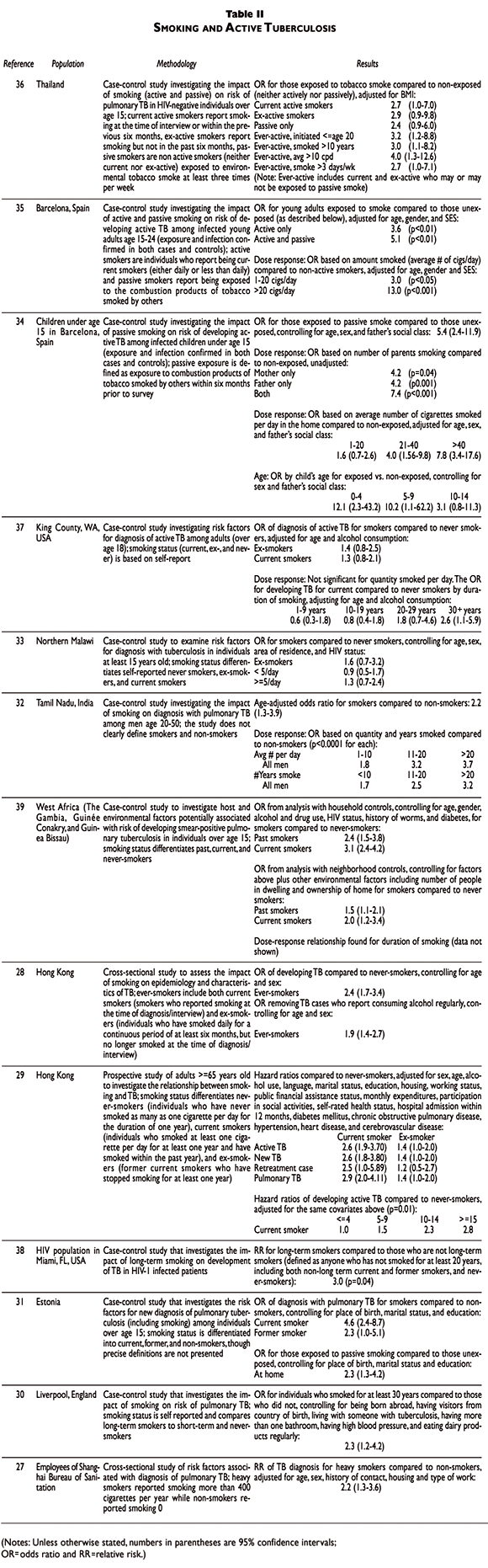
<body><![CDATA[<p><font size="2" face="Verdana"> The purpose of this paper is to present findings    on the association between smoking and TB from both developed and developing    countries around the world, published since 1988. This review is much more up-to-date    and complete than existing reviews.<SUP>2,20-22</SUP> </font></p>     <p><font size="2" face="Verdana"> Epidemiological studies fall into four categories    based on the TB outcome they consider: the first section (Smoking and mortality    from TB) reviews what is known about the association between TB mortality and    smoking, the second section (Smoking and active TB) reviews the association    between development of TB disease and smoking, the third section (Smoking and    tuberculin skin test reactivity) reviews the association between infection with    <I>M. tuberculosis</I> and smoking, and the fourth section (Smoking, characteristics    of TB, and treatment outcomes) reviews the impact of smoking on characteristics    of TB and outcomes. Because such factors as genetic susceptibility and environmental    characteristics (for example crowding, climate, or exposure to environmental    mycobacterium) are likely to affect the strength of the association between    smoking and TB, reviews are further categorized by country and/or subpopulation    studied. </font></p>     <p>&nbsp;</p>     <p><font size="3" face="Verdana"><b>Methods </b></font></p>     <p><font size="2" face="Verdana">The terms "tuberculosis" and either    "tobacco" or "smoking" were used to search the Pubmed database    for relevant literature published after 1988. Pubmed is a service of the U.S.    National Library of Medicine that includes all citations from MEDLINE and other    sources (<a href="http://www.ncbi.nlm.nih.gov/entrez/query.fcgi" target="_blank">http://www.ncbi.nlm.nih.gov/entrez/query.fcgi</a>).    Relevant references from articles obtained in this way were also reviewed. A    total of 34 relevant articles were identified; the research design, definition    of smoking utilized, and findings were reviewed for each. When possible relative    risk (RR) and odds ratio (OR) values are presented with 95% confidence intervals    –and presented as RR/OR (95% confidence inverval). When confidence intervals    are unavailable, p-values are presented (and labeled). Reviewed studies are    summarized alphabetically by first author in each section, see <a href="#tab01">tables    I-IV</a>.</font></p>     <p><a name="tab01"></a></p>     <p>&nbsp;</p>     <p align="center"><img src="/img/revistas/spm/v48s1/a24tab01.gif"></p>     <p>&nbsp;</p>     <p>&nbsp;</p>     ]]></body>
<body><![CDATA[<p align="center"><img src="/img/revistas/spm/v48s1/a24tab02.gif"></p>     <p>&nbsp;</p>     <p><a name="tab03"></a></p>     <p>&nbsp;</p>     <p align="center"><img src="/img/revistas/spm/v48s1/a24tab03.gif"></p>     <p>&nbsp;</p>     <p>&nbsp;</p>     <p align="center"><img src="/img/revistas/spm/v48s1/a24tab04.gif"></p>     <p>&nbsp;</p>     <p><font size="2" face="Verdana"><b>Epidemiological Evidence </b></font></p>     ]]></body>
<body><![CDATA[<p><font size="2" face="Verdana"><i>Smoking and mortality from TB </i></font></p>     <p><font size="2" face="Verdana"><I>China.</i>Interested in the impact of tobacco    use on mortality in mainland China, researchers conducted a large case control    study in 24 Chinese cities and 74 randomly selected rural counties.<SUP>23</SUP>    Men and women aged 35-69 who died in any of the study areas between 1986 and    1988 were eligible for inclusion. The study included 3 374 urban males, 4 542    rural males, 1 598 urban females, and 2 652 rural females who died from respiratory    TB. Controls were 30 709 urban male, 22 046 rural male, 21 171 urban female,    and 13 389 rural female individuals who died of other causes, and for whom smoking    habits before 1980 (6-8 years prior to death) could be obtained. Both current    and former smokers were defined as smokers, though very little smoking cessation    occurred in the study population. Adjusting for age at death and study area    (a proxy for SES since individuals are roughly homogenous by SES within study    areas), ever-smokers were more likely to die of TB than never-smokers in both    urban and rural settings. Further, greater average daily quantity of cigarettes    and earlier age of initiation were found to correlate with greater risk of death    of respiratory TB in men. </font></p>     <p><font size="2" face="Verdana"> A case-control study was conducted to assess    the mortality associated with smoking in Hong Kong.<SUP>24</SUP> Cases were    all deaths (with known cause) of ethnic Chinese individuals over age 35 between    mid-December 1997 and mid-January 1999 for whom a lifestyle survey was completed    by the person registering the death (27 507 cases). Controls were living males    in the household who were over age 35 and not the person responding to the lifestyle    survey (13 054 controls). Smokers were defined as individuals who were ever    smokers (current or former) 10 years prior to death. There were 135 total TB    deaths. Adjusting for age and education, ever-smokers of all ages are more likely    to die of respiratory TB, though the increase is risk is greater among 35-69    year olds than it is among individuals over age 70. Further, a significant dose-response    relationship was found for men in both age groups; the more cigarettes smoked    per day, the higher was the risk of dying from respiratory TB. </font></p>     <p><font size="2" face="Verdana"><I>India. </I>Researchers conducted a retrospective    case-control study in a large urban area (Chennai, population four million)    and rural areas (2 000 villages in the district of Vilippuram, population 2.5    million) in the state of Tamil Nadu.<SUP>3</SUP> Cases were individuals who    died of medical causes during the survey period and whose family was available    for interview to determine the individual's smoking behavior (16 076 males aged    25-69 in the urban area and 10 121 in the rural area). There were 16 488 urban    and 13 363 rural male controls aged 25-69 who were living members of households    where a death was reported during the survey period. Urban deaths were tracked    between 1995-1997, and rural deaths between 1997 and 1998. All analyses were    standardized for age, education level and tobacco chewing. Ever-smokers –of    both cigarettes and bidis in urban and rural environments– were significantly    (and substantially) more likely to die of TB than never-smokers. A majority    of TB deaths were determined to be associated with smoking (that is, attributed    to individuals' smoking behavior) –61% of urban and 56% of rural TB deaths.    Though the excess mortality from TB was significant throughout all age groups,    no clear pattern in relative risk by age was apparent. </font></p>     <p><font size="2" face="Verdana"> Researchers conducted a cohort study in the    densely populated city of Mumbai to estimate tobacco-associated mortality.<SUP>25</SUP>    Sampling from voter registration lists (oversampling low to middle-income areas),    99 570 individuals at least 35 years of age were interviewed in their homes    between February 1992 and May 1994. Between 1997 and 1999, 97 244 individuals    (97.7%) were reinterviewed, and cause of death information was obtained for    5 470. Tobacco use status, ascertained in the first wave of data collection,    was broken down into three mutually exclusive categories: current and former    users of smokeless tobacco only, current and former smokers (cigarettes and    bidis, may also use smokeless tobacco products), and lifetime never users. Both    female and male ever-tobacco users were more likely to die of TB than female    and male never-tobacco users (based on unadjusted estimation of relative risk).    </font></p>     <p><font size="2" face="Verdana"><I>South Africa. </I>To investigate the impact    of smoking on mortality in South Africa, researchers conducted a case-control    study.<SUP>26</SUP> Starting in October 1998, all local Departments of Home    Affairs submitted their first 200 death notifications. Of these (n=16 230),    analysis was conducted on 5 340 notifications for persons over age 25 of known    gender and smoking status. Individuals were considered smokers if a close family    member informant reported that the individual was a smoker five years prior    to death. A total of 414 cases died from TB. Controls (n=1 124) were deaths    from causess believed to be unrelated to smoking. Death notifications were excluded    for: ill-defined causes, death due to causes strongly associated with alcohol,    and death from external causes. Standardizing for age, education, population    group, and sex, smokers were more likely to die of TB than non-smokers. In this    population, more smoking-attributed deaths involved TB than lung cancer (87    and 57, respectively), and an estimated 20% of TB deaths were attributable to    smoking (based on attributable fraction percent calculation). </font></p>     <p><font size="2" face="Verdana"><i>Smoking and active TB </i></font></p>     <p><font size="2" face="Verdana"><I>China.</i>Researchers in Shanghai conducted    a cross-sectional study of risk factors associated with the development of TB    among employees of the Shanghai Bureau of Sanitation.<SUP>27</SUP> Data come    from a routine mass screening of the Bureau's employees, conducted between December    1985 and February 1986. Of the 30 289 employees screened, 202 were found to    have pulmonary TB. Adjusting for age, sex, history of contact, area of housing    and type of work, heavy smokers were more likely to be diagnosed with pulmonary    TB than non-smokers. Smoking accounted for observed differences in TB risk for    men and adults age 50 and older. </font></p>     <p><font size="2" face="Verdana"> Researchers in Hong Kong assessed the impact    of smoking on the epidemiology and clinical presentation of TB.<SUP>28</SUP>    TB notifications were obtained from four chest clinics and two clustered chest    hospitals in Hong Kong (26.6% of the total notifications in 1996 from all of    Hong Kong, n=851). Smoking history and clinical characteristics were obtained    from medical records. Current smokers reported smoking at the time of diagnosis,    and ex-smokers had smoked daily for a continuous period of at least six months,    but no longer smoked at the time of diagnosis. These two groups comprised the    ever-smokers. Population smoking prevalence rates (based on similar definitions)    were obtained from the General Household Survey carried out in 1996 (a population    survey of 3 024 households). Standardizing for age and sex, the odds ratio for    ever-smokers compared to never-smokers of developing TB was estimated as the    ratio of the prevalence of smoking among the TB cases to the prevalence of smoking    in the population. Ever-smokers were significantly more likely to develop TB    than never-smokers. Because alcohol consumption data were not available in the    General Household Survey, investigators recomputed the odds ratio above excluding    TB cases who were regular alcohol users. Ever-smoking remained significantly    related to risk of developing TB. The authors found that although smoking prevalence    varied substantially between age and gender groups, the odds ratio of developing    disease for ever-smokers compared to never-smokers did not. </font></p>     <p><font size="2" face="Verdana"> A prospective study among a group of adults    at least 65 years old was conducted to investigate the relationship between    smoking and TB.<SUP>29</SUP> A cohort of 42 655 clients who registered with    Hong Kong's Elderly Health Service in 2000 was followed prospectively through    the TB notification registry through 2002. Of these, 286 incident cases of TB    were notified and full data were available. Never-smokers were individuals who    had never smoked as many as one cigarette per day for the duration of one year.    Ever-smokers had smoked at least one cigarette per day for at least one year,    and ex-smokers were ever-smokers who had stopped smoking for at least one year.    Current smokers were ever-smokers who had smoked within the past year. Of the    232 patients agreeing to voluntary HIV testing, only one patient was found to    be HIV-positive. Hazard ratios were adjusted for sex, age, alcohol use, language,    marital status, education, housing, working status, public financial assistance    status, monthly expenditures, participation in social activities, self-rated    health status, hospital admission within 12 months, diabetes mellitus, chronic    obstructive pulmonary disease, hypertension, heart disease, and cerebrovascular    disease. Compared to never-smokers, ex-smokers and current smokers were significantly    more likely to develop active TB, to have culture-confirmed TB, to have new    TB (that is, first incidence of disease), to be a retreatment TB case, and,    to have pulmonary involvement. A statistically significant dose-response relationship    was found for number of cigarettes smoked per day. As much as 44.9% of the sex-related    difference in TB rates in this cohort can be attributed to smoking; smoking    was responsible for 32.8%, 8.6%, and 18.7% of TB risk among males, females,    and the entire cohort, respectively (based on population attributable risk calculation).    </font></p>     ]]></body>
<body><![CDATA[<p><font size="2" face="Verdana"><I>England. </I>Researchers in Liverpool conducted    a case-control survey to investigate lifestyle risk factors associated with    diagnosis of pulmonary TB.<SUP>30</SUP> Cases were 112 individuals diagnosed    with pulmonary TB. Controls were 198 individuals who were not tuberculin reactive    and were matched to cases by street-based postcode, sex, date of birth (within    three years), and ethnic origin. Individuals who reported smoking for at least    30 years were found to be significantly more likely to acquire pulmonary TB    than those who did not smoke for at least 30 years, controlling for being born    abroad, having visitors from country of birth, living with someone with TB,    having more than one bathroom (proxy for SES), having high blood pressure, and    eating dairy products regularly. Alcohol consumption was not found to be associated    with pulmonary TB in univariate analysis. </font></p>     <p><font size="2" face="Verdana"><I>Estonia. </I>Researchers conducted a case-control    study to investigate risk factors for pulmonary TB.<SUP>31</SUP> Cases were    adults (over age 15) newly diagnosed with pulmonary TB at a hospital in Tallinn    between January 1999 and June 2000 (n=248). Controls were randomly selected    from the Estonian Population Registry in July 2000, and were individually matched    to cases by sex, year of birth, and county of residence (n=248). Controls reporting    a history of TB were excluded. Both passive and active exposure was found to    relate to the risk of pulmonary TB, after adjusting for place of birth, marital    status, and education. </font></p>     <p><font size="2" face="Verdana"><I>India.</I> A group of researchers conducted    a case-control study to investigate the association between smoking and diagnosis    with pulmonary TB.<SUP>32</SUP> Cases and controls were drawn from a survey    of all persons, that was carried out in 30 villages from two areas of the Tiruvallur    district of Tamil Nadu between 1993 and 1996. As smoking is extremely rare among    Indian women, the study was restricted to men. Cases were men age 20-50 diagnosed    with pulmonary TB. For every case, five men age 20-50 who tested negative for    pulmonary TB were selected from the same village as controls. Tobacco use was    ascertained by survey in 1998; 76% of cases completed the tobacco use supplement,    as did 83% of the controls, giving a sample of 85 cases and 459 controls. It    is not clear, however, whether self-reported "smokers" included former    or just current smokers, and what question was used to determine smoking status.    Analysis was adjusted for age, and claimed that individuals from the rural villages    surveyed were homogenous with respect to socio-demographic characteristics.    Adjusting for age, smokers were more likely to develop TB, and this risk increased    significantly with both increased average quantity smoked per day and duration    of smoking. </font></p>     <p><font size="2" face="Verdana"><I>Malawi. </I>In northern Malawi, investigators    conducted a case-control study to examine risk factors for development of TB.<SUP>33</SUP>    Cases were individuals with at least one smear or culture positive for acid-fast    bacilli (AFB) and no previous TB, at least 15 years old, and diagnosed between    November 1996 and September 2001 (n=598). Controls were selected randomly from    the population to have an age, sex, and area distribution similar to the cases,    and no history of TB (n=992). Controlling for age, sex, area of residence, and    HIV status, smokers were not found to have a significantly different risk of    being diagnosed with TB than nonsmokers. The authors suggested this finding    may in part be due to the small sample of individuals with heavy exposure. In    the entire study, only seven individuals smoked at least 20 cigarettes per day    on average; six of these are cases. </font></p>     <p><font size="2" face="Verdana"><I>Spain. </I>A case-control study was conducted    in Barcelona to investigate the impact of passive smoking on children under    age 15 who had been infected with <I>M. tuberculosis</I>.<SUP>34</SUP> Data    were collected during 1992; cases and controls came from homes where one individual    was diagnosed with pulmonary TB with positive sputum smear for AFB (the index).    Cases were children diagnosed with pulmonary TB (n=93). Controls were tuberculin-reactive    children with no evidence of pulmonary TB (n=95). Care was taken to ensure that    tuberculin reaction was not due to BCG vaccination. Assay of urinary cotinine    concentration was used as an objective biomarker of exposure. Children were    excluded if they: smoked; had previous history of tuberculosis infection or    disease; had prior exposure to another index case; lived in an institution;    or, had concurrent diagnosis of conditions identified as risk factors for TB,    such as HIV infection, diabetes, or any other immuno-suppressing condition.    Passive exposure was defined as exposure to combustion products of tobacco smoked    by others within six months prior to survey. Adjusting for age, sex and father's    social class, children exposed to passive smoke were more likely to develop    pulmonary TB. The impact of passive smoke was stronger on younger children.    Further, a dose-response relationship was found for both the number of smokers    in the household and the average number of cigarettes smoked per day in the    household. </font></p>     <p><font size="2" face="Verdana"> The same group in Barcelona, using essentially    the same methodology, conducted another study to investigate the impact of active    and passive smoking among young adults on diagnosis of pulmonary TB.<SUP>35</SUP>    Forty-six cases age 15 to 24 who lived in a household with another infectious    individual (index) were found to be tuberculin reactive and were diagnosed with    pulmonary TB. Forty-six controls age 15 to 24 who were similarly exposed to    an index case were also found to be tuberculin reactive but free of pulmonary    TB. Daily smokers reported smoking a tobacco product every day at the time of    the survey, while occasional smokers smoked a tobacco product less than once    a day on average. A non-smoker did not smoke at all at the time of the study    or in the six months before the index case was diagnosed. Controlling for social    class, age, and gender, development of TB given tuberculin reactivity was found    to be associated with active smoking. Further, a dose-response relationship    was found for quantity smoked per day. </font></p>     <p><font size="2" face="Verdana"><I>Thailand. </I>A case-control study was conducted    to investigate the association between active and passive smoking and TB.<SUP>36</SUP>    Cases were individuals at least 15 years old who were newly diagnosed with pulmonary    TB between May and October 2001, and controls were age-sex matched individuals    without TB recruited from a local hospital and/or outpatient clinic during the    same period. All participants were HIV- and DM-negative. Individuals with other    lung diseases as indicated by physical examination and X-ray were excluded,    resulting in 100 cases and 100 controls. Nonsmokers were persons who had never    smoked (based on self-report) and were exposed to second-hand smoke less than    three times per week. Current active smokers smoked at the time of the study    or stopped smoking within six months (ex-active smokers quit at least six months    prior). Passive smokers were non-active smokers exposed to tobacco smoke either    at home, work, or in public places at least three times per week. Controlling    for age, sex, and BMI, current active, ex-active, and passive smokers were more    likely to be diagnosed with TB than nonsmokers, though the increase is only    statistically significant for current active smokers. There was a significant    dose-response relationship for both duration of smoking and quantity smoked    (both cigarettes per day and number of days per week). Type of cigarette smoked    (non-filtered/hand rolled or filtered) was not associated with risk of TB. Interestingly,    passive smokers exposed outside the household were more likely to develop pulmonary    TB than passive smokers exposed only within the household (who were not found    to have a significant difference in risk of developing TB than nonsmokers).    </font></p>     <p><font size="2" face="Verdana"><I>United States. </I>Researchers in Washington    conducted a case-control study to identify risk factors for TB.<SUP>37</SUP>    A total of 151 cases were diagnosed with TB in the Seattle/King County Tuberculosis    Clinic between 1988 and 1990 and were found to be competent for study, over    age 18, and never previously diagnosed or treated. A total of 545 controls were    also screened at the clinic, and found not to have TB. After adjusting for age,    age squared, and alcohol consumption, ex-smokers and current smokers were more    likely to be diagnosed with TB than never smokers (no statistically significant).    No significant dose-response relationship was found for number of cigarettes    smoked per day, but a significant dose-response relationship was found for duration    of smoking. </font></p>     <p><font size="2" face="Verdana"> A group of researchers sought to understand    the impact of smoking on the development of opportunistic respiratory infection    (including TB) in HIV-1 infected patients.<SUP>38</SUP> Out of 259 HIV-1 infected    subjects participating in a nutritional chemoprevention trial in Miami, Florida    who were followed between 1998 and 2000, 12 developed TB. These 12 cases were    compared to 27 controls with no history of respiratory infection, matched on    age, gender, race, SES, and HIV status. Long-term smokers (smoke for 20 years    or more) were more likely to develop TB than non long-term smokers. Lower CD4    cell counts were found in the cases as compared to the controls. </font></p>     <p><font size="2" face="Verdana"><I>West Africa. </I>A case-control study was    conducted to investigate host and environmental-related factors believed to    be associated with pulmonary TB.<SUP>39</SUP> Cases were individuals over age    15 attending urban health centers in The Gambia, Guin&eacute;e Conakry, and    Guinea Bissau, with confirmed smear-positive pulmonary TB. For each case, two    controls were selected: a healthy control within each case's household (687    case-control pairs), and a healthy community control within each case's neighborhood    (816 case-control pairs). All controls were age matched to within ten years    of the case. Based on analysis of cases and household controls and controlling    for age, gender, marital status, family history of TB, alcohol consumption,    drug use, BCG scar, HIV status, history of worms, and diabetes status, current    and past smokers were found to be significantly more likely to develop smear-positive    pulmonary TB than never-smokers. And, based on analysis of cases and neighborhood    controls, controlling for the covariates included above and environmental factors    including the number of households in the dwelling, the number of people in    the household, the number of adults in the household, occupation, and ownership    of house, current and past smokers were found to be significantly more likely    to develop smear-positive pulmonary TB than never smokers. A clear dose-response    relationship was found in terms of duration of smoking (data not shown). </font></p>     ]]></body>
<body><![CDATA[<p><font size="2" face="Verdana"><I>Smoking and tuberculin skin test reactivity    </i></font></p>     <p><font size="2" face="Verdana"><I>England.</i> A cross-sectional study was conducted    to estimate the association between tuberculin reactivity (based on tuberculin    skin test, TST) and length of time spent in a residential home for the elderly.<SUP>40</SUP>    All individuals residing in residential homes in Liverpool between January and    June 1990 were given a tuberculin test and were asked about their smoking status.    Heaf test positivity was stronger in current than in ex- and never-smokers.    Further, heaf test positivity was directly related to number of pack-years smoked<a name="tx01"></a><a href="#nt01"><sup>*</sup></a>    for both current and ex-smokers. </font></p>     <p><font size="2" face="Verdana"><I>Kuwait. </I>Researchers investigated tuberculin    reactivity among adults with and without pulmonary TB.<SUP>41</SUP> Cases were    patients admitted to Chest Hospital Kuwait for treatment for TB (n=200). Controls    were drawn randomly from the population of individuals attending routine residency    screening for employment (n=357). Individuals were excluded from the study if    they were ex-smokers, HIV patients, or immunosuppressed due to long-term systemic    steroids. Smoking was associated with induration (an indication of infection    with <I>M. tuberculosis</I>) among controls, but was not found to be significantly    different between smoking and non-smoking TB patients (who were known to be    infected). Non-parametric analysis further demonstrated a significant correlation    between induration and pack-years smoked among controls. </font></p>     <p><font size="2" face="Verdana"><I>Pakistan. </I>A cross-sectional study was    conducted to assess the risk of <I>M. tuberculosis</I> infection and associated    risk factors among prisoners.<SUP>42</SUP> A random sample of 18 to 60 year-old    men imprisoned between July and September 2002 in the five central prisons in    the North West Frontier Province was included in the study (n=425). Prisoners    were excluded if they were sentenced to death, in solitary confinement, or within    the first three months of their prison term. TST was conducted, and an induration    of at least 10 mm in BCG unvaccinated prisoners and at least 15 mm in BCG vaccinated    prisoners was the cutpoint for infection. There was a significant dose-response    relationship between the number of cigarettes smoked and risk of infection,    controlling for age, education, duration of incarceration, and type of accommodation.    </font></p>     <p><font size="2" face="Verdana"><I>South Africa</I>. Researchers in Cape Town    estimated the association between infection with <I>M. tuberculosis</I> and    smoking in a high TB incidence area.<SUP>43</SUP> A total of 2 328 adults over    age 15 were interviewed at random in a cross-sectional population survey, and    underwent a TST. Smoking was defined as having ever smoked for at least one    year. The authors concluded that income did not confound the interaction between    smoking and infection; after controlling for age and sex, smoking was associated    with <I>M. tuberculosis</I> infection (defined as at least 10 mm induration).    No statistically significant dose-response relationship for pack-years smoked    was found. </font></p>     <p><font size="2" face="Verdana"><I>Spain. </I>Researchers estimated the prevalence    of and risk factors for <I>M. tuberculosis</I> infection among the homeless    in Barcelona.<SUP>44</SUP> Between January 1997 and December 1998, 447 individuals    admitted to homeless shelters or soup kitchens were tested for TST reactivity    and active disease. Individuals who reported smoking more than 10 cigarettes    per day on average were considered smokers. Controlling for age, sex, and regular    alcohol consumption, smokers were more likely to be TST reactive (induration    of at least 5 mm) than nonsmokers. </font></p>     <p><font size="2" face="Verdana"><I>United States. </I>Researchers investigated    tuberculin reactivity among Hispanic migrant workers in California.<SUP>45</SUP>    A total of 296 workers staying at either of the two Yolo County housing centers    were interviewed and given a TST between July and September 1995. Controlling    for age, gender, and location of birth (in versus outside of the United States),    former smokers were significantly more likely to be infected (induration of    at least 10 mm) than migrant workers who had never smoked, though current smokers    were not significantly more likely to be infected. </font></p>     <p><font size="2" face="Verdana"> A case-control study was conducted in South    Carolina to estimate the impact of smoking on TST conversion (reacting to TST    after previously not, a condition indicative of recent infection).<SUP>46</SUP>    A total of 1245 inmates met the following inclusion criteria: from one of 11    correctional facilities in South Carolina, age 17-54 in 1990, admitted between    January 1982 and December 1989, demonstrated to be TST non-reactive when incarcerated    and tested again in 1990, and still incarcerated in 1992. Of these inmates,    116 who were TST converters (cases) and 177 race-matched non-converters (controls)    were interviewed about their smoking status. TST-reaction was defined as at    least 10 mm induration in HIV-negative and at least 5 mm induration in HIV-positive    inmates. Potential confounding variables investigated included: exposure to    an infectious case, length of time living in a high risk environment, age, race,    gender, MBI, education, employment history, use of alcohol or drugs, history    of silicosis, diabetes status, HIV status, history of cancer, and utilization    of immunosuppressive therapy. The authors controlled for variables they believed    to be potential confounders (<a href="#tab03">Table 3</a>). Current smokers    were not statistically significantly more likely to convert than never and ex-smokers.    A dose-response relationship was found for both quantity currently and formerly    smoked and risk of conversion, though these were also not statistically significant.    However, a statistically significant dose-response relationship was found for    duration of smoking. </font></p>     <p><font size="2" face="Verdana"><I>Vietnamese migrants. </I>To investigate predictors    of tuberculin reactivity, between January 1997 and June 1999, prospective Vietnamese    migrants to Australia were recruited from a pre-departure standardized medical    screening program.<SUP>47</SUP> A total of 1395 participants completed a TST    and structured interview including questions about socio-demographic indicators,    living situation, and smoking behavior. Socio-demographic characteristics other    than age and gender were not found to be significantly associated with tuberculin    reactivity. Controlling for age, age squared, and gender, ever-smokes were significantly    more likely to be tuberculin-reactive (induration of at least 10 mm) than those    who never smoked, and this risk increased with duration of smoking. Quitting    at least 10 years prior was associated with a decreased risk of induration,    though this finding was not statistically significant. No significant dose-response    relationship was found for average quantity smoked per day. </font></p>     <p><font size="2" face="Verdana"><I>Smoking, characteristics of TB, and treatment    outcomes </i></font></p>     ]]></body>
<body><![CDATA[<p><font size="2" face="Verdana"><I>China. </i>Investigators in Hong Kong conducted    a nested case-control study to assess the risk factors for defaulting from anti-TB    treatment under a directly observed treatment program.<SUP>48</SUP> All patients    registered at government chest clinics between January and March 1999 (excluding    those who died or were transferred out) were included. Default was defined as    failure to collect drugs for at least two months after registration, and three    non-defaulting controls (n=306) were age and sex-matched to each defaulting    case (n=102). Controlling for status as new or retreatment case, unsatisfactory    adherence in the first 2 months, subsequent hospitalization, and treatment side    effects in the last month of treatment, current smokers were significantly more    likely to default than never-smokers, though ex-smokers were not significantly    more likely to do so. Alcohol consumption, although correlated with smoking    status, was not found to be associated with treatment default in univariate    analysis. </font></p>     <p><font size="2" face="Verdana"> In addition to estimating the association between    smoking and diagnosis with TB (summarized above), Leung et al.<SUP>28</SUP>    assessed the impact of smoking on characteristics of TB. Controlling for sex,    age, working status at onset of disease, history of narcotic abuse, co-existing    medical illness and the absence of contact history within five years in logistic    regression, ever-smoking TB cases were significantly more likely to present    with a cough and difficult or labored breathing, and less likely to present    with only extrathoracic TB than never-smoking TB cases. They were significantly    more likely to have upper-zone involvement, cavitation<U>,</U> involvement,    and a positive sputum culture than never-smoking TB cases. </font></p>     <p><font size="2" face="Verdana"><I>India. </I>A study conducted in the Tiruvallur    District, Tamil Nadu, sought to understand the risk factors associated with    relapse among patients who successfully completed treatment under DOTS and were    considered "cured" (that is, smear-negative post treatment).<SUP>49</SUP>    This prospective study followed a cohort of new smear-positive pulmonary TB    patients registered for DOTS between April 2000 and December 2001. Field workers    collected sputum samples at 6, 12 and 18 months post completion of treatment.    Relapse was defined as a patient "cured" under DOTS who had either    two separate sputum samples positive for AFB (including at least one positive    culture). Controlling for initial drug resistance, alcoholism, and treatment    irregularity smokers (habitual and current) were significantly more likely to    relapse than nonsmokers. </font></p>     <p><font size="2" face="Verdana"> An earlier study in the same district assessed    risk factors associated with treatment default, treatment failure, and death    among TB patients treated in a DOTS program.<SUP>50</SUP> A total of 581 patients    who registered for anti-TB treatment in 209 villages and nine urban centers    in the state of Tamil Nadu between May 1999 and April 2000 were included in    analysis. Data do not show a clear association between smoking and treatment    default when controlling for age, sex, previous treatment, pulmonary status,    and alcoholism. However, the test is not very powerful given the small sample    size and high correlation between smoking status and sex in this population.    There is an association between smoking and both treatment default and failure    (remaining sputum-positive after 3 months of treatment) based on univariate    analysis. Smoking was not associated with risk of death from TB. </font></p>     <p><font size="2" face="Verdana"><I>Saudi Arabia. </I>Researchers investigated    risk factors associated with treatment compliance in a non-DOTS population.<SUP>52</SUP>    Of 628 patients diagnosed with active TB in a large hospital in Saudi Arabia    during 1996, 358 failed to attend their first appointment post discharge. Of    these, attempts to bring the patient back to continue treatment by phone and    visit by social worker failed for 275 patients. The characteristics of these    patients, defined as non-compliant, were compared to the compliant patients.    Based on univariate analysis, smokers were found to be significantly more likely    to be non-compliant with treatment than nonsmokers. </font></p>     <p><font size="2" face="Verdana"><I>Spain. </I>A retrospective cross-sectional    study was conducted in Catalu&ntilde;a, to establish whether there were differences    in the characteristics and outcomes of TB experienced by smokers and nonsmokers.<SUP>53</SUP>    A total of 13 038 cases of TB were diagnosed in individuals over age 14 between    January 1996 and December 2002. Patients who smoked at the time of diagnosis    (or within days of diagnosis) were defined as smokers. After controlling for    age, sex, alcohol consumption, and intra-venous drug use, smokers were significantly    more likely to have cavitary lesions, positive bacilloscopy, and pulmonary TB    than nonsmokers. After controlling for age, sex, alcohol consumption, and disease    site, smokers were significantly more likely to be hospitalized, and to be hospitalized    an average of 9.4 days longer than nonsmokers. Smokers did not take longer to    get diagnosed than nonsmokers, however their disease appeared to have progressed    faster upon diagnosis. Smokers were not significantly more likely to die from    TB. The authors also found that male smokers smoked twice as much as female    smokers, likely accounting for a substantial portion of the significant gender    effects in the analysis. </font></p>     <p><font size="2" face="Verdana"><I>Turkey. </I>A cross-sectional study was conducted    in Istanbul to compare factors influencing TB site.<SUP>54</SUP> Participants    were all individuals over age 12 treated at the Istanbul University Cerrahpasa    Medical Faculty Pulmonology Department Tuberculosis Polyclinic between May 1997    and August 2004, who did not have both pulmonary and extrapulmonary TB, miliary    or primary TB (n=375, all HIV-negative). Controlling for gender, history of    contact, diabetes status, and alcohol use, individuals with a history of smoking    (current or former) were significantly less likely to develop extrapulmonary    (versus pulmonary) TB than never smokers. </font></p>     <p><font size="2" face="Verdana"> Another cross-sectional study was conducted    in Duzce to investigate risk factors for non-adherence to TB treatment in a    population without DOTS.<SUP>55</SUP> A total of 154 patients at least 16 years    old who were diagnosed with drug-sensitive TB between October 1998 and October    2003 were included in the study. Non-adherent patients were those who: failed    to keep clinic appointments for at least two consecutive months, failed to keep    three or more monthly visits in the course of one year, or refused treatment    from the start. Controlling for age, gender, occurrence of family screening,    whether the case was new or a relapse, smear status, or the presence of cough,    hemoptysis, or cavity, nonsmokers were significantly more likely to adhere to    treatment. </font></p>     <p><font size="2" face="Verdana"><I>United States. </I>In a trial to investigate    the impact of incentives on treatment compliance, researchers in New York City    assessed risk factors for adherence.<SUP>56</SUP> A total of 365 patients from    six directly observed therapy centers who received treatment between 1992 and    1996 were included in analysis. Adherent patients were defined as those who    attended 80% of their prescribed visits every month during the course of their    treatment.<SUP>57</SUP> Based on univariate analysis, self-reported smokers    were found to be significantly less likely to adhere than non-smokers. Smoking    was not associated with differential odds of adherence based on incentives.    </font></p>     <p>&nbsp;</p>     ]]></body>
<body><![CDATA[<p><font size="3" face="Verdana"><b>Discussion </b></font></p>     <p><font size="2" face="Verdana">Taken together, evidence indicates that smoking    (both current and former, passive and active) is associated with: risk of being    infected with <I>M. tuberculosis</I>, risk of developing TB, risk of developing    more severe TB, and risk of dying of TB. In many cases, there is also statistically    significant and strong dose-response relationship between these risks and smoking    –both in terms of average quantity smoked and number of years smoked. These    relationships are not explained away by controlling for such potentially confounding    variables as age, gender, alcohol consumption, and HIV status. Do feasible physiological    mechanisms exist, further supporting the causal nature of these associations?    Indeed they do, and are just now becoming better understood. The specific mechanisms    are likely to involve both structural changes affecting lung function and altered    immune response.<SUP>2</SUP> </font></p>     <p><font size="2" face="Verdana"> As discussed in the Introduction, these two    epidemics –tobacco and TB– are on a collision course. Understanding the impact    of smoking on TB outcomes is critically important if we want to control TB.    More work needs to be done to further elucidate the mechanisms underlying the    impact of smoking on TB, so we know how best to intervene with policy. We need    to know whether quitting smoking reduces TB risks. We need to educate the public    and practitioners about this association. And because smoking is a substantial    risk factor for treatment default, we need to address this risk factor –because    treatment default leads to drug resistance, a condition that is much more expensive    and difficult to treat. </font></p>     <p>&nbsp;</p>     <p><font size="3" face="Verdana"><b>References </b></font></p>     <!-- ref --><p><font size="2" face="Verdana">1. Doll R, Peto R, Wheatley K, Gray R, Sutherland    I. Mortality in relation to smoking: 40 years' observations on male British    doctors. BMJ 1994;309:901-911. </font>&nbsp;&nbsp;&nbsp;&nbsp;&nbsp;&nbsp;&nbsp;&nbsp;[&#160;<a href="javascript:void(0);" onclick="javascript: window.open('/scielo.php?script=sci_nlinks&ref=9269819&pid=S0036-3634200600070002400001&lng=','','width=640,height=500,resizable=yes,scrollbars=1,menubar=yes,');">Links</a>&#160;]<!-- end-ref --><!-- ref --><p><font size="2" face="Verdana">2. Arcavi L, Benowitz NL. Cigarette smoking and    infection. Arch Intern Med 2004;164:2206-2216. </font>&nbsp;&nbsp;&nbsp;&nbsp;&nbsp;&nbsp;&nbsp;&nbsp;[&#160;<a href="javascript:void(0);" onclick="javascript: window.open('/scielo.php?script=sci_nlinks&ref=9269820&pid=S0036-3634200600070002400002&lng=','','width=640,height=500,resizable=yes,scrollbars=1,menubar=yes,');">Links</a>&#160;]<!-- end-ref --><!-- ref --><p><font size="2" face="Verdana">3. Gajalakshmi V, Peto R, Kanaka TS, Jha P. Smoking    and mortality from tuberculosis and other diseases in India: retrospective study    of 43000 adult male deaths and 35000 controls. Lancet 2003;362:507-515. </font>&nbsp;&nbsp;&nbsp;&nbsp;&nbsp;&nbsp;&nbsp;&nbsp;[&#160;<a href="javascript:void(0);" onclick="javascript: window.open('/scielo.php?script=sci_nlinks&ref=9269821&pid=S0036-3634200600070002400003&lng=','','width=640,height=500,resizable=yes,scrollbars=1,menubar=yes,');">Links</a>&#160;]<!-- end-ref --><!-- ref --><p><font size="2" face="Verdana">4. Dye C. Epidemiology. In: Davies PDO, ed. Clinical    tuberculosis. 3<SUP>rd </SUP>ed. London: Arnold, 2003. 21-42. </font>&nbsp;&nbsp;&nbsp;&nbsp;&nbsp;&nbsp;&nbsp;&nbsp;[&#160;<a href="javascript:void(0);" onclick="javascript: window.open('/scielo.php?script=sci_nlinks&ref=9269822&pid=S0036-3634200600070002400004&lng=','','width=640,height=500,resizable=yes,scrollbars=1,menubar=yes,');">Links</a>&#160;]<!-- end-ref --><!-- ref --><p><font size="2" face="Verdana">5. World Health Organization. Mental health:    new understanding, new hope. World Health Report 2001. Geneva: WHO, 2001. </font>&nbsp;&nbsp;&nbsp;&nbsp;&nbsp;&nbsp;&nbsp;&nbsp;[&#160;<a href="javascript:void(0);" onclick="javascript: window.open('/scielo.php?script=sci_nlinks&ref=9269823&pid=S0036-3634200600070002400005&lng=','','width=640,height=500,resizable=yes,scrollbars=1,menubar=yes,');">Links</a>&#160;]<!-- end-ref --><!-- ref --><p><font size="2" face="Verdana">6. Dye C, Scheele S, Dolin P, Pathania V, Raviglione    MC. Consensus statement. Global burden of tuberculosis: estimated incidence,    prevalence, and mortality by country. WHO Global Surveillance and Monitoring    Project. JAMA 1999;282:677-686. </font>&nbsp;&nbsp;&nbsp;&nbsp;&nbsp;&nbsp;&nbsp;&nbsp;[&#160;<a href="javascript:void(0);" onclick="javascript: window.open('/scielo.php?script=sci_nlinks&ref=9269824&pid=S0036-3634200600070002400006&lng=','','width=640,height=500,resizable=yes,scrollbars=1,menubar=yes,');">Links</a>&#160;]<!-- end-ref --><!-- ref --><p><font size="2" face="Verdana">7. Raviglione MC, Snider DE, Jr., Kochi A. Global    epidemiology of tuberculosis. Morbidity and mortality of a worldwide epidemic.    JAMA 1995;273:220-226. </font>&nbsp;&nbsp;&nbsp;&nbsp;&nbsp;&nbsp;&nbsp;&nbsp;[&#160;<a href="javascript:void(0);" onclick="javascript: window.open('/scielo.php?script=sci_nlinks&ref=9269825&pid=S0036-3634200600070002400007&lng=','','width=640,height=500,resizable=yes,scrollbars=1,menubar=yes,');">Links</a>&#160;]<!-- end-ref --><!-- ref --><p><font size="2" face="Verdana">8. Styblo K. Epidemiology of tuberculosis. In:    Broekmans JS, editor. Selected papers. The Hague, The Netherlands: Royal Netherlands    Tuberculosis Association, 1991: 1-136. </font>&nbsp;&nbsp;&nbsp;&nbsp;&nbsp;&nbsp;&nbsp;&nbsp;[&#160;<a href="javascript:void(0);" onclick="javascript: window.open('/scielo.php?script=sci_nlinks&ref=9269826&pid=S0036-3634200600070002400008&lng=','','width=640,height=500,resizable=yes,scrollbars=1,menubar=yes,');">Links</a>&#160;]<!-- end-ref --><!-- ref --><p><font size="2" face="Verdana">9. Vynnycky E, Fine PE. Lifetime risks, incubation    period, and serial interval of tuberculosis. Am J Epidemiol 2000;152:247-263.    </font>&nbsp;&nbsp;&nbsp;&nbsp;&nbsp;&nbsp;&nbsp;&nbsp;[&#160;<a href="javascript:void(0);" onclick="javascript: window.open('/scielo.php?script=sci_nlinks&ref=9269827&pid=S0036-3634200600070002400009&lng=','','width=640,height=500,resizable=yes,scrollbars=1,menubar=yes,');">Links</a>&#160;]<!-- end-ref --><!-- ref --><p><font size="2" face="Verdana">10. Guindon GE, Boisclair D. Past, Current and    Future Trends in Tobacco Use. Economics of Tobacco Control. Washington, D.C.:    World Health Organization, 2003. </font>&nbsp;&nbsp;&nbsp;&nbsp;&nbsp;&nbsp;&nbsp;&nbsp;[&#160;<a href="javascript:void(0);" onclick="javascript: window.open('/scielo.php?script=sci_nlinks&ref=9269828&pid=S0036-3634200600070002400010&lng=','','width=640,height=500,resizable=yes,scrollbars=1,menubar=yes,');">Links</a>&#160;]<!-- end-ref --><!-- ref --><p><font size="2" face="Verdana">11. Mackay J, Eriksen M. The Tobacco Atlas. Geneva,    Switzerland: World Health Organization 2002 </font>&nbsp;&nbsp;&nbsp;&nbsp;&nbsp;&nbsp;&nbsp;&nbsp;[&#160;<a href="javascript:void(0);" onclick="javascript: window.open('/scielo.php?script=sci_nlinks&ref=9269829&pid=S0036-3634200600070002400011&lng=','','width=640,height=500,resizable=yes,scrollbars=1,menubar=yes,');">Links</a>&#160;]<!-- end-ref --><!-- ref --><p><font size="2" face="Verdana">12. Kaufman NJ, Nichter M. The marketing of tobacco    to women: Global perspectives. In: Samet JK, Yoon SY. Women and the tobacco    epidemic: challenges for the 21st century. Geneva: World Health Organization,    2001:69-98 </font>&nbsp;&nbsp;&nbsp;&nbsp;&nbsp;&nbsp;&nbsp;&nbsp;[&#160;<a href="javascript:void(0);" onclick="javascript: window.open('/scielo.php?script=sci_nlinks&ref=9269830&pid=S0036-3634200600070002400012&lng=','','width=640,height=500,resizable=yes,scrollbars=1,menubar=yes,');">Links</a>&#160;]<!-- end-ref --><!-- ref --><p><font size="2" face="Verdana">13. Slama K. Current challenges in tobacco control.    Int J Tuberc Lung Dis 2004;8:1160-1172. </font>&nbsp;&nbsp;&nbsp;&nbsp;&nbsp;&nbsp;&nbsp;&nbsp;[&#160;<a href="javascript:void(0);" onclick="javascript: window.open('/scielo.php?script=sci_nlinks&ref=9269831&pid=S0036-3634200600070002400013&lng=','','width=640,height=500,resizable=yes,scrollbars=1,menubar=yes,');">Links</a>&#160;]<!-- end-ref --><!-- ref --><p><font size="2" face="Verdana">14. Adelstein AM, Rimington J. Smoking and pulmonary    tuberculosis: an analysis based on a study of volunteers for mass miniature    radiography. Tubercle 1967;48:219-226. </font>&nbsp;&nbsp;&nbsp;&nbsp;&nbsp;&nbsp;&nbsp;&nbsp;[&#160;<a href="javascript:void(0);" onclick="javascript: window.open('/scielo.php?script=sci_nlinks&ref=9269832&pid=S0036-3634200600070002400014&lng=','','width=640,height=500,resizable=yes,scrollbars=1,menubar=yes,');">Links</a>&#160;]<!-- end-ref --><!-- ref --><p><font size="2" face="Verdana">15. Edwards JH. Contribution of cigarette smoking    to respiratory disease. Br J Prev Soc Med 1957;11:10-21. </font>&nbsp;&nbsp;&nbsp;&nbsp;&nbsp;&nbsp;&nbsp;&nbsp;[&#160;<a href="javascript:void(0);" onclick="javascript: window.open('/scielo.php?script=sci_nlinks&ref=9269833&pid=S0036-3634200600070002400015&lng=','','width=640,height=500,resizable=yes,scrollbars=1,menubar=yes,');">Links</a>&#160;]<!-- end-ref --><!-- ref --><p><font size="2" face="Verdana">16. Lowe CR. An association between smoking and    respiratory tuberculosis. Br Med J 1956;2:1081-1086. </font>&nbsp;&nbsp;&nbsp;&nbsp;&nbsp;&nbsp;&nbsp;&nbsp;[&#160;<a href="javascript:void(0);" onclick="javascript: window.open('/scielo.php?script=sci_nlinks&ref=9269834&pid=S0036-3634200600070002400016&lng=','','width=640,height=500,resizable=yes,scrollbars=1,menubar=yes,');">Links</a>&#160;]<!-- end-ref --><!-- ref --><p><font size="2" face="Verdana">17. Kuemmerer JM, Comstock GW. Sociologic concomitants    of tuberculin sensitivity. Am Rev Respir Dis 1967;96:885-892. </font>&nbsp;&nbsp;&nbsp;&nbsp;&nbsp;&nbsp;&nbsp;&nbsp;[&#160;<a href="javascript:void(0);" onclick="javascript: window.open('/scielo.php?script=sci_nlinks&ref=9269835&pid=S0036-3634200600070002400017&lng=','','width=640,height=500,resizable=yes,scrollbars=1,menubar=yes,');">Links</a>&#160;]<!-- end-ref --><!-- ref --><p><font size="2" face="Verdana">18. Brown KE, Campbell AH. Tobacco, alcohol and    tuberculosis. Brit J Dis Chest 1961;55:150-158. </font>&nbsp;&nbsp;&nbsp;&nbsp;&nbsp;&nbsp;&nbsp;&nbsp;[&#160;<a href="javascript:void(0);" onclick="javascript: window.open('/scielo.php?script=sci_nlinks&ref=9269836&pid=S0036-3634200600070002400018&lng=','','width=640,height=500,resizable=yes,scrollbars=1,menubar=yes,');">Links</a>&#160;]<!-- end-ref --><!-- ref --><p><font size="2" face="Verdana">19. Lewis JG, Chamberlain DA. Alcohol consumption    and smoking habits in male patients with pulmonary tuberculosis. Brit J Prev    Soc Med 1963;17:149-152. </font>&nbsp;&nbsp;&nbsp;&nbsp;&nbsp;&nbsp;&nbsp;&nbsp;[&#160;<a href="javascript:void(0);" onclick="javascript: window.open('/scielo.php?script=sci_nlinks&ref=9269837&pid=S0036-3634200600070002400019&lng=','','width=640,height=500,resizable=yes,scrollbars=1,menubar=yes,');">Links</a>&#160;]<!-- end-ref --><!-- ref --><p><font size="2" face="Verdana">20. Davies PD, Yew WW, Ganguly D, <I>et al</I>.    Smoking and tuberculosis: the epidemiological association and immunopathogenesis.    Trans R Soc Trop Med Hyg 2006;100:291-298. </font>&nbsp;&nbsp;&nbsp;&nbsp;&nbsp;&nbsp;&nbsp;&nbsp;[&#160;<a href="javascript:void(0);" onclick="javascript: window.open('/scielo.php?script=sci_nlinks&ref=9269838&pid=S0036-3634200600070002400020&lng=','','width=640,height=500,resizable=yes,scrollbars=1,menubar=yes,');">Links</a>&#160;]<!-- end-ref --><!-- ref --><p><font size="2" face="Verdana">21. Yach D, Hawkes C, Epping-Jordan JE, Galbraith    S. The World Health Organization's Framework Convention on Tobacco Control:    implications for global epidemics of food-related deaths and disease. J Public    Health Policy 2003;24:274-290. </font>&nbsp;&nbsp;&nbsp;&nbsp;&nbsp;&nbsp;&nbsp;&nbsp;[&#160;<a href="javascript:void(0);" onclick="javascript: window.open('/scielo.php?script=sci_nlinks&ref=9269839&pid=S0036-3634200600070002400021&lng=','','width=640,height=500,resizable=yes,scrollbars=1,menubar=yes,');">Links</a>&#160;]<!-- end-ref --><!-- ref --><p><font size="2" face="Verdana">22. Maurya V, Vijayan VK, Shah A. Smoking and    tuberculosis: an association overlooked. Int J Tuberc Lung Dis 2002;6:942-951.    </font>&nbsp;&nbsp;&nbsp;&nbsp;&nbsp;&nbsp;&nbsp;&nbsp;[&#160;<a href="javascript:void(0);" onclick="javascript: window.open('/scielo.php?script=sci_nlinks&ref=9269840&pid=S0036-3634200600070002400022&lng=','','width=640,height=500,resizable=yes,scrollbars=1,menubar=yes,');">Links</a>&#160;]<!-- end-ref --><!-- ref --><p><font size="2" face="Verdana">23. Liu BQ, Peto R, Chen ZM, <I>et al</I>. Emerging    tobacco hazards in China: 1. Retrospective proportional mortality study of one    million deaths. BMJ 1998;317:1411-1422. </font>&nbsp;&nbsp;&nbsp;&nbsp;&nbsp;&nbsp;&nbsp;&nbsp;[&#160;<a href="javascript:void(0);" onclick="javascript: window.open('/scielo.php?script=sci_nlinks&ref=9269841&pid=S0036-3634200600070002400023&lng=','','width=640,height=500,resizable=yes,scrollbars=1,menubar=yes,');">Links</a>&#160;]<!-- end-ref --><!-- ref --><p><font size="2" face="Verdana">24. Lam TH, Ho SY, Hedley AJ, Mak KH, Peto R.    Mortality and smoking in Hong Kong: case-control study of all adult deaths in    1998. BMJ 2001;323:361-362. </font>&nbsp;&nbsp;&nbsp;&nbsp;&nbsp;&nbsp;&nbsp;&nbsp;[&#160;<a href="javascript:void(0);" onclick="javascript: window.open('/scielo.php?script=sci_nlinks&ref=9269842&pid=S0036-3634200600070002400024&lng=','','width=640,height=500,resizable=yes,scrollbars=1,menubar=yes,');">Links</a>&#160;]<!-- end-ref --><!-- ref --><p><font size="2" face="Verdana">25. Gupta PC, Pednekar MS, Parkin DM, Sankaranarayanan    R. Tobacco associated mortality in Mumbai (Bombay) India. Results of the Bombay    Cohort Study. Int J Epidemiol 2005; 34(6): 1395-1402. </font>&nbsp;&nbsp;&nbsp;&nbsp;&nbsp;&nbsp;&nbsp;&nbsp;[&#160;<a href="javascript:void(0);" onclick="javascript: window.open('/scielo.php?script=sci_nlinks&ref=9269843&pid=S0036-3634200600070002400025&lng=','','width=640,height=500,resizable=yes,scrollbars=1,menubar=yes,');">Links</a>&#160;]<!-- end-ref --><!-- ref --><p><font size="2" face="Verdana">26. Sitas F, Urban M, Bradshaw D, Kielkowski    D, Bah S, Peto R. Tobacco attributable deaths in South Africa. Tob Control 2004;13:396-399.    </font>&nbsp;&nbsp;&nbsp;&nbsp;&nbsp;&nbsp;&nbsp;&nbsp;[&#160;<a href="javascript:void(0);" onclick="javascript: window.open('/scielo.php?script=sci_nlinks&ref=9269844&pid=S0036-3634200600070002400026&lng=','','width=640,height=500,resizable=yes,scrollbars=1,menubar=yes,');">Links</a>&#160;]<!-- end-ref --><!-- ref --><p><font size="2" face="Verdana">27. Yu GP, Hsieh CC, J P. Risk factors associated    with the prevalence of pulmonary tuberculosis among sanitary workers in Shanghai.    Tubercle 1988;69:105-112. </font>&nbsp;&nbsp;&nbsp;&nbsp;&nbsp;&nbsp;&nbsp;&nbsp;[&#160;<a href="javascript:void(0);" onclick="javascript: window.open('/scielo.php?script=sci_nlinks&ref=9269845&pid=S0036-3634200600070002400027&lng=','','width=640,height=500,resizable=yes,scrollbars=1,menubar=yes,');">Links</a>&#160;]<!-- end-ref --><!-- ref --><p><font size="2" face="Verdana">28. Leung CC, Yew WW, Chan CK, <I>et al</I>.    Smoking and tuberculosis in Hong Kong. Int J Tuberc Lung Dis 2003;7:980-986.    </font>&nbsp;&nbsp;&nbsp;&nbsp;&nbsp;&nbsp;&nbsp;&nbsp;[&#160;<a href="javascript:void(0);" onclick="javascript: window.open('/scielo.php?script=sci_nlinks&ref=9269846&pid=S0036-3634200600070002400028&lng=','','width=640,height=500,resizable=yes,scrollbars=1,menubar=yes,');">Links</a>&#160;]<!-- end-ref --><!-- ref --><p><font size="2" face="Verdana">29. Leung CC, Li T, Lam TH, <I>et al</I>. Smoking    and Tuberculosis among the Elderly in Hong Kong. Am J Respir Crit Care Med 2004;170:1027-1033.    </font>&nbsp;&nbsp;&nbsp;&nbsp;&nbsp;&nbsp;&nbsp;&nbsp;[&#160;<a href="javascript:void(0);" onclick="javascript: window.open('/scielo.php?script=sci_nlinks&ref=9269847&pid=S0036-3634200600070002400029&lng=','','width=640,height=500,resizable=yes,scrollbars=1,menubar=yes,');">Links</a>&#160;]<!-- end-ref --><!-- ref --><p><font size="2" face="Verdana">30. Tocque K, Bellis MA, Beeching NJ, Syed Q,    Remmington T, Davies PD. A case-control study of lifestyle risk factors associated    with tuberculosis in Liverpool, North-West England. Eur Respir J 2001;18:959-964.    </font>&nbsp;&nbsp;&nbsp;&nbsp;&nbsp;&nbsp;&nbsp;&nbsp;[&#160;<a href="javascript:void(0);" onclick="javascript: window.open('/scielo.php?script=sci_nlinks&ref=9269848&pid=S0036-3634200600070002400030&lng=','','width=640,height=500,resizable=yes,scrollbars=1,menubar=yes,');">Links</a>&#160;]<!-- end-ref --><!-- ref --><p><font size="2" face="Verdana">31. Tekkel M, Rahu M, Loit HM, Baburin A. Risk    factors for pulmonary tuberculosis in Estonia. Int J Tuberc Lung Dis 2002;6:887-894.    </font>&nbsp;&nbsp;&nbsp;&nbsp;&nbsp;&nbsp;&nbsp;&nbsp;[&#160;<a href="javascript:void(0);" onclick="javascript: window.open('/scielo.php?script=sci_nlinks&ref=9269849&pid=S0036-3634200600070002400031&lng=','','width=640,height=500,resizable=yes,scrollbars=1,menubar=yes,');">Links</a>&#160;]<!-- end-ref --><!-- ref --><p><font size="2" face="Verdana">32. Kolappan C, Gopi PG. Tobacco smoking and    pulmonary tuberculosis. Thorax 2002;57:964-966. </font>&nbsp;&nbsp;&nbsp;&nbsp;&nbsp;&nbsp;&nbsp;&nbsp;[&#160;<a href="javascript:void(0);" onclick="javascript: window.open('/scielo.php?script=sci_nlinks&ref=9269850&pid=S0036-3634200600070002400032&lng=','','width=640,height=500,resizable=yes,scrollbars=1,menubar=yes,');">Links</a>&#160;]<!-- end-ref --><!-- ref --><p><font size="2" face="Verdana">33. Crampin AC, Glynn JR, Floyd S, <I>et al</I>.    Tuberculosis and gender: exploring the patterns in a case control study in Malawi.    Int J Tuberc Lung Dis 2004;8:194-203. </font>&nbsp;&nbsp;&nbsp;&nbsp;&nbsp;&nbsp;&nbsp;&nbsp;[&#160;<a href="javascript:void(0);" onclick="javascript: window.open('/scielo.php?script=sci_nlinks&ref=9269851&pid=S0036-3634200600070002400033&lng=','','width=640,height=500,resizable=yes,scrollbars=1,menubar=yes,');">Links</a>&#160;]<!-- end-ref --><!-- ref --><p><font size="2" face="Verdana">34. Altet MN, Alcaide J, Plans P, <I>et al</I>.    Passive smoking and risk of pulmonary tuberculosis in children immediately following    infection. A case-control study. Tuber Lung Dis 1996;77:537-544. </font>&nbsp;&nbsp;&nbsp;&nbsp;&nbsp;&nbsp;&nbsp;&nbsp;[&#160;<a href="javascript:void(0);" onclick="javascript: window.open('/scielo.php?script=sci_nlinks&ref=9269852&pid=S0036-3634200600070002400034&lng=','','width=640,height=500,resizable=yes,scrollbars=1,menubar=yes,');">Links</a>&#160;]<!-- end-ref --><!-- ref --><p><font size="2" face="Verdana">35. Alcaide J, Altet MN, Plans P, <I>et al</I>.    Cigarette smoking as a risk factor for tuberculosis in young adults: a case-control    study. Tuber Lung Dis. 1996;77:112-116. </font>&nbsp;&nbsp;&nbsp;&nbsp;&nbsp;&nbsp;&nbsp;&nbsp;[&#160;<a href="javascript:void(0);" onclick="javascript: window.open('/scielo.php?script=sci_nlinks&ref=9269853&pid=S0036-3634200600070002400035&lng=','','width=640,height=500,resizable=yes,scrollbars=1,menubar=yes,');">Links</a>&#160;]<!-- end-ref --><!-- ref --><p><font size="2" face="Verdana">36. Ariyothai N, Podhipak A, Akarasewi P, Tornee    S, Smithtikarn S, Thongprathum P. Cigarette smoking and its relation to pulmonary    tuberculosis in adults. Southeast Asian J Trop Med Public Health 2004;35:219-227.</font>&nbsp;&nbsp;&nbsp;&nbsp;&nbsp;&nbsp;&nbsp;&nbsp;[&#160;<a href="javascript:void(0);" onclick="javascript: window.open('/scielo.php?script=sci_nlinks&ref=9269854&pid=S0036-3634200600070002400036&lng=','','width=640,height=500,resizable=yes,scrollbars=1,menubar=yes,');">Links</a>&#160;]<!-- end-ref --><!-- ref --><p><font size="2" face="Verdana"> 37. Buskin SE, Gale JL, Weiss NS, Nolan CM.    Tuberculosis risk factors in adults in King County, Washington, 1988 through    1990. Am J Pub Health 1994;84:1750-1756. </font>&nbsp;&nbsp;&nbsp;&nbsp;&nbsp;&nbsp;&nbsp;&nbsp;[&#160;<a href="javascript:void(0);" onclick="javascript: window.open('/scielo.php?script=sci_nlinks&ref=9269855&pid=S0036-3634200600070002400037&lng=','','width=640,height=500,resizable=yes,scrollbars=1,menubar=yes,');">Links</a>&#160;]<!-- end-ref --><!-- ref --><p><font size="2" face="Verdana">38. Miguez-Burbano MJ, Burbano X, Ashkin D, <I>et    al</I>. Impact of tobacco use on the development of opportunistic respiratory    infections in HIV seropositive patients on antiretroviral therapy. Addict Biol    2003;8:39-43. </font>&nbsp;&nbsp;&nbsp;&nbsp;&nbsp;&nbsp;&nbsp;&nbsp;[&#160;<a href="javascript:void(0);" onclick="javascript: window.open('/scielo.php?script=sci_nlinks&ref=9269856&pid=S0036-3634200600070002400038&lng=','','width=640,height=500,resizable=yes,scrollbars=1,menubar=yes,');">Links</a>&#160;]<!-- end-ref --><!-- ref --><p><font size="2" face="Verdana">39. Lienhardt C, Fielding K, Sillah J, et al.    Investigation of the risk factors for tuberculosis: a case-control study in    three countries in West Africa. Int J Epidemiol 2005;34:914-923. </font>&nbsp;&nbsp;&nbsp;&nbsp;&nbsp;&nbsp;&nbsp;&nbsp;[&#160;<a href="javascript:void(0);" onclick="javascript: window.open('/scielo.php?script=sci_nlinks&ref=9269857&pid=S0036-3634200600070002400039&lng=','','width=640,height=500,resizable=yes,scrollbars=1,menubar=yes,');">Links</a>&#160;]<!-- end-ref --><!-- ref --><p><font size="2" face="Verdana">40. Nisar M, Williams CSD, Ashby D, Davies PD.    Tuberculin testing in residential homes for the elderly. Thorax 1993;48:1257-1260.    </font>&nbsp;&nbsp;&nbsp;&nbsp;&nbsp;&nbsp;&nbsp;&nbsp;[&#160;<a href="javascript:void(0);" onclick="javascript: window.open('/scielo.php?script=sci_nlinks&ref=9269858&pid=S0036-3634200600070002400040&lng=','','width=640,height=500,resizable=yes,scrollbars=1,menubar=yes,');">Links</a>&#160;]<!-- end-ref --><!-- ref --><p><font size="2" face="Verdana">41. Abal AT, Nair PC, Sugathan TN, Pawar S. Influence    of smoking on cutaneous delayed-type hyper sensitivity reaction by tuberculin    skin test. Respir Med 2003;97:672-675. </font>&nbsp;&nbsp;&nbsp;&nbsp;&nbsp;&nbsp;&nbsp;&nbsp;[&#160;<a href="javascript:void(0);" onclick="javascript: window.open('/scielo.php?script=sci_nlinks&ref=9269859&pid=S0036-3634200600070002400041&lng=','','width=640,height=500,resizable=yes,scrollbars=1,menubar=yes,');">Links</a>&#160;]<!-- end-ref --><!-- ref --><p><font size="2" face="Verdana">42. Hussain H, Akhtar S, Nanan D. Prevalence    of and risk factors associated with Mycobacterium tuberculosis infection in    prisoners, North West Frontier Province, Pakistan. Int J Epidemiol 2003;32:794-799.    </font>&nbsp;&nbsp;&nbsp;&nbsp;&nbsp;&nbsp;&nbsp;&nbsp;[&#160;<a href="javascript:void(0);" onclick="javascript: window.open('/scielo.php?script=sci_nlinks&ref=9269860&pid=S0036-3634200600070002400042&lng=','','width=640,height=500,resizable=yes,scrollbars=1,menubar=yes,');">Links</a>&#160;]<!-- end-ref --><!-- ref --><p><font size="2" face="Verdana">43. den Boon S, van Lill SW, Borgdorff MW, et    al. Association between smoking and tuberculosis infection: a population survey    in a high tuberculosis incidence area. Thorax 2005;60:555-557. </font>&nbsp;&nbsp;&nbsp;&nbsp;&nbsp;&nbsp;&nbsp;&nbsp;[&#160;<a href="javascript:void(0);" onclick="javascript: window.open('/scielo.php?script=sci_nlinks&ref=9269861&pid=S0036-3634200600070002400043&lng=','','width=640,height=500,resizable=yes,scrollbars=1,menubar=yes,');">Links</a>&#160;]<!-- end-ref --><!-- ref --><p><font size="2" face="Verdana">44. Solsona J, Cayla JA, Nadal J, et al. Screening    for tuberculosis upon admission to shelters and free-meal services. Eur J Epidemiol    2001;17:123-128. </font>&nbsp;&nbsp;&nbsp;&nbsp;&nbsp;&nbsp;&nbsp;&nbsp;[&#160;<a href="javascript:void(0);" onclick="javascript: window.open('/scielo.php?script=sci_nlinks&ref=9269862&pid=S0036-3634200600070002400044&lng=','','width=640,height=500,resizable=yes,scrollbars=1,menubar=yes,');">Links</a>&#160;]<!-- end-ref --><!-- ref --><p><font size="2" face="Verdana">45. McCurdy SA, Arretz DS, Bates RO. Tuberculin    reactivity among California Hispanic migrant farm workers. Amer J Indust Med    1997;32:600-605. </font>&nbsp;&nbsp;&nbsp;&nbsp;&nbsp;&nbsp;&nbsp;&nbsp;[&#160;<a href="javascript:void(0);" onclick="javascript: window.open('/scielo.php?script=sci_nlinks&ref=9269863&pid=S0036-3634200600070002400045&lng=','','width=640,height=500,resizable=yes,scrollbars=1,menubar=yes,');">Links</a>&#160;]<!-- end-ref --><!-- ref --><p><font size="2" face="Verdana">46. Anderson RH, Sy FS, Thompson S, Addy C. Cigarette    smoking and tuberculin skin test conversion among incarcerated adults. Am J    Prev Med 1997;13:175-181. </font>&nbsp;&nbsp;&nbsp;&nbsp;&nbsp;&nbsp;&nbsp;&nbsp;[&#160;<a href="javascript:void(0);" onclick="javascript: window.open('/scielo.php?script=sci_nlinks&ref=9269864&pid=S0036-3634200600070002400046&lng=','','width=640,height=500,resizable=yes,scrollbars=1,menubar=yes,');">Links</a>&#160;]<!-- end-ref --><!-- ref --><p><font size="2" face="Verdana">47. Plant AJ, Watkins RE, Gushulak B, et al.    Predictors of tuberculin reactivity among prospective Vietnamese migrants: the    effect of smoking. Epidemiol Infect 2002;128:37-45. </font>&nbsp;&nbsp;&nbsp;&nbsp;&nbsp;&nbsp;&nbsp;&nbsp;[&#160;<a href="javascript:void(0);" onclick="javascript: window.open('/scielo.php?script=sci_nlinks&ref=9269865&pid=S0036-3634200600070002400047&lng=','','width=640,height=500,resizable=yes,scrollbars=1,menubar=yes,');">Links</a>&#160;]<!-- end-ref --><!-- ref --><p><font size="2" face="Verdana">48. Chang KC, Leung CC, Tam CM. Risk factors    for defaulting from anti-tuberculosis treatment under directly observed treatment    in Hong Kong. Int J Tuberc Lung Dis 2004;8:1492-1498. </font>&nbsp;&nbsp;&nbsp;&nbsp;&nbsp;&nbsp;&nbsp;&nbsp;[&#160;<a href="javascript:void(0);" onclick="javascript: window.open('/scielo.php?script=sci_nlinks&ref=9269866&pid=S0036-3634200600070002400048&lng=','','width=640,height=500,resizable=yes,scrollbars=1,menubar=yes,');">Links</a>&#160;]<!-- end-ref --><!-- ref --><p><font size="2" face="Verdana">49. Thomas A, Gopi PG, Santha T, et al. Predictors    of relapse among pulmonary tuberculosis patients treated in a DOTS programme    in South India. Int J Tuberc Lung Dis 2005;9:556-561. </font>&nbsp;&nbsp;&nbsp;&nbsp;&nbsp;&nbsp;&nbsp;&nbsp;[&#160;<a href="javascript:void(0);" onclick="javascript: window.open('/scielo.php?script=sci_nlinks&ref=9269867&pid=S0036-3634200600070002400049&lng=','','width=640,height=500,resizable=yes,scrollbars=1,menubar=yes,');">Links</a>&#160;]<!-- end-ref --><!-- ref --><p><font size="2" face="Verdana">50. Santha T, Renu G, Frieden TR, et al. Are    community surveys to detect tuberculosis in high prevalence areas useful? Results    of a comparative study from Tiruvallur District, South India. Int J Tuberc Lung    Dis 2002;7:258-265. </font>&nbsp;&nbsp;&nbsp;&nbsp;&nbsp;&nbsp;&nbsp;&nbsp;[&#160;<a href="javascript:void(0);" onclick="javascript: window.open('/scielo.php?script=sci_nlinks&ref=9269868&pid=S0036-3634200600070002400050&lng=','','width=640,height=500,resizable=yes,scrollbars=1,menubar=yes,');">Links</a>&#160;]<!-- end-ref --><!-- ref --><p><font size="2" face="Verdana">51. Organization World Health. Revised international    definitions in tuberculosis control. Int J Tuberc Lung Dis 2001;5:213-215. </font>&nbsp;&nbsp;&nbsp;&nbsp;&nbsp;&nbsp;&nbsp;&nbsp;[&#160;<a href="javascript:void(0);" onclick="javascript: window.open('/scielo.php?script=sci_nlinks&ref=9269869&pid=S0036-3634200600070002400051&lng=','','width=640,height=500,resizable=yes,scrollbars=1,menubar=yes,');">Links</a>&#160;]<!-- end-ref --><!-- ref --><p><font size="2" face="Verdana">52. Al-Hajjaj MS, Al-Khatim IM. High rate of    non-compliance with anti-tuberculosis treatment despite a retrieval system:    a call for implementation of directly observed therapy in Saudi Arabia. Int    J Tuberc Lung Dis. 2000;4:345-349. </font>&nbsp;&nbsp;&nbsp;&nbsp;&nbsp;&nbsp;&nbsp;&nbsp;[&#160;<a href="javascript:void(0);" onclick="javascript: window.open('/scielo.php?script=sci_nlinks&ref=9269870&pid=S0036-3634200600070002400052&lng=','','width=640,height=500,resizable=yes,scrollbars=1,menubar=yes,');">Links</a>&#160;]<!-- end-ref --><!-- ref --><p><font size="2" face="Verdana">53. Altet-G&oacute;mez MN, Alcaide J, Godoy P,    Romero MA, Hern&aacute;ndez del Rey I. Clinical and epidemiological aspects    of smoking and tuberculosis: a study of 13,038 cases. Int J Tuberc Lung Dis.    2005;9:430-436. </font>&nbsp;&nbsp;&nbsp;&nbsp;&nbsp;&nbsp;&nbsp;&nbsp;[&#160;<a href="javascript:void(0);" onclick="javascript: window.open('/scielo.php?script=sci_nlinks&ref=9269871&pid=S0036-3634200600070002400053&lng=','','width=640,height=500,resizable=yes,scrollbars=1,menubar=yes,');">Links</a>&#160;]<!-- end-ref --><!-- ref --><p><font size="2" face="Verdana">54. Musellim B, Erturan S, Sonmez Duman E, Ongen    G. Comparison of extra-pulmonary and pulmonary tuberculosis cases: factors influencing    the site of reactivation. Int J Tuberc Lung Dis. 2005;9:1220-1223. </font>&nbsp;&nbsp;&nbsp;&nbsp;&nbsp;&nbsp;&nbsp;&nbsp;[&#160;<a href="javascript:void(0);" onclick="javascript: window.open('/scielo.php?script=sci_nlinks&ref=9269872&pid=S0036-3634200600070002400054&lng=','','width=640,height=500,resizable=yes,scrollbars=1,menubar=yes,');">Links</a>&#160;]<!-- end-ref --><!-- ref --><p><font size="2" face="Verdana">55. Balbay O, Annakkaya AN, Arbak P, Bilgin C,    Erbas M. Which patients are able to adhere to tuberculosis treatment? A study    in a rural area in the northwest part of Turkey. Jpn J Infect Dis. 2005;58:152-158.    </font>&nbsp;&nbsp;&nbsp;&nbsp;&nbsp;&nbsp;&nbsp;&nbsp;[&#160;<a href="javascript:void(0);" onclick="javascript: window.open('/scielo.php?script=sci_nlinks&ref=9269873&pid=S0036-3634200600070002400055&lng=','','width=640,height=500,resizable=yes,scrollbars=1,menubar=yes,');">Links</a>&#160;]<!-- end-ref --><!-- ref --><p><font size="2" face="Verdana">56. Davidson H, Schluger NW, Feldman PH, Valentine    DP, Telzak EE, Laufer FN. The effects of increasing incentives on adherence    to tuberculosis directly observed therapy. Int J Tuberc Lung Dis. 2000;4:860-865.    </font>&nbsp;&nbsp;&nbsp;&nbsp;&nbsp;&nbsp;&nbsp;&nbsp;[&#160;<a href="javascript:void(0);" onclick="javascript: window.open('/scielo.php?script=sci_nlinks&ref=9269874&pid=S0036-3634200600070002400056&lng=','','width=640,height=500,resizable=yes,scrollbars=1,menubar=yes,');">Links</a>&#160;]<!-- end-ref --><!-- ref --><p><font size="2" face="Verdana">57. Combs DL, O'Brien RJ, Geiter LJ. USPHS Tuberculosis    short-course chemotherapy trial: effectiveness, toxicity, and acceptability.    Ann Intern Med. 1990;112:397-406. </font>&nbsp;&nbsp;&nbsp;&nbsp;&nbsp;&nbsp;&nbsp;&nbsp;[&#160;<a href="javascript:void(0);" onclick="javascript: window.open('/scielo.php?script=sci_nlinks&ref=9269875&pid=S0036-3634200600070002400057&lng=','','width=640,height=500,resizable=yes,scrollbars=1,menubar=yes,');">Links</a>&#160;]<!-- end-ref --><p>&nbsp;</p>     <p>&nbsp;</p>     <p><font size="2" face="Verdana">Accepted on: March 6, 2006. </font></p>     <p>&nbsp;</p>     <p>&nbsp;</p>     <p><font size="2" face="Verdana">Address reprint requests to: K.M. Hassmiller.    Department of Health Policy and Administration. UNC-CH School of Public Health.    1107 McGavran-Greenbrg, CB#7411. Chapel Hill, NC 27599-7411.    <br>   Email: <a href="mailto:khassmil@umich.edu">khassmil@umich.edu</a>    <br>   <a name="nt01"></a><a href="#tx01">*</a> A pack-year is the product of the average    number of cigarettes smoked per day and the number of years smoked divided by    20.</font></p>     ]]></body>
<body><![CDATA[ ]]></body><back>
<ref-list>
<ref id="B1">
<label>1</label><nlm-citation citation-type="journal">
<person-group person-group-type="author">
<name>
<surname><![CDATA[Doll]]></surname>
<given-names><![CDATA[R]]></given-names>
</name>
<name>
<surname><![CDATA[Peto]]></surname>
<given-names><![CDATA[R]]></given-names>
</name>
<name>
<surname><![CDATA[Wheatley]]></surname>
<given-names><![CDATA[K]]></given-names>
</name>
<name>
<surname><![CDATA[Gray]]></surname>
<given-names><![CDATA[R]]></given-names>
</name>
<name>
<surname><![CDATA[Sutherland]]></surname>
<given-names><![CDATA[I]]></given-names>
</name>
</person-group>
<article-title xml:lang="en"><![CDATA[Mortality in relation to smoking: 40 years' observations on male British doctors]]></article-title>
<source><![CDATA[BMJ]]></source>
<year>1994</year>
<volume>309</volume>
<page-range>901-911</page-range></nlm-citation>
</ref>
<ref id="B2">
<label>2</label><nlm-citation citation-type="journal">
<person-group person-group-type="author">
<name>
<surname><![CDATA[Arcavi]]></surname>
<given-names><![CDATA[L]]></given-names>
</name>
<name>
<surname><![CDATA[Benowitz]]></surname>
<given-names><![CDATA[NL]]></given-names>
</name>
</person-group>
<article-title xml:lang="en"><![CDATA[Cigarette smoking and infection]]></article-title>
<source><![CDATA[Arch Intern Med]]></source>
<year>2004</year>
<volume>164</volume>
<page-range>2206-2216</page-range></nlm-citation>
</ref>
<ref id="B3">
<label>3</label><nlm-citation citation-type="journal">
<person-group person-group-type="author">
<name>
<surname><![CDATA[Gajalakshmi]]></surname>
<given-names><![CDATA[V]]></given-names>
</name>
<name>
<surname><![CDATA[Peto]]></surname>
<given-names><![CDATA[R]]></given-names>
</name>
<name>
<surname><![CDATA[Kanaka]]></surname>
<given-names><![CDATA[TS]]></given-names>
</name>
<name>
<surname><![CDATA[Jha]]></surname>
<given-names><![CDATA[P]]></given-names>
</name>
</person-group>
<article-title xml:lang="en"><![CDATA[Smoking and mortality from tuberculosis and other diseases in India: retrospective study of 43000 adult male deaths and 35000 controls]]></article-title>
<source><![CDATA[Lancet]]></source>
<year>2003</year>
<volume>362</volume>
<page-range>507-515</page-range></nlm-citation>
</ref>
<ref id="B4">
<label>4</label><nlm-citation citation-type="book">
<person-group person-group-type="author">
<name>
<surname><![CDATA[Dye]]></surname>
<given-names><![CDATA[C]]></given-names>
</name>
</person-group>
<person-group person-group-type="editor">
<name>
<surname><![CDATA[Davies]]></surname>
<given-names><![CDATA[PDO]]></given-names>
</name>
</person-group>
<source><![CDATA[Clinical tuberculosis]]></source>
<year>2003</year>
<edition>3</edition>
<page-range>21-42</page-range><publisher-loc><![CDATA[London ]]></publisher-loc>
<publisher-name><![CDATA[Arnold]]></publisher-name>
</nlm-citation>
</ref>
<ref id="B5">
<label>5</label><nlm-citation citation-type="book">
<collab>World Health Organization</collab>
<source><![CDATA[Mental health: new understanding, new hope]]></source>
<year>2001</year>
<publisher-loc><![CDATA[Geneva ]]></publisher-loc>
<publisher-name><![CDATA[WHO]]></publisher-name>
</nlm-citation>
</ref>
<ref id="B6">
<label>6</label><nlm-citation citation-type="journal">
<person-group person-group-type="author">
<name>
<surname><![CDATA[Dye]]></surname>
<given-names><![CDATA[C]]></given-names>
</name>
<name>
<surname><![CDATA[Scheele]]></surname>
<given-names><![CDATA[S]]></given-names>
</name>
<name>
<surname><![CDATA[Dolin]]></surname>
<given-names><![CDATA[P]]></given-names>
</name>
<name>
<surname><![CDATA[Pathania]]></surname>
<given-names><![CDATA[V]]></given-names>
</name>
<name>
<surname><![CDATA[Raviglione]]></surname>
<given-names><![CDATA[MC]]></given-names>
</name>
</person-group>
<article-title xml:lang="en"><![CDATA[Consensus statement. Global burden of tuberculosis: estimated incidence, prevalence, and mortality by country]]></article-title>
<source><![CDATA[JAMA]]></source>
<year>1999</year>
<volume>282</volume>
<page-range>677-686</page-range></nlm-citation>
</ref>
<ref id="B7">
<label>7</label><nlm-citation citation-type="journal">
<person-group person-group-type="author">
<name>
<surname><![CDATA[Raviglione]]></surname>
<given-names><![CDATA[MC]]></given-names>
</name>
<name>
<surname><![CDATA[Snider]]></surname>
<given-names><![CDATA[DE, Jr]]></given-names>
</name>
<name>
<surname><![CDATA[Kochi]]></surname>
<given-names><![CDATA[A]]></given-names>
</name>
</person-group>
<article-title xml:lang="en"><![CDATA[Global epidemiology of tuberculosis: Morbidity and mortality of a worldwide epidemic]]></article-title>
<source><![CDATA[JAMA]]></source>
<year>1995</year>
<volume>273</volume>
<page-range>220-226</page-range></nlm-citation>
</ref>
<ref id="B8">
<label>8</label><nlm-citation citation-type="book">
<person-group person-group-type="author">
<name>
<surname><![CDATA[Styblo]]></surname>
<given-names><![CDATA[K]]></given-names>
</name>
</person-group>
<article-title xml:lang="en"><![CDATA[Epidemiology of tuberculosis]]></article-title>
<person-group person-group-type="editor">
<name>
<surname><![CDATA[Broekmans]]></surname>
<given-names><![CDATA[JS]]></given-names>
</name>
</person-group>
<source><![CDATA[Selected papers]]></source>
<year>1991</year>
<page-range>1-136</page-range><publisher-loc><![CDATA[The Hague ]]></publisher-loc>
<publisher-name><![CDATA[Royal Netherlands Tuberculosis Association]]></publisher-name>
</nlm-citation>
</ref>
<ref id="B9">
<label>9</label><nlm-citation citation-type="journal">
<person-group person-group-type="author">
<name>
<surname><![CDATA[Vynnycky]]></surname>
<given-names><![CDATA[E]]></given-names>
</name>
<name>
<surname><![CDATA[Fine]]></surname>
<given-names><![CDATA[PE]]></given-names>
</name>
</person-group>
<article-title xml:lang="en"><![CDATA[Lifetime risks, incubation period, and serial interval of tuberculosis]]></article-title>
<source><![CDATA[Am J Epidemiol]]></source>
<year>2000</year>
<volume>152</volume>
<page-range>247-263</page-range></nlm-citation>
</ref>
<ref id="B10">
<label>10</label><nlm-citation citation-type="book">
<person-group person-group-type="author">
<name>
<surname><![CDATA[Guindon]]></surname>
<given-names><![CDATA[GE]]></given-names>
</name>
<name>
<surname><![CDATA[Boisclair]]></surname>
<given-names><![CDATA[D]]></given-names>
</name>
</person-group>
<source><![CDATA[Past, Current and Future Trends in Tobacco Use: Economics of Tobacco Control]]></source>
<year>2003</year>
<publisher-loc><![CDATA[Washington, D.C. ]]></publisher-loc>
<publisher-name><![CDATA[World Health Organization]]></publisher-name>
</nlm-citation>
</ref>
<ref id="B11">
<label>11</label><nlm-citation citation-type="book">
<person-group person-group-type="author">
<name>
<surname><![CDATA[Mackay]]></surname>
<given-names><![CDATA[J]]></given-names>
</name>
<name>
<surname><![CDATA[Eriksen]]></surname>
<given-names><![CDATA[M]]></given-names>
</name>
</person-group>
<source><![CDATA[The Tobacco Atlas]]></source>
<year>2002</year>
<publisher-loc><![CDATA[Geneva ]]></publisher-loc>
<publisher-name><![CDATA[World Health Organization]]></publisher-name>
</nlm-citation>
</ref>
<ref id="B12">
<label>12</label><nlm-citation citation-type="book">
<person-group person-group-type="author">
<name>
<surname><![CDATA[Kaufman]]></surname>
<given-names><![CDATA[NJ]]></given-names>
</name>
<name>
<surname><![CDATA[Nichter]]></surname>
<given-names><![CDATA[M]]></given-names>
</name>
</person-group>
<article-title xml:lang="en"><![CDATA[The marketing of tobacco to women: Global perspectives]]></article-title>
<person-group person-group-type="editor">
<name>
<surname><![CDATA[Samet]]></surname>
<given-names><![CDATA[JK]]></given-names>
</name>
<name>
<surname><![CDATA[Yoon]]></surname>
<given-names><![CDATA[SY]]></given-names>
</name>
</person-group>
<source><![CDATA[Women and the tobacco epidemic: challenges for the 21st century]]></source>
<year>2001</year>
<page-range>69-98</page-range><publisher-loc><![CDATA[Geneva ]]></publisher-loc>
<publisher-name><![CDATA[World Health Organization]]></publisher-name>
</nlm-citation>
</ref>
<ref id="B13">
<label>13</label><nlm-citation citation-type="journal">
<person-group person-group-type="author">
<name>
<surname><![CDATA[Slama]]></surname>
<given-names><![CDATA[K]]></given-names>
</name>
</person-group>
<article-title xml:lang="en"><![CDATA[Current challenges in tobacco control]]></article-title>
<source><![CDATA[Int J Tuberc Lung Dis]]></source>
<year>2004</year>
<volume>8</volume>
<page-range>1160-1172</page-range></nlm-citation>
</ref>
<ref id="B14">
<label>14</label><nlm-citation citation-type="journal">
<person-group person-group-type="author">
<name>
<surname><![CDATA[Adelstein]]></surname>
<given-names><![CDATA[AM]]></given-names>
</name>
<name>
<surname><![CDATA[Rimington]]></surname>
<given-names><![CDATA[J]]></given-names>
</name>
</person-group>
<article-title xml:lang="en"><![CDATA[Smoking and pulmonary tuberculosis: an analysis based on a study of volunteers for mass miniature radiography]]></article-title>
<source><![CDATA[Tubercle]]></source>
<year>1967</year>
<volume>48</volume>
<page-range>219-226</page-range></nlm-citation>
</ref>
<ref id="B15">
<label>15</label><nlm-citation citation-type="journal">
<person-group person-group-type="author">
<name>
<surname><![CDATA[Edwards]]></surname>
<given-names><![CDATA[JH]]></given-names>
</name>
</person-group>
<article-title xml:lang="en"><![CDATA[Contribution of cigarette smoking to respiratory disease]]></article-title>
<source><![CDATA[Br J Prev Soc Med]]></source>
<year>1957</year>
<volume>11</volume>
<page-range>10-21</page-range></nlm-citation>
</ref>
<ref id="B16">
<label>16</label><nlm-citation citation-type="journal">
<person-group person-group-type="author">
<name>
<surname><![CDATA[Lowe]]></surname>
<given-names><![CDATA[CR]]></given-names>
</name>
</person-group>
<article-title xml:lang="en"><![CDATA[An association between smoking and respiratory tuberculosis]]></article-title>
<source><![CDATA[Br Med J]]></source>
<year>1956</year>
<volume>2</volume>
<page-range>1081-1086</page-range></nlm-citation>
</ref>
<ref id="B17">
<label>17</label><nlm-citation citation-type="journal">
<person-group person-group-type="author">
<name>
<surname><![CDATA[Kuemmerer]]></surname>
<given-names><![CDATA[JM]]></given-names>
</name>
<name>
<surname><![CDATA[Comstock]]></surname>
<given-names><![CDATA[GW]]></given-names>
</name>
</person-group>
<article-title xml:lang="en"><![CDATA[Sociologic concomitants of tuberculin sensitivity]]></article-title>
<source><![CDATA[Am Rev Respir Dis]]></source>
<year>1967</year>
<volume>96</volume>
<page-range>885-892</page-range></nlm-citation>
</ref>
<ref id="B18">
<label>18</label><nlm-citation citation-type="journal">
<person-group person-group-type="author">
<name>
<surname><![CDATA[Brown]]></surname>
<given-names><![CDATA[KE]]></given-names>
</name>
<name>
<surname><![CDATA[Campbell]]></surname>
<given-names><![CDATA[AH]]></given-names>
</name>
</person-group>
<article-title xml:lang="en"><![CDATA[Tobacco, alcohol and tuberculosis]]></article-title>
<source><![CDATA[Brit J Dis Chest]]></source>
<year>1961</year>
<volume>55</volume>
<page-range>150-158</page-range></nlm-citation>
</ref>
<ref id="B19">
<label>19</label><nlm-citation citation-type="journal">
<person-group person-group-type="author">
<name>
<surname><![CDATA[Lewis]]></surname>
<given-names><![CDATA[JG]]></given-names>
</name>
<name>
<surname><![CDATA[Chamberlain]]></surname>
<given-names><![CDATA[DA]]></given-names>
</name>
</person-group>
<article-title xml:lang="en"><![CDATA[Alcohol consumption and smoking habits in male patients with pulmonary tuberculosis]]></article-title>
<source><![CDATA[Brit J Prev Soc Med]]></source>
<year>1963</year>
<volume>17</volume>
<page-range>149-152</page-range></nlm-citation>
</ref>
<ref id="B20">
<label>20</label><nlm-citation citation-type="journal">
<person-group person-group-type="author">
<name>
<surname><![CDATA[Davies]]></surname>
<given-names><![CDATA[PD]]></given-names>
</name>
<name>
<surname><![CDATA[Yew]]></surname>
<given-names><![CDATA[WW]]></given-names>
</name>
<name>
<surname><![CDATA[Ganguly]]></surname>
<given-names><![CDATA[D]]></given-names>
</name>
</person-group>
<article-title xml:lang="en"><![CDATA[Smoking and tuberculosis: the epidemiological association and immunopathogenesis]]></article-title>
<source><![CDATA[Trans R Soc Trop Med Hyg]]></source>
<year>2006</year>
<volume>100</volume>
<page-range>291-298</page-range></nlm-citation>
</ref>
<ref id="B21">
<label>21</label><nlm-citation citation-type="journal">
<person-group person-group-type="author">
<name>
<surname><![CDATA[Yach]]></surname>
<given-names><![CDATA[D]]></given-names>
</name>
<name>
<surname><![CDATA[Hawkes]]></surname>
<given-names><![CDATA[C]]></given-names>
</name>
<name>
<surname><![CDATA[Epping-Jordan]]></surname>
<given-names><![CDATA[JE]]></given-names>
</name>
<name>
<surname><![CDATA[Galbraith]]></surname>
<given-names><![CDATA[S]]></given-names>
</name>
</person-group>
<article-title xml:lang="en"><![CDATA[The World Health Organization's Framework Convention on Tobacco Control: implications for global epidemics of food-related deaths and disease]]></article-title>
<source><![CDATA[J Public Health Policy]]></source>
<year>2003</year>
<volume>24</volume>
<page-range>274-290</page-range></nlm-citation>
</ref>
<ref id="B22">
<label>22</label><nlm-citation citation-type="journal">
<person-group person-group-type="author">
<name>
<surname><![CDATA[Maurya]]></surname>
<given-names><![CDATA[V]]></given-names>
</name>
<name>
<surname><![CDATA[Vijayan]]></surname>
<given-names><![CDATA[VK]]></given-names>
</name>
<name>
<surname><![CDATA[Shah]]></surname>
<given-names><![CDATA[A]]></given-names>
</name>
</person-group>
<article-title xml:lang="en"><![CDATA[Smoking and tuberculosis: an association overlooked]]></article-title>
<source><![CDATA[Int J Tuberc Lung Dis]]></source>
<year>2002</year>
<volume>6</volume>
<page-range>942-951</page-range></nlm-citation>
</ref>
<ref id="B23">
<label>23</label><nlm-citation citation-type="journal">
<person-group person-group-type="author">
<name>
<surname><![CDATA[Liu]]></surname>
<given-names><![CDATA[BQ]]></given-names>
</name>
<name>
<surname><![CDATA[Peto]]></surname>
<given-names><![CDATA[R]]></given-names>
</name>
<name>
<surname><![CDATA[Chen]]></surname>
<given-names><![CDATA[ZM]]></given-names>
</name>
</person-group>
<article-title xml:lang="en"><![CDATA[Emerging tobacco hazards in China: 1. Retrospective proportional mortality study of one million deaths]]></article-title>
<source><![CDATA[BMJ]]></source>
<year>1998</year>
<volume>317</volume>
<page-range>1411-1422</page-range></nlm-citation>
</ref>
<ref id="B24">
<label>24</label><nlm-citation citation-type="journal">
<person-group person-group-type="author">
<name>
<surname><![CDATA[Lam]]></surname>
<given-names><![CDATA[TH]]></given-names>
</name>
<name>
<surname><![CDATA[Ho]]></surname>
<given-names><![CDATA[SY]]></given-names>
</name>
<name>
<surname><![CDATA[Hedley]]></surname>
<given-names><![CDATA[AJ]]></given-names>
</name>
<name>
<surname><![CDATA[Mak]]></surname>
<given-names><![CDATA[KH]]></given-names>
</name>
<name>
<surname><![CDATA[Peto]]></surname>
<given-names><![CDATA[R]]></given-names>
</name>
</person-group>
<article-title xml:lang="en"><![CDATA[Mortality and smoking in Hong Kong: case-control study of all adult deaths in 1998]]></article-title>
<source><![CDATA[BMJ]]></source>
<year>2001</year>
<volume>323</volume>
<page-range>361-362</page-range></nlm-citation>
</ref>
<ref id="B25">
<label>25</label><nlm-citation citation-type="journal">
<person-group person-group-type="author">
<name>
<surname><![CDATA[Gupta]]></surname>
<given-names><![CDATA[PC]]></given-names>
</name>
<name>
<surname><![CDATA[Pednekar]]></surname>
<given-names><![CDATA[MS]]></given-names>
</name>
<name>
<surname><![CDATA[Parkin]]></surname>
<given-names><![CDATA[DM]]></given-names>
</name>
<name>
<surname><![CDATA[Sankaranarayanan]]></surname>
<given-names><![CDATA[R]]></given-names>
</name>
</person-group>
<article-title xml:lang="en"><![CDATA[Tobacco associated mortality in Mumbai (Bombay) India: Results of the Bombay Cohort Study]]></article-title>
<source><![CDATA[Int J Epidemiol]]></source>
<year>2005</year>
<volume>34</volume>
<numero>6</numero>
<issue>6</issue>
<page-range>1395-1402</page-range></nlm-citation>
</ref>
<ref id="B26">
<label>26</label><nlm-citation citation-type="journal">
<person-group person-group-type="author">
<name>
<surname><![CDATA[Sitas]]></surname>
<given-names><![CDATA[F]]></given-names>
</name>
<name>
<surname><![CDATA[Urban]]></surname>
<given-names><![CDATA[M]]></given-names>
</name>
<name>
<surname><![CDATA[Bradshaw]]></surname>
<given-names><![CDATA[D]]></given-names>
</name>
<name>
<surname><![CDATA[Kielkowski]]></surname>
<given-names><![CDATA[D]]></given-names>
</name>
<name>
<surname><![CDATA[Bah]]></surname>
<given-names><![CDATA[S]]></given-names>
</name>
<name>
<surname><![CDATA[Peto]]></surname>
<given-names><![CDATA[R]]></given-names>
</name>
</person-group>
<article-title xml:lang="en"><![CDATA[Tobacco attributable deaths in South Africa]]></article-title>
<source><![CDATA[Tob Control]]></source>
<year>2004</year>
<volume>13</volume>
<page-range>396-399</page-range></nlm-citation>
</ref>
<ref id="B27">
<label>27</label><nlm-citation citation-type="journal">
<person-group person-group-type="author">
<name>
<surname><![CDATA[Yu]]></surname>
<given-names><![CDATA[GP]]></given-names>
</name>
<name>
<surname><![CDATA[Hsieh]]></surname>
<given-names><![CDATA[CC]]></given-names>
</name>
</person-group>
<article-title xml:lang="en"><![CDATA[Risk factors associated with the prevalence of pulmonary tuberculosis among sanitary workers in Shanghai]]></article-title>
<source><![CDATA[Tubercle]]></source>
<year>1988</year>
<volume>69</volume>
<page-range>105-112</page-range></nlm-citation>
</ref>
<ref id="B28">
<label>28</label><nlm-citation citation-type="journal">
<person-group person-group-type="author">
<name>
<surname><![CDATA[Leung]]></surname>
<given-names><![CDATA[CC]]></given-names>
</name>
<name>
<surname><![CDATA[Yew]]></surname>
<given-names><![CDATA[WW]]></given-names>
</name>
<name>
<surname><![CDATA[Chan]]></surname>
<given-names><![CDATA[CK]]></given-names>
</name>
</person-group>
<article-title xml:lang="en"><![CDATA[Smoking and tuberculosis in Hong Kong]]></article-title>
<source><![CDATA[Int J Tuberc Lung Dis]]></source>
<year>2003</year>
<volume>7</volume>
<page-range>980-986</page-range></nlm-citation>
</ref>
<ref id="B29">
<label>29</label><nlm-citation citation-type="journal">
<person-group person-group-type="author">
<name>
<surname><![CDATA[Leung]]></surname>
<given-names><![CDATA[CC]]></given-names>
</name>
<name>
<surname><![CDATA[Li]]></surname>
<given-names><![CDATA[T]]></given-names>
</name>
<name>
<surname><![CDATA[Lam]]></surname>
<given-names><![CDATA[TH]]></given-names>
</name>
</person-group>
<article-title xml:lang="en"><![CDATA[Smoking and Tuberculosis among the Elderly in Hong Kong]]></article-title>
<source><![CDATA[Am J Respir Crit Care Med]]></source>
<year>2004</year>
<volume>170</volume>
<page-range>1027-1033</page-range></nlm-citation>
</ref>
<ref id="B30">
<label>30</label><nlm-citation citation-type="journal">
<person-group person-group-type="author">
<name>
<surname><![CDATA[Tocque]]></surname>
<given-names><![CDATA[K]]></given-names>
</name>
<name>
<surname><![CDATA[Bellis]]></surname>
<given-names><![CDATA[MA]]></given-names>
</name>
<name>
<surname><![CDATA[Beeching]]></surname>
<given-names><![CDATA[NJ]]></given-names>
</name>
<name>
<surname><![CDATA[Syed]]></surname>
<given-names><![CDATA[Q]]></given-names>
</name>
<name>
<surname><![CDATA[Remmington]]></surname>
<given-names><![CDATA[T]]></given-names>
</name>
<name>
<surname><![CDATA[Davies]]></surname>
<given-names><![CDATA[PD]]></given-names>
</name>
</person-group>
<article-title xml:lang="en"><![CDATA[A case-control study of lifestyle risk factors associated with tuberculosis in Liverpool, North-West England]]></article-title>
<source><![CDATA[Eur Respir J]]></source>
<year>2001</year>
<volume>18</volume>
<page-range>959-964</page-range></nlm-citation>
</ref>
<ref id="B31">
<label>31</label><nlm-citation citation-type="journal">
<person-group person-group-type="author">
<name>
<surname><![CDATA[Tekkel]]></surname>
<given-names><![CDATA[M]]></given-names>
</name>
<name>
<surname><![CDATA[Rahu]]></surname>
<given-names><![CDATA[M]]></given-names>
</name>
<name>
<surname><![CDATA[Loit]]></surname>
<given-names><![CDATA[HM]]></given-names>
</name>
<name>
<surname><![CDATA[Baburin]]></surname>
<given-names><![CDATA[A]]></given-names>
</name>
</person-group>
<article-title xml:lang="en"><![CDATA[Risk factors for pulmonary tuberculosis in Estonia]]></article-title>
<source><![CDATA[Int J Tuberc Lung Dis]]></source>
<year>2002</year>
<volume>6</volume>
<page-range>887-894</page-range></nlm-citation>
</ref>
<ref id="B32">
<label>32</label><nlm-citation citation-type="journal">
<person-group person-group-type="author">
<name>
<surname><![CDATA[Kolappan]]></surname>
<given-names><![CDATA[C]]></given-names>
</name>
<name>
<surname><![CDATA[Gopi]]></surname>
<given-names><![CDATA[PG]]></given-names>
</name>
</person-group>
<article-title xml:lang="en"><![CDATA[Tobacco smoking and pulmonary tuberculosis]]></article-title>
<source><![CDATA[Thorax]]></source>
<year>2002</year>
<volume>57</volume>
<page-range>964-966</page-range></nlm-citation>
</ref>
<ref id="B33">
<label>33</label><nlm-citation citation-type="journal">
<person-group person-group-type="author">
<name>
<surname><![CDATA[Crampin]]></surname>
<given-names><![CDATA[AC]]></given-names>
</name>
<name>
<surname><![CDATA[Glynn]]></surname>
<given-names><![CDATA[JR]]></given-names>
</name>
<name>
<surname><![CDATA[Floyd]]></surname>
<given-names><![CDATA[S]]></given-names>
</name>
</person-group>
<article-title xml:lang="en"><![CDATA[Tuberculosis and gender: exploring the patterns in a case control study in Malawi]]></article-title>
<source><![CDATA[Int J Tuberc Lung Dis]]></source>
<year>2004</year>
<volume>8</volume>
<page-range>194-203</page-range></nlm-citation>
</ref>
<ref id="B34">
<label>34</label><nlm-citation citation-type="journal">
<person-group person-group-type="author">
<name>
<surname><![CDATA[Altet]]></surname>
<given-names><![CDATA[MN]]></given-names>
</name>
<name>
<surname><![CDATA[Alcaide]]></surname>
<given-names><![CDATA[J]]></given-names>
</name>
<name>
<surname><![CDATA[Plans]]></surname>
<given-names><![CDATA[P]]></given-names>
</name>
</person-group>
<article-title xml:lang="en"><![CDATA[Passive smoking and risk of pulmonary tuberculosis in children immediately following infection: A case-control study]]></article-title>
<source><![CDATA[Tuber Lung Dis]]></source>
<year>1996</year>
<volume>77</volume>
<page-range>537-544</page-range></nlm-citation>
</ref>
<ref id="B35">
<label>35</label><nlm-citation citation-type="journal">
<person-group person-group-type="author">
<name>
<surname><![CDATA[Alcaide]]></surname>
<given-names><![CDATA[J]]></given-names>
</name>
<name>
<surname><![CDATA[Altet]]></surname>
<given-names><![CDATA[MN]]></given-names>
</name>
<name>
<surname><![CDATA[Plans]]></surname>
<given-names><![CDATA[P]]></given-names>
</name>
</person-group>
<article-title xml:lang="en"><![CDATA[Cigarette smoking as a risk factor for tuberculosis in young adults: a case-control study]]></article-title>
<source><![CDATA[Tuber Lung Dis]]></source>
<year>1996</year>
<volume>77</volume>
<page-range>112-116</page-range></nlm-citation>
</ref>
<ref id="B36">
<label>36</label><nlm-citation citation-type="journal">
<person-group person-group-type="author">
<name>
<surname><![CDATA[Ariyothai]]></surname>
<given-names><![CDATA[N]]></given-names>
</name>
<name>
<surname><![CDATA[Podhipak]]></surname>
<given-names><![CDATA[A]]></given-names>
</name>
<name>
<surname><![CDATA[Akarasewi]]></surname>
<given-names><![CDATA[P]]></given-names>
</name>
<name>
<surname><![CDATA[Tornee]]></surname>
<given-names><![CDATA[S]]></given-names>
</name>
<name>
<surname><![CDATA[Smithtikarn]]></surname>
<given-names><![CDATA[S]]></given-names>
</name>
<name>
<surname><![CDATA[Thongprathum]]></surname>
<given-names><![CDATA[P]]></given-names>
</name>
</person-group>
<article-title xml:lang="en"><![CDATA[Cigarette smoking and its relation to pulmonary tuberculosis in adults]]></article-title>
<source><![CDATA[Southeast Asian J Trop Med Public Health]]></source>
<year>2004</year>
<volume>35</volume>
<page-range>219-227</page-range></nlm-citation>
</ref>
<ref id="B37">
<label>37</label><nlm-citation citation-type="journal">
<person-group person-group-type="author">
<name>
<surname><![CDATA[Buskin]]></surname>
<given-names><![CDATA[SE]]></given-names>
</name>
<name>
<surname><![CDATA[Gale]]></surname>
<given-names><![CDATA[JL]]></given-names>
</name>
<name>
<surname><![CDATA[Weiss]]></surname>
<given-names><![CDATA[NS]]></given-names>
</name>
<name>
<surname><![CDATA[Nolan]]></surname>
<given-names><![CDATA[CM]]></given-names>
</name>
</person-group>
<article-title xml:lang="en"><![CDATA[Tuberculosis risk factors in adults in King County, Washington, 1988 through 1990]]></article-title>
<source><![CDATA[Am J Pub Health]]></source>
<year>1994</year>
<volume>84</volume>
<page-range>1750-1756</page-range></nlm-citation>
</ref>
<ref id="B38">
<label>38</label><nlm-citation citation-type="journal">
<person-group person-group-type="author">
<name>
<surname><![CDATA[Miguez-Burbano]]></surname>
<given-names><![CDATA[MJ]]></given-names>
</name>
<name>
<surname><![CDATA[Burbano]]></surname>
<given-names><![CDATA[X]]></given-names>
</name>
<name>
<surname><![CDATA[Ashkin]]></surname>
<given-names><![CDATA[D]]></given-names>
</name>
</person-group>
<article-title xml:lang="en"><![CDATA[Impact of tobacco use on the development of opportunistic respiratory infections in HIV seropositive patients on antiretroviral therapy]]></article-title>
<source><![CDATA[Addict Biol]]></source>
<year>2003</year>
<volume>8</volume>
<page-range>39-43</page-range></nlm-citation>
</ref>
<ref id="B39">
<label>39</label><nlm-citation citation-type="journal">
<person-group person-group-type="author">
<name>
<surname><![CDATA[Lienhardt]]></surname>
<given-names><![CDATA[C]]></given-names>
</name>
<name>
<surname><![CDATA[Fielding]]></surname>
<given-names><![CDATA[K]]></given-names>
</name>
<name>
<surname><![CDATA[Sillah]]></surname>
<given-names><![CDATA[J]]></given-names>
</name>
</person-group>
<article-title xml:lang="en"><![CDATA[Investigation of the risk factors for tuberculosis: a case-control study in three countries in West Africa]]></article-title>
<source><![CDATA[Int J Epidemiol]]></source>
<year>2005</year>
<volume>34</volume>
<page-range>914-923</page-range></nlm-citation>
</ref>
<ref id="B40">
<label>40</label><nlm-citation citation-type="journal">
<person-group person-group-type="author">
<name>
<surname><![CDATA[Nisar]]></surname>
<given-names><![CDATA[M]]></given-names>
</name>
<name>
<surname><![CDATA[Williams]]></surname>
<given-names><![CDATA[CSD]]></given-names>
</name>
<name>
<surname><![CDATA[Ashby]]></surname>
<given-names><![CDATA[D]]></given-names>
</name>
<name>
<surname><![CDATA[Davies]]></surname>
<given-names><![CDATA[PD]]></given-names>
</name>
</person-group>
<article-title xml:lang="en"><![CDATA[Tuberculin testing in residential homes for the elderly]]></article-title>
<source><![CDATA[Thorax]]></source>
<year>1993</year>
<volume>48</volume>
<page-range>1257-1260</page-range></nlm-citation>
</ref>
<ref id="B41">
<label>41</label><nlm-citation citation-type="journal">
<person-group person-group-type="author">
<name>
<surname><![CDATA[Abal]]></surname>
<given-names><![CDATA[AT]]></given-names>
</name>
<name>
<surname><![CDATA[Nair]]></surname>
<given-names><![CDATA[PC]]></given-names>
</name>
<name>
<surname><![CDATA[Sugathan]]></surname>
<given-names><![CDATA[TN]]></given-names>
</name>
<name>
<surname><![CDATA[Pawar]]></surname>
<given-names><![CDATA[S]]></given-names>
</name>
</person-group>
<article-title xml:lang="en"><![CDATA[Influence of smoking on cutaneous delayed-type hyper sensitivity reaction by tuberculin skin test]]></article-title>
<source><![CDATA[Respir Med]]></source>
<year>2003</year>
<volume>97</volume>
<page-range>672-675</page-range></nlm-citation>
</ref>
<ref id="B42">
<label>42</label><nlm-citation citation-type="journal">
<person-group person-group-type="author">
<name>
<surname><![CDATA[Hussain]]></surname>
<given-names><![CDATA[H]]></given-names>
</name>
<name>
<surname><![CDATA[Akhtar]]></surname>
<given-names><![CDATA[S]]></given-names>
</name>
<name>
<surname><![CDATA[Nanan]]></surname>
<given-names><![CDATA[D]]></given-names>
</name>
</person-group>
<article-title xml:lang="en"><![CDATA[Prevalence of and risk factors associated with Mycobacterium tuberculosis infection in prisoners, North West Frontier Province, Pakistan]]></article-title>
<source><![CDATA[Int J Epidemiol]]></source>
<year>2003</year>
<volume>32</volume>
<page-range>794-799</page-range></nlm-citation>
</ref>
<ref id="B43">
<label>43</label><nlm-citation citation-type="journal">
<person-group person-group-type="author">
<name>
<surname><![CDATA[den Boon]]></surname>
<given-names><![CDATA[S]]></given-names>
</name>
<name>
<surname><![CDATA[van Lill]]></surname>
<given-names><![CDATA[SW]]></given-names>
</name>
<name>
<surname><![CDATA[Borgdorff]]></surname>
<given-names><![CDATA[MW]]></given-names>
</name>
</person-group>
<article-title xml:lang="en"><![CDATA[Association between smoking and tuberculosis infection: a population survey in a high tuberculosis incidence area]]></article-title>
<source><![CDATA[Thorax]]></source>
<year>2005</year>
<volume>60</volume>
<page-range>555-557</page-range></nlm-citation>
</ref>
<ref id="B44">
<label>44</label><nlm-citation citation-type="journal">
<person-group person-group-type="author">
<name>
<surname><![CDATA[Solsona]]></surname>
<given-names><![CDATA[J]]></given-names>
</name>
<name>
<surname><![CDATA[Cayla]]></surname>
<given-names><![CDATA[JA]]></given-names>
</name>
<name>
<surname><![CDATA[Nadal]]></surname>
<given-names><![CDATA[J]]></given-names>
</name>
</person-group>
<article-title xml:lang="en"><![CDATA[Screening for tuberculosis upon admission to shelters and free-meal services]]></article-title>
<source><![CDATA[Eur J Epidemiol]]></source>
<year>2001</year>
<volume>17</volume>
<page-range>123-128</page-range></nlm-citation>
</ref>
<ref id="B45">
<label>45</label><nlm-citation citation-type="journal">
<person-group person-group-type="author">
<name>
<surname><![CDATA[McCurdy]]></surname>
<given-names><![CDATA[SA]]></given-names>
</name>
<name>
<surname><![CDATA[Arretz]]></surname>
<given-names><![CDATA[DS]]></given-names>
</name>
<name>
<surname><![CDATA[Bates]]></surname>
<given-names><![CDATA[RO]]></given-names>
</name>
</person-group>
<article-title xml:lang="en"><![CDATA[Tuberculin reactivity among California Hispanic migrant farm workers]]></article-title>
<source><![CDATA[Amer J Indust Med]]></source>
<year>1997</year>
<volume>32</volume>
<page-range>600-605</page-range></nlm-citation>
</ref>
<ref id="B46">
<label>46</label><nlm-citation citation-type="journal">
<person-group person-group-type="author">
<name>
<surname><![CDATA[Anderson]]></surname>
<given-names><![CDATA[RH]]></given-names>
</name>
<name>
<surname><![CDATA[Sy]]></surname>
<given-names><![CDATA[FS]]></given-names>
</name>
<name>
<surname><![CDATA[Thompson]]></surname>
<given-names><![CDATA[S]]></given-names>
</name>
<name>
<surname><![CDATA[Addy]]></surname>
<given-names><![CDATA[C]]></given-names>
</name>
</person-group>
<article-title xml:lang="en"><![CDATA[Cigarette smoking and tuberculin skin test conversion among incarcerated adults]]></article-title>
<source><![CDATA[Am J Prev Med]]></source>
<year>1997</year>
<volume>13</volume>
<page-range>175-181</page-range></nlm-citation>
</ref>
<ref id="B47">
<label>47</label><nlm-citation citation-type="journal">
<person-group person-group-type="author">
<name>
<surname><![CDATA[Plant]]></surname>
<given-names><![CDATA[AJ]]></given-names>
</name>
<name>
<surname><![CDATA[Watkins]]></surname>
<given-names><![CDATA[RE]]></given-names>
</name>
<name>
<surname><![CDATA[Gushulak]]></surname>
<given-names><![CDATA[B]]></given-names>
</name>
</person-group>
<article-title xml:lang="en"><![CDATA[Predictors of tuberculin reactivity among prospective Vietnamese migrants: the effect of smoking]]></article-title>
<source><![CDATA[Epidemiol Infect]]></source>
<year>2002</year>
<volume>128</volume>
<page-range>37-45</page-range></nlm-citation>
</ref>
<ref id="B48">
<label>48</label><nlm-citation citation-type="journal">
<person-group person-group-type="author">
<name>
<surname><![CDATA[Chang]]></surname>
<given-names><![CDATA[KC]]></given-names>
</name>
<name>
<surname><![CDATA[Leung]]></surname>
<given-names><![CDATA[CC]]></given-names>
</name>
<name>
<surname><![CDATA[Tam]]></surname>
<given-names><![CDATA[CM]]></given-names>
</name>
</person-group>
<article-title xml:lang="en"><![CDATA[Risk factors for defaulting from anti-tuberculosis treatment under directly observed treatment in Hong Kong]]></article-title>
<source><![CDATA[Int J Tuberc Lung Dis]]></source>
<year>2004</year>
<volume>8</volume>
<page-range>1492-1498</page-range></nlm-citation>
</ref>
<ref id="B49">
<label>49</label><nlm-citation citation-type="journal">
<person-group person-group-type="author">
<name>
<surname><![CDATA[Thomas]]></surname>
<given-names><![CDATA[A]]></given-names>
</name>
<name>
<surname><![CDATA[Gopi]]></surname>
<given-names><![CDATA[PG]]></given-names>
</name>
<name>
<surname><![CDATA[Santha]]></surname>
<given-names><![CDATA[T]]></given-names>
</name>
</person-group>
<article-title xml:lang="en"><![CDATA[Predictors of relapse among pulmonary tuberculosis patients treated in a DOTS programme in South India]]></article-title>
<source><![CDATA[Int J Tuberc Lung Dis]]></source>
<year>2005</year>
<volume>9</volume>
<page-range>556-561</page-range></nlm-citation>
</ref>
<ref id="B50">
<label>50</label><nlm-citation citation-type="journal">
<person-group person-group-type="author">
<name>
<surname><![CDATA[Santha]]></surname>
<given-names><![CDATA[T]]></given-names>
</name>
<name>
<surname><![CDATA[Renu]]></surname>
<given-names><![CDATA[G]]></given-names>
</name>
<name>
<surname><![CDATA[Frieden]]></surname>
<given-names><![CDATA[TR]]></given-names>
</name>
</person-group>
<article-title xml:lang="en"><![CDATA[Are community surveys to detect tuberculosis in high prevalence areas useful?: Results of a comparative study from Tiruvallur District, South India]]></article-title>
<source><![CDATA[Int J Tuberc Lung Dis]]></source>
<year>2002</year>
<volume>7</volume>
<page-range>258-265</page-range></nlm-citation>
</ref>
<ref id="B51">
<label>51</label><nlm-citation citation-type="journal">
<collab>Organization World Health</collab>
<article-title xml:lang="en"><![CDATA[Revised international definitions in tuberculosis control]]></article-title>
<source><![CDATA[Int J Tuberc Lung Dis]]></source>
<year>2001</year>
<volume>5</volume>
<page-range>213-215</page-range></nlm-citation>
</ref>
<ref id="B52">
<label>52</label><nlm-citation citation-type="journal">
<person-group person-group-type="author">
<name>
<surname><![CDATA[Al-Hajjaj]]></surname>
<given-names><![CDATA[MS]]></given-names>
</name>
<name>
<surname><![CDATA[Al-Khatim]]></surname>
<given-names><![CDATA[IM]]></given-names>
</name>
</person-group>
<article-title xml:lang="en"><![CDATA[High rate of non-compliance with anti-tuberculosis treatment despite a retrieval system: a call for implementation of directly observed therapy in Saudi Arabia]]></article-title>
<source><![CDATA[Int J Tuberc Lung Dis]]></source>
<year>2000</year>
<volume>4</volume>
<page-range>345-349</page-range></nlm-citation>
</ref>
<ref id="B53">
<label>53</label><nlm-citation citation-type="journal">
<person-group person-group-type="author">
<name>
<surname><![CDATA[Altet-Gómez]]></surname>
<given-names><![CDATA[MN]]></given-names>
</name>
<name>
<surname><![CDATA[Alcaide]]></surname>
<given-names><![CDATA[J]]></given-names>
</name>
<name>
<surname><![CDATA[Godoy]]></surname>
<given-names><![CDATA[P]]></given-names>
</name>
<name>
<surname><![CDATA[Romero]]></surname>
<given-names><![CDATA[MA]]></given-names>
</name>
<name>
<surname><![CDATA[Hernández del Rey]]></surname>
<given-names><![CDATA[I]]></given-names>
</name>
</person-group>
<article-title xml:lang="en"><![CDATA[Clinical and epidemiological aspects of smoking and tuberculosis: a study of 13,038 cases]]></article-title>
<source><![CDATA[Int J Tuberc Lung Dis]]></source>
<year>2005</year>
<volume>9</volume>
<page-range>430-436</page-range></nlm-citation>
</ref>
<ref id="B54">
<label>54</label><nlm-citation citation-type="journal">
<person-group person-group-type="author">
<name>
<surname><![CDATA[Musellim]]></surname>
<given-names><![CDATA[B]]></given-names>
</name>
<name>
<surname><![CDATA[Erturan]]></surname>
<given-names><![CDATA[S]]></given-names>
</name>
<name>
<surname><![CDATA[Sonmez Duman]]></surname>
<given-names><![CDATA[E]]></given-names>
</name>
<name>
<surname><![CDATA[Ongen]]></surname>
<given-names><![CDATA[G]]></given-names>
</name>
</person-group>
<article-title xml:lang="en"><![CDATA[Comparison of extra-pulmonary and pulmonary tuberculosis cases: factors influencing the site of reactivation]]></article-title>
<source><![CDATA[Int J Tuberc Lung Dis]]></source>
<year>2005</year>
<volume>9</volume>
<page-range>1220-1223</page-range></nlm-citation>
</ref>
<ref id="B55">
<label>55</label><nlm-citation citation-type="journal">
<person-group person-group-type="author">
<name>
<surname><![CDATA[Balbay]]></surname>
<given-names><![CDATA[O]]></given-names>
</name>
<name>
<surname><![CDATA[Annakkaya]]></surname>
<given-names><![CDATA[AN]]></given-names>
</name>
<name>
<surname><![CDATA[Arbak]]></surname>
<given-names><![CDATA[P]]></given-names>
</name>
<name>
<surname><![CDATA[Bilgin]]></surname>
<given-names><![CDATA[C]]></given-names>
</name>
<name>
<surname><![CDATA[Erbas]]></surname>
<given-names><![CDATA[M]]></given-names>
</name>
</person-group>
<article-title xml:lang="en"><![CDATA[Which patients are able to adhere to tuberculosis treatment? A study in a rural area in the northwest part of Turkey]]></article-title>
<source><![CDATA[Jpn J Infect Dis]]></source>
<year>2005</year>
<volume>58</volume>
<page-range>152-158</page-range></nlm-citation>
</ref>
<ref id="B56">
<label>56</label><nlm-citation citation-type="journal">
<person-group person-group-type="author">
<name>
<surname><![CDATA[Davidson]]></surname>
<given-names><![CDATA[H]]></given-names>
</name>
<name>
<surname><![CDATA[Schluger]]></surname>
<given-names><![CDATA[NW]]></given-names>
</name>
<name>
<surname><![CDATA[Feldman]]></surname>
<given-names><![CDATA[PH]]></given-names>
</name>
<name>
<surname><![CDATA[Valentine]]></surname>
<given-names><![CDATA[DP]]></given-names>
</name>
<name>
<surname><![CDATA[Telzak]]></surname>
<given-names><![CDATA[EE]]></given-names>
</name>
<name>
<surname><![CDATA[Laufer]]></surname>
<given-names><![CDATA[FN]]></given-names>
</name>
</person-group>
<article-title xml:lang="en"><![CDATA[The effects of increasing incentives on adherence to tuberculosis directly observed therapy]]></article-title>
<source><![CDATA[Int J Tuberc Lung Dis]]></source>
<year>2000</year>
<volume>4</volume>
<page-range>860-865</page-range></nlm-citation>
</ref>
<ref id="B57">
<label>57</label><nlm-citation citation-type="journal">
<person-group person-group-type="author">
<name>
<surname><![CDATA[Combs]]></surname>
<given-names><![CDATA[DL]]></given-names>
</name>
<name>
<surname><![CDATA[O'Brien]]></surname>
<given-names><![CDATA[RJ]]></given-names>
</name>
<name>
<surname><![CDATA[Geiter]]></surname>
<given-names><![CDATA[LJ]]></given-names>
</name>
</person-group>
<article-title xml:lang="en"><![CDATA[USPHS Tuberculosis short-course chemotherapy trial: effectiveness, toxicity, and acceptability]]></article-title>
<source><![CDATA[Ann Intern Med]]></source>
<year>1990</year>
<volume>112</volume>
<page-range>397-406</page-range></nlm-citation>
</ref>
</ref-list>
</back>
</article>