<?xml version="1.0" encoding="ISO-8859-1"?><article xmlns:mml="http://www.w3.org/1998/Math/MathML" xmlns:xlink="http://www.w3.org/1999/xlink" xmlns:xsi="http://www.w3.org/2001/XMLSchema-instance">
<front>
<journal-meta>
<journal-id>0036-3634</journal-id>
<journal-title><![CDATA[Salud Pública de México]]></journal-title>
<abbrev-journal-title><![CDATA[Salud pública Méx]]></abbrev-journal-title>
<issn>0036-3634</issn>
<publisher>
<publisher-name><![CDATA[Instituto Nacional de Salud Pública]]></publisher-name>
</publisher>
</journal-meta>
<article-meta>
<article-id>S0036-36342006000700017</article-id>
<title-group>
<article-title xml:lang="en"><![CDATA[Tobacco control in China: the dilemma between economic development and health improvement]]></article-title>
<article-title xml:lang="es"><![CDATA[Control del tabaco en China: el dilema entre desarrollo económico y salud]]></article-title>
</title-group>
<contrib-group>
<contrib contrib-type="author">
<name>
<surname><![CDATA[Wang]]></surname>
<given-names><![CDATA[Hong]]></given-names>
</name>
<xref ref-type="aff" rid="A01"/>
</contrib>
</contrib-group>
<aff id="A01">
<institution><![CDATA[,Yale School of Public Health  ]]></institution>
<addr-line><![CDATA[New Haven Connecticut]]></addr-line>
<country>USA</country>
</aff>
<pub-date pub-type="pub">
<day>00</day>
<month>00</month>
<year>2006</year>
</pub-date>
<pub-date pub-type="epub">
<day>00</day>
<month>00</month>
<year>2006</year>
</pub-date>
<volume>48</volume>
<fpage>s140</fpage>
<lpage>s147</lpage>
<copyright-statement/>
<copyright-year/>
<self-uri xlink:href="http://www.scielo.org.mx/scielo.php?script=sci_arttext&amp;pid=S0036-36342006000700017&amp;lng=en&amp;nrm=iso"></self-uri><self-uri xlink:href="http://www.scielo.org.mx/scielo.php?script=sci_abstract&amp;pid=S0036-36342006000700017&amp;lng=en&amp;nrm=iso"></self-uri><self-uri xlink:href="http://www.scielo.org.mx/scielo.php?script=sci_pdf&amp;pid=S0036-36342006000700017&amp;lng=en&amp;nrm=iso"></self-uri><abstract abstract-type="short" xml:lang="en"><p><![CDATA[Although China's National People's Congress announced its decision to ratify the WHO's Framework Convention on Tobacco Control (FCTC) on Sunday, August 28, 2005, fundamental challenges to tobacco control still exist. A survey at the "No Smoking Day" on May 31, 2004 in China showed that over 73% of respondents do not think that human society will be able to get rid of the consumption of tobacco products. Although the prevalence of smoking declined 1.2% from 1996 to 2002, the absolute number of smokers increased by 30 million during this period. It is estimated that smoking prevalence will decline 10% in the next 25 years. However, due to the population increase, the total number of tobacco consumers will be about the same as today, which is 320 million. As long as the tobacco industry continues to be significant in overall economic development, and as long as the government continues to play a significant role in tobacco production, the debate between tobacco production and tobacco control will continue. Although China has already made significant efforts with regard to tobacco control, it is still in the beginning of its "long march" towards improving the population's health status by reducing tobacco consumption in China.]]></p></abstract>
<abstract abstract-type="short" xml:lang="es"><p><![CDATA[A pesar de que el Congreso Nacional de la Población de China anunció su decisión de ratificar el Convenio Marco sobre Control de Tabaco (CMCT) el domingo 28 de agosto del 2005, los desafíos fundamentales a dicho control todavía existen. El análisis de "Un día sin tabaco", llevado a cabo el 31 de mayo del 2004 en China, demostró que alrededor de 73% de los encuestados no piensan que la sociedad esté dispuesta a liberarse del consumo de los productos de tabaco. Aunque el predominio de fumadores disminuyó en 1.2% de 1996 al 2002, su número total se incrementó a 30 millones durante este periodo. Se estima que la prevalencia de fumadores disminuirá en un 10% en los próximos 25 años. Sin embargo, debido al aumento de la población, el total de consumidores de tabaco será próximo al actual, esto es, cerca de 320 millones. Mientras que la industria tabacalera siga siendo significativa en el desarrollo económico y los gobiernos aún jueguen un papel específico en la producción del tabaco, el debate entre la producción y el control de éste continuará. Aunque China ha hecho ya esfuerzos importantes en esta política de control todavía está al principio de su "largo camino" para mejorar el estado de la salud poblacional a partir de la reducción del consumo del tabaco en el país.]]></p></abstract>
<kwd-group>
<kwd lng="en"><![CDATA[tobacco]]></kwd>
<kwd lng="en"><![CDATA[control]]></kwd>
<kwd lng="en"><![CDATA[consumer]]></kwd>
<kwd lng="en"><![CDATA[smoking]]></kwd>
<kwd lng="en"><![CDATA[China]]></kwd>
<kwd lng="es"><![CDATA[tabaco]]></kwd>
<kwd lng="es"><![CDATA[control]]></kwd>
<kwd lng="es"><![CDATA[consumidor]]></kwd>
<kwd lng="es"><![CDATA[tabaquismo]]></kwd>
<kwd lng="es"><![CDATA[China]]></kwd>
</kwd-group>
</article-meta>
</front><body><![CDATA[ <p align="right"><font size="2" face="Verdana"><b>ART&Iacute;CULO DE REVISI&Oacute;N</b></font></p>     <p>&nbsp;</p>     <p><font size="4" face="Verdana"><b>Tobacco control in China: the dilemma between    economic development and health improvement </b></font></p>     <p>&nbsp;</p>     <p><font size="3" face="verdana"><b>Control del tabaco en China: el dilema entre    desarrollo econ&oacute;mico y salud</b></font></p>     <p>&nbsp;</p>     <p>&nbsp;</p>     <p><font size="2" face="Verdana"><b>Hong Wang, MD, PhD</b></font></p>     <p><font size="2" face="Verdana">Yale School of Public Health. New Haven, Connecticut,    USA</font></p>     <p>&nbsp;</p>     ]]></body>
<body><![CDATA[<p>&nbsp;</p> <hr size="1" noshade>     <p><font size="2" face="Verdana"><b>ABSTRACT</b></font></p>     <p><font size="2" face="Verdana">Although China's National People's Congress    announced its decision to ratify the WHO's Framework Convention on Tobacco Control    (FCTC) on Sunday, August 28, 2005, fundamental challenges to tobacco control    still exist. A survey at the "No Smoking Day" on May 31, 2004 in China    showed that over 73% of respondents do not think that human society will be    able to get rid of the consumption of tobacco products. Although the prevalence    of smoking declined 1.2% from 1996 to 2002, the absolute number of smokers increased    by 30 million during this period. It is estimated that smoking prevalence will    decline 10% in the next 25 years. However, due to the population increase, the    total number of tobacco consumers will be about the same as today, which is    320 million. As long as the tobacco industry continues to be significant in    overall economic development, and as long as the government continues to play    a significant role in tobacco production, the debate between tobacco production    and tobacco control will continue. Although China has already made significant    efforts with regard to tobacco control, it is still in the beginning of its    "long march" towards improving the population's health status    by reducing tobacco consumption in China. </font></p>     <p><font size="2" face="Verdana"><b>Key words:</b> tobacco; control; consumer;    smoking; China </font></p> <hr size="1" noshade>     <p><font size="2" face="Verdana"><b>RESUMEN</b></font></p>     <p><font size="2" face="Verdana">A pesar de que el Congreso Nacional de la Poblaci&oacute;n    de China anunci&oacute; su decisi&oacute;n de ratificar el Convenio Marco sobre    Control de Tabaco (CMCT) el domingo 28 de agosto del 2005, los desaf&iacute;os    fundamentales a dicho control todav&iacute;a existen. El an&aacute;lisis de    "Un d&iacute;a sin tabaco", llevado a cabo el 31 de mayo del 2004    en China, demostr&oacute; que alrededor de 73% de los encuestados no piensan    que la sociedad est&eacute; dispuesta a liberarse del consumo de los productos    de tabaco. Aunque el predominio de fumadores disminuy&oacute; en 1.2% de 1996    al 2002, su n&uacute;mero total se increment&oacute; a 30 millones durante este    periodo. Se estima que la prevalencia de fumadores disminuir&aacute; en un 10%    en los pr&oacute;ximos 25 a&ntilde;os. Sin embargo, debido al aumento de la    poblaci&oacute;n, el total de consumidores de tabaco ser&aacute; pr&oacute;ximo    al actual, esto es, cerca de 320 millones. Mientras que la industria tabacalera    siga siendo significativa en el desarrollo econ&oacute;mico y los gobiernos    a&uacute;n jueguen un papel espec&iacute;fico en la producci&oacute;n del tabaco,    el debate entre la producci&oacute;n y el control de &eacute;ste continuar&aacute;.    Aunque China ha hecho ya esfuerzos importantes en esta pol&iacute;tica de control    todav&iacute;a est&aacute; al principio de su "largo camino" para    mejorar el estado de la salud poblacional a partir de la reducci&oacute;n del    consumo del tabaco en el pa&iacute;s. </font></p>     <p><font size="2" face="Verdana"><b>Palabras clave:</b> tabaco; control; consumidor;    tabaquismo; China</font></p> <hr size="1" noshade>     <p>&nbsp;</p>     <p>&nbsp;</p>     <p><font size="2" face="Verdana">Tobacco production and tobacco control policies    have been debated intensively worldwide from various aspects. The centerpiece    of these debates is economic development versus health improvement. From a health    professional's perspective, tobacco consumption is seen as the major modifiable    behavioral risk factor for many health problems including cancer, heart and    respiratory diseases, and results in an enormous health care burden.<SUP>1</SUP>    From an economic development perspective, however, tobacco production is viewed    as an important contributor to the economy, which includes the contributions    to employment, incomes of people who work in tobacco production, and tax revenues.<SUP>2</SUP>    This debate becomes even more intensified in China due to the size of tobacco    production as well as the magnitude of consumption and the role of the government    in the health sector and tobacco industry. </font></p>     ]]></body>
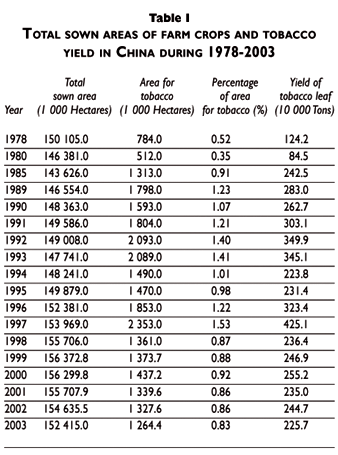
<body><![CDATA[<p><font size="2" face="Verdana"><b>The tobacco industry and its contribution    to economic development in China </b></font></p>     <p><font size="2" face="Verdana">It is reported that China is the largest tobacco    producer in the world;<SUP>3</SUP> about one-third of tobacco products are produced    in China. The tobacco industry includes three systems: tobacco agriculture,    tobacco manufacturing, and the tobacco trade. </font></p>     <p><font size="2" face="Verdana"> In the tobacco agricultural system, the land    used for the growth of tobacco leaf and the yields of tobacco leaf was growing    with a fluctuation in China during 1949 and 1997. In 1997 the amount of land    used for growing tobacco reached 2.35 million hectares, and the yield of tobacco    reached to 4.25 million tons (<a href="#tab01">Table I</a>). Although the land    used for the growth of tobacco and the yield of tobacco has declined since 1997,    about 1.26 million hectares of sown land was used for the growing of tobacco    in 2003, which was about 34% of the worldwide total of land used for the growing    tobacco in the same year. Tobacco yield was 2.26 million tons, which was about    37.2% of overall worldwide production in 2003.<SUP>4, 5</SUP> </font></p>     <p><a name="tab01"></a></p>     <p>&nbsp;</p>     <p align="center"><img src="/img/revistas/spm/v48s1/a17tab01.gif"></p>     <p>&nbsp;</p>     <p><font size="2" face="Verdana"> The areas where tobacco is grown include all    provinces/municipal cities except Beijing, Shanghai, Tianjin, and Tibet (<a href="#tab02">Table    II</a>). Yunnan, Guizhou, and Henan provinces are the first three provinces    in terms of both the land used for growing tobacco and tobacco yield. Over 52%    of tobacco was produced in these three provinces in 2003.<SUP>4</SUP> </font></p>     <p><a name="tab02"></a></p>     <p>&nbsp;</p>     ]]></body>
<body><![CDATA[<p align="center"><img src="/img/revistas/spm/v48s1/a17tab02.gif"></p>     <p>&nbsp;</p>     <p><font size="2" face="Verdana"> Tobacco manufacturing is a state-run enterprise.    The total number of cigarettes produced in China is about one-third of total    production in the world. The annual increase in the total number of cigarettes    produced was about 10% before 2000 (<a href="#tab03">Table III</a>). Although    the annual increase has declined in recent years, the production of cigarettes    reached 35.8 million boxes (1 box contains 50 000 cigarettes) in 2003, which    is 22 times as much as the production in 1949.<SUP>5</SUP> </font></p>     <p><a name="tab03"></a></p>     <p>&nbsp;</p>     <p align="center"><img src="/img/revistas/spm/v48s1/a17tab03.gif"></p>     <p>&nbsp;</p>     <p><font size="2" face="Verdana"> The tobacco trade system includes both points    of distribution and point of sale sub-systems. The point of distribution sub-system    is a state-run system. During "The Ninth Five-Year Plan" period (1996    to 2000), about 4.2 billion yuan was invested in the tobacco distribution system,    and 16 530 points of distribution were built across the country. Among these    points of distribution, 2 640 are located in urban areas and 13 890 are located    in rural areas.<SUP>5</SUP> In addition, there are nearly five million points    of sale of cigarette across the country, most of which are owned by the private    sector.<SUP>6</SUP> </font></p>     <p><font size="2" face="Verdana"> Currently, the tobacco industry is a very important    economic sector in China. It is reported that tobacco production significantly    contributes to China's economy by providing both tax revenue to the government    and employment to the population. </font></p>     <p><font size="2" face="Verdana"> The revenue provided by the tobacco industry    is one of the largest sources of government revenue. It is estimated that the    contribution by the tobacco industry to the government revenue was 900 billion    yuan between 1949 and 2000. Since the 1980s, tobacco tax revenue has been the    number one source of revenue for the government. Tobacco tax revenue made up    11.2% of total government revenue in 1996. Although this figure has declined    recently due to economic development in other sectors, tobacco taxes still made    up about 7.4% of the government's total revenue in 2003 (<a href="#tab04">Table    IV</a>).<SUP>5</SUP> The tobacco industry is also one of the major sources of    revenues to local governments in tobacco growing areas. It is estimated that    over 70% of the tobacco leaf is produced in the midwest provinces, which are    the least developed provinces in China. Tobacco production is very important    in terms of economic development in those regions. The contribution of the tobacco    industry to government revenue in these provinces was 40 to 80% of overall government    revenue.<SUP>5</SUP></font></p>     ]]></body>
<body><![CDATA[<p><a name="tab04"></a></p>     <p>&nbsp;</p>     <p align="center"><img src="/img/revistas/spm/v48s1/a17tab04.gif"></p>     <p>&nbsp;</p>     <p><font size="2" face="Verdana"> The contribution of the tobacco industry to    employment includes tobacco farmers, people working in manufacturing, and staff    members and salespersons in the tobacco trade system. In the agricultural sector,    nearly 4.1 million rural households grow tobacco. They are located in 46 000    villages and 4 627 townships across the entire country.<SUP>5</SUP> Approximately    215 600 workers and staff members are employed in tobacco manufacturing. An    additional 313 800 people were employed by the tobacco trade system in 2003.<SUP>5    </SUP>Furthermore, there are nearly five million points of sale across the country    which have provided job opportunities in the private sector. </font></p>     <p><font size="2" face="Verdana"><b>Tobacco consumption and its potential effects    on health and the economy </b></font></p>     <p><font size="2" face="Verdana">China is not only the world's largest tobacco    producer; it is also the world's largest tobacco consumer. Cigarettes produced    in China are most often consumed in China. There are 360 million smokers in    China, which accounts for nearly one-third of the world's smokers.<SUP>7,8</SUP>    According to China's Second National Survey of Smoking in 1996, the smoking    rate was 37.6% for the total population. This rate was 66.9% for men and 4.2%    for women. Compared to the results from the 1984 National survey, smoking prevalence    increased, the average number of smokers increased, and the average starting    age decreased.<SUP>9</SUP> A more recent study from the Chinese CDC reported    that about 57% of males and 3% of females smoke, which is lower than the smoking    rate from previous studies.<SUP>10</SUP> According to Chinese Statistical Bureau    estimates, the quantity of tobacco consumption was 68.06 packs per person per    year in 2002. The Chinese spend about 3% of per capita GDP on tobacco. –The    average price of one pack of cigarettes is 3.71 yuan, and GDP per capita was    8 214 yuan ($1US= 8 Chinese Yuan). In addition to these active smokers, China    also has 460 million passive smokers.<SUP>11</SUP> </font></p>     <p><font size="2" face="Verdana"> It is well known that smoking can cause many    deadly health problems, such as lung cancer and vascular disease, including    heart attacks, strokes and other diseases of the arteries or veins, as well    as chronic bronchitis and emphysema. Based on Peto-Lopez's methods, it is estimated    that by 2010 about one million deaths in China will be due to cigarette smoking.<SUP>12</SUP>    This figure will increase to two million by 2025 and three million by 2050.    Half of these deaths will occur in people ages 35-69.<SUP>10,13,14</SUP> </font></p>     <p><font size="2" face="Verdana"> In addition to the health effects of smoking,    smoking also has a major economic impact on smokers and their families. Although    the Chinese Government obtained 105 billion yuan in revenue from tobacco taxes    in 2000, the medical costs attributable to tobacco-related illness was about    48.6 billion yuan, or 46.3% of total tax revenue.<SUP>5</SUP> In addition to    these medical costs, smoking also reduces smokers' productivity. It is estimated    that due to cardiovascular disease alone, Chinese people ages 35-64 lost 7.6    million years of productive life during the year 2000.<SUP>15</SUP> A study    from the Academy of Preventive Medicine reported that the tobacco revenue that    government obtained from tobacco production was 24 billion yuan in 1989. In    the same year, however, the total economic loss due to tobacco consumption was    28 billion yuan, which included 6.9 billion in costs due to medical services,    2.6 billion in costs due to loss of productivity, 17.6 billion in costs due    to premature death, 0.9 billion in costs due to passive smoking, and 0.04 billion    in costs due to fire accidents.<SUP>16</SUP> A more recent study from Taiwan    showed thatfinancial costs due to excess absenteeism, reduced productivity,    and occupational injuries of employees who smoke were approximately US$1 030    million: US$184 million from increased sick leave, US$81 million from environmental    tobacco smoke, US$34 million from occupational injuries, and US$733 million    from lost productivity.<SUP>17</SUP> </font></p>     <p><font size="2" face="Verdana"> Tobacco consumption also reduces household consumption    of other goods and services, which not only influences smokers themselves but    also their family members. A recent study from the southwest China showed that    rural households spend an average of 6.5% of their total expenditure on tobacco,    which ranks as the 7<SUP>th</SUP> highest expenditure amount. Due to financial    constraints, these households have to make trade-offs between tobacco consumption    and other types of consumption. The extreme households, those that have high-tobacco    and high-alcohol consumption, allocate about 20% of their budget to tobacco    and 11% to alcohol. Every 100 yuan spent on tobacco was associated with a 30    yuan decline in spending on education, a 15 yuan decline in spending on medical    care, a 14 yuan decrease in spending on farming, and a 10 yuan decrease in spending    on food.<SUP>18</SUP> Another study from China reports that poor urban households    spend an average of 6.6% of their total expenditure on cigarettes and poor rural    households spend 11.3% of their total expenditures on cigarettes. Reducing cigarette    expenditures could release household resources for spending on food, housing,    and other goods to improve the standard of living.<SUP>19</SUP> </font></p>     ]]></body>
<body><![CDATA[<p><font size="2" face="Verdana"><b>The role of government in tobacco production    and the health sector </b></font></p>     <p><font size="2" face="Verdana">The role of government in tobacco policies is    a source of tension in China. On one hand, the Chinese government is responsible    for improving the population's health. In order assure the Chinese population's    health status, the Chinese government has invested heavily in the health sector,    which includes owning and operating urban health insurance plans, subsidizing    and operating the rural cooperative medical system (CMS), and owning and operating    most health facilities that provide curative and preventive services to the    population. </font></p>     <p><font size="2" face="Verdana"> The Ministry of Health is the government agency    that should take leadership of tobacco control. However, multi-sector participation    is very important to the success of any tobacco control policy. The State Council    approved "The notification of conducting health education on tobacco harm    and tobacco control", which was established jointly, in 1979, by the Ministry    of Health, Ministry of Finance, Ministry of Agriculture, and Ministry of Light    Industry. Health education activities as a means of tobacco control have been    implemented widely across the country.<SUP>16</SUP> Since 1990, the Association    of Tobacco Control has been established at both the central and provincial level,    and it has become the principal organization for public health education about    tobacco. Their activities include non-smoking days, tobacco cessation, tobacco    cessation hotlines and non-smoking schools, work places and public places. </font></p>     <p><font size="2" face="Verdana"> A series of laws and regulations have included    components related to tobacco control. These laws and regulations include the    China Tobacco Monopoly Sales Law, Health Regulation in Public Places (1987),    Child Protection Law (1991), Advertising Law (1994), and the Regulation Prohibiting    Smoking in Public Transportation and Waiting Places (1997).<SUP>6</SUP> In addition,    on August 28, 2005, China's National People's Congress announced its decision    to ratify the WHO's Framework Convention on Tobacco Control (FCTC). This is    a significant step towards improving the population's health by reducing    tobacco consumption in China. </font></p>     <p><font size="2" face="Verdana"> On the other hand, the Chinese government is    responsible for economic development. As described previously, the tobacco industry    provides substantial revenues to the government. In order to ensure this revenue,    the Chinese government plays a monopolistic role in tobacco production. The    China National Tobacco Company (CNTC), a monopoly under the State Tobacco Monopoly    Administration (STMA), controls all tobacco growth, cigarette manufacturing,    and the cigarette market. In addition, the tobacco industry provides significant    job opportunities to the Chinese population, especially in many relatively poor    regions. </font></p>     <p><font size="2" face="Verdana"> Obviously, the Chinese government plays mixed    roles in terms of tobacco control and tobacco production. On one hand, the Chinese    government made significant efforts to discourage cigarette consumption through    public campaigns. On the other hand, the Chinese government itself runs the    largest tobacco enterprise in the world. The health-related sectors of the government    have not been able to convince the other economic sectors to support some of    their tobacco control policies. As one government official in the tobacco production    sector said, tobacco production is not only related to the health of the population,    it is also related to economic development, employment, agricultural economic    structure, the standard of living, and social stability.<SUP>20</SUP> The conflict    of interests among policy makers between public health and economic development    constitutes a major dilemma within the Chinese government. </font></p>     <p><font size="2" face="Verdana"><b>The continuum of the debate on tobacco control    policies </b></font></p>     <p><font size="2" face="Verdana"><I>Raising the tobacco tax</I></font></p>     <p><font size="2" face="Verdana">One of the major debates is with regard to raising    cigarette taxes. Worldwide evidence has showed that raising tobacco taxes does    significantly reduce the consumption of tobacco. The price effect on tobacco    consumption is likely to be greatest on young people and more significant in    low- and middle-income countries.<SUP>21</SUP> In addition to the huge health    benefits gained, raising the tobacco tax will not harm government revenues or    economic development.<SUP>22</SUP> A comprehensive Chinese study showed that    the price elasticity of demand for cigarettes is -0.54 in China. By introducing    an additional 10% increase in cigarette tax per pack, the government's increase    in tax revenue would exceed two-fold the total losses in industry revenue, tobacco    farmers' income, and local tax revenue. In addition, between 1.4 and 2.2    million lives would be saved by such a tax increase.<SUP>23</SUP> </font></p>     <p><font size="2" face="Verdana"> However, government officials in the tobacco    production sector disagree with the above conclusions. They expressed the view    that if the price of cigarettes increased people may simply switch to cheaper    cigarettes, which have more tar and nicotine and thus are even more harmful    to people's health. They are also concerned that after a price increase, smuggling    would increase and would be difficult to control, which not only influences    the economy, but would also keep the government from controlling the tar and    nicotine levels in cigarettes. Certainly, the biggest concern for them is the    economic impact. If tobacco consumption declines, government revenue from tobacco    production will be reduced; the tobacco manufacturers may go bankrupt; and people    who work in the tobacco industry may become unemployed.<SUP>5</SUP> </font></p>     ]]></body>
<body><![CDATA[<p><font size="2" face="Verdana"><I>Introducing low harm tobacco products</I>    </font></p>     <p><font size="2" face="Verdana">In order to carry out their responsibility for    improving population health, one of the major strategies proposed by the tobacco    production sector is to introduce lower harm tobacco products, which would reduce    the health damage due to tobacco consumption, but also maintain the contribution    of the tobacco industry to the economy. Since 1984, tobacco products have been    classified into three levels, low-tar (&lt;15mg/per cigarette), moderate-tar    (15-25mg/per cigarette), and high-tar (&gt;25mg/per cigarette). In order to    encourage the tobacco industry to produce low-tar products, new criteria have    been recently introduced. This new criteria classifies cigarettes into five    levels, low-tar (&lt;=12mg/per cigarette), low-moderate-tar (12-16mg/per cigarette),    moderate-tar (16-19mg/per cigarette), moderate-high-tar (19-23mg/per cigarette),    and high-tar (&gt;=23mg/per cigarette).<SUP>5</SUP> In 2000, the STMA proposed    a reduction in tar levels by 0.5mg/per cigarette per year. The average tar level    has declined from 16.5mg/per cigarette in 1999 to 13.5mg/per cigarette in 2004.<SUP>6</SUP>    However, the "low-tar low harm" has not been supported by evidence,<SUP>21</SUP>    and the approach of introducing low-tar tobacco products has not been accepted    by the health–related governmental sectors. </font></p>     <p><font size="2" face="Verdana"> In addition to introducing low-tar cigarettes,    some tobacco manufacturers have added traditional Chinese medicines to their    tobacco products in order to "improve" the consumer's health. Traditional    medicines were added that can improve lung function and kidney function. A report    of "The New Life of a Sunset Industry" described how a Nanchang tobacco    manufacturer, a 40 year-old enterprise, introduced a new brand, Jinsheng, to    the market in the early 90's. This brand passed tests conducted by the National    Tobacco Bureau and Chinese Medicine Expert Panel in 1994 and won the national    innovation award in 1995. The company began with the production of 2 000 boxes    in 1992, and increased to 100 000 boxes in 1999.<SUP>24</SUP> Many other tobacco    manufacturers have also produced cigarettes that include Chinese medicines.    However, there are no existing regulations to control such products, which could    have even more negative impact on smokers' health status. In addition, these    brands provide a twisted message to the consumer, which may induce tobacco consumption    and reduce the willingness to quit.<SUP>6</SUP> </font></p>     <p><font size="2" face="Verdana"><I>Consumer information</I> </font></p>     <p><font size="2" face="Verdana">Although health education on tobacco use has    been implemented widely across the whole country since the State Council approved,    in 1979, "The Notification of Conducting Health Education on Tobacco Harm    and Tobacco Control" –which was established jointly by the Ministry of    Health, Ministry of Financing, Ministry of Agriculture, and Ministry of Light    Industry– the effects on tobacco consumption reduction have been quite limited.<SUP>16</SUP>    The Tobacco Consumption Survey in 1996 demonstrated that 60% of smoker considered    tobacco's effects on health to be "very limited or no harm." How to    deliver tobacco control information more effectively is one of the challenges    for reducing tobacco consumption. </font></p>     <p><font size="2" face="Verdana"> By 1991, seventy-seven countries, including    China, had introduced warning labels on tobacco products to warn the consumer    that tobacco is harmful to their health. However, the warning label on tobacco    products is very small, and sometimes is only on the side of the package. The    World Health Organization (WHO) recommends that the warning should be specific,    such as "tobacco can cause cancer," or "tobacco will induce a    heart attack," and that the label should be large and on the front side    of the package. This recommendation, however, will be very difficult to adopt    in China in the near future. People in the tobacco industry explain that many    cigarettes are purchased as gifts and if the warning label is one-third the    size of the front of the package, nobody will purchase such products.<SUP>25</SUP>    </font></p>     <p><font size="2" face="Verdana"> In order to market tobacco products, tobacco    manufacturers not only try to avoid putting warning labels in a notable place    on their product, but also try to link their products with images that can make    them seem as a good and responsible player in the society. For example, the    Beijing Cigarette Manufacturing Company links their tobacco product, "Zhong    Nan Hai," with the Hope Project. The Hope Project is a project that provides    funds to support poor children who cannot afford the tuition to finish school.    The tobacco company puts the label "your consumption will support the Hope    Project" on the package. The company intends to use Hope Project to promote    its tobacco products.<SUP>25</SUP> </font></p>     <p><font size="2" face="Verdana"> Although the Advertising Law prohibits having    tobacco related advertisements in movies, television, newspapers and journals,    many images related to tobacco consumption still exist in the media. A study    conducted by the MOH showed that in the most popular 10 movies between 2001-2002,    all have images of tobacco consumption. The average number of episodes of tobacco    consumption per movie was 26.2. The maximum number of episodes of tobacco consumption    in one movie was 111. The average length of a movie segment that included tobacco    consumption image was 5.6 minute. The longest length of a segment that included    tobacco consumption was 15 minutes. Although these tobacco consumption pictures    are not produced by the tobacco industry, the effects of those pictures on people's    smoking behavior is significant, especially for youth.<SUP>26</SUP> </font></p>     <p><font size="2" face="Verdana"><I>International tobacco penetration</I> </font></p>     <p><font size="2" face="Verdana">Aside from many debates, both tobacco control    and tobacco production sectors in China are facing a new challenge, foreign    tobacco's penetration into the Chinese tobacco market after China joined WTO.<SUP>27</SUP>    </font></p>     ]]></body>
<body><![CDATA[<p><font size="2" face="Verdana"> Morgan Stanley published their report "China:    the final frontier" on July 26, 2005.<SUP>28</SUP> This report provided    an in-depth analysis of the current status of China's tobacco industry, consumer    preferences, government roles, and the activities of foreign tobacco companies    in China. This report pointed out that many investors fear that the world tobacco    market would shrink inexorably and even disappear. To avoid this disaster, the    report suggested that these investors should go to China. By entering the Chinese    tobacco market, they "could increase the size of the available world market    by 40 to 50%." </font></p>     <p><font size="2" face="Verdana"> Although there is a huge market for tobacco    in China, the share of foreign tobacco is very small: less than 3% of the total    market. However, as China begins to implement the WTO commitment it made on    January 1, 2004, the tobacco import tax will decline and foreign cigarettes    will be able to be produced locally, thus avoiding import taxes and making foreign    brands more available to Chinese consumers. Due to the tax decrease and supply    increase, the price of foreign tobacco products may decline, which could lead    to an increase in the consumption of foreign tobacco. If the price of foreign    brand tobacco products declines, the price of domestic brands may also decline    due to market competition, and total consumption may therefore increase. </font></p>     <p><font size="2" face="Verdana"> In the face of penetration by foreign tobacco    in China, the Chinese tobacco industry has had to increase its ability to compete    with the international tobacco industry in the country.<SUP>20,27</SUP> They    have also used international penetration as an excuse to fight tobacco control    efforts. One former government official who works in the tobacco production    sector complains that tobacco control efforts reduced the innovative and competitive    capacity of the tobacco industry, which is harmful to China's economic development    and harmful to the Chinese people.<SUP>20</SUP> The tobacco control sector in    China has to confront challenges from both international and domestic tobacco    industries. </font></p>     <p><font size="2" face="Verdana"><b>Conclusion </b></font></p>     <p><font size="2" face="Verdana">In conclusion, although China's National    People's Congress announced its decision to ratify the WHO's Framework Convention    on Tobacco Control (FCTC) on August 28, 2005, fundamental challenges to tobacco    control still exist. A survey at the "No Smoking Day" in China on    May 31, 2004 showed that over 73% of respondents do not think that the society    will be able to eliminate the consumption of tobacco products.<SUP>25</SUP>    Although the prevalence of smoking declined 1.2% from 1996 to 2002, the absolute    number of smokers increased by 30 million during this period.<SUP>6</SUP> It    is estimated that smoking prevalence will decline 10% in the next 25 years.    However, due to the population increase, the total number of tobacco consumers    will be about the same as today, which is 320 million.<SUP>26</SUP> As long    as the tobacco industry continues to be significant in overall economic development,    and as long as the government continues to play a significant role in tobacco    production, the debate between tobacco production and tobacco control will continue.    Although China has already made significant efforts towards tobacco control,    it is still at the beginning of its "long march" towards improving    the population's health by reducing tobacco consumption in China. </font></p>     <p>&nbsp;</p>     <p><font size="3" face="Verdana"><b>References </b></font></p>     <!-- ref --><p><font size="2" face="Verdana">1. McQueen DV, Mckenna MT, <I>et al</I>. Chronic    diseases and injury. In: Merson MH, Black RE, Mills AJ, ed. International Public    Health: Diseases, Programs, Systems and Policies. Gaithersburg, Maryland: Aspen    Publications; 2002:293-330. </font>&nbsp;&nbsp;&nbsp;&nbsp;&nbsp;&nbsp;&nbsp;&nbsp;[&#160;<a href="javascript:void(0);" onclick="javascript: window.open('/scielo.php?script=sci_nlinks&ref=9227180&pid=S0036-3634200600070001700001&lng=','','width=640,height=500,resizable=yes,scrollbars=1,menubar=yes,');">Links</a>&#160;]<!-- end-ref --><!-- ref --><p><font size="2" face="Verdana">2. Chaloupka FJ, Warner KE. The economics of    smoking. In: Culyer AJ, Newhouse JP, ed. Handbook of health economics. Vol.    1B. New York: Elsevier; 2000:1539-1627. </font>&nbsp;&nbsp;&nbsp;&nbsp;&nbsp;&nbsp;&nbsp;&nbsp;[&#160;<a href="javascript:void(0);" onclick="javascript: window.open('/scielo.php?script=sci_nlinks&ref=9227181&pid=S0036-3634200600070001700002&lng=','','width=640,height=500,resizable=yes,scrollbars=1,menubar=yes,');">Links</a>&#160;]<!-- end-ref --><!-- ref --><p><font size="2" face="Verdana">3. World Health Organization. Tobacco or health:    A global status report. Geneva: WHO, 1997. </font>&nbsp;&nbsp;&nbsp;&nbsp;&nbsp;&nbsp;&nbsp;&nbsp;[&#160;<a href="javascript:void(0);" onclick="javascript: window.open('/scielo.php?script=sci_nlinks&ref=9227182&pid=S0036-3634200600070001700003&lng=','','width=640,height=500,resizable=yes,scrollbars=1,menubar=yes,');">Links</a>&#160;]<!-- end-ref --><!-- ref --><p><font size="2" face="Verdana">4. China Statistics Bureau. 2003 China statistics    yearbook. Beijing: China Statistics Bureau, 2004. </font>&nbsp;&nbsp;&nbsp;&nbsp;&nbsp;&nbsp;&nbsp;&nbsp;[&#160;<a href="javascript:void(0);" onclick="javascript: window.open('/scielo.php?script=sci_nlinks&ref=9227183&pid=S0036-3634200600070001700004&lng=','','width=640,height=500,resizable=yes,scrollbars=1,menubar=yes,');">Links</a>&#160;]<!-- end-ref --><!-- ref --><p><font size="2" face="Verdana">5. Liu T, Xiong B. Tobacco economy and tobacco    control. Beijing: Economic Science Press, 2004. </font>&nbsp;&nbsp;&nbsp;&nbsp;&nbsp;&nbsp;&nbsp;&nbsp;[&#160;<a href="javascript:void(0);" onclick="javascript: window.open('/scielo.php?script=sci_nlinks&ref=9227184&pid=S0036-3634200600070001700005&lng=','','width=640,height=500,resizable=yes,scrollbars=1,menubar=yes,');">Links</a>&#160;]<!-- end-ref --><!-- ref --><p><font size="2" face="Verdana">6. Zheng F, Zhao B, <I>et al.</I> Report on China    tobacco industry and the implication of FCTC. Journal of Academy of Tobacco    Science 2005;11 suppl 1:32-36. </font>&nbsp;&nbsp;&nbsp;&nbsp;&nbsp;&nbsp;&nbsp;&nbsp;[&#160;<a href="javascript:void(0);" onclick="javascript: window.open('/scielo.php?script=sci_nlinks&ref=9227185&pid=S0036-3634200600070001700006&lng=','','width=640,height=500,resizable=yes,scrollbars=1,menubar=yes,');">Links</a>&#160;]<!-- end-ref --><!-- ref --><p><font size="2" face="Verdana">7. Lam, TH, He Y, <I>et al.</I> Mortality attributable    to cigarette smoking in China. JAMA 1997; 278 suppl 18:1505-1508. </font>&nbsp;&nbsp;&nbsp;&nbsp;&nbsp;&nbsp;&nbsp;&nbsp;[&#160;<a href="javascript:void(0);" onclick="javascript: window.open('/scielo.php?script=sci_nlinks&ref=9227186&pid=S0036-3634200600070001700007&lng=','','width=640,height=500,resizable=yes,scrollbars=1,menubar=yes,');">Links</a>&#160;]<!-- end-ref --><!-- ref --><p><font size="2" face="Verdana">8. People's Daily. China faces hard job to control    smoking. China: People's Daily, 2000. </font>&nbsp;&nbsp;&nbsp;&nbsp;&nbsp;&nbsp;&nbsp;&nbsp;[&#160;<a href="javascript:void(0);" onclick="javascript: window.open('/scielo.php?script=sci_nlinks&ref=9227187&pid=S0036-3634200600070001700008&lng=','','width=640,height=500,resizable=yes,scrollbars=1,menubar=yes,');">Links</a>&#160;]<!-- end-ref --><!-- ref --><p><font size="2" face="Verdana"> 9. Yang, GH. 1996 National prevenlance survey    of smoking patterns. Beijing: China Science and Technology Press, 1997. </font>&nbsp;&nbsp;&nbsp;&nbsp;&nbsp;&nbsp;&nbsp;&nbsp;[&#160;<a href="javascript:void(0);" onclick="javascript: window.open('/scielo.php?script=sci_nlinks&ref=9227188&pid=S0036-3634200600070001700009&lng=','','width=640,height=500,resizable=yes,scrollbars=1,menubar=yes,');">Links</a>&#160;]<!-- end-ref --><!-- ref --><p><font size="2" face="Verdana">10. Yang G, Ma J, <I>et al.</I> Smoking and passive    smoking in Chinese. China Journal of Epidemiology 2005;26:78-83. </font>&nbsp;&nbsp;&nbsp;&nbsp;&nbsp;&nbsp;&nbsp;&nbsp;[&#160;<a href="javascript:void(0);" onclick="javascript: window.open('/scielo.php?script=sci_nlinks&ref=9227189&pid=S0036-3634200600070001700010&lng=','','width=640,height=500,resizable=yes,scrollbars=1,menubar=yes,');">Links</a>&#160;]<!-- end-ref --><!-- ref --><p><font size="2" face="Verdana">11. Zhu J. To coordinate the conflict between    tobacco control and tobacco production in China. Periscope 1996;46:12-13. </font>&nbsp;&nbsp;&nbsp;&nbsp;&nbsp;&nbsp;&nbsp;&nbsp;[&#160;<a href="javascript:void(0);" onclick="javascript: window.open('/scielo.php?script=sci_nlinks&ref=9227190&pid=S0036-3634200600070001700011&lng=','','width=640,height=500,resizable=yes,scrollbars=1,menubar=yes,');">Links</a>&#160;]<!-- end-ref --><!-- ref --><p><font size="2" face="Verdana">12. Peto R, Lopez A, <I>et al</I>. Mortality    from smoking in developed countries, 1950-2000. Oxford: Oxford University Press,    1994. </font>&nbsp;&nbsp;&nbsp;&nbsp;&nbsp;&nbsp;&nbsp;&nbsp;[&#160;<a href="javascript:void(0);" onclick="javascript: window.open('/scielo.php?script=sci_nlinks&ref=9227191&pid=S0036-3634200600070001700012&lng=','','width=640,height=500,resizable=yes,scrollbars=1,menubar=yes,');">Links</a>&#160;]<!-- end-ref --><!-- ref --><p><font size="2" face="Verdana">13. Niu S, Yang G, <I>et al</I>. Emerging tobacco    hazards in China: Early mortality results from a prospective study. BMJ 1998;317    suppl 21:1423-1424. </font>&nbsp;&nbsp;&nbsp;&nbsp;&nbsp;&nbsp;&nbsp;&nbsp;[&#160;<a href="javascript:void(0);" onclick="javascript: window.open('/scielo.php?script=sci_nlinks&ref=9227192&pid=S0036-3634200600070001700013&lng=','','width=640,height=500,resizable=yes,scrollbars=1,menubar=yes,');">Links</a>&#160;]<!-- end-ref --><!-- ref --><p><font size="2" face="Verdana">14. World Health Organization. The World Health    Report 1999: Making a difference. Geneva: WHO, 1999. </font>&nbsp;&nbsp;&nbsp;&nbsp;&nbsp;&nbsp;&nbsp;&nbsp;[&#160;<a href="javascript:void(0);" onclick="javascript: window.open('/scielo.php?script=sci_nlinks&ref=9227193&pid=S0036-3634200600070001700014&lng=','','width=640,height=500,resizable=yes,scrollbars=1,menubar=yes,');">Links</a>&#160;]<!-- end-ref --><!-- ref --><p><font size="2" face="Verdana">15. Wang L, Kong L, <I>et al</I>. Preventing    Chronic Disease in China. Lancet 2005:1821-1824. Available in: <a href="http://www.thelancet.com" target="_blank">www.thelancet.com</a>.    </font>&nbsp;&nbsp;&nbsp;&nbsp;&nbsp;&nbsp;&nbsp;&nbsp;[&#160;<a href="javascript:void(0);" onclick="javascript: window.open('/scielo.php?script=sci_nlinks&ref=9227194&pid=S0036-3634200600070001700015&lng=','','width=640,height=500,resizable=yes,scrollbars=1,menubar=yes,');">Links</a>&#160;]<!-- end-ref --><!-- ref --><p><font size="2" face="Verdana">16. Yuan X. The discussion on tobacco economy    and health economy. Medicine and Philosophy 1994;suppl 1:8-10. </font>&nbsp;&nbsp;&nbsp;&nbsp;&nbsp;&nbsp;&nbsp;&nbsp;[&#160;<a href="javascript:void(0);" onclick="javascript: window.open('/scielo.php?script=sci_nlinks&ref=9227195&pid=S0036-3634200600070001700016&lng=','','width=640,height=500,resizable=yes,scrollbars=1,menubar=yes,');">Links</a>&#160;]<!-- end-ref --><!-- ref --><p><font size="2" face="Verdana">17. Tsai, SP, Wen CP, <I>et al</I>. Workplace    smoking related absenteeism and productivity cost in Taiwan. Tob Control 2006;14    suppl 1:i33-i37. </font>&nbsp;&nbsp;&nbsp;&nbsp;&nbsp;&nbsp;&nbsp;&nbsp;[&#160;<a href="javascript:void(0);" onclick="javascript: window.open('/scielo.php?script=sci_nlinks&ref=9227196&pid=S0036-3634200600070001700017&lng=','','width=640,height=500,resizable=yes,scrollbars=1,menubar=yes,');">Links</a>&#160;]<!-- end-ref --><!-- ref --><p><font size="2" face="Verdana">18. Wang H, Sindelar J, <I>et al.</I> The impact    of tobacco expenditure on household consumption patterns in rural China. Soc    Sci Med 2006;62:1414-1426. </font>&nbsp;&nbsp;&nbsp;&nbsp;&nbsp;&nbsp;&nbsp;&nbsp;[&#160;<a href="javascript:void(0);" onclick="javascript: window.open('/scielo.php?script=sci_nlinks&ref=9227197&pid=S0036-3634200600070001700018&lng=','','width=640,height=500,resizable=yes,scrollbars=1,menubar=yes,');">Links</a>&#160;]<!-- end-ref --><!-- ref --><p><font size="2" face="Verdana">19. Hu TW, Mao Z, <I>et al. </I>Smoking, standard    of living, and poverty in China. Tob Control 2005;14:247-250. </font>&nbsp;&nbsp;&nbsp;&nbsp;&nbsp;&nbsp;&nbsp;&nbsp;[&#160;<a href="javascript:void(0);" onclick="javascript: window.open('/scielo.php?script=sci_nlinks&ref=9227198&pid=S0036-3634200600070001700019&lng=','','width=640,height=500,resizable=yes,scrollbars=1,menubar=yes,');">Links</a>&#160;]<!-- end-ref --><!-- ref --><p><font size="2" face="Verdana">20. Ma Z. "FCTC" and its impact on    tobacco production in China. China Economic Weekly 2005;319 suppl 36:36-37.    </font>&nbsp;&nbsp;&nbsp;&nbsp;&nbsp;&nbsp;&nbsp;&nbsp;[&#160;<a href="javascript:void(0);" onclick="javascript: window.open('/scielo.php?script=sci_nlinks&ref=9227199&pid=S0036-3634200600070001700020&lng=','','width=640,height=500,resizable=yes,scrollbars=1,menubar=yes,');">Links</a>&#160;]<!-- end-ref --><!-- ref --><p><font size="2" face="Verdana">21. The World Bank. Curbing the epidemic: Governments    and the economics of tobacco control. Washington DC: The World Bank, 1998. </font>&nbsp;&nbsp;&nbsp;&nbsp;&nbsp;&nbsp;&nbsp;&nbsp;[&#160;<a href="javascript:void(0);" onclick="javascript: window.open('/scielo.php?script=sci_nlinks&ref=9227200&pid=S0036-3634200600070001700021&lng=','','width=640,height=500,resizable=yes,scrollbars=1,menubar=yes,');">Links</a>&#160;]<!-- end-ref --><!-- ref --><p><font size="2" face="Verdana">22. Jha P, Beyer J, <I>et al.</I> Death and taxes:    Economics of tobacco control. Finance Dev 1999;12:46-49. </font>&nbsp;&nbsp;&nbsp;&nbsp;&nbsp;&nbsp;&nbsp;&nbsp;[&#160;<a href="javascript:void(0);" onclick="javascript: window.open('/scielo.php?script=sci_nlinks&ref=9227201&pid=S0036-3634200600070001700022&lng=','','width=640,height=500,resizable=yes,scrollbars=1,menubar=yes,');">Links</a>&#160;]<!-- end-ref --><!-- ref --><p><font size="2" face="Verdana">23. Hu TW, Mao Z. Effects of cigarette tax on    cigarette consumption and the Chinese economy. Tob Control 2002;11:105-108.    </font>&nbsp;&nbsp;&nbsp;&nbsp;&nbsp;&nbsp;&nbsp;&nbsp;[&#160;<a href="javascript:void(0);" onclick="javascript: window.open('/scielo.php?script=sci_nlinks&ref=9227202&pid=S0036-3634200600070001700023&lng=','','width=640,height=500,resizable=yes,scrollbars=1,menubar=yes,');">Links</a>&#160;]<!-- end-ref --><!-- ref --><p><font size="2" face="Verdana">24. Zhou B, Zheng J. New life of a sunset industry.    Feng Yun Ren Wu 1997; 10:26-28. </font>&nbsp;&nbsp;&nbsp;&nbsp;&nbsp;&nbsp;&nbsp;&nbsp;[&#160;<a href="javascript:void(0);" onclick="javascript: window.open('/scielo.php?script=sci_nlinks&ref=9227203&pid=S0036-3634200600070001700024&lng=','','width=640,height=500,resizable=yes,scrollbars=1,menubar=yes,');">Links</a>&#160;]<!-- end-ref --><!-- ref --><p><font size="2" face="Verdana">25. Zhang T. Why is it so difficult to control    tobacco in China? Science World 2005;8:37-38. </font>&nbsp;&nbsp;&nbsp;&nbsp;&nbsp;&nbsp;&nbsp;&nbsp;[&#160;<a href="javascript:void(0);" onclick="javascript: window.open('/scielo.php?script=sci_nlinks&ref=9227204&pid=S0036-3634200600070001700025&lng=','','width=640,height=500,resizable=yes,scrollbars=1,menubar=yes,');">Links</a>&#160;]<!-- end-ref --><!-- ref --><p><font size="2" face="Verdana">26. Wei, Y. The World FCTC and its impact on    the tobacco industry in China. China Foreign Investment 2005;5:36-39. </font>&nbsp;&nbsp;&nbsp;&nbsp;&nbsp;&nbsp;&nbsp;&nbsp;[&#160;<a href="javascript:void(0);" onclick="javascript: window.open('/scielo.php?script=sci_nlinks&ref=9227205&pid=S0036-3634200600070001700026&lng=','','width=640,height=500,resizable=yes,scrollbars=1,menubar=yes,');">Links</a>&#160;]<!-- end-ref --><!-- ref --><p><font size="2" face="Verdana">27. Yang ZY. The WTO and its impact on China's    tobacco economy. Reform and Its Theory 2000;113 suppl 5:51-53. </font>&nbsp;&nbsp;&nbsp;&nbsp;&nbsp;&nbsp;&nbsp;&nbsp;[&#160;<a href="javascript:void(0);" onclick="javascript: window.open('/scielo.php?script=sci_nlinks&ref=9227206&pid=S0036-3634200600070001700027&lng=','','width=640,height=500,resizable=yes,scrollbars=1,menubar=yes,');">Links</a>&#160;]<!-- end-ref --><!-- ref --><p><font size="2" face="Verdana">28. Fell J, Khoo E, <I>et al.</I> China: The final frontier. Morgan Stanley &#091;report&#093;, July 26, 2005.</font>&nbsp;&nbsp;&nbsp;&nbsp;&nbsp;&nbsp;&nbsp;&nbsp;[&#160;<a href="javascript:void(0);" onclick="javascript: window.open('/scielo.php?script=sci_nlinks&ref=9227207&pid=S0036-3634200600070001700028&lng=','','width=640,height=500,resizable=yes,scrollbars=1,menubar=yes,');">Links</a>&#160;]<!-- end-ref --><p>&nbsp;</p>     <p>&nbsp;</p>     <p><font size="2" face="Verdana">Accepted on: March 20, 2006 </font></p>     <p>&nbsp;</p>     <p>&nbsp;</p>     ]]></body>
<body><![CDATA[<p><font size="2" face="Verdana">Address reprint request to: Hong Wang. Yale School    of Public Health. 60 College Street, 208034, New Haven, Connecticut, USA.    <br>   E-mail: <a href="mailto:hong.wang@yale.edu">hong.wang@yale.edu</a></font></p>      ]]></body><back>
<ref-list>
<ref id="B1">
<label>1</label><nlm-citation citation-type="book">
<person-group person-group-type="author">
<name>
<surname><![CDATA[McQueen]]></surname>
<given-names><![CDATA[DV]]></given-names>
</name>
<name>
<surname><![CDATA[Mckenna]]></surname>
<given-names><![CDATA[MT]]></given-names>
</name>
</person-group>
<article-title xml:lang="en"><![CDATA[Chronic diseases and injury]]></article-title>
<person-group person-group-type="editor">
<name>
<surname><![CDATA[Merson]]></surname>
<given-names><![CDATA[MH]]></given-names>
</name>
<name>
<surname><![CDATA[Black]]></surname>
<given-names><![CDATA[RE]]></given-names>
</name>
<name>
<surname><![CDATA[Mills]]></surname>
<given-names><![CDATA[AJ]]></given-names>
</name>
</person-group>
<source><![CDATA[International Public Health: Diseases, Programs, Systems and Policies]]></source>
<year>2002</year>
<page-range>293-330</page-range><publisher-loc><![CDATA[Gaithersburg^eMaryland Maryland]]></publisher-loc>
<publisher-name><![CDATA[Aspen Publications]]></publisher-name>
</nlm-citation>
</ref>
<ref id="B2">
<label>2</label><nlm-citation citation-type="book">
<person-group person-group-type="author">
<name>
<surname><![CDATA[Chaloupka]]></surname>
<given-names><![CDATA[FJ]]></given-names>
</name>
<name>
<surname><![CDATA[Warner]]></surname>
<given-names><![CDATA[KE]]></given-names>
</name>
</person-group>
<article-title xml:lang="en"><![CDATA[The economics of smoking]]></article-title>
<person-group person-group-type="editor">
<name>
<surname><![CDATA[Culyer]]></surname>
<given-names><![CDATA[AJ]]></given-names>
</name>
<name>
<surname><![CDATA[Newhouse]]></surname>
<given-names><![CDATA[JP]]></given-names>
</name>
</person-group>
<source><![CDATA[Handbook of health economics]]></source>
<year>2000</year>
<page-range>1539-1627</page-range><publisher-loc><![CDATA[New York ]]></publisher-loc>
<publisher-name><![CDATA[Elsevier]]></publisher-name>
</nlm-citation>
</ref>
<ref id="B3">
<label>3</label><nlm-citation citation-type="book">
<collab>World Health Organization</collab>
<source><![CDATA[Tobacco or health: A global status report]]></source>
<year>1997</year>
<publisher-loc><![CDATA[Geneva ]]></publisher-loc>
<publisher-name><![CDATA[WHO]]></publisher-name>
</nlm-citation>
</ref>
<ref id="B4">
<label>4</label><nlm-citation citation-type="book">
<collab>China Statistics Bureau</collab>
<source><![CDATA[2003 China statistics yearbook]]></source>
<year>2004</year>
<publisher-loc><![CDATA[Beijing ]]></publisher-loc>
<publisher-name><![CDATA[China Statistics Bureau]]></publisher-name>
</nlm-citation>
</ref>
<ref id="B5">
<label>5</label><nlm-citation citation-type="book">
<person-group person-group-type="author">
<name>
<surname><![CDATA[Liu]]></surname>
<given-names><![CDATA[T]]></given-names>
</name>
<name>
<surname><![CDATA[Xiong]]></surname>
<given-names><![CDATA[B]]></given-names>
</name>
</person-group>
<source><![CDATA[Tobacco economy and tobacco control]]></source>
<year>2004</year>
<publisher-loc><![CDATA[Beijing ]]></publisher-loc>
<publisher-name><![CDATA[Economic Science Press]]></publisher-name>
</nlm-citation>
</ref>
<ref id="B6">
<label>6</label><nlm-citation citation-type="journal">
<person-group person-group-type="author">
<name>
<surname><![CDATA[Zheng]]></surname>
<given-names><![CDATA[F]]></given-names>
</name>
<name>
<surname><![CDATA[Zhao]]></surname>
<given-names><![CDATA[B]]></given-names>
</name>
</person-group>
<article-title xml:lang="en"><![CDATA[Report on China tobacco industry and the implication of FCTC]]></article-title>
<source><![CDATA[Journal of Academy of Tobacco Science]]></source>
<year>2005</year>
<volume>11</volume>
<numero>^s1</numero>
<issue>^s1</issue>
<supplement>1</supplement>
<page-range>32-36</page-range></nlm-citation>
</ref>
<ref id="B7">
<label>7</label><nlm-citation citation-type="journal">
<person-group person-group-type="author">
<name>
<surname><![CDATA[Lam]]></surname>
<given-names><![CDATA[TH]]></given-names>
</name>
<name>
<surname><![CDATA[He]]></surname>
<given-names><![CDATA[Y]]></given-names>
</name>
</person-group>
<article-title xml:lang="en"><![CDATA[Mortality attributable to cigarette smoking in China]]></article-title>
<source><![CDATA[JAMA]]></source>
<year>1997</year>
<volume>278</volume>
<numero>^s18</numero>
<issue>^s18</issue>
<supplement>18</supplement>
<page-range>1505-1508</page-range></nlm-citation>
</ref>
<ref id="B8">
<label>8</label><nlm-citation citation-type="journal">
<article-title xml:lang="en"><![CDATA[China faces hard job to control smoking]]></article-title>
<source><![CDATA[People's Daily]]></source>
<year>2000</year>
</nlm-citation>
</ref>
<ref id="B9">
<label>9</label><nlm-citation citation-type="book">
<person-group person-group-type="author">
<name>
<surname><![CDATA[Yang]]></surname>
<given-names><![CDATA[GH]]></given-names>
</name>
</person-group>
<source><![CDATA[1996 National prevenlance survey of smoking patterns]]></source>
<year>1997</year>
<publisher-loc><![CDATA[Beijing ]]></publisher-loc>
<publisher-name><![CDATA[China Science and Technology Press]]></publisher-name>
</nlm-citation>
</ref>
<ref id="B10">
<label>10</label><nlm-citation citation-type="journal">
<person-group person-group-type="author">
<name>
<surname><![CDATA[Yang]]></surname>
<given-names><![CDATA[G]]></given-names>
</name>
<name>
<surname><![CDATA[Ma]]></surname>
<given-names><![CDATA[J]]></given-names>
</name>
</person-group>
<article-title xml:lang="en"><![CDATA[Smoking and passive smoking in Chinese]]></article-title>
<source><![CDATA[China Journal of Epidemiology]]></source>
<year>2005</year>
<volume>26</volume>
<page-range>78-83</page-range></nlm-citation>
</ref>
<ref id="B11">
<label>11</label><nlm-citation citation-type="journal">
<person-group person-group-type="author">
<name>
<surname><![CDATA[Zhu]]></surname>
<given-names><![CDATA[J]]></given-names>
</name>
</person-group>
<article-title xml:lang="en"><![CDATA[To coordinate the conflict between tobacco control and tobacco production in China]]></article-title>
<source><![CDATA[Periscope]]></source>
<year>1996</year>
<volume>46</volume>
<page-range>12-13</page-range></nlm-citation>
</ref>
<ref id="B12">
<label>12</label><nlm-citation citation-type="book">
<person-group person-group-type="author">
<name>
<surname><![CDATA[Peto]]></surname>
<given-names><![CDATA[R]]></given-names>
</name>
<name>
<surname><![CDATA[Lopez]]></surname>
<given-names><![CDATA[A]]></given-names>
</name>
</person-group>
<source><![CDATA[Mortality from smoking in developed countries, 1950-2000]]></source>
<year>1994</year>
<publisher-loc><![CDATA[Oxford ]]></publisher-loc>
<publisher-name><![CDATA[Oxford University Press]]></publisher-name>
</nlm-citation>
</ref>
<ref id="B13">
<label>13</label><nlm-citation citation-type="journal">
<person-group person-group-type="author">
<name>
<surname><![CDATA[Niu]]></surname>
<given-names><![CDATA[S]]></given-names>
</name>
<name>
<surname><![CDATA[Yang]]></surname>
<given-names><![CDATA[G]]></given-names>
</name>
</person-group>
<article-title xml:lang="en"><![CDATA[Emerging tobacco hazards in China: Early mortality results from a prospective study]]></article-title>
<source><![CDATA[BMJ]]></source>
<year>1998</year>
<volume>317</volume>
<numero>^s21</numero>
<issue>^s21</issue>
<supplement>21</supplement>
<page-range>1423-1424</page-range></nlm-citation>
</ref>
<ref id="B14">
<label>14</label><nlm-citation citation-type="book">
<collab>World Health Organization</collab>
<source><![CDATA[The World Health Report 1999: Making a difference]]></source>
<year>1999</year>
<publisher-loc><![CDATA[Geneva ]]></publisher-loc>
<publisher-name><![CDATA[WHO]]></publisher-name>
</nlm-citation>
</ref>
<ref id="B15">
<label>15</label><nlm-citation citation-type="journal">
<person-group person-group-type="author">
<name>
<surname><![CDATA[Wang]]></surname>
<given-names><![CDATA[L]]></given-names>
</name>
<name>
<surname><![CDATA[Kong]]></surname>
<given-names><![CDATA[L]]></given-names>
</name>
</person-group>
<article-title xml:lang="en"><![CDATA[Preventing Chronic Disease in China]]></article-title>
<source><![CDATA[Lancet]]></source>
<year>2005</year>
<page-range>1821-1824</page-range></nlm-citation>
</ref>
<ref id="B16">
<label>16</label><nlm-citation citation-type="journal">
<person-group person-group-type="author">
<name>
<surname><![CDATA[Yuan]]></surname>
<given-names><![CDATA[X]]></given-names>
</name>
</person-group>
<article-title xml:lang="en"><![CDATA[The discussion on tobacco economy and health economy]]></article-title>
<source><![CDATA[Medicine and Philosophy]]></source>
<year>1994</year>
<numero>^s1</numero>
<issue>^s1</issue>
<supplement>1</supplement>
<page-range>8-10</page-range></nlm-citation>
</ref>
<ref id="B17">
<label>17</label><nlm-citation citation-type="journal">
<person-group person-group-type="author">
<name>
<surname><![CDATA[Tsai]]></surname>
<given-names><![CDATA[SP]]></given-names>
</name>
<name>
<surname><![CDATA[Wen]]></surname>
<given-names><![CDATA[CP]]></given-names>
</name>
</person-group>
<article-title xml:lang="en"><![CDATA[Workplace smoking related absenteeism and productivity cost in Taiwan]]></article-title>
<source><![CDATA[Tob Control]]></source>
<year>2006</year>
<volume>14</volume>
<numero>^s1</numero>
<issue>^s1</issue>
<supplement>1</supplement>
<page-range>i33-i37</page-range></nlm-citation>
</ref>
<ref id="B18">
<label>18</label><nlm-citation citation-type="journal">
<person-group person-group-type="author">
<name>
<surname><![CDATA[Wang]]></surname>
<given-names><![CDATA[H]]></given-names>
</name>
<name>
<surname><![CDATA[Sindelar]]></surname>
<given-names><![CDATA[J]]></given-names>
</name>
</person-group>
<article-title xml:lang="en"><![CDATA[The impact of tobacco expenditure on household consumption patterns in rural China]]></article-title>
<source><![CDATA[Soc Sci Med]]></source>
<year>2006</year>
<volume>62</volume>
<page-range>1414-1426</page-range></nlm-citation>
</ref>
<ref id="B19">
<label>19</label><nlm-citation citation-type="journal">
<person-group person-group-type="author">
<name>
<surname><![CDATA[Hu]]></surname>
<given-names><![CDATA[TW]]></given-names>
</name>
<name>
<surname><![CDATA[Mao]]></surname>
<given-names><![CDATA[Z]]></given-names>
</name>
</person-group>
<article-title xml:lang="en"><![CDATA[Smoking, standard of living, and poverty in China]]></article-title>
<source><![CDATA[Tob Control]]></source>
<year>2005</year>
<volume>14</volume>
<page-range>247-250</page-range></nlm-citation>
</ref>
<ref id="B20">
<label>20</label><nlm-citation citation-type="journal">
<person-group person-group-type="author">
<name>
<surname><![CDATA[Ma]]></surname>
<given-names><![CDATA[Z]]></given-names>
</name>
</person-group>
<article-title xml:lang="en"><![CDATA["FCTC" and its impact on tobacco production in China]]></article-title>
<source><![CDATA[China Economic Weekly]]></source>
<year>2005</year>
<volume>319</volume>
<numero>^s36</numero>
<issue>^s36</issue>
<supplement>36</supplement>
<page-range>36-37</page-range></nlm-citation>
</ref>
<ref id="B21">
<label>21</label><nlm-citation citation-type="book">
<collab>The World Bank</collab>
<source><![CDATA[Curbing the epidemic: Governments and the economics of tobacco control]]></source>
<year>1998</year>
<publisher-loc><![CDATA[Washington DC ]]></publisher-loc>
<publisher-name><![CDATA[The World Bank]]></publisher-name>
</nlm-citation>
</ref>
<ref id="B22">
<label>22</label><nlm-citation citation-type="journal">
<person-group person-group-type="author">
<name>
<surname><![CDATA[Jha]]></surname>
<given-names><![CDATA[P]]></given-names>
</name>
<name>
<surname><![CDATA[Beyer]]></surname>
<given-names><![CDATA[J]]></given-names>
</name>
</person-group>
<article-title xml:lang="en"><![CDATA[Death and taxes: Economics of tobacco control]]></article-title>
<source><![CDATA[Finance Dev]]></source>
<year>1999</year>
<volume>12</volume>
<page-range>46-49</page-range></nlm-citation>
</ref>
<ref id="B23">
<label>23</label><nlm-citation citation-type="journal">
<person-group person-group-type="author">
<name>
<surname><![CDATA[Hu]]></surname>
<given-names><![CDATA[TW]]></given-names>
</name>
<name>
<surname><![CDATA[Mao]]></surname>
<given-names><![CDATA[Z]]></given-names>
</name>
</person-group>
<article-title xml:lang="en"><![CDATA[Effects of cigarette tax on cigarette consumption and the Chinese economy]]></article-title>
<source><![CDATA[Tob Control]]></source>
<year>2002</year>
<volume>11</volume>
<page-range>105-108</page-range></nlm-citation>
</ref>
<ref id="B24">
<label>24</label><nlm-citation citation-type="journal">
<person-group person-group-type="author">
<name>
<surname><![CDATA[Zhou]]></surname>
<given-names><![CDATA[B]]></given-names>
</name>
<name>
<surname><![CDATA[Zheng]]></surname>
<given-names><![CDATA[J]]></given-names>
</name>
</person-group>
<article-title xml:lang="en"><![CDATA[New life of a sunset industry]]></article-title>
<source><![CDATA[Feng Yun Ren Wu]]></source>
<year>1997</year>
<volume>10</volume>
<page-range>26-28</page-range></nlm-citation>
</ref>
<ref id="B25">
<label>25</label><nlm-citation citation-type="journal">
<person-group person-group-type="author">
<name>
<surname><![CDATA[Zhang]]></surname>
<given-names><![CDATA[T]]></given-names>
</name>
</person-group>
<article-title xml:lang="en"><![CDATA[Why is it so difficult to control tobacco in China?]]></article-title>
<source><![CDATA[Science World]]></source>
<year>2005</year>
<volume>8</volume>
<page-range>37-38</page-range></nlm-citation>
</ref>
<ref id="B26">
<label>26</label><nlm-citation citation-type="journal">
<person-group person-group-type="author">
<name>
<surname><![CDATA[Wei]]></surname>
<given-names><![CDATA[Y]]></given-names>
</name>
</person-group>
<article-title xml:lang="en"><![CDATA[The World FCTC and its impact on the tobacco industry in China]]></article-title>
<source><![CDATA[China Foreign Investment]]></source>
<year>2005</year>
<volume>5</volume>
<page-range>36-39</page-range></nlm-citation>
</ref>
<ref id="B27">
<label>27</label><nlm-citation citation-type="journal">
<person-group person-group-type="author">
<name>
<surname><![CDATA[Yang]]></surname>
<given-names><![CDATA[ZY]]></given-names>
</name>
</person-group>
<article-title xml:lang="en"><![CDATA[The WTO and its impact on China's tobacco economy]]></article-title>
<source><![CDATA[Reform and Its Theory]]></source>
<year>2000</year>
<volume>113</volume>
<numero>^s5</numero>
<issue>^s5</issue>
<supplement>5</supplement>
<page-range>51-53</page-range></nlm-citation>
</ref>
<ref id="B28">
<label>28</label><nlm-citation citation-type="book">
<person-group person-group-type="author">
<name>
<surname><![CDATA[Fell]]></surname>
<given-names><![CDATA[J]]></given-names>
</name>
<name>
<surname><![CDATA[Khoo]]></surname>
<given-names><![CDATA[E]]></given-names>
</name>
</person-group>
<source><![CDATA[China: The final frontier]]></source>
<year>July</year>
<month> 2</month>
<day>6,</day>
<publisher-name><![CDATA[Morgan Stanley]]></publisher-name>
</nlm-citation>
</ref>
</ref-list>
</back>
</article>
