<?xml version="1.0" encoding="ISO-8859-1"?><article xmlns:mml="http://www.w3.org/1998/Math/MathML" xmlns:xlink="http://www.w3.org/1999/xlink" xmlns:xsi="http://www.w3.org/2001/XMLSchema-instance">
<front>
<journal-meta>
<journal-id>0036-3634</journal-id>
<journal-title><![CDATA[Salud Pública de México]]></journal-title>
<abbrev-journal-title><![CDATA[Salud pública Méx]]></abbrev-journal-title>
<issn>0036-3634</issn>
<publisher>
<publisher-name><![CDATA[Instituto Nacional de Salud Pública]]></publisher-name>
</publisher>
</journal-meta>
<article-meta>
<article-id>S0036-36342006000600003</article-id>
<title-group>
<article-title xml:lang="en"><![CDATA[Cancer incidence estimates at the national and district levels in Colombia]]></article-title>
<article-title xml:lang="es"><![CDATA[Incidencia estimada de cáncer en Colombia a nivel departamental y nacional]]></article-title>
</title-group>
<contrib-group>
<contrib contrib-type="author">
<name>
<surname><![CDATA[Piñeros]]></surname>
<given-names><![CDATA[Marion]]></given-names>
</name>
<xref ref-type="aff" rid="A01"/>
</contrib>
<contrib contrib-type="author">
<name>
<surname><![CDATA[Ferlay]]></surname>
<given-names><![CDATA[Jacques]]></given-names>
</name>
<xref ref-type="aff" rid="A02"/>
</contrib>
<contrib contrib-type="author">
<name>
<surname><![CDATA[Murill]]></surname>
<given-names><![CDATA[Raúl]]></given-names>
</name>
<xref ref-type="aff" rid="A01"/>
</contrib>
</contrib-group>
<aff id="A01">
<institution><![CDATA[,Instituto Nacional de Cancerología Subdirección de Investigaciones ]]></institution>
<addr-line><![CDATA[Bogotá DC]]></addr-line>
<country>Colombia</country>
</aff>
<aff id="A02">
<institution><![CDATA[,International Agency for Research on Cancer Descriptive Epidemiology Group ]]></institution>
<addr-line><![CDATA[Lyon ]]></addr-line>
<country>France</country>
</aff>
<pub-date pub-type="pub">
<day>00</day>
<month>12</month>
<year>2006</year>
</pub-date>
<pub-date pub-type="epub">
<day>00</day>
<month>12</month>
<year>2006</year>
</pub-date>
<volume>48</volume>
<numero>6</numero>
<fpage>455</fpage>
<lpage>465</lpage>
<copyright-statement/>
<copyright-year/>
<self-uri xlink:href="http://www.scielo.org.mx/scielo.php?script=sci_arttext&amp;pid=S0036-36342006000600003&amp;lng=en&amp;nrm=iso"></self-uri><self-uri xlink:href="http://www.scielo.org.mx/scielo.php?script=sci_abstract&amp;pid=S0036-36342006000600003&amp;lng=en&amp;nrm=iso"></self-uri><self-uri xlink:href="http://www.scielo.org.mx/scielo.php?script=sci_pdf&amp;pid=S0036-36342006000600003&amp;lng=en&amp;nrm=iso"></self-uri><abstract abstract-type="short" xml:lang="en"><p><![CDATA[OBJECTIVE: To estimate national and district cancer incidence for 18 major cancer sites in Colombia. MATERIAL AND METHODS: National and district incidence was estimated by applying a set of age, sex and site-specific incidence/mortality ratios, obtained from a population-based cancer registry, to national and regional mortality. The work was done in Bogotá (Colombia) and Lyon (France) between May 2003 and August 2004. RESULTS: The annual total number of cases expected (all cancers but skin) was 17 819 in men and 18 772 in women. Among males the most frequent cancers were those of the prostate (45.8 per 100 000), stomach (36.0), and lung (20.0). In females the most frequent were those of the cervix uteri (36.8 per 100 000), breast (30.0), and stomach (20.7). Districts with the lowest death certification coverage yielded the highest incidence rates. CONCLUSIONS: In the absence of national population-based cancer registry data, estimates of incidence provide valuable information at national and regional levels. As mortality data are an important source for the estimation, the quality of death certification should be considered as a possible cause of bias.]]></p></abstract>
<abstract abstract-type="short" xml:lang="es"><p><![CDATA[OBJETIVOS: Determinar la incidencia nacional y departamental para 18 tipos de cáncer en Colombia. MATERIAL Y MÉTODOS: Se estimaron casos y tasas de incidencia ajustadas por edad a partir de razones incidencia/mortalidad según edad, sexo y tipo de cáncer. Los casos se tomaron de un registro poblacional y se usó la información oficial de mortalidad. El trabajo se realizó en Bogotá (Colombia) y en Lyon (Francia) entre mayo de 2003 y agosto de 2004. RESULTADOS: El número anual de casos esperados (todos los cánceres) fue 17 819 en hombres y 18 772 en mujeres. Los principales cánceres en hombres fueron los de próstata (45.8 por 100 000), estómago (36.0) y pulmón (20.0); en mujeres fueron los de cuello uterino (36.8 por 100 000), mama (30.0) y estómago (20.7). Los departamentos con baja cobertura del certificado de defunción presentaron tasas altas de incidencia. CONCLUSIONES: En ausencia de un registro nacional de tumores, la estimación de incidencia proporciona información valiosa a nivel nacional y departamental. La calidad y cobertura de los certificados de defunción puede ser una fuente de error en los datos calculados.]]></p></abstract>
<kwd-group>
<kwd lng="en"><![CDATA[incidence]]></kwd>
<kwd lng="en"><![CDATA[neoplasms]]></kwd>
<kwd lng="en"><![CDATA[epidemiology]]></kwd>
<kwd lng="en"><![CDATA[Colombia]]></kwd>
<kwd lng="es"><![CDATA[incidencia]]></kwd>
<kwd lng="es"><![CDATA[neoplasias]]></kwd>
<kwd lng="es"><![CDATA[epidemiología]]></kwd>
<kwd lng="es"><![CDATA[Colombia]]></kwd>
</kwd-group>
</article-meta>
</front><body><![CDATA[ <p align="right"><font size="2" face="Verdana"><b>ART&Iacute;CULO ORIGINAL</b></font></p>     <p>&nbsp;</p>     <p><font size="4" face="verdana"> <b>Cancer incidence estimates at the national    and district levels in Colombia</b></font></p>     <p>&nbsp;</p>     <p><font size="3" face="verdana"><b>Incidencia estimada de c&aacute;ncer en Colombia    a nivel departamental y nacional</b></font></p>     <p>&nbsp;</p>     <p>&nbsp;</p>     <p><font size="2" face="Verdana"><b>Marion Pi&ntilde;eros, MSC<sup>I</sup>; Jacques    Ferlay, ME<sup>II</sup>; Ra&uacute;l Murillo, MSC<sup>I</sup></b></font></p>     <p><font size="2" face="Verdana"><sup>I</sup>Subdirecci&oacute;n de Investigaciones,    Instituto Nacional de Cancerolog&iacute;a, Bogot&aacute;, DC, Colombia    <br>   <sup>II</sup>Descriptive Epidemiology Group, International Agency for Research    on Cancer, Lyon, France</font></p>     ]]></body>
<body><![CDATA[<p>&nbsp;</p>     <p>&nbsp;</p> <hr size="1" noshade>     <p><font size="2" face="Verdana"><b>ABSTRACT</b></font></p>     <p><font size="2" face="Verdana"><b>OBJECTIVE:</b> To estimate national and district    cancer incidence for 18 major cancer sites in Colombia.    <br>   <b>MATERIAL AND METHODS: </b>National and district incidence was estimated by    applying a set of age, sex and site-specific incidence/mortality ratios, obtained    from a population-based cancer registry, to national and regional mortality.    The work was done in Bogot&aacute; (Colombia) and Lyon (France) between May    2003 and August 2004.    <br>   <b>RESULTS:</b> The annual total number of cases expected (all cancers but skin)    was 17 819 in men and 18 772 in women. Among males the most frequent cancers    were those of the prostate (45.8 per 100 000), stomach (36.0), and lung (20.0).    In females the most frequent were those of the cervix uteri (36.8 per 100 000),    breast (30.0), and stomach (20.7). Districts with the lowest death certification    coverage yielded the highest incidence rates.    <br>   <b>CONCLUSIONS:</b> In the absence of national population-based cancer registry    data, estimates of incidence provide valuable information at national and regional    levels. As mortality data are an important source for the estimation, the quality    of death certification should be considered as a possible cause of bias. </font></p>     <p><font size="2" face="Verdana"><b>Key words:</b> incidence; neoplasms; epidemiology;    Colombia</font></p> <hr size="1" noshade>     <p><font size="2" face="Verdana"><b>RESUMEN</b></font></p>     <p><font size="2" face="Verdana"><b>OBJETIVOS: </b>Determinar la incidencia nacional    y departamental para 18 tipos de c&aacute;ncer en Colombia.    ]]></body>
<body><![CDATA[<br>   <b>MATERIAL Y M&Eacute;TODOS:</b> Se estimaron casos y tasas de incidencia ajustadas    por edad a partir de razones incidencia/mortalidad seg&uacute;n edad, sexo y    tipo de c&aacute;ncer. Los casos se tomaron de un registro poblacional y se    us&oacute; la informaci&oacute;n oficial de mortalidad. El trabajo se realiz&oacute;    en Bogot&aacute; (Colombia) y en Lyon (Francia) entre mayo de 2003 y agosto    de 2004.    <br>   <b>RESULTADOS: </b>El n&uacute;mero anual de casos esperados (todos los c&aacute;nceres)    fue 17 819 en hombres y 18 772 en mujeres. Los principales c&aacute;nceres en    hombres fueron los de pr&oacute;stata (45.8 por 100 000), est&oacute;mago (36.0)    y pulm&oacute;n (20.0); en mujeres fueron los de cuello uterino (36.8 por 100    000), mama (30.0) y est&oacute;mago (20.7). Los departamentos con baja cobertura    del certificado de defunci&oacute;n presentaron tasas altas de incidencia.    <br>   <b>CONCLUSIONES:</b> En ausencia de un registro nacional de tumores, la estimaci&oacute;n    de incidencia proporciona informaci&oacute;n valiosa a nivel nacional y departamental.    La calidad y cobertura de los certificados de defunci&oacute;n puede ser una    fuente de error en los datos calculados. </font></p>     <p><font size="2" face="Verdana"><b>Palabras clave:</b> incidencia; neoplasias;    epidemiolog&iacute;a; Colombia</font></p> <hr size="1" noshade>     <p>&nbsp;</p>     <p>&nbsp;</p>     <p><font size="2" face="Verdana">Data on cancer incidence are traditionally obtained    from population-based cancer registries.<SUP>1</SUP> Colombia has the oldest    cancer registry in Latin America, the Cali Cancer Registry, which provides information    for the urban population of Cali since 1962, and meets standards of data quality    required for inclusion in successive volumes of the "Cancer Incidence in    Five Continents" series.<SUP>2</SUP></font></p>     <p><font size="2" face="Verdana"> Given the cultural, geographical and social    variability of Colombia, the incidence data of the Cali Cancer Registry are    insufficient to provide a nationwide picture of cancer incidence, nor for regions    outside its coverage area.This has motivated the establishment of additional    cancer registries in other areas of the country, although at present, these    registries have been going on for only a few years and do not provide additional    data to complement existing sources of information on cancer incidence in Colombia.    </font></p>     <p><font size="2" face="Verdana"> Despite the recent publication of a Mortality    Atlas for Colombia<SUP>3</SUP> –that provides a clear picture of differing    risks according to geographical areas for the major cancer sites– there    is still the necessity for the attainment of suitable information on cancer    incidence for the planning of treatment and prevention services at the district    and national level. </font></p>     <p><font size="2" face="Verdana"> In the absence of national incidence information,    the International Agency for Research on Cancer (IARC) developed an estimation    method based on national mortality and on local incidence and mortality data;    this method is frequently used to obtain information at the country level.<SUP>4-7    </SUP>GLOBOCAN<SUP>8</SUP> provides an estimation of cancer incidence at the    national level, but the estimation is based on mortality data, and incidence    data from the Cali Cancer Registry as well as from other Latin American registries.    The cancer patterns in these external populations may be of little relevance    to the epidemiological profile of Colombia and the true picture of national    incidence. </font></p>     ]]></body>
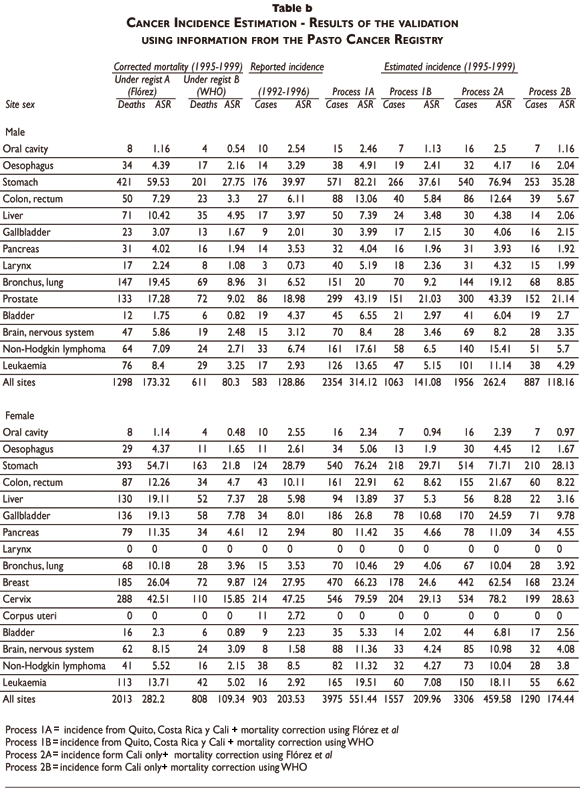
<body><![CDATA[<p><font size="2" face="Verdana"> The purpose of this study was to examine the    aforementioned method in estimating cancer incidence at the national and subnational    levels in Colombia. Estimates of incidence rates and the number of new cases    are presented for the 18 most common cancer sites by sex.</font></p>     <p>&nbsp;</p>     <p><font size="3" face="Verdana"><b>Material and Methods</b></font></p>     <p><font size="2" face="Verdana">The present publication is a component of the    study "Present state of the cancer situation in Colombia: Incidence and    mortality" , approved by the Ethics Committee at the Instituto Nacional    de Cancerolog&iacute;a in Bogot&aacute;, Colombia. </font></p>     <p><font size="2" face="Verdana"> Incidence and mortality data were extracted    by sex and for 18 common cancer sites using the International Classification    of Diseases, 10<SUP>th</SUP> edition (ICD-10): oral cavity and pharynx (C00-14),    oesophagus (C15), stomach (C16), colon-rectum (C18-21), liver (C22), gallbladder    (C23-4), pancreas (C25), larynx (C32), lung (C33-4), female breast (C50), cervix    uteri (C53), corpus uteri (C54), prostate (C61), bladder (C67), brain-central    nervous system (C70-2), non-Hodgkin lymphoma (C82-5,C96), leukaemia (C91-5)    and for all cancers combined (but non-melanoma skin cancer, C00-96 but C44).    After analysis, the data were partitioned into eight age groups: 0-44, 45-49,    50-54, 55-59, 60-64, 65-69, 70-74 and 75 years and over.</font></p>     <p><font size="2" face="Verdana"><b>National mortality and population data</b></font></p>     <p><font size="2" face="Verdana">Mortality and population data were obtained for    the period 1995-1999 at both the national level and district level from the    Departamento Administrativo Nacional de Estad&iacute;stica (DANE), the official    source for such information in Colombia.<SUP>9,10 </SUP>Mortality data were    first adjusted for under-registration at a district level and then by age and    sex, using the information provided by a Colombian study on completeness of    death information for the year 1993.<SUP>11 </SUP>The number of deaths coded    as 'uterus unspecified' (ICD-10 C55) was reallocated to either uterine cervix    (C53) or uterine corpus (C54) cancer, on the basis of their respective age specific    proportions, following international recommendations.<SUP>12 </SUP> </font></p>     <p><font size="2" face="Verdana"> Finally, for each combination of cancer site    and sex, cases of unknown age were partitioned proportionally within the eight    age groups, therefore assuming that such cases were missing age at random and    had the same age distribution as the known cases. This method is the one followed    by the IARC in the different "Cancer incidence in five continents"    publications.<SUP>2</SUP> </font></p>     <p><font size="2" face="Verdana"><b>Incidence estimates</b></font></p>     <p><font size="2" face="Verdana">The following formula was used in the estimation    process: </font></p>     ]]></body>
<body><![CDATA[<blockquote>        <p><font size="2" face="Verdana">I<SUB>N</SUB>= M<SUB>N</SUB> x &#91;I<SUB>R</SUB>/M<SUB>R</SUB>&#93;</font></p> </blockquote>     <p><font size="2" face="Verdana">Where: </font></p>     <blockquote>        <p><font size="2" face="Verdana">I <SUB>N</SUB>= national/district incidence    <br>     M<SUB>N</SUB>= national/district mortality (1995-1999)    <br>     I<SUB>R</SUB>= regional incidence from Cali (1992-1996)<SUP>2</SUP>    <br>     M<SUB>R</SUB>= regional mortality from Cali (1992-1996), </font></p> </blockquote>     <p><font size="2" face="Verdana">assuming a similar I/M ratio for each district    and for Colombia as a whole. </font></p>     <p><font size="2" face="Verdana"> National and district cancer incidence was estimated    through a Poisson log-linear model of incidence and mortality by sex and site,    adjusted for age, obtained from the Cali cancer registry. These I<SUB>R</SUB>/M<SUB>R</SUB>    ratios were then applied to the national and district mortality. Cervix (C53)    and corpus uteri (C54) cancer deaths and new cancer cases registered in Cali    were adjusted for age, to correct for the varying proportions of these attributed    to ICD code 'Uterus unspecified' (ICD-10 C55). For the category 'all cancers    but non-melanoma skin', estimates were obtained by summing the number of cases    at the 17 specific sites included in this study, and a category for 'all other    cancers but non-melanoma skin' (including cancer of unknown primary site). This    method has been used in compilations at the international level.<SUP>8,13 </SUP>The    estimated incidence and corrected mortality are presented as crude and age-standardized    rates per 100 000, using the world standard population, as originally proposed    by Segi,<SUP>14</SUP> and modified by Doll.<SUP>15</SUP></font></p>     ]]></body>
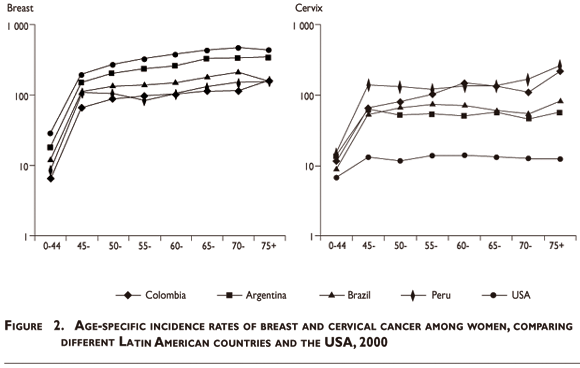
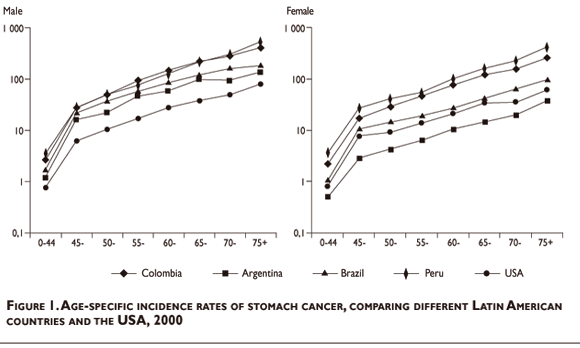
<body><![CDATA[<p><font size="2" face="Verdana"> Age-specific incidence rates for the main sites,    namely stomach cancer, breast cancer and cervix cancer are presented in comparison    to age-specific incidence rates from other Latin American countries and the    United States of America, provided by GLOBOCAN 2000 (<a href="#fig01">figures    1</a> and <a href="#fig02">2</a>).</font></p>     <p><a name="fig01"></a></p>     <p>&nbsp;</p>     <p align="center"><img src="/img/revistas/spm/v48n6/a03fig01.gif"></p>     <p>&nbsp;</p>     <p><a name="fig02"></a></p>     <p>&nbsp;</p>     <p align="center"><img src="/img/revistas/spm/v48n6/a03fig02.gif"></p>     <p>&nbsp;</p>     <p><font size="2" face="Verdana"><b>Validation</b></font></p>     ]]></body>
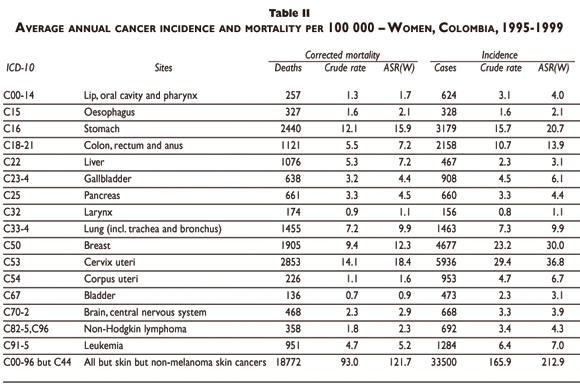
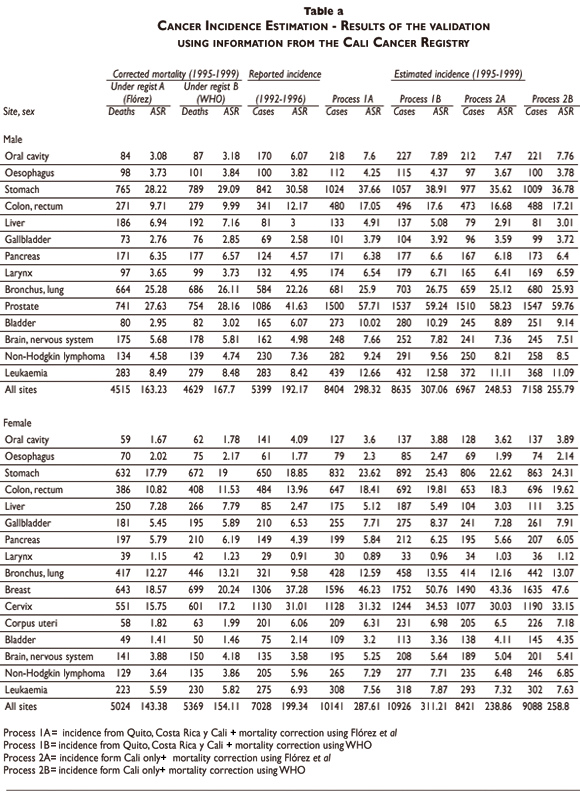
<body><![CDATA[<p><font size="2" face="Verdana">In selecting a final model to be used in the    estimations, we performed a validation procedure using different sources of    under-registration to correct the mortality (WHO indicators or local information)    and using incidence information from different registries (only Cali or Cali,    Quito and Costa Rica). Estimated incidence was obtained for Cali and Pasto,    using the following four combinations: mortality (Cali, Pasto) corrected with    WHO indicators and incidence from Cali only; mortality (Cali, Pasto) corrected    with local information and incidence from Cali only; mortality (Cali, Pasto)    corrected with WHO indicators and incidence from the three registries combined;    mortality (Cali, Pasto) corrected with local information and incidence from    the three registries combined. The estimated data were then compared with the    Cali incidence and with the Pasto incidence from the existing population based    cancer registries in these two cities.<SUP>2,16</SUP> This validation procedure    has been published previously<SUP>17</SUP> and yielded best results with a "Colombian    model" e.g. correcting mortality with local information and using the incidence    data only from the Cali Registry.</font></p>     <p>&nbsp;</p>     <p><font size="3" face="Verdana"><b>Results</b></font></p>     <p><font size="2" face="Verdana">Age-adjusted cancer incidence rates in men were    213.6 and 212.9 in women (<a href="#tab01">tables I</a> and <a href="#tab02">II</a>).    The estimated average annual number of incident cases for 1995-1999 was 28 130    in men and 33 500 in women (<a href="#tab01">tables I</a> and <a href="#tab02">II</a>).    The number of cases for the 17 specific sites accounted for 77.3% of the total    number of cases in males and for 73.5% in females. </font></p>     <p><a name="tab01"></a></p>     <p>&nbsp;</p>     <p align="center"><img src="/img/revistas/spm/v48n6/a03tab01.gif"></p>     <p>&nbsp;</p>     <p><a name="tab02"></a></p>     <p>&nbsp;</p>     ]]></body>
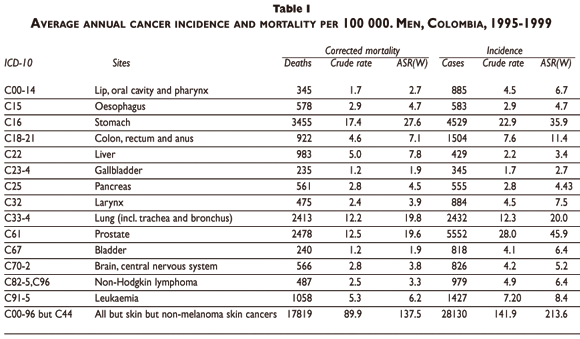
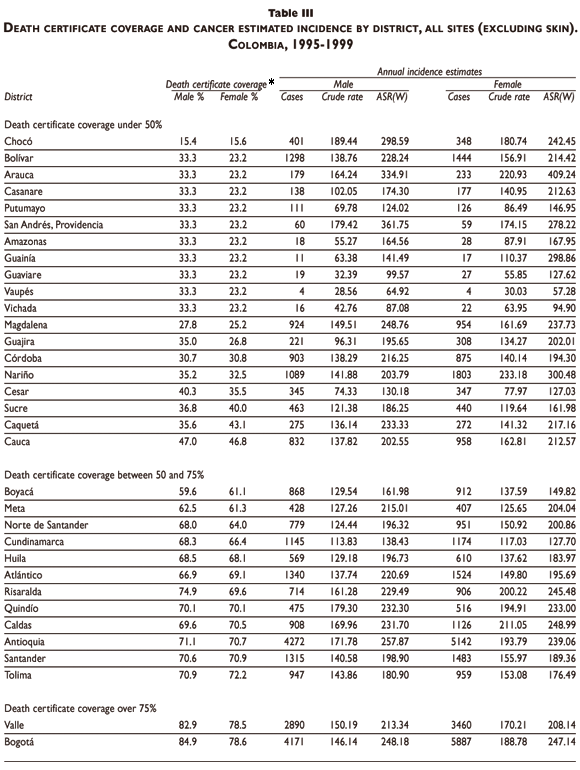
<body><![CDATA[<p align="center"><img src="/img/revistas/spm/v48n6/a03tab02.gif"></p>     <p>&nbsp;</p>     <p><font size="2" face="Verdana"> After correction for under-registration, the    total number of annual cancer deaths among males and females together, was 36    591 deaths; 17 819 in men and 18 772 in women, with a mortality rate of 137.5    among men and of 121.7 among women (<a href="#tab01">tables I</a>, <a href="#tab02">II</a>).    The I/M ratio was 1.6 in men and 1.8 in women. </font></p>     <p><font size="2" face="Verdana"> Among males, major incidence rates for specific    cancer sites were prostate cancer (ASRW 45.8) followed by stomach cancer (ASRW    36.0), lung (ASRW 20.0) colon/rectum (ASRW 11.4) and leukemia (ASRW 8.4). Among    females, the main cancers were those of the cervix uteri (ASRW 36.8), breast    (ASRW 30.0), stomach (ASRW 20.7), colon/rectum (ASRW 13.9) and lung (ASRW 9.9).</font></p>     <p><font size="2" face="Verdana"> Among men, the estimated age-specific incidence    rates of stomach cancer were highest in Colombia and Peru; among women, the    Colombian age-specific rates were slightly lower than those observed in Peru    but still higher than in other countries. </font></p>     <p><font size="2" face="Verdana"> The Colombian age-specific rates of cervical    cancer were relatively high, with a peak for the age group 60-64 followed by    a subsequent decline. In women aged 75 or over, cervix cancer rates showed a    strong increase again, which was difficult to interpret. Breast cancer age specific    rates, show the lowest rates in Colombia compared to other countries, but similar    patterns ocurr until age 74, when a new rise is seen in the rates. The pattern    observed in the age-specific rates for these cancers show an opposite shape:    the countries with lower rates for cervical cancer have the highest rates for    breast cancer. </font></p>     <p><font size="2" face="Verdana"> At the district level, the estimated incidence    rates for all cancers combined (excluding non-melanoma) were highest in both    sexes for those districts with low death certificate coverage (less than 50%)    and small population sizes (Choc&oacute;, Arauca, and San Andr&eacute;s, with    populations of 404 063, 215 410 and 67 612 for 1997 respectively) (<a href="#tab03">table    III</a>).</font></p>     <p><a name="tab03"></a></p>     <p>&nbsp;</p>     <p align="center"><img src="/img/revistas/spm/v48n6/a03tab03.gif"></p>     ]]></body>
<body><![CDATA[<p>&nbsp;</p>     <p><font size="3" face="Verdana"><b>Discussion</b></font></p>     <p><font size="2" face="Verdana">The cancer incidence estimates shown in this    paper are the first estimates incorporating both national and regional data    sources solely within Colombia; namely, incidence data from the Cali Cancer    Registry and national mortality data from official sources in Colombia. </font></p>     <p><font size="2" face="Verdana"> The total number of cases estimated for each    sex, as well as the rates for all sites but skin, are close to estimates derived    from GLOBOCAN 2000.<SUP>8 </SUP>Overall cancer rates were of a similar order    of magnitude between the sexes, as reported in previous estimates for the region.<SUP>4</SUP>    They do however differ from the patterns observed in North America, for which    rates are higher among men with male to female ratios of 1.1.<SUP>8,18</SUP>    </font></p>     <p><font size="2" face="Verdana"> The rank order and magnitude of the incidence    rates estimated for the main sites differ slightly from both the GLOBOCAN 2000    estimates and the Cali registry data. Among men in this study, cancer of the    prostate was the most common, followed by cancers of the stomach, lung and colon/rectum.    For GLOBOCAN 2000, the corresponding placed stomach cancer above prostate cancers.    The use of more recent mortality data in the present study (mortality data 1995-1999),    as compared to GLOBOCAN 2000 (mortality data 1992-94), may contribute to the    observed differences; stomach cancer mortality continues to decline in Colombia,    whereas prostate cancer has been increasing recently.<SUP>3,19</SUP> </font></p>     <p><font size="2" face="Verdana"> Among women in this study, the most common neoplasms    are cancer of the cervix, followed by cancers of the breast, stomach and colon/rectum.    In GLOBOCAN 2000, breast cancer ranked first, followed by cervical and stomach    cancer.<SUP>8 </SUP>The differing pattern in the main sites among women regarding    breast cancer may at least in part be explained by the wider number of cancer    registries included in the estimation process with GLOBOCAN 2000; the inclusion    of data from other Latin American registries pertaining to wealthier countries    than Colombia, where breast cancer rates are considerably higher than cervical    rates. In Concordia, Argentina, breast cancer rates (ASWR) are 60.2 whilst cervical    cancer rates (ASWR) are 32.0, while in Cali, figures for breast and cervix cancer    are pretty similar with rates of 38.8 and 34.4 respectively.<SUP>2</SUP> In    addition, the national mortality data used in the estimation process in this    study may have been affected by the higher correction for under-registration    among sparsely populated districts –which also had some of the highest    cervical cancer mortality rates in the country.<SUP>3 </SUP> </font></p>     <p><font size="2" face="Verdana"> The figures differ also from those of the Cali    cancer registry. For the last period of registration available (1992-96), the    highest incidence rates among men were reported as cancers of the prostate,    stomach and lung, whilst for women they were cancers of the breast, cervix,    and stomach.<SUP>2 </SUP>The difference is possibly explained by the fact that    Cali serves only an urban, and accounts for about 5% of the total population    of Colombia.<SUP>20</SUP> High levels of industrialization, a more favourable    mean socioeconomic status and change in lifestyle patterns, could be some of    the factors why both stomach and cervical cancer have been on the decline (Luis    Bravo, personal communication). </font></p>     <p><font size="2" face="Verdana"> The observed age-specific incidence pattern    of cervical cancer is different in Colombia than in the other countries. Screening    coverage for cervical cancer in postmenopausal women, although covered by the    Colombian health system, seems not to be very favourable according to the perception    of many health care providers, and it could be related to the fact that the    screening activities are a component of the sexual and reproductive health programme.    Another factor that could influence the age specific pattern, could probably    be also related to the prevalence and incidence of human papillomavirus infection,    which in a previous study among Colombian women showed an increase in women    aged 55 years or more.<SUP>21,22</SUP> </font></p>     <p><font size="2" face="Verdana"> The high incidence figure for prostate cancer    deserves a cautious interpretation; the effect of the introduction of PSAtesting    in the allocation of cause of death has not been established in Colombia; a    recent study in North America found that misattribution of the prostate cancer    deaths, over-attributing prostate cancer as cause of death in prevalent cases,    could account for a very important proportion of the observed mortality rate    increase.<SUP>23</SUP> There is also evidence that coding rules for mortality    favour an over-reporting of prostate cancer, in spite of a high level of agreement    observed between underlying causes of death and information from medical records.<SUP>24</SUP>    </font></p>     <p><font size="2" face="Verdana"> The other cancer site worth a comment regarding    quality is liver cancer, for which the estimated incidence rates and number    of new cases were lower than the corrected mortality; this reflects a well-known    problem observed in other countries and is explained by the fact that the majority    of liver cancer deaths are "liver cancer not specified if primary or secondary"    that probably correspond to metastatic cancers, but that are certified as primary    liver cancers.<SUP>25</SUP> </font></p>     ]]></body>
<body><![CDATA[<p><font size="2" face="Verdana"> A similar result was observed with pancreatic    cancer, where mortality rates were slightly higher than estimated incidence    rates. This discordant situation has also been observed in other countries and    could be due to underestimation of the incidence, since it is a site with difficult    access to a histological diagnosis, and to occurrence generally in old persons    who prefer dying at home without medical care. At the same time, mortality due    to pancreatic cancer has been shown to be overestimated.<SUP>25</SUP> </font></p>     <p><font size="2" face="Verdana"> At a district level, the most valuable data    obtained from the analysis reported in this paper were the absolute number of    cases and the crude rates that may help in the planning of cancer care, making    available for the first time data that can be used as the potential expected    demand for delivering cancer services, and related to the actual provision of    specialized cancer care services in the country. In contrast, the standardized    incidence rates obtained play a role in comparing rates among districts with    different age structures, as could be the case when comparing Bogot&aacute;    with some of the districts in the Amazon region, and also for international    comparisons as we used the world standard population in the standardization    of rates;<SUP>26 </SUP>these comparisons could also be used to identify priority    areas for intervention </font></p>     <p><font size="2" face="Verdana"> The higher estimates obtained for those districts    where mortality coverage is under 50% have to be interpreted cautiously, as    they can be overestimated for different reasons: most of the districts with    low mortality coverage are also districts with small population sizes, for which    rates may be unstable and coverage estimates were only estimated for one year,    namely, 1993 (the year of the census). In addition, those are districts with    low socio-economic conditions and are expected to have low cancer risk, except    for cancers associated with poverty, such as cervical cancer. Finally, Colombia    faced a new organization of the System of Vital Statistics in 1997 with clear    guidelines for collection of vital statistics;<SUP>27</SUP> as a result, districts    that formerly had very low coverage are expected to have improved it in a significant    way. This was not considered in the correction of underestimation, as it used    only data from 1993, even though mortality data from 1995 to 1998 were available.    Therefore, future estimation exercises should aggregate districts with sparse    populations before estimation, and should examine carefully how to correct for    mortality underestimation with more recently data, if available. </font></p>     <p><font size="2" face="Verdana"> It seems also worthwhile to evaluate the variations    in the district estimates when correcting mortality for quality indicators;    differences in quality among districts have shown to be very important.<SUP>3</SUP>    For example, the proportion of cancer deaths from unspecified sites, which may    comprise up to a 10% of total cancer deaths in Colombia, highlights problems    in the accuracy of the death certificate and in diagnostic capacity, which in    turn affects the estimation of cancer occurrence. </font></p>     <p><font size="2" face="Verdana"> Three approaches to missing data may be used:    ignoring missing data by excluding cases (listwise or pairwise), redistributing    missing data according to observed values, and replacing missing data by statistical    estimates from observed values (mean imputation, regression imputation, hot-deck    imputation and multiple imputation). Ignoring missing data is feasible when    there is a low impact on sample size; redistributing missing data is an alternative    to reduce the impact on sample size and it is viable when the mechanism causing    missing data is random; replacing missing data is reasonable if a statistical    method that needs a complete data set is required. Previous analysis shows that    entailing If a complete data set is needed and having a small sample size with    random occurrences of missing data or a big sample size with non random occurrences    of missing data, compels using the replacing technique , but, if obtaining a    complete data set is not the objective, imputation of missing values could incur    in biases.<a name="tx"></a><a href="#nt"><sup>*</sup></a> The present study    replaced missing data of age on the basis of a random occurrence, and following    a "historical procedure" carried out at IARC. </font></p>     <p><font size="2" face="Verdana"> The effect of introducing correction for quality    and coverage in the estimation procedure has to be carefully validated before    put into practice. Nevertheless, these estimates provide the best current estimates    of cancer burden in Colombia, and have been incorporated into the current edition    of GLOBOCAN, which provides worldwide cancer estimates for the year 2002.<SUP>28</SUP></font></p>     <p><font size="2" face="Verdana"><b>Acknowledgements</b></font></p>     <p><font size="2" face="Verdana">The authors wish to thank Freddie Ian Bray (Cancer    Registry of Norway) and Ricardo Cendales (Instituto Nacional de Cancerolog&iacute;a    de Colombia) for their valuable comments.</font></p>     <p><font size="2" face="Verdana"><b>Sources of support</b></font></p>     <p><font size="2" face="Verdana">This study was supported by Colciencias (Contrato    146/2000) and by the Terry Fox Run, from the Canadian Embassy in Colombia.</font></p>     ]]></body>
<body><![CDATA[<p>&nbsp;</p>     <p><font size="3" face="Verdana"><b>References</b></font></p>     <!-- ref --><p><font size="2" face="Verdana">1. Jensen OM, Parkin DM, MacLennan R, Muir CS,    Skeet RG. Cancer registration: Principles and methods. IARC Scientific Publications,    No.95. Lyon, France: International Agency for Research on Cancer, 1991. </font>&nbsp;&nbsp;&nbsp;&nbsp;&nbsp;&nbsp;&nbsp;&nbsp;[&#160;<a href="javascript:void(0);" onclick="javascript: window.open('/scielo.php?script=sci_nlinks&ref=9223006&pid=S0036-3634200600060000300001&lng=','','width=640,height=500,resizable=yes,scrollbars=1,menubar=yes,');">Links</a>&#160;]<!-- end-ref --><!-- ref --><p><font size="2" face="Verdana">2. Parkin DM, Whelan SL, Ferlay J, Teppo L, Thomas    DB, eds. Cancer Incidence in Five Continents, Vol. VIII. IARC Scientific Publications    No. 155. Lyon: International Agency for Research on Cancer, 2002. </font>&nbsp;&nbsp;&nbsp;&nbsp;&nbsp;&nbsp;&nbsp;&nbsp;[&#160;<a href="javascript:void(0);" onclick="javascript: window.open('/scielo.php?script=sci_nlinks&ref=9223007&pid=S0036-3634200600060000300002&lng=','','width=640,height=500,resizable=yes,scrollbars=1,menubar=yes,');">Links</a>&#160;]<!-- end-ref --><!-- ref --><p><font size="2" face="Verdana">3. Murillo R, Pi&ntilde;eros M, Hern&aacute;ndez    G. Atlas de mortalidad por c&aacute;ncer en Colombia &#91;Colombian Cancer Mortality    Atlas&#93;. Instituto Nacional de Cancerolog&iacute;a, Instituto Geogr&aacute;fico    Agust&iacute;n Codazzi, Bogot&aacute;: Imprenta Nacional, 2004. </font>&nbsp;&nbsp;&nbsp;&nbsp;&nbsp;&nbsp;&nbsp;&nbsp;[&#160;<a href="javascript:void(0);" onclick="javascript: window.open('/scielo.php?script=sci_nlinks&ref=9223008&pid=S0036-3634200600060000300003&lng=','','width=640,height=500,resizable=yes,scrollbars=1,menubar=yes,');">Links</a>&#160;]<!-- end-ref --><!-- ref --><p><font size="2" face="Verdana">4. Parkin DM, Laara E, Muir CS. Estimates of    the worldwide frequency of sixteen major cancers in 1980. Int J Cancer 1988;(41):184-197.    </font>&nbsp;&nbsp;&nbsp;&nbsp;&nbsp;&nbsp;&nbsp;&nbsp;[&#160;<a href="javascript:void(0);" onclick="javascript: window.open('/scielo.php?script=sci_nlinks&ref=9223009&pid=S0036-3634200600060000300004&lng=','','width=640,height=500,resizable=yes,scrollbars=1,menubar=yes,');">Links</a>&#160;]<!-- end-ref --><!-- ref --><p><font size="2" face="Verdana">5. Jensen OM, Esteve J, Moller H, Renard H. Cancer    in the European Community and its member states. Eur J Cancer 1990;(26):1167-1256.    </font>&nbsp;&nbsp;&nbsp;&nbsp;&nbsp;&nbsp;&nbsp;&nbsp;[&#160;<a href="javascript:void(0);" onclick="javascript: window.open('/scielo.php?script=sci_nlinks&ref=9223010&pid=S0036-3634200600060000300005&lng=','','width=640,height=500,resizable=yes,scrollbars=1,menubar=yes,');">Links</a>&#160;]<!-- end-ref --><!-- ref --><p><font size="2" face="Verdana">6. Parkin DM, Pisani P, Ferlay J. Estimates of    the worldwide incidence of twenty-five major cancers in 1990. Int J Cancer 1999;80:    827-841. </font>&nbsp;&nbsp;&nbsp;&nbsp;&nbsp;&nbsp;&nbsp;&nbsp;[&#160;<a href="javascript:void(0);" onclick="javascript: window.open('/scielo.php?script=sci_nlinks&ref=9223011&pid=S0036-3634200600060000300006&lng=','','width=640,height=500,resizable=yes,scrollbars=1,menubar=yes,');">Links</a>&#160;]<!-- end-ref --><!-- ref --><p><font size="2" face="Verdana">7. Black RJ, Bray F, Ferlay J, Parkin DM. Cancer    incidence and mortality in the European Union: cancer registry data and estimates    of national incidence for 1990. Eur J Cancer 1997;33(7):1075-1077. </font>&nbsp;&nbsp;&nbsp;&nbsp;&nbsp;&nbsp;&nbsp;&nbsp;[&#160;<a href="javascript:void(0);" onclick="javascript: window.open('/scielo.php?script=sci_nlinks&ref=9223012&pid=S0036-3634200600060000300007&lng=','','width=640,height=500,resizable=yes,scrollbars=1,menubar=yes,');">Links</a>&#160;]<!-- end-ref --><!-- ref --><p><font size="2" face="Verdana">8. Ferlay J, Bray F, Pisani P, Parkin DM. GLOBOCAN    2000: Cancer Incidence, Mortality and Prevalence Worldwide, Version 1.0. IARC    CancerBase No. 5. Lyon: IARC Press, 2001. </font>&nbsp;&nbsp;&nbsp;&nbsp;&nbsp;&nbsp;&nbsp;&nbsp;[&#160;<a href="javascript:void(0);" onclick="javascript: window.open('/scielo.php?script=sci_nlinks&ref=9223013&pid=S0036-3634200600060000300008&lng=','','width=640,height=500,resizable=yes,scrollbars=1,menubar=yes,');">Links</a>&#160;]<!-- end-ref --><!-- ref --><p><font size="2" face="Verdana">9. Departamento Administrativo Nacional de Estad&iacute;stica    (Colombia). Bases de datos de mortalidad 1995 – 1999. &#91;Mortality, 1995-1999&#93;.    (data base). Bogot&aacute;: Done (banco de datos), 2002. </font>&nbsp;&nbsp;&nbsp;&nbsp;&nbsp;&nbsp;&nbsp;&nbsp;[&#160;<a href="javascript:void(0);" onclick="javascript: window.open('/scielo.php?script=sci_nlinks&ref=9223014&pid=S0036-3634200600060000300009&lng=','','width=640,height=500,resizable=yes,scrollbars=1,menubar=yes,');">Links</a>&#160;]<!-- end-ref --><!-- ref --><p><font size="2" face="Verdana">10. Departamento Administrativo Nacional de Estad&iacute;stica    (Colombia). Proyecciones departamentales de poblaci&oacute;n por sexo y edad,1990-2015    &#91;Population projections by district, sex and age, 1990-2015&#93;. Bogot&aacute;:    Dane (Divisi&oacute;n de ediciones), 1998. </font>&nbsp;&nbsp;&nbsp;&nbsp;&nbsp;&nbsp;&nbsp;&nbsp;[&#160;<a href="javascript:void(0);" onclick="javascript: window.open('/scielo.php?script=sci_nlinks&ref=9223015&pid=S0036-3634200600060000300010&lng=','','width=640,height=500,resizable=yes,scrollbars=1,menubar=yes,');">Links</a>&#160;]<!-- end-ref --><!-- ref --><p><font size="2" face="Verdana">11. Fl&oacute;rez CE, Medina R. La cobertura    de las defunciones en 1993. Informe final para el Ministerio de Salud. &#91;Coverage    of mortality reporting in 1993, final report to the Health Ministry&#93;. Bogot&aacute;,    Colombia: Universidad de Los Andes, 1997. </font>&nbsp;&nbsp;&nbsp;&nbsp;&nbsp;&nbsp;&nbsp;&nbsp;[&#160;<a href="javascript:void(0);" onclick="javascript: window.open('/scielo.php?script=sci_nlinks&ref=9223016&pid=S0036-3634200600060000300011&lng=','','width=640,height=500,resizable=yes,scrollbars=1,menubar=yes,');">Links</a>&#160;]<!-- end-ref --><!-- ref --><p><font size="2" face="Verdana">12. Loos AH, Bray F, McCarron P, Weiderpass E,    Hakama M, Parkin DM. Sheep and goats: separating cervix and corpus uteri from    imprecisely coded uterine cancer deaths, for studies of geographical and temporal    variations in mortality. Eur J Cancer 2004;40(18):2794-2803. </font>&nbsp;&nbsp;&nbsp;&nbsp;&nbsp;&nbsp;&nbsp;&nbsp;[&#160;<a href="javascript:void(0);" onclick="javascript: window.open('/scielo.php?script=sci_nlinks&ref=9223017&pid=S0036-3634200600060000300012&lng=','','width=640,height=500,resizable=yes,scrollbars=1,menubar=yes,');">Links</a>&#160;]<!-- end-ref --><!-- ref --><p><font size="2" face="Verdana">13. Bray F, Sankila R, Ferlay J, Parkin DM. Estimates    of Cancer Incidence and Mortality in Europe in 1995. Eur J Cancer 2003;38:99-166.    </font>&nbsp;&nbsp;&nbsp;&nbsp;&nbsp;&nbsp;&nbsp;&nbsp;[&#160;<a href="javascript:void(0);" onclick="javascript: window.open('/scielo.php?script=sci_nlinks&ref=9223018&pid=S0036-3634200600060000300013&lng=','','width=640,height=500,resizable=yes,scrollbars=1,menubar=yes,');">Links</a>&#160;]<!-- end-ref --><!-- ref --><p><font size="2" face="Verdana">14. Segi M. Cancer mortality for selected sites    in 24 countries (1950-1957). Tohoku: University of Medicine, 1960. </font>&nbsp;&nbsp;&nbsp;&nbsp;&nbsp;&nbsp;&nbsp;&nbsp;[&#160;<a href="javascript:void(0);" onclick="javascript: window.open('/scielo.php?script=sci_nlinks&ref=9223019&pid=S0036-3634200600060000300014&lng=','','width=640,height=500,resizable=yes,scrollbars=1,menubar=yes,');">Links</a>&#160;]<!-- end-ref --><!-- ref --><p><font size="2" face="Verdana">15. Doll R, Payne P, Waterhouse JAH, eds. Cancer    Incidence in Five Continents, Vol. I. Geneva: Union Internationale Contre le    Cancer, 1966. </font>&nbsp;&nbsp;&nbsp;&nbsp;&nbsp;&nbsp;&nbsp;&nbsp;[&#160;<a href="javascript:void(0);" onclick="javascript: window.open('/scielo.php?script=sci_nlinks&ref=9223020&pid=S0036-3634200600060000300015&lng=','','width=640,height=500,resizable=yes,scrollbars=1,menubar=yes,');">Links</a>&#160;]<!-- end-ref --><!-- ref --><p><font size="2" face="Verdana">16. Sans&oacute;n F, Caicedo R, Dorado A. C&aacute;ncer    incidente en el municipio de Pasto:1999-2001. &#91;Cancer incidence in the district    of Pasto:1999-2001&#93;. Alcald&iacute;a Municipal de Seguridad Social en Salud,    Centro de Estudios en Salud de la Universidad de Nari&ntilde;o. Pasto: Gr&aacute;ficas    Ltda, 2002. </font>&nbsp;&nbsp;&nbsp;&nbsp;&nbsp;&nbsp;&nbsp;&nbsp;[&#160;<a href="javascript:void(0);" onclick="javascript: window.open('/scielo.php?script=sci_nlinks&ref=9223021&pid=S0036-3634200600060000300016&lng=','','width=640,height=500,resizable=yes,scrollbars=1,menubar=yes,');">Links</a>&#160;]<!-- end-ref --><!-- ref --><p><font size="2" face="Verdana">17. Pi&ntilde;eros M, Murillo R. Incidencia de    c&aacute;ncer en Colombia: importancia de las fuentes de informaci&oacute;n    en la obtenci&oacute;n de cifras estimativas &#91;Cancer Incidence Estimates in    Colombia: Importance of data sources in the obtention of estimation numbers&#93;.    Revista Colombiana de Cancerolog&iacute;a 2004; 8(1):5-12. </font>&nbsp;&nbsp;&nbsp;&nbsp;&nbsp;&nbsp;&nbsp;&nbsp;[&#160;<a href="javascript:void(0);" onclick="javascript: window.open('/scielo.php?script=sci_nlinks&ref=9223022&pid=S0036-3634200600060000300017&lng=','','width=640,height=500,resizable=yes,scrollbars=1,menubar=yes,');">Links</a>&#160;]<!-- end-ref --><!-- ref --><p><font size="2" face="Verdana">18. Ries LAG, Harkins D, Krapcho M, Mariotto    A, Miller BA, Feuer EJ, <I>et al </I>(eds). SEER Cancer Statistics Review, 1975-2003,    National Cancer Institute. Bethesda, MD. Available at: <a href="http://seer.cancer.gov/csr/1975_2003/results_merged/sect_02_all_sites.pdf" target="_blank">http://seer.cancer.gov/csr/1975_2003/results_merged/sect_02_all_sites.pdf</a>;    based on November 2005 SEER data submission, posted to the SEER web site, 2006.    </font>&nbsp;&nbsp;&nbsp;&nbsp;&nbsp;&nbsp;&nbsp;&nbsp;[&#160;<a href="javascript:void(0);" onclick="javascript: window.open('/scielo.php?script=sci_nlinks&ref=9223023&pid=S0036-3634200600060000300018&lng=','','width=640,height=500,resizable=yes,scrollbars=1,menubar=yes,');">Links</a>&#160;]<!-- end-ref --><!-- ref --><p><font size="2" face="Verdana">19. Pi&ntilde;eros M, Hernandez G, Bray F. Increasing    mortality rates of common malignancies in Colombia. Cancer 2004;101(10):2285-2292.    </font>&nbsp;&nbsp;&nbsp;&nbsp;&nbsp;&nbsp;&nbsp;&nbsp;[&#160;<a href="javascript:void(0);" onclick="javascript: window.open('/scielo.php?script=sci_nlinks&ref=9223024&pid=S0036-3634200600060000300019&lng=','','width=640,height=500,resizable=yes,scrollbars=1,menubar=yes,');">Links</a>&#160;]<!-- end-ref --><!-- ref --><p><font size="2" face="Verdana">20. Departamento Administrativo Nacional de Estad&iacute;stica    (Colombia). Colombia, proyecciones municipales de poblaci&oacute;n por &aacute;rea,1995-2005    &#91;Population projections by municipalities, sex and age, 1995-2005&#93;. Bogot&aacute;:    Dane (Divisi&oacute;n de ediciones), 1998. </font>&nbsp;&nbsp;&nbsp;&nbsp;&nbsp;&nbsp;&nbsp;&nbsp;[&#160;<a href="javascript:void(0);" onclick="javascript: window.open('/scielo.php?script=sci_nlinks&ref=9223025&pid=S0036-3634200600060000300020&lng=','','width=640,height=500,resizable=yes,scrollbars=1,menubar=yes,');">Links</a>&#160;]<!-- end-ref --><!-- ref --><p><font size="2" face="Verdana">21. Molano M, Posso H, Weiderpass E, van den    Brule AJ, Ronderos M, Franceschi S, <I>et al</I>. HPV Study Group HPV Study.    Prevalence and determinants of HPV infection among Colombian women with normal    cytology. Br J Cancer 2002;87(3):324-333. </font>&nbsp;&nbsp;&nbsp;&nbsp;&nbsp;&nbsp;&nbsp;&nbsp;[&#160;<a href="javascript:void(0);" onclick="javascript: window.open('/scielo.php?script=sci_nlinks&ref=9223026&pid=S0036-3634200600060000300021&lng=','','width=640,height=500,resizable=yes,scrollbars=1,menubar=yes,');">Links</a>&#160;]<!-- end-ref --><!-- ref --><p><font size="2" face="Verdana">22. Mu&ntilde;oz N, Mendez F, Posso H, Molano    M, van den Brule AJ, Ronderos M, <I>et al</I>. Incidence, duration, and determinants    of cervical human papillomavirus infection in a cohort of Colombian women with    normal cytological results. J Infect Dis 2004;190(12):2077-2087. </font>&nbsp;&nbsp;&nbsp;&nbsp;&nbsp;&nbsp;&nbsp;&nbsp;[&#160;<a href="javascript:void(0);" onclick="javascript: window.open('/scielo.php?script=sci_nlinks&ref=9223027&pid=S0036-3634200600060000300022&lng=','','width=640,height=500,resizable=yes,scrollbars=1,menubar=yes,');">Links</a>&#160;]<!-- end-ref --><!-- ref --><p><font size="2" face="Verdana">23. Hoffman RM, Stone SN, Hunt WC, Key CR, Gilliland    FD. Effects of misattribution in assigning cause of death on prostate cancer    mortality rates. Ann Epidemiol 2003;13(6):450-454. </font>&nbsp;&nbsp;&nbsp;&nbsp;&nbsp;&nbsp;&nbsp;&nbsp;[&#160;<a href="javascript:void(0);" onclick="javascript: window.open('/scielo.php?script=sci_nlinks&ref=9223028&pid=S0036-3634200600060000300023&lng=','','width=640,height=500,resizable=yes,scrollbars=1,menubar=yes,');">Links</a>&#160;]<!-- end-ref --><!-- ref --><p><font size="2" face="Verdana">24. Albertsen PC, Walters S, Hanley JA. A comparison    of cause of death determination in men previously diagnosed with prostate cancer    who died in 1985 or 1995. J Urol 2000; 163(2):519-523. </font>&nbsp;&nbsp;&nbsp;&nbsp;&nbsp;&nbsp;&nbsp;&nbsp;[&#160;<a href="javascript:void(0);" onclick="javascript: window.open('/scielo.php?script=sci_nlinks&ref=9223029&pid=S0036-3634200600060000300024&lng=','','width=640,height=500,resizable=yes,scrollbars=1,menubar=yes,');">Links</a>&#160;]<!-- end-ref --><!-- ref --><p><font size="2" face="Verdana">25. Remontet L, Esteve J, Bouvier AM, Grosclaude    P, Launoy G, Menegoz F, <I>et al</I>. Cancer incidence and mortality in France    over the period 1978-2000. Rev Epidemiol Sante Publique 2003;51(1 Pt 1):3-30.    </font>&nbsp;&nbsp;&nbsp;&nbsp;&nbsp;&nbsp;&nbsp;&nbsp;[&#160;<a href="javascript:void(0);" onclick="javascript: window.open('/scielo.php?script=sci_nlinks&ref=9223030&pid=S0036-3634200600060000300025&lng=','','width=640,height=500,resizable=yes,scrollbars=1,menubar=yes,');">Links</a>&#160;]<!-- end-ref --><!-- ref --><p><font size="2" face="Verdana">26. Esteve J, Benhamou E, Raymond L. Statistical    methods in cancer research. Volume IV. Descriptive epidemiology. IARC Sci Publ    1994;(128):1-302. </font>&nbsp;&nbsp;&nbsp;&nbsp;&nbsp;&nbsp;&nbsp;&nbsp;[&#160;<a href="javascript:void(0);" onclick="javascript: window.open('/scielo.php?script=sci_nlinks&ref=9223031&pid=S0036-3634200600060000300026&lng=','','width=640,height=500,resizable=yes,scrollbars=1,menubar=yes,');">Links</a>&#160;]<!-- end-ref --><!-- ref --><p><font size="2" face="Verdana">27. Departamento Administrativo Nacional de Estad&iacute;stica    (Colombia). Manual de principios y procedimientos del Sistema de Registro Civil    y Estad&iacute;sticas Vitales &#91;Guideline of principles and procedures of the    System of Civil Registration and vital statistics&#93;. Bogot&aacute;:Dane (Divisi&oacute;n    de ediciones), 1997. </font>&nbsp;&nbsp;&nbsp;&nbsp;&nbsp;&nbsp;&nbsp;&nbsp;[&#160;<a href="javascript:void(0);" onclick="javascript: window.open('/scielo.php?script=sci_nlinks&ref=9223032&pid=S0036-3634200600060000300027&lng=','','width=640,height=500,resizable=yes,scrollbars=1,menubar=yes,');">Links</a>&#160;]<!-- end-ref --><!-- ref --><p><font size="2" face="Verdana">28. Ferlay J, Bray F, Pisani P, Parkin DM. GLOBOCAN    2002: Cancer Incidence, Mortality and Prevalence Worldwide, Version 2.0. IARC    CancerBase No. 5. Lyon: IARC Press, 2004.</font>&nbsp;&nbsp;&nbsp;&nbsp;&nbsp;&nbsp;&nbsp;&nbsp;[&#160;<a href="javascript:void(0);" onclick="javascript: window.open('/scielo.php?script=sci_nlinks&ref=9223033&pid=S0036-3634200600060000300028&lng=','','width=640,height=500,resizable=yes,scrollbars=1,menubar=yes,');">Links</a>&#160;]<!-- end-ref --><p>&nbsp;</p>     <p>&nbsp;</p>     <p><font size="2" face="Verdana">Received on: February 23, 2006    <br>   Accepted on: July 13, 2006</font></p>     <p>&nbsp;</p>     <p>&nbsp;</p>     <p><font size="2" face="Verdana">Address reprint request to: Marion Pi&ntilde;eros.    Coordinadora Grupo Area Salud P&uacute;blica. Instituto Nacional de Cancerolog&iacute;a.    Calle 1 No. 9-85. Bogot&aacute;, Colombia. E-mail: <a href="mailto:mpineros@cancer.gov.co">mpineros@cancer.gov.co</a>    <br>   <a name="nt"></a><a href="#tx">*</a> Song Q, Shepperd M. A new imputation method    for small software project data sets. The Journal of Systems and Software 2006;    in press.</font></p>     <p>&nbsp;</p>     <p>&nbsp;</p>     ]]></body>
<body><![CDATA[<p><font size="3" face="Verdana"><b>Appendix</b></font></p>     <p>&nbsp;</p>     <p align="center"><img src="/img/revistas/spm/v48n6/a03tab0a.gif"></p>     <p>&nbsp;</p>     <p>&nbsp;</p>     <p align="center"><img src="/img/revistas/spm/v48n6/a03tab0b.gif"></p>      ]]></body><back>
<ref-list>
<ref id="B1">
<label>1</label><nlm-citation citation-type="book">
<person-group person-group-type="author">
<name>
<surname><![CDATA[Jensen]]></surname>
<given-names><![CDATA[OM]]></given-names>
</name>
<name>
<surname><![CDATA[Parkin]]></surname>
<given-names><![CDATA[DM]]></given-names>
</name>
<name>
<surname><![CDATA[MacLennan]]></surname>
<given-names><![CDATA[R]]></given-names>
</name>
<name>
<surname><![CDATA[Muir]]></surname>
<given-names><![CDATA[CS]]></given-names>
</name>
<name>
<surname><![CDATA[Skeet]]></surname>
<given-names><![CDATA[RG]]></given-names>
</name>
</person-group>
<source><![CDATA[Cancer registration: Principles and methods. IARC Scientific Publications]]></source>
<year>1991</year>
<publisher-loc><![CDATA[Lyon ]]></publisher-loc>
<publisher-name><![CDATA[International Agency for Research on Cancer]]></publisher-name>
</nlm-citation>
</ref>
<ref id="B2">
<label>2</label><nlm-citation citation-type="journal">
<person-group person-group-type="author">
<name>
<surname><![CDATA[Parkin]]></surname>
<given-names><![CDATA[DM]]></given-names>
</name>
<name>
<surname><![CDATA[Whelan]]></surname>
<given-names><![CDATA[SL]]></given-names>
</name>
<name>
<surname><![CDATA[Ferlay]]></surname>
<given-names><![CDATA[J]]></given-names>
</name>
<name>
<surname><![CDATA[Teppo]]></surname>
<given-names><![CDATA[L]]></given-names>
</name>
<name>
<surname><![CDATA[Thomas]]></surname>
<given-names><![CDATA[DB]]></given-names>
</name>
</person-group>
<article-title xml:lang="en"><![CDATA[Cancer Incidence in Five Continents]]></article-title>
<source><![CDATA[IARC Scientific Publications]]></source>
<year>2002</year>
<numero>155</numero>
<issue>155</issue>
</nlm-citation>
</ref>
<ref id="B3">
<label>3</label><nlm-citation citation-type="book">
<person-group person-group-type="author">
<name>
<surname><![CDATA[Murillo]]></surname>
<given-names><![CDATA[R]]></given-names>
</name>
<name>
<surname><![CDATA[Piñeros]]></surname>
<given-names><![CDATA[M]]></given-names>
</name>
<name>
<surname><![CDATA[Hernández]]></surname>
<given-names><![CDATA[G]]></given-names>
</name>
</person-group>
<source><![CDATA[Atlas de mortalidad por cáncer en Colombia [Colombian Cancer Mortality Atlas]]]></source>
<year>2004</year>
<publisher-loc><![CDATA[Bogotá ]]></publisher-loc>
<publisher-name><![CDATA[Instituto Nacional de CancerologíaInstituto Geográfico Agustín CodazziImprenta Nacional]]></publisher-name>
</nlm-citation>
</ref>
<ref id="B4">
<label>4</label><nlm-citation citation-type="journal">
<person-group person-group-type="author">
<name>
<surname><![CDATA[Parkin]]></surname>
<given-names><![CDATA[DM]]></given-names>
</name>
<name>
<surname><![CDATA[Laara]]></surname>
<given-names><![CDATA[E]]></given-names>
</name>
<name>
<surname><![CDATA[Muir]]></surname>
<given-names><![CDATA[CS]]></given-names>
</name>
</person-group>
<article-title xml:lang="en"><![CDATA[Estimates of the worldwide frequency of sixteen major cancers in 1980]]></article-title>
<source><![CDATA[Int J Cancer]]></source>
<year>1988</year>
<volume>41</volume>
<page-range>184-197</page-range></nlm-citation>
</ref>
<ref id="B5">
<label>5</label><nlm-citation citation-type="journal">
<person-group person-group-type="author">
<name>
<surname><![CDATA[Jensen]]></surname>
<given-names><![CDATA[OM]]></given-names>
</name>
<name>
<surname><![CDATA[Esteve]]></surname>
<given-names><![CDATA[J]]></given-names>
</name>
<name>
<surname><![CDATA[Moller]]></surname>
<given-names><![CDATA[H]]></given-names>
</name>
<name>
<surname><![CDATA[Renard]]></surname>
<given-names><![CDATA[H]]></given-names>
</name>
</person-group>
<article-title xml:lang="en"><![CDATA[Cancer in the European Community and its member states]]></article-title>
<source><![CDATA[Eur J Cancer]]></source>
<year>1990</year>
<volume>26</volume>
<page-range>1167-1256</page-range></nlm-citation>
</ref>
<ref id="B6">
<label>6</label><nlm-citation citation-type="journal">
<person-group person-group-type="author">
<name>
<surname><![CDATA[Parkin]]></surname>
<given-names><![CDATA[DM]]></given-names>
</name>
<name>
<surname><![CDATA[Pisani]]></surname>
<given-names><![CDATA[P]]></given-names>
</name>
<name>
<surname><![CDATA[Ferlay]]></surname>
<given-names><![CDATA[J]]></given-names>
</name>
</person-group>
<article-title xml:lang="en"><![CDATA[Estimates of the worldwide incidence of twenty-five major cancers in 1990]]></article-title>
<source><![CDATA[Int J Cancer]]></source>
<year>1999</year>
<volume>80</volume>
<page-range>827-841</page-range></nlm-citation>
</ref>
<ref id="B7">
<label>7</label><nlm-citation citation-type="journal">
<person-group person-group-type="author">
<name>
<surname><![CDATA[Black]]></surname>
<given-names><![CDATA[RJ]]></given-names>
</name>
<name>
<surname><![CDATA[Bray]]></surname>
<given-names><![CDATA[F]]></given-names>
</name>
<name>
<surname><![CDATA[Ferlay]]></surname>
<given-names><![CDATA[J]]></given-names>
</name>
<name>
<surname><![CDATA[Parkin]]></surname>
<given-names><![CDATA[DM]]></given-names>
</name>
</person-group>
<article-title xml:lang="en"><![CDATA[Cancer incidence and mortality in the European Union: cancer registry data and estimates of national incidence for 1990]]></article-title>
<source><![CDATA[Eur J Cancer]]></source>
<year>1997</year>
<volume>33</volume>
<numero>7</numero>
<issue>7</issue>
<page-range>1075-1077</page-range></nlm-citation>
</ref>
<ref id="B8">
<label>8</label><nlm-citation citation-type="book">
<person-group person-group-type="author">
<name>
<surname><![CDATA[Ferlay]]></surname>
<given-names><![CDATA[J]]></given-names>
</name>
<name>
<surname><![CDATA[Bray]]></surname>
<given-names><![CDATA[F]]></given-names>
</name>
<name>
<surname><![CDATA[Pisani]]></surname>
<given-names><![CDATA[P]]></given-names>
</name>
<name>
<surname><![CDATA[Parkin]]></surname>
<given-names><![CDATA[DM]]></given-names>
</name>
</person-group>
<source><![CDATA[GLOBOCAN 2000: Cancer Incidence, Mortality and Prevalence Worldwide]]></source>
<year>2001</year>
<publisher-loc><![CDATA[Lyon ]]></publisher-loc>
<publisher-name><![CDATA[IARC Press]]></publisher-name>
</nlm-citation>
</ref>
<ref id="B9">
<label>9</label><nlm-citation citation-type="book">
<collab>Colombia^dDepartamento Administrativo Nacional de Estadística</collab>
<source><![CDATA[Bases de datos de mortalidad 1995 - 1999. [Mortality, 1995-1999]]]></source>
<year>2002</year>
<publisher-loc><![CDATA[Bogotá ]]></publisher-loc>
<publisher-name><![CDATA[Done (banco de datos)]]></publisher-name>
</nlm-citation>
</ref>
<ref id="B10">
<label>10</label><nlm-citation citation-type="book">
<collab>Colombia^dDepartamento Administrativo Nacional de Estadística</collab>
<source><![CDATA[Proyecciones departamentales de población por sexo y edad,1990-2015]]></source>
<year>1998</year>
<publisher-loc><![CDATA[Bogotá ]]></publisher-loc>
<publisher-name><![CDATA[Dane (División de ediciones)]]></publisher-name>
</nlm-citation>
</ref>
<ref id="B11">
<label>11</label><nlm-citation citation-type="book">
<person-group person-group-type="author">
<name>
<surname><![CDATA[Flórez]]></surname>
<given-names><![CDATA[CE]]></given-names>
</name>
<name>
<surname><![CDATA[Medina]]></surname>
<given-names><![CDATA[R]]></given-names>
</name>
</person-group>
<source><![CDATA[La cobertura de las defunciones en 1993: Informe final para el Ministerio de Salud]]></source>
<year>1997</year>
<publisher-loc><![CDATA[Bogotá ]]></publisher-loc>
<publisher-name><![CDATA[Universidad de Los Andes]]></publisher-name>
</nlm-citation>
</ref>
<ref id="B12">
<label>12</label><nlm-citation citation-type="journal">
<person-group person-group-type="author">
<name>
<surname><![CDATA[Loos]]></surname>
<given-names><![CDATA[AH]]></given-names>
</name>
<name>
<surname><![CDATA[Bray]]></surname>
<given-names><![CDATA[F]]></given-names>
</name>
<name>
<surname><![CDATA[McCarron]]></surname>
<given-names><![CDATA[P]]></given-names>
</name>
<name>
<surname><![CDATA[Weiderpass]]></surname>
<given-names><![CDATA[E]]></given-names>
</name>
<name>
<surname><![CDATA[Hakama]]></surname>
<given-names><![CDATA[M]]></given-names>
</name>
<name>
<surname><![CDATA[Parkin]]></surname>
<given-names><![CDATA[DM]]></given-names>
</name>
</person-group>
<article-title xml:lang="en"><![CDATA[Sheep and goats: separating cervix and corpus uteri from imprecisely coded uterine cancer deaths, for studies of geographical and temporal variations in mortality]]></article-title>
<source><![CDATA[Eur J Cancer]]></source>
<year>2004</year>
<volume>40</volume>
<numero>18</numero>
<issue>18</issue>
<page-range>2794-2803</page-range></nlm-citation>
</ref>
<ref id="B13">
<label>13</label><nlm-citation citation-type="journal">
<person-group person-group-type="author">
<name>
<surname><![CDATA[Bray]]></surname>
<given-names><![CDATA[F]]></given-names>
</name>
<name>
<surname><![CDATA[Sankila]]></surname>
<given-names><![CDATA[R]]></given-names>
</name>
<name>
<surname><![CDATA[Ferlay]]></surname>
<given-names><![CDATA[J]]></given-names>
</name>
<name>
<surname><![CDATA[Parkin]]></surname>
<given-names><![CDATA[DM]]></given-names>
</name>
</person-group>
<article-title xml:lang="en"><![CDATA[Estimates of Cancer Incidence and Mortality in Europe in 1995]]></article-title>
<source><![CDATA[Eur J Cancer]]></source>
<year>2003</year>
<volume>38</volume>
<page-range>99-166</page-range></nlm-citation>
</ref>
<ref id="B14">
<label>14</label><nlm-citation citation-type="book">
<person-group person-group-type="author">
<name>
<surname><![CDATA[Segi]]></surname>
<given-names><![CDATA[M]]></given-names>
</name>
</person-group>
<source><![CDATA[Cancer mortality for selected sites in 24 countries (1950-1957)]]></source>
<year>1960</year>
<publisher-loc><![CDATA[Tohoku ]]></publisher-loc>
<publisher-name><![CDATA[University of Medicine]]></publisher-name>
</nlm-citation>
</ref>
<ref id="B15">
<label>15</label><nlm-citation citation-type="book">
<person-group person-group-type="author">
<name>
<surname><![CDATA[Doll]]></surname>
<given-names><![CDATA[R]]></given-names>
</name>
<name>
<surname><![CDATA[Payne]]></surname>
<given-names><![CDATA[P]]></given-names>
</name>
<name>
<surname><![CDATA[Waterhouse]]></surname>
<given-names><![CDATA[JAH]]></given-names>
</name>
</person-group>
<source><![CDATA[Cancer Incidence in Five Continents]]></source>
<year>1966</year>
<publisher-loc><![CDATA[Geneva ]]></publisher-loc>
<publisher-name><![CDATA[Union Internationale Contre le Cancer]]></publisher-name>
</nlm-citation>
</ref>
<ref id="B16">
<label>16</label><nlm-citation citation-type="book">
<person-group person-group-type="author">
<name>
<surname><![CDATA[Sansón]]></surname>
<given-names><![CDATA[F]]></given-names>
</name>
<name>
<surname><![CDATA[Caicedo]]></surname>
<given-names><![CDATA[R]]></given-names>
</name>
<name>
<surname><![CDATA[Dorado]]></surname>
<given-names><![CDATA[A]]></given-names>
</name>
</person-group>
<source><![CDATA[Cáncer incidente en el municipio de Pasto: 1999-2001]]></source>
<year>2002</year>
<publisher-loc><![CDATA[Pasto ]]></publisher-loc>
<publisher-name><![CDATA[Alcaldía Municipal de Seguridad Social en SaludCentro de Estudios en Salud de la Universidad de NariñoGráficas Ltda]]></publisher-name>
</nlm-citation>
</ref>
<ref id="B17">
<label>17</label><nlm-citation citation-type="journal">
<person-group person-group-type="author">
<name>
<surname><![CDATA[Piñeros]]></surname>
<given-names><![CDATA[M]]></given-names>
</name>
<name>
<surname><![CDATA[Murillo]]></surname>
<given-names><![CDATA[R]]></given-names>
</name>
</person-group>
<article-title xml:lang="es"><![CDATA[Incidencia de cáncer en Colombia: importancia de las fuentes de información en la obtención de cifras estimativas [Cancer Incidence Estimates in Colombia: Importance of data sources in the obtention of estimation numbers]]]></article-title>
<source><![CDATA[Revista Colombiana de Cancerología]]></source>
<year>2004</year>
<volume>8</volume>
<numero>1</numero>
<issue>1</issue>
<page-range>5-12</page-range></nlm-citation>
</ref>
<ref id="B18">
<label>18</label><nlm-citation citation-type="book">
<person-group person-group-type="author">
<name>
<surname><![CDATA[Ries]]></surname>
<given-names><![CDATA[LAG]]></given-names>
</name>
<name>
<surname><![CDATA[Harkins]]></surname>
<given-names><![CDATA[D]]></given-names>
</name>
<name>
<surname><![CDATA[Krapcho]]></surname>
<given-names><![CDATA[M]]></given-names>
</name>
<name>
<surname><![CDATA[Mariotto]]></surname>
<given-names><![CDATA[A]]></given-names>
</name>
<name>
<surname><![CDATA[Miller]]></surname>
<given-names><![CDATA[BA]]></given-names>
</name>
<name>
<surname><![CDATA[Feuer]]></surname>
<given-names><![CDATA[EJ]]></given-names>
</name>
</person-group>
<source><![CDATA[SEER Cancer Statistics Review, 1975-2003]]></source>
<year></year>
<publisher-loc><![CDATA[Bethesda^eMD MD]]></publisher-loc>
<publisher-name><![CDATA[National Cancer Institute]]></publisher-name>
</nlm-citation>
</ref>
<ref id="B19">
<label>19</label><nlm-citation citation-type="journal">
<person-group person-group-type="author">
<name>
<surname><![CDATA[Piñeros]]></surname>
<given-names><![CDATA[M]]></given-names>
</name>
<name>
<surname><![CDATA[Hernandez]]></surname>
<given-names><![CDATA[G]]></given-names>
</name>
<name>
<surname><![CDATA[Bray]]></surname>
<given-names><![CDATA[F]]></given-names>
</name>
</person-group>
<article-title xml:lang="en"><![CDATA[Increasing mortality rates of common malignancies in Colombia]]></article-title>
<source><![CDATA[Cancer]]></source>
<year>2004</year>
<volume>101</volume>
<numero>10</numero>
<issue>10</issue>
<page-range>2285-2292</page-range></nlm-citation>
</ref>
<ref id="B20">
<label>20</label><nlm-citation citation-type="book">
<collab>Colombia^dDepartamento Administrativo Nacional de Estadística</collab>
<source><![CDATA[Colombia, proyecciones municipales de población por área,1995-2005]]></source>
<year>1998</year>
<publisher-loc><![CDATA[Bogotá ]]></publisher-loc>
<publisher-name><![CDATA[Dane (División de ediciones)]]></publisher-name>
</nlm-citation>
</ref>
<ref id="B21">
<label>21</label><nlm-citation citation-type="journal">
<person-group person-group-type="author">
<name>
<surname><![CDATA[Molano]]></surname>
<given-names><![CDATA[M]]></given-names>
</name>
<name>
<surname><![CDATA[Posso]]></surname>
<given-names><![CDATA[H]]></given-names>
</name>
<name>
<surname><![CDATA[Weiderpass]]></surname>
<given-names><![CDATA[E]]></given-names>
</name>
<name>
<surname><![CDATA[van den Brule]]></surname>
<given-names><![CDATA[AJ]]></given-names>
</name>
<name>
<surname><![CDATA[Ronderos]]></surname>
<given-names><![CDATA[M]]></given-names>
</name>
<name>
<surname><![CDATA[Franceschi]]></surname>
<given-names><![CDATA[S]]></given-names>
</name>
</person-group>
<article-title xml:lang="en"><![CDATA[HPV Study Group HPV Study: Prevalence and determinants of HPV infection among Colombian women with normal cytology]]></article-title>
<source><![CDATA[Br J Cancer]]></source>
<year>2002</year>
<volume>87</volume>
<numero>3</numero>
<issue>3</issue>
<page-range>324-333</page-range></nlm-citation>
</ref>
<ref id="B22">
<label>22</label><nlm-citation citation-type="journal">
<person-group person-group-type="author">
<name>
<surname><![CDATA[Muñoz]]></surname>
<given-names><![CDATA[N]]></given-names>
</name>
<name>
<surname><![CDATA[Mendez]]></surname>
<given-names><![CDATA[F]]></given-names>
</name>
<name>
<surname><![CDATA[Posso]]></surname>
<given-names><![CDATA[H]]></given-names>
</name>
<name>
<surname><![CDATA[Molano]]></surname>
<given-names><![CDATA[M]]></given-names>
</name>
<name>
<surname><![CDATA[van den Brule]]></surname>
<given-names><![CDATA[AJ]]></given-names>
</name>
<name>
<surname><![CDATA[Ronderos]]></surname>
<given-names><![CDATA[M]]></given-names>
</name>
</person-group>
<article-title xml:lang="en"><![CDATA[Incidence, duration, and determinants of cervical human papillomavirus infection in a cohort of Colombian women with normal cytological results]]></article-title>
<source><![CDATA[J Infect Dis]]></source>
<year>2004</year>
<volume>190</volume>
<numero>12</numero>
<issue>12</issue>
<page-range>2077-2087</page-range></nlm-citation>
</ref>
<ref id="B23">
<label>23</label><nlm-citation citation-type="journal">
<person-group person-group-type="author">
<name>
<surname><![CDATA[Hoffman]]></surname>
<given-names><![CDATA[RM]]></given-names>
</name>
<name>
<surname><![CDATA[Stone]]></surname>
<given-names><![CDATA[SN]]></given-names>
</name>
<name>
<surname><![CDATA[Hunt]]></surname>
<given-names><![CDATA[WC]]></given-names>
</name>
<name>
<surname><![CDATA[Key]]></surname>
<given-names><![CDATA[CR]]></given-names>
</name>
<name>
<surname><![CDATA[Gilliland]]></surname>
<given-names><![CDATA[FD]]></given-names>
</name>
</person-group>
<article-title xml:lang="en"><![CDATA[Effects of misattribution in assigning cause of death on prostate cancer mortality rates]]></article-title>
<source><![CDATA[Ann Epidemiol]]></source>
<year>2003</year>
<volume>13</volume>
<numero>6</numero>
<issue>6</issue>
<page-range>450-454</page-range></nlm-citation>
</ref>
<ref id="B24">
<label>24</label><nlm-citation citation-type="journal">
<person-group person-group-type="author">
<name>
<surname><![CDATA[Albertsen]]></surname>
<given-names><![CDATA[PC]]></given-names>
</name>
<name>
<surname><![CDATA[Walters]]></surname>
<given-names><![CDATA[S]]></given-names>
</name>
<name>
<surname><![CDATA[Hanley]]></surname>
<given-names><![CDATA[JA]]></given-names>
</name>
</person-group>
<article-title xml:lang="en"><![CDATA[A comparison of cause of death determination in men previously diagnosed with prostate cancer who died in 1985 or 1995]]></article-title>
<source><![CDATA[J Urol]]></source>
<year>2000</year>
<volume>163</volume>
<numero>2</numero>
<issue>2</issue>
<page-range>519-523</page-range></nlm-citation>
</ref>
<ref id="B25">
<label>25</label><nlm-citation citation-type="journal">
<person-group person-group-type="author">
<name>
<surname><![CDATA[Remontet]]></surname>
<given-names><![CDATA[L]]></given-names>
</name>
<name>
<surname><![CDATA[Esteve]]></surname>
<given-names><![CDATA[J]]></given-names>
</name>
<name>
<surname><![CDATA[Bouvier]]></surname>
<given-names><![CDATA[AM]]></given-names>
</name>
<name>
<surname><![CDATA[Grosclaude]]></surname>
<given-names><![CDATA[P]]></given-names>
</name>
<name>
<surname><![CDATA[Launoy]]></surname>
<given-names><![CDATA[G]]></given-names>
</name>
<name>
<surname><![CDATA[Menegoz]]></surname>
<given-names><![CDATA[F]]></given-names>
</name>
</person-group>
<article-title xml:lang="en"><![CDATA[Cancer incidence and mortality in France over the period 1978-2000]]></article-title>
<source><![CDATA[Rev Epidemiol Sante Publique]]></source>
<year>2003</year>
<volume>51</volume>
<numero>1</numero>
<issue>1</issue>
<page-range>3-30</page-range></nlm-citation>
</ref>
<ref id="B26">
<label>26</label><nlm-citation citation-type="journal">
<person-group person-group-type="author">
<name>
<surname><![CDATA[Esteve]]></surname>
<given-names><![CDATA[J]]></given-names>
</name>
<name>
<surname><![CDATA[Benhamou]]></surname>
<given-names><![CDATA[E]]></given-names>
</name>
<name>
<surname><![CDATA[Raymond]]></surname>
<given-names><![CDATA[L]]></given-names>
</name>
</person-group>
<article-title xml:lang="en"><![CDATA[Statistical methods in cancer research]]></article-title>
<source><![CDATA[IARC Sci Publ]]></source>
<year>1994</year>
<volume>128</volume>
<page-range>1-302</page-range></nlm-citation>
</ref>
<ref id="B27">
<label>27</label><nlm-citation citation-type="book">
<collab>^dDepartamento Administrativo Nacional de Estadística</collab>
<source><![CDATA[Manual de principios y procedimientos del Sistema de Registro Civil y Estadísticas Vitales]]></source>
<year>1997</year>
<publisher-loc><![CDATA[Bogotá ]]></publisher-loc>
<publisher-name><![CDATA[Dane (División de ediciones)]]></publisher-name>
</nlm-citation>
</ref>
<ref id="B28">
<label>28</label><nlm-citation citation-type="journal">
<person-group person-group-type="author">
<name>
<surname><![CDATA[Ferlay]]></surname>
<given-names><![CDATA[J]]></given-names>
</name>
<name>
<surname><![CDATA[Bray]]></surname>
<given-names><![CDATA[F]]></given-names>
</name>
<name>
<surname><![CDATA[Pisani]]></surname>
<given-names><![CDATA[P]]></given-names>
</name>
<name>
<surname><![CDATA[Parkin]]></surname>
<given-names><![CDATA[DM]]></given-names>
</name>
</person-group>
<article-title xml:lang="en"><![CDATA[GLOBOCAN 2002: Cancer Incidence, Mortality and Prevalence Worldwide, Version 2.0]]></article-title>
<source><![CDATA[IARC CancerBase]]></source>
<year>2004</year>
<numero>5</numero>
<issue>5</issue>
</nlm-citation>
</ref>
</ref-list>
</back>
</article>