<?xml version="1.0" encoding="ISO-8859-1"?><article xmlns:mml="http://www.w3.org/1998/Math/MathML" xmlns:xlink="http://www.w3.org/1999/xlink" xmlns:xsi="http://www.w3.org/2001/XMLSchema-instance">
<front>
<journal-meta>
<journal-id>0036-3634</journal-id>
<journal-title><![CDATA[Salud Pública de México]]></journal-title>
<abbrev-journal-title><![CDATA[Salud pública Méx]]></abbrev-journal-title>
<issn>0036-3634</issn>
<publisher>
<publisher-name><![CDATA[Instituto Nacional de Salud Pública]]></publisher-name>
</publisher>
</journal-meta>
<article-meta>
<article-id>S0036-36342006000100003</article-id>
<title-group>
<article-title xml:lang="en"><![CDATA[Prevalence of risk factors for HIV infection among Mexican migrants and immigrants: probability survey in the north border of Mexico]]></article-title>
<article-title xml:lang="es"><![CDATA[Prevalencia de factores de riesgo para la infección por VIH entre migrantes mexicanos: encuesta probabilística en la frontera norte de México]]></article-title>
</title-group>
<contrib-group>
<contrib contrib-type="author">
<name>
<surname><![CDATA[Gudelia Rangel]]></surname>
<given-names><![CDATA[M.]]></given-names>
</name>
<xref ref-type="aff" rid="A01"/>
</contrib>
<contrib contrib-type="author">
<name>
<surname><![CDATA[Martínez-Donate]]></surname>
<given-names><![CDATA[Ana P.]]></given-names>
</name>
<xref ref-type="aff" rid="A02"/>
</contrib>
<contrib contrib-type="author">
<name>
<surname><![CDATA[Hovell]]></surname>
<given-names><![CDATA[Melbourne F.]]></given-names>
</name>
<xref ref-type="aff" rid="A02"/>
</contrib>
<contrib contrib-type="author">
<name>
<surname><![CDATA[Santibáñez]]></surname>
<given-names><![CDATA[Jorge]]></given-names>
</name>
<xref ref-type="aff" rid="A01"/>
</contrib>
<contrib contrib-type="author">
<name>
<surname><![CDATA[Sipan]]></surname>
<given-names><![CDATA[Carol L.]]></given-names>
</name>
<xref ref-type="aff" rid="A02"/>
</contrib>
<contrib contrib-type="author">
<name>
<surname><![CDATA[Izazola-Licea]]></surname>
<given-names><![CDATA[Jose A.]]></given-names>
</name>
<xref ref-type="aff" rid="A03"/>
</contrib>
</contrib-group>
<aff id="A01">
<institution><![CDATA[,El Colegio de la Frontera Norte  ]]></institution>
<addr-line><![CDATA[San Antonio del Mar Baja California]]></addr-line>
<country>México</country>
</aff>
<aff id="A02">
<institution><![CDATA[,San Diego State University Graduate School of Public Health Center for Behavioral Epidemiology and Community Health]]></institution>
<addr-line><![CDATA[ ]]></addr-line>
<country>United States of America</country>
</aff>
<aff id="A03">
<institution><![CDATA[,UNAIDS  ]]></institution>
<addr-line><![CDATA[Geneva ]]></addr-line>
<country>Switzerland</country>
</aff>
<pub-date pub-type="pub">
<day>00</day>
<month>02</month>
<year>2006</year>
</pub-date>
<pub-date pub-type="epub">
<day>00</day>
<month>02</month>
<year>2006</year>
</pub-date>
<volume>48</volume>
<numero>1</numero>
<fpage>3</fpage>
<lpage>12</lpage>
<copyright-statement/>
<copyright-year/>
<self-uri xlink:href="http://www.scielo.org.mx/scielo.php?script=sci_arttext&amp;pid=S0036-36342006000100003&amp;lng=en&amp;nrm=iso"></self-uri><self-uri xlink:href="http://www.scielo.org.mx/scielo.php?script=sci_abstract&amp;pid=S0036-36342006000100003&amp;lng=en&amp;nrm=iso"></self-uri><self-uri xlink:href="http://www.scielo.org.mx/scielo.php?script=sci_pdf&amp;pid=S0036-36342006000100003&amp;lng=en&amp;nrm=iso"></self-uri><abstract abstract-type="short" xml:lang="en"><p><![CDATA[OBJECTIVE: To estimate the prevalence of risk factors for HIV infection among Mexican migrants and immigrants (MMIs) in different geographic contexts, including the sending communities in Mexico, the receiving communities in the United States (US), and the Mexican North border region. MATERIAL AND METHODS: We conducted a probability survey among MMIs traveling through key border crossing sites in the Tijuana (Baja California, Mexico)-San Diego (California, US) border region (N=1 429). RESULTS: The survey revealed substantial rates of reported sexually transmitted infections, needle-sharing and sexual risk practices in all migration contexts. CONCLUSIONS: The estimated levels of HIV risk call for further binational research and preventive interventions in all key geographic contexts of the migration experience to identify and tackle the different personal, environmental, and structural determinants of HIV risk in each of these contexts.]]></p></abstract>
<abstract abstract-type="short" xml:lang="es"><p><![CDATA[OBJETIVO: Estimar la prevalencia de prácticas de riesgo para la infección por VIH en migrantes mexicanos durante su estancia en distintos contextos geográficos, incluyendo sus comunidades de origen en México, las comunidades de destino en Estados Unidos de América (EUA), y la frontera Norte de México. MATERIAL Y MÉTODOS: Encuesta probabilística de migrantes mexicanos que transitan por la región fronteriza Tijuana (Baja California, México)-San Diego (California, EUA) (N=1 429). RESULTADOS: La encuesta reveló una alta prevalencia de infecciones de transmisión sexual, uso compartido de agujas, y prácticas sexuales de riesgo en todos los contextos geográficos estudiados. CONCLUSIONES: Los niveles de riesgo de infección por VIH estimados para migrantes mexicanos en diferentes contextos geográficos exigen estudios e intervenciones preventivas binacionales que identifiquen y aborden los distintos factores de riesgo personales, ambientales, y estructurales que contribuyen al riesgo de infección por VIH en cada contexto.]]></p></abstract>
<kwd-group>
<kwd lng="en"><![CDATA[HIV]]></kwd>
<kwd lng="en"><![CDATA[Mexican migrants and immigrants]]></kwd>
<kwd lng="en"><![CDATA[US-Mexico border]]></kwd>
<kwd lng="en"><![CDATA[sexually transmitted infections]]></kwd>
<kwd lng="en"><![CDATA[risk factors]]></kwd>
<kwd lng="en"><![CDATA[prevalence]]></kwd>
<kwd lng="es"><![CDATA[VIH]]></kwd>
<kwd lng="es"><![CDATA[migrantes mexicanos]]></kwd>
<kwd lng="es"><![CDATA[frontera de Estados Unidos y México]]></kwd>
<kwd lng="es"><![CDATA[infecciones de transmisión sexual]]></kwd>
<kwd lng="es"><![CDATA[factores de riesgo]]></kwd>
<kwd lng="es"><![CDATA[prevalencia]]></kwd>
</kwd-group>
</article-meta>
</front><body><![CDATA[ <p align="right"><font face="Verdana, Arial, Helvetica, sans-serif" size="2"><b>ART&Iacute;CULO    ORIGINAL</b></font></p>     <p>&nbsp;</p>     <p><font face="Verdana, Arial, Helvetica, sans-serif" size="4"><b>Prevalence of    risk factors for HIV infection among Mexican migrants and immigrants: probability    survey in the north border of Mexico </b></font></p>     <p>&nbsp;</p>     <p><b><font face="Verdana, Arial, Helvetica, sans-serif" size="3">Prevalencia    de factores de riesgo para la infecci&oacute;n por VIH entre migrantes mexicanos:    encuesta probabil&iacute;stica en la frontera norte de M&eacute;xico</font></b></p>     <p>&nbsp;</p>     <p>&nbsp;</p>     <p><font face="Verdana, Arial, Helvetica, sans-serif" size="2"><b>M. Gudelia Rangel,    MPH, PhD<SUP>I</SUP>; Ana P. Mart&iacute;nez-Donate, PhD<SUP>II</SUP>; Melbourne    F. Hovell, PhD, MPH<SUP>II</SUP>; Jorge Santib&aacute;&ntilde;ez, PhD<SUP>I</SUP>;    Carol L. Sipan, RN, MPH<SUP>II</SUP>; Jose A. Izazola-Licea, ScD<SUP>III</SUP></b></font></p>     <p><font face="Verdana, Arial, Helvetica, sans-serif" size="2"><sup>I</sup>El    Colegio de la Frontera Norte, San Antonio del Mar, Baja California, M&eacute;xico    <br>   <sup>II</sup>Center for Behavioral Epidemiology and Community Health, Graduate    School of Public Health, San Diego State University, United States of America    ]]></body>
<body><![CDATA[<br>   <sup>III</sup>UNAIDS, Geneva, Switzerland</font></p>     <p>&nbsp;</p>     <p>&nbsp;</p> <hr size="1" noshade>     <p><font face="Verdana, Arial, Helvetica, sans-serif" size="2"><b>ABSTRACT</b></font></p>     <p><font face="Verdana, Arial, Helvetica, sans-serif" size="2"><B>OBJECTIVE:</B>    To estimate the prevalence of risk factors for HIV infection among Mexican migrants    and immigrants (MMIs) in different geographic contexts, including the sending    communities in Mexico, the receiving communities in the United States (US),    and the Mexican North border region.    <br>   <B>MATERIAL AND METHODS:</B> We conducted a probability survey among MMIs traveling    through key border crossing sites in the Tijuana (Baja California, Mexico)-San    Diego (California, US) border region (N=1 429).    <br>   <B>RESULTS:</B> The survey revealed substantial rates of reported sexually transmitted    infections, needle-sharing and sexual risk practices in all migration contexts.    <br>   <B>CONCLUSIONS:</B> The estimated levels of HIV risk call for further binational    research and preventive interventions in all key geographic contexts of the    migration experience to identify and tackle the different personal, environmental,    and structural determinants of HIV risk in each of these contexts. </font></p>     <p><font face="Verdana, Arial, Helvetica, sans-serif" size="2"><b>Key words:</b>    HIV; Mexican migrants and immigrants; US-Mexico border; sexually transmitted    infections; risk factors; prevalence</font></p> <hr size="1" noshade>     <p><font face="Verdana, Arial, Helvetica, sans-serif" size="2"><b>RESUMEN</b></font></p>     ]]></body>
<body><![CDATA[<p><font face="Verdana, Arial, Helvetica, sans-serif" size="2"><B>OBJETIVO:</B>    Estimar la prevalencia de pr&aacute;cticas de riesgo para la infecci&oacute;n    por VIH en migrantes mexicanos durante su estancia en distintos contextos geogr&aacute;ficos,    incluyendo sus comunidades de origen en M&eacute;xico, las comunidades de destino    en Estados Unidos de Am&eacute;rica (EUA), y la frontera Norte de M&eacute;xico.    <br>   <B>MATERIAL Y M&Eacute;TODOS:</B> Encuesta probabil&iacute;stica de migrantes    mexicanos que transitan por la regi&oacute;n fronteriza Tijuana (Baja California,    M&eacute;xico)-San Diego (California, EUA) (N=1 429).    <br>   <B>RESULTADOS:</B> La encuesta revel&oacute; una alta prevalencia de infecciones    de transmisi&oacute;n sexual, uso compartido de agujas, y pr&aacute;cticas sexuales    de riesgo en todos los contextos geogr&aacute;ficos estudiados.    <br>   <B>CONCLUSIONES:</B> Los niveles de riesgo de infecci&oacute;n por VIH estimados    para migrantes mexicanos en diferentes contextos geogr&aacute;ficos exigen estudios    e intervenciones preventivas binacionales que identifiquen y aborden los distintos    factores de riesgo personales, ambientales, y estructurales que contribuyen    al riesgo de infecci&oacute;n por VIH en cada contexto. </font></p>     <p><font face="Verdana, Arial, Helvetica, sans-serif" size="2"><b>Palabras clave:</b>    VIH; migrantes mexicanos; frontera de Estados Unidos y M&eacute;xico; infecciones    de transmisi&oacute;n sexual; factores de riesgo; prevalencia </font></p> <hr size="1" noshade>     <p>&nbsp;</p>     <p>&nbsp;</p>     <p><font face="Verdana, Arial, Helvetica, sans-serif" size="2">Research    has suggested that Mexican migrants and immigrants (MMIs) to the United States    (US) may be at high risk for HIV infection. In Mexico, an increasing proportion    of HIV cases has been associated with Mexican men becoming infected while in    the US and infecting their partners when they return to Mexico.<SUP>1-3 </SUP>An    estimated 25-39% of AIDS cases in rural areas of Mexico are among men who have    been in the US, whereas one-third of the AIDS cases are concentrated in the    Mexican states with the highest rates of migration to the US.<SUP>1,4</SUP></font></p>     <p><font face="Verdana, Arial, Helvetica, sans-serif" size="2"> To date, it has    been difficult to determine the prevalence of HIV among MMIs and document the    link between migration to the US and increased risk for HIV infection. A number    of studies in the US have provided evidence of high prevalence rates of sexually    transmitted infections (STI), unprotected sex, and self-injection practices    among different populations of labor migrants in the US, including MMIs.<SUP>5-8</SUP>    In contrast, research with Mexican migrant farm workers in California has found    0% HIV rates.<SUP>9,</SUP><a href="#nt"><sup>*</sup></a> The results from previous    studies are limited by the use of small, non-representative samples, or under-representation    of the nearly two thirds of MMIs in the US who are not employed in the agriculture    sector.<SUP>10</SUP> </font></p>     <p><font face="Verdana, Arial, Helvetica, sans-serif" size="2"> Recent concerns    about an epidemic of HIV among MMIs rely on evidence of HIV rates among high-risk    Latino or Mexican populations, such as men who have sex with men, sex workers,    and intravenous drug users in Mexico and the US.<SUP>11</SUP> The question remains,    however, about how prevalent these high-risk groups are in the MMI population    and what might be the consequences of generalizing the results from these epidemiological    studies to all MMIs. The limited external validity of available data may lead    to inaccurate estimates of the prevalence of and the current risk for HIV infection    among MMIs in the US. The lack of reliable epidemiological data may hinder the    correct allocation of funds for HIV prevention and treatment for migrants and    immigrants in Mexico and the US and result on inadequate policies regarding    migration from Mexico to the US. </font></p>     ]]></body>
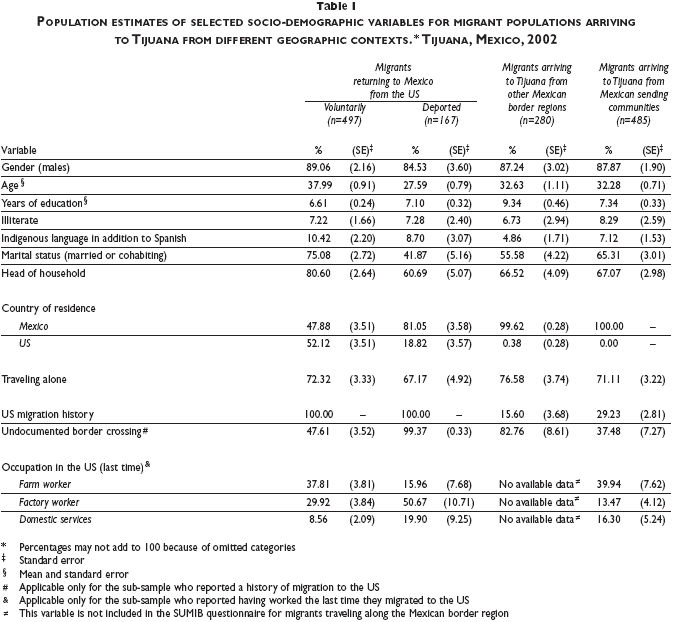
<body><![CDATA[<p><font face="Verdana, Arial, Helvetica, sans-serif" size="2"> We have recently    reported the lack of HIV positive cases, in conjunction with substantial reported    rates of HIV risk factors among a large and representative sample of MMIs (N=1    041) traveling through the border region of Tijuana (Baja California, Mexico)    and San Diego (California, US).<SUP>12</SUP> The Tijuana-San Diego border region    is the busiest border-crossing area in the world and the natural port of entry    from Mexico to California. This region concentrates approximately 37% of the    migration-related border crossings between Mexico and the US and 71% of the    migrant flow in the Western region of the US-Mexico border.<SUP>13 </SUP>The    results from this study suggest that, despite alarming rates of HIV infection    among high-risk groups in Mexico and certain Latino subpopulations in the US,    HIV is not endemic yet among the MMI population who travel through the Tijuana-San    Diego border region. The estimated level of risk practices indicates, however,    that HIV may spread rapidly once the virus enters this population and calls    for early preventive interventions to avert a future HIV epidemic among MMIs.    </font></p>     <p><font face="Verdana, Arial, Helvetica, sans-serif" size="2"> For many MMIs,    migration is a circular process that involves the repeated transition between    the communities of origin in Mexico and the communities of destination in the    US. This process often includes traveling through and temporarily staying in    intermediate regions, such as the Mexican border region, while arrangements    to cross to the US are made. Deportation by the US Border Patrol is frequently    part of the migration experience, due to undocumented crossing or expiration    of migration documents. As the context along different phases of the migration    process changes, so too may change the risk for HIV infection and the preventive    needs of MMIs at different stages of the migration process. There is a paucity    of studies examining the prevalence of risk practices among MMIs in different    geographic contexts of the migration experience. This study addresses this research    gap by reporting estimates of the prevalence of risk practices for HIV infection    in specific geographic contexts among a probability-based sample of MMIs traveling    through the Tijuana-San Diego border region. </font></p>     <p>&nbsp;</p>     <p><font face="Verdana, Arial, Helvetica, sans-serif" size="3"><b>Material and    Methods</b> </font></p>     <p><font face="Verdana, Arial, Helvetica, sans-serif" size="2">The present study    represents an extension of an ongoing cross-sectional survey on migration in    the Mexican border city of Tijuana, namely the Survey on Migration on the North    Border of Mexico (SUMIB) &#91;Encuesta sobre Migraci&oacute;n en la Frontera    Norte de M&eacute;xico&#93;. The SUMIB sampling methodology is based on the    observation that, despite MMIs traveling from and to many different regions    in Mexico and the US, about 94% of the MMIs crossing this border region travel    through key border crossing sites at a few specific border cities, including    Tijuana.<SUP>13</SUP> The SUMIB uses a multistage probability sampling design    that entails the screening, accurate enumeration, and recruitment of samples    uniquely representative of the migrant population traveling through these key    border crossing sites of the US-Mexico border region, and enables the estimation    of population parameters. A detailed description of the survey methodology has    been published elsewhere.<SUP>14</SUP> </font></p>     <p><font face="Verdana, Arial, Helvetica, sans-serif" size="2"> From April to    December 2002, 1 606 adult migrants completed the SUMIB in Tijuana and were    subsequently invited to participate in a HIV survey. Survey sites comprised    the Tijuana International Airport, four Tijuana bus stations, and the two Tijuana    deportation stations. Overall, 90% of the SUMIB respondents invited to participate    completed the HIV questionnaire (N=1 429). The response rate for the HIV survey    was higher than response rates achieved in other Mexican surveys on sexual risk    behaviors, which have ranged from 50.3 to 67%.<SUP>15,16 </SUP>The sample included    subjects from different migrant populations traveling through the US-Mexico    border region: a) migrants and immigrants returning from the US to Mexico either    voluntarily (N=497) or deported by the US Border Patrol (N=167); b) migrants    and immigrants arriving at Tijuana from other Mexican border regions (N=280);    and c) migrants and immigrants arriving at Tijuana from migrant sending communities    in non-border regions of Mexico (N=485). </font></p>     <p><font face="Verdana, Arial, Helvetica, sans-serif" size="2"> Participants completed    the SUMIB survey, followed by a questionnaire on HIV risk factors and the collection    of an oral transudate sample for HIV infection testing. An <I>ad hoc</I> questionnaire    was designed for this study. Oral transudate samples were collected by means    of Orasure HIV-1 Oral Specimen Collection Device (Orasure Technologies, Bethlehem,    Pennsylvania, USA). Results from the HIV screening have been reported elsewhere.<SUP>12</SUP></font></p>     <p><font face="Verdana, Arial, Helvetica, sans-serif" size="2"> The SUMIB survey    collects information on a wide array of socio-demographic aspects related to    migration between Mexico and the US. Specific questions on demographics, migration    background, and socioeconomic factors were selected for this study (<a href="/img/revistas/spm/v48n1/a03tab01.gif">Table    I</a>). </font></p>     <p><font face="Verdana, Arial, Helvetica, sans-serif" size="2"> The HIV questionnaire    inquired about risk practices for HIV infection during the six months prior    to the survey and during the participants' stay in specific geographic contexts.    Key geographic contexts included the sending communities in Mexico, the Mexican    border region, and the receiving communities in the US. The questionnaire addressed    sexual practices, in general; vaginal sex and receptive anal (RA) sex, specifically;    number of sexual partners for vaginal and RA sex; vaginal and RA sex with steady    partners, occasional partners, and sex workers; and unprotected vaginal and    RA sex with different types of partners. </font></p>     <p><font face="Verdana, Arial, Helvetica, sans-serif" size="2"> Additional questions    addressed the last six-month history of needle sharing and sexual practices    against the participant's will; with an IV drug user; in exchange for money,    food, shelter, or any other goods; and sexual practices with a transvestite    (only for males). Respondents were also asked about last six-month HIV testing;    testing for other STIs; history of STI; and use of medical services regarding    a possible or real STI. </font></p>     ]]></body>
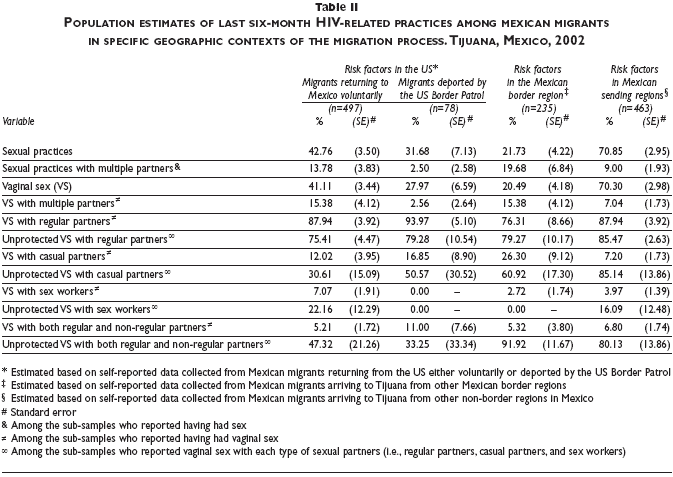
<body><![CDATA[<p><font face="Verdana, Arial, Helvetica, sans-serif" size="2"> The estimation    of prevalence rates of last six-month risk practices in specific geographic    contexts was based on data collected from different migrant subsamples regarding    their practices on these contexts. The prevalence of last six-month risk factors    in the US was estimated based on data collected from migrants and immigrants    who were arriving to Tijuana from the US and who reported having stayed in the    US at least one day during the last six months. We distinguished between migrants    and immigrants returning to Mexico voluntarily and migrants and immigrants who    had been deported by the US Border Patrol, because the actual context and conditions    endured by each group of migrants and immigrants may differ substantially and    relate to different risk factors for HIV infection. The prevalence of risk factors    in the Mexican border region was estimated based on data collected from migrants    and immigrants who were arriving to Tijuana from other Mexican border regions    and who reported having spent one or more days in the Mexican border region    during the last six months. Lastly, the prevalence of risk factors in Mexican    sending communities was estimated based on the reports of migrants and immigrants    who were arriving to Tijuana from sending communities in non-border Mexican    regions and who reported having been in these regions for at least one day.    In all cases, the questionnaire inquired about risk practices during the participants'    stay at the region of interest (e.g., the Mexican border region, the US, etc.)    in the last six months. Thus, data from each migrant subsample regarding practices    during their stay in specific geographic contexts served as a snapshot of the    risk for HIV infection of MMIs in different contexts of the migration process.    </font></p>     <p><font face="Verdana, Arial, Helvetica, sans-serif" size="2"> All study measures    were anonymous and linked by means of a numeric code. Both the HIV oral test    and the questionnaire were administered by Mexican interviewers. All interviewers    had completed high school, with most of them having completed a college degree.    They were trained by study investigators and personnel from the Tijuana Health    Department to appropriately use recruitment scripts, administer informed consent    procedures, conduct interviews on HIV-related risk factors, administer an oral    HIV test, and handle biological specimens. Recruitment and data collection activities    were conducted under the supervision of study investigators and senior field    survey supervisors. Interviewers received ongoing feedback and corrective training    throughout the duration of the survey to guarantee adherence to the study protocols.    </font></p>     <p><font face="Verdana, Arial, Helvetica, sans-serif" size="2"> Informed verbal    consent was obtained specifically for both the questionnaire and the oral HIV    test. Participants were given a copy of each consent form (i.e., one for the    questionnaire and one for the HIV test) and asked to read them prior to their    decision regarding participation in this study and acceptance of the HIV test.    When necessary, interviewers assisted participants by reading out these forms    for them. The consents included information about the study directors, purpose,    procedures, potential risks, benefits, and incentives. Verbal consent procedures    were preferred in order to keep study participation anonymous and, thus, reduce    any potential risks derived from participation in this study. It was also estimated    that these procedures would contribute to increase the response rate to the    survey and decrease the risk of selection bias. All study procedures were reviewed    and approved by the Committee for the Protection of Human Subjects of San Diego    State University, the Ethics Committee of El Colegio de la Frontera Norte, and    the Head of the Health Jurisdiction of Baja California, Mexico.</font></p>     <p><font face="Verdana, Arial, Helvetica, sans-serif" size="2"> Survey data were    weighted using standard procedures and information from the SUMIB sample design    to represent the volume and distribution of the migrant flow traveling through    the North border of Mexico.<SUP>10</SUP> Weighted prevalence estimates, descriptive    statistics, and standard errors (SE) were computed for socio-economic variables    and HIV risk factors. </font></p>     <p><font face="Verdana, Arial, Helvetica, sans-serif" size="2"> Chi-square and    <I>t</I> tests were conducted to compare the socio-demographic profiles of the    individuals who completed the HIV questionnaire versus respondents to the SUMIB    who were invited but did not participate or did not complete the HIV questionnaire,    to test for selection bias.</font></p>     <p>&nbsp;</p>     <p><font face="Verdana, Arial, Helvetica, sans-serif" size="3"><b>Results</b></font></p>     <p><font face="Verdana, Arial, Helvetica, sans-serif" size="2"><a href="/img/revistas/spm/v48n1/a03tab01.gif">Table    I</a> displays population estimates of the demographic, social, and migration    characteristics of the four migrant populations represented by the four study    sub-samples. MMIs are mostly males (84.5% to 89.1%), with ages ranging 27.6-38.0    years, and averaged education levels ranging 6.6-9.3 years. The gender distribution    was consistent with the SUMIB estimated male/female ratios among MMIs traveling    through the city of Tijuana during this study period.<a href="#nt"><sup>*</sup></a>    An estimated 6.7-8.3% of MMIs were unable to read or write, and 4.9-10.4% were    estimated to speak a Mexican indigenous language, in addition to Spanish. Among    MMIs traveling from other Mexican border regions and migrant sending communities    in Mexico, only an estimated 15.6% and 29.2%, respectively, had a history of    migration to the US. Among those with a history of migration to the US, the    estimated percentage that crossed the US-Mexico border without proper migration    documents the last time they entered to the US ranged widely from 37.5% among    MMIs traveling from Mexican sending regions to 99.4% among those deported by    the US Border Patrol. </font></p>     <p><font face="Verdana, Arial, Helvetica, sans-serif" size="2"> <a href="/img/revistas/spm/v48n1/a03tab02.gif">Table    II</a> shows population estimates of last six-month prevalence rates of HIV-related    practices at specific geographic contexts. All MMIs returning voluntarily from    the US and about 46.7% of the MMIs deported by the US Border Patrol had stayed    one day or longer in the US during the six months previous to the survey. Among    MMIs traveling to Tijuana from other border Mexican cities, 83.9% had spent    one or more days in the Mexican border region during the last six months. Finally,    about 95.7% of MMIs arriving to Tijuana from their communities of origin in    Mexico had stayed on those communities for one day or longer during six months    prior to the survey. </font></p>     <p><font face="Verdana, Arial, Helvetica, sans-serif" size="2"> Sexual practices    during the last six months appeared more prevalent in the Mexican sending communities    than in other geographic contexts. The majority (70.9%) of the MMIs arriving    to Tijuana from Mexican sending regions had engaged in sex in that context during    the last six-months. About 42.8% of the MMIs returning voluntarily from the    US to Mexico and almost a third of MMIs deported by the US Border Patrol (31.7%)    had engaged in sex during the last six-months in the US. In contrast, an estimated    21.7% of MMIs traveling from other Mexican border regions reported sexual practices    in this geographic context during the six months previous to the survey. Regardless    of the geographic context, the majority of MMIs who had vaginal sex, did so    with regular partners (76.3-94.0%). Rates of unprotected vaginal sex with regular    partners ranged from 75.4% to 85.5%. Substantial rates of vaginal sex with multiple    sexual partners among MMIs in the Mexican border region and in the US were also    estimated. Among MMIs who had vaginal sex, the prevalence of last six-month    vaginal sex with casual partners ranged from 7.2% in Mexican sending communities    to 26.3% in the Mexican border region. Unprotected vaginal sex among subjects    who had vaginal sex with casual partners was lowest in the US (30.6-50.6%),    second lowest in the Mexican border region (60.9%) and the highest in the Mexican    sending communities (85.2%). It is worth mentioning that, among MMIs returning    voluntarily from the US, an estimated 22.2% of the subjects who had vaginal    sex with prostitutes, had unprotected vaginal sex with these partners. Among    MMIs traveling from their communities of origin, the estimated percentage of    unprotected vaginal sex with prostitutes was 16.1%. No unprotected vaginal sex    with prostitutes was reported by MMIs deported from the US or traveling from    other border regions. Overall, 5.2% to 11.0% of all MMIs who had vaginal sex,    did so with both regular and non-regular (i.e. casual or prostitute) partners.    Among them, the percentage that had unprotected sex with both types of partners    ranged from 33.3% and 47.3% in the US to 91.9% in the Mexican border region.    </font></p>     ]]></body>
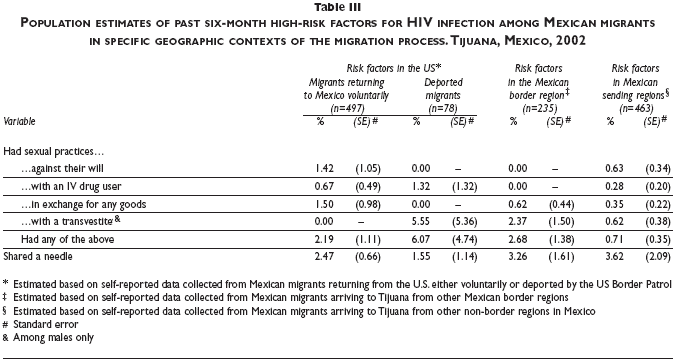
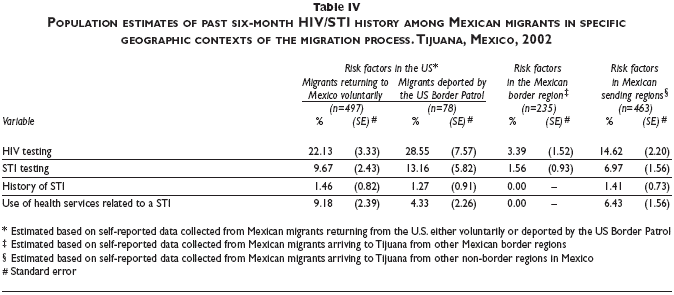
<body><![CDATA[<p><font face="Verdana, Arial, Helvetica, sans-serif" size="2"> Only two of the    MMIs who returned voluntarily from the US reported having had RA sex during    their stay in the US (Estimated Prevalence &#91;Prev&#93;=1.0%, Standard Error&#91;SE&#93;=.67),    while none of the deported MMIs reported this practice in the US. Similarly,    no RA sex was reported by MMIs arriving from other Mexican border regions. In    contrast, seven subjects or an estimated 1.4% prevalence rate of the MMIs traveling    from their Mexican sending regions reported last six-month RA sex in these regions    (SE=.59). </font></p>     <p><font face="Verdana, Arial, Helvetica, sans-serif" size="2"> The two MMIs who    reported RA sex in the US did so only with a regular partner and one of them    reported unprotected RA sex. All the seven subjects who reported having engaged    in RA sex in their communities of origin in Mexico reported RA sex with regular    partners and six of them reported unprotected RA sex with regular partners (Prev=87.2%,    SE=13.3). Three subjects reported RA sex with casual partners (Prev=41.6%, SE=23.0%);    all of them reported unprotected RA sex with casual partners. </font></p>     <p><font face="Verdana, Arial, Helvetica, sans-serif" size="2"> <a href="/img/revistas/spm/v48n1/a03tab03.gif">Table    III</a> shows the prevalence of other risk practices for HIV infection among    MMIs in each specific geographic context of the migration process. The prevalence    of high-risk sexual practices, including non-consented sex, sex with an IV drug    user, survival sex, and sex with a transvestite man, ranged from 0.7% to 6.1%,    depending on the migration context. In general, the rates of these risk practices    appeared higher in the US, particularly for deported MMIs (Prev=6.1%, SE=4.7),    second highest in the Mexican border region (Prev=2.4%, SE=1.5%), and lowest    in the sending communities in Mexico (Prev=0.7%, SE=0.4). </font></p>     <p><font face="Verdana, Arial, Helvetica, sans-serif" size="2"> Testing for HIV    and other STIs was estimated highest in the US and lowest in the Mexican border    region (<a href="/img/revistas/spm/v48n1/a03tab04.gif">Table IV</a>). Estimated rates of last six-month    history of STIs in the US and in the Mexican migrant sending regions ranged    from 1.3% to 1.4%. None of the MMIs traveling from other Mexican border regions    reported a STI during their stay in the border region. </font></p>     <p><font face="Verdana, Arial, Helvetica, sans-serif" size="2"> The comparison    of the socio-economic profiles of the extended HIV survey participants to the    SUMIB respondents within the same migrant and immigrant population who did not    complete the HIV questionnaire evidenced only two significant differences. Among    MMIs arriving to Tijuana from other Mexican border regions, respondents to the    HIV questionnaire were less likely to be married (55.7% vs. 75.0%, <I>p</I>&lt;.05)    and to have a history of migration to the US (12.5% vs. 34.3%, <I>p</I>=.001)    than the SUMIB participants who did not complete the HIV questionnaire. No other    significant differences were found between the two sub-samples among the other    three migrant and immigrant populations, thus supporting the representativeness    of the study samples.</font></p>     <p>&nbsp;</p>     <p><font face="Verdana, Arial, Helvetica, sans-serif" size="3"><b>Discussion</b></font></p>     <p><font face="Verdana, Arial, Helvetica, sans-serif" size="2">The purpose of    this study was to investigate the risk factors for HIV infection among MMIs    in different geographic contexts associated with migration from Mexico to the    US. In particular, this study has examined the case of the migrant and immigrant    population traveling through the San Diego-Tijuana border region and the risk    for HIV infection in three specific migration contexts: the sending communities    in Mexico, the Mexican border region, and the US. </font></p>     <p><font face="Verdana, Arial, Helvetica, sans-serif" size="2"> In general, the    results show that unprotected heterosexual practices with multiple partners,    including sex with casual partners and prostitutes, are prevalent in the three    migration contexts examined in this study. As observed in previous research,<SUP>6</SUP>    consistent use of condoms among MMIs is rare for sexual practices with regular    partners and unacceptably limited with casual or prostitute partners. A small,    but significant fraction of MMIs engages in unprotected sex with both regular    and non-regular partners, including prostitutes. These practices may represent    an important means for HIV and STI transmission from high- to low-risk populations    in Mexico and the US. Although it is common in all three migration contexts,    unprotected sex with regular and occasional partners appears to be relatively    more likely among MMIs arriving to Tijuana from the Mexican migrant sending    communities, compared to MMIs returning from the US. </font></p>     <p><font face="Verdana, Arial, Helvetica, sans-serif" size="2"> The low rates    of receptive anal sex observed across all migration contexts are close to the    0.8% rate of past-year bisexual and homosexual practices estimated by a probability    survey of male adults in Mexico City,<SUP>16</SUP> and lower than previous findings    from studies with non-probability based samples of MMIs in the US.<SUP>5,6,</SUP><a href="#nt"><sup>*</sup></a>    This may indicate a low proportion of men who have sex with men (MSM) within    this population of MMIs, limited success in the recruitment of MSM subjects    (i.e., due to self-selection), or under-reported rates of anal intercourse.    Neither scenario is unlikely in light of the stigma associated with homosexuality    within the Latino culture.<SUP>17</SUP> It is, therefore, possible that these    estimates represent a lower bound of the actual risk for HIV infection related    to anal sex among MMIs across all migration contexts. Our data suggest higher    rates of unprotected sex among migrants engaging in anal sex (i.e., 72-81% with    regular partners; 100% with casual partners) than those found in the Mexico    City survey (i.e., 36% with regular partners; 8% with casual partners).<SUP>16</SUP>    However, given the small number of subjects for whom this risk factor could    be examined in our sample, future large-sample studies are needed to determine    more accurately the prevalence rate of unprotected anal sex among MSM MMIs.    </font></p>     ]]></body>
<body><![CDATA[<p><font face="Verdana, Arial, Helvetica, sans-serif" size="2"> The pattern of    risk behaviors estimated for this population of MMIs is consistent with the    pattern of HIV transmission in Mexico, where 91% of male and 57% of female AIDS    cases are attributed to sexual transmission and the number of cases associated    with heterosexual transmission exceeds those attributed to homosexual practices.<SUP>18</SUP>    </font></p>     <p><font face="Verdana, Arial, Helvetica, sans-serif" size="2"> High-risk sexual    practices, such as exchange sex, non-consented sexual practices, and sex with    men dressed as women are relevant risk factors for HIV infection among MMIs    traveling through the US-Mexico border region, particularly when they are in    the Mexican border region and in the US. This study did not examine the use    of condoms for these high-risk sexual practices in particular. However, we presume    that the ability to negotiate safe sex for MMIs in these situations may be negligible.    Thus, these practices and their determinants need to be further investigated    in future research, with special attention to the contribution of socioeconomic,    cultural, and policy-related factors. </font></p>     <p><font face="Verdana, Arial, Helvetica, sans-serif" size="2"> Previous literature    has reported injection of vitamins, antibiotics, or vitamins being a common    practice among MMIs.<SUP>7,19,20</SUP> These practices are supported by cultural    health beliefs on the effectiveness of injected drugs, lack of access to standard    health care, and difficulties obtaining clean needles in the US. Our data support    the idea that needle-sharing rates are unacceptably high among MMIs in all stages    of the migration process. However, these practices may be less prevalent among    this population than indicated by research with convenience samples of Mexican    farm workers in the US.<SUP>7,19,20</SUP> More research is necessary regarding    the specific purposes and determinants of needle sharing in each migration context    and the means by which the prevalence of these practices can be reduced. </font></p>     <p><font face="Verdana, Arial, Helvetica, sans-serif" size="2"> Overall, the results    indicate that HIV risk practices among MMIs who travel through the San Diego-Tijuana    border region are present in all geographic contexts and stages of the migration    process. However, the risk factors do not appear as widespread as suggested    by previous research based on surveys using non probability-based sampling procedures    and by studies on high-risk Latino or Mexican-descent subpopulations, such as    MSM, IV drug users, or sex workers in Mexico or the US.<SUP>11</SUP> The variations    in the prevalence rates of last six-month risk practices in different geographic    contexts suggest that the risk for HIV infection changes along the different    phases of the migration process. For instance, sexual practices with casual    and multiple sexual partners, non-consented sexual practices, sex with IV drug    users, survival sex, and sex with transvestite men appear to be more common    for MMIs in the US and the Mexican border region than in their regions of origin    in Mexico. On the other hand, sexual practices and unprotected sex seem to be    more prevalent in the Mexican sending communities. In addition, HIV and STI    testing appear less common for MMIs in Mexico, whether in their communities    of origin or in the Mexican border region, than in the US. These patterns may    be the result of the different structural and environmental factors that define    each of these migration contexts. For one thing, in the US free and anonymous    HIV testing and counseling services may be more available, at least for documented    MMIs, and fear of stigma associated with HIV testing may be less important than    in Mexico. In contrast, availability of social support and access to regular    sexual partners may be greater in the communities of origin in Mexico than in    the Mexican border region and the US. Thus, each context may be associated with    a different configuration of protective and risk factors for HIV infection.    More research is warranted to further identify these patterns and develop interventions    that match the specific prevention needs associated with each migration context.    </font></p>     <p><font face="Verdana, Arial, Helvetica, sans-serif" size="2"> The prevalence    of risk behaviors and STIs across all migration contexts is at odds with the    absence of HIV positive cases reported elsewhere for this same sample of MMIs.<SUP>12</SUP>    This contrast underscores the need to identify the factors that may be protecting    MMIs from becoming infected with HIV infection in all three geographic contexts.    These may include the type of sexual practices, the characteristics of the network    of sexual partners, and biological/genetic host characteristics, to name a few.    </font></p>     <p><font face="Verdana, Arial, Helvetica, sans-serif" size="2"> This study is    subject to several limitations. Data on risk factors relied solely on self-report    measures. Study participants, although recruited following probability-based    sampling procedures, were ultimately self-selected. Self-reported measures and    self-selection may have resulted in information and selection bias. The risk,    however, is reduced by the anonymity of the survey, training of the field personnel,    and lack of notable differences between SUMIB subjects who agreed to participate    in this study and those who did not participate. Only two variables, among an    extensive list of socio-demographic and migration factors, were found to be    significantly different between the two subsets of migrants. The lack of a clearer    pattern of significant differences between the study samples and the SUMIB respondents    who did not participate in the HIV survey suggests the possibility that the    two differences observed are due to a type-I statistical error resulting from    the high number of hypothesis tested for each of the four migrant sub-samples.    </font></p>     <p><font face="Verdana, Arial, Helvetica, sans-serif" size="2"> The study sample    does not represent MMIs who travel through other regions of the US-Mexico border    or fly directly from the Mexican sending communities to the receiving US communities    and vice versa. Likewise, the study findings with regard to HIV risk factors    in the US cannot be generalized to MMIs who do not return or hardly travel back    to Mexico after migrating to the US (i.e. migrants and immigrants who settle    in the US for good). Notwithstanding these limitations, this research provides    information on HIV risk factors for MMIs traveling through the San Diego-Tijuana    border region, who represent a substantial proportion of the mobile migrant    stream between Mexico and the US. </font></p>     <p><font face="Verdana, Arial, Helvetica, sans-serif" size="2"> In summary, this    study indicates that risk factors for HIV infection are present across the different    phases of the migration experience and will lead to a quick spread of HIV infection    among MMIs, unless coordinated prevention interventions are developed in all    geographic contexts associated with migration from Mexico to the US. To be most    effective, these interventions may need to stress different risk practices and    tackle a variety of personal, environmental, and structural determinants that    contribute to HIV risk in each migration context. Both practices and contributing    factors remain yet to be fully identified through behavioral surveillance and    theory-driven research on determinants of risk behaviors conducted with large    and representative samples of MMIs in different geographic contexts. Likewise,    more research is needed to examine variations in the pattern of risk practices    and behavior determinants within each of these contexts (e.g., rural vs. urban    areas; first vs. subsequent migration experiences; etc.). Given the economic    importance and disenfranchised nature of the MMI population, it is urgent and    imperative for Mexico and the US to join efforts to understand the dynamics    of HIV risk and take effective measures to prevent HIV among this population.    </font></p>     <p><font face="Verdana, Arial, Helvetica, sans-serif" size="2"><b>Acknowledgments</b></font></p>     <p><font face="Verdana, Arial, Helvetica, sans-serif" size="2">Financial support    for the survey was provided by grant # CR01-CBECH-100 awarded to Dr. Hovell    and Ms. Rangel from the Universitywide AIDS Research Program (UARP), University    of California. The authors would like to thank Dr. Liza Rovniak for her valuable    comments and suggestions during the preparation of this paper.</font></p>     ]]></body>
<body><![CDATA[<p>&nbsp;</p>     <p><font face="Verdana, Arial, Helvetica, sans-serif" size="3"><b>References</b></font></p>     <!-- ref --><p><font face="Verdana, Arial, Helvetica, sans-serif" size="2">1. Bronfman M,    Sejenovich G, Uribe P. Migraci&oacute;n y SIDA en M&eacute;xico y Am&eacute;rica    Central. Mexico City: &Aacute;ngulos del SIDA, CONASIDA, 1998. </font>&nbsp;&nbsp;&nbsp;&nbsp;&nbsp;&nbsp;&nbsp;&nbsp;[&#160;<a href="javascript:void(0);" onclick="javascript: window.open('/scielo.php?script=sci_nlinks&ref=9270386&pid=S0036-3634200600010000300001&lng=','','width=640,height=500,resizable=yes,scrollbars=1,menubar=yes,');">Links</a>&#160;]<!-- end-ref --><!-- ref --><p><font face="Verdana, Arial, Helvetica, sans-serif" size="2">2.Gayet C, Magis    C, Bronfman M. Aspectos conceptuales sobre la relaci&oacute;n entre migraci&oacute;n    y SIDA en M&eacute;xico. Enferm Infecc Microbiol Clin 2000;20:134-140. </font>&nbsp;&nbsp;&nbsp;&nbsp;&nbsp;&nbsp;&nbsp;&nbsp;[&#160;<a href="javascript:void(0);" onclick="javascript: window.open('/scielo.php?script=sci_nlinks&ref=9270387&pid=S0036-3634200600010000300002&lng=','','width=640,height=500,resizable=yes,scrollbars=1,menubar=yes,');">Links</a>&#160;]<!-- end-ref --><!-- ref --><p><font face="Verdana, Arial, Helvetica, sans-serif" size="2">3. Hirsch JS, Higgins    J, Bentley M, Nathanson CA. The social constructions of sexuality: Marital infidelity    and sexually transmitted disease &#151; HIV risk in a Mexican migrant community.    Am J Public Health 2002; 92(8):1227-1237.</font> &nbsp;&nbsp;&nbsp;&nbsp;&nbsp;&nbsp;&nbsp;&nbsp;[&#160;<a href="javascript:void(0);" onclick="javascript: window.open('/scielo.php?script=sci_nlinks&ref=9270388&pid=S0036-3634200600010000300003&lng=','','width=640,height=500,resizable=yes,scrollbars=1,menubar=yes,');">Links</a>&#160;]<!-- end-ref --><!-- ref --><p><font face="Verdana, Arial, Helvetica, sans-serif" size="2">4. Magis-Rodriguez    C, Del Rio-Zolezzi A, Valdespino-Gomez JL, Garcia-Garcia ML. Casos de SIDA en    el &aacute;rea rural en M&eacute;xico. Salud Publica Mex 1995;37(6):615-62.    </font>&nbsp;&nbsp;&nbsp;&nbsp;&nbsp;&nbsp;&nbsp;&nbsp;[&#160;<a href="javascript:void(0);" onclick="javascript: window.open('/scielo.php?script=sci_nlinks&ref=9270389&pid=S0036-3634200600010000300004&lng=','','width=640,height=500,resizable=yes,scrollbars=1,menubar=yes,');">Links</a>&#160;]<!-- end-ref --><!-- ref --><p><font face="Verdana, Arial, Helvetica, sans-serif" size="2">5. Organista KC,    Organista PB. Migrant laborers and AIDS in the United States: A review of the    literature. AIDS Educ Prev 1997;9(1):83-93. </font>&nbsp;&nbsp;&nbsp;&nbsp;&nbsp;&nbsp;&nbsp;&nbsp;[&#160;<a href="javascript:void(0);" onclick="javascript: window.open('/scielo.php?script=sci_nlinks&ref=9270390&pid=S0036-3634200600010000300005&lng=','','width=640,height=500,resizable=yes,scrollbars=1,menubar=yes,');">Links</a>&#160;]<!-- end-ref --><!-- ref --><p><font face="Verdana, Arial, Helvetica, sans-serif" size="2">6. Organista KC,    Balls Organista P, Garcia de Alba JE, Castillo-Moran MA, Ureta-Carrillo LE.    Survey of condom-related beliefs, behaviors, and perceived social norms in Mexican    migrant laborers. J Community Health 1997;22(3):185-198. </font>&nbsp;&nbsp;&nbsp;&nbsp;&nbsp;&nbsp;&nbsp;&nbsp;[&#160;<a href="javascript:void(0);" onclick="javascript: window.open('/scielo.php?script=sci_nlinks&ref=9270391&pid=S0036-3634200600010000300006&lng=','','width=640,height=500,resizable=yes,scrollbars=1,menubar=yes,');">Links</a>&#160;]<!-- end-ref --><!-- ref --><p><font face="Verdana, Arial, Helvetica, sans-serif" size="2">7. McVea K. Lay    injection practices among migrant farmworkers in the age of AIDS: evolution    of a biomedical folk practice. Soc Sci Med 1997;45(1):91-98. </font>&nbsp;&nbsp;&nbsp;&nbsp;&nbsp;&nbsp;&nbsp;&nbsp;[&#160;<a href="javascript:void(0);" onclick="javascript: window.open('/scielo.php?script=sci_nlinks&ref=9270392&pid=S0036-3634200600010000300007&lng=','','width=640,height=500,resizable=yes,scrollbars=1,menubar=yes,');">Links</a>&#160;]<!-- end-ref --><!-- ref --><p><font face="Verdana, Arial, Helvetica, sans-serif" size="2">8. Wong W, Tambis    JA, Hernandez MT, Chaw JK, Klausner JD. Prevalence of sexually transmitted diseases    among Latino immigrant day laborers in an urban setting-San Francisco. Sex Transm    Dis 2003;30(8):661-3. </font>&nbsp;&nbsp;&nbsp;&nbsp;&nbsp;&nbsp;&nbsp;&nbsp;[&#160;<a href="javascript:void(0);" onclick="javascript: window.open('/scielo.php?script=sci_nlinks&ref=9270393&pid=S0036-3634200600010000300008&lng=','','width=640,height=500,resizable=yes,scrollbars=1,menubar=yes,');">Links</a>&#160;]<!-- end-ref --><!-- ref --><p><font face="Verdana, Arial, Helvetica, sans-serif" size="2">9. Carrier JM,    Maga&ntilde;a JR. Use of ethnosexual data on men of Mexican origin for HIV/AIDS    prevention programs. J Sex Res 1991;28(2):189-202. </font>&nbsp;&nbsp;&nbsp;&nbsp;&nbsp;&nbsp;&nbsp;&nbsp;[&#160;<a href="javascript:void(0);" onclick="javascript: window.open('/scielo.php?script=sci_nlinks&ref=9270394&pid=S0036-3634200600010000300009&lng=','','width=640,height=500,resizable=yes,scrollbars=1,menubar=yes,');">Links</a>&#160;]<!-- end-ref --><!-- ref --><p><font face="Verdana, Arial, Helvetica, sans-serif" size="2">10. Secretar&iacute;a    del Trabajo y Previsi&oacute;n Social. Encuesta sobre Migraci&oacute;n en la    Frontera Norte de M&eacute;xico 1999-2000. M&eacute;xico, D.F.: Secretar&iacute;a    del Trabajo y Previsi&oacute;n Social, Consejo Nacional de Poblaci&oacute;n,    El Colegio de la Frontera Norte, 2002. </font>&nbsp;&nbsp;&nbsp;&nbsp;&nbsp;&nbsp;&nbsp;&nbsp;[&#160;<a href="javascript:void(0);" onclick="javascript: window.open('/scielo.php?script=sci_nlinks&ref=9270395&pid=S0036-3634200600010000300010&lng=','','width=640,height=500,resizable=yes,scrollbars=1,menubar=yes,');">Links</a>&#160;]<!-- end-ref --><!-- ref --><p><font face="Verdana, Arial, Helvetica, sans-serif" size="2">11. Sanchez MA,    Lemp GF, Magis-Rodriguez C, Bravo-Garcia E, Carter S, Ruiz JD. The epidemiology    of HIV among Mexican migrants and recent immigrants in California and Mexico.    J Acquir Immune Defic Syndr 2004;37:S204-S214. </font>&nbsp;&nbsp;&nbsp;&nbsp;&nbsp;&nbsp;&nbsp;&nbsp;[&#160;<a href="javascript:void(0);" onclick="javascript: window.open('/scielo.php?script=sci_nlinks&ref=9270396&pid=S0036-3634200600010000300011&lng=','','width=640,height=500,resizable=yes,scrollbars=1,menubar=yes,');">Links</a>&#160;]<!-- end-ref --><!-- ref --><p><font face="Verdana, Arial, Helvetica, sans-serif" size="2">12. Mart&iacute;nez-Donate    AP, Rangel MG, Hovell MF, Santib&aacute;&ntilde;ez J, Sipan CL, Izazola-Licea    JA. HIV infection in mobile populations: the case of Mexican migrants to the    United States. Pan Rev Panam Salud Publica, 2005;17(1):26-29. </font>&nbsp;&nbsp;&nbsp;&nbsp;&nbsp;&nbsp;&nbsp;&nbsp;[&#160;<a href="javascript:void(0);" onclick="javascript: window.open('/scielo.php?script=sci_nlinks&ref=9270397&pid=S0036-3634200600010000300012&lng=','','width=640,height=500,resizable=yes,scrollbars=1,menubar=yes,');">Links</a>&#160;]<!-- end-ref --><!-- ref --><p><font face="Verdana, Arial, Helvetica, sans-serif" size="2">13. Secretar&iacute;a    del Trabajo y Previsi&oacute;n Social. Encuesta de Migraci&oacute;n de la Frontera    Norte de M&eacute;xico, 1996-1997. M&eacute;xico, D.F.: Secretar&iacute;a del    Trabajo y Previsi&oacute;n Social, Consejo Nacional de Poblaci&oacute;n, El    Colegio de la Frontera Norte, 1999. </font>&nbsp;&nbsp;&nbsp;&nbsp;&nbsp;&nbsp;&nbsp;&nbsp;[&#160;<a href="javascript:void(0);" onclick="javascript: window.open('/scielo.php?script=sci_nlinks&ref=9270398&pid=S0036-3634200600010000300013&lng=','','width=640,height=500,resizable=yes,scrollbars=1,menubar=yes,');">Links</a>&#160;]<!-- end-ref --><!-- ref --><p><font face="Verdana, Arial, Helvetica, sans-serif" size="2">14. Santiba&ntilde;ez    J. Metodolog&iacute;a de la encuesta sobre migraci&oacute;n en la Frontera Norte    de M&eacute;xico. In Bustamante JA, Delaunay D, Santiba&ntilde;ez J, comp. Taller    de medici&oacute;n de la migraci&oacute;n internacional. Tijuana, B.C.: El Colegio    de la Frontera Norte, ORSTOM, 1997:206-229. </font>&nbsp;&nbsp;&nbsp;&nbsp;&nbsp;&nbsp;&nbsp;&nbsp;[&#160;<a href="javascript:void(0);" onclick="javascript: window.open('/scielo.php?script=sci_nlinks&ref=9270399&pid=S0036-3634200600010000300014&lng=','','width=640,height=500,resizable=yes,scrollbars=1,menubar=yes,');">Links</a>&#160;]<!-- end-ref --><!-- ref --><p><font face="Verdana, Arial, Helvetica, sans-serif" size="2">15. Hernandez-Giron    C, Cruz-Valdez A, Quiterio-Trenado M, Peruga A, Hernandez-Avila M. Caracter&iacute;sticas    de comportamiento sexual en hombres de la Ciudad de M&eacute;xico &#91;Characteristics    of the sexual behavior in the male population from Mexico City&#93;. Salud Publica    Mex 1999; 41(2), 95-100. </font>&nbsp;&nbsp;&nbsp;&nbsp;&nbsp;&nbsp;&nbsp;&nbsp;[&#160;<a href="javascript:void(0);" onclick="javascript: window.open('/scielo.php?script=sci_nlinks&ref=9270400&pid=S0036-3634200600010000300015&lng=','','width=640,height=500,resizable=yes,scrollbars=1,menubar=yes,');">Links</a>&#160;]<!-- end-ref --><!-- ref --><p><font face="Verdana, Arial, Helvetica, sans-serif" size="2">16. Izazola-Licea    JA, Gortmaker SL, Tolbert K, Gruttola V, Mann J. Prevalence of same-gender sexual    behavior and HIV in a probability household survey in Mexican men. J Sex Res,    2000;37(1):37-43. </font>&nbsp;&nbsp;&nbsp;&nbsp;&nbsp;&nbsp;&nbsp;&nbsp;[&#160;<a href="javascript:void(0);" onclick="javascript: window.open('/scielo.php?script=sci_nlinks&ref=9270401&pid=S0036-3634200600010000300016&lng=','','width=640,height=500,resizable=yes,scrollbars=1,menubar=yes,');">Links</a>&#160;]<!-- end-ref --><!-- ref --><p><font face="Verdana, Arial, Helvetica, sans-serif" size="2">17. Diaz RM. Latino    gay men and HIV. Culture, sexuality, and risk behavior. New York: Routledge,    1998. </font>&nbsp;&nbsp;&nbsp;&nbsp;&nbsp;&nbsp;&nbsp;&nbsp;[&#160;<a href="javascript:void(0);" onclick="javascript: window.open('/scielo.php?script=sci_nlinks&ref=9270402&pid=S0036-3634200600010000300017&lng=','','width=640,height=500,resizable=yes,scrollbars=1,menubar=yes,');">Links</a>&#160;]<!-- end-ref --><!-- ref --><p><font face="Verdana, Arial, Helvetica, sans-serif" size="2">18. UNAIDS/WHO.    Epidemiological fact sheet on HIV/AIDS and sexually transmitted infections.    Mexico, 2000 Update. UNAIDS, Pan American Health Organization, World Health    Organization, 2000. Available at: <a href="http://www.paho.org/English/HCP/HCA/Mexico.pdf" target="_blank">http://www.paho.org/English/HCP/HCA/Mexico.pdf</a>.    Accessed January 15, 2004. </font>&nbsp;&nbsp;&nbsp;&nbsp;&nbsp;&nbsp;&nbsp;&nbsp;[&#160;<a href="javascript:void(0);" onclick="javascript: window.open('/scielo.php?script=sci_nlinks&ref=9270403&pid=S0036-3634200600010000300018&lng=','','width=640,height=500,resizable=yes,scrollbars=1,menubar=yes,');">Links</a>&#160;]<!-- end-ref --><!-- ref --><p><font face="Verdana, Arial, Helvetica, sans-serif" size="2">19. Lafferty J.    Self-injection and needle sharing among migrant farmworkers. Am J Public Health    1991; 81(2), 221. </font>&nbsp;&nbsp;&nbsp;&nbsp;&nbsp;&nbsp;&nbsp;&nbsp;[&#160;<a href="javascript:void(0);" onclick="javascript: window.open('/scielo.php?script=sci_nlinks&ref=9270404&pid=S0036-3634200600010000300019&lng=','','width=640,height=500,resizable=yes,scrollbars=1,menubar=yes,');">Links</a>&#160;]<!-- end-ref --><!-- ref --><p><font face="Verdana, Arial, Helvetica, sans-serif" size="2">20. Loue S, Oppenheim    S. Immigration and HIV infection: A pilot study. AIDS Educ Prev 1994; 6, 74-80.</font>&nbsp;&nbsp;&nbsp;&nbsp;&nbsp;&nbsp;&nbsp;&nbsp;[&#160;<a href="javascript:void(0);" onclick="javascript: window.open('/scielo.php?script=sci_nlinks&ref=9270405&pid=S0036-3634200600010000300020&lng=','','width=640,height=500,resizable=yes,scrollbars=1,menubar=yes,');">Links</a>&#160;]<!-- end-ref --><p>&nbsp;</p>     <p>&nbsp;</p>     <p><font face="Verdana, Arial, Helvetica, sans-serif" size="2">Received on: February    8, 2005    <br>   Accepted on: December 1, 2005</font></p>     <p>&nbsp;</p>     <p>&nbsp;</p>     <p><font face="Verdana, Arial, Helvetica, sans-serif" size="2">Address reprint    requests to: Dr. Ana P. Martinez-Donate, Center for Behavioral Epidemiology    &amp; Community Health, Graduate School of Public Health, San Diego State University,    9245 Sky Park Court, Suite 230, San Diego, CA 92123. E-mail: <a href="mailto:aralopez@uv.mx">amartinez@projects.sdsu.edu</a>    <br>   <a name="nt"></a>* Ruiz JD, Da Valle L, Jungkeit M, Platek G, Mobed K, Lopez    R. Seroprevalence of HIV and syphilis and assessment of risk behaviors among    migrant and seasonal farmworkers in five Northern California counties. &#91;Unpublished    report&#93;. Office of AIDS, HIV/ AIDS Epidemiology Branch, California Department    of Health Services; June, 1997.</font></p>     ]]></body>
<body><![CDATA[ ]]></body><back>
<ref-list>
<ref id="B1">
<label>1</label><nlm-citation citation-type="book">
<person-group person-group-type="author">
<name>
<surname><![CDATA[Bronfman]]></surname>
<given-names><![CDATA[M]]></given-names>
</name>
<name>
<surname><![CDATA[Sejenovich]]></surname>
<given-names><![CDATA[G]]></given-names>
</name>
<name>
<surname><![CDATA[Uribe]]></surname>
<given-names><![CDATA[P]]></given-names>
</name>
</person-group>
<source><![CDATA[Migración y SIDA en México y América Central]]></source>
<year>1998</year>
<publisher-loc><![CDATA[Mexico City ]]></publisher-loc>
<publisher-name><![CDATA[Ángulos del SIDACONASIDA]]></publisher-name>
</nlm-citation>
</ref>
<ref id="B2">
<label>2</label><nlm-citation citation-type="journal">
<person-group person-group-type="author">
<name>
<surname><![CDATA[Gayet]]></surname>
<given-names><![CDATA[C]]></given-names>
</name>
<name>
<surname><![CDATA[Magis]]></surname>
<given-names><![CDATA[C]]></given-names>
</name>
<name>
<surname><![CDATA[Bronfman]]></surname>
<given-names><![CDATA[M]]></given-names>
</name>
</person-group>
<article-title xml:lang="es"><![CDATA[Aspectos conceptuales sobre la relación entre migración y SIDA en México]]></article-title>
<source><![CDATA[Enferm Infecc Microbiol Clin]]></source>
<year>2000</year>
<volume>20</volume>
<page-range>134-140</page-range></nlm-citation>
</ref>
<ref id="B3">
<label>3</label><nlm-citation citation-type="journal">
<person-group person-group-type="author">
<name>
<surname><![CDATA[Hirsch]]></surname>
<given-names><![CDATA[JS]]></given-names>
</name>
<name>
<surname><![CDATA[Higgins]]></surname>
<given-names><![CDATA[J]]></given-names>
</name>
<name>
<surname><![CDATA[Bentley]]></surname>
<given-names><![CDATA[M]]></given-names>
</name>
<name>
<surname><![CDATA[Nathanson]]></surname>
<given-names><![CDATA[CA]]></given-names>
</name>
</person-group>
<article-title xml:lang="es"><![CDATA[The social constructions of sexuality: Marital infidelity and sexually transmitted disease - HIV risk in a Mexican migrant community]]></article-title>
<source><![CDATA[Am J Public Health]]></source>
<year>2002</year>
<volume>92</volume>
<numero>8</numero>
<issue>8</issue>
<page-range>1227-1237</page-range></nlm-citation>
</ref>
<ref id="B4">
<label>4</label><nlm-citation citation-type="journal">
<person-group person-group-type="author">
<name>
<surname><![CDATA[Magis-Rodriguez]]></surname>
<given-names><![CDATA[C]]></given-names>
</name>
<name>
<surname><![CDATA[Del Rio-Zolezzi]]></surname>
<given-names><![CDATA[A]]></given-names>
</name>
<name>
<surname><![CDATA[Valdespino-Gomez]]></surname>
<given-names><![CDATA[JL]]></given-names>
</name>
<name>
<surname><![CDATA[Garcia-Garcia]]></surname>
<given-names><![CDATA[ML]]></given-names>
</name>
</person-group>
<article-title xml:lang="es"><![CDATA[Casos de SIDA en el área rural en México]]></article-title>
<source><![CDATA[Salud Publica Mex]]></source>
<year>1995</year>
<volume>37</volume>
<numero>6</numero>
<issue>6</issue>
<page-range>615-62</page-range></nlm-citation>
</ref>
<ref id="B5">
<label>5</label><nlm-citation citation-type="journal">
<person-group person-group-type="author">
<name>
<surname><![CDATA[Organista]]></surname>
<given-names><![CDATA[KC]]></given-names>
</name>
<name>
<surname><![CDATA[Organista]]></surname>
<given-names><![CDATA[PB]]></given-names>
</name>
</person-group>
<article-title xml:lang="es"><![CDATA[Migrant laborers and AIDS in the United States: A review of the literature]]></article-title>
<source><![CDATA[AIDS Educ Prev]]></source>
<year>1997</year>
<volume>9</volume>
<numero>1</numero>
<issue>1</issue>
<page-range>83-93</page-range></nlm-citation>
</ref>
<ref id="B6">
<label>6</label><nlm-citation citation-type="journal">
<person-group person-group-type="author">
<name>
<surname><![CDATA[Organista]]></surname>
<given-names><![CDATA[KC]]></given-names>
</name>
<name>
<surname><![CDATA[Balls Organista]]></surname>
<given-names><![CDATA[P]]></given-names>
</name>
<name>
<surname><![CDATA[Garcia de Alba]]></surname>
<given-names><![CDATA[JE]]></given-names>
</name>
<name>
<surname><![CDATA[Castillo-Moran]]></surname>
<given-names><![CDATA[MA]]></given-names>
</name>
<name>
<surname><![CDATA[Ureta-Carrillo]]></surname>
<given-names><![CDATA[LE]]></given-names>
</name>
</person-group>
<article-title xml:lang="en"><![CDATA[Survey of condom-related beliefs, behaviors, and perceived social norms in Mexican migrant laborers]]></article-title>
<source><![CDATA[J Community Health]]></source>
<year>1997</year>
<volume>22</volume>
<numero>3</numero>
<issue>3</issue>
<page-range>185-198</page-range></nlm-citation>
</ref>
<ref id="B7">
<label>7</label><nlm-citation citation-type="journal">
<person-group person-group-type="author">
<name>
<surname><![CDATA[McVea]]></surname>
<given-names><![CDATA[K]]></given-names>
</name>
</person-group>
<article-title xml:lang="en"><![CDATA[Lay injection practices among migrant farmworkers in the age of AIDS: evolution of a biomedical folk practice]]></article-title>
<source><![CDATA[Soc Sci Med]]></source>
<year>1997</year>
<volume>45</volume>
<numero>1</numero>
<issue>1</issue>
<page-range>91-98</page-range></nlm-citation>
</ref>
<ref id="B8">
<label>8</label><nlm-citation citation-type="journal">
<person-group person-group-type="author">
<name>
<surname><![CDATA[Wong]]></surname>
<given-names><![CDATA[W]]></given-names>
</name>
<name>
<surname><![CDATA[Tambis]]></surname>
<given-names><![CDATA[JA]]></given-names>
</name>
<name>
<surname><![CDATA[Hernandez]]></surname>
<given-names><![CDATA[MT]]></given-names>
</name>
<name>
<surname><![CDATA[Chaw]]></surname>
<given-names><![CDATA[JK]]></given-names>
</name>
<name>
<surname><![CDATA[Klausner]]></surname>
<given-names><![CDATA[JD]]></given-names>
</name>
</person-group>
<article-title xml:lang="en"><![CDATA[Prevalence of sexually transmitted diseases among Latino immigrant day laborers in an urban setting-San Francisco]]></article-title>
<source><![CDATA[Sex Transm Dis]]></source>
<year>2003</year>
<volume>30</volume>
<numero>8</numero>
<issue>8</issue>
<page-range>661-3</page-range></nlm-citation>
</ref>
<ref id="B9">
<label>9</label><nlm-citation citation-type="journal">
<person-group person-group-type="author">
<name>
<surname><![CDATA[Carrier]]></surname>
<given-names><![CDATA[JM]]></given-names>
</name>
<name>
<surname><![CDATA[Magaña]]></surname>
<given-names><![CDATA[JR]]></given-names>
</name>
</person-group>
<article-title xml:lang="en"><![CDATA[Use of ethnosexual data on men of Mexican origin for HIV/AIDS prevention programs]]></article-title>
<source><![CDATA[J Sex Res]]></source>
<year>1991</year>
<volume>28</volume>
<numero>2</numero>
<issue>2</issue>
<page-range>189-202</page-range></nlm-citation>
</ref>
<ref id="B10">
<label>10</label><nlm-citation citation-type="book">
<collab>Secretaría del Trabajo y Previsión Social</collab>
<source><![CDATA[Encuesta sobre Migración en la Frontera Norte de México 1999-2000]]></source>
<year>2002</year>
<publisher-loc><![CDATA[México ]]></publisher-loc>
<publisher-name><![CDATA[Secretaría del Trabajo y Previsión Social, Consejo Nacional de Población, El Colegio de la Frontera Norte]]></publisher-name>
</nlm-citation>
</ref>
<ref id="B11">
<label>11</label><nlm-citation citation-type="journal">
<person-group person-group-type="author">
<name>
<surname><![CDATA[Sanchez]]></surname>
<given-names><![CDATA[MA]]></given-names>
</name>
<name>
<surname><![CDATA[Lemp]]></surname>
<given-names><![CDATA[GF]]></given-names>
</name>
<name>
<surname><![CDATA[Magis-Rodriguez]]></surname>
<given-names><![CDATA[C]]></given-names>
</name>
<name>
<surname><![CDATA[Bravo-Garcia]]></surname>
<given-names><![CDATA[E]]></given-names>
</name>
<name>
<surname><![CDATA[Carter]]></surname>
<given-names><![CDATA[S]]></given-names>
</name>
<name>
<surname><![CDATA[Ruiz]]></surname>
<given-names><![CDATA[JD]]></given-names>
</name>
</person-group>
<article-title xml:lang="es"><![CDATA[The epidemiology of HIV among Mexican migrants and recent immigrants in California and Mexico]]></article-title>
<source><![CDATA[J Acquir Immune Defic Syndr]]></source>
<year>2004</year>
<volume>37</volume>
<page-range>S204-S214</page-range></nlm-citation>
</ref>
<ref id="B12">
<label>12</label><nlm-citation citation-type="journal">
<person-group person-group-type="author">
<name>
<surname><![CDATA[Martínez-Donate]]></surname>
<given-names><![CDATA[AP]]></given-names>
</name>
<name>
<surname><![CDATA[Rangel]]></surname>
<given-names><![CDATA[MG]]></given-names>
</name>
<name>
<surname><![CDATA[Hovell]]></surname>
<given-names><![CDATA[MF]]></given-names>
</name>
<name>
<surname><![CDATA[Santibáñez]]></surname>
<given-names><![CDATA[J]]></given-names>
</name>
<name>
<surname><![CDATA[Sipan]]></surname>
<given-names><![CDATA[CL]]></given-names>
</name>
<name>
<surname><![CDATA[Izazola-Licea]]></surname>
<given-names><![CDATA[JA]]></given-names>
</name>
</person-group>
<article-title xml:lang="en"><![CDATA[HIV infection in mobile populations: the case of Mexican migrants to the United States]]></article-title>
<source><![CDATA[Pan Rev Panam Salud Publica]]></source>
<year>2005</year>
<volume>17</volume>
<numero>1</numero>
<issue>1</issue>
<page-range>26-29</page-range></nlm-citation>
</ref>
<ref id="B13">
<label>13</label><nlm-citation citation-type="book">
<collab>Secretaría del Trabajo y Previsión Social</collab>
<source><![CDATA[Encuesta de Migración de la Frontera Norte de México, 1996-1997]]></source>
<year>1999</year>
<publisher-loc><![CDATA[México ]]></publisher-loc>
<publisher-name><![CDATA[Secretaría del Trabajo y Previsión Social, Consejo Nacional de Población, El Colegio de la Frontera Norte]]></publisher-name>
</nlm-citation>
</ref>
<ref id="B14">
<label>14</label><nlm-citation citation-type="book">
<person-group person-group-type="author">
<name>
<surname><![CDATA[Santibañez]]></surname>
<given-names><![CDATA[J]]></given-names>
</name>
</person-group>
<article-title xml:lang="es"><![CDATA[Metodología de la encuesta sobre migración en la Frontera Norte de México]]></article-title>
<person-group person-group-type="editor">
<name>
<surname><![CDATA[Bustamante]]></surname>
<given-names><![CDATA[JA]]></given-names>
</name>
<name>
<surname><![CDATA[Delaunay]]></surname>
<given-names><![CDATA[D]]></given-names>
</name>
<name>
<surname><![CDATA[Santibañez]]></surname>
<given-names><![CDATA[J]]></given-names>
</name>
</person-group>
<source><![CDATA[]]></source>
<year>1997</year>
<page-range>206-229</page-range><publisher-loc><![CDATA[Tijuana^eB.C B.C]]></publisher-loc>
<publisher-name><![CDATA[El Colegio de la Frontera Norte, ORSTOM]]></publisher-name>
</nlm-citation>
</ref>
<ref id="B15">
<label>15</label><nlm-citation citation-type="journal">
<person-group person-group-type="author">
<name>
<surname><![CDATA[Hernandez-Giron]]></surname>
<given-names><![CDATA[C]]></given-names>
</name>
<name>
<surname><![CDATA[Cruz-Valdez]]></surname>
<given-names><![CDATA[A]]></given-names>
</name>
<name>
<surname><![CDATA[Quiterio-Trenado]]></surname>
<given-names><![CDATA[M]]></given-names>
</name>
<name>
<surname><![CDATA[Peruga]]></surname>
<given-names><![CDATA[A]]></given-names>
</name>
<name>
<surname><![CDATA[Hernandez-Avila]]></surname>
<given-names><![CDATA[M]]></given-names>
</name>
</person-group>
<article-title xml:lang="es"><![CDATA[Características de comportamiento sexual en hombres de la Ciudad de México]]></article-title>
<source><![CDATA[Salud Publica Mex]]></source>
<year>1999</year>
<volume>41</volume>
<numero>2</numero>
<issue>2</issue>
<page-range>95-100</page-range></nlm-citation>
</ref>
<ref id="B16">
<label>16</label><nlm-citation citation-type="journal">
<person-group person-group-type="author">
<name>
<surname><![CDATA[Izazola-Licea]]></surname>
<given-names><![CDATA[JA]]></given-names>
</name>
<name>
<surname><![CDATA[Gortmaker]]></surname>
<given-names><![CDATA[SL]]></given-names>
</name>
<name>
<surname><![CDATA[Tolbert]]></surname>
<given-names><![CDATA[K]]></given-names>
</name>
<name>
<surname><![CDATA[Gruttola]]></surname>
<given-names><![CDATA[V]]></given-names>
</name>
<name>
<surname><![CDATA[Mann]]></surname>
<given-names><![CDATA[J]]></given-names>
</name>
</person-group>
<article-title xml:lang="en"><![CDATA[Prevalence of same-gender sexual behavior and HIV in a probability household survey in Mexican men]]></article-title>
<source><![CDATA[J Sex Res]]></source>
<year>2000</year>
<volume>37</volume>
<numero>1</numero>
<issue>1</issue>
<page-range>37-43</page-range></nlm-citation>
</ref>
<ref id="B17">
<label>17</label><nlm-citation citation-type="book">
<person-group person-group-type="author">
<name>
<surname><![CDATA[Diaz]]></surname>
<given-names><![CDATA[RM]]></given-names>
</name>
</person-group>
<source><![CDATA[Latino gay men and HIV: Culture, sexuality, and risk behavior]]></source>
<year>1998</year>
<publisher-loc><![CDATA[New York ]]></publisher-loc>
<publisher-name><![CDATA[Routledge]]></publisher-name>
</nlm-citation>
</ref>
<ref id="B18">
<label>18</label><nlm-citation citation-type="book">
<collab>UNAIDS</collab>
<collab>WHO</collab>
<source><![CDATA[Epidemiological fact sheet on HIV/AIDS and sexually transmitted infections]]></source>
<year>2000</year>
<month>20</month>
<day>00</day>
<publisher-loc><![CDATA[Mexico ]]></publisher-loc>
<publisher-name><![CDATA[UNAIDSPan American Health Organization, World Health Organization]]></publisher-name>
</nlm-citation>
</ref>
<ref id="B19">
<label>19</label><nlm-citation citation-type="journal">
<person-group person-group-type="author">
<name>
<surname><![CDATA[Lafferty]]></surname>
<given-names><![CDATA[J]]></given-names>
</name>
</person-group>
<article-title xml:lang="en"><![CDATA[Self-injection and needle sharing among migrant farmworkers]]></article-title>
<source><![CDATA[Am J Public Health]]></source>
<year>1991</year>
<volume>81</volume>
<numero>2</numero>
<issue>2</issue>
<page-range>221</page-range></nlm-citation>
</ref>
<ref id="B20">
<label>20</label><nlm-citation citation-type="journal">
<person-group person-group-type="author">
<name>
<surname><![CDATA[Loue]]></surname>
<given-names><![CDATA[S]]></given-names>
</name>
<name>
<surname><![CDATA[Oppenheim]]></surname>
<given-names><![CDATA[S]]></given-names>
</name>
</person-group>
<article-title xml:lang="en"><![CDATA[Immigration and HIV infection: A pilot study]]></article-title>
<source><![CDATA[AIDS Educ Prev]]></source>
<year>1994</year>
<volume>6</volume>
<page-range>74-80</page-range></nlm-citation>
</ref>
</ref-list>
</back>
</article>