<?xml version="1.0" encoding="ISO-8859-1"?><article xmlns:mml="http://www.w3.org/1998/Math/MathML" xmlns:xlink="http://www.w3.org/1999/xlink" xmlns:xsi="http://www.w3.org/2001/XMLSchema-instance">
<front>
<journal-meta>
<journal-id>0036-3634</journal-id>
<journal-title><![CDATA[Salud Pública de México]]></journal-title>
<abbrev-journal-title><![CDATA[Salud pública Méx]]></abbrev-journal-title>
<issn>0036-3634</issn>
<publisher>
<publisher-name><![CDATA[Instituto Nacional de Salud Pública]]></publisher-name>
</publisher>
</journal-meta>
<article-meta>
<article-id>S0036-36342005000600003</article-id>
<title-group>
<article-title xml:lang="en"><![CDATA[Hepatitis A: the burden among Latino children in California]]></article-title>
<article-title xml:lang="es"><![CDATA[La hepatitis A: impacto entre los niños latinos californianos]]></article-title>
</title-group>
<contrib-group>
<contrib contrib-type="author">
<name>
<surname><![CDATA[Hayes-Bautista]]></surname>
<given-names><![CDATA[David E.]]></given-names>
</name>
<xref ref-type="aff" rid="A01"/>
</contrib>
<contrib contrib-type="author">
<name>
<surname><![CDATA[Hsu]]></surname>
<given-names><![CDATA[Paul]]></given-names>
</name>
<xref ref-type="aff" rid="A02"/>
</contrib>
<contrib contrib-type="author">
<name>
<surname><![CDATA[Pérez]]></surname>
<given-names><![CDATA[Aidé]]></given-names>
</name>
<xref ref-type="aff" rid="A03"/>
</contrib>
<contrib contrib-type="author">
<name>
<surname><![CDATA[Sosa]]></surname>
<given-names><![CDATA[Lucette]]></given-names>
</name>
<xref ref-type="aff" rid="A03"/>
</contrib>
<contrib contrib-type="author">
<name>
<surname><![CDATA[Gamboa]]></surname>
<given-names><![CDATA[Cristina]]></given-names>
</name>
<xref ref-type="aff" rid="A01"/>
</contrib>
</contrib-group>
<aff id="A01">
<institution><![CDATA[,Center for the Study of Latino Health and Culture UCLA School of Medicine Department of General Internal Medicine and Health Services Research]]></institution>
<addr-line><![CDATA[Los Angeles California]]></addr-line>
</aff>
<aff id="A02">
<institution><![CDATA[,UCLA School of Public Health Department of Epidemiology ]]></institution>
<addr-line><![CDATA[Los Angeles California]]></addr-line>
</aff>
<aff id="A03">
<institution><![CDATA[,University of Chicago at Illinois  ]]></institution>
<addr-line><![CDATA[Chicago Illinois]]></addr-line>
</aff>
<pub-date pub-type="pub">
<day>00</day>
<month>12</month>
<year>2005</year>
</pub-date>
<pub-date pub-type="epub">
<day>00</day>
<month>12</month>
<year>2005</year>
</pub-date>
<volume>47</volume>
<numero>6</numero>
<fpage>396</fpage>
<lpage>401</lpage>
<copyright-statement/>
<copyright-year/>
<self-uri xlink:href="http://www.scielo.org.mx/scielo.php?script=sci_arttext&amp;pid=S0036-36342005000600003&amp;lng=en&amp;nrm=iso"></self-uri><self-uri xlink:href="http://www.scielo.org.mx/scielo.php?script=sci_abstract&amp;pid=S0036-36342005000600003&amp;lng=en&amp;nrm=iso"></self-uri><self-uri xlink:href="http://www.scielo.org.mx/scielo.php?script=sci_pdf&amp;pid=S0036-36342005000600003&amp;lng=en&amp;nrm=iso"></self-uri><abstract abstract-type="short" xml:lang="en"><p><![CDATA[OBJECTIVE: To determine the prevalence of Hepatitis A within subpopulations of southern California counties. MATERIAL AND METHODS: Age and race/ethnic-specific hepatitis A rates were derived from the California Department of Health Services Surveillance and Statistics Section for 1996-2001 and from demographic data of the California Department of Finance. RESULTS: 2.3 million Latino children (aged 0-14 years) in five southern California counties had a rate of 31.1 cases per 100 000, five times higher than the non-Hispanic white rate. CONCLUSIONS: The CDC Advisory Committee on Immunization Practices recommends routine vaccination for children with "very high" rates of hepatitis A. The annual prevalence of hepatitis A in California, especially in southern California, met the CDC's "very high" definition, therefore Latino children in these counties should be considered for routine childhood hepatitis A vaccination. As health has no borders, this issue should be addressed by the public health services of both, the United States' and Mexico's public health services.]]></p></abstract>
<abstract abstract-type="short" xml:lang="es"><p><![CDATA[OBJETIVO: Determinar la tasa de prevalencia de la hepatitis A entre ciertos grupos de población de los condados del sur de California. MATERIAL Y MÉTODOS: Se calcularon las tasas de hepatitis A por edad y raza/etnia utilizando los datos de los archivos del Centro de Servicios de Salud y Vigilancia de California, y los denominadores demográficos del ciclo 1996-2001 de la Sección de Estadísticas del Departamento de Finanzas de California. RESULTADOS: Los 2.3 millones de niños latinos (de 0 a 14 años) de cinco condados del sur de California presentaron una tasa de 31.1 casos por cada 100 000 niños, lo que muestra que es cinco veces más alta que la tasa anglosajona. CONCLUSIONES: El Comité Consejero de Prácticas de Inmunización del CDC recomienda vacunar rutinariamente a los niños con índices "muy altos" de hepatitis A. La frecuencia anual de hepatitis A, especialmente en el sur de California, alcanzó el índice "muy alto" de acuerdo con lo establecido por el CDC; por lo tanto, debería considerarse a los niños latinos de estos condados para la administración rutinaria de vacunas contra la hepatitis A. Como la salud no tiene fronteras, este problema debería tomarse en cuenta por los servicios de la salud pública de ambos países, México y Estados Unidos.]]></p></abstract>
<kwd-group>
<kwd lng="en"><![CDATA[hepatitis A]]></kwd>
<kwd lng="en"><![CDATA[vaccination]]></kwd>
<kwd lng="en"><![CDATA[Latino]]></kwd>
<kwd lng="en"><![CDATA[United States]]></kwd>
<kwd lng="es"><![CDATA[hepatitis A]]></kwd>
<kwd lng="es"><![CDATA[vacuna]]></kwd>
<kwd lng="es"><![CDATA[latino]]></kwd>
<kwd lng="es"><![CDATA[Estados Unidos]]></kwd>
</kwd-group>
</article-meta>
</front><body><![CDATA[ <p align="right"><font size="2" face="Verdana"><b>ART&Iacute;CULO ORIGINAL</b></font></p>     <p>&nbsp; </p>     <p><font size="4" face="verdana"><b>Hepatitis A: the burden among Latino children    in California </b></font></p>     <p>&nbsp;</p>     <p><font size="3" face="Verdana"><b>La hepatitis A: impacto entre los ni&ntilde;os    latinos californianos</b></font></p>     <p>&nbsp;</p>     <p>&nbsp;</p>     <p><font size="2" face="Verdana"><b>David E. Hayes-Bautista, PhD<SUP>I</SUP>;    Paul Hsu, MSP,<SUP>II</SUP>; Aid&eacute; P&eacute;rez, BS,<SUP>III</SUP>; Lucette    Sosa, BS,<SUP>III</SUP>; Cristina Gamboa, BS<sup>I</sup></b></font></p>     <p><font size="2" face="Verdana"><sup>I</sup>Center for the Study of Latino Health    and Culture, Department of General Internal Medicine and Health Services Research.    UCLA School of Medicine, Los Angeles, California    <br>   <sup>II</sup>Department of Epidemiology, UCLA School of Public Health, Los Angeles,    California    ]]></body>
<body><![CDATA[<br>   <sup>III</sup>MS II, University of Chicago at Illinois, Chicago, Illinois</font></p>     <p>&nbsp;</p>     <p>&nbsp;</p> <hr size="1" noshade>     <p><font size="2" face="Verdana"><b>ABSTRACT</b></font></p>     <p><font size="2" face="Verdana"><b>OBJECTIVE:</b> To determine the prevalence    of Hepatitis A within subpopulations of southern California counties.    <br>   <b>MATERIAL AND METHODS:</b> Age and race/ethnic-specific hepatitis A rates    were derived from the California Department of Health Services Surveillance    and Statistics Section for 1996-2001 and from demographic data of the California    Department of Finance.    <br>   <b>RESULTS:</b> 2.3 million Latino children (aged 0-14 years) in five southern    California counties had a rate of 31.1 cases per 100 000, five times higher    than the non-Hispanic white rate.    <br>   <b>CONCLUSIONS:</b> The CDC Advisory Committee on Immunization Practices recommends    routine vaccination for children with "very high" rates of hepatitis    A. The annual prevalence of hepatitis A in California, especially in southern    California, met the CDC's "very high" definition, therefore Latino    children in these counties should be considered for routine childhood hepatitis    A vaccination. As health has no borders, this issue should be addressed by the    public health services of both, the United States' and Mexico's public health    services. </font></p>     <p><font size="2" face="Verdana"><b>Key words:</b> hepatitis A; vaccination; Latino;    United States</font></p> <hr size="1" noshade>     <p><font size="2" face="Verdana"><b>RESUMEN</b></font></p>     ]]></body>
<body><![CDATA[<p><font size="2" face="Verdana"><b>OBJETIVO: </b>Determinar la tasa de prevalencia    de la hepatitis A entre ciertos grupos de poblaci&oacute;n de los condados del    sur de California.    <br>   <b>MATERIAL Y M&Eacute;TODOS: </b> Se calcularon las tasas de hepatitis A por    edad y raza/etnia utilizando los datos de los archivos del Centro de Servicios    de Salud y Vigilancia de California, y los denominadores demogr&aacute;ficos    del ciclo 1996-2001 de la Secci&oacute;n de Estad&iacute;sticas del Departamento    de Finanzas de California.    <br>   <b>RESULTADOS: </b> Los 2.3 millones de ni&ntilde;os latinos (de 0 a 14 a&ntilde;os)    de cinco condados del sur de California presentaron una tasa de 31.1 casos por    cada 100 000 ni&ntilde;os, lo que muestra que es cinco veces m&aacute;s alta    que la tasa anglosajona.    <br>   <b>CONCLUSIONES:</b> El Comit&eacute; Consejero de Pr&aacute;cticas de Inmunizaci&oacute;n    del CDC recomienda vacunar rutinariamente a los ni&ntilde;os con &iacute;ndices    "muy altos" de hepatitis A. La frecuencia anual de hepatitis A, especialmente    en el sur de California, alcanz&oacute; el &iacute;ndice "muy alto"    de acuerdo con lo establecido por el CDC; por lo tanto, deber&iacute;a considerarse    a los ni&ntilde;os latinos de estos condados para la administraci&oacute;n rutinaria    de vacunas contra la hepatitis A. Como la salud no tiene fronteras, este problema    deber&iacute;a tomarse en cuenta por los servicios de la salud p&uacute;blica    de ambos pa&iacute;ses, M&eacute;xico y Estados Unidos. </font></p>     <p><font size="2" face="Verdana"><b>Palabras clave:</b> hepatitis A, vacuna, latino;    Estados Unidos</font></p> <hr size="1" noshade>     <p>&nbsp;</p>     <p>&nbsp;</p>     <p><font size="2" face="Verdana">Hepatitis A is the most common type of hepatitis    reported in the United States and, despite licensure of a vaccine in 1995,<SUP>1,2</SUP>    is still among the most commonly reported vaccine-preventable diseases.<SUP>3,4</SUP>    The highest rates occur in children younger than 15 years of age.<SUP>5</SUP>    From 1980 to 1999, the incidence of hepatitis A infections was 18.7 and 12.5    cases per 100 000 in the 5-9 years age group and 10-14 years age group, respectively,    compared with 10.5 cases per 100 000 across all age groups.<SUP>6</SUP> Rates    also vary by race and ethnicity, with the highest U.S. rates noted among Native    American/Alaskan natives and Latinos.<SUP>7</SUP> These ethnic differences probably    reflect correlations between race/ethnicity and factors such as socioeconomic    levels and frequent contact with persons from countries where the disease is    endemic.<SUP>1</SUP> </font></p>     <p><font size="2" face="Verdana"> Unlike hepatitis B and hepatitis C, which occur    primarily in high-risk individuals, hepatitis A prevalence varies regionally    and tends to manifest in community-wide epidemics.<SUP>2,3,5</SUP> Children    provide a critical transmission link, largely because they are more likely than    adults to have asymptomatic or unrecognized hepatitis A illness.<SUP>5-8</SUP>    Because of these related factors, the Centers for Disease Control and Prevention    (CDC) Advisory Committee on Immunization Practices (ACIP) recommends routine    vaccination against hepatitis A for children who live in states, counties, or    communities where the average annual rate between 1987 and 1997 was 20 or more    cases per 100 000 population.<SUP>1</SUP> Because the incidence of hepatitis    A among the susceptible population ("force of infection") declines    with age, routine childhood vaccination should induce a strong "herd immunity"    effect that would substantially lower incidence in non-immunized children and    adults.<SUP>1</SUP> During the ten-year period under study, ACIP identified    11 states, including California, that had "very high" rates of hepatitis    A (20 or more cases per 100 000). The other states were Arizona, Alaska, Oregon,    New Mexico, Utah, Washington, Oklahoma, South Dakota, Idaho, and Nevada.<SUP>1</SUP>    States with rates of 10.0 to 19.9 cases per 100 000 were considered to have    "high" rates. States with rates less than 10.0 per 100 000 were considered    "low" rates. </font></p>     <p><font size="2" face="Verdana"> Because of their large Latino populations, many    California communities are at even greater risk for hepatitis A than the statewide    rate would indicate. In southern California, hepatitis A is endemic and occurs    at a significantly higher rate in the Latino population compared to other groups.<SUP>9    </SUP>The objective of this study was to determine hepatitis A prevalence within    subpopulations of five large southern California counties. </font></p>     ]]></body>
<body><![CDATA[<p>&nbsp;</p>     <p><font size="3" face="Verdana"><b>Material and Methods </b></font></p>     <p><font size="2" face="Verdana"><b>Calculation of hepatitis A rates </b></font></p>     <p><font size="2" face="Verdana">Hepatitis A rates were calculated for the state    of California and its five largest southern counties (Los Angeles, Orange, Riverside,    San Bernardino, and San Diego). The number of hepatitis A cases for California    and the southern California counties were obtained from the state's Department    of Health <a name="tx"></a>Services;<a href="#nt"><sup>*</sup></a> population    estimates for the state and the counties were obtained from the California Department    of Finance.<SUP>10 </SUP>Local health departments in the state of California    are responsible for detecting and reporting communicable disease to the California    Department of Health Services. Likewise, local departments are responsible for    confirming reported cases. Generally, the positive diagnosis of acute hepatitis    A requires having a positive laboratory test for the IgM antibody to HAV, which    can indicate recent infection. A case meets the clinical definition if it occurs    in a person who has an epidemiologic link to a person who has laboratory-confirmed    hepatitis A (i.e., living in the same household or having sexual contact of    an infected person during the 15 to 50 days before the onset of symptoms).<SUP>11    </SUP>Both sets of figures were stratified by ethnicity (Asian/Pacific Islander,    African-American, Latino, non-Hispanic white, and Native American), by sex,    and by age. Cases with unknown gender or ethnicity or with ethnicity coded as    "other" were excluded from the calculations, as were Native Americans,    who represented a very small number of reported cases. </font></p>     <p><font size="2" face="Verdana"> Average annual hepatitis A rates per 100 000    for the interval 1996-2001 were calculated by dividing the total number of cases    for this period by the total population for the same period and multiplying    by 100 000. The relative risk of hepatitis A for Latino children compared with    non-Hispanic white children 0 to 14 years of age was calculated for each target    county by dividing the hepatitis A rate in Latino children by that in non-Hispanic    white children. </font></p>     <p><font size="2" face="Verdana"><b>Calculation of Nativity </b></font></p>     <p><font size="2" face="Verdana">The nativity of children in California was determined    from the Census Bureau's Public Use Microdata Sample (PUMS).<SUP>12</SUP> Data    were obtained for 2000. </font></p>     <p>&nbsp;</p>     <p><font size="3" face="Verdana"> <b>Results </b></font></p>     <p><font size="2" face="Verdana"><b>Demographics of five counties </b></font></p>     ]]></body>
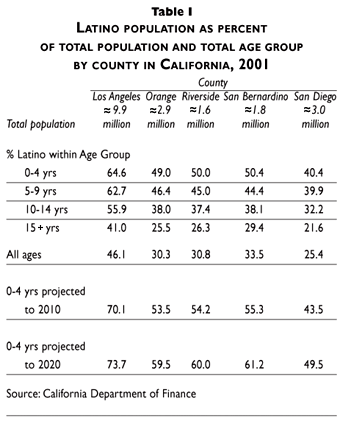
<body><![CDATA[<p><font size="2" face="Verdana">The demographics of the southern California counties,    based on age and race/ethnicity, are shown in <a href="#tab01">table I</a>.    For 2001, the 4.6 million Latinos in Los Angeles County represented 46.1% of    the county's total population of approximately 10 million, but accounted for    higher percentages of the younger age groups. Of children 0 to 4 years of age,    64.6% were Latinos, 17.2% were non-Hispanic whites, 8.0% were African-Americans,    and 10.1% were Asian/Pacific Islanders. Similar trends were observed in Orange,    Riverside, San Bernardino, and San Diego counties, in which Latinos comprised    between a quarter and a third of the overall populations, with higher percentages    among children and adolescents. Especially in the younger age groups (0-4, 5-9),    Latinos represented either the majority or the plurality of the population in    every county (see <a href="#tab01">table I</a>). Moreover, the percentages of    Latino population in the five counties are projected to increase through the    year 2020. </font></p>     <p><a name="tab01"></a></p>     <p>&nbsp;</p>     <p align="center"><img src="/img/revistas/spm/v47n6/a03tab01.gif"></p>     <p>&nbsp;</p>     <p><font size="2" face="Verdana"> Hepatitis A is not imported by large numbers    of immigrant Latino children. In fact, the vast majority of Latino children    (age 0 to 14 years) are born in the United States. In 2000, 88.3% of the 3.5    million Latino children 0 to 14 years in California were U.S.-born. Likewise,    a pattern of more U.S.-born than immigrant children is observed in each of the    southern California counties (see <a href="#tab02">table II</a>). </font></p>     <p><a name="tab02"></a></p>     <p>&nbsp;</p>     <p align="center"><img src="/img/revistas/spm/v47n6/a03tab02.gif"></p>     <p>&nbsp;</p>     ]]></body>
<body><![CDATA[<p><font size="2" face="Verdana"><b>Rates of hepatitis A in southern California    </b></font></p>     <p><font size="2" face="Verdana">For the six-year period under study, the average    annual hepatitis A rate for Latino children (0-14 years of age) in the southern    California counties was 31.13 per 100 000 -more than five times as high as the    second highest rate, of 5.83 for non-Hispanic white children, and about 1.6    times that of the CDC-defined "very high" rate (see <a href="#fig01">figure    1</a>). Yearly relative risks of hepatitis A for Latino children in southern    California, when compared to non-Hispanic white children, ranged from 4.50 times    higher in 1998 to as high as 7.40 times greater in 1997. From 1996 to 2001,    the average risk of contracting hepatitis A was 5.92 times greater in Latino    children than in non-Hispanic white children. </font></p>     <p><a name="fig01"></a></p>     <p>&nbsp;</p>     <p align="center"><img src="/img/revistas/spm/v47n6/a03fig01.gif"></p>     <p>&nbsp;</p>     <p><font size="2" face="Verdana"><b>Hepatitis A rates in children by county, age,    and race/ethnicity </b></font></p>     <p><font size="2" face="Verdana">The nearly 10 million residents of Los Angeles    County had yearly hepatitis A rates of 11.13 cases per 100 000 population from    1996 to 2001, placing the county in the ACIP "high" rate category    (prevalence between 10 and 20 cases per 100 000). Overall rates of 10.85, 12.41,    and 13.05 also earned San Diego, Riverside, and San Bernardino counties a "high"    rating. The overall rate in Orange County was 9.08. </font></p>     <p><font size="2" face="Verdana"> Rates of hepatitis A for Latinos of all ages    in Los Angeles County were somewhat higher than in the overall population but    still within the "high" rate range (see <a href="#tab03">table III</a>).    In children 0 to 14 years of age, moreover, rates were "very high."    Prevalence in this age group was approximately 5.5 times higher among Latino    children than among non-Hispanic white children. </font></p>     <p><a name="tab03"></a></p>     ]]></body>
<body><![CDATA[<p>&nbsp;</p>     <p align="center"><img src="/img/revistas/spm/v47n6/a03tab03.gif"></p>     <p>&nbsp;</p>     <p><font size="2" face="Verdana"> Similar trends were seen in the remaining four    southern California counties. Rates among Latinos of all ages were either "high,"    as in Orange, San Bernardino, and San Diego counties, or "very high,"    as seen in Los Angeles and Riverside. These rates tended to exceed considerably    those of non-Hispanic whites, African-Americans, and Asian/Pacific Islanders.    Moreover, when the 0 to 14 year-old group was examined separately, Latino children    in each county were well into the "very high" category. The hepatitis    A rate among Latino children in Riverside County, for example, was over six    times as high as that among non-Hispanic whites, almost twice as high as for    African-Americans, and over three times as high as for Asian/Pacific Islanders    (see <a href="#tab03">table III</a>). </font></p>     <p>&nbsp;</p>     <p><font size="3" face="Verdana"><b>Discussion</b></font></p>     <p><font size="2" face="Verdana">In the southern California counties of Los Angeles,    Orange, Riverside, San Bernardino, and San Diego, hepatitis A lays a heavy burden    on Latino populations, with children suffering higher rates than adults and    far higher rates than their non-Latino counterparts. </font></p>     <p><font size="2" face="Verdana"> This problem is not trivial. At 2.5 million    in 2000, the population of Latino children (0-14) in just this five-county region    is larger than the total population (all age groups, all races/ethnicities)    of some states. In fact, six of the remaining 10 states identified by ACIP as    having "very high" infection rates have total populations that are    less than the number of Latino children in our study region.<SUP>14</SUP> Given    the projected growth of Latino populations through 2020 within the five counties,    the potential impact on public health is significant. </font></p>     <p><font size="2" face="Verdana"> Although, by law, each case of hepatitis A treated    by a healthcare provider must be reported to health authorities,<SUP>1 </SUP>this    disease is sometimes missed. Some cases are "asymptomatic," in which    the classic symptoms -fever, malaise, anorexia, nausea, dark urine, and jaundice-    are not apparent or may be misdiagnosed as other viral illnesses, such as influenza    or rotavirus infections.<SUP>5,6 </SUP>The CDC estimates the underreporting    of hepatitis A cases to be around 30%. No studies, to date, have evaluated underreporting    among Latinos specifically, but mathematical modeling studies designed to correct    for the high incidence of anicteric infection among children, and for the underreporting    of clinical cases, indicate that in the general population estimated hepatitis    A infections are as much as 10.4 times the number of those actually reported.<SUP>6</SUP>    Therefore, actual rates among Latino children in the southern California counties    combined may have been much higher than the annual rate defined in the present    study. </font></p>     <p><font size="2" face="Verdana"> Groups at an increased risk of contracting hepatitis    A include persons traveling to countries with high or intermediate endemicity    of hepatitis A, food handlers, children and adults at day care centers, school-age    children, health-care institution employees, and workers exposed to sewage.<SUP>1</SUP>    Among Latino children, low socioeconomic status and overcrowding, as well as    frequent contact with travelers from endemic areas (e.g., Mexico, Central America),    underlie their high risk of contracting hepatitis A. Likewise, although international    travel accounts for less than 10% of hepatitis A cases, two-thirds of Hispanic    children living close to the U.S.-Mexico border, such as those in southern California,    reported traveling during the incubation period, principally to Mexico.<SUP>14    </SUP> </font></p>     ]]></body>
<body><![CDATA[<p><font size="2" face="Verdana"> National surveillance data indicate that approximately    50% of hepatitis A infections in the United States occur in persons with no    known risk factors. Rather, disease tends to appear in community-wide epidemics    that generally originate in high-rate areas but have the potential to spread    from one community to another.<SUP>1,2,3</SUP> At the national level, despite    an overall pattern of slow decline, epidemics of hepatitis A have erupted about    every 10 years.<SUP>3</SUP> California appears to be at or near the bottom of    a 10-year cycle, according to data from the state's Department of Health Services,    and thus an upturn in hepatitis A rates may already have begun during early    2000. </font></p>     <p><font size="2" face="Verdana"> Regardless of the cyclical pattern, however,    Latino children consistently are at higher risk for hepatitis A infection and    epidemic than non-Hispanic white children are. From 1996 to 2001, while overall    prevalence in California declined, the relative risk of hepatitis A in Latino    children remained fairly constant, at nearly five times that in non-Hispanic    white coevals. Thus, Latino children would be particularly affected by an epidemic    and, as a high-risk population contributing to transmission, including to adults,    could play a predominant role in initiating or continuing a cyclic epidemic.    </font></p>     <p><font size="2" face="Verdana"> This study has shown a heavy burden of hepatitis    A on Latino populations, especially children, in southern California counties.    The ACIP recommends routine vaccination of children in areas with "very    high" rates (20 or more cases per 100 000) and consideration of routine    childhood vaccination in areas of "high" rates (between 10 and 20    cases per 100 000). Latino children living in counties that meet the ACIP "very    high" definition should become strong candidates for routine hepatitis    A vaccination. The availability of the hepatitis A vaccine provides the opportunity    to substantially lower disease incidence and potentially eliminate infection.<SUP>1</SUP>    Yet, a sustained reduction in hepatitis A is unlikely to occur through merely    vaccination of selected high-risk groups or short-term programs to control individual    community-wide epidemics. To achieve a sustained reduction in national incidence    of hepatitis A, mandated and more widespread routine vaccination of children    is needed.<SUP>2</SUP> </font></p>     <p><font size="2" face="Verdana"> In California the burden of infectious disease    has significantly increased, and certain communities, such as the Latino population,    have experienced a disproportionate burden.<SUP>15</SUP> The U.S.-Mexico border    area has a combined population of more than 11 million people, many of whom    cross the border frequently in either direction to visit family and friends,    shop, work, attend school, or seek medical care.<SUP>16 </SUP>This greater rate    of international travel and higher hepatitis A rates affecting the Latino population    are a binational issue. Primary care pediatricians and other health care providers    treating Latino children who reside in areas where routine vaccination is not    currently recommended should be aware of the need to inquire about international    travel among Latino children. Health care providers should give the hepatitis    A vaccine to child travelers and provide preventive counseling to their parents,    to educate them about the risks of transmission and unsafe water and food consumption.<SUP>14</SUP>    </font></p>     <p><font size="2" face="Verdana"> The health status of the Latino population can    be assessed accurately through binational cooperation and communication. The    Latino population needs an adequate public health infrastructure that addresses    the risk of communicable disease. Health has no borders -the impact of disproportionate    communicable disease rates in Latino children is an issue that needs to be    addressed by both the United States' and Mexico's public health services. </font></p>     <p>&nbsp;</p>     <p><font size="3" face="Verdana"><b>Acknowledgements </b></font></p>     <p><font size="2" face="Verdana">We acknowledge the assistance of Stanley R. Bissell    of the Surveillance and Statistics Section of the Department of Health Services    in obtaining the data, and the support of GlaxoSmith Kline. </font></p>     <p>&nbsp;</p>     <p><font size="3" face="Verdana"><b>References </b></font></p>     ]]></body>
<body><![CDATA[<!-- ref --><p><font size="2" face="Verdana">1. Centers for Disease Control and Prevention.    Prevention of hepatitis A through active or passive immunization: recommendations    of the Advisory Committee on Immunization Practices (ACIP). MMWR 1999;48(RR-12):1-37.    </font>&nbsp;&nbsp;&nbsp;&nbsp;&nbsp;&nbsp;&nbsp;&nbsp;[&#160;<a href="javascript:void(0);" onclick="javascript: window.open('/scielo.php?script=sci_nlinks&ref=9211191&pid=S0036-3634200500060000300001&lng=','','width=640,height=500,resizable=yes,scrollbars=1,menubar=yes,');">Links</a>&#160;]<!-- end-ref --><!-- ref --><p><font size="2" face="Verdana">2. Bell BP, Shapiro CN, Alter MJ, Moyer LA, Judson    FN, Mottram K, et al. The diverse patterns of hepatitis A epidemiology in the    United States -implications for vaccination strategies. J Infect Dis 1998;178:1579-1584.    </font>&nbsp;&nbsp;&nbsp;&nbsp;&nbsp;&nbsp;&nbsp;&nbsp;[&#160;<a href="javascript:void(0);" onclick="javascript: window.open('/scielo.php?script=sci_nlinks&ref=9211192&pid=S0036-3634200500060000300002&lng=','','width=640,height=500,resizable=yes,scrollbars=1,menubar=yes,');">Links</a>&#160;]<!-- end-ref --><!-- ref --><p><font size="2" face="Verdana">3. Centers for Disease Control and Prevention.    Hepatitis surveillance report no. 57. Atlanta: CDC, 2000. </font>&nbsp;&nbsp;&nbsp;&nbsp;&nbsp;&nbsp;&nbsp;&nbsp;[&#160;<a href="javascript:void(0);" onclick="javascript: window.open('/scielo.php?script=sci_nlinks&ref=9211193&pid=S0036-3634200500060000300003&lng=','','width=640,height=500,resizable=yes,scrollbars=1,menubar=yes,');">Links</a>&#160;]<!-- end-ref --><!-- ref --><p><font size="2" face="Verdana">4. Centers for Disease Control and Prevention.    Summary of notifiable diseases, United States, 2000. MMWR 2000;49(53):1-17.    </font>&nbsp;&nbsp;&nbsp;&nbsp;&nbsp;&nbsp;&nbsp;&nbsp;[&#160;<a href="javascript:void(0);" onclick="javascript: window.open('/scielo.php?script=sci_nlinks&ref=9211194&pid=S0036-3634200500060000300004&lng=','','width=640,height=500,resizable=yes,scrollbars=1,menubar=yes,');">Links</a>&#160;]<!-- end-ref --><!-- ref --><p><font size="2" face="Verdana">5. Atkinson W, Wolfe C, Humiston S, Nelson R,    ed. Hepatitis A. In: Epidemiology and Prevention of Vaccine-Preventable Disease.    6th ed. Atlanta: Centers for Disease Control and Prevention, 2000:191-206. </font>&nbsp;&nbsp;&nbsp;&nbsp;&nbsp;&nbsp;&nbsp;&nbsp;[&#160;<a href="javascript:void(0);" onclick="javascript: window.open('/scielo.php?script=sci_nlinks&ref=9211195&pid=S0036-3634200500060000300005&lng=','','width=640,height=500,resizable=yes,scrollbars=1,menubar=yes,');">Links</a>&#160;]<!-- end-ref --><!-- ref --><p><font size="2" face="Verdana">6. Armstrong GL, Bell BP. Hepatitis A virus infection    in the United States: model-based estimates and implications for childhood immunization.    Pediatrics 2002;109:839-845. </font>&nbsp;&nbsp;&nbsp;&nbsp;&nbsp;&nbsp;&nbsp;&nbsp;[&#160;<a href="javascript:void(0);" onclick="javascript: window.open('/scielo.php?script=sci_nlinks&ref=9211196&pid=S0036-3634200500060000300006&lng=','','width=640,height=500,resizable=yes,scrollbars=1,menubar=yes,');">Links</a>&#160;]<!-- end-ref --><!-- ref --><p><font size="2" face="Verdana">7. Kemmer NM, Miskovsky EP. Hepatitis A. Infect    Dis Clin North Am 2000;14:605-615. </font>&nbsp;&nbsp;&nbsp;&nbsp;&nbsp;&nbsp;&nbsp;&nbsp;[&#160;<a href="javascript:void(0);" onclick="javascript: window.open('/scielo.php?script=sci_nlinks&ref=9211197&pid=S0036-3634200500060000300007&lng=','','width=640,height=500,resizable=yes,scrollbars=1,menubar=yes,');">Links</a>&#160;]<!-- end-ref --><!-- ref --><p><font size="2" face="Verdana">8. Staes CJ, Schlenker TL, Risk I, Cannon KG,    Harris H, Pavia AT et al. Sources of infection among persons with acute hepatitis    A and no identified risk factors during a sustained community-wide outbreak.    Pediatrics 2000;106(4):e54. </font>&nbsp;&nbsp;&nbsp;&nbsp;&nbsp;&nbsp;&nbsp;&nbsp;[&#160;<a href="javascript:void(0);" onclick="javascript: window.open('/scielo.php?script=sci_nlinks&ref=9211198&pid=S0036-3634200500060000300008&lng=','','width=640,height=500,resizable=yes,scrollbars=1,menubar=yes,');">Links</a>&#160;]<!-- end-ref --><!-- ref --><p><font size="2" face="Verdana">9. Hepatitis A: special risk for Hispanic populations.    Hepatitis Control Report 1996; 1(3) Fall, 1996. Online newsletter available    at: <a href="http://www.hepatitiscontrolreport.com/vol/v1n31.html" target="_blank">http://www.hepatitiscontrolreport.com/vol/v1n31.html</a>.    Accessed 05/16/05. </font>&nbsp;&nbsp;&nbsp;&nbsp;&nbsp;&nbsp;&nbsp;&nbsp;[&#160;<a href="javascript:void(0);" onclick="javascript: window.open('/scielo.php?script=sci_nlinks&ref=9211199&pid=S0036-3634200500060000300009&lng=','','width=640,height=500,resizable=yes,scrollbars=1,menubar=yes,');">Links</a>&#160;]<!-- end-ref --><!-- ref --><p><font size="2" face="Verdana">10. California Department of Finance, Demographic    Research Unit. Race/ethnic population with age and sex detail, 1970-2040. Sacramento:    California Department of Finance, 1998. Available at: <a href="http://www.dof.ca.gov/html/demograp/race.htm" target="_blank">http://www.dof.ca.gov/html/demograp/race.htm</a>.    Accessed 07/21/03. </font>&nbsp;&nbsp;&nbsp;&nbsp;&nbsp;&nbsp;&nbsp;&nbsp;[&#160;<a href="javascript:void(0);" onclick="javascript: window.open('/scielo.php?script=sci_nlinks&ref=9211200&pid=S0036-3634200500060000300010&lng=','','width=640,height=500,resizable=yes,scrollbars=1,menubar=yes,');">Links</a>&#160;]<!-- end-ref --><!-- ref --><p><font size="2" face="Verdana">11. Los Angeles County Department of Health Services.    Annual morbidity report and special studies report 2002. Los Angeles: Los Angeles    County Department of Health Services, 2002:61-63. </font>&nbsp;&nbsp;&nbsp;&nbsp;&nbsp;&nbsp;&nbsp;&nbsp;[&#160;<a href="javascript:void(0);" onclick="javascript: window.open('/scielo.php?script=sci_nlinks&ref=9211201&pid=S0036-3634200500060000300011&lng=','','width=640,height=500,resizable=yes,scrollbars=1,menubar=yes,');">Links</a>&#160;]<!-- end-ref --><!-- ref --><p><font size="2" face="Verdana">12. United States Census Bureau. 2000 Census    of population and housing: public use microdata sample (PUMS). DVD. Washington,    D.C.: United States Department of Commerce, Economics and Statistics Administration,    2003. </font>&nbsp;&nbsp;&nbsp;&nbsp;&nbsp;&nbsp;&nbsp;&nbsp;[&#160;<a href="javascript:void(0);" onclick="javascript: window.open('/scielo.php?script=sci_nlinks&ref=9211202&pid=S0036-3634200500060000300012&lng=','','width=640,height=500,resizable=yes,scrollbars=1,menubar=yes,');">Links</a>&#160;]<!-- end-ref --><!-- ref --><p><font size="2" face="Verdana">13. United States Census Bureau. Ranking tables    for states: population in 2000 and population change from 1990 to 2000 (PHT-T-2)    Table 1: "States ranked by population: 2000." Washington, D.C.: United    States Census Bureau, 2001. Available at: <a href="http://www.census.gov/population/www/cen2000/phc-t2.html" target="_blank">http://www.census.gov/population/www/cen2000/phc-t2.html</a>.    Accessed 07/24/03. </font>&nbsp;&nbsp;&nbsp;&nbsp;&nbsp;&nbsp;&nbsp;&nbsp;[&#160;<a href="javascript:void(0);" onclick="javascript: window.open('/scielo.php?script=sci_nlinks&ref=9211203&pid=S0036-3634200500060000300013&lng=','','width=640,height=500,resizable=yes,scrollbars=1,menubar=yes,');">Links</a>&#160;]<!-- end-ref --><!-- ref --><p><font size="2" face="Verdana">14. Weinberg M, Hopkins J, Farrington J, Gresham    L, Ginsberg M, Bell BP. Hepatitis A in Hispanic children who live along the    United States-Mexico border: the role of international travel and food-borne    exposures. Pediatrics 2004;114(1):68-73. </font>&nbsp;&nbsp;&nbsp;&nbsp;&nbsp;&nbsp;&nbsp;&nbsp;[&#160;<a href="javascript:void(0);" onclick="javascript: window.open('/scielo.php?script=sci_nlinks&ref=9211204&pid=S0036-3634200500060000300014&lng=','','width=640,height=500,resizable=yes,scrollbars=1,menubar=yes,');">Links</a>&#160;]<!-- end-ref --><!-- ref --><p><font size="2" face="Verdana">15. California Department of Health Services.    Communicable disease control in California. Sacramento, CA: Division of Communicable    Disease Control, California Department of Health Service, 2000:1-5. </font>&nbsp;&nbsp;&nbsp;&nbsp;&nbsp;&nbsp;&nbsp;&nbsp;[&#160;<a href="javascript:void(0);" onclick="javascript: window.open('/scielo.php?script=sci_nlinks&ref=9211205&pid=S0036-3634200500060000300015&lng=','','width=640,height=500,resizable=yes,scrollbars=1,menubar=yes,');">Links</a>&#160;]<!-- end-ref --><!-- ref --><p><font size="2" face="Verdana">16. Pan American Health Organization. Mortality    profiles of the sister communities on the United States-Mexico border. Washington,    D.C.: The Organization, 2005:5-6.</font>&nbsp;&nbsp;&nbsp;&nbsp;&nbsp;&nbsp;&nbsp;&nbsp;[&#160;<a href="javascript:void(0);" onclick="javascript: window.open('/scielo.php?script=sci_nlinks&ref=9211206&pid=S0036-3634200500060000300016&lng=','','width=640,height=500,resizable=yes,scrollbars=1,menubar=yes,');">Links</a>&#160;]<!-- end-ref --><p>&nbsp;</p>     <p>&nbsp;</p>     <p><font size="2" face="Verdana"><b>Address reprint requests to:</b>    <br>   D. E. Hayes-Bautista    ]]></body>
<body><![CDATA[<br>   Center for the Study of Latino Health and Culture    <br>   924 Westwood Blvd., Suite 730    <br>   Los Angeles, CA 90024    <br>   E-mail: <a href="mailto:dhayesb@ucla.edu">dhayesb@ucla.edu</a></font></p>     <p><font size="2" face="Verdana">Received on: January 3, 2005    <br>   Accepted on: August 25, 2005 </font></p>     <p>&nbsp;</p>     <p>&nbsp;</p>     <p><font size="2" face="Verdana"><a name="nt"></a><a href="#tx">*</a> Personal    communication from Stanley R. Bissell, Acting Chief, Surveillance and Statistics    Section, Infectious Disease Branch, Division of Communicable Disease Control,    California Department of Health Services (2/4/2004).</font></p>      ]]></body><back>
<ref-list>
<ref id="B1">
<label>1</label><nlm-citation citation-type="journal">
<collab>Centers for Disease Control and Prevention</collab>
<article-title xml:lang="en"><![CDATA[Prevention of hepatitis A through active or passive immunization: recommendations of the Advisory Committee on Immunization Practices (ACIP)]]></article-title>
<source><![CDATA[MMWR]]></source>
<year>1999</year>
<volume>48</volume>
<numero>RR-12</numero>
<issue>RR-12</issue>
<page-range>1-37</page-range></nlm-citation>
</ref>
<ref id="B2">
<label>2</label><nlm-citation citation-type="journal">
<person-group person-group-type="author">
<name>
<surname><![CDATA[Bell]]></surname>
<given-names><![CDATA[BP]]></given-names>
</name>
<name>
<surname><![CDATA[Shapiro]]></surname>
<given-names><![CDATA[CN]]></given-names>
</name>
<name>
<surname><![CDATA[Alter]]></surname>
<given-names><![CDATA[MJ]]></given-names>
</name>
<name>
<surname><![CDATA[Moyer]]></surname>
<given-names><![CDATA[LA]]></given-names>
</name>
<name>
<surname><![CDATA[Judson]]></surname>
<given-names><![CDATA[FN]]></given-names>
</name>
<name>
<surname><![CDATA[Mottram]]></surname>
<given-names><![CDATA[K]]></given-names>
</name>
</person-group>
<article-title xml:lang="en"><![CDATA[The diverse patterns of hepatitis A epidemiology in the United States -implications for vaccination strategies]]></article-title>
<source><![CDATA[J Infect Dis]]></source>
<year>1998</year>
<volume>178</volume>
<page-range>1579-1584</page-range></nlm-citation>
</ref>
<ref id="B3">
<label>3</label><nlm-citation citation-type="book">
<collab>Centers for Disease Control and Prevention</collab>
<source><![CDATA[Hepatitis surveillance report no. 57]]></source>
<year>2000</year>
<publisher-loc><![CDATA[Atlanta ]]></publisher-loc>
<publisher-name><![CDATA[CDC]]></publisher-name>
</nlm-citation>
</ref>
<ref id="B4">
<label>4</label><nlm-citation citation-type="journal">
<collab>Centers for Disease Control and Prevention</collab>
<article-title xml:lang="en"><![CDATA[Summary of notifiable diseases, United States, 2000]]></article-title>
<source><![CDATA[MMWR]]></source>
<year>2000</year>
<volume>49</volume>
<numero>53</numero>
<issue>53</issue>
<page-range>1-17</page-range></nlm-citation>
</ref>
<ref id="B5">
<label>5</label><nlm-citation citation-type="book">
<person-group person-group-type="author">
<name>
<surname><![CDATA[Atkinson]]></surname>
<given-names><![CDATA[W]]></given-names>
</name>
<name>
<surname><![CDATA[Wolfe]]></surname>
<given-names><![CDATA[C]]></given-names>
</name>
<name>
<surname><![CDATA[Humiston]]></surname>
<given-names><![CDATA[S]]></given-names>
</name>
<name>
<surname><![CDATA[Nelson]]></surname>
<given-names><![CDATA[R]]></given-names>
</name>
</person-group>
<article-title xml:lang="en"><![CDATA[Hepatitis A]]></article-title>
<source><![CDATA[Epidemiology and Prevention of Vaccine-Preventable Disease]]></source>
<year>2000</year>
<edition>6th</edition>
<page-range>191-206</page-range><publisher-loc><![CDATA[Atlanta ]]></publisher-loc>
<publisher-name><![CDATA[Centers for Disease Control and Prevention]]></publisher-name>
</nlm-citation>
</ref>
<ref id="B6">
<label>6</label><nlm-citation citation-type="journal">
<person-group person-group-type="author">
<name>
<surname><![CDATA[Armstrong]]></surname>
<given-names><![CDATA[GL]]></given-names>
</name>
<name>
<surname><![CDATA[Bell]]></surname>
<given-names><![CDATA[BP]]></given-names>
</name>
</person-group>
<article-title xml:lang="en"><![CDATA[Hepatitis A virus infection in the United States: model-based estimates and implications for childhood immunization]]></article-title>
<source><![CDATA[Pediatrics]]></source>
<year>2002</year>
<volume>109</volume>
<page-range>839-845</page-range></nlm-citation>
</ref>
<ref id="B7">
<label>7</label><nlm-citation citation-type="journal">
<person-group person-group-type="author">
<name>
<surname><![CDATA[Kemmer]]></surname>
<given-names><![CDATA[NM]]></given-names>
</name>
<name>
<surname><![CDATA[Miskovsky]]></surname>
<given-names><![CDATA[EP]]></given-names>
</name>
</person-group>
<article-title xml:lang="en"><![CDATA[Hepatitis A]]></article-title>
<source><![CDATA[Infect Dis Clin North Am]]></source>
<year>2000</year>
<volume>14</volume>
<page-range>605-615</page-range></nlm-citation>
</ref>
<ref id="B8">
<label>8</label><nlm-citation citation-type="journal">
<person-group person-group-type="author">
<name>
<surname><![CDATA[Staes]]></surname>
<given-names><![CDATA[CJ]]></given-names>
</name>
<name>
<surname><![CDATA[Schlenker]]></surname>
<given-names><![CDATA[TL]]></given-names>
</name>
<name>
<surname><![CDATA[Risk]]></surname>
<given-names><![CDATA[I]]></given-names>
</name>
<name>
<surname><![CDATA[Cannon]]></surname>
<given-names><![CDATA[KG]]></given-names>
</name>
<name>
<surname><![CDATA[Harris]]></surname>
<given-names><![CDATA[H]]></given-names>
</name>
<name>
<surname><![CDATA[Pavia]]></surname>
<given-names><![CDATA[AT]]></given-names>
</name>
</person-group>
<article-title xml:lang="en"><![CDATA[Sources of infection among persons with acute hepatitis A and no identified risk factors during a sustained community-wide outbreak]]></article-title>
<source><![CDATA[Pediatrics]]></source>
<year>2000</year>
<volume>106</volume>
<numero>4</numero>
<issue>4</issue>
<page-range>e54</page-range></nlm-citation>
</ref>
<ref id="B9">
<label>9</label><nlm-citation citation-type="journal">
<article-title xml:lang="en"><![CDATA[Hepatitis A: special risk for Hispanic populations]]></article-title>
<source><![CDATA[Hepatitis Control Report 1996]]></source>
<year>1996</year>
<volume>1</volume>
<numero>3</numero>
<issue>3</issue>
</nlm-citation>
</ref>
<ref id="B10">
<label>10</label><nlm-citation citation-type="book">
<source><![CDATA[California Department of Finance, Demographic Research Unit: Race/ethnic population with age and sex detail, 1970-2040]]></source>
<year>1998</year>
<publisher-loc><![CDATA[Sacramento ]]></publisher-loc>
<publisher-name><![CDATA[California Department of Finance]]></publisher-name>
</nlm-citation>
</ref>
<ref id="B11">
<label>11</label><nlm-citation citation-type="book">
<source><![CDATA[Los Angeles County Department of Health Services: Annual morbidity report and special studies report 2002]]></source>
<year>2002</year>
<page-range>61-63</page-range><publisher-loc><![CDATA[Los Angeles ]]></publisher-loc>
<publisher-name><![CDATA[Los Angeles County Department of Health Services]]></publisher-name>
</nlm-citation>
</ref>
<ref id="B12">
<label>12</label><nlm-citation citation-type="book">
<source><![CDATA[United States Census Bureau: 2000 Census of population and housing: public use microdata sample (PUMS)]]></source>
<year>2003</year>
<publisher-loc><![CDATA[Washington^eD.C. D.C.]]></publisher-loc>
<publisher-name><![CDATA[United States Department of Commerce, Economics and Statistics Administration]]></publisher-name>
</nlm-citation>
</ref>
<ref id="B13">
<label>13</label><nlm-citation citation-type="book">
<source><![CDATA[United States Census Bureau: Ranking tables for states: population in 2000 and population change from 1990 to 2000 (PHT-T-2) Table 1: "States ranked by population: 2000."]]></source>
<year>2001</year>
<publisher-loc><![CDATA[Washington^eD.C. D.C.]]></publisher-loc>
<publisher-name><![CDATA[United States Census Bureau]]></publisher-name>
</nlm-citation>
</ref>
<ref id="B14">
<label>14</label><nlm-citation citation-type="journal">
<person-group person-group-type="author">
<name>
<surname><![CDATA[Weinberg]]></surname>
<given-names><![CDATA[M]]></given-names>
</name>
<name>
<surname><![CDATA[Hopkins]]></surname>
<given-names><![CDATA[J]]></given-names>
</name>
<name>
<surname><![CDATA[Farrington]]></surname>
<given-names><![CDATA[J]]></given-names>
</name>
<name>
<surname><![CDATA[Gresham]]></surname>
<given-names><![CDATA[L]]></given-names>
</name>
<name>
<surname><![CDATA[Ginsberg]]></surname>
<given-names><![CDATA[M]]></given-names>
</name>
<name>
<surname><![CDATA[Bell]]></surname>
<given-names><![CDATA[BP]]></given-names>
</name>
</person-group>
<article-title xml:lang="en"><![CDATA[Hepatitis A in Hispanic children who live along the United States-Mexico border: the role of international travel and food-borne exposures]]></article-title>
<source><![CDATA[Pediatrics]]></source>
<year>2004</year>
<volume>114</volume>
<numero>1</numero>
<issue>1</issue>
<page-range>68-73</page-range></nlm-citation>
</ref>
<ref id="B15">
<label>15</label><nlm-citation citation-type="book">
<source><![CDATA[California Department of Health Services: Communicable disease control in California]]></source>
<year>2000</year>
<page-range>1-5</page-range><publisher-loc><![CDATA[Sacramento^eCA CA]]></publisher-loc>
<publisher-name><![CDATA[Division of Communicable Disease Control, California Department of Health Service]]></publisher-name>
</nlm-citation>
</ref>
<ref id="B16">
<label>16</label><nlm-citation citation-type="book">
<source><![CDATA[Pan American Health Organization: Mortality profiles of the sister communities on the United States-Mexico border]]></source>
<year>2005</year>
<page-range>5-6</page-range><publisher-loc><![CDATA[Washington^eD.C. D.C.]]></publisher-loc>
<publisher-name><![CDATA[The Organization]]></publisher-name>
</nlm-citation>
</ref>
</ref-list>
</back>
</article>
