<?xml version="1.0" encoding="ISO-8859-1"?><article xmlns:mml="http://www.w3.org/1998/Math/MathML" xmlns:xlink="http://www.w3.org/1999/xlink" xmlns:xsi="http://www.w3.org/2001/XMLSchema-instance">
<front>
<journal-meta>
<journal-id>0036-3634</journal-id>
<journal-title><![CDATA[Salud Pública de México]]></journal-title>
<abbrev-journal-title><![CDATA[Salud pública Méx]]></abbrev-journal-title>
<issn>0036-3634</issn>
<publisher>
<publisher-name><![CDATA[Instituto Nacional de Salud Pública]]></publisher-name>
</publisher>
</journal-meta>
<article-meta>
<article-id>S0036-36342005000400008</article-id>
<title-group>
<article-title xml:lang="en"><![CDATA[Informing the TB suspect for sputum sample collection and communicating laboratory results in Nicaragua: a neglected process in tuberculosis case finding]]></article-title>
<article-title xml:lang="es"><![CDATA[La información al caso sospechoso de TB para la recolección de la muestra de esputo y la comunicación de resultados de laboratorio en Nicaragua: un proceso descuidado en la pesquisa de casos de tuberculosis]]></article-title>
</title-group>
<contrib-group>
<contrib contrib-type="author">
<name>
<surname><![CDATA[Macq]]></surname>
<given-names><![CDATA[Jean]]></given-names>
</name>
<xref ref-type="aff" rid="A01"/>
</contrib>
<contrib contrib-type="author">
<name>
<surname><![CDATA[Solis]]></surname>
<given-names><![CDATA[Alejandro]]></given-names>
</name>
<xref ref-type="aff" rid="A02"/>
</contrib>
<contrib contrib-type="author">
<name>
<surname><![CDATA[Velázquez]]></surname>
<given-names><![CDATA[Harry]]></given-names>
</name>
<xref ref-type="aff" rid="A02"/>
<xref ref-type="aff" rid="A03"/>
</contrib>
<contrib contrib-type="author">
<name>
<surname><![CDATA[Dujardin]]></surname>
<given-names><![CDATA[Bruno]]></given-names>
</name>
<xref ref-type="aff" rid="A01"/>
</contrib>
</contrib-group>
<aff id="A01">
<institution><![CDATA[,Université Libre de Bruxelles Ecole de Santé Publique ]]></institution>
<addr-line><![CDATA[ ]]></addr-line>
</aff>
<aff id="A02">
<institution><![CDATA[,Universidad Nacional Autónoma de Nicaragua Centro de Investigaciones y Estudios de la Salud ]]></institution>
<addr-line><![CDATA[ ]]></addr-line>
</aff>
<aff id="A03">
<institution><![CDATA[,SILAIS Ministerio de Salud de Nicaragua ]]></institution>
<addr-line><![CDATA[ ]]></addr-line>
</aff>
<pub-date pub-type="pub">
<day>00</day>
<month>07</month>
<year>2005</year>
</pub-date>
<pub-date pub-type="epub">
<day>00</day>
<month>07</month>
<year>2005</year>
</pub-date>
<volume>47</volume>
<numero>4</numero>
<fpage>303</fpage>
<lpage>307</lpage>
<copyright-statement/>
<copyright-year/>
<self-uri xlink:href="http://www.scielo.org.mx/scielo.php?script=sci_arttext&amp;pid=S0036-36342005000400008&amp;lng=en&amp;nrm=iso"></self-uri><self-uri xlink:href="http://www.scielo.org.mx/scielo.php?script=sci_abstract&amp;pid=S0036-36342005000400008&amp;lng=en&amp;nrm=iso"></self-uri><self-uri xlink:href="http://www.scielo.org.mx/scielo.php?script=sci_pdf&amp;pid=S0036-36342005000400008&amp;lng=en&amp;nrm=iso"></self-uri><abstract abstract-type="short" xml:lang="es"><p><![CDATA[OBJECTIVE: To assess the patient information process before sputum sample collection, the quality of sputum sample and transmission of acid-fast bacilli (AFB) examination results to TB suspects, in three local areas of Nicaragua. METHODS: (a) directed interviews of consecutive series of TB suspects whose sputum had been examined for AFB; (b) directed interview of health personnel; and (c) assessment of the sputum sample quality. RESULTS: A total of 115 TB suspects and 33 health personnel were interviewed and 625 sputum samples were assessed. Results show multiple weaknesses in the process of information to the patient during sputum collections, as well as in the communication of results. CONCLUSIONS: This study unveiled an aspect usually overlooked of case finding, that is, the information process during sputum production, sputum sample quality, and the communication of results to the TB suspects. The results illustrate the need for routine assessment of the whole diagnostic process.]]></p></abstract>
<abstract abstract-type="short" xml:lang="en"><p><![CDATA[OBJETIVO: valorar el proceso de información del paciente antes de la producción de esputo, la calidad de la muestra de esputo, y la transmisión de los resultados del examen microscópico del esputo a los sospechosos de tuberculosis (TB) en tres áreas de Nicaragua. MATERIAL Y MÉTODOS: (a) entrevistas dirigidas a sospechosos de TB cuya expectoración ha sido examinada para BK; (b) entrevistas dirigidas al personal de salud de tres áreas de estudio (c) la evaluación de la calidad de la expectoración. RESULTADOS: Un total de 115 sospechosos de TB y 33 trabajadores de la salud fueron entrevistados; 625 muestras de esputo fueron examinadas. Los resultados muestran varias debilidades en el proceso de información a los sospechosos antes de la producción de esputo. CONCLUSIÓN: Este estudio revela un aspecto del proceso de diagnóstico de la TB demasiado ignorado. Los resultados ilustran la importancia de evaluar de forma rutinaria el proceso completo de diagnóstico de la TB. Informing the TB suspect for sputum sample collection and communicating laboratory results in Nicaragua: a neglected process in tuberculosis case finding]]></p></abstract>
<kwd-group>
<kwd lng="es"><![CDATA[tuberculosis]]></kwd>
<kwd lng="es"><![CDATA[diagnostic]]></kwd>
<kwd lng="es"><![CDATA[patient-provider communication]]></kwd>
<kwd lng="es"><![CDATA[Nicaragua]]></kwd>
<kwd lng="en"><![CDATA[tuberculosis]]></kwd>
<kwd lng="en"><![CDATA[diagnóstico]]></kwd>
<kwd lng="en"><![CDATA[comunicación prestador-paciente]]></kwd>
<kwd lng="en"><![CDATA[Nicaragua]]></kwd>
</kwd-group>
</article-meta>
</front><body><![CDATA[ <p align="right"><font size="2" face="Verdana"> <b>ART&Iacute;CULO BREVE</b></font></p>     <p>&nbsp;</p>     <p><font size="4" face="verdana"><b>Informing the TB suspect for sputum sample    collection and communicating laboratory results in Nicaragua: a neglected process    in tuberculosis case finding </b></font></p>     <p>&nbsp;</p>     <p><font size="3" face="verdana"><b>La informaci&oacute;n al caso sospechoso de    TB para la recolecci&oacute;n de la muestra de esputo y la comunicaci&oacute;n    de resultados de laboratorio en Nicaragua: un proceso descuidado en la pesquisa    de casos de tuberculosis</b></font></p>     <p>&nbsp;</p>     <p>&nbsp;</p>     <p><font size="2" face="Verdana"><b>Jean Macq, MD, DTM, MPH<SUP>I</SUP>; Alejandro    Solis, MD, MPH<SUP>II</SUP>; Harry Vel&aacute;zquez, MD, MPH<SUP>II,III</SUP>;    Bruno Dujardin MD, PhD.I</b></font></p>     <p><font size="2" face="Verdana"><sup>I</sup>Ecole de Sant&eacute; Publique, Universit&eacute;    Libre de Bruxelles, Belgium    <br>   <sup>II</sup>Centro de Investigaciones y Estudios de la Salud, Universidad Nacional    Aut&oacute;noma de Nicaragua    ]]></body>
<body><![CDATA[<br>   <sup>III</sup>Ministerio de Salud de Nicaragua-SILAIS</font></p>     <p>&nbsp;</p>     <p>&nbsp;</p> <hr size="1" noshade>     <p><font size="2" face="Verdana"><b>ABSTRACT</b></font></p>     <p><font size="2" face="Verdana"><B>OBJECTIVE:</B> To assess the patient information    process before sputum sample collection, the quality of sputum sample and transmission    of acid-fast bacilli (AFB) examination results to TB suspects, in three local    areas of Nicaragua.    <br>   <B>METHODS: </B>(a) directed interviews of consecutive series of TB suspects    whose sputum had been examined for AFB; (b) directed interview of health personnel;    and (c) assessment of the sputum sample quality.    <br>   <B>RESULTS:</B> A total of 115 TB suspects and 33 health personnel were interviewed    and 625 sputum samples were assessed. Results show multiple weaknesses in the    process of information to the patient during sputum collections, as well as    in the communication of results.     <br>   <B>CONCLUSIONS: </B>This study unveiled an aspect usually overlooked of case finding,    that is, the information process during sputum production, sputum sample quality,    and the communication of results to the TB suspects. The results illustrate    the need for routine assessment of the whole diagnostic process. </font></p>     <p><font size="2" face="Verdana"><b>Keywords:</b> tuberculosis; diagnostic; patient-provider    communication; Nicaragua </font></p> <hr size="1" noshade>     <p><font size="2" face="Verdana"><b>RESUMEN</b></font></p>     ]]></body>
<body><![CDATA[<p><font size="2" face="Verdana"><B>OBJETIVO:</B> valorar    el proceso de informaci&oacute;n del paciente antes de la producci&oacute;n    de esputo, la calidad de la muestra de esputo, y la transmisi&oacute;n de los    resultados del examen microsc&oacute;pico del esputo a los sospechosos de tuberculosis    (TB) en tres &aacute;reas de Nicaragua.     <br>   <B>MATERIAL Y M&Eacute;TODOS:</B> (a) entrevistas dirigidas a sospechosos    de TB cuya expectoraci&oacute;n ha sido examinada para BK; (b) entrevistas dirigidas    al personal de salud de tres &aacute;reas de estudio (c) la evaluaci&oacute;n    de la calidad de la expectoraci&oacute;n.    <br>   <B>RESULTADOS:</B> Un total de 115 sospechosos de TB y 33 trabajadores de la    salud fueron entrevistados; 625 muestras de esputo fueron examinadas. Los resultados    muestran varias debilidades en el proceso de informaci&oacute;n a los sospechosos    antes de la producci&oacute;n de esputo.    <br>   <B>CONCLUSI&Oacute;N:</B> Este estudio revela un aspecto del proceso de diagn&oacute;stico    de la TB demasiado ignorado. Los resultados ilustran la importancia de evaluar    de forma rutinaria el proceso completo de diagn&oacute;stico de la TB. Informing    the TB suspect for sputum sample collection and communicating laboratory results    in Nicaragua: a neglected process in tuberculosis case finding </font></p>     <p><font size="2" face="Verdana"><b>Palabras claves:</b> tuberculosis; diagn&oacute;stico;    comunicaci&oacute;n prestador-paciente; Nicaragua </font></p> <hr size="1" noshade>     <p>&nbsp;</p>     <p>&nbsp;</p>     <p><font size="2" face="Verdana">Tuberculosis control is a world-wide priority    for it kills an estimated 2 million people yearly.<SUP>1</SUP> Reducing the    disease's transmission requires reducing the delays in identifying infectious    cases and achieving a high cure rate of diagnosed AFB-positive pulmonary tuberculosis.    We have assessed in Nicaragua critical steps usually ignored in the process    of AFB-positive pulmonary TB cases finding: the information that must be given    to TB suspects in order to assist them to produce sputum samples, the quality    of the sample produced and the communication of microscopy results back to the    patients. That country has a generally well organised TB control programme (TCP).    In 2000, the national notification rate was 47/100 000 population for all forms    of TB and 29/100 000 population for AFB-positive pulmonary TB. Eighty one percent    of the 2000 cohort was declared cured at the end of the treatment and 8% dropped    out of treatment.<SUP>2</SUP> </font> </p>     <p><font size="2" face="Verdana"> In Nicaragua, in compliance with international    standards, pulmonary tuberculosis is diagnosed primarily through microscopic    examination of the sputum of suspected cases to detect the presence of AFB.    The criterion for being catalogued as a suspected case is having a cough of    more than 21 days.<SUP>3,4</SUP> In 2000, Nicaragua had an average of one laboratory    able to perform AFB sputum smears examination for 30 924 inhabitants.<SUP>5</SUP>    The national reference laboratory (CNDR) is responsible for supervision and    quality control. In 2000, its staff made 15 supervisory visits focusing on slide    preparation techniques (spreading and staining the samples) and checking the    microscopes.<SUP>5</SUP> </font></p>     <p><font size="2" face="Verdana"> The results of the routine quality control done    by the CNDR show since 1998, a stable and very good level of concordance with    the peripheral laboratories' results above 99% for AFB-negative and AFB-positive    slides. </font></p>     ]]></body>
<body><![CDATA[<p>&nbsp;</p>     <p><font size="3" face="Verdana"><b>Material and Methods </b></font></p>     <p><font size="2" face="Verdana">This study was conducted in three municipalities    or "municipios" (Jinotega, Pantasma and Bocay) in the northern department    of Jinotega, Nicaragua, in 2000. These municipalities have a total population    of 165 449, 30% of whom live in urban areas. They are covered by 30 health units,    i.e., health posts, health centres and hospitals. For the department of Jinotega,    the notification rate was of 35/100 000 inhabitants for AFB-positive pulmonary    TB in 2000. </font></p>     <p><font size="2" face="Verdana"> We used a "step-by-step" model to    assess the process, starting with the explanation given to the patient on how    to produce the sputum and finishing when the patient received his AFB examination    results.<SUP>6</SUP> This assessment focused on communication and consequent    loss of time for suspected cases of TB. The criteria and standard definitions    in each of the steps studied were mainly those of the TCP standards.<SUP>3,4</SUP>    </font></p>     <p><font size="2" face="Verdana"> To perform our assessment, we gathered information    from different sources. In March and April 2000 we invited consecutive series    of patients who had been suspected of tuberculosis for interviews in May 2000.    At the same time, we interviewed health care workers (HCW) who had been involved    in the care dispensed to the suspected cases. MPH students as part of their    master's research did both the HCW and suspected case interviews. </font></p>     <p><font size="2" face="Verdana"> To assess the quality of sputum specimen production    by patients suspected of tuberculosis, laboratory technicians from Jinotega    reviewed the sputum samples. We also used information from the patient interviews.    The steps assessed, criteria, standards and sources of data are summarised in    <a href="#tab01">Table I</a>. </font></p>     <p><a name="tab01"></a></p>     <p>&nbsp;</p>     <p align="center"><img src="/img/revistas/spm/v47n4/a08tab01.gif"></p>     <p>&nbsp;</p>     ]]></body>
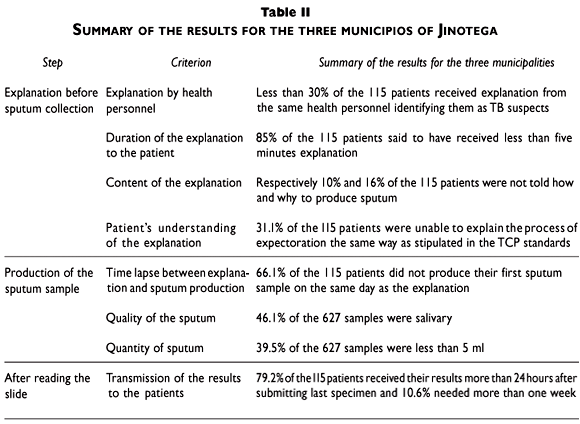
<body><![CDATA[<p><font size="2" face="Verdana"> The MPH group of lecturers of Centro de Investigaciones    y Estudios de la Salud, in Nicaragua reviewed the study protocol including at    ethical aspects and Nicaragua Ministry of Health authorities granted approval    for this study. </font></p>     <p><font size="2" face="Verdana"> In line with ethical guidelines, verbal informed    consent was sought to all suspected cases of tuberculosis. Confidentiality was    stressed throughout the research process. </font></p>     <p>&nbsp;</p>     <p><font size="3" face="Verdana"><b>Results </b></font></p>     <p><font size="2" face="Verdana">Of the consecutive 209 patients in Bocay, Pantasma    and Jinotega who came with a cough of more than 21 days in March and April 2000,    103 suspected cases responded to the invitation and were interviewed in a health    post, health centre or hospital. Twelve TB suspects, accounting for 10% of the    non-respondents, were visited at home to decrease selection bias. The patterns    of their answers were similar to those of the 103 suspected cases. Eighty percent    of the respondents were between 15 and 49 years old and 11/115 (10%) were AFB-positive.    Fifty percent of the suspects were illiterate. </font></p>     <p><font size="2" face="Verdana"> For the first step in our model, a minority    of the patients was given, by the same health care provider who identified them    as suspects, explanations on "how" (29%) to produce sputum and "why"    (28%) the sputum sample was needed. Others were given explanations by the TCP    nurse or laboratory technician. However, 10 and 16% of the patients, respectively,    were not told how and why to produce sputum. For those who were given explanations    on how to produce sputum, 98/104 (94%) said that the explanations took less    than 5 minutes. Forty-one patients (31.1%) were not able to explain correctly    the various steps to produce sputum for examination and 76/115 (66.1%) did not    produce their first sputum samples on the same day that they received the explanation    on how to do it. At the time of the interview, 29/115 (25.2%) had had more than    three sputum examinations. Finally, 91/115 (79.2%) received their results more    than 24 hours after submitting the last specimen, but 12/115 (10.6%) needed    more than one week to receive their results. Concerning the quality and quantity    of sputum, the laboratory technician reported that 46.1% (289/627) of the samples    were salivary and 39.5% (248/627) were less than 5 ml. The overall results are    summarised in <a href="#tab02">Table II</a>. </font></p>     <p><a name="tab02"></a></p>     <p>&nbsp;</p>     <p align="center"><img src="/img/revistas/spm/v47n4/a08tab02.gif"></p>     <p>&nbsp;</p>     ]]></body>
<body><![CDATA[<p><font size="3" face="Verdana"><b>Discussion </b></font></p>     <p><font size="2" face="Verdana">Our results' validity may be criticised for two    main reasons that we think are not sufficient to reject them. First, there might    be a selection bias in our sample, for the response rate in our sample is low    and the number of non-respondents who were visited at home was not great. The    non-respondents probably had more accessibility problems than the respondents,    a situation that in itself is unlikely to have influenced the explanation process    and specimen production. It might have had a consequence on the transmission    of results to the patients (i.e., there might be a higher proportion of non-respondents    coming later to receive their results). Second, sputum quality and quantity    are presented together, even though these characteristics will be significantly    affected by the disease's severity and whether specimens have been collected    on the spot or in the morning at home, in addition to the knowledge how to produce    sputum. However, a result of more than 40% of salivary sputum is a problem from    both the patients' and the health services' perspectives, regardless of the    patients' characteristics. </font></p>     <p><font size="2" face="Verdana"> Having said that, our findings raise important    questions. In the Nicaraguan context, where there is a seemingly excellent concordance    levels for reading the sputum smears for AFB, our study revealed multiple weaknesses    in the process of sputum production. First, our results showed that more than    two-thirds of the patients were given explanations on how and why to produce    sputum by another health personnel than the    one identifying them. This may be acceptable if the medical doctor who usually    identifies the suspected case personally takes the patient directly to the nurse    or laboratory technician who gives the explanation. However in practice, it    meant that the TB suspect often had to join additional queues and had longer    waits in the health facility because of poor coordination between the doctor    from the curative consultation and the TCP nurse or laboratory technician. Second,    two-thirds of the TB suspects from our sample lost at least one day and possibly    transport costs to come back another day to produce their first sputum sample.    This was often related to health unit organisation problems. For example, when    a suspected case came from far away and reached the health unit late in the    day, s/he would find the laboratory closed because the laboratory technician    stopped working at the end of official working hours. Third, one-fourth of the    patients lost time and possibly travel expenses because they were sent for sputum    examinations more than three times because of the poor quality of their sputum.    Indeed, producing sputum is not an easy process for people suspected of having    TB. Indeed, it may be considered impolite behaviour, particularly for women.    This has been documented in Asia.<SUP>7</SUP> This difficulty is probably exacerbated    by the health personnel's behaviour, as the HCWs often show disgust and fear    to the patients who need to produce it. This issue is strongly related to the    whole theme of tuberculosis-related social stigma and needs particular attention    from TB programme supervisors. Finally, patients lost time because only one-fifth    of them received their laboratory results less than one day after producing    their last sputum and one tenth had to wait more than a week. In addition to    these multiple potential causes of wasted time and money for the patient, the    number of false negatives might be under-estimated by the routine procedure    of supervision and quality control, as reflected by the high proportions of    salivary sputum samples and specimens that were too small. </font></p>     <p>&nbsp;</p>     <p><font size="3" face="Verdana"><b>Conclusion </b></font></p>     <p><font size="2" face="Verdana">This study shed light on a usually overlooked    aspect of case finding, that is, the information process to the TB suspect that    starts with the explanation given to the patient on how to produce the sputum    and finishes when the patient receives her/his AFB examination results. Our    study revealed various causes of wasted time and money and loss of AFB-positive    patients. It is unlikely that they are peculiar to Nicaragua. This is important    enough to be considered much more carefully in supervising and monitoring TB    control programmes. </font></p>     <p>&nbsp;</p>     <p><font size="3" face="Verdana"><b>Acknowledgements </b></font></p>     <p><font size="2" face="Verdana">We thank specially Lic. Neria Lopez and Dr. Moise    Huete for having collected the data and participating in their analysis and    Dr. Fabiola Prades, the former national    TB program coordinator for having facilitated this study. </font></p>     <p><font size="2" face="Verdana"> This study was financed by the European Union    (project IC-18 CT 98-0350 of DGXII) and the "Commission Universitaire pour    le D&eacute;veloppement" (CUD) of the CIUF. </font></p>     ]]></body>
<body><![CDATA[<p>&nbsp;</p>     <p><font size="3" face="Verdana"><b>References </b></font></p>     <!-- ref --><p><font size="2" face="Verdana">1. Dye C, Scheele S, Dolin P, Pathania V, Raviglione    M. Consensus statement. Global burden of tuberculosis: estimated incidence,    prevalence and mortality by country. WHO global surveilance and Monitoring Project.    JAMA 1999;(282):677-86. </font>&nbsp;&nbsp;&nbsp;&nbsp;&nbsp;&nbsp;&nbsp;&nbsp;[&#160;<a href="javascript:void(0);" onclick="javascript: window.open('/scielo.php?script=sci_nlinks&ref=9265939&pid=S0036-3634200500040000800001&lng=','','width=640,height=500,resizable=yes,scrollbars=1,menubar=yes,');">Links</a>&#160;]<!-- end-ref --><!-- ref --><p><font size="2" face="Verdana">2. Tardencilla A. Informe anual del programa    de control de la tuberculosis. Managua - Nicaragua; 2002. </font>&nbsp;&nbsp;&nbsp;&nbsp;&nbsp;&nbsp;&nbsp;&nbsp;[&#160;<a href="javascript:void(0);" onclick="javascript: window.open('/scielo.php?script=sci_nlinks&ref=9265940&pid=S0036-3634200500040000800002&lng=','','width=640,height=500,resizable=yes,scrollbars=1,menubar=yes,');">Links</a>&#160;]<!-- end-ref --><!-- ref --><p><font size="2" face="Verdana">3. Cruz JR. Manual del programa de control de    tuberculosis. Ministerio de Salud de Nicaragua. Managua, Nicaragua: El Amanecer;    1993. </font>&nbsp;&nbsp;&nbsp;&nbsp;&nbsp;&nbsp;&nbsp;&nbsp;[&#160;<a href="javascript:void(0);" onclick="javascript: window.open('/scielo.php?script=sci_nlinks&ref=9265941&pid=S0036-3634200500040000800003&lng=','','width=640,height=500,resizable=yes,scrollbars=1,menubar=yes,');">Links</a>&#160;]<!-- end-ref --><!-- ref --><p><font size="2" face="Verdana">4. Cruz JR. Manual del programa de control de    tuberculosis. Ministerio de Salud de Nicaragua. Managua: Imprimatur; 2001. </font>&nbsp;&nbsp;&nbsp;&nbsp;&nbsp;&nbsp;&nbsp;&nbsp;[&#160;<a href="javascript:void(0);" onclick="javascript: window.open('/scielo.php?script=sci_nlinks&ref=9265942&pid=S0036-3634200500040000800004&lng=','','width=640,height=500,resizable=yes,scrollbars=1,menubar=yes,');">Links</a>&#160;]<!-- end-ref --><!-- ref --><p><font size="2" face="Verdana">5. Prado Malespin MF. Informe anual del programa    de control de tuberculosis - edici&oacute;n 2000. Managua, Nicaragua; 2001.    </font>&nbsp;&nbsp;&nbsp;&nbsp;&nbsp;&nbsp;&nbsp;&nbsp;[&#160;<a href="javascript:void(0);" onclick="javascript: window.open('/scielo.php?script=sci_nlinks&ref=9265943&pid=S0036-3634200500040000800005&lng=','','width=640,height=500,resizable=yes,scrollbars=1,menubar=yes,');">Links</a>&#160;]<!-- end-ref --><!-- ref --><p><font size="2" face="Verdana">6. Dujardin B, Kegels G, Buve A, Mercenier P.    Editorial: Tuberculosis control: Did the programme fail or did we fail the programme?    Trop Med Int Health 1997;2(8):715-8. </font>&nbsp;&nbsp;&nbsp;&nbsp;&nbsp;&nbsp;&nbsp;&nbsp;[&#160;<a href="javascript:void(0);" onclick="javascript: window.open('/scielo.php?script=sci_nlinks&ref=9265944&pid=S0036-3634200500040000800006&lng=','','width=640,height=500,resizable=yes,scrollbars=1,menubar=yes,');">Links</a>&#160;]<!-- end-ref --><!-- ref --><p><font size="2" face="Verdana">7. Begum V, de Colombani P, Das Gupta S, Salim    MAH, Hussain H, Pietroni M, et al. Tuberculosis and patient gender in Bangladesh:    sex differences in diagnosis and treatment outcome. Int J Tuberc Lung Dis 2001;5(7):604-10.</font>&nbsp;&nbsp;&nbsp;&nbsp;&nbsp;&nbsp;&nbsp;&nbsp;[&#160;<a href="javascript:void(0);" onclick="javascript: window.open('/scielo.php?script=sci_nlinks&ref=9265945&pid=S0036-3634200500040000800007&lng=','','width=640,height=500,resizable=yes,scrollbars=1,menubar=yes,');">Links</a>&#160;]<!-- end-ref --><p>&nbsp;</p>     ]]></body>
<body><![CDATA[<p>&nbsp;</p>     <p><font size="2" face="Verdana">Received on: December 7, 2004    <br>   Accepted on: July 25, 2005 </font></p>     <p>&nbsp;</p>     <p>&nbsp;</p>     <p><font size="2" face="Verdana">Address reprint requests to: Jean Macq; Ecole    de Sant&eacute; Publique, D&eacute;partement Politiques et Syst&egrave;mes de    Sant&eacute;; Universit&eacute; Libre de    Bruxelles; Campus Erasme, CP 597; Route de Lennik, 808; B-1070 Brussels; Belgium.    Email: <a href="mailto:jmacq@ulb.ac.be">jmacq@ulb.ac.be</a></font></p>      ]]></body><back>
<ref-list>
<ref id="B1">
<label>1</label><nlm-citation citation-type="journal">
<person-group person-group-type="author">
<name>
<surname><![CDATA[Dye]]></surname>
<given-names><![CDATA[C]]></given-names>
</name>
<name>
<surname><![CDATA[Scheele]]></surname>
<given-names><![CDATA[S]]></given-names>
</name>
<name>
<surname><![CDATA[Dolin]]></surname>
<given-names><![CDATA[P]]></given-names>
</name>
<name>
<surname><![CDATA[Pathania]]></surname>
<given-names><![CDATA[V]]></given-names>
</name>
<name>
<surname><![CDATA[Raviglione]]></surname>
<given-names><![CDATA[M]]></given-names>
</name>
</person-group>
<article-title xml:lang="en"><![CDATA[Consensus statement. Global burden of tuberculosis: estimated incidence, prevalence and mortality by country: WHO global surveilance and Monitoring Project]]></article-title>
<source><![CDATA[JAMA]]></source>
<year>1999</year>
<volume>282</volume>
<page-range>677-86</page-range></nlm-citation>
</ref>
<ref id="B2">
<label>2</label><nlm-citation citation-type="">
<person-group person-group-type="author">
<name>
<surname><![CDATA[Tardencilla]]></surname>
<given-names><![CDATA[A]]></given-names>
</name>
</person-group>
<source><![CDATA[Informe anual del programa de control de la tuberculosis]]></source>
<year>2002</year>
<publisher-loc><![CDATA[^eManagua Managua]]></publisher-loc>
</nlm-citation>
</ref>
<ref id="B3">
<label>3</label><nlm-citation citation-type="">
<person-group person-group-type="author">
<name>
<surname><![CDATA[Cruz]]></surname>
<given-names><![CDATA[JR]]></given-names>
</name>
</person-group>
<source><![CDATA[Manual del programa de control de tuberculosis: Ministerio de Salud de Nicaragua]]></source>
<year></year>
</nlm-citation>
</ref>
<ref id="B4">
<label>4</label><nlm-citation citation-type="">
<person-group person-group-type="author">
<name>
<surname><![CDATA[Cruz]]></surname>
<given-names><![CDATA[JR]]></given-names>
</name>
</person-group>
<source><![CDATA[Manual del programa de control de tuberculosis: Ministerio de Salud de Nicaragua]]></source>
<year>2001</year>
<publisher-loc><![CDATA[Imprimatur^eManagua Managua]]></publisher-loc>
</nlm-citation>
</ref>
<ref id="B5">
<label>5</label><nlm-citation citation-type="">
<person-group person-group-type="author">
<name>
<surname><![CDATA[Prado Malespin]]></surname>
<given-names><![CDATA[MF]]></given-names>
</name>
</person-group>
<source><![CDATA[Informe anual del programa de control de tuberculosis - edición 2000]]></source>
<year>2001</year>
<publisher-loc><![CDATA[^eManagua Managua]]></publisher-loc>
</nlm-citation>
</ref>
<ref id="B6">
<label>6</label><nlm-citation citation-type="journal">
<person-group person-group-type="author">
<name>
<surname><![CDATA[Dujardin]]></surname>
<given-names><![CDATA[B]]></given-names>
</name>
<name>
<surname><![CDATA[Kegels]]></surname>
<given-names><![CDATA[G]]></given-names>
</name>
<name>
<surname><![CDATA[Buve]]></surname>
<given-names><![CDATA[A]]></given-names>
</name>
<name>
<surname><![CDATA[Mercenier]]></surname>
<given-names><![CDATA[P]]></given-names>
</name>
</person-group>
<article-title xml:lang="en"><![CDATA[Editorial: Tuberculosis control: Did the programme fail or did we fail the programme?]]></article-title>
<source><![CDATA[Trop Med Int Health]]></source>
<year>1997</year>
<volume>2</volume>
<numero>8</numero>
<issue>8</issue>
<page-range>715-8</page-range></nlm-citation>
</ref>
<ref id="B7">
<label>7</label><nlm-citation citation-type="journal">
<person-group person-group-type="author">
<name>
<surname><![CDATA[Begum]]></surname>
<given-names><![CDATA[V]]></given-names>
</name>
<name>
<surname><![CDATA[de Colombani]]></surname>
<given-names><![CDATA[P]]></given-names>
</name>
<name>
<surname><![CDATA[Das Gupta]]></surname>
<given-names><![CDATA[S]]></given-names>
</name>
<name>
<surname><![CDATA[Salim]]></surname>
<given-names><![CDATA[MAH]]></given-names>
</name>
<name>
<surname><![CDATA[Hussain]]></surname>
<given-names><![CDATA[H]]></given-names>
</name>
<name>
<surname><![CDATA[Pietroni]]></surname>
<given-names><![CDATA[M]]></given-names>
</name>
</person-group>
<article-title xml:lang="en"><![CDATA[Tuberculosis and patient gender in Bangladesh: sex differences in diagnosis and treatment outcome]]></article-title>
<source><![CDATA[Int J Tuberc Lung Dis]]></source>
<year>2001</year>
<volume>5</volume>
<numero>7</numero>
<issue>7</issue>
<page-range>604-10</page-range></nlm-citation>
</ref>
</ref-list>
</back>
</article>