<?xml version="1.0" encoding="ISO-8859-1"?><article xmlns:mml="http://www.w3.org/1998/Math/MathML" xmlns:xlink="http://www.w3.org/1999/xlink" xmlns:xsi="http://www.w3.org/2001/XMLSchema-instance">
<front>
<journal-meta>
<journal-id>0036-3634</journal-id>
<journal-title><![CDATA[Salud Pública de México]]></journal-title>
<abbrev-journal-title><![CDATA[Salud pública Méx]]></abbrev-journal-title>
<issn>0036-3634</issn>
<publisher>
<publisher-name><![CDATA[Instituto Nacional de Salud Pública]]></publisher-name>
</publisher>
</journal-meta>
<article-meta>
<article-id>S0036-36342005000400003</article-id>
<title-group>
<article-title xml:lang="en"><![CDATA[Obesity and overweight in IMSS female workers in Mexico City]]></article-title>
<article-title xml:lang="es"><![CDATA[Obesidad y sobrepeso en mujeres trabajadoras del IMSS, en la Ciudad de México]]></article-title>
</title-group>
<contrib-group>
<contrib contrib-type="author">
<name>
<surname><![CDATA[Vázquez-Martínez]]></surname>
<given-names><![CDATA[José Luis]]></given-names>
</name>
<xref ref-type="aff" rid="A01"/>
</contrib>
<contrib contrib-type="author">
<name>
<surname><![CDATA[Gómez-Dantés]]></surname>
<given-names><![CDATA[Héctor]]></given-names>
</name>
<xref ref-type="aff" rid="A02"/>
</contrib>
<contrib contrib-type="author">
<name>
<surname><![CDATA[Gómez-García]]></surname>
<given-names><![CDATA[Felipe]]></given-names>
</name>
<xref ref-type="aff" rid="A03"/>
</contrib>
<contrib contrib-type="author">
<name>
<surname><![CDATA[Lara-Rodríguez]]></surname>
<given-names><![CDATA[María de los Angeles]]></given-names>
</name>
<xref ref-type="aff" rid="A04"/>
</contrib>
<contrib contrib-type="author">
<name>
<surname><![CDATA[Navarrete-Espinosa]]></surname>
<given-names><![CDATA[Joel]]></given-names>
</name>
<xref ref-type="aff" rid="A04"/>
</contrib>
<contrib contrib-type="author">
<name>
<surname><![CDATA[Pérez-Pérez]]></surname>
<given-names><![CDATA[Gabriela]]></given-names>
</name>
<xref ref-type="aff" rid="A05"/>
</contrib>
</contrib-group>
<aff id="A01">
<institution><![CDATA[,Instituto Mexicano del Seguro Social (IMSS) División Técnica de Información Estadística en Salud ]]></institution>
<addr-line><![CDATA[ ]]></addr-line>
</aff>
<aff id="A02">
<institution><![CDATA[,Instituto Mexicano del Seguro Social (IMSS)  ]]></institution>
<addr-line><![CDATA[ ]]></addr-line>
</aff>
<aff id="A03">
<institution><![CDATA[,Mocel Hospital Board of Orthopedics ]]></institution>
<addr-line><![CDATA[ ]]></addr-line>
</aff>
<aff id="A04">
<institution><![CDATA[,IMSS Integrated Programs Coordination ]]></institution>
<addr-line><![CDATA[ ]]></addr-line>
</aff>
<aff id="A05">
<institution><![CDATA[,IMSS Integrated Programs Coordination Board of Epidemiology]]></institution>
<addr-line><![CDATA[ ]]></addr-line>
</aff>
<pub-date pub-type="pub">
<day>00</day>
<month>07</month>
<year>2005</year>
</pub-date>
<pub-date pub-type="epub">
<day>00</day>
<month>07</month>
<year>2005</year>
</pub-date>
<volume>47</volume>
<numero>4</numero>
<fpage>268</fpage>
<lpage>275</lpage>
<copyright-statement/>
<copyright-year/>
<self-uri xlink:href="http://www.scielo.org.mx/scielo.php?script=sci_arttext&amp;pid=S0036-36342005000400003&amp;lng=en&amp;nrm=iso"></self-uri><self-uri xlink:href="http://www.scielo.org.mx/scielo.php?script=sci_abstract&amp;pid=S0036-36342005000400003&amp;lng=en&amp;nrm=iso"></self-uri><self-uri xlink:href="http://www.scielo.org.mx/scielo.php?script=sci_pdf&amp;pid=S0036-36342005000400003&amp;lng=en&amp;nrm=iso"></self-uri><abstract abstract-type="short" xml:lang="en"><p><![CDATA[OBJECTIVE: To estimate the prevalence and risk factors for overweight (OW) and obesity (OB) in women working at the Mexican Social Security Institute (IMSS, per its abbreviation in Spanish) in Mexico City, using two different classification criteria. MATERIAL AND METHODS: A cross-sectional study was performed from July 1999 to September 2000. It included 588 women 20 to 65 years of age and who were working at the IMSS. The criteria used to estimate the prevalence of OW and OB were the WHO criteria and the Mexican Official Norm (NOM) for the integrated management of obesity in Mexico. RESULTS: The frequency of OB, according to WHO criteria, was 27.6% (26% adjusted) and for OW 43.2% (40.2% adjusted). According to the NOM, the levels of OB in those with short height (<1.50 m) increased to 75% and to 52.2% for those with height >1.50 m. Comparison of BMI between the two height groups showed no differences. The risk factor associated with OB and OW was age. Education and exercise were protective factors. CONCLUSIONS: The high prevalences detected in this particular working group highlight the importance of prevention and control of OB in health personnel because it can result in a high number of disability and premature retirement due to disease. The use of the NOM criteria for the identification of women at risk may be useful for early detection of high-risk groups.]]></p></abstract>
<abstract abstract-type="short" xml:lang="es"><p><![CDATA[OBJETIVO: Estimar la prevalencia de obesidad (OB) y sobrepeso (SP) en mujeres trabajadoras del IMSS en la Ciudad de México, aplicando dos criterios de clasificación y su asociación con algunos factores de riesgo. MATERIAL Y MÉTODOS: Estudio transversal realizado entre julio de 1999 y septiembre de 2000 que incluyó a 588 mujeres trabajadoras en el IMSS entre 20 y 65 años. Los criterios utilizados para medir la prevalencia de OB y SP fueron los propuestos por la OMS y la Norma Oficial Mexicana para el manejo integral de la obesidad (NOM). RESULTADOS: La frecuencia de OB fue 27.6% (26% ajustada) y de SP de 43.2% (40.2% ajustada) al aplicar los criterios de la OMS. Conforme a la NOM, los niveles de OB en el grupo de talla baja (<1.50 m) se elevaron a 75% y en el de talla mayor a 1.50 m a 52.2%. Sin embargo, al comparar el índice de masa corporal de talla baja y talla normal no se aprecian diferencias. El factor de riesgo para OB y SP fue la edad. En forma protectora resultaron la educación y el ejercicio. CONCLUSIONES: Las altas prevalencias de OB y SP en la población estudiada constituyen un riesgo importante para la salud de este grupo de población, que se puede traducir en altos niveles de discapacidad y pensiones con un alto costo para la Institución. Estos resultados demandan la realización de intervenciones que permitan identificar precozmente a mujeres con índices de masa corporal de riesgo. Los rangos propuestos por la NOM pueden ser de utilidad para la identificación precoz de las mujeres en riesgo.]]></p></abstract>
<kwd-group>
<kwd lng="en"><![CDATA[obesity]]></kwd>
<kwd lng="en"><![CDATA[overweight]]></kwd>
<kwd lng="en"><![CDATA[health personnel]]></kwd>
<kwd lng="en"><![CDATA[women]]></kwd>
<kwd lng="en"><![CDATA[social security]]></kwd>
<kwd lng="es"><![CDATA[obesidad]]></kwd>
<kwd lng="es"><![CDATA[sobrepeso]]></kwd>
<kwd lng="es"><![CDATA[trabajadoras de la salud]]></kwd>
<kwd lng="es"><![CDATA[mujeres]]></kwd>
<kwd lng="es"><![CDATA[seguridad social]]></kwd>
</kwd-group>
</article-meta>
</front><body><![CDATA[ <p align="right"><font size="2" face="Verdana"><b>ART&Iacute;CULO ORIGINAL</b></font></p>     <p>&nbsp;</p>     <p><font size="4" face="verdana"> <b>Obesity and overweight in IMSS female workers    in Mexico City </b></font></p>     <p>&nbsp;</p>     <p><font size="3" face="verdana"><b>Obesidad y sobrepeso en mujeres trabajadoras    del IMSS, en la Ciudad de M&eacute;xico</b></font></p>     <p>&nbsp;</p>     <p>&nbsp;</p>     <p><font size="2" face="Verdana"><b>Jos&eacute; Luis V&aacute;zquez-Mart&iacute;nez,    MD, MSc<SUP>I</SUP>; H&eacute;ctor G&oacute;mez-Dant&eacute;s, MD, MSc<SUP>II</SUP>;    Felipe G&oacute;mez-Garc&iacute;a, MD<SUP>III</SUP>; Mar&iacute;a de los Angeles    Lara-Rodr&iacute;guez, MD, MSc<SUP>IV</SUP>; Joel Navarrete-Espinosa, MD, MSc<SUP>IV</SUP>;    Gabriela P&eacute;rez-P&eacute;rez, MD.<SUP>V</SUP></b></font></p>     <p><font size="2" face="Verdana"><sup>I</sup>Divisi&oacute;n T&eacute;cnica de    Informaci&oacute;n Estad&iacute;stica en Salud. Instituto Mexicano del Seguro    Social (IMSS)    <br>   <sup>II</sup>Instituto Mexicano del Seguro    Social    ]]></body>
<body><![CDATA[<br>   <sup>III</sup>Board of Orthopedics; Mocel    Hospital    <br>   <sup>IV</sup>Integrated Programs Coordination,    IMSS    <br>   <sup>V</sup>Board of Epidemiology; Integrated    Programs Coordination; IMSS</font></p>     <p>&nbsp;</p>     <p>&nbsp;</p> <hr size="1" noshade>     <p><font size="2" face="Verdana"><b>ABSTRACT</b> </font></p>     <p><font size="2" face="Verdana"><B>OBJECTIVE: </B> To estimate the prevalence    and risk factors for overweight (OW) and obesity (OB) in women working at the    Mexican Social Security Institute (IMSS, per its abbreviation in Spanish) in    Mexico City, using two different classification criteria.    <br>   <B>MATERIAL AND METHODS: </B> A cross-sectional study was performed from July    1999 to September 2000. It included 588 women 20 to 65 years of age and who    were working at the IMSS. The criteria used to estimate the prevalence of OW    and OB were the WHO criteria and the Mexican Official Norm (NOM) for the integrated    management of obesity in Mexico.    <br>   <B>RESULTS: </B> The frequency of OB, according to WHO criteria, was 27.6% (26%    adjusted) and for OW 43.2% (40.2% adjusted). According to the NOM, the levels    of OB in those with short height (&lt;1.50 m) increased to 75% and to 52.2%    for those with height &gt;1.50 m. Comparison of BMI between the two height groups    showed no differences. The risk factor associated with OB and OW was age. Education    and exercise were protective factors.    <br>   <B>CONCLUSIONS: </B> The high prevalences detected in this particular working    group highlight the importance of prevention and control of OB in health personnel    because it can result in a high number of disability and premature retirement    due to disease. The use of the NOM criteria for the identification of women    at risk may be useful for early detection of high-risk groups. </font></p>     ]]></body>
<body><![CDATA[<p><font size="2" face="Verdana"><b>Key words:</b> obesity, overweight, health    personnel, women, social security</font></p> <hr size="1" noshade>     <p><font size="2" face="Verdana"><b>RESUMEN</b></font></p>     <p><font size="2" face="Verdana"><B>OBJETIVO:</B> Estimar la prevalencia de obesidad    (OB) y sobrepeso (SP) en mujeres trabajadoras del IMSS en la Ciudad de M&eacute;xico,    aplicando dos criterios de clasificaci&oacute;n y su asociaci&oacute;n con algunos    factores de riesgo.    <br>   <B>MATERIAL Y M&Eacute;TODOS: </B>Estudio transversal realizado entre julio    de 1999 y septiembre de 2000 que incluy&oacute; a 588 mujeres trabajadoras en    el IMSS entre 20 y 65 a&ntilde;os. Los criterios utilizados para medir la prevalencia    de OB y SP fueron los propuestos por la OMS y la Norma Oficial Mexicana para    el manejo integral de la obesidad (NOM).    <br>   <B>RESULTADOS: </B> La frecuencia de OB fue 27.6% (26% ajustada) y de SP de 43.2%    (40.2% ajustada) al aplicar los criterios de la OMS. Conforme a la NOM, los    niveles de OB en el grupo de talla baja (&lt;1.50 m) se elevaron a 75% y en    el de talla mayor a 1.50 m a 52.2%. Sin embargo, al comparar el &iacute;ndice    de masa corporal de talla baja y talla normal no se aprecian diferencias. El    factor de riesgo para OB y SP fue la edad. En forma protectora resultaron la    educaci&oacute;n y el ejercicio.    <br>   <B>CONCLUSIONES:</B> Las altas prevalencias de OB y SP en la poblaci&oacute;n    estudiada constituyen un riesgo importante para la salud de este grupo de poblaci&oacute;n,    que se puede traducir en altos niveles de discapacidad y pensiones con un alto    costo para la Instituci&oacute;n. Estos resultados demandan la realizaci&oacute;n    de intervenciones que permitan identificar precozmente a mujeres con &iacute;ndices    de masa corporal de riesgo. Los rangos propuestos por la NOM pueden ser de utilidad    para la identificaci&oacute;n precoz de las mujeres en riesgo. </font></p>     <p><font size="2" face="Verdana"><b>Palabras clave:</b> obesidad, sobrepeso, trabajadoras    de la salud, mujeres, seguridad social</font></p> <hr size="1" noshade>     <p>&nbsp;</p>     <p>&nbsp;</p>     <p><font size="2" face="Verdana">Obesity is defined as the physical state in which    excess fat stores are associated with various health risks. The most precise    way to measure obesity uses direct methods such as computerized tomography,    magnetic resonance imaging and densitometry. However, these techniques are complicated,    costly and unavailable or inaccessible for population studies. Hence, the estimate    of body fat is done indirectly through traditional anthropometric measurements    such as body weight, height, body circumferences, and skin fold thickness. A    simple and widely accepted weight diagnostic method is the body mass index (BMI)    or Quetelet index, which relates body weight with height and is a good indicator    of overweight (OW) and obesity (OB).<SUP>1</SUP> </font></p>     ]]></body>
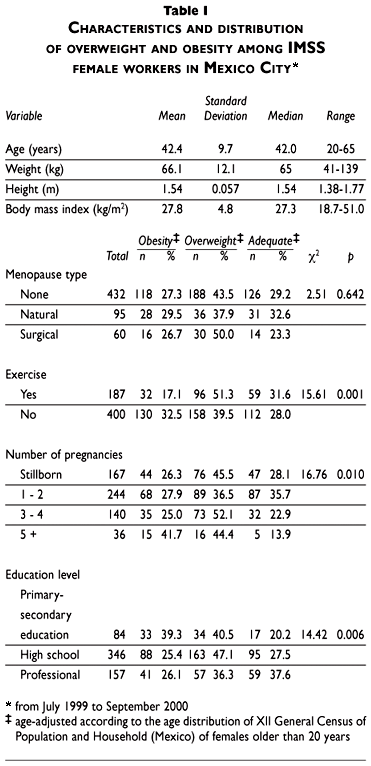
<body><![CDATA[<p><font size="2" face="Verdana"> Obesity has been clearly established as a public    health priority due to its clear association with the occurrence of a broad    group of health conditions such as heart disease, diabetes mellitus, arterial    hypertension, stroke, and some neoplasms. These conditions rank among the major    causes for seeking both primary and specialized health care and result in high    hospital admission rates. Moreover, these conditions rank among the major causes    of death nationwide.<SUP>2</SUP> </font></p>     <p><font size="2" face="Verdana"> The prevalence of obesity has increased remarkably    in recent decades. Obesity is considered as a pandemic and is the major contributor    to the overall burden of disease in both developed and developing countries.<SUP>3</SUP>    The total number of obese people worldwide is estimated in 250 million and the    World Health Organization (WHO) has projected that by 2025, around 300 million    people will be obese.<SUP>4</SUP> In the Americas region, the predominant pattern    shows that obesity is found mainly in urban areas, affects females more than    males, has a higher prevalence among adult age groups, and is considered as    a poverty-related problem. <SUP>5</SUP> </font></p>     <p><font size="2" face="Verdana"> The Third National Health and Nutrition Examination    Survey (NHANES III) conducted in the United States reported a total of 97 million    adults with overweight or obesity and 51% of females in that country are overweight.<SUP>6</SUP>    Even though weight loss is common in the United States, the prevalence of obesity,    considered as a BMI &gt;30 kg/m<SUP>2</SUP>, increased from 12% in 1991 to 17.9%    in 1998, with the greatest increment (69.9%) reported in the youngest age group,    ages 18-29 years. <SUP>7</SUP> In Mexico, data from the National Health Survey    (ENSA-2000) report that 23.7% of Mexicans over 20 years of age are obese.<SUP>8</SUP>    Data of the National Nutrition Surveys (ENN- and ENN-99) show an increment in    the frequency of OW from 16.4 to 31% and of OB from 18.7 to 21.7% among females.<SUP>9</SUP>    </font></p>     <p><font size="2" face="Verdana"> The increase in the number of obese people has    occurred at a fast rate, both in industrialized and in developing countries,    which leads us to consider obesity as a condition that is not exclusive of affluent    groups. It is also important to measure these health risks in medical personnel    who are directly involved in health promotion and health education to assess    their compliance and understanding of their preventing activities. </font></p>     <p><font size="2" face="Verdana"> We decided to conduct this study among the population    of working women in the IMSS to estimate the prevalence of obesity and overweight    in Mexico City by using an international standard (WHO criteria) as well as    the Mexican Official Norm for the integrated management of obesity in Mexico    (NOM).</font></p>     <p>&nbsp;</p>     <p><font size="3" face="Verdana"><b>Material and methods </b></font></p>     <p><font size="2" face="Verdana">The study was based on the weight and height    measurements performed in a cross-sectional study aimed at estimating the prevalence    of osteoporosis among female Mexican Social Security Institute (IMSS) workers    in Mexico City from July 1999 to September 2000. The total number of female    workers in the IMSS in Mexico City was 42 406. The mean age was 40.1 years (standard    deviation 8.1 years), and with a mean of 14.6 years of working history in the    institution (standard deviation 7.7 years). A total of 588 healthy and non-pregnant    females over 20 years of age were selected to participate in the study by means    of a multi-stage sampling process. The first stage of the selection process    consisted of a simple random sampling of the medical and administrative units    in each of the four districts (geographical-administrative divisions) in Mexico    City. The number of women from each district was proportional to the total number    of IMSS female workers in each district. Participants from each district were    distributed according to the proportion represented by each of the following    age groups: 20-29; 30-44; 45-49, and 50 and over. The final selection of women    was done by a simple random sampling procedure. The body mass index was used    to assess the nutritional status of women. It is obtained by dividing body weight    in kilograms by the height in square meters (kg/m<SUP>2</SUP>). Weight was measured    with the least clothing possible (wearing a gown) using a fixed calibrated scale    for each measurement. The observer responsible for somatometry was trained by    staff specialized in these measurements. A metallic stadiometer was used to    measure height with the person barefoot. The following criteria of the Expert    Panel for the Identification, Evaluation and Treatment of Adult Overweight and    Obesity were used to  classify the women    based on their nutritional status: malnourished (BMI &lt;18.5 kg/m<SUP>2</SUP>);    well nourished (BMI=1.5-24.9 kg/m<SUP>2</SUP>); overweight (BMI=25.0-29.9 kg/m<SUP>2</SUP>)    and obese (BMI&gt;30 kg/m<SUP>2</SUP>); the latter included only one category.    The resulting prevalence rates were age-adjusted according to the age distribution    of the XII General Population and Household Census (Mexico) of females over    20 years of age, based on the following percentages: 20-29=33%; 30-39=26%; 40-49=17%,    and &gt;50=24%. The Mexican Official Standard criteria for obesity applied in    this study considered height using a cut-off point of 1.50 m for females to    establish two categories: short height (&lt;1.50 m) and height &gt;1.50 m. The    following criteria for overweight and obesity were: for short stature, obesity    was defined as a BMI &gt;25 and overweight as a BMI of 23-25; for those with    heights &gt;1.50 m, obesity was defined as a BMI &gt;27 and overweight as a    BMI of 25-27.<SUP>10</SUP> Confidence intervals of 95% were obtained for each    category. Sociodemographic, schooling, job position, gynecological and obstetrics    factors, and exercise data (exercise yes or no) were obtained from a structured    interview by means of a questionnaire applied by previously trained staff. Physical    activity was assessed by type of exercise, time in minutes, times a week, and    years of practice. The number of pregnancies included four categories: stillborn;    1-2; 3-4, and <u>&gt;</u>5 pregnancies. Menopause was reported as: none, natural    and surgical menopause; tobacco use was classified as actual smoking, smoking    in the past, and no smoking. Health risks information was limited to data collected    from the survey performed during the osteoporosis study. </font></p>     <p><font size="2" face="Verdana"> Data analysis included measures of central tendency    and dispersion in the case of continuous variables. For categorical variables    (nominal and ordinal), simple frequencies were calculated. The relation between    the nutritional status (obesity, overweight and appropriate weight) and the    independent variables studied (age, menopause, exercise practice, number of    pregnancies, and schooling) were analyzed through contingency tables using the    <font face="Symbol">c</font><SUP>2</SUP> test. Age was measured in years; menopause    was defined as present or absent, doing exercise was categorical (yes and no);    number of pregnancies was categorical and schooling was classified according    to the following groups: primary-secondary, high school, and professional. </font></p>     <p><font size="2" face="Verdana"> To establish the difference in the BMI among    the groups with short and normal stature and educational level, Wilcoxon rank    sum test and the Kruskal-Wallis test were used as non-parametric methods due    to the skewed distribution of BMI. Since the condition of BMI variance homogeneity    for schooling was not met, Bonferroni's test was applied to determine the differences    among the groups, after range transformation, as recommended by Conover and    Iman.<SUP>11</SUP> The ordinal logistic regression method was used to evaluate    the risk of OW and OB according to the risk factors available in the osteoporosis    study. The principle ruling this method demands the existence of more than two    categories in the dependent variable. The logit recovers the relationship (trend)    between the covariables and the dependent variable. The proportional odds was    used based on the premise that every logit has a different constant but shares    the covariable coefficient. From these estimates one can establish the probabilities    of a woman having a given BMI depending on their characteristics (covariables).<SUP>12</SUP>    The cumulative probability is equal to the sum of all the probabilities in each    category Pr(Y&gt;=j)=Pr(Y=1) + (Pr(y=2) + ....Pr(Y=j), where the sum represents    100%. The covariable coefficients are used to obtain a "score," where    score= <font face="Symbol">b</font><SUB>1</SUB>(age) + <font face="Symbol">b</font><SUB>2</SUB>    (education) + <font face="Symbol">b</font><SUB>3</SUB> (pregnancies) + <font face="Symbol">b</font><SUB>4</SUB>(exercise),    and values correspond to the characteristics of each woman. The probability    of a normal BMI was calculated as follows: Pr(normal)=1/1 + e <SUP>score – cut-off    value 1</SUP>; for OW the formula is Pr (OW)= (1/1 + e <SUP>score – cut-off    value 2</SUP>) - (1/1 + e <SUP>score – cut-off value 1</SUP>). The    OB BMI is calculated by: Pr(OB)=1 – (1/1 + e <SUP>score – cut-off value 2</SUP>).<U>    </U> </font></p>     ]]></body>
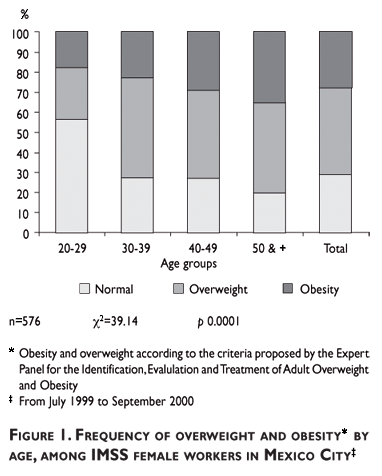
<body><![CDATA[<p><font size="2" face="Verdana"> The database was entered in duplicate using    the Epi-Info package, version 6.04, in order to detect data entry errors, and    the STATA statistical package, version 7.0 was used for data analysis. </font></p>     <p>&nbsp;</p>     <p><font size="3" face="Verdana"><b>Results </b></font></p>     <p><font size="2" face="Verdana">The group of women studied was composed of 588    female workers ages 20 to 65 years, with a mean age of 42.4 years (&plusmn;9.7).    The age-group distribution was as follows: 20-29 years, 74 women (12%); 30-39    years, 152 women (25.8%); 40-49 years, 198 women (33.7%) and the group of <u>&gt;</u>50    years, 164 women (27.9%). The median height was 1.54 m, which is very close    to the cut-off point proposed by the NOM. The median weight was 65 kg, and the    median BMI was 27.3 kg/m<SUP>2</SUP>, higher than the cut-off point proposed    by WHO for overweight (BMI &gt;25) and obesity (BMI &gt;27) for normal height    individuals (&gt; 1.50 m). The median BMI by age group was: 24.6 kg/m<SUP>2</SUP>    for the 20-29 years group; 26.8 kg/m<SUP>2</SUP> for the 30-39 years group;    27.5 kg/m<SUP>2</SUP> for the 40-49 years group; and 28.4 kg/m<SUP>2</SUP> for    the group &gt;50 years old. </font></p>     <p><font size="2" face="Verdana"> Since only one woman, with a BMI of 17.3 kg/m<SUP>2</SUP>,    was classified as malnourished, it was decided to delete this category from    the multivariate model. The remaining 587 women had a BMI &gt;18.5 kg/m<SUP>2</SUP>.    <a href="#tab01">Table I</a> shows the means for age, weight, height and body    mass index, together with the rates of menopause, exercise,     number of pregnancies and education level, distributed according to the nutritional    status. </font></p>     <p><a name="tab01"></a></p>     <p>&nbsp;</p>     <p align="center"><img src="/img/revistas/spm/v47n4/a03tab01.gif"></p>     <p>&nbsp;</p>     <p><font size="2" face="Verdana"> According to the WHO Expert Committee, the prevalence    of obesity was 27.6% (n=162; 95% CI= 23.9-3 1.2), the prevalence of overweight    was 43.3% (n=254; 95% CI= 39.2-47.2) and only 29.1% of women had an appropriate    weight (n=171; CI=95%, 25.6-32.9) (<a href="#fig01">figure 1</a>). </font></p>     ]]></body>
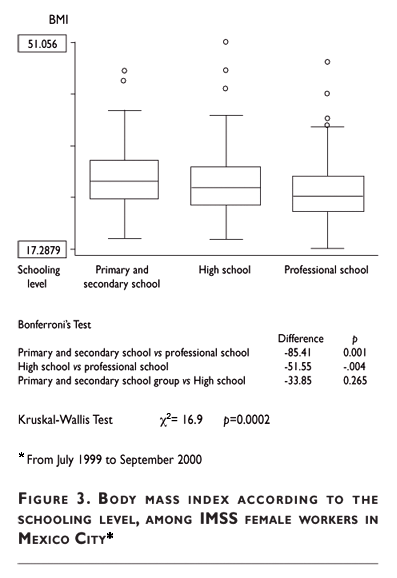
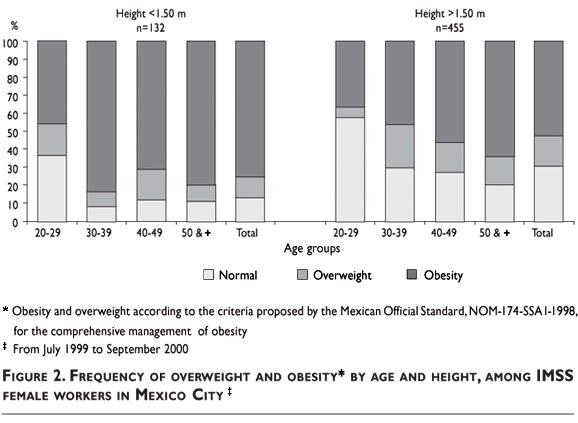
<body><![CDATA[<p><a name="fig01"></a></p>     <p>&nbsp;</p>     <p align="center"><img src="/img/revistas/spm/v47n4/a03fig01.gif"></p>     <p>&nbsp;</p>     <p><font size="2" face="Verdana"> The overall age-adjusted prevalence of overweight    and obesity was 25.1% and 39.6%, respectively. On the other hand, the frequency    of overweight and obesity increased with increasing age (<a href="#fig02">figure    2</a>). The same effect was observed when the NOM criteria were considered,    with the greatest increase reported in the 30-39 years group. </font></p>     <p><a name="fig02"></a></p>     <p>&nbsp;</p>     <p align="center"><img src="/img/revistas/spm/v47n4/a03fig02.gif"></p>     <p>&nbsp;</p>     <p><font size="2" face="Verdana"> Women with height &gt;= 1.50 m had a lower obesity    rate than short height women. However, the obesity rate was higher for both    groups (&lt;1.50 m and &gt;1.50 m) when the NOM criteria were applied (<a href="#fig03">figure    3</a>). When values of BMI distribution were compared for short stature (median=27.97)    and normal (median=27.82), no significant differences were reported using the    Wilcoxon rank sum test (z=0.854 <I>p</I>=0.3029). </font></p>     ]]></body>
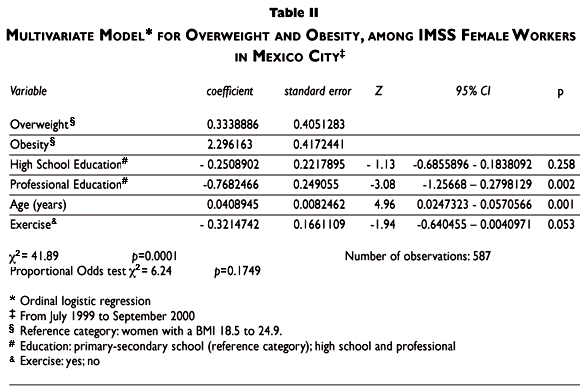
<body><![CDATA[<p><a name="fig03"></a></p>     <p>&nbsp;</p>     <p align="center"><img src="/img/revistas/spm/v47n4/a03fig03.gif"></p>     <p>&nbsp;</p>     <p><font size="2" face="Verdana"> The nutritional status (obesity and overweight)    was associated with menopause, exercise practice, number of pregnancies (<a href="#tab01">Table    I</a>) and schooling level (<a href="#fig03">Figure 3</a>). Bonferroni's test    showed differences in the BMI (transformed by ranges) between the lowest schooling    category (primary-secondary grade school) and the highest schooling group (a    difference of -85.41; <I>p</I>&lt;0.0001). The same situation was observed when    the high school group was compared with the women with the highest schooling    level, with a difference of -51.55 and <I>p</I>&lt;0.004. No significant differences    were seen between the primary-secondary school group and the high school group    (-33.85 difference; <I>p</I>=0.265). Smoking was not associated with BMI in    any of the three categories: actual smoking (median BMI 27.1 kg/m<SUP>2</SUP>),    past smoking (median BMI 28.0 kg/m<SUP>2</SUP>) and no smoking    (median BMI 27.3 kg/m<SUP>2</SUP>). Physical activity was measured as practice    of exercise (yes or no) and was positive in one third of the sample surveyed    (198/588= 32.7%). By type of exercise, only two women exceeded 10%: aerobics    (68/588=11.6%) and walking (65/588=11.1%), with a median time of exercise of    60 and 30 minutes respectively, for 3 to 4 times weekly and a duration of 2    to 3 years. </font></p>     <p><font size="2" face="Verdana"> In the multivariate model, age showed an association    with overweight and obesity. Education and exercise were associated as protective    factors with overweight and obesity, while the effect of menopause and number    of pregnancies was lost for overweight and obesity (<a href="#tab02">Table II</a>).    In other words, age increases the probability of OW and OB while the opposite    happens with exercise and educational attainment. </font></p>     <p><a name="tab02"></a></p>     <p>&nbsp;</p>     <p align="center"><img src="/img/revistas/spm/v47n4/a03tab02.gif"></p>     <p>&nbsp;</p>     ]]></body>
<body><![CDATA[<p><font size="3" face="Verdana"><b>Discussion </b></font></p>     <p><font size="2" face="Verdana">Data available for the past two decades show    an important increase in the OW and OB rates worldwide.<SUP>13</SUP> It is a    Pan-American ailment.<SUP>5,6</SUP> In our country, the ENN-99 demonstrated    an important increase in the OW and OB rates in women, as compared with the    prevalence detected in 1988 (ENN-88). Differences by type of locality consisted    of a higher frequency of OW and OB in urban areas and, by geographical region,    in the Northern Region and Mexico City.<SUP> 9,14.</SUP> </font></p>     <p><font size="2" face="Verdana"> The results of this study point at a higher    prevalence of OW (crude: 43.3%; adjusted: 40.2%) and OB (crude: 27.6%; adjusted:    26%) in the study population, as compared with the data reported by the ENN-99    (OW: 30.6%; OB: 21.2%). The OW and OB rates from this study were higher than    those reported by the ENN-99 for urban localities (OW: 31.5%; OB: 19.8%). These    frequencies highlight that two thirds of female workers (28 072 out of 42 406)    have OW or OB and are at risk of suffering the medical consequences linked to    these conditions: diabetes, high blood pressure, ischemic heart disease, and    cerebrovascular diseases. This profile results in a financial burden to the    IMSS because of the high indices of disability and increased pensions due to    premature morbidity and mortality.<SUP>22</SUP></font></p>     <p><font size="2" face="Verdana"> The OW and OB rates grow as age increases and    this same pattern has been observed in various populations, such as the one    surveyed by the NHANES III in the United States and by the First Obesity Survey    in Uruguay. Both of them showed that OW and OB rates went up as age increased    and that this increase was more pronounced in women than in men after age 55.<SUP>6,15</SUP>    </font></p>     <p><font size="2" face="Verdana"> The higher OW and OB rates from our study are    alarming due to the demographic transition our country is going through, which    involves an increase in chronic conditions associated with OW and OB that are    expressed directly on the female population in general, and particularly in    the female working population.<SUP>16</SUP> This phenomenon may become even    more critical in the medium and long term due to the frequency of obesity among    boys (5%) and girls (6%) ages 0-5 years in our country.<SUP>9</SUP> Recently    imposed lifestyles, such as the intake of carbohydrate and fat-rich foods lead    to assume that this problem has a rising trend in the Mexican society.<SUP>17,l8</SUP>    </font></p>     <p><font size="2" face="Verdana"> The findings reported using the two criteria    in this study did not reveal any substantial differences in the prevalences    of BMI between the two height groups; nevertheless, we stand in favor of detecting    and preventing those diseases linked to OB and OW before the WHO criteria are    met. The criteria established by the NOM could be used with that purpose in    mind, otherwise, there is no sense in having that Mexican standard. The application    of the NOM criteria for OW and OB resulted in a higher prevalence of OB in the    study population. This is because the cut-off points proposed by the NOM to    define obesity are lower and more useful, since the risk for various chronic    conditions goes up directly as the BMI increases. Huan Z <I>et al </I>have found    that as the BMI goes up, the risk of hypertension is higher, and vice versa    –as the former goes down, the latter decreases.<SUP>19</SUP> The same findings    were reported by the National Health Survey (ENSA-2000) in Mexico, which reported    the same increased risk of hypertension with higher BMI figures.<SUP>20</SUP>    </font></p>     <p><font size="2" face="Verdana"> Other conditions, such as diabetes mellitus,    dyslipidemias and albuminuria were also associated with increases in the BMI.    A BMI &gt;25 kg/m<SUP>2</SUP> represents a high risk for these conditions.<SUP>21,22</SUP>    Data confirm that the risk of stroke in women occurs at a BMI <u>&gt;</u>27    kg/m<SUP>2</SUP>.<SUP>23</SUP> In our study, the median BMI was 27.3 kg/m<SUP>2</SUP>,    which means that 50% of the women are already at risk of stroke. Women 40 years    old are at considerable risk since their median BMI was 27.5 kg/m<SUP>2</SUP>.    </font></p>     <p><font size="2" face="Verdana"> Our study findings are consistent with those    from other reports. Climacteric women undergo endocrine changes that affect    the make-up and distribution of body fat and make them prone to obesity and    to various chronic conditions. In the study population menopause was associated    with a higher obesity rate, but the association was lost after adjusting for    age. However, other studies support an increase in BMI among women during menopause.<SUP>24,25</SUP>    This study reports overweight and obesity rates among women who perform little    physical activity, but no risk gradients could be established between OW and    OB and the degree of physical activity. A limitation of this study is the temporal    ambiguity between BMI and exercise where no causal relationship can be ascertained.    Nevertheless, physical activity and exercise have been associated with decreases    in the BMI.<SUP>26</SUP> Education was a protective factor against OW and OB    and this same effect was reported by Lahti-Koski M. et. al, who found an increased    BMI with lower schooling levels, assuming that low educational level is associated    with a low level of knowledge of obesity and its links to other diseases.<SUP>27</SUP>    </font></p>     <p><font size="2" face="Verdana"> One of the limitations of this study is the    absence of an effect of diet on the OW and OB rates, the reason being that the    survey was aimed at specifically measuring calcium and hence important food    variables for OW and OB were omitted. </font></p>     <p><font size="2" face="Verdana"> The overweight and obesity rates reported for    the IMSS female working population represent an important risk for chronic conditions    both in the short and long term. Thus, there is a need to emphasize prevention    and control programs aimed at this population, particularly considering the    decreased incidence of chronic conditions that is associated with a decrease    in BMI. This is especially relevant, since due to their occupation, one would    think that this population would be more informed about preventive programs    and have more access to them. The IMSS has launched an intensive preventive    strategy (PREVENIMSS) directed to the population at large, to the working population,    and to the health personnel in its medical units, where detection of overweight    and obesity is an outstanding component of the early detection program. While    health interventions are focused on individual lifestyle changes, the health    personnel is responsible for counseling the population about exercise and change    in diet, as well as promoting healthy lifestyles. Thus we cannot expect this    kind of programs to succeed and have an impact on the general population if    this important risk factor is not properly controlled among a population group    that is better informed than the general population and, moreover, is constantly    exposed to risk reduction and healthy life-style campaigns. </font></p>     ]]></body>
<body><![CDATA[<p>&nbsp;</p>     <p><font size="3" face="Verdana"><b>References </b></font></p>     <!-- ref --><p><font size="2" face="Verdana">1. World Health Organization. Physical status:    the use and interpretation of anthropometry. Report of a WHO Expert Committee.    World Health Organ Tech Rep Ser. 1995;854:1-452. </font>&nbsp;&nbsp;&nbsp;&nbsp;&nbsp;&nbsp;&nbsp;&nbsp;[&#160;<a href="javascript:void(0);" onclick="javascript: window.open('/scielo.php?script=sci_nlinks&ref=9207902&pid=S0036-3634200500040000300001&lng=','','width=640,height=500,resizable=yes,scrollbars=1,menubar=yes,');">Links</a>&#160;]<!-- end-ref --><!-- ref --><p><font size="2" face="Verdana">2. Fundaci&oacute;n Mexicana para la Salud. Obesidad    en M&eacute;xico. Grupo Nacional de Consenso en Obesidad. M&eacute;xico, DF:    FUNSALUD, 1997. </font>&nbsp;&nbsp;&nbsp;&nbsp;&nbsp;&nbsp;&nbsp;&nbsp;[&#160;<a href="javascript:void(0);" onclick="javascript: window.open('/scielo.php?script=sci_nlinks&ref=9207903&pid=S0036-3634200500040000300002&lng=','','width=640,height=500,resizable=yes,scrollbars=1,menubar=yes,');">Links</a>&#160;]<!-- end-ref --><!-- ref --><p><font size="2" face="Verdana">3. Visscher TLS, Seidell J C The public health    impact of obesity. Annu Rev Public Health 2001;22:355-75. </font>&nbsp;&nbsp;&nbsp;&nbsp;&nbsp;&nbsp;&nbsp;&nbsp;[&#160;<a href="javascript:void(0);" onclick="javascript: window.open('/scielo.php?script=sci_nlinks&ref=9207904&pid=S0036-3634200500040000300003&lng=','','width=640,height=500,resizable=yes,scrollbars=1,menubar=yes,');">Links</a>&#160;]<!-- end-ref --><!-- ref --><p><font size="2" face="Verdana">4. World Health Organization. Life in the 21st    Century: a vision for all. The World Health Rep. Geneva Switzerland:WHO,1998.    </font>&nbsp;&nbsp;&nbsp;&nbsp;&nbsp;&nbsp;&nbsp;&nbsp;[&#160;<a href="javascript:void(0);" onclick="javascript: window.open('/scielo.php?script=sci_nlinks&ref=9207905&pid=S0036-3634200500040000300004&lng=','','width=640,height=500,resizable=yes,scrollbars=1,menubar=yes,');">Links</a>&#160;]<!-- end-ref --><!-- ref --><p><font size="2" face="Verdana">5. Pe&ntilde;a M, Bacallao J. La Obesidad en    la pobreza: un problema emergente en las Am&eacute;ricas. En: Un nuevo reto    para la salud p&uacute;blica. Washington, D.C: Organizaci&oacute;n Pan Americana    de la Salud; 2000:3-11. (Publicaci&oacute;n Cientifica No. 5769). </font>&nbsp;&nbsp;&nbsp;&nbsp;&nbsp;&nbsp;&nbsp;&nbsp;[&#160;<a href="javascript:void(0);" onclick="javascript: window.open('/scielo.php?script=sci_nlinks&ref=9207906&pid=S0036-3634200500040000300005&lng=','','width=640,height=500,resizable=yes,scrollbars=1,menubar=yes,');">Links</a>&#160;]<!-- end-ref --><!-- ref --><p><font size="2" face="Verdana">6. Flegal KM, Carrol MD, Kuczmarski RJ, Johnson    CL. Overweight and obesity in the United States: prevalence and trends, 1960-1994.    Int J Obes Relat Metab Disord 1998;22(1):39-47. </font>&nbsp;&nbsp;&nbsp;&nbsp;&nbsp;&nbsp;&nbsp;&nbsp;[&#160;<a href="javascript:void(0);" onclick="javascript: window.open('/scielo.php?script=sci_nlinks&ref=9207907&pid=S0036-3634200500040000300006&lng=','','width=640,height=500,resizable=yes,scrollbars=1,menubar=yes,');">Links</a>&#160;]<!-- end-ref --><!-- ref --><p><font size="2" face="Verdana">7. Mokdad AH, Serdula MK, Dietz WH, Bowman BA,    Marks JS, Koplan JP. The spread of the obesity epidemic in the United Stares,    1991-1998. JAMA 1999,282(16):1519-1522. </font>&nbsp;&nbsp;&nbsp;&nbsp;&nbsp;&nbsp;&nbsp;&nbsp;[&#160;<a href="javascript:void(0);" onclick="javascript: window.open('/scielo.php?script=sci_nlinks&ref=9207908&pid=S0036-3634200500040000300007&lng=','','width=640,height=500,resizable=yes,scrollbars=1,menubar=yes,');">Links</a>&#160;]<!-- end-ref --><!-- ref --><p><font size="2" face="Verdana">8. Olaiz G, Rojas R, Barquera S, Shamah T, Aguilar    C, Cravioto P, L&oacute;pez P, Hern&aacute;ndez M, Tapia R, Sep&uacute;lveda    J. Encuesta Nacional de Salud 2000. Tomo 2. La salud de los adultos. Cuernavaca,    Morelos, M&eacute;xico: Instituto Nacional de Salud P&uacute;blica, 2003:36-46.    </font>&nbsp;&nbsp;&nbsp;&nbsp;&nbsp;&nbsp;&nbsp;&nbsp;[&#160;<a href="javascript:void(0);" onclick="javascript: window.open('/scielo.php?script=sci_nlinks&ref=9207909&pid=S0036-3634200500040000300008&lng=','','width=640,height=500,resizable=yes,scrollbars=1,menubar=yes,');">Links</a>&#160;]<!-- end-ref --><!-- ref --><p><font size="2" face="Verdana">9. Rivera Dommarco J, Shamah Levy T, Villalpando    Hern&aacute;ndez S, Gonz&aacute;lez de Coss&iacute;o T, Hern&aacute;ndez Prado    B, Sep&uacute;lveda J. Encuesta Nacional de Nutrici&oacute;n 1999. Estado nutricio    de ni&ntilde;os y mujeres en M&eacute;xico. Cuernavaca, Morelos, M&eacute;xico:    Instituto Nacional de Salud P&uacute;blica, 2001. </font>&nbsp;&nbsp;&nbsp;&nbsp;&nbsp;&nbsp;&nbsp;&nbsp;[&#160;<a href="javascript:void(0);" onclick="javascript: window.open('/scielo.php?script=sci_nlinks&ref=9207910&pid=S0036-3634200500040000300009&lng=','','width=640,height=500,resizable=yes,scrollbars=1,menubar=yes,');">Links</a>&#160;]<!-- end-ref --><!-- ref --><p><font size="2" face="Verdana">10. Secretaria de Salud. Norma Oficial Mexicana    NOM-174-SSA1-1998, Para el manejo integral de la obesidad. M&eacute;xico: SSA,1998.    </font>&nbsp;&nbsp;&nbsp;&nbsp;&nbsp;&nbsp;&nbsp;&nbsp;[&#160;<a href="javascript:void(0);" onclick="javascript: window.open('/scielo.php?script=sci_nlinks&ref=9207911&pid=S0036-3634200500040000300010&lng=','','width=640,height=500,resizable=yes,scrollbars=1,menubar=yes,');">Links</a>&#160;]<!-- end-ref --><!-- ref --><p><font size="2" face="Verdana">11. Conover WJ, Iman RL. Rank transformations    as a bridge between parametric and nonparametric statistics. Amer Statistician    1981;35:124-133. </font>&nbsp;&nbsp;&nbsp;&nbsp;&nbsp;&nbsp;&nbsp;&nbsp;[&#160;<a href="javascript:void(0);" onclick="javascript: window.open('/scielo.php?script=sci_nlinks&ref=9207912&pid=S0036-3634200500040000300011&lng=','','width=640,height=500,resizable=yes,scrollbars=1,menubar=yes,');">Links</a>&#160;]<!-- end-ref --><!-- ref --><p><font size="2" face="Verdana">12. Ananth CV, Kleinbaum DG. Regression Models    for Ordinal Responses: A review of Methods an Applications. Int J Epidemiol    1997;26(6):1323-33. </font>&nbsp;&nbsp;&nbsp;&nbsp;&nbsp;&nbsp;&nbsp;&nbsp;[&#160;<a href="javascript:void(0);" onclick="javascript: window.open('/scielo.php?script=sci_nlinks&ref=9207913&pid=S0036-3634200500040000300012&lng=','','width=640,height=500,resizable=yes,scrollbars=1,menubar=yes,');">Links</a>&#160;]<!-- end-ref --><!-- ref --><p><font size="2" face="Verdana">13. World Health Organization. Obesity: preventing    and managing the global epidemic. Report of a WHO Consultation presented at:    the World Health Organization; June3-5, 1997; Geneva, Switzerland. Publication    WHO/NUT/NCD/98.1. </font>&nbsp;&nbsp;&nbsp;&nbsp;&nbsp;&nbsp;&nbsp;&nbsp;[&#160;<a href="javascript:void(0);" onclick="javascript: window.open('/scielo.php?script=sci_nlinks&ref=9207914&pid=S0036-3634200500040000300013&lng=','','width=640,height=500,resizable=yes,scrollbars=1,menubar=yes,');">Links</a>&#160;]<!-- end-ref --><!-- ref --><p><font size="2" face="Verdana">14. Hern&aacute;ndez B, Peterson K, Sobol A,    Rivera J, Sep&uacute;lveda J, Lezana MA. Obesity among 12-49 year-old women    and children aged under five in Mexico. Salud Publica Mex 1996;38:178-188. </font>&nbsp;&nbsp;&nbsp;&nbsp;&nbsp;&nbsp;&nbsp;&nbsp;[&#160;<a href="javascript:void(0);" onclick="javascript: window.open('/scielo.php?script=sci_nlinks&ref=9207915&pid=S0036-3634200500040000300014&lng=','','width=640,height=500,resizable=yes,scrollbars=1,menubar=yes,');">Links</a>&#160;]<!-- end-ref --><!-- ref --><p><font size="2" face="Verdana">15. Pisabarro R, Irraz&aacute;bal E, Recalde    A. Primera Encuesta Nacional de Sobrepeso y Obesidad (ENSO I). Rev Med Uruguay    2000;16:31-38. </font>&nbsp;&nbsp;&nbsp;&nbsp;&nbsp;&nbsp;&nbsp;&nbsp;[&#160;<a href="javascript:void(0);" onclick="javascript: window.open('/scielo.php?script=sci_nlinks&ref=9207916&pid=S0036-3634200500040000300015&lng=','','width=640,height=500,resizable=yes,scrollbars=1,menubar=yes,');">Links</a>&#160;]<!-- end-ref --><!-- ref --><p><font size="2" face="Verdana">16. Stern C. Tuir&aacute;n R. Transici&oacute;n    demogr&aacute;fica y desigualdad social en M&eacute;xico. Ponencia presentada    en la IV Conferencia Latinoamericana de Poblaci&oacute;n. La transici&oacute;n    demogr&aacute;fica y desigualdad social en Am&eacute;rica Latina y el Caribe,    M&eacute;xico, marzo de 1993. </font>&nbsp;&nbsp;&nbsp;&nbsp;&nbsp;&nbsp;&nbsp;&nbsp;[&#160;<a href="javascript:void(0);" onclick="javascript: window.open('/scielo.php?script=sci_nlinks&ref=9207917&pid=S0036-3634200500040000300016&lng=','','width=640,height=500,resizable=yes,scrollbars=1,menubar=yes,');">Links</a>&#160;]<!-- end-ref --><!-- ref --><p><font size="2" face="Verdana">17. Hernandez B, Gortmaker SL, Colditz GA, Peterson    KE, Laird NM, Parra-Cabrera S. Association of obesity with physical activity,    television programs and other forms of video viewing among children in Mexico    City. Int J Obes 1999;23(8):845-54. </font>&nbsp;&nbsp;&nbsp;&nbsp;&nbsp;&nbsp;&nbsp;&nbsp;[&#160;<a href="javascript:void(0);" onclick="javascript: window.open('/scielo.php?script=sci_nlinks&ref=9207918&pid=S0036-3634200500040000300017&lng=','','width=640,height=500,resizable=yes,scrollbars=1,menubar=yes,');">Links</a>&#160;]<!-- end-ref --><!-- ref --><p><font size="2" face="Verdana"> 18. Dietz WH. Gortmaker SL. Preventing Obesity    in Children and Adolescents. Annu Rev Public Health 2001;22:337-53. </font>&nbsp;&nbsp;&nbsp;&nbsp;&nbsp;&nbsp;&nbsp;&nbsp;[&#160;<a href="javascript:void(0);" onclick="javascript: window.open('/scielo.php?script=sci_nlinks&ref=9207919&pid=S0036-3634200500040000300018&lng=','','width=640,height=500,resizable=yes,scrollbars=1,menubar=yes,');">Links</a>&#160;]<!-- end-ref --><!-- ref --><p><font size="2" face="Verdana">19. Huang Z, Willet WC, Manson JE, Rosner B,    Stampfer MJ, Speizer FE, Colditz GA. Body weight, weight change, and risk for    hypertension in women. Ann Intern Med 1998;128:81-88. </font>&nbsp;&nbsp;&nbsp;&nbsp;&nbsp;&nbsp;&nbsp;&nbsp;[&#160;<a href="javascript:void(0);" onclick="javascript: window.open('/scielo.php?script=sci_nlinks&ref=9207920&pid=S0036-3634200500040000300019&lng=','','width=640,height=500,resizable=yes,scrollbars=1,menubar=yes,');">Links</a>&#160;]<!-- end-ref --><!-- ref --><p><font size="2" face="Verdana">20.Vel&aacute;zquez-Monroy O, Rosas-Peralta M,    Lara-Esqueda A, Gustavo Pastel&iacute;n-Hern&aacute;ndez G. Hipertensi&oacute;n    arterial en M&eacute;xico: Resultados de la Encuesta Nacional de Salud (ENSA)    2000. Arch Cardiol Mex 2002;72:71-84. </font>&nbsp;&nbsp;&nbsp;&nbsp;&nbsp;&nbsp;&nbsp;&nbsp;[&#160;<a href="javascript:void(0);" onclick="javascript: window.open('/scielo.php?script=sci_nlinks&ref=9207921&pid=S0036-3634200500040000300020&lng=','','width=640,height=500,resizable=yes,scrollbars=1,menubar=yes,');">Links</a>&#160;]<!-- end-ref --><!-- ref --><p><font size="2" face="Verdana">21. Ko GTC, Chan JCN, Cockram CS, Woo J. Prediction    of hypertension, diabetes, dyslipidaemia or albuminuria using simple anthropometric    indexes in Hong Kong Chinese. Int J Obes Relat Metab Disord 1999;23:1136-1142.    </font>&nbsp;&nbsp;&nbsp;&nbsp;&nbsp;&nbsp;&nbsp;&nbsp;[&#160;<a href="javascript:void(0);" onclick="javascript: window.open('/scielo.php?script=sci_nlinks&ref=9207922&pid=S0036-3634200500040000300021&lng=','','width=640,height=500,resizable=yes,scrollbars=1,menubar=yes,');">Links</a>&#160;]<!-- end-ref --><!-- ref --><p><font size="2" face="Verdana">22. National Institute of Health, NHLBI. Obesity    Education Initiative; North American Association for the Study of Obesity. The    practical guide to the identification, evaluation and treatment of overweight    and obesity in adults. Bethesda, Maryland:NIH;2000. </font>&nbsp;&nbsp;&nbsp;&nbsp;&nbsp;&nbsp;&nbsp;&nbsp;[&#160;<a href="javascript:void(0);" onclick="javascript: window.open('/scielo.php?script=sci_nlinks&ref=9207923&pid=S0036-3634200500040000300022&lng=','','width=640,height=500,resizable=yes,scrollbars=1,menubar=yes,');">Links</a>&#160;]<!-- end-ref --><!-- ref --><p><font size="2" face="Verdana">23. Rexrode KM, Hennekens CH, Willett WC, Colditz    GA, Stampfer MJ, Rich-Edwards J, Speizer JE, Manson JE. A prospective study    of body mass index, weight change, and risk of stroke in women. JAMA 1997;277:1539-1545.    </font>&nbsp;&nbsp;&nbsp;&nbsp;&nbsp;&nbsp;&nbsp;&nbsp;[&#160;<a href="javascript:void(0);" onclick="javascript: window.open('/scielo.php?script=sci_nlinks&ref=9207924&pid=S0036-3634200500040000300023&lng=','','width=640,height=500,resizable=yes,scrollbars=1,menubar=yes,');">Links</a>&#160;]<!-- end-ref --><!-- ref --><p><font size="2" face="Verdana">24. Poehlman ET, Toth MJ, Gardner AW. Changes    in energy balance and body composition at menopause: A controlled longitudinal    study. Ann Intern Med 1995; 123: 673-5. </font>&nbsp;&nbsp;&nbsp;&nbsp;&nbsp;&nbsp;&nbsp;&nbsp;[&#160;<a href="javascript:void(0);" onclick="javascript: window.open('/scielo.php?script=sci_nlinks&ref=9207925&pid=S0036-3634200500040000300024&lng=','','width=640,height=500,resizable=yes,scrollbars=1,menubar=yes,');">Links</a>&#160;]<!-- end-ref --><!-- ref --><p><font size="2" face="Verdana">25. Pisabarro R. Metabolismo y climaterio: la    visi&oacute;n de un endocrin&oacute;logo. Rev Med Uruguay 2000;16:144-151. </font>&nbsp;&nbsp;&nbsp;&nbsp;&nbsp;&nbsp;&nbsp;&nbsp;[&#160;<a href="javascript:void(0);" onclick="javascript: window.open('/scielo.php?script=sci_nlinks&ref=9207926&pid=S0036-3634200500040000300025&lng=','','width=640,height=500,resizable=yes,scrollbars=1,menubar=yes,');">Links</a>&#160;]<!-- end-ref --><!-- ref --><p><font size="2" face="Verdana">26. French SA, Store M, Jeffery RW. Environmental    Influences on Eating and Physical Activity. Annu Rev Public Health 2001; 22:309-35.    </font>&nbsp;&nbsp;&nbsp;&nbsp;&nbsp;&nbsp;&nbsp;&nbsp;[&#160;<a href="javascript:void(0);" onclick="javascript: window.open('/scielo.php?script=sci_nlinks&ref=9207927&pid=S0036-3634200500040000300026&lng=','','width=640,height=500,resizable=yes,scrollbars=1,menubar=yes,');">Links</a>&#160;]<!-- end-ref --><!-- ref --><p><font size="2" face="Verdana">27. Laht&iacute;-Koski M , Vartiainen E, Mansito    S, Pietinen P. Age, education and occupation as determinants of trends in body    mass index in Finland, 1982 to 1997. Int J Obes Relat Metab Disord 2000;24(12):1669-76.</font>&nbsp;&nbsp;&nbsp;&nbsp;&nbsp;&nbsp;&nbsp;&nbsp;[&#160;<a href="javascript:void(0);" onclick="javascript: window.open('/scielo.php?script=sci_nlinks&ref=9207928&pid=S0036-3634200500040000300027&lng=','','width=640,height=500,resizable=yes,scrollbars=1,menubar=yes,');">Links</a>&#160;]<!-- end-ref --><p>&nbsp;</p>     ]]></body>
<body><![CDATA[<p>&nbsp;</p>     <p><font size="2" face="Verdana">Received on: May 25, 2005     <br>   Accepted on: July 1, 2005 </font></p>     <p>&nbsp;</p>     <p>&nbsp;</p>     <p><font size="2" face="Verdana">Address reprint requests to: Dr. Jos&eacute;    Luis V&aacute;zquez Mart&iacute;nez. Divisi&oacute;n T&eacute;cnica de Informaci&oacute;n    Estad&iacute;stica en Salud. Instituto    Mexicano del Seguro Social (IMSS). Durango 289-6&ordm; piso, Col. Roma C&oacute;digo    Postal 06700, M&eacute;xico, D.F., M&eacute;xico.E-mail: <a href="mailto:jose.vazquezma@imss.gob.mx">jose.vazquezma@imss.gob.mx</a></font></p>      ]]></body><back>
<ref-list>
<ref id="B1">
<label>1</label><nlm-citation citation-type="journal">
<collab>World Health Organization</collab>
<article-title xml:lang="en"><![CDATA[Physical status: the use and interpretation of anthropometry. Report of a WHO Expert Committee]]></article-title>
<source><![CDATA[World Health Organ Tech Rep Ser.]]></source>
<year>1995</year>
<volume>854</volume>
<page-range>1-452</page-range></nlm-citation>
</ref>
<ref id="B2">
<label>2</label><nlm-citation citation-type="">
<collab>Fundación Mexicana para la Salud</collab>
<source><![CDATA[Obesidad en México: Grupo Nacional de Consenso en Obesidad]]></source>
<year>1997</year>
</nlm-citation>
</ref>
<ref id="B3">
<label>3</label><nlm-citation citation-type="journal">
<person-group person-group-type="author">
<name>
<surname><![CDATA[Visscher]]></surname>
<given-names><![CDATA[TLS]]></given-names>
</name>
<name>
<surname><![CDATA[Seidell]]></surname>
<given-names><![CDATA[J C]]></given-names>
</name>
</person-group>
<article-title xml:lang="en"><![CDATA[The public health impact of obesity]]></article-title>
<source><![CDATA[Annu Rev Public Health]]></source>
<year>2001</year>
<volume>22</volume>
<page-range>355-75</page-range></nlm-citation>
</ref>
<ref id="B4">
<label>4</label><nlm-citation citation-type="book">
<collab>World Health Organization</collab>
<source><![CDATA[Life in the 21st Century: a vision for all. The World Health Rep]]></source>
<year>1998</year>
<publisher-name><![CDATA[WHO]]></publisher-name>
</nlm-citation>
</ref>
<ref id="B5">
<label>5</label><nlm-citation citation-type="book">
<person-group person-group-type="author">
<name>
<surname><![CDATA[Peña]]></surname>
<given-names><![CDATA[M]]></given-names>
</name>
<name>
<surname><![CDATA[Bacallao]]></surname>
<given-names><![CDATA[J]]></given-names>
</name>
</person-group>
<article-title xml:lang="es"><![CDATA[La Obesidad en la pobreza: un problema emergente en las Américas]]></article-title>
<source><![CDATA[Un nuevo reto para la salud pública]]></source>
<year>2000</year>
<page-range>3-11</page-range><publisher-loc><![CDATA[Washington^eD.C D.C]]></publisher-loc>
<publisher-name><![CDATA[Organización Pan Americana de la Salud]]></publisher-name>
</nlm-citation>
</ref>
<ref id="B6">
<label>6</label><nlm-citation citation-type="journal">
<person-group person-group-type="author">
<name>
<surname><![CDATA[Flegal]]></surname>
<given-names><![CDATA[KM]]></given-names>
</name>
<name>
<surname><![CDATA[Carrol]]></surname>
<given-names><![CDATA[MD]]></given-names>
</name>
<name>
<surname><![CDATA[Kuczmarski]]></surname>
<given-names><![CDATA[RJ]]></given-names>
</name>
<name>
<surname><![CDATA[Johnson]]></surname>
<given-names><![CDATA[CL]]></given-names>
</name>
</person-group>
<article-title xml:lang="en"><![CDATA[Overweight and obesity in the United States: prevalence and trends, 1960-1994]]></article-title>
<source><![CDATA[Int J Obes Relat Metab Disord]]></source>
<year>1998</year>
<volume>22</volume>
<numero>1</numero>
<issue>1</issue>
<page-range>39-47</page-range></nlm-citation>
</ref>
<ref id="B7">
<label>7</label><nlm-citation citation-type="journal">
<person-group person-group-type="author">
<name>
<surname><![CDATA[Mokdad]]></surname>
<given-names><![CDATA[AH]]></given-names>
</name>
<name>
<surname><![CDATA[Serdula]]></surname>
<given-names><![CDATA[MK]]></given-names>
</name>
<name>
<surname><![CDATA[Dietz]]></surname>
<given-names><![CDATA[WH]]></given-names>
</name>
<name>
<surname><![CDATA[Bowman]]></surname>
<given-names><![CDATA[BA]]></given-names>
</name>
<name>
<surname><![CDATA[Marks]]></surname>
<given-names><![CDATA[JS]]></given-names>
</name>
<name>
<surname><![CDATA[Koplan]]></surname>
<given-names><![CDATA[JP]]></given-names>
</name>
</person-group>
<article-title xml:lang="en"><![CDATA[The spread of the obesity epidemic in the United Stares, 1991-1998]]></article-title>
<source><![CDATA[JAMA]]></source>
<year>1999</year>
<volume>282</volume>
<numero>16</numero>
<issue>16</issue>
<page-range>1519-1522</page-range></nlm-citation>
</ref>
<ref id="B8">
<label>8</label><nlm-citation citation-type="book">
<person-group person-group-type="author">
<name>
<surname><![CDATA[Olaiz]]></surname>
<given-names><![CDATA[G]]></given-names>
</name>
<name>
<surname><![CDATA[Rojas]]></surname>
<given-names><![CDATA[R]]></given-names>
</name>
<name>
<surname><![CDATA[Barquera]]></surname>
<given-names><![CDATA[S]]></given-names>
</name>
<name>
<surname><![CDATA[Shamah]]></surname>
<given-names><![CDATA[T]]></given-names>
</name>
<name>
<surname><![CDATA[Aguilar]]></surname>
<given-names><![CDATA[C]]></given-names>
</name>
<name>
<surname><![CDATA[Cravioto]]></surname>
<given-names><![CDATA[P]]></given-names>
</name>
<name>
<surname><![CDATA[López]]></surname>
<given-names><![CDATA[P]]></given-names>
</name>
<name>
<surname><![CDATA[Hernández]]></surname>
<given-names><![CDATA[M]]></given-names>
</name>
<name>
<surname><![CDATA[Tapia]]></surname>
<given-names><![CDATA[R]]></given-names>
</name>
<name>
<surname><![CDATA[Sepúlveda]]></surname>
<given-names><![CDATA[J]]></given-names>
</name>
</person-group>
<source><![CDATA[Encuesta Nacional de Salud 2000: Tomo 2. La salud de los adultos]]></source>
<year>2003</year>
<page-range>36-46</page-range><publisher-loc><![CDATA[Cuernavaca^eMorelos Morelos]]></publisher-loc>
<publisher-name><![CDATA[Instituto Nacional de Salud Pública]]></publisher-name>
</nlm-citation>
</ref>
<ref id="B9">
<label>9</label><nlm-citation citation-type="book">
<person-group person-group-type="author">
<name>
<surname><![CDATA[Rivera Dommarco]]></surname>
<given-names><![CDATA[J]]></given-names>
</name>
<name>
<surname><![CDATA[Shamah Levy]]></surname>
<given-names><![CDATA[T]]></given-names>
</name>
<name>
<surname><![CDATA[Villalpando Hernández]]></surname>
<given-names><![CDATA[S]]></given-names>
</name>
<name>
<surname><![CDATA[González de Cossío]]></surname>
<given-names><![CDATA[T]]></given-names>
</name>
<name>
<surname><![CDATA[Hernández Prado]]></surname>
<given-names><![CDATA[B]]></given-names>
</name>
<name>
<surname><![CDATA[Sepúlveda]]></surname>
<given-names><![CDATA[J]]></given-names>
</name>
</person-group>
<source><![CDATA[Encuesta Nacional de Nutrición 1999: Estado nutricio de niños y mujeres en México]]></source>
<year>2001</year>
<publisher-loc><![CDATA[Cuernavaca^eMorelos Morelos]]></publisher-loc>
<publisher-name><![CDATA[Instituto Nacional de Salud Pública]]></publisher-name>
</nlm-citation>
</ref>
<ref id="B10">
<label>10</label><nlm-citation citation-type="book">
<collab>Secretaria de Salud</collab>
<source><![CDATA[Norma Oficial Mexicana NOM-174-SSA1-1998, Para el manejo integral de la obesidad]]></source>
<year>1998</year>
<publisher-name><![CDATA[SSA]]></publisher-name>
</nlm-citation>
</ref>
<ref id="B11">
<label>11</label><nlm-citation citation-type="journal">
<person-group person-group-type="author">
<name>
<surname><![CDATA[Conover]]></surname>
<given-names><![CDATA[WJ]]></given-names>
</name>
<name>
<surname><![CDATA[Iman]]></surname>
<given-names><![CDATA[RL]]></given-names>
</name>
</person-group>
<article-title xml:lang="en"><![CDATA[Rank transformations as a bridge between parametric and nonparametric statistics]]></article-title>
<source><![CDATA[Amer Statistician]]></source>
<year>1981</year>
<volume>35</volume>
<page-range>124-133</page-range></nlm-citation>
</ref>
<ref id="B12">
<label>12</label><nlm-citation citation-type="">
<person-group person-group-type="author">
<name>
<surname><![CDATA[Ananth]]></surname>
<given-names><![CDATA[CV]]></given-names>
</name>
<name>
<surname><![CDATA[Kleinbaum]]></surname>
<given-names><![CDATA[DG]]></given-names>
</name>
</person-group>
<article-title xml:lang="en"><![CDATA[Regression Models for Ordinal Responses: A review of Methods an Applications]]></article-title>
<source><![CDATA[]]></source>
<year></year>
</nlm-citation>
</ref>
<ref id="B13">
<label>13</label><nlm-citation citation-type="">
<collab>World Health Organization</collab>
<source><![CDATA[Obesity: preventing and managing the global epidemic. Report of a WHO Consultation presented at: the World Health Organization]]></source>
<year>1997</year>
</nlm-citation>
</ref>
<ref id="B14">
<label>14</label><nlm-citation citation-type="journal">
<person-group person-group-type="author">
<name>
<surname><![CDATA[Hernández]]></surname>
<given-names><![CDATA[B]]></given-names>
</name>
<name>
<surname><![CDATA[Peterson]]></surname>
<given-names><![CDATA[K]]></given-names>
</name>
<name>
<surname><![CDATA[Sobol]]></surname>
<given-names><![CDATA[A]]></given-names>
</name>
<name>
<surname><![CDATA[Rivera]]></surname>
<given-names><![CDATA[J]]></given-names>
</name>
<name>
<surname><![CDATA[Sepúlveda]]></surname>
<given-names><![CDATA[J]]></given-names>
</name>
<name>
<surname><![CDATA[Lezana]]></surname>
<given-names><![CDATA[MA]]></given-names>
</name>
</person-group>
<article-title xml:lang="en"><![CDATA[Obesity among 12-49 year-old women and children aged under five in Mexico]]></article-title>
<source><![CDATA[Salud Publica Mex]]></source>
<year>1996</year>
<volume>38</volume>
<page-range>178-188</page-range></nlm-citation>
</ref>
<ref id="B15">
<label>15</label><nlm-citation citation-type="journal">
<person-group person-group-type="author">
<name>
<surname><![CDATA[Pisabarro]]></surname>
<given-names><![CDATA[R]]></given-names>
</name>
<name>
<surname><![CDATA[Irrazábal]]></surname>
<given-names><![CDATA[E]]></given-names>
</name>
<name>
<surname><![CDATA[Recalde]]></surname>
<given-names><![CDATA[A]]></given-names>
</name>
</person-group>
<article-title xml:lang="es"><![CDATA[Primera Encuesta Nacional de Sobrepeso y Obesidad (ENSO I)]]></article-title>
<source><![CDATA[Rev Med Uruguay]]></source>
<year>2000</year>
<volume>16</volume>
<page-range>31-38</page-range></nlm-citation>
</ref>
<ref id="B16">
<label>16</label><nlm-citation citation-type="confpro">
<person-group person-group-type="author">
<name>
<surname><![CDATA[Stern]]></surname>
<given-names><![CDATA[C]]></given-names>
</name>
<name>
<surname><![CDATA[Tuirán]]></surname>
<given-names><![CDATA[R]]></given-names>
</name>
</person-group>
<source><![CDATA[Transición demográfica y desigualdad social en México]]></source>
<year>1993</year>
<conf-name><![CDATA[IV Conferencia Latinoamericana de Población]]></conf-name>
<conf-loc> </conf-loc>
</nlm-citation>
</ref>
<ref id="B17">
<label>17</label><nlm-citation citation-type="journal">
<person-group person-group-type="author">
<name>
<surname><![CDATA[Hernandez]]></surname>
<given-names><![CDATA[B]]></given-names>
</name>
<name>
<surname><![CDATA[Gortmaker]]></surname>
<given-names><![CDATA[SL]]></given-names>
</name>
<name>
<surname><![CDATA[Colditz]]></surname>
<given-names><![CDATA[GA]]></given-names>
</name>
<name>
<surname><![CDATA[Peterson]]></surname>
<given-names><![CDATA[KE]]></given-names>
</name>
<name>
<surname><![CDATA[Laird]]></surname>
<given-names><![CDATA[NM]]></given-names>
</name>
<name>
<surname><![CDATA[Parra-Cabrera]]></surname>
<given-names><![CDATA[S]]></given-names>
</name>
</person-group>
<article-title xml:lang="en"><![CDATA[Association of obesity with physical activity, television programs and other forms of video viewing among children in Mexico City]]></article-title>
<source><![CDATA[Int J Obes]]></source>
<year>1999</year>
<volume>23</volume>
<numero>^s8</numero>
<issue>^s8</issue>
<supplement>8</supplement>
<page-range>845-54</page-range></nlm-citation>
</ref>
<ref id="B18">
<label>18</label><nlm-citation citation-type="journal">
<person-group person-group-type="author">
<name>
<surname><![CDATA[Dietz]]></surname>
<given-names><![CDATA[WH]]></given-names>
</name>
<name>
<surname><![CDATA[Gortmaker]]></surname>
<given-names><![CDATA[SL]]></given-names>
</name>
</person-group>
<article-title xml:lang="en"><![CDATA[Preventing Obesity in Children and Adolescents]]></article-title>
<source><![CDATA[Annu Rev Public Health]]></source>
<year>2001</year>
<volume>22</volume>
<page-range>337-53</page-range></nlm-citation>
</ref>
<ref id="B19">
<label>19</label><nlm-citation citation-type="journal">
<person-group person-group-type="author">
<name>
<surname><![CDATA[Huang]]></surname>
<given-names><![CDATA[Z]]></given-names>
</name>
<name>
<surname><![CDATA[Willet]]></surname>
<given-names><![CDATA[WC]]></given-names>
</name>
<name>
<surname><![CDATA[Manson]]></surname>
<given-names><![CDATA[JE]]></given-names>
</name>
<name>
<surname><![CDATA[Rosner]]></surname>
<given-names><![CDATA[B]]></given-names>
</name>
<name>
<surname><![CDATA[Stampfer]]></surname>
<given-names><![CDATA[MJ]]></given-names>
</name>
<name>
<surname><![CDATA[Speizer]]></surname>
<given-names><![CDATA[FE]]></given-names>
</name>
<name>
<surname><![CDATA[Colditz]]></surname>
<given-names><![CDATA[GA]]></given-names>
</name>
</person-group>
<article-title xml:lang="en"><![CDATA[Body weight, weight change, and risk for hypertension in women]]></article-title>
<source><![CDATA[Ann Intern Med]]></source>
<year>1998</year>
<volume>128</volume>
<page-range>81-88</page-range></nlm-citation>
</ref>
<ref id="B20">
<label>20</label><nlm-citation citation-type="journal">
<person-group person-group-type="author">
<name>
<surname><![CDATA[Velázquez-Monroy]]></surname>
<given-names><![CDATA[O]]></given-names>
</name>
<name>
<surname><![CDATA[Rosas-Peralta]]></surname>
<given-names><![CDATA[M]]></given-names>
</name>
<name>
<surname><![CDATA[Lara-Esqueda]]></surname>
<given-names><![CDATA[A]]></given-names>
</name>
<name>
<surname><![CDATA[Gustavo Pastelín-Hernández]]></surname>
<given-names><![CDATA[G]]></given-names>
</name>
</person-group>
<article-title xml:lang="en"><![CDATA[Hipertensión arterial en México: Resultados de la Encuesta Nacional de Salud (ENSA) 2000]]></article-title>
<source><![CDATA[Arch Cardiol Mex]]></source>
<year>2002</year>
<volume>72</volume>
<page-range>71-84</page-range></nlm-citation>
</ref>
<ref id="B21">
<label>21</label><nlm-citation citation-type="journal">
<person-group person-group-type="author">
<name>
<surname><![CDATA[Ko]]></surname>
<given-names><![CDATA[GTC]]></given-names>
</name>
<name>
<surname><![CDATA[Chan]]></surname>
<given-names><![CDATA[JCN]]></given-names>
</name>
<name>
<surname><![CDATA[Cockram]]></surname>
<given-names><![CDATA[CS]]></given-names>
</name>
<name>
<surname><![CDATA[Woo]]></surname>
<given-names><![CDATA[J]]></given-names>
</name>
</person-group>
<article-title xml:lang="en"><![CDATA[Prediction of hypertension, diabetes, dyslipidaemia or albuminuria using simple anthropometric indexes in Hong Kong Chinese]]></article-title>
<source><![CDATA[Int J Obes Relat Metab Disord]]></source>
<year>1999</year>
<volume>23</volume>
<page-range>1136-1142</page-range></nlm-citation>
</ref>
<ref id="B22">
<label>22</label><nlm-citation citation-type="">
<collab>National Institute of Health, NHLBI</collab>
<source><![CDATA[Obesity Education Initiative: North American Association for the Study of Obesity. The practical guide to the identification, evaluation and treatment of overweight and obesity in adults]]></source>
<year>2000</year>
</nlm-citation>
</ref>
<ref id="B23">
<label>23</label><nlm-citation citation-type="journal">
<person-group person-group-type="author">
<name>
<surname><![CDATA[Rexrode]]></surname>
<given-names><![CDATA[KM]]></given-names>
</name>
<name>
<surname><![CDATA[Hennekens]]></surname>
<given-names><![CDATA[CH]]></given-names>
</name>
<name>
<surname><![CDATA[Willett]]></surname>
<given-names><![CDATA[WC]]></given-names>
</name>
<name>
<surname><![CDATA[Colditz]]></surname>
<given-names><![CDATA[GA]]></given-names>
</name>
<name>
<surname><![CDATA[Stampfer]]></surname>
<given-names><![CDATA[MJ]]></given-names>
</name>
<name>
<surname><![CDATA[Rich-Edwards]]></surname>
<given-names><![CDATA[J]]></given-names>
</name>
<name>
<surname><![CDATA[Speizer]]></surname>
<given-names><![CDATA[JE]]></given-names>
</name>
<name>
<surname><![CDATA[Manson]]></surname>
<given-names><![CDATA[JE]]></given-names>
</name>
</person-group>
<article-title xml:lang="en"><![CDATA[A prospective study of body mass index, weight change, and risk of stroke in women]]></article-title>
<source><![CDATA[JAMA]]></source>
<year>1997</year>
<volume>277</volume>
<page-range>1539-1545</page-range></nlm-citation>
</ref>
<ref id="B24">
<label>24</label><nlm-citation citation-type="journal">
<person-group person-group-type="author">
<name>
<surname><![CDATA[Poehlman]]></surname>
<given-names><![CDATA[ET]]></given-names>
</name>
<name>
<surname><![CDATA[Toth]]></surname>
<given-names><![CDATA[MJ]]></given-names>
</name>
<name>
<surname><![CDATA[Gardner]]></surname>
<given-names><![CDATA[AW]]></given-names>
</name>
</person-group>
<article-title xml:lang="en"><![CDATA[Changes in energy balance and body composition at menopause: A controlled longitudinal study]]></article-title>
<source><![CDATA[Ann Intern Med]]></source>
<year>1995</year>
<volume>123</volume>
<page-range>673-5</page-range></nlm-citation>
</ref>
<ref id="B25">
<label>25</label><nlm-citation citation-type="journal">
<person-group person-group-type="author">
<name>
<surname><![CDATA[Pisabarro]]></surname>
<given-names><![CDATA[R]]></given-names>
</name>
</person-group>
<article-title xml:lang="en"><![CDATA[Metabolismo y climaterio: la visión de un endocrinólogo]]></article-title>
<source><![CDATA[Rev Med Uruguay]]></source>
<year>2000</year>
<volume>16</volume>
<page-range>144-151</page-range></nlm-citation>
</ref>
<ref id="B26">
<label>26</label><nlm-citation citation-type="journal">
<person-group person-group-type="author">
<name>
<surname><![CDATA[French]]></surname>
<given-names><![CDATA[SA]]></given-names>
</name>
<name>
<surname><![CDATA[Store]]></surname>
<given-names><![CDATA[M]]></given-names>
</name>
<name>
<surname><![CDATA[Jeffery]]></surname>
<given-names><![CDATA[RW]]></given-names>
</name>
</person-group>
<article-title xml:lang="en"><![CDATA[Environmental Influences on Eating and Physical Activity]]></article-title>
<source><![CDATA[Annu Rev Public Health]]></source>
<year>2001</year>
<volume>22</volume>
<page-range>309-35</page-range></nlm-citation>
</ref>
<ref id="B27">
<label>27</label><nlm-citation citation-type="journal">
<person-group person-group-type="author">
<name>
<surname><![CDATA[Lahtí-Koski]]></surname>
<given-names><![CDATA[M]]></given-names>
</name>
<name>
<surname><![CDATA[Vartiainen]]></surname>
<given-names><![CDATA[E]]></given-names>
</name>
<name>
<surname><![CDATA[Mansito]]></surname>
<given-names><![CDATA[S]]></given-names>
</name>
<name>
<surname><![CDATA[Pietinen]]></surname>
<given-names><![CDATA[P]]></given-names>
</name>
</person-group>
<article-title xml:lang="en"><![CDATA[Age, education and occupation as determinants of trends in body mass index in Finland, 1982 to 1997]]></article-title>
<source><![CDATA[Int J Obes Relat Metab Disord]]></source>
<year>2000</year>
<volume>24</volume>
<numero>12</numero>
<issue>12</issue>
<page-range>1669-76</page-range></nlm-citation>
</ref>
</ref-list>
</back>
</article>