<?xml version="1.0" encoding="ISO-8859-1"?><article xmlns:mml="http://www.w3.org/1998/Math/MathML" xmlns:xlink="http://www.w3.org/1999/xlink" xmlns:xsi="http://www.w3.org/2001/XMLSchema-instance">
<front>
<journal-meta>
<journal-id>0036-3634</journal-id>
<journal-title><![CDATA[Salud Pública de México]]></journal-title>
<abbrev-journal-title><![CDATA[Salud pública Méx]]></abbrev-journal-title>
<issn>0036-3634</issn>
<publisher>
<publisher-name><![CDATA[Instituto Nacional de Salud Pública]]></publisher-name>
</publisher>
</journal-meta>
<article-meta>
<article-id>S0036-36342005000300002</article-id>
<title-group>
<article-title xml:lang="en"><![CDATA[Clinical profile of dengue hemorrhagic fever cases in Mexico]]></article-title>
<article-title xml:lang="es"><![CDATA[Aspectos clínicos de los casos de fiebre hemorrágica por Dengue en México]]></article-title>
</title-group>
<contrib-group>
<contrib contrib-type="author">
<name>
<surname><![CDATA[Navarrete-Espinosa]]></surname>
<given-names><![CDATA[Joel]]></given-names>
</name>
<xref ref-type="aff" rid="A01"/>
</contrib>
<contrib contrib-type="author">
<name>
<surname><![CDATA[Gómez-Dantés]]></surname>
<given-names><![CDATA[Héctor]]></given-names>
</name>
<xref ref-type="aff" rid="A02"/>
</contrib>
<contrib contrib-type="author">
<name>
<surname><![CDATA[Germán Celis-Quintal]]></surname>
<given-names><![CDATA[Juan]]></given-names>
</name>
<xref ref-type="aff" rid="A02"/>
</contrib>
<contrib contrib-type="author">
<name>
<surname><![CDATA[Vázquez-Martínez]]></surname>
<given-names><![CDATA[José Luis]]></given-names>
</name>
<xref ref-type="aff" rid="A02"/>
</contrib>
</contrib-group>
<aff id="A01">
<institution><![CDATA[,Instituto Mexicano del Seguro Social Unidad de Salud Pública Coordinación de los Programas Integrados de Salud]]></institution>
<addr-line><![CDATA[ ]]></addr-line>
</aff>
<aff id="A02">
<institution><![CDATA[,Instituto Mexicano del Seguro Social División Técnica en Estadísticas de Salud ]]></institution>
<addr-line><![CDATA[ ]]></addr-line>
</aff>
<pub-date pub-type="pub">
<day>00</day>
<month>06</month>
<year>2005</year>
</pub-date>
<pub-date pub-type="epub">
<day>00</day>
<month>06</month>
<year>2005</year>
</pub-date>
<volume>47</volume>
<numero>3</numero>
<fpage>193</fpage>
<lpage>200</lpage>
<copyright-statement/>
<copyright-year/>
<self-uri xlink:href="http://www.scielo.org.mx/scielo.php?script=sci_arttext&amp;pid=S0036-36342005000300002&amp;lng=en&amp;nrm=iso"></self-uri><self-uri xlink:href="http://www.scielo.org.mx/scielo.php?script=sci_abstract&amp;pid=S0036-36342005000300002&amp;lng=en&amp;nrm=iso"></self-uri><self-uri xlink:href="http://www.scielo.org.mx/scielo.php?script=sci_pdf&amp;pid=S0036-36342005000300002&amp;lng=en&amp;nrm=iso"></self-uri><abstract abstract-type="short" xml:lang="en"><p><![CDATA[OBJECTIVE: Dengue hemorrhagic fever is a public health problem in Mexico since 1994. With four serotypes circulating the risk of epidemic dengue hemorrhagic fever is increasing. MATERIAL AND METHODS: We describe the clinical features of confirmed cases in the social security health system (IMSS) from 1995 to 2003. Clinical picture and epidemiological features were compared and a multivariate model was fitted to evaluate associations. RESULTS: Cases were divided into two groups: 438 patients with dengue fever, including 109 cases with hemorrhagic manifestations without thrombocytopenia, and 977 cases with dengue hemorrhagic fever, including 79 deaths. The main risk factors associated with mortality were hematemesis (RR 2.6; CI 95% 1.4-4.6) and melena (RR 2.2; CI 95% 1.2-3.7). CONCLUSIONS: Our results characterize the clinical profile of dengue hemorrhagic fever cases in Mexico and identify prognostic factors to alert clinician for the prevention of a fatal evolution.]]></p></abstract>
<abstract abstract-type="short" xml:lang="es"><p><![CDATA[OBJETIVO: El dengue hemorrágico en México es una enfermedad emergente desde 1994. La circulación de los cuatro serotipos incrementa el riesgo de epidemias de dengue hemorrágico. MATERIAL Y MÉTODOS: Se reportan los datos clínicos y epidemiológicos de los casos de dengue hemorrágico confirmados y notificados por el IMSS de 1995 a 2003. Se analizaron las características clínicas y epidemiológicas entre grupos. Para el control y la evaluación final de las variables se utilizó un modelo multivariado. RESULTADOS: Los casos fueron asignados en dos grupos: 438 con dengue clásico, que incluye 109 casos con manifestaciones hemorrágicas sin trombocitopenia, y 977 casos de dengue hemorrágico con 79 defunciones. Los factores de riesgo asociados a las defunciones fueron: hematemesis (RR 2.6; IC 95% 1.4-4.6) y melena (RR 2.2; IC 95% 1.2-3.7). CONCLUSIONES: El cuadro clínico descrito para la población del Instituto Mexicano del Seguro Social permite identificar factores pronósticos que ayuden al clínico a prevenir y manejar adecuadamente los casos severos de dengue hemorrágico.]]></p></abstract>
<kwd-group>
<kwd lng="en"><![CDATA[dengue]]></kwd>
<kwd lng="en"><![CDATA[thrombocytopenia]]></kwd>
<kwd lng="en"><![CDATA[Mexico]]></kwd>
<kwd lng="es"><![CDATA[dengue]]></kwd>
<kwd lng="es"><![CDATA[trombocitopenia]]></kwd>
<kwd lng="es"><![CDATA[México]]></kwd>
</kwd-group>
</article-meta>
</front><body><![CDATA[ <p align="right"><font size="2" face="Verdana"> <b>ART&Iacute;CULO ORIGINAL</b></font></p>     <p>&nbsp;</p>     <p><font size="4" face="Verdana"> <b>Clinical profile of dengue hemorrhagic fever    cases in Mexico</b></font></p>     <p>&nbsp;</p>     <p><font size="3" face="verdana"><b>Aspectos cl&iacute;nicos de los casos de fiebre    hemorr&aacute;gica por Dengue en M&eacute;xico</b></font></p>     <p>&nbsp;</p>     <p>&nbsp;</p>     <p><font size="2" face="Verdana"><b>Joel Navarrete-Espinosa, MD<SUP>I</SUP>; H&eacute;ctor    G&oacute;mez-Dant&eacute;s, MD<SUP>II</SUP>; Juan Germ&aacute;n Celis-Quintal,    MD<SUP>II</SUP>; Jos&eacute; Luis V&aacute;zquez-Mart&iacute;nez, MD<SUP>II</SUP></b></font></p>     <p><font size="2" face="Verdana"><sup>I</sup>Coordinaci&oacute;n de los Programas    Integrados de Salud (Unidad de Salud P&uacute;blica, Instituto Mexicano del    Seguro Social &#91;IMSS&#93;)    <br>   <sup>II</sup>Divisi&oacute;n T&eacute;cnica en Estad&iacute;sticas de Salud,    IMSS</font></p>     ]]></body>
<body><![CDATA[<p>&nbsp;</p>     <p>&nbsp;</p> <hr size="1" noshade>     <p><font size="2" face="Verdana"><b>ABSTRACT</b> </font></p>     <p><font size="2" face="Verdana"><B>OBJECTIVE: </B> Dengue hemorrhagic fever is    a public health problem in Mexico since 1994. With four serotypes circulating    the risk of epidemic dengue hemorrhagic fever is increasing.    <br>   <B>MATERIAL AND METHODS: </B> We describe the clinical features of confirmed    cases in the social security health system (IMSS) from 1995 to 2003. Clinical    picture and epidemiological features were compared and a multivariate model    was fitted to evaluate associations.    <br>   <B>RESULTS: </B> Cases were divided into two groups: 438 patients with dengue    fever, including 109 cases with hemorrhagic manifestations without thrombocytopenia,    and 977 cases with dengue hemorrhagic fever, including 79 deaths. The main risk    factors associated with mortality were hematemesis (<I>RR </I>2.6; CI 95% 1.4-4.6)    and melena (<I>RR </I>2.2; CI 95% 1.2-3.7).    <br>   <B>CONCLUSIONS: </B> Our results characterize the clinical profile of dengue    hemorrhagic fever cases in Mexico and identify prognostic factors to alert clinician    for the prevention of a fatal evolution. </font></p>     <p><font size="2" face="Verdana"><b>Key words:</b> dengue; thrombocytopenia; Mexico</font></p> <hr size="1" noshade>     <p><font size="2" face="Verdana"><b>RESUMEN</b> </font></p>     <p><font size="2" face="Verdana"><B>OBJETIVO: </B> El dengue hemorr&aacute;gico    en M&eacute;xico es una enfermedad emergente desde 1994. La circulaci&oacute;n    de los cuatro serotipos incrementa el riesgo de epidemias de dengue hemorr&aacute;gico.<B>    ]]></body>
<body><![CDATA[<br>   MATERIAL Y M&Eacute;TODOS: </B> Se reportan los datos cl&iacute;nicos y epidemiol&oacute;gicos    de los casos de dengue hemorr&aacute;gico confirmados y notificados por el IMSS    de 1995 a 2003. Se analizaron las caracter&iacute;sticas cl&iacute;nicas y epidemiol&oacute;gicas    entre grupos. Para el control y la evaluaci&oacute;n final de las variables    se utiliz&oacute; un modelo multivariado.    <br>   <B>RESULTADOS: </B> Los casos fueron asignados en dos grupos: 438 con dengue    cl&aacute;sico, que incluye 109 casos con manifestaciones hemorr&aacute;gicas    sin trombocitopenia, y 977 casos de dengue hemorr&aacute;gico con 79 defunciones.    Los factores de riesgo asociados a las defunciones fueron: hematemesis (<I>RR    </I>2.6; IC 95% 1.4-4.6) y melena (<I>RR </I>2.2; IC 95% 1.2-3.7).    <br>   <B>CONCLUSIONES: </B> El cuadro cl&iacute;nico descrito para la poblaci&oacute;n    del Instituto Mexicano del Seguro Social permite identificar factores pron&oacute;sticos    que ayuden al cl&iacute;nico a prevenir y manejar adecuadamente los casos severos    de dengue hemorr&aacute;gico. </font></p>     <p><font size="2" face="Verdana"><b>Palabras clave:</b> dengue; trombocitopenia;    M&eacute;xico</font></p> <hr size="1" noshade>     <p>&nbsp;</p>     <p>&nbsp;</p>     <p><font size="2" face="Verdana"> Dengue fever is an acute febrile viral disease    characterized by headaches, joint and muscular pains, rash and leukopenia. Dengue    Hemorrhagic Fever (DHF) has major clinical signs: high fever, hemorrhagic phenomena,    often with hepatomegaly. In severe cases, called Dengue Shock Syndrome (DSS),    patients may also develop hypovolemic shock resulting from plasma leakage. Dengue    fever is the most significant arthropod-borne viral disease worldwide; it occurs    in over 100 countries and territories and threatens the health of over 2 500    million people in tropical and subtropical regions. Annually, it is estimated    that there are 50-100 million cases of dengue infection and several hundred    thousand cases of severe dengue worldwide, resulting in thousands of deaths.<SUP>1,2</SUP>    During 2002, more than 200 countries notified over 100 000 cases of classical    dengue and 17 000 of DHF including 225 deaths.<SUP>3</SUP> From 1979 to 2002,    the Mexican Institute of Social Security (IMSS) reported 326 959 Dengue cases,    while the report of 2 624 DHF cases started since 1995.<SUP>4</SUP> </font></p>     <p><font size="2" face="Verdana"> The social determinants for the emergence of    DHF in the Americas, as well as in Mexico, involve population growth, the rapid    urbanization process along with the slower provision of public services as potable    water, sewage, and garbage collection systems, especially in suburban settings.    Water storage practices and disposable water containers in suburban neighborhoods    have created a wide spectrum of breeding sites that favor mosquito densities    in highly crowded areas. Dengue virus's transmission has also increased due    to the growing transport capacity and migration movements from endemic areas.<SUP>5,6</SUP>    </font></p>     <p><font size="2" face="Verdana"> The biological risk factors associated with    the development of DHF are the geographical origin of the viral strain, especially    DEN-2, the presence of enhancing antibodies originated in the primary infection,    the age, sex, race, nutritional status, host health conditions as well as the    vector's competence and density.<SUP>7</SUP> </font></p>     <p><font size="2" face="Verdana"> The control and surveillance activities established    to face this emerging epidemic include the opportune diagnosis and treatment    of severe dengue infection by physicians in public and private health institutions.    Any case of DHF must be immediately notified to the national surveillance system    and an epidemiological case study should be performed to confirm every suspected    case. The confirmation of DHF cases is not an easy diagnosis due to the wide    spectrum of signs and symptoms, the rapid progression of distinguished signs    like thrombocytopenia and hemoconcentration, the common expectation to see severe    hemorrhages, and the lack of serological diagnostic techniques at the local    level. The recent emergence of DHF in Mexico and the low number of cases have    also limited the practical experience of Mexican physicians in the diagnosis    of this new clinical entity. Additionally, the diagnosis and acute evolution    of DHF cases in the medical units requires efficient laboratory support to monitor    the clinical evolution of the patient, which is not always available in endemic    areas. The findings of this study aim to support the clinical diagnosis of DHF    in Mexico and provide predictive factors of severe dengue infection that enable    a better clinical management in the hospital units. </font></p>     ]]></body>
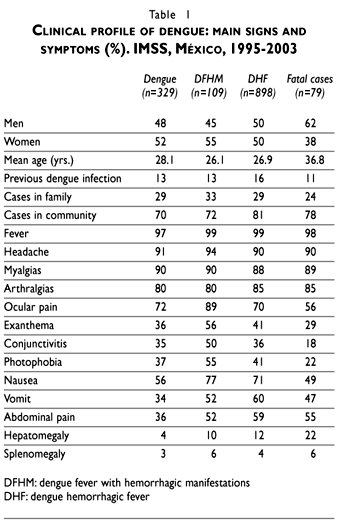
<body><![CDATA[<p>&nbsp;</p>     <p><font size="3" face="Verdana"><b>Material and Methods</b></font></p>     <p><font size="2" face="Verdana">A follow-up study was designed and conducted    by health personnel in the IMSS to describe the clinical behavior of Dengue    Fever (DF) and DHF and to determine some of the risk factors associated with    the occurrence of hemorrhagic forms and fatal cases in the population attended    by the most important social security system in Mexico. Patients were cases    diagnosed as DF or DHF that were confirmed by a serological test (IgM-ELISA),    notified to the Coordination of Health Integrated Programs of IMSS from 1995    to 2003. Clinical and epidemiological data were obtained from the case report    format used by the national surveillance system to notify DHF cases. Cases reported    in this study include only those that had all epidemiological, clinical information,    and laboratory data available. The database included age, sex, time of onset,    travel history, and contact with similar cases in the household or in the community.    It also included clinical features like fever, hepatomegaly, bleeding signs,    data for previous infection, the final outcome of the disease and laboratory    results (hemoglobin, hematocrit and platelets). Two groups were formed according    to their clinical evolution and following the WHO/PAHO established criteria:<SUP>8</SUP>    the DF and the Dengue Fever with Hemorrhagic Manifestations (DFHM) cases were    included in the first group while the DHF cases, including fatal cases (FC),    formed the second group. The fatal cases were patients that presented DSS as    the main cause of death. Groups were compared according to their clinical evolution    particularly during the acute phase of the disease. </font></p>     <p><font size="2" face="Verdana"> Blood samples (5 ml) were collected from each    patient after the acute phase (5-8 days) in order to perform the serological    diagnosis of dengue infection. Sera were obtained after centrifugation at 240    (x g) and 1500 rpm and were stored at -20 C. Rapid inmunochromatographic test    (PanBio)<SUP>9,10 </SUP>was used according to the manufacturer procedures (sensitivity    94% and specificity 100%). Dengue serological diagnosis was performed by the    state public health laboratories (validated by > Mexico's National Diagnostic    and Reference Laboratory, INDRE) and the result was registered in the case surveillance    format. Patients without serological diagnosis were excluded from the sample    and this mainly occurred in those classified as dengue fever. Dengue virus isolation    was performed when blood sample was taken in the early stages of the disease    and sent to the INDRE in Mexico City. </font></p>     <p><font size="2" face="Verdana"> The database was validated and analyzed to calculate    simple frequencies, central tendency and dispersion measures. Cumulative incidence    and relative risk were estimated along with their 95% confidence intervals (CI    95%). The case fatality rate for DHF cases was also calculated. The statistical    analysis to compare groups was performed using the Kruskal-Wallis test and Poisson    regression. The analysis was run in STATA-V8. </font></p>     <p>&nbsp;</p>     <p><font size="3" face="Verdana"><b>Results</b></font></p>     <p><font size="2" face="Verdana">From January 1995 to June 2003, the IMSS notified    a total of 2 743 cases of DHF. We analyzed 977 cases of DHF (including 79 deaths),    and 438 patients with dengue fever (including 109 DFHM cases), for a total of    1 415 individuals from 21 administrative regions or delegations (<a href="#tab01">Table    I</a>). The highest number of cases (717) was reported during 2002 and Nuevo    Le&oacute;n Delegation reported 305 cases, followed by Guerrero (252), Colima    (128), Yucat&aacute;n (127), Veracruz (104), Sonora (103), Oaxaca (88), Sinaloa    (53), Tamaulipas (57) and Chiapas (49). Although laboratory facilities are not    widely distributed in the IMSS, 98% of the total cases included in this study    were confirmed by determination of antibodies (ELISA-IgM) and dengue virus isolation    was present in the rest of the patients. Dengue virus 1 (DEN-1) was isolated    in three cases, DEN-2 in 19 patients and DEN-3 in 10 individuals. </font></p>     <p><a name="tab01"></a></p>     <p>&nbsp;</p>     ]]></body>
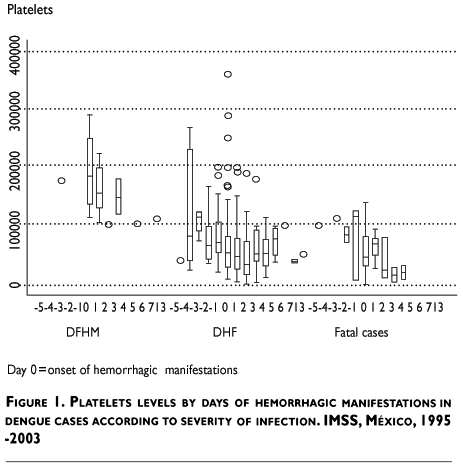
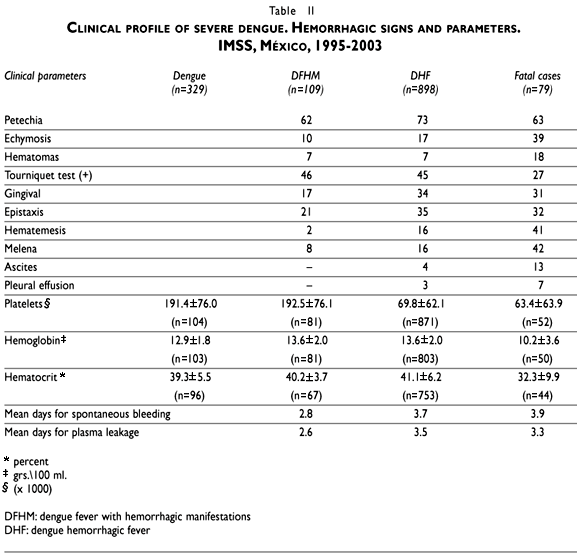
<body><![CDATA[<p align="center"><img src="/img/revistas/spm/v47n3/a02tab01.gif"></p>     <p>&nbsp;</p>     <p><font size="2" face="Verdana"> Sex and mean age distribution were similar in    all groups except in the fatal cases group where men predominated (62%) and    this group was significantly older (36.8 years) than the less severe cases.    Previous personal experience of dengue infection was reported in similarly low    proportions that increased when cases in the family were reported. Transmission    of dengue in the community was reported by a vast majority of patients, especially    by those with severe dengue (<a href="#tab01">Table I</a>). </font></p>     <p><font size="2" face="Verdana"> General symptoms as fever, headache, myalgias    and arthralgias, were present in similar proportion in each group. Exanthema,    ocular pain, conjunctivitis and photophobia were more frequent in the DFHM group.    On the other hand, a higher proportion of digestive symptoms such as vomit and    abdominal pain were found in the DHF and fatal cases. Hepatomegaly was mainly    documented in the fatal cases group (<a href="#tab01">Table I</a>). </font></p>     <p><font size="2" face="Verdana"> Higher frequencies of weak capillary and plasma    leakage signs were reported in fatal cases (83%) compared with DHF (61%) and    DFHM (72%) groups. Echymosis, hematomas, ascitis and pleural effusion were the    more prominent signs reported in the fatal cases group. On the other hand, a    positive tourniquet test was higher in the less severe cases. Hemorrhagic manifestations    were recorded in 41%, 49% and 93% of patients in each group. Spontaneous bleeding    signs like gingival bleeding and epistaxis were higher in the DHF group but    severe hemorrhages like melena and hematemesis appeared distinctively in the    fatal cases. Simultaneous plasma leakage and hemorrhagic signs were present    in 16% of the DFHM cases and 30% of DHF cases but occurred in almost every fatal    case (79%). These findings are paralleled by the mean values for hemoglobin,    hematocrit, and platelets, that were the lowest in fatal cases. The average    number of days between the onset of signs and symptoms to the onset of spontaneous    bleeding or plasma leakage signs was significantly higher (<I>p</I>&lt; 0.05)    for DHF and fatal cases (<a href="#tab02">Table II</a>). </font></p>     <p><a name="tab02"></a></p>     <p>&nbsp;</p>     <p align="center"><img src="/img/revistas/spm/v47n3/a02tab02.gif"></p>     <p>&nbsp;</p>     <p><font size="2" face="Verdana"> Thrombocytopenia (&lt;100 000 platelets) was    initially detected in the first blood sample in 82% of DHF patients (87% in    FC) and this hematological dysfunction was confirmed in subsequent blood samples    for the rest of the cases. Graphical view of platelet counts showed that the    median number of platelets was significantly lower in fatal cases and the recuperation    trend was faster in less severe cases (DHF) (<a href="#fig01">Figure 1</a>).    Hemoconcentration (hematocrit/hemoglobin ratio &gt;3.3) was documented in 8%    of the DHF cases and 34% of FC with a first sample. Both hemoconcentration and    thrombocytopenia were found in 6% of DHF and 25% of FC. Plasma leakage and thrombocytopenia    were present together in 51% of DHF cases (71% in FC). On the other hand, spontaneous    bleeding and thrombocytopenia occurred simultaneously in 41% of DHF cases (84%    in FC); while, plasma leakage and hemoconcentration were present in 5% (22%    in deaths) and spontaneous bleeding and hemoconcentration were present in 3%    (24% in deaths). </font></p>     ]]></body>
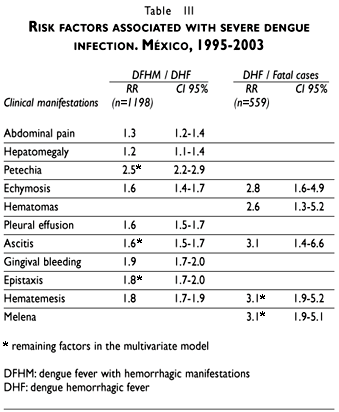
<body><![CDATA[<p><a name="fig01"></a></p>     <p>&nbsp;</p>     <p align="center"><img src="/img/revistas/spm/v47n3/a02fig01.gif"></p>     <p>&nbsp;</p>     <p><font size="2" face="Verdana"> Some of the most prominent signs of severity    of the infection, abdominal pain and hepatomegaly, along with petechia, gingival    bleeding and epistaxis were associated with an increased risk for the occurrence    of DHF. In the multivariate analysis the risk factors that appeared predictive    of severity and indicated a major risk for death were: echymosis (<I>RR </I>2.8;    CI 95% 1.6-4.9), hematomas (<I>RR</I> 2.6; CI 95% 1.3-5.2), ascitis (<I>RR</I>    3.1; CI 95% 1.4-6.6), hematemesis and melena (RR. 3.1; CI 95% 1.9-5.1) (<a href="#tab03">Table    III</a>). According to the number of leakage and bleedings signs, we found that    patients with two or more signs showed an increased risk to develop DHF. The    simultaneous presence of plasma leakage and spontaneous bleedings resulted in    an increased risk of 2.6 (CI 95% 2.1-3.1) for the occurrence of DHF compared    with those who did not. </font></p>     <p><a name="tab03"></a></p>     <p>&nbsp;</p>     <p align="center"><img src="/img/revistas/spm/v47n3/a02tab03.gif"></p>     <p>&nbsp;</p>     <p><font size="2" face="Verdana"> Evolution of clinical features for fatal cases    had a mean duration of 7.8 (<I>SD</I>=5.4) days from the beginning of the disease    until death (median=7). Also, the average time from the start of the illness    to the appearance of plasma leakage or hemorrhages was 3.3 (<I>SD</I>=3.5) days    (median=2) and 3.9 (<I>SD</I>=4.1) days (median=3) respectively; and 4.8 (<I>SD</I>=5.6)    days (median=4) and 4.1 (<I>SD</I>=5.5) days (median=3), from the beginning    of the plasma leakage and spontaneous hemorrhages to death. </font></p>     ]]></body>
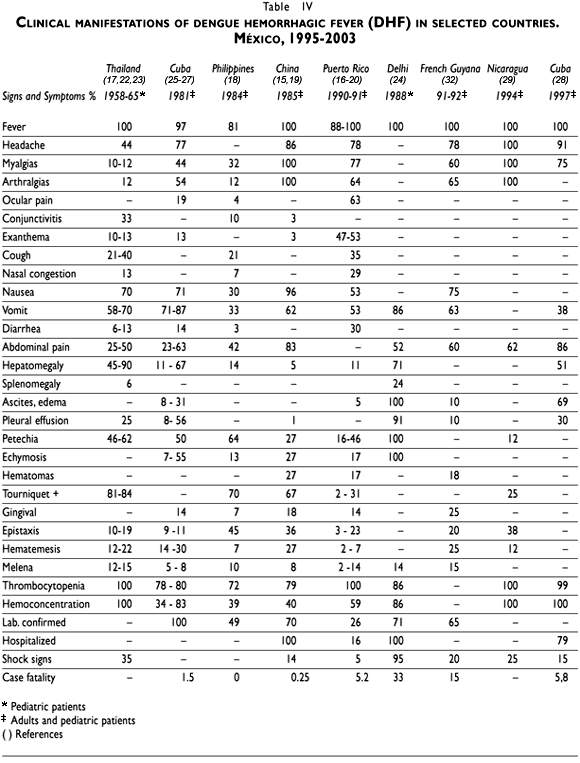
<body><![CDATA[<p>&nbsp;</p>     <p><font size="3" face="Verdana"><b>Discussion</b></font></p>     <p><font size="2" face="Verdana">The wide variety of signs and symptoms associated    with severe dengue infection and the identification of those that are required    to distinguish and classify DHF from DSS cases is a major clinical challenge    that demands laboratory support and a detailed clinical monitoring of blood    pressure, pulse, temperature, urinary output, hematocrit and platelet counts.    Clinical studies differed in the spectrum of signs and symptoms reported and    usually emphasized those that are more prominent in the population studied (<a href="#tab04">Table    IV</a>). </font></p>     <p><a name="tab04"></a></p>     <p>&nbsp;</p>     <p align="center"><img src="/img/revistas/spm/v47n3/a02tab04.gif"></p>     <p>&nbsp;</p>     <p><font size="2" face="Verdana"> The clinical reports of DHF in Southeast Asia    are focused in children under 15 years of age, the age group most affected by    dengue virus infection. The situation in the Americas reflects that DHF is more    prevalent in the young and adult population; therefore, it is necessary to highlight    their clinical profile and the findings reported in this study provide meaningful    clinical features to improve its diagnosis and management in the Latin American    context.<SUP>11</SUP> </font></p>     <p><font size="2" face="Verdana"> The reported frequency of the general signs    and symptoms –fever, malaise, headache, retro orbital pain, mialgias and arthralgias,    exanthema– in different populations is certainly due to the accuracy of the    clinical history and the clinical stage of the disease. In children, dengue-like    symptoms may not be as pronounced as in adults, in whom benign dengue fever    syndrome is classically seen. Dengue in children is often misdiagnosed as an    undifferentiated fever or other viral diseases like measles, rubella,<SUP>12</SUP>    and in adults with leptospirosis<SUP>13</SUP> or rickettsiosis.<SUP>14</SUP>    Exanthema is a prominent clinical sign and its report varied from 3% to 53%    in the series of severe dengue cases.<SUP>15,16</SUP> </font></p>     <p><font size="2" face="Verdana"> Nevertheless, the most prominent features necessary    to confirm DHF require a detailed discussion. The positive tourniquet test is    more frequently reported in the Asian countries<SUP>17-19 </SUP>and varies from    2-31% in Puerto Rico<SUP>16,20</SUP> to 81-84% in Thailand.<SUP>17</SUP> The    problems associated with its practical use in all patients and the low sensitivity    of the interpretation of the test should alert clinicians about its small predictive    value to distinguish dengue hemorrhagic cases. The presence of more than one    plasma leakage or hemorrhagic manifestations in a patient provides a more conclusive    criterion to distinguish clinical severity. Minor hemorrhages like petechia,    gingival bleeding and epistaxis are more common than gastrointestinal bleeding    –hematemesis and melena– or hematuria, but these are important hemorrhagic signs    that demand examination. Gastrointestinal bleeding may initially be hidden and    usually manifests as an abdominal pain or tenderness, a distended abdomen, pallor,    tachycardia, or a drop in hematocrit without clinical improvement.<SUP>21</SUP>    Hematuria may also be hidden (microhematuria) and only perceived by urine analysis,    which should be routinely performed in every suspected case. Report of dengue    hemorrhagic cases in the IMSS demonstrated that severe dengue infection is usually    accompanied by more than one bleeding site (30%) and that gastrointestinal bleeding    as well as petechia and epistaxis were prominent signs. The first epidemic of    DHF in China also resulted in 60% of DHF cases with two or more hemorrhagic    manifestations.<SUP>15</SUP> </font></p>     ]]></body>
<body><![CDATA[<p><font size="2" face="Verdana"> Based on the Thai experience, exploration of    the hepatic area should also be emphasized since the frequency of hepatomegaly    is below that reported in Thai populations (45-90%)<SUP>17,22,23</SUP> and in    India ( 71%).<SUP>24</SUP> The prevalence could be higher due to the readiness    to detect hepatomegaly in children more than in adult populations. DSS reported    higher prevalence of hepatomegaly (16% in adults and 60% in children) than DHF    (7% in adults and 22% in children) as was also found in children and adults    with severe and fatal dengue in Cuba.<SUP>25-27</SUP> Abdominal pain, nausea    and vomit are among the alarm signs –digestive syndrome– that revealed the imminent    evolution towards severity and these features were differentially reported in    DHF cases compared to DF cases in the IMSS. Abdominal pain –alarm sign that    may predict gastrointestinal bleeding– is also among the symptoms more frequently    reported in different case series ranging from 23 to 86%.<SUP>26,28</SUP> </font></p>     <p><font size="2" face="Verdana"> The hematological parameters like thrombocytopenia    and hemoconcentration –essential to confirm DHF– defy the laboratory infrastructure    in medical units in many developing countries. The studies that report 100%<SUP>29</SUP>    of cases with thrombocytopenia reflect the strict compliance with WHO guidelines    as well as the challenge to meet by other developing countries that lack the    laboratory resources to study all suspected cases. The criteria for hemoconcentration    is difficult to satisfy either because of hemodynamic changes produced by early    treatment with intravenous solutions, the severity of the disease, or even the    death of the patient. This issue becomes relevant when the prognosis of DHF    is highly dependent on the evolution of these two parameters. A severe thrombocytopenia    of less than 50 000 per cubic millimeter was found in 74% of fatal cases in    Thailand.<SUP>22</SUP> The significant differences found in the mean values    of platelets and hematocrit in fatal versus convalescent patient's supports    those findings in Thailand and provide vital clinical information for the opportune    detection and treatment of severe cases. The continuous monitoring of thrombocytopenia    and hemoconcentration should be viewed as an obligatory procedure and not only    as a diagnostic criterion. Based on the results reported, only 94% of the 977    patients with DHF had platelet counts performed for their initial diagnosis    of whom 82% had less than 100 000 m<SUP>3</SUP>. Second samples were taken in    65% of the patients and a third sample decreased to 39% of the patients. Serial    samples were used to finally confirme thrombocytopenia in all 977 patients.    Initial blood samples to test for hemoconcentration were performed in 82% of    all patients. All had decreasing numbers on the sequential samples taken, minimizing    the analytical potential of such clinical data. For example, although 109 cases    of DF had plasma leakage or bleeding, only 74% of them had a first blood sample    to detect thrombocytopenia or hemoconcentration; 42% and 31% had a second and    third sample, respectively. The study of cases was incomplete; therefore, they    were only classified like dengue with hemorrhagic manifestations. These operational    obstacles compelled the local health personnel to diagnose and confirm DHF cases    based on limited clinical information and use the epidemiological criteria to    establish the final diagnosis. </font></p>     <p><font size="2" face="Verdana"> Thrombocytopenia was present in 100% of the    notified cases, while hemoconcentration was documented in only 12% of them.    An important finding is the proportion in which both events are registered simultaneously    and the risk to develop hemorrhagic Dengue and death from this cause. Also,    the relationship found between plasma leakage and spontaneous bleedings with    hemoconcentration and thrombocytopenia has important implications to determine    prognostic factors for the clinical evolution that would allow establishing    a timely monitoring and appropriate treatment for ill persons. </font></p>     <p><font size="2" face="Verdana"> The operational case definition of DHF establishes    that the patient must show clinical manifestations of plasma leakage or spontaneous    bleedings besides thrombocytopenia and hemoconcentration. However, it is important    to take into account timing and sequence of these events, because the mentioned    parameters are not present in all cases simultaneously. In this relationship    it should be considered that theoretically, thrombocytopenia determines the    onset of spontaneous bleedings and it must precede them or coincide with time    of onset. In contrast, the beginning of plasma leakage and volume depletion    determines the presence of hemoconcentration; therefore, the leakage precedes    it. Then, the frequency of these parameters depends on the form corporal fluids    are lost during the infection, hemorrhages or plasma leakage, and time in which    laboratory tests are requested. These parameters have been useful to establish    operational criteria to classify cases;<SUP>8</SUP> nevertheless, findings of    this study invite us to design operative research to understand the clinical    behavior of the disease and to establish appropriate criteria to confirm cases,    properly classify the severity of the disease and estimate its real occurrence.<SUP>30</SUP>    </font></p>     <p><font size="2" face="Verdana"> Laboratory diagnosis is an issue of serious    concern in all endemic countries. Approximately 45% of all notified cases at    the IMSS are laboratory confirmed. This rate is low, although rates in other    countries are rarely near 100%. This issue becomes relevant because delay in    diagnosis may well affect the prompt treatment required to save the patient    from a severe dengue infection and death. Experience from 12 Asian countries    demonstrated that DHF-DSS case fatality rates vary between 0.5% and 3.5.<SUP>31</SUP>    Global case fatality rate in the IMSS (2.9%) is smaller than that reported in    Cuba (5.8% in 1997), Puerto Rico (5.2% in 1991), the French Guyana (15% in 1991),<SUP>32</SUP>    and India (33% in 1988). Prompt clinical and laboratory support is essential    to reduce the risk of death and provides adequate information to monitor the    severity of the disease. Data provided by studies like this should help the    physicians and the public health service to improve the dengue surveillance    system and the prevention of this emergent infectious disease. </font></p>     <p>&nbsp;</p>     <p><font size="3" face="Verdana"><b>References</b> </font></p>     <!-- ref --><p><font size="2" face="Verdana">1. Jacobs M. Dengue: Emergence as a global public    health problem and prospects for control. Trans Royal Soc Trop Med Hyg 2000;94:7-8.    </font>&nbsp;&nbsp;&nbsp;&nbsp;&nbsp;&nbsp;&nbsp;&nbsp;[&#160;<a href="javascript:void(0);" onclick="javascript: window.open('/scielo.php?script=sci_nlinks&ref=9206201&pid=S0036-3634200500030000200001&lng=','','width=640,height=500,resizable=yes,scrollbars=1,menubar=yes,');">Links</a>&#160;]<!-- end-ref --><!-- ref --><p><font size="2" face="Verdana">2. World Health Organization. Report on global    surveillance of epidemic-prone infectious diseases. WHO/CDS/CSR/ISR/2000.1 </font>&nbsp;&nbsp;&nbsp;&nbsp;&nbsp;&nbsp;&nbsp;&nbsp;[&#160;<a href="javascript:void(0);" onclick="javascript: window.open('/scielo.php?script=sci_nlinks&ref=9206202&pid=S0036-3634200500030000200002&lng=','','width=640,height=500,resizable=yes,scrollbars=1,menubar=yes,');">Links</a>&#160;]<!-- end-ref --><!-- ref --><p><font size="2" face="Verdana">3. Guzm&aacute;n MG, Kour&iacute; G. Dengue and    dengue hemorrhagic fever in the Americas: lessons and challenges. J Clin Virol    2003;27(1):1-13. </font>&nbsp;&nbsp;&nbsp;&nbsp;&nbsp;&nbsp;&nbsp;&nbsp;[&#160;<a href="javascript:void(0);" onclick="javascript: window.open('/scielo.php?script=sci_nlinks&ref=9206203&pid=S0036-3634200500030000200003&lng=','','width=640,height=500,resizable=yes,scrollbars=1,menubar=yes,');">Links</a>&#160;]<!-- end-ref --><!-- ref --><p><font size="2" face="Verdana">4. Boletines Epidemiol&oacute;gicos 1979-2002.    Coordinaci&oacute;n de Salud P&uacute;blica. Instituto Mexicano del Seguro Social.    </font>&nbsp;&nbsp;&nbsp;&nbsp;&nbsp;&nbsp;&nbsp;&nbsp;[&#160;<a href="javascript:void(0);" onclick="javascript: window.open('/scielo.php?script=sci_nlinks&ref=9206204&pid=S0036-3634200500030000200004&lng=','','width=640,height=500,resizable=yes,scrollbars=1,menubar=yes,');">Links</a>&#160;]<!-- end-ref --><!-- ref --><p><font size="2" face="Verdana">5. Narro-Robles J, G&oacute;mez-Dant&eacute;s    H. El dengue en M&eacute;xico: un problema prioritario de salud p&uacute;blica.    Salud Publica Mex 1995;37 supl:S12-S20. </font>&nbsp;&nbsp;&nbsp;&nbsp;&nbsp;&nbsp;&nbsp;&nbsp;[&#160;<a href="javascript:void(0);" onclick="javascript: window.open('/scielo.php?script=sci_nlinks&ref=9206205&pid=S0036-3634200500030000200005&lng=','','width=640,height=500,resizable=yes,scrollbars=1,menubar=yes,');">Links</a>&#160;]<!-- end-ref --><!-- ref --><p><font size="2" face="Verdana">6. Guzm&aacute;n MG, Kour&iacute; G. Dengue:    An update. Lancet Infect Dis 2002;2(1):33-42. </font>&nbsp;&nbsp;&nbsp;&nbsp;&nbsp;&nbsp;&nbsp;&nbsp;[&#160;<a href="javascript:void(0);" onclick="javascript: window.open('/scielo.php?script=sci_nlinks&ref=9206206&pid=S0036-3634200500030000200006&lng=','','width=640,height=500,resizable=yes,scrollbars=1,menubar=yes,');">Links</a>&#160;]<!-- end-ref --><!-- ref --><p><font size="2" face="Verdana">7. Gubler DJ. Dengue and dengue hemorrhagic fever.    Clin Microbiol Rev 1998;11(3):480-496. </font>&nbsp;&nbsp;&nbsp;&nbsp;&nbsp;&nbsp;&nbsp;&nbsp;[&#160;<a href="javascript:void(0);" onclick="javascript: window.open('/scielo.php?script=sci_nlinks&ref=9206207&pid=S0036-3634200500030000200007&lng=','','width=640,height=500,resizable=yes,scrollbars=1,menubar=yes,');">Links</a>&#160;]<!-- end-ref --><!-- ref --><p><font size="2" face="Verdana">8. World Health Organization. Dengue haemorrhagic    fever: Diagnosis, treatment, prevention and control. Geneva: WHO; 1997. </font>&nbsp;&nbsp;&nbsp;&nbsp;&nbsp;&nbsp;&nbsp;&nbsp;[&#160;<a href="javascript:void(0);" onclick="javascript: window.open('/scielo.php?script=sci_nlinks&ref=9206208&pid=S0036-3634200500030000200008&lng=','','width=640,height=500,resizable=yes,scrollbars=1,menubar=yes,');">Links</a>&#160;]<!-- end-ref --><!-- ref --><p><font size="2" face="Verdana">9. Cuzzubbo AJ, Vaughn DW, Nisalak A, Solomon    T, Kalayanarooj S, Aaskov J <I>et al</I>. Comparison of PanBio dengue duo enzyme-linked    immunosorbent assay (ELISA) and MRL dengue fever virus immunoglobulin M capture    ELISA for diagnosis of denguevirus infections in Southeast Asia. Clin Diagn    Lab Immunol 1999;6(5):705-712. </font>&nbsp;&nbsp;&nbsp;&nbsp;&nbsp;&nbsp;&nbsp;&nbsp;[&#160;<a href="javascript:void(0);" onclick="javascript: window.open('/scielo.php?script=sci_nlinks&ref=9206209&pid=S0036-3634200500030000200009&lng=','','width=640,height=500,resizable=yes,scrollbars=1,menubar=yes,');">Links</a>&#160;]<!-- end-ref --><!-- ref --><p><font size="2" face="Verdana">10. Porter KR, Widjaja S, Lohita HD, Hadiwijaya    SH, Maroef CN, Suharyono W <I>et al</I>. Evaluation of a commercially available    immunoglobulin M capture enzyme-linked immunosorbent assay kit for diagnosing    acute dengue infections. Clin Diagn Lab Immunol 1999;6(5):741-744. </font>&nbsp;&nbsp;&nbsp;&nbsp;&nbsp;&nbsp;&nbsp;&nbsp;[&#160;<a href="javascript:void(0);" onclick="javascript: window.open('/scielo.php?script=sci_nlinks&ref=9206210&pid=S0036-3634200500030000200010&lng=','','width=640,height=500,resizable=yes,scrollbars=1,menubar=yes,');">Links</a>&#160;]<!-- end-ref --><!-- ref --><p><font size="2" face="Verdana">11. Ramos C, Garc&iacute;a H, Villaseca JM. Fiebre    hemorr&aacute;gica y s&iacute;ndrome de choque por dengue. Salud Publica Mex    1993;35(1):39-55. </font>&nbsp;&nbsp;&nbsp;&nbsp;&nbsp;&nbsp;&nbsp;&nbsp;[&#160;<a href="javascript:void(0);" onclick="javascript: window.open('/scielo.php?script=sci_nlinks&ref=9206211&pid=S0036-3634200500030000200011&lng=','','width=640,height=500,resizable=yes,scrollbars=1,menubar=yes,');">Links</a>&#160;]<!-- end-ref --><!-- ref --><p><font size="2" face="Verdana">12. Bustos J, Hamdan A, Loro&ntilde;o MA. Serologically    proven acute rubella infection in patients with clinical diagnosis of dengue.    Epidemiol Infect 1990;104(2):297-302. </font>&nbsp;&nbsp;&nbsp;&nbsp;&nbsp;&nbsp;&nbsp;&nbsp;[&#160;<a href="javascript:void(0);" onclick="javascript: window.open('/scielo.php?script=sci_nlinks&ref=9206212&pid=S0036-3634200500030000200012&lng=','','width=640,height=500,resizable=yes,scrollbars=1,menubar=yes,');">Links</a>&#160;]<!-- end-ref --><!-- ref --><p><font size="2" face="Verdana">13. Zavala VJ, Vado SI, Rodr&iacute;guez FM,    Rodr&iacute;guez AE, Barrera PM, Guzm&aacute;n ME. Leptospirosis anict&eacute;rica    en un brote epid&eacute;mico de dengue en la Pen&iacute;nsula de Yucat&aacute;n.    Rev Biomed 1998;9(2):78-83. </font>&nbsp;&nbsp;&nbsp;&nbsp;&nbsp;&nbsp;&nbsp;&nbsp;[&#160;<a href="javascript:void(0);" onclick="javascript: window.open('/scielo.php?script=sci_nlinks&ref=9206213&pid=S0036-3634200500030000200013&lng=','','width=640,height=500,resizable=yes,scrollbars=1,menubar=yes,');">Links</a>&#160;]<!-- end-ref --><!-- ref --><p><font size="2" face="Verdana">14. Zavala VJ, Yu XJ, Walker DH. Unrecognized    spotted fever group rickettsiosis masquerading as dengue fever in Mexico. Am    J Trop Med Hyg 1996;55(2):157-159. </font>&nbsp;&nbsp;&nbsp;&nbsp;&nbsp;&nbsp;&nbsp;&nbsp;[&#160;<a href="javascript:void(0);" onclick="javascript: window.open('/scielo.php?script=sci_nlinks&ref=9206214&pid=S0036-3634200500030000200014&lng=','','width=640,height=500,resizable=yes,scrollbars=1,menubar=yes,');">Links</a>&#160;]<!-- end-ref --><!-- ref --><p><font size="2" face="Verdana">15. Qiu FX, Chen QQ, Ho QY, Chen WZ, Zhao ZG,    Zhao BW. The first epidemic of dengue hemorrhagic fever in the people's Republic    of China. Am J Trop Med Hyg 1991;44(4):364-370. </font>&nbsp;&nbsp;&nbsp;&nbsp;&nbsp;&nbsp;&nbsp;&nbsp;[&#160;<a href="javascript:void(0);" onclick="javascript: window.open('/scielo.php?script=sci_nlinks&ref=9206215&pid=S0036-3634200500030000200015&lng=','','width=640,height=500,resizable=yes,scrollbars=1,menubar=yes,');">Links</a>&#160;]<!-- end-ref --><!-- ref --><p><font size="2" face="Verdana">16. Cobra C, Rigau-P&eacute;rez JG, Kuno G, Vorndam    V. Symptoms of dengue fever in relation to host immunologic response and virus    serotype, Puerto Rico, 1990-1991. Am J Epidemiol 1995;142(11):1204-1211. </font>&nbsp;&nbsp;&nbsp;&nbsp;&nbsp;&nbsp;&nbsp;&nbsp;[&#160;<a href="javascript:void(0);" onclick="javascript: window.open('/scielo.php?script=sci_nlinks&ref=9206216&pid=S0036-3634200500030000200016&lng=','','width=640,height=500,resizable=yes,scrollbars=1,menubar=yes,');">Links</a>&#160;]<!-- end-ref --><!-- ref --><p><font size="2" face="Verdana">17. Halstead SB. Dengue and hemorrhagic fevers    of southeast Asia. The Yale Journal of Biology and Medicine 1965;37(6):434-454.    </font>&nbsp;&nbsp;&nbsp;&nbsp;&nbsp;&nbsp;&nbsp;&nbsp;[&#160;<a href="javascript:void(0);" onclick="javascript: window.open('/scielo.php?script=sci_nlinks&ref=9206217&pid=S0036-3634200500030000200017&lng=','','width=640,height=500,resizable=yes,scrollbars=1,menubar=yes,');">Links</a>&#160;]<!-- end-ref --><!-- ref --><p><font size="2" face="Verdana">18. Hayes CG, Manaloto CR, Gonz&aacute;lez A,    Ranoa CP. Dengue infections in the Philippines: clinical and virological findings    in 517 hospitalized patients. Am J Trop Med Hyg 1988;39(1):110-116. </font>&nbsp;&nbsp;&nbsp;&nbsp;&nbsp;&nbsp;&nbsp;&nbsp;[&#160;<a href="javascript:void(0);" onclick="javascript: window.open('/scielo.php?script=sci_nlinks&ref=9206218&pid=S0036-3634200500030000200018&lng=','','width=640,height=500,resizable=yes,scrollbars=1,menubar=yes,');">Links</a>&#160;]<!-- end-ref --><!-- ref --><p><font size="2" face="Verdana">19. Qiu FX, Gubler DJ, Liu J Ch, Chen QQ. Dengue    in China: A clinical review. Bull World Health Organ 1993;71(3/4):349-359. </font>&nbsp;&nbsp;&nbsp;&nbsp;&nbsp;&nbsp;&nbsp;&nbsp;[&#160;<a href="javascript:void(0);" onclick="javascript: window.open('/scielo.php?script=sci_nlinks&ref=9206219&pid=S0036-3634200500030000200019&lng=','','width=640,height=500,resizable=yes,scrollbars=1,menubar=yes,');">Links</a>&#160;]<!-- end-ref --><!-- ref --><p><font size="2" face="Verdana">20. Rigau-P&eacute;rez JG. Clinical manifestations    of dengue hemorrhagic fever in Puerto Rico, 1990-1991. Pan Am J Public Health    1997;1(5):381-388. </font>&nbsp;&nbsp;&nbsp;&nbsp;&nbsp;&nbsp;&nbsp;&nbsp;[&#160;<a href="javascript:void(0);" onclick="javascript: window.open('/scielo.php?script=sci_nlinks&ref=9206220&pid=S0036-3634200500030000200020&lng=','','width=640,height=500,resizable=yes,scrollbars=1,menubar=yes,');">Links</a>&#160;]<!-- end-ref --><!-- ref --><p><font size="2" face="Verdana">21. George R, Lum L. Clinical spectrum of dengue    infection. En: Gubler DJ, Kuno G. Dengue and dengue hemorrhagic fever. Wallingford,    UK: CAB International 1997:89-113. </font>&nbsp;&nbsp;&nbsp;&nbsp;&nbsp;&nbsp;&nbsp;&nbsp;[&#160;<a href="javascript:void(0);" onclick="javascript: window.open('/scielo.php?script=sci_nlinks&ref=9206221&pid=S0036-3634200500030000200021&lng=','','width=640,height=500,resizable=yes,scrollbars=1,menubar=yes,');">Links</a>&#160;]<!-- end-ref --><!-- ref --><p><font size="2" face="Verdana">22. Nelson E, Chulajata R. Danger signs in Thai    hemorrhagic fever (dengue). Tropical Pediatrics 1965;67(3):463-470. </font>&nbsp;&nbsp;&nbsp;&nbsp;&nbsp;&nbsp;&nbsp;&nbsp;[&#160;<a href="javascript:void(0);" onclick="javascript: window.open('/scielo.php?script=sci_nlinks&ref=9206222&pid=S0036-3634200500030000200022&lng=','','width=640,height=500,resizable=yes,scrollbars=1,menubar=yes,');">Links</a>&#160;]<!-- end-ref --><!-- ref --><p><font size="2" face="Verdana">23. Nelson ER. Hemorrhagic fever in children    in Thailand. Report of 69 cases. Tropical Pediatrics 1960;56(1):101-108. </font>&nbsp;&nbsp;&nbsp;&nbsp;&nbsp;&nbsp;&nbsp;&nbsp;[&#160;<a href="javascript:void(0);" onclick="javascript: window.open('/scielo.php?script=sci_nlinks&ref=9206223&pid=S0036-3634200500030000200023&lng=','','width=640,height=500,resizable=yes,scrollbars=1,menubar=yes,');">Links</a>&#160;]<!-- end-ref --><!-- ref --><p><font size="2" face="Verdana">24. Kabra SK, Verma IC, Arora NK, Jain Y, Kaira    V. Dengue hemorrhagic fever in children in Delhi. Bull World Health Organ 1992;70(1):105-108.    </font>&nbsp;&nbsp;&nbsp;&nbsp;&nbsp;&nbsp;&nbsp;&nbsp;[&#160;<a href="javascript:void(0);" onclick="javascript: window.open('/scielo.php?script=sci_nlinks&ref=9206224&pid=S0036-3634200500030000200024&lng=','','width=640,height=500,resizable=yes,scrollbars=1,menubar=yes,');">Links</a>&#160;]<!-- end-ref --><!-- ref --><p><font size="2" face="Verdana">25. Guzm&aacute;n MG, Kour&iacute; GP, Mart&iacute;nez    E, Bravo J, Rivero R, Soler M. Clinical and serologic study of Cuban children    with dengue hemorrhagic/dengue shock syndrome (DHF/DSS). Bull Pan Am Health    Organ 1987;21(3):270-279. </font>&nbsp;&nbsp;&nbsp;&nbsp;&nbsp;&nbsp;&nbsp;&nbsp;[&#160;<a href="javascript:void(0);" onclick="javascript: window.open('/scielo.php?script=sci_nlinks&ref=9206225&pid=S0036-3634200500030000200025&lng=','','width=640,height=500,resizable=yes,scrollbars=1,menubar=yes,');">Links</a>&#160;]<!-- end-ref --><!-- ref --><p><font size="2" face="Verdana">26. D&iacute;az A, Kour&iacute; GP, Guzm&aacute;n    MG, Lobaina L, Bravo J, Ruiz A <I>et al</I>. Cuadro cl&iacute;nico de la fiebre    hemorr&aacute;gica del dengue/ s&iacute;ndrome de choque del dengue en el adulto.    Bol Of Sanit Panam 1988;104(6):560-571. </font>&nbsp;&nbsp;&nbsp;&nbsp;&nbsp;&nbsp;&nbsp;&nbsp;[&#160;<a href="javascript:void(0);" onclick="javascript: window.open('/scielo.php?script=sci_nlinks&ref=9206226&pid=S0036-3634200500030000200026&lng=','','width=640,height=500,resizable=yes,scrollbars=1,menubar=yes,');">Links</a>&#160;]<!-- end-ref --><!-- ref --><p><font size="2" face="Verdana">27. Kour&iacute; GP, Guzm&aacute;n MG, Bravo    JR, Triana C. Dengue hemorrhagic fever/ dengue shock syndrome: lessons from    the Cuban epidemic, 1981. Bull World Health Organ 1989;67(4):375-380. </font>&nbsp;&nbsp;&nbsp;&nbsp;&nbsp;&nbsp;&nbsp;&nbsp;[&#160;<a href="javascript:void(0);" onclick="javascript: window.open('/scielo.php?script=sci_nlinks&ref=9206227&pid=S0036-3634200500030000200027&lng=','','width=640,height=500,resizable=yes,scrollbars=1,menubar=yes,');">Links</a>&#160;]<!-- end-ref --><!-- ref --><p><font size="2" face="Verdana">28. Vald&eacute;s L, Guzm&aacute;n MG, Kour&iacute;    GP, Delgado J, Carbonell I, Cabrera MV <I>et al</I>. La epidemiolog&iacute;a    del dengue y el dengue hemorr&aacute;gico en Santiago de Cuba, 1997. Rev Panam    Salud Publica 1999;6(1):16-24. </font>&nbsp;&nbsp;&nbsp;&nbsp;&nbsp;&nbsp;&nbsp;&nbsp;[&#160;<a href="javascript:void(0);" onclick="javascript: window.open('/scielo.php?script=sci_nlinks&ref=9206228&pid=S0036-3634200500030000200028&lng=','','width=640,height=500,resizable=yes,scrollbars=1,menubar=yes,');">Links</a>&#160;]<!-- end-ref --><!-- ref --><p><font size="2" face="Verdana">29. Guzm&aacute;n MG, V&aacute;zquez S, Mart&iacute;nez    E, Alvarez M, Rodr&iacute;guez R, Kour&iacute; G <I>et al</I>. Dengue en Nicaragua,    1994: reintroducci&oacute;n del serotipo 3 en las Am&eacute;ricas. Bol Oficina    Sanit Panam 1996;121(2):103-110. </font>&nbsp;&nbsp;&nbsp;&nbsp;&nbsp;&nbsp;&nbsp;&nbsp;[&#160;<a href="javascript:void(0);" onclick="javascript: window.open('/scielo.php?script=sci_nlinks&ref=9206229&pid=S0036-3634200500030000200029&lng=','','width=640,height=500,resizable=yes,scrollbars=1,menubar=yes,');">Links</a>&#160;]<!-- end-ref --><!-- ref --><p><font size="2" face="Verdana">30. Rigau-P&eacute;rez JG, Bonilla GL. An evaluation    of modified case definitions for the detection of dengue hemorrhagic fever.    Puerto Rico Association of Epidemiologists. P R Health Sci J 1999;18(4):347-352.    </font>&nbsp;&nbsp;&nbsp;&nbsp;&nbsp;&nbsp;&nbsp;&nbsp;[&#160;<a href="javascript:void(0);" onclick="javascript: window.open('/scielo.php?script=sci_nlinks&ref=9206230&pid=S0036-3634200500030000200030&lng=','','width=640,height=500,resizable=yes,scrollbars=1,menubar=yes,');">Links</a>&#160;]<!-- end-ref --><!-- ref --><p><font size="2" face="Verdana">31. Halstead S. Is there an inapparent dengue    explosion? Lancet 1999;353:1100. </font>&nbsp;&nbsp;&nbsp;&nbsp;&nbsp;&nbsp;&nbsp;&nbsp;[&#160;<a href="javascript:void(0);" onclick="javascript: window.open('/scielo.php?script=sci_nlinks&ref=9206231&pid=S0036-3634200500030000200031&lng=','','width=640,height=500,resizable=yes,scrollbars=1,menubar=yes,');">Links</a>&#160;]<!-- end-ref --><!-- ref --><p><font size="2" face="Verdana">32. Reynes JM, Laurent A, Deubel V, Telliam E,    Moreau JP. The first epidemic of dengue hemorrhagic fever in French Guiana.    Am J Trop Med Hyg 1994;51(5):545-553.</font>&nbsp;&nbsp;&nbsp;&nbsp;&nbsp;&nbsp;&nbsp;&nbsp;[&#160;<a href="javascript:void(0);" onclick="javascript: window.open('/scielo.php?script=sci_nlinks&ref=9206232&pid=S0036-3634200500030000200032&lng=','','width=640,height=500,resizable=yes,scrollbars=1,menubar=yes,');">Links</a>&#160;]<!-- end-ref --><p>&nbsp;</p>     ]]></body>
<body><![CDATA[<p>&nbsp;</p>     <p><font size="2" face="Verdana"><b>Address reprint requests to</b>    <br>   Joel Navarrete. Divisi&oacute;n de Eidemiolog&iacute;a    <br>   Coordinaci&oacute;n de los Programas Integrales de Salud    <br>   Instituto Mexicano del Seguro Social    <br>   Avenida Insurgentes Sur No. 253-2º Piso    <br>   colonia Roma Sur 06700, M&eacute;xico, DF, M&eacute;xico    <br>   E-mail: <a href="mailto:joel.navarrete@imss.gob.mx">joel.navarrete@imss.gob.mx</a>,    <a href="mailto:jonavaes@salud.gob.mx">jonavaes@salud.gob.mx</a> </font></p>     <p><font size="2" face="Verdana">Received on: October 15, 2004 <b>    <br>   </b>Accepted on: March 30, 2005 </font></p>     ]]></body>
<body><![CDATA[ ]]></body><back>
<ref-list>
<ref id="B1">
<label>1</label><nlm-citation citation-type="journal">
<person-group person-group-type="author">
<name>
<surname><![CDATA[Jacobs]]></surname>
<given-names><![CDATA[M]]></given-names>
</name>
</person-group>
<article-title xml:lang="en"><![CDATA[Dengue: Emergence as a global public health problem and prospects for control]]></article-title>
<source><![CDATA[Trans Royal Soc Trop Med Hyg]]></source>
<year>2000</year>
<volume>94</volume>
<page-range>7-8</page-range></nlm-citation>
</ref>
<ref id="B2">
<label>2</label><nlm-citation citation-type="book">
<collab>World Health Organization</collab>
<source><![CDATA[Report on global surveillance of epidemic-prone infectious diseases]]></source>
<year>2000</year>
<publisher-name><![CDATA[WHO/CDS/CSR/ISR]]></publisher-name>
</nlm-citation>
</ref>
<ref id="B3">
<label>3</label><nlm-citation citation-type="journal">
<person-group person-group-type="author">
<name>
<surname><![CDATA[Guzmán]]></surname>
<given-names><![CDATA[MG]]></given-names>
</name>
<name>
<surname><![CDATA[Kourí]]></surname>
<given-names><![CDATA[G]]></given-names>
</name>
</person-group>
<article-title xml:lang="en"><![CDATA[Dengue and dengue hemorrhagic fever in the Americas: lessons and challenges]]></article-title>
<source><![CDATA[J Clin Virol]]></source>
<year>2003</year>
<volume>27</volume>
<numero>1</numero>
<issue>1</issue>
<page-range>1-13</page-range></nlm-citation>
</ref>
<ref id="B4">
<label>4</label><nlm-citation citation-type="book">
<collab>Coordinación de Salud Pública</collab>
<source><![CDATA[Boletines Epidemiológicos 1979-2002]]></source>
<year></year>
<publisher-name><![CDATA[Instituto Mexicano del Seguro Social]]></publisher-name>
</nlm-citation>
</ref>
<ref id="B5">
<label>5</label><nlm-citation citation-type="journal">
<person-group person-group-type="author">
<name>
<surname><![CDATA[Narro-Robles]]></surname>
<given-names><![CDATA[J]]></given-names>
</name>
<name>
<surname><![CDATA[Gómez-Dantés]]></surname>
<given-names><![CDATA[H]]></given-names>
</name>
</person-group>
<article-title xml:lang="es"><![CDATA[El dengue en México: un problema prioritario de salud pública]]></article-title>
<source><![CDATA[Salud Publica Mex]]></source>
<year>1995</year>
<volume>37</volume>
<page-range>S12-S20</page-range></nlm-citation>
</ref>
<ref id="B6">
<label>6</label><nlm-citation citation-type="journal">
<person-group person-group-type="author">
<name>
<surname><![CDATA[Guzmán]]></surname>
<given-names><![CDATA[MG]]></given-names>
</name>
<name>
<surname><![CDATA[Kourí]]></surname>
<given-names><![CDATA[G]]></given-names>
</name>
</person-group>
<article-title xml:lang="en"><![CDATA[Dengue: An update]]></article-title>
<source><![CDATA[Lancet Infect Dis]]></source>
<year>2002</year>
<volume>2</volume>
<numero>1</numero>
<issue>1</issue>
<page-range>33-42</page-range></nlm-citation>
</ref>
<ref id="B7">
<label>7</label><nlm-citation citation-type="journal">
<person-group person-group-type="author">
<name>
<surname><![CDATA[Gubler]]></surname>
<given-names><![CDATA[DJ]]></given-names>
</name>
</person-group>
<article-title xml:lang="en"><![CDATA[Dengue and dengue hemorrhagic fever]]></article-title>
<source><![CDATA[Clin Microbiol Rev]]></source>
<year>1998</year>
<volume>11</volume>
<numero>3</numero>
<issue>3</issue>
<page-range>480-496</page-range></nlm-citation>
</ref>
<ref id="B8">
<label>8</label><nlm-citation citation-type="book">
<collab>World Health Organization</collab>
<source><![CDATA[Dengue haemorrhagic fever: Diagnosis, treatment, prevention and control]]></source>
<year>1997</year>
<publisher-loc><![CDATA[Geneva ]]></publisher-loc>
<publisher-name><![CDATA[WHO]]></publisher-name>
</nlm-citation>
</ref>
<ref id="B9">
<label>9</label><nlm-citation citation-type="journal">
<person-group person-group-type="author">
<name>
<surname><![CDATA[Cuzzubbo]]></surname>
<given-names><![CDATA[AJ]]></given-names>
</name>
<name>
<surname><![CDATA[Vaughn]]></surname>
<given-names><![CDATA[DW]]></given-names>
</name>
<name>
<surname><![CDATA[Nisalak]]></surname>
<given-names><![CDATA[A]]></given-names>
</name>
<name>
<surname><![CDATA[Solomon]]></surname>
<given-names><![CDATA[T]]></given-names>
</name>
<name>
<surname><![CDATA[Kalayanarooj]]></surname>
<given-names><![CDATA[S]]></given-names>
</name>
<name>
<surname><![CDATA[Aaskov]]></surname>
<given-names><![CDATA[J]]></given-names>
</name>
</person-group>
<article-title xml:lang="en"><![CDATA[Comparison of PanBio dengue duo enzyme-linked immunosorbent assay (ELISA) and MRL dengue fever virus immunoglobulin M capture ELISA for diagnosis of denguevirus infections in Southeast Asia]]></article-title>
<source><![CDATA[Clin Diagn Lab Immunol]]></source>
<year>1999</year>
<volume>6</volume>
<numero>5</numero>
<issue>5</issue>
<page-range>705-712</page-range></nlm-citation>
</ref>
<ref id="B10">
<label>10</label><nlm-citation citation-type="journal">
<person-group person-group-type="author">
<name>
<surname><![CDATA[Porter]]></surname>
<given-names><![CDATA[KR]]></given-names>
</name>
<name>
<surname><![CDATA[Widjaja]]></surname>
<given-names><![CDATA[S]]></given-names>
</name>
<name>
<surname><![CDATA[Lohita]]></surname>
<given-names><![CDATA[HD]]></given-names>
</name>
<name>
<surname><![CDATA[Hadiwijaya]]></surname>
<given-names><![CDATA[SH]]></given-names>
</name>
<name>
<surname><![CDATA[Maroef]]></surname>
<given-names><![CDATA[CN]]></given-names>
</name>
<name>
<surname><![CDATA[Suharyono]]></surname>
<given-names><![CDATA[W]]></given-names>
</name>
</person-group>
<article-title xml:lang="en"><![CDATA[Evaluation of a commercially available immunoglobulin M capture enzyme-linked immunosorbent assay kit for diagnosing acute dengue infections]]></article-title>
<source><![CDATA[Clin Diagn Lab Immunol]]></source>
<year>1999</year>
<volume>6</volume>
<numero>5</numero>
<issue>5</issue>
<page-range>741-744</page-range></nlm-citation>
</ref>
<ref id="B11">
<label>11</label><nlm-citation citation-type="journal">
<person-group person-group-type="author">
<name>
<surname><![CDATA[Ramos]]></surname>
<given-names><![CDATA[C]]></given-names>
</name>
<name>
<surname><![CDATA[García]]></surname>
<given-names><![CDATA[H]]></given-names>
</name>
<name>
<surname><![CDATA[Villaseca]]></surname>
<given-names><![CDATA[JM]]></given-names>
</name>
</person-group>
<article-title xml:lang="es"><![CDATA[Fiebre hemorrágica y síndrome de choque por dengue]]></article-title>
<source><![CDATA[Salud Publica Mex]]></source>
<year>1993</year>
<volume>35</volume>
<numero>1</numero>
<issue>1</issue>
<page-range>39-55</page-range></nlm-citation>
</ref>
<ref id="B12">
<label>12</label><nlm-citation citation-type="journal">
<person-group person-group-type="author">
<name>
<surname><![CDATA[Bustos]]></surname>
<given-names><![CDATA[J]]></given-names>
</name>
<name>
<surname><![CDATA[Hamdan]]></surname>
<given-names><![CDATA[A]]></given-names>
</name>
<name>
<surname><![CDATA[Loroño]]></surname>
<given-names><![CDATA[MA]]></given-names>
</name>
</person-group>
<article-title xml:lang="es"><![CDATA[Serologically proven acute rubella infection in patients with clinical diagnosis of dengue]]></article-title>
<source><![CDATA[Epidemiol Infect]]></source>
<year>1990</year>
<volume>104</volume>
<numero>2</numero>
<issue>2</issue>
<page-range>297-302</page-range></nlm-citation>
</ref>
<ref id="B13">
<label>13</label><nlm-citation citation-type="journal">
<person-group person-group-type="author">
<name>
<surname><![CDATA[Zavala]]></surname>
<given-names><![CDATA[VJ]]></given-names>
</name>
<name>
<surname><![CDATA[Vado]]></surname>
<given-names><![CDATA[SI]]></given-names>
</name>
<name>
<surname><![CDATA[Rodríguez]]></surname>
<given-names><![CDATA[FM]]></given-names>
</name>
<name>
<surname><![CDATA[Rodríguez]]></surname>
<given-names><![CDATA[AE]]></given-names>
</name>
<name>
<surname><![CDATA[Barrera]]></surname>
<given-names><![CDATA[PM]]></given-names>
</name>
<name>
<surname><![CDATA[Guzmán]]></surname>
<given-names><![CDATA[ME]]></given-names>
</name>
</person-group>
<article-title xml:lang="es"><![CDATA[Leptospirosis anictérica en un brote epidémico de dengue en la Península de Yucatán]]></article-title>
<source><![CDATA[Rev Biomed]]></source>
<year>1998</year>
<volume>9</volume>
<numero>2</numero>
<issue>2</issue>
<page-range>78-83</page-range></nlm-citation>
</ref>
<ref id="B14">
<label>14</label><nlm-citation citation-type="journal">
<person-group person-group-type="author">
<name>
<surname><![CDATA[Zavala]]></surname>
<given-names><![CDATA[VJ]]></given-names>
</name>
<name>
<surname><![CDATA[Yu]]></surname>
<given-names><![CDATA[XJ]]></given-names>
</name>
<name>
<surname><![CDATA[Walker]]></surname>
<given-names><![CDATA[DH]]></given-names>
</name>
</person-group>
<article-title xml:lang="en"><![CDATA[Unrecognized spotted fever group rickettsiosis masquerading as dengue fever in Mexico]]></article-title>
<source><![CDATA[Am J Trop Med Hyg]]></source>
<year>1996</year>
<volume>55</volume>
<numero>2</numero>
<issue>2</issue>
<page-range>157-159</page-range></nlm-citation>
</ref>
<ref id="B15">
<label>15</label><nlm-citation citation-type="journal">
<person-group person-group-type="author">
<name>
<surname><![CDATA[Qiu]]></surname>
<given-names><![CDATA[FX]]></given-names>
</name>
<name>
<surname><![CDATA[Chen]]></surname>
<given-names><![CDATA[QQ]]></given-names>
</name>
<name>
<surname><![CDATA[Ho]]></surname>
<given-names><![CDATA[QY]]></given-names>
</name>
<name>
<surname><![CDATA[Chen]]></surname>
<given-names><![CDATA[WZ]]></given-names>
</name>
<name>
<surname><![CDATA[Zhao]]></surname>
<given-names><![CDATA[ZG]]></given-names>
</name>
<name>
<surname><![CDATA[Zhao]]></surname>
<given-names><![CDATA[BW]]></given-names>
</name>
</person-group>
<article-title xml:lang="en"><![CDATA[The first epidemic of dengue hemorrhagic fever in the people's Republic of China]]></article-title>
<source><![CDATA[Am J Trop Med Hyg]]></source>
<year>1991</year>
<volume>44</volume>
<numero>4</numero>
<issue>4</issue>
<page-range>364-370</page-range></nlm-citation>
</ref>
<ref id="B16">
<label>16</label><nlm-citation citation-type="journal">
<person-group person-group-type="author">
<name>
<surname><![CDATA[Cobra]]></surname>
<given-names><![CDATA[C]]></given-names>
</name>
<name>
<surname><![CDATA[Rigau-Pérez]]></surname>
<given-names><![CDATA[JG]]></given-names>
</name>
<name>
<surname><![CDATA[Kuno]]></surname>
<given-names><![CDATA[G]]></given-names>
</name>
<name>
<surname><![CDATA[Vorndam]]></surname>
<given-names><![CDATA[V]]></given-names>
</name>
</person-group>
<article-title xml:lang="en"><![CDATA[Symptoms of dengue fever in relation to host immunologic response and virus serotype, Puerto Rico, 1990-1991]]></article-title>
<source><![CDATA[Am J Epidemiol]]></source>
<year>1995</year>
<volume>142</volume>
<numero>11</numero>
<issue>11</issue>
<page-range>1204-1211</page-range></nlm-citation>
</ref>
<ref id="B17">
<label>17</label><nlm-citation citation-type="journal">
<person-group person-group-type="author">
<name>
<surname><![CDATA[Halstead]]></surname>
<given-names><![CDATA[SB]]></given-names>
</name>
</person-group>
<article-title xml:lang="en"><![CDATA[Dengue and hemorrhagic fevers of southeast Asia]]></article-title>
<source><![CDATA[The Yale Journal of Biology and Medicine]]></source>
<year>1965</year>
<volume>37</volume>
<numero>6</numero>
<issue>6</issue>
<page-range>434-454</page-range></nlm-citation>
</ref>
<ref id="B18">
<label>18</label><nlm-citation citation-type="journal">
<person-group person-group-type="author">
<name>
<surname><![CDATA[Hayes]]></surname>
<given-names><![CDATA[CG]]></given-names>
</name>
<name>
<surname><![CDATA[Manaloto]]></surname>
<given-names><![CDATA[CR]]></given-names>
</name>
<name>
<surname><![CDATA[González]]></surname>
<given-names><![CDATA[A]]></given-names>
</name>
<name>
<surname><![CDATA[Ranoa]]></surname>
<given-names><![CDATA[CP]]></given-names>
</name>
</person-group>
<article-title xml:lang="en"><![CDATA[Dengue infections in the Philippines: clinical and virological findings in 517 hospitalized patients]]></article-title>
<source><![CDATA[Am J Trop Med Hyg]]></source>
<year>1988</year>
<volume>39</volume>
<numero>1</numero>
<issue>1</issue>
<page-range>110-116</page-range></nlm-citation>
</ref>
<ref id="B19">
<label>19</label><nlm-citation citation-type="journal">
<person-group person-group-type="author">
<name>
<surname><![CDATA[Qiu]]></surname>
<given-names><![CDATA[FX]]></given-names>
</name>
<name>
<surname><![CDATA[Gubler]]></surname>
<given-names><![CDATA[DJ]]></given-names>
</name>
<name>
<surname><![CDATA[Liu]]></surname>
<given-names><![CDATA[J Ch]]></given-names>
</name>
<name>
<surname><![CDATA[Chen]]></surname>
<given-names><![CDATA[QQ]]></given-names>
</name>
</person-group>
<article-title xml:lang="en"><![CDATA[Dengue in China: A clinical review]]></article-title>
<source><![CDATA[Bull World Health Organ]]></source>
<year>1993</year>
<volume>71</volume>
<numero>3/4</numero>
<issue>3/4</issue>
<page-range>349-359</page-range></nlm-citation>
</ref>
<ref id="B20">
<label>20</label><nlm-citation citation-type="journal">
<person-group person-group-type="author">
<name>
<surname><![CDATA[Rigau-Pérez]]></surname>
<given-names><![CDATA[JG]]></given-names>
</name>
</person-group>
<article-title xml:lang="en"><![CDATA[Clinical manifestations of dengue hemorrhagic fever in Puerto Rico, 1990-1991]]></article-title>
<source><![CDATA[Pan Am J Public Health]]></source>
<year>1997</year>
<volume>1</volume>
<numero>5</numero>
<issue>5</issue>
<page-range>381-388</page-range></nlm-citation>
</ref>
<ref id="B21">
<label>21</label><nlm-citation citation-type="book">
<person-group person-group-type="author">
<name>
<surname><![CDATA[George]]></surname>
<given-names><![CDATA[R]]></given-names>
</name>
<name>
<surname><![CDATA[Lum]]></surname>
<given-names><![CDATA[L]]></given-names>
</name>
</person-group>
<article-title xml:lang="en"><![CDATA[Clinical spectrum of dengue infection]]></article-title>
<person-group person-group-type="editor">
<name>
<surname><![CDATA[Gubler]]></surname>
<given-names><![CDATA[DJ]]></given-names>
</name>
<name>
<surname><![CDATA[Kuno]]></surname>
<given-names><![CDATA[G]]></given-names>
</name>
</person-group>
<source><![CDATA[Dengue and dengue hemorrhagic fever]]></source>
<year>1997</year>
<page-range>89-113</page-range><publisher-loc><![CDATA[Wallingford^eUK UK]]></publisher-loc>
<publisher-name><![CDATA[CAB International]]></publisher-name>
</nlm-citation>
</ref>
<ref id="B22">
<label>22</label><nlm-citation citation-type="journal">
<person-group person-group-type="author">
<name>
<surname><![CDATA[Nelson]]></surname>
<given-names><![CDATA[E]]></given-names>
</name>
<name>
<surname><![CDATA[Chulajata]]></surname>
<given-names><![CDATA[R]]></given-names>
</name>
</person-group>
<article-title xml:lang="en"><![CDATA[Danger signs in Thai hemorrhagic fever (dengue)]]></article-title>
<source><![CDATA[Tropical Pediatrics]]></source>
<year>1965</year>
<volume>67</volume>
<numero>3</numero>
<issue>3</issue>
<page-range>463-470</page-range></nlm-citation>
</ref>
<ref id="B23">
<label>23</label><nlm-citation citation-type="journal">
<person-group person-group-type="author">
<name>
<surname><![CDATA[Nelson]]></surname>
<given-names><![CDATA[ER.]]></given-names>
</name>
</person-group>
<article-title xml:lang="en"><![CDATA[Report of 69 cases]]></article-title>
<source><![CDATA[Tropical Pediatrics]]></source>
<year>1960</year>
<volume>56</volume>
<numero>1</numero>
<issue>1</issue>
<page-range>101-108</page-range></nlm-citation>
</ref>
<ref id="B24">
<label>24</label><nlm-citation citation-type="journal">
<person-group person-group-type="author">
<name>
<surname><![CDATA[Kabra]]></surname>
<given-names><![CDATA[SK]]></given-names>
</name>
<name>
<surname><![CDATA[Verma]]></surname>
<given-names><![CDATA[IC]]></given-names>
</name>
<name>
<surname><![CDATA[Arora]]></surname>
<given-names><![CDATA[NK]]></given-names>
</name>
<name>
<surname><![CDATA[Jain]]></surname>
<given-names><![CDATA[Y]]></given-names>
</name>
<name>
<surname><![CDATA[Kaira]]></surname>
<given-names><![CDATA[V]]></given-names>
</name>
</person-group>
<article-title xml:lang="en"><![CDATA[Dengue hemorrhagic fever in children in Delhi]]></article-title>
<source><![CDATA[Bull World Health Organ]]></source>
<year>1992</year>
<volume>70</volume>
<numero>1</numero>
<issue>1</issue>
<page-range>105-108</page-range></nlm-citation>
</ref>
<ref id="B25">
<label>25</label><nlm-citation citation-type="journal">
<person-group person-group-type="author">
<name>
<surname><![CDATA[Guzmán]]></surname>
<given-names><![CDATA[MG]]></given-names>
</name>
<name>
<surname><![CDATA[Kourí]]></surname>
<given-names><![CDATA[GP]]></given-names>
</name>
<name>
<surname><![CDATA[Martínez]]></surname>
<given-names><![CDATA[E]]></given-names>
</name>
<name>
<surname><![CDATA[Bravo]]></surname>
<given-names><![CDATA[J]]></given-names>
</name>
<name>
<surname><![CDATA[Rivero]]></surname>
<given-names><![CDATA[R]]></given-names>
</name>
<name>
<surname><![CDATA[Soler]]></surname>
<given-names><![CDATA[M]]></given-names>
</name>
</person-group>
<article-title xml:lang="en"><![CDATA[Clinical and serologic study of Cuban children with dengue hemorrhagic/dengue shock syndrome (DHF/DSS)]]></article-title>
<source><![CDATA[Bull Pan Am Health Organ]]></source>
<year>1987</year>
<volume>21</volume>
<numero>3</numero>
<issue>3</issue>
<page-range>270-279</page-range></nlm-citation>
</ref>
<ref id="B26">
<label>26</label><nlm-citation citation-type="journal">
<person-group person-group-type="author">
<name>
<surname><![CDATA[Díaz]]></surname>
<given-names><![CDATA[A]]></given-names>
</name>
<name>
<surname><![CDATA[Kourí]]></surname>
<given-names><![CDATA[GP]]></given-names>
</name>
<name>
<surname><![CDATA[Guzmán]]></surname>
<given-names><![CDATA[MG]]></given-names>
</name>
<name>
<surname><![CDATA[Lobaina]]></surname>
<given-names><![CDATA[L]]></given-names>
</name>
<name>
<surname><![CDATA[Bravo]]></surname>
<given-names><![CDATA[J]]></given-names>
</name>
<name>
<surname><![CDATA[Ruiz]]></surname>
<given-names><![CDATA[A]]></given-names>
</name>
</person-group>
<article-title xml:lang="es"><![CDATA[Cuadro clínico de la fiebre hemorrágica del dengue/ síndrome de choque del dengue en el adulto]]></article-title>
<source><![CDATA[Bol Of Sanit Panam]]></source>
<year>1988</year>
<volume>104</volume>
<numero>6</numero>
<issue>6</issue>
<page-range>560-571</page-range></nlm-citation>
</ref>
<ref id="B27">
<label>27</label><nlm-citation citation-type="journal">
<person-group person-group-type="author">
<name>
<surname><![CDATA[Kourí]]></surname>
<given-names><![CDATA[GP]]></given-names>
</name>
<name>
<surname><![CDATA[Guzmán]]></surname>
<given-names><![CDATA[MG]]></given-names>
</name>
<name>
<surname><![CDATA[Bravo]]></surname>
<given-names><![CDATA[JR]]></given-names>
</name>
<name>
<surname><![CDATA[Triana]]></surname>
<given-names><![CDATA[C]]></given-names>
</name>
</person-group>
<article-title xml:lang="en"><![CDATA[Dengue hemorrhagic fever/ dengue shock syndrome: lessons from the Cuban epidemic, 1981]]></article-title>
<source><![CDATA[Bull World Health Organ]]></source>
<year>1989</year>
<volume>67</volume>
<numero>4</numero>
<issue>4</issue>
<page-range>375-380</page-range></nlm-citation>
</ref>
<ref id="B28">
<label>28</label><nlm-citation citation-type="journal">
<person-group person-group-type="author">
<name>
<surname><![CDATA[Valdés]]></surname>
<given-names><![CDATA[L]]></given-names>
</name>
<name>
<surname><![CDATA[Guzmán]]></surname>
<given-names><![CDATA[MG]]></given-names>
</name>
<name>
<surname><![CDATA[Kourí]]></surname>
<given-names><![CDATA[GP]]></given-names>
</name>
<name>
<surname><![CDATA[Delgado]]></surname>
<given-names><![CDATA[J]]></given-names>
</name>
<name>
<surname><![CDATA[Carbonell]]></surname>
<given-names><![CDATA[I]]></given-names>
</name>
<name>
<surname><![CDATA[Cabrera]]></surname>
<given-names><![CDATA[MV]]></given-names>
</name>
</person-group>
<article-title xml:lang="es"><![CDATA[La epidemiología del dengue y el dengue hemorrágico en Santiago de Cuba, 1997]]></article-title>
<source><![CDATA[Rev Panam Salud Publica]]></source>
<year>1999</year>
<volume>6</volume>
<numero>1</numero>
<issue>1</issue>
<page-range>16-24</page-range></nlm-citation>
</ref>
<ref id="B29">
<label>29</label><nlm-citation citation-type="journal">
<person-group person-group-type="author">
<name>
<surname><![CDATA[Guzmán]]></surname>
<given-names><![CDATA[MG]]></given-names>
</name>
<name>
<surname><![CDATA[Vázquez]]></surname>
<given-names><![CDATA[S]]></given-names>
</name>
<name>
<surname><![CDATA[Martínez]]></surname>
<given-names><![CDATA[E]]></given-names>
</name>
<name>
<surname><![CDATA[Alvarez]]></surname>
<given-names><![CDATA[M]]></given-names>
</name>
<name>
<surname><![CDATA[Rodríguez]]></surname>
<given-names><![CDATA[R]]></given-names>
</name>
<name>
<surname><![CDATA[Kourí]]></surname>
<given-names><![CDATA[G]]></given-names>
</name>
</person-group>
<article-title xml:lang="en"><![CDATA[Dengue en Nicaragua, 1994: reintroducción del serotipo 3 en las Américas]]></article-title>
<source><![CDATA[Bol Oficina Sanit Panam]]></source>
<year>1996</year>
<numero>121</numero><numero>2</numero>
<issue>121</issue><issue>2</issue>
<page-range>103-110</page-range></nlm-citation>
</ref>
<ref id="B30">
<label>30</label><nlm-citation citation-type="journal">
<person-group person-group-type="author">
<name>
<surname><![CDATA[Rigau-Pérez]]></surname>
<given-names><![CDATA[JG]]></given-names>
</name>
<name>
<surname><![CDATA[Bonilla]]></surname>
<given-names><![CDATA[GL.]]></given-names>
</name>
</person-group>
<article-title xml:lang="en"><![CDATA[Puerto Rico Association of Epidemiologists]]></article-title>
<source><![CDATA[P R Health Sci J]]></source>
<year>1999</year>
<volume>18</volume>
<numero>4</numero>
<issue>4</issue>
<page-range>347-352</page-range></nlm-citation>
</ref>
<ref id="B31">
<label>31</label><nlm-citation citation-type="journal">
<person-group person-group-type="author">
<name>
<surname><![CDATA[Halstead]]></surname>
<given-names><![CDATA[S]]></given-names>
</name>
</person-group>
<article-title xml:lang="en"><![CDATA[Is there an inapparent dengue explosion?]]></article-title>
<source><![CDATA[Lancet]]></source>
<year>1999</year>
<volume>353</volume>
<page-range>1100</page-range></nlm-citation>
</ref>
<ref id="B32">
<label>32</label><nlm-citation citation-type="journal">
<person-group person-group-type="author">
<name>
<surname><![CDATA[Reynes]]></surname>
<given-names><![CDATA[JM]]></given-names>
</name>
<name>
<surname><![CDATA[Laurent]]></surname>
<given-names><![CDATA[A]]></given-names>
</name>
<name>
<surname><![CDATA[Deubel]]></surname>
<given-names><![CDATA[V]]></given-names>
</name>
<name>
<surname><![CDATA[Telliam]]></surname>
<given-names><![CDATA[E]]></given-names>
</name>
<name>
<surname><![CDATA[Moreau]]></surname>
<given-names><![CDATA[JP]]></given-names>
</name>
</person-group>
<article-title xml:lang="en"><![CDATA[The first epidemic of dengue hemorrhagic fever in French Guiana]]></article-title>
<source><![CDATA[Am J Trop Med Hyg]]></source>
<year>1994</year>
<volume>51</volume>
<numero>5</numero>
<issue>5</issue>
<page-range>545-553</page-range></nlm-citation>
</ref>
</ref-list>
</back>
</article>