<?xml version="1.0" encoding="ISO-8859-1"?><article xmlns:mml="http://www.w3.org/1998/Math/MathML" xmlns:xlink="http://www.w3.org/1999/xlink" xmlns:xsi="http://www.w3.org/2001/XMLSchema-instance">
<front>
<journal-meta>
<journal-id>0036-3634</journal-id>
<journal-title><![CDATA[Salud Pública de México]]></journal-title>
<abbrev-journal-title><![CDATA[Salud pública Méx]]></abbrev-journal-title>
<issn>0036-3634</issn>
<publisher>
<publisher-name><![CDATA[Instituto Nacional de Salud Pública]]></publisher-name>
</publisher>
</journal-meta>
<article-meta>
<article-id>S0036-36342005000200004</article-id>
<title-group>
<article-title xml:lang="en"><![CDATA[Clinical follow up of Mexican women with early onset of breast cancer and mutations in the BRCA1 and BRCA2 genes]]></article-title>
<article-title xml:lang="es"><![CDATA[Estudio de seguimiento clínico de mujeres mexicanas con cáncer de mama de inicio temprano y mutaciones en los genes BRCA1 y BRCA2]]></article-title>
</title-group>
<contrib-group>
<contrib contrib-type="author">
<name>
<surname><![CDATA[Calderón-Garcidueñas]]></surname>
<given-names><![CDATA[Ana Laura]]></given-names>
</name>
<xref ref-type="aff" rid="A01"/>
<xref ref-type="aff" rid="A02"/>
</contrib>
<contrib contrib-type="author">
<name>
<surname><![CDATA[Ruiz-Flores]]></surname>
<given-names><![CDATA[Pablo]]></given-names>
</name>
<xref ref-type="aff" rid="A03"/>
</contrib>
<contrib contrib-type="author">
<name>
<surname><![CDATA[Cerda-Flores]]></surname>
<given-names><![CDATA[Ricardo M]]></given-names>
</name>
<xref ref-type="aff" rid="A02"/>
</contrib>
<contrib contrib-type="author">
<name>
<surname><![CDATA[Barrera-Saldaña]]></surname>
<given-names><![CDATA[Hugo A]]></given-names>
</name>
<xref ref-type="aff" rid="A04"/>
</contrib>
</contrib-group>
<aff id="A01">
<institution><![CDATA[,Instituto Mexicano del Seguro Social Hospital de Especialidades No. 25 Department of Pathology]]></institution>
<addr-line><![CDATA[Monterrey Nuevo León]]></addr-line>
<country>México</country>
</aff>
<aff id="A02">
<institution><![CDATA[,Instituto Mexicano del Seguro Social Northeastern Center for Biomedical Research Department of Population Genetics]]></institution>
<addr-line><![CDATA[Monterrey Nuevo León]]></addr-line>
<country>México</country>
</aff>
<aff id="A03">
<institution><![CDATA[,Autonomous University of Coahuila Medical School Center for Biomedical Research]]></institution>
<addr-line><![CDATA[Torreón Coahuila]]></addr-line>
</aff>
<aff id="A04">
<institution><![CDATA[,Universidad Autonóma de Nuevo León Medical School Department of Biochemistry]]></institution>
<addr-line><![CDATA[Monterrey Nuevo León]]></addr-line>
<country>México</country>
</aff>
<pub-date pub-type="pub">
<day>00</day>
<month>04</month>
<year>2005</year>
</pub-date>
<pub-date pub-type="epub">
<day>00</day>
<month>04</month>
<year>2005</year>
</pub-date>
<volume>47</volume>
<numero>2</numero>
<fpage>110</fpage>
<lpage>115</lpage>
<copyright-statement/>
<copyright-year/>
<self-uri xlink:href="http://www.scielo.org.mx/scielo.php?script=sci_arttext&amp;pid=S0036-36342005000200004&amp;lng=en&amp;nrm=iso"></self-uri><self-uri xlink:href="http://www.scielo.org.mx/scielo.php?script=sci_abstract&amp;pid=S0036-36342005000200004&amp;lng=en&amp;nrm=iso"></self-uri><self-uri xlink:href="http://www.scielo.org.mx/scielo.php?script=sci_pdf&amp;pid=S0036-36342005000200004&amp;lng=en&amp;nrm=iso"></self-uri><abstract abstract-type="short" xml:lang="en"><p><![CDATA[OBJECTIVE: This study describes the presence of mutations in BRCA1 and BRCA2 genes in a group of Mexican women and the clinical evolution of early onset breast cancer (EOBC). MATERIAL AND METHODS: A prospective hospital-based study was performed in a sample of 22 women with EOBC (7 in clinical stage IIA, 8 in IIB, and 7 in IIIA). The patients attended a tertiary care hospital in northeastern Mexico in 1997 and were followed up over a 5-year period. Molecular analysis included: 1) a mutation screening by heteroduplex analysis (HA) of BRCA1 and BRCA2 genes and 2) a sequence analysis. RESULTS: Of 22 patients, 14 (63.6%) showed a variant band detected by heteroduplex analysis of the BRCA1 and BRCA2 genes: 8 polymorphisms, 4 mutations of uncertain significance, and 2 novel truncated protein mutations, one in BRCA1 (exon 11, 3587delT) and the other in the BRCA2 gene (exon 11, 2664InsA). CONCLUSIONS: These findings support future studies to determine the significance and impact of the genetic factor in this Mexican women population.]]></p></abstract>
<abstract abstract-type="short" xml:lang="es"><p><![CDATA[OBJETIVO: Describir la presencia de mutaciones en los genes BRCA1 y BRCA2 y la evolución clínica de un grupo de mujeres con carcinoma mamario de inicio temprano (CMIT). MATERIAL Y MÉTODOS: Se realizó un estudio hospitalario, prospectivo, en una muestra de 22 pacientes con CMIT (siete en etapa clínica IIA, ocho en la IIB y siete en etapa IIIA). Las pacientes fueron atendidas en un hospital del noreste de México en 1997 y se realizó un seguimiento clínico durante cinco años. El análisis molecular incluyó: 1) análisis heterodúplex (AH) para detectar bandas variantes en la secuencia de ADN de los genes BRCA1 y BRCA2, y 2) análisis de secuenciación. RESULTADOS: De 22 pacientes, 14 (63.6%) mostraron banda variante por AH en los genes BRCA1 y BRCA2: ocho polimorfismos, cuatro mutaciones de significado incierto y dos mutaciones noveles con proteína truncada, una en BRCA1 (exón 11, 3587delT) y otra en BRCA2 (exón 11, 2664InsA). CONCLUSIONES: Estos hallazgos apoyan el desarrollo de futuros estudios para determinar el impacto del factor genético en la población mexicana con CMIT.]]></p></abstract>
<kwd-group>
<kwd lng="en"><![CDATA[breast cancer]]></kwd>
<kwd lng="en"><![CDATA[BRCA genes]]></kwd>
<kwd lng="en"><![CDATA[Mexico]]></kwd>
<kwd lng="es"><![CDATA[cáncer de mama]]></kwd>
<kwd lng="es"><![CDATA[genes, BRCA]]></kwd>
<kwd lng="es"><![CDATA[México]]></kwd>
</kwd-group>
</article-meta>
</front><body><![CDATA[ <p align="right"><font size="2" face="Verdana"><b>ART&Iacute;CULO ORIGINAL</b></font></p>     <p>&nbsp;</p>     <p><font size="4" face="verdana"><b>Clinical follow up of Mexican women with early    onset of breast cancer and mutations in the BRCA1 and BRCA2 genes</b></font></p>     <p>&nbsp;</p>     <p><font size="3" face="Verdana"><b>Estudio de seguimiento cl&iacute;nico de mujeres    mexicanas con c&aacute;ncer de mama de inicio temprano y mutaciones en los genes    BRCA1 y BRCA2</b></font></p>     <p>&nbsp;</p>     <p>&nbsp;</p>     <p><font size="2" face="Verdana"><b>Ana Laura Calder&oacute;n-Garcidue&ntilde;as,    MD, MSc<SUP>I, II</SUP>; Pablo Ruiz-Flores, MD, PhD<SUP>III</SUP>; Ricardo M    Cerda-Flores, PhD<SUP>II</SUP>; Hugo A Barrera-Salda&ntilde;a, PhD<SUP>IV</SUP></b></font></p>     <p><font size="2" face="Verdana"><sup>I</sup>Department of Pathology, Hospital    de Especialidades No. 25, Instituto Mexicano del Seguro Social (IMSS), Monterrey,    Nuevo Le&oacute;n, M&eacute;xico    <br>   <sup>II</sup>Department of Population Genetics, Northeastern Center    for Biomedical Research, IMSS, Monterrey, Nuevo Le&oacute;n, M&eacute;xico    ]]></body>
<body><![CDATA[<br>   <sup>III</sup>Center for Biomedical Research, Department    of Genetics, Medical School, Autonomous University of Coahuila. Torre&oacute;n,    Coahuila    <br>   <sup>IV</sup>Department of Biochemistry, Medical School, Universidad    Auton&oacute;ma de Nuevo Le&oacute;n. Monterrey, Nuevo Le&oacute;n, M&eacute;xico</font></p>     <p>&nbsp;</p>     <p>&nbsp;</p> <hr size="1" noshade>     <p><font size="2" face="Verdana"><b>ABSTRACT</b></font></p>     <p><font size="2" face="Verdana"><b>OBJECTIVE: </b>This study describes the presence    of mutations in BRCA1 and BRCA2 genes in a group of Mexican women and the clinical    evolution of early onset breast cancer (EOBC).     <br>   <B>MATERIAL AND METHODS: </B> A prospective hospital-based study was performed    in a sample of 22 women with EOBC (7 in clinical stage IIA, 8 in IIB, and 7    in IIIA). The patients attended a tertiary care hospital in northeastern Mexico    in 1997 and were followed up over a 5-year period. Molecular analysis included:    1) a mutation screening by heteroduplex analysis (HA) of BRCA1 and BRCA2 genes    and 2) a sequence analysis.     <br>   <B>RESULTS:</B> Of 22 patients, 14 (63.6%) showed a variant band detected by heteroduplex    analysis of the BRCA1 and BRCA2 genes: 8 polymorphisms, 4 mutations of uncertain    significance, and 2 novel truncated protein mutations, one in BRCA1 (exon 11,    3587delT) and the other in the BRCA2 gene (exon 11, 2664InsA).     <br>   <B>CONCLUSIONS: </B> These findings support future studies to determine the significance    and impact of the genetic factor in this Mexican women population. </font></p>     <p><font size="2" face="Verdana"><b>Key words:</b> breast cancer; BRCA genes;    Mexico</font></p> <hr size="1" noshade>     ]]></body>
<body><![CDATA[<p><font size="2" face="Verdana"><b>RESUMEN</b></font></p>     <p><font size="2" face="Verdana"><b>OBJETIVO:</b> Describir la presencia de mutaciones    en los genes BRCA1 y BRCA2 y la evoluci&oacute;n cl&iacute;nica de un grupo    de mujeres con carcinoma mamario de inicio temprano (CMIT).     <br>  <B> MATERIAL Y M&Eacute;TODOS: </B> Se realiz&oacute; un estudio hospitalario, prospectivo,    en una muestra de 22 pacientes con CMIT (siete en etapa cl&iacute;nica IIA,    ocho en la IIB y siete en etapa IIIA). Las pacientes fueron atendidas en un    hospital del noreste de M&eacute;xico en 1997 y se realiz&oacute; un seguimiento    cl&iacute;nico durante cinco a&ntilde;os. El an&aacute;lisis molecular incluy&oacute;:    1) an&aacute;lisis heterod&uacute;plex (AH) para detectar bandas variantes en    la secuencia de ADN de los genes BRCA1 y BRCA2, y 2) an&aacute;lisis de secuenciaci&oacute;n.     <br>   <B>RESULTADOS: </B> De 22 pacientes, 14 (63.6%) mostraron banda variante por AH    en los genes BRCA1 y BRCA2: ocho polimorfismos, cuatro mutaciones de significado    incierto y dos mutaciones noveles con prote&iacute;na truncada, una en BRCA1    (ex&oacute;n 11, 3587delT) y otra en BRCA2 (ex&oacute;n 11, 2664InsA).     <br>   <B>CONCLUSIONES:</B> Estos hallazgos apoyan el desarrollo de futuros estudios para    determinar el impacto del factor gen&eacute;tico en la poblaci&oacute;n mexicana    con CMIT. </font></p>     <p><font size="2" face="Verdana"><b>Palabras clave:</b> c&aacute;ncer de mama;    genes, BRCA; M&eacute;xico</font></p> <hr size="1" noshade>     <p>&nbsp;</p>     <p>&nbsp;</p>     <p><font size="2" face="Verdana">Breast cancer (BC) has evolved as one of the    main causes of morbidity and mortality for women. Each year, at least a million    women are diagnosed with this disease in the world and the number of deaths    is estimated in 300 000.<SUP>1</SUP> Annually, 180 000 new cases and 30 000    deaths are reported in the United States.<SUP>2</SUP> </font> </p>     <p><font size="2" face="Verdana"> Mexico is a country with almost 98 million inhabitants;    51.1% are women.<SUP>3</SUP> In 1993, the number of new BC cases registered    was 5 739 and 20% of them were residing in the state of Nuevo Le&oacute;n.<SUP>4</SUP>    In 1998, yearly cases increased to 9 490.<SUP>4</SUP> The average BC mortality    rate in Mexico is 10.45 /100 000 women. Nuevo Leon ranks third in mortality    rate due to this cancer in the country, with 15.9/100 000 inhabitants, following    by Mexico City and the state of Coahuila. The mortality rates due to BC are    higher in the Northern states: Coahuila (16.1), Nuevo Leon, Sonora (14.5), Chihuahua    (14.1), and Baja California (13.5).<SUP>4</SUP> </font></p>     ]]></body>
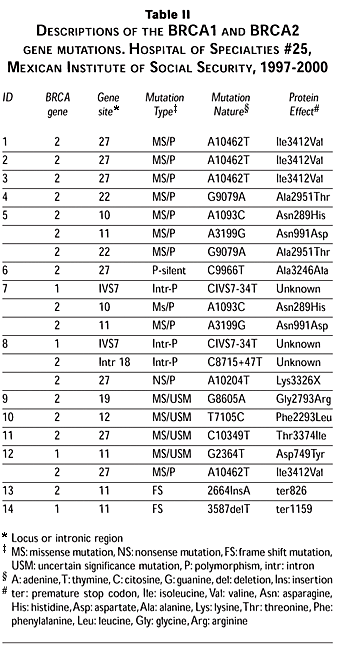
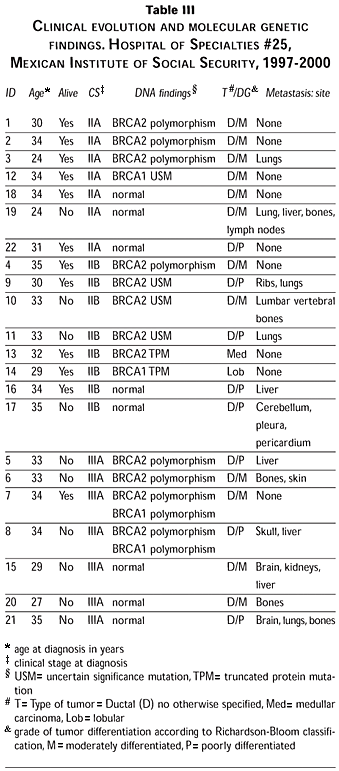
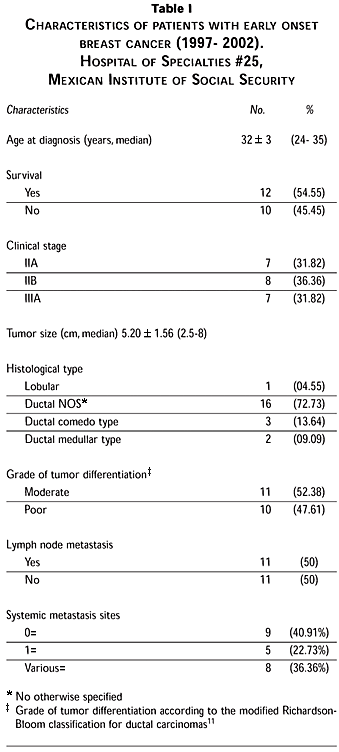
<body><![CDATA[<p><font size="2" face="Verdana"> Increasing age is a major risk factor for BC.    The risk of developing the disease is 1 in 20 000 for women younger than 25    years and this risk increases to 1 in 9 women older than 79 years.<SUP>5</SUP>    However, in 1998 in Mexico,<SUP>4</SUP> 8% of all breast cancer cases presented    in the early onset (EOBC) group (35 years of age or earlier at diagnosis). Many    studies have demonstrated that BC in young patients has a more aggressive clinical    course than in older patients.<SUP>5</SUP> It is thought that tumors in younger    women are biologically different, frequently with a higher proliferation index    and less histological differentiation. In general, EOBC patients have shorter    disease-free and reduced survival times.<SUP>5</SUP> </font></p>     <p><font size="2" face="Verdana"> On the other hand, heredity is another important    risk factor for BC. It is estimated that it contributes 3 to 10% to BC cases    and up to 30% to early onset ones.<SUP>6</SUP> Mutations in BRCA1 and BRCA2    genes are responsible for 90% of the inherited BC cases.<SUP>7</SUP> </font></p>     <p><font size="2" face="Verdana"> Since there is a lack of information in Mexico    about the contribution of BRCA1 and BRCA2 genes to BC, the aim of this case    series, prospective, hospital-based study of 22 Mexican women with EOBC was    to describe the clinical course of BC and the presence of mutations of the BRCA1    and BRCA2 genes. </font></p>     <p>&nbsp;</p>     <p><b><font size="3" face="Verdana">Material and Methods</font></b></p>     <p><font size="2" face="Verdana">Our protocol was reviewed and approved by the    Scientific and Ethics Committee of the Hospital of Specialities # 25, Mexican    Institute of Social Security (IMSS). In our hospital an average of 250 new breast    cancer cases are studied per year and 25 of them are women with EOBC. A sample    of 22 consecutive women newly diagnosed with histologically confirmed EOBC,    aged 35 years or younger at the time of diagnosis, was recruited from the hospital    in 1997. The study design and objectives were explained to the patients who    were asked to sign an informed consent. The clinical histories were obtained    and followed up for 5 years. Also, each patient donated 15 ml of venous blood    from which DNA was extracted.<SUP>8</SUP> Mutations in the BRCA1 and BRCA2 genes    were screened for by the heteroduplex analysis (HA). Variant bands observed    in the HA were re-amplified and sequenced.<SUP>9</SUP> </font></p>     <p> <font size="2" face="Verdana"><I>Clinical and pathological data</I>. Patients    were interviewed by two of the authors (ALCG, PRF); a questionnaire was completed    and patients' medical records were examined. Age at diagnosis and data about    the clinical progress and outcome were also recorded. The tumor size was measured    in centimeters at its largest diameter. All breast tumor slides were reviewed    by one of the authors (ALCG). Tumors were classified histologically and recorded    as ductal or lobular and subtypes of ductal carcinomas.<SUP>10</SUP> The histological    grade of differentiation of tumors was determined according to the modified    Bloom-Richardson criteria.<SUP>11</SUP> In the mastectomy specimen, the total    numbers of lymph nodes, as well as the number of specimens with metastasis were    recorded. The sites of metastasis were also described. Patients attended the    hospital at least four times during the first year following diagnosis, and    twice each subsequent year. </font></p>     <p>&nbsp;</p>     <p><font size="3" face="Verdana"><b>Results</b></font></p>     <p><font size="2" face="Verdana"><I>Clinical characteristics</I>. <a href="#tab01">Table    I</a> shows the more important clinical and tumoral findings. The identification    number (ID) of patients is given in <a href="#tab02">Tables II</a> and <a href="#tab03">III</a>.    All patients accepted to participate in the study and none were lost during    1997-2002. The age range was 24 to 35 years; 68% of patients completed elementary    school and 82% were housewives. History of BC in the family was present in six    out of 22 cases (27%) and two out of 22 (9%) patients had a first degree relative    with BC. Of the two women with truncated protein mutations (TPM), the one involving    the BRCA1 gene had only a paternal aunt with BC, while the other, who had the    mutation in the BRCA2 gene, had a history of gastric and breast carcinoma in    two paternal aunts; in the maternal line, she had two aunts with breast cancer,    and one uncle with melanoma. Diabetes mellitus and arterial hypertension affected    9% of patients. Twenty patients had children (range 1-5) and the other two had    not initiated active sexual life. Forty percent of patients with children breast-fed    them. Eighty-six percent of patients did not smoke. According with the Bray    classification, 36% of the patients had normal weight, 27% obesity grade I,    28% grade II, and 9% grade III. </font></p>     ]]></body>
<body><![CDATA[<p><a name="tab01"></a></p>     <p>&nbsp;</p>     <p align="center"><img src="/img/revistas/spm/v47n2/a03tab01.gif"></p>     <p>&nbsp;</p>     <p><a name="tab02"></a></p>     <p>&nbsp;</p>     <p align="center"><img src="/img/revistas/spm/v47n2/a03tab02.gif"></p>     <p>&nbsp;</p>     <p><a name="tab03"></a></p>     <p>&nbsp;</p>     ]]></body>
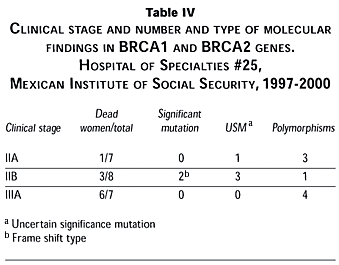
<body><![CDATA[<p align="center"><img src="/img/revistas/spm/v47n2/a03tab03.gif"></p>     <p>&nbsp;</p>     <p><font size="2" face="Verdana"><I>Tumor histology</I>. Twenty-one tumors were    classified as ductal carcinomas and the remaining one as lobular in origin (<a href="#tab01">Table    I</a>). Ductal carcinomas were poorly and moderately differentiated in 10 out    of 22 and 11 out of 22 cases, respectively. The two women with TPMs had a classical    invasive lobular carcinoma (BRCA1 gene mutation) and a medullar carcinoma (BRCA2    gene mutation). The medullar carcinoma showed non-caseous granulomas distributed    within the tumor and around its border. Special stains for fungi, tuberculosis    bacilli, and bacteria were negative. </font></p>     <p><font size="2" face="Verdana"><I>DNA data</I>. <a href="#tab02">Table II</a>    shows a description of the mutations found for the BRCA1 and BRCA2 genes. Only    14 of the 22 patients showed a variant band when the mutations in the BRCA1    and BRCA2 genes were screened by the heteroduplex analysis. Thus, 64% of patients    with EOBC had variations in the DNA sequence involving BRCA1 or BRCA2 genes.    The molecular findings were: 8 patients had one or more polymorphisms, 4 women    had mutations of uncertain significance (USM) and 2 other had 2 novel TPM, one    in BRCA1 (exon 11, 3587delT) and the other in BRCA2 gene (exon11, 2664InsA).    In general, exclusively BRCA2 variant bands were found in 71.4% of the cases,    versus only 7.14% of BRCA1 variants; in 21.43%, patients had both BRCA1 and    BRCA2 variant bands. Polymorphisms were more frequently found in the BRCA2 gene,    especially in exon 27, followed by exons 11, 10 and 22. The TPM affected exon    11 in BRCA1 and <I>BRCA2 </I>genes. </font></p>     <p><font size="2" face="Verdana"> <a href="#tab03">Table III</a> shows the clinical    stage and molecular findings in BRCA1 and BRCA2 genes and <a href="#tab04">Table    IV</a> summarizes the molecular findings according with the clinical stage.</font></p>     <p><a name="tab04"></a></p>     <p>&nbsp;</p>     <p align="center"><img src="/img/revistas/spm/v47n2/a03tab04.gif"></p>     <p>&nbsp;</p>     <p><font size="2" face="Verdana"> All patients in the same clinical stage received    the same treatment, including modified radical mastectomy, chemotherapy (5-fluoracile,    epirubicine, cyclophosphamide) and radiotherapy. The five-year mortality among    these women was about 45%. <a href="#tab04">Table IV</a> shows the number of    dead women/total with the clinical stage at diagnosis (1/7 in IIA, 3/8 in IIB    and 6/7 in IIIA). All deaths were caused by neoplastic activity and 80% occurred    within the first 3 years following diagnosis. Fourteen patients developed metastatic    disease, and among those, only 4 still remain alive. </font></p>     ]]></body>
<body><![CDATA[<p>&nbsp;</p>     <p><font size="3" face="Verdana"><b>Discussion</b></font></p>     <p><font size="2" face="Verdana">This follow-up study characterized 22 young women    with EOBC who attended a tertiary care hospital in northeastern Mexico. Even    though the results of this study cannot be extrapolated to the population at    large, it provides useful information on which to base further studies. </font></p>     <p><font size="2" face="Verdana"> Several risk factors particular to this group    were observed. Obesity is a BC risk factor in postmenopausal women but apparently    not in young women;<SUP>12</SUP> nevertheless, 14 out of 22 of our women had    some degree of obesity. The prevalence of family history of BC in our patients    was similar to those previously reported among Mexican women<SUP>13</SUP> and    similar to American and European studies.<SUP>14</SUP> The prevalence of common    diseases such as diabetes mellitus and arterial hypertension was similar to    that reported in adults in the north of Mexico.<SUP>15</SUP> </font></p>     <p><font size="2" face="Verdana"> With one exception, all fatalities had lymph    node metastases (LNM) at diagnosis. The sole exception initially underwent partial    lymph node resection, with only six non-metastatic lymph nodes dissected after    careful examination of axillary fat; later, developing    ipsilateral LNM and systemic dissemination. On the other hand, two patients    initially presenting with LNM survived, one of whom remained asymptomatic at    the end of the study, and the other, who had a poorly differentiated neoplasm,    developed liver metastasis and had terminal disease. These outcomes are consistent    with those reported in the relevant literature. In general, metastatic involvement    of axillary lymph nodes is one of the most important prognostic factors for    survival in BC. Without LNM, 5-year survival is about 80%, with one to three    positive lymph nodes is 50% and only 21% with four or more nodes.<SUP>16</SUP></font></p>     <p><font size="2" face="Verdana"> In general, the frequency of mutations in BRCA1    and BRCA2 genes in our study sample seems to be very similar to that described    in other studies of EOBC;<SUP>17-19</SUP> however, some of this mutations had    not been described before (the two PTM and gly2793Arg in BRCA2 gene and Asp749Tyr    in BRCA1 gene) and this can be explained by the genetic characteristic of our    mestizo population.<SUP>20</SUP> If we consider only those mutations resulting    in truncated proteins, BC in our patients was associated with mutations of BRCA1    and BRCA2 genes in 9 % of cases, which is also consistent with the percentage    of cases in the literature attributable to these types of mutations in these    genes.<SUP>17, 18</SUP> Overall, depending on the population analyzed, the estimated    percentage of mutations in young women with breast cancer is between 6 and 30%.<SUP>19</SUP>    </font></p>     <p><font size="2" face="Verdana"> As was mentioned before, the two truncating    protein mutations detected in our Mexican women have not been reported previously    in other countries.<SUP>21</SUP> Since these women originated from northeastern    Mexico, and had resided there for at least four generations, our observations    may be identifying unique population mutations. In relation with the four cases    with USM, further studies are needed to determine whether they correspond to    clinically significant mutations or polymorphisms. </font></p>     <p><font size="2" face="Verdana"> All the reported polymorphisms were in the BRCA2    gene, although some women also had them in the BRCA1 gene. It is well known    that in different populations, the contribution of BRCA1 and BRCA2 genes may    be different not only in polymorphisms but also in deleterious mutations; thus,    in Jewish women, BRCA1 mutations are more frequent that BRCA2 ones, while in    Italian women, the contribution of BRCA2 mutations predominates.<SUP>22</SUP>    The study of polymorphisms is important especially in a mestizo population<I>,    </I>such as the Mexican case. Some of the polymorphisms described in these patients    (CIVS7-34T in BRCA1 and A1093C in BRCA2 genes) have been previously described    in Spain and elsewhere,<SUP>21</SUP> including Africans (C8715+47T),<SUP>21</SUP>    thus denoting the influence of these origins.<SUP>20</SUP> </font></p>     <p><font size="2" face="Verdana"> Early studies of women with mutations in BC    susceptibility genes did not show differences between sporadic and mutation-associated    tumors.<SUP>23</SUP> More recent quantitative studies reveal higher nuclear    grade, less positive expression to estrogen receptors, more pleomorphism and    higher mitotic index in tumors associated with mutations than in sporadic tumors.<SUP>24</SUP>    One of our two cases had a lobular carcinoma (BRCA1 mutation) and the other    a medullar carcinoma (BRCA2 mutation). Both of these histological tumor types    have a better prognosis than the common ductal adenocarcinoma. Furthermore,    the observation of non-caseous granulomas in the tumor probably signals active    anti-tumor cellular immunity, and more importantly, these patients were among    the survivors and are now clinically asymptomatic. </font></p>     <p><font size="2" face="Verdana"><b>Conclusions</b></font></p>     ]]></body>
<body><![CDATA[<p><font size="2" face="Verdana">In summary, our study shows that breast cancer    behaves aggressively in young Mexican women, particularly if the disease is    clinically advanced at the time of diagnosis.<SUP>16</SUP> We have also demonstrated    the contribution of BRCA1 and BRCA2 genes in EOBC in Mexican patients. Although    there are reports of mutations in Mexican-American women,<SUP>25</SUP> this    study is the first to describe both, the clinical progress and the molecular    genetic analysis of BRCA1 and BRCA2 genes in Latin-American women. The two novel    mutations were associated with less aggressive types of adenocarcinoma and non-metastatic,    localized disease, in spite of a large tumor size. The ability to identify women    with mutations allows further study of the family and, thus, early intervention,    hopefully leading to a reduction in mortality.<SUP>26</SUP> </font></p>     <p><font size="2" face="Verdana"> Our data point to the need for a large population-based    study to characterize the EOBC in Mexican women, in order to determine the type,    frequency, and significance of variations in the sequences of BRCA1 and BRCA2    genes in Mexico. </font></p>     <p><font size="2" face="Verdana"><b>Acknowledgments</b> </font></p>     <p><font size="2" face="Verdana">To Professor RM Chandler- Burns† for his    critical reading of our manuscript. </font></p>     <p>&nbsp;</p>     <p><font size="3" face="Verdana"><b>References</b></font></p>     <!-- ref --><p><font size="2" face="Verdana">1. Pisani P, Parkin DM, Bray F, Ferlay J. Estimates    of the worldwide mortality from cancer in 1990. Int J Cancer 1999;83(1):18-29.</font>&nbsp;&nbsp;&nbsp;&nbsp;&nbsp;&nbsp;&nbsp;&nbsp;[&#160;<a href="javascript:void(0);" onclick="javascript: window.open('/scielo.php?script=sci_nlinks&ref=9251707&pid=S0036-3634200500020000400001&lng=','','width=640,height=500,resizable=yes,scrollbars=1,menubar=yes,');">Links</a>&#160;]<!-- end-ref --><!-- ref --><p><font size="2" face="Verdana">2. Holford TR, Roush GC, McKay LA. Trends in    female breast cancer in Connecticut and the United States. J Clin Epidemiol    1991;44(1):29-39. </font>&nbsp;&nbsp;&nbsp;&nbsp;&nbsp;&nbsp;&nbsp;&nbsp;[&#160;<a href="javascript:void(0);" onclick="javascript: window.open('/scielo.php?script=sci_nlinks&ref=9251708&pid=S0036-3634200500020000400002&lng=','','width=640,height=500,resizable=yes,scrollbars=1,menubar=yes,');">Links</a>&#160;]<!-- end-ref --><!-- ref --><p><font size="2" face="Verdana">3. Instituto Nacional de Estad&iacute;stica,    Geograf&iacute;a e Inform&aacute;tica. XII Censo General de Poblaci&oacute;n    y Vivienda 2000. Aguascalientes, Aguascalientes:    INEGI; 2001. Disponible en: <a href="http://www.inegi.gob.mx/est/contenidos/espa%F1ol/tem%E1ticos/mediano/anu.asp?t=mpob01" target="_blank">http://www.inegi.gob.mx/est/contenidos/espa&ntilde;ol/tem&aacute;ticos/mediano/anu.asp?t=mpob01</a>    </font>&nbsp;&nbsp;&nbsp;&nbsp;&nbsp;&nbsp;&nbsp;&nbsp;[&#160;<a href="javascript:void(0);" onclick="javascript: window.open('/scielo.php?script=sci_nlinks&ref=9251709&pid=S0036-3634200500020000400003&lng=','','width=640,height=500,resizable=yes,scrollbars=1,menubar=yes,');">Links</a>&#160;]<!-- end-ref --><!-- ref --><p><font size="2" face="Verdana">4. Secretar&iacute;a de Salud. Compendio del    Registro Histopatol&oacute;gico de Neoplasias en M&eacute;xico. M&eacute;xico,    DF: SSA; 1998. </font>&nbsp;&nbsp;&nbsp;&nbsp;&nbsp;&nbsp;&nbsp;&nbsp;[&#160;<a href="javascript:void(0);" onclick="javascript: window.open('/scielo.php?script=sci_nlinks&ref=9251710&pid=S0036-3634200500020000400004&lng=','','width=640,height=500,resizable=yes,scrollbars=1,menubar=yes,');">Links</a>&#160;]<!-- end-ref --><!-- ref --><p><font size="2" face="Verdana">5. Henderson IC, Patek AJ. Are breast cancers    in young women qualitatively distinct? Lancet 1997;349:1488-1489. </font>&nbsp;&nbsp;&nbsp;&nbsp;&nbsp;&nbsp;&nbsp;&nbsp;[&#160;<a href="javascript:void(0);" onclick="javascript: window.open('/scielo.php?script=sci_nlinks&ref=9251711&pid=S0036-3634200500020000400005&lng=','','width=640,height=500,resizable=yes,scrollbars=1,menubar=yes,');">Links</a>&#160;]<!-- end-ref --><!-- ref --><p><font size="2" face="Verdana">6. Tereschenko IV, Basham VM, Ponder BA, Pharoah    PD. BRCA1 and BRCA2 mutations in Russian familial breast cancer. Hum Mutat 2002;19(2):184.    </font>&nbsp;&nbsp;&nbsp;&nbsp;&nbsp;&nbsp;&nbsp;&nbsp;[&#160;<a href="javascript:void(0);" onclick="javascript: window.open('/scielo.php?script=sci_nlinks&ref=9251712&pid=S0036-3634200500020000400006&lng=','','width=640,height=500,resizable=yes,scrollbars=1,menubar=yes,');">Links</a>&#160;]<!-- end-ref --><!-- ref --><p><font size="2" face="Verdana">7. Antoniou AC, Pharoah PD, McMullan G, Day NE,    Stratton MR, Peto J <I>et al</I>. A comprehensive model for familial breast    cancer incorporating BRCA1, BRCA2 and other genes. Br J Cancer 2002;    86 (1):76-83. </font>&nbsp;&nbsp;&nbsp;&nbsp;&nbsp;&nbsp;&nbsp;&nbsp;[&#160;<a href="javascript:void(0);" onclick="javascript: window.open('/scielo.php?script=sci_nlinks&ref=9251713&pid=S0036-3634200500020000400007&lng=','','width=640,height=500,resizable=yes,scrollbars=1,menubar=yes,');">Links</a>&#160;]<!-- end-ref --><!-- ref --><p><font size="2" face="Verdana">8. Miller SA, Dykes DD, Polesky HF. A simple    salting out procedure for extracting DNA from human nucleated cells. Nucleic    Acids Res 1988;16(3):1215. </font>&nbsp;&nbsp;&nbsp;&nbsp;&nbsp;&nbsp;&nbsp;&nbsp;[&#160;<a href="javascript:void(0);" onclick="javascript: window.open('/scielo.php?script=sci_nlinks&ref=9251714&pid=S0036-3634200500020000400008&lng=','','width=640,height=500,resizable=yes,scrollbars=1,menubar=yes,');">Links</a>&#160;]<!-- end-ref --><!-- ref --><p><font size="2" face="Verdana">9. Ruiz-Flores P, Sinilnikova O, Badzioch M,    Calder&oacute;n-Garcidue&ntilde;as AL, Chopin S, Fabrice O <I>et al</I>. BRCA1    and BRCA2 mutation analysis of early-onset and familial breast cancer cases    in Mexico. Hum Mutat 2002;20(6):474-475. </font>&nbsp;&nbsp;&nbsp;&nbsp;&nbsp;&nbsp;&nbsp;&nbsp;[&#160;<a href="javascript:void(0);" onclick="javascript: window.open('/scielo.php?script=sci_nlinks&ref=9251715&pid=S0036-3634200500020000400009&lng=','','width=640,height=500,resizable=yes,scrollbars=1,menubar=yes,');">Links</a>&#160;]<!-- end-ref --><!-- ref --><p><font size="2" face="Verdana">10. Cotran R, Kumar V, Robbins S. The breast.    En: Schoen F, ed. Patolog&iacute;a estructural y funcional. Fifth edition. Madrid:    McGraw-Hill- Interamerican; 1998:1201-1222. </font>&nbsp;&nbsp;&nbsp;&nbsp;&nbsp;&nbsp;&nbsp;&nbsp;[&#160;<a href="javascript:void(0);" onclick="javascript: window.open('/scielo.php?script=sci_nlinks&ref=9251716&pid=S0036-3634200500020000400010&lng=','','width=640,height=500,resizable=yes,scrollbars=1,menubar=yes,');">Links</a>&#160;]<!-- end-ref --><!-- ref --><p><font size="2" face="Verdana">11. Frierson HF Jr, Wolber RA, Berean KW, Franquemont    DW, Gaffey MJ, Boyd JC <I>et al</I>. Interobserver reproducibility of the Nottingham    modification of the Bloom-Richardson histological grading scheme for infiltrating    ductal carcinoma. Am J Clin Pathol 1995;103(2):195-198. </font>&nbsp;&nbsp;&nbsp;&nbsp;&nbsp;&nbsp;&nbsp;&nbsp;[&#160;<a href="javascript:void(0);" onclick="javascript: window.open('/scielo.php?script=sci_nlinks&ref=9251717&pid=S0036-3634200500020000400011&lng=','','width=640,height=500,resizable=yes,scrollbars=1,menubar=yes,');">Links</a>&#160;]<!-- end-ref --><!-- ref --><p><font size="2" face="Verdana">12. Clinton SK. Diet, anthropometry and breast    cancer: Integration of experimental and epidemiologic approaches. J Nutr 1997;127    Suppl 5:916S-920S. </font>&nbsp;&nbsp;&nbsp;&nbsp;&nbsp;&nbsp;&nbsp;&nbsp;[&#160;<a href="javascript:void(0);" onclick="javascript: window.open('/scielo.php?script=sci_nlinks&ref=9251718&pid=S0036-3634200500020000400012&lng=','','width=640,height=500,resizable=yes,scrollbars=1,menubar=yes,');">Links</a>&#160;]<!-- end-ref --><!-- ref --><p><font size="2" face="Verdana">13. Calder&oacute;n-Garcidue&ntilde;as AL, Par&aacute;s-Barrientos    FU, C&aacute;rdenas-Ibarra L, Gonz&aacute;lez-Guerrero JF, Villarreal-R&iacute;os    E, Staines-Boone T <I>et al</I>. Risk factors of breast cancer in Mexican women.    Salud Publica Mex 2000;42(1):26-33. </font>&nbsp;&nbsp;&nbsp;&nbsp;&nbsp;&nbsp;&nbsp;&nbsp;[&#160;<a href="javascript:void(0);" onclick="javascript: window.open('/scielo.php?script=sci_nlinks&ref=9251719&pid=S0036-3634200500020000400013&lng=','','width=640,height=500,resizable=yes,scrollbars=1,menubar=yes,');">Links</a>&#160;]<!-- end-ref --><!-- ref --><p><font size="2" face="Verdana">14. Hoskins KF, Stopfer JE, Calzone KA, Merajver    SD, Rebbeck TR, Garber JE <I>et al</I>. Assessment and counseling for women    with a family history of breast cancer: A guide for clinicians. JAMA 1995;273:    577- 585. </font>&nbsp;&nbsp;&nbsp;&nbsp;&nbsp;&nbsp;&nbsp;&nbsp;[&#160;<a href="javascript:void(0);" onclick="javascript: window.open('/scielo.php?script=sci_nlinks&ref=9251720&pid=S0036-3634200500020000400014&lng=','','width=640,height=500,resizable=yes,scrollbars=1,menubar=yes,');">Links</a>&#160;]<!-- end-ref --><!-- ref --><p><font size="2" face="Verdana">15. Secretar&iacute;a de Salud. Subsecretar&iacute;a    de Coordinaci&oacute;n y Desarrollo. Encuestas Nacionales de Salud: panorama    de la salud en M&eacute;xico. M&eacute;xico, DF: SSA; 1994. </font>&nbsp;&nbsp;&nbsp;&nbsp;&nbsp;&nbsp;&nbsp;&nbsp;[&#160;<a href="javascript:void(0);" onclick="javascript: window.open('/scielo.php?script=sci_nlinks&ref=9251721&pid=S0036-3634200500020000400015&lng=','','width=640,height=500,resizable=yes,scrollbars=1,menubar=yes,');">Links</a>&#160;]<!-- end-ref --><!-- ref --><p><font size="2" face="Verdana">16. Gompel C, Kerkem C. The breast. En: Silverberg    S. Ed. Principles and practice of surgical pathology. Toronto: Wiley Medical    Publications; 1983:245-295. </font>&nbsp;&nbsp;&nbsp;&nbsp;&nbsp;&nbsp;&nbsp;&nbsp;[&#160;<a href="javascript:void(0);" onclick="javascript: window.open('/scielo.php?script=sci_nlinks&ref=9251722&pid=S0036-3634200500020000400016&lng=','','width=640,height=500,resizable=yes,scrollbars=1,menubar=yes,');">Links</a>&#160;]<!-- end-ref --><!-- ref --><p><font size="2" face="Verdana">17. De Le&oacute;n-Matsuda ML, Liede A, Kwan    E, Mapua CA, Cutiongco EM Tan A <I>et al</I>. BRCA1 and BRCA2 mutations among    breast cancer patients from the Philippines. Int J Cancer 2002;98(4):596-603.</font>&nbsp;&nbsp;&nbsp;&nbsp;&nbsp;&nbsp;&nbsp;&nbsp;[&#160;<a href="javascript:void(0);" onclick="javascript: window.open('/scielo.php?script=sci_nlinks&ref=9251723&pid=S0036-3634200500020000400017&lng=','','width=640,height=500,resizable=yes,scrollbars=1,menubar=yes,');">Links</a>&#160;]<!-- end-ref --><!-- ref --><p><font size="2" face="Verdana"> 18. Osorio A, Barroso A, Mart&iacute;nez B,    Cebri&aacute;n A, San Rom&aacute;n JM, Lobo F <I>et al</I>. Molecular analysis    of the BRCA1 and BRCA2 genes in 32 breast and/or ovarian cancer Spanish families.    Br J Cancer 2000;82(7): 1266-1270.</font>&nbsp;&nbsp;&nbsp;&nbsp;&nbsp;&nbsp;&nbsp;&nbsp;[&#160;<a href="javascript:void(0);" onclick="javascript: window.open('/scielo.php?script=sci_nlinks&ref=9251724&pid=S0036-3634200500020000400018&lng=','','width=640,height=500,resizable=yes,scrollbars=1,menubar=yes,');">Links</a>&#160;]<!-- end-ref --><!-- ref --><p><font size="2" face="Verdana"> 19. Loman N, Johannsson O, Kristoffersson U,    Olsson H, Borg A. Family history of breast and ovarian cancers and BRCA1 and    BRCA2 mutations in a population-based series of early-onset breast cancer. J    Natl Cancer Inst 2001;93(16):1188-1189. </font>&nbsp;&nbsp;&nbsp;&nbsp;&nbsp;&nbsp;&nbsp;&nbsp;[&#160;<a href="javascript:void(0);" onclick="javascript: window.open('/scielo.php?script=sci_nlinks&ref=9251725&pid=S0036-3634200500020000400019&lng=','','width=640,height=500,resizable=yes,scrollbars=1,menubar=yes,');">Links</a>&#160;]<!-- end-ref --><!-- ref --><p><font size="2" face="Verdana">20. Cerda-Flores RM, Villalobos-Torres MC, Barrera-Salda&ntilde;a    HA, Cort&eacute;s-Prieto LM, Barajas LO, Rivas F <I>et al</I>. Genetic admixture    in three Mexican mestizo populations based on D1S80 and HLA-DQA1 loci. Am J    Hum Biol 2002;14(2):257-263. </font>&nbsp;&nbsp;&nbsp;&nbsp;&nbsp;&nbsp;&nbsp;&nbsp;[&#160;<a href="javascript:void(0);" onclick="javascript: window.open('/scielo.php?script=sci_nlinks&ref=9251726&pid=S0036-3634200500020000400020&lng=','','width=640,height=500,resizable=yes,scrollbars=1,menubar=yes,');">Links</a>&#160;]<!-- end-ref --><!-- ref --><p><font size="2" face="Verdana">21. An Open Access On-Line Breast Cancer Mutation    Data Base. An International Collaborative Effort hosted by National Human Genetic    Research Institute of the National Institute of Health. The Breast Cancer Information    Core database design, structure, and scope. Disponible en: <a href="http://www.nhgri.nih.gov/bic/" target="_blank">http://www.nhgri.nih.gov/bic/</a>.    &#91;2001marzo 14&#93;. </font>&nbsp;&nbsp;&nbsp;&nbsp;&nbsp;&nbsp;&nbsp;&nbsp;[&#160;<a href="javascript:void(0);" onclick="javascript: window.open('/scielo.php?script=sci_nlinks&ref=9251727&pid=S0036-3634200500020000400021&lng=','','width=640,height=500,resizable=yes,scrollbars=1,menubar=yes,');">Links</a>&#160;]<!-- end-ref --><!-- ref --><p><font size="2" face="Verdana">22. Krainer M, Silva-Arrieta S, FitzGerald MG,    Shimada A, Ishioka C, Kanamaru R <I>et al</I>. Differential contributions of    BRCA1 and BRCA2 to early-onset breast cancer. N Engl J Med 1997;336(20):1416-1421.    </font>&nbsp;&nbsp;&nbsp;&nbsp;&nbsp;&nbsp;&nbsp;&nbsp;[&#160;<a href="javascript:void(0);" onclick="javascript: window.open('/scielo.php?script=sci_nlinks&ref=9251728&pid=S0036-3634200500020000400022&lng=','','width=640,height=500,resizable=yes,scrollbars=1,menubar=yes,');">Links</a>&#160;]<!-- end-ref --><!-- ref --><p><font size="2" face="Verdana">23. Marcus JN, Watson P, Page DL, Lynch HT. Pathology    and heredity of breast cancer in younger women. J Natl Cancer Inst Monogr 1994;16:23-34.    </font>&nbsp;&nbsp;&nbsp;&nbsp;&nbsp;&nbsp;&nbsp;&nbsp;[&#160;<a href="javascript:void(0);" onclick="javascript: window.open('/scielo.php?script=sci_nlinks&ref=9251729&pid=S0036-3634200500020000400023&lng=','','width=640,height=500,resizable=yes,scrollbars=1,menubar=yes,');">Links</a>&#160;]<!-- end-ref --><!-- ref --><p><font size="2" face="Verdana">24. Breast Cancer Linkage Consortium. Pathology    of familial breast cancer: Differences between breast cancers in carriers of    BRCA1 or BRCA2 mutations and sporadic cases. Lancet 1997;349(9064):1505-1510.    </font>&nbsp;&nbsp;&nbsp;&nbsp;&nbsp;&nbsp;&nbsp;&nbsp;[&#160;<a href="javascript:void(0);" onclick="javascript: window.open('/scielo.php?script=sci_nlinks&ref=9251730&pid=S0036-3634200500020000400024&lng=','','width=640,height=500,resizable=yes,scrollbars=1,menubar=yes,');">Links</a>&#160;]<!-- end-ref --><!-- ref --><p><font size="2" face="Verdana">25. Dejun S, Yanyuan W, Ram C, Jaydutt V. A truncated    BRCA1 gene mutation identified in a Hispanic-American breast cancer patient    with a family history. Disponible en: <a href="http://www.medicineoftheamericas.org/page_15.html" target="_blank">www.medicineoftheamericas.org/page_15.html</a>.    &#91;2001 abril 3&#93;. </font>&nbsp;&nbsp;&nbsp;&nbsp;&nbsp;&nbsp;&nbsp;&nbsp;[&#160;<a href="javascript:void(0);" onclick="javascript: window.open('/scielo.php?script=sci_nlinks&ref=9251731&pid=S0036-3634200500020000400025&lng=','','width=640,height=500,resizable=yes,scrollbars=1,menubar=yes,');">Links</a>&#160;]<!-- end-ref --><!-- ref --><p><font size="2" face="Verdana">26. Burke W, Daly M, Garber J, Botkin J, Kahn    MJ, Lynch P <I>et al</I>. Recommendations for follow-up care of individuals    with an inherited predisposition to cancer. II. BRCA1 and BRCA2. Cancer Genetics    Studies Consortium. JAMA 1997;277(12):997-1003.</font>&nbsp;&nbsp;&nbsp;&nbsp;&nbsp;&nbsp;&nbsp;&nbsp;[&#160;<a href="javascript:void(0);" onclick="javascript: window.open('/scielo.php?script=sci_nlinks&ref=9251732&pid=S0036-3634200500020000400026&lng=','','width=640,height=500,resizable=yes,scrollbars=1,menubar=yes,');">Links</a>&#160;]<!-- end-ref --><p>&nbsp;</p>     <p>&nbsp;</p>     <p><font size="2" face="Verdana"><b>Address reprint requests to</b>    <br>   Prof. Dr. Hugo A Barrera-Salda&ntilde;a    <br>   Departamento de Bioqu&iacute;mica    <br>   Facultad de Medicina de la Universidad Aut&oacute;noma de    Nuevo Le&oacute;n    <br>   Avenida Madero y Dr. Eduardo Aguirre Peque&ntilde;o    <br>   colonia Mitras Centro 64460, Monterrey, Nuevo Le&oacute;n, M&eacute;xico    ]]></body>
<body><![CDATA[<br>   E-mail: <a href="mailto:hbarrera@fm.uanl.mx">hbarrera@fm.uanl.mx</a></font></p>     <p><font size="2" face="Verdana">Received on: November 7, 2003    <br>   Accepted on: February 1, 2005 </font></p>     <p>&nbsp;</p>     <p>&nbsp;</p>     <p><font size="2" face="Verdana">We express our gratitude to the PAICYT Program,    the Office of the President of UANL, the FOFOI: IMSS-2002/021/20111021 for funding,    and Conacyt for the doctoral scholarship (93354) to ALCG. We also thank the    PROMEP program of the Federal Secretariat of Education and the Mexican National    Council of Science and Technology for support. </font></p>      ]]></body><back>
<ref-list>
<ref id="B1">
<label>1</label><nlm-citation citation-type="journal">
<person-group person-group-type="author">
<name>
<surname><![CDATA[Pisani]]></surname>
<given-names><![CDATA[P]]></given-names>
</name>
<name>
<surname><![CDATA[Parkin]]></surname>
<given-names><![CDATA[DM]]></given-names>
</name>
<name>
<surname><![CDATA[Bray]]></surname>
<given-names><![CDATA[F]]></given-names>
</name>
<name>
<surname><![CDATA[Ferlay]]></surname>
<given-names><![CDATA[J]]></given-names>
</name>
</person-group>
<article-title xml:lang="en"><![CDATA[Estimates of the worldwide mortality from cancer in 1990]]></article-title>
<source><![CDATA[Int J Cancer]]></source>
<year>1999</year>
<volume>83</volume>
<numero>1</numero>
<issue>1</issue>
<page-range>18-29</page-range></nlm-citation>
</ref>
<ref id="B2">
<label>2</label><nlm-citation citation-type="journal">
<person-group person-group-type="author">
<name>
<surname><![CDATA[Holford]]></surname>
<given-names><![CDATA[TR]]></given-names>
</name>
<name>
<surname><![CDATA[Roush]]></surname>
<given-names><![CDATA[GC]]></given-names>
</name>
<name>
<surname><![CDATA[McKay]]></surname>
<given-names><![CDATA[LA]]></given-names>
</name>
</person-group>
<article-title xml:lang="en"><![CDATA[Trends in female breast cancer in Connecticut and the United States]]></article-title>
<source><![CDATA[J Clin Epidemiol]]></source>
<year>1991</year>
<volume>44</volume>
<numero>1</numero>
<issue>1</issue>
<page-range>29-39</page-range></nlm-citation>
</ref>
<ref id="B3">
<label>3</label><nlm-citation citation-type="book">
<collab>Instituto Nacional de Estadística, Geografía e Informática</collab>
<source><![CDATA[XII Censo General de Población y Vivienda 2000]]></source>
<year>2001</year>
<publisher-loc><![CDATA[Aguascalientes ]]></publisher-loc>
<publisher-name><![CDATA[INEGI]]></publisher-name>
</nlm-citation>
</ref>
<ref id="B4">
<label>4</label><nlm-citation citation-type="book">
<collab>Secretaría de Salud</collab>
<source><![CDATA[Compendio del Registro Histopatológico de Neoplasias en México]]></source>
<year>1998</year>
<publisher-loc><![CDATA[México, DF ]]></publisher-loc>
<publisher-name><![CDATA[SSA]]></publisher-name>
</nlm-citation>
</ref>
<ref id="B5">
<label>5</label><nlm-citation citation-type="journal">
<person-group person-group-type="author">
<name>
<surname><![CDATA[Henderson]]></surname>
<given-names><![CDATA[IC]]></given-names>
</name>
<name>
<surname><![CDATA[Patek]]></surname>
<given-names><![CDATA[AJ]]></given-names>
</name>
</person-group>
<article-title xml:lang="en"><![CDATA[Are breast cancers in young women qualitatively distinct?]]></article-title>
<source><![CDATA[Lancet]]></source>
<year>1997</year>
<volume>349</volume>
<page-range>1488-1489</page-range></nlm-citation>
</ref>
<ref id="B6">
<label>6</label><nlm-citation citation-type="journal">
<person-group person-group-type="author">
<name>
<surname><![CDATA[Tereschenko]]></surname>
<given-names><![CDATA[IV]]></given-names>
</name>
<name>
<surname><![CDATA[Basham]]></surname>
<given-names><![CDATA[VM]]></given-names>
</name>
<name>
<surname><![CDATA[Ponder]]></surname>
<given-names><![CDATA[BA]]></given-names>
</name>
<name>
<surname><![CDATA[Pharoah]]></surname>
<given-names><![CDATA[PD]]></given-names>
</name>
</person-group>
<article-title xml:lang="en"><![CDATA[BRCA1 and BRCA2 mutations in Russian familial breast cancer]]></article-title>
<source><![CDATA[Hum Mutat]]></source>
<year>2002</year>
<volume>19</volume>
<numero>2</numero>
<issue>2</issue>
<page-range>184</page-range></nlm-citation>
</ref>
<ref id="B7">
<label>7</label><nlm-citation citation-type="journal">
<person-group person-group-type="author">
<name>
<surname><![CDATA[Antoniou]]></surname>
<given-names><![CDATA[AC]]></given-names>
</name>
<name>
<surname><![CDATA[Pharoah]]></surname>
<given-names><![CDATA[PD]]></given-names>
</name>
<name>
<surname><![CDATA[McMullan]]></surname>
<given-names><![CDATA[G]]></given-names>
</name>
<name>
<surname><![CDATA[Day]]></surname>
<given-names><![CDATA[NE]]></given-names>
</name>
<name>
<surname><![CDATA[Stratton]]></surname>
<given-names><![CDATA[MR]]></given-names>
</name>
<name>
<surname><![CDATA[Peto]]></surname>
<given-names><![CDATA[J]]></given-names>
</name>
</person-group>
<article-title xml:lang="en"><![CDATA[A comprehensive model for familial breast cancer incorporating BRCA1, BRCA2 and other genes]]></article-title>
<source><![CDATA[Br J Cancer]]></source>
<year>2002</year>
<volume>86</volume>
<numero>1</numero>
<issue>1</issue>
<page-range>76-83</page-range></nlm-citation>
</ref>
<ref id="B8">
<label>8</label><nlm-citation citation-type="journal">
<person-group person-group-type="author">
<name>
<surname><![CDATA[Miller]]></surname>
<given-names><![CDATA[SA]]></given-names>
</name>
<name>
<surname><![CDATA[Dykes]]></surname>
<given-names><![CDATA[DD]]></given-names>
</name>
<name>
<surname><![CDATA[Polesky]]></surname>
<given-names><![CDATA[HF]]></given-names>
</name>
</person-group>
<article-title xml:lang="en"><![CDATA[A simple salting out procedure for extracting DNA from human nucleated cells]]></article-title>
<source><![CDATA[Nucleic Acids Res]]></source>
<year>1988</year>
<volume>16</volume>
<numero>3</numero>
<issue>3</issue>
<page-range>1215</page-range></nlm-citation>
</ref>
<ref id="B9">
<label>9</label><nlm-citation citation-type="journal">
<person-group person-group-type="author">
<name>
<surname><![CDATA[Ruiz-Flores]]></surname>
<given-names><![CDATA[P]]></given-names>
</name>
<name>
<surname><![CDATA[Sinilnikova]]></surname>
<given-names><![CDATA[O]]></given-names>
</name>
<name>
<surname><![CDATA[Badzioch]]></surname>
<given-names><![CDATA[M]]></given-names>
</name>
<name>
<surname><![CDATA[Calderón-Garcidueñas]]></surname>
<given-names><![CDATA[AL]]></given-names>
</name>
<name>
<surname><![CDATA[Chopin]]></surname>
<given-names><![CDATA[S]]></given-names>
</name>
<name>
<surname><![CDATA[Fabrice]]></surname>
<given-names><![CDATA[O]]></given-names>
</name>
</person-group>
<article-title xml:lang="en"><![CDATA[BRCA1 and BRCA2 mutation analysis of early-onset and familial breast cancer cases in Mexico]]></article-title>
<source><![CDATA[Hum Mutat]]></source>
<year>2002</year>
<volume>20</volume>
<numero>6</numero>
<issue>6</issue>
<page-range>474-475</page-range></nlm-citation>
</ref>
<ref id="B10">
<label>10</label><nlm-citation citation-type="book">
<person-group person-group-type="author">
<name>
<surname><![CDATA[Cotran]]></surname>
<given-names><![CDATA[R]]></given-names>
</name>
<name>
<surname><![CDATA[Kumar]]></surname>
<given-names><![CDATA[V]]></given-names>
</name>
<name>
<surname><![CDATA[Robbins]]></surname>
<given-names><![CDATA[S]]></given-names>
</name>
</person-group>
<article-title xml:lang="en"><![CDATA[The breast]]></article-title>
<person-group person-group-type="editor">
<name>
<surname><![CDATA[Schoen]]></surname>
<given-names><![CDATA[F]]></given-names>
</name>
</person-group>
<source><![CDATA[Patología estructural y funcional]]></source>
<year>1998</year>
<edition>Fifth</edition>
<page-range>1201-1222</page-range><publisher-loc><![CDATA[Madrid ]]></publisher-loc>
<publisher-name><![CDATA[McGraw-Hill- Interamerican]]></publisher-name>
</nlm-citation>
</ref>
<ref id="B11">
<label>11</label><nlm-citation citation-type="journal">
<person-group person-group-type="author">
<name>
<surname><![CDATA[Frierson]]></surname>
<given-names><![CDATA[HF Jr]]></given-names>
</name>
<name>
<surname><![CDATA[Wolber]]></surname>
<given-names><![CDATA[RA]]></given-names>
</name>
<name>
<surname><![CDATA[Berean]]></surname>
<given-names><![CDATA[KW]]></given-names>
</name>
<name>
<surname><![CDATA[Franquemont]]></surname>
<given-names><![CDATA[DW]]></given-names>
</name>
<name>
<surname><![CDATA[Gaffey]]></surname>
<given-names><![CDATA[MJ]]></given-names>
</name>
<name>
<surname><![CDATA[Boyd]]></surname>
<given-names><![CDATA[JC]]></given-names>
</name>
</person-group>
<article-title xml:lang="en"><![CDATA[Interobserver reproducibility of the Nottingham modification of the Bloom-Richardson histological grading scheme for infiltrating ductal carcinoma]]></article-title>
<source><![CDATA[Am J Clin Pathol]]></source>
<year>1995</year>
<volume>103</volume>
<numero>2</numero>
<issue>2</issue>
<page-range>195-198</page-range></nlm-citation>
</ref>
<ref id="B12">
<label>12</label><nlm-citation citation-type="journal">
<person-group person-group-type="author">
<name>
<surname><![CDATA[Clinton]]></surname>
<given-names><![CDATA[SK]]></given-names>
</name>
</person-group>
<article-title xml:lang="en"><![CDATA[Diet, anthropometry and breast cancer: Integration of experimental and epidemiologic approaches]]></article-title>
<source><![CDATA[J Nutr]]></source>
<year>1997</year>
<volume>127</volume>
<numero>^s5</numero>
<issue>^s5</issue>
<supplement>5</supplement>
<page-range>916S-920S</page-range></nlm-citation>
</ref>
<ref id="B13">
<label>13</label><nlm-citation citation-type="journal">
<person-group person-group-type="author">
<name>
<surname><![CDATA[Calderón-Garcidueñas]]></surname>
<given-names><![CDATA[AL]]></given-names>
</name>
<name>
<surname><![CDATA[Parás-Barrientos]]></surname>
<given-names><![CDATA[FU]]></given-names>
</name>
<name>
<surname><![CDATA[Cárdenas-Ibarra]]></surname>
<given-names><![CDATA[L]]></given-names>
</name>
<name>
<surname><![CDATA[González-Guerrero]]></surname>
<given-names><![CDATA[JF]]></given-names>
</name>
<name>
<surname><![CDATA[Villarreal-Ríos]]></surname>
<given-names><![CDATA[E]]></given-names>
</name>
<name>
<surname><![CDATA[Staines-Boone]]></surname>
<given-names><![CDATA[T]]></given-names>
</name>
</person-group>
<article-title xml:lang="en"><![CDATA[Risk factors of breast cancer in Mexican women]]></article-title>
<source><![CDATA[Salud Publica Mex]]></source>
<year>2000</year>
<volume>42</volume>
<numero>1</numero>
<issue>1</issue>
<page-range>26-33</page-range></nlm-citation>
</ref>
<ref id="B14">
<label>14</label><nlm-citation citation-type="journal">
<person-group person-group-type="author">
<name>
<surname><![CDATA[Hoskins]]></surname>
<given-names><![CDATA[KF]]></given-names>
</name>
<name>
<surname><![CDATA[Stopfer]]></surname>
<given-names><![CDATA[JE]]></given-names>
</name>
<name>
<surname><![CDATA[Calzone]]></surname>
<given-names><![CDATA[KA]]></given-names>
</name>
<name>
<surname><![CDATA[Merajver]]></surname>
<given-names><![CDATA[SD]]></given-names>
</name>
<name>
<surname><![CDATA[Rebbeck]]></surname>
<given-names><![CDATA[TR]]></given-names>
</name>
<name>
<surname><![CDATA[Garber]]></surname>
<given-names><![CDATA[JE]]></given-names>
</name>
</person-group>
<article-title xml:lang="en"><![CDATA[Assessment and counseling for women with a family history of breast cancer: A guide for clinicians]]></article-title>
<source><![CDATA[JAMA]]></source>
<year>1995</year>
<volume>273</volume>
<page-range>577- 585</page-range></nlm-citation>
</ref>
<ref id="B15">
<label>15</label><nlm-citation citation-type="book">
<collab>Secretaría de Salud^dSubsecretaría de Coordinación y Desarrollo</collab>
<source><![CDATA[Encuestas Nacionales de Salud: panorama de la salud en México]]></source>
<year>1994</year>
<publisher-loc><![CDATA[México, DF ]]></publisher-loc>
<publisher-name><![CDATA[SSA]]></publisher-name>
</nlm-citation>
</ref>
<ref id="B16">
<label>16</label><nlm-citation citation-type="book">
<person-group person-group-type="author">
<name>
<surname><![CDATA[Gompel]]></surname>
<given-names><![CDATA[C]]></given-names>
</name>
<name>
<surname><![CDATA[Kerkem]]></surname>
<given-names><![CDATA[C]]></given-names>
</name>
</person-group>
<article-title xml:lang="en"><![CDATA[The breast]]></article-title>
<person-group person-group-type="editor">
<name>
<surname><![CDATA[Silverberg]]></surname>
<given-names><![CDATA[S]]></given-names>
</name>
</person-group>
<source><![CDATA[Principles and practice of surgical pathology]]></source>
<year>1983</year>
<page-range>245-295</page-range><publisher-loc><![CDATA[Toronto ]]></publisher-loc>
<publisher-name><![CDATA[Wiley Medical Publications]]></publisher-name>
</nlm-citation>
</ref>
<ref id="B17">
<label>17</label><nlm-citation citation-type="journal">
<person-group person-group-type="author">
<name>
<surname><![CDATA[De León-Matsuda]]></surname>
<given-names><![CDATA[ML]]></given-names>
</name>
<name>
<surname><![CDATA[Liede]]></surname>
<given-names><![CDATA[A]]></given-names>
</name>
<name>
<surname><![CDATA[Kwan]]></surname>
<given-names><![CDATA[E]]></given-names>
</name>
<name>
<surname><![CDATA[Mapua]]></surname>
<given-names><![CDATA[CA]]></given-names>
</name>
<name>
<surname><![CDATA[Cutiongco]]></surname>
<given-names><![CDATA[EM]]></given-names>
</name>
<name>
<surname><![CDATA[Tan]]></surname>
<given-names><![CDATA[A]]></given-names>
</name>
</person-group>
<article-title xml:lang="en"><![CDATA[BRCA1 and BRCA2 mutations among breast cancer patients from the Philippines]]></article-title>
<source><![CDATA[Int J Cancer]]></source>
<year>2002</year>
<volume>98</volume>
<numero>4</numero>
<issue>4</issue>
<page-range>596-603</page-range></nlm-citation>
</ref>
<ref id="B18">
<label>18</label><nlm-citation citation-type="journal">
<person-group person-group-type="author">
<name>
<surname><![CDATA[Osorio]]></surname>
<given-names><![CDATA[A]]></given-names>
</name>
<name>
<surname><![CDATA[Barroso]]></surname>
<given-names><![CDATA[A]]></given-names>
</name>
<name>
<surname><![CDATA[Martínez]]></surname>
<given-names><![CDATA[B]]></given-names>
</name>
<name>
<surname><![CDATA[Cebrián]]></surname>
<given-names><![CDATA[A]]></given-names>
</name>
<name>
<surname><![CDATA[San Román]]></surname>
<given-names><![CDATA[JM]]></given-names>
</name>
<name>
<surname><![CDATA[Lobo]]></surname>
<given-names><![CDATA[F]]></given-names>
</name>
</person-group>
<article-title xml:lang="en"><![CDATA[Molecular analysis of the BRCA1 and BRCA2 genes in 32 breast and/or ovarian cancer Spanish families]]></article-title>
<source><![CDATA[Br J Cancer]]></source>
<year>2000</year>
<volume>82</volume>
<numero>7</numero>
<issue>7</issue>
<page-range>1266-1270</page-range></nlm-citation>
</ref>
<ref id="B19">
<label>19</label><nlm-citation citation-type="journal">
<person-group person-group-type="author">
<name>
<surname><![CDATA[Loman]]></surname>
<given-names><![CDATA[N]]></given-names>
</name>
<name>
<surname><![CDATA[Johannsson]]></surname>
<given-names><![CDATA[O]]></given-names>
</name>
<name>
<surname><![CDATA[Kristoffersson]]></surname>
<given-names><![CDATA[U]]></given-names>
</name>
<name>
<surname><![CDATA[Olsson]]></surname>
<given-names><![CDATA[H]]></given-names>
</name>
<name>
<surname><![CDATA[Borg]]></surname>
<given-names><![CDATA[A]]></given-names>
</name>
</person-group>
<article-title xml:lang="en"><![CDATA[Family history of breast and ovarian cancers and BRCA1 and BRCA2 mutations in a population-based series of early-onset breast cancer]]></article-title>
<source><![CDATA[J Natl Cancer Inst]]></source>
<year>2001</year>
<volume>93</volume>
<numero>16</numero>
<issue>16</issue>
<page-range>1188-1189</page-range></nlm-citation>
</ref>
<ref id="B20">
<label>20</label><nlm-citation citation-type="journal">
<person-group person-group-type="author">
<name>
<surname><![CDATA[Cerda-Flores]]></surname>
<given-names><![CDATA[RM]]></given-names>
</name>
<name>
<surname><![CDATA[Villalobos-Torres]]></surname>
<given-names><![CDATA[MC]]></given-names>
</name>
<name>
<surname><![CDATA[Barrera-Saldaña]]></surname>
<given-names><![CDATA[HA]]></given-names>
</name>
<name>
<surname><![CDATA[Cortés-Prieto]]></surname>
<given-names><![CDATA[LM]]></given-names>
</name>
<name>
<surname><![CDATA[Barajas]]></surname>
<given-names><![CDATA[LO]]></given-names>
</name>
<name>
<surname><![CDATA[Rivas]]></surname>
<given-names><![CDATA[F]]></given-names>
</name>
</person-group>
<article-title xml:lang="en"><![CDATA[Genetic admixture in three Mexican mestizo populations based on D1S80 and HLA-DQA1 loci]]></article-title>
<source><![CDATA[Am J Hum Biol]]></source>
<year>2002</year>
<volume>14</volume>
<numero>2</numero>
<issue>2</issue>
<page-range>257-263</page-range></nlm-citation>
</ref>
<ref id="B21">
<label>21</label><nlm-citation citation-type="">
<collab>Open Access On-Line Breast Cancer Mutation Data Base</collab>
<collab>National Institute of Health^dNational Human Genetic Research Institute</collab>
<source><![CDATA[The Breast Cancer Information Core database design, structure, and scope]]></source>
<year>2001</year>
<month>ma</month>
<day>rz</day>
</nlm-citation>
</ref>
<ref id="B22">
<label>22</label><nlm-citation citation-type="journal">
<person-group person-group-type="author">
<name>
<surname><![CDATA[Krainer]]></surname>
<given-names><![CDATA[M]]></given-names>
</name>
<name>
<surname><![CDATA[Silva-Arrieta]]></surname>
<given-names><![CDATA[S]]></given-names>
</name>
<name>
<surname><![CDATA[FitzGerald]]></surname>
<given-names><![CDATA[MG]]></given-names>
</name>
<name>
<surname><![CDATA[Shimada]]></surname>
<given-names><![CDATA[A]]></given-names>
</name>
<name>
<surname><![CDATA[Ishioka]]></surname>
<given-names><![CDATA[C]]></given-names>
</name>
<name>
<surname><![CDATA[Kanamaru]]></surname>
<given-names><![CDATA[R]]></given-names>
</name>
</person-group>
<article-title xml:lang="en"><![CDATA[Differential contributions of BRCA1 and BRCA2 to early-onset breast cancer]]></article-title>
<source><![CDATA[N Engl J Med]]></source>
<year>1997</year>
<volume>336</volume>
<numero>20</numero>
<issue>20</issue>
<page-range>1416-1421</page-range></nlm-citation>
</ref>
<ref id="B23">
<label>23</label><nlm-citation citation-type="journal">
<person-group person-group-type="author">
<name>
<surname><![CDATA[Marcus]]></surname>
<given-names><![CDATA[JN]]></given-names>
</name>
<name>
<surname><![CDATA[Watson]]></surname>
<given-names><![CDATA[P]]></given-names>
</name>
<name>
<surname><![CDATA[Page]]></surname>
<given-names><![CDATA[DL]]></given-names>
</name>
<name>
<surname><![CDATA[Lynch]]></surname>
<given-names><![CDATA[HT]]></given-names>
</name>
</person-group>
<article-title xml:lang="en"><![CDATA[Pathology and heredity of breast cancer in younger women]]></article-title>
<source><![CDATA[J Natl Cancer Inst Monogr]]></source>
<year>1994</year>
<volume>16</volume>
<page-range>23-34</page-range></nlm-citation>
</ref>
<ref id="B24">
<label>24</label><nlm-citation citation-type="journal">
<collab>Breast Cancer Linkage Consortium</collab>
<article-title xml:lang="en"><![CDATA[Pathology of familial breast cancer: Differences between breast cancers in carriers of BRCA1 or BRCA2 mutations and sporadic cases]]></article-title>
<source><![CDATA[Lancet]]></source>
<year>1997</year>
<volume>349</volume>
<numero>9064</numero>
<issue>9064</issue>
<page-range>1505-1510</page-range></nlm-citation>
</ref>
<ref id="B25">
<label>25</label><nlm-citation citation-type="">
<person-group person-group-type="author">
<name>
<surname><![CDATA[Dejun]]></surname>
<given-names><![CDATA[S]]></given-names>
</name>
<name>
<surname><![CDATA[Yanyuan]]></surname>
<given-names><![CDATA[W]]></given-names>
</name>
<name>
<surname><![CDATA[Ram]]></surname>
<given-names><![CDATA[C]]></given-names>
</name>
<name>
<surname><![CDATA[Jaydutt]]></surname>
<given-names><![CDATA[V]]></given-names>
</name>
</person-group>
<source><![CDATA[A truncated BRCA1 gene mutation identified in a Hispanic-American breast cancer patient with a family history]]></source>
<year>2001</year>
<month> a</month>
<day>br</day>
</nlm-citation>
</ref>
<ref id="B26">
<label>26</label><nlm-citation citation-type="journal">
<person-group person-group-type="author">
<name>
<surname><![CDATA[Burke]]></surname>
<given-names><![CDATA[W]]></given-names>
</name>
<name>
<surname><![CDATA[Daly]]></surname>
<given-names><![CDATA[M]]></given-names>
</name>
<name>
<surname><![CDATA[Garber]]></surname>
<given-names><![CDATA[J]]></given-names>
</name>
<name>
<surname><![CDATA[Botkin]]></surname>
<given-names><![CDATA[J]]></given-names>
</name>
<name>
<surname><![CDATA[Kahn]]></surname>
<given-names><![CDATA[MJ]]></given-names>
</name>
<name>
<surname><![CDATA[Lynch]]></surname>
<given-names><![CDATA[P]]></given-names>
</name>
</person-group>
<article-title xml:lang="en"><![CDATA[Recommendations for follow-up care of individuals with an inherited predisposition to cancer: II. BRCA1 and BRCA2]]></article-title>
<source><![CDATA[JAMA]]></source>
<year>1997</year>
<volume>277</volume>
<numero>12</numero>
<issue>12</issue>
<page-range>997-1003</page-range></nlm-citation>
</ref>
</ref-list>
</back>
</article>