<?xml version="1.0" encoding="ISO-8859-1"?><article xmlns:mml="http://www.w3.org/1998/Math/MathML" xmlns:xlink="http://www.w3.org/1999/xlink" xmlns:xsi="http://www.w3.org/2001/XMLSchema-instance">
<front>
<journal-meta>
<journal-id>0036-3634</journal-id>
<journal-title><![CDATA[Salud Pública de México]]></journal-title>
<abbrev-journal-title><![CDATA[Salud pública Méx]]></abbrev-journal-title>
<issn>0036-3634</issn>
<publisher>
<publisher-name><![CDATA[Instituto Nacional de Salud Pública]]></publisher-name>
</publisher>
</journal-meta>
<article-meta>
<article-id>S0036-36342004000300013</article-id>
<title-group>
<article-title xml:lang="en"><![CDATA[The logistic model for predicting the non-gonoactive Aedes aegypti females]]></article-title>
<article-title xml:lang="es"><![CDATA[El modelo logístico para predecir la frecuencia de hembras no gonoactivas en función del tamaño corporal y tipo de colecta, en poblaciones de Aedes aegypti, en Monterrey, México]]></article-title>
</title-group>
<contrib-group>
<contrib contrib-type="author">
<name>
<surname><![CDATA[Reyes-Villanueva]]></surname>
<given-names><![CDATA[Filiberto]]></given-names>
</name>
<xref ref-type="aff" rid="A01"/>
</contrib>
<contrib contrib-type="author">
<name>
<surname><![CDATA[Rodríguez-Pérez]]></surname>
<given-names><![CDATA[Mario A]]></given-names>
</name>
<xref ref-type="aff" rid="A02"/>
</contrib>
</contrib-group>
<aff id="A01">
<institution><![CDATA[,Universidad Autónoma de Nuevo León Facultad de Ciencias Biológicas Laboratorio de Entomología Médica]]></institution>
<addr-line><![CDATA[San Nicolás de los Garza Nuevo León]]></addr-line>
<country>México</country>
</aff>
<aff id="A02">
<institution><![CDATA[,Instituto Politécnico Nacional Centro de Biotecnología Genómica ]]></institution>
<addr-line><![CDATA[ ]]></addr-line>
</aff>
<pub-date pub-type="pub">
<day>00</day>
<month>06</month>
<year>2004</year>
</pub-date>
<pub-date pub-type="epub">
<day>00</day>
<month>06</month>
<year>2004</year>
</pub-date>
<volume>46</volume>
<numero>3</numero>
<fpage>234</fpage>
<lpage>240</lpage>
<copyright-statement/>
<copyright-year/>
<self-uri xlink:href="http://www.scielo.org.mx/scielo.php?script=sci_arttext&amp;pid=S0036-36342004000300013&amp;lng=en&amp;nrm=iso"></self-uri><self-uri xlink:href="http://www.scielo.org.mx/scielo.php?script=sci_abstract&amp;pid=S0036-36342004000300013&amp;lng=en&amp;nrm=iso"></self-uri><self-uri xlink:href="http://www.scielo.org.mx/scielo.php?script=sci_pdf&amp;pid=S0036-36342004000300013&amp;lng=en&amp;nrm=iso"></self-uri><abstract abstract-type="short" xml:lang="en"><p><![CDATA[OBJECTIVE: To estimate, using logistic regression, the likelihood of occurrence of a non-gonoactive Aedes aegypti female, previously fed human blood, with relation to body size and collection method. MATERIAL AND METHODS: This study was conducted in Monterrey, Mexico, between 1994 and 1996. Ten samplings of 60 mosquitoes of Ae aegypti females were carried out in three dengue endemic areas: six of biting females, two of emerging mosquitoes, and two of indoor resting females. Gravid females, as well as those with blood in the gut were removed. Mosquitoes were taken to the laboratory and engorged on human blood. After 48 hours, ovaries were dissected to register whether they were gonoactive or non-gonoactive. Wing-length in mm was an indicator for body size. The logistic regression model was used to assess the likelihood of non-gonoactivity, as a binary variable, in relation to wing-length and collection method. RESULTS: Of the 600 females, 164 (27%) remained non-gonoactive, with a wing-length range of 1.9-3.2 mm, almost equal to that of all females (1.8-3.3 mm). The logistic regression model showed a significant likelihood of a female remaining non-gonoactive (Y=1). The collection method did not influence the binary response, but there was an inverse relationship between non-gonoactivity and wing-length. CONCLUSIONS: Dengue vector populations from Monterrey, Mexico display a wide-range body size. Logistic regression was a useful tool to estimate the likelihood for an engorged female to remain non-gonoactive. The necessity for a second blood meal is present in any female, but small mosquitoes are more likely to bite again within a 2-day interval, in order to attain egg maturation.]]></p></abstract>
<abstract abstract-type="short" xml:lang="es"><p><![CDATA[OBJETIVO: Estimar la probabilidad para que una hembra de Aedes aegypti, previamente alimentada con sangre humana, permanezca no gonoactiva, sin madurar huevos, dependiendo del tamaño corporal y tipo de colecta. MATERIAL Y MÉTODOS: Se hicieron 10 muestreos de Ae aegypti.: seis de hembras capturadas en cebo humano, dos de nulíparas y dos colectadas en reposo intradomiciliar. Cada muestreo incluyó 60 hembras, en tres colonias endémicas para dengue, en Monterrey, Nuevo León, México, entre 1994 y 1996. Las hembras grávidas o con sangre en estómago fueron excluidas. Cada mosquito fue llevado al laboratorio y alimentado a repleción con sangre humana, y a las 48 horas los ovarios fueron disecados para registrar si estaban en fase gonoactiva o no. El tamaño corporal fue registrado por la longitud en mm del ala izquierda de cada mosquito. Se usó regresión logística para estimar la probabilidad de que una hembra fuera no gonoactiva, como una variable binaria, en función de la longitud alar, y del tipo de colecta. RESULTADOS: De las 600 hembras procesadas, 164 (27%) permanecieron no gonoactivas, y su tamaño corporal mostró un intervalo (1.9-3.2 mm) casi igual al total de las hembras (1.8-3.3 mm). El modelo de regresión logística fue significativo para estimar la probabilidad de que una hembra permanezca no gonoactiva (Y=1). El tipo de colecta no tuvo influencia significativa en la variable binaria, pero la probabilidad de no gonoactividad mostró una relación inversa con el tamaño corporal. CONCLUSIONES: Las poblaciones del vector del dengue en Monterrey, México, están integradas por hembras de tamaño muy variable. La regresión logística resultó útil para evaluar la probabilidad que tiene una hembra de quedar no gonoactiva después de una alimentación sanguínea. La necesidad de una segunda comida sanguínea está presente en cualquier mosquito, pero los pequeños tienen una mayor probabilidad de picar por segunda ocasión a una persona en un periodo de dos días, para poder madurar huevos.]]></p></abstract>
<kwd-group>
<kwd lng="en"><![CDATA[Aedes aegypti]]></kwd>
<kwd lng="en"><![CDATA[dengue]]></kwd>
<kwd lng="en"><![CDATA[wing-length]]></kwd>
<kwd lng="en"><![CDATA[non-gonoactive]]></kwd>
<kwd lng="en"><![CDATA[Mexico]]></kwd>
<kwd lng="es"><![CDATA[Aedes aegypti]]></kwd>
<kwd lng="es"><![CDATA[dengue]]></kwd>
<kwd lng="es"><![CDATA[longitud alar]]></kwd>
<kwd lng="es"><![CDATA[no gonoactiva]]></kwd>
<kwd lng="es"><![CDATA[México]]></kwd>
</kwd-group>
</article-meta>
</front><body><![CDATA[ <p align="right"><font size="2" face="verdana"><b>ART&Iacute;CULO ORIGINAL</b></font></p>     <p>&nbsp;</p>     <p><font size="4" face="verdana"><b>The logistic model for predicting the non-gonoactive    <i>Aedes aegypti</i> females</b></font></p>     <p>&nbsp;</p>     <p><font size="3" face="verdana"><b>El modelo log&iacute;stico para predecir la    frecuencia de hembras no gonoactivas en funci&oacute;n del tama&ntilde;o corporal    y tipo de colecta, en poblaciones de <i>Aedes aegypti</i>, en Monterrey, M&eacute;xico</b></font></p>     <p>&nbsp;</p>     <p>&nbsp;</p>     <p><font size="2" face="Verdana"><b>Filiberto Reyes-Villanueva, PhD<SUP>I</SUP>;    Mario A Rodríguez-Pérez, PhD<SUP>II</SUP></b></font></p>     <p><font size="2" face="Verdana"><SUP>I</sup>Facultad de Ciencias Biológicas,    Laboratorio de Entomología Médica, Universidad Autónoma de Nuevo León. San Nicolás    de los Garza, Nuevo León, México    <br>   <SUP>II</sup>Centro de Biotecnología Genómica,    Instituto Politécnico Nacional. Reynosa, Tamaulipas, México</font></p>     ]]></body>
<body><![CDATA[<p>&nbsp;</p>     <p>&nbsp;</p> <hr size="1" noshade>     <p><font size="2" face="Verdana"><b>ABSTRACT</b></font></p>     <p><font size="2" face="Verdana"><B>OBJECTIVE:</B> To estimate, using logistic    regression, the likelihood of occurrence of a non-gonoactive <I>Aedes aegypti</I>    female, previously fed human blood, with relation to body size and collection    method.    <br>   <B>MATERIAL AND METHODS:</B> This study was conducted in Monterrey, Mexico,    between 1994 and 1996. Ten samplings of 60 mosquitoes of<I> Ae aegypti</I> females    were carried out in three dengue endemic areas: six of biting females, two of    emerging mosquitoes, and two of indoor resting females. Gravid females, as well    as those with blood in the gut were removed. Mosquitoes were taken to the laboratory    and engorged on human blood. After 48 hours, ovaries were dissected to register    whether they were gonoactive or non-gonoactive. Wing-length in mm was an indicator    for body size. The logistic regression model was used to assess the likelihood    of non-gonoactivity, as a binary variable, in relation to wing-length and collection    method.    <br>   <B>RESULTS:</B> Of the 600 females, 164 (27%) remained non-gonoactive, with    a wing-length range of 1.9-3.2 mm, almost equal to that of all females (1.8-3.3    mm). The logistic regression model showed a significant likelihood of a female    remaining non-gonoactive (Y=1). The collection method did not influence the    binary response, but there was an inverse relationship between non-gonoactivity    and wing-length.    <br>   <B>CONCLUSIONS:</B> Dengue vector populations from Monterrey, Mexico display    a wide-range body size. Logistic regression was a useful tool to estimate the    likelihood for an engorged female to remain non-gonoactive. The necessity for    a second blood meal is present in any female, but small mosquitoes are more    likely to bite again within a 2-day interval, in order to attain egg maturation.    The English version of this paper is available too at: <a href="http://www.insp.mx/salud/index.html" target="_blank">http://www.insp.mx/salud/index.html</a>    </font></p>     <p><font size="2" face="Verdana"><b>Key words:</b> <I>Aedes aegypti</I>; dengue;    wing-length; non-gonoactive; Mexico</font></p> <hr size="1" noshade>     <p><font size="2" face="VERDANA"><b>RESUMEN</b></font></p>     <p><font size="2" face="Verdana"><B>OBJETIVO:</B> Estimar la probabilidad para    que una hembra de <I>Aedes aegypti</I>, previamente alimentada con sangre humana,    permanezca no gonoactiva, sin madurar huevos, dependiendo del tamaño corporal    y tipo de colecta.    ]]></body>
<body><![CDATA[<br>   <B>MATERIAL Y M&Eacute;TODOS:</B> Se hicieron 10 muestreos de <I>Ae aegypti</I>.:    seis de hembras capturadas en cebo humano, dos de nulíparas y dos colectadas    en reposo intradomiciliar. Cada muestreo incluyó 60 hembras, en tres colonias    endémicas para dengue, en Monterrey, Nuevo León, México, entre 1994 y 1996.    Las hembras grávidas o con sangre en estómago fueron excluidas. Cada mosquito    fue llevado al laboratorio y alimentado a repleción con sangre humana, y a las    48 horas los ovarios fueron disecados para registrar si estaban en fase gonoactiva    o no. El tamaño corporal fue registrado por la longitud en mm del ala izquierda    de cada mosquito. Se usó regresión logística para estimar la probabilidad de    que una hembra fuera no gonoactiva, como una variable binaria, en función de    la longitud alar, y del tipo de colecta.    <br>   <B>RESULTADOS:</B> De las 600 hembras procesadas, 164 (27%) permanecieron no    gonoactivas, y su tamaño corporal mostró un intervalo (1.9-3.2 mm) casi igual    al total de las hembras (1.8-3.3 mm). El modelo de regresión logística fue significativo    para estimar la probabilidad de que una hembra permanezca no gonoactiva (Y=1).    El tipo de colecta no tuvo influencia significativa en la variable binaria,    pero la probabilidad de no gonoactividad mostró una relación inversa con el    tamaño corporal.    <br>   <B>CONCLUSIONES:</B> Las poblaciones del    vector del dengue en Monterrey, México, están integradas por hembras de tamaño    muy variable. La regresión logística resultó útil para evaluar la probabilidad    que tiene una hembra de quedar no gonoactiva después de una alimentación sanguínea.    La necesidad de una segunda comida sanguínea está presente en cualquier mosquito,    pero los pequeños tienen una mayor probabilidad de picar por segunda ocasión    a una persona en un periodo de dos días, para poder madurar huevos. El texto    completo en inglés de este artículo también está disponible en: <a href="http://www.insp.mx/salud/index.html" target="_blank">http://www.insp.mx/salud/index.html</a>    </font></p>     <p><font size="2" face="Verdana"><b>Palabras clave:</b> <I>Aedes aegypti</I>;    dengue; longitud alar; no gonoactiva; México</font></p> <hr size="1" noshade>     <p>&nbsp;</p>     <p>&nbsp;</p>     <p><font size="2" face="Verdana">The body size of <I>Aedes aegypti</I>    has been associated with its vectorial competence for some viral strains of    dengue (DEN) virus.<SUP>1</SUP> It has been reported that although <I>Ae aegypti</I>    sometimes ingests plant carbohydrates,<SUP>2</SUP> it prefers to feed only on    human blood.<SUP>3</SUP> This inclination in wild mosquitoes makes the females    more prolific and long-lived than those reared on blood plus sugar.<SUP>4</SUP>    The water-holding containers found in urban habitats that serve as breeding    sites for a varying number of mosquitoes typically undergo changes of water    volume, consequently, the amount of food can also vary causing an effect on    the nutritional larval stage and the body size of the adult mosquito. The newly    emerged females can be divided into Christophers stages,<SUP>5,6</SUP> in an    ordinal scale to measure the ovarian development extent. Christophers stages    I, IIb, and III-V correspond to three oogenic phases: the previtellogenic, resting    (quiescent), and vitellogenic phase.<SUP>7</SUP> Most newly emerged <I>Ae aegypti</I>    females have their ovaries in stage IIb; however, malnourished mosquitoes with    their ovaries in stage I can also be found.<SUP>8,9</SUP> There have been a    few through studies that have examined the association between the body size    of domestic mosquitoes and those that remain non-gonoactive, i.e., with neither    egg maturation nor oviposition, after ingesting a human blood meal to repletion.    In an important work,<SUP>8</SUP> colony-reared <I>Ae aegypti</I> females in    stage I needed two successive blood meals to accomplish ovarian maturation.    A first blood meal in mosquitoes allowed the development of the ovaries from    stage I to II, and the full egg development occurred after a consecutive second    blood meal. Nutritionally weak Anopheline mosquitoes requiring two complete    blood meals for full egg development were defined as "pregravid females".<SUP>10,11</SUP>    Although a "pregravid phase" is a common event in the oogenesis of Culicidae    mosquitoes, the term has not been widely accepted by mosquito biologists.<SUP>12</SUP>    In this paper, a "non-gonoactive female" will be more correctly referred to    as a mosquito in Sella stage I, i.e., with its blood meal entirely digested,<SUP>6</SUP>    and with its ovarian development, after engorgement, not beyond Christophers    stage IIa.<SUP>7</SUP> Thus, we assumed that a non-gonoactive female used up    all nutrients of the first blood meal to increase its caloric reserve level    and the oogenesis reached only Christophers stage IIa. It has been reported    that mosquitoes with ovarian development below stage IIa cannot develop eggs.<SUP>7</SUP>    </font> </p>     <p><font size="2" face="Verdana"><I>Ae aegypti</I> laboratory females with a wing    length shorter than 2.9 mm needed two blood meals to reach the vitellogenic    phase.<SUP>9</SUP> It has also been reported that <I>Anopheles albimanus </I>and    <I>An gambiae </I>s.l. with a wing length &lt;2.9 mm did not develop eggs after    ingesting their first blood meal.<SUP>13</SUP> However, small females    could become gonoactive and large ones non-gonoactive. The purpose of this study    was to evaluate the logistic model for predicting the frequency of non-gonoactive    females, as a dependent variable of body size and collection type in wild <I>Ae    aegypti</I> populations. Different types of collections of biting, resting,    and container-emerging mosquitoes were performed to ensure the capture of the    widest female body size range naturally occurring. The wing length and Christophers    stages of wild <I>Ae aegypti</I> mosquitoes after taking a full human blood    meal were determined. These data were used to develop a binary logistic regression    model to estimate the likelihood of a female mosquito being non-gonoactive     P(GI=1) or not (GI=0) considering the wing length X<SUB>1</SUB> and the collection    category X<SUB>2</SUB> as the explanatory covariates in the global model. </font></p>     <p>&nbsp;</p>     <p><font size="3" face="Verdana"><b>Material and Methods </b></font></p>     ]]></body>
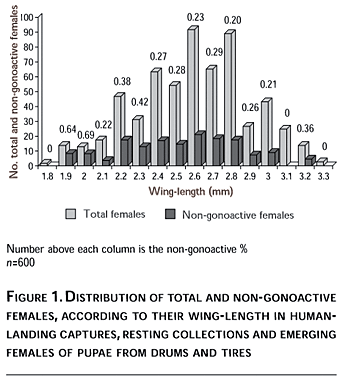
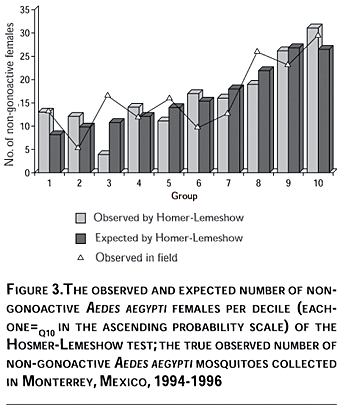
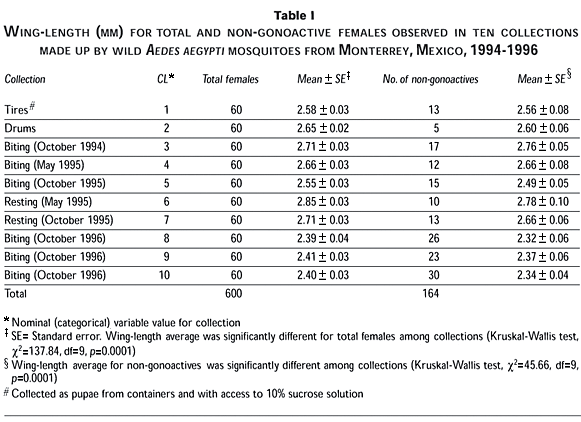
<body><![CDATA[<p><font size="2" face="Verdana"><I>Aedes aegypti</I> females were collected in    three dengue endemic neighborhoods in Monterrey: Francisco I. Madero, Lázaro    Cárdenas, and El Mirador. Dwellings were clustered and built with cement and    metallic or cement roofs. In the first neighborhood, containers including cans,    bottles, and discarded tires were abundant in back yards, while in the other    two, 200-liter drums were commonly used by homeowners as water-storage containers    due to the lack of piped water. The climate in Monterrey is arid with    a mean annual rainfall in the area of 450 mm (range=270 mm-620 mm), average    temperature of 23 ºC (range=-2 ºC -44 ºC) and    relative humidity of 60% (range=32-90%). The two rainy months are May and October,<SUP>14</SUP>    and the highest population densities of <I>Ae aegypti </I>occur in these months.<SUP>15</SUP>    </font></p>     <p><font size="2" face="Verdana">Ten collection sets of mosquitoes were performed    from 1994 through 1996. Six human-biting collections (one in October 1994, May    1995, October 1995, and three in October 1996) were conducted in five houses    at Francisco I. Madero. Two collections of container-emerged mosquitoes were    done in October 1994 from five drums at El Mirador, and from five tires at Lázaro    Cárdenas. Finally, two indoor-resting collections were conducted in five houses    at El Mirador in May 1995, and October 1995. Each collection set consisted of    60 females. Each human-biting collection of 60 mosquito females was carried    out in a 5-day capture interval by a two-person team (the attractant and collector    catching mosquitoes on one person). Mosquitoes were captured in backyards from    17:00 to 20:00 h with a mouth aspirator immediately after they posed on the    legs and arms of one of the authors posing as the volunteer human bite. The    mosquitoes were held in a cardboard cage and transported to the laboratory the    same day of capture for an examination of their abdomen, after being anesthetized    by a 10-minute exposure inside a freezer (~ -2 ºC). Females with    the abdomen completely empty were separated for blood feeding, whereas those    with blood vestiges in stomach and/or gravids were removed. Twenty-four hours    after their capture and kept only with access to water, empty females were fed    to repletion on the hand of one of the authors who volunteered to do so. Mosquitoes    were not interrupted during blood feeding, which lasted until they withdrew    their mouthparts freely from the volunteer's hand. Forty-eight h after blood    feeding, mosquitoes were immobilized by freezing and the ovaries of the females    that had fed to repletion were dissected in 0.5% saline solution and observed    through a stereomicroscope to determine the Christophers stage of the oocyte    in development.<SUP>5,6</SUP> The wing of each mosquito was excised and    the wing length measured from the axillary incision to the apical margin, excluding    the fringe scale.<SUP>16</SUP> As we mentioned before, a non-gonoactive female    was one that fed to repletion 48 h prior to examination with blood completely    digested, and ovaries not beyond Christophers stage IIa.<SUP>7</SUP> On the    contrary, a female previously fed to repletion and with ovaries in any stage    beyond IIIa, 48 h after blood feeding and blood completely digested was considered    to be a gonoactive female, i.e. with eggs in maturation. </font></p>     <p><font size="2" face="Verdana">Each collection of 60 resting mosquitoes was    conducted inside the houses in a 5-day interval. This sample size was chosen    considering that 30 is the limit between small and large samples.<SUP>17</SUP>    The same five houses were sampled for each collection. For emerging female collections,    pupae were collected from five 200-liter drums and five discarded tires to obtain    teneral females. A total of 150 pupae from drums, and 150 pupae from tires were    collected and transported to the laboratory where they were placed into screened    emergence cages (30 x 30 x 30 cm). Here, mosquitoes had access to a 10% sucrose    solution provided in cotton pads, and newly emerged females and males were allowed    to mate. After 72 hours of emergence the volunteer author introduced a hand    into each cage to feed the mosquitoes to repletion. Time feeding varied among    individuals because each female was allowed to feed until she withdrew freely    her proboscis from the skin. Twenty-four hours post-blood feeding, 60 engorged    females were placed into a new cage, and 48 h after her blood meal, the ovaries    were dissected and the wing length of each female was measured as above. </font></p>     <p><b><font size="2" face="Verdana">Statistical analysis </font></b></p>     <p><font size="2" face="Verdana">The 600 wing length data were sorted in ascending    order, and a histogram was built. Lowest and highest limits of the entire wing    length range were 1.8 and 3.3 mm, comprising 16 classes of 0.1 mm width each,    where the 2.5 mm class was identified as the median. Total and non-gonoactive    female frequencies were represented in this histogram. </font></p>     <p><font size="2" face="Verdana">The arithmetic mean and standard error of the    wing length for each collection were calculated. Variation in wing length average    for the total number of mosquitoes and non-gonoactive mosquitoes among collections    was compared by a Kruskal-Wallis test using    procedures<I> Proc means</I> and <I>Proc npar1way</I> in SAS.<SUP>18</SUP> A    dataset of 600 values made up of three variables: non-gonoactive (GI=the response    variable; a binary-discrete variable), wing length (WL; a continuous variable),    and collection category (a nominal variable) was constructed. A logistic regression    model was applied using procedure <I>Proc logistic</I> in SAS<SUP>19</SUP> to    these data, using the binary variable GI as the dependent variable (Y) and the    other two as the covariates (X). The nominal variable or "collection category"    (CL) was arranged in values from 1 to 10 according to the collection number    (<a href="#tab01">Table I</a>). A linear logistic regression model was transformed    to the exponential form by calculating the antilog (e<SUP>x</SUP>) of each linear    parameter, and the likelihood of being non-gonoactive P(GI=1) was estimated    according to WL and CL values for each female mosquito. The probability values    were plotted on the Y-axis against the total wing length range in the X-axis.    Finally, with the options: <I>descending </I>and <I>lackfit</I> in the <I>proc    logistic</I> procedure in SAS, the number of observed and expected non-gonoactive    females per wing length decile (Q<SUB>10</SUB> in the entire probability scale)    was calculated and compared using the c<SUP>2</SUP> statistic of the Hosmer-Lemeshow    test.<SUP>20</SUP></font></p>     <p><a name="tab01"></a></p>     <p>&nbsp;</p>     <p align="center"><img src="/img/revistas/spm/v46n3/a07tab01.gif"></p>     <p>&nbsp;</p>     ]]></body>
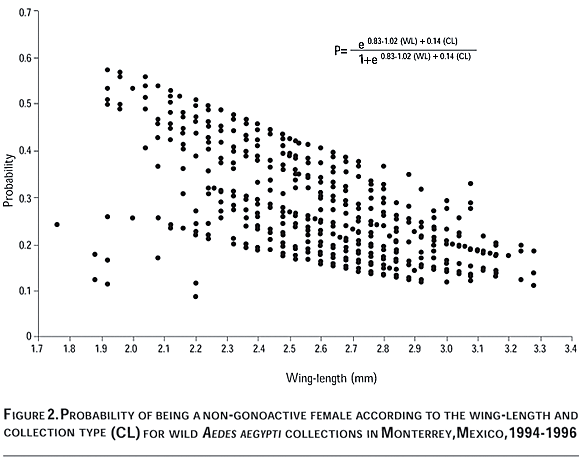
<body><![CDATA[<p><font size="3" face="Verdana"><b>Results</b> </font></p>     <p><font size="2" face="Verdana">One hundred and sixty four out of 600 <I>Ae aegypti</I>    mosquitoes (27%) that were fully fed and dissected from ten collections carried    out during 1994-1996 remained non-gonoactive, because they showed their ovaries    in Christophers stage I, II or IIa. Most of the (108/164=66%) non-gonoactive    females presented Christophers stage II; 53/164=32% exhibited the previtellogenic    stage I, and only 3/164=2% had ovaries in stage IIa. </font></p>     <p><font size="2" face="Verdana">Non-gonoactive females wing length ranged from    1.9 to 3.2 mm within the wing length entire range of 1.8-3.3 mm observed for    all mosquitoes collected in this study (<a href="#fig01">Figure 1</a>). A total    of 74% of the non-gonoactive mosquitoes were concentrated in three wing length    classes on each side of the median=2.5 mm. Thus, there were 122 non-gonoactive    females in the 2.2-2.8 mm range. In addition, 23 (14%) non-gonoactive mosquitoes    had the smallest wing length (range=1.9-2.1 mm), and 19 (12%) had the largest    one=2.9-3.2 mm, although there was none in the 3.1 mm class. Among the largest    non-gonoactives, 17 (10% out of 164) had a wing length longer than 2.9 mm (<a href="#fig01">Figure    1</a>). These largest non-gonoactive mosquitoes were obtained from four human-biting    collections and from resting captures.</font></p>     <p><a name="fig01"></a></p>     <p>&nbsp;</p>     <p align="center"><img src="/img/revistas/spm/v46n3/a07fig01.gif"></p>     <p>&nbsp;</p>     <p><font size="2" face="Verdana">In relation to collection date, the biting capture    of 1996 resulted in the highest number of non-gonoactive females (16%, 14%,    and 18%) in comparison with  3% of emerging    females from water drums, 8% from tires, and 6% and 8% from resting captures.    The Kruskal-Wallis test showed that the wing length average of the non-gonoactive    mosquitoes varied among collections (<font face="Symbol">c</font><SUP>2</SUP>=45.66,    df=9, <I>p</I>=0.0001); a similar finding was observed for the wing length average    of total females among collections (<font face="Symbol">c</font><SUP>2</SUP>=137.84,    df=9, <I>p</I>=0.0001) (<a href="#tab01">Table I</a>). Moreover, the smallest    non-gonoactive females (2.32±0.06 mm) corresponded to the biting collections    of 1996. The non-gonoactive females collected as pupae from tires were, in general,    at the middle of the size range of 2.56±0.08 mm, whereas the largest non-gonoactive    mosquitoes of 2.78±0.10 mm were found in resting collections (<a href="#tab01">Table    I</a>). </font></p>     <p><font size="2" face="Verdana">The overall logistic model to calculate the probability    of occurrence of a non-gonoactive female P(GI=1; as a binary variable) was highly    significant (<I>p</I>=0.0001) according to a likelihood-ratio <font face="Symbol">c</font><SUP>2</SUP>    test (-2 LOG L) with 1 df. The model accurately predicted 65% of the responses,    and the Nagelkerke's R<SUP>2</SUP> (max-rescaled R<SUP>2</SUP>) was 0.09. The    Wald <font face="Symbol">c</font><SUP>2</SUP> statistic showed significance    for the slope of both covariates, indicating that the WL as well as the CL had    a significant influence on the probability of incidence of a non-gonoactive    female in a sampling scheme (<a href="#tab02">Table II</a>, <a href="#fig02">Figure    2</a>). A negative slope (-1.02) for WL means that P(GI=1) decreases when the    WL increases. According to the slope values for both covariates, the WL had    a significant effect &#91;(1/exp(<font face="Symbol">b</font>)=2.77&#93; shown by the    odds ratio, and two-fold higher in comparison to the CL variable &#91;(1/exp(<font face="Symbol">b</font>)=1.15&#93;.</font></p>     <p><a name="tab02"></a></p>     ]]></body>
<body><![CDATA[<p>&nbsp;</p>     <p align="center"><img src="/img/revistas/spm/v46n3/a07tab02.gif"></p>     <p>&nbsp;</p>     <p><a name="fig02"></a></p>     <p>&nbsp;</p>     <p align="center"><img src="/img/revistas/spm/v46n3/a07fig02.gif"></p>     <p>&nbsp;</p>     <p><font size="2" face="Verdana">Finally, the observed and expected number of    non-gonoactive females per decile (Q<SUB>10</SUB>) along the whole sorted probability    scale were similar according to the Hosmer-Lemershow goodness of fit test (<font face="Symbol">c</font><SUP>2</SUP>=13.22,    8 df, <I>p</I>=0.10), and these values were also similar to the true number    of non-gonoactive mosquitoes collected in this study (<a href="#fig03">Figure    3</a>).</font></p>     <p><a name="fig03"></a></p>     <p>&nbsp;</p>     ]]></body>
<body><![CDATA[<p align="center"><img src="/img/revistas/spm/v46n3/a07fig03.gif"></p>     <p>&nbsp;</p>     <p><font size="3" face="Verdana"><b>Discussion </b></font></p>     <p><font size="2" face="Verdana">A body-size threshold of 2.9 mm, below which    <I>Ae aegypti</I> laboratory-raised females remain non-gonoactive after engorging    on human blood,<SUP>9</SUP> does not coincide with the wing length range found    in wild non-gonoactive populations of the dengue vector in Monterrey, Mexico.    In our results, 10% of the non-gonoactive females, which was approximately 3%    of the total number of collected mosquitoes of 600, had a large body size <u>&gt;</u>    2.9 mm. Further examination of the Feinsod and Spielman<SUP>9</SUP> data revealed    a similar result because they also observed large mosquitoes that failed to    mature eggs after their first human blood-engorgement. In one experiment, they    engorged 65 <I>Ae aegypti</I> females, out of which 11 (17%) remained non-gonoactive,    yet had a wing length of 3.0 mm. In <I>Anopheles, </I>the scenario does not    seem different because <I>An arabiensis</I> females that stayed non-gonoactive    had a mean wing length smaller than 2.97 ± 0.014 mm.<SUP>21</SUP> </font></p>     <p><font size="2" face="Verdana">A large female may not necessarily be a well-fed    mosquito, and she will not always become gonoactive after her first blood meal.    The amount of lipids deposited in <I>Ae aegypti </I>ovaries from blood meals    was similar in either small or large females, but glycogen levels were higher    in small mosquitoes.<SUP>22</SUP> This strategy has evolved to improve survival,    but compels small females to take a second blood meal before egg-laying. </font></p>     <p><font size="2" face="Verdana"> This could explain our observations: overall,    the higher the mean wing length in our mosquito collection, the lower the non-gonoactive    female number in that collection (<a href="#tab01">Table I</a>). </font></p>     <p><font size="2" face="Verdana">Our results suggest that the presence of large    <I>Ae aegypti</I> non-gonoactive females is usual in wild <I>Aedes aegypti</I>    populations. Regardless of the terms, there is a common trait between the "pregravid    females" of Gillies<SUP>11</SUP> and the non-gonoactive females found in this    study: both require at least a second blood meal to mature eggs. In addition,    it has been pointed out that in this species, there is always a proportion of    "pregravid" females varying from 5% to 10%, regardless of both larval density    and food amount during larval breeding.<SUP>8</SUP> Indeed, MacDonald<SUP>8</SUP>    also reported that in a small indoor-resting collection of 33 <I>Ae aegypti    </I>mosquitoes in Malaya, eight (24 %) did not develop eggs after ingesting    a replete human blood meal.<SUP>8</SUP> A similar proportion has been reported    in <I>Ae albopictus</I> field populations, in which 20% was the highest incidence    of non-gonoactive mosquitoes estimated from multiple blood meals per gonotrophic    cycle.<SUP>23</SUP> Our results revealed that the percentage of non-gonoactive    females that could be involved in three blood meals to repletion, including    the last one required to initiate the next gonotrophic cycle, was approximately    32% (those in stage I) of the total number of non-gonoactive females, and around    4% of the whole capture. Similarly, non-gonoactive females implicated in two    blood meals comprised around 68% (those in stage II and IIa) of the total number    of non-gonoactive females. Therefore, non-gonoactive mosquitoes in stage I from    Monterrey comprised a population that must ingest three blood meals in the same    gonotrophic cycle. Highly competent mosquitoes with multiple feedings increase    the human-vector contact rate, thus they may be associated with endemic areas    where the four serotypes of the DEN virus may be in circulation. It seems that    a few non-gonoactive females feeding indoors would be enough to produce a dengue    outbreak. </font></p>     <p><font size="2" face="Verdana">In conclusion, the prediction power of the logistic    regression to estimate the probability P(GI=1) of being a non-gonoactive wild    <I>Ae aegypti</I> mosquito, demonstrated to be an acceptable tool for field    surveys. These surveys could include biting, emerging, and resting mosquitoes,    and the logistic model will predict the frequency of non-gonoactive females    in the collections, with a known probability level, and in function of the wing    length and collection category as explanatory variables.</font></p>     <p>&nbsp;</p>     <p><font size="3" face="Verdana"><b>Acknowledgments </b></font></p>     ]]></body>
<body><![CDATA[<p><font size="2" face="Verdana">We express our gratefulness to Carolina Briceño    Dávila who was the responsible for dissection of most mosquitoes processed in    this study. We also thank to Dra. Olga Najarro from Universidad Valle de Bravo,    Tamaulipas, México, for an early review of the draft, and to the anonymous reviewer    of <I>Salud Pública de México </I>by relevant corrections done in the whole    manuscript. </font></p>     <p>&nbsp;</p>     <p><font size="3" face="Verdana"><b>References </b></font></p>     <!-- ref --><p><font size="2" face="Verdana">1. Sumanochitrapon W, Strickman D, Sithiprasasna    R, Kittayapong P, Innis BL. Effect of size and geographic origin of <I>Aedes    aegypti </I>on oral infection with dengue-2 virus. Am J Trop Med Hyg 1998;58:283-286.</font>&nbsp;&nbsp;&nbsp;&nbsp;&nbsp;&nbsp;&nbsp;&nbsp;[&#160;<a href="javascript:void(0);" onclick="javascript: window.open('/scielo.php?script=sci_nlinks&ref=9195724&pid=S0036-3634200400030001300001&lng=','','width=640,height=500,resizable=yes,scrollbars=1,menubar=yes,');">Links</a>&#160;]<!-- end-ref --><!-- ref --><p><font size="2" face="Verdana"> 2. Martínez-Ibarra JA, Rodríguez MH, Arredondo-Jiménez    JI, Yuval B. Influence of plant abundance on nectar feeding by <I>Aedes aegypti    </I>(Diptera: <I>Culicidae</I>) in southern    México. J Med Entomol 1997;34: 589-593.    </font>&nbsp;&nbsp;&nbsp;&nbsp;&nbsp;&nbsp;&nbsp;&nbsp;[&#160;<a href="javascript:void(0);" onclick="javascript: window.open('/scielo.php?script=sci_nlinks&ref=9195725&pid=S0036-3634200400030001300002&lng=','','width=640,height=500,resizable=yes,scrollbars=1,menubar=yes,');">Links</a>&#160;]<!-- end-ref --><!-- ref --><p><font size="2" face="Verdana">3. Scott TW, Naksathit A, Day JF, Kittayapong    P, Edman JD. A fitness advantage for <I>Aedes aegypti </I>and the viruses it    transmits when females fed only on human blood. Am J Trop Med Hyg 1997;57:235-239.    </font>&nbsp;&nbsp;&nbsp;&nbsp;&nbsp;&nbsp;&nbsp;&nbsp;[&#160;<a href="javascript:void(0);" onclick="javascript: window.open('/scielo.php?script=sci_nlinks&ref=9195726&pid=S0036-3634200400030001300003&lng=','','width=640,height=500,resizable=yes,scrollbars=1,menubar=yes,');">Links</a>&#160;]<!-- end-ref --><!-- ref --><p><font size="2" face="Verdana">4. Costero A, Edman JD, Clark GG, Scott TW. A    life table study of <I>Aedes aegypti </I>(Diptera: <I>Culicidae</I>) in Puerto    Rico fed only human blood <I>versus</I> blood plus sugar. J Med Entomol 1998;35:809-813.    </font>&nbsp;&nbsp;&nbsp;&nbsp;&nbsp;&nbsp;&nbsp;&nbsp;[&#160;<a href="javascript:void(0);" onclick="javascript: window.open('/scielo.php?script=sci_nlinks&ref=9195727&pid=S0036-3634200400030001300004&lng=','','width=640,height=500,resizable=yes,scrollbars=1,menubar=yes,');">Links</a>&#160;]<!-- end-ref --><!-- ref --><p><font size="2" face="Verdana">5. Christophers SR. The development of the egg    follicle in anophelines. Paludism 1911;2:73-88. </font>&nbsp;&nbsp;&nbsp;&nbsp;&nbsp;&nbsp;&nbsp;&nbsp;[&#160;<a href="javascript:void(0);" onclick="javascript: window.open('/scielo.php?script=sci_nlinks&ref=9195728&pid=S0036-3634200400030001300005&lng=','','width=640,height=500,resizable=yes,scrollbars=1,menubar=yes,');">Links</a>&#160;]<!-- end-ref --><!-- ref --><p><font size="2" face="Verdana">6. World Health Organization. Manual on practical    entomology in malaria. Part II. Methods and techniques. Ginebra WHO; 1975. (WHO    Offset Publication 13). </font>&nbsp;&nbsp;&nbsp;&nbsp;&nbsp;&nbsp;&nbsp;&nbsp;[&#160;<a href="javascript:void(0);" onclick="javascript: window.open('/scielo.php?script=sci_nlinks&ref=9195729&pid=S0036-3634200400030001300006&lng=','','width=640,height=500,resizable=yes,scrollbars=1,menubar=yes,');">Links</a>&#160;]<!-- end-ref --><!-- ref --><p><font size="2" face="Verdana">7. Clements AN. The biology of mosquitoes. Vol.    1. Development, nutrition and reproduction. London: Chapman &amp; Hall; 1992.    </font>&nbsp;&nbsp;&nbsp;&nbsp;&nbsp;&nbsp;&nbsp;&nbsp;[&#160;<a href="javascript:void(0);" onclick="javascript: window.open('/scielo.php?script=sci_nlinks&ref=9195730&pid=S0036-3634200400030001300007&lng=','','width=640,height=500,resizable=yes,scrollbars=1,menubar=yes,');">Links</a>&#160;]<!-- end-ref --><!-- ref --><p><font size="2" face="Verdana">8. MacDonald WW. <I>Aedes aegypti</I> in Malaya.    II. Larval and adult biology. Ann Trop Med Parasitol 1956;50:399-414. </font>&nbsp;&nbsp;&nbsp;&nbsp;&nbsp;&nbsp;&nbsp;&nbsp;[&#160;<a href="javascript:void(0);" onclick="javascript: window.open('/scielo.php?script=sci_nlinks&ref=9195731&pid=S0036-3634200400030001300008&lng=','','width=640,height=500,resizable=yes,scrollbars=1,menubar=yes,');">Links</a>&#160;]<!-- end-ref --><!-- ref --><p><font size="2" face="Verdana">9. Feinsod FM, Spielman A. Nutrient-mediated    juvenile hormone secretion in mosquitoes. J Insect Physiol 1980;26:113-117.    </font>&nbsp;&nbsp;&nbsp;&nbsp;&nbsp;&nbsp;&nbsp;&nbsp;[&#160;<a href="javascript:void(0);" onclick="javascript: window.open('/scielo.php?script=sci_nlinks&ref=9195732&pid=S0036-3634200400030001300009&lng=','','width=640,height=500,resizable=yes,scrollbars=1,menubar=yes,');">Links</a>&#160;]<!-- end-ref --><!-- ref --><p><font size="2" face="Verdana">10. Gillies MT. The recognition of age-groups    within populations of <I>Anopheles gambiae</I> by the pre-gravid rate and sporozoite    rate. Ann Trop Med Parasitol 1954;49:320-325. </font>&nbsp;&nbsp;&nbsp;&nbsp;&nbsp;&nbsp;&nbsp;&nbsp;[&#160;<a href="javascript:void(0);" onclick="javascript: window.open('/scielo.php?script=sci_nlinks&ref=9195733&pid=S0036-3634200400030001300010&lng=','','width=640,height=500,resizable=yes,scrollbars=1,menubar=yes,');">Links</a>&#160;]<!-- end-ref --><!-- ref --><p><font size="2" face="Verdana">11. Gillies MT. The pre-gravid phase of ovarian    development in <I>Anopheles funestus</I>. Ann Trop Med Parasitol 1955;49:320-325.    </font>&nbsp;&nbsp;&nbsp;&nbsp;&nbsp;&nbsp;&nbsp;&nbsp;[&#160;<a href="javascript:void(0);" onclick="javascript: window.open('/scielo.php?script=sci_nlinks&ref=9195734&pid=S0036-3634200400030001300011&lng=','','width=640,height=500,resizable=yes,scrollbars=1,menubar=yes,');">Links</a>&#160;]<!-- end-ref --><!-- ref --><p><font size="2" face="Verdana">12. Washino RK. The physiological ecology of    gonotrophic dissociation and related phenomena in mosquitoes. J Med Entomol    1977;13:381-388. </font>&nbsp;&nbsp;&nbsp;&nbsp;&nbsp;&nbsp;&nbsp;&nbsp;[&#160;<a href="javascript:void(0);" onclick="javascript: window.open('/scielo.php?script=sci_nlinks&ref=9195735&pid=S0036-3634200400030001300012&lng=','','width=640,height=500,resizable=yes,scrollbars=1,menubar=yes,');">Links</a>&#160;]<!-- end-ref --><!-- ref --><p><font size="2" face="Verdana">13. Lyimo EO, Takken W. Effects of adult body    size on fecundity and the pre-gravid rate of <I>Anopheles gambiae s.l</I>.    females in Tanzania. Med Vet Entomol 1993;7:328-332. </font>&nbsp;&nbsp;&nbsp;&nbsp;&nbsp;&nbsp;&nbsp;&nbsp;[&#160;<a href="javascript:void(0);" onclick="javascript: window.open('/scielo.php?script=sci_nlinks&ref=9195736&pid=S0036-3634200400030001300013&lng=','','width=640,height=500,resizable=yes,scrollbars=1,menubar=yes,');">Links</a>&#160;]<!-- end-ref --><!-- ref --><p><font size="2" face="Verdana">14. Instituto Nacional de Estadística, Geografía    e Informática. Carta Geográfica del Estado de Nuevo León. México DF: Gobierno    Federal, Secretaría de Programación y Presupuesto; 1986. </font>&nbsp;&nbsp;&nbsp;&nbsp;&nbsp;&nbsp;&nbsp;&nbsp;[&#160;<a href="javascript:void(0);" onclick="javascript: window.open('/scielo.php?script=sci_nlinks&ref=9195737&pid=S0036-3634200400030001300014&lng=','','width=640,height=500,resizable=yes,scrollbars=1,menubar=yes,');">Links</a>&#160;]<!-- end-ref --><!-- ref --><p><font size="2" face="Verdana">15. Salas-Luévano M, Reyes-Villanueva F. Variación    estacional de las poblaciones de <I>Aedes aegypti </I>en Monterrey, México.    Salud Publica Mex 1994;36:385-392. </font>&nbsp;&nbsp;&nbsp;&nbsp;&nbsp;&nbsp;&nbsp;&nbsp;[&#160;<a href="javascript:void(0);" onclick="javascript: window.open('/scielo.php?script=sci_nlinks&ref=9195738&pid=S0036-3634200400030001300015&lng=','','width=640,height=500,resizable=yes,scrollbars=1,menubar=yes,');">Links</a>&#160;]<!-- end-ref --><!-- ref --><p><font size="2" face="Verdana">16. Xue RD, Edman JD, Scott TW. Age and structure    effects on blood meal size and multiple blood feeding by <I>Aedes aegypti</I>    (Diptera: <I>Culicidae</I>). J Med Entomol 1995;32:471-474. </font>&nbsp;&nbsp;&nbsp;&nbsp;&nbsp;&nbsp;&nbsp;&nbsp;[&#160;<a href="javascript:void(0);" onclick="javascript: window.open('/scielo.php?script=sci_nlinks&ref=9195739&pid=S0036-3634200400030001300016&lng=','','width=640,height=500,resizable=yes,scrollbars=1,menubar=yes,');">Links</a>&#160;]<!-- end-ref --><!-- ref --><p><font size="2" face="Verdana">17. Zar JH. Biostatistical analysis. Prentice-Hall;    1974. </font>&nbsp;&nbsp;&nbsp;&nbsp;&nbsp;&nbsp;&nbsp;&nbsp;[&#160;<a href="javascript:void(0);" onclick="javascript: window.open('/scielo.php?script=sci_nlinks&ref=9195740&pid=S0036-3634200400030001300017&lng=','','width=640,height=500,resizable=yes,scrollbars=1,menubar=yes,');">Links</a>&#160;]<!-- end-ref --><!-- ref --><p><font size="2" face="Verdana">18. Schlotzauer SD, Littel RC. SAS system for    elementary analysis. Cary (NC); SAS Institute; 1987. </font>&nbsp;&nbsp;&nbsp;&nbsp;&nbsp;&nbsp;&nbsp;&nbsp;[&#160;<a href="javascript:void(0);" onclick="javascript: window.open('/scielo.php?script=sci_nlinks&ref=9195741&pid=S0036-3634200400030001300018&lng=','','width=640,height=500,resizable=yes,scrollbars=1,menubar=yes,');">Links</a>&#160;]<!-- end-ref --><!-- ref --><p><font size="2" face="Verdana">19. SAS. Logistic regression examples using the    SAS system, version 6. Cary (NC): SAS Institute; 1995. </font>&nbsp;&nbsp;&nbsp;&nbsp;&nbsp;&nbsp;&nbsp;&nbsp;[&#160;<a href="javascript:void(0);" onclick="javascript: window.open('/scielo.php?script=sci_nlinks&ref=9195742&pid=S0036-3634200400030001300019&lng=','','width=640,height=500,resizable=yes,scrollbars=1,menubar=yes,');">Links</a>&#160;]<!-- end-ref --><!-- ref --><p><font size="2" face="Verdana">20. Hosmer DW, Lemeshow S. Applied logistic regression.    John Wiley &amp; Sons; 1989. </font>&nbsp;&nbsp;&nbsp;&nbsp;&nbsp;&nbsp;&nbsp;&nbsp;[&#160;<a href="javascript:void(0);" onclick="javascript: window.open('/scielo.php?script=sci_nlinks&ref=9195743&pid=S0036-3634200400030001300020&lng=','','width=640,height=500,resizable=yes,scrollbars=1,menubar=yes,');">Links</a>&#160;]<!-- end-ref --><!-- ref --><p><font size="2" face="Verdana">21. Hogg JC, Thompson MC, Hurd H. Comparative    fecundity and associated factors for two sibling species of the <I>Anopheles    gambiae </I>complex occurring sympatrically in The Gambia. Med Vet Entomol 1996;10:385-391    </font>&nbsp;&nbsp;&nbsp;&nbsp;&nbsp;&nbsp;&nbsp;&nbsp;[&#160;<a href="javascript:void(0);" onclick="javascript: window.open('/scielo.php?script=sci_nlinks&ref=9195744&pid=S0036-3634200400030001300021&lng=','','width=640,height=500,resizable=yes,scrollbars=1,menubar=yes,');">Links</a>&#160;]<!-- end-ref --><!-- ref --><p><font size="2" face="Verdana">22. Naksathit AT, Edman JD, Scott TW. Amounts    of glycogen, lipid, and sugar in adult female <I>Aedes aegypti</I> (Diptera:    <I>Culicidae</I>) fed sucrose. J Med Entomol 1999,36:8-12. </font>&nbsp;&nbsp;&nbsp;&nbsp;&nbsp;&nbsp;&nbsp;&nbsp;[&#160;<a href="javascript:void(0);" onclick="javascript: window.open('/scielo.php?script=sci_nlinks&ref=9195745&pid=S0036-3634200400030001300022&lng=','','width=640,height=500,resizable=yes,scrollbars=1,menubar=yes,');">Links</a>&#160;]<!-- end-ref --><!-- ref --><p><font size="2" face="Verdana">23. Hawley WA. The biology of <I>Aedes albopictus</I>.    J Am Mosq Control Assoc 1988;(Suppl 1):40.</font>&nbsp;&nbsp;&nbsp;&nbsp;&nbsp;&nbsp;&nbsp;&nbsp;[&#160;<a href="javascript:void(0);" onclick="javascript: window.open('/scielo.php?script=sci_nlinks&ref=9195746&pid=S0036-3634200400030001300023&lng=','','width=640,height=500,resizable=yes,scrollbars=1,menubar=yes,');">Links</a>&#160;]<!-- end-ref --><p>&nbsp;</p>     <p>&nbsp;</p>     <p><font size="2" face="Verdana"><b>Adress reprint requests to</b>    <br>   Dr. Filiberto Reyes Villanueva    ]]></body>
<body><![CDATA[<br>   Universidad Autónoma de Nuevo León    <br>   Facultad de Ciencias Biológicas    <br>   Laboratorio de Entomología Médica    <br>   P.O. Box 109-F, 66450 San Nicolás de los Garza, Nuevo León, México    <br>   E-mail: <a href="mailto:frvi@prodigy.net.mx">frvi@prodigy.net.mx</a></font></p>     <p><font size="2" face="Verdana">Received on: july 24, 2003    <br>   Accepted on: march 5, 2004 </font></p>      ]]></body><back>
<ref-list>
<ref id="B1">
<label>1</label><nlm-citation citation-type="journal">
<person-group person-group-type="author">
<name>
<surname><![CDATA[Sumanochitrapon]]></surname>
<given-names><![CDATA[W]]></given-names>
</name>
<name>
<surname><![CDATA[Strickman]]></surname>
<given-names><![CDATA[D]]></given-names>
</name>
<name>
<surname><![CDATA[Sithiprasasna]]></surname>
<given-names><![CDATA[R]]></given-names>
</name>
<name>
<surname><![CDATA[Kittayapong]]></surname>
<given-names><![CDATA[P]]></given-names>
</name>
<name>
<surname><![CDATA[Innis]]></surname>
<given-names><![CDATA[BL]]></given-names>
</name>
</person-group>
<article-title xml:lang="en"><![CDATA[Effect of size and geographic origin of Aedes aegypti on oral infection with dengue-2 virus]]></article-title>
<source><![CDATA[Am J Trop Med Hyg]]></source>
<year>1998</year>
<volume>58</volume>
<page-range>283-286</page-range></nlm-citation>
</ref>
<ref id="B2">
<label>2</label><nlm-citation citation-type="journal">
<person-group person-group-type="author">
<name>
<surname><![CDATA[Martínez-Ibarra]]></surname>
<given-names><![CDATA[JA]]></given-names>
</name>
<name>
<surname><![CDATA[Rodríguez]]></surname>
<given-names><![CDATA[MH]]></given-names>
</name>
<name>
<surname><![CDATA[Arredondo-Jiménez]]></surname>
<given-names><![CDATA[JI]]></given-names>
</name>
<name>
<surname><![CDATA[Yuval]]></surname>
<given-names><![CDATA[B]]></given-names>
</name>
</person-group>
<article-title xml:lang="en"><![CDATA[Influence of plant abundance on nectar feeding by Aedes aegypti (Diptera: Culicidae) in southern México]]></article-title>
<source><![CDATA[J Med Entomol]]></source>
<year>1997</year>
<volume>34</volume>
<page-range>589-593</page-range></nlm-citation>
</ref>
<ref id="B3">
<label>3</label><nlm-citation citation-type="journal">
<person-group person-group-type="author">
<name>
<surname><![CDATA[Scott]]></surname>
<given-names><![CDATA[TW]]></given-names>
</name>
<name>
<surname><![CDATA[Naksathit]]></surname>
<given-names><![CDATA[A]]></given-names>
</name>
<name>
<surname><![CDATA[Day]]></surname>
<given-names><![CDATA[JF]]></given-names>
</name>
<name>
<surname><![CDATA[Kittayapong]]></surname>
<given-names><![CDATA[P]]></given-names>
</name>
<name>
<surname><![CDATA[Edman]]></surname>
<given-names><![CDATA[JD]]></given-names>
</name>
</person-group>
<article-title xml:lang="en"><![CDATA[A fitness advantage for Aedes aegypti and the viruses it transmits when females fed only on human blood]]></article-title>
<source><![CDATA[Am J Trop Med Hyg]]></source>
<year>1997</year>
<volume>57</volume>
<page-range>235-239</page-range></nlm-citation>
</ref>
<ref id="B4">
<label>4</label><nlm-citation citation-type="journal">
<person-group person-group-type="author">
<name>
<surname><![CDATA[Costero]]></surname>
<given-names><![CDATA[A]]></given-names>
</name>
<name>
<surname><![CDATA[Edman]]></surname>
<given-names><![CDATA[JD]]></given-names>
</name>
<name>
<surname><![CDATA[Clark]]></surname>
<given-names><![CDATA[GG]]></given-names>
</name>
<name>
<surname><![CDATA[Scott]]></surname>
<given-names><![CDATA[TW]]></given-names>
</name>
</person-group>
<article-title xml:lang="en"><![CDATA[A life table study of Aedes aegypti (Diptera: Culicidae) in Puerto Rico fed only human blood versus blood plus sugar]]></article-title>
<source><![CDATA[J Med Entomol]]></source>
<year>1998</year>
<volume>35</volume>
<page-range>809-813</page-range></nlm-citation>
</ref>
<ref id="B5">
<label>5</label><nlm-citation citation-type="journal">
<person-group person-group-type="author">
<name>
<surname><![CDATA[Christophers]]></surname>
<given-names><![CDATA[SR]]></given-names>
</name>
</person-group>
<article-title xml:lang="en"><![CDATA[The development of the egg follicle in anophelines]]></article-title>
<source><![CDATA[Paludism]]></source>
<year>1911</year>
<volume>2</volume>
<page-range>73-88</page-range></nlm-citation>
</ref>
<ref id="B6">
<label>6</label><nlm-citation citation-type="book">
<collab>World Health Organization</collab>
<source><![CDATA[Manual on practical entomology in malaria: Part II. Methods and techniques]]></source>
<year>1975</year>
<publisher-loc><![CDATA[Ginebra ]]></publisher-loc>
<publisher-name><![CDATA[WHO]]></publisher-name>
</nlm-citation>
</ref>
<ref id="B7">
<label>7</label><nlm-citation citation-type="book">
<person-group person-group-type="author">
<name>
<surname><![CDATA[Clements]]></surname>
<given-names><![CDATA[AN]]></given-names>
</name>
</person-group>
<source><![CDATA[The biology of mosquitoes. Vol. 1: Development, nutrition and reproduction]]></source>
<year>1992</year>
<publisher-loc><![CDATA[London ]]></publisher-loc>
<publisher-name><![CDATA[Chapman & Hall]]></publisher-name>
</nlm-citation>
</ref>
<ref id="B8">
<label>8</label><nlm-citation citation-type="journal">
<person-group person-group-type="author">
<name>
<surname><![CDATA[MacDonald]]></surname>
<given-names><![CDATA[WW]]></given-names>
</name>
</person-group>
<article-title xml:lang="en"><![CDATA[Aedes aegypti in Malaya. II.: Larval and adult biology]]></article-title>
<source><![CDATA[Ann Trop Med Parasitol]]></source>
<year>1956</year>
<volume>50</volume>
<page-range>399-414</page-range></nlm-citation>
</ref>
<ref id="B9">
<label>9</label><nlm-citation citation-type="journal">
<person-group person-group-type="author">
<name>
<surname><![CDATA[Feinsod]]></surname>
<given-names><![CDATA[FM]]></given-names>
</name>
<name>
<surname><![CDATA[Spielman]]></surname>
<given-names><![CDATA[A]]></given-names>
</name>
</person-group>
<article-title xml:lang="en"><![CDATA[Nutrient-mediated juvenile hormone secretion in mosquitoes]]></article-title>
<source><![CDATA[J Insect Physiol]]></source>
<year>1980</year>
<volume>26</volume>
<page-range>113-117</page-range></nlm-citation>
</ref>
<ref id="B10">
<label>10</label><nlm-citation citation-type="journal">
<person-group person-group-type="author">
<name>
<surname><![CDATA[Gillies]]></surname>
<given-names><![CDATA[MT]]></given-names>
</name>
</person-group>
<article-title xml:lang="en"><![CDATA[The recognition of age-groups within populations of Anopheles gambiae by the pre-gravid rate and sporozoite rate]]></article-title>
<source><![CDATA[Ann Trop Med Parasitol]]></source>
<year>1954</year>
<volume>49</volume>
<page-range>320-325</page-range></nlm-citation>
</ref>
<ref id="B11">
<label>11</label><nlm-citation citation-type="journal">
<person-group person-group-type="author">
<name>
<surname><![CDATA[Gillies]]></surname>
<given-names><![CDATA[MT]]></given-names>
</name>
</person-group>
<article-title xml:lang="en"><![CDATA[The pre-gravid phase of ovarian development in Anopheles funestus]]></article-title>
<source><![CDATA[Ann Trop Med Parasitol]]></source>
<year>1955</year>
<volume>49</volume>
<page-range>320-325</page-range></nlm-citation>
</ref>
<ref id="B12">
<label>12</label><nlm-citation citation-type="journal">
<person-group person-group-type="author">
<name>
<surname><![CDATA[Washino]]></surname>
<given-names><![CDATA[RK]]></given-names>
</name>
</person-group>
<article-title xml:lang="en"><![CDATA[The physiological ecology of gonotrophic dissociation and related phenomena in mosquitoes]]></article-title>
<source><![CDATA[J Med Entomol]]></source>
<year>1977</year>
<volume>13</volume>
<page-range>381-388</page-range></nlm-citation>
</ref>
<ref id="B13">
<label>13</label><nlm-citation citation-type="journal">
<person-group person-group-type="author">
<name>
<surname><![CDATA[Lyimo]]></surname>
<given-names><![CDATA[EO]]></given-names>
</name>
<name>
<surname><![CDATA[Takken]]></surname>
<given-names><![CDATA[W]]></given-names>
</name>
</person-group>
<article-title xml:lang="en"><![CDATA[Effects of adult body size on fecundity and the pre-gravid rate of Anopheles gambiae s. l. females in Tanzania]]></article-title>
<source><![CDATA[Med Vet Entomol]]></source>
<year>1993</year>
<volume>7</volume>
<page-range>328-332</page-range></nlm-citation>
</ref>
<ref id="B14">
<label>14</label><nlm-citation citation-type="book">
<collab>Instituto Nacional de Estadística^dGeografía e Informática</collab>
<source><![CDATA[Carta Geográfica del Estado de Nuevo León]]></source>
<year>1986</year>
<publisher-loc><![CDATA[México DF ]]></publisher-loc>
<publisher-name><![CDATA[Gobierno Federal, Secretaría de Programación y Presupuesto]]></publisher-name>
</nlm-citation>
</ref>
<ref id="B15">
<label>15</label><nlm-citation citation-type="journal">
<person-group person-group-type="author">
<name>
<surname><![CDATA[Salas-Luévano]]></surname>
<given-names><![CDATA[M]]></given-names>
</name>
<name>
<surname><![CDATA[Reyes-Villanueva]]></surname>
<given-names><![CDATA[F]]></given-names>
</name>
</person-group>
<article-title xml:lang="es"><![CDATA[Variación estacional de las poblaciones de Aedes aegypti en Monterrey, México]]></article-title>
<source><![CDATA[Salud Publica Mex]]></source>
<year>1994</year>
<volume>36</volume>
<page-range>385-392</page-range></nlm-citation>
</ref>
<ref id="B16">
<label>16</label><nlm-citation citation-type="journal">
<person-group person-group-type="author">
<name>
<surname><![CDATA[Xue]]></surname>
<given-names><![CDATA[RD]]></given-names>
</name>
<name>
<surname><![CDATA[Edman]]></surname>
<given-names><![CDATA[JD]]></given-names>
</name>
<name>
<surname><![CDATA[Scott]]></surname>
<given-names><![CDATA[TW]]></given-names>
</name>
</person-group>
<article-title xml:lang="en"><![CDATA[Age and structure effects on blood meal size and multiple blood feeding by Aedes aegypti (Diptera: Culicidae)]]></article-title>
<source><![CDATA[J Med Entomol]]></source>
<year>1995</year>
<volume>32</volume>
<page-range>471-474</page-range></nlm-citation>
</ref>
<ref id="B17">
<label>17</label><nlm-citation citation-type="book">
<person-group person-group-type="author">
<name>
<surname><![CDATA[Zar]]></surname>
<given-names><![CDATA[JH]]></given-names>
</name>
</person-group>
<source><![CDATA[Biostatistical analysis]]></source>
<year>1974</year>
<publisher-name><![CDATA[Prentice-Hall]]></publisher-name>
</nlm-citation>
</ref>
<ref id="B18">
<label>18</label><nlm-citation citation-type="book">
<person-group person-group-type="author">
<name>
<surname><![CDATA[Schlotzauer]]></surname>
<given-names><![CDATA[SD]]></given-names>
</name>
<name>
<surname><![CDATA[Littel]]></surname>
<given-names><![CDATA[RC]]></given-names>
</name>
</person-group>
<source><![CDATA[SAS system for elementary analysis]]></source>
<year>1987</year>
<publisher-loc><![CDATA[Cary (NC) ]]></publisher-loc>
<publisher-name><![CDATA[SAS Institute]]></publisher-name>
</nlm-citation>
</ref>
<ref id="B19">
<label>19</label><nlm-citation citation-type="book">
<collab>SAS</collab>
<source><![CDATA[Logistic regression examples using the SAS system, version 6]]></source>
<year>1995</year>
<publisher-loc><![CDATA[Cary (NC) ]]></publisher-loc>
<publisher-name><![CDATA[SAS Institute]]></publisher-name>
</nlm-citation>
</ref>
<ref id="B20">
<label>20</label><nlm-citation citation-type="book">
<person-group person-group-type="author">
<name>
<surname><![CDATA[Hosmer]]></surname>
<given-names><![CDATA[DW]]></given-names>
</name>
<name>
<surname><![CDATA[Lemeshow]]></surname>
<given-names><![CDATA[S]]></given-names>
</name>
</person-group>
<source><![CDATA[Applied logistic regression]]></source>
<year>1989</year>
<publisher-name><![CDATA[John Wiley & Sons]]></publisher-name>
</nlm-citation>
</ref>
<ref id="B21">
<label>21</label><nlm-citation citation-type="journal">
<person-group person-group-type="author">
<name>
<surname><![CDATA[Hogg]]></surname>
<given-names><![CDATA[JC]]></given-names>
</name>
<name>
<surname><![CDATA[Thompson]]></surname>
<given-names><![CDATA[MC]]></given-names>
</name>
<name>
<surname><![CDATA[Hurd]]></surname>
<given-names><![CDATA[H]]></given-names>
</name>
</person-group>
<article-title xml:lang="en"><![CDATA[Comparative fecundity and associated factors for two sibling species of the Anopheles gambiae complex occurring sympatrically in The Gambia]]></article-title>
<source><![CDATA[Med Vet Entomol]]></source>
<year>1996</year>
<volume>10</volume>
<page-range>385-391</page-range></nlm-citation>
</ref>
<ref id="B22">
<label>22</label><nlm-citation citation-type="journal">
<person-group person-group-type="author">
<name>
<surname><![CDATA[Naksathit]]></surname>
<given-names><![CDATA[AT]]></given-names>
</name>
<name>
<surname><![CDATA[Edman]]></surname>
<given-names><![CDATA[JD]]></given-names>
</name>
<name>
<surname><![CDATA[Scott]]></surname>
<given-names><![CDATA[TW]]></given-names>
</name>
</person-group>
<article-title xml:lang="en"><![CDATA[Amounts of glycogen, lipid, and sugar in adult female Aedes aegypti (Diptera: Culicidae) fed sucrose]]></article-title>
<source><![CDATA[J Med Entomol]]></source>
<year>1999</year>
<volume>36</volume>
<page-range>8-12</page-range></nlm-citation>
</ref>
<ref id="B23">
<label>23</label><nlm-citation citation-type="journal">
<person-group person-group-type="author">
<name>
<surname><![CDATA[Hawley]]></surname>
<given-names><![CDATA[WA]]></given-names>
</name>
</person-group>
<article-title xml:lang="en"><![CDATA[The biology of Aedes albopictus]]></article-title>
<source><![CDATA[J Am Mosq Control Assoc]]></source>
<year>1988</year>
<numero>^s1</numero>
<issue>^s1</issue>
<supplement>1</supplement>
<page-range>40</page-range></nlm-citation>
</ref>
</ref-list>
</back>
</article>