<?xml version="1.0" encoding="ISO-8859-1"?><article xmlns:mml="http://www.w3.org/1998/Math/MathML" xmlns:xlink="http://www.w3.org/1999/xlink" xmlns:xsi="http://www.w3.org/2001/XMLSchema-instance">
<front>
<journal-meta>
<journal-id>0036-3634</journal-id>
<journal-title><![CDATA[Salud Pública de México]]></journal-title>
<abbrev-journal-title><![CDATA[Salud pública Méx]]></abbrev-journal-title>
<issn>0036-3634</issn>
<publisher>
<publisher-name><![CDATA[Instituto Nacional de Salud Pública]]></publisher-name>
</publisher>
</journal-meta>
<article-meta>
<article-id>S0036-36342004000100005</article-id>
<title-group>
<article-title xml:lang="en"><![CDATA[Environmental exposure of commuters in Mexico City to volatile organic compounds as assessed by blood concentrations, 1998]]></article-title>
<article-title xml:lang="es"><![CDATA[Exposición ambiental a compuestos orgánicos volátiles evaluados en concentraciones sanguíneas en usuarios de transporte en la Ciudad de México, 1998]]></article-title>
</title-group>
<contrib-group>
<contrib contrib-type="author">
<name>
<surname><![CDATA[Lemire]]></surname>
<given-names><![CDATA[Sharon]]></given-names>
</name>
<xref ref-type="aff" rid="A01"/>
</contrib>
<contrib contrib-type="author">
<name>
<surname><![CDATA[Ashley]]></surname>
<given-names><![CDATA[David]]></given-names>
</name>
<xref ref-type="aff" rid="A01"/>
</contrib>
<contrib contrib-type="author">
<name>
<surname><![CDATA[Olaya]]></surname>
<given-names><![CDATA[Patricia]]></given-names>
</name>
<xref ref-type="aff" rid="A02"/>
</contrib>
<contrib contrib-type="author">
<name>
<surname><![CDATA[Romieu]]></surname>
<given-names><![CDATA[Isabelle]]></given-names>
</name>
<xref ref-type="aff" rid="A03"/>
</contrib>
<contrib contrib-type="author">
<name>
<surname><![CDATA[Welch]]></surname>
<given-names><![CDATA[Susan]]></given-names>
</name>
<xref ref-type="aff" rid="A01"/>
</contrib>
<contrib contrib-type="author">
<name>
<surname><![CDATA[Meneses-González]]></surname>
<given-names><![CDATA[Fernando]]></given-names>
</name>
<xref ref-type="aff" rid="A02"/>
</contrib>
<contrib contrib-type="author">
<name>
<surname><![CDATA[Hernández-Avila]]></surname>
<given-names><![CDATA[Mauricio]]></given-names>
</name>
<xref ref-type="aff" rid="A02"/>
</contrib>
</contrib-group>
<aff id="A01">
<institution><![CDATA[,National Center for Environmental Health/Centers for Disease Control and Prevention Division of Laboratory Sciences ]]></institution>
<addr-line><![CDATA[Atlanta Georgia]]></addr-line>
<country>EUA</country>
</aff>
<aff id="A02">
<institution><![CDATA[,Instituto Nacional de Salud Pública Centro de Investigación en Salud Poblacional ]]></institution>
<addr-line><![CDATA[Cuernavaca Morelos]]></addr-line>
<country>México</country>
</aff>
<aff id="A03">
<institution><![CDATA[,Pan American Health Organization  ]]></institution>
<addr-line><![CDATA[México DF]]></addr-line>
<country>México</country>
</aff>
<pub-date pub-type="pub">
<day>00</day>
<month>02</month>
<year>2004</year>
</pub-date>
<pub-date pub-type="epub">
<day>00</day>
<month>02</month>
<year>2004</year>
</pub-date>
<volume>46</volume>
<numero>1</numero>
<fpage>32</fpage>
<lpage>38</lpage>
<copyright-statement/>
<copyright-year/>
<self-uri xlink:href="http://www.scielo.org.mx/scielo.php?script=sci_arttext&amp;pid=S0036-36342004000100005&amp;lng=en&amp;nrm=iso"></self-uri><self-uri xlink:href="http://www.scielo.org.mx/scielo.php?script=sci_abstract&amp;pid=S0036-36342004000100005&amp;lng=en&amp;nrm=iso"></self-uri><self-uri xlink:href="http://www.scielo.org.mx/scielo.php?script=sci_pdf&amp;pid=S0036-36342004000100005&amp;lng=en&amp;nrm=iso"></self-uri><abstract abstract-type="short" xml:lang="en"><p><![CDATA[OBJECTIVE: To assess the extent of exposure for Volatile Organic Compounds (VOCs) among nonoccupationally exposed commuters in Mexico City. MATERIAL AND METHODS: Blood concentrations of benzene, toluene, ethylbenzene, m-/p-xylene, o-xylene and methyl tert-butyl ether were determined on samples collected from participants after the morning commute. RESULTS: Median blood concentrations of benzene (0.11 mg/l), ethylbenzene (0.081 mg/l), m-/p-xylene (0.32 mg/l) and toluene (0.56 mg/l) in the Mexico City participants were all approximately two times higher than in a nonsmoking subset of the Third National Health and Nutrition Examination Survey population of the United States. On the other hand, median VOC blood levels were similar to medians observed in other studies involving commuters in specific U.S. cities, despite the fact that only half the Mexico City study participants commuted by personal vehicles compared with all U.S. commuters. CONCLUSIONS: These results reflect the extent of the air pollution problem in Mexico City. The surrounding topography exacerbates the problems caused by heavy vehicular traffic, poor emission-control devices on older vehicles, and poor maintenance practices. Elevated levels of gasoline components in the blood of nonoccupationally exposed commuters emphasize the need for regulatory initiatives and mass-transit options to reduce hydrocarbon emissions and thus reduce the risk for nonoccupational exposure for the residents of Mexico City.]]></p></abstract>
<abstract abstract-type="short" xml:lang="es"><p><![CDATA[OBJETIVO: Evaluar la exposición a compuestos orgánicos volátiles en usuarios de transporte no expuestos ocupacionalmente en la Ciudad de México. MATERIAL Y MÉTODOS: Se determinaron las concentraciones sanguíneas de benceno, tolueno, etilbenceno, m/p-xileno, o-xileno y metil-terbutil éter en muestras obtenidas de participantes después del traslado matutino. RESULTADOS: Las concentraciones promedio de benceno en sangre (0.11mg/l), etilbenceno (0.081mg/l), m-/p-xileno (0.32mg/l) y tolueno (0.56mg/l) en los participantes de la Ciudad de México son aproximadamente dos veces más elevadas que en la submuestra de no fumadores de la Tercera Encuesta de Nutrición y Salud (Third National Health and Nutrition Examination Survey) en la población de Estados Unidos de América. Por otro lado, la mediana de los niveles de Compuestos Orgánicos Volátiles fueron similares a las medianas observadas en otros estudios de viajeros en ciudades de los Estados Unidos de América, no obstante el hecho de que sólo la mitad de los participantes de la Ciudad de México viajan en vehículos de uso personal, en comparación con los viajeros de los Estados Unidos de América. CONCLUSIONES: Estos resultados reflejan el problema de la contaminación ambiental en la Ciudad de México, donde la topografía que la rodea incrementa los problemas causados por el tráfico vehicular intenso, el bajo control de emisiones en los vehículos viejos y las pobres prácticas de mantenimiento. Los niveles altos de componentes de gasolina en la sangre de los viajeros no expuestos ocupacionalmente enfatizan la necesidad de iniciativas regulatorias y alternativas para disminuir el tráfico que reduzcan las emisiones de hidrocarburos y, en consecuencia, el riesgo de exposición no ocupacional para los residentes de la Ciudad de México.]]></p></abstract>
<kwd-group>
<kwd lng="en"><![CDATA[benzene]]></kwd>
<kwd lng="en"><![CDATA[blood benzene levels]]></kwd>
<kwd lng="en"><![CDATA[volatile organic compounds]]></kwd>
<kwd lng="en"><![CDATA[commuters]]></kwd>
<kwd lng="en"><![CDATA[Mexico]]></kwd>
<kwd lng="es"><![CDATA[benceno]]></kwd>
<kwd lng="es"><![CDATA[niveles sanguíneos de benceno]]></kwd>
<kwd lng="es"><![CDATA[compuestos orgánicos volátiles]]></kwd>
<kwd lng="es"><![CDATA[usuarios de transporte]]></kwd>
<kwd lng="es"><![CDATA[México]]></kwd>
</kwd-group>
</article-meta>
</front><body><![CDATA[ <p align="right"><font size="2" face="verdana"><b>ART&Iacute;CULO ORIGINAL</b></font></p>     <p>&nbsp;</p>     <p><font size="4" face="verdana"><b>Environmental exposure of commuters in Mexico    City to volatile organic compounds as assessed by blood concentrations, 1998</b></font></p>     <p>&nbsp;</p>     <p><font size="3" face="verdana"><b>Exposici&oacute;n ambiental a compuestos org&aacute;nicos    vol&aacute;tiles evaluados en concentraciones sangu&iacute;neas en usuarios    de transporte en la Ciudad de M&eacute;xico, 1998</b></font></p>     <p>&nbsp;</p>     <p>&nbsp;</p>     <p><font size="2" face="Verdana"> <b>Sharon Lemire, PhD<SUP>I</SUP>; David Ashley,    PhD<SUP>I</SUP>; Patricia Olaya, MSc<SUP>II</SUP>; Isabelle Romieu, DSc<SUP>III</SUP>;     Susan Welch, PhD<SUP>I</SUP>; Fernando Meneses-Gonz&aacute;lez, MSc<SUP>II</SUP>;    Mauricio Hern&aacute;ndez-Avila, DSc<SUP>II</SUP></b></font></p>     <p><font size="2" face="Verdana"><SUP>I</SUP>Division of Laboratory Sciences,    National Center for Environmental Health/Centers for Disease Control and Prevention.    Atlanta, Georgia, EUA    <br>   <SUP>II</SUP>Centro de Investigaci&oacute;n en Salud Poblacional, Instituto    Nacional de Salud P&uacute;blica. Cuernavaca, Morelos, M&eacute;xico    ]]></body>
<body><![CDATA[<br>   <SUP>III</SUP>Pan American Health Organization. M&eacute;xico, DF, M&eacute;xico</font></p>     <p>&nbsp;</p>     <p>&nbsp;</p> <hr size="1" noshade>     <p><font size="2" face="Verdana"><b>ABSTRACT</b></font></p>     <p><font size="2" face="Verdana"><B>OBJECTIVE</B><B>: </B>To assess the extent    of exposure for Volatile Organic Compounds (VOCs) among nonoccupationally exposed    commuters in Mexico City.    <br>   <B>MATERIAL AND METHODS: </B> Blood concentrations of benzene, toluene, ethylbenzene,    m-/p-xylene, o-xylene and methyl tert-butyl ether were determined on samples    collected from participants after the morning commute.     <br>   <B>RESULTS</B><B>: </B>Median blood concentrations of benzene (0.11 <font face="symbol">m</font>g/l),    ethylbenzene (0.081 <font face="symbol">m</font>g/l), m-/p-xylene (0.32 <font face="symbol">m</font>g/l)    and toluene (0.56 <font face="symbol">m</font>g/l) in the Mexico City participants    were all approximately two times higher than in a nonsmoking subset of the Third    National Health and Nutrition Examination Survey population of the United States.    On the other hand, median VOC blood levels were similar to medians observed    in other studies involving commuters in specific U.S. cities, despite the fact    that only half the Mexico City study participants commuted by personal vehicles    compared with all U.S. commuters.<B>    <br>   CONCLUSIONS</B><B>: </B>These results reflect the extent of the air pollution    problem in Mexico City. The surrounding topography exacerbates the problems    caused by heavy vehicular traffic, poor emission-control devices on older vehicles,    and poor maintenance practices. Elevated levels of gasoline components in the    blood of nonoccupationally exposed commuters emphasize the need for regulatory    initiatives and mass-transit options to reduce hydrocarbon emissions and thus    reduce the risk for nonoccupational exposure for the residents of Mexico City.    The English version of this paper is available too at: <a href="http://www.insp.mx/salud/index.html " target="_blank">http://www.insp.mx/salud/index.html    </a></font></p>     <p><font size="2" face="Verdana"><b>Key words:</b> benzene; blood benzene levels;    volatile organic compounds; commuters; Mexico </font></p> <hr size="1" noshade>     <p><font size="2" face="Verdana"><b>RESUMEN</b></font></p>     ]]></body>
<body><![CDATA[<p><font size="2" face="Verdana"><B>OBJETIVO: </B>Evaluar la exposici&oacute;n    a compuestos org&aacute;nicos vol&aacute;tiles en usuarios de transporte no    expuestos ocupacionalmente en la Ciudad de M&eacute;xico. <B>    <br>   MATERIAL Y M&Eacute;TODOS: </B> Se determinaron las concentraciones sangu&iacute;neas    de benceno, tolueno, etilbenceno, m/p-xileno, o-xileno y metil-terbutil &eacute;ter    en muestras obtenidas de participantes despu&eacute;s del traslado matutino.        <br>   <B>RESULTADOS: </B> Las concentraciones promedio de benceno en sangre (0.11<font face="symbol">m</font>g/l),    etilbenceno (0.081<font face="symbol">m</font>g/l), m-/p-xileno (0.32<font face="symbol">m</font>g/l)    y tolueno (0.56<font face="symbol">m</font>g/l) en los participantes de la Ciudad    de M&eacute;xico son aproximadamente dos veces m&aacute;s elevadas que en la    submuestra de no fumadores de la Tercera Encuesta de Nutrici&oacute;n y Salud    (Third National Health and Nutrition Examination Survey) en la poblaci&oacute;n    de Estados Unidos de Am&eacute;rica. Por otro lado, la mediana de los niveles    de Compuestos Org&aacute;nicos Vol&aacute;tiles fueron similares a las medianas    observadas en otros estudios de viajeros en ciudades de los Estados Unidos de    Am&eacute;rica, no obstante el hecho de que s&oacute;lo la mitad de los participantes    de la Ciudad de M&eacute;xico viajan en veh&iacute;culos de uso personal, en    comparaci&oacute;n con los viajeros de los Estados Unidos de Am&eacute;rica.        <br>   <B>CONCLUSIONES: </B> Estos resultados reflejan el problema de la contaminaci&oacute;n    ambiental en la Ciudad de M&eacute;xico, donde la topograf&iacute;a que la rodea    incrementa los problemas causados por el tr&aacute;fico vehicular intenso, el    bajo control de emisiones en los veh&iacute;culos viejos y las pobres pr&aacute;cticas    de mantenimiento. Los niveles altos de componentes de gasolina en la sangre    de los viajeros no expuestos ocupacionalmente enfatizan la necesidad de iniciativas    regulatorias y alternativas para disminuir el tr&aacute;fico que reduzcan las    emisiones de hidrocarburos y, en consecuencia, el riesgo de exposici&oacute;n    no ocupacional para los residentes de la Ciudad de M&eacute;xico. El texto completo    en ingl&eacute;s de este art&iacute;culo tambi&eacute;n est&aacute; disponible    en: <a href="http://www.insp.mx/salud/index.html" target="_blank">http://www.insp.mx/salud/index.html</a></font></p>     <p><font size="2" face="Verdana"><b>Palabras clave:</b> benceno; niveles sangu&iacute;neos    de benceno; compuestos org&aacute;nicos vol&aacute;tiles; usuarios de transporte;    M&eacute;xico</font></p> <hr size="1" noshade>     <p>&nbsp;</p>     <p>&nbsp;</p>     <p><font size="2" face="Verdana">Occupational exposure to benzene, a human carcinogen,    results in an increased risk for developing certain types of cancers,<SUP>1-4</SUP>    most notably leukemia. Additionally, nonoccupationally exposed populations may    be at risk because benzene may be carcinogenic at low levels of exposure over    the long term.<SUP>5</SUP> The primary nonoccupational sources of benzene exposure    are vehicle emissions (both vehicular exhaust and evaporative losses of fuel)    and tobacco smoke. Studies conducted in the United States<SUP>6</SUP> and the    United Kingdom<SUP>7</SUP> attributed 82% and 97%, respectively, of benzene    emissions to vehicular emissions. Although ambient air quality is monitored    in Mexico City, pollutant concentrations inside vehicles traveling in slow-moving,    high-density traffic are generally higher than concentrations in ambient air.<SUP>8-10</SUP>    Consequently, several studies have been conducted to measure the in-vehicle    exposures of commuters to vehicle emissions.<SUP>9-16</SUP> In a recent study    of populations in Mexico City that were occupationally exposed to gasoline fumes    and/or to vehicle emissions,<SUP>17</SUP> the most striking result was that    the unexposed control group (<I>n </I>= 10) exhibited higher median blood concentrations    for several volatile organic compounds (VOCs) in gasoline than an unexposed    US population. To confirm this result, we sampled a larger (<I>n</I>= 93) nonoccupationally    exposed population in Mexico City. Blood concentrations of benzene, toluene,    ethylbenzene, m-/p-xylene, o-xylene and methyl tert-butyl ether were measured    on samples collected from participants after the morning commute into Mexico    City. Toluene, ethylbenzene, and the xylenes, though not human carcinogens,    are often studied along with benzene because of similarities in chemical structure    and sources of exposure. Toluene is present in vehicle emissions and in tobacco    smoke and the others are present in vehicle emissions. Methyl tert-butyl ether,    a relatively recent additive to gasoline, has also been included because of    concern about various health effects that may be associated with its use. </font></p>     <p>&nbsp;</p>     <p><font size="3" face="Verdana"><b>Material and Methods </b></font></p>     ]]></body>
<body><![CDATA[<p><font size="2" face="Verdana">The study population consisted of a convenience    sample of adult volunteers working in a governmental office located in downtown    Mexico City. Participants were informed about the risks involved in participating    in the study and were asked to sign a consent form and to complete a questionnaire    that provided information on their sociodemographic characteristics and their    potential for exposure to VOCs. The study population was comprised of 93 volunteers    (48 women) ranging in age from 19 to 59 years (median age 30 years). All participants    were nonoccupationally exposed to gasoline fumes, but approximately 23 (25%)    were smokers, 76 (82%) reported having a gas boiler outside the house, others    used another appliance to heat the water, and 43 (45%) always kept the stove    pilot flame on. During the commute, participants were asked to avoid refueling    and smoking and to minimize exposure to environmental tobacco smoke. Each participant    provided a 10-ml blood sample immediately after arriving at the workplace. Blood    samples were obtained by venipuncture and collected into specially prepared    Vacutainer tubes (Becton Dickinson, Rutherford, NJ) containing a mixture of    potassium oxalate and sodium fluoride as an anticoagulant. </font></p>     <p><font size="2" face="Verdana"> As in the previous study,<SUP>17</SUP> blood    samples were analyzed at the Centers for Disease Control and Prevention (CDC)    in Atlanta, GA. Vacutainer tubes used in sample collection were previously treated    to remove VOC contaminants and examined to verify that the contaminants were    adequately removed.<SUP>18</SUP> Blood samples were maintained at 4 <SUP>0</SUP>C    during storage and shipment. Samples can    be stored in this manner for up to 7 weeks without measurably affecting the    results of the analyses.<SUP>19</SUP> The analysis was performed by purge-and-trap    gas chromatography isotope dilution mass spectrometry as described by Ashley    <I>et al</I>.<SUP>20</SUP> Briefly, samples, heated to 30<SUP>–0 </SUP>C,    were purged for 15 min with helium and trapped on Tenax (Tekmar-Dohrmann, Cincinnati,    OH). After dry purging for 6 min to remove absorbed water, the trap was thermally    desorbed at 180 <SUP>– 0</SUP>C for 4 min. The VOCs were cryogenically    trapped at the gas chromatograph (GC) injection port, then injected onto the    GC column by rapidly heating the cryogenic trap. Separation was obtained on    a DB-624 (J&amp;W Scientific, Inc., Folsom, CA) capillary GC column. High-resolution    mass spectrometry was performed at full scan over a mass range of 40-200 amu    at 1 scan/s on a VG 70S sector mass spectrometer (Micromass, Inc., Beverly,    MA). </font></p>     <p><font size="2" face="Verdana"> Before analysis, each sample was spiked with    stable isotopic analogs of the native compounds of interest. The responses of    specific ions from the unknown sample relative to the labeled analog were measured    against a six-point calibration curve to quantitate the results. </font></p>     <p><font size="2" face="Verdana"> Spiked blood samples were analyzed to determine    the accuracy and precision of the method, resulting in an estimated precision    of &lt;20% relative standard deviation. Method blanks were prepared from a water    source free of VOCs. The limits of detection (LODs) for the compounds reported    here are: benzene 0.010 <font face="symbol">m</font>g/l; ethylbenzene 0.031    <font face="symbol">m</font>g/l; o-xylene 0.050 <font face="symbol">m</font>g/l;    m-/p-xylene 0.019 <font face="symbol">m</font>g/l; toluene 0.016 <font face="symbol">m</font>g/l;    styrene 0.0083 <font face="symbol">m</font>g/l; and methyl tert-butyl ether    (MTBE) 0.021 <font face="symbol">m</font>g/l. </font></p>     <p><font size="2" face="Verdana"> The purge-and-trap method described here and    a similar method based on headspace analysis are the two methods commonly used    to measure VOCs in blood. Ashley <I>et al</I> have participated in inter-laboratory    comparisons to ensure comparable results between the two methods.<a name="tx"></a><a href="#nt">*</a>The    purge-and-trap method results in improved LODs as a consequence of more complete    removal of the VOCs from the sample matrix. </font></p>     <p><font size="2" face="Verdana"> Questions designed to eliminate participants    who may have been exposed to the components of gasoline fumes from sources other    than the morning commute did not lead to the removal of any subjects from the    data set. Data were analyzed using SAS statistical software (SAS Institute,    Inc., Cary, NC). The Shapiro and Wilk test indicated that the data were not    normally distribut ed (<I>p</I>= 0.0001) but were skewed to the right for most    analytes. Neither the square root nor the log transform successfully produced    a normal distribution for all analytes. For consistency, nonparametric methods    utilizing the Wilcoxon Rank Sum Test were used for all comparisons and significance    was determined at the 95% confidence level. Stratification of the data by smoking    status indicated a statistically significant difference (<I>p</I> &lt; 0.05)    for most VOCs, even for VOCs not associated with smoking. However, dimethylfuran,    which is considered a biomarker for smoking, was not significantly different.    These results and reports by most participants of smoking less than 10 cigarettes/day    suggested that the differences were not associated with smoking. Therefore,    the results presented are for all commuters, regardless of smoking status. Some    VOC values are missing for some of the participants because either the sample    volume was insufficient for analysis or the analysis was out of control for    the missing analyte(s) at the time the analysis was performed. The blood concentrations    are given in terms of the maximum, minimum, median, 90<SUP>th</SUP> and 95<SUP>th</SUP>    percentiles for benzene, ethylbenzene, m-/p-xylene, o-xylene, toluene and MTBE    (<a href="#tab01">Table I</a>). For statistical purposes, values listed as below    the detection limit were given values of half the LOD according to the method    by Nehls and Akland.<SUP>21</SUP> </font></p>     <p><a name="tab01"></a></p>     <p>&nbsp;</p>     <p align="center"><img src="/img/revistas/spm/v46n1/a05tab01.gif"></p>     <p>&nbsp;</p>     ]]></body>
<body><![CDATA[<p><font size="3" face="Verdana"><b>Results</b></font></p>     <p><font size="2" face="Verdana">The concentrations of the compounds related to    gasoline exposure that were measured in blood samples from Mexico City commuters    are presented in <a href="#tab01">Table I</a>. The primary means of commuting    was by automobile for 50% (45% by personal vehicles and 5% by taxi) of the subjects    and by bus for 45%; the remaining 5% designated either another (4%) or walking    (1%) as their primary mode of transportation. The levels of gasoline-related    compounds in the blood of automobile versus bus commuters would be expected    to differ on the basis of exposure to different fuel types (gasoline versus    diesel). However, in Mexico City there are two types of buses: diesel and gasoline-powered    microbuses. Because the study design did not allow for a distinction between    these two types of buses, an unknown number of bus commuters were also exposed    to gasoline-related compounds. Consequently, a comparison of the blood VOC concentrations    between participants who commuted by bus (median commute 75 min) and participants    who commuted by automobile (median commute 60 min) revealed no significant differences    (<I>p</I> = 0.05). Additionally, the blood concentrations for these compounds    might be expected to be highest for those participants with the longest commutes;    however, regression analyses performed    on each of the analytes showed no correlation (R<SUP>2</SUP> &lt;0.01) for either    mode of travel. The one-way commute to the workplace by automobile ranged from    2 to 120 min, and by all other means, from 5 to 180 min. </font></p>     <p><font size="2" face="Verdana"> Mexico City commuters had significantly lower    blood levels of benzene, ethylbenzene, m-/p-xylene and o-xylene (<I>p </I>&lt;    0.05) than the control group of beginning-shift office workers in the previous    Mexico City study.<SUP>17</SUP> A comparison of toluene and MTBE between commuters    and office workers, however, indicated no significant differences. Because blood    samples were taken after the morning commute from office workers who were not    occupationally exposed, VOC blood levels would be expected to be similar to    those of the commuters in the current study. However, the results indicate that,    even though commuters and office workers may have been exposed to similar sources    of toluene and MTBE during the commute, office workers may have been exposed    to additional sources of the other four compounds. Alternatively, the differences    may simply be due to analysis of a different population or to the small sample    size of the office workers. </font></p>     <p><font size="2" face="Verdana"> The Third National Health and Nutrition Examination    Survey (NHANES III) data are used as a reference range for the general U.S.    population.<SUP>22</SUP> A comparison of the current data to a nonsmoking subset    of the NHANES III data showed a significant difference in the distributions    of the two data sets (<I>p</I> &lt; 0.01) for all the VOCs, except for MTBE,    which was not measured in NHANES III. <a href="#tab02">Table II</a> shows the    median blood levels of benzene, ethylbenzene, m-/p-xylene, o-xylene, toluene    and MTBE for the Mexico City commuters compared with a nonsmoking subset of    the NHANES III population. For benzene, ethylbenzene, m-/p-xylene and toluene,    the medians for the commuters are approximately two to three times higher than    the medians for the NHANES III population, while the o-xylene results were approximately    the same. All the Mexico City participants are considered nonsmokers, because    the few who did smoke, smoked fewer than 10 cigarettes/day. </font></p>     <p><a name="tab02"></a></p>     <p>&nbsp;</p>     <p align="center"><img src="/img/revistas/spm/v46n1/a05tab02.gif"></p>     <p>&nbsp;</p>     <p><font size="3" face="Verdana"><b>Discussion</b></font></p>     <p><font size="2" face="Verdana">Median blood VOC levels for Mexico City commuters    are consistent with medians observed in other studies involving commuters (<a href="#tab02">Table    II</a>). Mexico City medians for benzene, ethylbenzene, and m-/p-xylene are    approximately midway between the median blood levels for commuters in Connecticut    and Alaska. For o-xylene, the medians are similar for Mexico City and Connecticut    commuters; the median for Alaska commuters is 2.5 times higher. The median blood    toluene level for commuters from Mexico City is 1.5 times higher than from Alaska    and three times higher than from Connecticut. Mexico City commuters also had    median blood MTBE levels two times higher than Connecticut commuters, even though    the percentage of MTBE added to gasoline in Mexico<SUP>23</SUP> (5%) is one    third that added to gasoline in the US (15%). The results for toluene and MTBE    indicate the possibility of additional sources of exposure in Mexico City. Additionally,    the topography surrounding Mexico City contributes to higher concentrations    of air pollutants in the city and this increased concentration may be responsible    for the elevated blood levels in commuters. Gasolines, formulated for maximum    performance according to weather conditions and temperature extremes, differ    seasonally as well as regionally. Thus, differences in the gasolines used in    the Alaska (winter), Connecticut (winter),    and Mexico City (spring) studies may partially account for the differences in    the blood. </font></p>     ]]></body>
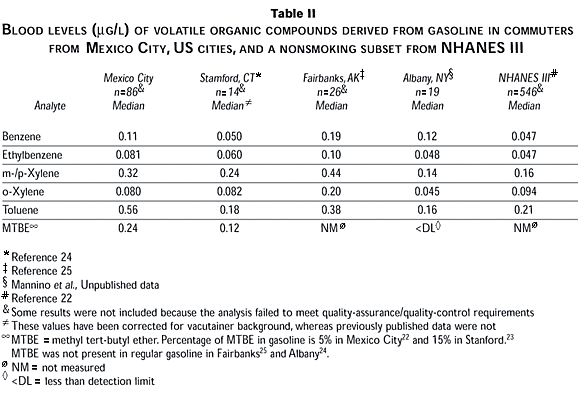
<body><![CDATA[<p><font size="2" face="Verdana"> The range of blood benzene levels (BBLs) for    Mexico City commuters is also consistent with ranges observed in the above studies    and studies of other nonoccupationally exposed persons (Figure 1). Mexico City    commuters had BBLs ranging from 0.028 to 0.57 ppb. White <I>et al</I><SUP>24</SUP>    observed BBLs ranging from the LOD (=0.030 ppb) to 0.51 ppb among 14 commuters    in Stamford, Connecticut. BBLs, ranging from 0.076 to 0.40 ppb, were observed    among 19 commuters in Albany, New York studied by Mannino <I><a name="tx02"></a>et    al</I><a href="#nt">**</a> Backer <I>et al</I><SUP>25</SUP> observed a range    of 0.080 to 0.65 ppb before pumping regular gasoline for 26 participants in    a Fairbanks, Alaska, study designed to measure exposure during refueling. For    NHANES III, the range is from the LOD (= 0.030 ppb) to 0.55 ppb. The other analytes    exhibited a similar trend. For all the above-mentioned studies, the same method    was used to analyze the blood samples as for the current study. Studies by Brugnone    <I>et al</I>., using a different analytical method, showed slightly higher BBLs    among 58 hospital staffers (range 0.015-1.7 ppb, median 0.23 ppb)<SUP>26</SUP>    and among 179 nonsmoking, nonoccupationally exposed workers from an urban area    (0.015 to 0.92 ppb, median 0.18 ppb). <SUP>27</SUP> </font></p>     <p><font size="2" face="Verdana"> Several studies<SUP>8,11,12,28-30 </SUP>have    measured commuter exposure indirectly by measuring in-vehicle VOCs and comparing    these values to ambient air measured at fixed monitoring stations. Chan <I>et    al</I><SUP>11</SUP> and Lawryk <I>et al</I><SUP>28</SUP> reported in-vehicle    medians for benzene (14, 15 <font face="symbol">m</font>g/m<SUP>3</SUP>), ethylbenzene    (11, 8.7 <font face="symbol">m</font>g/m<SUP>3</SUP>), m-/p-xylene (40, 34 <font face="symbol">m</font>g/m<SUP>3</SUP>),    o-xylene (15, 13 <font face="symbol">m</font>g/m<SUP>3</SUP>), and toluene (59,    54 <font face="symbol">m</font>g/m<SUP>3</SUP>) that were similar for Raleigh,    North Carolina and New York City/New Jersey area commuters, respectively. Ambient    concentrations were also similar except for the xylenes, which were approximately    two times higher in Raleigh. In-vehicle/ambient air concentration ratios for    these five VOCs indicated that in-vehicle concentrations ranged from 7 to 16    times higher than ambient air concentrations. Jo and Park<SUP>30</SUP> measured    median in-vehicle benzene and MTBE levels of 45 and 49 <font face="symbol">m</font>g/m<SUP>3</SUP>    in Korea that produced in-vehicle/ambient air ratios of 9 and 14, respectively.    By comparison, the ambient air concentration of benzene in Mexico City was 45    <font face="symbol">m</font>g/m<SUP>3 </SUP>(annual hourly mean) in 1995, similar    to in-vehicle concentrations in Korea, Duffy <I>et al</I><SUP>29</SUP> provide    an extensive table of in-vehicle benzene concentrations from previous studies.    High blood benzene levels in Mexican commuters may increase their risk of benzene-related    cancers; a study by Serrano<SUP>31</SUP> reported that the environmental concentration    of benzene as measured by personal monitoring was 17.5 <font face="symbol">m</font>g/m<SUP>3</SUP>    in Mexico City and the risk of acquired cancer was 1 x 10.<SUP>4</SUP></font></p>     <p><font size="2" face="Verdana"> In all these studies, in-vehicle concentrations    greatly exceed concentrations measured at monitoring stations that are often    situated several feet above and away from the roadway. The main sources of in-vehicle    exposure are the exhaust of nearby vehicles and vehicle self-contamination.<SUP>8</SUP>    Several factors, including the design and condition of engines and fuel-distribution    systems, ventilation conditions, traffic density and velocity, meteorological    factors, and gasoline compositions, can influence local VOC emissions and/or    commuter exposure levels from these sources. Lawryk <I>et al</I><SUP>28</SUP>    found roadway air to be the primary VOC source in vehicles with fuel injection    and properly functioning carburetors. On the other hand, both Lawryk <I>et al</I><SUP>28</SUP>    and Jo and Park<SUP>30</SUP> found that most in-vehicle VOCs were higher for    carbureted vehicles under low-ventilation conditions, indicating that carbureted    vehicles may be more self-contaminating than fuel injected vehicles. Lawryk    <I>et al</I><SUP>28</SUP> found that all substituted aromatics were two times    higher for carbureted vehicles; and Jo and Park<SUP>30</SUP> found that benzene    and MTBE were 3.5 times greater. In Mexico City, the microbuses and the majority    of automobiles are carbureted, thus vehicle self-contamination contributes to    the high levels of VOCs found in Mexico City commuters. </font> </p>     <p><font size="2" face="Verdana"> Measurements of gasoline-related compounds inside    vehicles have shown that models based on ambient air concentrations at monitoring    stations underestimate VOC exposure to commuters. This study assesses commuter    exposure by directly measuring the concentrations of these VOCs in the blood    of exposed persons. Median VOC blood levels in the Mexico City commuters were    two to three times higher than in the general US population represented by NHANES    III but were similar to blood levels for commuters in specific US cities. These    results confirm the conclusion of previous in-vehicle studies that an increase    in exposure to VOCs occurs during the commute. Lofgren <I>et al</I> have predicted    that commuters receive approximately 50% of their daily VOC exposure during    the commute,<SUP>9</SUP> and Wallace has stated that approximately 25% of benzene    exposure results from personal activities, primarily driving or riding in automobiles,    and approximately 25% from outdoor sources, primarily vehicle exhaust.<SUP>15</SUP>    In view of the health risks associated with exposure to gasoline-related compounds,    reducing the amount of exposure to these compounds during the commute is important.    As Duffy <I>et al</I><SUP>29</SUP> and Chan <I>et al</I><SUP>11</SUP> observed,    the most effective means for an individual to reduce personal exposure to exhaust    is by driving with the vents closed or with the air conditioner operating. In    Mexico City, buses do not have air conditioning, and although newer-model automobiles    do, few commuters use it, so that exposure to vehicle exhaust also contributes    to the increased levels of VOCs in the blood of the commuters. Providing air-conditioned    buses and promoting the use of air conditioners in automobiles so equipped would    reduce exposure from the exhaust of nearby vehicles. Additionally, Chan <I>et    al</I><SUP>11</SUP> found no significant difference in VOC levels between two    well-maintained vehicles of different ages, and Lawryk <I>et al</I><SUP>28</SUP>    observed much higher in-vehicle VOC levels in a malfunctioning vehicle than    in a correctly functioning one. These results suggest that routine maintenance    and regular inspections could significantly reduce in-vehicle exposures to gasoline-related    compounds. Chan <I>et al</I><SUP>12</SUP> found in-vehicle VOC concentrations    for urban routes to be about 1.5 times higher than on interstate routes. Thus,    reducing urban traffic density by improving mass-transportation options or traffic    flow through congested areas would also improve the quality of in-vehicle air.    </font></p>     <p><font size="2" face="Verdana"><b>Acknowledgments</b></font></p>     <p><font size="2" face="Verdana">We thank S. Caudill whose advice and guidance    were invaluable during statistical analysis of the data. </font></p>     <p>&nbsp;</p>     <p><font size="3" face="Verdana"><b>References</b></font></p>     <!-- ref --><p><font size="2" face="Verdana">1. Dean BJ. Recent findings on the genetic toxicology    of benzene, toluene, xylenes and phenols. Mutat Res 1985;154:153-181. </font>&nbsp;&nbsp;&nbsp;&nbsp;&nbsp;&nbsp;&nbsp;&nbsp;[&#160;<a href="javascript:void(0);" onclick="javascript: window.open('/scielo.php?script=sci_nlinks&ref=9232881&pid=S0036-3634200400010000500001&lng=','','width=640,height=500,resizable=yes,scrollbars=1,menubar=yes,');">Links</a>&#160;]<!-- end-ref --><!-- ref --><p><font size="2" face="Verdana">2.Hayes BR, Yin SN, Dosemeci M, Li GL, Wacholder    S, Travis LB <I>et al</I>. Benzene and the dose-related incidence of hematologic    neoplasm in China. J Natl Cancer Inst 1997; 89:1065-1071. </font>&nbsp;&nbsp;&nbsp;&nbsp;&nbsp;&nbsp;&nbsp;&nbsp;[&#160;<a href="javascript:void(0);" onclick="javascript: window.open('/scielo.php?script=sci_nlinks&ref=9232882&pid=S0036-3634200400010000500002&lng=','','width=640,height=500,resizable=yes,scrollbars=1,menubar=yes,');">Links</a>&#160;]<!-- end-ref --><!-- ref --><p><font size="2" face="Verdana">3. Lynge E, Andersen A, Nilsson R, Barlow L,    Pukkala E, Nordlinder R <I>et al</I> . Risk of cancer and exposure to gasoline    vapors. Am J Epidemiol 1997;145:449-458. </font>&nbsp;&nbsp;&nbsp;&nbsp;&nbsp;&nbsp;&nbsp;&nbsp;[&#160;<a href="javascript:void(0);" onclick="javascript: window.open('/scielo.php?script=sci_nlinks&ref=9232883&pid=S0036-3634200400010000500003&lng=','','width=640,height=500,resizable=yes,scrollbars=1,menubar=yes,');">Links</a>&#160;]<!-- end-ref --><!-- ref --><p><font size="2" face="Verdana">4. Rinsky RA, Young RJ, Smith AB. Leukemia in    benzene workers. Am J Ind Med 1981; 2:217-245. </font>&nbsp;&nbsp;&nbsp;&nbsp;&nbsp;&nbsp;&nbsp;&nbsp;[&#160;<a href="javascript:void(0);" onclick="javascript: window.open('/scielo.php?script=sci_nlinks&ref=9232884&pid=S0036-3634200400010000500004&lng=','','width=640,height=500,resizable=yes,scrollbars=1,menubar=yes,');">Links</a>&#160;]<!-- end-ref --><!-- ref --><p><font size="2" face="Verdana">5. US Public Health Service, Agency for Toxic    Substances and Disease Registry. Toxicological Profile for Benzene. Oak Ridge,    (TN): Oak Ridge National Laboratory, 1989. ATSDR/TP-88/03. </font>&nbsp;&nbsp;&nbsp;&nbsp;&nbsp;&nbsp;&nbsp;&nbsp;[&#160;<a href="javascript:void(0);" onclick="javascript: window.open('/scielo.php?script=sci_nlinks&ref=9232885&pid=S0036-3634200400010000500005&lng=','','width=640,height=500,resizable=yes,scrollbars=1,menubar=yes,');">Links</a>&#160;]<!-- end-ref --><!-- ref --><p><font size="2" face="Verdana">6. Wallace L. Major sources of exposure to benzene    and other volatile organic chemicals. Risk Anal 1990;10:59-64. </font>&nbsp;&nbsp;&nbsp;&nbsp;&nbsp;&nbsp;&nbsp;&nbsp;[&#160;<a href="javascript:void(0);" onclick="javascript: window.open('/scielo.php?script=sci_nlinks&ref=9232886&pid=S0036-3634200400010000500006&lng=','','width=640,height=500,resizable=yes,scrollbars=1,menubar=yes,');">Links</a>&#160;]<!-- end-ref --><!-- ref --><p><font size="2" face="Verdana">7. UK Department of the Environment. First Report:    Urban air quality in the United Kingdom. London, England: Quality of Urban Air    Review Group, 1993. </font>&nbsp;&nbsp;&nbsp;&nbsp;&nbsp;&nbsp;&nbsp;&nbsp;[&#160;<a href="javascript:void(0);" onclick="javascript: window.open('/scielo.php?script=sci_nlinks&ref=9232887&pid=S0036-3634200400010000500007&lng=','','width=640,height=500,resizable=yes,scrollbars=1,menubar=yes,');">Links</a>&#160;]<!-- end-ref --><!-- ref --><p><font size="2" face="Verdana">8. Leung PL, Harrison RM. Roadside and in-vehicle    concentrations of monoaromatic hydrocarbons. Atmospheric Environ 1999;33:191-204.    </font>&nbsp;&nbsp;&nbsp;&nbsp;&nbsp;&nbsp;&nbsp;&nbsp;[&#160;<a href="javascript:void(0);" onclick="javascript: window.open('/scielo.php?script=sci_nlinks&ref=9232888&pid=S0036-3634200400010000500008&lng=','','width=640,height=500,resizable=yes,scrollbars=1,menubar=yes,');">Links</a>&#160;]<!-- end-ref --><!-- ref --><p><font size="2" face="Verdana">9. L&ouml;fgren L, Persson K, Str&ouml;mvall    AM, Petersson G. Exposure of commuters to volatile aromatic hydrocarbons from    petrol exhaust. Sci Total Environ 1991; 108:225-233. </font>&nbsp;&nbsp;&nbsp;&nbsp;&nbsp;&nbsp;&nbsp;&nbsp;[&#160;<a href="javascript:void(0);" onclick="javascript: window.open('/scielo.php?script=sci_nlinks&ref=9232889&pid=S0036-3634200400010000500009&lng=','','width=640,height=500,resizable=yes,scrollbars=1,menubar=yes,');">Links</a>&#160;]<!-- end-ref --><!-- ref --><p><font size="2" face="Verdana">10. Serrano-Trespalacios P. Indicadores ambientales    de compuestos org&aacute;nicos vol&aacute;tiles en el aire ambiente de la Ciudad    de M&eacute;xico. En: CONSERVA 2, Salud. M&eacute;xico, DF: Departamento del    Distrito Federal,1998:154-269. </font>&nbsp;&nbsp;&nbsp;&nbsp;&nbsp;&nbsp;&nbsp;&nbsp;[&#160;<a href="javascript:void(0);" onclick="javascript: window.open('/scielo.php?script=sci_nlinks&ref=9232890&pid=S0036-3634200400010000500010&lng=','','width=640,height=500,resizable=yes,scrollbars=1,menubar=yes,');">Links</a>&#160;]<!-- end-ref --><!-- ref --><p><font size="2" face="Verdana">11. Chan CC, Ozkaynak H, Spengler JD, Sheldon    L. Driver exposure to volatile organic compounds, CO, ozone, and NO<SUB>2</SUB>    under different driving conditions. Environ Sci Technol 1991;25:964-972.</font>&nbsp;&nbsp;&nbsp;&nbsp;&nbsp;&nbsp;&nbsp;&nbsp;[&#160;<a href="javascript:void(0);" onclick="javascript: window.open('/scielo.php?script=sci_nlinks&ref=9232891&pid=S0036-3634200400010000500011&lng=','','width=640,height=500,resizable=yes,scrollbars=1,menubar=yes,');">Links</a>&#160;]<!-- end-ref --><!-- ref --><p><font size="2" face="Verdana"> 12. Chan CC, Spengler JD, Ozkaynak H, Lefkopoulou    M. Commuter exposures to VOCs in Boston, Massachusetts. J Air Waste Manag Assoc    1991; 41:1594-1600. </font>&nbsp;&nbsp;&nbsp;&nbsp;&nbsp;&nbsp;&nbsp;&nbsp;[&#160;<a href="javascript:void(0);" onclick="javascript: window.open('/scielo.php?script=sci_nlinks&ref=9232892&pid=S0036-3634200400010000500012&lng=','','width=640,height=500,resizable=yes,scrollbars=1,menubar=yes,');">Links</a>&#160;]<!-- end-ref --><!-- ref --><p><font size="2" face="Verdana">13. Chan CC, Lin SH, Her GR. Student's exposure    to volatile organic compounds while commuting by motorcycle and bus in Taipei    City. J Air Waste Manag Assoc 1993; 43:1231-1238. </font>&nbsp;&nbsp;&nbsp;&nbsp;&nbsp;&nbsp;&nbsp;&nbsp;[&#160;<a href="javascript:void(0);" onclick="javascript: window.open('/scielo.php?script=sci_nlinks&ref=9232893&pid=S0036-3634200400010000500013&lng=','','width=640,height=500,resizable=yes,scrollbars=1,menubar=yes,');">Links</a>&#160;]<!-- end-ref --><!-- ref --><p><font size="2" face="Verdana">14. Lawryk NJ, Weisel CP. Concentrations of volatile    organic compounds in the passenger compartment of automobiles. Environ Sci Technol    1996;30:810-816. </font>&nbsp;&nbsp;&nbsp;&nbsp;&nbsp;&nbsp;&nbsp;&nbsp;[&#160;<a href="javascript:void(0);" onclick="javascript: window.open('/scielo.php?script=sci_nlinks&ref=9232894&pid=S0036-3634200400010000500014&lng=','','width=640,height=500,resizable=yes,scrollbars=1,menubar=yes,');">Links</a>&#160;]<!-- end-ref --><!-- ref --><p><font size="2" face="Verdana">15. Wallace L. Major sources of benzene exposure.    Environ Health Perspect 1989; 82:165-169. </font>&nbsp;&nbsp;&nbsp;&nbsp;&nbsp;&nbsp;&nbsp;&nbsp;[&#160;<a href="javascript:void(0);" onclick="javascript: window.open('/scielo.php?script=sci_nlinks&ref=9232895&pid=S0036-3634200400010000500015&lng=','','width=640,height=500,resizable=yes,scrollbars=1,menubar=yes,');">Links</a>&#160;]<!-- end-ref --><!-- ref --><p><font size="2" face="Verdana">16. Fern&aacute;ndez-Bremauntz AA, Asmore MR.    Exposure of commuters to carbon monoxide in Mexico city II, Comparison of in-vehicle    and fixed-site concentrations. J Exp Anal Environ Epidemiol 1995;5:497-510.    </font>&nbsp;&nbsp;&nbsp;&nbsp;&nbsp;&nbsp;&nbsp;&nbsp;[&#160;<a href="javascript:void(0);" onclick="javascript: window.open('/scielo.php?script=sci_nlinks&ref=9232896&pid=S0036-3634200400010000500016&lng=','','width=640,height=500,resizable=yes,scrollbars=1,menubar=yes,');">Links</a>&#160;]<!-- end-ref --><!-- ref --><p><font size="2" face="Verdana">17. Romieu I, Ram&iacute;rez M, Meneses F, Ashley    D, Lemire S, Colome S <I>et al.</I> Environmental exposure to volatile organic    compounds among workers in Mexico City as assessed by personal monitors and    blood concentrations. Environ Health Perspect 1999:107:511-515. </font>&nbsp;&nbsp;&nbsp;&nbsp;&nbsp;&nbsp;&nbsp;&nbsp;[&#160;<a href="javascript:void(0);" onclick="javascript: window.open('/scielo.php?script=sci_nlinks&ref=9232897&pid=S0036-3634200400010000500017&lng=','','width=640,height=500,resizable=yes,scrollbars=1,menubar=yes,');">Links</a>&#160;]<!-- end-ref --><!-- ref --><p><font size="2" face="Verdana">18. Cardinali FL, McCraw JM, Ashley DL, Bonin    M, Wooten J. Treatment of vacutainers for use in the analysis of volatile organic    compounds in human blood at the low parts-per-trillion level. J Chromatogr Sci    1995;33:557-560. </font>&nbsp;&nbsp;&nbsp;&nbsp;&nbsp;&nbsp;&nbsp;&nbsp;[&#160;<a href="javascript:void(0);" onclick="javascript: window.open('/scielo.php?script=sci_nlinks&ref=9232898&pid=S0036-3634200400010000500018&lng=','','width=640,height=500,resizable=yes,scrollbars=1,menubar=yes,');">Links</a>&#160;]<!-- end-ref --><!-- ref --><p><font size="2" face="Verdana">19. Ashley DL, Bonin MA, Cardinali FL, McCraw    JM, Wooten JV, Needham LL. Important considerations in the ultratrace measurement    of volatile organic compounds in blood. In: Applications of Molecular Biology    in Environmental Chemistry. Boca Raton (FL):CRC Press, 1995;135-146. </font>&nbsp;&nbsp;&nbsp;&nbsp;&nbsp;&nbsp;&nbsp;&nbsp;[&#160;<a href="javascript:void(0);" onclick="javascript: window.open('/scielo.php?script=sci_nlinks&ref=9232899&pid=S0036-3634200400010000500019&lng=','','width=640,height=500,resizable=yes,scrollbars=1,menubar=yes,');">Links</a>&#160;]<!-- end-ref --><!-- ref --><p><font size="2" face="Verdana">20. Ashley D, Bonin MA, Cardinali FL, McCraw    JM, Holler JS, Needham LL <I>et al</I> .Determining volatile organic compounds    in human blood from a large sample population by using purge and trap gas chromatography/mass    spectrometry. Anal Chem 1992; 64:1021-1029. </font>&nbsp;&nbsp;&nbsp;&nbsp;&nbsp;&nbsp;&nbsp;&nbsp;[&#160;<a href="javascript:void(0);" onclick="javascript: window.open('/scielo.php?script=sci_nlinks&ref=9232900&pid=S0036-3634200400010000500020&lng=','','width=640,height=500,resizable=yes,scrollbars=1,menubar=yes,');">Links</a>&#160;]<!-- end-ref --><!-- ref --><p><font size="2" face="Verdana">21. Hornung RW, Reed LD. Estimation of average    concentration in the presence of nondetectable values. Appl Occup Environ Hyg    1990; 5:46-51. </font>&nbsp;&nbsp;&nbsp;&nbsp;&nbsp;&nbsp;&nbsp;&nbsp;[&#160;<a href="javascript:void(0);" onclick="javascript: window.open('/scielo.php?script=sci_nlinks&ref=9232901&pid=S0036-3634200400010000500021&lng=','','width=640,height=500,resizable=yes,scrollbars=1,menubar=yes,');">Links</a>&#160;]<!-- end-ref --><!-- ref --><p><font size="2" face="Verdana">22. Ashley DL, Bonin MA, Cardinali FL, McCraw    JM, Wooten JV. Blood concentrations of volatile organic compounds in a nonoccupationally    exposed U.S. population and in groups with suspected exposure. Clin Chem 1994;40:1401-1404.    </font>&nbsp;&nbsp;&nbsp;&nbsp;&nbsp;&nbsp;&nbsp;&nbsp;[&#160;<a href="javascript:void(0);" onclick="javascript: window.open('/scielo.php?script=sci_nlinks&ref=9232902&pid=S0036-3634200400010000500022&lng=','','width=640,height=500,resizable=yes,scrollbars=1,menubar=yes,');">Links</a>&#160;]<!-- end-ref --><!-- ref --><p><font size="2" face="Verdana">23. Petr&oacute;leos Mexicanos (Pemex refinaci&oacute;n).    Calidad de combustibles y proyectos ambientales. M&eacute;xico, DF: Pemex,1996.    </font>&nbsp;&nbsp;&nbsp;&nbsp;&nbsp;&nbsp;&nbsp;&nbsp;[&#160;<a href="javascript:void(0);" onclick="javascript: window.open('/scielo.php?script=sci_nlinks&ref=9232903&pid=S0036-3634200400010000500023&lng=','','width=640,height=500,resizable=yes,scrollbars=1,menubar=yes,');">Links</a>&#160;]<!-- end-ref --><!-- ref --><p><font size="2" face="Verdana">24. White MC, Johnson CA, Ashley DL, Buchta TM,    Pelletier DJ. Exposure to methyl tertiary-butyl ether from oxygenated gasoline    in Stamford, Connecticut. Arch Environ Health 1995; 50:183-189. </font>&nbsp;&nbsp;&nbsp;&nbsp;&nbsp;&nbsp;&nbsp;&nbsp;[&#160;<a href="javascript:void(0);" onclick="javascript: window.open('/scielo.php?script=sci_nlinks&ref=9232904&pid=S0036-3634200400010000500024&lng=','','width=640,height=500,resizable=yes,scrollbars=1,menubar=yes,');">Links</a>&#160;]<!-- end-ref --><!-- ref --><p><font size="2" face="Verdana">25. Backer LC, Egeland GM, Ashley DL, Lawryk    NJ, Weisel CP, White MC <I>et al</I>. Exposure to regular gasoline and ethanol    oxyfuel during refueling in Alaska. Environ Health Perspect 1997;105:850-855.    </font>&nbsp;&nbsp;&nbsp;&nbsp;&nbsp;&nbsp;&nbsp;&nbsp;[&#160;<a href="javascript:void(0);" onclick="javascript: window.open('/scielo.php?script=sci_nlinks&ref=9232905&pid=S0036-3634200400010000500025&lng=','','width=640,height=500,resizable=yes,scrollbars=1,menubar=yes,');">Links</a>&#160;]<!-- end-ref --><!-- ref --><p><font size="2" face="Verdana">26. Brugnone F, Perbellini L, Faccini GB, Pasini    F, Maranelli G, Romeo L <I>et al.</I> Breath and blood levels of benzene, toluene,    cumene and styrene in nonoccupational exposure. Int Arch Occup Environ Health    1989; 61:303-311. </font>&nbsp;&nbsp;&nbsp;&nbsp;&nbsp;&nbsp;&nbsp;&nbsp;[&#160;<a href="javascript:void(0);" onclick="javascript: window.open('/scielo.php?script=sci_nlinks&ref=9232906&pid=S0036-3634200400010000500026&lng=','','width=640,height=500,resizable=yes,scrollbars=1,menubar=yes,');">Links</a>&#160;]<!-- end-ref --><!-- ref --><p><font size="2" face="Verdana">27. Brugnone F, Perbellini L, Maranelli G, Romeo    L, Guglielmi G, Lombardini F. Reference values for blood benzene in the occupationally    unexposed general population. Int Arch Occup Environ Health 1992;64:179-184.    </font>&nbsp;&nbsp;&nbsp;&nbsp;&nbsp;&nbsp;&nbsp;&nbsp;[&#160;<a href="javascript:void(0);" onclick="javascript: window.open('/scielo.php?script=sci_nlinks&ref=9232907&pid=S0036-3634200400010000500027&lng=','','width=640,height=500,resizable=yes,scrollbars=1,menubar=yes,');">Links</a>&#160;]<!-- end-ref --><!-- ref --><p><font size="2" face="Verdana">28. Lawryk NJ, Lioy PJ, Weisel CP. Exposure to    volatile organic compounds in the passenger compartment of automobiles during    periods of normal and malfunctioning operation. J Exp Anal Environ Epidemiol    1995;5:511-531. </font>&nbsp;&nbsp;&nbsp;&nbsp;&nbsp;&nbsp;&nbsp;&nbsp;[&#160;<a href="javascript:void(0);" onclick="javascript: window.open('/scielo.php?script=sci_nlinks&ref=9232908&pid=S0036-3634200400010000500028&lng=','','width=640,height=500,resizable=yes,scrollbars=1,menubar=yes,');">Links</a>&#160;]<!-- end-ref --><!-- ref --><p><font size="2" face="Verdana">29. Duffy DL, Nelson PF. Exposure to emissions    of 1,3-butadiene and benzene in the cabins of moving motor vehicles and buses    in Sydney, Australia. Atmosph Environ 1997;31:3877-3885. </font>&nbsp;&nbsp;&nbsp;&nbsp;&nbsp;&nbsp;&nbsp;&nbsp;[&#160;<a href="javascript:void(0);" onclick="javascript: window.open('/scielo.php?script=sci_nlinks&ref=9232909&pid=S0036-3634200400010000500029&lng=','','width=640,height=500,resizable=yes,scrollbars=1,menubar=yes,');">Links</a>&#160;]<!-- end-ref --><!-- ref --><p><font size="2" face="Verdana">30. Jo WK, Park KH. Exposure to carbon monoxide,    methyl tertiary-butyl ether (MTBE) and benzene levels inside vehicles traveling    on an urban area in Korea. J Exp Anal Environ Epidemiol 1998;8:159-171. </font>&nbsp;&nbsp;&nbsp;&nbsp;&nbsp;&nbsp;&nbsp;&nbsp;[&#160;<a href="javascript:void(0);" onclick="javascript: window.open('/scielo.php?script=sci_nlinks&ref=9232910&pid=S0036-3634200400010000500030&lng=','','width=640,height=500,resizable=yes,scrollbars=1,menubar=yes,');">Links</a>&#160;]<!-- end-ref --><!-- ref --><p><font size="2" face="Verdana">31. Serrano-Trespalacios P. Evaluaci&oacute;n    de la exposici&oacute;n a compuestos org&aacute;nicos vol&aacute;tiles y riesgo    de c&aacute;ncer en la Ciudad de M&eacute;xico. En: CONSERVA 2, Salud. M&eacute;xico,    DF: Departamento del Distrito Federal,1998:282-291.</font>&nbsp;&nbsp;&nbsp;&nbsp;&nbsp;&nbsp;&nbsp;&nbsp;[&#160;<a href="javascript:void(0);" onclick="javascript: window.open('/scielo.php?script=sci_nlinks&ref=9232911&pid=S0036-3634200400010000500031&lng=','','width=640,height=500,resizable=yes,scrollbars=1,menubar=yes,');">Links</a>&#160;]<!-- end-ref --><p>&nbsp;</p>     ]]></body>
<body><![CDATA[<p>&nbsp;</p>     <p><font size="2" face="Verdana"><b>Address reprint requests to:</b> Sharon Lemire,    National Center for Environmental Health, Centers for Disease Control and Prevention,    4770, Buford Highway NE, Bldg 17 Loading Dock, Atlanta, GA 30341-3724, E-mail:    <a href="mailto:SGL4@CDC.GOV">SGL4@CDC.GOV</a></font></p>     <p><font size="2" face="Verdana">Received on: November 28, 2002<B>    <br>   </B>Accepted on: September 11, 2003     <br>   Grants: Mexican Ministry of Health, the Commission and Technology, Mexico (CONACyT    project 3786P-M); U.S. EPA; Department of the Federal District, Mexico; Pan    American Health Organization; National Center for Environmental Health, Centers    for Disease Control and Prevention; Oak Ridge Institute for Science and Education.    </font></p>     <p>&nbsp;</p>     <p>&nbsp;</p>     <p><font size="2" face="Verdana"> <a name="nt"></a><a href="#tx">*</a> Ashley    D. Quality Assurance Project/ BTX in Blood. Human Blood Samples for Interlab    Comparison. Atlanta (GA): Centers for Disease Control, Public Health Services,    US Department of Health and Human Services, 1997. Unpublished data.    <br>   <a href="#tx02">**</a> Mannino DM, Schreiber J, Aldous K, Ashley D, Moolenaar    R, Almaguer D. Unpublished data.</font></p>      ]]></body><back>
<ref-list>
<ref id="B1">
<label>1</label><nlm-citation citation-type="journal">
<person-group person-group-type="author">
<name>
<surname><![CDATA[Dean]]></surname>
<given-names><![CDATA[BJ]]></given-names>
</name>
</person-group>
<article-title xml:lang="en"><![CDATA[Recent findings on the genetic toxicology of benzene, toluene, xylenes and phenols]]></article-title>
<source><![CDATA[Mutat Res]]></source>
<year>1985</year>
<volume>154</volume>
<page-range>153-181</page-range></nlm-citation>
</ref>
<ref id="B2">
<label>2</label><nlm-citation citation-type="journal">
<person-group person-group-type="author">
<name>
<surname><![CDATA[Hayes]]></surname>
<given-names><![CDATA[BR]]></given-names>
</name>
<name>
<surname><![CDATA[Yin]]></surname>
<given-names><![CDATA[SN]]></given-names>
</name>
<name>
<surname><![CDATA[Dosemeci]]></surname>
<given-names><![CDATA[M]]></given-names>
</name>
<name>
<surname><![CDATA[Li]]></surname>
<given-names><![CDATA[GL]]></given-names>
</name>
<name>
<surname><![CDATA[Wacholder]]></surname>
<given-names><![CDATA[S]]></given-names>
</name>
<name>
<surname><![CDATA[Travis]]></surname>
<given-names><![CDATA[LB]]></given-names>
</name>
</person-group>
<article-title xml:lang="en"><![CDATA[Benzene and the dose-related incidence of hematologic neoplasm in China]]></article-title>
<source><![CDATA[J Natl Cancer Inst]]></source>
<year>1997</year>
<volume>89</volume>
<page-range>1065-1071</page-range></nlm-citation>
</ref>
<ref id="B3">
<label>3</label><nlm-citation citation-type="journal">
<person-group person-group-type="author">
<name>
<surname><![CDATA[Lynge]]></surname>
<given-names><![CDATA[E]]></given-names>
</name>
<name>
<surname><![CDATA[Andersen]]></surname>
<given-names><![CDATA[A]]></given-names>
</name>
<name>
<surname><![CDATA[Nilsson]]></surname>
<given-names><![CDATA[R]]></given-names>
</name>
<name>
<surname><![CDATA[Barlow]]></surname>
<given-names><![CDATA[L]]></given-names>
</name>
<name>
<surname><![CDATA[Pukkala]]></surname>
<given-names><![CDATA[E]]></given-names>
</name>
<name>
<surname><![CDATA[Nordlinder]]></surname>
<given-names><![CDATA[R]]></given-names>
</name>
</person-group>
<article-title xml:lang="en"><![CDATA[Risk of cancer and exposure to gasoline vapors]]></article-title>
<source><![CDATA[Am J Epidemiol]]></source>
<year>1997</year>
<volume>145</volume>
<page-range>449-458</page-range></nlm-citation>
</ref>
<ref id="B4">
<label>4</label><nlm-citation citation-type="journal">
<person-group person-group-type="author">
<name>
<surname><![CDATA[Rinsky]]></surname>
<given-names><![CDATA[RA]]></given-names>
</name>
<name>
<surname><![CDATA[Young]]></surname>
<given-names><![CDATA[RJ]]></given-names>
</name>
<name>
<surname><![CDATA[Smith]]></surname>
<given-names><![CDATA[AB]]></given-names>
</name>
</person-group>
<article-title xml:lang="en"><![CDATA[Leukemia in benzene workers]]></article-title>
<source><![CDATA[Am J Ind Med]]></source>
<year>1981</year>
<volume>2</volume>
<page-range>217-245</page-range></nlm-citation>
</ref>
<ref id="B5">
<label>5</label><nlm-citation citation-type="book">
<collab>US Public Health Service^dAgency for Toxic Substances and Disease Registry</collab>
<source><![CDATA[Toxicological Profile for Benzene]]></source>
<year>1989</year>
<publisher-loc><![CDATA[Oak Ridge^eTN TN]]></publisher-loc>
<publisher-name><![CDATA[Oak Ridge National Laboratory]]></publisher-name>
</nlm-citation>
</ref>
<ref id="B6">
<label>6</label><nlm-citation citation-type="journal">
<person-group person-group-type="author">
<name>
<surname><![CDATA[Wallace]]></surname>
<given-names><![CDATA[L]]></given-names>
</name>
</person-group>
<article-title xml:lang="en"><![CDATA[Major sources of exposure to benzene and other volatile organic chemicals]]></article-title>
<source><![CDATA[Risk Anal]]></source>
<year>1990</year>
<volume>10</volume>
<page-range>59-64</page-range></nlm-citation>
</ref>
<ref id="B7">
<label>7</label><nlm-citation citation-type="book">
<collab>UK Department of the Environment</collab>
<source><![CDATA[First Report: Urban air quality in the United Kingdom]]></source>
<year>1993</year>
<publisher-loc><![CDATA[London ]]></publisher-loc>
<publisher-name><![CDATA[Quality of Urban Air Review Group]]></publisher-name>
</nlm-citation>
</ref>
<ref id="B8">
<label>8</label><nlm-citation citation-type="journal">
<person-group person-group-type="author">
<name>
<surname><![CDATA[Leung]]></surname>
<given-names><![CDATA[PL]]></given-names>
</name>
<name>
<surname><![CDATA[Harrison]]></surname>
<given-names><![CDATA[RM]]></given-names>
</name>
</person-group>
<article-title xml:lang="en"><![CDATA[Roadside and in-vehicle concentrations of monoaromatic hydrocarbons]]></article-title>
<source><![CDATA[Atmospheric Environ]]></source>
<year>1999</year>
<volume>33</volume>
<page-range>191-204</page-range></nlm-citation>
</ref>
<ref id="B9">
<label>9</label><nlm-citation citation-type="journal">
<person-group person-group-type="author">
<name>
<surname><![CDATA[Löfgren]]></surname>
<given-names><![CDATA[L]]></given-names>
</name>
<name>
<surname><![CDATA[Persson]]></surname>
<given-names><![CDATA[K]]></given-names>
</name>
<name>
<surname><![CDATA[Strömvall]]></surname>
<given-names><![CDATA[AM]]></given-names>
</name>
<name>
<surname><![CDATA[Petersson]]></surname>
<given-names><![CDATA[G]]></given-names>
</name>
</person-group>
<article-title xml:lang="en"><![CDATA[Exposure of commuters to volatile aromatic hydrocarbons from petrol exhaust]]></article-title>
<source><![CDATA[Sci Total Environ]]></source>
<year>1991</year>
<volume>108</volume>
<page-range>225-233</page-range></nlm-citation>
</ref>
<ref id="B10">
<label>10</label><nlm-citation citation-type="book">
<person-group person-group-type="author">
<name>
<surname><![CDATA[Serrano-Trespalacios]]></surname>
<given-names><![CDATA[P.]]></given-names>
</name>
</person-group>
<article-title xml:lang="es"><![CDATA[Indicadores ambientales de compuestos orgánicos volátiles en el aire ambiente de la Ciudad de México]]></article-title>
<source><![CDATA[CONSERVA 2: Salud]]></source>
<year>1998</year>
<page-range>154-269</page-range><publisher-loc><![CDATA[México^eDF DF]]></publisher-loc>
<publisher-name><![CDATA[Departamento del Distrito Federal]]></publisher-name>
</nlm-citation>
</ref>
<ref id="B11">
<label>11</label><nlm-citation citation-type="journal">
<person-group person-group-type="author">
<name>
<surname><![CDATA[Chan]]></surname>
<given-names><![CDATA[CC]]></given-names>
</name>
<name>
<surname><![CDATA[Ozkaynak]]></surname>
<given-names><![CDATA[H]]></given-names>
</name>
<name>
<surname><![CDATA[Spengler]]></surname>
<given-names><![CDATA[JD]]></given-names>
</name>
<name>
<surname><![CDATA[Sheldon]]></surname>
<given-names><![CDATA[L]]></given-names>
</name>
</person-group>
<article-title xml:lang="en"><![CDATA[Driver exposure to volatile organic compounds, CO, ozone, and NO2 under different driving conditions]]></article-title>
<source><![CDATA[Environ Sci Technol]]></source>
<year>1991</year>
<volume>25</volume>
<page-range>964-972</page-range></nlm-citation>
</ref>
<ref id="B12">
<label>12</label><nlm-citation citation-type="journal">
<person-group person-group-type="author">
<name>
<surname><![CDATA[Chan]]></surname>
<given-names><![CDATA[CC]]></given-names>
</name>
<name>
<surname><![CDATA[Spengler]]></surname>
<given-names><![CDATA[JD]]></given-names>
</name>
<name>
<surname><![CDATA[Ozkaynak]]></surname>
<given-names><![CDATA[H]]></given-names>
</name>
<name>
<surname><![CDATA[Lefkopoulou]]></surname>
<given-names><![CDATA[M]]></given-names>
</name>
</person-group>
<article-title xml:lang="en"><![CDATA[Commuter exposures to VOCs in Boston, Massachusetts]]></article-title>
<source><![CDATA[J Air Waste Manag Assoc]]></source>
<year>1991</year>
<volume>41</volume>
<page-range>1594-1600</page-range></nlm-citation>
</ref>
<ref id="B13">
<label>13</label><nlm-citation citation-type="journal">
<person-group person-group-type="author">
<name>
<surname><![CDATA[Chan]]></surname>
<given-names><![CDATA[CC]]></given-names>
</name>
<name>
<surname><![CDATA[Lin]]></surname>
<given-names><![CDATA[SH]]></given-names>
</name>
<name>
<surname><![CDATA[Her]]></surname>
<given-names><![CDATA[GR]]></given-names>
</name>
</person-group>
<article-title xml:lang="en"><![CDATA[Student's exposure to volatile organic compounds while commuting by motorcycle and bus in Taipei City]]></article-title>
<source><![CDATA[J Air Waste Manag Assoc]]></source>
<year>1993</year>
<volume>43</volume>
<page-range>1231-1238</page-range></nlm-citation>
</ref>
<ref id="B14">
<label>14</label><nlm-citation citation-type="journal">
<person-group person-group-type="author">
<name>
<surname><![CDATA[Lawryk]]></surname>
<given-names><![CDATA[NJ]]></given-names>
</name>
<name>
<surname><![CDATA[Weisel]]></surname>
<given-names><![CDATA[CP]]></given-names>
</name>
</person-group>
<article-title xml:lang="en"><![CDATA[Concentrations of volatile organic compounds in the passenger compartment of automobiles]]></article-title>
<source><![CDATA[Environ Sci Technol]]></source>
<year>1996</year>
<volume>30</volume>
<page-range>810-816</page-range></nlm-citation>
</ref>
<ref id="B15">
<label>15</label><nlm-citation citation-type="journal">
<person-group person-group-type="author">
<name>
<surname><![CDATA[Wallace]]></surname>
<given-names><![CDATA[L]]></given-names>
</name>
</person-group>
<article-title xml:lang="en"><![CDATA[Major sources of benzene exposure]]></article-title>
<source><![CDATA[Environ Health Perspect]]></source>
<year>1989</year>
<volume>82</volume>
<page-range>165-169</page-range></nlm-citation>
</ref>
<ref id="B16">
<label>16</label><nlm-citation citation-type="journal">
<person-group person-group-type="author">
<name>
<surname><![CDATA[Fernández-Bremauntz]]></surname>
<given-names><![CDATA[AA]]></given-names>
</name>
<name>
<surname><![CDATA[Asmore]]></surname>
<given-names><![CDATA[MR]]></given-names>
</name>
</person-group>
<article-title xml:lang="en"><![CDATA[Exposure of commuters to carbon monoxide in Mexico city II, Comparison of in-vehicle and fixed-site concentrations]]></article-title>
<source><![CDATA[J Exp Anal Environ Epidemiol]]></source>
<year>1995</year>
<volume>5</volume>
<page-range>497-510</page-range></nlm-citation>
</ref>
<ref id="B17">
<label>17</label><nlm-citation citation-type="journal">
<person-group person-group-type="author">
<name>
<surname><![CDATA[Romieu]]></surname>
<given-names><![CDATA[I]]></given-names>
</name>
<name>
<surname><![CDATA[Ramírez]]></surname>
<given-names><![CDATA[M]]></given-names>
</name>
<name>
<surname><![CDATA[Meneses]]></surname>
<given-names><![CDATA[F]]></given-names>
</name>
<name>
<surname><![CDATA[Ashley]]></surname>
<given-names><![CDATA[D]]></given-names>
</name>
<name>
<surname><![CDATA[Lemire]]></surname>
<given-names><![CDATA[S]]></given-names>
</name>
<name>
<surname><![CDATA[Colome]]></surname>
<given-names><![CDATA[S]]></given-names>
</name>
</person-group>
<article-title xml:lang="en"><![CDATA[Environmental exposure to volatile organic compounds among workers in Mexico City as assessed by personal monitors and blood concentrations]]></article-title>
<source><![CDATA[Environ Health Perspect]]></source>
<year>1999</year>
<volume>107</volume>
<page-range>511-515</page-range></nlm-citation>
</ref>
<ref id="B18">
<label>18</label><nlm-citation citation-type="journal">
<person-group person-group-type="author">
<name>
<surname><![CDATA[Cardinali]]></surname>
<given-names><![CDATA[FL]]></given-names>
</name>
<name>
<surname><![CDATA[McCraw]]></surname>
<given-names><![CDATA[JM]]></given-names>
</name>
<name>
<surname><![CDATA[Ashley]]></surname>
<given-names><![CDATA[DL]]></given-names>
</name>
<name>
<surname><![CDATA[Bonin]]></surname>
<given-names><![CDATA[M]]></given-names>
</name>
<name>
<surname><![CDATA[Wooten]]></surname>
<given-names><![CDATA[J]]></given-names>
</name>
</person-group>
<article-title xml:lang="en"><![CDATA[Treatment of vacutainers for use in the analysis of volatile organic compounds in human blood at the low parts-per-trillion level]]></article-title>
<source><![CDATA[J Chromatogr Sci]]></source>
<year>1995</year>
<volume>33</volume>
<page-range>557-560</page-range></nlm-citation>
</ref>
<ref id="B19">
<label>19</label><nlm-citation citation-type="book">
<person-group person-group-type="author">
<name>
<surname><![CDATA[Ashley]]></surname>
<given-names><![CDATA[DL]]></given-names>
</name>
<name>
<surname><![CDATA[Bonin]]></surname>
<given-names><![CDATA[MA]]></given-names>
</name>
<name>
<surname><![CDATA[Cardinali]]></surname>
<given-names><![CDATA[FL]]></given-names>
</name>
<name>
<surname><![CDATA[McCraw]]></surname>
<given-names><![CDATA[JM]]></given-names>
</name>
<name>
<surname><![CDATA[Wooten]]></surname>
<given-names><![CDATA[JV]]></given-names>
</name>
<name>
<surname><![CDATA[Needham]]></surname>
<given-names><![CDATA[LL]]></given-names>
</name>
</person-group>
<article-title xml:lang="en"><![CDATA[Important considerations in the ultratrace measurement of volatile organic compounds in blood]]></article-title>
<source><![CDATA[Applications of Molecular Biology in Environmental Chemistry]]></source>
<year>1995</year>
<page-range>135-146</page-range><publisher-loc><![CDATA[Boca Raton^eFL FL]]></publisher-loc>
<publisher-name><![CDATA[CRC Press]]></publisher-name>
</nlm-citation>
</ref>
<ref id="B20">
<label>20</label><nlm-citation citation-type="journal">
<person-group person-group-type="author">
<name>
<surname><![CDATA[Ashley]]></surname>
<given-names><![CDATA[D]]></given-names>
</name>
<name>
<surname><![CDATA[Bonin]]></surname>
<given-names><![CDATA[MA]]></given-names>
</name>
<name>
<surname><![CDATA[Cardinali]]></surname>
<given-names><![CDATA[FL]]></given-names>
</name>
<name>
<surname><![CDATA[McCraw]]></surname>
<given-names><![CDATA[JM]]></given-names>
</name>
<name>
<surname><![CDATA[Holler]]></surname>
<given-names><![CDATA[JS]]></given-names>
</name>
<name>
<surname><![CDATA[Needham]]></surname>
<given-names><![CDATA[LL]]></given-names>
</name>
</person-group>
<article-title xml:lang="en"><![CDATA[Determining volatile organic compounds in human blood from a large sample population by using purge and trap gas chromatography/mass spectrometry]]></article-title>
<source><![CDATA[Anal Chem]]></source>
<year>1992</year>
<volume>64</volume>
<page-range>1021-1029</page-range></nlm-citation>
</ref>
<ref id="B21">
<label>21</label><nlm-citation citation-type="journal">
<person-group person-group-type="author">
<name>
<surname><![CDATA[Hornung]]></surname>
<given-names><![CDATA[RW]]></given-names>
</name>
<name>
<surname><![CDATA[Reed]]></surname>
<given-names><![CDATA[LD]]></given-names>
</name>
</person-group>
<article-title xml:lang="en"><![CDATA[Estimation of average concentration in the presence of nondetectable values]]></article-title>
<source><![CDATA[Appl Occup Environ Hyg]]></source>
<year>1990</year>
<volume>5</volume>
<page-range>46-51</page-range></nlm-citation>
</ref>
<ref id="B22">
<label>22</label><nlm-citation citation-type="journal">
<person-group person-group-type="author">
<name>
<surname><![CDATA[Ashley]]></surname>
<given-names><![CDATA[DL]]></given-names>
</name>
<name>
<surname><![CDATA[Bonin]]></surname>
<given-names><![CDATA[MA]]></given-names>
</name>
<name>
<surname><![CDATA[Cardinali]]></surname>
<given-names><![CDATA[FL]]></given-names>
</name>
<name>
<surname><![CDATA[McCraw]]></surname>
<given-names><![CDATA[JM]]></given-names>
</name>
<name>
<surname><![CDATA[Wooten]]></surname>
<given-names><![CDATA[JV.]]></given-names>
</name>
</person-group>
<article-title xml:lang="en"><![CDATA[Blood concentrations of volatile organic compounds in a nonoccupationally exposed U. S. population and in groups with suspected exposure]]></article-title>
<source><![CDATA[Clin Chem]]></source>
<year>1994</year>
<volume>40</volume>
<page-range>1401-1404</page-range></nlm-citation>
</ref>
<ref id="B23">
<label>23</label><nlm-citation citation-type="book">
<collab>Petróleos Mexicanos^dPemex refinación</collab>
<source><![CDATA[Calidad de combustibles y proyectos ambientales]]></source>
<year>1996</year>
<publisher-loc><![CDATA[México^eDF DF]]></publisher-loc>
<publisher-name><![CDATA[Pemex]]></publisher-name>
</nlm-citation>
</ref>
<ref id="B24">
<label>24</label><nlm-citation citation-type="journal">
<person-group person-group-type="author">
<name>
<surname><![CDATA[White]]></surname>
<given-names><![CDATA[MC]]></given-names>
</name>
<name>
<surname><![CDATA[Johnson]]></surname>
<given-names><![CDATA[CA]]></given-names>
</name>
<name>
<surname><![CDATA[Ashley]]></surname>
<given-names><![CDATA[DL]]></given-names>
</name>
<name>
<surname><![CDATA[Buchta]]></surname>
<given-names><![CDATA[TM]]></given-names>
</name>
<name>
<surname><![CDATA[Pelletier]]></surname>
<given-names><![CDATA[DJ]]></given-names>
</name>
</person-group>
<article-title xml:lang="en"><![CDATA[Exposure to methyl tertiary-butyl ether from oxygenated gasoline in Stamford, Connecticut]]></article-title>
<source><![CDATA[Arch Environ Health]]></source>
<year>1995</year>
<volume>50</volume>
<page-range>183-189</page-range></nlm-citation>
</ref>
<ref id="B25">
<label>25</label><nlm-citation citation-type="journal">
<person-group person-group-type="author">
<name>
<surname><![CDATA[Backer]]></surname>
<given-names><![CDATA[LC]]></given-names>
</name>
<name>
<surname><![CDATA[Egeland]]></surname>
<given-names><![CDATA[GM]]></given-names>
</name>
<name>
<surname><![CDATA[Ashley]]></surname>
<given-names><![CDATA[DL]]></given-names>
</name>
<name>
<surname><![CDATA[Lawryk]]></surname>
<given-names><![CDATA[NJ]]></given-names>
</name>
<name>
<surname><![CDATA[Weisel]]></surname>
<given-names><![CDATA[CP]]></given-names>
</name>
<name>
<surname><![CDATA[White]]></surname>
<given-names><![CDATA[MC]]></given-names>
</name>
</person-group>
<article-title xml:lang="en"><![CDATA[Exposure to regular gasoline and ethanol oxyfuel during refueling in Alaska]]></article-title>
<source><![CDATA[Environ Health Perspect]]></source>
<year>1997</year>
<volume>105</volume>
<page-range>850-855</page-range></nlm-citation>
</ref>
<ref id="B26">
<label>26</label><nlm-citation citation-type="journal">
<person-group person-group-type="author">
<name>
<surname><![CDATA[Brugnone]]></surname>
<given-names><![CDATA[F]]></given-names>
</name>
<name>
<surname><![CDATA[Perbellini]]></surname>
<given-names><![CDATA[L]]></given-names>
</name>
<name>
<surname><![CDATA[Faccini]]></surname>
<given-names><![CDATA[GB]]></given-names>
</name>
<name>
<surname><![CDATA[Pasini]]></surname>
<given-names><![CDATA[F]]></given-names>
</name>
<name>
<surname><![CDATA[Maranelli]]></surname>
<given-names><![CDATA[G]]></given-names>
</name>
<name>
<surname><![CDATA[Romeo]]></surname>
<given-names><![CDATA[L]]></given-names>
</name>
</person-group>
<article-title xml:lang="en"><![CDATA[Breath and blood levels of benzene, toluene, cumene and styrene in nonoccupational exposure]]></article-title>
<source><![CDATA[Int Arch Occup Environ Health]]></source>
<year>1989</year>
<volume>61</volume>
<page-range>303-311</page-range></nlm-citation>
</ref>
<ref id="B27">
<label>27</label><nlm-citation citation-type="journal">
<person-group person-group-type="author">
<name>
<surname><![CDATA[Brugnone]]></surname>
<given-names><![CDATA[F]]></given-names>
</name>
<name>
<surname><![CDATA[Perbellini]]></surname>
<given-names><![CDATA[L]]></given-names>
</name>
<name>
<surname><![CDATA[Maranelli]]></surname>
<given-names><![CDATA[G]]></given-names>
</name>
<name>
<surname><![CDATA[Romeo]]></surname>
<given-names><![CDATA[L]]></given-names>
</name>
<name>
<surname><![CDATA[Guglielmi]]></surname>
<given-names><![CDATA[G]]></given-names>
</name>
<name>
<surname><![CDATA[Lombardini]]></surname>
<given-names><![CDATA[F]]></given-names>
</name>
</person-group>
<article-title xml:lang="en"><![CDATA[Reference values for blood benzene in the occupationally unexposed general population]]></article-title>
<source><![CDATA[Int Arch Occup Environ Health]]></source>
<year>1992</year>
<volume>64</volume>
<page-range>179-184</page-range></nlm-citation>
</ref>
<ref id="B28">
<label>28</label><nlm-citation citation-type="journal">
<person-group person-group-type="author">
<name>
<surname><![CDATA[Lawryk]]></surname>
<given-names><![CDATA[NJ]]></given-names>
</name>
<name>
<surname><![CDATA[Lioy]]></surname>
<given-names><![CDATA[PJ]]></given-names>
</name>
<name>
<surname><![CDATA[Weisel]]></surname>
<given-names><![CDATA[CP]]></given-names>
</name>
</person-group>
<article-title xml:lang="en"><![CDATA[Exposure to volatile organic compounds in the passenger compartment of automobiles during periods of normal and malfunctioning operation]]></article-title>
<source><![CDATA[J Exp Anal Environ Epidemiol]]></source>
<year>1995</year>
<volume>5</volume>
<page-range>511-531</page-range></nlm-citation>
</ref>
<ref id="B29">
<label>29</label><nlm-citation citation-type="journal">
<person-group person-group-type="author">
<name>
<surname><![CDATA[Duffy]]></surname>
<given-names><![CDATA[DL]]></given-names>
</name>
<name>
<surname><![CDATA[Nelson]]></surname>
<given-names><![CDATA[PF]]></given-names>
</name>
</person-group>
<article-title xml:lang="en"><![CDATA[Exposure to emissions of 1,3-butadiene and benzene in the cabins of moving motor vehicles and buses in Sydney, Australia]]></article-title>
<source><![CDATA[Atmosph Environ]]></source>
<year>1997</year>
<volume>31</volume>
<page-range>3877-3885</page-range></nlm-citation>
</ref>
<ref id="B30">
<label>30</label><nlm-citation citation-type="journal">
<person-group person-group-type="author">
<name>
<surname><![CDATA[Jo]]></surname>
<given-names><![CDATA[WK]]></given-names>
</name>
<name>
<surname><![CDATA[Park]]></surname>
<given-names><![CDATA[KH]]></given-names>
</name>
</person-group>
<article-title xml:lang="en"><![CDATA[Exposure to carbon monoxide, methyl tertiary-butyl ether (MTBE) and benzene levels inside vehicles traveling on an urban area in Korea]]></article-title>
<source><![CDATA[J Exp Anal Environ Epidemiol]]></source>
<year>1998</year>
<volume>8</volume>
<page-range>159-171</page-range></nlm-citation>
</ref>
<ref id="B31">
<label>31</label><nlm-citation citation-type="book">
<person-group person-group-type="author">
<name>
<surname><![CDATA[Serrano-Trespalacios]]></surname>
<given-names><![CDATA[P.]]></given-names>
</name>
</person-group>
<article-title xml:lang="es"><![CDATA[Evaluación de la exposición a compuestos orgánicos volátiles y riesgo de cáncer en la Ciudad de México]]></article-title>
<source><![CDATA[CONSERVA 2: Salud]]></source>
<year>1998</year>
<page-range>282-291</page-range><publisher-loc><![CDATA[México^eDF DF]]></publisher-loc>
<publisher-name><![CDATA[Departamento del Distrito Federal]]></publisher-name>
</nlm-citation>
</ref>
</ref-list>
</back>
</article>
