<?xml version="1.0" encoding="ISO-8859-1"?><article xmlns:mml="http://www.w3.org/1998/Math/MathML" xmlns:xlink="http://www.w3.org/1999/xlink" xmlns:xsi="http://www.w3.org/2001/XMLSchema-instance">
<front>
<journal-meta>
<journal-id>0036-3634</journal-id>
<journal-title><![CDATA[Salud Pública de México]]></journal-title>
<abbrev-journal-title><![CDATA[Salud pública Méx]]></abbrev-journal-title>
<issn>0036-3634</issn>
<publisher>
<publisher-name><![CDATA[Instituto Nacional de Salud Pública]]></publisher-name>
</publisher>
</journal-meta>
<article-meta>
<article-id>S0036-36342004000100004</article-id>
<title-group>
<article-title xml:lang="en"><![CDATA[Low birth weight in Mexico: new evidence from a multi-site postpartum hospital survey]]></article-title>
<article-title xml:lang="es"><![CDATA[Bajo peso al nacer en México: nueva evidencia a partir de una encuesta postparto multi-hospitalaria]]></article-title>
</title-group>
<contrib-group>
<contrib contrib-type="author">
<name>
<surname><![CDATA[Frank]]></surname>
<given-names><![CDATA[Reanne]]></given-names>
</name>
<xref ref-type="aff" rid="A01"/>
</contrib>
<contrib contrib-type="author">
<name>
<surname><![CDATA[Pelcastre]]></surname>
<given-names><![CDATA[Blanca]]></given-names>
</name>
<xref ref-type="aff" rid="A02"/>
</contrib>
<contrib contrib-type="author">
<name>
<surname><![CDATA[Snyder]]></surname>
<given-names><![CDATA[Nelly Salgado de]]></given-names>
</name>
<xref ref-type="aff" rid="A02"/>
</contrib>
<contrib contrib-type="author">
<name>
<surname><![CDATA[Frisbie]]></surname>
<given-names><![CDATA[W Parker]]></given-names>
</name>
<xref ref-type="aff" rid="A03"/>
</contrib>
<contrib contrib-type="author">
<name>
<surname><![CDATA[Potter]]></surname>
<given-names><![CDATA[Joseph E]]></given-names>
</name>
<xref ref-type="aff" rid="A03"/>
</contrib>
<contrib contrib-type="author">
<name>
<surname><![CDATA[Bronfman-Pertzovsky]]></surname>
<given-names><![CDATA[Mario N]]></given-names>
</name>
<xref ref-type="aff" rid="A02"/>
</contrib>
</contrib-group>
<aff id="A01">
<institution><![CDATA[,The Ohio State University  ]]></institution>
<addr-line><![CDATA[ ]]></addr-line>
<country>Estados Unidos de América</country>
</aff>
<aff id="A02">
<institution><![CDATA[,Instituto Nacional de Salud Pública  ]]></institution>
<addr-line><![CDATA[Cuernavaca Morelos]]></addr-line>
<country>México</country>
</aff>
<aff id="A03">
<institution><![CDATA[,University of Texas at Austin  ]]></institution>
<addr-line><![CDATA[ ]]></addr-line>
<country>Estados Unidos de América</country>
</aff>
<pub-date pub-type="pub">
<day>00</day>
<month>02</month>
<year>2004</year>
</pub-date>
<pub-date pub-type="epub">
<day>00</day>
<month>02</month>
<year>2004</year>
</pub-date>
<volume>46</volume>
<numero>1</numero>
<fpage>23</fpage>
<lpage>31</lpage>
<copyright-statement/>
<copyright-year/>
<self-uri xlink:href="http://www.scielo.org.mx/scielo.php?script=sci_arttext&amp;pid=S0036-36342004000100004&amp;lng=en&amp;nrm=iso"></self-uri><self-uri xlink:href="http://www.scielo.org.mx/scielo.php?script=sci_abstract&amp;pid=S0036-36342004000100004&amp;lng=en&amp;nrm=iso"></self-uri><self-uri xlink:href="http://www.scielo.org.mx/scielo.php?script=sci_pdf&amp;pid=S0036-36342004000100004&amp;lng=en&amp;nrm=iso"></self-uri><abstract abstract-type="short" xml:lang="en"><p><![CDATA[OBJECTIVE: To identify factors related to cases of low birth weight among a sample of Mexican women. MATERIAL AND METHODS: The present analysis utilizes data from a post partum survey of 565 women implemented in eight different social security hospitals in western Mexico during 2001. Women giving birth to low weight infants (2.5 kgs) were oversampled and make up half of the sample. RESULTS: A series of logistic regression equations are presented that estimate the risk of low birth weight. Study findings indicate that, although behavioral factors appear to be highly significant in predicting the odds of low birth weight, socioeconomic and sociodemographic factors were found to be important in determining utilization of prenatal care. CONCLUSIONS: The key role of behavioral characteristics in determining low birth weight risk and the role of socioeconomic and sociodemographic factors in determining prenatal care usage highlights the need to improve prenatal care utilization by disadvantaged populations.]]></p></abstract>
<abstract abstract-type="short" xml:lang="es"><p><![CDATA[OBJETIVO: Objetivo. Identificar los factores relacionados con el bajo peso al nacer en mujeres mexicanas. MATERIAL Y MÉTODOS: Se analizan datos de una encuesta recientemente aplicada en 2001 a 565 mujeres en condición de posparto, en ocho hospitales de la Secretaría de Salud, en el Occidente de la República Mexicana, que permite una evaluación detallada de los factores que contribuyen al riesgo de bajo peso. La mitad de las mujeres había dado a luz a recién nacidos de bajo peso (menos de 2.5 kgs) y el resto de peso normal. Este trabajo presenta los resultados de una serie de regresiones logísticas que estiman el riesgo de bajo peso al nacer. RESULTADOS: Los resultados indican que mientras los factores de comportamiento están asociados significativamente al bajo peso al nacer, los factores sociodemográficos y socioeconómicos están más relacionados con la utilización de servicios de atención prenatal. CONCLUSIONES: El papel clave de las características de comportamiento en la determinación del riesgo del bajo peso y el papel de los factores sociodemográficos y socioeconómicos en la determinación de atención prenatal, enfatizan la necesidad de incrementar la utilización de servicios de atención prenatal por parte de los sectores más desfavorecidos de la población.]]></p></abstract>
<kwd-group>
<kwd lng="en"><![CDATA[low birth weight]]></kwd>
<kwd lng="en"><![CDATA[infant mortality]]></kwd>
<kwd lng="en"><![CDATA[infant health]]></kwd>
<kwd lng="en"><![CDATA[perinatal care]]></kwd>
<kwd lng="en"><![CDATA[Mexico]]></kwd>
<kwd lng="es"><![CDATA[bajo peso al nacer]]></kwd>
<kwd lng="es"><![CDATA[mortalidad infantil]]></kwd>
<kwd lng="es"><![CDATA[salud perinatal]]></kwd>
<kwd lng="es"><![CDATA[cuidado prenatal]]></kwd>
<kwd lng="es"><![CDATA[México]]></kwd>
</kwd-group>
</article-meta>
</front><body><![CDATA[ <p align="right"><font size="2" face="verdana"><b>ART&Iacute;CULO ORIGINAL</b></font></p>     <p>&nbsp;</p>     <p><font size="4" face="verdana"><b>Low birth weight in Mexico: new evidence from    a multi-site postpartum hospital survey </b></font></p>     <p>&nbsp;</p>     <p><font size="3" face="verdana"><b>Bajo peso al nacer en M&eacute;xico: nueva    evidencia a partir de una encuesta postparto multi-hospitalaria</b></font></p>     <p>&nbsp;</p>     <p>&nbsp;</p>     <p><font size="2" face="Verdana"><b>Reanne Frank, PhD<SUP>I</SUP>; Blanca Pelcastre,    PhD<SUP>II</SUP>; V Nelly Salgado de Snyder, PhD<SUP>II</SUP>; W    Parker Frisbie, PhD<SUP>III</SUP>; Joseph E Potter, PhD,<SUP>III</SUP>;    Mario N Bronfman-Pertzovsky, PhD<SUP>II</SUP></b></font></p>     <p><font size="2" face="Verdana"><SUP>I</SUP>The Ohio State University, Estados    Unidos de Am&eacute;rica    <br>  <SUP>II</SUP>Instituto Nacional de Salud    P&uacute;blica. Cuernavaca, Morelos, M&eacute;xico    ]]></body>
<body><![CDATA[<br>   <SUP>III</SUP>University of    Texas at Austin, Estados Unidos de Am&eacute;rica</font></p>     <p>&nbsp;</p>     <p>&nbsp;</p> <hr size="1" noshade>     <p><font size="2" face="Verdana"><b>ABSTRACT</b></font></p>     <p><font size="2" face="Verdana"><B>OBJECTIVE: </B>To identify factors related    to cases of low birth weight among a sample of Mexican women.     <br>   <B>MATERIAL AND METHODS: </B> The present analysis utilizes data from a post    partum survey of 565 women implemented in eight different social security hospitals    in western Mexico during 2001. Women giving birth to low weight infants (2.5    kgs) were oversampled and make up half of the sample.     <br>   <B>RESULTS</B><B>: </B>A series of logistic regression equations are presented    that estimate the risk of low birth weight. Study findings indicate that, although    behavioral factors appear to be highly significant in predicting the odds of    low birth weight, socioeconomic and sociodemographic factors were found to be    important in determining utilization of prenatal care. <B>    <br>   CONCLUSIONS</B><B>: </B>The key role of behavioral characteristics in determining    low birth weight risk and the role of socioeconomic and sociodemographic factors    in determining prenatal care usage highlights the need to improve prenatal care    utilization by disadvantaged populations. The English version of this paper    is available too at: <a href="http://www.insp.mx/salud/index.html" target="_blank">http://www.insp.mx/salud/index.html</a></font></p>     <p><font size="2" face="Verdana"><b>Key words:</b> low birth weight; infant mortality;    infant health; perinatal care; Mexico</font></p> <hr size="1" noshade>     <p><font size="2" face="Verdana"><b>RESUMEN</b></font></p>     ]]></body>
<body><![CDATA[<p><font size="2" face="Verdana"><B>OBJETIVO: </B>Objetivo. Identificar los factores    relacionados con el bajo peso al nacer en mujeres mexicanas.    <br>   <B>MATERIAL Y M&Eacute;TODOS: </B> Se analizan datos de una encuesta recientemente    aplicada en 2001 a 565 mujeres en condici&oacute;n de posparto, en ocho hospitales    de la Secretar&iacute;a de Salud, en el Occidente de la Rep&uacute;blica Mexicana,    que permite una evaluaci&oacute;n detallada de los factores que contribuyen    al riesgo de bajo peso. La mitad de las mujeres hab&iacute;a dado a luz a reci&eacute;n    nacidos de bajo peso (menos de 2.5 kgs) y el resto de peso normal. Este trabajo    presenta los resultados de una serie de regresiones log&iacute;sticas que estiman    el riesgo de bajo peso al nacer.    <br>   <B>RESULTADOS: </B>Los resultados indican que mientras los factores de comportamiento    est&aacute;n asociados significativamente al bajo peso al nacer, los factores    sociodemogr&aacute;ficos y socioecon&oacute;micos est&aacute;n m&aacute;s relacionados    con la utilizaci&oacute;n de servicios de atenci&oacute;n prenatal.    <br>   <B>CONCLUSIONES: </B>El papel clave de las caracter&iacute;sticas de comportamiento    en la determinaci&oacute;n del riesgo del bajo peso y el papel de los factores    sociodemogr&aacute;ficos y socioecon&oacute;micos en la determinaci&oacute;n    de atenci&oacute;n prenatal, enfatizan la necesidad de incrementar la utilizaci&oacute;n    de servicios de atenci&oacute;n prenatal por parte de los sectores m&aacute;s    desfavorecidos de la poblaci&oacute;n. El texto completo en ingl&eacute;s de    este art&iacute;culo tambi&eacute;n est&aacute; disponible en: <a href="http://www.insp.mx/salud/index.html" target="_blank">http://www.insp.mx/salud/index.html</a></font></p>     <p><font size="2" face="Verdana"><b>Palabras clave:</b> bajo peso al nacer; mortalidad    infantil; salud perinatal; cuidado prenatal; M&eacute;xico</font></p> <hr size="1" noshade>     <p>&nbsp;</p>     <p>&nbsp;</p>     <p><font size="2" face="Verdana"> Over the last century, great advances have been    made in Mexican perinatal health. In 1930, 178 of every 1 000 live births resulted    in an infant death. By 2002, this number had fallen to 21, a decrease of over    80 percent.<SUP>1,2</SUP> The uninterrupted continuous decline in Mexico's infant    mortality rate has largely been driven by improvements in socioeconomic development    and primary health care that have affected the causes of death most frequent    in the postnatal period (deaths occurring after 27 days and before 1 year of    age).<SUP>3</SUP> Beginning in 1980, when reliable data first became available,    infectious disease and respiratory infections accounted for over one half of    all infant deaths; by 2000, they represented less than one-fifth of all deaths.<SUP>4</SUP>    In turn, perinatal complications and congenital abnormalities now account for    over two thirds of all infant deaths. Due to these shifts in Mexico's distribution    of death causes, infant mortality has become increasingly concentrated in the    neonatal period (before 27 days of age) among premature and low birth weight    infants. As a result, low birth weight has become an increasingly important    factor in determining infant mortality risk (for an alternative perspective    see Wilcox 2001).<SUP>5</SUP> </font></p>     <p><font size="2" face="Verdana"> The purpose of the present analysis was to identify    factors related to low birth weight in Mexico, using a recent hospital-based    postpartum survey. By learning more about factors that contribute to low birth    weight, this research informs practices that aim to decrease infant mortality,    as well as the subsequent poorer child health and development outcomes that    continue to plague children of low birth weight later in life.<SUP>6</SUP> </font></p>     <p><font size="2" face="Verdana"> The analyses also focus on the receipt of prenatal    care, given the positive association between receipt of care and birth weight.<SUP>7</SUP>    Prenatal care includes educating women about pregnancy, labor and delivery,    linking women to other valuable social services, encouraging healthy lifestyle    choices, and identifying and treating maternal morbidities.<SUP>8,9</SUP> </font></p>     ]]></body>
<body><![CDATA[<p><font size="2" face="Verdana"> Much of the literature in the area of infant    health considers birth weight as an endpoint in a series of links between socioeconomic    background characteristics and more proximate determinants.<SUP>10,11 </SUP>Most    causally distant from low birth weight are social factors, including education    level, standard of living, and living conditions. Level of education and household    infrastructure are two socioeconomic variables most commonly operationalized    in infant health research in Mexico and both have been found to be inversely    related to the odds of low birth weight.<SUP>12,13 </SUP>Maternal work experience    has also been linked to low birth weight in Mexico, although the direction of    the relationship has been subject to debate. Several studies suggest that type    of work is a critical variable for determining the relationship. Women working    under mentally stressful working conditions, in laborious jobs, or working for    more than 50 hours a week, all experienced a significantly increased risk of    low-weight birth.<SUP>14,15 </SUP>Socioeconomic position interacts with sociodemographic    factors to influence an individual's social position. These include: young age,    first births, and unwed marital status, all of which have been linked to the    incidence of low-weight births.<SUP>13,16</SUP> </font></p>     <p><font size="2" face="Verdana"> While sociodemographic and socioeconomic factors    are important driving forces in determining health risks, they are not usually    considered to influence infant health outcomes directly. Rather, they contribute    to the incidence of low birth weight by patterning distributions along other    more proximate factors, such as behavioral or maternal lifestyle characteristics.<SUP>17    </SUP>These behaviors are influenced by socioeconomic background factors to    the degree that social position affects the ability to control everyday life    circumstances and influences major lifestyle choices. Maternal lifestyle behaviors    that have been shown to influence birth weight include: drug and alcohol use,    cigarette smoking, diet and nutrition, exercise, stress levels, vitamin use,    and prenatal care.<SUP>18 </SUP>Maternal lifestyle choices impinge on infant    health largely through biological pathways, and for this reason maternal health    indicators are the most proximately related to infant birth weight. </font></p>      <p>&nbsp;</p>     <p><font size="3" face="Verdana"><b>Material and Methods</b></font></p>     <p><font size="2" face="Verdana">The data used in this analysis come from a primary    data collection effort conducted in 2001. A hospital-based postpartum survey    (HPS) was administered to a sample of women who had given birth in one of eight    different hospitals located in the Mexican states of Jalisco and Michoac&aacute;n.    The focus of the survey was on factors related to low birth weight. </font></p>     <p><font size="2" face="Verdana"> The hospital sites were restricted to those    that fell under the umbrella of the Ministry of Health (Secretar&iacute;a de    Salud de M&eacute;xico-SSA), which provides health services to the uninsured    Mexican population, as one of the objectives of this survey was to examine the    relationship between low birth weight and disadvantaged social status. An over-sample    of low-weight births was conducted in order to ensure a sufficient sample size    with which to conduct reliable statistical analyses. Hospital records were used    to ascertain the volume of births occurring in each possible hospital     site and the prevalence of low birth weights among the births. The final eight    hospitals chosen represented a mix of technological sophistication and size.    </font></p>     <p><font size="2" face="Verdana"> The sample respondents were 565 women selected    based on the birth weight of their infant. In each hospital, trained female    interviewers (nurses, social workers) were instructed to invite every available    woman who had given birth to a low-weight infant during the data collection    period to take part in the survey. Among women who had given birth to a normal    weight infant, interviewers randomly selected the participants. Women were explained    the purpose of the study and consent was obtained prior to the interview. The    final sample size resulted in 565 infants, 257 low birth weight infants (&lt;    2 500 grams) and 308 normal weight infants (<u>&gt</u>2 500 grams). In all the analyses,    weights were utilized that adjust for the sampling design. </font></p>     <p><font size="2" face="Verdana"> In the first set of analyses, low birth weight    was the outcome of interest and was treated as a dichotomous variable so that    infants weighing less than 2 500 grams at birth were defined as low birth weight.    The data on infant birth weight were highly reliable as they were collected    directly from the hospital files. There were no missing cases for the outcome    variable. </font></p>     <p><font size="2" face="Verdana"> The sociodemographic factors included maternal    age, marital status, and parity status. Maternal age was coded using the three    categories that divide women into young (&lt;20 years), middle age (20-34 years),    and older mothers (35+), in order to capture the often curvilinear shape of    maternal age and infant health distribution. Parity was operationalized using    the Kleinman and Kessel Index,<SUP>19 </SUP>in which birth order and maternal    age are combined to result in three categories: a) First birth; b) Low parity    (second-order births to women 18 and older, third order births to women 25 and    older), and c) High parity (second- or higher-order births to women under 18,    third- or higher-order births to women under 25, and fourth- and higher-order    births to women 25 and older. Marital status was measured at the beginning of    the pregnancy and differentiates between formal and informal unions. </font></p>     <p><font size="2" face="Verdana"> The socioeconomic indicators chosen for this    analysis included those that have in the past proven important in contributing    to health outcomes in Mexico.<SUP>20 </SUP>Maternal education level was coded    to distinguish between women who had received no formal education, women who    have had less than a primary school education (&lt;6 years) and women who had    completed primary school or more. Also, women who reported working at any time    during the pregnancy were differentiated from women who did not work at all    during their pregnancy. With regard to socioeconomic context variables, a dichotomous    indicator measuring locality size was included to differentiate large metropolitan    areas (100 000+ inhabitants) from areas with less than 100 000 inhabitants.    A measure of household infrastructure as a proxy for general socioeconomic condition    was also included. Women were asked a series of questions concerning the household    infrastructure of the house in which they spent the majority of their pregnancy.    Lack of indoor sanitation or water facilities, lack of electricity, and the    presence of dirt floors, were all considered indicators of poor household infrastructure.    These indicators were then added to count the number of household infrastructure    problems. In the descriptive statistics, each of the indicators is presented    separately, and in the regression models the number of household infrastructure    problems is included as a continuous variable. </font></p>     ]]></body>
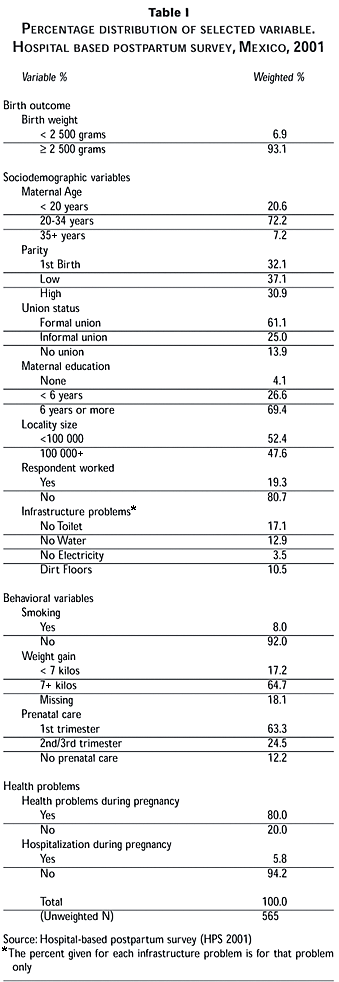
<body><![CDATA[<p><font size="2" face="Verdana"> With regard to behavioral practices, three measures    were included as general indicators of a healthy maternal lifestyle and have    been identified in past literature as linked to the prevalence of low birth    weight.<SUP>18 </SUP>They include maternal smoking, prenatal care utilization,    and maternal weight gain during pregnancy. In this analysis, women who smoked    at any point during their pregnancy were coded as smokers. With regard to weight    gain, each respondent was asked how much weight she gained during her pregnancy,    if she did not know the answer, she was assigned to a missing category. Women    were defined as gaining an insufficient amount of weight if they gained less    than 7 kilograms during the pregnancy.<SUP>21 </SUP>A third measure of maternal    lifestyle involved having obtained prenatal care. In the models predicting birth    weight, prenatal care was captured with a three-level variable that differentiates    between the time of the first prenatal care visit, as timing is a key component    determining the adequacy of prenatal care.<SUP>22 </SUP>Based on whether the    respondent attended her first prenatal care visit within the first three months    of pregnancy, she was coded as having received prenatal care either early or    late in pregnancy. The definition of prenatal care was restricted to health    care that is provided by a physician or a nurse. </font></p>     <p><font size="2" face="Verdana"> Maternal health is a key intervening variable    for risk of low birth weight. The analysis included several medical indicators    that captured the general health of respondents during pregnancy. Respondents    who were hospitalized at any time during the pregnancy were differentiated from    those who were not. Furthermore, women who reported having any of the following    problems during pregnancy were coded as having experienced health problems:    vaginal bleeding, urinary tract infection, bladder infection, other infection,    diabetes, premature labor pains, high fever,    weakness/fatigue, hypertension/high blood pressure, nervios, other health problems.    These conditions were based on self-report and were not obtained from medical    records. Although subjective health reporting has been found to be a reliable    indicator of overall health status, it remains inferior to medical reports with    regard to the reporting of specific conditions. Thus, the distributions of health    problems should be treated with caution.<SUP>23</SUP> </font></p>     <p><font size="2" face="Verdana"> Following a description of the distribution    of birth weight and risk factors, two sets of models were constructed. The first    uses logistic regression to estimate the effect of three different sets of covariates    on the likelihood of giving birth to a low weight infant. Nested models were    built hierarchically to evaluate the exploratory power of the different sets    of factors. The first model included sociodemographic and socioeconomic background    factors, the most causally distant from low birth weight. The second model added    maternal lifestyle factors, through which the background factors are understood    to influence infant health. The third model included maternal health indicators,    which are the most causally proximate to low birth weight. </font></p>     <p><font size="2" face="Verdana"> The second set of models used logistic regression    to estimate the effects of two sets of covariates on the likelihood of receiving    prenatal care. By modeling receipt of prenatal care, we hoped to better understand    the factors influencing care utilization. When prenatal care was included as    the dependent variable, it was measured dichotomously as whether or not the    respondent received some type of prenatal care by a physician or nurse during    the pregnancy, regardless of the timing of the initial visit. The first model    added the sociodemographic and socioeconomic factors in order to evaluate if    the odds of receiving prenatal care differed by sub-group. A second model added    controls for maternal health problems, which may provide a stimulus for women    to actively seek out prenatal care. </font></p>     <p><font size="2" face="Verdana"> The survey was based on a sample design that    involved stratification by month, hospital, and birth weight. Weights were created    based on the inverse of the selection probability. The regression models were    run using Stata 7 software, which adjusts coefficients and standard errors to    take the sampling design into account.<SUP>24 </SUP></font></p>     <p>&nbsp;</p>     <p><font size="3" face="Verdana"><b>Results</b> </font></p>     <p><font size="2" face="Verdana"><a href="#tab01">Table I</a> presents the percentage    distribution of the variables used in the analysis. Around 7% of the births    in the sample were low birth weight, a figure that closely matches those obtained    in Mexican national samples. The complete sample was characterized by infants    whose mothers were between 20-34 years of age, lived in a formal union and exhibited    low parity. Slightly less than one half of the sample reported living in a metropolitan    area with at least 100 000 inhabitants. The participants were relatively disadvantaged    in terms of socioeconomic status. Four percent of the sample reported having    received no education at all and over one quarter of the respondents did not    complete a primary school education. With regard to household infrastructure,    around 17% of the sample reported lack of indoor plumbing in the house where    they spent the majority of their pregnancy and around 13% reported not having    an indoor water supply. Ten percent indicated living in a house with dirt floors    while only around 3% reported that their house did not have electricity. </font></p>     <p><a name="tab01"></a></p>     <p>&nbsp;</p>     ]]></body>
<body><![CDATA[<p align="center"><img src="/img/revistas/spm/v46n1/a04tab01.gif"></p>     <p>&nbsp;</p>     <p><font size="2" face="Verdana"> With respect to behavioral practices, 8% reported    smoking during pregnancy. This percentage is considerably lower than that found    among women in the U.S. (23 percent) but higher than the percentage found among    Mexican-born women in the U.S. (2.4 percent), suggesting a possible selection    effect.<SUP>17,25 </SUP>Around 17 % of the sample reported low weight gain (&lt;    7 kilograms) indicating an inadequate maternal diet during pregnancy. In terms    of prenatal care, the majority of the respondents reported having received some    type of prenatal care prior to the birth of the infant. Almost two-thirds of    the sample reported that they attended their first prenatal care visit sometime    in the first three months of the pregnancy, whereas 24.5% attended their first    visit sometime after the first trimester of the pregnancy. These distributions    are slightly lower than those found among women giving birth in Instituto Mexicano    del Seguro Social – (IMSS), Mexican Institute of Social Security (MISS) hospitals    where around three fourths of all women reported receiving prenatal care within    the first trimester.<SUP>26 </SUP>Around 12% of the sample reported that they    never attended a prenatal care visit, which is nearly double the national estimate    of 6.8%.<SUP>27 </SUP> </font></p>     <p><font size="2" face="Verdana"> With regard to health problems, the majority    of the sample (80%) reported having experienced at least one health problem    during the pregnancy. The high number of health problems is likely due to the    wide range of problems included in this measure. Additionally, each problem    was based on self-report, which may have artificially inflated each problem's    incidence. Despite the high proportion of women that reported a health problem,    only 5.8% were actually hospitalized at some point during the pregnancy. </font></p>     <p><font size="2" face="Verdana"> <a href="#tab02">Table II</a> shows the results    from logistic regression models of low birth weight. The results are presented    as odds ratios. The first model presents the relation ship between low birth    weight and the sociodemographic and socioeconomic background factors. Most notably,    only one of the predictor variables reaches statistical significance in the    model predicting low birth weight. Women who gave birth to their first infant    presented significantly increased odds of having a low birth weight infant.    Although they operate in the expected direction, the rest of the sociodemographic    and socioeconomic effects were not statistically significant in predicting the    likelihood of giving birth to a low weight infant. In sharp contrast, the behavioral    factors that were added in Model 2 appeared to be highly significant in predicting    the odds of a low birth weight infant. Women who received some kind of prenatal    care were less likely to give birth to a low weight infant, although the effect    was more pronounced among those women who received prenatal care later on in    the pregnancy. One of the reasons that early receipt of prenatal care was not    as strongly associated with positive birth outcomes as was later receipt of    prenatal care may be that some of the respondents that received their prenatal    care in the first trimester of pregnancy may have initiated early care because    their pregnancy was high-risk. Weight gain and smoking were two other maternal    behavioral practices that were significantly related to the odds of a low-weight    birth. Women who gained less than 7 kilograms presented significantly increased    odds of having a low-weight birth. Additionally, women who did not know how    much weight they gained were also at an increased risk of having a low birth    weight infant. This association may have resulted from the possibility that    one of the ways that women learn how much weight they gain during their pregnancy    is through prenatal care appointments. An inability to estimate how much weight    was gained throughout the pregnancy may be an indicator of a lack of prenatal    care and medical attention during the pregnancy. In accordance with past findings,    women who smoked during pregnancy also experienced more than a two-fold risk    of giving birth to a low birth weight infant. </font></p>     <p><a name="tab02"></a></p>     <p>&nbsp;</p>     <p align="center"><img src="/img/revistas/spm/v46n1/a04tab02.gif"></p>     <p>&nbsp;</p>     <p><font size="2" face="Verdana"> In the third model, the maternal health variables    (those that are most closely associated with birth weight) were added. Not surprisingly,    they were also the most strongly associated with the odds of giving birth to    a low weight infant. Women who reported experiencing a health problem during    the pregnancy had over a two-fold increased risk of having a low-weight birth    and respondents who were hospitalized during the pregnancy had over four times    the odds of giving birth to a low birth weight infant. </font></p>     ]]></body>
<body><![CDATA[<p><font size="2" face="Verdana"> The next set of models tested the possibility    that there were significant differences in the odds of receiving prenatal care    among the patient populations of the hospitals included in the sample. The first    model in <a href="#tab03">Table III</a> examined the role of sociodemographic    and socioeconomic variables in determining the receipt of prenatal care. In    contrast to the model predicting low birth weight, the results demonstrated    that the sociodemographic and socioeconomic factors were strongly related to    the likelihood of receiving prenatal care. Women who were younger, single, and    living in urban areas all presented significantly decreased odds of receiving    prenatal care. In contrast, older women (35+), first births and women who worked    during their pregnancies presented significantly increased odds of receiving    care. </font></p>     <p><a name="tab03"></a></p>     <p>&nbsp;</p>     <p align="center"><img src="/img/revistas/spm/v46n1/a04tab03.gif"></p>     <p>&nbsp;</p>     <p><font size="2" face="Verdana"> In the second model a measure of maternal health    was added. Women who reported experiencing a problem during pregnancy presented    five-fold increased odds of receiving prenatal care. This effect captured the    fact that many women who were considered high-risk and/or were experiencing    medical problems sought out prenatal care. Indeed, part of the high risk of    prenatal care for older women was explained by experiencing more medical problems.    The other effects were largely left unchanged, suggesting that decreased utilization    of prenatal care among sociodemographically disadvantaged groups occurs largely    outside of the context of maternal health problems. </font></p>     <p>&nbsp;</p>     <p><font size="3" face="Verdana"><b>Discussion</b></font></p>     <p><font size="2" face="Verdana">The present analysis utilized data from a recent    postpartum hospital survey to investigate the factors associated with low birth    weight, which is strongly associated with neonatal mortality and has been linked    to a range of health problems later in life.</font></p>     <p><font size="2" face="Verdana"> The multivariate analysis of low birth weight    demonstrated the importance of behavioral factors in determining the odds of    giving birth to a low weight infant. In contrast to the socioeconomic and sociodemographic    factors, which were not significantly predictive of low birth weight, the receipt    of prenatal care, smoking during pregnancy and weight gain were all significantly    associated with the odds of low birth weight in our sample. One explanation    for the absence of a significant effect of the socioeconomic and sociodemographic    variables on the risk of low birth weight may involve the nature of the sample.    The HPS was administered to a relatively socioeconomically disadvantaged segment    of the population, reflected in the fact that all the women in the sample received    their medical care from SSA hospitals and a large number reported receiving    either no formal education or less than a primary school education. As such,    the strength  of individual-level socioeconomic    effects on the odds of low birth weight may be more pronounced with a nationally    representative survey sample. An additional explanation involves the relatively    small sample size of the HPS. However, the oversampling of low birth weights    gave increased stability to the estimates predicting the odds of low birth weight.    </font></p>     ]]></body>
<body><![CDATA[<p><font size="2" face="Verdana"> The strong effect of behavioral factors on birth    weight is what we might expect given that low birth weight is more affected    by processes associated with birth.<SUP>28 </SUP>In contrast to many of the    conditions tied to postneonatal mortality, low birth weight tends to operate    more  directly through maternal influences    and pregnancy-related pathways. In accordance with past studies, this analysis    showed that these factors included receipt of prenatal care, inadequate and    unknown weight gain, smoking, and pregnancy complications.<SUP>18 </SUP>It is    expected that these factors would be more predictive of low birth weight given    that they are most causally proximate to maternal health. Indeed, it appears    that many of the behavioral factors operated through maternal health variables    to influence low birth weight, as two of the behavioral effects decreased and    became insignificant when the maternal health variables were added to the model.    </font></p>     <p><font size="2" face="Verdana"> The importance of individual behaviors for contributing    to the risk of low birth weight highlights the need to focus on the prevention    of risky behaviors and encourage healthy lifestyles during pregnancy. To this    end, the analysis also estimated the odds of obtaining prenatal care during    pregnancy. Prenatal care is understood to improve birth outcomes by encouraging    healthy behaviors and also by identifying and treating maternal morbidities.<SUP>29    </SUP>The findings indicated that sociodemographic and socioeconomic indicators    are important for determining the receipt of prenatal care. The results demonstrated    that several of the sub-groups of women most in need of prenatal care did obtain    it. "Higher risk" pregnancies, including those involving women over    the age of 35, first births and women with health problems, were strongly predictive    of receiving prenatal care. Additionally, women who were employed during pregnancy    were significantly more likely to have received prenatal care. It is unlikely    that this effect was due to increased insurance coverage, given that all the    women in the sample attended SSA hospitals. Instead, employment may have resulted    in increased prenatal care usage to the extent that it provides women with more    income and information from their co-worker social network. </font></p>     <p><font size="2" face="Verdana"> On the other hand, several other sub-groups    appear to be considerably less likely to receive prenatal care. The results    demonstrated that teenagers and single women presented significantly decreased    odds of receiving prenatal care. These findings confirm what has been shown    for other populations, namely that disadvantaged sociodemographic status is    linked to decreased utilization of prenatal care.<SUP>22 </SUP>Additionally,    the findings demonstrated that women living in urban areas (100 000+ inhabitants)    also presented significantly decreased odds of receiving prenatal care. While    this effect may be unique to this sample, it is important to the extent that    it suggests that women living in urban areas in Western Mexico are at an increased    risk of not receiving prenatal care during pregnancy. Whether this effect was    due to an issue of access or utilization, it deserves further exploration. </font></p>     <p><font size="2" face="Verdana"> Taken together the evidence presented here suggests    that a) the incidence of low birth weight in this sample of women from Western    Mexico is strongly associated with maternal lifestyle behaviors and b) prenatal    care utilization, which has been shown to most directly affect women's lifestyle    choices, is highly variable by sociodemographic status. Most notably, socially    disadvantaged women as measured by age, residence and marital status, are less    likely to receive prenatal care. This gap in prenatal care utilization is particularly    salient in light of the understanding that disadvantaged social position affects    ability to control everyday life circumstances and may influence preferences    toward insalubrious salutary lifestyle behaviors.<SUP>30 </SUP>As a result,    many of the women that are not receiving prenatal care may actually include    those that need it most. These findings highlight the need to increase efforts    to encourage prenatal care utilization among higher risk segments of the population.    </font></p>     <p><font size="2" face="Verdana"> Finally, in addition to efforts aimed at modifying    maternal behavioral patterns, one must not disregard the important, albeit indirect,    role of socioeconomic background factors in contributing to the incidence of    low birth weight. All too often the key role of maternal lifestyle behaviors    in contributing to infant health outcomes works to deflect attention away from    the more difficult problem of social environment. This possibility is particularly    relevant in the study of low birth weight, given its close proximity to maternal    and pregnancy-related pathways. Maternal lifestyle behaviors are best viewed,    not only as individual characteristics, "but as the patterned response    of social groups to the realities and constraints of the external environment."<SUP>31    </SUP>Future public health approaches to lowering the rate of low weight infants    in Mexico must address both sets of factors, improving maternal lifestyle choices    by increasing access utilization and quality of care, while at the same time    remaining committed to addressing many of the more intractable socioeconomic    disparities that continue to indirectly contribute to the incidence of low birth    weight. </font></p>     <p>&nbsp;</p>     <p><font size="3" face="Verdana"><b>References</b></font></p>      <!-- ref --><p><font size="2" face="Verdana">1. Partida V. Situaci&oacute;n demogr&aacute;fica    actual. En: Consejo Nacional de Poblaci&oacute;n, ed. Situaci&oacute;n Demogr&aacute;fica    de M&eacute;xico, 2002. M&eacute;xico, DF: 2003. </font>&nbsp;&nbsp;&nbsp;&nbsp;&nbsp;&nbsp;&nbsp;&nbsp;[&#160;<a href="javascript:void(0);" onclick="javascript: window.open('/scielo.php?script=sci_nlinks&ref=9191525&pid=S0036-3634200400010000400001&lng=','','width=640,height=500,resizable=yes,scrollbars=1,menubar=yes,');">Links</a>&#160;]<!-- end-ref --><!-- ref --><p><font size="2" face="Verdana">2. Consejo Nacional de Poblaci&oacute;n. La situaci&oacute;n    demogr&aacute;fica de M&eacute;xico. M&eacute;xico, DF: Conapo, 1998. </font>&nbsp;&nbsp;&nbsp;&nbsp;&nbsp;&nbsp;&nbsp;&nbsp;[&#160;<a href="javascript:void(0);" onclick="javascript: window.open('/scielo.php?script=sci_nlinks&ref=9191526&pid=S0036-3634200400010000400002&lng=','','width=640,height=500,resizable=yes,scrollbars=1,menubar=yes,');">Links</a>&#160;]<!-- end-ref --><!-- ref --><p><font size="2" face="Verdana">3. Frenk J, Bobadilla JL, Sep&uacute;lveda J,    Cervantes ML. Health transition in middle-income countries: New challenges for    health care. Health Policy Plann 1989; 4:29-39.</font>&nbsp;&nbsp;&nbsp;&nbsp;&nbsp;&nbsp;&nbsp;&nbsp;[&#160;<a href="javascript:void(0);" onclick="javascript: window.open('/scielo.php?script=sci_nlinks&ref=9191527&pid=S0036-3634200400010000400003&lng=','','width=640,height=500,resizable=yes,scrollbars=1,menubar=yes,');">Links</a>&#160;]<!-- end-ref --><!-- ref --><p><font size="2" face="Verdana"> 4. Partida V, Garc&iacute;a JE. El cambio epidemiol&oacute;gico    reciente. En: ed. Situaci&oacute;n demogr&aacute;fica de M&eacute;xico, 2002.    M&eacute;xico, DF:Consejo Nacional de Poblaci&oacute;n, 2003:17-27. </font>&nbsp;&nbsp;&nbsp;&nbsp;&nbsp;&nbsp;&nbsp;&nbsp;[&#160;<a href="javascript:void(0);" onclick="javascript: window.open('/scielo.php?script=sci_nlinks&ref=9191528&pid=S0036-3634200400010000400004&lng=','','width=640,height=500,resizable=yes,scrollbars=1,menubar=yes,');">Links</a>&#160;]<!-- end-ref --><!-- ref --><p><font size="2" face="Verdana">5. Wilcox AJ. On the importance-and the unimportance    of birthweight. Int Epidemiol Assoc 2001; 30:1233-1241. </font>&nbsp;&nbsp;&nbsp;&nbsp;&nbsp;&nbsp;&nbsp;&nbsp;[&#160;<a href="javascript:void(0);" onclick="javascript: window.open('/scielo.php?script=sci_nlinks&ref=9191529&pid=S0036-3634200400010000400005&lng=','','width=640,height=500,resizable=yes,scrollbars=1,menubar=yes,');">Links</a>&#160;]<!-- end-ref --><!-- ref --><p><font size="2" face="Verdana">6. Boardman JD, Powers DA, Padilla YC, Hummer    RA. Low birth weight, social factors, and developmental outcomes among children    in the United States. Demography 2002; 39(2):353-68. </font>&nbsp;&nbsp;&nbsp;&nbsp;&nbsp;&nbsp;&nbsp;&nbsp;[&#160;<a href="javascript:void(0);" onclick="javascript: window.open('/scielo.php?script=sci_nlinks&ref=9191530&pid=S0036-3634200400010000400006&lng=','','width=640,height=500,resizable=yes,scrollbars=1,menubar=yes,');">Links</a>&#160;]<!-- end-ref --><!-- ref --><p><font size="2" face="Verdana">7. Coria-Soto IL, Bobadilla JL, Notzon F. The    effectiveness of antenatal care in preventing intrauterine growth retardation    and low birth weight due to preterm delivery. Int J Qual Health Care 1996; 8:13-20.    </font>&nbsp;&nbsp;&nbsp;&nbsp;&nbsp;&nbsp;&nbsp;&nbsp;[&#160;<a href="javascript:void(0);" onclick="javascript: window.open('/scielo.php?script=sci_nlinks&ref=9191531&pid=S0036-3634200400010000400007&lng=','','width=640,height=500,resizable=yes,scrollbars=1,menubar=yes,');">Links</a>&#160;]<!-- end-ref --><!-- ref --><p><font size="2" face="Verdana">8. Alexander GR, Kogan MD, Himes JH. 1994-1996    U.S. singleton birth weight percentiles for gestational age by race, hispanic    origin, and gender. Matern Child Health J 1999; 3:225-231. </font>&nbsp;&nbsp;&nbsp;&nbsp;&nbsp;&nbsp;&nbsp;&nbsp;[&#160;<a href="javascript:void(0);" onclick="javascript: window.open('/scielo.php?script=sci_nlinks&ref=9191532&pid=S0036-3634200400010000400008&lng=','','width=640,height=500,resizable=yes,scrollbars=1,menubar=yes,');">Links</a>&#160;]<!-- end-ref --><!-- ref --><p><font size="2" face="Verdana">9. Alexander GR, Milton K. Assessing the role    and effectiveness of prenatal care: History, challenges, and directions for    future research. Public Health Rep 2001; 116:306-316. </font>&nbsp;&nbsp;&nbsp;&nbsp;&nbsp;&nbsp;&nbsp;&nbsp;[&#160;<a href="javascript:void(0);" onclick="javascript: window.open('/scielo.php?script=sci_nlinks&ref=9191533&pid=S0036-3634200400010000400009&lng=','','width=640,height=500,resizable=yes,scrollbars=1,menubar=yes,');">Links</a>&#160;]<!-- end-ref --><!-- ref --><p><font size="2" face="Verdana">10. Cramer JC. Social factors and infant mortality:    Identifying high-risk groups and proximate causes. Demography 1987; 24:299-322.    </font>&nbsp;&nbsp;&nbsp;&nbsp;&nbsp;&nbsp;&nbsp;&nbsp;[&#160;<a href="javascript:void(0);" onclick="javascript: window.open('/scielo.php?script=sci_nlinks&ref=9191534&pid=S0036-3634200400010000400010&lng=','','width=640,height=500,resizable=yes,scrollbars=1,menubar=yes,');">Links</a>&#160;]<!-- end-ref --><!-- ref --><p><font size="2" face="Verdana">11. Cramer JC. Racial and ethnic differences    in birthweight: The role of income and financial assistance. Demography 1995;    32(2):231-247. </font>&nbsp;&nbsp;&nbsp;&nbsp;&nbsp;&nbsp;&nbsp;&nbsp;[&#160;<a href="javascript:void(0);" onclick="javascript: window.open('/scielo.php?script=sci_nlinks&ref=9191535&pid=S0036-3634200400010000400011&lng=','','width=640,height=500,resizable=yes,scrollbars=1,menubar=yes,');">Links</a>&#160;]<!-- end-ref --><!-- ref --><p><font size="2" face="Verdana">12. Avila-Rosas H, Casanueva E, Barrera A, Cruz    I, Rojo MC. Algunos determinantes biol&oacute;gicos y sociales del peso al nacer.    Salud Publica Mex 1988; 30(1):47-53. </font>&nbsp;&nbsp;&nbsp;&nbsp;&nbsp;&nbsp;&nbsp;&nbsp;[&#160;<a href="javascript:void(0);" onclick="javascript: window.open('/scielo.php?script=sci_nlinks&ref=9191536&pid=S0036-3634200400010000400012&lng=','','width=640,height=500,resizable=yes,scrollbars=1,menubar=yes,');">Links</a>&#160;]<!-- end-ref --><!-- ref --><p><font size="2" face="Verdana">13. Z&uacute;&ntilde;iga EH, L&oacute;pez AR.    V&iacute;nculos entre la desnutrici&oacute;n infantil y la condici&oacute;n    social de la madre, la familia y la pobreza. En: Bringas HHH, Menkes C, eds.    La poblaci&oacute;n de M&eacute;xico al final del siglo XX. Vol. 1. M&eacute;xico    DF: Universidad Nacional Aut&oacute;noma de M&eacute;xico, 1998:299-314. </font>&nbsp;&nbsp;&nbsp;&nbsp;&nbsp;&nbsp;&nbsp;&nbsp;[&#160;<a href="javascript:void(0);" onclick="javascript: window.open('/scielo.php?script=sci_nlinks&ref=9191537&pid=S0036-3634200400010000400013&lng=','','width=640,height=500,resizable=yes,scrollbars=1,menubar=yes,');">Links</a>&#160;]<!-- end-ref --><!-- ref --><p><font size="2" face="Verdana">14. Cer&oacute;n-Mireles P, S&aacute;nchez-Carrillo    CI, Harlow S, N&uacute;&ntilde;ez-Urquiza RM. Condiciones de trabajo materno    y bajo peso al nacer en la Ciudad de M&eacute;xico. Salud Publica Mex 1997;    39:2-10. </font>&nbsp;&nbsp;&nbsp;&nbsp;&nbsp;&nbsp;&nbsp;&nbsp;[&#160;<a href="javascript:void(0);" onclick="javascript: window.open('/scielo.php?script=sci_nlinks&ref=9191538&pid=S0036-3634200400010000400014&lng=','','width=640,height=500,resizable=yes,scrollbars=1,menubar=yes,');">Links</a>&#160;]<!-- end-ref --><!-- ref --><p><font size="2" face="Verdana">15. Hern&aacute;ndez-Pe&auml;na P, Kageyama ML,    Coria I, Hern&aacute;ndez B, Harlow S. Condiciones de trabajo, fatiga laboral    y bajo peso al nacer en vendedoras ambulantes. Salud Publica Mex 1999; 41(2):101-109.    </font>&nbsp;&nbsp;&nbsp;&nbsp;&nbsp;&nbsp;&nbsp;&nbsp;[&#160;<a href="javascript:void(0);" onclick="javascript: window.open('/scielo.php?script=sci_nlinks&ref=9191539&pid=S0036-3634200400010000400015&lng=','','width=640,height=500,resizable=yes,scrollbars=1,menubar=yes,');">Links</a>&#160;]<!-- end-ref --><!-- ref --><p><font size="2" face="Verdana">16. Cogswell ME, Yip R. The influence of fetal    and maternal factors on the distribution of birthweight. Semin Perinatol 1995;    19:222-240. </font>&nbsp;&nbsp;&nbsp;&nbsp;&nbsp;&nbsp;&nbsp;&nbsp;[&#160;<a href="javascript:void(0);" onclick="javascript: window.open('/scielo.php?script=sci_nlinks&ref=9191540&pid=S0036-3634200400010000400016&lng=','','width=640,height=500,resizable=yes,scrollbars=1,menubar=yes,');">Links</a>&#160;]<!-- end-ref --><!-- ref --><p><font size="2" face="Verdana">17. Finch BK, Frank R, Hummer RA. Racial/ethnic    disparities in infant mortality: The role of behavioral factors. Soc Biol 2000;    47(3-4):244-263. </font>&nbsp;&nbsp;&nbsp;&nbsp;&nbsp;&nbsp;&nbsp;&nbsp;[&#160;<a href="javascript:void(0);" onclick="javascript: window.open('/scielo.php?script=sci_nlinks&ref=9191541&pid=S0036-3634200400010000400017&lng=','','width=640,height=500,resizable=yes,scrollbars=1,menubar=yes,');">Links</a>&#160;]<!-- end-ref --><!-- ref --><p><font size="2" face="Verdana">18. Chomitz VR, Cheung WY, Lieberman E. The role    of lifestyle in preventing low birth weight. Future Child 1995; 5:121-138. </font>&nbsp;&nbsp;&nbsp;&nbsp;&nbsp;&nbsp;&nbsp;&nbsp;[&#160;<a href="javascript:void(0);" onclick="javascript: window.open('/scielo.php?script=sci_nlinks&ref=9191542&pid=S0036-3634200400010000400018&lng=','','width=640,height=500,resizable=yes,scrollbars=1,menubar=yes,');">Links</a>&#160;]<!-- end-ref --><!-- ref --><p><font size="2" face="Verdana">19. Kleinman JC, Kessel SS. Racial differences    in low birth weight. Trends and risk factors.N Engl J Med. 1987; 317(12):749-753.    </font>&nbsp;&nbsp;&nbsp;&nbsp;&nbsp;&nbsp;&nbsp;&nbsp;[&#160;<a href="javascript:void(0);" onclick="javascript: window.open('/scielo.php?script=sci_nlinks&ref=9191543&pid=S0036-3634200400010000400019&lng=','','width=640,height=500,resizable=yes,scrollbars=1,menubar=yes,');">Links</a>&#160;]<!-- end-ref --><!-- ref --><p><font size="2" face="Verdana">20. Infante C, Schlaepfer L. Las variables socioecon&oacute;micas    en la investigaci&oacute;n en salud p&uacute;blica en M&eacute;xico. Salud Publica    Mex. 1994; 36(4):365-373. </font>&nbsp;&nbsp;&nbsp;&nbsp;&nbsp;&nbsp;&nbsp;&nbsp;[&#160;<a href="javascript:void(0);" onclick="javascript: window.open('/scielo.php?script=sci_nlinks&ref=9191544&pid=S0036-3634200400010000400020&lng=','','width=640,height=500,resizable=yes,scrollbars=1,menubar=yes,');">Links</a>&#160;]<!-- end-ref --><!-- ref --><p><font size="2" face="Verdana">21. Institute of M. Nutrition during pregnancy.    Washington, DC: National Academy Press, 1990. </font>&nbsp;&nbsp;&nbsp;&nbsp;&nbsp;&nbsp;&nbsp;&nbsp;[&#160;<a href="javascript:void(0);" onclick="javascript: window.open('/scielo.php?script=sci_nlinks&ref=9191545&pid=S0036-3634200400010000400021&lng=','','width=640,height=500,resizable=yes,scrollbars=1,menubar=yes,');">Links</a>&#160;]<!-- end-ref --><!-- ref --><p><font size="2" face="Verdana">22. Alexander GR, Korenbrot CC. The role of prenatal    care in preventing low birth weight. Future Child 1995; 5:103-120. </font>&nbsp;&nbsp;&nbsp;&nbsp;&nbsp;&nbsp;&nbsp;&nbsp;[&#160;<a href="javascript:void(0);" onclick="javascript: window.open('/scielo.php?script=sci_nlinks&ref=9191546&pid=S0036-3634200400010000400022&lng=','','width=640,height=500,resizable=yes,scrollbars=1,menubar=yes,');">Links</a>&#160;]<!-- end-ref --><!-- ref --><p><font size="2" face="Verdana">23. Menec VH, Chipperfield JG, Perry RP. Self-perceptions    of health: A prospective analysis of mortality, control, and health. Gerontol    B Psychol Sci Soc Sci 1999; 54(2):85-93. </font>&nbsp;&nbsp;&nbsp;&nbsp;&nbsp;&nbsp;&nbsp;&nbsp;[&#160;<a href="javascript:void(0);" onclick="javascript: window.open('/scielo.php?script=sci_nlinks&ref=9191547&pid=S0036-3634200400010000400023&lng=','','width=640,height=500,resizable=yes,scrollbars=1,menubar=yes,');">Links</a>&#160;]<!-- end-ref --><!-- ref --><p><font size="2" face="Verdana">24. Statacorp. Stata statistical software. College    Station: Stata Corporation, 2001. </font>&nbsp;&nbsp;&nbsp;&nbsp;&nbsp;&nbsp;&nbsp;&nbsp;[&#160;<a href="javascript:void(0);" onclick="javascript: window.open('/scielo.php?script=sci_nlinks&ref=9191548&pid=S0036-3634200400010000400024&lng=','','width=640,height=500,resizable=yes,scrollbars=1,menubar=yes,');">Links</a>&#160;]<!-- end-ref --><!-- ref --><p><font size="2" face="Verdana">25. Hummer RA, Biegler M, DeTurk PB,Forbes-Frisbie    WP, Hong Y <I>et al</I>. Race/ethnicity, nativity, and infant mortality in the    United States. Soc Forces 1999; 77:1083-1118. </font>&nbsp;&nbsp;&nbsp;&nbsp;&nbsp;&nbsp;&nbsp;&nbsp;[&#160;<a href="javascript:void(0);" onclick="javascript: window.open('/scielo.php?script=sci_nlinks&ref=9191549&pid=S0036-3634200400010000400025&lng=','','width=640,height=500,resizable=yes,scrollbars=1,menubar=yes,');">Links</a>&#160;]<!-- end-ref --><!-- ref --><p><font size="2" face="Verdana">26. Mart&iacute;nez-Gonz&aacute;lez L, Reyes-Frausto    S, Garc&iacute;a-Pe&ntilde;a MDC. Utilizaci&oacute;n adecuada de la atenci&oacute;n    prenatal en el Instituto Mexicano del Seguro Social. Salud Publica Mex 1996;    38:341-351. </font>&nbsp;&nbsp;&nbsp;&nbsp;&nbsp;&nbsp;&nbsp;&nbsp;[&#160;<a href="javascript:void(0);" onclick="javascript: window.open('/scielo.php?script=sci_nlinks&ref=9191550&pid=S0036-3634200400010000400026&lng=','','width=640,height=500,resizable=yes,scrollbars=1,menubar=yes,');">Links</a>&#160;]<!-- end-ref --><!-- ref --><p><font size="2" face="Verdana">27. Consejo Nacional de Poblaci&oacute;n. La    situaci&oacute;n demogr&aacute;fica de M&eacute;xico, 1998. En: Consejo Nacional    de Poblaci&oacute;n, ed. M&eacute;xico, DF: Con, 1999: 27-35. </font>&nbsp;&nbsp;&nbsp;&nbsp;&nbsp;&nbsp;&nbsp;&nbsp;[&#160;<a href="javascript:void(0);" onclick="javascript: window.open('/scielo.php?script=sci_nlinks&ref=9191551&pid=S0036-3634200400010000400027&lng=','','width=640,height=500,resizable=yes,scrollbars=1,menubar=yes,');">Links</a>&#160;]<!-- end-ref --><!-- ref --><p><font size="2" face="Verdana">28. Gortmaker SL, Wise PH. The first injustice:    Socioeconomic disparities, health services technology, and infant mortality.    Annual Rev Sociol 1997; 23. </font>&nbsp;&nbsp;&nbsp;&nbsp;&nbsp;&nbsp;&nbsp;&nbsp;[&#160;<a href="javascript:void(0);" onclick="javascript: window.open('/scielo.php?script=sci_nlinks&ref=9191552&pid=S0036-3634200400010000400028&lng=','','width=640,height=500,resizable=yes,scrollbars=1,menubar=yes,');">Links</a>&#160;]<!-- end-ref --><!-- ref --><p><font size="2" face="Verdana">29. Hughes D, Simpson L. The role of social change    in preventing low birth weight. Future child 1995; 5(1):87-102. </font>&nbsp;&nbsp;&nbsp;&nbsp;&nbsp;&nbsp;&nbsp;&nbsp;[&#160;<a href="javascript:void(0);" onclick="javascript: window.open('/scielo.php?script=sci_nlinks&ref=9191553&pid=S0036-3634200400010000400029&lng=','','width=640,height=500,resizable=yes,scrollbars=1,menubar=yes,');">Links</a>&#160;]<!-- end-ref --><!-- ref --><p><font size="2" face="Verdana">30. Jones C. Levels of racism: A theoretic framework    and a gardener's tale. Am J Public Health 2000; 90:1212-1215. </font>&nbsp;&nbsp;&nbsp;&nbsp;&nbsp;&nbsp;&nbsp;&nbsp;[&#160;<a href="javascript:void(0);" onclick="javascript: window.open('/scielo.php?script=sci_nlinks&ref=9191554&pid=S0036-3634200400010000400030&lng=','','width=640,height=500,resizable=yes,scrollbars=1,menubar=yes,');">Links</a>&#160;]<!-- end-ref --><!-- ref --><p><font size="2" face="Verdana">31. Zambrana RE, Dunkel-Schetter C, Collins NL,    Scrimshaw SC. Mediators of ethnic-associated differences in infant birth weight.    J of Urban Health 1999; 76:102-116. </font>&nbsp;&nbsp;&nbsp;&nbsp;&nbsp;&nbsp;&nbsp;&nbsp;[&#160;<a href="javascript:void(0);" onclick="javascript: window.open('/scielo.php?script=sci_nlinks&ref=9191555&pid=S0036-3634200400010000400031&lng=','','width=640,height=500,resizable=yes,scrollbars=1,menubar=yes,');">Links</a>&#160;]<!-- end-ref --><p>&nbsp;</p>     <p>&nbsp;</p>     ]]></body>
<body><![CDATA[<p><font size="2" face="Verdana"><b>Address reprint requests to</b>    <br>   Reanne Frank    <br>   The Ohio State University 300 Bricker Hall    <br>   Columbus, OH 43210. USA    <br>   E- mail: <a href="mailto:reanne10@yahoo.co">reanne10@yahoo.co</a></font></p>     <p><font size="2" face="Verdana">Received on: February 12, 2003    <br>   Accepted on: August 1, 2003    <br>   </font><font size="2" face="Verdana">This work was supported by grants from    the Andrew W Mellon Foundation (Latin American Fellowship Program in Sociology    and Center Grant for the Study of Urbanization and Internal Migration in Developing    Countries, Population Research Center, University of Texas at Austin). </font></p>      ]]></body><back>
<ref-list>
<ref id="B1">
<label>1</label><nlm-citation citation-type="">
<person-group person-group-type="author">
<name>
<surname><![CDATA[Partida]]></surname>
<given-names><![CDATA[V.]]></given-names>
</name>
</person-group>
<article-title xml:lang="es"><![CDATA[Situación demográfica actual]]></article-title>
<collab>Consejo Nacional de Población</collab>
<source><![CDATA[Situación Demográfica de México]]></source>
<year>2002</year>
<month>20</month>
<day>03</day>
<publisher-loc><![CDATA[México^eDF DF]]></publisher-loc>
</nlm-citation>
</ref>
<ref id="B2">
<label>2</label><nlm-citation citation-type="book">
<collab>Consejo Nacional de Población</collab>
<source><![CDATA[La situación demográfica de México]]></source>
<year>1998</year>
<publisher-loc><![CDATA[México^eDF DF]]></publisher-loc>
<publisher-name><![CDATA[Conapo]]></publisher-name>
</nlm-citation>
</ref>
<ref id="B3">
<label>3</label><nlm-citation citation-type="journal">
<person-group person-group-type="author">
<name>
<surname><![CDATA[Frenk]]></surname>
<given-names><![CDATA[J]]></given-names>
</name>
<name>
<surname><![CDATA[Bobadilla]]></surname>
<given-names><![CDATA[JL]]></given-names>
</name>
<name>
<surname><![CDATA[Sepúlveda]]></surname>
<given-names><![CDATA[J]]></given-names>
</name>
<name>
<surname><![CDATA[Cervantes]]></surname>
<given-names><![CDATA[ML]]></given-names>
</name>
</person-group>
<article-title xml:lang="en"><![CDATA[Health transition in middle-income countries: New challenges for health care]]></article-title>
<source><![CDATA[Health Policy Plann]]></source>
<year>1989</year>
<volume>4</volume>
<page-range>29-39</page-range></nlm-citation>
</ref>
<ref id="B4">
<label>4</label><nlm-citation citation-type="book">
<person-group person-group-type="author">
<name>
<surname><![CDATA[Partida]]></surname>
<given-names><![CDATA[V]]></given-names>
</name>
<name>
<surname><![CDATA[García]]></surname>
<given-names><![CDATA[JE]]></given-names>
</name>
</person-group>
<article-title xml:lang="es"><![CDATA[El cambio epidemiológico reciente]]></article-title>
<source><![CDATA[Situación demográfica de México]]></source>
<year>2002</year>
<month>20</month>
<day>03</day>
<page-range>17-27</page-range><publisher-loc><![CDATA[México^eDF DF]]></publisher-loc>
<publisher-name><![CDATA[Consejo Nacional de Población]]></publisher-name>
</nlm-citation>
</ref>
<ref id="B5">
<label>5</label><nlm-citation citation-type="journal">
<person-group person-group-type="author">
<name>
<surname><![CDATA[Wilcox]]></surname>
<given-names><![CDATA[AJ]]></given-names>
</name>
</person-group>
<article-title xml:lang="en"><![CDATA[On the importance-and the unimportance of birthweight]]></article-title>
<source><![CDATA[Int Epidemiol Assoc]]></source>
<year>2001</year>
<volume>30</volume>
<page-range>1233-1241</page-range></nlm-citation>
</ref>
<ref id="B6">
<label>6</label><nlm-citation citation-type="journal">
<person-group person-group-type="author">
<name>
<surname><![CDATA[Boardman]]></surname>
<given-names><![CDATA[JD]]></given-names>
</name>
<name>
<surname><![CDATA[Powers]]></surname>
<given-names><![CDATA[DA]]></given-names>
</name>
<name>
<surname><![CDATA[Padilla]]></surname>
<given-names><![CDATA[YC]]></given-names>
</name>
<name>
<surname><![CDATA[Hummer]]></surname>
<given-names><![CDATA[RA]]></given-names>
</name>
</person-group>
<article-title xml:lang="en"><![CDATA[Low birth weight, social factors, and developmental outcomes among children in the United States]]></article-title>
<source><![CDATA[Demography]]></source>
<year>2002</year>
<volume>39</volume>
<numero>2</numero>
<issue>2</issue>
<page-range>353-68</page-range></nlm-citation>
</ref>
<ref id="B7">
<label>7</label><nlm-citation citation-type="journal">
<person-group person-group-type="author">
<name>
<surname><![CDATA[Coria-Soto]]></surname>
<given-names><![CDATA[IL]]></given-names>
</name>
<name>
<surname><![CDATA[Bobadilla]]></surname>
<given-names><![CDATA[JL]]></given-names>
</name>
<name>
<surname><![CDATA[Notzon]]></surname>
<given-names><![CDATA[F]]></given-names>
</name>
</person-group>
<article-title xml:lang="en"><![CDATA[The effectiveness of antenatal care in preventing intrauterine growth retardation and low birth weight due to preterm delivery]]></article-title>
<source><![CDATA[Int J Qual Health Care]]></source>
<year>1996</year>
<volume>8</volume>
<page-range>13-20</page-range></nlm-citation>
</ref>
<ref id="B8">
<label>8</label><nlm-citation citation-type="journal">
<person-group person-group-type="author">
<name>
<surname><![CDATA[Alexander]]></surname>
<given-names><![CDATA[GR]]></given-names>
</name>
<name>
<surname><![CDATA[Kogan]]></surname>
<given-names><![CDATA[MD]]></given-names>
</name>
<name>
<surname><![CDATA[Himes]]></surname>
<given-names><![CDATA[JH.]]></given-names>
</name>
</person-group>
<article-title xml:lang="en"><![CDATA[1994-1996 U. S. singleton birth weight percentiles for gestational age by race, hispanic origin, and gender]]></article-title>
<source><![CDATA[Matern Child Health J]]></source>
<year>1999</year>
<volume>3</volume>
<page-range>225-231</page-range></nlm-citation>
</ref>
<ref id="B9">
<label>9</label><nlm-citation citation-type="journal">
<person-group person-group-type="author">
<name>
<surname><![CDATA[Alexander]]></surname>
<given-names><![CDATA[GR]]></given-names>
</name>
<name>
<surname><![CDATA[Milton]]></surname>
<given-names><![CDATA[K]]></given-names>
</name>
</person-group>
<article-title xml:lang="en"><![CDATA[Assessing the role and effectiveness of prenatal care: History, challenges, and directions for future research]]></article-title>
<source><![CDATA[Public Health Rep]]></source>
<year>2001</year>
<volume>116</volume>
<page-range>306-316</page-range></nlm-citation>
</ref>
<ref id="B10">
<label>10</label><nlm-citation citation-type="journal">
<person-group person-group-type="author">
<name>
<surname><![CDATA[Cramer]]></surname>
<given-names><![CDATA[JC]]></given-names>
</name>
</person-group>
<article-title xml:lang="en"><![CDATA[Social factors and infant mortality: Identifying high-risk groups and proximate causes]]></article-title>
<source><![CDATA[Demography]]></source>
<year>1987</year>
<volume>24</volume>
<page-range>299-322</page-range></nlm-citation>
</ref>
<ref id="B11">
<label>11</label><nlm-citation citation-type="journal">
<person-group person-group-type="author">
<name>
<surname><![CDATA[Cramer]]></surname>
<given-names><![CDATA[JC]]></given-names>
</name>
</person-group>
<article-title xml:lang="en"><![CDATA[Racial and ethnic differences in birthweight: The role of income and financial assistance]]></article-title>
<source><![CDATA[Demography]]></source>
<year>1995</year>
<volume>32</volume>
<numero>2</numero>
<issue>2</issue>
<page-range>231-247</page-range></nlm-citation>
</ref>
<ref id="B12">
<label>12</label><nlm-citation citation-type="journal">
<person-group person-group-type="author">
<name>
<surname><![CDATA[Avila-Rosas]]></surname>
<given-names><![CDATA[H]]></given-names>
</name>
<name>
<surname><![CDATA[Casanueva]]></surname>
<given-names><![CDATA[E]]></given-names>
</name>
<name>
<surname><![CDATA[Barrera]]></surname>
<given-names><![CDATA[A]]></given-names>
</name>
<name>
<surname><![CDATA[Cruz]]></surname>
<given-names><![CDATA[I]]></given-names>
</name>
<name>
<surname><![CDATA[Rojo]]></surname>
<given-names><![CDATA[MC]]></given-names>
</name>
</person-group>
<article-title xml:lang="es"><![CDATA[Algunos determinantes biológicos y sociales del peso al nacer]]></article-title>
<source><![CDATA[Salud Publica Mex]]></source>
<year>1988</year>
<volume>30</volume>
<numero>1</numero>
<issue>1</issue>
<page-range>47-53</page-range></nlm-citation>
</ref>
<ref id="B13">
<label>13</label><nlm-citation citation-type="book">
<person-group person-group-type="author">
<name>
<surname><![CDATA[Zúñiga]]></surname>
<given-names><![CDATA[EH]]></given-names>
</name>
<name>
<surname><![CDATA[López]]></surname>
<given-names><![CDATA[AR]]></given-names>
</name>
</person-group>
<article-title xml:lang="es"><![CDATA[Vínculos entre la desnutrición infantil y la condición social de la madre, la familia y la pobreza]]></article-title>
<person-group person-group-type="editor">
<name>
<surname><![CDATA[Bringas]]></surname>
<given-names><![CDATA[HHH]]></given-names>
</name>
<name>
<surname><![CDATA[Menkes]]></surname>
<given-names><![CDATA[C]]></given-names>
</name>
</person-group>
<source><![CDATA[La población de México al final del siglo XX]]></source>
<year>1998</year>
<page-range>299-314</page-range><publisher-loc><![CDATA[México^eDF DF]]></publisher-loc>
<publisher-name><![CDATA[Universidad Nacional Autónoma de México]]></publisher-name>
</nlm-citation>
</ref>
<ref id="B14">
<label>14</label><nlm-citation citation-type="journal">
<person-group person-group-type="author">
<name>
<surname><![CDATA[Cerón-Mireles]]></surname>
<given-names><![CDATA[P]]></given-names>
</name>
<name>
<surname><![CDATA[Sánchez-Carrillo]]></surname>
<given-names><![CDATA[CI]]></given-names>
</name>
<name>
<surname><![CDATA[Harlow]]></surname>
<given-names><![CDATA[S]]></given-names>
</name>
<name>
<surname><![CDATA[Núñez-Urquiza]]></surname>
<given-names><![CDATA[RM]]></given-names>
</name>
</person-group>
<article-title xml:lang="es"><![CDATA[Condiciones de trabajo materno y bajo peso al nacer en la Ciudad de México]]></article-title>
<source><![CDATA[Salud Publica Mex]]></source>
<year>1997</year>
<volume>39</volume>
<page-range>2-10</page-range></nlm-citation>
</ref>
<ref id="B15">
<label>15</label><nlm-citation citation-type="journal">
<person-group person-group-type="author">
<name>
<surname><![CDATA[Hernández-Peäna]]></surname>
<given-names><![CDATA[P]]></given-names>
</name>
<name>
<surname><![CDATA[Kageyama]]></surname>
<given-names><![CDATA[ML]]></given-names>
</name>
<name>
<surname><![CDATA[Coria]]></surname>
<given-names><![CDATA[I]]></given-names>
</name>
<name>
<surname><![CDATA[Hernández]]></surname>
<given-names><![CDATA[B]]></given-names>
</name>
<name>
<surname><![CDATA[Harlow]]></surname>
<given-names><![CDATA[S]]></given-names>
</name>
</person-group>
<article-title xml:lang="es"><![CDATA[Condiciones de trabajo, fatiga laboral y bajo peso al nacer en vendedoras ambulantes]]></article-title>
<source><![CDATA[Salud Publica Mex]]></source>
<year>1999</year>
<volume>41</volume>
<numero>2</numero>
<issue>2</issue>
<page-range>101-109</page-range></nlm-citation>
</ref>
<ref id="B16">
<label>16</label><nlm-citation citation-type="journal">
<person-group person-group-type="author">
<name>
<surname><![CDATA[Cogswell]]></surname>
<given-names><![CDATA[ME]]></given-names>
</name>
<name>
<surname><![CDATA[Yip]]></surname>
<given-names><![CDATA[R]]></given-names>
</name>
</person-group>
<article-title xml:lang="en"><![CDATA[The influence of fetal and maternal factors on the distribution of birthweight]]></article-title>
<source><![CDATA[Semin Perinatol]]></source>
<year>1995</year>
<volume>19</volume>
<page-range>222-240</page-range></nlm-citation>
</ref>
<ref id="B17">
<label>17</label><nlm-citation citation-type="journal">
<person-group person-group-type="author">
<name>
<surname><![CDATA[Finch]]></surname>
<given-names><![CDATA[BK]]></given-names>
</name>
<name>
<surname><![CDATA[Frank]]></surname>
<given-names><![CDATA[R]]></given-names>
</name>
<name>
<surname><![CDATA[Hummer]]></surname>
<given-names><![CDATA[RA]]></given-names>
</name>
</person-group>
<article-title xml:lang="en"><![CDATA[Racial/ethnic disparities in infant mortality: The role of behavioral factors]]></article-title>
<source><![CDATA[Soc Biol]]></source>
<year>2000</year>
<volume>47</volume>
<numero>3-4</numero>
<issue>3-4</issue>
<page-range>244-263</page-range></nlm-citation>
</ref>
<ref id="B18">
<label>18</label><nlm-citation citation-type="journal">
<person-group person-group-type="author">
<name>
<surname><![CDATA[Chomitz]]></surname>
<given-names><![CDATA[VR]]></given-names>
</name>
<name>
<surname><![CDATA[Cheung]]></surname>
<given-names><![CDATA[WY]]></given-names>
</name>
<name>
<surname><![CDATA[Lieberman]]></surname>
<given-names><![CDATA[E]]></given-names>
</name>
</person-group>
<article-title xml:lang="en"><![CDATA[The role of lifestyle in preventing low birth weight]]></article-title>
<source><![CDATA[Future Child]]></source>
<year>1995</year>
<volume>5</volume>
<page-range>121-138</page-range></nlm-citation>
</ref>
<ref id="B19">
<label>19</label><nlm-citation citation-type="journal">
<person-group person-group-type="author">
<name>
<surname><![CDATA[Kleinman]]></surname>
<given-names><![CDATA[JC]]></given-names>
</name>
<name>
<surname><![CDATA[Kessel]]></surname>
<given-names><![CDATA[SS]]></given-names>
</name>
</person-group>
<article-title xml:lang="en"><![CDATA[Racial differences in low birth weight.: Trends and risk factors]]></article-title>
<source><![CDATA[N Engl J Med.]]></source>
<year>1987</year>
<volume>317</volume>
<numero>12</numero>
<issue>12</issue>
<page-range>749-753</page-range></nlm-citation>
</ref>
<ref id="B20">
<label>20</label><nlm-citation citation-type="journal">
<person-group person-group-type="author">
<name>
<surname><![CDATA[Infante]]></surname>
<given-names><![CDATA[C]]></given-names>
</name>
<name>
<surname><![CDATA[Schlaepfer]]></surname>
<given-names><![CDATA[L]]></given-names>
</name>
</person-group>
<article-title xml:lang="es"><![CDATA[Las variables socioeconómicas en la investigación en salud pública en México]]></article-title>
<source><![CDATA[Salud Publica Mex.]]></source>
<year>1994</year>
<volume>36</volume>
<numero>4</numero>
<issue>4</issue>
<page-range>365-373</page-range></nlm-citation>
</ref>
<ref id="B21">
<label>21</label><nlm-citation citation-type="book">
<collab>Institute of M.</collab>
<source><![CDATA[Nutrition during pregnancy]]></source>
<year>1990</year>
<publisher-loc><![CDATA[Washington^eDC DC]]></publisher-loc>
<publisher-name><![CDATA[National Academy Press]]></publisher-name>
</nlm-citation>
</ref>
<ref id="B22">
<label>22</label><nlm-citation citation-type="journal">
<person-group person-group-type="author">
<name>
<surname><![CDATA[Alexander]]></surname>
<given-names><![CDATA[GR]]></given-names>
</name>
<name>
<surname><![CDATA[Korenbrot]]></surname>
<given-names><![CDATA[CC]]></given-names>
</name>
</person-group>
<article-title xml:lang="en"><![CDATA[The role of prenatal care in preventing low birth weight]]></article-title>
<source><![CDATA[Future Child]]></source>
<year>1995</year>
<volume>5</volume>
<page-range>103-120</page-range></nlm-citation>
</ref>
<ref id="B23">
<label>23</label><nlm-citation citation-type="journal">
<person-group person-group-type="author">
<name>
<surname><![CDATA[Menec]]></surname>
<given-names><![CDATA[VH]]></given-names>
</name>
<name>
<surname><![CDATA[Chipperfield]]></surname>
<given-names><![CDATA[JG]]></given-names>
</name>
<name>
<surname><![CDATA[Perry]]></surname>
<given-names><![CDATA[RP]]></given-names>
</name>
</person-group>
<article-title xml:lang="en"><![CDATA[Self-perceptions of health: A prospective analysis of mortality, control, and health]]></article-title>
<source><![CDATA[Gerontol B Psychol Sci Soc Sci]]></source>
<year>1999</year>
<volume>54</volume>
<numero>2</numero>
<issue>2</issue>
<page-range>85-93</page-range></nlm-citation>
</ref>
<ref id="B24">
<label>24</label><nlm-citation citation-type="book">
<collab>Statacorp</collab>
<source><![CDATA[Stata statistical software]]></source>
<year>2001</year>
<publisher-name><![CDATA[Stata Corporation]]></publisher-name>
</nlm-citation>
</ref>
<ref id="B25">
<label>25</label><nlm-citation citation-type="journal">
<person-group person-group-type="author">
<name>
<surname><![CDATA[Hummer]]></surname>
<given-names><![CDATA[RA]]></given-names>
</name>
<name>
<surname><![CDATA[Biegler]]></surname>
<given-names><![CDATA[M]]></given-names>
</name>
<name>
<surname><![CDATA[DeTurk]]></surname>
<given-names><![CDATA[PB]]></given-names>
</name>
<name>
<surname><![CDATA[Forbes-Frisbie]]></surname>
<given-names><![CDATA[WP]]></given-names>
</name>
<name>
<surname><![CDATA[Hong]]></surname>
<given-names><![CDATA[Y]]></given-names>
</name>
</person-group>
<article-title xml:lang="en"><![CDATA[Race/ethnicity, nativity, and infant mortality in the United States]]></article-title>
<source><![CDATA[Soc Forces]]></source>
<year>1999</year>
<volume>77</volume>
<page-range>1083-1118</page-range></nlm-citation>
</ref>
<ref id="B26">
<label>26</label><nlm-citation citation-type="journal">
<person-group person-group-type="author">
<name>
<surname><![CDATA[Martínez-González]]></surname>
<given-names><![CDATA[L]]></given-names>
</name>
<name>
<surname><![CDATA[Reyes-Frausto]]></surname>
<given-names><![CDATA[S]]></given-names>
</name>
<name>
<surname><![CDATA[García-Peña]]></surname>
<given-names><![CDATA[MDC]]></given-names>
</name>
</person-group>
<article-title xml:lang="es"><![CDATA[Utilización adecuada de la atención prenatal en el Instituto Mexicano del Seguro Social]]></article-title>
<source><![CDATA[Salud Publica Mex]]></source>
<year>1996</year>
<volume>38</volume>
<page-range>341-351</page-range></nlm-citation>
</ref>
<ref id="B27">
<label>27</label><nlm-citation citation-type="book">
<collab>Consejo Nacional de Población</collab>
<article-title xml:lang="es"><![CDATA[La situación demográfica de México, 1998.]]></article-title>
<source><![CDATA[Consejo Nacional de Población]]></source>
<year>1999</year>
<page-range>27-35</page-range><publisher-loc><![CDATA[México^eDF DF]]></publisher-loc>
<publisher-name><![CDATA[Con]]></publisher-name>
</nlm-citation>
</ref>
<ref id="B28">
<label>28</label><nlm-citation citation-type="journal">
<person-group person-group-type="author">
<name>
<surname><![CDATA[Gortmaker]]></surname>
<given-names><![CDATA[SL]]></given-names>
</name>
<name>
<surname><![CDATA[Wise]]></surname>
<given-names><![CDATA[PH]]></given-names>
</name>
</person-group>
<article-title xml:lang="en"><![CDATA[The first injustice: Socioeconomic disparities, health services technology, and infant mortality]]></article-title>
<source><![CDATA[Annual Rev Sociol]]></source>
<year>1997</year>
<volume>23</volume>
</nlm-citation>
</ref>
<ref id="B29">
<label>29</label><nlm-citation citation-type="journal">
<person-group person-group-type="author">
<name>
<surname><![CDATA[Hughes]]></surname>
<given-names><![CDATA[D]]></given-names>
</name>
<name>
<surname><![CDATA[Simpson]]></surname>
<given-names><![CDATA[L]]></given-names>
</name>
</person-group>
<article-title xml:lang="en"><![CDATA[The role of social change in preventing low birth weight]]></article-title>
<source><![CDATA[Future child]]></source>
<year>1995</year>
<volume>5</volume>
<numero>1</numero>
<issue>1</issue>
<page-range>87-102</page-range></nlm-citation>
</ref>
<ref id="B30">
<label>30</label><nlm-citation citation-type="journal">
<person-group person-group-type="author">
<name>
<surname><![CDATA[Jones]]></surname>
<given-names><![CDATA[C]]></given-names>
</name>
</person-group>
<article-title xml:lang="en"><![CDATA[Levels of racism: A theoretic framework and a gardener's tale]]></article-title>
<source><![CDATA[Am J Public Health]]></source>
<year>2000</year>
<volume>90</volume>
<page-range>1212-1215</page-range></nlm-citation>
</ref>
<ref id="B31">
<label>31</label><nlm-citation citation-type="journal">
<person-group person-group-type="author">
<name>
<surname><![CDATA[Zambrana]]></surname>
<given-names><![CDATA[RE]]></given-names>
</name>
<name>
<surname><![CDATA[Dunkel-Schetter]]></surname>
<given-names><![CDATA[C]]></given-names>
</name>
<name>
<surname><![CDATA[Collins]]></surname>
<given-names><![CDATA[NL]]></given-names>
</name>
<name>
<surname><![CDATA[Scrimshaw]]></surname>
<given-names><![CDATA[SC]]></given-names>
</name>
</person-group>
<article-title xml:lang="en"><![CDATA[Mediators of ethnic-associated differences in infant birth weight]]></article-title>
<source><![CDATA[J of Urban Health]]></source>
<year>1999</year>
<volume>76</volume>
<page-range>102-116</page-range></nlm-citation>
</ref>
</ref-list>
</back>
</article>