<?xml version="1.0" encoding="ISO-8859-1"?><article xmlns:mml="http://www.w3.org/1998/Math/MathML" xmlns:xlink="http://www.w3.org/1999/xlink" xmlns:xsi="http://www.w3.org/2001/XMLSchema-instance">
<front>
<journal-meta>
<journal-id>0036-3634</journal-id>
<journal-title><![CDATA[Salud Pública de México]]></journal-title>
<abbrev-journal-title><![CDATA[Salud pública Méx]]></abbrev-journal-title>
<issn>0036-3634</issn>
<publisher>
<publisher-name><![CDATA[Instituto Nacional de Salud Pública]]></publisher-name>
</publisher>
</journal-meta>
<article-meta>
<article-id>S0036-36342003001000012</article-id>
<title-group>
<article-title xml:lang="en"><![CDATA[Methods of the National Nutrition Survey 1999]]></article-title>
<article-title xml:lang="es"><![CDATA[Metodología de la Encuesta Nacional de Nutrición 1999]]></article-title>
</title-group>
<contrib-group>
<contrib contrib-type="author">
<name>
<surname><![CDATA[Resano-Pérez]]></surname>
<given-names><![CDATA[Elsa]]></given-names>
</name>
<xref ref-type="aff" rid="A01"/>
</contrib>
<contrib contrib-type="author">
<name>
<surname><![CDATA[Méndez-Ramírez]]></surname>
<given-names><![CDATA[Ignacio]]></given-names>
</name>
<xref ref-type="aff" rid="A02"/>
</contrib>
<contrib contrib-type="author">
<name>
<surname><![CDATA[Shamah-Levy]]></surname>
<given-names><![CDATA[Teresa]]></given-names>
</name>
<xref ref-type="aff" rid="A03"/>
</contrib>
<contrib contrib-type="author">
<name>
<surname><![CDATA[Rivera]]></surname>
<given-names><![CDATA[Juan A]]></given-names>
</name>
<xref ref-type="aff" rid="A03"/>
</contrib>
<contrib contrib-type="author">
<name>
<surname><![CDATA[Sepúlveda-Amor]]></surname>
<given-names><![CDATA[Jaime]]></given-names>
</name>
<xref ref-type="aff" rid="A03"/>
</contrib>
</contrib-group>
<aff id="A01">
<institution><![CDATA[,Instituto Nacional de Salud Pública Secretaría Académica ]]></institution>
<addr-line><![CDATA[Cuernavaca Morelos]]></addr-line>
<country>México</country>
</aff>
<aff id="A02">
<institution><![CDATA[,Universidad Nacional Autónoma de México Instituto de Investigaciones en Matemáticas Aplicadas ]]></institution>
<addr-line><![CDATA[México DF]]></addr-line>
<country>México</country>
</aff>
<aff id="A03">
<institution><![CDATA[,Instituto Nacional de Salud Pública Centro de Investigación en Nutrición y Salud ]]></institution>
<addr-line><![CDATA[Cuernavaca Morelos]]></addr-line>
<country>México</country>
</aff>
<pub-date pub-type="pub">
<day>00</day>
<month>00</month>
<year>2003</year>
</pub-date>
<pub-date pub-type="epub">
<day>00</day>
<month>00</month>
<year>2003</year>
</pub-date>
<volume>45</volume>
<fpage>558</fpage>
<lpage>564</lpage>
<copyright-statement/>
<copyright-year/>
<self-uri xlink:href="http://www.scielo.org.mx/scielo.php?script=sci_arttext&amp;pid=S0036-36342003001000012&amp;lng=en&amp;nrm=iso"></self-uri><self-uri xlink:href="http://www.scielo.org.mx/scielo.php?script=sci_abstract&amp;pid=S0036-36342003001000012&amp;lng=en&amp;nrm=iso"></self-uri><self-uri xlink:href="http://www.scielo.org.mx/scielo.php?script=sci_pdf&amp;pid=S0036-36342003001000012&amp;lng=en&amp;nrm=iso"></self-uri><abstract abstract-type="short" xml:lang="en"><p><![CDATA[OBJECTIVE: To describe the methods and analyses of the 1999 National Nutrition Survey (NNS-99). MATERIAL AND METHODS: The 1999 National Nutrition Survey (NNS-99) is a probabilistic survey with nationwide representativity. The NNS-99 included four regions and urban and rural areas of Mexico. The last sampling units were households, selected through stratified cluster sampling. The study population consisted of children under five years of age, school-age children (6-11 years), and women of childbearing age (12-49 years). Data were collected on anthropometric measurements, hemoglobin levels, morbidity and its determinants, and socioeconomic and demographic characteristics. In addition, data on diet and micronutrients intakes (iron, zinc, vitamin A, folic acid, vitamin C, and iodine) were obtained in a sub-sample of subjects. RESULTS: The response rate for the NNS-99 was 82.3%; the non-response rate was 5.9% and the remaining did not participate due to uninhabited houses. CONCLUSIONS: This survey updates the information on nutritional status in Mexico and should serve as the basis for food and nutrition policy-making and priority program design.]]></p></abstract>
<abstract abstract-type="short" xml:lang="es"><p><![CDATA[OBJETIVO: Describir la metodología y análisis de la Encuesta Nacional de Nutrición 1999 (ENN-99). MATERIAL Y MÉTODOS: La ENN-99 es probabilística, con representatividad nacional de cuatro regiones y estratos urbano/rural. Las unidades últimas de muestras son los hogares seleccionados por muestreo estratificado y por conglomerados. La población de estudio fueron los niños menores de cinco años de edad, los niños 6-11 años (escolares) y las mujeres de 12-49 años, en quienes se obtuvieron mediciones antropométricas, niveles de hemoglobina, información sobre morbilidad y sus determinantes, datos socieconómicos y demográficos, y en una submuestra se determinaron micronutrimentos (hierro, zinc, vitamina A, ácido fólico, vitamina C, yoduria) y se obtuvo información sobre dieta. RESULTADOS: La Encuesta obtuvo una tasa de respuesta de 82.3%, la no respuesta se asoció en 5.9% a no respuesta del informante y el resto fue ocasionado por no estar habitadas las viviendas seleccionadas. CONCLUSIONES: La información obtenida a través de esta encuesta actualiza la información existente en nuestro país y es la base para la formulación de políticas y programas prioritarios.]]></p></abstract>
<kwd-group>
<kwd lng="en"><![CDATA[national surveys]]></kwd>
<kwd lng="en"><![CDATA[nutrition]]></kwd>
<kwd lng="en"><![CDATA[children]]></kwd>
<kwd lng="en"><![CDATA[women]]></kwd>
<kwd lng="en"><![CDATA[anthropometry]]></kwd>
<kwd lng="en"><![CDATA[anemia]]></kwd>
<kwd lng="en"><![CDATA[micronutrients]]></kwd>
<kwd lng="en"><![CDATA[diet]]></kwd>
<kwd lng="en"><![CDATA[Mexico]]></kwd>
<kwd lng="es"><![CDATA[encuestas nacionales]]></kwd>
<kwd lng="es"><![CDATA[nutrición]]></kwd>
<kwd lng="es"><![CDATA[niños]]></kwd>
<kwd lng="es"><![CDATA[mujeres]]></kwd>
<kwd lng="es"><![CDATA[antropometría]]></kwd>
<kwd lng="es"><![CDATA[anemia]]></kwd>
<kwd lng="es"><![CDATA[micronutrimentos]]></kwd>
<kwd lng="es"><![CDATA[dieta]]></kwd>
<kwd lng="es"><![CDATA[México]]></kwd>
</kwd-group>
</article-meta>
</front><body><![CDATA[ <p align="right"><font size="2" face="Verdana"> <b>SPECIAL ARTICLE</b></font></p>     <p>&nbsp;</p>     <p><font size="4" face="Verdana"><b>Methods of the National Nutrition Survey 1999    </b></font></p>     <p>&nbsp;</p>     <p><b><font size="3" face="Verdana">Metodolog&iacute;a de la Encuesta Nacional de Nutrici&oacute;n    1999</font></b></p>     <p>&nbsp;</p>     <p>&nbsp;</p>     <p><font size="2" face="Verdana"><b>Elsa Resano-P&eacute;rez, MD<SUP>I</SUP>; Ignacio M&eacute;ndez-Ram&iacute;rez, PhD<SUP>II</SUP>; Teresa Shamah-Levy,    BSc<SUP>III</SUP>; Juan A Rivera, MS, PhD<SUP>III</SUP>; Jaime Sep&uacute;lveda-Amor,    MD, DSc<sup>III</sup></b></font></p>     <p><font size="2" face="Verdana"><sup>I</sup>Secretar&iacute;a Acad&eacute;mica,    Instituto Nacional de Salud P&uacute;blica. Cuernavaca, Morelos, M&eacute;xico    <br>   <sup>II</sup>Instituto de Investigaciones    en Matem&aacute;ticas Aplicadas, Universidad Nacional Aut&oacute;noma    de M&eacute;xico. M&eacute;xico, DF, M&eacute;xico    ]]></body>
<body><![CDATA[<br>   <sup>III</sup>Centro de Investigaci&oacute;n    en Nutrici&oacute;n y Salud, Instituto Nacional de Salud P&uacute;blica. Cuernavaca,    Morelos, M&eacute;xico</font></p>     <p>&nbsp;</p>     <p>&nbsp;</p> <hr size="1" noshade>     <p><font size="2" face="Verdana"><b>ABSTRACT</b></font></p>     <p><font size="2" face="Verdana"><B>OBJECTIVE:</B> To describe the methods and    analyses of the 1999 National Nutrition Survey (NNS-99). <B>    <br>   </B><B>MATERIAL AND METHODS:</B> The 1999 National Nutrition Survey (NNS-99)    is a probabilistic survey with nationwide representativity. The NNS-99 included    four regions and urban and rural areas of Mexico. The last sampling units were    households, selected through stratified cluster sampling. The study population    consisted of children under five years of age, school-age children (6-11 years),    and women of childbearing age (12-49 years). Data were collected on anthropometric    measurements, hemoglobin levels, morbidity and its determinants, and socioeconomic    and demographic characteristics. In addition, data on diet and micronutrients    intakes (iron, zinc, vitamin A, folic acid, vitamin C, and iodine) were obtained    in a sub-sample of subjects. <B>    <br>   </B><B>RESULTS:</B> The response rate for the NNS-99 was 82.3%; the non-response    rate was 5.9% and the remaining did not participate due to uninhabited houses.    <br>   <B>CONCLUSIONS:</B> This survey updates the information on nutritional status    in Mexico and should serve as the basis for food and nutrition policy-making    and priority program design. The English version of this paper is available    too at: <a href="http://www.insp.mx/salud/index.html">http://www.insp.mx/salud/index.html</a></font></p>     <p><font size="2" face="Verdana"><b>Key words:</b> national surveys; nutrition;    children; women; anthropometry; anemia; micronutrients; diet; Mexico</font></p> <hr size="1" noshade>     <p><font size="2" face="Verdana"><b>RESUMEN</b></font></p>     ]]></body>
<body><![CDATA[<p><font size="2" face="Verdana"><B>OBJETIVO:</B> Describir la metodolog&iacute;a    y an&aacute;lisis de la Encuesta Nacional de Nutrici&oacute;n 1999 (ENN-99).    <br>   <B>MATERIAL Y M&Eacute;TODOS:</B> La ENN-99 es probabil&iacute;stica, con representatividad    nacional de cuatro regiones y estratos urbano/rural. Las unidades &uacute;ltimas    de muestras son los hogares seleccionados por muestreo estratificado y por conglomerados.    La poblaci&oacute;n de estudio fueron los ni&ntilde;os menores de cinco a&ntilde;os    de edad, los ni&ntilde;os 6-11 a&ntilde;os (escolares) y las mujeres de 12-49    a&ntilde;os, en quienes se obtuvieron mediciones antropom&eacute;tricas, niveles    de hemoglobina, informaci&oacute;n sobre morbilidad y sus determinantes, datos    sociecon&oacute;micos y demogr&aacute;ficos, y en una submuestra se determinaron    micronutrimentos (hierro, zinc, vitamina A, &aacute;cido f&oacute;lico, vitamina    C, yoduria) y se obtuvo informaci&oacute;n sobre dieta.<B>    <br>   </B><B>RESULTADOS:</B> La Encuesta obtuvo una tasa de respuesta de 82.3%, la    no respuesta se asoci&oacute; en 5.9% a no respuesta del informante y el resto    fue ocasionado por no estar habitadas las viviendas seleccionadas. <B>    <br>   </B><B>CONCLUSIONES:</B> La informaci&oacute;n obtenida a trav&eacute;s de esta    encuesta actualiza la informaci&oacute;n existente en nuestro pa&iacute;s y    es la base para la formulaci&oacute;n de pol&iacute;ticas y programas prioritarios.    El texto completo en ingl&eacute;s de este art&iacute;culo tambi&eacute;n est&aacute;    disponible en: <a href="http://www.insp.mx/salud/index.html">http://www.insp.mx/salud/index.html</a></font></p>     <p><font size="2" face="Verdana"><b>Palabras clave:</b> encuestas nacionales;    nutrici&oacute;n; ni&ntilde;os; mujeres; antropometr&iacute;a; anemia; micronutrimentos;    dieta; M&eacute;xico</font></p> <hr size="1" noshade>     <p>&nbsp;</p>     <p>&nbsp;</p>     <p><font size="2" face="Verdana">The first national probabilistic nutrition and    diet survey in Mexico was carried out    in 1988. The National Nutrition Survey 1988<SUP>1</SUP> (NNS-1988) described    the nutrition situation for the first time, both nationwide and by region (the    country was divided into four regions for that purpose). Surveys previous to    1988 and other recent surveys had excluded either urban or rural zones and had    not included representative samples, thus limiting their scope. Unlike those    surveys, the NNS-1988 included both urban and rural zones. Also, its probabilistic    sampling design made it representative at the national and regional level. </font></p>     <p><font size="2" face="Verdana"> During the NNS-1988, data were collected from    children &lt;5 years of age, and women of reproductive age, the groups considered    to be the most nutritionally vulnerable. Reliability of anthropometric measures    was assured through collection by well-trained and standardized personnel. Height    and weight measurements, together with age data, could be used for constructing    indicators to differentiate between types of malnutrition. </font></p>     <p><font size="2" face="Verdana"> The NNS-1988 collected data from over 13 000    households, including 19 000 women aged 12-49 years and almost 7 500 children    &lt;5 years of age. Data were collected from women and children on anthropometric    measures, dietary intake, sociodemographic characteristics, and health and illness    indicators. Data on anemia were collected from women only. </font></p>     ]]></body>
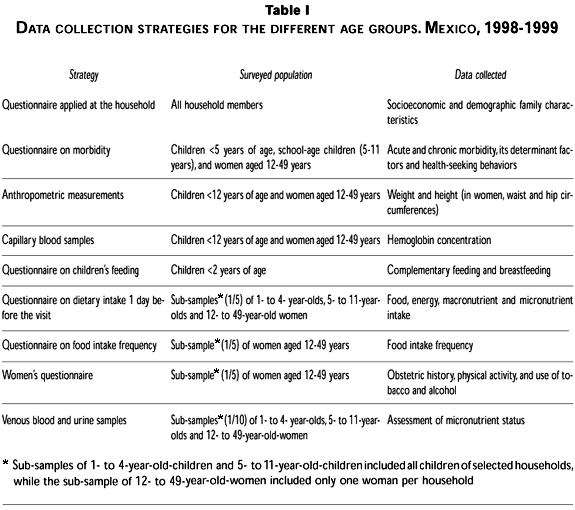
<body><![CDATA[<p><font size="2" face="Verdana"> A second NNS was carried out 10 years after    the first one, to account for demographic and socioeconomic changes that were    likely to be influencing the prevalence and distribution of malnutrition due    to deficiency of nutrients and overweight. It was necessary to update the information    on the nutritional status of the population, given the high prevalence of malnutrition    and overweight found in the previous survey. This paper presents the methods    of the 1999 National Nutrition Survey. </font></p>     <p>&nbsp;</p>     <p><font size="3" face="Verdana"><b>Material and Methods </b></font></p>     <p><font size="2" face="Verdana">The study population consisted of Mexican subjects    residing in their households at the time of the study, of the following age    groups: children &lt;5 years of age, school-age children (5-11 years), and women    aged 12-49 years. The survey was conducted between October 1998 to March 1999.    It included the entire country, aggregated by localities with <a name="tx01"></a>&lt;    2 500 inhabitants,<a href="#nt01"><sup>1</sup></a> &lt;15 000 inhabitants, and    15 000 or more inhabitants, as well as into <a name="tx02"></a>four regions.<a href="#nt02"><sup>2</sup></a></font></p>     <p><font size="2" face="Verdana"> The survey included diverse data collection    strategies for the different age groups. <a href="#tab01">Table I</a> describes    collection strategies, surveyed population, and type of data collected. Three    different samples are readily apparent in <a href="#tab01">Table I</a>. The    original sample included the entire study, with the following data: household    characteristics, morbidity, anthropometry, capillary blood sample, and breastfeeding    and complementary feeding of children &lt;2 years. </font></p>     <p><a name="tab01"></a></p>     <p>&nbsp;</p>     <p align="center"><img src="/img/revistas/spm/v45s4/a12tab01.gif"></p>     <p>&nbsp;</p>     <p><font size="2" face="Verdana"> A sub-sample was characterized by application    of a food questionnaire and a women's questionnaire. A sub-sample of the sub-sample    selected for dietary assessment was utilized to obtain a venous blood sample,    a urine sample, and table salt intake. </font></p>     ]]></body>
<body><![CDATA[<p><font size="2" face="Verdana"><b>Sample design </b></font></p>     <p><font size="2" face="Verdana">The probabilistic nature of the sample allowed    making inferences to the target population and ensured the quality of estimations,    mainly presented as rates, means, and proportions. </font></p>     <p><font size="2" face="Verdana"> The sampling frame corresponded to the National    Household Sampling Frame of INEGI.<SUP>2</SUP> This sampling frame was constructed    by stratifying within each Mexican state to demarcate <a name="tx03"></a>zone    grouping localities.<a href="#nt03"><SUP>3</SUP></a> </font></p>     <p><font size="2" face="Verdana"><b>Construction of sampling units </b></font></p>     <p><font size="2" face="Verdana"><I>Primary sampling units. </I>The primary sampling    units (PSU) consisted of one or part of one Basic Geographical Statistical Area    (BGSA). This is described as the geographical reference area for statistical    information, in localities with 2 500 or more inhabitants it is made up of a    number of household blocks delimited by streets and avenues (urban BGSA). Localities    with &lt;2 500 inhabitants form a rural BGSA within a geographical    area of about 10 000 hectares (BGSA rural) or of several adjoining BGSAs when    the number of households was less than the required number to form a PSU. Depending    on the zone, they were conformed as follows: zone I PSU: A BGSA with at least    480 households –the combination of two or more adjoining BGSA from the    same stratum, with at least 480 households–; zones II to VI PSU: A BGSA    or the combination of two or more BGSA with at least 280 households in localities    with 2 500 or more inhabitants, or 100 households in localities with &lt;2 500    inhabitants. </font></p>     <p><font size="2" face="Verdana"><I>Secondary sampling units</I>. The secondary    sampling unit (SSU) in zone I was composed of one or more complete and adjacent    blocks with at least 40 inhabited households. In zones II through VI, the SSU    consisted of private households. </font></p>     <p><font size="2" face="Verdana"><I>Tertiary sampling units.</I> The tertiary    sampling units (TSU) were found only in zone I and consisted of private households.    </font></p>     <p><font size="2" face="Verdana"><b>Stratification </b></font></p>     <p><font size="2" face="Verdana">Once constructed, the PSUs were stratified by    an index of socioeconomic status for each locality and zone using the following    variables from the Population and Household Census of 1995: percent of literate    population aged 6 to 14 years, percent of literate population aged 15 years,    percent of households with public sewage system, percent of households with    potable water. For zone VI, the variable ''percent of households with electricity''    was added. The index was the first principal component obtained with the variables    for each zone and locality. </font></p>     <p><font size="2" face="Verdana"><b>Sample size calculation </b></font></p>     ]]></body>
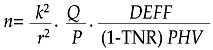
<body><![CDATA[<p><font size="2" face="Verdana">The sample size should be sufficient to ensure    that estimations are of good statistical quality. In a multiple-purpose survey,    the calculation of an adequate sample size for each single purpose may be quite    complex due to the number of variables and relationships of interest. Multiple    analyses should be approached by selecting the most important variables that    have the lowest values, to obtain the minimum sample size required when the    event of interest is uncommon in the total population, thus including by default    other more common events. The sample size was calculated using the formula:<SUP>3</SUP>    </font></p>     <p align="center"><img src="/img/revistas/spm/v45s4/a12img01.gif"></p>     <p><font size="2" face="Verdana">where: </font></p>     <blockquote>        <p><font size="2" face="Verdana"><I>n</I>= sample size in number of households;    <br>     P= proportion of event of interest;    <br>     Q= 1 – P;    <br>     r= maximum acceptable relative error;    <br>     k= preset value for appropriate statistical      estimation;    <br>     DEFF= design effect from cluster sampling;    ]]></body>
<body><![CDATA[<br>     TNR= non-response rate, and    <br>     PHV= average number of inhabitants per      household. Substituting the expression      yields:    <br>     <I>p</I>= .0575;    <br>     Q= 0.9425;    <br>     <I>r</I>= 0.165;    <br>     k= 1.645 (value of tables with a 90%      confidence);    <br>     DEFF= 2.3 (from an average of DEFF of      above variables from NNS-1988);    <br>     TNR= 0.15, and    <br>     PHV= 0.21 children &lt;2 years of age      per household. </font></p> </blockquote>     <p><font size="2" face="Verdana"> The sample size was <I>n</I>=2 000 households.    The proportions utilized as reference to calculate the sample size came from    the National Nutrition Survey 1988 (NNS-1988) and are presented in <a href="#tab02">Table    II</a>. A basic variable to calculate the sample size was the proportion of    children &lt;2 years of age starting milk formula feeding in the first 4 to    5 months of life, since this is an uncommon event representing the smallest    study group. </font></p>     ]]></body>
<body><![CDATA[<p><a name="tab02"></a></p>     <p>&nbsp;</p>     <p align="center"><img src="/img/revistas/spm/v45s4/a12tab02.gif"></p>     <p>&nbsp;</p>     <p><font size="2" face="Verdana"> <a href="#tab03">Table III</a> shows the sample    distribution by region and locality. Finally, the sub-sample for diet was applied    in 4 200 households for each of the three intended populations, and the sub-sample    for venous blood collection in 2 000 households for those three populations.</font></p>     <p><a name="tab03"></a></p>     <p>&nbsp;</p>     <p align="center"><img src="/img/revistas/spm/v45s4/a12tab03.gif"></p>     <p>&nbsp;</p>     <p><font size="2" face="Verdana"> A multistage, stratified, cluster sampling selection    was conducted. In each household, data were collected from all children &lt;5    years of age, all school-age children (5-11 years), but only for one woman aged    12-49 years. </font></p>     ]]></body>
<body><![CDATA[<p><font size="2" face="Verdana"> Households were selected independently in each    state/zone. This process varied by zone. </font></p>     <p><font size="2" face="Verdana"><I>Zone I.</I> In the first stage n<SUB>gh</SUB>    PSU were selected with probability proportional to size (number of households    in the PSU in the sampling frame). In the second stage k SSU were selected with    probability proportional to size (number of households in the SSU in the sampling    frame) in each PSU selected in the first stage. </font></p>     <p><font size="2" face="Verdana"> In each SSU, five households were selected without    replacement with equal probability. Thus, the probability of selecting a household    was given by: </font></p>     <p align="center"><img src="/img/revistas/spm/v45s4/a12img02.gif"></p>     <p><font size="2" face="Verdana">Where: </font></p>     <blockquote>        <p><font size="2" face="Verdana">n<SUB>gh</SUB>= PSU sample size;     <br>     m<SUB>ghi</SUB>= number of households      of the i-th PSU in the h-th stratum of the g-th state;    <br>      m<SUB>gh</SUB>= number of households      in the h-th stratum of the g-th state;    <br>     m<SUB>ghij</SUB>= number of households      in the sampling frame in the j-th SSU of the i-th PSU in the h-th stratum      of the g-th state;    ]]></body>
<body><![CDATA[<br>     k = SSU sample size, and    <br>     m*<SUB>ghij</SUB>= number of households      listed in field work for the j-th SSU of the i-th PSU in the h-th stratum      for the g-th state. </font></p> </blockquote>     <p><font size="2" face="Verdana"><I>Zones II to V. </I>In the first stage n<SUB>gh</SUB>    PSU were selected with probability proportional to size (number of households    in the PSU in the sampling frame). In the second stage <I>t</I> households were    selected without replacement with equal probability within each PSU selected    in the first stage. Thus, the probability of household selection in the PSU<SUB>i</SUB>    is given by: </font></p>     <p align="center"><img src="/img/revistas/spm/v45s4/a12img03.gif"></p>     <p><font size="2" face="Verdana">Where: </font></p>     <blockquote>        <p><font size="2" face="Verdana">n<SUB>gh</SUB>= PSU sample size;     <br>     m<SUB>ghi</SUB>= number of households      for the i-th PSU within the h-th stratum of the g-th state;    <br>     m<SUB>gh</SUB>= number of households      within the h-th stratum of the g-th state, and    <br>     m*<SUB>ghi</SUB>= total number of households      listed in field work for the i-th PSU within the h-th stratum of the g-th      state. </font></p> </blockquote>     ]]></body>
<body><![CDATA[<p><font size="2" face="Verdana"><I>Zone VI. </I>In the first stage n<SUB>gh</SUB>    PSU were selected with probability proportional to size (number of households    in the PSU in the sampling frame). In the second stage, there were two or four    segments of 10 households on average in each PSU. Therefore, the probability    of selecting a household in the PSU<SUB>i </SUB>of the h stratum in the g state    was given by: </font></p>     <p align="center"><img src="/img/revistas/spm/v45s4/a12img04.gif"></p>     <p><font size="2" face="Verdana">Where: </font></p>     <blockquote>        <p><font size="2" face="Verdana">n<SUB>gh</SUB>= PSU sample size;     <br>     m<SUB>ghi</SUB>= number of households      for the i-th PSU within the h-th stratum of the g-th state;    <br>     m<SUB>gh</SUB>= number of households      in the h-th stratum of the g-th state;    <br>     n<SUB>seg</SUB>= sample size of segments,      and    <br>     N<SUB>seg</SUB>= total number of segments      constructed in the PSU. </font></p> </blockquote>     <p><font size="2" face="Verdana"><I>Selection of the sub-sample for dietary data.    </I>The sub-sample for diet was selected independently for each study population;    one of every five of the 21 000 households was selected. In this way, the probability    of selecting a household where dietary data were collected for each of the three    target populations was given by: </font></p>     ]]></body>
<body><![CDATA[<p align="center"><font size="2" face="Verdana"> <img src="/img/revistas/spm/v45s4/a12img05.gif"></font></p>     <p><font size="2" face="Verdana">Where: </font></p>     <blockquote>        <p><font size="2" face="Verdana">PD(V<SUB>ghij</SUB>)= probability of selecting      a household for the sub-sample on diet, and     <br>     P(V<SUB>ghij</SUB>)= probability of selecting      a household within the j-th SSU within the i-th PSU in the h stratum of the      g state. </font></p> </blockquote>     <p><font size="2" face="Verdana"> For the subgroup of women only one woman was    selected from those living in a given household; thus, the probability of selecting    a woman is given by: </font></p>     <p align="center"><font size="2" face="Verdana"> <img src="/img/revistas/spm/v45s4/a12img06.gif"></font></p>     <p><font size="2" face="Verdana">Where: </font></p>     <blockquote>        <p><font size="2" face="Verdana">PM= probability of selecting a woman, and     ]]></body>
<body><![CDATA[<br>     NMV= number of women in the household.      </font></p> </blockquote>     <p><font size="2" face="Verdana"><I>Selection of the sub-sample for venous blood    data. </I>For each target population, one of every three households was selected    from those selected for the diet sub-sample. Venous blood specimens were collected    from the target population. </font></p>     <p><font size="2" face="Verdana"> The probability of selecting the household for    the venous blood specimen collection was: </font></p>     <p align="center"><font size="2" face="Verdana"> <img src="/img/revistas/spm/v45s4/a12img07.gif"></font></p>     <p><font size="2" face="Verdana">Where: </font></p>     <blockquote>        <p><font size="2" face="Verdana">PS(V<SUB>ghij</SUB>)= probability of selecting      a household for venous blood collection. </font></p> </blockquote>     <p><font size="2" face="Verdana"><b>Estimates </b></font></p>     <p><font size="2" face="Verdana">The estimate of the total number of characteristic    X is given by: </font></p>     <p align="center"><font size="2" face="Verdana"> <img src="/img/revistas/spm/v45s4/a12img08.gif"></font></p>     ]]></body>
<body><![CDATA[<p><font size="2" face="Verdana">Where: </font></p>     <blockquote>        <p><font size="2" face="Verdana">F<SUB>ghi</SUB>= expansion factor of the household      within the i-th PSU of the h stratum in the g state (inverse of the probability      of selecting a household), and    <br>     X<SUB>ghik</SUB>= value of the characteristic      of interest in the k-th interview within the i-th PSU in the h stratum of      the g state. </font></p> </blockquote>     <p><font size="2" face="Verdana"> The estimation of proportions, rates, and means    uses the combined rate estimator <img src="/img/revistas/spm/v45s4/a12img09.gif" align="absbottom">,    given by: </font></p>     <p align="center"><font size="2" face="Verdana"> <img src="/img/revistas/spm/v45s4/a12img10.gif"></font></p>     <p><font size="2" face="Verdana"> Where <img src="/img/revistas/spm/v45s4/a12img11.gif" align="absbottom">    is defined in a way similar to <img src="/img/revistas/spm/v45s4/a12img12.gif" align="absbottom">.    </font></p>     <p><font size="2" face="Verdana"> The mean squared error for <img src="/img/revistas/spm/v45s4/a12img09.gif" align="absbottom">(its    squared root is used as a standard error) was obtained with </font></p>     <p align="center"><img src="/img/revistas/spm/v45s4/a12img13.gif"></p>     <p><font size="2" face="Verdana"> The fitting of sample per region is shown in    <a href="#tab04">Table IV</a>. </font></p>     ]]></body>
<body><![CDATA[<p><a name="tab04"></a></p>     <p>&nbsp;</p>     <p align="center"><img src="/img/revistas/spm/v45s4/a12tab04.gif"></p>     <p>&nbsp;</p>     <p><font size="2" face="Verdana"><b>Data collection results </b></font></p>     <p><font size="2" face="Verdana"><a href="#tab05">Table V</a> shows that the response    rate was 82% of households. The non-response in 4.46% of households was due    to refusal or to the absence of a proper informant; 13.3% of households were    uninhabited or just temporally inhabited. The response rate per region is also    shown. </font></p>     <p><a name="tab05"></a></p>     <p>&nbsp;</p>     <p align="center"><img src="/img/revistas/spm/v45s4/a12tab05.gif"></p>     <p>&nbsp;</p>     ]]></body>
<body><![CDATA[<p><font size="2" face="Verdana"><I>Data analysis.</I> Data analysis included    a socioeconomic index, modified after that proposed by Bronfman,<SUP>4</SUP>    by weighting different predictors using the principal components method. Predictor    variables were: household flooring material, potable water, and ownership of    electrical home appliances (washing machine, refrigerator, television, radio,    and stove). This index explained 51.6 % of the variance of the set of variables,    with a single component scoring poverty (SES –2.28797 to 1.54518). </font></p>     <p>&nbsp;</p>     <p><font size="2" face="Verdana"><b>References </b></font></p>     <!-- ref --><p><font size="2" face="Verdana">1. Sep&uacute;lveda-Amor J, Lezana MA, Tapia-Conyer    R, Valdespino JL, Madrigal H, Kumate J. Estado nutricional de prescolares y    mujeres en M&eacute;xico: resultados de una encuesta probabil&iacute;stica nacional.    Gac Med Mex 1990;126(3):207-225. </font>&nbsp;&nbsp;&nbsp;&nbsp;&nbsp;&nbsp;&nbsp;&nbsp;[&#160;<a href="javascript:void(0);" onclick="javascript: window.open('/scielo.php?script=sci_nlinks&ref=9187812&pid=S0036-3634200300100001200001&lng=','','width=640,height=500,resizable=yes,scrollbars=1,menubar=yes,');">Links</a>&#160;]<!-- end-ref --><!-- ref --><p><font size="2" face="Verdana"> 2. Instituto Nacional de Estad&iacute;stica,    Geograf&iacute;a, e Inform&aacute;tica. Resultados del Conteo de Poblaci&oacute;n    y Vivienda de 1995. M&eacute;xico, DF: INEGI, diciembre 1995. </font>&nbsp;&nbsp;&nbsp;&nbsp;&nbsp;&nbsp;&nbsp;&nbsp;[&#160;<a href="javascript:void(0);" onclick="javascript: window.open('/scielo.php?script=sci_nlinks&ref=9187813&pid=S0036-3634200300100001200002&lng=','','width=640,height=500,resizable=yes,scrollbars=1,menubar=yes,');">Links</a>&#160;]<!-- end-ref --><!-- ref --><p><font size="2" face="Verdana">3. Cochran W. Sampling techniques. Third edition.    Otawa, Canada: John Wiley &amp; Sons, 1977. </font>&nbsp;&nbsp;&nbsp;&nbsp;&nbsp;&nbsp;&nbsp;&nbsp;[&#160;<a href="javascript:void(0);" onclick="javascript: window.open('/scielo.php?script=sci_nlinks&ref=9187814&pid=S0036-3634200300100001200003&lng=','','width=640,height=500,resizable=yes,scrollbars=1,menubar=yes,');">Links</a>&#160;]<!-- end-ref --><!-- ref --><p><font size="2" face="Verdana">4. Bronfman M, Guiscafr&eacute; H, Castro V,    Castro R, Guti&eacute;rrez G. La medici&oacute;n de la desigualdad: una estrategia    metodol&oacute;gica, an&aacute;lisis de las caracter&iacute;sticas socioecon&oacute;micas    de la muestra. Arch Invest Med 1988;19:351-360.</font>&nbsp;&nbsp;&nbsp;&nbsp;&nbsp;&nbsp;&nbsp;&nbsp;[&#160;<a href="javascript:void(0);" onclick="javascript: window.open('/scielo.php?script=sci_nlinks&ref=9187815&pid=S0036-3634200300100001200004&lng=','','width=640,height=500,resizable=yes,scrollbars=1,menubar=yes,');">Links</a>&#160;]<!-- end-ref --><p>&nbsp;</p>     <p>&nbsp;</p>     <p><font size="2" face="Verdana">Address reprint requests to    ]]></body>
<body><![CDATA[<br>   Maestra Elsa Resano P&eacute;rez    <br>   Avenida Universidad 655    <br>   colonia Santa Mar&iacute;a Ahuacatitl&aacute;n    <br>   62508. Cuernavaca, Morelos, M&eacute;xico    <br>   E-mail: <a href="mailto:eresano@correo.insp.mx">eresano@correo.insp.mx</a></font></p>     <p><font size="2" face="Verdana"><b>Received on:</b> August 20, 2002     <br>   <b>Acepted on:</b> July 4, 2003 </font></p>     <p>&nbsp;</p>     <p>&nbsp;</p>     <p><font size="2" face="Verdana"><a name="nt01"></a><a href="#tx01">1</a> Instituto    Nacional de Estad&iacute;stica Geograf&iacute;a e Inform&aacute;tica establishes    an operational definition of rural localities as those &lt; 2 500 inhabitants    and of urban localities as those &gt; 2 500 inhabitants, according to the last    National Household Sampling Frame of INEGI.    ]]></body>
<body><![CDATA[<br>   <a name="nt02"></a><a href="#tx02">2</a>    North: Baja California, Baja California Sur, Coahuila, Chihuahua, Durango, Nuevo    Le&oacute;n, Sonora, Tamaulipas; Center: Aguascalientes, Colima, Guanajuato,    Jalisco, M&eacute;xico (excluding municipalities and localities adjoining M&eacute;xico    City), Michoac&aacute;n, Morelos, Nayarit, Quer&eacute;taro, San Luis Potos&iacute;,    Sinaloa, Zacatecas; South: Campeche, Chiapas, Guerrero, Hidalgo, Oaxaca, Puebla,    Quintana Roo, Tabasco, Tlaxcala, Veracruz, Yucat&aacute;n and M&eacute;xico    City (M&eacute;xico City and adjoining urban municipalities of the State of    M&eacute;xico).    <br>   <a name="nt03"></a><a href="#tx03">3</a> Zone I: Cities and metropolitan areas    selected for the National Survey of Urban Employment (ENEU); Zone II: Other    cities of 100 000 and more inhabitants or state capitals; Zone III: Localities    with 20 000 to 99 999 inhabitants; Zone IV: Localities with 15 000 to 19 999    inhabitants Zone V: Localities with 2 500 to 14 999 inhabitants; Zone VI: Localities    with &lt;2 500 inhabitants.</font></p>      ]]></body><back>
<ref-list>
<ref id="B1">
<label>1</label><nlm-citation citation-type="journal">
<person-group person-group-type="author">
<name>
<surname><![CDATA[Sepúlveda-Amor]]></surname>
<given-names><![CDATA[J]]></given-names>
</name>
<name>
<surname><![CDATA[Lezana]]></surname>
<given-names><![CDATA[MA]]></given-names>
</name>
<name>
<surname><![CDATA[Tapia-Conyer]]></surname>
<given-names><![CDATA[R]]></given-names>
</name>
<name>
<surname><![CDATA[Valdespino]]></surname>
<given-names><![CDATA[JL]]></given-names>
</name>
<name>
<surname><![CDATA[Madrigal]]></surname>
<given-names><![CDATA[H]]></given-names>
</name>
<name>
<surname><![CDATA[Kumate]]></surname>
<given-names><![CDATA[J]]></given-names>
</name>
</person-group>
<article-title xml:lang="es"><![CDATA[Estado nutricional de prescolares y mujeres en México: resultados de una encuesta probabilística nacional]]></article-title>
<source><![CDATA[Gac Med Mex]]></source>
<year>1990</year>
<volume>126(3)</volume>
<page-range>207-225</page-range></nlm-citation>
</ref>
<ref id="B2">
<label>2</label><nlm-citation citation-type="book">
<collab>Instituto Nacional de Estadística, Geografía, e Informática</collab>
<source><![CDATA[Resultados del Conteo de Población y Vivienda de 1995]]></source>
<year>dici</year>
<month>em</month>
<day>br</day>
<publisher-loc><![CDATA[México^eDF DF]]></publisher-loc>
<publisher-name><![CDATA[INEGI]]></publisher-name>
</nlm-citation>
</ref>
<ref id="B3">
<label>3</label><nlm-citation citation-type="book">
<person-group person-group-type="author">
<name>
<surname><![CDATA[Cochran]]></surname>
<given-names><![CDATA[W]]></given-names>
</name>
</person-group>
<source><![CDATA[Sampling techniques: Third edition]]></source>
<year>1977</year>
<publisher-loc><![CDATA[Otawa ]]></publisher-loc>
<publisher-name><![CDATA[John Wiley & Sons]]></publisher-name>
</nlm-citation>
</ref>
<ref id="B4">
<label>4</label><nlm-citation citation-type="journal">
<person-group person-group-type="author">
<name>
<surname><![CDATA[Bronfman]]></surname>
<given-names><![CDATA[M]]></given-names>
</name>
<name>
<surname><![CDATA[Guiscafré]]></surname>
<given-names><![CDATA[H]]></given-names>
</name>
<name>
<surname><![CDATA[Castro]]></surname>
<given-names><![CDATA[V]]></given-names>
</name>
<name>
<surname><![CDATA[Castro]]></surname>
<given-names><![CDATA[R]]></given-names>
</name>
<name>
<surname><![CDATA[Gutiérrez]]></surname>
<given-names><![CDATA[G]]></given-names>
</name>
</person-group>
<article-title xml:lang="es"><![CDATA[La medición de la desigualdad: una estrategia metodológica, análisis de las características socioeconómicas de la muestra]]></article-title>
<source><![CDATA[Arch Invest Med]]></source>
<year>1988</year>
<volume>19</volume>
<page-range>351-360</page-range></nlm-citation>
</ref>
</ref-list>
</back>
</article>