<?xml version="1.0" encoding="ISO-8859-1"?><article xmlns:mml="http://www.w3.org/1998/Math/MathML" xmlns:xlink="http://www.w3.org/1999/xlink" xmlns:xsi="http://www.w3.org/2001/XMLSchema-instance">
<front>
<journal-meta>
<journal-id>0036-3634</journal-id>
<journal-title><![CDATA[Salud Pública de México]]></journal-title>
<abbrev-journal-title><![CDATA[Salud pública Méx]]></abbrev-journal-title>
<issn>0036-3634</issn>
<publisher>
<publisher-name><![CDATA[Instituto Nacional de Salud Pública]]></publisher-name>
</publisher>
</journal-meta>
<article-meta>
<article-id>S0036-36342003001000009</article-id>
<title-group>
<article-title xml:lang="en"><![CDATA[Energy and nutrient consumption in Mexican women 12-49 years of age: analysis of the National Nutrition Survey 1999]]></article-title>
<article-title xml:lang="es"><![CDATA[Consumo de energía y nutrimentos en mujeres mexicanas de entre 12 a 49 años de edad: análisis de la Encuesta Nacional de Nutrición 1999]]></article-title>
</title-group>
<contrib-group>
<contrib contrib-type="author">
<name>
<surname><![CDATA[Barquera]]></surname>
<given-names><![CDATA[Simón]]></given-names>
</name>
<xref ref-type="aff" rid="A01"/>
</contrib>
<contrib contrib-type="author">
<name>
<surname><![CDATA[Rivera]]></surname>
<given-names><![CDATA[Juan A]]></given-names>
</name>
<xref ref-type="aff" rid="A01"/>
</contrib>
<contrib contrib-type="author">
<name>
<surname><![CDATA[Espinosa-Montero]]></surname>
<given-names><![CDATA[Juan]]></given-names>
</name>
<xref ref-type="aff" rid="A01"/>
</contrib>
<contrib contrib-type="author">
<name>
<surname><![CDATA[Safdie]]></surname>
<given-names><![CDATA[Margarita]]></given-names>
</name>
<xref ref-type="aff" rid="A01"/>
</contrib>
<contrib contrib-type="author">
<name>
<surname><![CDATA[Campirano]]></surname>
<given-names><![CDATA[Fabricio]]></given-names>
</name>
<xref ref-type="aff" rid="A01"/>
</contrib>
<contrib contrib-type="author">
<name>
<surname><![CDATA[Monterrubio]]></surname>
<given-names><![CDATA[Eric A]]></given-names>
</name>
<xref ref-type="aff" rid="A01"/>
</contrib>
</contrib-group>
<aff id="A01">
<institution><![CDATA[,Instituto Nacional de Salud Pública Centro de Investigación en Nutrición y Salud ]]></institution>
<addr-line><![CDATA[Cuernavaca Morelos]]></addr-line>
<country>México</country>
</aff>
<pub-date pub-type="pub">
<day>00</day>
<month>00</month>
<year>2003</year>
</pub-date>
<pub-date pub-type="epub">
<day>00</day>
<month>00</month>
<year>2003</year>
</pub-date>
<volume>45</volume>
<fpage>530</fpage>
<lpage>539</lpage>
<copyright-statement/>
<copyright-year/>
<self-uri xlink:href="http://www.scielo.org.mx/scielo.php?script=sci_arttext&amp;pid=S0036-36342003001000009&amp;lng=en&amp;nrm=iso"></self-uri><self-uri xlink:href="http://www.scielo.org.mx/scielo.php?script=sci_abstract&amp;pid=S0036-36342003001000009&amp;lng=en&amp;nrm=iso"></self-uri><self-uri xlink:href="http://www.scielo.org.mx/scielo.php?script=sci_pdf&amp;pid=S0036-36342003001000009&amp;lng=en&amp;nrm=iso"></self-uri><abstract abstract-type="short" xml:lang="en"><p><![CDATA[OBJECTIVE: To describe the reported energy and nutrient intake and adequacies in Mexican women. MATERIAL AND METHODS: A 24-hour dietary recall was used to obtain nutrient intake in a representative sub-sample of 2 630 women from 12 to 49 years of age from the National Nutrition Survey 1999. Nutrient adequacies were estimated using the Dietary Reference Intakes and stratified according to region, area (urban or rural), socioeconomic status and obesity status (non-obese: BMI <30 kg/m², obese: >30 kg/m²). Differences were analyzed using linear regression for complex surveys of log-transformed intake and adequacy, adjusting for multiple comparisons with the Bonferroni test. RESULTS: The median national energy intake was 1 471 kcal. The Risk of Inadequacy (RI) (prevalence of adequacy <50%) was: vitamin A:38.3%, vitamin C: 45.5%, and folate: 34.3%. Carbohydrates, folate, iron and calcium intake was significantly higher in rural than in urban areas. The RI was higher in women of the lowest socioeconomic status tertile for all nutrients with the exception of carbohydrates and calcium. Macro-nutrient adequacies were significantly higher in non-obese women. CONCLUSIONS: Differences within the country among regions, rural and urban areas, and socioeconomic status tertile reflect an increasing availability of inexpensive calorie-dense foods in marginal groups. However, total energy, cholesterol, saturated and total fat were consumed in greater quantities by women from the higher socioeconomic status tertile and from urban areas. These patterns could be a contributing factor to the rise of obesity and other non-communicable nutrition-related chronic diseases in Mexico.]]></p></abstract>
<abstract abstract-type="short" xml:lang="es"><p><![CDATA[OBJETIVO: Describir la ingesta reportada de energía y nutrimentos en mujeres mexicanas. MATERIAL Y MÉTODOS: Se utilizó un recordatorio de 24 horas para obtener la ingesta de energía en una submuestra representativa de 2 630 mujeres de 12 a 49 años de edad de la Encuesta Nacional de Nutrición 1999. Las adecuaciones nutrimentales se estimaron utilizando las Referencias de Ingesta Dietética y fueron estratificadas por región, área urbana o rural, nivel socioeconómico y presencia de obesidad (no-obesas: IMC <30 kg/m², obesas: >30 kg/m²). Las diferencias se analizaron utilizando modelos de regresión lineal para encuestas complejas del logaritmo de la ingesta y la adecuación, ajustando para comparaciones múltiples con la prueba de Bonferroni. RESULTADOS: La media nacional de ingesta de energía fue de 1 471 kcal. El riesgo de inadecuación (prevalencia de adecuación <50%) fue vitamina A: 38.3%, vitamina C: 45.5% y folato: 34.3%. La ingesta de carbohidratos, folato, hierro y calcio fue significativamente más alta en áreas rurales que en las urbanas. El riesgo de inadecuación fue mayor en mujeres del nivel socioeconómico más bajo para todos los nutrimentos con excepción de carbohidratos y calcio. Las adecuaciones de macro-nutrimentos fueron significativamente mayores en mujeres no-obesas. CONCLUSIONES: Las diferencias entre las regiones, áreas del país y terciles de nivel socioeconómico reflejan una disponibilidad creciente de alimentos densamente calóricos de bajo costo en grupos marginales. Sin embargo, la energía total, colesterol y la grasa saturada y total se consumieron en mayores cantidades por mujeres del tercil de nivel socioeconómico más alto y áreas urbanas. Estos patrones pueden estar contribuyendo al incremento de la obesidad y otras enfermedades no transmisibles en México.]]></p></abstract>
<kwd-group>
<kwd lng="en"><![CDATA[diet]]></kwd>
<kwd lng="en"><![CDATA[nutritional transition]]></kwd>
<kwd lng="en"><![CDATA[epidemiologic transition]]></kwd>
<kwd lng="en"><![CDATA[obesity, dietary reference intake]]></kwd>
<kwd lng="en"><![CDATA[probabilistic survey]]></kwd>
<kwd lng="en"><![CDATA[Mexico]]></kwd>
<kwd lng="es"><![CDATA[dieta]]></kwd>
<kwd lng="es"><![CDATA[transición nutricional]]></kwd>
<kwd lng="es"><![CDATA[transición epidemiológica]]></kwd>
<kwd lng="es"><![CDATA[obesidad]]></kwd>
<kwd lng="es"><![CDATA[ingesta dietética de referencia]]></kwd>
<kwd lng="es"><![CDATA[encuesta probabilística]]></kwd>
<kwd lng="es"><![CDATA[México]]></kwd>
</kwd-group>
</article-meta>
</front><body><![CDATA[ <p align="right"><font size="2" face="Verdana"> <b>ORIGINAL ARTICLE</b></font></p>     <p>&nbsp;</p>     <p><font size="4" face="Verdana"><b>Energy and nutrient consumption in Mexican    women 12-49 years of age: analysis of the National Nutrition Survey 1999 </b></font></p>     <p>&nbsp;</p>     <p><font size="3" face="Verdana"><b>Consumo de energ&iacute;a y nutrimentos en    mujeres mexicanas de entre 12 a 49 a&ntilde;os de edad: an&aacute;lisis de la    Encuesta Nacional de Nutrici&oacute;n 1999</b></font></p>     <p>&nbsp;</p>     <p>&nbsp;</p>     <p><font size="2" face="Verdana"><b>Sim&oacute;n Barquera, MD, MSc; Juan A Rivera,    MS, PhD; Juan Espinosa-Montero, BS; Margarita Safdie, MSc; Fabricio Campirano,    MSc; Eric A Monterrubio, BS</b></font></p>     <p><font size="2" face="Verdana">Centro de Investigaci&oacute;n en Nutrici&oacute;n    y Salud, Instituto Nacional de Salud P&uacute;blica, Cuernavaca, Morelos, M&eacute;xico</font></p>     <p>&nbsp;</p>     ]]></body>
<body><![CDATA[<p>&nbsp;</p> <hr size="1" noshade>     <p><font size="2" face="Verdana"><b>ABSTRACT</b></font></p>     <p><font size="2" face="Verdana"><B>OBJECTIVE:</B> To describe the reported energy    and nutrient intake and adequacies in Mexican women.    <br>   <B>MATERIAL AND METHODS:</B> A 24-hour dietary recall was used to obtain nutrient    intake in a representative sub-sample of 2 630 women from 12 to 49 years of    age from the National Nutrition Survey 1999. Nutrient adequacies were estimated    using the Dietary Reference Intakes and stratified according to region, area    (urban or rural), socioeconomic status and obesity status (non-obese: BMI &lt;30    kg/m<SUP>2</SUP>, obese: <u>&gt;</u>30 kg/m<SUP>2</SUP>). Differences were analyzed    using linear regression for complex surveys of log-transformed intake and adequacy,    adjusting for multiple comparisons with the Bonferroni test. <B>    <br>   </B><B>RESULTS:</B> The median national energy intake was 1 471 kcal. The Risk    of Inadequacy (RI) (prevalence of adequacy &lt;50%) was: vitamin A:38.3%, vitamin    C: 45.5%, and folate: 34.3%. Carbohydrates, folate, iron and calcium intake    was significantly higher in rural than in urban areas. The RI was higher in    women of the lowest socioeconomic status tertile for all nutrients with the    exception of carbohydrates and calcium. Macro-nutrient adequacies were significantly    higher in non-obese women.    <br>   <B>CONCLUSIONS:</B> Differences within the country among regions, rural and    urban areas, and socioeconomic status tertile reflect an increasing availability    of inexpensive calorie-dense foods in marginal groups. However, total energy,    cholesterol, saturated and total fat were consumed in greater quantities by    women from the higher socioeconomic status tertile and from urban areas. These    patterns could be a contributing factor to the rise of obesity and other non-communicable    nutrition-related chronic diseases in Mexico. The English version of this paper    is available at: <a href="http://www.insp.mx/salud/index.html">http://www.insp.mx/salud/index.html</a></font></p>     <p><font size="2" face="Verdana"><b>Key words:</b> diet; nutritional transition;    epidemiologic transition; obesity, dietary reference intake; probabilistic survey;    Mexico</font></p> <hr size="1" noshade>     <p><font size="2" face="Verdana"> <b>RESUMEN</b></font></p>     <p><font size="2" face="Verdana"><B>OBJETIVO:</B> Describir la ingesta reportada    de energ&iacute;a y nutrimentos en mujeres mexicanas. <B>    <br>   </B><B>MATERIAL Y M&Eacute;TODOS:</B> Se utiliz&oacute; un recordatorio de 24    horas para obtener la ingesta de energ&iacute;a en una submuestra representativa    de 2 630 mujeres de 12 a 49 a&ntilde;os de edad de la Encuesta Nacional de Nutrici&oacute;n    1999. Las adecuaciones nutrimentales se estimaron utilizando las Referencias    de Ingesta Diet&eacute;tica y fueron estratificadas por regi&oacute;n, &aacute;rea    urbana o rural, nivel socioecon&oacute;mico y presencia de obesidad (no-obesas:    IMC &lt;30 kg/m<SUP>2</SUP>, obesas: <u>&gt;</u>30 kg/m<SUP>2</SUP>). Las diferencias    se analizaron utilizando modelos de regresi&oacute;n lineal para encuestas complejas    del logaritmo de la ingesta y la adecuaci&oacute;n, ajustando para comparaciones    m&uacute;ltiples con la prueba de Bonferroni. <B>    ]]></body>
<body><![CDATA[<br>   </B><B>RESULTADOS:</B> La media nacional de ingesta de energ&iacute;a fue de    1 471 kcal. El riesgo de inadecuaci&oacute;n (prevalencia de adecuaci&oacute;n    &lt;50%) fue vitamina A: 38.3%, vitamina C: 45.5% y folato: 34.3%. La ingesta    de carbohidratos, folato, hierro y calcio fue significativamente m&aacute;s    alta en &aacute;reas rurales que en las urbanas. El riesgo de inadecuaci&oacute;n    fue mayor en mujeres del nivel socioecon&oacute;mico m&aacute;s bajo para todos    los nutrimentos con excepci&oacute;n de carbohidratos y calcio. Las adecuaciones    de macro-nutrimentos fueron significativamente mayores en mujeres no-obesas.    <br>   <B>CONCLUSIONES:</B> Las diferencias entre las regiones, &aacute;reas del pa&iacute;s    y terciles de nivel socioecon&oacute;mico reflejan una disponibilidad creciente    de alimentos densamente cal&oacute;ricos de bajo costo en grupos marginales.    Sin embargo, la energ&iacute;a total, colesterol y la grasa saturada y total    se consumieron en mayores cantidades por mujeres del tercil de nivel socioecon&oacute;mico    m&aacute;s alto y &aacute;reas urbanas. Estos patrones pueden estar contribuyendo    al incremento de la obesidad y otras enfermedades no transmisibles en M&eacute;xico<B>.    </B>El texto completo en ingl&eacute;s de este art&iacute;culo tambi&eacute;n    est&aacute; disponible en: <a href="http://www.insp.mx/salud/index.html">http://www.insp.mx/salud/index.html</a></font></p>     <p><font size="2" face="Verdana"><b>Palabras clave:</b> dieta; transici&oacute;n    nutricional; transici&oacute;n epidemiol&oacute;gica; obesidad; ingesta diet&eacute;tica    de referencia; encuesta probabil&iacute;stica; M&eacute;xico</font></p> <hr size="1" noshade>     <p>&nbsp;</p>     <p>&nbsp;</p>     <p><font size="2" face="Verdana">Dietary studies are relevant for improving our    understanding of the role of nutrition in preventing certain diseases, for identifying    causes of public health problems and cost-effective interventions aimed at reducing    potential health risks. Changes in food patterns and intake in countries such    as Mexico experiencing an epidemiological transition must be carefully analyzed.    The co-existence of non-communicable chronic diseases and nutrient deficiencies    present a difficult challenge to health planners.<SUP>1-5</SUP> Diverse socioeconomic,    environmental and demographic factors affect dietary consumption. In addition,    cultural perceptions and traditions influence food intake.<SUP>6,7</SUP> Finally,    the growing urbanization with increased access to energy-dense industrialized    foods has an effect on dietary patterns with potential health consequences,    in particular for marginal vulnerable populations.<SUP>8-10</SUP> </font> </p>     <p><font size="2" face="Verdana"> National consumption of energy and nutrients    in the Mexican diet has been described using data collected 11 years previous    to the present study.<SUP>11,12</SUP> The target group for this questionnaire    were women between 12 and 49 years of age. This group has been considered a    priority due to their fertility status, central role in the household food resource    allocation and family health care.<SUP>12-14</SUP> Nutritional status of women    of childbearing age affects not only their health but also contributes to the    newborn's health, with a potential transgenerational impact.<SUP>15-20</SUP>    </font></p>     <p><font size="2" face="Verdana"> The objective of this analysis is to describe    the reported energy and nutrient intake in women 12-49 years of age, obtained    from the National Nutrition Survey (NNS) 1999. </font></p>     <p>&nbsp;</p>     <p><font size="3" face="Verdana"><b>Material and Methods </b></font></p>     ]]></body>
<body><![CDATA[<p><font size="2" face="Verdana"><b>The National Nutrition Survey 1999 </b></font></p>     <p><font size="2" face="Verdana">This analysis used data obtained from the NNS    II (1999); a national probabilistic survey representative of the country with    sampling power to disaggregate into urban (Pop<u>&gt;</u>2 500) and rural (Pop&lt;2    500) areas or by four country regions: a) North (Baja California, Baja California    Sur, Coahuila, Chihuahua, Durango, Nuevo Le&oacute;n, Sonora, Tamaulipas); b)    Center (Aguascalientes, Colima, Estado de M&eacute;xico, Guanajuato, Jalisco,    Michoac&aacute;n, Morelos, Nayarit, Quer&eacute;taro, San Luis Potos&iacute;,    Sinaloa, Zacatecas); c) Mexico City, and d) South (Campeche, Chiapas, Guerrero,    Hidalgo, Oaxaca, Puebla, Quintana Roo, Tabasco, Tlaxcala, Veracruz, Yucat&aacute;n).    The objective of this survey was to characterize the nutritional status as well    as the food and nutrient patterns of pre-school and school-age children, and    women of childbearing age in Mexico. A detailed description of the sampling    procedures and survey methodology has been published elsewhere.<SUP>21,22</SUP>    Approximately 4 200 women of childbearing age (12 to 49 years of age) from the    selected households participated in this survey. </font></p>     <p><font size="2" face="Verdana"><b>Socioeconomic status index </b></font></p>     <p><font size="2" face="Verdana">The NNS 1999 collected socioeconomic information    such as household conditions (flooring material, ceiling, walls, number of persons    residing in the household), basic services infrastructure (i.e., water source    and disposal) and possession of domestic appliances (i.e., radio, television    and refrigerator). A principal component analysis was constructed following    a methodology previously reported in the first National Nutrition Survey (1998).<SUP>3</SUP>    With this information a main factor explaining 56.1% of the socioeconomic information    variability was extracted. This factor had large loadings for household and    community characteristics such as sewer system and indoor plumbing. It was divided    into tertiles and used as a proxy for low, medium and high socioeconomic status.    </font></p>     <p><font size="2" face="Verdana"><b>Dietary information </b></font></p>     <p><font size="2" face="Verdana">To estimate food consumption of women and children    in the first and second National Nutrition Surveys, a previously validated 24-hour    dietary recall (24-h DR) was used. Nutrient    intake information in a sub-sample of 2 630 women from 12 to 49 years of age    was obtained. This sub-sample was representative of the country and its regions.    It included one of every 5 households in the sample and one woman per household.    A detailed description of the sampling strategy has been published previously.<SUP>21</SUP>    Standardized personnel applied the questionnaires and converted each reported    preparation into grams or milliliters of individual foods. Nutrient intake was    then estimated using a comprehensive nutrient composition database compiled    from diverse references.<SUP>23-28</SUP> </font></p>     <p><font size="2" face="Verdana"> Nutrient adequacies were estimated using as    reference the following Dietary Reference Intakes (DRIs): Estimated Average    Requirement (EAR) for vitamin A, vitamin C, folate, iron, zinc and calcium and    Adequate Intakes (AI) for energy, protein, fat (using 30% of the total caloric    intake as the cut-off point), carbohydrates and fiber.<SUP>29-33 </SUP>Aberrant    reported consumptions and adequacies were reviewed case by case and corrected    when possible. If the value was not biologically plausible but information to    correct it was not available, the case was eliminated. Adequacy was then estimated    as the percentage of consumption relative to the requirement. Requirements for    women with a Body Mass Index (BMI) &lt;19 kg/m<SUP>2</SUP> (1.9%) or with missing    anthropometric information (3.5%), were estimated based only on the corresponding    adequacy for age. The requirements for pregnant (4.9%) or lactating (8.2%) women    were considered. Only half of the energy DRI for lactating women was added when    partial breast-feeding (breast milk plus formula or foods) was reported.<SUP>34    </SUP>Due to missing or aberrant information 34 cases (1.29%) were excluded    from this analysis. </font></p>     <p><font size="2" face="Verdana"><b>Data analysis </b></font></p>     <p><font size="2" face="Verdana">Once the nutrient intake database was cleaned    of aberrant values, nutrient intakes were calculated for all women and stratified    according to the following factors: region (North, Center, Mexico City, South),    area (urban or rural), socioeconomic index tertiles and, for non-pregnant and    non-lactating women &gt;18 years of age, in body mass index group (non-obese:    &lt;30 kg/m<SUP>2</SUP> and obese: BMI <u>&gt;</u>30 kg/m<SUP>2</SUP>). </font></p>     <p><font size="2" face="Verdana"> Nutrient consumption was expressed as nutrient    quantity and percentage of adequacy. Due to the skewed distribution of nutrient    intake consumption, data were reported as medians with interquartile range instead    of means to avoid overestimating consumption. Risk of inadequacy was evaluated    calculating the prevalence below 50% of the estimated adequacy. To test for    statistical differences across the factors of interest in nutrient intakes and    adequacies, we used generalized linear models for complex surveys with the log-transformed    nutrient and adequacy as independent variable and the Bonferroni method to adjust    for multiple comparisons, for the risk of inadequacy differences were established    using logistic regression.<SUP>35,36 </SUP>The median caloric consumption by    age was analyzed comparing rural and urban cases and both non-obese and obese    women &gt;18 years old (BMI <u>&gt;</u>30 kg/m<SUP>2</SUP>). All statistical    calculations were done applying the expansion factors, using SPSS version 10    (SPSS Inc., Chicago IL, USA).<SUP>36</SUP> To adjust for the complex survey    design effects, we used the ''svy'' command from STATA Statistical Software,    Release 7.0 (Stata Corporation College Station, Texas, USA).<SUP>37</SUP> </font></p>     ]]></body>
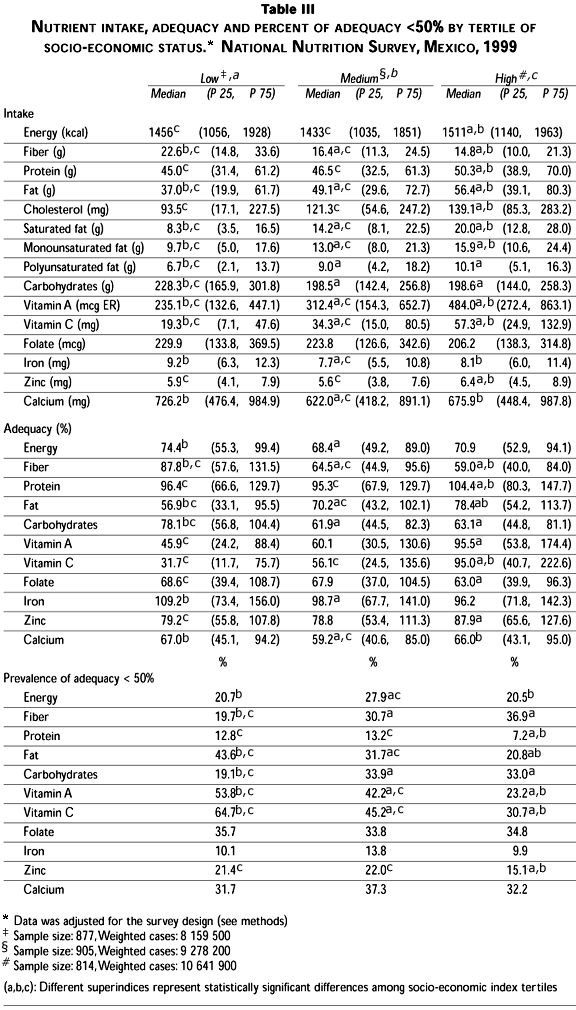
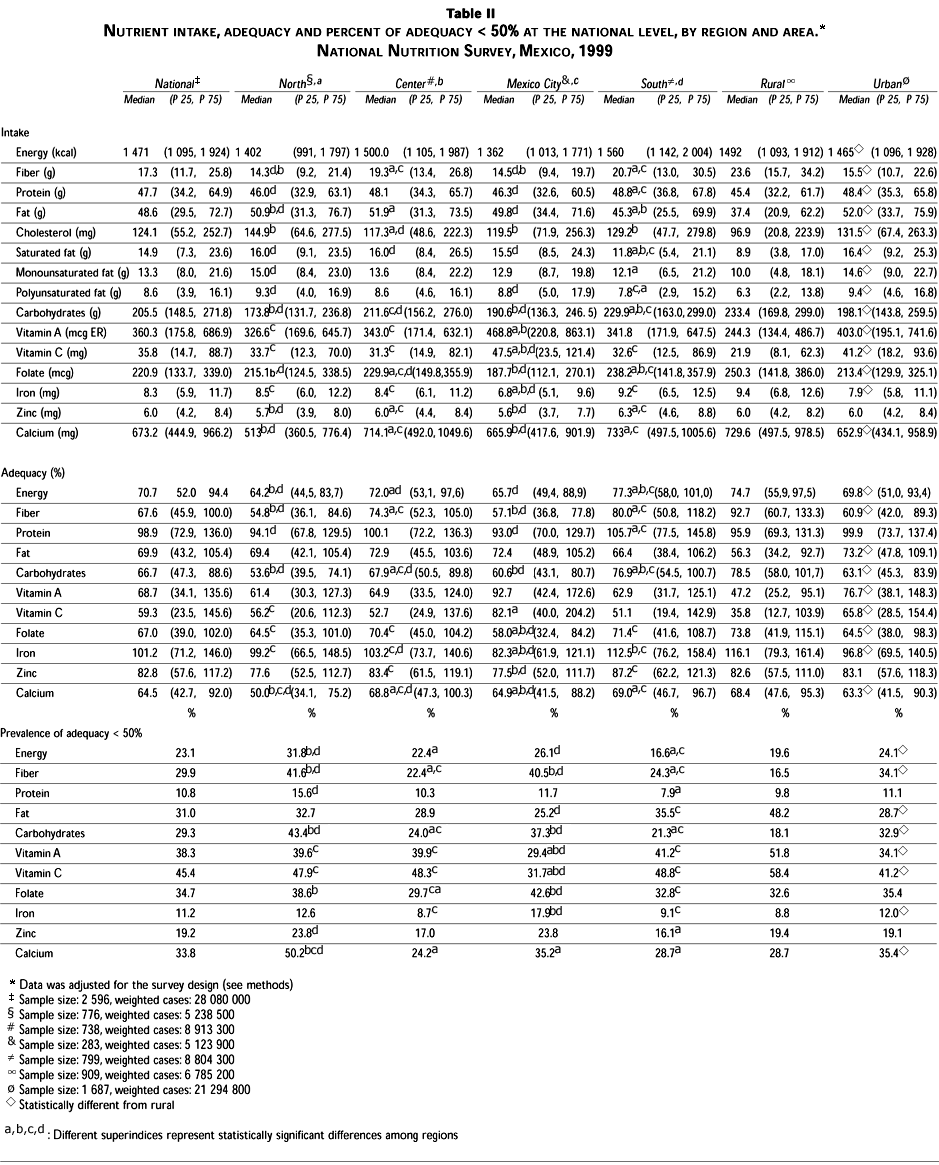
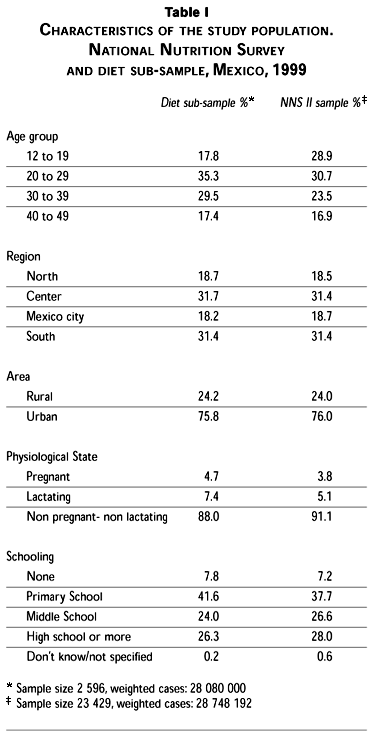
<body><![CDATA[<p>&nbsp;</p>     <p><font size="3" face="Verdana"><b>Results </b></font></p>     <p><font size="2" face="Verdana">The total valid sample of women (<I>n</I>=2 596)    represented 28 080 000 cases at the national level. From this sample, a total    of 64.8% cases were between 20 and 39 years of age, 88% were non-pregnant and    non-lactating and 75.8% lived in urban areas. Additional characteristics of    the population and the diet sub-sample are shown in <a href="#tab01">Table I</a>.    Energy and nutrient intake as well as adequacy relative to the DRIs is presented    in <a href="/img/revistas/spm/v45s4/a09tab02.gif">Table II</a>. Nutrient adequacies for all nutrients    were &lt;71% at the national level except for protein (98.9%), iron (101.2%)    and zinc (82.8%). The median energy consumption at the national level was 1    471 calories and 23.1% of the women were at risk of energy inadequacy. The higher    reported median energy adequacy by region was observed in the South (77.3%)    and Center (72%) regions. Energy adequacy by area was slightly higher in rural    than in urban and this difference was statistically significant. Fiber consumption    at the national level was 17.3g with higher consumption in the South region    and in rural areas. The same occurred for carbohydrates, folate, iron and calcium    consumption. Fat intake was higher in urban areas and the risk of fat inadequacy    was higher in the South and in the rural areas of the country. Protein was the    nutrient with the lowest risk of inadequacy at the national level with a prevalence    of only 10.8% (<a href="/img/revistas/spm/v45s4/a09tab02.gif">Table II</a>). When intake and    adequacy were compared by SES, fiber, carbohydrates, folate, iron and calcium    consumption were higher in the lowest SES tertile. Energy and the remainder    of the analyzed nutrients were higher in the highest SES tertile (<a href="#tab03">Table    III</a>). </font></p>     <p><a name="tab01"></a></p>     <p>&nbsp;</p>     <p align="center"><img src="/img/revistas/spm/v45s4/a09tab01.gif"></p>     <p>&nbsp;</p>     <p><a name="tab03"></a></p>     <p>&nbsp;</p>     <p align="center"><img src="/img/revistas/spm/v45s4/a09tab03.gif"></p>     ]]></body>
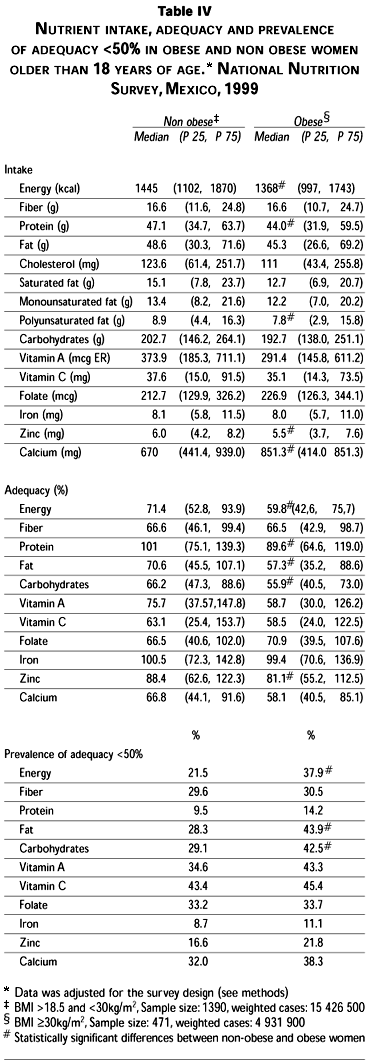
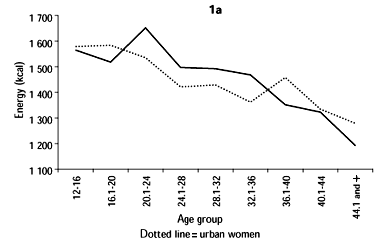
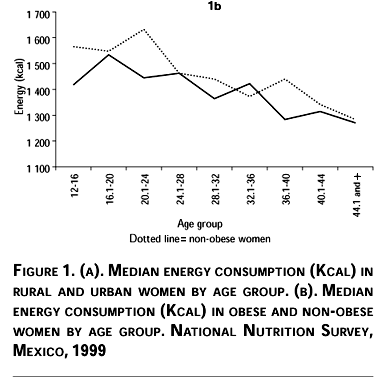
<body><![CDATA[<p>&nbsp;</p>     <p><font size="2" face="Verdana"> The estimated adequacy of energy and nutrients    compared by BMI status (non-obese: &lt;30, or obese: <u>&gt;</u>30 kg/m<SUP>2</SUP>)    was higher for all macronutrients (total energy, protein, fat and carbohydrates),    and zinc in non-obese women. Fiber, vitamin A, C, folate, iron, and calcium    intakes showed no significant differences between groups. Reported total, saturated,    monounsaturated and polyunsaturated fat intake were higher in non-obese women.    However, only polyunsaturated fat was statistically significant. Zinc intake    was significantly higher among non-obese women. Calcium intake was significantly    higher among obese women (<a href="#tab04">Table IV</a>). </font></p>     <p><a name="tab04"></a></p>     <p>&nbsp;</p>     <p align="center"><img src="/img/revistas/spm/v45s4/a09tab04.gif"></p>     <p>&nbsp;</p>     <p><font size="2" face="Verdana"> Analyzing reported energy intake by age groups    and area, urban women between the ages of 20 and 36 years reported less energy    intake; younger and older urban women reported higher intake than women living    in rural areas. Obese women reported intakes lower than or similar to non-obese    women across most of the age groups (<a href="#fig1a">Figures 1a</a> and <a href="#fig1b">1b</a>).    </font></p>     <p><a name="fig1a"></a></p>     <p>&nbsp;</p>     <p align="center"><img src="/img/revistas/spm/v45s4/a09fig1a.gif"></p>     ]]></body>
<body><![CDATA[<p><a name="fig1b"></a></p>     <p align="center"><font size="2" face="Verdana"><img src="/img/revistas/spm/v45s4/a09fig1b.gif"></font></p>     <p>&nbsp;</p>     <p><font size="3" face="Verdana"><b>Discussion </b></font></p>     <p><font size="2" face="Verdana">The stratification of the data shows interesting    patterns related to the epidemiological and nutritional transition: the rural    areas, the South region, and the lower Socio-Economic Status (SES) index tertile    showed the highest fiber and carbohydrate intake and the lowest saturated fat    intake.<SUP>5,38</SUP> Protein adequacy and intake were significantly higher    in the South region; with the lowest saturated fat intake reflecting a relevant    contribution of beans and cereals to this picture. Women from urban areas and    from the higher socioeconomic status tertile had higher protein intakes. </font></p>     <p><font size="2" face="Verdana"> Since the SES index was built using household    and family characteristics, the extracted factor could reflect access to certain    conditions such as sanitation (water quality and disposal) and information (radio    and TV) rather than a precise socio-economic status. Thus, our indicator must    be interpreted with caution as a rough estimate. However, a previous analysis    showed a significant association between the lowest tertile of a similar index    and poor nutritional status indicators.<SUP>3</SUP> </font></p>     <p><font size="2" face="Verdana"> The 24-h DR has been recognized as a useful    method for quantifying consumption in large surveys since it is inexpensive    and relatively easy to apply. Furthermore, it is known to have good compliance.<SUP>39</SUP>    Nevertheless, it has been described that some frequently reported foods in the    Mexican diet (such as tortillas, sugar and oil) tend to be underestimated.<SUP>40</SUP>    In addition, a previous analysis with this information identified an almost    twofold under-reporting in obese (36%) vs. non-obese women (20%), controlling    for confounders. This underreporting was higher in the North and Mexico City    regions compared to the Center and South regions, but without urban-rural differences.<SUP>41</SUP>    These results are in the same direction as other recent nutrition surveys in    developed and developing countries.<SUP>42</SUP> Therefore, although the median    energy intake was below the RDA, an important percentage of energy consumption    is not detected with this instrument. </font></p>     <p><font size="2" face="Verdana"> Energy, protein, carbohydrate and lipid intakes    reported in this survey were slightly lower than those reported in the First    NNS (1988). Energy consumption decreased from a median of 1 586 to 1 470. The    only exception was total fat, increasing from 41.2 g to 48.6 g.<SUP>12</SUP>    However, these differences must be considered with caution since obesity and    overweight have increased substantially from the first to the second national    nutrition survey. Thus, a higher under-reporting in the latter    could be suspected, partially explaining lower median consumptions and adequacies.<SUP>1</SUP>    As other studies have shown, under-reporting of energy intake is associated    with bias in estimates of macronutrient intake (low energy intake reporters    tend to report a higher percentage of energy from protein and a lower percentage    of energy from fat while energy from total carbohydrate is variable).<SUP>43</SUP>    In addition, we applied an updated nutrient composition database with more precise    information but different from the one used to analyze the previous survey.    Therefore, comparisons between both are limited and must be done carefully.    </font></p>     <p><font size="2" face="Verdana"> Our data suggest that protein intake quantity    in women is adequate; however, an analysis of the protein quality must be done    since there must be clear differences among regions. Consumption of nutrients    in this descriptive analysis is not adjusted for energy; therefore, adequacies    could reflect in some cases a higher net    intake rather than better diet quality when comparing factors.<SUP>44</SUP>    Fiber consumption had a prevalence of inadequacy of 29.9% at the national level.    By region the Center and South (less developed) had a clearly lower risk of    inadequacy than the North and Mexico City regions (22.4 and 24.3 vs. 41.6 and    40.5% respectively). This is due mainly to the fiber content of tortillas, beans    and other cereals, since fruit and vegetable intake is low, as suggested from    the low micronutrient adequacies and consumption (in particular vitamins A,    C and folate). Folate and iron consumption were higher in rural areas, lowest    socioeconomic index tertile and the South region of the country. This could    be explained by the contribution of beans to the diet, an iron and folate-rich    food. However, even though beans contain folate and iron, their phytic acid    content decreases the absorption and bioavailability, and the cooking process    affects folate dramatically. Fortified foods such as corn and wheat flour, the    national vitamin A supplementation program and the National Health, Nutrition    and Education programs could be contributing to improve the micronutrient intake    in marginal areas.<SUP>45</SUP> The impact of these policies is currently under    evaluation. </font></p>     <p><font size="2" face="Verdana"> Energy consumption decreased with age, reaching    the maximum median consumption approximately at 20 years of age and decreasing    steadily. This is consistent with results obtained from the U.S. Nutrition Surveys    in the American population.<SUP>46</SUP> Rural women reported higher caloric    consumption than urban women from 20 to 36 years of age; this could be explained    by a higher energy demand due to higher physical activity and less under-reporting    of the 24-h DR questionnaire. Obese women reported less energy consumption than    non-obese women across most of the age groups (<a href="#fig1a">Figure 1</a>).    </font></p>     ]]></body>
<body><![CDATA[<p><font size="2" face="Verdana"> Differences within the country among regions,    rural and urban areas, and socioeconomic tertiles could indicate that inexpensive    calorie-dense foods are becoming more available explaining the higher carbohydrate    consumption for marginal groups. On the other hand, cholesterol and saturated    and total fat were more frequently consumed by women in the higher SES and urban    areas. Micronutrient adequacies were low reflecting a poor consumption of fruits    and vegetables throughout the country. These patterns have been associated with    increased non-communicable chronic disease morbidity and mortality in a number    of studies<SUP>47-52</SUP> and could be associated with the rising prevalence    of obesity and other non-communicable chronic diseases currently reported in    Mexico. </font></p>     <p><font size="2" face="Verdana"><b>Acknowledgments </b></font></p>     <p><font size="2" face="Verdana">We would like to acknowledge the collaboration    of Lourdes Flores-L&oacute;pez, MSc in data cleaning, Ivonne Ram&iacute;rez,    BS for assistance in database management, Maribel Porcayo,BS for assistance    in compiling the nutrient composition database and Noem&iacute; Figueroa, BS    for assistance in the computer-generated nutrient vectors. </font></p>     <p>&nbsp;</p>     <p><font size="3" face="Verdana"><b>References </b></font></p>     <!-- ref --><p><font size="2" face="Verdana">1. Gonz&aacute;lez-Coss&iacute;o T, Rivera J,    Shamah T, Barquera S, Hern&aacute;ndez B, Sep&uacute;lveda J. Obesity in Mexico:    A growing national epidemic. Ann Nutr Metabol 2001;45:405. </font>&nbsp;&nbsp;&nbsp;&nbsp;&nbsp;&nbsp;&nbsp;&nbsp;[&#160;<a href="javascript:void(0);" onclick="javascript: window.open('/scielo.php?script=sci_nlinks&ref=9187025&pid=S0036-3634200300100000900001&lng=','','width=640,height=500,resizable=yes,scrollbars=1,menubar=yes,');">Links</a>&#160;]<!-- end-ref --><!-- ref --><p><font size="2" face="Verdana">2. Romieu I, Hern&aacute;ndez-Avila M, Rivera    JA, Ruel MT, Parra S. Dietary studies in countries experiencing a health transition:    Mexico and Central America. Am J Clin Nutr 1997;65:1159s-1165s. </font>&nbsp;&nbsp;&nbsp;&nbsp;&nbsp;&nbsp;&nbsp;&nbsp;[&#160;<a href="javascript:void(0);" onclick="javascript: window.open('/scielo.php?script=sci_nlinks&ref=9187026&pid=S0036-3634200300100000900002&lng=','','width=640,height=500,resizable=yes,scrollbars=1,menubar=yes,');">Links</a>&#160;]<!-- end-ref --><!-- ref --><p><font size="2" face="Verdana">3. Hern&aacute;ndez-D&iacute;az S, Peterson K,    Dixit S, Hern&aacute;ndez B, Parra S, Barquera S <I>et al</I>. Association of    maternal short stature with stunting in Mexican children: common genes <I>vs</I>    common environment. Eur J Clin Nutr 1999;53:938-945. </font>&nbsp;&nbsp;&nbsp;&nbsp;&nbsp;&nbsp;&nbsp;&nbsp;[&#160;<a href="javascript:void(0);" onclick="javascript: window.open('/scielo.php?script=sci_nlinks&ref=9187027&pid=S0036-3634200300100000900003&lng=','','width=640,height=500,resizable=yes,scrollbars=1,menubar=yes,');">Links</a>&#160;]<!-- end-ref --><!-- ref --><p><font size="2" face="Verdana">4. Hern&aacute;ndez B, Peterson K, Sobol A, Rivera    J, Sep&uacute;lveda J, Lezana MA. Overweight in 12-49 year-old women and children    under 5 years of age in Mexico. Salud Publica Mex 1996;38:178-188. </font>&nbsp;&nbsp;&nbsp;&nbsp;&nbsp;&nbsp;&nbsp;&nbsp;[&#160;<a href="javascript:void(0);" onclick="javascript: window.open('/scielo.php?script=sci_nlinks&ref=9187028&pid=S0036-3634200300100000900004&lng=','','width=640,height=500,resizable=yes,scrollbars=1,menubar=yes,');">Links</a>&#160;]<!-- end-ref --><!-- ref --><p><font size="2" face="Verdana">5. Drewnowski A, Popkin BM. The nutrition transition:    New trends in the global diet. Nutr Rev 1997;55:31-43. </font>&nbsp;&nbsp;&nbsp;&nbsp;&nbsp;&nbsp;&nbsp;&nbsp;[&#160;<a href="javascript:void(0);" onclick="javascript: window.open('/scielo.php?script=sci_nlinks&ref=9187029&pid=S0036-3634200300100000900005&lng=','','width=640,height=500,resizable=yes,scrollbars=1,menubar=yes,');">Links</a>&#160;]<!-- end-ref --><!-- ref --><p><font size="2" face="Verdana">6. Murphy S, Rose D, Hudes M, Viteri F. Demographic    and economic factors associated with dietary quality for adults in the 1987–88    nationwide food consumption survey. J Am Diet Assoc 1992;92: 1352-1357.    </font>&nbsp;&nbsp;&nbsp;&nbsp;&nbsp;&nbsp;&nbsp;&nbsp;[&#160;<a href="javascript:void(0);" onclick="javascript: window.open('/scielo.php?script=sci_nlinks&ref=9187030&pid=S0036-3634200300100000900006&lng=','','width=640,height=500,resizable=yes,scrollbars=1,menubar=yes,');">Links</a>&#160;]<!-- end-ref --><!-- ref --><p><font size="2" face="Verdana">7. Zeitlin M, Ghassemi H, Mansour M. Positive    deviance in child nutrition with emphasis on psychosocial and behavioural aspects    and implications for development. Tokyo: The United Nations University, 1990.    Vol. Food and Nutrition Bulletin Supplement 141:153. </font>&nbsp;&nbsp;&nbsp;&nbsp;&nbsp;&nbsp;&nbsp;&nbsp;[&#160;<a href="javascript:void(0);" onclick="javascript: window.open('/scielo.php?script=sci_nlinks&ref=9187031&pid=S0036-3634200300100000900007&lng=','','width=640,height=500,resizable=yes,scrollbars=1,menubar=yes,');">Links</a>&#160;]<!-- end-ref --><!-- ref --><p><font size="2" face="Verdana">8. Loslier L. Ambiocontrol as a primary factor    of health. Soc Sci Med 1993;37:735-743. </font>&nbsp;&nbsp;&nbsp;&nbsp;&nbsp;&nbsp;&nbsp;&nbsp;[&#160;<a href="javascript:void(0);" onclick="javascript: window.open('/scielo.php?script=sci_nlinks&ref=9187032&pid=S0036-3634200300100000900008&lng=','','width=640,height=500,resizable=yes,scrollbars=1,menubar=yes,');">Links</a>&#160;]<!-- end-ref --><!-- ref --><p><font size="2" face="Verdana">9. Duhl LJ. Urbanization, poverty, and health.    Bull New York Acad Med 1966;42:369-379. </font>&nbsp;&nbsp;&nbsp;&nbsp;&nbsp;&nbsp;&nbsp;&nbsp;[&#160;<a href="javascript:void(0);" onclick="javascript: window.open('/scielo.php?script=sci_nlinks&ref=9187033&pid=S0036-3634200300100000900009&lng=','','width=640,height=500,resizable=yes,scrollbars=1,menubar=yes,');">Links</a>&#160;]<!-- end-ref --><!-- ref --><p><font size="2" face="Verdana">10. Harpham T, Stephens C. Urbanization and health    in developing countries. World Health Statistics Quarterly Report Trimestriel    de Statistiques Sanitaires Mondiales 1991;44:62-69. </font>&nbsp;&nbsp;&nbsp;&nbsp;&nbsp;&nbsp;&nbsp;&nbsp;[&#160;<a href="javascript:void(0);" onclick="javascript: window.open('/scielo.php?script=sci_nlinks&ref=9187034&pid=S0036-3634200300100000900010&lng=','','width=640,height=500,resizable=yes,scrollbars=1,menubar=yes,');">Links</a>&#160;]<!-- end-ref --><!-- ref --><p><font size="2" face="Verdana">11. Sep&uacute;lveda-Amor J, Angel Lezana M,    Tapia-Conyer R, Valdespino J, Madrigal H, Kumate J. Nutritional status of pre-school    children and women in Mexico: Results of a probabilistic national survey. Gaceta    Med Mex 1990;126:207-224. </font>&nbsp;&nbsp;&nbsp;&nbsp;&nbsp;&nbsp;&nbsp;&nbsp;[&#160;<a href="javascript:void(0);" onclick="javascript: window.open('/scielo.php?script=sci_nlinks&ref=9187035&pid=S0036-3634200300100000900011&lng=','','width=640,height=500,resizable=yes,scrollbars=1,menubar=yes,');">Links</a>&#160;]<!-- end-ref --><!-- ref --><p><font size="2" face="Verdana">12. Flores M, Melgar H, Cort&eacute;s C, Rivera    M, Rivera J, Sep&uacute;lveda J. Energy and nutrient consumption in Mexican    women in reproductive age. Salud Publica Mex 1998;40:161-171. </font>&nbsp;&nbsp;&nbsp;&nbsp;&nbsp;&nbsp;&nbsp;&nbsp;[&#160;<a href="javascript:void(0);" onclick="javascript: window.open('/scielo.php?script=sci_nlinks&ref=9187036&pid=S0036-3634200300100000900012&lng=','','width=640,height=500,resizable=yes,scrollbars=1,menubar=yes,');">Links</a>&#160;]<!-- end-ref --><!-- ref --><p><font size="2" face="Verdana">13. Secretar&iacute;a de Salud. Programa Nacional    de Salud 2001-2006. M&eacute;xico DF: SA, 2000:205. </font>&nbsp;&nbsp;&nbsp;&nbsp;&nbsp;&nbsp;&nbsp;&nbsp;[&#160;<a href="javascript:void(0);" onclick="javascript: window.open('/scielo.php?script=sci_nlinks&ref=9187037&pid=S0036-3634200300100000900013&lng=','','width=640,height=500,resizable=yes,scrollbars=1,menubar=yes,');">Links</a>&#160;]<!-- end-ref --><!-- ref --><p><font size="2" face="Verdana">14. Zeitlin MF, Ahmed NU, Beiser AS, Zeitlin    JA, Super CM, Guldan GS. Developmental, behavioural, and environmental risk    factors for diarrhoea among rural Bangladesh children of less than two years.    J Diarrhoeal Dis Res 1995;13:99-105. </font>&nbsp;&nbsp;&nbsp;&nbsp;&nbsp;&nbsp;&nbsp;&nbsp;[&#160;<a href="javascript:void(0);" onclick="javascript: window.open('/scielo.php?script=sci_nlinks&ref=9187038&pid=S0036-3634200300100000900014&lng=','','width=640,height=500,resizable=yes,scrollbars=1,menubar=yes,');">Links</a>&#160;]<!-- end-ref --><!-- ref --><p><font size="2" face="Verdana">15. Barker DJ. Fetal growth and adult disease.    Br J Obstet Gynaecol 1992;99:275-276.</font>&nbsp;&nbsp;&nbsp;&nbsp;&nbsp;&nbsp;&nbsp;&nbsp;[&#160;<a href="javascript:void(0);" onclick="javascript: window.open('/scielo.php?script=sci_nlinks&ref=9187039&pid=S0036-3634200300100000900015&lng=','','width=640,height=500,resizable=yes,scrollbars=1,menubar=yes,');">Links</a>&#160;]<!-- end-ref --><!-- ref --><p><font size="2" face="Verdana"> 16. Barker DJ, Hales CN, Fall CH, Osmond C,    Phipps K, Clark PM. Type 2 (non-insulin-dependent) diabetes mellitus, hypertension    and hyperlipidaemia (syndrome X): Relation to reduced fetal growth. Diabetologia    1993;36:62-67. </font>&nbsp;&nbsp;&nbsp;&nbsp;&nbsp;&nbsp;&nbsp;&nbsp;[&#160;<a href="javascript:void(0);" onclick="javascript: window.open('/scielo.php?script=sci_nlinks&ref=9187040&pid=S0036-3634200300100000900016&lng=','','width=640,height=500,resizable=yes,scrollbars=1,menubar=yes,');">Links</a>&#160;]<!-- end-ref --><!-- ref --><p><font size="2" face="Verdana">17. Hales CN. Metabolic consequences of intrauterine    growth retardation. Acta Paediatr 1997;423(Suppl):184-187. </font>&nbsp;&nbsp;&nbsp;&nbsp;&nbsp;&nbsp;&nbsp;&nbsp;[&#160;<a href="javascript:void(0);" onclick="javascript: window.open('/scielo.php?script=sci_nlinks&ref=9187041&pid=S0036-3634200300100000900017&lng=','','width=640,height=500,resizable=yes,scrollbars=1,menubar=yes,');">Links</a>&#160;]<!-- end-ref --><!-- ref --><p><font size="2" face="Verdana">18. Barker DJ, Osmond C, Simmonds SJ, Wield GA.    The relation of small head circumference and thinness at birth to death from    cardiovascular disease in adult life. BMJ 1993;306:422-426. </font>&nbsp;&nbsp;&nbsp;&nbsp;&nbsp;&nbsp;&nbsp;&nbsp;[&#160;<a href="javascript:void(0);" onclick="javascript: window.open('/scielo.php?script=sci_nlinks&ref=9187042&pid=S0036-3634200300100000900018&lng=','','width=640,height=500,resizable=yes,scrollbars=1,menubar=yes,');">Links</a>&#160;]<!-- end-ref --><!-- ref --><p><font size="2" face="Verdana">19. Hales CN, Barker DJ. Type 2 (non-insulin-dependent)    diabetes mellitus: The thrifty phenotype hypothesis. Diabetologia 1992;35: 595-601.    </font>&nbsp;&nbsp;&nbsp;&nbsp;&nbsp;&nbsp;&nbsp;&nbsp;[&#160;<a href="javascript:void(0);" onclick="javascript: window.open('/scielo.php?script=sci_nlinks&ref=9187043&pid=S0036-3634200300100000900019&lng=','','width=640,height=500,resizable=yes,scrollbars=1,menubar=yes,');">Links</a>&#160;]<!-- end-ref --><!-- ref --><p><font size="2" face="Verdana">20. Barker DJ. Maternal nutrition, fetal nutrition,    and disease in later life. J Nutr 1997;13:807-813. </font>&nbsp;&nbsp;&nbsp;&nbsp;&nbsp;&nbsp;&nbsp;&nbsp;[&#160;<a href="javascript:void(0);" onclick="javascript: window.open('/scielo.php?script=sci_nlinks&ref=9187044&pid=S0036-3634200300100000900020&lng=','','width=640,height=500,resizable=yes,scrollbars=1,menubar=yes,');">Links</a>&#160;]<!-- end-ref --><!-- ref --><p><font size="2" face="Verdana">21. Resano-P&eacute;rez E, Vicencio-Acevedo C,    Landeros-D&iacute;az A, Shamah-Levy T, Rivera-Dommarco J. Metodolog&iacute;a.    En: Rivera-Dommarco J, Shamah-Levy T, Villalpando-Hern&aacute;ndez S, Gonz&aacute;lez-Coss&iacute;o    T, Hern&aacute;ndez-Prado B, Sep&uacute;lveda-Amor J, ed. Encuesta Nacional    de Nutrici&oacute;n II: Estado nutricio de ni&ntilde;os y mujeres en M&eacute;xico.    Cuernavaca, Morelos: Instituto Nacional de Salud P&uacute;blica, 2000:21-28.    </font>&nbsp;&nbsp;&nbsp;&nbsp;&nbsp;&nbsp;&nbsp;&nbsp;[&#160;<a href="javascript:void(0);" onclick="javascript: window.open('/scielo.php?script=sci_nlinks&ref=9187045&pid=S0036-3634200300100000900021&lng=','','width=640,height=500,resizable=yes,scrollbars=1,menubar=yes,');">Links</a>&#160;]<!-- end-ref --><!-- ref --><p><font size="2" face="Verdana">22. Rivera-Dommarco J, Shamah-Levy T, Villalpando-Hern&aacute;ndez    S, Gonz&aacute;lez-Coss&iacute;o T, Hern&aacute;ndez-Prado B, Sep&uacute;lveda-Amor    J, ed. Encuesta Nacional de Nutrici&oacute;n II: Estado Nutricio de Ni&ntilde;os    y Mujeres en M&eacute;xico. Cuernavaca, Morelos: Instituto Nacional de Salud    P&uacute;blica, 2000. </font>&nbsp;&nbsp;&nbsp;&nbsp;&nbsp;&nbsp;&nbsp;&nbsp;[&#160;<a href="javascript:void(0);" onclick="javascript: window.open('/scielo.php?script=sci_nlinks&ref=9187046&pid=S0036-3634200300100000900022&lng=','','width=640,height=500,resizable=yes,scrollbars=1,menubar=yes,');">Links</a>&#160;]<!-- end-ref --><!-- ref --><p><font size="2" face="Verdana">23. US Department of Agriculture, Agricultural    Research Service. USDA Nutrient Database for Standard Reference, Release 13.    Nutrient Data Laboratory, 1999. </font>&nbsp;&nbsp;&nbsp;&nbsp;&nbsp;&nbsp;&nbsp;&nbsp;[&#160;<a href="javascript:void(0);" onclick="javascript: window.open('/scielo.php?script=sci_nlinks&ref=9187047&pid=S0036-3634200300100000900023&lng=','','width=640,height=500,resizable=yes,scrollbars=1,menubar=yes,');">Links</a>&#160;]<!-- end-ref --><!-- ref --><p><font size="2" face="Verdana">24. Food composition database. Davis (CA): University    of California-Davis, 1998. </font>&nbsp;&nbsp;&nbsp;&nbsp;&nbsp;&nbsp;&nbsp;&nbsp;[&#160;<a href="javascript:void(0);" onclick="javascript: window.open('/scielo.php?script=sci_nlinks&ref=9187048&pid=S0036-3634200300100000900024&lng=','','width=640,height=500,resizable=yes,scrollbars=1,menubar=yes,');">Links</a>&#160;]<!-- end-ref --><!-- ref --><p><font size="2" face="Verdana">25. Instituto de Nutrici&oacute;n de Centroam&eacute;rica    y Panam&aacute;. Tabla de composici&oacute;n de alimentos para uso en Am&eacute;rica    Latina. Guatemala: Panamerican Health Organization-Instituto de Nutrici&oacute;n    de Centroam&eacute;rica y Panama, 1961-98. </font>&nbsp;&nbsp;&nbsp;&nbsp;&nbsp;&nbsp;&nbsp;&nbsp;[&#160;<a href="javascript:void(0);" onclick="javascript: window.open('/scielo.php?script=sci_nlinks&ref=9187049&pid=S0036-3634200300100000900025&lng=','','width=640,height=500,resizable=yes,scrollbars=1,menubar=yes,');">Links</a>&#160;]<!-- end-ref --><!-- ref --><p><font size="2" face="Verdana">26. Morales J, Babinsky V, Bourges H, Camacho    M. Tablas de composici&oacute;n de alimentos mexicanos del Instituto Nacional    de Ciencias M&eacute;dicas y Nutrici&oacute;n Salvador Zubir&aacute;n. Mexico    DF.: Instituto Nacional de Nutrici&oacute;n, 1999. </font>&nbsp;&nbsp;&nbsp;&nbsp;&nbsp;&nbsp;&nbsp;&nbsp;[&#160;<a href="javascript:void(0);" onclick="javascript: window.open('/scielo.php?script=sci_nlinks&ref=9187050&pid=S0036-3634200300100000900026&lng=','','width=640,height=500,resizable=yes,scrollbars=1,menubar=yes,');">Links</a>&#160;]<!-- end-ref --><!-- ref --><p><font size="2" face="Verdana">27. Mu&ntilde;oz M, Ch&aacute;vez A, P&eacute;rez-Gil    F, Rold&aacute;n JA, Ledesma JA, Hern&aacute;ndez-Cordero SL. Tablas de valor    nutritivo de los alimentos de mayor consumo en M&eacute;xico. Mexico, DF: Editorial    Pax, 1996:330. </font>&nbsp;&nbsp;&nbsp;&nbsp;&nbsp;&nbsp;&nbsp;&nbsp;[&#160;<a href="javascript:void(0);" onclick="javascript: window.open('/scielo.php?script=sci_nlinks&ref=9187051&pid=S0036-3634200300100000900027&lng=','','width=640,height=500,resizable=yes,scrollbars=1,menubar=yes,');">Links</a>&#160;]<!-- end-ref --><!-- ref --><p><font size="2" face="Verdana">28. Souci S, Fachmann W, Kraut H. Food composition    and nutrition tables. En: Senser HSuF, Ed. Stuttgart: Medpharm Scientific Publications/CRC    Press, 2000. </font>&nbsp;&nbsp;&nbsp;&nbsp;&nbsp;&nbsp;&nbsp;&nbsp;[&#160;<a href="javascript:void(0);" onclick="javascript: window.open('/scielo.php?script=sci_nlinks&ref=9187052&pid=S0036-3634200300100000900028&lng=','','width=640,height=500,resizable=yes,scrollbars=1,menubar=yes,');">Links</a>&#160;]<!-- end-ref --><!-- ref --><p><font size="2" face="Verdana">29. Institute of Medicine Dietary reference intakes    for: Calcium, phosphorus, magnesium, vitamin D and fluoride. Washington, DC:    Institute of Medicine, National Academy Press, 2000:432. </font>&nbsp;&nbsp;&nbsp;&nbsp;&nbsp;&nbsp;&nbsp;&nbsp;[&#160;<a href="javascript:void(0);" onclick="javascript: window.open('/scielo.php?script=sci_nlinks&ref=9187053&pid=S0036-3634200300100000900029&lng=','','width=640,height=500,resizable=yes,scrollbars=1,menubar=yes,');">Links</a>&#160;]<!-- end-ref --><!-- ref --><p><font size="2" face="Verdana">30. Institute of Medicine Dietary reference intakes    for: Vitamin C, vitamin E, selenium and carotenoids. Washington, DC: Institute    of Medicine, National Academy Press, 2000:506. </font>&nbsp;&nbsp;&nbsp;&nbsp;&nbsp;&nbsp;&nbsp;&nbsp;[&#160;<a href="javascript:void(0);" onclick="javascript: window.open('/scielo.php?script=sci_nlinks&ref=9187054&pid=S0036-3634200300100000900030&lng=','','width=640,height=500,resizable=yes,scrollbars=1,menubar=yes,');">Links</a>&#160;]<!-- end-ref --><!-- ref --><p><font size="2" face="Verdana">31. Institute of Medicine Dietary reference intakes    for: Thiamin, riboflavin, niacin, vitamin B6, folate, vitamin B12, panthothenic    acid, biotin, and choline. Washington, DC: Institute of Medicine, National Academy    Press, 2000:564. </font>&nbsp;&nbsp;&nbsp;&nbsp;&nbsp;&nbsp;&nbsp;&nbsp;[&#160;<a href="javascript:void(0);" onclick="javascript: window.open('/scielo.php?script=sci_nlinks&ref=9187055&pid=S0036-3634200300100000900031&lng=','','width=640,height=500,resizable=yes,scrollbars=1,menubar=yes,');">Links</a>&#160;]<!-- end-ref --><!-- ref --><p><font size="2" face="Verdana">32. Institute of Medicine Dietary reference intakes    for: Vitamin A, vitamin K, arsenic, boron, chromium, copper, iodine, iron, manganese,    molybdenum, nickel, silicon, vanadium, and zinc. Washington, DC: Institute of    Medicine, National Academy Press, 2001:650. </font>&nbsp;&nbsp;&nbsp;&nbsp;&nbsp;&nbsp;&nbsp;&nbsp;[&#160;<a href="javascript:void(0);" onclick="javascript: window.open('/scielo.php?script=sci_nlinks&ref=9187056&pid=S0036-3634200300100000900032&lng=','','width=640,height=500,resizable=yes,scrollbars=1,menubar=yes,');">Links</a>&#160;]<!-- end-ref --><!-- ref --><p><font size="2" face="Verdana">33. Institute of Medicine Dietary reference intakes    for energy, carbohydrate, fiber, fat, fatty acids, cholesterol, protein, and    amino acids (macronutrients). Washington, DC: Institute of Medicine, National    Academy Press, 2002: 207-608. </font>&nbsp;&nbsp;&nbsp;&nbsp;&nbsp;&nbsp;&nbsp;&nbsp;[&#160;<a href="javascript:void(0);" onclick="javascript: window.open('/scielo.php?script=sci_nlinks&ref=9187057&pid=S0036-3634200300100000900033&lng=','','width=640,height=500,resizable=yes,scrollbars=1,menubar=yes,');">Links</a>&#160;]<!-- end-ref --><!-- ref --><p><font size="2" face="Verdana">34. National Research Council. Recommended dietary    allowances. Washington, DC: National Academy Press, 1989. </font>&nbsp;&nbsp;&nbsp;&nbsp;&nbsp;&nbsp;&nbsp;&nbsp;[&#160;<a href="javascript:void(0);" onclick="javascript: window.open('/scielo.php?script=sci_nlinks&ref=9187058&pid=S0036-3634200300100000900034&lng=','','width=640,height=500,resizable=yes,scrollbars=1,menubar=yes,');">Links</a>&#160;]<!-- end-ref --><!-- ref --><p><font size="2" face="Verdana">35. Millns H, Woodward M, Bolton-Smith C. Is    it necessary to transform nutrient variables prior to statistical analyses?    Am J Epidemiol 1995;141:251-262. </font>&nbsp;&nbsp;&nbsp;&nbsp;&nbsp;&nbsp;&nbsp;&nbsp;[&#160;<a href="javascript:void(0);" onclick="javascript: window.open('/scielo.php?script=sci_nlinks&ref=9187059&pid=S0036-3634200300100000900035&lng=','','width=640,height=500,resizable=yes,scrollbars=1,menubar=yes,');">Links</a>&#160;]<!-- end-ref --><!-- ref --><p><font size="2" face="Verdana">36. SPSS for Windows. Release 10.0. Chicago (IL):    SPSS Inc., 1999. </font>&nbsp;&nbsp;&nbsp;&nbsp;&nbsp;&nbsp;&nbsp;&nbsp;[&#160;<a href="javascript:void(0);" onclick="javascript: window.open('/scielo.php?script=sci_nlinks&ref=9187060&pid=S0036-3634200300100000900036&lng=','','width=640,height=500,resizable=yes,scrollbars=1,menubar=yes,');">Links</a>&#160;]<!-- end-ref --><!-- ref --><p><font size="2" face="Verdana">37. Stata Corp. Stata Reference Manual Release    7. Texas: Stata Press, 2001;Vol. 1-4. </font>&nbsp;&nbsp;&nbsp;&nbsp;&nbsp;&nbsp;&nbsp;&nbsp;[&#160;<a href="javascript:void(0);" onclick="javascript: window.open('/scielo.php?script=sci_nlinks&ref=9187061&pid=S0036-3634200300100000900037&lng=','','width=640,height=500,resizable=yes,scrollbars=1,menubar=yes,');">Links</a>&#160;]<!-- end-ref --><!-- ref --><p><font size="2" face="Verdana">38. Popkin BM. The nutrition transition in low-income    countries: An emerging crisis. Nutr Rev 1994;52:285-298. </font>&nbsp;&nbsp;&nbsp;&nbsp;&nbsp;&nbsp;&nbsp;&nbsp;[&#160;<a href="javascript:void(0);" onclick="javascript: window.open('/scielo.php?script=sci_nlinks&ref=9187062&pid=S0036-3634200300100000900038&lng=','','width=640,height=500,resizable=yes,scrollbars=1,menubar=yes,');">Links</a>&#160;]<!-- end-ref --><!-- ref --><p><font size="2" face="Verdana">39. Gibson R. Principles of nutritional assessment.    Nueva York (NY): Oxford University Press, 1990:691. </font>&nbsp;&nbsp;&nbsp;&nbsp;&nbsp;&nbsp;&nbsp;&nbsp;[&#160;<a href="javascript:void(0);" onclick="javascript: window.open('/scielo.php?script=sci_nlinks&ref=9187063&pid=S0036-3634200300100000900039&lng=','','width=640,height=500,resizable=yes,scrollbars=1,menubar=yes,');">Links</a>&#160;]<!-- end-ref --><!-- ref --><p><font size="2" face="Verdana">40. Madrigal H, Mart&iacute;nez H. Manual de    encuestas de dieta. Cuernavaca, Morelos: Instituto Nacional de Salud P&uacute;blica,    1996;Perspectiva en Salud P&uacute;blica 23. </font>&nbsp;&nbsp;&nbsp;&nbsp;&nbsp;&nbsp;&nbsp;&nbsp;[&#160;<a href="javascript:void(0);" onclick="javascript: window.open('/scielo.php?script=sci_nlinks&ref=9187064&pid=S0036-3634200300100000900040&lng=','','width=640,height=500,resizable=yes,scrollbars=1,menubar=yes,');">Links</a>&#160;]<!-- end-ref --><!-- ref --><p><font size="2" face="Verdana">41. Campirano F, Barquera S, Rivera J, Hern&aacute;ndez-Prado    B, Flores M, Monterrubio E. Estimation of energy under-reporting in obese and    </font><font size="2" face="Verdana">non-obese Mexican women using different    equations: Analysis of the Mexican Nutrition Survey. Ann Nutr Metabol 2001;45:146.    </font>&nbsp;&nbsp;&nbsp;&nbsp;&nbsp;&nbsp;&nbsp;&nbsp;[&#160;<a href="javascript:void(0);" onclick="javascript: window.open('/scielo.php?script=sci_nlinks&ref=9187065&pid=S0036-3634200300100000900041&lng=','','width=640,height=500,resizable=yes,scrollbars=1,menubar=yes,');">Links</a>&#160;]<!-- end-ref --><!-- ref --><p><font size="2" face="Verdana">42. Briefel R, Sempos C, McDowell M, Chien S,    Alaimo K. Dietary methods research in the third National Health and Nutrition    Examination Surveys: Underreporting of energy intake. Ame J Clin Nutr 1997;65:1203S-1209S.    </font>&nbsp;&nbsp;&nbsp;&nbsp;&nbsp;&nbsp;&nbsp;&nbsp;[&#160;<a href="javascript:void(0);" onclick="javascript: window.open('/scielo.php?script=sci_nlinks&ref=9187066&pid=S0036-3634200300100000900042&lng=','','width=640,height=500,resizable=yes,scrollbars=1,menubar=yes,');">Links</a>&#160;]<!-- end-ref --><!-- ref --><p><font size="2" face="Verdana">43. Livingstone B Black A. Markers of the validity    of reported energy intake. J Nutr 2003 Mar; 133 (Suppl 3):895S-920S. </font>&nbsp;&nbsp;&nbsp;&nbsp;&nbsp;&nbsp;&nbsp;&nbsp;[&#160;<a href="javascript:void(0);" onclick="javascript: window.open('/scielo.php?script=sci_nlinks&ref=9187067&pid=S0036-3634200300100000900043&lng=','','width=640,height=500,resizable=yes,scrollbars=1,menubar=yes,');">Links</a>&#160;]<!-- end-ref --><!-- ref --><p><font size="2" face="Verdana">44. Willett W. Implications of total energy intake    for epidemiologic analyses. Nutritional Epidemiology. Nueva York (NY): Oxford    University Press, 1990:396. </font>&nbsp;&nbsp;&nbsp;&nbsp;&nbsp;&nbsp;&nbsp;&nbsp;[&#160;<a href="javascript:void(0);" onclick="javascript: window.open('/scielo.php?script=sci_nlinks&ref=9187068&pid=S0036-3634200300100000900044&lng=','','width=640,height=500,resizable=yes,scrollbars=1,menubar=yes,');">Links</a>&#160;]<!-- end-ref --><!-- ref --><p><font size="2" face="Verdana">45. Barquera S, Rivera J, Gasca-Garc&iacute;a    A. Pol&iacute;ticas y programas de alimentaci&oacute;n y nutrici&oacute;n en    M&eacute;xico &#91;Food and nutrition policy and programs in Mexico&#93;. Salud Publica    Mex 2001;43:1-14. </font>&nbsp;&nbsp;&nbsp;&nbsp;&nbsp;&nbsp;&nbsp;&nbsp;[&#160;<a href="javascript:void(0);" onclick="javascript: window.open('/scielo.php?script=sci_nlinks&ref=9187069&pid=S0036-3634200300100000900045&lng=','','width=640,height=500,resizable=yes,scrollbars=1,menubar=yes,');">Links</a>&#160;]<!-- end-ref --><!-- ref --><p><font size="2" face="Verdana">46. Bray G. Etiology and pathogenesis of obesity.    Clin Cornerstone 1999;2:1-15. </font>&nbsp;&nbsp;&nbsp;&nbsp;&nbsp;&nbsp;&nbsp;&nbsp;[&#160;<a href="javascript:void(0);" onclick="javascript: window.open('/scielo.php?script=sci_nlinks&ref=9187070&pid=S0036-3634200300100000900046&lng=','','width=640,height=500,resizable=yes,scrollbars=1,menubar=yes,');">Links</a>&#160;]<!-- end-ref --><!-- ref --><p><font size="2" face="Verdana">47. Hu FB, Manson JE, Stampfer MJ, Colditz G,    Liu S, Solomon CG <I>et al.</I> Diet, lifestyle, and the risk of type 2 diabetes    mellitus in women. N Engl J Med 2001;345:790-797. </font>&nbsp;&nbsp;&nbsp;&nbsp;&nbsp;&nbsp;&nbsp;&nbsp;[&#160;<a href="javascript:void(0);" onclick="javascript: window.open('/scielo.php?script=sci_nlinks&ref=9187071&pid=S0036-3634200300100000900047&lng=','','width=640,height=500,resizable=yes,scrollbars=1,menubar=yes,');">Links</a>&#160;]<!-- end-ref --><!-- ref --><p><font size="2" face="Verdana">48. Hu FB, Willett WC. Diet and coronary heart    disease: Findings from the Nurses' Health Study and Health Professionals' Follow-up    Study. J Nutr Health Aging 2001;5:132-138. </font>&nbsp;&nbsp;&nbsp;&nbsp;&nbsp;&nbsp;&nbsp;&nbsp;[&#160;<a href="javascript:void(0);" onclick="javascript: window.open('/scielo.php?script=sci_nlinks&ref=9187072&pid=S0036-3634200300100000900048&lng=','','width=640,height=500,resizable=yes,scrollbars=1,menubar=yes,');">Links</a>&#160;]<!-- end-ref --><!-- ref --><p><font size="2" face="Verdana">49. Liu S, Manson JE, Lee IM, Cole SR, Hennekens    CH, Willett WC <I>et al</I>. Fruit and vegetable intake and risk of cardiovascular    disease: The Women's Health Study. Am J Clin Nutr 2000;72:922-928. </font>&nbsp;&nbsp;&nbsp;&nbsp;&nbsp;&nbsp;&nbsp;&nbsp;[&#160;<a href="javascript:void(0);" onclick="javascript: window.open('/scielo.php?script=sci_nlinks&ref=9187073&pid=S0036-3634200300100000900049&lng=','','width=640,height=500,resizable=yes,scrollbars=1,menubar=yes,');">Links</a>&#160;]<!-- end-ref --><!-- ref --><p><font size="2" face="Verdana">50. Liu S, Buring JE, Sesso HD, Rimm EB, Willett    WC, Manson JE. A prospective study of dietary fiber intake and risk of cardiovascular    disease among women. J Am Coll Cardiol 2002;39:49-56. </font>&nbsp;&nbsp;&nbsp;&nbsp;&nbsp;&nbsp;&nbsp;&nbsp;[&#160;<a href="javascript:void(0);" onclick="javascript: window.open('/scielo.php?script=sci_nlinks&ref=9187074&pid=S0036-3634200300100000900050&lng=','','width=640,height=500,resizable=yes,scrollbars=1,menubar=yes,');">Links</a>&#160;]<!-- end-ref --><!-- ref --><p><font size="2" face="Verdana">51. Fung TT, Willett WC, Stampfer MJ, Manson    JE, Hu FB. Dietary patterns and the risk of coronary heart disease in women.    Arch Intern Med 2001;161:1857-1862. </font>&nbsp;&nbsp;&nbsp;&nbsp;&nbsp;&nbsp;&nbsp;&nbsp;[&#160;<a href="javascript:void(0);" onclick="javascript: window.open('/scielo.php?script=sci_nlinks&ref=9187075&pid=S0036-3634200300100000900051&lng=','','width=640,height=500,resizable=yes,scrollbars=1,menubar=yes,');">Links</a>&#160;]<!-- end-ref --><!-- ref --><p><font size="2" face="Verdana">52. Tucker K, Selhub J, Wilson P, Rosenberg I.    Dietary intake pattern relates to plasma folate and homocysteine concentrations    in the Framingham Heart Study. J Nutr 1996;126:3025-3031.</font>&nbsp;&nbsp;&nbsp;&nbsp;&nbsp;&nbsp;&nbsp;&nbsp;[&#160;<a href="javascript:void(0);" onclick="javascript: window.open('/scielo.php?script=sci_nlinks&ref=9187076&pid=S0036-3634200300100000900052&lng=','','width=640,height=500,resizable=yes,scrollbars=1,menubar=yes,');">Links</a>&#160;]<!-- end-ref --><p>&nbsp;</p>     <p>&nbsp;</p>     <p><font size="2" face="Verdana">Address reprint requests to    ]]></body>
<body><![CDATA[<br>   Dr. Sim&oacute;n Barquera    <br>   Centro de Investigaci&oacute;n en Nutrici&oacute;n y Salud, Instituto Nacional    de Salud P&uacute;blica    <br>   Avenida Universidad 655    <br>   colonia Santa Mar&iacute;a Ahuacatitl&aacute;n    <br>   62508 Cuernavaca, Morelos, M&eacute;xico    <br>   E-mail: <a href="mailto:sbarquera@insp.mx">sbarquera@insp.mx</a></font></p>     <p><font size="2" face="Verdana"><B>Received on:</B> August 20, 2002     <br>   <B>Acepted on:</B> September 22, 2003 </font></p>      ]]></body><back>
<ref-list>
<ref id="B1">
<label>1</label><nlm-citation citation-type="journal">
<person-group person-group-type="author">
<name>
<surname><![CDATA[González-Cossío]]></surname>
<given-names><![CDATA[T]]></given-names>
</name>
<name>
<surname><![CDATA[Rivera]]></surname>
<given-names><![CDATA[J]]></given-names>
</name>
<name>
<surname><![CDATA[Shamah]]></surname>
<given-names><![CDATA[T]]></given-names>
</name>
<name>
<surname><![CDATA[Barquera]]></surname>
<given-names><![CDATA[S]]></given-names>
</name>
<name>
<surname><![CDATA[Hernández]]></surname>
<given-names><![CDATA[B]]></given-names>
</name>
<name>
<surname><![CDATA[Sepúlveda]]></surname>
<given-names><![CDATA[J]]></given-names>
</name>
</person-group>
<article-title xml:lang="en"><![CDATA[Obesity in Mexico: A growing national epidemic]]></article-title>
<source><![CDATA[Ann Nutr Metabol]]></source>
<year>2001</year>
<volume>45</volume>
<page-range>405</page-range></nlm-citation>
</ref>
<ref id="B2">
<label>2</label><nlm-citation citation-type="journal">
<person-group person-group-type="author">
<name>
<surname><![CDATA[Romieu]]></surname>
<given-names><![CDATA[I]]></given-names>
</name>
<name>
<surname><![CDATA[Hernández-Avila]]></surname>
<given-names><![CDATA[M]]></given-names>
</name>
<name>
<surname><![CDATA[Rivera]]></surname>
<given-names><![CDATA[JA]]></given-names>
</name>
<name>
<surname><![CDATA[Ruel]]></surname>
<given-names><![CDATA[MT]]></given-names>
</name>
<name>
<surname><![CDATA[Parra]]></surname>
<given-names><![CDATA[S]]></given-names>
</name>
</person-group>
<article-title xml:lang="en"><![CDATA[Dietary studies in countries experiencing a health transition: Mexico and Central America]]></article-title>
<source><![CDATA[Am J Clin Nutr]]></source>
<year>1997</year>
<volume>65</volume>
<page-range>1159s-1165s</page-range></nlm-citation>
</ref>
<ref id="B3">
<label>3</label><nlm-citation citation-type="journal">
<person-group person-group-type="author">
<name>
<surname><![CDATA[Hernández-Díaz]]></surname>
<given-names><![CDATA[S]]></given-names>
</name>
<name>
<surname><![CDATA[Peterson]]></surname>
<given-names><![CDATA[K]]></given-names>
</name>
<name>
<surname><![CDATA[Dixit]]></surname>
<given-names><![CDATA[S]]></given-names>
</name>
<name>
<surname><![CDATA[Hernández]]></surname>
<given-names><![CDATA[B]]></given-names>
</name>
<name>
<surname><![CDATA[Parra]]></surname>
<given-names><![CDATA[S]]></given-names>
</name>
<name>
<surname><![CDATA[Barquera]]></surname>
<given-names><![CDATA[S]]></given-names>
</name>
</person-group>
<article-title xml:lang="en"><![CDATA[Association of maternal short stature with stunting in Mexican children: common genes vs common environment]]></article-title>
<source><![CDATA[Eur J Clin Nutr]]></source>
<year>1999</year>
<volume>53</volume>
<page-range>938-945</page-range></nlm-citation>
</ref>
<ref id="B4">
<label>4</label><nlm-citation citation-type="journal">
<person-group person-group-type="author">
<name>
<surname><![CDATA[Hernández]]></surname>
<given-names><![CDATA[B]]></given-names>
</name>
<name>
<surname><![CDATA[Peterson]]></surname>
<given-names><![CDATA[K]]></given-names>
</name>
<name>
<surname><![CDATA[Sobol]]></surname>
<given-names><![CDATA[A]]></given-names>
</name>
<name>
<surname><![CDATA[Rivera]]></surname>
<given-names><![CDATA[J]]></given-names>
</name>
<name>
<surname><![CDATA[Sepúlveda]]></surname>
<given-names><![CDATA[J]]></given-names>
</name>
<name>
<surname><![CDATA[Lezana]]></surname>
<given-names><![CDATA[MA]]></given-names>
</name>
</person-group>
<article-title xml:lang="en"><![CDATA[Overweight in 12-49 year-old women and children under 5 years of age in Mexico]]></article-title>
<source><![CDATA[Salud Publica Mex]]></source>
<year>1996</year>
<volume>38</volume>
<page-range>178-188</page-range></nlm-citation>
</ref>
<ref id="B5">
<label>5</label><nlm-citation citation-type="journal">
<person-group person-group-type="author">
<name>
<surname><![CDATA[Drewnowski]]></surname>
<given-names><![CDATA[A]]></given-names>
</name>
<name>
<surname><![CDATA[Popkin]]></surname>
<given-names><![CDATA[BM]]></given-names>
</name>
</person-group>
<article-title xml:lang="en"><![CDATA[The nutrition transition: New trends in the global diet]]></article-title>
<source><![CDATA[Nutr Rev]]></source>
<year>1997</year>
<volume>55</volume>
<page-range>31-43</page-range></nlm-citation>
</ref>
<ref id="B6">
<label>6</label><nlm-citation citation-type="journal">
<person-group person-group-type="author">
<name>
<surname><![CDATA[Murphy]]></surname>
<given-names><![CDATA[S]]></given-names>
</name>
<name>
<surname><![CDATA[Rose]]></surname>
<given-names><![CDATA[D]]></given-names>
</name>
<name>
<surname><![CDATA[Hudes]]></surname>
<given-names><![CDATA[M]]></given-names>
</name>
<name>
<surname><![CDATA[Viteri]]></surname>
<given-names><![CDATA[F]]></given-names>
</name>
</person-group>
<article-title xml:lang="en"><![CDATA[Demographic and economic factors associated with dietary quality for adults in the 1987-88 nationwide food consumption survey]]></article-title>
<source><![CDATA[J Am Diet Assoc]]></source>
<year>1992</year>
<volume>92</volume>
<page-range>1352-1357</page-range></nlm-citation>
</ref>
<ref id="B7">
<label>7</label><nlm-citation citation-type="book">
<person-group person-group-type="author">
<name>
<surname><![CDATA[Zeitlin]]></surname>
<given-names><![CDATA[M]]></given-names>
</name>
<name>
<surname><![CDATA[Ghassemi]]></surname>
<given-names><![CDATA[H]]></given-names>
</name>
<name>
<surname><![CDATA[Mansour]]></surname>
<given-names><![CDATA[M]]></given-names>
</name>
</person-group>
<source><![CDATA[Positive deviance in child nutrition with emphasis on psychosocial and behavioural aspects and implications for development]]></source>
<year>1990</year>
<publisher-loc><![CDATA[Tokyo ]]></publisher-loc>
<publisher-name><![CDATA[The United Nations University]]></publisher-name>
</nlm-citation>
</ref>
<ref id="B8">
<label>8</label><nlm-citation citation-type="journal">
<person-group person-group-type="author">
<name>
<surname><![CDATA[Loslier]]></surname>
<given-names><![CDATA[L]]></given-names>
</name>
</person-group>
<article-title xml:lang="en"><![CDATA[Ambiocontrol as a primary factor of health]]></article-title>
<source><![CDATA[Soc Sci Med]]></source>
<year>1993</year>
<volume>37</volume>
<page-range>735-743</page-range></nlm-citation>
</ref>
<ref id="B9">
<label>9</label><nlm-citation citation-type="journal">
<person-group person-group-type="author">
<name>
<surname><![CDATA[Duhl]]></surname>
<given-names><![CDATA[LJ]]></given-names>
</name>
</person-group>
<article-title xml:lang="en"><![CDATA[Urbanization, poverty, and health]]></article-title>
<source><![CDATA[Bull New York Acad Med]]></source>
<year>1966</year>
<volume>42</volume>
<page-range>369-379</page-range></nlm-citation>
</ref>
<ref id="B10">
<label>10</label><nlm-citation citation-type="journal">
<person-group person-group-type="author">
<name>
<surname><![CDATA[Harpham]]></surname>
<given-names><![CDATA[T]]></given-names>
</name>
<name>
<surname><![CDATA[Stephens]]></surname>
<given-names><![CDATA[C]]></given-names>
</name>
</person-group>
<article-title xml:lang="en"><![CDATA[Urbanization and health in developing countries]]></article-title>
<source><![CDATA[World Health Statistics Quarterly Report Trimestriel de Statistiques Sanitaires Mondiales]]></source>
<year>1991</year>
<volume>44</volume>
<page-range>62-69</page-range></nlm-citation>
</ref>
<ref id="B11">
<label>11</label><nlm-citation citation-type="journal">
<person-group person-group-type="author">
<name>
<surname><![CDATA[Sepúlveda-Amor]]></surname>
<given-names><![CDATA[J]]></given-names>
</name>
<name>
<surname><![CDATA[Angel Lezana]]></surname>
<given-names><![CDATA[M]]></given-names>
</name>
<name>
<surname><![CDATA[Tapia-Conyer]]></surname>
<given-names><![CDATA[R]]></given-names>
</name>
<name>
<surname><![CDATA[Valdespino]]></surname>
<given-names><![CDATA[J]]></given-names>
</name>
<name>
<surname><![CDATA[Madrigal]]></surname>
<given-names><![CDATA[H]]></given-names>
</name>
<name>
<surname><![CDATA[Kumate]]></surname>
<given-names><![CDATA[J]]></given-names>
</name>
</person-group>
<article-title xml:lang="en"><![CDATA[Nutritional status of pre-school children and women in Mexico: Results of a probabilistic national survey]]></article-title>
<source><![CDATA[Gaceta Med Mex]]></source>
<year>1990</year>
<volume>126</volume>
<page-range>207-224</page-range></nlm-citation>
</ref>
<ref id="B12">
<label>12</label><nlm-citation citation-type="journal">
<person-group person-group-type="author">
<name>
<surname><![CDATA[Flores]]></surname>
<given-names><![CDATA[M]]></given-names>
</name>
<name>
<surname><![CDATA[Melgar]]></surname>
<given-names><![CDATA[H]]></given-names>
</name>
<name>
<surname><![CDATA[Cortés]]></surname>
<given-names><![CDATA[C]]></given-names>
</name>
<name>
<surname><![CDATA[Rivera]]></surname>
<given-names><![CDATA[M]]></given-names>
</name>
<name>
<surname><![CDATA[Rivera]]></surname>
<given-names><![CDATA[J]]></given-names>
</name>
<name>
<surname><![CDATA[Sepúlveda]]></surname>
<given-names><![CDATA[J]]></given-names>
</name>
</person-group>
<article-title xml:lang="en"><![CDATA[Energy and nutrient consumption in Mexican women in reproductive age]]></article-title>
<source><![CDATA[Salud Publica Mex]]></source>
<year>1998</year>
<volume>40</volume>
<page-range>161-171</page-range></nlm-citation>
</ref>
<ref id="B13">
<label>13</label><nlm-citation citation-type="book">
<collab>Secretaría de Salud</collab>
<source><![CDATA[Programa Nacional de Salud 2001-2006]]></source>
<year>2000</year>
<publisher-loc><![CDATA[México^eDF DF]]></publisher-loc>
<publisher-name><![CDATA[SA]]></publisher-name>
</nlm-citation>
</ref>
<ref id="B14">
<label>14</label><nlm-citation citation-type="journal">
<person-group person-group-type="author">
<name>
<surname><![CDATA[Zeitlin]]></surname>
<given-names><![CDATA[MF]]></given-names>
</name>
<name>
<surname><![CDATA[Ahmed]]></surname>
<given-names><![CDATA[NU]]></given-names>
</name>
<name>
<surname><![CDATA[Beiser]]></surname>
<given-names><![CDATA[AS]]></given-names>
</name>
<name>
<surname><![CDATA[Zeitlin]]></surname>
<given-names><![CDATA[JA]]></given-names>
</name>
<name>
<surname><![CDATA[Super]]></surname>
<given-names><![CDATA[CM]]></given-names>
</name>
<name>
<surname><![CDATA[Guldan]]></surname>
<given-names><![CDATA[GS]]></given-names>
</name>
</person-group>
<article-title xml:lang="en"><![CDATA[Developmental, behavioural, and environmental risk factors for diarrhoea among rural Bangladesh children of less than two years]]></article-title>
<source><![CDATA[J Diarrhoeal Dis Res]]></source>
<year>1995</year>
<volume>13</volume>
<page-range>99-105</page-range></nlm-citation>
</ref>
<ref id="B15">
<label>15</label><nlm-citation citation-type="journal">
<person-group person-group-type="author">
<name>
<surname><![CDATA[Barker]]></surname>
<given-names><![CDATA[DJ]]></given-names>
</name>
</person-group>
<article-title xml:lang="en"><![CDATA[Fetal growth and adult disease]]></article-title>
<source><![CDATA[Br J Obstet Gynaecol]]></source>
<year>1992</year>
<volume>99</volume>
<page-range>275-276</page-range></nlm-citation>
</ref>
<ref id="B16">
<label>16</label><nlm-citation citation-type="journal">
<person-group person-group-type="author">
<name>
<surname><![CDATA[Barker]]></surname>
<given-names><![CDATA[DJ]]></given-names>
</name>
<name>
<surname><![CDATA[Hales]]></surname>
<given-names><![CDATA[CN]]></given-names>
</name>
<name>
<surname><![CDATA[Fall]]></surname>
<given-names><![CDATA[CH]]></given-names>
</name>
<name>
<surname><![CDATA[Osmond]]></surname>
<given-names><![CDATA[C]]></given-names>
</name>
<name>
<surname><![CDATA[Phipps]]></surname>
<given-names><![CDATA[K]]></given-names>
</name>
<name>
<surname><![CDATA[Clark]]></surname>
<given-names><![CDATA[PM]]></given-names>
</name>
</person-group>
<article-title xml:lang="en"><![CDATA[Type 2 (non-insulin-dependent) diabetes mellitus, hypertension and hyperlipidaemia (syndrome X): Relation to reduced fetal growth]]></article-title>
<source><![CDATA[Diabetologia]]></source>
<year>1993</year>
<volume>36</volume>
<page-range>62-67</page-range></nlm-citation>
</ref>
<ref id="B17">
<label>17</label><nlm-citation citation-type="journal">
<person-group person-group-type="author">
<name>
<surname><![CDATA[Hales]]></surname>
<given-names><![CDATA[CN]]></given-names>
</name>
</person-group>
<article-title xml:lang="en"><![CDATA[Metabolic consequences of intrauterine growth retardation]]></article-title>
<source><![CDATA[Acta Paediatr]]></source>
<year>1997</year>
<numero>^s423</numero>
<issue>^s423</issue>
<supplement>423</supplement>
<page-range>184-187</page-range></nlm-citation>
</ref>
<ref id="B18">
<label>18</label><nlm-citation citation-type="journal">
<person-group person-group-type="author">
<name>
<surname><![CDATA[Barker]]></surname>
<given-names><![CDATA[DJ]]></given-names>
</name>
<name>
<surname><![CDATA[Osmond]]></surname>
<given-names><![CDATA[C]]></given-names>
</name>
<name>
<surname><![CDATA[Simmonds]]></surname>
<given-names><![CDATA[SJ]]></given-names>
</name>
<name>
<surname><![CDATA[Wield]]></surname>
<given-names><![CDATA[GA]]></given-names>
</name>
</person-group>
<article-title xml:lang="en"><![CDATA[The relation of small head circumference and thinness at birth to death from cardiovascular disease in adult life]]></article-title>
<source><![CDATA[BMJ]]></source>
<year>1993</year>
<volume>306</volume>
<page-range>422-426</page-range></nlm-citation>
</ref>
<ref id="B19">
<label>19</label><nlm-citation citation-type="journal">
<person-group person-group-type="author">
<name>
<surname><![CDATA[Hales]]></surname>
<given-names><![CDATA[CN]]></given-names>
</name>
<name>
<surname><![CDATA[Barker]]></surname>
<given-names><![CDATA[DJ]]></given-names>
</name>
</person-group>
<article-title xml:lang="en"><![CDATA[Type 2 (non-insulin-dependent) diabetes mellitus: The thrifty phenotype hypothesis]]></article-title>
<source><![CDATA[Diabetologia]]></source>
<year>1992</year>
<volume>35</volume>
<page-range>595-601</page-range></nlm-citation>
</ref>
<ref id="B20">
<label>20</label><nlm-citation citation-type="journal">
<person-group person-group-type="author">
<name>
<surname><![CDATA[Barker]]></surname>
<given-names><![CDATA[DJ]]></given-names>
</name>
</person-group>
<article-title xml:lang="en"><![CDATA[Maternal nutrition, fetal nutrition, and disease in later life]]></article-title>
<source><![CDATA[J Nutr]]></source>
<year>1997</year>
<volume>13</volume>
<page-range>807-813</page-range></nlm-citation>
</ref>
<ref id="B21">
<label>21</label><nlm-citation citation-type="book">
<person-group person-group-type="author">
<name>
<surname><![CDATA[Resano-Pérez]]></surname>
<given-names><![CDATA[E]]></given-names>
</name>
<name>
<surname><![CDATA[Vicencio-Acevedo]]></surname>
<given-names><![CDATA[C]]></given-names>
</name>
<name>
<surname><![CDATA[Landeros-Díaz]]></surname>
<given-names><![CDATA[A]]></given-names>
</name>
<name>
<surname><![CDATA[Shamah-Levy]]></surname>
<given-names><![CDATA[T]]></given-names>
</name>
<name>
<surname><![CDATA[Rivera-Dommarco]]></surname>
<given-names><![CDATA[J]]></given-names>
</name>
</person-group>
<article-title xml:lang="es"><![CDATA[Metodología]]></article-title>
<person-group person-group-type="editor">
<name>
<surname><![CDATA[Rivera-Dommarco]]></surname>
<given-names><![CDATA[J]]></given-names>
</name>
<name>
<surname><![CDATA[Shamah-Levy]]></surname>
<given-names><![CDATA[T]]></given-names>
</name>
<name>
<surname><![CDATA[Villalpando-Hernández]]></surname>
<given-names><![CDATA[S]]></given-names>
</name>
<name>
<surname><![CDATA[González-Cossío]]></surname>
<given-names><![CDATA[T]]></given-names>
</name>
<name>
<surname><![CDATA[Hernández-Prado]]></surname>
<given-names><![CDATA[B]]></given-names>
</name>
<name>
<surname><![CDATA[Sepúlveda-Amor]]></surname>
<given-names><![CDATA[J]]></given-names>
</name>
</person-group>
<source><![CDATA[Encuesta Nacional de Nutrición II: Estado nutricio de niños y mujeres en México]]></source>
<year>2000</year>
<page-range>21-28</page-range><publisher-loc><![CDATA[Cuernavaca^eMorelos Morelos]]></publisher-loc>
<publisher-name><![CDATA[Instituto Nacional de Salud Pública]]></publisher-name>
</nlm-citation>
</ref>
<ref id="B22">
<label>22</label><nlm-citation citation-type="book">
<person-group person-group-type="author">
<name>
<surname><![CDATA[Rivera-Dommarco]]></surname>
<given-names><![CDATA[J]]></given-names>
</name>
<name>
<surname><![CDATA[Shamah-Levy]]></surname>
<given-names><![CDATA[T]]></given-names>
</name>
<name>
<surname><![CDATA[Villalpando-Hernández]]></surname>
<given-names><![CDATA[S]]></given-names>
</name>
<name>
<surname><![CDATA[González-Cossío]]></surname>
<given-names><![CDATA[T]]></given-names>
</name>
<name>
<surname><![CDATA[Hernández-Prado]]></surname>
<given-names><![CDATA[B]]></given-names>
</name>
<name>
<surname><![CDATA[Sepúlveda-Amor]]></surname>
<given-names><![CDATA[J]]></given-names>
</name>
</person-group>
<source><![CDATA[Encuesta Nacional de Nutrición II: Estado Nutricio de Niños y Mujeres en México]]></source>
<year>2000</year>
<publisher-loc><![CDATA[Cuernavaca^eMorelos Morelos]]></publisher-loc>
<publisher-name><![CDATA[Instituto Nacional de Salud Pública]]></publisher-name>
</nlm-citation>
</ref>
<ref id="B23">
<label>23</label><nlm-citation citation-type="book">
<collab>US Department of Agriculture, Agricultural Research Service</collab>
<source><![CDATA[USDA Nutrient Database for Standard Reference, Release 13]]></source>
<year>1999</year>
<publisher-name><![CDATA[Nutrient Data Laboratory]]></publisher-name>
</nlm-citation>
</ref>
<ref id="B24">
<label>24</label><nlm-citation citation-type="book">
<collab>Food composition database</collab>
<source><![CDATA[Davis (CA)]]></source>
<year>1998</year>
<publisher-name><![CDATA[University of California-Davis]]></publisher-name>
</nlm-citation>
</ref>
<ref id="B25">
<label>25</label><nlm-citation citation-type="book">
<collab>Instituto de Nutrición de Centroamérica y Panamá</collab>
<source><![CDATA[Tabla de composición de alimentos para uso en América Latina]]></source>
<year>1961</year>
<publisher-loc><![CDATA[Guatemala ]]></publisher-loc>
<publisher-name><![CDATA[Panamerican Health Organization-Instituto de Nutrición de Centroamérica y Panama]]></publisher-name>
</nlm-citation>
</ref>
<ref id="B26">
<label>26</label><nlm-citation citation-type="book">
<person-group person-group-type="author">
<name>
<surname><![CDATA[Morales]]></surname>
<given-names><![CDATA[J]]></given-names>
</name>
<name>
<surname><![CDATA[Babinsky]]></surname>
<given-names><![CDATA[V]]></given-names>
</name>
<name>
<surname><![CDATA[Bourges]]></surname>
<given-names><![CDATA[H]]></given-names>
</name>
<name>
<surname><![CDATA[Camacho]]></surname>
<given-names><![CDATA[M]]></given-names>
</name>
</person-group>
<source><![CDATA[Tablas de composición de alimentos mexicanos del Instituto Nacional de Ciencias Médicas y Nutrición Salvador Zubirán]]></source>
<year>1999</year>
<publisher-loc><![CDATA[Mexico^eDF DF]]></publisher-loc>
<publisher-name><![CDATA[Instituto Nacional de Nutrición]]></publisher-name>
</nlm-citation>
</ref>
<ref id="B27">
<label>27</label><nlm-citation citation-type="">
<person-group person-group-type="author">
<name>
<surname><![CDATA[Muñoz]]></surname>
<given-names><![CDATA[M]]></given-names>
</name>
<name>
<surname><![CDATA[Chávez]]></surname>
<given-names><![CDATA[A]]></given-names>
</name>
<name>
<surname><![CDATA[Pérez-Gil]]></surname>
<given-names><![CDATA[F]]></given-names>
</name>
<name>
<surname><![CDATA[Roldán]]></surname>
<given-names><![CDATA[JA]]></given-names>
</name>
<name>
<surname><![CDATA[Ledesma]]></surname>
<given-names><![CDATA[JA]]></given-names>
</name>
<name>
<surname><![CDATA[Hernández-Cordero]]></surname>
<given-names><![CDATA[SL]]></given-names>
</name>
</person-group>
<source><![CDATA[Tablas de valor nutritivo de los alimentos de mayor consumo en México]]></source>
<year></year>
<publisher-loc><![CDATA[Mexico^eDF DF]]></publisher-loc>
</nlm-citation>
</ref>
<ref id="B28">
<label>28</label><nlm-citation citation-type="book">
<person-group person-group-type="author">
<name>
<surname><![CDATA[Souci]]></surname>
<given-names><![CDATA[S]]></given-names>
</name>
<name>
<surname><![CDATA[Fachmann]]></surname>
<given-names><![CDATA[W]]></given-names>
</name>
<name>
<surname><![CDATA[Kraut]]></surname>
<given-names><![CDATA[H]]></given-names>
</name>
</person-group>
<article-title xml:lang="en"><![CDATA[Food composition and nutrition tables]]></article-title>
<person-group person-group-type="editor">
<name>
<surname><![CDATA[Senser]]></surname>
<given-names><![CDATA[HSuF]]></given-names>
</name>
</person-group>
<source><![CDATA[Stuttgart: Medpharm Scientific Publications]]></source>
<year>2000</year>
<publisher-name><![CDATA[CRC Press]]></publisher-name>
</nlm-citation>
</ref>
<ref id="B29">
<label>29</label><nlm-citation citation-type="book">
<collab>Institute of Medicine Dietary</collab>
<source><![CDATA[Calcium, phosphorus, magnesium, vitamin D and fluoride]]></source>
<year>2000</year>
<publisher-loc><![CDATA[Washington^eDC DC]]></publisher-loc>
<publisher-name><![CDATA[Institute of Medicine, National Academy Press]]></publisher-name>
</nlm-citation>
</ref>
<ref id="B30">
<label>30</label><nlm-citation citation-type="book">
<collab>Institute of Medicine Dietary</collab>
<source><![CDATA[Vitamin C, vitamin E, selenium and carotenoids]]></source>
<year>2000</year>
<publisher-loc><![CDATA[Washington^eDC DC]]></publisher-loc>
<publisher-name><![CDATA[Institute of MedicineNational Academy Press]]></publisher-name>
</nlm-citation>
</ref>
<ref id="B31">
<label>31</label><nlm-citation citation-type="book">
<collab>Institute of Medicine Dietary</collab>
<source><![CDATA[Thiamin, riboflavin, niacin, vitamin B6, folate, vitamin B12, panthothenic acid, biotin, and choline]]></source>
<year>2000</year>
<publisher-loc><![CDATA[Washington^eDC DC]]></publisher-loc>
<publisher-name><![CDATA[Institute of MedicineNational Academy Press]]></publisher-name>
</nlm-citation>
</ref>
<ref id="B32">
<label>32</label><nlm-citation citation-type="book">
<collab>Institute of Medicine Dietary</collab>
<source><![CDATA[Vitamin A, vitamin K, arsenic, boron, chromium, copper, iodine, iron, manganese, molybdenum, nickel, silicon, vanadium, and zinc]]></source>
<year>2001</year>
<publisher-loc><![CDATA[Washington^eDC DC]]></publisher-loc>
<publisher-name><![CDATA[Institute of MedicineNational Academy Press]]></publisher-name>
</nlm-citation>
</ref>
<ref id="B33">
<label>33</label><nlm-citation citation-type="book">
<collab>Institute of Medicine Dietary</collab>
<source><![CDATA[reference intakes for energy, carbohydrate, fiber, fat, fatty acids, cholesterol, protein, and amino acids (macronutrients)]]></source>
<year>2002</year>
<page-range>207-608</page-range><publisher-loc><![CDATA[Washington^eDC DC]]></publisher-loc>
<publisher-name><![CDATA[Institute of MedicineNational Academy Press]]></publisher-name>
</nlm-citation>
</ref>
<ref id="B34">
<label>34</label><nlm-citation citation-type="book">
<collab>National Research Council</collab>
<source><![CDATA[Recommended dietary allowances]]></source>
<year>1989</year>
<publisher-loc><![CDATA[Washington^eDC DC]]></publisher-loc>
<publisher-name><![CDATA[National Academy Press]]></publisher-name>
</nlm-citation>
</ref>
<ref id="B35">
<label>35</label><nlm-citation citation-type="journal">
<person-group person-group-type="author">
<name>
<surname><![CDATA[Millns]]></surname>
<given-names><![CDATA[H]]></given-names>
</name>
<name>
<surname><![CDATA[Woodward]]></surname>
<given-names><![CDATA[M]]></given-names>
</name>
<name>
<surname><![CDATA[Bolton-Smith]]></surname>
<given-names><![CDATA[C]]></given-names>
</name>
</person-group>
<article-title xml:lang="en"><![CDATA[Is it necessary to transform nutrient variables prior to statistical analyses?]]></article-title>
<source><![CDATA[Am J Epidemiol]]></source>
<year>1995</year>
<volume>141</volume>
<page-range>251-262</page-range></nlm-citation>
</ref>
<ref id="B36">
<label>36</label><nlm-citation citation-type="book">
<collab>SPSS for Windows</collab>
<source><![CDATA[Release 10.0.]]></source>
<year>1999</year>
<publisher-loc><![CDATA[Chicago^eIL IL]]></publisher-loc>
<publisher-name><![CDATA[SPSS Inc.]]></publisher-name>
</nlm-citation>
</ref>
<ref id="B37">
<label>37</label><nlm-citation citation-type="book">
<collab>Stata Corp</collab>
<source><![CDATA[Stata Reference Manual Release 7]]></source>
<year>2001</year>
<publisher-loc><![CDATA[Texas ]]></publisher-loc>
<publisher-name><![CDATA[Stata Press]]></publisher-name>
</nlm-citation>
</ref>
<ref id="B38">
<label>38</label><nlm-citation citation-type="journal">
<person-group person-group-type="author">
<name>
<surname><![CDATA[Popkin]]></surname>
<given-names><![CDATA[BM]]></given-names>
</name>
</person-group>
<article-title xml:lang="en"><![CDATA[The nutrition transition in low-income countries: An emerging crisis]]></article-title>
<source><![CDATA[Nutr Rev]]></source>
<year>1994</year>
<volume>52</volume>
<page-range>285-298</page-range></nlm-citation>
</ref>
<ref id="B39">
<label>39</label><nlm-citation citation-type="book">
<collab>Gibson^dR</collab>
<source><![CDATA[Principles of nutritional assessment]]></source>
<year>1990</year>
<publisher-loc><![CDATA[Nueva York^eNY NY]]></publisher-loc>
<publisher-name><![CDATA[Oxford University Press]]></publisher-name>
</nlm-citation>
</ref>
<ref id="B40">
<label>40</label><nlm-citation citation-type="book">
<person-group person-group-type="author">
<name>
<surname><![CDATA[Madrigal]]></surname>
<given-names><![CDATA[H]]></given-names>
</name>
<name>
<surname><![CDATA[Martínez]]></surname>
<given-names><![CDATA[H]]></given-names>
</name>
</person-group>
<source><![CDATA[Manual de encuestas de dieta]]></source>
<year>1996</year>
<publisher-loc><![CDATA[Cuernavaca^eMorelos Morelos]]></publisher-loc>
<publisher-name><![CDATA[Instituto Nacional de Salud Pública]]></publisher-name>
</nlm-citation>
</ref>
<ref id="B41">
<label>41</label><nlm-citation citation-type="journal">
<person-group person-group-type="author">
<name>
<surname><![CDATA[Campirano]]></surname>
<given-names><![CDATA[F]]></given-names>
</name>
<name>
<surname><![CDATA[Barquera]]></surname>
<given-names><![CDATA[S]]></given-names>
</name>
<name>
<surname><![CDATA[Rivera]]></surname>
<given-names><![CDATA[J]]></given-names>
</name>
<name>
<surname><![CDATA[Hernández-Prado]]></surname>
<given-names><![CDATA[B]]></given-names>
</name>
<name>
<surname><![CDATA[Flores]]></surname>
<given-names><![CDATA[M]]></given-names>
</name>
<name>
<surname><![CDATA[Monterrubio]]></surname>
<given-names><![CDATA[E]]></given-names>
</name>
</person-group>
<article-title xml:lang="en"><![CDATA[Estimation of energy under-reporting in obese and non-obese Mexican women using different equations: Analysis of the Mexican Nutrition Survey]]></article-title>
<source><![CDATA[Ann Nutr Metabol]]></source>
<year>2001</year>
<volume>45</volume>
<page-range>146</page-range></nlm-citation>
</ref>
<ref id="B42">
<label>42</label><nlm-citation citation-type="journal">
<person-group person-group-type="author">
<name>
<surname><![CDATA[Briefel]]></surname>
<given-names><![CDATA[R]]></given-names>
</name>
<name>
<surname><![CDATA[Sempos]]></surname>
<given-names><![CDATA[C]]></given-names>
</name>
<name>
<surname><![CDATA[McDowell]]></surname>
<given-names><![CDATA[M]]></given-names>
</name>
<name>
<surname><![CDATA[Chien]]></surname>
<given-names><![CDATA[S]]></given-names>
</name>
<name>
<surname><![CDATA[Alaimo]]></surname>
<given-names><![CDATA[K]]></given-names>
</name>
</person-group>
<article-title xml:lang="en"><![CDATA[Dietary methods research in the third National Health and Nutrition Examination Surveys: Underreporting of energy intake]]></article-title>
<source><![CDATA[Ame J Clin Nutr]]></source>
<year>1997</year>
<volume>65</volume>
<page-range>1203S-1209S</page-range></nlm-citation>
</ref>
<ref id="B43">
<label>43</label><nlm-citation citation-type="journal">
<person-group person-group-type="author">
<name>
<surname><![CDATA[Livingstone]]></surname>
<given-names><![CDATA[B]]></given-names>
</name>
</person-group>
<article-title xml:lang="en"><![CDATA[Markers of the validity of reported energy intake]]></article-title>
<source><![CDATA[J Nutr 2003]]></source>
<year>Mar</year>
<volume>133</volume>
<numero>^s3</numero>
<issue>^s3</issue>
<supplement>3</supplement>
<page-range>895S-920S</page-range></nlm-citation>
</ref>
<ref id="B44">
<label>44</label><nlm-citation citation-type="book">
<person-group person-group-type="author">
<name>
<surname><![CDATA[Willett]]></surname>
<given-names><![CDATA[W]]></given-names>
</name>
</person-group>
<source><![CDATA[Implications of total energy intake for epidemiologic analyses: Nutritional Epidemiology]]></source>
<year>1990</year>
<publisher-loc><![CDATA[Nueva York^eNY NY]]></publisher-loc>
<publisher-name><![CDATA[Oxford University Press]]></publisher-name>
</nlm-citation>
</ref>
<ref id="B45">
<label>45</label><nlm-citation citation-type="journal">
<person-group person-group-type="author">
<name>
<surname><![CDATA[Barquera]]></surname>
<given-names><![CDATA[S]]></given-names>
</name>
<name>
<surname><![CDATA[Rivera]]></surname>
<given-names><![CDATA[J]]></given-names>
</name>
<name>
<surname><![CDATA[Gasca-García]]></surname>
<given-names><![CDATA[A.]]></given-names>
</name>
</person-group>
<article-title xml:lang="en"><![CDATA[Políticas y programas de alimentación y nutrición en México [Food and nutrition policy and programs in Mexico&#093]]></article-title>
<source><![CDATA[Salud Publica Mex]]></source>
<year>2001</year>
<volume>43</volume>
<page-range>1-14</page-range></nlm-citation>
</ref>
<ref id="B46">
<label>46</label><nlm-citation citation-type="journal">
<person-group person-group-type="author">
<name>
<surname><![CDATA[Bray]]></surname>
<given-names><![CDATA[G]]></given-names>
</name>
</person-group>
<article-title xml:lang="en"><![CDATA[Etiology and pathogenesis of obesity]]></article-title>
<source><![CDATA[Clin Cornerstone]]></source>
<year>1999</year>
<volume>2</volume>
<page-range>1-15</page-range></nlm-citation>
</ref>
<ref id="B47">
<label>47</label><nlm-citation citation-type="journal">
<person-group person-group-type="author">
<name>
<surname><![CDATA[Hu]]></surname>
<given-names><![CDATA[FB]]></given-names>
</name>
<name>
<surname><![CDATA[Manson]]></surname>
<given-names><![CDATA[JE]]></given-names>
</name>
<name>
<surname><![CDATA[Stampfer]]></surname>
<given-names><![CDATA[MJ]]></given-names>
</name>
<name>
<surname><![CDATA[Colditz]]></surname>
<given-names><![CDATA[G]]></given-names>
</name>
<name>
<surname><![CDATA[Liu]]></surname>
<given-names><![CDATA[S]]></given-names>
</name>
<name>
<surname><![CDATA[Solomon]]></surname>
<given-names><![CDATA[CG]]></given-names>
</name>
</person-group>
<article-title xml:lang="en"><![CDATA[Diet, lifestyle, and the risk of type 2 diabetes mellitus in women]]></article-title>
<source><![CDATA[N Engl J Med]]></source>
<year>2001</year>
<volume>345</volume>
<page-range>790-797</page-range></nlm-citation>
</ref>
<ref id="B48">
<label>48</label><nlm-citation citation-type="journal">
<person-group person-group-type="author">
<name>
<surname><![CDATA[Hu]]></surname>
<given-names><![CDATA[FB]]></given-names>
</name>
<name>
<surname><![CDATA[Willett]]></surname>
<given-names><![CDATA[WC]]></given-names>
</name>
</person-group>
<article-title xml:lang="en"><![CDATA[Diet and coronary heart disease: Findings from the Nurses' Health Study and Health Professionals' Follow-up Study]]></article-title>
<source><![CDATA[J Nutr Health Aging]]></source>
<year>2001</year>
<volume>5</volume>
<page-range>132-138</page-range></nlm-citation>
</ref>
<ref id="B49">
<label>49</label><nlm-citation citation-type="journal">
<person-group person-group-type="author">
<name>
<surname><![CDATA[Liu]]></surname>
<given-names><![CDATA[S]]></given-names>
</name>
<name>
<surname><![CDATA[Manson]]></surname>
<given-names><![CDATA[JE]]></given-names>
</name>
<name>
<surname><![CDATA[Lee]]></surname>
<given-names><![CDATA[IM]]></given-names>
</name>
<name>
<surname><![CDATA[Cole]]></surname>
<given-names><![CDATA[SR]]></given-names>
</name>
<name>
<surname><![CDATA[Hennekens]]></surname>
<given-names><![CDATA[CH]]></given-names>
</name>
<name>
<surname><![CDATA[Willett]]></surname>
<given-names><![CDATA[WC]]></given-names>
</name>
</person-group>
<article-title xml:lang="en"><![CDATA[Fruit and vegetable intake and risk of cardiovascular disease: The Women's Health Study]]></article-title>
<source><![CDATA[Am J Clin Nutr]]></source>
<year>2000</year>
<volume>72</volume>
<page-range>922-928</page-range></nlm-citation>
</ref>
<ref id="B50">
<label>50</label><nlm-citation citation-type="journal">
<person-group person-group-type="author">
<name>
<surname><![CDATA[Liu]]></surname>
<given-names><![CDATA[S]]></given-names>
</name>
<name>
<surname><![CDATA[Buring]]></surname>
<given-names><![CDATA[JE]]></given-names>
</name>
<name>
<surname><![CDATA[Sesso]]></surname>
<given-names><![CDATA[HD]]></given-names>
</name>
<name>
<surname><![CDATA[Rimm]]></surname>
<given-names><![CDATA[EB]]></given-names>
</name>
<name>
<surname><![CDATA[Willett]]></surname>
<given-names><![CDATA[WC]]></given-names>
</name>
<name>
<surname><![CDATA[Manson]]></surname>
<given-names><![CDATA[JE]]></given-names>
</name>
</person-group>
<article-title xml:lang="en"><![CDATA[A prospective study of dietary fiber intake and risk of cardiovascular disease among women]]></article-title>
<source><![CDATA[J Am Coll Cardiol]]></source>
<year>2002</year>
<volume>39</volume>
<page-range>49-56</page-range></nlm-citation>
</ref>
<ref id="B51">
<label>51</label><nlm-citation citation-type="journal">
<person-group person-group-type="author">
<name>
<surname><![CDATA[Fung]]></surname>
<given-names><![CDATA[TT]]></given-names>
</name>
<name>
<surname><![CDATA[Willett]]></surname>
<given-names><![CDATA[WC]]></given-names>
</name>
<name>
<surname><![CDATA[Stampfer]]></surname>
<given-names><![CDATA[MJ]]></given-names>
</name>
<name>
<surname><![CDATA[Manson]]></surname>
<given-names><![CDATA[JE]]></given-names>
</name>
<name>
<surname><![CDATA[Hu]]></surname>
<given-names><![CDATA[FB]]></given-names>
</name>
</person-group>
<article-title xml:lang="en"><![CDATA[Dietary patterns and the risk of coronary heart disease in women]]></article-title>
<source><![CDATA[Arch Intern Med]]></source>
<year>2001</year>
<volume>161</volume>
<page-range>1857-1862</page-range></nlm-citation>
</ref>
<ref id="B52">
<label>52</label><nlm-citation citation-type="journal">
<person-group person-group-type="author">
<name>
<surname><![CDATA[Tucker]]></surname>
<given-names><![CDATA[K]]></given-names>
</name>
<name>
<surname><![CDATA[Selhub]]></surname>
<given-names><![CDATA[J]]></given-names>
</name>
<name>
<surname><![CDATA[Wilson]]></surname>
<given-names><![CDATA[P]]></given-names>
</name>
<name>
<surname><![CDATA[Rosenberg]]></surname>
<given-names><![CDATA[I]]></given-names>
</name>
</person-group>
<article-title xml:lang="en"><![CDATA[Dietary intake pattern relates to plasma folate and homocysteine concentrations in the Framingham Heart Study]]></article-title>
<source><![CDATA[J Nutr]]></source>
<year>1996</year>
<volume>126</volume>
<page-range>3025-3031</page-range></nlm-citation>
</ref>
</ref-list>
</back>
</article>