<?xml version="1.0" encoding="ISO-8859-1"?><article xmlns:mml="http://www.w3.org/1998/Math/MathML" xmlns:xlink="http://www.w3.org/1999/xlink" xmlns:xsi="http://www.w3.org/2001/XMLSchema-instance">
<front>
<journal-meta>
<journal-id>0036-3634</journal-id>
<journal-title><![CDATA[Salud Pública de México]]></journal-title>
<abbrev-journal-title><![CDATA[Salud pública Méx]]></abbrev-journal-title>
<issn>0036-3634</issn>
<publisher>
<publisher-name><![CDATA[Instituto Nacional de Salud Pública]]></publisher-name>
</publisher>
</journal-meta>
<article-meta>
<article-id>S0036-36342003001000008</article-id>
<title-group>
<article-title xml:lang="en"><![CDATA[Iron, zinc and iodide status in Mexican children under 12 years and women 12-49 years of age: a probabilistic national survey]]></article-title>
<article-title xml:lang="es"><![CDATA[Estado de hierro, zinc y yodo en niños menores de 12 años y en mujeres de 12-49 años de edad en México: una encuesta probabilística nacional]]></article-title>
</title-group>
<contrib-group>
<contrib contrib-type="author">
<name>
<surname><![CDATA[Villalpando]]></surname>
<given-names><![CDATA[Salvador]]></given-names>
</name>
<xref ref-type="aff" rid="A01"/>
</contrib>
<contrib contrib-type="author">
<name>
<surname><![CDATA[García-Guerra]]></surname>
<given-names><![CDATA[Armando]]></given-names>
</name>
<xref ref-type="aff" rid="A01"/>
</contrib>
<contrib contrib-type="author">
<name>
<surname><![CDATA[Ramírez-Silva]]></surname>
<given-names><![CDATA[Claudia Ivonne]]></given-names>
</name>
<xref ref-type="aff" rid="A01"/>
</contrib>
<contrib contrib-type="author">
<name>
<surname><![CDATA[Mejía-Rodríguez]]></surname>
<given-names><![CDATA[Fabiola]]></given-names>
</name>
<xref ref-type="aff" rid="A01"/>
</contrib>
<contrib contrib-type="author">
<name>
<surname><![CDATA[Matute]]></surname>
<given-names><![CDATA[Guadalupe]]></given-names>
</name>
<xref ref-type="aff" rid="A02"/>
</contrib>
<contrib contrib-type="author">
<name>
<surname><![CDATA[Shamah-Levy]]></surname>
<given-names><![CDATA[Teresa]]></given-names>
</name>
<xref ref-type="aff" rid="A01"/>
</contrib>
<contrib contrib-type="author">
<name>
<surname><![CDATA[Rivera]]></surname>
<given-names><![CDATA[Juan A]]></given-names>
</name>
<xref ref-type="aff" rid="A01"/>
</contrib>
</contrib-group>
<aff id="A01">
<institution><![CDATA[,Instituto Nacional de Salud Pública Centro de Investigación en Nutrición y Salud ]]></institution>
<addr-line><![CDATA[Cuernavaca Morelos]]></addr-line>
<country>México</country>
</aff>
<aff id="A02">
<institution><![CDATA[,Instituto Mexicano del Seguro Social Centro Médico Nacional Unidad de Investigación en Nutrición]]></institution>
<addr-line><![CDATA[México DF]]></addr-line>
<country>México</country>
</aff>
<pub-date pub-type="pub">
<day>00</day>
<month>00</month>
<year>2003</year>
</pub-date>
<pub-date pub-type="epub">
<day>00</day>
<month>00</month>
<year>2003</year>
</pub-date>
<volume>45</volume>
<fpage>520</fpage>
<lpage>529</lpage>
<copyright-statement/>
<copyright-year/>
<self-uri xlink:href="http://www.scielo.org.mx/scielo.php?script=sci_arttext&amp;pid=S0036-36342003001000008&amp;lng=en&amp;nrm=iso"></self-uri><self-uri xlink:href="http://www.scielo.org.mx/scielo.php?script=sci_abstract&amp;pid=S0036-36342003001000008&amp;lng=en&amp;nrm=iso"></self-uri><self-uri xlink:href="http://www.scielo.org.mx/scielo.php?script=sci_pdf&amp;pid=S0036-36342003001000008&amp;lng=en&amp;nrm=iso"></self-uri><abstract abstract-type="short" xml:lang="en"><p><![CDATA[OBJECTIVE: To describe the epidemiology of iron, zinc and iodide deficiencies in a probabilistic sample of Mexican women and children and explore its association with some dietary and socio-demographic variables. MATERIAL AND METHODS: We carried out in 1999 an epidemiological description of iron (percent transferrin saturation, PTS, <16%), serum zinc (<65ug/dl) and iodide (<50 ug/l urine) deficiencies in a probabilistic sample of 1,363 Mexican children under 12 years and of 731 women of child-bearing age. Serum iron, Total Iron Binding Capacity (TIBC) and zinc were measured by atomic absorption spectrometry, and urinary iodide by a colorimetric method. Logistic regression models explored determinants for such micromineral deficiencies. RESULTS: Iron deficiency was higher (67%) in infants <2 years of age. Prevalence declined (34-39%) at school age. The prevalence for iron deficiency in women was 40%. Zinc deficiency was higher in infants <2 years of age (34%) than in school-age children (19-24%). Prevalence in women was 30%, with no rural/urban difference. In women the likelihood of iron deficiency decreased as SEL improved (p=0.04) and increased with the intake of cereals (p=0.01). The likelihood of low serum zinc levels was greater in women and children of low socioeconomic level (SEL) (p<0.02 and p=0.001) iodide deficiency was negligible in both children and women. CONCLUSIONS: The data shows high prevalence of iron deficiency- specially in infants 12 to 24 months of age. It is suggested that in older children and women 12 to 49 years of age that iron bioavailability is low. The prevalence of zinc deficiency was also very high.]]></p></abstract>
<abstract abstract-type="short" xml:lang="es"><p><![CDATA[OBJETIVO: Describir la epidemiología de las deficiencias de hierro, zinc y yodo en una muestra probabilística de mujeres y niños mexicanos y analizar algunas asociaciones con factores dietéticos y sociodemográficos. MATERIAL Y MÉTODOS: Descripción epidemiológica de las deficiencias de hierro (Porcentaje de saturación de transferrina <16%), zinc (<65ug/dl) y yodo (<50ug/l orina) en una muestra probabilística de 1363 niños y 731 mujeres. Las concentraciones séricas de hierro, y la capacidad total de saturación de hierro y zinc se midieron por espectrometría de absorción atómica, y el yodo por un método colorimétrico. Los determinantes de tales deficiencias se estudiaron mediante modelos de regresión logística. RESULTADOS: La deficiencia de hierro fue mayor (67%) en niños <2 años de edad. La prevalencia disminuyó en los escolares (34-39%). La prevalencia de deficiencia de hierro en mujeres fue de 40%. La deficiencia de zinc fue mayor en niños <2 años de edad (34%) que en escolares (19-24%). La prevalencia en mujeres fue de 30%, sin diferencia rural/urbana. La probabilidad de tener deficiencia de hierro en mujeres disminuyó con el nivel socio-económico (p=0.04) y aumentó con la ingestión de cereales (p=0.01). La probabilidad de tener concentraciones bajas de zinc sérico fueron mayores en mujeres de nivel socioeconómico (SES) bajo (p=0.02 y p=0.001). La prevalencia de deficiencia de yodo fue casi inexistente tanto en niños como en mujeres. CONCLUSIONES: Los datos demuestran una alta prevalencia de deficiencia de hierro, especialmente en niños de 12 a 24 meses de edad. Se sugiere que en niños mayores y en mujeres de 12 49 años existe una baja biodisponibilidad de hierro. La deficiencia de zinc fue tambien muy alta.]]></p></abstract>
<kwd-group>
<kwd lng="en"><![CDATA[iron deficiency]]></kwd>
<kwd lng="en"><![CDATA[zinc deficiency]]></kwd>
<kwd lng="en"><![CDATA[iodide deficiency]]></kwd>
<kwd lng="en"><![CDATA[preschoolers]]></kwd>
<kwd lng="en"><![CDATA[school-age children]]></kwd>
<kwd lng="en"><![CDATA[women of child-bearing age]]></kwd>
<kwd lng="en"><![CDATA[Mexico]]></kwd>
<kwd lng="es"><![CDATA[deficiencia de hierro]]></kwd>
<kwd lng="es"><![CDATA[deficiencia de zinc]]></kwd>
<kwd lng="es"><![CDATA[deficiencia de yodo]]></kwd>
<kwd lng="es"><![CDATA[niños preescolares]]></kwd>
<kwd lng="es"><![CDATA[niños escolares]]></kwd>
<kwd lng="es"><![CDATA[mujeres en edad reproductiva]]></kwd>
<kwd lng="es"><![CDATA[México]]></kwd>
</kwd-group>
</article-meta>
</front><body><![CDATA[ <p align="right"><font size="2" face="Verdana"> <b>ORIGINAL ARTICLE</b></font></p>     <p>&nbsp;</p>     <p><font size="4" face="Verdana"><b>Iron, zinc and iodide status in Mexican children    under 12 years and women 12-49 years of age. A probabilistic national survey    </b></font></p>     <p>&nbsp;</p>     <p><font size="3" face="Verdana"><b>Estado de hierro, zinc y yodo en ni&ntilde;os    menores de 12 a&ntilde;os y en mujeres de 12-49 a&ntilde;os de edad en M&eacute;xico.    Una encuesta probabil&iacute;stica nacional</b></font></p>     <p>&nbsp;</p>     <p>&nbsp;</p>     <p><font size="2" face="Verdana"><b>Salvador Villalpando, MD, PhD<SUP>I</SUP>;    Armando Garc&iacute;a-Guerra, MSc<SUP>I</SUP>; Claudia Ivonne Ram&iacute;rez-Silva,    BSc<SUP>I</SUP>; Fabiola Mej&iacute;a-Rodr&iacute;guez, BSc<SUP>I</SUP>; Guadalupe    Matute, Chem<SUP>II</SUP>; Teresa Shamah-Levy, MSc<SUP>I</SUP>; Juan A Rivera,    MS, PhD<SUP>I</SUP></b></font></p>     <p><font size="2" face="Verdana"><sup>I</sup>Centro de Investigaci&oacute;n en    Nutrici&oacute;n y Salud, Instituto Nacional de Salud P&uacute;blica, Cuernavaca    Morelos, M&eacute;xico    <br>   <sup>II</sup>Unidad de Investigaci&oacute;n    en Nutrici&oacute;n, Centro M&eacute;dico Nacional, Instituto Mexicano del Seguro    Social, M&eacute;xico, DF, M&eacute;xico</font></p>     ]]></body>
<body><![CDATA[<p>&nbsp;</p>     <p>&nbsp;</p> <hr size="1" noshade>     <p><font size="2" face="Verdana"><b>ABSTRACT</b></font></p>     <p><font size="2" face="Verdana"><B>OBJECTIVE:</B> To describe the epidemiology    of iron, zinc and iodide deficiencies in a probabilistic sample of Mexican women    and children and explore its association with some dietary and socio-demographic    variables.<B>    <br>   </B><B>MATERIAL AND METHODS:</B> We carried out in 1999 an epidemiological description    of iron (percent transferrin saturation, PTS, &lt;16%), serum zinc (&lt;65ug/dl)    and iodide (&lt;50 ug/l urine) deficiencies in a probabilistic sample of 1,363    Mexican children under 12 years and of 731 women of child-bearing age. Serum    iron, Total Iron Binding Capacity (TIBC) and zinc were measured by atomic absorption    spectrometry, and urinary iodide by a colorimetric method. Logistic regression    models explored determinants for such micromineral deficiencies. <B>    <br>   </B><B>RESULTS:</B> Iron deficiency was higher (67%) in infants &lt;2 years    of age. Prevalence declined (34-39%) at school age. The prevalence for iron    deficiency in women was 40%. Zinc deficiency was higher in infants &lt;2 years    of age (34%) than in school-age children (19-24%). Prevalence in women was 30%,    with no rural/urban difference. In women the likelihood of iron deficiency decreased    as SEL improved (<I>p</I>=0.04) and increased with the intake of cereals (<I>p</I>=0.01).    The likelihood of low serum zinc levels was greater in women and children of    low socioeconomic level (SEL) (<I>p</I>&lt;0.02 and <I>p</I>=0.001) iodide deficiency    was negligible in both children and women. <B>    <br>   </B><B>CONCLUSIONS:</B> The data shows high prevalence of iron deficiency- specially    in infants 12 to 24 months of age. It is suggested that in older children and    women 12 to 49 years of age that iron bioavailability is low. The prevalence    of zinc deficiency was also very high. The English version of this paper is    available too at: <a href="http://www.insp.mx/salud/index.html">http://www.insp.mx/salud/index.html</a></font></p>     <p><font size="2" face="Verdana"><b>Key words:</b> iron deficiency; zinc deficiency;    iodide deficiency; preschoolers; school-age children; women of child-bearing    age; Mexico</font></p> <hr size="1" noshade>     <p><font size="2" face="Verdana"><b>RESUMEN</b></font></p>     <p><font size="2" face="Verdana"><B>OBJETIVO:</B> Describir la epidemiolog&iacute;a    de las deficiencias de hierro, zinc y yodo en una muestra probabil&iacute;stica    de mujeres y ni&ntilde;os mexicanos y analizar algunas asociaciones con factores    diet&eacute;ticos y sociodemogr&aacute;ficos.    ]]></body>
<body><![CDATA[<br>   <B>MATERIAL Y M&Eacute;TODOS:</B> Descripci&oacute;n epidemiol&oacute;gica de    las deficiencias de hierro (Porcentaje de saturaci&oacute;n de transferrina    &lt;16%), zinc (&lt;65ug/dl) y yodo (&lt;50ug/l orina) en una muestra probabil&iacute;stica    de 1363 ni&ntilde;os y 731 mujeres. Las concentraciones s&eacute;ricas de hierro,    y la capacidad total de saturaci&oacute;n de hierro y zinc se midieron por espectrometr&iacute;a    de absorci&oacute;n at&oacute;mica, y el yodo por un m&eacute;todo colorim&eacute;trico.    Los determinantes de tales deficiencias se estudiaron mediante modelos de regresi&oacute;n    log&iacute;stica. <B>    <br>   </B><B>RESULTADOS:</B> La deficiencia de hierro fue mayor (67%) en ni&ntilde;os    &lt;2 a&ntilde;os de edad. La prevalencia disminuy&oacute; en los escolares    (34-39%). La prevalencia de deficiencia de hierro en mujeres fue de 40%. La    deficiencia de zinc fue mayor en ni&ntilde;os &lt;2 a&ntilde;os de edad (34%)    que en escolares (19-24%). La prevalencia en mujeres fue de 30%, sin diferencia    rural/urbana. La probabilidad de tener deficiencia de hierro en mujeres disminuy&oacute;    con el nivel socio-econ&oacute;mico (<I>p</I>=0.04) y aument&oacute; con la    ingesti&oacute;n de cereales (<I>p</I>=0.01). La probabilidad de tener concentraciones    bajas de zinc s&eacute;rico fueron mayores en mujeres de nivel socioecon&oacute;mico    (SES) bajo (<I>p</I>=0.02 y <I>p</I>=0.001). La prevalencia de deficiencia de    yodo fue casi inexistente tanto en ni&ntilde;os como en mujeres.    <br>   <B>CONCLUSIONES:</B> Los datos demuestran una alta prevalencia de deficiencia    de hierro, especialmente en ni&ntilde;os de 12 a 24 meses de edad. Se sugiere    que en ni&ntilde;os mayores y en mujeres de 12 49 a&ntilde;os existe una baja    biodisponibilidad de hierro. La deficiencia de zinc fue tambien muy alta. El    texto completo en ingl&eacute;s de este art&iacute;culo tambi&eacute;n est&aacute;    disponible en: <a href="http://www.insp.mx/salud/index.html">http://www.insp.mx/salud/index.html</a></font></p>     <p><font size="2" face="Verdana"><b>Palabras clave:</b> deficiencia de hierro;    deficiencia de zinc; deficiencia de yodo; ni&ntilde;os preescolares; ni&ntilde;os    escolares; mujeres en edad reproductiva; M&eacute;xico</font></p> <hr size="1" noshade>     <p>&nbsp;</p>     <p>&nbsp;</p>     <p><font size="2" face="Verdana">Iron deficiency is the most common nutritional    deficiency worldwide. Although, anemia is the best-known consequence of iron    deficiency, it also produces impairments in mental development, in the ability    to combat infections when occurring during early childhood, and difficulty in    performance of physical work in later life.<SUP>1</SUP> Mild zinc deficiency    is associated with growth retardation; it also alters the immune response, and    increases de incidence of diarrhea and other infections.<SUP>2,3</SUP> </font></p>     <p><font size="2" face="Verdana"> Ample information on the prevalence of stunting    in Mexico is available.<SUP>4,6</SUP> However, assessment of the nutritional    status of micronutrients of Mexican populations is contained in a handful of    studies, most of which are not nationally or regionally representative.<SUP>8-10</SUP>    Information about the prevalence of micronutrient deficiencies is of utmost    relevance for the design and implementation of public nutrition programs. </font></p>     <p><font size="2" face="Verdana"> This study describes the epidemiology of iron,    zinc and iodide deficiencies, based on determinations of their concentrations    in biological samples from a probabilistic sample of Mexican children under    twelve and women 12-49 years of age. Also, it explores the associations between    these microminerals and dietary and socio-demographic variables that may play    a role as determinants. </font></p>     <p>&nbsp;</p>     ]]></body>
<body><![CDATA[<p><font size="3" face="Verdana"><b>Material and Methods </b></font></p>     <p><font size="2" face="Verdana">Data were extracted from the database of the    Mexican National Nutrition Survey of 1999 (ENN-99). The methodology of this    probabilistic survey was published in detail elsewhere.<SUP>6</SUP> Briefly,    the sampling procedure included a randomized selection of households based on    the master household frame provided by Instituto Nacional de Estadistica, Geograf&iacute;a    e Inform&aacute;tica (INEGI). Blood and urine samples were obtained in subsamples    of children under 12 and women 12-49 years of age, by drafting 6.6% of the 21    000 households originally selected. </font></p>     <p><font size="2" face="Verdana"> The probability of selecting a given household    (V) to obtain blood samples from an individual of one age group (w) was determined    by the following formula: </font></p>     <p align="center"><font size="2" face="Verdana"> <img src="/img/revistas/spm/v45s4/a08img01.gif"></font></p>     <p><font size="2" face="Verdana"> After prevalences were calculated, they were    expanded to represent the original population. </font></p>     <p><font size="2" face="Verdana"> The expansion factors were calculated based    on the characteristics of the Mexican population in 1995 according to census    data published by Instituto Nacional de Estad&iacute;stica Geograf&iacute;a    e Inform&aacute;tica (INEGI). </font></p>     <p><font size="2" face="Verdana"> Files of children under 12 and women 12 to 49    years of age containing information about their serum iron, zinc and urine iodide    concentrations, birth date, gender, maternal education, dietary intake, socioeconomic    level (SEL), ethnic origin, consumption of dietary supplements, and if they    were beneficiaries of a food assistance program (BFAP) were selected for the    present analysis. Maternal education was stratified into five categories based    on the education cycles completed: no schooling, primary school (6 years), secondary    school (9 years), high school or more (&gt;12 years). Socioeconomic level was    a continuous variable using a construct based on a principal components analysis    of household possessions and characteristics. Ethnic origin was categorized    as indigenous for families in which at least one member spoke a native language.<SUP>10</SUP>    Dietary supplements included vitamins and/or minerals (pills, drops, etc.),    or enriched food provided within a formal public nutrition intervention. Food    assistance was considered as present when the family or the study subject were    beneficiaries of any program providing food in kind or at subsidized prices.    Food assistance programs included in the questionnaire were: Fidelist,     distributing tortillas and Liconsa, distributing milk, both at subsidized prices;    and DIF (Desarrollo Integral de la Familia &#91;Integral development of the family&#93;),    distributing free food baskets. PROGRESA (Programa de educaci&oacute;n salud    y alimentaci&oacute;n &#91;Education, health and nutrition program&#93;) was not included    because at the time of the survey distribution of fortified food was just starting.    </font></p>     <p><font size="2" face="Verdana"><b>Study design </b></font></p>     <p><font size="2" face="Verdana">Chronological age of children was divided into    one-year intervals. Women were categorized as pregnant and non-pregnant. Subjects    were categorized as rural if they lived in a community of less than 2,500 inhabitants;    all others were categorized as urban. The country was divided arbitrarily into    four geographic regions: the North region included the states of Baja California,    South Baja California, Coahuila, Chihuahua, Durango, Nuevo Le&oacute;n, Sonora    and Tamaulipas. The Center included the states of Aguascalientes, Colima, Guanajuato,    Jalisco, M&eacute;xico, Michoac&aacute;n, Morelos, Nayarit, Quer&eacute;taro,    San Luis Potos&iacute;, Sinaloa and Zacatecas. The Mexico City region included    the Federal District and the nearby urban areas. The South region included the    states of Campeche, Chiapas, Guerrero, Hidalgo, Oaxaca, Puebla, Quintana Roo,    Tabasco, Tlaxcala, Veracruz and Yucat&aacute;n. </font></p>     <p><font size="2" face="Verdana"><b>Blood sample collection, preparation and preservation    </b></font></p>     ]]></body>
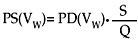
<body><![CDATA[<p><font size="2" face="Verdana">Blood samples were drawn from a vein in the forearm,    in evacuated glass tubes specially prepared for trace elements (vacutainer,    purple cap, evacuated tubes, Beckton Dickinson Inc, Lakes, NJ, USA). Serum was    immediately separated on the household premises using a portable centrifuge    EB8 (Hettich, Tuttlingen, Germany), and transferred into cryovials and preserved    in liquid nitrogen until delivered to a central laboratory. Although they were    spot samples, more than 80% were collected in the morning after at least two    hours of fasting. Subjects with evident signs of acute infections or other debilitating    illnesses were not included in the sample. </font></p>     <p><font size="2" face="Verdana"><b>Methods for iron, zinc, iodide, C-reactive    protein determinations. </b></font></p>     <p><font size="2" face="Verdana">The concentrations of iron, total iron binding    capacity (TIBC), and zinc and C-reactive protein were determined in serum samples,    and iodide was determined in spot urine samples. </font></p>     <p><font size="2" face="Verdana"><I>Iron status</I>. Serum iron and TIBC were    estimated by determining iron concentrations before and after incubating a serum    aliquot with saturated iron solution and then precipitating it with trichloroacetic    acid. Determinations were made by atomic absorption spectrometry using an Analyst    300 spectrometer (Perkin-Elmer, Norwalk, Ct, USA). Percent transferrin saturation    (PTS) was calculated dividing serum iron by TIBC, times 100.<SUP>11,12</SUP>    Because PTS is a more parsimonious indicator of iron status than the other two    measurements, it was used in this research as the sole indicator of iron status.    Iron status as indicated by PTS was graded into the following categories: Normal:    &gt;20%; iron depletion: 16.1-20%; and iron deficiency: &lt;16%.<SUP>13</SUP>    </font></p>     <p><font size="2" face="Verdana"> Serum Zinc. Serum zinc concentrations were determined    by atomic absorption spectrometry using the same instrument described for the    determinations of iron.<SUP>14</SUP> A cut-off value of 70 ug/dl has been recommended<SUP>15</SUP>    to assess zinc deficiency in children based on NHAENES II results. Because blood    samples in this survey were not obtained necessarily after fasting, we used    a cut-off value of 65 ug/dl, as recommended by the International Zinc Nutrition    Consultative Group (IzincCG). </font></p>     <p><font size="2" face="Verdana"><I>C-reactive protein</I>. C-reactive protein    was determined by nephelometry using a commercial kit (Dade-Behring, Marburg,    Germany). The cut-off point used to detect abnormal values was &gt;3 mg/dl,    as suggested by the manufacturer. </font></p>     <p><font size="2" face="Verdana"><I>Urinary iodide</I>. Iodide concentrations    were measured in the urine samples collected in hermetic cryovial and frozen    at –70&ordm;C, until determination by a colorimetric method, based    on the capacity of iodide to reduce ceric-amonium sulfate in the presence of    arseniosus acid. The urine sample was digested previously with ammonium persulfate.<SUP>16</SUP>    </font></p>     <p><font size="2" face="Verdana"> Cut-off concentrations of iodide to define deficiencies    were those of ICCIDD/OMS/OPS/UNICEF<SUP>17 </SUP> i.e., normal: &gt; 100 ug/l,    low risk: 50-99 ug/l, moderate risk: 20-49 ug/l, and high risk: &lt;20 ug/l.    </font></p>     <p><font size="2" face="Verdana"><b>Assessment of dietary intake </b></font></p>     <p><font size="2" face="Verdana">Dietary intake was assessed by a single 24-hour    (24-h) recall applied to the women. The dietary intake of children was assessed    by 24-h recall applied to the mother. Based on this single recall the consumption    of food and nutrients was calculated. Nutrient intake was calculated by multiplying    the portion size in grams of a given food by the nutrient content per gram of    that food as per food-composition tables. Food composition was obtained from    a data base which included micronutrient information from 7 published food composition    tables<SUP>18-23</SUP>and from an unpublished composition table     (Informaci&oacute;n Nutricional de Marinela, Marinela Company, Mexico City),    all of which were pooled at the Instituto Nacional de Salud P&uacute;blica,    Mexico. </font></p>     ]]></body>
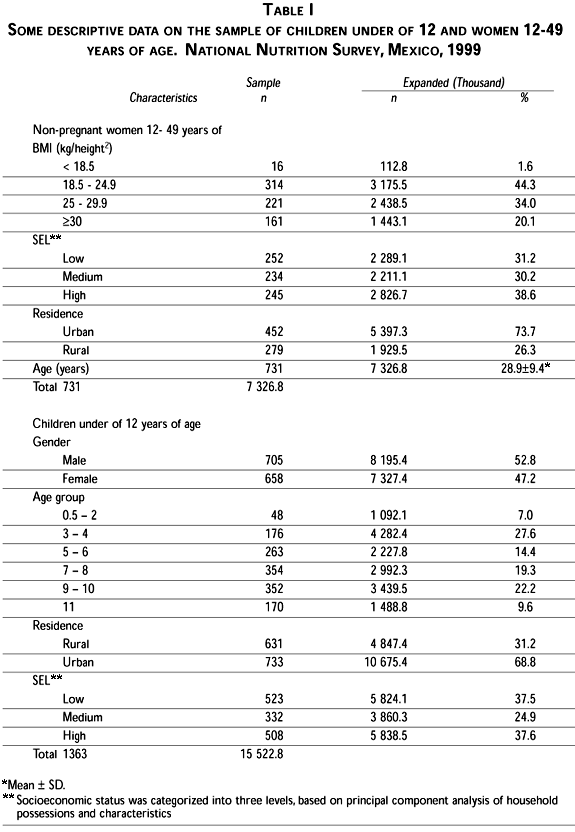
<body><![CDATA[<p><font size="2" face="Verdana"><b>Data analysis </b></font></p>     <p><font size="2" face="Verdana">Description of variables was made by central    tendency and dispersion statistics. The prevalence of each category of nutritional    status of minerals included in this analysis is presented as rates and confidence    intervals. The presence of a positive C-reactive protein determination (&gt;3mg/dl)    excluded iron and zinc values of that individual from the analysis. Actual sample    size for any category presented here was expanded using a population factor    as described above. </font></p>     <p><font size="2" face="Verdana"> Also, to identify potential predictors of the    nutritional status for each mineral, we constructed logistic regression models,    which controlled for the clustered design of the study. Individual minerals    were coded as normal or abnormal according to the following cut-off values:    PTS&lt; 20% and serum zinc &lt;65 ug/dl, and introduced into the models as dependent    variables. Age, gender, socioeconomic level, ethnic status, receiving food assistance    programs, and the daily intake of the following food groups: cereals, meat,    legumes, were introduced as independent variables. Food intake was expressed    as portions of 100 grams consumed per day. Because of the great co-linearity    between socioeconomic level, maternal education and height we choose include    socioeconomic level in the model, and not maternal education, height or height/age.    There are some difficulties in explaining the association of nutritional status    of micronutrients and dietary variables, because the latter are frequently associated    with SEL. Controlling for SEL when examining associations with diet may represent    over controlling. Thus, to avoid it we constructed two additional restricted    models in which only socioeconomic variables or dietary variables were alternately    introduced as independent variables. </font></p>     <p><font size="2" face="Verdana"> Data entry was done using a Clipper-based program    using data entry formats that included range and contingency validation checks    (version 5.01, Nantucket<SUP> TM </SUP>Corporation, 1991, S.F., California).    Descriptive analysis was run in SPSS for Windows (version 10.1.4; SPSS Inc,    Chicago, U.S.A., 2000). Regression models were adjusted using Stata statistical    software (V. 7.0 for Windows, Stata Corp, College Station, Tx, U.S.A. 2001).    </font></p>     <p>&nbsp;</p>     <p><font size="3" face="Verdana"><b>Results </b></font></p>     <p><font size="2" face="Verdana">Data on 1 363 children and 731 women were obtained;    however, the sample size varies for each nutrient because of losses of samples    or unrecoverable results (<a href="#tab01">Table I</a>). The sample size for    pregnant women was insufficient to furnish reliable conclusions, thus they are    not presented in this analysis. </font></p>     <p><a name="tab01"></a></p>     <p>&nbsp;</p>     <p align="center"><img src="/img/revistas/spm/v45s4/a08tab01.gif"></p>     ]]></body>
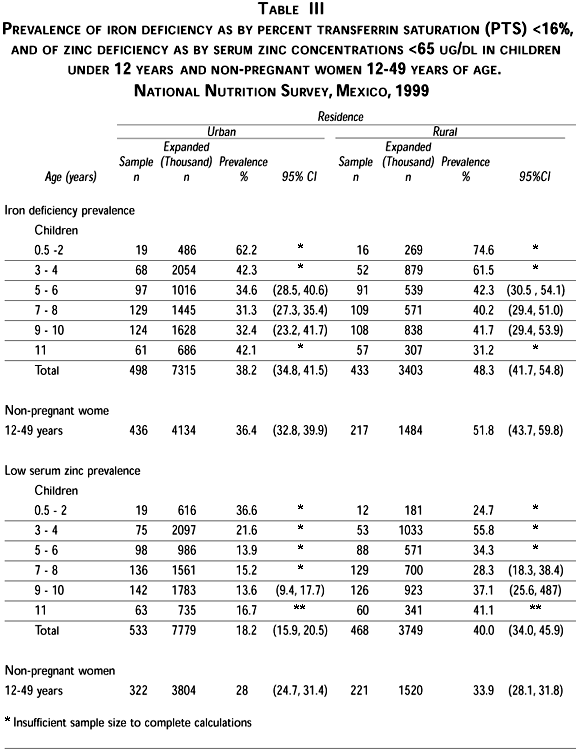
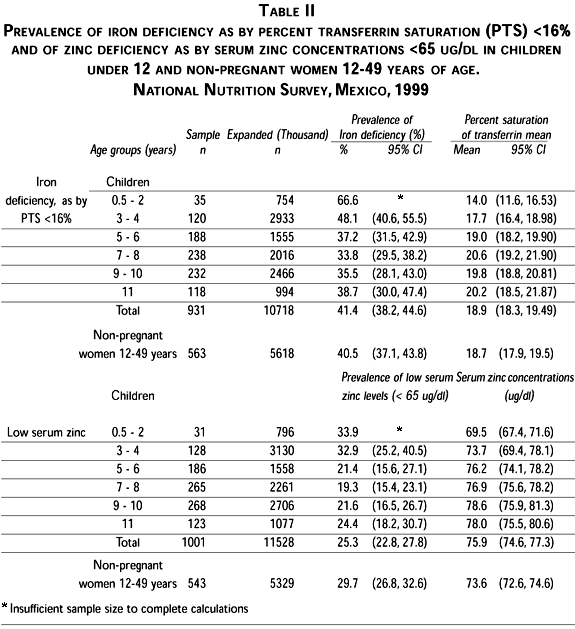
<body><![CDATA[<p>&nbsp;</p>     <p><font size="2" face="Verdana"><b>Children under 12 years of age </b></font></p>     <p><font size="2" face="Verdana"><I>Iron status</I>. The prevalence of overt iron    deficiency (PTS &lt;16%) at the national level was highest in infants 12 to    24 months of age (66.6%). Although the prevalence of iron deficiency declined    progressively with age, it remained very high in school-age children (33.8-38.7%).    Prevalence of iron deficiency was higher in rural than urban children, differences    were of at least 10 percent points, except at 11 years of age. At that age a    surge in the prevalence of iron deficiency in urban children changed the direction    of the difference in prevalence relative to rural children (<I>p</I>&lt;0.05).    Urban children were able to reduce their prevalence of iron deficiency in 33%    at three years of age, while rural reduced it in only 16% (<a href="#tab03">Table    III</a>). The North (73.1%), center (87%), and South (75%) regions had the highest    prevalence in infants younger than two years. Children from the North and center    reduced their prevalence of iron deficiency by more than 30 percentage points    by three years of age, while those from the South did so by only 10 percent    points at the same age. </font></p>     <p><a name="tab02"></a></p>     <p>&nbsp;</p>     <p align="center"><img src="/img/revistas/spm/v45s4/a08tab02.gif"></p>     <p>&nbsp;</p>     <p><a name="tab03"></a></p>     <p>&nbsp;</p>     <p align="center"><img src="/img/revistas/spm/v45s4/a08tab03.gif"></p>     ]]></body>
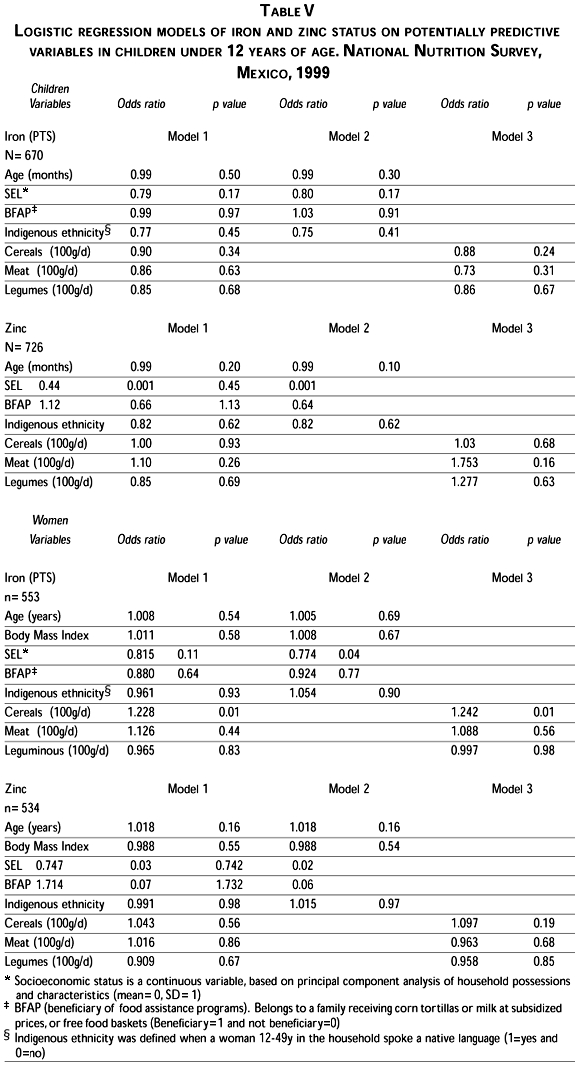
<body><![CDATA[<p>&nbsp;</p>     <p><font size="2" face="Verdana"> In a logistic regression analysis the likelihood    of being iron deficient was not affected by SEL, Indigenous ethnicity, being    beneficiary of food assistance programmes, dietary intakes of cereals, meat    or leguminous (<a href="#tab05">Table V</a>). </font></p>     <p><a name="tab04"></a></p>     <p>&nbsp;</p>     <p align="center"><img src="/img/revistas/spm/v45s4/a08tab04.gif"></p>     <p>&nbsp;</p>     <p><a name="tab05"></a></p>     <p>&nbsp;</p>     <p align="center"><img src="/img/revistas/spm/v45s4/a08tab05.gif"></p>     <p>&nbsp;</p>     ]]></body>
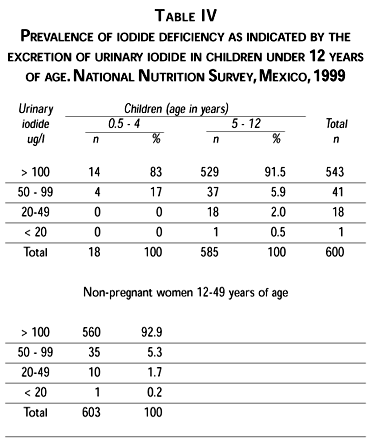
<body><![CDATA[<p><font size="2" face="Verdana"><b>Zinc status </b></font></p>     <p><font size="2" face="Verdana">The prevalence of low serum zinc levels was highest    in children under of 24 months of age (33.9%) and it declined progressively    with age, maintaining a plateau during the school age (19.3-24.4%) (<a href="#tab02">Table    II</a>). The global prevalence of low serum zinc levels in rural children under    12 years of age (40.0%) was twice that of their urban counterparts (18.2%);    however, the opposite occurred in children under of 24 months of age (24.7 vs.    36.6%, respectively) (<a href="#tab03">Table III</a>). The highest prevalence    of low serum zinc levels after two years of age occurred in the South region,    at all ages (20.9-51.7%), while the lowest corresponded to the North region    (5.5-14.2%). </font></p>     <p><font size="2" face="Verdana"> Logistic regression showed that the likelihood    of having low serum zinc levels was lower as SEL increased (OR=0.44, <I>p</I>=0.001),    (<a href="#tab05">Table V</a>). </font></p>     <p><font size="2" face="Verdana"><b>Iodide status </b></font></p>     <p><font size="2" face="Verdana">The prevalence of urine iodide concentrations    compatible with severe iodide deficiency were not detected in children under    5 years of age, and the prevalence was 0.5% in school-age children. The remaining    children in the sample had iodide concentrations either within the normal range    or indicative of a low risk of deficiency. Data were not further disaggregated    because of the extremely low prevalence of abnormal values (<a href="#tab05">Table    V</a>). </font></p>     <p><font size="2" face="Verdana"><b>Women 12 to 49 years of age </b></font></p>     <p><font size="2" face="Verdana"><I>Iron status</I> </font></p>     <p><font size="2" face="Verdana">The prevalence of overt iron deficiency (PTS    &lt;16%) at the national level was 40.5%, and was higher in the rural (51.8%)    than in the urban women (36.4%, <I>p</I>&lt;0.02) (<a href="#tab03">Table III</a>).    The most affected region was the South with a prevalence of 50.9%; nevertheless,    the prevalence in the other three regions (31-36%) was also high. The prevalence    of iron depletion (PTS &gt;16&lt;20%) was about 20% in all regions, except Mexico    City (13%) The summed prevalence of any form of iron deficiency was more than    70% in the South and about 50% in the other regions. </font></p>     <p><font size="2" face="Verdana"> In a logistic regression model the likelihood    of having iron deficiency was lower as SEL increased (OR=0.77, <I>p</I>=0.04)    and higher in those with higher cereals intakes (OR=1.22, p=0.01). BMI, being    beneficiary of food assistance programs, ethnicity, or the intakes of meat,    legumes, fruits or vegetables did not affect the risk of being iron deficient    (<a href="#tab05">Table V</a>). </font></p>     <p><font size="2" face="Verdana"><I>Zinc status</I> </font></p>     ]]></body>
<body><![CDATA[<p><font size="2" face="Verdana">The prevalence of zinc deficiency (&lt;65 ug/dl)    was almost 30% in the national sample, with no significant difference between    urban and rural women (28.8 vs. 33.9%, respectively) (<a href="#tab03">Table    III</a>). The highest prevalence of zinc deficiency corresponded to the South    region (36.4%) and the lowest to the Mexico City region (19.2%). The other two    regions were intermediate. </font></p>     <p><font size="2" face="Verdana"> The likelihood of having low serum zinc levels    in women was lower as SEL increased (OR=0.74, <I>p</I>=0.02). No association    was found with age, BMI, being beneficiary of food assistance programmes or    with any of the food groups introduced to the model. (<a href="#tab05">Table    V</a>). </font></p>     <p><font size="2" face="Verdana"><I>Iodide status</I> </font></p>     <p><font size="2" face="Verdana">In only one case were the urine concentrations    of iodide compatible with severe deficiency. Normal values (&gt;100 ug/l) or    values compatible with mild deficiency (50-99 ug/l) were found in 98% of the    samples. No differences in the prevalence were found between urban and rural    women (<a href="#tab04">Table IV</a>).</font></p>     <p>&nbsp;</p>     <p><font size="3" face="Verdana"><b> Discussion </b></font></p>     <p><font size="2" face="Verdana">Iron deficiency in children. The prevalence of    iron deficiency was very high in all children but particularly in those under    24 months of age. Iron deficiency was 25% higher than the prevalence of anemia    (50%) reported for the same infants from the NNS-99.<SUP> 24</SUP> Plausible    explanations for such a high prevalence of iron deficiency in this age group    include: a) There is a high prevalence of iron deficiency in women of reproductive    age from the same households herein reported, particularly those that were pregnant.    The latter may lead to development of limited fetal iron stores of their offspring.    b) Even milk from well-nourished mothers does not meet the infant's iron requirements    after the first few months of life; iron status of the infant then relies only    on preexisting stores. c) Dietary transition from lactation to the family diet    frequently implies weaning children with foods of low energy and iron densities.<SUP>    25</SUP> Thus, the higher risk for iron deficiency occurs in the first years    of life when children are less able to eat a diet with a larger content of iron.    In support of this notion we observed that although the prevalence of iron deficiency    declined in both rural and urban infants, rural infants reduced their prevalence    of iron deficiency two years after their urban counterparts. Such differences    might be attributed to differences in the timing and quality of weaning diets    between the two groups. Iron deficiency in women of childbearing age. The prevalence    of iron deficiency in women was high in    general but some distinctions are in order. It was higher in rural residents    and in those living in the poorest (South) region of the country. Iron deficiency    was as high in school-age children as in women suggesting that they share common    dietary insufficiencies. Higher daily intakes of cereals represented a risk    for iron deficiency too, suggesting that they may interfere with the availability    of iron. Corn and corn products were the most frequently eaten food by this    population, referred, both, as grams per day or as kcal per day.<SUP> 26 </SUP>    Corn is known to be one of the cereals with the highest content of phytic acid,    a potent inhibitor of the intestinal absorption of iron and other divalent metals.    Thus, it is very plausible that the negative association between the intake    of cereals and iron status of this population may be explained by the higher    intake of corn phytates. </font></p>     <p><font size="2" face="Verdana"> Nutritional interventions aiming to improve    the iron status of young children and women of childbearing age are urgent in    order to reduce the deleterious effects of iron deficiency anemia and other    forms of iron deficiency on growth,<SUP> 27</SUP> mental development,<SUP>28</SUP>    immune ability to combat infections,<SUP>29</SUP> and work capacity.<SUP>30</SUP>    </font></p>     <p><font size="2" face="Verdana"><b>Zinc nutritional status </b></font></p>     <p><font size="2" face="Verdana">The lower cut-off value, relative to those most    frequently accepted,<SUP>15</SUP> was chosen for this study based on the recent    recommendations of the IZINCG for non-fasting serum samples, as was the case    for the serum samples from this survey.<SUP>16</SUP>    In this study, we demonstrated that the prevalence of low serum zinc affected    more to children living in the poorest regions and to those of the lower SEL.The    primary cause of zinc deficiency is believed to be the inadequate intake of    dietary zinc.<SUP>16,31</SUP> It is difficult to meet dietary requirements for    zinc in populations where a large proportion of dietary intake is derived from    cereals such as corn (maize) and very little food from animal sources. </font></p>     ]]></body>
<body><![CDATA[<p><font size="2" face="Verdana"> Zinc deficiency has profound and far-reaching    effects on the health and well being of humans. There is a large body of convincing    evidence linking zinc deficiency to childhood growth stunting,<SUP>32</SUP>    increased prevalence of common childhood infections such as diarrhea and pneumonia,<SUP>33</SUP>    reduced appetite among children,<SUP>34</SUP> impaired neurobehavioral function,<SUP>35,36</SUP>    delayed sexual maturation among adolescents,<SUP>37</SUP> poor pregnancy outcomes    including low birth weight, preterm deliveries, maternal delivery complications,<SUP>38</SUP>    and impaired immune function of the neonate,<SUP>39</SUP> and increased risk    of infant mortality among low birth weight infants.<SUP>40</SUP> Despite these    far reaching consequences, much remains to be learned about efficacious methods    to prevent zinc deficiency. Women of childbearing age may be at even higher    risk of zinc deficiency in comparison to other groups (e.g. adult men) due to    the higher requirements for zinc during fetal development and lactation.<SUP>41</SUP>    </font></p>     <p><font size="2" face="Verdana"><b>Iodide status </b></font></p>     <p><font size="2" face="Verdana">Given the results presented, the prevalence of    iodide deficiency is negligible in both, women and children. Distribution of    abnormal results was so scattered that no remarks can be made relating to geographical    distribution<B>. </B>We recognize that the scope of our study does not allow    us to distinguish micro regions where iodide deficiency might be still high.    Table salt iodination is the most ancient public nutrition intervention in Mexico.    Salt iodination has been mandatory by law for more than 50 years; thus, it is    not surprising to find such a low prevalence of low urinary iodide levels. A    note of caution is in order, however, as we checked on the iodide level of table    salt and found (data not shown) that industrially refined salt, but none of    the other forms available on the market complied with the required levels of    iodide. </font></p>     <p><font size="2" face="Verdana"> In summary the prevalence of iron and zinc deficiency    is very high in women of childbearing age and children, especially those under    two years of age. The evidence indicates that poverty is the main underling    cause of iron and zinc deficiencies. The association between some dietary factors    suggests that the iron deficiencies are related to low intake of the most bioavailable    forms of the mineral, and to the intake of dietary iron and zinc inhibitors.    Aggressive interventions are imperative to correct iron and zinc deficiencies    and by so doing avoid their deleterious effects . </font></p>     <p>&nbsp;</p>     <p><font size="3" face="Verdana"><b>References </b></font></p>     <!-- ref --><p><font size="2" face="Verdana">1. Commission on the Nutrition Challenge of the    21<SUP>st</SUP> Century. Ending malnutrition by 2020: An agenda for change in    the millennium. Final report to the ACC/SCN Food Nutr Bull 2000; 21: (v3) </font>&nbsp;&nbsp;&nbsp;&nbsp;&nbsp;&nbsp;&nbsp;&nbsp;[&#160;<a href="javascript:void(0);" onclick="javascript: window.open('/scielo.php?script=sci_nlinks&ref=9228004&pid=S0036-3634200300100000800001&lng=','','width=640,height=500,resizable=yes,scrollbars=1,menubar=yes,');">Links</a>&#160;]<!-- end-ref --><!-- ref --><p><font size="2" face="Verdana">2. Rivera JA, Martorell R, Ruel MT, Habicht J-P,    Hass JD. Nutritional supplementation during the preschool years influences body    size and composition of Guatemalan adolescents. J Nutr 1995;125:1068S-1077S.    </font>&nbsp;&nbsp;&nbsp;&nbsp;&nbsp;&nbsp;&nbsp;&nbsp;[&#160;<a href="javascript:void(0);" onclick="javascript: window.open('/scielo.php?script=sci_nlinks&ref=9228005&pid=S0036-3634200300100000800002&lng=','','width=640,height=500,resizable=yes,scrollbars=1,menubar=yes,');">Links</a>&#160;]<!-- end-ref --><!-- ref --><p><font size="2" face="Verdana">3. Shankar AH, Prasad AS. Zinc and immune function:    The biological basis of altered resistance to infection. Am J Clin Nutr 1998;    68:447S-463S. </font>&nbsp;&nbsp;&nbsp;&nbsp;&nbsp;&nbsp;&nbsp;&nbsp;[&#160;<a href="javascript:void(0);" onclick="javascript: window.open('/scielo.php?script=sci_nlinks&ref=9228006&pid=S0036-3634200300100000800003&lng=','','width=640,height=500,resizable=yes,scrollbars=1,menubar=yes,');">Links</a>&#160;]<!-- end-ref --><!-- ref --><p><font size="2" face="Verdana">4. Sep&uacute;lveda-Amor J, Lezana MA, Tapia-Conyer,    Valdespino JL, Madrigal H, Kumate J. Estado nutricional de prescolares y mujeres    en M&eacute;xico: resultados de una encuesta probabil&iacute;stica nacional.    Gac Med Mex 1990; 126:207-224. </font>&nbsp;&nbsp;&nbsp;&nbsp;&nbsp;&nbsp;&nbsp;&nbsp;[&#160;<a href="javascript:void(0);" onclick="javascript: window.open('/scielo.php?script=sci_nlinks&ref=9228007&pid=S0036-3634200300100000800004&lng=','','width=640,height=500,resizable=yes,scrollbars=1,menubar=yes,');">Links</a>&#160;]<!-- end-ref --><!-- ref --><p><font size="2" face="Verdana">5. Anonimous. Segundo Censo Nacional de talla.    En ni&ntilde;os de primer grado de primaria. Informe t&eacute;cnico ejecutivo.    Sistema Nacional para el desarrollo integral de la familia, M&eacute;xico D.F.,    1996. </font>&nbsp;&nbsp;&nbsp;&nbsp;&nbsp;&nbsp;&nbsp;&nbsp;[&#160;<a href="javascript:void(0);" onclick="javascript: window.open('/scielo.php?script=sci_nlinks&ref=9228008&pid=S0036-3634200300100000800005&lng=','','width=640,height=500,resizable=yes,scrollbars=1,menubar=yes,');">Links</a>&#160;]<!-- end-ref --><!-- ref --><p><font size="2" face="Verdana">6. Rivera J, Shamah T, Villalpando S, Gonz&aacute;lez    T, Hern&aacute;ndez B, Sep&uacute;lveda J, ed. Encuesta Nacional de Nutrici&oacute;n    1999. Estado Nutricio de Ni&ntilde;os y Mujeres en M&eacute;xico. Cuernavaca,    Morelos, M&eacute;xico. Instituto Nacional de Salud P&uacute;blica, 2001. </font>&nbsp;&nbsp;&nbsp;&nbsp;&nbsp;&nbsp;&nbsp;&nbsp;[&#160;<a href="javascript:void(0);" onclick="javascript: window.open('/scielo.php?script=sci_nlinks&ref=9228009&pid=S0036-3634200300100000800006&lng=','','width=640,height=500,resizable=yes,scrollbars=1,menubar=yes,');">Links</a>&#160;]<!-- end-ref --><!-- ref --><p><font size="2" face="Verdana">7. Rivera J, Bourges H, Arroyo P, Casanueva E,    Chavez A, Halhalali A, et al. Deficiencia de micronutrimentos. En: De la Fuente    JR, Sep&uacute;lveda J, comp. Diez problemas relevantes de salud p&uacute;blica    en M&eacute;xico. M&eacute;xico, D.F.: Fondo de Cultura Econ&oacute;mica, 1999:15-57.    </font>&nbsp;&nbsp;&nbsp;&nbsp;&nbsp;&nbsp;&nbsp;&nbsp;[&#160;<a href="javascript:void(0);" onclick="javascript: window.open('/scielo.php?script=sci_nlinks&ref=9228010&pid=S0036-3634200300100000800007&lng=','','width=640,height=500,resizable=yes,scrollbars=1,menubar=yes,');">Links</a>&#160;]<!-- end-ref --><!-- ref --><p><font size="2" face="Verdana">8. Rosado JL, Bourges H, SainT-Martin B. Deficiencias    de vitaminas y minerales en M&eacute;xico. Una revisi&oacute;n cr&iacute;tica    del estado de la informaci&oacute;n: I. Deficiencia de minerales. Salud Publica    Mex 1995; 37:13-19. </font>&nbsp;&nbsp;&nbsp;&nbsp;&nbsp;&nbsp;&nbsp;&nbsp;[&#160;<a href="javascript:void(0);" onclick="javascript: window.open('/scielo.php?script=sci_nlinks&ref=9228011&pid=S0036-3634200300100000800008&lng=','','width=640,height=500,resizable=yes,scrollbars=1,menubar=yes,');">Links</a>&#160;]<!-- end-ref --><!-- ref --><p><font size="2" face="Verdana">9. Loria A, S&aacute;nchez L, Arroyo E, Cordourier    E, Piedras J, Casanueva E. Nutritional anemia. VIII Hemoglobin and plasma iron    in infants treated perinatally with iron. Nutr Rep Internat 1979; 19:451-62    </font>&nbsp;&nbsp;&nbsp;&nbsp;&nbsp;&nbsp;&nbsp;&nbsp;[&#160;<a href="javascript:void(0);" onclick="javascript: window.open('/scielo.php?script=sci_nlinks&ref=9228012&pid=S0036-3634200300100000800009&lng=','','width=640,height=500,resizable=yes,scrollbars=1,menubar=yes,');">Links</a>&#160;]<!-- end-ref --><!-- ref --><p><font size="2" face="Verdana">10. Instituto Nacional de Salud P&uacute;blica.    Encuesta Nacional de Nutrici&oacute;n 1999. Tomo I. Ni&ntilde;os menores de    5 a&ntilde;os. Cuernavaca, Morelos: INSP, 2000:14-24. </font>&nbsp;&nbsp;&nbsp;&nbsp;&nbsp;&nbsp;&nbsp;&nbsp;[&#160;<a href="javascript:void(0);" onclick="javascript: window.open('/scielo.php?script=sci_nlinks&ref=9228013&pid=S0036-3634200300100000800010&lng=','','width=640,height=500,resizable=yes,scrollbars=1,menubar=yes,');">Links</a>&#160;]<!-- end-ref --><!-- ref --><p><font size="2" face="Verdana">11. Henry JB. Clinical diagnosis and management    by laboratory methods. Philadelphia (PA): W.B. Saunders 1991. </font>&nbsp;&nbsp;&nbsp;&nbsp;&nbsp;&nbsp;&nbsp;&nbsp;[&#160;<a href="javascript:void(0);" onclick="javascript: window.open('/scielo.php?script=sci_nlinks&ref=9228014&pid=S0036-3634200300100000800011&lng=','','width=640,height=500,resizable=yes,scrollbars=1,menubar=yes,');">Links</a>&#160;]<!-- end-ref --><!-- ref --><p><font size="2" face="Verdana">12. National Committee for Clinical Laboratory    Standards. Method comparison and bias estimation using patients serum samples:    Tentative guideline. Villanova, (PA): NCCLS, 1992. Publication EP9-T. </font>&nbsp;&nbsp;&nbsp;&nbsp;&nbsp;&nbsp;&nbsp;&nbsp;[&#160;<a href="javascript:void(0);" onclick="javascript: window.open('/scielo.php?script=sci_nlinks&ref=9228015&pid=S0036-3634200300100000800012&lng=','','width=640,height=500,resizable=yes,scrollbars=1,menubar=yes,');">Links</a>&#160;]<!-- end-ref --><!-- ref --><p><font size="2" face="Verdana">13. Herbert V. The Herman Award Lecture. Nutrition    Science as a continually unfolding story: The Folate and Vitamin B12 paradigm.    Am J Clin Nutr 1986; 46: 387-400. </font>&nbsp;&nbsp;&nbsp;&nbsp;&nbsp;&nbsp;&nbsp;&nbsp;[&#160;<a href="javascript:void(0);" onclick="javascript: window.open('/scielo.php?script=sci_nlinks&ref=9228016&pid=S0036-3634200300100000800013&lng=','','width=640,height=500,resizable=yes,scrollbars=1,menubar=yes,');">Links</a>&#160;]<!-- end-ref --><!-- ref --><p><font size="2" face="Verdana">14. Makino T, Takahara K. Direct determination    of plasma copper and zinc in infants by atomic absorption with discreet nebulization.    Clin Chem 1981; 27:1445-1449. </font>&nbsp;&nbsp;&nbsp;&nbsp;&nbsp;&nbsp;&nbsp;&nbsp;[&#160;<a href="javascript:void(0);" onclick="javascript: window.open('/scielo.php?script=sci_nlinks&ref=9228017&pid=S0036-3634200300100000800014&lng=','','width=640,height=500,resizable=yes,scrollbars=1,menubar=yes,');">Links</a>&#160;]<!-- end-ref --><!-- ref --><p><font size="2" face="Verdana">15. Gibson RS. Zinc nutrition in developing countries.    Nutr Res Rev 1994; 7: 151-173. </font>&nbsp;&nbsp;&nbsp;&nbsp;&nbsp;&nbsp;&nbsp;&nbsp;[&#160;<a href="javascript:void(0);" onclick="javascript: window.open('/scielo.php?script=sci_nlinks&ref=9228018&pid=S0036-3634200300100000800015&lng=','','width=640,height=500,resizable=yes,scrollbars=1,menubar=yes,');">Links</a>&#160;]<!-- end-ref --><!-- ref --><p><font size="2" face="Verdana">16. Dunn JT, Crutenfield HE, Gutekunst R, Dunn    AD. Methods for measuring iodine in urine. ICCIDD/Fondo Internacional de Ayuda    a la Infancia/World Health Organization, Washington D.C., 1993. </font>&nbsp;&nbsp;&nbsp;&nbsp;&nbsp;&nbsp;&nbsp;&nbsp;[&#160;<a href="javascript:void(0);" onclick="javascript: window.open('/scielo.php?script=sci_nlinks&ref=9228019&pid=S0036-3634200300100000800016&lng=','','width=640,height=500,resizable=yes,scrollbars=1,menubar=yes,');">Links</a>&#160;]<!-- end-ref --><!-- ref --><p><font size="2" face="Verdana">17. Indicadores para evaluar los transtornos    por carencia de yodo y su control mediante la yodaci&oacute;n de la sal. ICCIDD/Organizaci&oacute;n    Mundial de la Salud/Organizaci&oacute;n Panamericana de la Salud/Fondo Internacional    de Ayuda a la Infancia, Documento t&eacute;cnico. WHO/Nut/94.6, Geneve, Switz,    1994. </font>&nbsp;&nbsp;&nbsp;&nbsp;&nbsp;&nbsp;&nbsp;&nbsp;[&#160;<a href="javascript:void(0);" onclick="javascript: window.open('/scielo.php?script=sci_nlinks&ref=9228020&pid=S0036-3634200300100000800017&lng=','','width=640,height=500,resizable=yes,scrollbars=1,menubar=yes,');">Links</a>&#160;]<!-- end-ref --><!-- ref --><p><font size="2" face="Verdana">18. Morales J, Babinsky V, Bourges H, Camacho    ME. Tablas de Composici&oacute;n de Alimentos Mexicanos del Instituto Nacional    de Ciencias M&eacute;dicas y Nutrici&oacute;n &quot;Salvador Zubir&aacute;n&quot;,    M&eacute;xico, D.F.: INMNSZ 2000. </font>&nbsp;&nbsp;&nbsp;&nbsp;&nbsp;&nbsp;&nbsp;&nbsp;[&#160;<a href="javascript:void(0);" onclick="javascript: window.open('/scielo.php?script=sci_nlinks&ref=9228021&pid=S0036-3634200300100000800018&lng=','','width=640,height=500,resizable=yes,scrollbars=1,menubar=yes,');">Links</a>&#160;]<!-- end-ref --><!-- ref --><p><font size="2" face="Verdana">19. Mu&ntilde;oz M, Ch&aacute;vez A, P&eacute;rez-Gil    F, Rold&aacute;n JA, Hern&aacute;ndez S, Ledesma JA, et al. Tablas de valor    nutritivo de los alimentos de mayor consumo en M&eacute;xico. M&eacute;xico,    D.F: Editorial Pax, M&eacute;xico, 1996. </font>&nbsp;&nbsp;&nbsp;&nbsp;&nbsp;&nbsp;&nbsp;&nbsp;[&#160;<a href="javascript:void(0);" onclick="javascript: window.open('/scielo.php?script=sci_nlinks&ref=9228022&pid=S0036-3634200300100000800019&lng=','','width=640,height=500,resizable=yes,scrollbars=1,menubar=yes,');">Links</a>&#160;]<!-- end-ref --><!-- ref --><p><font size="2" face="Verdana">20. Database for Standard Reference. US Department    of Agriculture, Agricultural Research Service. USDA Nutrient, Release 13. Nutrient    Data Laboratory, 1999. </font>&nbsp;&nbsp;&nbsp;&nbsp;&nbsp;&nbsp;&nbsp;&nbsp;[&#160;<a href="javascript:void(0);" onclick="javascript: window.open('/scielo.php?script=sci_nlinks&ref=9228023&pid=S0036-3634200300100000800020&lng=','','width=640,height=500,resizable=yes,scrollbars=1,menubar=yes,');">Links</a>&#160;]<!-- end-ref --><!-- ref --><p><font size="2" face="Verdana">21. Scherz H, Senser F. Der zusament setzung    der Lebensmittel, N&auml;hrwert – Tabellen/on behalf of the Bundesministerium    f&uuml;r Ern&auml;hrung, Land wirts shaft und Forsten, Bonn, ed. , Stuttgart:    Medpharm Scientific (Pub) and CRC Press, London UK, 2000. </font>&nbsp;&nbsp;&nbsp;&nbsp;&nbsp;&nbsp;&nbsp;&nbsp;[&#160;<a href="javascript:void(0);" onclick="javascript: window.open('/scielo.php?script=sci_nlinks&ref=9228024&pid=S0036-3634200300100000800021&lng=','','width=640,height=500,resizable=yes,scrollbars=1,menubar=yes,');">Links</a>&#160;]<!-- end-ref --><!-- ref --><p><font size="2" face="Verdana">22. Instituto de Nutrici&oacute;n de Centro Am&eacute;rica    y Panam&aacute;. Tabla de composici&oacute;n de alimentos. Guatemala,CA: INCAP,    1994. </font>&nbsp;&nbsp;&nbsp;&nbsp;&nbsp;&nbsp;&nbsp;&nbsp;[&#160;<a href="javascript:void(0);" onclick="javascript: window.open('/scielo.php?script=sci_nlinks&ref=9228025&pid=S0036-3634200300100000800022&lng=','','width=640,height=500,resizable=yes,scrollbars=1,menubar=yes,');">Links</a>&#160;]<!-- end-ref --><!-- ref --><p><font size="2" face="Verdana">23. Anonimous. World Food Dietary Assessment    System. V 2.0, University of California, Berkeley, 1997. </font>&nbsp;&nbsp;&nbsp;&nbsp;&nbsp;&nbsp;&nbsp;&nbsp;[&#160;<a href="javascript:void(0);" onclick="javascript: window.open('/scielo.php?script=sci_nlinks&ref=9228026&pid=S0036-3634200300100000800023&lng=','','width=640,height=500,resizable=yes,scrollbars=1,menubar=yes,');">Links</a>&#160;]<!-- end-ref --><!-- ref --><p><font size="2" face="Verdana">24. Villalpando S, Shamah-Levy T, Ram&iacute;rez-Silva    CI, Mej&iacute;a-Rodr&iacute;guez F, Rivera JA. Prevalence of anemia in children    1 to 12 years of age. Results of a nationwide probabilistic survey in Mexico.    Salud Publica Mex 2003;45 suppl 4:S490-S498. </font>&nbsp;&nbsp;&nbsp;&nbsp;&nbsp;&nbsp;&nbsp;&nbsp;[&#160;<a href="javascript:void(0);" onclick="javascript: window.open('/scielo.php?script=sci_nlinks&ref=9228027&pid=S0036-3634200300100000800024&lng=','','width=640,height=500,resizable=yes,scrollbars=1,menubar=yes,');">Links</a>&#160;]<!-- end-ref --><!-- ref --><p><font size="2" face="Verdana">25. Anonimous. Complementary feeding of young    children in developing countries: A review of current scientific knowledge.    Geneva: WHO, 1998; WHO/NUT/98.1. </font>&nbsp;&nbsp;&nbsp;&nbsp;&nbsp;&nbsp;&nbsp;&nbsp;[&#160;<a href="javascript:void(0);" onclick="javascript: window.open('/scielo.php?script=sci_nlinks&ref=9228028&pid=S0036-3634200300100000800025&lng=','','width=640,height=500,resizable=yes,scrollbars=1,menubar=yes,');">Links</a>&#160;]<!-- end-ref --><!-- ref --><p><font size="2" face="Verdana">26. Avila A, Shamah T, Chavez A. Encuesta Nacional    de Alimentaci&oacute;n y Nutrici&oacute;n en el Medio Rural 1996. Vol 1. Resultados    por Entidad. M&eacute;xico, D.F: INNSZ: 1998. </font>&nbsp;&nbsp;&nbsp;&nbsp;&nbsp;&nbsp;&nbsp;&nbsp;[&#160;<a href="javascript:void(0);" onclick="javascript: window.open('/scielo.php?script=sci_nlinks&ref=9228029&pid=S0036-3634200300100000800026&lng=','','width=640,height=500,resizable=yes,scrollbars=1,menubar=yes,');">Links</a>&#160;]<!-- end-ref --><!-- ref --><p><font size="2" face="Verdana">27. Rivera JA, Martorell R, Ruel MT, Habicht    J-P, Hass JD. Nutritional supplementation during the preschool years influences    body size and composition of Guatemalan adolescents. J Nutr 1995;125:1068S-1077S.    </font>&nbsp;&nbsp;&nbsp;&nbsp;&nbsp;&nbsp;&nbsp;&nbsp;[&#160;<a href="javascript:void(0);" onclick="javascript: window.open('/scielo.php?script=sci_nlinks&ref=9228030&pid=S0036-3634200300100000800027&lng=','','width=640,height=500,resizable=yes,scrollbars=1,menubar=yes,');">Links</a>&#160;]<!-- end-ref --><!-- ref --><p><font size="2" face="Verdana">28. Pollitt E, Gorman K, Engle PL, Rivera JA,    Martorell R. Nutrition in early life and fulfillment of intellectual potential.    J. Nutr. 1995;125:1111S-1118S. </font>&nbsp;&nbsp;&nbsp;&nbsp;&nbsp;&nbsp;&nbsp;&nbsp;[&#160;<a href="javascript:void(0);" onclick="javascript: window.open('/scielo.php?script=sci_nlinks&ref=9228031&pid=S0036-3634200300100000800028&lng=','','width=640,height=500,resizable=yes,scrollbars=1,menubar=yes,');">Links</a>&#160;]<!-- end-ref --><!-- ref --><p><font size="2" face="Verdana">29. Chandra RK. Nutrition, immunity and infection:    Present knowledge and future directions. Lancet 1983; 1:688-693. </font>&nbsp;&nbsp;&nbsp;&nbsp;&nbsp;&nbsp;&nbsp;&nbsp;[&#160;<a href="javascript:void(0);" onclick="javascript: window.open('/scielo.php?script=sci_nlinks&ref=9228032&pid=S0036-3634200300100000800029&lng=','','width=640,height=500,resizable=yes,scrollbars=1,menubar=yes,');">Links</a>&#160;]<!-- end-ref --><!-- ref --><p><font size="2" face="Verdana">30. Haas JD, Murdoch S, Rivera J, Martorell R.    Early nutrition and later physical work capacity. Nutr Rev. 1996; 54:S41-S48.    </font>&nbsp;&nbsp;&nbsp;&nbsp;&nbsp;&nbsp;&nbsp;&nbsp;[&#160;<a href="javascript:void(0);" onclick="javascript: window.open('/scielo.php?script=sci_nlinks&ref=9228033&pid=S0036-3634200300100000800030&lng=','','width=640,height=500,resizable=yes,scrollbars=1,menubar=yes,');">Links</a>&#160;]<!-- end-ref --><!-- ref --><p><font size="2" face="Verdana">31. Brown KH, Wuehler SE, Peerson JM. The importance    of zinc in human nutrition and estimation of the global prevalence of zinc deficiency.    Food Nutr Bull 2001;22:113-125. </font>&nbsp;&nbsp;&nbsp;&nbsp;&nbsp;&nbsp;&nbsp;&nbsp;[&#160;<a href="javascript:void(0);" onclick="javascript: window.open('/scielo.php?script=sci_nlinks&ref=9228034&pid=S0036-3634200300100000800031&lng=','','width=640,height=500,resizable=yes,scrollbars=1,menubar=yes,');">Links</a>&#160;]<!-- end-ref --><!-- ref --><p><font size="2" face="Verdana">32. Brown KH, Peerson JM, Allen LH, Rivera J.    Effect of supplemental zinc on the growth and serum zinc concentrations of pre-pubertal    children: A meta-analysis of randomized, controlled trials. Am J Clin Nutr 2002;75:1062-1071.    </font>&nbsp;&nbsp;&nbsp;&nbsp;&nbsp;&nbsp;&nbsp;&nbsp;[&#160;<a href="javascript:void(0);" onclick="javascript: window.open('/scielo.php?script=sci_nlinks&ref=9228035&pid=S0036-3634200300100000800032&lng=','','width=640,height=500,resizable=yes,scrollbars=1,menubar=yes,');">Links</a>&#160;]<!-- end-ref --><!-- ref --><p><font size="2" face="Verdana">33. Zinc Investigators' Collaborative Group.    Prevention of diarrhea and pneumonia by zinc supplementation in children in    developing countries: pooled analysis of randomized controlled trials. J Pediatr    1999;135:689-697. </font>&nbsp;&nbsp;&nbsp;&nbsp;&nbsp;&nbsp;&nbsp;&nbsp;[&#160;<a href="javascript:void(0);" onclick="javascript: window.open('/scielo.php?script=sci_nlinks&ref=9228036&pid=S0036-3634200300100000800033&lng=','','width=640,height=500,resizable=yes,scrollbars=1,menubar=yes,');">Links</a>&#160;]<!-- end-ref --><!-- ref --><p><font size="2" face="Verdana">34. Krebs NF, Hambidge KM, Walravens PA. Increased    food intake of young children receiving a zinc supplement. Am J Dis Child 1994;138:270-273.    </font>&nbsp;&nbsp;&nbsp;&nbsp;&nbsp;&nbsp;&nbsp;&nbsp;[&#160;<a href="javascript:void(0);" onclick="javascript: window.open('/scielo.php?script=sci_nlinks&ref=9228037&pid=S0036-3634200300100000800034&lng=','','width=640,height=500,resizable=yes,scrollbars=1,menubar=yes,');">Links</a>&#160;]<!-- end-ref --><!-- ref --><p><font size="2" face="Verdana">35. Penland JG, Sandstead HH, Alcock NW, et al.    A preliminary report: Effects of zinc and micronutrient repletion on growth    and neuropsychological function of urban Chinese children. J Am Coll Nutr 1997;16:268-272.    </font>&nbsp;&nbsp;&nbsp;&nbsp;&nbsp;&nbsp;&nbsp;&nbsp;[&#160;<a href="javascript:void(0);" onclick="javascript: window.open('/scielo.php?script=sci_nlinks&ref=9228038&pid=S0036-3634200300100000800035&lng=','','width=640,height=500,resizable=yes,scrollbars=1,menubar=yes,');">Links</a>&#160;]<!-- end-ref --><!-- ref --><p><font size="2" face="Verdana">36. Bentley ME, Caulfield LE, Ram M, Santizo    MC, Hurtado E, Rivera JA, Ruel MT, Brown KH. Zinc supplementation affects the    activity patterns of rural Guatemalan infants. J Nutr 1997;127:1333-1338. </font>&nbsp;&nbsp;&nbsp;&nbsp;&nbsp;&nbsp;&nbsp;&nbsp;[&#160;<a href="javascript:void(0);" onclick="javascript: window.open('/scielo.php?script=sci_nlinks&ref=9228039&pid=S0036-3634200300100000800036&lng=','','width=640,height=500,resizable=yes,scrollbars=1,menubar=yes,');">Links</a>&#160;]<!-- end-ref --><!-- ref --><p><font size="2" face="Verdana">37. Ronaghy HA, Reinhold JG, Mahloudji M, Ghavami    P, Fox MR, Halsted JA. Zinc supplementation of malnourished schoolboys in Iran:    Increased growth and other effects. Am J Clin Nutr 1974;27:112-121. </font>&nbsp;&nbsp;&nbsp;&nbsp;&nbsp;&nbsp;&nbsp;&nbsp;[&#160;<a href="javascript:void(0);" onclick="javascript: window.open('/scielo.php?script=sci_nlinks&ref=9228040&pid=S0036-3634200300100000800037&lng=','','width=640,height=500,resizable=yes,scrollbars=1,menubar=yes,');">Links</a>&#160;]<!-- end-ref --><!-- ref --><p><font size="2" face="Verdana">38. King JC. Determinants of maternal zinc status    during pregnancy. Am J Clin Nutr (2000) 71: 1334S-1343S. </font>&nbsp;&nbsp;&nbsp;&nbsp;&nbsp;&nbsp;&nbsp;&nbsp;[&#160;<a href="javascript:void(0);" onclick="javascript: window.open('/scielo.php?script=sci_nlinks&ref=9228041&pid=S0036-3634200300100000800038&lng=','','width=640,height=500,resizable=yes,scrollbars=1,menubar=yes,');">Links</a>&#160;]<!-- end-ref --><!-- ref --><p><font size="2" face="Verdana">39. Osendarp SJM, van Raaij JMA, Darmstadt GL,    Baqui AH, Hautvast JG, Fuchs GJ. Zinc supplementation during pregnancy and effects    on growth and morbidity in low birthweight infants: a randomized placebo controlled    trial. Lancet 2001;357:1080-1085. </font>&nbsp;&nbsp;&nbsp;&nbsp;&nbsp;&nbsp;&nbsp;&nbsp;[&#160;<a href="javascript:void(0);" onclick="javascript: window.open('/scielo.php?script=sci_nlinks&ref=9228042&pid=S0036-3634200300100000800039&lng=','','width=640,height=500,resizable=yes,scrollbars=1,menubar=yes,');">Links</a>&#160;]<!-- end-ref --><!-- ref --><p><font size="2" face="Verdana">40. Sazawal S, Black RE, Menon VP, Dinghra P,    Caulfield LE, Dhingra U, et al. Zinc supplementation in infants born small for    gestational age reduces mortality: a prospective, randomized, controlled trial.    Pediatr 2001;108:1280-1286. </font>&nbsp;&nbsp;&nbsp;&nbsp;&nbsp;&nbsp;&nbsp;&nbsp;[&#160;<a href="javascript:void(0);" onclick="javascript: window.open('/scielo.php?script=sci_nlinks&ref=9228043&pid=S0036-3634200300100000800040&lng=','','width=640,height=500,resizable=yes,scrollbars=1,menubar=yes,');">Links</a>&#160;]<!-- end-ref --><!-- ref --><p><font size="2" face="Verdana">41. Food and Nutrition Board and the Institute    of Medicine. Dietary reference intakes for vitamin A, vitamin K, boron, chromium,    copper, iodine, iron, manganese, molybdenum, nickel, silicon, vanadium and zinc.    Washington, DC: National Academy Press, 2001.</font>&nbsp;&nbsp;&nbsp;&nbsp;&nbsp;&nbsp;&nbsp;&nbsp;[&#160;<a href="javascript:void(0);" onclick="javascript: window.open('/scielo.php?script=sci_nlinks&ref=9228044&pid=S0036-3634200300100000800041&lng=','','width=640,height=500,resizable=yes,scrollbars=1,menubar=yes,');">Links</a>&#160;]<!-- end-ref --><p>&nbsp;</p>     <p>&nbsp;</p>     <p><font size="2" face="Verdana">Address reprint requests to    ]]></body>
<body><![CDATA[<br>   Dr. Salvador Villalpando    <br>   Avenida Universidad 655    <br>   Colonia Santa Mar&iacute;a Ahuacatitl&aacute;n    <br>   62508 Cuernavaca Morelos, M&eacute;xico    <br>   E-mail: <a href="mailto:svillalp@insp.mx">svillalp@insp.mx</a></font></p>     <p><font size="2" face="Verdana"><B>Received on:</B> August 20, 2002 <B>    <br>   Accepted on:</B> October 16, 2003 </font></p>      ]]></body><back>
<ref-list>
<ref id="B1">
<label>1</label><nlm-citation citation-type="">
<collab>Commission on the Nutrition Challenge</collab>
<source><![CDATA[Ending malnutrition by 2020: An agenda for change in the millennium]]></source>
<year></year>
</nlm-citation>
</ref>
<ref id="B2">
<label>2</label><nlm-citation citation-type="journal">
<person-group person-group-type="author">
<name>
<surname><![CDATA[Rivera]]></surname>
<given-names><![CDATA[JA]]></given-names>
</name>
<name>
<surname><![CDATA[Martorell]]></surname>
<given-names><![CDATA[R]]></given-names>
</name>
<name>
<surname><![CDATA[Ruel]]></surname>
<given-names><![CDATA[MT]]></given-names>
</name>
<name>
<surname><![CDATA[Habicht]]></surname>
<given-names><![CDATA[J-P]]></given-names>
</name>
<name>
<surname><![CDATA[Hass]]></surname>
<given-names><![CDATA[JD]]></given-names>
</name>
</person-group>
<article-title xml:lang="en"><![CDATA[Nutritional supplementation during the preschool years influences body size and composition of Guatemalan adolescents]]></article-title>
<source><![CDATA[J Nutr]]></source>
<year>1995</year>
<volume>125</volume>
<page-range>1068S-1077S</page-range></nlm-citation>
</ref>
<ref id="B3">
<label>3</label><nlm-citation citation-type="journal">
<person-group person-group-type="author">
<name>
<surname><![CDATA[Shankar]]></surname>
<given-names><![CDATA[AH]]></given-names>
</name>
<name>
<surname><![CDATA[Prasad]]></surname>
<given-names><![CDATA[AS]]></given-names>
</name>
</person-group>
<article-title xml:lang="en"><![CDATA[Zinc and immune function: The biological basis of altered resistance to infection]]></article-title>
<source><![CDATA[Am J Clin Nutr]]></source>
<year>1998</year>
<volume>68</volume>
<page-range>447S-463S</page-range></nlm-citation>
</ref>
<ref id="B4">
<label>4</label><nlm-citation citation-type="journal">
<person-group person-group-type="author">
<name>
<surname><![CDATA[Sepúlveda-Amor]]></surname>
<given-names><![CDATA[J]]></given-names>
</name>
<name>
<surname><![CDATA[Lezana]]></surname>
<given-names><![CDATA[MA]]></given-names>
</name>
<name>
<surname><![CDATA[Tapia-Conyer,]]></surname>
<given-names><![CDATA[Valdespino JL]]></given-names>
</name>
<name>
<surname><![CDATA[Madrigal]]></surname>
<given-names><![CDATA[H]]></given-names>
</name>
<name>
<surname><![CDATA[Kumate]]></surname>
<given-names><![CDATA[J]]></given-names>
</name>
</person-group>
<article-title xml:lang="es"><![CDATA[Estado nutricional de prescolares y mujeres en México: resultados de una encuesta probabilística nacional]]></article-title>
<source><![CDATA[Gac Med Mex]]></source>
<year>1990</year>
<volume>126</volume>
<page-range>207-224</page-range></nlm-citation>
</ref>
<ref id="B5">
<label>5</label><nlm-citation citation-type="book">
<source><![CDATA[Segundo Censo Nacional de talla: En niños de primer grado de primaria. Informe técnico ejecutivo]]></source>
<year>1996</year>
<publisher-loc><![CDATA[México^eD.F. D.F.]]></publisher-loc>
<publisher-name><![CDATA[Sistema Nacional para el desarrollo integral de la familia]]></publisher-name>
</nlm-citation>
</ref>
<ref id="B6">
<label>6</label><nlm-citation citation-type="book">
<person-group person-group-type="author">
<name>
<surname><![CDATA[Rivera]]></surname>
<given-names><![CDATA[J]]></given-names>
</name>
<name>
<surname><![CDATA[Shamah]]></surname>
<given-names><![CDATA[T]]></given-names>
</name>
<name>
<surname><![CDATA[Villalpando]]></surname>
<given-names><![CDATA[S]]></given-names>
</name>
<name>
<surname><![CDATA[González]]></surname>
<given-names><![CDATA[T]]></given-names>
</name>
<name>
<surname><![CDATA[Hernández]]></surname>
<given-names><![CDATA[B]]></given-names>
</name>
<name>
<surname><![CDATA[Sepúlveda]]></surname>
<given-names><![CDATA[J]]></given-names>
</name>
</person-group>
<source><![CDATA[Encuesta Nacional de Nutrición 1999: Estado Nutricio de Niños y Mujeres en México]]></source>
<year>2001</year>
<publisher-loc><![CDATA[Cuernavaca^eMorelos Morelos]]></publisher-loc>
<publisher-name><![CDATA[Instituto Nacional de Salud Pública]]></publisher-name>
</nlm-citation>
</ref>
<ref id="B7">
<label>7</label><nlm-citation citation-type="book">
<person-group person-group-type="author">
<name>
<surname><![CDATA[Rivera]]></surname>
<given-names><![CDATA[J]]></given-names>
</name>
<name>
<surname><![CDATA[Bourges]]></surname>
<given-names><![CDATA[H]]></given-names>
</name>
<name>
<surname><![CDATA[Arroyo]]></surname>
<given-names><![CDATA[P]]></given-names>
</name>
<name>
<surname><![CDATA[Casanueva]]></surname>
<given-names><![CDATA[E]]></given-names>
</name>
<name>
<surname><![CDATA[Chavez]]></surname>
<given-names><![CDATA[A]]></given-names>
</name>
<name>
<surname><![CDATA[Halhalali]]></surname>
<given-names><![CDATA[A]]></given-names>
</name>
</person-group>
<article-title xml:lang="pt"><![CDATA[Deficiencia de micronutrimentos]]></article-title>
<person-group person-group-type="editor">
<name>
<surname><![CDATA[JR]]></surname>
<given-names><![CDATA[De la Fuente]]></given-names>
</name>
<name>
<surname><![CDATA[Sepúlveda]]></surname>
<given-names><![CDATA[J]]></given-names>
</name>
</person-group>
<source><![CDATA[Diez problemas relevantes de salud pública en México]]></source>
<year>1999</year>
<page-range>15-57</page-range><publisher-loc><![CDATA[México^eD.F. D.F.]]></publisher-loc>
<publisher-name><![CDATA[Fondo de Cultura Económica]]></publisher-name>
</nlm-citation>
</ref>
<ref id="B8">
<label>8</label><nlm-citation citation-type="journal">
<person-group person-group-type="author">
<name>
<surname><![CDATA[Rosado]]></surname>
<given-names><![CDATA[JL]]></given-names>
</name>
<name>
<surname><![CDATA[Bourges]]></surname>
<given-names><![CDATA[H]]></given-names>
</name>
<name>
<surname><![CDATA[SainT-Martin]]></surname>
<given-names><![CDATA[B.]]></given-names>
</name>
</person-group>
<article-title xml:lang="es"><![CDATA[Deficiencias de vitaminas y minerales en México. Una revisión crítica del estado de la información: I. Deficiencia de minerales]]></article-title>
<source><![CDATA[Salud Publica Mex]]></source>
<year>1995</year>
<volume>37</volume>
<page-range>13-19</page-range></nlm-citation>
</ref>
<ref id="B9">
<label>9</label><nlm-citation citation-type="journal">
<person-group person-group-type="author">
<name>
<surname><![CDATA[Loria]]></surname>
<given-names><![CDATA[A]]></given-names>
</name>
<name>
<surname><![CDATA[Sánchez]]></surname>
<given-names><![CDATA[L]]></given-names>
</name>
<name>
<surname><![CDATA[Arroyo]]></surname>
<given-names><![CDATA[E]]></given-names>
</name>
<name>
<surname><![CDATA[Cordourier]]></surname>
<given-names><![CDATA[E]]></given-names>
</name>
<name>
<surname><![CDATA[Piedras]]></surname>
<given-names><![CDATA[J]]></given-names>
</name>
<name>
<surname><![CDATA[Casanueva]]></surname>
<given-names><![CDATA[E.]]></given-names>
</name>
</person-group>
<article-title xml:lang="en"><![CDATA[VIII Hemoglobin and plasma iron in infants treated perinatally with iron]]></article-title>
<source><![CDATA[Nutr Rep Internat]]></source>
<year>1979</year>
<volume>19</volume>
<page-range>451-62</page-range></nlm-citation>
</ref>
<ref id="B10">
<label>10</label><nlm-citation citation-type="book">
<collab>Instituto Nacional de Salud Pública</collab>
<source><![CDATA[Encuesta Nacional de Nutrición 1999: Tomo I. Niños menores de 5 años]]></source>
<year>2000</year>
<page-range>14-24</page-range><publisher-loc><![CDATA[Cuernavaca^eMorelos Morelos]]></publisher-loc>
<publisher-name><![CDATA[INSP]]></publisher-name>
</nlm-citation>
</ref>
<ref id="B11">
<label>11</label><nlm-citation citation-type="book">
<person-group person-group-type="author">
<name>
<surname><![CDATA[Henry]]></surname>
<given-names><![CDATA[JB]]></given-names>
</name>
</person-group>
<source><![CDATA[Clinical diagnosis and management by laboratory methods]]></source>
<year>1991</year>
<publisher-loc><![CDATA[Philadelphia^ePA PA]]></publisher-loc>
<publisher-name><![CDATA[W.B. Saunders]]></publisher-name>
</nlm-citation>
</ref>
<ref id="B12">
<label>12</label><nlm-citation citation-type="book">
<collab>National Committee for Clinical Laboratory Standards</collab>
<source><![CDATA[Method comparison and bias estimation using patients serum samples: Tentative guideline]]></source>
<year>1992</year>
<publisher-loc><![CDATA[Villanova^ePA PA]]></publisher-loc>
<publisher-name><![CDATA[NCCLS]]></publisher-name>
</nlm-citation>
</ref>
<ref id="B13">
<label>13</label><nlm-citation citation-type="journal">
<person-group person-group-type="author">
<name>
<surname><![CDATA[Herbert]]></surname>
<given-names><![CDATA[V.]]></given-names>
</name>
</person-group>
<article-title xml:lang="en"><![CDATA[Nutrition Science as a continually unfolding story: The Folate and Vitamin B12 paradigm]]></article-title>
<source><![CDATA[Am J Clin Nutr]]></source>
<year>1986</year>
<volume>46</volume>
<page-range>387-400</page-range></nlm-citation>
</ref>
<ref id="B14">
<label>14</label><nlm-citation citation-type="journal">
<person-group person-group-type="author">
<name>
<surname><![CDATA[Makino]]></surname>
<given-names><![CDATA[T]]></given-names>
</name>
<name>
<surname><![CDATA[Takahara]]></surname>
<given-names><![CDATA[K]]></given-names>
</name>
</person-group>
<article-title xml:lang="en"><![CDATA[Direct determination of plasma copper and zinc in infants by atomic absorption with discreet nebulization]]></article-title>
<source><![CDATA[Clin Chem]]></source>
<year>1981</year>
<volume>27</volume>
<page-range>1445-1449</page-range></nlm-citation>
</ref>
<ref id="B15">
<label>15</label><nlm-citation citation-type="journal">
<person-group person-group-type="author">
<name>
<surname><![CDATA[Gibson]]></surname>
<given-names><![CDATA[RS]]></given-names>
</name>
</person-group>
<article-title xml:lang="en"><![CDATA[Zinc nutrition in developing countries]]></article-title>
<source><![CDATA[Nutr Res Rev]]></source>
<year>1994</year>
<volume>7</volume>
<page-range>151-173</page-range></nlm-citation>
</ref>
<ref id="B16">
<label>16</label><nlm-citation citation-type="book">
<person-group person-group-type="author">
<name>
<surname><![CDATA[Dunn]]></surname>
<given-names><![CDATA[JT]]></given-names>
</name>
<name>
<surname><![CDATA[Crutenfield]]></surname>
<given-names><![CDATA[HE]]></given-names>
</name>
<name>
<surname><![CDATA[Gutekunst]]></surname>
<given-names><![CDATA[R]]></given-names>
</name>
<name>
<surname><![CDATA[Dunn]]></surname>
<given-names><![CDATA[AD]]></given-names>
</name>
</person-group>
<source><![CDATA[Methods for measuring iodine in urine]]></source>
<year>1993</year>
<publisher-loc><![CDATA[Washington^eD.C. D.C.]]></publisher-loc>
<publisher-name><![CDATA[ICCIDDFondo Internacional de Ayuda a la InfanciaWorld Health Organization]]></publisher-name>
</nlm-citation>
</ref>
<ref id="B17">
<label>17</label><nlm-citation citation-type="book">
<collab>Organización Mundial de la Salud^dOrganización Panamericana de la Salud/Fondo Internacional de Ayuda a la Infancia</collab>
<source><![CDATA[Indicadores para evaluar los transtornos por carencia de yodo y su control mediante la yodación de la sal]]></source>
<year>1994</year>
<publisher-loc><![CDATA[Geneve ]]></publisher-loc>
<publisher-name><![CDATA[WHO]]></publisher-name>
</nlm-citation>
</ref>
<ref id="B18">
<label>18</label><nlm-citation citation-type="book">
<person-group person-group-type="author">
<name>
<surname><![CDATA[Morales]]></surname>
<given-names><![CDATA[J]]></given-names>
</name>
<name>
<surname><![CDATA[Babinsky]]></surname>
<given-names><![CDATA[V]]></given-names>
</name>
<name>
<surname><![CDATA[Bourges]]></surname>
<given-names><![CDATA[H]]></given-names>
</name>
<name>
<surname><![CDATA[Camacho]]></surname>
<given-names><![CDATA[ME]]></given-names>
</name>
</person-group>
<source><![CDATA[Tablas de Composición de Alimentos Mexicanos del Instituto Nacional de Ciencias Médicas y Nutrición "Salvador Zubirán"]]></source>
<year>2000</year>
<publisher-loc><![CDATA[México^eD.F. D.F.]]></publisher-loc>
<publisher-name><![CDATA[INMNSZ]]></publisher-name>
</nlm-citation>
</ref>
<ref id="B19">
<label>19</label><nlm-citation citation-type="">
<person-group person-group-type="author">
<name>
<surname><![CDATA[Muñoz]]></surname>
<given-names><![CDATA[M]]></given-names>
</name>
<name>
<surname><![CDATA[Chávez]]></surname>
<given-names><![CDATA[A]]></given-names>
</name>
<name>
<surname><![CDATA[Pérez-Gil]]></surname>
<given-names><![CDATA[F]]></given-names>
</name>
<name>
<surname><![CDATA[Roldán]]></surname>
<given-names><![CDATA[JA]]></given-names>
</name>
<name>
<surname><![CDATA[Hernández]]></surname>
<given-names><![CDATA[S]]></given-names>
</name>
<name>
<surname><![CDATA[Ledesma]]></surname>
<given-names><![CDATA[JA]]></given-names>
</name>
</person-group>
<source><![CDATA[Tablas de valor nutritivo de los alimentos de mayor consumo en México]]></source>
<year>1996</year>
<publisher-loc><![CDATA[México^eD.F D.F]]></publisher-loc>
</nlm-citation>
</ref>
<ref id="B20">
<label>20</label><nlm-citation citation-type="book">
<collab>Database for Standard Reference^dUS Department of Agriculture, Agricultural Research Service</collab>
<source><![CDATA[USDA Nutrient]]></source>
<year>1999</year>
<publisher-name><![CDATA[Nutrient Data Laboratory]]></publisher-name>
</nlm-citation>
</ref>
<ref id="B21">
<label>21</label><nlm-citation citation-type="book">
<person-group person-group-type="author">
<name>
<surname><![CDATA[Scherz]]></surname>
<given-names><![CDATA[H]]></given-names>
</name>
<name>
<surname><![CDATA[Senser]]></surname>
<given-names><![CDATA[F]]></given-names>
</name>
</person-group>
<source><![CDATA[Der zusament setzung der Lebensmittel, Nährwert - Tabellen/on behalf of the Bundesministerium für Ernährung, Land wirts shaft und Forsten]]></source>
<year>2000</year>
<publisher-loc><![CDATA[London^eUK UK]]></publisher-loc>
<publisher-name><![CDATA[Medpharm ScientificCRC Press]]></publisher-name>
</nlm-citation>
</ref>
<ref id="B22">
<label>22</label><nlm-citation citation-type="book">
<collab>Instituto de Nutrición de Centro América y Panamá</collab>
<source><![CDATA[Tabla de composición de alimentos]]></source>
<year>1994</year>
<publisher-loc><![CDATA[Guatemala^eCA CA]]></publisher-loc>
<publisher-name><![CDATA[INCAP]]></publisher-name>
</nlm-citation>
</ref>
<ref id="B23">
<label>23</label><nlm-citation citation-type="book">
<source><![CDATA[World Food Dietary Assessment System]]></source>
<year>1997</year>
<publisher-loc><![CDATA[Berkeley ]]></publisher-loc>
<publisher-name><![CDATA[University of California]]></publisher-name>
</nlm-citation>
</ref>
<ref id="B24">
<label>24</label><nlm-citation citation-type="journal">
<person-group person-group-type="author">
<name>
<surname><![CDATA[Villalpando]]></surname>
<given-names><![CDATA[S]]></given-names>
</name>
<name>
<surname><![CDATA[Shamah-Levy]]></surname>
<given-names><![CDATA[T]]></given-names>
</name>
<name>
<surname><![CDATA[Ramírez-Silva]]></surname>
<given-names><![CDATA[CI]]></given-names>
</name>
<name>
<surname><![CDATA[Mejía-Rodríguez]]></surname>
<given-names><![CDATA[F]]></given-names>
</name>
<name>
<surname><![CDATA[Rivera]]></surname>
<given-names><![CDATA[JA.]]></given-names>
</name>
</person-group>
<article-title xml:lang="en"><![CDATA[Results of a nationwide probabilistic survey in Mexico]]></article-title>
<source><![CDATA[Salud Publica Mex]]></source>
<year>2003</year>
<volume>45</volume>
<numero>^s4</numero>
<issue>^s4</issue>
<supplement>4</supplement>
<page-range>S490-S498</page-range></nlm-citation>
</ref>
<ref id="B25">
<label>25</label><nlm-citation citation-type="book">
<source><![CDATA[Complementary feeding of young children in developing countries: A review of current scientific knowledge]]></source>
<year>1998</year>
<publisher-loc><![CDATA[Geneva ]]></publisher-loc>
<publisher-name><![CDATA[WHOWHONUT]]></publisher-name>
</nlm-citation>
</ref>
<ref id="B26">
<label>26</label><nlm-citation citation-type="book">
<person-group person-group-type="author">
<name>
<surname><![CDATA[Avila]]></surname>
<given-names><![CDATA[A]]></given-names>
</name>
<name>
<surname><![CDATA[Shamah]]></surname>
<given-names><![CDATA[T]]></given-names>
</name>
<name>
<surname><![CDATA[Chavez]]></surname>
<given-names><![CDATA[A]]></given-names>
</name>
</person-group>
<source><![CDATA[Encuesta Nacional de Alimentación y Nutrición en el Medio Rural 1996]]></source>
<year>1998</year>
<publisher-loc><![CDATA[México^eD.F D.F]]></publisher-loc>
<publisher-name><![CDATA[INNSZ]]></publisher-name>
</nlm-citation>
</ref>
<ref id="B27">
<label>27</label><nlm-citation citation-type="journal">
<person-group person-group-type="author">
<name>
<surname><![CDATA[Rivera]]></surname>
<given-names><![CDATA[JA]]></given-names>
</name>
<name>
<surname><![CDATA[Martorell]]></surname>
<given-names><![CDATA[R]]></given-names>
</name>
<name>
<surname><![CDATA[Ruel]]></surname>
<given-names><![CDATA[MT]]></given-names>
</name>
<name>
<surname><![CDATA[Habicht]]></surname>
<given-names><![CDATA[J-P]]></given-names>
</name>
<name>
<surname><![CDATA[Hass]]></surname>
<given-names><![CDATA[JD]]></given-names>
</name>
</person-group>
<article-title xml:lang="en"><![CDATA[Nutritional supplementation during the preschool years influences body size and composition of Guatemalan adolescents]]></article-title>
<source><![CDATA[J Nutr]]></source>
<year>1995</year>
<volume>125</volume>
<page-range>1068S-1077S</page-range></nlm-citation>
</ref>
<ref id="B28">
<label>28</label><nlm-citation citation-type="journal">
<person-group person-group-type="author">
<name>
<surname><![CDATA[Pollitt]]></surname>
<given-names><![CDATA[E]]></given-names>
</name>
<name>
<surname><![CDATA[Gorman]]></surname>
<given-names><![CDATA[K]]></given-names>
</name>
<name>
<surname><![CDATA[Engle]]></surname>
<given-names><![CDATA[PL]]></given-names>
</name>
<name>
<surname><![CDATA[Rivera]]></surname>
<given-names><![CDATA[JA]]></given-names>
</name>
<name>
<surname><![CDATA[Martorell]]></surname>
<given-names><![CDATA[R]]></given-names>
</name>
</person-group>
<article-title xml:lang="en"><![CDATA[Nutrition in early life and fulfillment of intellectual potential]]></article-title>
<source><![CDATA[J. Nutr.]]></source>
<year>1995</year>
<volume>125</volume>
<page-range>1111S-1118S</page-range></nlm-citation>
</ref>
<ref id="B29">
<label>29</label><nlm-citation citation-type="journal">
<person-group person-group-type="author">
<name>
<surname><![CDATA[Chandra]]></surname>
<given-names><![CDATA[RK]]></given-names>
</name>
</person-group>
<article-title xml:lang="en"><![CDATA[Nutrition, immunity and infection: Present knowledge and future directions]]></article-title>
<source><![CDATA[Lancet]]></source>
<year>1983</year>
<volume>1</volume>
<page-range>688-693</page-range></nlm-citation>
</ref>
<ref id="B30">
<label>30</label><nlm-citation citation-type="journal">
<person-group person-group-type="author">
<name>
<surname><![CDATA[Haas]]></surname>
<given-names><![CDATA[JD]]></given-names>
</name>
<name>
<surname><![CDATA[Murdoch]]></surname>
<given-names><![CDATA[S]]></given-names>
</name>
<name>
<surname><![CDATA[Rivera]]></surname>
<given-names><![CDATA[J]]></given-names>
</name>
<name>
<surname><![CDATA[Martorell]]></surname>
<given-names><![CDATA[R]]></given-names>
</name>
</person-group>
<article-title xml:lang="en"><![CDATA[Early nutrition and later physical work capacity]]></article-title>
<source><![CDATA[Nutr Rev.]]></source>
<year>1996</year>
<volume>54</volume>
<page-range>S41-S48</page-range></nlm-citation>
</ref>
<ref id="B31">
<label>31</label><nlm-citation citation-type="journal">
<person-group person-group-type="author">
<name>
<surname><![CDATA[Brown]]></surname>
<given-names><![CDATA[KH]]></given-names>
</name>
<name>
<surname><![CDATA[Wuehler]]></surname>
<given-names><![CDATA[SE]]></given-names>
</name>
<name>
<surname><![CDATA[Peerson]]></surname>
<given-names><![CDATA[JM]]></given-names>
</name>
</person-group>
<article-title xml:lang="en"><![CDATA[The importance of zinc in human nutrition and estimation of the global prevalence of zinc deficiency]]></article-title>
<source><![CDATA[Food Nutr Bull]]></source>
<year>2001</year>
<volume>22</volume>
<page-range>113-125</page-range></nlm-citation>
</ref>
<ref id="B32">
<label>32</label><nlm-citation citation-type="journal">
<person-group person-group-type="author">
<name>
<surname><![CDATA[Brown]]></surname>
<given-names><![CDATA[KH]]></given-names>
</name>
<name>
<surname><![CDATA[Peerson]]></surname>
<given-names><![CDATA[JM]]></given-names>
</name>
<name>
<surname><![CDATA[Allen]]></surname>
<given-names><![CDATA[LH]]></given-names>
</name>
<name>
<surname><![CDATA[Rivera]]></surname>
<given-names><![CDATA[J]]></given-names>
</name>
</person-group>
<article-title xml:lang="en"><![CDATA[Effect of supplemental zinc on the growth and serum zinc concentrations of pre-pubertal children: A meta-analysis of randomized, controlled trials]]></article-title>
<source><![CDATA[Am J Clin Nutr]]></source>
<year>2002</year>
<volume>75</volume>
<page-range>1062-1071</page-range></nlm-citation>
</ref>
<ref id="B33">
<label>33</label><nlm-citation citation-type="journal">
<person-group person-group-type="author">
<name>
<surname><![CDATA[Zinc]]></surname>
<given-names><![CDATA[Investigators']]></given-names>
</name>
</person-group>
<article-title xml:lang="en"><![CDATA[Prevention of diarrhea and pneumonia by zinc supplementation in children in developing countries: pooled analysis of randomized controlled trials]]></article-title>
<source><![CDATA[J Pediatr]]></source>
<year>1999</year>
<volume>135</volume>
<page-range>689-697</page-range></nlm-citation>
</ref>
<ref id="B34">
<label>34</label><nlm-citation citation-type="journal">
<person-group person-group-type="author">
<name>
<surname><![CDATA[Krebs]]></surname>
<given-names><![CDATA[NF]]></given-names>
</name>
<name>
<surname><![CDATA[Hambidge]]></surname>
<given-names><![CDATA[KM]]></given-names>
</name>
<name>
<surname><![CDATA[Walravens]]></surname>
<given-names><![CDATA[PA]]></given-names>
</name>
</person-group>
<article-title xml:lang="en"><![CDATA[Increased food intake of young children receiving a zinc supplement]]></article-title>
<source><![CDATA[Am J Dis Child]]></source>
<year>1994</year>
<volume>138</volume>
<page-range>270-273</page-range></nlm-citation>
</ref>
<ref id="B35">
<label>35</label><nlm-citation citation-type="journal">
<person-group person-group-type="author">
<name>
<surname><![CDATA[Penland]]></surname>
<given-names><![CDATA[JG]]></given-names>
</name>
<name>
<surname><![CDATA[Sandstead]]></surname>
<given-names><![CDATA[HH]]></given-names>
</name>
<name>
<surname><![CDATA[Alcock]]></surname>
<given-names><![CDATA[NW]]></given-names>
</name>
</person-group>
<article-title xml:lang="en"><![CDATA[A preliminary report: Effects of zinc and micronutrient repletion on growth and neuropsychological function of urban Chinese children]]></article-title>
<source><![CDATA[J Am Coll Nutr]]></source>
<year>1997</year>
<volume>16</volume>
<page-range>268-272</page-range></nlm-citation>
</ref>
<ref id="B36">
<label>36</label><nlm-citation citation-type="journal">
<person-group person-group-type="author">
<name>
<surname><![CDATA[Bentley]]></surname>
<given-names><![CDATA[ME]]></given-names>
</name>
<name>
<surname><![CDATA[Caulfield]]></surname>
<given-names><![CDATA[LE]]></given-names>
</name>
<name>
<surname><![CDATA[Ram]]></surname>
<given-names><![CDATA[M]]></given-names>
</name>
<name>
<surname><![CDATA[Santizo]]></surname>
<given-names><![CDATA[MC]]></given-names>
</name>
<name>
<surname><![CDATA[Hurtado]]></surname>
<given-names><![CDATA[E]]></given-names>
</name>
<name>
<surname><![CDATA[Rivera]]></surname>
<given-names><![CDATA[JA]]></given-names>
</name>
<name>
<surname><![CDATA[Ruel]]></surname>
<given-names><![CDATA[MT]]></given-names>
</name>
<name>
<surname><![CDATA[Brown]]></surname>
<given-names><![CDATA[KH]]></given-names>
</name>
</person-group>
<article-title xml:lang="en"><![CDATA[Zinc supplementation affects the activity patterns of rural Guatemalan infants]]></article-title>
<source><![CDATA[J Nutr]]></source>
<year>1997</year>
<volume>127</volume>
<page-range>1333-1338</page-range></nlm-citation>
</ref>
<ref id="B37">
<label>37</label><nlm-citation citation-type="journal">
<person-group person-group-type="author">
<name>
<surname><![CDATA[Ronaghy]]></surname>
<given-names><![CDATA[HA]]></given-names>
</name>
<name>
<surname><![CDATA[Reinhold]]></surname>
<given-names><![CDATA[JG]]></given-names>
</name>
<name>
<surname><![CDATA[Mahloudji]]></surname>
<given-names><![CDATA[M]]></given-names>
</name>
<name>
<surname><![CDATA[Ghavami]]></surname>
<given-names><![CDATA[P]]></given-names>
</name>
<name>
<surname><![CDATA[Fox]]></surname>
<given-names><![CDATA[MR]]></given-names>
</name>
<name>
<surname><![CDATA[Halsted]]></surname>
<given-names><![CDATA[JA]]></given-names>
</name>
</person-group>
<article-title xml:lang="en"><![CDATA[Zinc supplementation of malnourished schoolboys in Iran: Increased growth and other effects]]></article-title>
<source><![CDATA[Am J Clin Nutr]]></source>
<year>1974</year>
<volume>27</volume>
<page-range>112-121</page-range></nlm-citation>
</ref>
<ref id="B38">
<label>38</label><nlm-citation citation-type="journal">
<person-group person-group-type="author">
<name>
<surname><![CDATA[King]]></surname>
<given-names><![CDATA[JC]]></given-names>
</name>
</person-group>
<article-title xml:lang="en"><![CDATA[Determinants of maternal zinc status during pregnancy]]></article-title>
<source><![CDATA[Am J Clin Nutr]]></source>
<year>2000</year>
<volume>71</volume>
<page-range>1334S-1343S</page-range></nlm-citation>
</ref>
<ref id="B39">
<label>39</label><nlm-citation citation-type="journal">
<person-group person-group-type="author">
<name>
<surname><![CDATA[Osendarp]]></surname>
<given-names><![CDATA[SJM]]></given-names>
</name>
<name>
<surname><![CDATA[Raaij]]></surname>
<given-names><![CDATA[JMA]]></given-names>
</name>
<name>
<surname><![CDATA[Darmstadt]]></surname>
<given-names><![CDATA[GL]]></given-names>
</name>
<name>
<surname><![CDATA[Baqui]]></surname>
<given-names><![CDATA[AH]]></given-names>
</name>
<name>
<surname><![CDATA[Hautvast]]></surname>
<given-names><![CDATA[JG]]></given-names>
</name>
<name>
<surname><![CDATA[Fuchs]]></surname>
<given-names><![CDATA[GJ]]></given-names>
</name>
</person-group>
<article-title xml:lang="en"><![CDATA[Zinc supplementation during pregnancy and effects on growth and morbidity in low birthweight infants: a randomized placebo controlled trial]]></article-title>
<source><![CDATA[Lancet]]></source>
<year>2001</year>
<volume>357</volume>
<page-range>1080-1085</page-range></nlm-citation>
</ref>
<ref id="B40">
<label>40</label><nlm-citation citation-type="journal">
<person-group person-group-type="author">
<name>
<surname><![CDATA[Sazawal]]></surname>
<given-names><![CDATA[S]]></given-names>
</name>
<name>
<surname><![CDATA[Black]]></surname>
<given-names><![CDATA[RE]]></given-names>
</name>
<name>
<surname><![CDATA[Menon]]></surname>
<given-names><![CDATA[VP]]></given-names>
</name>
<name>
<surname><![CDATA[Dinghra]]></surname>
<given-names><![CDATA[P]]></given-names>
</name>
<name>
<surname><![CDATA[Caulfield]]></surname>
<given-names><![CDATA[LE]]></given-names>
</name>
<name>
<surname><![CDATA[Dhingra]]></surname>
<given-names><![CDATA[U]]></given-names>
</name>
</person-group>
<article-title xml:lang="en"><![CDATA[Zinc supplementation in infants born small for gestational age reduces mortality: a prospective, randomized, controlled trial]]></article-title>
<source><![CDATA[Pediatr]]></source>
<year>2001</year>
<volume>108</volume>
<page-range>1280-1286</page-range></nlm-citation>
</ref>
<ref id="B41">
<label>41</label><nlm-citation citation-type="book">
<collab>Food and Nutrition Board and the Institute of Medicine</collab>
<source><![CDATA[Dietary reference intakes for vitamin A, vitamin K, boron, chromium, copper, iodine, iron, manganese, molybdenum, nickel, silicon, vanadium and zinc]]></source>
<year>2001</year>
<publisher-loc><![CDATA[Washington^eDC DC]]></publisher-loc>
<publisher-name><![CDATA[National Academy Press]]></publisher-name>
</nlm-citation>
</ref>
</ref-list>
</back>
</article>