<?xml version="1.0" encoding="ISO-8859-1"?><article xmlns:mml="http://www.w3.org/1998/Math/MathML" xmlns:xlink="http://www.w3.org/1999/xlink" xmlns:xsi="http://www.w3.org/2001/XMLSchema-instance">
<front>
<journal-meta>
<journal-id>0036-3634</journal-id>
<journal-title><![CDATA[Salud Pública de México]]></journal-title>
<abbrev-journal-title><![CDATA[Salud pública Méx]]></abbrev-journal-title>
<issn>0036-3634</issn>
<publisher>
<publisher-name><![CDATA[Instituto Nacional de Salud Pública]]></publisher-name>
</publisher>
</journal-meta>
<article-meta>
<article-id>S0036-36342003000900016</article-id>
<title-group>
<article-title xml:lang="en"><![CDATA[Cervical squamous and glandular intraepithelial neoplasia: identification and current management approaches]]></article-title>
<article-title xml:lang="es"><![CDATA[Neoplasia intraepitelial cervical escamosa y glandular: identificación y estrategias de manejo]]></article-title>
</title-group>
<contrib-group>
<contrib contrib-type="author">
<name>
<surname><![CDATA[Wright]]></surname>
<given-names><![CDATA[V Cecil]]></given-names>
</name>
<xref ref-type="aff" rid="A01"/>
</contrib>
</contrib-group>
<aff id="A01">
<institution><![CDATA[,The University of Western Ontario Department of Obstetrics and Gynaecology ]]></institution>
<addr-line><![CDATA[ Ontario]]></addr-line>
<country>Canada</country>
</aff>
<pub-date pub-type="pub">
<day>00</day>
<month>00</month>
<year>2003</year>
</pub-date>
<pub-date pub-type="epub">
<day>00</day>
<month>00</month>
<year>2003</year>
</pub-date>
<volume>45</volume>
<fpage>417</fpage>
<lpage>429</lpage>
<copyright-statement/>
<copyright-year/>
<self-uri xlink:href="http://www.scielo.org.mx/scielo.php?script=sci_arttext&amp;pid=S0036-36342003000900016&amp;lng=en&amp;nrm=iso"></self-uri><self-uri xlink:href="http://www.scielo.org.mx/scielo.php?script=sci_abstract&amp;pid=S0036-36342003000900016&amp;lng=en&amp;nrm=iso"></self-uri><self-uri xlink:href="http://www.scielo.org.mx/scielo.php?script=sci_pdf&amp;pid=S0036-36342003000900016&amp;lng=en&amp;nrm=iso"></self-uri><abstract abstract-type="short" xml:lang="en"><p><![CDATA[Certain types of human papillomaviruses (HPV) are associated with squamous intraepithelial lesions and cancer and these are termed high-risk. HPV type 16 is detected in approximately half of the high-grade squamous intraepithelial lesions and cancer. Because of the high rate of spontaneous regression of low-grade squamous lesions, follow-up by cytology, colposcopy and possible biopsy appears preferable. Due to the higher rate of progression to malignancy of the high-grade lesions conservative treatment is recommended. One of the most common reasons for persistence relates to the human immunodeficiency virus. Adenocarcinoma in situ is an uncommon disorder and not well identified by cytologic sampling or colposcopic inspection. The diagnosis is made by cone biopsy, the specimen having negative margins for disease. Hysterectomy is the treatment procedure of choice unless fertility is an issue. Excisional methods (particularly electrosurgical loop) can interfere with accurate histological interpretation in some cases of both squamous disease and adenocarcinoma in situ.]]></p></abstract>
<abstract abstract-type="short" xml:lang="es"><p><![CDATA[Ciertos tipos de virus del papiloma humano (VPH), denominados de alto riesgo, están asociados con lesiones escamosas intraepiteliales y cáncer invasor. El VPH tipo 16 es detectado en aproximadamente la mitad de las lesiones escamosas intraepiteliales de alto grado y cáncer. Sin embargo, existe una elevada proporción de regresión espontánea en lesiones escamosas de bajo grado, por lo que para su monitoreo es preferible la utilización de citología, colposcopía y biopsia. Asimismo, debido a la elevada tasa de progresión a malignidad de lesiones de alto grado se recomienda un tratamiento conservador. Una de las razones comunes relacionadas con la persistencia de infección por el VPH es el virus de inmunodeficiencia humana. Por otra parte, el adenocarcinoma in situ es un trastorno raro, no bien identificado en muestras citológicas o de inspección colposcópica; el diagnóstico se realiza mediante la biopsia de cono, y el espécimen debe tener márgenes negativos para enfermedad. La histerectomía es un tratamiento probable, a menos que la fertilidad esté siendo buscada. La escisión, particularmente por electrocirugía (loop), puede interferir con la interpretación histológica en algunos casos o de ambos, particularmente en enfermedades escamosas y adenocarcinoma in situ. En este artículo se describe ampliamente el manejo de la neoplasia intraepitelial escamosa y glandular.]]></p></abstract>
<kwd-group>
<kwd lng="en"><![CDATA[squamous intraepithelial neoplasia]]></kwd>
<kwd lng="en"><![CDATA[adenocarcinoma in situ]]></kwd>
<kwd lng="en"><![CDATA[conservative treatment]]></kwd>
<kwd lng="es"><![CDATA[cáncer cervical]]></kwd>
<kwd lng="es"><![CDATA[neoplasia intraepitelial escamosa]]></kwd>
<kwd lng="es"><![CDATA[adenocarcinoma in situ]]></kwd>
<kwd lng="es"><![CDATA[tratamiento conservador]]></kwd>
</kwd-group>
</article-meta>
</front><body><![CDATA[ <p align="right"><font face="Verdana" size="2"><b>ARTICLE    </b> ARTÍCULOS</font></p>     <p>&nbsp;</p>     <p><font face="Verdana" size="4"><b>Cervical squamous    and glandular intraepithelial neoplasia: Identification and current management    approaches</b></font></p>     <p>&nbsp;</p>     <p><font face="Verdana" size="3"><b>Neoplasia intraepitelial    cervical escamosa y glandular: identificaci&oacute;n y estrategias de manejo</b></font></p>     <p>&nbsp;</p>     <p>&nbsp;</p>     <p><font face="Verdana" size="2"><b>V Cecil Wright,    MD</b></font></p>     <p><font face="Verdana" size="2">Professor Emeritus.    Department of Obstetrics and Gynaecology. The University of Western Ontario.    London, Ontario, Canada </font></p>     <p>&nbsp;</p>     ]]></body>
<body><![CDATA[<p>&nbsp;</p> <hr size="1" noshade>     <p><font face="Verdana" size="2"><b>ABSTRACT</b>    </font></p>     <p><font face="Verdana" size="2">Certain types of    human papillomaviruses (HPV) are associated with squamous intraepithelial lesions    and cancer and these are termed high-risk. HPV type 16 is detected in approximately    half of the high-grade squamous intraepithelial lesions and cancer. Because    of the high rate of spontaneous regression of low-grade squamous lesions, follow-up    by cytology, colposcopy and possible biopsy appears preferable. Due to the higher    rate of progression to malignancy of the high-grade lesions conservative treatment    is recommended. One of the most common reasons for persistence relates to the    human immunodeficiency virus. Adenocarcinoma <i>in situ</i> is an uncommon disorder    and not well identified by cytologic sampling or colposcopic inspection. The    diagnosis is made by cone biopsy, the specimen having negative margins for disease.    Hysterectomy is the treatment procedure of choice unless fertility is an issue.    Excisional methods (particularly electrosurgical loop) can interfere with accurate    histological interpretation in some cases of both squamous disease and adenocarcinoma    <i>in situ</i>. This paper is available too at: <a href="http://www.insp.mx/salud/index.html">http://www.insp.mx/salud/index.html</a>    </font></p>     <p><font face="Verdana" size="2"><b>Key words:</b>    squamous intraepithelial neoplasia; adenocarcinoma <i>in situ</i>; conservative    treatment </font></p> <hr size="1" noshade>     <p><font face="Verdana" size="2"><b>RESUMEN</b>    </font></p>     <p><font face="Verdana" size="2">Ciertos tipos de    virus del papiloma humano (VPH), denominados de alto riesgo, est&aacute;n asociados    con lesiones escamosas intraepiteliales y c&aacute;ncer invasor. El VPH tipo    16 es detectado en aproximadamente la mitad de las lesiones escamosas intraepiteliales    de alto grado y c&aacute;ncer. Sin embargo, existe una elevada proporci&oacute;n    de regresi&oacute;n espont&aacute;nea en lesiones escamosas de bajo grado, por    lo que para su monitoreo es preferible la utilizaci&oacute;n de citolog&iacute;a,    colposcop&iacute;a y biopsia. Asimismo, debido a la elevada tasa de progresi&oacute;n    a malignidad de lesiones de alto grado se recomienda un tratamiento conservador.    Una de las razones comunes relacionadas con la persistencia de infecci&oacute;n    por el VPH es el virus de inmunodeficiencia humana. Por otra parte, el adenocarcinoma    <i>in situ </i>es un trastorno raro, no bien identificado en muestras citol&oacute;gicas    o de inspecci&oacute;n colposc&oacute;pica; el diagn&oacute;stico se realiza    mediante la biopsia de cono, y el esp&eacute;cimen debe tener m&aacute;rgenes    negativos para enfermedad. La histerectom&iacute;a es un tratamiento probable,    a menos que la fertilidad est&eacute; siendo buscada. La escisi&oacute;n, particularmente    por electrocirug&iacute;a (<i>loop</i>), puede interferir con la interpretaci&oacute;n    histol&oacute;gica en algunos casos o de ambos, particularmente en enfermedades    escamosas y adenocarcinoma <i>in situ</i>. En este art&iacute;culo se describe    ampliamente el manejo de la neoplasia intraepitelial escamosa y glandular. Este    art&iacute;culo tambi&eacute;n est&aacute; disponible en: <a href="http://www.insp.mx/salud/index.html">http://www.insp.mx/salud/index.html</a>    </font></p>     <p><font face="Verdana" size="2"><b>Palabras clave:</b>    c&aacute;ncer cervical<i>; </i>neoplasia intraepitelial escamosa; adenocarcinoma    <i>in situ</i>; tratamiento conservador </font></p> <hr size="1" noshade>     <p>&nbsp;</p>     <p>&nbsp;</p>     <p><font face="Verdana" size="2">Clinical and subclinical    human papillomavirus (HPV) infections are among the most common sexually transmitted    diseases today.<SUP>1</SUP> Asymptomatic HPV infections can be detected in 5%    to 40% of women of reproductive age.<SUP>1</SUP> It is recognized that HPV infection    is the central causal factor in cervical cancer.<SUP>1,2</SUP> There are over    100 HPV types. At least 40 types infect the female and male anogenital tracts    producing a spectrum of lesions ranging from genital condyloma to invasive cancer.<SUP>1,3</SUP>    </font></p>     ]]></body>
<body><![CDATA[<p><font face="Verdana" size="2"><b>Classification    of HPV types </b></font></p>     <p><font face="Verdana" size="2">Based on their    association with benign lesions, high-grade precursor lesions and invasive cancer,    the anogenital HPV types can be classified into non-oncogenic and oncogenic    risk categories. Low or non-oncogenic risk viruses include types 6,11,42,43,44    and they are associated with condylomata and some cases of low grade squamous    intraepithelial lesions (CIN I) but rarely if ever invasive cancer. As a single    oncogenic risk, type 16 is the most common one found in screening, high-grade    (CIN II-III) squamous intraepithelial neoplasia and cancer.<SUP>2,4,5</SUP>    Using PCR-based tests, 99.7% of cervical cancers worldwide are positive for    HPV.<SUP>6</SUP> Viral types 16 and 18 predominate in glandular lesions (adenocarcinoma    <I>in situ</I> and adenocarcinoma) with type 18 being the most common in adenocarcinoma    and type 16 in adenocarcinoma <I>in situ</I> lesions.<SUP>7,8</SUP> </font></p>     <p><font face="Verdana" size="2"><b>Squamous intraepithelial    neoplasia</b> </font></p>     <p><font face="Verdana" size="2">There is an increased incidence of cervical squamous    intraepithelial lesions and a higher prevalence of oncogenic HPVs in human immunodeficiency    virus (HIV) infected women because of CD4 T-cell suppression and viral load    in both adolescents and adults <SUP>9-13</SUP> Persistent squamous intraepithelial    lesions occur more often in HIV-infected women probably because of immunosuppression    (CD 4 count <u>&lt;</u> 200 cells/mm<SUP>3</SUP>).<SUP>9-13</SUP> </font></p>     <p><font face="Verdana" size="2"> High risk type    HPV infections of the cervix and vagina are transient in 80% of women. In these    cases an intraepithelial lesion does not develop and the virus clears in 6 to    8 months.<SUP>14,15</SUP> Intraepithelial neoplasia will develop in the other    20% of women but the high majority of these will similarly regress, the virus    clears and the lesion subsequently disappears.<SUP>4,14-16</SUP> Peak levels    of high risk viral types (prevalence 20 to 25%) occur in women between 20 to    24 years of age.<SUP>2,4</SUP> It is estimated that between 5% and 10% of low-grade    squamous intraepithelial lesions progress to high-grade squamous intraepithelial    lesions and rarely to cancer.<SUP>17,18</SUP> In contrast 30% of untreated high-grade    lesions of the cervix progress to invasive cancer.<SUP>19</SUP> The progression    of a low-grade lesion is thought to be due to the presence of an oncogenic viral    type &#150;specifically types 16 and 18. This suggests that HPV typing may be    useful in predicting the likelihood of progression and the necessity of treating.<SUP>20,21</SUP>    Because few low-grade intraepithelial lesions (cervical intraepithelial neoplasia    grade 1/CIN I) progress, many clinicians choose not to treat them but only to    follow patients with cytology, colposcopy and at times biopsy. Any advancement    in lesion grade requires treatment. Such candidates are usually young and nulliparous.    CO<SUB>2</SUB> laser ablation and cryosurgery are excellent options with cure    rates exceeding 90%.<SUP>22</SUP> Electrosurgical loop excision is another option.    Since high-grade squamous intraepithelial lesions(including moderate dysplasia/CIN    II and severe dysplasia/carcinoma <I>in situ</I>/CIN III) can progress to malignancy,    treatment is recommended. </font></p>     <p><font face="Verdana" size="2"><b>What is the    best method of treatment? </b></font></p>     <p><font face="Verdana" size="2">Currently many    investigators advocate electrosurgical loop excision for ectocervical high-grade    squamous intraepithelial lesions.<SUP>23-25</SUP> This is a retreat from the    widespread practice in the last 20 years of ablation by cryosurgery, carbon    dioxide laser vaporization, electrodiathermy and cold-coagulation. Most are    office procedures and some require brief anesthesia. All ablative procedures    rely on adequate colposcopic evaluation and correlation to assure that invasive    cancer is not missed. Patients are cured using these techniques in 98% of cases    with one or two procedures.<SUP>22,26-30</SUP> </font></p>     <p><font face="Verdana" size="2"> The purported    advantage of routine excision of colposcopically defined high-grade squamous    intraepithelial neoplasia is that a specimen (or specimens) is always available.    However, the following questions apply: a) is the specimen(s) always interpretable?;    b) when interpretable is cancer ever missed?; c) do clear margins insure that    no high-grade lesion or cancer is present?, and d) does the thermal effect interfere    with interpretation of clear margins or with a diagnosis of adenocarcinoma?    </font></p>     <p><font face="Verdana" size="2"> At colposcopic    examination one determines whether the examination is satisfactory or not and    formulates a colposcopic impression. After the correlation process has been    completed, the colposcopist must determine what the patient needs next. Is it:    a) referral to a gynecologic oncologist for staging; b) diagnostic excision    (conization); c) conservative local treatment, or d) follow-up? </font></p>     <p><font face="Verdana" size="2"> The indications    for ablative methods or loop excision are: a) cytology, colposcopy, and pathology    must correlate to establish an accurate tissue diagnosis; b) the entire transformation    zone must be colposcopically defined; c) the colposcopist must be certain from    the qualitative assessment of the transformation zone that no invasive cancer    is present; d) the intraepithelial lesion must occupy the ectocervix with no    extension into the endocervical canal, and e) preferably the patient is not    pregnant.<SUP>30</SUP> </font></p>     ]]></body>
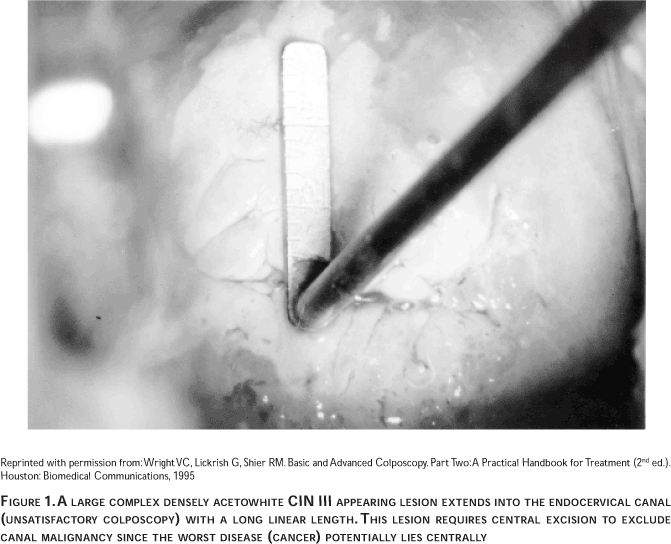
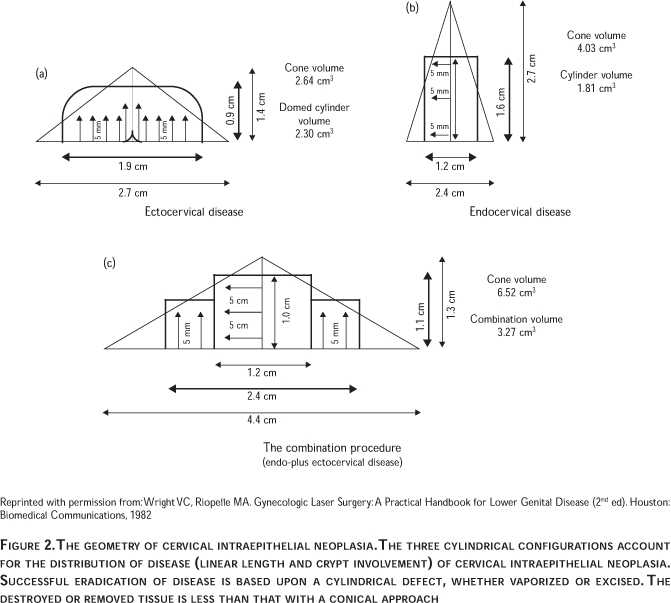
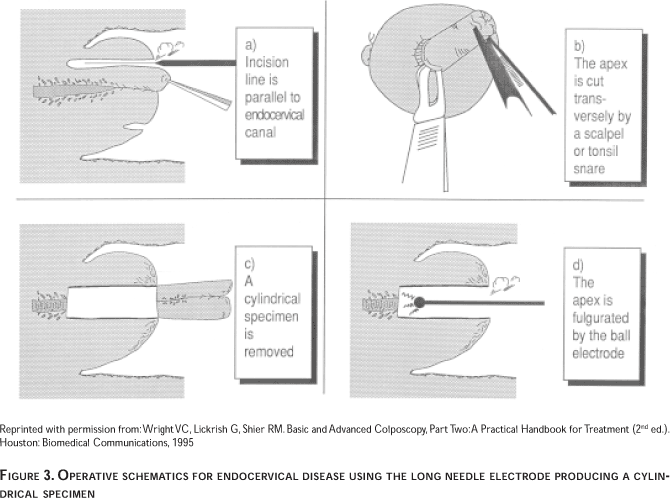
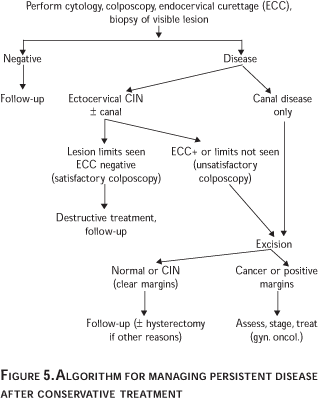
<body><![CDATA[<p><font face="Verdana" size="2"> In contrast excisional    procedures are required when: a) discrepancies exist between cytology, colposcopy    and histology; b) significant lesions are located in the endocervical canal    and require tissue for histological sampling; c) cytology or colposcopy suggests    possible invasive carcinoma that has not been proven by colposcopically directed    biopsy; d) colposcopic biopsy indicates microinvasive squamous disease or adenocarcinoma    <I>in situ</I>, or e) when colposcopy is unsatisfactory.<SUP>30 </SUP>In these    cases loop electrosurgery is not considered appropriate because the apical margin    might be positive and electric current can interfere with histological interpretation.    Laser excision or electrosurgical needle excision, removing a cylindrical specimen,    with the apex of the specimen being cut with a scalpel or scissors (creating    no thermal effect) produces a good quality specimen in the author's experience.<SUP>30</SUP>    However, in these situations, some pathologists prefer the use of the scalpel    and doing a cold knife conization.<SUP>31</SUP> </font></p>     <p><font face="Verdana" size="2"> In managing cervical    intraepithelial lesions, regardless of method, the following must be taken into    consideration in designing the excision parameters: a) intraepithelial neoplasia    (particularly CIN III /severe dysplasia/carcinoma <I>in situ</I>) can extend    into cervical crypts up to 5.2mm<SUP>32,33 </SUP>&#150;it has been postulated    that destruction/excision of lesions to a depth of 3.8 mm would eradicate all    involved crypts in 99.7% of patients;<SUP>32</SUP> b) the radial linear length    of squamous intraepithelial neoplasia varies between 2 and 22 mm (<a href="/img/revistas/spm/v45s3/3a18f01.gif">Figure    1</a>),<SUP>33,34</SUP> and c) invasive cancer typically occurs on the canal    side&#150; that is, the worst pathology is located centrally.<SUP>35,36</SUP>    Therefore, accepting the known dimensions, to remove the likely diseased tissue    with the least volume of normal tissue, one can conceptualize the three-dimensional    geometry of disease in any given patient depending on the location of the squamocolumnar    junction. Then appropriate operative techniques can be applied to remove or    destroy it (<a href="/img/revistas/spm/v45s3/3a18f02.gif">Figure 2</a>).<SUP>37</SUP> This is    the basis of ablating or removing diseased tissue in a cylindrical manner or    combining excision with ablation (the combination procedure) whether using central    excision plus peripheral vaporization or electrosurgery with a combination of    loop excisions or using the electrosurgical needle (<a href="/img/revistas/spm/v45s3/3a18f03.gif">Figures    3</a> and <a href="/img/revistas/spm/v45s3/html/3a18f04.htm">4</a>). </font></p>     <p><font face="Verdana" size="2"> Treatment, especially    by excisional methods, can cause symptomatic stenosis with canal narrowing,    although this is an infrequent complication. The most common patient symptom    is severe dysmenorrhea. Narrowing can lead to difficulty in obtaining satisfactory    cytology.<SUP>38,39</SUP> Stenosis is related to hypoestrogenic states: a) women    of reproductive age with oligomenorrhea or amenorrhea; b) women on a low-dosage    contraceptive pill who have oligomenorrhea or amenorrhea; c) women who are post-partum    and lactating; d) post-menopausal women who are not on hormone replacement therapy    with amenorrhea; e) women who are on estrogen and progesterone therapy with    amenorrhea, and f) medroxyprogesterone acetate patients.<SUP>39</SUP> The incidence    of cervical stenosis can be reduced by the use of cyclic conjugated estrogen    and progesterone to induce menses before and after treatment for several months.<SUP>39</SUP>    Long length (height) of the specimen (<u>&gt;</u>20mm) and an entirely endocervical    lesion appear to be independent risk factors for stenosis.<SUP>38 </SUP>The    majority of cervical stenosis cases (95%) are diagnosed at the first post-operative    assessment and are usually easily treated by dilation of the endocervical canal.<SUP>38</SUP>    </font></p>     <p><font face="Verdana" size="2"> When thermal energy    is used, heat may interfere with accurate histological interpretation. Some    investigators found loop specimens in general difficult to interpret due to    the thermal artifact and fragmentation. This interfered with margin assessment    and grading of the lesion.<SUP>40-42</SUP> In contrast, others experienced no    difficulties in specimen assessment.<SUP>43,44</SUP> Furthermore, unrecognized    malignancy has been identified in hysterectomy specimens (a surprise finding)    following loop excision.<SUP>45</SUP> </font></p>     <p><font face="Verdana" size="2"> Regardless of    the method of treatment persistent disease occurs. After ablative methods it    is usually identified at the first visit by colposcopy using acetic acid and    iodine staining and including cytology.<SUP>30</SUP> No earlier than three months    after treatment the patient is submitted to the standard colposcopic examination    with biopsies (including endocervical curettage) if warranted. If significant    disease is identified, retreatment is usually necessary. The technique depends    upon disease location. For excisional procedures, it is important to know whether    there was an endocervical (apical) margin positive or an ectocervical margin    positive. This is because a positive endocervical margin with CIN III disease    can signal potential remaining cancer in 3 to 8% in the intact cervix (potentially,    the worst disease occurs centrally).<SUP>46-50</SUP> In excisional procedures    the reporting of negative margins is associated with a 90 to 97% normal follow-up<SUP>51    </SUP>versus a 60 to 65% persistent disease rate with positive margins and positive    endocervical curettage (ECC) &#150;the ECC being done immediately after the    conization.<SUP>51,52</SUP> That is, a histological report of incomplete excision    of cervical dysplasia does not necessarily equate with residual disease. Others    have found abnormal cytology to be an excellent predictor of residual disease.<SUP>52</SUP>    <a href="#fig5">Figure 5</a> illustrates an algorithm to investigate persistent    disease after conservative management. Despite negative margins and normal follow-up    there is a small lifetime risk of developing an invasive cancer in the intact    cervix of 2 to 4%.<SUP>53,54</SUP> </font></p>     <p><a name="fig5"></a></p>     <p>&nbsp;</p>     <p align="center"><img src="/img/revistas/spm/v45s3/3a18f05.gif"></p>     <p>&nbsp;</p>     <p><font face="Verdana" size="2"> In some cases    simple hysterectomy for the high-grade squamous case may still be required for    the following reasons: a) failed conservative management; b) extensive disease    involving the cervix and vagina where conservative management may be difficult;    c) the presence of co-existing pathology (not resolved conservatively) such    as large fibroids, uterine prolapse, endometriosis or intractable menorrhagia;    d) technical difficulties in exposure; e) unresolved post-conservative treatment    stenosis; f) definitive management of adenocarcinoma <I>in situ</I>; g) to control    hemorrhage post-excision (conization), and h) cancer phobia.<SUP>54</SUP> If    a hysterectomy is done for some reason, invasive cancer still develops in the    vaginal vault in 0.1 to 2.0% of cases.<SUP>53-56</SUP> </font></p>     ]]></body>
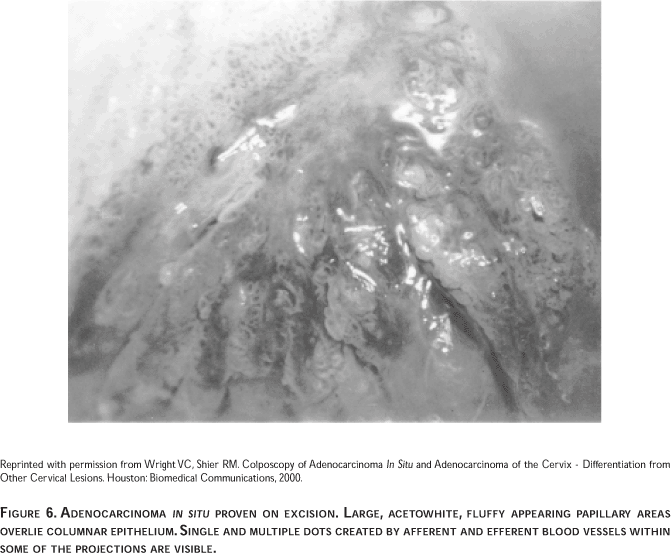
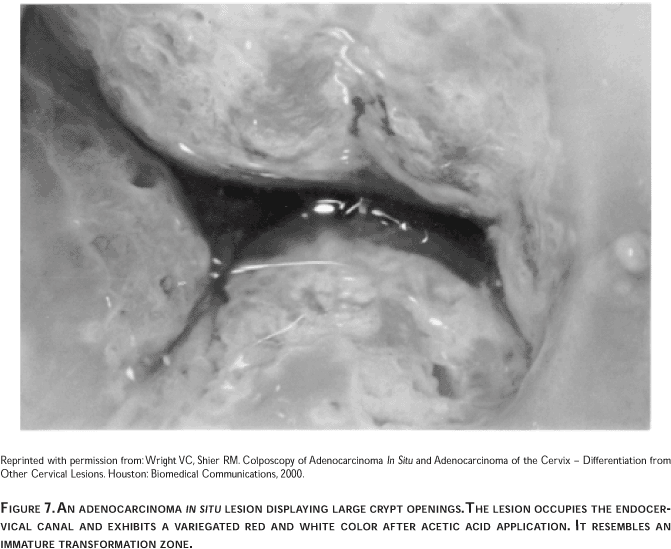
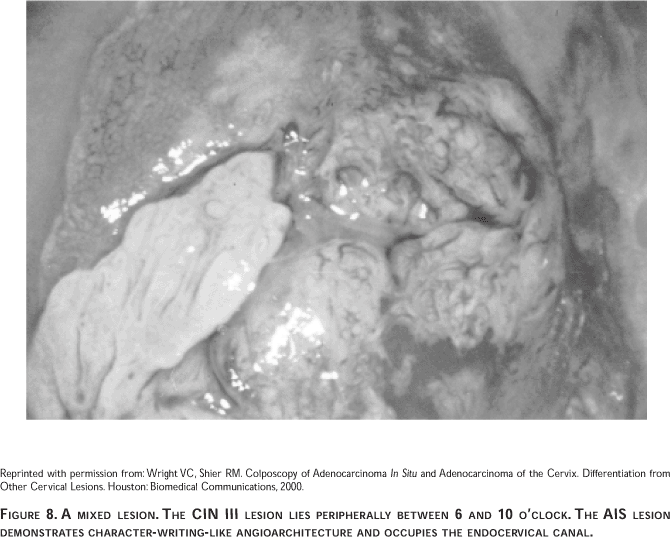
<body><![CDATA[<p><font face="Verdana" size="2"><b>Cervical adenocarcinoma    <I>in situ</I></b> </font></p>     <p><font face="Verdana" size="2">Adenocarcinoma    <I>in situ</I> (AIS) of the uterine cervix was first described in 1953 by Freidel    and McKay.<SUP>57</SUP> Glandular lesions have a morphological spectrum (similar    to squamous) ranging from mild changes to severe abnormalities termed cervical    intraepithelial glandular neoplasia and abbreviated as CIGN, CGIN or GIN. This    spectrum has been divided into low grade and high grade CIGN.<SUP>58,59</SUP>    In this article the specific entity AIS (high grade CIGN) will be discussed.    </font></p>     <p><font face="Verdana" size="2"> Adenocarcinoma    <I>in situ</I> is uncommon. The ratio of AIS to CIN III lesions (severe dysplasia/carcinoma)    is 1:50 or 2%.<SUP>60-62</SUP> The majority of AIS cases (46 to 72%) contain    a counterpart squamous component &#150;termed "mixed disease"&#150;    which is usually a CIN III lesion.<SUP>61-63</SUP> Furthermore, AIS is less    commonly diagnosed than its malignant counterpart, the latter accounting for    6 to 18% of all invasive cancers.<SUP>61,64,65</SUP> The usual age range of    women with AIS is from 29 to 46 years with an average age of 35.8 years. <SUP>59,65</SUP>    </font></p>     <p><font face="Verdana" size="2"> Making the diagnosis    of AIS by the clinician is challenging. The lesion is frequently overlooked    because of the absence of clinical findings, the presence of normal cytology    or cytology reflecting squamous disease and unfamiliar colposcopic patterns.<SUP>37,66,67</SUP>    Cullimore <I>et al </I>noted that women with pure AIS were 4.8 years older than    women with mixed disease. This finding suggests that cytologic studies are more    accurate in identifying the squamous component than the glandular component.<SUP>59</SUP>    Only recently have authors drawn attention to the colposcopic features suggestive    of AIS.<SUP>68-70</SUP> The relative infrequency of AIS cases as compared to    squamous disease has not permitted most physicians to accumulate large series    or gain experience with colposcopic identification. </font></p>     <p><font face="Verdana" size="2"> Basically there    are three colposcopic presentations of AIS lesions. The most common colposcopic    appearance is a papillary expression resembling an immature transformation zone    (<a href="/img/revistas/spm/v45s3/3a18f06.gif">Figure 6</a>). Second is a flat, variegated red    and white area resembling an immature transformation zone (<a href="/img/revistas/spm/v45s3/3a18f07.gif">Figure    7</a>). The least common is one or more isolated, elevated, individual, densely    acetowhite lesions overlying columnar epithelium.<SUP>68-70</SUP> When glandular    and squamous lesions coexist, the squamous component is more likely to be noted    because it is more likely visible. In mixed disease, the glandular lesion can    abut the glandular lesion, be sandwiched between two squamous lesions or lie    above the squamous lesion (<a href="/img/revistas/spm/v45s3/3a18f08.gif">Figure 8</a>).<SUP>68,69</SUP>    There is no single colposcopic appearance which characterizes adenocarcinoma    <I>in situ</I>. In many cases colposcopic appearances of AIS mimic other conditions    (<a href="/img/revistas/spm/v45s3/3a18t01.gif">Table I</a>). </font></p>     <p><font face="Verdana" size="2"> AIS lesions can    be small, focal and easily missed.<SUP>17,59</SUP> Ectocervical expression occurs    in 53% of cases, the endocervical canal in 5% of cases and contiguous involvement    in 38%, indicating that 95% of AIS cases are available for partial or complete    colposcopic scrutiny.<SUP>71</SUP> Forty-eight percent of lesions involve one    quadrant whereas only 10% occupy all four.<SUP>71</SUP> </font></p>     <p><font face="Verdana" size="2"> Measurements (linear    length) of AIS lesions (the distance over the tissue surface between caudal    and cephalad edges) have been studied. The distance usually does not exceed    15 mm and rarely does it encompass the entire glandular epithelium.<SUP>17,72,73</SUP>    Younger women, particularly those less than age 36 years, have a significant    reduction in the proximal extent of AIS. Nicklin <I>et al </I>found that women    younger than age 36 years have a mean lesion length of 5.6 mm, versus 10.8 mm    for women age 36 years and older (a statistically significant difference).<SUP>72</SUP>    Only 1 of 14 younger women from a series of 31 patients, had a linear length    of more than 10 mm. In contrast 9 of 17 women in the older group had lesion    lengths of more than 10 mm, with a maximum of 25 mm.<SUP>72</SUP> Bertrand <I>et    al </I>studied the highest focus of cervical involvement of AIS measured from    the maximal convexity of the cervix in hysterectomy specimens. The highest focus    did not exceed 19.9 mm in 78.9% of cases, the highest focus being 29.9 mm.<SUP>74</SUP>    Such measurements however do not reflect the true linear length of disease but    rather provide guidelines for designing cylindrical excisional specimen measurements    to account for the distribution particularly for endocervical canal involvement.    </font></p>     <p><font face="Verdana" size="2"> As in squamous    intraepithelial neoplasia, AIS can extend into underlying cervical crypts. Involvement    averages 2.5 mm and extension is usually no more than 4 mm, maximum 6 mm.<SUP>37,63,72,73</SUP>    Also younger women (age 35 or less) had a lesser depth of disease than did older    women.<SUP>72</SUP> </font></p>     <p><font face="Verdana" size="2"> Multifocal lesions    (so called "skip lesions") represent foci involving different portions    of the endocervical mucosa. By definition, this is when a normal radial histological    section separates two areas of AIS.<SUP>74</SUP> Such lesions are uncommon and    occur in 6.5 to 15% of AIS lesions.<SUP>17,74</SUP> Multifocality of AIS does    not appear to correlate with a higher incidence of residual disease.<SUP>31</SUP>    </font></p>     <p><font face="Verdana" size="2"> AIS can involve    both superficial and deep crypts that are covered by metaplastic or dysplastic    squamous epithelium. This is termed "buried disease" and occurs in    60% of cases.<SUP>63,74</SUP> Although the crypts open through such tissue,    the glandular component will not be colposcopically visible. </font></p>     ]]></body>
<body><![CDATA[<p><font face="Verdana" size="2"> AIS lesions are    to be suspected when any of the following colposcopic findings are observed:    a) a lesion overlying columnar epithelium and not contiguous with the squamocolumnar    junction; b) large gland openings (<a href="/img/revistas/spm/v45s3/3a18f07.gif">Figure 7</a>);    c) papillary-like lesions (<a href="/img/revistas/spm/v45s3/3a18f06.gif">Figure 6</a>); d) epithelial    budding; e) variegated red and white lesions (<a href="/img/revistas/spm/v45s3/3a18f07.gif">Figure    7</a>), and f) atypical angioarchitecture such as waste-thread-like, tendril-like,    root-like (<a href="/img/revistas/spm/v45s3/3a18f08.gif">Figure 8</a>) or character-writing-like    vessels and single and multiple-dot-like formations (<a href="/img/revistas/spm/v45s3/3a18f06.gif">Figure    6</a>), the latter seen in the tips of the papillary excrescences. The differential    of similar appearing lesions is shown in <a href="/img/revistas/spm/v45s3/3a18t01.gif">Table    I</a>.<SUP>68</SUP> </font></p>     <p><font face="Verdana" size="2"> Having suspected    the glandular lesion, the clinician should consider the following in AIS management:    a) patient's age; b) lesion location (ectocervical, endocervical, or both &#150;    colposcopic assessment can be helpful); c) three dimensional lesion geometry    (linear length and crypt involvement); d) potential for buried disease; e) mixed    disease (presence of a squamous component); f) specimen margin status post-excision;    g) patient's desire for fertility, and h) patient's compliance. </font></p>     <p><font face="Verdana" size="2"> When AIS is found    on biopsy or suspected cytologically or colposcopically, an excisional procedure    is required, producing a specimen with negative margins (ie, free of disease)    &#150; the latter to help ensure that no adenocarcinoma is present. The excisional    procedure should attempt to account for the distribution of disease (linear    length, crypt involvement, and disease location). As in squamous intraepithelial    neoplasia, the configuration (base and height dimensions) will vary. A cylindrical    shaped specimen best accounts for disease distribution (<a href="/img/revistas/spm/v45s3/3a18f09.gif">Figure    9</a>).<SUP>63,74,75</SUP> It is recommended that the procedure be done under    colposcopic guidance noting the lower lesion border (which is usually at or    very near the squamocolumnar junction), and if possible, noting or estimating    the upper margin, that is, the entire potential linear length.<SUP>63,74,75</SUP>    These parameters serve as a guide for determining the dimensions of the cylindrical    specimen. </font></p>     <p><font face="Verdana" size="2"> The preferred    instrument for the excisional procedure to provide the best interpretable specimen    is a subject of debate. From the pathologist's standpoint, the cold knife conization    is the safest and best therapeutic modality, provided that the cone specimen    is adequately sampled and the margins are free.<SUP>37,76</SUP> Other investigators    have found that the use of laser or electrosurgical needle to create the deep    margin plus scalpel excision of the cylinder's apex (producing a non-thermal    effect) to be satisfactory.<SUP>75</SUP> It must be recognized that a cold knife    conization can be a formidable operation. There is general consensus that electrosurgical    loop may not be the procedure of choice. This is because electric current follows    the path of least resistance (into crypt mucus) and thus it can potentially    distort the glandular epithelium (causing pseudostratification or streaming    of nuclei parallel to the electric field) making it difficult to histologically    differentiate between <I>in situ</I> and invasive disease.<SUP>37,77</SUP> Furthermore    such loop specimens are often fragmented due to several passes making evaluation    of the margins difficult.<SUP>37</SUP> Others have found that the use of loop    excision in the management of AIS is acceptable when there is a single specimen    with clear margins.<SUP>78</SUP> </font></p>     <p><font face="Verdana" size="2"> Cumulative studies    show that positive margins are of significance due to persistent AIS in 12.5    to 80% of cases.<SUP>59,60,71,72,79-86</SUP> Adenocarcinoma is found in 12.5    to 50% of such cases.<SUP>71,80,82</SUP> Other studies did not identify malignancy    (adenocarcinoma) in cases with positive margins on follow-up histology.<SUP>17,    59, 71-73,81,83,84</SUP> In positive margin cases, repeat excision is recommended    to obtain negative margins in the conservatively managed patient who desires    future childbearing. Repeat excision, producing negative margins is also recommended    before a simple hysterectomy as definitive treatment. Failure to do so may result    in inappropriate surgery (simple hysterectomy instead of radical hysterectomy),    should adenocarcinoma be found in the extirpated uterine cervix.<SUP>75</SUP>    </font></p>     <p><font face="Verdana" size="2"> Studies indicate    that if excised specimens have negative margins then conservative management    is possible in those women who desire future child bearing.<SUP>59,71,73,82,86</SUP>    However, negative margins are associated with persistent AIS in 8.3 to 50% of    cases.<SUP>71,80-86</SUP> These findings suggest that cervical conization should    not necessarily be considered a definitive treatment for AIS in the presence    of negative margins.<SUP>30</SUP> Studies have rarely identified adenocarcinoma    even when specimens had negative margins.<SUP>79,80,87</SUP> </font></p>     <p><font face="Verdana" size="2"> For the conservatively    managed patient, follow-up management should consist of cytology, colposcopy,    and endocervical curettage every four months for one year and every six months    thereafter.<SUP>80,87</SUP> Patients who choose to be followed conservatively    must be counseled about the importance of compliance and the potential risks    of undetected and recurrent glandular disease, despite negative follow-up findings.<SUP>79,81</SUP>    </font></p>     <p>&nbsp;</p>     <p><font face="Verdana" size="3"><b>References </b></font></p>     <!-- ref --><p><font face="Verdana" size="2">1. Franco EL, Durante-Franco    E, Ferenczy A. Cervical cancer: Epidemiology, prevention, and the role of the    human papillomavirus infection. Can Med Assn J 2001;164:1017-1025. </font>&nbsp;&nbsp;&nbsp;&nbsp;&nbsp;&nbsp;&nbsp;&nbsp;[&#160;<a href="javascript:void(0);" onclick="javascript: window.open('/scielo.php?script=sci_nlinks&ref=9184443&pid=S0036-3634200300090001600001&lng=','','width=640,height=500,resizable=yes,scrollbars=1,menubar=yes,');">Links</a>&#160;]<!-- end-ref --><!-- ref --><p><font face="Verdana" size="2">2. Sellors JW,    Loring AT, Mahony JB, Mielzynska I, Lytwyn A, Roth P <I>et al</I>. Comparison    of self-collected vaginal, vulvar and urine samples for human papillomavirus    testing to detect high-grade squamous intraepithelial lesions. Can Med Assn    J 2000;163:513-518. </font>&nbsp;&nbsp;&nbsp;&nbsp;&nbsp;&nbsp;&nbsp;&nbsp;[&#160;<a href="javascript:void(0);" onclick="javascript: window.open('/scielo.php?script=sci_nlinks&ref=9184444&pid=S0036-3634200300090001600002&lng=','','width=640,height=500,resizable=yes,scrollbars=1,menubar=yes,');">Links</a>&#160;]<!-- end-ref --><!-- ref --><p><font face="Verdana" size="2">3. Bristow RE,    Montz FJ. Human papillomavirus: Molecular biology screening applications in    cervical dysplasia &#150; A primer for primary care physicians. Prim Care Update    Ob/Gyn 1998;5:238-246. </font>&nbsp;&nbsp;&nbsp;&nbsp;&nbsp;&nbsp;&nbsp;&nbsp;[&#160;<a href="javascript:void(0);" onclick="javascript: window.open('/scielo.php?script=sci_nlinks&ref=9184445&pid=S0036-3634200300090001600003&lng=','','width=640,height=500,resizable=yes,scrollbars=1,menubar=yes,');">Links</a>&#160;]<!-- end-ref --><!-- ref --><p><font face="Verdana" size="2">4. Ho GY, Burk    RD, Klein S, Kadish AS, Chang CJ, Palan P <I>et al</I>. Persistent genital human    papillomavirus infection as a risk factor for persistent dysplasia. J Natl Cancer    Inst 1995;87:1365-1371. </font>&nbsp;&nbsp;&nbsp;&nbsp;&nbsp;&nbsp;&nbsp;&nbsp;[&#160;<a href="javascript:void(0);" onclick="javascript: window.open('/scielo.php?script=sci_nlinks&ref=9184446&pid=S0036-3634200300090001600004&lng=','','width=640,height=500,resizable=yes,scrollbars=1,menubar=yes,');">Links</a>&#160;]<!-- end-ref --><!-- ref --><p><font face="Verdana" size="2">5. Nagai Y, Maehamat    T, Asato T, Kanazawa K. Persistence of human papillomavirus infections after    therapeutic conization for CIN III. Is it an alarm for recurrence? Gynecol Oncol    2000;79:294-299. </font>&nbsp;&nbsp;&nbsp;&nbsp;&nbsp;&nbsp;&nbsp;&nbsp;[&#160;<a href="javascript:void(0);" onclick="javascript: window.open('/scielo.php?script=sci_nlinks&ref=9184447&pid=S0036-3634200300090001600005&lng=','','width=640,height=500,resizable=yes,scrollbars=1,menubar=yes,');">Links</a>&#160;]<!-- end-ref --><!-- ref --><p><font face="Verdana" size="2">6. Walboomers JMM,    Jacobs MV, Manos MM, Bosch FX, Kummer A, Shah KV <I>et al</I>. Human papillomavirus    is a necessary cause of invasive cancer worldwide. J Pathol 1999;189:12-19.    </font>&nbsp;&nbsp;&nbsp;&nbsp;&nbsp;&nbsp;&nbsp;&nbsp;[&#160;<a href="javascript:void(0);" onclick="javascript: window.open('/scielo.php?script=sci_nlinks&ref=9184448&pid=S0036-3634200300090001600006&lng=','','width=640,height=500,resizable=yes,scrollbars=1,menubar=yes,');">Links</a>&#160;]<!-- end-ref --><!-- ref --><p><font face="Verdana" size="2">7. Andersson S,    Rylander E, Larsson B, Strand A, Silfersvard C, Wilander E. The role of human    papillomavirus in cervical adenocarcinoma carcinogenesis. Eur J Cancer 2001;37:246-250.    </font>&nbsp;&nbsp;&nbsp;&nbsp;&nbsp;&nbsp;&nbsp;&nbsp;[&#160;<a href="javascript:void(0);" onclick="javascript: window.open('/scielo.php?script=sci_nlinks&ref=9184449&pid=S0036-3634200300090001600007&lng=','','width=640,height=500,resizable=yes,scrollbars=1,menubar=yes,');">Links</a>&#160;]<!-- end-ref --><!-- ref --><p><font face="Verdana" size="2">8. Riethdorf S,    Riethdorf L, Milde-Langosch K, Park JW, Loning T. Differences in HPV 16 and    HPV 18 E6/E7 oncogenic expression between <I>in situ</I> and invasive adenocarcinoma    of the cervix uteri. Virchows Arch 2000; 437:491-500. </font>&nbsp;&nbsp;&nbsp;&nbsp;&nbsp;&nbsp;&nbsp;&nbsp;[&#160;<a href="javascript:void(0);" onclick="javascript: window.open('/scielo.php?script=sci_nlinks&ref=9184450&pid=S0036-3634200300090001600008&lng=','','width=640,height=500,resizable=yes,scrollbars=1,menubar=yes,');">Links</a>&#160;]<!-- end-ref --><!-- ref --><p><font face="Verdana" size="2">9. United States    Public Health Service/Infectious Diseases Society of America. Guidelines for    the prevention of opportunistic infections in persons infected with human immunodeficiency    virus. Ann Intern Med 1997;127:922-946. </font>&nbsp;&nbsp;&nbsp;&nbsp;&nbsp;&nbsp;&nbsp;&nbsp;[&#160;<a href="javascript:void(0);" onclick="javascript: window.open('/scielo.php?script=sci_nlinks&ref=9184451&pid=S0036-3634200300090001600009&lng=','','width=640,height=500,resizable=yes,scrollbars=1,menubar=yes,');">Links</a>&#160;]<!-- end-ref --><!-- ref --><p><font face="Verdana" size="2">10. Ellerbrock    TV, Chiasson MA, Bush TJ, Sun XW, Sawo D, Brundley K <I>et al</I>. Incidence    of cervical squamous intraepithelial lesions in HIV-infected women. JAMA 2000;283:1031-1037.    </font>&nbsp;&nbsp;&nbsp;&nbsp;&nbsp;&nbsp;&nbsp;&nbsp;[&#160;<a href="javascript:void(0);" onclick="javascript: window.open('/scielo.php?script=sci_nlinks&ref=9184452&pid=S0036-3634200300090001600010&lng=','','width=640,height=500,resizable=yes,scrollbars=1,menubar=yes,');">Links</a>&#160;]<!-- end-ref --><!-- ref --><p><font face="Verdana" size="2">11. Sun XW, Kuhn    L, Ellerbrook TV, Lungu O, Chiasson MA, Bush TJ <I>et al</I>. Human papillomavirus    infection in women infected with the human immunodeficiency virus. N Engl J    Med 1997;337:1343-1349. </font>&nbsp;&nbsp;&nbsp;&nbsp;&nbsp;&nbsp;&nbsp;&nbsp;[&#160;<a href="javascript:void(0);" onclick="javascript: window.open('/scielo.php?script=sci_nlinks&ref=9184453&pid=S0036-3634200300090001600011&lng=','','width=640,height=500,resizable=yes,scrollbars=1,menubar=yes,');">Links</a>&#160;]<!-- end-ref --><!-- ref --><p><font face="Verdana" size="2">12. Heard I, Jean-Michel    T, Schmitz V, Mandelbrot L, Kazatchkine MD, Orth G. Increased risk of cervical    disease among immunodeficiency. Virus-infected women with severe immunosuppression    and human papillomavirus load. Obstet Gynecol 2000;96:403-409. </font>&nbsp;&nbsp;&nbsp;&nbsp;&nbsp;&nbsp;&nbsp;&nbsp;[&#160;<a href="javascript:void(0);" onclick="javascript: window.open('/scielo.php?script=sci_nlinks&ref=9184454&pid=S0036-3634200300090001600012&lng=','','width=640,height=500,resizable=yes,scrollbars=1,menubar=yes,');">Links</a>&#160;]<!-- end-ref --><!-- ref --><p><font face="Verdana" size="2">13. Moscicki AB,    Ellenberg JH, Vermund SH, Holland CA, Darrah T, Crowley-Nowick PA <I>et al</I>.    Prevalence of and risks for cervical human papillomavirus infection and squamous    intraepithelial lesions in adolescent girls: Impact of infection with human    immunodeficiency virus. Arch Pediatr Adolesc Med 2000;154:127-134. </font>&nbsp;&nbsp;&nbsp;&nbsp;&nbsp;&nbsp;&nbsp;&nbsp;[&#160;<a href="javascript:void(0);" onclick="javascript: window.open('/scielo.php?script=sci_nlinks&ref=9184455&pid=S0036-3634200300090001600013&lng=','','width=640,height=500,resizable=yes,scrollbars=1,menubar=yes,');">Links</a>&#160;]<!-- end-ref --><!-- ref --><p><font face="Verdana" size="2">14. Rozendaal L,    Walboomers JMM, van der Linden JC, Voorhorst FJ, Kenemans P, Helmerhorot TJM    <I>et al</I>. PCR-based high risk HPV test in cervical cancer screening gives    objective risk assessment of women with cytomorophologically normal cervical    smears. Int J Cancer 1996;68:766-769. </font>&nbsp;&nbsp;&nbsp;&nbsp;&nbsp;&nbsp;&nbsp;&nbsp;[&#160;<a href="javascript:void(0);" onclick="javascript: window.open('/scielo.php?script=sci_nlinks&ref=9184456&pid=S0036-3634200300090001600014&lng=','','width=640,height=500,resizable=yes,scrollbars=1,menubar=yes,');">Links</a>&#160;]<!-- end-ref --><!-- ref --><p><font face="Verdana" size="2">15. Nobbenhuis    MAE, Walboomers JMM, Helmerhorst TJM, Tozendaal L, Remmink AJ, Risse AKT <I>et    al</I>. Relation of human papillomavirus status to cervical lesions and consequences    for cervical-cancer screening: A prospective study. Lancet 1999;354:20-25. </font>&nbsp;&nbsp;&nbsp;&nbsp;&nbsp;&nbsp;&nbsp;&nbsp;[&#160;<a href="javascript:void(0);" onclick="javascript: window.open('/scielo.php?script=sci_nlinks&ref=9184457&pid=S0036-3634200300090001600015&lng=','','width=640,height=500,resizable=yes,scrollbars=1,menubar=yes,');">Links</a>&#160;]<!-- end-ref --><!-- ref --><p><font face="Verdana" size="2">16. Meijer CJLM,    Snijders PJF, Van den Brule AJC. Screening for cervical cancer: Should we test    for infection with high risk HPV? Can Med Assn J 2000;163:535-538. </font>&nbsp;&nbsp;&nbsp;&nbsp;&nbsp;&nbsp;&nbsp;&nbsp;[&#160;<a href="javascript:void(0);" onclick="javascript: window.open('/scielo.php?script=sci_nlinks&ref=9184458&pid=S0036-3634200300090001600016&lng=','','width=640,height=500,resizable=yes,scrollbars=1,menubar=yes,');">Links</a>&#160;]<!-- end-ref --><!-- ref --><p><font face="Verdana" size="2">17. &Ouml;st&ouml;r    AG. Natural history of cervical intraepithelial neoplasia: A critical review.    Int J Gynecol Oncol 1993;12:186-192. </font>&nbsp;&nbsp;&nbsp;&nbsp;&nbsp;&nbsp;&nbsp;&nbsp;[&#160;<a href="javascript:void(0);" onclick="javascript: window.open('/scielo.php?script=sci_nlinks&ref=9184459&pid=S0036-3634200300090001600017&lng=','','width=640,height=500,resizable=yes,scrollbars=1,menubar=yes,');">Links</a>&#160;]<!-- end-ref --><!-- ref --><p><font face="Verdana" size="2">18. Naisell K,    Roger V, Naisell M. Behavior of mild dysplasia during long term follow-up. Obstet    Gynecol 1986;67:665-669. </font>&nbsp;&nbsp;&nbsp;&nbsp;&nbsp;&nbsp;&nbsp;&nbsp;[&#160;<a href="javascript:void(0);" onclick="javascript: window.open('/scielo.php?script=sci_nlinks&ref=9184460&pid=S0036-3634200300090001600018&lng=','','width=640,height=500,resizable=yes,scrollbars=1,menubar=yes,');">Links</a>&#160;]<!-- end-ref --><!-- ref --><p><font face="Verdana" size="2">19. McIndole WA,    McLean MR, Jones RW, Mullins PR. The invasive potential of carcinoma <I>in situ</I>    of the cervix. Obstet Gynecol 1984;64:451-458. </font>&nbsp;&nbsp;&nbsp;&nbsp;&nbsp;&nbsp;&nbsp;&nbsp;[&#160;<a href="javascript:void(0);" onclick="javascript: window.open('/scielo.php?script=sci_nlinks&ref=9184461&pid=S0036-3634200300090001600019&lng=','','width=640,height=500,resizable=yes,scrollbars=1,menubar=yes,');">Links</a>&#160;]<!-- end-ref --><!-- ref --><p><font face="Verdana" size="2">20. Campion MJ,    McCane DJ, Cuzick J, Singer A. Progressive potential of mild cervical atypia,    prospective cytologic, colposcopic and virologic study. Lancet 1986;2:237-240.    </font>&nbsp;&nbsp;&nbsp;&nbsp;&nbsp;&nbsp;&nbsp;&nbsp;[&#160;<a href="javascript:void(0);" onclick="javascript: window.open('/scielo.php?script=sci_nlinks&ref=9184462&pid=S0036-3634200300090001600020&lng=','','width=640,height=500,resizable=yes,scrollbars=1,menubar=yes,');">Links</a>&#160;]<!-- end-ref --><!-- ref --><p><font face="Verdana" size="2">21. Schneider A,    Meihardt G, Devilliers EM, Gisssman L. Sensitivity of the cytologic diagnosis    of cervical condyloma in comparison with HPV DNA hybridization studies. Acta    Cytopathol 1987;3:250-255. </font>&nbsp;&nbsp;&nbsp;&nbsp;&nbsp;&nbsp;&nbsp;&nbsp;[&#160;<a href="javascript:void(0);" onclick="javascript: window.open('/scielo.php?script=sci_nlinks&ref=9184463&pid=S0036-3634200300090001600021&lng=','','width=640,height=500,resizable=yes,scrollbars=1,menubar=yes,');">Links</a>&#160;]<!-- end-ref --><!-- ref --><p><font face="Verdana" size="2">22. Persad VL,    Pierotic MA, Guijon FB. Management of cervical neoplasia: A 13 year experience.    J Lower Gen Tract Dis 2001;5:199-203. </font>&nbsp;&nbsp;&nbsp;&nbsp;&nbsp;&nbsp;&nbsp;&nbsp;[&#160;<a href="javascript:void(0);" onclick="javascript: window.open('/scielo.php?script=sci_nlinks&ref=9184464&pid=S0036-3634200300090001600022&lng=','','width=640,height=500,resizable=yes,scrollbars=1,menubar=yes,');">Links</a>&#160;]<!-- end-ref --><!-- ref --><p><font face="Verdana" size="2">23. Mor-Yosef S,    Lopes A, Pearson S, Monghan JM. Loop diathermy cone biopsies. Obstet Gynecol    1990;75:884-886. </font>&nbsp;&nbsp;&nbsp;&nbsp;&nbsp;&nbsp;&nbsp;&nbsp;[&#160;<a href="javascript:void(0);" onclick="javascript: window.open('/scielo.php?script=sci_nlinks&ref=9184465&pid=S0036-3634200300090001600023&lng=','','width=640,height=500,resizable=yes,scrollbars=1,menubar=yes,');">Links</a>&#160;]<!-- end-ref --><!-- ref --><p><font face="Verdana" size="2">24. Prendiville    W, Cullimore J, Norman S. Large loop excision of the transformation zone (LLETZ):    A new method of management for women with cervical intraepithelial neoplasia.    Br J Obstet Gynaecol 1989;96:1054-1060. </font>&nbsp;&nbsp;&nbsp;&nbsp;&nbsp;&nbsp;&nbsp;&nbsp;[&#160;<a href="javascript:void(0);" onclick="javascript: window.open('/scielo.php?script=sci_nlinks&ref=9184466&pid=S0036-3634200300090001600024&lng=','','width=640,height=500,resizable=yes,scrollbars=1,menubar=yes,');">Links</a>&#160;]<!-- end-ref --><!-- ref --><p><font face="Verdana" size="2">25. Ferenczy A,    Chouroun D, Arseneau J. Loop electrosurgical excision procedure for squamous    intraepithelial lesions of the cervix: Advantages and potential pitfalls. Obstet    Gynecol 1996;87:332-337. </font>&nbsp;&nbsp;&nbsp;&nbsp;&nbsp;&nbsp;&nbsp;&nbsp;[&#160;<a href="javascript:void(0);" onclick="javascript: window.open('/scielo.php?script=sci_nlinks&ref=9184467&pid=S0036-3634200300090001600025&lng=','','width=640,height=500,resizable=yes,scrollbars=1,menubar=yes,');">Links</a>&#160;]<!-- end-ref --><!-- ref --><p><font face="Verdana" size="2">26. Wright VC,    Davies E, Riopelle MA. Laser surgery for cervical intraepithelial neoplasia:    Principles and results. Am J Obstet Gynecol 1983;145: 181-185. </font>&nbsp;&nbsp;&nbsp;&nbsp;&nbsp;&nbsp;&nbsp;&nbsp;[&#160;<a href="javascript:void(0);" onclick="javascript: window.open('/scielo.php?script=sci_nlinks&ref=9184468&pid=S0036-3634200300090001600026&lng=','','width=640,height=500,resizable=yes,scrollbars=1,menubar=yes,');">Links</a>&#160;]<!-- end-ref --><!-- ref --><p><font face="Verdana" size="2">27. Duncan ID.    The Semm cold coagulator in the management of cervical intraepithelial neoplasia.    Clin Obstet Gynaecol 1983;26: 996-999. </font>&nbsp;&nbsp;&nbsp;&nbsp;&nbsp;&nbsp;&nbsp;&nbsp;[&#160;<a href="javascript:void(0);" onclick="javascript: window.open('/scielo.php?script=sci_nlinks&ref=9184469&pid=S0036-3634200300090001600027&lng=','','width=640,height=500,resizable=yes,scrollbars=1,menubar=yes,');">Links</a>&#160;]<!-- end-ref --><!-- ref --><p><font face="Verdana" size="2">28. Chanen W, Rome    RM. Electrocoagulation diathermy in the treatment of cervical dysplasia and    carcinoma <I>in situ</I>: A 15 year survey. Obstet Gynecol 1983;61:673-677.    </font>&nbsp;&nbsp;&nbsp;&nbsp;&nbsp;&nbsp;&nbsp;&nbsp;[&#160;<a href="javascript:void(0);" onclick="javascript: window.open('/scielo.php?script=sci_nlinks&ref=9184470&pid=S0036-3634200300090001600028&lng=','','width=640,height=500,resizable=yes,scrollbars=1,menubar=yes,');">Links</a>&#160;]<!-- end-ref --><!-- ref --><p><font face="Verdana" size="2">29. Bryson SC,    Lenehan P, Lickrish GM. The treatment of grade 3 cervical intraepithelial neoplasia    with cryotherapy: An 11 year experience. Am J Obstet Gynecol 1985;151:201-205.    </font>&nbsp;&nbsp;&nbsp;&nbsp;&nbsp;&nbsp;&nbsp;&nbsp;[&#160;<a href="javascript:void(0);" onclick="javascript: window.open('/scielo.php?script=sci_nlinks&ref=9184471&pid=S0036-3634200300090001600029&lng=','','width=640,height=500,resizable=yes,scrollbars=1,menubar=yes,');">Links</a>&#160;]<!-- end-ref --><!-- ref --><p><font face="Verdana" size="2">30. Wright VC.    Carbon dioxide laser surgery for the cervix and vagina: Indications, complications    and results. Comp Ther 1988;14:54-64. </font>&nbsp;&nbsp;&nbsp;&nbsp;&nbsp;&nbsp;&nbsp;&nbsp;[&#160;<a href="javascript:void(0);" onclick="javascript: window.open('/scielo.php?script=sci_nlinks&ref=9184472&pid=S0036-3634200300090001600030&lng=','','width=640,height=500,resizable=yes,scrollbars=1,menubar=yes,');">Links</a>&#160;]<!-- end-ref --><!-- ref --><p><font face="Verdana" size="2">31. &Ouml;st&ouml;r    AG, Duncan A, Quinn M, Rome R. Adenocarcinoma <I>in situ</I> of the uterine    cervix: An experience with 100 cases. Gynecol Oncol 2000;79: 207-210. </font>&nbsp;&nbsp;&nbsp;&nbsp;&nbsp;&nbsp;&nbsp;&nbsp;[&#160;<a href="javascript:void(0);" onclick="javascript: window.open('/scielo.php?script=sci_nlinks&ref=9184473&pid=S0036-3634200300090001600031&lng=','','width=640,height=500,resizable=yes,scrollbars=1,menubar=yes,');">Links</a>&#160;]<!-- end-ref --><!-- ref --><p><font face="Verdana" size="2">32. Anderson MC,    Hartley RB. Cervical crypt involvement by intraepithelial neoplasia. Am J Obstet    Gynecol 1980;55:546-549. </font>&nbsp;&nbsp;&nbsp;&nbsp;&nbsp;&nbsp;&nbsp;&nbsp;[&#160;<a href="javascript:void(0);" onclick="javascript: window.open('/scielo.php?script=sci_nlinks&ref=9184474&pid=S0036-3634200300090001600032&lng=','','width=640,height=500,resizable=yes,scrollbars=1,menubar=yes,');">Links</a>&#160;]<!-- end-ref --><!-- ref --><p><font face="Verdana" size="2">33. Boonstra H,    Aalders JG, Koudstaal J, Oosrerhuis JW, Janssens J. Minimum extension and appropriate    topographic position of tissue destruction for treatment of cervical intraepithelial    neoplasia. Obstet Gynecol 1990;75:227-231. </font>&nbsp;&nbsp;&nbsp;&nbsp;&nbsp;&nbsp;&nbsp;&nbsp;[&#160;<a href="javascript:void(0);" onclick="javascript: window.open('/scielo.php?script=sci_nlinks&ref=9184475&pid=S0036-3634200300090001600033&lng=','','width=640,height=500,resizable=yes,scrollbars=1,menubar=yes,');">Links</a>&#160;]<!-- end-ref --><!-- ref --><p><font face="Verdana" size="2">34. Przybora LA,    Plutowa A. Histologic topography of carcinoma <I>in situ</I> of the cervix uteri.    Cancer 1959;12:268-273. </font>&nbsp;&nbsp;&nbsp;&nbsp;&nbsp;&nbsp;&nbsp;&nbsp;[&#160;<a href="javascript:void(0);" onclick="javascript: window.open('/scielo.php?script=sci_nlinks&ref=9184476&pid=S0036-3634200300090001600034&lng=','','width=640,height=500,resizable=yes,scrollbars=1,menubar=yes,');">Links</a>&#160;]<!-- end-ref --><!-- ref --><p><font face="Verdana" size="2">35. Carron RP,    Gall EA. Preinvasive carcinoma and precancer metaplasia of the cervix. Am J    Pathol 1954;30:15-19. </font>&nbsp;&nbsp;&nbsp;&nbsp;&nbsp;&nbsp;&nbsp;&nbsp;[&#160;<a href="javascript:void(0);" onclick="javascript: window.open('/scielo.php?script=sci_nlinks&ref=9184477&pid=S0036-3634200300090001600035&lng=','','width=640,height=500,resizable=yes,scrollbars=1,menubar=yes,');">Links</a>&#160;]<!-- end-ref --><!-- ref --><p><font face="Verdana" size="2">36. Scott RB, Reagan    JW. Diagnostic cervical biopsy technique for the study of early cancer: Value    of the cold-knife conization procedure. JAMA 1956;343-348. </font>&nbsp;&nbsp;&nbsp;&nbsp;&nbsp;&nbsp;&nbsp;&nbsp;[&#160;<a href="javascript:void(0);" onclick="javascript: window.open('/scielo.php?script=sci_nlinks&ref=9184478&pid=S0036-3634200300090001600036&lng=','','width=640,height=500,resizable=yes,scrollbars=1,menubar=yes,');">Links</a>&#160;]<!-- end-ref --><!-- ref --><p><font face="Verdana" size="2">37. Wright VC,    Riopelle MA. The geometry of cervical intraepithelial neoplasia as a guide to    its eradication. Cervix 1986;4:21-38. </font>&nbsp;&nbsp;&nbsp;&nbsp;&nbsp;&nbsp;&nbsp;&nbsp;[&#160;<a href="javascript:void(0);" onclick="javascript: window.open('/scielo.php?script=sci_nlinks&ref=9184479&pid=S0036-3634200300090001600037&lng=','','width=640,height=500,resizable=yes,scrollbars=1,menubar=yes,');">Links</a>&#160;]<!-- end-ref --><!-- ref --><p><font face="Verdana" size="2">38. Baldauff JJ,    Dreyfus M, Ritter J, Meyer P, Philippe E. Risk of cervical stenosis after large    loop or laser conization. Obstet Gynecol 1996;88: 933-938. </font>&nbsp;&nbsp;&nbsp;&nbsp;&nbsp;&nbsp;&nbsp;&nbsp;[&#160;<a href="javascript:void(0);" onclick="javascript: window.open('/scielo.php?script=sci_nlinks&ref=9184480&pid=S0036-3634200300090001600038&lng=','','width=640,height=500,resizable=yes,scrollbars=1,menubar=yes,');">Links</a>&#160;]<!-- end-ref --><!-- ref --><p><font face="Verdana" size="2">39. Lickrish GM.    Colposcopy in the management of cervical intraepithelial neoplasia: Problems    and suggestions. J Soc Obstet Gynaecol Can 2000; 22:429-434. </font>&nbsp;&nbsp;&nbsp;&nbsp;&nbsp;&nbsp;&nbsp;&nbsp;[&#160;<a href="javascript:void(0);" onclick="javascript: window.open('/scielo.php?script=sci_nlinks&ref=9184481&pid=S0036-3634200300090001600039&lng=','','width=640,height=500,resizable=yes,scrollbars=1,menubar=yes,');">Links</a>&#160;]<!-- end-ref --><!-- ref --><p><font face="Verdana" size="2">40. Montz FJ, Holschnidrer    CH, Thompson CDR. Large loop excision of the transformation zone: Effect on    pathologic interpretation of resection margins. Obstet Gynecol 1993;81:976-982.    </font>&nbsp;&nbsp;&nbsp;&nbsp;&nbsp;&nbsp;&nbsp;&nbsp;[&#160;<a href="javascript:void(0);" onclick="javascript: window.open('/scielo.php?script=sci_nlinks&ref=9184482&pid=S0036-3634200300090001600040&lng=','','width=640,height=500,resizable=yes,scrollbars=1,menubar=yes,');">Links</a>&#160;]<!-- end-ref --><!-- ref --><p><font face="Verdana" size="2">41. Ioffe OB, Brooks    SE, De Rezende RB, Silverberg SG. Artifact in cervical LLETZ specimens: Correlated    with follow-up. Int J Gynaecol Pathol 1999;18:115-121. </font>&nbsp;&nbsp;&nbsp;&nbsp;&nbsp;&nbsp;&nbsp;&nbsp;[&#160;<a href="javascript:void(0);" onclick="javascript: window.open('/scielo.php?script=sci_nlinks&ref=9184483&pid=S0036-3634200300090001600041&lng=','','width=640,height=500,resizable=yes,scrollbars=1,menubar=yes,');">Links</a>&#160;]<!-- end-ref --><!-- ref --><p><font face="Verdana" size="2">42. Dalrymple C,    Russel P. Thermal artifact after diathermy loop excision and laser cone biopsy.    Int J Gynaecol Cancer 1999;9:238-242. </font>&nbsp;&nbsp;&nbsp;&nbsp;&nbsp;&nbsp;&nbsp;&nbsp;[&#160;<a href="javascript:void(0);" onclick="javascript: window.open('/scielo.php?script=sci_nlinks&ref=9184484&pid=S0036-3634200300090001600042&lng=','','width=640,height=500,resizable=yes,scrollbars=1,menubar=yes,');">Links</a>&#160;]<!-- end-ref --><!-- ref --><p><font face="Verdana" size="2">43. Baggish MS,    Barash F, Noel Y, Brooks M. Comparison of thermal injury zones in loop electrical    and laser cervical excisional conization. Am J Obstet Gynecol 1992;166:545-548.    </font>&nbsp;&nbsp;&nbsp;&nbsp;&nbsp;&nbsp;&nbsp;&nbsp;[&#160;<a href="javascript:void(0);" onclick="javascript: window.open('/scielo.php?script=sci_nlinks&ref=9184485&pid=S0036-3634200300090001600043&lng=','','width=640,height=500,resizable=yes,scrollbars=1,menubar=yes,');">Links</a>&#160;]<!-- end-ref --><!-- ref --><p><font face="Verdana" size="2">44. Spitzer M,    Chernys AE, Seltzer VL. The use of large loop excision of the transformation    zone in an inner city population. Obstet Gynecol 1993;82:731-735. </font>&nbsp;&nbsp;&nbsp;&nbsp;&nbsp;&nbsp;&nbsp;&nbsp;[&#160;<a href="javascript:void(0);" onclick="javascript: window.open('/scielo.php?script=sci_nlinks&ref=9184486&pid=S0036-3634200300090001600044&lng=','','width=640,height=500,resizable=yes,scrollbars=1,menubar=yes,');">Links</a>&#160;]<!-- end-ref --><!-- ref --><p><font face="Verdana" size="2">45. Whitely PE,    Olah KS. Treatment of cervical intraepithelial neoplasia: Experience with low-voltage    diathermy loop. Am J Obstet Gynaecol 1990; 162:1272-1277. </font>&nbsp;&nbsp;&nbsp;&nbsp;&nbsp;&nbsp;&nbsp;&nbsp;[&#160;<a href="javascript:void(0);" onclick="javascript: window.open('/scielo.php?script=sci_nlinks&ref=9184487&pid=S0036-3634200300090001600045&lng=','','width=640,height=500,resizable=yes,scrollbars=1,menubar=yes,');">Links</a>&#160;]<!-- end-ref --><!-- ref --><p><font face="Verdana" size="2">46. Grundsell H,    Alm P, Larsson G. Cure rates after conization for early cervical neoplasia.    Ann Chir Gynecol 1993;72:218-222. </font>&nbsp;&nbsp;&nbsp;&nbsp;&nbsp;&nbsp;&nbsp;&nbsp;[&#160;<a href="javascript:void(0);" onclick="javascript: window.open('/scielo.php?script=sci_nlinks&ref=9184488&pid=S0036-3634200300090001600046&lng=','','width=640,height=500,resizable=yes,scrollbars=1,menubar=yes,');">Links</a>&#160;]<!-- end-ref --><!-- ref --><p><font face="Verdana" size="2">47. Mohamed-Noor    K, Quinn MA, Tan J. Outcomes after cervical cold knife conization with complete    and incomplete excision of abnormal epithelium: A review of 699 cases. Gynecol    Oncol 1997;67:34-38. </font>&nbsp;&nbsp;&nbsp;&nbsp;&nbsp;&nbsp;&nbsp;&nbsp;[&#160;<a href="javascript:void(0);" onclick="javascript: window.open('/scielo.php?script=sci_nlinks&ref=9184489&pid=S0036-3634200300090001600047&lng=','','width=640,height=500,resizable=yes,scrollbars=1,menubar=yes,');">Links</a>&#160;]<!-- end-ref --><!-- ref --><p><font face="Verdana" size="2">48. Ostegard DR.    Prediction of cervical clearance of cervical intraepithelial neoplasia by conization.    Obstet Gynecol 1980;56:77-80. </font>&nbsp;&nbsp;&nbsp;&nbsp;&nbsp;&nbsp;&nbsp;&nbsp;[&#160;<a href="javascript:void(0);" onclick="javascript: window.open('/scielo.php?script=sci_nlinks&ref=9184490&pid=S0036-3634200300090001600048&lng=','','width=640,height=500,resizable=yes,scrollbars=1,menubar=yes,');">Links</a>&#160;]<!-- end-ref --><!-- ref --><p><font face="Verdana" size="2">49. Killackney    MA, Jones WB, Lewis J, Jr. Diagnostic conization of the cervix: Review of 460    cases. Obstet Gynecol 1986;67:766-770. </font>&nbsp;&nbsp;&nbsp;&nbsp;&nbsp;&nbsp;&nbsp;&nbsp;[&#160;<a href="javascript:void(0);" onclick="javascript: window.open('/scielo.php?script=sci_nlinks&ref=9184491&pid=S0036-3634200300090001600049&lng=','','width=640,height=500,resizable=yes,scrollbars=1,menubar=yes,');">Links</a>&#160;]<!-- end-ref --><!-- ref --><p><font face="Verdana" size="2">50. Benedet JL,    Anderson GH, Boyes DA. Colposcopic accuracy in the diagnosis of microinvasive    and occult invasive carcinoma of the cervix. Obstet Gynecol 1985;65:551-561.    </font>&nbsp;&nbsp;&nbsp;&nbsp;&nbsp;&nbsp;&nbsp;&nbsp;[&#160;<a href="javascript:void(0);" onclick="javascript: window.open('/scielo.php?script=sci_nlinks&ref=9184492&pid=S0036-3634200300090001600050&lng=','','width=640,height=500,resizable=yes,scrollbars=1,menubar=yes,');">Links</a>&#160;]<!-- end-ref --><!-- ref --><p><font face="Verdana" size="2">51. Schermerhorn    TJ, Hodge J, Saztman AK, Hackett TE, Sprance HE, Harrison TA. Clinicopathologic    variables predictive of residual dysplasia after cervical conization. J Reprod    Med 1997;42:189-192. </font>&nbsp;&nbsp;&nbsp;&nbsp;&nbsp;&nbsp;&nbsp;&nbsp;[&#160;<a href="javascript:void(0);" onclick="javascript: window.open('/scielo.php?script=sci_nlinks&ref=9184493&pid=S0036-3634200300090001600051&lng=','','width=640,height=500,resizable=yes,scrollbars=1,menubar=yes,');">Links</a>&#160;]<!-- end-ref --><!-- ref --><p><font face="Verdana" size="2">52. Buxton EJ,    Luesley DM, Wade-Evans T, Jordan JA. Residual disease after cone biopsy: Completeness    of excision and follow-up cytology as predictive factors. Obstet Gynecol 1987;70:529-532.    </font>&nbsp;&nbsp;&nbsp;&nbsp;&nbsp;&nbsp;&nbsp;&nbsp;[&#160;<a href="javascript:void(0);" onclick="javascript: window.open('/scielo.php?script=sci_nlinks&ref=9184494&pid=S0036-3634200300090001600052&lng=','','width=640,height=500,resizable=yes,scrollbars=1,menubar=yes,');">Links</a>&#160;]<!-- end-ref --><!-- ref --><p><font face="Verdana" size="2">53. Kolstad P,    Valborg K. Long term follow-up of 1121 cases of carcinoma <I>in situ</I>. Obstet    Gynecol 1976;48:125-129. </font>&nbsp;&nbsp;&nbsp;&nbsp;&nbsp;&nbsp;&nbsp;&nbsp;[&#160;<a href="javascript:void(0);" onclick="javascript: window.open('/scielo.php?script=sci_nlinks&ref=9184495&pid=S0036-3634200300090001600053&lng=','','width=640,height=500,resizable=yes,scrollbars=1,menubar=yes,');">Links</a>&#160;]<!-- end-ref --><!-- ref --><p><font face="Verdana" size="2">54. Jordan JA.    Symposium on cervical dysplasia. I. Excisional methods. Colpos Gynecol Laser    Surg 1984;4:271-274. </font>&nbsp;&nbsp;&nbsp;&nbsp;&nbsp;&nbsp;&nbsp;&nbsp;[&#160;<a href="javascript:void(0);" onclick="javascript: window.open('/scielo.php?script=sci_nlinks&ref=9184496&pid=S0036-3634200300090001600054&lng=','','width=640,height=500,resizable=yes,scrollbars=1,menubar=yes,');">Links</a>&#160;]<!-- end-ref --><!-- ref --><p><font face="Verdana" size="2">55. Creasman WT,    Parkin RT. Management of early cervical neoplasia. Clin Obstet Gynecol 1975;    18:233-238. </font>&nbsp;&nbsp;&nbsp;&nbsp;&nbsp;&nbsp;&nbsp;&nbsp;[&#160;<a href="javascript:void(0);" onclick="javascript: window.open('/scielo.php?script=sci_nlinks&ref=9184497&pid=S0036-3634200300090001600055&lng=','','width=640,height=500,resizable=yes,scrollbars=1,menubar=yes,');">Links</a>&#160;]<!-- end-ref --><!-- ref --><p><font face="Verdana" size="2">56. Boyes DA, Worth    J, Fidler HK. The results of 4389 cases of preinvasive cervical squamous carcinoma.    J Obstet Gynaecol Br Commwlth 1979; 77:769-773. </font>&nbsp;&nbsp;&nbsp;&nbsp;&nbsp;&nbsp;&nbsp;&nbsp;[&#160;<a href="javascript:void(0);" onclick="javascript: window.open('/scielo.php?script=sci_nlinks&ref=9184498&pid=S0036-3634200300090001600056&lng=','','width=640,height=500,resizable=yes,scrollbars=1,menubar=yes,');">Links</a>&#160;]<!-- end-ref --><!-- ref --><p><font face="Verdana" size="2">57. Friedell GH,    McKay DG. Adenocarcinoma <I>in situ</I> of the endocervix. Cancer 1953;6:887-897.    </font>&nbsp;&nbsp;&nbsp;&nbsp;&nbsp;&nbsp;&nbsp;&nbsp;[&#160;<a href="javascript:void(0);" onclick="javascript: window.open('/scielo.php?script=sci_nlinks&ref=9184499&pid=S0036-3634200300090001600057&lng=','','width=640,height=500,resizable=yes,scrollbars=1,menubar=yes,');">Links</a>&#160;]<!-- end-ref --><!-- ref --><p><font face="Verdana" size="2">58. Gloor E, Hurlimann    J. Cervical intraepithelial glandular neoplasia (adenocarcinoma <I>in situ</I>    and glandular dysplasia). Cancer 1986;58: 1272-1282. </font>&nbsp;&nbsp;&nbsp;&nbsp;&nbsp;&nbsp;&nbsp;&nbsp;[&#160;<a href="javascript:void(0);" onclick="javascript: window.open('/scielo.php?script=sci_nlinks&ref=9184500&pid=S0036-3634200300090001600058&lng=','','width=640,height=500,resizable=yes,scrollbars=1,menubar=yes,');">Links</a>&#160;]<!-- end-ref --><!-- ref --><p><font face="Verdana" size="2">59. Cullimore JE,    Luesley DM, Rollason TP, Byrne P, Buckley CH, Williams DR <I>et al</I>. A prospective    study of conization of the cervix in the management of cervical intraepithelial    glandular neoplasia (CIGN) - A preliminary report. Br J Obstet Gynaecol 1992;99:314-318.    </font>&nbsp;&nbsp;&nbsp;&nbsp;&nbsp;&nbsp;&nbsp;&nbsp;[&#160;<a href="javascript:void(0);" onclick="javascript: window.open('/scielo.php?script=sci_nlinks&ref=9184501&pid=S0036-3634200300090001600059&lng=','','width=640,height=500,resizable=yes,scrollbars=1,menubar=yes,');">Links</a>&#160;]<!-- end-ref --><!-- ref --><p><font face="Verdana" size="2">60. Anderson MC.    Glandular lesions of the cervix: Diagnostic and therapeutic dilemmas. Bailli&egrave;res    Clin Obstet Gynaecol 1995;9:105-119. </font>&nbsp;&nbsp;&nbsp;&nbsp;&nbsp;&nbsp;&nbsp;&nbsp;[&#160;<a href="javascript:void(0);" onclick="javascript: window.open('/scielo.php?script=sci_nlinks&ref=9184502&pid=S0036-3634200300090001600060&lng=','','width=640,height=500,resizable=yes,scrollbars=1,menubar=yes,');">Links</a>&#160;]<!-- end-ref --><!-- ref --><p><font face="Verdana" size="2">61. Christopherson    WM, Nealson N, Gray LA. Noninvasive precursor lesions of adenocarcinoma and    mixed adenosquamous carcinoma of the cervix uteri. Cancer 1981;48:768-773. </font>&nbsp;&nbsp;&nbsp;&nbsp;&nbsp;&nbsp;&nbsp;&nbsp;[&#160;<a href="javascript:void(0);" onclick="javascript: window.open('/scielo.php?script=sci_nlinks&ref=9184503&pid=S0036-3634200300090001600061&lng=','','width=640,height=500,resizable=yes,scrollbars=1,menubar=yes,');">Links</a>&#160;]<!-- end-ref --><!-- ref --><p><font face="Verdana" size="2">62. Boon ME, Baak    JPA, Kurver PJH. Adenocarcinoma <I>in situ</I> of the cervix. Cancer 1981;48:768-773.    </font>&nbsp;&nbsp;&nbsp;&nbsp;&nbsp;&nbsp;&nbsp;&nbsp;[&#160;<a href="javascript:void(0);" onclick="javascript: window.open('/scielo.php?script=sci_nlinks&ref=9184504&pid=S0036-3634200300090001600062&lng=','','width=640,height=500,resizable=yes,scrollbars=1,menubar=yes,');">Links</a>&#160;]<!-- end-ref --><!-- ref --><p><font face="Verdana" size="2">63. Colgan TJ,    Lickrish GM. The topography and invasive potential of cervical adenocarcinoma    <I>in situ</I>, with or without associated dysplasia. Gynecol Oncol 1990;36:246-249.    </font>&nbsp;&nbsp;&nbsp;&nbsp;&nbsp;&nbsp;&nbsp;&nbsp;[&#160;<a href="javascript:void(0);" onclick="javascript: window.open('/scielo.php?script=sci_nlinks&ref=9184505&pid=S0036-3634200300090001600063&lng=','','width=640,height=500,resizable=yes,scrollbars=1,menubar=yes,');">Links</a>&#160;]<!-- end-ref --><!-- ref --><p><font face="Verdana" size="2">64. Liu S, Semenci    R, Mao Y. Cervical cancer: The increasing risk of adenocarcinoma and adenosquamous    carcinoma in younger women. Can Med Assn J 2001;164:1152-1154. </font>&nbsp;&nbsp;&nbsp;&nbsp;&nbsp;&nbsp;&nbsp;&nbsp;[&#160;<a href="javascript:void(0);" onclick="javascript: window.open('/scielo.php?script=sci_nlinks&ref=9184506&pid=S0036-3634200300090001600064&lng=','','width=640,height=500,resizable=yes,scrollbars=1,menubar=yes,');">Links</a>&#160;]<!-- end-ref --><!-- ref --><p><font face="Verdana" size="2">65. Plaxe SC, Saltzstein    SL. Estimation of the duration of the preclinical phase of cervical adenocarcinoma    suggests there is ample opportunity for screening. Gynecol Oncol 1999;75:55-61.    </font>&nbsp;&nbsp;&nbsp;&nbsp;&nbsp;&nbsp;&nbsp;&nbsp;[&#160;<a href="javascript:void(0);" onclick="javascript: window.open('/scielo.php?script=sci_nlinks&ref=9184507&pid=S0036-3634200300090001600065&lng=','','width=640,height=500,resizable=yes,scrollbars=1,menubar=yes,');">Links</a>&#160;]<!-- end-ref --><!-- ref --><p><font face="Verdana" size="2">66. Laverty CR,    Farnsworth A, Thurlse J, Bowditch R. The reliability of a cytological prediction    of cervical adenocarcinoma <I>in situ</I>. Aust NZ J Obstet Gynaecol 1988;28:307-312.    </font>&nbsp;&nbsp;&nbsp;&nbsp;&nbsp;&nbsp;&nbsp;&nbsp;[&#160;<a href="javascript:void(0);" onclick="javascript: window.open('/scielo.php?script=sci_nlinks&ref=9184508&pid=S0036-3634200300090001600066&lng=','','width=640,height=500,resizable=yes,scrollbars=1,menubar=yes,');">Links</a>&#160;]<!-- end-ref --><!-- ref --><p><font face="Verdana" size="2">67. Mitchell H,    Medley G, Gordon I, Giles G. Cervical cytology reported as negative and risk    of adenocarcinoma of the cervix: No strong evidence of benefit. Br J Cancer    1995;71:894-897. </font>&nbsp;&nbsp;&nbsp;&nbsp;&nbsp;&nbsp;&nbsp;&nbsp;[&#160;<a href="javascript:void(0);" onclick="javascript: window.open('/scielo.php?script=sci_nlinks&ref=9184509&pid=S0036-3634200300090001600067&lng=','','width=640,height=500,resizable=yes,scrollbars=1,menubar=yes,');">Links</a>&#160;]<!-- end-ref --><!-- ref --><p><font face="Verdana" size="2">68. Wright VC,    Shier RM. Colposcopy of adenocarcinoma <I>in situ</I> and adenocarcinoma &#150;    Differentiation from Other Cervical Lesions. Houston: Biomedical Communications,    2000. </font>&nbsp;&nbsp;&nbsp;&nbsp;&nbsp;&nbsp;&nbsp;&nbsp;[&#160;<a href="javascript:void(0);" onclick="javascript: window.open('/scielo.php?script=sci_nlinks&ref=9184510&pid=S0036-3634200300090001600068&lng=','','width=640,height=500,resizable=yes,scrollbars=1,menubar=yes,');">Links</a>&#160;]<!-- end-ref --><!-- ref --><p><font face="Verdana" size="2">69. Wright VC.    Colposcopic features of cervical adenocarcinoma <I>in situ</I> and adenocarcinoma    and management of preinvasive disease. En: Apgar B, Bronztman GL, Spitzer M.    Colposcopy &#150; Principles and practice. Philadelphia: WB Saunders, 2001:301-320.    </font>&nbsp;&nbsp;&nbsp;&nbsp;&nbsp;&nbsp;&nbsp;&nbsp;[&#160;<a href="javascript:void(0);" onclick="javascript: window.open('/scielo.php?script=sci_nlinks&ref=9184511&pid=S0036-3634200300090001600069&lng=','','width=640,height=500,resizable=yes,scrollbars=1,menubar=yes,');">Links</a>&#160;]<!-- end-ref --><!-- ref --><p><font face="Verdana" size="2">70. Coppleson M,    Atkinson KH, Dalrymple JC. Cervical squamous and glandular neoplasia: Clinical    features and review of management. En: Coppleson M. Gynecologic Oncology. Edinburgh:    Churchill Livingston, 1992: 571-607. </font>&nbsp;&nbsp;&nbsp;&nbsp;&nbsp;&nbsp;&nbsp;&nbsp;[&#160;<a href="javascript:void(0);" onclick="javascript: window.open('/scielo.php?script=sci_nlinks&ref=9184512&pid=S0036-3634200300090001600070&lng=','','width=640,height=500,resizable=yes,scrollbars=1,menubar=yes,');">Links</a>&#160;]<!-- end-ref --><!-- ref --><p><font face="Verdana" size="2">71. Muntz HG, Bell    DA, Lage JM, Geoff BA, Feldman S, Rice LW. Adenocarcinoma <I>in situ</I> of    the uterine cervix. Obstet Gynecol 1992;80:935-939. </font>&nbsp;&nbsp;&nbsp;&nbsp;&nbsp;&nbsp;&nbsp;&nbsp;[&#160;<a href="javascript:void(0);" onclick="javascript: window.open('/scielo.php?script=sci_nlinks&ref=9184513&pid=S0036-3634200300090001600071&lng=','','width=640,height=500,resizable=yes,scrollbars=1,menubar=yes,');">Links</a>&#160;]<!-- end-ref --><!-- ref --><p><font face="Verdana" size="2">72. Nicklin JL,    Wright RG, Bell JR, Samaratunga H, Cox NC, Ward BG. A clinicopathological study    of adenocarcinoma <I>in situ</I> of the cervix. The influence of cervical HPV    infection and others factors, and the role of conservative surgery. Aust NZ    J Obstet Gynaecol 1991;2:179-183. </font>&nbsp;&nbsp;&nbsp;&nbsp;&nbsp;&nbsp;&nbsp;&nbsp;[&#160;<a href="javascript:void(0);" onclick="javascript: window.open('/scielo.php?script=sci_nlinks&ref=9184514&pid=S0036-3634200300090001600072&lng=','','width=640,height=500,resizable=yes,scrollbars=1,menubar=yes,');">Links</a>&#160;]<!-- end-ref --><!-- ref --><p><font face="Verdana" size="2">73. Andersen ES,    Arffman E. Adenocarcinoma <I>in situ</I> of the uterine cervix: A clinicopathologic    study of 36 cases. Gynecol Oncol 1989; 35:1-6. </font>&nbsp;&nbsp;&nbsp;&nbsp;&nbsp;&nbsp;&nbsp;&nbsp;[&#160;<a href="javascript:void(0);" onclick="javascript: window.open('/scielo.php?script=sci_nlinks&ref=9184515&pid=S0036-3634200300090001600073&lng=','','width=640,height=500,resizable=yes,scrollbars=1,menubar=yes,');">Links</a>&#160;]<!-- end-ref --><!-- ref --><p><font face="Verdana" size="2">74. Bertrand M,    Lickrish GM, Colgan TJ. The anatomical distribution of cervical adenocarcinoma    <I>in situ</I>. Am J Obstet Gynecol 1987;1:21-26. </font>&nbsp;&nbsp;&nbsp;&nbsp;&nbsp;&nbsp;&nbsp;&nbsp;[&#160;<a href="javascript:void(0);" onclick="javascript: window.open('/scielo.php?script=sci_nlinks&ref=9184516&pid=S0036-3634200300090001600074&lng=','','width=640,height=500,resizable=yes,scrollbars=1,menubar=yes,');">Links</a>&#160;]<!-- end-ref --><!-- ref --><p><font face="Verdana" size="2">75. Wright VC,    Dubuc-Lissoir J, Ehlen T, Heywood M, Plante M. Guidelines on adenocarcinoma    <I>in situ</I> of the cervix: Clinical features and review of management. J    Soc Obstet Gynaecol Can 1999;77:699-706. </font>&nbsp;&nbsp;&nbsp;&nbsp;&nbsp;&nbsp;&nbsp;&nbsp;[&#160;<a href="javascript:void(0);" onclick="javascript: window.open('/scielo.php?script=sci_nlinks&ref=9184517&pid=S0036-3634200300090001600075&lng=','','width=640,height=500,resizable=yes,scrollbars=1,menubar=yes,');">Links</a>&#160;]<!-- end-ref --><!-- ref --><p><font face="Verdana" size="2">76. Wright TC,    Jr., Cox TJ, Massad LS, Twiggs LB, Wilkinson EJ. 2001 consensus guidelines for    management of women with cervical cytological abnormalities. J Lower Gen Tract    Dis 2002;6:127-143. </font>&nbsp;&nbsp;&nbsp;&nbsp;&nbsp;&nbsp;&nbsp;&nbsp;[&#160;<a href="javascript:void(0);" onclick="javascript: window.open('/scielo.php?script=sci_nlinks&ref=9184518&pid=S0036-3634200300090001600076&lng=','','width=640,height=500,resizable=yes,scrollbars=1,menubar=yes,');">Links</a>&#160;]<!-- end-ref --><!-- ref --><p><font face="Verdana" size="2">77. Thomas PA,    Zalaski MS, Ohlhausen WW, Raab SS, Brenda JJ. Cytomorphologic characteristics    of thermal injury related to endocervical brushing following loop electrosurgical    excision procedure. Diagn Cytopathol 1996; 14:212-215. </font>&nbsp;&nbsp;&nbsp;&nbsp;&nbsp;&nbsp;&nbsp;&nbsp;[&#160;<a href="javascript:void(0);" onclick="javascript: window.open('/scielo.php?script=sci_nlinks&ref=9184519&pid=S0036-3634200300090001600077&lng=','','width=640,height=500,resizable=yes,scrollbars=1,menubar=yes,');">Links</a>&#160;]<!-- end-ref --><!-- ref --><p><font face="Verdana" size="2">78. Houghton SJ,    Shafi MI, Rollason TP, Luesley DM. Is loop excision adequate primary treatment    of adenocarcinoma <I>in situ</I> of the cervix? Br J Obstet Gynaecol 1997;104:325-329.    </font>&nbsp;&nbsp;&nbsp;&nbsp;&nbsp;&nbsp;&nbsp;&nbsp;[&#160;<a href="javascript:void(0);" onclick="javascript: window.open('/scielo.php?script=sci_nlinks&ref=9184520&pid=S0036-3634200300090001600078&lng=','','width=640,height=500,resizable=yes,scrollbars=1,menubar=yes,');">Links</a>&#160;]<!-- end-ref --><!-- ref --><p><font face="Verdana" size="2">79. Poynor EA,    Barakat RR, Hoskins WJ. Management follow-up of patients with adenocarcinoma    <I>in situ</I> of the uterine cervix. Gynecol Oncol 1995;57:158-164. </font>&nbsp;&nbsp;&nbsp;&nbsp;&nbsp;&nbsp;&nbsp;&nbsp;[&#160;<a href="javascript:void(0);" onclick="javascript: window.open('/scielo.php?script=sci_nlinks&ref=9184521&pid=S0036-3634200300090001600079&lng=','','width=640,height=500,resizable=yes,scrollbars=1,menubar=yes,');">Links</a>&#160;]<!-- end-ref --><!-- ref --><p><font face="Verdana" size="2">80. Widrich T,    Kennedy AW, Myers TM, Hart WR, Wirth S. Adenocarcinoma <I>in situ</I> of the    uterine cervix: Management and outcome. Gynecol Oncol 1996;61:304-308. </font>&nbsp;&nbsp;&nbsp;&nbsp;&nbsp;&nbsp;&nbsp;&nbsp;[&#160;<a href="javascript:void(0);" onclick="javascript: window.open('/scielo.php?script=sci_nlinks&ref=9184522&pid=S0036-3634200300090001600080&lng=','','width=640,height=500,resizable=yes,scrollbars=1,menubar=yes,');">Links</a>&#160;]<!-- end-ref --><!-- ref --><p><font face="Verdana" size="2">81. Wolf JK, Levenback    C, Malpica A, Morris M, Burke T, Follen Mitchell M. Adenocarcinoma <I>in situ</I>    of the cervix: Significance of cone biopsy margins. Obstet Gynecol 1996;88:82-86.    </font>&nbsp;&nbsp;&nbsp;&nbsp;&nbsp;&nbsp;&nbsp;&nbsp;[&#160;<a href="javascript:void(0);" onclick="javascript: window.open('/scielo.php?script=sci_nlinks&ref=9184523&pid=S0036-3634200300090001600081&lng=','','width=640,height=500,resizable=yes,scrollbars=1,menubar=yes,');">Links</a>&#160;]<!-- end-ref --><!-- ref --><p><font face="Verdana" size="2">82. Denehy TR,    Gregori CA, Breen JL. Endocervical curettage, cone margins and residual adenocarcinoma    <I>in situ</I> of the cervix. Obstet Gynecol 1997;90:1-6. </font>&nbsp;&nbsp;&nbsp;&nbsp;&nbsp;&nbsp;&nbsp;&nbsp;[&#160;<a href="javascript:void(0);" onclick="javascript: window.open('/scielo.php?script=sci_nlinks&ref=9184524&pid=S0036-3634200300090001600082&lng=','','width=640,height=500,resizable=yes,scrollbars=1,menubar=yes,');">Links</a>&#160;]<!-- end-ref --><!-- ref --><p><font face="Verdana" size="2">83. Im DO, Duska    LR, Rosenshein NB. Adequacy of conization margins in adenocarcinoma <I>in situ</I>    of the cervix as a predictor of residual disease. Gynecol Oncol 1995;59:179-182.    </font>&nbsp;&nbsp;&nbsp;&nbsp;&nbsp;&nbsp;&nbsp;&nbsp;[&#160;<a href="javascript:void(0);" onclick="javascript: window.open('/scielo.php?script=sci_nlinks&ref=9184525&pid=S0036-3634200300090001600083&lng=','','width=640,height=500,resizable=yes,scrollbars=1,menubar=yes,');">Links</a>&#160;]<!-- end-ref --><!-- ref --><p><font face="Verdana" size="2">84. Luesley DM,    Jordan JA, Woodman CBJ, Watson N, Williams DR, Waddell C. A retrospective review    of adenocarcinoma-<I>in-situ</I> and glandular atypia of the uterine cervix.    Br J Obstet Gynaecol 1987;94:699-703. </font>&nbsp;&nbsp;&nbsp;&nbsp;&nbsp;&nbsp;&nbsp;&nbsp;[&#160;<a href="javascript:void(0);" onclick="javascript: window.open('/scielo.php?script=sci_nlinks&ref=9184526&pid=S0036-3634200300090001600084&lng=','','width=640,height=500,resizable=yes,scrollbars=1,menubar=yes,');">Links</a>&#160;]<!-- end-ref --><!-- ref --><p><font face="Verdana" size="2">85. Hopkins MP,    Roberts JA, Schmidt RW. Cervical adenocarcinoma <I>in situ</I>. Obstet Gynecol    1988;71:842-844. </font>&nbsp;&nbsp;&nbsp;&nbsp;&nbsp;&nbsp;&nbsp;&nbsp;[&#160;<a href="javascript:void(0);" onclick="javascript: window.open('/scielo.php?script=sci_nlinks&ref=9184527&pid=S0036-3634200300090001600085&lng=','','width=640,height=500,resizable=yes,scrollbars=1,menubar=yes,');">Links</a>&#160;]<!-- end-ref --><!-- ref --><p><font face="Verdana" size="2">86. Weisbrot IM,    Stabinsky C, Davis AM. Adenocarcinoma <I>in situ</I> of the uterine cervix.    Cancer 1972;29:1179-1187. </font>&nbsp;&nbsp;&nbsp;&nbsp;&nbsp;&nbsp;&nbsp;&nbsp;[&#160;<a href="javascript:void(0);" onclick="javascript: window.open('/scielo.php?script=sci_nlinks&ref=9184528&pid=S0036-3634200300090001600086&lng=','','width=640,height=500,resizable=yes,scrollbars=1,menubar=yes,');">Links</a>&#160;]<!-- end-ref --><!-- ref --><p><font face="Verdana" size="2">87. Kennedy AW,    Tabbakh GH, Biscotti CV, Wirth S. Invasive adenocarcinoma of the cervix following    LLETZ (Large Loop Excision of the Transformation Zone). Gynecol Oncol 1995;58:274:277.    </font>&nbsp;&nbsp;&nbsp;&nbsp;&nbsp;&nbsp;&nbsp;&nbsp;[&#160;<a href="javascript:void(0);" onclick="javascript: window.open('/scielo.php?script=sci_nlinks&ref=9184529&pid=S0036-3634200300090001600087&lng=','','width=640,height=500,resizable=yes,scrollbars=1,menubar=yes,');">Links</a>&#160;]<!-- end-ref --><p>&nbsp;</p>     <p>&nbsp;</p>     <p><font face="Verdana" size="2"><b>Address reprint    requests to:</b>     <br>   Dr. V. Cecil Wright    ]]></body>
<body><![CDATA[<br>   10829 Old River Road    <br>   Komoka, ON, NOL 1RO Canada     <br>   E-mail: <a href="mailto:vcwright@biomedical-communications.com">vcwright@biomedical-communications.com</a>    </font></p>     <p><font face="Verdana" size="2"><b>Received on:</b>    February 27, 2003     <br>   <b> Accepted on:</b> March 5, 2003</font></p>      ]]></body><back>
<ref-list>
<ref id="B1">
<label>1</label><nlm-citation citation-type="journal">
<person-group person-group-type="author">
<name>
<surname><![CDATA[Franco]]></surname>
<given-names><![CDATA[EL]]></given-names>
</name>
<name>
<surname><![CDATA[Durante-Franco]]></surname>
<given-names><![CDATA[E]]></given-names>
</name>
<name>
<surname><![CDATA[Ferenczy]]></surname>
<given-names><![CDATA[A]]></given-names>
</name>
</person-group>
<article-title xml:lang="en"><![CDATA[Cervical cancer: Epidemiology, prevention, and the role of the human papillomavirus infection]]></article-title>
<source><![CDATA[Can Med Assn J]]></source>
<year>2001</year>
<volume>164</volume>
<page-range>1017-1025</page-range></nlm-citation>
</ref>
<ref id="B2">
<label>2</label><nlm-citation citation-type="journal">
<person-group person-group-type="author">
<name>
<surname><![CDATA[Sellors]]></surname>
<given-names><![CDATA[JW]]></given-names>
</name>
<name>
<surname><![CDATA[Loring]]></surname>
<given-names><![CDATA[AT]]></given-names>
</name>
<name>
<surname><![CDATA[Mahony]]></surname>
<given-names><![CDATA[JB]]></given-names>
</name>
<name>
<surname><![CDATA[Mielzynska]]></surname>
<given-names><![CDATA[I]]></given-names>
</name>
<name>
<surname><![CDATA[Lytwyn]]></surname>
<given-names><![CDATA[A]]></given-names>
</name>
<name>
<surname><![CDATA[Roth]]></surname>
<given-names><![CDATA[P]]></given-names>
</name>
</person-group>
<article-title xml:lang="en"><![CDATA[Comparison of self-collected vaginal, vulvar and urine samples for human papillomavirus testing to detect high-grade squamous intraepithelial lesions]]></article-title>
<source><![CDATA[Can Med Assn J]]></source>
<year>2000</year>
<volume>163</volume>
<page-range>513-518</page-range></nlm-citation>
</ref>
<ref id="B3">
<label>3</label><nlm-citation citation-type="journal">
<person-group person-group-type="author">
<name>
<surname><![CDATA[Bristow]]></surname>
<given-names><![CDATA[RE]]></given-names>
</name>
<name>
<surname><![CDATA[Montz]]></surname>
<given-names><![CDATA[FJ]]></given-names>
</name>
</person-group>
<article-title xml:lang="en"><![CDATA[Human papillomavirus: Molecular biology screening applications in cervical dysplasia - A primer for primary care physicians]]></article-title>
<source><![CDATA[Prim Care Update Ob/Gyn]]></source>
<year>1998</year>
<volume>5</volume>
<page-range>238-246</page-range></nlm-citation>
</ref>
<ref id="B4">
<label>4</label><nlm-citation citation-type="journal">
<person-group person-group-type="author">
<name>
<surname><![CDATA[Ho]]></surname>
<given-names><![CDATA[GY]]></given-names>
</name>
<name>
<surname><![CDATA[Burk]]></surname>
<given-names><![CDATA[RD]]></given-names>
</name>
<name>
<surname><![CDATA[Klein]]></surname>
<given-names><![CDATA[S]]></given-names>
</name>
<name>
<surname><![CDATA[Kadish]]></surname>
<given-names><![CDATA[AS]]></given-names>
</name>
<name>
<surname><![CDATA[Chang]]></surname>
<given-names><![CDATA[CJ]]></given-names>
</name>
<name>
<surname><![CDATA[Palan]]></surname>
<given-names><![CDATA[P]]></given-names>
</name>
</person-group>
<article-title xml:lang="en"><![CDATA[Persistent genital human papillomavirus infection as a risk factor for persistent dysplasia]]></article-title>
<source><![CDATA[J Natl Cancer Inst]]></source>
<year>1995</year>
<volume>87</volume>
<page-range>1365-1371</page-range></nlm-citation>
</ref>
<ref id="B5">
<label>5</label><nlm-citation citation-type="journal">
<person-group person-group-type="author">
<name>
<surname><![CDATA[Nagai]]></surname>
<given-names><![CDATA[Y]]></given-names>
</name>
<name>
<surname><![CDATA[Maehamat]]></surname>
<given-names><![CDATA[T]]></given-names>
</name>
<name>
<surname><![CDATA[Asato]]></surname>
<given-names><![CDATA[T]]></given-names>
</name>
<name>
<surname><![CDATA[Kanazawa]]></surname>
<given-names><![CDATA[K]]></given-names>
</name>
</person-group>
<article-title xml:lang="en"><![CDATA[Persistence of human papillomavirus infections after therapeutic conization for CIN III: Is it an alarm for recurrence?]]></article-title>
<source><![CDATA[Gynecol Oncol]]></source>
<year>2000</year>
<volume>79</volume>
<page-range>294-299</page-range></nlm-citation>
</ref>
<ref id="B6">
<label>6</label><nlm-citation citation-type="journal">
<person-group person-group-type="author">
<name>
<surname><![CDATA[Walboomers]]></surname>
<given-names><![CDATA[JMM]]></given-names>
</name>
<name>
<surname><![CDATA[Jacobs]]></surname>
<given-names><![CDATA[MV]]></given-names>
</name>
<name>
<surname><![CDATA[Manos]]></surname>
<given-names><![CDATA[MM]]></given-names>
</name>
<name>
<surname><![CDATA[Bosch]]></surname>
<given-names><![CDATA[FX]]></given-names>
</name>
<name>
<surname><![CDATA[Kummer]]></surname>
<given-names><![CDATA[A]]></given-names>
</name>
<name>
<surname><![CDATA[Shah]]></surname>
<given-names><![CDATA[KV]]></given-names>
</name>
</person-group>
<article-title xml:lang="en"><![CDATA[Human papillomavirus is a necessary cause of invasive cancer worldwide]]></article-title>
<source><![CDATA[J Pathol]]></source>
<year>1999</year>
<volume>189</volume>
<page-range>12-19</page-range></nlm-citation>
</ref>
<ref id="B7">
<label>7</label><nlm-citation citation-type="journal">
<person-group person-group-type="author">
<name>
<surname><![CDATA[Andersson]]></surname>
<given-names><![CDATA[S]]></given-names>
</name>
<name>
<surname><![CDATA[Rylander]]></surname>
<given-names><![CDATA[E]]></given-names>
</name>
<name>
<surname><![CDATA[Larsson]]></surname>
<given-names><![CDATA[B]]></given-names>
</name>
<name>
<surname><![CDATA[Strand]]></surname>
<given-names><![CDATA[A]]></given-names>
</name>
<name>
<surname><![CDATA[Silfersvard]]></surname>
<given-names><![CDATA[C]]></given-names>
</name>
<name>
<surname><![CDATA[Wilander]]></surname>
<given-names><![CDATA[E]]></given-names>
</name>
</person-group>
<article-title xml:lang="en"><![CDATA[The role of human papillomavirus in cervical adenocarcinoma carcinogenesis]]></article-title>
<source><![CDATA[Eur J Cancer]]></source>
<year>2001</year>
<volume>37</volume>
<page-range>246-250</page-range></nlm-citation>
</ref>
<ref id="B8">
<label>8</label><nlm-citation citation-type="journal">
<person-group person-group-type="author">
<name>
<surname><![CDATA[Riethdorf]]></surname>
<given-names><![CDATA[S]]></given-names>
</name>
<name>
<surname><![CDATA[Riethdorf]]></surname>
<given-names><![CDATA[L]]></given-names>
</name>
<name>
<surname><![CDATA[Milde-Langosch]]></surname>
<given-names><![CDATA[K]]></given-names>
</name>
<name>
<surname><![CDATA[Park]]></surname>
<given-names><![CDATA[JW]]></given-names>
</name>
<name>
<surname><![CDATA[Loning]]></surname>
<given-names><![CDATA[T]]></given-names>
</name>
</person-group>
<article-title xml:lang="en"><![CDATA[Differences in HPV 16 and HPV 18 E6/E7 oncogenic expression between in situ and invasive adenocarcinoma of the cervix uteri]]></article-title>
<source><![CDATA[Virchows Arch]]></source>
<year>2000</year>
<volume>437</volume>
<page-range>491-500</page-range></nlm-citation>
</ref>
<ref id="B9">
<label>9</label><nlm-citation citation-type="journal">
<collab>United States Public Health Service^dInfectious Diseases Society of America</collab>
<article-title xml:lang="en"><![CDATA[Guidelines for the prevention of opportunistic infections in persons infected with human immunodeficiency virus]]></article-title>
<source><![CDATA[Ann Intern Med]]></source>
<year>1997</year>
<volume>127</volume>
<page-range>922-946</page-range></nlm-citation>
</ref>
<ref id="B10">
<label>10</label><nlm-citation citation-type="journal">
<person-group person-group-type="author">
<name>
<surname><![CDATA[Ellerbrock]]></surname>
<given-names><![CDATA[TV]]></given-names>
</name>
<name>
<surname><![CDATA[Chiasson]]></surname>
<given-names><![CDATA[MA]]></given-names>
</name>
<name>
<surname><![CDATA[Bush]]></surname>
<given-names><![CDATA[TJ]]></given-names>
</name>
<name>
<surname><![CDATA[Sun]]></surname>
<given-names><![CDATA[XW]]></given-names>
</name>
<name>
<surname><![CDATA[Sawo]]></surname>
<given-names><![CDATA[D]]></given-names>
</name>
<name>
<surname><![CDATA[Brundley]]></surname>
<given-names><![CDATA[K]]></given-names>
</name>
</person-group>
<article-title xml:lang="en"><![CDATA[Incidence of cervical squamous intraepithelial lesions in HIV-infected women]]></article-title>
<source><![CDATA[JAMA]]></source>
<year>2000</year>
<volume>283</volume>
<page-range>1031-1037</page-range></nlm-citation>
</ref>
<ref id="B11">
<label>11</label><nlm-citation citation-type="journal">
<person-group person-group-type="author">
<name>
<surname><![CDATA[Sun]]></surname>
<given-names><![CDATA[XW]]></given-names>
</name>
<name>
<surname><![CDATA[Kuhn]]></surname>
<given-names><![CDATA[L]]></given-names>
</name>
<name>
<surname><![CDATA[Ellerbrook]]></surname>
<given-names><![CDATA[TV]]></given-names>
</name>
<name>
<surname><![CDATA[Lungu]]></surname>
<given-names><![CDATA[O]]></given-names>
</name>
<name>
<surname><![CDATA[Chiasson]]></surname>
<given-names><![CDATA[MA]]></given-names>
</name>
<name>
<surname><![CDATA[Bush]]></surname>
<given-names><![CDATA[TJ]]></given-names>
</name>
</person-group>
<article-title xml:lang="en"><![CDATA[Human papillomavirus infection in women infected with the human immunodeficiency virus]]></article-title>
<source><![CDATA[N Engl J Med]]></source>
<year>1997</year>
<volume>337</volume>
<page-range>1343-1349</page-range></nlm-citation>
</ref>
<ref id="B12">
<label>12</label><nlm-citation citation-type="journal">
<person-group person-group-type="author">
<name>
<surname><![CDATA[Heard]]></surname>
<given-names><![CDATA[I]]></given-names>
</name>
<name>
<surname><![CDATA[Jean-Michel]]></surname>
<given-names><![CDATA[T]]></given-names>
</name>
<name>
<surname><![CDATA[Schmitz]]></surname>
<given-names><![CDATA[V]]></given-names>
</name>
<name>
<surname><![CDATA[Mandelbrot]]></surname>
<given-names><![CDATA[L]]></given-names>
</name>
<name>
<surname><![CDATA[Kazatchkine]]></surname>
<given-names><![CDATA[MD]]></given-names>
</name>
<name>
<surname><![CDATA[Orth]]></surname>
<given-names><![CDATA[G]]></given-names>
</name>
</person-group>
<article-title xml:lang="en"><![CDATA[Increased risk of cervical disease among immunodeficiency: Virus-infected women with severe immunosuppression and human papillomavirus load]]></article-title>
<source><![CDATA[Obstet Gynecol]]></source>
<year>2000</year>
<volume>96</volume>
<page-range>403-409</page-range></nlm-citation>
</ref>
<ref id="B13">
<label>13</label><nlm-citation citation-type="journal">
<person-group person-group-type="author">
<name>
<surname><![CDATA[Moscicki]]></surname>
<given-names><![CDATA[AB]]></given-names>
</name>
<name>
<surname><![CDATA[Ellenberg]]></surname>
<given-names><![CDATA[JH]]></given-names>
</name>
<name>
<surname><![CDATA[Vermund]]></surname>
<given-names><![CDATA[SH]]></given-names>
</name>
<name>
<surname><![CDATA[Holland]]></surname>
<given-names><![CDATA[CA]]></given-names>
</name>
<name>
<surname><![CDATA[Darrah]]></surname>
<given-names><![CDATA[T]]></given-names>
</name>
<name>
<surname><![CDATA[Crowley-Nowick]]></surname>
<given-names><![CDATA[PA]]></given-names>
</name>
</person-group>
<article-title xml:lang="en"><![CDATA[Prevalence of and risks for cervical human papillomavirus infection and squamous intraepithelial lesions in adolescent girls: Impact of infection with human immunodeficiency virus]]></article-title>
<source><![CDATA[Arch Pediatr Adolesc Med]]></source>
<year>2000</year>
<volume>154</volume>
<page-range>127-134</page-range></nlm-citation>
</ref>
<ref id="B14">
<label>14</label><nlm-citation citation-type="journal">
<person-group person-group-type="author">
<name>
<surname><![CDATA[Rozendaal]]></surname>
<given-names><![CDATA[L]]></given-names>
</name>
<name>
<surname><![CDATA[Walboomers]]></surname>
<given-names><![CDATA[JMM]]></given-names>
</name>
<name>
<surname><![CDATA[van]]></surname>
<given-names><![CDATA[der Linden JC]]></given-names>
</name>
<name>
<surname><![CDATA[Voorhorst]]></surname>
<given-names><![CDATA[FJ]]></given-names>
</name>
<name>
<surname><![CDATA[Kenemans]]></surname>
<given-names><![CDATA[P]]></given-names>
</name>
<name>
<surname><![CDATA[Helmerhorot]]></surname>
<given-names><![CDATA[TJM]]></given-names>
</name>
</person-group>
<article-title xml:lang="en"><![CDATA[PCR-based high risk HPV test in cervical cancer screening gives objective risk assessment of women with cytomorophologically normal cervical smears]]></article-title>
<source><![CDATA[Int J Cancer]]></source>
<year>1996</year>
<volume>68</volume>
<page-range>766-769</page-range></nlm-citation>
</ref>
<ref id="B15">
<label>15</label><nlm-citation citation-type="journal">
<person-group person-group-type="author">
<name>
<surname><![CDATA[Nobbenhuis]]></surname>
<given-names><![CDATA[MAE]]></given-names>
</name>
<name>
<surname><![CDATA[Walboomers]]></surname>
<given-names><![CDATA[JMM]]></given-names>
</name>
<name>
<surname><![CDATA[Helmerhorst]]></surname>
<given-names><![CDATA[TJM]]></given-names>
</name>
<name>
<surname><![CDATA[Tozendaal]]></surname>
<given-names><![CDATA[L]]></given-names>
</name>
<name>
<surname><![CDATA[Remmink]]></surname>
<given-names><![CDATA[AJ]]></given-names>
</name>
<name>
<surname><![CDATA[Risse]]></surname>
<given-names><![CDATA[AKT]]></given-names>
</name>
</person-group>
<article-title xml:lang="en"><![CDATA[Relation of human papillomavirus status to cervical lesions and consequences for cervical-cancer screening: A prospective study]]></article-title>
<source><![CDATA[Lancet]]></source>
<year>1999</year>
<volume>354</volume>
<page-range>20-25</page-range></nlm-citation>
</ref>
<ref id="B16">
<label>16</label><nlm-citation citation-type="journal">
<person-group person-group-type="author">
<name>
<surname><![CDATA[Meijer]]></surname>
<given-names><![CDATA[CJLM]]></given-names>
</name>
<name>
<surname><![CDATA[Snijders]]></surname>
<given-names><![CDATA[PJF]]></given-names>
</name>
<name>
<surname><![CDATA[Van den Brule]]></surname>
<given-names><![CDATA[AJC]]></given-names>
</name>
</person-group>
<article-title xml:lang="en"><![CDATA[Screening for cervical cancer: Should we test for infection with high risk HPV?]]></article-title>
<source><![CDATA[Can Med Assn J]]></source>
<year>2000</year>
<volume>163</volume>
<page-range>535-538</page-range></nlm-citation>
</ref>
<ref id="B17">
<label>17</label><nlm-citation citation-type="journal">
<person-group person-group-type="author">
<name>
<surname><![CDATA[Östör]]></surname>
<given-names><![CDATA[AG]]></given-names>
</name>
</person-group>
<article-title xml:lang="en"><![CDATA[Natural history of cervical intraepithelial neoplasia: A critical review]]></article-title>
<source><![CDATA[Int J Gynecol Oncol]]></source>
<year>1993</year>
<volume>12</volume>
<page-range>186-192</page-range></nlm-citation>
</ref>
<ref id="B18">
<label>18</label><nlm-citation citation-type="journal">
<person-group person-group-type="author">
<name>
<surname><![CDATA[Naisell]]></surname>
<given-names><![CDATA[K]]></given-names>
</name>
<name>
<surname><![CDATA[Roger]]></surname>
<given-names><![CDATA[V]]></given-names>
</name>
<name>
<surname><![CDATA[Naisell]]></surname>
<given-names><![CDATA[M]]></given-names>
</name>
</person-group>
<article-title xml:lang="en"><![CDATA[Behavior of mild dysplasia during long term follow-up]]></article-title>
<source><![CDATA[Obstet Gynecol]]></source>
<year>1986</year>
<volume>67</volume>
<page-range>665-669</page-range></nlm-citation>
</ref>
<ref id="B19">
<label>19</label><nlm-citation citation-type="journal">
<person-group person-group-type="author">
<name>
<surname><![CDATA[McIndole]]></surname>
<given-names><![CDATA[WA]]></given-names>
</name>
<name>
<surname><![CDATA[McLean]]></surname>
<given-names><![CDATA[MR]]></given-names>
</name>
<name>
<surname><![CDATA[Jones]]></surname>
<given-names><![CDATA[RW]]></given-names>
</name>
<name>
<surname><![CDATA[Mullins]]></surname>
<given-names><![CDATA[PR]]></given-names>
</name>
</person-group>
<article-title xml:lang="en"><![CDATA[The invasive potential of carcinoma in situ of the cervix]]></article-title>
<source><![CDATA[Obstet Gynecol]]></source>
<year>1984</year>
<volume>64</volume>
<page-range>451-458</page-range></nlm-citation>
</ref>
<ref id="B20">
<label>20</label><nlm-citation citation-type="journal">
<person-group person-group-type="author">
<name>
<surname><![CDATA[Campion]]></surname>
<given-names><![CDATA[MJ]]></given-names>
</name>
<name>
<surname><![CDATA[McCane]]></surname>
<given-names><![CDATA[DJ]]></given-names>
</name>
<name>
<surname><![CDATA[Cuzick]]></surname>
<given-names><![CDATA[J]]></given-names>
</name>
<name>
<surname><![CDATA[Singer]]></surname>
<given-names><![CDATA[A]]></given-names>
</name>
</person-group>
<article-title xml:lang="en"><![CDATA[Progressive potential of mild cervical atypia, prospective cytologic, colposcopic and virologic study]]></article-title>
<source><![CDATA[Lancet]]></source>
<year>1986</year>
<volume>2</volume>
<page-range>237-240</page-range></nlm-citation>
</ref>
<ref id="B21">
<label>21</label><nlm-citation citation-type="journal">
<person-group person-group-type="author">
<name>
<surname><![CDATA[Schneider]]></surname>
<given-names><![CDATA[A]]></given-names>
</name>
<name>
<surname><![CDATA[Meihardt]]></surname>
<given-names><![CDATA[G]]></given-names>
</name>
<name>
<surname><![CDATA[Devilliers]]></surname>
<given-names><![CDATA[EM]]></given-names>
</name>
<name>
<surname><![CDATA[Gisssman]]></surname>
<given-names><![CDATA[L]]></given-names>
</name>
</person-group>
<article-title xml:lang="en"><![CDATA[Sensitivity of the cytologic diagnosis of cervical condyloma in comparison with HPV DNA hybridization studies]]></article-title>
<source><![CDATA[Acta Cytopathol]]></source>
<year>1987</year>
<volume>3</volume>
<page-range>250-255</page-range></nlm-citation>
</ref>
<ref id="B22">
<label>22</label><nlm-citation citation-type="journal">
<person-group person-group-type="author">
<name>
<surname><![CDATA[Persad]]></surname>
<given-names><![CDATA[VL]]></given-names>
</name>
<name>
<surname><![CDATA[Pierotic]]></surname>
<given-names><![CDATA[MA]]></given-names>
</name>
<name>
<surname><![CDATA[Guijon]]></surname>
<given-names><![CDATA[FB]]></given-names>
</name>
</person-group>
<article-title xml:lang="en"><![CDATA[Management of cervical neoplasia: A 13 year experience]]></article-title>
<source><![CDATA[J Lower Gen Tract Dis]]></source>
<year>2001</year>
<volume>5</volume>
<page-range>199-203</page-range></nlm-citation>
</ref>
<ref id="B23">
<label>23</label><nlm-citation citation-type="journal">
<person-group person-group-type="author">
<name>
<surname><![CDATA[Mor-Yosef]]></surname>
<given-names><![CDATA[S]]></given-names>
</name>
<name>
<surname><![CDATA[Lopes]]></surname>
<given-names><![CDATA[A]]></given-names>
</name>
<name>
<surname><![CDATA[Pearson]]></surname>
<given-names><![CDATA[S]]></given-names>
</name>
<name>
<surname><![CDATA[Monghan]]></surname>
<given-names><![CDATA[JM]]></given-names>
</name>
</person-group>
<article-title xml:lang="en"><![CDATA[Loop diathermy cone biopsies]]></article-title>
<source><![CDATA[Obstet Gynecol]]></source>
<year>1990</year>
<volume>75</volume>
<page-range>884-886</page-range></nlm-citation>
</ref>
<ref id="B24">
<label>24</label><nlm-citation citation-type="journal">
<person-group person-group-type="author">
<name>
<surname><![CDATA[Prendiville]]></surname>
<given-names><![CDATA[W]]></given-names>
</name>
<name>
<surname><![CDATA[Cullimore]]></surname>
<given-names><![CDATA[J]]></given-names>
</name>
<name>
<surname><![CDATA[Norman]]></surname>
<given-names><![CDATA[S]]></given-names>
</name>
</person-group>
<article-title xml:lang="en"><![CDATA[Large loop excision of the transformation zone (LLETZ): A new method of management for women with cervical intraepithelial neoplasia]]></article-title>
<source><![CDATA[Br J Obstet Gynaecol]]></source>
<year>1989</year>
<volume>96</volume>
<page-range>1054-1060</page-range></nlm-citation>
</ref>
<ref id="B25">
<label>25</label><nlm-citation citation-type="journal">
<person-group person-group-type="author">
<name>
<surname><![CDATA[Ferenczy]]></surname>
<given-names><![CDATA[A]]></given-names>
</name>
<name>
<surname><![CDATA[Chouroun]]></surname>
<given-names><![CDATA[D]]></given-names>
</name>
<name>
<surname><![CDATA[Arseneau]]></surname>
<given-names><![CDATA[J]]></given-names>
</name>
</person-group>
<article-title xml:lang="en"><![CDATA[Loop electrosurgical excision procedure for squamous intraepithelial lesions of the cervix: Advantages and potential pitfalls]]></article-title>
<source><![CDATA[Obstet Gynecol]]></source>
<year>1996</year>
<volume>87</volume>
<page-range>332-337</page-range></nlm-citation>
</ref>
<ref id="B26">
<label>26</label><nlm-citation citation-type="journal">
<person-group person-group-type="author">
<name>
<surname><![CDATA[Wright]]></surname>
<given-names><![CDATA[VC]]></given-names>
</name>
<name>
<surname><![CDATA[Davies]]></surname>
<given-names><![CDATA[E]]></given-names>
</name>
<name>
<surname><![CDATA[Riopelle]]></surname>
<given-names><![CDATA[MA]]></given-names>
</name>
</person-group>
<article-title xml:lang="en"><![CDATA[Laser surgery for cervical intraepithelial neoplasia: Principles and results]]></article-title>
<source><![CDATA[Am J Obstet Gynecol]]></source>
<year>1983</year>
<volume>145</volume>
<page-range>181-185</page-range></nlm-citation>
</ref>
<ref id="B27">
<label>27</label><nlm-citation citation-type="journal">
<person-group person-group-type="author">
<name>
<surname><![CDATA[Duncan]]></surname>
<given-names><![CDATA[ID]]></given-names>
</name>
</person-group>
<article-title xml:lang="en"><![CDATA[The Semm cold coagulator in the management of cervical intraepithelial neoplasia]]></article-title>
<source><![CDATA[Clin Obstet Gynaecol]]></source>
<year>1983</year>
<volume>26</volume>
<page-range>996-999</page-range></nlm-citation>
</ref>
<ref id="B28">
<label>28</label><nlm-citation citation-type="journal">
<person-group person-group-type="author">
<name>
<surname><![CDATA[Chanen]]></surname>
<given-names><![CDATA[W]]></given-names>
</name>
<name>
<surname><![CDATA[Rome]]></surname>
<given-names><![CDATA[RM]]></given-names>
</name>
</person-group>
<article-title xml:lang="en"><![CDATA[Electrocoagulation diathermy in the treatment of cervical dysplasia and carcinoma in situ: A 15 year survey]]></article-title>
<source><![CDATA[Obstet Gynecol]]></source>
<year>1983</year>
<volume>61</volume>
<page-range>673-677</page-range></nlm-citation>
</ref>
<ref id="B29">
<label>29</label><nlm-citation citation-type="journal">
<person-group person-group-type="author">
<name>
<surname><![CDATA[Bryson]]></surname>
<given-names><![CDATA[SC]]></given-names>
</name>
<name>
<surname><![CDATA[Lenehan]]></surname>
<given-names><![CDATA[P]]></given-names>
</name>
<name>
<surname><![CDATA[Lickrish]]></surname>
<given-names><![CDATA[GM]]></given-names>
</name>
</person-group>
<article-title xml:lang="en"><![CDATA[The treatment of grade 3 cervical intraepithelial neoplasia with cryotherapy: An 11 year experience]]></article-title>
<source><![CDATA[Am J Obstet Gynecol]]></source>
<year>1985</year>
<volume>151</volume>
<page-range>201-205</page-range></nlm-citation>
</ref>
<ref id="B30">
<label>30</label><nlm-citation citation-type="journal">
<person-group person-group-type="author">
<name>
<surname><![CDATA[Wright]]></surname>
<given-names><![CDATA[VC]]></given-names>
</name>
</person-group>
<article-title xml:lang="en"><![CDATA[Carbon dioxide laser surgery for the cervix and vagina: Indications, complications and results]]></article-title>
<source><![CDATA[Comp Ther]]></source>
<year>1988</year>
<volume>14</volume>
<page-range>54-64</page-range></nlm-citation>
</ref>
<ref id="B31">
<label>31</label><nlm-citation citation-type="journal">
<person-group person-group-type="author">
<name>
<surname><![CDATA[Östör]]></surname>
<given-names><![CDATA[AG]]></given-names>
</name>
<name>
<surname><![CDATA[Duncan]]></surname>
<given-names><![CDATA[A]]></given-names>
</name>
<name>
<surname><![CDATA[Quinn]]></surname>
<given-names><![CDATA[M]]></given-names>
</name>
<name>
<surname><![CDATA[Rome]]></surname>
<given-names><![CDATA[R]]></given-names>
</name>
</person-group>
<article-title xml:lang="en"><![CDATA[Adenocarcinoma in situ of the uterine cervix: An experience with 100 cases]]></article-title>
<source><![CDATA[Gynecol Oncol]]></source>
<year>2000</year>
<volume>79</volume>
<page-range>207-210</page-range></nlm-citation>
</ref>
<ref id="B32">
<label>32</label><nlm-citation citation-type="journal">
<person-group person-group-type="author">
<name>
<surname><![CDATA[Anderson]]></surname>
<given-names><![CDATA[MC]]></given-names>
</name>
<name>
<surname><![CDATA[Hartley]]></surname>
<given-names><![CDATA[RB]]></given-names>
</name>
</person-group>
<article-title xml:lang="en"><![CDATA[Cervical crypt involvement by intraepithelial neoplasia]]></article-title>
<source><![CDATA[Am J Obstet Gynecol]]></source>
<year>1980</year>
<volume>55</volume>
<page-range>546-549</page-range></nlm-citation>
</ref>
<ref id="B33">
<label>33</label><nlm-citation citation-type="journal">
<person-group person-group-type="author">
<name>
<surname><![CDATA[Boonstra]]></surname>
<given-names><![CDATA[H]]></given-names>
</name>
<name>
<surname><![CDATA[Aalders]]></surname>
<given-names><![CDATA[JG]]></given-names>
</name>
<name>
<surname><![CDATA[Koudstaal]]></surname>
<given-names><![CDATA[J]]></given-names>
</name>
<name>
<surname><![CDATA[Oosrerhuis]]></surname>
<given-names><![CDATA[JW]]></given-names>
</name>
<name>
<surname><![CDATA[Janssens]]></surname>
<given-names><![CDATA[J]]></given-names>
</name>
</person-group>
<article-title xml:lang="en"><![CDATA[Minimum extension and appropriate topographic position of tissue destruction for treatment of cervical intraepithelial neoplasia]]></article-title>
<source><![CDATA[Obstet Gynecol]]></source>
<year>1990</year>
<volume>75</volume>
<page-range>227-231</page-range></nlm-citation>
</ref>
<ref id="B34">
<label>34</label><nlm-citation citation-type="journal">
<person-group person-group-type="author">
<name>
<surname><![CDATA[Przybora]]></surname>
<given-names><![CDATA[LA]]></given-names>
</name>
<name>
<surname><![CDATA[Plutowa]]></surname>
<given-names><![CDATA[A]]></given-names>
</name>
</person-group>
<article-title xml:lang="en"><![CDATA[Histologic topography of carcinoma in situ of the cervix uteri]]></article-title>
<source><![CDATA[Cancer]]></source>
<year>1959</year>
<volume>12</volume>
<page-range>268-273</page-range></nlm-citation>
</ref>
<ref id="B35">
<label>35</label><nlm-citation citation-type="journal">
<person-group person-group-type="author">
<name>
<surname><![CDATA[Carron]]></surname>
<given-names><![CDATA[RP]]></given-names>
</name>
<name>
<surname><![CDATA[Gall]]></surname>
<given-names><![CDATA[EA]]></given-names>
</name>
</person-group>
<article-title xml:lang="en"><![CDATA[Preinvasive carcinoma and precancer metaplasia of the cervix]]></article-title>
<source><![CDATA[Am J Pathol]]></source>
<year>1954</year>
<volume>30</volume>
<page-range>15-19</page-range></nlm-citation>
</ref>
<ref id="B36">
<label>36</label><nlm-citation citation-type="journal">
<person-group person-group-type="author">
<name>
<surname><![CDATA[Scott]]></surname>
<given-names><![CDATA[RB]]></given-names>
</name>
<name>
<surname><![CDATA[Reagan]]></surname>
<given-names><![CDATA[JW]]></given-names>
</name>
</person-group>
<article-title xml:lang="en"><![CDATA[Diagnostic cervical biopsy technique for the study of early cancer: Value of the cold-knife conization procedure]]></article-title>
<source><![CDATA[JAMA]]></source>
<year>1956</year>
<page-range>343-348</page-range></nlm-citation>
</ref>
<ref id="B37">
<label>37</label><nlm-citation citation-type="journal">
<person-group person-group-type="author">
<name>
<surname><![CDATA[Wright]]></surname>
<given-names><![CDATA[VC]]></given-names>
</name>
<name>
<surname><![CDATA[Riopelle]]></surname>
<given-names><![CDATA[MA]]></given-names>
</name>
</person-group>
<article-title xml:lang="en"><![CDATA[The geometry of cervical intraepithelial neoplasia as a guide to its eradication]]></article-title>
<source><![CDATA[Cervix]]></source>
<year>1986</year>
<volume>4</volume>
<page-range>21-38</page-range></nlm-citation>
</ref>
<ref id="B38">
<label>38</label><nlm-citation citation-type="journal">
<person-group person-group-type="author">
<name>
<surname><![CDATA[Baldauff]]></surname>
<given-names><![CDATA[JJ]]></given-names>
</name>
<name>
<surname><![CDATA[Dreyfus]]></surname>
<given-names><![CDATA[M]]></given-names>
</name>
<name>
<surname><![CDATA[Ritter]]></surname>
<given-names><![CDATA[J]]></given-names>
</name>
<name>
<surname><![CDATA[Meyer]]></surname>
<given-names><![CDATA[P]]></given-names>
</name>
<name>
<surname><![CDATA[Philippe]]></surname>
<given-names><![CDATA[E]]></given-names>
</name>
</person-group>
<article-title xml:lang="en"><![CDATA[Risk of cervical stenosis after large loop or laser conization]]></article-title>
<source><![CDATA[Obstet Gynecol]]></source>
<year>1996</year>
<volume>88</volume>
<page-range>933-938</page-range></nlm-citation>
</ref>
<ref id="B39">
<label>39</label><nlm-citation citation-type="journal">
<person-group person-group-type="author">
<name>
<surname><![CDATA[Lickrish]]></surname>
<given-names><![CDATA[GM]]></given-names>
</name>
</person-group>
<article-title xml:lang="en"><![CDATA[Colposcopy in the management of cervical intraepithelial neoplasia: Problems and suggestions]]></article-title>
<source><![CDATA[J Soc Obstet Gynaecol Can]]></source>
<year>2000</year>
<volume>22</volume>
<page-range>429-434</page-range></nlm-citation>
</ref>
<ref id="B40">
<label>40</label><nlm-citation citation-type="journal">
<person-group person-group-type="author">
<name>
<surname><![CDATA[Montz]]></surname>
<given-names><![CDATA[FJ]]></given-names>
</name>
<name>
<surname><![CDATA[Holschnidrer]]></surname>
<given-names><![CDATA[CH]]></given-names>
</name>
<name>
<surname><![CDATA[Thompson]]></surname>
<given-names><![CDATA[CDR]]></given-names>
</name>
</person-group>
<article-title xml:lang="en"><![CDATA[Large loop excision of the transformation zone: Effect on pathologic interpretation of resection margins]]></article-title>
<source><![CDATA[Obstet Gynecol]]></source>
<year>1993</year>
<volume>81</volume>
<page-range>976-982</page-range></nlm-citation>
</ref>
<ref id="B41">
<label>41</label><nlm-citation citation-type="journal">
<person-group person-group-type="author">
<name>
<surname><![CDATA[Ioffe]]></surname>
<given-names><![CDATA[OB]]></given-names>
</name>
<name>
<surname><![CDATA[Brooks]]></surname>
<given-names><![CDATA[SE]]></given-names>
</name>
<name>
<surname><![CDATA[De Rezende]]></surname>
<given-names><![CDATA[RB]]></given-names>
</name>
<name>
<surname><![CDATA[Silverberg]]></surname>
<given-names><![CDATA[SG]]></given-names>
</name>
</person-group>
<article-title xml:lang="en"><![CDATA[Artifact in cervical LLETZ specimens: Correlated with follow-up]]></article-title>
<source><![CDATA[Int J Gynaecol Pathol]]></source>
<year>1999</year>
<volume>18</volume>
<page-range>115-121</page-range></nlm-citation>
</ref>
<ref id="B42">
<label>42</label><nlm-citation citation-type="journal">
<person-group person-group-type="author">
<name>
<surname><![CDATA[Dalrymple]]></surname>
<given-names><![CDATA[C]]></given-names>
</name>
<name>
<surname><![CDATA[Russel]]></surname>
<given-names><![CDATA[P]]></given-names>
</name>
</person-group>
<article-title xml:lang="en"><![CDATA[Thermal artifact after diathermy loop excision and laser cone biopsy]]></article-title>
<source><![CDATA[Int J Gynaecol Cancer]]></source>
<year>1999</year>
<volume>9</volume>
<page-range>238-242</page-range></nlm-citation>
</ref>
<ref id="B43">
<label>43</label><nlm-citation citation-type="journal">
<person-group person-group-type="author">
<name>
<surname><![CDATA[Baggish]]></surname>
<given-names><![CDATA[MS]]></given-names>
</name>
<name>
<surname><![CDATA[Barash]]></surname>
<given-names><![CDATA[F]]></given-names>
</name>
<name>
<surname><![CDATA[Noel]]></surname>
<given-names><![CDATA[Y]]></given-names>
</name>
<name>
<surname><![CDATA[Brooks]]></surname>
<given-names><![CDATA[M]]></given-names>
</name>
</person-group>
<article-title xml:lang="en"><![CDATA[Comparison of thermal injury zones in loop electrical and laser cervical excisional conization]]></article-title>
<source><![CDATA[Am J Obstet Gynecol]]></source>
<year>1992</year>
<volume>166</volume>
<page-range>545-548</page-range></nlm-citation>
</ref>
<ref id="B44">
<label>44</label><nlm-citation citation-type="journal">
<person-group person-group-type="author">
<name>
<surname><![CDATA[Spitzer]]></surname>
<given-names><![CDATA[M]]></given-names>
</name>
<name>
<surname><![CDATA[Chernys]]></surname>
<given-names><![CDATA[AE]]></given-names>
</name>
<name>
<surname><![CDATA[Seltzer]]></surname>
<given-names><![CDATA[VL]]></given-names>
</name>
</person-group>
<article-title xml:lang="en"><![CDATA[The use of large loop excision of the transformation zone in an inner city population]]></article-title>
<source><![CDATA[Obstet Gynecol]]></source>
<year>1993</year>
<volume>82</volume>
<page-range>731-735</page-range></nlm-citation>
</ref>
<ref id="B45">
<label>45</label><nlm-citation citation-type="journal">
<person-group person-group-type="author">
<name>
<surname><![CDATA[Whitely]]></surname>
<given-names><![CDATA[PE]]></given-names>
</name>
<name>
<surname><![CDATA[Olah]]></surname>
<given-names><![CDATA[KS]]></given-names>
</name>
</person-group>
<article-title xml:lang="en"><![CDATA[Treatment of cervical intraepithelial neoplasia: Experience with low-voltage diathermy loop]]></article-title>
<source><![CDATA[Am J Obstet Gynaecol]]></source>
<year>1990</year>
<volume>162</volume>
<page-range>1272-1277</page-range></nlm-citation>
</ref>
<ref id="B46">
<label>46</label><nlm-citation citation-type="journal">
<person-group person-group-type="author">
<name>
<surname><![CDATA[Grundsell]]></surname>
<given-names><![CDATA[H]]></given-names>
</name>
<name>
<surname><![CDATA[Alm]]></surname>
<given-names><![CDATA[P]]></given-names>
</name>
<name>
<surname><![CDATA[Larsson]]></surname>
<given-names><![CDATA[G]]></given-names>
</name>
</person-group>
<article-title xml:lang="en"><![CDATA[Cure rates after conization for early cervical neoplasia]]></article-title>
<source><![CDATA[Ann Chir Gynecol]]></source>
<year>1993</year>
<volume>72</volume>
<page-range>218-222</page-range></nlm-citation>
</ref>
<ref id="B47">
<label>47</label><nlm-citation citation-type="journal">
<person-group person-group-type="author">
<name>
<surname><![CDATA[Mohamed-Noor]]></surname>
<given-names><![CDATA[K]]></given-names>
</name>
<name>
<surname><![CDATA[Quinn]]></surname>
<given-names><![CDATA[MA]]></given-names>
</name>
<name>
<surname><![CDATA[Tan]]></surname>
<given-names><![CDATA[J]]></given-names>
</name>
</person-group>
<article-title xml:lang="en"><![CDATA[Outcomes after cervical cold knife conization with complete and incomplete excision of abnormal epithelium: A review of 699 cases]]></article-title>
<source><![CDATA[Gynecol Oncol]]></source>
<year>1997</year>
<volume>67</volume>
<page-range>34-38</page-range></nlm-citation>
</ref>
<ref id="B48">
<label>48</label><nlm-citation citation-type="journal">
<person-group person-group-type="author">
<name>
<surname><![CDATA[Ostegard]]></surname>
<given-names><![CDATA[DR]]></given-names>
</name>
</person-group>
<article-title xml:lang="en"><![CDATA[Prediction of cervical clearance of cervical intraepithelial neoplasia by conization]]></article-title>
<source><![CDATA[Obstet Gynecol]]></source>
<year>1980</year>
<volume>56</volume>
<page-range>77-80</page-range></nlm-citation>
</ref>
<ref id="B49">
<label>49</label><nlm-citation citation-type="journal">
<person-group person-group-type="author">
<name>
<surname><![CDATA[Killackney]]></surname>
<given-names><![CDATA[MA]]></given-names>
</name>
<name>
<surname><![CDATA[Jones]]></surname>
<given-names><![CDATA[WB]]></given-names>
</name>
<name>
<surname><![CDATA[Lewis]]></surname>
<given-names><![CDATA[J, Jr]]></given-names>
</name>
</person-group>
<article-title xml:lang="en"><![CDATA[Diagnostic conization of the cervix: Review of 460 cases]]></article-title>
<source><![CDATA[Obstet Gynecol]]></source>
<year>1986</year>
<volume>67</volume>
<page-range>766-770</page-range></nlm-citation>
</ref>
<ref id="B50">
<label>50</label><nlm-citation citation-type="journal">
<person-group person-group-type="author">
<name>
<surname><![CDATA[Benedet]]></surname>
<given-names><![CDATA[JL]]></given-names>
</name>
<name>
<surname><![CDATA[Anderson]]></surname>
<given-names><![CDATA[GH]]></given-names>
</name>
<name>
<surname><![CDATA[Boyes]]></surname>
<given-names><![CDATA[DA]]></given-names>
</name>
</person-group>
<article-title xml:lang="en"><![CDATA[Colposcopic accuracy in the diagnosis of microinvasive and occult invasive carcinoma of the cervix]]></article-title>
<source><![CDATA[Obstet Gynecol]]></source>
<year>1985</year>
<volume>65</volume>
<page-range>551-561</page-range></nlm-citation>
</ref>
<ref id="B51">
<label>51</label><nlm-citation citation-type="journal">
<person-group person-group-type="author">
<name>
<surname><![CDATA[Schermerhorn]]></surname>
<given-names><![CDATA[TJ]]></given-names>
</name>
<name>
<surname><![CDATA[Hodge]]></surname>
<given-names><![CDATA[J]]></given-names>
</name>
<name>
<surname><![CDATA[Saztman]]></surname>
<given-names><![CDATA[AK]]></given-names>
</name>
<name>
<surname><![CDATA[Hackett]]></surname>
<given-names><![CDATA[TE]]></given-names>
</name>
<name>
<surname><![CDATA[Sprance]]></surname>
<given-names><![CDATA[HE]]></given-names>
</name>
<name>
<surname><![CDATA[Harrison]]></surname>
<given-names><![CDATA[TA]]></given-names>
</name>
</person-group>
<article-title xml:lang="en"><![CDATA[Clinicopathologic variables predictive of residual dysplasia after cervical conization]]></article-title>
<source><![CDATA[J Reprod Med]]></source>
<year>1997</year>
<volume>42</volume>
<page-range>189-192</page-range></nlm-citation>
</ref>
<ref id="B52">
<label>52</label><nlm-citation citation-type="journal">
<person-group person-group-type="author">
<name>
<surname><![CDATA[Buxton]]></surname>
<given-names><![CDATA[EJ]]></given-names>
</name>
<name>
<surname><![CDATA[Luesley]]></surname>
<given-names><![CDATA[DM]]></given-names>
</name>
<name>
<surname><![CDATA[Wade-Evans]]></surname>
<given-names><![CDATA[T]]></given-names>
</name>
<name>
<surname><![CDATA[Jordan]]></surname>
<given-names><![CDATA[JA]]></given-names>
</name>
</person-group>
<article-title xml:lang="en"><![CDATA[Residual disease after cone biopsy: Completeness of excision and follow-up cytology as predictive factors]]></article-title>
<source><![CDATA[Obstet Gynecol]]></source>
<year>1987</year>
<volume>70</volume>
<page-range>529-532</page-range></nlm-citation>
</ref>
<ref id="B53">
<label>53</label><nlm-citation citation-type="journal">
<person-group person-group-type="author">
<name>
<surname><![CDATA[Kolstad]]></surname>
<given-names><![CDATA[P]]></given-names>
</name>
<name>
<surname><![CDATA[Valborg]]></surname>
<given-names><![CDATA[K]]></given-names>
</name>
</person-group>
<article-title xml:lang="en"><![CDATA[Long term follow-up of 1121 cases of carcinoma in situ]]></article-title>
<source><![CDATA[Obstet Gynecol]]></source>
<year>1976</year>
<volume>48</volume>
<page-range>125-129</page-range></nlm-citation>
</ref>
<ref id="B54">
<label>54</label><nlm-citation citation-type="journal">
<person-group person-group-type="author">
<name>
<surname><![CDATA[Jordan]]></surname>
<given-names><![CDATA[JA]]></given-names>
</name>
</person-group>
<article-title xml:lang="en"><![CDATA[Symposium on cervical dysplasia]]></article-title>
<source><![CDATA[I. Excisional methods. Colpos Gynecol Laser Surg]]></source>
<year>1984</year>
<volume>4</volume>
<page-range>271-274</page-range></nlm-citation>
</ref>
<ref id="B55">
<label>55</label><nlm-citation citation-type="journal">
<person-group person-group-type="author">
<name>
<surname><![CDATA[Creasman]]></surname>
<given-names><![CDATA[WT]]></given-names>
</name>
<name>
<surname><![CDATA[Parkin]]></surname>
<given-names><![CDATA[RT]]></given-names>
</name>
</person-group>
<article-title xml:lang="en"><![CDATA[Management of early cervical neoplasia]]></article-title>
<source><![CDATA[Clin Obstet Gynecol]]></source>
<year>1975</year>
<volume>18</volume>
<page-range>233-238</page-range></nlm-citation>
</ref>
<ref id="B56">
<label>56</label><nlm-citation citation-type="journal">
<person-group person-group-type="author">
<name>
<surname><![CDATA[Boyes]]></surname>
<given-names><![CDATA[DA]]></given-names>
</name>
<name>
<surname><![CDATA[Worth]]></surname>
<given-names><![CDATA[J]]></given-names>
</name>
<name>
<surname><![CDATA[Fidler]]></surname>
<given-names><![CDATA[HK]]></given-names>
</name>
</person-group>
<article-title xml:lang="en"><![CDATA[The results of 4389 cases of preinvasive cervical squamous carcinoma]]></article-title>
<source><![CDATA[J Obstet Gynaecol Br Commwlth]]></source>
<year>1979</year>
<volume>77</volume>
<page-range>769-773</page-range></nlm-citation>
</ref>
<ref id="B57">
<label>57</label><nlm-citation citation-type="journal">
<person-group person-group-type="author">
<name>
<surname><![CDATA[Friedell]]></surname>
<given-names><![CDATA[GH]]></given-names>
</name>
<name>
<surname><![CDATA[McKay]]></surname>
<given-names><![CDATA[DG]]></given-names>
</name>
</person-group>
<article-title xml:lang="en"><![CDATA[Adenocarcinoma in situ of the endocervix]]></article-title>
<source><![CDATA[Cancer]]></source>
<year>1953</year>
<volume>6</volume>
<page-range>887-897</page-range></nlm-citation>
</ref>
<ref id="B58">
<label>58</label><nlm-citation citation-type="journal">
<person-group person-group-type="author">
<name>
<surname><![CDATA[Gloor]]></surname>
<given-names><![CDATA[E]]></given-names>
</name>
<name>
<surname><![CDATA[Hurlimann]]></surname>
<given-names><![CDATA[J]]></given-names>
</name>
</person-group>
<article-title xml:lang="en"><![CDATA[Cervical intraepithelial glandular neoplasia (adenocarcinoma in situ and glandular dysplasia)]]></article-title>
<source><![CDATA[Cancer]]></source>
<year>1986</year>
<volume>58</volume>
<page-range>1272-1282</page-range></nlm-citation>
</ref>
<ref id="B59">
<label>59</label><nlm-citation citation-type="journal">
<person-group person-group-type="author">
<name>
<surname><![CDATA[Cullimore]]></surname>
<given-names><![CDATA[JE]]></given-names>
</name>
<name>
<surname><![CDATA[Luesley]]></surname>
<given-names><![CDATA[DM]]></given-names>
</name>
<name>
<surname><![CDATA[Rollason]]></surname>
<given-names><![CDATA[TP]]></given-names>
</name>
<name>
<surname><![CDATA[Byrne]]></surname>
<given-names><![CDATA[P]]></given-names>
</name>
<name>
<surname><![CDATA[Buckley]]></surname>
<given-names><![CDATA[CH]]></given-names>
</name>
<name>
<surname><![CDATA[Williams]]></surname>
<given-names><![CDATA[DR]]></given-names>
</name>
</person-group>
<article-title xml:lang="en"><![CDATA[A prospective study of conization of the cervix in the management of cervical intraepithelial glandular neoplasia (CIGN) - A preliminary report]]></article-title>
<source><![CDATA[Br J Obstet Gynaecol]]></source>
<year>1992</year>
<volume>99</volume>
<page-range>314-318</page-range></nlm-citation>
</ref>
<ref id="B60">
<label>60</label><nlm-citation citation-type="journal">
<person-group person-group-type="author">
<name>
<surname><![CDATA[Anderson]]></surname>
<given-names><![CDATA[MC]]></given-names>
</name>
</person-group>
<article-title xml:lang="en"><![CDATA[Glandular lesions of the cervix: Diagnostic and therapeutic dilemmas]]></article-title>
<source><![CDATA[Baillières Clin Obstet Gynaecol]]></source>
<year>1995</year>
<volume>9</volume>
<page-range>105-119</page-range></nlm-citation>
</ref>
<ref id="B61">
<label>61</label><nlm-citation citation-type="journal">
<person-group person-group-type="author">
<name>
<surname><![CDATA[Christopherson]]></surname>
<given-names><![CDATA[WM]]></given-names>
</name>
<name>
<surname><![CDATA[Nealson]]></surname>
<given-names><![CDATA[N]]></given-names>
</name>
<name>
<surname><![CDATA[Gray]]></surname>
<given-names><![CDATA[LA]]></given-names>
</name>
</person-group>
<article-title xml:lang="en"><![CDATA[Noninvasive precursor lesions of adenocarcinoma and mixed adenosquamous carcinoma of the cervix uteri]]></article-title>
<source><![CDATA[Cancer]]></source>
<year>1981</year>
<volume>48</volume>
<page-range>768-773</page-range></nlm-citation>
</ref>
<ref id="B62">
<label>62</label><nlm-citation citation-type="journal">
<person-group person-group-type="author">
<name>
<surname><![CDATA[Boon]]></surname>
<given-names><![CDATA[ME]]></given-names>
</name>
<name>
<surname><![CDATA[Baak]]></surname>
<given-names><![CDATA[JPA]]></given-names>
</name>
<name>
<surname><![CDATA[Kurver]]></surname>
<given-names><![CDATA[PJH]]></given-names>
</name>
</person-group>
<article-title xml:lang="en"><![CDATA[Adenocarcinoma in situ of the cervix]]></article-title>
<source><![CDATA[Cancer]]></source>
<year>1981</year>
<volume>48</volume>
<page-range>768-773</page-range></nlm-citation>
</ref>
<ref id="B63">
<label>63</label><nlm-citation citation-type="journal">
<person-group person-group-type="author">
<name>
<surname><![CDATA[Colgan]]></surname>
<given-names><![CDATA[TJ]]></given-names>
</name>
<name>
<surname><![CDATA[Lickrish]]></surname>
<given-names><![CDATA[GM]]></given-names>
</name>
</person-group>
<article-title xml:lang="en"><![CDATA[The topography and invasive potential of cervical adenocarcinoma in situ, with or without associated dysplasia]]></article-title>
<source><![CDATA[Gynecol Oncol]]></source>
<year>1990</year>
<volume>36</volume>
<page-range>246-249</page-range></nlm-citation>
</ref>
<ref id="B64">
<label>64</label><nlm-citation citation-type="journal">
<person-group person-group-type="author">
<name>
<surname><![CDATA[Liu]]></surname>
<given-names><![CDATA[S]]></given-names>
</name>
<name>
<surname><![CDATA[Semenci]]></surname>
<given-names><![CDATA[R]]></given-names>
</name>
<name>
<surname><![CDATA[Mao]]></surname>
<given-names><![CDATA[Y]]></given-names>
</name>
</person-group>
<article-title xml:lang="en"><![CDATA[Cervical cancer: The increasing risk of adenocarcinoma and adenosquamous carcinoma in younger women]]></article-title>
<source><![CDATA[Can Med Assn J]]></source>
<year>2001</year>
<volume>164</volume>
<page-range>1152-1154</page-range></nlm-citation>
</ref>
<ref id="B65">
<label>65</label><nlm-citation citation-type="journal">
<person-group person-group-type="author">
<name>
<surname><![CDATA[Plaxe]]></surname>
<given-names><![CDATA[SC]]></given-names>
</name>
<name>
<surname><![CDATA[Saltzstein]]></surname>
<given-names><![CDATA[SL]]></given-names>
</name>
</person-group>
<article-title xml:lang="en"><![CDATA[Estimation of the duration of the preclinical phase of cervical adenocarcinoma suggests there is ample opportunity for screening]]></article-title>
<source><![CDATA[Gynecol Oncol]]></source>
<year>1999</year>
<volume>75</volume>
<page-range>55-61</page-range></nlm-citation>
</ref>
<ref id="B66">
<label>66</label><nlm-citation citation-type="journal">
<person-group person-group-type="author">
<name>
<surname><![CDATA[Laverty]]></surname>
<given-names><![CDATA[CR]]></given-names>
</name>
<name>
<surname><![CDATA[Farnsworth]]></surname>
<given-names><![CDATA[A]]></given-names>
</name>
<name>
<surname><![CDATA[Thurlse]]></surname>
<given-names><![CDATA[J]]></given-names>
</name>
<name>
<surname><![CDATA[Bowditch]]></surname>
<given-names><![CDATA[R]]></given-names>
</name>
</person-group>
<article-title xml:lang="en"><![CDATA[The reliability of a cytological prediction of cervical adenocarcinoma in situ]]></article-title>
<source><![CDATA[Aust NZ J Obstet Gynaecol]]></source>
<year>1988</year>
<volume>28</volume>
<page-range>307-312</page-range></nlm-citation>
</ref>
<ref id="B67">
<label>67</label><nlm-citation citation-type="journal">
<person-group person-group-type="author">
<name>
<surname><![CDATA[Mitchell]]></surname>
<given-names><![CDATA[H]]></given-names>
</name>
<name>
<surname><![CDATA[Medley]]></surname>
<given-names><![CDATA[G]]></given-names>
</name>
<name>
<surname><![CDATA[Gordon]]></surname>
<given-names><![CDATA[I]]></given-names>
</name>
<name>
<surname><![CDATA[Giles]]></surname>
<given-names><![CDATA[G]]></given-names>
</name>
</person-group>
<article-title xml:lang="en"><![CDATA[Cervical cytology reported as negative and risk of adenocarcinoma of the cervix: No strong evidence of benefit]]></article-title>
<source><![CDATA[Br J Cancer]]></source>
<year>1995</year>
<volume>71</volume>
<page-range>894-897</page-range></nlm-citation>
</ref>
<ref id="B68">
<label>68</label><nlm-citation citation-type="book">
<person-group person-group-type="author">
<name>
<surname><![CDATA[Wright]]></surname>
<given-names><![CDATA[VC]]></given-names>
</name>
<name>
<surname><![CDATA[Shier]]></surname>
<given-names><![CDATA[RM]]></given-names>
</name>
</person-group>
<source><![CDATA[Colposcopy of adenocarcinoma in situ and adenocarcinoma: Differentiation from Other Cervical Lesions]]></source>
<year>2000</year>
<publisher-loc><![CDATA[Houston ]]></publisher-loc>
<publisher-name><![CDATA[Biomedical Communications]]></publisher-name>
</nlm-citation>
</ref>
<ref id="B69">
<label>69</label><nlm-citation citation-type="book">
<person-group person-group-type="author">
<name>
<surname><![CDATA[Wright]]></surname>
<given-names><![CDATA[VC]]></given-names>
</name>
</person-group>
<article-title xml:lang="en"><![CDATA[Colposcopic features of cervical adenocarcinoma in situ and adenocarcinoma and management of preinvasive disease]]></article-title>
<person-group person-group-type="editor">
<name>
<surname><![CDATA[Apgar]]></surname>
<given-names><![CDATA[B]]></given-names>
</name>
<name>
<surname><![CDATA[Bronztman]]></surname>
<given-names><![CDATA[GL]]></given-names>
</name>
<name>
<surname><![CDATA[Spitzer]]></surname>
<given-names><![CDATA[M]]></given-names>
</name>
</person-group>
<source><![CDATA[Colposcopy: Principles and practic]]></source>
<year>2001</year>
<page-range>301-320</page-range><publisher-loc><![CDATA[Philadelphia ]]></publisher-loc>
<publisher-name><![CDATA[WB Saunders]]></publisher-name>
</nlm-citation>
</ref>
<ref id="B70">
<label>70</label><nlm-citation citation-type="book">
<person-group person-group-type="author">
<name>
<surname><![CDATA[Coppleson]]></surname>
<given-names><![CDATA[M]]></given-names>
</name>
<name>
<surname><![CDATA[Atkinson]]></surname>
<given-names><![CDATA[KH]]></given-names>
</name>
<name>
<surname><![CDATA[Dalrymple]]></surname>
<given-names><![CDATA[JC]]></given-names>
</name>
</person-group>
<person-group person-group-type="editor">
<name>
<surname><![CDATA[Coppleson]]></surname>
<given-names><![CDATA[M]]></given-names>
</name>
</person-group>
<source><![CDATA[Gynecologic Oncology]]></source>
<year>1992</year>
<page-range>571-607</page-range><publisher-loc><![CDATA[Edinburgh ]]></publisher-loc>
<publisher-name><![CDATA[Churchill Livingston]]></publisher-name>
</nlm-citation>
</ref>
<ref id="B71">
<label>71</label><nlm-citation citation-type="journal">
<person-group person-group-type="author">
<name>
<surname><![CDATA[Muntz]]></surname>
<given-names><![CDATA[HG]]></given-names>
</name>
<name>
<surname><![CDATA[Bell]]></surname>
<given-names><![CDATA[DA]]></given-names>
</name>
<name>
<surname><![CDATA[Lage]]></surname>
<given-names><![CDATA[JM]]></given-names>
</name>
<name>
<surname><![CDATA[Geoff]]></surname>
<given-names><![CDATA[BA]]></given-names>
</name>
<name>
<surname><![CDATA[Feldman]]></surname>
<given-names><![CDATA[S]]></given-names>
</name>
<name>
<surname><![CDATA[Rice]]></surname>
<given-names><![CDATA[LW]]></given-names>
</name>
</person-group>
<article-title xml:lang="en"><![CDATA[Adenocarcinoma in situ of the uterine cervix]]></article-title>
<source><![CDATA[Obstet Gynecol]]></source>
<year>1992</year>
<volume>80</volume>
<page-range>935-939</page-range></nlm-citation>
</ref>
<ref id="B72">
<label>72</label><nlm-citation citation-type="journal">
<person-group person-group-type="author">
<name>
<surname><![CDATA[Nicklin]]></surname>
<given-names><![CDATA[JL]]></given-names>
</name>
<name>
<surname><![CDATA[Wright]]></surname>
<given-names><![CDATA[RG]]></given-names>
</name>
<name>
<surname><![CDATA[Bell]]></surname>
<given-names><![CDATA[JR]]></given-names>
</name>
<name>
<surname><![CDATA[Samaratunga]]></surname>
<given-names><![CDATA[H]]></given-names>
</name>
<name>
<surname><![CDATA[Cox]]></surname>
<given-names><![CDATA[NC]]></given-names>
</name>
<name>
<surname><![CDATA[Ward]]></surname>
<given-names><![CDATA[BG]]></given-names>
</name>
</person-group>
<article-title xml:lang="en"><![CDATA[A clinicopathological study of adenocarcinoma in situ of the cervix: The influence of cervical HPV infection and others factors, and the role of conservative surgery]]></article-title>
<source><![CDATA[Aust NZ J Obstet Gynaecol]]></source>
<year>1991</year>
<volume>2</volume>
<page-range>179-183</page-range></nlm-citation>
</ref>
<ref id="B73">
<label>73</label><nlm-citation citation-type="journal">
<person-group person-group-type="author">
<name>
<surname><![CDATA[Andersen]]></surname>
<given-names><![CDATA[ES]]></given-names>
</name>
<name>
<surname><![CDATA[Arffman]]></surname>
<given-names><![CDATA[E]]></given-names>
</name>
</person-group>
<article-title xml:lang="en"><![CDATA[Adenocarcinoma in situ of the uterine cervix: A clinicopathologic study of 36 cases]]></article-title>
<source><![CDATA[Gynecol Oncol]]></source>
<year>1989</year>
<volume>35</volume>
<page-range>1-6</page-range></nlm-citation>
</ref>
<ref id="B74">
<label>74</label><nlm-citation citation-type="journal">
<person-group person-group-type="author">
<name>
<surname><![CDATA[Bertrand]]></surname>
<given-names><![CDATA[M]]></given-names>
</name>
<name>
<surname><![CDATA[Lickrish]]></surname>
<given-names><![CDATA[GM]]></given-names>
</name>
<name>
<surname><![CDATA[Colgan]]></surname>
<given-names><![CDATA[TJ]]></given-names>
</name>
</person-group>
<article-title xml:lang="en"><![CDATA[The anatomical distribution of cervical adenocarcinoma in situ]]></article-title>
<source><![CDATA[Am J Obstet Gynecol]]></source>
<year>1987</year>
<volume>1</volume>
<page-range>21-26</page-range></nlm-citation>
</ref>
<ref id="B75">
<label>75</label><nlm-citation citation-type="journal">
<person-group person-group-type="author">
<name>
<surname><![CDATA[Wright]]></surname>
<given-names><![CDATA[VC]]></given-names>
</name>
<name>
<surname><![CDATA[Dubuc-Lissoir]]></surname>
<given-names><![CDATA[J]]></given-names>
</name>
<name>
<surname><![CDATA[Ehlen]]></surname>
<given-names><![CDATA[T]]></given-names>
</name>
<name>
<surname><![CDATA[Heywood]]></surname>
<given-names><![CDATA[M]]></given-names>
</name>
<name>
<surname><![CDATA[Plante]]></surname>
<given-names><![CDATA[M]]></given-names>
</name>
</person-group>
<article-title xml:lang="en"><![CDATA[Guidelines on adenocarcinoma in situ of the cervix: Clinical features and review of management]]></article-title>
<source><![CDATA[J Soc Obstet Gynaecol Can]]></source>
<year>1999</year>
<volume>77</volume>
<page-range>699-706</page-range></nlm-citation>
</ref>
<ref id="B76">
<label>76</label><nlm-citation citation-type="journal">
<person-group person-group-type="author">
<name>
<surname><![CDATA[Wright]]></surname>
<given-names><![CDATA[TC]]></given-names>
</name>
<name>
<surname><![CDATA[Jr.,]]></surname>
<given-names><![CDATA[Cox TJ]]></given-names>
</name>
<name>
<surname><![CDATA[Massad]]></surname>
<given-names><![CDATA[LS]]></given-names>
</name>
<name>
<surname><![CDATA[Twiggs]]></surname>
<given-names><![CDATA[LB]]></given-names>
</name>
<name>
<surname><![CDATA[Wilkinson]]></surname>
<given-names><![CDATA[EJ]]></given-names>
</name>
</person-group>
<article-title xml:lang="en"><![CDATA[2001 consensus guidelines for management of women with cervical cytological abnormalities]]></article-title>
<source><![CDATA[J Lower Gen Tract Dis]]></source>
<year>2002</year>
<volume>6</volume>
<page-range>127-143</page-range></nlm-citation>
</ref>
<ref id="B77">
<label>77</label><nlm-citation citation-type="journal">
<person-group person-group-type="author">
<name>
<surname><![CDATA[Thomas]]></surname>
<given-names><![CDATA[PA]]></given-names>
</name>
<name>
<surname><![CDATA[Zalaski]]></surname>
<given-names><![CDATA[MS]]></given-names>
</name>
<name>
<surname><![CDATA[Ohlhausen]]></surname>
<given-names><![CDATA[WW]]></given-names>
</name>
<name>
<surname><![CDATA[Raab]]></surname>
<given-names><![CDATA[SS]]></given-names>
</name>
<name>
<surname><![CDATA[Brenda]]></surname>
<given-names><![CDATA[JJ]]></given-names>
</name>
</person-group>
<article-title xml:lang="en"><![CDATA[Cytomorphologic characteristics of thermal injury related to endocervical brushing following loop electrosurgical excision procedure]]></article-title>
<source><![CDATA[Diagn Cytopathol]]></source>
<year>1996</year>
<volume>14</volume>
<page-range>212-215</page-range></nlm-citation>
</ref>
<ref id="B78">
<label>78</label><nlm-citation citation-type="journal">
<person-group person-group-type="author">
<name>
<surname><![CDATA[Houghton]]></surname>
<given-names><![CDATA[SJ]]></given-names>
</name>
<name>
<surname><![CDATA[Shafi]]></surname>
<given-names><![CDATA[MI]]></given-names>
</name>
<name>
<surname><![CDATA[Rollason]]></surname>
<given-names><![CDATA[TP]]></given-names>
</name>
<name>
<surname><![CDATA[Luesley]]></surname>
<given-names><![CDATA[DM]]></given-names>
</name>
</person-group>
<article-title xml:lang="en"><![CDATA[Is loop excision adequate primary treatment of adenocarcinoma in situ of the cervix]]></article-title>
<source><![CDATA[Br J Obstet Gynaecol]]></source>
<year>1997</year>
<volume>104</volume>
<page-range>325-329</page-range></nlm-citation>
</ref>
<ref id="B79">
<label>79</label><nlm-citation citation-type="journal">
<person-group person-group-type="author">
<name>
<surname><![CDATA[Poynor]]></surname>
<given-names><![CDATA[EA]]></given-names>
</name>
<name>
<surname><![CDATA[Barakat]]></surname>
<given-names><![CDATA[RR]]></given-names>
</name>
<name>
<surname><![CDATA[Hoskins]]></surname>
<given-names><![CDATA[WJ]]></given-names>
</name>
</person-group>
<article-title xml:lang="en"><![CDATA[Management follow-up of patients with adenocarcinoma in situ of the uterine cervix]]></article-title>
<source><![CDATA[Gynecol Oncol]]></source>
<year>1995</year>
<volume>57</volume>
<page-range>158-164</page-range></nlm-citation>
</ref>
<ref id="B80">
<label>80</label><nlm-citation citation-type="journal">
<person-group person-group-type="author">
<name>
<surname><![CDATA[Widrich]]></surname>
<given-names><![CDATA[T]]></given-names>
</name>
<name>
<surname><![CDATA[Kennedy]]></surname>
<given-names><![CDATA[AW]]></given-names>
</name>
<name>
<surname><![CDATA[Myers]]></surname>
<given-names><![CDATA[TM]]></given-names>
</name>
<name>
<surname><![CDATA[Hart]]></surname>
<given-names><![CDATA[WR]]></given-names>
</name>
<name>
<surname><![CDATA[Wirth]]></surname>
<given-names><![CDATA[S]]></given-names>
</name>
</person-group>
<article-title xml:lang="en"><![CDATA[Adenocarcinoma in situ of the uterine cervix: Management and outcome]]></article-title>
<source><![CDATA[Gynecol Oncol]]></source>
<year>1996</year>
<volume>61</volume>
<page-range>304-308</page-range></nlm-citation>
</ref>
<ref id="B81">
<label>81</label><nlm-citation citation-type="journal">
<person-group person-group-type="author">
<name>
<surname><![CDATA[Wolf]]></surname>
<given-names><![CDATA[JK]]></given-names>
</name>
<name>
<surname><![CDATA[Levenback]]></surname>
<given-names><![CDATA[C]]></given-names>
</name>
<name>
<surname><![CDATA[Malpica]]></surname>
<given-names><![CDATA[A]]></given-names>
</name>
<name>
<surname><![CDATA[Morris]]></surname>
<given-names><![CDATA[M]]></given-names>
</name>
<name>
<surname><![CDATA[Burke]]></surname>
<given-names><![CDATA[T]]></given-names>
</name>
<name>
<surname><![CDATA[Follen]]></surname>
<given-names><![CDATA[Mitchell M]]></given-names>
</name>
</person-group>
<article-title xml:lang="en"><![CDATA[Adenocarcinoma in situ of the cervix: Significance of cone biopsy margins]]></article-title>
<source><![CDATA[Obstet Gynecol]]></source>
<year>1996</year>
<volume>88</volume>
<page-range>82-86</page-range></nlm-citation>
</ref>
<ref id="B82">
<label>82</label><nlm-citation citation-type="journal">
<person-group person-group-type="author">
<name>
<surname><![CDATA[Denehy]]></surname>
<given-names><![CDATA[TR]]></given-names>
</name>
<name>
<surname><![CDATA[Gregori]]></surname>
<given-names><![CDATA[CA]]></given-names>
</name>
<name>
<surname><![CDATA[Breen]]></surname>
<given-names><![CDATA[JL]]></given-names>
</name>
</person-group>
<article-title xml:lang="en"><![CDATA[Endocervical curettage, cone margins and residual adenocarcinoma in situ of the cervix]]></article-title>
<source><![CDATA[Obstet Gynecol]]></source>
<year>1997</year>
<volume>90</volume>
<page-range>1-6</page-range></nlm-citation>
</ref>
<ref id="B83">
<label>83</label><nlm-citation citation-type="journal">
<person-group person-group-type="author">
<name>
<surname><![CDATA[Im]]></surname>
<given-names><![CDATA[DO]]></given-names>
</name>
<name>
<surname><![CDATA[Duska]]></surname>
<given-names><![CDATA[LR]]></given-names>
</name>
<name>
<surname><![CDATA[Rosenshein]]></surname>
<given-names><![CDATA[NB]]></given-names>
</name>
</person-group>
<article-title xml:lang="en"><![CDATA[Adequacy of conization margins in adenocarcinoma in situ of the cervix as a predictor of residual disease]]></article-title>
<source><![CDATA[Gynecol Oncol]]></source>
<year>1995</year>
<volume>59</volume>
<page-range>179-182</page-range></nlm-citation>
</ref>
<ref id="B84">
<label>84</label><nlm-citation citation-type="journal">
<person-group person-group-type="author">
<name>
<surname><![CDATA[Luesley]]></surname>
<given-names><![CDATA[DM]]></given-names>
</name>
<name>
<surname><![CDATA[Jordan]]></surname>
<given-names><![CDATA[JA]]></given-names>
</name>
<name>
<surname><![CDATA[Woodman]]></surname>
<given-names><![CDATA[CBJ]]></given-names>
</name>
<name>
<surname><![CDATA[Watson]]></surname>
<given-names><![CDATA[N]]></given-names>
</name>
<name>
<surname><![CDATA[Williams]]></surname>
<given-names><![CDATA[DR]]></given-names>
</name>
<name>
<surname><![CDATA[Waddell]]></surname>
<given-names><![CDATA[C]]></given-names>
</name>
</person-group>
<article-title xml:lang="en"><![CDATA[A retrospective review of adenocarcinoma-in-situ and glandular atypia of the uterine cervix]]></article-title>
<source><![CDATA[Br J Obstet Gynaecol]]></source>
<year>1987</year>
<volume>94</volume>
<page-range>699-703</page-range></nlm-citation>
</ref>
<ref id="B85">
<label>85</label><nlm-citation citation-type="journal">
<person-group person-group-type="author">
<name>
<surname><![CDATA[Hopkins]]></surname>
<given-names><![CDATA[MP]]></given-names>
</name>
<name>
<surname><![CDATA[Roberts]]></surname>
<given-names><![CDATA[JA]]></given-names>
</name>
<name>
<surname><![CDATA[Schmidt]]></surname>
<given-names><![CDATA[RW]]></given-names>
</name>
</person-group>
<article-title xml:lang="en"><![CDATA[Cervical adenocarcinoma in situ]]></article-title>
<source><![CDATA[Obstet Gynecol]]></source>
<year>1988</year>
<volume>71</volume>
<page-range>842-844</page-range></nlm-citation>
</ref>
<ref id="B86">
<label>86</label><nlm-citation citation-type="journal">
<person-group person-group-type="author">
<name>
<surname><![CDATA[Weisbrot]]></surname>
<given-names><![CDATA[IM]]></given-names>
</name>
<name>
<surname><![CDATA[Stabinsky]]></surname>
<given-names><![CDATA[C]]></given-names>
</name>
<name>
<surname><![CDATA[Davis]]></surname>
<given-names><![CDATA[AM]]></given-names>
</name>
</person-group>
<article-title xml:lang="en"><![CDATA[Adenocarcinoma in situ of the uterine cervix]]></article-title>
<source><![CDATA[Cancer]]></source>
<year>1972</year>
<volume>29</volume>
<page-range>1179-1187</page-range></nlm-citation>
</ref>
<ref id="B87">
<label>87</label><nlm-citation citation-type="journal">
<person-group person-group-type="author">
<name>
<surname><![CDATA[Kennedy]]></surname>
<given-names><![CDATA[AW]]></given-names>
</name>
<name>
<surname><![CDATA[Tabbakh]]></surname>
<given-names><![CDATA[GH]]></given-names>
</name>
<name>
<surname><![CDATA[Biscotti]]></surname>
<given-names><![CDATA[CV]]></given-names>
</name>
<name>
<surname><![CDATA[Wirth]]></surname>
<given-names><![CDATA[S]]></given-names>
</name>
</person-group>
<article-title xml:lang="en"><![CDATA[Invasive adenocarcinoma of the cervix following LLETZ (Large Loop Excision of the Transformation Zone)]]></article-title>
<source><![CDATA[Gynecol Oncol]]></source>
<year>1995</year>
<volume>58</volume>
<page-range>274:277</page-range></nlm-citation>
</ref>
</ref-list>
</back>
</article>