<?xml version="1.0" encoding="ISO-8859-1"?><article xmlns:mml="http://www.w3.org/1998/Math/MathML" xmlns:xlink="http://www.w3.org/1999/xlink" xmlns:xsi="http://www.w3.org/2001/XMLSchema-instance">
<front>
<journal-meta>
<journal-id>0036-3634</journal-id>
<journal-title><![CDATA[Salud Pública de México]]></journal-title>
<abbrev-journal-title><![CDATA[Salud pública Méx]]></abbrev-journal-title>
<issn>0036-3634</issn>
<publisher>
<publisher-name><![CDATA[Instituto Nacional de Salud Pública]]></publisher-name>
</publisher>
</journal-meta>
<article-meta>
<article-id>S0036-36342003000900013</article-id>
<title-group>
<article-title xml:lang="en"><![CDATA[Improving cervical cancer screening in Mexico: results from the Morelos HPV Study]]></article-title>
<article-title xml:lang="es"><![CDATA[Mejorando la detección oportuna del cáncer cervical en México: resultados del Estudio de VPH en Morelos]]></article-title>
</title-group>
<contrib-group>
<contrib contrib-type="author">
<name>
<surname><![CDATA[Flores]]></surname>
<given-names><![CDATA[Yvonne]]></given-names>
</name>
<xref ref-type="aff" rid="A01"/>
</contrib>
<contrib contrib-type="author">
<name>
<surname><![CDATA[Bishai]]></surname>
<given-names><![CDATA[David]]></given-names>
</name>
<xref ref-type="aff" rid="A02"/>
</contrib>
<contrib contrib-type="author">
<name>
<surname><![CDATA[Lazcano]]></surname>
<given-names><![CDATA[Eduardo]]></given-names>
</name>
<xref ref-type="aff" rid="A03"/>
</contrib>
<contrib contrib-type="author">
<name>
<surname><![CDATA[Shah]]></surname>
<given-names><![CDATA[Keerti]]></given-names>
</name>
<xref ref-type="aff" rid="A02"/>
</contrib>
<contrib contrib-type="author">
<name>
<surname><![CDATA[Lörincz]]></surname>
<given-names><![CDATA[Attila]]></given-names>
</name>
<xref ref-type="aff" rid="A04"/>
</contrib>
<contrib contrib-type="author">
<name>
<surname><![CDATA[Hernández]]></surname>
<given-names><![CDATA[Mauricio]]></given-names>
</name>
<xref ref-type="aff" rid="A03"/>
</contrib>
<contrib contrib-type="author">
<name>
<surname><![CDATA[Salmerón]]></surname>
<given-names><![CDATA[Jorge]]></given-names>
</name>
<xref ref-type="aff" rid="A01"/>
</contrib>
<contrib contrib-type="author">
<name>
<surname><![CDATA[Ferris]]></surname>
<given-names><![CDATA[Daron]]></given-names>
</name>
<xref ref-type="aff" rid="A05"/>
</contrib>
<contrib contrib-type="author">
<name>
<surname><![CDATA[Hernández]]></surname>
<given-names><![CDATA[Pilar]]></given-names>
</name>
<xref ref-type="aff" rid="A03"/>
</contrib>
<contrib contrib-type="author">
<name>
<surname><![CDATA[Sherman]]></surname>
<given-names><![CDATA[Mark E]]></given-names>
</name>
<xref ref-type="aff" rid="A06"/>
</contrib>
<contrib contrib-type="author">
<name>
<surname><![CDATA[Ronnett]]></surname>
<given-names><![CDATA[Brigitte M]]></given-names>
</name>
<xref ref-type="aff" rid="A06"/>
</contrib>
<contrib contrib-type="author">
<name>
<surname><![CDATA[Carmona]]></surname>
<given-names><![CDATA[Enrique]]></given-names>
</name>
<xref ref-type="aff" rid="A07"/>
</contrib>
<contrib contrib-type="author">
<name>
<surname><![CDATA[Antúnez]]></surname>
<given-names><![CDATA[Alfredo]]></given-names>
</name>
<xref ref-type="aff" rid="A07"/>
</contrib>
<contrib contrib-type="author">
<name>
<surname><![CDATA[Manzanares]]></surname>
<given-names><![CDATA[Horacio]]></given-names>
</name>
<xref ref-type="aff" rid="A07"/>
</contrib>
<contrib contrib-type="author">
<name>
<surname><![CDATA[Uribe]]></surname>
<given-names><![CDATA[Mario]]></given-names>
</name>
<xref ref-type="aff" rid="A07"/>
</contrib>
<contrib contrib-type="author">
<name>
<surname><![CDATA[Pérez-Cuevas]]></surname>
<given-names><![CDATA[Ricardo]]></given-names>
</name>
<xref ref-type="aff" rid="A08"/>
</contrib>
<contrib contrib-type="author">
<name>
<surname><![CDATA[Leyva]]></surname>
<given-names><![CDATA[Ahideé]]></given-names>
</name>
<xref ref-type="aff" rid="A03"/>
</contrib>
<contrib contrib-type="author">
<name>
<surname><![CDATA[Yunes]]></surname>
<given-names><![CDATA[Elsa]]></given-names>
</name>
<xref ref-type="aff" rid="A03"/>
</contrib>
</contrib-group>
<aff id="A01">
<institution><![CDATA[,The Mexican Institute for Social Security Epidemiology and Health Services Research Department ]]></institution>
<addr-line><![CDATA[Cuernavaca Morelos]]></addr-line>
<country>Mexico</country>
</aff>
<aff id="A02">
<institution><![CDATA[,Bloomberg School of Public Health The Johns Hopkins University ]]></institution>
<addr-line><![CDATA[Baltimore MD]]></addr-line>
<country>USA</country>
</aff>
<aff id="A03">
<institution><![CDATA[,National Institute of Public Health Center for Population Health Research ]]></institution>
<addr-line><![CDATA[Cuernavaca Morelos]]></addr-line>
<country>Mexico</country>
</aff>
<aff id="A04">
<institution><![CDATA[,Digene Corporation  ]]></institution>
<addr-line><![CDATA[Gaithersburg MD]]></addr-line>
<country>USA</country>
</aff>
<aff id="A05">
<institution><![CDATA[,Medical College of Georgia Department of Family Medicine ]]></institution>
<addr-line><![CDATA[Atlanta GA]]></addr-line>
<country>USA</country>
</aff>
<aff id="A06">
<institution><![CDATA[,The Johns Hopkins University School of Medicine and Hospital Department of Pathology and Obstetrics and Gynecology]]></institution>
<addr-line><![CDATA[Baltimore MD]]></addr-line>
<country>USA</country>
</aff>
<aff id="A07">
<institution><![CDATA[,Mexican Institute for Social Security Regional Hospital ]]></institution>
<addr-line><![CDATA[Cuernavaca Morelos]]></addr-line>
<country>Mexico</country>
</aff>
<aff id="A08">
<institution><![CDATA[,Mexican Institute for Social Security Epidemiology and Health Services Research Department ]]></institution>
<addr-line><![CDATA[Mexico DF]]></addr-line>
</aff>
<pub-date pub-type="pub">
<day>00</day>
<month>00</month>
<year>2003</year>
</pub-date>
<pub-date pub-type="epub">
<day>00</day>
<month>00</month>
<year>2003</year>
</pub-date>
<volume>45</volume>
<fpage>388</fpage>
<lpage>398</lpage>
<copyright-statement/>
<copyright-year/>
<self-uri xlink:href="http://www.scielo.org.mx/scielo.php?script=sci_arttext&amp;pid=S0036-36342003000900013&amp;lng=en&amp;nrm=iso"></self-uri><self-uri xlink:href="http://www.scielo.org.mx/scielo.php?script=sci_abstract&amp;pid=S0036-36342003000900013&amp;lng=en&amp;nrm=iso"></self-uri><self-uri xlink:href="http://www.scielo.org.mx/scielo.php?script=sci_pdf&amp;pid=S0036-36342003000900013&amp;lng=en&amp;nrm=iso"></self-uri><abstract abstract-type="short" xml:lang="en"><p><![CDATA[OBJECTIVE: The purpose of this paper is to describe some of the results of the Morelos HPV Study. The main objective of the Morelos HPV Study is to evaluate the use of human papillomavirus (HPV) DNA testing, as compared to the Papanicolaou (Pap) test, for cervical cancer (CC) screening. MATERIAL AND METHODS: The Morelos HPV Study is currently being conducted in Mexico, to examine the possibility of using HPV testing for CC screening. The HPV testing of self-collected vaginal and clinician-collected cervical specimens was evaluated as part of this study. The acceptability of the HPV testing of self-collected specimens was compared to that of the Pap test. A cost-effectiveness analysis (CEA) and cost-benefit analysis (CBA) was also performed. RESULTS: The Morelos HPV Study results indicate that HPV testing has a greater sensitivity to detect cervical intraepithelial neoplasia (CIN) 2/3 and CC than the Pap test. Our results also indicate an over-all lower acceptability of the Pap test as compared to the self-collected procedure. The results of the CEA and CBA indicate that screening women between the ages of 20-80 for CC using some type of HPV testing is always more cost-effective than screening for CC using the Pap test. CONCLUSIONS: Our results suggest that self- and clinician-collected HPV testing could be used in CC prevention programs, as an effective complement or substitute for the Pap test.]]></p></abstract>
<abstract abstract-type="short" xml:lang="es"><p><![CDATA[OBJETIVO: Describir algunos de los resultados del Estudio de VPH en Morelos. El objetivo principal del Estudio de VPH en Morelos es evaluar el uso de la prueba del virus de papiloma humano (VPH), en relación con la prueba de Papanicolaou, para el tamizaje de cáncer cervical. MATERIAL Y MÉTODOS: El Estudio de VPH en Morelos actualmente se está llevando a cabo en México, para examinar la posibilidad de usar la prueba de VPH para la detección de cáncer cervical. Se evaluó el uso de la prueba de VPH en muestras auto-tomadas vaginales y en muestras cervicales tomadas por un clínico. Se comparó la aceptabilidad del uso de la prueba de VPH en muestras auto-tomadas al uso del Papanicolaou. También se realizó un análisis de costo-efectividad y de costo-beneficio. RESULTADOS: Los resultados del Estudio de VPH en Morelos indican que la prueba de VPH tiene una mayor sensibilidad para detectar los casos de neoplasia intraepitelial cervical 2/3 y cáncer cervical que la prueba de Papanicolaou. Los resultados también indican una aceptabilidad menor al uso de la prueba de Papanicolaou que al uso de la prueba de VPH auto-tomada. Los resultados del análisis de costo-efectividad y el análisis de costo-beneficio indican que el tamizaje con la prueba de VPH en mujeres de 20-80 años de edad siempre es más costo-efectivo que el tamizaje con el Papanicolaou. CONCLUSIONES: Nuestros resultados sugieren que la prueba del VPH (ya sea auto-tomada o clínica) podría ser utilizada en los programas de detección y prevención de cáncer cervical, como un complemento o un sustituto efectivo de la prueba de Papanicolaou.]]></p></abstract>
<kwd-group>
<kwd lng="en"><![CDATA[cervical cancer]]></kwd>
<kwd lng="en"><![CDATA[screening]]></kwd>
<kwd lng="en"><![CDATA[HPV testing]]></kwd>
<kwd lng="en"><![CDATA[Pap]]></kwd>
<kwd lng="es"><![CDATA[cáncer cervical]]></kwd>
<kwd lng="es"><![CDATA[tamizaje]]></kwd>
<kwd lng="es"><![CDATA[prueba del VPH]]></kwd>
<kwd lng="es"><![CDATA[Papanicolaou]]></kwd>
</kwd-group>
</article-meta>
</front><body><![CDATA[ <p align="right"><font face="Verdana" size="2"><b>ARTICLE    </b> ARTÍCULOS</font></p>     <p>&nbsp;</p>     <p><font face="Verdana" size="4"><b>Improving cervical    cancer screening in Mexico: results from the Morelos HPV Study </b></font></p>     <p>&nbsp;</p>     <p><font face="Verdana" size="3"><b>Mejorando la    detecci&oacute;n oportuna del c&aacute;ncer cervical en M&eacute;xico: resultados    del Estudio de VPH en Morelos </b></font></p>     <p>&nbsp;</p>     <p>&nbsp;</p>     <p><font face="Verdana" size="2"><b>Yvonne Flores,    PhD<sup>I</sup>; David Bishai, MD, PhD<sup>II</sup>; Eduardo Lazcano, MD, DrSc<sup>III</sup>;    Keerti Shah, MD, DrPH<sup>II</sup>; Attila L&ouml;rincz, PhD<sup>IV</sup>; Mauricio    Hern&aacute;ndez, MD, DrSc<sup>III</sup>; Jorge Salmer&oacute;n, MD, DrSc<sup>I</sup>;    The Morelos HPV Study Collaborators: Daron Ferris, MD<sup>V</sup>; Pilar Hern&aacute;ndez,    BA<sup>III</sup>; Mark E Sherman, MD<sup>VI</sup>; Brigitte M Ronnett, MD<sup>VI</sup>;    Enrique Carmona, MD<sup>VII</sup>; Alfredo Ant&uacute;nez, MD<sup>VII</sup>;    Horacio Manzanares, MD<sup>VII</sup>; Mario Uribe, MD<sup>VII</sup>; Ricardo    P&eacute;rez-Cuevas, MD, MPH<sup>VIII</sup>; Ahide&eacute; Leyva, MSc<sup>III</sup>;    Elsa Yunes, MD, MSc<sup>III</sup> </b></font></p>     <p><font face="Verdana" size="2"><sup>I</sup>Epidemiology    and Health Services Research Department, The Mexican Institute for Social Security,    Cuernavaca, Morelos, Mexico    <br>   <sup>II</sup>The Johns Hopkins University, Bloomberg School of Public Health,    Baltimore, MD, USA    ]]></body>
<body><![CDATA[<br>   <sup>III</sup>Center for Population Health Research-National Institute of Public    Health (INSP), Cuernavaca, Morelos, Mexico    <br>   <sup>IV</sup>Digene Corporation, Gaithersburg, MD, USA    <br>   <sup>V</sup>Department of Family Medicine, Medical College of Georgia, Atlanta,    GA, USA    <br>   <sup>VI</sup>Department of Pathology and Obstetrics and Gynecology, The Johns    Hopkins University, School of Medicine and Hospital, Baltimore, MD, USA    <br>   <sup>VII</sup>Regional Hospital of the Mexican Institute for Social Security,    Cuernavaca, Morelos, Mexico    <br>   <sup>VIII</sup>Epidemiology and Health Services Research Department, The Mexican    Institute for Social Security, Mexico, DF</font></p>     <p>&nbsp;</p>     <p>&nbsp;</p> <hr size="1" noshade>     <p><font face="Verdana" size="2"><b>ABSTRACT </b></font></p>     <p><font face="Verdana" size="2"><b>OBJECTIVE: </b>The    purpose of this paper is to describe some of the results of the Morelos HPV    Study. The main objective of the Morelos HPV Study is to evaluate the use of    human papillomavirus (HPV) DNA testing, as compared to the Papanicolaou (Pap)    test, for cervical cancer (CC) screening.    ]]></body>
<body><![CDATA[<br>   <b>MATERIAL AND METHODS: </b>The Morelos HPV Study is currently being conducted    in Mexico, to examine the possibility of using HPV testing for CC screening.    The HPV testing of self-collected vaginal and clinician-collected cervical specimens    was evaluated as part of this study. The acceptability of the HPV testing of    self-collected specimens was compared to that of the Pap test. A cost-effectiveness    analysis (CEA) and cost-benefit analysis (CBA) was also performed.    <br>   <b>RESULTS: </b>The Morelos HPV Study results indicate that HPV testing has    a greater sensitivity to detect cervical intraepithelial neoplasia (CIN) 2/3    and CC than the Pap test. Our results also indicate an over-all lower acceptability    of the Pap test as compared to the self-collected procedure. The results of    the CEA and CBA indicate that screening women between the ages of 20-80 for    CC using some type of HPV testing is always more cost-effective than screening    for CC using the Pap test.    <br>   <b>CONCLUSIONS: </b>Our results suggest that self- and clinician-collected HPV    testing could be used in CC prevention programs, as an effective complement    or substitute for the Pap test. This paper is available too at: <a href="http://www.insp.mx/salud/index.html">http://www.insp.mx/salud/index.html</a>    </font></p>     <p><font face="Verdana" size="2"><b>Key words:</b>    cervical cancer; screening; HPV testing; Pap </font></p> <hr size="1" noshade>     <p><font face="Verdana" size="2"><b>RESUMEN</b>    </font></p>     <p><font face="Verdana" size="2"><b>OBJETIVO: </b>Describir    algunos de los resultados del Estudio de VPH en Morelos. El objetivo principal    del Estudio de VPH en Morelos es evaluar el uso de la prueba del virus de papiloma    humano (VPH), en relaci&oacute;n con la prueba de Papanicolaou, para el tamizaje    de c&aacute;ncer cervical.    <br>   <b>MATERIAL Y M&Eacute;TODOS: </b>El Estudio de VPH en Morelos actualmente se    est&aacute; llevando a cabo en M&eacute;xico, para examinar la posibilidad de    usar la prueba de VPH para la detecci&oacute;n de c&aacute;ncer cervical. Se    evalu&oacute; el uso de la prueba de VPH en muestras auto-tomadas vaginales    y en muestras cervicales tomadas por un cl&iacute;nico. Se compar&oacute; la    aceptabilidad del uso de la prueba de VPH en muestras auto-tomadas al uso del    Papanicolaou. Tambi&eacute;n se realiz&oacute; un an&aacute;lisis de costo-efectividad    y de costo-beneficio.    <br>   <b>RESULTADOS: </b>Los resultados del Estudio de VPH en Morelos indican que    la prueba de VPH tiene una mayor sensibilidad para detectar los casos de neoplasia    intraepitelial cervical 2/3 y c&aacute;ncer cervical que la prueba de Papanicolaou.    Los resultados tambi&eacute;n indican una aceptabilidad menor al uso de la prueba    de Papanicolaou que al uso de la prueba de VPH auto-tomada. Los resultados del    an&aacute;lisis de costo-efectividad y el an&aacute;lisis de costo-beneficio    indican que el tamizaje con la prueba de VPH en mujeres de 20-80 a&ntilde;os    de edad siempre es m&aacute;s costo-efectivo que el tamizaje con el Papanicolaou.    <b>    <br>   CONCLUSIONES:</b> Nuestros resultados sugieren que la prueba del VPH (ya sea    auto-tomada o cl&iacute;nica) podr&iacute;a ser utilizada en los programas de    detecci&oacute;n y prevenci&oacute;n de c&aacute;ncer cervical, como un complemento    o un sustituto efectivo de la prueba de Papanicolaou. Este art&iacute;culo tambi&eacute;n    est&aacute; disponible en: <a href="http://www.insp.mx/salud/index.html">http://www.insp.mx/salud/index.html</a>    </font></p>     <p><font face="Verdana" size="2"><b>Palabras clave:</b>    c&aacute;ncer cervical; tamizaje; prueba del VPH; Papanicolaou </font></p> <hr size="1" noshade>     ]]></body>
<body><![CDATA[<p>&nbsp;</p>     <p>&nbsp;</p>     <p><font face="Verdana" size="2"><b>Burden of disease    </b> </font></p>     <p><font face="Verdana" size="2">Cervical cancer    (CC) is a major public health problem in Mexico, and in many other developing    countries. Over the past 25 years CC mortality rates have remained stable, fluctuating    little from 16.9 per 100 000 women in 1980 to 17.1 per 100 000 in 1997.<SUP>1</SUP>    In 1992, Mexico had the highest CC mortality rate in the world,<SUP>2</SUP>    and it has ranked first in CC mortality for Latin America.<SUP>3</SUP> Between    1980 and 1995 approximately 62 000 women died from CC, and each year more than    4 000 Mexican women die from this disease.<SUP>4</SUP> </font></p>     <p><font face="Verdana" size="2"> The incidence    of invasive CC in Mexico is also estimated to be one of the highest in the world.    In 1985, the incidence of CC was estimated to be 40 new cases per 100 000 women,    and by 1997 this estimate had increased to 50 new cases per 100 000.<SUP>2,4</SUP>    The mortality and high incidence rate of late stage CC are indirect evidence    of the low impact of the Mexican National Cervical Cancer Screening Program    (CCSP), especially since 90% of these cases can and should be detected using    the Papanicolaou (Pap) test.<SUP>5</SUP> </font></p>     <p><font face="Verdana" size="2"> Although there    has been a national CCSP in effect since 1974, CC remains one of the leading    causes of death for women in Mexico.<SUP>6</SUP> It is the second most frequent    cause of death for Mexican women, and it is the principal cause of death for    women on reproductive age (15-49).<SUP>7</SUP> Epidemiological reports from    the Mexican Institute of Social Security (IMSS) indicate that in 1995, CC was    the second most frequent cause of death due to cancer, and the leading cause    of death due to cancer among women.<SUP>8</SUP> In Mexico, the average age at    death from CC is 48, and 74% of these deaths occur between the ages of 30 and    64.<SUP>9</SUP> </font></p>     <p><font face="Verdana" size="2"><b>Problems with    Pap Screening </b></font></p>     <p><font face="Verdana" size="2">In Mexico, it has    been difficult to establish and maintain an effective Pap-based screening program,    such as those that are credited with reducing CC rates in the developed world.<SUP>10</SUP>    The CCSP has a very low coverage (approximately 20% annually, and 40% over a    three year period); in 1996 an estimated 3 516 000 Pap tests were performed    on a population of approximately 16 507 011 women between the ages of 25 and    65.<SUP>11</SUP> Instead of being an early detection tool, the Pap test in Mexico    is frequently used to diagnose advanced cases of CC. According to some studies,    between 20 and 60% of all CC deaths could be prevented through an effective    early detection CCSP.<SUP>12</SUP> It has been reported that 60% of cases detected    using the Pap test are invasive CC.<SUP>12</SUP> The current CCSP prevents an    estimated less than 13% of the potentially preventable cases of CC in Mexico.<SUP>13</SUP>    </font></p>     <p><font face="Verdana" size="2"> One of the explanations    for the low coverage of the Mexican CCSP is the limited utilization and acceptability    of the Pap test due to cultural and institutional barriers.<SUP>14</SUP> Many    women do not get a Pap test because they are uncomfortable with the pelvic examination,    their male sexual partners will not let them, or because of a previous negative    experience. Other reasons include: not knowing about the test, the perceived    financial expense, and the long waiting time to get the test at a clinic and    to receive the results.<SUP>14</SUP> </font></p>     <p><font face="Verdana" size="2"> Although the efficacy    of the Pap test has never been evaluated in a randomized trial, it is the primary    tool for the screening of cervical neoplasia around the world. The decline in    the number of advanced lesions and in the mortality rate for patients with CC    that has occurred in the last 40 years has mainly been attributed to the introduction    of this screening test.<SUP>15</SUP> However, in the last two decades, this    decreasing trend is no longer occurring in some developed areas, which have    reported a significant increase in incidence and mortality among women under    the age of 50. This is probably related to an increase in the incidence of sexually    transmitted diseases, including infection with certain types of human papillomavirus    (HPV),<SUP>16 </SUP>which may have occurred 10-20 years ago. Also important    is the fact that in some developed countries with well screened populations,    CC mortality rates have stabilized and large reductions in mortality are not    expected. In a recent audit of the UK national CCSP, 50% of invasive cancers    were detected in women who had been adequately screened.<SUP>17</SUP> Recent    attention has been focused on developing more sensitive and effective procedures    that could be used to detect CC. One possible option is the use of HPV testing    as an alternative to, or in conjunction with, the Pap test. </font></p>     ]]></body>
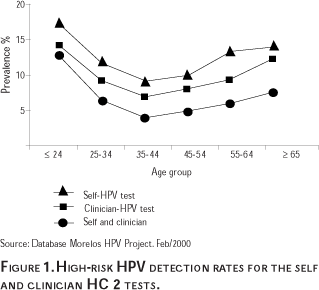
<body><![CDATA[<p><font face="Verdana" size="2"><b>HPV testing    for cervical cancer screening </b></font></p>     <p><font face="Verdana" size="2">Genital HPV infection    is the most common sexually transmitted viral infection.<SUP>18</SUP> Infection    with HPV through sexual contact has been determined to be a necessary risk factor    for the development of CC.<SUP>19</SUP> A recent study reported that the worldwide    HPV prevalence in cervical carcinomas is 99.7%.<SUP>20</SUP> The presence of    HPV in virtually all CC implies the highest attributable fraction that has been    reported for a specific cause of any major human cancer, around the world.<SUP>20</SUP>    The official recognition of HPV infection as a necessary cause of cervical dysplasia    and CC has produced an interest in the use of HPV diagnostic tests for screening    activities. Some of the possible uses of HPV testing include: a) triage of women    with low-grade Pap smear abnormalities, b) follow-up of women with confirmed    cervical intraepithelial neoplasia (CIN), and c) primary screening.<SUP>21</SUP>    The use of HPV testing in CCSPs could have the following benefits, a) the sensitivity    of CC screening results could be largely improved, b) women who are not infected    with HPV could be screened at longer intervals, and c) limited resources for    follow-up could be targeted better.<SUP>22</SUP> Other benefits include the    fact that the HPV test requires less technical resources, it is more reliable,    less subjective, and relatively easier to perform than the Pap test. The higher    costs that may be associated with HPV testing are likely to be offset by the    savings in the direct and indirect costs of Pap testing and Colposcopy services,    and by allowing longer screening intervals for HPV DNA negative women. </font></p>     <p><font face="Verdana" size="2"> In direct comparison    with the Pap, the HPV DNA test has a significantly greater sensitivity for premalignant    lesions (CIN 2/3).<SUP>23</SUP> Studies have also demonstrated that HPV testing    can be used to triage females with inconclusive or low grade abnormalities on    their Pap tests, with potential cost savings.<SUP>24-26</SUP> Other studies    indicate that a combination of HPV testing and repeated cytologic screening    can provide a reasonably sensitive screening for CC, while limiting the use    of overburdened colposcopy services.<SUP>27-29</SUP> Finally, HPV testing may    improve the sensitivity of CC screening services by identifying patients who    harbor serious cervical lesions that are not detected by the Pap test, or who    are at high risk for cervical neoplasia.<SUP>30</SUP> </font></p>     <p><font face="Verdana" size="2"> On its own or    in conjunction with cytology, there are a number of possibilities for incorporating    HPV testing at different ages and at different screening intervals. Studies    that have modeled different HPV screening strategies using various values for    prevalence, sensitivity, and probability of progression indicate that it may    be effective and cost-effective.<SUP>22,31</SUP> However, current knowledge    is incomplete and further studies and modeling are needed to evaluate the potential    roles and most cost-effective use of HPV testing for screening purposes.<SUP>32</SUP>    </font></p>     <p><font face="Verdana" size="2"><b>HPV prevalence    </b> </font></p>     <p><font face="Verdana" size="2">It has been estimated    that at least 50% of sexually active adults have had a genital HPV infection.<SUP>33</SUP>    Some studies suggest that the prevalence of HPV in men is similar to that found    in women.<SUP>34,35 </SUP>When male partners of women with HPV-associated genital    disease are examined by colposcopy and the acetic acid test, about 40 to 50%    of them show HPV-associated lesions, and half of these lesions are sub-clinical.<SUP>36</SUP>    Another study reports that 32% of men with low-grade penile intraepithelial    neoplasia were partners of women with CIN 2/3, whereas 72% of men with high-grade    penile intraepithelial neoplasia had female partners with CIN 2/3.<SUP>36</SUP>    </font></p>     <p><font face="Verdana" size="2"> The highest rates    of HPV infection have consistently been found in sexually active women under    the age of 25. This observation tends to be true even after adjusting for factors    such as lifetime number of sexual partners. In some studies, older women appear    to have a decreased prevalence of HPV due to biological effects, such as immunity,    that may limit or clear the infection.<SUP>33</SUP> </font></p>     <p><font face="Verdana" size="2"> <a href="#fig1">Figure 1</a> shows the detection    rates of HPV infection by collection type for the Morelos HPV Study.<SUP>37</SUP>    These findings indicate that the detection of HPV is greatest among younger    women (<u>&lt;</u>25 years of age), then it tends to drop until the age of    35 when it begins to increase again. This trend can be observed regardless of    the HPV testing technique used. The U-shaped HPV prevalence results from the    Morelos HPV Study indicate that, unlike other studies in the US and Europe which    have reported that infection with HPV tends to decrease with age, prevalence    of HPV increases among older women. This U-shaped curve is consistent with other    studies of HPV prevalence in Latin America such as Costa Rica and Colombia that    have found higher rates among younger and older women.<SUP>38,39 </SUP>The reasons    for the variation in HPV prevalence rates by age and geographic region are not    yet fully understood. Some explanations for this phenomenon may include: a)    a hormonal effect, b) a cohort effect, c) a reactivation of a latent infection,    and d) an immune system response. Other reasons could be the HPV detection techniques    that were used, or the type of study population that was selected. </font></p>     <p><a name="fig1"></a></p>     <p>&nbsp;</p>     ]]></body>
<body><![CDATA[<p align="center"><img src="/img/revistas/spm/v45s3/3a15f01.gif"></p>     <p>&nbsp;</p>     <p><font face="Verdana" size="2">These results also    indicate that the HPV testing of self-collected specimens detects a larger number    of women who are infected than does the testing of clinician-collected specimens.    However, since the HPV testing of self-collected specimens is less sensitive    for detecting CIN 2/3 and CC than the testing of clinician-collected specimens,    these results indicate that the HPV testing of self-collected specimens detects    more women infected with HPV that is not associated with CIN. A reason for this    phenomenon could be that the vaginal self-collected specimens contain other    types of HPV that are not found at cervical os, the area from which the clinician-collected    specimens are obtained. </font></p>     <p><font face="Verdana" size="2"> <a href="#fig2">Figure    2</a> compares the age-specific prevalence of HPV detected in clinician-collected    specimens, and the histologically confirmed cases of CIN 2/3 and CC found in    the Morelos HPV Study population. These results indicate that the highest prevalence    of HPV is found in the youngest and oldest age groups, which also report the    lowest number of CIN 2/3 and CC cases. This information could have important    implications in terms of the optimal age range for an HPV-based screening strategy.    </font></p>     <p><a name="fig2"></a></p>     <p>&nbsp;</p>     <p align="center"><img src="/img/revistas/spm/v45s3/3a15f02.gif"></p>     <p>&nbsp;</p>     <p><font face="Verdana" size="2">The process by    which an HPV infection progresses to carcinogenesis is not yet fully understood.    The development of invasive cervical cancer has been regarded as a continuum    that begins with mild dysplasia. Although low-grade lesions caused by HPV are    usually transient, women with these lesions are at an increased risk of developing    higher-grade CIN, the precursor to invasive carcinoma. High-grade CIN will usually    occur in women with a previous low-grade diagnosis, but it can also emerge in    women with a prior normal cytology or equivocal lesion diagnosis. The type of    HPV found in the cervix appears to predict the risk of a woman progressing from    a low-grade lesion to a diagnosis of CIN 2/3. This association has been demonstrated    in both cross-sectional,<SUP>40,41</SUP> and prospective,<SUP>42,43</SUP> studies.    </font></p>     <p><font face="Verdana" size="2"> The incubation    period for the development of a clinically apparent HPV infection (genital warts)    varies from three weeks to eight months. However, most HPV infections in the    squamous epithelium of the cervix remain at a sub-clinical level, providing    a reservoir for the transmission of the virus.<SUP>44 </SUP>A latent infection    may be converted to a replicative infection but the signal to initiate this    process is not clear. Individuals who are physiologically (as in pregnancy),    medically (as in taking steroids), or pathologically (as in HIV-infected) immunosuppressed,    are at a significantly greater risk of replicative infections with HPV. When    the individual is no longer in an immunosuppressed state the virus may again    become latent, as is commonly observed postpartum, or a complete clearance of    the infection may occur.<SUP>45</SUP> </font></p>     ]]></body>
<body><![CDATA[<p><font face="Verdana" size="2"> Most HPV infections    occur early in a person's sexual life, the overwhelming majority of infections    are cleared by the host immune system, and persistent infection is strongly    related to neoplasia.<SUP>46 </SUP>Recently results have been presented showing    a median duration of HPV infection of only 8 months, and after 24 months, only    9% of the women studied continued to be infected.<SUP>47</SUP> Although infection    with HPV is quite common, relatively few infected women develop invasive cervical    cancer. One study found that 12% of young women (13 to 22 years old) who were    persistently HPV positive developed CIN 2/3 after two years. They also found    that approximately 70% of the participants who were initially positive had HPV    regression by 24 months.<SUP>48</SUP> Another study found that 15.8% of patients    with HPV progressed to CIN after 24 months, persistence occurred in 39.4% and    regression in 44.8% of patients.<SUP>49</SUP> </font></p>     <p><font face="Verdana" size="2"> Although infection    with high-risk HPV types is a necessary factor for the development of CC, it    is not sufficient, since the majority of infected women do not go on to develop    this disease. CC usually develops after years or decades, apparently in association    with other possible co-factors. Studies suggest that infection with high-risk    types of HPV and older age are associated with persistence. Certain behaviors    such as smoking, hormonal exposure (e.g. multiparity and prolonged use of oral    contraceptives), nutritional deficiency, HLA haplotypes, other genital tract    infections, and immunodeficiency (especially infection with HIV), are thought    to be related to persistent infection and the development of CC.<SUP>46,50,51</SUP>    </font></p>     <p><font face="Verdana" size="2"> Women with persistent    HPV infections, especially those with high-risk types, are at greater risk for    developing CIN and CIN lesions that persist instead of regressing. The natural    history of HPV infection directly influences the prognosis of cervical dysplasia    as measured by persistence of the lesion.<SUP>52</SUP> Studies indicate that    persistence of high-risk HPVs may determine progression to more severe stages    of the disease, and risk for disease progression also seems to be associated    with viral burden.<SUP>53,54</SUP> </font></p>     <p><font face="Verdana" size="2"><b>The Morelos    HPV Study</b> </font></p>     <p><font face="Verdana" size="2"><I>Study design    and enrollment activities</I> </font></p>     <p><font face="Verdana" size="2">The Morelos HPV    Study<SUP>37</SUP> is currently being conducted in Mexico, to examine the use    of HPV testing for cervical cancer screening. The main objective of the Morelos    HPV Study is to evaluate the effectiveness of two different specimen collection    strategies for HPV testing: self-collected vaginal, and clinician-collected    cervical, for detecting pre-invasive cervical lesions and CC, as compared to    the Pap test. Another objective is to investigate the role of other factors,    such as HPV viral load and types, for the risk of cervical intraepithelial neoplasia    (CIN) 2/3 and CC. An additional objective is to evaluate the cost-effectiveness    of HPV testing, as compared to the Pap test. </font></p>     <p><font face="Verdana" size="2"> This study is    being carried out within the regular population-based framework of the IMSS    CCSP in Morelos. The study participants were obtained as a sample of all consecutive    women attending CC screening services at any one of the 23 health units that    make up the CCSP in Morelos. Women attending any of the CC screening clinics    in Morelos were invited to join the enrollment phase of the study between May    and October 1999. Overall, the response rate to participate in the study was    greater than 95%. This study sample is considered representative of the women    attending CC screening services at the 23 IMSS clinics in Morelos in 1999. All    participants provided informed consent, after a written and oral explanation    of the study was provided, at the recruitment visit. </font></p>     <p><font face="Verdana" size="2"> Before the pelvic    exam, participants were asked to provide a self-collected (SS) vaginal specimen    for HPV testing. All participants also underwent a pelvic examination that involved    collecting a cervical sample for the Pap smear, and a clinician-collected cervical    specimen (CS) for HPV testing. The Digene Hybrid Capture (HC) 2 Probe B, microtiter    assay was used to determine the presence of HPV. A specialized HPV lab was set    up and validated at INSP with the help of Digene technicians, and the samples    were tested according to the manufacturer's instructions.<SUP>55</SUP> </font></p>     <p><font face="Verdana" size="2"> A total of 7 872    women between the ages of 20 and 80, without a prior diagnosis of CIN 2/3 or    CC, hysterectomy or other treatment, enrolled in the study. Data were evaluated    from 7 732 women with complete information for the three tests (median age =    41). The 1 147 women who received at least one positive result (Pap, SS and/or    CS) were asked to come back for a colposcopic evaluation. During colposcopy,    biopsies were taken as appropriate, to histologically confirm a diagnosis of    CIN 2/3 or invasive cancer. A total of 1 015 women returned for colposcopy;    and 101 women received a histologically confirmed diagnosis of CIN 2/3 (n =    89) or CC (n = 12). </font></p>     <p><font face="Verdana" size="2"> During the recruitment    visit, all participants were interviewed by female staff using a standard IMSS    registration form. In addition, during the initial recruitment visit a randomly    selected subsample of 1 069 participants were interviewed to collect additional    information about their demographic data; obstetric, family planning and sexual    history; risk factors for HPV and CC; knowledge and use of the CCSP; experience    and acceptance of the Pap and HPV tests; patient costs of screening; and willingness    to pay to reduce risk of CC. </font></p>     ]]></body>
<body><![CDATA[<p>&nbsp;</p>     <p><font face="Verdana" size="3"><b>Results</b></font></p>     <p><font face="Verdana" size="2"><b>HPV test performance    results </b></font></p>     <p><font face="Verdana" size="2">The oncogenic HPV    detection rate observed among the Morelos HPV Study participants was found to    be 11.6% for SS, and 9.3% for CS. Fifty six Pap smear abnormalities were observed    in 2.4% of the women.<SUP>56</SUP> The relative sensitivity estimates for the    Pap test, SS and CS were 59.4% (95% CI, 49.2-68.9), 71.3% (95% CI, 61.3-79.6),    and 93.1% (95% CI, 85.8-96.9), respectively, while the specificities were 98.3%    (95% CI, 98.0-98.6), 89.2% (95% CI, 88.5-89.9), and 91.8% (95% CI, 91.2-92.4),    respectively.<SUP>56</SUP> The positive predictive values of Pap, SS and CS    were 36.1, 9.1 and 14.9, the colposcopy referrals needed to detect a case of    CIN2/3 or cancer were 2.8, 11.0 and 6.7, respectively.<SUP>56</SUP> </font></p>     <p><font face="Verdana" size="2"> Other recent studies    have also reported that the HPV HC2 test has a greater sensitivity to detect    CIN 2/3 and CC than the Pap test. <a href="/img/revistas/spm/v45s3/3a15t01.gif">Table I</a> summarizes    the findings of some of these studies. </font></p>     <p><font face="Verdana" size="2"> Preliminary results    from other recent studies in Brazil, Canada, Germany and the United States,    have also reported a greater sensitivity of HPV testing as compared to the Pap.<SUP>67,68    </SUP>These results suggest that self- and clinician-collected HPV testing could    be used in CC prevention programs, as an effective complement or substitute    for the Pap test. </font></p>     <p><font face="Verdana" size="2"><b>Acceptability    results</b> </font></p>     <p><font face="Verdana" size="2">As previously mentioned,    one of the reasons for the low coverage of the Mexican CCSP is the limited utilization    and acceptability of the Pap due to socio-cultural factors. Some of these factors    include: a) a reluctance to have a pelvic exam that may be embarrassing or painful;    b) feelings of helplessness associated with the invasive nature of the exam;    and c) the disapproval of a male partner.<SUP>14</SUP> </font></p>     <p><font face="Verdana" size="2"> Recently, the    acceptability of the Pap was examined in relation to the use of a self-sampling    technique for HPV testing.<SUP>69 </SUP>This investigation was conducted as    part of the Morelos HPV Study. A sub-sample of 1 069 women was selected from    the total Morelos HPV Study population of 7 732. These women were asked to provide    a self-collected vaginal specimen, to undergo a pelvic exam that included a    Pap test, and to answer an in depth questionnaire. The acceptability component    of the questionnaire addressed the perception of the level of pain, discomfort,    embarrassment, and privacy experienced with the Pap and self-sampling procedures.    Respondents were asked to rate their answers using a Likert scale, where a score    of "1" represents low acceptability and a score of "5" indicates    a high acceptability. </font></p>     <p><font face="Verdana" size="2"> <a href="#fig3">Figure    3</a> compares the respondents' experience with both the Pap and self-sampling    procedures in terms of over-all acceptability, pain, embarrassment, discomfort,    and privacy. The respondents showed a strong preference for the self-sampling    technique as compared to the Pap test, as measured by the Likert scale, (68%    vs. 32%).<SUP>69</SUP> The respondents also indicated a greater amount of pain,    embarrassment, and discomfort associated with the Pap test, as compared to the    self-sampling procedure. More women reported increased privacy associated with    the self-sampling technique than with the Pap test. Most of the women (93.1%)    who reported that they preferred the Pap test indicated that they had more confidence    in the procedure.<SUP>69</SUP> </font></p>     ]]></body>
<body><![CDATA[<p><a name="fig3"></a></p>     <p>&nbsp;</p>     <p align="center"><img src="/img/revistas/spm/v45s3/3a15f03.gif"></p>     <p>&nbsp;</p>     <p><font face="Verdana" size="2">It is important    to note that these women were asked to rate their acceptance of the Pap and    self-sampling procedures without knowing the sensitivity and specificity of    these screening techniques. Had these women been informed of the fact that the    sensitivity of the Pap is actually lower than that of the HPV test on self-sampled    specimens, the acceptability of the Pap may have been even lower. </font></p>     <p><font face="Verdana" size="2"><b>Cost-effectiveness    </b> </font></p>     <p><font face="Verdana" size="2">There are few studies    that have examined the cost-effectiveness of HPV testing as compared to the    Pap. A recent review of 2 100 papers that address the role of HPV testing for    CC screening found that the existing modeling studies are inadequate for assessing    cost-effectiveness.<SUP>70 </SUP>This report was disseminated in 1999, at a    time when there were far fewer published studies on the effectiveness of HPV    testing. Since 1999, a number of studies have published very promising results    on the high sensitivity and potential applications of HPV testing. </font></p>     <p><font face="Verdana" size="2"> Some studies that    have examined the cost-effectiveness of HPV testing, such as van Ballegooijen    <I>et al</I>,<SUP>71</SUP> are limited by the estimates of the effectiveness    of HPV testing they used. More accurate estimates of the effectiveness of HPV    testing are only currently becoming available. These studies are also limited    by the estimates of the cost of the HPV test they used because it is not known    what the cost of the test will be for high-volume screening. The results of    modeling studies indicate that for plausible values of prevalence, sensitivity,    and disease progression, the use of HPV testing could be cost-effective.<SUP>70</SUP>    However, since these modeling studies have used imprecise input parameters due    to lack of data, additional studies are required to improve the estimates of    the key model parameters needed to perform an accurate and up-to-date cost-effectiveness    analysis (CEA). </font></p>     <p><font face="Verdana" size="2"> In order to determine    what CC screening strategy is the most appropriate, it is important to compare    the benefits and costs of each strategy. A recent study by Mandelblatt <I>et    al</I>.<SUP>22</SUP> used a mathematical model of the natural history of CC    to estimate the benefits and costs of screening the average US population. The    use of HPV testing alone and in combination with the Pap test was compared to    screening with the Pap test on its own. This study used published estimates    of costs and effectiveness to create their model.The study concluded that screening    with both the Pap and HPV test every two years results in additional years of    life saved at a reasonable cost, compared to Pap testing alone. </font></p>     <p><font face="Verdana" size="2"> Another recent    study by Goldie <I>et al</I>.<SUP>31</SUP> examined the policy implications    of several CC screening strategies in low-resource settings. A CEA was performed    using a mathematical model and a hypothetical cohort of 30 year-old, black,    South African women who had never been screened for CC. The performance of various    screening tests including, direct visual inspection of the cervix, cytology,    and HPV testing, were evaluated. The researchers who conducted this study used    data from a South African screening study, a national survey, fee schedules,    and published literature, to create their model. The study reports that when    all strategies are compared simultaneously, HPV testing every three years is    the most cost-effective option. </font></p>     ]]></body>
<body><![CDATA[<p><font face="Verdana" size="2"> These two studies    provide important information about the cost-effectiveness of HPV testing for    CC screening. However, the results of these studies are based on cost and effectiveness    parameters that were estimated using previously published data from many different    sources. An economic evaluation of HPV testing that is based on cost and effectiveness    data obtained from an actual CCSP context is also needed in order to further    assess the role of HPV testing for CC screening. These data were obtained as    part of the Morelos HPV Study. </font></p>     <p><font face="Verdana" size="2"> A CEA and a cost-benefit    analysis (CBA) were performed using data from the Morelos HPV Study, to further    evaluate the possibility of using HPV testing as a screening technique for the    detection of CC. The costs and benefits of the following interventions were    evaluated and compared: a) using only the Pap test vs. self- or clinician-HPV    testing for CC screening; b) using the clinician-HPV test in conjunction with    the Pap test, and c) using different screening options for different age groups.    The CEA and CBA were performed from the perspective of society and IMSS. The    results of the CEA and CBA indicate that screening women between the ages of    20-80 for CC using some type of HPV testing is always more cost-effective than    screening for CC using the Pap test.<SUP>72</SUP> The cost-effectiveness    results vary based on the cost that is assigned to missed cases of CC. If a    cost of $500 per missed case is used, the most cost-effective option is Self-HPV    testing followed by Pap testing, Clinician-HPV testing, then Pap in conjunction    with Clinician-HPV testing, respectively. If a cost per missed case of $10,000    is used, the most cost-effective option is Pap in conjunction with Clinician-HPV    testing, followed by Clinician-HPV testing Self-HPV testing, then Pap testing    respectively. These results will be reported in a future publication. </font></p>     <p>&nbsp;</p>     <p><font face="Verdana" size="3"><b>Discussion </b></font></p>     <p><font face="Verdana" size="2">Until recently,    most studies have focused on the use of the clinician-collected HPV test, rather    than the self-collected test. Also, previous studies have not examined the potential    use of different test combinations. Of particular importance are the reference    populations that have been used for these studies; most have focused on the    use of HPV testing in women who are attending colposcopy. The sensitivity and    specificity results in studies using a colposcopy population will be different    than those of studies that use a routine Pap screening population. The HPV test    may have a greater sensitivity and a lower specificity to detect CIN 2/3 and    CC when it is applied to a colposcopy population, than when it is used within    a regular screening population. This is because women who are referred to colposcopy    have evidence of a cervical lesion, but most will not have high grade cervical    disease. </font></p>     <p><font face="Verdana" size="2"> Also, very few    studies have been conducted within an actual population-based CCSP. Evaluating    the use of HPV testing for primary screening is very relevant, and this must    be done using a population of women who are attending routine Pap screening    services. Studies that take place within an established CCSP can produce results    that will be applicable for the specific screening program context. Finally,    because the specificity of the HPV tests is relatively low, identifying strategies    that could be used to improve it is a priority. Since many women who test positive    for HPV will never go on to develop high grade CIN and cancer, it is important    to find ways to distinguish the HPV positive women who are at greater risk of    high grade disease, from those who may not be at risk. </font></p>     <p><font face="Verdana" size="2"> The results from    the Morelos HPV Study indicate an over-all lower acceptability of the Pap test    as compared to the self-sampling procedure. This finding has important implications    concerning the potential use of self-sampling CC screening services for women    who reject Pap-based screening programs. However, it is also important to note    that most of the study participants indicated no difference in pain, discomfort,    or privacy between the Pap test and the self-sampling procedure. This finding    is significant because it implies that a large number of women appear to accept    the pelvic examination that is required to perform a Pap test. As noted previously,    the Morelos HPV Study results indicate that the HPV testing of clinician-collected    cervical specimens has a higher sensitivity for detecting CIN 2/3 and CC when    compared with HPV testing of vaginal self-collected specimens (93% <I>vs</I>.    71%, respectively).<SUP>56</SUP> This finding suggests that the HPV testing    of clinician-collected specimens could potentially be a more effective CC screening    option. The fact that a significant number of women would agree to have a pelvic    exam is a necessary first step to implementing HPV testing of clinician-collected    cervical specimens as a viable CC screening option. </font></p>     <p><font face="Verdana" size="2"> The baseline results    of the Morelos HPV Study indicate that the use of Pap testing on its own is    not as effective as the use of HPV testing to screen for CC. The combined use    of the Pap and the clinician-collected HPV test appears to be the most effective    and cost-effective option to detect cases of CIN 2/3 and cervical cancer. Although    the self-collected HPV test was not found to be as effective or cost-effective    as the Pap-HPV test combination, the acceptability results indicate that most    study participants showed a strong preference for the self-sampling technique.    These findings suggest that the self-collected HPV test could be an attractive    option for women who refuse to get a Pap or clinician-collected HPV test because    of the pelvic examination. The self-HPV test could be used as an alternative    way to reach these women, and increase the coverage of CC screening programs.    </font></p>     <p><font face="Verdana" size="2"> Future studies    need to examine the cost-effectiveness and cost-benefit of HPV testing as part    of a long-term population-based screening program. Two such demonstration studies    are currently underway in the states of Morelos and Tlaxcala in Mexico. These    long-term studies will provide valuable information about the ideal screening    intervals for HPV testing, as well as long-term cost-effectiveness results.    One of the benefits of HPV testing is the fact that women who are negative may    not need to be screened as frequently, which could result in additional cost    savings. Future research should also examine the potential social consequences    that women may experience from receiving an HPV positive diagnosis. A screening    program that is based on HPV testing may have to take into account issues associated    with screening for a sexually transmitted infection, as well as those associated    with screening for CIN and CC. </font></p>     <p>&nbsp;</p>     ]]></body>
<body><![CDATA[<p><font face="Verdana" size="3"><b>References </b></font></p>     <!-- ref --><p><font face="Verdana" size="2">1. Secretar&iacute;a    de Salud. Estad&iacute;sticas de mortalidad relacionada con la salud reproductiva.    M&eacute;xico, 1997. (Indicadores). Salud Publica Mex 1999;41:138-46. </font>&nbsp;&nbsp;&nbsp;&nbsp;&nbsp;&nbsp;&nbsp;&nbsp;[&#160;<a href="javascript:void(0);" onclick="javascript: window.open('/scielo.php?script=sci_nlinks&ref=9183810&pid=S0036-3634200300090001300001&lng=','','width=640,height=500,resizable=yes,scrollbars=1,menubar=yes,');">Links</a>&#160;]<!-- end-ref --><!-- ref --><p><font face="Verdana" size="2">2. Lazcano-Ponce    EC, N&aacute;jera-Aguilar P, Buiatti E, Alonso-de Ruiz P, Kuri P, Cantoral L,    <I>et al</I>. The cervical cancer screening program in Mexico: Problems with    access and coverage. Cancer Causes Control 1997;8:698-704. </font>&nbsp;&nbsp;&nbsp;&nbsp;&nbsp;&nbsp;&nbsp;&nbsp;[&#160;<a href="javascript:void(0);" onclick="javascript: window.open('/scielo.php?script=sci_nlinks&ref=9183811&pid=S0036-3634200300090001300002&lng=','','width=640,height=500,resizable=yes,scrollbars=1,menubar=yes,');">Links</a>&#160;]<!-- end-ref --><!-- ref --><p><font face="Verdana" size="2">3. Direcci&oacute;n    General de Estad&iacute;stica I y E. Estad&iacute;sticas sobre tumores malignos    en M&eacute;xico. Direcci&oacute;n General de Estad&iacute;stica, Inform&aacute;tica    y Evoluci&oacute;n. Salud Publica Mex 1997;39:388-399. </font>&nbsp;&nbsp;&nbsp;&nbsp;&nbsp;&nbsp;&nbsp;&nbsp;[&#160;<a href="javascript:void(0);" onclick="javascript: window.open('/scielo.php?script=sci_nlinks&ref=9183812&pid=S0036-3634200300090001300003&lng=','','width=640,height=500,resizable=yes,scrollbars=1,menubar=yes,');">Links</a>&#160;]<!-- end-ref --><!-- ref --><p><font face="Verdana" size="2">4. Hern&aacute;ndez-Avila    M, Lazcano-Ponce EC, Alonso-de Ruiz P, Romieu I. Evaluation of the cervical    cancer screening program in Mexico: A population-based case-control study. Int    J Epidemiol 1998;27:1-7. </font>&nbsp;&nbsp;&nbsp;&nbsp;&nbsp;&nbsp;&nbsp;&nbsp;[&#160;<a href="javascript:void(0);" onclick="javascript: window.open('/scielo.php?script=sci_nlinks&ref=9183813&pid=S0036-3634200300090001300004&lng=','','width=640,height=500,resizable=yes,scrollbars=1,menubar=yes,');">Links</a>&#160;]<!-- end-ref --><!-- ref --><p><font face="Verdana" size="2">5. National Cancer    Institute Workshop: The 1988 Bethesda System for reporting cervical/vaginal    cytological diagnoses. JAMA. 1989;262:931-934. </font>&nbsp;&nbsp;&nbsp;&nbsp;&nbsp;&nbsp;&nbsp;&nbsp;[&#160;<a href="javascript:void(0);" onclick="javascript: window.open('/scielo.php?script=sci_nlinks&ref=9183814&pid=S0036-3634200300090001300005&lng=','','width=640,height=500,resizable=yes,scrollbars=1,menubar=yes,');">Links</a>&#160;]<!-- end-ref --><!-- ref --><p><font face="Verdana" size="2">6. Lazcano-Ponce    EC, Rasc&oacute;n-Pacheco RA, Lozano-Ascencio R, Velasco-Mondrag&oacute;n HE.    Mortality from cervical carcinoma in Mexico: Impact of screening, 1980-1990.    Acta Cytol 1996;40:506-512. </font>&nbsp;&nbsp;&nbsp;&nbsp;&nbsp;&nbsp;&nbsp;&nbsp;[&#160;<a href="javascript:void(0);" onclick="javascript: window.open('/scielo.php?script=sci_nlinks&ref=9183815&pid=S0036-3634200300090001300006&lng=','','width=640,height=500,resizable=yes,scrollbars=1,menubar=yes,');">Links</a>&#160;]<!-- end-ref --><!-- ref --><p><font face="Verdana" size="2">7. Secretar&iacute;a    de Salud. La Perspectiva de G&eacute;nero en la Salud. 1996. </font>&nbsp;&nbsp;&nbsp;&nbsp;&nbsp;&nbsp;&nbsp;&nbsp;[&#160;<a href="javascript:void(0);" onclick="javascript: window.open('/scielo.php?script=sci_nlinks&ref=9183816&pid=S0036-3634200300090001300007&lng=','','width=640,height=500,resizable=yes,scrollbars=1,menubar=yes,');">Links</a>&#160;]<!-- end-ref --><!-- ref --><p><font face="Verdana" size="2">8. Salmer&oacute;n-Castro    J, Franco-Marina F, Salazar-Mart&iacute;nez E, Lazcano-Ponce EC. Panorama epidemiol&oacute;gico    de la mortalidad por c&aacute;ncer en el IMSS: 1990-1995. Salud Publica Mex    1997;39:266-273. </font>&nbsp;&nbsp;&nbsp;&nbsp;&nbsp;&nbsp;&nbsp;&nbsp;[&#160;<a href="javascript:void(0);" onclick="javascript: window.open('/scielo.php?script=sci_nlinks&ref=9183817&pid=S0036-3634200300090001300008&lng=','','width=640,height=500,resizable=yes,scrollbars=1,menubar=yes,');">Links</a>&#160;]<!-- end-ref --><!-- ref --><p><font face="Verdana" size="2">9. Compendio del    Registro Histopatol&oacute;gico de Neoplasias en M&eacute;xico. Morbididad y    Mortalidad Secretar&iacute;a de Salud. 1a Edici&oacute;n. 1996:35-37. </font>&nbsp;&nbsp;&nbsp;&nbsp;&nbsp;&nbsp;&nbsp;&nbsp;[&#160;<a href="javascript:void(0);" onclick="javascript: window.open('/scielo.php?script=sci_nlinks&ref=9183818&pid=S0036-3634200300090001300009&lng=','','width=640,height=500,resizable=yes,scrollbars=1,menubar=yes,');">Links</a>&#160;]<!-- end-ref --><!-- ref --><p><font face="Verdana" size="2">10. Lazcano-Ponce    EC, Moss S, Alonso-de Ruiz P, Salmer&oacute;n-Castro J, Hern&aacute;ndez-Avila    M. Cervical cancer screening in developing countries: Why is it ineffective?    The case of Mexico. Arch Med Res. 1999;30:240-250. </font>&nbsp;&nbsp;&nbsp;&nbsp;&nbsp;&nbsp;&nbsp;&nbsp;[&#160;<a href="javascript:void(0);" onclick="javascript: window.open('/scielo.php?script=sci_nlinks&ref=9183819&pid=S0036-3634200300090001300010&lng=','','width=640,height=500,resizable=yes,scrollbars=1,menubar=yes,');">Links</a>&#160;]<!-- end-ref --><!-- ref --><p><font face="Verdana" size="2">11. Lazcano-Ponce    EC, Buiatti E, N&aacute;jera-Aguilar P, Alonso-de Ruiz P, Hern&aacute;ndez-Avila    M. Evaluation model of the Mexican national program for early cervical cancer    detection and proposals for a new approach. Cancer Causes Control 1998;9:1-11.    </font>&nbsp;&nbsp;&nbsp;&nbsp;&nbsp;&nbsp;&nbsp;&nbsp;[&#160;<a href="javascript:void(0);" onclick="javascript: window.open('/scielo.php?script=sci_nlinks&ref=9183820&pid=S0036-3634200300090001300011&lng=','','width=640,height=500,resizable=yes,scrollbars=1,menubar=yes,');">Links</a>&#160;]<!-- end-ref --><!-- ref --><p><font face="Verdana" size="2">12. Hern&aacute;ndez-Avila    M, Lazcano-Ponce EC, Alonso-de Ruiz P, L&oacute;pez-Carrillo L, Rojas-Mart&iacute;nez.    Evaluaci&oacute;n del programa de detecci&oacute;n oportuna del c&aacute;ncer    del cuello uterino en la Ciudad de M&eacute;xico: Un estudio epidemiol&oacute;gico    de casos y controles con base poblacional. Gac Med Mex 1994;130:201-209. </font>&nbsp;&nbsp;&nbsp;&nbsp;&nbsp;&nbsp;&nbsp;&nbsp;[&#160;<a href="javascript:void(0);" onclick="javascript: window.open('/scielo.php?script=sci_nlinks&ref=9183821&pid=S0036-3634200300090001300012&lng=','','width=640,height=500,resizable=yes,scrollbars=1,menubar=yes,');">Links</a>&#160;]<!-- end-ref --><!-- ref --><p><font face="Verdana" size="2">13. Lazcano-Ponce    EC, N&aacute;jera-Aguilar P, Alonso-de Ruiz P, Buiatti E, Hern&aacute;ndez-Avila    M. Programa de detecci&oacute;n oportuna de c&aacute;ncer cervical en M&eacute;xico:    Diagn&oacute;stico situacional. Cancerolog&iacute;a 1996;42:123-140. </font>&nbsp;&nbsp;&nbsp;&nbsp;&nbsp;&nbsp;&nbsp;&nbsp;[&#160;<a href="javascript:void(0);" onclick="javascript: window.open('/scielo.php?script=sci_nlinks&ref=9183822&pid=S0036-3634200300090001300013&lng=','','width=640,height=500,resizable=yes,scrollbars=1,menubar=yes,');">Links</a>&#160;]<!-- end-ref --><!-- ref --><p><font face="Verdana" size="2">14. Lazcano-Ponce    EC, Castro R, Allen B, N&aacute;jera-Aguilar P, Alonso-de Ruiz P, Hern&aacute;ndez-Avila    M. Barriers to early detection of cervical-uterine cancer in Mexico. J Womens    Health 1999; 8(3):399-408. </font>&nbsp;&nbsp;&nbsp;&nbsp;&nbsp;&nbsp;&nbsp;&nbsp;[&#160;<a href="javascript:void(0);" onclick="javascript: window.open('/scielo.php?script=sci_nlinks&ref=9183823&pid=S0036-3634200300090001300014&lng=','','width=640,height=500,resizable=yes,scrollbars=1,menubar=yes,');">Links</a>&#160;]<!-- end-ref --><!-- ref --><p><font face="Verdana" size="2">15. Mitchell MF,    Tortolero-Luna G, Wright T, Sarkar A, Richards-Kortum R, Hong WK <I>et al</I>.    Cervical human papillomavirus infection and intraepithelial neoplasia: A review.    J Natl Cancer Inst Monogr 1996;(21):17-25.    &nbsp;&nbsp;&nbsp;&nbsp;&nbsp;&nbsp;&nbsp;&nbsp;[&#160;<a href="javascript:void(0);" onclick="javascript: window.open('/scielo.php?script=sci_nlinks&ref=9183824&pid=S0036-3634200300090001300015&lng=','','width=640,height=500,resizable=yes,scrollbars=1,menubar=yes,');">Links</a>&#160;]<!-- end-ref --> Review. </font></p>     <!-- ref --><p><font face="Verdana" size="2">16. Herrero R.    Epidemiology of cervical cancer. Monogr Natl Cancer Inst 1996;21:1-6. </font>&nbsp;&nbsp;&nbsp;&nbsp;&nbsp;&nbsp;&nbsp;&nbsp;[&#160;<a href="javascript:void(0);" onclick="javascript: window.open('/scielo.php?script=sci_nlinks&ref=9183826&pid=S0036-3634200300090001300016&lng=','','width=640,height=500,resizable=yes,scrollbars=1,menubar=yes,');">Links</a>&#160;]<!-- end-ref --><!-- ref --><p><font face="Verdana" size="2">17. Cuzick J, Meijer    CJ, Walboomers JM. Screening for cervical cancer. Lancet 1998;351:1439-1440.    </font>&nbsp;&nbsp;&nbsp;&nbsp;&nbsp;&nbsp;&nbsp;&nbsp;[&#160;<a href="javascript:void(0);" onclick="javascript: window.open('/scielo.php?script=sci_nlinks&ref=9183827&pid=S0036-3634200300090001300017&lng=','','width=640,height=500,resizable=yes,scrollbars=1,menubar=yes,');">Links</a>&#160;]<!-- end-ref --><!-- ref --><p><font face="Verdana" size="2">18. Division of    STD Prevention. Prevention of Genital HPV Infection and Sequelae: Report of    an External Consultants' Meeting. Department of Health and Human Services, Atlanta:    Centers for Disease Control and Prevention (CDC), December 1999. </font>&nbsp;&nbsp;&nbsp;&nbsp;&nbsp;&nbsp;&nbsp;&nbsp;[&#160;<a href="javascript:void(0);" onclick="javascript: window.open('/scielo.php?script=sci_nlinks&ref=9183828&pid=S0036-3634200300090001300018&lng=','','width=640,height=500,resizable=yes,scrollbars=1,menubar=yes,');">Links</a>&#160;]<!-- end-ref --><!-- ref --><p><font face="Verdana" size="2">19. Schiffman MH,    Bauer HM, Hoover RN, Glass AG, Cadell DM, Rush BB, <I>et al</I>. Epidemiologic    evidence showing that human papillomavirus infection causes most cervical intraepithelial    neoplasia. J Natl Cancer Inst 1993;85:958-964. </font>&nbsp;&nbsp;&nbsp;&nbsp;&nbsp;&nbsp;&nbsp;&nbsp;[&#160;<a href="javascript:void(0);" onclick="javascript: window.open('/scielo.php?script=sci_nlinks&ref=9183829&pid=S0036-3634200300090001300019&lng=','','width=640,height=500,resizable=yes,scrollbars=1,menubar=yes,');">Links</a>&#160;]<!-- end-ref --><!-- ref --><p><font face="Verdana" size="2">20. Walboomers    JM, Jacobs MV, Manos MM, Bosch FX, Kummer JA, Shah KV <I>et al</I>. Human papillomavirus    is a necessary cause of invasive cancer worldwide. J Pathol 1999;189:12-19.    </font>&nbsp;&nbsp;&nbsp;&nbsp;&nbsp;&nbsp;&nbsp;&nbsp;[&#160;<a href="javascript:void(0);" onclick="javascript: window.open('/scielo.php?script=sci_nlinks&ref=9183830&pid=S0036-3634200300090001300020&lng=','','width=640,height=500,resizable=yes,scrollbars=1,menubar=yes,');">Links</a>&#160;]<!-- end-ref --><!-- ref --><p><font face="Verdana" size="2">21. Cuzick J, Human    Papillomavirus testing for primary cervical cancer screening. JAMA. 2000;283:108-109.    </font>&nbsp;&nbsp;&nbsp;&nbsp;&nbsp;&nbsp;&nbsp;&nbsp;[&#160;<a href="javascript:void(0);" onclick="javascript: window.open('/scielo.php?script=sci_nlinks&ref=9183831&pid=S0036-3634200300090001300021&lng=','','width=640,height=500,resizable=yes,scrollbars=1,menubar=yes,');">Links</a>&#160;]<!-- end-ref --><!-- ref --><p><font face="Verdana" size="2">22. Mandelblatt    JS, Lawrence WF, Womack SM, Jacobson D, Yi B, Hwang YT <I>et al</I>. Benefits    and costs of using HPV testing to screen for cervical cancer. JAMA 2002;287(18):2372-2381.    </font>&nbsp;&nbsp;&nbsp;&nbsp;&nbsp;&nbsp;&nbsp;&nbsp;[&#160;<a href="javascript:void(0);" onclick="javascript: window.open('/scielo.php?script=sci_nlinks&ref=9183832&pid=S0036-3634200300090001300022&lng=','','width=640,height=500,resizable=yes,scrollbars=1,menubar=yes,');">Links</a>&#160;]<!-- end-ref --><!-- ref --><p><font face="Verdana" size="2">23. L&ouml;rincz    AT, Richart RM. Human papillomavirus DNA testing as an adjunct to cytology in    cervical screening programs. Arch Pathol Lab Med 2003;127(8):959-968. </font>&nbsp;&nbsp;&nbsp;&nbsp;&nbsp;&nbsp;&nbsp;&nbsp;[&#160;<a href="javascript:void(0);" onclick="javascript: window.open('/scielo.php?script=sci_nlinks&ref=9183833&pid=S0036-3634200300090001300023&lng=','','width=640,height=500,resizable=yes,scrollbars=1,menubar=yes,');">Links</a>&#160;]<!-- end-ref --><!-- ref --><p><font face="Verdana" size="2">24. Ferenczy A.    Viral testing for genital human papillomavirus infections: Recent progress and    clinical potentials. Int J Gynecol Cancer 1995;5:321-328. </font>&nbsp;&nbsp;&nbsp;&nbsp;&nbsp;&nbsp;&nbsp;&nbsp;[&#160;<a href="javascript:void(0);" onclick="javascript: window.open('/scielo.php?script=sci_nlinks&ref=9183834&pid=S0036-3634200300090001300024&lng=','','width=640,height=500,resizable=yes,scrollbars=1,menubar=yes,');">Links</a>&#160;]<!-- end-ref --><!-- ref --><p><font face="Verdana" size="2">25. Richart RM.    Screening: The next century. Cancer 1995;15;76(10 suppl):1919-1927. </font>&nbsp;&nbsp;&nbsp;&nbsp;&nbsp;&nbsp;&nbsp;&nbsp;[&#160;<a href="javascript:void(0);" onclick="javascript: window.open('/scielo.php?script=sci_nlinks&ref=9183835&pid=S0036-3634200300090001300025&lng=','','width=640,height=500,resizable=yes,scrollbars=1,menubar=yes,');">Links</a>&#160;]<!-- end-ref --><!-- ref --><p><font face="Verdana" size="2">26. Hatch KD, Schneider    A, Abdel-Nour MW. An evaluation of human papillomavirus testing for intermediate-    and high-risk types as triage before coloposcopy. Am J Obstet Gynecol 1995;172:1150-1157.    </font>&nbsp;&nbsp;&nbsp;&nbsp;&nbsp;&nbsp;&nbsp;&nbsp;[&#160;<a href="javascript:void(0);" onclick="javascript: window.open('/scielo.php?script=sci_nlinks&ref=9183836&pid=S0036-3634200300090001300026&lng=','','width=640,height=500,resizable=yes,scrollbars=1,menubar=yes,');">Links</a>&#160;]<!-- end-ref --><!-- ref --><p><font face="Verdana" size="2">27. Cox JT, Schiffman    MH, Winzelberg AJ, Patterson JM. An evaluation of human papillomavirus testing    as part of referral to colposcopy clinics. Obstet Gynecol 1992;80:384-389. </font>&nbsp;&nbsp;&nbsp;&nbsp;&nbsp;&nbsp;&nbsp;&nbsp;[&#160;<a href="javascript:void(0);" onclick="javascript: window.open('/scielo.php?script=sci_nlinks&ref=9183837&pid=S0036-3634200300090001300027&lng=','','width=640,height=500,resizable=yes,scrollbars=1,menubar=yes,');">Links</a>&#160;]<!-- end-ref --><!-- ref --><p><font face="Verdana" size="2">28. L&ouml;rincz,    AT. Hybrid capture method for detection of human papilloma virus DNA in clinical    specimens. Papillomavirus Report 1996;7:1-5. </font>&nbsp;&nbsp;&nbsp;&nbsp;&nbsp;&nbsp;&nbsp;&nbsp;[&#160;<a href="javascript:void(0);" onclick="javascript: window.open('/scielo.php?script=sci_nlinks&ref=9183838&pid=S0036-3634200300090001300028&lng=','','width=640,height=500,resizable=yes,scrollbars=1,menubar=yes,');">Links</a>&#160;]<!-- end-ref --><!-- ref --><p><font face="Verdana" size="2">29. Wright TC,    Wei Sun X, Koulos J. Comparison of management algorithms for the evaluation    of women with low-grade cytologic abnormalities. Obstet Gynecol 1995;85:202-210.    </font>&nbsp;&nbsp;&nbsp;&nbsp;&nbsp;&nbsp;&nbsp;&nbsp;[&#160;<a href="javascript:void(0);" onclick="javascript: window.open('/scielo.php?script=sci_nlinks&ref=9183839&pid=S0036-3634200300090001300029&lng=','','width=640,height=500,resizable=yes,scrollbars=1,menubar=yes,');">Links</a>&#160;]<!-- end-ref --><!-- ref --><p><font face="Verdana" size="2">30. Serwadda D,    Wawer MJ, Shah KV, Sewankambo NK, Daniel R, Li C <I>et al</I>. Use of a hybrid    capture assay of self-collected vaginal swabs in rural Uganda for detection    of human papillomavirus. J Infect Dis 1999;180:316-319. </font>&nbsp;&nbsp;&nbsp;&nbsp;&nbsp;&nbsp;&nbsp;&nbsp;[&#160;<a href="javascript:void(0);" onclick="javascript: window.open('/scielo.php?script=sci_nlinks&ref=9183840&pid=S0036-3634200300090001300030&lng=','','width=640,height=500,resizable=yes,scrollbars=1,menubar=yes,');">Links</a>&#160;]<!-- end-ref --><!-- ref --><p><font face="Verdana" size="2">31. Goldie SJ,    Kuhn L, Denny L, Pollack A, Wright TC. Policy analysis of cervical cancer screening    strategies in low-resource settings: clinical benefits and cost-effectiveness.    JAMA. 2001;285(24):3107-3115. </font>&nbsp;&nbsp;&nbsp;&nbsp;&nbsp;&nbsp;&nbsp;&nbsp;[&#160;<a href="javascript:void(0);" onclick="javascript: window.open('/scielo.php?script=sci_nlinks&ref=9183841&pid=S0036-3634200300090001300031&lng=','','width=640,height=500,resizable=yes,scrollbars=1,menubar=yes,');">Links</a>&#160;]<!-- end-ref --><!-- ref --><p><font face="Verdana" size="2">32. Cuzick J, Sasieni    P, Davies P, Adams J, Normand C, Frater A <I>et al</I>. A systematic review    of the role of human papillomavirus (HPV) testing within a cervical screening    programme: summary and conclusions. Br J Cancer 2000;83:561-565. </font>&nbsp;&nbsp;&nbsp;&nbsp;&nbsp;&nbsp;&nbsp;&nbsp;[&#160;<a href="javascript:void(0);" onclick="javascript: window.open('/scielo.php?script=sci_nlinks&ref=9183842&pid=S0036-3634200300090001300032&lng=','','width=640,height=500,resizable=yes,scrollbars=1,menubar=yes,');">Links</a>&#160;]<!-- end-ref --><!-- ref --><p><font face="Verdana" size="2">33. Koutsky L.    Epidemiology of genital human papillomavirus infection. Am J Med 1997;102:3-8.    </font>&nbsp;&nbsp;&nbsp;&nbsp;&nbsp;&nbsp;&nbsp;&nbsp;[&#160;<a href="javascript:void(0);" onclick="javascript: window.open('/scielo.php?script=sci_nlinks&ref=9183843&pid=S0036-3634200300090001300033&lng=','','width=640,height=500,resizable=yes,scrollbars=1,menubar=yes,');">Links</a>&#160;]<!-- end-ref --><!-- ref --><p><font face="Verdana" size="2">34. Hippel&auml;inen    M, Syrj&auml;nen S, Hippel&auml;inen M <I>et al</I>. Prevalence and risk factors    of genital papillomavirus infections in healthy males: A study on Finnish conscripts.    Sex Transm Dis 1993;20:321-328. </font>&nbsp;&nbsp;&nbsp;&nbsp;&nbsp;&nbsp;&nbsp;&nbsp;[&#160;<a href="javascript:void(0);" onclick="javascript: window.open('/scielo.php?script=sci_nlinks&ref=9183844&pid=S0036-3634200300090001300034&lng=','','width=640,height=500,resizable=yes,scrollbars=1,menubar=yes,');">Links</a>&#160;]<!-- end-ref --><!-- ref --><p><font face="Verdana" size="2">35. Grussendorf-Conen    EI, de Villiers EM, Gissmann L. Human papillomavirus genomes in penile smears    of healthy men. (Letter) Lancet 1986; ii:1092. </font>&nbsp;&nbsp;&nbsp;&nbsp;&nbsp;&nbsp;&nbsp;&nbsp;[&#160;<a href="javascript:void(0);" onclick="javascript: window.open('/scielo.php?script=sci_nlinks&ref=9183845&pid=S0036-3634200300090001300035&lng=','','width=640,height=500,resizable=yes,scrollbars=1,menubar=yes,');">Links</a>&#160;]<!-- end-ref --><!-- ref --><p><font face="Verdana" size="2">36. Palefsky JM,    Barrasso R. HPV infection and disease in men. In: Human Papillomavirus II. Obstet    Gynecol Clin 1996;23:895-915. </font>&nbsp;&nbsp;&nbsp;&nbsp;&nbsp;&nbsp;&nbsp;&nbsp;[&#160;<a href="javascript:void(0);" onclick="javascript: window.open('/scielo.php?script=sci_nlinks&ref=9183846&pid=S0036-3634200300090001300036&lng=','','width=640,height=500,resizable=yes,scrollbars=1,menubar=yes,');">Links</a>&#160;]<!-- end-ref --><!-- ref --><p><font face="Verdana" size="2">37. Flores Y, Shah    K, Lazcano E, Hern&aacute;ndez M, Bishai D, Ferris D <I>et al</I>. Design and    methods of the evaluation of an HPV-based cervical cancer screening strategy    in Mexico: The Morelos HPV Study. Salud Publica Mex 2002;44(4):335-344. </font>&nbsp;&nbsp;&nbsp;&nbsp;&nbsp;&nbsp;&nbsp;&nbsp;[&#160;<a href="javascript:void(0);" onclick="javascript: window.open('/scielo.php?script=sci_nlinks&ref=9183847&pid=S0036-3634200300090001300037&lng=','','width=640,height=500,resizable=yes,scrollbars=1,menubar=yes,');">Links</a>&#160;]<!-- end-ref --><!-- ref --><p><font face="Verdana" size="2">38. Lazcano EC,    Herrero R, Mu&ntilde;oz N, Cruz A, Shah KV, Alonso P <I>et al</I>. Epidemiology    of HPV infection among Mexican women with normal cytology. Int J Cancer 2001;91(3):    412-420. </font>&nbsp;&nbsp;&nbsp;&nbsp;&nbsp;&nbsp;&nbsp;&nbsp;[&#160;<a href="javascript:void(0);" onclick="javascript: window.open('/scielo.php?script=sci_nlinks&ref=9183848&pid=S0036-3634200300090001300038&lng=','','width=640,height=500,resizable=yes,scrollbars=1,menubar=yes,');">Links</a>&#160;]<!-- end-ref --><!-- ref --><p><font face="Verdana" size="2">39. Herrero R,    Hildesheim A, Bratti C, Sherman M, Hutchinson M, Morales J <I>et al</I>. A population-based    study of human papillomavirus infection and cervical neoplasia in rural Costa    Rica. JNCI 2000;92(6): 464-474. </font>&nbsp;&nbsp;&nbsp;&nbsp;&nbsp;&nbsp;&nbsp;&nbsp;[&#160;<a href="javascript:void(0);" onclick="javascript: window.open('/scielo.php?script=sci_nlinks&ref=9183849&pid=S0036-3634200300090001300039&lng=','','width=640,height=500,resizable=yes,scrollbars=1,menubar=yes,');">Links</a>&#160;]<!-- end-ref --><!-- ref --><p><font face="Verdana" size="2">40. L&ouml;rincz    A, Reid R, Jenson B, Greenberg M, Lancaster W, Kurman R. Human papillomavirus    infection of the cervix: Relative risk associations of 15 common anogenital    types. Obstet Gynecol 1992;79:328-37. </font>&nbsp;&nbsp;&nbsp;&nbsp;&nbsp;&nbsp;&nbsp;&nbsp;[&#160;<a href="javascript:void(0);" onclick="javascript: window.open('/scielo.php?script=sci_nlinks&ref=9183850&pid=S0036-3634200300090001300040&lng=','','width=640,height=500,resizable=yes,scrollbars=1,menubar=yes,');">Links</a>&#160;]<!-- end-ref --><!-- ref --><p><font face="Verdana" size="2">41. Cuzick J, Terry    G, Ho L, Hollingworth T, Anderson M. Type-specific human papillomavirus DNA    in abnormal smears as a predictor of high-grade cervical intraepithelial neoplasia.    Br J Cancer 1994;69:167-171. </font>&nbsp;&nbsp;&nbsp;&nbsp;&nbsp;&nbsp;&nbsp;&nbsp;[&#160;<a href="javascript:void(0);" onclick="javascript: window.open('/scielo.php?script=sci_nlinks&ref=9183851&pid=S0036-3634200300090001300041&lng=','','width=640,height=500,resizable=yes,scrollbars=1,menubar=yes,');">Links</a>&#160;]<!-- end-ref --><!-- ref --><p><font face="Verdana" size="2">42. Remmink AJ,    Walboomers JM, Helmerhorst TJ, Voorhorst FJ, Rozendaal L, Risse EK <I>et al</I>.    The presence of persistent high-risk HPV genotypes in dysplastic cervical lesions    is associated with progressive disease: Natural history up to 36 months. Int    J Cancer 1995;61:306-311. </font>&nbsp;&nbsp;&nbsp;&nbsp;&nbsp;&nbsp;&nbsp;&nbsp;[&#160;<a href="javascript:void(0);" onclick="javascript: window.open('/scielo.php?script=sci_nlinks&ref=9183852&pid=S0036-3634200300090001300042&lng=','','width=640,height=500,resizable=yes,scrollbars=1,menubar=yes,');">Links</a>&#160;]<!-- end-ref --><!-- ref --><p><font face="Verdana" size="2">43. Wallin KL,    Wiklund F, Angstrom T, Bergman F, Stendahl U, Wadell G, <I>et al</I>. Type-specific    persistence of human papillomavirus DNA before the development of invasive cervical    cancer. N Engl J Med 1999;341:1633-1638. </font>&nbsp;&nbsp;&nbsp;&nbsp;&nbsp;&nbsp;&nbsp;&nbsp;[&#160;<a href="javascript:void(0);" onclick="javascript: window.open('/scielo.php?script=sci_nlinks&ref=9183853&pid=S0036-3634200300090001300043&lng=','','width=640,height=500,resizable=yes,scrollbars=1,menubar=yes,');">Links</a>&#160;]<!-- end-ref --><!-- ref --><p><font face="Verdana" size="2">44. Zhang MZ, Borchardt    KA, Li Z. Condyloma acuminatum. In: Borchardt KA, Nobel MA, eds. Sexually Transmitted    Diseases. New York: CRC Press, 1997:271-282. </font>&nbsp;&nbsp;&nbsp;&nbsp;&nbsp;&nbsp;&nbsp;&nbsp;[&#160;<a href="javascript:void(0);" onclick="javascript: window.open('/scielo.php?script=sci_nlinks&ref=9183854&pid=S0036-3634200300090001300044&lng=','','width=640,height=500,resizable=yes,scrollbars=1,menubar=yes,');">Links</a>&#160;]<!-- end-ref --><!-- ref --><p><font face="Verdana" size="2">45. Richart RM,    Masood S, Syrjanen KJ, Vassilakos P, Kaufman RH, Olszewski WT, <I>et al</I>.    Human papillomavirus IAC task force summary. Acta Cytol 1998;42:50-58. </font>&nbsp;&nbsp;&nbsp;&nbsp;&nbsp;&nbsp;&nbsp;&nbsp;[&#160;<a href="javascript:void(0);" onclick="javascript: window.open('/scielo.php?script=sci_nlinks&ref=9183855&pid=S0036-3634200300090001300045&lng=','','width=640,height=500,resizable=yes,scrollbars=1,menubar=yes,');">Links</a>&#160;]<!-- end-ref --><!-- ref --><p><font face="Verdana" size="2">46. Sedlacek TV.    Advances in the diagnosis and treatment of human papillomavirus infections.    Clin Obstet Gynecol. 1999;42:206-220. </font>&nbsp;&nbsp;&nbsp;&nbsp;&nbsp;&nbsp;&nbsp;&nbsp;[&#160;<a href="javascript:void(0);" onclick="javascript: window.open('/scielo.php?script=sci_nlinks&ref=9183856&pid=S0036-3634200300090001300046&lng=','','width=640,height=500,resizable=yes,scrollbars=1,menubar=yes,');">Links</a>&#160;]<!-- end-ref --><!-- ref --><p><font face="Verdana" size="2">47. Strand A, Rylander    E. Human papillomavirus. Subclinical and atypical manifestations. Dermatol Clin    1998;16: 817-822. </font>&nbsp;&nbsp;&nbsp;&nbsp;&nbsp;&nbsp;&nbsp;&nbsp;[&#160;<a href="javascript:void(0);" onclick="javascript: window.open('/scielo.php?script=sci_nlinks&ref=9183857&pid=S0036-3634200300090001300047&lng=','','width=640,height=500,resizable=yes,scrollbars=1,menubar=yes,');">Links</a>&#160;]<!-- end-ref --><!-- ref --><p><font face="Verdana" size="2">48. Moscicki AB,    Shiboski S, Broering J, Powell K, Clayton L, Jay N <I>et al. </I>The natural    history of human papillomavirus infection as measured by repeated DNA testing    in adolescent and young women. J Pediatr 1998;132:277-284. </font>&nbsp;&nbsp;&nbsp;&nbsp;&nbsp;&nbsp;&nbsp;&nbsp;[&#160;<a href="javascript:void(0);" onclick="javascript: window.open('/scielo.php?script=sci_nlinks&ref=9183858&pid=S0036-3634200300090001300048&lng=','','width=640,height=500,resizable=yes,scrollbars=1,menubar=yes,');">Links</a>&#160;]<!-- end-ref --><!-- ref --><p><font face="Verdana" size="2">49. Rome RM, Chanen    W, Pagano R. The natural history of human papillomavirus (HPV) atypia of the    cervix. Aust N Z J Obst Gynaecol 1987;27:287-290. </font>&nbsp;&nbsp;&nbsp;&nbsp;&nbsp;&nbsp;&nbsp;&nbsp;[&#160;<a href="javascript:void(0);" onclick="javascript: window.open('/scielo.php?script=sci_nlinks&ref=9183859&pid=S0036-3634200300090001300049&lng=','','width=640,height=500,resizable=yes,scrollbars=1,menubar=yes,');">Links</a>&#160;]<!-- end-ref --><!-- ref --><p><font face="Verdana" size="2">50. World Health    Organization. IARC Monograph on the Evaluation of Carcinogenic Risks to Humans:    Human Papillomaviruses. Lyons: IARC, 1995; Vol. 64. </font>&nbsp;&nbsp;&nbsp;&nbsp;&nbsp;&nbsp;&nbsp;&nbsp;[&#160;<a href="javascript:void(0);" onclick="javascript: window.open('/scielo.php?script=sci_nlinks&ref=9183860&pid=S0036-3634200300090001300050&lng=','','width=640,height=500,resizable=yes,scrollbars=1,menubar=yes,');">Links</a>&#160;]<!-- end-ref --><!-- ref --><p><font face="Verdana" size="2">51. Brinton LA,    Epidemiology of cervical cancer&#151;overview. In: Mu&ntilde;oz N, Bosch FX,    Shah KV, Meheus A, eds. The Epidemiology of Cervical Cancer and Human Papillomavirus.    Lyon: IARC, 1992. </font>&nbsp;&nbsp;&nbsp;&nbsp;&nbsp;&nbsp;&nbsp;&nbsp;[&#160;<a href="javascript:void(0);" onclick="javascript: window.open('/scielo.php?script=sci_nlinks&ref=9183861&pid=S0036-3634200300090001300051&lng=','','width=640,height=500,resizable=yes,scrollbars=1,menubar=yes,');">Links</a>&#160;]<!-- end-ref --><!-- ref --><p><font face="Verdana" size="2">52. Ho GY, Burk    DD, Klein S, Kadish AS, Chang CJ, Palan P <I>et al</I>. Persistent genital human    papillomavirus infection as a risk factor for persistent cervical dysplasia.    J Natl Cancer Inst 1995;87:1365-1371. </font>&nbsp;&nbsp;&nbsp;&nbsp;&nbsp;&nbsp;&nbsp;&nbsp;[&#160;<a href="javascript:void(0);" onclick="javascript: window.open('/scielo.php?script=sci_nlinks&ref=9183862&pid=S0036-3634200300090001300052&lng=','','width=640,height=500,resizable=yes,scrollbars=1,menubar=yes,');">Links</a>&#160;]<!-- end-ref --><!-- ref --><p><font face="Verdana" size="2">53. Villa L. Human    papillomaviruses and cervical cancer. Adv Cancer Res 1997;71:321-341. </font>&nbsp;&nbsp;&nbsp;&nbsp;&nbsp;&nbsp;&nbsp;&nbsp;[&#160;<a href="javascript:void(0);" onclick="javascript: window.open('/scielo.php?script=sci_nlinks&ref=9183863&pid=S0036-3634200300090001300053&lng=','','width=640,height=500,resizable=yes,scrollbars=1,menubar=yes,');">Links</a>&#160;]<!-- end-ref --><!-- ref --><p><font face="Verdana" size="2">54. Mu&ntilde;oz    N, Bosch FX, De Sanjos&eacute; S, Shah KV. The role of HPV in the etiology of    cervical cancer. Mutation Res 1994;305:293-301. </font>&nbsp;&nbsp;&nbsp;&nbsp;&nbsp;&nbsp;&nbsp;&nbsp;[&#160;<a href="javascript:void(0);" onclick="javascript: window.open('/scielo.php?script=sci_nlinks&ref=9183864&pid=S0036-3634200300090001300054&lng=','','width=640,height=500,resizable=yes,scrollbars=1,menubar=yes,');">Links</a>&#160;]<!-- end-ref --><!-- ref --><p><font face="Verdana" size="2">55. L&ouml;rincz    A. Hybrid CaptureTM method for detection of human papillomavirus DNA in clinical    specimens. Papillomavirus Rep 1996;7:1-5. </font>&nbsp;&nbsp;&nbsp;&nbsp;&nbsp;&nbsp;&nbsp;&nbsp;[&#160;<a href="javascript:void(0);" onclick="javascript: window.open('/scielo.php?script=sci_nlinks&ref=9183865&pid=S0036-3634200300090001300055&lng=','','width=640,height=500,resizable=yes,scrollbars=1,menubar=yes,');">Links</a>&#160;]<!-- end-ref --><!-- ref --><p><font face="Verdana" size="2">56. Salmer&oacute;n    J, Lazcano EC, L&ouml;rincz A, Hern&aacute;ndez M, Hern&aacute;ndez P, Leyva    A <I>et al</I>. Comparison of HPV-based assays with Papanicolaou smears for    cervical cancer screening in Morelos State, Mexico. Cancer Causes Control 2003;14:505-512.    </font>&nbsp;&nbsp;&nbsp;&nbsp;&nbsp;&nbsp;&nbsp;&nbsp;[&#160;<a href="javascript:void(0);" onclick="javascript: window.open('/scielo.php?script=sci_nlinks&ref=9183866&pid=S0036-3634200300090001300056&lng=','','width=640,height=500,resizable=yes,scrollbars=1,menubar=yes,');">Links</a>&#160;]<!-- end-ref --><!-- ref --><p><font face="Verdana" size="2">57. Schiffman M,    Herrero R, Hildesheim A, Sherman M, Bratti M, Wacholder S <I>et al</I>. HPV    DNA testing in cervical cancer screening: Results from women in a high-risk    province of Costa Rica. JAMA 2000;283:87-93. </font>&nbsp;&nbsp;&nbsp;&nbsp;&nbsp;&nbsp;&nbsp;&nbsp;[&#160;<a href="javascript:void(0);" onclick="javascript: window.open('/scielo.php?script=sci_nlinks&ref=9183867&pid=S0036-3634200300090001300057&lng=','','width=640,height=500,resizable=yes,scrollbars=1,menubar=yes,');">Links</a>&#160;]<!-- end-ref --><!-- ref --><p><font face="Verdana" size="2">58. Womack SD,    Chirenje ZM, Blumenthal PD, Gaffikin L, McGrath JA, Chipato T <I>et al</I>. Evaluation of a human papillomavirus assay in cervical screening in Zimbabwe.    BJOG 2000;107:33-8. </font>&nbsp;&nbsp;&nbsp;&nbsp;&nbsp;&nbsp;&nbsp;&nbsp;[&#160;<a href="javascript:void(0);" onclick="javascript: window.open('/scielo.php?script=sci_nlinks&ref=9183868&pid=S0036-3634200300090001300058&lng=','','width=640,height=500,resizable=yes,scrollbars=1,menubar=yes,');">Links</a>&#160;]<!-- end-ref --><!-- ref --><p><font face="Verdana" size="2">59. Wright TC,    Denny L, Kuhn L, Pollack A, L&ouml;rincz A. HPV DNA testing of self-collected    vaginal samples compared with cytologic screening to detect cervical cancer.    JAMA 2000;283:81-86. </font>&nbsp;&nbsp;&nbsp;&nbsp;&nbsp;&nbsp;&nbsp;&nbsp;[&#160;<a href="javascript:void(0);" onclick="javascript: window.open('/scielo.php?script=sci_nlinks&ref=9183869&pid=S0036-3634200300090001300059&lng=','','width=640,height=500,resizable=yes,scrollbars=1,menubar=yes,');">Links</a>&#160;]<!-- end-ref --><!-- ref --><p><font face="Verdana" size="2">60. Lin CT, Tseng    CJ, Lai CH, Hsueh S, Huang HJ, Law KS. High-risk HPV DNA detection by Hybrid    Capture II. An adjunctive test for mildly abnormal cytologic smears in women    &gt; or = 50 years of age. J Reprod Med 2000;45(4):345-350. </font>&nbsp;&nbsp;&nbsp;&nbsp;&nbsp;&nbsp;&nbsp;&nbsp;[&#160;<a href="javascript:void(0);" onclick="javascript: window.open('/scielo.php?script=sci_nlinks&ref=9183870&pid=S0036-3634200300090001300060&lng=','','width=640,height=500,resizable=yes,scrollbars=1,menubar=yes,');">Links</a>&#160;]<!-- end-ref --><!-- ref --><p><font face="Verdana" size="2">61. Sellors JW,    L&ouml;rincz AT, Mahony JB, Mielzynska I, Lytwyn A, Roth P <I>et al</I>. Comparison of self-collected vaginal, vulvar and urine samples with physician-collected    cervical samples for human papillomavirus testing to detect high-grade squamous    intraepithelial lesions. CMAJ 2000;163:513-518. </font>&nbsp;&nbsp;&nbsp;&nbsp;&nbsp;&nbsp;&nbsp;&nbsp;[&#160;<a href="javascript:void(0);" onclick="javascript: window.open('/scielo.php?script=sci_nlinks&ref=9183871&pid=S0036-3634200300090001300061&lng=','','width=640,height=500,resizable=yes,scrollbars=1,menubar=yes,');">Links</a>&#160;]<!-- end-ref --><!-- ref --><p><font face="Verdana" size="2">62. Fait G, Kupferminc    MJ, Daniel Y, Geva E, Ron IG, Lessing JB <I>et al</I>. Contribution of human    papillomavirus testing by hybrid capture in the triage of women with repeated    abnormal pap smears before colposcopy referral. Gynecol Oncol 2000;79:177-180.    </font>&nbsp;&nbsp;&nbsp;&nbsp;&nbsp;&nbsp;&nbsp;&nbsp;[&#160;<a href="javascript:void(0);" onclick="javascript: window.open('/scielo.php?script=sci_nlinks&ref=9183872&pid=S0036-3634200300090001300062&lng=','','width=640,height=500,resizable=yes,scrollbars=1,menubar=yes,');">Links</a>&#160;]<!-- end-ref --><!-- ref --><p><font face="Verdana" size="2">63. Bergeron C,    Jeannel D, Poveda J, Cassonnet P, Orth G. Human papillomavirus testing    in women with mild cytologic atypia. Obstet Gynecol 2000;95:821-827. </font>&nbsp;&nbsp;&nbsp;&nbsp;&nbsp;&nbsp;&nbsp;&nbsp;[&#160;<a href="javascript:void(0);" onclick="javascript: window.open('/scielo.php?script=sci_nlinks&ref=9183873&pid=S0036-3634200300090001300063&lng=','','width=640,height=500,resizable=yes,scrollbars=1,menubar=yes,');">Links</a>&#160;]<!-- end-ref --><!-- ref --><p><font face="Verdana" size="2">64. Clavel C, Masure    M, Bory JP, Putaud I, Mangeonjean C, Lorenzato M <I>et al</I>. Hybrid Capture    II-based human papillomavirus detection, a sensitive test to detect in routine    high-grade cervical lesions: a preliminary study on 1518 women. Br J Cancer    1999;80:1306-1311. </font>&nbsp;&nbsp;&nbsp;&nbsp;&nbsp;&nbsp;&nbsp;&nbsp;[&#160;<a href="javascript:void(0);" onclick="javascript: window.open('/scielo.php?script=sci_nlinks&ref=9183874&pid=S0036-3634200300090001300064&lng=','','width=640,height=500,resizable=yes,scrollbars=1,menubar=yes,');">Links</a>&#160;]<!-- end-ref --><!-- ref --><p><font face="Verdana" size="2">65. Cuzick J, Beverley    E, Ho L, Terry G, Sapper H, Mielzynska I <I>et al</I>. HPV testing in primary    screening of older women. Br J Cancer 1999;8:554-558. </font>&nbsp;&nbsp;&nbsp;&nbsp;&nbsp;&nbsp;&nbsp;&nbsp;[&#160;<a href="javascript:void(0);" onclick="javascript: window.open('/scielo.php?script=sci_nlinks&ref=9183875&pid=S0036-3634200300090001300065&lng=','','width=640,height=500,resizable=yes,scrollbars=1,menubar=yes,');">Links</a>&#160;]<!-- end-ref --><!-- ref --><p><font face="Verdana" size="2">66. Ferris DG,    Wright TC, Litaker MS, Richart RM, L&ouml;rincz AT, Xaio-Wei S <I>et al</I>.    Comparison of two tests for detecting carcinogenic HPV in women with papanicolaou    smear reports of ASCUS and LSIL. J Fam Pract 1998;46:136-141. </font>&nbsp;&nbsp;&nbsp;&nbsp;&nbsp;&nbsp;&nbsp;&nbsp;[&#160;<a href="javascript:void(0);" onclick="javascript: window.open('/scielo.php?script=sci_nlinks&ref=9183876&pid=S0036-3634200300090001300066&lng=','','width=640,height=500,resizable=yes,scrollbars=1,menubar=yes,');">Links</a>&#160;]<!-- end-ref --><!-- ref --><p><font face="Verdana" size="2">67. Ratnam S, Franco    EL, Ferenczy A. Human papillomavirus testing for primary screening of cervical    cancer precursors. Cancer Epidem Biomar 2000;9:945-951. </font>&nbsp;&nbsp;&nbsp;&nbsp;&nbsp;&nbsp;&nbsp;&nbsp;[&#160;<a href="javascript:void(0);" onclick="javascript: window.open('/scielo.php?script=sci_nlinks&ref=9183877&pid=S0036-3634200300090001300067&lng=','','width=640,height=500,resizable=yes,scrollbars=1,menubar=yes,');">Links</a>&#160;]<!-- end-ref --><!-- ref --><p><font face="Verdana" size="2">68. 18th International    Papillomavirus Conference. Charleston, SC, USA. January 9-15, 1999. </font>&nbsp;&nbsp;&nbsp;&nbsp;&nbsp;&nbsp;&nbsp;&nbsp;[&#160;<a href="javascript:void(0);" onclick="javascript: window.open('/scielo.php?script=sci_nlinks&ref=9183878&pid=S0036-3634200300090001300068&lng=','','width=640,height=500,resizable=yes,scrollbars=1,menubar=yes,');">Links</a>&#160;]<!-- end-ref --><!-- ref --><p><font face="Verdana" size="2">69. Dzuba I, Yunes-D&iacute;az    E, Allen B, Flores Y, Lazcano-Ponce EC, Shah K <I>et al</I>. The acceptability    of self-collected samples for HPV testing <I>vs</I>. the pap test as alternatives    in cervical cancer screening. J Womens Health Gend Based Med 2002;11(3):265-275.    </font>&nbsp;&nbsp;&nbsp;&nbsp;&nbsp;&nbsp;&nbsp;&nbsp;[&#160;<a href="javascript:void(0);" onclick="javascript: window.open('/scielo.php?script=sci_nlinks&ref=9183879&pid=S0036-3634200300090001300069&lng=','','width=640,height=500,resizable=yes,scrollbars=1,menubar=yes,');">Links</a>&#160;]<!-- end-ref --><!-- ref --><p><font face="Verdana" size="2">70. Cuzick J, Sasieni    P, Davies P, Adams J, Normand C, Frater A <I>et al</I>. A systematic review    of the role of human papillomavirus testing within a cervical screening program.    Health Technol Assess 1999;3(14):i-iv, 1-204. </font>&nbsp;&nbsp;&nbsp;&nbsp;&nbsp;&nbsp;&nbsp;&nbsp;[&#160;<a href="javascript:void(0);" onclick="javascript: window.open('/scielo.php?script=sci_nlinks&ref=9183880&pid=S0036-3634200300090001300070&lng=','','width=640,height=500,resizable=yes,scrollbars=1,menubar=yes,');">Links</a>&#160;]<!-- end-ref --><!-- ref --><p><font face="Verdana" size="2">71. van Ballegooijen    M, van den Akker-van Marle ME, Warmerdam PG, Meijer CJ, Walboomers JM, Habbema    JD. Present evidence on the value of HPV testing for cervical cancer screening:    a model-based exploration of the (cost-) effectiveness. Br J Cancer 1997;76:651-657.    </font>&nbsp;&nbsp;&nbsp;&nbsp;&nbsp;&nbsp;&nbsp;&nbsp;[&#160;<a href="javascript:void(0);" onclick="javascript: window.open('/scielo.php?script=sci_nlinks&ref=9183881&pid=S0036-3634200300090001300071&lng=','','width=640,height=500,resizable=yes,scrollbars=1,menubar=yes,');">Links</a>&#160;]<!-- end-ref --><!-- ref --><p><font face="Verdana" size="2">72. Flores Y, Bishai    d, L&ouml;rincz A, Lazcano E, Hern&aacute;ndez M, Salmer&oacute;n J, Shah K.    Cost-effectiveness of HPV testing as compared to the Pap in Mexico. 20th International    Papillomavirus Conference. Paris, France. October 4-9, 2002. </font>&nbsp;&nbsp;&nbsp;&nbsp;&nbsp;&nbsp;&nbsp;&nbsp;[&#160;<a href="javascript:void(0);" onclick="javascript: window.open('/scielo.php?script=sci_nlinks&ref=9183882&pid=S0036-3634200300090001300072&lng=','','width=640,height=500,resizable=yes,scrollbars=1,menubar=yes,');">Links</a>&#160;]<!-- end-ref --><p>&nbsp;</p>     <p>&nbsp;</p>     <p><font face="Verdana" size="2"><b>Address reprint    requests to:</b>     <br>   Yvonne Flores    <br>   Unidad de Investigaci&oacute;n Epidemiol&oacute;gica y en Servicios de Salud.    Hospital General Regional con Medicina Familiar No. 1    <br>   Avenida Plan de Ayala Esquina Central s/n, colonia Chapultepec    ]]></body>
<body><![CDATA[<br>   62450 Cuernavaca, Morelos, M&eacute;xico    <br>   e-mail: <a href="mailto:ivonne.flores@imss.gob.mx">ivonne.flores@imss.gob.mx</a>    </font></p>     <p><font face="Verdana" size="2"><b>Received on:</b>    March 27, 2003     <br>   <b>Accepted on:</b> July 28, 2003 </font></p>      ]]></body><back>
<ref-list>
<ref id="B1">
<label>1</label><nlm-citation citation-type="journal">
<collab>Secretaría de Salud</collab>
<article-title xml:lang="es"><![CDATA[Estadísticas de mortalidad relacionada con la salud reproductiva: México, 1997]]></article-title>
<source><![CDATA[Salud Publica Mex]]></source>
<year>1999</year>
<volume>41</volume>
<page-range>138-46</page-range></nlm-citation>
</ref>
<ref id="B2">
<label>2</label><nlm-citation citation-type="journal">
<person-group person-group-type="author">
<name>
<surname><![CDATA[Lazcano-Ponce]]></surname>
<given-names><![CDATA[EC]]></given-names>
</name>
<name>
<surname><![CDATA[Nájera-Aguilar]]></surname>
<given-names><![CDATA[P]]></given-names>
</name>
<name>
<surname><![CDATA[Buiatti]]></surname>
<given-names><![CDATA[E]]></given-names>
</name>
<name>
<surname><![CDATA[Alonso-de]]></surname>
<given-names><![CDATA[Ruiz P]]></given-names>
</name>
<name>
<surname><![CDATA[Kuri]]></surname>
<given-names><![CDATA[P]]></given-names>
</name>
<name>
<surname><![CDATA[Cantoral]]></surname>
<given-names><![CDATA[L]]></given-names>
</name>
</person-group>
<article-title xml:lang="en"><![CDATA[The cervical cancer screening program in Mexico: Problems with access and coverage]]></article-title>
<source><![CDATA[Cancer Causes Control]]></source>
<year>1997</year>
<volume>8</volume>
<page-range>698-704</page-range></nlm-citation>
</ref>
<ref id="B3">
<label>3</label><nlm-citation citation-type="journal">
<collab>Dirección General de Estadística I y E</collab>
<article-title xml:lang="es"><![CDATA[Estadísticas sobre tumores malignos en México: Dirección General de Estadística, Informática y Evolución]]></article-title>
<source><![CDATA[Salud Publica Mex]]></source>
<year>1997</year>
<volume>39</volume>
<page-range>388-399</page-range></nlm-citation>
</ref>
<ref id="B4">
<label>4</label><nlm-citation citation-type="journal">
<person-group person-group-type="author">
<name>
<surname><![CDATA[Hernández-Avila]]></surname>
<given-names><![CDATA[M]]></given-names>
</name>
<name>
<surname><![CDATA[Lazcano-Ponce]]></surname>
<given-names><![CDATA[EC]]></given-names>
</name>
<name>
<surname><![CDATA[Alonso-de]]></surname>
<given-names><![CDATA[Ruiz P]]></given-names>
</name>
<name>
<surname><![CDATA[Romieu]]></surname>
<given-names><![CDATA[I]]></given-names>
</name>
</person-group>
<article-title xml:lang="en"><![CDATA[Evaluation of the cervical cancer screening program in Mexico: A population-based case-control study]]></article-title>
<source><![CDATA[Int J Epidemiol]]></source>
<year>1998</year>
<volume>27</volume>
<page-range>1-7</page-range></nlm-citation>
</ref>
<ref id="B5">
<label>5</label><nlm-citation citation-type="journal">
<article-title xml:lang="en"><![CDATA[National Cancer Institute Workshop: The 1988 Bethesda System for reporting cervical/vaginal cytological diagnoses]]></article-title>
<source><![CDATA[JAMA]]></source>
<year>1989</year>
<volume>262</volume>
<page-range>931-934</page-range></nlm-citation>
</ref>
<ref id="B6">
<label>6</label><nlm-citation citation-type="journal">
<person-group person-group-type="author">
<name>
<surname><![CDATA[Lazcano-Ponce]]></surname>
<given-names><![CDATA[EC]]></given-names>
</name>
<name>
<surname><![CDATA[Rascón-Pacheco]]></surname>
<given-names><![CDATA[RA]]></given-names>
</name>
<name>
<surname><![CDATA[Lozano-Ascencio]]></surname>
<given-names><![CDATA[R]]></given-names>
</name>
<name>
<surname><![CDATA[Velasco-Mondragón]]></surname>
<given-names><![CDATA[HE]]></given-names>
</name>
</person-group>
<article-title xml:lang="en"><![CDATA[Mortality from cervical carcinoma in Mexico: Impact of screening, 1980-1990]]></article-title>
<source><![CDATA[Acta Cytol]]></source>
<year>1996</year>
<volume>40</volume>
<page-range>506-512</page-range></nlm-citation>
</ref>
<ref id="B7">
<label>7</label><nlm-citation citation-type="">
<collab>Secretaría de Salud</collab>
<source><![CDATA[La Perspectiva de Género en la Salud]]></source>
<year>1996</year>
</nlm-citation>
</ref>
<ref id="B8">
<label>8</label><nlm-citation citation-type="journal">
<person-group person-group-type="author">
<name>
<surname><![CDATA[Salmerón-Castro]]></surname>
<given-names><![CDATA[J]]></given-names>
</name>
<name>
<surname><![CDATA[Franco-Marina]]></surname>
<given-names><![CDATA[F]]></given-names>
</name>
<name>
<surname><![CDATA[Salazar-Martínez]]></surname>
<given-names><![CDATA[E]]></given-names>
</name>
<name>
<surname><![CDATA[Lazcano-Ponce]]></surname>
<given-names><![CDATA[EC]]></given-names>
</name>
</person-group>
<article-title xml:lang="es"><![CDATA[Panorama epidemiológico de la mortalidad por cáncer en el IMSS: 1990-1995]]></article-title>
<source><![CDATA[Salud Publica Mex]]></source>
<year>1997</year>
<volume>39</volume>
<page-range>266-273</page-range></nlm-citation>
</ref>
<ref id="B9">
<label>9</label><nlm-citation citation-type="">
<source><![CDATA[Compendio del Registro Histopatológico de Neoplasias en México: Morbididad y Mortalidad Secretaría de Salud]]></source>
<year>1996</year>
<edition>1</edition>
<page-range>35-37</page-range></nlm-citation>
</ref>
<ref id="B10">
<label>10</label><nlm-citation citation-type="journal">
<person-group person-group-type="author">
<name>
<surname><![CDATA[Lazcano-Ponce]]></surname>
<given-names><![CDATA[EC]]></given-names>
</name>
<name>
<surname><![CDATA[Moss]]></surname>
<given-names><![CDATA[S]]></given-names>
</name>
<name>
<surname><![CDATA[Alonso-de]]></surname>
<given-names><![CDATA[Ruiz P]]></given-names>
</name>
<name>
<surname><![CDATA[Salmerón-Castro]]></surname>
<given-names><![CDATA[J]]></given-names>
</name>
<name>
<surname><![CDATA[Hernández-Avila]]></surname>
<given-names><![CDATA[M]]></given-names>
</name>
</person-group>
<article-title xml:lang="en"><![CDATA[Cervical cancer screening in developing countries: Why is it ineffective? The case of Mexico]]></article-title>
<source><![CDATA[Arch Med Res.]]></source>
<year>1999</year>
<volume>30</volume>
<page-range>240-250</page-range></nlm-citation>
</ref>
<ref id="B11">
<label>11</label><nlm-citation citation-type="journal">
<person-group person-group-type="author">
<name>
<surname><![CDATA[Lazcano-Ponce]]></surname>
<given-names><![CDATA[EC]]></given-names>
</name>
<name>
<surname><![CDATA[Buiatti]]></surname>
<given-names><![CDATA[E]]></given-names>
</name>
<name>
<surname><![CDATA[Nájera-Aguilar]]></surname>
<given-names><![CDATA[P]]></given-names>
</name>
<name>
<surname><![CDATA[Alonso-de]]></surname>
<given-names><![CDATA[Ruiz P]]></given-names>
</name>
<name>
<surname><![CDATA[Hernández-Avila]]></surname>
<given-names><![CDATA[M]]></given-names>
</name>
</person-group>
<article-title xml:lang="en"><![CDATA[Evaluation model of the Mexican national program for early cervical cancer detection and proposals for a new approach]]></article-title>
<source><![CDATA[Cancer Causes Control]]></source>
<year>1998</year>
<volume>9</volume>
<page-range>1-11</page-range></nlm-citation>
</ref>
<ref id="B12">
<label>12</label><nlm-citation citation-type="journal">
<person-group person-group-type="author">
<name>
<surname><![CDATA[Hernández-Avila]]></surname>
<given-names><![CDATA[M]]></given-names>
</name>
<name>
<surname><![CDATA[Lazcano-Ponce]]></surname>
<given-names><![CDATA[EC]]></given-names>
</name>
<name>
<surname><![CDATA[Alonso-de]]></surname>
<given-names><![CDATA[Ruiz P]]></given-names>
</name>
<name>
<surname><![CDATA[López-Carrillo]]></surname>
<given-names><![CDATA[L]]></given-names>
</name>
<name>
<surname><![CDATA[Rojas-Martínez]]></surname>
</name>
</person-group>
<article-title xml:lang="es"><![CDATA[Evaluación del programa de detección oportuna del cáncer del cuello uterino en la Ciudad de México: Un estudio epidemiológico de casos y controles con base poblacional]]></article-title>
<source><![CDATA[Gac Med Mex]]></source>
<year>1994</year>
<volume>130</volume>
<page-range>201-209</page-range></nlm-citation>
</ref>
<ref id="B13">
<label>13</label><nlm-citation citation-type="journal">
<person-group person-group-type="author">
<name>
<surname><![CDATA[Lazcano-Ponce]]></surname>
<given-names><![CDATA[EC]]></given-names>
</name>
<name>
<surname><![CDATA[Nájera-Aguilar]]></surname>
<given-names><![CDATA[P]]></given-names>
</name>
<name>
<surname><![CDATA[Alonso-de]]></surname>
<given-names><![CDATA[Ruiz P]]></given-names>
</name>
<name>
<surname><![CDATA[Buiatti]]></surname>
<given-names><![CDATA[E]]></given-names>
</name>
<name>
<surname><![CDATA[Hernández-Avila]]></surname>
<given-names><![CDATA[M]]></given-names>
</name>
</person-group>
<article-title xml:lang="es"><![CDATA[Programa de detección oportuna de cáncer cervical en México: Diagnóstico situacional]]></article-title>
<source><![CDATA[Cancerología]]></source>
<year>1996</year>
<volume>42</volume>
<page-range>123-140</page-range></nlm-citation>
</ref>
<ref id="B14">
<label>14</label><nlm-citation citation-type="journal">
<person-group person-group-type="author">
<name>
<surname><![CDATA[Lazcano-Ponce]]></surname>
<given-names><![CDATA[EC]]></given-names>
</name>
<name>
<surname><![CDATA[Castro]]></surname>
<given-names><![CDATA[R]]></given-names>
</name>
<name>
<surname><![CDATA[Allen]]></surname>
<given-names><![CDATA[B]]></given-names>
</name>
<name>
<surname><![CDATA[Nájera-Aguilar]]></surname>
<given-names><![CDATA[P]]></given-names>
</name>
<name>
<surname><![CDATA[Alonso-de]]></surname>
<given-names><![CDATA[Ruiz P]]></given-names>
</name>
<name>
<surname><![CDATA[Hernández-Avila]]></surname>
<given-names><![CDATA[M]]></given-names>
</name>
</person-group>
<article-title xml:lang="en"><![CDATA[Barriers to early detection of cervical-uterine cancer in Mexico]]></article-title>
<source><![CDATA[J Womens Health]]></source>
<year>1999</year>
<volume>8</volume>
<numero>3</numero>
<issue>3</issue>
<page-range>399-408</page-range></nlm-citation>
</ref>
<ref id="B15">
<label>15</label><nlm-citation citation-type="journal">
<person-group person-group-type="author">
<name>
<surname><![CDATA[Mitchell]]></surname>
<given-names><![CDATA[MF]]></given-names>
</name>
<name>
<surname><![CDATA[Tortolero-Luna]]></surname>
<given-names><![CDATA[G]]></given-names>
</name>
<name>
<surname><![CDATA[Wright]]></surname>
<given-names><![CDATA[T]]></given-names>
</name>
<name>
<surname><![CDATA[Sarkar]]></surname>
<given-names><![CDATA[A]]></given-names>
</name>
<name>
<surname><![CDATA[Richards-Kortum]]></surname>
<given-names><![CDATA[R]]></given-names>
</name>
<name>
<surname><![CDATA[Hong]]></surname>
<given-names><![CDATA[WK]]></given-names>
</name>
</person-group>
<article-title xml:lang="en"><![CDATA[Cervical human papillomavirus infection and intraepithelial neoplasia: A review]]></article-title>
<source><![CDATA[J Natl Cancer Inst Monogr]]></source>
<year>1996</year>
<volume>(21)</volume>
<page-range>17-25</page-range></nlm-citation>
</ref>
<ref id="B16">
<label>16</label><nlm-citation citation-type="journal">
<person-group person-group-type="author">
<name>
<surname><![CDATA[Herrero]]></surname>
<given-names><![CDATA[R]]></given-names>
</name>
</person-group>
<article-title xml:lang="en"><![CDATA[Epidemiology of cervical cancer]]></article-title>
<source><![CDATA[Monogr Natl Cancer Inst]]></source>
<year>1996</year>
<volume>21</volume>
<page-range>1-6</page-range></nlm-citation>
</ref>
<ref id="B17">
<label>17</label><nlm-citation citation-type="journal">
<person-group person-group-type="author">
<name>
<surname><![CDATA[Cuzick]]></surname>
<given-names><![CDATA[J]]></given-names>
</name>
<name>
<surname><![CDATA[Meijer]]></surname>
<given-names><![CDATA[CJ]]></given-names>
</name>
<name>
<surname><![CDATA[Walboomers]]></surname>
<given-names><![CDATA[JM]]></given-names>
</name>
</person-group>
<article-title xml:lang="en"><![CDATA[Screening for cervical cancer]]></article-title>
<source><![CDATA[Lancet]]></source>
<year>1998</year>
<volume>351</volume>
<page-range>1439-1440</page-range></nlm-citation>
</ref>
<ref id="B18">
<label>18</label><nlm-citation citation-type="book">
<collab>Division of STD Prevention</collab>
<source><![CDATA[Prevention of Genital HPV Infection and Sequelae: Report of an External Consultants' Meeting]]></source>
<year>Dece</year>
<month>mb</month>
<day>er</day>
<publisher-loc><![CDATA[Atlanta ]]></publisher-loc>
<publisher-name><![CDATA[Department of Health and Human ServicesCenters for Disease Control and Prevention]]></publisher-name>
</nlm-citation>
</ref>
<ref id="B19">
<label>19</label><nlm-citation citation-type="journal">
<person-group person-group-type="author">
<name>
<surname><![CDATA[Schiffman]]></surname>
<given-names><![CDATA[MH]]></given-names>
</name>
<name>
<surname><![CDATA[Bauer]]></surname>
<given-names><![CDATA[HM]]></given-names>
</name>
<name>
<surname><![CDATA[Hoover]]></surname>
<given-names><![CDATA[RN]]></given-names>
</name>
<name>
<surname><![CDATA[Glass]]></surname>
<given-names><![CDATA[AG]]></given-names>
</name>
<name>
<surname><![CDATA[Cadell]]></surname>
<given-names><![CDATA[DM]]></given-names>
</name>
<name>
<surname><![CDATA[Rush]]></surname>
<given-names><![CDATA[BB,]]></given-names>
</name>
</person-group>
<article-title xml:lang="en"><![CDATA[Epidemiologic evidence showing that human papillomavirus infection causes most cervical intraepithelial neoplasia]]></article-title>
<source><![CDATA[J Natl Cancer Inst]]></source>
<year>1993</year>
<volume>85</volume>
<page-range>958-964</page-range></nlm-citation>
</ref>
<ref id="B20">
<label>20</label><nlm-citation citation-type="journal">
<person-group person-group-type="author">
<name>
<surname><![CDATA[Walboomers]]></surname>
<given-names><![CDATA[JM]]></given-names>
</name>
<name>
<surname><![CDATA[Jacobs]]></surname>
<given-names><![CDATA[MV]]></given-names>
</name>
<name>
<surname><![CDATA[Manos]]></surname>
<given-names><![CDATA[MM]]></given-names>
</name>
<name>
<surname><![CDATA[Bosch]]></surname>
<given-names><![CDATA[FX]]></given-names>
</name>
<name>
<surname><![CDATA[Kummer]]></surname>
<given-names><![CDATA[JA]]></given-names>
</name>
<name>
<surname><![CDATA[Shah]]></surname>
<given-names><![CDATA[KV]]></given-names>
</name>
</person-group>
<article-title xml:lang="en"><![CDATA[Human papillomavirus is a necessary cause of invasive cancer worldwide]]></article-title>
<source><![CDATA[J Pathol]]></source>
<year>1999</year>
<volume>189</volume>
<page-range>12-19</page-range></nlm-citation>
</ref>
<ref id="B21">
<label>21</label><nlm-citation citation-type="journal">
<person-group person-group-type="author">
<name>
<surname><![CDATA[Cuzick]]></surname>
<given-names><![CDATA[J]]></given-names>
</name>
</person-group>
<article-title xml:lang="en"><![CDATA[Human Papillomavirus testing for primary cervical cancer screening]]></article-title>
<source><![CDATA[JAMA]]></source>
<year>2000</year>
<volume>283</volume>
<page-range>108-109</page-range></nlm-citation>
</ref>
<ref id="B22">
<label>22</label><nlm-citation citation-type="journal">
<person-group person-group-type="author">
<name>
<surname><![CDATA[Mandelblatt]]></surname>
<given-names><![CDATA[JS]]></given-names>
</name>
<name>
<surname><![CDATA[Lawrence]]></surname>
<given-names><![CDATA[WF]]></given-names>
</name>
<name>
<surname><![CDATA[Womack]]></surname>
<given-names><![CDATA[SM]]></given-names>
</name>
<name>
<surname><![CDATA[Jacobson]]></surname>
<given-names><![CDATA[D]]></given-names>
</name>
<name>
<surname><![CDATA[Yi]]></surname>
<given-names><![CDATA[B]]></given-names>
</name>
<name>
<surname><![CDATA[Hwang]]></surname>
<given-names><![CDATA[YT]]></given-names>
</name>
</person-group>
<article-title xml:lang="en"><![CDATA[Benefits and costs of using HPV testing to screen for cervical cancer]]></article-title>
<source><![CDATA[JAMA]]></source>
<year>2002</year>
<volume>287</volume>
<numero>18</numero>
<issue>18</issue>
<page-range>2372-2381</page-range></nlm-citation>
</ref>
<ref id="B23">
<label>23</label><nlm-citation citation-type="journal">
<person-group person-group-type="author">
<name>
<surname><![CDATA[Lörincz]]></surname>
<given-names><![CDATA[AT]]></given-names>
</name>
<name>
<surname><![CDATA[Richart]]></surname>
<given-names><![CDATA[RM]]></given-names>
</name>
</person-group>
<article-title xml:lang="en"><![CDATA[Human papillomavirus DNA testing as an adjunct to cytology in cervical screening programs]]></article-title>
<source><![CDATA[Arch Pathol Lab Med]]></source>
<year>2003</year>
<volume>127</volume>
<numero>8</numero>
<issue>8</issue>
<page-range>959-968</page-range></nlm-citation>
</ref>
<ref id="B24">
<label>24</label><nlm-citation citation-type="journal">
<person-group person-group-type="author">
<name>
<surname><![CDATA[Ferenczy]]></surname>
<given-names><![CDATA[A]]></given-names>
</name>
</person-group>
<article-title xml:lang="en"><![CDATA[Viral testing for genital human papillomavirus infections: Recent progress and clinical potentials]]></article-title>
<source><![CDATA[Int J Gynecol Cancer]]></source>
<year>1995</year>
<volume>5</volume>
<page-range>321-328</page-range></nlm-citation>
</ref>
<ref id="B25">
<label>25</label><nlm-citation citation-type="journal">
<person-group person-group-type="author">
<name>
<surname><![CDATA[Richart]]></surname>
<given-names><![CDATA[RM]]></given-names>
</name>
</person-group>
<article-title xml:lang="en"><![CDATA[Screening: The next century]]></article-title>
<source><![CDATA[Cancer]]></source>
<year>1995</year>
<volume>15</volume>
<numero>76^s10</numero>
<issue>76^s10</issue>
<supplement>10</supplement>
<page-range>1919-1927</page-range></nlm-citation>
</ref>
<ref id="B26">
<label>26</label><nlm-citation citation-type="journal">
<person-group person-group-type="author">
<name>
<surname><![CDATA[Hatch]]></surname>
<given-names><![CDATA[KD]]></given-names>
</name>
<name>
<surname><![CDATA[Schneider]]></surname>
<given-names><![CDATA[A]]></given-names>
</name>
<name>
<surname><![CDATA[Abdel-Nour]]></surname>
<given-names><![CDATA[MW]]></given-names>
</name>
</person-group>
<article-title xml:lang="en"><![CDATA[An evaluation of human papillomavirus testing for intermediate- and high-risk types as triage before coloposcopy]]></article-title>
<source><![CDATA[Am J Obstet Gynecol]]></source>
<year>1995</year>
<volume>172</volume>
<page-range>1150-1157</page-range></nlm-citation>
</ref>
<ref id="B27">
<label>27</label><nlm-citation citation-type="journal">
<person-group person-group-type="author">
<name>
<surname><![CDATA[Cox]]></surname>
<given-names><![CDATA[JT]]></given-names>
</name>
<name>
<surname><![CDATA[Schiffman]]></surname>
<given-names><![CDATA[MH]]></given-names>
</name>
<name>
<surname><![CDATA[Winzelberg]]></surname>
<given-names><![CDATA[AJ]]></given-names>
</name>
<name>
<surname><![CDATA[Patterson]]></surname>
<given-names><![CDATA[JM]]></given-names>
</name>
</person-group>
<article-title xml:lang="en"><![CDATA[An evaluation of human papillomavirus testing as part of referral to colposcopy clinics]]></article-title>
<source><![CDATA[Obstet Gynecol]]></source>
<year>1992</year>
<volume>80</volume>
<page-range>384-389</page-range></nlm-citation>
</ref>
<ref id="B28">
<label>28</label><nlm-citation citation-type="journal">
<person-group person-group-type="author">
<name>
<surname><![CDATA[Lörincz,]]></surname>
<given-names><![CDATA[AT]]></given-names>
</name>
</person-group>
<article-title xml:lang="en"><![CDATA[Hybrid capture method for detection of human papilloma virus DNA in clinical specimens]]></article-title>
<source><![CDATA[Papillomavirus Report]]></source>
<year>1996</year>
<volume>7</volume>
<page-range>1-5</page-range></nlm-citation>
</ref>
<ref id="B29">
<label>29</label><nlm-citation citation-type="journal">
<person-group person-group-type="author">
<name>
<surname><![CDATA[Wright]]></surname>
<given-names><![CDATA[TC]]></given-names>
</name>
<name>
<surname><![CDATA[Wei]]></surname>
<given-names><![CDATA[Sun X]]></given-names>
</name>
<name>
<surname><![CDATA[Koulos]]></surname>
<given-names><![CDATA[J]]></given-names>
</name>
</person-group>
<article-title xml:lang="en"><![CDATA[Comparison of management algorithms for the evaluation of women with low-grade cytologic abnormalities]]></article-title>
<source><![CDATA[Obstet Gynecol]]></source>
<year>1995</year>
<volume>85</volume>
<page-range>202-210</page-range></nlm-citation>
</ref>
<ref id="B30">
<label>30</label><nlm-citation citation-type="journal">
<person-group person-group-type="author">
<name>
<surname><![CDATA[Serwadda]]></surname>
<given-names><![CDATA[D]]></given-names>
</name>
<name>
<surname><![CDATA[Wawer]]></surname>
<given-names><![CDATA[MJ]]></given-names>
</name>
<name>
<surname><![CDATA[Shah]]></surname>
<given-names><![CDATA[KV]]></given-names>
</name>
<name>
<surname><![CDATA[Sewankambo]]></surname>
<given-names><![CDATA[NK]]></given-names>
</name>
<name>
<surname><![CDATA[Daniel]]></surname>
<given-names><![CDATA[R]]></given-names>
</name>
<name>
<surname><![CDATA[Li]]></surname>
<given-names><![CDATA[C]]></given-names>
</name>
</person-group>
<article-title xml:lang="en"><![CDATA[Use of a hybrid capture assay of self-collected vaginal swabs in rural Uganda for detection of human papillomavirus]]></article-title>
<source><![CDATA[J Infect Dis]]></source>
<year>1999</year>
<volume>180</volume>
<page-range>316-319</page-range></nlm-citation>
</ref>
<ref id="B31">
<label>31</label><nlm-citation citation-type="journal">
<person-group person-group-type="author">
<name>
<surname><![CDATA[Goldie]]></surname>
<given-names><![CDATA[SJ]]></given-names>
</name>
<name>
<surname><![CDATA[Kuhn]]></surname>
<given-names><![CDATA[L]]></given-names>
</name>
<name>
<surname><![CDATA[Denny]]></surname>
<given-names><![CDATA[L]]></given-names>
</name>
<name>
<surname><![CDATA[Pollack]]></surname>
<given-names><![CDATA[A]]></given-names>
</name>
<name>
<surname><![CDATA[Wright]]></surname>
<given-names><![CDATA[TC]]></given-names>
</name>
</person-group>
<article-title xml:lang="en"><![CDATA[Policy analysis of cervical cancer screening strategies in low-resource settings: clinical benefits and cost-effectiveness]]></article-title>
<source><![CDATA[JAMA.]]></source>
<year>2001</year>
<volume>285</volume>
<numero>24</numero>
<issue>24</issue>
<page-range>3107-3115</page-range></nlm-citation>
</ref>
<ref id="B32">
<label>32</label><nlm-citation citation-type="journal">
<person-group person-group-type="author">
<name>
<surname><![CDATA[Cuzick]]></surname>
<given-names><![CDATA[J]]></given-names>
</name>
<name>
<surname><![CDATA[Sasieni]]></surname>
<given-names><![CDATA[P]]></given-names>
</name>
<name>
<surname><![CDATA[Davies]]></surname>
<given-names><![CDATA[P]]></given-names>
</name>
<name>
<surname><![CDATA[Adams]]></surname>
<given-names><![CDATA[J]]></given-names>
</name>
<name>
<surname><![CDATA[Normand]]></surname>
<given-names><![CDATA[C]]></given-names>
</name>
<name>
<surname><![CDATA[Frater]]></surname>
<given-names><![CDATA[A]]></given-names>
</name>
</person-group>
<article-title xml:lang="en"><![CDATA[A systematic review of the role of human papillomavirus (HPV) testing within a cervical screening programme: summary and conclusions]]></article-title>
<source><![CDATA[Br J Cancer]]></source>
<year>2000</year>
<volume>83</volume>
<page-range>561-565</page-range></nlm-citation>
</ref>
<ref id="B33">
<label>33</label><nlm-citation citation-type="journal">
<person-group person-group-type="author">
<name>
<surname><![CDATA[Koutsky]]></surname>
<given-names><![CDATA[L]]></given-names>
</name>
</person-group>
<article-title xml:lang="en"><![CDATA[Epidemiology of genital human papillomavirus infection]]></article-title>
<source><![CDATA[Am J Med]]></source>
<year>1997</year>
<volume>102</volume>
<page-range>3-8</page-range></nlm-citation>
</ref>
<ref id="B34">
<label>34</label><nlm-citation citation-type="journal">
<person-group person-group-type="author">
<name>
<surname><![CDATA[Hippeläinen]]></surname>
<given-names><![CDATA[M]]></given-names>
</name>
<name>
<surname><![CDATA[Syrjänen]]></surname>
<given-names><![CDATA[S]]></given-names>
</name>
<name>
<surname><![CDATA[Hippeläinen]]></surname>
<given-names><![CDATA[M]]></given-names>
</name>
</person-group>
<article-title xml:lang="en"><![CDATA[Prevalence and risk factors of genital papillomavirus infections in healthy males: A study on Finnish conscripts]]></article-title>
<source><![CDATA[Sex Transm Dis]]></source>
<year>1993</year>
<volume>20</volume>
<page-range>321-328</page-range></nlm-citation>
</ref>
<ref id="B35">
<label>35</label><nlm-citation citation-type="journal">
<person-group person-group-type="author">
<name>
<surname><![CDATA[Grussendorf-Conen]]></surname>
<given-names><![CDATA[EI]]></given-names>
</name>
<name>
<surname><![CDATA[de Villiers]]></surname>
<given-names><![CDATA[EM]]></given-names>
</name>
<name>
<surname><![CDATA[Gissmann]]></surname>
<given-names><![CDATA[L]]></given-names>
</name>
</person-group>
<article-title xml:lang="en"><![CDATA[Human papillomavirus genomes in penile smears of healthy men]]></article-title>
<source><![CDATA[(Letter) Lancet]]></source>
<year>1986</year>
<volume>ii</volume>
<page-range>1092</page-range></nlm-citation>
</ref>
<ref id="B36">
<label>36</label><nlm-citation citation-type="journal">
<person-group person-group-type="author">
<name>
<surname><![CDATA[Palefsky]]></surname>
<given-names><![CDATA[JM]]></given-names>
</name>
<name>
<surname><![CDATA[Barrasso]]></surname>
<given-names><![CDATA[R]]></given-names>
</name>
</person-group>
<article-title xml:lang="en"><![CDATA[HPV infection and disease in men]]></article-title>
<source><![CDATA[Obstet Gynecol Clin]]></source>
<year>1996</year>
<volume>23</volume>
<page-range>895-915</page-range></nlm-citation>
</ref>
<ref id="B37">
<label>37</label><nlm-citation citation-type="journal">
<person-group person-group-type="author">
<name>
<surname><![CDATA[Flores]]></surname>
<given-names><![CDATA[Y]]></given-names>
</name>
<name>
<surname><![CDATA[Shah]]></surname>
<given-names><![CDATA[K]]></given-names>
</name>
<name>
<surname><![CDATA[Lazcano]]></surname>
<given-names><![CDATA[E]]></given-names>
</name>
<name>
<surname><![CDATA[Hernández]]></surname>
<given-names><![CDATA[M]]></given-names>
</name>
<name>
<surname><![CDATA[Bishai]]></surname>
<given-names><![CDATA[D]]></given-names>
</name>
<name>
<surname><![CDATA[Ferris]]></surname>
<given-names><![CDATA[D]]></given-names>
</name>
</person-group>
<article-title xml:lang="en"><![CDATA[Design and methods of the evaluation of an HPV-based cervical cancer screening strategy in Mexico: The Morelos HPV Study]]></article-title>
<source><![CDATA[Salud Publica Mex]]></source>
<year>2002</year>
<volume>44</volume>
<numero>4</numero>
<issue>4</issue>
<page-range>335-344</page-range></nlm-citation>
</ref>
<ref id="B38">
<label>38</label><nlm-citation citation-type="journal">
<person-group person-group-type="author">
<name>
<surname><![CDATA[Lazcano]]></surname>
<given-names><![CDATA[EC]]></given-names>
</name>
<name>
<surname><![CDATA[Herrero]]></surname>
<given-names><![CDATA[R]]></given-names>
</name>
<name>
<surname><![CDATA[Muñoz]]></surname>
<given-names><![CDATA[N]]></given-names>
</name>
<name>
<surname><![CDATA[Cruz]]></surname>
<given-names><![CDATA[A]]></given-names>
</name>
<name>
<surname><![CDATA[Shah]]></surname>
<given-names><![CDATA[KV]]></given-names>
</name>
<name>
<surname><![CDATA[Alonso]]></surname>
<given-names><![CDATA[P]]></given-names>
</name>
</person-group>
<article-title xml:lang="en"><![CDATA[Epidemiology of HPV infection among Mexican women with normal cytology]]></article-title>
<source><![CDATA[Int J Cancer]]></source>
<year>2001</year>
<volume>91</volume>
<numero>3</numero>
<issue>3</issue>
<page-range>412-420</page-range></nlm-citation>
</ref>
<ref id="B39">
<label>39</label><nlm-citation citation-type="journal">
<person-group person-group-type="author">
<name>
<surname><![CDATA[Herrero]]></surname>
<given-names><![CDATA[R]]></given-names>
</name>
<name>
<surname><![CDATA[Hildesheim]]></surname>
<given-names><![CDATA[A]]></given-names>
</name>
<name>
<surname><![CDATA[Bratti]]></surname>
<given-names><![CDATA[C]]></given-names>
</name>
<name>
<surname><![CDATA[Sherman]]></surname>
<given-names><![CDATA[M]]></given-names>
</name>
<name>
<surname><![CDATA[Hutchinson]]></surname>
<given-names><![CDATA[M]]></given-names>
</name>
<name>
<surname><![CDATA[Morales]]></surname>
<given-names><![CDATA[J]]></given-names>
</name>
</person-group>
<article-title xml:lang="en"><![CDATA[A population-based study of human papillomavirus infection and cervical neoplasia in rural Costa Rica]]></article-title>
<source><![CDATA[JNCI]]></source>
<year>2000</year>
<volume>92</volume>
<numero>6</numero>
<issue>6</issue>
<page-range>464-474</page-range></nlm-citation>
</ref>
<ref id="B40">
<label>40</label><nlm-citation citation-type="journal">
<person-group person-group-type="author">
<name>
<surname><![CDATA[Lörincz]]></surname>
<given-names><![CDATA[A]]></given-names>
</name>
<name>
<surname><![CDATA[Reid]]></surname>
<given-names><![CDATA[R]]></given-names>
</name>
<name>
<surname><![CDATA[Jenson]]></surname>
<given-names><![CDATA[B]]></given-names>
</name>
<name>
<surname><![CDATA[Greenberg]]></surname>
<given-names><![CDATA[M]]></given-names>
</name>
<name>
<surname><![CDATA[Lancaster]]></surname>
<given-names><![CDATA[W]]></given-names>
</name>
<name>
<surname><![CDATA[Kurman]]></surname>
<given-names><![CDATA[R]]></given-names>
</name>
</person-group>
<article-title xml:lang="en"><![CDATA[Human papillomavirus infection of the cervix: Relative risk associations of 15 common anogenital types]]></article-title>
<source><![CDATA[Obstet Gynecol]]></source>
<year>1992</year>
<volume>79</volume>
<page-range>328-37</page-range></nlm-citation>
</ref>
<ref id="B41">
<label>41</label><nlm-citation citation-type="journal">
<person-group person-group-type="author">
<name>
<surname><![CDATA[Cuzick]]></surname>
<given-names><![CDATA[J]]></given-names>
</name>
<name>
<surname><![CDATA[Terry]]></surname>
<given-names><![CDATA[G]]></given-names>
</name>
<name>
<surname><![CDATA[Ho]]></surname>
<given-names><![CDATA[L]]></given-names>
</name>
<name>
<surname><![CDATA[Hollingworth]]></surname>
<given-names><![CDATA[T]]></given-names>
</name>
<name>
<surname><![CDATA[Anderson]]></surname>
<given-names><![CDATA[M]]></given-names>
</name>
</person-group>
<article-title xml:lang="en"><![CDATA[Type-specific human papillomavirus DNA in abnormal smears as a predictor of high-grade cervical intraepithelial neoplasia]]></article-title>
<source><![CDATA[Br J Cancer]]></source>
<year>1994</year>
<volume>69</volume>
<page-range>167-171</page-range></nlm-citation>
</ref>
<ref id="B42">
<label>42</label><nlm-citation citation-type="journal">
<person-group person-group-type="author">
<name>
<surname><![CDATA[Remmink]]></surname>
<given-names><![CDATA[AJ]]></given-names>
</name>
<name>
<surname><![CDATA[Walboomers]]></surname>
<given-names><![CDATA[JM]]></given-names>
</name>
<name>
<surname><![CDATA[Helmerhorst]]></surname>
<given-names><![CDATA[TJ]]></given-names>
</name>
<name>
<surname><![CDATA[Voorhorst]]></surname>
<given-names><![CDATA[FJ]]></given-names>
</name>
<name>
<surname><![CDATA[Rozendaal]]></surname>
<given-names><![CDATA[L]]></given-names>
</name>
<name>
<surname><![CDATA[Risse]]></surname>
<given-names><![CDATA[EK]]></given-names>
</name>
</person-group>
<article-title xml:lang="en"><![CDATA[The presence of persistent high-risk HPV genotypes in dysplastic cervical lesions is associated with progressive disease: Natural history up to 36 months]]></article-title>
<source><![CDATA[Int J Cancer]]></source>
<year>1995</year>
<volume>61</volume>
<page-range>306-311</page-range></nlm-citation>
</ref>
<ref id="B43">
<label>43</label><nlm-citation citation-type="journal">
<person-group person-group-type="author">
<name>
<surname><![CDATA[Wallin]]></surname>
<given-names><![CDATA[KL]]></given-names>
</name>
<name>
<surname><![CDATA[Wiklund]]></surname>
<given-names><![CDATA[F]]></given-names>
</name>
<name>
<surname><![CDATA[Angstrom]]></surname>
<given-names><![CDATA[T]]></given-names>
</name>
<name>
<surname><![CDATA[Bergman]]></surname>
<given-names><![CDATA[F]]></given-names>
</name>
<name>
<surname><![CDATA[Stendahl]]></surname>
<given-names><![CDATA[U]]></given-names>
</name>
<name>
<surname><![CDATA[Wadell]]></surname>
<given-names><![CDATA[G]]></given-names>
</name>
</person-group>
<article-title xml:lang="en"><![CDATA[Type-specific persistence of human papillomavirus DNA before the development of invasive cervical cancer]]></article-title>
<source><![CDATA[N Engl J Med]]></source>
<year>1999</year>
<volume>341</volume>
<page-range>1633-1638</page-range></nlm-citation>
</ref>
<ref id="B44">
<label>44</label><nlm-citation citation-type="book">
<person-group person-group-type="author">
<name>
<surname><![CDATA[Zhang]]></surname>
<given-names><![CDATA[MZ]]></given-names>
</name>
<name>
<surname><![CDATA[Borchardt]]></surname>
<given-names><![CDATA[KA]]></given-names>
</name>
<name>
<surname><![CDATA[Li]]></surname>
<given-names><![CDATA[Z]]></given-names>
</name>
</person-group>
<article-title xml:lang="en"><![CDATA[Condyloma acuminatum]]></article-title>
<person-group person-group-type="editor">
<name>
<surname><![CDATA[Borchardt]]></surname>
<given-names><![CDATA[KA]]></given-names>
</name>
<name>
<surname><![CDATA[Nobel]]></surname>
<given-names><![CDATA[MA]]></given-names>
</name>
</person-group>
<source><![CDATA[Sexually Transmitted Diseases]]></source>
<year>1997</year>
<page-range>271-282</page-range><publisher-loc><![CDATA[New York ]]></publisher-loc>
<publisher-name><![CDATA[CRC Press]]></publisher-name>
</nlm-citation>
</ref>
<ref id="B45">
<label>45</label><nlm-citation citation-type="journal">
<person-group person-group-type="author">
<name>
<surname><![CDATA[Richart]]></surname>
<given-names><![CDATA[RM]]></given-names>
</name>
<name>
<surname><![CDATA[Masood]]></surname>
<given-names><![CDATA[S]]></given-names>
</name>
<name>
<surname><![CDATA[Syrjanen]]></surname>
<given-names><![CDATA[KJ]]></given-names>
</name>
<name>
<surname><![CDATA[Vassilakos]]></surname>
<given-names><![CDATA[P]]></given-names>
</name>
<name>
<surname><![CDATA[Kaufman]]></surname>
<given-names><![CDATA[RH]]></given-names>
</name>
<name>
<surname><![CDATA[Olszewski]]></surname>
<given-names><![CDATA[WT,]]></given-names>
</name>
</person-group>
<article-title xml:lang="en"><![CDATA[Human papillomavirus IAC task force summary]]></article-title>
<source><![CDATA[Acta Cytol]]></source>
<year>1998</year>
<volume>42</volume>
<page-range>50-58</page-range></nlm-citation>
</ref>
<ref id="B46">
<label>46</label><nlm-citation citation-type="journal">
<person-group person-group-type="author">
<name>
<surname><![CDATA[Sedlacek]]></surname>
<given-names><![CDATA[TV]]></given-names>
</name>
</person-group>
<article-title xml:lang="en"><![CDATA[Advances in the diagnosis and treatment of human papillomavirus infections]]></article-title>
<source><![CDATA[Clin Obstet Gynecol.]]></source>
<year>1999</year>
<volume>42</volume>
<page-range>206-220</page-range></nlm-citation>
</ref>
<ref id="B47">
<label>47</label><nlm-citation citation-type="journal">
<person-group person-group-type="author">
<name>
<surname><![CDATA[Strand]]></surname>
<given-names><![CDATA[A]]></given-names>
</name>
<name>
<surname><![CDATA[Rylander]]></surname>
<given-names><![CDATA[E]]></given-names>
</name>
</person-group>
<article-title xml:lang="en"><![CDATA[Human papillomavirus]]></article-title>
<source><![CDATA[Subclinical and atypical manifestations. Dermatol Clin]]></source>
<year>1998</year>
<volume>16</volume>
<page-range>817-822</page-range></nlm-citation>
</ref>
<ref id="B48">
<label>48</label><nlm-citation citation-type="journal">
<person-group person-group-type="author">
<name>
<surname><![CDATA[Moscicki]]></surname>
<given-names><![CDATA[AB]]></given-names>
</name>
<name>
<surname><![CDATA[Shiboski]]></surname>
<given-names><![CDATA[S]]></given-names>
</name>
<name>
<surname><![CDATA[Broering]]></surname>
<given-names><![CDATA[J]]></given-names>
</name>
<name>
<surname><![CDATA[Powell]]></surname>
<given-names><![CDATA[K]]></given-names>
</name>
<name>
<surname><![CDATA[Clayton]]></surname>
<given-names><![CDATA[L]]></given-names>
</name>
<name>
<surname><![CDATA[Jay]]></surname>
<given-names><![CDATA[N]]></given-names>
</name>
</person-group>
<article-title xml:lang="en"><![CDATA[The natural history of human papillomavirus infection as measured by repeated DNA testing in adolescent and young women]]></article-title>
<source><![CDATA[J Pediatr]]></source>
<year>1998</year>
<volume>132</volume>
<page-range>277-284</page-range></nlm-citation>
</ref>
<ref id="B49">
<label>49</label><nlm-citation citation-type="journal">
<person-group person-group-type="author">
<name>
<surname><![CDATA[Rome]]></surname>
<given-names><![CDATA[RM]]></given-names>
</name>
<name>
<surname><![CDATA[Chanen]]></surname>
<given-names><![CDATA[W]]></given-names>
</name>
<name>
<surname><![CDATA[Pagano]]></surname>
<given-names><![CDATA[R]]></given-names>
</name>
</person-group>
<article-title xml:lang="en"><![CDATA[The natural history of human papillomavirus (HPV) atypia of the cervix]]></article-title>
<source><![CDATA[Aust N Z J Obst Gynaecol]]></source>
<year>1987</year>
<volume>27</volume>
<page-range>287-290</page-range></nlm-citation>
</ref>
<ref id="B50">
<label>50</label><nlm-citation citation-type="book">
<collab>World Health Organization</collab>
<source><![CDATA[IARC Monograph on the Evaluation of Carcinogenic Risks to Humans: Human Papillomaviruses]]></source>
<year>1995</year>
<publisher-loc><![CDATA[Lyons ]]></publisher-loc>
<publisher-name><![CDATA[IARC]]></publisher-name>
</nlm-citation>
</ref>
<ref id="B51">
<label>51</label><nlm-citation citation-type="book">
<person-group person-group-type="author">
<name>
<surname><![CDATA[Brinton]]></surname>
<given-names><![CDATA[LA]]></given-names>
</name>
</person-group>
<article-title xml:lang="en"><![CDATA[Epidemiology of cervical cancer-overview]]></article-title>
<person-group person-group-type="editor">
<name>
<surname><![CDATA[Muñoz]]></surname>
<given-names><![CDATA[N]]></given-names>
</name>
<name>
<surname><![CDATA[Bosch]]></surname>
<given-names><![CDATA[FX]]></given-names>
</name>
<name>
<surname><![CDATA[Shah]]></surname>
<given-names><![CDATA[KV]]></given-names>
</name>
<name>
<surname><![CDATA[Meheus]]></surname>
<given-names><![CDATA[A]]></given-names>
</name>
</person-group>
<source><![CDATA[The Epidemiology of Cervical Cancer and Human Papillomavirus]]></source>
<year>1992</year>
<publisher-loc><![CDATA[Lyon ]]></publisher-loc>
<publisher-name><![CDATA[IARC]]></publisher-name>
</nlm-citation>
</ref>
<ref id="B52">
<label>52</label><nlm-citation citation-type="journal">
<person-group person-group-type="author">
<name>
<surname><![CDATA[Ho]]></surname>
<given-names><![CDATA[GY]]></given-names>
</name>
<name>
<surname><![CDATA[Burk]]></surname>
<given-names><![CDATA[DD]]></given-names>
</name>
<name>
<surname><![CDATA[Klein]]></surname>
<given-names><![CDATA[S]]></given-names>
</name>
<name>
<surname><![CDATA[Kadish]]></surname>
<given-names><![CDATA[AS]]></given-names>
</name>
<name>
<surname><![CDATA[Chang]]></surname>
<given-names><![CDATA[CJ]]></given-names>
</name>
<name>
<surname><![CDATA[Palan]]></surname>
<given-names><![CDATA[P]]></given-names>
</name>
</person-group>
<article-title xml:lang="en"><![CDATA[Persistent genital human papillomavirus infection as a risk factor for persistent cervical dysplasia]]></article-title>
<source><![CDATA[J Natl Cancer Inst]]></source>
<year>1995</year>
<volume>87</volume>
<page-range>1365-1371</page-range></nlm-citation>
</ref>
<ref id="B53">
<label>53</label><nlm-citation citation-type="journal">
<person-group person-group-type="author">
<name>
<surname><![CDATA[Villa]]></surname>
<given-names><![CDATA[L]]></given-names>
</name>
</person-group>
<article-title xml:lang="en"><![CDATA[Human papillomaviruses and cervical cancer]]></article-title>
<source><![CDATA[Adv Cancer Res]]></source>
<year>1997</year>
<volume>71</volume>
<page-range>321-341</page-range></nlm-citation>
</ref>
<ref id="B54">
<label>54</label><nlm-citation citation-type="journal">
<person-group person-group-type="author">
<name>
<surname><![CDATA[Muñoz]]></surname>
<given-names><![CDATA[N]]></given-names>
</name>
<name>
<surname><![CDATA[Bosch]]></surname>
<given-names><![CDATA[FX]]></given-names>
</name>
<name>
<surname><![CDATA[De Sanjosé]]></surname>
<given-names><![CDATA[S]]></given-names>
</name>
<name>
<surname><![CDATA[Shah]]></surname>
<given-names><![CDATA[KV]]></given-names>
</name>
</person-group>
<article-title xml:lang="en"><![CDATA[The role of HPV in the etiology of cervical cancer]]></article-title>
<source><![CDATA[Mutation Res]]></source>
<year>1994</year>
<volume>305</volume>
<page-range>293-301</page-range></nlm-citation>
</ref>
<ref id="B55">
<label>55</label><nlm-citation citation-type="journal">
<person-group person-group-type="author">
<name>
<surname><![CDATA[Lörincz]]></surname>
<given-names><![CDATA[A]]></given-names>
</name>
</person-group>
<article-title xml:lang="en"><![CDATA[Hybrid CaptureTM method for detection of human papillomavirus DNA in clinical specimens]]></article-title>
<source><![CDATA[Papillomavirus Rep]]></source>
<year>1996</year>
<volume>7</volume>
<page-range>1-5</page-range></nlm-citation>
</ref>
<ref id="B56">
<label>56</label><nlm-citation citation-type="journal">
<person-group person-group-type="author">
<name>
<surname><![CDATA[Salmerón]]></surname>
<given-names><![CDATA[J]]></given-names>
</name>
<name>
<surname><![CDATA[Lazcano]]></surname>
<given-names><![CDATA[EC]]></given-names>
</name>
<name>
<surname><![CDATA[Lörincz]]></surname>
<given-names><![CDATA[A]]></given-names>
</name>
<name>
<surname><![CDATA[Hernández]]></surname>
<given-names><![CDATA[M]]></given-names>
</name>
<name>
<surname><![CDATA[Hernández]]></surname>
<given-names><![CDATA[P]]></given-names>
</name>
<name>
<surname><![CDATA[Leyva]]></surname>
<given-names><![CDATA[A]]></given-names>
</name>
</person-group>
<article-title xml:lang="en"><![CDATA[Comparison of HPV-based assays with Papanicolaou smears for cervical cancer screening in Morelos State, Mexico]]></article-title>
<source><![CDATA[Cancer Causes Control]]></source>
<year>2003</year>
<volume>14</volume>
<page-range>505-512</page-range></nlm-citation>
</ref>
<ref id="B57">
<label>57</label><nlm-citation citation-type="journal">
<person-group person-group-type="author">
<name>
<surname><![CDATA[Schiffman]]></surname>
<given-names><![CDATA[M]]></given-names>
</name>
<name>
<surname><![CDATA[Herrero]]></surname>
<given-names><![CDATA[R]]></given-names>
</name>
<name>
<surname><![CDATA[Hildesheim]]></surname>
<given-names><![CDATA[A]]></given-names>
</name>
<name>
<surname><![CDATA[Sherman]]></surname>
<given-names><![CDATA[M]]></given-names>
</name>
<name>
<surname><![CDATA[Bratti]]></surname>
<given-names><![CDATA[M]]></given-names>
</name>
<name>
<surname><![CDATA[Wacholder]]></surname>
<given-names><![CDATA[S]]></given-names>
</name>
</person-group>
<article-title xml:lang="en"><![CDATA[HPV DNA testing in cervical cancer screening: Results from women in a high-risk province of Costa Rica]]></article-title>
<source><![CDATA[JAMA]]></source>
<year>2000</year>
<volume>283</volume>
<page-range>87-93</page-range></nlm-citation>
</ref>
<ref id="B58">
<label>58</label><nlm-citation citation-type="journal">
<person-group person-group-type="author">
<name>
<surname><![CDATA[Womack]]></surname>
<given-names><![CDATA[SD]]></given-names>
</name>
<name>
<surname><![CDATA[Chirenje]]></surname>
<given-names><![CDATA[ZM]]></given-names>
</name>
<name>
<surname><![CDATA[Blumenthal]]></surname>
<given-names><![CDATA[PD]]></given-names>
</name>
<name>
<surname><![CDATA[Gaffikin]]></surname>
<given-names><![CDATA[L]]></given-names>
</name>
<name>
<surname><![CDATA[McGrath]]></surname>
<given-names><![CDATA[JA]]></given-names>
</name>
<name>
<surname><![CDATA[Chipato]]></surname>
<given-names><![CDATA[T]]></given-names>
</name>
</person-group>
<article-title xml:lang="en"><![CDATA[Evaluation of a human papillomavirus assay in cervical screening in Zimbabwe]]></article-title>
<source><![CDATA[BJOG]]></source>
<year>2000</year>
<volume>107</volume>
<page-range>33-8</page-range></nlm-citation>
</ref>
<ref id="B59">
<label>59</label><nlm-citation citation-type="journal">
<person-group person-group-type="author">
<name>
<surname><![CDATA[Wright]]></surname>
<given-names><![CDATA[TC]]></given-names>
</name>
<name>
<surname><![CDATA[Denny]]></surname>
<given-names><![CDATA[L]]></given-names>
</name>
<name>
<surname><![CDATA[Kuhn]]></surname>
<given-names><![CDATA[L]]></given-names>
</name>
<name>
<surname><![CDATA[Pollack]]></surname>
<given-names><![CDATA[A]]></given-names>
</name>
<name>
<surname><![CDATA[Lörincz]]></surname>
<given-names><![CDATA[A]]></given-names>
</name>
</person-group>
<article-title xml:lang="en"><![CDATA[HPV DNA testing of self-collected vaginal samples compared with cytologic screening to detect cervical cancer]]></article-title>
<source><![CDATA[JAMA]]></source>
<year>2000</year>
<volume>283</volume>
<page-range>81-86</page-range></nlm-citation>
</ref>
<ref id="B60">
<label>60</label><nlm-citation citation-type="journal">
<person-group person-group-type="author">
<name>
<surname><![CDATA[Lin]]></surname>
<given-names><![CDATA[CT]]></given-names>
</name>
<name>
<surname><![CDATA[Tseng]]></surname>
<given-names><![CDATA[CJ]]></given-names>
</name>
<name>
<surname><![CDATA[Lai]]></surname>
<given-names><![CDATA[CH]]></given-names>
</name>
<name>
<surname><![CDATA[Hsueh]]></surname>
<given-names><![CDATA[S]]></given-names>
</name>
<name>
<surname><![CDATA[Huang]]></surname>
<given-names><![CDATA[HJ]]></given-names>
</name>
<name>
<surname><![CDATA[Law]]></surname>
<given-names><![CDATA[KS]]></given-names>
</name>
</person-group>
<article-title xml:lang="en"><![CDATA[High-risk HPV DNA detection by Hybrid Capture II: An adjunctive test for mildly abnormal cytologic smears in women > or = 50 years of age]]></article-title>
<source><![CDATA[J Reprod Med]]></source>
<year>2000</year>
<volume>45</volume>
<numero>4</numero>
<issue>4</issue>
<page-range>345-350</page-range></nlm-citation>
</ref>
<ref id="B61">
<label>61</label><nlm-citation citation-type="journal">
<person-group person-group-type="author">
<name>
<surname><![CDATA[Sellors]]></surname>
<given-names><![CDATA[JW]]></given-names>
</name>
<name>
<surname><![CDATA[Lörincz]]></surname>
<given-names><![CDATA[AT]]></given-names>
</name>
<name>
<surname><![CDATA[Mahony]]></surname>
<given-names><![CDATA[JB]]></given-names>
</name>
<name>
<surname><![CDATA[Mielzynska]]></surname>
<given-names><![CDATA[I]]></given-names>
</name>
<name>
<surname><![CDATA[Lytwyn]]></surname>
<given-names><![CDATA[A]]></given-names>
</name>
<name>
<surname><![CDATA[Roth]]></surname>
<given-names><![CDATA[P]]></given-names>
</name>
</person-group>
<article-title xml:lang="en"><![CDATA[Comparison of self-collected vaginal, vulvar and urine samples with physician-collected cervical samples for human papillomavirus testing to detect high-grade squamous intraepithelial lesions]]></article-title>
<source><![CDATA[CMAJ]]></source>
<year>2000</year>
<volume>163</volume>
<page-range>513-518</page-range></nlm-citation>
</ref>
<ref id="B62">
<label>62</label><nlm-citation citation-type="journal">
<person-group person-group-type="author">
<name>
<surname><![CDATA[Fait]]></surname>
<given-names><![CDATA[G]]></given-names>
</name>
<name>
<surname><![CDATA[Kupferminc]]></surname>
<given-names><![CDATA[MJ]]></given-names>
</name>
<name>
<surname><![CDATA[Daniel]]></surname>
<given-names><![CDATA[Y]]></given-names>
</name>
<name>
<surname><![CDATA[Geva]]></surname>
<given-names><![CDATA[E]]></given-names>
</name>
<name>
<surname><![CDATA[Ron]]></surname>
<given-names><![CDATA[IG]]></given-names>
</name>
<name>
<surname><![CDATA[Lessing]]></surname>
<given-names><![CDATA[JB]]></given-names>
</name>
</person-group>
<article-title xml:lang="en"><![CDATA[Contribution of human papillomavirus testing by hybrid capture in the triage of women with repeated abnormal pap smears before colposcopy referral]]></article-title>
<source><![CDATA[Gynecol Oncol]]></source>
<year>2000</year>
<volume>79</volume>
<page-range>177-180</page-range></nlm-citation>
</ref>
<ref id="B63">
<label>63</label><nlm-citation citation-type="journal">
<person-group person-group-type="author">
<name>
<surname><![CDATA[Bergeron]]></surname>
<given-names><![CDATA[C]]></given-names>
</name>
<name>
<surname><![CDATA[Jeannel]]></surname>
<given-names><![CDATA[D]]></given-names>
</name>
<name>
<surname><![CDATA[Poveda]]></surname>
<given-names><![CDATA[J]]></given-names>
</name>
<name>
<surname><![CDATA[Cassonnet]]></surname>
<given-names><![CDATA[P]]></given-names>
</name>
<name>
<surname><![CDATA[Orth]]></surname>
<given-names><![CDATA[G]]></given-names>
</name>
</person-group>
<article-title xml:lang="en"><![CDATA[Human papillomavirus testing in women with mild cytologic atypia]]></article-title>
<source><![CDATA[Obstet Gynecol]]></source>
<year>2000</year>
<volume>95</volume>
<page-range>821-827</page-range></nlm-citation>
</ref>
<ref id="B64">
<label>64</label><nlm-citation citation-type="journal">
<person-group person-group-type="author">
<name>
<surname><![CDATA[Clavel]]></surname>
<given-names><![CDATA[C]]></given-names>
</name>
<name>
<surname><![CDATA[Masure]]></surname>
<given-names><![CDATA[M]]></given-names>
</name>
<name>
<surname><![CDATA[Bory]]></surname>
<given-names><![CDATA[JP]]></given-names>
</name>
<name>
<surname><![CDATA[Putaud]]></surname>
<given-names><![CDATA[I]]></given-names>
</name>
<name>
<surname><![CDATA[Mangeonjean]]></surname>
<given-names><![CDATA[C]]></given-names>
</name>
<name>
<surname><![CDATA[Lorenzato]]></surname>
<given-names><![CDATA[M]]></given-names>
</name>
</person-group>
<article-title xml:lang="en"><![CDATA[Hybrid Capture II-based human papillomavirus detection, a sensitive test to detect in routine high-grade cervical lesions: a preliminary study on 1518 women]]></article-title>
<source><![CDATA[Br J Cancer]]></source>
<year>1999</year>
<volume>80</volume>
<page-range>1306-1311</page-range></nlm-citation>
</ref>
<ref id="B65">
<label>65</label><nlm-citation citation-type="journal">
<person-group person-group-type="author">
<name>
<surname><![CDATA[Cuzick]]></surname>
<given-names><![CDATA[J]]></given-names>
</name>
<name>
<surname><![CDATA[Beverley]]></surname>
<given-names><![CDATA[E]]></given-names>
</name>
<name>
<surname><![CDATA[Ho]]></surname>
<given-names><![CDATA[L]]></given-names>
</name>
<name>
<surname><![CDATA[Terry]]></surname>
<given-names><![CDATA[G]]></given-names>
</name>
<name>
<surname><![CDATA[Sapper]]></surname>
<given-names><![CDATA[H]]></given-names>
</name>
<name>
<surname><![CDATA[Mielzynska]]></surname>
<given-names><![CDATA[I]]></given-names>
</name>
</person-group>
<article-title xml:lang="en"><![CDATA[HPV testing in primary screening of older women]]></article-title>
<source><![CDATA[Br J Cancer]]></source>
<year>1999</year>
<volume>8</volume>
<page-range>554-558</page-range></nlm-citation>
</ref>
<ref id="B66">
<label>66</label><nlm-citation citation-type="journal">
<person-group person-group-type="author">
<name>
<surname><![CDATA[Ferris]]></surname>
<given-names><![CDATA[DG]]></given-names>
</name>
<name>
<surname><![CDATA[Wright]]></surname>
<given-names><![CDATA[TC]]></given-names>
</name>
<name>
<surname><![CDATA[Litaker]]></surname>
<given-names><![CDATA[MS]]></given-names>
</name>
<name>
<surname><![CDATA[Richart]]></surname>
<given-names><![CDATA[RM]]></given-names>
</name>
<name>
<surname><![CDATA[Lörincz]]></surname>
<given-names><![CDATA[AT]]></given-names>
</name>
<name>
<surname><![CDATA[Xaio-Wei]]></surname>
<given-names><![CDATA[S]]></given-names>
</name>
</person-group>
<article-title xml:lang="en"><![CDATA[Comparison of two tests for detecting carcinogenic HPV in women with papanicolaou smear reports of ASCUS and LSIL]]></article-title>
<source><![CDATA[J Fam Pract]]></source>
<year>1998</year>
<volume>46</volume>
<page-range>136-141</page-range></nlm-citation>
</ref>
<ref id="B67">
<label>67</label><nlm-citation citation-type="journal">
<person-group person-group-type="author">
<name>
<surname><![CDATA[Ratnam]]></surname>
<given-names><![CDATA[S]]></given-names>
</name>
<name>
<surname><![CDATA[Franco]]></surname>
<given-names><![CDATA[EL]]></given-names>
</name>
<name>
<surname><![CDATA[Ferenczy]]></surname>
<given-names><![CDATA[A]]></given-names>
</name>
</person-group>
<article-title xml:lang="en"><![CDATA[Human papillomavirus testing for primary screening of cervical cancer precursors]]></article-title>
<source><![CDATA[Cancer Epidem Biomar]]></source>
<year>2000</year>
<volume>9</volume>
<page-range>945-951</page-range></nlm-citation>
</ref>
<ref id="B68">
<label>68</label><nlm-citation citation-type="confpro">
<source><![CDATA[]]></source>
<year></year>
<conf-name><![CDATA[18 International Papillomavirus Conference]]></conf-name>
<conf-date>January 9-15, 1999</conf-date>
<conf-loc>Charleston SC</conf-loc>
</nlm-citation>
</ref>
<ref id="B69">
<label>69</label><nlm-citation citation-type="journal">
<person-group person-group-type="author">
<name>
<surname><![CDATA[Dzuba]]></surname>
<given-names><![CDATA[I]]></given-names>
</name>
<name>
<surname><![CDATA[Yunes-Díaz]]></surname>
<given-names><![CDATA[E]]></given-names>
</name>
<name>
<surname><![CDATA[Allen]]></surname>
<given-names><![CDATA[B]]></given-names>
</name>
<name>
<surname><![CDATA[Flores]]></surname>
<given-names><![CDATA[Y]]></given-names>
</name>
<name>
<surname><![CDATA[Lazcano-Ponce]]></surname>
<given-names><![CDATA[EC]]></given-names>
</name>
<name>
<surname><![CDATA[Shah]]></surname>
<given-names><![CDATA[K]]></given-names>
</name>
</person-group>
<article-title xml:lang="en"><![CDATA[The acceptability of self-collected samples for HPV testing vs]]></article-title>
<source><![CDATA[the pap test as alternatives in cervical cancer screening. J Womens Health Gend Based Med]]></source>
<year>2002</year>
<volume>11</volume>
<numero>3</numero>
<issue>3</issue>
<page-range>265-275</page-range></nlm-citation>
</ref>
<ref id="B70">
<label>70</label><nlm-citation citation-type="journal">
<person-group person-group-type="author">
<name>
<surname><![CDATA[Cuzick]]></surname>
<given-names><![CDATA[J]]></given-names>
</name>
<name>
<surname><![CDATA[Sasieni]]></surname>
<given-names><![CDATA[P]]></given-names>
</name>
<name>
<surname><![CDATA[Davies]]></surname>
<given-names><![CDATA[P]]></given-names>
</name>
<name>
<surname><![CDATA[Adams]]></surname>
<given-names><![CDATA[J]]></given-names>
</name>
<name>
<surname><![CDATA[Normand]]></surname>
<given-names><![CDATA[C]]></given-names>
</name>
<name>
<surname><![CDATA[Frater]]></surname>
<given-names><![CDATA[A]]></given-names>
</name>
</person-group>
<article-title xml:lang="en"><![CDATA[A systematic review of the role of human papillomavirus testing within a cervical screening program]]></article-title>
<source><![CDATA[Health Technol Assess]]></source>
<year>1999</year>
<volume>3</volume>
<numero>14</numero>
<issue>14</issue>
<page-range>i-iv</page-range><page-range>1-204</page-range></nlm-citation>
</ref>
<ref id="B71">
<label>71</label><nlm-citation citation-type="journal">
<person-group person-group-type="author">
<name>
<surname><![CDATA[van Ballegooijen]]></surname>
<given-names><![CDATA[M]]></given-names>
</name>
<name>
<surname><![CDATA[van den Akker-van Marle]]></surname>
<given-names><![CDATA[ME]]></given-names>
</name>
<name>
<surname><![CDATA[Warmerdam]]></surname>
<given-names><![CDATA[PG]]></given-names>
</name>
<name>
<surname><![CDATA[Meijer]]></surname>
<given-names><![CDATA[CJ]]></given-names>
</name>
<name>
<surname><![CDATA[Walboomers]]></surname>
<given-names><![CDATA[JM]]></given-names>
</name>
<name>
<surname><![CDATA[Habbema]]></surname>
<given-names><![CDATA[JD]]></given-names>
</name>
</person-group>
<article-title xml:lang="en"><![CDATA[Present evidence on the value of HPV testing for cervical cancer screening: a model-based exploration of the (cost-) effectiveness]]></article-title>
<source><![CDATA[Br J Cancer]]></source>
<year>1997</year>
<volume>76</volume>
<page-range>651-657</page-range></nlm-citation>
</ref>
<ref id="B72">
<label>72</label><nlm-citation citation-type="confpro">
<person-group person-group-type="author">
<name>
<surname><![CDATA[Flores]]></surname>
<given-names><![CDATA[Y]]></given-names>
</name>
<name>
<surname><![CDATA[Bishai]]></surname>
<given-names><![CDATA[d]]></given-names>
</name>
<name>
<surname><![CDATA[Lörincz]]></surname>
<given-names><![CDATA[A]]></given-names>
</name>
<name>
<surname><![CDATA[Lazcano]]></surname>
<given-names><![CDATA[E]]></given-names>
</name>
<name>
<surname><![CDATA[Hernández]]></surname>
<given-names><![CDATA[M]]></given-names>
</name>
<name>
<surname><![CDATA[Salmerón]]></surname>
<given-names><![CDATA[J]]></given-names>
</name>
<name>
<surname><![CDATA[Shah]]></surname>
<given-names><![CDATA[K]]></given-names>
</name>
</person-group>
<source><![CDATA[st-effectiveness of HPV testing as compared to the Pap in Mexico]]></source>
<year></year>
<conf-name><![CDATA[20 International Papillomavirus Conference]]></conf-name>
<conf-date>October 4-9, 2002</conf-date>
<conf-loc>Paris </conf-loc>
</nlm-citation>
</ref>
</ref-list>
</back>
</article>