<?xml version="1.0" encoding="ISO-8859-1"?><article xmlns:mml="http://www.w3.org/1998/Math/MathML" xmlns:xlink="http://www.w3.org/1999/xlink" xmlns:xsi="http://www.w3.org/2001/XMLSchema-instance">
<front>
<journal-meta>
<journal-id>0036-3634</journal-id>
<journal-title><![CDATA[Salud Pública de México]]></journal-title>
<abbrev-journal-title><![CDATA[Salud pública Méx]]></abbrev-journal-title>
<issn>0036-3634</issn>
<publisher>
<publisher-name><![CDATA[Instituto Nacional de Salud Pública]]></publisher-name>
</publisher>
</journal-meta>
<article-meta>
<article-id>S0036-36342003000900011</article-id>
<title-group>
<article-title xml:lang="en"><![CDATA[Prospects for controlling cervical cancer at the turn of the century]]></article-title>
<article-title xml:lang="es"><![CDATA[Perspectivas de control de cáncer cervical en el siglo XXI]]></article-title>
</title-group>
<contrib-group>
<contrib contrib-type="author">
<name>
<surname><![CDATA[Franco]]></surname>
<given-names><![CDATA[Eduardo L]]></given-names>
</name>
<xref ref-type="aff" rid="A01"/>
<xref ref-type="aff" rid="A02"/>
</contrib>
<contrib contrib-type="author">
<name>
<surname><![CDATA[Duarte-Franco]]></surname>
<given-names><![CDATA[Eliane]]></given-names>
</name>
<xref ref-type="aff" rid="A01"/>
</contrib>
<contrib contrib-type="author">
<name>
<surname><![CDATA[Ferenczy]]></surname>
<given-names><![CDATA[Alex]]></given-names>
</name>
<xref ref-type="aff" rid="A03"/>
</contrib>
</contrib-group>
<aff id="A01">
<institution><![CDATA[,Mc Gill University Department of Oncology ]]></institution>
<addr-line><![CDATA[Montreal ]]></addr-line>
<country>Canada</country>
</aff>
<aff id="A02">
<institution><![CDATA[,Mc Gill University Department of Epidemiology and Biostatistics ]]></institution>
<addr-line><![CDATA[Montreal ]]></addr-line>
<country>Canada</country>
</aff>
<aff id="A03">
<institution><![CDATA[,Mc Gill University Department of Pathology ]]></institution>
<addr-line><![CDATA[Montreal ]]></addr-line>
<country>Canada</country>
</aff>
<pub-date pub-type="pub">
<day>00</day>
<month>00</month>
<year>2003</year>
</pub-date>
<pub-date pub-type="epub">
<day>00</day>
<month>00</month>
<year>2003</year>
</pub-date>
<volume>45</volume>
<fpage>367</fpage>
<lpage>375</lpage>
<copyright-statement/>
<copyright-year/>
<self-uri xlink:href="http://www.scielo.org.mx/scielo.php?script=sci_arttext&amp;pid=S0036-36342003000900011&amp;lng=en&amp;nrm=iso"></self-uri><self-uri xlink:href="http://www.scielo.org.mx/scielo.php?script=sci_abstract&amp;pid=S0036-36342003000900011&amp;lng=en&amp;nrm=iso"></self-uri><self-uri xlink:href="http://www.scielo.org.mx/scielo.php?script=sci_pdf&amp;pid=S0036-36342003000900011&amp;lng=en&amp;nrm=iso"></self-uri><abstract abstract-type="short" xml:lang="en"><p><![CDATA[Cervical cancer morbidity and mortality have decreased substantially during the last 50 years mostly due to success-ful organized or opportunistic screening with Pap cytology in high and middle income countries. In many low income countries Pap cytology screening is yet to be effectively implemented or has failed to reduce cervical cancer rates to an appreciable extent. The fact that infection with certain human papillomavirus (HPV) types is now recognized as a necessary cause of this disease has led to new research fronts on prevention of cervical cancer. Testing for HPV DNA has shown great promise as a screening tool with better sensitivity but somewhat lower specificity than Pap cytology. In combination with the latter, HPV testing has the potential to improve the negative predictive value of cytology, thus allowing for increased testing intervals, which would lower program costs with acceptable safety. Advances in cytology processing and automation have also led to new screening approaches that are increasingly gaining acceptance in high and middle income countries. For low income countries, visual inspection with acetic acid has proven to be an effective alternative to conventional Pap cytology, especially in settings where no screening programs have been implemented. Concerning primary prevention of cervical cancer, recent research on the safety and efficacy of candidate prophylactic vaccines against HPV have shown very promising results with nearly 100% efficacy in preventing persistent infections and development of cervical cancer precursors. However, policy makers are strongly cautioned to avoid deferring decisions concerning the implementation of cervical cancer screening under the expectation that a successful vaccine could obviate the need for secondary prevention strategies.]]></p></abstract>
<abstract abstract-type="short" xml:lang="es"><p><![CDATA[La morbilidad y mortalidad de cáncer cervical ha decrecido sustancialmente durante los últimos 50 años, debido principalmente a programas organizados de detección oportuna de cáncer basados en citología, particularmente en países con altos y medianos ingresos. Sin embargo, en muchos países de bajos ingresos el programa de detección oportuna de cáncer basado en citología apenas está siendo implantado correctamente o tiene fallas, por lo que no se puede apreciar el alcance para reducir las tasas de este cáncer. El hecho es que la infección con ciertos tipos de virus de papiloma humano es ahora reconocida como una causa necesaria de la enfermedad, lo que ha conducido a nuevas investigaciones frente a la prevención del cáncer cervical. Las pruebas de ADN del virus del papiloma humano se han mostrado como una herramienta prometedora con gran sensibilidad, pero con especificidad más baja que la citología. En combinación con citología ginecológica, la prueba del virus del papiloma humano tiene potencial para mejorar el valor predictivo negativo de la prueba convencional, permitiendo incrementar los intervalos de periodicidad de la misma y poder disminuir los costos del programa con seguridad aceptable. Los avances en el procesamiento de la prueba de citología y automatización de pruebas que determinan ADN del virus, han permitido nuevas propuestas de tamizaje lo que incrementa cada vez más su aceptación en países de altos y medianos ingresos. Para países de bajos ingresos, se ha probado que la inspección visual con ácido acético es una alternativa efectiva para la citología convencional, especialmente observada en sitios en los que los programas de tamizaje no han sido organizados. Referente a la prevención primaria del cáncer cervical, investigaciones recientes sobre seguridad y eficacia de la vacuna profiláctica contra el virus del papiloma humano han mostrado resultados muy prometedores con una eficacia cercana a 100% en prevención de infecciones persistentes y desarrollo de lesiones precursoras de este cáncer. Sin embargo, las políticas generadas son fuertemente cautelosas para evitar decisiones aplazadas, concernientes a la implantación del tamizaje del cáncer cervical bajo la expectativa de que la vacuna podría obviar la necesidad de estrategias de prevención secundaria.]]></p></abstract>
<kwd-group>
<kwd lng="en"><![CDATA[cervical neoplasms]]></kwd>
<kwd lng="en"><![CDATA[papillomavirus]]></kwd>
<kwd lng="en"><![CDATA[human]]></kwd>
<kwd lng="en"><![CDATA[screening]]></kwd>
<kwd lng="en"><![CDATA[Pap cytology]]></kwd>
<kwd lng="en"><![CDATA[liquid-based cytology]]></kwd>
<kwd lng="es"><![CDATA[virus de papiloma humano]]></kwd>
<kwd lng="es"><![CDATA[prevención secundaria]]></kwd>
<kwd lng="es"><![CDATA[detección oportuna de cáncer cervical]]></kwd>
<kwd lng="es"><![CDATA[citología base líquida]]></kwd>
</kwd-group>
</article-meta>
</front><body><![CDATA[ <p align="right"><font face="Verdana" size="2"><b>ARTICLE    </b> ARTÍCULOS</font></p>     <p>&nbsp;</p>     <p><font face="Verdana" size="4"><b>Prospects for    controlling cervical cancer at the turn of the century </b></font></p>     <p>&nbsp;</p>     <p><font face="Verdana" size="3"><b>Perspectivas    de control de c&aacute;ncer cervical en el siglo XXI</b></font></p>     <p>&nbsp;</p>     <p>&nbsp;</p>     <p><font face="Verdana" size="2"><b>Eduardo L Franco    MPH, Dr PH<sup>I,II</sup>; Eliane Duarte-Franco,MD, MPH<sup>I</sup>; Alex Ferenczy,    MD<sup>III</sup> </b></font></p>     <p><font face="Verdana" size="2"><sup>I</sup>Department of Oncology, Mc Gill University,    Montreal, Canada    <br>   <sup>II</sup>Department of Epidemiology and Biostatistics, McGill University,    Montreal, Canada    ]]></body>
<body><![CDATA[<br>   <sup>III</sup>Department of Pathology, McGill University, Montreal, Canada</font></p>     <p>&nbsp;</p>     <p>&nbsp;</p> <hr size="1" noshade>     <p><font face="Verdana" size="2"><b>ABSTRACT </b></font></p>     <p><font face="Verdana" size="2">Cervical cancer    morbidity and mortality have decreased substantially during the last 50 years    mostly due to success-ful organized or opportunistic screening with Pap cytology    in high and middle income countries. In many low income countries Pap cytology    screening is yet to be effectively implemented or has failed to reduce cervical    cancer rates to an appreciable extent. The fact that infection with certain    human papillomavirus (HPV) types is now recognized as a necessary cause of this    disease has led to new research fronts on prevention of cervical cancer. Testing    for HPV DNA has shown great promise as a screening tool with better sensitivity    but somewhat lower specificity than Pap cytology. In combination with the latter,    HPV testing has the potential to improve the negative predictive value of cytology,    thus allowing for increased testing intervals, which would lower program costs    with acceptable safety. Advances in cytology processing and automation have    also led to new screening approaches that are increasingly gaining acceptance    in high and middle income countries. For low income countries, visual inspection    with acetic acid has proven to be an effective alternative to conventional Pap    cytology, especially in settings where no screening programs have been implemented.    Concerning primary prevention of cervical cancer, recent research on the safety    and efficacy of candidate prophylactic vaccines against HPV have shown very    promising results with nearly 100% efficacy in preventing persistent infections    and development of cervical cancer precursors. However, policy makers are strongly    cautioned to avoid deferring decisions concerning the implementation of cervical    cancer screening under the expectation that a successful vaccine could obviate    the need for secondary prevention strategies. This paper is available too at:    <a href="http://www.insp.mx/salud/index.html">http://www.insp.mx/salud/index.html</a>    </font></p>     <p><font face="Verdana" size="2"><b>Key words:</b>    cervical neoplasms/prevention and control; papillomavirus, human; screening;    Pap cytology; liquid-based cytology </font></p> <hr size="1" noshade>     <p><font face="Verdana" size="2"><b>RESUMEN </b></font></p>     <p><font face="Verdana" size="2">La morbilidad y    mortalidad de c&aacute;ncer cervical ha decrecido sustancialmente durante los    &uacute;ltimos 50 a&ntilde;os, debido principalmente a programas organizados    de detecci&oacute;n oportuna de c&aacute;ncer basados en citolog&iacute;a, particularmente    en pa&iacute;ses con altos y medianos ingresos. Sin embargo, en muchos pa&iacute;ses    de bajos ingresos el programa de detecci&oacute;n oportuna de c&aacute;ncer    basado en citolog&iacute;a apenas est&aacute; siendo implantado correctamente    o tiene fallas, por lo que no se puede apreciar el alcance para reducir las    tasas de este c&aacute;ncer. El hecho es que la infecci&oacute;n con ciertos    tipos de virus de papiloma humano es ahora reconocida como una causa necesaria    de la enfermedad, lo que ha conducido a nuevas investigaciones frente a la prevenci&oacute;n    del c&aacute;ncer cervical. Las pruebas de ADN del virus del papiloma humano    se han mostrado como una herramienta prometedora con gran sensibilidad, pero    con especificidad m&aacute;s baja que la citolog&iacute;a. En combinaci&oacute;n    con citolog&iacute;a ginecol&oacute;gica, la prueba del virus del papiloma humano    tiene potencial para mejorar el valor predictivo negativo de la prueba convencional,    permitiendo incrementar los intervalos de periodicidad de la misma y poder disminuir    los costos del programa con seguridad aceptable. Los avances en el procesamiento    de la prueba de citolog&iacute;a y automatizaci&oacute;n de pruebas que determinan    ADN del virus, han permitido nuevas propuestas de tamizaje lo que incrementa    cada vez m&aacute;s su aceptaci&oacute;n en pa&iacute;ses de altos y medianos    ingresos. Para pa&iacute;ses de bajos ingresos, se ha probado que la inspecci&oacute;n    visual con &aacute;cido ac&eacute;tico es una alternativa efectiva para la citolog&iacute;a    convencional, especialmente observada en sitios en los que los programas de    tamizaje no han sido organizados. Referente a la prevenci&oacute;n primaria    del c&aacute;ncer cervical, investigaciones recientes sobre seguridad y eficacia    de la vacuna profil&aacute;ctica contra el virus del papiloma humano han mostrado    resultados muy prometedores con una eficacia cercana a 100% en prevenci&oacute;n    de infecciones persistentes y desarrollo de lesiones precursoras de este c&aacute;ncer.    Sin embargo, las pol&iacute;ticas generadas son fuertemente cautelosas para    evitar decisiones aplazadas, concernientes a la implantaci&oacute;n del tamizaje    del c&aacute;ncer cervical bajo la expectativa de que la vacuna podr&iacute;a    obviar la necesidad de estrategias de prevenci&oacute;n secundaria. Este art&iacute;culo    tambi&eacute;n est&aacute; disponible en: <a href="http://www.insp.mx/salud/index.html">http://www.insp.mx/salud/index.html</a>    </font></p>     <p><font face="Verdana" size="2"><b>Palabras clave:</b>    virus de papiloma humano; prevenci&oacute;n secundaria; detecci&oacute;n oportuna    de c&aacute;ncer cervical; citolog&iacute;a base l&iacute;quida </font></p> <hr size="1" noshade>     <p>&nbsp;</p>     ]]></body>
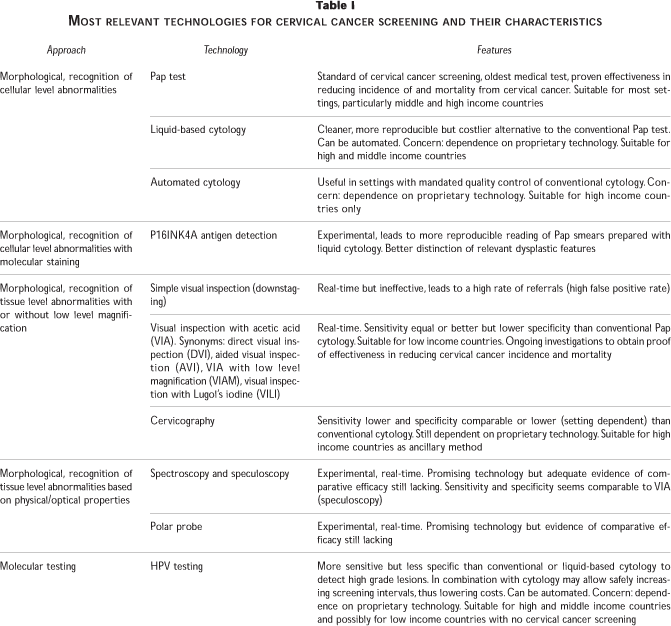
<body><![CDATA[<p>&nbsp;</p>     <p><font face="Verdana" size="2">It is probably    fair to assume that of all malignant neo-plastic diseases, cervical cancer is    the one in which public health prevention initiatives have been the most successful    in the western industrialized world. Widespread programmatic or opportunistic    screening with the Papanicolaou cytology technique, or Pap test for short, has    likely contributed to reducing about three-fourths of the cervical cancer burden    in high income countries during the last 50 years. Additional factors contributing    to further historical declines in cervical cancer incidence are the gradual    decrease in population fertility (lower parity) and improvements in the western    diet (more intake of fresh vegetables and fruits). Lung cancer prevention via    tobacco cessation programs is still far from its target of about 80% reduction    in disease incidence and screening efforts for other male or female neoplasms    have more modest goals for curbing cancer incidence. </font></p>     <p><font face="Verdana" size="2"> In spite of its    success, Pap cytology has important limitations. A recent meta-analysis that    included only studies unaffected by verification bias indicated that the average    sensitivity of Pap cytology to detect cervical intraepithelial neoplasia (CIN)    or invasive cervical cancer was 51% and its average specificity was 98%.<SUP>1</SUP>    The Pap test's high false negative rate is thus its most critical limitation.    About one-third of false-negative diagnoses are attributable to slide interpretation    errors and two-thirds to poor sample collection and slide preparation.<SUP>2</SUP>    False-negative diagnoses have important medical, financial, and legal implications;    the latter being a particularly acute problem in North America where false-negative    smears are among the most frequent reasons for medical malpractice litigation.    Pap cytology is based on highly subjective interpretation of morphologic alterations    and is also dependent on optimally collected samples. Also, the highly repetitive    nature of the work of screening many Pap smears leads to fatigue, which invariably    causes errors in interpretation. </font></p>     <p><font face="Verdana" size="2"> Conversely, despite    the test's relatively high specificity, false-positive results are particularly    common in populations with low prevalence of CIN and cancer. False-positive    cytology results lead to unnecessary and frequently invasive procedures in a    fairly large number of women which in turn result in increased patient anxiety    and costs. The solution to minimizing errors in cytology is to improve the quality    of smear taking, slide processing, and overall diagnostic performance of cervical    cytology, which incur high costs for a screening program. In many settings,    especially developing countries, cytology-based programs have failed to reduce    cervical cancer rates substantially.<SUP>3,4</SUP> This state of affairs elicited    interest from the medical technology industry in developing new morphology or    molecular tests with adequate sensitivity and specificity for detecting clinically    significant cancer precursors. Ongoing research on the use of such new tests    has led to new approaches to preventing cervical cancer and to reducing the    costs of screening programs both in developed and in developing countries. </font></p>     <p><font face="Verdana" size="2"> With the relatively    recent understanding of the causal connection between infection by certain types    (the so-called high risk types) of human papillomavirus (HPV) and cervical neoplasia<SUP>5</SUP>    a new paradigm of research in the detection and prevention of CIN and cervical    cancer has begun. Concerning secondary prevention (screening) initiatives, this    research has led to the development of tests to detect cervical HPV infection    as the necessary precursor event driving cervical carcinogenesis. Use of tests    to detect HPV DNA has the potential to become a useful cervical cancer screening    tool either as a standalone approach or in combination with Pap cytology to    augment the latter test's efficacy. Research on HPV has also led to substantial    technological knowledge that is currently being used to develop candidate vaccines    to prevent HPV infection and, ultimately, cervical cancer as well. Further gains    in our understanding of the natural history of these infections and of the molecular    biology of cervical cancer have also led to additional promising leads in prevention    based on testing for genetic alterations or markers of early disease. </font></p>     <p><font face="Verdana" size="2"> This overview    summarizes the epidemiologic evidence for the high public health significance    of cervical cancer control followed by a description of the existing prospects    in all of the above areas of prevention; both primary, via control and elimination    of the causes of disease, and secondary, via screening for cancer precursors    (CIN) and their immediate treatment. For historical reasons, since screening    by Pap cytology has been the first secondary prevention initiative in cervical    cancer we review the situation with emerging screening technologies first. This    is followed by a brief overview of progress in primary prevention. </font></p>     <p><font face="Verdana" size="2"><b>Cervical cancer    burden throughout the world </b></font></p>     <p><font face="Verdana" size="2">Cervical cancer    is one of the most common malignant diseases of women. In the US each year there    are approximately 12 800 new cases of invasive cervical cancer with 4 600 deaths    due to this disease.<SUP>6</SUP> In Mexico, a country with less than half of    the US population, the estimated new cervical cancer cases in 2000 was 16 450,    which was accompanied in the same year by 6 650 deaths.<SUP>7</SUP> During the    last decade, an estimated 371 000 new cases of invasive cervical carcinoma were    diagnosed annually worldwide, representing nearly 10% of all female cancers.    Its incidence is the seventh overall among all cancer sites, regardless of gender,    and is third among women, after breast and colorectal cancer.<SUP>8</SUP> In    developing countries, cervical cancer was the most frequent neoplastic disease    of women until the early 1990's when breast became the predominant cancer site.<SUP>9</SUP>    The highest risk areas for cervical cancer are in Central and South America,    Southern and Eastern Africa, and The Caribbean, with average incidence rates    around 40 per 100 000 women per year. While risk in western Europe and North    America is considered relatively low at less than 10 new cases annually per    100 000 women rates are 10 times higher in some parts of Northeastern Brazil,    where the cumulative lifetime risk can approach 10%.<SUP>10</SUP> </font></p>     <p><font face="Verdana" size="2"> Every year, an    estimated 190 000 deaths from cervical cancer occur worldwide, with over three-fourths    of them in developing countries, where mortality from this disease is the highest    among deaths caused by neoplasms.<SUP>11</SUP> In general, there is a correlation    between incidence and mortality across all regions but some areas seem to have    a disproportionately higher mortality, such as Africa. Cervical cancer incidence    and mortality in North America are relatively low. The mortality rate for Canada    is the lowest among all regions.<SUP>2</SUP> </font></p>     <p><font face="Verdana" size="2"> Less than 50%    of women affected by cervical cancer in developing countries survive longer    than five years whereas the five-year survival rate in developed countries is    about 66%.<SUP>11</SUP> Moreover, cervical cancer generally affects multiparous    women in the early post-menopausal years. In high-fertility developing countries    these women are the primary source of moral values and education for their school-age    children. The premature loss of these mothers has important social consequences    for the community. </font></p>     ]]></body>
<body><![CDATA[<p><font face="Verdana" size="2"><b>Technologies    for cervical cancer screening </b></font></p>     <p><font face="Verdana" size="2">The available screening    technologies can be classified into morphology- or molecular-based approaches    to recognize cytological or tissue-level abnormalities or molecular markers    consistent with CIN or cervical cancer. Further distinctions can also be made    based on the use of aided or unaided microscopy or of physical and electro-optical    properties. <a href="/img/revistas/spm/v45s3/3a13t01.gif">Table I</a> provides an overview of    the various technologies considered in cervical cancer screening. The most relevant    or promising among the technologies are summarized below. </font></p>     <p><font face="Verdana" size="2"><I>The paradigm:    Pap cytology.</I> The Pap test is one of the first cancer screening tests and    is undoubtedly the one with the best record of accomplishments in contemporary    medical practice. Pap test screening targets mainly the detection of cervix    cancer precursors, thereby allowing close monitoring of equivocal or low grade    abnormalities on repeat tests or immediate referral for colposcopy, biopsy,    and treatment of high grade or more severe lesions. Prevention of invasive cervical    cancer is thus accomplished by arresting neoplastic development within the cervical    epithelium before it becomes invasive. There are two types of cervical cancer    screening programs: opportunistic (or sporadic) and systematic (or organized).    Opportunistic screening is carried out by suggestion from a physician or health    care provider when a woman presents for consultation for other health reasons.    Systematic screening occurs within a system with mechanisms to identify the    target population and invite all of its members to participate. There is widespread    belief that systematic screening may be superior to opportunistic screening    in terms of cost-effectiveness<SUP>12</SUP> but this contention has been challenged.<SUP>13</SUP>    A discussion of available guidelines for Pap test screening is discussed elsewhere.<SUP>12,14,15</SUP>    </font></p>     <p><font face="Verdana" size="2"> There have been    no prospective controlled trials of Pap screening efficacy, either randomized    or not. The evidence for the efficacy of Pap smear screening in cervical cancer    comes from two sources: a) epidemiologic studies indicating that the risk of    invasive cervical cancer is substantially greater in women who have not been    screened and that risk increases with time since last normal smear or with lower    frequency of screening, and b) population surveillance, which indicates that    cervical cancer incidence and mortality rates have decreased following adoption    of cytology screening in Scandinavian countries, in Canada, and in the USA,    with reductions in incidence and mortality being proportional to the extent    of population coverage.<SUP>14</SUP> </font></p>     <p><font face="Verdana" size="2"><I>Thin-Layer liquid-based    cytology.</I> The ThinPrep&#153; system (Cytyc, Inc., Boxborough, Mass., USA)    and AutoCyte Prep System" (Tripath Imaging Inc., NC, USA) are liquid-based    alternatives for the conventional method of Pap smear preparation. The sample    recovered from the cervix is suspended in a cell-preserving solution instead    of being placed directly on a glass slide. Virtually all cellular material is    made available to the laboratory. With the conventional Pap smear, roughly 20%    of the cervical cells harvested from the cervix are placed manually on the glass    slide.<SUP>16</SUP> In the thin layer samples, excess blood and inflammatory    cells are lysed and a random sample of approximately 50 000 cells are transferred    by the robotic cell processor as a thin layer onto a glass slide. The slides    are stained and then read by cytotechnologists. Automated thin-layer slides    can improve detection of atypical cells, precursor lesions, and cancer by producing    uniformly cleaner slides free of blood, inflammatory debris, and cell clumps    that interfere with microscopic reading.<SUP>17,18</SUP> </font></p>     <p><font face="Verdana" size="2"> One attractive    feature of this system is the ability to save the supernatant of remaining cells    in a standardized fashion for subsequent panel testing for HPV DNA and <I>Chlamydia trachomatis</I>.<SUP>14</SUP> Another advantage of thin smears is that they    can be used in conjunction with immunocytochemical staining for specific markers    of dysplastic progression. The viral oncogene E7 induces increased expression    of the cyclin dependent kinase inhibitor p16(ink4a) in infected cells.<SUP>19</SUP>    Immunostaining for p16(ink4a) using a monoclonal antibody can identify dysplastic    cells with enhanced accuracy <SUP>20</SUP> (<a href="/img/revistas/spm/v45s3/3a13t01.gif">Table    I</a>). </font></p>     <p><font face="Verdana" size="2"> The US Food and    Drug Administration (FDA) approved the ThinPrep Pap test in 1996 and the AutoCyte    Prep System in 1999, as significantly superior and equivalent to the conventional    Pap smear, respectively, for the detection of CIN and cervical cancer. Since    then these technologies have already gained considerable penetration in the    market for opportunistic cervical cancer screening in the USA, currently approaching    or exceeding 50% of all smears taken in major urban centers. </font></p>     <p><font face="Verdana" size="2"> In a recent evidence-based    medicine review,<SUP>21</SUP> the American Cancer Society concluded that liquid-based    cytology was a suitable alternative to conventional cervical smears, specifying    that use of this technology allows cervical screening to be performed every    two years and after age 30, women who have had three consecutive, technically    satisfactory normal or negative cytology results may be screened every two to    three years &#91;unless they belong to a high risk group, e.g., history of prenatal    diethyls-sestrol (DES) exposure, HIV positivity, or immunosuppressive conditions&#93;.    </font></p>     <p><font face="Verdana" size="2"><I>Cytology automation.</I>    There are several automated systems being tested and marketed, ranging from    robotic devices that process the cervical cell suspensions to prepare standardized    thin-layer slides to computer-assisted slide scanners that map the smear to    detect abnormal cells, thereby separating any slides that contain suspect images    for subsequent reading by a cytotechnologist. A key advantage is the potential    to alleviate shortage of qualified manpower in cytopathology. Comparative trials    mostly funded by the private sector are ongoing in many laboratories in North    America and in Europe to answer questions related to screening efficacy and    cost effectiveness of automated devices. </font></p>     <p><font face="Verdana" size="2"> At present, there    is only one device approved by the FDA for quality control of cytology and for    primary screening for cervix cancer and its precursors in the USA, the AutoPap    Screening System (Tripath Imaging Inc., NC, USA), which scans with a high speed    video camera close to 200 conventional Pap smears a day. Morphometric algorithms    indicate to the cytotechnologists to manually screen slides that contain the    most likely abnormal cells. Conversely, those without likely abnormalities are    filed (approximately 25% to 50%) without the need for human review. The device    outperforms human review of manually screened negative smears (for quality control)    by a factor of 5 to 7, and in screening mode of low-risk women, performs as    well as humans with a sort rate (no review of smears needed) of up to 50%. On    the other hand, the device is cumbersome and its large throughput and high per-slide    cost make it cost-effective only for large-volume laboratories.<SUP>22</SUP>    </font></p>     ]]></body>
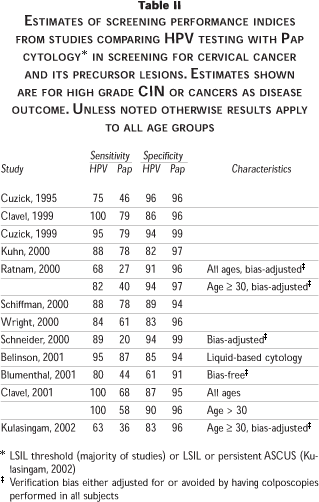
<body><![CDATA[<p><font face="Verdana" size="2"><I>Visual inspection    with acetic acid application (VIA):</I> Visual methods have emerged as a non-technology    intensive, alternative to cytology screening in low-income countries. The visual    methods of screening include unaided, non-magnified visual inspection of the    cervix (the so-called 'downstaging'), visual inspection with acetic acid (VIA)    (also known as direct visual inspection &#91;DVI&#93;, cervicoscopy, or aided visual    inspection), VIA with low level magnification (VIAM), visual inspection with    Lugol's iodine (VILI), and cervicography. </font></p>     <p><font face="Verdana" size="2"> Downstaging has    been shown to be inaccurate and ineffective.<SUP>12</SUP> Of all visual methods    VIA has been the most extensively investigated in different countries with respect    to its screening accuracy in detecting cervical neoplasia. VIA involves naked    eye examination of the uterine cervix, usually by a nurse or other non-medical    health worker, after swabbing it with 3-5% acetic acid and using artificial    bright illumination. Findings of characteristic acetowhite lesions are considered    positive. VIA provides results immediately (also referred to as real time screening    test) which allows for treatment and management decisions to be taken during    the same patient visit. VIA seems to be at least as sensitive as, if not more    sensitive than, conventional cytology to detect high-grade CIN, but it has lower    specificity than the latter test.<SUP>12</SUP> As it stands, VIA is the most    promising low technology alternative to cytology, which led international agencies    such as WHO to study its efficacy in reducing incidence of and mortality from    cervical cancer. These investigations are currently ongoing.<SUP>23</SUP> </font></p>     <p><font face="Verdana" size="2"><I>HPV testing    in screening.</I> There have been several studies assessing the value of HPV    testing compared to the Pap test as a cervical cancer screening tool. Most investigations    have used first or second generation Hybrid Capture&#153; (HC) systems (Digene,    Inc., Gaithersburg, MD), the only HPV test that is currently FDA approved. A    few studies have used different polymerase chain reaction (PCR) protocols to    detect HPV. PCR has a lower threshold of detectability for HPV DNA than the    HC assay but HC2 (the second generation assay which became available commercially    in 1997) has substantially improved molecular sensitivity (as compared with    its first generation counterpart, the Hybrid Capture tube assay) for detecting    HPV DNA that approaches that of PCR techniques. The HC2 test is a nucleic acid    hybridization assay with signal amplification using microplate chemiluminescence    for the qualitative detection in cervical specimens of HPV DNA of 13 high-risk    types, defined as those that are frequently associated with cervical cancer:    16, 18, 31, 33, 35, 39, 45, 51, 52, 56, 58, 59, 68. PCR protocols are based    on target amplification with type-specific or consensus or general primers followed    by hybridization with specific oligoprobes. No PCR technique to detect HPV is    yet available commercially. </font></p>     <p><font face="Verdana" size="2"> Studies using    HC or PCR in cervical cancer screening for detection of high grade squamous    intraepithelial lesions (HSIL) (CIN of grades 2 or 3) have targeted European,<SUP>24-27</SUP>    African,<SUP>28-30</SUP> Asian,<SUP>31</SUP> Latin American,<SUP>32</SUP> and    North American <SUP>33,34</SUP> populations. As shown in <a href="/img/revistas/spm/v45s3/3a13t02.gif">Table    II</a>, HPV testing has 25%-30% higher sensitivity than cytology in absolute    terms but somewhat lower specificity, 8%-10% lower for detecting high grade    lesions. Screening of women ages 30 or older or 35 or older tends to improve    the performance of HPV testing because viral infections in this age group are    less likely to be of a transient nature than those in younger women. </font></p>     <p><font face="Verdana" size="2"> An important finding    of some studies was the realization that the combination of cytology and HPV    testing attained very high sensitivity and negative predictive values (approaching    100%).<SUP>31-33</SUP> A testing combination with such a high negative predictive    value could potentially allow increasing screening intervals safely, e.g., from    1-3 years to 3-5 years, depending on the population and risk profile. The drawback    of this approach is the loss in specificity with respect to either test in isolation    due to the excessive number of patients who would need to be referred for colposcopy,    many of which will turn out to be false positive results. Resource-rich countries    can absorb the extra costs related to the secondary triage of cases that will    be referred via a dual-testing screening approach because this strategy may    be cost saving upon long term assessment, via the reduced patient flow for primary    screening clinics. Economic models based on valid estimates of screening efficacy    across different settings are urgently needed to assess the potential benefit    of combined screening in relation to its costs. </font></p>     <p><font face="Verdana" size="2"> One of the advantages    of HPV DNA testing is that it is suitable for self-sampling. In one study of    1 365 South-African women aged 35 to 65 years old the rate of detecting cervical    cancer precursors was comparable between self-sampling for HPV testing (66.1%)    and conventional cytology performed by healthcare providers (67.9%).<SUP>29</SUP>    Self-sampling is likely to improve compliance, which is particularly appealing    in countries in which cultures have social and religious limitations on the    acceptability of vaginal examinations. </font></p>     <p><font face="Verdana" size="2"> A few large randomized    controlled trials of HPV testing in primary cervical cancer screening are currently    ongoing. Of note are the UK HPV in Addition to Routine Testing (HART) investigation,<SUP>35</SUP>    the UK "A Randomized Trial In Screening To Improve Cytology" (ARTISTIC)    &#91;Henry Kitchener, personal communication&#93;, and the Canadian Cervical Cancer    Screening Trial (CCaST), led by the authors. </font></p>     <p><font face="Verdana" size="2"><I>HPV testing    for secondary triage of cervical abnormalities.</I> One of the first applications    of HPV DNA testing in clinical practice was for the triage of women referred    for colposcopy because of an abnormal Pap smear. The adoption nearly 15 years    ago of the Bethesda system for cervical cytology reports <SUP>36</SUP> has dramatically    increased the proportion of Pap smears with cytological abnormalities that merit    clinical attention. The new terminology increased the overall proportion of    low grade lesions by combining the original mild dysplasia category with cytological    abnormalities consistent with koilocytotic atypias, thus creating the low grade    intraepithelial lesion (LSIL) designation, and created a new category for borderline    lesions, the "atypical squamous cells of undetermined significance",    or ASCUS. While there is consensus that women with high grade SIL (HSIL) on    cytology need immediate referral for colposcopy, uncertainty has existed about    management options for ASCUS and LSIL. Such cases have been managed by immediate    colposcopy, repeat Pap testing, and HPV DNA testing, the latter two tests either    alone or in combination. </font></p>     <p><font face="Verdana" size="2"> Preliminary evidence    that HPV DNA testing has clinical value in triaging ASCUS or LSIL has been provided    by several studies conducted in the early and mid-90's, which indicated for    the most part that HPV DNA testing could increase the sensitivity of a repeat    Pap when used as an adjunct test.<SUP>37</SUP> Two recent large-scale studies    (the Kaiser-Permanente and the ALTS investigations) have provided more conclusive    evidence of benefit for women of all ages, specifically for the triage of ASCUS    smears.<SUP>38,39</SUP> HPV DNA testing is significantly more sensitive (about    10% higher in absolute terms) than repeat Pap cytology in detecting histologically    confirmed HSIL among such cases, even when the latter is used at a lower threshold    of positivity. These two studies have shown also that the HPV and Pap tests    have comparable specificities in ASCUS triage. </font></p>     <p><font face="Verdana" size="2"> While the value    of HPV DNA testing in the triage of ASCUS smears is well established, it cannot    be recommended as a tool to orient clinical management of women with a referral    LSIL smear. A component of the aforementioned ALTS trial found that more than    four-fifths of such cases are HPV positive. Given the very high rate of HPV    positivity (with high risk types) among women with LSIL there would be limited    or no value in using HPV DNA testing in triaging such cases for colposcopy.<SUP>40</SUP>    Recent analyses from the latter study using restriction on age or viral load    corroborate this interpretation.<SUP>41</SUP> </font></p>     ]]></body>
<body><![CDATA[<p><font face="Verdana" size="2"><b>Primary prevention    of cervical cancer </b></font></p>     <p><font face="Verdana" size="2">Recognition that    HPV infection is the central cause of cervical cancer and its precursor CIN<SUP>    42</SUP> has created new research fronts in primary prevention of this disease.    </font></p>     <p><font face="Verdana" size="2"><I>Primary prevention    by education.</I> Primary prevention of cervical cancer can be achieved through    prevention and control of genital HPV infection. Health promotion strategies    geared at a change in sexual behavior targeting all sexually-transmitted infections    of public health significance can be effective in preventing genital HPV infection.<SUP>14</SUP>    Although there is consensus that symptomatic HPV infection (genital warts) should    be managed via treatment, counseling, and partner notification, active case-finding    of asymptomatic HPV infection is currently not recommended as a control measure.    Further research is needed to determine the effectiveness of such a strategy.    </font></p>     <p><font face="Verdana" size="2"><I>Primary prevention    by HPV vaccination.</I> Two main types of HPV vaccines are currently being developed:    prophylactic vaccines to prevent HPV infection and associated diseases, and    therapeutic vaccines to induce regression of precancerous lesions or remission    of advanced cervical cancer. Strictly speaking, however, the latter type cannot    be considered as part of a primary prevention effort because of its curative    intent. </font></p>     <p><font face="Verdana" size="2"> DNA-free virus-like    particles (VLP) synthesized by self-assembly of fusion proteins of the major    capsid antigen L1 induce a strong humoral response with neutralizing antibodies.    VLPs are thus the best candidate immunogen for HPV vaccine trials. Such vaccines    are already under evaluation in efficacy and safety trials in different populations    sponsored by pharmaceutical companies (e.g., Glaxo Smithkline and Merck) and    by the US National Institutes of Health and can produce strong type-specific    antibody responses.<SUP>43</SUP> The preliminary results of one such a trial    were extremely promising.<SUP>44</SUP> It indicated that an HPV 16 VLP vaccine    was 100% effective in preventing acquisition of persistent infection with HPV    16 and 90% effective in preventing any incident HPV 16 infection, transient    or persistent. As a noteworthy secondary finding was the fact that all HPV 16    associated CIN cases occurred in the non-vaccinated group. </font></p>     <p><font face="Verdana" size="2"> Immunization against    HPV may have greatest value in developing countries, where 80% of the global    burden of cervical cancer occurs each year and where Pap screening programs    have been largely ineffective. In this regard, many issues are being considered    by those involved in HPV vaccine research. Long-lasting protection against HPV    16 may translate into prevention of nearly half of all cervical cancers. Although    evidence from controlled trials has been obtained mostly for monovalent or bivalent    vaccines there is a general consensus that a future vaccine will have to include    at least the most common high risk HPV types associated with the disease to    be largely effective against cervical cancer. Other concerns include the development    and standardization of surrogate assays for protective antibodies, the definition    of the target population to be vaccinated, agreement on trial endpoints, e.g.,    early (HPV) vs. late (lesions) for prophylactic vaccines and criteria for regression    of established lesions for therapeutic vaccines, the establishment of roles    for the public sector and regulatory agencies; identification of funding sources    for studies in which the pharmaceutical sector will not be involved, and last,    but not least, coordination with secondary prevention strategies. </font></p>     <p>&nbsp;</p>     <p><font face="Verdana" size="3"><b>Conclusions    </b></font></p>     <p><font face="Verdana" size="2">In summary, although    much has been gained in the last 50 years in reducing the burden of cervical    cancer by organized or opportunistic cytology screening, the benefits have been    seen particularly in high and middle income countries. Cervical cancer remains    an important public health problem in low income countries, especially in Africa    and in Latin America. Despite its history of success when performed in well    controlled conditions, the Pap test has several limitations. Efficacious alternatives    are available but their cost effectiveness needs to be assessed in different    settings. Some of the most promising alternatives to conventional Pap cytology,    such as HPV testing or liquid-based cytology, may be effective in high and middle    countries that have not yet made substantial investments in establishing Pap-based    screening programs or overhauling existing ones that seem inadequate. In this    regard, an important concern is the possible dependence on a proprietary method    that is controlled by one or a few commercial monopolies. On the other hand,    VIA seems to be a viable and cost effective option for low income countries    with little infrastructure resources. </font></p>     <p><font face="Verdana" size="2"> Public health    authorities in middle and low income countries have monitored closely the ongoing    debate on the role of new screening technologies. Between the fear of increased    health care costs consequent to the adoption of a new screening test and the    promising results coming from the research front on HPV vaccines it is tempting    to take a wait-and-see attitude concerning cervical cancer prevention. It is    not unreasonable to consider that this posture could lead to decreased funding    for cervical cancer screening in the false hope that HPV vaccines will be available    soon to eradicate the disease. This scenario could prove disastrous by abolishing    the hard-earned gains made in the last half century in reducing cervical cancer    morbidity and mortality by Pap screening. </font></p>     ]]></body>
<body><![CDATA[<p>&nbsp;</p>     <p><font face="Verdana" size="3"><b>References </b></font></p>     <!-- ref --><p><font face="Verdana" size="2">1. Nanda K, McCrory    DC, Myers ER, Bastian LA, Hasselblad V, Hickey JD <I>et al</I>. Accuracy of    the Papanicolaou test in screening for and follow-up of cervical cytologic abnormalities:    A systematic review. Ann Intern Med 2000;132:810-819. </font>&nbsp;&nbsp;&nbsp;&nbsp;&nbsp;&nbsp;&nbsp;&nbsp;[&#160;<a href="javascript:void(0);" onclick="javascript: window.open('/scielo.php?script=sci_nlinks&ref=9183306&pid=S0036-3634200300090001100001&lng=','','width=640,height=500,resizable=yes,scrollbars=1,menubar=yes,');">Links</a>&#160;]<!-- end-ref --><!-- ref --><p><font face="Verdana" size="2">2. Franco EL, Duarte-Franco    E, Ferenczy A. Cervical cancer: Epidemiology, prevention, and role of human    papillomavirus infection. Can Med Assoc J 2001;164:1017-1025. </font>&nbsp;&nbsp;&nbsp;&nbsp;&nbsp;&nbsp;&nbsp;&nbsp;[&#160;<a href="javascript:void(0);" onclick="javascript: window.open('/scielo.php?script=sci_nlinks&ref=9183307&pid=S0036-3634200300090001100002&lng=','','width=640,height=500,resizable=yes,scrollbars=1,menubar=yes,');">Links</a>&#160;]<!-- end-ref --><!-- ref --><p><font face="Verdana" size="2">3. Koss LG. The    Papanicolaou test for cervical cancer detection. A triumph and a tragedy. JAMA    1989;261:737-743. </font>&nbsp;&nbsp;&nbsp;&nbsp;&nbsp;&nbsp;&nbsp;&nbsp;[&#160;<a href="javascript:void(0);" onclick="javascript: window.open('/scielo.php?script=sci_nlinks&ref=9183308&pid=S0036-3634200300090001100003&lng=','','width=640,height=500,resizable=yes,scrollbars=1,menubar=yes,');">Links</a>&#160;]<!-- end-ref --><!-- ref --><p><font face="Verdana" size="2">4. McGoogan E.    Advantages and limitations of automated screening systems in developing and    developed countries. In: Franco EL, Monsonego J, ed. New developments in cervical    cancer screening and prevention. London: Blackwell, 1997:317-322. </font>&nbsp;&nbsp;&nbsp;&nbsp;&nbsp;&nbsp;&nbsp;&nbsp;[&#160;<a href="javascript:void(0);" onclick="javascript: window.open('/scielo.php?script=sci_nlinks&ref=9183309&pid=S0036-3634200300090001100004&lng=','','width=640,height=500,resizable=yes,scrollbars=1,menubar=yes,');">Links</a>&#160;]<!-- end-ref --><!-- ref --><p><font face="Verdana" size="2">5. IARC Working    Group. Human papillomaviruses. IARC Monographs on the evaluation of carcinogenic    risks to humans. International Agency for Research on Cancer, Lyon: vol. 64,    1995; </font>&nbsp;&nbsp;&nbsp;&nbsp;&nbsp;&nbsp;&nbsp;&nbsp;[&#160;<a href="javascript:void(0);" onclick="javascript: window.open('/scielo.php?script=sci_nlinks&ref=9183310&pid=S0036-3634200300090001100005&lng=','','width=640,height=500,resizable=yes,scrollbars=1,menubar=yes,');">Links</a>&#160;]<!-- end-ref --><!-- ref --><p><font face="Verdana" size="2">6. Ries LAG, Eisner    MP, Kosary CL, Hankey BF, Miller BA, Clegg L <I>et al, </I>ed. SEER Cancer Statistics    Review, 1973-1997. Bethesda (MD) National Cancer Institute, 2000. </font>&nbsp;&nbsp;&nbsp;&nbsp;&nbsp;&nbsp;&nbsp;&nbsp;[&#160;<a href="javascript:void(0);" onclick="javascript: window.open('/scielo.php?script=sci_nlinks&ref=9183311&pid=S0036-3634200300090001100006&lng=','','width=640,height=500,resizable=yes,scrollbars=1,menubar=yes,');">Links</a>&#160;]<!-- end-ref --><!-- ref --><p><font face="Verdana" size="2">7. Ferlay J, Bray    F, Pisani P, Parkin DM. GLOBOCAN 2000: Cancer incidence, mortality and prevalence    worldwide. Lyon: IARCPress, 2001; Version 1.0. IARC CancerBase No. 5. </font>&nbsp;&nbsp;&nbsp;&nbsp;&nbsp;&nbsp;&nbsp;&nbsp;[&#160;<a href="javascript:void(0);" onclick="javascript: window.open('/scielo.php?script=sci_nlinks&ref=9183312&pid=S0036-3634200300090001100007&lng=','','width=640,height=500,resizable=yes,scrollbars=1,menubar=yes,');">Links</a>&#160;]<!-- end-ref --><!-- ref --><p><font face="Verdana" size="2">8. Parkin DM, Pisani    P, Ferlay J. Estimates of the worldwide incidence of 25 major cancers in 1990.    Int J Cancer 1999;80:827-841. </font>&nbsp;&nbsp;&nbsp;&nbsp;&nbsp;&nbsp;&nbsp;&nbsp;[&#160;<a href="javascript:void(0);" onclick="javascript: window.open('/scielo.php?script=sci_nlinks&ref=9183313&pid=S0036-3634200300090001100008&lng=','','width=640,height=500,resizable=yes,scrollbars=1,menubar=yes,');">Links</a>&#160;]<!-- end-ref --><!-- ref --><p><font face="Verdana" size="2">9. Parkin DM, Pisani    P, Ferlay J. Estimates of the worldwide incidence of 18 major cancers in 1985.    Int J Cancer 1993;54:594-606. </font>&nbsp;&nbsp;&nbsp;&nbsp;&nbsp;&nbsp;&nbsp;&nbsp;[&#160;<a href="javascript:void(0);" onclick="javascript: window.open('/scielo.php?script=sci_nlinks&ref=9183314&pid=S0036-3634200300090001100009&lng=','','width=640,height=500,resizable=yes,scrollbars=1,menubar=yes,');">Links</a>&#160;]<!-- end-ref --><!-- ref --><p><font face="Verdana" size="2">10. Muir C, Waterhouse    J, Mack T, Powell J, Whelan S. Cancer incidence in five continents. Lyon: International    Agency for Research on Cancer, 1987;Vol. V. IARC Scientific Publications No.    88. </font>&nbsp;&nbsp;&nbsp;&nbsp;&nbsp;&nbsp;&nbsp;&nbsp;[&#160;<a href="javascript:void(0);" onclick="javascript: window.open('/scielo.php?script=sci_nlinks&ref=9183315&pid=S0036-3634200300090001100010&lng=','','width=640,height=500,resizable=yes,scrollbars=1,menubar=yes,');">Links</a>&#160;]<!-- end-ref --><!-- ref --><p><font face="Verdana" size="2">11. Pisani P, Parkin    DM, Bray F, Ferlay J. Estimates of the worldwide mortality from 25 cancers in    1990. Int J Cancer 1999;83:18-29. </font>&nbsp;&nbsp;&nbsp;&nbsp;&nbsp;&nbsp;&nbsp;&nbsp;[&#160;<a href="javascript:void(0);" onclick="javascript: window.open('/scielo.php?script=sci_nlinks&ref=9183316&pid=S0036-3634200300090001100011&lng=','','width=640,height=500,resizable=yes,scrollbars=1,menubar=yes,');">Links</a>&#160;]<!-- end-ref --><!-- ref --><p><font face="Verdana" size="2">12. Miller AB,    Nazeer S, Fonn S, Brandup-Lukanow A, Rehman R, Cronje H, Sankaranarayanan R    <I>et al</I>. Report on consensus conference on cervical cancer screening and    management. Int J Cancer 2000;86:440-447. </font>&nbsp;&nbsp;&nbsp;&nbsp;&nbsp;&nbsp;&nbsp;&nbsp;[&#160;<a href="javascript:void(0);" onclick="javascript: window.open('/scielo.php?script=sci_nlinks&ref=9183317&pid=S0036-3634200300090001100012&lng=','','width=640,height=500,resizable=yes,scrollbars=1,menubar=yes,');">Links</a>&#160;]<!-- end-ref --><!-- ref --><p><font face="Verdana" size="2">13. Gustafsson    L, Sparen P, Gustafsson M, Wilander E, Bergstrom R, Adami HO. Efficiency of    organised and opportunistic cytological screening for cancer <I>in situ</I>    of the cervix. Br J Cancer 1995;72:498-505. </font>&nbsp;&nbsp;&nbsp;&nbsp;&nbsp;&nbsp;&nbsp;&nbsp;[&#160;<a href="javascript:void(0);" onclick="javascript: window.open('/scielo.php?script=sci_nlinks&ref=9183318&pid=S0036-3634200300090001100013&lng=','','width=640,height=500,resizable=yes,scrollbars=1,menubar=yes,');">Links</a>&#160;]<!-- end-ref --><!-- ref --><p><font face="Verdana" size="2">14. Franco EL,    Ferenczy A. Cervix. In: Franco EL, Rohan TE, ed. Cancer precursors: Epidemiology,    detection, and prevention. New York: Springer-Verlag, 2002:249-286. </font>&nbsp;&nbsp;&nbsp;&nbsp;&nbsp;&nbsp;&nbsp;&nbsp;[&#160;<a href="javascript:void(0);" onclick="javascript: window.open('/scielo.php?script=sci_nlinks&ref=9183319&pid=S0036-3634200300090001100014&lng=','','width=640,height=500,resizable=yes,scrollbars=1,menubar=yes,');">Links</a>&#160;]<!-- end-ref --><!-- ref --><p><font face="Verdana" size="2">15. Franco EL,    Duarte-Franco E, Rohan TE. Evidence-based policy recommendations on cancer screening    and prevention. Cancer Detect Prev 2002;26:350-361. </font>&nbsp;&nbsp;&nbsp;&nbsp;&nbsp;&nbsp;&nbsp;&nbsp;[&#160;<a href="javascript:void(0);" onclick="javascript: window.open('/scielo.php?script=sci_nlinks&ref=9183320&pid=S0036-3634200300090001100015&lng=','','width=640,height=500,resizable=yes,scrollbars=1,menubar=yes,');">Links</a>&#160;]<!-- end-ref --><!-- ref --><p><font face="Verdana" size="2">16. Ferenczy A,    Franco EL. Cervical-cancer screening beyond the year 2000. Lancet Oncol 2001;2:27-32.    </font>&nbsp;&nbsp;&nbsp;&nbsp;&nbsp;&nbsp;&nbsp;&nbsp;[&#160;<a href="javascript:void(0);" onclick="javascript: window.open('/scielo.php?script=sci_nlinks&ref=9183321&pid=S0036-3634200300090001100016&lng=','','width=640,height=500,resizable=yes,scrollbars=1,menubar=yes,');">Links</a>&#160;]<!-- end-ref --><!-- ref --><p><font face="Verdana" size="2">17. Ferenczy A,    Robitaille J, Franco E, Arseneau J, Richart RM, Wright TC. Conventional cervical    cytologic smears <I>vs</I>. thin prep smears. A paired comparison study on cervical    cytology. Acta Cytol 1996;40:1136-1142. </font>&nbsp;&nbsp;&nbsp;&nbsp;&nbsp;&nbsp;&nbsp;&nbsp;[&#160;<a href="javascript:void(0);" onclick="javascript: window.open('/scielo.php?script=sci_nlinks&ref=9183322&pid=S0036-3634200300090001100017&lng=','','width=640,height=500,resizable=yes,scrollbars=1,menubar=yes,');">Links</a>&#160;]<!-- end-ref --><!-- ref --><p><font face="Verdana" size="2">18. Hutchinson    ML, Zahniser DJ, Sherman ME, Herrero R, Alfaro M, Bratti MC <I>et al</I>. Utility    of liquid-based cytology for cervical carcinoma screening: Results of a population-based    study conducted in a region of Costa Rica with a high incidence of cervical    carcinoma. Cancer 1999;87:48-55. </font>&nbsp;&nbsp;&nbsp;&nbsp;&nbsp;&nbsp;&nbsp;&nbsp;[&#160;<a href="javascript:void(0);" onclick="javascript: window.open('/scielo.php?script=sci_nlinks&ref=9183323&pid=S0036-3634200300090001100018&lng=','','width=640,height=500,resizable=yes,scrollbars=1,menubar=yes,');">Links</a>&#160;]<!-- end-ref --><!-- ref --><p><font face="Verdana" size="2">19. Von Knebel-Doeberitz    M. New markers for cervical dysplasia to visualise the genomic chaos created    by aberrant oncogenic papillomavirus infections. Eur J Cancer 2002;38:2229-2242.    </font>&nbsp;&nbsp;&nbsp;&nbsp;&nbsp;&nbsp;&nbsp;&nbsp;[&#160;<a href="javascript:void(0);" onclick="javascript: window.open('/scielo.php?script=sci_nlinks&ref=9183324&pid=S0036-3634200300090001100019&lng=','','width=640,height=500,resizable=yes,scrollbars=1,menubar=yes,');">Links</a>&#160;]<!-- end-ref --><!-- ref --><p><font face="Verdana" size="2">20. Bibbo M, Klump    WJ, DeCecco J, Kovatich AJ. Procedure for immunocytochemical detection of P16INK4A    antigen in thin-layer, liquid-based specimens. Acta Cytol 2002;46:25-29. </font>&nbsp;&nbsp;&nbsp;&nbsp;&nbsp;&nbsp;&nbsp;&nbsp;[&#160;<a href="javascript:void(0);" onclick="javascript: window.open('/scielo.php?script=sci_nlinks&ref=9183325&pid=S0036-3634200300090001100020&lng=','','width=640,height=500,resizable=yes,scrollbars=1,menubar=yes,');">Links</a>&#160;]<!-- end-ref --><!-- ref --><p><font face="Verdana" size="2">21. Saslow D, Runowicz    CD, Solomon D, Moscicki AB, Smith RA, Eyre HJ <I>et al</I>. American Cancer    Society. Guideline for the early detection of cervical neoplasia and cancer.    CA Cancer J Clin 2002;52:342-362. </font>&nbsp;&nbsp;&nbsp;&nbsp;&nbsp;&nbsp;&nbsp;&nbsp;[&#160;<a href="javascript:void(0);" onclick="javascript: window.open('/scielo.php?script=sci_nlinks&ref=9183326&pid=S0036-3634200300090001100021&lng=','','width=640,height=500,resizable=yes,scrollbars=1,menubar=yes,');">Links</a>&#160;]<!-- end-ref --><!-- ref --><p><font face="Verdana" size="2">22. Wilbur DC,    Prey MU, Miller WM, Pawlick GF, Colgan TJ. The AutoPap system for primary screening    in cervical cytology. Comparing the results of a prospective, intended-use study    with routine manual practice. Acta Cytol 1998; 42: 214-220. </font>&nbsp;&nbsp;&nbsp;&nbsp;&nbsp;&nbsp;&nbsp;&nbsp;[&#160;<a href="javascript:void(0);" onclick="javascript: window.open('/scielo.php?script=sci_nlinks&ref=9183327&pid=S0036-3634200300090001100022&lng=','','width=640,height=500,resizable=yes,scrollbars=1,menubar=yes,');">Links</a>&#160;]<!-- end-ref --><!-- ref --><p><font face="Verdana" size="2">23. Sankaranarayanan    R, Budukh AM, Rajkumar R. Effective screening programmes for cervical cancer    in low- and middle-income developing countries. Bull World Health Organ. 2001;79:954-962.    </font>&nbsp;&nbsp;&nbsp;&nbsp;&nbsp;&nbsp;&nbsp;&nbsp;[&#160;<a href="javascript:void(0);" onclick="javascript: window.open('/scielo.php?script=sci_nlinks&ref=9183328&pid=S0036-3634200300090001100023&lng=','','width=640,height=500,resizable=yes,scrollbars=1,menubar=yes,');">Links</a>&#160;]<!-- end-ref --><!-- ref --><p><font face="Verdana" size="2">24. Cuzick J, Szarewski    A, Terry G, Ho L, Hanby A, Maddox PM <I>et al</I>. Human papillomavirus testing    in primary cervical screening. Lancet 1995;345:1533-1536. </font>&nbsp;&nbsp;&nbsp;&nbsp;&nbsp;&nbsp;&nbsp;&nbsp;[&#160;<a href="javascript:void(0);" onclick="javascript: window.open('/scielo.php?script=sci_nlinks&ref=9183329&pid=S0036-3634200300090001100024&lng=','','width=640,height=500,resizable=yes,scrollbars=1,menubar=yes,');">Links</a>&#160;]<!-- end-ref --><!-- ref --><p><font face="Verdana" size="2">25. Cuzick J, Beverley    E, Ho L, Terry G, Sapper H, Mielzynska I <I>et al</I>. HPV testing in primary    screening of older women. Br J Cancer 1999;81:554-558. </font>&nbsp;&nbsp;&nbsp;&nbsp;&nbsp;&nbsp;&nbsp;&nbsp;[&#160;<a href="javascript:void(0);" onclick="javascript: window.open('/scielo.php?script=sci_nlinks&ref=9183330&pid=S0036-3634200300090001100025&lng=','','width=640,height=500,resizable=yes,scrollbars=1,menubar=yes,');">Links</a>&#160;]<!-- end-ref --><!-- ref --><p><font face="Verdana" size="2">26. Schneider A,    Hoyer H, Lotz B, Leistritza S, Kuhne-Heid R, Nindl I <I>et al</I>. Screening    for high-grade cervical intra-epithelial neoplasia and cancer by testing for    high-risk HPV, routine cytology or colposcopy. Int J Cancer 2000;9:29-34. </font>&nbsp;&nbsp;&nbsp;&nbsp;&nbsp;&nbsp;&nbsp;&nbsp;[&#160;<a href="javascript:void(0);" onclick="javascript: window.open('/scielo.php?script=sci_nlinks&ref=9183331&pid=S0036-3634200300090001100026&lng=','','width=640,height=500,resizable=yes,scrollbars=1,menubar=yes,');">Links</a>&#160;]<!-- end-ref --><!-- ref --><p><font face="Verdana" size="2">27. Clavel C, Masure    M, Bory JP, Putaud I, Mangeonjean C, Lorenzato M <I>et al</I> P. Human papillomavirus    testing in primary screening for the detection of high-grade cervical lesions:    A study of 7 932 women. Br J Cancer 2001; 84:1616-1623. </font>&nbsp;&nbsp;&nbsp;&nbsp;&nbsp;&nbsp;&nbsp;&nbsp;[&#160;<a href="javascript:void(0);" onclick="javascript: window.open('/scielo.php?script=sci_nlinks&ref=9183332&pid=S0036-3634200300090001100027&lng=','','width=640,height=500,resizable=yes,scrollbars=1,menubar=yes,');">Links</a>&#160;]<!-- end-ref --><!-- ref --><p><font face="Verdana" size="2">28. Kuhn L, Denny    L, Pollack A, L&ouml;rincz A, Richart RM, Wright TC. Human papillomavirus DNA    testing for cervical cancer screening in low-resource settings. J Natl Cancer    Inst 2000;92:818-825. </font>&nbsp;&nbsp;&nbsp;&nbsp;&nbsp;&nbsp;&nbsp;&nbsp;[&#160;<a href="javascript:void(0);" onclick="javascript: window.open('/scielo.php?script=sci_nlinks&ref=9183333&pid=S0036-3634200300090001100028&lng=','','width=640,height=500,resizable=yes,scrollbars=1,menubar=yes,');">Links</a>&#160;]<!-- end-ref --><!-- ref --><p><font face="Verdana" size="2">29. Wright TC Jr,    Denny L, Kuhn L, Pollack A, L&ouml;rincz A. HPV DNA testing of self-collected    vaginal samples compared with cytologic screening to detect cervical cancer.    JAMA 2000;283:81-86. </font>&nbsp;&nbsp;&nbsp;&nbsp;&nbsp;&nbsp;&nbsp;&nbsp;[&#160;<a href="javascript:void(0);" onclick="javascript: window.open('/scielo.php?script=sci_nlinks&ref=9183334&pid=S0036-3634200300090001100029&lng=','','width=640,height=500,resizable=yes,scrollbars=1,menubar=yes,');">Links</a>&#160;]<!-- end-ref --><!-- ref --><p><font face="Verdana" size="2">30. Blumenthal    PD, Gaffikin L, Chirenje ZM, McGrath J, Womack S, Shah K. Adjunctive testing    for cervical cancer in low resource settings with visual inspection, HPV, and    the Pap smear. Int J Gynaecol Obstet 2001;72:47-53. </font>&nbsp;&nbsp;&nbsp;&nbsp;&nbsp;&nbsp;&nbsp;&nbsp;[&#160;<a href="javascript:void(0);" onclick="javascript: window.open('/scielo.php?script=sci_nlinks&ref=9183335&pid=S0036-3634200300090001100030&lng=','','width=640,height=500,resizable=yes,scrollbars=1,menubar=yes,');">Links</a>&#160;]<!-- end-ref --><!-- ref --><p><font face="Verdana" size="2">31. Belinson J,    Qiao YL, Pretorius R, Zhang WH, Elson P, Li L, Pan QJ <I>et al</I>. Shanxi Province    cervical cancer screening study: A cross-sectional comparative trial of multiple    techniques to detect cervical neoplasia. Gynecol Oncol 2001;83:439-444. </font>&nbsp;&nbsp;&nbsp;&nbsp;&nbsp;&nbsp;&nbsp;&nbsp;[&#160;<a href="javascript:void(0);" onclick="javascript: window.open('/scielo.php?script=sci_nlinks&ref=9183336&pid=S0036-3634200300090001100031&lng=','','width=640,height=500,resizable=yes,scrollbars=1,menubar=yes,');">Links</a>&#160;]<!-- end-ref --><!-- ref --><p><font face="Verdana" size="2">32. Schiffman M,    Herrero R, Hildesheim A, Sherman ME, Bratti M, Wacholder S <I>et al</I>. HPV    DNA testing in cervical cancer screening: Results from women in a high-risk    province of Costa Rica. JAMA 2000;283:87-93. </font>&nbsp;&nbsp;&nbsp;&nbsp;&nbsp;&nbsp;&nbsp;&nbsp;[&#160;<a href="javascript:void(0);" onclick="javascript: window.open('/scielo.php?script=sci_nlinks&ref=9183337&pid=S0036-3634200300090001100032&lng=','','width=640,height=500,resizable=yes,scrollbars=1,menubar=yes,');">Links</a>&#160;]<!-- end-ref --><!-- ref --><p><font face="Verdana" size="2">33. Ratnam S, Franco    EL, Ferenczy A. Human papillomavirus testing for primary screening of cervical    cancer precursors. Cancer Epidemiol Biomarkers Prev 2000;9:945-951. </font>&nbsp;&nbsp;&nbsp;&nbsp;&nbsp;&nbsp;&nbsp;&nbsp;[&#160;<a href="javascript:void(0);" onclick="javascript: window.open('/scielo.php?script=sci_nlinks&ref=9183338&pid=S0036-3634200300090001100033&lng=','','width=640,height=500,resizable=yes,scrollbars=1,menubar=yes,');">Links</a>&#160;]<!-- end-ref --><!-- ref --><p><font face="Verdana" size="2">34. Kulasingam    SL, Hughes JP, Kiviat NB, Mao C, Weiss NS, Kuypers JM <I>et al</I>. Evaluation    of human papillomavirus testing in primary screening for cervical abnormalities:    Comparison of sensitivity, specificity, and frequency of referral. JAMA 2002;    288: 1749-1757. </font>&nbsp;&nbsp;&nbsp;&nbsp;&nbsp;&nbsp;&nbsp;&nbsp;[&#160;<a href="javascript:void(0);" onclick="javascript: window.open('/scielo.php?script=sci_nlinks&ref=9183339&pid=S0036-3634200300090001100034&lng=','','width=640,height=500,resizable=yes,scrollbars=1,menubar=yes,');">Links</a>&#160;]<!-- end-ref --><!-- ref --><p><font face="Verdana" size="2">35. Cuzick J, for    the HART Study Group. Baseline results for the hart multicentre hpv screening    study of older women. 19th International Papillomavirus Conference; Florian&oacute;polis,    September 1-7, 2001 Brazil (abstract # P-4). </font>&nbsp;&nbsp;&nbsp;&nbsp;&nbsp;&nbsp;&nbsp;&nbsp;[&#160;<a href="javascript:void(0);" onclick="javascript: window.open('/scielo.php?script=sci_nlinks&ref=9183340&pid=S0036-3634200300090001100035&lng=','','width=640,height=500,resizable=yes,scrollbars=1,menubar=yes,');">Links</a>&#160;]<!-- end-ref --><!-- ref --><p><font face="Verdana" size="2">36. Solomon D.    The 1988 Bethesda system for reporting cervical/vaginal cytologic diagnoses.    J Clin Cytol Cytopathol 1989;33:567-574. </font>&nbsp;&nbsp;&nbsp;&nbsp;&nbsp;&nbsp;&nbsp;&nbsp;[&#160;<a href="javascript:void(0);" onclick="javascript: window.open('/scielo.php?script=sci_nlinks&ref=9183341&pid=S0036-3634200300090001100036&lng=','','width=640,height=500,resizable=yes,scrollbars=1,menubar=yes,');">Links</a>&#160;]<!-- end-ref --><!-- ref --><p><font face="Verdana" size="2">37. Franco EL,    Ferenczy A. Assessing gains in diagnostic utility when human papillomavirus    testing is used as a Pap smear adjunct for triaging women with cervical abnormalities.    Am J Obstet Gynecol 1999;181: 382-386. </font>&nbsp;&nbsp;&nbsp;&nbsp;&nbsp;&nbsp;&nbsp;&nbsp;[&#160;<a href="javascript:void(0);" onclick="javascript: window.open('/scielo.php?script=sci_nlinks&ref=9183342&pid=S0036-3634200300090001100037&lng=','','width=640,height=500,resizable=yes,scrollbars=1,menubar=yes,');">Links</a>&#160;]<!-- end-ref --><!-- ref --><p><font face="Verdana" size="2">38. Manos MM, Kinney    WK, Hurley LB, Sherman ME, Shieh-Ngai J, Kurman RJ <I>et al</I>. Identifying    women with cervical neoplasia: Using human papillomavirus DNA testing for equivocal    Papanicolaou results. JAMA 1999; 281:1605-1610. </font>&nbsp;&nbsp;&nbsp;&nbsp;&nbsp;&nbsp;&nbsp;&nbsp;[&#160;<a href="javascript:void(0);" onclick="javascript: window.open('/scielo.php?script=sci_nlinks&ref=9183343&pid=S0036-3634200300090001100038&lng=','','width=640,height=500,resizable=yes,scrollbars=1,menubar=yes,');">Links</a>&#160;]<!-- end-ref --><!-- ref --><p><font face="Verdana" size="2">39. Solomon D,    Schiffman M, Tarone R. Comparison of three management strategies for patients    with atypical squamous cells of undetermined significance: Baseline results    from a randomized trial. J Natl Cancer Inst 2001;93:293-299. </font>&nbsp;&nbsp;&nbsp;&nbsp;&nbsp;&nbsp;&nbsp;&nbsp;[&#160;<a href="javascript:void(0);" onclick="javascript: window.open('/scielo.php?script=sci_nlinks&ref=9183344&pid=S0036-3634200300090001100039&lng=','','width=640,height=500,resizable=yes,scrollbars=1,menubar=yes,');">Links</a>&#160;]<!-- end-ref --><!-- ref --><p><font face="Verdana" size="2">40. ALTS Group.    Human papillomavirus testing for triage of women with cytologic evidence of    low-grade squamous intraepithelial lesions: Baseline data from a randomized    trial. The atypical squamous cells of undetermined significance/low-grade squamous    intraepithelial lesions triage study (ALTS) Group. J Natl Cancer Inst 2000;92:397-402.    </font>&nbsp;&nbsp;&nbsp;&nbsp;&nbsp;&nbsp;&nbsp;&nbsp;[&#160;<a href="javascript:void(0);" onclick="javascript: window.open('/scielo.php?script=sci_nlinks&ref=9183345&pid=S0036-3634200300090001100040&lng=','','width=640,height=500,resizable=yes,scrollbars=1,menubar=yes,');">Links</a>&#160;]<!-- end-ref --><!-- ref --><p><font face="Verdana" size="2">41. Sherman ME,    Schiffman M, Cox JT. Effects of age and human papilloma viral load on colposcopy    triage: Data from the randomized atypical squamous cells of undetermined significance/low-grade    squamous intraepithelial lesion triage study (ALTS). J Natl Cancer Inst 2002;94:102-107.    </font>&nbsp;&nbsp;&nbsp;&nbsp;&nbsp;&nbsp;&nbsp;&nbsp;[&#160;<a href="javascript:void(0);" onclick="javascript: window.open('/scielo.php?script=sci_nlinks&ref=9183346&pid=S0036-3634200300090001100041&lng=','','width=640,height=500,resizable=yes,scrollbars=1,menubar=yes,');">Links</a>&#160;]<!-- end-ref --><!-- ref --><p><font face="Verdana" size="2">42. Bosch FX, L&ouml;rincz    A, Mu&ntilde;oz N, Meijer CJ, Shah KV. The causal relation between human papillomavirus    and cervical cancer. J Clin Pathol 2002;55: 244-265. </font>&nbsp;&nbsp;&nbsp;&nbsp;&nbsp;&nbsp;&nbsp;&nbsp;[&#160;<a href="javascript:void(0);" onclick="javascript: window.open('/scielo.php?script=sci_nlinks&ref=9183347&pid=S0036-3634200300090001100042&lng=','','width=640,height=500,resizable=yes,scrollbars=1,menubar=yes,');">Links</a>&#160;]<!-- end-ref --><!-- ref --><p><font face="Verdana" size="2">43. Harro CD, Pang    YY, Roden RB, Hildesheim A, Wang Z, Reynolds MJ <I>et al</I>. Safety and immunogenicity    trial in adult volunteers of a human papillomavirus 16 L1 virus-like particle    vaccine. J Natl Cancer Inst 2001;93: 284-292. </font>&nbsp;&nbsp;&nbsp;&nbsp;&nbsp;&nbsp;&nbsp;&nbsp;[&#160;<a href="javascript:void(0);" onclick="javascript: window.open('/scielo.php?script=sci_nlinks&ref=9183348&pid=S0036-3634200300090001100043&lng=','','width=640,height=500,resizable=yes,scrollbars=1,menubar=yes,');">Links</a>&#160;]<!-- end-ref --><!-- ref --><p><font face="Verdana" size="2">44. Koutsky LA,    Ault KA, Wheeler CM, Brown DR, Barr E, Alvarez FB <I>et al</I>. A controlled    trial of a human papillomavirus type 16 vaccine. N Engl J Med 2002;347:1645-1651.    </font>&nbsp;&nbsp;&nbsp;&nbsp;&nbsp;&nbsp;&nbsp;&nbsp;[&#160;<a href="javascript:void(0);" onclick="javascript: window.open('/scielo.php?script=sci_nlinks&ref=9183349&pid=S0036-3634200300090001100044&lng=','','width=640,height=500,resizable=yes,scrollbars=1,menubar=yes,');">Links</a>&#160;]<!-- end-ref --><p>&nbsp;</p>     <p>&nbsp;</p>     <p><font face="Verdana" size="2"><b>Address reprint    requests to:</b>    <br>   Division of Cancer Epidemiology, McGill University    ]]></body>
<body><![CDATA[<br>   546 Pine Avenue West    <br>   Montreal, QC, Canada H2W 1S6    <br>   E-mail: <a href="mailto:eduardo.franco@mcgill.ca">eduardo.franco@mcgill.ca</a>    </font></p>     <p><font face="Verdana" size="2"><b>Received on:</b>    November 20, 2002     <br>   <b>Accepted on:</b> February 17, 2003 </font></p>     <p>&nbsp;</p>     <p>&nbsp;</p>     <p><font face="Verdana" size="2">The authors' research    on the epidemiology and prevention of cervical cancer is funded by grants from    the Canadian Institutes of Health Research (CIHR) and from the US National Institutes    of Health. Eduardo Franco is recipient of a Distinguished Scientist Award from    the CIHR. </font></p>      ]]></body><back>
<ref-list>
<ref id="B1">
<label>1</label><nlm-citation citation-type="journal">
<person-group person-group-type="author">
<name>
<surname><![CDATA[Nanda]]></surname>
<given-names><![CDATA[K]]></given-names>
</name>
<name>
<surname><![CDATA[McCrory]]></surname>
<given-names><![CDATA[DC]]></given-names>
</name>
<name>
<surname><![CDATA[Myers]]></surname>
<given-names><![CDATA[ER]]></given-names>
</name>
<name>
<surname><![CDATA[Bastian]]></surname>
<given-names><![CDATA[LA]]></given-names>
</name>
<name>
<surname><![CDATA[Hasselblad]]></surname>
<given-names><![CDATA[V]]></given-names>
</name>
<name>
<surname><![CDATA[Hickey]]></surname>
<given-names><![CDATA[JD]]></given-names>
</name>
</person-group>
<article-title xml:lang="en"><![CDATA[Accuracy of the Papanicolaou test in screening for and follow-up of cervical cytologic abnormalities: A systematic review]]></article-title>
<source><![CDATA[Ann Intern Med]]></source>
<year>2000</year>
<volume>132</volume>
<page-range>810-819</page-range></nlm-citation>
</ref>
<ref id="B2">
<label>2</label><nlm-citation citation-type="journal">
<person-group person-group-type="author">
<name>
<surname><![CDATA[Franco]]></surname>
<given-names><![CDATA[EL]]></given-names>
</name>
<name>
<surname><![CDATA[Duarte-Franco]]></surname>
<given-names><![CDATA[E]]></given-names>
</name>
<name>
<surname><![CDATA[Ferenczy]]></surname>
<given-names><![CDATA[A]]></given-names>
</name>
</person-group>
<article-title xml:lang="en"><![CDATA[Cervical cancer: Epidemiology, prevention, and role of human papillomavirus infection]]></article-title>
<source><![CDATA[Can Med Assoc J]]></source>
<year>2001</year>
<volume>164</volume>
<page-range>1017-1025</page-range></nlm-citation>
</ref>
<ref id="B3">
<label>3</label><nlm-citation citation-type="journal">
<person-group person-group-type="author">
<name>
<surname><![CDATA[Koss]]></surname>
<given-names><![CDATA[LG.]]></given-names>
</name>
</person-group>
<article-title xml:lang="en"><![CDATA[The Papanicolaou test for cervical cancer detection: A triumph and a tragedy]]></article-title>
<source><![CDATA[JAMA]]></source>
<year>1989</year>
<volume>261</volume>
<page-range>737-743</page-range></nlm-citation>
</ref>
<ref id="B4">
<label>4</label><nlm-citation citation-type="book">
<person-group person-group-type="author">
<name>
<surname><![CDATA[McGoogan]]></surname>
<given-names><![CDATA[E]]></given-names>
</name>
</person-group>
<article-title xml:lang="en"><![CDATA[Advantages and limitations of automated screening systems in developing and developed countries]]></article-title>
<person-group person-group-type="editor">
<name>
<surname><![CDATA[Franco]]></surname>
<given-names><![CDATA[EL]]></given-names>
</name>
<name>
<surname><![CDATA[Monsonego]]></surname>
<given-names><![CDATA[J]]></given-names>
</name>
</person-group>
<source><![CDATA[New developments in cervical cancer screening and prevention]]></source>
<year>1997</year>
<page-range>317-322</page-range><publisher-loc><![CDATA[London ]]></publisher-loc>
<publisher-name><![CDATA[Blackwell]]></publisher-name>
</nlm-citation>
</ref>
<ref id="B5">
<label>5</label><nlm-citation citation-type="book">
<collab>IARC Working Group</collab>
<source><![CDATA[Human papillomaviruses. IARC Monographs on the evaluation of carcinogenic risks to humans]]></source>
<year>1995</year>
<publisher-loc><![CDATA[Lyon ]]></publisher-loc>
<publisher-name><![CDATA[International Agency for Research on Cancer]]></publisher-name>
</nlm-citation>
</ref>
<ref id="B6">
<label>6</label><nlm-citation citation-type="book">
<person-group person-group-type="author">
<name>
<surname><![CDATA[Ries]]></surname>
<given-names><![CDATA[LAG]]></given-names>
</name>
<name>
<surname><![CDATA[Eisner]]></surname>
<given-names><![CDATA[MP]]></given-names>
</name>
<name>
<surname><![CDATA[Kosary]]></surname>
<given-names><![CDATA[CL]]></given-names>
</name>
<name>
<surname><![CDATA[Hankey]]></surname>
<given-names><![CDATA[BF]]></given-names>
</name>
<name>
<surname><![CDATA[Miller]]></surname>
<given-names><![CDATA[BA]]></given-names>
</name>
<name>
<surname><![CDATA[Clegg]]></surname>
<given-names><![CDATA[L]]></given-names>
</name>
</person-group>
<source><![CDATA[SEER Cancer Statistics Review, 1973-1997]]></source>
<year>2000</year>
<publisher-loc><![CDATA[Bethesda ]]></publisher-loc>
<publisher-name><![CDATA[National Cancer Institute]]></publisher-name>
</nlm-citation>
</ref>
<ref id="B7">
<label>7</label><nlm-citation citation-type="book">
<person-group person-group-type="author">
<name>
<surname><![CDATA[Ferlay]]></surname>
<given-names><![CDATA[J]]></given-names>
</name>
<name>
<surname><![CDATA[Bray]]></surname>
<given-names><![CDATA[F]]></given-names>
</name>
<name>
<surname><![CDATA[Pisani]]></surname>
<given-names><![CDATA[P]]></given-names>
</name>
<name>
<surname><![CDATA[Parkin]]></surname>
<given-names><![CDATA[DM]]></given-names>
</name>
</person-group>
<source><![CDATA[GLOBOCAN 2000: Cancer incidence, mortality and prevalence worldwide]]></source>
<year>2001</year>
<page-range>Version 1.0. IARC CancerBase No. 5</page-range><publisher-loc><![CDATA[Lyon ]]></publisher-loc>
<publisher-name><![CDATA[IARCPress]]></publisher-name>
</nlm-citation>
</ref>
<ref id="B8">
<label>8</label><nlm-citation citation-type="journal">
<person-group person-group-type="author">
<name>
<surname><![CDATA[Parkin]]></surname>
<given-names><![CDATA[DM]]></given-names>
</name>
<name>
<surname><![CDATA[Pisani]]></surname>
<given-names><![CDATA[P]]></given-names>
</name>
<name>
<surname><![CDATA[Ferlay]]></surname>
<given-names><![CDATA[J]]></given-names>
</name>
</person-group>
<article-title xml:lang="en"><![CDATA[Estimates of the worldwide incidence of 25 major cancers in 1990]]></article-title>
<source><![CDATA[Int J Cancer]]></source>
<year>1999</year>
<volume>80</volume>
<page-range>827-841</page-range></nlm-citation>
</ref>
<ref id="B9">
<label>9</label><nlm-citation citation-type="journal">
<person-group person-group-type="author">
<name>
<surname><![CDATA[Parkin]]></surname>
<given-names><![CDATA[DM]]></given-names>
</name>
<name>
<surname><![CDATA[Pisani]]></surname>
<given-names><![CDATA[P]]></given-names>
</name>
<name>
<surname><![CDATA[Ferlay]]></surname>
<given-names><![CDATA[J]]></given-names>
</name>
</person-group>
<article-title xml:lang="en"><![CDATA[Estimates of the worldwide incidence of 18 major cancers in 1985]]></article-title>
<source><![CDATA[Int J Cancer]]></source>
<year>1993</year>
<volume>54</volume>
<page-range>594-606</page-range></nlm-citation>
</ref>
<ref id="B10">
<label>10</label><nlm-citation citation-type="book">
<person-group person-group-type="author">
<name>
<surname><![CDATA[Muir]]></surname>
<given-names><![CDATA[C]]></given-names>
</name>
<name>
<surname><![CDATA[Waterhouse]]></surname>
<given-names><![CDATA[J]]></given-names>
</name>
<name>
<surname><![CDATA[Mack]]></surname>
<given-names><![CDATA[T]]></given-names>
</name>
<name>
<surname><![CDATA[Powell]]></surname>
<given-names><![CDATA[J]]></given-names>
</name>
<name>
<surname><![CDATA[Whelan]]></surname>
<given-names><![CDATA[S]]></given-names>
</name>
</person-group>
<source><![CDATA[Cancer incidence in five continents]]></source>
<year>1987</year>
<publisher-loc><![CDATA[Lyon ]]></publisher-loc>
<publisher-name><![CDATA[International Agency for Research on Cancer]]></publisher-name>
</nlm-citation>
</ref>
<ref id="B11">
<label>11</label><nlm-citation citation-type="journal">
<person-group person-group-type="author">
<name>
<surname><![CDATA[Pisani]]></surname>
<given-names><![CDATA[P]]></given-names>
</name>
<name>
<surname><![CDATA[Parkin]]></surname>
<given-names><![CDATA[DM]]></given-names>
</name>
<name>
<surname><![CDATA[Bray]]></surname>
<given-names><![CDATA[F]]></given-names>
</name>
<name>
<surname><![CDATA[Ferlay]]></surname>
<given-names><![CDATA[J]]></given-names>
</name>
</person-group>
<article-title xml:lang="en"><![CDATA[Estimates of the worldwide mortality from 25 cancers in 1990]]></article-title>
<source><![CDATA[Int J Cancer]]></source>
<year>1999</year>
<volume>83</volume>
<page-range>18-29</page-range></nlm-citation>
</ref>
<ref id="B12">
<label>12</label><nlm-citation citation-type="journal">
<person-group person-group-type="author">
<name>
<surname><![CDATA[Miller]]></surname>
<given-names><![CDATA[AB]]></given-names>
</name>
<name>
<surname><![CDATA[Nazeer]]></surname>
<given-names><![CDATA[S]]></given-names>
</name>
<name>
<surname><![CDATA[Fonn]]></surname>
<given-names><![CDATA[S]]></given-names>
</name>
<name>
<surname><![CDATA[Brandup-Lukanow]]></surname>
<given-names><![CDATA[A]]></given-names>
</name>
<name>
<surname><![CDATA[Rehman]]></surname>
<given-names><![CDATA[R]]></given-names>
</name>
<name>
<surname><![CDATA[Cronje]]></surname>
<given-names><![CDATA[H]]></given-names>
</name>
<name>
<surname><![CDATA[Sankaranarayanan]]></surname>
<given-names><![CDATA[R]]></given-names>
</name>
</person-group>
<article-title xml:lang="en"><![CDATA[Report on consensus conference on cervical cancer screening and management]]></article-title>
<source><![CDATA[Int J Cancer]]></source>
<year>2000</year>
<volume>86</volume>
<page-range>440-447</page-range></nlm-citation>
</ref>
<ref id="B13">
<label>13</label><nlm-citation citation-type="journal">
<person-group person-group-type="author">
<name>
<surname><![CDATA[Gustafsson]]></surname>
<given-names><![CDATA[L]]></given-names>
</name>
<name>
<surname><![CDATA[Sparen]]></surname>
<given-names><![CDATA[P]]></given-names>
</name>
<name>
<surname><![CDATA[Gustafsson]]></surname>
<given-names><![CDATA[M]]></given-names>
</name>
<name>
<surname><![CDATA[Wilander]]></surname>
<given-names><![CDATA[E]]></given-names>
</name>
<name>
<surname><![CDATA[Bergstrom]]></surname>
<given-names><![CDATA[R]]></given-names>
</name>
<name>
<surname><![CDATA[Adami]]></surname>
<given-names><![CDATA[HO]]></given-names>
</name>
</person-group>
<article-title xml:lang="en"><![CDATA[Efficiency of organised and opportunistic cytological screening for cancer in situ of the cervix]]></article-title>
<source><![CDATA[Br J Cancer]]></source>
<year>1995</year>
<volume>72</volume>
<page-range>498-505</page-range></nlm-citation>
</ref>
<ref id="B14">
<label>14</label><nlm-citation citation-type="book">
<person-group person-group-type="author">
<name>
<surname><![CDATA[Franco]]></surname>
<given-names><![CDATA[EL]]></given-names>
</name>
<name>
<surname><![CDATA[Ferenczy]]></surname>
<given-names><![CDATA[A]]></given-names>
</name>
</person-group>
<article-title xml:lang="en"><![CDATA[Cervix]]></article-title>
<person-group person-group-type="editor">
<name>
<surname><![CDATA[Franco]]></surname>
<given-names><![CDATA[EL]]></given-names>
</name>
<name>
<surname><![CDATA[Rohan]]></surname>
<given-names><![CDATA[TE]]></given-names>
</name>
</person-group>
<source><![CDATA[Cancer precursors: Epidemiology, detection, and prevention]]></source>
<year>2002</year>
<page-range>249-286</page-range><publisher-loc><![CDATA[New York ]]></publisher-loc>
<publisher-name><![CDATA[Springer-Verlag]]></publisher-name>
</nlm-citation>
</ref>
<ref id="B15">
<label>15</label><nlm-citation citation-type="journal">
<person-group person-group-type="author">
<name>
<surname><![CDATA[Franco]]></surname>
<given-names><![CDATA[EL]]></given-names>
</name>
<name>
<surname><![CDATA[Duarte-Franco]]></surname>
<given-names><![CDATA[E]]></given-names>
</name>
<name>
<surname><![CDATA[Rohan]]></surname>
<given-names><![CDATA[TE]]></given-names>
</name>
</person-group>
<article-title xml:lang="en"><![CDATA[Evidence-based policy recommendations on cancer screening and prevention]]></article-title>
<source><![CDATA[Cancer Detect Prev]]></source>
<year>2002</year>
<volume>26</volume>
<page-range>350-361</page-range></nlm-citation>
</ref>
<ref id="B16">
<label>16</label><nlm-citation citation-type="journal">
<person-group person-group-type="author">
<name>
<surname><![CDATA[Ferenczy]]></surname>
<given-names><![CDATA[A]]></given-names>
</name>
<name>
<surname><![CDATA[Franco]]></surname>
<given-names><![CDATA[EL]]></given-names>
</name>
</person-group>
<article-title xml:lang="en"><![CDATA[Cervical-cancer screening beyond the year 2000]]></article-title>
<source><![CDATA[Lancet Oncol]]></source>
<year>2001</year>
<volume>2</volume>
<page-range>27-32</page-range></nlm-citation>
</ref>
<ref id="B17">
<label>17</label><nlm-citation citation-type="journal">
<person-group person-group-type="author">
<name>
<surname><![CDATA[Ferenczy]]></surname>
<given-names><![CDATA[A]]></given-names>
</name>
<name>
<surname><![CDATA[Robitaille]]></surname>
<given-names><![CDATA[J]]></given-names>
</name>
<name>
<surname><![CDATA[Franco]]></surname>
<given-names><![CDATA[E]]></given-names>
</name>
<name>
<surname><![CDATA[Arseneau]]></surname>
<given-names><![CDATA[J]]></given-names>
</name>
<name>
<surname><![CDATA[Richart]]></surname>
<given-names><![CDATA[RM]]></given-names>
</name>
<name>
<surname><![CDATA[Wright]]></surname>
<given-names><![CDATA[TC.]]></given-names>
</name>
</person-group>
<article-title xml:lang="en"><![CDATA[thin prep smears: A paired comparison study on cervical cytology]]></article-title>
<source><![CDATA[Acta Cytol]]></source>
<year>1996</year>
<volume>40</volume>
<page-range>1136-1142</page-range></nlm-citation>
</ref>
<ref id="B18">
<label>18</label><nlm-citation citation-type="journal">
<person-group person-group-type="author">
<name>
<surname><![CDATA[Hutchinson]]></surname>
<given-names><![CDATA[ML]]></given-names>
</name>
<name>
<surname><![CDATA[Zahniser]]></surname>
<given-names><![CDATA[DJ]]></given-names>
</name>
<name>
<surname><![CDATA[Sherman]]></surname>
<given-names><![CDATA[ME]]></given-names>
</name>
<name>
<surname><![CDATA[Herrero]]></surname>
<given-names><![CDATA[R]]></given-names>
</name>
<name>
<surname><![CDATA[Alfaro]]></surname>
<given-names><![CDATA[M]]></given-names>
</name>
<name>
<surname><![CDATA[Bratti]]></surname>
<given-names><![CDATA[MC]]></given-names>
</name>
</person-group>
<article-title xml:lang="en"><![CDATA[Utility of liquid-based cytology for cervical carcinoma screening: Results of a population-based study conducted in a region of Costa Rica with a high incidence of cervical carcinoma]]></article-title>
<source><![CDATA[Cancer]]></source>
<year>1999</year>
<volume>87</volume>
<page-range>48-55</page-range></nlm-citation>
</ref>
<ref id="B19">
<label>19</label><nlm-citation citation-type="journal">
<person-group person-group-type="author">
<name>
<surname><![CDATA[Von]]></surname>
<given-names><![CDATA[Knebel-Doeberitz M]]></given-names>
</name>
</person-group>
<article-title xml:lang="en"><![CDATA[New markers for cervical dysplasia to visualise the genomic chaos created by aberrant oncogenic papillomavirus infections]]></article-title>
<source><![CDATA[Eur J Cancer]]></source>
<year>2002</year>
<volume>38</volume>
<page-range>2229-2242</page-range></nlm-citation>
</ref>
<ref id="B20">
<label>20</label><nlm-citation citation-type="journal">
<person-group person-group-type="author">
<name>
<surname><![CDATA[Bibbo]]></surname>
<given-names><![CDATA[M]]></given-names>
</name>
<name>
<surname><![CDATA[Klump]]></surname>
<given-names><![CDATA[WJ]]></given-names>
</name>
<name>
<surname><![CDATA[DeCecco]]></surname>
<given-names><![CDATA[J]]></given-names>
</name>
<name>
<surname><![CDATA[Kovatich]]></surname>
<given-names><![CDATA[AJ]]></given-names>
</name>
</person-group>
<article-title xml:lang="en"><![CDATA[Procedure for immunocytochemical detection of P16INK4A antigen in thin-layer, liquid-based specimens]]></article-title>
<source><![CDATA[Acta Cytol]]></source>
<year>2002</year>
<volume>46</volume>
<page-range>25-29</page-range></nlm-citation>
</ref>
<ref id="B21">
<label>21</label><nlm-citation citation-type="journal">
<person-group person-group-type="author">
<name>
<surname><![CDATA[Saslow]]></surname>
<given-names><![CDATA[D]]></given-names>
</name>
<name>
<surname><![CDATA[Runowicz]]></surname>
<given-names><![CDATA[CD]]></given-names>
</name>
<name>
<surname><![CDATA[Solomon]]></surname>
<given-names><![CDATA[D]]></given-names>
</name>
<name>
<surname><![CDATA[Moscicki]]></surname>
<given-names><![CDATA[AB]]></given-names>
</name>
<name>
<surname><![CDATA[Smith]]></surname>
<given-names><![CDATA[RA]]></given-names>
</name>
<name>
<surname><![CDATA[Eyre]]></surname>
<given-names><![CDATA[HJ]]></given-names>
</name>
</person-group>
<article-title xml:lang="en"><![CDATA[American Cancer Society: Guideline for the early detection of cervical neoplasia and cancer]]></article-title>
<source><![CDATA[CA Cancer J Clin]]></source>
<year>2002</year>
<volume>52</volume>
<page-range>342-362</page-range></nlm-citation>
</ref>
<ref id="B22">
<label>22</label><nlm-citation citation-type="journal">
<person-group person-group-type="author">
<name>
<surname><![CDATA[Wilbur]]></surname>
<given-names><![CDATA[DC]]></given-names>
</name>
<name>
<surname><![CDATA[Prey]]></surname>
<given-names><![CDATA[MU]]></given-names>
</name>
<name>
<surname><![CDATA[Miller]]></surname>
<given-names><![CDATA[WM]]></given-names>
</name>
<name>
<surname><![CDATA[Pawlick]]></surname>
<given-names><![CDATA[GF]]></given-names>
</name>
<name>
<surname><![CDATA[Colgan]]></surname>
<given-names><![CDATA[TJ]]></given-names>
</name>
</person-group>
<article-title xml:lang="en"><![CDATA[The AutoPap system for primary screening in cervical cytology: Comparing the results of a prospective, intended-use study with routine manual practice]]></article-title>
<source><![CDATA[Acta Cytol]]></source>
<year>1998</year>
<volume>42</volume>
<page-range>214-220</page-range></nlm-citation>
</ref>
<ref id="B23">
<label>23</label><nlm-citation citation-type="journal">
<person-group person-group-type="author">
<name>
<surname><![CDATA[Sankaranarayanan]]></surname>
<given-names><![CDATA[R]]></given-names>
</name>
<name>
<surname><![CDATA[Budukh]]></surname>
<given-names><![CDATA[AM]]></given-names>
</name>
<name>
<surname><![CDATA[Rajkumar]]></surname>
<given-names><![CDATA[R]]></given-names>
</name>
</person-group>
<article-title xml:lang="en"><![CDATA[Effective screening programmes for cervical cancer in low- and middle-income developing countries]]></article-title>
<source><![CDATA[Bull World Health Organ.]]></source>
<year>2001</year>
<volume>79</volume>
<page-range>954-962</page-range></nlm-citation>
</ref>
<ref id="B24">
<label>24</label><nlm-citation citation-type="journal">
<person-group person-group-type="author">
<name>
<surname><![CDATA[Cuzick]]></surname>
<given-names><![CDATA[J]]></given-names>
</name>
<name>
<surname><![CDATA[Szarewski]]></surname>
<given-names><![CDATA[A]]></given-names>
</name>
<name>
<surname><![CDATA[Terry]]></surname>
<given-names><![CDATA[G]]></given-names>
</name>
<name>
<surname><![CDATA[Ho]]></surname>
<given-names><![CDATA[L]]></given-names>
</name>
<name>
<surname><![CDATA[Hanby]]></surname>
<given-names><![CDATA[A]]></given-names>
</name>
<name>
<surname><![CDATA[Maddox]]></surname>
<given-names><![CDATA[PM]]></given-names>
</name>
</person-group>
<article-title xml:lang="en"><![CDATA[Human papillomavirus testing in primary cervical screening]]></article-title>
<source><![CDATA[Lancet]]></source>
<year>1995</year>
<volume>345</volume>
<page-range>1533-1536</page-range></nlm-citation>
</ref>
<ref id="B25">
<label>25</label><nlm-citation citation-type="journal">
<person-group person-group-type="author">
<name>
<surname><![CDATA[Cuzick]]></surname>
<given-names><![CDATA[J]]></given-names>
</name>
<name>
<surname><![CDATA[Beverley]]></surname>
<given-names><![CDATA[E]]></given-names>
</name>
<name>
<surname><![CDATA[Ho]]></surname>
<given-names><![CDATA[L]]></given-names>
</name>
<name>
<surname><![CDATA[Terry]]></surname>
<given-names><![CDATA[G]]></given-names>
</name>
<name>
<surname><![CDATA[Sapper]]></surname>
<given-names><![CDATA[H]]></given-names>
</name>
<name>
<surname><![CDATA[Mielzynska]]></surname>
<given-names><![CDATA[I]]></given-names>
</name>
</person-group>
<article-title xml:lang="en"><![CDATA[HPV testing in primary screening of older women]]></article-title>
<source><![CDATA[Br J Cancer]]></source>
<year>1999</year>
<volume>81</volume>
<page-range>554-558</page-range></nlm-citation>
</ref>
<ref id="B26">
<label>26</label><nlm-citation citation-type="journal">
<person-group person-group-type="author">
<name>
<surname><![CDATA[Schneider]]></surname>
<given-names><![CDATA[A]]></given-names>
</name>
<name>
<surname><![CDATA[Hoyer]]></surname>
<given-names><![CDATA[H]]></given-names>
</name>
<name>
<surname><![CDATA[Lotz]]></surname>
<given-names><![CDATA[B]]></given-names>
</name>
<name>
<surname><![CDATA[Leistritza]]></surname>
<given-names><![CDATA[S]]></given-names>
</name>
<name>
<surname><![CDATA[Kuhne-Heid]]></surname>
<given-names><![CDATA[R]]></given-names>
</name>
<name>
<surname><![CDATA[Nindl]]></surname>
<given-names><![CDATA[I]]></given-names>
</name>
</person-group>
<article-title xml:lang="en"><![CDATA[Screening for high-grade cervical intra-epithelial neoplasia and cancer by testing for high-risk HPV, routine cytology or colposcopy]]></article-title>
<source><![CDATA[Int J Cancer]]></source>
<year>2000</year>
<volume>9</volume>
<page-range>29-34</page-range></nlm-citation>
</ref>
<ref id="B27">
<label>27</label><nlm-citation citation-type="journal">
<person-group person-group-type="author">
<name>
<surname><![CDATA[Clavel]]></surname>
<given-names><![CDATA[C]]></given-names>
</name>
<name>
<surname><![CDATA[Masure]]></surname>
<given-names><![CDATA[M]]></given-names>
</name>
<name>
<surname><![CDATA[Bory]]></surname>
<given-names><![CDATA[JP]]></given-names>
</name>
<name>
<surname><![CDATA[Putaud]]></surname>
<given-names><![CDATA[I]]></given-names>
</name>
<name>
<surname><![CDATA[Mangeonjean]]></surname>
<given-names><![CDATA[C]]></given-names>
</name>
<name>
<surname><![CDATA[Lorenzato]]></surname>
<given-names><![CDATA[M]]></given-names>
</name>
</person-group>
<article-title xml:lang="en"><![CDATA[Human papillomavirus testing in primary screening for the detection of high-grade cervical lesions: A study of 7 932 women]]></article-title>
<source><![CDATA[Br J Cancer]]></source>
<year>2001</year>
<volume>84</volume>
<page-range>1616-1623</page-range></nlm-citation>
</ref>
<ref id="B28">
<label>28</label><nlm-citation citation-type="journal">
<person-group person-group-type="author">
<name>
<surname><![CDATA[Kuhn]]></surname>
<given-names><![CDATA[L]]></given-names>
</name>
<name>
<surname><![CDATA[Denny]]></surname>
<given-names><![CDATA[L]]></given-names>
</name>
<name>
<surname><![CDATA[Pollack]]></surname>
<given-names><![CDATA[A]]></given-names>
</name>
<name>
<surname><![CDATA[Lörincz]]></surname>
<given-names><![CDATA[A]]></given-names>
</name>
<name>
<surname><![CDATA[Richart]]></surname>
<given-names><![CDATA[RM]]></given-names>
</name>
<name>
<surname><![CDATA[Wright]]></surname>
<given-names><![CDATA[TC]]></given-names>
</name>
</person-group>
<article-title xml:lang="en"><![CDATA[Human papillomavirus DNA testing for cervical cancer screening in low-resource settings]]></article-title>
<source><![CDATA[J Natl Cancer Inst]]></source>
<year>2000</year>
<volume>92</volume>
<page-range>818-825</page-range></nlm-citation>
</ref>
<ref id="B29">
<label>29</label><nlm-citation citation-type="journal">
<person-group person-group-type="author">
<name>
<surname><![CDATA[Wright]]></surname>
<given-names><![CDATA[TC Jr]]></given-names>
</name>
<name>
<surname><![CDATA[Denny]]></surname>
<given-names><![CDATA[L]]></given-names>
</name>
<name>
<surname><![CDATA[Kuhn]]></surname>
<given-names><![CDATA[L]]></given-names>
</name>
<name>
<surname><![CDATA[Pollack]]></surname>
<given-names><![CDATA[A]]></given-names>
</name>
<name>
<surname><![CDATA[Lörincz]]></surname>
<given-names><![CDATA[A]]></given-names>
</name>
</person-group>
<article-title xml:lang="en"><![CDATA[HPV DNA testing of self-collected vaginal samples compared with cytologic screening to detect cervical cancer]]></article-title>
<source><![CDATA[JAMA]]></source>
<year>2000</year>
<volume>283</volume>
<page-range>81-86</page-range></nlm-citation>
</ref>
<ref id="B30">
<label>30</label><nlm-citation citation-type="journal">
<person-group person-group-type="author">
<name>
<surname><![CDATA[Blumenthal]]></surname>
<given-names><![CDATA[PD]]></given-names>
</name>
<name>
<surname><![CDATA[Gaffikin]]></surname>
<given-names><![CDATA[L]]></given-names>
</name>
<name>
<surname><![CDATA[Chirenje]]></surname>
<given-names><![CDATA[ZM]]></given-names>
</name>
<name>
<surname><![CDATA[McGrath]]></surname>
<given-names><![CDATA[J]]></given-names>
</name>
<name>
<surname><![CDATA[Womack]]></surname>
<given-names><![CDATA[S]]></given-names>
</name>
<name>
<surname><![CDATA[Shah]]></surname>
<given-names><![CDATA[K]]></given-names>
</name>
</person-group>
<article-title xml:lang="en"><![CDATA[Adjunctive testing for cervical cancer in low resource settings with visual inspection, HPV, and the Pap smear]]></article-title>
<source><![CDATA[Int J Gynaecol Obstet]]></source>
<year>2001</year>
<volume>72</volume>
<page-range>47-53</page-range></nlm-citation>
</ref>
<ref id="B31">
<label>31</label><nlm-citation citation-type="journal">
<person-group person-group-type="author">
<name>
<surname><![CDATA[Belinson]]></surname>
<given-names><![CDATA[J]]></given-names>
</name>
<name>
<surname><![CDATA[Qiao]]></surname>
<given-names><![CDATA[YL]]></given-names>
</name>
<name>
<surname><![CDATA[Pretorius]]></surname>
<given-names><![CDATA[R]]></given-names>
</name>
<name>
<surname><![CDATA[Zhang]]></surname>
<given-names><![CDATA[WH]]></given-names>
</name>
<name>
<surname><![CDATA[Elson]]></surname>
<given-names><![CDATA[P]]></given-names>
</name>
<name>
<surname><![CDATA[Li]]></surname>
<given-names><![CDATA[L]]></given-names>
</name>
<name>
<surname><![CDATA[Pan]]></surname>
<given-names><![CDATA[QJ]]></given-names>
</name>
</person-group>
<article-title xml:lang="en"><![CDATA[Shanxi Province cervical cancer screening study: A cross-sectional comparative trial of multiple techniques to detect cervical neoplasia]]></article-title>
<source><![CDATA[Gynecol Oncol]]></source>
<year>2001</year>
<volume>83</volume>
<page-range>439-444</page-range></nlm-citation>
</ref>
<ref id="B32">
<label>32</label><nlm-citation citation-type="journal">
<person-group person-group-type="author">
<name>
<surname><![CDATA[Schiffman]]></surname>
<given-names><![CDATA[M]]></given-names>
</name>
<name>
<surname><![CDATA[Herrero]]></surname>
<given-names><![CDATA[R]]></given-names>
</name>
<name>
<surname><![CDATA[Hildesheim]]></surname>
<given-names><![CDATA[A]]></given-names>
</name>
<name>
<surname><![CDATA[Sherman]]></surname>
<given-names><![CDATA[ME]]></given-names>
</name>
<name>
<surname><![CDATA[Bratti]]></surname>
<given-names><![CDATA[M]]></given-names>
</name>
<name>
<surname><![CDATA[Wacholder]]></surname>
<given-names><![CDATA[S]]></given-names>
</name>
</person-group>
<article-title xml:lang="en"><![CDATA[HPV DNA testing in cervical cancer screening: Results from women in a high-risk province of Costa Rica]]></article-title>
<source><![CDATA[JAMA]]></source>
<year>2000</year>
<volume>283</volume>
<page-range>87-93</page-range></nlm-citation>
</ref>
<ref id="B33">
<label>33</label><nlm-citation citation-type="journal">
<person-group person-group-type="author">
<name>
<surname><![CDATA[Ratnam]]></surname>
<given-names><![CDATA[S]]></given-names>
</name>
<name>
<surname><![CDATA[Franco]]></surname>
<given-names><![CDATA[EL]]></given-names>
</name>
<name>
<surname><![CDATA[Ferenczy]]></surname>
<given-names><![CDATA[A]]></given-names>
</name>
</person-group>
<article-title xml:lang="en"><![CDATA[Human papillomavirus testing for primary screening of cervical cancer precursors]]></article-title>
<source><![CDATA[Cancer Epidemiol Biomarkers Prev]]></source>
<year>2000</year>
<volume>9</volume>
<page-range>945-951</page-range></nlm-citation>
</ref>
<ref id="B34">
<label>34</label><nlm-citation citation-type="journal">
<person-group person-group-type="author">
<name>
<surname><![CDATA[Kulasingam]]></surname>
<given-names><![CDATA[SL]]></given-names>
</name>
<name>
<surname><![CDATA[Hughes]]></surname>
<given-names><![CDATA[JP]]></given-names>
</name>
<name>
<surname><![CDATA[Kiviat]]></surname>
<given-names><![CDATA[NB]]></given-names>
</name>
<name>
<surname><![CDATA[Mao]]></surname>
<given-names><![CDATA[C]]></given-names>
</name>
<name>
<surname><![CDATA[Weiss]]></surname>
<given-names><![CDATA[NS]]></given-names>
</name>
<name>
<surname><![CDATA[Kuypers]]></surname>
<given-names><![CDATA[JM]]></given-names>
</name>
</person-group>
<article-title xml:lang="en"><![CDATA[Evaluation of human papillomavirus testing in primary screening for cervical abnormalities: Comparison of sensitivity, specificity, and frequency of referral]]></article-title>
<source><![CDATA[JAMA]]></source>
<year>2002</year>
<volume>288</volume>
<page-range>1749-1757</page-range></nlm-citation>
</ref>
<ref id="B35">
<label>35</label><nlm-citation citation-type="confpro">
<person-group person-group-type="author">
<name>
<surname><![CDATA[Cuzick]]></surname>
<given-names><![CDATA[J]]></given-names>
</name>
</person-group>
<article-title xml:lang="en"><![CDATA[Baseline results for the hart multicentre hpv screening study of older women]]></article-title>
<source><![CDATA[]]></source>
<year></year>
<conf-name><![CDATA[19 International Papillomavirus Conference]]></conf-name>
<conf-date>1-7, 2001</conf-date>
<conf-loc>Florianópolis </conf-loc>
</nlm-citation>
</ref>
<ref id="B36">
<label>36</label><nlm-citation citation-type="journal">
<person-group person-group-type="author">
<name>
<surname><![CDATA[Solomon]]></surname>
<given-names><![CDATA[D]]></given-names>
</name>
</person-group>
<article-title xml:lang="en"><![CDATA[The 1988 Bethesda system for reporting cervical/vaginal cytologic diagnoses]]></article-title>
<source><![CDATA[J Clin Cytol Cytopathol]]></source>
<year>1989</year>
<volume>33</volume>
<page-range>567-574</page-range></nlm-citation>
</ref>
<ref id="B37">
<label>37</label><nlm-citation citation-type="journal">
<person-group person-group-type="author">
<name>
<surname><![CDATA[Franco]]></surname>
<given-names><![CDATA[EL]]></given-names>
</name>
<name>
<surname><![CDATA[Ferenczy]]></surname>
<given-names><![CDATA[A]]></given-names>
</name>
</person-group>
<article-title xml:lang="en"><![CDATA[Assessing gains in diagnostic utility when human papillomavirus testing is used as a Pap smear adjunct for triaging women with cervical abnormalities]]></article-title>
<source><![CDATA[Am J Obstet Gynecol]]></source>
<year>1999</year>
<volume>181</volume>
<page-range>382-386</page-range></nlm-citation>
</ref>
<ref id="B38">
<label>38</label><nlm-citation citation-type="journal">
<person-group person-group-type="author">
<name>
<surname><![CDATA[Manos]]></surname>
<given-names><![CDATA[MM]]></given-names>
</name>
<name>
<surname><![CDATA[Kinney]]></surname>
<given-names><![CDATA[WK]]></given-names>
</name>
<name>
<surname><![CDATA[Hurley]]></surname>
<given-names><![CDATA[LB]]></given-names>
</name>
<name>
<surname><![CDATA[Sherman]]></surname>
<given-names><![CDATA[ME]]></given-names>
</name>
<name>
<surname><![CDATA[Shieh-Ngai]]></surname>
<given-names><![CDATA[J]]></given-names>
</name>
<name>
<surname><![CDATA[Kurman]]></surname>
<given-names><![CDATA[RJ]]></given-names>
</name>
</person-group>
<article-title xml:lang="en"><![CDATA[Identifying women with cervical neoplasia: Using human papillomavirus DNA testing for equivocal Papanicolaou results]]></article-title>
<source><![CDATA[JAMA]]></source>
<year>1999</year>
<volume>281</volume>
<page-range>1605-1610</page-range></nlm-citation>
</ref>
<ref id="B39">
<label>39</label><nlm-citation citation-type="journal">
<person-group person-group-type="author">
<name>
<surname><![CDATA[Solomon]]></surname>
<given-names><![CDATA[D]]></given-names>
</name>
<name>
<surname><![CDATA[Schiffman]]></surname>
<given-names><![CDATA[M]]></given-names>
</name>
<name>
<surname><![CDATA[Tarone]]></surname>
<given-names><![CDATA[R]]></given-names>
</name>
</person-group>
<article-title xml:lang="en"><![CDATA[Comparison of three management strategies for patients with atypical squamous cells of undetermined significance: Baseline results from a randomized trial]]></article-title>
<source><![CDATA[J Natl Cancer Inst]]></source>
<year>2001</year>
<volume>93</volume>
<page-range>293-299</page-range></nlm-citation>
</ref>
<ref id="B40">
<label>40</label><nlm-citation citation-type="journal">
<person-group person-group-type="author">
<name>
<surname><![CDATA[ALTS]]></surname>
<given-names><![CDATA[Group]]></given-names>
</name>
</person-group>
<article-title xml:lang="en"><![CDATA[Human papillomavirus testing for triage of women with cytologic evidence of low-grade squamous intraepithelial lesions: Baseline data from a randomized trial]]></article-title>
<source><![CDATA[J Natl Cancer Inst]]></source>
<year>2000</year>
<volume>92</volume>
<page-range>397-402</page-range></nlm-citation>
</ref>
<ref id="B41">
<label>41</label><nlm-citation citation-type="journal">
<person-group person-group-type="author">
<name>
<surname><![CDATA[Sherman]]></surname>
<given-names><![CDATA[ME]]></given-names>
</name>
<name>
<surname><![CDATA[Schiffman]]></surname>
<given-names><![CDATA[M]]></given-names>
</name>
<name>
<surname><![CDATA[Cox]]></surname>
<given-names><![CDATA[JT]]></given-names>
</name>
</person-group>
<article-title xml:lang="en"><![CDATA[Effects of age and human papilloma viral load on colposcopy triage: Data from the randomized atypical squamous cells of undetermined significance/low-grade squamous intraepithelial lesion triage study (ALTS)]]></article-title>
<source><![CDATA[J Natl Cancer Inst]]></source>
<year>2002</year>
<volume>94</volume>
<page-range>102-107</page-range></nlm-citation>
</ref>
<ref id="B42">
<label>42</label><nlm-citation citation-type="journal">
<person-group person-group-type="author">
<name>
<surname><![CDATA[Bosch]]></surname>
<given-names><![CDATA[FX]]></given-names>
</name>
<name>
<surname><![CDATA[Lörincz]]></surname>
<given-names><![CDATA[A]]></given-names>
</name>
<name>
<surname><![CDATA[Muñoz]]></surname>
<given-names><![CDATA[N]]></given-names>
</name>
<name>
<surname><![CDATA[Meijer]]></surname>
<given-names><![CDATA[CJ]]></given-names>
</name>
<name>
<surname><![CDATA[Shah]]></surname>
<given-names><![CDATA[KV]]></given-names>
</name>
</person-group>
<article-title xml:lang="en"><![CDATA[The causal relation between human papillomavirus and cervical cancer]]></article-title>
<source><![CDATA[J Clin Pathol]]></source>
<year>2002</year>
<volume>55</volume>
<page-range>244-265</page-range></nlm-citation>
</ref>
<ref id="B43">
<label>43</label><nlm-citation citation-type="journal">
<person-group person-group-type="author">
<name>
<surname><![CDATA[Harro]]></surname>
<given-names><![CDATA[CD]]></given-names>
</name>
<name>
<surname><![CDATA[Pang]]></surname>
<given-names><![CDATA[YY]]></given-names>
</name>
<name>
<surname><![CDATA[Roden]]></surname>
<given-names><![CDATA[RB]]></given-names>
</name>
<name>
<surname><![CDATA[Hildesheim]]></surname>
<given-names><![CDATA[A]]></given-names>
</name>
<name>
<surname><![CDATA[Wang]]></surname>
<given-names><![CDATA[Z]]></given-names>
</name>
<name>
<surname><![CDATA[Reynolds]]></surname>
<given-names><![CDATA[MJ]]></given-names>
</name>
</person-group>
<article-title xml:lang="en"><![CDATA[Safety and immunogenicity trial in adult volunteers of a human papillomavirus 16 L1 virus-like particle vaccine]]></article-title>
<source><![CDATA[J Natl Cancer Inst]]></source>
<year>2001</year>
<volume>93</volume>
<page-range>284-292</page-range></nlm-citation>
</ref>
<ref id="B44">
<label>44</label><nlm-citation citation-type="journal">
<person-group person-group-type="author">
<name>
<surname><![CDATA[Koutsky]]></surname>
<given-names><![CDATA[LA]]></given-names>
</name>
<name>
<surname><![CDATA[Ault]]></surname>
<given-names><![CDATA[KA]]></given-names>
</name>
<name>
<surname><![CDATA[Wheeler]]></surname>
<given-names><![CDATA[CM]]></given-names>
</name>
<name>
<surname><![CDATA[Brown]]></surname>
<given-names><![CDATA[DR]]></given-names>
</name>
<name>
<surname><![CDATA[Barr]]></surname>
<given-names><![CDATA[E]]></given-names>
</name>
<name>
<surname><![CDATA[Alvarez]]></surname>
<given-names><![CDATA[FB]]></given-names>
</name>
</person-group>
<article-title xml:lang="en"><![CDATA[A controlled trial of a human papillomavirus type 16 vaccine]]></article-title>
<source><![CDATA[N Engl J Med]]></source>
<year>2002</year>
<volume>347</volume>
<page-range>1645-1651</page-range></nlm-citation>
</ref>
</ref-list>
</back>
</article>