<?xml version="1.0" encoding="ISO-8859-1"?><article xmlns:mml="http://www.w3.org/1998/Math/MathML" xmlns:xlink="http://www.w3.org/1999/xlink" xmlns:xsi="http://www.w3.org/2001/XMLSchema-instance">
<front>
<journal-meta>
<journal-id>0036-3634</journal-id>
<journal-title><![CDATA[Salud Pública de México]]></journal-title>
<abbrev-journal-title><![CDATA[Salud pública Méx]]></abbrev-journal-title>
<issn>0036-3634</issn>
<publisher>
<publisher-name><![CDATA[Instituto Nacional de Salud Pública]]></publisher-name>
</publisher>
</journal-meta>
<article-meta>
<article-id>S0036-36342003000900008</article-id>
<title-group>
<article-title xml:lang="en"><![CDATA[The male role in cervical cancer]]></article-title>
<article-title xml:lang="es"><![CDATA[El papel del varón en el cáncer cervical]]></article-title>
</title-group>
<contrib-group>
<contrib contrib-type="author">
<name>
<surname><![CDATA[Castellsagué]]></surname>
<given-names><![CDATA[Xavier]]></given-names>
</name>
<xref ref-type="aff" rid="A01"/>
</contrib>
<contrib contrib-type="author">
<name>
<surname><![CDATA[Bosch]]></surname>
<given-names><![CDATA[F Xavier]]></given-names>
</name>
<xref ref-type="aff" rid="A01"/>
</contrib>
<contrib contrib-type="author">
<name>
<surname><![CDATA[Muñoz]]></surname>
<given-names><![CDATA[Nubia]]></given-names>
</name>
<xref ref-type="aff" rid="A02"/>
</contrib>
</contrib-group>
<aff id="A01">
<institution><![CDATA[,Institut Català d'Oncologia L'Hospitalet de Llobregat ]]></institution>
<addr-line><![CDATA[ ]]></addr-line>
<country>Spain</country>
</aff>
<aff id="A02">
<institution><![CDATA[,International Agency for Research on Cancer Unit of Field and Intervention Studies ]]></institution>
<addr-line><![CDATA[Lyon ]]></addr-line>
<country>France</country>
</aff>
<pub-date pub-type="pub">
<day>00</day>
<month>00</month>
<year>2003</year>
</pub-date>
<pub-date pub-type="epub">
<day>00</day>
<month>00</month>
<year>2003</year>
</pub-date>
<volume>45</volume>
<fpage>345</fpage>
<lpage>353</lpage>
<copyright-statement/>
<copyright-year/>
<self-uri xlink:href="http://www.scielo.org.mx/scielo.php?script=sci_arttext&amp;pid=S0036-36342003000900008&amp;lng=en&amp;nrm=iso"></self-uri><self-uri xlink:href="http://www.scielo.org.mx/scielo.php?script=sci_abstract&amp;pid=S0036-36342003000900008&amp;lng=en&amp;nrm=iso"></self-uri><self-uri xlink:href="http://www.scielo.org.mx/scielo.php?script=sci_pdf&amp;pid=S0036-36342003000900008&amp;lng=en&amp;nrm=iso"></self-uri><abstract abstract-type="short" xml:lang="en"><p><![CDATA[Experimental, clinical, and epidemiological evidence strongly suggests that genital Human Papillomaviruses (HPVs) are predominantly sexually transmitted. Epidemiological studies in virginal and HPV-negative women clearly indicate that sexual intercourse is virtually a necessary step for acquiring HPV. As with any other sexually transmitted disease (STD) men are implicated in the epidemiological chain of the infection. Penile HPVs are predominantly acquired through sexual contacts. Sexual contacts with women who are prostitutes play an important role in HPV transmission and in some populations sex workers may become an important reservoir of high-risk HPVs. Acting both as "carriers" and "vectors" of oncogenic HPVs male partners may markedly contribute to the risk of developing cervical cancer in their female partners. Thus, in the absence of screening programs, a woman's risk of cervical cancer may depend less on her own sexual behavior than on that of her husband or other male partners. Although more rarely than women, men may also become the "victims" of their own HPV infections as a fraction of infected men are at an increased risk of developing penile and anal cancers. Male circumcision status has been shown to reduce the risk not only of acquiring and transmitting genital HPVs but also of cervical cancer in their female partners. More research is needed to better understand the natural history and epidemiology of HPV infections in men.]]></p></abstract>
<abstract abstract-type="short" xml:lang="es"><p><![CDATA[Evidencia experimental, clínica y epidemiológica demuestra que los papilomavirus humanos (VPH) genitales son predominantemente de transmisión sexual. Estudios experimentales en mujeres vírgenes y en mujeres VPH-negativas indican de forma clara que el coito es virtualmente un paso necesario para adquirir el VPH. Como ocurre con cualquier otra infección de transmisión sexual (ITS) los varones están implicados en la cadena epidemiológica de la infección. Los VPH en el pene son predominantemente adquiridos a través de contactos sexuales. Los contactos sexuales con mujeres que ejercen el sexo comercial juegan un papel importante en la transmisión de los VPH y en algunas poblaciones estas mujeres pueden convertirse en un importante reservorio de VPH de alto riesgo. Actuando ambos como "portadores" y "vectores" de los VPH oncogénicos los hombres pueden aumentar de forma substancial el riesgo de propiciar cáncer de cérvix en sus parejas. En ausencia de programas de detección precoz, el riesgo de cáncer de cérvix en una mujer puede depender menos de su conducta sexual que de la de su marido u otras parejas sexuales. Aunque más raramente que en las mujeres, los hombres pueden también convertirse en "víctimas" de sus propias infecciones por el VPH, pues una fracción de hombres infectados tiene un riesgo aumentado de desarrollar cáncer de pene y de ano. Se ha mostrado que la circuncisión masculina puede reducir el riesgo no sólo de adquisición y transmisión del VPH genital, sino también de cáncer cervical en las parejas de hombres circuncisos. Se requieren más estudios científicos para entender mejor la historia natural y la epidemiología de las infecciones por el VPH en el hombre.]]></p></abstract>
<kwd-group>
<kwd lng="en"><![CDATA[cervix neoplasms]]></kwd>
<kwd lng="en"><![CDATA[human papillomavirus]]></kwd>
<kwd lng="en"><![CDATA[sexually transmitted infections]]></kwd>
<kwd lng="en"><![CDATA[male role]]></kwd>
<kwd lng="es"><![CDATA[neoplasmas del cuello uterino]]></kwd>
<kwd lng="es"><![CDATA[papillomavirus humano]]></kwd>
<kwd lng="es"><![CDATA[infecciones sexualmente transmisibles]]></kwd>
<kwd lng="es"><![CDATA[papel masculino]]></kwd>
</kwd-group>
</article-meta>
</front><body><![CDATA[ <p align="right"><font face="Verdana" size="2"><b>ARTICLE    </b> ARTÍCULOS</font></p>     <p>&nbsp;</p>     <p><font face="Verdana" size="4"><b>The male role    in cervical cancer </b></font></p>     <p>&nbsp;</p>     <p><font face="Verdana" size="3"><b>El papel del    var&oacute;n en el c&aacute;ncer cervical</b></font></p>     <p>&nbsp;</p>     <p>&nbsp;</p>     <p><font face="Verdana" size="2"><b>Xavier Castellsagu&eacute;,    MD, MPH, PhD<sup>I</sup>; F Xavier Bosch, MD, PhD<sup>I</sup>; Nubia Mu&ntilde;oz,    MD, MPH<sup>II</sup> </b></font></p>     <p><font face="Verdana" size="2"><sup>I</sup>Institut    Catal&agrave; d'Oncologia (ICO). Servei d'Epidemiologia i Registre del C&agrave;ncer.    L'Hospitalet de Llobregat (Barcelona), Spain    <br>   <sup>II</sup>International Agency for Research on Cancer (IARC). Unit of Field    and Intervention Studies. Lyon, France</font></p>     ]]></body>
<body><![CDATA[<p>&nbsp;</p>     <p>&nbsp;</p> <hr size="1" noshade>     <p><font face="Verdana" size="2"><b>ABSTRACT </b></font></p>     <p><font face="Verdana" size="2">Experimental, clinical,    and epidemiological evidence strongly suggests that genital Human Papillomaviruses    (HPVs) are predominantly sexually transmitted. Epidemiological studies in virginal    and HPV-negative women clearly indicate that sexual intercourse is virtually    a necessary step for acquiring HPV. As with any other sexually transmitted disease    (STD) men are implicated in the epidemiological chain of the infection. Penile    HPVs are predominantly acquired through sexual contacts. Sexual contacts with    women who are prostitutes play an important role in HPV transmission and in    some populations sex workers may become an important reservoir of high-risk    HPVs. Acting both as "carriers" and "vectors" of oncogenic    HPVs male partners may markedly contribute to the risk of developing cervical    cancer in their female partners. Thus, in the absence of screening programs,    a woman's risk of cervical cancer may depend less on her own sexual behavior    than on that of her husband or other male partners. Although more rarely than    women, men may also become the "victims" of their own HPV infections    as a fraction of infected men are at an increased risk of developing penile    and anal cancers. Male circumcision status has been shown to reduce the risk    not only of acquiring and transmitting genital HPVs but also of cervical cancer    in their female partners. More research is needed to better understand the natural    history and epidemiology of HPV infections in men. This paper is available too    at: <a href="http://www.insp.mx/salud/index.html">http://www.insp.mx/salud/index.html</a>    </font></p>     <p><font face="Verdana" size="2"><b>Key words:</b>    cervix neoplasms; human papillomavirus; sexually transmitted infections; male    role </font></p> <hr size="1" noshade>     <p><font face="Verdana" size="2"><b>RESUMEN </b></font></p>     <p><font face="Verdana" size="2">Evidencia experimental,    cl&iacute;nica y epidemiol&oacute;gica demuestra que los papilomavirus humanos    (VPH) genitales son predominantemente de transmisi&oacute;n sexual. Estudios    experimentales en mujeres v&iacute;rgenes y en mujeres VPH-negativas indican    de forma clara que el coito es virtualmente un paso necesario para adquirir    el VPH. Como ocurre con cualquier otra infecci&oacute;n de transmisi&oacute;n    sexual (ITS) los varones est&aacute;n implicados en la cadena epidemiol&oacute;gica    de la infecci&oacute;n. Los VPH en el pene son predominantemente adquiridos    a trav&eacute;s de contactos sexuales. Los contactos sexuales con mujeres que    ejercen el sexo comercial juegan un papel importante en la transmisi&oacute;n    de los VPH y en algunas poblaciones estas mujeres pueden convertirse en un importante    reservorio de VPH de alto riesgo. Actuando ambos como "portadores"    y "vectores" de los VPH oncog&eacute;nicos los hombres pueden aumentar    de forma substancial el riesgo de propiciar c&aacute;ncer de c&eacute;rvix en    sus parejas. En ausencia de programas de detecci&oacute;n precoz, el riesgo    de c&aacute;ncer de c&eacute;rvix en una mujer puede depender menos de su conducta    sexual que de la de su marido u otras parejas sexuales. Aunque m&aacute;s raramente    que en las mujeres, los hombres pueden tambi&eacute;n convertirse en "v&iacute;ctimas"    de sus propias infecciones por el VPH, pues una fracci&oacute;n de hombres infectados    tiene un riesgo aumentado de desarrollar c&aacute;ncer de pene y de ano. Se    ha mostrado que la circuncisi&oacute;n masculina puede reducir el riesgo no    s&oacute;lo de adquisici&oacute;n y transmisi&oacute;n del VPH genital, sino    tambi&eacute;n de c&aacute;ncer cervical en las parejas de hombres circuncisos.    Se requieren m&aacute;s estudios cient&iacute;ficos para entender mejor la historia    natural y la epidemiolog&iacute;a de las infecciones por el VPH en el hombre.    Este art&iacute;culo tambi&eacute;n est&aacute; disponible en: <a href="http://www.insp.mx/salud/index.html">http://www.insp.mx/salud/index.html</a>    </font></p>     <p><font face="Verdana" size="2"><b>Palabras clave:</b>    neoplasmas del cuello uterino; papillomavirus humano; infecciones sexualmente    transmisibles; papel masculino </font></p> <hr size="1" noshade>     <p>&nbsp;</p>     <p>&nbsp;</p>     ]]></body>
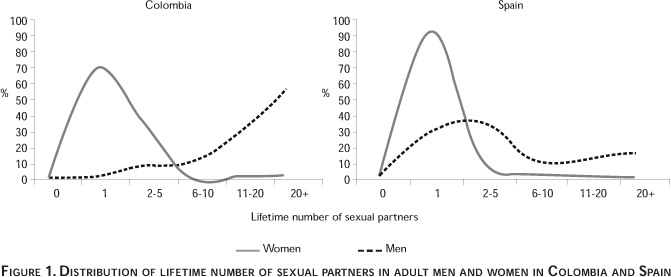
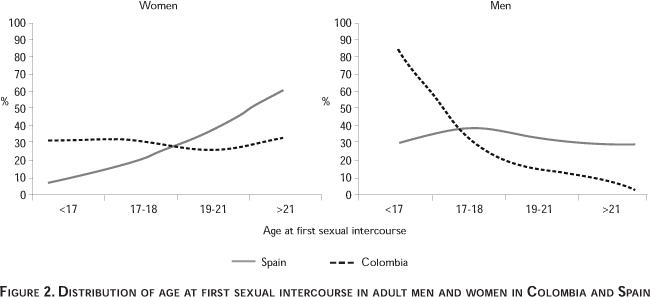
<body><![CDATA[<p><font face="Verdana" size="2">Epidemiological    studies in virginal and Human Papillomavirus (HPV)-negative women clearly indicate    that sexual intercourse is virtually a necessary step for acquiring HPV as detected    by HPV DNA and serum antibodies testing. Genital HPVs are predominantly sexually    transmitted. As with any other sexually transmitted infection (STI) men are    implicated in the epidemiological chain of the infection. Acting both as "carriers"    and "vectors" of oncogenic HPVs, male partners may be important contributors    to the risk of developing cervical cancer in their female partners. Although    more rarely than women, men may also become the "victims" of their    own sexual behavior and of their own HPV infections, and a fraction of infected    men are at an increased risk of developing penile and anal cancers, two tumors    that are strongly related to infection by the same HPV types that cause cervical    cancer. </font></p>     <p><font face="Verdana" size="2"> This chapter reviews    and summarizes the accumulated evidence showing the importance of the male role    in cervical carcinogenesis. We first show ecological evidence correlating sexual    behavior patterns with cervical cancer incidence rates in different populations.    We also review the evidence for a role of men in HPV transmission and cervical    cancer risk. </font></p>      <p><font face="Verdana" size="2"><b>Sexual behavior    patterns and incidence of cervical cancer: An ecological approach </b></font></p>      <p><font face="Verdana" size="2"><I>The hypothesis</I>    </font></p>      <p><font face="Verdana" size="2">The extent to which    males contribute to the risk of HPV-related cancers in a particular population    mainly depends on two factors: the overall pattern of sexual behavior in the    population as a whole, and on its related background HPV prevalence. This concept    is not new and it was first formally proposed by Skegg and colleagues back in    1982, well before HPV was identified as the causal agent of cervical cancer.<SUP>1</SUP>    </font></p>     <p><font face="Verdana" size="2"> These investigators    hypothesized that, in some populations, "a woman's risk of cervical cancer    will depend less on her own sexual behavior than on that of her husband or other    male partners." Without data on HPV prevalence at hand, they put forward    the idea that cervical cancer incidence rates in an unscreened population will    vary according to three different sexual behavior patterns. "Pattern A",    would be observed in non promiscuous communities in which both men and women    are mainly lifetime monogamous. "Pattern B", would be the one observed    in some Latin American societies in which while women are expected to be lifetime    monogamous men have many sexual partners. And "Pattern C", would be    observed in a more permissive society in which both men and women tend to have    several partners. Skegg's model thus predicted that cervical cancer incidence    rates would be lowest in "Pattern A" communities, in which men and    women are mostly monogamous, and highest in "Pattern B" communities,    in which many men have intercourse with a small number of highly promiscuous    women, frequently sex workers who constitute a reservoir of HPV infection. </font></p>      <p><font face="Verdana" size="2"><I>The data: the    IARC studies on the male role</I> </font></p>      <p><font face="Verdana" size="2">Between 1985 and    1993 the International Agency for Research on Cancer (IARC) conducted a series    of case-control studies in countries with low, intermediate and high incidence    rates of cervical cancer to assess the role of HPV and other STIs in the etiology    of this cancer.<SUP>2-15</SUP> Husbands or current stable sexual partners of    the women recruited in these studies were also invited, interviewed, and their    penile samples tested for HPV DNA detection by state-of-the-art Polymerase Chain    Reaction (PCR) techniques. This was accomplished in 1 925 men enrolled in seven    case-control studies carried out in Colombia, Brazil, Thailand, The Philippines,    and Spain. This design allowed, almost 20 years later, the testing of Skegg's    hypothesis by analyzing individually-collected data on HPV infection and sexual    practices in adult men and women. </font></p>     <p><font face="Verdana" size="2"> The distribution    of the lifetime number of sexual partners in men and women is plotted in <a href="/img/revistas/spm/v45s3/3a10f01.gif">Figure    1</a> for two selected countries that have a 5-fold ratio of cervical cancer    incidence rates: Colombia, (age-adjusted incidence rate &#91;AAIR&#93; of 34.4 per 100    000 women), and Spain (AAIR of 7.1). The curve for Colombia, closely resembles    that hypothesized in Skegg's "Pattern B" society, with women being    mostly monogamous (around 70%), and men highly promiscuous (55% of men had 20    or more sexual partners). In contrast, the corresponding distribution in Spain,    although not identical, is consistent with Skegg's "Pattern A" society,    with the vast majority of women being monogamous (around 90%), and a small fraction    of men highly promiscuous (15% of men had 20 or more sexual partners). Clearly,    the male to female disparity in terms of number of sexual partners is more marked    in high-risk Colombia than in low-risk Spain, confirming thus the contrasting    cervical cancer incidence rates predicted by Skegg's model. </font></p>     <p><font face="Verdana" size="2"> In parallel with    these findings the distribution of age at first sexual intercourse, a sexual    behavior indicator consistently found to be associated with cervical cancer    risk even after taking into account HPV, greatly differed between Colombia and    Spain (<a href="/img/revistas/spm/v45s3/3a10f02.gif">Figure 2</a>). It was remarkable that, for    this variable, the between-country disparity was observed both in men (68% versus    24% men initiated sex at age 16 or younger in Colombia and Spain, respectively),    and in women (26% versus 6% women, initiated sex at age 16 or younger in Colombia    and Spain, respectively). </font></p>     ]]></body>
<body><![CDATA[<p><font face="Verdana" size="2"> These studies    further found that the prevalence of reported ever contacts with prostitutes    (79% in Colombia versus 52% in Spain) correlated also with cervical cancer,    as it did the fraction of men's sexual partners than were prostitutes (28% versus    10% men had more than 50 partners that were prostitutes in Colombia and Spain,    respectively). </font></p>     <p><font face="Verdana" size="2"> Concerning HPV    infections in men and women the results from these studies show that penile    HPV correlates better than cervical HPV with cervical cancer incidence rates.    In Colombia, men had a higher HPV prevalence than women (19% versus 15%, respectively).    In Spain, HPV prevalences for both men and women were 5 to 6-fold lower than    those in Colombia, and men had a lower HPV prevalence than women (3% versus    5%, respectively). </font></p>      <p><font face="Verdana" size="2"><b>The role of    men in cervical carcinogenesis </b></font></p>      <p><font face="Verdana" size="2"><I>Male sexual    behavior and cervical neoplasia in sexual partners</I> </font></p>      <p><font face="Verdana" size="2">Although the implication    of a sexually transmitted agent in the etiology of cervical cancer has been    suggested since the 1940's,<SUP>16</SUP> most early studies focused on the analysis    of female's sexual behavior and on the testing of female's biological samples,    paying little attention to the potential contribution of men. However, as with    any other STD, studies in couples should provide consistent evidence of the    venereal nature of HPVs and one would expect higher rates of HPV infection and    HPV-related diseases in women who had sexual contacts with promiscuous men than    in women who had contacts with non-promiscuous men. Indeed, this was already    reported more than 30 years ago by Pridan and colleagues who showed for the    first time an association between the number of sexual partners of the husband    and the risk of cervical cancer among mostly monogamous Jewish women.<SUP>17</SUP>    </font></p>     <p><font face="Verdana" size="2"> Since the women    themselves may also have had multiple sexual partners, the evidence for a role    of men in HPV transmission is more clearly shown in studies of couples whose    female consort claim to have had no sexual partners other than her husband or    stable partner. This was shown for the first time by Buckley and colleagues    who found that the risk of cervical cancer among monogamous women greatly increased    with the number of sexual partners their husbands had had. Other male factors    found to increase risk in this study were an early age at first intercourse,    extramarital affairs, and history of STDs.<SUP>18</SUP> </font></p>     <p><font face="Verdana" size="2"> The potential    importance of the male role was also suggested in early studies of marital clusters.    One study reported that subsequent wives of husbands whose previous wife developed    cervical cancer had an increased risk of cervical neoplasia,<SUP>19</SUP> and    several studies have shown that wives of men with cancer of the penis have a    higher incidence and mortality rates of cervical cancer.<SUP>20-22</SUP> </font></p>     <p><font face="Verdana" size="2"> Studies showing    geographic clustering of cervical and penile cancers,<SUP>23-25</SUP> and studies    showing strong correlation between incidence rates of male and female genital    cancers,<SUP>22,26</SUP> provided further ecological support on the importance    of men in the natural history of cervical cancer. </font></p>     <p><font face="Verdana" size="2"> More recently,    data from the Swedish Family Cancer Database showed that husbands of women with    <I>in situ</I> or invasive cervical cancer had an excess risk of anal cancer,    a recognized HPV-related cancer.<SUP>27</SUP> Anal cancer was also increased    as a second primary cancer in women with cervical neoplasia.<SUP>28</SUP> Of    special interest is also the excess risk found in husbands of cervical cancer    patients of both tonsilar cancer and cancer of the tongue, supporting the currently    emerging evidence that HPV may be etiologically involved in a fraction of these    tumors.<SUP>29</SUP> </font></p>     <p><font face="Verdana" size="2"> All together these    studies provide thus indirect evidence that: a) cervical and penile cancers    share a common infectious etiology, b) both men and women contribute to the    transmission of an infectious agent, and c) both men and women may become cancer    victims of this viral infection. </font></p>     ]]></body>
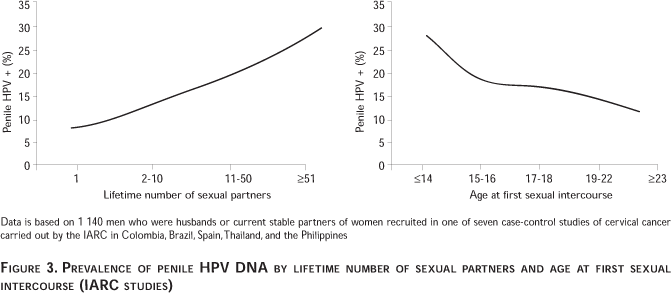
<body><![CDATA[<p><font face="Verdana" size="2"> Stronger evidence    of the male role has been provided by formal case-control studies comparing    either direct histories of sexual behavior or clinical evidence of HPV-related    lesions in male partners of women with and without cervical cancer.<SUP>2,13,30-32</SUP>    Zunzunegui and colleagues showed, for instance, that as compared to unaffected    women, women with cervical neoplasia were five times more likely to be married    to a man who had had more than 20 sexual partners.<SUP>30</SUP> In another study,    women who were the sole sexual consorts of men with pre-existing penile condyloma    showed an increased risk of cervical neoplasia.<SUP>33</SUP> Barrasso and colleagues    also reported a high prevalence of HPV-related penile neoplasia in the sex partners    of women with cervical neoplasia.<SUP>34</SUP> </font></p>      <p><font face="Verdana" size="2"><I>Penile HPV DNA    and risk of cervical cancer</I> </font></p>      <p><font face="Verdana" size="2">After the identification    of HPVs as the sexually transmitted agents etiologically linked to cervical    cancer, firm evidence for a role of men as carriers and vectors of oncogenic    HPVs stemmed from studies that introduced HPV DNA detection in penile samples.    </font></p>     <p><font face="Verdana" size="2"> The largest study    to date exploring the male role in cervical carcinogenesis is the multicentric    case-control study coordinated by the IARC (Lyon, France). As explained in a    previous section this large study involved over 1 900 couples that were enrolled    in seven case-control studies of cervical cancer carried out in Spain, Colombia,    Brazil, Thailand, and the Philippines and in whom exfoliated penile cells were    collected in men for HPV DNA detection.<SUP>2,3,5,6,8,9,11,13,15</SUP> Pooled    data from these studies clearly indicate that the overall penile HPV prevalence    clearly increases with increasing lifetime number of sexual partners of the    men and with and early age at sexual debut (<a href="/img/revistas/spm/v45s3/3a10f03.gif">Figure    3</a>). If we take also into account the sexual behavior of the female consort    in the studies conducted in Spain<SUP>2</SUP> and Colombia<SUP>13</SUP> we can    see that penile HPV prevalences were systematically higher in husbands of non-monogamous    women than in husbands of monogamous women (<a href="#fig4">Figure 4</a>). Furthermore,    the increasing trend between penile HPV and number of sexual partners of men    was observed in the partners of both monogamous and non-monogamous women.<SUP>7</SUP>    </font></p>     <p><a name="fig4"></a></p>     <p>&nbsp;</p>     <p align="center"><img src="/img/revistas/spm/v45s3/3a10f04.gif"></p>     <p>&nbsp;</p>     <p><font face="Verdana" size="2"> Results for the    IARC studies conducted in low- to intermediate-risk countries (i.e., Spain,    Thailand and the Philippines), also indicate that the men's lifetime number    of sexual partners, including female prostitutes as sexual partners, is one    of the key determinants of cervical cancer risk in their wives. In Spain, the    presence of HPV DNA in the husband's penis conveyed a 5-fold increased risk    of cervical cancer to their wives. The odds of cervical cancer among monogamous    women increased up to 9.5-fold in relation to the presence of high-risk HPV    types in the penis of their husbands. The excess risk associated with HPV type    16 was 6- to 9-fold. Furthermore, the prevalence of penile HPV showed a positive    trend with increasing number of sexual partners and with the number of sexual    partners who were prostitutes.<SUP>2</SUP> In contrast, in high-risk countries    such as Colombia and Brazil, no associations with cervical cancer risk were    found with penile HPV DNA or with other indicators of male sexual behavior.<SUP>13</SUP>    </font></p>     <p><font face="Verdana" size="2"> The lack of association    between most male-related variables and cervical cancer risk found in high-risk    countries could be explained by the fact that in these populations HPV is such    a widespread infection that hampers case-control studies to discriminate subjects    at a higher risk. In these populations, women's having sexual contacts with    an even limited number of male partners place them at a high risk of acquiring    cervical HPV infections and subsequent cervical cancer. HPV DNA detection in    the penis of adult men, even if high, is still a poor reflection of lifetime    exposure to HPV. Other biological markers of lifetime sexual promiscuity in    men such as seropositivity to <I>Chlamydia trachomatis</I> have proved to better    discriminate men's partners at a high risk of cervical cancer, not only in populations    at low risk,<SUP>2</SUP> but also in populations at high risk of cervical cancer.<SUP>13</SUP>    </font></p>      ]]></body>
<body><![CDATA[<p><font face="Verdana" size="2"><I>HPV concordance    in couples</I> </font></p>      <p><font face="Verdana" size="2">Several studies    have addressed concordance of genital HPVs in heterosexual couples. Most, but    not all,<SUP>35</SUP> of these studies found a relatively poor correlation of    HPV-positivity and types in cervical and penile samples.<SUP>7,10,36-38</SUP>    The low agreement may be partly due to technical reasons, since a smaller amount    of penile exfoliated cells may be obtained in men relative to the cellular yield    obtained from the cervix. In some couples, the partner who has been sampled    may not be the relevant one in determining the woman's risk of HPV persistence    and progression to cervical neoplasia. Agreement in HPV findings, however, was    also modest in couples where both the wife and husband reported only one lifetime    sexual partner.<SUP>10</SUP> In some of these studies the timing of the sampling    of penile and cervical specimens at a relatively old age is the likeliest explanation    for HPV discordance, since spontaneous regression of HPV infection is common    in men<SUP>39</SUP> and in women who do not develop cervical neoplasia.<SUP>40</SUP>    Among women with cervical neoplasia, the relevant infection may have occurred    many years earlier, and the relatively low prevalence of penile HPV infection    in their husbands suggests that viral shedding of advanced cervical lesions    is limited. Also point detection of penile HPV may measure relatively recent    exposures to HPVs that may be unrelated to the initiation of cervical neoplasia    in the wife. </font></p>      <p><font face="Verdana" size="2"><I>Male circumcision,    penile HPV, and cervical cancer</I> </font></p>      <p><font face="Verdana" size="2">A recent piece    of evidence confirming the importance of men in HPV transmission and cervical    carcinogenesis comes from the IARC multicentric study on male circumcision.<SUP>6</SUP>    This study compared penile HPV DNA prevalence in circumcised and uncircumcised    men to estimate a woman's risk of cervical HPV infection and that of cervical    cancer according to the husband's circumcision status. We found that circumcised    men were about three times less likely to harbor HPV in their penis than did    uncircumcised men. Consistent with the venereal nature of HPV infections, we    found that male circumcision also reduced the risk of both genital HPV infections    and cervical cancer in the female partner. As shown in <a href="/img/revistas/spm/v45s3/3a10f05.gif">Figure    5</a> among monogamous women, circumcision status of the husband was associated    with a reduced risk of cervical cancer, particularly and most strongly, among    women whose male consorts had engaged in high-risk sexual behaviors as measured    by an early age at first sexual intercourse, a high lifetime number of sexual    partners, and sexual intercourse with women that were prostitutes. Furthermore,    as shown in <a href="/img/revistas/spm/v45s3/3a10f05.gif">Figure 5</a>, using a computed sexual    behavior risk index revealed a statistically significant dose-response relationship    between increasing husband's sexual behavior risk and cervical cancer risk reduction    linked to circumcision in their wives. These findings confirmed for the first    time the long-suspected hypothesis claiming that male circumcision might reduce    the risk of cervical cancer in female partners and underlines the importance    of the male in the risk of HPV acquisition and cervical neoplasia in the female    partner. </font></p>      <p><font face="Verdana" size="2"><I>The male role:    Closing the epidemiological chain linking HPV and cervical cancer</I> </font></p>      <p><font face="Verdana" size="2">Even though males    have traditionally been much less studied than women, in the last decade data    from all sorts of epidemiological study designs assessing directly or indirectly    the role of men in cervical carcinogenesis have been accumulating. The large    IARC studies on couples have shed new light on the largely unknown male side    of the epidemiological chain of HPV and cervical cancer.<SUP>2,6,7,10,13</SUP>    </font></p>     <p><font face="Verdana" size="2"> Our current understanding    is that men who have had multiple sexual partners or who are carriers of HPV    DNA may be vectors of high-risk HPV types, placing their sexual partners at    a high risk of cervical cancer. The key question though is how men acquire the    virus in the penis in the first place. It is now well established that penile    HPVs are predominantly acquired through sexual contacts. Sexual contacts with    prostitutes play an important role in HPV transmission and sex workers may be    an important population reservoir of high-risk HPVs. Through sexual intercourse    with high-risk women, HPVs enter the penis which can then be transmitted to    the current stable partner or to subsequent sexual partners. Men are thus the    vectors of oncogenic HPV types that are usually found in cervical carcinomas.    Circumcision is also likely to modulate the risk of penile HPV acquisition,    the risk of transmission to the partners as well as the long-term risk of cervical    cancer. </font></p>     <p><font face="Verdana" size="2"> At the ecological    level, populations in which the sexual habits of men greatly differ from those    of women, male promiscuity in general, and sexual contacts with prostitutes    in particular, is likely. Under these circumstances, a woman's risk of being    infected and develop cervical cancer depends much more on the sexual behavior    of her partner than on that of her own.<SUP>1</SUP> </font></p>      <p>&nbsp;</p>     <p><font face="Verdana" size="3"><b>Conclusions    </b></font></p>      ]]></body>
<body><![CDATA[<p><font face="Verdana" size="2">Experimental, clinical,    and epidemiological evidence strongly suggests that genital HPVs are predominantly    sexually transmitted. As with any STI men are implicated in the epidemiological    chain. Penile HPVs are predominantly acquired through sexual contacts notably,    at least in some populations, with prostitutes who become an important reservoir    of high-risk HPVs. Acting both as "carriers" and "vectors"    of oncogenic HPVs male partners may be important contributors to the risk of    developing cervical cancer in their female partners. Male circumcision status    has also been shown to influence not only the risk of acquiring and transmitting    genital HPVs but also the risk of cervical cancer in women with promiscuous    sex partners. </font></p>      <p>&nbsp;</p>     <p><font face="Verdana" size="3"><b>Acknowledgments</b>    </font></p>      <p><font face="Verdana" size="2">We thank Gina Albero    for her assistance in statistical analyses and graph design. </font></p>        <p>&nbsp;</p>     <p><font face="Verdana" size="3"><b>References </b></font></p>      <!-- ref --><p><font face="Verdana" size="2">1. Skegg DC, Corwin    PA, Paul C, Doll R. Importance of the male factor in cancer of the cervix. Lancet    1982;2:581-583. </font>&nbsp;&nbsp;&nbsp;&nbsp;&nbsp;&nbsp;&nbsp;&nbsp;[&#160;<a href="javascript:void(0);" onclick="javascript: window.open('/scielo.php?script=sci_nlinks&ref=9234081&pid=S0036-3634200300090000800001&lng=','','width=640,height=500,resizable=yes,scrollbars=1,menubar=yes,');">Links</a>&#160;]<!-- end-ref --><!-- ref --><p><font face="Verdana" size="2">2. Bosch FX, Castellsagu&eacute;    X, Mu&ntilde;oz N, De Sanjos&eacute; S, Ghaffari AM, Gonz&aacute;lez LC <I>et    al</I>. Male sexual behavior and human papillomavirus DNA: Key risk factors    for cervical cancer in Spain. J Natl Cancer Inst 1996;88:1060-1067. </font>&nbsp;&nbsp;&nbsp;&nbsp;&nbsp;&nbsp;&nbsp;&nbsp;[&#160;<a href="javascript:void(0);" onclick="javascript: window.open('/scielo.php?script=sci_nlinks&ref=9234082&pid=S0036-3634200300090000800002&lng=','','width=640,height=500,resizable=yes,scrollbars=1,menubar=yes,');">Links</a>&#160;]<!-- end-ref --><!-- ref --><p><font face="Verdana" size="2">3. Bosch FX, Mu&ntilde;oz    N, De Sanjos&eacute; S, Guerrerro E, Ghaffari AM, Kaldor J, et al. Importance    of human papillomavirus endemicity in the incidence of cervical cancer: An extension    of the hypothesis on sexual behavior. Cancer Epidemiol Biomark Prev 1994;3:375-379.    </font>&nbsp;&nbsp;&nbsp;&nbsp;&nbsp;&nbsp;&nbsp;&nbsp;[&#160;<a href="javascript:void(0);" onclick="javascript: window.open('/scielo.php?script=sci_nlinks&ref=9234083&pid=S0036-3634200300090000800003&lng=','','width=640,height=500,resizable=yes,scrollbars=1,menubar=yes,');">Links</a>&#160;]<!-- end-ref --><!-- ref --><p><font face="Verdana" size="2">4. Bosch FX, Mu&ntilde;oz    N, De Sanjos&eacute; S, Izarzugaza I, Gili M, Viladiu P <I>et al</I>. Risk factors    for cervical cancer in Colombia and Spain. Int J Cancer 1992;52: 750-758. </font>&nbsp;&nbsp;&nbsp;&nbsp;&nbsp;&nbsp;&nbsp;&nbsp;[&#160;<a href="javascript:void(0);" onclick="javascript: window.open('/scielo.php?script=sci_nlinks&ref=9234084&pid=S0036-3634200300090000800004&lng=','','width=640,height=500,resizable=yes,scrollbars=1,menubar=yes,');">Links</a>&#160;]<!-- end-ref --><!-- ref --><p><font face="Verdana" size="2">5. Bosch FX, Mu&ntilde;oz    N, De Sanjos&eacute; S, Navarro C, Moreo P, Ascunce N <I>et al</I>. Human papillomavirus    and cervical intraepithelial neoplasia grade III/carcinoma in situ: A case-control    study in Spain and Colombia. Cancer Epidemiol Biomark Prev 1993;2:415-422. </font>&nbsp;&nbsp;&nbsp;&nbsp;&nbsp;&nbsp;&nbsp;&nbsp;[&#160;<a href="javascript:void(0);" onclick="javascript: window.open('/scielo.php?script=sci_nlinks&ref=9234085&pid=S0036-3634200300090000800005&lng=','','width=640,height=500,resizable=yes,scrollbars=1,menubar=yes,');">Links</a>&#160;]<!-- end-ref --><!-- ref --><p><font face="Verdana" size="2">6. Castellsagu&eacute;    X, Bosch FX, Mu&ntilde;oz N, Meijer CJ, Shah KV, De Sanjos&eacute; S <I>et al</I>.    Male circumcision, penile human papillomavirus infection, and cervical cancer    in female partners. N Engl J Med 2002;346:1105-1112. </font>&nbsp;&nbsp;&nbsp;&nbsp;&nbsp;&nbsp;&nbsp;&nbsp;[&#160;<a href="javascript:void(0);" onclick="javascript: window.open('/scielo.php?script=sci_nlinks&ref=9234086&pid=S0036-3634200300090000800006&lng=','','width=640,height=500,resizable=yes,scrollbars=1,menubar=yes,');">Links</a>&#160;]<!-- end-ref --><!-- ref --><p><font face="Verdana" size="2">7. Castellsagu&eacute;    X, Ghaffari A, Daniel RW, Bosch FX, Mu&ntilde;oz N, Shah KV. Prevalence of penile    human papillomavirus DNA in husbands of women with and without cervical neoplasia:    A study in Spain and Colombia. J Infect Dis 1997;176:353-361. </font>&nbsp;&nbsp;&nbsp;&nbsp;&nbsp;&nbsp;&nbsp;&nbsp;[&#160;<a href="javascript:void(0);" onclick="javascript: window.open('/scielo.php?script=sci_nlinks&ref=9234087&pid=S0036-3634200300090000800007&lng=','','width=640,height=500,resizable=yes,scrollbars=1,menubar=yes,');">Links</a>&#160;]<!-- end-ref --><!-- ref --><p><font face="Verdana" size="2">8. Chichareon S,    Herrero R, Mu&ntilde;oz N, Bosch FX, Jacobs MV, Deacon J <I>et al</I>. Risk    factors for cervical cancer in Thailand: A case-control study. J Natl Cancer    Inst 1998;90:50-57. </font>&nbsp;&nbsp;&nbsp;&nbsp;&nbsp;&nbsp;&nbsp;&nbsp;[&#160;<a href="javascript:void(0);" onclick="javascript: window.open('/scielo.php?script=sci_nlinks&ref=9234088&pid=S0036-3634200300090000800008&lng=','','width=640,height=500,resizable=yes,scrollbars=1,menubar=yes,');">Links</a>&#160;]<!-- end-ref --><!-- ref --><p><font face="Verdana" size="2">9. Eluf-Neto J,    Booth M, Mu&ntilde;oz N, Bosch FX, Meijer CJ, Walboomers JM. Human papillomavirus    and invasive cervical cancer in Brazil. Br J Cancer 1994;69:114-119. </font>&nbsp;&nbsp;&nbsp;&nbsp;&nbsp;&nbsp;&nbsp;&nbsp;[&#160;<a href="javascript:void(0);" onclick="javascript: window.open('/scielo.php?script=sci_nlinks&ref=9234089&pid=S0036-3634200300090000800009&lng=','','width=640,height=500,resizable=yes,scrollbars=1,menubar=yes,');">Links</a>&#160;]<!-- end-ref --><!-- ref --><p><font face="Verdana" size="2">10. Franceschi    S, Castellsagu&eacute; X, Dal Maso L, Smith JS, Plummer M, Ngelangel C <I>et    al</I>. Prevalence and determinants of human papillomavirus genital infection    in men. Br J Cancer 2002;86:705-711. </font>&nbsp;&nbsp;&nbsp;&nbsp;&nbsp;&nbsp;&nbsp;&nbsp;[&#160;<a href="javascript:void(0);" onclick="javascript: window.open('/scielo.php?script=sci_nlinks&ref=9234090&pid=S0036-3634200300090000800010&lng=','','width=640,height=500,resizable=yes,scrollbars=1,menubar=yes,');">Links</a>&#160;]<!-- end-ref --><!-- ref --><p><font face="Verdana" size="2">11. Mu&ntilde;oz    N, Bosch FX, De Sanjos&eacute; S, Tafur L, Izarzugaza I, Gili M <I>et al</I>.    The causal link between human papillomavirus and invasive cervical cancer: A    population-based case-control study in Colombia and Spain. Int J Cancer 1992;52:743-749.    </font>&nbsp;&nbsp;&nbsp;&nbsp;&nbsp;&nbsp;&nbsp;&nbsp;[&#160;<a href="javascript:void(0);" onclick="javascript: window.open('/scielo.php?script=sci_nlinks&ref=9234091&pid=S0036-3634200300090000800011&lng=','','width=640,height=500,resizable=yes,scrollbars=1,menubar=yes,');">Links</a>&#160;]<!-- end-ref --><!-- ref --><p><font face="Verdana" size="2">12. Mu&ntilde;oz    N, Bosch FX, De Sanjos&eacute; S, Vergara A, del Moral A, Mu&ntilde;oz MT <I>et    al</I>. Risk factors for cervical intraepithelial neoplasia grade III/carcinoma    in situ in Spain and Colombia. Cancer Epidemiol Biomark Prev 1993;2: 423-431.    </font>&nbsp;&nbsp;&nbsp;&nbsp;&nbsp;&nbsp;&nbsp;&nbsp;[&#160;<a href="javascript:void(0);" onclick="javascript: window.open('/scielo.php?script=sci_nlinks&ref=9234092&pid=S0036-3634200300090000800012&lng=','','width=640,height=500,resizable=yes,scrollbars=1,menubar=yes,');">Links</a>&#160;]<!-- end-ref --><!-- ref --><p><font face="Verdana" size="2">13. Mu&ntilde;oz    N, Castellsagu&eacute; X, Bosch FX, Tafur L, De Sanjos&eacute; S, Aristizabal    N <I>et al</I>. Difficulty in elucidating the male role in cervical cancer in    Colombia, a high-risk area for the disease. J Natl Cancer Inst 1996;88:1068-1075.    </font>&nbsp;&nbsp;&nbsp;&nbsp;&nbsp;&nbsp;&nbsp;&nbsp;[&#160;<a href="javascript:void(0);" onclick="javascript: window.open('/scielo.php?script=sci_nlinks&ref=9234093&pid=S0036-3634200300090000800013&lng=','','width=640,height=500,resizable=yes,scrollbars=1,menubar=yes,');">Links</a>&#160;]<!-- end-ref --><!-- ref --><p><font face="Verdana" size="2">14. Mu&ntilde;oz    N, Kato I, Bosch FX, Eluf-Neto J, De Sanjos&eacute; S, Ascunce N <I>et al</I>.    Risk factors for HPV DNA detection in middle-aged women. Sex Transm Dis 1996;23:504-510.    </font>&nbsp;&nbsp;&nbsp;&nbsp;&nbsp;&nbsp;&nbsp;&nbsp;[&#160;<a href="javascript:void(0);" onclick="javascript: window.open('/scielo.php?script=sci_nlinks&ref=9234094&pid=S0036-3634200300090000800014&lng=','','width=640,height=500,resizable=yes,scrollbars=1,menubar=yes,');">Links</a>&#160;]<!-- end-ref --><!-- ref --><p><font face="Verdana" size="2">15. Ngelangel C,    Mu&ntilde;oz N, Bosch FX, Limson GM, Festin MR, Deacon J <I>et al</I>. Causes    of cervical cancer in the Philippines: A case-control study. J Natl Cancer Inst    1998;90:43-49. </font>&nbsp;&nbsp;&nbsp;&nbsp;&nbsp;&nbsp;&nbsp;&nbsp;[&#160;<a href="javascript:void(0);" onclick="javascript: window.open('/scielo.php?script=sci_nlinks&ref=9234095&pid=S0036-3634200300090000800015&lng=','','width=640,height=500,resizable=yes,scrollbars=1,menubar=yes,');">Links</a>&#160;]<!-- end-ref --><!-- ref --><p><font face="Verdana" size="2">16. Rigoni-Stern    A, Ricci JV, ed. One hundred years of gynaecology 1800-1900. Philadelphia: Blakiston    Co, 1945. </font>&nbsp;&nbsp;&nbsp;&nbsp;&nbsp;&nbsp;&nbsp;&nbsp;[&#160;<a href="javascript:void(0);" onclick="javascript: window.open('/scielo.php?script=sci_nlinks&ref=9234096&pid=S0036-3634200300090000800016&lng=','','width=640,height=500,resizable=yes,scrollbars=1,menubar=yes,');">Links</a>&#160;]<!-- end-ref --><!-- ref --><p><font face="Verdana" size="2">17. Pridan H, Lilienfeld    AM. Carcinoma of the cervix in Jewish women in Israel, 1960-67. An epidemiological    study. Isr J Med Sci 1971;7:1465-1470. </font>&nbsp;&nbsp;&nbsp;&nbsp;&nbsp;&nbsp;&nbsp;&nbsp;[&#160;<a href="javascript:void(0);" onclick="javascript: window.open('/scielo.php?script=sci_nlinks&ref=9234097&pid=S0036-3634200300090000800017&lng=','','width=640,height=500,resizable=yes,scrollbars=1,menubar=yes,');">Links</a>&#160;]<!-- end-ref --><!-- ref --><p><font face="Verdana" size="2">18. Buckley JD,    Harris RW, Doll R, Vessey MP, Williams PT. Case-control study of the husbands    of women with dysplasia or carcinoma of the cervix uteri. Lancet 1981;2:1010-1015.    </font>&nbsp;&nbsp;&nbsp;&nbsp;&nbsp;&nbsp;&nbsp;&nbsp;[&#160;<a href="javascript:void(0);" onclick="javascript: window.open('/scielo.php?script=sci_nlinks&ref=9234098&pid=S0036-3634200300090000800018&lng=','','width=640,height=500,resizable=yes,scrollbars=1,menubar=yes,');">Links</a>&#160;]<!-- end-ref --><!-- ref --><p><font face="Verdana" size="2">19. Kessler II.    Venereal factors in human cervical cancer: Evidence from marital clusters. Cancer    1977;39:1912-1919. </font>&nbsp;&nbsp;&nbsp;&nbsp;&nbsp;&nbsp;&nbsp;&nbsp;[&#160;<a href="javascript:void(0);" onclick="javascript: window.open('/scielo.php?script=sci_nlinks&ref=9234099&pid=S0036-3634200300090000800019&lng=','','width=640,height=500,resizable=yes,scrollbars=1,menubar=yes,');">Links</a>&#160;]<!-- end-ref --><!-- ref --><p><font face="Verdana" size="2">20. Martinez I.    Relationship of squamous cell carcinoma of the cervix uteri to squamous cell    carcinoma of the penis among Puertorican women married to men with penile carcinoma.    Cancer 1969;24:777-780. </font>&nbsp;&nbsp;&nbsp;&nbsp;&nbsp;&nbsp;&nbsp;&nbsp;[&#160;<a href="javascript:void(0);" onclick="javascript: window.open('/scielo.php?script=sci_nlinks&ref=9234100&pid=S0036-3634200300090000800020&lng=','','width=640,height=500,resizable=yes,scrollbars=1,menubar=yes,');">Links</a>&#160;]<!-- end-ref --><!-- ref --><p><font face="Verdana" size="2">21. Graham S, Priore    R, Graham M, Browne R, Burnett W, West D. Genital cancer in wives of penile    cancer patients. Cancer 1979;44:1870-1874. </font>&nbsp;&nbsp;&nbsp;&nbsp;&nbsp;&nbsp;&nbsp;&nbsp;[&#160;<a href="javascript:void(0);" onclick="javascript: window.open('/scielo.php?script=sci_nlinks&ref=9234101&pid=S0036-3634200300090000800021&lng=','','width=640,height=500,resizable=yes,scrollbars=1,menubar=yes,');">Links</a>&#160;]<!-- end-ref --><!-- ref --><p><font face="Verdana" size="2">22. Smith PG, Kinlen    LJ, White GC, Adelstein AM, Fox AJ. Mortality of wives of men dying with cancer    of the penis. Br J Cancer 1980;41: 422-428. </font>&nbsp;&nbsp;&nbsp;&nbsp;&nbsp;&nbsp;&nbsp;&nbsp;[&#160;<a href="javascript:void(0);" onclick="javascript: window.open('/scielo.php?script=sci_nlinks&ref=9234102&pid=S0036-3634200300090000800022&lng=','','width=640,height=500,resizable=yes,scrollbars=1,menubar=yes,');">Links</a>&#160;]<!-- end-ref --><!-- ref --><p><font face="Verdana" size="2">23. Cartwright    RA, Sinson JD. Carcinoma of penis and cervix. Lancet 1980;1:97. </font>&nbsp;&nbsp;&nbsp;&nbsp;&nbsp;&nbsp;&nbsp;&nbsp;[&#160;<a href="javascript:void(0);" onclick="javascript: window.open('/scielo.php?script=sci_nlinks&ref=9234103&pid=S0036-3634200300090000800023&lng=','','width=640,height=500,resizable=yes,scrollbars=1,menubar=yes,');">Links</a>&#160;]<!-- end-ref --><!-- ref --><p><font face="Verdana" size="2">24. Li JY, Li FP,    Blot WJ, Miller RW, Fraumeni JF Jr. Correlation between cancers of the uterine    cervix and penis in China. J Natl Cancer Inst 1982; 69:1063-1065. </font>&nbsp;&nbsp;&nbsp;&nbsp;&nbsp;&nbsp;&nbsp;&nbsp;[&#160;<a href="javascript:void(0);" onclick="javascript: window.open('/scielo.php?script=sci_nlinks&ref=9234104&pid=S0036-3634200300090000800024&lng=','','width=640,height=500,resizable=yes,scrollbars=1,menubar=yes,');">Links</a>&#160;]<!-- end-ref --><!-- ref --><p><font face="Verdana" size="2">25. Macgregor JE,    Innes G. Carcinoma of penis and cervix. Lancet 1980;1:1246-1247. </font>&nbsp;&nbsp;&nbsp;&nbsp;&nbsp;&nbsp;&nbsp;&nbsp;[&#160;<a href="javascript:void(0);" onclick="javascript: window.open('/scielo.php?script=sci_nlinks&ref=9234105&pid=S0036-3634200300090000800025&lng=','','width=640,height=500,resizable=yes,scrollbars=1,menubar=yes,');">Links</a>&#160;]<!-- end-ref --><!-- ref --><p><font face="Verdana" size="2">26. Bosch FX, Cardis    E. Cancer incidence correlations: Genital, urinary and some tobacco- related    cancers. Int J Cancer 1990;46:178-184. </font>&nbsp;&nbsp;&nbsp;&nbsp;&nbsp;&nbsp;&nbsp;&nbsp;[&#160;<a href="javascript:void(0);" onclick="javascript: window.open('/scielo.php?script=sci_nlinks&ref=9234106&pid=S0036-3634200300090000800026&lng=','','width=640,height=500,resizable=yes,scrollbars=1,menubar=yes,');">Links</a>&#160;]<!-- end-ref --><!-- ref --><p><font face="Verdana" size="2">27. Hemminki K,    Dong C. Cancer in husbands of cervical cancer patients. Epidemiology 2000;11:347-349.    </font>&nbsp;&nbsp;&nbsp;&nbsp;&nbsp;&nbsp;&nbsp;&nbsp;[&#160;<a href="javascript:void(0);" onclick="javascript: window.open('/scielo.php?script=sci_nlinks&ref=9234107&pid=S0036-3634200300090000800027&lng=','','width=640,height=500,resizable=yes,scrollbars=1,menubar=yes,');">Links</a>&#160;]<!-- end-ref --><!-- ref --><p><font face="Verdana" size="2">28. Hemminki K,    Dong C, Vaittinen P. Second primary cancer after <I>in situ </I>and invasive    cervical cancer. Epidemiology 2000;11:457-461. </font>&nbsp;&nbsp;&nbsp;&nbsp;&nbsp;&nbsp;&nbsp;&nbsp;[&#160;<a href="javascript:void(0);" onclick="javascript: window.open('/scielo.php?script=sci_nlinks&ref=9234108&pid=S0036-3634200300090000800028&lng=','','width=640,height=500,resizable=yes,scrollbars=1,menubar=yes,');">Links</a>&#160;]<!-- end-ref --><!-- ref --><p><font face="Verdana" size="2">29. Hemminki K,    Dong C, Frisch M. Tonsillar and other upper aerodigestive tract cancers among    cervical cancer patients and their husbands. Eur J Cancer Prev 2000;9:433-437.    </font>&nbsp;&nbsp;&nbsp;&nbsp;&nbsp;&nbsp;&nbsp;&nbsp;[&#160;<a href="javascript:void(0);" onclick="javascript: window.open('/scielo.php?script=sci_nlinks&ref=9234109&pid=S0036-3634200300090000800029&lng=','','width=640,height=500,resizable=yes,scrollbars=1,menubar=yes,');">Links</a>&#160;]<!-- end-ref --><!-- ref --><p><font face="Verdana" size="2">30. Zunzunegui    MV, King MC, Coria CF, Charlet J. Male influences on cervical cancer risk. Am    J Epidemiol 1986;123:302-307. </font>&nbsp;&nbsp;&nbsp;&nbsp;&nbsp;&nbsp;&nbsp;&nbsp;[&#160;<a href="javascript:void(0);" onclick="javascript: window.open('/scielo.php?script=sci_nlinks&ref=9234110&pid=S0036-3634200300090000800030&lng=','','width=640,height=500,resizable=yes,scrollbars=1,menubar=yes,');">Links</a>&#160;]<!-- end-ref --><!-- ref --><p><font face="Verdana" size="2">31. Brinton LA,    Reeves WC, Brenes MM, Herrero R, Gait&aacute;n E, Tenorio F <I>et al</I>. The    male factor in the etiology of cervical cancer among sexually monogamous women.    Int J Cancer 1989;44:199-203. </font>&nbsp;&nbsp;&nbsp;&nbsp;&nbsp;&nbsp;&nbsp;&nbsp;[&#160;<a href="javascript:void(0);" onclick="javascript: window.open('/scielo.php?script=sci_nlinks&ref=9234111&pid=S0036-3634200300090000800031&lng=','','width=640,height=500,resizable=yes,scrollbars=1,menubar=yes,');">Links</a>&#160;]<!-- end-ref --><!-- ref --><p><font face="Verdana" size="2">32. Kjaer SK, de    Villiers EM, Dahl C, Engholm G, Bock JE, Vestergaard BF <I>et al</I>. Case-control    study of risk factors for cervical neoplasia in Denmark. I: Role of the "male    factor" in women with one lifetime sexual partner. Int J Cancer 1991;48:39-44.    </font>&nbsp;&nbsp;&nbsp;&nbsp;&nbsp;&nbsp;&nbsp;&nbsp;[&#160;<a href="javascript:void(0);" onclick="javascript: window.open('/scielo.php?script=sci_nlinks&ref=9234112&pid=S0036-3634200300090000800032&lng=','','width=640,height=500,resizable=yes,scrollbars=1,menubar=yes,');">Links</a>&#160;]<!-- end-ref --><!-- ref --><p><font face="Verdana" size="2">33. Campion MJ,    Clarkson P, McCance DJ. Squamous neoplasia of the cervix in relation to other    genital tract neoplasia. Clin Obstet Gynaecol 1985;12:265-280. </font>&nbsp;&nbsp;&nbsp;&nbsp;&nbsp;&nbsp;&nbsp;&nbsp;[&#160;<a href="javascript:void(0);" onclick="javascript: window.open('/scielo.php?script=sci_nlinks&ref=9234113&pid=S0036-3634200300090000800033&lng=','','width=640,height=500,resizable=yes,scrollbars=1,menubar=yes,');">Links</a>&#160;]<!-- end-ref --><!-- ref --><p><font face="Verdana" size="2">34. Barrasso R,    De Brux J, Croissant O, Orth G. High prevalence of papillomavirus-associated    penile intraepithelial neoplasia in sexual partners of women with cervical intraepithelial    neoplasia. N Engl J Med 1987;317: 916-923. </font>&nbsp;&nbsp;&nbsp;&nbsp;&nbsp;&nbsp;&nbsp;&nbsp;[&#160;<a href="javascript:void(0);" onclick="javascript: window.open('/scielo.php?script=sci_nlinks&ref=9234114&pid=S0036-3634200300090000800034&lng=','','width=640,height=500,resizable=yes,scrollbars=1,menubar=yes,');">Links</a>&#160;]<!-- end-ref --><!-- ref --><p><font face="Verdana" size="2">35. Baken LA, Koutsky    LA, Kuypers J, Kosorok MR, Lee SK, Kiviat NB <I>et al</I>. Genital human papillomavirus    infection among male and female sex partners: Prevalence and type-specific concordance.    J Infect Dis 1995;171: 429-432. </font>&nbsp;&nbsp;&nbsp;&nbsp;&nbsp;&nbsp;&nbsp;&nbsp;[&#160;<a href="javascript:void(0);" onclick="javascript: window.open('/scielo.php?script=sci_nlinks&ref=9234115&pid=S0036-3634200300090000800035&lng=','','width=640,height=500,resizable=yes,scrollbars=1,menubar=yes,');">Links</a>&#160;]<!-- end-ref --><!-- ref --><p><font face="Verdana" size="2">36. Hippelainen    MI, Yliskoski M, Syrjanen S, Saastamoinen J, Hippelainen M, Saarikoski S <I>et    al</I>. Low concordance of genital human papillomavirus (HPV) lesions and viral    types in HPV-infected women and their male sexual partners. Sex Transm Dis 1994;21:76-82.    </font>&nbsp;&nbsp;&nbsp;&nbsp;&nbsp;&nbsp;&nbsp;&nbsp;[&#160;<a href="javascript:void(0);" onclick="javascript: window.open('/scielo.php?script=sci_nlinks&ref=9234116&pid=S0036-3634200300090000800036&lng=','','width=640,height=500,resizable=yes,scrollbars=1,menubar=yes,');">Links</a>&#160;]<!-- end-ref --><!-- ref --><p><font face="Verdana" size="2">37. Kyo S, Inoue    M, Koyama M, Fujita M, Tanizawa O, Hakura A. Detection of high-risk human papillomavirus    in the cervix and semen of sex partners. J Infect Dis 1994;170:682-685. </font>&nbsp;&nbsp;&nbsp;&nbsp;&nbsp;&nbsp;&nbsp;&nbsp;[&#160;<a href="javascript:void(0);" onclick="javascript: window.open('/scielo.php?script=sci_nlinks&ref=9234117&pid=S0036-3634200300090000800037&lng=','','width=640,height=500,resizable=yes,scrollbars=1,menubar=yes,');">Links</a>&#160;]<!-- end-ref --><!-- ref --><p><font face="Verdana" size="2">38. Strand A, Rylander    E, Wilander E, Zehbe I. HPV infection in male partners of women with squamous    intraepithelial neoplasia and/or high-risk HPV. Acta Derm Venereol 1995;75:312-316.    </font>&nbsp;&nbsp;&nbsp;&nbsp;&nbsp;&nbsp;&nbsp;&nbsp;[&#160;<a href="javascript:void(0);" onclick="javascript: window.open('/scielo.php?script=sci_nlinks&ref=9234118&pid=S0036-3634200300090000800038&lng=','','width=640,height=500,resizable=yes,scrollbars=1,menubar=yes,');">Links</a>&#160;]<!-- end-ref --><!-- ref --><p><font face="Verdana" size="2">39. Hippelainen    MI, Hippelainen M, Saarikoski S, Syrjanen K. Clinical course and prognostic    factors of human papillomavirus infections in men. Sex Transm Dis 1994;21:272-279.    </font>&nbsp;&nbsp;&nbsp;&nbsp;&nbsp;&nbsp;&nbsp;&nbsp;[&#160;<a href="javascript:void(0);" onclick="javascript: window.open('/scielo.php?script=sci_nlinks&ref=9234119&pid=S0036-3634200300090000800039&lng=','','width=640,height=500,resizable=yes,scrollbars=1,menubar=yes,');">Links</a>&#160;]<!-- end-ref --><!-- ref --><p><font face="Verdana" size="2">40. Woodman CB,    Collins S, Winter H, Bailey A, Ellis J, Prior P <I>et al</I>. Natural history    of cervical human papillomavirus infection in young women: A longitudinal cohort    study. Lancet 2001;357:1831-1836. </font>&nbsp;&nbsp;&nbsp;&nbsp;&nbsp;&nbsp;&nbsp;&nbsp;[&#160;<a href="javascript:void(0);" onclick="javascript: window.open('/scielo.php?script=sci_nlinks&ref=9234120&pid=S0036-3634200300090000800040&lng=','','width=640,height=500,resizable=yes,scrollbars=1,menubar=yes,');">Links</a>&#160;]<!-- end-ref --><p>&nbsp;</p>     <p>&nbsp;</p>     <p><font face="Verdana" size="2"><b>Address reprint    requests to:</b>    <br>   Dr. Xavier Castellsagu&eacute;    ]]></body>
<body><![CDATA[<br>   Institut Catal&agrave; d' Oncologia. Servei d'Epidemiologia i Registre del C&agrave;ncer    <br>   Gran Via s/n, Km 2.7    <br>   08907 L'Hospitalet de Llobregat. Barcelona, Spain    <br>   </font><font face="Verdana" size="2">E-mail: <a href="mailto:xcastellsague@ico.scs.es">xcastellsague@ico.scs.es</a>    </font></p>     <p><font face="Verdana" size="2"><b>Received on:    </b>September 17, 2002<b>    <br>   Accepted on: </b>February 26, 2003 </font></p>     <p>&nbsp;</p>     <p>&nbsp;</p>     <p><font face="Verdana" size="2">This work was partially    supported by the Institut Catal&agrave; d'Oncologia, Spain, the International    Agency for Research on Cancer, France; the Fondo de Investigaciones Sanitarias    (FIS), Spain (grants 01/1237, 01/1236, and BAE 01/5013); and a Yamagiwa-Yoshida    Memorial UICC International Cancer Study Grant. </font></p>      ]]></body><back>
<ref-list>
<ref id="B1">
<label>1</label><nlm-citation citation-type="journal">
<person-group person-group-type="author">
<name>
<surname><![CDATA[Skegg]]></surname>
<given-names><![CDATA[DC]]></given-names>
</name>
<name>
<surname><![CDATA[Corwin]]></surname>
<given-names><![CDATA[PA]]></given-names>
</name>
<name>
<surname><![CDATA[Paul]]></surname>
<given-names><![CDATA[C]]></given-names>
</name>
<name>
<surname><![CDATA[Doll]]></surname>
<given-names><![CDATA[R]]></given-names>
</name>
</person-group>
<article-title xml:lang="en"><![CDATA[Importance of the male factor in cancer of the cervix]]></article-title>
<source><![CDATA[Lancet]]></source>
<year>1982</year>
<volume>2</volume>
<page-range>581-583</page-range></nlm-citation>
</ref>
<ref id="B2">
<label>2</label><nlm-citation citation-type="journal">
<person-group person-group-type="author">
<name>
<surname><![CDATA[Bosch]]></surname>
<given-names><![CDATA[FX]]></given-names>
</name>
<name>
<surname><![CDATA[Castellsagué]]></surname>
<given-names><![CDATA[X]]></given-names>
</name>
<name>
<surname><![CDATA[Muñoz]]></surname>
<given-names><![CDATA[N]]></given-names>
</name>
<name>
<surname><![CDATA[De]]></surname>
<given-names><![CDATA[Sanjosé S]]></given-names>
</name>
<name>
<surname><![CDATA[Ghaffari]]></surname>
<given-names><![CDATA[AM]]></given-names>
</name>
<name>
<surname><![CDATA[González]]></surname>
<given-names><![CDATA[LC]]></given-names>
</name>
</person-group>
<article-title xml:lang="en"><![CDATA[Male sexual behavior and human papillomavirus DNA: Key risk factors for cervical cancer in Spain]]></article-title>
<source><![CDATA[J Natl Cancer Inst]]></source>
<year>1996</year>
<volume>88</volume>
<page-range>1060-1067</page-range></nlm-citation>
</ref>
<ref id="B3">
<label>3</label><nlm-citation citation-type="journal">
<person-group person-group-type="author">
<name>
<surname><![CDATA[Bosch]]></surname>
<given-names><![CDATA[FX]]></given-names>
</name>
<name>
<surname><![CDATA[Muñoz]]></surname>
<given-names><![CDATA[N]]></given-names>
</name>
<name>
<surname><![CDATA[De Sanjosé]]></surname>
<given-names><![CDATA[S]]></given-names>
</name>
<name>
<surname><![CDATA[Guerrerro]]></surname>
<given-names><![CDATA[E]]></given-names>
</name>
<name>
<surname><![CDATA[Ghaffari]]></surname>
<given-names><![CDATA[AM]]></given-names>
</name>
<name>
<surname><![CDATA[Kaldor]]></surname>
<given-names><![CDATA[J]]></given-names>
</name>
</person-group>
<article-title xml:lang="en"><![CDATA[Importance of human papillomavirus endemicity in the incidence of cervical cancer: An extension of the hypothesis on sexual behavior]]></article-title>
<source><![CDATA[Cancer Epidemiol Biomark Prev]]></source>
<year>1994</year>
<volume>3</volume>
<page-range>375-379</page-range></nlm-citation>
</ref>
<ref id="B4">
<label>4</label><nlm-citation citation-type="journal">
<person-group person-group-type="author">
<name>
<surname><![CDATA[Bosch]]></surname>
<given-names><![CDATA[FX]]></given-names>
</name>
<name>
<surname><![CDATA[Muñoz]]></surname>
<given-names><![CDATA[N]]></given-names>
</name>
<name>
<surname><![CDATA[De Sanjosé]]></surname>
<given-names><![CDATA[S]]></given-names>
</name>
<name>
<surname><![CDATA[Izarzugaza]]></surname>
<given-names><![CDATA[I]]></given-names>
</name>
<name>
<surname><![CDATA[Gili]]></surname>
<given-names><![CDATA[M]]></given-names>
</name>
<name>
<surname><![CDATA[Viladiu]]></surname>
<given-names><![CDATA[P]]></given-names>
</name>
</person-group>
<article-title xml:lang="en"><![CDATA[Risk factors for cervical cancer in Colombia and Spain]]></article-title>
<source><![CDATA[Int J Cancer]]></source>
<year>1992</year>
<volume>52</volume>
<page-range>750-758</page-range></nlm-citation>
</ref>
<ref id="B5">
<label>5</label><nlm-citation citation-type="journal">
<person-group person-group-type="author">
<name>
<surname><![CDATA[Bosch]]></surname>
<given-names><![CDATA[FX]]></given-names>
</name>
<name>
<surname><![CDATA[Muñoz]]></surname>
<given-names><![CDATA[N]]></given-names>
</name>
<name>
<surname><![CDATA[De Sanjosé]]></surname>
<given-names><![CDATA[S]]></given-names>
</name>
<name>
<surname><![CDATA[Navarro]]></surname>
<given-names><![CDATA[C]]></given-names>
</name>
<name>
<surname><![CDATA[Moreo]]></surname>
<given-names><![CDATA[P]]></given-names>
</name>
<name>
<surname><![CDATA[Ascunce]]></surname>
<given-names><![CDATA[N]]></given-names>
</name>
</person-group>
<article-title xml:lang="en"><![CDATA[Human papillomavirus and cervical intraepithelial neoplasia grade III/carcinoma in situ: A case-control study in Spain and Colombia]]></article-title>
<source><![CDATA[Cancer Epidemiol Biomark Prev]]></source>
<year>1993</year>
<volume>2</volume>
<page-range>415-422</page-range></nlm-citation>
</ref>
<ref id="B6">
<label>6</label><nlm-citation citation-type="journal">
<person-group person-group-type="author">
<name>
<surname><![CDATA[Castellsagué]]></surname>
<given-names><![CDATA[X]]></given-names>
</name>
<name>
<surname><![CDATA[Bosch]]></surname>
<given-names><![CDATA[FX]]></given-names>
</name>
<name>
<surname><![CDATA[Muñoz]]></surname>
<given-names><![CDATA[N]]></given-names>
</name>
<name>
<surname><![CDATA[Meijer]]></surname>
<given-names><![CDATA[CJ]]></given-names>
</name>
<name>
<surname><![CDATA[Shah]]></surname>
<given-names><![CDATA[KV]]></given-names>
</name>
<name>
<surname><![CDATA[De Sanjosé]]></surname>
<given-names><![CDATA[S]]></given-names>
</name>
</person-group>
<article-title xml:lang="en"><![CDATA[Male circumcision, penile human papillomavirus infection, and cervical cancer in female partners]]></article-title>
<source><![CDATA[N Engl J Med]]></source>
<year>2002</year>
<volume>346</volume>
<page-range>1105-1112</page-range></nlm-citation>
</ref>
<ref id="B7">
<label>7</label><nlm-citation citation-type="journal">
<person-group person-group-type="author">
<name>
<surname><![CDATA[Castellsagué]]></surname>
<given-names><![CDATA[X]]></given-names>
</name>
<name>
<surname><![CDATA[Ghaffari]]></surname>
<given-names><![CDATA[A]]></given-names>
</name>
<name>
<surname><![CDATA[Daniel]]></surname>
<given-names><![CDATA[RW]]></given-names>
</name>
<name>
<surname><![CDATA[Bosch]]></surname>
<given-names><![CDATA[FX]]></given-names>
</name>
<name>
<surname><![CDATA[Muñoz]]></surname>
<given-names><![CDATA[N]]></given-names>
</name>
<name>
<surname><![CDATA[Shah]]></surname>
<given-names><![CDATA[KV]]></given-names>
</name>
</person-group>
<article-title xml:lang="en"><![CDATA[Prevalence of penile human papillomavirus DNA in husbands of women with and without cervical neoplasia: A study in Spain and Colombia]]></article-title>
<source><![CDATA[J Infect Dis]]></source>
<year>1997</year>
<volume>176</volume>
<page-range>353-361</page-range></nlm-citation>
</ref>
<ref id="B8">
<label>8</label><nlm-citation citation-type="journal">
<person-group person-group-type="author">
<name>
<surname><![CDATA[Chichareon]]></surname>
<given-names><![CDATA[S]]></given-names>
</name>
<name>
<surname><![CDATA[Herrero]]></surname>
<given-names><![CDATA[R]]></given-names>
</name>
<name>
<surname><![CDATA[Muñoz]]></surname>
<given-names><![CDATA[N]]></given-names>
</name>
<name>
<surname><![CDATA[Bosch]]></surname>
<given-names><![CDATA[FX]]></given-names>
</name>
<name>
<surname><![CDATA[Jacobs]]></surname>
<given-names><![CDATA[MV]]></given-names>
</name>
<name>
<surname><![CDATA[Deacon]]></surname>
<given-names><![CDATA[J]]></given-names>
</name>
</person-group>
<article-title xml:lang="en"><![CDATA[Risk factors for cervical cancer in Thailand: A case-control study]]></article-title>
<source><![CDATA[J Natl Cancer Inst]]></source>
<year>1998</year>
<volume>90</volume>
<page-range>50-57</page-range></nlm-citation>
</ref>
<ref id="B9">
<label>9</label><nlm-citation citation-type="journal">
<person-group person-group-type="author">
<name>
<surname><![CDATA[Eluf-Neto]]></surname>
<given-names><![CDATA[J]]></given-names>
</name>
<name>
<surname><![CDATA[Booth]]></surname>
<given-names><![CDATA[M]]></given-names>
</name>
<name>
<surname><![CDATA[Muñoz]]></surname>
<given-names><![CDATA[N]]></given-names>
</name>
<name>
<surname><![CDATA[Bosch]]></surname>
<given-names><![CDATA[FX]]></given-names>
</name>
<name>
<surname><![CDATA[Meijer]]></surname>
<given-names><![CDATA[CJ]]></given-names>
</name>
<name>
<surname><![CDATA[Walboomers]]></surname>
<given-names><![CDATA[JM]]></given-names>
</name>
</person-group>
<article-title xml:lang="en"><![CDATA[Human papillomavirus and invasive cervical cancer in Brazil]]></article-title>
<source><![CDATA[Br J Cancer]]></source>
<year>1994</year>
<volume>69</volume>
<page-range>114-119</page-range></nlm-citation>
</ref>
<ref id="B10">
<label>10</label><nlm-citation citation-type="journal">
<person-group person-group-type="author">
<name>
<surname><![CDATA[Franceschi]]></surname>
<given-names><![CDATA[S]]></given-names>
</name>
<name>
<surname><![CDATA[Castellsagué]]></surname>
<given-names><![CDATA[X]]></given-names>
</name>
<name>
<surname><![CDATA[Dal]]></surname>
<given-names><![CDATA[Maso L]]></given-names>
</name>
<name>
<surname><![CDATA[Smith]]></surname>
<given-names><![CDATA[JS]]></given-names>
</name>
<name>
<surname><![CDATA[Plummer]]></surname>
<given-names><![CDATA[M]]></given-names>
</name>
<name>
<surname><![CDATA[Ngelangel]]></surname>
<given-names><![CDATA[C]]></given-names>
</name>
</person-group>
<article-title xml:lang="en"><![CDATA[Prevalence and determinants of human papillomavirus genital infection in men]]></article-title>
<source><![CDATA[Br J Cancer]]></source>
<year>2002</year>
<volume>86</volume>
<page-range>705-711</page-range></nlm-citation>
</ref>
<ref id="B11">
<label>11</label><nlm-citation citation-type="journal">
<person-group person-group-type="author">
<name>
<surname><![CDATA[Muñoz]]></surname>
<given-names><![CDATA[N]]></given-names>
</name>
<name>
<surname><![CDATA[Bosch]]></surname>
<given-names><![CDATA[FX]]></given-names>
</name>
<name>
<surname><![CDATA[De Sanjosé]]></surname>
<given-names><![CDATA[S]]></given-names>
</name>
<name>
<surname><![CDATA[Tafur]]></surname>
<given-names><![CDATA[L]]></given-names>
</name>
<name>
<surname><![CDATA[Izarzugaza]]></surname>
<given-names><![CDATA[I]]></given-names>
</name>
<name>
<surname><![CDATA[Gili]]></surname>
<given-names><![CDATA[M]]></given-names>
</name>
</person-group>
<article-title xml:lang="en"><![CDATA[The causal link between human papillomavirus and invasive cervical cancer: A population-based case-control study in Colombia and Spain]]></article-title>
<source><![CDATA[Int J Cancer]]></source>
<year>1992</year>
<volume>52</volume>
<page-range>743-749</page-range></nlm-citation>
</ref>
<ref id="B12">
<label>12</label><nlm-citation citation-type="journal">
<person-group person-group-type="author">
<name>
<surname><![CDATA[Muñoz]]></surname>
<given-names><![CDATA[N]]></given-names>
</name>
<name>
<surname><![CDATA[Bosch]]></surname>
<given-names><![CDATA[FX]]></given-names>
</name>
<name>
<surname><![CDATA[De Sanjosé]]></surname>
<given-names><![CDATA[S]]></given-names>
</name>
<name>
<surname><![CDATA[Vergara]]></surname>
<given-names><![CDATA[A]]></given-names>
</name>
<name>
<surname><![CDATA[del Moral]]></surname>
<given-names><![CDATA[A]]></given-names>
</name>
<name>
<surname><![CDATA[Muñoz]]></surname>
<given-names><![CDATA[MT]]></given-names>
</name>
</person-group>
<article-title xml:lang="en"><![CDATA[Risk factors for cervical intraepithelial neoplasia grade III/carcinoma in situ in Spain and Colombia]]></article-title>
<source><![CDATA[Cancer Epidemiol Biomark Prev]]></source>
<year>1993</year>
<volume>2</volume>
<page-range>423-431</page-range></nlm-citation>
</ref>
<ref id="B13">
<label>13</label><nlm-citation citation-type="journal">
<person-group person-group-type="author">
<name>
<surname><![CDATA[Muñoz]]></surname>
<given-names><![CDATA[N]]></given-names>
</name>
<name>
<surname><![CDATA[Castellsagué]]></surname>
<given-names><![CDATA[X]]></given-names>
</name>
<name>
<surname><![CDATA[Bosch]]></surname>
<given-names><![CDATA[FX]]></given-names>
</name>
<name>
<surname><![CDATA[Tafur]]></surname>
<given-names><![CDATA[L]]></given-names>
</name>
<name>
<surname><![CDATA[De Sanjosé]]></surname>
<given-names><![CDATA[S]]></given-names>
</name>
<name>
<surname><![CDATA[Aristizabal]]></surname>
<given-names><![CDATA[N]]></given-names>
</name>
</person-group>
<article-title xml:lang="en"><![CDATA[Difficulty in elucidating the male role in cervical cancer in Colombia, a high-risk area for the disease]]></article-title>
<source><![CDATA[J Natl Cancer Inst]]></source>
<year>1996</year>
<volume>88</volume>
<page-range>1068-1075</page-range></nlm-citation>
</ref>
<ref id="B14">
<label>14</label><nlm-citation citation-type="journal">
<person-group person-group-type="author">
<name>
<surname><![CDATA[Muñoz]]></surname>
<given-names><![CDATA[N]]></given-names>
</name>
<name>
<surname><![CDATA[Kato]]></surname>
<given-names><![CDATA[I]]></given-names>
</name>
<name>
<surname><![CDATA[Bosch]]></surname>
<given-names><![CDATA[FX]]></given-names>
</name>
<name>
<surname><![CDATA[Eluf-Neto]]></surname>
<given-names><![CDATA[J]]></given-names>
</name>
<name>
<surname><![CDATA[De Sanjosé]]></surname>
<given-names><![CDATA[S]]></given-names>
</name>
<name>
<surname><![CDATA[Ascunce]]></surname>
<given-names><![CDATA[N]]></given-names>
</name>
</person-group>
<article-title xml:lang="en"><![CDATA[Risk factors for HPV DNA detection in middle-aged women]]></article-title>
<source><![CDATA[Sex Transm Dis]]></source>
<year>1996</year>
<volume>23</volume>
<page-range>504-510</page-range></nlm-citation>
</ref>
<ref id="B15">
<label>15</label><nlm-citation citation-type="journal">
<person-group person-group-type="author">
<name>
<surname><![CDATA[Ngelangel]]></surname>
<given-names><![CDATA[C]]></given-names>
</name>
<name>
<surname><![CDATA[Muñoz]]></surname>
<given-names><![CDATA[N]]></given-names>
</name>
<name>
<surname><![CDATA[Bosch]]></surname>
<given-names><![CDATA[FX]]></given-names>
</name>
<name>
<surname><![CDATA[Limson]]></surname>
<given-names><![CDATA[GM]]></given-names>
</name>
<name>
<surname><![CDATA[Festin]]></surname>
<given-names><![CDATA[MR]]></given-names>
</name>
<name>
<surname><![CDATA[Deacon]]></surname>
<given-names><![CDATA[J]]></given-names>
</name>
</person-group>
<article-title xml:lang="en"><![CDATA[Causes of cervical cancer in the Philippines: A case-control study]]></article-title>
<source><![CDATA[J Natl Cancer Inst]]></source>
<year>1998</year>
<volume>90</volume>
<page-range>43-49</page-range></nlm-citation>
</ref>
<ref id="B16">
<label>16</label><nlm-citation citation-type="book">
<person-group person-group-type="author">
<name>
<surname><![CDATA[Rigoni-Stern]]></surname>
<given-names><![CDATA[A]]></given-names>
</name>
<name>
<surname><![CDATA[Ricci]]></surname>
<given-names><![CDATA[JV]]></given-names>
</name>
</person-group>
<source><![CDATA[One hundred years of gynaecology 1800-1900]]></source>
<year>1945</year>
<publisher-loc><![CDATA[Philadelphia ]]></publisher-loc>
<publisher-name><![CDATA[Blakiston Co]]></publisher-name>
</nlm-citation>
</ref>
<ref id="B17">
<label>17</label><nlm-citation citation-type="journal">
<person-group person-group-type="author">
<name>
<surname><![CDATA[Pridan]]></surname>
<given-names><![CDATA[H]]></given-names>
</name>
<name>
<surname><![CDATA[Lilienfeld]]></surname>
<given-names><![CDATA[AM.]]></given-names>
</name>
</person-group>
<article-title xml:lang="en"><![CDATA[Carcinoma of the cervix in Jewish women in Israel, 1960-67: An epidemiological study]]></article-title>
<source><![CDATA[Isr J Med Sci]]></source>
<year>1971</year>
<volume>7</volume>
<page-range>1465-1470</page-range></nlm-citation>
</ref>
<ref id="B18">
<label>18</label><nlm-citation citation-type="journal">
<person-group person-group-type="author">
<name>
<surname><![CDATA[Buckley]]></surname>
<given-names><![CDATA[JD]]></given-names>
</name>
<name>
<surname><![CDATA[Harris]]></surname>
<given-names><![CDATA[RW]]></given-names>
</name>
<name>
<surname><![CDATA[Doll]]></surname>
<given-names><![CDATA[R]]></given-names>
</name>
<name>
<surname><![CDATA[Vessey]]></surname>
<given-names><![CDATA[MP]]></given-names>
</name>
<name>
<surname><![CDATA[Williams]]></surname>
<given-names><![CDATA[PT]]></given-names>
</name>
</person-group>
<article-title xml:lang="en"><![CDATA[Case-control study of the husbands of women with dysplasia or carcinoma of the cervix uteri]]></article-title>
<source><![CDATA[Lancet]]></source>
<year>1981</year>
<volume>2</volume>
<page-range>1010-1015</page-range></nlm-citation>
</ref>
<ref id="B19">
<label>19</label><nlm-citation citation-type="journal">
<person-group person-group-type="author">
<name>
<surname><![CDATA[Kessler]]></surname>
<given-names><![CDATA[II]]></given-names>
</name>
</person-group>
<article-title xml:lang="en"><![CDATA[Venereal factors in human cervical cancer: Evidence from marital clusters]]></article-title>
<source><![CDATA[Cancer]]></source>
<year>1977</year>
<volume>39</volume>
<page-range>1912-1919</page-range></nlm-citation>
</ref>
<ref id="B20">
<label>20</label><nlm-citation citation-type="journal">
<person-group person-group-type="author">
<name>
<surname><![CDATA[Martinez]]></surname>
<given-names><![CDATA[I]]></given-names>
</name>
</person-group>
<article-title xml:lang="en"><![CDATA[Relationship of squamous cell carcinoma of the cervix uteri to squamous cell carcinoma of the penis among Puertorican women married to men with penile carcinoma]]></article-title>
<source><![CDATA[Cancer]]></source>
<year>1969</year>
<volume>24</volume>
<page-range>777-780</page-range></nlm-citation>
</ref>
<ref id="B21">
<label>21</label><nlm-citation citation-type="journal">
<person-group person-group-type="author">
<name>
<surname><![CDATA[Graham]]></surname>
<given-names><![CDATA[S]]></given-names>
</name>
<name>
<surname><![CDATA[Priore]]></surname>
<given-names><![CDATA[R]]></given-names>
</name>
<name>
<surname><![CDATA[Graham]]></surname>
<given-names><![CDATA[M]]></given-names>
</name>
<name>
<surname><![CDATA[Browne]]></surname>
<given-names><![CDATA[R]]></given-names>
</name>
<name>
<surname><![CDATA[Burnett]]></surname>
<given-names><![CDATA[W]]></given-names>
</name>
<name>
<surname><![CDATA[West]]></surname>
<given-names><![CDATA[D]]></given-names>
</name>
</person-group>
<article-title xml:lang="en"><![CDATA[Genital cancer in wives of penile cancer patients]]></article-title>
<source><![CDATA[Cancer]]></source>
<year>1979</year>
<volume>44</volume>
<page-range>1870-1874</page-range></nlm-citation>
</ref>
<ref id="B22">
<label>22</label><nlm-citation citation-type="journal">
<person-group person-group-type="author">
<name>
<surname><![CDATA[Smith]]></surname>
<given-names><![CDATA[PG]]></given-names>
</name>
<name>
<surname><![CDATA[Kinlen]]></surname>
<given-names><![CDATA[LJ]]></given-names>
</name>
<name>
<surname><![CDATA[White]]></surname>
<given-names><![CDATA[GC]]></given-names>
</name>
<name>
<surname><![CDATA[Adelstein]]></surname>
<given-names><![CDATA[AM]]></given-names>
</name>
<name>
<surname><![CDATA[Fox]]></surname>
<given-names><![CDATA[AJ]]></given-names>
</name>
</person-group>
<article-title xml:lang="en"><![CDATA[Mortality of wives of men dying with cancer of the penis]]></article-title>
<source><![CDATA[Br J Cancer]]></source>
<year>1980</year>
<volume>41</volume>
<page-range>422-428</page-range></nlm-citation>
</ref>
<ref id="B23">
<label>23</label><nlm-citation citation-type="journal">
<person-group person-group-type="author">
<name>
<surname><![CDATA[Cartwright]]></surname>
<given-names><![CDATA[RA]]></given-names>
</name>
<name>
<surname><![CDATA[Sinson]]></surname>
<given-names><![CDATA[JD]]></given-names>
</name>
</person-group>
<article-title xml:lang="en"><![CDATA[Carcinoma of penis and cervix]]></article-title>
<source><![CDATA[Lancet]]></source>
<year>1980</year>
<volume>1</volume>
<page-range>97</page-range></nlm-citation>
</ref>
<ref id="B24">
<label>24</label><nlm-citation citation-type="journal">
<person-group person-group-type="author">
<name>
<surname><![CDATA[Li]]></surname>
<given-names><![CDATA[JY]]></given-names>
</name>
<name>
<surname><![CDATA[Li]]></surname>
<given-names><![CDATA[FP]]></given-names>
</name>
<name>
<surname><![CDATA[Blot]]></surname>
<given-names><![CDATA[WJ]]></given-names>
</name>
<name>
<surname><![CDATA[Miller]]></surname>
<given-names><![CDATA[RW]]></given-names>
</name>
<name>
<surname><![CDATA[Fraumeni]]></surname>
<given-names><![CDATA[JF Jr]]></given-names>
</name>
</person-group>
<article-title xml:lang="en"><![CDATA[Correlation between cancers of the uterine cervix and penis in China]]></article-title>
<source><![CDATA[J Natl Cancer Inst]]></source>
<year>1982</year>
<volume>69</volume>
<page-range>1063-1065</page-range></nlm-citation>
</ref>
<ref id="B25">
<label>25</label><nlm-citation citation-type="journal">
<person-group person-group-type="author">
<name>
<surname><![CDATA[Macgregor]]></surname>
<given-names><![CDATA[JE]]></given-names>
</name>
<name>
<surname><![CDATA[Innes]]></surname>
<given-names><![CDATA[G]]></given-names>
</name>
</person-group>
<article-title xml:lang="en"><![CDATA[Carcinoma of penis and cervix]]></article-title>
<source><![CDATA[Lancet]]></source>
<year>1980</year>
<volume>1</volume>
<page-range>1246-1247</page-range></nlm-citation>
</ref>
<ref id="B26">
<label>26</label><nlm-citation citation-type="journal">
<person-group person-group-type="author">
<name>
<surname><![CDATA[Bosch]]></surname>
<given-names><![CDATA[FX]]></given-names>
</name>
<name>
<surname><![CDATA[Cardis]]></surname>
<given-names><![CDATA[E]]></given-names>
</name>
</person-group>
<article-title xml:lang="en"><![CDATA[Cancer incidence correlations: Genital, urinary and some tobacco- related cancers]]></article-title>
<source><![CDATA[Int J Cancer]]></source>
<year>1990</year>
<volume>46</volume>
<page-range>178-184</page-range></nlm-citation>
</ref>
<ref id="B27">
<label>27</label><nlm-citation citation-type="journal">
<person-group person-group-type="author">
<name>
<surname><![CDATA[Hemminki]]></surname>
<given-names><![CDATA[K]]></given-names>
</name>
<name>
<surname><![CDATA[Dong]]></surname>
<given-names><![CDATA[C]]></given-names>
</name>
</person-group>
<article-title xml:lang="en"><![CDATA[Cancer in husbands of cervical cancer patients]]></article-title>
<source><![CDATA[Epidemiology]]></source>
<year>2000</year>
<volume>11</volume>
<page-range>347-349</page-range></nlm-citation>
</ref>
<ref id="B28">
<label>28</label><nlm-citation citation-type="journal">
<person-group person-group-type="author">
<name>
<surname><![CDATA[Hemminki]]></surname>
<given-names><![CDATA[K]]></given-names>
</name>
<name>
<surname><![CDATA[Dong]]></surname>
<given-names><![CDATA[C]]></given-names>
</name>
<name>
<surname><![CDATA[Vaittinen]]></surname>
<given-names><![CDATA[P]]></given-names>
</name>
</person-group>
<article-title xml:lang="en"><![CDATA[Second primary cancer after in situ and invasive cervical cancer]]></article-title>
<source><![CDATA[Epidemiology]]></source>
<year>2000</year>
<volume>11</volume>
<page-range>457-461</page-range></nlm-citation>
</ref>
<ref id="B29">
<label>29</label><nlm-citation citation-type="journal">
<person-group person-group-type="author">
<name>
<surname><![CDATA[Hemminki]]></surname>
<given-names><![CDATA[K]]></given-names>
</name>
<name>
<surname><![CDATA[Dong]]></surname>
<given-names><![CDATA[C]]></given-names>
</name>
<name>
<surname><![CDATA[Frisch]]></surname>
<given-names><![CDATA[M]]></given-names>
</name>
</person-group>
<article-title xml:lang="en"><![CDATA[Tonsillar and other upper aerodigestive tract cancers among cervical cancer patients and their husbands]]></article-title>
<source><![CDATA[Eur J Cancer Prev]]></source>
<year>2000</year>
<volume>9</volume>
<page-range>433-437</page-range></nlm-citation>
</ref>
<ref id="B30">
<label>30</label><nlm-citation citation-type="journal">
<person-group person-group-type="author">
<name>
<surname><![CDATA[Zunzunegui]]></surname>
<given-names><![CDATA[MV]]></given-names>
</name>
<name>
<surname><![CDATA[King]]></surname>
<given-names><![CDATA[MC]]></given-names>
</name>
<name>
<surname><![CDATA[Coria]]></surname>
<given-names><![CDATA[CF]]></given-names>
</name>
<name>
<surname><![CDATA[Charlet]]></surname>
<given-names><![CDATA[J]]></given-names>
</name>
</person-group>
<article-title xml:lang="en"><![CDATA[Male influences on cervical cancer risk]]></article-title>
<source><![CDATA[Am J Epidemiol]]></source>
<year>1986</year>
<volume>123</volume>
<page-range>302-307</page-range></nlm-citation>
</ref>
<ref id="B31">
<label>31</label><nlm-citation citation-type="journal">
<person-group person-group-type="author">
<name>
<surname><![CDATA[Brinton]]></surname>
<given-names><![CDATA[LA]]></given-names>
</name>
<name>
<surname><![CDATA[Reeves]]></surname>
<given-names><![CDATA[WC]]></given-names>
</name>
<name>
<surname><![CDATA[Brenes]]></surname>
<given-names><![CDATA[MM]]></given-names>
</name>
<name>
<surname><![CDATA[Herrero]]></surname>
<given-names><![CDATA[R]]></given-names>
</name>
<name>
<surname><![CDATA[Gaitán]]></surname>
<given-names><![CDATA[E]]></given-names>
</name>
<name>
<surname><![CDATA[Tenorio]]></surname>
<given-names><![CDATA[F]]></given-names>
</name>
</person-group>
<article-title xml:lang="en"><![CDATA[The male factor in the etiology of cervical cancer among sexually monogamous women]]></article-title>
<source><![CDATA[Int J Cancer]]></source>
<year>1989</year>
<volume>44</volume>
<page-range>199-203</page-range></nlm-citation>
</ref>
<ref id="B32">
<label>32</label><nlm-citation citation-type="journal">
<person-group person-group-type="author">
<name>
<surname><![CDATA[Kjaer]]></surname>
<given-names><![CDATA[SK]]></given-names>
</name>
<name>
<surname><![CDATA[de]]></surname>
<given-names><![CDATA[Villiers EM]]></given-names>
</name>
<name>
<surname><![CDATA[Dahl]]></surname>
<given-names><![CDATA[C]]></given-names>
</name>
<name>
<surname><![CDATA[Engholm]]></surname>
<given-names><![CDATA[G]]></given-names>
</name>
<name>
<surname><![CDATA[Bock]]></surname>
<given-names><![CDATA[JE]]></given-names>
</name>
<name>
<surname><![CDATA[Vestergaard]]></surname>
<given-names><![CDATA[BF]]></given-names>
</name>
</person-group>
<article-title xml:lang="en"><![CDATA[Case-control study of risk factors for cervical neoplasia in Denmark. I: Role of the "male factor" in women with one lifetime sexual partner]]></article-title>
<source><![CDATA[Int J Cancer]]></source>
<year>1991</year>
<volume>48</volume>
<page-range>39-44</page-range></nlm-citation>
</ref>
<ref id="B33">
<label>33</label><nlm-citation citation-type="journal">
<person-group person-group-type="author">
<name>
<surname><![CDATA[Campion]]></surname>
<given-names><![CDATA[MJ]]></given-names>
</name>
<name>
<surname><![CDATA[Clarkson]]></surname>
<given-names><![CDATA[P]]></given-names>
</name>
<name>
<surname><![CDATA[McCance]]></surname>
<given-names><![CDATA[DJ]]></given-names>
</name>
</person-group>
<article-title xml:lang="en"><![CDATA[Squamous neoplasia of the cervix in relation to other genital tract neoplasia]]></article-title>
<source><![CDATA[Clin Obstet Gynaecol]]></source>
<year>1985</year>
<volume>12</volume>
<page-range>265-280</page-range></nlm-citation>
</ref>
<ref id="B34">
<label>34</label><nlm-citation citation-type="journal">
<person-group person-group-type="author">
<name>
<surname><![CDATA[Barrasso]]></surname>
<given-names><![CDATA[R]]></given-names>
</name>
<name>
<surname><![CDATA[De Brux]]></surname>
<given-names><![CDATA[J]]></given-names>
</name>
<name>
<surname><![CDATA[Croissant]]></surname>
<given-names><![CDATA[O]]></given-names>
</name>
<name>
<surname><![CDATA[Orth]]></surname>
<given-names><![CDATA[G]]></given-names>
</name>
</person-group>
<article-title xml:lang="en"><![CDATA[High prevalence of papillomavirus-associated penile intraepithelial neoplasia in sexual partners of women with cervical intraepithelial neoplasia]]></article-title>
<source><![CDATA[N Engl J Med]]></source>
<year>1987</year>
<volume>317</volume>
<page-range>916-923</page-range></nlm-citation>
</ref>
<ref id="B35">
<label>35</label><nlm-citation citation-type="journal">
<person-group person-group-type="author">
<name>
<surname><![CDATA[Baken]]></surname>
<given-names><![CDATA[LA]]></given-names>
</name>
<name>
<surname><![CDATA[Koutsky]]></surname>
<given-names><![CDATA[LA]]></given-names>
</name>
<name>
<surname><![CDATA[Kuypers]]></surname>
<given-names><![CDATA[J]]></given-names>
</name>
<name>
<surname><![CDATA[Kosorok]]></surname>
<given-names><![CDATA[MR]]></given-names>
</name>
<name>
<surname><![CDATA[Lee]]></surname>
<given-names><![CDATA[SK]]></given-names>
</name>
<name>
<surname><![CDATA[Kiviat]]></surname>
<given-names><![CDATA[NB]]></given-names>
</name>
</person-group>
<article-title xml:lang="en"><![CDATA[Genital human papillomavirus infection among male and female sex partners: Prevalence and type-specific concordance]]></article-title>
<source><![CDATA[J Infect Dis]]></source>
<year>1995</year>
<volume>171</volume>
<page-range>429-432</page-range></nlm-citation>
</ref>
<ref id="B36">
<label>36</label><nlm-citation citation-type="journal">
<person-group person-group-type="author">
<name>
<surname><![CDATA[Hippelainen]]></surname>
<given-names><![CDATA[MI]]></given-names>
</name>
<name>
<surname><![CDATA[Yliskoski]]></surname>
<given-names><![CDATA[M]]></given-names>
</name>
<name>
<surname><![CDATA[Syrjanen]]></surname>
<given-names><![CDATA[S]]></given-names>
</name>
<name>
<surname><![CDATA[Saastamoinen]]></surname>
<given-names><![CDATA[J]]></given-names>
</name>
<name>
<surname><![CDATA[Hippelainen]]></surname>
<given-names><![CDATA[M]]></given-names>
</name>
<name>
<surname><![CDATA[Saarikoski]]></surname>
<given-names><![CDATA[S]]></given-names>
</name>
</person-group>
<article-title xml:lang="en"><![CDATA[Low concordance of genital human papillomavirus (HPV) lesions and viral types in HPV-infected women and their male sexual partners]]></article-title>
<source><![CDATA[Sex Transm Dis]]></source>
<year>1994</year>
<volume>21</volume>
<page-range>76-82</page-range></nlm-citation>
</ref>
<ref id="B37">
<label>37</label><nlm-citation citation-type="journal">
<person-group person-group-type="author">
<name>
<surname><![CDATA[Kyo]]></surname>
<given-names><![CDATA[S]]></given-names>
</name>
<name>
<surname><![CDATA[Inoue]]></surname>
<given-names><![CDATA[M]]></given-names>
</name>
<name>
<surname><![CDATA[Koyama]]></surname>
<given-names><![CDATA[M]]></given-names>
</name>
<name>
<surname><![CDATA[Fujita]]></surname>
<given-names><![CDATA[M]]></given-names>
</name>
<name>
<surname><![CDATA[Tanizawa]]></surname>
<given-names><![CDATA[O]]></given-names>
</name>
<name>
<surname><![CDATA[Hakura]]></surname>
<given-names><![CDATA[A]]></given-names>
</name>
</person-group>
<article-title xml:lang="en"><![CDATA[Detection of high-risk human papillomavirus in the cervix and semen of sex partners]]></article-title>
<source><![CDATA[J Infect Dis]]></source>
<year>1994</year>
<volume>170</volume>
<page-range>682-685</page-range></nlm-citation>
</ref>
<ref id="B38">
<label>38</label><nlm-citation citation-type="journal">
<person-group person-group-type="author">
<name>
<surname><![CDATA[Strand]]></surname>
<given-names><![CDATA[A]]></given-names>
</name>
<name>
<surname><![CDATA[Rylander]]></surname>
<given-names><![CDATA[E]]></given-names>
</name>
<name>
<surname><![CDATA[Wilander]]></surname>
<given-names><![CDATA[E]]></given-names>
</name>
<name>
<surname><![CDATA[Zehbe]]></surname>
<given-names><![CDATA[I]]></given-names>
</name>
</person-group>
<article-title xml:lang="en"><![CDATA[HPV infection in male partners of women with squamous intraepithelial neoplasia and/or high-risk HPV]]></article-title>
<source><![CDATA[Acta Derm Venereol]]></source>
<year>1995</year>
<volume>75</volume>
<page-range>312-316</page-range></nlm-citation>
</ref>
<ref id="B39">
<label>39</label><nlm-citation citation-type="journal">
<person-group person-group-type="author">
<name>
<surname><![CDATA[Hippelainen]]></surname>
<given-names><![CDATA[MI]]></given-names>
</name>
<name>
<surname><![CDATA[Hippelainen]]></surname>
<given-names><![CDATA[M]]></given-names>
</name>
<name>
<surname><![CDATA[Saarikoski]]></surname>
<given-names><![CDATA[S]]></given-names>
</name>
<name>
<surname><![CDATA[Syrjanen]]></surname>
<given-names><![CDATA[K]]></given-names>
</name>
</person-group>
<article-title xml:lang="en"><![CDATA[Clinical course and prognostic factors of human papillomavirus infections in men]]></article-title>
<source><![CDATA[Sex Transm Dis]]></source>
<year>1994</year>
<volume>21</volume>
<page-range>272-279</page-range></nlm-citation>
</ref>
<ref id="B40">
<label>40</label><nlm-citation citation-type="journal">
<person-group person-group-type="author">
<name>
<surname><![CDATA[Woodman]]></surname>
<given-names><![CDATA[CB]]></given-names>
</name>
<name>
<surname><![CDATA[Collins]]></surname>
<given-names><![CDATA[S]]></given-names>
</name>
<name>
<surname><![CDATA[Winter]]></surname>
<given-names><![CDATA[H]]></given-names>
</name>
<name>
<surname><![CDATA[Bailey]]></surname>
<given-names><![CDATA[A]]></given-names>
</name>
<name>
<surname><![CDATA[Ellis]]></surname>
<given-names><![CDATA[J]]></given-names>
</name>
<name>
<surname><![CDATA[Prior]]></surname>
<given-names><![CDATA[P]]></given-names>
</name>
</person-group>
<article-title xml:lang="en"><![CDATA[Natural history of cervical human papillomavirus infection in young women: A longitudinal cohort study]]></article-title>
<source><![CDATA[Lancet]]></source>
<year>2001</year>
<volume>357</volume>
<page-range>1831-1836</page-range></nlm-citation>
</ref>
</ref-list>
</back>
</article>
