<?xml version="1.0" encoding="ISO-8859-1"?><article xmlns:mml="http://www.w3.org/1998/Math/MathML" xmlns:xlink="http://www.w3.org/1999/xlink" xmlns:xsi="http://www.w3.org/2001/XMLSchema-instance">
<front>
<journal-meta>
<journal-id>0036-3634</journal-id>
<journal-title><![CDATA[Salud Pública de México]]></journal-title>
<abbrev-journal-title><![CDATA[Salud pública Méx]]></abbrev-journal-title>
<issn>0036-3634</issn>
<publisher>
<publisher-name><![CDATA[Instituto Nacional de Salud Pública]]></publisher-name>
</publisher>
</journal-meta>
<article-meta>
<article-id>S0036-36342003000900005</article-id>
<title-group>
<article-title xml:lang="en"><![CDATA[Cervical cancer, a disease of poverty: mortality differences between urban and rural areas in Mexico]]></article-title>
<article-title xml:lang="es"><![CDATA[Cáncer cervical, una enfermedad de la pobreza: diferencias en la mortalidad por áreas urbanas y rurales en México]]></article-title>
</title-group>
<contrib-group>
<contrib contrib-type="author">
<name>
<surname><![CDATA[Palacio-Mejía]]></surname>
<given-names><![CDATA[Lina Sofía]]></given-names>
</name>
<xref ref-type="aff" rid="A01"/>
</contrib>
<contrib contrib-type="author">
<name>
<surname><![CDATA[Rangel-Gómez]]></surname>
<given-names><![CDATA[Gudelia]]></given-names>
</name>
<xref ref-type="aff" rid="A01"/>
</contrib>
<contrib contrib-type="author">
<name>
<surname><![CDATA[Hernández-Avila]]></surname>
<given-names><![CDATA[Mauricio]]></given-names>
</name>
<xref ref-type="aff" rid="A02"/>
</contrib>
<contrib contrib-type="author">
<name>
<surname><![CDATA[Lazcano-Ponce]]></surname>
<given-names><![CDATA[Eduardo]]></given-names>
</name>
<xref ref-type="aff" rid="A02"/>
</contrib>
</contrib-group>
<aff id="A01">
<institution><![CDATA[,El Colegio de la Frontera Norte  ]]></institution>
<addr-line><![CDATA[Tijuana Baja California]]></addr-line>
<country>México</country>
</aff>
<aff id="A02">
<institution><![CDATA[,Instituto Nacional de Salud Pública Centro de Investigación en Salud Poblacional ]]></institution>
<addr-line><![CDATA[Cuernavaca Morelos]]></addr-line>
<country>México</country>
</aff>
<pub-date pub-type="pub">
<day>00</day>
<month>00</month>
<year>2003</year>
</pub-date>
<pub-date pub-type="epub">
<day>00</day>
<month>00</month>
<year>2003</year>
</pub-date>
<volume>45</volume>
<fpage>315</fpage>
<lpage>325</lpage>
<copyright-statement/>
<copyright-year/>
<self-uri xlink:href="http://www.scielo.org.mx/scielo.php?script=sci_arttext&amp;pid=S0036-36342003000900005&amp;lng=en&amp;nrm=iso"></self-uri><self-uri xlink:href="http://www.scielo.org.mx/scielo.php?script=sci_abstract&amp;pid=S0036-36342003000900005&amp;lng=en&amp;nrm=iso"></self-uri><self-uri xlink:href="http://www.scielo.org.mx/scielo.php?script=sci_pdf&amp;pid=S0036-36342003000900005&amp;lng=en&amp;nrm=iso"></self-uri><abstract abstract-type="short" xml:lang="en"><p><![CDATA[OBJECTIVE: To examine cervical cancer mortality rates in Mexican urban and rural communities, and their association with poverty-related factors, during 1990-2000. MATERIAL AND METHODS: We analyzed data from national databases to obtain mortality trends and regional variations using a Poisson regression model based on location (urban-rural). RESULTS: During 1990-2000 a total of 48 761 cervical cancer (CC) deaths were reported in Mexico (1990=4 280 deaths/year; 2000=4 620 deaths/year). On average, 12 women died every 24 hours, with 0.76% yearly annual growth in CC deaths. Women living in rural areas had 3.07 higher CC mortality risks compared to women with urban residence. Comparison of state CC mortality rates (reference=Mexico City) found higher risk in states with lower socio-economic development (Chiapas, relative risk [RR]=10.99; Nayarit, RR=10.5). Predominantly rural states had higher CC mortality rates compared to Mexico City (lowest rural population). CONCLUSIONS: CC mortality is associated with poverty-related factors, including lack of formal education, unemployment, low socio-economic level, rural residence and insufficient access to healthcare. This indicates the need for eradication of regional differences in cancer detection.]]></p></abstract>
<abstract abstract-type="short" xml:lang="es"><p><![CDATA[OBJETIVO: Analizar las tasas de mortalidad por cáncer cervicouterino en las poblaciones urbanas y rurales de las regiones y entidades federativas de México, y su relación con factores relacionados con la pobreza, durante el periodo de 1990 a 2000. MATERIAL Y MÉTODOS: Se analizaron las bases de datos de población del Instituto Nacional de Estadística, Geografía e Informática, las estimaciones de población del Consejo Nacional de Población para el periodo de 1990 a 2000 y las Estadísticas Vitales de Mortalidad registradas por la Secretaría de Salud y el Instituto Nacional de Estadística, Geografía e Informática. Estos datos fueron analizados para obtener tendencias de mortalidad, y se obtuvieron variaciones regionales para el mismo periodo usando un modelo de regresión de Poisson, de acuerdo con la localidad (urbano-rural). RESULTADOS: Para el periodo de 1990 a 2000 se reportaron oficialmente un total de 48 761 defunciones por cáncer cérvicouterino en México, iniciado en 1990 con 4 280 muertes en el año y terminado con 4 620 en el 2000, lo que representa en promedio 12 mujeres fallecidas cada 24 horas, con un crecimiento promedio anual de los casos absolutos de mortalidad por cáncer cervicouterino de 0.76%. Las mujeres que viven en el área rural tienen 3.07 veces mayor riesgo de mortalidad por este cáncer, en comparación con las mujeres residentes en el área urbana. Comparando las tasas de mortalidad por cáncer cervicouterino de las entidades federativas respecto al Distrito Federal se encontró un mayor riesgo en estados con menor desarrollo económico y social, como Chiapas, con un RR de 10.99 y Nayarit, con un RR de 10.5. Se observó que los riesgos de mortalidad en las entidades con mayor predominio rural aumentan considerablemente respecto al Distrito Federal, el cual posee el menor porcentaje de población rural en el país. CONCLUSIONES: Los resultados muestran que la mortalidad por cáncer cervicouterino se encuentra relacionada con los factores presentes en la pobreza como son la falta de escolaridad, el desempleo, el bajo nivel socioeconómico, la residencia en áreas rurales y la falta de acceso efectivo a los servicios de salud. En México, este cáncer es un problema de género y equidad, por lo que debe impulsarse la eliminación de disparidades regionales en la detección de cáncer.]]></p></abstract>
<kwd-group>
<kwd lng="en"><![CDATA[cervical cancer]]></kwd>
<kwd lng="en"><![CDATA[poverty]]></kwd>
<kwd lng="en"><![CDATA[mortality]]></kwd>
<kwd lng="en"><![CDATA[trends]]></kwd>
<kwd lng="en"><![CDATA[urban]]></kwd>
<kwd lng="en"><![CDATA[rural]]></kwd>
<kwd lng="en"><![CDATA[Mexico]]></kwd>
<kwd lng="es"><![CDATA[cáncer cervical]]></kwd>
<kwd lng="es"><![CDATA[pobreza]]></kwd>
<kwd lng="es"><![CDATA[mortalidad]]></kwd>
<kwd lng="es"><![CDATA[tendencias]]></kwd>
<kwd lng="es"><![CDATA[urbano]]></kwd>
<kwd lng="es"><![CDATA[rural]]></kwd>
<kwd lng="es"><![CDATA[México]]></kwd>
</kwd-group>
</article-meta>
</front><body><![CDATA[ <p align="right"><font face="Verdana" size="2"><b>ARTICLE    </b> ARTÍCULOS</font></p>     <p>&nbsp;</p>     <p><font face="Verdana" size="4"><b>Cervical cancer,    a disease of poverty: mortality differences between urban and rural areas in    Mexico </b></font></p>     <p>&nbsp;</p>     <p><font face="Verdana" size="3"><b>C&aacute;ncer    cervical, una enfermedad de la pobreza: diferencias en la mortalidad por &aacute;reas    urbanas y rurales en M&eacute;xico</b></font></p>     <p>&nbsp;</p>     <p>&nbsp;</p>     <p><font face="Verdana" size="2"><b>Lina Sof&iacute;a    Palacio-Mej&iacute;a, M Sc<sup>I</sup>; Gudelia Rangel-G&oacute;mez, M Sc<sup>I</sup>;    Mauricio Hern&aacute;ndez-Avila, Dr Sc<sup>II</sup>; Eduardo Lazcano-Ponce,    Dr Sc<sup>II</sup></b></font></p>     <p><font face="Verdana" size="2"><sup>I</sup>El    Colegio de la Frontera Norte. Tijuana, Baja California, M&eacute;xico    <br>   <sup>II</sup>Centro    de Investigaci&oacute;n en Salud Poblacional, Instituto Nacional de Salud P&uacute;blica.    Cuernavaca, Morelos, M&eacute;xico</font></p>     ]]></body>
<body><![CDATA[<p>&nbsp;</p>     <p>&nbsp;</p> <hr size="1" noshade>     <p><font face="Verdana" size="2"><b>ABSTRACT </b></font></p>     <p><font face="Verdana" size="2"><B>OBJECTIVE: </B>To    examine cervical cancer mortality rates in Mexican urban and rural communities,    and their association with poverty-related factors, during 1990-2000.    <br>   <B>MATERIAL AND METHODS: </B>We analyzed data from national databases to obtain    mortality trends and regional variations using a Poisson regression model based    on location (urban-rural).     <br>   <B>RESULTS: </B>During 1990-2000 a total of 48 761 cervical cancer (CC) deaths    were reported in Mexico (1990=4 280 deaths/year; 2000=4 620 deaths/year). On    average, 12 women died every 24 hours, with 0.76% yearly annual growth in CC    deaths. Women living in rural areas had 3.07 higher CC mortality risks compared    to women with urban residence. Comparison of state CC mortality rates (reference=Mexico    City) found higher risk in states with lower socio-economic development (Chiapas,    relative risk &#91;RR&#93;=10.99; Nayarit, RR=10.5). Predominantly rural states had    higher CC mortality rates compared to Mexico City (lowest rural population).    <br>   <B>CONCLUSIONS: </B>CC mortality is associated with poverty-related factors,    including lack of formal education, unemployment, low socio-economic level,    rural residence and insufficient access to healthcare. This indicates the need    for eradication of regional differences in cancer detection. This paper is available    too at: <a href="http://www.insp.mx/salud/index.html">http://www.insp.mx/salud/index.html</a>    </font></p>     <p><font face="Verdana" size="2"><b>Key words:</b>    cervical cancer; poverty; mortality; trends; urban; rural; Mexico </font></p> <hr size="1" noshade>     <p><font face="Verdana" size="2"><b>RESUMEN </b></font></p>     <p><font face="Verdana" size="2"><B>OBJETIVO: </B>Analizar    las tasas de mortalidad por c&aacute;ncer cervicouterino en las poblaciones    urbanas y rurales de las regiones y entidades federativas de M&eacute;xico,    y su relaci&oacute;n con factores relacionados con la pobreza, durante el periodo    de 1990 a 2000.    ]]></body>
<body><![CDATA[<br>   <B>MATERIAL Y M&Eacute;TODOS: </B>Se analizaron las bases de datos de poblaci&oacute;n    del Instituto Nacional de Estad&iacute;stica, Geograf&iacute;a e Inform&aacute;tica,    las estimaciones de poblaci&oacute;n del Consejo Nacional de Poblaci&oacute;n    para el periodo de 1990 a 2000 y las Estad&iacute;sticas Vitales de Mortalidad    registradas por la Secretar&iacute;a de Salud y el Instituto Nacional de Estad&iacute;stica,    Geograf&iacute;a e Inform&aacute;tica. Estos datos fueron analizados para obtener    tendencias de mortalidad, y se obtuvieron variaciones regionales para el mismo    periodo usando un modelo de regresi&oacute;n de Poisson, de acuerdo con la localidad    (urbano-rural).    <br>   <B>RESULTADOS: </B>Para el periodo de 1990 a 2000 se reportaron oficialmente    un total de 48 761 defunciones por c&aacute;ncer c&eacute;rvicouterino en M&eacute;xico,    iniciado en 1990 con 4 280 muertes en el a&ntilde;o y terminado con 4 620 en    el 2000, lo que representa en promedio 12 mujeres fallecidas cada 24 horas,    con un crecimiento promedio anual de los casos absolutos de mortalidad por c&aacute;ncer    cervicouterino de 0.76%. Las mujeres que viven en el &aacute;rea rural tienen    3.07 veces mayor riesgo de mortalidad por este c&aacute;ncer, en comparaci&oacute;n    con las mujeres residentes en el &aacute;rea urbana. Comparando las tasas de    mortalidad por c&aacute;ncer cervicouterino de las entidades federativas respecto    al Distrito Federal se encontr&oacute; un mayor riesgo en estados con menor    desarrollo econ&oacute;mico y social, como Chiapas, con un RR de 10.99 y Nayarit,    con un RR de 10.5. Se observ&oacute; que los riesgos de mortalidad en las entidades    con mayor predominio rural aumentan considerablemente respecto al Distrito Federal,    el cual posee el menor porcentaje de poblaci&oacute;n rural en el pa&iacute;s.    <br>   <B>CONCLUSIONES: </B>Los resultados muestran que la mortalidad por c&aacute;ncer    cervicouterino se encuentra relacionada con los factores presentes en la pobreza    como son la falta de escolaridad, el desempleo, el bajo nivel socioecon&oacute;mico,    la residencia en &aacute;reas rurales y la falta de acceso efectivo a los servicios    de salud. En M&eacute;xico, este c&aacute;ncer es un problema de g&eacute;nero    y equidad, por lo que debe impulsarse la eliminaci&oacute;n de disparidades    regionales en la detecci&oacute;n de c&aacute;ncer. Este art&iacute;culo tambi&eacute;n    est&aacute; disponible en: <a href="http://www.insp.mx/salud/index.html">http://www.insp.mx/salud/index.html</a>    </font></p>     <p><font face="Verdana" size="2"><b>Palabras clave:</b>    c&aacute;ncer cervical; pobreza; mortalidad; tendencias; urbano; rural; M&eacute;xico    </font></p> <hr size="1" noshade>     <p>&nbsp;</p>     <p>&nbsp;</p>     <p><font face="Verdana" size="2">Poverty is the    lack of minimum opportunities necessary for holistic human development of individuals,    due to insufficient resources and lack of effective rights to take advantage    of and exploit skills or abilities. That is to say, poverty constitutes an extreme    form of exclusion of individuals and their families from the productive process,    social integration, and access to diverse goods, services and opportunities.    </font></p>     <p><font face="Verdana" size="2"> In view of this    definition, and based on diverse evidence provided by a variety of studies,    cervical cancer can be considered a disease of poverty. Mortality rates are    higher in low socio-economic level population groups.<SUP>1</SUP> High incidence    rates and mortality due to cervical cancer mainly affect women living in poor    countries, which frequently have deficient early detection programs for cancer.<SUP>2</SUP>    Cervical cancer incidence rates can be up to 15 times higher in poor countries,    as compared to industrialized countries.<SUP>3</SUP> Poor Latin-American women    who have immigrated to the United States in search of work have higher cervical    cancer incidence and mortality rates than white and Afro-American women in the    US do.<SUP>4</SUP> </font></p>     <p><font face="Verdana" size="2"> Factors such as    illiteracy<SUP>5</SUP> and multiparity (multiple births)<SUP>6 </SUP>are associated    in a direct, proportional manner to cervical cancer incidence, and these factors    predominate in marginalized areas in poor countries. In geographic regions with    high cervical cancer incidence and mortality rates, there are areas of endemic    human papilloma virus infection (HPV), that produces high prevalence of infection    in women<SUP>7</SUP> and men.<SUP>8 </SUP>The subtypes of HPV that are prevalent    in countries with high mortality from cervical cancer (Asian, Latin-American    and African), are probably higher risk in that they have higher oncogenic power    that the European<SUP>9</SUP> type. </font></p>     <p><font face="Verdana" size="2"> Place of residence    is a social variable, and a higher cervical cancer mortality risk in relation    to residency reflects, at a great extent, health inequalities. For example,    there are huge differences between urban and rural areas in terms of coverage    of cervical cancer early detection programs<SUP>10</SUP> and limited access    to health services<SUP>11</SUP> (the latter of which is the principle factor    defining use of cervical cancer screening program in Mexico;)<SUP>12</SUP> to    a great extent, these factors constitute an indicator of treatment opportunity.<SUP>13</SUP>    In sum, marginalization and poverty are two socio-economic variables that increase    cervical cancer mortality risk. </font></p>     ]]></body>
<body><![CDATA[<p><font face="Verdana" size="2"> Given this context,    in this article we seek to explore the urban-rural differences in cervical cancer    mortality rates in Mexico, a country where women are at very high risk for cervical    cancer. Epidemiological data for Mexico is presented in order to evaluate the    relation between cervical cancer mortality risk and type of residency and regional    socio-economic development. </font></p>     <p>&nbsp;</p>     <p><font face="Verdana" size="3"><b>Material and    Methods </b> </font></p>     <p><font face="Verdana" size="2"><b>Study design    </b></font></p>     <p><font face="Verdana" size="2">The correlation    studies used in this article are the equivalent of geographic analysis of the    determinants of mortality risk. In fact, this ecologic procedure is frequently    used with population groups that are clearly defined, and represents the most    straightforward approach for explaining geographic heterogeneity, while adjusting    for socio-demographic variables in a multivariate model.<SUP>14</SUP> The unit    of analysis is therefore the group, as corresponds to an ecologic study design.    </font></p>     <p><font face="Verdana" size="2"><b>Unit of observation    </b> </font></p>     <p><font face="Verdana" size="2">The dependent variable    was the cervical cancer mortality rate during the study period, and included    three basic units of observation: the state (Mexico has 32 states), municipalities    (administrative divisions within states) and urban-rural groupings (specific    communities). Cervical cancer mortality in Mexico was analyzed for the 1990-2000    period, using official information obtained from the National Institute for    Statistics, Geography and Information database (INEGI, the institute's initials    in Spanish). INEGI registers reported cases of cancer with a specific reference    code for cervical cancer, considered of primary origin and specific location;    for the years 1990-1997, the reference code was cause 180 according to the 9<SUP>th</SUP>    International Classification of Diseases (ICD-9) and for years 1998-2000 it    was cause C53 according to ICD-10.<SUP>15 </SUP>The denominator represents the    standardized population during the study period estimated by the INEGI population    and housing census and National Population Council (Conapo) estimates, in addition    to preparation of population projections at the municipal level, for women of    all age groups during the 1990-2000 time period. </font></p>     <p><font face="Verdana" size="2"><b>Corrections    of misclassification </b></font></p>     <p><font face="Verdana" size="2">Under the assumption    that most cancers originally classified as unspecified tumors of the genital    tract, under codes 182, ICD-9 and C54, ICD-10, were most likely cervical cancer    cases, given the frequency with which they were recorded, the estimate was corrected    and these were included in the numerator. </font></p>     <p><font face="Verdana" size="2"><b>Evaluation of    mortality trends by age groups </b></font></p>     ]]></body>
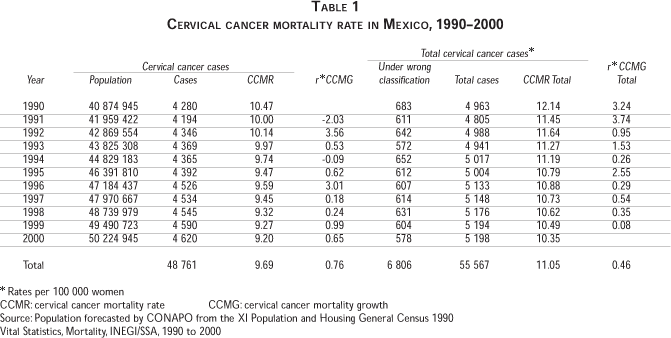
<body><![CDATA[<p><font face="Verdana" size="2">We carried out    a mortality study on cervical cancer for the period covering 1990-2000, in order    to evaluate cervical cancer mortality trends throughout the nineties and define    the status of cervical cancer mortality at the beginning of the twenty-first    century in Mexico. The dependent variable was cervical cancer mortality rates    and the independent variable was the year of observation. In order to explain    the occurrences of the event over time, a robust linear regression model was    developed, under the hypothesis that beta is different from cero. Since cervical    cancer mortality rates are closely related to increasing age, the rates were    determined by five-year age groups. </font></p>     <p><font face="Verdana" size="2"><b>Regional analysis    on cervical cancer mortality in Mexico </b></font></p>     <p><font face="Verdana" size="2">For the regional    analysis on cervical cancer mortality in Mexico, the years 1990, 1995 and 2000    were taken as the points of analysis, to determine the proportion of cervical    cancer mortality by five-year groups in urban and rural communities from the    five geographic regions and 32 states in Mexico. The Central region and the    capital (Mexico City, also considered a state) were taken as reference categories,    given that they have the highest socioeconomic development in the country, as    well as the largest concentration of health services. </font></p>     <p><font face="Verdana" size="2"><b>Construction    of the urban-rural variable </b></font></p>     <p><font face="Verdana" size="2">The urban and rural    variable was constructed based on a review of theory and taking into account    the possibility of statistical variance in the analysis of the database information.    The concept of community concentration was employed, evaluating the statistical    usefulness of the size of the population in municipalities with 2 500, 5 000,    10 000 and 15 000 inhabitants (cut-off points defined by Conapo and the Ministry    of Health). In this way, we created groups that would be heterogeneous in relation    to each other and also internally homogeneous. These differences were observed    throughout construction of cervical cancer mortality rates for 1990 to 2000,    according to the different population cut-off points. </font></p>     <p><font face="Verdana" size="2"> In this context,    we determined that the population cut-off point that best differentiates urban    and rural areas in terms of cervical cancer mortality are the municipalities    with less than 2 500 inhabitants. However, modern Mexico is a mainly urban country,    which means the indicator would be very sensitive to changes in the annual number    of cases. Therefore, for our analysis we decided to define a rural community    as having less than 15 000 inhabitants and urban as communities with 15 000    inhabitants or more. </font></p>     <p><font face="Verdana" size="2"><b>Evaluation of    risk of cervical cancer mortality by state</b> </font></p>     <p><font face="Verdana" size="2">To estimate the    risk of cervical cancer mortality in the states in Mexico, we constructed a    Poisson multiplicative model which adjusted for age and place of residence (urban-rural),    taking Mexico City's mortality rates as a reference (these rates constitute    the lowest standardized mortality at the national level). </font></p>     <p><font face="Verdana" size="2"> The Poisson<SUP>16    </SUP>probability model was used for testing a hypothesis, to evaluate the risk    of cervical cancer mortality as an unusual event in a continuous space. For    this model the dependent variable was the number of deaths due to cervical cancer,    and the group of independent variables were: the year of observation, age group,    region, state, and the urban-rural population. In order to assess the risk of    mortality from cervical cancer in the female population, according to place    of residence, the following equation was used. </font></p>     <p><font face="Verdana" size="2">Log(E(y)) = <font face="Symbol">b</font>0    + <font face="Symbol">b</font>1year + <font face="Symbol">b</font>2age + <font face="Symbol">b</font>3region    + <font face="Symbol">b</font>4state + <font face="Symbol">b</font>5urban, rural    </font></p>     ]]></body>
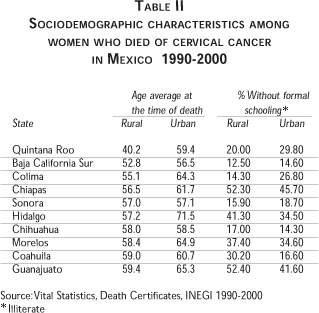
<body><![CDATA[<p><font face="Verdana" size="2"> In this way, we    carried out the analysis with a socio-demographic and health approach, which    allowed a more integrated view of cervical cancer mortality. </font></p>     <p>&nbsp;</p>     <p><font face="Verdana" size="3"><b>Results </b></font></p>     <p><font face="Verdana" size="2"><b>Cervical cancer    mortality rates in Mexico, 1990-2000 </b></font></p>     <p><font face="Verdana" size="2">For the 1990-2000    period, a total of 48 761 cervical cancer deaths were recorded nation-wide in    Mexico; the yearly rate starting out in 1990 with 4 280 deaths at the end of    the year, and reached 4 620 deaths by year 2000. This translates into an average    of 12 women dying every 24 hours from cervical cancer throughout the country,    with a 0.76% yearly average increase in cases of cervical cancer mortality.    If we take into account the mortality data that was probably misclassified as    non-specified uterine cancer, reclassifying these as cervical cancer cases,    there are 6 806 additional deaths in the study period, for a yearly average    of 620 potentially misclassified deaths (<a href="/img/revistas/spm/v45s3/3a07t01.gif">Table    I</a>). </font></p>     <p><font face="Verdana" size="2"> A trend towards    an increase in the total female population in Mexico was observed during the    study period, with a growth rate of 2.06% on average, which is higher than the    increase in deaths due to cervical cancer, at 0.76%. This reflects that deaths    due to cervical cancer did not decrease during the study period, even though    the likelihood of dying from this disease, in crude mortality rates, does show    a slight decrease. This is due to the static or constant behavior of the likelihood    of dying from cervical cancer, given the small decrease that can be observed    in rates during an 11 year study period. </font></p>     <p><font face="Verdana" size="2"><b>Sociodemographic    characteristics of women who died of cervical cancer in Mexico </b></font></p>     <p><font face="Verdana" size="2">One of the socio-demographic features studied    in order to try to explain the differences in mortality between urban and rural    populations is the number of years of formal education that the women who died    of cervical cancer had received. In this regard, 44% of women who died of cervical    cancer in rural communities during the year 2000, had no formal education (this    surpasses the national average, which is 33.7%), while 94% of the women had    an elementary school education or less. This indicates a very low formal education    level, with an average of only one year of formal education among women who    died of cervical cancer in rural areas (<a href="#tab2">Table II</a>). </font></p>     <p><a name="tab2"></a></p>     <p>&nbsp;</p>     ]]></body>
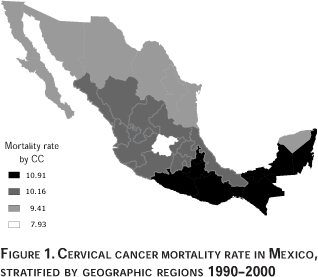
<body><![CDATA[<p align="center"><img src="/img/revistas/spm/v45s3/3a07t02.gif"></p>     <p>&nbsp;</p>     <p><font face="Verdana" size="2"> The formal education    level of the women who died of cervical cancer in urban areas was higher than    in rural areas. Among women residing in urban areas, 25% had no formal education    at all, but 94% had a junior high school education or less. Comparing women    who died of cervical cancer, those with urban residence had an average of three    more years of formal education than those who had lived in rural areas. </font></p>     <p><font face="Verdana" size="2"> The state of Oaxaca    is of special interest because it has the highest proportion of women who died    of cervical cancer who had no formal education at all (58.3%), while 91% had    no formal employment. This state had the highest percentage of women without    social security coverage (which includes access to the social security health    care system), at 65.7%. These data indicate the high level of exclusion or marginalization    in this state in terms of social development and women's quality life, characteristics    which in turn could contribute to a growing trend in cervical cancer deaths    in the future. </font></p>     <p><font face="Verdana" size="2"> During the 1990-2000    period, at the time of their death due to cervical cancer, 44% of women living    in rural areas and 38% of women with urban residency did not have social security    coverage. In relation to this, 40% of women who lived in rural areas and died    of cervical cancer between 1990-2000 had social security coverage provided by    the Mexican Institute for Social Security (IMSS), and 6% had coverage provided    by Social Security for Public Employees (ISSSTE). In comparison, 44% of women    in urban areas who died of the disease had IMSS social security coverage and    7% had ISSSTE coverage. </font></p>     <p><font face="Verdana" size="2"><b>Regional distribution    of cervical cancer mortality in Mexico </b></font></p>     <p><font face="Verdana" size="2">The crude rates    of cervical cancer mortality showed great heterogeneity in different regions    of the country. The lowest rate was found in the Central region of the country    with 8.31 deaths per 100 000 women and the highest rate in the South-eastern    region with 11.77 deaths per 100 000 women. Cervical cancer mortality rate in    the North-central region were 10.13 deaths per 100 000, quite similar to the    rate in the Southern region, which was 10.10 deaths per 100 000 women. Finally,    the Northern region was closest to the national average, with 9.41 deaths per    every 100 000 women during the 1990-2000 period (<a href="#fig1">Figure 1</a>).    </font></p>     <p><a name="fig1"></a></p>     <p>&nbsp;</p>     <p align="center"><img src="/img/revistas/spm/v45s3/3a07f01.gif"></p>     ]]></body>
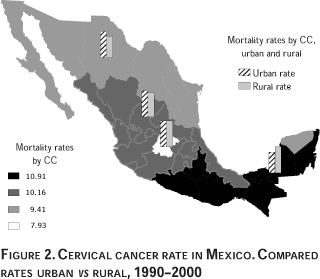
<body><![CDATA[<p>&nbsp;</p>     <p><font face="Verdana" size="2"> In Mexico, the    percentage of the population in each region living in communities with over    15 000 inhabitants is as follows: 97% of the population in the Central region    live in urban areas (thus defined), followed by 95% in the Northern region,    and 93% of the population in the Southeastern region, with the lowest rates    of urban residence in the Southern region at 79%. The states with larger amounts    of rural population are Oaxaca (22.47%), Chiapas (28,6%), Hidalgo (30.6%), Zacatecas    (33.6%), Tabasco (34.2%) and Guerrero (39%). In general, states in the Northern    region have a higher concentration of urban residency, while states in the Southern,    Southeastern, Central and Central-northern regions have a higher concentration    of rural population. </font></p>     <p><font face="Verdana" size="2"> In the Central    and Central-northern regions, the mortality rates in the urban and rural populations    were quite similar, being only slightly higher in urban areas. In the Northern    region of Mexico, the geographical area with the highest socioeconomic development    after Mexico City, the cervical cancer mortality rate was higher among women    living in urban areas (8.63) compared to rural (5.75), which can be explained    by the high concentration of population in this region. In contrast, the Southern    region, in spite of the fact that it has a medium-level population concentration,    registered a higher cervical cancer mortality rate in rural areas (15.39) than    in the urban zones (10.54), which could explain the increase in mortality rates    that is occurring in this region. </font></p>     <p><font face="Verdana" size="2"><b>Cervical cancer    mortality risk in different regions in Mexico </b></font></p>     <p><font face="Verdana" size="2">The cervical cancer    mortality rates by state in Mexico in the year 2000 are very heterogeneous,    in that they range from lower rates of 5.71 deaths per 100 000 women in the    state of Zacatecas, to very high mortality rates of 16.66 deaths per 100 000    women in the state of Nayarit. This implies a very high variability (10.95)    between these two states, which indicates the varying distribution of the risk    of dying from cervical cancer in different areas of Mexico. </font></p>     <p><font face="Verdana" size="2"> In this context,    the average cervical cancer mortality rate in Mexico was 9.20 deaths per 100    000 women in the year 2000. The rate that remained around 9.5 during the nineties,    without evidence of significant differences in mortality trends. Also, during    the study period 18 states were above the national median mortality trend and    14 states were below it. Therefore, the states with the highest cervical cancer    mortality rates for the year 2000 are: Nayarit with 16.66 deaths per 100 000    women, Morelos with 15.44, Yucat&aacute;n with 14.39, Veracruz with 11.89 and    Campeche with 11.42. These states share something in common: a high percentage    of women who died of cervical cancer who did not have any formal education,    ranging from 31.9% in Nayarit to 42.5% in Veracruz. </font></p>     <p><font face="Verdana" size="2"> Given these results,    it is surprising that Mexico City, with 8.46 deaths per 100 000 women, does    not represent the lowest rate of cervical cancer in the country, probably due    to the high concentration of health resources in this city. This could indicate    an increased registry of cervical cancer deaths, given that patients with cancer    are transferred to specialty hospitals for treatment and care, which for the    most part are located in the capital and therefore more women tend to die of    cancer in Mexico City. </font></p>     <p><font face="Verdana" size="2"> Seven states showed    an increase in cervical cancer mortality rates during 1990-2000, of which two    are located in the Southern region. These two southern states, Chiapas and Guerrero,    were also the states with the highest rate of women who died of cervical cancer    who did not have a formal education (51.7% and 50.9%, respectively), as well    as the highest rates of non-coverage with social security health care services    (59.5% and 47.7%, respectively). </font></p>     <p><font face="Verdana" size="2"> In order to evaluate    cervical cancer mortality risk at a regional level, we built a Poisson regression    model, taking the Central region as the comparison region, since it was found    to be the region where women were at the lowest risk of dying from cervical    cancer. Likewise, the 15-19 year-old age group, was taken as the comparison    age group because at this age women are at the lowest risk of dying from this    disease. The model had a good capacity for explanation of differences, with    a pseudo <I>r</I><SUP>2</SUP> of 70.44%, and showed a constant, increasing cervical    cancer mortality trend for the year 2000, starting at 20-24 year-olds with one    (OR=1.34, with a 95% confidence interval &#91;CI&#93; of 1.17-1.52) up to 75 and more    (OR=3.64, 95% CI 3.49-3.79). Also, the greatest risk from dying of cervical    cancer was among women over the age of 65 residing in rural areas (<a href="#fig2">Figure    2</a>). </font></p>     <p><a name="fig2"></a></p>     ]]></body>
<body><![CDATA[<p>&nbsp;</p>     <p align="center"><img src="/img/revistas/spm/v45s3/3a07f02.gif"></p>     <p>&nbsp;</p>     <p><font face="Verdana" size="2"> Comparison between    regions showed varying risk of death from cervical cancer in different regions,    when compared with the Central region. The region with the lowest risk is the    Northern region with a risk of 1.34, (95% CI 1.22-1.49), followed by the Central-northern    region with a risk of 1.56, (95% CI 1.45-1.69) while the regions with higher    risks were the Southern region at 2.03 (95% CI 1.82-2.25) and the South-eastern    region at 2.04 (95% CI 1.78-2.33), all compared to the Central region in the    year 2000. In this respect, we observed higher rates of cervical cancer mortality    in the states with a higher rural concentration (<a href="#fig3">Figure 3</a>).    </font></p>     <p><a name="fig3"></a></p>     <p>&nbsp;</p>     <p align="center"><img src="/img/revistas/spm/v45s3/3a07f03.gif"></p>     <p>&nbsp;</p>     <p><font face="Verdana" size="2"><b>Risk of mortality    from cervical cancer by state </b></font></p>     <p><font face="Verdana" size="2">In order to compare    cervical cancer mortality rates by state and age, we used the Poisson regression    model which took Mexico City and the 15-19 year-old age group as references.    This model showed that the states with the greatest relative risk are Morelos    with 3.22 (95% CI: 2.62-3.3), Chiapas with 3.16 (95% CI: 2.67-3.74) and Nayarit    with 3.14 (95% CI: 2.46-3.99). Also, the states of Morelos, Yucat&aacute;n and    Nayarit were the states with the highest mortality rates for both the 1980-1990    period and the 1990-2000 period. The model showed that in the 10 states with    the greatest risk of cervical cancer mortality, this risk increased over time    in relation to Mexico City. It should be noted that the difference between other    states and the country's capital is growing, since in the 1990-2000 period no    state had a mortality risk that was lower than that of Mexico City's. </font></p>     ]]></body>
<body><![CDATA[<p><font face="Verdana" size="2"><b>Risk of mortality    from cervical cancer by state, adjusted by place of residency (urban-rural)    </b></font></p>     <p><font face="Verdana" size="2">We developed the    Poisson regression model to determine the risk of dying from cervical cancer    in rural and urban areas, by state. According to this model, women who lived    in a rural area had a 3.07 times greater mortality rate than women in urban    areas, when comparing by state and age group. Comparing cervical cancer mortality    rates between states, with Mexico City as the reference, we found the highest    risk in Chiapas, where the risk was 10.99 times that of the capital city, followed    by Nayarit which was 10.5 times greater (95% CI: 4.84-23.17) and Hidalgo and    Guerrero (which had a greater risk among rural population as compared to urban    residency by groups of age) with a risk of 9.98 (95% CI: 4.99-19.92) and 9.87    (95% CI: 5.00-19.50), respectively (<a href="/img/revistas/spm/v45s3/3a07t03.gif">Table III</a>).    In states where rural residence predominated we found that mortality risks increased    considerably as compared to Mexico City, which has the lowest percentage of    rural population in the country. </font></p>     <p><font face="Verdana" size="2"> Regarding the    association between cervical cancer mortality and urban or rural residency,    preliminary observation indicates that if such an association exists, it is    not linear, as states that are prominently rural do not have the highest mortality    rates. Likewise, the lowest mortality rates are not registered in the states    with a higher percentage of urban areas, except in the state of Nuevo Le&oacute;n.    For example, the state of Zacatecas has a low percentage of urban areas and    a low cervical cancer rate (5.71), while the state of Morelos has a high mortality    rate (16.66) in spite of a moderate percentage of urbanization and being located    in the Central region. </font></p>     <p><font face="Verdana" size="2"><b>Cervical cancer    mortality trends in four geographic regions in Mexico, 1990-2000 period </b></font></p>     <p><font face="Verdana" size="2">In the Northern    and Central-northern regions of the country there is a clear decrease in cervical    cancer mortality during the study period; although the lowest mortality rates    are registered in Mexico City, this trend during the 10 year study period was    stable. Meanwhile, the Southern region maintained the highest cervical cancer    rates and showed no signs of a decrease of any kind (<a href="#fig4">Figure    4</a>). </font></p>     <p><a name="fig4"></a></p>     <p>&nbsp;</p>     <p align="center"><img src="/img/revistas/spm/v45s3/3a07f04.gif"></p>     <p>&nbsp;</p>     <p><font face="Verdana" size="2"><b>Cervical cancer    mortality trends in Mexico, 1980-2000 period </b></font></p>     ]]></body>
<body><![CDATA[<p><font face="Verdana" size="2">Based on a previous    analysis of trends in the cervical cancer mortality rate for 1980-1990 in Mexico,    and comparison with the mortality rates for 1990-2000, the results of which    are presented in detail here, we found that in the last 20 years in Mexico,    cervical cancer mortality rates were highest between 1985 and 1995. In 1989    the highest mortality rate was recorded for the period, with 16.64 deaths per    100 000 women over 15 years old.<SUP>17</SUP> Rates began to decrease that year,    and by the beginning of the twenty-first century had reached a rate almost equal    to that recorded at the beginning of the eighties, of 12.84 deaths per 100 000    women (<a href="#fig5">Figure 5</a>). </font></p>     <p><a name="fig5"></a></p>     <p>&nbsp;</p>     <p align="center"><img src="/img/revistas/spm/v45s3/3a07f05.gif"></p>     <p>&nbsp;</p>     <p><font face="Verdana" size="3"><b>Discussion</b>    </font></p>     <p><font face="Verdana" size="2">In this study,    using a multiple probabilistic model we found that in Mexico, cervical cancer    mortality risk is three times higher in rural areas, as compared to urban zones,    and women living in states where socio-economic development is lower have the    highest mortality risks, as compared with women living in Mexico City. This    indicates a huge problem in terms of unequal levels of effectiveness of the    national cervical cancer prevention program, which appears to be especially    problematic in the more marginalized areas. </font></p>     <p><font face="Verdana" size="2"><b>Cervical cancer:    A problem linked to inequality </b></font></p>     <p><font face="Verdana" size="2">A high number of    cancer deaths occur in minority ethnic groups of the United States, especially    among Afro-American women, who have a 33% higher risk of dying of cancer when    compared to white women.<SUP>18</SUP> Thus, both race and poverty have been    strongly associated to high mortality due to cancer.<SUP>19 </SUP>This association    has been attributed to poor access to medical care, not belonging to a health-care    system and receiving diagnosis or treatment when the disease is in advanced    stages.<SUP>20</SUP> In Mexico, an estimated ten million persons do not have    access to health care services, predominantly in rural areas in the southern    part of the country; in addition, poverty is more prevalent in rural areas and    in the south. </font></p>     <p><font face="Verdana" size="2"> Poverty is a complex    issue which includes elements such as unemployment and low levels of formal    education. The high rates of preventable cancer found in groups living in poverty    must be understood in the context of this complexity. Many factors determine    socio-economic status, and in turn these are associated with cervical cancer    risk. For example, both poverty and cervical cancer risk can be associated with    the huge social differences that exist between urban and rural areas in Mexico.    The highest percentage of Mexican women without education or a low level of    formal education is found in rural areas; this is an important socio-economic    difference often linked to place of residence (urban or rural). In Mexico at    the national level, nine out of ten girls from 6 to 14 years old attend school,    but in rural areas only three out of every four do. Also, 30% of women over    15 years old who live in populations of less than 2 500 inhabitants are illiterate.<SUP>21</SUP>    Low levels of formal education in women can be related to poverty and low socio-economic    level, or to gender inequality, since these low levels can be due to lack of    access to education (not enough schools or leaving school in order to work)    or to the belief that formal education is not a priority for girls and women.    </font></p>     ]]></body>
<body><![CDATA[<p><font face="Verdana" size="2"> Low levels of    formal education constitute a risk factor for cervical cancer, probably because    this impedes women's access to the information related to health promotion and    disease prevention methods, such as early detection of cervical cancer through    the Papanicolaou test and treatment when the disease is in the early stages.<SUP>22</SUP>    In relation to this, if a health need is not recognized, the impulse towards    satisfying this need is therefore non-existent, and as a result the health care    seeking process is not initiated. As a consequence, the woman in question will    not use an early detection program for cervical cancer. </font></p>     <p><font face="Verdana" size="2"><b>Women living    in rural areas in Mexico </b></font></p>     <p><font face="Verdana" size="2">In rural areas,    women's health problems are often linked to nutritional deficiencies, excessive    workload and frequent pregnancies coupled with inadequate prenatal and birth    care. Life expectancy in Mexican women at birth is over 3.5 years shorter in    states which are more rural and have less socio-economic development (Oaxaca,    Chiapas and Puebla), as compared to more urbanized northern states in Mexico    (Baja California Sur and Nuevo Leon) and Mexico City. In Mexico, the infant    mortality rate in rural areas is estimated at 46 per one thousand live births;    this is almost 60% higher than in urban areas (even worse, in the indigenous    population infant mortality reaches 56 per one thousand live births). Also,    at the beginning of the nineteen-nineties, among women living in rural areas    fertility was estimated at 4.7 children per woman (and 5.7 children in indigenous    women), which is two more children than among women living in urban areas. In    relation to this, a recent study reported that one of the main co-factors of    cervical cancer is a history of four or more live births.<SUP>23 </SUP>The average    age of sexual debut in rural areas is a year younger than the average age among    women in urban areas (14.5 years-old in rural areas vs. 15.5 years-old in urban    areas); this is a risk factor for infection of human papilloma virus, which    causes cervical cancer.<SUP>24</SUP> </font></p>     <p><font face="Verdana" size="2"><b>Use of preventive    programs in marginalized areas </b></font></p>     <p><font face="Verdana" size="2">Some studies have    found an association between socio-economic level and the number of Papanicolaou    tests (Pap smears, for cervical cancer detection), and have argued that this    could explain certain variations in cervical cancer mortality risk among different    populations. Previous reports have shown that participation in efficient detection    programs is crucial to secondary prevention of cervical cancer, regardless of    the frequency with which screening tests (Pap smears) are performed. If each    participating woman has a lifetime history of 2-4 Papanicolaou tests, a detection    program that provides at least one test every 10 years (but with total population    coverage) can reduce cervical cancer incidence by between 40% and 60%.<SUP>25</SUP>    </font></p>     <p><font face="Verdana" size="2"> In Mexico, a previous    population-based study comparing two areas, one urban and one rural, indicated    there is low coverage of the early detection program for cervical cancer in    marginalized areas. This study also showed that 40% of women at risk in the    rural area had not had even one Papanicolaou test, while over 75% of women living    in Mexico City had received one or more Pap tests.<SUP>26</SUP> These results    can also be observed in developed countries; for example, in France a study    found low coverage of the early detection program for cervical cancer among    women of low socio-economic level, lower levels of formal education, lower incomes,    and with deficient use of health services.<SUP>27</SUP> </font></p>     <p><font face="Verdana" size="2"><b>Low-cost alternatives    for early detection of cervical cancer </b></font></p>     <p><font face="Verdana" size="2">Visual inspection    is a low-cost technique for cervical cancer detection that has been thoroughly    studied in countries with limited infrastructure for the development of an organized    early detection program for cervical cancer. This strategy has been shown to    have low sensitivity and specificity to detect pre-cancerous lesions of the    uterine cervix. However, at present several initiatives are being undertaken    in regard to this low-cost cervical cancer detection technique. For example,    a transversal study is underway to evaluate the usefulness of visual inspection;    preliminary results suggest a similar sensitivity to conventional strategies    (Papanicolaou), but with a lower specificity.<SUP>28</SUP> Given this finding,    in regions in Mexico lacking the physical infrastructure or human resources    necessary to establish an organized program, as is the case in many rural areas,    the possible use of this detection strategy should be analyzed. </font></p>     <p><font face="Verdana" size="2"><b>High-cost alternatives    for detection of pre-cancerous cervical lesions </b></font></p>     <p><font face="Verdana" size="2">Human papilloma    virus (HPV) detection could potentially be used as a test for early detection    of cervical cancer, as a secondary measure for cancer prevention.<SUP>29</SUP>    Nevertheless, in many cases detection of the virus would occur when cancer was    not yet present or was in very early stages; therefore, HPV detection would    only be beneficial if used to prevent cervical cancer through early detection    of asymptomatic precursor lesions. Many of HPV tests use a system that amplifies    many genotypes and are based on a series of specific tests. At present, there    are three systems available, including MY09/11, GP5+/6+, and hybrid capture    type II. These three methods have high sensitivity and specificity for detection    of oncogenic viruses and could potentially be automatized. Current technological    developments have improved specificity without substantially reducing sensitivity.    This could have important public health ramifications, because it has been shown    that detection of HPV DNA in the absence of cytological abnormalities can indicate    the presence of high grade cervical intraepithelial neoplasms (CIN), which can    be overlooked (i.e., go diagnosed) when using cytology.<SUP>30</SUP> The relevant    studies suggest that adding an HPV test, in addition to the Papanicolaou, within    a program aimed at screening for cervical cancer could increase the identification    of pre-cancerous lesions of the cervix by between 50 and 100%. Also, the existence    of a self-collected vaginal specimen (the sample is collected by the woman herself,    using a swab) for HPV testing means it would be possible to screen women who    do not or cannot use health services provided in traditional (clinic or hospital-based)    settings, as well as possibly being more acceptable to women, and therefore    this option should be evaluated in rural areas (as well as other marginalized    populations, especially those living in poverty).<SUP>31</SUP> Future studies    and prediction models are necessary to evaluate the usefulness and the cost-effectiveness    of HPV test as a screening strategy and how it could be used in conjunction    with other diagnosis methodologies. </font></p>     ]]></body>
<body><![CDATA[<p>&nbsp;</p>     <p><font face="Verdana" size="3"><b>Conclusions    </b></font></p>     <p><font face="Verdana" size="2">In conclusion,    cervical cancer is a disease that is closely related to poverty and a health    issue with links to gender inequality. It is also a health problem which involves    regional inequalities in terms of differences in economic and social development    and variability of health care infrastructure and human resources who provide    primary care services. Therefore, early detection programs for cervical cancer    should increasingly target both rural areas and marginalized urban sectors,    given that this disease is, unfortunately, linked to poverty. If early detection    efforts are efficient and effective in these areas, a large proportion of the    health, social and economic impact of cervical cancer can be eliminated. </font></p>     <p>&nbsp;</p>     <p><font face="Verdana" size="3"><b>References</b></font></p>     <!-- ref --><p><font face="Verdana" size="2">1. Sloggett A,    Joshi H. Higher mortality in deprived areas: Community or personal disadvantage?    BMJ 1994;309:1470-1474. </font>&nbsp;&nbsp;&nbsp;&nbsp;&nbsp;&nbsp;&nbsp;&nbsp;[&#160;<a href="javascript:void(0);" onclick="javascript: window.open('/scielo.php?script=sci_nlinks&ref=9181896&pid=S0036-3634200300090000500001&lng=','','width=640,height=500,resizable=yes,scrollbars=1,menubar=yes,');">Links</a>&#160;]<!-- end-ref --><!-- ref --><p><font face="Verdana" size="2">2. Soe MN. Screening    for cervical cancer in developing countries. BMJ 1992;304:534-535. </font>&nbsp;&nbsp;&nbsp;&nbsp;&nbsp;&nbsp;&nbsp;&nbsp;[&#160;<a href="javascript:void(0);" onclick="javascript: window.open('/scielo.php?script=sci_nlinks&ref=9181897&pid=S0036-3634200300090000500002&lng=','','width=640,height=500,resizable=yes,scrollbars=1,menubar=yes,');">Links</a>&#160;]<!-- end-ref --><!-- ref --><p><font face="Verdana" size="2">3. Parkin M, Pisani    P, Ferlay J. Estimates of the worldwide incidence of 25 major cancers in 1990.    Int J Cancer 1999; 80:827-841. </font>&nbsp;&nbsp;&nbsp;&nbsp;&nbsp;&nbsp;&nbsp;&nbsp;[&#160;<a href="javascript:void(0);" onclick="javascript: window.open('/scielo.php?script=sci_nlinks&ref=9181898&pid=S0036-3634200300090000500003&lng=','','width=640,height=500,resizable=yes,scrollbars=1,menubar=yes,');">Links</a>&#160;]<!-- end-ref --><!-- ref --><p><font face="Verdana" size="2">4. Shavers VL,    Brown M. Racial and ethnic disparities in the receipt of cancer treatment. J    Natl Cancer Inst 2002;94(5):334-357. </font>&nbsp;&nbsp;&nbsp;&nbsp;&nbsp;&nbsp;&nbsp;&nbsp;[&#160;<a href="javascript:void(0);" onclick="javascript: window.open('/scielo.php?script=sci_nlinks&ref=9181899&pid=S0036-3634200300090000500004&lng=','','width=640,height=500,resizable=yes,scrollbars=1,menubar=yes,');">Links</a>&#160;]<!-- end-ref --><!-- ref --><p><font face="Verdana" size="2">5. Drain P, Colmes    K, Highes J, Koutsky L. Determinants of cervical cancer rates in developing    countries. Int J Cancer 2002;100:199-205. </font>&nbsp;&nbsp;&nbsp;&nbsp;&nbsp;&nbsp;&nbsp;&nbsp;[&#160;<a href="javascript:void(0);" onclick="javascript: window.open('/scielo.php?script=sci_nlinks&ref=9181900&pid=S0036-3634200300090000500005&lng=','','width=640,height=500,resizable=yes,scrollbars=1,menubar=yes,');">Links</a>&#160;]<!-- end-ref --><!-- ref --><p><font face="Verdana" size="2">6. Mu&ntilde;oz    N, Franceschi S, Bosetti C, Moreno V, Herrero R, Smith J <I>et al</I>. Role    of parity and human papillomavirus in cervical cancer: The IARC multicentric    case-control study. Lancet 2002;359:1093-1101. </font>&nbsp;&nbsp;&nbsp;&nbsp;&nbsp;&nbsp;&nbsp;&nbsp;[&#160;<a href="javascript:void(0);" onclick="javascript: window.open('/scielo.php?script=sci_nlinks&ref=9181901&pid=S0036-3634200300090000500006&lng=','','width=640,height=500,resizable=yes,scrollbars=1,menubar=yes,');">Links</a>&#160;]<!-- end-ref --><!-- ref --><p><font face="Verdana" size="2">7. Bosch X, Mu&ntilde;oz    N, De Sanjose S, Guerrero E, Chaffari AM, Kaldor J <I>et al</I>. Importance    of human papillomavirus endemicity in the incident of cervical cancer: An extension    of the hypothesis on sexual behavior. Cancer Epidemiol Biomarkers Prev 1994;3:375-379.    </font>&nbsp;&nbsp;&nbsp;&nbsp;&nbsp;&nbsp;&nbsp;&nbsp;[&#160;<a href="javascript:void(0);" onclick="javascript: window.open('/scielo.php?script=sci_nlinks&ref=9181902&pid=S0036-3634200300090000500007&lng=','','width=640,height=500,resizable=yes,scrollbars=1,menubar=yes,');">Links</a>&#160;]<!-- end-ref --><!-- ref --><p><font face="Verdana" size="2">8. Lazcano-Ponce    E, Herrero R, Mu&ntilde;oz N, Hern&aacute;ndez-Avila M, Salmer&oacute;n J, Leyva    A <I>et al</I>. High prevalence of human papillomavirus infection in Mexican    males. Comparative study of penile-urethral swabs and urine samples. Sex Transm    Dis 2001;28(5):277-280. </font>&nbsp;&nbsp;&nbsp;&nbsp;&nbsp;&nbsp;&nbsp;&nbsp;[&#160;<a href="javascript:void(0);" onclick="javascript: window.open('/scielo.php?script=sci_nlinks&ref=9181903&pid=S0036-3634200300090000500008&lng=','','width=640,height=500,resizable=yes,scrollbars=1,menubar=yes,');">Links</a>&#160;]<!-- end-ref --><!-- ref --><p><font face="Verdana" size="2">9. Berumen J, Ord&oacute;&ntilde;ez    RM, Lazcano-Ponce E, Salmer&oacute;n J, Galv&aacute;n SC, Estrada RA <I>et al</I>.    Asian American variants of human papillomavirus 16 and risk for cervical cancer:    a case-control study. J Natl Cancer Inst 2001;93:1325-1330. </font>&nbsp;&nbsp;&nbsp;&nbsp;&nbsp;&nbsp;&nbsp;&nbsp;[&#160;<a href="javascript:void(0);" onclick="javascript: window.open('/scielo.php?script=sci_nlinks&ref=9181904&pid=S0036-3634200300090000500009&lng=','','width=640,height=500,resizable=yes,scrollbars=1,menubar=yes,');">Links</a>&#160;]<!-- end-ref --><!-- ref --><p><font face="Verdana" size="2">10. Lazcano-Ponce    E, N&aacute;jera P, Buiatti E, Alonso P, Kuri P, Cantoral L <I>et al</I>. The    cervical cancer screening program in Mexico. Problems with access and coverage.    Cancer Causes Control 1997;8:698-704. </font>&nbsp;&nbsp;&nbsp;&nbsp;&nbsp;&nbsp;&nbsp;&nbsp;[&#160;<a href="javascript:void(0);" onclick="javascript: window.open('/scielo.php?script=sci_nlinks&ref=9181905&pid=S0036-3634200300090000500010&lng=','','width=640,height=500,resizable=yes,scrollbars=1,menubar=yes,');">Links</a>&#160;]<!-- end-ref --><!-- ref --><p><font face="Verdana" size="2">11. Lazcano-Ponce    E, Buiatti E, N&aacute;jera P, Alonso P, Hern&aacute;ndez M. Quality evaluation    of Mexican National Program for Early Cervical Cancer Detection and proposals    for a new approach. Cancer Causes Control 1998;9;241-251. </font>&nbsp;&nbsp;&nbsp;&nbsp;&nbsp;&nbsp;&nbsp;&nbsp;[&#160;<a href="javascript:void(0);" onclick="javascript: window.open('/scielo.php?script=sci_nlinks&ref=9181906&pid=S0036-3634200300090000500011&lng=','','width=640,height=500,resizable=yes,scrollbars=1,menubar=yes,');">Links</a>&#160;]<!-- end-ref --><!-- ref --><p><font face="Verdana" size="2">12. Lazcano-Ponce    EC, Moss S, Cruz-Valdez A, Alonso-de Ruiz P, C&aacute;seres Queralt S, Mart&iacute;nez-Le&oacute;n    CJ <I>et al</I>. Factores que determinan la participaci&oacute;n en el tamizaje    de c&aacute;ncer cervical en el estado de Morelos. Salud Publica Mex 1999;41(4):278-285.    </font>&nbsp;&nbsp;&nbsp;&nbsp;&nbsp;&nbsp;&nbsp;&nbsp;[&#160;<a href="javascript:void(0);" onclick="javascript: window.open('/scielo.php?script=sci_nlinks&ref=9181907&pid=S0036-3634200300090000500012&lng=','','width=640,height=500,resizable=yes,scrollbars=1,menubar=yes,');">Links</a>&#160;]<!-- end-ref --><!-- ref --><p><font face="Verdana" size="2">13. Schneider E.    Measuring mortality outcomes to improve health care. Rational use of ratings    and rankings. Med Care 2002;40(1):1-3. </font>&nbsp;&nbsp;&nbsp;&nbsp;&nbsp;&nbsp;&nbsp;&nbsp;[&#160;<a href="javascript:void(0);" onclick="javascript: window.open('/scielo.php?script=sci_nlinks&ref=9181908&pid=S0036-3634200300090000500013&lng=','','width=640,height=500,resizable=yes,scrollbars=1,menubar=yes,');">Links</a>&#160;]<!-- end-ref --><!-- ref --><p><font face="Verdana" size="2">14. Susser M. The    logic in ecological: II. The logic of design. Am J Public Health 1994;84:830-835.    </font>&nbsp;&nbsp;&nbsp;&nbsp;&nbsp;&nbsp;&nbsp;&nbsp;[&#160;<a href="javascript:void(0);" onclick="javascript: window.open('/scielo.php?script=sci_nlinks&ref=9181909&pid=S0036-3634200300090000500014&lng=','','width=640,height=500,resizable=yes,scrollbars=1,menubar=yes,');">Links</a>&#160;]<!-- end-ref --><!-- ref --><p><font face="Verdana" size="2">15. Organizaci&oacute;n    Panamericana de la Salud. Clasificaci&oacute;n Internacional de Enfermedades.    Manual de clasificaci&oacute;n y estad&iacute;stica internacional de enfermedades,    traumatismos y causas de defunci&oacute;n. Revisi&oacute;n 1975. Washington,    DC: OPS, Volumen I, publicaci&oacute;n cient&iacute;fica No. 353. </font>&nbsp;&nbsp;&nbsp;&nbsp;&nbsp;&nbsp;&nbsp;&nbsp;[&#160;<a href="javascript:void(0);" onclick="javascript: window.open('/scielo.php?script=sci_nlinks&ref=9181910&pid=S0036-3634200300090000500015&lng=','','width=640,height=500,resizable=yes,scrollbars=1,menubar=yes,');">Links</a>&#160;]<!-- end-ref --><!-- ref --><p><font face="Verdana" size="2">16. Frome EL, Checkoway    H. Use of Poisson regression models in estimating incidence rates and ratios.    Am J Epidemiol 1985;121:309. </font>&nbsp;&nbsp;&nbsp;&nbsp;&nbsp;&nbsp;&nbsp;&nbsp;[&#160;<a href="javascript:void(0);" onclick="javascript: window.open('/scielo.php?script=sci_nlinks&ref=9181911&pid=S0036-3634200300090000500016&lng=','','width=640,height=500,resizable=yes,scrollbars=1,menubar=yes,');">Links</a>&#160;]<!-- end-ref --><!-- ref --><p><font face="Verdana" size="2">17. Lazcano-Ponce    E, Rasc&oacute;n-Pacheco R, Lozano-Ascencio R, Velasco E. Mortality from carcinoma    of the uterine cervix in Mexico: Impact of screening 1980-1990. Acta Cytol 1996;40(3):506-512.    </font>&nbsp;&nbsp;&nbsp;&nbsp;&nbsp;&nbsp;&nbsp;&nbsp;[&#160;<a href="javascript:void(0);" onclick="javascript: window.open('/scielo.php?script=sci_nlinks&ref=9181912&pid=S0036-3634200300090000500017&lng=','','width=640,height=500,resizable=yes,scrollbars=1,menubar=yes,');">Links</a>&#160;]<!-- end-ref --><!-- ref --><p><font face="Verdana" size="2">18. Ries LA, Eisner    MP, Kosary CL, Hankey BF, Millar BA, Clegg L <I>et al</I>. Ed. SEER cancer statistics    review, 1973-1998. Bethesda (MD): National Cancer Institute, 2001. </font>&nbsp;&nbsp;&nbsp;&nbsp;&nbsp;&nbsp;&nbsp;&nbsp;[&#160;<a href="javascript:void(0);" onclick="javascript: window.open('/scielo.php?script=sci_nlinks&ref=9181913&pid=S0036-3634200300090000500018&lng=','','width=640,height=500,resizable=yes,scrollbars=1,menubar=yes,');">Links</a>&#160;]<!-- end-ref --><!-- ref --><p><font face="Verdana" size="2">19. Freeman H.    Race, poverty and cancer. J Natl Cancer Inst 1991;83:526-527. </font>&nbsp;&nbsp;&nbsp;&nbsp;&nbsp;&nbsp;&nbsp;&nbsp;[&#160;<a href="javascript:void(0);" onclick="javascript: window.open('/scielo.php?script=sci_nlinks&ref=9181914&pid=S0036-3634200300090000500019&lng=','','width=640,height=500,resizable=yes,scrollbars=1,menubar=yes,');">Links</a>&#160;]<!-- end-ref --><!-- ref --><p><font face="Verdana" size="2">20. Coughlin S,    Thompson T, Seeff L, Richards T, Stallings F. Breast, cervical, and colorectal    carcinoma screening in a demographically defined region of the Southern U.S.    Cancer 2002;95(10):2211-2222. </font>&nbsp;&nbsp;&nbsp;&nbsp;&nbsp;&nbsp;&nbsp;&nbsp;[&#160;<a href="javascript:void(0);" onclick="javascript: window.open('/scielo.php?script=sci_nlinks&ref=9181915&pid=S0036-3634200300090000500020&lng=','','width=640,height=500,resizable=yes,scrollbars=1,menubar=yes,');">Links</a>&#160;]<!-- end-ref --><!-- ref --><p><font face="Verdana" size="2">21. Estados Unidos    Mexicanos, Programa Nacional de la Mujer 1995-2000. Alianza    para la Igualdad. M&eacute;xico, DF: Poder Ejecutivo Federal, 1-109. </font>&nbsp;&nbsp;&nbsp;&nbsp;&nbsp;&nbsp;&nbsp;&nbsp;[&#160;<a href="javascript:void(0);" onclick="javascript: window.open('/scielo.php?script=sci_nlinks&ref=9181916&pid=S0036-3634200300090000500021&lng=','','width=640,height=500,resizable=yes,scrollbars=1,menubar=yes,');">Links</a>&#160;]<!-- end-ref --><!-- ref --><p><font face="Verdana" size="2">22. Lazcano-Ponce    EC, Castro R, Allen B, N&aacute;jera P, Alonso-de Ruiz P, Hern&aacute;ndez-Avila    M. Barriers to early detection of cervical uterine cancer in Mexico. J Women's    Health 1999;8(3):399-408. </font>&nbsp;&nbsp;&nbsp;&nbsp;&nbsp;&nbsp;&nbsp;&nbsp;[&#160;<a href="javascript:void(0);" onclick="javascript: window.open('/scielo.php?script=sci_nlinks&ref=9181917&pid=S0036-3634200300090000500022&lng=','','width=640,height=500,resizable=yes,scrollbars=1,menubar=yes,');">Links</a>&#160;]<!-- end-ref --><!-- ref --><p><font face="Verdana" size="2">23. Hildesheim    A, Herrero R, Castle PE, Wacholder S, Bratti MC, Sherman ME <I>et al</I>. HPV    Co-factors related to the development of cervical cancer: Results from a population-based    study in Costa Rica. Br J Cancer 2001 May 4;84(9):1219-1226. </font>&nbsp;&nbsp;&nbsp;&nbsp;&nbsp;&nbsp;&nbsp;&nbsp;[&#160;<a href="javascript:void(0);" onclick="javascript: window.open('/scielo.php?script=sci_nlinks&ref=9181918&pid=S0036-3634200300090000500023&lng=','','width=640,height=500,resizable=yes,scrollbars=1,menubar=yes,');">Links</a>&#160;]<!-- end-ref --><!-- ref --><p><font face="Verdana" size="2">24. Kjellberg L,    Hallmans G, Ahren AM, Johansson R, Bergman F, Wadell G <I>et al</I>. Smoking,    diet, pregnancy and oral contraceptive use as risk factors for cervical intra-epithelial    neoplasia in relation to human papillomavirus infection. Br J Cancer 2000;82:1332-1338.    </font>&nbsp;&nbsp;&nbsp;&nbsp;&nbsp;&nbsp;&nbsp;&nbsp;[&#160;<a href="javascript:void(0);" onclick="javascript: window.open('/scielo.php?script=sci_nlinks&ref=9181919&pid=S0036-3634200300090000500024&lng=','','width=640,height=500,resizable=yes,scrollbars=1,menubar=yes,');">Links</a>&#160;]<!-- end-ref --><!-- ref --><p><font face="Verdana" size="2">25. Signan N. Socioeconomic    status and cancer screening. In: Kogevinas M, Pearce N, Susser M, Boffetta P,    eds. Social Inequalities in Cancer. Lyon: International Agency for Research    on Cancer 1997:369-376. </font>&nbsp;&nbsp;&nbsp;&nbsp;&nbsp;&nbsp;&nbsp;&nbsp;[&#160;<a href="javascript:void(0);" onclick="javascript: window.open('/scielo.php?script=sci_nlinks&ref=9181920&pid=S0036-3634200300090000500025&lng=','','width=640,height=500,resizable=yes,scrollbars=1,menubar=yes,');">Links</a>&#160;]<!-- end-ref --><!-- ref --><p><font face="Verdana" size="2">26. Lazcano-Ponce    EC, Moss S, Alonso-de Ruiz P, Salmer&oacute;n-Castro J, Hern&aacute;ndez-Avila    M. Cervical cancer screening in developing countries: Why is it ineffective?    The case of Mexico. Arch Med Res 1999;30(3): 240-250. </font>&nbsp;&nbsp;&nbsp;&nbsp;&nbsp;&nbsp;&nbsp;&nbsp;[&#160;<a href="javascript:void(0);" onclick="javascript: window.open('/scielo.php?script=sci_nlinks&ref=9181921&pid=S0036-3634200300090000500026&lng=','','width=640,height=500,resizable=yes,scrollbars=1,menubar=yes,');">Links</a>&#160;]<!-- end-ref --><!-- ref --><p><font face="Verdana" size="2">27. Challier B,    Meslans Y, Viel JF. Deprived areas and attendance to screening of cervix uteri    cancer in a French region. Cancer Causes Control 2000;11:157-162. </font>&nbsp;&nbsp;&nbsp;&nbsp;&nbsp;&nbsp;&nbsp;&nbsp;[&#160;<a href="javascript:void(0);" onclick="javascript: window.open('/scielo.php?script=sci_nlinks&ref=9181922&pid=S0036-3634200300090000500027&lng=','','width=640,height=500,resizable=yes,scrollbars=1,menubar=yes,');">Links</a>&#160;]<!-- end-ref --><!-- ref --><p><font face="Verdana" size="2">28. Sankaranarayanan    R, Wesley R, Somanathan T, Dhakad N, Shyamala-Kumary B, Amman S <I>et al</I>.    Visual inspection of uterine cervix after the application of acetic acid in    the detection of cervical carcinoma and its precursors. Cancer 1998 nov 15;    83(10):2150-2156. </font>&nbsp;&nbsp;&nbsp;&nbsp;&nbsp;&nbsp;&nbsp;&nbsp;[&#160;<a href="javascript:void(0);" onclick="javascript: window.open('/scielo.php?script=sci_nlinks&ref=9181923&pid=S0036-3634200300090000500028&lng=','','width=640,height=500,resizable=yes,scrollbars=1,menubar=yes,');">Links</a>&#160;]<!-- end-ref --><!-- ref --><p><font face="Verdana" size="2">29. Cuzick J, Sasieni    P, Davies P, Adams J, Normand C, Frater A <I>et al</I>. A systematic review    of the role of human papillomavirus testing within a cervical screening programme.    Health Technol Assess 1999;3(14):1-204. </font>&nbsp;&nbsp;&nbsp;&nbsp;&nbsp;&nbsp;&nbsp;&nbsp;[&#160;<a href="javascript:void(0);" onclick="javascript: window.open('/scielo.php?script=sci_nlinks&ref=9181924&pid=S0036-3634200300090000500029&lng=','','width=640,height=500,resizable=yes,scrollbars=1,menubar=yes,');">Links</a>&#160;]<!-- end-ref --><!-- ref --><p><font face="Verdana" size="2">30. Cuzick J, Beverley    E, Ho L, Terry G, Sapper H, Mielzynska I <I>et al</I>. HPV testing in primary    screening of older women. Br J Cancer 1999;81(3):554-558. </font>&nbsp;&nbsp;&nbsp;&nbsp;&nbsp;&nbsp;&nbsp;&nbsp;[&#160;<a href="javascript:void(0);" onclick="javascript: window.open('/scielo.php?script=sci_nlinks&ref=9181925&pid=S0036-3634200300090000500030&lng=','','width=640,height=500,resizable=yes,scrollbars=1,menubar=yes,');">Links</a>&#160;]<!-- end-ref --><!-- ref --><p><font face="Verdana" size="2">31. Dzuba IG, Yunes-D&iacute;az    E, Allen B, Flores-Leonard Y, Lazcano-Ponce EC, Shah K <I>et al</I>. The acceptability    of self-collected samples for HPV testing <I>vs.</I> the Pap test as alternatives    in cervical cancer screening. J Womens Health Gen Based Med 2002;11(3):265-275.    </font>&nbsp;&nbsp;&nbsp;&nbsp;&nbsp;&nbsp;&nbsp;&nbsp;[&#160;<a href="javascript:void(0);" onclick="javascript: window.open('/scielo.php?script=sci_nlinks&ref=9181926&pid=S0036-3634200300090000500031&lng=','','width=640,height=500,resizable=yes,scrollbars=1,menubar=yes,');">Links</a>&#160;]<!-- end-ref --><p>&nbsp;</p>     <p>&nbsp;</p>     <p><font face="Verdana" size="2"><b>Address reprint    requests to:</b>    <br>   Dr. Eduardo C&eacute;sar Lazcano Ponce. Director de Enfermedades Cr&oacute;nicas    ]]></body>
<body><![CDATA[<br>   Centro de Investigaci&oacute;n en Salud Poblacional. </font><font face="Verdana" size="2">Instituto    Nacional de Salud P&uacute;blica    <br>   Avenida Universidad 655, colonia Santa Mar&iacute;a Ahuacatitl&aacute;n     <br>   62508 Cuernavaca, Morelos, M&eacute;xico    <br>   E-mail: <a href="mailto:elazcano@correo.insp.mx">elazcano@correo.insp.mx</a>    </font></p>     <p><font face="Verdana" size="2"><b>Received on:</b>    January 9, 2003<b>    <br>   Accepted on:</b> July 29, 2003 </font></p>     <p>&nbsp;</p>     <p>&nbsp;</p>     <p><font face="Verdana" size="2"><b>Acknowledgements:    </b>This article is based on the Master's thesis written by Lina Sof&iacute;a    Palacio Mej&iacute;a, presented for her master's degree in demography at the    Colegio de la Frontera Norte. The research was developed with the support of    the Instituto Nacional de Salud P&uacute;blica and El Colegio de la Frontera    Norte, as well as with funding from the Consorcio Transfronterizo en Salud (Cross-border    Health Consortium). </font></p>      ]]></body><back>
<ref-list>
<ref id="B1">
<label>1</label><nlm-citation citation-type="journal">
<person-group person-group-type="author">
<name>
<surname><![CDATA[Sloggett]]></surname>
<given-names><![CDATA[A]]></given-names>
</name>
<name>
<surname><![CDATA[Joshi]]></surname>
<given-names><![CDATA[H]]></given-names>
</name>
</person-group>
<article-title xml:lang="en"><![CDATA[Higher mortality in deprived areas: Community or personal disadvantage?]]></article-title>
<source><![CDATA[BMJ]]></source>
<year>1994</year>
<volume>309</volume>
<page-range>1470-1474</page-range></nlm-citation>
</ref>
<ref id="B2">
<label>2</label><nlm-citation citation-type="journal">
<person-group person-group-type="author">
<name>
<surname><![CDATA[Soe]]></surname>
<given-names><![CDATA[MN]]></given-names>
</name>
</person-group>
<article-title xml:lang="en"><![CDATA[Screening for cervical cancer in developing countries]]></article-title>
<source><![CDATA[BMJ]]></source>
<year>1992</year>
<volume>304</volume>
<page-range>534-535</page-range></nlm-citation>
</ref>
<ref id="B3">
<label>3</label><nlm-citation citation-type="journal">
<person-group person-group-type="author">
<name>
<surname><![CDATA[Parkin]]></surname>
<given-names><![CDATA[M]]></given-names>
</name>
<name>
<surname><![CDATA[Pisani]]></surname>
<given-names><![CDATA[P]]></given-names>
</name>
<name>
<surname><![CDATA[Ferlay]]></surname>
<given-names><![CDATA[J]]></given-names>
</name>
</person-group>
<article-title xml:lang="en"><![CDATA[Estimates of the worldwide incidence of 25 major cancers in 1990]]></article-title>
<source><![CDATA[Int J Cancer]]></source>
<year>1999</year>
<volume>80</volume>
<page-range>827-841</page-range></nlm-citation>
</ref>
<ref id="B4">
<label>4</label><nlm-citation citation-type="journal">
<person-group person-group-type="author">
<name>
<surname><![CDATA[Shavers]]></surname>
<given-names><![CDATA[VL]]></given-names>
</name>
<name>
<surname><![CDATA[Brown]]></surname>
<given-names><![CDATA[M]]></given-names>
</name>
</person-group>
<article-title xml:lang="en"><![CDATA[Racial and ethnic disparities in the receipt of cancer treatment]]></article-title>
<source><![CDATA[J Natl Cancer Inst]]></source>
<year>2002</year>
<volume>94</volume>
<numero>5</numero>
<issue>5</issue>
<page-range>334-357</page-range></nlm-citation>
</ref>
<ref id="B5">
<label>5</label><nlm-citation citation-type="journal">
<person-group person-group-type="author">
<name>
<surname><![CDATA[Drain]]></surname>
<given-names><![CDATA[P]]></given-names>
</name>
<name>
<surname><![CDATA[Colmes]]></surname>
<given-names><![CDATA[K]]></given-names>
</name>
<name>
<surname><![CDATA[Highes]]></surname>
<given-names><![CDATA[J]]></given-names>
</name>
<name>
<surname><![CDATA[Koutsky]]></surname>
<given-names><![CDATA[L]]></given-names>
</name>
</person-group>
<article-title xml:lang="en"><![CDATA[Determinants of cervical cancer rates in developing countries]]></article-title>
<source><![CDATA[Int J Cancer]]></source>
<year>2002</year>
<volume>100</volume>
<page-range>199-205</page-range></nlm-citation>
</ref>
<ref id="B6">
<label>6</label><nlm-citation citation-type="journal">
<person-group person-group-type="author">
<name>
<surname><![CDATA[Muñoz]]></surname>
<given-names><![CDATA[N]]></given-names>
</name>
<name>
<surname><![CDATA[Franceschi]]></surname>
<given-names><![CDATA[S]]></given-names>
</name>
<name>
<surname><![CDATA[Bosetti]]></surname>
<given-names><![CDATA[C]]></given-names>
</name>
<name>
<surname><![CDATA[Moreno]]></surname>
<given-names><![CDATA[V]]></given-names>
</name>
<name>
<surname><![CDATA[Herrero]]></surname>
<given-names><![CDATA[R]]></given-names>
</name>
<name>
<surname><![CDATA[Smith]]></surname>
<given-names><![CDATA[J]]></given-names>
</name>
</person-group>
<article-title xml:lang="en"><![CDATA[Role of parity and human papillomavirus in cervical cancer: The IARC multicentric case-control study]]></article-title>
<source><![CDATA[Lancet]]></source>
<year>2002</year>
<volume>359</volume>
<page-range>1093-1101</page-range></nlm-citation>
</ref>
<ref id="B7">
<label>7</label><nlm-citation citation-type="journal">
<person-group person-group-type="author">
<name>
<surname><![CDATA[Bosch]]></surname>
<given-names><![CDATA[X]]></given-names>
</name>
<name>
<surname><![CDATA[Muñoz]]></surname>
<given-names><![CDATA[N]]></given-names>
</name>
<name>
<surname><![CDATA[De Sanjose]]></surname>
<given-names><![CDATA[S]]></given-names>
</name>
<name>
<surname><![CDATA[Guerrero]]></surname>
<given-names><![CDATA[E]]></given-names>
</name>
<name>
<surname><![CDATA[Chaffari]]></surname>
<given-names><![CDATA[AM]]></given-names>
</name>
<name>
<surname><![CDATA[Kaldor]]></surname>
<given-names><![CDATA[J]]></given-names>
</name>
</person-group>
<article-title xml:lang="en"><![CDATA[Importance of human papillomavirus endemicity in the incident of cervical cancer: An extension of the hypothesis on sexual behavior]]></article-title>
<source><![CDATA[Cancer Epidemiol Biomarkers Prev]]></source>
<year>1994</year>
<volume>3</volume>
<page-range>375-379</page-range></nlm-citation>
</ref>
<ref id="B8">
<label>8</label><nlm-citation citation-type="journal">
<person-group person-group-type="author">
<name>
<surname><![CDATA[Lazcano-Ponce]]></surname>
<given-names><![CDATA[E]]></given-names>
</name>
<name>
<surname><![CDATA[Herrero]]></surname>
<given-names><![CDATA[R]]></given-names>
</name>
<name>
<surname><![CDATA[Muñoz]]></surname>
<given-names><![CDATA[N]]></given-names>
</name>
<name>
<surname><![CDATA[Hernández-Avila]]></surname>
<given-names><![CDATA[M]]></given-names>
</name>
<name>
<surname><![CDATA[Salmerón]]></surname>
<given-names><![CDATA[J]]></given-names>
</name>
<name>
<surname><![CDATA[Leyva]]></surname>
<given-names><![CDATA[A]]></given-names>
</name>
</person-group>
<article-title xml:lang="en"><![CDATA[High prevalence of human papillomavirus infection in Mexican males: Comparative study of penile-urethral swabs and urine samples]]></article-title>
<source><![CDATA[Sex Transm Dis]]></source>
<year>2001</year>
<volume>28</volume>
<numero>5</numero>
<issue>5</issue>
<page-range>277-280</page-range></nlm-citation>
</ref>
<ref id="B9">
<label>9</label><nlm-citation citation-type="journal">
<person-group person-group-type="author">
<name>
<surname><![CDATA[Berumen]]></surname>
<given-names><![CDATA[J]]></given-names>
</name>
<name>
<surname><![CDATA[Ordóñez]]></surname>
<given-names><![CDATA[RM]]></given-names>
</name>
<name>
<surname><![CDATA[Lazcano-Ponce]]></surname>
<given-names><![CDATA[E]]></given-names>
</name>
<name>
<surname><![CDATA[Salmerón]]></surname>
<given-names><![CDATA[J]]></given-names>
</name>
<name>
<surname><![CDATA[Galván]]></surname>
<given-names><![CDATA[SC]]></given-names>
</name>
<name>
<surname><![CDATA[Estrada]]></surname>
<given-names><![CDATA[RA]]></given-names>
</name>
</person-group>
<article-title xml:lang="en"><![CDATA[Asian American variants of human papillomavirus 16 and risk for cervical cancer: a case-control study]]></article-title>
<source><![CDATA[J Natl Cancer Inst]]></source>
<year>2001</year>
<volume>93</volume>
<page-range>1325-1330</page-range></nlm-citation>
</ref>
<ref id="B10">
<label>10</label><nlm-citation citation-type="journal">
<person-group person-group-type="author">
<name>
<surname><![CDATA[Lazcano-Ponce]]></surname>
<given-names><![CDATA[E]]></given-names>
</name>
<name>
<surname><![CDATA[Nájera]]></surname>
<given-names><![CDATA[P]]></given-names>
</name>
<name>
<surname><![CDATA[Buiatti]]></surname>
<given-names><![CDATA[E]]></given-names>
</name>
<name>
<surname><![CDATA[Alonso]]></surname>
<given-names><![CDATA[P]]></given-names>
</name>
<name>
<surname><![CDATA[Kuri]]></surname>
<given-names><![CDATA[P]]></given-names>
</name>
<name>
<surname><![CDATA[Cantoral]]></surname>
<given-names><![CDATA[L]]></given-names>
</name>
</person-group>
<article-title xml:lang="en"><![CDATA[The cervical cancer screening program in Mexico: Problems with access and coverage]]></article-title>
<source><![CDATA[Cancer Causes Control]]></source>
<year>1997</year>
<volume>8</volume>
<page-range>698-704</page-range></nlm-citation>
</ref>
<ref id="B11">
<label>11</label><nlm-citation citation-type="journal">
<person-group person-group-type="author">
<name>
<surname><![CDATA[Lazcano-Ponce]]></surname>
<given-names><![CDATA[E]]></given-names>
</name>
<name>
<surname><![CDATA[Buiatti]]></surname>
<given-names><![CDATA[E]]></given-names>
</name>
<name>
<surname><![CDATA[Nájera]]></surname>
<given-names><![CDATA[P]]></given-names>
</name>
<name>
<surname><![CDATA[Alonso]]></surname>
<given-names><![CDATA[P]]></given-names>
</name>
<name>
<surname><![CDATA[Hernández]]></surname>
<given-names><![CDATA[M]]></given-names>
</name>
</person-group>
<article-title xml:lang="en"><![CDATA[Quality evaluation of Mexican National Program for Early Cervical Cancer Detection and proposals for a new approach]]></article-title>
<source><![CDATA[Cancer Causes Control]]></source>
<year>1998</year>
<volume>9</volume>
<page-range>241-251</page-range></nlm-citation>
</ref>
<ref id="B12">
<label>12</label><nlm-citation citation-type="journal">
<person-group person-group-type="author">
<name>
<surname><![CDATA[Lazcano-Ponce]]></surname>
<given-names><![CDATA[EC]]></given-names>
</name>
<name>
<surname><![CDATA[Moss]]></surname>
<given-names><![CDATA[S]]></given-names>
</name>
<name>
<surname><![CDATA[Cruz-Valdez]]></surname>
<given-names><![CDATA[A]]></given-names>
</name>
<name>
<surname><![CDATA[Alonso-de Ruiz]]></surname>
<given-names><![CDATA[P]]></given-names>
</name>
<name>
<surname><![CDATA[Cáseres Queralt]]></surname>
<given-names><![CDATA[S]]></given-names>
</name>
<name>
<surname><![CDATA[Martínez-León]]></surname>
<given-names><![CDATA[CJ]]></given-names>
</name>
</person-group>
<article-title xml:lang="es"><![CDATA[Factores que determinan la participación en el tamizaje de cáncer cervical en el estado de Morelos]]></article-title>
<source><![CDATA[Salud Publica Mex]]></source>
<year>1999</year>
<volume>41</volume>
<numero>4</numero>
<issue>4</issue>
<page-range>278-285</page-range></nlm-citation>
</ref>
<ref id="B13">
<label>13</label><nlm-citation citation-type="journal">
<person-group person-group-type="author">
<name>
<surname><![CDATA[Schneider]]></surname>
<given-names><![CDATA[E]]></given-names>
</name>
</person-group>
<article-title xml:lang="en"><![CDATA[Measuring mortality outcomes to improve health care: Rational use of ratings and rankings]]></article-title>
<source><![CDATA[Med Care]]></source>
<year>2002</year>
<volume>40</volume>
<numero>1</numero>
<issue>1</issue>
<page-range>1-3</page-range></nlm-citation>
</ref>
<ref id="B14">
<label>14</label><nlm-citation citation-type="journal">
<person-group person-group-type="author">
<name>
<surname><![CDATA[Susser]]></surname>
<given-names><![CDATA[M]]></given-names>
</name>
</person-group>
<article-title xml:lang="en"><![CDATA[The logic in ecological: II. The logic of design]]></article-title>
<source><![CDATA[Am J Public Health]]></source>
<year>1994</year>
<volume>84</volume>
<page-range>830-835</page-range></nlm-citation>
</ref>
<ref id="B15">
<label>15</label><nlm-citation citation-type="book">
<collab>Organización Panamericana de la Salud</collab>
<source><![CDATA[Clasificación Internacional de Enfermedades: Manual de clasificación y estadística internacional de enfermedades, traumatismos y causas de defunción]]></source>
<year></year>
<publisher-loc><![CDATA[Washington^eDC DC]]></publisher-loc>
<publisher-name><![CDATA[OPS]]></publisher-name>
</nlm-citation>
</ref>
<ref id="B16">
<label>16</label><nlm-citation citation-type="journal">
<person-group person-group-type="author">
<name>
<surname><![CDATA[Frome]]></surname>
<given-names><![CDATA[EL]]></given-names>
</name>
<name>
<surname><![CDATA[Checkoway]]></surname>
<given-names><![CDATA[H]]></given-names>
</name>
</person-group>
<article-title xml:lang="en"><![CDATA[Use of Poisson regression models in estimating incidence rates and ratio]]></article-title>
<source><![CDATA[Am J Epidemiol]]></source>
<year>1985</year>
<volume>121</volume>
<page-range>309</page-range></nlm-citation>
</ref>
<ref id="B17">
<label>17</label><nlm-citation citation-type="journal">
<person-group person-group-type="author">
<name>
<surname><![CDATA[Lazcano-Ponce]]></surname>
<given-names><![CDATA[E]]></given-names>
</name>
<name>
<surname><![CDATA[Rascón-Pacheco]]></surname>
<given-names><![CDATA[R]]></given-names>
</name>
<name>
<surname><![CDATA[Lozano-Ascencio]]></surname>
<given-names><![CDATA[R]]></given-names>
</name>
<name>
<surname><![CDATA[Velasco]]></surname>
<given-names><![CDATA[E]]></given-names>
</name>
</person-group>
<article-title xml:lang="en"><![CDATA[Mortality from carcinoma of the uterine cervix in Mexico: Impact of screening 1980-1990]]></article-title>
<source><![CDATA[Acta Cytol]]></source>
<year>1996</year>
<volume>40</volume>
<numero>3</numero>
<issue>3</issue>
<page-range>506-512</page-range></nlm-citation>
</ref>
<ref id="B18">
<label>18</label><nlm-citation citation-type="book">
<person-group person-group-type="author">
<name>
<surname><![CDATA[Ries]]></surname>
<given-names><![CDATA[LA]]></given-names>
</name>
<name>
<surname><![CDATA[Eisner]]></surname>
<given-names><![CDATA[MP]]></given-names>
</name>
<name>
<surname><![CDATA[Kosary]]></surname>
<given-names><![CDATA[CL]]></given-names>
</name>
<name>
<surname><![CDATA[Hankey]]></surname>
<given-names><![CDATA[BF]]></given-names>
</name>
<name>
<surname><![CDATA[Millar]]></surname>
<given-names><![CDATA[BA]]></given-names>
</name>
<name>
<surname><![CDATA[Clegg]]></surname>
<given-names><![CDATA[L]]></given-names>
</name>
</person-group>
<source><![CDATA[SEER cancer statistics review, 1973-1998]]></source>
<year>2001</year>
<publisher-loc><![CDATA[Bethesda^eMD MD]]></publisher-loc>
<publisher-name><![CDATA[National Cancer Institute]]></publisher-name>
</nlm-citation>
</ref>
<ref id="B19">
<label>19</label><nlm-citation citation-type="journal">
<person-group person-group-type="author">
<name>
<surname><![CDATA[Freeman]]></surname>
<given-names><![CDATA[H]]></given-names>
</name>
</person-group>
<article-title xml:lang="en"><![CDATA[Race, poverty and cancer]]></article-title>
<source><![CDATA[J Natl Cancer Inst]]></source>
<year>1991</year>
<volume>83</volume>
<page-range>526-527</page-range></nlm-citation>
</ref>
<ref id="B20">
<label>20</label><nlm-citation citation-type="journal">
<person-group person-group-type="author">
<name>
<surname><![CDATA[Coughlin]]></surname>
<given-names><![CDATA[S]]></given-names>
</name>
<name>
<surname><![CDATA[Thompson]]></surname>
<given-names><![CDATA[T]]></given-names>
</name>
<name>
<surname><![CDATA[Seeff]]></surname>
<given-names><![CDATA[L]]></given-names>
</name>
<name>
<surname><![CDATA[Richards]]></surname>
<given-names><![CDATA[T]]></given-names>
</name>
<name>
<surname><![CDATA[Stallings]]></surname>
<given-names><![CDATA[F]]></given-names>
</name>
</person-group>
<article-title xml:lang="en"><![CDATA[Breast, cervical, and colorectal carcinoma screening in a demographically defined region of the Southern U.S]]></article-title>
<source><![CDATA[Cancer]]></source>
<year>2002</year>
<volume>95</volume>
<numero>10</numero>
<issue>10</issue>
<page-range>2211-222</page-range></nlm-citation>
</ref>
<ref id="B21">
<label>21</label><nlm-citation citation-type="book">
<collab>Estados Unidos Mexicanos</collab>
<source><![CDATA[Programa Nacional de la Mujer 1995-2000: Alianza para la Igualdad]]></source>
<year></year>
<page-range>1-109</page-range><publisher-loc><![CDATA[México^eDF DF]]></publisher-loc>
<publisher-name><![CDATA[Poder Ejecutivo Federal]]></publisher-name>
</nlm-citation>
</ref>
<ref id="B22">
<label>22</label><nlm-citation citation-type="journal">
<person-group person-group-type="author">
<name>
<surname><![CDATA[Lazcano-Ponce]]></surname>
<given-names><![CDATA[EC]]></given-names>
</name>
<name>
<surname><![CDATA[Castro]]></surname>
<given-names><![CDATA[R]]></given-names>
</name>
<name>
<surname><![CDATA[Allen]]></surname>
<given-names><![CDATA[B]]></given-names>
</name>
<name>
<surname><![CDATA[Nájera]]></surname>
<given-names><![CDATA[P]]></given-names>
</name>
<name>
<surname><![CDATA[Alonso-de Ruiz]]></surname>
<given-names><![CDATA[P]]></given-names>
</name>
<name>
<surname><![CDATA[Hernández-Avila]]></surname>
<given-names><![CDATA[M]]></given-names>
</name>
</person-group>
<article-title xml:lang="en"><![CDATA[Barriers to early detection of cervical uterine cancer in Mexico]]></article-title>
<source><![CDATA[J Women's Health]]></source>
<year>1999</year>
<volume>8</volume>
<numero>3</numero>
<issue>3</issue>
<page-range>399-408</page-range></nlm-citation>
</ref>
<ref id="B23">
<label>23</label><nlm-citation citation-type="journal">
<person-group person-group-type="author">
<name>
<surname><![CDATA[Hildesheim]]></surname>
<given-names><![CDATA[A]]></given-names>
</name>
<name>
<surname><![CDATA[Herrero]]></surname>
<given-names><![CDATA[R]]></given-names>
</name>
<name>
<surname><![CDATA[Castle]]></surname>
<given-names><![CDATA[PE]]></given-names>
</name>
<name>
<surname><![CDATA[Wacholder]]></surname>
<given-names><![CDATA[S]]></given-names>
</name>
<name>
<surname><![CDATA[Bratti]]></surname>
<given-names><![CDATA[MC]]></given-names>
</name>
<name>
<surname><![CDATA[Sherman]]></surname>
<given-names><![CDATA[ME]]></given-names>
</name>
</person-group>
<article-title xml:lang="en"><![CDATA[HPV Co-factors related to the development of cervical cancer: Results from a population-based study in Costa Rica]]></article-title>
<source><![CDATA[Br J Cancer]]></source>
<year>2001</year>
<volume>84</volume>
<numero>9</numero>
<issue>9</issue>
<page-range>1219-1226</page-range></nlm-citation>
</ref>
<ref id="B24">
<label>24</label><nlm-citation citation-type="journal">
<person-group person-group-type="author">
<name>
<surname><![CDATA[Kjellberg]]></surname>
<given-names><![CDATA[L]]></given-names>
</name>
<name>
<surname><![CDATA[Hallmans]]></surname>
<given-names><![CDATA[G]]></given-names>
</name>
<name>
<surname><![CDATA[Ahren]]></surname>
<given-names><![CDATA[AM]]></given-names>
</name>
<name>
<surname><![CDATA[Johansson]]></surname>
<given-names><![CDATA[R]]></given-names>
</name>
<name>
<surname><![CDATA[Bergman]]></surname>
<given-names><![CDATA[F]]></given-names>
</name>
<name>
<surname><![CDATA[Wadell]]></surname>
<given-names><![CDATA[G]]></given-names>
</name>
</person-group>
<article-title xml:lang="en"><![CDATA[Smoking, diet, pregnancy and oral contraceptive use as risk factors for cervical intra-epithelial neoplasia in relation to human papillomavirus infection]]></article-title>
<source><![CDATA[Br J Cancer]]></source>
<year>2000</year>
<volume>82</volume>
<page-range>1332-1338</page-range></nlm-citation>
</ref>
<ref id="B25">
<label>25</label><nlm-citation citation-type="book">
<person-group person-group-type="author">
<name>
<surname><![CDATA[Signan]]></surname>
<given-names><![CDATA[N]]></given-names>
</name>
</person-group>
<article-title xml:lang="en"><![CDATA[Socioeconomic status and cancer screening]]></article-title>
<person-group person-group-type="editor">
<name>
<surname><![CDATA[Kogevinas]]></surname>
<given-names><![CDATA[M]]></given-names>
</name>
<name>
<surname><![CDATA[Pearce]]></surname>
<given-names><![CDATA[N]]></given-names>
</name>
<name>
<surname><![CDATA[Susser]]></surname>
<given-names><![CDATA[M]]></given-names>
</name>
<name>
<surname><![CDATA[Boffetta]]></surname>
<given-names><![CDATA[P]]></given-names>
</name>
</person-group>
<source><![CDATA[Social Inequalities in Cancer]]></source>
<year>1997</year>
<page-range>369-376</page-range><publisher-loc><![CDATA[Lyon ]]></publisher-loc>
<publisher-name><![CDATA[International Agency for Research on Cancer]]></publisher-name>
</nlm-citation>
</ref>
<ref id="B26">
<label>26</label><nlm-citation citation-type="journal">
<person-group person-group-type="author">
<name>
<surname><![CDATA[Lazcano-Ponce]]></surname>
<given-names><![CDATA[EC]]></given-names>
</name>
<name>
<surname><![CDATA[Moss]]></surname>
<given-names><![CDATA[S]]></given-names>
</name>
<name>
<surname><![CDATA[Alonso-de Ruiz]]></surname>
<given-names><![CDATA[P]]></given-names>
</name>
<name>
<surname><![CDATA[Salmerón-Castro]]></surname>
<given-names><![CDATA[J]]></given-names>
</name>
<name>
<surname><![CDATA[Hernández-Avila]]></surname>
<given-names><![CDATA[M]]></given-names>
</name>
</person-group>
<article-title xml:lang="en"><![CDATA[Cervical cancer screening in developing countries: Why is it ineffective? The case of Mexico]]></article-title>
<source><![CDATA[Arch Med Res]]></source>
<year>1999</year>
<volume>30</volume>
<numero>3</numero>
<issue>3</issue>
<page-range>240-250</page-range></nlm-citation>
</ref>
<ref id="B27">
<label>27</label><nlm-citation citation-type="journal">
<person-group person-group-type="author">
<name>
<surname><![CDATA[Challier]]></surname>
<given-names><![CDATA[B]]></given-names>
</name>
<name>
<surname><![CDATA[Meslans]]></surname>
<given-names><![CDATA[Y]]></given-names>
</name>
<name>
<surname><![CDATA[Viel]]></surname>
<given-names><![CDATA[JF]]></given-names>
</name>
</person-group>
<article-title xml:lang="en"><![CDATA[Deprived areas and attendance to screening of cervix uteri cancer in a French region]]></article-title>
<source><![CDATA[Cancer Causes Control]]></source>
<year>2000</year>
<volume>11</volume>
<page-range>157-162</page-range></nlm-citation>
</ref>
<ref id="B28">
<label>28</label><nlm-citation citation-type="journal">
<person-group person-group-type="author">
<name>
<surname><![CDATA[Sankaranarayanan]]></surname>
<given-names><![CDATA[R]]></given-names>
</name>
<name>
<surname><![CDATA[Wesley]]></surname>
<given-names><![CDATA[R]]></given-names>
</name>
<name>
<surname><![CDATA[Somanathan]]></surname>
<given-names><![CDATA[T]]></given-names>
</name>
<name>
<surname><![CDATA[Dhakad]]></surname>
<given-names><![CDATA[N]]></given-names>
</name>
<name>
<surname><![CDATA[Shyamala-Kumary]]></surname>
<given-names><![CDATA[B]]></given-names>
</name>
<name>
<surname><![CDATA[Amman]]></surname>
<given-names><![CDATA[S]]></given-names>
</name>
</person-group>
<article-title xml:lang="en"><![CDATA[Visual inspection of uterine cervix after the application of acetic acid in the detection of cervical carcinoma and its precursors]]></article-title>
<source><![CDATA[Cancer]]></source>
<year>1998</year>
<volume>83</volume>
<numero>10</numero>
<issue>10</issue>
<page-range>2150-2156</page-range></nlm-citation>
</ref>
<ref id="B29">
<label>29</label><nlm-citation citation-type="journal">
<person-group person-group-type="author">
<name>
<surname><![CDATA[Cuzick]]></surname>
<given-names><![CDATA[J]]></given-names>
</name>
<name>
<surname><![CDATA[Sasieni]]></surname>
<given-names><![CDATA[P]]></given-names>
</name>
<name>
<surname><![CDATA[Davies]]></surname>
<given-names><![CDATA[P]]></given-names>
</name>
<name>
<surname><![CDATA[Adams]]></surname>
<given-names><![CDATA[J]]></given-names>
</name>
<name>
<surname><![CDATA[Normand]]></surname>
<given-names><![CDATA[C]]></given-names>
</name>
<name>
<surname><![CDATA[Frater]]></surname>
<given-names><![CDATA[A]]></given-names>
</name>
</person-group>
<article-title xml:lang="en"><![CDATA[A systematic review of the role of human papillomavirus testing within a cervical screening programme]]></article-title>
<source><![CDATA[Health Technol Assess]]></source>
<year>1999</year>
<volume>3</volume>
<numero>14</numero>
<issue>14</issue>
<page-range>1-204</page-range></nlm-citation>
</ref>
<ref id="B30">
<label>30</label><nlm-citation citation-type="journal">
<person-group person-group-type="author">
<name>
<surname><![CDATA[Cuzick]]></surname>
<given-names><![CDATA[J]]></given-names>
</name>
<name>
<surname><![CDATA[Beverley]]></surname>
<given-names><![CDATA[E]]></given-names>
</name>
<name>
<surname><![CDATA[Ho]]></surname>
<given-names><![CDATA[L]]></given-names>
</name>
<name>
<surname><![CDATA[Terry]]></surname>
<given-names><![CDATA[G]]></given-names>
</name>
<name>
<surname><![CDATA[Sapper]]></surname>
<given-names><![CDATA[H]]></given-names>
</name>
<name>
<surname><![CDATA[Mielzynska]]></surname>
<given-names><![CDATA[I]]></given-names>
</name>
</person-group>
<article-title xml:lang="en"><![CDATA[HPV testing in primary screening of older women]]></article-title>
<source><![CDATA[Br J Cancer]]></source>
<year>1999</year>
<volume>81</volume>
<numero>3</numero>
<issue>3</issue>
<page-range>554-558</page-range></nlm-citation>
</ref>
<ref id="B31">
<label>31</label><nlm-citation citation-type="journal">
<person-group person-group-type="author">
<name>
<surname><![CDATA[Dzuba]]></surname>
<given-names><![CDATA[IG]]></given-names>
</name>
<name>
<surname><![CDATA[Yunes-Díaz]]></surname>
<given-names><![CDATA[E]]></given-names>
</name>
<name>
<surname><![CDATA[Allen]]></surname>
<given-names><![CDATA[B]]></given-names>
</name>
<name>
<surname><![CDATA[Flores-Leonard]]></surname>
<given-names><![CDATA[Y]]></given-names>
</name>
<name>
<surname><![CDATA[Lazcano-Ponce]]></surname>
<given-names><![CDATA[EC]]></given-names>
</name>
<name>
<surname><![CDATA[Shah]]></surname>
<given-names><![CDATA[K]]></given-names>
</name>
</person-group>
<article-title xml:lang="en"><![CDATA[The acceptability of self-collected samples for HPV testing vs. the Pap test as alternatives in cervical cancer screening]]></article-title>
<source><![CDATA[J Womens Health Gen Based Med]]></source>
<year>2002</year>
<volume>11</volume>
<numero>3</numero>
<issue>3</issue>
<page-range>265-275</page-range></nlm-citation>
</ref>
</ref-list>
</back>
</article>