<?xml version="1.0" encoding="ISO-8859-1"?><article xmlns:mml="http://www.w3.org/1998/Math/MathML" xmlns:xlink="http://www.w3.org/1999/xlink" xmlns:xsi="http://www.w3.org/2001/XMLSchema-instance">
<front>
<journal-meta>
<journal-id>0036-3634</journal-id>
<journal-title><![CDATA[Salud Pública de México]]></journal-title>
<abbrev-journal-title><![CDATA[Salud pública Méx]]></abbrev-journal-title>
<issn>0036-3634</issn>
<publisher>
<publisher-name><![CDATA[Instituto Nacional de Salud Pública]]></publisher-name>
</publisher>
</journal-meta>
<article-meta>
<article-id>S0036-36342003000300008</article-id>
<title-group>
<article-title xml:lang="en"><![CDATA[Factors associated with therapy noncompliance in type-2 diabetes patients]]></article-title>
<article-title xml:lang="es"><![CDATA[Frecuencia y factores asociados al incumplimiento terapéutico en pacientes con diabetes mellitus tipo 2]]></article-title>
</title-group>
<contrib-group>
<contrib contrib-type="author">
<name>
<surname><![CDATA[Hernández-Ronquillo]]></surname>
<given-names><![CDATA[Lizbeth]]></given-names>
</name>
<xref ref-type="aff" rid="A01"/>
</contrib>
<contrib contrib-type="author">
<name>
<surname><![CDATA[Téllez-Zenteno]]></surname>
<given-names><![CDATA[José Francisco]]></given-names>
</name>
<xref ref-type="aff" rid="A02"/>
</contrib>
<contrib contrib-type="author">
<name>
<surname><![CDATA[Garduño-Espinosa]]></surname>
<given-names><![CDATA[Juan]]></given-names>
</name>
<xref ref-type="aff" rid="A03"/>
</contrib>
<contrib contrib-type="author">
<name>
<surname><![CDATA[González-Acevez]]></surname>
<given-names><![CDATA[Erick]]></given-names>
</name>
<xref ref-type="aff" rid="A03"/>
</contrib>
</contrib-group>
<aff id="A01">
<institution><![CDATA[,Instituto Nacional de Perinatología  ]]></institution>
<addr-line><![CDATA[México DF]]></addr-line>
<country>México</country>
</aff>
<aff id="A02">
<institution><![CDATA[,Universidad Nacional Autónoma de México Facultad de Medicina ]]></institution>
<addr-line><![CDATA[ ]]></addr-line>
</aff>
<aff id="A03">
<institution><![CDATA[,Instituto Mexicano del Seguro Social  ]]></institution>
<addr-line><![CDATA[México DF]]></addr-line>
<country>México</country>
</aff>
<pub-date pub-type="pub">
<day>00</day>
<month>06</month>
<year>2003</year>
</pub-date>
<pub-date pub-type="epub">
<day>00</day>
<month>06</month>
<year>2003</year>
</pub-date>
<volume>45</volume>
<numero>3</numero>
<fpage>191</fpage>
<lpage>197</lpage>
<copyright-statement/>
<copyright-year/>
<self-uri xlink:href="http://www.scielo.org.mx/scielo.php?script=sci_arttext&amp;pid=S0036-36342003000300008&amp;lng=en&amp;nrm=iso"></self-uri><self-uri xlink:href="http://www.scielo.org.mx/scielo.php?script=sci_abstract&amp;pid=S0036-36342003000300008&amp;lng=en&amp;nrm=iso"></self-uri><self-uri xlink:href="http://www.scielo.org.mx/scielo.php?script=sci_pdf&amp;pid=S0036-36342003000300008&amp;lng=en&amp;nrm=iso"></self-uri><abstract abstract-type="short" xml:lang="en"><p><![CDATA[OBJECTIVE: To identify the frequency and factors associated with therapy noncompliance in type-2 diabetes mellitus patients. MATERIAL AND METHODS: A cross-sectional study was carried out in 79 patients with type-2 diabetes mellitus seen in major hospitals of Mexico City. Patients were visited at home, from March 1998 to August 1999, to measure compliance with prescribed therapy. Complying patients were defined as those taking at least 80% of their pills or 80% of their corresponding insulin dose. The degree of compliance with therapy components (diet, amount of exercise, and keeping appointments) was measured. RESULTS: The average age of study subjects was 59 years (SD 11 years); 73% (n=58) were female subjects. The overall frequency of noncompliance was 39%. Noncompliance rates were: 62% for dietary recommendations, 85% for exercise, 17% for intake of oral hypoglycemic medication, 13% for insulin application, and 3% for appointment keeping. Hypertension plus obesity was the only factor significantly associated with noncompliance (OR 4.58, CI 95% 1.0, 22.4, p=0.02). CONCLUSIONS: The frequency of therapy noncompliance was very high, especially for diet and exercise.]]></p></abstract>
<abstract abstract-type="short" xml:lang="es"><p><![CDATA[OBJETIVO: Identificar la frecuencia y factores asociados al incumplimiento terapéutico en pacientes con diabetes mellitus tipo 2. MATERIAL Y MÉTODOS: Se llevó a cabo un estudio transversal en cuatro clínicas y hospitales de la Ciudad de México, en 79 pacientes con diabetes mellitus tipo 2. Se recolectaron datos sobre el cumplimiento terapéutico, para lo cual se visitó el domicilio de los sujetos de estudio entre marzo de 1998 y agosto de 1999, con el fin de contar los medicamentos. Se definió cumplimiento cuando el paciente administró correctamente 80% de las pastillas o de la dosis de insulina que le correspondía. Se midió el grado de cumplimiento para cada una de las medidas terapéuticas (dieta, ejercicio y asistencia a citas). RESULTADOS: La edad promedio del grupo fue de 59 años (DE=11 años); 58 pacientes (73%) fueron del sexo femenino. La frecuencia de incumplimiento global fue de 39%. La frecuencia de incumplimiento en el grupo donde se pudo llevar a cabo el conteo de medicamentos fue 62% para la dieta, 85% para el ejercicio, 17% para la administración de hipoglucemiantes, 13% para la aplicación de insulina y 3% para la asistencia a citas. Sólo la asociación de incumplimiento con la presencia de hipertensión arterial sistémica más obesidad fue estadísticamente significativa (RM= 4.58, IC 95%= 1.0-22.4, p= 0.02). CONCLUSIONES: La frecuencia de incumplimiento fue muy alta, especialmente en lo que se refiere a la dieta y al ejercicio.]]></p></abstract>
<kwd-group>
<kwd lng="en"><![CDATA[diabetes mellitus]]></kwd>
<kwd lng="en"><![CDATA[non-insulin-dependent]]></kwd>
<kwd lng="en"><![CDATA[noncompliance]]></kwd>
<kwd lng="en"><![CDATA[diabetic diet]]></kwd>
<kwd lng="en"><![CDATA[exercise]]></kwd>
<kwd lng="en"><![CDATA[depression]]></kwd>
<kwd lng="en"><![CDATA[Mexico]]></kwd>
<kwd lng="es"><![CDATA[diabetes mellitus no insulino-dependiente]]></kwd>
<kwd lng="es"><![CDATA[incumplimiento]]></kwd>
<kwd lng="es"><![CDATA[dieta para diabéticos]]></kwd>
<kwd lng="es"><![CDATA[ejercicio]]></kwd>
<kwd lng="es"><![CDATA[depresión]]></kwd>
<kwd lng="es"><![CDATA[México]]></kwd>
</kwd-group>
</article-meta>
</front><body><![CDATA[ <p align="right"><font face="Verdana, Arial, Helvetica, sans-serif" size="2"><b>ART&Iacute;CULO    ORIGINAL</b></font></p>     <p>&nbsp;</p>     <p><b><font face="Verdana, Arial, Helvetica-Normal, sans-serif" size="4">Factors    associated with therapy noncompliance in type-2 diabetes patients</font></b></p>     <p>&nbsp;</p>     <p><b><font face="Verdana, Arial, Helvetica-Normal, sans-serif" size="3">Frecuencia    y factores asociados al incumplimiento terap&eacute;utico en pacientes con diabetes    mellitus tipo 2</font></b></p>     <p>&nbsp;</p>     <p>&nbsp;</p>     <p><b><font face="Verdana, Arial, Helvetica-Normal, sans-serif" size="2">Lizbeth    Hern&aacute;ndez-Ronquillo, MD<sup>I</sup>; Jos&eacute; Francisco T&eacute;llez-Zenteno,    MSc<sup>II</sup>; Juan Gardu&ntilde;o-Espinosa, MSc<sup>III</sup>; Erick Gonz&aacute;lez-Acevez,    MD<sup>III</sup></font></b></p>     <p><font face="Verdana, Arial, Helvetica-Normal, sans-serif" size="2"><SUP>I</sup>Instituto    Nacional de Perinatolog&iacute;a. M&eacute;xico, DF, M&eacute;xico    <br>   </font><font face="Verdana, Arial, Helvetica-Normal, sans-serif" size="2"><SUP>II</sup>Instituto    Nacional de Ciencias M&eacute;dicas y Nutrici&oacute;n Salvador Zubir&aacute;n.    Grupo AFINES, Facultad de Medicina, Universidad Nacional Aut&oacute;noma de    M&eacute;xico, M&eacute;xico, DF, M&eacute;xico    ]]></body>
<body><![CDATA[<br>   </font><font face="Verdana, Arial, Helvetica-Normal, sans-serif" size="2"><SUP>III</sup>Instituto    Mexicano del Seguro Social, M&eacute;xico, DF, M&eacute;xico</font></p>     <p>&nbsp;</p>     <p>&nbsp;</p> <hr size="1" noshade>     <p><b><font face="Verdana, Arial, Helvetica-Normal, sans-serif" size="2">ABSTRACT</font></b></p>     <p><b><font face="Verdana, Arial, Helvetica-Normal, sans-serif" size="2">OBJECTIVE:</font></b><font face="Verdana, Arial, Helvetica-Normal, sans-serif" size="2">    To identify the frequency and factors associated with therapy noncompliance    in type-2 diabetes mellitus patients. <b>    <br>   MATERIAL AND METHODS:</b> A cross-sectional study was carried out in 79 patients    with type-2 diabetes mellitus seen in major hospitals of Mexico City. Patients    were visited at home, from March 1998 to August 1999, to measure compliance    with prescribed therapy. Complying patients were defined as those taking at    least 80% of their pills or 80% of their corresponding insulin dose. The degree    of compliance with therapy components (diet, amount of exercise, and keeping    appointments) was measured. <b>    <br>   RESULTS:</b> The average age of study subjects was 59 years (SD 11 years); 73%    (<i>n</i>=58) were female subjects. The overall frequency of noncompliance was    39%. Noncompliance rates were: 62% for dietary recommendations, 85% for exercise,    17% for intake of oral hypoglycemic medication, 13% for insulin application,    and 3% for appointment keeping. Hypertension plus obesity was the only factor    significantly associated with noncompliance (OR 4.58, CI 95% 1.0, 22.4, <i>p</i>=0.02).    <b>    <br>   CONCLUSIONS:</b> The frequency of therapy noncompliance was very high, especially    for diet and exercise. The English version of this paper is available too at:    <a href="http://www.insp.mx/salud/index.html">http://www.insp.mx/salud/index.html</a></font></p>     <p><font face="Verdana, Arial, Helvetica-Normal, sans-serif" size="2"><b>Keywords:</b>    diabetes mellitus, non-insulin-dependent; noncompliance; diabetic diet; exercise;    depression; Mexico</font></p> <hr size="1" noshade>     <p><b><font face="Verdana, Arial, Helvetica-Normal, sans-serif" size="2">RESUMEN</font></b></p>     ]]></body>
<body><![CDATA[<p><b><font face="Verdana, Arial, Helvetica-Normal, sans-serif" size="2">OBJETIVO:</font></b><font face="Verdana, Arial, Helvetica-Normal, sans-serif" size="2">    Identificar la frecuencia y factores asociados al incumplimiento terap&eacute;utico    en pacientes con diabetes mellitus tipo 2. <b>    <br>   MATERIAL Y M&Eacute;TODOS:</b> Se llev&oacute; a cabo un estudio transversal    en cuatro cl&iacute;nicas y hospitales de la Ciudad de M&eacute;xico, en 79    pacientes con diabetes mellitus tipo 2. Se recolectaron datos sobre el cumplimiento    terap&eacute;utico, para lo cual se visit&oacute; el domicilio de los sujetos    de estudio entre marzo de 1998 y agosto de 1999, con el fin de contar los medicamentos.    Se defini&oacute; cumplimiento cuando el paciente administr&oacute; correctamente    80% de las pastillas o de la dosis de insulina que le correspond&iacute;a. Se    midi&oacute; el grado de cumplimiento para cada una de las medidas terap&eacute;uticas    (dieta, ejercicio y asistencia a citas). <b>    <br>   RESULTADOS:</b> La edad promedio del grupo fue de 59 a&ntilde;os (DE=11 a&ntilde;os);    58 pacientes (73%) fueron del sexo femenino. La frecuencia de incumplimiento    global fue de 39%. La frecuencia de incumplimiento en el grupo donde se pudo    llevar a cabo el conteo de medicamentos fue 62% para la dieta, 85% para el ejercicio,    17% para la administraci&oacute;n de hipoglucemiantes, 13% para la aplicaci&oacute;n    de insulina y 3% para la asistencia a citas. S&oacute;lo la asociaci&oacute;n    de incumplimiento con la presencia de hipertensi&oacute;n arterial sist&eacute;mica    m&aacute;s obesidad fue estad&iacute;sticamente significativa (RM= 4.58, IC    95%= 1.0-22.4, <i>p</i>= 0.02). <b>    <br>   CONCLUSIONES:</b> La frecuencia de incumplimiento fue muy alta, especialmente    en lo que se refiere a la dieta y al ejercicio. El texto completo en ingl&eacute;s    de este art&iacute;culo tambi&eacute;n est&aacute; disponible en: <a href="http://www.insp.mx/salud/index.html">http://www.insp.mx/salud/index.html</a></font></p>     <p><font face="Verdana, Arial, Helvetica-Normal, sans-serif" size="2"><b>Palabras    clave:</b> diabetes mellitus no insulino-dependiente; incumplimiento; dieta    para diab&eacute;ticos; ejercicio; depresi&oacute;n; M&eacute;xico</font></p> <hr size="1" noshade>     <p>&nbsp;</p>     <p>&nbsp;</p>     <p><font face="Verdana, Arial, Helvetica-Normal, sans-serif" size="2">Therapeutic    compliance is defined as adherence of the patient to therapy indications prescribed    by the attending physician. Noncompliance may consist of not initiating therapy,    finishing therapy and not beginning it again if necessary, or following indications    incorrectly. There may be errors of omission, dose, schedule, or failure to    follow medical indications. Following instructions given by other people or    self-regulation of medication are also considered errors.<sup>1</sup></font></p>     <p><font face="Verdana, Arial, Helvetica-Normal, sans-serif" size="2">Compliance    has been assessed by measuring the amount of medication or its by-products through    blood or urinary levels, and even with the use of radioactive material for tracing    the frequency of use of prescribed medication.<sup>2,3</sup></font></p>     <p><font face="Verdana, Arial, Helvetica-Normal, sans-serif" size="2">Diabetes    mellitus (DM) is a condition that requires therapeutic control generally involving    strict, rigorous, and permanent lifestyle changes. Diabetes control measures    include dietary restrictions, physical activity, strict medication regimes,    periodic medical control, and permanent metabolic control through laboratory    studies.<sup>4</sup></font></p>     ]]></body>
<body><![CDATA[<p><font face="Verdana, Arial, Helvetica-Normal, sans-serif" size="2">In type-2    diabetes mellitus, as in other chronic diseases, non-medical indications (diet,    exercise, and periodic medical monitoring) have a fundamental importance. Thus,    it is necessary to evaluate not only pharmacological compliance but also the    correct observance of non-medical indications. The prevalence of therapy noncompliance    in DM type-2 has not been clearly established. The reported frequencies vary    between 25% and 90%, depending on the population and the therapeutic program    examined.<sup>5,6</sup></font></p>     <p><font face="Verdana, Arial, Helvetica-Normal, sans-serif" size="2">The difference    in the frequencies of therapy noncompliance reported in previous studies seems    to be due not only to disparity of diagnostic criteria or measurement instruments,    but also to secondary variations like cultural factors, family characteristics,    or social organization of the studied groups. For example, Morrison<sup>7</sup>    found that adult Jamaican diabetic patients did not follow the therapy regime    unless they developed serious complications, or they resumed their medication    only a few days before their medical visit.</font></p>     <p><font face="Verdana, Arial, Helvetica-Normal, sans-serif" size="2">Complexity    of treatment, barriers to access, a negative social environment, and the degree    to which the patient's everyday life is affected, especially in chronic diseases    like diabetes, have been described among the factors associated with noncompliance.<sup>8,9</sup></font></p>     <p><font face="Verdana, Arial, Helvetica-Normal, sans-serif" size="2">The objective    of this study was to determine the frequency of therapy noncompliance in a sample    of Mexican patients with type-2 diabetes mellitus. Also, some risk factors potentially    associated with therapy noncompliance were explored.</font></p>     <p>&nbsp;</p>     <p><b><font face="Verdana, Arial, Helvetica, sans-serif" size="3">Material and    Methods</font></b></p>     <p><font face="Verdana, Arial, Helvetica-Normal, sans-serif" size="2">A cross-sectional    study was carried out in 79 patients with type-2 diabetes mellitus in four clinics    of Mexico City: Mexican Institute of Social Security' San Pedro de los Pinos    Clinic and Siglo XXI National Medical Center (Cl&iacute;nica San Pedro de los    Pinos y Centro M&eacute;dico Nacional Siglo XXI, del Instituto Mexicano del    Seguro Social &#150;IMSS&#150;), and Ministry of Health Gea Gonz&aacute;lez    Hospital and Margarita Chorn&eacute; Health Center (Hospital Gea Gonz&aacute;lez    y Centro de Salud Margarita Chorn&eacute;, de la Secretar&iacute;a de Salud    &#150;SSA&#150;). Consecutive sampling was used. The sample population was followed    throughout the duration of the study, from March 1998, to August 1999. Patients    with type-2 diabetes mellitus who accepted to participate in the study (which    required visiting them at home) were included. Diabetes mellitus diagnosis was    performed following World Health Organization (WHO) criteria.<sup>10</sup> Participants'    records were reviewed to obtain data on diagnostic criteria, diabetes evolution    time, therapy, appointment keeping, and comorbidity. Patients were asked to    provide sociodemographic data. The Beck scale was used to measure depression.    Furthermore, their medical prescriptions were reviewed to count the medication    in their homes. Patients were visited at home seven days after the initial appointment.    Interviews were conducted to explore therapeutic compliance with different methods    (diet, exercise, medication) as well as obstacles to healthcare access. Study    personnel checked dietary indication observance in the patient's home and counted    medications.</font></p>     <p><font face="Verdana, Arial, Helvetica-Normal, sans-serif" size="2">Seventy-nine    patients were studied; medication was counted in 58 of the patients at home    (73%). Medication counting could not be performed for 21 patients (27%) because    no initial prescription was available, or because the patients were controlled    only by means of diet and exercise.</font></p>     <p><font face="Verdana, Arial, Helvetica-Normal, sans-serif" size="2">Therapeutic    compliance was measured in two ways: 1) when the counting of medication could    be done, the percentage of missing tablets or insulin units was calculated.    In these patients medication counting was considered to be 100% of their score;    and 2) in patients whose medication could not be counted (because some patients    did not keep what remained of the medication or because they were only prescribed    a specific diet) compliance was evaluated in different ways (diet, exercise,    appointment keeping, and medication) with an instrument to assess the patient's    own estimation of his or her compliance. Compliance with diet, exercise, and    medication was graded on a scale from zero to ten. The average score for these    items represented the final grade of degree of compliance. The required amount    for a patient to be considered compliant was 80%, a figure that has been used    in other studies.<sup>8</sup></font></p>     <p><font face="Verdana, Arial, Helvetica-Normal, sans-serif" size="2">The data    collection instrument was validated in terms of appearance and content validity.    In the first stage, 25 endocrinologists and 30 medical interns evaluated its    contents for completeness and clarity. The grading system recommended by the    specialists was a scale from 1 to 10, since it was considered to be easier for    patients to understand and it had been used in previous studies. Finally, the    instrument was validated in terms of appearance and applied in the first stage    to diabetic patients, to correct any unclear questions.</font></p>     ]]></body>
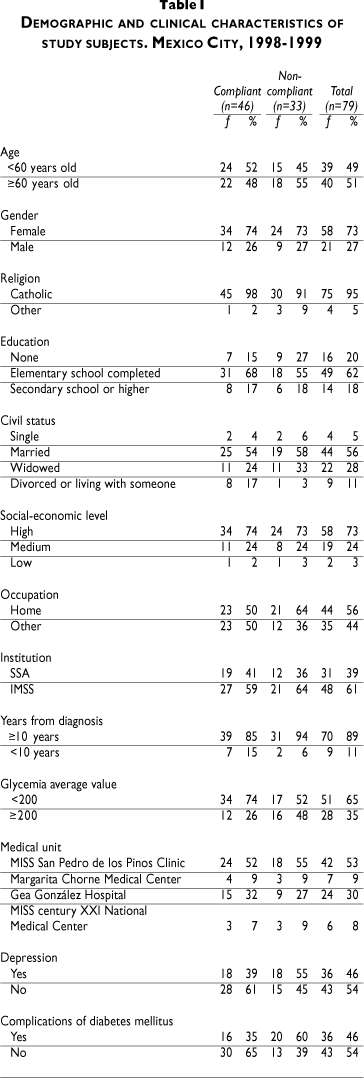
<body><![CDATA[<p><font face="Verdana, Arial, Helvetica-Normal, sans-serif" size="2">Depression    was evaluated using the Beck depression inventory (BDI). The BDI is an instrument    that has been extensively used over many years. It consists of 21 self-administered    items that measure affective, cognitive, and somatic symptoms of depression.    Each item evaluates a category according to a scale of 4 possible responses    of increasing severity (except for items 14 and 20 which have only 3 options).    The result is measured using a score between 0 and 61. The cutoff points to    identify people at risk for depression vary from scores of 14 to 17 points,    according to different reports. For the present study, the limit of 14 points    was used as cutoff. This cutoff point has been used in similar research studies    on this topic.<sup>11,12</sup> A sensitivity of 92% and a specificity of 77%    have been documented with this diagnostic cutoff point. The categories measured    were: 1) sadness, 2) pessimism, 3) sense of failure, 4) dissatisfaction, 5)    sense of guilt, 6) sense of punishment, 7) self-disappointment, 8) self-criticism,    9) suicidal ideas, 10) tendency to cry, 11) irritability, 12) isolation, 13)    indecisiveness, 14) concerns about appearance, 15) effort required to do things,    16) trouble sleeping, 17) sense of tiredness, 18) lack of appetite, 19) weight    loss, 20) concern about health, and 21) decreased interest in sex.</font></p>     <p><font face="Verdana, Arial, Helvetica-Normal, sans-serif" size="2">Associations    were assessed between therapy noncompliance and the following factors: 1) patients'    comorbid characteristics, like depression and arterial hypertension; 2) sociodemographic    aspects such as gender, civil status, religion, education, occupation, and family    support; 3) characteristics of the disease such as evolution time and complications,    and 4) level of medical care.</font></p>     <p><font face="Verdana, Arial, Helvetica-Normal, sans-serif" size="2">The data    collection instrument included 137 items structured as follows: 1) identification    data sheet; 2) personal data and prescription details; 3) socioeconomic level;    4) obstacles to healthcare access; 5) therapeutic compliance with medication,    diet, exercise, and appointment keeping; 6) family support; 7) counting medication    and reviewing dietary instructions, and 8) depression. Socioeconomic level was    measured using a validated scale<sup>13</sup> and depression was evaluated by    the Beck depression inventory (BDI).<sup>14</sup></font></p>     <p><font face="Verdana, Arial, Helvetica-Normal, sans-serif" size="2">For statistical    analysis, descriptive statistics were obtained according to type of variable.    Odds ratios with 95% confidence intervals were estimated. The statistical significance    of associations was evaluated with the chi-squared test or with Fisher's exact    test. The level of statistical significance was set at 0.05 for the two-sided    null hypothesis.</font></p>     <p>&nbsp;</p>     <p><b><font face="Verdana, Arial, Helvetica, sans-serif" size="3">Results</font></b></p>     <p><font face="Verdana, Arial, Helvetica-Normal, sans-serif" size="2">The average    age of the group was 59 (33-88) years (SD=11 years); 73% (<i>n</i>=58) were    women, 82% (<i>n</i>=65) had an educational level less than or equal to elementary    school, 56% (<i>n</i>=44) were housewives, 73% (<i>n</i>=58) had a good socioeconomic    level. Sixty-seven percent (<i>n</i>=53) were controlled with hypoglycemic drugs,    diet and exercise; 20% (<i>n</i>=16) with insulin, diet and exercise, and 13%    (<i>n</i>=10) with diet and exercise. The frequency of depression was 46% (36    patients), 48 were IMSS patients (61%) and 31 (39%) were SSA patients. IMSS    patients receive medication at no cost, whereas in SSA institutions some may    be given at no cost and some may have to be bought (<a href="#tabela1">Table    I</a>).</font></p>     <p align="center"><a name="tabela1"></a></p>     <p align="center">&nbsp;</p>     <p align="center"><img src="/img/revistas/spm/v45n3/16481t1.gif"></p>     ]]></body>
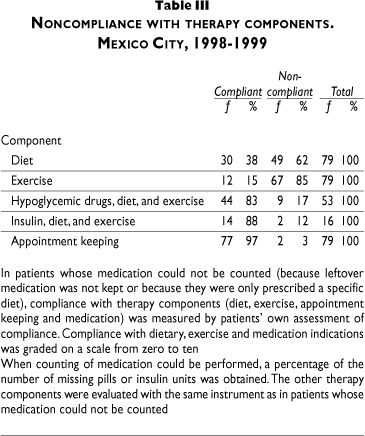
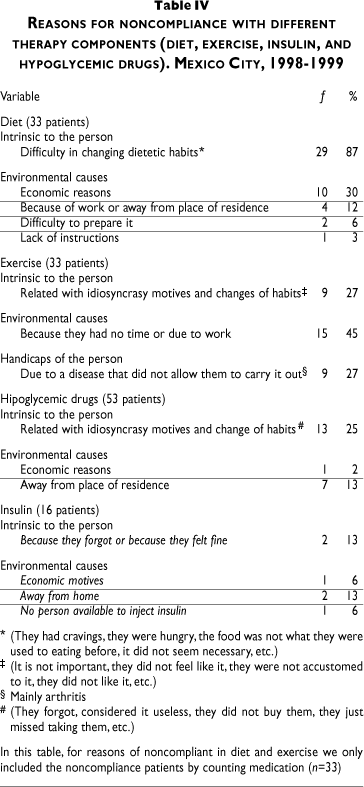
<body><![CDATA[<p align="center">&nbsp;</p>     <p><font face="Verdana, Arial, Helvetica-Normal, sans-serif" size="2">The overall    noncompliance was 42% (<i>n</i>=33). Noncompliance in the group of 58 patients    for whom medication was counted was 41% (<i>n</i>=24). The frequency of noncompliance    in the group of 21 patients whose medication was not counted (because there    was no initial prescription or the patients were only controlled by a diet)    was 43% (<i>n</i>=9) (<a href="/img/revistas/spm/v45n3/16481t2.gif">Table II</a>). A comparative    analysis was performed between these two groups. No statistically significant    differences were found between sociodemographic characteristics and DM characteristics,    and frequency of noncompliance. The only difference found was for type of therapy,    given that 8 out of the 21 patients in whom the counting of medication could    not be carried out were only controlled with a diet and did not take any medication;    also, in the group in which the counting of medication was performed, everyone    used insulin or hypoglycemic drugs.</font></p>     <p><font face="Verdana, Arial, Helvetica-Normal, sans-serif" size="2">The frequency    of dietary noncompliance was 62% (49 patients), 85% for exercise (67 patients),    17% for intake of hypoglycemic drugs (9 patients out of 53 who had been prescribed    hypoglycemic drugs), 13% for insulin application (2 patients out of 16 who had    been indicated treatment with insulin), and 3% for appointment keeping (2 patients    out of 79) (<a href="#tabela3">Table III</a>). Only 38 patients (48%) had a    dietary prescription in their home. The frequency of noncompliance for IMSS    patients was 64% (<i>n</i>=21) and 36% (<i>n</i>=12) for SSA patients (<a href="#tabela1">Table    I</a>).</font></p>     <p align="center"><a name="tabela3"></a></p>     <p align="center">&nbsp;</p>     <p align="center"><img src="/img/revistas/spm/v45n3/16481t3.gif"></p>     <p align="center">&nbsp;</p>     <p><font face="Verdana, Arial, Helvetica-Normal, sans-serif" size="2">The only    factor associated with therapy noncompliance was the presence of comorbidity    specifically related to hypertension and obesity (OR 4.58, 95% CI 1.0, 22.4,    <i>p</i>= 0.02). With regard to non-medical indications, 29 patients (87%),    referred that they could not follow the diet adequately due to the difficulty    of changing previous habits (also because they had cramps, they were hungry,    the food was not the same as they were used to eating before, etc.). Another    reason for noncompliance was economical reasons (<i>n</i>=10, 30%). Regarding    exercise, 9 patients (27%) preferred not to do it because of associated diseases    (especially arthritis); 15 patients did not exercise because of lack of time    (45%), and 9 patients (27%) because of motivational and cultural causes (lack    of motivation, idiosyncrasy, and change in their habits). With respect to medication,    7 out of the 53 patients (13%) who were controlled with hypoglycemic drugs referred    that they did not take them because they left their houses without taking their    medication along and 13 (25%) because of other causes (mainly forgetfulness).    Regarding insulin application (<i>n</i>=16 patients), 2 (13%) of them referred    that the reasons for noncompliance were that they had forgotten to administer    it or that they were feeling well, and 2 (13%) referred that they had left their    homes without it. (<a href="#tabela4">Table IV</a>).</font></p>     <p align="center"><a name="tabela4"></a></p>     <p align="center">&nbsp;</p>     ]]></body>
<body><![CDATA[<p align="center"><img src="/img/revistas/spm/v45n3/16481t4.gif"></p>     <p>&nbsp;</p>     <p><b><font face="Verdana, Arial, Helvetica, sans-serif" size="3">Discussion</font></b></p>     <p><font face="Verdana, Arial, Helvetica-Normal, sans-serif" size="2">We identified    a frequency of noncompliance of 41% in patients in whose the counting of medication    could be carried out. This frequency was very high and evidenced that one of    every two patients did not comply with prescribed therapy. Venter<sup>15</sup>    studied 68 African American patients and found a frequency of noncompliance    of 65%. Other authors report a frequency of noncompliance of 80 to 90 %, considering    all the therapeutic measures.<sup>16</sup></font></p>     <p><font face="Verdana, Arial, Helvetica-Normal, sans-serif" size="2">As for noncompliance    with individual measures, the 62% dietary noncompliance found in this study    was similar to the 73% reported by Watkins<sup>5</sup>, and to the 65% by Cerkoney.<sup>6</sup>    Diehl <i>et al</i><sup>17</sup> evaluated noncompliance in a similar way to    our study, through the counting of pills and by measuring the quantity of insulin    administered. They found frequencies of noncompliance between 40 and 50%; Diehl's    data are equivalent to the group of patients in our study in whom the counting    of medication could be carried out and where the frequency of noncompliance    was 41%.</font></p>     <p><font face="Verdana, Arial, Helvetica-Normal, sans-serif" size="2">The frequency    of noncompliance with exercise indications was 85% in our study. Through telephone    calls, Kravitz <i>et al</i><sup>18</sup> studied the level of adherence to exercise,    diet, and the administration of medication in patients with chronic diseases    such as diabetes mellitus. They found frequencies of noncompliance of 19%, 69%,    and 91% respectively. The frequency of noncompliance for appointment keeping    was 3% (2 patients), which indicates that even if patients do not miss their    appointments, they still do not comply with the different therapeutic measures    that are prescribed to them.</font></p>     <p><font face="Verdana, Arial, Helvetica-Normal, sans-serif" size="2">We evaluated    the possibility that therapy noncompliance was related to some personal characteristics    of the patient, sociodemographic characteristics, and disease characteristics,    but no statistically significant associations were found. These results are    consistent with those reported by other authors.<sup>15,16,18-20</sup> The only    significant association was the presence of systemic arterial hypertension and    obesity in the presence of diabetes, especially the association with obesity    already described.<sup>21</sup> It has been documented that overweight diabetic    patients have more difficulty in their glycemic control. They have difficulties    following dietary indications because they may have coexisting depressive symptoms    and they have many problems to lose weight, even with strict diet programs.</font></p>     <p><font face="Verdana, Arial, Helvetica-Normal, sans-serif" size="2">In this    study, a frequency of depression of 39% has been documented in a sample of patients    with DM type-2 in Mexico City. This frequency is considerably high and it seems    that in our society, most of the time, this problem is overlooked. The frequency    of depression found in this study is higher in comparison to similar investigations,    like the one of Bundo-Vidiella and collaborators,<sup>22</sup> in which a group    of 85 patients was studied, using the same scale as the one used in this study,    and where the frequency of depression was 27%. although the frequency was high,    we could not found any association with noncompliance.</font></p>     <p><font face="Verdana, Arial, Helvetica-Normal, sans-serif" size="2">Among the    reasons for noncompliance of the different therapeutic measures, two aspects    of the diet were identified: one is related to the motivational aspect that    involved 87% of the cases and the other is related to the environment (economical    aspects, being away from home, and work activities) which involved 61%. House    <i>et al</i><sup>23</sup> found that the motivational causes accounted for 34%    of noncompliance and those related to the environment, for 37%. One group of    somatic causes (blindness, physical restrictions) accounted for 26% for noncompliance.    On the other hand, Schlundt<sup>24</sup> found that out of 69 situations of    diet noncompliance studied in 26 patients, 32 (46%) were related to environmental    reasons and 13 (19%) to motivational aspects. In the two previous studies, economical    difficulties for following dietary indications did not play an important role    as in our population. Potential benefits of exercise in patients with DM2 have    been documented, such as improvement in glycemic control, cardiovascular function,    weight loss, positive psychological effects, and prevention of other diseases.<sup>25</sup>    Kamiya carried out a survey among 570 diabetics to define the reasons of noncompliance    with exercise; the two main reasons given were similar to the ones found in    our study: "I have no time." and "I do not have that habit and I have no desire    to exercise".<sup>26</sup> These findings indicate that patients must be motivated    in a proper way at the moment of diagnosis and throughout the evolution of the    disease, in order to obtain the benefits of exercise.</font></p>     <p><font face="Verdana, Arial, Helvetica-Normal, sans-serif" size="2">Most of    our patients with hypoglycemic drugs stopped taking them for intrinsic reasons    (mainly forgetfulness) and because they were away from home; reasons that were    similar to those of patients who were controlled with insulin. Our results are    comparable to those from other studies in which the principal cause for noncompliance    of medical measures was forgetfulness, as reported by Khoza <i>et al</i>.<sup>27</sup></font></p>     ]]></body>
<body><![CDATA[<p><font face="Verdana, Arial, Helvetica-Normal, sans-serif" size="2">There are    few studies that measure therapy compliance in the Mexican population. We recognize    that our study is limited because the sample is not large. We consider that    this problem should be analyzed in different contexts, populations, social levels,    and social-economic strata, to gather a realistic panorama of the impact that    it has on individual health and the public health importance of this problem.</font></p>     <p>&nbsp;</p>     <p><font face="Verdana, Arial, Helvetica-Normal, sans-serif" size="3"><b>Acknowledgements</b></font></p>     <p><font face="Verdana, Arial, Helvetica-Normal, sans-serif" size="2">The authors    thank Silvia Armenta for helpful suggestions.</font></p>     <p>&nbsp;</p>     <p><b><font face="Verdana, Arial, Helvetica, sans-serif" size="3">References</font></b></p>     <!-- ref --><p><font face="Verdana, Arial, Helvetica-Normal, sans-serif" size="2">1. Mart&iacute;nez    C, Guiscafr&eacute; H, Mu&ntilde;oz O, Guti&eacute;rrez G. An&aacute;lisis del    incumplimiento del tratamiento con los esquemas terap&eacute;uticos utilizados.    Arch Invest Med 1988;9:409-417.</font>&nbsp;&nbsp;&nbsp;&nbsp;&nbsp;&nbsp;&nbsp;&nbsp;[&#160;<a href="javascript:void(0);" onclick="javascript: window.open('/scielo.php?script=sci_nlinks&ref=9210222&pid=S0036-3634200300030000800001&lng=','','width=640,height=500,resizable=yes,scrollbars=1,menubar=yes,');">Links</a>&#160;]<!-- end-ref --><!-- ref --><p><font face="Verdana, Arial, Helvetica-Normal, sans-serif" size="2">2. Fletcher    SW, Pappius EM, Harper SJ. Measurement of medication compliance in a clinical    setting. Comparison of three methods in patients prescribed digoxina. Arch Intern    Med 1979;139:635-638.</font>&nbsp;&nbsp;&nbsp;&nbsp;&nbsp;&nbsp;&nbsp;&nbsp;[&#160;<a href="javascript:void(0);" onclick="javascript: window.open('/scielo.php?script=sci_nlinks&ref=9210223&pid=S0036-3634200300030000800002&lng=','','width=640,height=500,resizable=yes,scrollbars=1,menubar=yes,');">Links</a>&#160;]<!-- end-ref --><!-- ref --><p><font face="Verdana, Arial, Helvetica-Normal, sans-serif" size="2">3. Rudd    P. In search of the gold standard for compliance measurement. Arch Intern Med    1979;139:627-628.</font>&nbsp;&nbsp;&nbsp;&nbsp;&nbsp;&nbsp;&nbsp;&nbsp;[&#160;<a href="javascript:void(0);" onclick="javascript: window.open('/scielo.php?script=sci_nlinks&ref=9210224&pid=S0036-3634200300030000800003&lng=','','width=640,height=500,resizable=yes,scrollbars=1,menubar=yes,');">Links</a>&#160;]<!-- end-ref --><!-- ref --><p><font face="Verdana, Arial, Helvetica-Normal, sans-serif" size="2">4. Golin    CE, DiMatteo MR, Gelberg L. The role of patient participation in the doctor    visit. Diabetes Care 1996;19:l154-1164.</font>&nbsp;&nbsp;&nbsp;&nbsp;&nbsp;&nbsp;&nbsp;&nbsp;[&#160;<a href="javascript:void(0);" onclick="javascript: window.open('/scielo.php?script=sci_nlinks&ref=9210225&pid=S0036-3634200300030000800004&lng=','','width=640,height=500,resizable=yes,scrollbars=1,menubar=yes,');">Links</a>&#160;]<!-- end-ref --><!-- ref --><p><font face="Verdana, Arial, Helvetica-Normal, sans-serif" size="2">5. Watkins    JD, Williams F, Martin DA, Hogan MD, Anderson E. A study of diabetic patients    at home. J Am Public Health 1967;56:452-459.</font>&nbsp;&nbsp;&nbsp;&nbsp;&nbsp;&nbsp;&nbsp;&nbsp;[&#160;<a href="javascript:void(0);" onclick="javascript: window.open('/scielo.php?script=sci_nlinks&ref=9210226&pid=S0036-3634200300030000800005&lng=','','width=640,height=500,resizable=yes,scrollbars=1,menubar=yes,');">Links</a>&#160;]<!-- end-ref --><!-- ref --><p><font face="Verdana, Arial, Helvetica-Normal, sans-serif" size="2">6. Cerkoney    AB, Hart K. The relationship between the health belief model and compliance    of persons with diabetes mellitus. Diabetes Care 1980;3:594-598.</font>&nbsp;&nbsp;&nbsp;&nbsp;&nbsp;&nbsp;&nbsp;&nbsp;[&#160;<a href="javascript:void(0);" onclick="javascript: window.open('/scielo.php?script=sci_nlinks&ref=9210227&pid=S0036-3634200300030000800006&lng=','','width=640,height=500,resizable=yes,scrollbars=1,menubar=yes,');">Links</a>&#160;]<!-- end-ref --><!-- ref --><p><font face="Verdana, Arial, Helvetica-Normal, sans-serif" size="2">7. Morrison    EY, Bennett F. Assessment of patient compliance in a diabetic clinic using glycated    proteins compared with blood sugar measurements. West Indian Med J 1988;37:58-61.</font>&nbsp;&nbsp;&nbsp;&nbsp;&nbsp;&nbsp;&nbsp;&nbsp;[&#160;<a href="javascript:void(0);" onclick="javascript: window.open('/scielo.php?script=sci_nlinks&ref=9210228&pid=S0036-3634200300030000800007&lng=','','width=640,height=500,resizable=yes,scrollbars=1,menubar=yes,');">Links</a>&#160;]<!-- end-ref --><!-- ref --><p><font face="Verdana, Arial, Helvetica-Normal, sans-serif" size="2">8. Irwin    M, Rosenstock IM. Understanding and enhancing patient compliance with diabetic    regimes. Diabetes Care 1985;8:610-616.</font>&nbsp;&nbsp;&nbsp;&nbsp;&nbsp;&nbsp;&nbsp;&nbsp;[&#160;<a href="javascript:void(0);" onclick="javascript: window.open('/scielo.php?script=sci_nlinks&ref=9210229&pid=S0036-3634200300030000800008&lng=','','width=640,height=500,resizable=yes,scrollbars=1,menubar=yes,');">Links</a>&#160;]<!-- end-ref --><!-- ref --><p><font face="Verdana, Arial, Helvetica-Normal, sans-serif" size="2">9. Nagasawa    M, Smith MC, Barnes JH, Fincham JE. Meta-analysis of correlates of diabetes    patients' compliance with prescribed medications. Diabetes Educ 1990;16:192-200.</font>&nbsp;&nbsp;&nbsp;&nbsp;&nbsp;&nbsp;&nbsp;&nbsp;[&#160;<a href="javascript:void(0);" onclick="javascript: window.open('/scielo.php?script=sci_nlinks&ref=9210230&pid=S0036-3634200300030000800009&lng=','','width=640,height=500,resizable=yes,scrollbars=1,menubar=yes,');">Links</a>&#160;]<!-- end-ref --><!-- ref --><p><font face="Verdana, Arial, Helvetica-Normal, sans-serif" size="2">10. Rull    JA, R&iacute;os JM, G&oacute;mez-P&eacute;rez FJ, Olaiz G, Tapia R, Sep&uacute;lveda    J. The impact of diabetes mellitus on public health in Mexico. En: Schwartz    C, Born G. New horizons in diabetes mellitus and cardiovascular disease. Curr    Sci 1998;1:64-74.</font>&nbsp;&nbsp;&nbsp;&nbsp;&nbsp;&nbsp;&nbsp;&nbsp;[&#160;<a href="javascript:void(0);" onclick="javascript: window.open('/scielo.php?script=sci_nlinks&ref=9210231&pid=S0036-3634200300030000800010&lng=','','width=640,height=500,resizable=yes,scrollbars=1,menubar=yes,');">Links</a>&#160;]<!-- end-ref --><!-- ref --><p><font face="Verdana, Arial, Helvetica-Normal, sans-serif" size="2">11. Su&aacute;rez-Mendoza    A, Cardiel M, Caballero-Uribe C, Ortega-Soto H, M&aacute;rquez-Mar&iacute;n    M. Measurement of depression in Mexican patients with rheumatoid arthritis:    Validity of the Beck Depression Inventory. J Rheumatol 1997;10:194-199.</font>&nbsp;&nbsp;&nbsp;&nbsp;&nbsp;&nbsp;&nbsp;&nbsp;[&#160;<a href="javascript:void(0);" onclick="javascript: window.open('/scielo.php?script=sci_nlinks&ref=9210232&pid=S0036-3634200300030000800011&lng=','','width=640,height=500,resizable=yes,scrollbars=1,menubar=yes,');">Links</a>&#160;]<!-- end-ref --><!-- ref --><p><font face="Verdana, Arial, Helvetica-Normal, sans-serif" size="2">12. Torres-Castillo    M, Hern&aacute;ndez-Malpica E, Ortega-Soto HA. Validez y reproducibilidad del    inventario para depresi&oacute;n de Beck en un hospital de cardiolog&iacute;a.    Salud Mental 1991;14:1-6.</font>&nbsp;&nbsp;&nbsp;&nbsp;&nbsp;&nbsp;&nbsp;&nbsp;[&#160;<a href="javascript:void(0);" onclick="javascript: window.open('/scielo.php?script=sci_nlinks&ref=9210233&pid=S0036-3634200300030000800012&lng=','','width=640,height=500,resizable=yes,scrollbars=1,menubar=yes,');">Links</a>&#160;]<!-- end-ref --><!-- ref --><p><font face="Verdana, Arial, Helvetica-Normal, sans-serif" size="2">13. Bronfman    M, Guiscafr&eacute; H, Castro V, Castro R, Guti&eacute;rrez G. La medici&oacute;n    de la desigualdad: una estrategia metodol&oacute;gica, an&aacute;lisis de las    caracter&iacute;sticas socioecon&oacute;micas de la muestra. Arch Invest Med    1988;19:351-360.</font>&nbsp;&nbsp;&nbsp;&nbsp;&nbsp;&nbsp;&nbsp;&nbsp;[&#160;<a href="javascript:void(0);" onclick="javascript: window.open('/scielo.php?script=sci_nlinks&ref=9210234&pid=S0036-3634200300030000800013&lng=','','width=640,height=500,resizable=yes,scrollbars=1,menubar=yes,');">Links</a>&#160;]<!-- end-ref --><!-- ref --><p><font face="Verdana, Arial, Helvetica-Normal, sans-serif" size="2">14. Beck    AT, Ward CH, Mendelsson A. An Inventory for measuring depression. Arch Gen Psychiatry    1961;4:561-571.</font>&nbsp;&nbsp;&nbsp;&nbsp;&nbsp;&nbsp;&nbsp;&nbsp;[&#160;<a href="javascript:void(0);" onclick="javascript: window.open('/scielo.php?script=sci_nlinks&ref=9210235&pid=S0036-3634200300030000800014&lng=','','width=640,height=500,resizable=yes,scrollbars=1,menubar=yes,');">Links</a>&#160;]<!-- end-ref --><!-- ref --><p><font face="Verdana, Arial, Helvetica-Normal, sans-serif" size="2">15. Venter    HL, Joubert PH, Foukaridis GN. Compliance in black patients with non-insulin-dependent    diabetes mellitus receiving oral hypoglycaemic therapy. S Afr Med J 1991;79:549-551.</font>&nbsp;&nbsp;&nbsp;&nbsp;&nbsp;&nbsp;&nbsp;&nbsp;[&#160;<a href="javascript:void(0);" onclick="javascript: window.open('/scielo.php?script=sci_nlinks&ref=9210236&pid=S0036-3634200300030000800015&lng=','','width=640,height=500,resizable=yes,scrollbars=1,menubar=yes,');">Links</a>&#160;]<!-- end-ref --><!-- ref --><p><font face="Verdana, Arial, Helvetica-Normal, sans-serif" size="2">16. Harris    R, Linn M. Health beliefs, compliance, and control of diabetes mellitus. South    Med J 1985;78:162-166.</font>&nbsp;&nbsp;&nbsp;&nbsp;&nbsp;&nbsp;&nbsp;&nbsp;[&#160;<a href="javascript:void(0);" onclick="javascript: window.open('/scielo.php?script=sci_nlinks&ref=9210237&pid=S0036-3634200300030000800016&lng=','','width=640,height=500,resizable=yes,scrollbars=1,menubar=yes,');">Links</a>&#160;]<!-- end-ref --><!-- ref --><p><font face="Verdana, Arial, Helvetica-Normal, sans-serif" size="2">17. Diehl    AK, Bauer RL, Sugarek NJ. Correlates of medication compliance in non-insulin-dependent    diabetes mellitus. South Med J 1987;80:332-335.</font>&nbsp;&nbsp;&nbsp;&nbsp;&nbsp;&nbsp;&nbsp;&nbsp;[&#160;<a href="javascript:void(0);" onclick="javascript: window.open('/scielo.php?script=sci_nlinks&ref=9210238&pid=S0036-3634200300030000800017&lng=','','width=640,height=500,resizable=yes,scrollbars=1,menubar=yes,');">Links</a>&#160;]<!-- end-ref --><!-- ref --><p><font face="Verdana, Arial, Helvetica-Normal, sans-serif" size="2">18. Kravitz    RL, Hays RD, Sherbourne CD, DiMatteo, Rogers WH, Ordway L <i>et al</i>. Recall    to recommendations and adherence to advice among patients with chronic medical    conditions. Arch Intern Med 1993; 16: 1869-1878.</font>&nbsp;&nbsp;&nbsp;&nbsp;&nbsp;&nbsp;&nbsp;&nbsp;[&#160;<a href="javascript:void(0);" onclick="javascript: window.open('/scielo.php?script=sci_nlinks&ref=9210239&pid=S0036-3634200300030000800018&lng=','','width=640,height=500,resizable=yes,scrollbars=1,menubar=yes,');">Links</a>&#160;]<!-- end-ref --><!-- ref --><p><font face="Verdana, Arial, Helvetica-Normal, sans-serif" size="2">19. Pringle    M, Stewart-Evans C, Coupland C, Williams I, Allison S, Sterland J. Influences    on control in diabetes mellitus: Patient, doctor, practice or delivery of care?    Br Med J 1993;306:630-634.</font>&nbsp;&nbsp;&nbsp;&nbsp;&nbsp;&nbsp;&nbsp;&nbsp;[&#160;<a href="javascript:void(0);" onclick="javascript: window.open('/scielo.php?script=sci_nlinks&ref=9210240&pid=S0036-3634200300030000800019&lng=','','width=640,height=500,resizable=yes,scrollbars=1,menubar=yes,');">Links</a>&#160;]<!-- end-ref --><!-- ref --><p><font face="Verdana, Arial, Helvetica-Normal, sans-serif" size="2">20. O'Connor    PJ, Fragneto R, Coulehan J, Crabtree BF. Metabolic control in non-insulin-dependent    diabetes mellitus: Factors associated with patient outcomes. Diabetes Care 1987;    10: 697-701.</font>&nbsp;&nbsp;&nbsp;&nbsp;&nbsp;&nbsp;&nbsp;&nbsp;[&#160;<a href="javascript:void(0);" onclick="javascript: window.open('/scielo.php?script=sci_nlinks&ref=9210241&pid=S0036-3634200300030000800020&lng=','','width=640,height=500,resizable=yes,scrollbars=1,menubar=yes,');">Links</a>&#160;]<!-- end-ref --><!-- ref --><p><font face="Verdana, Arial, Helvetica-Normal, sans-serif" size="2">21. Wing    RR, Epstein LH, Nowalk MP, Scott N, Koeske R, Hagg S. Does self-monitoring of    blood glucose levels improve dietary compliance for obese patients with type    II diabetes? Am J Med 1986;81:830-836.</font>&nbsp;&nbsp;&nbsp;&nbsp;&nbsp;&nbsp;&nbsp;&nbsp;[&#160;<a href="javascript:void(0);" onclick="javascript: window.open('/scielo.php?script=sci_nlinks&ref=9210242&pid=S0036-3634200300030000800021&lng=','','width=640,height=500,resizable=yes,scrollbars=1,menubar=yes,');">Links</a>&#160;]<!-- end-ref --><!-- ref --><p><font face="Verdana, Arial, Helvetica-Normal, sans-serif" size="2">22. Bundo-Vidiella    M, Auba-Llambrich J, Massons-Cirera J, Trilla-Soler MC, P&eacute;rez-Villegas    R, P&eacute;rez-del Campo AM. Ansiedad y depresi&oacute;n en pacientes diab&eacute;ticos    tipo II. Aten Primaria 1996;17:58-62.</font>&nbsp;&nbsp;&nbsp;&nbsp;&nbsp;&nbsp;&nbsp;&nbsp;[&#160;<a href="javascript:void(0);" onclick="javascript: window.open('/scielo.php?script=sci_nlinks&ref=9210243&pid=S0036-3634200300030000800022&lng=','','width=640,height=500,resizable=yes,scrollbars=1,menubar=yes,');">Links</a>&#160;]<!-- end-ref --><!-- ref --><p><font face="Verdana, Arial, Helvetica-Normal, sans-serif" size="2">23. House    W, Pendleton L, Parker L. Patients' <i>Versus</i> physicians' attributions of    reasons for diabetic patients' noncompliance with diet. Diabetes Care 1986;9:434.</font>&nbsp;&nbsp;&nbsp;&nbsp;&nbsp;&nbsp;&nbsp;&nbsp;[&#160;<a href="javascript:void(0);" onclick="javascript: window.open('/scielo.php?script=sci_nlinks&ref=9210244&pid=S0036-3634200300030000800023&lng=','','width=640,height=500,resizable=yes,scrollbars=1,menubar=yes,');">Links</a>&#160;]<!-- end-ref --><!-- ref --><p><font face="Verdana, Arial, Helvetica-Normal, sans-serif" size="2">24. Schlundt    DG, Rea MR, Kline S, Pichert JW. Situational obstacles to dietary adherence    for adults with diabetes. J Am Diet Assoc 1994;8:874-879.</font>&nbsp;&nbsp;&nbsp;&nbsp;&nbsp;&nbsp;&nbsp;&nbsp;[&#160;<a href="javascript:void(0);" onclick="javascript: window.open('/scielo.php?script=sci_nlinks&ref=9210245&pid=S0036-3634200300030000800024&lng=','','width=640,height=500,resizable=yes,scrollbars=1,menubar=yes,');">Links</a>&#160;]<!-- end-ref --><!-- ref --><p><font face="Verdana, Arial, Helvetica-Normal, sans-serif" size="2">25. Schneider    SH, Johnson RW, Ruderman NB. Exercise and DIDDM. Diabetes Care 1990;13:785-789.</font>&nbsp;&nbsp;&nbsp;&nbsp;&nbsp;&nbsp;&nbsp;&nbsp;[&#160;<a href="javascript:void(0);" onclick="javascript: window.open('/scielo.php?script=sci_nlinks&ref=9210246&pid=S0036-3634200300030000800025&lng=','','width=640,height=500,resizable=yes,scrollbars=1,menubar=yes,');">Links</a>&#160;]<!-- end-ref --><!-- ref --><p><font face="Verdana, Arial, Helvetica-Normal, sans-serif" size="2">26. Kamiya    A, Osawa I, Fujii T, Nagai M, Yamanouchi K, Oshida Y <i>et al</i>. A clinical    survey of the compliance of exercise therapy for diabetic outpatients. Diabetes    Res Clin Pract 1995;27:141-145.</font>&nbsp;&nbsp;&nbsp;&nbsp;&nbsp;&nbsp;&nbsp;&nbsp;[&#160;<a href="javascript:void(0);" onclick="javascript: window.open('/scielo.php?script=sci_nlinks&ref=9210247&pid=S0036-3634200300030000800026&lng=','','width=640,height=500,resizable=yes,scrollbars=1,menubar=yes,');">Links</a>&#160;]<!-- end-ref --><!-- ref --><p><font face="Verdana, Arial, Helvetica-Normal, sans-serif" size="2">27. Khoza    SR, Kortenbout W. An investigation of compliance in type II diabetic patients    attending clinic at Church of Scotland Hospital. Curationis 1995;18:10-14.</font>&nbsp;&nbsp;&nbsp;&nbsp;&nbsp;&nbsp;&nbsp;&nbsp;[&#160;<a href="javascript:void(0);" onclick="javascript: window.open('/scielo.php?script=sci_nlinks&ref=9210248&pid=S0036-3634200300030000800027&lng=','','width=640,height=500,resizable=yes,scrollbars=1,menubar=yes,');">Links</a>&#160;]<!-- end-ref --><p>&nbsp;</p>     <p>&nbsp;</p>     <p><font face="Verdana, Arial, Helvetica-Normal, sans-serif" size="2"><b>Address    reprint requests to:</b>    <br>   Dr. Jos&eacute; Francisco T&eacute;llez Zenteno    <br>   Departamento de Neurolog&iacute;a    <br>   Instituto Nacional de Ciencias M&eacute;dicas y de la Nutrici&oacute;n Salvador    Zubir&aacute;n    <br>   Vasco de Quiroga No. 15, colonia secci&oacute;n XVI, Tlalpan    ]]></body>
<body><![CDATA[<br>   14000 M&eacute;xico, DF    <br>   E-mail: <a href="mailto:liztellez@correo.unam.mx">liztellez@correo.unam.mx</a></font></p>     <p><font face="Verdana, Arial, Helvetica, sans-serif" size="2"><b>Received on:</b>    May 21, 2002    <br>   <b>Accepted on:</b> January 10, 2003    <br>   This work was partially supported by Fundaci&oacute;n UNAM</font></p>     <p>&nbsp;</p>     <p>&nbsp;</p>     <p><font face="Verdana, Arial, Helvetica, sans-serif" size="2">The English version    of this paper is available too at: <a href="http://www.insp.mx/salud/index.html">http://www.insp.mx/salud/index.html</a></font></p>      ]]></body><back>
<ref-list>
<ref id="B1">
<label>1</label><nlm-citation citation-type="journal">
<person-group person-group-type="author">
<name>
<surname><![CDATA[Martínez]]></surname>
<given-names><![CDATA[C]]></given-names>
</name>
<name>
<surname><![CDATA[Guiscafré]]></surname>
<given-names><![CDATA[H]]></given-names>
</name>
<name>
<surname><![CDATA[Muñoz]]></surname>
<given-names><![CDATA[O]]></given-names>
</name>
<name>
<surname><![CDATA[Gutiérrez]]></surname>
<given-names><![CDATA[G]]></given-names>
</name>
</person-group>
<article-title xml:lang="es"><![CDATA[Análisis del incumplimiento del tratamiento con los esquemas terapéuticos utilizados]]></article-title>
<source><![CDATA[Arch Invest Med]]></source>
<year>1988</year>
<volume>9</volume>
<page-range>409-417</page-range></nlm-citation>
</ref>
<ref id="B2">
<label>2</label><nlm-citation citation-type="journal">
<person-group person-group-type="author">
<name>
<surname><![CDATA[Fletcher]]></surname>
<given-names><![CDATA[SW]]></given-names>
</name>
<name>
<surname><![CDATA[Pappius]]></surname>
<given-names><![CDATA[EM]]></given-names>
</name>
<name>
<surname><![CDATA[Harper]]></surname>
<given-names><![CDATA[SJ.]]></given-names>
</name>
</person-group>
<article-title xml:lang="en"><![CDATA[Comparison of three methods in patients prescribed digoxina]]></article-title>
<source><![CDATA[Arch Intern Med]]></source>
<year>1979</year>
<volume>139</volume>
<page-range>635-638</page-range></nlm-citation>
</ref>
<ref id="B3">
<label>3</label><nlm-citation citation-type="journal">
<person-group person-group-type="author">
<name>
<surname><![CDATA[Rudd]]></surname>
<given-names><![CDATA[P]]></given-names>
</name>
</person-group>
<article-title xml:lang="en"><![CDATA[In search of the gold standard for compliance measurement]]></article-title>
<source><![CDATA[Arch Intern Med]]></source>
<year>1979</year>
<volume>139</volume>
<page-range>627-628</page-range></nlm-citation>
</ref>
<ref id="B4">
<label>4</label><nlm-citation citation-type="journal">
<person-group person-group-type="author">
<name>
<surname><![CDATA[Golin]]></surname>
<given-names><![CDATA[CE]]></given-names>
</name>
<name>
<surname><![CDATA[DiMatteo]]></surname>
<given-names><![CDATA[MR]]></given-names>
</name>
<name>
<surname><![CDATA[Gelberg]]></surname>
<given-names><![CDATA[L]]></given-names>
</name>
</person-group>
<article-title xml:lang="en"><![CDATA[The role of patient participation in the doctor visit]]></article-title>
<source><![CDATA[Diabetes Care]]></source>
<year>1996</year>
<volume>19</volume>
<page-range>l154-1164</page-range></nlm-citation>
</ref>
<ref id="B5">
<label>5</label><nlm-citation citation-type="journal">
<person-group person-group-type="author">
<name>
<surname><![CDATA[Watkins]]></surname>
<given-names><![CDATA[JD]]></given-names>
</name>
<name>
<surname><![CDATA[Williams]]></surname>
<given-names><![CDATA[F]]></given-names>
</name>
<name>
<surname><![CDATA[Martin]]></surname>
<given-names><![CDATA[DA]]></given-names>
</name>
<name>
<surname><![CDATA[Hogan]]></surname>
<given-names><![CDATA[MD]]></given-names>
</name>
<name>
<surname><![CDATA[Anderson]]></surname>
<given-names><![CDATA[E]]></given-names>
</name>
</person-group>
<article-title xml:lang="en"><![CDATA[A study of diabetic patients at home]]></article-title>
<source><![CDATA[J Am Public Health]]></source>
<year>1967</year>
<volume>56</volume>
<page-range>452-459</page-range></nlm-citation>
</ref>
<ref id="B6">
<label>6</label><nlm-citation citation-type="journal">
<person-group person-group-type="author">
<name>
<surname><![CDATA[Cerkoney]]></surname>
<given-names><![CDATA[AB]]></given-names>
</name>
<name>
<surname><![CDATA[Hart]]></surname>
<given-names><![CDATA[K]]></given-names>
</name>
</person-group>
<article-title xml:lang="en"><![CDATA[The relationship between the health belief model and compliance of persons with diabetes mellitus]]></article-title>
<source><![CDATA[Diabetes Care]]></source>
<year>1980</year>
<volume>3</volume>
<page-range>594-598</page-range></nlm-citation>
</ref>
<ref id="B7">
<label>7</label><nlm-citation citation-type="journal">
<person-group person-group-type="author">
<name>
<surname><![CDATA[Morrison]]></surname>
<given-names><![CDATA[EY]]></given-names>
</name>
<name>
<surname><![CDATA[Bennett]]></surname>
<given-names><![CDATA[F]]></given-names>
</name>
</person-group>
<article-title xml:lang="en"><![CDATA[Assessment of patient compliance in a diabetic clinic using glycated proteins compared with blood sugar measurements]]></article-title>
<source><![CDATA[West Indian Med J]]></source>
<year>1988</year>
<volume>37</volume>
<page-range>58-61</page-range></nlm-citation>
</ref>
<ref id="B8">
<label>8</label><nlm-citation citation-type="journal">
<person-group person-group-type="author">
<name>
<surname><![CDATA[Irwin]]></surname>
<given-names><![CDATA[M]]></given-names>
</name>
<name>
<surname><![CDATA[Rosenstock]]></surname>
<given-names><![CDATA[IM]]></given-names>
</name>
</person-group>
<article-title xml:lang="en"><![CDATA[Understanding and enhancing patient compliance with diabetic regimes]]></article-title>
<source><![CDATA[Diabetes Care]]></source>
<year>1985</year>
<volume>8</volume>
<page-range>610-616</page-range></nlm-citation>
</ref>
<ref id="B9">
<label>9</label><nlm-citation citation-type="journal">
<person-group person-group-type="author">
<name>
<surname><![CDATA[Nagasawa]]></surname>
<given-names><![CDATA[M]]></given-names>
</name>
<name>
<surname><![CDATA[Smith]]></surname>
<given-names><![CDATA[MC]]></given-names>
</name>
<name>
<surname><![CDATA[Barnes]]></surname>
<given-names><![CDATA[JH]]></given-names>
</name>
<name>
<surname><![CDATA[Fincham]]></surname>
<given-names><![CDATA[JE]]></given-names>
</name>
</person-group>
<article-title xml:lang="en"><![CDATA[Meta-analysis of correlates of diabetes patients' compliance with prescribed medications]]></article-title>
<source><![CDATA[Diabetes Educ]]></source>
<year>1990</year>
<volume>16</volume>
<page-range>192-200</page-range></nlm-citation>
</ref>
<ref id="B10">
<label>10</label><nlm-citation citation-type="journal">
<person-group person-group-type="author">
<name>
<surname><![CDATA[Rull]]></surname>
<given-names><![CDATA[JA]]></given-names>
</name>
<name>
<surname><![CDATA[Ríos]]></surname>
<given-names><![CDATA[JM]]></given-names>
</name>
<name>
<surname><![CDATA[Gómez-Pérez]]></surname>
<given-names><![CDATA[FJ]]></given-names>
</name>
<name>
<surname><![CDATA[Olaiz]]></surname>
<given-names><![CDATA[G]]></given-names>
</name>
<name>
<surname><![CDATA[Tapia]]></surname>
<given-names><![CDATA[R]]></given-names>
</name>
<name>
<surname><![CDATA[Sepúlveda]]></surname>
<given-names><![CDATA[J]]></given-names>
</name>
</person-group>
<article-title xml:lang="en"><![CDATA[The impact of diabetes mellitus on public health in Mexico]]></article-title>
<person-group person-group-type="editor">
<name>
<surname><![CDATA[Schwartz]]></surname>
<given-names><![CDATA[C]]></given-names>
</name>
<name>
<surname><![CDATA[Born]]></surname>
<given-names><![CDATA[G]]></given-names>
</name>
</person-group>
<source><![CDATA[Curr SciNew horizons in diabetes mellitus and cardiovascular disease]]></source>
<year>1998</year>
<volume>1</volume>
<page-range>64-74</page-range></nlm-citation>
</ref>
<ref id="B11">
<label>11</label><nlm-citation citation-type="journal">
<person-group person-group-type="author">
<name>
<surname><![CDATA[Suárez-Mendoza]]></surname>
<given-names><![CDATA[A]]></given-names>
</name>
<name>
<surname><![CDATA[Cardiel]]></surname>
<given-names><![CDATA[M]]></given-names>
</name>
<name>
<surname><![CDATA[Caballero-Uribe]]></surname>
<given-names><![CDATA[C]]></given-names>
</name>
<name>
<surname><![CDATA[Ortega-Soto]]></surname>
<given-names><![CDATA[H]]></given-names>
</name>
<name>
<surname><![CDATA[Márquez-Marín]]></surname>
<given-names><![CDATA[M]]></given-names>
</name>
</person-group>
<article-title xml:lang="en"><![CDATA[Measurement of depression in Mexican patients with rheumatoid arthritis: Validity of the Beck Depression Inventory]]></article-title>
<source><![CDATA[J Rheumatol]]></source>
<year>1997</year>
<volume>10</volume>
<page-range>194-199</page-range></nlm-citation>
</ref>
<ref id="B12">
<label>12</label><nlm-citation citation-type="journal">
<person-group person-group-type="author">
<name>
<surname><![CDATA[Torres-Castillo]]></surname>
<given-names><![CDATA[M]]></given-names>
</name>
<name>
<surname><![CDATA[Hernández-Malpica]]></surname>
<given-names><![CDATA[E]]></given-names>
</name>
<name>
<surname><![CDATA[Ortega-Soto]]></surname>
<given-names><![CDATA[HA]]></given-names>
</name>
</person-group>
<article-title xml:lang="es"><![CDATA[Validez y reproducibilidad del inventario para depresión de Beck en un hospital de cardiología]]></article-title>
<source><![CDATA[Salud Mental]]></source>
<year>1991</year>
<volume>14</volume>
<page-range>1-6</page-range></nlm-citation>
</ref>
<ref id="B13">
<label>13</label><nlm-citation citation-type="journal">
<person-group person-group-type="author">
<name>
<surname><![CDATA[Bronfman]]></surname>
<given-names><![CDATA[M]]></given-names>
</name>
<name>
<surname><![CDATA[Guiscafré]]></surname>
<given-names><![CDATA[H]]></given-names>
</name>
<name>
<surname><![CDATA[Castro]]></surname>
<given-names><![CDATA[V]]></given-names>
</name>
<name>
<surname><![CDATA[Castro]]></surname>
<given-names><![CDATA[R]]></given-names>
</name>
<name>
<surname><![CDATA[Gutiérrez]]></surname>
<given-names><![CDATA[G]]></given-names>
</name>
</person-group>
<article-title xml:lang="es"><![CDATA[La medición de la desigualdad: una estrategia metodológica, análisis de las características socioeconómicas de la muestra]]></article-title>
<source><![CDATA[Arch Invest Med]]></source>
<year>1988</year>
<volume>19</volume>
<page-range>351-360</page-range></nlm-citation>
</ref>
<ref id="B14">
<label>14</label><nlm-citation citation-type="journal">
<person-group person-group-type="author">
<name>
<surname><![CDATA[Beck]]></surname>
<given-names><![CDATA[AT]]></given-names>
</name>
<name>
<surname><![CDATA[Ward]]></surname>
<given-names><![CDATA[CH]]></given-names>
</name>
<name>
<surname><![CDATA[Mendelsson]]></surname>
<given-names><![CDATA[A]]></given-names>
</name>
</person-group>
<article-title xml:lang="en"><![CDATA[An Inventory for measuring depression]]></article-title>
<source><![CDATA[Arch Gen Psychiatry]]></source>
<year>1961</year>
<volume>4</volume>
<page-range>561-571</page-range></nlm-citation>
</ref>
<ref id="B15">
<label>15</label><nlm-citation citation-type="journal">
<person-group person-group-type="author">
<name>
<surname><![CDATA[Venter]]></surname>
<given-names><![CDATA[HL]]></given-names>
</name>
<name>
<surname><![CDATA[Joubert]]></surname>
<given-names><![CDATA[PH]]></given-names>
</name>
<name>
<surname><![CDATA[Foukaridis]]></surname>
<given-names><![CDATA[GN]]></given-names>
</name>
</person-group>
<article-title xml:lang="en"><![CDATA[Compliance in black patients with non-insulin-dependent diabetes mellitus receiving oral hypoglycaemic therapy]]></article-title>
<source><![CDATA[S Afr Med J]]></source>
<year>1991</year>
<volume>79</volume>
<page-range>549-551</page-range></nlm-citation>
</ref>
<ref id="B16">
<label>16</label><nlm-citation citation-type="journal">
<person-group person-group-type="author">
<name>
<surname><![CDATA[Harris]]></surname>
<given-names><![CDATA[R]]></given-names>
</name>
<name>
<surname><![CDATA[Linn]]></surname>
<given-names><![CDATA[M]]></given-names>
</name>
</person-group>
<article-title xml:lang="en"><![CDATA[Health beliefs, compliance, and control of diabetes mellitus]]></article-title>
<source><![CDATA[South Med J]]></source>
<year>1985</year>
<volume>78</volume>
<page-range>162-166</page-range></nlm-citation>
</ref>
<ref id="B17">
<label>17</label><nlm-citation citation-type="journal">
<person-group person-group-type="author">
<name>
<surname><![CDATA[Diehl]]></surname>
<given-names><![CDATA[AK]]></given-names>
</name>
<name>
<surname><![CDATA[Bauer]]></surname>
<given-names><![CDATA[RL]]></given-names>
</name>
<name>
<surname><![CDATA[Sugarek]]></surname>
<given-names><![CDATA[NJ]]></given-names>
</name>
</person-group>
<article-title xml:lang="en"><![CDATA[Correlates of medication compliance in non-insulin-dependent diabetes mellitus]]></article-title>
<source><![CDATA[South Med J]]></source>
<year>1987</year>
<volume>80</volume>
<page-range>332-335</page-range></nlm-citation>
</ref>
<ref id="B18">
<label>18</label><nlm-citation citation-type="journal">
<person-group person-group-type="author">
<name>
<surname><![CDATA[Kravitz]]></surname>
<given-names><![CDATA[RL]]></given-names>
</name>
<name>
<surname><![CDATA[Hays]]></surname>
<given-names><![CDATA[RD]]></given-names>
</name>
<name>
<surname><![CDATA[Sherbourne]]></surname>
<given-names><![CDATA[CD]]></given-names>
</name>
<name>
<surname><![CDATA[DiMatteo,]]></surname>
<given-names><![CDATA[Rogers WH]]></given-names>
</name>
<name>
<surname><![CDATA[Ordway]]></surname>
<given-names><![CDATA[L]]></given-names>
</name>
</person-group>
<article-title xml:lang="en"><![CDATA[Recall to recommendations and adherence to advice among patients with chronic medical conditions]]></article-title>
<source><![CDATA[Arch Intern Med]]></source>
<year>1993</year>
<volume>16</volume>
<page-range>1869-1878</page-range></nlm-citation>
</ref>
<ref id="B19">
<label>19</label><nlm-citation citation-type="journal">
<person-group person-group-type="author">
<name>
<surname><![CDATA[Pringle]]></surname>
<given-names><![CDATA[M]]></given-names>
</name>
<name>
<surname><![CDATA[Stewart-Evans]]></surname>
<given-names><![CDATA[C]]></given-names>
</name>
<name>
<surname><![CDATA[Coupland]]></surname>
<given-names><![CDATA[C]]></given-names>
</name>
<name>
<surname><![CDATA[Williams]]></surname>
<given-names><![CDATA[I]]></given-names>
</name>
<name>
<surname><![CDATA[Allison]]></surname>
<given-names><![CDATA[S]]></given-names>
</name>
<name>
<surname><![CDATA[Sterland]]></surname>
<given-names><![CDATA[J]]></given-names>
</name>
</person-group>
<article-title xml:lang="en"><![CDATA[Influences on control in diabetes mellitus: Patient, doctor, practice or delivery of care?]]></article-title>
<source><![CDATA[Br Med J]]></source>
<year>1993</year>
<volume>306</volume>
<page-range>630-634</page-range></nlm-citation>
</ref>
<ref id="B20">
<label>20</label><nlm-citation citation-type="journal">
<person-group person-group-type="author">
<name>
<surname><![CDATA[O'Connor]]></surname>
<given-names><![CDATA[PJ]]></given-names>
</name>
<name>
<surname><![CDATA[Fragneto]]></surname>
<given-names><![CDATA[R]]></given-names>
</name>
<name>
<surname><![CDATA[Coulehan]]></surname>
<given-names><![CDATA[J]]></given-names>
</name>
<name>
<surname><![CDATA[Crabtree]]></surname>
<given-names><![CDATA[BF]]></given-names>
</name>
</person-group>
<article-title xml:lang="en"><![CDATA[Metabolic control in non-insulin-dependent diabetes mellitus: Factors associated with patient outcomes]]></article-title>
<source><![CDATA[Diabetes Care]]></source>
<year>1987</year>
<volume>10</volume>
<page-range>697-701</page-range></nlm-citation>
</ref>
<ref id="B21">
<label>21</label><nlm-citation citation-type="journal">
<person-group person-group-type="author">
<name>
<surname><![CDATA[Wing]]></surname>
<given-names><![CDATA[RR]]></given-names>
</name>
<name>
<surname><![CDATA[Epstein]]></surname>
<given-names><![CDATA[LH]]></given-names>
</name>
<name>
<surname><![CDATA[Nowalk]]></surname>
<given-names><![CDATA[MP]]></given-names>
</name>
<name>
<surname><![CDATA[Scott]]></surname>
<given-names><![CDATA[N]]></given-names>
</name>
<name>
<surname><![CDATA[Koeske]]></surname>
<given-names><![CDATA[R]]></given-names>
</name>
<name>
<surname><![CDATA[Hagg]]></surname>
<given-names><![CDATA[S]]></given-names>
</name>
</person-group>
<article-title xml:lang="en"><![CDATA[Does self-monitoring of blood glucose levels improve dietary compliance for obese patients with type II diabetes?]]></article-title>
<source><![CDATA[Am J Med]]></source>
<year>1986</year>
<volume>81</volume>
<page-range>830-836</page-range></nlm-citation>
</ref>
<ref id="B22">
<label>22</label><nlm-citation citation-type="journal">
<person-group person-group-type="author">
<name>
<surname><![CDATA[Bundo-Vidiella]]></surname>
<given-names><![CDATA[M]]></given-names>
</name>
<name>
<surname><![CDATA[Auba-Llambrich]]></surname>
<given-names><![CDATA[J]]></given-names>
</name>
<name>
<surname><![CDATA[Massons-Cirera]]></surname>
<given-names><![CDATA[J]]></given-names>
</name>
<name>
<surname><![CDATA[Trilla-Soler]]></surname>
<given-names><![CDATA[MC]]></given-names>
</name>
<name>
<surname><![CDATA[Pérez-Villegas]]></surname>
<given-names><![CDATA[R]]></given-names>
</name>
<name>
<surname><![CDATA[Pérez-del Campo]]></surname>
<given-names><![CDATA[AM]]></given-names>
</name>
</person-group>
<article-title xml:lang="es"><![CDATA[Ansiedad y depresión en pacientes diabéticos tipo II]]></article-title>
<source><![CDATA[Aten Primaria]]></source>
<year>1996</year>
<volume>17</volume>
<page-range>58-62</page-range></nlm-citation>
</ref>
<ref id="B23">
<label>23</label><nlm-citation citation-type="journal">
<person-group person-group-type="author">
<name>
<surname><![CDATA[House]]></surname>
<given-names><![CDATA[W]]></given-names>
</name>
<name>
<surname><![CDATA[Pendleton]]></surname>
<given-names><![CDATA[L]]></given-names>
</name>
<name>
<surname><![CDATA[Parker]]></surname>
<given-names><![CDATA[L]]></given-names>
</name>
</person-group>
<article-title xml:lang="en"><![CDATA[Patients' Versus physicians' attributions of reasons for diabetic patients' noncompliance with diet]]></article-title>
<source><![CDATA[Diabetes Care]]></source>
<year>1986</year>
<volume>9</volume>
<page-range>434</page-range></nlm-citation>
</ref>
<ref id="B24">
<label>24</label><nlm-citation citation-type="journal">
<person-group person-group-type="author">
<name>
<surname><![CDATA[Schlundt]]></surname>
<given-names><![CDATA[DG]]></given-names>
</name>
<name>
<surname><![CDATA[Rea]]></surname>
<given-names><![CDATA[MR]]></given-names>
</name>
<name>
<surname><![CDATA[Kline]]></surname>
<given-names><![CDATA[S]]></given-names>
</name>
<name>
<surname><![CDATA[Pichert]]></surname>
<given-names><![CDATA[JW]]></given-names>
</name>
</person-group>
<article-title xml:lang="en"><![CDATA[Situational obstacles to dietary adherence for adults with diabetes]]></article-title>
<source><![CDATA[J Am Diet Assoc]]></source>
<year>1994</year>
<volume>8</volume>
<page-range>874-879</page-range></nlm-citation>
</ref>
<ref id="B25">
<label>25</label><nlm-citation citation-type="journal">
<person-group person-group-type="author">
<name>
<surname><![CDATA[Schneider]]></surname>
<given-names><![CDATA[SH]]></given-names>
</name>
<name>
<surname><![CDATA[Johnson]]></surname>
<given-names><![CDATA[RW]]></given-names>
</name>
<name>
<surname><![CDATA[Ruderman]]></surname>
<given-names><![CDATA[NB]]></given-names>
</name>
</person-group>
<article-title xml:lang="en"><![CDATA[Exercise and DIDDM]]></article-title>
<source><![CDATA[Diabetes Care]]></source>
<year>1990</year>
<volume>13</volume>
<page-range>785-789</page-range></nlm-citation>
</ref>
<ref id="B26">
<label>26</label><nlm-citation citation-type="journal">
<person-group person-group-type="author">
<name>
<surname><![CDATA[Kamiya]]></surname>
<given-names><![CDATA[A]]></given-names>
</name>
<name>
<surname><![CDATA[Osawa]]></surname>
<given-names><![CDATA[I]]></given-names>
</name>
<name>
<surname><![CDATA[Fujii]]></surname>
<given-names><![CDATA[T]]></given-names>
</name>
<name>
<surname><![CDATA[Nagai]]></surname>
<given-names><![CDATA[M]]></given-names>
</name>
<name>
<surname><![CDATA[Yamanouchi]]></surname>
<given-names><![CDATA[K]]></given-names>
</name>
<name>
<surname><![CDATA[Oshida]]></surname>
<given-names><![CDATA[Y]]></given-names>
</name>
</person-group>
<article-title xml:lang="en"><![CDATA[A clinical survey of the compliance of exercise therapy for diabetic outpatients]]></article-title>
<source><![CDATA[Diabetes Res Clin Pract]]></source>
<year>1995</year>
<volume>27</volume>
<page-range>141-145</page-range></nlm-citation>
</ref>
<ref id="B27">
<label>27</label><nlm-citation citation-type="journal">
<person-group person-group-type="author">
<name>
<surname><![CDATA[Khoza]]></surname>
<given-names><![CDATA[SR]]></given-names>
</name>
<name>
<surname><![CDATA[Kortenbout]]></surname>
<given-names><![CDATA[W]]></given-names>
</name>
</person-group>
<article-title xml:lang="en"><![CDATA[An investigation of compliance in type II diabetic patients attending clinic at Church of Scotland Hospital]]></article-title>
<source><![CDATA[Curationis]]></source>
<year>1995</year>
<volume>18</volume>
<page-range>10-14</page-range></nlm-citation>
</ref>
</ref-list>
</back>
</article>