<?xml version="1.0" encoding="ISO-8859-1"?><article xmlns:mml="http://www.w3.org/1998/Math/MathML" xmlns:xlink="http://www.w3.org/1999/xlink" xmlns:xsi="http://www.w3.org/2001/XMLSchema-instance">
<front>
<journal-meta>
<journal-id>0036-3634</journal-id>
<journal-title><![CDATA[Salud Pública de México]]></journal-title>
<abbrev-journal-title><![CDATA[Salud pública Méx]]></abbrev-journal-title>
<issn>0036-3634</issn>
<publisher>
<publisher-name><![CDATA[Instituto Nacional de Salud Pública]]></publisher-name>
</publisher>
</journal-meta>
<article-meta>
<article-id>S0036-36342003000300004</article-id>
<title-group>
<article-title xml:lang="en"><![CDATA[Use of antibiotics in upper respiratory infections on patients under 16 years old in private ambulatory medicine]]></article-title>
<article-title xml:lang="es"><![CDATA[Uso de antibióticos en infecciones de vías respiratorias altas de niños atendidos en consulta externa privada]]></article-title>
</title-group>
<contrib-group>
<contrib contrib-type="author">
<name>
<surname><![CDATA[Peláez-Ballestas]]></surname>
<given-names><![CDATA[Ingris]]></given-names>
</name>
<xref ref-type="aff" rid="A01"/>
</contrib>
<contrib contrib-type="author">
<name>
<surname><![CDATA[Hernández-Garduño]]></surname>
<given-names><![CDATA[Adolfo]]></given-names>
</name>
<xref ref-type="aff" rid="A01"/>
</contrib>
<contrib contrib-type="author">
<name>
<surname><![CDATA[Arredondo-García]]></surname>
<given-names><![CDATA[José Luis]]></given-names>
</name>
<xref ref-type="aff" rid="A02"/>
</contrib>
<contrib contrib-type="author">
<name>
<surname><![CDATA[Viramontes-Madrid]]></surname>
<given-names><![CDATA[Jose Luis]]></given-names>
</name>
<xref ref-type="aff" rid="A03"/>
</contrib>
<contrib contrib-type="author">
<name>
<surname><![CDATA[Aguilar-Chiu]]></surname>
<given-names><![CDATA[Artemisa]]></given-names>
</name>
<xref ref-type="aff" rid="A04"/>
</contrib>
</contrib-group>
<aff id="A01">
<institution><![CDATA[,Hospital General de México Departamento de Investigación Clínica ]]></institution>
<addr-line><![CDATA[México DF]]></addr-line>
<country>México</country>
</aff>
<aff id="A02">
<institution><![CDATA[,Instituto Nacional de Pediatría Investigación Clínica ]]></institution>
<addr-line><![CDATA[México DF]]></addr-line>
<country>México</country>
</aff>
<aff id="A03">
<institution><![CDATA[,Merck Sharp & Dohme de México Laboratorios Merck ]]></institution>
<addr-line><![CDATA[México DF]]></addr-line>
<country>México</country>
</aff>
<aff id="A04">
<institution><![CDATA[,Investigadora independiente  ]]></institution>
<addr-line><![CDATA[ ]]></addr-line>
</aff>
<pub-date pub-type="pub">
<day>00</day>
<month>06</month>
<year>2003</year>
</pub-date>
<pub-date pub-type="epub">
<day>00</day>
<month>06</month>
<year>2003</year>
</pub-date>
<volume>45</volume>
<numero>3</numero>
<fpage>159</fpage>
<lpage>164</lpage>
<copyright-statement/>
<copyright-year/>
<self-uri xlink:href="http://www.scielo.org.mx/scielo.php?script=sci_arttext&amp;pid=S0036-36342003000300004&amp;lng=en&amp;nrm=iso"></self-uri><self-uri xlink:href="http://www.scielo.org.mx/scielo.php?script=sci_abstract&amp;pid=S0036-36342003000300004&amp;lng=en&amp;nrm=iso"></self-uri><self-uri xlink:href="http://www.scielo.org.mx/scielo.php?script=sci_pdf&amp;pid=S0036-36342003000300004&amp;lng=en&amp;nrm=iso"></self-uri><abstract abstract-type="short" xml:lang="en"><p><![CDATA[OBJECTIVE: To assess antibiotic use for upper respiratory infections (URI) treatment on patients under 16 years-old who are beneficiaries of a pre-paid health care scheme. MATERIAL AND METHODS: A database containing the record of all the medical prescriptions for URI treatment, from May 1997 to April 1998 was analyzed. Patients were under 16 years old and had been diagnosed with common colds, pharyngitis, bronchitis, sinusitis, otitis, and other unspecified upper respiratory tract infections. Three hundred and fifty-one physicians of seven different specialties who attended 25 300 beneficiaries wrote such prescriptions. RESULTS: A total of 30 889 assorted medications were prescribed to 5 533 patients with the above diagnoses. Antibiotics were prescribed for 77.5% of all diagnoses, ranging from 58% for pharyngitis to 91% for laryngitis. The most frequently used antibiotics were: penicillin, cephalosporins, and macrolides. CONCLUSIONS: This study presents the information of antibiotics prescription practices for URI in a pre-paid health plan in Mexico. These findings may be used to support specific campaigns for rational use of antibiotics among children attended at private ambulatory health care practices.]]></p></abstract>
<abstract abstract-type="short" xml:lang="es"><p><![CDATA[OBJETIVO: Evaluar el uso de antibióticos para tratar las infecciones de vías respiratorias altas (IVRA) en pacientes menores de 16 años con derecho a un sistema médico prepagado privado. MATERIAL Y MÉTODOS: De mayo de 1997 a abril de 1998 se analizó una base de datos de todas las recetas médicas para tratamiento de IVRA. Los pacientes eran menores de edad con diagnósticos de resfriado común, faringitis, bronquitis, sinusitis, otitis o de otras IVRA no especificadas. Las recetas fueron hechas por 351 médicos de siete especialidades, que atendieron a 25 300 beneficiarios. RESULTADOS: Fueron prescritos 30 889 tipos de medicamentos a 5 533 pacientes con los diagnósticos mencionados. Se recetaron antibióticos para 77.5% de todos los diagnósticos, desde 58% para faringitis hasta 91% para laringitis. Los antibióticos recetados más frecuentemente fueron: penicilina, cefalosporinas, y macrólidos. CONCLUSIONES: Este estudio presenta la información sobre las prácticas prescriptivas médicas para IVRA en una institución de atención médica privada en México. Los hallazgos de este estudio pueden ser utilizados para apoyar campañas específicas a favor del uso racional de antibióticos en niños atendidos en los sistemas privados de consulta externa.]]></p></abstract>
<kwd-group>
<kwd lng="en"><![CDATA[antibiotics]]></kwd>
<kwd lng="en"><![CDATA[respiratory tract infections]]></kwd>
<kwd lng="en"><![CDATA[child]]></kwd>
<kwd lng="en"><![CDATA[adolescence]]></kwd>
<kwd lng="en"><![CDATA[prescriptions]]></kwd>
<kwd lng="en"><![CDATA[drug]]></kwd>
<kwd lng="en"><![CDATA[Mexico]]></kwd>
<kwd lng="es"><![CDATA[antibióticos]]></kwd>
<kwd lng="es"><![CDATA[infecciones del tracto respiratorio]]></kwd>
<kwd lng="es"><![CDATA[niño]]></kwd>
<kwd lng="es"><![CDATA[adolescencia]]></kwd>
<kwd lng="es"><![CDATA[prescripción de medicamentos]]></kwd>
<kwd lng="es"><![CDATA[México]]></kwd>
</kwd-group>
</article-meta>
</front><body><![CDATA[ <p align="right"><font face="Verdana, Arial, Helvetica, sans-serif" size="2"><b>ART&Iacute;CULO    ORIGINAL</b></font></p>     <p>&nbsp;</p>     <p><b><font face="Verdana, Arial, Helvetica-Normal, sans-serif" size="4">Use of    antibiotics in upper respiratory infections on patients under 16 years old in    private ambulatory medicine</font></b></p>     <p>&nbsp;</p>     <p><b><font face="Verdana, Arial, Helvetica-Normal, sans-serif" size="3">Uso de    antibi&oacute;ticos en infecciones de v&iacute;as respiratorias altas de ni&ntilde;os    atendidos en consulta externa privada</font></b></p>     <p>&nbsp;</p>     <p>&nbsp;</p>     <p><b><font face="Verdana, Arial, Helvetica-Normal, sans-serif" size="2">Ingris    Pel&aacute;ez-Ballestas, MD<sup>I</sup>; Adolfo Hern&aacute;ndez-Gardu&ntilde;o,    MD, MSc<sup>I</sup>; Jos&eacute; Luis Arredondo-Garc&iacute;a, MD<sup>II</sup>;    Jose Luis Viramontes-Madrid, MD, MSc<sup>III</sup>; Artemisa Aguilar-Chiu, MD<sup>IV</sup></font></b></p>     <p><font face="Verdana, Arial, Helvetica-Normal, sans-serif" size="2"><SUP>I</sup>Departamento    de Investigaci&oacute;n Cl&iacute;nica, Hospital General de M&eacute;xico, M&eacute;xico,    DF, M&eacute;xico    <br>   </font><font face="Verdana, Arial, Helvetica-Normal, sans-serif" size="2"><SUP>II</sup>Investigaci&oacute;n    Cl&iacute;nica, Instituto Nacional de Pediatr&iacute;a, M&eacute;xico, DF, M&eacute;xico    ]]></body>
<body><![CDATA[<br>   </font><font face="Verdana, Arial, Helvetica-Normal, sans-serif" size="2"><SUP>III</sup>Laboratorios    Merck, Merck Sharp &amp; Dohme de M&eacute;xico, M&eacute;xico, DF, M&eacute;xico    <br>   </font><font face="Verdana, Arial, Helvetica-Normal, sans-serif" size="2"><SUP>IV</sup>Investigadora    independiente</font></p>     <p>&nbsp;</p>     <p>&nbsp;</p> <hr size="1" noshade>     <p><b><font face="Verdana, Arial, Helvetica-Normal, sans-serif" size="2">ABSTRACT</font></b></p>     <p><b><font face="Verdana, Arial, Helvetica-Normal, sans-serif" size="2">OBJECTIVE:</font></b><font face="Verdana, Arial, Helvetica-Normal, sans-serif" size="2">    To assess antibiotic use for upper respiratory infections (URI) treatment on    patients under 16 years-old who are beneficiaries of a pre-paid health care    scheme. <b>    <br>   MATERIAL AND METHODS:</b> A database containing the record of all the medical    prescriptions for URI treatment, from May 1997 to April 1998 was analyzed. Patients    were under 16 years old and had been diagnosed with common colds, pharyngitis,    bronchitis, sinusitis, otitis, and other unspecified upper respiratory tract    infections. Three hundred and fifty-one physicians of seven different specialties    who attended 25 300 beneficiaries wrote such prescriptions. <b>    <br>   RESULTS:</b> A total of 30 889 assorted medications were prescribed to 5 533    patients with the above diagnoses. Antibiotics were prescribed for 77.5% of    all diagnoses, ranging from 58% for pharyngitis to 91% for laryngitis. The most    frequently used antibiotics were: penicillin, cephalosporins, and macrolides.    <b>    <br>   CONCLUSIONS:</b> This study presents the information of antibiotics prescription    practices for URI in a pre-paid health plan in Mexico. These findings may be    used to support specific campaigns for rational use of antibiotics among children    attended at private ambulatory health care practices. The English version of    this paper is available too at: <a href="http://www.insp.mx/salud/index.html">http://www.insp.mx/salud/index.html</a></font></p>     <p><font face="Verdana, Arial, Helvetica-Normal, sans-serif" size="2"><b>Keywords:</b>    antibiotics/therapeutic use; respiratory tract infections; child; adolescence;    prescriptions, drug; Mexico</font></p> <hr size="1" noshade>     ]]></body>
<body><![CDATA[<p><b><font face="Verdana, Arial, Helvetica-Normal, sans-serif" size="2">RESUMEN</font></b></p>     <p><b><font face="Verdana, Arial, Helvetica-Normal, sans-serif" size="2">OBJETIVO:</font></b><font face="Verdana, Arial, Helvetica-Normal, sans-serif" size="2">    Evaluar el uso de antibi&oacute;ticos para tratar las infecciones de v&iacute;as    respiratorias altas (IVRA) en pacientes menores de 16 a&ntilde;os con derecho    a un sistema m&eacute;dico prepagado privado. <b>    <br>   MATERIAL Y M&Eacute;TODOS:</b> De mayo de 1997 a abril de 1998 se analiz&oacute;    una base de datos de todas las recetas m&eacute;dicas para tratamiento de IVRA.    Los pacientes eran menores de edad con diagn&oacute;sticos de resfriado com&uacute;n,    faringitis, bronquitis, sinusitis, otitis o de otras IVRA no especificadas.    Las recetas fueron hechas por 351 m&eacute;dicos de siete especialidades, que    atendieron a 25 300 beneficiarios. <b>    <br>   RESULTADOS:</b> Fueron prescritos 30 889 tipos de medicamentos a 5 533 pacientes    con los diagn&oacute;sticos mencionados. Se recetaron antibi&oacute;ticos para    77.5% de todos los diagn&oacute;sticos, desde 58% para faringitis hasta 91%    para laringitis. Los antibi&oacute;ticos recetados m&aacute;s frecuentemente    fueron: penicilina, cefalosporinas, y macr&oacute;lidos. <b>    <br>   CONCLUSIONES:</b> Este estudio presenta la informaci&oacute;n sobre las pr&aacute;cticas    prescriptivas m&eacute;dicas para IVRA en una instituci&oacute;n de atenci&oacute;n    m&eacute;dica privada en M&eacute;xico. Los hallazgos de este estudio pueden    ser utilizados para apoyar campa&ntilde;as espec&iacute;ficas a favor del uso    racional de antibi&oacute;ticos en ni&ntilde;os atendidos en los sistemas privados    de consulta externa. El texto completo en ingl&eacute;s de este art&iacute;culo    tambi&eacute;n est&aacute; disponible en: <a href="http://www.insp.mx/salud/index.html">http://www.insp.mx/salud/index.html</a></font></p>     <p><font face="Verdana, Arial, Helvetica-Normal, sans-serif" size="2"><b>Palabras    clave:</b> antibi&oacute;ticos/uso terap&eacute;utico; infecciones del tracto    respiratorio; ni&ntilde;o; adolescencia; prescripci&oacute;n de medicamentos;    M&eacute;xico</font></p> <hr size="1" noshade>     <p>&nbsp;</p>     <p>&nbsp;</p>     <p><font face="Verdana, Arial, Helvetica-Normal, sans-serif" size="2">Upper respiratory    infections (URI) is the most com mon infectious pathology on children, often    reported in a frequency of 5 to 8 episodes per year in urban areas.<sup>1</sup>    The use of antimicrobials in such cases is a constantly debated topic; in spite    of the fact that is largely accepted that these infections are virus related.    The high frequency of antibiotic usage on URI is a worldwide issue,<sup>1-6</sup>    always ranking high among the conditions associated with antibiotic prescriptions.<sup>7</sup></font></p>     <p><font face="Verdana, Arial, Helvetica-Normal, sans-serif" size="2">According    to the current literature, before prescribing an antibiotic for these infections,    a precise diagnosis must precede; such diagnosis shall establish its bacterial    origin to prevent the null clinical utility of the drug and a potential risk    of increasing bacterial resistance.<sup>4</sup> This is particularly important    in pediatric populations, where the risk of transmission and spread of drug-resistance    is high.<sup>8</sup></font></p>     ]]></body>
<body><![CDATA[<p><font face="Verdana, Arial, Helvetica-Normal, sans-serif" size="2">The identification    of antibiotic-prescribing practices should be the first part of a strategy that    would reduce its unnecessary usage and consequences, as already proposed in    our setting by Flores-Hernandez <i>et al.</i><sup>9</sup></font></p>     <p><font face="Verdana, Arial, Helvetica-Normal, sans-serif" size="2">The objective    of the study was to assess the antibiotic usage profile for URI among patients    under 16 years old, beneficiaries of a pre-paid health care scheme, which is    part of the private sector in Mexico. In a pre-paid system, the health care    is provided by a private practicing physician and all the expenses are covered    by the institution, including drugs. This is the first report of antimicrobial    use on URI, based on a database from private practices in Mexico.</font></p>     <p>&nbsp;</p>     <p><b><font face="Verdana, Arial, Helvetica, sans-serif" size="3">Material and    Methods</font></b></p>     <p><font face="Verdana, Arial, Helvetica-Normal, sans-serif" size="2">A retrospective-observational    study was carried out using a drug prescription database. Data from URI-related    medical visits resulting in at least one prescription medication were included.    Subjects were 16-year old patients with a URI antibiotic prescription within    one year (May 1997 to April 1998). All data came from an online claims processing    system. Data were stored using the software program Oracle 7.3.4 for UNIX.</font></p>     <p><font face="Verdana, Arial, Helvetica-Normal, sans-serif" size="2">The database    included 25 300 (predominantly middle class) subjects, residents of Mexico City.    The sample included bank employees (39%) and their relatives (54%); retirees    (7%), 37.1% of them were between 0 and 20 years of age, 58% between 20 and 60,    and 4.9% were older than 60 years. A total of 351 physicians provided medical    care to this population on a fee-for-service basis. The seven specialties represented    in the database were: General/Family Practice, Pediatrics, Otolaryngology, Surgery,    Allergy, and Internal Medicine. Data included the pharmacological history of    each subject and a list of all drugs prescribed, along with a record of the    prescribed and dispensed doses. Every drug prescribed had a specific coded diagnosis    written by the prescribing physician (based on World Health Organization (WHO)    10th International Classification of Disease, ICD-10).<sup>10</sup> The physician    had to assign a specific diagnosis for each drug included (up to three different    diagnoses per prescription). The computer system automatically registers the    presentation, active ingredient, date supplied, patient's age and gender, prescribing    physician, and physician's specialty.</font></p>     <p><font face="Verdana, Arial, Helvetica-Normal, sans-serif" size="2">The following    variables were analyzed for each patient: a) date; b) patient's age; c) patient's    gender; d) active ingredient of prescribed drug; e) drug therapeutic class;    f) drug prescribed dose; g) number of days indicated; h) specialty of the prescribing    physician, and i) diagnosis that motivated the prescription (ICD-10 codes).    Using ICD-10 codes, patients' diagnoses were selected and grouped as follows:    rhinopharyngitis/common cold (J00), pharyngitis (J02, J02.0, J02.8, J0.9), bronchitis    (J20, J20.0, J20.2, J20.8, J20.9, J40), laryngitis (J04), amigdalitis (J03,    J03.8, J03.9, J35.0), sinusitis (J01, J01.4, J01.9), otitis (H60.3, H65, H65.9,    H66), and other unspecified upper respiratory tract infections (J06, J06.8).</font></p>     <p><font face="Verdana, Arial, Helvetica-Normal, sans-serif" size="2">The drug    database only provided information about drugs dispensed at pharmacies. More    than 90% of all clinical visits generated at least one single prescription.</font></p>     <p><font face="Verdana, Arial, Helvetica-Normal, sans-serif" size="2">Data were    analyzed using the STATVIEW 5 Statistical Program for Macintosh and Windows    (SAS Institute Inc., Cary, NC). Data are presented as means and standard deviations    for continuous variables and as proportions for categorical variables. Age was    categorized in five groups: a) less than one year, b) 1 to 2 years, c) 3 to    5 years, d) 6 to 10 years, and e) 11 to16 years. For each group, the spectrum    of drugs used by specialty was analyzed using the <font face="Symbol">c</font><sup>2</sup>    test. Diagnosis under which the prescription was filled, duration and amount    of prescribed drug were analyzed using one-way analysis of variance (ANOVA).</font></p>     <p>&nbsp;</p>     ]]></body>
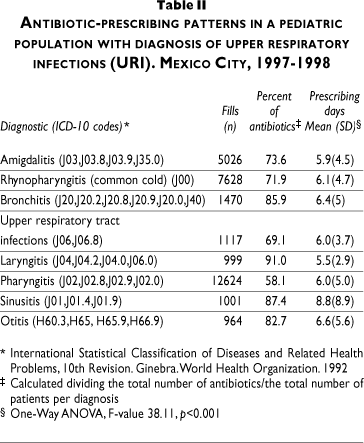
<body><![CDATA[<p><b><font face="Verdana, Arial, Helvetica, sans-serif" size="3">Results</font></b></p>     <p><font face="Verdana, Arial, Helvetica-Normal, sans-serif" size="2">The sample    contained 30 889 prescriptions filled for patients under 16 years of age. These    patients were prescribed at least once under the selected diagnoses during the    period of study. By gender, the proportion of participants was similar (48%    males, 52% females). Most of the population (32.4%) was in the 6 to 10 year-old    age range. The total average of drugs prescribed per patient was 5.6 drugs and    varied from 4.6 for the 11 to 16 year-old group, to 6.3 for the 3 to 5 year-old    group. These differences were statistically significant (ANOVA, <i>p</i>&lt;0.001),    (<a href="/img/revistas/spm/v45n3/16477t1.gif">Table I</a>).</font></p>     <p><font face="Verdana, Arial, Helvetica-Normal, sans-serif" size="2">Pediatricians    prescribed (74.2%) antibiotics more frequently, contrasting with general practitioners    (24.9%) and other specialties, such as otolaryngology, surgeons and allergy    specialists (0.8%) (<font face="Symbol">c</font><sup>2</sup> test, <i>p</i>&lt;0.001).    The use of antibiotics was lower in the younger groups, and this observation    was consistent across the different specialties. (Data not showed).</font></p>     <p><font face="Verdana, Arial, Helvetica-Normal, sans-serif" size="2">The most    common diagnosis was pharyngitis (41%), followed by rhinopharyngitis or common    cold (24.6%), amigdalitis (16.3%), bronchitis (4.8%), other unspecified upper    respiratory tract infections (3.6%), sinusitis (3.2%), laryngitis (3.2%), and    otitis (3.1%).</font></p>     <p><font face="Verdana, Arial, Helvetica-Normal, sans-serif" size="2">The overall    usage frequency of antibiotics in the total sample reached 77.5%, ranging from    58.1% in patients with diagnosis of pharyngitis, to 91% in those with laryngitis.    From another perspective, 22.5% of all the patients seen for URI, received and    filled a prescription which did not include an antibiotic.</font></p>     <p><font face="Verdana, Arial, Helvetica-Normal, sans-serif" size="2">Antibiotic    drugs were more frequently prescribed than non-antibiotic drugs (symptomatic),    with a 2.1:1 ratio. In general, 31.9% of all drugs prescribed were antibiotics,    which means that 9 823 antibiotics were received by the 5 533 patients with    URI who filled a prescription within the analyzed period (an average of 1.8    antibiotics per patient).</font></p>     <p><font face="Verdana, Arial, Helvetica-Normal, sans-serif" size="2">The highest    mean of days of treatment with an antibiotic corresponded to sinusitis (8.8),    followed by otitis (6.6), bronchitis (6.4), rhinopharyngitis/common cold (6.1),    pharyngitis (6.0), upper respiratory tract infections (6), amigdalitis (5.9),    and laryngitis (5.5), (<a href="#tabela2">Table II</a>).</font></p>     <p align="center"><a name="tabela2"></a></p>     <p align="center">&nbsp;</p>     <p align="center"><img src="/img/revistas/spm/v45n3/16477t2.gif"></p>     ]]></body>
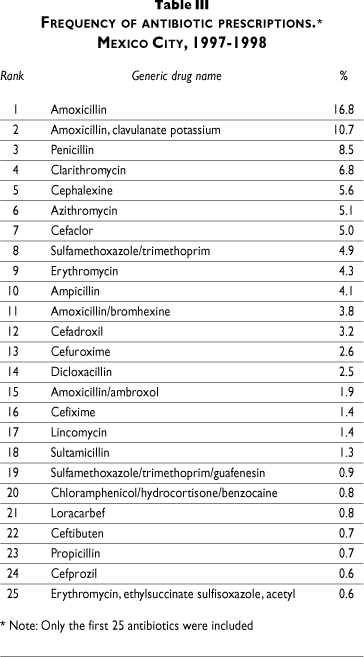
<body><![CDATA[<p align="center">&nbsp;</p>     <p><font face="Verdana, Arial, Helvetica-Normal, sans-serif" size="2">The five    most prescribed antibiotics for all age groups, diagnoses, and medical specialties    were: a) Amoxicillin (16.8%), b) Amoxicillin plus clavulanic acid (10.7%), c)    Penicillin (8.5%), d) clarythromycin (6.8%), e) Cephalexine (5.6%), (<a href="#tabela3">Table    III</a>).</font></p>     <p align="center"><a name="tabela3"></a></p>     <p align="center">&nbsp;</p>     <p align="center"><img src="/img/revistas/spm/v45n3/16477t3.gif"></p>     <p align="center">&nbsp;</p>     <p><font face="Verdana, Arial, Helvetica-Normal, sans-serif" size="2">When these    data were analyzed based on diagnosis, differences were found in the type of    antibiotics used. For the diagnosis of otitis and sinusitis, the most frequently    used antibiotic was amoxicillin plus clavulanic acid, followed by second-generation    cephalosporins (cefaclor and cefuroxime). In bronchitis, the most common antibiotic    was penicillin, followed by amoxicillin and azithromycin. For laryngitis the    most common antibiotic was amoxicillin, followed by sulphametoxazol/trimethroprim,    and amoxicillin plus clavulanic acid. For the common cold, the most common antibiotics    prescribed were amoxicillin, penicillin, amoxicillin plus clavulanic acid, and    cephalexine.</font></p>     <p><font face="Verdana, Arial, Helvetica-Normal, sans-serif" size="2">Forty-five    different antibiotics were prescribed. After sorting them by class, they were    analyzed. The most frequently prescribed group was penicillin (including aminopenicillins)    (52.1%), followed by cephalosporins (20.4%, predominantly those belonging to    the second generation with 37.4%), macrolides (17.9%), and sulphonamides (6%).</font></p>     <p>&nbsp;</p>     <p><b><font face="Verdana, Arial, Helvetica, sans-serif" size="3">Discussion</font></b></p>     ]]></body>
<body><![CDATA[<p><font face="Verdana, Arial, Helvetica-Normal, sans-serif" size="2">To our knowledge,    this is the first study that analyzes the prescribing pattern of physicians    working in a private practice setting in Mexico, where doctors have no drug-selection    restrictions.</font></p>     <p><font face="Verdana, Arial, Helvetica-Normal, sans-serif" size="2">Worldwide,    the frequent use of antibiotics in ambulatory patients with URI is a topic of    great epidemiological and economic impact. It was found that 7 out of every    10 pediatric patients with URI received an antibiotic. This frequency of antibiotic    usage for URI is higher than that in most of the previous reports,<sup>2,3,6</sup>    suggesting an over-utilization of antibiotics, in contrast with standard practices.<sup>9</sup>    This finding is similar with that reported in the National Health Survey (1994),<sup>11</sup>    where a prescription percentage of 87% was found in beneficiaries of all ages    at private institutions. The frequency of antibiotic usage found in this report    might be consistent with the whole private medical practice in Mexico.</font></p>     <p><font face="Verdana, Arial, Helvetica-Normal, sans-serif" size="2">Rosenstein    <i>et al</i><sup>2</sup> and Gonzalez <i>et al</i><sup>6</sup> both reported    that 50% to 70% of patients having a common cold are prescribed an antibiotic.    This may be due to insistence by the patient to be prescribed antibiotics.<sup>12</sup></font></p>     <p><font face="Verdana, Arial, Helvetica-Normal, sans-serif" size="2">In Mexico,    Gutierrez <i>et al<sup>3</sup></i> reported 63% usage of antibiotics for URI    in an outpatient rural population covered by a health insurance scheme that    provided a 100% reimbursement for drugs. Libreros <i>et al</i><sup>4</sup> found    a similar pattern in 85.5% of the patients with URI attending the social security    system, and 70.4% in those attending a public health system.</font></p>     <p><font face="Verdana, Arial, Helvetica-Normal, sans-serif" size="2">If analysis    is limited only to rhinopharyngitis/common cold cases (J00), the percentage    (71.9%) is considered high, given the viral etiology of most of these infections.    Moreover, it could also contribute to the increasing antimicrobial drug resistance    in our setting.<sup>4</sup></font></p>     <p><font face="Verdana, Arial, Helvetica-Normal, sans-serif" size="2">In studies    performed in children, Nyquist <i>et al</i><sup>8</sup> reported 44% of antibiotic    usage in common cold and Schwartz <i>et al</i><sup>13</sup> reported 71%. In    populations that included adults, Libreros <i>et al</i><sup>4</sup> observed    80.4% of antibiotic usage for the common cold in Mexico, and Mainous <i>et al</i><sup>5</sup>    observed 60%. Conversely, Guillemont <i>et al,</i><sup>14</sup> in a study conducted    in Europe, reported that only 17% of common cold cases were given antibiotics.</font></p>     <p><font face="Verdana, Arial, Helvetica-Normal, sans-serif" size="2">Among patients    with sinusitis and otitis, 87.4% and 82.7% were given an antibiotic, respectively,    thus meeting standard guidelines.<sup>9</sup></font></p>     <p><font face="Verdana, Arial, Helvetica-Normal, sans-serif" size="2">Considering    the reduced group of diagnoses reviewed, the high variability of prescribed    antibiotics is of great concern (45 different antibiotics). McCaig and Hughes<sup>7</sup>    reported that their study group of physicians prescribed only 19 different antibiotics    to treat URI.</font></p>     <p><font face="Verdana, Arial, Helvetica-Normal, sans-serif" size="2">The distribution    of antibiotics by therapeutic group showed a high use of cephalosporins (27%),    with a higher proportion of second generation types, a finding consistent with    reports elsewhere.<sup>5,13</sup> The use of penicillin is still important in    Mexico. Penicillin was considered as the third therapeutic option in physicians'    preferences, with 8.5% of the total. Gutierrez <i>et al</i><sup>3</sup> and    Libreros <i>et al</i><sup>4</sup> also observed a high use of penicillin (54.8%    and 25.5%, respectively). Nevertheless, it should be considered that the population    studied in those reports consisted of social security beneficiaries relying    on a Closed Formulary. It is also important to note that the studies were carried    out when some of the cephalosporin and aminopenicillinbased antibiotics were    not as popular as they currently are. It is interesting that the percentage    found in our study for erythromycin (4.3%) was rather low if compared with that    reported by Mexico's social security system (where it is the first antibiotic    prescribed in 30.3% of the population).<sup>4</sup></font></p>     <p><font face="Verdana, Arial, Helvetica-Normal, sans-serif" size="2">Regarding    the results observed in different groups of medical specialties, general practitioners    tend to prescribe antibiotics more often in younger groups (less than one year),    while medical specialists prescribe antibiotics with a lower frequency (<i>p</i>&lt;    0.05).</font></p>     ]]></body>
<body><![CDATA[<p><font face="Verdana, Arial, Helvetica-Normal, sans-serif" size="2">The studies    conducted in our setting and those reported from other countries are based on    surveys directed to physicians. This might mislead the recording and accuracy    of the analyzed information. However, the use of a prescription database &#150;such    as the one we use in the present report&#150; can reduce or eliminate possible    inaccuracies. Information is taken from an electronic system that records only    what is filled from each prescription at the final pharmacy level. Still, it    is in itself a potential source of bias. Lezzoni<sup>15</sup> and Goldberg <i>et    al</i><sup>16</sup> have stressed the issues surrounding the use of administrative    databases to conduct epidemiological and economical research. The database used    for this study is conformed by 100% of the prescriptions filled to the population    covered. It is mainly a claims database, yet with a high clinical value for    analytic purposes. All the information written by the physician included a specific    coded diagnosis for each drug and was electronically collected at the pharmacy    level. Retrospective analyses allowed billing providers, included physicians,    and planning interventions to improve drug use patterns. Another potential source    of bias in our database comes from the non-specific ICD-10 code assignment to    each case. This often happens when the physician does not remember or does not    have the time to look for a more specific one. This "bias of prescription code"    may be an important aspect to evaluate in future studies.</font></p>     <p><font face="Verdana, Arial, Helvetica-Normal, sans-serif" size="2">Although    this study is an interesting approach to physicians' prescribing practices in    our setting, conclusions should be taken cautiously if we consider the study    design. The database analyzed did not provide outcome information concerning    office visits for URI. Only medical encounters where a prescription was finally    filled at the pharmacy were informative. Thus, the percentage of patients with    URI who received an antibiotic cannot be accurately related to the actual number    of patients with URI attending private ambulatory care. We can only assume overutilization    in all patients filling a prescription under the diagnosis of URI, being the    ratio of antibiotics to symptomatic drugs of 3.4 to 1 (77.5% of patients receiving    an antibiotic compared with 22.5% who did not). As a result, physicians who    tend to prescribe any medications will probably be overrepresented. Therefore,    our numbers will only show the comparative prescribing pattern of antibiotics    versus other (symptomatic) drugs in URI, and not precisely the general frequency    of antibiotic prescribing for this condition. It is important to state however,    that for this population, the percentage of visits with no filled prescription    is low&#150;independently of the diagnosis-, ranging from 5 to 10%. This finding    originated from specific analysis regularly performed for doctors' pay-roll    purposes (data on file). We believe that the low number of visits resulting    in no medical prescription is mainly due to the reimbursement scheme's nature    of the provided service. Most patients in this setting expect a medical prescription    after visiting a doctor, and the physician could be responding to an unconscious    pressure. When a patient attends with symptoms, as it commonly occurs in URI,    the percentage of no drug usage should be even higher.<sup>12</sup> In addition,    URI patients who do not seek medical care may be another potential factor of    missing data.</font></p>     <p><font face="Verdana, Arial, Helvetica-Normal, sans-serif" size="2">On the other    hand, there is another major issue to be considered: patients with a viral URI    who develop a bacterial complication. This usually leads to a prescription of    antibiotics. Unfortunately, the information reviewed is insufficient to identify    such cases and their final impact on our Results.</font></p>     <p><font face="Verdana, Arial, Helvetica-Normal, sans-serif" size="2">Finally,    it should be stated that these claim-processing databases show what medical    prescriptions really are, with all their implied failures and bias. What this    database contains is what patients really filled at the pharmacy, after seeing    a doctor. Nowadays, the utilization of this kind of databases must be considered    as an important element in pharmacoepidemiology analyses and a very useful tool    to improve the decision-making process in clinical practice.</font></p>     <p><font face="Verdana, Arial, Helvetica-Normal, sans-serif" size="2">The present    report provides information of prescribing practices in URI related with antibiotics    in a pre-paid health plan in Mexico. Results show a clear tendency towards drug    over-utilization, and so provide a general framework for similar settings.</font></p>     <p><font face="Verdana, Arial, Helvetica-Normal, sans-serif" size="2">The average    usage of 1.8 antibiotics per patient with URI (77.5% of the total patients)    could be an overestimate, due to the potential presence of antibiotic change    in "non-responders", an obvious occurrence in viral-origin URI. The findings    are to be used as a support for specific campaigns, towards a judicious use    of antibiotics in children in our setting.</font></p>     <p>&nbsp;</p>     <p><font face="Verdana, Arial, Helvetica-Normal, sans-serif" size="3"><b>Acknowledgments</b></font></p>     <p><font face="Verdana, Arial, Helvetica-Normal, sans-serif" size="2">The authors    wish to thank Ricardo Figueroa-Damian MD, Enrique Segura-Cervantes MD, and Gilberto    Casta&ntilde;eda PhD, for their comments, as well as Jorge Rodriguez for data    management.</font></p>     <p>&nbsp;</p>     ]]></body>
<body><![CDATA[<p><b><font face="Verdana, Arial, Helvetica, sans-serif" size="3">References</font></b></p>     <!-- ref --><p><font face="Verdana, Arial, Helvetica-Normal, sans-serif" size="2">1. Dowell    SF, Marcy SM, Phillips WR, Gerber MA, Schwartz B. Principles of judicious use    of antimicrobial agents for pediatric upper respiratory tract infections. Pediatrics    1998;101:163-165.</font>&nbsp;&nbsp;&nbsp;&nbsp;&nbsp;&nbsp;&nbsp;&nbsp;[&#160;<a href="javascript:void(0);" onclick="javascript: window.open('/scielo.php?script=sci_nlinks&ref=9233565&pid=S0036-3634200300030000400001&lng=','','width=640,height=500,resizable=yes,scrollbars=1,menubar=yes,');">Links</a>&#160;]<!-- end-ref --><!-- ref --><p><font face="Verdana, Arial, Helvetica-Normal, sans-serif" size="2">2. Rosenstein    N, Phillips WR, Gerber MA, Marcy SM, Schwartz B, Dowell SF. The common cold-    principles of judicious use of antimicrobial agents. Pediatrics 1998;101:181-184.</font>&nbsp;&nbsp;&nbsp;&nbsp;&nbsp;&nbsp;&nbsp;&nbsp;[&#160;<a href="javascript:void(0);" onclick="javascript: window.open('/scielo.php?script=sci_nlinks&ref=9233566&pid=S0036-3634200300030000400002&lng=','','width=640,height=500,resizable=yes,scrollbars=1,menubar=yes,');">Links</a>&#160;]<!-- end-ref --><!-- ref --><p><font face="Verdana, Arial, Helvetica-Normal, sans-serif" size="2">3. Guti&eacute;rrez    G, Mart&iacute;nez MC, Guiscafr&eacute; H, G&oacute;mez G, Peniche A, Mu&ntilde;oz    O. Encuesta sobre el uso de antimicrobianos en las infecciones respiratorias    agudas en la poblaci&oacute;n rural mexicana. Bol Med Hosp Infant Mex 1986;43:761-768.</font>&nbsp;&nbsp;&nbsp;&nbsp;&nbsp;&nbsp;&nbsp;&nbsp;[&#160;<a href="javascript:void(0);" onclick="javascript: window.open('/scielo.php?script=sci_nlinks&ref=9233567&pid=S0036-3634200300030000400003&lng=','','width=640,height=500,resizable=yes,scrollbars=1,menubar=yes,');">Links</a>&#160;]<!-- end-ref --><!-- ref --><p><font face="Verdana, Arial, Helvetica-Normal, sans-serif" size="2">4. Libreros    V, Guiscafr&eacute; H, Tom&eacute; P, Reyes H, P&eacute;rez-Cuevas R, Guti&eacute;rrez    G <i>et al</i>. Patrones de prescripci&oacute;n terap&eacute;utica en diarrea    e infecciones respiratorias agudas en dos instituciones de salud: SS e IMSS.    Gac Med Mex 1992;128:505-552.</font>&nbsp;&nbsp;&nbsp;&nbsp;&nbsp;&nbsp;&nbsp;&nbsp;[&#160;<a href="javascript:void(0);" onclick="javascript: window.open('/scielo.php?script=sci_nlinks&ref=9233568&pid=S0036-3634200300030000400004&lng=','','width=640,height=500,resizable=yes,scrollbars=1,menubar=yes,');">Links</a>&#160;]<!-- end-ref --><!-- ref --><p><font face="Verdana, Arial, Helvetica-Normal, sans-serif" size="2">5. Mainous    AG, 3a. ed, Hueston WJ, Clark JR. Antibiotics and upper respiratory infection:    Do some folks think is a cure for the common cold? J Fam Pract 1996;42:357-361.</font>&nbsp;&nbsp;&nbsp;&nbsp;&nbsp;&nbsp;&nbsp;&nbsp;[&#160;<a href="javascript:void(0);" onclick="javascript: window.open('/scielo.php?script=sci_nlinks&ref=9233569&pid=S0036-3634200300030000400005&lng=','','width=640,height=500,resizable=yes,scrollbars=1,menubar=yes,');">Links</a>&#160;]<!-- end-ref --><!-- ref --><p><font face="Verdana, Arial, Helvetica-Normal, sans-serif" size="2">6. Gonz&aacute;lez    R, Steiner JF, Merle S. Antibiotic prescribing for adults with colds, upper    respiratory tract infections, and bronchitis by ambulatory care physicians.    JAMA 1997;278:901-904.</font>&nbsp;&nbsp;&nbsp;&nbsp;&nbsp;&nbsp;&nbsp;&nbsp;[&#160;<a href="javascript:void(0);" onclick="javascript: window.open('/scielo.php?script=sci_nlinks&ref=9233570&pid=S0036-3634200300030000400006&lng=','','width=640,height=500,resizable=yes,scrollbars=1,menubar=yes,');">Links</a>&#160;]<!-- end-ref --><!-- ref --><p><font face="Verdana, Arial, Helvetica-Normal, sans-serif" size="2">7. McCaig    LF, Hughes JM. Trends in antimicrobial drug prescribing among office-based physicians    in the United States. JAMA 1995;273:214-219.</font>&nbsp;&nbsp;&nbsp;&nbsp;&nbsp;&nbsp;&nbsp;&nbsp;[&#160;<a href="javascript:void(0);" onclick="javascript: window.open('/scielo.php?script=sci_nlinks&ref=9233571&pid=S0036-3634200300030000400007&lng=','','width=640,height=500,resizable=yes,scrollbars=1,menubar=yes,');">Links</a>&#160;]<!-- end-ref --><!-- ref --><p><font face="Verdana, Arial, Helvetica-Normal, sans-serif" size="2">8. Nyquist    AC,Gonz&aacute;lez R, Steiner J, Sande MA. Antibiotics for children with upper    respiratory tract infections. JAMA 1998;280:1399-1402.</font>&nbsp;&nbsp;&nbsp;&nbsp;&nbsp;&nbsp;&nbsp;&nbsp;[&#160;<a href="javascript:void(0);" onclick="javascript: window.open('/scielo.php?script=sci_nlinks&ref=9233572&pid=S0036-3634200300030000400008&lng=','','width=640,height=500,resizable=yes,scrollbars=1,menubar=yes,');">Links</a>&#160;]<!-- end-ref --><!-- ref --><p><font face="Verdana, Arial, Helvetica-Normal, sans-serif" size="2">9. Flores-Hern&aacute;ndez    S, Trejo y P&eacute;rez JA, Reyes-Morales H, P&eacute;rez-Cuevas R, Loera-Romo    G, Ju&aacute;rez D&iacute;az-Gonz&aacute;lez N <i>et al</i>. Dise&ntilde;o y    aplicabilidad de una gu&iacute;a cl&iacute;nica para la atenci&oacute;n apropiada    en las infecciones respiratorias agudas. Gac Med Mex 1999;135:121-137.</font>&nbsp;&nbsp;&nbsp;&nbsp;&nbsp;&nbsp;&nbsp;&nbsp;[&#160;<a href="javascript:void(0);" onclick="javascript: window.open('/scielo.php?script=sci_nlinks&ref=9233573&pid=S0036-3634200300030000400009&lng=','','width=640,height=500,resizable=yes,scrollbars=1,menubar=yes,');">Links</a>&#160;]<!-- end-ref --><!-- ref --><p><font face="Verdana, Arial, Helvetica-Normal, sans-serif" size="2">10. World    Health Organization. International Statistical Classification of Diseases and    Related Health Problems, 10th Revision. Ginebra: WHO, 1992.</font>&nbsp;&nbsp;&nbsp;&nbsp;&nbsp;&nbsp;&nbsp;&nbsp;[&#160;<a href="javascript:void(0);" onclick="javascript: window.open('/scielo.php?script=sci_nlinks&ref=9233574&pid=S0036-3634200300030000400010&lng=','','width=640,height=500,resizable=yes,scrollbars=1,menubar=yes,');">Links</a>&#160;]<!-- end-ref --><!-- ref --><p><font face="Verdana, Arial, Helvetica-Normal, sans-serif" size="2">11. Leyva-Flores    R, Erviti-Erice J, Kageyama-Escobar M, Arredondo A. Prescripci&oacute;n, acceso    y gasto en medicamentos entre usuarios de servicios de salud en M&eacute;xico.    Salud Publica Mex 1998;40:24-31.</font>&nbsp;&nbsp;&nbsp;&nbsp;&nbsp;&nbsp;&nbsp;&nbsp;[&#160;<a href="javascript:void(0);" onclick="javascript: window.open('/scielo.php?script=sci_nlinks&ref=9233575&pid=S0036-3634200300030000400011&lng=','','width=640,height=500,resizable=yes,scrollbars=1,menubar=yes,');">Links</a>&#160;]<!-- end-ref --><!-- ref --><p><font face="Verdana, Arial, Helvetica-Normal, sans-serif" size="2">12. Hamm    RM, Hicks RJ, Bemben DA. Antibiotics and respiratory infections: Are patients    more satisfied when expectations are met? J Fam Pract 1996;43:56-62.</font>&nbsp;&nbsp;&nbsp;&nbsp;&nbsp;&nbsp;&nbsp;&nbsp;[&#160;<a href="javascript:void(0);" onclick="javascript: window.open('/scielo.php?script=sci_nlinks&ref=9233576&pid=S0036-3634200300030000400012&lng=','','width=640,height=500,resizable=yes,scrollbars=1,menubar=yes,');">Links</a>&#160;]<!-- end-ref --><!-- ref --><p><font face="Verdana, Arial, Helvetica-Normal, sans-serif" size="2">13. Schwartz    RH,Freij BJ,Ziai M, Scheridan MJ. Antimicrobial prescribing for acute purulent    rhinitis in children: A survey of pediatricians and family practitioners. Pediatr    Infect Dis J 1997;16:185-190</font>&nbsp;&nbsp;&nbsp;&nbsp;&nbsp;&nbsp;&nbsp;&nbsp;[&#160;<a href="javascript:void(0);" onclick="javascript: window.open('/scielo.php?script=sci_nlinks&ref=9233577&pid=S0036-3634200300030000400013&lng=','','width=640,height=500,resizable=yes,scrollbars=1,menubar=yes,');">Links</a>&#160;]<!-- end-ref --><!-- ref --><p><font face="Verdana, Arial, Helvetica-Normal, sans-serif" size="2">14. Guillemot    D, Carbon C, Vauzelle-Kervroedan F, Balkau B, Maison P, Bouvenot G <i>et al</i>.    Inappropriateness and variability of antibiotic prescription among French office-based    physicians. J Clin Epidemiol 1998;51:61-68.</font>&nbsp;&nbsp;&nbsp;&nbsp;&nbsp;&nbsp;&nbsp;&nbsp;[&#160;<a href="javascript:void(0);" onclick="javascript: window.open('/scielo.php?script=sci_nlinks&ref=9233578&pid=S0036-3634200300030000400014&lng=','','width=640,height=500,resizable=yes,scrollbars=1,menubar=yes,');">Links</a>&#160;]<!-- end-ref --><!-- ref --><p><font face="Verdana, Arial, Helvetica-Normal, sans-serif" size="2">15. Iezzoni    LI. Assessing quality using administrative data. Ann Intern Med 1997;127:666-674.</font>&nbsp;&nbsp;&nbsp;&nbsp;&nbsp;&nbsp;&nbsp;&nbsp;[&#160;<a href="javascript:void(0);" onclick="javascript: window.open('/scielo.php?script=sci_nlinks&ref=9233579&pid=S0036-3634200300030000400015&lng=','','width=640,height=500,resizable=yes,scrollbars=1,menubar=yes,');">Links</a>&#160;]<!-- end-ref --><!-- ref --><p><font face="Verdana, Arial, Helvetica-Normal, sans-serif" size="2">16. Goldberg    R, Kotsanos JG. Panel 3: Methodological issues in conducting pharmacoeconomic    evaluations. Retrospective and claims database studies. Value Health 1999;2:82-87.</font>&nbsp;&nbsp;&nbsp;&nbsp;&nbsp;&nbsp;&nbsp;&nbsp;[&#160;<a href="javascript:void(0);" onclick="javascript: window.open('/scielo.php?script=sci_nlinks&ref=9233580&pid=S0036-3634200300030000400016&lng=','','width=640,height=500,resizable=yes,scrollbars=1,menubar=yes,');">Links</a>&#160;]<!-- end-ref --><p>&nbsp;</p>     <p>&nbsp;</p>     <p><font face="Verdana, Arial, Helvetica-Normal, sans-serif" size="2"><b>Address    reprint requests to:</b>    ]]></body>
<body><![CDATA[<br>   Adolfo Gabriel Hern&aacute;ndez Gardu&ntilde;o    <br>   Direcci&oacute;n de Investigaci&oacute;n, Hospital General de M&eacute;xico    <br>   Secretar&iacute;a de Salud. Dr. Balmis 148, colonia Doctores, 06726 M&eacute;xico,    DF    <br>   E-mail: <a href="mailto:hzglob@liceaga.facmed.unam.mx">hzglob@liceaga.facmed.unam.mx</a></font></p>     <p><b><font face="Verdana, Arial, Helvetica-Normal, sans-serif" size="2">Received    on:</font></b><font face="Verdana, Arial, Helvetica-Normal, sans-serif" size="2">    April 26, 2002    <br>   <b>Accepted on:</b> October 24, 2002    <br>   </font><font face="Verdana, Arial, Helvetica-Normal, sans-serif" size="2">Project    supported by Medco de M&eacute;xico Managed Care</font></p>     <p>&nbsp;</p>     <p>&nbsp;</p>     <p> <font face="Verdana, Arial, Helvetica, sans-serif" size="2">The English version    of this paper is available too at: <a href="http://www.insp.mx/salud/index.html">http://www.insp.mx/salud/index.html</a></font></p>     ]]></body>
<body><![CDATA[ ]]></body><back>
<ref-list>
<ref id="B1">
<label>1</label><nlm-citation citation-type="journal">
<person-group person-group-type="author">
<name>
<surname><![CDATA[Dowell]]></surname>
<given-names><![CDATA[SF]]></given-names>
</name>
<name>
<surname><![CDATA[Marcy]]></surname>
<given-names><![CDATA[SM]]></given-names>
</name>
<name>
<surname><![CDATA[Phillips]]></surname>
<given-names><![CDATA[WR]]></given-names>
</name>
<name>
<surname><![CDATA[Gerber]]></surname>
<given-names><![CDATA[MA]]></given-names>
</name>
<name>
<surname><![CDATA[Schwartz]]></surname>
<given-names><![CDATA[B]]></given-names>
</name>
</person-group>
<article-title xml:lang="en"><![CDATA[Principles of judicious use of antimicrobial agents for pediatric upper respiratory tract infections]]></article-title>
<source><![CDATA[Pediatrics]]></source>
<year>1998</year>
<volume>101</volume>
<page-range>163-165</page-range></nlm-citation>
</ref>
<ref id="B2">
<label>2</label><nlm-citation citation-type="journal">
<person-group person-group-type="author">
<name>
<surname><![CDATA[Rosenstein]]></surname>
<given-names><![CDATA[N]]></given-names>
</name>
<name>
<surname><![CDATA[Phillips]]></surname>
<given-names><![CDATA[WR]]></given-names>
</name>
<name>
<surname><![CDATA[Gerber]]></surname>
<given-names><![CDATA[MA]]></given-names>
</name>
<name>
<surname><![CDATA[Marcy]]></surname>
<given-names><![CDATA[SM]]></given-names>
</name>
<name>
<surname><![CDATA[Schwartz]]></surname>
<given-names><![CDATA[B]]></given-names>
</name>
<name>
<surname><![CDATA[Dowell]]></surname>
<given-names><![CDATA[SF]]></given-names>
</name>
</person-group>
<article-title xml:lang="en"><![CDATA[The common cold- principles of judicious use of antimicrobial agents]]></article-title>
<source><![CDATA[Pediatrics]]></source>
<year>1998</year>
<volume>101</volume>
<page-range>181-184</page-range></nlm-citation>
</ref>
<ref id="B3">
<label>3</label><nlm-citation citation-type="journal">
<person-group person-group-type="author">
<name>
<surname><![CDATA[Gutiérrez]]></surname>
<given-names><![CDATA[G]]></given-names>
</name>
<name>
<surname><![CDATA[Martínez]]></surname>
<given-names><![CDATA[MC]]></given-names>
</name>
<name>
<surname><![CDATA[Guiscafré]]></surname>
<given-names><![CDATA[H]]></given-names>
</name>
<name>
<surname><![CDATA[Gómez]]></surname>
<given-names><![CDATA[G]]></given-names>
</name>
<name>
<surname><![CDATA[Peniche]]></surname>
<given-names><![CDATA[A]]></given-names>
</name>
<name>
<surname><![CDATA[Muñoz]]></surname>
<given-names><![CDATA[O]]></given-names>
</name>
</person-group>
<article-title xml:lang="es"><![CDATA[Encuesta sobre el uso de antimicrobianos en las infecciones respiratorias agudas en la población rural mexicana]]></article-title>
<source><![CDATA[Bol Med Hosp Infant Mex]]></source>
<year>1986</year>
<volume>43</volume>
<page-range>761-768</page-range></nlm-citation>
</ref>
<ref id="B4">
<label>4</label><nlm-citation citation-type="journal">
<person-group person-group-type="author">
<name>
<surname><![CDATA[Libreros]]></surname>
<given-names><![CDATA[V]]></given-names>
</name>
<name>
<surname><![CDATA[Guiscafré]]></surname>
<given-names><![CDATA[H]]></given-names>
</name>
<name>
<surname><![CDATA[Tomé]]></surname>
<given-names><![CDATA[P]]></given-names>
</name>
<name>
<surname><![CDATA[Reyes]]></surname>
<given-names><![CDATA[H]]></given-names>
</name>
<name>
<surname><![CDATA[Pérez-Cuevas]]></surname>
<given-names><![CDATA[R]]></given-names>
</name>
<name>
<surname><![CDATA[Gutiérrez]]></surname>
<given-names><![CDATA[G]]></given-names>
</name>
</person-group>
<article-title xml:lang="es"><![CDATA[Patrones de prescripción terapéutica en diarrea e infecciones respiratorias agudas en dos instituciones de salud: SS e IMSS]]></article-title>
<source><![CDATA[Gac Med Mex]]></source>
<year>1992</year>
<volume>128</volume>
<page-range>505-552</page-range></nlm-citation>
</ref>
<ref id="B5">
<label>5</label><nlm-citation citation-type="journal">
<person-group person-group-type="author">
<name>
<surname><![CDATA[Mainous]]></surname>
<given-names><![CDATA[AG]]></given-names>
</name>
<name>
<surname><![CDATA[Hueston]]></surname>
<given-names><![CDATA[WJ]]></given-names>
</name>
<name>
<surname><![CDATA[Clark]]></surname>
<given-names><![CDATA[JR]]></given-names>
</name>
</person-group>
<article-title xml:lang="en"><![CDATA[Antibiotics and upper respiratory infection: Do some folks think is a cure for the common cold?]]></article-title>
<source><![CDATA[J Fam Pract]]></source>
<year>1996</year>
<volume>42</volume>
<page-range>357-361</page-range></nlm-citation>
</ref>
<ref id="B6">
<label>6</label><nlm-citation citation-type="journal">
<person-group person-group-type="author">
<name>
<surname><![CDATA[González]]></surname>
<given-names><![CDATA[R]]></given-names>
</name>
<name>
<surname><![CDATA[Steiner]]></surname>
<given-names><![CDATA[JF]]></given-names>
</name>
<name>
<surname><![CDATA[Merle]]></surname>
<given-names><![CDATA[S]]></given-names>
</name>
</person-group>
<article-title xml:lang="en"><![CDATA[Antibiotic prescribing for adults with colds, upper respiratory tract infections, and bronchitis by ambulatory care physicians]]></article-title>
<source><![CDATA[JAMA]]></source>
<year>1997</year>
<volume>278</volume>
<page-range>901-904</page-range></nlm-citation>
</ref>
<ref id="B7">
<label>7</label><nlm-citation citation-type="journal">
<person-group person-group-type="author">
<name>
<surname><![CDATA[McCaig]]></surname>
<given-names><![CDATA[LF]]></given-names>
</name>
<name>
<surname><![CDATA[Hughes]]></surname>
<given-names><![CDATA[JM]]></given-names>
</name>
</person-group>
<article-title xml:lang="en"><![CDATA[Trends in antimicrobial drug prescribing among office-based physicians in the United States]]></article-title>
<source><![CDATA[JAMA]]></source>
<year>1995</year>
<volume>273</volume>
<page-range>214-219</page-range></nlm-citation>
</ref>
<ref id="B8">
<label>8</label><nlm-citation citation-type="journal">
<person-group person-group-type="author">
<name>
<surname><![CDATA[Nyquist]]></surname>
<given-names><![CDATA[AC]]></given-names>
</name>
<name>
<surname><![CDATA[González]]></surname>
<given-names><![CDATA[R]]></given-names>
</name>
<name>
<surname><![CDATA[Steiner]]></surname>
<given-names><![CDATA[J]]></given-names>
</name>
<name>
<surname><![CDATA[Sande]]></surname>
<given-names><![CDATA[MA]]></given-names>
</name>
</person-group>
<article-title xml:lang="en"><![CDATA[Antibiotics for children with upper respiratory tract infections]]></article-title>
<source><![CDATA[JAMA]]></source>
<year>1998</year>
<volume>280</volume>
<page-range>1399-1402</page-range></nlm-citation>
</ref>
<ref id="B9">
<label>9</label><nlm-citation citation-type="journal">
<person-group person-group-type="author">
<name>
<surname><![CDATA[Flores-Hernández]]></surname>
<given-names><![CDATA[S]]></given-names>
</name>
<name>
<surname><![CDATA[Trejo y Pérez]]></surname>
<given-names><![CDATA[JA]]></given-names>
</name>
<name>
<surname><![CDATA[Reyes-Morales]]></surname>
<given-names><![CDATA[H]]></given-names>
</name>
<name>
<surname><![CDATA[Pérez-Cuevas]]></surname>
<given-names><![CDATA[R]]></given-names>
</name>
<name>
<surname><![CDATA[Loera-Romo]]></surname>
<given-names><![CDATA[G]]></given-names>
</name>
<name>
<surname><![CDATA[Díaz-González]]></surname>
<given-names><![CDATA[Juárez]]></given-names>
</name>
</person-group>
<article-title xml:lang="es"><![CDATA[Diseño y aplicabilidad de una guía clínica para la atención apropiada en las infecciones respiratorias agudas]]></article-title>
<source><![CDATA[Gac Med Mex]]></source>
<year>1999</year>
<volume>135</volume>
<page-range>121-137</page-range></nlm-citation>
</ref>
<ref id="B10">
<label>10</label><nlm-citation citation-type="book">
<collab>World Health Organization</collab>
<source><![CDATA[International Statistical Classification of Diseases and Related Health Problems]]></source>
<year>1992</year>
<edition>10</edition>
<publisher-loc><![CDATA[Ginebra ]]></publisher-loc>
<publisher-name><![CDATA[WHO]]></publisher-name>
</nlm-citation>
</ref>
<ref id="B11">
<label>11</label><nlm-citation citation-type="journal">
<person-group person-group-type="author">
<name>
<surname><![CDATA[Leyva-Flores]]></surname>
<given-names><![CDATA[R]]></given-names>
</name>
<name>
<surname><![CDATA[Erviti-Erice]]></surname>
<given-names><![CDATA[J]]></given-names>
</name>
<name>
<surname><![CDATA[Kageyama-Escobar]]></surname>
<given-names><![CDATA[M]]></given-names>
</name>
<name>
<surname><![CDATA[Arredondo]]></surname>
<given-names><![CDATA[A]]></given-names>
</name>
</person-group>
<article-title xml:lang="es"><![CDATA[Prescripción, acceso y gasto en medicamentos entre usuarios de servicios de salud en México]]></article-title>
<source><![CDATA[Salud Publica Mex]]></source>
<year>1998</year>
<volume>40</volume>
<page-range>24-31</page-range></nlm-citation>
</ref>
<ref id="B12">
<label>12</label><nlm-citation citation-type="journal">
<person-group person-group-type="author">
<name>
<surname><![CDATA[Hamm]]></surname>
<given-names><![CDATA[RM]]></given-names>
</name>
<name>
<surname><![CDATA[Hicks]]></surname>
<given-names><![CDATA[RJ]]></given-names>
</name>
<name>
<surname><![CDATA[Bemben]]></surname>
<given-names><![CDATA[DA]]></given-names>
</name>
</person-group>
<article-title xml:lang="en"><![CDATA[Antibiotics and respiratory infections: Are patients more satisfied when expectations are met?]]></article-title>
<source><![CDATA[J Fam Pract]]></source>
<year>1996</year>
<volume>43</volume>
<page-range>56-62</page-range></nlm-citation>
</ref>
<ref id="B13">
<label>13</label><nlm-citation citation-type="journal">
<person-group person-group-type="author">
<name>
<surname><![CDATA[Schwartz]]></surname>
<given-names><![CDATA[RH]]></given-names>
</name>
<name>
<surname><![CDATA[Freij]]></surname>
<given-names><![CDATA[BJ]]></given-names>
</name>
<name>
<surname><![CDATA[Ziai]]></surname>
<given-names><![CDATA[M]]></given-names>
</name>
<name>
<surname><![CDATA[Scheridan]]></surname>
<given-names><![CDATA[MJ]]></given-names>
</name>
</person-group>
<article-title xml:lang="en"><![CDATA[Antimicrobial prescribing for acute purulent rhinitis in children: A survey of pediatricians and family practitioners]]></article-title>
<source><![CDATA[Pediatr Infect Dis J]]></source>
<year>1997</year>
<volume>16</volume>
<page-range>185-190</page-range></nlm-citation>
</ref>
<ref id="B14">
<label>14</label><nlm-citation citation-type="journal">
<person-group person-group-type="author">
<name>
<surname><![CDATA[Guillemot]]></surname>
<given-names><![CDATA[D]]></given-names>
</name>
<name>
<surname><![CDATA[Carbon]]></surname>
<given-names><![CDATA[C]]></given-names>
</name>
<name>
<surname><![CDATA[Vauzelle-Kervroedan]]></surname>
<given-names><![CDATA[F]]></given-names>
</name>
<name>
<surname><![CDATA[Balkau]]></surname>
<given-names><![CDATA[B]]></given-names>
</name>
<name>
<surname><![CDATA[Maison]]></surname>
<given-names><![CDATA[P]]></given-names>
</name>
<name>
<surname><![CDATA[Bouvenot]]></surname>
<given-names><![CDATA[G]]></given-names>
</name>
</person-group>
<article-title xml:lang="en"><![CDATA[Inappropriateness and variability of antibiotic prescription among French office-based physicians]]></article-title>
<source><![CDATA[J Clin Epidemiol]]></source>
<year>1998</year>
<volume>51</volume>
<page-range>61-68</page-range></nlm-citation>
</ref>
<ref id="B15">
<label>15</label><nlm-citation citation-type="journal">
<person-group person-group-type="author">
<name>
<surname><![CDATA[Iezzoni]]></surname>
<given-names><![CDATA[LI]]></given-names>
</name>
</person-group>
<article-title xml:lang="en"><![CDATA[Assessing quality using administrative data]]></article-title>
<source><![CDATA[Ann Intern Med]]></source>
<year>1997</year>
<volume>127</volume>
<page-range>666-674</page-range></nlm-citation>
</ref>
<ref id="B16">
<label>16</label><nlm-citation citation-type="journal">
<person-group person-group-type="author">
<name>
<surname><![CDATA[Goldberg]]></surname>
<given-names><![CDATA[R]]></given-names>
</name>
<name>
<surname><![CDATA[Kotsanos]]></surname>
<given-names><![CDATA[JG]]></given-names>
</name>
</person-group>
<article-title xml:lang="en"><![CDATA[Panel 3: Methodological issues in conducting pharmacoeconomic evaluations. Retrospective and claims database studies]]></article-title>
<source><![CDATA[Value Health]]></source>
<year>1999</year>
<volume>2</volume>
<page-range>82-87</page-range></nlm-citation>
</ref>
</ref-list>
</back>
</article>