<?xml version="1.0" encoding="ISO-8859-1"?><article xmlns:mml="http://www.w3.org/1998/Math/MathML" xmlns:xlink="http://www.w3.org/1999/xlink" xmlns:xsi="http://www.w3.org/2001/XMLSchema-instance">
<front>
<journal-meta>
<journal-id>0036-3634</journal-id>
<journal-title><![CDATA[Salud Pública de México]]></journal-title>
<abbrev-journal-title><![CDATA[Salud pública Méx]]></abbrev-journal-title>
<issn>0036-3634</issn>
<publisher>
<publisher-name><![CDATA[Instituto Nacional de Salud Pública]]></publisher-name>
</publisher>
</journal-meta>
<article-meta>
<article-id>S0036-36342003000200010</article-id>
<title-group>
<article-title xml:lang="en"><![CDATA[Control of Chagas disease vectors]]></article-title>
<article-title xml:lang="es"><![CDATA[Control de vectores de la enfermedad de Chagas]]></article-title>
</title-group>
<contrib-group>
<contrib contrib-type="author">
<name>
<surname><![CDATA[Ramsey]]></surname>
<given-names><![CDATA[JM]]></given-names>
</name>
<xref ref-type="aff" rid="A01"/>
</contrib>
<contrib contrib-type="author">
<name>
<surname><![CDATA[Schofield]]></surname>
<given-names><![CDATA[CJ]]></given-names>
</name>
<xref ref-type="aff" rid="A02"/>
</contrib>
</contrib-group>
<aff id="A01">
<institution><![CDATA[,Instituto Nacional de Salud Publica CISEI ]]></institution>
<addr-line><![CDATA[Cuernavaca Morelos]]></addr-line>
<country>Mexico</country>
</aff>
<aff id="A02">
<institution><![CDATA[,LSHTM ECLAT ]]></institution>
<addr-line><![CDATA[London ]]></addr-line>
<country>UK</country>
</aff>
<pub-date pub-type="pub">
<day>00</day>
<month>04</month>
<year>2003</year>
</pub-date>
<pub-date pub-type="epub">
<day>00</day>
<month>04</month>
<year>2003</year>
</pub-date>
<volume>45</volume>
<numero>2</numero>
<fpage>123</fpage>
<lpage>128</lpage>
<copyright-statement/>
<copyright-year/>
<self-uri xlink:href="http://www.scielo.org.mx/scielo.php?script=sci_arttext&amp;pid=S0036-36342003000200010&amp;lng=en&amp;nrm=iso"></self-uri><self-uri xlink:href="http://www.scielo.org.mx/scielo.php?script=sci_abstract&amp;pid=S0036-36342003000200010&amp;lng=en&amp;nrm=iso"></self-uri><self-uri xlink:href="http://www.scielo.org.mx/scielo.php?script=sci_pdf&amp;pid=S0036-36342003000200010&amp;lng=en&amp;nrm=iso"></self-uri><abstract abstract-type="short" xml:lang="en"><p><![CDATA[Most Latin American countries are making dramatic progress in controlling Chagas disease, through a series of national and international initiatives focusing on elimination of domestic populations of Triatominae, improved screening of blood donors, and clinical support and treatment of persons infected with Trypanosoma cruzi. Some countries, particularly Uruguay, Chile and Brazil, are sufficiently advanced in their programmes to initiate detailed planning of the subsequent phases of Chagas disease control, while others such as Peru, Ecuador, and Mexico, are currently applying only the initial phases of the control campaigns. In this review, we seek to provide a brief history of the campaigns as a basis for discussion of future interventions. Our aim is to relate operational needs to the underlying biological aspects that have made Chagas disease so serious in Latin America but have also revealed the epidemiological vulnerability of this disease.]]></p></abstract>
<abstract abstract-type="short" xml:lang="es"><p><![CDATA[La mayoría de los países en América Latina está avanzando, con pasos importantes, en las tareas de control de la enfermedad de Chagas por medio de iniciativas nacionales e internacionales enfocadas en la eliminación de poblaciones domésticas de Triatominae, en el tamizaje de la sangre de transfusión, y en el apoyo terapeútico para los casos infectados con Trypanosoma cruzi. Algunos países como Uruguay, Chile y Brasil, están ya adelantados en sus programas y en la planeación de las siguientes fases de vigilancia y control. Sin embargo, otros países como Perú, Ecuador y México se encuentran apenas en las fases iniciales de planeación de las campañas de control. Este ensayo revisa brevemente la historia de las campañas, como fundamento para entender las estrategias para intervenciones futuras. Nuestro propósito es relacionar las necesidades operacionales con los aspectos biológicos que han provocado las dimensiones de la enfermedad de Chagas en toda América Latina, y que también han manifestado su vulnerabilidad epidemiológica.]]></p></abstract>
<kwd-group>
<kwd lng="en"><![CDATA[Chagas disease]]></kwd>
<kwd lng="en"><![CDATA[Triatominae]]></kwd>
<kwd lng="en"><![CDATA[vector control]]></kwd>
<kwd lng="en"><![CDATA[Mexico]]></kwd>
<kwd lng="es"><![CDATA[enfermedad de Chagas]]></kwd>
<kwd lng="es"><![CDATA[Triatominae]]></kwd>
<kwd lng="es"><![CDATA[control de vectores]]></kwd>
<kwd lng="es"><![CDATA[México]]></kwd>
</kwd-group>
</article-meta>
</front><body><![CDATA[ <p align="right"><font face="Verdana" size="2"><b>ENSAYO</b></font></p>     <p>&nbsp;</p>     <p><font face="verdana" size="4"><b>Control of Chagas disease vectors</b></font></p>     <p>&nbsp;</p>     <p><font face="verdana" size="3"><b>Control de vectores de la enfermedad de Chagas.</b></font></p>     <p>&nbsp;</p>     <p>&nbsp;</p>     <p><font face="verdana" size="2"> <b>JM Ramsey, PhD<SUP>I</SUP> CJ Schofield,    PhD.<SUP>II</SUP></b></font></p>     <p><font face="verdana" size="2"><sup>I</sup> CISEI, Instituto Nacional de Salud    Publica, Cuernavaca Morelos, Mexico.    <br> <sup>II</sup> ECLAT Coordinator, LSHTM, London    WC1 E7HT, UK.</font></p>     ]]></body>
<body><![CDATA[<p>&nbsp;</p>     <p>&nbsp;</p> <HR>     <p><b><font face="verdana" size="2">ABSTRACT</font></b></p>     <p><font face="verdana" size="2">Most Latin American countries are making dramatic    progress in controlling Chagas disease, through a series of national and international    initiatives focusing on elimination of domestic populations of <I>Triatominae</I>,    improved screening of blood donors, and clinical support and treatment of persons    infected with <I>Trypanosoma cruzi</I>. Some countries, particularly Uruguay,    Chile and Brazil, are sufficiently advanced in their programmes to initiate    detailed planning of the subsequent phases of Chagas disease control, while    others such as Peru, Ecuador, and Mexico, are currently applying only the initial    phases of the control campaigns. In this review, we seek to provide a brief    history of the campaigns as a basis for discussion of future interventions.    Our aim is to relate operational needs to the underlying biological aspects    that have made Chagas disease so serious in Latin America but have also revealed    the epidemiological vulnerability of this disease. The English version of this    paper is available too at: <a href="http://www.insp.mx/salud/index.html">http://www.insp.mx/salud/index.html</a></font></p>     <p><font face="verdana" size="2"><b>Key words:</b> Chagas disease, <I>Triatominae</I>,    vector control; Mexico</font></p> <HR>     <p><font face="verdana" size="2"><b>RESUMEN</b></font></p>     <p><font face="verdana" size="2">La mayor&iacute;a de los pa&iacute;ses en Am&eacute;rica    Latina est&aacute; avanzando, con pasos importantes, en las tareas de control    de la enfermedad de Chagas por medio de iniciativas nacionales e internacionales    enfocadas en la eliminaci&oacute;n de poblaciones dom&eacute;sticas de <I>Triatominae</I>,    en el tamizaje de la sangre de transfusi&oacute;n, y en el apoyo terape&uacute;tico    para los casos infectados con <I>Trypanosoma cruzi</I>. Algunos pa&iacute;ses    como Uruguay, Chile y Brasil, est&aacute;n ya adelantados en sus programas y    en la planeaci&oacute;n de las siguientes fases de vigilancia y control. Sin    embargo, otros pa&iacute;ses como Per&uacute;, Ecuador y M&eacute;xico se encuentran    apenas en las fases iniciales de planeaci&oacute;n de las campa&ntilde;as de    control. Este ensayo revisa brevemente la historia de las campa&ntilde;as, como    fundamento para entender las estrategias para intervenciones futuras. Nuestro    prop&oacute;sito es relacionar las necesidades operacionales con los aspectos    biol&oacute;gicos que han provocado las dimensiones de la enfermedad de Chagas    en toda Am&eacute;rica Latina, y que tambi&eacute;n han manifestado su vulnerabilidad    epidemiol&oacute;gica. El texto completo en ingl&eacute;s de este art&iacute;culo    tambi&eacute;n est&aacute; disponible en: <a href="http://www.insp.mx/salud/index.html">http://www.insp.mx/salud/index.html</a></font></p>     <p><font face="verdana" size="2"><b>Palabras clave:</b>  enfermedad de Chagas; <I>Triatominae;</I> control de vectores; M&eacute;xico</font></p> <HR>     <p>&nbsp;</p>     <p>&nbsp;</p>     ]]></body>
<body><![CDATA[<p><font face="verdana" size="2">Chagas disease control has become a significant    suc- cess story of the last decade, implemented through a series of regional    and multinational initiatives focused primarily on the elimination of domestic    vectors, together with improved screening of blood donors and supportive treatment    for those already infected. This success is seen internationally, and forms    the basis for other large-scale disease control initiatives, such as the Pan    African Tsetse and Trypanosomiasis Eradication Campaign (PATTEC) recently launched    by the Organisation of African Unity (now African Union)<SUP>1</SUP>. However,    in spite of the successes, there are clear problems in maintaining continuity    of action, consolidation of the advancements made, and in preparing for future    scenarios when the emphasis may change away from vector control and back to    clinical surveillance and treatment.<SUP>2</SUP></font></p>      <p><font face="verdana" size="2">Vector control is not the panacea for Chagas  dissease control. It is better viewed as the means to  eliminate domestic populations of  <I>Triatominae</I> and to monitor the ever-present risk posed by sylvatic  bugs. We have very well-proven techniques to eliminate  any and all domestic populations of  <I>Triatominae</I>, which makes it entirely unethical to condemn rural  communities to living in houses infested with these  large blood-sucking insects. Irrespective of their role  as vectors, domestic <I>Triatominae</I> can contribute to  chronic blood-loss, with estimated average rates of  around 2.5ml blood loss per person per day in houses  infested with <I>Rhodnius prolixus</I> in  Venezuela<SUP>3</SUP> or <I>Triatoma infestans</I> in Brazil and  Argentina.<SUP>4</SUP> It is but an unhappy myth that rural communities do not care. This  may have once been the case in some areas, but even  rural communities are becoming increasingly aware  that domestic <I>Triatominae</I> are not good for them. It is  not pleasant to sleep in a house infested with  <I>Triatominae</I>, and any who might argue against vector control  should be invited to try.</font></p>     <p><font face="verdana" size="2">But although the focus of this review is on the    elimination of domestic <I>Triatominae</I>, we feel it is important to place    this within the broader context of Chagas disease control. We want to emphasise    that although domestic bug populations can be eliminated, thus reducing transmission    to a mere fraction of its previous levels, sylvatic bug populations will continue    to exist. This means that occasional new cases of human infection may continue    to occur, and it will be incumbent on the clinical surveillance services to    improve their procedures for prompt diagnosis and treatment. In essence, there    are two basic transmission patterns for Chagas disease which we refer to here    as sylvatic and domestic. The domestic pattern derives from the original sylvatic    pattern, and is currently much more important. Available vector control methods    can eliminate domestic transmission, but the risk posed by the sylvatic transmission    cycle will remain.</font></p>     <p>&nbsp;</p>     <p><font face="verdana" size="3"><b>Patterns of transmission </b></font></p>     <p><font face="verdana" size="2"><I>Sylvatic transmission patterns</I></font></p>     <p><font face="verdana" size="2">As a zoonotic infection of wild mammals, the    etiologic agent of Chagas disease  - <I>Trypanosoma cruzi</I> -  is widespread in    the Americas, from the Great Lakes of North America to Southern Patagonia (roughly    between latitudes 42&#176;N and 46&#176;S). Didelphid opossums are amongst the    most important wild reservoirs, as are other nest-building mammals such as caviid    and murine rodents, and armadillos. There is some evidence to suggest that opossums    may have been the original hosts and vectors of <I>T. cruzi</I>, with the parasite    passed directly between these marsupials in their anal gland secretions and    urine. Under this theory, the more recent advent of blood-sucking reduviids    (<I>Triatominae</I>) would have provided the mechanism to vector <I>T. cruzi</I>    into other mammals, contributing the current strain diversity of the parasite.<SUP>5</SUP></font></p>     <p><font face="verdana" size="2">The basic pattern of vector-borne transmission    of <I>T. cruzi</I> thus involves sylvatic species of <I>Triatominae</I> vectoring    the parasite from one mammal to another. We can envisage a process whereby a    sylvatic vector population occupies an opossum lodge, and becomes infected by    feeding on the infected opossums. Then, when the lodge is used by another mammal,    such as a rodent, the parasite may be passed on and carried by the newly infected    rodent to another nest - perhaps to be transmitted to other rodents by another    triatomine population occupying the rodent nest. For each individual triatomine    bug, the probability of becoming infected with <I>T. cruzi</I> increases in    accordance with the number of bloodmeals taken, so that older bugs - especially    adults - tend to have the highest infection rates. As a stable ecological system,    this type of sylvatic transmission has little epidemiological importance in    terms of human infection. But introduction of instability, such as drought,    flood, deforestation, urbanization, or other events that lead to mortality or    emigration of the mammals, can result in the triatomine population becoming    hungry. Hungry adult bugs tend to fly.<SUP>6</SUP></font></p>     <p> <font face="verdana" size="2">Flying adult <I>Triatominae</I> may be attracted  to light, heat, or certain odours, or they may simply encounter a human dwelling  by chance. Hungry bugs transported passively from sylvan areas due to movement  of housing materials or harvest may also find themselves in a human dwelling.  In such a dwelling they may encounter people and domestic animals, offering the  possibility of a bloodmeal, and also offering the possibility of transmission  of <I>T. cruzi</I> to people. In some cases, the adventitious bug may not even  feed on a person, but simply contaminates foodstuffs or beverages that are then  consumed by people living in the house - an increasing problem in the Amazon Region.<SUP>7</SUP>  The result may be an acute case of Chagas disease, but not necessarily involving  domestic vector species. In fact, the newly-arrived triatomine bug may not succeed  in colonising the house. So far in our story, there is no role for vector control.  Instead, control of the disease relies primarily upon adequate case detection  and treatment - oriented by good epidemiological and entomological knowledge -  that can indicate where (and sometimes when) such cases might be expected to occur.</font></p>     <p><font face="verdana" size="2"><I>Domestic transmission patterns</I></font></p>     ]]></body>
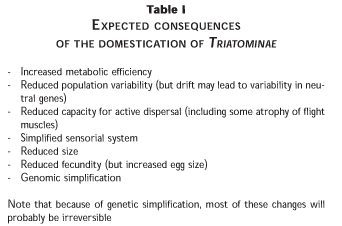
<body><![CDATA[<p><font face="verdana" size="2">Following our pr&eacute;cis of the sylvatic story,    it is evident that the derived domestic transmission pattern has become much    more important in epidemiological terms. But it is over-simplistic to state    that some sylvatic bugs have adapted to domestic habitats where they colonise    and transmit <I>T. cruzi</I> amongst the inhabitants of the house. Domestication    of <I>Triatominae</I> is a complex process, with important genetic and phenotypic    consequences - many of which favour our existing techniques for vector control.</font></p>     <p><font face="verdana" size="2">The transition from sylvatic to domestic is mediated    by major changes in habitat stability. Sylvatic habitats are less stable than    domestic habitats in two key aspects. Domestic habitats offer greater protection    from climatic extremes, meaning that the bugs can reproduce more continuously    - less subject to the influence of seasonal climatic changes. Domestic habitats    also offer greater access to blood sources, and these blood sources - people    and domestic animals - are more readily available throughout the year. So domestic    bugs can feed well, reproduce more quickly and more often, and so their numerical    density tends to increase towards the limit of available resources. At this    point however, their rate of population growth must slow - in other words, their    net rate of population increase must tend to unity and the population becomes,    on average, stable, neither increasing nor decreasing. So at this point, each    female bug of the population is having, on average, one female offspring that    reaches reproductive age (more, and the population would increase, less and    it would decline). But since each female bug retains the capacity to lay 100    or more eggs, of which at least half would be female, this results in intense    inter-sibling competition - the majority of her offspring will not reach reproductive    age.<SUP>8</SUP> This produces an intense selection pressure for the most energetically-efficient    offspring, leading to physiological simplification that appears to be reflected    even in simplification of the genome and reduction in total DNA.<SUP>9</SUP></font></p>     <p><font face="verdana" size="2">The consequences of this domestic transition,    summarised in <a href="#tab1">Table I</a>, lead to a high degree of genetic    homogeneity amongst each domestic triatomine population.<SUP>10</SUP> There    is very little variability against which to select new attributes such as insecticide    resistance, which probably explains why insecticide resistance has never been    an operational problem in campaigns against domestic <I>Triatominae</I>. But    there is one consequence that is extremely unhelpful in terms of dissemination    of vectors and vector control campaigns. Selection for energetic efficiency    can lead to selection against flight capacity. Domestic <I>Triatominae</I> become    less likely to disperse by active flight, and very much more dependent on their    vertebrate hosts for dispersal. They are carried around by people, amongst the    belongings of travellers and visitors from one house to another.</font></p>     <p><a name="tab1"></a></p>     <p>&nbsp;</p>     <p align="center"><img src="/img/revistas/spm/v45n2/a10t01.gif"></p>     <p>&nbsp;</p>     <p><font face="verdana" size="2"> Dispersal in association with people can lead    to domestic <I>Triatominae</I> being carried over large distances, often into    areas that would not have offered suitable sylvatic habitats for that species.    Examples include the finding of <I>T. infestans</I> in houses in the cooler    Southern regions of Argentina (J.W. Abalos, pers. comm. 1978), or in a luxury    apartment in Palermo, Buenos Aires (E.Segura, pers. comm. 1999), or of <I>T.    barberi</I> in Mexico City (O. Velasco, pers. comm. 1996). In fact, much of    the spread of <I>T. infestans</I> throughout the southern cone countries can    be attributed to passive dispersal in association with human migrations,<SUP>11</SUP>    and the spread of <I>R. prolixus</I> from Venezuela into Colombia and parts    of Central America is also believed to have been due primarily to accidental    carriage by humans.<SUP>12,13</SUP> Also<I> T. dimidiata</I> - although apparently    spread as a natural sylvatic cline along most of Central America - appears to    have been spread from Mexico directly to Ecuador along pre-Columbian maritime    routes,<SUP>14</SUP> and there is evidence that <I>R. ecuadoriensis</I> may    have reached Northern Peru by being carried in lorries returning after delivering    Peruvian grapes to Ecuador (F.Vargas, pers. comm. 2001). <I>T. phyllosoma</I>    in Mexico appears periodically outside its natural range in the Sierra Zapoteca    of Oaxaca due to transport of agave plants for tequila processing to the northeastern    regions of Jalisco (J. Ramsey, unpublished), while <I>T. nitida</I> has now    become established in the Sierra Zapoteca - probably due to illegal immigrant    migratory routes from Central America to the Mexican-US border.<SUP>15</SUP></font></p>     <p><font face="verdana" size="2"><I>Domestic Triatominae as targets for vector    control</I></font></p>     <p><font face="verdana" size="2">In essence, there are two types of domestic <I>Triatominae</I>.    There are those such as <I>T. brasiliensis</I> in NE Brasil, or <I>T. dimidiata</I>    in Central America, that have colonised local domestic habitats, and where we    can expect (and in some cases has been confirmed by genetic analyses) continuous    contact between the domestic populations and the conspecific sylvatic populations    in the same areas. In such cases, the domestic populations can be eliminated,    but continual monitoring is then required to enable selective action to eliminate    any newly constituted domestic populations. The essential strategy involves    insecticide spraying of all houses in localities with high rates of house infestation,    until the average house infestation rate (i.e. proportion of houses infested)    is brought below a predetermined level. At this point, the strategy switches    to one of community-based vigilance, from which spraying is carried out only    in those houses where the presence of bugs has been confirmed. This is the successful    strategy now being employed against <I>T. brasiliensis</I> in NE Brazil,<SUP>16</SUP>    and has been successfully evaluated as the preferred strategy against <I>T.    dimidiata</I> in Central America.<SUP>17,18</SUP></font></p>     ]]></body>
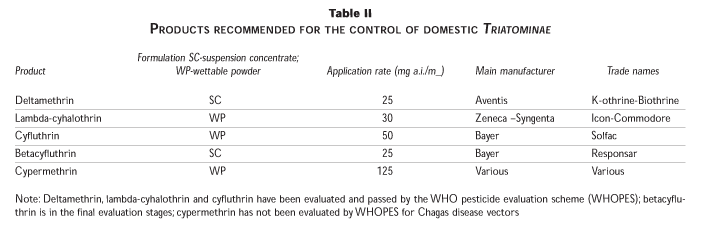
<body><![CDATA[<p><font face="verdana" size="2">Other domestic triatomine populations  appear to have been carried by people to new areas,  where they have become genetically isolated from their  original sylvatic conspecifics. Examples include  <I>T. infestans</I> throughout the Southern Cone (which has  sylvatic populations only in limited foci in central  Bolivia), <I>R. prolixus</I> in Central America and Southern  Mexico, <I>T. dimidiata</I> in Ecuador and Northern Peru, and  <I>R. ecuadoriensis</I> in northern Peru. These latter populations  are genetically highly restricted, having gone through  a series of genetic bottlenecks during their dispersal,  as well as the intense selection of inter-sibling  competition discussed above.<SUP>9</SUP> They are in regions  generally unsuitable for the species, surviving only in the  protected habitat offered by human dwellings. They  are candidates for complete eradication. The control  strategy is similar, but involves spraying all houses in  infested localities, irrespective of the house  infestation rate, followed by vigilance and selective  intervention until no bugs have been encountered for a  period of at least 3 years. Moreover, the entire  geographic range of the target populations must be dealt with,  in order to ensure that bugs are not accidentally  carried in from untreated localities.</font></p>     <p><font face="verdana" size="2">For both operational strategies, the control    techniques are similar. The entire internal surface of the infested premises    is sprayed, together with furniture and any peridomestic dependencies such as    chicken coops, goat corrals, latrines and so on. Spraying is carried out by    professional teams using professional equipment, applying recommended dose rates    of approved products (see <a href="/img/revistas/spm/v45n2/a10t02.gif">Table II</a>). Guides to the equipment,    products, and procedures have been published by the World Health Organization    (<a href="http://www.who.int/ctd/html/whopes.html">www.who.int/ctd/html/whopes.html</a>)    or are available on request (Dr Morteza Zaim, WHOPES, WHO, 1211 Geneva 27, Switzerland).</font></p>     <p><font face="verdana" size="2"><I>Present and future of Chagas disease control</I></font></p>     <p><font face="verdana" size="2">Since the launch of the Southern Cone initiative    in 1991, Latin America has made tremendous advances in the control of Chagas    disease. Already Uruguay, Chile, most of Southern and Central Brazil, and four    previously endemic provinces of Argentina have been formally certified by PAHO    as free of Chagas disease transmission. Large areas of Paraguay and Southern    Bolivia are also free of vector-borne transmission, with some progress also    in Southern Peru (Tacna). In Central America, <I>R. prolixus</I> now seems to    have been eliminated from El Salvador and from large parts of the previously    endemic regions of Guatemala, Honduras and Nicaragua. Mexico also, although    only just beginning to plan large-scale campaigns against Chagas disease,<SUP>19</SUP>    appears already to have almost eliminated <I>R. prolixus</I> from the Southern    states.<SUP>15,20</SUP> The medical and social benefits have been dramatic.    Even the poorest families in controlled areas can now construct even the humblest    of dwellings, and sleep without the risk of nuisance, blood-loss, and <I>T.    cruzi</I> transmission due to domestic bugs. Even for people already infected    with <I>T. cruzi</I>, the likelihood of developing chronic lesions seems to    have declined <SUP>2</SUP> - possibly due to absence of reinfection.<SUP>21</SUP></font></p>     <p><font face="verdana" size="2">The consolidation and surveillance phases are    also well underway in many countries. Even areas with virtually no previous    history of Chagas disease transmission, such as Belize and Suriname, now have    organised entomological, serological and clinical surveillance procedures, designed    to inhibit future transmission. But it is a mistake to believe that Chagas disease    is conquered. Regions such as Northern Peru, Ecuador, much of Venezuela and    Colombia, Guyana, French Guiana, Costa Rica and Panama, have yet to implement    fully prioritised surveillance and control campaigns against Chagas disease    and its vectors. Mexico is only just beginning. And even countries such as Uruguay    and Argentina, with a long and successful tradition of successful Chagas disease    control, now suffer the paradoxical &quot;castigo del &eacute;xito&quot; (burden    of success). Success tends to bring the &quot;punishment&quot; of reduced resources    and declining interest on the part of government services  - risking recrudescence    of transmission in previously controlled areas. This is a serious mistake, as    even the simplest of economic models will show. For the Southern Cone programme    for example, economic analyses show benefits accruing at the rate of over US$53    million per year (dollars valued at 1990 levels) provided vigilance is maintained    and there is no recrudescence of vector-borne transmission in treated areas.    By contrast, abandoning epidemiological surveillance would save only around    5% of total intervention costs, but would reduce overall benefits by over 33%.<SUP>22</SUP></font></p>     <p><font face="verdana" size="2">In regions where the primary domestic vectors    have been targeted for eradication - the Southern Cone (<I>T. infestans</I>),    Central America (<I>R. prolixus</I>), Ecuador and Northern Peru (<I>T. dimidiata</I>),    it is vital to complete the task. This seems technically feasible, as shown    by the rapidity of success in so many areas, and will greatly contribute to    the well-being of rural communities.<SUP>23</SUP> But in these areas and elsewhere,    the need is to adopt a sustainable system of reporting the presence of any domestic    triatomine recurrence, backed by a well-trained professional service able to    intervene with selective actions to prevent the establishment of spread of domestic    bug populations. The strategies have been trialled, and seem to be highly cost-effective.<SUP>17</SUP>    And if widely adopted, we believe it will be possible to maintain Latin American    communities free of domestic Chagas disease vectors. At this point - if achieved    - vector control will no longer be the primary arm of Chagas disease control.    We would have reverted to the original pattern of <I>T. cruzi</I> transmission,    involving adventitious sylvatic vectors and occasional cases of acute infection    (see above). There would be a need in some areas to monitor the entomological    scenario, with selective action against any vector population that might reinitiate    domestic colonisation, although this may become progressively less likely with    improving standards of rural accommodation. But ecological change - accelerating    in many regions of Latin America - would forever presage the possibility of    sylvatic bugs leaving their sylvatic homes and potentially entering ours.</font></p>     <p> <font face="verdana" size="2">We can target such regions of risk, using, for example,  predictive geographic models of vector and host distribution, overlaid with patterns  of human land use.<SUP>24</SUP> We can relate such models to real-time changes  in land use using remotely-sensed satellite data,<SUP>25</SUP> and from this guide  the surveillance services in terms of where and when to expect possible transmission  due to sylvatic vectors. But such ideas are entirely contingent on the idea that  clinical medical services would be developed sufficiently to offer prompt diagnosis  of new acute cases, and able to initiate prompt remedial therapy. Such services  have yet to be developed in most parts of Latin America. Clinical training in  Chagas disease diagnosis is not a major feature in the curriculum of many Latin  American Schools of Medicine - in some countries, it has been estimated that some  clinical courses now devote no more than 30 minutes to Chagas disease within a  6-year course of medical training.</font></p>     <p><font face="verdana" size="2">Historical appraisals show that it is primarily    the scientific community of Latin America - and particularly the clinical medical    community - that has provided the knowledge, rationale and political influence    that has promoted and shaped the successful campaigns against Chagas disease.<SUP>26</SUP>    They must continue to do so, but we believe they must also prepare for the future    - when domestic populations of <I>Triatominae</I> become rare, while occasional    new acute cases may continue to occur.</font></p>     <p>&nbsp;</p>     <p><font face="verdana" size="3"><b>Acknowledgements </b></font></p>     ]]></body>
<body><![CDATA[<p><font face="verdana" size="2">We express particular thanks to the many colleagues    who have shaped our views on Chagas disease control, and place on record our    admiration for those who have led and implemented the Chagas disease control    initiatives throughout Latin America. We also congratulate Dr Edgardo Schapachnik    for his moderation of the Chagas forum, and the many contributors who have enriched    it.</font></p>     <p>&nbsp;</p>     <p><font face="verdana" size="3"><b>References </b></font></p>     <!-- ref --><p><font face="verdana" size="2">1. Kabayo J. Aiming to eliminate tsetse from Africa. Trends  Parasitol 2002;18:534-536</font>&nbsp;&nbsp;&nbsp;&nbsp;&nbsp;&nbsp;&nbsp;&nbsp;[&#160;<a href="javascript:void(0);" onclick="javascript: window.open('/scielo.php?script=sci_nlinks&ref=9167918&pid=S0036-3634200300020001000001&lng=','','width=640,height=500,resizable=yes,scrollbars=1,menubar=yes,');">Links</a>&#160;]<!-- end-ref --><!-- ref --><p><font face="verdana" size="2">2. Dias JCP, Silveira AC, Schofield CJ. The impact of Chagas disease control in Latin America. Mem Inst Oswaldo Cruz 2000;97:603-612.</font>&nbsp;&nbsp;&nbsp;&nbsp;&nbsp;&nbsp;&nbsp;&nbsp;[&#160;<a href="javascript:void(0);" onclick="javascript: window.open('/scielo.php?script=sci_nlinks&ref=9167919&pid=S0036-3634200300020001000002&lng=','','width=640,height=500,resizable=yes,scrollbars=1,menubar=yes,');">Links</a>&#160;]<!-- end-ref --><!-- ref --><p><font face="verdana" size="2">3. Rabinovich JE, Leal JA, Pinero DF. Domiciliary biting frequency and  blood ingestion of the Chagas disease vector <I>Rhodnius  prolixus</I> Stahl (<I>Hemiptera: Reduviidae</I>) in Venezuela. Trans Roy Soc Trop Med Hyg 1979;73:272-283.</font>&nbsp;&nbsp;&nbsp;&nbsp;&nbsp;&nbsp;&nbsp;&nbsp;[&#160;<a href="javascript:void(0);" onclick="javascript: window.open('/scielo.php?script=sci_nlinks&ref=9167920&pid=S0036-3634200300020001000003&lng=','','width=640,height=500,resizable=yes,scrollbars=1,menubar=yes,');">Links</a>&#160;]<!-- end-ref --><!-- ref --><p><font face="verdana" size="2">4. Schofield CJ. Chagas disease, triatomine bugs, and blood-loss.  Lancet1981:1316.</font>&nbsp;&nbsp;&nbsp;&nbsp;&nbsp;&nbsp;&nbsp;&nbsp;[&#160;<a href="javascript:void(0);" onclick="javascript: window.open('/scielo.php?script=sci_nlinks&ref=9167921&pid=S0036-3634200300020001000004&lng=','','width=640,height=500,resizable=yes,scrollbars=1,menubar=yes,');">Links</a>&#160;]<!-- end-ref --><!-- ref --><p><font face="verdana" size="2">5. Schofield CJ. <I>Trypanosoma cruzi</I>  -  The vector-parasite paradox. Mem  Inst Oswaldo Cruz 2000;95:535-544.</font>&nbsp;&nbsp;&nbsp;&nbsp;&nbsp;&nbsp;&nbsp;&nbsp;[&#160;<a href="javascript:void(0);" onclick="javascript: window.open('/scielo.php?script=sci_nlinks&ref=9167922&pid=S0036-3634200300020001000005&lng=','','width=640,height=500,resizable=yes,scrollbars=1,menubar=yes,');">Links</a>&#160;]<!-- end-ref --><!-- ref --><p><font face="verdana" size="2">6. Lehane MJ, McEwan PK, Whitaker CJ, Schofield CJ. The role of  temperature and nutritional dependence in flight initiation  by<I> Triatoma infestans. </I>Acta Tropica  1992<I>;</I>52:27-38.</font>&nbsp;&nbsp;&nbsp;&nbsp;&nbsp;&nbsp;&nbsp;&nbsp;[&#160;<a href="javascript:void(0);" onclick="javascript: window.open('/scielo.php?script=sci_nlinks&ref=9167923&pid=S0036-3634200300020001000006&lng=','','width=640,height=500,resizable=yes,scrollbars=1,menubar=yes,');">Links</a>&#160;]<!-- end-ref --><!-- ref --><p><font face="verdana" size="2">7. Coura JR, Junqueira ACV, Fernandes O, Valente SAS, Miles MA.  Emerging Chagas disease in Amazonian Brasil. Trends in Parasitol 2002;18:171-176.</font>&nbsp;&nbsp;&nbsp;&nbsp;&nbsp;&nbsp;&nbsp;&nbsp;[&#160;<a href="javascript:void(0);" onclick="javascript: window.open('/scielo.php?script=sci_nlinks&ref=9167924&pid=S0036-3634200300020001000007&lng=','','width=640,height=500,resizable=yes,scrollbars=1,menubar=yes,');">Links</a>&#160;]<!-- end-ref --><!-- ref --><p><font face="verdana" size="2">8. Schofield CJ, Diotaiuti L, Dujardin JP. The process of domestication  in <I>Triatominae</I>. Mem Inst Oswaldo Cruz 1999;94:375-378.</font>&nbsp;&nbsp;&nbsp;&nbsp;&nbsp;&nbsp;&nbsp;&nbsp;[&#160;<a href="javascript:void(0);" onclick="javascript: window.open('/scielo.php?script=sci_nlinks&ref=9167925&pid=S0036-3634200300020001000008&lng=','','width=640,height=500,resizable=yes,scrollbars=1,menubar=yes,');">Links</a>&#160;]<!-- end-ref --><!-- ref --><p><font face="verdana" size="2">9. Dujardin JP, Schofield CJ, Panzera F. Les Vecteurs de la maladie de  Chagas. Recherches taxonomiques, biologiques et g&eacute;n&eacute;tiques.  Brussels: Academie Royale des Sciences d'Outre Mer, 2000.</font>&nbsp;&nbsp;&nbsp;&nbsp;&nbsp;&nbsp;&nbsp;&nbsp;[&#160;<a href="javascript:void(0);" onclick="javascript: window.open('/scielo.php?script=sci_nlinks&ref=9167926&pid=S0036-3634200300020001000009&lng=','','width=640,height=500,resizable=yes,scrollbars=1,menubar=yes,');">Links</a>&#160;]<!-- end-ref --><!-- ref --><p><font face="verdana" size="2">10. Dujardin JP, Schofield CJ, Tibayrenc M. Population structure of  Andean <I>Triatoma infestans</I>: Allozyme frequencies and their epidemiological  relevance. Med Vet Entomol 1998;12:20-29.</font>&nbsp;&nbsp;&nbsp;&nbsp;&nbsp;&nbsp;&nbsp;&nbsp;[&#160;<a href="javascript:void(0);" onclick="javascript: window.open('/scielo.php?script=sci_nlinks&ref=9167927&pid=S0036-3634200300020001000010&lng=','','width=640,height=500,resizable=yes,scrollbars=1,menubar=yes,');">Links</a>&#160;]<!-- end-ref --><!-- ref --><p><font face="verdana" size="2">11. Schofield CJ. Biosystematics of the  <I>Triatominae</I>. En: Service MW, comp. Biosystematics of haematophagous insects. Oxford: Clarendon  Press, 1988:284-312.</font>&nbsp;&nbsp;&nbsp;&nbsp;&nbsp;&nbsp;&nbsp;&nbsp;[&#160;<a href="javascript:void(0);" onclick="javascript: window.open('/scielo.php?script=sci_nlinks&ref=9167928&pid=S0036-3634200300020001000011&lng=','','width=640,height=500,resizable=yes,scrollbars=1,menubar=yes,');">Links</a>&#160;]<!-- end-ref --><!-- ref --><p><font face="verdana" size="2">12. Dujardin JP, Mu&ntilde;oz M, Ch&aacute;vez T, Ponce C, Moreno J, Schofield CJ.  The origin of <I>Rhodnius prolixus</I> in Central America. Med Vet  Entomol 1998;12:113-115.</font>&nbsp;&nbsp;&nbsp;&nbsp;&nbsp;&nbsp;&nbsp;&nbsp;[&#160;<a href="javascript:void(0);" onclick="javascript: window.open('/scielo.php?script=sci_nlinks&ref=9167929&pid=S0036-3634200300020001000012&lng=','','width=640,height=500,resizable=yes,scrollbars=1,menubar=yes,');">Links</a>&#160;]<!-- end-ref --><!-- ref --><p><font face="verdana" size="2">13. Schofield CJ, Dujardin JP. Theories on the evolution of  <I>Rhodnius</I>. Actual Biol 1999;70:183-197.</font>&nbsp;&nbsp;&nbsp;&nbsp;&nbsp;&nbsp;&nbsp;&nbsp;[&#160;<a href="javascript:void(0);" onclick="javascript: window.open('/scielo.php?script=sci_nlinks&ref=9167930&pid=S0036-3634200300020001000013&lng=','','width=640,height=500,resizable=yes,scrollbars=1,menubar=yes,');">Links</a>&#160;]<!-- end-ref --><!-- ref --><p><font face="verdana" size="2">14. Abad-Franch F, Paucar CA, Carpio CC, Cuba-Cuba CA, Aguilar  VHM, Miles MA. Biogeography of <I>Triatominae</I> in Ecuador: Implications for  the design of control strategies. Mem Inst Oswaldo Cruz 2001;96:611-620.</font>&nbsp;&nbsp;&nbsp;&nbsp;&nbsp;&nbsp;&nbsp;&nbsp;[&#160;<a href="javascript:void(0);" onclick="javascript: window.open('/scielo.php?script=sci_nlinks&ref=9167931&pid=S0036-3634200300020001000014&lng=','','width=640,height=500,resizable=yes,scrollbars=1,menubar=yes,');">Links</a>&#160;]<!-- end-ref --><!-- ref --><p><font face="verdana" size="2">15. Ramsey JM, Ord&oacute;&ntilde;ez R, Cruz-Celis A, Alvear AL, Ch&aacute;vez V, L&oacute;pez R  <I>et al</I>. Distribution of domestic  <I>Triatominae</I> and stratification of Chagas  disease transmission in Oaxaca, Mexico. Med Vet Entomol 2000;14:1-12.</font>&nbsp;&nbsp;&nbsp;&nbsp;&nbsp;&nbsp;&nbsp;&nbsp;[&#160;<a href="javascript:void(0);" onclick="javascript: window.open('/scielo.php?script=sci_nlinks&ref=9167932&pid=S0036-3634200300020001000015&lng=','','width=640,height=500,resizable=yes,scrollbars=1,menubar=yes,');">Links</a>&#160;]<!-- end-ref --><!-- ref --><p><font face="verdana" size="2">16. Dias JCP, Diotaiuti L. Triatomineos e seu controle no Brasil:  Perspectivas e desafios. Cadernos de Saude Publica 2000; 6 suppl 2:1-126.</font>&nbsp;&nbsp;&nbsp;&nbsp;&nbsp;&nbsp;&nbsp;&nbsp;[&#160;<a href="javascript:void(0);" onclick="javascript: window.open('/scielo.php?script=sci_nlinks&ref=9167933&pid=S0036-3634200300020001000016&lng=','','width=640,height=500,resizable=yes,scrollbars=1,menubar=yes,');">Links</a>&#160;]<!-- end-ref --><!-- ref --><p><font face="verdana" size="2">17. Acevedo F, Godoy E, Schofield CJ. Comparison of intervention  strategies for control of <I>Triatoma  dimidiata</I> in Nicaragua. Mem Inst Oswaldo Cruz 2000;95:867-871.</font>&nbsp;&nbsp;&nbsp;&nbsp;&nbsp;&nbsp;&nbsp;&nbsp;[&#160;<a href="javascript:void(0);" onclick="javascript: window.open('/scielo.php?script=sci_nlinks&ref=9167934&pid=S0036-3634200300020001000017&lng=','','width=640,height=500,resizable=yes,scrollbars=1,menubar=yes,');">Links</a>&#160;]<!-- end-ref --><!-- ref --><p><font face="verdana" size="2">18. Pan American Health Organization. Taller para el establecimiento  de pautas t&eacute;cnicas en el control de <I>Triatoma  dimidiata</I>. El Salvador: Pan American Health Organization, 2002 (in press).</font>&nbsp;&nbsp;&nbsp;&nbsp;&nbsp;&nbsp;&nbsp;&nbsp;[&#160;<a href="javascript:void(0);" onclick="javascript: window.open('/scielo.php?script=sci_nlinks&ref=9167935&pid=S0036-3634200300020001000018&lng=','','width=640,height=500,resizable=yes,scrollbars=1,menubar=yes,');">Links</a>&#160;]<!-- end-ref --><!-- ref --><p><font face="verdana" size="2">19. Ramsey JM, Pohls JL, Tello-L&oacute;pez A. Memorias del Taller para la  vigilancia y el control de la Enfermedad de Chagas en la Rep&uacute;blica  Mexicana. Cuernavaca, Morelos, M&eacute;xico: Instituto Nacional de Salud P&uacute;blica (in press).</font>&nbsp;&nbsp;&nbsp;&nbsp;&nbsp;&nbsp;&nbsp;&nbsp;[&#160;<a href="javascript:void(0);" onclick="javascript: window.open('/scielo.php?script=sci_nlinks&ref=9167936&pid=S0036-3634200300020001000019&lng=','','width=640,height=500,resizable=yes,scrollbars=1,menubar=yes,');">Links</a>&#160;]<!-- end-ref --><!-- ref --><p><font face="verdana" size="2">20. Vidal-Acosta V, Ib&aacute;&ntilde;ez-Bernal S, Mart&iacute;nez-Campos C. Infecci&oacute;n  natural de chinches <I>Triatominae</I> con <I>Trypanosoma  cruzi</I> asociados a la vivienda humana en M&eacute;xico. Salud Publica Mex 2000;42:496-503.</font>&nbsp;&nbsp;&nbsp;&nbsp;&nbsp;&nbsp;&nbsp;&nbsp;[&#160;<a href="javascript:void(0);" onclick="javascript: window.open('/scielo.php?script=sci_nlinks&ref=9167937&pid=S0036-3634200300020001000020&lng=','','width=640,height=500,resizable=yes,scrollbars=1,menubar=yes,');">Links</a>&#160;]<!-- end-ref --><!-- ref --><p><font face="verdana" size="2">21. Bustamente JM, Rivarola HW, Fern&aacute;ndez AR, Enders JE, Fretes R,  Palma JA <I>et al</I>. <I>Trypanosoma cruzi</I> reinfections in mice determine the severity  of cardiac damage. Int J Parasitol 2002;32:889-896.</font>&nbsp;&nbsp;&nbsp;&nbsp;&nbsp;&nbsp;&nbsp;&nbsp;[&#160;<a href="javascript:void(0);" onclick="javascript: window.open('/scielo.php?script=sci_nlinks&ref=9167938&pid=S0036-3634200300020001000021&lng=','','width=640,height=500,resizable=yes,scrollbars=1,menubar=yes,');">Links</a>&#160;]<!-- end-ref --><!-- ref --><p><font face="verdana" size="2">22. Akhavan D. An&aacute;lise de custo-efetividade do Programa de Controle  da Doen&ccedil;a de Chagas no Brasil. Brasilia: Organiza&ccedil;&atilde;o Pan-Americana da  Sa&uacute;de, 2000.</font>&nbsp;&nbsp;&nbsp;&nbsp;&nbsp;&nbsp;&nbsp;&nbsp;[&#160;<a href="javascript:void(0);" onclick="javascript: window.open('/scielo.php?script=sci_nlinks&ref=9167939&pid=S0036-3634200300020001000022&lng=','','width=640,height=500,resizable=yes,scrollbars=1,menubar=yes,');">Links</a>&#160;]<!-- end-ref --><!-- ref --><p><font face="verdana" size="2">23. Brice&ntilde;o-Le&oacute;n R. La enfermedad de Chagas: una construcci&oacute;n  social. En:Brice&ntilde;o-Le&oacute;n R, Dias JCP, comp. Las enfermedades tropicales en  la sociedad contempor&aacute;nea. Acta Cient Venez 1993;44:257-282.</font>&nbsp;&nbsp;&nbsp;&nbsp;&nbsp;&nbsp;&nbsp;&nbsp;[&#160;<a href="javascript:void(0);" onclick="javascript: window.open('/scielo.php?script=sci_nlinks&ref=9167940&pid=S0036-3634200300020001000023&lng=','','width=640,height=500,resizable=yes,scrollbars=1,menubar=yes,');">Links</a>&#160;]<!-- end-ref --><!-- ref --><p><font face="verdana" size="2">24. Peterson AT, S&aacute;nchez-Cordero V, Beard CB, Ramsey JM. Ecologic  niche modelling and potential reservoirs for Chagas disease, Mexico. Emerg  Infect Dis 2002;8:662-667.</font>&nbsp;&nbsp;&nbsp;&nbsp;&nbsp;&nbsp;&nbsp;&nbsp;[&#160;<a href="javascript:void(0);" onclick="javascript: window.open('/scielo.php?script=sci_nlinks&ref=9167941&pid=S0036-3634200300020001000024&lng=','','width=640,height=500,resizable=yes,scrollbars=1,menubar=yes,');">Links</a>&#160;]<!-- end-ref --><!-- ref --><p><font face="verdana" size="2">25. Gorla DE. La reconstrucci&oacute;n de la distribuci&oacute;n geogr&aacute;fica de  <I>Triatominae</I> en base a informaci&oacute;n de variables ambientales. Proceedings of  the Fourth International Workshop on Population Genetics and Control  of Triatominae; 2000 agosto 22-24; Cartagena de Indias, Colombia.</font>&nbsp;&nbsp;&nbsp;&nbsp;&nbsp;&nbsp;&nbsp;&nbsp;[&#160;<a href="javascript:void(0);" onclick="javascript: window.open('/scielo.php?script=sci_nlinks&ref=9167942&pid=S0036-3634200300020001000025&lng=','','width=640,height=500,resizable=yes,scrollbars=1,menubar=yes,');">Links</a>&#160;]<!-- end-ref --><!-- ref --><p><font face="verdana" size="2">26. Dias JCP, Schofield CJ. The evolution of    Chagas disease (American Trypanosomiasis) control after 90 years since Carlos    Chagas discovery. Mem Inst Oswaldo Cruz 1999;94:103-121.</font>&nbsp;&nbsp;&nbsp;&nbsp;&nbsp;&nbsp;&nbsp;&nbsp;[&#160;<a href="javascript:void(0);" onclick="javascript: window.open('/scielo.php?script=sci_nlinks&ref=9167943&pid=S0036-3634200300020001000026&lng=','','width=640,height=500,resizable=yes,scrollbars=1,menubar=yes,');">Links</a>&#160;]<!-- end-ref --><p>&nbsp;</p>     ]]></body>
<body><![CDATA[<p>&nbsp;</p>     <p>&nbsp;</p>     <p><font face="verdana" size="2"><b>Address reprint requests to</b>    <br>   Dr. Janine M. Ramsey Willoquet    <br>   Direcci&oacute;n de Enfermedades Transmitidas por Vectores    <br>   Centro de Investigaci&oacute;n sobre Enfermedades Infecciosas, Instituto Nacional    de Salud P&uacute;blica    <br>   Avenida Universidad 655, colonia Santa    Mar&iacute;a Ahuacatitl&aacute;n    <br>   625098, Cuernavaca, Morelos, M&eacute;xico    <br>   E-mail: <a href="mailto:jramsey@insp.mx">jramsey@insp.mx</a></font></p>     <p><font face="verdana" size="2"><b>Received on:</b> July 29, 2002 <b>Accepted    on:</b> February 11, 2002 </font></p>     ]]></body>
<body><![CDATA[<p><font face="verdana" size="2">The English version of this paper is available    too at: <a href="http://www.insp.mx/salud/index.html">http://www.insp.mx/salud/index.html</a>    <br>   El texto completo en ingl&eacute;s de este art&iacute;culo tambi&eacute;n est&aacute;    disponible en: <a href="http://www.insp.mx/salud/index.html">http://www.insp.mx/salud/index.html</a></font></p>      ]]></body><back>
<ref-list>
<ref id="B1">
<label>1</label><nlm-citation citation-type="journal">
<person-group person-group-type="author">
<name>
<surname><![CDATA[Kabayo]]></surname>
<given-names><![CDATA[J]]></given-names>
</name>
</person-group>
<article-title xml:lang="en"><![CDATA[Aiming to eliminate tsetse from Africa]]></article-title>
<source><![CDATA[Trends Parasitol]]></source>
<year>2002</year>
<volume>18</volume>
<page-range>534-536</page-range></nlm-citation>
</ref>
<ref id="B2">
<label>2</label><nlm-citation citation-type="journal">
<person-group person-group-type="author">
<name>
<surname><![CDATA[Dias]]></surname>
<given-names><![CDATA[JCP]]></given-names>
</name>
<name>
<surname><![CDATA[Silveira]]></surname>
<given-names><![CDATA[AC]]></given-names>
</name>
<name>
<surname><![CDATA[Schofield]]></surname>
<given-names><![CDATA[CJ]]></given-names>
</name>
</person-group>
<article-title xml:lang="en"><![CDATA[The impact of Chagas disease control in Latin America]]></article-title>
<source><![CDATA[Mem Inst Oswaldo Cruz]]></source>
<year>2000</year>
<volume>97</volume>
<page-range>603-612</page-range></nlm-citation>
</ref>
<ref id="B3">
<label>3</label><nlm-citation citation-type="journal">
<person-group person-group-type="author">
<name>
<surname><![CDATA[Rabinovich]]></surname>
<given-names><![CDATA[JE]]></given-names>
</name>
<name>
<surname><![CDATA[Leal]]></surname>
<given-names><![CDATA[JA]]></given-names>
</name>
<name>
<surname><![CDATA[Pinero]]></surname>
<given-names><![CDATA[DF]]></given-names>
</name>
</person-group>
<article-title xml:lang="en"><![CDATA[Domiciliary biting frequency and blood ingestion of the Chagas disease vector Rhodnius prolixus Stahl (Hemiptera: Reduviidae) in Venezuela]]></article-title>
<source><![CDATA[Trans Roy Soc Trop Med Hyg]]></source>
<year>1979</year>
<volume>73</volume>
<page-range>272-283</page-range></nlm-citation>
</ref>
<ref id="B4">
<label>4</label><nlm-citation citation-type="journal">
<person-group person-group-type="author">
<name>
<surname><![CDATA[Schofield]]></surname>
<given-names><![CDATA[CJ]]></given-names>
</name>
</person-group>
<article-title xml:lang="en"><![CDATA[Chagas disease, triatomine bugs, and blood-loss]]></article-title>
<source><![CDATA[Lancet]]></source>
<year>1981</year>
</nlm-citation>
</ref>
<ref id="B5">
<label>5</label><nlm-citation citation-type="journal">
<person-group person-group-type="author">
<name>
<surname><![CDATA[Schofield]]></surname>
<given-names><![CDATA[CJ]]></given-names>
</name>
</person-group>
<article-title xml:lang="en"><![CDATA[Trypanosoma cruzi - The vector-parasite paradox]]></article-title>
<source><![CDATA[Mem Inst Oswaldo Cruz]]></source>
<year>2000</year>
<volume>95</volume>
<page-range>535-544</page-range></nlm-citation>
</ref>
<ref id="B6">
<label>6</label><nlm-citation citation-type="journal">
<person-group person-group-type="author">
<name>
<surname><![CDATA[Lehane]]></surname>
<given-names><![CDATA[MJ]]></given-names>
</name>
<name>
<surname><![CDATA[McEwan]]></surname>
<given-names><![CDATA[PK]]></given-names>
</name>
<name>
<surname><![CDATA[Whitaker]]></surname>
<given-names><![CDATA[CJ]]></given-names>
</name>
<name>
<surname><![CDATA[Schofield]]></surname>
<given-names><![CDATA[CJ]]></given-names>
</name>
</person-group>
<article-title xml:lang="en"><![CDATA[The role of temperature and nutritional dependence in flight initiation by Triatoma infestans]]></article-title>
<source><![CDATA[Acta Tropica]]></source>
<year>1992</year>
<volume>52</volume>
<page-range>27-38</page-range></nlm-citation>
</ref>
<ref id="B7">
<label>7</label><nlm-citation citation-type="journal">
<person-group person-group-type="author">
<name>
<surname><![CDATA[Coura]]></surname>
<given-names><![CDATA[JR]]></given-names>
</name>
<name>
<surname><![CDATA[Junqueira]]></surname>
<given-names><![CDATA[ACV]]></given-names>
</name>
<name>
<surname><![CDATA[Fernandes]]></surname>
<given-names><![CDATA[O]]></given-names>
</name>
<name>
<surname><![CDATA[Valente]]></surname>
<given-names><![CDATA[SAS]]></given-names>
</name>
<name>
<surname><![CDATA[Miles]]></surname>
<given-names><![CDATA[MA]]></given-names>
</name>
</person-group>
<article-title xml:lang="en"><![CDATA[Emerging Chagas disease in Amazonian Brasil]]></article-title>
<source><![CDATA[Trends in Parasitol]]></source>
<year>2002</year>
<volume>18</volume>
<page-range>171-176</page-range></nlm-citation>
</ref>
<ref id="B8">
<label>8</label><nlm-citation citation-type="journal">
<person-group person-group-type="author">
<name>
<surname><![CDATA[Schofield]]></surname>
<given-names><![CDATA[CJ]]></given-names>
</name>
<name>
<surname><![CDATA[Diotaiuti]]></surname>
<given-names><![CDATA[L]]></given-names>
</name>
<name>
<surname><![CDATA[Dujardin]]></surname>
<given-names><![CDATA[JP]]></given-names>
</name>
</person-group>
<article-title xml:lang="en"><![CDATA[The process of domestication in Triatominae]]></article-title>
<source><![CDATA[Mem Inst Oswaldo Cruz]]></source>
<year>1999</year>
<volume>94</volume>
<page-range>375-378</page-range></nlm-citation>
</ref>
<ref id="B9">
<label>9</label><nlm-citation citation-type="book">
<person-group person-group-type="author">
<name>
<surname><![CDATA[Dujardin]]></surname>
<given-names><![CDATA[JP]]></given-names>
</name>
<name>
<surname><![CDATA[Schofield]]></surname>
<given-names><![CDATA[CJ]]></given-names>
</name>
<name>
<surname><![CDATA[Panzera]]></surname>
<given-names><![CDATA[F]]></given-names>
</name>
</person-group>
<source><![CDATA[Les Vecteurs de la maladie de Chagas: Recherches taxonomiques, biologiques et génétiques]]></source>
<year>2000</year>
<publisher-loc><![CDATA[Brussels ]]></publisher-loc>
<publisher-name><![CDATA[Academie Royale des Sciences d'Outre Mer]]></publisher-name>
</nlm-citation>
</ref>
<ref id="B10">
<label>10</label><nlm-citation citation-type="journal">
<person-group person-group-type="author">
<name>
<surname><![CDATA[Dujardin]]></surname>
<given-names><![CDATA[JP]]></given-names>
</name>
<name>
<surname><![CDATA[Schofield]]></surname>
<given-names><![CDATA[CJ]]></given-names>
</name>
<name>
<surname><![CDATA[Tibayrenc]]></surname>
<given-names><![CDATA[M]]></given-names>
</name>
</person-group>
<article-title xml:lang="en"><![CDATA[Population structure of Andean Triatoma infestans: Allozyme frequencies and their epidemiological relevance]]></article-title>
<source><![CDATA[Med Vet Entomol]]></source>
<year>1998</year>
<volume>12</volume>
<page-range>20-29</page-range></nlm-citation>
</ref>
<ref id="B11">
<label>11</label><nlm-citation citation-type="book">
<person-group person-group-type="author">
<name>
<surname><![CDATA[Schofield]]></surname>
<given-names><![CDATA[CJ]]></given-names>
</name>
</person-group>
<article-title xml:lang="en"><![CDATA[Biosystematics of the Triatominae]]></article-title>
<person-group person-group-type="editor">
<name>
<surname><![CDATA[Service]]></surname>
<given-names><![CDATA[MW]]></given-names>
</name>
</person-group>
<source><![CDATA[Biosystematics of haematophagous insects]]></source>
<year>1988</year>
<page-range>284-312</page-range><publisher-loc><![CDATA[Oxford ]]></publisher-loc>
<publisher-name><![CDATA[Clarendon Press]]></publisher-name>
</nlm-citation>
</ref>
<ref id="B12">
<label>12</label><nlm-citation citation-type="journal">
<person-group person-group-type="author">
<name>
<surname><![CDATA[Dujardin]]></surname>
<given-names><![CDATA[JP]]></given-names>
</name>
<name>
<surname><![CDATA[Muñoz]]></surname>
<given-names><![CDATA[M]]></given-names>
</name>
<name>
<surname><![CDATA[Chávez]]></surname>
<given-names><![CDATA[T]]></given-names>
</name>
<name>
<surname><![CDATA[Ponce]]></surname>
<given-names><![CDATA[C]]></given-names>
</name>
<name>
<surname><![CDATA[Moreno]]></surname>
<given-names><![CDATA[J]]></given-names>
</name>
<name>
<surname><![CDATA[Schofield]]></surname>
<given-names><![CDATA[CJ]]></given-names>
</name>
</person-group>
<article-title xml:lang="en"><![CDATA[The origin of Rhodnius prolixus in Central America]]></article-title>
<source><![CDATA[Med Vet Entomol]]></source>
<year>1998</year>
<volume>12</volume>
<page-range>113-115</page-range></nlm-citation>
</ref>
<ref id="B13">
<label>13</label><nlm-citation citation-type="journal">
<person-group person-group-type="author">
<name>
<surname><![CDATA[Schofield]]></surname>
<given-names><![CDATA[CJ]]></given-names>
</name>
<name>
<surname><![CDATA[Dujardin]]></surname>
<given-names><![CDATA[JP]]></given-names>
</name>
</person-group>
<article-title xml:lang="en"><![CDATA[Theories on the evolution of Rhodnius]]></article-title>
<source><![CDATA[Actual Biol]]></source>
<year>1999</year>
<volume>70</volume>
<page-range>183-197</page-range></nlm-citation>
</ref>
<ref id="B14">
<label>14</label><nlm-citation citation-type="journal">
<person-group person-group-type="author">
<name>
<surname><![CDATA[Abad-Franch]]></surname>
<given-names><![CDATA[F]]></given-names>
</name>
<name>
<surname><![CDATA[Paucar]]></surname>
<given-names><![CDATA[CA]]></given-names>
</name>
<name>
<surname><![CDATA[Carpio]]></surname>
<given-names><![CDATA[CC]]></given-names>
</name>
<name>
<surname><![CDATA[Cuba-Cuba]]></surname>
<given-names><![CDATA[CA]]></given-names>
</name>
<name>
<surname><![CDATA[Aguilar]]></surname>
<given-names><![CDATA[VHM]]></given-names>
</name>
<name>
<surname><![CDATA[Miles]]></surname>
<given-names><![CDATA[MA]]></given-names>
</name>
</person-group>
<article-title xml:lang="en"><![CDATA[Biogeography of Triatominae in Ecuador: Implications for the design of control strategies]]></article-title>
<source><![CDATA[Mem Inst Oswaldo Cruz]]></source>
<year>2001</year>
<volume>96</volume>
<page-range>611-620</page-range></nlm-citation>
</ref>
<ref id="B15">
<label>15</label><nlm-citation citation-type="journal">
<person-group person-group-type="author">
<name>
<surname><![CDATA[Ramsey]]></surname>
<given-names><![CDATA[JM]]></given-names>
</name>
<name>
<surname><![CDATA[Ordóñez]]></surname>
<given-names><![CDATA[R]]></given-names>
</name>
<name>
<surname><![CDATA[Cruz-Celis]]></surname>
<given-names><![CDATA[A]]></given-names>
</name>
<name>
<surname><![CDATA[Alvear]]></surname>
<given-names><![CDATA[AL]]></given-names>
</name>
<name>
<surname><![CDATA[Chávez]]></surname>
<given-names><![CDATA[V]]></given-names>
</name>
<name>
<surname><![CDATA[López]]></surname>
<given-names><![CDATA[R]]></given-names>
</name>
</person-group>
<article-title xml:lang="en"><![CDATA[Distribution of domestic Triatominae and stratification of Chagas disease transmission in Oaxaca, Mexico]]></article-title>
<source><![CDATA[Med Vet Entomol]]></source>
<year>2000</year>
<volume>14</volume>
<page-range>1-12</page-range></nlm-citation>
</ref>
<ref id="B16">
<label>16</label><nlm-citation citation-type="journal">
<person-group person-group-type="author">
<name>
<surname><![CDATA[Dias]]></surname>
<given-names><![CDATA[JCP]]></given-names>
</name>
<name>
<surname><![CDATA[Diotaiuti]]></surname>
<given-names><![CDATA[L]]></given-names>
</name>
</person-group>
<article-title xml:lang="pt"><![CDATA[Triatomineos e seu controle no Brasil: Perspectivas e desafios]]></article-title>
<source><![CDATA[Cadernos de Saude Publica]]></source>
<year>2000</year>
<volume>6</volume>
<numero>^s2</numero>
<issue>^s2</issue>
<supplement>2</supplement>
<page-range>1-126</page-range></nlm-citation>
</ref>
<ref id="B17">
<label>17</label><nlm-citation citation-type="journal">
<person-group person-group-type="author">
<name>
<surname><![CDATA[Acevedo]]></surname>
<given-names><![CDATA[F]]></given-names>
</name>
<name>
<surname><![CDATA[Godoy]]></surname>
<given-names><![CDATA[E]]></given-names>
</name>
<name>
<surname><![CDATA[Schofield]]></surname>
<given-names><![CDATA[CJ]]></given-names>
</name>
</person-group>
<article-title xml:lang="en"><![CDATA[Comparison of intervention strategies for control of Triatoma dimidiata in Nicaragua]]></article-title>
<source><![CDATA[Mem Inst Oswaldo Cruz]]></source>
<year>2000</year>
<volume>95</volume>
<page-range>867-871</page-range></nlm-citation>
</ref>
<ref id="B18">
<label>18</label><nlm-citation citation-type="book">
<collab>Pan American Health Organization</collab>
<source><![CDATA[Taller para el establecimiento de pautas técnicas en el control de Triatoma dimidiata]]></source>
<year>2002</year>
<month> (</month>
<day>in</day>
<publisher-loc><![CDATA[El Salvador ]]></publisher-loc>
<publisher-name><![CDATA[Pan American Health Organization]]></publisher-name>
</nlm-citation>
</ref>
<ref id="B19">
<label>19</label><nlm-citation citation-type="book">
<person-group person-group-type="author">
<name>
<surname><![CDATA[Ramsey]]></surname>
<given-names><![CDATA[JM]]></given-names>
</name>
<name>
<surname><![CDATA[Pohls]]></surname>
<given-names><![CDATA[JL]]></given-names>
</name>
<name>
<surname><![CDATA[Tello-López]]></surname>
<given-names><![CDATA[A]]></given-names>
</name>
</person-group>
<source><![CDATA[Memorias del Taller para la vigilancia y el control de la Enfermedad de Chagas en la República Mexicana]]></source>
<year></year>
<publisher-loc><![CDATA[Cuernavaca^eMorelos Morelos]]></publisher-loc>
<publisher-name><![CDATA[Instituto Nacional de Salud Pública]]></publisher-name>
</nlm-citation>
</ref>
<ref id="B20">
<label>20</label><nlm-citation citation-type="journal">
<person-group person-group-type="author">
<name>
<surname><![CDATA[Vidal-Acosta]]></surname>
<given-names><![CDATA[V]]></given-names>
</name>
<name>
<surname><![CDATA[Ibáñez-Bernal]]></surname>
<given-names><![CDATA[S]]></given-names>
</name>
<name>
<surname><![CDATA[Martínez-Campos]]></surname>
<given-names><![CDATA[C]]></given-names>
</name>
</person-group>
<article-title xml:lang="es"><![CDATA[Infección natural de chinches Triatominae con Trypanosoma cruzi asociados a la vivienda humana en México]]></article-title>
<source><![CDATA[Salud Publica Mex]]></source>
<year>2000</year>
<volume>42</volume>
<page-range>496-503</page-range></nlm-citation>
</ref>
<ref id="B21">
<label>21</label><nlm-citation citation-type="journal">
<person-group person-group-type="author">
<name>
<surname><![CDATA[Bustamente]]></surname>
<given-names><![CDATA[JM]]></given-names>
</name>
<name>
<surname><![CDATA[Rivarola]]></surname>
<given-names><![CDATA[HW]]></given-names>
</name>
<name>
<surname><![CDATA[Fernández]]></surname>
<given-names><![CDATA[AR]]></given-names>
</name>
<name>
<surname><![CDATA[Enders]]></surname>
<given-names><![CDATA[JE]]></given-names>
</name>
<name>
<surname><![CDATA[Fretes]]></surname>
<given-names><![CDATA[R]]></given-names>
</name>
<name>
<surname><![CDATA[Palma]]></surname>
<given-names><![CDATA[JA]]></given-names>
</name>
</person-group>
<article-title xml:lang="en"><![CDATA[Trypanosoma cruzi reinfections in mice determine the severity of cardiac damage]]></article-title>
<source><![CDATA[Int J Parasitol]]></source>
<year>2002</year>
<volume>32</volume>
<page-range>889-896</page-range></nlm-citation>
</ref>
<ref id="B22">
<label>22</label><nlm-citation citation-type="book">
<person-group person-group-type="author">
<name>
<surname><![CDATA[Akhavan]]></surname>
<given-names><![CDATA[D]]></given-names>
</name>
</person-group>
<source><![CDATA[Análise de custo-efetividade do Programa de Controle da Doença de Chagas no Brasil]]></source>
<year>2000</year>
<publisher-loc><![CDATA[Brasilia ]]></publisher-loc>
<publisher-name><![CDATA[Organização Pan-Americana da Saúde]]></publisher-name>
</nlm-citation>
</ref>
<ref id="B23">
<label>23</label><nlm-citation citation-type="journal">
<person-group person-group-type="author">
<name>
<surname><![CDATA[Briceño-León]]></surname>
<given-names><![CDATA[R]]></given-names>
</name>
</person-group>
<article-title xml:lang="es"><![CDATA[La enfermedad de Chagas: una construcción social]]></article-title>
<person-group person-group-type="editor">
<name>
<surname><![CDATA[Briceño-León]]></surname>
<given-names><![CDATA[R]]></given-names>
</name>
<name>
<surname><![CDATA[Dias]]></surname>
<given-names><![CDATA[JCP]]></given-names>
</name>
</person-group>
<source><![CDATA[Acta Cient VenezLas enfermedades tropicales en la sociedad contemporánea]]></source>
<year>1993</year>
<volume>44</volume>
<page-range>257-282</page-range></nlm-citation>
</ref>
<ref id="B24">
<label>24</label><nlm-citation citation-type="journal">
<person-group person-group-type="author">
<name>
<surname><![CDATA[Peterson]]></surname>
<given-names><![CDATA[AT]]></given-names>
</name>
<name>
<surname><![CDATA[Sánchez-Cordero]]></surname>
<given-names><![CDATA[V]]></given-names>
</name>
<name>
<surname><![CDATA[Beard]]></surname>
<given-names><![CDATA[CB]]></given-names>
</name>
<name>
<surname><![CDATA[Ramsey]]></surname>
<given-names><![CDATA[JM]]></given-names>
</name>
</person-group>
<article-title xml:lang="fr"><![CDATA[Ecologic niche modelling and potential reservoirs for Chagas disease, Mexico]]></article-title>
<source><![CDATA[Emerg Infect Dis]]></source>
<year>2002</year>
<volume>8</volume>
<page-range>662-667</page-range></nlm-citation>
</ref>
<ref id="B25">
<label>25</label><nlm-citation citation-type="confpro">
<person-group person-group-type="author">
<name>
<surname><![CDATA[Gorla]]></surname>
<given-names><![CDATA[DE]]></given-names>
</name>
</person-group>
<article-title xml:lang="es"><![CDATA[La reconstrucción de la distribución geográfica de Triatominae en base a información de variables ambientales]]></article-title>
<source><![CDATA[Proceedings]]></source>
<year></year>
<conf-name><![CDATA[Fourth International Workshop on Population Genetics and Control of Triatominae]]></conf-name>
<conf-date>2000 agosto 22-24</conf-date>
<conf-loc>Cartagena de Indias </conf-loc>
</nlm-citation>
</ref>
<ref id="B26">
<label>26</label><nlm-citation citation-type="journal">
<person-group person-group-type="author">
<name>
<surname><![CDATA[Dias]]></surname>
<given-names><![CDATA[JCP]]></given-names>
</name>
<name>
<surname><![CDATA[Schofield]]></surname>
<given-names><![CDATA[CJ]]></given-names>
</name>
</person-group>
<article-title xml:lang="en"><![CDATA[The evolution of Chagas disease (American Trypanosomiasis) control after 90 years since Carlos Chagas discovery]]></article-title>
<source><![CDATA[Mem Inst Oswaldo Cruz]]></source>
<year>1999</year>
<volume>94</volume>
<page-range>103-121</page-range></nlm-citation>
</ref>
</ref-list>
</back>
</article>