<?xml version="1.0" encoding="ISO-8859-1"?><article xmlns:mml="http://www.w3.org/1998/Math/MathML" xmlns:xlink="http://www.w3.org/1999/xlink" xmlns:xsi="http://www.w3.org/2001/XMLSchema-instance">
<front>
<journal-meta>
<journal-id>0036-3634</journal-id>
<journal-title><![CDATA[Salud Pública de México]]></journal-title>
<abbrev-journal-title><![CDATA[Salud pública Méx]]></abbrev-journal-title>
<issn>0036-3634</issn>
<publisher>
<publisher-name><![CDATA[Instituto Nacional de Salud Pública]]></publisher-name>
</publisher>
</journal-meta>
<article-meta>
<article-id>S0036-36342003000200007</article-id>
<title-group>
<article-title xml:lang="en"><![CDATA[Knowledge and beliefs about malaria transmission and practices for vector control in Southern Mexico]]></article-title>
<article-title xml:lang="es"><![CDATA[Conocimientos y creencias acerca del paludismo y prácticas para el control de vectores en el sur de México]]></article-title>
</title-group>
<contrib-group>
<contrib contrib-type="author">
<name>
<surname><![CDATA[Rodríguez]]></surname>
<given-names><![CDATA[Américo David]]></given-names>
</name>
<xref ref-type="aff" rid="A01"/>
</contrib>
<contrib contrib-type="author">
<name>
<surname><![CDATA[Penilla]]></surname>
<given-names><![CDATA[Rosa Patricia]]></given-names>
</name>
<xref ref-type="aff" rid="A01"/>
</contrib>
<contrib contrib-type="author">
<name>
<surname><![CDATA[Henry-Rodríguez]]></surname>
<given-names><![CDATA[Mario]]></given-names>
</name>
<xref ref-type="aff" rid="A02"/>
</contrib>
<contrib contrib-type="author">
<name>
<surname><![CDATA[Hemingway]]></surname>
<given-names><![CDATA[Janet]]></given-names>
</name>
<xref ref-type="aff" rid="A03"/>
</contrib>
<contrib contrib-type="author">
<name>
<surname><![CDATA[Betanzos]]></surname>
<given-names><![CDATA[Angel Francisco]]></given-names>
</name>
<xref ref-type="aff" rid="A01"/>
</contrib>
<contrib contrib-type="author">
<name>
<surname><![CDATA[Hernández-Avila]]></surname>
<given-names><![CDATA[Juan Eugenio]]></given-names>
</name>
<xref ref-type="aff" rid="A04"/>
</contrib>
</contrib-group>
<aff id="A01">
<institution><![CDATA[,Instituto Nacional de Salud Pública Centro de Investigación de Paludismo ]]></institution>
<addr-line><![CDATA[Tapachula Chiapas]]></addr-line>
<country>México</country>
</aff>
<aff id="A02">
<institution><![CDATA[,Instituto Nacional de Salud Pública Centro de Investigación sobre Enfermedades Infecciosas ]]></institution>
<addr-line><![CDATA[Cuernavaca Morelos]]></addr-line>
<country>México</country>
</aff>
<aff id="A03">
<institution><![CDATA[,Liverpool School of Tropical Medicine  ]]></institution>
<addr-line><![CDATA[Liverpool ]]></addr-line>
<country>UK</country>
</aff>
<aff id="A04">
<institution><![CDATA[,Instituto Nacional de Salud Pública Dirección de Informática ]]></institution>
<addr-line><![CDATA[Cuernavaca Morelos]]></addr-line>
<country>México</country>
</aff>
<pub-date pub-type="pub">
<day>00</day>
<month>04</month>
<year>2003</year>
</pub-date>
<pub-date pub-type="epub">
<day>00</day>
<month>04</month>
<year>2003</year>
</pub-date>
<volume>45</volume>
<numero>2</numero>
<fpage>110</fpage>
<lpage>116</lpage>
<copyright-statement/>
<copyright-year/>
<self-uri xlink:href="http://www.scielo.org.mx/scielo.php?script=sci_arttext&amp;pid=S0036-36342003000200007&amp;lng=en&amp;nrm=iso"></self-uri><self-uri xlink:href="http://www.scielo.org.mx/scielo.php?script=sci_abstract&amp;pid=S0036-36342003000200007&amp;lng=en&amp;nrm=iso"></self-uri><self-uri xlink:href="http://www.scielo.org.mx/scielo.php?script=sci_pdf&amp;pid=S0036-36342003000200007&amp;lng=en&amp;nrm=iso"></self-uri><abstract abstract-type="short" xml:lang="en"><p><![CDATA[OBJECTIVE: To investigate the knowledge and beliefs about malaria transmission and practices for vector control in eight villages on the coastal plain of Chiapas, Mexico. MATERIAL AND METHODS: A cross-sectional survey was conducted during May and June 1995 in Chiapas, Mexico. A questionnaire to investigate family structure, knowledge on malaria transmission, preventive measures and attitudes towards seeking treatment was applied to both family heads of a sample of households. Associations were analyzed by estimating odds ratios with confidence intervals and p values, using bivariate and multivariate logistic regression methods. RESULTS: Malaria knowledge was poor and only 48% associated malaria with mosquito bites. The perceived benefit of indoor residual spraying was associated to a reduction of mosquitoes, a reduction in the numbers of cockroaches and rats, but only 3% associated it directly with the prevention of malaria transmission. Most villagers (97.6%) agreed with the indoor residual spraying of insecticides. Ninety nine percent of villagers had mosquito bednets, 75.7% used them all year round. Other measures used by villagers to prevent mosquito bites were smoke and mosquito coils. Above 40% of villagers self-medicated when any member of the family had a fever episode, but 51% attended proper health services (community dispensary, private physician, health worker). About 61% used pesticides for agricultural or livestock purposes and 55% applied them themselves. Women had a greater participation as family health promoters, with 70% of the housewives being in charge of the application of self-protection preventive measures. CONCLUSIONS: Educational programs aimed at increasing awareness on the participation of mosquitoes on malaria transmission could promote community participation in malaria control in the region.]]></p></abstract>
<abstract abstract-type="short" xml:lang="es"><p><![CDATA[OBJETIVO: Investigar el conocimiento, las creencias sobre paludismo y las prácticas para el control de vectores en ocho localidades de la costa de Chiapas, México. MATERIAL Y MÉTODOS: Durante mayo y junio de 1995, en un estudio transversal, se aplicó un cuestionario a ambos jefes de familia de una muestra de hogares de ocho localidades rurales del estado de Chiapas, México, para investigar la estructura familiar, el conocimiento acerca de la transmisión del paludismo, actividades de prevención y actitudes para la búsqueda de tratamiento. El análisis estadístico consistió en la estimación de razones de momios con intervalos de confianza y valores p usando métodos de regresión logística bivariada y multivariada. RESULTADOS: El conocimiento sobre el paludismo fue pobre y sólo 48% lo asociaron con picaduras de mosquitos. Los beneficios percibidos del rociado intradomiciliar de insecticidas se asociaron con la reducción de mosquitos, cucarachas y ratas, pero sólo 3% asoció el rociado con la prevención de la malaria. La mayoría (97.6%) estuvo de acuerdo con el rociado intradomiciliar con insecticida. Noventa y nueve por ciento poseían mosquiteros y 75.7% los usaban todo el año. Otras medidas empleadas para prevenir las picaduras de mosquitos fueron el humo y espirales antimosquito. Por arriba de 40% indicó que se automedicaba en caso de fiebre en algún miembro de la familia, 38% acudía al centro de salud oficial y11% visitaba a un médico privado. Cerca de 61% usaba pesticidas agrícolas y 55% lo aplicaban ellos mismos. Las mujeres tuvieron mayor participación como promotoras de la salud y cerca de 70% de las amas de casa estaban a cargo de la implantación de medidas preventivas. CONCLUSIONES: Con el propósito de incrementar el conocimiento sobre la participación de los mosquitos en la transmisión del paludismo programas educacionales podrían ayudar a la inducción de la participación de la comunidad en las actividades para su control en la región.]]></p></abstract>
<kwd-group>
<kwd lng="en"><![CDATA[malaria]]></kwd>
<kwd lng="en"><![CDATA[knowledge]]></kwd>
<kwd lng="en"><![CDATA[attitudes]]></kwd>
<kwd lng="en"><![CDATA[practice]]></kwd>
<kwd lng="en"><![CDATA[culicidae]]></kwd>
<kwd lng="en"><![CDATA[Mexico]]></kwd>
<kwd lng="es"><![CDATA[paludismo]]></kwd>
<kwd lng="es"><![CDATA[conocimientos]]></kwd>
<kwd lng="es"><![CDATA[actitudes y práctica]]></kwd>
<kwd lng="es"><![CDATA[creencias]]></kwd>
<kwd lng="es"><![CDATA[culicidae]]></kwd>
<kwd lng="es"><![CDATA[México]]></kwd>
</kwd-group>
</article-meta>
</front><body><![CDATA[ <p align="right"><font face="verdana" size="2"><b>ART&Iacute;CULO ORIGINAL</b></font></p>     <p>&nbsp;</p>     <p><font face="verdana" size="4"><b>Knowledge and beliefs about malaria transmission    and practices for vector control in Southern Mexico</b></font></p>     <p>&nbsp;</p>     <p><font face="verdana" size="3"><b>Conocimientos y creencias acerca del paludismo    y pr&aacute;cticas para el control de vectores en el sur de M&eacute;xico.</b></font></p>     <p>&nbsp;</p>     <p>&nbsp;</p>     <p>     <p><b><font face="verdana" size="2">Am&eacute;rico David Rodr&iacute;guez, PhD<SUP>I</SUP>;    Rosa Patricia Penilla, PhD<SUP>I</SUP>; Mario Henry-Rodr&iacute;guez, MD, PhD<SUP>II</SUP>;    Janet Hemingway, PhD<SUP>III</SUP>; Angel Francisco Betanzos, MD, MSP<SUP>I</SUP>;    Juan Eugenio Hern&aacute;ndez-Avila, MSc.<SUP>IV</SUP></font></b></p>     <p><font face="verdana" size="2"><SUP>I</SUP> Centro de Investigaci&oacute;n de Paludismo,    Instituto Nacional de Salud P&uacute;blica, Tapachula, Chiapas, M&eacute;xico.    ]]></body>
<body><![CDATA[<br>   <SUP>II</SUP> Centro de Investigaci&oacute;n sobre    Enfermedades Infecciosas, Instituto Nacional de Salud P&uacute;blica, Cuernavaca,    Morelos, M&eacute;xico.    <br>  <SUP>III</SUP> Liverpool School of Tropical Medicine,    Pembroke Place, Liverpool L3 5QA, UK.    <br>   <SUP>IV</SUP> Direcci&oacute;n de Inform&aacute;tica,    Instituto Nacional de Salud P&uacute;blica, Cuernavaca, Morelos, M&eacute;xico.</font></p>     <p>&nbsp;</p>     <p>&nbsp;</p> <HR>     <p><b><font face="verdana" size="2">ABSTRACT</font></b></p>     <p><font face="verdana" size="2"><B>OBJECTIVE:</B> To investigate the knowledge    and beliefs about malaria transmission and practices for vector control in eight    villages on the coastal plain of Chiapas, Mexico.    <br>   <B>MATERIAL AND METHODS:</B> A cross-sectional survey was conducted during May    and June 1995 in Chiapas, Mexico. A questionnaire to investigate family structure,    knowledge on malaria transmission, preventive measures and attitudes towards    seeking treatment was applied to both family heads of a sample of households.    Associations were analyzed by estimating odds ratios with confidence intervals    and <I>p</I> values, using bivariate and multivariate logistic regression methods.    <br>   <B>RESULTS:</B> Malaria knowledge was poor and only 48% associated malaria with    mosquito bites. The perceived benefit of indoor residual spraying was associated    to a reduction of mosquitoes, a reduction in the numbers of cockroaches and    rats, but only 3% associated it directly with the prevention of malaria transmission.    Most villagers (97.6%) agreed with the indoor residual spraying of insecticides.    Ninety nine percent of villagers had mosquito bednets, 75.7% used them all year    round. Other measures used by villagers to prevent mosquito bites were smoke    and mosquito coils. Above 40% of villagers self-medicated when any member of    the family had a fever episode, but 51% attended proper health services (community    dispensary, private physician, health worker). About 61% used pesticides for    agricultural or livestock purposes and 55% applied them themselves. Women had    a greater participation as family health promoters, with 70% of the housewives    being in charge of the application of self-protection preventive measures.    <br>   <b>CONCLUSIONS:</b> Educational programs aimed at increasing awareness on the    participation of mosquitoes on malaria transmission could promote community    participation in malaria control in the region. The English version of this    paper is available too at: <a href="http://www.insp.mx/salud/index.html">http://www.insp.mx/salud/index.html</a></font></p>      ]]></body>
<body><![CDATA[<p><font face="verdana" size="2"><b>Key words:</b> malaria; knowledge, attitudes,    practice; <i>culicidae</i>; Mexico</font></p> <HR>     <p><font face="verdana" size="2"><b>RESUMEN</b></font></p>     <p>     <p><font face="verdana" size="2"><B>OBJETIVO:</B> Investigar el conocimiento,    las creencias sobre paludismo y las pr&aacute;cticas para el control de vectores    en ocho localidades de la costa de Chiapas, M&eacute;xico.    <br>   <B>MATERIAL Y M&Eacute;TODOS:</B> Durante mayo y junio de 1995, en un estudio    transversal, se aplic&oacute; un cuestionario a ambos jefes de familia de una    muestra de hogares de ocho localidades rurales del estado de Chiapas, M&eacute;xico,    para investigar la estructura familiar, el conocimiento acerca de la transmisi&oacute;n    del paludismo, actividades de prevenci&oacute;n y actitudes para la b&uacute;squeda    de tratamiento. El an&aacute;lisis estad&iacute;stico consisti&oacute; en la    estimaci&oacute;n de razones de momios con intervalos de confianza y valores    <I>p</I> usando m&eacute;todos de regresi&oacute;n log&iacute;stica bivariada    y multivariada.    <br>   <B>RESULTADOS:</B> El conocimiento sobre el paludismo fue pobre y s&oacute;lo    48% lo asociaron con picaduras de mosquitos. Los beneficios percibidos del rociado    intradomiciliar de insecticidas se asociaron con la reducci&oacute;n de mosquitos,    cucarachas y ratas, pero s&oacute;lo 3% asoci&oacute; el rociado con la prevenci&oacute;n    de la malaria. La mayor&iacute;a (97.6%) estuvo de acuerdo con el rociado intradomiciliar    con insecticida. Noventa y nueve por ciento pose&iacute;an mosquiteros y 75.7%    los usaban todo el a&ntilde;o. Otras medidas empleadas para prevenir las picaduras    de mosquitos fueron el humo y espirales antimosquito. Por arriba de 40% indic&oacute;    que se automedicaba en caso de fiebre en alg&uacute;n miembro de la familia,    38% acud&iacute;a al centro de salud oficial y11% visitaba a un m&eacute;dico    privado. Cerca de 61% usaba pesticidas agr&iacute;colas y 55% lo aplicaban ellos    mismos. Las mujeres tuvieron mayor participaci&oacute;n como promotoras de la    salud y cerca de 70% de las amas de casa estaban a cargo de la implantaci&oacute;n    de medidas preventivas.    <br>   <b>CONCLUSIONES:</b> Con el prop&oacute;sito de incrementar el conocimiento    sobre la participaci&oacute;n de los mosquitos en la transmisi&oacute;n del    paludismo programas educacionales podr&iacute;an ayudar a la inducci&oacute;n    de la participaci&oacute;n de la comunidad en las actividades para su control    en la regi&oacute;n. El texto completo en ingl&eacute;s de este art&iacute;culo    tambi&eacute;n est&aacute; disponible en: <a href="http://www.insp.mx/salud/index.html">http://www.insp.mx/salud/index.html</a></font></p>     <p><font face="verdana" size="2"><b>Palabras clave:</b> paludismo; conocimientos,    actitudes y pr&aacute;ctica; creencias, <i>culicidae</i>; M&eacute;xico</font></P> <HR>     <p>&nbsp;</p>     <p>&nbsp;</p>     ]]></body>
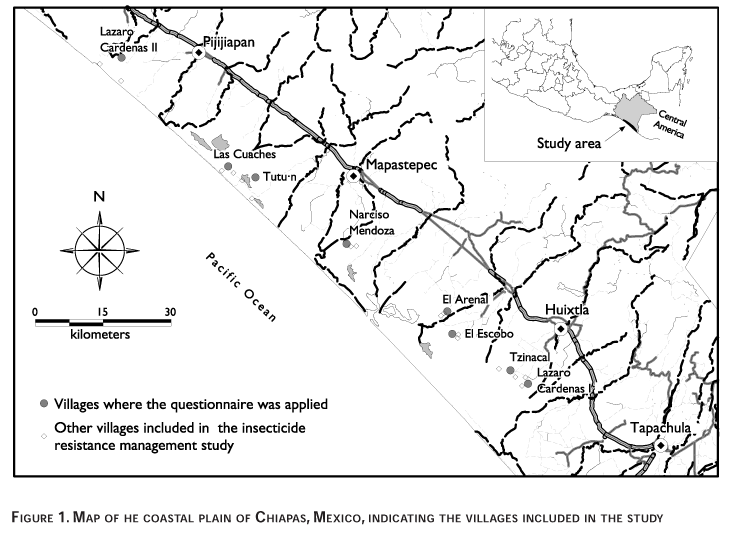
<body><![CDATA[<p><font face="verdana" size="2">Vector control programs are more effective with    the involvement of the community, and prompter results are obtained from community-based    programs compared with government-supported activities alone.<SUP>1, 2</SUP>    An advanced knowledge of the community beliefs and practices with respect to    the disease in question is required to obtain and maintain its participation    in surveillance and control activities.<SUP>3</SUP> Accordingly, it is important    to identify family members that are more sensitive and/or aware of the benefits    that will accrue to the community from a vector control program. It is also    necessary to understand who in the family is in charge of prophylactic activities,    as this will help in directing health workers' efforts. The participation of    women in malaria control has been noted,<SUP>4</SUP> indicating a need to understand    how women influence their environment, particularly the family habits, hygiene,    and the interaction as a family unit with local health and education systems.</font></p>     <p><font face="verdana" size="2">This paper presents the results of a survey to    investigate the knowledge, beliefs, and practices about malaria transmission    and vector control, by interviewing both parents from families in eight villages    in Southern Mexico, where insecticide resistance management strategies were    to undergo evaluation.</font></p>     <p>&nbsp;</p>     <p><font face="verdana" size="3"><b>Material and Methods</b></font></p>     <p><font face="verdana" size="2">The study took place before an insecticide resistance    management project was carried out in 24 villages on the coastal plain of Chiapas,    Mexico.<SUP>5</SUP> A questionnaire was applied in eight randomly selected villages    (<a href="/img/revistas/spm/v45n2/a07f01.gif">Figure 1</a>, <a href="#tab1">Table I</a>) during May and June    1995, before the insecticide application began. Malaria is endemic in the area,    but, except for one case reported in 1993, no malaria cases were recorded in    the area during the five previous years. <I>Anopheles albimanus </I>abundance    was similarly high in all villages included in the study. No current malaria    transmission and high mosquito abundance were conditions that ethically allowed    the insecticide resistance management trial.</font></p>     <p><a name="tab1"></a></p>     <p>&nbsp;</p>     <p align="center"><img src="/img/revistas/spm/v45n2/a07t01.gif"></p>     <p>&nbsp;</p>     <p><font face="verdana" size="2">To validate and adjust the questionnaire to  the understanding of the population, a preliminary  version was applied to 15 family heads of a village in  the study area. The questionnaire was applied  separately to both the mother and the father of each family  to approximately 30% of the families per village.  Previous to each interview, the purpose of the questionnaire  was explained, indicating our interest in collecting  information to aid in planning future health programs.  The same interviewers examined each household to  assess their construction materials.</font></p>     ]]></body>
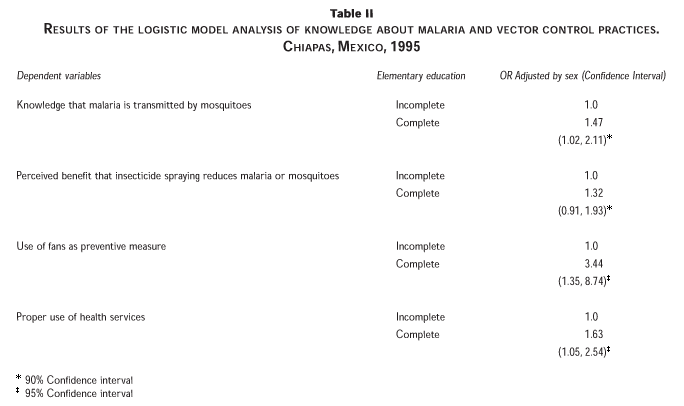
<body><![CDATA[<p>     <p><font face="verdana" size="2">The questionnaire included three sections; the    first part was designed to obtain information on the family structure, including    number of members, and their occupation and schooling. The second section investigated    previous malaria episodes among family members, their knowledge about malaria    transmission, and their attitudes towards the disease, including medication    and use of health services. To investigate family heads' knowledge about malaria    transmission, four optional answers were given: by mosquito bite, by water,    by food, and by other means. These options were selected as the most cited by    villagers during the validation of the questionnaire, where this question was    in open format. To investigate the use of health services they were asked to    whom they usually turn in case of a fever episode in family members, including:    the community dispensary, a private physician, a community health worker, self    medication, a pharmacy, and a traditional health practitioner. In the third    section, the understanding and application of preventive practices    were investigated. In this section, questions addressed the family heads' perceived    effect of indoor insecticide spraying, the preferred spraying frequency, the    use of other preventive methods (bednets, smoke-fumigation and repellents),    and who in the family was in charge of the application of preventive measures.</font></p>     <p><font face="verdana" size="2"> Chi-squared analysis<SUP>6</SUP> was used to    test the hypothesis that schooling was independent of gender. Logistic regression    analysis<SUP>7</SUP> was used to explore the possible associations between schooling    and knowledge of malaria transmission, measures used to prevent mosquito bites,    the perceived benefits of the spraying, and utilization of health services.    All statistical analyses were carried out using the Stata statistical package.</font></p>     <p>&nbsp;</p>     <p><font face="verdana" size="3"><b>Results</b></font></p>     <p><font face="verdana" size="2">A total of 498 people were interviewed, 251 females    and 247 males, comprising 277 families in the 8 villages (<a href="#tab1">Table    I</a>). Surfaces of walls of houses were made of wood (34.7%), plaster (24.9%),    brick and cement block (17.1%), palm leaves (12.9%), and bamboo stems (8%).    There were on average 5.53 &#177; 2.22 (SD) inhabitants per family, with a minimum    of 2 and a maximum of 12 per household. Ninety-seven per cent of females were    housewives and 77% of males were farmers. Family heads' schooling ranged from    illiterate to high school or above; however, 43% of females and 36.8% of males    had incomplete elementary education, and 28.3% of females and 19.8% of males    were illiterate. Overall, males had higher education than females (<font face="Symbol">c</font><SUP>2</SUP>=    16.0, DF= 6, <I>p</I>= 0.01).</font></p>        <p><font face="verdana" size="2"><I>Malaria knowledge. </I>Eighty six percent of  interviewees (<I>n</I>= 430) indicated no malaria experience, 1.6%  (<I>n</I>= 8) indicated that at least one member of their family  had had malaria during the previous year, and the  remainder recalled bouts of malaria in the previous 2-5  years or more than 10 years. No significant differences  in answers were detected between sexes and among  localities.</font></p>     <p><font face="verdana" size="2">Forty-eight percent of interviewed villagers    indicated that malaria was transmitted by mosquito bites (<I>n</I>= 229), 2.8    % answered that it was by water (<I>n</I>= 14), 47.8% did not know (<I>n</I>=    238), and 1.4% gave other answers (<I>n</I>= 7). Forty-seven percent of people    with complete elementary education knew more about malaria transmission than    tose with less education. According to the sex-adjusted logistic model, malaria    transmission knowledge was similar between males and females who completed elementary    school (<I>p</I>= 0.13, OR= 1.47, 90% CI 1.02-2.1) (<a href="/img/revistas/spm/v45n2/a07t02.gif">Table II</a>),    but women who completed elementary school knew more than less educated women    (<I>p</I>= 0.01, OR= 2.24% CI= 1.28-3.47).</font></p>      <p><font face="verdana" size="2"> When knowledge about the reason for spraying    was investigated, 63.9% (<I>n</I>= 281) of the villagers associated it with    a reduction of mosquitoes inside houses, 29.1% (<I>n</I>= 128) responded that    it helped to reduce cockroach numbers, 1.8% (n= 8) associated it with a reduction    of rats in the houses, 2.3% (<I>n</I>= 19) indicated other benefits, but only    3% (<I>n</I>= 13) related insecticide indoor spraying with prevention of malaria    transmission. Sixty to 87% of villagers from any schooling group recognized    that the spraying reduced mosquito numbers, 10%-32% from all groups associated    it with a reduction in cockroach numbers, while 0-7.7% from all groups acknowledged    that spraying helps to prevent malaria. Neither of the two more literate groups    acknowledged the benefits of spraying in malaria prevention. No significant    differences were detected in the responses among schooling groups in the logistic    regression analysis adjusted by sex (<I>p</I>= 0.21, OR= 1.32, 90%    CI 0.91-1.93) (<a href="/img/revistas/spm/v45n2/a07t02.gif">Table II</a>), but women, regardless of their    education level, reported less often that spraying diminished indoor mosquitoes    or malaria occurrence (<I>p</I>= 0.07, OR= 2.12, 90% CI= 0.53-0.98).</font></p>      <p><font face="verdana" size="2">To the question of wheter they agreed with  indoor residual spraying, 97.6% responded positively  and only 12 persons aswered negatively. Among the  reasons given for refusing spraying were that the  insecticide kills their livestock, stains the walls, or is  ineffective. Also, some people reported having physical  impediments to remove the furniture out of the house.  More than 30% (<I>n</I>= 158) indicated that they would  prefer their houses sprayed every two months, 29.3%  (<I>n</I>= 146) preferred it at six months intervals, as it is  customary with DDT, and 22.75 (<I>n</I>= 113) preferred  spraying every three monts.</font></p>     ]]></body>
<body><![CDATA[<p><font face="verdana" size="2"><I>Preventive practices. </I>Ninety-nine percent of  interviewed villagers indicated that they had mosquito bednets,  but only 76.5% (<I>n</I>= 377) use them all year round;  10.8% (<I>n</I>= 53) during the high mosquito abundance  season, and 12.2% (<I>n</I>= 60) only during the wet season.  There were no significant differences in the responses  given by spouses.</font></p>     <p><font face="verdana" size="2">Villagers indicated that they usually apply  their own measures to prevent mosquito bites; 69.3%  (<I>n</I>= 345) responded that they produce smoke by  burning flammable material, which varied from weeds to  dry cattle dung. Only 19.5% (<I>n</I>= 97) used the mosquito  bednets as the principal means for preventing bites,  and the remainder used electric fans, other measures,  or no measures at all. In the logistic model, the use of  electric fans was associated with people that had  completed elementary education (<I>p</I>= 0.009, OR= 3.44, 95%  CI= 1.35-8.74), (<a href="/img/revistas/spm/v45n2/a07t02.gif">Table II</a>).</font></p>     <p><font face="verdana" size="2">A total of 98.4% responded that they bought at    least one product for protection against mosquito bites within the previous    year. The most common products purchased by villagers were mosquito nets (98.2%,    <I>n</I>= 489) and insecticides for home use (22.3%, <I>n</I>= 111), although    10.4% (<I>n</I>= 52) bought mosquito coils and only 0.8% (<I>n</I>= 4) bought    mosquito repellents. On average 3.3 &#177; 1.4 (SD) (<I>n</I>= 448) mosquito    nets were purchased per family during the previous year, and no difference in    the answer was found between sexes. Families bought, on average, 6.4 &#177;    6.6 (SD) (<I>n</I>= 111) insecticide products during the previous year, and    again no difference was found between the answers given by sex. On average,    8.4 &#177; 9.7 (<I>SD</I>) (<I>n</I>= 52) mosquito coils were bought per family    during the previous year and no difference between sexes was found. Finally,    the 4 males who bought repellents averaged 5.5 &#177; 4.2 (<I>SD</I>) repellent    purchases per person during the previous year.</font></p>     <p><font face="verdana" size="2">When asked which family member applied prevention measures, 70.2% answered that the mother  was in charge. When this question was analyzed by  sex, 71.7% of females and 68.7% of males answered  that the mother was in charge. The father was in charge  of applying the prevention measures in 13.5% of  cases. However, when analyzed by sex, only 11.6% of  the answers given by females involved males, while  15.4% of the answers given by males involved  themselves. The involvement of the eldest son in applying  prevention measures was reported in 7.4% of the  answers (7.2% of females and 7.7% of males).</font></p>     <p><font face="verdana" size="2"><I>Use of health services. </I>Villagers were    asked what they did when any member of the family had a fever episode. Fifty    one percent of the respondents indicated that in the case of fever in any family    member, they attended to an adequate health service: the community dispensary,    a private physician, or a voluntary health worker. In the logistic model, adjusted    by sex, there was a positive association of this behavior and complete elementary    or higher education levels (<I>p</I>= 0.02, OR= 1.63, 95% CI= 1.05-2.54), (<a href="/img/revistas/spm/v45n2/a07t02.gif">Table    II</a>). Only 1% (<I>n</I>= 5) responded positively to the specific question    of using anti-malarial drugs when a fever episode occurred.</font></p>     <p>&nbsp;</p>     <p><font face="verdana" size="3"><b>Discussion</b></font></p>     <p><font face="verdana" size="2">In Mexico, a national malaria control program  began in 1955, with excellent success. However,  epidemic outbreaks occurred when control activities  decreased. A long-term control strategy was then adopted in  1982.<SUP>8</SUP> In 1990, at the peak of the last epidemic, an  intensive control program was launched, which included  indoor spraying of DDT and anti-malaria drugs during  the high transmission season. Therefore, it would be  expected that frequent contact of villagers with the  malaria program personnel, as well as the  permanent presence of community health promoters, would  result in better awareness about malaria  transmission. However, a poor understanding of this and  other related issues was documented in this survey. This  situation coincides with that reported in Kenya,  where only 58.5% of interviewed householders associated  malaria with mosquitoes.<SUP>9</SUP> Although malaria  knowledge was marginally better at higher education levels, it  is possible that the small number of villagers with  previous malaria experience may explain the little  awareness about malaria in our study area.</font></p>     <p><font face="verdana" size="2"> Conversely, 63.9% of villagers recognized the    benefits of indoor insecticide spraying in the reduction of mosquito abundance,    but again, only 3% related this directly with a reduction in malaria transmission.    It is clear that villagers seldom have any appreciation of malaria control <I>per    se</I>. Nevertheless, the acceptability of the spraying, in terms of house-spraying    coverage, is sufficient to prevent human-vector contact and to control malaria    in the region. Malaria control based on indoor house spraying heavily depends    on this acceptance. In India, vector control is still based on DDT indoor spraying,    but the coverage is poor as the general opinion of the people does not favor    this intervention.<SUP>10</SUP> On the other hand, in Sri Lanka, high acceptance    levels of malathion, resulted in more than 90% of sprayed houses.<SUP>11</SUP>    The acceptability of spraying is linked to whether householders perceive residual    spraying as beneficial. In our study area, none of the interviewees regarded    spraying as detrimental, and 97.6% agreed with it, although no predisposition    was found in the frequency they would like their houses treated.</font></p>      <p><font face="verdana" size="2">Bednets are among the most recognized  methods of personal protection against mosquitoes and  nuisance insects,<SUP>12</SUP> and many trials have evaluated the  benefits of insecticide impregnated  bednets.<SUP>13-15</SUP> Impregnated bednets were easily accepted and used by  villagers, even in areas with no previous experience or  low usage.<SUP>16</SUP> The dissemination and effectiveness of  bednets in Ghana was influenced by seasonal factors,  patterns of use, and cost.<SUP>17</SUP> In our study area, these  were the products for personal protection most  frequently purchased during the previous year. Bednets were  present in 99% households, most of them (76%) were  in use all year round and the others during the high  mosquito season. However, villagers regarded bednets  as protecting against mosquito bites, and they did not  associate them with malaria prevention. It is  interesting that when asked about self-protection practice,  only 19% listed bednets.</font></p>     ]]></body>
<body><![CDATA[<p><font face="verdana" size="2">Practices recognized as self-protecting  measures were identified as those applied as soon as  mosquito biting activity starts, while villagers are still active  before going to bed, after which bednets were used.  A study on the behaviour of the local malaria vector  <I>An. albimanus</I> with the use of pyrethroid impregnated  bednets, documented that this method may be an  alternative to house-spraying.<SUP>18</SUP> Therefore, the extended  use of bednets in the area supports their inclusion  (impregnated with insecticide) as an additional malaria  control measure in the coastal area of Chiapas.</font></p>     <p><font face="verdana" size="2">Alternative self-protection practices against    mosquito bites included using a range of products and methods, from the burning    of any material to produce smoke, to the use of mosquito coils. Besides relief    from the heat, locals are aware that electric fans also prevent mosquito biting.    Nevertheless, this measure was limited to the better educated people. Although    the questionnaire did not provide elements to construct a socioeconomic index    of the population, the presence of electric fans was associated to concrete    floor (<I>p</I>= 0.002, OR= 25.54, 95% CI= 3.92-192.5), indicating that this    facility was limited to the more well off families.</font></p>     <p><font face="verdana" size="2">The historical position of women, placed at a  lower social level than men, is still clearly observed  in the communities we studied. Most of the women  interviewed were housewives and a significantly  higher percent were illiterate as compared with males.  Women in the area were in general socially, culturally  and economically at a disadvantage to men. Despite  these inequalities, there were no differences in their  beliefs and practices about malaria. Women had a greater  potential impact as family health promoters, with 70%  of the housewives being in charge of the  application of the self-protection preventive measures.</font></p>     <p><font face="verdana" size="2">     Use of health services by the community depends  on several factors; such as the availability of service providers. In some instances, private  physicians are preferred over public health facilities,  because they are perceived as more reliable, although they  are highly expensive and usually located at long  distances from rural areas, which deters utilization of  their services.<SUP>19</SUP> In some regions, villagers rely on the  pharmacist or use local shops for treatment, claiming  that they receive prompt consultation and treatment,  and because these are their nearest source of  care.<SUP>20</SUP> A high percentage of the villagers from our study area  used self-medication when family members had fever,  but most of them attended proper health service  providers. This contrasts with other malarious areas of  Mexico, where 55% of fever cases self-medicated at home,  and only 16.4% attended primary health care services  (equivalent to the community dispensaries) for  treatment.<SUP>21</SUP> This seems to be influenced mainly by the  availability of primary health care services and the severity of  the fever. In our study area, proper health services  are either available in each village or at close  distance. Concerning the severity of the fever, as malaria  transmission is very low and there were no cases  reported during the previous four years, fever was more  likely to be associated with other infectious diseases, as  has been reported elsewhere.<SUP>22</SUP> This lack of recent  experience with malaria, which made villagers to confuse  any fever episode with malaria, is reflected in the  difference between the malaria cases officially reported  and those reported by villagers in the questionnaires.</font></p>     <p><font face="verdana" size="2">In summary, although malaria knowledge in the    coastal plain of Chiapas was poor, knowing the benefit of indoor residual spraying    was associated with a reduction of mosquitoes and other pests in the houses,    and most of villagers agreed with this control measure. People in the communities    apply their own preventive measures to avoid mosquito bites and the use of bednets    is widespread, which makes bednets a viable alternative for malaria control.    The participation of women from these communities in the application of these    measures was important. These results indicate the need for educational programs    aimed at the induction of community participation for malaria control. These    programs should be directed at increasing the awareness of the community about    the participation of mosquitoes on malaria transmission and the different strategies    devised to abate mosquito abundance and deter human-vector contact. The participation    of women in malaria prevention activities within households should be taken    into account in these educational programs.</font></p>     <p>&nbsp;</p>      <p><font face="verdana" size="3"><b>Acknowledgements </b></font></p>     <p><font face="verdana" size="2">The help of Juan Guillermo Bond and Carlos F.    Marina in the application of the questionnaires is appreciated.</font></p>     <p>&nbsp;</p>     <p><font face="verdana" size="3"><b>References</b></font></p>     ]]></body>
<body><![CDATA[<!-- ref --><p><font face="verdana" size="2">1. Ruebush TK, Godoy HA. Community participation in malaria  surveillance and treatment .1. The volunteer collaborator network of  Guatemala. Am J Trop Med Hyg 1992;46:248-260.</font>&nbsp;&nbsp;&nbsp;&nbsp;&nbsp;&nbsp;&nbsp;&nbsp;[&#160;<a href="javascript:void(0);" onclick="javascript: window.open('/scielo.php?script=sci_nlinks&ref=9208788&pid=S0036-3634200300020000700001&lng=','','width=640,height=500,resizable=yes,scrollbars=1,menubar=yes,');">Links</a>&#160;]<!-- end-ref --><!-- ref --><p><font face="verdana" size="2">2. Ruebush TK, Zeissig R, Koplan JP, Klein RE, Godoy HA.  Community participation in malaria surveillance and treatment .3. An evaluation  of modifications in the volunteer collaborator network of Guatemala. Am  J Trop Med Hyg 1994;50:85-98.</font>&nbsp;&nbsp;&nbsp;&nbsp;&nbsp;&nbsp;&nbsp;&nbsp;[&#160;<a href="javascript:void(0);" onclick="javascript: window.open('/scielo.php?script=sci_nlinks&ref=9208789&pid=S0036-3634200300020000700002&lng=','','width=640,height=500,resizable=yes,scrollbars=1,menubar=yes,');">Links</a>&#160;]<!-- end-ref --><!-- ref --><p><font face="verdana" size="2">3. Klein RE, Weller SC, Zeissig, Richards FO, Ruebush TK. Knowledge,  beliefs, and practices in relation to malaria transmission and vector  control in Guatemala. Am J Trop Med Hyg 1995;52:383-388.</font>&nbsp;&nbsp;&nbsp;&nbsp;&nbsp;&nbsp;&nbsp;&nbsp;[&#160;<a href="javascript:void(0);" onclick="javascript: window.open('/scielo.php?script=sci_nlinks&ref=9208790&pid=S0036-3634200300020000700003&lng=','','width=640,height=500,resizable=yes,scrollbars=1,menubar=yes,');">Links</a>&#160;]<!-- end-ref --><!-- ref --><p><font face="verdana" size="2">4. Reuben R. Women and malaria: Special risks and appropriate  control strategy. Soc Sci Med 1993;37:473-490.</font>&nbsp;&nbsp;&nbsp;&nbsp;&nbsp;&nbsp;&nbsp;&nbsp;[&#160;<a href="javascript:void(0);" onclick="javascript: window.open('/scielo.php?script=sci_nlinks&ref=9208791&pid=S0036-3634200300020000700004&lng=','','width=640,height=500,resizable=yes,scrollbars=1,menubar=yes,');">Links</a>&#160;]<!-- end-ref --><!-- ref --><p><font face="verdana" size="2">5. Penilla PR, Rodr&iacute;guez AD, Hemingway J, Torres JL, Arredondo-Jim&eacute;nez  JI, Rodr&iacute;guez MH. Resistance management strategies in malaria vector  mosquito control. Baseline data for a large-scale field trial against  <I>Anopheles albimanus</I> in Mexico. Med Vet Entomol 1998;12:217-233.</font>&nbsp;&nbsp;&nbsp;&nbsp;&nbsp;&nbsp;&nbsp;&nbsp;[&#160;<a href="javascript:void(0);" onclick="javascript: window.open('/scielo.php?script=sci_nlinks&ref=9208792&pid=S0036-3634200300020000700005&lng=','','width=640,height=500,resizable=yes,scrollbars=1,menubar=yes,');">Links</a>&#160;]<!-- end-ref --><!-- ref --><p><font face="verdana" size="2">6. Zar JH. Biostatistical analysis. Englewood Cliffs (NJ): Prentice-Hall, 1984.</font>&nbsp;&nbsp;&nbsp;&nbsp;&nbsp;&nbsp;&nbsp;&nbsp;[&#160;<a href="javascript:void(0);" onclick="javascript: window.open('/scielo.php?script=sci_nlinks&ref=9208793&pid=S0036-3634200300020000700006&lng=','','width=640,height=500,resizable=yes,scrollbars=1,menubar=yes,');">Links</a>&#160;]<!-- end-ref --><!-- ref --><p><font face="verdana" size="2">7. McCullag P, Nelder JA. Generalized Linear Models. 2nd Edition.  New York (NY): Chapman and Hall.</font>&nbsp;&nbsp;&nbsp;&nbsp;&nbsp;&nbsp;&nbsp;&nbsp;[&#160;<a href="javascript:void(0);" onclick="javascript: window.open('/scielo.php?script=sci_nlinks&ref=9208794&pid=S0036-3634200300020000700007&lng=','','width=640,height=500,resizable=yes,scrollbars=1,menubar=yes,');">Links</a>&#160;]<!-- end-ref --><!-- ref --><p><font face="verdana" size="2">8. M&eacute;ndez-Galvan JF, Guerrero-Alvarado J, Gonz&aacute;lez-Mora M,  P&eacute;rez M, Quintero Cabanillas R. Evaluaci&oacute;n de un esquema alternativo  de tratamiento para el control del paludismo. Salud Publica Mex  1984;26: 561-572.</font>&nbsp;&nbsp;&nbsp;&nbsp;&nbsp;&nbsp;&nbsp;&nbsp;[&#160;<a href="javascript:void(0);" onclick="javascript: window.open('/scielo.php?script=sci_nlinks&ref=9208795&pid=S0036-3634200300020000700008&lng=','','width=640,height=500,resizable=yes,scrollbars=1,menubar=yes,');">Links</a>&#160;]<!-- end-ref --><!-- ref --><p><font face="verdana" size="2">9. Munguti KJ. Community perceptions and treatment seeking for  malaria in Baringo district, Kenya: Implications for disease control. East Afr Med  J 1998;75:687-691.</font>&nbsp;&nbsp;&nbsp;&nbsp;&nbsp;&nbsp;&nbsp;&nbsp;[&#160;<a href="javascript:void(0);" onclick="javascript: window.open('/scielo.php?script=sci_nlinks&ref=9208796&pid=S0036-3634200300020000700009&lng=','','width=640,height=500,resizable=yes,scrollbars=1,menubar=yes,');">Links</a>&#160;]<!-- end-ref --><!-- ref --><p><font face="verdana" size="2">10. Sampath TRR, Yadav RS, Sharma VP, Adak T. Evaluation of  lambdacyhalothrin-impregnated bednets in a malaria endemic area of India. Part  I. Implementation and acceptability of the trial. J Am Mosq Control  Assoc 1998;14:431-436.</font>&nbsp;&nbsp;&nbsp;&nbsp;&nbsp;&nbsp;&nbsp;&nbsp;[&#160;<a href="javascript:void(0);" onclick="javascript: window.open('/scielo.php?script=sci_nlinks&ref=9208797&pid=S0036-3634200300020000700010&lng=','','width=640,height=500,resizable=yes,scrollbars=1,menubar=yes,');">Links</a>&#160;]<!-- end-ref --><!-- ref --><p><font face="verdana" size="2">11. Konradsen F, Steele P, Perera D, van der Hoek W, Amerasinghe  PH, Amerasinghe FP. Cost of malaria control in Sri Lanka. Bull  WHO 1999;77:301-309.</font>&nbsp;&nbsp;&nbsp;&nbsp;&nbsp;&nbsp;&nbsp;&nbsp;[&#160;<a href="javascript:void(0);" onclick="javascript: window.open('/scielo.php?script=sci_nlinks&ref=9208798&pid=S0036-3634200300020000700011&lng=','','width=640,height=500,resizable=yes,scrollbars=1,menubar=yes,');">Links</a>&#160;]<!-- end-ref --><!-- ref --><p><font face="verdana" size="2">12. Lindsay SW, Gibson ME. Bednets revisited&#151;Old idea, new angle.  Parasitol Today 1988;4:270-272.</font>&nbsp;&nbsp;&nbsp;&nbsp;&nbsp;&nbsp;&nbsp;&nbsp;[&#160;<a href="javascript:void(0);" onclick="javascript: window.open('/scielo.php?script=sci_nlinks&ref=9208799&pid=S0036-3634200300020000700012&lng=','','width=640,height=500,resizable=yes,scrollbars=1,menubar=yes,');">Links</a>&#160;]<!-- end-ref --><!-- ref --><p><font face="verdana" size="2">13. Cheng H, Yang W, Kang W, Liu C. Large-scale spraying of bednets  to control mosquito vectors and malaria in Sichuan, China. Bull WHO  1995; 73: 321-328.</font>&nbsp;&nbsp;&nbsp;&nbsp;&nbsp;&nbsp;&nbsp;&nbsp;[&#160;<a href="javascript:void(0);" onclick="javascript: window.open('/scielo.php?script=sci_nlinks&ref=9208800&pid=S0036-3634200300020000700013&lng=','','width=640,height=500,resizable=yes,scrollbars=1,menubar=yes,');">Links</a>&#160;]<!-- end-ref --><!-- ref --><p><font face="verdana" size="2">14. D'alessandro U, Olaleye BO, Mcguire W, Langerock P, Bennett S,  Aikins MK <I>et al</I>. Mortality and morbidity from malaria in Gambian  children after introduction of an impregnated bednet programme.  Lancet 1995;345:479-483.</font>&nbsp;&nbsp;&nbsp;&nbsp;&nbsp;&nbsp;&nbsp;&nbsp;[&#160;<a href="javascript:void(0);" onclick="javascript: window.open('/scielo.php?script=sci_nlinks&ref=9208801&pid=S0036-3634200300020000700014&lng=','','width=640,height=500,resizable=yes,scrollbars=1,menubar=yes,');">Links</a>&#160;]<!-- end-ref --><!-- ref --><p><font face="verdana" size="2">15. Binka F N, Kubaje A, Adjuik M, Williams LA, Lengeler C, Maude GH  <I>et al</I>. Impact of permethrin impregnated bednets on child mortality in  Kassena-Nankana district, Ghana: A randomised controlled trial. Trop Med  Int Health 1996;1:147-154.</font>&nbsp;&nbsp;&nbsp;&nbsp;&nbsp;&nbsp;&nbsp;&nbsp;[&#160;<a href="javascript:void(0);" onclick="javascript: window.open('/scielo.php?script=sci_nlinks&ref=9208802&pid=S0036-3634200300020000700015&lng=','','width=640,height=500,resizable=yes,scrollbars=1,menubar=yes,');">Links</a>&#160;]<!-- end-ref --><!-- ref --><p><font face="verdana" size="2">16. Gyapong M, Gyapong JO, Amankwa J, Asedem J, Sory E.  Introducing insecticide impregnated bednets in an area of low bednet usage: An  exploratory study in North-East Ghana. Trop Med Int Health 1996;1:328-333.</font>&nbsp;&nbsp;&nbsp;&nbsp;&nbsp;&nbsp;&nbsp;&nbsp;[&#160;<a href="javascript:void(0);" onclick="javascript: window.open('/scielo.php?script=sci_nlinks&ref=9208803&pid=S0036-3634200300020000700016&lng=','','width=640,height=500,resizable=yes,scrollbars=1,menubar=yes,');">Links</a>&#160;]<!-- end-ref --><!-- ref --><p><font face="verdana" size="2">17. Binka F N, Adongo P. Acceptability and use of insecticide  impregnated bednets in Northern Ghana. Trop Med Int Health 1997;2:499-507.</font>&nbsp;&nbsp;&nbsp;&nbsp;&nbsp;&nbsp;&nbsp;&nbsp;[&#160;<a href="javascript:void(0);" onclick="javascript: window.open('/scielo.php?script=sci_nlinks&ref=9208804&pid=S0036-3634200300020000700017&lng=','','width=640,height=500,resizable=yes,scrollbars=1,menubar=yes,');">Links</a>&#160;]<!-- end-ref --><!-- ref --><p><font face="verdana" size="2">18. Arredondo-Jim&eacute;nez JI, Rodr&iacute;guez MH, Loyola EG, Bown DN.  Behaviour of <I>Anopheles albimanus</I> in relation to pyrethroid-treated  bednets. Med Vet Entomol 1997;11:87-94.</font>&nbsp;&nbsp;&nbsp;&nbsp;&nbsp;&nbsp;&nbsp;&nbsp;[&#160;<a href="javascript:void(0);" onclick="javascript: window.open('/scielo.php?script=sci_nlinks&ref=9208805&pid=S0036-3634200300020000700018&lng=','','width=640,height=500,resizable=yes,scrollbars=1,menubar=yes,');">Links</a>&#160;]<!-- end-ref --><!-- ref --><p><font face="verdana" size="2">19. De Bartolome CA, Vosti SA. Choosing between public and  private health-care: A case study of malaria treatment in Brazil. J Health  Econ 1995;14:191-205.</font>&nbsp;&nbsp;&nbsp;&nbsp;&nbsp;&nbsp;&nbsp;&nbsp;[&#160;<a href="javascript:void(0);" onclick="javascript: window.open('/scielo.php?script=sci_nlinks&ref=9208806&pid=S0036-3634200300020000700019&lng=','','width=640,height=500,resizable=yes,scrollbars=1,menubar=yes,');">Links</a>&#160;]<!-- end-ref --><!-- ref --><p><font face="verdana" size="2">20. Igun UA. Why we seek treatment here: Retail pharmacy and  clinical practice in Maiduguri, Nigeria. Soc Sci Med 1987;24:689-695.</font>&nbsp;&nbsp;&nbsp;&nbsp;&nbsp;&nbsp;&nbsp;&nbsp;[&#160;<a href="javascript:void(0);" onclick="javascript: window.open('/scielo.php?script=sci_nlinks&ref=9208807&pid=S0036-3634200300020000700020&lng=','','width=640,height=500,resizable=yes,scrollbars=1,menubar=yes,');">Links</a>&#160;]<!-- end-ref --><!-- ref --><p><font face="verdana" size="2">21. Leyva-Flores R, Erviti-Erice J, Kageyama-Escobar L, Gallardo-D&iacute;az  E, Lara-Rodr&iacute;guez F. Utilizaci&oacute;n de servicios de salud por febriles en  un &aacute;rea de transmisi&oacute;n de paludismo en M&eacute;xico. Salud Publica Mex  1995;37: 400-407.</font>&nbsp;&nbsp;&nbsp;&nbsp;&nbsp;&nbsp;&nbsp;&nbsp;[&#160;<a href="javascript:void(0);" onclick="javascript: window.open('/scielo.php?script=sci_nlinks&ref=9208808&pid=S0036-3634200300020000700021&lng=','','width=640,height=500,resizable=yes,scrollbars=1,menubar=yes,');">Links</a>&#160;]<!-- end-ref --><!-- ref --><p><font face="verdana" size="2">22. Secretar&iacute;a de Salud. Encuesta Nacional    de Salud II. M&eacute;xico, DF.: SSA, 1994.</font>&nbsp;&nbsp;&nbsp;&nbsp;&nbsp;&nbsp;&nbsp;&nbsp;[&#160;<a href="javascript:void(0);" onclick="javascript: window.open('/scielo.php?script=sci_nlinks&ref=9208809&pid=S0036-3634200300020000700022&lng=','','width=640,height=500,resizable=yes,scrollbars=1,menubar=yes,');">Links</a>&#160;]<!-- end-ref --><p>&nbsp;</p>     <p>&nbsp;</p>     <p><font face="verdana" size="2"><b>Address reprint requests to</b>    <br>   Dr Am&eacute;rico D Rodr&iacute;guez    <br>   Centro de Investigaci&oacute;n de Paludismo, Instituto Nacional de Salud P&uacute;blica    <br>   Apartado Postal 537    <br>   30700 Tapachula, Chiapas, M&eacute;xico    <br>   Email: <a href="mailto:americo@correo.insp.mx">americo@correo.insp.mx</a></font></p>     ]]></body>
<body><![CDATA[<p><font face="verdana" size="2"><b>Received on:</b> February 21, 2002 <b>Accepted    on:</b> January 9, 2003    <br> This study was funded by IRAC/GCPF (The Insecticide    Resistance Action Committee of the Global Crop Protection Federation), with    further contributions from companies participating in the Public Health Working    Group of IRAC/GCPF, viz: Agrevo, Bayer, Cheminova, FMC, Mitsui Toatsu, Novartis,    Rhone Poulenc, Sumitomo, and Zeneca.</font></p>     <p><font face="verdana" size="2">The English version of this paper is available    too at: <a href="http://www.insp.mx/salud/index.html">http://www.insp.mx/salud/index.htm</a>    <br>   El texto completo en ingl&eacute;s de este art&iacute;culo tambi&eacute;n est&aacute;    disponible en: <a href="http://www.insp.mx/salud/index.html">http://www.insp.mx/salud/index.html</a>    </font></p>      ]]></body><back>
<ref-list>
<ref id="B1">
<label>1</label><nlm-citation citation-type="journal">
<person-group person-group-type="author">
<name>
<surname><![CDATA[Ruebush]]></surname>
<given-names><![CDATA[TK]]></given-names>
</name>
<name>
<surname><![CDATA[Godoy]]></surname>
<given-names><![CDATA[HA]]></given-names>
</name>
</person-group>
<article-title xml:lang="en"><![CDATA[Community participation in malaria surveillance and treatment: 1. The volunteer collaborator network of Guatemala.]]></article-title>
<source><![CDATA[Am J Trop Med Hyg]]></source>
<year>1992</year>
<volume>46</volume>
<page-range>248-260</page-range></nlm-citation>
</ref>
<ref id="B2">
<label>2</label><nlm-citation citation-type="journal">
<person-group person-group-type="author">
<name>
<surname><![CDATA[Ruebush]]></surname>
<given-names><![CDATA[TK]]></given-names>
</name>
<name>
<surname><![CDATA[Zeissig]]></surname>
<given-names><![CDATA[R]]></given-names>
</name>
<name>
<surname><![CDATA[Koplan]]></surname>
<given-names><![CDATA[JP]]></given-names>
</name>
<name>
<surname><![CDATA[Klein]]></surname>
<given-names><![CDATA[RE]]></given-names>
</name>
<name>
<surname><![CDATA[Godoy]]></surname>
<given-names><![CDATA[HA]]></given-names>
</name>
</person-group>
<article-title xml:lang="en"><![CDATA[Community participation in malaria surveillance and treatment: 3. An evaluation of modifications in the volunteer collaborator network of Guatemala.]]></article-title>
<source><![CDATA[Am J Trop Med Hyg]]></source>
<year>1994</year>
<volume>50</volume>
<page-range>85-98</page-range></nlm-citation>
</ref>
<ref id="B3">
<label>3</label><nlm-citation citation-type="journal">
<person-group person-group-type="author">
<name>
<surname><![CDATA[Klein]]></surname>
<given-names><![CDATA[RE]]></given-names>
</name>
<name>
<surname><![CDATA[Weller]]></surname>
<given-names><![CDATA[SC]]></given-names>
</name>
<name>
<surname><![CDATA[Zeissig,]]></surname>
<given-names><![CDATA[Richards FO]]></given-names>
</name>
<name>
<surname><![CDATA[Ruebush]]></surname>
<given-names><![CDATA[TK]]></given-names>
</name>
</person-group>
<article-title xml:lang="en"><![CDATA[Knowledge, beliefs, and practices in relation to malaria transmission and vector control in Guatemala]]></article-title>
<source><![CDATA[Am J Trop Med Hyg]]></source>
<year>1995</year>
<volume>52</volume>
<page-range>383-388</page-range></nlm-citation>
</ref>
<ref id="B4">
<label>4</label><nlm-citation citation-type="journal">
<person-group person-group-type="author">
<name>
<surname><![CDATA[Reuben]]></surname>
<given-names><![CDATA[R]]></given-names>
</name>
</person-group>
<article-title xml:lang="en"><![CDATA[Women and malaria: Special risks and appropriate control strategy]]></article-title>
<source><![CDATA[Soc Sci Med]]></source>
<year>1993</year>
<volume>37</volume>
<page-range>473-490</page-range></nlm-citation>
</ref>
<ref id="B5">
<label>5</label><nlm-citation citation-type="journal">
<person-group person-group-type="author">
<name>
<surname><![CDATA[Penilla]]></surname>
<given-names><![CDATA[PR]]></given-names>
</name>
<name>
<surname><![CDATA[Rodríguez]]></surname>
<given-names><![CDATA[AD]]></given-names>
</name>
<name>
<surname><![CDATA[Hemingway]]></surname>
<given-names><![CDATA[J]]></given-names>
</name>
<name>
<surname><![CDATA[Torres]]></surname>
<given-names><![CDATA[JL]]></given-names>
</name>
<name>
<surname><![CDATA[Arredondo-Jiménez]]></surname>
<given-names><![CDATA[JI]]></given-names>
</name>
<name>
<surname><![CDATA[Rodríguez]]></surname>
<given-names><![CDATA[MH]]></given-names>
</name>
</person-group>
<article-title xml:lang="en"><![CDATA[Resistance management strategies in malaria vector mosquito control: Baseline data for a large-scale field trial against Anopheles albimanus in Mexico]]></article-title>
<source><![CDATA[Med Vet Entomol]]></source>
<year>1998</year>
<volume>12</volume>
<page-range>217-233</page-range></nlm-citation>
</ref>
<ref id="B6">
<label>6</label><nlm-citation citation-type="book">
<person-group person-group-type="author">
<name>
<surname><![CDATA[Zar]]></surname>
<given-names><![CDATA[JH]]></given-names>
</name>
</person-group>
<source><![CDATA[Biostatistical analysis]]></source>
<year>1984</year>
<publisher-loc><![CDATA[Englewood Cliffs (NJ) ]]></publisher-loc>
<publisher-name><![CDATA[Prentice-Hall]]></publisher-name>
</nlm-citation>
</ref>
<ref id="B7">
<label>7</label><nlm-citation citation-type="book">
<person-group person-group-type="author">
<name>
<surname><![CDATA[McCullag]]></surname>
<given-names><![CDATA[P]]></given-names>
</name>
<name>
<surname><![CDATA[Nelder]]></surname>
<given-names><![CDATA[JA]]></given-names>
</name>
</person-group>
<source><![CDATA[Generalized Linear Models]]></source>
<year></year>
<edition>2</edition>
<publisher-loc><![CDATA[New York^eNY NY]]></publisher-loc>
<publisher-name><![CDATA[Chapman and Hall]]></publisher-name>
</nlm-citation>
</ref>
<ref id="B8">
<label>8</label><nlm-citation citation-type="journal">
<person-group person-group-type="author">
<name>
<surname><![CDATA[Méndez-Galvan]]></surname>
<given-names><![CDATA[JF]]></given-names>
</name>
<name>
<surname><![CDATA[Guerrero-Alvarado]]></surname>
<given-names><![CDATA[J]]></given-names>
</name>
<name>
<surname><![CDATA[González-Mora]]></surname>
<given-names><![CDATA[M]]></given-names>
</name>
<name>
<surname><![CDATA[Pérez]]></surname>
<given-names><![CDATA[M]]></given-names>
</name>
<name>
<surname><![CDATA[Quintero]]></surname>
<given-names><![CDATA[Cabanillas R]]></given-names>
</name>
</person-group>
<article-title xml:lang="es"><![CDATA[Evaluación de un esquema alternativo de tratamiento para el control del paludismo]]></article-title>
<source><![CDATA[Salud Publica Mex]]></source>
<year>1984</year>
<volume>26</volume>
<page-range>561-572</page-range></nlm-citation>
</ref>
<ref id="B9">
<label>9</label><nlm-citation citation-type="journal">
<person-group person-group-type="author">
<name>
<surname><![CDATA[Munguti]]></surname>
<given-names><![CDATA[KJ]]></given-names>
</name>
</person-group>
<article-title xml:lang="en"><![CDATA[Community perceptions and treatment seeking for malaria in Baringo district, Kenya: Implications for disease control]]></article-title>
<source><![CDATA[East Afr Med J]]></source>
<year>1998</year>
<volume>75</volume>
<page-range>687-691</page-range></nlm-citation>
</ref>
<ref id="B10">
<label>10</label><nlm-citation citation-type="journal">
<person-group person-group-type="author">
<name>
<surname><![CDATA[Sampath]]></surname>
<given-names><![CDATA[TRR]]></given-names>
</name>
<name>
<surname><![CDATA[Yadav]]></surname>
<given-names><![CDATA[RS]]></given-names>
</name>
<name>
<surname><![CDATA[Sharma]]></surname>
<given-names><![CDATA[VP]]></given-names>
</name>
<name>
<surname><![CDATA[Adak]]></surname>
<given-names><![CDATA[T]]></given-names>
</name>
</person-group>
<article-title xml:lang="en"><![CDATA[Evaluation of lambdacyhalothrin-impregnated bednets in a malaria endemic area of India: Part I. Implementation and acceptability of the trial.]]></article-title>
<source><![CDATA[J Am Mosq Control Assoc]]></source>
<year>1998</year>
<volume>14</volume>
<page-range>431-436</page-range></nlm-citation>
</ref>
<ref id="B11">
<label>11</label><nlm-citation citation-type="journal">
<person-group person-group-type="author">
<name>
<surname><![CDATA[Konradsen]]></surname>
<given-names><![CDATA[F]]></given-names>
</name>
<name>
<surname><![CDATA[Steele]]></surname>
<given-names><![CDATA[P]]></given-names>
</name>
<name>
<surname><![CDATA[Perera]]></surname>
<given-names><![CDATA[D]]></given-names>
</name>
<name>
<surname><![CDATA[van der Hoek]]></surname>
<given-names><![CDATA[W]]></given-names>
</name>
<name>
<surname><![CDATA[Amerasinghe]]></surname>
<given-names><![CDATA[PH]]></given-names>
</name>
<name>
<surname><![CDATA[Amerasinghe]]></surname>
<given-names><![CDATA[FP]]></given-names>
</name>
</person-group>
<article-title xml:lang="en"><![CDATA[Cost of malaria control in Sri Lanka]]></article-title>
<source><![CDATA[Bull WHO]]></source>
<year>1999</year>
<volume>77</volume>
<page-range>301-309</page-range></nlm-citation>
</ref>
<ref id="B12">
<label>12</label><nlm-citation citation-type="journal">
<person-group person-group-type="author">
<name>
<surname><![CDATA[Lindsay]]></surname>
<given-names><![CDATA[SW]]></given-names>
</name>
<name>
<surname><![CDATA[Gibson]]></surname>
<given-names><![CDATA[ME]]></given-names>
</name>
</person-group>
<article-title xml:lang="en"><![CDATA[Bednets revisited-Old idea, new angle]]></article-title>
<source><![CDATA[Parasitol Today]]></source>
<year>1988</year>
<volume>4</volume>
<page-range>270-272</page-range></nlm-citation>
</ref>
<ref id="B13">
<label>13</label><nlm-citation citation-type="journal">
<person-group person-group-type="author">
<name>
<surname><![CDATA[Cheng]]></surname>
<given-names><![CDATA[H]]></given-names>
</name>
<name>
<surname><![CDATA[Yang]]></surname>
<given-names><![CDATA[W]]></given-names>
</name>
<name>
<surname><![CDATA[Kang]]></surname>
<given-names><![CDATA[W]]></given-names>
</name>
<name>
<surname><![CDATA[Liu]]></surname>
<given-names><![CDATA[C]]></given-names>
</name>
</person-group>
<article-title xml:lang="en"><![CDATA[Large-scale spraying of bednets to control mosquito vectors and malaria in Sichuan, China]]></article-title>
<source><![CDATA[Bull WHO]]></source>
<year>1995</year>
<volume>73</volume>
<page-range>321-328</page-range></nlm-citation>
</ref>
<ref id="B14">
<label>14</label><nlm-citation citation-type="journal">
<person-group person-group-type="author">
<name>
<surname><![CDATA[D'alessandro]]></surname>
<given-names><![CDATA[U]]></given-names>
</name>
<name>
<surname><![CDATA[Olaleye]]></surname>
<given-names><![CDATA[BO]]></given-names>
</name>
<name>
<surname><![CDATA[Mcguire]]></surname>
<given-names><![CDATA[W]]></given-names>
</name>
<name>
<surname><![CDATA[Langerock]]></surname>
<given-names><![CDATA[P]]></given-names>
</name>
<name>
<surname><![CDATA[Bennett]]></surname>
<given-names><![CDATA[S]]></given-names>
</name>
<name>
<surname><![CDATA[Aikins]]></surname>
<given-names><![CDATA[MK]]></given-names>
</name>
</person-group>
<article-title xml:lang="en"><![CDATA[Mortality and morbidity from malaria in Gambian children after introduction of an impregnated bednet programme]]></article-title>
<source><![CDATA[Lancet]]></source>
<year>1995</year>
<volume>345</volume>
<page-range>479-483</page-range></nlm-citation>
</ref>
<ref id="B15">
<label>15</label><nlm-citation citation-type="journal">
<person-group person-group-type="author">
<name>
<surname><![CDATA[Binka]]></surname>
<given-names><![CDATA[F N]]></given-names>
</name>
<name>
<surname><![CDATA[Kubaje]]></surname>
<given-names><![CDATA[A]]></given-names>
</name>
<name>
<surname><![CDATA[Adjuik]]></surname>
<given-names><![CDATA[M]]></given-names>
</name>
<name>
<surname><![CDATA[Williams]]></surname>
<given-names><![CDATA[LA]]></given-names>
</name>
<name>
<surname><![CDATA[Lengeler]]></surname>
<given-names><![CDATA[C]]></given-names>
</name>
<name>
<surname><![CDATA[Maude]]></surname>
<given-names><![CDATA[GH]]></given-names>
</name>
</person-group>
<article-title xml:lang="en"><![CDATA[Impact of permethrin impregnated bednets on child mortality in Kassena-Nankana district, Ghana: A randomised controlled trial]]></article-title>
<source><![CDATA[Trop Med Int Health]]></source>
<year>1996</year>
<volume>1</volume>
<page-range>147-154</page-range></nlm-citation>
</ref>
<ref id="B16">
<label>16</label><nlm-citation citation-type="journal">
<person-group person-group-type="author">
<name>
<surname><![CDATA[Gyapong]]></surname>
<given-names><![CDATA[M]]></given-names>
</name>
<name>
<surname><![CDATA[Gyapong]]></surname>
<given-names><![CDATA[JO]]></given-names>
</name>
<name>
<surname><![CDATA[Amankwa]]></surname>
<given-names><![CDATA[J]]></given-names>
</name>
<name>
<surname><![CDATA[Asedem]]></surname>
<given-names><![CDATA[J]]></given-names>
</name>
<name>
<surname><![CDATA[Sory]]></surname>
<given-names><![CDATA[E]]></given-names>
</name>
</person-group>
<article-title xml:lang="en"><![CDATA[Introducing insecticide impregnated bednets in an area of low bednet usage: An exploratory study in North-East Ghana]]></article-title>
<source><![CDATA[Trop Med Int Health]]></source>
<year>1996</year>
<volume>1</volume>
<page-range>328-333</page-range></nlm-citation>
</ref>
<ref id="B17">
<label>17</label><nlm-citation citation-type="journal">
<person-group person-group-type="author">
<name>
<surname><![CDATA[Binka]]></surname>
<given-names><![CDATA[F N]]></given-names>
</name>
<name>
<surname><![CDATA[Adongo]]></surname>
<given-names><![CDATA[P]]></given-names>
</name>
</person-group>
<article-title xml:lang="en"><![CDATA[Acceptability and use of insecticide impregnated bednets in Northern Ghana]]></article-title>
<source><![CDATA[Trop Med Int Health]]></source>
<year>1997</year>
<volume>2</volume>
<page-range>499-507</page-range></nlm-citation>
</ref>
<ref id="B18">
<label>18</label><nlm-citation citation-type="journal">
<person-group person-group-type="author">
<name>
<surname><![CDATA[Arredondo-Jiménez]]></surname>
<given-names><![CDATA[JI]]></given-names>
</name>
<name>
<surname><![CDATA[Rodríguez]]></surname>
<given-names><![CDATA[MH]]></given-names>
</name>
<name>
<surname><![CDATA[Loyola]]></surname>
<given-names><![CDATA[EG]]></given-names>
</name>
<name>
<surname><![CDATA[Bown]]></surname>
<given-names><![CDATA[DN]]></given-names>
</name>
</person-group>
<article-title xml:lang="en"><![CDATA[Behaviour of Anopheles albimanus in relation to pyrethroid-treated bednets]]></article-title>
<source><![CDATA[Med Vet Entomol]]></source>
<year>1997</year>
<volume>11</volume>
<page-range>87-94</page-range></nlm-citation>
</ref>
<ref id="B19">
<label>19</label><nlm-citation citation-type="journal">
<person-group person-group-type="author">
<name>
<surname><![CDATA[De Bartolome]]></surname>
<given-names><![CDATA[CA]]></given-names>
</name>
<name>
<surname><![CDATA[Vosti]]></surname>
<given-names><![CDATA[SA]]></given-names>
</name>
</person-group>
<article-title xml:lang="en"><![CDATA[Choosing between public and private health-care: A case study of malaria treatment in Brazil]]></article-title>
<source><![CDATA[J Health Econ]]></source>
<year>1995</year>
<volume>14</volume>
<page-range>191-205</page-range></nlm-citation>
</ref>
<ref id="B20">
<label>20</label><nlm-citation citation-type="journal">
<person-group person-group-type="author">
<name>
<surname><![CDATA[Igun]]></surname>
<given-names><![CDATA[UA]]></given-names>
</name>
</person-group>
<article-title xml:lang="en"><![CDATA[Why we seek treatment here: Retail pharmacy and clinical practice in Maiduguri, Nigeria]]></article-title>
<source><![CDATA[Soc Sci Med]]></source>
<year>1987</year>
<volume>24</volume>
<page-range>689-695</page-range></nlm-citation>
</ref>
<ref id="B21">
<label>21</label><nlm-citation citation-type="journal">
<person-group person-group-type="author">
<name>
<surname><![CDATA[Leyva-Flores]]></surname>
<given-names><![CDATA[R]]></given-names>
</name>
<name>
<surname><![CDATA[Erviti-Erice]]></surname>
<given-names><![CDATA[J]]></given-names>
</name>
<name>
<surname><![CDATA[Kageyama-Escobar]]></surname>
<given-names><![CDATA[L]]></given-names>
</name>
<name>
<surname><![CDATA[Gallardo-Díaz]]></surname>
<given-names><![CDATA[E]]></given-names>
</name>
<name>
<surname><![CDATA[Lara-Rodríguez]]></surname>
<given-names><![CDATA[F]]></given-names>
</name>
</person-group>
<article-title xml:lang="es"><![CDATA[Utilización de servicios de salud por febriles en un área de transmisión de paludismo en México]]></article-title>
<source><![CDATA[Salud Publica Mex]]></source>
<year>1995</year>
<volume>37</volume>
<page-range>400-407</page-range></nlm-citation>
</ref>
<ref id="B22">
<label>22</label><nlm-citation citation-type="book">
<collab>Secretaría de Salud</collab>
<source><![CDATA[Encuesta Nacional de Salud II]]></source>
<year>1994</year>
<publisher-loc><![CDATA[México^eDF. DF.]]></publisher-loc>
<publisher-name><![CDATA[SSA]]></publisher-name>
</nlm-citation>
</ref>
</ref-list>
</back>
</article>