<?xml version="1.0" encoding="ISO-8859-1"?><article xmlns:mml="http://www.w3.org/1998/Math/MathML" xmlns:xlink="http://www.w3.org/1999/xlink" xmlns:xsi="http://www.w3.org/2001/XMLSchema-instance">
<front>
<journal-meta>
<journal-id>0036-3634</journal-id>
<journal-title><![CDATA[Salud Pública de México]]></journal-title>
<abbrev-journal-title><![CDATA[Salud pública Méx]]></abbrev-journal-title>
<issn>0036-3634</issn>
<publisher>
<publisher-name><![CDATA[Instituto Nacional de Salud Pública]]></publisher-name>
</publisher>
</journal-meta>
<article-meta>
<article-id>S0036-36342003000100004</article-id>
<title-group>
<article-title xml:lang="en"><![CDATA[Costs of publicly provided maternity services in Rosario, Argentina]]></article-title>
<article-title xml:lang="es"><![CDATA[Los costos de servicios maternos públicos en Rosario, Argentina]]></article-title>
</title-group>
<contrib-group>
<contrib contrib-type="author">
<name>
<surname><![CDATA[Borghi]]></surname>
<given-names><![CDATA[Josephine]]></given-names>
</name>
<xref ref-type="aff" rid="A01"/>
</contrib>
<contrib contrib-type="author">
<name>
<surname><![CDATA[Bastus]]></surname>
<given-names><![CDATA[Silvia]]></given-names>
</name>
<xref ref-type="aff" rid="A02"/>
</contrib>
<contrib contrib-type="author">
<name>
<surname><![CDATA[Belizan]]></surname>
<given-names><![CDATA[María]]></given-names>
</name>
<xref ref-type="aff" rid="A03"/>
</contrib>
<contrib contrib-type="author">
<name>
<surname><![CDATA[Carroli]]></surname>
<given-names><![CDATA[Guillermo]]></given-names>
</name>
<xref ref-type="aff" rid="A03"/>
</contrib>
<contrib contrib-type="author">
<name>
<surname><![CDATA[Hutton]]></surname>
<given-names><![CDATA[Guy]]></given-names>
</name>
<xref ref-type="aff" rid="A04"/>
</contrib>
<contrib contrib-type="author">
<name>
<surname><![CDATA[Fox-Rushby]]></surname>
<given-names><![CDATA[Julia]]></given-names>
</name>
<xref ref-type="aff" rid="A01"/>
</contrib>
</contrib-group>
<aff id="A01">
<institution><![CDATA[,London School of Hygiene and Tropical Medicine  ]]></institution>
<addr-line><![CDATA[London ]]></addr-line>
<country>UK</country>
</aff>
<aff id="A02">
<institution><![CDATA[,Secretaría de Salud Pública Centro Unico de Facturación ]]></institution>
<addr-line><![CDATA[Rosario ]]></addr-line>
<country>Argentina</country>
</aff>
<aff id="A03">
<institution><![CDATA[,Centro Rosarino de Estudios Perinatales  ]]></institution>
<addr-line><![CDATA[Rosario ]]></addr-line>
<country>Argentina</country>
</aff>
<aff id="A04">
<institution><![CDATA[,Swiss Tropical Institute  ]]></institution>
<addr-line><![CDATA[Basel ]]></addr-line>
<country>Switzerland</country>
</aff>
<pub-date pub-type="pub">
<day>00</day>
<month>01</month>
<year>2003</year>
</pub-date>
<pub-date pub-type="epub">
<day>00</day>
<month>01</month>
<year>2003</year>
</pub-date>
<volume>45</volume>
<numero>1</numero>
<fpage>27</fpage>
<lpage>34</lpage>
<copyright-statement/>
<copyright-year/>
<self-uri xlink:href="http://www.scielo.org.mx/scielo.php?script=sci_arttext&amp;pid=S0036-36342003000100004&amp;lng=en&amp;nrm=iso"></self-uri><self-uri xlink:href="http://www.scielo.org.mx/scielo.php?script=sci_abstract&amp;pid=S0036-36342003000100004&amp;lng=en&amp;nrm=iso"></self-uri><self-uri xlink:href="http://www.scielo.org.mx/scielo.php?script=sci_pdf&amp;pid=S0036-36342003000100004&amp;lng=en&amp;nrm=iso"></self-uri><abstract abstract-type="short" xml:lang="en"><p><![CDATA[OBJECTIVE: This study estimates the costs of maternal health services in Rosario, Argentina. MATERIAL AND METHODS: The provider costs (US$ 1999) of antenatal care, a normal vaginal delivery and a caesarean section, were evaluated retrospectively in two municipal hospitals. The cost of an antenatal visit was evaluated in two health centres and the patient costs associated with the visit were evaluated in a hospital and a health centre. RESULTS: The average cost per hospital day is $114.62. The average cost of a caesarean section ($525.57) is five times greater than that of a normal vaginal delivery ($105.61). A normal delivery costs less at the general hospital and a c-section less at the maternity hospital. The average cost of an antenatal visit is $31.10. The provider cost is lower at the health centre than at the hospital. Personnel accounted for 72-94% of the total cost and drugs and medical supplies between 4-26%. On average, an antenatal visit costs women $4.70. Direct costs are minimal compared to indirect costs of travel and waiting time. CONCLUSIONS: These results suggest the potential for increasing the efficiency of resource use by promoting antenatal care visits at the primary level. Women could also benefit from reduced travel and waiting time. Similar benefits could accrue to the provider by encouraging normal delivery at general hospitals, and complicated deliveries at specialised maternity hospitals.]]></p></abstract>
<abstract abstract-type="short" xml:lang="es"><p><![CDATA[OBJETIVO: En este artículo se presenta una estimación de los costos de los servicios maternos en Rosario, Argentina. MATERIAL Y MÉTODOS: Evaluamos retrospectivamente el costo (US$ 1999) en dos hospitales municipales, de un parto normal vaginal, y de una cesárea y de una visita prenatal. El costo de atención prenatal fue evaluado en dos centros de salud y los costos asumidos por las pacientes fueron evaluados en un hospital y un centro de salud. RESULTADOS: El costo promedio por día-cama es de $114.62. El costo promedio de una cesárea ($525.57) es cinco veces superior al de un parto normal vaginal ($105.61). El parto normal costó menos en el hospital general y la cesárea costó menos en la unidad especializada de atención materna. El costo promedio por visita prenatal es de $31.10. El costo de prestación era más bajo en el centro de salud que en el hospital. El personal de salud representa 72-94% del costo total y los medicamentos y materiales médicos entre 4-26%. En promedio, el costo total asumido por las mujeres por cada visita prenatal asciende a $4.70. Los costos directos son mínimos, comparados con los costos indirectos del tiempo de viaje y de espera. CONCLUSIONES: Los resultados sugieren que la promoción de la atención prenatal en los centros de salud podría aumentar la eficiencia del uso de los recursos. Igualmente, las mujeres se beneficiarían de una reducción en el tiempo de viaje y de espera. Se podrían obtener beneficios similares apoyando la atención del parto normal en los hospitales generales y la de los partos complicados en unidades especializadas de atención materna.]]></p></abstract>
<kwd-group>
<kwd lng="en"><![CDATA[cost]]></kwd>
<kwd lng="en"><![CDATA[maternal health]]></kwd>
<kwd lng="en"><![CDATA[pregnancy]]></kwd>
<kwd lng="en"><![CDATA[delivery]]></kwd>
<kwd lng="en"><![CDATA[Argentina]]></kwd>
<kwd lng="es"><![CDATA[costo]]></kwd>
<kwd lng="es"><![CDATA[salud materna]]></kwd>
<kwd lng="es"><![CDATA[embarazo]]></kwd>
<kwd lng="es"><![CDATA[parto]]></kwd>
<kwd lng="es"><![CDATA[Argentina]]></kwd>
</kwd-group>
</article-meta>
</front><body><![CDATA[  <B><FONT FACE="Verdana, Arial" SIZE=2>     <P ALIGN="RIGHT">ART&Iacute;CULO ORIGINAL</P> </font></B>     <P ALIGN="RIGHT">&nbsp;</P> <B><FONT FACE="Verdana, Arial" SIZE=4>     <P><A NAME="top1"></A>Costs of publicly provided maternity services in Rosario,    Argentina</P> </font></B>     <P>&nbsp;</P> <B><FONT FACE="Verdana, Arial">     <P>Los costos de servicios maternos p&uacute;blicos en Rosario, Argentina</P> </font></B>     <P>&nbsp;</P>     <P>&nbsp;</P> <B></B>     <P><FONT FACE="Verdana, Arial" SIZE=2><B>Josephine Borghi, MSc<SUP>I, </SUP></b></font><A HREF="#back1"><B><SUP><FONT FACE="Verdana, Arial" SIZE=2>1</font></sup></B></A><B><FONT FACE="Verdana, Arial" SIZE=2>;    Silvia Bastus, BA<SUP>II, </sup></font></B><A HREF="#back2"><B><SUP><FONT FACE="Verdana, Arial" SIZE=2>2</font></sup></B></A><B><FONT FACE="Verdana, Arial" SIZE=2>;    Mar&iacute;a Belizan, MA<SUP>III, </sup></font></B><A HREF="#back3"><B><SUP><FONT FACE="Verdana, Arial" SIZE=2>3</font></sup></B></A><B><FONT FACE="Verdana, Arial" SIZE=2>;    Guillermo Carroli, MD<SUP>III, </sup></font></B><A HREF="#back3"><B><SUP><FONT FACE="Verdana, Arial" SIZE=2>3</font></sup></B></A><B><FONT FACE="Verdana, Arial" SIZE=2>;    Guy Hutton, MSc, PhD<SUP>IV, </sup></font></B><A HREF="#back4"><B><SUP><FONT FACE="Verdana, Arial" SIZE=2>4</font></sup></B></A><B><FONT FACE="Verdana, Arial" SIZE=2>;    Julia Fox-Rushby, MSc, PhD<SUP>I, </sup></font></B><A HREF="#back1"><B><SUP><FONT FACE="Verdana, Arial" SIZE=2>1</font></sup></B></A><B><FONT FACE="Verdana, Arial" SIZE=2>;</font></b></P> <FONT FACE="Verdana, Arial" SIZE=2>     <P><SUP>I</sup>London School of Hygiene and Tropical Medicine, London, UK    ]]></body>
<body><![CDATA[<BR>   <SUP>II</SUP>Centro Unico de Facturaci&oacute;n, Secretar&iacute;a de Salud    P&uacute;blica, Municipio de Rosario, Argentina    <BR>   <SUP>III</SUP>Centro Rosarino de Estudios Perinatales, Rosario, Argentina    <BR>   <SUP>IV</SUP>Swiss Tropical Institute, Basel, Switzerland</P> </FONT>     <P>&nbsp;</P>     <P>&nbsp;</P>     <P> <HR SIZE=0>     <p></P> <B><FONT FACE="Verdana, Arial" SIZE=2>     <P>ABSTRACT</P> </font></B>     <P><FONT FACE="Verdana, Arial" SIZE=2><B>OBJECTIVE:</b></font><FONT FACE="Verdana, Arial" SIZE=2>    This study estimates the costs of maternal health services in Rosario, Argentina.    <BR>   <B>MATERIAL AND METHODS:</B> The provider costs (US$ 1999) of antenatal care,    a normal vaginal delivery and a caesarean section, were evaluated retrospectively    in two municipal hospitals. The cost of an antenatal visit was evaluated in    two health centres and the patient costs associated with the visit were evaluated    in a hospital and a health centre.    ]]></body>
<body><![CDATA[<BR>   <B>RESULTS:</B> The average cost per hospital day is $114.62. The average cost    of a caesarean section ($525.57) is five times greater than that of a normal    vaginal delivery ($105.61). A normal delivery costs less at the general hospital    and a c-section less at the maternity hospital. The average cost of an antenatal    visit is $31.10. The provider cost is lower at the health centre than at the    hospital. Personnel accounted for 72-94% of the total cost and drugs and medical    supplies between 4-26%. On average, an antenatal visit costs women $4.70. Direct    costs are minimal compared to indirect costs of travel and waiting time.    <BR>   <B>CONCLUSIONS:</B> These results suggest the potential for increasing the efficiency    of resource use by promoting antenatal care visits at the primary level. Women    could also benefit from reduced travel and waiting time. Similar benefits could    accrue to the provider by encouraging normal delivery at general hospitals,    and complicated deliveries at specialised maternity hospitals. The English version    of this paper is available too at: </FONT><A HREF="http://www.insp.mx/salud/index.html"><FONT FACE="Verdana, Arial" SIZE=2>http://www.insp.mx/salud/index.html</FONT></A></P> <B></B>     <P><FONT FACE="Verdana, Arial" SIZE=2><B>Key words:</b></font><FONT FACE="Verdana, Arial" SIZE=2>    cost; maternal health; pregnancy; delivery; Argentina</font></P>     <P> <HR SIZE=0>     <p></P> <B><FONT FACE="Verdana, Arial" SIZE=2>     <P>RESUMEN</P> </font></B>     <P><FONT FACE="Verdana, Arial" SIZE=2><B>OBJETIVO:</b></font><FONT FACE="Verdana, Arial" SIZE=2>    En este art&iacute;culo se presenta una estimaci&oacute;n de los costos de los    servicios maternos en Rosario, Argentina.    <BR>   <B>MATERIAL Y M&Eacute;TODOS:</B> Evaluamos retrospectivamente el costo (US$    1999) en dos hospitales municipales, de un parto normal vaginal, y de una ces&aacute;rea    y de una visita prenatal. El costo de atenci&oacute;n prenatal fue evaluado    en dos centros de salud y los costos asumidos por las pacientes fueron evaluados    en un hospital y un centro de salud.    <BR>   <B>RESULTADOS:</B> El costo promedio por d&iacute;a-cama es de $114.62. El costo    promedio de una ces&aacute;rea ($525.57) es cinco veces superior al de un parto    normal vaginal ($105.61). El parto normal cost&oacute; menos en el hospital    general y la ces&aacute;rea cost&oacute; menos en la unidad especializada de    atenci&oacute;n materna. El costo promedio por visita prenatal es de $31.10.    El costo de prestaci&oacute;n era m&aacute;s bajo en el centro de salud que    en el hospital. El personal de salud representa 72-94% del costo total y los    medicamentos y materiales m&eacute;dicos entre 4-26%. En promedio, el costo    total asumido por las mujeres por cada visita prenatal asciende a $4.70. Los    costos directos son m&iacute;nimos, comparados con los costos indirectos del    tiempo de viaje y de espera.    <BR>   <B>CONCLUSIONES:</B> Los resultados sugieren que la promoci&oacute;n de la atenci&oacute;n    prenatal en los centros de salud podr&iacute;a aumentar la eficiencia del uso    de los recursos. Igualmente, las mujeres se beneficiar&iacute;an de una reducci&oacute;n    en el tiempo de viaje y de espera. Se podr&iacute;an obtener beneficios similares    apoyando la atenci&oacute;n del parto normal en los hospitales generales y la    de los partos complicados en unidades especializadas de atenci&oacute;n materna.    El texto completo en ingl&eacute;s de este art&iacute;culo tambi&eacute;n est&aacute;    disponible en: </FONT><A HREF="http://www.insp.mx/salud/index.html"><FONT FACE="Verdana, Arial" SIZE=2>http://www.insp.mx/salud/index.html</FONT></A></P> <B></B>     ]]></body>
<body><![CDATA[<P><FONT FACE="Verdana, Arial" SIZE=2><B>Palabras clave:</b></font><FONT FACE="Verdana, Arial" SIZE=2>    costo; salud materna; embarazo; parto; Argentina</font></P>     <P> <HR SIZE=0>     <p></P>     <P>&nbsp;</P>     <P>&nbsp;</P> <FONT FACE="Verdana, Arial" SIZE=2>     <P>The reduction in maternal mortality rates observed in most high-income countries    over the last century has been associated with changes in the access of pregnant    women to skilled care during pregnancy and childbirth and to the guaranteed    provision of safe interventions assisting vaginal delivery and caesarean section.<SUP>1</SUP>    However, the critical question of where these interventions should take place    and who qualifies as a skilled attendant remains a matter of debate.<SUP>2-5</SUP>    Case studies from countries that have low maternal mortality demonstrate that    delivery care can be organised in different ways: from home births with a trained    non-professional, to basic pregnancy and delivery care in health centres or    obstetric care at a referral level with trained professionals.<SUP>2,3</SUP>    There is no information to date as to which option is more effective in reducing    maternal mortality and only limited evidence as to the cost of these alternatives.<SUP>6,7</sup></P>     <P>In Argentina, public hospitals provide the full range of routine outpatient    and inpatient maternity services and deal with obstetric complications, while    the health centres provide outpatient antenatal care (ANC) alone. Ninety-five    percent of women deliver with trained personnel in health facilities<SUP>8</SUP>    and attend at least one antenatal visit, while the recommended national average    is four antenatal visits.<SUP>9</SUP> While maternal mortality rates are lower    than the average for Latin America, the reduction in maternal morbidity and    mortality over recent years is seen to be inadequate.<SUP>10</SUP> One explanation    is the increasing demand for obstetric services which has been exceeding available    supply in the public sector, with implications for quality.<SUP>10</sup></P>     <P>With falling health budgets, health planners and policy makers face the challenge    of improving the efficiency of the health service delivery system to meet the    increase in demand, without compromising maternal health or the financial viability    of the system. To this end, information is needed on the cost of providing services    at different health care levels and its relation to resource inputs, as well    as on the cost to the people using services.<SUP>11</SUP> However, in public    health facilities in Argentina the focus to date has been mainly on the evaluation    of efficacy rather than efficiency of health services<SUP>11</SUP> and cost    data are lacking.</P>     <P>Against this background, the primary aim of this study was to examine the costs    of providing antenatal care in two health centres and two hospitals and the    costs of delivery care in the hospital setting. The specific objectives were    to explore how and why costs differ at different levels of service delivery    for different interventions (antenatal <I>versus</I> normal delivery versus    caesarean section), to assess the efficiency of service delivery, and to discuss    the potential for achieving cost savings without hurting quality. Costs to women    were also evaluated, as they serve as a useful indicator of the accessibility    of health care in terms of distance to travel and affordability interns of direct    costs of receiving care.</P> </FONT>     <P>&nbsp;</P> <B><FONT FACE="Verdana, Arial">     ]]></body>
<body><![CDATA[<P>Material and Methods</P> </font></B><FONT FACE="Verdana, Arial" SIZE=2>     <P>The study took place in Rosario City, located in the Province of Santa Fe,    Argentina. Rosario has an estimated population of 908,875.<SUP>12</SUP> Maternidad    Mart&iacute;n, a high complexity referral hospital and Roque S&aacute;enz-Pe&ntilde;a,    a general hospital, and two health centres: Las Flores and Casiano Casas, were    selected for the study of provider costs. All costs are presented in constant    prices US$ 1999. The criteria for site selection were that the number of hours    per week allocated to antenatal visits and the number of monthly visits be representative    of the district average. In Roque S&aacute;enz-Pe&ntilde;a and Las Flores, a    sample of women who had completed an antenatal visit was interviewed on the    costs they faced in accessing and receiving antenatal care.</P>     <P>The provider costs of inpatient maternity and delivery care were evaluated    in the study hospitals. The costs of outpatient antenatal care were evaluated    from the provider and patient perspectives. Data on costs were collected between    May 1999 and January 2000. Financial and economic costs were estimated and classified    according to recurrent and capital inputs. Inputs were considered as recurrent    items if used up within a year, or capital items if lasting longer than a year.    Personnel, drugs and materials (medical and non-medical), utilities and maintenance    were considered as recurrent inputs; equipment and building as capital items.    The direct out-of-pocket treatment costs to women associated with antenatal    care were considered, as well as the indirect, opportunity cost of travelling    and waiting time.</P> </FONT>     <P><FONT FACE="Verdana, Arial" SIZE=2>Average costs of services to the provider    were estimated using a top-down approach.<SUP>13</SUP> Services were classified    as directly related to maternity care or as 'support' or shared services,<A NAME="ast1"></A></font><A HREF="#astback1"><FONT FACE="Verdana, Arial" SIZE=2>*</FONT></A><FONT FACE="Verdana, Arial" SIZE=2>    which contribute to the functioning, rather than the provision, of health care.    </FONT><A HREF="/img/revistas/spm/v45n1/15047t1.gif"><FONT FACE="Verdana, Arial" SIZE=2>Table    I</FONT></A><FONT FACE="Verdana, Arial" SIZE=2> presents the methods used to    measure and evaluate direct and shared costs and the data obtained for each    input type and for each health facility. A direct allocation of shared costs    was conducted, using where possible the number of units (i.e. prescriptions    for pharmacy, tests for laboratory, food rations for kitchen) attributable to    the maternity ward. Alternatively, full-time equivalent staff numbers or floor    space were used as a basis for allocation. The opportunity cost of equipment    used by the maternity ward but shared with other departments was not considered.    Monthly utilisation data for each of the services were obtained from Centro    Rosarino de Estudios Perinatales (CREP) and the Secretar&iacute;a de Salud P&uacute;blica.</font></P> <FONT FACE="Verdana, Arial" SIZE=2>      <P>A questionnaire to measure women's costs was developed and translated into    Spanish. An interviewer was recruited and trained to carry out a supervised    pilot study, before conducting facility-based exit interviews on a sample of    20 low-risk pregnant women from the general hospital and 20 from a health centre.    Interviews were carried out over a two-week period in November 1999. The questions    focused on women and their companion's direct costs associated with travel,    drug prescriptions or tests and the indirect, opportunity costs associated with    travel, waiting and visit time. For those women working, the opportunity cost    of their time was based on their average wage for their time ($0.03 per minute).    For those women looking after children/doing housework, we valued their time    and that of their companion (if of working age) by means of the minimum wage    in Argentina.</P> </FONT>     <P><FONT FACE="Verdana, Arial" SIZE=2>Average, marginal<A NAME="ast2"></A></font><A HREF="#astback2"><FONT FACE="Verdana, Arial" SIZE=2>**</FONT></A><FONT FACE="Verdana, Arial" SIZE=2>    and total monthly provider costs for each activity are presented as well as    monthly service-volume ratios. Total direct and indirect and costs borne by    women and their families in accessing outpatient antenatal care, at the health    centre and hospital levels, are also presented. One-way sensitivity analyses    were conducted to test the sensitivity of the results to changes in assumptions.    Salaries were scaled up to between 1.5 to 4 times the baseline level to reflect    the differential between the public and the private sectors. The majority of    the utilisation and cost data collected relates to a one-month period that does    not capture the full extent of any inter-month/seasonal variation. Based on    the findings reported elsewhere, we varied these parameters between 14% above    and below their estimated values.<SUP>14,15</SUP> Finally, we conducted a threshold    analysis to determine the implications for average costs of a transfer of normal    deliveries from the maternity to the general hospital and of c-sections from    the general to the maternity hospital. Similarly we considered the implications    for average costs of a transfer of antenatal visits from the hospital to health    centre level.</font></P>     <P>&nbsp;</P> <B><FONT FACE="Verdana, Arial">     <P>Results</P> </FONT><FONT FACE="Verdana, Arial" SIZE=2>     <P>Inpatient and Delivery Care: the general <I>versus</I> maternity hospital</P> </font></B>     <P><FONT FACE="Verdana, Arial" SIZE=2>Total costs are shown in </font><A HREF="#tabela2"><FONT FACE="Verdana, Arial" SIZE=2>Table    II</FONT></A><FONT FACE="Verdana, Arial" SIZE=2> where each input is expressed    as a monetary value and as a percentage of the total. Total costs are consistently    higher in the maternity compared to the general hospital. Personnel represent    between 88-90% of the total in the general hospital and 72-94% in the maternity    hospital. Drugs represent 7-9% of the total in the general hospital and 4-26%    in the maternity hospital.</font></P>     ]]></body>
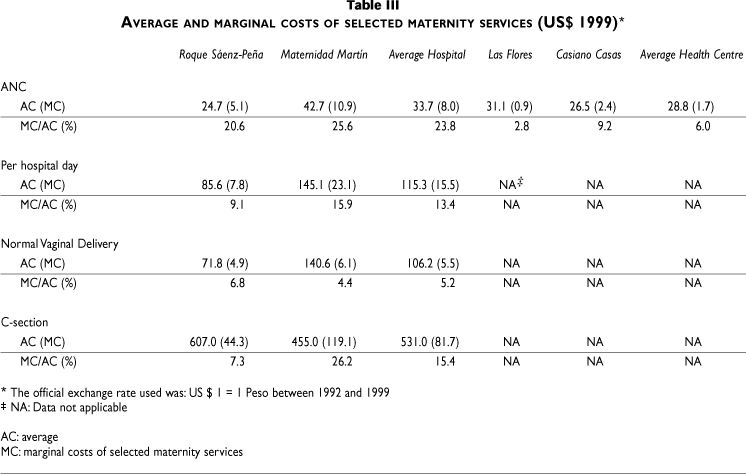
<body><![CDATA[<P ALIGN="CENTER"><A NAME="tabela2"></A></P>     <P ALIGN="CENTER">&nbsp;</P>     <P ALIGN="CENTER"><IMG SRC="/img/revistas/spm/v45n1/15047t2.gif"></P>     <P ALIGN="CENTER">&nbsp;</P> <FONT FACE="Verdana, Arial" SIZE=2>     <P>The number of days of inpatient stay was 48% higher (824 <I>versus</I> 558    days) in the maternity compared to general hospital; the total number of normal    vaginal deliveries was 58% higher (275 <I>versus</I> 174 deliveries); and the    total number of caesarean sections was 37% higher (50 <I>versus</I> 36 c-sections).    The ratio of caesarean sections to normal vaginal deliveries is approximately    1:5 in both facilities.</P> </FONT>     <P><A HREF="/img/revistas/spm/v45n1/15047t3.gif"><FONT FACE="Verdana, Arial" SIZE=2>Table    3</FONT></A><FONT FACE="Verdana, Arial" SIZE=2> shows that average costs are    higher in the maternity hospital except for caesarean section, which is 32%    higher in the general hospital ($599 <I>versus</I> $453). Indeed, the cost of    inpatient stay is 72% higher and the cost of vaginal delivery 98% higher in    the maternity compared to the general hospital ($145 <I>versus</I> $84 and $140    <I>versus</I> $71 respectively). Ac-section costs on average 5.8 times more    than a normal vaginal delivery.</font></P>     <P>&nbsp;</P> <B><FONT FACE="Verdana, Arial" SIZE=2>     <P>Outpatient Antenatal Care (ANC): Hospital <I>versus</I> Health Centre</P> </font></B>     <P><FONT FACE="Verdana, Arial" SIZE=2>Total monthly costs of antenatal care are    higher in the hospitals than the health centres ($2 153 compared to $32 117)    (</font><A HREF="#figura1"><FONT FACE="Verdana, Arial" SIZE=2>Figure 1</FONT></A><FONT FACE="Verdana, Arial" SIZE=2>).    Personnel costs account for the highest proportion of total cost, 91% in the    health centres versus 73% in the hospitals. Drugs and materials contribute to    23% of total cost to the hospitals <I>versus</I> 6% in the health centres. The    average prescription cost is of a similar level for each health facility ($3.09-$5.08),    however, the average number of prescriptions is substantially higher in the    hospital compared to the health centre for antenatal care (401 <I>versus</I>    19 respectively) due to higher utilisation rates.</font></P>     <P ALIGN="CENTER"><A NAME="figura1"></A></P>     ]]></body>
<body><![CDATA[<P ALIGN="CENTER">&nbsp;</P>     <P ALIGN="CENTER"><IMG SRC="/img/revistas/spm/v45n1/15047f1.gif"></P>     <P ALIGN="CENTER">&nbsp;</P>     <P><FONT FACE="Verdana, Arial" SIZE=2>The average monthly number of antenatal    care visits is almost twelve times higher in the hospitals than the health centres    (899 visits <I>versus</I> 74). The visit numbers are nearly twice as high in    the maternity compared to the general hospital (1 113 <I>versus</I> 685 ANC    visits). Furthermore, ANC visits represent a larger proportion of total outpatient    visits in the maternity hospital than in either of the health centres (42% <I>versus</I>    2% respectively).<A NAME="ast3"></A></font><A HREF="#astback3"><FONT FACE="Verdana, Arial" SIZE=2>***</FONT></A></P>     <P><FONT FACE="Verdana, Arial" SIZE=2>On average, the provision of antenatal care    is more costly at the secondary ($33.6) rather than the primary care level ($28.75)    (</font><A HREF="/img/revistas/spm/v45n1/15047t3.gif"><FONT FACE="Verdana, Arial" SIZE=2>Table    III</FONT></A><FONT FACE="Verdana, Arial" SIZE=2>). The highest cost per antenatal    care visit, $42.51, is in the maternity hospital, whilst the lowest cost is    in the general hospital, $24.40.</font></P> <FONT FACE="Verdana, Arial" SIZE=2> <B>     <P>Women's Costs</P> </B>     <P>Ninety-five percent of the women travelled to the health centre by foot and    the remaining 5% by bus. Forty-five percent of the women interviewed in the    hospital travelled by bus, followed by 30% travelling by foot or by bicycle    and 15% by car. Thirty-five percent of the women were accompanied to the health    facility. Average travel costs borne by women and their companion amounted to    $1.26 in the hospital (SD*: 1.32) and only one woman faced travel costs in the    health centre, hence an average cost of $0.06 (SD: 0.27). The women surveyed    generally did not face any prescription charges, drugs and tests prescribed    during the visit were provided for free. Only 3 women made purchases as a direct    result of the visit, hence, for the total sample of women the average cost of    drugs / tests was $0.87 (SD: 0.12) per visit. Total direct costs for women and    their companions was highest at the hospital: $1.25 (SD: 1.29) compared to the    health centre: $0.14 (SD: 0.35).</P>     <P>Women travelled for an average of 25 minutes for a return journey to the health    centre (SD: 24.24) and 34.21 minutes to and from the hospital (SD: 18.34). The    length of time spent in the clinic (waiting and visit time) varied from 68.5    minutes (SD: 47.13) in the health centre to 116.75 (SD: 74.52) in the hospital    (an average of 92.63 (SD: 66.22)). The opportunity cost of time for each women    and their companion per visit amounts to $3.53 (SD: 2.46) in the health centre    and $5.37 (SD: 2.64) in the hospital.</P>     <P>The total cost to women and their companion per visit was $4.70 (SD: 3.42):    $3.31 (SD: 2.53) in the health centre and $6.08 (SD: 3.68) in the hospital.    Within the hospital, patient costs represent 20% of total cost (patient plus    provider) and 10% of the total within the health centre.</P> <I>     <P>Sensitivity Analysis</P> </I></FONT>     ]]></body>
<body><![CDATA[<P><FONT FACE="Verdana, Arial" SIZE=2>Average costs increased significantly, by    a factor of up to 3.6, with an increase in staff salaries by a factor of 4 (</font><A HREF="/img/revistas/spm/v45n1/15047t4.gif"><FONT FACE="Verdana, Arial" SIZE=2>Table    IV</FONT></A><FONT FACE="Verdana, Arial" SIZE=2>). Even a two fold increase    in salaries, leads to a doubling of average costs.</font></P> <FONT FACE="Verdana, Arial" SIZE=2>      <P>Increases in the quantity of staff involved in the provision of each service,    holding service volume constant, also had an impact on average costs. The average    cost per day of inpatient stay ranged between $48-$200, the cost of a normal    vaginal delivery between $38-$204 and the cost of a caesarean section between    $288-$746. The average cost of an outpatient ANC visit was also sensitive to    variations in the quantity of staff, the average cost ranging between $15-$41    across all facilities with a variation in staff quantities by 50% above/below    the baseline value. Average costs were insensitive to variations in the average    monthly volume of service utilisation data.</P> </FONT>     <P>&nbsp;</P> <B><FONT FACE="Verdana, Arial">     <P>Discussion</P> </font></B><FONT FACE="Verdana, Arial" SIZE=2>     <P>The provider cost of maternity services in Argentina is driven by staff salaries,    which contribute to between 72-94% of total costs. Variations in staff costs    between facilities can be explained by differences in the numbers of highly    skilled medical staff. The performance of deliveries by an obstetrician rather    than a midwife also accounts for the high staff costs in comparison with other    country-settings. For example, in a study of Ghana, Malawi and Uganda,<SUP>8</SUP>    staff represented a maximum of 39% of the total cost of maternal health services    total costs, compared to 88% for drugs and materials.</P>     <P>The unit costs of inpatient and normal delivery care were greater in the maternity    compared to the general hospitals due to higher drug costs and a greater number    of medical staff, although the unit cost of c-section was greater in the general    hospital due to lower utilisation. This shows the potential for a more efficient    use of resources by promoting the referral of complicated cases to the maternity    hospital for a c-section. On average, a caesarean section costs over five times    more than a normal vaginal delivery. With one in five women giving birth by    caesarean section over the period considered, the impact on total cost is significant.    A reduction in the practise of unnecessary elective c-sections would clearly    result in savings to the provider.</P>     <P>The unit costs of these maternal health services in Argentina are significantly    higher than those in other Central<SUP>16</SUP> and Southern American<SUP>17,    18</SUP> countries (roughly four-fold) and between 6 and 10-fold higher than    in Sub-Saharan Africa.<SUP>19-22</SUP> On the contrary to the experience in    other countries, in Argentina costs are generally higher in the lower level    facilities, due to the lower service volume. By encouraging antenatal care at    the primary rather than secondary level, providers would benefit from lower    average costs, although policy makers need to ensure the availability of essential    equipment, drugs and medical supplies, to ensure women are not deterred due    to a lower perceived quality of care at the primary level.</P>     <P>In Argentina, women do not pay for prescriptions of drugs and/or tests resulting    from ANC visits in public facilities, the burden of the cost of service provision    falling entirely on the provider. Costs and distance associated with travel    to and from the health facilities are minimal, although women were found to    pay more on average when travelling to the hospital than the health centre.    This suggests an easier accessibility of primary compared to secondary facilities,    for user and the potential for productivity gains by using primary rather than    secondary facilities for antenatal care. Women lose considerable time travelling    to and from the health facility and attending antenatal care, which could have    been spent more productively at work, looking after their children or doing    housework. Overall, total costs facing women for each ANC visit represent 1-2%    of average monthly income. The ninety-five percent antenatal care coverage rate    in Argentina suggests that the burden in terms of direct cost and time do not    represent a significant barrier to access.</P>     <P>Two studies which also considered direct costs to women in africa (indirect    costs and direct costs to companions were not included) in Africa, estimated    costs from $1.71-$3.06 in a hospital setting and $0.15-$0.97 in a health centre.<SUP>21,22</SUP>    User costs are lower in Argentina as out-of-pocket payments associated with    the visit were negligible.</P>     <P>Further research is required to extend the analysis to include additional health    facilities: providers in different settings in Argentina as well as private    sector facilities. An evaluation of the cost of providing a wider range of services,    including the management of obstetrical complications is also recommended. Similarly,    the sample of women interviewed in this study was small and our results need    to be tested on a larger sample in different geographic areas.</P> </FONT>     ]]></body>
<body><![CDATA[<P>&nbsp;</P> <B><FONT FACE="Verdana, Arial">     <P>Acknowledgements</P> </font></B><FONT FACE="Verdana, Arial" SIZE=2>     <P>Josephine Borghi is funded by the Department for International Development    through the Maternal Health Programme at the London School of Hygiene &amp;    Tropical Medicine. This project was conducted for and funded by the Human Reproduction    Programme at WHO, Geneva. We thank Professor Miranda Mugford, from University    of East Anglia, who assisted in the study design and provided advice during    the study. Many people assisted us with this study in Argentina. We would specifically    like to thank: Daniel Giordano, Centro Rosarino de Estudios Perinatales, Rosario,    Argentina. Dr Edgardo Abalos, Centro Rosarino de Estudios Perinatales, Rosario,    Argentina; Beatriz C Galiano, English Translator, Argentina; Dr Miriam Acosta,    Subdirector, Roque S&aacute;enz-Pe&ntilde;a; Dr D&eacute;bora Ferrandini, Subdirector    of Primary Health Care (Atenci&oacute;n Primaria); Marta Rossi de Budai, Administrative    Director; Dra Marina Duarte, Neonatology; and M&oacute;nica Giustina, Director    of Statistics Department of Maternidad Mart&iacute;n; Marcela A Nuccetelli,    Director, and Dra Gabriela Gioia, Obstetrician, Las Flores; Dr Antonio Chacra,    Director, and Dr Alberto R Pais, Obstetrician of Casiano Casas; Dr Lelio Mangiaterra,    Rosario, Argentina; and finally, the Staff at Palacio Municipal, Rosario, Argentina.</P> </FONT>     <P>&nbsp;</P> <B><FONT FACE="Verdana, Arial">     <P>References</P> </font></B><FONT FACE="Verdana, Arial" SIZE=2>     <!-- ref --><P>1. Loudon I, Childbirth. En: Loudon I, ed. Western medicine: An illustrated    history. Oxford: Oxford University Press, 1997: 206-220.&nbsp;&nbsp;&nbsp;&nbsp;&nbsp;&nbsp;&nbsp;&nbsp;[&#160;<a href="javascript:void(0);" onclick="javascript: window.open('/scielo.php?script=sci_nlinks&ref=9165857&pid=S0036-3634200300010000400001&lng=','','width=640,height=500,resizable=yes,scrollbars=1,menubar=yes,');">Links</a>&#160;]<!-- end-ref --><!-- ref --><P>2. Koblinsky MA, Campbell O, Heichelheim J. Organizing delivery care: What    works for safe motherhood? Bull WHO 1999; 77: 399-406.&nbsp;&nbsp;&nbsp;&nbsp;&nbsp;&nbsp;&nbsp;&nbsp;[&#160;<a href="javascript:void(0);" onclick="javascript: window.open('/scielo.php?script=sci_nlinks&ref=9165858&pid=S0036-3634200300010000400002&lng=','','width=640,height=500,resizable=yes,scrollbars=1,menubar=yes,');">Links</a>&#160;]<!-- end-ref --><!-- ref --><P>3. De Brouwere V, Tonglet R, Van Lerberghe W. Strategies for reducing maternal    mortality in developing countries: What can we learn from the history of the    industrialized West? Trop Med Int Health 1998; 3: 771-782.&nbsp;&nbsp;&nbsp;&nbsp;&nbsp;&nbsp;&nbsp;&nbsp;[&#160;<a href="javascript:void(0);" onclick="javascript: window.open('/scielo.php?script=sci_nlinks&ref=9165859&pid=S0036-3634200300010000400003&lng=','','width=640,height=500,resizable=yes,scrollbars=1,menubar=yes,');">Links</a>&#160;]<!-- end-ref --><!-- ref --><P>4. Walraven G, Weeks A. The role of (traditional) birth attendants with midwifery    skills in the reduction of maternal mortality. Trop Med Int Health 1999;4:527-529.&nbsp;&nbsp;&nbsp;&nbsp;&nbsp;&nbsp;&nbsp;&nbsp;[&#160;<a href="javascript:void(0);" onclick="javascript: window.open('/scielo.php?script=sci_nlinks&ref=9165860&pid=S0036-3634200300010000400004&lng=','','width=640,height=500,resizable=yes,scrollbars=1,menubar=yes,');">Links</a>&#160;]<!-- end-ref --><!-- ref --><P>5. Graham WJ, Bell JS, Bullough CHW. Can skilled attendance at delivery reduce    maternal mortality in developing countries? Stud Health Serv-Organ Policy 2001;17:97-130.&nbsp;&nbsp;&nbsp;&nbsp;&nbsp;&nbsp;&nbsp;&nbsp;[&#160;<a href="javascript:void(0);" onclick="javascript: window.open('/scielo.php?script=sci_nlinks&ref=9165861&pid=S0036-3634200300010000400005&lng=','','width=640,height=500,resizable=yes,scrollbars=1,menubar=yes,');">Links</a>&#160;]<!-- end-ref --><!-- ref --><P>6. Mumford EA, Dayaratna V, Winfrey W, Sine J, McGreevey WP. Reproductive Health    Cost: Literature Review. Working Paper Series No. 3. Washington, D.C.: Futures    Group International, 1998.&nbsp;&nbsp;&nbsp;&nbsp;&nbsp;&nbsp;&nbsp;&nbsp;[&#160;<a href="javascript:void(0);" onclick="javascript: window.open('/scielo.php?script=sci_nlinks&ref=9165862&pid=S0036-3634200300010000400006&lng=','','width=640,height=500,resizable=yes,scrollbars=1,menubar=yes,');">Links</a>&#160;]<!-- end-ref --><!-- ref --><P>7. Jowett M. Safe motherhood interventions in low-income countries: An economic    justification and evidence of cost effectiveness. J Health Policy 2000; 53:    201-228.&nbsp;&nbsp;&nbsp;&nbsp;&nbsp;&nbsp;&nbsp;&nbsp;[&#160;<a href="javascript:void(0);" onclick="javascript: window.open('/scielo.php?script=sci_nlinks&ref=9165863&pid=S0036-3634200300010000400007&lng=','','width=640,height=500,resizable=yes,scrollbars=1,menubar=yes,');">Links</a>&#160;]<!-- end-ref --><!-- ref --><P>8. Pan American Health Organization. Health in the Americas. Volume I. Washington,    DC: Regional Office of WHO, 1998.&nbsp;&nbsp;&nbsp;&nbsp;&nbsp;&nbsp;&nbsp;&nbsp;[&#160;<a href="javascript:void(0);" onclick="javascript: window.open('/scielo.php?script=sci_nlinks&ref=9165864&pid=S0036-3634200300010000400008&lng=','','width=640,height=500,resizable=yes,scrollbars=1,menubar=yes,');">Links</a>&#160;]<!-- end-ref --><!-- ref --><P>9. Villar J, Ba'aqeel H, Piaggio G, Lumbiganon P, Miguel Beliz&aacute;n J,    Farnot U <I>et al</I>. WHO antenatal care randomised trial for the evaluation    of a new model of routine antenatal care. Lancet 2001; 357: 1551-1564.&nbsp;&nbsp;&nbsp;&nbsp;&nbsp;&nbsp;&nbsp;&nbsp;[&#160;<a href="javascript:void(0);" onclick="javascript: window.open('/scielo.php?script=sci_nlinks&ref=9165865&pid=S0036-3634200300010000400009&lng=','','width=640,height=500,resizable=yes,scrollbars=1,menubar=yes,');">Links</a>&#160;]<!-- end-ref --><!-- ref --><P>10. Szmoisz S, Vuegen SE, Plaza AS, Barracchini R, Checa S, Derlindati A <I>et    al</I>. Argentina: Risk factors and maternal mortality in La Matanza, Province    of Buenos Aires, 1990. World Health Stat Q 1995; 48: 4-7.&nbsp;&nbsp;&nbsp;&nbsp;&nbsp;&nbsp;&nbsp;&nbsp;[&#160;<a href="javascript:void(0);" onclick="javascript: window.open('/scielo.php?script=sci_nlinks&ref=9165866&pid=S0036-3634200300010000400010&lng=','','width=640,height=500,resizable=yes,scrollbars=1,menubar=yes,');">Links</a>&#160;]<!-- end-ref --><!-- ref --><P>11. Villanueva H. [Ongoing health management control by cost monitoring through    tracer indicators]. Rev Panam Salud Publica 2001; 10: 405-412.&nbsp;&nbsp;&nbsp;&nbsp;&nbsp;&nbsp;&nbsp;&nbsp;[&#160;<a href="javascript:void(0);" onclick="javascript: window.open('/scielo.php?script=sci_nlinks&ref=9165867&pid=S0036-3634200300010000400011&lng=','','width=640,height=500,resizable=yes,scrollbars=1,menubar=yes,');">Links</a>&#160;]<!-- end-ref --><!-- ref --><P><FONT FACE="Verdana, Arial" SIZE=2>12. Censo del 2000 paso a paso [online]    1991 [cited 2002 May 23]. Available from URL: </font><A HREF="http://www.rosario.gov.ar/muni10e/muni1001.nsf/Paginas/Fram01"><FONT FACE="Verdana, Arial" SIZE=2>httph://www.rosario.gov.ar/muni10e/muni1001.nsf/Pagi    nas/Fram01</FONT></A><FONT FACE="Verdana, Arial" SIZE=2>.</font>&nbsp;&nbsp;&nbsp;&nbsp;&nbsp;&nbsp;&nbsp;&nbsp;[&#160;<a href="javascript:void(0);" onclick="javascript: window.open('/scielo.php?script=sci_nlinks&ref=9165868&pid=S0036-3634200300010000400012&lng=','','width=640,height=500,resizable=yes,scrollbars=1,menubar=yes,');">Links</a>&#160;]<!-- end-ref --><!-- ref --><P>13. Drummond MF, O'Brien B, Stoddart G L, Torrance G W. Methods for economic    evaluation of health care programmes 2<SUP>nd</SUP> Edition. Oxford (UK): Oxford    Medical Publications, Oxford University Press, 1997.&nbsp;&nbsp;&nbsp;&nbsp;&nbsp;&nbsp;&nbsp;&nbsp;[&#160;<a href="javascript:void(0);" onclick="javascript: window.open('/scielo.php?script=sci_nlinks&ref=9165869&pid=S0036-3634200300010000400013&lng=','','width=640,height=500,resizable=yes,scrollbars=1,menubar=yes,');">Links</a>&#160;]<!-- end-ref --><!-- ref --><P>14. G&aacute;lvez AM, Alvarez M, Sanabria G, Mugford M, Hutton G, Fox-Rushby    J. A study of the costs of antenatal care alongside the World Health Organization    Trial in Havana, Cuba. Norwich: School of Health Policy and Practice, 2000.&nbsp;&nbsp;&nbsp;&nbsp;&nbsp;&nbsp;&nbsp;&nbsp;[&#160;<a href="javascript:void(0);" onclick="javascript: window.open('/scielo.php?script=sci_nlinks&ref=9165870&pid=S0036-3634200300010000400014&lng=','','width=640,height=500,resizable=yes,scrollbars=1,menubar=yes,');">Links</a>&#160;]<!-- end-ref --><!-- ref --><P>15. Thinkamrop J, Thinkamrop B, Kuchaisit C, Bagwandeen C, Mugford M, Hutton    G <I>et al</I>. A study of the costs of antenatal care alongside the WHO trial    in Thailand. Norwich: School of Health Policy and Practice, 2000.&nbsp;&nbsp;&nbsp;&nbsp;&nbsp;&nbsp;&nbsp;&nbsp;[&#160;<a href="javascript:void(0);" onclick="javascript: window.open('/scielo.php?script=sci_nlinks&ref=9165871&pid=S0036-3634200300010000400015&lng=','','width=640,height=500,resizable=yes,scrollbars=1,menubar=yes,');">Links</a>&#160;]<!-- end-ref --><!-- ref --><P>16. Rosenthel G, Percy A. Maternity services in Cochabamba, Bolivia: Costs,    cost recovery, and changing markets. Arlington (VA): Mothercare, John Snow,    1991.&nbsp;&nbsp;&nbsp;&nbsp;&nbsp;&nbsp;&nbsp;&nbsp;[&#160;<a href="javascript:void(0);" onclick="javascript: window.open('/scielo.php?script=sci_nlinks&ref=9165872&pid=S0036-3634200300010000400016&lng=','','width=640,height=500,resizable=yes,scrollbars=1,menubar=yes,');">Links</a>&#160;]<!-- end-ref --><!-- ref --><P>17. Dmytraczenko T, Aitken I, Carrasco SE, Seoane KC, Kolley J, Abramson WB    <I>et al</I>. Evaluaci&oacute;n del Seguro Nacional de Maternidad y Ni&ntilde;ez    en Bolivia. Bethesda (MD): Partnerships for Health Reform Project, Abt Associates    1998, Informe T&eacute;cnico 22.&nbsp;&nbsp;&nbsp;&nbsp;&nbsp;&nbsp;&nbsp;&nbsp;[&#160;<a href="javascript:void(0);" onclick="javascript: window.open('/scielo.php?script=sci_nlinks&ref=9165873&pid=S0036-3634200300010000400017&lng=','','width=640,height=500,resizable=yes,scrollbars=1,menubar=yes,');">Links</a>&#160;]<!-- end-ref --><!-- ref --><P>18. Mitchell MD, Littlefield J, Gutter S. Reproductive Health: From policy    to practice. Draft manuscript. Boston, Management Sciences for Health, 1997.&nbsp;&nbsp;&nbsp;&nbsp;&nbsp;&nbsp;&nbsp;&nbsp;[&#160;<a href="javascript:void(0);" onclick="javascript: window.open('/scielo.php?script=sci_nlinks&ref=9165874&pid=S0036-3634200300010000400018&lng=','','width=640,height=500,resizable=yes,scrollbars=1,menubar=yes,');">Links</a>&#160;]<!-- end-ref --><!-- ref --><P>19. Weissman E, Sentumbwe-Mugisa O, Mbonye AK, Lissner C. Costing safe motherhood    in Uganda. En: Berer M, Sundari-Ravindran TK, ed. Reproductive Health Matters:    Safe Motherhood Initiatives Critical Issues. Oxford (UK): Blackwer Science,    1999.&nbsp;&nbsp;&nbsp;&nbsp;&nbsp;&nbsp;&nbsp;&nbsp;[&#160;<a href="javascript:void(0);" onclick="javascript: window.open('/scielo.php?script=sci_nlinks&ref=9165875&pid=S0036-3634200300010000400019&lng=','','width=640,height=500,resizable=yes,scrollbars=1,menubar=yes,');">Links</a>&#160;]<!-- end-ref --><!-- ref --><P>20. Fox-Rushby J, Foord F. Costs, Effects and Cost-Effectiveness Analysis of    a Mobile Maternal Health Care Service in West Kiang, The Gambia. Health Policy    1996; 35: 123-143.&nbsp;&nbsp;&nbsp;&nbsp;&nbsp;&nbsp;&nbsp;&nbsp;[&#160;<a href="javascript:void(0);" onclick="javascript: window.open('/scielo.php?script=sci_nlinks&ref=9165876&pid=S0036-3634200300010000400020&lng=','','width=640,height=500,resizable=yes,scrollbars=1,menubar=yes,');">Links</a>&#160;]<!-- end-ref --><!-- ref --><P>21. Jinabhai C, Wamukuo J, Bagwandeen C, Mugford M, Hutton G, Fox-Rushby J.    Costs of antenatal and delivery care for providers and women in Umlazy township,    Durban, South Africa. Norwich: School of Health Policy and Practice, 2000.&nbsp;&nbsp;&nbsp;&nbsp;&nbsp;&nbsp;&nbsp;&nbsp;[&#160;<a href="javascript:void(0);" onclick="javascript: window.open('/scielo.php?script=sci_nlinks&ref=9165877&pid=S0036-3634200300010000400021&lng=','','width=640,height=500,resizable=yes,scrollbars=1,menubar=yes,');">Links</a>&#160;]<!-- end-ref --><!-- ref --><P>22. Levin A, McEuen M, Dymatraczenko T, Ssengooba F, Mangani R, Van Dyck G.    Costs of maternal health care services in three anglophone African countries.    Special Initiatives Report 22. Bethesda (MD): Partnerships for Health Reform    Project, Abt Associates 2000.&nbsp;&nbsp;&nbsp;&nbsp;&nbsp;&nbsp;&nbsp;&nbsp;[&#160;<a href="javascript:void(0);" onclick="javascript: window.open('/scielo.php?script=sci_nlinks&ref=9165878&pid=S0036-3634200300010000400022&lng=','','width=640,height=500,resizable=yes,scrollbars=1,menubar=yes,');">Links</a>&#160;]<!-- end-ref --><P>&nbsp;</P>     <P>&nbsp;</P> <B></B>     <P><FONT FACE="Verdana, Arial" SIZE=2><B>Address reprint requests to:    ]]></body>
<body><![CDATA[<BR>   </b></font><FONT FACE="Verdana, Arial" SIZE=2>Josephine Borghi    <BR>   Health Policy Unit    <BR>   London School of Hygiene and Tropical Medicine, Keppel Street    <BR>   London WC1E 7HT    <BR>   E-mail: </FONT><A HREF="mailto:jo.Borghi@lshtm.ac.uk"><FONT FACE="Verdana, Arial" SIZE=2>jo.Borghi@lshtm.ac.uk</FONT></A></P> <B></B>     <P><FONT FACE="Verdana, Arial" SIZE=2><B>Received on:</b></font><FONT FACE="Verdana, Arial" SIZE=2>    February 26, 2002    <BR>   <B>Accepted on:</B> September 26, 2002</font></P>     <P>&nbsp;</P>     <P>&nbsp;</P>     <P><FONT FACE="Verdana, Arial" SIZE=2>The English version of this paper is available    too at: </font><A HREF="http://www.insp.mx/salud/index.html"><FONT FACE="Verdana, Arial" SIZE=2>http://www.insp.mx/salud/index.html    ]]></body>
<body><![CDATA[<BR>   </FONT></A><A NAME="astback1"></A><A HREF="#ast1"><FONT FACE="Verdana, Arial" SIZE=2>*</FONT></A><FONT FACE="Verdana, Arial" SIZE=2>    For example: pharmacy, laundry, laboratory, radiology, social work, haematology,    anaestesiology, maintenance, kitchen, cleaning, general administration, security    <BR>   <A NAME="astback2"></A></FONT><A HREF="#ast2"><FONT FACE="Verdana, Arial" SIZE=2>**</FONT></A><FONT FACE="Verdana, Arial" SIZE=2>    Including drugs and medical supplies    <BR>   <A NAME="astback3"></A></FONT><A HREF="#ast3"><FONT FACE="Verdana, Arial" SIZE=2>***</FONT></A><FONT FACE="Verdana, Arial" SIZE=2>    This information is not available for the general hospital    <BR>   <A NAME="back1"></A></FONT><A HREF="#top1"><FONT FACE="Verdana, Arial" SIZE=2>1</FONT></A><FONT FACE="Verdana, Arial" SIZE=2>    London School of Hygiene and Tropical Medicine, London, UK    <BR>   <A NAME="back2"></A></FONT><A HREF="#top1"><FONT FACE="Verdana, Arial" SIZE=2>2</FONT></A><FONT FACE="Verdana, Arial" SIZE=2>    Centro Unico de Facturaci&oacute;n, Secretar&iacute;a de Salud P&uacute;blica,    Municipio de Rosario, Argentina    <BR>   <A NAME="back3"></A></FONT><A HREF="#top1"><FONT FACE="Verdana, Arial" SIZE=2>3</FONT></A><FONT FACE="Verdana, Arial" SIZE=2>    Centro Rosarino de Estudios Perinatales, Rosario, Argentina    <BR>   <A NAME="back4"></A></FONT><A HREF="#top1"><FONT FACE="Verdana, Arial" SIZE=2>4</FONT></A><FONT FACE="Verdana, Arial" SIZE=2>    Swiss Tropical Institute, Basel, Switzerland</font></P>      ]]></body><back>
<ref-list>
<ref id="B1">
<label>1</label><nlm-citation citation-type="book">
<person-group person-group-type="author">
<name>
<surname><![CDATA[Loudon]]></surname>
<given-names><![CDATA[I]]></given-names>
</name>
</person-group>
<article-title xml:lang="en"><![CDATA[Childbirth]]></article-title>
<person-group person-group-type="editor">
<name>
<surname><![CDATA[Loudon]]></surname>
<given-names><![CDATA[I]]></given-names>
</name>
</person-group>
<source><![CDATA[Western medicine: An illustrated history]]></source>
<year>1997</year>
<page-range>206-220</page-range><publisher-loc><![CDATA[Oxford ]]></publisher-loc>
<publisher-name><![CDATA[Oxford University Press]]></publisher-name>
</nlm-citation>
</ref>
<ref id="B2">
<label>2</label><nlm-citation citation-type="journal">
<person-group person-group-type="author">
<name>
<surname><![CDATA[Koblinsky]]></surname>
<given-names><![CDATA[MA]]></given-names>
</name>
<name>
<surname><![CDATA[Campbell]]></surname>
<given-names><![CDATA[O]]></given-names>
</name>
<name>
<surname><![CDATA[Heichelheim]]></surname>
<given-names><![CDATA[J]]></given-names>
</name>
</person-group>
<article-title xml:lang="en"><![CDATA[Organizing delivery care: What works for safe motherhood?]]></article-title>
<source><![CDATA[Bull WHO]]></source>
<year>1999</year>
<volume>77</volume>
<page-range>399-406</page-range></nlm-citation>
</ref>
<ref id="B3">
<label>3</label><nlm-citation citation-type="journal">
<person-group person-group-type="author">
<name>
<surname><![CDATA[De Brouwere]]></surname>
<given-names><![CDATA[V]]></given-names>
</name>
<name>
<surname><![CDATA[Tonglet]]></surname>
<given-names><![CDATA[R]]></given-names>
</name>
<name>
<surname><![CDATA[Van Lerberghe]]></surname>
<given-names><![CDATA[W]]></given-names>
</name>
</person-group>
<article-title xml:lang="en"><![CDATA[Strategies for reducing maternal mortality in developing countries: What can we learn from the history of the industrialized West?]]></article-title>
<source><![CDATA[Trop Med Int Health]]></source>
<year>1998</year>
<volume>3</volume>
<page-range>771-782</page-range></nlm-citation>
</ref>
<ref id="B4">
<label>4</label><nlm-citation citation-type="journal">
<person-group person-group-type="author">
<name>
<surname><![CDATA[Walraven]]></surname>
<given-names><![CDATA[G]]></given-names>
</name>
<name>
<surname><![CDATA[Weeks]]></surname>
<given-names><![CDATA[A]]></given-names>
</name>
</person-group>
<article-title xml:lang="en"><![CDATA[The role of (traditional) birth attendants with midwifery skills in the reduction of maternal mortality]]></article-title>
<source><![CDATA[Trop Med Int Health]]></source>
<year>1999</year>
<volume>4</volume>
<page-range>527-529</page-range></nlm-citation>
</ref>
<ref id="B5">
<label>5</label><nlm-citation citation-type="journal">
<person-group person-group-type="author">
<name>
<surname><![CDATA[Graham]]></surname>
<given-names><![CDATA[WJ]]></given-names>
</name>
<name>
<surname><![CDATA[Bell]]></surname>
<given-names><![CDATA[JS]]></given-names>
</name>
<name>
<surname><![CDATA[Bullough]]></surname>
<given-names><![CDATA[CHW]]></given-names>
</name>
</person-group>
<article-title xml:lang="en"><![CDATA[Can skilled attendance at delivery reduce maternal mortality in developing countries?]]></article-title>
<source><![CDATA[Stud Health Serv-Organ Policy]]></source>
<year>2001</year>
<volume>17</volume>
<page-range>97-130</page-range></nlm-citation>
</ref>
<ref id="B6">
<label>6</label><nlm-citation citation-type="book">
<person-group person-group-type="author">
<name>
<surname><![CDATA[Mumford]]></surname>
<given-names><![CDATA[EA]]></given-names>
</name>
<name>
<surname><![CDATA[Dayaratna]]></surname>
<given-names><![CDATA[V]]></given-names>
</name>
<name>
<surname><![CDATA[Winfrey]]></surname>
<given-names><![CDATA[W]]></given-names>
</name>
<name>
<surname><![CDATA[Sine]]></surname>
<given-names><![CDATA[J]]></given-names>
</name>
<name>
<surname><![CDATA[McGreevey]]></surname>
<given-names><![CDATA[WP]]></given-names>
</name>
</person-group>
<source><![CDATA[Reproductive Health Cost: Literature Review]]></source>
<year>1998</year>
<volume>3</volume>
<publisher-loc><![CDATA[Washington^eD.C D.C]]></publisher-loc>
<publisher-name><![CDATA[Futures Group International]]></publisher-name>
</nlm-citation>
</ref>
<ref id="B7">
<label>7</label><nlm-citation citation-type="journal">
<person-group person-group-type="author">
<name>
<surname><![CDATA[Jowett]]></surname>
<given-names><![CDATA[M]]></given-names>
</name>
</person-group>
<article-title xml:lang="en"><![CDATA[Safe motherhood interventions in low-income countries: An economic justification and evidence of cost effectiveness]]></article-title>
<source><![CDATA[J Health Policy]]></source>
<year>2000</year>
<volume>53</volume>
<page-range>201-228</page-range></nlm-citation>
</ref>
<ref id="B8">
<label>8</label><nlm-citation citation-type="book">
<collab>Pan American Health Organization</collab>
<source><![CDATA[Health in the Americas]]></source>
<year>1998</year>
<volume>I</volume>
<publisher-loc><![CDATA[Washington^eDC DC]]></publisher-loc>
<publisher-name><![CDATA[Regional Office of WHO]]></publisher-name>
</nlm-citation>
</ref>
<ref id="B9">
<label>9</label><nlm-citation citation-type="journal">
<person-group person-group-type="author">
<name>
<surname><![CDATA[Villar]]></surname>
<given-names><![CDATA[J]]></given-names>
</name>
<name>
<surname><![CDATA[Ba'aqeel]]></surname>
<given-names><![CDATA[H]]></given-names>
</name>
<name>
<surname><![CDATA[Piaggio]]></surname>
<given-names><![CDATA[G]]></given-names>
</name>
<name>
<surname><![CDATA[Lumbiganon]]></surname>
<given-names><![CDATA[P]]></given-names>
</name>
<name>
<surname><![CDATA[Miguel]]></surname>
<given-names><![CDATA[Belizán J]]></given-names>
</name>
<name>
<surname><![CDATA[Farnot]]></surname>
<given-names><![CDATA[U]]></given-names>
</name>
</person-group>
<article-title xml:lang="en"><![CDATA[WHO antenatal care randomised trial for the evaluation of a new model of routine antenatal care]]></article-title>
<source><![CDATA[Lancet]]></source>
<year>2001</year>
<volume>357</volume>
<page-range>1551-1564</page-range></nlm-citation>
</ref>
<ref id="B10">
<label>10</label><nlm-citation citation-type="journal">
<person-group person-group-type="author">
<name>
<surname><![CDATA[Szmoisz]]></surname>
<given-names><![CDATA[S]]></given-names>
</name>
<name>
<surname><![CDATA[Vuegen]]></surname>
<given-names><![CDATA[SE]]></given-names>
</name>
<name>
<surname><![CDATA[Plaza]]></surname>
<given-names><![CDATA[AS]]></given-names>
</name>
<name>
<surname><![CDATA[Barracchini]]></surname>
<given-names><![CDATA[R]]></given-names>
</name>
<name>
<surname><![CDATA[Checa]]></surname>
<given-names><![CDATA[S]]></given-names>
</name>
<name>
<surname><![CDATA[Derlindati]]></surname>
<given-names><![CDATA[A]]></given-names>
</name>
</person-group>
<article-title xml:lang="en"><![CDATA[Argentina: Risk factors and maternal mortality in La Matanza, Province of Buenos Aires]]></article-title>
<source><![CDATA[World Health Stat Q]]></source>
<year>1990</year>
<month>19</month>
<day>95</day>
<volume>48</volume>
<page-range>4-7</page-range></nlm-citation>
</ref>
<ref id="B11">
<label>11</label><nlm-citation citation-type="journal">
<person-group person-group-type="author">
<name>
<surname><![CDATA[Villanueva]]></surname>
<given-names><![CDATA[H]]></given-names>
</name>
</person-group>
<article-title xml:lang="en"><![CDATA[Ongoing health management control by cost monitoring through tracer indicators]]></article-title>
<source><![CDATA[Rev Panam Salud Publica]]></source>
<year>2001</year>
<volume>10</volume>
<page-range>405-412</page-range></nlm-citation>
</ref>
<ref id="B12">
<label>12</label><nlm-citation citation-type="">
<source><![CDATA[Censo del 2000 paso a paso]]></source>
<year>1991</year>
</nlm-citation>
</ref>
<ref id="B13">
<label>13</label><nlm-citation citation-type="book">
<person-group person-group-type="author">
<name>
<surname><![CDATA[Drummond]]></surname>
<given-names><![CDATA[MF]]></given-names>
</name>
<name>
<surname><![CDATA[O'Brien]]></surname>
<given-names><![CDATA[B]]></given-names>
</name>
<name>
<surname><![CDATA[Stoddart]]></surname>
<given-names><![CDATA[G L]]></given-names>
</name>
<name>
<surname><![CDATA[Torrance]]></surname>
<given-names><![CDATA[G W]]></given-names>
</name>
</person-group>
<source><![CDATA[Methods for economic evaluation of health care programmes]]></source>
<year>1997</year>
<edition>2</edition>
<publisher-loc><![CDATA[Oxford ]]></publisher-loc>
<publisher-name><![CDATA[Oxford Medical PublicationsOxford University Press]]></publisher-name>
</nlm-citation>
</ref>
<ref id="B14">
<label>14</label><nlm-citation citation-type="book">
<person-group person-group-type="author">
<name>
<surname><![CDATA[Gálvez]]></surname>
<given-names><![CDATA[AM]]></given-names>
</name>
<name>
<surname><![CDATA[Alvarez]]></surname>
<given-names><![CDATA[M]]></given-names>
</name>
<name>
<surname><![CDATA[Sanabria]]></surname>
<given-names><![CDATA[G]]></given-names>
</name>
<name>
<surname><![CDATA[Mugford]]></surname>
<given-names><![CDATA[M]]></given-names>
</name>
<name>
<surname><![CDATA[Hutton]]></surname>
<given-names><![CDATA[G]]></given-names>
</name>
<name>
<surname><![CDATA[Fox-Rushby]]></surname>
<given-names><![CDATA[J]]></given-names>
</name>
</person-group>
<source><![CDATA[A study of the costs of antenatal care alongside the World Health Organization Trial in Havana, Cuba]]></source>
<year>2000</year>
<publisher-loc><![CDATA[Norwich ]]></publisher-loc>
<publisher-name><![CDATA[School of Health Policy and Practice]]></publisher-name>
</nlm-citation>
</ref>
<ref id="B15">
<label>15</label><nlm-citation citation-type="book">
<person-group person-group-type="author">
<name>
<surname><![CDATA[Thinkamrop]]></surname>
<given-names><![CDATA[J]]></given-names>
</name>
<name>
<surname><![CDATA[Thinkamrop]]></surname>
<given-names><![CDATA[B]]></given-names>
</name>
<name>
<surname><![CDATA[Kuchaisit]]></surname>
<given-names><![CDATA[C]]></given-names>
</name>
<name>
<surname><![CDATA[Bagwandeen]]></surname>
<given-names><![CDATA[C]]></given-names>
</name>
<name>
<surname><![CDATA[Mugford]]></surname>
<given-names><![CDATA[M]]></given-names>
</name>
<name>
<surname><![CDATA[Hutton]]></surname>
<given-names><![CDATA[G]]></given-names>
</name>
</person-group>
<source><![CDATA[A study of the costs of antenatal care alongside the WHO trial in Thailand]]></source>
<year>2000</year>
<publisher-loc><![CDATA[Norwich ]]></publisher-loc>
<publisher-name><![CDATA[School of Health Policy and Practice]]></publisher-name>
</nlm-citation>
</ref>
<ref id="B16">
<label>16</label><nlm-citation citation-type="book">
<person-group person-group-type="author">
<name>
<surname><![CDATA[Rosenthel]]></surname>
<given-names><![CDATA[G]]></given-names>
</name>
<name>
<surname><![CDATA[Percy]]></surname>
<given-names><![CDATA[A]]></given-names>
</name>
</person-group>
<source><![CDATA[Maternity services in Cochabamba, Bolivia: Costs, cost recovery, and changing markets]]></source>
<year>1991</year>
<publisher-loc><![CDATA[Arlington (VA) ]]></publisher-loc>
<publisher-name><![CDATA[MothercareJohn Snow]]></publisher-name>
</nlm-citation>
</ref>
<ref id="B17">
<label>17</label><nlm-citation citation-type="book">
<person-group person-group-type="author">
<name>
<surname><![CDATA[Dmytraczenko]]></surname>
<given-names><![CDATA[T]]></given-names>
</name>
<name>
<surname><![CDATA[Aitken]]></surname>
<given-names><![CDATA[I]]></given-names>
</name>
<name>
<surname><![CDATA[Carrasco]]></surname>
<given-names><![CDATA[SE]]></given-names>
</name>
<name>
<surname><![CDATA[Seoane]]></surname>
<given-names><![CDATA[KC]]></given-names>
</name>
<name>
<surname><![CDATA[Kolley]]></surname>
<given-names><![CDATA[J]]></given-names>
</name>
<name>
<surname><![CDATA[Abramson]]></surname>
<given-names><![CDATA[WB]]></given-names>
</name>
</person-group>
<source><![CDATA[Evaluación del Seguro Nacional de Maternidad y Niñez en Bolivia]]></source>
<year>1998</year>
<publisher-loc><![CDATA[Bethesda (MD) ]]></publisher-loc>
<publisher-name><![CDATA[Partnerships for Health Reform Project]]></publisher-name>
</nlm-citation>
</ref>
<ref id="B18">
<label>18</label><nlm-citation citation-type="book">
<person-group person-group-type="author">
<name>
<surname><![CDATA[Mitchell]]></surname>
<given-names><![CDATA[MD]]></given-names>
</name>
<name>
<surname><![CDATA[Littlefield]]></surname>
<given-names><![CDATA[J]]></given-names>
</name>
<name>
<surname><![CDATA[Gutter]]></surname>
<given-names><![CDATA[S]]></given-names>
</name>
</person-group>
<source><![CDATA[Reproductive Health: From policy to practice]]></source>
<year>1997</year>
<publisher-loc><![CDATA[Boston ]]></publisher-loc>
<publisher-name><![CDATA[Management Sciences for Health]]></publisher-name>
</nlm-citation>
</ref>
<ref id="B19">
<label>19</label><nlm-citation citation-type="book">
<person-group person-group-type="author">
<name>
<surname><![CDATA[Weissman]]></surname>
<given-names><![CDATA[E]]></given-names>
</name>
<name>
<surname><![CDATA[Sentumbwe-Mugisa]]></surname>
<given-names><![CDATA[O]]></given-names>
</name>
<name>
<surname><![CDATA[Mbonye]]></surname>
<given-names><![CDATA[AK]]></given-names>
</name>
<name>
<surname><![CDATA[Lissner]]></surname>
<given-names><![CDATA[C]]></given-names>
</name>
</person-group>
<article-title xml:lang="en"><![CDATA[Costing safe motherhood in Uganda]]></article-title>
<person-group person-group-type="editor">
<name>
<surname><![CDATA[Berer]]></surname>
<given-names><![CDATA[M]]></given-names>
</name>
<name>
<surname><![CDATA[Sundari-Ravindran]]></surname>
<given-names><![CDATA[TK]]></given-names>
</name>
</person-group>
<source><![CDATA[Reproductive Health Matters: Safe Motherhood Initiatives Critical Issues]]></source>
<year>1999</year>
<publisher-loc><![CDATA[Oxford (UK) ]]></publisher-loc>
<publisher-name><![CDATA[Blackwer Science]]></publisher-name>
</nlm-citation>
</ref>
<ref id="B20">
<label>20</label><nlm-citation citation-type="journal">
<person-group person-group-type="author">
<name>
<surname><![CDATA[Fox-Rushby]]></surname>
<given-names><![CDATA[J]]></given-names>
</name>
<name>
<surname><![CDATA[Foord]]></surname>
<given-names><![CDATA[F]]></given-names>
</name>
</person-group>
<article-title xml:lang="en"><![CDATA[Costs, Effects and Cost-Effectiveness Analysis of a Mobile Maternal Health Care Service in West Kiang, The Gambia]]></article-title>
<source><![CDATA[Health Policy]]></source>
<year>1996</year>
<volume>35</volume>
<page-range>123-143</page-range></nlm-citation>
</ref>
<ref id="B21">
<label>21</label><nlm-citation citation-type="book">
<person-group person-group-type="author">
<name>
<surname><![CDATA[Jinabhai]]></surname>
<given-names><![CDATA[C]]></given-names>
</name>
<name>
<surname><![CDATA[Wamukuo]]></surname>
<given-names><![CDATA[J]]></given-names>
</name>
<name>
<surname><![CDATA[Bagwandeen]]></surname>
<given-names><![CDATA[C]]></given-names>
</name>
<name>
<surname><![CDATA[Mugford]]></surname>
<given-names><![CDATA[M]]></given-names>
</name>
<name>
<surname><![CDATA[Hutton]]></surname>
<given-names><![CDATA[G]]></given-names>
</name>
<name>
<surname><![CDATA[Fox-Rushby]]></surname>
<given-names><![CDATA[J]]></given-names>
</name>
</person-group>
<source><![CDATA[Costs of antenatal and delivery care for providers and women in Umlazy township, Durban, South Africa]]></source>
<year>2000</year>
<publisher-loc><![CDATA[Norwich ]]></publisher-loc>
<publisher-name><![CDATA[School of Health Policy and Practice]]></publisher-name>
</nlm-citation>
</ref>
<ref id="B22">
<label>22</label><nlm-citation citation-type="book">
<person-group person-group-type="author">
<name>
<surname><![CDATA[Levin]]></surname>
<given-names><![CDATA[A]]></given-names>
</name>
<name>
<surname><![CDATA[McEuen]]></surname>
<given-names><![CDATA[M]]></given-names>
</name>
<name>
<surname><![CDATA[Dymatraczenko]]></surname>
<given-names><![CDATA[T]]></given-names>
</name>
<name>
<surname><![CDATA[Ssengooba]]></surname>
<given-names><![CDATA[F]]></given-names>
</name>
<name>
<surname><![CDATA[Mangani]]></surname>
<given-names><![CDATA[R]]></given-names>
</name>
<name>
<surname><![CDATA[Van]]></surname>
<given-names><![CDATA[Dyck G]]></given-names>
</name>
</person-group>
<source><![CDATA[Costs of maternal health care services in three anglophone African countries: Special Initiatives Report 22]]></source>
<year>2000</year>
<publisher-loc><![CDATA[Bethesda (MD) ]]></publisher-loc>
<publisher-name><![CDATA[Partnerships for Health Reform Project]]></publisher-name>
</nlm-citation>
</ref>
</ref-list>
</back>
</article>