<?xml version="1.0" encoding="ISO-8859-1"?><article xmlns:mml="http://www.w3.org/1998/Math/MathML" xmlns:xlink="http://www.w3.org/1999/xlink" xmlns:xsi="http://www.w3.org/2001/XMLSchema-instance">
<front>
<journal-meta>
<journal-id>0036-3634</journal-id>
<journal-title><![CDATA[Salud Pública de México]]></journal-title>
<abbrev-journal-title><![CDATA[Salud pública Méx]]></abbrev-journal-title>
<issn>0036-3634</issn>
<publisher>
<publisher-name><![CDATA[Instituto Nacional de Salud Pública]]></publisher-name>
</publisher>
</journal-meta>
<article-meta>
<article-id>S0036-36342002000600002</article-id>
<title-group>
<article-title xml:lang="en"><![CDATA[The relationship between family structure and exclusive breastfeeding prevalence in Nicaragua]]></article-title>
<article-title xml:lang="es"><![CDATA[La relación existente entre las prácticas de lactancia materna exclusiva y la estructura de la familia nicaragüense]]></article-title>
</title-group>
<contrib-group>
<contrib contrib-type="author">
<name>
<surname><![CDATA[Espinoza]]></surname>
<given-names><![CDATA[Henry]]></given-names>
</name>
<xref ref-type="aff" rid="A01"/>
</contrib>
</contrib-group>
<aff id="A01">
<institution><![CDATA[,Oficina Regional para América Latina y El Caribe Population Council ]]></institution>
<addr-line><![CDATA[ ]]></addr-line>
</aff>
<pub-date pub-type="pub">
<day>00</day>
<month>11</month>
<year>2002</year>
</pub-date>
<pub-date pub-type="epub">
<day>00</day>
<month>11</month>
<year>2002</year>
</pub-date>
<volume>44</volume>
<numero>6</numero>
<fpage>499</fpage>
<lpage>507</lpage>
<copyright-statement/>
<copyright-year/>
<self-uri xlink:href="http://www.scielo.org.mx/scielo.php?script=sci_arttext&amp;pid=S0036-36342002000600002&amp;lng=en&amp;nrm=iso"></self-uri><self-uri xlink:href="http://www.scielo.org.mx/scielo.php?script=sci_abstract&amp;pid=S0036-36342002000600002&amp;lng=en&amp;nrm=iso"></self-uri><self-uri xlink:href="http://www.scielo.org.mx/scielo.php?script=sci_pdf&amp;pid=S0036-36342002000600002&amp;lng=en&amp;nrm=iso"></self-uri><abstract abstract-type="short" xml:lang="en"><p><![CDATA[Objective. To examine the relationship between family structure and the prevalence of exclusive breastfeeding (EBF) in Nicaragua. Material and Methods. A subset of the Nicaraguan Demographic and Health Survey conducted in 1998 was obtained by selecting all last-born infants less than 4 months old at the time of the survey. Weighted chi-squared and multivariate logistic regression analyses were used to examine the association. Results. Interviewee women heads of household and interviewee women whose husbands were the heads of the household had a significantly lower prevalence of EBF. Exposure to the health care system was not related to EBF. Conclusions. New approaches are needed to promote that men support women's decisions to breastfeed. Health institutions should effectively communicate the benefits of breastfeeding on both the mother and the child.]]></p></abstract>
<abstract abstract-type="short" xml:lang="es"><p><![CDATA[Objetivo. Examinar la relación existente entre la estructura de la familia y la prevalencia de la práctica de lactancia materna exclusiva (LME) en Nicaragua. Material y métodos. Se tomó una submuestra de la Encuesta Nicaragüense de Demografía y Salud de 1998, seleccionando a todos los infantes últimos nacidos menores de cuatro meses al momento de la encuesta. Se procedió a hacer un análisis bivariado con la prueba estadística de ji cuadrada y multivariado a través de regresión logística. Resultados. Se encontró que la prevalencia de LME es más baja entre las mujeres jefas de hogar y entre las que vivían en hogares cuyo jefe era el esposo de la entrevistada. El contacto con los servicios de salud no se relacionó con la LME. Conclusiones. La promoción de las prácticas de alimentación infantil debería dirigirse también a los hombres, para que las mujeres que amamantan puedan ser apoyadas por sus parejas. Las instituciones de salud deben comunicar efectivamente a las mujeres los beneficios de la lactancia exclusiva al seno materno.]]></p></abstract>
<kwd-group>
<kwd lng="en"><![CDATA[breastfeeding]]></kwd>
<kwd lng="en"><![CDATA[determinants]]></kwd>
<kwd lng="en"><![CDATA[family]]></kwd>
<kwd lng="en"><![CDATA[Latin America]]></kwd>
<kwd lng="en"><![CDATA[Nicaragua]]></kwd>
<kwd lng="en"><![CDATA[prevalence]]></kwd>
<kwd lng="es"><![CDATA[América Latina]]></kwd>
<kwd lng="es"><![CDATA[lactancia]]></kwd>
<kwd lng="es"><![CDATA[determinantes]]></kwd>
<kwd lng="es"><![CDATA[familia]]></kwd>
<kwd lng="es"><![CDATA[Nicaragua]]></kwd>
<kwd lng="es"><![CDATA[prevalencia]]></kwd>
</kwd-group>
</article-meta>
</front><body><![CDATA[ <p><b><font size="2"><a name="top1"></a>ARTÍCULO ORIGINAL</font></b></p>     <p>&nbsp;</p>     <p align="center"><font size=5><b>The relationship between family structure    and exclusive breastfeeding prevalence in Nicaragua</b></font></p>     <p>&nbsp;</p>     <p align="center">Henry Espinoza, MD, MPH.<sup>(<a href="#back1">1</a>)</sup></p>     <p>&nbsp;</p>     <p>&nbsp;</p>     <p>Espinoza H.    <br>   The relationship between family structure and exclusive breastfeeding prevalence    in Nicaragua.    <br>   Salud Publica Mex 2002;44:499-507.    ]]></body>
<body><![CDATA[<br>   <b>The English version of this paper is available too at: <a href="http://www.insp.mx/salud/index.html">http://www.insp.mx/salud/index.html</a></b></p>     <p><b>Abstract    <br>   </b><b>Objective</b>. To examine the relationship between family structure and    the prevalence of exclusive breastfeeding (EBF) in Nicaragua. <b>Material and    Methods</b>. A subset of the Nicaraguan Demographic and Health Survey conducted    in 1998 was obtained by selecting all last-born infants less than 4 months old    at the time of the survey. Weighted chi-squared and multivariate logistic regression    analyses were used to examine the association. <b>Results</b>. Interviewee women    heads of household and interviewee women whose husbands were the heads of the    household had a significantly lower prevalence of EBF. Exposure to the health    care system was not related to EBF. <b>Conclusions</b>. New approaches are needed    to promote that men support women's decisions to breastfeed. Health institutions    should effectively communicate the benefits of breastfeeding on both the mother    and the child.The English version of this paper is available too at: <a href="http://www.insp.mx/salud/index.html">http://www.insp.mx/salud/index.html</a>    <br>   Key words: breastfeeding; determinants; family; Latin America; Nicaragua; prevalence</p>     <p>&nbsp;</p>     <p>Espinoza H.    <br>   La relaci&oacute;n existente entre las pr&aacute;cticas de lactancia materna    exclusiva y la estructura de la familia nicarag&uuml;ense.    <br>   Salud Publica Mex 2002;44:499-507.    <br>   <b>El texto completo en ingl&eacute;s de este art&iacute;culo tambi&eacute;n    est&aacute; disponible en: <a href="http://www.insp.mx/salud/index.html">http://www.insp.mx/salud/index.html</a></b></p>     <p><b>Resumen    ]]></body>
<body><![CDATA[<br>   </b><b>Objetivo</b>. Examinar la relaci&oacute;n existente entre la estructura    de la familia y la prevalencia de la pr&aacute;ctica de lactancia materna exclusiva    (LME) en Nicaragua. <b>Material y m&eacute;todos</b>. Se tom&oacute; una submuestra    de la Encuesta Nicarag&uuml;ense de Demograf&iacute;a y Salud de 1998, seleccionando    a todos los infantes &uacute;ltimos nacidos menores de cuatro meses al momento    de la encuesta. Se procedi&oacute; a hacer un an&aacute;lisis bivariado con    la prueba estad&iacute;stica de ji cuadrada y multivariado a trav&eacute;s de    regresi&oacute;n log&iacute;stica. <b>Resultados</b>. Se encontr&oacute; que    la prevalencia de LME es m&aacute;s baja entre las mujeres jefas de hogar y    entre las que viv&iacute;an en hogares cuyo jefe era el esposo de la entrevistada.    El contacto con los servicios de salud no se relacion&oacute; con la LME. <b>Conclusiones</b>.    La promoci&oacute;n de las pr&aacute;cticas de alimentaci&oacute;n infantil    deber&iacute;a dirigirse tambi&eacute;n a los hombres, para que las mujeres    que amamantan puedan ser apoyadas por sus parejas. Las instituciones de salud    deben comunicar efectivamente a las mujeres los beneficios de la lactancia exclusiva    al seno materno. El texto completo en ingl&eacute;s de este art&iacute;culo    tambi&eacute;n est&aacute; disponible en: <a href="http://www.insp.mx/salud/index.html">http://www.insp.mx/salud/index.html</a>    <br>   Palabras clave: Am&eacute;rica Latina; lactancia; determinantes; familia; Nicaragua;    prevalencia</p>     <p>&nbsp;</p>     <p>&nbsp;</p>     <p><font size="6"><b>T</b></font>he World Health Organization (WHO) recommends    that the optimal way to feed an infant from birth during the first 4 to 6 months<a name="top10"></a><a href="#back1">*</a>    of life is providing him/her exclusively with breast milk.<sup>1</sup> In Nicaragua,    the Ministry of Health recommends exclusive breastfeeding for the first six    months of life.<sup>2</sup> After this period complementary food should be introduced;    however, breastfeeding should continue up to and beyond the child's second birthday.<sup>1</sup>    Although the WHO recommendation has been in effect for more than two decades,    the majority of women in the world do not comply with it.<sup>3</sup> This discrepancy    has motivated researchers to explore the elements that either impede or motivate    women to select and practice exclusive breastfeeding.</p>     <p>The theoretical framework used in this study assumes that family support is    an underlying determinant of exclusive breastfeeding practice.<sup>4</sup> Women's    scientific knowledge of breastfeeding plays a secondary role. Family structure    creates and supports the rules for child feeding practices.<sup>5</sup> According    to this behavioral model, social expectations often play a greater role in determining    a woman's infant feeding practice than her individual knowledge.<sup>5,6</sup></p>     <p>A woman's close relationships are important in shaping her views on infant    feeding behavior. How much a particular woman is influenced depends on the type    of relationship and the amount of support. Specific family members influence    varies from place to place,<sup>7</sup> and the woman's decision to exclusively    breastfeed may be restricted by the conditions imposed by the household leader    or other family members.<sup>8</sup></p>     <p>In Nicaraguan society, the family is "like an extended web"<sup>9</sup> rather    than a nuclear family consisting of husband, wife, and children. Very little    is known about the influence of Nicaraguan family structure on the way infants    are fed.</p>     <p>Using a national representative database,<sup>10</sup> this study provides    evidence generalizable to the Nicaraguan population about the practice of exclusive    breastfeeding. Our study aimed to answer the following questions:</p>     <blockquote>       ]]></body>
<body><![CDATA[<p>1. Does a Nicaraguan woman's breastfeeding behavior correspond to the structure      of the household in which she lives?</p>       <p>2. What are other determinants of exclusive breastfeeding in Nicaragua?</p> </blockquote>     <p>&nbsp;</p>     <p align="center"><font size="4">Material and Methods</font></p>     <p>The data source is the 1998 Nicaraguan Demographic and Health Survey (DHS).    This study used a multistage cluster sampling design based on a nationally representative    sampling framework developed by the Nicaraguan National Institute of Statistics    and Macro International. The DHS used three data collection instruments, administered    at the household level, to collect information on fertility, family planning,    and overall maternal and child health status.<sup>10</sup> Two were administered    to women aged 15-49 with children under 5 years of age and included several    questions about infant feeding practices. The third questionnaire was administered    to men 15-49 years old and included only family planning questions.</p>     <p>The sample included 11 528 households and was representative at the provincial,    regional, and national levels. The total response rate for women was 92.1% with    similar participation for rural and urban regions.</p>     <p>For this study, a subset of the master file was created by selecting the last    born children aged 0 to 3 months (n=463 cases). Statistical analysis consisted    of frequency and contingency table analysis, and weighted<a name="top11"></a><a href="#back1">**</a>    chi square tests to assess the significance of the relationship between the    predictor and respondent variables. Similar procedures were used to identify    potential confounder variables, and other potential predictors reported by other    researchers.<sup>7,11,12</sup> To control for 'child's age,' the data were analyzed    for two age groups. First, the age group of 0 to 3 months was assessed, as recommended    by WHO guidelines.<sup>13</sup> Second, the infants who were younger than 30    days were separated out, and the analyses were conducted again for the remaining    group of 1 to 3 months. Because the median duration of exclusive breastfeeding    was 21 days, (this is the age at which 50% of these infants are being exclusively    breastfed), it was expected that some predictors might not be the same for both    age groups. As the child ages, the feeding methods are affected by different    factors.<sup>12,14</sup> All analyses were conducted using the statistical program    SPSS 8.0 for Windows.</p>     <p>Definitions of variables for this study</p>     <blockquote>        <p>&#149; <i>Exclusive Breastfeeding</i>: This variable was based on the 24-hour      recall checklist questionnaire. It measured whether the child did or did not      receive any food or liquid, other than breastmilk, during the 24 hours before      the interview.</p>       ]]></body>
<body><![CDATA[<p>&#149; <i>Head of the Household:</i> This variable measured the position      of the interviewee in relation to the household head. It was coded in the      following five categories:</p>       <p>a) 'A female relative is' the head of the household.    <br>     b) 'Her partner or husband is' the head of the household.    <br>     c) 'A male relative is' the head of the household.    <br>     d) 'The index mother is,' the interviewee is the head of the household, which      also includes a woman who said her partner or husband was the head of the      household but he was not living in the house at the time of the survey.    <br>     e) 'A non-relative <font face="Symbol" size="2">¾</font>regardless gender.      A person who is not a family member- is' the head of the household.</p>       <p>&#149; <i>Exposure to the health care system:</i> This variable was a summary      measure of three variables: prenatal care provided by the health care system,      delivery place either at a private or public health facility, and whether      the index child had a health card (reflecting exposure to the immunization      program.). We coded this variable into three categories:</p>       <p>a) 'No' meant the woman did not receive prenatal care, she delivered at home,      and she reported that her child did not have a health card.    <br>     b) 'Yes, at least at one point' meant the woman had at least one contact with      the health care system at one point, which occurred either during the last      pregnancy or at the time of delivery or afterwards, by having reported the      child had a health card.    <br>     c) 'Yes, at three main points' means the woman had three contacts with the      health care system at three key moments; at least one prenatal care visit,      she delivered at a health care facility, and she reported or showed the child's      health card.</p>       ]]></body>
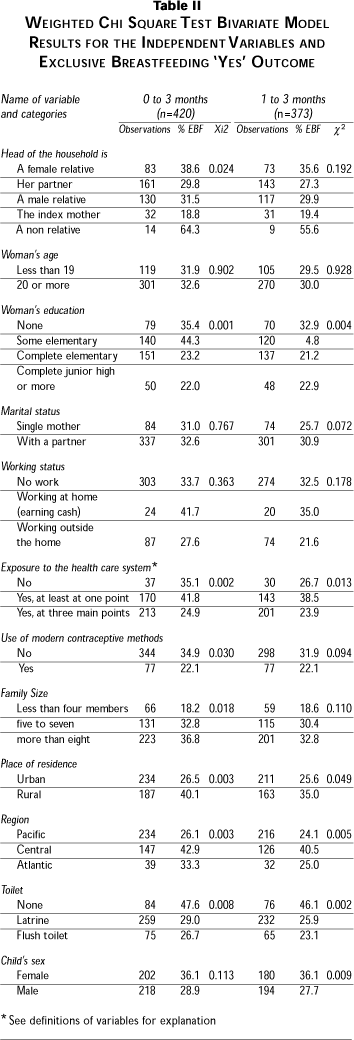
<body><![CDATA[<p>&#149; <i>Parity:</i> This variable was coded as 'no previous' if the index      child was the only one ever delivered.</p>       <p>&#149; <i>Toilet:</i> This variable was a proxy variable for social economic      status. We coded it into the following three categories:</p>       <p>a) 'None' meant not having a latrine or toilet and was equivalent to being      extremely poor.    <br>     b) Having a 'latrine' was considered as being poor.    <br>     c) Having a 'flush toilet' classified the person as a non-poor individual.</p>   </blockquote>     <p>&nbsp;</p>     <p align="center"><font size="4">Results</font></p>     <p>Of the 463 women of childbearing age whose index child was three months old    or less, 29.5% were exclusive breastfeeders, 61.4% were partial breastfeeders,    and 9.1% had already weaned their infants.</p>     <p>The demographic characteristics of the sample are described in <a href="#tabela1">Table    I</a>. Men, irrespective of the relationship with the index woman, headed 69.2%    of the households. In over half the cases the man was the woman's partner. A    female relative of the interviewed women headed 22% of the households. In 2/3    of these instances the most frequent female head of household was the woman's    mother. Three point five percent of participants reported that the family head    was not a relative.</p>     <p align="center"><a name="tabela1"></a></p>     ]]></body>
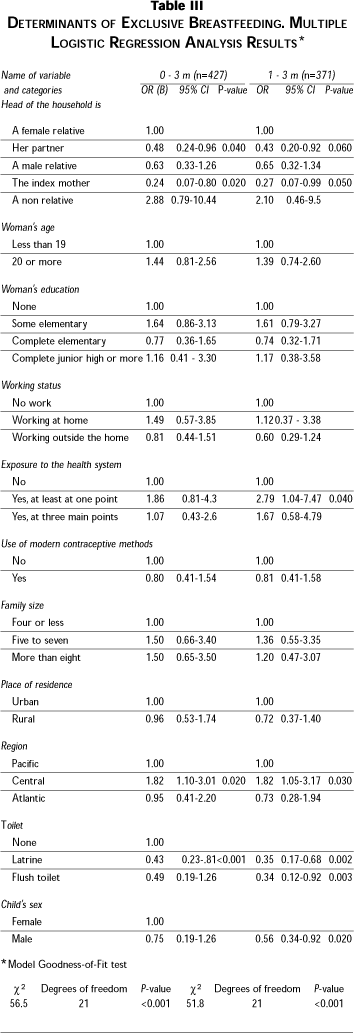
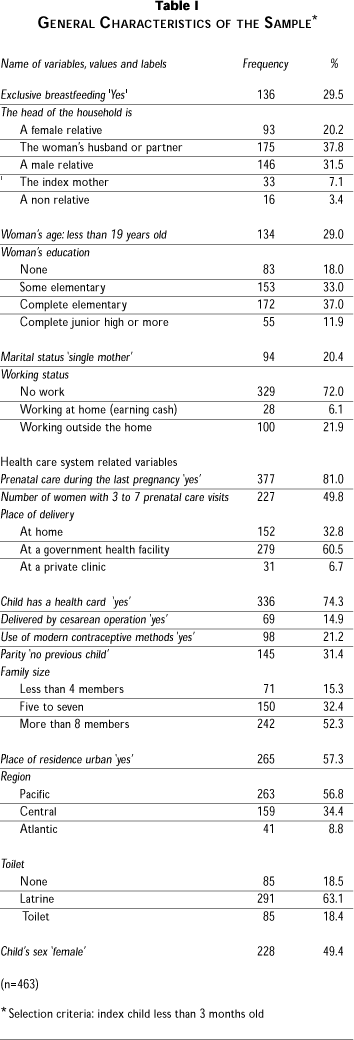
<body><![CDATA[<p align="center">&nbsp;</p>     <p align="center"><img src="/img/revistas/spm/v44n6/14039t1.gif"></p>     <p align="center">&nbsp;</p>     <p>Women who were heads of households were less likely to be teenagers and had    smaller families. About half of these women were working outside the home. Almost    half were single mothers. More than two thirds lived in urban areas (<i>p</i>&lt;    0.001 for all these values). These women did not differ from women in the other    household structure categories regarding prenatal care, having a child with    a health card, and their number of children under 5 years.</p>     <p>Nearly 20% of the women in the sample had no education. Of those who reported    having made a prenatal care visit during the index pregnancy (81%), half of    them claimed having made 3-7 visits. Twenty percent of the infants were reported    as not being weighed at birth (data not shown on tables). Virtually all these    cases were born at home in rural areas, and their mothers had a lower education    level and lower socioeconomic status, compared to mothers of infants who were    weighed after delivery. The analysis of the remaining 80%, who were weighed    at birth, showed no relationship between weight at birth and subsequent exclusive    breastfeeding.</p>     <p>The results of the weighted chi square tests for the bivariate models are displayed    in <a href="#tabela2">Table II</a>. These tests revealed significant differences    between the categories of household head and exclusive breastfeeding. The relationship    is sustained in the multivariate model (See <a href="#tabela3">Table III</a>.)    and fully explained in the next section. Region, socioeconomic status, and sex    of the child were also significantly associated with exclusive breastfeeding    practice. (The adjusted OR and 95% CI are provided in <a href="#tabela3">table    III</a> for both age groups. P values are reported there for significant associations    only.</p>     <p align="center"><a name="tabela2"></a></p>     <p align="center">&nbsp;</p>     <p align="center"><img src="/img/revistas/spm/v44n6/14039t2.gif"></p>     <p align="center"><a name="tabela3"></a></p>     ]]></body>
<body><![CDATA[<p align="center">&nbsp;</p>     <p align="center"><img src="/img/revistas/spm/v44n6/14039t3.gif"></p>     <p align="center">&nbsp;</p>     <p align="center"><font size="4">Discussion</font></p>     <p>The data obtained from this analysis provide evidence that in Nicaragua, family    structure is significantly related to the prevalence of exclusive breastfeeding.    Women who reported that they were the heads of their households were less likely    to exclusively breastfeed compared to those living under the familial authority    of a female relative. Likewise, women who live in a home where the head of the    household was her partner also tended to exclusively breastfeed less than women    living in a home where the head of household was another female relative (18.8    and 29.8, respectively, versus 38.6, <i>p</i>&lt;0.05). This relationship becomes    marginal for the group of children aged 1 to 3 months (<i>p</i>=0.05 and 0.06).</p>     <p>Women who reported that they were the heads of their households were significantly    different in age, place of residence and working status, from women who lived    in a home where another female relative was the head of the household. Compared    to this last group, head of household index women tended to live in smaller    families, be employed outside the home, be single, and be older. Their contacts    with the health care system, however, were similar. The most likely explanation    for the finding regarding breastfeeding practice is that women who are head    of households might have less family support. Without this support, activities    outside the home, such as having to work, might prevent exclusive breastfeeding.    In Nicaraguan society, women are highly dependent on the support system formed    by sisters, mothers, grandmothers, and other relatives. Strength in numbers    enables families to confront economic difficulties.<sup>9,15,16</sup> Bryant    (1982) also found that in the Hispanic American community, mothers who received    support from family members also had improved breastfeeding outcomes.<sup>17</sup></p>     <p>Women living in a house headed by her partner, exclusively breastfed less than    those women living in a house headed by another female relative. This may be    explained by two factors; the first is the contextual meaning of being a male    head of the household; and the second is men's attitudes towards breastfeeding.    The head of the household is the person whose decision prevails. Patria Potestad,    a Nicaraguan law that was in effect until 1981, recognized only fathers as heads    of household, holding absolute power over the family and its possessions.<sup>18</sup>    Collinson et al (1990) also commented on the fact that many Nicaraguan men do    not take responsibility for the family, leaving single women and children on    their own.<sup>9</sup> On the other extreme, a man's presence in the house can    also be oppressive. Ellsberg et al., reported that about 52% of Nicaraguan women    who had a child less than 5 years old at the time of the survey had been beaten    at least once in their life by their husbands.<sup>19</sup> Since 1981 several    laws have been enforced to improve women's social status, family leadership,    and land ownership.<sup>2,20-25</sup> This scenario may provide some insights    into the powerful position of a man over his wife, and may be particularly powerful    in women's child feeding decisions if he is the family leader.</p>     <p>A man's positive or negative attitudes towards breastfeeding can easily influence    a woman's breastfeeding behavior. Men may disapprove of breastfeeding if they    believe it will interfere with sexual activity, will make women lose their breast    shape, or cause women to expose their breasts in public.<sup>26,27</sup> The    child's father, on the other hand, may be supportive of breastfeeding<sup>28</sup>    if he realizes that the economic benefits of human milk will free him from the    responsibility of obtaining infant foods.<sup>26</sup> Whatever the man's attitude    towards breastfeeding is, it is likely to influence a woman's infant feeding    method. Bryant (1982) explains that among Hispanics groups, just knowing the    husband disapproves of breastfeeding was enough reason for a woman to avoid    practicing it.<sup>17</sup> P&eacute;rez-Escamilla et al (1995) suggested that    in Honduras, women living in a home with the child's father, exclusively breastfed    less than single mothers.<sup>7</sup> Dr. Lutter, Latin American Regional Advisor    on Nutrition, suggested that the presence of the child's father at home can    also be negatively related to exclusive breastfeeding, because providing infant    formula could be a father's way of showing support towards child feeding matters    (Personal communication, May 19, 2000). Mukuria et al (1996) in Kenya, found    that one way for the father to show responsibility toward the mother and child    was by providing infant food product, which influenced woman's infant feeding    behavior.<sup>5</sup></p>     <p>The data in the present analysis suggest that in Nicaragua the woman's partner    head of household may not be a strong source of support for exclusive breastfeeding.    Further studies are needed to investigate men's beliefs regarding breastfeeding    practices.</p>     <p>Living in the Central region of Nicaragua was associated with a higher prevalence    of exclusive breastfeeding, relative to women living in the Pacific region.    Initially, the analysis for this variable was conducted independently adjusting    only for socioeconomic status. It revealed a protective effect on exclusive    breastfeeding practice of 0.54 (0.33-0.87; <i>p</i>&lt; 0.001) in the Central    region versus the Atlantic and Pacific regions of the country. In the multivariate    model the relationship only holds against the Pacific region. Two explanations    may be considered. First, the Pacific region is the most urbanized, industrialized    and crowded zone of the country. Recent urbanization in developing countries    has brought changes that may have some positive and negative impacts on infant    feeding behavior. Changes such as the increasing number of women joining the    labor force, women working away from homes, families depending more and more    on a cash economy, women accessing education, smaller households, and the increasing    number of households headed by a woman, are among the changes listed that may    severely compromise the woman's time for child care activities.<sup>29</sup>    Secondly, it may be possible that some recent health interventions conducted    in the area may be accountable for the higher prevalence of exclusive breastfeeding.    For instance, the pioneer hospital that fully implemented the Baby Friendly    Hospital Initiative is located in the Central Region; a health project developed    by Save The Children reported an increase in exclusive breastfeeding prevalence    from 20% at the time the program started to 63% in the closing report.<sup>30</sup>    A comprehensive study is needed to clarify the more frequent practice of exclusive    breastfeeding in this area.</p>     ]]></body>
<body><![CDATA[<p>As expected, socioeconomic status was highly related to the outcome variable.    Those who were extremely poor, equated to not having a latrine or a toilet,    exclusively breastfed more than those considered not poor (having a flush toilet),    in both age groups. When compared to poor women (having a latrine), extremely    poor ones exclusively breastfed more in the age group 1 to 3 months.</p>     <p>An early study on breastfeeding prevalence developed in 1981 by WHO reported    that in Guatemala, the Philippines, and Chile, higher income women had significantly    lower proportions of breastfed infants.<sup>31</sup> Forman (1984) pointed out    that for the Latin American region, higher economic level was a negative predictor    of full and partial breastfeeding.<sup>11</sup> None of these publications,    however, differentiated between exclusive breastfeeding and breastfeeding. Lillig    and Lackey (1982) found that exclusive breastfeeding in a Mexican community    was associated with extreme poverty and inability to afford infant formula.<sup>32</sup>    P&eacute;rez-Escamilla et al (1995) also reported lower socioeconomic status    as a determinant of exclusive breastfeeding in Honduras and Mexico.<sup>7</sup>    So far, the main reason why most Nicaraguan women tend to exclusively breastfeed    is likely to be due to its economic benefits. Nicaraguan women reported that    there were several advantages in practicing breastfeeding but the only reason    to exclusively breastfeed a child was economical.<sup>33</sup> Similarly, one    motivating factor to practice this infant feeding method for neighboring Honduran    women was its economic advantage.<sup>8</sup></p>     <p>The sex of the child was found to be another predictor of exclusive breastfeeding.    Girls seem to be favored by a longer period of exclusive breastfeeding. This    relationship showed up when infants less than 1 month old were excluded. Breastfeeding    girls more than boys is a finding detected also in Honduras, Brazil,<sup>7</sup>    and the Philippines.<sup>34</sup> This has been suggested to reflect the belief    that a male child's growing process demands more food.<sup>7</sup> However,    this assumption has not yet been proven. It will be important to study the causal    factors of this relationship so that appropriate interventions are developed    to improve care for both boys and girls.</p>     <p>Exposure to the health system (see definition of variables) was not related    to exclusive breastfeeding during the period 0 to 3 months. The result for the    age 1 to 3 months group (OR 2.79 and 95% CI 1.04-7.47) revealed some protective    effect on exclusive breastfeeding, but, this result is rather misleading. Bivariate    analyses showed that the correction for the potential effects of socioeconomic    status and region had no such protective effect. In both cases, those exposed    either one or three times to health workers, did not have a significantly higher    prevalence of exclusive breastfeeding than women who apparently had never seen    health care providers. Before 1982 the health care system had been an active    promoter of infant formula.<sup>9</sup> Since then, steps were made to reverse    the effect of the immense formula campaign developed during the 70s. These included    the adoption of the International Code of Breastmilk Substitutes issued by WHO/UNICEF    in 1981.<sup>13,20</sup> By the time the DHS survey was conducted, 9 of the    19 Nicaraguan maternity hospitals had been certified by the WHO/UNICEF Baby    Friendly Hospital Initiative, and the remaining hospitals were working towards    obtaining the certification.<sup>30</sup> Nonetheless, it was not until June    1999 that the practice of distributing infant formula to working women during    their maternity leave was officially prohibited by law.<sup>2,35,36</sup> Prior    to that, up to 44 infant formula cans were given to employed women during their    maternity leave. Formulas were widely distributed at the hospitals.<sup>35</sup></p>     <p>Exposure to the health care system with a negative impact on breastfeeding    outcomes was reported by P&eacute;rez-Escamilla et al (1996) in the analysis    of the DHS 1987 from Mexico. The author suggested that at the time, Mexico had    yet to implement breastfeeding promotion activities within the health system.<sup>12</sup>    The findings from Nicaragua suggest that a review of the breastfeeding and exclusive    breastfeeding activities is urgently needed, particularly now, while there exists    a legislative environment for the promotion and protection of breastfeeding</p>     <p>The 'working status'variable did not show any significant relationship with    the prevalence of exclusive breastfeeding at any point in the analysis. P&eacute;rez-Escamilla    et al (1995) suggested that working women in Mexico might have started introducing    foods or liquids long before resuming their jobs, so the relationship between    a negative effect of having a job and exclusive breastfeeding was not identified.<sup>7</sup>    Forman (1984) presumed that the problem resulted from the lack of a clear definition    of "job."<sup>11</sup> In the present study women were defined to be working    at home or outside the home only if they reported that such activity generated    income. In this subset only 26% of women were working. However, nearly half    of this 26% were classified as unskilled. The 1995 Nicaraguan census reports    a rate of women's employment of about 30%.<sup>37</sup> The main unskilled jobs    among Nicaraguan women reported by most authors are street vendors, domestic    workers in private houses, and owners of their own small store in their homes.<sup>9,15,16,37</sup>    These activities make up more than three quarters of the unskilled job positions.<sup>37</sup>    What women do in these jobs has been considered to be an extension of their    own household activities,<sup>9,15</sup> and they have reported themselves as    having a more flexible work schedule compared to formal job schedules. This    situation enables them to take care of their own children.<sup>15</sup> In this    study, the comparison between unskilled and skilled working women showed that    the unskilled women exclusively breastfeed as much as non-working women. On    the other hand, women with skilled jobs exclusively breastfeed less than the    other two groups.</p>     <p>The positive relationship between the women's level of education, the use of    modern contraceptive methods, the size of the family, and living in a rural    or urban area with the prevalence of exclusive breastfeeding, showed up only    in the two-way contingency table analysis but not in the multivariate model.</p>     <p>This study is limited by the lack of information regarding breastfeeding attitudes    from family members or from the index woman herself. Since the criteria to define    the child feeding method was the child's food intake within the last 24 hours    previous to the interview, it is possible that some infants fed non-breastmilk    products intermittently may have been misclassified.<sup>13</sup> The associations    found in this study are not causal. They require more research to better understand    the complexity of the social support network and its relationship with breastfeeding    practices in Nicaragua.</p>     <p align="left"><b>Conclusions</b></p>     <p>The Nicaraguan family structure is significantly associated with the prevalence    of exclusive breastfeeding. Interviewee women who are heads of households and    women whose partners were the heads of household were found to have a significantly    lower prevalence of exclusive breastfeeding, compared to women living under    the familial authority of a female relative. Women living in the Central region    of the country show a significantly higher prevalence of exclusive breastfeeding    than those living in the more urbanized Pacific region. Low socioeconomic status    was a predictor of this maternal behavior. Women tend to exclusively breastfeed    boys for a shorter period of time than girls. Exposure to the health care system    was not a determinant of exclusive breastfeeding.</p>     ]]></body>
<body><![CDATA[<p>Single mothers leading a household should be considered a high priority for    breastfeeding support strategies. It is recommended to include the woman's partner    as a target of breastfeeding programs within a broader infant feeding educational    intervention. This may require conducting studies to better understand Nicaraguan    men's attitudes towards breastfeeding practices, and their potential impact    on women's breastfeeding decisions. Furthermore, it may be necessary to develop    appropriate messages and educational techniques, as well as indicators to measure    the impact of men's participation in breastfeeding. Comprehensive analyses are    needed to clarify the reasons why there is a significantly higher prevalence    of exclusive breastfeeding in the central region. Infant feeding messages should    emphasize boys and girls as equal beneficiaries of exclusive breastfeeding and    subsequent complementary feeding. It is necessary to review the current educational    strategies so that health institutions can improve the way they communicate    to women the benefits of breastfeeding.</p>     <p align="left"><b>Acknowledgements</b></p>     <p>I am grateful to Doctor Chessa Lutter, of the Pan American Health Organization,    Washington, D.C., and Doctors Teresa Gonz&aacute;lez de Coss&iacute;o and Juan    Rivera Dommarco, of the National Institute of Public Health, Cuernavaca, Morelos,    Mexico, for their valuable input to this manuscript.</p>     <p>&nbsp;</p>     <p align="center"><font size="4">References</font></p>     <!-- ref --><p>1. World Health Organization. Joint WHO/UNICEF Meeting on Infant and Young    Child Feeding. Statement and Recommendations. Ginebra, Switzerland: World Health    Organization, 1979.&nbsp;&nbsp;&nbsp;&nbsp;&nbsp;&nbsp;&nbsp;&nbsp;[&#160;<a href="javascript:void(0);" onclick="javascript: window.open('/scielo.php?script=sci_nlinks&ref=9206455&pid=S0036-3634200200060000200001&lng=','','width=640,height=500,resizable=yes,scrollbars=1,menubar=yes,');">Links</a>&#160;]<!-- end-ref --><!-- ref --><p>2. Ley de promoci&oacute;n, protecci&oacute;n y mantenimiento de la lactancia    materna y regulaci&oacute;n de la comercializaci&oacute;n de suced&aacute;neos    de la leche materna [Law to promote, protect and sustain breastfeeding, and    to regulate breastmilk substitutes]. Managua, Nicaragua: La Gaceta1999, June    28; No 122.&nbsp;&nbsp;&nbsp;&nbsp;&nbsp;&nbsp;&nbsp;&nbsp;[&#160;<a href="javascript:void(0);" onclick="javascript: window.open('/scielo.php?script=sci_nlinks&ref=9206456&pid=S0036-3634200200060000200002&lng=','','width=640,height=500,resizable=yes,scrollbars=1,menubar=yes,');">Links</a>&#160;]<!-- end-ref --><!-- ref --><p>3. World Health Organization. The World Health Report. Ginebra, Switzerland:    World Health Organization, 1998.&nbsp;&nbsp;&nbsp;&nbsp;&nbsp;&nbsp;&nbsp;&nbsp;[&#160;<a href="javascript:void(0);" onclick="javascript: window.open('/scielo.php?script=sci_nlinks&ref=9206457&pid=S0036-3634200200060000200003&lng=','','width=640,height=500,resizable=yes,scrollbars=1,menubar=yes,');">Links</a>&#160;]<!-- end-ref --><!-- ref --><p>4. Lutter CK. Breastfeeding promotion: Is its effectiveness supported by scientific    evidence and global changes in breastfeeding behaviors? Adv Exp Med Biol 2000;478:355-368.&nbsp;&nbsp;&nbsp;&nbsp;&nbsp;&nbsp;&nbsp;&nbsp;[&#160;<a href="javascript:void(0);" onclick="javascript: window.open('/scielo.php?script=sci_nlinks&ref=9206458&pid=S0036-3634200200060000200004&lng=','','width=640,height=500,resizable=yes,scrollbars=1,menubar=yes,');">Links</a>&#160;]<!-- end-ref --><!-- ref --><p>5. Mukuria AG, Bentley M, Kogi-Makau W, Caulfield L, Bandeen-Roche K. Early    complementary feeding: The role of social support networks. In: Wellstart International's    Expanded Promotion of Breastfeeding Program. Washington, DC: Wellstart International,1996.&nbsp;&nbsp;&nbsp;&nbsp;&nbsp;&nbsp;&nbsp;&nbsp;[&#160;<a href="javascript:void(0);" onclick="javascript: window.open('/scielo.php?script=sci_nlinks&ref=9206459&pid=S0036-3634200200060000200005&lng=','','width=640,height=500,resizable=yes,scrollbars=1,menubar=yes,');">Links</a>&#160;]<!-- end-ref --><!-- ref --><p>6. Hornik R. Alternative models of behaviors change. En: Wasserheit JN, ed.    Research Issues in Human Behavior and STDs Era. Washington, DC: American Society    for Microbiology, 1991:201-218.&nbsp;&nbsp;&nbsp;&nbsp;&nbsp;&nbsp;&nbsp;&nbsp;[&#160;<a href="javascript:void(0);" onclick="javascript: window.open('/scielo.php?script=sci_nlinks&ref=9206460&pid=S0036-3634200200060000200006&lng=','','width=640,height=500,resizable=yes,scrollbars=1,menubar=yes,');">Links</a>&#160;]<!-- end-ref --><!-- ref --><p>7. P&eacute;rez-Escamilla R, Lutter CK, Segall AM, Rivera A, Trevi&ntilde;o-Siller    S, Sanghvi T. Exclusive breastfeeding duration is associated with attitudinal,    socioeconomic and biocultural determinants in three Latin American Countries.    J Nutr 1995;125:2972-2984.&nbsp;&nbsp;&nbsp;&nbsp;&nbsp;&nbsp;&nbsp;&nbsp;[&#160;<a href="javascript:void(0);" onclick="javascript: window.open('/scielo.php?script=sci_nlinks&ref=9206461&pid=S0036-3634200200060000200007&lng=','','width=640,height=500,resizable=yes,scrollbars=1,menubar=yes,');">Links</a>&#160;]<!-- end-ref --><!-- ref --><p>8. Cohen RJ, Brown KH, Landa L, Dewey KG. Promoting exclusive breastfeeding    for 4-6 months in Honduras: Attitudes of mothers and barriers of compliance.    J Hum Lact 1999;15:9-18.&nbsp;&nbsp;&nbsp;&nbsp;&nbsp;&nbsp;&nbsp;&nbsp;[&#160;<a href="javascript:void(0);" onclick="javascript: window.open('/scielo.php?script=sci_nlinks&ref=9206462&pid=S0036-3634200200060000200008&lng=','','width=640,height=500,resizable=yes,scrollbars=1,menubar=yes,');">Links</a>&#160;]<!-- end-ref --><!-- ref --><p>9. Collinson H, Broadbent L, Daphne D, Ginsburg E, Nuttall C, Somers J, ed.    Women and revolution. Nueva Jersey: Zed Books, 1990.&nbsp;&nbsp;&nbsp;&nbsp;&nbsp;&nbsp;&nbsp;&nbsp;[&#160;<a href="javascript:void(0);" onclick="javascript: window.open('/scielo.php?script=sci_nlinks&ref=9206463&pid=S0036-3634200200060000200009&lng=','','width=640,height=500,resizable=yes,scrollbars=1,menubar=yes,');">Links</a>&#160;]<!-- end-ref --><!-- ref --><p>10. Demographic and Health Survey. Encuesta Nacional de Demografia y Salud,    Nicaragua. Calverston, Maryland: Macro International, 1998.&nbsp;&nbsp;&nbsp;&nbsp;&nbsp;&nbsp;&nbsp;&nbsp;[&#160;<a href="javascript:void(0);" onclick="javascript: window.open('/scielo.php?script=sci_nlinks&ref=9206464&pid=S0036-3634200200060000200010&lng=','','width=640,height=500,resizable=yes,scrollbars=1,menubar=yes,');">Links</a>&#160;]<!-- end-ref --><!-- ref --><p>11. Forman MR. Review of research on the factors associated with choice and    duration of infant feeding in less developed countries. Pediatrics 1984;74:667-693.&nbsp;&nbsp;&nbsp;&nbsp;&nbsp;&nbsp;&nbsp;&nbsp;[&#160;<a href="javascript:void(0);" onclick="javascript: window.open('/scielo.php?script=sci_nlinks&ref=9206465&pid=S0036-3634200200060000200011&lng=','','width=640,height=500,resizable=yes,scrollbars=1,menubar=yes,');">Links</a>&#160;]<!-- end-ref --><!-- ref --><p>12. P&eacute;rez-Escamilla R, Maulen-Radovan I, Dewey K. The association between    cesarean delivery and breastfeeding outcomes among Mexican women. Am J Public    Health 1996;86:832-836.&nbsp;&nbsp;&nbsp;&nbsp;&nbsp;&nbsp;&nbsp;&nbsp;[&#160;<a href="javascript:void(0);" onclick="javascript: window.open('/scielo.php?script=sci_nlinks&ref=9206466&pid=S0036-3634200200060000200012&lng=','','width=640,height=500,resizable=yes,scrollbars=1,menubar=yes,');">Links</a>&#160;]<!-- end-ref --><!-- ref --><p>13. World Health Organization. Indicators for assessing breast-feeding practices.    Report of an informal meeting. Geneva, Switzerland: World Health Organization,    1991.&nbsp;&nbsp;&nbsp;&nbsp;&nbsp;&nbsp;&nbsp;&nbsp;[&#160;<a href="javascript:void(0);" onclick="javascript: window.open('/scielo.php?script=sci_nlinks&ref=9206467&pid=S0036-3634200200060000200013&lng=','','width=640,height=500,resizable=yes,scrollbars=1,menubar=yes,');">Links</a>&#160;]<!-- end-ref --><!-- ref --><p>14. P&eacute;rez-Escamilla R, Segura-Mill&aacute;n S, Pollitt E, Dewey K. Determinants    of lactation performance across time in an urban population in Mexico. Soc Sci    Med 1993;37(8):1069-1078.&nbsp;&nbsp;&nbsp;&nbsp;&nbsp;&nbsp;&nbsp;&nbsp;[&#160;<a href="javascript:void(0);" onclick="javascript: window.open('/scielo.php?script=sci_nlinks&ref=9206468&pid=S0036-3634200200060000200014&lng=','','width=640,height=500,resizable=yes,scrollbars=1,menubar=yes,');">Links</a>&#160;]<!-- end-ref --><!-- ref --><p>15. Largaespada C. Soy la &uacute;ltima en comer: crisis econ&oacute;mica y    familiar de las mujeres trabajadoras de Managua, Nicaragua [I am the last one    to eat: Economic and familial crisis among working women in Managua, Nicaragua].    Managua:Editorial Nueva Nicaragua, 1993.&nbsp;&nbsp;&nbsp;&nbsp;&nbsp;&nbsp;&nbsp;&nbsp;[&#160;<a href="javascript:void(0);" onclick="javascript: window.open('/scielo.php?script=sci_nlinks&ref=9206469&pid=S0036-3634200200060000200015&lng=','','width=640,height=500,resizable=yes,scrollbars=1,menubar=yes,');">Links</a>&#160;]<!-- end-ref --><!-- ref --><p>16. Lamontagne JF, Engle PL, Zeitlin MF. Maternal employment, child care, and    nutritional status of 12-18-month-old children in Managua, Nicaragua. Soc Sci    Med 1998;46(3):403-414.&nbsp;&nbsp;&nbsp;&nbsp;&nbsp;&nbsp;&nbsp;&nbsp;[&#160;<a href="javascript:void(0);" onclick="javascript: window.open('/scielo.php?script=sci_nlinks&ref=9206470&pid=S0036-3634200200060000200016&lng=','','width=640,height=500,resizable=yes,scrollbars=1,menubar=yes,');">Links</a>&#160;]<!-- end-ref --><!-- ref --><p>17. Bryant CA. The impact of kin, friend and neighbor networks on infant feeding    practices: Cuban, Puerto Rican and Anglo families in Florida. Soc Sci Med 1982;16:    1757-1765.&nbsp;&nbsp;&nbsp;&nbsp;&nbsp;&nbsp;&nbsp;&nbsp;[&#160;<a href="javascript:void(0);" onclick="javascript: window.open('/scielo.php?script=sci_nlinks&ref=9206471&pid=S0036-3634200200060000200017&lng=','','width=640,height=500,resizable=yes,scrollbars=1,menubar=yes,');">Links</a>&#160;]<!-- end-ref --><!-- ref --><p>18. Latin American Working Group. Central American women speak for themselves.    Toronto, Ontario, Canada: Latin American Working Group, 1983.&nbsp;&nbsp;&nbsp;&nbsp;&nbsp;&nbsp;&nbsp;&nbsp;[&#160;<a href="javascript:void(0);" onclick="javascript: window.open('/scielo.php?script=sci_nlinks&ref=9206472&pid=S0036-3634200200060000200018&lng=','','width=640,height=500,resizable=yes,scrollbars=1,menubar=yes,');">Links</a>&#160;]<!-- end-ref --><!-- ref --><p>19. Ellsberg MC, Pe&ntilde;a R, Herrera A, Liljestrand J,Winkvist A. Wife abuse    among women of childbearing age in Nicaragua. Am J Public Health 1999;89(2):241-244.&nbsp;&nbsp;&nbsp;&nbsp;&nbsp;&nbsp;&nbsp;&nbsp;[&#160;<a href="javascript:void(0);" onclick="javascript: window.open('/scielo.php?script=sci_nlinks&ref=9206473&pid=S0036-3634200200060000200019&lng=','','width=640,height=500,resizable=yes,scrollbars=1,menubar=yes,');">Links</a>&#160;]<!-- end-ref --><!-- ref --><p>20. Ley de promoci&oacute;n de la lactancia materna [Law to promote breastfeeding].    Managua, Nicaragua: La Gaceta 1981, December 15; No 292.&nbsp;&nbsp;&nbsp;&nbsp;&nbsp;&nbsp;&nbsp;&nbsp;[&#160;<a href="javascript:void(0);" onclick="javascript: window.open('/scielo.php?script=sci_nlinks&ref=9206474&pid=S0036-3634200200060000200020&lng=','','width=640,height=500,resizable=yes,scrollbars=1,menubar=yes,');">Links</a>&#160;]<!-- end-ref --><!-- ref --><p>21. Ley de reforma agraria [Law for the agricultural reform]. Managua, Nicaragua:    La Gaceta 1981, October 2; No 222.&nbsp;&nbsp;&nbsp;&nbsp;&nbsp;&nbsp;&nbsp;&nbsp;[&#160;<a href="javascript:void(0);" onclick="javascript: window.open('/scielo.php?script=sci_nlinks&ref=9206475&pid=S0036-3634200200060000200021&lng=','','width=640,height=500,resizable=yes,scrollbars=1,menubar=yes,');">Links</a>&#160;]<!-- end-ref --><!-- ref --><p>22. Ley Org&aacute;nica del Ministerio de Salud [Law for the Ministry of Health    functions]. Managua, Nicaragua: La Gaceta 1982, May 3; No 102.&nbsp;&nbsp;&nbsp;&nbsp;&nbsp;&nbsp;&nbsp;&nbsp;[&#160;<a href="javascript:void(0);" onclick="javascript: window.open('/scielo.php?script=sci_nlinks&ref=9206476&pid=S0036-3634200200060000200022&lng=','','width=640,height=500,resizable=yes,scrollbars=1,menubar=yes,');">Links</a>&#160;]<!-- end-ref --><!-- ref --><p>23.Ley reguladora de las relaciones entre madre, padre e hijos [Law to regulate    relations between mothers, fathers, and children]. Managua, Nicaragua: La Gaceta    1982, July 3; No 156.&nbsp;&nbsp;&nbsp;&nbsp;&nbsp;&nbsp;&nbsp;&nbsp;[&#160;<a href="javascript:void(0);" onclick="javascript: window.open('/scielo.php?script=sci_nlinks&ref=9206477&pid=S0036-3634200200060000200023&lng=','','width=640,height=500,resizable=yes,scrollbars=1,menubar=yes,');">Links</a>&#160;]<!-- end-ref --><!-- ref --><p>24. Ley de alimentos [Law of nurturing]. Managua, Nicaragua: La Gaceta 1992,    March 24; No 57.&nbsp;&nbsp;&nbsp;&nbsp;&nbsp;&nbsp;&nbsp;&nbsp;[&#160;<a href="javascript:void(0);" onclick="javascript: window.open('/scielo.php?script=sci_nlinks&ref=9206478&pid=S0036-3634200200060000200024&lng=','','width=640,height=500,resizable=yes,scrollbars=1,menubar=yes,');">Links</a>&#160;]<!-- end-ref --><!-- ref --><p>25. C&oacute;digo de la ni&ntilde;ez y la adolescencia [The code for children    and adolescents] (1998, May 27). Managua, Nicaragua. La Gaceta 1998, May 27;    No 97.&nbsp;&nbsp;&nbsp;&nbsp;&nbsp;&nbsp;&nbsp;&nbsp;[&#160;<a href="javascript:void(0);" onclick="javascript: window.open('/scielo.php?script=sci_nlinks&ref=9206479&pid=S0036-3634200200060000200025&lng=','','width=640,height=500,resizable=yes,scrollbars=1,menubar=yes,');">Links</a>&#160;]<!-- end-ref --><!-- ref --><p>26. Bryant CA, Coreil J, D'Angelo SL, Bailey FC, Lazarov M. A strategy for    promoting breastfeeding among economically disadvantaged women and adolescents.    NAACOG's Clinical Issues 1992;3(4):723<font face="Symbol" size="2">¾</font>730.&nbsp;&nbsp;&nbsp;&nbsp;&nbsp;&nbsp;&nbsp;&nbsp;[&#160;<a href="javascript:void(0);" onclick="javascript: window.open('/scielo.php?script=sci_nlinks&ref=9206480&pid=S0036-3634200200060000200026&lng=','','width=640,height=500,resizable=yes,scrollbars=1,menubar=yes,');">Links</a>&#160;]<!-- end-ref --><!-- ref --><p>27. Bentley ME, Caulfield LE, Gross SM, Bronner Y, Jensen J, Kessler LA <i>et    al.</i> Sources of influence on intention to breastfeed among African-American    women at entry to WIC. J Hum Lact1999;15(1):27-34.&nbsp;&nbsp;&nbsp;&nbsp;&nbsp;&nbsp;&nbsp;&nbsp;[&#160;<a href="javascript:void(0);" onclick="javascript: window.open('/scielo.php?script=sci_nlinks&ref=9206481&pid=S0036-3634200200060000200027&lng=','','width=640,height=500,resizable=yes,scrollbars=1,menubar=yes,');">Links</a>&#160;]<!-- end-ref --><!-- ref --><p>28. Kessler LA, Gielen AC, Diener-West M, Paige DM. The effect of a woman's    significant other on her breastfeeding decision. J Hum Lact 1995;11(2):103-109.&nbsp;&nbsp;&nbsp;&nbsp;&nbsp;&nbsp;&nbsp;&nbsp;[&#160;<a href="javascript:void(0);" onclick="javascript: window.open('/scielo.php?script=sci_nlinks&ref=9206482&pid=S0036-3634200200060000200028&lng=','','width=640,height=500,resizable=yes,scrollbars=1,menubar=yes,');">Links</a>&#160;]<!-- end-ref --><!-- ref --><p>29.Ruel MT. Urbanization in Latin America: Constraints and opportunities for    child feeding and care. Food Nutr Bull 2000;21(1):12-24.&nbsp;&nbsp;&nbsp;&nbsp;&nbsp;&nbsp;&nbsp;&nbsp;[&#160;<a href="javascript:void(0);" onclick="javascript: window.open('/scielo.php?script=sci_nlinks&ref=9206483&pid=S0036-3634200200060000200029&lng=','','width=640,height=500,resizable=yes,scrollbars=1,menubar=yes,');">Links</a>&#160;]<!-- end-ref --><!-- ref --><p>30. UNICEF. Breastfeeding: A right of mothers and infants; mother and baby    friendly hospitals, health centers and universities. Managua, Nicaragua: UNICEF,    1999.&nbsp;&nbsp;&nbsp;&nbsp;&nbsp;&nbsp;&nbsp;&nbsp;[&#160;<a href="javascript:void(0);" onclick="javascript: window.open('/scielo.php?script=sci_nlinks&ref=9206484&pid=S0036-3634200200060000200030&lng=','','width=640,height=500,resizable=yes,scrollbars=1,menubar=yes,');">Links</a>&#160;]<!-- end-ref --><!-- ref --><p>31. World Health Organization. Contemporary patterns of breastfeeding: Report    on the WHO collaborative on breastfeeding. Geneve, Switzerland: World Health    Organization, 1981.&nbsp;&nbsp;&nbsp;&nbsp;&nbsp;&nbsp;&nbsp;&nbsp;[&#160;<a href="javascript:void(0);" onclick="javascript: window.open('/scielo.php?script=sci_nlinks&ref=9206485&pid=S0036-3634200200060000200031&lng=','','width=640,height=500,resizable=yes,scrollbars=1,menubar=yes,');">Links</a>&#160;]<!-- end-ref --><!-- ref --><p>32. Lillig K, Lackey CJ. Economics and social factors influencing women's infant    feeding decision in a rural Mexican community. J Trop Pediatr 1982;28:240-247.&nbsp;&nbsp;&nbsp;&nbsp;&nbsp;&nbsp;&nbsp;&nbsp;[&#160;<a href="javascript:void(0);" onclick="javascript: window.open('/scielo.php?script=sci_nlinks&ref=9206486&pid=S0036-3634200200060000200032&lng=','','width=640,height=500,resizable=yes,scrollbars=1,menubar=yes,');">Links</a>&#160;]<!-- end-ref --><!-- ref --><p>33. Picado JI, Olson CM, Rasmussen KM. Metodolog&iacute;a combinada para entender    la duraci&oacute;n del amamantamiento en barrios pobres de Managua, Nicaragua    [A combined methodology for understanding the duration of breastfeeding in the    poor neighborhoods of Managua]. Rev Panam Salud Publica 1997;2(6):398-407.&nbsp;&nbsp;&nbsp;&nbsp;&nbsp;&nbsp;&nbsp;&nbsp;[&#160;<a href="javascript:void(0);" onclick="javascript: window.open('/scielo.php?script=sci_nlinks&ref=9206487&pid=S0036-3634200200060000200033&lng=','','width=640,height=500,resizable=yes,scrollbars=1,menubar=yes,');">Links</a>&#160;]<!-- end-ref --><!-- ref --><p>34. Adair LS, Popkin BM, Guilkey DK. The duration of breast-feeding: How is    it affected by biological, socioeconomic, demographic, health sector and food    industry factors? Demography 1993;30:63-80.&nbsp;&nbsp;&nbsp;&nbsp;&nbsp;&nbsp;&nbsp;&nbsp;[&#160;<a href="javascript:void(0);" onclick="javascript: window.open('/scielo.php?script=sci_nlinks&ref=9206488&pid=S0036-3634200200060000200034&lng=','','width=640,height=500,resizable=yes,scrollbars=1,menubar=yes,');">Links</a>&#160;]<!-- end-ref --><!-- ref --><p>35. Wellstart International. Lactancia Materna en Nicaragua: diagn&oacute;stico    de pr&aacute;cticas y promoci&oacute;n. Managua, Nicaragua: Wellstart International,    1994.&nbsp;&nbsp;&nbsp;&nbsp;&nbsp;&nbsp;&nbsp;&nbsp;[&#160;<a href="javascript:void(0);" onclick="javascript: window.open('/scielo.php?script=sci_nlinks&ref=9206489&pid=S0036-3634200200060000200035&lng=','','width=640,height=500,resizable=yes,scrollbars=1,menubar=yes,');">Links</a>&#160;]<!-- end-ref --><!-- ref --><p>36. Las mujeres est&aacute;n obligadas a dar el pecho a sus hijos [Women are    mandated to breastfeed]. Managua, Nicaragua: La Tribuna 1998, June 19. Available    from <a href="http://www.latribuna.com.ni/cron/1998/19junio-1998/hoy/Nacional/4.html">http://www.latribuna.com.ni/cron/1998/19junio-1998/hoy/Nacional/4.html</a>.    Accessed January 1999.&nbsp;&nbsp;&nbsp;&nbsp;&nbsp;&nbsp;&nbsp;&nbsp;[&#160;<a href="javascript:void(0);" onclick="javascript: window.open('/scielo.php?script=sci_nlinks&ref=9206490&pid=S0036-3634200200060000200036&lng=','','width=640,height=500,resizable=yes,scrollbars=1,menubar=yes,');">Links</a>&#160;]<!-- end-ref --><!-- ref --><p>37. Vargas O. Pobreza en Nicaragua: un abismo que se agranda [Poverty in Nicaragua    is growing]. Managua, Nicaragua: Universidad Polit&eacute;cnica, 1998.&nbsp;&nbsp;&nbsp;&nbsp;&nbsp;&nbsp;&nbsp;&nbsp;[&#160;<a href="javascript:void(0);" onclick="javascript: window.open('/scielo.php?script=sci_nlinks&ref=9206491&pid=S0036-3634200200060000200037&lng=','','width=640,height=500,resizable=yes,scrollbars=1,menubar=yes,');">Links</a>&#160;]<!-- end-ref --><p>&nbsp;</p>     <p>&nbsp;</p>     <p><a name="back1"></a>(<a href="#top1">1</a>) Population Council, Oficina Regional    para Am&eacute;rica Latina y El Caribe.</p>     <p><a href="#top10">*</a> In April 2001, the WHO's Expert Consultation Team changed    this recommendation, stating that women should exclusively breastfeed their    children for the first six months of life (WHO, Note for the Press N&deg; 7).</p>     <p><a href="#top11">**</a> Sample weight</p>     <p>&nbsp;</p>     <p align="center"><b>Received on:</b> December 3, 2001 &#149; <b>Accepted on:</b>    Juny 25, 2002    <br>   Address reprint request to: Henry Espinoza, Population Council. Oficina Regional    para Am&eacute;rica Latina.    ]]></body>
<body><![CDATA[<br>   Escondida No. 110, 64000, colonia Villa Coyoac&aacute;n, M&eacute;xico, D.F.,    M&eacute;xico.    <br>   E-mail: <a href="mailto:hespinoza@popcouncil.org.mx">hespinoza@popcouncil.org.mx</a></p>      ]]></body><back>
<ref-list>
<ref id="B1">
<label>1</label><nlm-citation citation-type="book">
<collab>World Health Organization</collab>
<source><![CDATA[Joint WHO/UNICEF Meeting on Infant and Young Child Feeding: Statement and Recommendations]]></source>
<year>1979</year>
<publisher-loc><![CDATA[Ginebra ]]></publisher-loc>
<publisher-name><![CDATA[World Health Organization]]></publisher-name>
</nlm-citation>
</ref>
<ref id="B2">
<label>2</label><nlm-citation citation-type="journal">
<article-title xml:lang="es"><![CDATA[Ley de promoción, protección y mantenimiento de la lactancia materna y regulación de la comercialización de sucedáneos de la leche materna]]></article-title>
<source><![CDATA[Managua, Nicaragua: La Gaceta]]></source>
<year>1999</year>
<month>, </month>
<day>Ju</day>
<numero>122</numero>
<issue>122</issue>
</nlm-citation>
</ref>
<ref id="B3">
<label>3</label><nlm-citation citation-type="book">
<collab>World Health Organization</collab>
<source><![CDATA[The World Health Report]]></source>
<year>1998</year>
<publisher-loc><![CDATA[Ginebra ]]></publisher-loc>
<publisher-name><![CDATA[World Health Organization]]></publisher-name>
</nlm-citation>
</ref>
<ref id="B4">
<label>4</label><nlm-citation citation-type="journal">
<person-group person-group-type="author">
<name>
<surname><![CDATA[Lutter]]></surname>
<given-names><![CDATA[CK]]></given-names>
</name>
</person-group>
<article-title xml:lang="en"><![CDATA[Breastfeeding promotion: Is its effectiveness supported by scientific evidence and global changes in breastfeeding behaviors?]]></article-title>
<source><![CDATA[Adv Exp Med Biol]]></source>
<year>2000</year>
<volume>478</volume>
<page-range>355-368</page-range></nlm-citation>
</ref>
<ref id="B5">
<label>5</label><nlm-citation citation-type="book">
<person-group person-group-type="author">
<name>
<surname><![CDATA[Mukuria]]></surname>
<given-names><![CDATA[AG]]></given-names>
</name>
<name>
<surname><![CDATA[Bentley]]></surname>
<given-names><![CDATA[M]]></given-names>
</name>
<name>
<surname><![CDATA[Kogi-Makau]]></surname>
<given-names><![CDATA[W]]></given-names>
</name>
<name>
<surname><![CDATA[Caulfield]]></surname>
<given-names><![CDATA[L]]></given-names>
</name>
<name>
<surname><![CDATA[Bandeen-Roche]]></surname>
<given-names><![CDATA[K.]]></given-names>
</name>
</person-group>
<article-title xml:lang="en"><![CDATA[Early complementary feeding: The role of social support networks]]></article-title>
<source><![CDATA[Wellstart International's Expanded Promotion of Breastfeeding Program]]></source>
<year>1996</year>
<publisher-loc><![CDATA[Washington^eDC DC]]></publisher-loc>
<publisher-name><![CDATA[Wellstart International]]></publisher-name>
</nlm-citation>
</ref>
<ref id="B6">
<label>6</label><nlm-citation citation-type="book">
<person-group person-group-type="author">
<name>
<surname><![CDATA[Hornik]]></surname>
<given-names><![CDATA[R.]]></given-names>
</name>
</person-group>
<article-title xml:lang="en"><![CDATA[Alternative models of behaviors change]]></article-title>
<person-group person-group-type="editor">
<name>
<surname><![CDATA[Wasserheit]]></surname>
<given-names><![CDATA[JN]]></given-names>
</name>
</person-group>
<source><![CDATA[Research Issues in Human Behavior and STDs Era]]></source>
<year>1991</year>
<page-range>201-218</page-range><publisher-loc><![CDATA[Washington^eDC DC]]></publisher-loc>
<publisher-name><![CDATA[American Society for Microbiology]]></publisher-name>
</nlm-citation>
</ref>
<ref id="B7">
<label>7</label><nlm-citation citation-type="journal">
<person-group person-group-type="author">
<name>
<surname><![CDATA[Pérez-Escamilla]]></surname>
<given-names><![CDATA[R]]></given-names>
</name>
<name>
<surname><![CDATA[Lutter]]></surname>
<given-names><![CDATA[CK]]></given-names>
</name>
<name>
<surname><![CDATA[Segall]]></surname>
<given-names><![CDATA[AM]]></given-names>
</name>
<name>
<surname><![CDATA[Rivera]]></surname>
<given-names><![CDATA[A]]></given-names>
</name>
<name>
<surname><![CDATA[Treviño-Siller]]></surname>
<given-names><![CDATA[S]]></given-names>
</name>
<name>
<surname><![CDATA[Sanghvi]]></surname>
<given-names><![CDATA[T.]]></given-names>
</name>
</person-group>
<article-title xml:lang="en"><![CDATA[Exclusive breastfeeding duration is associated with attitudinal: socioeconomic and biocultural determinants in three Latin American Countries]]></article-title>
<source><![CDATA[J Nutr]]></source>
<year>1995</year>
<volume>125</volume>
<page-range>2972-2984</page-range></nlm-citation>
</ref>
<ref id="B8">
<label>8</label><nlm-citation citation-type="journal">
<person-group person-group-type="author">
<name>
<surname><![CDATA[Cohen]]></surname>
<given-names><![CDATA[RJ]]></given-names>
</name>
<name>
<surname><![CDATA[Brown]]></surname>
<given-names><![CDATA[KH]]></given-names>
</name>
<name>
<surname><![CDATA[Landa]]></surname>
<given-names><![CDATA[L]]></given-names>
</name>
<name>
<surname><![CDATA[Dewey]]></surname>
<given-names><![CDATA[KG.]]></given-names>
</name>
</person-group>
<article-title xml:lang="en"><![CDATA[Promoting exclusive breastfeeding for 4-6 months in Honduras: Attitudes of mothers and barriers of compliance]]></article-title>
<source><![CDATA[J Hum Lact]]></source>
<year>1999</year>
<volume>15</volume>
<page-range>9-18</page-range></nlm-citation>
</ref>
<ref id="B9">
<label>9</label><nlm-citation citation-type="book">
<person-group person-group-type="author">
<name>
<surname><![CDATA[Collinson]]></surname>
<given-names><![CDATA[H]]></given-names>
</name>
<name>
<surname><![CDATA[Broadbent]]></surname>
<given-names><![CDATA[L]]></given-names>
</name>
<name>
<surname><![CDATA[Daphne]]></surname>
<given-names><![CDATA[D]]></given-names>
</name>
<name>
<surname><![CDATA[Ginsburg]]></surname>
<given-names><![CDATA[E]]></given-names>
</name>
<name>
<surname><![CDATA[Nuttall]]></surname>
<given-names><![CDATA[C]]></given-names>
</name>
<name>
<surname><![CDATA[Somers]]></surname>
<given-names><![CDATA[J]]></given-names>
</name>
</person-group>
<source><![CDATA[Women and revolution]]></source>
<year>1990</year>
<publisher-loc><![CDATA[Nueva Jersey ]]></publisher-loc>
<publisher-name><![CDATA[Zed Books]]></publisher-name>
</nlm-citation>
</ref>
<ref id="B10">
<label>10</label><nlm-citation citation-type="book">
<collab>Demographic and Health Survey</collab>
<source><![CDATA[Encuesta Nacional de Demografia y Salud: Nicaragua]]></source>
<year>1998</year>
<publisher-loc><![CDATA[Calverston^eMaryland Maryland]]></publisher-loc>
<publisher-name><![CDATA[Macro International]]></publisher-name>
</nlm-citation>
</ref>
<ref id="B11">
<label>11</label><nlm-citation citation-type="journal">
<person-group person-group-type="author">
<name>
<surname><![CDATA[Forman]]></surname>
<given-names><![CDATA[MR.]]></given-names>
</name>
</person-group>
<article-title xml:lang="en"><![CDATA[Review of research on the factors associated with choice and duration of infant feeding in less developed countries]]></article-title>
<source><![CDATA[Pediatrics]]></source>
<year>1984</year>
<volume>74</volume>
<page-range>667-693</page-range></nlm-citation>
</ref>
<ref id="B12">
<label>12</label><nlm-citation citation-type="journal">
<person-group person-group-type="author">
<name>
<surname><![CDATA[Pérez-Escamilla]]></surname>
<given-names><![CDATA[R]]></given-names>
</name>
<name>
<surname><![CDATA[Maulen-Radovan]]></surname>
<given-names><![CDATA[I]]></given-names>
</name>
<name>
<surname><![CDATA[Dewey]]></surname>
<given-names><![CDATA[K.]]></given-names>
</name>
</person-group>
<article-title xml:lang="en"><![CDATA[The association between cesarean delivery and breastfeeding outcomes among Mexican women]]></article-title>
<source><![CDATA[Am J Public Health]]></source>
<year>1996</year>
<volume>86</volume>
<page-range>832-836</page-range></nlm-citation>
</ref>
<ref id="B13">
<label>13</label><nlm-citation citation-type="book">
<collab>World Health Organization</collab>
<source><![CDATA[Indicators for assessing breast-feeding practices: Report of an informal meeting]]></source>
<year>1991</year>
<publisher-loc><![CDATA[Geneva ]]></publisher-loc>
<publisher-name><![CDATA[World Health Organization]]></publisher-name>
</nlm-citation>
</ref>
<ref id="B14">
<label>14</label><nlm-citation citation-type="journal">
<person-group person-group-type="author">
<name>
<surname><![CDATA[Pérez-Escamilla]]></surname>
<given-names><![CDATA[R]]></given-names>
</name>
<name>
<surname><![CDATA[Segura-Millán]]></surname>
<given-names><![CDATA[S]]></given-names>
</name>
<name>
<surname><![CDATA[Pollitt]]></surname>
<given-names><![CDATA[E]]></given-names>
</name>
<name>
<surname><![CDATA[Dewey]]></surname>
<given-names><![CDATA[K.]]></given-names>
</name>
</person-group>
<article-title xml:lang="en"><![CDATA[Determinants of lactation performance across time in an urban population in Mexico]]></article-title>
<source><![CDATA[Soc Sci Med]]></source>
<year>1993</year>
<volume>37</volume>
<numero>^s8</numero>
<issue>^s8</issue>
<supplement>8</supplement>
<page-range>1069-1078</page-range></nlm-citation>
</ref>
<ref id="B15">
<label>15</label><nlm-citation citation-type="book">
<person-group person-group-type="author">
<name>
<surname><![CDATA[Largaespada]]></surname>
<given-names><![CDATA[C]]></given-names>
</name>
</person-group>
<source><![CDATA[Soy la última en comer: crisis económica y familiar de las mujeres trabajadoras de Managua, Nicaragua]]></source>
<year>1993</year>
<publisher-loc><![CDATA[Managua ]]></publisher-loc>
<publisher-name><![CDATA[Editorial Nueva Nicaragua]]></publisher-name>
</nlm-citation>
</ref>
<ref id="B16">
<label>16</label><nlm-citation citation-type="journal">
<person-group person-group-type="author">
<name>
<surname><![CDATA[Lamontagne]]></surname>
<given-names><![CDATA[JF]]></given-names>
</name>
<name>
<surname><![CDATA[Engle]]></surname>
<given-names><![CDATA[PL]]></given-names>
</name>
<name>
<surname><![CDATA[Zeitlin]]></surname>
<given-names><![CDATA[MF.]]></given-names>
</name>
</person-group>
<article-title xml:lang="en"><![CDATA[Maternal employment, child care, and nutritional status of 12-18-month-old children in Managua: Nicaragua]]></article-title>
<source><![CDATA[Soc Sci Med]]></source>
<year>1998</year>
<volume>46</volume>
<numero>^s3</numero>
<issue>^s3</issue>
<supplement>3</supplement>
<page-range>403-414</page-range></nlm-citation>
</ref>
<ref id="B17">
<label>17</label><nlm-citation citation-type="journal">
<person-group person-group-type="author">
<name>
<surname><![CDATA[Bryant]]></surname>
<given-names><![CDATA[CA.]]></given-names>
</name>
</person-group>
<article-title xml:lang="en"><![CDATA[The impact of kin, friend and neighbor networks on infant feeding practices: Cuban, Puerto Rican and Anglo families in Florida]]></article-title>
<source><![CDATA[Soc Sci Med]]></source>
<year>1982</year>
<volume>16</volume>
<page-range>1757-1765</page-range></nlm-citation>
</ref>
<ref id="B18">
<label>18</label><nlm-citation citation-type="book">
<collab>Latin American Working Group</collab>
<source><![CDATA[Central American women speak for themselves]]></source>
<year>1983</year>
<publisher-loc><![CDATA[Toronto^eOntario Ontario]]></publisher-loc>
<publisher-name><![CDATA[Latin American Working Group]]></publisher-name>
</nlm-citation>
</ref>
<ref id="B19">
<label>19</label><nlm-citation citation-type="journal">
<person-group person-group-type="author">
<name>
<surname><![CDATA[Ellsberg]]></surname>
<given-names><![CDATA[MC]]></given-names>
</name>
<name>
<surname><![CDATA[Peña]]></surname>
<given-names><![CDATA[R]]></given-names>
</name>
<name>
<surname><![CDATA[Herrera]]></surname>
<given-names><![CDATA[A]]></given-names>
</name>
<name>
<surname><![CDATA[Liljestrand]]></surname>
<given-names><![CDATA[J]]></given-names>
</name>
<name>
<surname><![CDATA[Winkvist]]></surname>
<given-names><![CDATA[A.]]></given-names>
</name>
</person-group>
<article-title xml:lang="en"><![CDATA[Wife abuse among women of childbearing age in Nicaragua]]></article-title>
<source><![CDATA[Am J Public Health]]></source>
<year>1999</year>
<volume>89</volume>
<numero>^s2</numero>
<issue>^s2</issue>
<supplement>2</supplement>
<page-range>241-244</page-range></nlm-citation>
</ref>
<ref id="B20">
<label>20</label><nlm-citation citation-type="journal">
<article-title xml:lang="es"><![CDATA[Ley de promoción de la lactancia materna]]></article-title>
<source><![CDATA[Managua, Nicaragua: La Gaceta]]></source>
<year>1981</year>
<month>, </month>
<day>De</day>
<numero>292</numero>
<issue>292</issue>
</nlm-citation>
</ref>
<ref id="B21">
<label>21</label><nlm-citation citation-type="journal">
<article-title xml:lang="es"><![CDATA[Ley de reforma agraria]]></article-title>
<source><![CDATA[Managua, Nicaragua: La Gaceta]]></source>
<year>1981</year>
<month>, </month>
<day>Oc</day>
<numero>222</numero>
<issue>222</issue>
</nlm-citation>
</ref>
<ref id="B22">
<label>22</label><nlm-citation citation-type="journal">
<article-title xml:lang="es"><![CDATA[Ley Orgánica del Ministerio de Salud]]></article-title>
<source><![CDATA[Managua, Nicaragua: La Gaceta]]></source>
<year>1982</year>
<month>, </month>
<day>Ma</day>
<numero>102</numero>
<issue>102</issue>
</nlm-citation>
</ref>
<ref id="B23">
<label>23</label><nlm-citation citation-type="journal">
<article-title xml:lang="es"><![CDATA[Ley reguladora de las relaciones entre madre, padre e hijos]]></article-title>
<source><![CDATA[Managua, Nicaragua: La Gaceta]]></source>
<year>1982</year>
<month>, </month>
<day>Ju</day>
<numero>156</numero>
<issue>156</issue>
</nlm-citation>
</ref>
<ref id="B24">
<label>24</label><nlm-citation citation-type="journal">
<article-title xml:lang="es"><![CDATA[Ley de alimentos]]></article-title>
<source><![CDATA[Managua, Nicaragua: La Gaceta]]></source>
<year>1992</year>
<month>, </month>
<day>Ma</day>
<numero>57</numero>
<issue>57</issue>
</nlm-citation>
</ref>
<ref id="B25">
<label>25</label><nlm-citation citation-type="journal">
<article-title xml:lang="es"><![CDATA[Código de la niñez y la adolescencia]]></article-title>
<source><![CDATA[Managua, Nicaragua. La Gaceta]]></source>
<year>1998</year>
<month>, </month>
<day>Ma</day>
<numero>97</numero>
<issue>97</issue>
</nlm-citation>
</ref>
<ref id="B26">
<label>26</label><nlm-citation citation-type="journal">
<person-group person-group-type="author">
<name>
<surname><![CDATA[Bryant]]></surname>
<given-names><![CDATA[CA]]></given-names>
</name>
<name>
<surname><![CDATA[Coreil]]></surname>
<given-names><![CDATA[J]]></given-names>
</name>
<name>
<surname><![CDATA[D'Angelo]]></surname>
<given-names><![CDATA[SL]]></given-names>
</name>
<name>
<surname><![CDATA[Bailey]]></surname>
<given-names><![CDATA[FC]]></given-names>
</name>
<name>
<surname><![CDATA[Lazarov]]></surname>
<given-names><![CDATA[M.]]></given-names>
</name>
</person-group>
<article-title xml:lang="en"><![CDATA[A strategy for promoting breastfeeding among economically disadvantaged women and adolescents]]></article-title>
<source><![CDATA[NAACOG's Clinical Issues]]></source>
<year>1992</year>
<volume>3</volume>
<numero>^s4</numero>
<issue>^s4</issue>
<supplement>4</supplement>
<page-range>723--730</page-range></nlm-citation>
</ref>
<ref id="B27">
<label>27</label><nlm-citation citation-type="journal">
<person-group person-group-type="author">
<name>
<surname><![CDATA[Bentley]]></surname>
<given-names><![CDATA[ME]]></given-names>
</name>
<name>
<surname><![CDATA[Caulfield]]></surname>
<given-names><![CDATA[LE]]></given-names>
</name>
<name>
<surname><![CDATA[Gross]]></surname>
<given-names><![CDATA[SM]]></given-names>
</name>
<name>
<surname><![CDATA[Bronner]]></surname>
<given-names><![CDATA[Y]]></given-names>
</name>
<name>
<surname><![CDATA[Jensen]]></surname>
<given-names><![CDATA[J]]></given-names>
</name>
<name>
<surname><![CDATA[Kessler]]></surname>
<given-names><![CDATA[LA]]></given-names>
</name>
</person-group>
<article-title xml:lang="en"><![CDATA[Sources of influence on intention to breastfeed among African-American women at entry to WIC]]></article-title>
<source><![CDATA[J Hum Lact]]></source>
<year>1999</year>
<volume>15</volume>
<numero>^s1</numero>
<issue>^s1</issue>
<supplement>1</supplement>
<page-range>27-34</page-range></nlm-citation>
</ref>
<ref id="B28">
<label>28</label><nlm-citation citation-type="journal">
<person-group person-group-type="author">
<name>
<surname><![CDATA[Kessler]]></surname>
<given-names><![CDATA[LA]]></given-names>
</name>
<name>
<surname><![CDATA[Gielen]]></surname>
<given-names><![CDATA[AC]]></given-names>
</name>
<name>
<surname><![CDATA[Diener-West]]></surname>
<given-names><![CDATA[M]]></given-names>
</name>
<name>
<surname><![CDATA[Paige]]></surname>
<given-names><![CDATA[DM.]]></given-names>
</name>
</person-group>
<article-title xml:lang="en"><![CDATA[The effect of a woman's significant other on her breastfeeding decision]]></article-title>
<source><![CDATA[J Hum Lact]]></source>
<year>1995</year>
<volume>11</volume>
<numero>^s2</numero>
<issue>^s2</issue>
<supplement>2</supplement>
<page-range>103-109</page-range></nlm-citation>
</ref>
<ref id="B29">
<label>29</label><nlm-citation citation-type="journal">
<person-group person-group-type="author">
<name>
<surname><![CDATA[Ruel]]></surname>
<given-names><![CDATA[MT.]]></given-names>
</name>
</person-group>
<article-title xml:lang="en"><![CDATA[Urbanization in Latin America: Constraints and opportunities for child feeding and care.]]></article-title>
<source><![CDATA[Food Nutr Bull]]></source>
<year>2000</year>
<volume>21</volume>
<numero>^s1</numero>
<issue>^s1</issue>
<supplement>1</supplement>
<page-range>12-24</page-range></nlm-citation>
</ref>
<ref id="B30">
<label>30</label><nlm-citation citation-type="book">
<collab>UNICEF</collab>
<source><![CDATA[Breastfeeding: A right of mothers and infants; mother and baby friendly hospitals, health centers and universities]]></source>
<year>1999</year>
<publisher-loc><![CDATA[Managua ]]></publisher-loc>
<publisher-name><![CDATA[UNICEF]]></publisher-name>
</nlm-citation>
</ref>
<ref id="B31">
<label>31</label><nlm-citation citation-type="book">
<collab>World Health Organization</collab>
<source><![CDATA[Contemporary patterns of breastfeeding: Report on the WHO collaborative on breastfeeding.]]></source>
<year>1981</year>
<publisher-loc><![CDATA[Geneve ]]></publisher-loc>
<publisher-name><![CDATA[World Health Organization]]></publisher-name>
</nlm-citation>
</ref>
<ref id="B32">
<label>32</label><nlm-citation citation-type="journal">
<person-group person-group-type="author">
<name>
<surname><![CDATA[Lillig]]></surname>
<given-names><![CDATA[K]]></given-names>
</name>
<name>
<surname><![CDATA[Lackey]]></surname>
<given-names><![CDATA[CJ.]]></given-names>
</name>
</person-group>
<article-title xml:lang="en"><![CDATA[Economics and social factors influencing women's infant feeding decision in a rural Mexican community]]></article-title>
<source><![CDATA[J Trop Pediatr]]></source>
<year>1982</year>
<volume>28</volume>
<page-range>240-247</page-range></nlm-citation>
</ref>
<ref id="B33">
<label>33</label><nlm-citation citation-type="journal">
<person-group person-group-type="author">
<name>
<surname><![CDATA[Picado]]></surname>
<given-names><![CDATA[JI]]></given-names>
</name>
<name>
<surname><![CDATA[Olson]]></surname>
<given-names><![CDATA[CM]]></given-names>
</name>
<name>
<surname><![CDATA[Rasmussen]]></surname>
<given-names><![CDATA[KM.]]></given-names>
</name>
</person-group>
<article-title xml:lang="en"><![CDATA[Metodología combinada para entender la duración del amamantamiento en barrios pobres de Managua: Nicaragua]]></article-title>
<source><![CDATA[Rev Panam Salud Publica]]></source>
<year>1997</year>
<volume>2</volume>
<numero>^s6</numero>
<issue>^s6</issue>
<supplement>6</supplement>
<page-range>398-407</page-range></nlm-citation>
</ref>
<ref id="B34">
<label>34</label><nlm-citation citation-type="journal">
<person-group person-group-type="author">
<name>
<surname><![CDATA[Adair]]></surname>
<given-names><![CDATA[LS]]></given-names>
</name>
<name>
<surname><![CDATA[Popkin]]></surname>
<given-names><![CDATA[BM]]></given-names>
</name>
<name>
<surname><![CDATA[Guilkey]]></surname>
<given-names><![CDATA[DK.]]></given-names>
</name>
</person-group>
<article-title xml:lang="en"><![CDATA[The duration of breast-feeding: How is it affected by biological, socioeconomic, demographic, health sector and food industry factors?]]></article-title>
<source><![CDATA[Demography]]></source>
<year>1993</year>
<volume>30</volume>
<page-range>63-80</page-range></nlm-citation>
</ref>
<ref id="B35">
<label>35</label><nlm-citation citation-type="book">
<collab>Wellstart International</collab>
<source><![CDATA[Lactancia Materna en Nicaragua: diagnóstico de prácticas y promoción]]></source>
<year>1994</year>
<publisher-loc><![CDATA[Managua ]]></publisher-loc>
<publisher-name><![CDATA[Wellstart International]]></publisher-name>
</nlm-citation>
</ref>
<ref id="B36">
<label>36</label><nlm-citation citation-type="journal">
<article-title xml:lang="es"><![CDATA[Las mujeres están obligadas a dar el pecho a sus hijos]]></article-title>
<source><![CDATA[Managua, Nicaragua: La Tribuna]]></source>
<year>1998</year>
<month>, </month>
<day>Ju</day>
</nlm-citation>
</ref>
<ref id="B37">
<label>37</label><nlm-citation citation-type="book">
<person-group person-group-type="author">
<name>
<surname><![CDATA[Vargas]]></surname>
<given-names><![CDATA[O.]]></given-names>
</name>
</person-group>
<source><![CDATA[Pobreza en Nicaragua: un abismo que se agranda]]></source>
<year>1998</year>
<publisher-loc><![CDATA[Managua ]]></publisher-loc>
<publisher-name><![CDATA[Universidad Politécnica]]></publisher-name>
</nlm-citation>
</ref>
</ref-list>
</back>
</article>