<?xml version="1.0" encoding="ISO-8859-1"?><article xmlns:mml="http://www.w3.org/1998/Math/MathML" xmlns:xlink="http://www.w3.org/1999/xlink" xmlns:xsi="http://www.w3.org/2001/XMLSchema-instance">
<front>
<journal-meta>
<journal-id>0036-3634</journal-id>
<journal-title><![CDATA[Salud Pública de México]]></journal-title>
<abbrev-journal-title><![CDATA[Salud pública Méx]]></abbrev-journal-title>
<issn>0036-3634</issn>
<publisher>
<publisher-name><![CDATA[Instituto Nacional de Salud Pública]]></publisher-name>
</publisher>
</journal-meta>
<article-meta>
<article-id>S0036-36342002000500007</article-id>
<title-group>
<article-title xml:lang="en"><![CDATA[Implementation and evaluation of a National External Quality Control Program for Cervical Cytology in Mexico]]></article-title>
<article-title xml:lang="es"><![CDATA[Instrumentación y evaluación de un programa nacional de control de calidad externo para citología cervical en México]]></article-title>
</title-group>
<contrib-group>
<contrib contrib-type="author">
<name>
<surname><![CDATA[Flisser]]></surname>
<given-names><![CDATA[Ana]]></given-names>
</name>
<xref ref-type="aff" rid="A01"/>
<xref ref-type="aff" rid="A02"/>
</contrib>
<contrib contrib-type="author">
<name>
<surname><![CDATA[García-Malo]]></surname>
<given-names><![CDATA[Felipe]]></given-names>
</name>
<xref ref-type="aff" rid="A03"/>
</contrib>
<contrib contrib-type="author">
<name>
<surname><![CDATA[Canepa]]></surname>
<given-names><![CDATA[María de los Angeles]]></given-names>
</name>
<xref ref-type="aff" rid="A03"/>
</contrib>
<contrib contrib-type="author">
<name>
<surname><![CDATA[Doncel]]></surname>
<given-names><![CDATA[Susana]]></given-names>
</name>
<xref ref-type="aff" rid="A03"/>
</contrib>
<contrib contrib-type="author">
<name>
<surname><![CDATA[Espinoza]]></surname>
<given-names><![CDATA[Raquel]]></given-names>
</name>
<xref ref-type="aff" rid="A04"/>
</contrib>
<contrib contrib-type="author">
<name>
<surname><![CDATA[Moreno]]></surname>
<given-names><![CDATA[Ramiro]]></given-names>
</name>
<xref ref-type="aff" rid="A04"/>
</contrib>
<contrib contrib-type="author">
<name>
<surname><![CDATA[Avila]]></surname>
<given-names><![CDATA[Isidro]]></given-names>
</name>
<xref ref-type="aff" rid="A04"/>
</contrib>
<contrib contrib-type="author">
<name>
<surname><![CDATA[Pérez-Palacios]]></surname>
<given-names><![CDATA[Gregorio]]></given-names>
</name>
<xref ref-type="aff" rid="A05"/>
<xref ref-type="aff" rid="A06"/>
</contrib>
<contrib contrib-type="author">
<name>
<surname><![CDATA[Tapia-Conyer]]></surname>
<given-names><![CDATA[Roberto]]></given-names>
</name>
<xref ref-type="aff" rid="A07"/>
</contrib>
<contrib contrib-type="author">
<name>
<surname><![CDATA[de la Fuente]]></surname>
<given-names><![CDATA[Juan Ramón]]></given-names>
</name>
<xref ref-type="aff" rid="A08"/>
<xref ref-type="aff" rid="A09"/>
</contrib>
</contrib-group>
<aff id="A01">
<institution><![CDATA[,Secretaría de Salud Instituto de Diagnóstico y Referencia Epidemiológicos ]]></institution>
<addr-line><![CDATA[México D.F.]]></addr-line>
<country>México</country>
</aff>
<aff id="A02">
<institution><![CDATA[,Universidad Nacional Autónoma de México Facultad de Medicina Departamento de Microbiología y Parasitología]]></institution>
<addr-line><![CDATA[México D.F.]]></addr-line>
<country>México</country>
</aff>
<aff id="A03">
<institution><![CDATA[,Secretaría de Salud Instituto de Diagnóstico y Referencia Epidemiológicos ]]></institution>
<addr-line><![CDATA[México D.F.]]></addr-line>
<country>México</country>
</aff>
<aff id="A04">
<institution><![CDATA[,SSA Programa Nacional de Prevención y Control de Cáncer Cérvico Uterino ]]></institution>
<addr-line><![CDATA[México D.F.]]></addr-line>
<country>México</country>
</aff>
<aff id="A05">
<institution><![CDATA[,SSA Programa de Salud de la Mujer ]]></institution>
<addr-line><![CDATA[ ]]></addr-line>
</aff>
<aff id="A06">
<institution><![CDATA[,SSA Hospital General de México ]]></institution>
<addr-line><![CDATA[México D.F.]]></addr-line>
<country>México</country>
</aff>
<aff id="A07">
<institution><![CDATA[,SSA Subsecretaría de Prevención y Control de Enfermedades ]]></institution>
<addr-line><![CDATA[México D.F.]]></addr-line>
<country>México</country>
</aff>
<aff id="A08">
<institution><![CDATA[,Secretaría de Salud  ]]></institution>
<addr-line><![CDATA[México D.F.]]></addr-line>
<country>México</country>
</aff>
<aff id="A09">
<institution><![CDATA[,UNAM  ]]></institution>
<addr-line><![CDATA[México D.F.]]></addr-line>
<country>México</country>
</aff>
<pub-date pub-type="pub">
<day>00</day>
<month>09</month>
<year>2002</year>
</pub-date>
<pub-date pub-type="epub">
<day>00</day>
<month>09</month>
<year>2002</year>
</pub-date>
<volume>44</volume>
<numero>5</numero>
<fpage>431</fpage>
<lpage>436</lpage>
<copyright-statement/>
<copyright-year/>
<self-uri xlink:href="http://www.scielo.org.mx/scielo.php?script=sci_arttext&amp;pid=S0036-36342002000500007&amp;lng=en&amp;nrm=iso"></self-uri><self-uri xlink:href="http://www.scielo.org.mx/scielo.php?script=sci_abstract&amp;pid=S0036-36342002000500007&amp;lng=en&amp;nrm=iso"></self-uri><self-uri xlink:href="http://www.scielo.org.mx/scielo.php?script=sci_pdf&amp;pid=S0036-36342002000500007&amp;lng=en&amp;nrm=iso"></self-uri><abstract abstract-type="short" xml:lang="en"><p><![CDATA[Objective. To evaluate cytology laboratories and the performance of cytotechnologists for establishing efficient external quality control for Mexico's National Program for the Prevention and Control of Cervical Cancer. Material and Methods. During January and February 1998, an on-site evaluation of all cytology laboratories of the Ministry of Health found that only 70% of the microscopes were in adequate working conditions, reagents were out of date, and working conditions were sub-optimal. A program for external quality control based on proficiency testing was established for cytotechnologists. Fifty slide sets with 20 Papanicolaou slides and 10 photographic slides were prepared. The sets were given to the cytotechnologists for evaluation and again one year later by courier. Results. Twenty-one percent of microscopes were repaired and 9% replaced; reagents were distributed and laboratory facilities improved. Only 16% of cytotechnologists passed the initial proficiency test. Cytotechnologists received a refresher training course: one year later 67% of them passed the proficiency test. To ascertain that each slide was correctly diagnosed, 41 sets were rescreened by expert cytopathologists or cytologists and their diagnoses compared to the original ones. Thirty-seven sets had 86% to 96% concordance. Conclusions. This new system for external quality control of cervical cytology allowed the opportune and reliable evaluation of the performance of cytotechnologists.]]></p></abstract>
<abstract abstract-type="short" xml:lang="es"><p><![CDATA[Objetivo. Evaluar los laboratorios de citología y la capacidad de los citotecnólogos para establecer un programa eficiente de control de calidad externo para el Programa Nacional de Prevención y Control de Cáncer Cérvico Uterino de México. Material y métodos. Se realizó una evaluación de todos los laboratorios de citología de la Secretaría de Salud; sólo 70% de los microscopios estaban en buenas condiciones de trabajo, había reactivos caducos y condiciones subóptimas de trabajo. Se estableció un programa de control de calidad externo basado en pruebas de eficiencia para los citotecnólogos. Se elaboraron 50 conjuntos con 20 laminillas de Papanicolaou y 10 diapositivas. Los conjuntos se enviaron a los citotecnólogos para su evaluación in situ y un año después se remitieron nuevamente por mensajería. Resultados. De los microscopios, 21% se reparó y 9% fueron remplazados; se distribuyeron reactivos y se mejoraron algunos laboratorios. Debido a que sólo 16% de los citotecnólogos aprobó la evaluación inicial, se organizaron cursos intensivos de capacitación y un año después 67% de ellos aprobaron. Para asegurar que cada laminilla tuviera un diagnóstico correcto, los citopatólogos o citólogos expertos revisaron nuevamente 41 conjuntos y sus diagnósticos se compararon con los originales; 37 conjuntos tuvieron 86 a 96% de concordancia. Conclusiones. Este nuevo sistema de control de calidad externo de citología cervical permitió tener una evaluación oportuna y confiable de la capacidad de los citotecnólogos.]]></p></abstract>
<kwd-group>
<kwd lng="en"><![CDATA[cervix neosplasms]]></kwd>
<kwd lng="en"><![CDATA[Papanicolaou]]></kwd>
<kwd lng="en"><![CDATA[proficiency testin]]></kwd>
<kwd lng="en"><![CDATA[quality control]]></kwd>
<kwd lng="en"><![CDATA[México]]></kwd>
<kwd lng="es"><![CDATA[neoplasmas del cuello uterino]]></kwd>
<kwd lng="es"><![CDATA[Papanicolaou]]></kwd>
<kwd lng="es"><![CDATA[pruebas de eficiencia]]></kwd>
<kwd lng="es"><![CDATA[control de calidad]]></kwd>
<kwd lng="es"><![CDATA[México]]></kwd>
</kwd-group>
</article-meta>
</front><body><![CDATA[ <p align="left"><b><font size="2"><a name="top1"></a>ARTÍCULO ORIGINAL</font></b></p>     <p align="left">&nbsp;</p>     <center>       <p><font size=5><b>Implementation and evaluation of a National External Quality      Control Program for Cervical Cytology in Mexico </b></font></p>       <p>&nbsp; </p> </center>     <p align="center">Ana Flisser, Bi&oacute;l, DSc,<sup>(<a href="#back1">1</a>)</sup>    Felipe Garc&iacute;a-Malo, MD,<sup>(<a href="#back1">2</a>)</sup> Mar&iacute;a    de los Angeles Canepa, MD,<sup>(<a href="#back1">2</a>) </sup>Susana Doncel,    Comp Tech,<sup>(<a href="#back1">2</a>)</sup> Raquel Espinoza, MD,<sup>(<a href="#back1">3</a>)</sup>    Ramiro Moreno, MD,<sup>(<a href="#back1">3</a>)</sup> Isidro Avila, MD,<sup>(<a href="#back1">3</a>)    </sup>Gregorio P&eacute;rez-Palacios, MD, PhD,<sup>(<a href="#back1">4</a>)</sup>    Roberto Tapia-Conyer, MD, MPH,<sup>(<a href="#back1">5</a>) </sup>Juan Ram&oacute;n    de la Fuente, MD, PhD.<sup>(<a href="#back1">6</a>)</sup></p>     <p>&nbsp;</p>     <p>&nbsp;</p>     <p>Flisser A, Garc&iacute;a-Malo F, Canepa MA, Doncel S, Espinoza R, Moreno R,    Avila I, P&eacute;rez-Palacios G, Tapia-Conyer R, De la Fuente JR.    <br>   Implementation and Evaluation of a National External Quality Control Program    for Cervical Cytology in Mexico    ]]></body>
<body><![CDATA[<br>   Salud Publica Mex 2002;44:431-436.    <br>   <b>The English version of this paper is available too at: <a href="http://www.insp.mx/salud/index.html">http://www.insp.mx/salud/index.html</a></b></p>     <p><b>Abstract    <br>   </b><b>Objective</b>. To evaluate cytology laboratories and the performance    of cytotechnologists for establishing efficient external quality control for    Mexico's National Program for the Prevention and Control of Cervical Cancer<b>.    Material and Methods</b>. During January and February 1998, an on-site evaluation    of all cytology laboratories of the Ministry of Health found that only 70% of    the microscopes were in adequate working conditions, reagents were out of date,    and working conditions were sub-optimal. A program for external quality control    based on proficiency testing was established for cytotechnologists. Fifty slide    sets with 20 Papanicolaou slides and 10 photographic slides were prepared. The    sets were given to the cytotechnologists for evaluation and again one year later    by courier. <b>Results</b>. Twenty-one percent of microscopes were repaired    and 9% replaced; reagents were distributed and laboratory facilities improved.    Only 16% of cytotechnologists passed the initial proficiency test. Cytotechnologists    received a refresher training course: one year later 67% of them passed the    proficiency test. To ascertain that each slide was correctly diagnosed, 41 sets    were rescreened by expert cytopathologists or cytologists and their diagnoses    compared to the original ones. Thirty-seven sets had 86% to 96% concordance.    <b>Conclusions</b>. This new system for external quality control of cervical    cytology allowed the opportune and reliable evaluation of the performance of    cytotechnologists. The English version of this paper is available too at: <a href="http://www.insp.mx/salud/index.html">http://www.insp.mx/salud/index.html</a>    <br>   Key words: cervix neosplasms; Papanicolaou; proficiency testin; quality control;    M&eacute;xico</p>     <p>&nbsp;</p>     <p>Flisser A, Garc&iacute;a-Malo F, Canepa MA, Doncel S, Espinoza R, Moreno R,    Avila I, P&eacute;rez-Palacios G, Tapia-Conyer R, De la Fuente JR.    <br>   Instrumentaci&oacute;n y evaluaci&oacute;n de un programa nacional de control    de calidad externo para citolog&iacute;a cervical en M&eacute;xico.    <br>   Salud Publica Mex 2002;44:431-436.    <br>   <b>El texto completo en ingl&eacute;s de este art&iacute;culo tambi&eacute;n    est&aacute; disponible en: <a href="http://www.insp.mx/salud/index.html">http://www.insp.mx/salud/index.html</a></b></p>     ]]></body>
<body><![CDATA[<p><b>Resumen    <br>   </b><b>Objetivo</b>. Evaluar los laboratorios de citolog&iacute;a y la capacidad    de los citotecn&oacute;logos para establecer un programa eficiente de control    de calidad externo para el Programa Nacional de Prevenci&oacute;n y Control    de C&aacute;ncer C&eacute;rvico Uterino de M&eacute;xico. <b>Material y m&eacute;todos</b>.    Se realiz&oacute; una evaluaci&oacute;n de todos los laboratorios de citolog&iacute;a    de la Secretar&iacute;a de Salud; s&oacute;lo 70% de los microscopios estaban    en buenas condiciones de trabajo, hab&iacute;a reactivos caducos y condiciones    sub&oacute;ptimas de trabajo. Se estableci&oacute; un programa de control de    calidad externo basado en pruebas de eficiencia para los citotecn&oacute;logos.    Se elaboraron 50 conjuntos con 20 laminillas de Papanicolaou y 10 diapositivas.    Los conjuntos se enviaron a los citotecn&oacute;logos para su evaluaci&oacute;n    <i>in situ</i> y un a&ntilde;o despu&eacute;s se remitieron nuevamente por mensajer&iacute;a.    <b>Resultados</b>. De los microscopios, 21% se repar&oacute; y 9% fueron remplazados;    se distribuyeron reactivos y se mejoraron algunos laboratorios. Debido a que    s&oacute;lo 16% de los citotecn&oacute;logos aprob&oacute; la evaluaci&oacute;n    inicial, se organizaron cursos intensivos de capacitaci&oacute;n y un a&ntilde;o    despu&eacute;s 67% de ellos aprobaron. Para asegurar que cada laminilla tuviera    un diagn&oacute;stico correcto, los citopat&oacute;logos o cit&oacute;logos    expertos revisaron nuevamente 41 conjuntos y sus diagn&oacute;sticos se compararon    con los originales; 37 conjuntos tuvieron 86 a 96% de concordancia. <b>Conclusiones</b>.    Este nuevo sistema de control de calidad externo de citolog&iacute;a cervical    permiti&oacute; tener una evaluaci&oacute;n oportuna y confiable de la capacidad    de los citotecn&oacute;logos. El texto completo en ingl&eacute;s de este art&iacute;culo    tambi&eacute;n est&aacute; disponible en: <a href="http://www.insp.mx/salud/index.html">http://www.insp.mx/salud/index.html</a>    <br>   Palabras clave: neoplasmas del cuello uterino; Papanicolaou; pruebas de eficiencia;    control de calidad; M&eacute;xico</p>     <p>&nbsp;</p>     <p>&nbsp;</p>     <p><font size="6"><b>C</b></font>ervical cancer is the most frequent type of malig-    nant disease among women in Latin America and the Caribbean. In most of these    countries mortality rates from cervical cancer have remained unchanged over    the past 30 years.<sup>1</sup> It has been clearly established that cervical    cancer incidence and mortality can be reduced through appropriate treatment    of pre-cancerous lesions<sup>2</sup> with early diagnosis using exfoliative    cytology, introduced by Papanicolaou in 1941.<sup>3</sup> The effectiveness    of screening programs has been shown in Iceland, where cervical cancer mortality    has been practically eradicated.<sup>4</sup> In Canada, mortality was reduced    from 11.5 to 4.8 per 100,000 women.<sup>5</sup> According to different studies    in Latin America, between 20% and 60% of all deaths attributed to cervical cancer    can be avoided through screening programs using the Papanicolaou (Pap) test.<sup>6</sup>    In Mexico, the use of the Pap test started in 1949 in the Women's Hospital (Hospital    de la Mujer) of the Ministry of Health<sup>7</sup> and is presently performed    in all health institutions.</p>     <p>The Instituto de Diagn&oacute;stico y Referencia Epidemiol&oacute;gicos (Institute    of Epidemiological Diagnosis and Reference, InDRE) belongs to the Ministry of    Health. InDRE has, among many other activities, the responsibility of quality    control of cervical cytology since 1985.<sup>8</sup> Quality control was based    on rescreening Pap smears obtained from the Mexican population without social    security that had been diagnosed in public cytology laboratories belonging to    the Ministry of Health in Mexico. All smears with atypical images and those    associated with any degree of dysplasia or carcinoma, and up to 10% of negative    smears, underwent rescreening. Results of the comparison of smears diagnosed    in the 32 states of Mexico and rescreened in InDRE during 1994-1995, alerted    us of the low diagnostic performance. An overall concordance of 70% was found,    ranging from 93% in negative smears and 63% in moderate dysplasia, to 13% in    carcinomas.<sup>9</sup> These discrepant results, together with the increasing    number of Pap smears received in InDRE since 1995, from the Program for Prevention    and Control of Cervical Cancer, compelled to streamlining the quality control    system for diagnosis of cervical cytology. In this paper we present the conception,    establishment, evaluation and follow up of the new program.</p>     <p>&nbsp;</p>     <p align="center"><font size="4">Material and Methods</font></p>     <p>A group of experts from Mexico's Ministry of Health was assembled, composed    by cytopathologists (MD with 2 years in pathology and one in cytology) and cytologists    (MD with 2 years in cytology), leaders in laboratory diagnosis of cervical cytology.    The main objective of the group was to define a new external quality control    program, based on proficiency testing, following the recommendation of Rodrigo    Prado (Pan American Health Organization consultant, Chile). Fifty slide sets    were prepared in InDRE. Each set included 20 Pap smears with unequivocal diagnoses    (as to their own criteria), provided by some of the experts of the group. Slide    sets included smears with the following diagnoses: negative, inflammatory or    infectious (40%), low dysplasia (10%), moderate dysplasia (10%), severe dysplasia    (10%), in situ cancer (10%), invasive squamous cancer (10%), adenocarcinoma    (5%), and inadequate smears (5%). The official classification in Mexico,<sup>10</sup>    which is that of the World Health Organization,<sup>10</sup> was used. The slide    sets also included 10 photographic slides with images of the same diagnoses    as the smears and one picture of either <i>Trichomonas, Chlamydia</i> or <i>Entamoeba</i>.    No photographs of inadequate smears were included. Each set also contained a    sheet with clinical data of the slides and a sheet where the cytotechnologist    who took the test had to write all 30 diagnoses. A portable viewfiner was provided    for those laboratories where no slide projector was available.</p>     ]]></body>
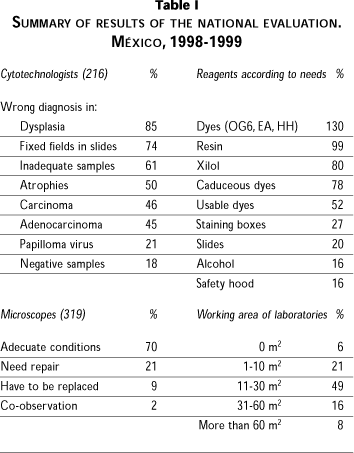
<body><![CDATA[<p>Initially the group of experts developed a procedures manual that included    the general characteristics of cytology laboratories, type, number, and activities    of the personnel, equipment, reagents, and staining methods used. This manual    was distributed to all cytology laboratories. A comprehensive evaluation of    all cytology laboratories belonging to the Ministry of Health was undertaken    by 18 microscopists from InDRE who routinely perform microscopic diagnosis,    such as thick smears for malaria, acid-fast bacilli for tuberculosis, stool    parasitoscopic studies, and cervical cytology. The group was trained for two    weeks on the characteristics of the cervical cancer national program, specially    the cytology laboratory procedures, and on how to clean and oil microscopes    and identify those in non-working conditions.</p>     <p>During January and February 1998, 111 laboratories were visited, 319 microscopes    were checked, and slide sets were given to 216 cytotechnologists. Cytotechnologists    read the slides in the laboratory with their usual microscope during that workday.    Due to the low performance of cytotechnologists, InDRE organized five three-day    courses in March and April 1998, with conferences given by members of the expert    group, and workshops where slides and Pap smears were shared and discussed.    All cytotechnologists attended the five courses. To evaluate their progress    in a short time, a pre-test of 10 slides and a pos-test of five Pap smears were    included. The diagnosis of each slide in the slide sets and in the tests was    considered as correct or incorrect and results were scored as excellent (80    to 100% of correct diagnoses), good (70-79%), fair (60-69%), and failures (less    than 60%). Official diplomas were provided for those having excellent and good    results. Cytotechnologists who had fair results received official probation    letters conditioning their work until the following evaluation. Cytotechnologists    with scores &lt;60% received official letters indicating that they were not    authorized to perform cytological diagnosis until completion of a three-week    training course. Finally, a national workshop divided in two two-day sessions    was organized for all cytotechnologists, independently of their grading, in    April 1999.</p>     <p>During the second semester of 1998 and 1999, the national external quality    control was performed again. This time InDRE sent by courier to state public    health laboratories (SPHL) one slide set for each cytotechnologist in the state.    SPHL distributed the sets to all laboratories and one week later returned to    InDRE the sets and results sheets. Official diplomas, letters of conditional    work or disapproval to perform cytological diagnosis, were again prepared.</p>     <p>Finally, to determine the reliability of the slide sets, since they are constituted    by smears obtained from routine Pap studies, 41 sets were randomly distributed    among the group of experts. The experts work in the Ministry of Health, the    National Institute of Cancer, the General Hospital of Mexico, the General Hospital    "Dr. Manuel Gea Gonzalez", the Ministry of National Defense, the Mexican Institute    of Social Security, the Institute for Social Security for State Workers in Mexico    City and in Sonora, the Ministry of Health of Mexico City, and the Ministry    of Health of Zacatecas State. Each expert rescreened 3-5 slide sets during December    1999 and January 2000 and diagnoses were compared to the original ones. To assess    the concordance of the slide set readings, each of the 20 slides were given    five points if both diagnoses were identical, four points if the difference    was one diagnosis above or below, two points if the difference was two steps    (for example between low and severe dysplasia, between in situ cancer and adenocarcinoma,    etc) and zero points if the difference was higher. These results were compared    to the grades that the cytotechnologists received in the on-site evaluation    and in the courier-sent evaluation.</p>     <p>&nbsp;</p>     <p align="center"><font size="4">Results</font></p>     <p>The results obtained from the national evaluation of all cytology laboratories    revealed problems with microscopes, inadequate supply of reagents, and inadequate    laboratory facilities (<a href="#tabela1">Table I</a>). Between 85% and 18%    of the cytotechnologists gave wrong diagnoses (<a href="#tabela1">Table I</a>).    For example 61% of the cytotechnologists were not able not identify an inadequate    sample and 45-46% did not identify carcinomas. Of the 319 microscopes, 70% were    in adequate working conditions, 21% were brought to InDRE for repair, and 9%    were replaced. There were inadequate amounts of dyes and reagents; for example,    there was a higher amount of staining reagents than needed (130%), but 78% were    outdated. Around one fourth of the laboratories consisted of a washstand for    staining and a table for the microscope, hence having a working area of 0 m<sup>2</sup>,    while another fourth had adequate areas (<a href="#tabela1">Table I</a>). Microscopes,    dyes, reagents, and staining items were bought and distributed to all laboratories    according to the needs detected. State Departments of Health have been invited    to improve cytology laboratories and to centralize them in order to have adequate    volumes of slides, so as to maintain the ability to perform correct diagnoses    of Pap smears. Microscopes for double reading were provided to the central laboratory    or to the SPHL of each state for internal quality control; in this way several    cytotechnologists working in the same place with a cytologist or a cytopathologist    can review together atypical, positive, and non-concordant slides, and a given    percentage of negative ones to confirm diagnosis.</p>     <p align="center"><a name="tabela1"></a></p>     <p align="center">&nbsp;</p>     <p align="center"><img src="/img/revistas/spm/v44n5/14032t1.gif"></p>     ]]></body>
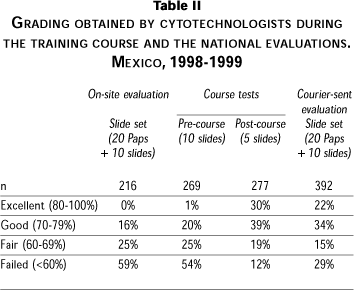
<body><![CDATA[<p align="center">&nbsp;</p>     <p><a href="#tabela2">Table 2</a> shows the performance of cytotechnologists before    and after the external quality control intervention. The training program improved    the performance of cytotechnologists from 59% of failures before to only 12%    afterwards. During 1998 and 1999 slide sets were sent by courier to all laboratories;    the same cytotechnologists and the new ones were evaluated. Results were reviewed    and graded in InDRE and are also shown in <a href="#tabela2">table 2</a>. The    proportion of excellent and good results was 56%, 15% had fair results and 29%    failed. When considering individual changes between both national evaluations,    14% passed both evaluations and 54% of cytotechnologists failed in the on-site    one but passed the courier-sent evaluation; 13% remained as failures and a similar    proportion moved from failure to conditional work. Only 3 and 2% had a lower    performance; that is, they were downgraded from excellent or good results to    conditional work or to failure, respectively. Regarding the technologists that    were incorporated to cytology laboratories along the time of this study, 84%    had excellent or good results in the courier-sent evaluation.</p>     <p align="center"><a name="tabela2"></a></p>     <p align="center">&nbsp;</p>     <p align="center"><img src="/img/revistas/spm/v44n5/14032t2.gif"></p>     <p align="center">&nbsp;</p>     <p>Since the slides used for quality control were obtained during clinical work,    although diagnosed by experts, we wanted to ascertain their performance. Between    86 and 96 points (out of 100) of concordance were obtained by expert rescreening,    with one exception that showed 73 points of concordance. The percentage of cytotechnologists    that had excellent or good results with the same sets during the on-site evaluation    was between 0 and 50%, increasing to 47-67% with the courier-sent evaluation    of 1998-1999. The non-concordant slides were replaced with new slides provided    by the same group of experts.</p>     <p>&nbsp;</p>     <p align="center"><font size="4">Discussion</font></p>     <p>A previous study performed in Mexico found a poor diagnostic reproducibility    with an overall rate of 35% false negative results in the Pap test.<sup>12</sup>    The study performed in InDRE showed great discrepancies between the results    obtained in the Institute and those from the cytology laboratories across the    country.<sup>9</sup> Other studies have shown that the validity and reproducibility    of cytology diagnosis vary greatly within and between institutions<sup>13</sup>    and between Latin American countries.<sup>14</sup> The authors argue that the    main problem is the overwhelming lack of methods to evaluate cytotechnologists    and cytopathology laboratories, and that quality control of diagnostic precision    is central to the consistency of results in cytology laboratories.<sup>13,14</sup>    Therefore, a new external quality control program for cervical cytology was    created based on proficiency testing.</p>     ]]></body>
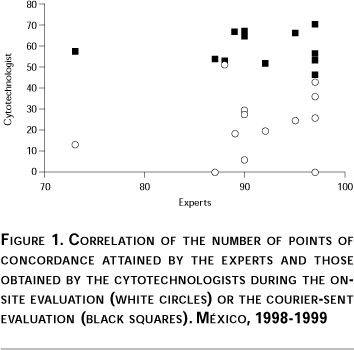
<body><![CDATA[<p>To have a complete panorama of laboratory issues, an on-site evaluation was    performed for all laboratories belonging to the Ministry of Health from across    the country, which allowed a short time evaluation of the performance of all    cytotechnologists and the conditions of the laboratories. Cytology laboratories    received the microscopes and reagents needed; this effort included purchasing    and distribution of adequate supplies, replacing microscopes, and providing    those for co-observation. Moreover, each of 319 microscopes were checked, cleaned,    and oiled or replaced; this was an important support for the daily work of cytotechnologists.    No correlation was found between the screening efficiency and the working conditions    of the microscopes, reagents, and laboratories, probably because many cytotechnologists    had poor performance and many microscopes were in good working conditions. Training    of cytotechnologists in short courses and workshops clearly increased their    diagnostic performance. Before training, 59% of cytotechnologists failed and    only 29% afterwards. It should be noted that more or less similar proportions    were obtained with the slide sets during the on-site evaluation and the 10 slides    used in the pre-course test, or with the post-course evaluation and the courier    sent-sets; these results support the notion that the sets provided reproducible    results and therefore were useful for quality control. Clearly the intervention    was responsible for the change in the proportion of cytotechnologists who had    excellent and good results, since 54% were upgraded from failing the first evaluation    to good and excellent results in the second one, as compared to only 14% who    passed both evaluations. Also, most new cytotechnologists had good diagnostic    ability.</p>     <p>Until 1997 external quality control of cervical cytology was performed in the    Ministry of Health of Mexico by rescreening of Pap smears. The high discrepancy    of results<sup>9</sup> and the increasing number of slides received in InDRE    prompted a change of system. Proficiency testing is now recognized as an alternative    way for evaluating the diagnostic quality of slide reading.<sup>15, 16</sup>    For this purpose 50 sets were prepared with slides provided by experts in cervical    cytology and used in two national quality control evaluations. Sets were prepared    with slides having similar proportions of different types of diagnoses to those    found after rescreening 10,098 slides from the Departments of Health across    the country in 1994-1995.<sup>9</sup> This system allowed detecting the diagnostic    ability of cytotechnologists. Finally, when the concordance value of diagnoses    given by experts was associated with the percentage of cytotechnologists that    had excellent or good results with the same slide sets in the on-site evaluation    (white circles) or in the courier-sent evaluation (black squares), it was found    that when cytotechnologists had a poorer performance (white circles), sets with    higher concordance between experts had higher percentages of excellent or good    results. This trend was not statistically significant but suggests that training    facilitated reading of more difficult slides (<a href="#figura1">Figure 1</a>).</p>     <p align="center"><a name="figura1"></a></p>     <p align="center">&nbsp;</p>     <p align="center"><img src="/img/revistas/spm/v44n5/14032f1.gif"></p>     <p align="center">&nbsp;</p>     <p>This new system for external quality control of cervical cytology allowed timely    and reliable evaluation of the performance of cytotechnologists working in the    National Program for the Prevention and Control of Cervical Cancer. After providing    training courses, microscopes, and reagents, the quality control program demonstrated    improvement in the diagnosis performed by the cytotechnologists. International    standards recommend external quality control not to be performed in an individual    basis but on laboratories as evaluation units.<sup>14,16,17</sup> The improvement    in diagnostic capabilities of cytotechnologists in Mexico now allows for this    change. Also, external quality control programs should allow keeping the slide    sets in the laboratories, until results are graded at the national laboratory    and returned, so that each laboratory can go over the slides to review wrong    diagnoses. Only after that should sets be sent back to the national laboratory.<sup>16</sup>    For this purpose more Pap smears of excellent quality are being collected in    InDRE, to assemble more test slide sets.</p>     <p align="left"><b>Acknowledgements</b></p>     <p>The authors wish to thank all Mexican cytotechnologists who participated in    the on-site evaluation and in the new external quality control program, as well    as the group of experts for their participation and collaboration, PAHO and    Rodrigo Prado (PAHO, Chile) for support, and Dolores Correa (Instituto Nacional    de Pediatria), Maribeth Gagnon, and John Ridderhoff (CDC) for critical review    of the manuscript.</p>     <p>&nbsp;</p>     ]]></body>
<body><![CDATA[<p align="center"><font size="4">References</font></p>     <!-- ref --><p>1. Robles S. Introduction to the special issue: Timely detection of cervical    cancer. Bull PAHO 1996:30:285-289.&nbsp;&nbsp;&nbsp;&nbsp;&nbsp;&nbsp;&nbsp;&nbsp;[&#160;<a href="javascript:void(0);" onclick="javascript: window.open('/scielo.php?script=sci_nlinks&ref=9199141&pid=S0036-3634200200050000700001&lng=','','width=640,height=500,resizable=yes,scrollbars=1,menubar=yes,');">Links</a>&#160;]<!-- end-ref --><!-- ref --><p>2. Laara E, Day E, Hakama M. Trends in mortality from cervical cancer in the    Nordic countries: Association with organized screening programs. Lancet 1987;1:1279-1281.&nbsp;&nbsp;&nbsp;&nbsp;&nbsp;&nbsp;&nbsp;&nbsp;[&#160;<a href="javascript:void(0);" onclick="javascript: window.open('/scielo.php?script=sci_nlinks&ref=9199142&pid=S0036-3634200200050000700002&lng=','','width=640,height=500,resizable=yes,scrollbars=1,menubar=yes,');">Links</a>&#160;]<!-- end-ref --><!-- ref --><p>3. Papanicolaou GN, Traut HF. The diagnostic value of vaginal smears in carcinoma    of the uterus. Am J Obstet Gynecol 1941;42:193.&nbsp;&nbsp;&nbsp;&nbsp;&nbsp;&nbsp;&nbsp;&nbsp;[&#160;<a href="javascript:void(0);" onclick="javascript: window.open('/scielo.php?script=sci_nlinks&ref=9199143&pid=S0036-3634200200050000700003&lng=','','width=640,height=500,resizable=yes,scrollbars=1,menubar=yes,');">Links</a>&#160;]<!-- end-ref --><!-- ref --><p>4. Johannesson G, Geirsson G, Day NE. The effect of mass screening in Iceland.    1965-1974, on the incidence and mortality of cervical carcinoma. Intl J Cancer    1978;21:418.&nbsp;&nbsp;&nbsp;&nbsp;&nbsp;&nbsp;&nbsp;&nbsp;[&#160;<a href="javascript:void(0);" onclick="javascript: window.open('/scielo.php?script=sci_nlinks&ref=9199144&pid=S0036-3634200200050000700004&lng=','','width=640,height=500,resizable=yes,scrollbars=1,menubar=yes,');">Links</a>&#160;]<!-- end-ref --><!-- ref --><p>5. Boyes DA, Nichols TM, Millner AM, Worth AJ. Recent results from the British    Columbia screening program for cervical caner. Am J Obstet Gynecol 1977;128:692.&nbsp;&nbsp;&nbsp;&nbsp;&nbsp;&nbsp;&nbsp;&nbsp;[&#160;<a href="javascript:void(0);" onclick="javascript: window.open('/scielo.php?script=sci_nlinks&ref=9199145&pid=S0036-3634200200050000700005&lng=','','width=640,height=500,resizable=yes,scrollbars=1,menubar=yes,');">Links</a>&#160;]<!-- end-ref --><!-- ref --><p>6. Restrepo HE, Gonz&aacute;lez JL, Roberts E, Litvak J. Epidemiolog&iacute;a    y control del c&aacute;ncer del cuello uterino en Am&eacute;rica Latina y El    Caribe. Bol Oficina Sanit Panam 1987;102:578.&nbsp;&nbsp;&nbsp;&nbsp;&nbsp;&nbsp;&nbsp;&nbsp;[&#160;<a href="javascript:void(0);" onclick="javascript: window.open('/scielo.php?script=sci_nlinks&ref=9199146&pid=S0036-3634200200050000700006&lng=','','width=640,height=500,resizable=yes,scrollbars=1,menubar=yes,');">Links</a>&#160;]<!-- end-ref --><!-- ref --><p>7. Garc&iacute;a G. La detecci&oacute;n de c&aacute;ncer del cuello uterino    en 75 855 mujeres. Gac Med Mex 1970;100:154.&nbsp;&nbsp;&nbsp;&nbsp;&nbsp;&nbsp;&nbsp;&nbsp;[&#160;<a href="javascript:void(0);" onclick="javascript: window.open('/scielo.php?script=sci_nlinks&ref=9199147&pid=S0036-3634200200050000700007&lng=','','width=640,height=500,resizable=yes,scrollbars=1,menubar=yes,');">Links</a>&#160;]<!-- end-ref --><!-- ref --><p>8. Weissbrod-de Bonder D, Magis-Rodr&iacute;guez C. Control de calidad del    diagn&oacute;stico citol&oacute;gico de displasias en M&eacute;xico. Higiene    1994;II: 207-212.&nbsp;&nbsp;&nbsp;&nbsp;&nbsp;&nbsp;&nbsp;&nbsp;[&#160;<a href="javascript:void(0);" onclick="javascript: window.open('/scielo.php?script=sci_nlinks&ref=9199148&pid=S0036-3634200200050000700008&lng=','','width=640,height=500,resizable=yes,scrollbars=1,menubar=yes,');">Links</a>&#160;]<!-- end-ref --><!-- ref --><p>9. Weissbrod D, Torres M, Rodr&iacute;guez A, Ure&ntilde;a I, Estrada J, Reyes    ML <i>et al</i>. Comparaci&oacute;n del examen de citolog&iacute;a cervical    efectuado por el m&eacute;todo Papnet y por microscop&iacute;a convencional.    Bol Oficina Sanit Panam 1996;121:528-535.&nbsp;&nbsp;&nbsp;&nbsp;&nbsp;&nbsp;&nbsp;&nbsp;[&#160;<a href="javascript:void(0);" onclick="javascript: window.open('/scielo.php?script=sci_nlinks&ref=9199149&pid=S0036-3634200200050000700009&lng=','','width=640,height=500,resizable=yes,scrollbars=1,menubar=yes,');">Links</a>&#160;]<!-- end-ref --><!-- ref --><p>10. Secretar&iacute;a de Salud. Norma Oficial Mexicana. NOM-014-SSA2-1994,    para la Prevenci&oacute;n, Detecci&oacute;n, Diagn&oacute;stico, Tratamiento,    Control y Vigilancia Epidemiol&oacute;gica del C&aacute;ncer C&eacute;rvico    Uterino. M&eacute;xico, D.F.: Diario Oficial, Marzo 6, 1998.&nbsp;&nbsp;&nbsp;&nbsp;&nbsp;&nbsp;&nbsp;&nbsp;[&#160;<a href="javascript:void(0);" onclick="javascript: window.open('/scielo.php?script=sci_nlinks&ref=9199150&pid=S0036-3634200200050000700010&lng=','','width=640,height=500,resizable=yes,scrollbars=1,menubar=yes,');">Links</a>&#160;]<!-- end-ref --><!-- ref --><p>11. Organizaci&oacute;n Panamericana de la Salud. Manual de normas y procedimientos    para el control del c&aacute;ncer de cuello uterino. PALTEX 1990;6;37-43.&nbsp;&nbsp;&nbsp;&nbsp;&nbsp;&nbsp;&nbsp;&nbsp;[&#160;<a href="javascript:void(0);" onclick="javascript: window.open('/scielo.php?script=sci_nlinks&ref=9199151&pid=S0036-3634200200050000700011&lng=','','width=640,height=500,resizable=yes,scrollbars=1,menubar=yes,');">Links</a>&#160;]<!-- end-ref --><!-- ref --><p>12. Lazcano-Ponce EC, Buiatti E, N&aacute;jera-Aguilar P, Alonso-de Ruiz P,    Hern&aacute;ndez-Avila M. Evaluation model of the Mexican national program for    early cervical cancer detection and proposals for a new approach. Cancer Causes    Control 1998;9:241-251.&nbsp;&nbsp;&nbsp;&nbsp;&nbsp;&nbsp;&nbsp;&nbsp;[&#160;<a href="javascript:void(0);" onclick="javascript: window.open('/scielo.php?script=sci_nlinks&ref=9199152&pid=S0036-3634200200050000700012&lng=','','width=640,height=500,resizable=yes,scrollbars=1,menubar=yes,');">Links</a>&#160;]<!-- end-ref --><!-- ref --><p>13. Lazcano-Ponce EC, Alonso-de Ruiz P, L&oacute;pez-Carrillo L, N&aacute;jera-Aguilar    P, Avila-Cisneros R, Escand&oacute;n-Romero C <i>et al</i>. Validity and reproducibility    of cytologic diagnosis in a sample of cervical cancer screening centres in Mexico.    Acta Cytol 1997;41:277-284.&nbsp;&nbsp;&nbsp;&nbsp;&nbsp;&nbsp;&nbsp;&nbsp;[&#160;<a href="javascript:void(0);" onclick="javascript: window.open('/scielo.php?script=sci_nlinks&ref=9199153&pid=S0036-3634200200050000700013&lng=','','width=640,height=500,resizable=yes,scrollbars=1,menubar=yes,');">Links</a>&#160;]<!-- end-ref --><!-- ref --><p>14. Alonso-de Ruiz P, Lazcano-Ponce EC. Quality control in cytopathology laboratories    in six Latin American countries. In: Compendium on quality assurance, proficiency    testing and workload limitations in clinical cytology. 1995:115-121.&nbsp;&nbsp;&nbsp;&nbsp;&nbsp;&nbsp;&nbsp;&nbsp;[&#160;<a href="javascript:void(0);" onclick="javascript: window.open('/scielo.php?script=sci_nlinks&ref=9199154&pid=S0036-3634200200050000700014&lng=','','width=640,height=500,resizable=yes,scrollbars=1,menubar=yes,');">Links</a>&#160;]<!-- end-ref --><!-- ref --><p>15. United States Department of Health and Human Services. Health care financing    administration. Medicare, Medicaid and CLIA Programs. Regulations implementing    the clinical laboratory improvement amendments of 1988 (CLIA). Federal Register    1992;57(49):7002-7186.&nbsp;&nbsp;&nbsp;&nbsp;&nbsp;&nbsp;&nbsp;&nbsp;[&#160;<a href="javascript:void(0);" onclick="javascript: window.open('/scielo.php?script=sci_nlinks&ref=9199155&pid=S0036-3634200200050000700015&lng=','','width=640,height=500,resizable=yes,scrollbars=1,menubar=yes,');">Links</a>&#160;]<!-- end-ref --><!-- ref --><p>16. Organizaci&oacute;n Panamericana de la Salud. M&oacute;dulo de Citolog&iacute;a.    Procedimientos. Washington, D.C., 2000:1-20.&nbsp;&nbsp;&nbsp;&nbsp;&nbsp;&nbsp;&nbsp;&nbsp;[&#160;<a href="javascript:void(0);" onclick="javascript: window.open('/scielo.php?script=sci_nlinks&ref=9199156&pid=S0036-3634200200050000700016&lng=','','width=640,height=500,resizable=yes,scrollbars=1,menubar=yes,');">Links</a>&#160;]<!-- end-ref --><!-- ref --><p>17. Alonso-de Ruiz P, Lazcano-Ponce EC, Hern&aacute;ndez-Avila M. C&aacute;ncer    cervicouterino. Diagn&oacute;stico, prevenci&oacute;n y control. M&eacute;xico,    D.F.: Editorial M&eacute;dica Panamericana, 2000: 203-209.&nbsp;&nbsp;&nbsp;&nbsp;&nbsp;&nbsp;&nbsp;&nbsp;[&#160;<a href="javascript:void(0);" onclick="javascript: window.open('/scielo.php?script=sci_nlinks&ref=9199157&pid=S0036-3634200200050000700017&lng=','','width=640,height=500,resizable=yes,scrollbars=1,menubar=yes,');">Links</a>&#160;]<!-- end-ref --><p>&nbsp;</p>     <p>&nbsp;</p>     ]]></body>
<body><![CDATA[<p><a name="back1"></a>(<a href="#top1">1</a>) Instituto de Diagn&oacute;stico    y Referencia Epidemiol&oacute;gicos, Secretar&iacute;a de Salud (SSA), M&eacute;xico,    D.F., M&eacute;xico. Actualmente en el Departamento de Microbiolog&iacute;a    y Parasitolog&iacute;a, Facultad de Medicina. Universidad Nacional Aut&oacute;noma    de M&eacute;xico (UNAM). M&eacute;xico, D.F., M&eacute;xico.</p>     <p>(<a href="#top1">2</a>) Instituto de Diagn&oacute;stico y Referencia Epidemiol&oacute;gicos,    Secretar&iacute;a de Salud. M&eacute;xico, D.F., M&eacute;xico.</p>     <p>(<a href="#top1">3</a>) Programa Nacional de Prevenci&oacute;n y Control de    C&aacute;ncer C&eacute;rvico Uterino, SSA, M&eacute;xico, D.F., M&eacute;xico.</p>     <p>(<a href="#top1">4</a>) Programa de Salud de la Mujer, SSA, M&eacute;xico,    D.F. Actualmente en el Hospital General de M&eacute;xico, SSA. M&eacute;xico,    D.F., M&eacute;xico.</p>     <p>(<a href="#top1">5</a>) Subsecretar&iacute;a de Prevenci&oacute;n y Control    de Enfermedades, SSA. M&eacute;xico, D.F., M&eacute;xico.</p>     <p>(<a href="#top1">6</a>) Secretar&iacute;a de Salud, M&eacute;xico, D.F., M&eacute;xico.    Actualmente en la Rector&iacute;a de la UNAM, M&eacute;xico, D.F., M&eacute;xico.</p>     <p>&nbsp;</p>     <p align="center"><b>Received on</b>: January 29, 2001 &#149; <b>Accepted on</b>:    April 17, 2002    <br>   Address reprint requests: Ana Flisser. Departamento de Microbiolog&iacute;a    y Parasitolog&iacute;a, Facultad de Medicina, UNAM, Ciudad Universitaria, San    Angel, 04510 M&eacute;xico, D.F., M&eacute;xico.    <br>   e-mail: <a href="mailto:flisser@servidor.unam.mx">flisser@servidor.unam.mx</a></p>     ]]></body>
<body><![CDATA[ ]]></body><back>
<ref-list>
<ref id="B1">
<label>1</label><nlm-citation citation-type="journal">
<person-group person-group-type="author">
<name>
<surname><![CDATA[Robles]]></surname>
<given-names><![CDATA[S]]></given-names>
</name>
</person-group>
<article-title xml:lang="en"><![CDATA[Introduction to the special issue: Timely detection of cervical cancer]]></article-title>
<source><![CDATA[Bull PAHO]]></source>
<year>1996</year>
<volume>30</volume>
<page-range>285-289</page-range></nlm-citation>
</ref>
<ref id="B2">
<label>2</label><nlm-citation citation-type="journal">
<person-group person-group-type="author">
<name>
<surname><![CDATA[Laara]]></surname>
<given-names><![CDATA[E]]></given-names>
</name>
<name>
<surname><![CDATA[Day]]></surname>
<given-names><![CDATA[E]]></given-names>
</name>
<name>
<surname><![CDATA[Hakama]]></surname>
<given-names><![CDATA[M]]></given-names>
</name>
</person-group>
<article-title xml:lang="en"><![CDATA[Trends in mortality from cervical cancer in the Nordic countries: Association with organized screening programs]]></article-title>
<source><![CDATA[Lancet]]></source>
<year>1987</year>
<volume>1</volume>
<page-range>1279-1281</page-range></nlm-citation>
</ref>
<ref id="B3">
<label>3</label><nlm-citation citation-type="journal">
<person-group person-group-type="author">
<name>
<surname><![CDATA[Papanicolaou]]></surname>
<given-names><![CDATA[GN]]></given-names>
</name>
<name>
<surname><![CDATA[Traut]]></surname>
<given-names><![CDATA[HF]]></given-names>
</name>
</person-group>
<article-title xml:lang="en"><![CDATA[The diagnostic value of vaginal smears in carcinoma of the uterus]]></article-title>
<source><![CDATA[Am J Obstet Gynecol]]></source>
<year>1941</year>
<volume>42</volume>
<page-range>193</page-range></nlm-citation>
</ref>
<ref id="B4">
<label>4</label><nlm-citation citation-type="journal">
<person-group person-group-type="author">
<name>
<surname><![CDATA[Johannesson]]></surname>
<given-names><![CDATA[G]]></given-names>
</name>
<name>
<surname><![CDATA[Geirsson]]></surname>
<given-names><![CDATA[G]]></given-names>
</name>
<name>
<surname><![CDATA[Day]]></surname>
<given-names><![CDATA[NE]]></given-names>
</name>
</person-group>
<article-title xml:lang="en"><![CDATA[The effect of mass screening in Iceland: 1965-1974, on the incidence and mortality of cervical carcinoma]]></article-title>
<source><![CDATA[Intl J Cancer]]></source>
<year>1978</year>
<volume>21</volume>
<page-range>418</page-range></nlm-citation>
</ref>
<ref id="B5">
<label>5</label><nlm-citation citation-type="journal">
<person-group person-group-type="author">
<name>
<surname><![CDATA[Boyes]]></surname>
<given-names><![CDATA[DA]]></given-names>
</name>
<name>
<surname><![CDATA[Nichols]]></surname>
<given-names><![CDATA[TM]]></given-names>
</name>
<name>
<surname><![CDATA[Millner]]></surname>
<given-names><![CDATA[AM]]></given-names>
</name>
<name>
<surname><![CDATA[Worth]]></surname>
<given-names><![CDATA[AJ]]></given-names>
</name>
</person-group>
<article-title xml:lang="en"><![CDATA[Recent results from the British Columbia screening program for cervical caner]]></article-title>
<source><![CDATA[Am J Obstet Gynecol]]></source>
<year>1977</year>
<volume>128</volume>
<page-range>692</page-range></nlm-citation>
</ref>
<ref id="B6">
<label>6</label><nlm-citation citation-type="journal">
<person-group person-group-type="author">
<name>
<surname><![CDATA[Restrepo]]></surname>
<given-names><![CDATA[HE]]></given-names>
</name>
<name>
<surname><![CDATA[González]]></surname>
<given-names><![CDATA[JL]]></given-names>
</name>
<name>
<surname><![CDATA[Roberts]]></surname>
<given-names><![CDATA[E]]></given-names>
</name>
<name>
<surname><![CDATA[Litvak]]></surname>
<given-names><![CDATA[J]]></given-names>
</name>
</person-group>
<article-title xml:lang="es"><![CDATA[Epidemiología y control del cáncer del cuello uterino en América Latina y El Caribe]]></article-title>
<source><![CDATA[Bol Oficina Sanit Panam]]></source>
<year>1987</year>
<volume>102</volume>
<page-range>578</page-range></nlm-citation>
</ref>
<ref id="B7">
<label>7</label><nlm-citation citation-type="journal">
<person-group person-group-type="author">
<name>
<surname><![CDATA[García]]></surname>
<given-names><![CDATA[G]]></given-names>
</name>
</person-group>
<article-title xml:lang="es"><![CDATA[La detección de cáncer del cuello uterino en 75 855 mujeres]]></article-title>
<source><![CDATA[Gac Med Mex]]></source>
<year>1970</year>
<volume>100</volume>
<page-range>154</page-range></nlm-citation>
</ref>
<ref id="B8">
<label>8</label><nlm-citation citation-type="journal">
<person-group person-group-type="author">
<name>
<surname><![CDATA[Weissbrod-deBonder]]></surname>
<given-names><![CDATA[D]]></given-names>
</name>
<name>
<surname><![CDATA[Magis-Rodríguez]]></surname>
<given-names><![CDATA[C]]></given-names>
</name>
</person-group>
<article-title xml:lang="es"><![CDATA[Control de calidad del diagnóstico citológico de displasias en México]]></article-title>
<source><![CDATA[Higiene]]></source>
<year>1994</year>
<volume>II</volume>
<page-range>207-212</page-range></nlm-citation>
</ref>
<ref id="B9">
<label>9</label><nlm-citation citation-type="journal">
<person-group person-group-type="author">
<name>
<surname><![CDATA[Weissbrod]]></surname>
<given-names><![CDATA[D]]></given-names>
</name>
<name>
<surname><![CDATA[Torres]]></surname>
<given-names><![CDATA[M]]></given-names>
</name>
<name>
<surname><![CDATA[Rodríguez]]></surname>
<given-names><![CDATA[A]]></given-names>
</name>
<name>
<surname><![CDATA[Ureña]]></surname>
<given-names><![CDATA[I]]></given-names>
</name>
<name>
<surname><![CDATA[Estrada]]></surname>
<given-names><![CDATA[J]]></given-names>
</name>
<name>
<surname><![CDATA[Reyes]]></surname>
<given-names><![CDATA[ML]]></given-names>
</name>
</person-group>
<article-title xml:lang="es"><![CDATA[Comparación del examen de citología cervical efectuado por el método Papnet y por microscopía convencional]]></article-title>
<source><![CDATA[Bol Oficina Sanit Panam]]></source>
<year>1996</year>
<volume>121</volume>
<page-range>528-535</page-range></nlm-citation>
</ref>
<ref id="B10">
<label>10</label><nlm-citation citation-type="book">
<collab>Secretaría de Salud</collab>
<source><![CDATA[Norma Oficial Mexicana: NOM-014-SSA2-1994, para la Prevención, Detección, Diagnóstico, Tratamiento, Control y Vigilancia Epidemiológica del Cáncer Cérvico Uterino]]></source>
<year>Marz</year>
<month>o </month>
<day>6,</day>
<publisher-loc><![CDATA[México^eD.F. D.F.]]></publisher-loc>
<publisher-name><![CDATA[Diario Oficial]]></publisher-name>
</nlm-citation>
</ref>
<ref id="B11">
<label>11</label><nlm-citation citation-type="journal">
<collab>Organización Panamericana de la Salud</collab>
<article-title xml:lang="es"><![CDATA[Manual de normas y procedimientos para el control del cáncer de cuello uterino]]></article-title>
<source><![CDATA[PALTEX]]></source>
<year>1990</year>
<volume>6</volume>
<page-range>37-43</page-range></nlm-citation>
</ref>
<ref id="B12">
<label>12</label><nlm-citation citation-type="journal">
<person-group person-group-type="author">
<name>
<surname><![CDATA[Lazcano-Ponce]]></surname>
<given-names><![CDATA[EC]]></given-names>
</name>
<name>
<surname><![CDATA[Buiatti]]></surname>
<given-names><![CDATA[E]]></given-names>
</name>
<name>
<surname><![CDATA[Nájera-Aguilar]]></surname>
<given-names><![CDATA[P]]></given-names>
</name>
<name>
<surname><![CDATA[Alonso-de]]></surname>
<given-names><![CDATA[Ruiz P]]></given-names>
</name>
<name>
<surname><![CDATA[Hernández-Avila]]></surname>
<given-names><![CDATA[M]]></given-names>
</name>
</person-group>
<article-title xml:lang="en"><![CDATA[Evaluation model of the Mexican national program for early cervical cancer detection and proposals for a new approach]]></article-title>
<source><![CDATA[Cancer Causes Control]]></source>
<year>1998</year>
<volume>9</volume>
<page-range>241-251</page-range></nlm-citation>
</ref>
<ref id="B13">
<label>13</label><nlm-citation citation-type="journal">
<person-group person-group-type="author">
<name>
<surname><![CDATA[Lazcano-Ponce]]></surname>
<given-names><![CDATA[EC]]></given-names>
</name>
<name>
<surname><![CDATA[Alonso-de]]></surname>
<given-names><![CDATA[Ruiz P]]></given-names>
</name>
<name>
<surname><![CDATA[López-Carrillo]]></surname>
<given-names><![CDATA[L]]></given-names>
</name>
<name>
<surname><![CDATA[Nájera-Aguilar]]></surname>
<given-names><![CDATA[P]]></given-names>
</name>
<name>
<surname><![CDATA[Avila-Cisneros]]></surname>
<given-names><![CDATA[R]]></given-names>
</name>
<name>
<surname><![CDATA[Escandón-Romero]]></surname>
<given-names><![CDATA[C]]></given-names>
</name>
</person-group>
<article-title xml:lang="en"><![CDATA[Validity and reproducibility of cytologic diagnosis in a sample of cervical cancer screening centres in Mexico]]></article-title>
<source><![CDATA[Acta Cytol]]></source>
<year>1997</year>
<volume>41</volume>
<page-range>277-284</page-range></nlm-citation>
</ref>
<ref id="B14">
<label>14</label><nlm-citation citation-type="">
<person-group person-group-type="author">
<name>
<surname><![CDATA[Alonso-de Ruiz]]></surname>
<given-names><![CDATA[P]]></given-names>
</name>
<name>
<surname><![CDATA[Lazcano-Ponce]]></surname>
<given-names><![CDATA[EC]]></given-names>
</name>
</person-group>
<article-title xml:lang="en"><![CDATA[Quality control in cytopathology laboratories in six Latin American countries]]></article-title>
<source><![CDATA[Compendium on quality assurance, proficiency testing and workload limitations in clinical cytology]]></source>
<year>1995</year>
<page-range>115-121</page-range></nlm-citation>
</ref>
<ref id="B15">
<label>15</label><nlm-citation citation-type="journal">
<collab>United States Department of Health and Human Services</collab>
<article-title xml:lang="en"><![CDATA[Health care financing administration: Medicare, Medicaid and CLIA Programs. Regulations implementing the clinical laboratory improvement amendments of 1988 (CLIA)]]></article-title>
<source><![CDATA[Federal Register]]></source>
<year>1992</year>
<volume>57</volume>
<numero>49</numero>
<issue>49</issue>
<page-range>7002-7186</page-range></nlm-citation>
</ref>
<ref id="B16">
<label>16</label><nlm-citation citation-type="">
<collab>Organización Panamericana de la Salud</collab>
<source><![CDATA[Módulo de Citología: Procedimientos]]></source>
<year></year>
<volume>2000</volume>
<page-range>1-20</page-range><publisher-loc><![CDATA[Washington^eD.C. D.C.]]></publisher-loc>
</nlm-citation>
</ref>
<ref id="B17">
<label>17</label><nlm-citation citation-type="book">
<person-group person-group-type="author">
<name>
<surname><![CDATA[Alonso-deRuiz]]></surname>
<given-names><![CDATA[P]]></given-names>
</name>
<name>
<surname><![CDATA[Lazcano-Ponce]]></surname>
<given-names><![CDATA[EC]]></given-names>
</name>
<name>
<surname><![CDATA[Hernández-Avila]]></surname>
<given-names><![CDATA[M]]></given-names>
</name>
</person-group>
<source><![CDATA[Cáncer cervicouterino: Diagnóstico, prevención y control]]></source>
<year>2000</year>
<page-range>203-209</page-range><publisher-loc><![CDATA[México^eD.F. D.F.]]></publisher-loc>
<publisher-name><![CDATA[Editorial Médica Panamericana]]></publisher-name>
</nlm-citation>
</ref>
</ref-list>
</back>
</article>