<?xml version="1.0" encoding="ISO-8859-1"?><article xmlns:mml="http://www.w3.org/1998/Math/MathML" xmlns:xlink="http://www.w3.org/1999/xlink" xmlns:xsi="http://www.w3.org/2001/XMLSchema-instance">
<front>
<journal-meta>
<journal-id>0036-3634</journal-id>
<journal-title><![CDATA[Salud Pública de México]]></journal-title>
<abbrev-journal-title><![CDATA[Salud pública Méx]]></abbrev-journal-title>
<issn>0036-3634</issn>
<publisher>
<publisher-name><![CDATA[Instituto Nacional de Salud Pública]]></publisher-name>
</publisher>
</journal-meta>
<article-meta>
<article-id>S0036-36342002000300006</article-id>
<title-group>
<article-title xml:lang="en"><![CDATA[Phylogenetic analysis of the envelope protein (domain lll) of dengue 4 viruses]]></article-title>
<article-title xml:lang="es"><![CDATA[Análisis filogenético del dominio III de la proteína de envoltura del virus dengue 4]]></article-title>
</title-group>
<contrib-group>
<contrib contrib-type="author">
<name>
<surname><![CDATA[Mota]]></surname>
<given-names><![CDATA[Javier]]></given-names>
</name>
<xref ref-type="aff" rid="A01"/>
</contrib>
<contrib contrib-type="author">
<name>
<surname><![CDATA[Ramos-Castañeda]]></surname>
<given-names><![CDATA[José]]></given-names>
</name>
<xref ref-type="aff" rid="A01"/>
</contrib>
<contrib contrib-type="author">
<name>
<surname><![CDATA[Rico-Hesse]]></surname>
<given-names><![CDATA[Rebeca]]></given-names>
</name>
<xref ref-type="aff" rid="A02"/>
</contrib>
<contrib contrib-type="author">
<name>
<surname><![CDATA[Ramos]]></surname>
<given-names><![CDATA[Celso]]></given-names>
</name>
<xref ref-type="aff" rid="A01"/>
</contrib>
</contrib-group>
<aff id="A01">
<institution><![CDATA[,Instituto Nacional de Salud Pública Centro de Investigación sobre Enfermedades Infecciosas Departamento de Arbovirus]]></institution>
<addr-line><![CDATA[Cuernavaca Morelos]]></addr-line>
<country>México</country>
</aff>
<aff id="A02">
<institution><![CDATA[,Southwest Foundation for Biomedical Research Department of Virology and Immunology ]]></institution>
<addr-line><![CDATA[San Antonio Texas]]></addr-line>
<country>USA</country>
</aff>
<pub-date pub-type="pub">
<day>00</day>
<month>06</month>
<year>2002</year>
</pub-date>
<pub-date pub-type="epub">
<day>00</day>
<month>06</month>
<year>2002</year>
</pub-date>
<volume>44</volume>
<numero>3</numero>
<fpage>228</fpage>
<lpage>236</lpage>
<copyright-statement/>
<copyright-year/>
<self-uri xlink:href="http://www.scielo.org.mx/scielo.php?script=sci_arttext&amp;pid=S0036-36342002000300006&amp;lng=en&amp;nrm=iso"></self-uri><self-uri xlink:href="http://www.scielo.org.mx/scielo.php?script=sci_abstract&amp;pid=S0036-36342002000300006&amp;lng=en&amp;nrm=iso"></self-uri><self-uri xlink:href="http://www.scielo.org.mx/scielo.php?script=sci_pdf&amp;pid=S0036-36342002000300006&amp;lng=en&amp;nrm=iso"></self-uri><abstract abstract-type="short" xml:lang="en"><p><![CDATA[Objective. To evaluate the genetic variability of domain III of envelope (E) protein and to estimate phylogenetic relationships of dengue 4 (Den-4) viruses isolated in Mexico and from other endemic areas of the world. Material and Methods. A phylogenetic study of domain III of envelope (E) protein of Den-4 viruses was conducted in 1998 using virus strains from Mexico and other parts of the world, isolated in different years. Specific primers were used to amplify by RT-PCR the domain III and to obtain nucleotide sequence. Based on nucleotide and deduced aminoacid sequence, genetic variability was estimated and a phylogenetic tree was generated. To make an easy genetic analysis of domain III region, a Restriction Fragment Length Polymorphism (RFLP) assay was performed, using six restriction enzymes. Results. Study results demonstrate that nucleotide and aminoacid sequence analysis of domain III are similar to those reported from the complete E protein gene. Based on the RFLP analysis of domain III using the restriction enzymes Nla III, Dde I and Cfo I, Den-4 viruses included in this study were clustered into genotypes 1 and 2 previously reported. Conclusions. Study results suggest that domain III may be used as a genetic marker for phylogenetic and molecular epidemiology studies of dengue viruses.]]></p></abstract>
<abstract abstract-type="short" xml:lang="es"><p><![CDATA[Objetivo. Evaluar la variabilidad genética del dominio III de la proteína de envoltura (E) y estimar la relación filogenética de los virus dengue 4 (Den-4) aislados en México y en otras regiones endémicas del mundo. Material y métodos. En el presente trabajo reportamos un estudio filogenético del dominio III de la proteína de envoltura (E) que se realizó en 1998 con virus Den-4 aislados en distintos años en México y en otras partes del mundo. Se usaron oligonucleótidos específicos para amplificar por RT-PCR la región del dominio III y para obtener la secuencia de nucleótidos. Mediante el análisis de la secuencia de nucleótidos y de la secuencia deducida de aminoácidos se estimó la variabilidad genética y se generó un árbol filogenético. Para facilitar el análisis genético del dominio III se usó la técnica basada en el polimorfismo de fragmentos generados con enzimas de restricción (PFER) utilizando seis enzimas de restricción. Resultados. Los datos demuestran que la información del análisis de la secuencia de nucleótidos y de aminoácidos de la región del dominio III es similar a la del gene completo de la proteína E. El análisis de PFER con las enzimas de restricción Nla III, Dde I y Cfo I, mostró que los virus Den-4 incluidos en este estudio se agruparon en los genotipos 1 y 2 reportados previamente. Conclusiones. Los resultados sugieren que el dominio III se puede utilizar como un marcador para estudios filogenéticos y de epidemiología molecular del virus Den-4.]]></p></abstract>
<kwd-group>
<kwd lng="en"><![CDATA[Den-4 virus]]></kwd>
<kwd lng="en"><![CDATA[phylogenetic analysis]]></kwd>
<kwd lng="en"><![CDATA[envelope protein]]></kwd>
<kwd lng="es"><![CDATA[virus Den-4]]></kwd>
<kwd lng="es"><![CDATA[análisis filogenético]]></kwd>
<kwd lng="es"><![CDATA[proteína E]]></kwd>
</kwd-group>
</article-meta>
</front><body><![CDATA[ <p align="left"><font size="2"><b><a name="texto"></a>ARTÍCULO ORIGINAL</b></font>     <p align="left">&nbsp;     <p align="center"><font size=5><b> Phylogenetic analysis of the envelope protein (domain lll) of dengue 4 viruses</b></font></p>     <P align="left">&nbsp;     <P align="center">Javier Mota, MSc,<SUP>(<a href="#nota">1</a>)</SUP> Jos&eacute; Ramos-Casta&ntilde;eda,  MSc,<SUP>(<a href="#nota">1</a>)</SUP> Rebeca Rico-Hesse,  PhD,<SUP>(<a href="#nota">2</a>)</SUP> Celso Ramos, PhD.<SUP>(<a href="#nota">1</a>) </SUP>     <p align="left">&nbsp;     <p align="left">&nbsp;</p>     <p align="left"> Mota J, Ramos-Casta&ntilde;eda J, Rico-Hesse R, Ramos C.    <br> Phylogenetic analysis of the envelope protein (domain lll) of dengue 4 viruses.    <br> Salud Publica Mex 2002;44:228-236.    ]]></body>
<body><![CDATA[<br> <b>The English version of this paper is available too  at: <a href="http://www.insp.mx/salud/index.html"> http://www.insp.mx/salud/index.html</a></b></p>     <P align="left"><b>Abstract    <br>   Objective</b>. To evaluate the genetic variability of domain III of envelope    (E) protein and to estimate phylogenetic relationships of dengue 4 (Den-4) viruses    isolated in Mexico and from other endemic areas of the world. <B>Material and    Methods</B>. A phylogenetic study of domain III of envelope (E) protein of Den-4    viruses was conducted in 1998 using virus strains from Mexico and other parts    of the world, isolated in different years. Specific primers were used to amplify    by RT-PCR the domain III and to obtain nucleotide sequence. Based on nucleotide    and deduced aminoacid sequence, genetic variability was estimated and a phylogenetic    tree was generated. To make an easy genetic analysis of domain III region, a    Restriction Fragment Length Polymorphism (RFLP) assay was performed, using six    restriction enzymes. <B>Results</B>. Study results demonstrate that nucleotide    and aminoacid sequence analysis of domain III are similar to those reported    from the complete E protein gene. Based on the RFLP analysis of domain III using    the restriction enzymes Nla III, Dde I and Cfo I, Den-4 viruses included in    this study were clustered into genotypes 1 and 2 previously reported. <B>Conclusions</B>.    Study results suggest that domain III may be used as a genetic marker for phylogenetic    and molecular epidemiology studies of dengue viruses. The English version of    this paper is available too at: <a href="http://www.insp.mx/salud/index.html">    http://www.insp.mx/salud/index.html</a>    <br> Key words: Den-4 virus; phylogenetic analysis;  envelope protein     <P align="left">&nbsp;     <P align="left">Mota J, Ramos-Casta&ntilde;eda J, Rico-Hesse R, Ramos C.    <br> An&aacute;lisis filogen&eacute;tico del dominio III de la prote&iacute;na de envoltura del virus dengue 4.    <br> Salud Publica Mex 2002;44:228-236.    <br> <b>El texto completo en ingl&eacute;s de este art&iacute;culo tambi&eacute;n est&aacute; disponible en: <a href="http://www.insp.mx/salud/index.html"> http://www.insp.mx/salud/index.html</a></b>     <P align="left"><b>Resumen    ]]></body>
<body><![CDATA[<br> Objetivo</b>. Evaluar la variabilidad gen&eacute;tica del dominio III  de la prote&iacute;na de envoltura (E) y estimar la relaci&oacute;n  filogen&eacute;tica de los virus dengue 4  (Den-4) aislados en M&eacute;xico y  en otras regiones end&eacute;micas del mundo. <B>Material y  m&eacute;todos</B>. En el presente trabajo reportamos un estudio  filogen&eacute;tico del dominio III de la prote&iacute;na de envoltura (E) que  se realiz&oacute; en 1998 con virus Den-4 aislados en distintos  a&ntilde;os en M&eacute;xico y en otras partes del mundo. Se usaron  oligonucle&oacute;tidos espec&iacute;ficos para amplificar por RT-PCR la  regi&oacute;n del dominio III y para obtener la secuencia de  nucle&oacute;tidos. Mediante el an&aacute;lisis de la secuencia de nucle&oacute;tidos y de  la secuencia deducida de amino&aacute;cidos se estim&oacute; la  variabilidad gen&eacute;tica y se gener&oacute; un &aacute;rbol filogen&eacute;tico. Para  facilitar el an&aacute;lisis gen&eacute;tico del dominio III se us&oacute; la t&eacute;cnica  basada en el polimorfismo de fragmentos generados con  enzimas de restricci&oacute;n (PFER) utilizando seis enzimas de  restricci&oacute;n. <B>Resultados</B>. Los datos demuestran que la informaci&oacute;n  del an&aacute;lisis de la secuencia de nucle&oacute;tidos y de amino&aacute;cidos  de la regi&oacute;n del dominio III es similar a la del gene completo  de la prote&iacute;na E. El an&aacute;lisis de PFER con las  enzimas de restricci&oacute;n Nla III, Dde I y Cfo I,  mostr&oacute; que los  virus Den-4 incluidos en este estudio se agruparon en los genotipos 1  y 2 reportados previamente. <B>Conclusiones</B>. Los  resultados sugieren que el dominio III se puede utilizar como un  marcador para estudios filogen&eacute;ticos y de epidemiolog&iacute;a  molecular del virus Den-4. El texto completo en ingl&eacute;s de  este art&iacute;culo tambi&eacute;n est&aacute; disponible en: <a href="http://www.insp.mx/salud/index.html">  http://www.insp.mx/salud/index.html</a>    <br> Palabras clave: virus Den-4; an&aacute;lisis filogen&eacute;tico; prote&iacute;na E     <p align="left">&nbsp;     <p align="left">&nbsp;</p>     <p align="left"><b><font size="6">D</font></b>engue viruses cause large epidemics of dengue fever (DF) and Dengue Hemorrhagic Fever/Dengue Shock Syndrome (DHF/DSS) in Asia, the  Pacific Region, Africa and America.<SUP>1</SUP> During the period  of 1970-1994, dengue-1, 2 and 4 circulated in the  American Region and dengue-3 recently reappeared in  Central America and Mexico.<SUP>2-4</SUP> Dengue-4 (Den-4)  was introduced in the Americas in 1981 and  subsequently spread throughout the  Region.<SUP>3,5</SUP> In Mexico, the four serotypes of dengue have been isolated during  epidemics of DF and DHF. Even when it is known  that Den-4 viruses have been associated with DF cases  in Mexico,<SUP>5</SUP> Den-4 has also been implicated in DHF  epidemics in 1984,<SUP>6</SUP> and recently it has been detected  in the brain tissue of a DHF fatal case.<SUP>7</SUP> </p>     <P align="left">     The antigenic and genetic variability of  dengue viruses has  been reported by several  groups.<SUP>8-15</SUP> The analysis of the flavivirus genome provides  information about virus evolution and the complex  interactions between viruses and biological  factors.<SUP>16</SUP> Phylogenetic studies on Den-2 suggested that the recent  introduction of the Asian genotype into the Americas, is  associated with an increased risk  for  DHF;<SUP>17</SUP> therefore, phylogenetic analysis of dengue viruses can be a  useful tool for epidemiological surveillance and for  the development of efficient vaccines against  dengue.<SUP>17,18</SUP> Moreover, a good example of the information  provided by this type of analysis is the recent  observation reported by Leitmeyer <I>et  al</I><SUP>19</SUP> and Watts <I>et  al</I><SUP>20</SUP> in which the analysis of dengue- 2 genotypes isolated from  patients with dengue fever and DHF, suggested a   correlation between the severity of the disease and  the infectious genotype. However, the most  important limitation of this type of analysis is the  time-consuming nucleotide sequencing procedure.  Nevertheless, Vorndam <I>et al</I><SUP>21</SUP> recognized Den-2 and Den-3  subgroups by comparing Restriction Fragment Length  Polymorphism (RFLP) patterns, which corresponded to  those previously determined by oligonucleotide  fingerprinting or genome  sequencing,<SUP>10,11,22</SUP> and pointed out  that RFLP differentiates the major genotypes of dengue  and provides a simple and rapid method for  monitoring the relationship of dengue virus populations.     <P align="left">     Phylogenetic patterns of Den-4 viruses have  been studied using nucleotide sequences from the entire  E gene.<SUP>15</SUP> In an attempt to improve the phylogenetic  analysis of dengue viruses, we focused on the analysis  of domain III of the E protein of Den-4 virus; since  this region is presumably under immune selective  pressure,<SUP>23</SUP> we would expect higher rates of  nucleotide substitution and probably reflects better  evolutionary and epidemiological relationships. Domain III of E  protein has been recently implicated in the emergence  of urban dengue due to the interaction of this domain with cellular receptors for virus entry; Wang  <I>et al</I> reported that six of the eight amino acid changes are  in domain III.<SUP>16</SUP>  In fact, some experimental  evidence shows that domain III is the most variable region  of protein E of mosquito-borne  flavivirus.<SUP>24</SUP> In the present work we performed a phylogenetic and a  RFLP approach for rapid molecular analysis using  domain III of the E gene, which could provide a tool for  the analysis of  evolutionary relationships between  Den-4 viruses without  having to determine the sequence  of the entire E gene.     <P align="left">&nbsp;     <P align="center"><font size="4">Material and Methods</font>     <P align="left"><b>Viruses</b>     ]]></body>
<body><![CDATA[<P align="left">Dengue viruses were isolated from human serum  in the mosquito cell line C6/36 and  serotyped by  indirect immunofluorescence using monoclonal  antibodies.<SUP>25</SUP> Selected Den-4 isolates from dengue fever cases  in Mexico and six from other parts of the world,  were included (<a href="#tab01">Table I</a>). Strain 0028, isolated in Mexico  in 1984 from a DHF case, and Den-4 prototype virus (strain H241), were also included. Isolates used  for phylogenetic and RFLP analysis were three from  Mexico: Guerrero (strain 0153), San Luis Potosi (strain  SLP-01) and Puebla (strain 0047)), and six from other  parts of the world: Senegal (strain DAKHD34460),  Venezuela (strain 88609), China (strain BN-L8 TVO259),  Malaysia (strain  LN-72992), Dominican Republic  (strain TVP2177), and India (strain 611319 TVP2395)).     <P align="left"><a name="tab01"></a>     <P align="left">&nbsp;     <p align="center"><img src="/img/revistas/spm/v44n3/a06tab01.gif"></p>     <P align="left">&nbsp;     <P align="left"><b>RT-PCR assay</b>     <P align="left">The oligonucleotides used as primers were  designed using the Oligo 4.0 computer software  (National Biosciences, Playmouth MN, USA), based on  the published nucleotide sequence of Den-4 (strain  814669) from Dominica (GenBank Accession No. M14931).   Total RNA was extracted from infected cells with guanidine thiocyanate and phenol-chloroform,  using a previously described  procedure.<SUP>10</SUP> The RNA was resuspended in distilled water and the  reverse transcriptase (RT) reaction was carried out at  37 <sup>º</sup>C for 1 h in a reaction mixture (10 <font FACE="Symbol">m</font>l) containing 5  mM MgCl<SUB>2</SUB>, 500 mM KCl, 100 mM Tris-HCl, pH 8.3,  1U/<font FACE="Symbol">m</font>l of RNase inhibitor, 2.5 U/<font FACE="Symbol">m</font>l of MuLV  reverse transcriptase, 400 <font FACE="Symbol">m</font>M of nucleotides  (Perkin  Elmer, Norwalk, CT) and 1.2 <font FACE="Symbol">m</font>M of the anti-sense  primer DENEB-I (21-mer,  5'-GTTTCACCTAGAATGGCCATT-3'). One <font FACE="Symbol">m</font>l of RT reaction mixture was used for  cDNA amplification by the Polymerase Chain Reaction  (PCR). The PCR mixture reaction  (100 <font FACE="Symbol">m</font>l) contained 500  mM KCl, 100 mM Tris-HCl, 200 <font FACE="Symbol">m</font>M of nucleotides, 1.5  mM MgCl<SUB>2</SUB>, 2.5 U DNA Polymerase (Amplitaq;  Perkin Elmer, Norwalk CT) and 1.2 <font FACE="Symbol">m</font>M of anti-sense  (DENEB-I) and sense primer (DENEB-II; 21-mer,  5'-AAGTGCAAAGTCCGTATGGAG-3'). PCR was  performed by an initial DNA denaturation step at 94  <SUP>o</SUP>C followed by 35 cycles of denaturation (94 <sup>º</sup>C, 1 min), annealing (56 <sup>º</sup>C, 1 min) and extension (72 <sup>º</sup>C, 3 min).  A final extension step was done at 72 <sup>º</sup>C for 10 min. DENEB-I and DENEB-II primers amplified a fragment of 404  bp, encompassing the domain III region. The primers   were tested using  RNA extracted from cells  infected separately with the four serotypes, and a fragment  of 404 bp was amplified  by RT-PCR only for Den-4  virus (data not shown).     <P align="left"><b>For cDNA sequencing</b>     <P align="left">The PCR product (404 bp) was excised from agarose gel and purified    using the Geneclean II kit (Bio 101, Inc) and used as a template in the <I>fmol</I>    DNA Sequencing System (Promega Corporation) using the primers DENEB-I and DENEB-II,    and <img src="/img/revistas/spm/v44n3/a06for01.gif" align="absmiddle">dATP    (10 <font FACE="Symbol">m</font>Ci/<font FACE="Symbol">m</font>l). The sequence    of domain III (282 nucleotides) was obtained using overlapping data from forward    and reverse primers and used for phylogenetic analysis.      <P align="left"><b>Phylogenetic analysis</b>     ]]></body>
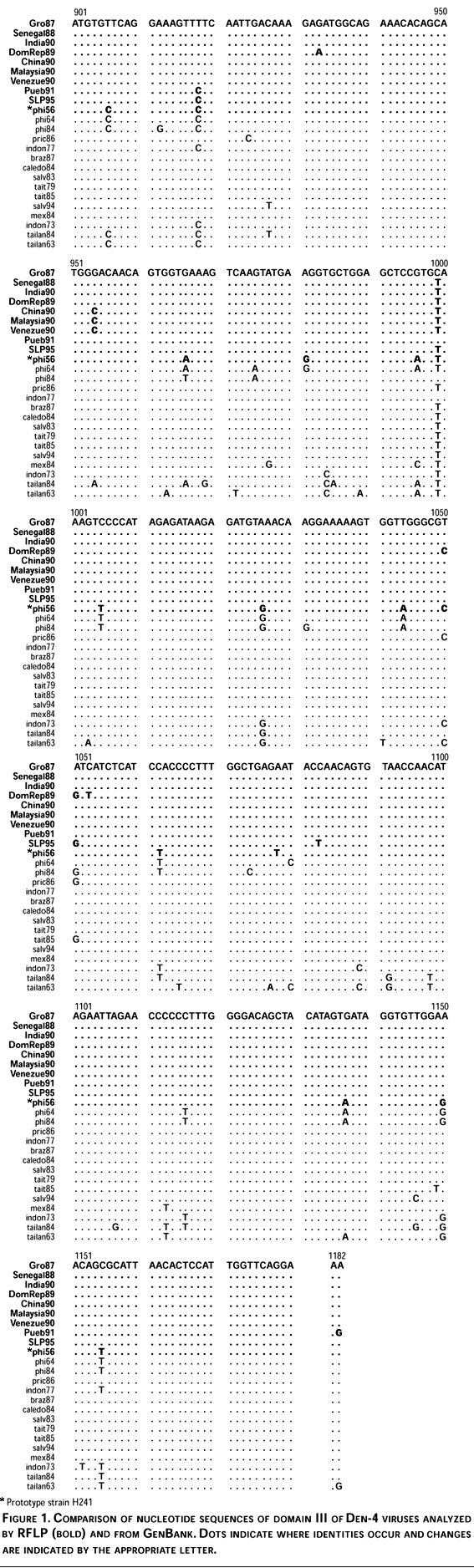
<body><![CDATA[<P align="left">Nucleotide and deduced amino acid sequences  encoding domain III  were obtained for 9 Den-4 viruses (<a href="#tab01">Table I</a>) and compared with 15 virus sequences from  the GenBank database. Sequence alignments were performed using the Wisconsin Package of the  Genetics Computer Group, Inc. Phylogenetic analysis was  done using the PAUP (Phylogenetic Analysis Using  Parsimony) program, with uniform character weights,  using branch and bound and heuristic search  algorithms for most parsimonious  trees;<SUP>26</SUP> sequences of serotypes 1, 2 and 3 were used to root the tree. The reliability  of the inferred tree was estimated using the  bootstrap method<SUP>17,19</SUP> with 100 replications, as described  by Felsenstein.<SUP>27</SUP>     <P align="left"><b>Restriction enzyme analysis</b>     <P align="left">Based on available Den-4 virus sequences; a  computer-based analysis using the GCG software  (Wisconsin Package, Genetics Computer Group, Inc.)  was performed to analyze polymorphism in domain  III region of envelope protein and six restriction  enzymes were chosen.  PCR products were digested with  the restriction enzymes Mae III, Alu I, Sac I, Nla III, Dde  I and Cfo I. Digestion reactions were performed  using 5-10 <font FACE="Symbol">m</font>l of PCR product, 2.5 <font FACE="Symbol">m</font>l of appropriate  buffer and 3 U of restriction enzyme in a final volume of  25 <font FACE="Symbol">m</font>l. The reaction was performed at 37 <sup>º</sup>C for 1 h for all enzymes, except for Mae III (55 <sup>º</sup>C, 1 h). Digestion products were separated by electrophoresis in a  3% agarose gel, stained with ethidium bromide and visualized under ultraviolet (UV) light.     <P align="left">&nbsp;     <P align="center"><font size="4">Results</font>     <P align="left">For phylogenetic analysis, nucleotide sequences  encompassing domain III (282 bp, 301-394 aa of E  protein) of 24 Den-4 virus strains were compared; sequences for 15 viruses were obtained from the  GenBank (accession numbers: U18425-U18428, U18430-U18436, U18438-U18440, U18442). To root the tree  the homologous domain III sequences for  serotypes 1,  2 and 3 were included: Nauru74 strain (M32904),  New Guinea44 (M29095), and Philippines56 strain  (L11423), respectively. Only 9 nucleotide sequences (<a href="#tab01">Table I</a>)  of Den-4 viruses used in this study were included in  the phylogenetic analysis. Three of them represent  viral isolates from dengue outbreaks occurring in  Mexico (strains: 0153/Guerrero87, 0047/Puebla91 and  SLP-01/SLP95) and from other parts of the world  (strains: DAKHD34460/Senegal88, 88609/Venezuela90,  BN-L8TV0259/China90,  LN72992/Malaysia90, TVP2177/Dominican Republic89 and 611319/India90).     <P align="left">     Mexican virus samples included in the  phylogenetic analysis are representative of DF outbreaks in  time and space.  The nucleotide sequences were  submitted to the GenBank (accession numbers: AF051104  to AF051112).     <P align="left">     Nucleotide sequence comparisons among all Den-4  viruses included in this study showed a maximum divergence of 9.3% within  Den-4 viruses.  Nucleotide differences along domain III region (282  nt) occurred at 52  positions (18.4%) and most of them  were silent. The region of maximum variability occurred  at nucleotide sequence 961-1080  with 29 of the 52  changes, 55.8% (<a href="#fig01">Figure 1</a>). The deduced aminoacid  sequence of domain III analysis showed eight changes&nbsp;(8.6%)  and occurred at positions: Cys-Tyr,<SUP>326</SUP>  Thr-Ala,<SUP>329</SUP> Glu-Gln,<SUP>330</SUP>  ILe-Val,<SUP>335</SUP> Arg-Lys,<SUP>344</SUP>  Val-Ile,<SUP>351</SUP> Tyr-Asn<SUP>360</SUP> and  Asp-Asn<SUP>384</SUP>  of E protein; most of these non-silent  changes occurred in the  above mentioned region  (961-1080 nt).     <P align="left">     <a name="fig01"></a>     <P align="left">&nbsp;          ]]></body>
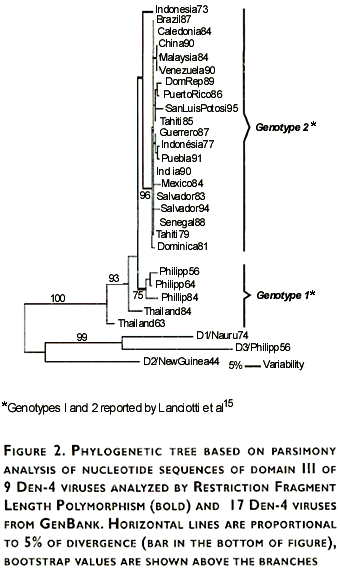
<body><![CDATA[<p align="center"><img src="/img/revistas/spm/v44n3/a06fig01.gif"></p>     <P align="left">&nbsp;          <P align="left">     Genetic variability and phylogenetic  relationships among sequenced viruses (<a href="#tab01">Table I</a>) and virus  sequences obtained from GenBank, were estimated and  graphically represented using the PAUP program (<a href="#fig02">Figure 2</a>). The resulting phylogenetic tree showed two  distinct groups: one including viruses only from Southeast  Asia (Philippines 1956,1964,1984; Thailand 1963,1984),  and the other including viruses from Asian countries,  Africa, Central America, and South America.     <P align="left">     <a name="fig02"></a>     <P align="left">&nbsp;          <p align="center"><img src="/img/revistas/spm/v44n3/a06fig02.gif"></p>     <P align="left">&nbsp;          <P align="left">     Even the short size of domain III and low  variability of E gene of Den-4 viruses in comparison  with the other serotypes<SUP>15</SUP>, phylogenetic analysis of  Den-4 using sequences of domain III provides  information that  makes it a suitable target for molecular  analysis using a different methodology instead of  nucleotide sequencing. Our  rationale was that domain III  of Den-4 viruses contains enough variability,  therefore genotypes could be  evidenced by  RFLP analysis.  As described in materials and methods, a  computer-based analysis for all restriction sites on domain III was  performed and six enzymes were chosen for RFLP  analysis (Mae III, Alu I,Sac I, Nla III, Dde I and Cfo I).     <P align="left">     Total RNA of all strains listed in <a href="#tab01"> Table I</a> was  extracted from serum or cell lysates and used for  RT-PCR amplification and restriction enzyme digestion,  however, representative RFLP results for only nine  isolates are presented. A similar pattern was obtained in  all samples treated with Mae III, Alu I and Sac I (data  not shown). However, for the Nla III restriction  enzyme, the expected sizes (305 nt and 99 nt) were  observed in all samples, except for Den-4 prototype H241  strain (Philippines, 1956) (<a href="#fig3a">Figure 3a</a>). In the case of  enzyme Dde I, all samples digested, except the  prototype, showed the same fragments (223 nt and 181 nt) (<a href="#fig3b">Figure 3b</a>). To confirm experimental results,  nucleotide sequence of strain H241 (GenBank accession  no. L11423) was analyzed  for all possible Nla III and  Dde I sites. Analysis showed 3 sites for Nla III  (expected fragment sizes of 259, 85, 46 and 14 nt) that agree  with our results. For Dde I two sites were found  (expected fragment sizes of 181, 167 and 56 nt), as in the Nla  III case, the expected sizes agree with our results.  Finally, the digestion with Cfo I showed the expected  fragments (304 nt and 100 nt), except for the prototype H241  and Dominican Republic strain (<a href="#fig3c">Figure 3c</a>). Both  prototype H241 and Dominican Republic viruses showed 3  different size fragments between them (197, 176 and  31 nt/ 197, 107 and 100 nt, respectively). This finding  was confirmed by sequence analysis&nbsp;of PCR fragments;  The Puerto Rican strain of Den-4 (GenBank accession  no. U18436) had a similar pattern with Cfo I when it  was analyzed by a computer program. In some cases,  the expected small fragments (e.g. the 31 nt fragment  for prototype H241 digested with Cfo I) were not  visualized in the agarose gel, however the restriction  enzyme cleavage sites were confirmed by nucleotide  sequence analysis.     <P align="left">     <a name="fig3a"></a>     ]]></body>
<body><![CDATA[<P align="left">&nbsp;          <p align="center"><img src="/img/revistas/spm/v44n3/a06fig3a.gif"></p>     <P align="left"><a name="fig3b"></a>     <p align="center"><img src="/img/revistas/spm/v44n3/a06fig3b.gif"></p>     <P align="left"><a name="fig3c"></a>     <p align="center"><img src="/img/revistas/spm/v44n3/a06fig3c.gif"></p>     <P align="left">&nbsp;     <P align="center"><font size="4">Discussion</font>     <P align="left">Genetic analysis of dengue viruses has been a  useful tool for monitoring the transmission of virus  genotypes associated with the appearance and/or the increase  of severe cases of the disease.<SUP>17</SUP> Sequence variation  and phylogenetic relationships among Den-4 viruses  was first reported by Chungue <I>et  al</I>,<SUP>14</SUP> showing a maximum divergence of 4.9% in nucleotide sequences of the  5' terminus of the nucleotides encoding the E  protein; however, genotypes could not be distinguished.  More recently, Lanciotti <I>et al</I><SUP>15</SUP> reported a maximum  nucleotide divergence of about 8% when E gene of  Den-4 viruses from diverse geographic regions were  compared, leading to their clustering in two genotypes.     <P align="left">     In order to analyze a genome region that can  provide phylogenetic information for Den-4 viruses  to differentiate genotypes, we used  the domain III of  the envelope protein. Our results showed a maximum  divergence of 9.3 % that is greater than the 8%  reported by Lanciotti <I>et al</I>,<SUP>15</SUP> considering that  domain III  region is less that 20% of the complete E gene. Our  results support those reported by Gritsun <I>et  al</I>,<SUP>24</SUP> who suggested that variability in envelope protein of  flaviviruses is not randomly distributed along the primary  sequence but is characterized by distinct variable  domains. This is a significant finding because the  E protein is the target for neutralizing antibodies and  T-cell responses and recently domain III of E protein  has been  identified as a key region during evolution  of dengue viruses and its adaptation to mosquitoes  and human hosts,<SUP>16</SUP> since several aminoacid changes  involved  in this evolution and adaptation process  are mapped into domain III.     ]]></body>
<body><![CDATA[<P align="left">     The phylogenetic tree generated using the  domain III sequences of Den-4 viruses (282 nt) showed  two genetic groups; all Den-4 virus included in this work   except prototype H241 strain (genotype 1), were  clustered in genotype 2, according to Lanciotti  <I>et al</I>.<SUP>15</SUP> These results indicated that a shorter sequence than the  entire E gene provide phylogenetic information,  which allows to distinguish Den-4 viruses genotypes 1 and 2.     <P align="left">     Sequencing of viral genes is a time-consuming  and expensive methodology that is impractical for the  analysis of a large number of  samples. In the present work   we  analyzed domain III of E protein by the RFLP  approach using 6 different restriction enzymes.  Den-4 viruses from Mexico and those from other parts of  the world (Senegal88, Venezuela90, China90,  Malaysia90, Dominican Republic89 and India90), showed  similar restriction patterns, except for Den-4 prototype  H241 (Philippines56) and Dominican Republic89 virus.  The prototype H241 virus had a different restriction  pattern with 3 out of 6 enzymes (Nla III, Dde I and Cfo  I) and the Dominican Republic strain showed a  different pattern only with Cfo I, which differs from that of  prototype H241 (<a href="#fig3a">Figure 3</a>). Although RFLP has some  limitations in its  interpretation, since results do  not directly correlate with more precise sequence  analysis, these results allowed us to rapidly classify  viruses into genotypes that correlate with classifications  suggested by others.<SUP>21</SUP> This approach has been used in  other viral studies, to quickly address  epidemiological questions.<SUP>28,29</SUP> Using information obtained from  restriction enzyme patterns of Nla III, Dde I and Cfo I,  we were able to cluster Den-4 viruses into genotypes 1  and 2;<SUP>15</SUP> however,  more virus isolates from genotype 1  of Den-4 are required to support the usefulness of the   RFLP analysis. In spite of few viruses analyzed  belonging to the Den-4 strains of genotype 1 with the  enzymes described above, a computer-based analysis of  the available GeneBank sequences of genotype 1  viruses, demonstrated that the same restriction sites  were present as in the prototype strain H241 analized  here (data not shown).     <P align="left">     To assess the relevance of the presence of  both Den-4 genotypes and their possible association  with severe manifestations of the disease, large  molecular epidemiological studies are needed. However, the  lack of  epidemiological studies of Den-4 epidemics in  Mexico makes it  difficult to have a clear distribution  of both genotypes, therefore this work  provides an  alternative methodology for Den-4 virus analysis.     <P align="left">     The transmission and human infection by  multiple dengue virus serotypes increases the risk for  severe disease and recently it has been shown that genotypes of the same serotype could play an  important role in the outcome of the   disease.<SUP>17,20</SUP> Since different environmental factors seem to increase the  risk of introducing new dengue virus genotypes into  areas where they did not previously exist, it is important  to screen multiple samples rapidly, to detect their  introduction into endemic areas. The RFLP analysis  described here could be an important research tool  to improve the detection of genetic variants of Den-4  virus. This information could also be used to  correlate the transmission of specific virus variants and the  risk for severe dengue outbreaks.     <P align="left">&nbsp;     <P align="center"><font size="4">Acknowledgements</font>     <P align="left">We thank Dr. Carlos Arias and Dr. Miguel Angel  Torres from the Instituto de Biotecnolog&iacute;a/Universidad  Nacional Aut&oacute;noma de M&eacute;xico, for their support in  nucleotide sequencing.     <P align="left">&nbsp;     <P align="center"><font size="4">References</font>     <!-- ref --><P align="left">1. Gubler DJ,  Clark GG. Dengue/dengue haemorrhagic fever: The  emergence of a global health problem. Emerg Infect Dis 1995;1:55-57.    &nbsp;&nbsp;&nbsp;&nbsp;&nbsp;&nbsp;&nbsp;&nbsp;[&#160;<a href="javascript:void(0);" onclick="javascript: window.open('/scielo.php?script=sci_nlinks&ref=9153699&pid=S0036-3634200200030000600001&lng=','','width=640,height=500,resizable=yes,scrollbars=1,menubar=yes,');">Links</a>&#160;]<!-- end-ref --><!-- ref --><P align="left">2. Monath TP. Dengue: The risk to developed and developing  countries. Proc Nat Acad Sci USA 1994;91:2395-2400.    &nbsp;&nbsp;&nbsp;&nbsp;&nbsp;&nbsp;&nbsp;&nbsp;[&#160;<a href="javascript:void(0);" onclick="javascript: window.open('/scielo.php?script=sci_nlinks&ref=9153700&pid=S0036-3634200200030000600002&lng=','','width=640,height=500,resizable=yes,scrollbars=1,menubar=yes,');">Links</a>&#160;]<!-- end-ref --><!-- ref --><P align="left">3. Gubler DJ,  Trent DW. Emergence of epidemic dengue/dengue  hemorrhagic fever as a public health problem in the Americas. Infect Agents  Dis<I> </I>1994;2:383-393.    &nbsp;&nbsp;&nbsp;&nbsp;&nbsp;&nbsp;&nbsp;&nbsp;[&#160;<a href="javascript:void(0);" onclick="javascript: window.open('/scielo.php?script=sci_nlinks&ref=9153701&pid=S0036-3634200200030000600003&lng=','','width=640,height=500,resizable=yes,scrollbars=1,menubar=yes,');">Links</a>&#160;]<!-- end-ref --><!-- ref --><P align="left">4. Brice&ntilde;o-Garc&iacute;a B, G&oacute;mez-Dant&eacute;s H, Argott-Ram&iacute;rez E, Montesano  R, V&aacute;zquez-Mart&iacute;nez AL, Ib&aacute;&ntilde;ez-Bernal S  <I>et al</I>.  Potential risk for dengue hemorrhagic fever&nbsp;: The isolation of serotype dengue-3 in Mexico.  Emerg Infect Dis 1996;2:133-135.    &nbsp;&nbsp;&nbsp;&nbsp;&nbsp;&nbsp;&nbsp;&nbsp;[&#160;<a href="javascript:void(0);" onclick="javascript: window.open('/scielo.php?script=sci_nlinks&ref=9153702&pid=S0036-3634200200030000600004&lng=','','width=640,height=500,resizable=yes,scrollbars=1,menubar=yes,');">Links</a>&#160;]<!-- end-ref --><!-- ref --><P align="left">5. Monath TP, Heinz FX. <I>Flaviviruses</I>. in: Virology. 3rd Ed. Fields B N,  Knipe DM, Holay PM, ed. Filadelfia Lippincott-Raven (PA)1996: 1002.    &nbsp;&nbsp;&nbsp;&nbsp;&nbsp;&nbsp;&nbsp;&nbsp;[&#160;<a href="javascript:void(0);" onclick="javascript: window.open('/scielo.php?script=sci_nlinks&ref=9153703&pid=S0036-3634200200030000600005&lng=','','width=640,height=500,resizable=yes,scrollbars=1,menubar=yes,');">Links</a>&#160;]<!-- end-ref --><!-- ref --><P align="left">6.  Loro&ntilde;o PM, Farf&aacute;n AJ, Rosado PE, Kuno G, Gubler DJ. Epidemic  of dengue in the Yucat&aacute;n, M&eacute;xico. Rev  Inst Med Trop Sao Paulo 1993;35: 449-455.    &nbsp;&nbsp;&nbsp;&nbsp;&nbsp;&nbsp;&nbsp;&nbsp;[&#160;<a href="javascript:void(0);" onclick="javascript: window.open('/scielo.php?script=sci_nlinks&ref=9153704&pid=S0036-3634200200030000600006&lng=','','width=640,height=500,resizable=yes,scrollbars=1,menubar=yes,');">Links</a>&#160;]<!-- end-ref --><!-- ref --><P align="left">7. Ramos C, S&aacute;nchez G, Hern&aacute;ndez-Pando R, Baquera J, Hern&aacute;ndez  D, Mota J <I>et al</I> E. Dengue virus in the brain of a fatal case of  hemorrhagic dengue fever. J Neurovirol 1998;4:465-468.    &nbsp;&nbsp;&nbsp;&nbsp;&nbsp;&nbsp;&nbsp;&nbsp;[&#160;<a href="javascript:void(0);" onclick="javascript: window.open('/scielo.php?script=sci_nlinks&ref=9153705&pid=S0036-3634200200030000600007&lng=','','width=640,height=500,resizable=yes,scrollbars=1,menubar=yes,');">Links</a>&#160;]<!-- end-ref --><!-- ref --><P align="left">8. Henchal EA, Repik PM, McCown JM, Brandt WE. Identification of  an antigenic and genetic variant of dengue-4 virus from the Caribbean. Am  J Trop Med Hyg 1986;35:393-400.    &nbsp;&nbsp;&nbsp;&nbsp;&nbsp;&nbsp;&nbsp;&nbsp;[&#160;<a href="javascript:void(0);" onclick="javascript: window.open('/scielo.php?script=sci_nlinks&ref=9153706&pid=S0036-3634200200030000600008&lng=','','width=640,height=500,resizable=yes,scrollbars=1,menubar=yes,');">Links</a>&#160;]<!-- end-ref --><!-- ref --><P align="left">9. Blok J, Samuel S, Gibbs AJ,  Vitarana UT. Variation of the nucleotide  and encoded aminoacid sequences of the envelope gene from eight dengue  2 viruses. Arch   Virol 1989;105:39-53.    &nbsp;&nbsp;&nbsp;&nbsp;&nbsp;&nbsp;&nbsp;&nbsp;[&#160;<a href="javascript:void(0);" onclick="javascript: window.open('/scielo.php?script=sci_nlinks&ref=9153707&pid=S0036-3634200200030000600009&lng=','','width=640,height=500,resizable=yes,scrollbars=1,menubar=yes,');">Links</a>&#160;]<!-- end-ref --><!-- ref --><P align="left">10. Rico-Hesse R. Molecular evolution and distribution of dengue  viruses type 1 and 2 in nature. Virology 1990;174:001-0015.    &nbsp;&nbsp;&nbsp;&nbsp;&nbsp;&nbsp;&nbsp;&nbsp;[&#160;<a href="javascript:void(0);" onclick="javascript: window.open('/scielo.php?script=sci_nlinks&ref=9153708&pid=S0036-3634200200030000600010&lng=','','width=640,height=500,resizable=yes,scrollbars=1,menubar=yes,');">Links</a>&#160;]<!-- end-ref --><!-- ref --><P align="left">11. Lewis JA, Chang JG, Lanciotti RS, Kinney RK, Mayer LW, Trent  DW. Phylogenetic relationships of dengue-2 viruses.  Virology<I> </I>1993;197:216-224.    &nbsp;&nbsp;&nbsp;&nbsp;&nbsp;&nbsp;&nbsp;&nbsp;[&#160;<a href="javascript:void(0);" onclick="javascript: window.open('/scielo.php?script=sci_nlinks&ref=9153709&pid=S0036-3634200200030000600011&lng=','','width=640,height=500,resizable=yes,scrollbars=1,menubar=yes,');">Links</a>&#160;]<!-- end-ref --><!-- ref --><p align="left"> 12. Chungue E, Cassar O, Drouet MT, Guzm&aacute;n MG, Laille M, Rosen L  <I>et al</I>. Molecular epidemiology of dengue 3 viruses and genetic relatedness  among dengue 3 strains isolated from patients with mild or severe form of  dengue fever in French Polynesia. J  Gen Virol<I>  </I> 1993;74:2765-2770.    &nbsp;&nbsp;&nbsp;&nbsp;&nbsp;&nbsp;&nbsp;&nbsp;[&#160;<a href="javascript:void(0);" onclick="javascript: window.open('/scielo.php?script=sci_nlinks&ref=9153710&pid=S0036-3634200200030000600012&lng=','','width=640,height=500,resizable=yes,scrollbars=1,menubar=yes,');">Links</a>&#160;]<!-- end-ref --><!-- ref --><P align="left">13. Lanciotti RS, Lewis JG, Gubler DJ, Trent DW.  Molecular evolution  and epidemiology of dengue-3 viruses. J Virol 1994;75:65-75.    &nbsp;&nbsp;&nbsp;&nbsp;&nbsp;&nbsp;&nbsp;&nbsp;[&#160;<a href="javascript:void(0);" onclick="javascript: window.open('/scielo.php?script=sci_nlinks&ref=9153711&pid=S0036-3634200200030000600013&lng=','','width=640,height=500,resizable=yes,scrollbars=1,menubar=yes,');">Links</a>&#160;]<!-- end-ref --><!-- ref --><P align="left">14. Chungue E, Cassar O, Drouet MT, Guzm&aacute;n MG, Laille M, Rosen L  <I>et al</I>. Molecular epidemiology of dengue-1 and dengue-4  viruses.<I> </I>J Gen Virol 1995; 76:1877-1884.    &nbsp;&nbsp;&nbsp;&nbsp;&nbsp;&nbsp;&nbsp;&nbsp;[&#160;<a href="javascript:void(0);" onclick="javascript: window.open('/scielo.php?script=sci_nlinks&ref=9153712&pid=S0036-3634200200030000600014&lng=','','width=640,height=500,resizable=yes,scrollbars=1,menubar=yes,');">Links</a>&#160;]<!-- end-ref --><!-- ref --><P align="left">15. Lanciotti RS, Gubler DJ, Trent DW. Molecular evolution and  phylogeny of dengue-4 viruses. J Gen Virol 1997;78:2279-2286.    &nbsp;&nbsp;&nbsp;&nbsp;&nbsp;&nbsp;&nbsp;&nbsp;[&#160;<a href="javascript:void(0);" onclick="javascript: window.open('/scielo.php?script=sci_nlinks&ref=9153713&pid=S0036-3634200200030000600015&lng=','','width=640,height=500,resizable=yes,scrollbars=1,menubar=yes,');">Links</a>&#160;]<!-- end-ref --><!-- ref --><P align="left">16. Wang E, Ni H, Xu R, Barrett AD, Watowich SJ, Gubler DJ  <I>et al</I>. Evolutionary relationships of  endemic/epidemic and selvatic dengue viruses.  J Virol 2000;74:3227-3234.    &nbsp;&nbsp;&nbsp;&nbsp;&nbsp;&nbsp;&nbsp;&nbsp;[&#160;<a href="javascript:void(0);" onclick="javascript: window.open('/scielo.php?script=sci_nlinks&ref=9153714&pid=S0036-3634200200030000600016&lng=','','width=640,height=500,resizable=yes,scrollbars=1,menubar=yes,');">Links</a>&#160;]<!-- end-ref --><!-- ref --><P align="left">17. Rico-Hesse R,  Harrison LM, Salas RA, Tovar D, Nisalak A, Ramos C  <I>et al</I>. Origins of dengue type 2 viruses associated with increased  pathogenicity in the Americas. Virology 1997; 230:244-251.    &nbsp;&nbsp;&nbsp;&nbsp;&nbsp;&nbsp;&nbsp;&nbsp;[&#160;<a href="javascript:void(0);" onclick="javascript: window.open('/scielo.php?script=sci_nlinks&ref=9153715&pid=S0036-3634200200030000600017&lng=','','width=640,height=500,resizable=yes,scrollbars=1,menubar=yes,');">Links</a>&#160;]<!-- end-ref --><!-- ref --><P align="left">18. Beaty BJ. Virus variation and evolution mechanisms and  epidemiological significance. En: Monath TP, ed. The arboviruses: Epidemiology  and ecology. Boca Raton (FL): CRC Press, 1988: 59-85.    &nbsp;&nbsp;&nbsp;&nbsp;&nbsp;&nbsp;&nbsp;&nbsp;[&#160;<a href="javascript:void(0);" onclick="javascript: window.open('/scielo.php?script=sci_nlinks&ref=9153716&pid=S0036-3634200200030000600018&lng=','','width=640,height=500,resizable=yes,scrollbars=1,menubar=yes,');">Links</a>&#160;]<!-- end-ref --><!-- ref --><P align="left">19. Leitmeyer KC, Vaughn DW, Watts DM, Salas R, Chac&oacute;n IV, Ramos C  <I>et al</I>. Dengue virus structural differences that correlate with pathogenesis.  J Virol 1999;73:4738-4747.    &nbsp;&nbsp;&nbsp;&nbsp;&nbsp;&nbsp;&nbsp;&nbsp;[&#160;<a href="javascript:void(0);" onclick="javascript: window.open('/scielo.php?script=sci_nlinks&ref=9153717&pid=S0036-3634200200030000600019&lng=','','width=640,height=500,resizable=yes,scrollbars=1,menubar=yes,');">Links</a>&#160;]<!-- end-ref --><!-- ref --><P align="left">20. Watts DM, Porter KR, Putvatana P,  V&aacute;squez B,  Calampa C, Hayes  CG <I>et al.</I> Failure of secondary infection with American genotype dengue 2  to cause dengue haemorrhagic fever. Lancet 1999;354:1431-1434.    &nbsp;&nbsp;&nbsp;&nbsp;&nbsp;&nbsp;&nbsp;&nbsp;[&#160;<a href="javascript:void(0);" onclick="javascript: window.open('/scielo.php?script=sci_nlinks&ref=9153718&pid=S0036-3634200200030000600020&lng=','','width=640,height=500,resizable=yes,scrollbars=1,menubar=yes,');">Links</a>&#160;]<!-- end-ref --><!-- ref --><P align="left">21. Vorndam V, Kuno G, Rosado N. A PCR-restriction enzyme  technique for determining dengue virus subgroups within serotypes. J Virol  Methods 1994; 48:237-244.    &nbsp;&nbsp;&nbsp;&nbsp;&nbsp;&nbsp;&nbsp;&nbsp;[&#160;<a href="javascript:void(0);" onclick="javascript: window.open('/scielo.php?script=sci_nlinks&ref=9153719&pid=S0036-3634200200030000600021&lng=','','width=640,height=500,resizable=yes,scrollbars=1,menubar=yes,');">Links</a>&#160;]<!-- end-ref --><!-- ref --><P align="left">22. Trent DW, Grant JA, Rosen L, Monath TP. Genetic variation  among dengue 2 viruses of different geographic origin. Virology  1983;128:271-284.    &nbsp;&nbsp;&nbsp;&nbsp;&nbsp;&nbsp;&nbsp;&nbsp;[&#160;<a href="javascript:void(0);" onclick="javascript: window.open('/scielo.php?script=sci_nlinks&ref=9153720&pid=S0036-3634200200030000600022&lng=','','width=640,height=500,resizable=yes,scrollbars=1,menubar=yes,');">Links</a>&#160;]<!-- end-ref --><!-- ref --><P align="left">23. Rey FA, Heinz FX, Mandl C, Kunz C, Harrison SC. The envelope  glycoprotein from tick-borne encephalitis virus at 2 &Aring; resolution.  Nature<I> </I>1995;375:291-298.    &nbsp;&nbsp;&nbsp;&nbsp;&nbsp;&nbsp;&nbsp;&nbsp;[&#160;<a href="javascript:void(0);" onclick="javascript: window.open('/scielo.php?script=sci_nlinks&ref=9153721&pid=S0036-3634200200030000600023&lng=','','width=640,height=500,resizable=yes,scrollbars=1,menubar=yes,');">Links</a>&#160;]<!-- end-ref --><!-- ref --><P align="left">24. Gritsun TS, Holmes EC, Gould E. Analysis of flavivirus envelope  proteins reveals variable domains that reflect their antigenicity and may  determine their pathogenesis. Virus Res 1995;35:307-321.    &nbsp;&nbsp;&nbsp;&nbsp;&nbsp;&nbsp;&nbsp;&nbsp;[&#160;<a href="javascript:void(0);" onclick="javascript: window.open('/scielo.php?script=sci_nlinks&ref=9153722&pid=S0036-3634200200030000600024&lng=','','width=640,height=500,resizable=yes,scrollbars=1,menubar=yes,');">Links</a>&#160;]<!-- end-ref --><!-- ref --><P align="left">25.Gubler DJ,  Kuno G, Sather GE, V&eacute;lez M, Oliver A. Mosquito cell  cultures and specific monoclonal antibodies in surveillance for dengue  viruses. Am J Trop Med Hyg 1984;33:158-165.    &nbsp;&nbsp;&nbsp;&nbsp;&nbsp;&nbsp;&nbsp;&nbsp;[&#160;<a href="javascript:void(0);" onclick="javascript: window.open('/scielo.php?script=sci_nlinks&ref=9153723&pid=S0036-3634200200030000600025&lng=','','width=640,height=500,resizable=yes,scrollbars=1,menubar=yes,');">Links</a>&#160;]<!-- end-ref --><!-- ref --><P align="left">26. Swofford D. AUP: Phylogenetic analysis using parsimony. Version  3.1.1 Champaign (IL): Illinois Natural History Survey, 1993.    &nbsp;&nbsp;&nbsp;&nbsp;&nbsp;&nbsp;&nbsp;&nbsp;[&#160;<a href="javascript:void(0);" onclick="javascript: window.open('/scielo.php?script=sci_nlinks&ref=9153724&pid=S0036-3634200200030000600026&lng=','','width=640,height=500,resizable=yes,scrollbars=1,menubar=yes,');">Links</a>&#160;]<!-- end-ref --><!-- ref --><P align="left">27. Felsenstein J. Confidence limits on phylogenies:  An approach using  the bootstrap. Evolution 1985;39:783-791.    &nbsp;&nbsp;&nbsp;&nbsp;&nbsp;&nbsp;&nbsp;&nbsp;[&#160;<a href="javascript:void(0);" onclick="javascript: window.open('/scielo.php?script=sci_nlinks&ref=9153725&pid=S0036-3634200200030000600027&lng=','','width=640,height=500,resizable=yes,scrollbars=1,menubar=yes,');">Links</a>&#160;]<!-- end-ref --><!-- ref --><P align="left">28. Vonsover A, Hansher R, Neuman M, Guillot S, Balanant J, Rudich H  <I>et al</I>. Molecular epidemiology of type 1 Polioviruses isolated in Israel and  defined by restriction fragment length polymorphism assay. J Infect Dis   1993; 167:199-203.    &nbsp;&nbsp;&nbsp;&nbsp;&nbsp;&nbsp;&nbsp;&nbsp;[&#160;<a href="javascript:void(0);" onclick="javascript: window.open('/scielo.php?script=sci_nlinks&ref=9153726&pid=S0036-3634200200030000600028&lng=','','width=640,height=500,resizable=yes,scrollbars=1,menubar=yes,');">Links</a>&#160;]<!-- end-ref --><!-- ref --><P align="left">29. Wu JC, Chiang TY,  Sheen IJ. Characterization and phylogenetic  analysis of a novel hepatitis D virus strain discovered by restriction fragment  length polymorphism analysis<I>. </I>J Gen Virol 1998;79:1105-1113.    &nbsp;&nbsp;&nbsp;&nbsp;&nbsp;&nbsp;&nbsp;&nbsp;[&#160;<a href="javascript:void(0);" onclick="javascript: window.open('/scielo.php?script=sci_nlinks&ref=9153727&pid=S0036-3634200200030000600029&lng=','','width=640,height=500,resizable=yes,scrollbars=1,menubar=yes,');">Links</a>&#160;]<!-- end-ref --><p align="left">&nbsp;     <p align="left">&nbsp;</p>     ]]></body>
<body><![CDATA[<p align="left"><a name="nota"></a>(<a href="#texto">1</a>)     Departamento de Arbovirus, Centro de Investigaci&oacute;n sobre Enfermedades Infecciosas, Instituto Nacional de Salud P&uacute;blica, Cuernavaca,  Morelos, M&eacute;xico.</p>     <P align="left">(<a href="#texto">2</a>)     Department of Virology and Immunology, Southwest Foundation for Biomedical Research, San Antonio, Texas 78245, USA.     <P align="left">&nbsp;     <P align="center"><B>Received on</B>: April 17, 2001 <font FACE="Symbol">·</font> <B>Accepted  on</B>: October 30, 2001    <br> Address reprint requests to: Dr. Celso Ramos. Area de Enfermedades Transmitidas por Vectores, CISEI/ INSP. Av. Universidad No. 655, Colonia Santa Mar&iacute;a Ahuacatitl&aacute;n, 62508 Cuernavaca, Morelos, M&eacute;xico.    <br> E-mail: <a href="mailto:cramos@correo.insp.mx"> cramos@correo.insp.mx</a>      ]]></body><back>
<ref-list>
<ref id="B1">
<label>1</label><nlm-citation citation-type="journal">
<person-group person-group-type="author">
<name>
<surname><![CDATA[Gubler]]></surname>
<given-names><![CDATA[DJ]]></given-names>
</name>
<name>
<surname><![CDATA[Clark]]></surname>
<given-names><![CDATA[GG]]></given-names>
</name>
</person-group>
<article-title xml:lang="en"><![CDATA[Dengue/dengue haemorrhagic fever: The emergence of a global health problem]]></article-title>
<source><![CDATA[Emerg Infect Dis]]></source>
<year>1995</year>
<volume>1</volume>
<page-range>55-57</page-range></nlm-citation>
</ref>
<ref id="B2">
<label>2</label><nlm-citation citation-type="journal">
<person-group person-group-type="author">
<name>
<surname><![CDATA[Monath]]></surname>
<given-names><![CDATA[TP]]></given-names>
</name>
</person-group>
<article-title xml:lang="en"><![CDATA[Dengue: The risk to developed and developing countries]]></article-title>
<source><![CDATA[Proc Nat Acad Sci USA]]></source>
<year>1994</year>
<volume>91</volume>
<page-range>2395-2400</page-range></nlm-citation>
</ref>
<ref id="B3">
<label>3</label><nlm-citation citation-type="journal">
<person-group person-group-type="author">
<name>
<surname><![CDATA[Gubler]]></surname>
<given-names><![CDATA[DJ]]></given-names>
</name>
<name>
<surname><![CDATA[Trent]]></surname>
<given-names><![CDATA[DW]]></given-names>
</name>
</person-group>
<article-title xml:lang="en"><![CDATA[Emergence of epidemic dengue/dengue hemorrhagic fever as a public health problem in the Americas]]></article-title>
<source><![CDATA[Infect Agents Dis]]></source>
<year>1994</year>
<volume>2</volume>
<page-range>383-393</page-range></nlm-citation>
</ref>
<ref id="B4">
<label>4</label><nlm-citation citation-type="journal">
<person-group person-group-type="author">
<name>
<surname><![CDATA[Briceño-García]]></surname>
<given-names><![CDATA[B]]></given-names>
</name>
<name>
<surname><![CDATA[Gómez-Dantés]]></surname>
<given-names><![CDATA[H]]></given-names>
</name>
<name>
<surname><![CDATA[Argott-Ramírez]]></surname>
<given-names><![CDATA[E]]></given-names>
</name>
<name>
<surname><![CDATA[Montesano]]></surname>
<given-names><![CDATA[R]]></given-names>
</name>
<name>
<surname><![CDATA[Vázquez-Martínez]]></surname>
<given-names><![CDATA[AL]]></given-names>
</name>
<name>
<surname><![CDATA[Ibáñez-Bernal]]></surname>
<given-names><![CDATA[S]]></given-names>
</name>
</person-group>
<article-title xml:lang="en"><![CDATA[Potential risk for dengue hemorrhagic fever: The isolation of serotype dengue-3 in Mexico]]></article-title>
<source><![CDATA[Emerg Infect Dis]]></source>
<year>1996</year>
<volume>2</volume>
<page-range>133-135</page-range></nlm-citation>
</ref>
<ref id="B5">
<label>5</label><nlm-citation citation-type="book">
<person-group person-group-type="author">
<name>
<surname><![CDATA[Monath]]></surname>
<given-names><![CDATA[TP]]></given-names>
</name>
<name>
<surname><![CDATA[Heinz]]></surname>
<given-names><![CDATA[FX]]></given-names>
</name>
</person-group>
<article-title xml:lang="en"><![CDATA[Flaviviruses]]></article-title>
<person-group person-group-type="editor">
<name>
<surname><![CDATA[Fields]]></surname>
<given-names><![CDATA[B N]]></given-names>
</name>
<name>
<surname><![CDATA[Knipe]]></surname>
<given-names><![CDATA[DM]]></given-names>
</name>
<name>
<surname><![CDATA[Holay]]></surname>
<given-names><![CDATA[PM]]></given-names>
</name>
</person-group>
<source><![CDATA[Virology]]></source>
<year>1996</year>
<edition>3</edition>
<page-range>1002</page-range><publisher-loc><![CDATA[Filadelfia^ePA PA]]></publisher-loc>
<publisher-name><![CDATA[Lippincott-Raven]]></publisher-name>
</nlm-citation>
</ref>
<ref id="B6">
<label>6</label><nlm-citation citation-type="journal">
<person-group person-group-type="author">
<name>
<surname><![CDATA[Loroño]]></surname>
<given-names><![CDATA[PM]]></given-names>
</name>
<name>
<surname><![CDATA[Farfán]]></surname>
<given-names><![CDATA[AJ]]></given-names>
</name>
<name>
<surname><![CDATA[Rosado]]></surname>
<given-names><![CDATA[PE]]></given-names>
</name>
<name>
<surname><![CDATA[Kuno]]></surname>
<given-names><![CDATA[G]]></given-names>
</name>
<name>
<surname><![CDATA[Gubler]]></surname>
<given-names><![CDATA[DJ]]></given-names>
</name>
</person-group>
<article-title xml:lang="en"><![CDATA[Epidemic of dengue in the Yucatán, México]]></article-title>
<source><![CDATA[Rev Inst Med Trop Sao Paulo]]></source>
<year>1993</year>
<volume>35</volume>
<page-range>449-455</page-range></nlm-citation>
</ref>
<ref id="B7">
<label>7</label><nlm-citation citation-type="journal">
<person-group person-group-type="author">
<name>
<surname><![CDATA[Ramos]]></surname>
<given-names><![CDATA[C]]></given-names>
</name>
<name>
<surname><![CDATA[Sánchez]]></surname>
<given-names><![CDATA[G]]></given-names>
</name>
<name>
<surname><![CDATA[Hernández-Pando]]></surname>
<given-names><![CDATA[R]]></given-names>
</name>
<name>
<surname><![CDATA[Baquera]]></surname>
<given-names><![CDATA[J]]></given-names>
</name>
<name>
<surname><![CDATA[Hernández]]></surname>
<given-names><![CDATA[D]]></given-names>
</name>
<name>
<surname><![CDATA[Mota]]></surname>
<given-names><![CDATA[J]]></given-names>
</name>
</person-group>
<article-title xml:lang="en"><![CDATA[Dengue virus in the brain of a fatal case of hemorrhagic dengue fever]]></article-title>
<source><![CDATA[J Neurovirol]]></source>
<year>1998</year>
<volume>4</volume>
<page-range>465-468</page-range></nlm-citation>
</ref>
<ref id="B8">
<label>8</label><nlm-citation citation-type="journal">
<person-group person-group-type="author">
<name>
<surname><![CDATA[Henchal]]></surname>
<given-names><![CDATA[EA]]></given-names>
</name>
<name>
<surname><![CDATA[Repik]]></surname>
<given-names><![CDATA[PM]]></given-names>
</name>
<name>
<surname><![CDATA[McCown]]></surname>
<given-names><![CDATA[JM]]></given-names>
</name>
<name>
<surname><![CDATA[Brandt]]></surname>
<given-names><![CDATA[WE]]></given-names>
</name>
</person-group>
<article-title xml:lang="en"><![CDATA[Identification of an antigenic and genetic variant of dengue-4 virus from the Caribbean]]></article-title>
<source><![CDATA[Am J Trop Med Hyg]]></source>
<year>1986</year>
<volume>35</volume>
<page-range>393-400</page-range></nlm-citation>
</ref>
<ref id="B9">
<label>9</label><nlm-citation citation-type="journal">
<person-group person-group-type="author">
<name>
<surname><![CDATA[Blok]]></surname>
<given-names><![CDATA[J]]></given-names>
</name>
<name>
<surname><![CDATA[Samuel]]></surname>
<given-names><![CDATA[S]]></given-names>
</name>
<name>
<surname><![CDATA[Gibbs]]></surname>
<given-names><![CDATA[AJ]]></given-names>
</name>
<name>
<surname><![CDATA[Vitarana]]></surname>
<given-names><![CDATA[UT]]></given-names>
</name>
</person-group>
<article-title xml:lang="en"><![CDATA[Variation of the nucleotide and encoded aminoacid sequences of the envelope gene from eight dengue 2 viruses]]></article-title>
<source><![CDATA[Arch Virol]]></source>
<year>1989</year>
<volume>105</volume>
<page-range>39-53</page-range></nlm-citation>
</ref>
<ref id="B10">
<label>10</label><nlm-citation citation-type="journal">
<person-group person-group-type="author">
<name>
<surname><![CDATA[Rico-Hesse]]></surname>
<given-names><![CDATA[R]]></given-names>
</name>
</person-group>
<article-title xml:lang="en"><![CDATA[Molecular evolution and distribution of dengue viruses type 1 and 2 in nature]]></article-title>
<source><![CDATA[Virology]]></source>
<year>1990</year>
<volume>174</volume>
<page-range>001-0015</page-range></nlm-citation>
</ref>
<ref id="B11">
<label>11</label><nlm-citation citation-type="journal">
<person-group person-group-type="author">
<name>
<surname><![CDATA[Lewis]]></surname>
<given-names><![CDATA[JA]]></given-names>
</name>
<name>
<surname><![CDATA[Chang]]></surname>
<given-names><![CDATA[JG]]></given-names>
</name>
<name>
<surname><![CDATA[Lanciotti]]></surname>
<given-names><![CDATA[RS]]></given-names>
</name>
<name>
<surname><![CDATA[Kinney]]></surname>
<given-names><![CDATA[RK]]></given-names>
</name>
<name>
<surname><![CDATA[Mayer]]></surname>
<given-names><![CDATA[LW]]></given-names>
</name>
<name>
<surname><![CDATA[Trent]]></surname>
<given-names><![CDATA[DW]]></given-names>
</name>
</person-group>
<article-title xml:lang="en"><![CDATA[Phylogenetic relationships of dengue-2 viruses]]></article-title>
<source><![CDATA[Virology]]></source>
<year>1993</year>
<volume>197</volume>
<page-range>216-224</page-range></nlm-citation>
</ref>
<ref id="B12">
<label>12</label><nlm-citation citation-type="journal">
<person-group person-group-type="author">
<name>
<surname><![CDATA[Chungue]]></surname>
<given-names><![CDATA[E]]></given-names>
</name>
<name>
<surname><![CDATA[Cassar]]></surname>
<given-names><![CDATA[O]]></given-names>
</name>
<name>
<surname><![CDATA[Drouet]]></surname>
<given-names><![CDATA[MT]]></given-names>
</name>
<name>
<surname><![CDATA[Guzmán]]></surname>
<given-names><![CDATA[MG]]></given-names>
</name>
<name>
<surname><![CDATA[Laille]]></surname>
<given-names><![CDATA[M]]></given-names>
</name>
<name>
<surname><![CDATA[Rosen]]></surname>
<given-names><![CDATA[L]]></given-names>
</name>
</person-group>
<article-title xml:lang="en"><![CDATA[Molecular epidemiology of dengue 3 viruses and genetic relatedness among dengue 3 strains isolated from patients with mild or severe form of dengue fever in French Polynesia]]></article-title>
<source><![CDATA[J Gen Virol]]></source>
<year>1993</year>
<volume>74</volume>
<page-range>2765-2770</page-range></nlm-citation>
</ref>
<ref id="B13">
<label>13</label><nlm-citation citation-type="journal">
<person-group person-group-type="author">
<name>
<surname><![CDATA[Lanciotti]]></surname>
<given-names><![CDATA[RS]]></given-names>
</name>
<name>
<surname><![CDATA[Lewis]]></surname>
<given-names><![CDATA[JG]]></given-names>
</name>
<name>
<surname><![CDATA[Gubler]]></surname>
<given-names><![CDATA[DJ]]></given-names>
</name>
<name>
<surname><![CDATA[Trent]]></surname>
<given-names><![CDATA[DW]]></given-names>
</name>
</person-group>
<article-title xml:lang="en"><![CDATA[Molecular evolution and epidemiology of dengue-3 viruses]]></article-title>
<source><![CDATA[J Virol]]></source>
<year>1994</year>
<volume>75</volume>
<page-range>65-75</page-range></nlm-citation>
</ref>
<ref id="B14">
<label>14</label><nlm-citation citation-type="journal">
<person-group person-group-type="author">
<name>
<surname><![CDATA[Chungue]]></surname>
<given-names><![CDATA[E]]></given-names>
</name>
<name>
<surname><![CDATA[Cassar]]></surname>
<given-names><![CDATA[O]]></given-names>
</name>
<name>
<surname><![CDATA[Drouet]]></surname>
<given-names><![CDATA[MT]]></given-names>
</name>
<name>
<surname><![CDATA[Guzmán]]></surname>
<given-names><![CDATA[MG]]></given-names>
</name>
<name>
<surname><![CDATA[Laille]]></surname>
<given-names><![CDATA[M]]></given-names>
</name>
<name>
<surname><![CDATA[Rosen]]></surname>
<given-names><![CDATA[L]]></given-names>
</name>
</person-group>
<article-title xml:lang="en"><![CDATA[Molecular epidemiology of dengue-1 and dengue-4 viruses]]></article-title>
<source><![CDATA[J Gen Virol]]></source>
<year>1995</year>
<volume>76</volume>
<page-range>1877-1884</page-range></nlm-citation>
</ref>
<ref id="B15">
<label>15</label><nlm-citation citation-type="journal">
<person-group person-group-type="author">
<name>
<surname><![CDATA[Lanciotti]]></surname>
<given-names><![CDATA[RS]]></given-names>
</name>
<name>
<surname><![CDATA[Gubler]]></surname>
<given-names><![CDATA[DJ]]></given-names>
</name>
<name>
<surname><![CDATA[Trent]]></surname>
<given-names><![CDATA[DW]]></given-names>
</name>
</person-group>
<article-title xml:lang="en"><![CDATA[Molecular evolution and phylogeny of dengue-4 viruses]]></article-title>
<source><![CDATA[J Gen Virol]]></source>
<year>1997</year>
<volume>78</volume>
<page-range>2279-2286</page-range></nlm-citation>
</ref>
<ref id="B16">
<label>16</label><nlm-citation citation-type="journal">
<person-group person-group-type="author">
<name>
<surname><![CDATA[Wang]]></surname>
<given-names><![CDATA[E]]></given-names>
</name>
<name>
<surname><![CDATA[Ni]]></surname>
<given-names><![CDATA[H]]></given-names>
</name>
<name>
<surname><![CDATA[Xu]]></surname>
<given-names><![CDATA[R]]></given-names>
</name>
<name>
<surname><![CDATA[Barrett]]></surname>
<given-names><![CDATA[AD]]></given-names>
</name>
<name>
<surname><![CDATA[Watowich]]></surname>
<given-names><![CDATA[SJ]]></given-names>
</name>
<name>
<surname><![CDATA[Gubler]]></surname>
<given-names><![CDATA[DJ]]></given-names>
</name>
</person-group>
<article-title xml:lang="en"><![CDATA[Evolutionary relationships of endemic/epidemic and selvatic dengue viruses]]></article-title>
<source><![CDATA[J Virol]]></source>
<year>2000</year>
<volume>74</volume>
<page-range>3227-3234</page-range></nlm-citation>
</ref>
<ref id="B17">
<label>17</label><nlm-citation citation-type="journal">
<person-group person-group-type="author">
<name>
<surname><![CDATA[Rico-Hesse]]></surname>
<given-names><![CDATA[R]]></given-names>
</name>
<name>
<surname><![CDATA[Harrison]]></surname>
<given-names><![CDATA[LM]]></given-names>
</name>
<name>
<surname><![CDATA[Salas]]></surname>
<given-names><![CDATA[RA]]></given-names>
</name>
<name>
<surname><![CDATA[Tovar]]></surname>
<given-names><![CDATA[D]]></given-names>
</name>
<name>
<surname><![CDATA[Nisalak]]></surname>
<given-names><![CDATA[A]]></given-names>
</name>
<name>
<surname><![CDATA[Ramos]]></surname>
<given-names><![CDATA[C]]></given-names>
</name>
</person-group>
<article-title xml:lang="en"><![CDATA[Origins of dengue type 2 viruses associated with increased pathogenicity in the Americas]]></article-title>
<source><![CDATA[Virology]]></source>
<year>1997</year>
<volume>230</volume>
<page-range>244-251</page-range></nlm-citation>
</ref>
<ref id="B18">
<label>18</label><nlm-citation citation-type="book">
<person-group person-group-type="author">
<name>
<surname><![CDATA[Beaty]]></surname>
<given-names><![CDATA[BJ]]></given-names>
</name>
</person-group>
<article-title xml:lang="en"><![CDATA[Virus variation and evolution mechanisms and epidemiological significance]]></article-title>
<person-group person-group-type="editor">
<name>
<surname><![CDATA[Monath]]></surname>
<given-names><![CDATA[TP]]></given-names>
</name>
</person-group>
<collab>ed</collab>
<source><![CDATA[The arboviruses: Epidemiology and ecology]]></source>
<year>1988</year>
<page-range>59-85</page-range><publisher-loc><![CDATA[Boca Raton^eFL FL]]></publisher-loc>
<publisher-name><![CDATA[CRC Press]]></publisher-name>
</nlm-citation>
</ref>
<ref id="B19">
<label>19</label><nlm-citation citation-type="journal">
<person-group person-group-type="author">
<name>
<surname><![CDATA[Leitmeyer]]></surname>
<given-names><![CDATA[KC]]></given-names>
</name>
<name>
<surname><![CDATA[Vaughn]]></surname>
<given-names><![CDATA[DW]]></given-names>
</name>
<name>
<surname><![CDATA[Watts]]></surname>
<given-names><![CDATA[DM]]></given-names>
</name>
<name>
<surname><![CDATA[Salas]]></surname>
<given-names><![CDATA[R]]></given-names>
</name>
<name>
<surname><![CDATA[Chacón]]></surname>
<given-names><![CDATA[IV]]></given-names>
</name>
<name>
<surname><![CDATA[Ramos]]></surname>
<given-names><![CDATA[C]]></given-names>
</name>
</person-group>
<article-title xml:lang="en"><![CDATA[Dengue virus structural differences that correlate with pathogenesis]]></article-title>
<source><![CDATA[J Virol]]></source>
<year>1999</year>
<volume>73</volume>
<page-range>4738-4747</page-range></nlm-citation>
</ref>
<ref id="B20">
<label>20</label><nlm-citation citation-type="journal">
<person-group person-group-type="author">
<name>
<surname><![CDATA[Watts]]></surname>
<given-names><![CDATA[DM]]></given-names>
</name>
<name>
<surname><![CDATA[Porter]]></surname>
<given-names><![CDATA[KR]]></given-names>
</name>
<name>
<surname><![CDATA[Putvatana]]></surname>
<given-names><![CDATA[P]]></given-names>
</name>
<name>
<surname><![CDATA[Vásquez]]></surname>
<given-names><![CDATA[B]]></given-names>
</name>
<name>
<surname><![CDATA[Calampa]]></surname>
<given-names><![CDATA[C]]></given-names>
</name>
<name>
<surname><![CDATA[Hayes]]></surname>
<given-names><![CDATA[CG]]></given-names>
</name>
</person-group>
<article-title xml:lang="en"><![CDATA[Failure of secondary infection with American genotype dengue 2 to cause dengue haemorrhagic fever]]></article-title>
<source><![CDATA[Lancet]]></source>
<year>1999</year>
<volume>354</volume>
<page-range>1431-1434</page-range></nlm-citation>
</ref>
<ref id="B21">
<label>21</label><nlm-citation citation-type="journal">
<person-group person-group-type="author">
<name>
<surname><![CDATA[Vorndam]]></surname>
<given-names><![CDATA[V]]></given-names>
</name>
<name>
<surname><![CDATA[Kuno]]></surname>
<given-names><![CDATA[G]]></given-names>
</name>
<name>
<surname><![CDATA[Rosado]]></surname>
<given-names><![CDATA[N]]></given-names>
</name>
</person-group>
<article-title xml:lang="en"><![CDATA[A PCR-restriction enzyme technique for determining dengue virus subgroups within serotypes]]></article-title>
<source><![CDATA[J Virol Methods]]></source>
<year>1994</year>
<volume>48</volume>
<page-range>237-244</page-range></nlm-citation>
</ref>
<ref id="B22">
<label>22</label><nlm-citation citation-type="journal">
<person-group person-group-type="author">
<name>
<surname><![CDATA[Trent]]></surname>
<given-names><![CDATA[DW]]></given-names>
</name>
<name>
<surname><![CDATA[Grant]]></surname>
<given-names><![CDATA[JA]]></given-names>
</name>
<name>
<surname><![CDATA[Rosen]]></surname>
<given-names><![CDATA[L]]></given-names>
</name>
<name>
<surname><![CDATA[Monath]]></surname>
<given-names><![CDATA[TP]]></given-names>
</name>
</person-group>
<article-title xml:lang="en"><![CDATA[Genetic variation among dengue 2 viruses of different geographic origin]]></article-title>
<source><![CDATA[Virology]]></source>
<year>1983</year>
<volume>128</volume>
<page-range>271-284</page-range></nlm-citation>
</ref>
<ref id="B23">
<label>23</label><nlm-citation citation-type="journal">
<person-group person-group-type="author">
<name>
<surname><![CDATA[Rey]]></surname>
<given-names><![CDATA[FA]]></given-names>
</name>
<name>
<surname><![CDATA[Heinz]]></surname>
<given-names><![CDATA[FX]]></given-names>
</name>
<name>
<surname><![CDATA[Mandl]]></surname>
<given-names><![CDATA[C]]></given-names>
</name>
<name>
<surname><![CDATA[Kunz]]></surname>
<given-names><![CDATA[C]]></given-names>
</name>
<name>
<surname><![CDATA[Harrison]]></surname>
<given-names><![CDATA[SC]]></given-names>
</name>
</person-group>
<article-title xml:lang="en"><![CDATA[The envelope glycoprotein from tick-borne encephalitis virus at 2 Å resolution]]></article-title>
<source><![CDATA[Nature]]></source>
<year>1995</year>
<volume>375</volume>
<page-range>291-298</page-range></nlm-citation>
</ref>
<ref id="B24">
<label>24</label><nlm-citation citation-type="journal">
<person-group person-group-type="author">
<name>
<surname><![CDATA[Gritsun]]></surname>
<given-names><![CDATA[TS]]></given-names>
</name>
<name>
<surname><![CDATA[Holmes]]></surname>
<given-names><![CDATA[EC]]></given-names>
</name>
<name>
<surname><![CDATA[Gould]]></surname>
<given-names><![CDATA[E]]></given-names>
</name>
</person-group>
<article-title xml:lang="en"><![CDATA[Analysis of flavivirus envelope proteins reveals variable domains that reflect their antigenicity and may determine their pathogenesis]]></article-title>
<source><![CDATA[Virus Res]]></source>
<year>1995</year>
<volume>35</volume>
<page-range>307-321</page-range></nlm-citation>
</ref>
<ref id="B25">
<label>25</label><nlm-citation citation-type="journal">
<person-group person-group-type="author">
<name>
<surname><![CDATA[Gubler]]></surname>
<given-names><![CDATA[DJ]]></given-names>
</name>
<name>
<surname><![CDATA[Kuno]]></surname>
<given-names><![CDATA[G]]></given-names>
</name>
<name>
<surname><![CDATA[Sather]]></surname>
<given-names><![CDATA[GE]]></given-names>
</name>
<name>
<surname><![CDATA[Vélez]]></surname>
<given-names><![CDATA[M]]></given-names>
</name>
<name>
<surname><![CDATA[Oliver]]></surname>
<given-names><![CDATA[A]]></given-names>
</name>
</person-group>
<article-title xml:lang="en"><![CDATA[Mosquito cell cultures and specific monoclonal antibodies in surveillance for dengue viruses]]></article-title>
<source><![CDATA[Am J Trop Med Hyg]]></source>
<year>1984</year>
<volume>33</volume>
<page-range>158-165</page-range></nlm-citation>
</ref>
<ref id="B26">
<label>26</label><nlm-citation citation-type="book">
<person-group person-group-type="author">
<name>
<surname><![CDATA[Swofford]]></surname>
<given-names><![CDATA[D]]></given-names>
</name>
</person-group>
<source><![CDATA[AUP: Phylogenetic analysis using parsimony. Version 3.1.1]]></source>
<year>1993</year>
<publisher-loc><![CDATA[Champaign^eIL IL]]></publisher-loc>
<publisher-name><![CDATA[Illinois Natural History Survey]]></publisher-name>
</nlm-citation>
</ref>
<ref id="B27">
<label>27</label><nlm-citation citation-type="journal">
<person-group person-group-type="author">
<name>
<surname><![CDATA[Felsenstein]]></surname>
<given-names><![CDATA[J]]></given-names>
</name>
</person-group>
<article-title xml:lang="en"><![CDATA[Confidence limits on phylogenies: An approach using the bootstrap]]></article-title>
<source><![CDATA[Evolution]]></source>
<year>1985</year>
<volume>39</volume>
<page-range>783-791</page-range></nlm-citation>
</ref>
<ref id="B28">
<label>28</label><nlm-citation citation-type="journal">
<person-group person-group-type="author">
<name>
<surname><![CDATA[Vonsover]]></surname>
<given-names><![CDATA[A]]></given-names>
</name>
<name>
<surname><![CDATA[Hansher]]></surname>
<given-names><![CDATA[R]]></given-names>
</name>
<name>
<surname><![CDATA[Neuman]]></surname>
<given-names><![CDATA[M]]></given-names>
</name>
<name>
<surname><![CDATA[Guillot]]></surname>
<given-names><![CDATA[S]]></given-names>
</name>
<name>
<surname><![CDATA[Balanant]]></surname>
<given-names><![CDATA[J]]></given-names>
</name>
<name>
<surname><![CDATA[Rudich]]></surname>
<given-names><![CDATA[H]]></given-names>
</name>
</person-group>
<article-title xml:lang="en"><![CDATA[Molecular epidemiology of type 1 Polioviruses isolated in Israel and defined by restriction fragment length polymorphism assay]]></article-title>
<source><![CDATA[J Infect Dis]]></source>
<year>1993</year>
<volume>167</volume>
<page-range>199-203</page-range></nlm-citation>
</ref>
<ref id="B29">
<label>29</label><nlm-citation citation-type="journal">
<person-group person-group-type="author">
<name>
<surname><![CDATA[Wu]]></surname>
<given-names><![CDATA[JC]]></given-names>
</name>
<name>
<surname><![CDATA[Chiang]]></surname>
<given-names><![CDATA[TY]]></given-names>
</name>
<name>
<surname><![CDATA[Sheen]]></surname>
<given-names><![CDATA[IJ]]></given-names>
</name>
</person-group>
<article-title xml:lang="en"><![CDATA[Characterization and phylogenetic analysis of a novel hepatitis D virus strain discovered by restriction fragment length polymorphism analysis]]></article-title>
<source><![CDATA[J Gen Virol]]></source>
<year>1998</year>
<volume>79</volume>
<page-range>1105-1113</page-range></nlm-citation>
</ref>
</ref-list>
</back>
</article>