<?xml version="1.0" encoding="ISO-8859-1"?><article xmlns:mml="http://www.w3.org/1998/Math/MathML" xmlns:xlink="http://www.w3.org/1999/xlink" xmlns:xsi="http://www.w3.org/2001/XMLSchema-instance">
<front>
<journal-meta>
<journal-id>0036-3634</journal-id>
<journal-title><![CDATA[Salud Pública de México]]></journal-title>
<abbrev-journal-title><![CDATA[Salud pública Méx]]></abbrev-journal-title>
<issn>0036-3634</issn>
<publisher>
<publisher-name><![CDATA[Instituto Nacional de Salud Pública]]></publisher-name>
</publisher>
</journal-meta>
<article-meta>
<article-id>S0036-36342002000300005</article-id>
<title-group>
<article-title xml:lang="en"><![CDATA[Hemoglobin measured by Hemocue and a reference method in venous and capillary blood: a validation study]]></article-title>
<article-title xml:lang="es"><![CDATA[Hemoglobina medida por Hemocue y por un método de referencia en sangre venosa y capilar: estudio de validación]]></article-title>
</title-group>
<contrib-group>
<contrib contrib-type="author">
<name>
<surname><![CDATA[Neufeld]]></surname>
<given-names><![CDATA[Lynnette]]></given-names>
</name>
<xref ref-type="aff" rid="A01"/>
</contrib>
<contrib contrib-type="author">
<name>
<surname><![CDATA[García-Guerra]]></surname>
<given-names><![CDATA[Armando]]></given-names>
</name>
<xref ref-type="aff" rid="A01"/>
</contrib>
<contrib contrib-type="author">
<name>
<surname><![CDATA[Sánchez-Francia]]></surname>
<given-names><![CDATA[Domingo]]></given-names>
</name>
<xref ref-type="aff" rid="A02"/>
</contrib>
<contrib contrib-type="author">
<name>
<surname><![CDATA[Newton-Sánchez]]></surname>
<given-names><![CDATA[Oscar]]></given-names>
</name>
<xref ref-type="aff" rid="A02"/>
</contrib>
<contrib contrib-type="author">
<name>
<surname><![CDATA[Ramírez-Villalobos]]></surname>
<given-names><![CDATA[María Dolores]]></given-names>
</name>
<xref ref-type="aff" rid="A03"/>
</contrib>
<contrib contrib-type="author">
<name>
<surname><![CDATA[Rivera-Dommarco]]></surname>
<given-names><![CDATA[Juan]]></given-names>
</name>
<xref ref-type="aff" rid="A01"/>
</contrib>
</contrib-group>
<aff id="A01">
<institution><![CDATA[,Instituto Nacional de Salud Pública Centro de Investigación en Nutrición y Salud ]]></institution>
<addr-line><![CDATA[Cuernavaca Morelos]]></addr-line>
<country>México</country>
</aff>
<aff id="A02">
<institution><![CDATA[,Hospital del Niño Morelense  ]]></institution>
<addr-line><![CDATA[Cuernavaca Morelos]]></addr-line>
<country>México</country>
</aff>
<aff id="A03">
<institution><![CDATA[,Instituto Nacional de Salud Pública Centro de Investigación en Sistemas de Salud ]]></institution>
<addr-line><![CDATA[ ]]></addr-line>
</aff>
<pub-date pub-type="pub">
<day>00</day>
<month>06</month>
<year>2002</year>
</pub-date>
<pub-date pub-type="epub">
<day>00</day>
<month>06</month>
<year>2002</year>
</pub-date>
<volume>44</volume>
<numero>3</numero>
<fpage>219</fpage>
<lpage>227</lpage>
<copyright-statement/>
<copyright-year/>
<self-uri xlink:href="http://www.scielo.org.mx/scielo.php?script=sci_arttext&amp;pid=S0036-36342002000300005&amp;lng=en&amp;nrm=iso"></self-uri><self-uri xlink:href="http://www.scielo.org.mx/scielo.php?script=sci_abstract&amp;pid=S0036-36342002000300005&amp;lng=en&amp;nrm=iso"></self-uri><self-uri xlink:href="http://www.scielo.org.mx/scielo.php?script=sci_pdf&amp;pid=S0036-36342002000300005&amp;lng=en&amp;nrm=iso"></self-uri><abstract abstract-type="short" xml:lang="en"><p><![CDATA[Objective. To assess the comparability of hemoglobin concentration (Hb) in venous and capillary blood measured by Hemocue and an automated spectrophotometer (Celldyn) and to document the influence of type of blood (capillary or venous) and analysis method on anemia prevalence estimates. Material and Methods. Between February and May 2000, capillary and venous samples were collected from 72 adults and children at Hospital del Niño Morelense (Morelos State Children's Hospital) in Cuernavaca, Morelos, Mexico, and assessed for Hb using the Hemocue and Celldyn methods. Estimated Hb levels were compared using the concordance correlation coefficient and Student's t test for paired data. The sensitivity and specificity for anemia diagnosis were estimated and compared between type of blood and method of assessment. Results. Capillary blood had higher Hb (+0.5g/dl) than venous blood in adults and children, as did samples assessed by Celldyn compared to Hemocue (+0.3g/dl). Specificity to detect anemia was adequate (>0.90) but sensitivity was low for capillary blood assessed by Hemocue (<0.80). Conclusions. The difference in Hb between venous and capillary blood is likely related to biological variability. Hemoglobin concentration in capillary blood assessed by Hemocue provides an adequate estimation of population anemia prevalence but may result in excess false negative diagnoses among individuals. The results of this study stress the importance of sample collection technique, particularly for children. Method of analysis and sampling site need to be taken into consideration in field studies.]]></p></abstract>
<abstract abstract-type="short" xml:lang="es"><p><![CDATA[Objetivo. Evaluar la comparabilidad de la concentración de hemoglobina (Hb) en sangre venosa y capilar medida por Hemocue y por espectrofotómetro automatizado (Celldyn), así como documentar la influencia del tipo de sangre (capilar o venosa) y del método de análisis sobre la prevalencia de anemia. Material y métodos. De febrero a mayo de 2000, se recolectaron muestras de sangre capilar y venosa en 72 adultos y niños en el Hospital del Niño Morelense, Cuernavaca, Morelos, México. Se determinaron los niveles de Hb con los métodos Hemocue y Celldyn. Las cifras de Hb estimadas se compararon con el coeficiente de concordancia y la prueba pareada de t de Student. También se comparó la sensibilidad y especificidad para el diagnóstico de anemia, utilizando sangre de los dos tipos y métodos de análisis. Resultados. La Hb fue mayor en sangre capilar comparada con sangre venosa (+0.5g/dl) en adultos y niños, y en las determinaciones por Celldyn comparadas con las de Hemocue (+0.3 g/dl). La especificidad para el diagnóstico de anemia fue adecuada (>0.90), mientras que la sensibilidad fue baja para las muestras capilares medidas por Hemocue (<0.80). Conclusiones. Es probable que la diferencia en la Hb entre sangre venosa y capilar refleje variabilidad biológica. La Hb en sangre capilar medida por Hemocue provee una estimación adecuada de la prevalencia de anemia en poblaciones, pero podría resultar en un exceso de diagnósticos falsos negativos. Los resultados de este estudio ponen énfasis en la importancia de la técnica de recolección de la muestra, particularmente en niños. Los métodos de análisis y tipos de muestra de sangre deben ser tomados en cuenta en estudios de campo.]]></p></abstract>
<kwd-group>
<kwd lng="en"><![CDATA[hemoglobin]]></kwd>
<kwd lng="en"><![CDATA[Hemocue]]></kwd>
<kwd lng="en"><![CDATA[Celldyn]]></kwd>
<kwd lng="en"><![CDATA[reference methods]]></kwd>
<kwd lng="en"><![CDATA[capillary blood]]></kwd>
<kwd lng="en"><![CDATA[venous blood]]></kwd>
<kwd lng="en"><![CDATA[anemia prevalence]]></kwd>
<kwd lng="en"><![CDATA[Mexico]]></kwd>
<kwd lng="es"><![CDATA[hemoglobina]]></kwd>
<kwd lng="es"><![CDATA[Hemocue]]></kwd>
<kwd lng="es"><![CDATA[Celldyn]]></kwd>
<kwd lng="es"><![CDATA[métodos de referencia]]></kwd>
<kwd lng="es"><![CDATA[sangre capilar]]></kwd>
<kwd lng="es"><![CDATA[sangre venosa]]></kwd>
<kwd lng="es"><![CDATA[anemia]]></kwd>
<kwd lng="es"><![CDATA[México]]></kwd>
</kwd-group>
</article-meta>
</front><body><![CDATA[ <p align="left"><font size="2"><b><a name="texto"></a>ARTÍCULO ORIGINAL</b></font></p>     <p align="left">&nbsp;     <p align="center"><b><font size=5> Hemoglobin measured by Hemocue and a reference method in venous and capillary blood: A validation study</font></b></p>     <P align="left">&nbsp;     <P align="center">Lynnette Neufeld, PhD, MSc, BA  Sc,<SUP>(<a href="#nota">1</a>)</SUP> Armando Garc&iacute;a-Guerra, M en  C,<SUP>(<a href="#nota">1</a>)</SUP> Domingo S&aacute;nchez-Francia,  QFB,<SUP>(<a href="#nota">2</a>)</SUP> Oscar Newton-S&aacute;nchez,  MC,<SUP>(<a href="#nota">2</a>)</SUP> Mar&iacute;a Dolores Ram&iacute;rez-Villalobos,  MC,<SUP>(<a href="#nota">3</a>)</SUP> Juan Rivera-Dommarco, M Sc, PhD.<SUP>(<a href="#nota">1</a>) </SUP>     <p align="left">&nbsp;     <p align="left">&nbsp;</p>     <p align="left"> Neufeld L, Garc&iacute;a-Guerra A, S&aacute;nchez-Francia D,    <br> Newton-S&aacute;nchez O, Ram&iacute;rez-Villalobos MD,    <br> Rivera-Dommarco J.    ]]></body>
<body><![CDATA[<br> Hemoglobin measured by Hemocue and a reference method in venous and capillary blood: A validation study.    <br> Salud Publica Mex 2002;44:219-227.    <br> <b>The English version of this paper is available too  at: <a href="http://www.insp.mx/salud/index.html"> http://www.insp.mx/salud/index.html</a></b></p>     <P align="left"><b>Abstract    <br>   Objective</b>. To assess the comparability of hemoglobin concentration (Hb)    in venous and capillary blood measured by Hemocue and an automated spectrophotometer    (Celldyn) and to document the influence of type of blood (capillary or venous)    and analysis method on anemia prevalence estimates. <B>Material and Methods</B>.    Between February and May 2000, capillary and venous samples were collected from    72 adults and children at Hospital del Ni&ntilde;o Morelense (Morelos State    Children's Hospital) in Cuernavaca, Morelos, Mexico, and assessed for Hb using    the Hemocue and Celldyn methods. Estimated Hb levels were compared using the    concordance correlation coefficient and Student's <I>t </I>test for paired data.    The sensitivity and specificity for anemia diagnosis were estimated and compared    between type of blood and method of assessment. <B>Results</B>. Capillary blood    had higher Hb (+0.5g/dl) than venous blood in adults and children, as did samples    assessed by Celldyn compared to Hemocue (+0.3g/dl). Specificity to detect anemia    was adequate (&gt;0.90) but sensitivity was low for capillary blood assessed    by Hemocue (&lt;0.80). <B>Conclusions</B>. The difference in Hb between venous    and capillary blood is likely related to biological variability. Hemoglobin    concentration in capillary blood assessed by Hemocue provides an adequate estimation    of population anemia prevalence but may result in excess false negative diagnoses    among individuals. The results of this study stress the importance of sample    collection technique, particularly for children. Method of analysis and sampling    site need to be taken into consideration in field studies. The English version    of this paper is available too at: <a href="http://www.insp.mx/salud/index.html">    http://www.insp.mx/salud/index.html</a>    <br> Key words: hemoglobin; Hemocue; Celldyn; reference  methods; capillary blood; venous blood; anemia  prevalence; Mexico     <P align="left">&nbsp;     <P align="left"> Neufeld L, Garc&iacute;a-Guerra A, S&aacute;nchez-Francia D,    <br> Newton-S&aacute;nchez O, Ram&iacute;rez-Villalobos MD,    <br> Rivera-Dommarco J.    ]]></body>
<body><![CDATA[<br> Hemoglobina medida por Hemocue y por un m&eacute;todo de referencia en sangre venosa y capilar: estudio de validaci&oacute;n.    <br> Salud Publica Mex 2002;44:219-227.    <br> <b>El texto completo en ingl&eacute;s de este art&iacute;culo tambi&eacute;n est&aacute; disponible en: <a href="http://www.insp.mx/salud/index.html"> http://www.insp.mx/salud/index.html</a></b>     <P align="left"><b>Resumen    <br> Objetivo</b>. Evaluar la comparabilidad de la  concentraci&oacute;n de hemoglobina (Hb) en sangre venosa y capilar  medida por Hemocue y por espectrofot&oacute;metro automatizado  (Celldyn), as&iacute; como documentar la influencia del tipo de  sangre (capilar o venosa) y del m&eacute;todo de an&aacute;lisis sobre la  prevalencia de anemia. <B>Material y  m&eacute;todos</B>. De febrero a mayo de 2000, se recolectaron muestras de sangre capilar y  venosa en 72 adultos y ni&ntilde;os en el Hospital del Ni&ntilde;o  Morelense, Cuernavaca, Morelos, M&eacute;xico. Se determinaron  los niveles de Hb con los m&eacute;todos Hemocue y Celldyn.  Las cifras de Hb estimadas se compararon con el  coeficiente de concordancia y la prueba pareada de  <I>t</I> de Student. Tambi&eacute;n se compar&oacute; la sensibilidad y especificidad para el  diagn&oacute;stico de anemia, utilizando sangre de los dos tipos  y m&eacute;todos de an&aacute;lisis.  <B>Resultados</B>. La Hb fue mayor en sangre capilar comparada con sangre venosa (+0.5g/dl) en  adultos y ni&ntilde;os, y en las determinaciones por Celldyn  comparadas con las de Hemocue (+0.3 g/dl). La especificidad para  el diagn&oacute;stico de anemia fue adecuada (&gt;0.90), mientras  que la sensibilidad fue baja para las muestras capilares  medidas por Hemocue (&lt;0.80).  <B>Conclusiones</B>. Es probable que la diferencia en la Hb entre sangre venosa y capilar  refleje variabilidad biol&oacute;gica. La Hb en sangre capilar medida  por Hemocue provee una estimaci&oacute;n adecuada de la  prevalencia de anemia en poblaciones, pero podr&iacute;a resultar en  un exceso de diagn&oacute;sticos falsos negativos. Los resultados  de este estudio ponen &eacute;nfasis en la importancia de la  t&eacute;cnica de recolecci&oacute;n de la muestra, particularmente en ni&ntilde;os.  Los m&eacute;todos de an&aacute;lisis y tipos de muestra de sangre deben  ser tomados en cuenta en estudios de campo. El texto  completo en ingl&eacute;s de este art&iacute;culo tambi&eacute;n  est&aacute; disponible en: <a href="http://www.insp.mx/salud/index.html"> http://www.insp.mx/salud/index.html</a>    <br> Palabras clave: hemoglobina; Hemocue; Celldyn; m&eacute;todos  de referencia; sangre capilar; sangre venosa; anemia; M&eacute;xico     <p align="left">&nbsp;     <p align="left">&nbsp;</p>     <p align="left"><b><font size="6">A</font></b>nemia resulting from iron deficiency and other causes is estimated to affect up to 40% of  women and children<SUP>1</SUP> and as many as 50% of pregnant  women<SUP>2</SUP> worldwide. The diagnosis of anemia based on  hemoglobin concentration (Hb) in venous or capillary  blood is used at the population level to estimate the  prevalence of anemia, allocate resources, and target  intervention programs to vulnerable groups; at the individual level, it is used to screen for  participation in programs and to evaluate response to  interventions.<SUP>3</SUP> </p>     <P align="left">     Some evidence exists that, when adequate  capillary sample collection technique is used,  capillary blood has, on average, a higher Hb than venous  blood in adults<SUP>4,5</SUP> and  children.<SUP>6,7</SUP> If this is confirmed, a  diagnosis of anemia based on Hb in capillary blood  may be less likely for a given individual. Within a  research project or within a single clinic, this difference can  be controlled by using sampling protocols that  establish beforehand at which site blood samples will be  collected. Comparisons of mean Hb or anemia  prevalence between regions or research studies that use  different blood sampling protocols may be more problematic.  If the difference in Hb between the sites is consistent,  one could use a conversion factor to make venous and  capillary samples comparable. Whether the difference in  Hb is sufficiently consistent to apply a conversion  factor is not well documented.     ]]></body>
<body><![CDATA[<P align="left">     The portable photometer, Hemocue (Hemocue Inc., Mission Viejo, CA, USA) is used extensively  in field studies for the estimation of Hb. The  instrument is reported to have high precision and accuracy in  laboratory settings.<SUP>8,9</SUP> In the field, some authors  found adequate precision and accuracy<SUP>3</SUP> while others  did not.<SUP>10</SUP> Chen and  coworkers<SUP>11</SUP> compared the accuracy and precision of the Hemocue to a reference  method for the assessment of Hb in venous, arterial, and  capillary blood. They found precision and accuracy  were considerably reduced in samples of capillary  origin.<SUP>11</SUP> The extent to which the variability in Hb in  capillary blood measured by Hemocue is due to biological  variability, technical error, or instrument error has  not been adequately documented.     <P align="left">     Considerable intra-individual variability in  capillary Hb has been reported over short time  periods<SUP>3,12</SUP> and between the right and left  hand.<SUP>3</SUP> Repeat capillary sampling has been suggested as a means of  controlling for individual variability. Nonetheless, repeat  samples are often not feasible in field settings and, in  many cases, diagnoses continue to be made based on Hb  from single capillary blood samples.     <P align="left">     The study reported here was conducted as a  validation of methods used in two large surveys and a  longitudinal research project conducted by the Centro  de Investigaci&oacute;n en Nutrici&oacute;n y Salud, Instituto  Nacional de Salud P&uacute;blica (Center for Nutrition and Health  Research at the National Institute of Public Health),  in <a name="tx01"></a>Mexico.<a href="#nt01">*</a> Our purpose was to assess the  comparability of estimations of Hb as measured by Hemocue to  those obtained by an automated spectrophotometer  (Celldyn 1700, Abbott Diagnostics, Santa Clara, CA, USA),  and to compare Hb in venous and capillary blood. We  then examined the influence of method of Hb  determination and sampling site on the estimated prevalence  of anemia.     <P align="left">&nbsp;     <P align="center"><font size="4">Material and Methods</font>     <P align="left">The study took place in the Hospital del Ni&ntilde;o  Morelense (Morelos State Children's Hospital) in  Cuernavaca, Morelos, Mexico, from February to May 2000, after  receiving clearance from the Committees for Human Subjects of the Children's Hospital and INSP. The  hospital serves the low socio-economic population  from the state of Morelos that do not have access to the  National Social Security System. All hospital staff and  all patients who were accompanied by at least one  adult were invited to participate. The inclusion of  hospital staff and patients was done in an attempt to ensure  a large range of Hb concentrations. After a complete  explanation of study procedures, the adult  participant or the parent/guardian of the child participant  was asked to sign informed consent. To allow for the  analysis of data by age group, recruitment continued  until the desired sample size was reached for adults  and children.     <P align="left">     Each participant was given a pamphlet of  recommendations for the prevention of anemia and  information about the importance of iron in the  body. All anemic participants were given one months'  supply of iron supplements (ferrous sulfate) free of  cost and recommended to have a follow-up blood test  at the end of the month. The dose and format (drops  or pills) of supplemental iron was determined on the  basis of age, sex, and physiological status.      <P align="left">     Sample size was calculated based on the power  to detect a correlation between the concentration of  Hb measured by the Celldyn compared to the  Hemocue, assuming that the correlation between the two  measures is at least 0.5 (considered a large  correlation).<SUP>13</SUP> This calculation assumes that the variance in Hb is  similar in capillary and venous blood assessed by  each method and in children and adults. Allowing for  an alpha error of 0.05 with a two-tailed test, a sample  size of 60 provides power of 0.99 to detect a large  correlation in Hb.     <P align="left"><b>Blood collection and biochemical analysis</b>     <P align="left">Capillary and venous blood samples were  collected from the right side of the body in alternating  order. Both sample collection sites were previously  cleaned with isopropyl alcohol. All analyses were  conducted within 10 minutes of sample collection.     ]]></body>
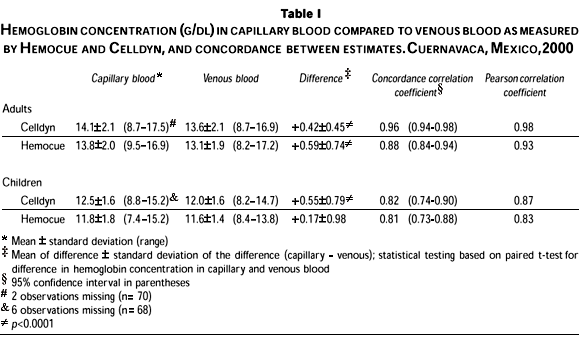
<body><![CDATA[<P align="left">     Venous samples were collected directly into  Vacutainer tubes (Becton Dickinson, New Jersey,  USA) containing potassium EDTA as anticoagulant. To  avoid hemoconcentration, a tourniquet was placed on  the arm at least 7 cm above the venipuncture site and  left in place for less than 1 minute. The Vacutainer  tube was inverted to ensure adequate mixture with the  anticoagulant. A drop of blood was then collected by  capillary action into the microcuvette  specifically designed for the Hemocue system and 250 <font FACE="Symbol">m</font>l of  blood was poured into Microtainers (Becton Dickinson,  New Jersey, USA) and analyzed directly in these tubes  by Celldyn.     <P align="left">     For the capillary blood sample, the fingertip  was pierced using an automated lancet and the first  drop of blood removed with a sterile cotton swab.  Drops were collected directly into microtainers  containing EDTA until the necessary volume of 250 <font FACE="Symbol">m</font>l  (approximately 4 drops, easily obtained from a normal  finger stick sample) was reached and was then analyzed  directly by Celldyn. Care was taken to avoid any  pressure on the finger, which can result in  hemodilution due to the inclusion of interstitial and  intracellular fluids. Blood was also collected directly from the  finger by capillary action into the Hemocue  microcuvettes. The order of sample collection for the 2 systems  was alternated.     <P align="left">     The Hemocue system uses 10 <font FACE="Symbol">m</font>l of blood  collected into a special cuvette whose walls are lined  with the dry reagents. The reagents react  spontaneously with the blood sample resulting in erythrocyte  membrane disintegration allowing for Hb release.  Methemoglobin is formed by the conversion of iron from  the ferrous to the ferric state, which combines with  azide to form azide methemoglobin.<SUP>14</SUP> Absorbance is read  at 2 wavelengths as a means of controlling for  sample turbidity. The apparatus converts the readings into  Hb and displays the results digitally (g/dl). The  concentration of Hb was recorded on the study  questionnaire and double-checked by the laboratory technician.  The Hemocue was calibrated daily using the  calibration cuvette provided by the manufacturer.     <P align="left">     In the automated system, Celldyn,  erythrocyte membranes are also disintegrated to allow for  the release of Hb, which combines with potassium  cyanide to form cyanomethemoglobin.<SUP>15</SUP> All reagents  are automatically measured and sample dilution occurs  automatically, resulting in a high degree of  precision.<SUP>10,16</SUP> Absorbance is read automatically and converted to  Hb (g/dl). Results are provided on a printed output,  which were copied onto the study questionnaires and  crosschecked with the printout. The Celldyn has been  shown to have high precision and accuracy compared to  the traditional cyanomethemoglobin method and  other automated analyzers.<SUP>17-19</SUP>     <P align="left">     Duplicate venous and capillary samples were  collected at the time of sampling from the same  sampling site on 20% of the subjects and assessed by both  Celldyn and Hemocue methods. This was done to document reproducibility of Hb at each sampling site  and by each analysis method.     <P align="left">     For the purpose of this article, error  associated with the analysis of Hb was divided into precision  (similarity in repeat analyses), accuracy (values do not  differ from a &quot;gold standard&quot;), and reliability  (similarity of results over time and across measurement  sites).<SUP>3,20</SUP> All three may be influenced by instrument and  technical error. Reliability is also influenced by  biological variability.     <P align="left">     Hb concentration in venous blood was  compared to the concentration in capillary blood using  each analysis method. Venous and capillary blood  analyzed by Celldyn and Hemocue were compared to  determine accuracy of the Hemocue in blood from  each sample site. Finally, Hb from venous blood  measured by the Celldyn was compared to capillary blood  measured by the Hemocue. This comparison was  considered to be of particular importance as it compares  typically used field methods with what we considered a  &quot;gold standard&quot; for the estimation of Hb.     <P align="left">     Concentrations were compared using the concordance correlation  coefficient.<SUP>21</SUP> This coefficient measures the strength of the relation between two  estimates, as well as the deviation from the 45º  line through the origin (line of equity). The coefficient  is considered a good method for comparing  precision, reliability, and accuracy of test  results.<SUP>22</SUP> Although inadequate as statistical tests for this type of  analysis,<SUP>21-23</SUP> paired <I>t</I>-test for a difference in Hb for each  comparison, the Pearson correlation coefficient, and  the simple linear regression equations are also  presented to allow for comparison with other photometer  validation studies.     <P align="left">     Anemia diagnosis was made using the age  and sex specific cut-off points for Hb recommended by  the World Health Organization.<SUP>24</SUP> The cut-off point  for adult males (&gt;15 years of age) and non-pregnant  females was &lt;12.0 g/dl. A cut-off of &lt;11.0 g/dl was  used for male and female children from 1 to 6 years of  age, and &lt;11.5 g/dl was used for male and female  children from 6-15 years of age. Although Cuernavaca is  located at approximately 1500 m above sea level,  cut-off points were not corrected for altitude. The  difference in cut-off point at this altitude is very small,  approximately 0.3 g/dl<SUP>25,26</SUP> and would have a minimal  influence on prevalence estimates, sensitivity (Se)  or specificity (Sp).     <P align="left">     The diagnosis of anemia based on Hb in  venous blood measured by Celldyn was considered true  diagnosis. Anemia was diagnosed based on the  capillary sample using Celldyn and the venous and capillary sample using Hemocue. The Se, Sp,  positive predictive value (PPV), and negative predictive  value (NPV) for the diagnosis of anemia by each of  these methods were then estimated. There was no  biological reason to believe that the difference between  Hb values estimated by the Hemocue and the Celldyn would differ by age. Nonetheless, we felt that an  age difference may exist in the relationship between Hb  in venous and capillary blood. Therefore, all  analyses were conducted separately for adults and children.     ]]></body>
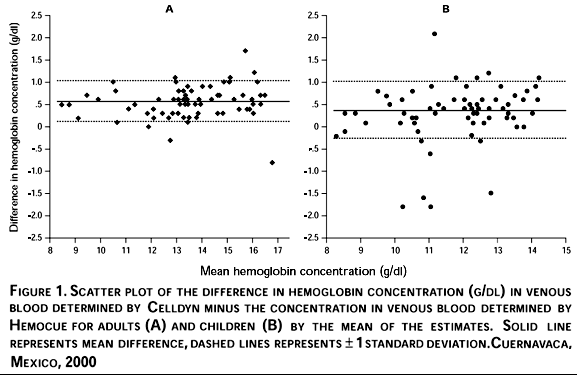
<body><![CDATA[<P align="left">&nbsp;     <P align="center"><font size="4">Results</font>     <P align="left">Blood samples were collected on a total of 72  children and 72 adults. Children ranged in age from 0.5 to  15 years and adults ranged from 17 to 73 years of  age. Adult male participants (n= 20) were all hospital  staff and adult female participants (n= 52) were hospital  staff and family members accompanying patients in  the outpatient clinic. Thirty-five male children and 37  female children, clinic outpatient patients, and  family members accompanying them, participated in  the study.     <P align="left">     There were no differences between repeat  measures for venous or capillary blood or for the  Celldyn or the Hemocue. Estimates of between replicate  variation (coefficient of variation) in Hb in venous  blood were 4.4% and 4.3% for Celldyn and Hemocue,  respectively. In capillary blood, the coefficients of  variation were 4.5% and 3.9% for Celldyn and Hemocue,  respectively.     <P align="left">     On average, the Hb in capillary blood was  higher than in venous blood (<a href="#tab01">Table I</a>). The difference  ranged from +0.17 g/dl (p= 0.15) for samples from  children measured by Hemocue, to +0.59 g/dl  (<I>p</I>&lt; 0.0001) for samples from adults using the Hemocue. Despite  this tendency, Hb was lower in capillary than in  venous blood in 19% of adults and 21% of children.  Among adults, concordance between Hb in capillary and  venous blood was high, although lower for samples measured by Hemocue (0.88) compared to  Celldyn (0.96). Concordance between Hb in capillary and  venous blood among children was considerably lower and similar between methods of assessment (0.82  Celldyn; 0.81 Hemocue).     <P align="left">     <a name="tab01"></a>     <P align="left">&nbsp;          <p align="center"><img src="/img/revistas/spm/v44n3/a05tab01.gif"></p>     <P align="left">&nbsp;          <P align="left">     Hb concentration in both capillary and  venous blood as measured by Hemocue was 0.29-0.68  g/dl lower on average, than the concentration measured  by Celldyn (<a href="#tab02">Table II</a>). Despite this tendency, the  Hemocue measured a higher concentration in 6% of adults  and 18% of children using venous blood. Concordance  between analysis methods was high for both  capillary and venous blood from adults and for venous  blood collected from children (0.89-0.94). Concordance  between analysis methods was considerably lower  for capillary samples collected from children (0.79).  To determine whether this difference existed across  the entire range of Hb, we plotted the difference  between venous Hb estimated by Celldyn and Hemocue against the mean of the estimates (<a href="#fig01">Figure 1</a>) for adults  (Panel A) and children (Panel B). Due to the limitations of  regression analysis to reflect agreement between  measures, this has been suggested as a more  adequate means of graphically depicting comparisons  between analysis methods.<SUP>23</SUP> We show only data for  venous blood due to potential bias in capillary samples  collected from children. Nonetheless, the pattern in  capillary blood is similar to that shown in <a href="#fig01"> Figure 1</a>.     ]]></body>
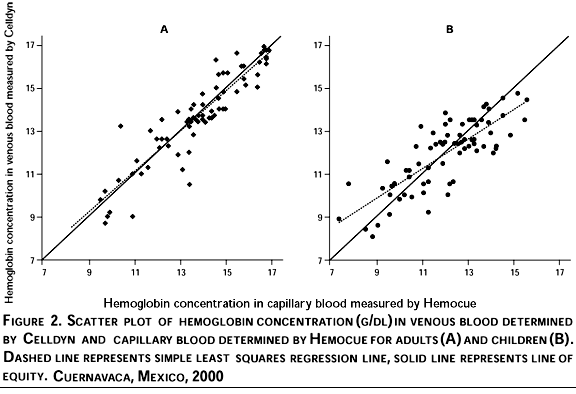
<body><![CDATA[<P align="left">     <a name="tab02"></a>     <P align="left">&nbsp;          <p align="center"><img src="/img/revistas/spm/v44n3/a05tab02.gif"></p>     <P align="left">&nbsp;          <P align="left">     <a name="fig01"></a>     <P align="left">&nbsp;          <p align="center"><img src="/img/revistas/spm/v44n3/a05fig01.gif"></p>     <P align="left">&nbsp;          <P align="left"> A graphic presentation of the raw data showing the simple least    squares regression line suggests that among adults (<a href="#fig02">Figure    2</a>,) (Panel A), the assessment of Hb in capillary blood using Hemocue adequately    represents the concentration in venous blood assessed by Celldyn. Among children,    Hb in capillary blood as sessed by Hemocue appears to underestimate the concentration    as assessed by Celldyn in venous blood below approximately 12.5 g/dl (<a href="#fig02">Figure    2</a>,) (Panel B) and to overstimate at higher values.      <P align="left">     <a name="fig02"></a>     ]]></body>
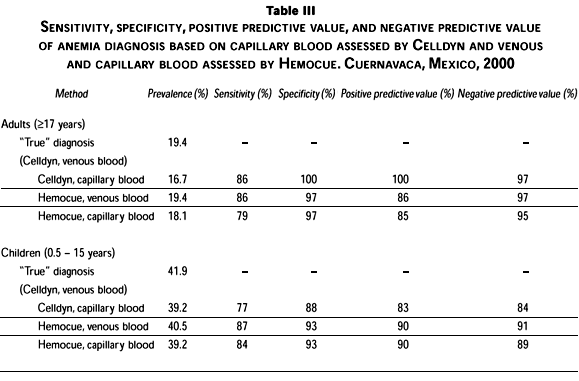
<body><![CDATA[<P align="left">&nbsp;          <p align="center"><img src="/img/revistas/spm/v44n3/a05fig02.gif"></p>     <P align="left">&nbsp;          <P align="left">     Among adults, Hb from capillary blood using  the Hemocue had a low Se (&lt;80%) for identifying  anemia (<a href="#tab03">Table III</a>), as did Hb estimated from capillary  blood using the Celldyn in children. Se for all other  methods and Sp for all methods of diagnosis were adequate (&gt;80%). PPV and NPV were adequate (&gt;80%) for  both methods of analysis at each sampling location.     <P align="left">     <a name="tab03"></a>     <P align="left">&nbsp;          <p align="center"><img src="/img/revistas/spm/v44n3/a05tab03.gif"></p>     <P align="left">&nbsp;          <P align="left">     As a means of determining whether the use of  an adjustment factor for capillary blood would  improve the Se and Sp of capillary blood for anemia  diagnosis, we subtracted the mean difference in Hb between  capillary and venous blood measured by Celldyn  (0.5 g/dl) from capillary Hb. For both children and  adults, concordance between venous and capillary  samples measured by Celldyn improved compared to  unadjusted capillary values (0.98 adults, 0.87  children). Prevalence estimations, Se, Sp, PPV, and NPV were  unchanged for adults and improved for children  (prevalence 41.9%; Se 84%; Sp 88%; PPV 84%; NPV 88%).  In contrast, concordance between the venous sample measured by Celldyn and the capillary sample  measured by Hemocue was lower than for the  unadjusted values (0.90 adults, 0.74 children). Prevalence  estimates were considerably higher (adults 26.4%;  children 46.0%) reflected in unchanged Se for adults and  higher Se for children (90%) but reduced Sp for adults  (97%) and children (86%).     <P align="left">&nbsp;     ]]></body>
<body><![CDATA[<P align="center"><font size="4">Discussion</font>     <P align="left">In many rural regions of developing countries  where the prevalence of anemia may be particularly  high and resources are limited, the collection of  venous blood samples is often unacceptable and analysis  of fresh blood by standard laboratory methods,  unfeasible. The estimation of Hb in capillary blood  using portable photometers permits the collection of  information that may otherwise be inaccessible. The  Pan American Health Organization (PAHO) has  identified the fundamental role of rapid, economical  surveys as opposed to sophisticated research projects as  a means of collecting baseline information on iron  status of populations.<SUP>27</SUP> Nonetheless, the extent to  which variability in Hb in and between venous and  capillary blood and methods of analysis, influences the  precision, validity, and reliability of the estimates and  anemia prevalence estimates, has not been  adequately examined.     <P align="left">     We found that among both children and  adults, Hb in capillary blood was on average, 0.5 g/dl  higher than in venous blood. This difference likely  reflects biological variability between Hb at these sites,  and thus may influence reliability of Hb estimates.  Inadequate capillary sample collection technique may  influence Hb by hemodilution, but would not  explain hemoconcentration. If sample collection  technique had a major influence on Hb, one may expect  greater intra- and inter-individual variability in  capillary blood samples. This was not observed in the  present study, as demonstrated by the relatively  similar standard deviation between measurement sites.     <P align="left">     The reasons why there was a smaller  difference between venous and capillary blood assessed by  Hemocue only on samples collected from children (<a href="#tab01">Table I</a>) are not entirely clear. Because the difference  between Hb in venous and capillary blood from children  assessed by Celldyn was similar to that found in  adults, we believe that capillary sample collection directly  into Hemocue microcuvettes may have influenced  capillary Hb. Capillary samples are more difficult to collect  from small children and if the Hemocue cuvettes were  filled inadequately or inadequate sampling technique  was used, a lower Hb may result. This would also  explain the larger difference between Hemocue and  Celldyn in capillary blood for children (<a href="#tab02">Table II</a>). We find  these results surprising considering that our staff was  highly trained and considerable effort was made to  ensure adequate laboratory techniques and emphasize  the critical role of sample collection techniques used  on children.     <P align="left">     The accuracy of Hb estimated by Hemocue in  laboratory settings is usually high.<SUP>3,8,9  </SUP>The systematically lower mean Hb measured by Hemocue (<a href="#fig01">Figure 1</a>)  in this study may be related to sample collection  technique or equipment error. Because the difference  is similar in capillary and venous blood and in both  age groups, it is unlikely a result of sample collection  or analysis technique and may be related to  equipment. It appears that our Hemocue tended to  underestimate Hb and this tendency increased with increasing  Hb. Alternately, our Celldyn may have  underestimated Hb, with greater underestimation at lower Hb.  The Hemocue used in this study was calibrated on a  daily basis and error was within the limits specified by  the manufacturer. The hospital laboratory undergoes  periodic external evaluation to ensure high precision  and accuracy of all hematological evaluations.  Further study, including calibration of the Hemocue over  the entire range of expected Hb concentrations is  required to determine the source of these differences.     <P align="left">     No precise method of calculating sample size  for validation studies exists and we recognize that  the calculation based on finding a correlation  between methods is not entirely adequate. We conducted  power analyses using the JMP program (SAS Institute  Inc., Cary, NC). This program tests whether the slope of  the regression between two sets of measurements  differs from 1 and whether the intercept is 0, thus  providing results similar to those of the concordance  correlation coefficient. A sample of 72 provides power of  approximately 0.82-0.93 to detect a difference in slope  of 0.2 between the various comparisons made in the present study. Thus, we conclude that our sample  size was adequate to evaluate agreement between Hb  assessed by different methods in capillary and  venous blood.     <P align="left">     According to the present study, Hb measured  in capillary blood could result in a false negative  anemia diagnosis. Nonetheless, the difference in  prevalence estimates based on Hb in venous blood measured  by Celldyn and capillary blood assessed by Hemocue was  not large (&lt;2%) and our results confirm  previous studies<SUP>3</SUP> suggesting that the use of Hb estimated  from capillary blood using Hemocue is adequate for  anemia prevalence estimates in populations. It is  important to note that highly trained laboratory  personnel collected and analyzed all samples under ideal  conditions (e.g. limited time between sample collection  and analysis). Although this is not the norm for most  field studies, similar conditions can be ensured in a  field setting using strict protocols, adequate training,  and quality control.     <P align="left">     The use of a conversion factor from capillary  to venous blood improved concordance, Se, and Sp  when the capillary sample was assessed by Celldyn.  Although this suggests improved ability to correctly  diagnose anemia using capillary blood, most field  studies are dependent on portable photometer such as  Hemocue. For capillary samples measured by  Hemocue, concordance was better for the unadjusted values.  Although we do not recommend the use of the adjustment factor at this time, further research should  be conducted to determine its usefulness, particularly  for adults.     <P align="left">     The present study is one of the few that has  attempted to identify sources of error related to the  estimation of Hb in venous and capillary blood and  to determine the extent to which blood sampling site  and method of assessment influence anemia  prevalence estimates. We found high precision for the  estimation of Hb in venous and capillary blood using both  Hemocue and Celldyn. The accuracy of the Hemocue  was poorer than that reported in other studies, the  reasons for which require further investigation. The use of  a single capillary blood sample measured by  Hemocue resulted in an adequate ability to identify those  who truly were not anemic (high Sp). The ability to  correctly diagnose anemia among the truly anemic (Se)  was lower. Methods to ensure high precision and  accuracy, including adequate sample collection technique,  particularly for children and strict equipment  calibration should be carefully planned and followed in all  research and programs that estimate Hb in  capillary blood. Clear reporting of methods may help to  avoid inappropriate comparisons between  measurement sites where the Hb may be influenced by  biological variability.     <p align="left">&nbsp;     ]]></body>
<body><![CDATA[<p align="center"><font size="4"> References</font></p>     <!-- ref --><P align="left">1. DeMaeyer E, Adiels-Tegman M. The prevalence of anemia in the  world. World Health Stat Q 1985;38:302-316.    &nbsp;&nbsp;&nbsp;&nbsp;&nbsp;&nbsp;&nbsp;&nbsp;[&#160;<a href="javascript:void(0);" onclick="javascript: window.open('/scielo.php?script=sci_nlinks&ref=9194715&pid=S0036-3634200200030000500001&lng=','','width=640,height=500,resizable=yes,scrollbars=1,menubar=yes,');">Links</a>&#160;]<!-- end-ref --><!-- ref --><P align="left">2. Administrative Committee on Coordination, Sub-Committee on  Nutrition. (ACC/SCN) Third report on the world nutrition situation.  Ginebra: United Nations, 1997.    &nbsp;&nbsp;&nbsp;&nbsp;&nbsp;&nbsp;&nbsp;&nbsp;[&#160;<a href="javascript:void(0);" onclick="javascript: window.open('/scielo.php?script=sci_nlinks&ref=9194716&pid=S0036-3634200200030000500002&lng=','','width=640,height=500,resizable=yes,scrollbars=1,menubar=yes,');">Links</a>&#160;]<!-- end-ref --><!-- ref --><P align="left">3. Morris S, Ruel M, Cohen R, Dewey K, Bri&egrave;re BDL, Hassan M.  Precision, accuracy, and reliability of hemoglobin assessment with use of  capillary blood. Am J Clin Nutr 1999;69:1243-1248.    &nbsp;&nbsp;&nbsp;&nbsp;&nbsp;&nbsp;&nbsp;&nbsp;[&#160;<a href="javascript:void(0);" onclick="javascript: window.open('/scielo.php?script=sci_nlinks&ref=9194717&pid=S0036-3634200200030000500003&lng=','','width=640,height=500,resizable=yes,scrollbars=1,menubar=yes,');">Links</a>&#160;]<!-- end-ref --><!-- ref --><P align="left">4. Daae LN, Halvorsen S, Maticen PM, Mironska K. A comparison  between haematological parameters in 'capillary' and venous blood from  healthy adults. Scand J Clin Lab Invest 1988;48:723-726.    &nbsp;&nbsp;&nbsp;&nbsp;&nbsp;&nbsp;&nbsp;&nbsp;[&#160;<a href="javascript:void(0);" onclick="javascript: window.open('/scielo.php?script=sci_nlinks&ref=9194718&pid=S0036-3634200200030000500004&lng=','','width=640,height=500,resizable=yes,scrollbars=1,menubar=yes,');">Links</a>&#160;]<!-- end-ref --><!-- ref --><P align="left">5. Hutler M, Beneke R, Boning D. Determination of circulating  hemoglobin mass and related quantities by using capillary blood. Med Sci Sports  Exerc 2000;32:1024-1027.    &nbsp;&nbsp;&nbsp;&nbsp;&nbsp;&nbsp;&nbsp;&nbsp;[&#160;<a href="javascript:void(0);" onclick="javascript: window.open('/scielo.php?script=sci_nlinks&ref=9194719&pid=S0036-3634200200030000500005&lng=','','width=640,height=500,resizable=yes,scrollbars=1,menubar=yes,');">Links</a>&#160;]<!-- end-ref --><!-- ref --><P align="left">6. Moe PJ. Hemoglobin, hematocrit and red blood cell count in  &quot;capillary&quot; (skin-prick) blood compared to venous blood in children. Acta  Paediatr Scand 1970;59:49-51.    &nbsp;&nbsp;&nbsp;&nbsp;&nbsp;&nbsp;&nbsp;&nbsp;[&#160;<a href="javascript:void(0);" onclick="javascript: window.open('/scielo.php?script=sci_nlinks&ref=9194720&pid=S0036-3634200200030000500006&lng=','','width=640,height=500,resizable=yes,scrollbars=1,menubar=yes,');">Links</a>&#160;]<!-- end-ref --><!-- ref --><P align="left">7. Thomas WJ, Collins TM. Comparison of venipuncture blood counts  with microcapillary measurements in screening for anemia in one-year-old  infants. J Pediatr 1982;101:32-35.    &nbsp;&nbsp;&nbsp;&nbsp;&nbsp;&nbsp;&nbsp;&nbsp;[&#160;<a href="javascript:void(0);" onclick="javascript: window.open('/scielo.php?script=sci_nlinks&ref=9194721&pid=S0036-3634200200030000500007&lng=','','width=640,height=500,resizable=yes,scrollbars=1,menubar=yes,');">Links</a>&#160;]<!-- end-ref --><!-- ref --><P align="left">8. Bridges N, Parvin RM, van Assendelft OW. Evaluation of a new  system for hemoglobin measurement. Am Clin Products Rev 1987;6:22-25.    &nbsp;&nbsp;&nbsp;&nbsp;&nbsp;&nbsp;&nbsp;&nbsp;[&#160;<a href="javascript:void(0);" onclick="javascript: window.open('/scielo.php?script=sci_nlinks&ref=9194722&pid=S0036-3634200200030000500008&lng=','','width=640,height=500,resizable=yes,scrollbars=1,menubar=yes,');">Links</a>&#160;]<!-- end-ref --><!-- ref --><P align="left">9. Cohen A, Seidl-Friedman J. HemoCue system for hemoglobin  measurement. Am J Clin Pathol 1988;90: 302-305.    &nbsp;&nbsp;&nbsp;&nbsp;&nbsp;&nbsp;&nbsp;&nbsp;[&#160;<a href="javascript:void(0);" onclick="javascript: window.open('/scielo.php?script=sci_nlinks&ref=9194723&pid=S0036-3634200200030000500009&lng=','','width=640,height=500,resizable=yes,scrollbars=1,menubar=yes,');">Links</a>&#160;]<!-- end-ref --><!-- ref --><P align="left">10. Neville R. Evaluation of portable haemoglobinometer in general  practice. Br Med J 1987;294:1263-1265.    &nbsp;&nbsp;&nbsp;&nbsp;&nbsp;&nbsp;&nbsp;&nbsp;[&#160;<a href="javascript:void(0);" onclick="javascript: window.open('/scielo.php?script=sci_nlinks&ref=9194724&pid=S0036-3634200200030000500010&lng=','','width=640,height=500,resizable=yes,scrollbars=1,menubar=yes,');">Links</a>&#160;]<!-- end-ref --><!-- ref --><P align="left">11. Chen P, Short T, Leung D, Oh T. A clinical evaluation of the  Hemocue haemoglobinometer using capillary, venous, and arterial samples.  Anaesth Intens Care 1992;20:497-503.    &nbsp;&nbsp;&nbsp;&nbsp;&nbsp;&nbsp;&nbsp;&nbsp;[&#160;<a href="javascript:void(0);" onclick="javascript: window.open('/scielo.php?script=sci_nlinks&ref=9194725&pid=S0036-3634200200030000500011&lng=','','width=640,height=500,resizable=yes,scrollbars=1,menubar=yes,');">Links</a>&#160;]<!-- end-ref --><!-- ref --><P align="left">12. Statlande BE, Winkel P, Harris SC, Burdsall MJ, Saunders AM.  Evaluation of biological sources of variation of leukocyte counts and other  hematologic quantities using very precise automated analyzers. Am J Clin  Pathol 1977;69:48-54.    &nbsp;&nbsp;&nbsp;&nbsp;&nbsp;&nbsp;&nbsp;&nbsp;[&#160;<a href="javascript:void(0);" onclick="javascript: window.open('/scielo.php?script=sci_nlinks&ref=9194726&pid=S0036-3634200200030000500012&lng=','','width=640,height=500,resizable=yes,scrollbars=1,menubar=yes,');">Links</a>&#160;]<!-- end-ref --><!-- ref --><p align="left"> 13. Cohen J. Statistical power analysis for the behavioral sciences.  Second edition. Nueva Jersey (NJ): Hillsdale Publishers, 1988.    &nbsp;&nbsp;&nbsp;&nbsp;&nbsp;&nbsp;&nbsp;&nbsp;[&#160;<a href="javascript:void(0);" onclick="javascript: window.open('/scielo.php?script=sci_nlinks&ref=9194727&pid=S0036-3634200200030000500013&lng=','','width=640,height=500,resizable=yes,scrollbars=1,menubar=yes,');">Links</a>&#160;]<!-- end-ref --><!-- ref --><P align="left">14. von Schenck H, Falkensson M, Lundberg B. Evaluation of  &quot;HemoCue&quot;, a new device for determining hemoglobin. Clin Chem 1986;32:526-529.    &nbsp;&nbsp;&nbsp;&nbsp;&nbsp;&nbsp;&nbsp;&nbsp;[&#160;<a href="javascript:void(0);" onclick="javascript: window.open('/scielo.php?script=sci_nlinks&ref=9194728&pid=S0036-3634200200030000500014&lng=','','width=640,height=500,resizable=yes,scrollbars=1,menubar=yes,');">Links</a>&#160;]<!-- end-ref --><!-- ref --><P align="left">15. Drabkin DL, Austin JH. Spectrophotometric studies:  Spectrophotometric constants for common hemoglobin derivatives in human, dog  and rabbit blood. J Biol Chem 1932;98:719-733.    &nbsp;&nbsp;&nbsp;&nbsp;&nbsp;&nbsp;&nbsp;&nbsp;[&#160;<a href="javascript:void(0);" onclick="javascript: window.open('/scielo.php?script=sci_nlinks&ref=9194729&pid=S0036-3634200200030000500015&lng=','','width=640,height=500,resizable=yes,scrollbars=1,menubar=yes,');">Links</a>&#160;]<!-- end-ref --><!-- ref --><P align="left">16. Bigbee J, Winter B. Reliability and validity testing of the  whole-blood hemoglobinometer. Public Health Nurs 1990;7:40-44.    &nbsp;&nbsp;&nbsp;&nbsp;&nbsp;&nbsp;&nbsp;&nbsp;[&#160;<a href="javascript:void(0);" onclick="javascript: window.open('/scielo.php?script=sci_nlinks&ref=9194730&pid=S0036-3634200200030000500016&lng=','','width=640,height=500,resizable=yes,scrollbars=1,menubar=yes,');">Links</a>&#160;]<!-- end-ref --><!-- ref --><P align="left">17. Sandberg S, Thue G, Christensen HG, Lund PK, Rynning M.  Performance of cell counters in primary health care. Scand J Prim Health  Care 1991;9:129-133.    &nbsp;&nbsp;&nbsp;&nbsp;&nbsp;&nbsp;&nbsp;&nbsp;[&#160;<a href="javascript:void(0);" onclick="javascript: window.open('/scielo.php?script=sci_nlinks&ref=9194731&pid=S0036-3634200200030000500017&lng=','','width=640,height=500,resizable=yes,scrollbars=1,menubar=yes,');">Links</a>&#160;]<!-- end-ref --><!-- ref --><P align="left">18. Petani S, Topic E, Turcic G, Daschner M. Clinical evaluation of the  Cell-Dyn 1700CS blood counter. Clin Chem 1997;43:1085-1088.    &nbsp;&nbsp;&nbsp;&nbsp;&nbsp;&nbsp;&nbsp;&nbsp;[&#160;<a href="javascript:void(0);" onclick="javascript: window.open('/scielo.php?script=sci_nlinks&ref=9194732&pid=S0036-3634200200030000500018&lng=','','width=640,height=500,resizable=yes,scrollbars=1,menubar=yes,');">Links</a>&#160;]<!-- end-ref --><!-- ref --><P align="left">19. Sachse C, Henkel E. An evaluation of the CELL-DYN 1700  haematology analyzer: Automated cell counting and three-part leucocyte  differentiation. Clin Lab Haematol 1996;18:171-180.    &nbsp;&nbsp;&nbsp;&nbsp;&nbsp;&nbsp;&nbsp;&nbsp;[&#160;<a href="javascript:void(0);" onclick="javascript: window.open('/scielo.php?script=sci_nlinks&ref=9194733&pid=S0036-3634200200030000500019&lng=','','width=640,height=500,resizable=yes,scrollbars=1,menubar=yes,');">Links</a>&#160;]<!-- end-ref --><!-- ref --><P align="left">20. Marks GC, Habicht JP, Mueller WH. Reliability, dependability, and  precision of anthropometric measurements. The Second National Health  and Nutrition Survey 1976-1980. Am J Epidemiol 1989;130:578-587.    &nbsp;&nbsp;&nbsp;&nbsp;&nbsp;&nbsp;&nbsp;&nbsp;[&#160;<a href="javascript:void(0);" onclick="javascript: window.open('/scielo.php?script=sci_nlinks&ref=9194734&pid=S0036-3634200200030000500020&lng=','','width=640,height=500,resizable=yes,scrollbars=1,menubar=yes,');">Links</a>&#160;]<!-- end-ref --><!-- ref --><P align="left">21. Lin L. A concordance correlation coefficient to evaluate  reproducibility. Biometrics 1989;45:255-268.    &nbsp;&nbsp;&nbsp;&nbsp;&nbsp;&nbsp;&nbsp;&nbsp;[&#160;<a href="javascript:void(0);" onclick="javascript: window.open('/scielo.php?script=sci_nlinks&ref=9194735&pid=S0036-3634200200030000500021&lng=','','width=640,height=500,resizable=yes,scrollbars=1,menubar=yes,');">Links</a>&#160;]<!-- end-ref --><!-- ref --><P align="left">22. Lin L. Assay validation using the concordance correlation  coefficient. Biometrics 1992;48:599-604.    &nbsp;&nbsp;&nbsp;&nbsp;&nbsp;&nbsp;&nbsp;&nbsp;[&#160;<a href="javascript:void(0);" onclick="javascript: window.open('/scielo.php?script=sci_nlinks&ref=9194736&pid=S0036-3634200200030000500022&lng=','','width=640,height=500,resizable=yes,scrollbars=1,menubar=yes,');">Links</a>&#160;]<!-- end-ref --><!-- ref --><P align="left">23. Bland JM, Atlman DG. Statistical methods for assessing agreement  between two methods of clinical measurement. Lancet 1986;8176:307-310.    &nbsp;&nbsp;&nbsp;&nbsp;&nbsp;&nbsp;&nbsp;&nbsp;[&#160;<a href="javascript:void(0);" onclick="javascript: window.open('/scielo.php?script=sci_nlinks&ref=9194737&pid=S0036-3634200200030000500023&lng=','','width=640,height=500,resizable=yes,scrollbars=1,menubar=yes,');">Links</a>&#160;]<!-- end-ref --><!-- ref --><P align="left">24. Gillespie S, Johnston JL. Expert consultation on anemia  determinants and interventions. Ottawa: Micronutrients Initiatives, 1998.    &nbsp;&nbsp;&nbsp;&nbsp;&nbsp;&nbsp;&nbsp;&nbsp;[&#160;<a href="javascript:void(0);" onclick="javascript: window.open('/scielo.php?script=sci_nlinks&ref=9194738&pid=S0036-3634200200030000500024&lng=','','width=640,height=500,resizable=yes,scrollbars=1,menubar=yes,');">Links</a>&#160;]<!-- end-ref --><!-- ref --><P align="left">25. Cohen JH, Haas JD. Hemoglobin correction factors for estimating  the prevalence of iron deficiency anemia in pregnant women residing at  high altitudes in Bolivia. Rev Panam Salud Publica 1999;6:392-399.    &nbsp;&nbsp;&nbsp;&nbsp;&nbsp;&nbsp;&nbsp;&nbsp;[&#160;<a href="javascript:void(0);" onclick="javascript: window.open('/scielo.php?script=sci_nlinks&ref=9194739&pid=S0036-3634200200030000500025&lng=','','width=640,height=500,resizable=yes,scrollbars=1,menubar=yes,');">Links</a>&#160;]<!-- end-ref --><!-- ref --><P align="left">26. Ruiz-Arg&uuml;elles GJ, Llorente-Peters A. Predictive equations for  normal red cell values at altitudes from sea level to 2,670 meters. Rev Invest  Clin Mex 1981;33:191-193.    &nbsp;&nbsp;&nbsp;&nbsp;&nbsp;&nbsp;&nbsp;&nbsp;[&#160;<a href="javascript:void(0);" onclick="javascript: window.open('/scielo.php?script=sci_nlinks&ref=9194740&pid=S0036-3634200200030000500026&lng=','','width=640,height=500,resizable=yes,scrollbars=1,menubar=yes,');">Links</a>&#160;]<!-- end-ref --><!-- ref --><P align="left">27. Freire WB. Strategies of the Pan American Health Organization for  the control of iron deficiency in Latin America. Nutr Rev 1997;55:183-188.    &nbsp;&nbsp;&nbsp;&nbsp;&nbsp;&nbsp;&nbsp;&nbsp;[&#160;<a href="javascript:void(0);" onclick="javascript: window.open('/scielo.php?script=sci_nlinks&ref=9194741&pid=S0036-3634200200030000500027&lng=','','width=640,height=500,resizable=yes,scrollbars=1,menubar=yes,');">Links</a>&#160;]<!-- end-ref --><P align="left">&nbsp;     <P align="left">&nbsp;     ]]></body>
<body><![CDATA[<P align="left"><a name="nt01" href="#tx01"> *</a>     Mexican National Nutrition Survey II. Impact evaluation of  the Progresa Program in Mexico. The effect of multiple  micronutrient supplementation during pregnancy on birth outcome and  early prenatal growth (results forthcoming).     <p align="left"><a name="nota"></a>(<a href="#texto">1</a>)     Centro de Investigaci&oacute;n en Nutrici&oacute;n y Salud, Instituto Nacional de Salud P&uacute;blica (INSP), Cuernavaca, Morelos, M&eacute;xico     <P align="left">(<a href="#texto">2</a>)     Hospital del Ni&ntilde;o Morelense, Cuernavaca, Morelos, M&eacute;xico     <P align="left">(<a href="#texto">3</a>)     Centro de Investigaci&oacute;n en Sistemas de Salud, INSP     <P align="left">&nbsp;     <P align="center"><B>Received on</B>: July 12, 2001 <font FACE="Symbol">·</font> <B>Accepted  on</B>: October 19, 2001    <br> Address reprint requests to: Dra. Lynnette Neufeld. Divisi&oacute;n de Epidemiolog&iacute;a de la Nutrici&oacute;n, Centro de Investigaciones en Nutrici&oacute;n y Salud.    <br> Instituto Nacional de Salud P&uacute;blica. Av. Universidad 655, colonia Santa Mar&iacute;a Ahuacatitl&aacute;n, 62508 Cuernavaca, Morelos, M&eacute;xico.    <br> E-mail: <a href="mailto:lneufeld@correo.insp.mx"> lneufeld@correo.insp.mx</a>      ]]></body><back>
<ref-list>
<ref id="B1">
<label>1</label><nlm-citation citation-type="journal">
<person-group person-group-type="author">
<name>
<surname><![CDATA[DeMaeyer]]></surname>
<given-names><![CDATA[E]]></given-names>
</name>
<name>
<surname><![CDATA[Adiels-Tegman]]></surname>
<given-names><![CDATA[M]]></given-names>
</name>
</person-group>
<article-title xml:lang="en"><![CDATA[The prevalence of anemia in the world]]></article-title>
<source><![CDATA[World Health Stat Q]]></source>
<year>1985</year>
<volume>38</volume>
<page-range>302-316</page-range></nlm-citation>
</ref>
<ref id="B2">
<label>2</label><nlm-citation citation-type="book">
<collab>Administrative Committee on Coordination^dSub-Committee on Nutrition</collab>
<source><![CDATA[Third report on the world nutrition situation]]></source>
<year>1997</year>
<publisher-loc><![CDATA[Ginebra ]]></publisher-loc>
<publisher-name><![CDATA[United Nations]]></publisher-name>
</nlm-citation>
</ref>
<ref id="B3">
<label>3</label><nlm-citation citation-type="journal">
<person-group person-group-type="author">
<name>
<surname><![CDATA[Morris]]></surname>
<given-names><![CDATA[S]]></given-names>
</name>
<name>
<surname><![CDATA[Ruel]]></surname>
<given-names><![CDATA[M]]></given-names>
</name>
<name>
<surname><![CDATA[Cohen]]></surname>
<given-names><![CDATA[R]]></given-names>
</name>
<name>
<surname><![CDATA[Dewey]]></surname>
<given-names><![CDATA[K]]></given-names>
</name>
<name>
<surname><![CDATA[Brière]]></surname>
<given-names><![CDATA[BDL]]></given-names>
</name>
<name>
<surname><![CDATA[Hassan]]></surname>
<given-names><![CDATA[M]]></given-names>
</name>
</person-group>
<article-title xml:lang="en"><![CDATA[Precision, accuracy, and reliability of hemoglobin assessment with use of capillary blood]]></article-title>
<source><![CDATA[Am J Clin Nutr]]></source>
<year>1999</year>
<volume>69</volume>
<page-range>1243-1248</page-range></nlm-citation>
</ref>
<ref id="B4">
<label>4</label><nlm-citation citation-type="journal">
<person-group person-group-type="author">
<name>
<surname><![CDATA[Daae]]></surname>
<given-names><![CDATA[LN]]></given-names>
</name>
<name>
<surname><![CDATA[Halvorsen]]></surname>
<given-names><![CDATA[S]]></given-names>
</name>
<name>
<surname><![CDATA[Maticen]]></surname>
<given-names><![CDATA[PM]]></given-names>
</name>
<name>
<surname><![CDATA[Mironska]]></surname>
<given-names><![CDATA[K]]></given-names>
</name>
</person-group>
<article-title xml:lang="en"><![CDATA[A comparison between haematological parameters in 'capillary' and venous blood from healthy adults]]></article-title>
<source><![CDATA[Scand J Clin Lab Invest]]></source>
<year>1988</year>
<volume>48</volume>
<page-range>723-726</page-range></nlm-citation>
</ref>
<ref id="B5">
<label>5</label><nlm-citation citation-type="journal">
<person-group person-group-type="author">
<name>
<surname><![CDATA[Hutler]]></surname>
<given-names><![CDATA[M]]></given-names>
</name>
<name>
<surname><![CDATA[Beneke]]></surname>
<given-names><![CDATA[R]]></given-names>
</name>
<name>
<surname><![CDATA[Boning]]></surname>
<given-names><![CDATA[D]]></given-names>
</name>
</person-group>
<article-title xml:lang="en"><![CDATA[Determination of circulating hemoglobin mass and related quantities by using capillary blood]]></article-title>
<source><![CDATA[Med Sci Sports Exerc]]></source>
<year>2000</year>
<volume>32</volume>
<page-range>1024-1027</page-range></nlm-citation>
</ref>
<ref id="B6">
<label>6</label><nlm-citation citation-type="journal">
<person-group person-group-type="author">
<name>
<surname><![CDATA[Moe]]></surname>
<given-names><![CDATA[PJ]]></given-names>
</name>
</person-group>
<article-title xml:lang="en"><![CDATA[Hemoglobin, hematocrit and red blood cell count in "capillary" (skin-prick) blood compared to venous blood in children]]></article-title>
<source><![CDATA[Acta Paediatr Scand]]></source>
<year>1970</year>
<volume>59</volume>
<page-range>49-51</page-range></nlm-citation>
</ref>
<ref id="B7">
<label>7</label><nlm-citation citation-type="journal">
<person-group person-group-type="author">
<name>
<surname><![CDATA[Thomas]]></surname>
<given-names><![CDATA[WJ]]></given-names>
</name>
<name>
<surname><![CDATA[Collins]]></surname>
<given-names><![CDATA[TM]]></given-names>
</name>
</person-group>
<article-title xml:lang="en"><![CDATA[Comparison of venipuncture blood counts with microcapillary measurements in screening for anemia in one-year-old infants]]></article-title>
<source><![CDATA[J Pediatr]]></source>
<year>1982</year>
<volume>101</volume>
<page-range>32-35</page-range></nlm-citation>
</ref>
<ref id="B8">
<label>8</label><nlm-citation citation-type="journal">
<person-group person-group-type="author">
<name>
<surname><![CDATA[Bridges]]></surname>
<given-names><![CDATA[N]]></given-names>
</name>
<name>
<surname><![CDATA[Parvin]]></surname>
<given-names><![CDATA[RM]]></given-names>
</name>
<name>
<surname><![CDATA[van Assendelft]]></surname>
<given-names><![CDATA[OW.]]></given-names>
</name>
</person-group>
<article-title xml:lang="en"><![CDATA[Evaluation of a new system for hemoglobin measurement]]></article-title>
<source><![CDATA[Am Clin Products Rev]]></source>
<year>1987</year>
<volume>6</volume>
<page-range>22-25</page-range></nlm-citation>
</ref>
<ref id="B9">
<label>9</label><nlm-citation citation-type="journal">
<person-group person-group-type="author">
<name>
<surname><![CDATA[Cohen]]></surname>
<given-names><![CDATA[A]]></given-names>
</name>
<name>
<surname><![CDATA[Seidl-Friedman]]></surname>
<given-names><![CDATA[J]]></given-names>
</name>
</person-group>
<article-title xml:lang="en"><![CDATA[HemoCue system for hemoglobin measurement]]></article-title>
<source><![CDATA[Am J Clin Pathol]]></source>
<year>1988</year>
<volume>90</volume>
<page-range>302-305</page-range></nlm-citation>
</ref>
<ref id="B10">
<label>10</label><nlm-citation citation-type="journal">
<person-group person-group-type="author">
<name>
<surname><![CDATA[Neville]]></surname>
<given-names><![CDATA[R]]></given-names>
</name>
</person-group>
<article-title xml:lang="en"><![CDATA[Evaluation of portable haemoglobinometer in general practice]]></article-title>
<source><![CDATA[Br Med J]]></source>
<year>1987</year>
<volume>294</volume>
<page-range>1263-1265</page-range></nlm-citation>
</ref>
<ref id="B11">
<label>11</label><nlm-citation citation-type="journal">
<person-group person-group-type="author">
<name>
<surname><![CDATA[Chen]]></surname>
<given-names><![CDATA[P]]></given-names>
</name>
<name>
<surname><![CDATA[Short]]></surname>
<given-names><![CDATA[T]]></given-names>
</name>
<name>
<surname><![CDATA[Leung]]></surname>
<given-names><![CDATA[D]]></given-names>
</name>
<name>
<surname><![CDATA[Oh]]></surname>
<given-names><![CDATA[T]]></given-names>
</name>
</person-group>
<article-title xml:lang="en"><![CDATA[A clinical evaluation of the Hemocue haemoglobinometer using capillary, venous, and arterial samples]]></article-title>
<source><![CDATA[Anaesth Intens Care]]></source>
<year>1992</year>
<volume>20</volume>
<page-range>497-503</page-range></nlm-citation>
</ref>
<ref id="B12">
<label>12</label><nlm-citation citation-type="journal">
<person-group person-group-type="author">
<name>
<surname><![CDATA[Statlande]]></surname>
<given-names><![CDATA[BE]]></given-names>
</name>
<name>
<surname><![CDATA[Winkel]]></surname>
<given-names><![CDATA[P]]></given-names>
</name>
<name>
<surname><![CDATA[Harris]]></surname>
<given-names><![CDATA[SC]]></given-names>
</name>
<name>
<surname><![CDATA[Burdsall]]></surname>
<given-names><![CDATA[MJ]]></given-names>
</name>
<name>
<surname><![CDATA[Saunders]]></surname>
<given-names><![CDATA[AM]]></given-names>
</name>
</person-group>
<article-title xml:lang="en"><![CDATA[Evaluation of biological sources of variation of leukocyte counts and other hematologic quantities using very precise automated analyzers]]></article-title>
<source><![CDATA[Am J Clin Pathol]]></source>
<year>1977</year>
<volume>69</volume>
<page-range>48-54</page-range></nlm-citation>
</ref>
<ref id="B13">
<label>13</label><nlm-citation citation-type="book">
<person-group person-group-type="author">
<name>
<surname><![CDATA[Cohen]]></surname>
<given-names><![CDATA[J]]></given-names>
</name>
</person-group>
<source><![CDATA[Statistical power analysis for the behavioral sciences]]></source>
<year>1988</year>
<edition>Second</edition>
<publisher-loc><![CDATA[Nueva Jersey^eNJ NJ]]></publisher-loc>
<publisher-name><![CDATA[Hillsdale Publishers]]></publisher-name>
</nlm-citation>
</ref>
<ref id="B14">
<label>14</label><nlm-citation citation-type="journal">
<person-group person-group-type="author">
<name>
<surname><![CDATA[von]]></surname>
<given-names><![CDATA[Schenck H]]></given-names>
</name>
<name>
<surname><![CDATA[Falkensson]]></surname>
<given-names><![CDATA[M]]></given-names>
</name>
<name>
<surname><![CDATA[Lundberg]]></surname>
<given-names><![CDATA[B]]></given-names>
</name>
</person-group>
<article-title xml:lang="en"><![CDATA[Evaluation of "HemoCue", a new device for determining hemoglobin]]></article-title>
<source><![CDATA[Clin Chem]]></source>
<year>1986</year>
<volume>32</volume>
<page-range>526-529</page-range></nlm-citation>
</ref>
<ref id="B15">
<label>15</label><nlm-citation citation-type="journal">
<person-group person-group-type="author">
<name>
<surname><![CDATA[Drabkin]]></surname>
<given-names><![CDATA[DL]]></given-names>
</name>
<name>
<surname><![CDATA[Austin]]></surname>
<given-names><![CDATA[JH]]></given-names>
</name>
</person-group>
<article-title xml:lang="en"><![CDATA[Spectrophotometric studies: Spectrophotometric constants for common hemoglobin derivatives in human, dog and rabbit blood]]></article-title>
<source><![CDATA[J Biol Chem]]></source>
<year>1932</year>
<volume>98</volume>
<page-range>719-733</page-range></nlm-citation>
</ref>
<ref id="B16">
<label>16</label><nlm-citation citation-type="journal">
<person-group person-group-type="author">
<name>
<surname><![CDATA[Bigbee]]></surname>
<given-names><![CDATA[J]]></given-names>
</name>
<name>
<surname><![CDATA[Winter]]></surname>
<given-names><![CDATA[B]]></given-names>
</name>
</person-group>
<article-title xml:lang="en"><![CDATA[Reliability and validity testing of the whole-blood hemoglobinometer]]></article-title>
<source><![CDATA[Public Health Nurs]]></source>
<year>1990</year>
<volume>7</volume>
<page-range>40-44</page-range></nlm-citation>
</ref>
<ref id="B17">
<label>17</label><nlm-citation citation-type="journal">
<person-group person-group-type="author">
<name>
<surname><![CDATA[Sandberg]]></surname>
<given-names><![CDATA[S]]></given-names>
</name>
<name>
<surname><![CDATA[Thue]]></surname>
<given-names><![CDATA[G]]></given-names>
</name>
<name>
<surname><![CDATA[Christensen]]></surname>
<given-names><![CDATA[HG]]></given-names>
</name>
<name>
<surname><![CDATA[Lund]]></surname>
<given-names><![CDATA[PK]]></given-names>
</name>
<name>
<surname><![CDATA[Rynning]]></surname>
<given-names><![CDATA[M]]></given-names>
</name>
</person-group>
<article-title xml:lang="en"><![CDATA[Performance of cell counters in primary health care]]></article-title>
<source><![CDATA[Scand J Prim Health Care]]></source>
<year>1991</year>
<volume>9</volume>
<page-range>129-133</page-range></nlm-citation>
</ref>
<ref id="B18">
<label>18</label><nlm-citation citation-type="journal">
<person-group person-group-type="author">
<name>
<surname><![CDATA[Petani]]></surname>
<given-names><![CDATA[S]]></given-names>
</name>
<name>
<surname><![CDATA[Topic]]></surname>
<given-names><![CDATA[E]]></given-names>
</name>
<name>
<surname><![CDATA[Turcic]]></surname>
<given-names><![CDATA[G]]></given-names>
</name>
<name>
<surname><![CDATA[Daschner]]></surname>
<given-names><![CDATA[M]]></given-names>
</name>
</person-group>
<article-title xml:lang="en"><![CDATA[Clinical evaluation of the Cell-Dyn 1700CS blood counter]]></article-title>
<source><![CDATA[Clin Chem]]></source>
<year>1997</year>
<volume>43</volume>
<page-range>1085-1088</page-range></nlm-citation>
</ref>
<ref id="B19">
<label>19</label><nlm-citation citation-type="journal">
<person-group person-group-type="author">
<name>
<surname><![CDATA[Sachse]]></surname>
<given-names><![CDATA[C]]></given-names>
</name>
<name>
<surname><![CDATA[Henkel]]></surname>
<given-names><![CDATA[E]]></given-names>
</name>
</person-group>
<article-title xml:lang="en"><![CDATA[An evaluation of the CELL-DYN 1700 haematology analyzer: Automated cell counting and three-part leucocyte differentiation]]></article-title>
<source><![CDATA[Clin Lab Haematol]]></source>
<year>1996</year>
<volume>18</volume>
<page-range>171-180</page-range></nlm-citation>
</ref>
<ref id="B20">
<label>20</label><nlm-citation citation-type="journal">
<person-group person-group-type="author">
<name>
<surname><![CDATA[Marks]]></surname>
<given-names><![CDATA[GC]]></given-names>
</name>
<name>
<surname><![CDATA[Habicht]]></surname>
<given-names><![CDATA[JP]]></given-names>
</name>
<name>
<surname><![CDATA[Mueller]]></surname>
<given-names><![CDATA[WH]]></given-names>
</name>
</person-group>
<article-title xml:lang="en"><![CDATA[Reliability, dependability, and precision of anthropometric measurements: The Second National Health and Nutrition Survey 1976-1980]]></article-title>
<source><![CDATA[Am J Epidemiol]]></source>
<year>1989</year>
<volume>130</volume>
<page-range>578-587</page-range></nlm-citation>
</ref>
<ref id="B21">
<label>21</label><nlm-citation citation-type="journal">
<person-group person-group-type="author">
<name>
<surname><![CDATA[Lin]]></surname>
<given-names><![CDATA[L]]></given-names>
</name>
</person-group>
<article-title xml:lang="en"><![CDATA[A concordance correlation coefficient to evaluate reproducibility]]></article-title>
<source><![CDATA[Biometrics]]></source>
<year>1989</year>
<volume>45</volume>
<page-range>255-268</page-range></nlm-citation>
</ref>
<ref id="B22">
<label>22</label><nlm-citation citation-type="journal">
<person-group person-group-type="author">
<name>
<surname><![CDATA[Lin]]></surname>
<given-names><![CDATA[L]]></given-names>
</name>
</person-group>
<article-title xml:lang="en"><![CDATA[Assay validation using the concordance correlation coefficient]]></article-title>
<source><![CDATA[Biometrics]]></source>
<year>1992</year>
<volume>48</volume>
<page-range>599-604</page-range></nlm-citation>
</ref>
<ref id="B23">
<label>23</label><nlm-citation citation-type="journal">
<person-group person-group-type="author">
<name>
<surname><![CDATA[Bland]]></surname>
<given-names><![CDATA[JM]]></given-names>
</name>
<name>
<surname><![CDATA[Atlman]]></surname>
<given-names><![CDATA[DG]]></given-names>
</name>
</person-group>
<article-title xml:lang="en"><![CDATA[Statistical methods for assessing agreement between two methods of clinical measurement]]></article-title>
<source><![CDATA[Lancet]]></source>
<year>1986</year>
<volume>8176</volume>
<page-range>307-310</page-range></nlm-citation>
</ref>
<ref id="B24">
<label>24</label><nlm-citation citation-type="book">
<person-group person-group-type="author">
<name>
<surname><![CDATA[Gillespie]]></surname>
<given-names><![CDATA[S]]></given-names>
</name>
<name>
<surname><![CDATA[Johnston]]></surname>
<given-names><![CDATA[JL]]></given-names>
</name>
</person-group>
<source><![CDATA[Expert consultation on anemia determinants and interventions]]></source>
<year>1998</year>
<publisher-loc><![CDATA[Ottawa ]]></publisher-loc>
<publisher-name><![CDATA[Micronutrients Initiatives]]></publisher-name>
</nlm-citation>
</ref>
<ref id="B25">
<label>25</label><nlm-citation citation-type="journal">
<person-group person-group-type="author">
<name>
<surname><![CDATA[Cohen]]></surname>
<given-names><![CDATA[JH]]></given-names>
</name>
<name>
<surname><![CDATA[Haas]]></surname>
<given-names><![CDATA[JD]]></given-names>
</name>
</person-group>
<article-title xml:lang="en"><![CDATA[Hemoglobin correction factors for estimating the prevalence of iron deficiency anemia in pregnant women residing at high altitudes in Bolivia]]></article-title>
<source><![CDATA[Rev Panam Salud Publica]]></source>
<year>1999</year>
<volume>6</volume>
<page-range>392-399</page-range></nlm-citation>
</ref>
<ref id="B26">
<label>26</label><nlm-citation citation-type="journal">
<person-group person-group-type="author">
<name>
<surname><![CDATA[Ruiz-Argüelles]]></surname>
<given-names><![CDATA[GJ]]></given-names>
</name>
<name>
<surname><![CDATA[Llorente-Peters]]></surname>
<given-names><![CDATA[A]]></given-names>
</name>
</person-group>
<article-title xml:lang="en"><![CDATA[Predictive equations for normal red cell values at altitudes from sea level to 2,670 meters]]></article-title>
<source><![CDATA[Rev Invest Clin Mex]]></source>
<year>1981</year>
<volume>33</volume>
<page-range>191-193</page-range></nlm-citation>
</ref>
<ref id="B27">
<label>27</label><nlm-citation citation-type="journal">
<person-group person-group-type="author">
<name>
<surname><![CDATA[Freire]]></surname>
<given-names><![CDATA[WB]]></given-names>
</name>
</person-group>
<article-title xml:lang="en"><![CDATA[Strategies of the Pan American Health Organization for the control of iron deficiency in Latin America]]></article-title>
<source><![CDATA[Nutr Rev]]></source>
<year>1997</year>
<volume>55</volume>
<page-range>183-188</page-range></nlm-citation>
</ref>
</ref-list>
</back>
</article>