<?xml version="1.0" encoding="ISO-8859-1"?><article xmlns:mml="http://www.w3.org/1998/Math/MathML" xmlns:xlink="http://www.w3.org/1999/xlink" xmlns:xsi="http://www.w3.org/2001/XMLSchema-instance">
<front>
<journal-meta>
<journal-id>0036-3634</journal-id>
<journal-title><![CDATA[Salud Pública de México]]></journal-title>
<abbrev-journal-title><![CDATA[Salud pública Méx]]></abbrev-journal-title>
<issn>0036-3634</issn>
<publisher>
<publisher-name><![CDATA[Instituto Nacional de Salud Pública]]></publisher-name>
</publisher>
</journal-meta>
<article-meta>
<article-id>S0036-36342002000300003</article-id>
<title-group>
<article-title xml:lang="en"><![CDATA[AIDS mortality trends in Mexico, 1988-1997]]></article-title>
<article-title xml:lang="es"><![CDATA[Tendencias de mortalidad por SIDA en México, 1988-1997]]></article-title>
</title-group>
<contrib-group>
<contrib contrib-type="author">
<name>
<surname><![CDATA[Hernández-Girón]]></surname>
<given-names><![CDATA[Carlos]]></given-names>
</name>
<xref ref-type="aff" rid="A01"/>
</contrib>
<contrib contrib-type="author">
<name>
<surname><![CDATA[Tovar-Guzmán]]></surname>
<given-names><![CDATA[Víctor]]></given-names>
</name>
<xref ref-type="aff" rid="A01"/>
</contrib>
<contrib contrib-type="author">
<name>
<surname><![CDATA[del Río]]></surname>
<given-names><![CDATA[Carlos]]></given-names>
</name>
<xref ref-type="aff" rid="A02"/>
</contrib>
</contrib-group>
<aff id="A01">
<institution><![CDATA[,Instituto Nacional de Salud Pública Centro de Investigación en Salud Poblacional ]]></institution>
<addr-line><![CDATA[Cuernavaca Morelos]]></addr-line>
<country>México</country>
</aff>
<aff id="A02">
<institution><![CDATA[,Emory University School of Medicine  ]]></institution>
<addr-line><![CDATA[Atlanta Georgia]]></addr-line>
<country>United States of America</country>
</aff>
<pub-date pub-type="pub">
<day>00</day>
<month>06</month>
<year>2002</year>
</pub-date>
<pub-date pub-type="epub">
<day>00</day>
<month>06</month>
<year>2002</year>
</pub-date>
<volume>44</volume>
<numero>3</numero>
<fpage>207</fpage>
<lpage>212</lpage>
<copyright-statement/>
<copyright-year/>
<self-uri xlink:href="http://www.scielo.org.mx/scielo.php?script=sci_arttext&amp;pid=S0036-36342002000300003&amp;lng=en&amp;nrm=iso"></self-uri><self-uri xlink:href="http://www.scielo.org.mx/scielo.php?script=sci_abstract&amp;pid=S0036-36342002000300003&amp;lng=en&amp;nrm=iso"></self-uri><self-uri xlink:href="http://www.scielo.org.mx/scielo.php?script=sci_pdf&amp;pid=S0036-36342002000300003&amp;lng=en&amp;nrm=iso"></self-uri><abstract abstract-type="short" xml:lang="en"><p><![CDATA[Objective. To assess the geographic distribution and trends of AIDS deaths for the 1988-1997 period in Mexico. Material and Methods. Crude and adjusted mortality rates were estimated for the 1988-1997 period. A trend test was performed using the simple linear regression method. Standardized mortality ratios (SMR) and years of potential life lost (YPLL) were calculated for each Mexican state. Results. During the study period (1988-1997), there were 26,999 AIDS deaths in Mexico; 86.5% (23,354) of them were among men. The mean age at the time of death was 38.4 years for men and 37.7 years for women (p> 0.05). The crude AIDS mortality rate for the period of study was 3.02 cases (95% CI: 2.94, 3.06) per 100,000 inhabitants. The adjusted rate was 3.13 (95% CI: 3.09, 3.17), with 5.22 (95% CI: 5.16 - 5.29) for men and 0.82 (95% CI: 0.79-0.84) for women. The states with the highest SMR were: Baja California (SMR: 248.69; 95% CI: 234.02-263.36), Mexico City (SMR: 220.74; 95% CI: 215.57-225.91), and Jalisco (SMR: 169.16; 95% CI: 162.88-175.44). Similarly, a Potential Lost Life Years Index (PLLYI) analysis by state showed a greater risk of premature AIDS mortality in the same states [Baja California (PLLYI index: 236.33; 95% CI: 233.97-238.68), Mexico City (PLLYI: 194.68; 95% CI: 193.88 - 195.48), and Jalisco (PLLYI: 170.69; 95% CI: 169.60-171.79)]. Conclusions. Mortality trends indicate that AIDS mortality in Mexico increased by an annual rate of 23% between 1988 and 1997. The adjusted AIDS mortality rate increased from 0.75 per 100 000 in 1988, to 4.20 per 100 000 in 1997, with the largest burden of mortality in men (male to female ratio of 6:1). We therefore expect that a decreasing effect on AIDS mortality trends will be observed in the next years.]]></p></abstract>
<abstract abstract-type="short" xml:lang="es"><p><![CDATA[Objetivo. Determinar la distribución geográfica y la tendencia de mortalidad por SIDA durante el periodo 1988 a 1997, en México. Material y métodos. Se estimaron tasas de mortalidad por SIDA, cruda y ajustadas, para el periodo 1988-1997. Se realizó una prueba de tendencia utilizando regresión lineal simple. La razón de mortalidad estandarizada (RME) y los años de vida potencialmente perdidos (AVPP), fueron calculados para cada estado de la República. Resultados. Durante el periodo de estudio se reportaron 26 999 muertes por SIDA en México, 86.5% (23 354), fueron hombres. La media de edad al momento de la muerte por esta causa, fue 38.4 años para los hombres y 37.7 años para las mujeres (p> 0.05). La tasa cruda de mortalidad por SIDA para el periodo de estudio fue de 3.02 casos (IC 95% 2.94-3.06) por 100 000 habitantes. La tasa ajustada de mortalidad por SIDA para el periodo de estudio fue de 3.13 casos (IC 95% 3.09-3.17) por 100 000 habitantes. La tasa ajustada de mortalidad para hombres fue de 5.22 casos (IC 95% 5.16-5.29) por 100 000 habitantes; y para mujeres fue de 0.82 casos (IC 95% 0.79-0.84). Los estados con mayor RME fueron Baja California (RME: 248.69; IC 95%: 234.02-263.36), Distrito Federal (RME: 220.74; IC 95%: 215.57-225.91), y Jalisco (RME: 169.16; IC 95%: 162.88-175.44). También se calculó el índice de años de vida potencialmente perdidos (IAVPP), mostrando mayor prematurez en la mortalidad por SIDA, en los mismos estados [Baja California (IAVPP: 236.33; IC 95%: 233.97-238.68), Distrito Federal (IAVPP: 194.68; IC 95%: 193.88-195.48), y Jalisco (IAVPP: 170.69; IC 95%: 169.60-171.79)]. Conclusiones. La tendencia de mortalidad por SIDA en México muestra un incremento anual de 23% entre 1988 y 1997. La tasa ajustada de mortalidad por SIDA se incrementó de 0.75 por 100 000 habitantes en 1988, a 4.20 por 100 000 habitantes en 1997. La mayor carga de mortalidad fue en hombres (relación hombre:mujer 6:1). Se espera un efecto decreciente en la mortalidad por esta causa en los siguientes años.]]></p></abstract>
<kwd-group>
<kwd lng="en"><![CDATA[AIDS]]></kwd>
<kwd lng="en"><![CDATA[mortality trends]]></kwd>
<kwd lng="en"><![CDATA[Mexico]]></kwd>
<kwd lng="es"><![CDATA[SIDA]]></kwd>
<kwd lng="es"><![CDATA[tendencia de mortalidad]]></kwd>
<kwd lng="es"><![CDATA[México]]></kwd>
</kwd-group>
</article-meta>
</front><body><![CDATA[ <p align="left"><font size="2"><b><a name="texto"></a>ARTÍCULO ORIGINAL</b></font>     <p align="left">&nbsp;</p>     <p align="center"><b><font size=5> AIDS mortality trends in Mexico, 1988-1997</font></b>     <P align="left">&nbsp;     <P align="center"><font size="3">Carlos Hern&aacute;ndez-Gir&oacute;n, MD, M  Sc,<SUP>(<a href="#nota">1</a>)</SUP> V&iacute;ctor Tovar-Guzm&aacute;n, MD, MPH, M  Sc,<SUP>(<a href="#nota">1</a>)</SUP></font> <font size="3">Carlos del R&iacute;o, MD.</font><font size="3"><SUP>(<a href="#nota">2</a>)</sup></font>     <p align="left">&nbsp;     <p align="left">&nbsp;</p>     <p align="left"><font size="3"> Hern&aacute;ndez-Gir&oacute;n C, Tovar-Guzm&aacute;n V, Del R&iacute;o C.    <br> Aids mortality trends in Mexico, 1988-1997.    <br> Salud Publica Mex 2002;44:207-212.    ]]></body>
<body><![CDATA[<br> <b>The English version of this paper is available too  at: <a href="http://www.insp.mx/salud/index.html"> http://www.insp.mx/salud/index.html</a></b></font></p>     <P align="left"><font size="3"><b>Abstract    <br>   Objective</b>. To assess the geographic distribution and trends of AIDS deaths    for the 1988-1997 period in Mexico. <B>Material and Methods</B>. Crude and adjusted    mortality rates were estimated for the 1988-1997 period. A trend test was performed    using the simple linear regression method. Standardized mortality ratios (SMR)    and years of potential life lost (YPLL) were calculated for each Mexican state.    <B>Results</B>. During the study period (1988-1997), there were 26,999 AIDS    deaths in Mexico; 86.5% (23,354) of them were among men. The mean age at the    time of death was 38.4 years for men and 37.7 years for women (<I>p</I>&gt;    0.05). The crude AIDS mortality rate for the period of study was 3.02 cases    (95% CI: 2.94, 3.06) per 100,000 inhabitants. The adjusted rate was 3.13 (95%    CI: 3.09, 3.17), with 5.22 (95% CI: 5.16 - 5.29) for men and 0.82 (95% CI: 0.79-0.84)    for women. The states with the highest SMR were: Baja California (SMR: 248.69;    95% CI: 234.02-263.36), Mexico City (SMR: 220.74; 95% CI: 215.57-225.91), and    Jalisco (SMR: 169.16; 95% CI: 162.88-175.44). Similarly, a Potential Lost Life    Years Index (PLLYI) analysis by state showed a greater risk of premature AIDS    mortality in the same states [Baja California (PLLYI index: 236.33; 95% CI:    233.97-238.68), Mexico City (PLLYI: 194.68; 95% CI: 193.88 - 195.48), and Jalisco    (PLLYI: 170.69; 95% CI: 169.60-171.79)]. <B>Conclusions</B>. Mortality trends    indicate that AIDS mortality in Mexico increased by an annual rate of 23% between    1988 and 1997. The adjusted AIDS mortality rate increased from 0.75 per 100    000 in </font><font size="3"> 1988, to 4.20 per 100 000 in 1997, with the largest    burden of mortality in men (male to female ratio of 6:1). We therefore expect    that a decreasing effect on AIDS mortality trends will be observed in the next    years. The English version of this paper is available too at: <a href="http://www.insp.mx/salud/index.html">    http://www.insp.mx/salud/index.html    <br> </a>Key words: AIDS; mortality trends; Mexico</font>     <P align="left">&nbsp;     <P align="left"><font size="3">Hern&aacute;ndez-Gir&oacute;n C, Tovar-Guzm&aacute;n V, Del R&iacute;o C.    <br> Tendencias de mortalidad por SIDA en M&eacute;xico, 1988-1997.    <br> Salud Publica Mex 2002;44:207-212.    <br> <b>El texto completo en ingl&eacute;s de este art&iacute;culo tambi&eacute;n est&aacute; disponible en: <a href="http://www.insp.mx/salud/index.html"> http://www.insp.mx/salud/index.html</a></b></font>     <P align="left"><font size="3"><b>Resumen    ]]></body>
<body><![CDATA[<br> Objetivo</b>. Determinar la distribuci&oacute;n geogr&aacute;fica y la  tendencia de mortalidad por SIDA durante el periodo 1988  a 1997, en M&eacute;xico. <B>Material y  m&eacute;todos</B>. Se estimaron tasas de mortalidad por SIDA, cruda y ajustadas, para el  periodo 1988-1997. Se realiz&oacute; una prueba de tendencia  utilizando regresi&oacute;n lineal simple. La raz&oacute;n de mortalidad  estandarizada (RME) y los a&ntilde;os de vida potencialmente perdidos  (AVPP), fueron calculados para cada estado de la Rep&uacute;blica.  <B>Resultados</B>. Durante el periodo de estudio se reportaron 26  999 muertes por SIDA en M&eacute;xico, 86.5% (23 354), fueron  hombres. La media de edad al momento de la muerte por  esta causa, fue 38.4 a&ntilde;os para los hombres y 37.7 a&ntilde;os para  las mujeres (<I>p</I>&gt; 0.05). La tasa cruda de mortalidad por  SIDA para el periodo de estudio fue de 3.02 casos (IC 95%  2.94-3.06) por 100 000 habitantes. La tasa ajustada de  mortalidad por SIDA para el periodo de estudio fue de 3.13  casos (IC 95% 3.09-3.17) por 100 000 habitantes. La tasa  ajustada de mortalidad para hombres fue de 5.22 casos (IC  95% 5.16-5.29) por 100 000 habitantes; y para mujeres fue  de 0.82 casos (IC 95% 0.79-0.84). Los estados con mayor  RME fueron Baja California (RME: 248.69; IC 95%:  234.02-263.36), Distrito Federal (RME: 220.74; IC 95%: 215.57-225.91),  y Jalisco (RME: 169.16; IC 95%: 162.88-175.44). Tambi&eacute;n  se calcul&oacute; el &iacute;ndice de a&ntilde;os de vida potencialmente  perdidos (IAVPP), mostrando mayor prematurez en la  mortalidad por SIDA, en los mismos estados [Baja California  (IAVPP: 236.33; IC 95%: 233.97-238.68), Distrito Federal  (IAVPP:</font> <font size="3">194.68; IC 95%: 193.88-195.48), y Jalisco (IAVPP: 170.69;  IC 95%: 169.60-171.79)]. <B>Conclusiones</B>. La tendencia de  mortalidad por SIDA en M&eacute;xico muestra un incremento  anual de 23% entre 1988 y 1997. La tasa ajustada de  mortalidad por SIDA se increment&oacute; de 0.75 por 100 000 habitantes  en 1988, a 4.20 por 100 000 habitantes en 1997. La mayor  carga de mortalidad fue en hombres (relaci&oacute;n  hombre:mujer 6:1). Se espera un efecto decreciente en la mortalidad  por esta causa en los siguientes a&ntilde;os. El texto completo en  ingl&eacute;s de este art&iacute;culo tambi&eacute;n  est&aacute; disponible en: <a href="http://www.insp.mx/salud/index.html"> http://www.insp.mx/salud/index.html</a>    <br> Palabras clave: SIDA; tendencia de mortalidad; M&eacute;xico</font>     <p align="left">&nbsp;     <p align="left">&nbsp;</p>     <p align="left"><b><font size="6">U</font></b><font size="3">NAIDS estimates that by the year 2000, thirty-six million people were living with the HIV  infection worldwide, most of them in developing countries  (70% corresponding to sub-Saharan Africa). In the  Americas, Mexico ranked third place in cumulative AIDS  cases reported, following the United States and Brasil.  It ranked 15<SUP>th</SUP> place, however, according to  prevalence rates in adults (0.29%).<SUP>1</SUP> </font></p>     <P align="left">     <font size="3">     AIDS surveillance in Mexico began in 1986  and, by the end of December 2000, 47 617 cases had  been reported. However, when underreporting and  delays in case notification are considered, the  estimated number of AIDS cases could have been as high  as 64 000 cases. The AIDS epidemic grew  exponentially in Mexico between 1987 and 1990, then decreasing  in metropolitan areas after 1991; still, the annual  incidence rate for the last 3 years was 3.5 cases per 100 000  inhabitants.<SUP>3,4</SUP> </font>     <P align="left">     <font size="3">     This report provides descriptive  epidemiologic data of AIDS mortality trends in Mexico for 1988  to 1997, highlighting the most affected age groups  as well as their geographical distribution in the country.</font>     <P align="left">&nbsp;     <P align="center"><font size="4">Material and Methods</font>     <P align="left"><font size="3">Data for this study were obtained from  electronic records of AIDS mortality compiled by Instituto  Nacional de Estad&iacute;stica, Geograf&iacute;a e Inform&aacute;tica  (INEGI, the National Statistics, Geography and  Informatics Institute). These records include data on age, sex,  state of residency, cause of death using the  International Classification of Diseases (ICD Nº 279.5), and year  of death.<SUP>4</SUP> Mortality Proportional Ratio (MRP) by  sex was obtained using the Dever method. Crude  mortality rates were obtained using the population  projected by the Consejo Nacional de Poblaci&oacute;n  (Conapo, National Population Council) as denominator.  Adjusted mortality rates were obtained by the direct  method using the world population structure as the  standard population.<SUP>5</SUP> Statistical significance of the trend test  (<I>p</I> value) was estimated using the simple linear  regression method, using the crude and adjusted  mortality rates as dependent variables, and the year of death  as the independent variable.<SUP>6</SUP> </font>     ]]></body>
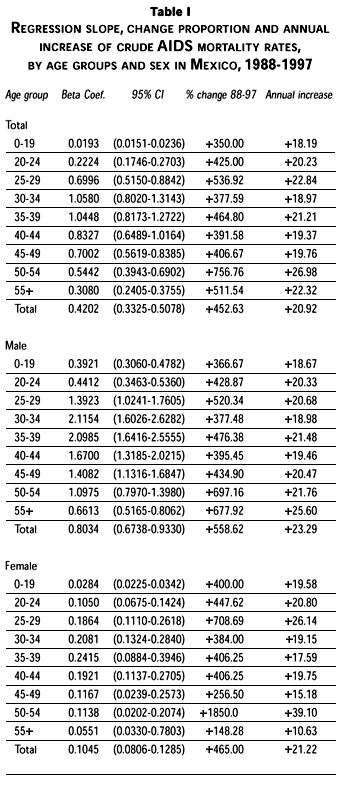
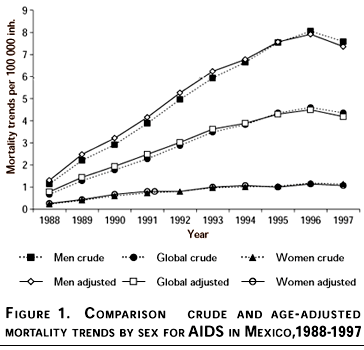
<body><![CDATA[<P align="left">     <font size="3">     The crude AIDS mortality rate trend by  5-year groups was calculated using a simple lineal  regression statistical technique; statistical significance of the  regression coefficient was assessed with the  <I>p</I> value and 95% confidence intervals (95% CI). The working  hypothesis tests whether the slope is different from  zero (Beta <font FACE="Symbol">¹</font>0).<SUP>7</SUP> </font>     <P align="left">     <font size="3">     Standardized Mortality Ratio (SMR) and  Potential Lost Life Year Index  (PLLYI) with the  corresponding 95% CI were calculated for 1988-1997, by  Mexican state. The PLLYI was estimated primarily to  evaluate premature mortality from this disease. This  indicator is useful in planning health services and  establishing priorities in the prevention of premature  deaths.<SUP>5-7</SUP> </font>     <P align="left">&nbsp;     <P align="center"><font size="4">Results</font>     <P align="left"><font size="3">During the ten-year study period (1988-1997),  there were 26 999 AIDS-related deaths in Mexico, with  86.5% (23 354) of them among men. The mean age at time  of death was 38.4 years for men and 37.7 years for  women. The difference in the means was not  statistically significant (<I>p</I>&gt; 0.05). The group between the ages of  25 to 39 years had a higher relative mortality  proportion; it was 59% for men and 51% for women. The male  to female ratio was 6:1.</font>     <P align="left">     <font size="3">     The AIDS crude mortality rate for the period  of study was 3.02 deaths (95% CI: 2.94-3.06) per 100  000 inhabitants, with 5.22 (95% CI 5.16-5.29) among  men and 0.82 (95% CI 0.79-0.84) among women. The AIDS adjusted rate was 3.13 deaths (95% CI:  3.09-3.17) per 100 000 inhabitants; for men it was 5.46  (95% CI 5.39-5.53) and for women, 0.84 (95% CI  0.82-0.87) (<a href="#fig01">Figure 1</a>).</font>     <P align="left">     <a name="fig01"></a>     <P align="left">&nbsp;          <p align="center"><img src="/img/revistas/spm/v44n3/a03fig01.gif"></p>     <P align="left">&nbsp;          ]]></body>
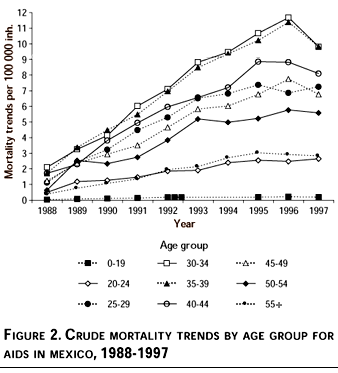
<body><![CDATA[<P align="left">     <font size="3">     The percentage of change from the beginning  to the end of the 1988-1997 period was +545.50%, and  the mean annual increase, measured through the  geometric mean, was +23.03% for the same period. In a  comparison by sex, a higher change percentage from 1988  to 1997, and a higher annual increase of mortality  rates, were observed in men (<a href="#tab01">Table I</a>).</font>     <P align="left">     <a name="tab01"></a>     <P align="left">&nbsp;          <p align="center"><img src="/img/revistas/spm/v44n3/a03tab01.gif"></p>     <P align="left">&nbsp;          <P align="left">     <font size="3">     A trend analysis of crude mortality rates by  quinquennial age groups showed the highest rates  among the 25-29, 30-34 and 35-39 age groups (<a href="#fig02">Figure 2</a>).  The highest slopes corresponded to the 30-34 age  group (Beta: 1.0580; 95% CI: 0.8020-1.3143;  <I>p</I>&lt; 0.001) and the 35-39 age group (Beta: 1.0448; 95% CI:  0.8173-1.2722; <I>p</I>&lt; 0.001). The greatest percentage of change (from  1988 to 1997) was for the 50-54 age group. The mean  annual increase was greater for this age group (<a href="#tab01">Table I</a>).</font>     <P align="left">     <a name="fig02"></a>     <P align="left">&nbsp;          <p align="center"><img src="/img/revistas/spm/v44n3/a03fig02.gif"></p>     <P align="left">&nbsp;          ]]></body>
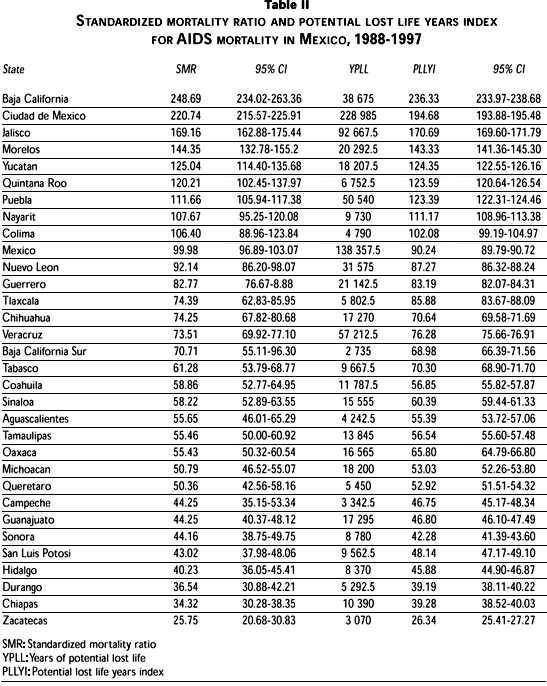
<body><![CDATA[<P align="left">     <font size="3">     There was a greater proportion of observed  deaths than expected, as measured by the SMR in Baja  California Norte (SMR: 248.69; 95% CI:  234.02-263.36), Mexico City (SMR: 220.74; 95% CI: 214.47-224.91)  and Jalisco (SMR:169.16; 95% CI: 162.88-175.44). The  states with the lowest SMR were Zacatecas (SMR:  25.75%; 95% CI: 20.68-30.83), Chiapas (SMR: 34.32; 95%  CI: 30.28-38.35), and Durango (SMR 36.54; 95% CI:  30.88-42.21) (<a href="#tab02">Table II</a>).</font>     <P align="left">     <a name="tab02"></a>     <P align="left">&nbsp;          <p align="center"><img src="/img/revistas/spm/v44n3/a03tab02.gif"></p>     <P align="left">&nbsp;          <P align="left">     <font size="3">     The total PLLY for this period was 906,050. A  PLLYI analysis by state indicated greater and more  premature mortality in Baja California (PLLYI:  236.33; 95% CI: 233.97-238.68), Mexico City  (PLLYI: 194.68; 95% CI: 193.88-195.48), and Jalisco (PLLYI:  170.69; 95% CI: 169.60-171.79). The states with the lowest  PLLYI were Zacatecas (PLLYI: 26.34; 95% CI: 25.41-27.27),  Durango (PLLYI: 39.16; 95% CI: 38.11-40.22), and  Chiapas (PLLYI:39.28; 95% CI: 38.52-40.03) (<a href="#tab02">Table II</a>).</font>     <P align="left">&nbsp;          <p align="center"><font size="4"> Discussion</font>     <P align="left"><font size="3">WHO estimated that over 21 million people died  from AIDS worldwide in 2000, with 90% of them in  developing countries. These data show that the impact  from AIDS, as measured by AIDS-related deaths, is  still growing, with an annual increase in the number of  both deaths and infections in Latin America.<SUP>1,8</SUP> </font>     <P align="left">     <font size="3">     Analysis of AIDS mortality trends in  Mexico showed a 22% increase for the 1989-1997 period.  These rates are lower than those for the United States,  where the AIDS mortality rate increased by 58%, from 41  per 100 000 inhabitants in 1980, to 65 in  1992.<SUP>9</SUP> However, there has been a dramatic decrease in  AIDS-related deaths in the United States and other developed  countries during the past few years, with AIDS deaths  declining 42% between 1996 (36 792 deaths) and 1997  (21 222 deaths), and 20% between 1997 and 1998 (17  047 deaths).<SUP>10</SUP> In Mexico the results show that AIDS  mortality patterns increased, globally and by sex, for  the 1988-1997 period, however in 1997 they began to  stabilize. The real effect of this decline could be  observed when the mortality trends analysis included more  recent years.<SUP>11</SUP> </font>     ]]></body>
<body><![CDATA[<P align="left">      <font size="3">      The mean age at death from AIDS for both  men and women was 38 years for the 1988-1997 period,  with the 25-39 years age groups having the highest  relative mortality proportion; this pattern persists. Similar  findings have been reported in other countries, such as  the United States, where the mean age at death from  AIDS was 38 years for males and 34 years for  females.<SUP>12</SUP> In Mexico, the incidence of AIDS-related deaths in  1998 was 4,758, with 63% occurring among persons  between 20 and 39 years of age. In this age group, AIDS is  now the fourth leading cause of death for both  sexes.<SUP>3,13,14</SUP> </font>     <P align="left">     <font size="3">     The male to female ratio (6:1) is similar to that  reported for the Andean region of Latin America  (6:1), but higher than in the United States, Brasil and  Central America (3:1), and the Caribbean (2:1) in 1997.  The male to female global ratio has decreased in the  United States (from 6:0 in 1991 to 3.0 in 1998), but not  in Mexico, where it remained stable during the  1988-1997 period (5.45 in 1991 and 6:1 in 1998). However, we  can observe inside the country a range from 3:1 in  Puebla, Tlaxcala and Morelos, to 12:1 in Nuevo  Le&oacute;n.<SUP>8,15,16</SUP> </font>     <P align="left">     <font size="3">     AIDS death risks by state showed more  observed cases than expected, for both SMR and PLLYI, in  Baja California, Mexico City, and Jalisco. In these  three states, 43.3% of cumulative AIDS cases (16 623)  reported through January 1 1999 are concentrated. The  major risk factors for HIV infection in these three  states wer homosexual and bisexual practices, with  39.8%, 48.9%, and 37.9%, respectively. Baja California, a  state that borders with the United States, has a  considerable proportion of cases related to intravenous drug  users (3.5%), that is greater than the national mean  (0.7%).<SUP>3 </SUP>If we compare the PLLY for this period (906 050)  with that reported by Izazola and collaborators for  1983-1992 (295 749), there is a cumulative increase of  206.37%.<SUP>17</SUP> </font>     <P align="left">     <font size="3">     An important drawback in AIDS data  analysis consists of delayed reporting and underreporting  of cases, mainly with respect to the basic cause of  death, resulting in an underestimation of the results. In  Mexico, 47 617 AIDS cases were reported through  January 1, 2001. Correcting for underdiagnosis and delayed notification (34%), the actual  cumulative number of AIDS cases in Mexico would be closer to  a figure of 64 000 cases for that year. Similarly,  underreporting of AIDS mortality has been estimated to  be over 30%.<SUP>16,18</SUP> In Canada and the United States,  underreporting of AIDS mortality has been estimated at  between 10 and 20%.<SUP>10</SUP> However, our findings are  similar to those found elsewhere, regarding the frequency  and distribution of AIDS mortality.<SUP>3,10,19-21</SUP> </font>     <P align="left">     <font size="3">     The fact that antiretroviral treatment is an  important marker for the impact of HIV infection should  be considered in the development of new strategies  for the prevention and control of the AIDS epidemic  in Mexico. Contrary to developed countries, we have  not observed a decline in AIDS mortality in the study  period. In the United States, the use of  antiretroviral treatment of AIDS patients began in 1994, however in  Mexico it was not an important therapeutic option until 1997. Therefore we expect that the effect of  decreasing AIDS mortality trends will be observed in  the next years.</font>     <P align="left">&nbsp;     <P align="center"><font size="4">References</font>     <!-- ref --><P align="left"><font size="3">1. World Health Organization. Annual report on AIDS, Ginebra:  WHO, 1997.</font>    &nbsp;&nbsp;&nbsp;&nbsp;&nbsp;&nbsp;&nbsp;&nbsp;[&#160;<a href="javascript:void(0);" onclick="javascript: window.open('/scielo.php?script=sci_nlinks&ref=9173405&pid=S0036-3634200200030000300001&lng=','','width=640,height=500,resizable=yes,scrollbars=1,menubar=yes,');">Links</a>&#160;]<!-- end-ref --><!-- ref --><P align="left"><font size="3">2. Consejo Nacional de Prevenci&oacute;n y Control del SIDA. Bolet&iacute;n  Epidemiol&oacute;gico. SIDA/ETS. Revista SIDA/ETS 1997;4(4).</font>    &nbsp;&nbsp;&nbsp;&nbsp;&nbsp;&nbsp;&nbsp;&nbsp;[&#160;<a href="javascript:void(0);" onclick="javascript: window.open('/scielo.php?script=sci_nlinks&ref=9173406&pid=S0036-3634200200030000300002&lng=','','width=640,height=500,resizable=yes,scrollbars=1,menubar=yes,');">Links</a>&#160;]<!-- end-ref --><!-- ref --><P align="left"><font size="3">3. Consejo Nacional de Prevenci&oacute;n y Control del SIDA. Bolet&iacute;n  Epidemiol&oacute;gico. SIDA/ETS. Revista SIDA/ETS 1998;4(1-4).</font>    &nbsp;&nbsp;&nbsp;&nbsp;&nbsp;&nbsp;&nbsp;&nbsp;[&#160;<a href="javascript:void(0);" onclick="javascript: window.open('/scielo.php?script=sci_nlinks&ref=9173407&pid=S0036-3634200200030000300003&lng=','','width=640,height=500,resizable=yes,scrollbars=1,menubar=yes,');">Links</a>&#160;]<!-- end-ref --><!-- ref --><P align="left"><font size="3">4. Organizaci&oacute;n Panamericana de la Salud. Clasificaci&oacute;n Internacional  de Enfermedades. IX revisi&oacute;n. Washington, D.C.: OPS, 1978.</font>    &nbsp;&nbsp;&nbsp;&nbsp;&nbsp;&nbsp;&nbsp;&nbsp;[&#160;<a href="javascript:void(0);" onclick="javascript: window.open('/scielo.php?script=sci_nlinks&ref=9173408&pid=S0036-3634200200030000300004&lng=','','width=640,height=500,resizable=yes,scrollbars=1,menubar=yes,');">Links</a>&#160;]<!-- end-ref --><!-- ref --><P align="left"><font size="3">5. Dever A. Epidemiolog&iacute;a y administraci&oacute;n de servicios de salud.  Washington, D.C.: OPS, 1991.</font>    &nbsp;&nbsp;&nbsp;&nbsp;&nbsp;&nbsp;&nbsp;&nbsp;[&#160;<a href="javascript:void(0);" onclick="javascript: window.open('/scielo.php?script=sci_nlinks&ref=9173409&pid=S0036-3634200200030000300005&lng=','','width=640,height=500,resizable=yes,scrollbars=1,menubar=yes,');">Links</a>&#160;]<!-- end-ref --><!-- ref --><P align="left"><font size="3">6. Lilinfield D, Stolley P. Foundations of epidemiology. Third edition.  Nueva York: Oxford University Press, 1994.</font>    &nbsp;&nbsp;&nbsp;&nbsp;&nbsp;&nbsp;&nbsp;&nbsp;[&#160;<a href="javascript:void(0);" onclick="javascript: window.open('/scielo.php?script=sci_nlinks&ref=9173410&pid=S0036-3634200200030000300006&lng=','','width=640,height=500,resizable=yes,scrollbars=1,menubar=yes,');">Links</a>&#160;]<!-- end-ref --><!-- ref --><P align="left"><font size="3">7. Hamilton L. Statistics with Stata 3.0, Belmont (CA): Duxbury  Press, 1993.</font>    &nbsp;&nbsp;&nbsp;&nbsp;&nbsp;&nbsp;&nbsp;&nbsp;[&#160;<a href="javascript:void(0);" onclick="javascript: window.open('/scielo.php?script=sci_nlinks&ref=9173411&pid=S0036-3634200200030000300007&lng=','','width=640,height=500,resizable=yes,scrollbars=1,menubar=yes,');">Links</a>&#160;]<!-- end-ref --><!-- ref --><P align="left"><font size="3">8. Organizaci&oacute;n Panamericana de la Salud. La epidemia del SIDA:  situaci&oacute;n en diciembre 1998. Washington, D.C.: OPS, December 1998.</font>    &nbsp;&nbsp;&nbsp;&nbsp;&nbsp;&nbsp;&nbsp;&nbsp;[&#160;<a href="javascript:void(0);" onclick="javascript: window.open('/scielo.php?script=sci_nlinks&ref=9173412&pid=S0036-3634200200030000300008&lng=','','width=640,height=500,resizable=yes,scrollbars=1,menubar=yes,');">Links</a>&#160;]<!-- end-ref --><!-- ref --><P align="left"><font size="3">9. Pinner R, Teustsch S, Simonsen L, Kulg L, Graber J, Clarke M  <I>et al</I>. Trends in infectious diseases mortality in the United States. JAMA  1996;275(3): 189-193.</font>    &nbsp;&nbsp;&nbsp;&nbsp;&nbsp;&nbsp;&nbsp;&nbsp;[&#160;<a href="javascript:void(0);" onclick="javascript: window.open('/scielo.php?script=sci_nlinks&ref=9173413&pid=S0036-3634200200030000300009&lng=','','width=640,height=500,resizable=yes,scrollbars=1,menubar=yes,');">Links</a>&#160;]<!-- end-ref --><!-- ref --><p align="left"><font size="3"> 10. Center for Disease Control and Prevention. National HIV  Prevention Conference. Atlanta (GA): CDC, 1999.</font>    &nbsp;&nbsp;&nbsp;&nbsp;&nbsp;&nbsp;&nbsp;&nbsp;[&#160;<a href="javascript:void(0);" onclick="javascript: window.open('/scielo.php?script=sci_nlinks&ref=9173414&pid=S0036-3634200200030000300010&lng=','','width=640,height=500,resizable=yes,scrollbars=1,menubar=yes,');">Links</a>&#160;]<!-- end-ref --><!-- ref --><P align="left"><font size="3">11. Valdespino JL, Garc&iacute;a ML, Del R&iacute;o A, Loo-M&eacute;ndez E, Magis C,  Salcedo RA. Epidemiolog&iacute;a del SIDA/VIH en M&eacute;xico: 1983-1995. Salud Publica  Mex 1995;37(6):556-571.</font>    &nbsp;&nbsp;&nbsp;&nbsp;&nbsp;&nbsp;&nbsp;&nbsp;[&#160;<a href="javascript:void(0);" onclick="javascript: window.open('/scielo.php?script=sci_nlinks&ref=9173415&pid=S0036-3634200200030000300011&lng=','','width=640,height=500,resizable=yes,scrollbars=1,menubar=yes,');">Links</a>&#160;]<!-- end-ref --><!-- ref --><P align="left"><font size="3">12. Heath K, Frank O, Montaner J, O'Shaughnessy, Schechter M, Hogg  R. Human immunodeficiency virus (HIV)/acquired immunodeficiency  syndrome (AIDS) mortality in industrialized nations, 1987-1991. Int J  Epidemiol 1998;27:685-690.</font>    &nbsp;&nbsp;&nbsp;&nbsp;&nbsp;&nbsp;&nbsp;&nbsp;[&#160;<a href="javascript:void(0);" onclick="javascript: window.open('/scielo.php?script=sci_nlinks&ref=9173416&pid=S0036-3634200200030000300012&lng=','','width=640,height=500,resizable=yes,scrollbars=1,menubar=yes,');">Links</a>&#160;]<!-- end-ref --><!-- ref --><P align="left"><font size="3">13.  Magis C, Del R&iacute;o A, Valdespino JL, Garc&iacute;a ML. Casos de SIDA en el  &aacute;rea rural en M&eacute;xico. Salud Publica Mex 1995;37(6):615-623.</font>    &nbsp;&nbsp;&nbsp;&nbsp;&nbsp;&nbsp;&nbsp;&nbsp;[&#160;<a href="javascript:void(0);" onclick="javascript: window.open('/scielo.php?script=sci_nlinks&ref=9173417&pid=S0036-3634200200030000300013&lng=','','width=640,height=500,resizable=yes,scrollbars=1,menubar=yes,');">Links</a>&#160;]<!-- end-ref --><!-- ref --><P align="left"><font size="3">14. Del R&iacute;o A, Ligouri AL, Magis C, Valdespino JL, Garc&iacute;a ML, Sep&uacute;lveda J.  La epidemia del VIH/SIDA y la mujer en M&eacute;xico. Salud Publica Mex  1995;37(6): 581-591.</font>    &nbsp;&nbsp;&nbsp;&nbsp;&nbsp;&nbsp;&nbsp;&nbsp;[&#160;<a href="javascript:void(0);" onclick="javascript: window.open('/scielo.php?script=sci_nlinks&ref=9173418&pid=S0036-3634200200030000300014&lng=','','width=640,height=500,resizable=yes,scrollbars=1,menubar=yes,');">Links</a>&#160;]<!-- end-ref --><!-- ref --><P align="left"><font size="3">15. Sep&uacute;lveda J, Del R&iacute;o A, Valdespino JL, Garc&iacute;a ML, Vel&aacute;squez L, Volkow  P. La estrategia de prevenci&oacute;n de la transmisi&oacute;n del VIH/SIDA a trav&eacute;s de  la sangre y sus derivados en M&eacute;xico. Salud Publica Mex 1995;37(6):624-635.</font>    &nbsp;&nbsp;&nbsp;&nbsp;&nbsp;&nbsp;&nbsp;&nbsp;[&#160;<a href="javascript:void(0);" onclick="javascript: window.open('/scielo.php?script=sci_nlinks&ref=9173419&pid=S0036-3634200200030000300015&lng=','','width=640,height=500,resizable=yes,scrollbars=1,menubar=yes,');">Links</a>&#160;]<!-- end-ref --><!-- ref --><P align="left"><font size="3">16. Consejo Nacional de Prevenci&oacute;n y Control del SIDA.  El SIDA en M&eacute;xico en el a&ntilde;o 2000. Junio 2001. Reporte preliminar.</font>    &nbsp;&nbsp;&nbsp;&nbsp;&nbsp;&nbsp;&nbsp;&nbsp;[&#160;<a href="javascript:void(0);" onclick="javascript: window.open('/scielo.php?script=sci_nlinks&ref=9173420&pid=S0036-3634200200030000300016&lng=','','width=640,height=500,resizable=yes,scrollbars=1,menubar=yes,');">Links</a>&#160;]<!-- end-ref --><!-- ref --><P align="left"><font size="3">17. Izazola JA, Valdez-Garc&iacute;a MC, S&aacute;nchez-P&eacute;rez H, Del R&iacute;o-Chiriboga  C. La mortalidad por SIDA en M&eacute;xico 1983-1992. Tendencias y a&ntilde;os de  vida potencialmente perdidos. Salud Publica Mex 1995;37(2):140-148.</font>    &nbsp;&nbsp;&nbsp;&nbsp;&nbsp;&nbsp;&nbsp;&nbsp;[&#160;<a href="javascript:void(0);" onclick="javascript: window.open('/scielo.php?script=sci_nlinks&ref=9173421&pid=S0036-3634200200030000300017&lng=','','width=640,height=500,resizable=yes,scrollbars=1,menubar=yes,');">Links</a>&#160;]<!-- end-ref --><!-- ref --><P align="left"><font size="3">18. Anaya-L&oacute;pez L. Subestimaci&oacute;n de la incidencia de SIDA en  M&eacute;xico, debida al retraso en la notificaci&oacute;n. Revista SIDA/ETS 1997;2(3):35-38.</font>    &nbsp;&nbsp;&nbsp;&nbsp;&nbsp;&nbsp;&nbsp;&nbsp;[&#160;<a href="javascript:void(0);" onclick="javascript: window.open('/scielo.php?script=sci_nlinks&ref=9173422&pid=S0036-3634200200030000300018&lng=','','width=640,height=500,resizable=yes,scrollbars=1,menubar=yes,');">Links</a>&#160;]<!-- end-ref --><!-- ref --><P align="left"><font size="3">19. Surasiengsunk S, Kiranandana S, Wongboonsin K, Van Griensven  G. Demographic impact of the HIV epidemic in Thailand. AIDS  1998;12: 775-784.</font>    &nbsp;&nbsp;&nbsp;&nbsp;&nbsp;&nbsp;&nbsp;&nbsp;[&#160;<a href="javascript:void(0);" onclick="javascript: window.open('/scielo.php?script=sci_nlinks&ref=9173423&pid=S0036-3634200200030000300019&lng=','','width=640,height=500,resizable=yes,scrollbars=1,menubar=yes,');">Links</a>&#160;]<!-- end-ref --><!-- ref --><P align="left"><font size="3">20. Laurichesse H, Mortimer J, Evans B, Farrington P. Pre-AIDS  mortality in HIV-infected individuals in England, Wales and Nothern Ireland,  1982-1996. AIDS 1998;12:651-658.</font>    &nbsp;&nbsp;&nbsp;&nbsp;&nbsp;&nbsp;&nbsp;&nbsp;[&#160;<a href="javascript:void(0);" onclick="javascript: window.open('/scielo.php?script=sci_nlinks&ref=9173424&pid=S0036-3634200200030000300020&lng=','','width=640,height=500,resizable=yes,scrollbars=1,menubar=yes,');">Links</a>&#160;]<!-- end-ref --><!-- ref --><P align="left"><font size="3">21. Kristal A. The impact of the AIDS on patterns of premature death  in New York City. JAMA 1986;255(17):2306-2310.</font>    &nbsp;&nbsp;&nbsp;&nbsp;&nbsp;&nbsp;&nbsp;&nbsp;[&#160;<a href="javascript:void(0);" onclick="javascript: window.open('/scielo.php?script=sci_nlinks&ref=9173425&pid=S0036-3634200200030000300021&lng=','','width=640,height=500,resizable=yes,scrollbars=1,menubar=yes,');">Links</a>&#160;]<!-- end-ref --><P align="left">&nbsp;     <P align="left">&nbsp;     ]]></body>
<body><![CDATA[<p align="left"><font size="3"> Presented in part at the &quot;XIII International Conference con AIDS&quot;, Durban, South Africa, July 2000. (Abstract # MoPeD2498)&quot; &quot;Supported in part by  the NIH/AIDS. International Training and Research Program of Emory University Grant #D43 TW01042-0&quot;.</font>     <P align="left"><font size="3"><a name="nota"></a>(<a href="#texto">1</a>)     Centro de Investigaci&oacute;n en Salud Poblacional, Instituto Nacional de Salud P&uacute;blica, Cuernavaca, Morelos, M&eacute;xico.</font>     <P align="left"><font size="3">(<a href="#texto">2</a>)     Emory University School of Medicine. Atlanta, Georgia, United States of America.</font>     <P align="left">&nbsp;     <P align="center"><font size="3"><B>Received on:</B> May 24, 2001 <font FACE="Symbol">·</font> <B>Accepted  on:</B> December 5, 2001    <br> Address reprint requests to: Carlos Hern&aacute;ndez-Gir&oacute;n. Instituto Nacional de Salud P&uacute;blica. Av. Universidad 655, 62508 Cuernavaca, Morelos, M&eacute;xico.    <br> <a href="mailto:E-mail:chernand@correo.insp.mx"> E-mail:chernand@correo.insp.mx</a></font>      ]]></body><back>
<ref-list>
<ref id="B1">
<label>1</label><nlm-citation citation-type="book">
<collab>World Health Organization</collab>
<source><![CDATA[Annual report on AIDS]]></source>
<year>1997</year>
<publisher-loc><![CDATA[Ginebra ]]></publisher-loc>
<publisher-name><![CDATA[WHO]]></publisher-name>
</nlm-citation>
</ref>
<ref id="B2">
<label>2</label><nlm-citation citation-type="journal">
<collab>Consejo Nacional de Prevención y Control del SIDA</collab>
<article-title xml:lang="es"><![CDATA[Boletín Epidemiológico: SIDA/ETS]]></article-title>
<source><![CDATA[Revista SIDA/ETS]]></source>
<year>1997</year>
<volume>4</volume>
<numero>4</numero>
<issue>4</issue>
</nlm-citation>
</ref>
<ref id="B3">
<label>3</label><nlm-citation citation-type="journal">
<collab>Consejo Nacional de Prevención y Control del SIDA</collab>
<article-title xml:lang="es"><![CDATA[Boletín Epidemiológico: SIDA/ETS]]></article-title>
<source><![CDATA[Revista SIDA/ETS]]></source>
<year>1998</year>
<volume>4</volume>
<numero>1-4</numero>
<issue>1-4</issue>
</nlm-citation>
</ref>
<ref id="B4">
<label>4</label><nlm-citation citation-type="book">
<collab>Organización Panamericana de la Salud</collab>
<source><![CDATA[Clasificación Internacional de Enfermedades]]></source>
<year>1978</year>
<publisher-loc><![CDATA[Washington^eD.C. D.C.]]></publisher-loc>
<publisher-name><![CDATA[OPS]]></publisher-name>
</nlm-citation>
</ref>
<ref id="B5">
<label>5</label><nlm-citation citation-type="book">
<person-group person-group-type="author">
<name>
<surname><![CDATA[Dever]]></surname>
<given-names><![CDATA[A]]></given-names>
</name>
</person-group>
<source><![CDATA[Epidemiología y administración de servicios de salud]]></source>
<year>1991</year>
<publisher-loc><![CDATA[Washington^eD. C. D. C.]]></publisher-loc>
<publisher-name><![CDATA[OPS]]></publisher-name>
</nlm-citation>
</ref>
<ref id="B6">
<label>6</label><nlm-citation citation-type="book">
<person-group person-group-type="author">
<name>
<surname><![CDATA[Lilinfield]]></surname>
<given-names><![CDATA[D]]></given-names>
</name>
<name>
<surname><![CDATA[Stolley]]></surname>
<given-names><![CDATA[P]]></given-names>
</name>
</person-group>
<source><![CDATA[Foundations of epidemiology]]></source>
<year>1994</year>
<edition>Third</edition>
<publisher-loc><![CDATA[Nueva York ]]></publisher-loc>
<publisher-name><![CDATA[Oxford University Press]]></publisher-name>
</nlm-citation>
</ref>
<ref id="B7">
<label>7</label><nlm-citation citation-type="book">
<person-group person-group-type="author">
<name>
<surname><![CDATA[Hamilton]]></surname>
<given-names><![CDATA[L]]></given-names>
</name>
</person-group>
<source><![CDATA[Statistics with Stata 3.0]]></source>
<year>1993</year>
<publisher-loc><![CDATA[Belmont^eCA CA]]></publisher-loc>
<publisher-name><![CDATA[Duxbury Press]]></publisher-name>
</nlm-citation>
</ref>
<ref id="B8">
<label>8</label><nlm-citation citation-type="book">
<collab>Organización Panamericana de la Salud</collab>
<source><![CDATA[La epidemia del SIDA: situación en diciembre 1998]]></source>
<year>Dece</year>
<month>mb</month>
<day>er</day>
<publisher-loc><![CDATA[Washington^eD.C. D.C.]]></publisher-loc>
<publisher-name><![CDATA[OPS]]></publisher-name>
</nlm-citation>
</ref>
<ref id="B9">
<label>9</label><nlm-citation citation-type="journal">
<person-group person-group-type="author">
<name>
<surname><![CDATA[Pinner]]></surname>
<given-names><![CDATA[R]]></given-names>
</name>
<name>
<surname><![CDATA[Teustsch]]></surname>
<given-names><![CDATA[S]]></given-names>
</name>
<name>
<surname><![CDATA[Simonsen]]></surname>
<given-names><![CDATA[L]]></given-names>
</name>
<name>
<surname><![CDATA[Kulg]]></surname>
<given-names><![CDATA[L]]></given-names>
</name>
<name>
<surname><![CDATA[Graber]]></surname>
<given-names><![CDATA[J]]></given-names>
</name>
<name>
<surname><![CDATA[Clarke]]></surname>
<given-names><![CDATA[M]]></given-names>
</name>
</person-group>
<article-title xml:lang="en"><![CDATA[Trends in infectious diseases mortality in the United States]]></article-title>
<source><![CDATA[JAMA]]></source>
<year>1996</year>
<volume>275</volume>
<numero>3</numero>
<issue>3</issue>
<page-range>189-193</page-range></nlm-citation>
</ref>
<ref id="B10">
<label>10</label><nlm-citation citation-type="book">
<collab>Center for Disease Control and Prevention</collab>
<source><![CDATA[National HIV Prevention Conference]]></source>
<year>1999</year>
<publisher-loc><![CDATA[Atlanta (GA) ]]></publisher-loc>
<publisher-name><![CDATA[CDC]]></publisher-name>
</nlm-citation>
</ref>
<ref id="B11">
<label>11</label><nlm-citation citation-type="journal">
<person-group person-group-type="author">
<name>
<surname><![CDATA[Valdespino]]></surname>
<given-names><![CDATA[JL]]></given-names>
</name>
<name>
<surname><![CDATA[García]]></surname>
<given-names><![CDATA[ML]]></given-names>
</name>
<name>
<surname><![CDATA[Del Río]]></surname>
<given-names><![CDATA[A]]></given-names>
</name>
<name>
<surname><![CDATA[Loo-Méndez]]></surname>
<given-names><![CDATA[E]]></given-names>
</name>
<name>
<surname><![CDATA[Magis]]></surname>
<given-names><![CDATA[C]]></given-names>
</name>
<name>
<surname><![CDATA[Salcedo]]></surname>
<given-names><![CDATA[RA]]></given-names>
</name>
</person-group>
<article-title xml:lang="es"><![CDATA[Epidemiología del SIDA/VIH en México: 1983-1995]]></article-title>
<source><![CDATA[Salud Publica Mex]]></source>
<year>1995</year>
<volume>37</volume>
<numero>6</numero>
<issue>6</issue>
<page-range>556-571</page-range></nlm-citation>
</ref>
<ref id="B12">
<label>12</label><nlm-citation citation-type="journal">
<person-group person-group-type="author">
<name>
<surname><![CDATA[Heath]]></surname>
<given-names><![CDATA[K]]></given-names>
</name>
<name>
<surname><![CDATA[Frank]]></surname>
<given-names><![CDATA[O]]></given-names>
</name>
<name>
<surname><![CDATA[Montaner]]></surname>
<given-names><![CDATA[J]]></given-names>
</name>
<name>
<surname><![CDATA[O'Shaughnessy]]></surname>
<given-names><![CDATA[Schechter M]]></given-names>
</name>
<name>
<surname><![CDATA[Hogg]]></surname>
<given-names><![CDATA[R]]></given-names>
</name>
</person-group>
<article-title xml:lang="en"><![CDATA[Human immunodeficiency virus (HIV)/acquired immunodeficiency syndrome (AIDS) mortality in industrialized nations, 1987-1991]]></article-title>
<source><![CDATA[Int J Epidemiol]]></source>
<year>1998</year>
<volume>27</volume>
<page-range>685-690</page-range></nlm-citation>
</ref>
<ref id="B13">
<label>13</label><nlm-citation citation-type="journal">
<person-group person-group-type="author">
<name>
<surname><![CDATA[Magis]]></surname>
<given-names><![CDATA[C]]></given-names>
</name>
<name>
<surname><![CDATA[Del Río]]></surname>
<given-names><![CDATA[A]]></given-names>
</name>
<name>
<surname><![CDATA[Valdespino]]></surname>
<given-names><![CDATA[JL]]></given-names>
</name>
<name>
<surname><![CDATA[García]]></surname>
<given-names><![CDATA[ML]]></given-names>
</name>
</person-group>
<article-title xml:lang="es"><![CDATA[Casos de SIDA en el área rural en México]]></article-title>
<source><![CDATA[Salud Publica Mex]]></source>
<year>1995</year>
<volume>37</volume>
<numero>6</numero>
<issue>6</issue>
<page-range>615-623</page-range></nlm-citation>
</ref>
<ref id="B14">
<label>14</label><nlm-citation citation-type="journal">
<person-group person-group-type="author">
<name>
<surname><![CDATA[Del Río]]></surname>
<given-names><![CDATA[A]]></given-names>
</name>
<name>
<surname><![CDATA[Ligouri]]></surname>
<given-names><![CDATA[AL]]></given-names>
</name>
<name>
<surname><![CDATA[Magis]]></surname>
<given-names><![CDATA[C]]></given-names>
</name>
<name>
<surname><![CDATA[Valdespino]]></surname>
<given-names><![CDATA[JL]]></given-names>
</name>
<name>
<surname><![CDATA[García]]></surname>
<given-names><![CDATA[ML]]></given-names>
</name>
<name>
<surname><![CDATA[Sepúlveda]]></surname>
<given-names><![CDATA[J]]></given-names>
</name>
</person-group>
<article-title xml:lang="es"><![CDATA[La epidemia del VIH/SIDA y la mujer en México]]></article-title>
<source><![CDATA[Salud Publica Mex]]></source>
<year>1995</year>
<volume>37</volume>
<numero>6</numero>
<issue>6</issue>
<page-range>581-591</page-range></nlm-citation>
</ref>
<ref id="B15">
<label>15</label><nlm-citation citation-type="journal">
<person-group person-group-type="author">
<name>
<surname><![CDATA[Sepúlveda]]></surname>
<given-names><![CDATA[J]]></given-names>
</name>
<name>
<surname><![CDATA[Del Río]]></surname>
<given-names><![CDATA[A]]></given-names>
</name>
<name>
<surname><![CDATA[Valdespino]]></surname>
<given-names><![CDATA[JL]]></given-names>
</name>
<name>
<surname><![CDATA[García]]></surname>
<given-names><![CDATA[ML]]></given-names>
</name>
<name>
<surname><![CDATA[Velásquez]]></surname>
<given-names><![CDATA[L]]></given-names>
</name>
<name>
<surname><![CDATA[Volkow]]></surname>
<given-names><![CDATA[P]]></given-names>
</name>
</person-group>
<article-title xml:lang="es"><![CDATA[La estrategia de prevención de la transmisión del VIH/SIDA a través de la sangre y sus derivados en México]]></article-title>
<source><![CDATA[Salud Publica Mex]]></source>
<year>1995</year>
<volume>37</volume>
<numero>6</numero>
<issue>6</issue>
<page-range>624-635</page-range></nlm-citation>
</ref>
<ref id="B16">
<label>16</label><nlm-citation citation-type="">
<collab>Consejo Nacional de Prevención y Control del SIDA</collab>
<source><![CDATA[El SIDA en México en el año 2000]]></source>
<year>Juni</year>
<month>o </month>
<day>20</day>
</nlm-citation>
</ref>
<ref id="B17">
<label>17</label><nlm-citation citation-type="journal">
<person-group person-group-type="author">
<name>
<surname><![CDATA[Izazola]]></surname>
<given-names><![CDATA[JA]]></given-names>
</name>
<name>
<surname><![CDATA[Valdez-García]]></surname>
<given-names><![CDATA[MC]]></given-names>
</name>
<name>
<surname><![CDATA[Sánchez-Pérez]]></surname>
<given-names><![CDATA[H]]></given-names>
</name>
<name>
<surname><![CDATA[Del Río-Chiriboga]]></surname>
<given-names><![CDATA[C]]></given-names>
</name>
</person-group>
<article-title xml:lang="es"><![CDATA[La mortalidad por SIDA en México 1983-1992: Tendencias y años de vida potencialmente perdidos]]></article-title>
<source><![CDATA[Salud Publica Mex]]></source>
<year>1995</year>
<volume>37</volume>
<numero>2</numero>
<issue>2</issue>
<page-range>140-148</page-range></nlm-citation>
</ref>
<ref id="B18">
<label>18</label><nlm-citation citation-type="journal">
<person-group person-group-type="author">
<name>
<surname><![CDATA[Anaya-López]]></surname>
<given-names><![CDATA[L]]></given-names>
</name>
</person-group>
<article-title xml:lang="es"><![CDATA[Subestimación de la incidencia de SIDA en México, debida al retraso en la notificación]]></article-title>
<source><![CDATA[Revista SIDA/ETS]]></source>
<year>1997</year>
<volume>2</volume>
<numero>3</numero>
<issue>3</issue>
<page-range>35-38</page-range></nlm-citation>
</ref>
<ref id="B19">
<label>19</label><nlm-citation citation-type="journal">
<person-group person-group-type="author">
<name>
<surname><![CDATA[Surasiengsunk]]></surname>
<given-names><![CDATA[S]]></given-names>
</name>
<name>
<surname><![CDATA[Kiranandana]]></surname>
<given-names><![CDATA[S]]></given-names>
</name>
<name>
<surname><![CDATA[Wongboonsin]]></surname>
<given-names><![CDATA[K]]></given-names>
</name>
<name>
<surname><![CDATA[Van Griensven]]></surname>
<given-names><![CDATA[G]]></given-names>
</name>
</person-group>
<article-title xml:lang="en"><![CDATA[Demographic impact of the HIV epidemic in Thailand]]></article-title>
<source><![CDATA[AIDS]]></source>
<year>1998</year>
<volume>12</volume>
<page-range>775-784</page-range></nlm-citation>
</ref>
<ref id="B20">
<label>20</label><nlm-citation citation-type="journal">
<person-group person-group-type="author">
<name>
<surname><![CDATA[Laurichesse]]></surname>
<given-names><![CDATA[H]]></given-names>
</name>
<name>
<surname><![CDATA[Mortimer]]></surname>
<given-names><![CDATA[J]]></given-names>
</name>
<name>
<surname><![CDATA[Evans]]></surname>
<given-names><![CDATA[B]]></given-names>
</name>
<name>
<surname><![CDATA[Farrington]]></surname>
<given-names><![CDATA[P]]></given-names>
</name>
</person-group>
<article-title xml:lang="en"><![CDATA[Pre-AIDS mortality in HIV-infected individuals in England, Wales and Nothern Ireland, 1982-1996]]></article-title>
<source><![CDATA[AIDS]]></source>
<year>1998</year>
<volume>12</volume>
<page-range>651-658</page-range></nlm-citation>
</ref>
<ref id="B21">
<label>21</label><nlm-citation citation-type="journal">
<person-group person-group-type="author">
<name>
<surname><![CDATA[Kristal]]></surname>
<given-names><![CDATA[A]]></given-names>
</name>
</person-group>
<article-title xml:lang="en"><![CDATA[The impact of the AIDS on patterns of premature death in New York City]]></article-title>
<source><![CDATA[JAMA]]></source>
<year>1986</year>
<volume>255</volume>
<numero>17</numero>
<issue>17</issue>
<page-range>2306-2310</page-range></nlm-citation>
</ref>
</ref-list>
</back>
</article>