<?xml version="1.0" encoding="ISO-8859-1"?><article xmlns:mml="http://www.w3.org/1998/Math/MathML" xmlns:xlink="http://www.w3.org/1999/xlink" xmlns:xsi="http://www.w3.org/2001/XMLSchema-instance">
<front>
<journal-meta>
<journal-id>0036-3634</journal-id>
<journal-title><![CDATA[Salud Pública de México]]></journal-title>
<abbrev-journal-title><![CDATA[Salud pública Méx]]></abbrev-journal-title>
<issn>0036-3634</issn>
<publisher>
<publisher-name><![CDATA[Instituto Nacional de Salud Pública]]></publisher-name>
</publisher>
</journal-meta>
<article-meta>
<article-id>S0036-36342002000200009</article-id>
<title-group>
<article-title xml:lang="en"><![CDATA[The centennial of the Yellow Fever Commission and the use of informed consent in medical research]]></article-title>
<article-title xml:lang="es"><![CDATA[El centenario de la Comisión de la Fiebre Amarilla y el uso del consentimiento informado en la investigación médica]]></article-title>
</title-group>
<contrib-group>
<contrib contrib-type="author">
<name>
<surname><![CDATA[Güereña-Burgueño]]></surname>
<given-names><![CDATA[Fernando]]></given-names>
</name>
<xref ref-type="aff" rid="A01"/>
</contrib>
</contrib-group>
<aff id="A01">
<institution><![CDATA[,Department of Enteric Infections Division of Communicable Diseases and Immunology Walter Reed Army Institute of Research]]></institution>
<addr-line><![CDATA[ ]]></addr-line>
<country>United States of America</country>
</aff>
<pub-date pub-type="pub">
<day>00</day>
<month>04</month>
<year>2002</year>
</pub-date>
<pub-date pub-type="epub">
<day>00</day>
<month>04</month>
<year>2002</year>
</pub-date>
<volume>44</volume>
<numero>2</numero>
<fpage>140</fpage>
<lpage>144</lpage>
<copyright-statement/>
<copyright-year/>
<self-uri xlink:href="http://www.scielo.org.mx/scielo.php?script=sci_arttext&amp;pid=S0036-36342002000200009&amp;lng=en&amp;nrm=iso"></self-uri><self-uri xlink:href="http://www.scielo.org.mx/scielo.php?script=sci_abstract&amp;pid=S0036-36342002000200009&amp;lng=en&amp;nrm=iso"></self-uri><self-uri xlink:href="http://www.scielo.org.mx/scielo.php?script=sci_pdf&amp;pid=S0036-36342002000200009&amp;lng=en&amp;nrm=iso"></self-uri><abstract abstract-type="short" xml:lang="en"><p><![CDATA[The year 2000 marked the centennial of the discovery of the mode of transmission of yellow fever. Informed consent was systematically used for the first time in research. This process was the result of a complex social phenomenon involving the American Public Health Association, the US and Spanish Governments, American and Cuban scientists, the media, and civilian and military volunteers. The public health and medical communities face the AIDS pandemic at the beginning of the 21st Century, as they faced the yellow fever epidemic at the beginning of the 20th Century. Current medical research dilemmas have fueled the debate about the ethical conduct of research in human subjects. The AIDS pandemic is imposing enormous new ethical challenges on the conduct of medical research, especially in the developing world. Reflecting on the yellow fever experiments of 1900, lessons can be learned and applied to the current ethical challenges faced by the international public health research community.]]></p></abstract>
<abstract abstract-type="short" xml:lang="es"><p><![CDATA[En el año 2000 se cumplió el primer centenario del descubrimiento del modo de transmisión de la fiebre amarilla. El consentimiento informado fue utilizado por primera vez de manera sistemática en una investigación médica. Este proceso fue el resultado de un fenómeno social complejo que involucró a la Asociación Americana de Salud Pública, a los gobiernos de los Estados Unidos de América y España, a científicos norteamericanos y cubanos, a la prensa y a voluntarios civiles y militares. Al inicio del siglo XXI las comunidades de salud pública y médicas en el ámbito internacional enfrentan la pandemia de SIDA al igual que enfrentaron a la fiebre amarilla al iniciarse el siglo XX. A la vez, también debaten los retos éticos que la investigación médica contemporánea les ofrece, especialmente en los países en desarrollo. La reflexión sobre los experimentos de 1900 podría ofrecer enseñanzas aplicables a los retos éticos enfrentados por las comunidades internacionales de investigación en salud pública.]]></p></abstract>
<kwd-group>
<kwd lng="en"><![CDATA[yellow fever]]></kwd>
<kwd lng="en"><![CDATA[informed consent]]></kwd>
<kwd lng="en"><![CDATA[research]]></kwd>
<kwd lng="en"><![CDATA[ethics]]></kwd>
<kwd lng="en"><![CDATA[medical]]></kwd>
<kwd lng="es"><![CDATA[fiebre amarilla]]></kwd>
<kwd lng="es"><![CDATA[consentimiento informado]]></kwd>
<kwd lng="es"><![CDATA[investigación]]></kwd>
<kwd lng="es"><![CDATA[ética médica]]></kwd>
</kwd-group>
</article-meta>
</front><body><![CDATA[ <p align="left"><font size="2"><b><a name="tx"></a>ARTÍCULO DE REVISIÓN</b></font></p>     <p align="left">&nbsp;</p>     <p align="center"><b><font size=5> The centennial of the Yellow Fever Commission and the use of informed consent in medical research</font></b></p>     <P align="left">&nbsp;     <P align="center"><font size="3">Fernando G&uuml;ere&ntilde;a-Burgue&ntilde;o, MD,  MPH.<sup>(<a href="#nt">1</a>)</sup></font>     <p align="left">&nbsp;     <p align="left">&nbsp;</p>     <p align="left"><font size="3"> G&uuml;ere&ntilde;a-Burgue&ntilde;o F.    <br> The centennial of the Yellow Fever Commission</font> <font size="3">and the use of informed consent</font> <font size="3">in medical research.    <br> Salud Publica Mex 2002;44:140-144.    ]]></body>
<body><![CDATA[<br> <b> The English version of this paper is available too  at: <a href="http://www.insp.mx/salud/index.html"> http://www.insp.mx/salud/index.html</a></b></font></p>     <P align="left"><font size="3"><b>Abstract    <br>   </b>The year 2000 marked the centennial of the discovery of the mode of transmission    of yellow fever. Informed consent was systematically used for the first time    in research. This process was the result of a complex social phenomenon involving    the American Public Health Association, the US and Spanish Governments, American    and Cuban scientists, the media, and civilian and military volunteers. The public    health and medical communities face the AIDS pandemic at the beginning of the    21<SUP>st</SUP> Century, as they faced the yellow fever epidemic at the beginning    of the 20<SUP>th</SUP> Century. Current medical research dilemmas have fueled    the debate about the ethical conduct of research in human subjects. The AIDS    pandemic is imposing enormous new ethical challenges on the conduct of medical    research, especially in the developing world. Reflecting on the yellow fever    experiments of 1900, lessons can be learned and applied to the current ethical    challenges faced by the international public health research community. The    English version of this paper is available too at: <a href="http://www.insp.mx/salud/index.html">    http://www.insp.mx/salud/index.html</a>    <br> Key words: yellow fever; informed consent; research;  ethics, medical</font>     <P align="left">&nbsp;     <P align="left"><font size="3">G&uuml;ere&ntilde;a-Burgue&ntilde;o F.    <br> El centenario de la Comisi&oacute;n de la Fiebre Amarilla</font> <font size="3">y el uso del consentimiento informado</font> <font size="3">en la investigaci&oacute;n m&eacute;dica.    <br> Salud Publica Mex 2002;44:140-144.    <br> <b> El texto completo en ingl&eacute;s de este art&iacute;culo tambi&eacute;n</b></font> <b> <font size="3">est&aacute; disponible en: <a href="http://www.insp.mx/salud/index.html"> http://www.insp.mx/salud/index.html</a></font> </b>     <P align="left"><font size="3"><b>Resumen    ]]></body>
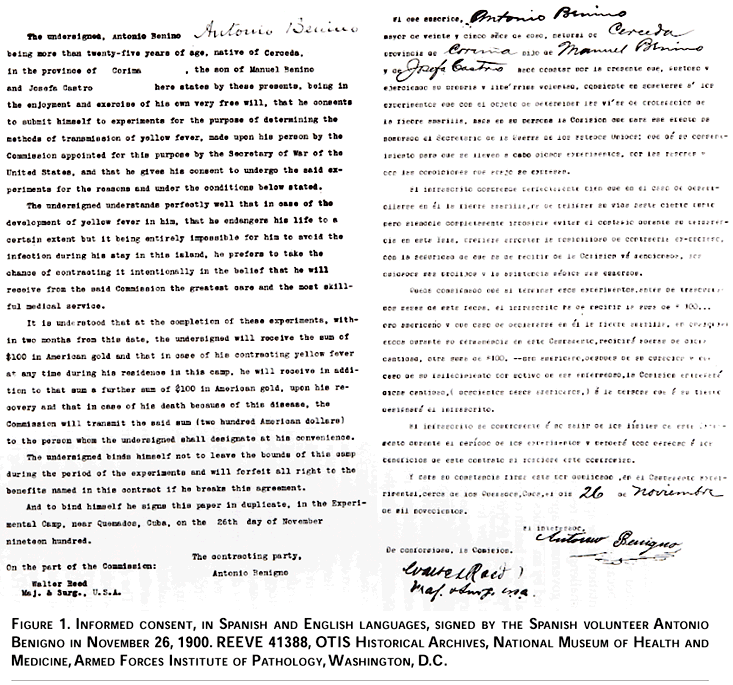
<body><![CDATA[<br> </b>En el a&ntilde;o 2000 se cumpli&oacute; el primer centenario del  descubrimiento del modo de transmisi&oacute;n de la fiebre amarilla.  El consentimiento informado fue utilizado por primera vez  de manera sistem&aacute;tica en una investigaci&oacute;n m&eacute;dica. Este  proceso fue el resultado de un fen&oacute;meno social complejo que  involucr&oacute; a la Asociaci&oacute;n Americana de Salud P&uacute;blica, a  los gobiernos de los Estados Unidos de Am&eacute;rica y Espa&ntilde;a,  a cient&iacute;ficos norteamericanos y cubanos, a la prensa y a  voluntarios civiles y militares. Al inicio del siglo XXI las  comunidades de salud p&uacute;blica y m&eacute;dicas en el &aacute;mbito  internacional enfrentan la pandemia de SIDA al igual que enfrentaron a  la fiebre amarilla al iniciarse el siglo XX. A la vez, tambi&eacute;n  debaten los retos &eacute;ticos que la investigaci&oacute;n m&eacute;dica  contempor&aacute;nea&nbsp;les ofrece, especialmente en los pa&iacute;ses en  desarrollo. La reflexi&oacute;n sobre los experimentos de 1900 podr&iacute;a  ofrecer ense&ntilde;anzas aplicables a los retos &eacute;ticos enfrentados  por las comunidades internacionales de investigaci&oacute;n en  salud p&uacute;blica. El texto completo en ingl&eacute;s de este art&iacute;culo  tambi&eacute;n est&aacute; disponible en: <a href="http://www.insp.mx/salud/index.html"> http://www.insp.mx/salud/index.html</a>    <br> Palabras clave: fiebre amarilla; consentimiento  informado; investigaci&oacute;n; &eacute;tica m&eacute;dica</font>     <p align="left">&nbsp;</p>     <p align="left">&nbsp;</p>     <p align="left"><b><font size="6">A</font></b><font size="3"> <SUB>     </SUB>t the start of the  21<SUP>st</SUP> Century, the medical research community in the United States is engaged in  multiple controversies and debates regarding the  ethical conduct of research in human subjects. Examples  of these controversies include the use of certain  methods in the conduct of researching poor and minority  populations,<SUP>1,2</SUP> and the application of new medical  technologies such as gene therapy.<SUP>3</SUP> Clinical trials  being conducted in leading academic medical research  centers in the United States have been ordered to  temporarily stop because of alleged violations in  the safe implementation of the approved  protocols.<SUP>4</SUP> This array of new challenges has resulted in the  establishment of a new government agency for ethics in  medical research,<SUP>5</SUP> led by an &quot;Ethics  Czar&quot;.<SUP>6</SUP> </font></p>     <P align="left">     <font size="3">     The global public health community is facing  the deadly AIDS pandemic at the beginning of the  21<SUP>st</SUP> Century, as it faced yellow fever at the beginning  of the 20<SUP>th</SUP> Century. The AIDS pandemic is imposing  enormous new ethical challenges, especially on the  conduct of medical research in the developing world.  Recently published scientific papers from research  conducted in the countries most affected by the AIDS  pandemic, are putting into question the principles of social  justice and the distribution of benefits derived from  medical research.<SUP>7-9</SUP> The Declaration of Helsinki  was under revision because of these new ethical  challenges,<SUP>10,11</SUP> and was modified in October 2000. The  public health and research communities have faced and  overcome similar challenges in the past.</font>     <P align="left">     <font size="3">     A milestone in the evolution of ethics in  medical research that occurred a century ago, was the  systematic use of informed consent during the conduct  of research in human subjects. The year 2000 marked  the centennial of the discovery of the mode of  transmission of yellow fever by the mosquito <I>Aedes  aegypti </I>(<I>Culex fasciatus, Stegomya  fasciata</I>). Recurrent epidemics of yellow fever in the Temperate Zone of North  America were responsible for more that 100 000 deaths  between the end of the 18<SUP>th</SUP> Century and the end of  the 19<SUP>th</SUP> Century.<SUP>12</SUP> The American Public Health  Association (APHA), which included more than 1 000  members and the sanitary authorities and health officials  of the United States, Canada, and Mexico in the  1890's, played a crucial role in this historic episode. Dr.  Benjamin Lee, the future chairman of the  29<SUP>th</SUP> Annual Meeting of the APHA, presented during the  17<SUP>th</SUP> meeting in Brooklyn, New York, in 1899, a &quot;demand  for the annexation of Cuba&quot; to sanitize the  island.<SUP>13</SUP> Major William Crawford Gorgas, the sanitary officer in  Cuba during the yellow fever experiments, and future  Surgeon General of the Army, expressed in 1907 that  &quot;Cuba is so situated commercially with regard to our  gulf coast that, as long as she was infected with the  yellow fever, she was a constant menace to our gulf-states,  and to the United States generally&quot;.<SUP>14</SUP> </font>     <P align="left">     <font size="3">     The APHA presented draft legislation to  William McKinley, President of the United States,  requesting the formation of a scientific commission to &quot;study  the etiology of yellow fever&quot; in  1897,<SUP>13</SUP> and because no action was taken by congress, it was presented again  in 1898, the year the Spanish-American war began.  The result of the war with Spain gave control of Cuba  to the United States in 1899,<SUP>15</SUP> permitting the direct  intervention of the United States Army in the  investigation of the cause of yellow fever. The Army Board of  medical officers, known as the &quot;Yellow Fever  Commission&quot;, was appointed by George M. Sternberg,  Surgeon General of the Army, member of the APHA, and of  the Yellow Fever Committee selected by the APHA in  1897.<SUP>13</SUP> The Yellow Fever Commission, led my  Major Walter Reed of the U.S. Army, conducted the  classic experiments<SUP>16,17</SUP> that proved the hypothesis of the  Cuban scientist Dr. Juan Carlos Finlay y Barres, which  stated that yellow fever was transmitted by  mosquitoes. Dr. Finlay was elected President of the  31<SUP>st</SUP> Meeting of the APHA in 1904, and honored during the  32<SUP>nd</SUP> Meeting of the APHA in recognition of his scientific  work in yellow fever.<SUP>18,19</SUP> Major William Crawford  Gorgas promptly put science into practice. The sanitary  methods in vector control derived from the Yellow  Fever Commission's discovery nearly eradicated the  mosquitoes carrying yellow fever from Havana,  Cuba.<SUP>20</SUP> The lessons in sanitation learned in Cuba were then  implemented in Panam&aacute;, successfully controlling the  transmission of yellow fever and  malaria.<SUP>14</SUP> Control of yellow fever and malaria allowed the Americans  to complete the Panama Canal by 1914, after more  than 20 years of unsuccessful efforts by France, and  more than 20,000 deaths. This monumental engineering  endeavor led to the emergence of the United States  of America as a world power.</font>     <P align="left">     <font size="3">     The Yellow Fever Commission had a less  conspicuous achievement of enormous implications for  the future of ethics in medical research –the  recruitment of informed volunteers through a covenant, a  &quot;written informed consent&quot;. This approach contrasted with  the then prevalent authoritarian methods,  absolutely unethical by modern standards, of experimentation  in human subjects.<SUP>21</SUP> This novel research tool was,  however, the product of a complex social phenomenon.  In November 21<SUP>st</SUP>, 1900, the Cuban newspapers  aggressively opposed the use of recent Spanish  immigrants, who were susceptible to yellow fever, as &quot;Guinea  pigs&quot;. Brigadier General Leonard Wood, the Military  Governor of Cuba, a physician himself, and the Yellow  Fever </font><font size="3"> Commission sought the collaboration of the Spanish Consul in Cuba, and turned the public opinion in  favor of the investigations.<SUP>22</SUP> Brigadier General  Leonard Wood granted $5 000 to Major Walter Reed &quot;for  the purpose of hiring men to submit to these  experiments and to the bite of the mosquito on condition that  the men should be appraised of their danger and sign  papers to that effect; that it should be their own free  will in every particular, and that, incase of Spaniards,  the Spanish consul's permission should be  obtained&quot;.<SUP>23</SUP> The Yellow Fever Commission produced a written  document, in Spanish and English, with all the  pertinent information about the known benefits and risks to  the potential volunteers (<a href="/img/revistas/spm/v44n2/a09fig01.gif">Figure 1</a>).</font>      <P align="left">     <font size="3">     In 1946, Dr. Andrew C. Ivy, representative  from the American Medical Association, and Dr. Leo  Alexander were both sent as expert witnesses during  the trials of war criminals before the Nuremberg  Military Tribunals. Drs. Ivy and Alexander, with the  collaboration of Brigadier General Telford Taylor, wrote  the Nuremberg Code that defined a &quot;10-point  statement delimiting permissible medical experimentation  on human subjects&quot; which included as the first point:  &quot;The voluntary consent of the human subject is  absolutely essential&quot;, further detailing its  meaning.<SUP>24</SUP> The ethical manner in which the Yellow Fever Commission  conducted its experiments with human subjects was  cited in 1946, among other studies, in the Journal of  the American Medical Association suggesting that  it served as a point of reference in the development  of the Nuremberg Code.<SUP>25</SUP> </font>     ]]></body>
<body><![CDATA[<P align="left">     <font size="3">     Further developments in the field of ethics in  medical research in human subjects evolved  dramatically, and by 1964, the 18<SUP>th</SUP> World Medical Assembly,  in Helsinki, Finland, adopted the  &quot;Recommendations Guiding Physicians in Biomedical Research  Involving Human Subjects&quot;. These recommendations are  known as the &quot;Declaration of Helsinki&quot;. One of the basic  principles of the declaration states that &quot;In any research  on human beings, each potential subject must be  adequately informed of the aims, methods,  anticipated benefits and potential hazards of the study and  the discomfort it may entail&quot; also further detailing the  characteristics of the informed  consent.<SUP>26</SUP> The consent form used by the Yellow Fever Commission, well ahead  of its time, met most of these criteria as compared  to other several examples of historical &quot;documented  cases of legal informed consent&quot; in the practice of  medicine, that have been published in the  literature.<SUP>27,28</SUP> </font>     <P align="left">     <font size="3">     In summary, the accomplishments of the  Yellow Fever Commission were the result of the  application of principles that make a public health  intervention successful. The organized political pressure from  the APHA made the U.S. Government to take action against the threat that yellow fever posed to the  nation and the rest of the American continent. Rather  than authoritarian methods, the leadership of the  military members of the Commission consulted with the  local authorities and built consensus among the native  and Spanish immigrant populations of Cuba and  sought their cooperation. The subjects who participated in  the study were treated ethically, and finally,  aggressive implementation of public health measures  followed the results of the practice of sound science. The  lessons learned from this historic episode can be  applied to the current challenges faced by the public  health and research communities.</font>     <P align="center">&nbsp;     <P align="center"><font size="4">Acknowledgements</font>     <P align="left"><font size="3">The autor wishes to express appreciation to COL  David N. Taylor and James Writer, MPH, for their  helpful comments on this paper.</font>     <P align="center">&nbsp;     <P align="center"><font size="4">References</font>     <!-- ref --><P align="left"><font size="3">1. Keperlman LC, Connel DB, Gunn WJ. Effect of a monetary sanction  on immunization rates of recipients of aid to families with dependent  children. JAMA 2000;284:53-59.</font>    &nbsp;&nbsp;&nbsp;&nbsp;&nbsp;&nbsp;&nbsp;&nbsp;[&#160;<a href="javascript:void(0);" onclick="javascript: window.open('/scielo.php?script=sci_nlinks&ref=9152232&pid=S0036-3634200200020000900001&lng=','','width=640,height=500,resizable=yes,scrollbars=1,menubar=yes,');">Links</a>&#160;]<!-- end-ref --><!-- ref --><P align="left"><font size="3">2. Davis MM, Lantos JD. Ethical considerations in the public policy  laboratory. JAMA 2000;284:85-87.</font>    &nbsp;&nbsp;&nbsp;&nbsp;&nbsp;&nbsp;&nbsp;&nbsp;[&#160;<a href="javascript:void(0);" onclick="javascript: window.open('/scielo.php?script=sci_nlinks&ref=9152233&pid=S0036-3634200200020000900002&lng=','','width=640,height=500,resizable=yes,scrollbars=1,menubar=yes,');">Links</a>&#160;]<!-- end-ref --><!-- ref --><P align="left"><font size="3">3. Marshall E. Gene therapy on trial. Science 2000;288:951-957.</font>    &nbsp;&nbsp;&nbsp;&nbsp;&nbsp;&nbsp;&nbsp;&nbsp;[&#160;<a href="javascript:void(0);" onclick="javascript: window.open('/scielo.php?script=sci_nlinks&ref=9152234&pid=S0036-3634200200020000900003&lng=','','width=640,height=500,resizable=yes,scrollbars=1,menubar=yes,');">Links</a>&#160;]<!-- end-ref --><!-- ref --><P align="left"><font size="3">4. Malakoff M. Flawed cancer study leads to shake-up at University  of Oklahoma. Science 2000;289:706-707.</font>    &nbsp;&nbsp;&nbsp;&nbsp;&nbsp;&nbsp;&nbsp;&nbsp;[&#160;<a href="javascript:void(0);" onclick="javascript: window.open('/scielo.php?script=sci_nlinks&ref=9152235&pid=S0036-3634200200020000900004&lng=','','width=640,height=500,resizable=yes,scrollbars=1,menubar=yes,');">Links</a>&#160;]<!-- end-ref --><!-- ref --><P align="left"><font size="3">5. Marshall E. HHS plans to overhaul clinical research rules.  Science 2000;288:1315-1316.</font>    &nbsp;&nbsp;&nbsp;&nbsp;&nbsp;&nbsp;&nbsp;&nbsp;[&#160;<a href="javascript:void(0);" onclick="javascript: window.open('/scielo.php?script=sci_nlinks&ref=9152236&pid=S0036-3634200200020000900005&lng=','','width=640,height=500,resizable=yes,scrollbars=1,menubar=yes,');">Links</a>&#160;]<!-- end-ref --><!-- ref --><P align="left"><font size="3">6. Marshall E. Harvard's Koski to lead human subjects office.  Science 2000;288:1349.</font>    &nbsp;&nbsp;&nbsp;&nbsp;&nbsp;&nbsp;&nbsp;&nbsp;[&#160;<a href="javascript:void(0);" onclick="javascript: window.open('/scielo.php?script=sci_nlinks&ref=9152237&pid=S0036-3634200200020000900006&lng=','','width=640,height=500,resizable=yes,scrollbars=1,menubar=yes,');">Links</a>&#160;]<!-- end-ref --><!-- ref --><P align="left"><font size="3">7. Quinn TC, Wawer MJ, Sewankambo N, Serwadda D, Li C,  Wabwire-Mangen F <I>et al</I>. Viral load and heterosexual transmission of  human immunodeficiency virus type 1. N Engl J Med 2000;342:921-929.</font>    &nbsp;&nbsp;&nbsp;&nbsp;&nbsp;&nbsp;&nbsp;&nbsp;[&#160;<a href="javascript:void(0);" onclick="javascript: window.open('/scielo.php?script=sci_nlinks&ref=9152238&pid=S0036-3634200200020000900007&lng=','','width=640,height=500,resizable=yes,scrollbars=1,menubar=yes,');">Links</a>&#160;]<!-- end-ref --><!-- ref --><P align="left"><font size="3">8. Angell M. Investigator's responsibilities for human subjects in  developing countries. N Engl J Med 2000; 342:967-969.</font>    &nbsp;&nbsp;&nbsp;&nbsp;&nbsp;&nbsp;&nbsp;&nbsp;[&#160;<a href="javascript:void(0);" onclick="javascript: window.open('/scielo.php?script=sci_nlinks&ref=9152239&pid=S0036-3634200200020000900008&lng=','','width=640,height=500,resizable=yes,scrollbars=1,menubar=yes,');">Links</a>&#160;]<!-- end-ref --><!-- ref --><P align="left"><font size="3">9. Ethics of placebo-controlled trials of zidovudine to prevent the  perinatal transmission of HIV in the Third World. N Engl J Med  1998;338: 1003-1005.</font>    &nbsp;&nbsp;&nbsp;&nbsp;&nbsp;&nbsp;&nbsp;&nbsp;[&#160;<a href="javascript:void(0);" onclick="javascript: window.open('/scielo.php?script=sci_nlinks&ref=9152240&pid=S0036-3634200200020000900009&lng=','','width=640,height=500,resizable=yes,scrollbars=1,menubar=yes,');">Links</a>&#160;]<!-- end-ref --><!-- ref --><P align="left"><font size="3">10. Levine RJ. The need to revise the declaration of Helsinki. N Engl J  Med 1999;341:531-534.</font>    &nbsp;&nbsp;&nbsp;&nbsp;&nbsp;&nbsp;&nbsp;&nbsp;[&#160;<a href="javascript:void(0);" onclick="javascript: window.open('/scielo.php?script=sci_nlinks&ref=9152241&pid=S0036-3634200200020000900010&lng=','','width=640,height=500,resizable=yes,scrollbars=1,menubar=yes,');">Links</a>&#160;]<!-- end-ref --><!-- ref --><P align="left"><font size="3">11. Brennan TA. Proposed revisions to the Declaration of Helsinki –Will they weaken the ethical principles underlying human research? N Engl  J Med 1999;341:527-531.</font>    &nbsp;&nbsp;&nbsp;&nbsp;&nbsp;&nbsp;&nbsp;&nbsp;[&#160;<a href="javascript:void(0);" onclick="javascript: window.open('/scielo.php?script=sci_nlinks&ref=9152242&pid=S0036-3634200200020000900011&lng=','','width=640,height=500,resizable=yes,scrollbars=1,menubar=yes,');">Links</a>&#160;]<!-- end-ref --><!-- ref --><P align="left"><font size="3">12. Reed W, Carrol J. The prevention of yellow fever. Public Health  Papers and Reports. Presented at the Twenty-Ninth Annual Meeting of  the American Public Health Association; September 16-18, 19 and  1901;20. Buffalo (NY). Columbus (OH): The Berlin Printing Company,  1902;Vol. XXVII:113-129.</font>    &nbsp;&nbsp;&nbsp;&nbsp;&nbsp;&nbsp;&nbsp;&nbsp;[&#160;<a href="javascript:void(0);" onclick="javascript: window.open('/scielo.php?script=sci_nlinks&ref=9152243&pid=S0036-3634200200020000900012&lng=','','width=640,height=500,resizable=yes,scrollbars=1,menubar=yes,');">Links</a>&#160;]<!-- end-ref --><!-- ref --><P align="left"><font size="3">13. Holbreck HB. Report of the Committee of Etiology of Yellow  Fever. Public Health Papers and Reports. Presented at the Twenty-Sixth  Annual Meeting of the American Public Health Association. September  1898;27-30. Ottawa, Canada. Columbus (OH): The Berlin Printing Company,  1898; Vol. XXIV:116-127.</font>    &nbsp;&nbsp;&nbsp;&nbsp;&nbsp;&nbsp;&nbsp;&nbsp;[&#160;<a href="javascript:void(0);" onclick="javascript: window.open('/scielo.php?script=sci_nlinks&ref=9152244&pid=S0036-3634200200020000900013&lng=','','width=640,height=500,resizable=yes,scrollbars=1,menubar=yes,');">Links</a>&#160;]<!-- end-ref --><!-- ref --><P align="left"><font size="3">14. Gorgas WC. Sanitation in the Canal Zone. JAMA 1907;Jul 6:6-8.</font>    &nbsp;&nbsp;&nbsp;&nbsp;&nbsp;&nbsp;&nbsp;&nbsp;[&#160;<a href="javascript:void(0);" onclick="javascript: window.open('/scielo.php?script=sci_nlinks&ref=9152245&pid=S0036-3634200200020000900014&lng=','','width=640,height=500,resizable=yes,scrollbars=1,menubar=yes,');">Links</a>&#160;]<!-- end-ref --><!-- ref --><P align="left"><font size="3">15. Holbreck HB. Report of the Committee of Etiology of Yellow  Fever. Public Health Papers and Reports. Presented at the Twenty-Seventh  Annual Meeting of the American Public Health Association; October 31,  and November 1899;1-3. Minneapolis, MN. Columbus (OH): The Berlin  Printing Company, 1900;Vol. XXV:24-32.</font>    &nbsp;&nbsp;&nbsp;&nbsp;&nbsp;&nbsp;&nbsp;&nbsp;[&#160;<a href="javascript:void(0);" onclick="javascript: window.open('/scielo.php?script=sci_nlinks&ref=9152246&pid=S0036-3634200200020000900015&lng=','','width=640,height=500,resizable=yes,scrollbars=1,menubar=yes,');">Links</a>&#160;]<!-- end-ref --><!-- ref --><P align="left"><font size="3">16. Reed W, Carroll J, Agramonte A, Lazear JW. The etiology of  yellow fever. –A preliminary note. Public Health Papers and Reports.  Presented at the Twenty-Eight Annual Meeting of the American Public Health  Association, October 1900;22-26. Indianapolis, IN. Columbus (OH): The  Berlin Printing Company, 1901;Vol. XXVI:37-53.</font>    &nbsp;&nbsp;&nbsp;&nbsp;&nbsp;&nbsp;&nbsp;&nbsp;[&#160;<a href="javascript:void(0);" onclick="javascript: window.open('/scielo.php?script=sci_nlinks&ref=9152247&pid=S0036-3634200200020000900016&lng=','','width=640,height=500,resizable=yes,scrollbars=1,menubar=yes,');">Links</a>&#160;]<!-- end-ref --><!-- ref --><P align="left"><font size="3">17. Reed W, Carroll J, Agramonte A. The etiology of yellow fever and  additional notes. JAMA 1901;Feb 16:431-439.</font>    &nbsp;&nbsp;&nbsp;&nbsp;&nbsp;&nbsp;&nbsp;&nbsp;[&#160;<a href="javascript:void(0);" onclick="javascript: window.open('/scielo.php?script=sci_nlinks&ref=9152248&pid=S0036-3634200200020000900017&lng=','','width=640,height=500,resizable=yes,scrollbars=1,menubar=yes,');">Links</a>&#160;]<!-- end-ref --><!-- ref --><P align="left"><font size="3">18. Finlay CJ. President's address. Public Health Papers and Reports,  Vol. XXX. Presented at the Thirty-Second Annual Meeting of the  American Public Health Association, January 1905;9-13. Havana Cuba.  Columbus (OH): The Berlin Printing Company, 1905:1-7.</font>    &nbsp;&nbsp;&nbsp;&nbsp;&nbsp;&nbsp;&nbsp;&nbsp;[&#160;<a href="javascript:void(0);" onclick="javascript: window.open('/scielo.php?script=sci_nlinks&ref=9152249&pid=S0036-3634200200020000900018&lng=','','width=640,height=500,resizable=yes,scrollbars=1,menubar=yes,');">Links</a>&#160;]<!-- end-ref --><!-- ref --><P align="left"><font size="3">19. Lee B. A tribute to Carlos J. Finlay for his distinguished services  to science and humanity in the discovery of the propagation of yellow  fever. Public Health Papers and Reports. Presented at the Thirty-Second  Annual Meeting of the American Public Health Association, Havana, Cuba  January 9, 10, 11, 12, 13. 1905. Columbus (OH): The Berlin Printing  Company 1905;Vol. XXX:8-14.</font>    &nbsp;&nbsp;&nbsp;&nbsp;&nbsp;&nbsp;&nbsp;&nbsp;[&#160;<a href="javascript:void(0);" onclick="javascript: window.open('/scielo.php?script=sci_nlinks&ref=9152250&pid=S0036-3634200200020000900019&lng=','','width=640,height=500,resizable=yes,scrollbars=1,menubar=yes,');">Links</a>&#160;]<!-- end-ref --><!-- ref --><P align="left"><font size="3">20. Gorgas WC. The results of yellow fever sanitation in Havana, Cuba,  for the Year 1901 up to September 1st, carried on upon the basis that  the <I>Stegomya</I> mosquito is the sole means of its transmission. Public  Health Reports. Presented at the Twenty-Ninth Annual Meeting of the  American Public Health Association; 1901;September 16-20. Buffalo NY.  Columbus (OH): The Berlin Printing Company, 1902;Vol. XXVII:130-133.</font>    &nbsp;&nbsp;&nbsp;&nbsp;&nbsp;&nbsp;&nbsp;&nbsp;[&#160;<a href="javascript:void(0);" onclick="javascript: window.open('/scielo.php?script=sci_nlinks&ref=9152251&pid=S0036-3634200200020000900020&lng=','','width=640,height=500,resizable=yes,scrollbars=1,menubar=yes,');">Links</a>&#160;]<!-- end-ref --><!-- ref --><P align="left"><font size="3">21. Bean WB. The Fielding H. Harrison Lecture: Walter Reed and the  ordeal of human experiments. Bull History Med 1977;51:75-92.</font>    &nbsp;&nbsp;&nbsp;&nbsp;&nbsp;&nbsp;&nbsp;&nbsp;[&#160;<a href="javascript:void(0);" onclick="javascript: window.open('/scielo.php?script=sci_nlinks&ref=9152252&pid=S0036-3634200200020000900021&lng=','','width=640,height=500,resizable=yes,scrollbars=1,menubar=yes,');">Links</a>&#160;]<!-- end-ref --><!-- ref --><P align="left"><font size="3">22. Agramonte A. The inside history of a great medical discovery.  Scientific Monthly 1915;1:209-237.</font>    &nbsp;&nbsp;&nbsp;&nbsp;&nbsp;&nbsp;&nbsp;&nbsp;[&#160;<a href="javascript:void(0);" onclick="javascript: window.open('/scielo.php?script=sci_nlinks&ref=9152253&pid=S0036-3634200200020000900022&lng=','','width=640,height=500,resizable=yes,scrollbars=1,menubar=yes,');">Links</a>&#160;]<!-- end-ref --><!-- ref --><P align="left"><font size="3">23. Pan-American Medical Congress held in Havana, Cuba, February  4. Etiology of yellow fever. JAMA 1901;Feb 16:461-462.</font>    &nbsp;&nbsp;&nbsp;&nbsp;&nbsp;&nbsp;&nbsp;&nbsp;[&#160;<a href="javascript:void(0);" onclick="javascript: window.open('/scielo.php?script=sci_nlinks&ref=9152254&pid=S0036-3634200200020000900023&lng=','','width=640,height=500,resizable=yes,scrollbars=1,menubar=yes,');">Links</a>&#160;]<!-- end-ref --><!-- ref --><P align="left"><font size="3">24. The Nuremberg Code. JAMA 1996;276:1691.</font>    &nbsp;&nbsp;&nbsp;&nbsp;&nbsp;&nbsp;&nbsp;&nbsp;[&#160;<a href="javascript:void(0);" onclick="javascript: window.open('/scielo.php?script=sci_nlinks&ref=9152255&pid=S0036-3634200200020000900024&lng=','','width=640,height=500,resizable=yes,scrollbars=1,menubar=yes,');">Links</a>&#160;]<!-- end-ref --><!-- ref --><P align="left"><font size="3">25. The brutalities of nazi physicians. JAMA 1946;Nov 23:714-715.</font>    &nbsp;&nbsp;&nbsp;&nbsp;&nbsp;&nbsp;&nbsp;&nbsp;[&#160;<a href="javascript:void(0);" onclick="javascript: window.open('/scielo.php?script=sci_nlinks&ref=9152256&pid=S0036-3634200200020000900025&lng=','','width=640,height=500,resizable=yes,scrollbars=1,menubar=yes,');">Links</a>&#160;]<!-- end-ref --><!-- ref --><P align="left"><font size="3">26. World Medical Association Declaration of Helsinki. JAMA  1997;277: 925-926.</font>    &nbsp;&nbsp;&nbsp;&nbsp;&nbsp;&nbsp;&nbsp;&nbsp;[&#160;<a href="javascript:void(0);" onclick="javascript: window.open('/scielo.php?script=sci_nlinks&ref=9152257&pid=S0036-3634200200020000900026&lng=','','width=640,height=500,resizable=yes,scrollbars=1,menubar=yes,');">Links</a>&#160;]<!-- end-ref --><!-- ref --><P align="left"><font size="3">27. Ajlouni KM. History of informed medical consent. Lancet 1995;346:980.</font>    &nbsp;&nbsp;&nbsp;&nbsp;&nbsp;&nbsp;&nbsp;&nbsp;[&#160;<a href="javascript:void(0);" onclick="javascript: window.open('/scielo.php?script=sci_nlinks&ref=9152258&pid=S0036-3634200200020000900027&lng=','','width=640,height=500,resizable=yes,scrollbars=1,menubar=yes,');">Links</a>&#160;]<!-- end-ref --><!-- ref --><P align="left"><font size="3">28. Ruthkov IM. Beaumont and St Martin: A blast from the past.  Arch Surg 1998;133:1259.</font>    &nbsp;&nbsp;&nbsp;&nbsp;&nbsp;&nbsp;&nbsp;&nbsp;[&#160;<a href="javascript:void(0);" onclick="javascript: window.open('/scielo.php?script=sci_nlinks&ref=9152259&pid=S0036-3634200200020000900028&lng=','','width=640,height=500,resizable=yes,scrollbars=1,menubar=yes,');">Links</a>&#160;]<!-- end-ref --><P align="left">&nbsp;     <P align="left">&nbsp;     <p align="left"><font size="3"> The opinions and assertions contained herein are the private ones of the authors and are not to be constructed as official or as reflecting the views of  the Department of Defense, or Army.</font>     <P align="left"><font size="3"><a name="nt"></a>(<a href="#tx">1</a>)     Walter Reed Army Institute of Research, Division of Communicable Diseases and Immunology, Department of Enteric Infections. United States  of America.</font>     <P align="left">&nbsp;     ]]></body>
<body><![CDATA[<P align="center"><font size="3"><B>Received on</B>: June 4, 2001 <font FACE="Symbol">·</font> <B>Accepted  on</B>: October 1, 2001    <br> Address reprint requests to: Fernando G&uuml;ere&ntilde;a-Burgue&ntilde;o. Walter Reed Army Institute of Research, Division of Communicable Diseases</font> <font size="3">and Immunology, Department of Enteric Infections. 503 Robert Grant Ave. Silver Spring MD, 20910-7500. United States of America.    <br> E-mail: <a href="mailto:Fernando.Guerena@na.amedd.army.mil"> Fernando.Guerena@na.amedd.army.mil</a></font>      ]]></body><back>
<ref-list>
<ref id="B1">
<label>1</label><nlm-citation citation-type="journal">
<person-group person-group-type="author">
<name>
<surname><![CDATA[Keperlman]]></surname>
<given-names><![CDATA[LC]]></given-names>
</name>
<name>
<surname><![CDATA[Connel]]></surname>
<given-names><![CDATA[DB]]></given-names>
</name>
<name>
<surname><![CDATA[Gunn]]></surname>
<given-names><![CDATA[WJ]]></given-names>
</name>
</person-group>
<article-title xml:lang="en"><![CDATA[Effect of a monetary sanction on immunization rates of recipients of aid to families with dependent children]]></article-title>
<source><![CDATA[JAMA]]></source>
<year>2000</year>
<volume>284</volume>
<page-range>53-59</page-range></nlm-citation>
</ref>
<ref id="B2">
<label>2</label><nlm-citation citation-type="journal">
<person-group person-group-type="author">
<name>
<surname><![CDATA[Davis]]></surname>
<given-names><![CDATA[MM]]></given-names>
</name>
<name>
<surname><![CDATA[Lantos]]></surname>
<given-names><![CDATA[JD]]></given-names>
</name>
</person-group>
<article-title xml:lang="en"><![CDATA[Ethical considerations in the public policy laboratory]]></article-title>
<source><![CDATA[JAMA]]></source>
<year>2000</year>
<volume>284</volume>
<page-range>85-87</page-range></nlm-citation>
</ref>
<ref id="B3">
<label>3</label><nlm-citation citation-type="journal">
<person-group person-group-type="author">
<name>
<surname><![CDATA[Marshall]]></surname>
<given-names><![CDATA[E]]></given-names>
</name>
</person-group>
<article-title xml:lang="en"><![CDATA[Gene therapy on trial]]></article-title>
<source><![CDATA[Science]]></source>
<year>2000</year>
<volume>288</volume>
<page-range>951-957</page-range></nlm-citation>
</ref>
<ref id="B4">
<label>4</label><nlm-citation citation-type="journal">
<person-group person-group-type="author">
<name>
<surname><![CDATA[Malakoff]]></surname>
<given-names><![CDATA[M]]></given-names>
</name>
</person-group>
<article-title xml:lang="en"><![CDATA[Flawed cancer study leads to shake-up at University of Oklahoma]]></article-title>
<source><![CDATA[Science]]></source>
<year>2000</year>
<volume>289</volume>
<page-range>706-707</page-range></nlm-citation>
</ref>
<ref id="B5">
<label>5</label><nlm-citation citation-type="journal">
<person-group person-group-type="author">
<name>
<surname><![CDATA[Marshall]]></surname>
<given-names><![CDATA[E]]></given-names>
</name>
</person-group>
<article-title xml:lang="en"><![CDATA[HHS plans to overhaul clinical research rules]]></article-title>
<source><![CDATA[Science]]></source>
<year>2000</year>
<volume>288</volume>
<page-range>1315-1316</page-range></nlm-citation>
</ref>
<ref id="B6">
<label>6</label><nlm-citation citation-type="journal">
<person-group person-group-type="author">
<name>
<surname><![CDATA[Marshall]]></surname>
<given-names><![CDATA[E]]></given-names>
</name>
</person-group>
<article-title xml:lang="en"><![CDATA[Harvard's Koski to lead human subjects office]]></article-title>
<source><![CDATA[Science]]></source>
<year>2000</year>
<volume>288</volume>
<page-range>1349</page-range></nlm-citation>
</ref>
<ref id="B7">
<label>7</label><nlm-citation citation-type="journal">
<person-group person-group-type="author">
<name>
<surname><![CDATA[Quinn]]></surname>
<given-names><![CDATA[TC]]></given-names>
</name>
<name>
<surname><![CDATA[Wawer]]></surname>
<given-names><![CDATA[MJ]]></given-names>
</name>
<name>
<surname><![CDATA[Sewankambo]]></surname>
<given-names><![CDATA[N]]></given-names>
</name>
<name>
<surname><![CDATA[Serwadda]]></surname>
<given-names><![CDATA[D]]></given-names>
</name>
<name>
<surname><![CDATA[Li]]></surname>
<given-names><![CDATA[C]]></given-names>
</name>
<name>
<surname><![CDATA[Wabwire-Mangen]]></surname>
<given-names><![CDATA[F]]></given-names>
</name>
</person-group>
<article-title xml:lang="en"><![CDATA[Viral load and heterosexual transmission of human immunodeficiency virus type 1]]></article-title>
<source><![CDATA[N Engl J Med]]></source>
<year>2000</year>
<volume>342</volume>
<page-range>921-929</page-range></nlm-citation>
</ref>
<ref id="B8">
<label>8</label><nlm-citation citation-type="journal">
<person-group person-group-type="author">
<name>
<surname><![CDATA[Angell]]></surname>
<given-names><![CDATA[M]]></given-names>
</name>
</person-group>
<article-title xml:lang="en"><![CDATA[Investigator's responsibilities for human subjects in developing countries]]></article-title>
<source><![CDATA[N Engl J Med]]></source>
<year>2000</year>
<volume>342</volume>
<page-range>967-969</page-range></nlm-citation>
</ref>
<ref id="B9">
<label>9</label><nlm-citation citation-type="journal">
<article-title xml:lang="en"><![CDATA[Ethics of placebo-controlled trials of zidovudine to prevent the perinatal transmission of HIV in the Third World]]></article-title>
<source><![CDATA[N Engl J Med]]></source>
<year>1998</year>
<volume>338</volume>
<page-range>1003-1005</page-range></nlm-citation>
</ref>
<ref id="B10">
<label>10</label><nlm-citation citation-type="journal">
<person-group person-group-type="author">
<name>
<surname><![CDATA[Levine]]></surname>
<given-names><![CDATA[RJ]]></given-names>
</name>
</person-group>
<article-title xml:lang="en"><![CDATA[The need to revise the declaration of Helsinki]]></article-title>
<source><![CDATA[N Engl J Med]]></source>
<year>1999</year>
<volume>341</volume>
<page-range>531-534</page-range></nlm-citation>
</ref>
<ref id="B11">
<label>11</label><nlm-citation citation-type="journal">
<person-group person-group-type="author">
<name>
<surname><![CDATA[Brennan]]></surname>
<given-names><![CDATA[TA]]></given-names>
</name>
</person-group>
<article-title xml:lang="en"><![CDATA[Proposed revisions to the Declaration of Helsinki -Will they weaken the ethical principles underlying human research?]]></article-title>
<source><![CDATA[N Engl J Med]]></source>
<year>1999</year>
<volume>341</volume>
<page-range>527-531</page-range></nlm-citation>
</ref>
<ref id="B12">
<label>12</label><nlm-citation citation-type="confpro">
<person-group person-group-type="author">
<name>
<surname><![CDATA[Reed]]></surname>
<given-names><![CDATA[W]]></given-names>
</name>
<name>
<surname><![CDATA[Carrol]]></surname>
<given-names><![CDATA[J]]></given-names>
</name>
</person-group>
<article-title xml:lang="en"><![CDATA[The prevention of yellow fever]]></article-title>
<source><![CDATA[Public Health Papers and Reports]]></source>
<year>1902</year>
<volume>XXVII</volume>
<conf-name><![CDATA[ Presented at the Twenty-Ninth Annual Meeting of the American Public Health Association]]></conf-name>
<conf-date>September 16-18, 19 and 1901</conf-date>
<conf-loc> </conf-loc>
<page-range>113-129</page-range><publisher-loc><![CDATA[Buffalo^eNYColumbus^eOH NYOH]]></publisher-loc>
<publisher-name><![CDATA[The Berlin Printing Company]]></publisher-name>
</nlm-citation>
</ref>
<ref id="B13">
<label>13</label><nlm-citation citation-type="confpro">
<person-group person-group-type="author">
<name>
<surname><![CDATA[Holbreck]]></surname>
<given-names><![CDATA[HB]]></given-names>
</name>
</person-group>
<article-title xml:lang="en"><![CDATA[Report of the Committee of Etiology of Yellow Fever]]></article-title>
<source><![CDATA[Public Health Papers and Reports]]></source>
<year>1898</year>
<volume>XXIV</volume>
<conf-name><![CDATA[ Twenty-Sixth Annual Meeting of the American Public Health Association]]></conf-name>
<conf-date>September 1898</conf-date>
<conf-loc>OttawaColumbus OH</conf-loc>
<page-range>116-127</page-range><publisher-name><![CDATA[The Berlin Printing Company]]></publisher-name>
</nlm-citation>
</ref>
<ref id="B14">
<label>14</label><nlm-citation citation-type="journal">
<person-group person-group-type="author">
<name>
<surname><![CDATA[Gorgas]]></surname>
<given-names><![CDATA[WC]]></given-names>
</name>
</person-group>
<article-title xml:lang="en"><![CDATA[Sanitation in the Canal Zone]]></article-title>
<source><![CDATA[JAMA]]></source>
<year>1907</year>
<volume>Jul 6</volume>
<page-range>6-8</page-range></nlm-citation>
</ref>
<ref id="B15">
<label>15</label><nlm-citation citation-type="confpro">
<person-group person-group-type="author">
<name>
<surname><![CDATA[Holbreck]]></surname>
<given-names><![CDATA[HB]]></given-names>
</name>
</person-group>
<article-title xml:lang="en"><![CDATA[Report of the Committee of Etiology of Yellow Fever]]></article-title>
<source><![CDATA[Public Health Papers and Reports]]></source>
<year>1900</year>
<volume>XXV</volume>
<conf-name><![CDATA[ Twenty-Seventh Annual Meeting of the American Public Health Association]]></conf-name>
<conf-date>1899</conf-date>
<conf-loc>MinneapolisColumbus MNOH</conf-loc>
<page-range>24-32</page-range><publisher-name><![CDATA[The Berlin Printing Company]]></publisher-name>
</nlm-citation>
</ref>
<ref id="B16">
<label>16</label><nlm-citation citation-type="confpro">
<person-group person-group-type="author">
<name>
<surname><![CDATA[Reed]]></surname>
<given-names><![CDATA[W]]></given-names>
</name>
<name>
<surname><![CDATA[Carroll]]></surname>
<given-names><![CDATA[J]]></given-names>
</name>
<name>
<surname><![CDATA[Agramonte]]></surname>
<given-names><![CDATA[A]]></given-names>
</name>
<name>
<surname><![CDATA[Lazear]]></surname>
<given-names><![CDATA[JW]]></given-names>
</name>
</person-group>
<article-title xml:lang="en"><![CDATA[The etiology of yellow fever: A preliminary note]]></article-title>
<source><![CDATA[Public Health Papers and Reports]]></source>
<year>1901</year>
<volume>XXVI</volume>
<conf-name><![CDATA[Twenty-Eight Annual Meeting of the American Public Health Association]]></conf-name>
<conf-date>October 1900</conf-date>
<conf-loc>Indianapolis IN</conf-loc>
<page-range>37-53</page-range><publisher-loc><![CDATA[Columbus^eOH OH]]></publisher-loc>
<publisher-name><![CDATA[The Berlin Printing Company]]></publisher-name>
</nlm-citation>
</ref>
<ref id="B17">
<label>17</label><nlm-citation citation-type="journal">
<person-group person-group-type="author">
<name>
<surname><![CDATA[Reed]]></surname>
<given-names><![CDATA[W]]></given-names>
</name>
<name>
<surname><![CDATA[Carroll]]></surname>
<given-names><![CDATA[J]]></given-names>
</name>
<name>
<surname><![CDATA[Agramonte]]></surname>
<given-names><![CDATA[A]]></given-names>
</name>
</person-group>
<article-title xml:lang="en"><![CDATA[The etiology of yellow fever and additional notes]]></article-title>
<source><![CDATA[JAMA]]></source>
<year>1901</year>
<volume>Feb 16</volume>
<page-range>431-439</page-range></nlm-citation>
</ref>
<ref id="B18">
<label>18</label><nlm-citation citation-type="confpro">
<person-group person-group-type="author">
<name>
<surname><![CDATA[Finlay]]></surname>
<given-names><![CDATA[CJ]]></given-names>
</name>
</person-group>
<article-title xml:lang="en"><![CDATA[President's address]]></article-title>
<source><![CDATA[Public Health Papers and Reports]]></source>
<year>1905</year>
<volume>XXX</volume>
<conf-name><![CDATA[Thirty-Second Annual Meeting of the American Public Health Association]]></conf-name>
<conf-date>January 1905</conf-date>
<conf-loc>Havana </conf-loc>
<page-range>1-7</page-range><publisher-loc><![CDATA[Columbus^eOH OH]]></publisher-loc>
<publisher-name><![CDATA[The Berlin Printing Company]]></publisher-name>
</nlm-citation>
</ref>
<ref id="B19">
<label>19</label><nlm-citation citation-type="confpro">
<person-group person-group-type="author">
<name>
<surname><![CDATA[Lee]]></surname>
<given-names><![CDATA[B]]></given-names>
</name>
</person-group>
<article-title xml:lang="en"><![CDATA[A tribute to Carlos J. Finlay for his distinguished services to science and humanity in the discovery of the propagation of yellow fever]]></article-title>
<source><![CDATA[Public Health Papers and Reports]]></source>
<year>1905</year>
<volume>XXX</volume>
<conf-name><![CDATA[Thirty-Second Annual Meeting of the American Public Health Association]]></conf-name>
<conf-date>January 9, 10, 11, 12, 13. 1905</conf-date>
<conf-loc>Havana </conf-loc>
<page-range>8-14</page-range><publisher-loc><![CDATA[Columbus^eOH OH]]></publisher-loc>
<publisher-name><![CDATA[The Berlin Printing Company]]></publisher-name>
</nlm-citation>
</ref>
<ref id="B20">
<label>20</label><nlm-citation citation-type="confpro">
<person-group person-group-type="author">
<name>
<surname><![CDATA[Gorgas]]></surname>
<given-names><![CDATA[WC]]></given-names>
</name>
</person-group>
<article-title xml:lang="en"><![CDATA[The results of yellow fever sanitation in Havana, Cuba, for the Year 1901 up to September 1st, carried on upon the basis that the Stegomya mosquito is the sole means of its transmission]]></article-title>
<source><![CDATA[Public Health Reports]]></source>
<year>1902</year>
<volume>XXVII</volume>
<conf-name><![CDATA[Twenty-Ninth Annual Meeting of the American Public Health Association]]></conf-name>
<conf-date>1901;September 16-20</conf-date>
<conf-loc>Buffalo NY</conf-loc>
<page-range>130-133</page-range><publisher-loc><![CDATA[Columbus^eOH OH]]></publisher-loc>
<publisher-name><![CDATA[The Berlin Printing Company]]></publisher-name>
</nlm-citation>
</ref>
<ref id="B21">
<label>21</label><nlm-citation citation-type="journal">
<person-group person-group-type="author">
<name>
<surname><![CDATA[Bean]]></surname>
<given-names><![CDATA[WB]]></given-names>
</name>
</person-group>
<article-title xml:lang="en"><![CDATA[The Fielding H. Harrison Lecture: Walter Reed and the ordeal of human experiments]]></article-title>
<source><![CDATA[Bull History Med]]></source>
<year>1977</year>
<volume>51</volume>
<page-range>75-92</page-range></nlm-citation>
</ref>
<ref id="B22">
<label>22</label><nlm-citation citation-type="journal">
<person-group person-group-type="author">
<name>
<surname><![CDATA[Agramonte]]></surname>
<given-names><![CDATA[A]]></given-names>
</name>
</person-group>
<article-title xml:lang="en"><![CDATA[The inside history of a great medical discovery]]></article-title>
<source><![CDATA[Scientific Monthly]]></source>
<year>1915</year>
<volume>1</volume>
<page-range>209-237</page-range></nlm-citation>
</ref>
<ref id="B23">
<label>23</label><nlm-citation citation-type="journal">
<collab>Pan-American Medical Congress held in Havana</collab>
<article-title xml:lang="en"><![CDATA[Etiology of yellow fever]]></article-title>
<source><![CDATA[JAMA]]></source>
<year>1901</year>
<volume>Feb 16</volume>
<page-range>461-462</page-range></nlm-citation>
</ref>
<ref id="B24">
<label>24</label><nlm-citation citation-type="journal">
<article-title xml:lang="en"><![CDATA[The Nuremberg Code]]></article-title>
<source><![CDATA[JAMA]]></source>
<year>1996</year>
<volume>276</volume>
<page-range>1691</page-range></nlm-citation>
</ref>
<ref id="B25">
<label>25</label><nlm-citation citation-type="journal">
<article-title xml:lang="en"><![CDATA[The brutalities of nazi physicians]]></article-title>
<source><![CDATA[JAMA]]></source>
<year>1946</year>
<page-range>714-715</page-range></nlm-citation>
</ref>
<ref id="B26">
<label>26</label><nlm-citation citation-type="journal">
<article-title xml:lang="en"><![CDATA[World Medical Association Declaration of Helsinki]]></article-title>
<source><![CDATA[JAMA]]></source>
<year>1997</year>
<volume>277</volume>
<page-range>925-926</page-range></nlm-citation>
</ref>
<ref id="B27">
<label>27</label><nlm-citation citation-type="journal">
<person-group person-group-type="author">
<name>
<surname><![CDATA[Ajlouni]]></surname>
<given-names><![CDATA[KM]]></given-names>
</name>
</person-group>
<article-title xml:lang="en"><![CDATA[History of informed medical consent]]></article-title>
<source><![CDATA[Lancet]]></source>
<year>1995</year>
<volume>346</volume>
<page-range>980</page-range></nlm-citation>
</ref>
<ref id="B28">
<label>28</label><nlm-citation citation-type="journal">
<person-group person-group-type="author">
<name>
<surname><![CDATA[Ruthkov]]></surname>
<given-names><![CDATA[IM]]></given-names>
</name>
</person-group>
<article-title xml:lang="en"><![CDATA[Beaumont and St Martin: A blast from the past]]></article-title>
<source><![CDATA[Arch Surg]]></source>
<year>1998</year>
<volume>133</volume>
<page-range>1259</page-range></nlm-citation>
</ref>
</ref-list>
</back>
</article>