<?xml version="1.0" encoding="ISO-8859-1"?><article xmlns:mml="http://www.w3.org/1998/Math/MathML" xmlns:xlink="http://www.w3.org/1999/xlink" xmlns:xsi="http://www.w3.org/2001/XMLSchema-instance">
<front>
<journal-meta>
<journal-id>0036-3634</journal-id>
<journal-title><![CDATA[Salud Pública de México]]></journal-title>
<abbrev-journal-title><![CDATA[Salud pública Méx]]></abbrev-journal-title>
<issn>0036-3634</issn>
<publisher>
<publisher-name><![CDATA[Instituto Nacional de Salud Pública]]></publisher-name>
</publisher>
</journal-meta>
<article-meta>
<article-id>S0036-36342002000200004</article-id>
<title-group>
<article-title xml:lang="en"><![CDATA[Epidemiology of drug resistance: The case of Staphylococcus aureus and coagulase-negative staphylococci infections]]></article-title>
<article-title xml:lang="es"><![CDATA[Epidemiología de la resistencia bacteriana: el caso de Staphylococcus aureus y las infecciones Staphylococcus coagulasa negativas]]></article-title>
</title-group>
<contrib-group>
<contrib contrib-type="author">
<name>
<surname><![CDATA[Calderón-Jaimes]]></surname>
<given-names><![CDATA[Ernesto]]></given-names>
</name>
<xref ref-type="aff" rid="A01"/>
</contrib>
<contrib contrib-type="author">
<name>
<surname><![CDATA[Espinosa de los Monteros]]></surname>
<given-names><![CDATA[Luz E]]></given-names>
</name>
<xref ref-type="aff" rid="A01"/>
</contrib>
<contrib contrib-type="author">
<name>
<surname><![CDATA[Avila-Beltrán]]></surname>
<given-names><![CDATA[Renata]]></given-names>
</name>
<xref ref-type="aff" rid="A01"/>
</contrib>
</contrib-group>
<aff id="A01">
<institution><![CDATA[,Hospital Infantil de México Federico Gómez Inmunoquímica y Biología Celular Departamentos de Bacteriología Intestinal]]></institution>
<addr-line><![CDATA[México, D.F. ]]></addr-line>
<country>México</country>
</aff>
<pub-date pub-type="pub">
<day>00</day>
<month>04</month>
<year>2002</year>
</pub-date>
<pub-date pub-type="epub">
<day>00</day>
<month>04</month>
<year>2002</year>
</pub-date>
<volume>44</volume>
<numero>2</numero>
<fpage>108</fpage>
<lpage>112</lpage>
<copyright-statement/>
<copyright-year/>
<self-uri xlink:href="http://www.scielo.org.mx/scielo.php?script=sci_arttext&amp;pid=S0036-36342002000200004&amp;lng=en&amp;nrm=iso"></self-uri><self-uri xlink:href="http://www.scielo.org.mx/scielo.php?script=sci_abstract&amp;pid=S0036-36342002000200004&amp;lng=en&amp;nrm=iso"></self-uri><self-uri xlink:href="http://www.scielo.org.mx/scielo.php?script=sci_pdf&amp;pid=S0036-36342002000200004&amp;lng=en&amp;nrm=iso"></self-uri><abstract abstract-type="short" xml:lang="en"><p><![CDATA[Objective. To study the activity of several antibiotics against Staphylococcus spp. Material and Methods. The study included 1209 strains of Staphylococcus spp. from two institutions; Instituto Nacional de Pediatría (National Institute of Pediatrics) and Hospital Infantil de México Federico Gómez (Mexico City Children's Hospital). Minimum Inhibitory Concentrations of all antibiotics were determined by the agar macrodilution technique and standard methods from the National Committee for Clinical Laboratory Standards. Results. Resistance of S. aureus was 14.2% and that of coagulase-negative staphylococci was 53.4%. The activity of different antibiotics is presented in detail. Conclusions. Surveillance of strains resistant to methicillin is necessary.]]></p></abstract>
<abstract abstract-type="short" xml:lang="es"><p><![CDATA[Objetivo. Determinar la frecuencia de la resistencia a la meticilina y la actividad de varios antibióticos. Material y métodos. Se incluyeron 1 209 cepas de Staphylococcus spp. procedentes de pacientes del Instituto Nacional de Pediatría y del Hospital Infantil de México Federico Gómez. Se utilizó la técnica de dilución en placas con agar. El procedimiento e interpretación fueron acordes con lo establecido por el National Committee for Clinical Laboratory Standards. Resultados. La frecuencia de la resistencia de S. aureus fue de 14.2% y de 53.4% en los Staphylococcus coagulasa negativa. La actividad de otros antimicrobianos se presenta en el texto. Conclusiones. Es necesario vigilar continuamente la progresión de la resistencia de Staphylococcus spp. a la meticilina.]]></p></abstract>
<kwd-group>
<kwd lng="en"><![CDATA[drug resistance]]></kwd>
<kwd lng="en"><![CDATA[microbial]]></kwd>
<kwd lng="en"><![CDATA[Staphylococcus aureus]]></kwd>
<kwd lng="en"><![CDATA[coagulase-negative Staphylococcus]]></kwd>
<kwd lng="en"><![CDATA[antimicrobial susceptibility]]></kwd>
<kwd lng="en"><![CDATA[methicillin-resistant staphylococci]]></kwd>
<kwd lng="en"><![CDATA[Mexico]]></kwd>
<kwd lng="es"><![CDATA[resistencia microbiana a las drogas]]></kwd>
<kwd lng="es"><![CDATA[Staphylococcus aureus]]></kwd>
<kwd lng="es"><![CDATA[Staphylococcus coagulasa negativa]]></kwd>
<kwd lng="es"><![CDATA[sensibilidad antimicrobiana]]></kwd>
<kwd lng="es"><![CDATA[estatilococos metilicina resistentes]]></kwd>
<kwd lng="es"><![CDATA[México]]></kwd>
</kwd-group>
</article-meta>
</front><body><![CDATA[ <p align="left"><font size="2"><b><a name="tx"></a>ARTÍCULO ORIGINAL</b></font></p>     <p align="left">&nbsp;</p>     <p align="center"><b><font size=5> Epidemiology of drug resistance: The case of <i> Staphylococcus aureus</i> and coagulase-negative staphylococci infections</font></b></p>     <P align="left">     <P align="center"><font size="3">Ernesto Calder&oacute;n-Jaimes, MC, MSP,<SUP>(<a href="#nt">1</a>)  </SUP>Luz E Espinosa de los Monteros, Dra en  C,<SUP>(<a href="#nt">1</a>)</SUP></font> <font size="3">Renata Avila-Beltr&aacute;n, MC.<sup>(<a href="#nt">1</a>)</sup></font>     <p align="left">&nbsp;     <p align="left">&nbsp;</p>     <p align="left"><font size="3"> Calder&oacute;n-Jaimes E, Espinosa de los Monteros LE,    <br> Avila-Beltr&aacute;n R.    <br> Epidemiology of drug resistance:</font> <font size="3">The case of <i> Staphylococcus aureus</i></font> <font size="3">and coagulase-negative staphylococci infections.    ]]></body>
<body><![CDATA[<br> Salud Publica Mex 2002;44:108-112.    <br> <b> The English version of this paper is available too  at: <a href="http://www.insp.mx/salud/index.html"> http://www.insp.mx/salud/index.html</a></b></font></p>     <P align="left"><font size="3"><b>Abstract    <br>   Objective</b>. To study the activity of several antibiotics against <i> Staphylococcus</i>    spp. <B>Material and Methods</B>. The study included 1209 strains of <i> Staphylococcus</i>    spp. from two institutions; Instituto Nacional de Pediatr&iacute;a (National    Institute of Pediatrics) and Hospital Infantil de M&eacute;xico Federico G&oacute;mez    (Mexico City Children's Hospital). Minimum Inhibitory Concentrations of all    antibiotics were determined by the agar macrodilution technique and standard    methods from the National Committee for Clinical Laboratory Standards. <B>Results</B>.    Resistance of <i> S. aureus</i> was 14.2% and that of coagulase-negative staphylococci    was 53.4%. The activity of different antibiotics is presented in detail. <B>Conclusions</B>.    Surveillance of strains resistant to methicillin is necessary. The English version    of this paper is available too at: <a href="http://www.insp.mx/salud/index.html">    http://www.insp.mx/salud/index.html</a>    <br> Key words: drug resistance, microbial; <i> Staphylococcus  aureus; </i>coagulase-negative<I>   Staphylococcus; </I>antimicrobial  susceptibility; methicillin-resistant staphylococci; Mexico</font>     <P align="left">&nbsp;     <P align="left"><font size="3">Calder&oacute;n-Jaimes E, Espinosa de los Monteros LE,    <br> Avila-Beltr&aacute;n R.    <br> Epidemiolog&iacute;a de la resistencia bacteriana:</font> <font size="3">el caso de <i> Staphylococcus aureus</i></font> <font size="3">y las infecciones <i> Staphylococcus</i> coagulasa negativas.    <br> Salud Publica Mex 2002;44:108-112.    ]]></body>
<body><![CDATA[<br> <b> El texto completo en ingl&eacute;s de este art&iacute;culo tambi&eacute;n</b></font> <b> <font size="3">est&aacute; disponible en: <a href="http://www.insp.mx/salud/index.html"> http://www.insp.mx/salud/index.html</a></font> </b>     <P align="left"><font size="3"><b>Resumen    <br> Objetivo</b>. Determinar la frecuencia de la resistencia a  la meticilina y la actividad de varios antibi&oacute;ticos.  <B>Material y m&eacute;todos</B>. Se incluyeron 1 209 cepas de <i> Staphylococcus</i>  spp. procedentes de pacientes del Instituto Nacional de  Pediatr&iacute;a y del Hospital Infantil de M&eacute;xico Federico G&oacute;mez. Se  utiliz&oacute; la t&eacute;cnica de diluci&oacute;n en placas con agar. El procedimiento  e interpretaci&oacute;n fueron acordes con lo establecido por  el National Committee for Clinical Laboratory  Standards. <B>Resultados</B>. La frecuencia de la resistencia de <i> S. aureus </i>  fue de 14.2% y de 53.4% en los <i> Staphylococcus</i> coagulasa  negativa. La actividad de otros antimicrobianos se presenta en el  texto. <B>Conclusiones</B>. Es necesario vigilar continuamente  la progresi&oacute;n de la resistencia de <i> Staphylococcus</i> spp. a  la meticilina.El texto completo en ingl&eacute;s de este art&iacute;culo  tambi&eacute;n est&aacute; disponible en: <a href="http://www.insp.mx/salud/index.html"> http://www.insp.mx/salud/index.html</a>    <br> Palabras clave: resistencia microbiana a las drogas; <i>  Staphylococcus aureus; Staphylococcus</i> coagulasa negativa;  sensibilidad antimicrobiana; estatilococos metilicina resistentes; M&eacute;xico</font>     <p align="left">&nbsp;</p>     <p align="left">&nbsp;</p>     <p align="left"><i><b><font size="6">S</font></b></i><font size="3"><i>taphylococcus aureus</i> remains a versatile and dangerous pathogen in humans, since it is one of  the most common causes of nosocomial and community-acquired infection. SA infections are often acute  and pyogenic, and if untreated, may spread to  surrounding tissue or via bacteremia to metastatic  sites.<SUP>1-3</SUP> </font></p>     <P align="left">     <font size="3">     Some of the most common infections caused  by SA involve the skin, including furuncles,  cellulitis, impetigo, and postoperative wound infections of  various sites. Some of the most serious infections  produced by SA are bacteremia, pneumonia,  osteomyelitis, endocarditis, scalded skin syndrome, empyema,  toxic shock syndrome, and abscesses of the muscle and  various intra-abdominal organs.<SUP>4-8</SUP> </font>     <P align="left">     <font size="3">     The role of coagulase-negative staphylococci  in causing nosocomial infections has been recognized  and well documented over the last two decades,  specially for the species <i> S. epidermidis</i>. The infection rate  has been correlated with the increase in the use  of prosthetic and indwelling devices and the  growing number of immunocompromised patients in  hospitals. Nosocomial infections have been a mayor cause  of morbidity and mortality.<SUP>9-12</SUP> </font>     <P align="left">     <font size="3">     Methicillin-resistant staphylococci have become  a serious problem in many parts of the world.  Although the incidence of methicillin-resistant strains of  staphylococci varies from country to country and from  hospital to hospital, it has been steadily  increasing worldwide in the last decade.<SUP>13-16</SUP> </font>     ]]></body>
<body><![CDATA[<P align="left">     <font size="3">     The present work was carried out to study the  activity of several antimicrobials against <i> S. aureus</i>  and coagulase negative staphylococci strains  recovered from patients with severe infections.</font>     <P align="center">&nbsp;     <P align="center"><font size="4">Material and Methods</font>     <P align="left"><font size="3">This study included 296 <i> Staphylococcus</i> strains (84 <i>  S. aureus </i>and 212 coagulase-negative  staphylococci strains) collected in patients from the National  Institute of Pediatrics during 1998-1999, and 913 <i>   Staphylococcus </i>strains (127 <i> S. aureus</i> and 786  coagulase-negative staphylococci strains) collected in patients from  Hospital Infantil de M&eacute;xico Federico G&oacute;mez during  1998-2000; both of these hospitals are tertiary care referral  centers. Data for each strain was obtained from the  Institutional Surveillance System for Antimicrobial Resistance,  to monitor the frequency of occurrence and  antimicrobial susceptibility of both nosocomial and  community-acquired bacterial pathogens.</font>     <P align="left">     <font size="3">     The organisms were recovered from a variety  of clinical specimens, including normally sterile body  fluids (71 in blood; 165 in CSF, mainly from  ventriculitis; 53 in pleural fluid; 22 in peritonitis; 7 in joint fluid;  265 in abscesses; 65 in urine cultures; 36 in dialysis,  and 525 in prosthetic and indwelling devices, mainly  catheters). Only one isolate from each clinical  episode was included in the analyses. Isolates  (coagulase-negative staphylococci) were judged to be clinically  significant by two criteria: a) isolation of strain in  pure culture from the infected site or body fluid, b)  repeated isolation of the same strain over the course  of the infection. <i> Staphylococcus</i> strains were kept  frozen at -70 &deg;C until testing.<SUP>17</SUP> </font>     <P align="left">     <font size="3">     Antimicrobials used in this study were  oxacillin, amoxicillin-clavulanate, ticarcillin-clavulanate,  cefepime, ceftriaxone, imipenem, clarithromycin,  gentamicin, amikacin, ciprofloxacin, teicoplanin, vancomicyn, and linezolid. The agents were  supplied as laboratory powders of known potency, and  stock solutions were made as recommended by the  manufacturers.</font>     <P align="left">     <font size="3">     Prior to being tested, each isolate was  subcultured at least twice on mannitol and NaCl agar plates  (BBL, Mexico) to ensure purity and optimal characteristics.   Minimum Inhibitory Concentrations (MIC) of all of antibiotics tested were determined by use of a  broth macrodilution technique and standard methods  defined by the National Committee for Clinical  Laboratory Standards (NCCLS).<SUP>18,19</SUP> Mueller-Hinton broth  was used as the growth medium throughout the study (BBL, Mexico). The final bacterial inoculum  concentration used was 5 x 10<SUP>5</SUP> cfu/mL. Trays were incubated  24 h at 35 &deg;C in ambient air before determination of  MIC values. National Committee for Clinical  Laboratory Standards breakpoints were used to interpret MIC  data. Appropriate quality control was performed by use  of <i> Staphylococcus aureus</i> ATCC 29213 (oxacillin  susceptible). Linezolid is an investigational drug; no  susceptibility breakpoints are available for it.  The manufacturer defined <font FACE="Symbol">£</font>4 &micro;g/mL as  susceptible  and <font FACE="Symbol">³</font>4 &micro;g/mL as  resistant.</font>     <P align="left">     <font size="3">     The current NCCLS breakpoint for oxacillin  susceptibility for <i> Staphylococcus</i> was MIC<font FACE="Symbol">£</font>2 &micro;g/mL  for susceptible strains and MIC<font FACE="Symbol">³</font>4 &micro;g/mL for  resistant strains. All isolates were screened for methicillin  resistance on Mueller-Hinton agar added with NaCl  (2%). Colonies that grew only on oxacillin-free  plates and were both mannitol and coagulase-positive,  were considered methicillin susceptible <i> Staphylococcus  aureus</i> (MSSA) Coagulase-positive organisms that  also grew on mannitol salt plates with oxacillin were  identified as methicillin resistant <i> Staphylococcus aureus</i>. Coagulase-negative staphylococci were also  probed and considered in accordance as  coagulase-negative methicillin susceptible or coagulase-negative  methicillin resistant.</font>     <p align="center">&nbsp;</p>     <p align="center"><font size="4"> Results</font></p>     ]]></body>
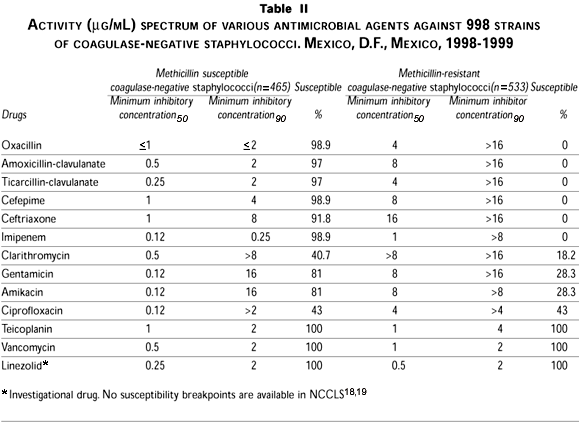
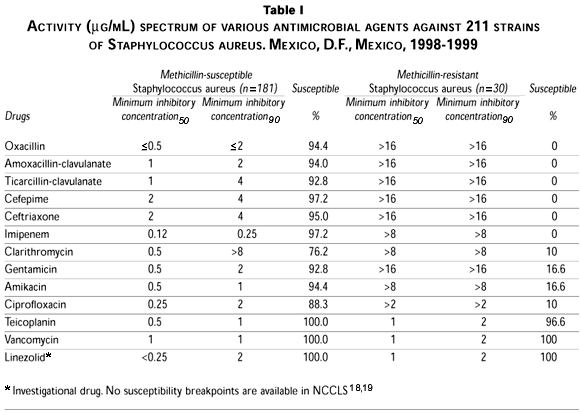
<body><![CDATA[<P align="left"><font size="3">Susceptibility to oxacillin differed significantly  among staphylococci, with 14.2% of <i> S. aureus </i>isolates and 53.4% of coagulase-negative staphylococci  isolates showing resistance to oxacillin, and therefore  were cross-resistant to all other <font face="Symbol">b</font>-lactam compounds.  Oxacillin-dicloxacillin, and also other useful  antistaphylococcal compounds, were predictably highly  active against oxacillin-susceptible isolates.</font>     <P align="left">     <font size="3">     Regarding non-<font face="Symbol">b</font>-lactam antibiotics, all  staphylococci remained fully susceptible to the  glycopeptide antibiotics vancomycin and teicoplanin  (MIC<SUB>90</SUB><font FACE="Symbol">£</font>2 &micro;g/mL). Linezolid, a new class of antimicrobial  agent that inhibits bacterial protein synthesis by blocking  formation of the initiation complex, demonstrated  100% activity against all <i> Staphylococcus </i>in this <i> in vitro</i> study.</font>     <P align="left">     <font size="3">     Few oxacillin-resistant staphylococci were  susceptible to ciprofloxacin, whereas 81% of the  oxacillin-susceptible <i> S. aureus</i>  were susceptible to amikacin.  A total of 94.4% of the coagulase-negative  oxacillin-susceptible strains were also susceptible to that  aminoglycoside. Reduced susceptibility to all other drugs  tested was higher among methicillin-resistant than  among methicillin-susceptible isolates, especially  susceptibility to clarithromycin and gentamicin.</font>     <P align="left">     <font size="3">     The activity of different antibiotics against <i> S.  aureus</i> and coagulase-negative staphylococci is shown  in <a href="#tab01"> tables I</a> and <a href="#tab02">II</a>.</font>     <P align="left">     <a name="tab01"></a>     <P align="left">&nbsp;          <p align="center"><img src="/img/revistas/spm/v44n2/a04tab01.gif"></p>     <P align="left">&nbsp;          <P align="left">     <a name="tab02"></a>     <P align="left">&nbsp;          ]]></body>
<body><![CDATA[<p align="center"><img src="/img/revistas/spm/v44n2/a04tab02.gif"></p>     <P align="center">&nbsp;     <P align="center"><font size="4">Discussion</font>     <P align="left"><font size="3">The development of antimicrobial resistance  nearly always has followed the therapeutic use of  antimicrobial agents. When penicillin was introduced for clinical  use, virtually all strains of <i> S. aureus</i> were  susceptible. Unfortunately, within less than a decade, serious  resistance problems were seen in many major medical centers. <i>   S.</i> <i> aureus </i>acquired <font face="Symbol">b</font>-lactamase genes, rendering  the organism penicillin-resistant. To combat this  problem, researchers developed extended-spectrum penicillins  and cephalosporins. These new antimicrobials succeeded  only partially in overcoming the problem of  resistance. Methicillin-resistant strains of staphylococci have  been known since the early 1960s. Recently, strains  relatively resistant to glycopeptides have been described (MIC<font FACE="Symbol">£</font>8 &micro;g/mL).<SUP>15</SUP> Treatment of <i> Staphylococcus</i> infections  has become more difficult because of  multidrug-resistant strains.</font>     <P align="left"><font size="3"><i>Staphylococcus aureus </i>and  coagulase-negative staphylococci have been identified by the National  Nosocomial Infections Surveillance system as the  leading overall causes of hospital acquired  infections.<SUP>5,15,20</SUP> </font>     <P align="left">     <font size="3">     The percentage of methicillin-resistant <i> S. aureus</i> (MRSA) in hospitals in the United States rose  from 2.4% in 1975 to 29 % in 1991, with a  methicillin-resistant <i> Staphylococcus aureus</i> rate of 38% at  large hospitals.<SUP>3</SUP> The highest resistance rates  occurred among isolates from patients in intensive care  units, </font><font size="3"> followed in decreasing order by rates among  isolates from outpatients. These organisms included  methicillin-resistant coagulase-negative staphylococci  in intensive care units (75%), non-ICUs (60.4%)  and outpatient areas (44.5%); and MRSA in intensive  care units (35.2%), non-intensive care units (31.9%)  and outpatients areas (17.7%).<SUP>21</SUP> </font>     <P align="left">     <font size="3">     <i>     S. aureus</i> and coagulase-negative staphylococci  are virulent pathogens that are currently the most  common cause of infections in hospitalized patients.  Increasing resistance to antibiotics indicates that  their prevalence will continue to rise.</font>     <P align="left">     <font size="3">     Given the number and severity of  staphylococcal infections, it is important to understand the nature  and pathogenesis of infections and the current  strategies available for therapy and prevention.</font>     <P align="left">     <font size="3">     The core resistance phenotype that seems to  be mostly associated with the persistence of <i> S. aureus</i>  in the hospital is methicillin resistance. This  resistance is due to the acquisition of a new  penicillin-binding protein, PBP2a.<SUP>14</SUP>  This protein has low affinity for  most <font face="Symbol">b</font>-lactam antibiotics, and therefore, mediates  cross-resistance to all these compounds.<SUP>3,14</SUP> </font>     <P align="left">     <font size="3">     Methicillin  resistance in nosocomial isolates of <i>  S. aureus</i> and coagulase-negative staphylococci has  been dramatically increasing, and is also associated  with resistance to other useful antistaphylococcal  compounds.<SUP>15,20</SUP> </font>     ]]></body>
<body><![CDATA[<P align="left">     <font size="3">     This high level of resistance not only  impedes successful therapy for infections but also allows  the organism to persist in the hospital, expanding its  reservoir. Study results suggest that the current levels  of methicillin-resistance in <i> S. aureus </i> and CNS have a  similar pattern to what has already been  established.<SUP>15</SUP> </font>     <P align="left">     <font size="3">     Although the incidence of- methicillin  resistant <i> S. aureus </i> and methicillin-resistant <i>  Staphylococcus epidermidis</i> strains and other methicillin resistant  staphylococci varies from hospital to hospital, it has  been increasing and often exceeds 50%, as is in the case  of coagulase-negative methicillin resistant  staphylococci, which is a major cause of medical  device-associated infections, specially in immunocompromised  patients, and the excessive use of vancomycin in the  empirical treatment is complicated by the emergence of  multiresistant strains.<SUP>15</SUP> </font>     <P align="left">     <font size="3">     A semisynthetic penicillin (dicloxacillin) would  be the drug of choice for b-lactamase-producing  strains, as well as in the case of <i> S. aureus </i>and methicillin-susceptible coagulase-negative staphylococci.  Cephalotin and clindamycin are acceptable alternatives.   Vancomycin should be reserved to treat  methicillin-resistant proved cases. The extensive use of vancomycin  may help promote colonization and infections with  vancomycin enterococci.</font>     <P align="left">     <font size="3">     Today, chemotherapy for <i> Staphylococcus</i>  methicillin-resistant infections is becoming increasingly  difficult.  With the increasing frequency of nosocomial  and device-related infections associated with  methicillin-resistant <i> staphyloccocus epidermidis</i>, and the  failure of glycopeptide antibiotic therapy  in those  infections, the pharmaceutical industry is searching and  responding with alternative agents, such as a combination  drug consisting of semisynthetic derivatives of  streptogramin A (dalfopristin) and streptogramin B  (quinupristin) (Synercid), used in Europe for several  years with no significant increase in resistance over  time.<SUP>22</SUP> </font>     <P align="left">     <font size="3">     The oxazolidinone antibiotics (PNU-1000766  and PNU-100592, Linezolid and Eperezolid), are other  novel antimicrobial agents that have been shown to be  active against most medically important  gram-positive bacteria. In our study, the <i> in vitro</i> activity of  Linezolid against <i>Staphylococcus</i>, either methicillin susceptible  or resistant, was comparable with those of  vancomycin.<SUP>23</SUP> </font>     <P align="left">     <font size="3">     Since antibiotic use became widespread 50  years ago, bacteria have steadily and routinely  developed resistance. Control of the emergence of resistance  will depend on new approaches to prudent antibiotic  use in hospitals and clinics, based in part on  improved surveillance for methicillin-resistance staphylococci  by currently available methods and on better systems  to encourage staff adherence to follow isolation  procedures.*</font>     <P align="center">&nbsp;     <P align="center"><font size="4">Acknowledgements</font>     <P align="left"><font size="3">We acknowledge the partial support of Pharmacia   and Upjohn (Dra. Susana Su&aacute;rez). The authors are  grateful to QBP, MSc, Norma Vel&aacute;zquez for technical assistance.</font>     <P align="center">&nbsp;     ]]></body>
<body><![CDATA[<P align="center"><font size="4">References</font>     <!-- ref --><P align="left"><font size="3">1. Lowy FD. <i> Staphylococcus aureus</i> infection. N Engl J Med  1998;320: 520-532.</font>    &nbsp;&nbsp;&nbsp;&nbsp;&nbsp;&nbsp;&nbsp;&nbsp;[&#160;<a href="javascript:void(0);" onclick="javascript: window.open('/scielo.php?script=sci_nlinks&ref=9151497&pid=S0036-3634200200020000400001&lng=','','width=640,height=500,resizable=yes,scrollbars=1,menubar=yes,');">Links</a>&#160;]<!-- end-ref --><!-- ref --><P align="left"><font size="3">2. Crossley KB, Archer GL, ed. The staphylococci in human diseases.  Nueva York: Churchill Livingstone, 1997.</font>    &nbsp;&nbsp;&nbsp;&nbsp;&nbsp;&nbsp;&nbsp;&nbsp;[&#160;<a href="javascript:void(0);" onclick="javascript: window.open('/scielo.php?script=sci_nlinks&ref=9151498&pid=S0036-3634200200020000400002&lng=','','width=640,height=500,resizable=yes,scrollbars=1,menubar=yes,');">Links</a>&#160;]<!-- end-ref --><!-- ref --><P align="left"><font size="3">3. Archer GL. <i> Staphylococcus aureus</i>: A well-armed pathogen. Clin  Infect Dis 1998;26:1179-1181.</font>    &nbsp;&nbsp;&nbsp;&nbsp;&nbsp;&nbsp;&nbsp;&nbsp;[&#160;<a href="javascript:void(0);" onclick="javascript: window.open('/scielo.php?script=sci_nlinks&ref=9151499&pid=S0036-3634200200020000400003&lng=','','width=640,height=500,resizable=yes,scrollbars=1,menubar=yes,');">Links</a>&#160;]<!-- end-ref --><!-- ref --><P align="left"><font size="3">4. Conterno LO, Wey SB, Castelo A. Risk factors for mortality in <i>  Staphylococcus aureus</i> bacteremia. Infect Control Hosp Epidemiol 1998;19:32-37.</font>    &nbsp;&nbsp;&nbsp;&nbsp;&nbsp;&nbsp;&nbsp;&nbsp;[&#160;<a href="javascript:void(0);" onclick="javascript: window.open('/scielo.php?script=sci_nlinks&ref=9151500&pid=S0036-3634200200020000400004&lng=','','width=640,height=500,resizable=yes,scrollbars=1,menubar=yes,');">Links</a>&#160;]<!-- end-ref --><!-- ref --><P align="left"><font size="3">5. Romero-Vivas J, Rubio M, Fern&aacute;ndez C, Picazo JJ. Mortality  associated with nosocomial bacteremia due to methicillin-resistant <i>  Staphylococcus aureus</i>. Clin Infect Dis 1995;21:1417-1423.</font>    &nbsp;&nbsp;&nbsp;&nbsp;&nbsp;&nbsp;&nbsp;&nbsp;[&#160;<a href="javascript:void(0);" onclick="javascript: window.open('/scielo.php?script=sci_nlinks&ref=9151501&pid=S0036-3634200200020000400005&lng=','','width=640,height=500,resizable=yes,scrollbars=1,menubar=yes,');">Links</a>&#160;]<!-- end-ref --><!-- ref --><P align="left"><font size="3">6. Musher OM, Lamm N, Daroniche RO, Young EJ, Hamill RJ, Landon  GC. The current spectrum of <i> Staphylococcus aureus</i> infection in a  tertiary care hospital. Medicine (Baltimore) 1994;73:186-208.</font>    &nbsp;&nbsp;&nbsp;&nbsp;&nbsp;&nbsp;&nbsp;&nbsp;[&#160;<a href="javascript:void(0);" onclick="javascript: window.open('/scielo.php?script=sci_nlinks&ref=9151502&pid=S0036-3634200200020000400006&lng=','','width=640,height=500,resizable=yes,scrollbars=1,menubar=yes,');">Links</a>&#160;]<!-- end-ref --><!-- ref --><P align="left"><font size="3">7. Bone RC. Gram-positive organisms and sepsis. Arch Intern  Med 1994;154:26-34.</font>    &nbsp;&nbsp;&nbsp;&nbsp;&nbsp;&nbsp;&nbsp;&nbsp;[&#160;<a href="javascript:void(0);" onclick="javascript: window.open('/scielo.php?script=sci_nlinks&ref=9151503&pid=S0036-3634200200020000400007&lng=','','width=640,height=500,resizable=yes,scrollbars=1,menubar=yes,');">Links</a>&#160;]<!-- end-ref --><!-- ref --><P align="left"><font size="3">8. Witte W. Antibiotic resistance in gram-positive bacteria:  Epidemiologic aspects. J Antimicrob Chemother 1999;44 (Suppl A): 1-9.</font>    &nbsp;&nbsp;&nbsp;&nbsp;&nbsp;&nbsp;&nbsp;&nbsp;[&#160;<a href="javascript:void(0);" onclick="javascript: window.open('/scielo.php?script=sci_nlinks&ref=9151504&pid=S0036-3634200200020000400008&lng=','','width=640,height=500,resizable=yes,scrollbars=1,menubar=yes,');">Links</a>&#160;]<!-- end-ref --><!-- ref --><P align="left"><font size="3">9. Kloos WE, Bannerman TL. Update on clinical significance of  coagulase-negative staphylococci. Clin Microbial Rev 1994;7:117-140.</font>    &nbsp;&nbsp;&nbsp;&nbsp;&nbsp;&nbsp;&nbsp;&nbsp;[&#160;<a href="javascript:void(0);" onclick="javascript: window.open('/scielo.php?script=sci_nlinks&ref=9151505&pid=S0036-3634200200020000400009&lng=','','width=640,height=500,resizable=yes,scrollbars=1,menubar=yes,');">Links</a>&#160;]<!-- end-ref --><!-- ref --><P align="left"><font size="3">10. Viagappan N, Kelsey MC. The origin of coagulase-negative  staphylococci isolated from blood cultures. J Hosp Infect 1995;30:217-223.</font>    &nbsp;&nbsp;&nbsp;&nbsp;&nbsp;&nbsp;&nbsp;&nbsp;[&#160;<a href="javascript:void(0);" onclick="javascript: window.open('/scielo.php?script=sci_nlinks&ref=9151506&pid=S0036-3634200200020000400010&lng=','','width=640,height=500,resizable=yes,scrollbars=1,menubar=yes,');">Links</a>&#160;]<!-- end-ref --><!-- ref --><P align="left"><font size="3">11. Raad L, Alrahwan A, Rolston K. <i> Staphylococcus epidermidis</i>:  Emerging resistance and need for alternative agents. Clin Infect Dis  1998; 26:1182-1187.</font>    &nbsp;&nbsp;&nbsp;&nbsp;&nbsp;&nbsp;&nbsp;&nbsp;[&#160;<a href="javascript:void(0);" onclick="javascript: window.open('/scielo.php?script=sci_nlinks&ref=9151507&pid=S0036-3634200200020000400011&lng=','','width=640,height=500,resizable=yes,scrollbars=1,menubar=yes,');">Links</a>&#160;]<!-- end-ref --><!-- ref --><P align="left"><font size="3">12. Rupp ME, Archer GL. Coagulase-negative staphylococci: Pathogens  associated with medical progress. Clin Infect Dis 1994;19:231-243.</font>    &nbsp;&nbsp;&nbsp;&nbsp;&nbsp;&nbsp;&nbsp;&nbsp;[&#160;<a href="javascript:void(0);" onclick="javascript: window.open('/scielo.php?script=sci_nlinks&ref=9151508&pid=S0036-3634200200020000400012&lng=','','width=640,height=500,resizable=yes,scrollbars=1,menubar=yes,');">Links</a>&#160;]<!-- end-ref --><!-- ref --><P align="left"><font size="3">13. Waldvogel FA. New resistance in <i> Staphylococcus aureus</i>. N Engl J  Med 1999;340:556-557.</font>    &nbsp;&nbsp;&nbsp;&nbsp;&nbsp;&nbsp;&nbsp;&nbsp;[&#160;<a href="javascript:void(0);" onclick="javascript: window.open('/scielo.php?script=sci_nlinks&ref=9151509&pid=S0036-3634200200020000400013&lng=','','width=640,height=500,resizable=yes,scrollbars=1,menubar=yes,');">Links</a>&#160;]<!-- end-ref --><!-- ref --><P align="left"><font size="3">14. Chambers HF. Methicillin resistance in staphylococci. Molecular  and biochemical basis and clinical implications. Clin Microbiol Rev  1997;10: 781-791.</font>    &nbsp;&nbsp;&nbsp;&nbsp;&nbsp;&nbsp;&nbsp;&nbsp;[&#160;<a href="javascript:void(0);" onclick="javascript: window.open('/scielo.php?script=sci_nlinks&ref=9151510&pid=S0036-3634200200020000400014&lng=','','width=640,height=500,resizable=yes,scrollbars=1,menubar=yes,');">Links</a>&#160;]<!-- end-ref --><!-- ref --><P align="left"><font size="3">15. Pfaller MA, Jones RN, Doern GV, Sader HS, Kugler KC, Beach ML <i> et  al.</i> Survey of bloodstream infections due to gram-positive cocci:  Frequency of occurrence and antimicrobial susceptibility of isolates collected in  1997 in the United States, Canada, and Latin America for the SENTRY  antimicrobial surveillance program. Diagn Microbiol Infect Dis 1999;33:283-297.</font>    &nbsp;&nbsp;&nbsp;&nbsp;&nbsp;&nbsp;&nbsp;&nbsp;[&#160;<a href="javascript:void(0);" onclick="javascript: window.open('/scielo.php?script=sci_nlinks&ref=9151511&pid=S0036-3634200200020000400015&lng=','','width=640,height=500,resizable=yes,scrollbars=1,menubar=yes,');">Links</a>&#160;]<!-- end-ref --><!-- ref --><P align="left"><font size="3">16. Schwalbe RS, Stapleton JT, Gilligan PH. Emergence of  vancomycin resistance in coagulase-negative staphylococci. N Engl Med  1987;316: 927-931.</font>    &nbsp;&nbsp;&nbsp;&nbsp;&nbsp;&nbsp;&nbsp;&nbsp;[&#160;<a href="javascript:void(0);" onclick="javascript: window.open('/scielo.php?script=sci_nlinks&ref=9151512&pid=S0036-3634200200020000400016&lng=','','width=640,height=500,resizable=yes,scrollbars=1,menubar=yes,');">Links</a>&#160;]<!-- end-ref --><!-- ref --><P align="left"><font size="3">17. Kloos WK, Bannerman TL. <i> Staphylococcus </i> and <i>Micrococcus</i>. En:  Murray PR, Baron EJ, Pfaller MA, Tenover FC, Yolken RH, ed. Manual of  clinical microbiology. 7<SUP>th</SUP> ed. Washington, D.C.: ASM Press, 1999: 264-282.</font>    &nbsp;&nbsp;&nbsp;&nbsp;&nbsp;&nbsp;&nbsp;&nbsp;[&#160;<a href="javascript:void(0);" onclick="javascript: window.open('/scielo.php?script=sci_nlinks&ref=9151513&pid=S0036-3634200200020000400017&lng=','','width=640,height=500,resizable=yes,scrollbars=1,menubar=yes,');">Links</a>&#160;]<!-- end-ref --><!-- ref --><P align="left"><font size="3">18. National Committee for Clinical Laboratory Standards.  Antimicrobial susceptibility test for bacteria that grow aerobically: Approved  Standard. 5<SUP>th</SUP> ed. Wayne (PA): National Committee for Clinical Laboratory  Standards, 2000; NCCLS document M7-A5.</font>    &nbsp;&nbsp;&nbsp;&nbsp;&nbsp;&nbsp;&nbsp;&nbsp;[&#160;<a href="javascript:void(0);" onclick="javascript: window.open('/scielo.php?script=sci_nlinks&ref=9151514&pid=S0036-3634200200020000400018&lng=','','width=640,height=500,resizable=yes,scrollbars=1,menubar=yes,');">Links</a>&#160;]<!-- end-ref --><!-- ref --><P align="left"><font size="3">19. National Committee for Clinical Laboratory Standards.  Performance standards for antimicrobial susceptibility testing: Tenth informational  supplement Wayne (PA): National Committee for Clinical Laboratory  Standards. 2000; M100-S10.</font>    &nbsp;&nbsp;&nbsp;&nbsp;&nbsp;&nbsp;&nbsp;&nbsp;[&#160;<a href="javascript:void(0);" onclick="javascript: window.open('/scielo.php?script=sci_nlinks&ref=9151515&pid=S0036-3634200200020000400019&lng=','','width=640,height=500,resizable=yes,scrollbars=1,menubar=yes,');">Links</a>&#160;]<!-- end-ref --><!-- ref --><P align="left"><font size="3">20. Emory TG, Gaynes RP. An overview of nosocomial infections,  including the role of the microbiology laboratory. Clin Microbiol Rev  1993;6: 428-442.</font>    &nbsp;&nbsp;&nbsp;&nbsp;&nbsp;&nbsp;&nbsp;&nbsp;[&#160;<a href="javascript:void(0);" onclick="javascript: window.open('/scielo.php?script=sci_nlinks&ref=9151516&pid=S0036-3634200200020000400020&lng=','','width=640,height=500,resizable=yes,scrollbars=1,menubar=yes,');">Links</a>&#160;]<!-- end-ref --><!-- ref --><P align="left"><font size="3">21. Fridkin SK, Steward CD, Edwards JR, Pryor EE, Mc Gowan JE,  Archivald LK <i> et al.</i> Surveillance of antimicrobial use and antimicrobial resistance  in the United States hospitals: Project ICARE phase 2. Clin Infect Dis   1999; 29: 245-252.</font>    &nbsp;&nbsp;&nbsp;&nbsp;&nbsp;&nbsp;&nbsp;&nbsp;[&#160;<a href="javascript:void(0);" onclick="javascript: window.open('/scielo.php?script=sci_nlinks&ref=9151517&pid=S0036-3634200200020000400021&lng=','','width=640,height=500,resizable=yes,scrollbars=1,menubar=yes,');">Links</a>&#160;]<!-- end-ref --><!-- ref --><P align="left"><font size="3">22. Brumfitt W, Hamilton-Miller JM, Shah S. <i> In vitro</i> activity of RP59500  a new semisynthetic antibiotic, against gram-positive bacteria. J  Antimicrob Chemother 1992; 30 (Suppl A):27-37.</font>    &nbsp;&nbsp;&nbsp;&nbsp;&nbsp;&nbsp;&nbsp;&nbsp;[&#160;<a href="javascript:void(0);" onclick="javascript: window.open('/scielo.php?script=sci_nlinks&ref=9151518&pid=S0036-3634200200020000400022&lng=','','width=640,height=500,resizable=yes,scrollbars=1,menubar=yes,');">Links</a>&#160;]<!-- end-ref --><!-- ref --><P align="left"><font size="3">23. Stevens DL, Smith LG, Bruss JB, McConnell-Martin MA, Duvall SE,  Todd WM <i> et al.</i> Randomized comparison of Linezolid (PNU-100766)  versus oxacillin-dicloxacillin for treatment of complicated skin and soft  tissue infections. Antimicrob Agents Chemother  2000; 44: 3408-4813.</font>    &nbsp;&nbsp;&nbsp;&nbsp;&nbsp;&nbsp;&nbsp;&nbsp;[&#160;<a href="javascript:void(0);" onclick="javascript: window.open('/scielo.php?script=sci_nlinks&ref=9151519&pid=S0036-3634200200020000400023&lng=','','width=640,height=500,resizable=yes,scrollbars=1,menubar=yes,');">Links</a>&#160;]<!-- end-ref --><p align="left">&nbsp;     <p align="left">&nbsp;</p>     <p align="left"><font size="3"> <a name="nt"></a>(<a href="#tx">1</a>)     Departamentos de Bacteriolog&iacute;a Intestinal, Inmunoqu&iacute;mica y Biolog&iacute;a Celular. Hospital Infantil de M&eacute;xico  &quot;Federico G&oacute;mez&quot;. M&eacute;xico, D.F., M&eacute;xico.</font></p>     <P align="left">&nbsp;     <P align="center"><font size="3"><B>Received on:</B> April 3, 2001 <font FACE="Symbol">·</font> <B>Accepted  on:</B> October 19, 2001    <br> Address reprint requests to: Dr. E. Calder&oacute;n. Subdirecci&oacute;n de Investigaci&oacute;n, Departamento de Inmunoqu&iacute;mica y Biolog&iacute;a Celular,</font> <font size="3">Hospital Infantil de M&eacute;xico &quot;Federico G&oacute;mez&quot;. Dr. M&aacute;rquez No. 162, colonia Doctores, 06720 M&eacute;xico, D.F., M&eacute;xico.    ]]></body>
<body><![CDATA[<br> E-mail: <a href="mailto:ecalderj@yahoo.com"> ecalderj@yahoo.com</a></font>      ]]></body><back>
<ref-list>
<ref id="B1">
<label>1</label><nlm-citation citation-type="journal">
<person-group person-group-type="author">
<name>
<surname><![CDATA[Lowy]]></surname>
<given-names><![CDATA[FD]]></given-names>
</name>
</person-group>
<article-title xml:lang="en"><![CDATA[Staphylococcus aureus infection]]></article-title>
<source><![CDATA[N Engl J Med]]></source>
<year>1998</year>
<volume>320</volume>
<page-range>520-532</page-range></nlm-citation>
</ref>
<ref id="B2">
<label>2</label><nlm-citation citation-type="book">
<person-group person-group-type="author">
<name>
<surname><![CDATA[Crossley]]></surname>
<given-names><![CDATA[KB]]></given-names>
</name>
<name>
<surname><![CDATA[Archer]]></surname>
<given-names><![CDATA[GL]]></given-names>
</name>
</person-group>
<source><![CDATA[The staphylococci in human diseases]]></source>
<year>1997</year>
<publisher-loc><![CDATA[Nueva York ]]></publisher-loc>
<publisher-name><![CDATA[Churchill Livingstone]]></publisher-name>
</nlm-citation>
</ref>
<ref id="B3">
<label>3</label><nlm-citation citation-type="journal">
<person-group person-group-type="author">
<name>
<surname><![CDATA[Archer]]></surname>
<given-names><![CDATA[GL]]></given-names>
</name>
</person-group>
<article-title xml:lang="en"><![CDATA[Staphylococcus aureus: A well-armed pathogen]]></article-title>
<source><![CDATA[Clin Infect Dis]]></source>
<year>1998</year>
<volume>26</volume>
<page-range>1179-1181</page-range></nlm-citation>
</ref>
<ref id="B4">
<label>4</label><nlm-citation citation-type="journal">
<person-group person-group-type="author">
<name>
<surname><![CDATA[Conterno]]></surname>
<given-names><![CDATA[LO]]></given-names>
</name>
<name>
<surname><![CDATA[Wey]]></surname>
<given-names><![CDATA[SB]]></given-names>
</name>
<name>
<surname><![CDATA[Castelo]]></surname>
<given-names><![CDATA[A]]></given-names>
</name>
</person-group>
<article-title xml:lang="en"><![CDATA[Risk factors for mortality in Staphylococcus aureus bacteremia]]></article-title>
<source><![CDATA[Infect Control Hosp Epidemiol]]></source>
<year>1998</year>
<volume>19</volume>
<page-range>32-37</page-range></nlm-citation>
</ref>
<ref id="B5">
<label>5</label><nlm-citation citation-type="journal">
<person-group person-group-type="author">
<name>
<surname><![CDATA[Romero-Vivas]]></surname>
<given-names><![CDATA[J]]></given-names>
</name>
<name>
<surname><![CDATA[Rubio]]></surname>
<given-names><![CDATA[M]]></given-names>
</name>
<name>
<surname><![CDATA[Fernández]]></surname>
<given-names><![CDATA[C]]></given-names>
</name>
<name>
<surname><![CDATA[Picazo]]></surname>
<given-names><![CDATA[JJ]]></given-names>
</name>
</person-group>
<article-title xml:lang="en"><![CDATA[Mortality associated with nosocomial bacteremia due to methicillin-resistant Staphylococcus aureus]]></article-title>
<source><![CDATA[Clin Infect Dis]]></source>
<year>1995</year>
<volume>21</volume>
<page-range>1417-1423</page-range></nlm-citation>
</ref>
<ref id="B6">
<label>6</label><nlm-citation citation-type="journal">
<person-group person-group-type="author">
<name>
<surname><![CDATA[Musher]]></surname>
<given-names><![CDATA[OM]]></given-names>
</name>
<name>
<surname><![CDATA[Lamm]]></surname>
<given-names><![CDATA[N]]></given-names>
</name>
<name>
<surname><![CDATA[Daroniche]]></surname>
<given-names><![CDATA[RO]]></given-names>
</name>
<name>
<surname><![CDATA[Young]]></surname>
<given-names><![CDATA[EJ]]></given-names>
</name>
<name>
<surname><![CDATA[Hamill]]></surname>
<given-names><![CDATA[RJ]]></given-names>
</name>
<name>
<surname><![CDATA[Landon]]></surname>
<given-names><![CDATA[GC]]></given-names>
</name>
</person-group>
<article-title xml:lang="en"><![CDATA[The current spectrum of Staphylococcus aureus infection in a tertiary care hospital]]></article-title>
<source><![CDATA[Medicine (Baltimore)]]></source>
<year>1994</year>
<volume>73</volume>
<page-range>186-208</page-range></nlm-citation>
</ref>
<ref id="B7">
<label>7</label><nlm-citation citation-type="journal">
<person-group person-group-type="author">
<name>
<surname><![CDATA[Bone]]></surname>
<given-names><![CDATA[RC]]></given-names>
</name>
</person-group>
<article-title xml:lang="en"><![CDATA[Gram-positive organisms and sepsis]]></article-title>
<source><![CDATA[Arch Intern Med]]></source>
<year>1994</year>
<volume>154</volume>
<page-range>26-34</page-range></nlm-citation>
</ref>
<ref id="B8">
<label>8</label><nlm-citation citation-type="journal">
<person-group person-group-type="author">
<name>
<surname><![CDATA[Witte]]></surname>
<given-names><![CDATA[W]]></given-names>
</name>
</person-group>
<article-title xml:lang="en"><![CDATA[Antibiotic resistance in gram-positive bacteria: Epidemiologic aspects]]></article-title>
<source><![CDATA[J Antimicrob Chemother]]></source>
<year>1999</year>
<volume>44</volume>
<numero>Suppl A</numero>
<issue>Suppl A</issue>
<page-range>1-9</page-range></nlm-citation>
</ref>
<ref id="B9">
<label>9</label><nlm-citation citation-type="journal">
<person-group person-group-type="author">
<name>
<surname><![CDATA[Kloos]]></surname>
<given-names><![CDATA[WE]]></given-names>
</name>
<name>
<surname><![CDATA[Bannerman]]></surname>
<given-names><![CDATA[TL]]></given-names>
</name>
</person-group>
<article-title xml:lang="en"><![CDATA[Update on clinical significance of coagulase-negative staphylococci]]></article-title>
<source><![CDATA[Clin Microbial Rev]]></source>
<year>1994</year>
<volume>7</volume>
<page-range>117-140</page-range></nlm-citation>
</ref>
<ref id="B10">
<label>10</label><nlm-citation citation-type="journal">
<person-group person-group-type="author">
<name>
<surname><![CDATA[Viagappan]]></surname>
<given-names><![CDATA[N]]></given-names>
</name>
<name>
<surname><![CDATA[Kelsey]]></surname>
<given-names><![CDATA[MC]]></given-names>
</name>
</person-group>
<article-title xml:lang="en"><![CDATA[The origin of coagulase-negative staphylococci isolated from blood cultures]]></article-title>
<source><![CDATA[J Hosp Infect]]></source>
<year>1995</year>
<volume>30</volume>
<page-range>217-223</page-range></nlm-citation>
</ref>
<ref id="B11">
<label>11</label><nlm-citation citation-type="journal">
<person-group person-group-type="author">
<name>
<surname><![CDATA[Raad]]></surname>
<given-names><![CDATA[L]]></given-names>
</name>
<name>
<surname><![CDATA[Alrahwan]]></surname>
<given-names><![CDATA[A]]></given-names>
</name>
<name>
<surname><![CDATA[Rolston]]></surname>
<given-names><![CDATA[K]]></given-names>
</name>
</person-group>
<article-title xml:lang="en"><![CDATA[Staphylococcus epidermidis: Emerging resistance and need for alternative agents]]></article-title>
<source><![CDATA[Clin Infect Dis]]></source>
<year>1998</year>
<volume>26</volume>
<page-range>1182-1187</page-range></nlm-citation>
</ref>
<ref id="B12">
<label>12</label><nlm-citation citation-type="journal">
<person-group person-group-type="author">
<name>
<surname><![CDATA[Rupp]]></surname>
<given-names><![CDATA[ME]]></given-names>
</name>
<name>
<surname><![CDATA[Archer]]></surname>
<given-names><![CDATA[GL]]></given-names>
</name>
</person-group>
<article-title xml:lang="en"><![CDATA[Coagulase-negative staphylococci: Pathogens associated with medical progress]]></article-title>
<source><![CDATA[Clin Infect Dis]]></source>
<year>1994</year>
<volume>19</volume>
<page-range>231-243</page-range></nlm-citation>
</ref>
<ref id="B13">
<label>13</label><nlm-citation citation-type="journal">
<person-group person-group-type="author">
<name>
<surname><![CDATA[Waldvogel]]></surname>
<given-names><![CDATA[FA]]></given-names>
</name>
</person-group>
<article-title xml:lang="en"><![CDATA[New resistance in Staphylococcus aureus]]></article-title>
<source><![CDATA[N Engl J Med]]></source>
<year>1999</year>
<volume>340</volume>
<page-range>556-557</page-range></nlm-citation>
</ref>
<ref id="B14">
<label>14</label><nlm-citation citation-type="journal">
<person-group person-group-type="author">
<name>
<surname><![CDATA[Chambers]]></surname>
<given-names><![CDATA[HF]]></given-names>
</name>
</person-group>
<article-title xml:lang="en"><![CDATA[Methicillin resistance in staphylococci: Molecular and biochemical basis and clinical implications]]></article-title>
<source><![CDATA[Clin Microbiol Rev]]></source>
<year>1997</year>
<volume>10</volume>
<page-range>781-791</page-range></nlm-citation>
</ref>
<ref id="B15">
<label>15</label><nlm-citation citation-type="journal">
<person-group person-group-type="author">
<name>
<surname><![CDATA[Pfaller]]></surname>
<given-names><![CDATA[MA]]></given-names>
</name>
<name>
<surname><![CDATA[Jones]]></surname>
<given-names><![CDATA[RN]]></given-names>
</name>
<name>
<surname><![CDATA[Doern]]></surname>
<given-names><![CDATA[GV]]></given-names>
</name>
<name>
<surname><![CDATA[Sader]]></surname>
<given-names><![CDATA[HS]]></given-names>
</name>
<name>
<surname><![CDATA[Kugler]]></surname>
<given-names><![CDATA[KC]]></given-names>
</name>
<name>
<surname><![CDATA[Beach]]></surname>
<given-names><![CDATA[ML]]></given-names>
</name>
</person-group>
<article-title xml:lang="en"><![CDATA[Survey of bloodstream infections due to gram-positive cocci: Frequency of occurrence and antimicrobial susceptibility of isolates collected in 1997 in the United States, Canada, and Latin America for the SENTRY antimicrobial surveillance program]]></article-title>
<source><![CDATA[Diagn Microbiol Infect Dis]]></source>
<year>1999</year>
<volume>33</volume>
<page-range>283-297</page-range></nlm-citation>
</ref>
<ref id="B16">
<label>16</label><nlm-citation citation-type="journal">
<person-group person-group-type="author">
<name>
<surname><![CDATA[Schwalbe]]></surname>
<given-names><![CDATA[RS]]></given-names>
</name>
<name>
<surname><![CDATA[Stapleton]]></surname>
<given-names><![CDATA[JT]]></given-names>
</name>
<name>
<surname><![CDATA[Gilligan]]></surname>
<given-names><![CDATA[PH]]></given-names>
</name>
</person-group>
<article-title xml:lang="en"><![CDATA[Emergence of vancomycin resistance in coagulase-negative staphylococci]]></article-title>
<source><![CDATA[N Engl Med]]></source>
<year>1987</year>
<volume>316</volume>
<page-range>927-931</page-range></nlm-citation>
</ref>
<ref id="B17">
<label>17</label><nlm-citation citation-type="book">
<person-group person-group-type="author">
<name>
<surname><![CDATA[Kloos]]></surname>
<given-names><![CDATA[WK]]></given-names>
</name>
<name>
<surname><![CDATA[Bannerman]]></surname>
<given-names><![CDATA[TL]]></given-names>
</name>
</person-group>
<article-title xml:lang="en"><![CDATA[Staphylococcus and Micrococcus]]></article-title>
<person-group person-group-type="editor">
<name>
<surname><![CDATA[Murray]]></surname>
<given-names><![CDATA[PR]]></given-names>
</name>
<name>
<surname><![CDATA[Baron]]></surname>
<given-names><![CDATA[EJ]]></given-names>
</name>
<name>
<surname><![CDATA[Pfaller]]></surname>
<given-names><![CDATA[MA]]></given-names>
</name>
<name>
<surname><![CDATA[Tenover]]></surname>
<given-names><![CDATA[FC]]></given-names>
</name>
<name>
<surname><![CDATA[Yolken]]></surname>
<given-names><![CDATA[RH]]></given-names>
</name>
</person-group>
<source><![CDATA[Manual of clinical microbiology]]></source>
<year>1999</year>
<edition>7</edition>
<page-range>264-282</page-range><publisher-loc><![CDATA[Washington^eD. C. D. C.]]></publisher-loc>
<publisher-name><![CDATA[ASM Press]]></publisher-name>
</nlm-citation>
</ref>
<ref id="B18">
<label>18</label><nlm-citation citation-type="book">
<collab>National Committee for Clinical Laboratory Standards</collab>
<source><![CDATA[Antimicrobial susceptibility test for bacteria that grow aerobically: Approved Standard]]></source>
<year>2000</year>
<edition>5</edition>
<page-range>M7-A5</page-range><publisher-loc><![CDATA[Wayne^ePA PA]]></publisher-loc>
<publisher-name><![CDATA[National Committee for Clinical Laboratory StandardsNCCLS document]]></publisher-name>
</nlm-citation>
</ref>
<ref id="B19">
<label>19</label><nlm-citation citation-type="book">
<collab>National Committee for Clinical Laboratory Standards</collab>
<source><![CDATA[Performance standards for antimicrobial susceptibility testing: Tenth informational supplement Wayne (PA)]]></source>
<year>2000</year>
<page-range>M100-S10</page-range><publisher-name><![CDATA[National Committee for Clinical Laboratory Standards]]></publisher-name>
</nlm-citation>
</ref>
<ref id="B20">
<label>20</label><nlm-citation citation-type="journal">
<person-group person-group-type="author">
<name>
<surname><![CDATA[Emory]]></surname>
<given-names><![CDATA[TG]]></given-names>
</name>
<name>
<surname><![CDATA[Gaynes]]></surname>
<given-names><![CDATA[RP]]></given-names>
</name>
</person-group>
<article-title xml:lang="en"><![CDATA[An overview of nosocomial infections, including the role of the microbiology laboratory]]></article-title>
<source><![CDATA[Clin Microbiol Rev]]></source>
<year>1993</year>
<volume>6</volume>
<page-range>428-442</page-range></nlm-citation>
</ref>
<ref id="B21">
<label>21</label><nlm-citation citation-type="journal">
<person-group person-group-type="author">
<name>
<surname><![CDATA[Fridkin]]></surname>
<given-names><![CDATA[SK]]></given-names>
</name>
<name>
<surname><![CDATA[Steward]]></surname>
<given-names><![CDATA[CD]]></given-names>
</name>
<name>
<surname><![CDATA[Edwards]]></surname>
<given-names><![CDATA[JR]]></given-names>
</name>
<name>
<surname><![CDATA[Pryor]]></surname>
<given-names><![CDATA[EE]]></given-names>
</name>
<name>
<surname><![CDATA[Mc]]></surname>
<given-names><![CDATA[Gowan JE]]></given-names>
</name>
<name>
<surname><![CDATA[Archivald]]></surname>
<given-names><![CDATA[LK]]></given-names>
</name>
</person-group>
<article-title xml:lang="en"><![CDATA[Surveillance of antimicrobial use and antimicrobial resistance in the United States hospitals: Project ICARE phase 2]]></article-title>
<source><![CDATA[Clin Infect Dis]]></source>
<year>1999</year>
<volume>29</volume>
<page-range>245-252</page-range></nlm-citation>
</ref>
<ref id="B22">
<label>22</label><nlm-citation citation-type="journal">
<person-group person-group-type="author">
<name>
<surname><![CDATA[Brumfitt]]></surname>
<given-names><![CDATA[W]]></given-names>
</name>
<name>
<surname><![CDATA[Hamilton-Miller]]></surname>
<given-names><![CDATA[JM]]></given-names>
</name>
<name>
<surname><![CDATA[Shah]]></surname>
<given-names><![CDATA[S]]></given-names>
</name>
</person-group>
<article-title xml:lang="en"><![CDATA[In vitro activity of RP59500 a new semisynthetic antibiotic, against gram-positive bacteria]]></article-title>
<source><![CDATA[J Antimicrob Chemother]]></source>
<year>1992</year>
<volume>30</volume>
<numero>Suppl A</numero>
<issue>Suppl A</issue>
<page-range>27-37</page-range></nlm-citation>
</ref>
<ref id="B23">
<label>23</label><nlm-citation citation-type="journal">
<person-group person-group-type="author">
<name>
<surname><![CDATA[Stevens]]></surname>
<given-names><![CDATA[DL]]></given-names>
</name>
<name>
<surname><![CDATA[Smith]]></surname>
<given-names><![CDATA[LG]]></given-names>
</name>
<name>
<surname><![CDATA[Bruss]]></surname>
<given-names><![CDATA[JB]]></given-names>
</name>
<name>
<surname><![CDATA[McConnell-Martin]]></surname>
<given-names><![CDATA[MA]]></given-names>
</name>
<name>
<surname><![CDATA[Duvall]]></surname>
<given-names><![CDATA[SE]]></given-names>
</name>
<name>
<surname><![CDATA[Todd]]></surname>
<given-names><![CDATA[WM]]></given-names>
</name>
</person-group>
<article-title xml:lang="en"><![CDATA[Randomized comparison of Linezolid (PNU-100766) versus oxacillin-dicloxacillin for treatment of complicated skin and soft tissue infections]]></article-title>
<source><![CDATA[Antimicrob Agents Chemother]]></source>
<year>2000</year>
<volume>44</volume>
<page-range>3408-4813</page-range></nlm-citation>
</ref>
</ref-list>
</back>
</article>