<?xml version="1.0" encoding="ISO-8859-1"?><article xmlns:mml="http://www.w3.org/1998/Math/MathML" xmlns:xlink="http://www.w3.org/1999/xlink" xmlns:xsi="http://www.w3.org/2001/XMLSchema-instance">
<front>
<journal-meta>
<journal-id>0036-3634</journal-id>
<journal-title><![CDATA[Salud Pública de México]]></journal-title>
<abbrev-journal-title><![CDATA[Salud pública Méx]]></abbrev-journal-title>
<issn>0036-3634</issn>
<publisher>
<publisher-name><![CDATA[Instituto Nacional de Salud Pública]]></publisher-name>
</publisher>
</journal-meta>
<article-meta>
<article-id>S0036-36342002000100002</article-id>
<title-group>
<article-title xml:lang="en"><![CDATA[Economic analysis of a pragmatic randomised trial of home visits by a nurse to elderly people with hypertension in Mexico]]></article-title>
<article-title xml:lang="es"><![CDATA[Análisis económico de un ensayo clínico aleatorizado de visitas de enfermera en casa a ancianos con hipertensión en México]]></article-title>
</title-group>
<contrib-group>
<contrib contrib-type="author">
<name>
<surname><![CDATA[García-Peña]]></surname>
<given-names><![CDATA[Carmen]]></given-names>
</name>
<xref ref-type="aff" rid="A01"/>
</contrib>
<contrib contrib-type="author">
<name>
<surname><![CDATA[Thorogood]]></surname>
<given-names><![CDATA[Margaret]]></given-names>
</name>
<xref ref-type="aff" rid="A02"/>
</contrib>
<contrib contrib-type="author">
<name>
<surname><![CDATA[Wonderling]]></surname>
<given-names><![CDATA[David]]></given-names>
</name>
<xref ref-type="aff" rid="A03"/>
</contrib>
<contrib contrib-type="author">
<name>
<surname><![CDATA[Reyes-Frausto]]></surname>
<given-names><![CDATA[Sandra]]></given-names>
</name>
<xref ref-type="aff" rid="A04"/>
</contrib>
</contrib-group>
<aff id="A01">
<institution><![CDATA[,Instituto Mexicano del Seguro Social Area de Investigación en Servicios de Salud ]]></institution>
<addr-line><![CDATA[México D.F.]]></addr-line>
<country>México</country>
</aff>
<aff id="A02">
<institution><![CDATA[,London School of Hygiene and Tropical Medicine Health Promotion Research Unit ]]></institution>
<addr-line><![CDATA[ ]]></addr-line>
</aff>
<aff id="A03">
<institution><![CDATA[,London School of Hygiene and Tropical Medicine Cancer and Public Health Unit ]]></institution>
<addr-line><![CDATA[ ]]></addr-line>
</aff>
<aff id="A04">
<institution><![CDATA[,University of Leicester Department of Epidemiology and Public Health ]]></institution>
<addr-line><![CDATA[ ]]></addr-line>
<country>United Kingdom</country>
</aff>
<pub-date pub-type="pub">
<day>00</day>
<month>01</month>
<year>2002</year>
</pub-date>
<pub-date pub-type="epub">
<day>00</day>
<month>01</month>
<year>2002</year>
</pub-date>
<volume>44</volume>
<numero>1</numero>
<fpage>14</fpage>
<lpage>20</lpage>
<copyright-statement/>
<copyright-year/>
<self-uri xlink:href="http://www.scielo.org.mx/scielo.php?script=sci_arttext&amp;pid=S0036-36342002000100002&amp;lng=en&amp;nrm=iso"></self-uri><self-uri xlink:href="http://www.scielo.org.mx/scielo.php?script=sci_abstract&amp;pid=S0036-36342002000100002&amp;lng=en&amp;nrm=iso"></self-uri><self-uri xlink:href="http://www.scielo.org.mx/scielo.php?script=sci_pdf&amp;pid=S0036-36342002000100002&amp;lng=en&amp;nrm=iso"></self-uri><abstract abstract-type="short" xml:lang="en"><p><![CDATA[Objective. To analyse the costs and the effectiveness of an intervention of home visits made by nurses to elderly people versus usual care given by the family medicine units. Material and Methods. A sample of 4 777 subjects aged 60 years and over covered by the Mexican Institute of Social Security (Instituto Mexicano del Seguro Social, IMSS) were screened. Those with a systolic and/or diastolic blood pressure level higher or equal than 160/90 mm Hg were randomly allocated to the intervention or control groups. The intervention consisted of visits at home by nurses who gave health and lifestyle advice to the participants. The economic evaluation was considered from a health services and patient perspective. Direct and indirect costs were calculated as incremental. Effectiveness was measured in terms of cost per millimetre of mercury reduced. Results. Three hundred and forty five participants were allocated to the intervention group and compared with 338 controls. At the end of the intervention period the difference in the mean change in systolic blood pressure was 3.31 mm Hg (95% CI 6.32, 0.29; p=0.03) comparing with the control group. In diastolic blood pressure the difference was 3.67 (95% CI 5.22, 2.12; p<0.001). The total cost of the intervention was 101 901.66 pesos. The intervention cost per patient was 34.61 pesos (US$3.78), (CI 95% 34.44, 35.46). The cost-effectiveness ratios was 10.46 pesos (US$1.14) for systolic (CI 95% 129.31, 5.51) and 9.43 (US$1.03) for diastolic (CI 95% 19.90, 2.49). Conclusions. The reduction in blood pressure obtained may well justify the small incremental cost of the intervention.]]></p></abstract>
<abstract abstract-type="short" xml:lang="es"><p><![CDATA[Objetivo. Analizar los costos y la efectividad de una intervención basada en visitas de enfermería en casa a ancianos hipertensos comparada con el tratamiento usual otorgado por el médico familiar. Material y métodos. Una muestra de 4 777 sujetos de 60 años y más derechohabientes del Instituto Mexicano del Seguro Social (IMSS) fueron sometidos a escrutinio. Aquellos con cifras sistólica o diastólica iguales o superiores a 160/90 mm Hg fueron asignados aleatoriamente al grupo de intervención o al control. La intervención consistió en visitas de enfermera en casa que daban promoción de la salud. La evaluación económica fue considerada desde una perspectiva del paciente y de los servicios de salud. Costos directos e indirectos fueron considerados como incrementales. La efectividad fue medida en términos de costo por mmHg reducido. Resultados. Trescientos cuarenta y cinco participantes fueron aleatorizados al grupo de intervención y comparados con 338 controles. Al final del periodo de intervención la diferencia en el cambio promedio en presión arterial sistólica fue de 3.31 mm Hg (IC 95% 6.32, 0.29; p=0.03) comparado con el grupo control. La diferencia en presión arterial diastólica fue de 3.67 mm Hg (IC 95% 5.22, 2.12; p<0.001). El costo total de la intervención fue de 101,901.66 pesos. El costo por paciente fue de 34.61 pesos (US$3.78), (IC 95% 34.44, 35.46). La razón de costo efectividad fue de 10.46 pesos (US$1.14) para presión sistólica (IC 95% 129.31, 5.51) y 9.43 (US$1.03) para presión diastólica (IC 95% 19.90, 2.49). Conclusiones. La reducción de la presión arterial parece valer el costo incremental de la intervención.]]></p></abstract>
<kwd-group>
<kwd lng="en"><![CDATA[hypertension]]></kwd>
<kwd lng="en"><![CDATA[elderly population]]></kwd>
<kwd lng="en"><![CDATA[cost effectiveness]]></kwd>
<kwd lng="en"><![CDATA[Mexico]]></kwd>
<kwd lng="es"><![CDATA[hipertensión]]></kwd>
<kwd lng="es"><![CDATA[población anciana]]></kwd>
<kwd lng="es"><![CDATA[costo-efectividad]]></kwd>
<kwd lng="es"><![CDATA[México]]></kwd>
</kwd-group>
</article-meta>
</front><body><![CDATA[ <p><font size="2"><b><a name="top"></a>ART&Iacute;CULO ORIGINAL</b></font></p>     <p>&nbsp;</p>     <p align="center"><b><font size=5>Economic analysis of a pragmatic randomised    trial of home visits by a nurse to elderly people with hypertension in Mexico    </font></b></p>     <p align="center">&nbsp;</p>     <P align="center">Carmen Garc&iacute;a-Pe&ntilde;a, MD, MsC, PhD,<SUP>(<a href="#back">1</a>)</SUP>    Margaret Thorogood, PhD,<SUP>(<a href="#back">2</a>)</SUP> David Wonderling,    Ba, MSc,<SUP>(<a href="#back">3</a>) </SUP>Sandra Reyes-Frausto, MD, MsC, PhD.<SUP>(<a href="#back">4</a>)</SUP>      <P>     <P>&nbsp;     <P>&nbsp;     <P>Garc&iacute;a-Pe&ntilde;a C, Thorogood M,    <br>   Wonderling D, Reyes-Frausto S.    ]]></body>
<body><![CDATA[<br>   Economic analysis of a pragmatic randomised trial of home visits by a nurse    to elderly people with hypertension in Mexico.    <br>   Salud Publica Mex 2002;44:14-20.    <br>   <b>The English version of this paper is available at: <a href="http://www.insp.mx/salud/index.htm">http://www.insp.mx/salud/index.htm</a>    </b>     <P>     <P> <B>Abstract    <br> </B><B>Objective.</b> To analyse the costs and the effectiveness of an intervention  of home visits made by nurses to elderly people versus usual care given by the  family medicine units. <B>Material and Methods. </B>A sample of 4 777 subjects  aged 60 years and over covered by the Mexican Institute of Social Security (Instituto  Mexicano del Seguro Social, IMSS) were screened. Those with a systolic and/or  diastolic blood pressure level higher or equal than 160/90 mm Hg were randomly  allocated to the intervention or control groups. The intervention consisted of  visits at home by nurses who gave health and lifestyle advice to the participants.  The economic evaluation was considered from a health services and patient perspective.  Direct and indirect costs were calculated as incremental. Effectiveness was measured  in terms of cost per millimetre of mercury reduced. <B>Results</B>. Three hundred  and forty five participants were allocated to the intervention group and compared  with 338 controls. At the end of the intervention period the difference in the  mean change in systolic blood pressure was 3.31 mm Hg (95% CI 6.32, 0.29; <I>p</I>=0.03)  comparing with the control group. In diastolic blood pressure the difference was  3.67 (95% CI 5.22, 2.12; <I>p</I>&lt;0.001). The total cost of the intervention  was 101 901.66 pesos. The intervention cost per patient was 34.61 pesos (US$3.78),  (CI 95% 34.44, 35.46). The cost-effectiveness ratios was 10.46 pesos (US$1.14)  for systolic (CI 95% 129.31, 5.51) and 9.43 (US$1.03) for diastolic (CI 95% 19.90,  2.49). <B>Conclusions</B>. The reduction in blood pressure obtained may well justify  the small incremental cost of the intervention. The English version of this paper  is available too at: <a href="http://www.insp.mx/salud/index.htm">http://www.insp.mx/salud/index.htm</a>    <br> Key words: hypertension; elderly population; cost effectiveness; Mexico      <P>     <P>&nbsp;     <P>Garc&iacute;a-Pe&ntilde;a C, Thorogood M,    ]]></body>
<body><![CDATA[<br>   Wonderling D, Reyes-Frausto S.    <br>   An&aacute;lisis econ&oacute;mico de un ensayo cl&iacute;nico aleatorizado de    visitas de enfermera en casa a ancianos con hipertensi&oacute;n en M&eacute;xico.    <br>   Salud Publica Mex 2002;44:14-20.    <br>   <b>El texto completo en ingl&eacute;s de este art&iacute;culo est&aacute; disponible    en: <a href="http://www.insp.mx/salud/index.html">http://www.insp.mx/salud/index.html</a>    </b>      <P>     <P>     <p><B>Resumen    <br>   </B><B>Objetivo</b>. Analizar los costos y la efectividad de una intervenci&oacute;n    basada en visitas de enfermer&iacute;a en casa a ancianos hipertensos comparada    con el tratamiento usual otorgado por el m&eacute;dico familiar. <B>Material    y m&eacute;todos</B>. Una muestra de 4 777 sujetos de 60 a&ntilde;os y m&aacute;s    derechohabientes del Instituto Mexicano del Seguro Social (IMSS) fueron sometidos    a escrutinio. Aquellos con cifras sist&oacute;lica o diast&oacute;lica iguales    o superiores a 160/90 mm Hg fueron asignados aleatoriamente al grupo de intervenci&oacute;n    o al control. La intervenci&oacute;n consisti&oacute; en visitas de enfermera    en casa que daban promoci&oacute;n de la salud. La evaluaci&oacute;n econ&oacute;mica    fue considerada desde una perspectiva del paciente y de los servicios de salud.    Costos directos e indirectos fueron considerados como incrementales. La efectividad    fue medida en t&eacute;rminos de costo por mmHg reducido. <B>Resultados</B>.    Trescientos cuarenta y cinco participantes fueron aleatorizados al grupo de    intervenci&oacute;n y comparados con 338 controles. Al final del periodo de    intervenci&oacute;n la diferencia en el cambio promedio en presi&oacute;n arterial    sist&oacute;lica fue de 3.31 mm Hg (IC 95% 6.32, 0.29; <I>p</I>=0.03) comparado    con el grupo control. La diferencia en presi&oacute;n arterial diast&oacute;lica    fue de 3.67 mm Hg (IC 95% 5.22, 2.12; <I>p</I>&lt;0.001). El costo total de    la intervenci&oacute;n fue de 101,901.66 pesos. El costo por paciente fue de    34.61 pesos (US$3.78), (IC 95% 34.44, 35.46). La raz&oacute;n de costo efectividad    fue de 10.46 pesos (US$1.14) para presi&oacute;n sist&oacute;lica (IC 95% 129.31,    5.51) y 9.43 (US$1.03) para presi&oacute;n diast&oacute;lica (IC 95% 19.90,    2.49). <B>Conclusiones</B>. La reducci&oacute;n de la presi&oacute;n arterial    parece valer el costo incremental de la intervenci&oacute;n. El texto completo    en ingl&eacute;s de este art&iacute;culo tambi&eacute;n est&aacute; disponible    en: <a href="http://www.insp.mx/salud/index.html">http://www.insp.mx/salud/index.html    <br>   </a>Palabras clave: hipertensi&oacute;n; poblaci&oacute;n anciana; costo-efectividad;    M&eacute;xico</p>     <p>&nbsp;</p>     ]]></body>
<body><![CDATA[<p>&nbsp;</p>     <p><font size="6"><b>T</b></font>he ageing population and the concomitant increasing    prevalence of non-communicable diseases is an important issue in the health    agenda of Mexico.<SUP>1,2</SUP> Different ways of providing health care for    the elderly are being studied to identify the most effective policies. A pragmatic    randomised trial of home visits made by nurses to elderly people with hypertension    in Mexico has reported the effectiveness of this intervention in reducing blood    pressure levels at six months.<SUP>3,4</SUP> There was a significant reduction    in blood pressure, as well as an increased proportion of participants undertaking    regular brisk walking. There was also a significant increase in the proportion    of participants on hypotensive medication. However, there was no difference    in weight reduction or salt excretion between the intervention and control group.    Financial resources for health are inevitably limited and there are many competing    demands. It is therefore important to determine the cost-effectivenss of a policy    before recommending that it be incorporated in health care provided by the Mexican    Institute of Social Security (Instituto Mexicano del Seguro Social (IMSS). A    number of studies have evaluated the cost and effects of antihypertensive drugs,<SUP>5-8</SUP>    but far fewer have evaluated health promotion strategies for reducing hypertension,    and even fewer have considered the effect in old people. Health checks to reduce    cardiovascular risk factors in the general population<SUP>9,10</SUP> have been    shown to be cost-effective although, this depends on the duration of the effect.  </p>     <P>     This report estimates the incremental costs and effects of home visits made by nurses to elderly people in  comparison with the usual care provided by the family medicine units.      <P>     <P>&nbsp;     <p align="center"><font size="4">Material and Methods </font></p>     <P>The design of the trial, methods and main findings have been reported previously.<SUP>3,4</SUP>    Briefly, 4 777 participants aged 60 years and over were screened. Those previously    known as hypertensives or those with new diagnosis who had a systolic and/or    diastolic blood pressure level higher or equal to 160/90 mm Hg respectively,    were randomly allocated to the intervention or control arm. The intervention    consisted of visits at home at least fortnightly by nurses during a six month    period. The nurses were first given training about ageing, clinical aspects    of hypertension, personal interviews, health behaviour change models, process    of negotiation and ethical aspects of home visits. During visits, the nurse    measured blood pressure and the nurse and patient reviewed information from    the baseline health check, and discussed possible lifestyle changes. The nurse    tried to guide their patients to a healthier lifestyle and suggested different    alternative ways to achieve the changes and negotiated specific targets. The    nurse also reviewed the pharmacological treatment and compliance was encouraged.    The patient led the process of negotiation, while the nurse provided information    about risks and benefits from lifestyle change. Both groups continued to receive    the usual care provided by the family physicians. The trial did not interfere    with the care given by the doctors at the family medicine units. A different    team of nurses measured blood pressure and weighed the participants at baseline    and at final follow-up. They also collected a sample of urine for calculating    sodium excretion and administered a questionnaire to ascertain the presence    of risk factors, use of medication and self-reported level of physical activity.    There were 364 participants randomised to the intervention group and 354 to    the control group. The 19 participants in the intervention group and 16 in the    control group dropped out before the final evaluation. The flow of the subjects    through the study is presented in <a href="#figura1">Figure 1</a>. Baseline    characteristics of the participants are included in <a href="#tabela1">Table    I</a>.      <P align="center"><a name="figura1"></a>     <P align="center">&nbsp;     <P align="center"><img src="/img/revistas/spm/v44n1/8556f1.gif">      ]]></body>
<body><![CDATA[<P align="center"><a name="tabela1"></a>     <P align="center">&nbsp;     <P align="center"><img src="/img/revistas/spm/v44n1/8556t1.gif">      <P align="center">&nbsp;     <P>      <p><b>Costs </b></p>     <P>     <P>The evaluation was considered from a health services and patient perspective. All costs are reported in 1998  Mexican pesos and US dollars. Costs were not discounted since the time period of the intervention was six months, apart from  the cost of the sphygmomanometers, which was discounted assuming a  capital life expectancy of five years and a  discount rate of 6%. Costs which related to the process of research rather than the provision of the intervention were excluded.  All the costs of the intervention were considered to be incremental to the cost of existing care since the family medicine  units do not have an existing programme. Nurse time was recorded during the trial, including the duration of each visit,  the time spent travelling, and time spent on general issues such as planning, codifying and reporting. The cost of  transport was also included.  Using this information, an average cost of a visit was calculated, which is the cost of nurse  time during the consultation plus time spent travelling. The unit costs of the time of the nurses and their instructors  were calculated from their salaries (17.50 pesos per hour for the nurses). Supplies and stationery costs were collected  from institutional records. Equipment costs (sphygmomanometers and stethoscopes) were collected from the  institutional distributor. Clinic/office space was costed using the daily accounting cost of a room at IMSS. The impact of the  intervention on the number of family physicians consultations was measured. Patient costs were investigated.     <P>     A cost for each patient was calculated by multiplying the number of visits that individual had received by  the average cost of a visit plus the average of the other costs (equipment, office space, training, supplies). A  confidence interval for mean cost, as well as mean effect, was calculated using the t-distribution with the variation in cost  being attributable to the variation in the number of visits received.  Similarly the difference in costs, or difference in effects  was also calculated.      <P>     Cost/effectiveness was measured in terms of cost per millimetre of mercury reduced. Confidence intervals for  the cost-effectiveness ratios were estimated using Fieller's method, which takes account of the skewness of the  distribution of the ratio.<SUP>11</SUP>     ]]></body>
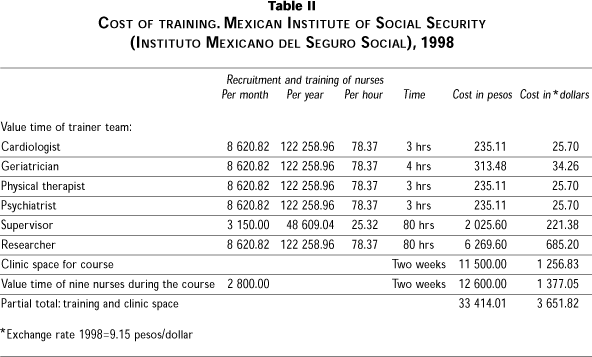
<body><![CDATA[<P>     <P>&nbsp;     <p align="center"><font size="4">Results </font></p>     <P>At the end of the intervention period the difference in the mean change was a fall of 3.31 mm Hg (95% CI 6.32,   0.29, <I>p</I>=0.03) in systolic blood pressure and a fall of 3.67 mm Hg  (95% CI 5.22, 2.12  <I>p</I>&lt;0.001) in diastolic blood pressure comparing the intervention group with the control group. In the intervention group, 12.9% of participants reported  an increase in brisk walking, compared with 5.2% in the control group  (<I>p</I>=0.0004), and the proportion of people not  anti-hypertensive medication  decreased from 28.4% to 15.9%, compared to a decrease from 32.2% to 26.9% in the  control group (<I>p</I>=0.001).      <P>      <P><b>Costs </b>     <P>     <P>Cost items related to the training course are described in <a href="/img/revistas/spm/v44n1/8556t2.gif">Table    II</a>. <a href="#tabela3">Table III</a> presents the costs of equipment. Indirect    costs such as patient or family time were not included because when the nurses    asked, none of the participants reported a cost value of the time spent during    the visits. The total cost of the transport was $7 207.60 pesos (US$787.71),    the average transport cost per visit was $2.70 pesos (CI 95% 2.42, 2.95 pesos).    The average time per consultation was 43.58 minutes (CI 95% 41.16, 45.89 min.).    The total number of visits to the participants was 2 944 (mean for a participant    8.53, std. dev.=2.10). The total cost of the intervention nurses was 59 096.82    pesos (US$6,180.99). The total cost of the intervention was then calculated    as follows:      <p align="center"><a name="tabela3"></a>      <p align="center">&nbsp;      ]]></body>
<body><![CDATA[<p align="center"><img src="/img/revistas/spm/v44n1/8556t3.gif">      <p align="center">&nbsp;     <P> Cost = [number of consultations per patient average cost of a consultation    (nurse time consultation+time travelling)+cost travelling] + other costs (equipment,    office space, training, supplies) = 101 901.66 pesos (US$11,136.79).     <P>     The average intervention cost per patient was 34.61 pesos (US$3.78),   (<I>p</I>=0.000, CI 95% 34.44, 35.46). This cost  was not significantly different (<I>p</I>=0.61) in men and women (the  cost for one woman was 35.05 pesos (US$3.83) and for  one man  34.78 pesos (US$3.80).     <P>     The total number of clinic visits to the family physicians by the participants was also calculated. There were 1  395 clinic visits in two hundred and sixty five participants (mean=5.26, std. dev.=2.57) in the intervention group and  1,392 visits in 259 participants (mean=5.37, std. dev.=1.85) in the control group. The difference between the groups was  not significant (<I>p</I>=0.22).      <P>      <P><b>Effects and cost/effectiveness ratios </b>     <P>     <P>The differences in the mean change of systolic and diastolic blood pressure    were used as the effectiveness measurements. The cost-effectiveness of the intervention    was 10.46 pesos (US$1.14) per millimetre reduction in systolic blood pressure    or 9.43 pesos (US$1.03) per millimetre reduction in diastolic blood pressure.    Confidence intervals for the cost-effectiveness ratios are presented in <a href="#tabela4">Table    IV</a>. The cost of the control group is zero because a) the intervention is    considered to be an incremental cost and b) the cost of family physician visits    was not included as there was no significant difference between the trial arms.    Variances and standard deviations of the effects (S<SUP>2</SUP><SUB>ET</SUB>,    S<SUP>2</SUP><SUB>EC</SUB>, and<SUB> </SUB>S<SUB>ET</SUB>) assumed the values    of change in systolic and diastolic blood pressure. The intervention cost per    patient (C<SUB>T</SUB>) was 34.61 pesos (S<SUB>CT</SUB>=4.86, S<SUP>2</SUP><SUB>CT</SUB>=23.68    pesos). Symbol r<SUB>T </SUB>refers to the sample correlation coefficient of    the cost an effect in the intervention group (Systolic r<SUB>T</SUB>=0.028 and    diastolic r<SUB>T</SUB>=0.003). <a href="#tabela4">Table 4</a> includes values    of the three coefficients of variation (C<SUB>dd</SUB>, C<SUB>nn</SUB> and C<SUB>nd</SUB>)    and the resulting confidence intervals for systolic and diastolic cost-effectiveness    ratios.      <P align="center"><a name="tabela4"></a>      ]]></body>
<body><![CDATA[<P align="center">&nbsp;     <P align="center"><img src="/img/revistas/spm/v44n1/8556t4.gif">      <P align="center">&nbsp;     <p align="center"><font size="4">Discussion </font></p>     <P>Much research has been published in the area of effective antihypertensive therapy, patient management  guidelines and life-style management, but optimal methods for the delivery of care have not been fully explored.   With this  perspective, the aim of this study  was to measure the incremental costs and effects of home visits by a nurse to elderly people  with hypertension in Mexico.       <P>     The cost effectiveness of the intervention was 10.5 pesos (US$1.1)  per mm Hg reduction of systolic blood  pressure and 9.4 pesos (US$1.0) per mm Hg reduction of diastolic blood pressure. This seems on face value to be a  cost-effective intervention.  However,  it is not possible to draw a firm conclusion because it is not possible to make  comparisons with alternative health care interventions based in Mexico which used other measures of effectiveness. The tool  of economic analysis has emerged only recently in Mexico and little information  exists. We cannot determine, therefore,  if nurse visits to the elderly  is the most cost-effective alternative. However, the estimated cost per millimetre  of mercury reduction in blood pressure suggests that this intervention will prove to be highly cost effective.      <P>     This study is based on an outcome of  reduction in blood pressure, which  is an immediate outcome. We do not  have any information on the sustainability of the intervention, and the future benefits of the intervention in terms of  mortality, morbidity or quality of life are unknown. Because the target group is elderly, it is not possible to model the effects  of blood pressure reduction on mortality. Models for estimating life years gained after blood pressure reduction  have  been criticised for discriminating against older people, due to a shorter life expectancy of older  people.<SUP>12 </SUP>Unfortunately, models have not been  developed for people over 70 years old. As a consequence the utilization of  modelling would underestimate the cost-effectiveness ratio.      <P>     The number of clinic consultations with the family physician was not statistically different between the groups.  If future benefits are achieved in the intervention group, it is possible that there will be a decrease in utilisation rates  for second and third levels of care and a decrease in the disability rates. On the other hand the intervention lead to  increased prescribing of antihypertensive drugs and this has not been considered in our estimate of cost. Indirect costs were  not included in the analysis because none of the participants reported any.  One of the reasons for this was that the  nurse always arranged the appointment with the participant and he/she could choose a time that was convenient. By  arranging home visits at times that are convenient to the participant, indirect costs can be greatly reduced. Many health  policy makers argue that health promotion practices and preventive care are a way of reducing health care costs. However,  the idea that health promotion and preventive strategies are cheap and will save money, is too simplistic.  Indeed, in the  case of the elderly population, health promotion activities could add to the costs of the medical expenditure but they will  also represent future benefits in terms of a better quality of life, a decrease in disability and the possibility of a  successful ageing.<SUP>13</SUP>     <P>     Recognition  that health can be promoted for the elderly to improve the quality of life  has increased in the last  few years<SUP>14</SUP> but the process by which research data are incorporated into a clinical setting is complicated. Economic  features, organisational aspects, uncertainty about the usefulness of the results, technical barriers are some of the obstacles in  the process of linking research into policy.<SUP>15  </SUP>Ensuring that the health promotion strategy that we tested is effective is  an important step, but not enough. As is true everywhere in the world, institutional resources in Mexico will remain  limited and interventions for the elderly must be shown to be cost-effective if they are to compete against the resource  demands of other worthwhile interventions.  The intervention evaluated in this study has been shown to be effective at very  small cost, but whether this represents good value compared with other health interventions remains to be determined.   Moreover, there is, as yet, no relevant data on the effectiveness or cost of other possible interventions aimed at blood  pressure reduction in an elderly Mexican population, such as self help groups and future research has to be done in this area.       <P>     This study is important because introduces the tool of the economic analysis  in the arena of health promotion  for elderly people. In M&eacute;xico, health system has to be reorganized in order to response to the growing needs of this group  of age and research is a key element in this process. Hypertension and their consequences  (stroke and coronary  heart disease) is the most important cause of mortality and disability among the elderly.  Cost-effective strategies that  improves health and promotes healthy aging  are crucial if we want to diminish an increasing utilization of third  level hospitals and the subsequent costs.     ]]></body>
<body><![CDATA[<P>     <P>     <P>&nbsp;     <p align="center"><font size="4">References </font></p>     <P>     <!-- ref --><P>1. Secretar&iacute;a de Salud. Bolet&iacute;n de Informaci&oacute;n Estad&iacute;stica, Recursos y Servicios. M&eacute;xico, D.F.: SSA;1997.    &nbsp;&nbsp;&nbsp;&nbsp;&nbsp;&nbsp;&nbsp;&nbsp;[&#160;<a href="javascript:void(0);" onclick="javascript: window.open('/scielo.php?script=sci_nlinks&ref=9149265&pid=S0036-3634200200010000200001&lng=','','width=640,height=500,resizable=yes,scrollbars=1,menubar=yes,');">Links</a>&#160;]<!-- end-ref --><!-- ref --><P>2. Secretar&iacute;a de Salud. Encuesta Nacional de Enfermedades Cr&oacute;nicas. M&eacute;xico, D.F.: Direcci&oacute;n General de Epidemiolog&iacute;a, 1996.    &nbsp;&nbsp;&nbsp;&nbsp;&nbsp;&nbsp;&nbsp;&nbsp;[&#160;<a href="javascript:void(0);" onclick="javascript: window.open('/scielo.php?script=sci_nlinks&ref=9149266&pid=S0036-3634200200010000200002&lng=','','width=640,height=500,resizable=yes,scrollbars=1,menubar=yes,');">Links</a>&#160;]<!-- end-ref --><!-- ref --><P>3. Garc&iacute;a-Pe&ntilde;a C, Thorogood M, Armstrong B, Reyes S, Mu&ntilde;oz O. Pragmatic Randomised Trial of Home Visits by a Nurse to Elderly People with Hypertension  in Mexico. Int J Epidemiol 2001.    &nbsp;&nbsp;&nbsp;&nbsp;&nbsp;&nbsp;&nbsp;&nbsp;[&#160;<a href="javascript:void(0);" onclick="javascript: window.open('/scielo.php?script=sci_nlinks&ref=9149267&pid=S0036-3634200200010000200003&lng=','','width=640,height=500,resizable=yes,scrollbars=1,menubar=yes,');">Links</a>&#160;]<!-- end-ref --><!-- ref --><P>4. Garc&iacute;a-Pe&ntilde;a C, Thorogood M, Reyes S, Salmer&oacute;n-Castro J, Dur&aacute;n C.  The prevalence and Treatment of Hypertension in Elderly Population.  Salud Publica  Mex 2001;43:415-420.    &nbsp;&nbsp;&nbsp;&nbsp;&nbsp;&nbsp;&nbsp;&nbsp;[&#160;<a href="javascript:void(0);" onclick="javascript: window.open('/scielo.php?script=sci_nlinks&ref=9149268&pid=S0036-3634200200010000200004&lng=','','width=640,height=500,resizable=yes,scrollbars=1,menubar=yes,');">Links</a>&#160;]<!-- end-ref --><!-- ref --><P>5. Kaplan N. Cost Considerations in the drug treatment of the Mexican Institute of Social Security hypertension. Is older better? Pharmacoeconomics  1996;9:283-285.    &nbsp;&nbsp;&nbsp;&nbsp;&nbsp;&nbsp;&nbsp;&nbsp;[&#160;<a href="javascript:void(0);" onclick="javascript: window.open('/scielo.php?script=sci_nlinks&ref=9149269&pid=S0036-3634200200010000200005&lng=','','width=640,height=500,resizable=yes,scrollbars=1,menubar=yes,');">Links</a>&#160;]<!-- end-ref --><!-- ref --><P>6. Johannesson M. The cost effectiveness of hypertension treatment in Sweden. Pharmacoeconomics 1995;7:242-250.    &nbsp;&nbsp;&nbsp;&nbsp;&nbsp;&nbsp;&nbsp;&nbsp;[&#160;<a href="javascript:void(0);" onclick="javascript: window.open('/scielo.php?script=sci_nlinks&ref=9149270&pid=S0036-3634200200010000200006&lng=','','width=640,height=500,resizable=yes,scrollbars=1,menubar=yes,');">Links</a>&#160;]<!-- end-ref --><!-- ref --><P>7. Edelson D, Weinstein M, Tosteson A, Willims L, Lee  T, Goldman L. Long-term cost-effectiveness of various initial monotherapies for mild to moderate  hypertension. JAMA 1990;263:407-413.    &nbsp;&nbsp;&nbsp;&nbsp;&nbsp;&nbsp;&nbsp;&nbsp;[&#160;<a href="javascript:void(0);" onclick="javascript: window.open('/scielo.php?script=sci_nlinks&ref=9149271&pid=S0036-3634200200010000200007&lng=','','width=640,height=500,resizable=yes,scrollbars=1,menubar=yes,');">Links</a>&#160;]<!-- end-ref --><!-- ref --><P>8. Mancia G, Giannattasio C. Benefit and costs of anti-hypertensive treatment. Eur Heart J 1995;17 (Suppl A):25-28.    &nbsp;&nbsp;&nbsp;&nbsp;&nbsp;&nbsp;&nbsp;&nbsp;[&#160;<a href="javascript:void(0);" onclick="javascript: window.open('/scielo.php?script=sci_nlinks&ref=9149272&pid=S0036-3634200200010000200008&lng=','','width=640,height=500,resizable=yes,scrollbars=1,menubar=yes,');">Links</a>&#160;]<!-- end-ref --><!-- ref --><P>9. Wonderling D, McDErmott Ch, Buxton M, Kinmonth A, Pyke S, Thompson S. Costs and cost effectiveness of cardiovascular screening and intervention: the  British Family Heart Study. BMJ 1996;312:1269-1273.    &nbsp;&nbsp;&nbsp;&nbsp;&nbsp;&nbsp;&nbsp;&nbsp;[&#160;<a href="javascript:void(0);" onclick="javascript: window.open('/scielo.php?script=sci_nlinks&ref=9149273&pid=S0036-3634200200010000200009&lng=','','width=640,height=500,resizable=yes,scrollbars=1,menubar=yes,');">Links</a>&#160;]<!-- end-ref --><!-- ref --><P>10. Wonderling D, Langham S, Buxton M, Normand Ch, McDermott CH. What can be concluded from the Oxcheck and British Family Heart Studies: commentary  on cost effectiveness analyses. BMJ 1996;312:1274-1278.    &nbsp;&nbsp;&nbsp;&nbsp;&nbsp;&nbsp;&nbsp;&nbsp;[&#160;<a href="javascript:void(0);" onclick="javascript: window.open('/scielo.php?script=sci_nlinks&ref=9149274&pid=S0036-3634200200010000200010&lng=','','width=640,height=500,resizable=yes,scrollbars=1,menubar=yes,');">Links</a>&#160;]<!-- end-ref --><!-- ref --><P>11. Chaundhary M, Steams S. Estimating confidence intervals for cost-effectivness ratios: An example from a randomized trial. Stat Med 1996;15:1447-1458.    &nbsp;&nbsp;&nbsp;&nbsp;&nbsp;&nbsp;&nbsp;&nbsp;[&#160;<a href="javascript:void(0);" onclick="javascript: window.open('/scielo.php?script=sci_nlinks&ref=9149275&pid=S0036-3634200200010000200011&lng=','','width=640,height=500,resizable=yes,scrollbars=1,menubar=yes,');">Links</a>&#160;]<!-- end-ref --><!-- ref --><P>12. Johannesson N, Johansson P. Is the evaluation of a QALY gained independent of age? Some empirical evidence. J Health Economics 1997;16:589-599.    &nbsp;&nbsp;&nbsp;&nbsp;&nbsp;&nbsp;&nbsp;&nbsp;[&#160;<a href="javascript:void(0);" onclick="javascript: window.open('/scielo.php?script=sci_nlinks&ref=9149276&pid=S0036-3634200200010000200012&lng=','','width=640,height=500,resizable=yes,scrollbars=1,menubar=yes,');">Links</a>&#160;]<!-- end-ref --><!-- ref --><P>13. Kennie D. Preventive Care for Elderly People. Londres: Cambridge University Press, 1993:310.    &nbsp;&nbsp;&nbsp;&nbsp;&nbsp;&nbsp;&nbsp;&nbsp;[&#160;<a href="javascript:void(0);" onclick="javascript: window.open('/scielo.php?script=sci_nlinks&ref=9149277&pid=S0036-3634200200010000200013&lng=','','width=640,height=500,resizable=yes,scrollbars=1,menubar=yes,');">Links</a>&#160;]<!-- end-ref --><!-- ref --><P>14. Kalache A. Health promotion. En: Ebrahim S, Kalache A, ed. Epidemiology in old age. Londres: Latimer Trend, 1996:156.    &nbsp;&nbsp;&nbsp;&nbsp;&nbsp;&nbsp;&nbsp;&nbsp;[&#160;<a href="javascript:void(0);" onclick="javascript: window.open('/scielo.php?script=sci_nlinks&ref=9149278&pid=S0036-3634200200010000200014&lng=','','width=640,height=500,resizable=yes,scrollbars=1,menubar=yes,');">Links</a>&#160;]<!-- end-ref --><!-- ref --><P>15. Lewando-Hundt G,  Al Zaroo S (2000). Evaluation the dissemination of health promotion research. En: Thorogood M, Coombes Y. Evaluation Health  Promotion. Practice and Methods. Oxford (UK): Oxford University Press, 2000:151.    &nbsp;&nbsp;&nbsp;&nbsp;&nbsp;&nbsp;&nbsp;&nbsp;[&#160;<a href="javascript:void(0);" onclick="javascript: window.open('/scielo.php?script=sci_nlinks&ref=9149279&pid=S0036-3634200200010000200015&lng=','','width=640,height=500,resizable=yes,scrollbars=1,menubar=yes,');">Links</a>&#160;]<!-- end-ref --><P>     <P>&nbsp;     <P>&nbsp;     <P>This trial was funded by the National Council of Science and Technology, Mexico    (Conacyt) and the Mexican Institute of Social Security (IMSS).      <P>      <P><a name="back"></a>(<a href="#top">1</a>) Area de Investigaci&oacute;n en Servicios    de Salud. Instituto Mexicano del Seguro Social. M&eacute;xico, D.F., M&eacute;xico.      <P>(<a href="#top">2</a>) Health Promotion Research Unit. London School of Hygiene    and Tropical Medicine.      <P>(<a href="#top">3</a>) Cancer and Public Health Unit. London School of Hygiene    and Tropical Medicine.      <P>(<a href="#top">4</a>) Department of Epidemiology and Public Health. University    of Leicester, United Kingdom.     <P>&nbsp;     ]]></body>
<body><![CDATA[<P align="center"><B>Received on</B>: January 1, 2001 &#149; <B>Acepted on</B>:    October 3, 2001    <br>   Address reprint requests to: Dra. Ma. del Carmen Garc&iacute;a-Pe&ntilde;a.    Divisi&oacute;n de Investigaci&oacute;n Epidemiol&oacute;gica y en Servicios    de Salud, Edificio Bloque &quot;B&quot;, Cuarto piso, Unidad de Congresos, Centro    M&eacute;dico Nacional Siglo XXI. Av. Cuauht&eacute;moc 330, colonia Doctores.    06125 M&eacute;xico, D.F., M&eacute;xico.    <br>   E-mail: <a href="mailto:mcgp1@terra.com.mx">mcgp1@terra.com.mx</a>       ]]></body><back>
<ref-list>
<ref id="B1">
<label>1</label><nlm-citation citation-type="book">
<collab>Secretaría de Salud</collab>
<source><![CDATA[Boletín de Información Estadística, Recursos y Servicios]]></source>
<year>1997</year>
<publisher-loc><![CDATA[México^eD.F. D.F.]]></publisher-loc>
<publisher-name><![CDATA[SSA]]></publisher-name>
</nlm-citation>
</ref>
<ref id="B2">
<label>2</label><nlm-citation citation-type="book">
<collab>Secretaría de Salud</collab>
<source><![CDATA[Encuesta Nacional de Enfermedades Crónicas]]></source>
<year>1996</year>
<publisher-loc><![CDATA[México^eD.F. D.F.]]></publisher-loc>
<publisher-name><![CDATA[Dirección General de Epidemiología]]></publisher-name>
</nlm-citation>
</ref>
<ref id="B3">
<label>3</label><nlm-citation citation-type="journal">
<person-group person-group-type="author">
<name>
<surname><![CDATA[García-Peña]]></surname>
<given-names><![CDATA[C]]></given-names>
</name>
<name>
<surname><![CDATA[Thorogood]]></surname>
<given-names><![CDATA[M]]></given-names>
</name>
<name>
<surname><![CDATA[Armstrong]]></surname>
<given-names><![CDATA[B]]></given-names>
</name>
<name>
<surname><![CDATA[Reyes]]></surname>
<given-names><![CDATA[S]]></given-names>
</name>
<name>
<surname><![CDATA[Muñoz]]></surname>
<given-names><![CDATA[O]]></given-names>
</name>
</person-group>
<article-title xml:lang="en"><![CDATA[Pragmatic Randomised Trial of Home Visits by a Nurse to Elderly People with Hypertension in Mexico]]></article-title>
<source><![CDATA[Int J Epidemiol]]></source>
<year>2001</year>
</nlm-citation>
</ref>
<ref id="B4">
<label>4</label><nlm-citation citation-type="journal">
<person-group person-group-type="author">
<name>
<surname><![CDATA[García-Peña]]></surname>
<given-names><![CDATA[C]]></given-names>
</name>
<name>
<surname><![CDATA[Thorogood]]></surname>
<given-names><![CDATA[M]]></given-names>
</name>
<name>
<surname><![CDATA[Reyes]]></surname>
<given-names><![CDATA[S]]></given-names>
</name>
<name>
<surname><![CDATA[Salmerón-Castro]]></surname>
<given-names><![CDATA[J]]></given-names>
</name>
<name>
<surname><![CDATA[Durán]]></surname>
<given-names><![CDATA[C]]></given-names>
</name>
</person-group>
<article-title xml:lang="en"><![CDATA[The prevalence and Treatment of Hypertension in Elderly Population]]></article-title>
<source><![CDATA[Salud Publica Mex]]></source>
<year>2001</year>
<volume>43</volume>
<page-range>415-420</page-range></nlm-citation>
</ref>
<ref id="B5">
<label>5</label><nlm-citation citation-type="journal">
<person-group person-group-type="author">
<name>
<surname><![CDATA[Kaplan]]></surname>
<given-names><![CDATA[N]]></given-names>
</name>
</person-group>
<article-title xml:lang="en"><![CDATA[Cost Considerations in the drug treatment of the Mexican Institute of Social Security hypertension: Is older better?]]></article-title>
<source><![CDATA[Pharmacoeconomics]]></source>
<year>1996</year>
<volume>9</volume>
<page-range>283-285</page-range></nlm-citation>
</ref>
<ref id="B6">
<label>6</label><nlm-citation citation-type="journal">
<person-group person-group-type="author">
<name>
<surname><![CDATA[Johannesson]]></surname>
<given-names><![CDATA[M]]></given-names>
</name>
</person-group>
<article-title xml:lang="en"><![CDATA[The cost effectiveness of hypertension treatment in Sweden]]></article-title>
<source><![CDATA[Pharmacoeconomics]]></source>
<year>1995</year>
<volume>7</volume>
<page-range>242-250</page-range></nlm-citation>
</ref>
<ref id="B7">
<label>7</label><nlm-citation citation-type="journal">
<person-group person-group-type="author">
<name>
<surname><![CDATA[Edelson]]></surname>
<given-names><![CDATA[D]]></given-names>
</name>
<name>
<surname><![CDATA[Weinstein]]></surname>
<given-names><![CDATA[M]]></given-names>
</name>
<name>
<surname><![CDATA[Tosteson]]></surname>
<given-names><![CDATA[A]]></given-names>
</name>
<name>
<surname><![CDATA[Willims]]></surname>
<given-names><![CDATA[L]]></given-names>
</name>
<name>
<surname><![CDATA[Lee]]></surname>
<given-names><![CDATA[T]]></given-names>
</name>
<name>
<surname><![CDATA[Goldman]]></surname>
<given-names><![CDATA[L]]></given-names>
</name>
</person-group>
<article-title xml:lang="en"><![CDATA[Long-term cost-effectiveness of various initial monotherapies for mild to moderate hypertension]]></article-title>
<source><![CDATA[JAMA]]></source>
<year>1990</year>
<volume>263</volume>
<page-range>407-413</page-range></nlm-citation>
</ref>
<ref id="B8">
<label>8</label><nlm-citation citation-type="journal">
<person-group person-group-type="author">
<name>
<surname><![CDATA[Mancia]]></surname>
<given-names><![CDATA[G]]></given-names>
</name>
<name>
<surname><![CDATA[Giannattasio]]></surname>
<given-names><![CDATA[C]]></given-names>
</name>
</person-group>
<article-title xml:lang="en"><![CDATA[Benefit and costs of anti-hypertensive treatment]]></article-title>
<source><![CDATA[Eur Heart J]]></source>
<year>1995</year>
<volume>17</volume>
<numero>^sA</numero>
<issue>^sA</issue>
<supplement>A</supplement>
<page-range>25-28</page-range></nlm-citation>
</ref>
<ref id="B9">
<label>9</label><nlm-citation citation-type="journal">
<person-group person-group-type="author">
<name>
<surname><![CDATA[Wonderling]]></surname>
<given-names><![CDATA[D]]></given-names>
</name>
<name>
<surname><![CDATA[McDErmott]]></surname>
<given-names><![CDATA[Ch]]></given-names>
</name>
<name>
<surname><![CDATA[Buxton]]></surname>
<given-names><![CDATA[M]]></given-names>
</name>
<name>
<surname><![CDATA[Kinmonth]]></surname>
<given-names><![CDATA[A]]></given-names>
</name>
<name>
<surname><![CDATA[Pyke]]></surname>
<given-names><![CDATA[S]]></given-names>
</name>
<name>
<surname><![CDATA[Thompson]]></surname>
<given-names><![CDATA[S]]></given-names>
</name>
</person-group>
<article-title xml:lang="en"><![CDATA[Costs and cost effectiveness of cardiovascular screening and intervention: the British Family Heart Study]]></article-title>
<source><![CDATA[BMJ]]></source>
<year>1996</year>
<volume>312</volume>
<page-range>1269-1273</page-range></nlm-citation>
</ref>
<ref id="B10">
<label>10</label><nlm-citation citation-type="journal">
<person-group person-group-type="author">
<name>
<surname><![CDATA[Wonderling]]></surname>
<given-names><![CDATA[D]]></given-names>
</name>
<name>
<surname><![CDATA[Langham]]></surname>
<given-names><![CDATA[S]]></given-names>
</name>
<name>
<surname><![CDATA[Buxton]]></surname>
<given-names><![CDATA[M]]></given-names>
</name>
<name>
<surname><![CDATA[Normand]]></surname>
<given-names><![CDATA[Ch]]></given-names>
</name>
<name>
<surname><![CDATA[McDermott]]></surname>
<given-names><![CDATA[CH]]></given-names>
</name>
</person-group>
<article-title xml:lang="en"><![CDATA[What can be concluded from the Oxcheck and British Family Heart Studies: commentary on cost effectiveness analyses]]></article-title>
<source><![CDATA[BMJ]]></source>
<year>1996</year>
<volume>312</volume>
<page-range>1274-1278</page-range></nlm-citation>
</ref>
<ref id="B11">
<label>11</label><nlm-citation citation-type="journal">
<person-group person-group-type="author">
<name>
<surname><![CDATA[Chaundhary]]></surname>
<given-names><![CDATA[M]]></given-names>
</name>
<name>
<surname><![CDATA[Steams]]></surname>
<given-names><![CDATA[S]]></given-names>
</name>
</person-group>
<article-title xml:lang="en"><![CDATA[Estimating confidence intervals for cost-effectivness ratios: An example from a randomized trial]]></article-title>
<source><![CDATA[Stat Med]]></source>
<year>1996</year>
<volume>15</volume>
<page-range>1447-1458</page-range></nlm-citation>
</ref>
<ref id="B12">
<label>12</label><nlm-citation citation-type="journal">
<person-group person-group-type="author">
<name>
<surname><![CDATA[Johannesson]]></surname>
<given-names><![CDATA[N]]></given-names>
</name>
<name>
<surname><![CDATA[Johansson]]></surname>
<given-names><![CDATA[P]]></given-names>
</name>
</person-group>
<article-title xml:lang="en"><![CDATA[Is the evaluation of a QALY gained independent of age?: Some empirical evidence]]></article-title>
<source><![CDATA[J Health Economics]]></source>
<year>1997</year>
<volume>16</volume>
<page-range>589-599</page-range></nlm-citation>
</ref>
<ref id="B13">
<label>13</label><nlm-citation citation-type="book">
<person-group person-group-type="author">
<name>
<surname><![CDATA[Kennie]]></surname>
<given-names><![CDATA[D]]></given-names>
</name>
</person-group>
<source><![CDATA[Preventive Care for Elderly People]]></source>
<year>1993</year>
<page-range>310</page-range><publisher-loc><![CDATA[Londres ]]></publisher-loc>
<publisher-name><![CDATA[Cambridge University Press]]></publisher-name>
</nlm-citation>
</ref>
<ref id="B14">
<label>14</label><nlm-citation citation-type="book">
<person-group person-group-type="author">
<name>
<surname><![CDATA[Kalache]]></surname>
<given-names><![CDATA[A]]></given-names>
</name>
</person-group>
<article-title xml:lang="en"><![CDATA[Health promotion]]></article-title>
<person-group person-group-type="editor">
<name>
<surname><![CDATA[Ebrahim]]></surname>
<given-names><![CDATA[S]]></given-names>
</name>
<name>
<surname><![CDATA[Kalache]]></surname>
<given-names><![CDATA[A]]></given-names>
</name>
</person-group>
<collab>ed</collab>
<source><![CDATA[Epidemiology in old age]]></source>
<year>1996</year>
<page-range>156</page-range><publisher-loc><![CDATA[Londres ]]></publisher-loc>
<publisher-name><![CDATA[Latimer Trend]]></publisher-name>
</nlm-citation>
</ref>
<ref id="B15">
<label>15</label><nlm-citation citation-type="book">
<person-group person-group-type="author">
<name>
<surname><![CDATA[Lewando-Hundt]]></surname>
<given-names><![CDATA[G]]></given-names>
</name>
<name>
<surname><![CDATA[Al Zaroo]]></surname>
<given-names><![CDATA[S]]></given-names>
</name>
</person-group>
<article-title xml:lang="en"><![CDATA[Evaluation the dissemination of health promotion research]]></article-title>
<person-group person-group-type="editor">
<name>
<surname><![CDATA[Thorogood]]></surname>
<given-names><![CDATA[M]]></given-names>
</name>
<name>
<surname><![CDATA[Coombes]]></surname>
<given-names><![CDATA[Y]]></given-names>
</name>
</person-group>
<source><![CDATA[Evaluation Health Promotion: Practice and Methods]]></source>
<year>2000</year>
<page-range>151</page-range><publisher-loc><![CDATA[Oxford ]]></publisher-loc>
<publisher-name><![CDATA[Oxford University Press]]></publisher-name>
</nlm-citation>
</ref>
</ref-list>
</back>
</article>