<?xml version="1.0" encoding="ISO-8859-1"?><article xmlns:mml="http://www.w3.org/1998/Math/MathML" xmlns:xlink="http://www.w3.org/1999/xlink" xmlns:xsi="http://www.w3.org/2001/XMLSchema-instance">
<front>
<journal-meta>
<journal-id>0036-3634</journal-id>
<journal-title><![CDATA[Salud Pública de México]]></journal-title>
<abbrev-journal-title><![CDATA[Salud pública Méx]]></abbrev-journal-title>
<issn>0036-3634</issn>
<publisher>
<publisher-name><![CDATA[Instituto Nacional de Salud Pública]]></publisher-name>
</publisher>
</journal-meta>
<article-meta>
<article-id>S0036-36342001000600007</article-id>
<title-group>
<article-title xml:lang="en"><![CDATA[Evaluation of genotoxic activity of maleic hydrazide, ethyl methane sulfonate, and N-nitroso diethylamine in Tradescantia]]></article-title>
<article-title xml:lang="es"><![CDATA[Evaluación de la genotoxicidad de hidrazida málica, N-nitroso dietilamina, y etil metano sulfonato, en núcleos de Tradescantia, por medio de la prueba del cometa]]></article-title>
</title-group>
<contrib-group>
<contrib contrib-type="author">
<name>
<surname><![CDATA[Alvarez-Moya]]></surname>
<given-names><![CDATA[Carlos]]></given-names>
</name>
<xref ref-type="aff" rid="A01"/>
</contrib>
<contrib contrib-type="author">
<name>
<surname><![CDATA[Santerre-Lucas]]></surname>
<given-names><![CDATA[Anne]]></given-names>
</name>
<xref ref-type="aff" rid="A01"/>
</contrib>
<contrib contrib-type="author">
<name>
<surname><![CDATA[Zúñiga-González]]></surname>
<given-names><![CDATA[Guillermo]]></given-names>
</name>
<xref ref-type="aff" rid="A02"/>
</contrib>
<contrib contrib-type="author">
<name>
<surname><![CDATA[Torres-Bugarín]]></surname>
<given-names><![CDATA[Olivia]]></given-names>
</name>
<xref ref-type="aff" rid="A03"/>
</contrib>
<contrib contrib-type="author">
<name>
<surname><![CDATA[Padilla-Camberos]]></surname>
<given-names><![CDATA[Eduardo]]></given-names>
</name>
<xref ref-type="aff" rid="A04"/>
</contrib>
<contrib contrib-type="author">
<name>
<surname><![CDATA[Feria-Velasco]]></surname>
<given-names><![CDATA[Alfredo]]></given-names>
</name>
<xref ref-type="aff" rid="A04"/>
</contrib>
</contrib-group>
<aff id="A01">
<institution><![CDATA[,Universidad de Guadalajara CUCBA Departamento de Biología Celular y Molecular]]></institution>
<addr-line><![CDATA[Guadalajara Jalisco]]></addr-line>
<country>México</country>
</aff>
<aff id="A02">
<institution><![CDATA[,Instituto Mexicano del Seguro Social Centro de investigación Biomédica de Occidente Laboratorio de Mutagénesis]]></institution>
<addr-line><![CDATA[Guadalajara Jalisco]]></addr-line>
<country>México</country>
</aff>
<aff id="A03">
<institution><![CDATA[,Universidad Autónoma de Guadalajara Instituto de Ciencias Biológicas Facultad de Medicina]]></institution>
<addr-line><![CDATA[ ]]></addr-line>
</aff>
<aff id="A04">
<institution><![CDATA[,CIATEJ (SEP-CONACYT) División de Patología y Biotecnología Ambiental ]]></institution>
<addr-line><![CDATA[ ]]></addr-line>
</aff>
<pub-date pub-type="pub">
<day>00</day>
<month>12</month>
<year>2001</year>
</pub-date>
<pub-date pub-type="epub">
<day>00</day>
<month>12</month>
<year>2001</year>
</pub-date>
<volume>43</volume>
<numero>6</numero>
<fpage>563</fpage>
<lpage>569</lpage>
<copyright-statement/>
<copyright-year/>
<self-uri xlink:href="http://www.scielo.org.mx/scielo.php?script=sci_arttext&amp;pid=S0036-36342001000600007&amp;lng=en&amp;nrm=iso"></self-uri><self-uri xlink:href="http://www.scielo.org.mx/scielo.php?script=sci_abstract&amp;pid=S0036-36342001000600007&amp;lng=en&amp;nrm=iso"></self-uri><self-uri xlink:href="http://www.scielo.org.mx/scielo.php?script=sci_pdf&amp;pid=S0036-36342001000600007&amp;lng=en&amp;nrm=iso"></self-uri><abstract abstract-type="short" xml:lang="en"><p><![CDATA[Objective. To assess the genotoxic activity of N-nitroso diethylamine (NDEA), maleic hydrazide (MH), and ethyl methane sulfonate (EMS) using two systems: the comet assay on nuclei from Tradescantia, and the pink mutation test on Tradescantia staminal hairs (clone 4430). Material and Methods. Tradescantia cups was obtained from Laboratorio de Citogenética y Mutagénesis del Centro de Ciencias de la Atmósfera de la Universidad Nacional Autónoma de México and treated with: N-nitroso diethylamine (NDEA) at 1, 5, 10 mM, maleic hidrazide (MH) at 1, 5, 10 mM and ethyl methane sulfonate (EMS) at 15, 30 and 45 mM; and used in both pink mutation assay and comet assay using cellular nuclei from Tradescantia staminal hairs. The observation of staminal hair was realized along eight days (6-14) after treatment), flowers produced day 14 after treatment were utilized done according to Underbrink. In previous reports on plants, were comet assay was used, breaking cellular wall and separating by centrifugation gradient are necessary. Here, nuclei from staminal hairs were obtained by squashing the cells (is not necessary to utilize to break special procedure cellular wall), collected using a nylon mesh of 80Mm and next the comet assay was applied. Student's T test was the statistical test used for analyzing the comet assay data. Results. Both assays showed a great sensitivity to the studied mutagens. A relationship between the dose-pink event and the dose-tail length was evident. Even though the Tradescantia mutation assay is a sensitive test with MH and EMS, low doses of NDEA were not able to induce a significant increase in the pink event frequencies; however, the comet assay was able to detect the mutagenic effect of NDEA at the same dose. Thus, it is clear that the comet assay is highly sensitive to the lowest dose of chemical mutagens. Conclusions. The comet assay on nuclei from Tradescantia staminal hairs is a useful tool to monitor genotoxic agents; it is simple, highly sensitive, and faster than the pink mutation test. The English version of this paper is available too at: <A HREF="http://www.insp.mx/salud/index.html">http://www.insp.mx/salud/index.html </A>]]></p></abstract>
<abstract abstract-type="short" xml:lang="es"><p><![CDATA[Objetivo. Evaluar la genotoxicidad de N-nitroso dietilamina (NDEA), hidrazida málica (MH) y etil metano sulfonato (EMS), en núcleos de Tradescantia (clona 4430) por medio de la prueba del cometa y de la prueba de mutación rosa, en los pelos estaminales de la misma planta. Material y métodos. Las plantas de Tradescantia (clon 4430) fueron obtenidas del Laboratorio de Citogenética y Mutagénesis del Centro de ciencias de la Atmósfera de la Universidad Nacional Autónoma de México, tratadas con NDEA a 1, 5, 10 mM, MH a 1, 5, 10 mM y EMS a 15, 30 y 45 mM, y utilizadas en la prueba de mutación rosa y en la del cometa, en núcleos celulares de los pelos estaminales. En la primera, la lectura de los pelos estaminales se realizó de acuerdo con el método de Underbrink. En otros estudios, que han aplicado la prueba del cometa en plantas, existe la necesidad de romper la pared celular y separar los núcleos por gradiente de centrifugación; en este caso, los núcleos de las células de los pelos estaminales fueron extraídos por aplastamiento sin aplicar un procedimiento especial para romper la pared, colectados por filtración en una malla de nylon y sometidos a la prueba del cometa. La prueba t de Student se usó para analizar los datos obtenidos. Resultados. Ambas pruebas presentaron una gran sensibilidad a los mutágenos estudiados y hubo una relación evidente dosis-eventos rosa / longitud de la cauda. Aunque la prueba de mutación rosa en Tradescantia fue muy sensible a MH y EMS, no se detectaron dosis bajas de NDEA; en cambio, la prueba del cometa en la misma planta permite detectar fácilmente la actividad de todos los agentes estudiados. Conclusión. La prueba del cometa en los núcleos de las células de los pelos estaminales de Tradescantia es una útil herramienta para los estudios de monitoreo. Además, es simple, sensible y más rápida que la prueba de mutación rosa en la misma planta. El texto completo en inglés de este artículo también está disponible en: <A HREF="http://www.insp.mx/salud/index.html">http://www.insp.mx/salud/index.html </A>]]></p></abstract>
<kwd-group>
<kwd lng="en"><![CDATA[environmental mutagens]]></kwd>
<kwd lng="en"><![CDATA[genotoxicity test]]></kwd>
<kwd lng="en"><![CDATA[Comet assay]]></kwd>
<kwd lng="en"><![CDATA[Tradescantia]]></kwd>
<kwd lng="en"><![CDATA[Mexico]]></kwd>
<kwd lng="es"><![CDATA[mutágenos ambientales]]></kwd>
<kwd lng="es"><![CDATA[pruebas de genotoxicidad]]></kwd>
<kwd lng="es"><![CDATA[prueba del cometa]]></kwd>
<kwd lng="es"><![CDATA[Tradescantia]]></kwd>
<kwd lng="es"><![CDATA[México]]></kwd>
</kwd-group>
</article-meta>
</front><body><![CDATA[ <p><b><font size="2"><a name="top"></a>ART&Iacute;CULO ORIGINAL</font></b></p>     <p>&nbsp;</p>     <p align="center"><font size=5><b>Evaluation of genotoxic activity of maleic    hydrazide, ethyl methane sulfonate, and N-nitroso diethylamine in <i>Tradescantia</i></b></font></p>     <p align="center">&nbsp;</p>     <p align="center">Carlos Alvarez-Moya, Dr en C,<SUP>(<a href="#back">1</a>)</SUP>    Anne Santerre-Lucas, Dr en C,<SUP>(<a href="#back">1</a>)</SUP> Guillermo Z&uacute;&ntilde;iga-Gonz&aacute;lez,    Dr en C,<SUP>(<a href="#back">2</a>) </SUP>Olivia Torres-Bugar&iacute;n, Dr    en C,<SUP>(<a href="#back">3</a>)</SUP> Eduardo Padilla-Camberos, Bi&oacute;l,<SUP>(<a href="#back">4</a>)</SUP>    Alfredo Feria-Velasco, Dr en C.<SUP>(<a href="#back">4</a>)</SUP> </p>     <P align="center">      <P>&nbsp;     <P>&nbsp;     <P>Alvarez-Moya C, Santerre-Lucas A, Z&uacute;&ntilde;iga-Gonz&aacute;lez G, Torres-Bugar&iacute;n    O, Padilla-Camberos E, Feria-Velasco A.    <br>   Evaluation of genotoxic activity of maleic hydrazide, ethyl methane sulfonate,    and N-nitroso diethylamine in <I>Tradescantia.    ]]></body>
<body><![CDATA[<br>   </I>Salud Publica Mex 2001;43:563-569.    <br>   <b> The English version of this paper is available too at: <a href="http://www.insp.mx/salud/index.html">http://www.insp.mx/salud/index.html</a></b>      <P>      <P><b>Abstract    <br>   </b><B>Objective</B>. To assess the genotoxic activity of N-nitroso diethylamine    (NDEA), maleic hydrazide (MH), and ethyl methane sulfonate (EMS) using two systems:    the comet assay on nuclei from <I>Tradescantia</I>, and the pink mutation test    on <I>Tradescantia</I> staminal hairs (clone 4430). <B>Material and Methods</B><I>.    Tradescantia</I> cups was obtained from Laboratorio de Citogen&eacute;tica y    Mutag&eacute;nesis del Centro de Ciencias de la Atm&oacute;sfera de la Universidad    Nacional Aut&oacute;noma de M&eacute;xico and treated with: N-nitroso diethylamine    (NDEA) at 1, 5, 10 mM, maleic hidrazide (MH) at 1, 5, 10 mM and ethyl methane    sulfonate (EMS) at 15, 30 and 45 mM; and used in both pink mutation assay and    comet assay using cellular nuclei from <I>Tradescantia</I> staminal hairs. The    observation of staminal hair was realized along eight days (6-14) after treatment),    flowers produced day 14 after treatment were utilized done according to Underbrink.    In previous reports on plants, were comet assay was used, breaking cellular    wall and separating by centrifugation gradient are necessary. Here, nuclei from    staminal hairs were obtained by squashing the cells (is not necessary to utilize    to break special procedure cellular wall), collected using a nylon mesh of 80Mm    and next the comet assay was applied. Student's T test was the statistical test    used for analyzing the comet assay data. <B>Results</B>. Both assays showed    a great sensitivity to the studied mutagens. A relationship between the dose-pink    event and the dose-tail length was evident. Even though the <I>Tradescantia</I>    mutation assay is a sensitive test with MH and EMS, low doses of NDEA were not    able to induce a significant increase in the pink event frequencies; however,    the comet assay was able to detect the mutagenic effect of NDEA at the same    dose. Thus, it is clear that the comet assay is highly sensitive to the lowest    dose of chemical mutagens. <B>Conclusions</B>. The comet assay on nuclei from    <I>Tradescantia</I> staminal hairs is a useful tool to monitor genotoxic agents;    it is simple, highly sensitive, and faster than the pink mutation test. The    English version of this paper is available too at: <a href="http://www.insp.mx/salud/index.html">http://www.insp.mx/salud/index.html    <br>   </a>Key words: environmental mutagens; genotoxicity test; Comet assay; <I>Tradescantia</I>;    Mexico     <P>&nbsp;     <P>Alvarez-Moya C, Santerre-Lucas A, Z&uacute;&ntilde;iga-Gonz&aacute;lez G, Torres-Bugar&iacute;n    O, Padilla-Camberos E, Feria-Velasco A.    <br>   Evaluaci&oacute;n de la genotoxicidad de hidrazida m&aacute;lica, N-nitroso    dietilamina, y etil metano sulfonato, en n&uacute;cleos de <I>Tradescantia</I>,    por medio de la prueba del cometa.    <br>   Salud Publica Mex 2001;43:563-569.    ]]></body>
<body><![CDATA[<br>   <b>El texto completo en ingl&eacute;s de este art&iacute;culo tambi&eacute;n    est&aacute; disponible en: <a href="http://www.insp.mx/salud/index.html">http://www.insp.mx/salud/index.html</a>    </b>     <P>      <P><b>Resumen</b>    <br>   <B>Objetivo</B>. Evaluar la genotoxicidad de N-nitroso dietilamina (NDEA), hidrazida    m&aacute;lica (MH) y etil metano sulfonato (EMS), en n&uacute;cleos de <I>Tradescantia</I>    (clona 4430) por medio de la prueba del cometa y de la prueba de mutaci&oacute;n    rosa, en los pelos estaminales de la misma planta. <B>Material y m&eacute;todos</B>.    Las plantas de <I>Tradescantia</I> (clon 4430) fueron obtenidas del Laboratorio    de Citogen&eacute;tica y Mutag&eacute;nesis del Centro de ciencias de la Atm&oacute;sfera    de la Universidad Nacional Aut&oacute;noma de M&eacute;xico, tratadas con NDEA    a 1, 5, 10 mM, MH a 1, 5, 10 mM y EMS a 15, 30 y 45 mM, y utilizadas en la prueba    de mutaci&oacute;n rosa y en la del cometa, en n&uacute;cleos celulares de los    pelos estaminales. En la primera, la lectura de los pelos estaminales se realiz&oacute;    de acuerdo con el m&eacute;todo de Underbrink. En otros estudios, que han aplicado    la prueba del cometa en plantas, existe la necesidad de romper la pared celular    y separar los n&uacute;cleos por gradiente de centrifugaci&oacute;n; en este    caso, los n&uacute;cleos de las c&eacute;lulas de los pelos estaminales fueron    extra&iacute;dos por aplastamiento sin aplicar un procedimiento especial para    romper la pared, colectados por filtraci&oacute;n en una malla de nylon y sometidos    a la prueba del cometa. La prueba <I>t</I> de Student se us&oacute; para analizar    los datos obtenidos. <B>Resultados</B>. Ambas pruebas presentaron una gran sensibilidad    a los mut&aacute;genos estudiados y hubo una relaci&oacute;n evidente dosis-eventos    rosa / longitud de la cauda. Aunque la prueba de mutaci&oacute;n rosa en <I>Tradescantia</I>    fue muy sensible a MH y EMS, no se detectaron dosis bajas de NDEA; en cambio,    la prueba del cometa en la misma planta permite detectar f&aacute;cilmente la    actividad de todos los agentes estudiados. <B>Conclusi&oacute;n</B>. La prueba    del cometa en los n&uacute;cleos de las c&eacute;lulas de los pelos estaminales    de <I>Tradescantia</I> es una &uacute;til herramienta para los estudios de monitoreo.    Adem&aacute;s, es simple, sensible y m&aacute;s r&aacute;pida que la prueba    de mutaci&oacute;n rosa en la misma planta<I>. </I>El texto completo en ingl&eacute;s    de este art&iacute;culo tambi&eacute;n est&aacute; disponible en: <a href="http://www.insp.mx/salud/index.html">http://www.insp.mx/salud/index.html    <br>   </a>Palabras clave: mut&aacute;genos ambientales; pruebas de genotoxicidad; prueba    del cometa; <I>Tradescantia</I>; M&eacute;xico      <P>      <P>&nbsp;     <P>&nbsp;     <P><b><font size="6">T</font></b>echniques allowing the detection of DNA damage    are excellent tools in carcinogenesis and environmental toxicology studies.<SUP>1-3</SUP>    One of the methods most widely used to detect genotoxic activity of chemical    or physical agents is the somatic mutation test on <I>Tradescantia</I> staminal    hairs (clone 4430).<SUP>4</SUP> This test is based on the fact that <I>Tradescantia</I>    staminal hair cells are heterozygous for color (Aa). The dominant allele (A)    accounts for the blue color and the recessive allele (a) is responsible for    the pink color. Mutations in the dominant allele will result in expressing the    recessive allele (pink cells).<SUP>5,6 </SUP>This system shows a high accuracy    in laboratory experiments, and is also applicable for <I>in situ</I> monitoring    in the environment. It requires only short training times.<SUP>2</SUP> The protocol    for <I>Tradescantia </I>includes collecting data along a 9-day period, usually    days 7 to 15 after treatment.<SUP>5,6 </SUP>The pink mutation frequency in the    stamen hairs is expressed as the number of the mutant events, either per hair    (usually 10<SUP>3</SUP> hairs) or per hair-cell division (usually 10<SUP>4</SUP>    hair-cell division).<SUP>4</SUP>      <P> One of the most recent tests for detecting genetic damage in cells is the    alkaline comet assay. It allows quantification of low levels of DNA damage in    individual cells, is very simple, and only requires only a few cells.<SUP>7,8    </SUP>This technique detects thread rupture, alkali sensitive sites, and bonding.    It has been widely used in animal cells as well.<SUP>7-10 </SUP>The comet assay    system has shown to be more sensitive than other assays in detecting mutagenicity.<SUP>11    </SUP>In plant cells, the single cell gel electrophoresis assay is less frequent,    however, a number of studies have been reported on the induction of mutations    by chemical mutagens.<SUP>12-20</SUP> Koppen and Verschaeve reported the first    application of the comet assay to plant cells for genotoxicological assessment    on nuclei from <I>Vicia faba</I>. The analysis of genomic damage induced by    EMS was also studied on cultured tobacco cells.<SUP>14,16</SUP> Poli <I>et al</I>,<SUP>19</SUP>    applied the comet assay to human leukocytes and, with major improvements, to    plant cells (<I>Allium cepa</I> roots and epigean tissues of <I>Impatiens balsamina</I>).    The first findings on human leukocytes confirmed the sensitivity of this assay,    its peculiarity, and its applicability in assessing genotoxicity in environmental    samples. Nuclei from <I>Vicia faba</I> root cells were used to value repair    capacity to X-ray induced DNA damage measured by the comet assay.<SUP>15</SUP>    All the systems, which report the use of the comet assay on plant nuclei, refer    that it is necessary to break cell walls and use a centrifugation gradient to    separate the nuclei.      ]]></body>
<body><![CDATA[<P><I> Tradescantia</I> staminal hair cells and their nuclei are very large and    very easy to obtain. In these cells, the comet assay can be used without immersing    the tissue in liquid nitrogen or centrifuging it on a density gradient to separate    the nuclei.      <P> The present work was conducted to achieve two main objectives: to standardize    the comet assay on <I>Tradescantia</I> nuclei and use it for monitoring ambiental    genotoxics; and to compare it with the<I> Tradescantia</I> staminal hair system.      <P>      <P>&nbsp;     <P align="center"><font size="4">Material and Methods </font>     <P>Chemical mutagens and doses applied in this experiment were: N-nitroso diethylamine    (NDEA) 1, 5, and 10 mM; maleic hydrazide (MH) 1, 5, and 10 mM; and ethyl methane    sulfonate (EMS) 15, 30 and 45 mM (Sigma Chemical Co., U.S.A.).      <P>      <P><b>Plants </b>      <P>      <P><I>Tradescantia,</I> (clone 4430) (hybrid <I>T. subacaulis</I> X <I>T. hirsutiflora</I>)    is highly sensitive to environmental mutagens; it was provided by Laboratorio    de Citogen&eacute;tica y Mutag&eacute;nesis del Centro de Ciencias de la Atm&oacute;sfera    de la Universidad Nacional Aut&oacute;noma de M&eacute;xico.      ]]></body>
<body><![CDATA[<P> To increase the efficiency of scoring, the pink mutation rate was calculated    on the basis of the number of pink mutant events, divided by the average number    of hairs per flower, and expressed in terms of pink mutant events per 1 000    hairs.      <P>      <P><b>Treatment and Scoring in <I>Tradescantia </I></b>      <P>      <P>Plants were grown under controlled conditions, with a 22 &#176;C daytime temperature    and a 16-18 &#176;C nighttime temperature. For each treatment 30 inflorescences    were immersed for 3 h in 250 ml of the solution to be tested. After treatment,    cuts were thoroughly washed in tap water for 30 minutes and placed in a beaker    with Hoagland's nutrient solution. Untreated plants immersed in Hoagland's solution    were used as negative controls. For each treatment, 5-10 flowers (i.e. about    1 500 to 3 000 stamen hairs) were scored every day, depending on how many flowers    were available.      <P> The stamen hairs were observed daily from day 7 to day 15 after the application    of chemicals, period which the pink mutation is evident. The mutational events    as well as the number of observed hairs and cells were scored under a dissecting    microscope. The frequency of pink colored cells (events per 1 000 cells) was    established according to the methodology described by Underbrink et al.<SUP>5    </SUP>The mean values of pink mutation are shown with 95% confidence intervals    (<I>p</I>=0.05).      <P>      <P><b>Obtaining Nuclei </b>      <P>      <P>Staminal hair cell nuclei were separated as follows: Twenty-four plant stamens    were treated as described above (this was necessary to compare both tests) and    obtained day 14 after treatment were placed in a cold mortar and 440 ml of Honda    buffer (0.44 M sucrose, 2.5% Ficoll (type 400), 5% Dextran T-40, 25 mM Tris-HCl    (pH 8.5), 10 mM MgCl<SUB>2</SUB>, 10 mM <font face="Symbol">b</font>-mercaptoethanol,    and 2.5% Triton X-100) were added. According the pink mutation assay, on this    period the higher mutation frequency occurs. After homogenization, the mix was    filtered through a nylon fabric, (80 &#181;m mesh). The nuclei were separated    by centrifugation at 3000 rpm (4 &#176;C) for 3 minutes. A centrifugation gradient    and freezing in liquid nitrogen to break the cellular wall were not necessary    to separate nuclei. This section is different from the method used by Koppen    and Verschaeve<SUP>12</SUP> and represents an interesting simplification of    their original protocol. Nuclei were washed three times in 5 ml of physiological    saline solution (0.9% NaCl), resuspended in 200 ml of saline solution and preserved    at -20 &#176;C until performing electrophoresis. The rest of the methodology    was conducted as described in Singh <I>et al</I>.<SUP>7</SUP>      ]]></body>
<body><![CDATA[<P>      <P><b>Alkaline Comet Assay </b>      <P>      <P>The basic alkaline technique of Singh <I>et al</I>,<SUP>7</SUP> was followed.    Slides were covered first with 0.5 ml of Normal Melting Point (NMP) 1% agarose,    which was allowed to solidify and was then removed. Immediately thereafter,    300 &#181;l of NMP 0.6% agarose was placed on the slide and left to solidify    again. Afterwards, 100 &#181;l of Low Melting Point (LMP) 0.5% agarose was mixed    with 10 &#181;l of the nuclear suspension and also placed on the slide. A third    layer consisted of 100 &#181;l of LMP 0.5% agarose, which was added to cover    the cell-containing layer. Slides were treated during 3 h at 25 &#176;C with    several concentrations of NDEA, EMS and MH, that were kept at 4 C after treatments,    to avoid the repair of the damage induced by the chemical.      <P> For nuclear lysis and to permit DNA unfolding, slides were immersed in lysis    buffer (2.5 M NaCl, 100 mM Na<SUB>2</SUB>EDTA, 10 mM Tris-HCl, 1% sodium lauryl    sarcosine, 1% Triton X-100, and 10% DMSO, pH 10) for one hour at 4 C. After    lysis, slides were placed in a horizontal electrophoresis system with a high    pH buffer (30 mM NaOH, 1 mM Na<SUB>2</SUB>EDTA, pH 13) for 45 minutes, to allow    unwinding of DNA before electrophoresis. This step was optimized (the incubation    time of 45 minutes was found to be optimal under this condition. Electrophoresis    lasted for 15 minutes at 9 volts and 200 mA. All of the steps described above    were carried out under yellow light to prevent additional DNA damage. After    electrophoresis, slides were washed gently to remove alkali and immersed in    neutralization buffer (0.4 M Tris-HCl, pH 7.5) for 5 minutes. Gels were stained    with ethidium bromide (100 &#181;l at 20 &#181;g/ml) for 10 minutes and then    rinsed three times with distilled water. The preparation was then covered with    a glass cover slip.      <P> Fluorescence microscopy was used to observe the slides with a light microscope    equipped with a 515-560 nm excitation filter. Nuclei were photographed at 10X    and 40X magnifications using a 35 mm color ASA 400 film. Migration was determined    by measuring the tail length from the nucleus center. A variable number of randomly    selected nuclei were measured for each experimental group.<SUP>7</SUP>      <P>      <P><b>Statistical Analysis </b>      <P>      <P>The effect of the chemical dose on the length of DNA migration was analyzed    using a one-tailed trend test, with a significance level set at 0.05. Differences    between the control values and the values of each concentration of tested compounds    were investigated using the Student's <I>t</I> test .<SUP>12</SUP>      ]]></body>
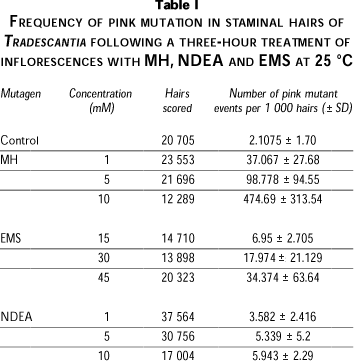
<body><![CDATA[<P>      <P>&nbsp;     <P align="center"><font size="4">Results </font>     <P><b>Tradescantia </b>      <P>      <P>The average of pink mutation frequency from day 7 to day 15 after treatment    with EMS, MH and NDEA (in duplicates) was calculated (<a href="#tabela1">Table    I</a>). Depending on the number of flowers available, the number of observed    hairs were different in each treatment. The frequency of mutation rate of the    control group was 2.1075 &#177; 1.70 (S.E). The three mutagens increased the    mutation frequency, as compared with the control group. In both cases of EMS    and MH, a lineal relationship between dose and frequency was observed. NDEA    10 mM, did no cause a frequency of mutation higher than 5 mM. MH induced the    highest frequency of pink mutation at all concentrations.      <P align="center"><a name="tabela1"></a>     <P align="center">&nbsp;     <P align="center"><img src="/img/revistas/spm/v43n6/7531t1.gif">      <P align="center">&nbsp;     ]]></body>
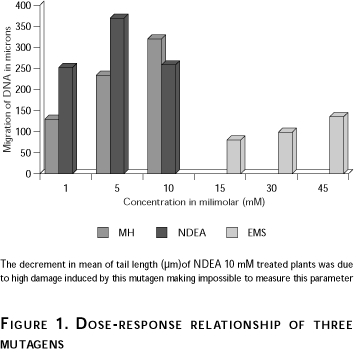
<body><![CDATA[<P>     <P>      <P><b>Comet Assay </b>      <P>      <P>The methodology used by Singh et al<SUP>7</SUP> showed to be effective on nuclei    from <I>Tradescantia</I> staminal hair cells and it was optimized until it was    repeatable. The condition for isolating and freezing the nuclei used here did    not inflect DNA strand breaks.      <P> <a href="/img/revistas/spm/v43n6/7531t2.gif">Table II</a> shows the mean tail length in nuclei    of <I>Tradescantia</I> staminal hairs exposed to the different mutagens. Two    slides from each mutagen concentration were made, however, different number    of nuclei were observed. The slides exposed to MH 10 mM, NDEA 5 y 10 mM showed    a low number of nuclei due to high DNA damage and the tail length was longer,    thus it was not possible to make further measurements (<a href="/img/revistas/spm/v43n6/7531t2.gif">Table    II</a>).      <P> The mean and standard deviation of each group were calculated. A significant    increase (one-tail trend, <I>p</I>&lt;0.0001) in the length of DNA migration    was observed in nuclei from <I>Tradescantia</I> staminal hairs exposed to each    mutagen. The three chemical mutagens showed mutagenic activity and a relationship    tail/length-concentration was observed (<a href="/img/revistas/spm/v43n6/7531t2.gif">Table II</a>).    The higher concentrations induced high heterogeneity in DNA migration.      <P> Both the pink mutation test in <I>Tradescantia </I>staminal hairs and the    comet assay test in nuclei from <I>Tradescantia </I>staminal hairs detected    mutagenic activity, which was different depending on the mutagen (<a href="#tabela1">Tables    I</a> and <a href="/img/revistas/spm/v43n6/7531t2.gif">II</a>). Using the pink mutation assay,    NDEA showed the smallest mutagenic activity however, when the comet assay on    nuclei of <I>Tradescantia</I> staminal hairs was used, the NDEA did show a higher    mutagenic activity. A direct relationship dose-tail length of the three mutagens    was observed (<a href="#figura1">Figure 1</a>). It is clear that NDEA was the    strongest mutagen, followed by MH and EMS.      <P align="center"><a name="figura1"></a>     <P align="center">&nbsp;     ]]></body>
<body><![CDATA[<P align="center"><img src="/img/revistas/spm/v43n6/7531f1.gif">      <P align="center">&nbsp;      <P align="center"><font size="4">Discussion </font>     <P>The mutation assay system in <I>Tradescantia</I> stamen hairs has been widely    used to detect agents with mutagenic activity.<SUP>2,4-6,21,22</SUP> Three reference    mutagens; MH, NDEA and EMS, were used in this study at well established concentrations;    the results were compared and very similar to other reports.<SUP>2,12-14,22,23</SUP>    Using this efficient, simple and inexpensive test, experimental results could    be obtained within a few days.<SUP>6 </SUP>The protocol with <I>Tradescantia</I>    includes collecting data along a 9-day period, usually days 7-15 after the application    of the mutagen. The comet assay system yields results within few hours and requires    only extremely small cell samples.<SUP>7,24,25</SUP> The single cell gel electrophoresis    assay has been used in a variety of mammalian cells.<SUP>7,10,26-28</SUP> Frequently,    20 nuclei are considered suitable to obtain trusty results, even though it is    better to use 50-100 cells. Recently the comet assay has been used in plant    cells and has been shown to be highly efficient<SUP>12-19</SUP> In these reports    the methodology includes breaking of the cell wall and isolating the nucleus.    The comet assay using nuclei from <I>Tradescantia</I> staminal hairs is easier    than other methods in plant tissue because it only requires to squash the staminal    hairs; after that, the nuclei can be filtered (it is not necessary to isolate    them using a centrifugation gradient); therefore, utilization of liquid nitrogen    and a centrifugation gradient are not necessary. The next step of the methodology    is the same as that reported by Singh et al.<SUP>7</SUP> Moreover, the <I>Tradescantia</I>    nuclei are bigger than other plant nuclei, so they can be easily observed. On    the other hand, as the nuclei size was heterogeneous, statistical analysis showed    high standard deviations, which could be diminished talking into account a higher    number of cells.      <P> The comet assay using nuclei from <I>Tradescantia </I>staminal hairs can be    used in two ways: (a) with untreated plant nuclei to induce genetic damage <I>in    vitro</I> and (b) with nuclei of treated plants <I>(in vivo</I>). We used the    second option in order to apply similar experimental conditions in both assays    and to be able to compare them later. Even though the <I>in vivo</I> comet assay    takes longer than the <I>in vitro</I> one, it still is shorter than the classical    <I>Tradescantia</I> pink mutation test. In this case nuclei from any day between    days 10 to 14 presented a stronger mutagenic effect. When comparing the two    systems, it is very important to have a clear idea of what each system is measuring;    the pink hair mutation assay measures mutations, while the comet assay, at the    pH used, evaluates clastogenicity. A higher migration of the tail can be compared    with a higher frequency of pink events in the pink mutation assay.      <P> The mutagenic effect of the three mutagens (EMS, MH and NDEA) as compared    to their controls, was evident with both assays, but especially with the comet    assay (<I>p</I>&lt;0.0001). The mutagenic effect presented a close relationship    with the mutagen concentration. These results are similar to other works that    have been reported with the Tradescantia mutation and the comet assays, both    in mammalian and plant cells, at similar mutagen concentrations. <SUP>14,16,17,22,23,29</SUP>      <P> Some difficulties arose at the highest concentrations of MH (10 mM) and NDEA    (5 and 10 mM), probably due to extreme DNA damage. In these conditions, the    tail length could not be measured properly. Although NDEA has been reported    to be a potent mutagen, this mutagenic effect was no very clear in our experimental    conditions with the <I>Tradescantia</I> pink mutation assay using 1,5 and 10    mM. However, when we applied the same concentrations in the comet assay on <I>Tradescantia</I>    staminal hair nuclei, we observed greater genetic damage (the DNA dispersion    was not strong, so it was difficult to measure the tail length and as a consequence    a few cells were included in the statistical analysis) (<a href="/img/revistas/spm/v43n6/7531t2.gif">Table    II</a>). On the other hand, genetic damage by MH 10 mM was more evident using    the <I>Tradescantia</I> pink mutation assay.      <P> <a href="#figura1">Figure 1</a> shows a direct dose-tail length relationship    of the three mutagens. As aforementioned, only a few nuclei treated with 10    mM NDEA were recorded because of the high DNA diffusion.      <P> The comet assay on <I>Tradescanti</I>a nuclei is as sensible as the comet    assay on mammalian cells. It is also useful to monitor genotoxic agents dangerous    to any organisms and not only to humans. The results of studies on plant cells    can be extrapolated to animal systems and many mutagens were first detected    in plants, so the importance of these assays in plants is evident.<SUP>30</SUP>    The present report, together with others on plant nuclei, demonstrates that    it is possible to apply the comet test to any plant. This could be extrapolated    to any plant cell that is suspected to be exposed to mutagens (crops exposed    to pesticides, wild plants exposed to contaminants). The comet assay on <I>Tradescantia    </I>nuclei can be a useful and economic tool when genetically dangerous genotoxic    agents, are being used indoors (factories for example).      <P> In conclusion, the comet assay in nuclei of <I>Tradescantia </I>is an effective,    simple, and rapid procedure, which can provide valuable information in mutagenicity.    It can be used to monitor environmental mutagens dangerous to humans and other    organisms. This is not to say that the pink mutation assay should be discarded,    but rather that the comet assay with <I>Tradescantia </I>staminal hair cells    is useful as a complementary tool to get repeatable results in a short time.       ]]></body>
<body><![CDATA[<P>&nbsp;     <P align="center"><font size="4">References</font>     <P>      <!-- ref --><P>1. Graf U, W&uuml;rgler F, Kazt A, Frei H, Joan H, Hall C <I>et al.</I> Somatic    mutation and recombination test in <I>Drosophila melanogaster</I>. Environ Mutagen    1984; 6:153-188.    &nbsp;&nbsp;&nbsp;&nbsp;&nbsp;&nbsp;&nbsp;&nbsp;[&#160;<a href="javascript:void(0);" onclick="javascript: window.open('/scielo.php?script=sci_nlinks&ref=9188725&pid=S0036-3634200100060000700001&lng=','','width=640,height=500,resizable=yes,scrollbars=1,menubar=yes,');">Links</a>&#160;]<!-- end-ref --><!-- ref --><P>2. Grant W, Lee H, Logan D, Salamone M. The use of <I>Tradescantia</I> and    <I>Vicia faba</I> bioassays for the <I>in situ</I> detection of mutagens in    an aquatic environment. Mutat Res 1992;2:53-64.    &nbsp;&nbsp;&nbsp;&nbsp;&nbsp;&nbsp;&nbsp;&nbsp;[&#160;<a href="javascript:void(0);" onclick="javascript: window.open('/scielo.php?script=sci_nlinks&ref=9188726&pid=S0036-3634200100060000700002&lng=','','width=640,height=500,resizable=yes,scrollbars=1,menubar=yes,');">Links</a>&#160;]<!-- end-ref --><!-- ref --><P>3. Ames A, Durston W, Yamasaki E, Lee F. An improved bacterial test system    for the detection and classification of mutagens and carcinogens.<I> </I>En:    Miller J, ed. Discovering Molecular Genetics. Los Angeles: Cold Spring Harbor    Laboratory Press, 1996:367-376.    &nbsp;&nbsp;&nbsp;&nbsp;&nbsp;&nbsp;&nbsp;&nbsp;[&#160;<a href="javascript:void(0);" onclick="javascript: window.open('/scielo.php?script=sci_nlinks&ref=9188727&pid=S0036-3634200100060000700003&lng=','','width=640,height=500,resizable=yes,scrollbars=1,menubar=yes,');">Links</a>&#160;]<!-- end-ref --><!-- ref --><P>4. Ichikawa S. <I>Tradescantia</I> stamen hair system as an excellent botanical    tester of mutagenicity: Its response to ionizing radiations and chemical mutagens    and some synergistic effects found. Mutat Res 1992;270:3-22.    &nbsp;&nbsp;&nbsp;&nbsp;&nbsp;&nbsp;&nbsp;&nbsp;[&#160;<a href="javascript:void(0);" onclick="javascript: window.open('/scielo.php?script=sci_nlinks&ref=9188728&pid=S0036-3634200100060000700004&lng=','','width=640,height=500,resizable=yes,scrollbars=1,menubar=yes,');">Links</a>&#160;]<!-- end-ref --><!-- ref --><P>5. Underbrink A, Schairer L, Sparrow A. <I>Tradescantia</I> stamen hairs: A    radiobiological test system applicable to chemical mutagenesis. En: Hollaender    A, ed. Chemical mutagens: Principles and methods for their detection. Nueva    York: Plenum Press, 1973:71-207.    &nbsp;&nbsp;&nbsp;&nbsp;&nbsp;&nbsp;&nbsp;&nbsp;[&#160;<a href="javascript:void(0);" onclick="javascript: window.open('/scielo.php?script=sci_nlinks&ref=9188729&pid=S0036-3634200100060000700005&lng=','','width=640,height=500,resizable=yes,scrollbars=1,menubar=yes,');">Links</a>&#160;]<!-- end-ref --><!-- ref --><P>6. Ma T, Cabrera G, Cebulska-Wasilewska A, Chen R, Loarca F, Vandenberg A <I>et    al</I>. <I>Tradescantia</I> stamen hair mutation bioassay. Mutat Res 1994;310:    211-220.    &nbsp;&nbsp;&nbsp;&nbsp;&nbsp;&nbsp;&nbsp;&nbsp;[&#160;<a href="javascript:void(0);" onclick="javascript: window.open('/scielo.php?script=sci_nlinks&ref=9188730&pid=S0036-3634200100060000700006&lng=','','width=640,height=500,resizable=yes,scrollbars=1,menubar=yes,');">Links</a>&#160;]<!-- end-ref --><!-- ref --><P>7. Singh N, McCoy M, Tice R, Schneider L. A simple technique for quantitation    of low levels of DNA damage in individual cells. Exp Cell Res 1988; 175:184-191.    &nbsp;&nbsp;&nbsp;&nbsp;&nbsp;&nbsp;&nbsp;&nbsp;[&#160;<a href="javascript:void(0);" onclick="javascript: window.open('/scielo.php?script=sci_nlinks&ref=9188731&pid=S0036-3634200100060000700007&lng=','','width=640,height=500,resizable=yes,scrollbars=1,menubar=yes,');">Links</a>&#160;]<!-- end-ref --><!-- ref --><P>8. Fairbairn D, Olive P, O&#180;Neill K. The comet assay: A comprehensive review.    Mutat Res 1995;339:37-59.    &nbsp;&nbsp;&nbsp;&nbsp;&nbsp;&nbsp;&nbsp;&nbsp;[&#160;<a href="javascript:void(0);" onclick="javascript: window.open('/scielo.php?script=sci_nlinks&ref=9188732&pid=S0036-3634200100060000700008&lng=','','width=640,height=500,resizable=yes,scrollbars=1,menubar=yes,');">Links</a>&#160;]<!-- end-ref --><!-- ref --><P>9. Betti C, Davini T, Giannessi L, Loprionow N, Barale R. Microgel electrophoresis    assay (comet test) and SCE analysis in human lymphocytes from 100 normal subjects.    Mutat Res 1994;307:323-333.    &nbsp;&nbsp;&nbsp;&nbsp;&nbsp;&nbsp;&nbsp;&nbsp;[&#160;<a href="javascript:void(0);" onclick="javascript: window.open('/scielo.php?script=sci_nlinks&ref=9188733&pid=S0036-3634200100060000700009&lng=','','width=640,height=500,resizable=yes,scrollbars=1,menubar=yes,');">Links</a>&#160;]<!-- end-ref --><!-- ref --><P>10. Pandrangi R, Petras M, Ralph S, Vrzoc M. Alkaline single cell gel (comet)    assay and genotoxicity monitoring using blue heads and carp. Environ Mol Mutagen    1995;26:345-356.    &nbsp;&nbsp;&nbsp;&nbsp;&nbsp;&nbsp;&nbsp;&nbsp;[&#160;<a href="javascript:void(0);" onclick="javascript: window.open('/scielo.php?script=sci_nlinks&ref=9188734&pid=S0036-3634200100060000700010&lng=','','width=640,height=500,resizable=yes,scrollbars=1,menubar=yes,');">Links</a>&#160;]<!-- end-ref --><!-- ref --><P>11. Monteith D K, Vanstone K. Comparison of the microgel electrophoresis assay    and other assays for genotoxicity in the detection of DNA damage. Mutat Res    1995;345:97-103.    &nbsp;&nbsp;&nbsp;&nbsp;&nbsp;&nbsp;&nbsp;&nbsp;[&#160;<a href="javascript:void(0);" onclick="javascript: window.open('/scielo.php?script=sci_nlinks&ref=9188735&pid=S0036-3634200100060000700011&lng=','','width=640,height=500,resizable=yes,scrollbars=1,menubar=yes,');">Links</a>&#160;]<!-- end-ref --><!-- ref --><P>12. Koppen G, Verschaeve L. The alkaline comet on plant cells: A new genotoxicity    test for DNA breaks in <I>Vicia faba</I> roots cells. Mutat Res 1996; 360:193-200.    &nbsp;&nbsp;&nbsp;&nbsp;&nbsp;&nbsp;&nbsp;&nbsp;[&#160;<a href="javascript:void(0);" onclick="javascript: window.open('/scielo.php?script=sci_nlinks&ref=9188736&pid=S0036-3634200100060000700012&lng=','','width=640,height=500,resizable=yes,scrollbars=1,menubar=yes,');">Links</a>&#160;]<!-- end-ref --><!-- ref --><P>13. Navarrete MH, Carreara P, De Miguel M, De la Torre C. A fast comet assay    variant for solid tissue cells. The assessment of DNA damage in higher plants.    Mutat Res 1997;389:271-277.    &nbsp;&nbsp;&nbsp;&nbsp;&nbsp;&nbsp;&nbsp;&nbsp;[&#160;<a href="javascript:void(0);" onclick="javascript: window.open('/scielo.php?script=sci_nlinks&ref=9188737&pid=S0036-3634200100060000700013&lng=','','width=640,height=500,resizable=yes,scrollbars=1,menubar=yes,');">Links</a>&#160;]<!-- end-ref --><!-- ref --><P>14. Gichner P, Plewa MJ. Induction of somatic DNA damage as measured by single    cell gel electrophoresis and point mutation in leaves of tobacco plants. Mutat    Res 1998;401:143-152.    &nbsp;&nbsp;&nbsp;&nbsp;&nbsp;&nbsp;&nbsp;&nbsp;[&#160;<a href="javascript:void(0);" onclick="javascript: window.open('/scielo.php?script=sci_nlinks&ref=9188738&pid=S0036-3634200100060000700014&lng=','','width=640,height=500,resizable=yes,scrollbars=1,menubar=yes,');">Links</a>&#160;]<!-- end-ref --><!-- ref --><P>15. Koppen G, Angelis KJ. Repair of X-ray induced DNA damage measured by the    comet assay in roots of <I>Vicia faba</I>. Environ Mol Mutagen 1998; 32:281-285.    &nbsp;&nbsp;&nbsp;&nbsp;&nbsp;&nbsp;&nbsp;&nbsp;[&#160;<a href="javascript:void(0);" onclick="javascript: window.open('/scielo.php?script=sci_nlinks&ref=9188739&pid=S0036-3634200100060000700015&lng=','','width=640,height=500,resizable=yes,scrollbars=1,menubar=yes,');">Links</a>&#160;]<!-- end-ref --><!-- ref --><P>16. Stavreva DA, Plewa MJ, Gichner T. Single cell gel electrophoresis analysis    of genomic damage induce by ethymethanesulfonate in cultured tobacco cells.    Mutat Res 1998;422:223-330.    &nbsp;&nbsp;&nbsp;&nbsp;&nbsp;&nbsp;&nbsp;&nbsp;[&#160;<a href="javascript:void(0);" onclick="javascript: window.open('/scielo.php?script=sci_nlinks&ref=9188740&pid=S0036-3634200100060000700016&lng=','','width=640,height=500,resizable=yes,scrollbars=1,menubar=yes,');">Links</a>&#160;]<!-- end-ref --><!-- ref --><P>17. Gichner T, Ptacek O, Stavreva AA, Plewa MJ. Comparison of DNA damage in    plants as measured by single cell gel electrophoresis and somatic leaf mutations    induced by monofunctional alkilanting agents. Mutat Res 1999;33:279-286.    &nbsp;&nbsp;&nbsp;&nbsp;&nbsp;&nbsp;&nbsp;&nbsp;[&#160;<a href="javascript:void(0);" onclick="javascript: window.open('/scielo.php?script=sci_nlinks&ref=9188741&pid=S0036-3634200100060000700017&lng=','','width=640,height=500,resizable=yes,scrollbars=1,menubar=yes,');">Links</a>&#160;]<!-- end-ref --><!-- ref --><P>18. Koppen G, Toncelli LM, Triest L, Verschaeve L. The comet assay: A tool    to study alterations of DNA integrity in developing plant leaves. Mech Ageing    Dev 1999;110:13-24.    &nbsp;&nbsp;&nbsp;&nbsp;&nbsp;&nbsp;&nbsp;&nbsp;[&#160;<a href="javascript:void(0);" onclick="javascript: window.open('/scielo.php?script=sci_nlinks&ref=9188742&pid=S0036-3634200100060000700018&lng=','','width=640,height=500,resizable=yes,scrollbars=1,menubar=yes,');">Links</a>&#160;]<!-- end-ref --><!-- ref --><P>19. Poli P, Buschini A, Restivo FM, Ficarelli A, Cassoni F, Ferrero I <I>et    al</I>. Comet assay application in environmental monitoring: DNA damage in human    lymphocytes and plant cells in comparison with bacterial and yeast tests. Mutagenesis    1999;14:547-556.    &nbsp;&nbsp;&nbsp;&nbsp;&nbsp;&nbsp;&nbsp;&nbsp;[&#160;<a href="javascript:void(0);" onclick="javascript: window.open('/scielo.php?script=sci_nlinks&ref=9188743&pid=S0036-3634200100060000700019&lng=','','width=640,height=500,resizable=yes,scrollbars=1,menubar=yes,');">Links</a>&#160;]<!-- end-ref --><!-- ref --><P>20. Menke M, Angelis KJ, Schubert I. Detection of specific DNA lesions by a    combination of comet assay and fish in plants. Environ Mol Mutagen 2000;35:132-138.    &nbsp;&nbsp;&nbsp;&nbsp;&nbsp;&nbsp;&nbsp;&nbsp;[&#160;<a href="javascript:void(0);" onclick="javascript: window.open('/scielo.php?script=sci_nlinks&ref=9188744&pid=S0036-3634200100060000700020&lng=','','width=640,height=500,resizable=yes,scrollbars=1,menubar=yes,');">Links</a>&#160;]<!-- end-ref --><!-- ref --><P>21. Gichner T, Valem&iacute;nsky J, Pokorny O. Somatic mutation induced by    maleic hydrazide and its potassium and diethanolamine salts in <I>Tradescantia</I>    mutation assay. Mutat Res 1982;103:289-295.    &nbsp;&nbsp;&nbsp;&nbsp;&nbsp;&nbsp;&nbsp;&nbsp;[&#160;<a href="javascript:void(0);" onclick="javascript: window.open('/scielo.php?script=sci_nlinks&ref=9188745&pid=S0036-3634200100060000700021&lng=','','width=640,height=500,resizable=yes,scrollbars=1,menubar=yes,');">Links</a>&#160;]<!-- end-ref --><!-- ref --><P>22. Gichner T, Veleminsky J, Rieger R. Antimutagenic effect of Diethyldiothiocarbamate    toward malec hydrazide and N-Nitrosodiethylamine induced mutagenicity in Tradescantia    mutagenicity assay. Biol Plantarum 1988;30:14-19.    &nbsp;&nbsp;&nbsp;&nbsp;&nbsp;&nbsp;&nbsp;&nbsp;[&#160;<a href="javascript:void(0);" onclick="javascript: window.open('/scielo.php?script=sci_nlinks&ref=9188746&pid=S0036-3634200100060000700022&lng=','','width=640,height=500,resizable=yes,scrollbars=1,menubar=yes,');">Links</a>&#160;]<!-- end-ref --><!-- ref --><P>23. Lijinski W. Life span and cancer: The induction time of tumors in diverse    animal species treated with nitrosodiethylamine. Carcinogenesis 1993; 14:2373-2375.    &nbsp;&nbsp;&nbsp;&nbsp;&nbsp;&nbsp;&nbsp;&nbsp;[&#160;<a href="javascript:void(0);" onclick="javascript: window.open('/scielo.php?script=sci_nlinks&ref=9188747&pid=S0036-3634200100060000700023&lng=','','width=640,height=500,resizable=yes,scrollbars=1,menubar=yes,');">Links</a>&#160;]<!-- end-ref --><!-- ref --><P>24. Olive PL, Ban&aacute;th JP, Durant RE. Heterogeneity in radiation-induced    DNA damage and repair in tumor and normal cells measured using the comet assay.    Radiat Res 1990;122:86-94.    &nbsp;&nbsp;&nbsp;&nbsp;&nbsp;&nbsp;&nbsp;&nbsp;[&#160;<a href="javascript:void(0);" onclick="javascript: window.open('/scielo.php?script=sci_nlinks&ref=9188748&pid=S0036-3634200100060000700024&lng=','','width=640,height=500,resizable=yes,scrollbars=1,menubar=yes,');">Links</a>&#160;]<!-- end-ref --><!-- ref --><P>25. Mckelvey-Martin VJ, Green MHL, ScMHezer P, Pool-Zobel BL, De M&eacute;o    MP, Collins A. The single cell gel electrophoresis assay (comet assay): A European    review. Mutat Res 1993;288:47-63.    &nbsp;&nbsp;&nbsp;&nbsp;&nbsp;&nbsp;&nbsp;&nbsp;[&#160;<a href="javascript:void(0);" onclick="javascript: window.open('/scielo.php?script=sci_nlinks&ref=9188749&pid=S0036-3634200100060000700025&lng=','','width=640,height=500,resizable=yes,scrollbars=1,menubar=yes,');">Links</a>&#160;]<!-- end-ref --><!-- ref --><P>26. Sasaki YF, Saga A, Akasaka M, Nishidate E, Watanabe-Akamura M, Ohta T <I>et    al</I>. <I>In vivo</I> genotoxicity of heterocyclic amines detected by a modified    alkaline single cell gel electrophoresis assay in a multiple organ study in    the mouse. Mutat Res 1997;395:57-73.    &nbsp;&nbsp;&nbsp;&nbsp;&nbsp;&nbsp;&nbsp;&nbsp;[&#160;<a href="javascript:void(0);" onclick="javascript: window.open('/scielo.php?script=sci_nlinks&ref=9188750&pid=S0036-3634200100060000700026&lng=','','width=640,height=500,resizable=yes,scrollbars=1,menubar=yes,');">Links</a>&#160;]<!-- end-ref --><!-- ref --><P>27. Speit G, Haupter S, Hartmann A. Evaluation of the genotoxic properties    of paraquat in V79 Chinese hamster cells. Mutat Res 1998;412: 187-193.    &nbsp;&nbsp;&nbsp;&nbsp;&nbsp;&nbsp;&nbsp;&nbsp;[&#160;<a href="javascript:void(0);" onclick="javascript: window.open('/scielo.php?script=sci_nlinks&ref=9188751&pid=S0036-3634200100060000700027&lng=','','width=640,height=500,resizable=yes,scrollbars=1,menubar=yes,');">Links</a>&#160;]<!-- end-ref --><!-- ref --><P>28. Vigreux C, Poul JM, Deslandes E, Lebailly P, Godard T, Sichel F, <I>et    al</I>. DNA damaging effects of pesticides measured by the single cell gel electrophoresis    assay (comet assay) and the chromosomal aberration test in CHOK1 cells. Mutat    Res 1998;419:79-90.    &nbsp;&nbsp;&nbsp;&nbsp;&nbsp;&nbsp;&nbsp;&nbsp;[&#160;<a href="javascript:void(0);" onclick="javascript: window.open('/scielo.php?script=sci_nlinks&ref=9188752&pid=S0036-3634200100060000700028&lng=','','width=640,height=500,resizable=yes,scrollbars=1,menubar=yes,');">Links</a>&#160;]<!-- end-ref --><!-- ref --><P>29. Gichner T, Valem&iacute;nsky J, Pokorny O. Somatic mutation induced by    maleic hydrazide and its potassium and diethanolamine salts in <I>Tradescantia</I>    mutation assay. Mutat Res 1982;103:289-295.    &nbsp;&nbsp;&nbsp;&nbsp;&nbsp;&nbsp;&nbsp;&nbsp;[&#160;<a href="javascript:void(0);" onclick="javascript: window.open('/scielo.php?script=sci_nlinks&ref=9188753&pid=S0036-3634200100060000700029&lng=','','width=640,height=500,resizable=yes,scrollbars=1,menubar=yes,');">Links</a>&#160;]<!-- end-ref --><!-- ref --><P>30. Grant W. The present status of higher plant bioassay for the detection    of environmental mutagens. Mutat Res 1994;310:175-185.    &nbsp;&nbsp;&nbsp;&nbsp;&nbsp;&nbsp;&nbsp;&nbsp;[&#160;<a href="javascript:void(0);" onclick="javascript: window.open('/scielo.php?script=sci_nlinks&ref=9188754&pid=S0036-3634200100060000700030&lng=','','width=640,height=500,resizable=yes,scrollbars=1,menubar=yes,');">Links</a>&#160;]<!-- end-ref --><P>      <P>      <P>&nbsp;     <P>&nbsp;     <P><a name="back"></a>(<a href="#top">1</a>) Laboratorio de Gen&eacute;tica, Departamento    de Biolog&iacute;a Celular y Molecular, CUCBA, Universidad de Guadalajara, Guadalajara,    Jalisco, M&eacute;xico.      <P> (<a href="#top">2</a>)<SUP> </SUP>Laboratorio de Mutag&eacute;nesis, Centro    de investigaci&oacute;n Biom&eacute;dica de Occidente, IMSS, Guadalajara, Jalisco,    M&eacute;xico.      <P> (<a href="#top">3</a>) Programa Internacional, Facultad de Medicina, Instituto    de Ciencias Biol&oacute;gicas, Universidad Aut&oacute;noma de Guadalajara.      ]]></body>
<body><![CDATA[<P> (<a href="#top">4</a>)<SUP> </SUP>Divisi&oacute;n de Patolog&iacute;a y Biotecnolog&iacute;a    Ambiental, CIATEJ (SEP-CONACYT), Guadalajara, Jalisco, M&eacute;xico.      <P>      <P>&nbsp;     <P align="center"><B>Received on:</B> November 9, 200 &#149; <B>Accepted on:</B>    July 17, 2001    <br>   Adress reprint requests to: Dr. Carlos Alvarez Moya, Agust&iacute;n Melgar 1533    Chapultepec Country, Guadalajara, Jalisco, M&eacute;xico. C.P. 44260.    <br>   E-mail: <a href="mailto:calvarez@cucba.udg.mx">calvarez@cucba.udg.mx</a>       ]]></body><back>
<ref-list>
<ref id="B1">
<label>1</label><nlm-citation citation-type="journal">
<person-group person-group-type="author">
<name>
<surname><![CDATA[Graf]]></surname>
<given-names><![CDATA[U]]></given-names>
</name>
<name>
<surname><![CDATA[Würgler]]></surname>
<given-names><![CDATA[F]]></given-names>
</name>
<name>
<surname><![CDATA[Kazt]]></surname>
<given-names><![CDATA[A]]></given-names>
</name>
<name>
<surname><![CDATA[Frei]]></surname>
<given-names><![CDATA[H]]></given-names>
</name>
<name>
<surname><![CDATA[Joan]]></surname>
<given-names><![CDATA[H]]></given-names>
</name>
<name>
<surname><![CDATA[Hall]]></surname>
<given-names><![CDATA[C]]></given-names>
</name>
</person-group>
<article-title xml:lang="en"><![CDATA[Somatic mutation and recombination test in Drosophila melanogaster]]></article-title>
<source><![CDATA[Environ Mutagen]]></source>
<year>1984</year>
<volume>6</volume>
<page-range>153-188</page-range></nlm-citation>
</ref>
<ref id="B2">
<label>2</label><nlm-citation citation-type="journal">
<person-group person-group-type="author">
<name>
<surname><![CDATA[Grant]]></surname>
<given-names><![CDATA[W]]></given-names>
</name>
<name>
<surname><![CDATA[Lee]]></surname>
<given-names><![CDATA[H]]></given-names>
</name>
<name>
<surname><![CDATA[Logan]]></surname>
<given-names><![CDATA[D]]></given-names>
</name>
<name>
<surname><![CDATA[Salamone]]></surname>
<given-names><![CDATA[M]]></given-names>
</name>
</person-group>
<article-title xml:lang="en"><![CDATA[The use of Tradescantia and Vicia faba bioassays for the in situ detection of mutagens in an aquatic environment]]></article-title>
<source><![CDATA[Mutat Res]]></source>
<year>1992</year>
<volume>2</volume>
<page-range>53-64</page-range></nlm-citation>
</ref>
<ref id="B3">
<label>3</label><nlm-citation citation-type="book">
<person-group person-group-type="author">
<name>
<surname><![CDATA[Ames]]></surname>
<given-names><![CDATA[A]]></given-names>
</name>
<name>
<surname><![CDATA[Durston]]></surname>
<given-names><![CDATA[W]]></given-names>
</name>
<name>
<surname><![CDATA[Yamasaki]]></surname>
<given-names><![CDATA[E]]></given-names>
</name>
<name>
<surname><![CDATA[Lee]]></surname>
<given-names><![CDATA[F]]></given-names>
</name>
</person-group>
<article-title xml:lang="en"><![CDATA[An improved bacterial test system for the detection and classification of mutagens and carcinogens]]></article-title>
<person-group person-group-type="editor">
<name>
<surname><![CDATA[Miller]]></surname>
<given-names><![CDATA[J]]></given-names>
</name>
</person-group>
<source><![CDATA[Discovering Molecular Genetics]]></source>
<year>1996</year>
<page-range>367-376</page-range><publisher-loc><![CDATA[Los Angeles ]]></publisher-loc>
<publisher-name><![CDATA[Cold Spring Harbor Laboratory Press]]></publisher-name>
</nlm-citation>
</ref>
<ref id="B4">
<label>4</label><nlm-citation citation-type="journal">
<person-group person-group-type="author">
<name>
<surname><![CDATA[Ichikawa]]></surname>
<given-names><![CDATA[S]]></given-names>
</name>
</person-group>
<article-title xml:lang="en"><![CDATA[Tradescantia stamen hair system as an excellent botanical tester of mutagenicity: Its response to ionizing radiations and chemical mutagens and some synergistic effects found]]></article-title>
<source><![CDATA[Mutat Res]]></source>
<year>1992</year>
<volume>270</volume>
<page-range>3-22</page-range></nlm-citation>
</ref>
<ref id="B5">
<label>5</label><nlm-citation citation-type="book">
<person-group person-group-type="author">
<name>
<surname><![CDATA[Underbrink]]></surname>
<given-names><![CDATA[A]]></given-names>
</name>
<name>
<surname><![CDATA[Schairer]]></surname>
<given-names><![CDATA[L]]></given-names>
</name>
<name>
<surname><![CDATA[Sparrow]]></surname>
<given-names><![CDATA[A]]></given-names>
</name>
</person-group>
<article-title xml:lang="en"><![CDATA[Tradescantia stamen hairs: A radiobiological test system applicable to chemical mutagenesis]]></article-title>
<person-group person-group-type="editor">
<name>
<surname><![CDATA[Hollaender]]></surname>
<given-names><![CDATA[A]]></given-names>
</name>
</person-group>
<source><![CDATA[Chemical mutagens: Principles and methods for their detection]]></source>
<year>1973</year>
<page-range>71-207</page-range><publisher-loc><![CDATA[Nueva York ]]></publisher-loc>
<publisher-name><![CDATA[Plenum Press]]></publisher-name>
</nlm-citation>
</ref>
<ref id="B6">
<label>6</label><nlm-citation citation-type="journal">
<person-group person-group-type="author">
<name>
<surname><![CDATA[Ma]]></surname>
<given-names><![CDATA[T]]></given-names>
</name>
<name>
<surname><![CDATA[Cabrera]]></surname>
<given-names><![CDATA[G]]></given-names>
</name>
<name>
<surname><![CDATA[Cebulska-Wasilewska]]></surname>
<given-names><![CDATA[A]]></given-names>
</name>
<name>
<surname><![CDATA[Chen]]></surname>
<given-names><![CDATA[R]]></given-names>
</name>
<name>
<surname><![CDATA[Loarca]]></surname>
<given-names><![CDATA[F]]></given-names>
</name>
<name>
<surname><![CDATA[Vandenberg]]></surname>
<given-names><![CDATA[A]]></given-names>
</name>
</person-group>
<article-title xml:lang="en"><![CDATA[Tradescantia stamen hair mutation bioassay]]></article-title>
<source><![CDATA[Mutat Res]]></source>
<year>1994</year>
<volume>310</volume>
<page-range>211-220</page-range></nlm-citation>
</ref>
<ref id="B7">
<label>7</label><nlm-citation citation-type="journal">
<person-group person-group-type="author">
<name>
<surname><![CDATA[Singh]]></surname>
<given-names><![CDATA[N]]></given-names>
</name>
<name>
<surname><![CDATA[McCoy]]></surname>
<given-names><![CDATA[M]]></given-names>
</name>
<name>
<surname><![CDATA[Tice]]></surname>
<given-names><![CDATA[R]]></given-names>
</name>
<name>
<surname><![CDATA[Schneider]]></surname>
<given-names><![CDATA[L]]></given-names>
</name>
</person-group>
<article-title xml:lang="en"><![CDATA[A simple technique for quantitation of low levels of DNA damage in individual cells]]></article-title>
<source><![CDATA[Exp Cell Res]]></source>
<year>1988</year>
<volume>175</volume>
<page-range>184-191</page-range></nlm-citation>
</ref>
<ref id="B8">
<label>8</label><nlm-citation citation-type="journal">
<person-group person-group-type="author">
<name>
<surname><![CDATA[Fairbairn]]></surname>
<given-names><![CDATA[D]]></given-names>
</name>
<name>
<surname><![CDATA[Olive]]></surname>
<given-names><![CDATA[P]]></given-names>
</name>
<name>
<surname><![CDATA[O´Neill]]></surname>
<given-names><![CDATA[K]]></given-names>
</name>
</person-group>
<article-title xml:lang="en"><![CDATA[The comet assay: A comprehensive review]]></article-title>
<source><![CDATA[Mutat Res]]></source>
<year>1995</year>
<volume>339</volume>
<page-range>37-59</page-range></nlm-citation>
</ref>
<ref id="B9">
<label>9</label><nlm-citation citation-type="journal">
<person-group person-group-type="author">
<name>
<surname><![CDATA[Betti]]></surname>
<given-names><![CDATA[C]]></given-names>
</name>
<name>
<surname><![CDATA[Davini]]></surname>
<given-names><![CDATA[T]]></given-names>
</name>
<name>
<surname><![CDATA[Giannessi]]></surname>
<given-names><![CDATA[L]]></given-names>
</name>
<name>
<surname><![CDATA[Loprionow]]></surname>
<given-names><![CDATA[N]]></given-names>
</name>
<name>
<surname><![CDATA[Barale]]></surname>
<given-names><![CDATA[R]]></given-names>
</name>
</person-group>
<article-title xml:lang="en"><![CDATA[Microgel electrophoresis assay (comet test) and SCE analysis in human lymphocytes from 100 normal subjects]]></article-title>
<source><![CDATA[Mutat Res]]></source>
<year>1994</year>
<volume>307</volume>
<page-range>323-333</page-range></nlm-citation>
</ref>
<ref id="B10">
<label>10</label><nlm-citation citation-type="journal">
<person-group person-group-type="author">
<name>
<surname><![CDATA[Pandrangi]]></surname>
<given-names><![CDATA[R]]></given-names>
</name>
<name>
<surname><![CDATA[Petras]]></surname>
<given-names><![CDATA[M]]></given-names>
</name>
<name>
<surname><![CDATA[Ralph]]></surname>
<given-names><![CDATA[S]]></given-names>
</name>
<name>
<surname><![CDATA[Vrzoc]]></surname>
<given-names><![CDATA[M]]></given-names>
</name>
</person-group>
<article-title xml:lang="en"><![CDATA[Alkaline single cell gel (comet) assay and genotoxicity monitoring using blue heads and carp]]></article-title>
<source><![CDATA[Environ Mol Mutagen]]></source>
<year>1995</year>
<volume>26</volume>
<page-range>345-356</page-range></nlm-citation>
</ref>
<ref id="B11">
<label>11</label><nlm-citation citation-type="journal">
<person-group person-group-type="author">
<name>
<surname><![CDATA[Monteith]]></surname>
<given-names><![CDATA[D K]]></given-names>
</name>
<name>
<surname><![CDATA[Vanstone]]></surname>
<given-names><![CDATA[K]]></given-names>
</name>
</person-group>
<article-title xml:lang="en"><![CDATA[Comparison of the microgel electrophoresis assay and other assays for genotoxicity in the detection of DNA damage]]></article-title>
<source><![CDATA[Mutat Res]]></source>
<year>1995</year>
<volume>345</volume>
<page-range>97-103</page-range></nlm-citation>
</ref>
<ref id="B12">
<label>12</label><nlm-citation citation-type="journal">
<person-group person-group-type="author">
<name>
<surname><![CDATA[Koppen]]></surname>
<given-names><![CDATA[G]]></given-names>
</name>
<name>
<surname><![CDATA[Verschaeve]]></surname>
<given-names><![CDATA[L]]></given-names>
</name>
</person-group>
<article-title xml:lang="en"><![CDATA[The alkaline comet on plant cells: A new genotoxicity test for DNA breaks in Vicia faba roots cells]]></article-title>
<source><![CDATA[Mutat Res]]></source>
<year>1996</year>
<volume>360</volume>
<page-range>193-200</page-range></nlm-citation>
</ref>
<ref id="B13">
<label>13</label><nlm-citation citation-type="journal">
<person-group person-group-type="author">
<name>
<surname><![CDATA[Navarrete]]></surname>
<given-names><![CDATA[MH]]></given-names>
</name>
<name>
<surname><![CDATA[Carreara]]></surname>
<given-names><![CDATA[P]]></given-names>
</name>
<name>
<surname><![CDATA[De Miguel]]></surname>
<given-names><![CDATA[M]]></given-names>
</name>
<name>
<surname><![CDATA[De la Torre]]></surname>
<given-names><![CDATA[C]]></given-names>
</name>
</person-group>
<article-title xml:lang="en"><![CDATA[A fast comet assay variant for solid tissue cells: The assessment of DNA damage in higher plants]]></article-title>
<source><![CDATA[Mutat Res]]></source>
<year>1997</year>
<volume>389</volume>
<page-range>271-277</page-range></nlm-citation>
</ref>
<ref id="B14">
<label>14</label><nlm-citation citation-type="journal">
<person-group person-group-type="author">
<name>
<surname><![CDATA[Gichner]]></surname>
<given-names><![CDATA[P]]></given-names>
</name>
<name>
<surname><![CDATA[Plewa]]></surname>
<given-names><![CDATA[MJ]]></given-names>
</name>
</person-group>
<article-title xml:lang="en"><![CDATA[Induction of somatic DNA damage as measured by single cell gel electrophoresis and point mutation in leaves of tobacco plants]]></article-title>
<source><![CDATA[Mutat Res]]></source>
<year>1998</year>
<volume>401</volume>
<page-range>143-152</page-range></nlm-citation>
</ref>
<ref id="B15">
<label>15</label><nlm-citation citation-type="journal">
<person-group person-group-type="author">
<name>
<surname><![CDATA[Koppen]]></surname>
<given-names><![CDATA[G]]></given-names>
</name>
<name>
<surname><![CDATA[Angelis]]></surname>
<given-names><![CDATA[KJ]]></given-names>
</name>
</person-group>
<article-title xml:lang="en"><![CDATA[Repair of X-ray induced DNA damage measured by the comet assay in roots of Vicia faba]]></article-title>
<source><![CDATA[Environ Mol Mutagen]]></source>
<year>1998</year>
<volume>32</volume>
<page-range>281-285</page-range></nlm-citation>
</ref>
<ref id="B16">
<label>16</label><nlm-citation citation-type="journal">
<person-group person-group-type="author">
<name>
<surname><![CDATA[Stavreva]]></surname>
<given-names><![CDATA[DA]]></given-names>
</name>
<name>
<surname><![CDATA[Plewa]]></surname>
<given-names><![CDATA[MJ]]></given-names>
</name>
<name>
<surname><![CDATA[Gichner]]></surname>
<given-names><![CDATA[T]]></given-names>
</name>
</person-group>
<article-title xml:lang="en"><![CDATA[Single cell gel electrophoresis analysis of genomic damage induce by ethymethanesulfonate in cultured tobacco cells]]></article-title>
<source><![CDATA[Mutat Res]]></source>
<year>1998</year>
<volume>422</volume>
<page-range>223-330</page-range></nlm-citation>
</ref>
<ref id="B17">
<label>17</label><nlm-citation citation-type="journal">
<person-group person-group-type="author">
<name>
<surname><![CDATA[Gichner]]></surname>
<given-names><![CDATA[T]]></given-names>
</name>
<name>
<surname><![CDATA[Ptacek]]></surname>
<given-names><![CDATA[O]]></given-names>
</name>
<name>
<surname><![CDATA[Stavreva]]></surname>
<given-names><![CDATA[AA]]></given-names>
</name>
<name>
<surname><![CDATA[Plewa]]></surname>
<given-names><![CDATA[MJ]]></given-names>
</name>
</person-group>
<article-title xml:lang="en"><![CDATA[Comparison of DNA damage in plants as measured by single cell gel electrophoresis and somatic leaf mutations induced by monofunctional alkilanting agents]]></article-title>
<source><![CDATA[Mutat Res]]></source>
<year>1999</year>
<volume>33</volume>
<page-range>279-286</page-range></nlm-citation>
</ref>
<ref id="B18">
<label>18</label><nlm-citation citation-type="journal">
<person-group person-group-type="author">
<name>
<surname><![CDATA[Koppen]]></surname>
<given-names><![CDATA[G]]></given-names>
</name>
<name>
<surname><![CDATA[Toncelli]]></surname>
<given-names><![CDATA[LM]]></given-names>
</name>
<name>
<surname><![CDATA[Triest]]></surname>
<given-names><![CDATA[L]]></given-names>
</name>
<name>
<surname><![CDATA[Verschaeve]]></surname>
<given-names><![CDATA[L]]></given-names>
</name>
</person-group>
<article-title xml:lang="en"><![CDATA[The comet assay: A tool to study alterations of DNA integrity in developing plant leaves]]></article-title>
<source><![CDATA[Mech Ageing Dev]]></source>
<year>1999</year>
<volume>110</volume>
<page-range>13-24</page-range></nlm-citation>
</ref>
<ref id="B19">
<label>19</label><nlm-citation citation-type="journal">
<person-group person-group-type="author">
<name>
<surname><![CDATA[Poli]]></surname>
<given-names><![CDATA[P]]></given-names>
</name>
<name>
<surname><![CDATA[Buschini]]></surname>
<given-names><![CDATA[A]]></given-names>
</name>
<name>
<surname><![CDATA[Restivo]]></surname>
<given-names><![CDATA[FM]]></given-names>
</name>
<name>
<surname><![CDATA[Ficarelli]]></surname>
<given-names><![CDATA[A]]></given-names>
</name>
<name>
<surname><![CDATA[Cassoni]]></surname>
<given-names><![CDATA[F]]></given-names>
</name>
<name>
<surname><![CDATA[Ferrero]]></surname>
<given-names><![CDATA[I]]></given-names>
</name>
</person-group>
<article-title xml:lang="en"><![CDATA[Comet assay application in environmental monitoring: DNA damage in human lymphocytes and plant cells in comparison with bacterial and yeast tests]]></article-title>
<source><![CDATA[Mutagenesis]]></source>
<year>1999</year>
<volume>14</volume>
<page-range>547-556</page-range></nlm-citation>
</ref>
<ref id="B20">
<label>20</label><nlm-citation citation-type="journal">
<person-group person-group-type="author">
<name>
<surname><![CDATA[Menke]]></surname>
<given-names><![CDATA[M]]></given-names>
</name>
<name>
<surname><![CDATA[Angelis]]></surname>
<given-names><![CDATA[KJ]]></given-names>
</name>
<name>
<surname><![CDATA[Schubert]]></surname>
<given-names><![CDATA[I]]></given-names>
</name>
</person-group>
<article-title xml:lang="en"><![CDATA[Detection of specific DNA lesions by a combination of comet assay and fish in plants]]></article-title>
<source><![CDATA[Environ Mol Mutagen]]></source>
<year>2000</year>
<volume>35</volume>
<page-range>132-138</page-range></nlm-citation>
</ref>
<ref id="B21">
<label>21</label><nlm-citation citation-type="journal">
<person-group person-group-type="author">
<name>
<surname><![CDATA[Gichner]]></surname>
<given-names><![CDATA[T]]></given-names>
</name>
<name>
<surname><![CDATA[Valemínsky]]></surname>
<given-names><![CDATA[J]]></given-names>
</name>
<name>
<surname><![CDATA[Pokorny]]></surname>
<given-names><![CDATA[O]]></given-names>
</name>
</person-group>
<article-title xml:lang="en"><![CDATA[Somatic mutation induced by maleic hydrazide and its potassium and diethanolamine salts in Tradescantia mutation assay]]></article-title>
<source><![CDATA[Mutat Res]]></source>
<year>1982</year>
<volume>103</volume>
<page-range>289-295</page-range></nlm-citation>
</ref>
<ref id="B22">
<label>22</label><nlm-citation citation-type="journal">
<person-group person-group-type="author">
<name>
<surname><![CDATA[Gichner]]></surname>
<given-names><![CDATA[T]]></given-names>
</name>
<name>
<surname><![CDATA[Veleminsky]]></surname>
<given-names><![CDATA[J]]></given-names>
</name>
<name>
<surname><![CDATA[Rieger]]></surname>
<given-names><![CDATA[R]]></given-names>
</name>
</person-group>
<article-title xml:lang="en"><![CDATA[Antimutagenic effect of Diethyldiothiocarbamate toward malec hydrazide and N-Nitrosodiethylamine induced mutagenicity in Tradescantia mutagenicity assay]]></article-title>
<source><![CDATA[Biol Plantarum]]></source>
<year>1988</year>
<volume>30</volume>
<page-range>14-19</page-range></nlm-citation>
</ref>
<ref id="B23">
<label>23</label><nlm-citation citation-type="journal">
<person-group person-group-type="author">
<name>
<surname><![CDATA[Lijinski]]></surname>
<given-names><![CDATA[W]]></given-names>
</name>
</person-group>
<article-title xml:lang="en"><![CDATA[Life span and cancer: The induction time of tumors in diverse animal species treated with nitrosodiethylamine]]></article-title>
<source><![CDATA[Carcinogenesis]]></source>
<year>1993</year>
<volume>14</volume>
<page-range>2373-2375</page-range></nlm-citation>
</ref>
<ref id="B24">
<label>24</label><nlm-citation citation-type="journal">
<person-group person-group-type="author">
<name>
<surname><![CDATA[Olive]]></surname>
<given-names><![CDATA[PL]]></given-names>
</name>
<name>
<surname><![CDATA[Banáth]]></surname>
<given-names><![CDATA[JP]]></given-names>
</name>
<name>
<surname><![CDATA[Durant]]></surname>
<given-names><![CDATA[RE]]></given-names>
</name>
</person-group>
<article-title xml:lang="en"><![CDATA[Heterogeneity in radiation-induced DNA damage and repair in tumor and normal cells measured using the comet assay]]></article-title>
<source><![CDATA[Radiat Res]]></source>
<year>1990</year>
<volume>122</volume>
<page-range>86-94</page-range></nlm-citation>
</ref>
<ref id="B25">
<label>25</label><nlm-citation citation-type="journal">
<person-group person-group-type="author">
<name>
<surname><![CDATA[Mckelvey-Martin]]></surname>
<given-names><![CDATA[VJ]]></given-names>
</name>
<name>
<surname><![CDATA[Green]]></surname>
<given-names><![CDATA[MHL]]></given-names>
</name>
<name>
<surname><![CDATA[ScMHezer]]></surname>
<given-names><![CDATA[P]]></given-names>
</name>
<name>
<surname><![CDATA[Pool-Zobel]]></surname>
<given-names><![CDATA[BL]]></given-names>
</name>
<name>
<surname><![CDATA[De Méo]]></surname>
<given-names><![CDATA[MP]]></given-names>
</name>
<name>
<surname><![CDATA[Collins]]></surname>
<given-names><![CDATA[A]]></given-names>
</name>
</person-group>
<article-title xml:lang="en"><![CDATA[The single cell gel electrophoresis assay (comet assay): A European review]]></article-title>
<source><![CDATA[Mutat Res]]></source>
<year>1993</year>
<volume>288</volume>
<page-range>47-63</page-range></nlm-citation>
</ref>
<ref id="B26">
<label>26</label><nlm-citation citation-type="journal">
<person-group person-group-type="author">
<name>
<surname><![CDATA[Sasaki]]></surname>
<given-names><![CDATA[YF]]></given-names>
</name>
<name>
<surname><![CDATA[Saga]]></surname>
<given-names><![CDATA[A]]></given-names>
</name>
<name>
<surname><![CDATA[Akasaka]]></surname>
<given-names><![CDATA[M]]></given-names>
</name>
<name>
<surname><![CDATA[Nishidate]]></surname>
<given-names><![CDATA[E]]></given-names>
</name>
<name>
<surname><![CDATA[Watanabe-Akamura]]></surname>
<given-names><![CDATA[M]]></given-names>
</name>
<name>
<surname><![CDATA[Ohta]]></surname>
<given-names><![CDATA[T]]></given-names>
</name>
</person-group>
<article-title xml:lang="en"><![CDATA[In vivo genotoxicity of heterocyclic amines detected by a modified alkaline single cell gel electrophoresis assay in a multiple organ study in the mouse]]></article-title>
<source><![CDATA[Mutat Res]]></source>
<year>1997</year>
<volume>395</volume>
<page-range>57-73</page-range></nlm-citation>
</ref>
<ref id="B27">
<label>27</label><nlm-citation citation-type="journal">
<person-group person-group-type="author">
<name>
<surname><![CDATA[Speit]]></surname>
<given-names><![CDATA[G]]></given-names>
</name>
<name>
<surname><![CDATA[Haupter]]></surname>
<given-names><![CDATA[S]]></given-names>
</name>
<name>
<surname><![CDATA[Hartmann]]></surname>
<given-names><![CDATA[A]]></given-names>
</name>
</person-group>
<article-title xml:lang="en"><![CDATA[Evaluation of the genotoxic properties of paraquat in V79 Chinese hamster cells]]></article-title>
<source><![CDATA[Mutat Res]]></source>
<year>1998</year>
<volume>412</volume>
<page-range>187-193</page-range></nlm-citation>
</ref>
<ref id="B28">
<label>28</label><nlm-citation citation-type="journal">
<person-group person-group-type="author">
<name>
<surname><![CDATA[Vigreux]]></surname>
<given-names><![CDATA[C]]></given-names>
</name>
<name>
<surname><![CDATA[Poul]]></surname>
<given-names><![CDATA[JM]]></given-names>
</name>
<name>
<surname><![CDATA[Deslandes]]></surname>
<given-names><![CDATA[E]]></given-names>
</name>
<name>
<surname><![CDATA[Lebailly]]></surname>
<given-names><![CDATA[P]]></given-names>
</name>
<name>
<surname><![CDATA[Godard]]></surname>
<given-names><![CDATA[T]]></given-names>
</name>
<name>
<surname><![CDATA[Sichel]]></surname>
<given-names><![CDATA[F]]></given-names>
</name>
</person-group>
<article-title xml:lang="en"><![CDATA[DNA damaging effects of pesticides measured by the single cell gel electrophoresis assay (comet assay) and the chromosomal aberration test in CHOK1 cells]]></article-title>
<source><![CDATA[Mutat Res]]></source>
<year>1998</year>
<volume>419</volume>
<page-range>79-90</page-range></nlm-citation>
</ref>
<ref id="B29">
<label>29</label><nlm-citation citation-type="journal">
<person-group person-group-type="author">
<name>
<surname><![CDATA[Gichner]]></surname>
<given-names><![CDATA[T]]></given-names>
</name>
<name>
<surname><![CDATA[Valemínsky]]></surname>
<given-names><![CDATA[J]]></given-names>
</name>
<name>
<surname><![CDATA[Pokorny]]></surname>
<given-names><![CDATA[O]]></given-names>
</name>
</person-group>
<article-title xml:lang="en"><![CDATA[Somatic mutation induced by maleic hydrazide and its potassium and diethanolamine salts in Tradescantia mutation assay]]></article-title>
<source><![CDATA[Mutat Res]]></source>
<year>1982</year>
<volume>103</volume>
<page-range>289-295</page-range></nlm-citation>
</ref>
<ref id="B30">
<label>30</label><nlm-citation citation-type="journal">
<person-group person-group-type="author">
<name>
<surname><![CDATA[Grant]]></surname>
<given-names><![CDATA[W]]></given-names>
</name>
</person-group>
<article-title xml:lang="en"><![CDATA[The present status of higher plant bioassay for the detection of environmental mutagens]]></article-title>
<source><![CDATA[Mutat Res]]></source>
<year>1994</year>
<volume>310</volume>
<page-range>175-185</page-range></nlm-citation>
</ref>
</ref-list>
</back>
</article>