<?xml version="1.0" encoding="ISO-8859-1"?><article xmlns:mml="http://www.w3.org/1998/Math/MathML" xmlns:xlink="http://www.w3.org/1999/xlink" xmlns:xsi="http://www.w3.org/2001/XMLSchema-instance">
<front>
<journal-meta>
<journal-id>0036-3634</journal-id>
<journal-title><![CDATA[Salud Pública de México]]></journal-title>
<abbrev-journal-title><![CDATA[Salud pública Méx]]></abbrev-journal-title>
<issn>0036-3634</issn>
<publisher>
<publisher-name><![CDATA[Instituto Nacional de Salud Pública]]></publisher-name>
</publisher>
</journal-meta>
<article-meta>
<article-id>S0036-36342001000500002</article-id>
<title-group>
<article-title xml:lang="en"><![CDATA[Iron deficiency anemia in Tarahumara women of reproductive-age in Northern Mexico]]></article-title>
<article-title xml:lang="es"><![CDATA[Anemia ferropriva en mujeres tarahumaras, en edad fértil, del norte de México]]></article-title>
</title-group>
<contrib-group>
<contrib contrib-type="author">
<name>
<surname><![CDATA[Monárrez-Espino]]></surname>
<given-names><![CDATA[Joel]]></given-names>
</name>
<xref ref-type="aff" rid="A01"/>
<xref ref-type="aff" rid="A02"/>
</contrib>
<contrib contrib-type="author">
<name>
<surname><![CDATA[Martínez]]></surname>
<given-names><![CDATA[Homero]]></given-names>
</name>
<xref ref-type="aff" rid="A03"/>
</contrib>
<contrib contrib-type="author">
<name>
<surname><![CDATA[Greiner]]></surname>
<given-names><![CDATA[Ted]]></given-names>
</name>
<xref ref-type="aff" rid="A01"/>
</contrib>
</contrib-group>
<aff id="A01">
<institution><![CDATA[,Uppsala University Department of Women's and Children's Health Section for International Maternal and Child Health]]></institution>
<addr-line><![CDATA[Uppsala ]]></addr-line>
<country>Sweden</country>
</aff>
<aff id="A02">
<institution><![CDATA[,Instituto Tecnológico y de Estudios Superiores de Monterrey  ]]></institution>
<addr-line><![CDATA[Chihuahua Chih.]]></addr-line>
<country>México</country>
</aff>
<aff id="A03">
<institution><![CDATA[,Instituto Mexicano del Seguro Social Centro Médico Nacional Siglo XXI División de Investigación Epidemiológica]]></institution>
<addr-line><![CDATA[México D.F.]]></addr-line>
<country>México</country>
</aff>
<pub-date pub-type="pub">
<day>00</day>
<month>10</month>
<year>2001</year>
</pub-date>
<pub-date pub-type="epub">
<day>00</day>
<month>10</month>
<year>2001</year>
</pub-date>
<volume>43</volume>
<numero>5</numero>
<fpage>392</fpage>
<lpage>401</lpage>
<copyright-statement/>
<copyright-year/>
<self-uri xlink:href="http://www.scielo.org.mx/scielo.php?script=sci_arttext&amp;pid=S0036-36342001000500002&amp;lng=en&amp;nrm=iso"></self-uri><self-uri xlink:href="http://www.scielo.org.mx/scielo.php?script=sci_abstract&amp;pid=S0036-36342001000500002&amp;lng=en&amp;nrm=iso"></self-uri><self-uri xlink:href="http://www.scielo.org.mx/scielo.php?script=sci_pdf&amp;pid=S0036-36342001000500002&amp;lng=en&amp;nrm=iso"></self-uri><abstract abstract-type="short" xml:lang="en"><p><![CDATA[Objective. To determine the prevalence of iron deficiency anemia (IDA) among Tarahumara women of reproductive age. Material and Methods. A cross-sectional survey was conducted in a representative sample of 481 women aged 12-49 years, residents of Guachochi Municipality, Chihuahua, from June to September 1998. The hemoglobin (Hb) level was measured in capillary blood using the Hemocue technique, and the serum ferritin level in capillary serum spotted on filter paper, in a sub-sample of women. Central tendency and dispersion measures were estimated; the Chisquared test was used to test differences in proportions and ANOVA and Bonferroni's test for differences in means. Results. Prevalence of anemia (mean Hb±S.D.) was 16.1% (140±16 g/l) and 25.7% (129±12 g/l) for non-pregnant and pregnant women, respectively. Pregnant women in the 3rd trimester and those who were breast-feeding their children during the first 6 months after delivery had the highest prevalence of anemia (38.5% and 42.9%, respectively). Iron deficiency was responsible for most of the anemia found in this sample. Conclusions. This study provides relevant information for the development of intervention programs to treat and prevent IDA in this ethnic group. The English version of this paper is available too at: <a HREF="http://www.insp.mx/salud/index.html">http://www.insp.mx/salud/index.html</a>]]></p></abstract>
<abstract abstract-type="short" xml:lang="es"><p><![CDATA[Objetivo. Determinar la prevalencia de anemia ferropriva en mujeres tarahumaras de edad fértil. Material y métodos. Se realizó un estudio transversal en una muestra representativa de 481 mujeres, de edades entre 12 a 49 años, residentes del municipio de Guachochi, Chihuahua, de junio a septiembre de 1998. El nivel de hemoglobina (Hb) se midió en sangre capilar mediante la técnica del Hemocue, además, en un subgrupo se midió el nivel de ferritina en suero capilar sobre papel filtro. Se obtuvieron medidas de tendencia central y de dispersión, se hicieron pruebas de ji cuadrada para diferencias de proporciones, además de ANOVA y prueba de Bonferroni para diferencias de medias. Resultados. La prevalencia de anemia (<img src="/img/revistas/spm/v43n5/6717s1.gif" align="absmiddle"> Hb±DE) fue de 16.1% (140±16 g/l) y 25.7% (129±12 g/l) para no embarazadas y embarazadas, respectivamente. Las embarazadas en el tercer trimestre y las que estaban lactando durante los primeros seis meses del postparto mostraron las más altas prevalencias de anemia (38.5% y 42.9%, respectivamente). La deficiencia de hierro fue responsable de la mayoría de los casos de anemia encontrada en esta muestra. Conclusiones. Este estudio provee información relevante para desarrollar programas de intervención para tratar y prevenir la anemia ferropriva en este grupo étnico. El texto completo en inglés de este artículo está también disponible en: <a href="http://www.insp.mx/salud/index.html">http://www.insp.mx/salud/index.html</a>]]></p></abstract>
<kwd-group>
<kwd lng="en"><![CDATA[anemia, iron deficiency]]></kwd>
<kwd lng="en"><![CDATA[Tarahumara women]]></kwd>
<kwd lng="en"><![CDATA[Mexico]]></kwd>
<kwd lng="es"><![CDATA[anemia ferropriva]]></kwd>
<kwd lng="es"><![CDATA[mujeres tarahumaras]]></kwd>
<kwd lng="es"><![CDATA[México]]></kwd>
</kwd-group>
</article-meta>
</front><body><![CDATA[ <p><b><font size=2><a name=top1></a></font></b><b><font size="2">ARTÍCULO ORIGINAL</font></b></p>     <p>&nbsp;</p>     <p align="center"><font size=5><b>Iron deficiency anemia in Tarahumara women    of reproductive-age in Northern Mexico</b></font> </p>     <p align="center">&nbsp;</p>     <P>     <P align="center">Joel Mon&aacute;rrez-Espino, M.C., M. en C., M.Sc.,<SUP>(<a href="#back1">1</a>,    <a href="#back1">2</a>)</SUP> Homero Mart&iacute;nez, M.C., Ph.D.,<SUP>(<a href="#back1">3</a>)    </SUP>Ted Greiner, B.A., M.A.Ed., M.S., Ph.D.<SUP>(<a href="#back1">1</a>)</SUP>     <P align="center">&nbsp;     <P align="center">&nbsp;     <P align="left">Mon&aacute;rrez-Espino J, Mart&iacute;nez H, Greiner T.    <br>   Iron deficiency anemia in reproductive-age Tarahumara women of Northern Mexico.    ]]></body>
<body><![CDATA[<br>   Salud Publica Mex 2001;43:392-401.    <br>   <b>The English version of this paper is available at: <a href="http://www.insp.mx/salud/index.html">http://www.insp.mx/salud/index.html</a></b>      <P>      <P><b>Abstract    <br>   </b><B>Objective</B>. To determine the prevalence of iron deficiency anemia    (IDA) among Tarahumara women of reproductive age. <B>Material and Methods</B>.    A cross-sectional survey was conducted in a representative sample of 481 women    aged 12-49 years, residents of Guachochi Municipality, Chihuahua, from June    to September 1998. The hemoglobin (Hb) level was measured in capillary blood    using the Hemocue technique, and the serum ferritin level in capillary serum    spotted on filter paper, in a sub-sample of women. Central tendency and dispersion    measures were estimated; the Chisquared test was used to test differences in    proportions and ANOVA and Bonferroni's test for differences in means. <B>Results</B>.    Prevalence of anemia (mean Hb&#177;<I>S.D.</I>) was 16.1% (140&#177;16 g/l)    and 25.7% (129&#177;12 g/l) for non-pregnant and pregnant women, respectively.    Pregnant women in the 3<SUP>rd</SUP> trimester and those who were breast-feeding    their children during the first 6 months after delivery had the highest prevalence    of anemia (38.5% and 42.9%, respectively). Iron deficiency was responsible for    most of the anemia found in this sample. <B>Conclusions</B>. This study provides    relevant information for the development of intervention programs to treat and    prevent IDA in this ethnic group. The English version of this paper is available    too at: <a href="http://www.insp.mx/salud/index.html">http://www.insp.mx/salud/index.html</a>    <br>   Key words: anemia, iron deficiency; Tarahumara women; Mexico      <P>&nbsp;      <P>     <P>Mon&aacute;rrez-Espino J, Mart&iacute;nez H, Greiner T.    <br>   Anemia ferropriva en mujeres tarahumaras, en edad f&eacute;rtil, del norte de    M&eacute;xico.    ]]></body>
<body><![CDATA[<br>   Salud Publica Mex 2001;43:392-401.    <br>   <b>El texto completo en ingl&eacute;s de este art&iacute;culo est&aacute; disponible    en: <a href="http://www.insp.mx/salud/index.html">http://www.insp.mx/salud/index.html</a></b>      <P>     <P><b>Resumen</b>    <br>   <B>Objetivo</B>. Determinar la prevalencia de anemia ferropriva en mujeres tarahumaras    de edad f&eacute;rtil. <B>Material y m&eacute;todos</B>. Se realiz&oacute; un    estudio transversal en una muestra representativa de 481 mujeres, de edades    entre 12 a 49 a&ntilde;os, residentes del municipio de Guachochi, Chihuahua,    de junio a septiembre de 1998. El nivel de hemoglobina (Hb) se midi&oacute;    en sangre capilar mediante la t&eacute;cnica del Hemocue, adem&aacute;s, en    un subgrupo se midi&oacute; el nivel de ferritina en suero capilar sobre papel    filtro. Se obtuvieron medidas de tendencia central y de dispersi&oacute;n, se    hicieron pruebas de ji cuadrada para diferencias de proporciones, adem&aacute;s    de ANOVA y prueba de Bonferroni para diferencias de medias. <B>Resultados</B>.    La prevalencia de anemia (<img src="/img/revistas/spm/v43n5/6717s1.gif" align="absmiddle">    Hb&#177;<I>DE</I>) fue de 16.1% (140&#177;16 g/l) y 25.7% (129&#177;12 g/l)    para no embarazadas y embarazadas, respectivamente. Las embarazadas en el tercer    trimestre y las que estaban lactando durante los primeros seis meses del postparto    mostraron las m&aacute;s altas prevalencias de anemia (38.5% y 42.9%, respectivamente).    La deficiencia de hierro fue responsable de la mayor&iacute;a de los casos de    anemia encontrada en esta muestra. <B>Conclusiones</B>. Este estudio provee    informaci&oacute;n relevante para desarrollar programas de intervenci&oacute;n    para tratar y prevenir la anemia ferropriva en este grupo &eacute;tnico. El    texto completo en ingl&eacute;s de este art&iacute;culo est&aacute; tambi&eacute;n    disponible en: <a href="http://www.insp.mx/salud/index.html">http://www.insp.mx/salud/index.html</a>    <br>   Palabras clave: anemia ferropriva; mujeres tarahumaras; M&eacute;xico      <P>&nbsp;     <P>&nbsp;     <P>      <P><b><font size="6">I</font></b>ron deficiency is the most common nutritional    disorder in the world, it affects particularly women of reproductive age and    preschool children in tropical and sub-tropical zones, and constitutes a major    health issue in many developing countries. Iron is essential in the production    of hemoglobin (Hb), which participates in the delivery of oxygen from the lungs    to the body tissues, in electron transport in cells, and in the synthesis of    iron enzymes that are required to use oxygen for the production of cellular    energy.<SUP>1</SUP>      ]]></body>
<body><![CDATA[<P>     Anemia, defined as the reduction of Hb concentration in the blood, is due, in many developing countries, primarily to the lack of  bio-available dietary iron.<SUP>2</SUP> Although there are other causes of nutritional anemia, including folate or vitamin B-12 deficiency, iron deficiency is a common  cause of anemia in areas with a high prevalence of anemia. Other non-nutritional causes of anemia include malaria, hemorrhage, inherited disorders  and various chronic diseases.<SUP>3</SUP>     <P>     The normal physiologic iron losses among menstruating women and the substantial increase in iron requirements during the  2<SUP>nd</SUP>-3<SUP>rd</SUP> trimesters of pregnancy make it inevitable for many women to  develop anemia if they do not receive supplemental  iron.<SUP>4</SUP> In developing countries, anemia is often aggravated by  repeated and closely-spaced pregnancies, as well as by  intestinal parasites, mostly hookworm.<SUP>5</SUP>     <P>     Iron balance is dependent on the body's iron stores, absorption and losses. At least two-thirds of body iron is functional iron, found mainly  as Hb circulating in the red blood cells. Most of the remaining is storage iron, mainly as serum ferritin (SF) to be mobilized when  needed.<SUP>6</SUP>     <P>     There are three major stages in the development of iron  deficiency:<SUP>7</SUP> iron depletion is a reduction in the SF level, with no evidence of  functional consequences;<SUP>8,9</SUP> iron deficient erythropoiesis occurs when the needs of the erythroid marrow for iron are no longer met with a subsequent  rise in erythrocyte protoporphyrin and serum transferrin receptor levels; and finally, iron deficiency anemia (IDA), the most severe form  associated with functional consequences. IDA is diagnosed when the Hb concentration is lower than the level considered normal for the person's age, sex  and physiological status (i.e. below a statistically defined  threshold of 2<I> </I>S.D. from the mean for a healthy  population).<SUP>10</SUP> The restriction in Hb production causes distortion of erythrocytes with microcytosis and hypochromia.     <P>     Well-documented consequences of anemia include diminished learning ability, reduced work capacity, increased morbidity from  infections, and greater risk of death associated with pregnancy and  childbirth.<SUP>11-14</SUP> Infants born to anemic mothers are more predisposed to low birth  weight and prematurity.<SUP>15,16 </SUP>Furthermore, some studies have also supported the hypothesis of an association between iron deficiency without anemia  and poorer performance on tests of cognitive development in  children.<SUP>17-19</SUP>     <P>     At the World Summit for Children, Mexico made a commitment to achieve by the year 2000 a reduction of one-third in the prevalence of  IDA in women of reproductive age, as compared to the prevalence in 1990. In 1991, a plan of action was drawn up to reach this goal and  specific programs were assigned to different institutions. Unfortunately, these programs have not yet reached some marginalized areas of the country,  often inhabited by indigenous groups such as the Tarahumara.     <P>      <P><b>The Tarahumara women </b>     <P>     <P>The Tarahumara are the most numerous indigenous minority of Northern Mexico, with nearly 80 000  inhabitants,<SUP>20</SUP> and are one of the most  isolated and socially deprived ethnic communities in North America. Their children have low immunization coverage and  high rates of infant mortality, infant malnutrition, and  various infectious diseases.<SUP>21-23</SUP> Although the local authorities are attempting to deal with some of these  problems, women's health is still neglected. Health care  for them has been limited to trying to provide some prenatal care during pregnancy and  family planning.     ]]></body>
<body><![CDATA[<P>     Women play a central role in the Tarahumara household as they are involved basically in all domestic tasks including fetching fuel,  carrying water, and the care of the children. Their productive sphere includes herding, making handcrafts for sale, and agricultural labor. They usually  join the men in weeding, harvesting, and sowing, even while carrying infants on their backs. It is common to see women performing tasks such  as hoeing maize or even ploughing with oxen. These activities frequently demand a high physical energy expenditure that can be better achieved  by those with better nutritional and health status.     <P>     However, information concerning the health of these women is scarce and usually based on hospital records. No population-based data  are available. Their high fertility rates, closely spaced pregnancies,  low levels of education, along with other ecological and demographic  factors, make Tarahumara women very vulnerable to IDA and its consequences.     <P> The aim of the present study was to provide detailed population-based data    to establish the frequency, severity, and distribution of IDA among these indigenous    women. This information is needed to design pertinent interventions to improve    the Tarahumara women's nutritional status that can be translated into lower    health risks.      <P>&nbsp;     <P align="center">      <P align="center"><font size="4">Material and Methods </font>     <P>A cross-sectional survey was conducted during the Summer of 1998, in the most predominantly indigenous municipality of Chihuahua  State, Mexico. It focused on reproductive-age (12-49 years) Tarahumara women (able to speak the indigenous language), who were permanent  residents of Guachochi municipality.     <P>     Although this municipality occupies only 10% of the Tarahumara territory, it is inhabited by one-third  of the total Tarahumara population.<SUP>20</SUP> It comprises 4  350 km<SUP>2</SUP> with an average altitude of 2 200 m above sea level. It has a temperate humid forest climate with a mean  annual temperature of 11 &#186;C (max. 32 &#186;C; min. <font face="Symbol" size="2">¾</font>12 &#186;C), and a mean annual rainfall of 827  mm.<SUP>24</SUP>     <P>     A brief gynecological clinical history to evaluate reproductive health risks and a short questionnaire focusing on basic demographic  and educational indicators were utilized. To evaluate the use of iron supplements, women were asked if they had received iron tablets (shown to  them) within the last 6 months prior to the interview and, if so, the prescribed schedule and duration of supplementation.     <P>     Local translator-guides were hired to reach isolated communities and to interview women who did not speak Spanish.  Anthropometrical measurements were also taken, but were reported  separately.<SUP>25</SUP>     ]]></body>
<body><![CDATA[<P>     The aims of the study were explained to all potential participants. Verbal informed consent was obtained from all women who agreed  to participate. Participation required accepting a finger-prick for capillary blood, to determine Hb and SF levels. As Hb  determination took only a few minutes, all women found  to be anemic received an iron supplementation treatment. The study was approved by Uppsala  University Ethics Committee and by the local health authority (Secretariat of Health, Guachochi). When possible, traditional authorities were also asked for  cooperation.     <P>      <P><b>Sample design </b>     <P>     <P>The sample size estimation was based on the 25% prevalence of anemia found among indigenous women, reported by the National  Nutrition Survey (NNS) carried out in  1988.<SUP>26</SUP> Specifying a confidence level of 95% and a 15% relative precision of the estimate, the required sample size  was 485 women, according to the formula described by Lemeshow and  associates.<SUP>27</SUP>     <P> A sample frame from which to draw a probabilistic sample could not be established,    because there is no census for the Tarahumara population and there are no cartographic    data to use in distinguishing between the indigenous and non-indigenous households.    Logistic constraints included the fact that more than half of Tarahumara women    in the municipality reside in nearly 1&nbsp;000 communities with &lt;50 inhabitants    each. These localities, inhabited mostly by indigenous peoples, are widely scattered    throughout mountains that are difficult to access.      <P> Multistage proportional sampling was used; the population was grouped according    to the number of people living in each locality. From the estimated 6 500 Tarahumara    women aged 12-49 years living in the municipality, approximately 53%, 24% and    23% lived in localities with &lt;50, 50-99, and <font face="Symbol">&sup3; </font>100    persons, respectively.      <P> The relatively small number of localities with 50-99 and <font face="Symbol">&sup3;    </font> 100 persons (108 and 39, respectively) allowed the drawing of a systematic    sample. The localities were listed with the number of households in alphabetical    order, the cumulative frequency of households, and the range of households between    the previous and the current locality. Then, a random number was chosen and    the predetermined sampling interval was added consecutively. The localities    sampled were those found within the range where the number was located. Once    in the field, eight houses were randomly selected from the inhabited Tarahumara    households in each selected locality, and all reproductive-age women in them    were included in the sample. In the localities with 50-99 persons, 115 women    living in 95 households from 20 localities were selected; and in those localities    with <font face="Symbol">&sup3;</font>100 persons, 111 women living in 85 households from 12 localities    were similarly sampled.      <P> In communities with &lt;50 persons, quota sampling was used. As most of these    small villages surround the bigger ones, a random sample from the surrounding    localities with <font face="Symbol">&sup3; </font>50 persons was drawn, and    all reproductive-age women found were sampled until the quota was reached. A    total of 255 women living in 207 households from 93 of these small localities    were sampled.      <P>      ]]></body>
<body><![CDATA[<P><b>Hemoglobin assessment </b>     <P>     <P>Hemoglobin was measured on capillary blood with a portable photometer (HemoCue AB, Box 1204, SE-262 23 &Auml;ngelholm, Sweden). This  azide methemoglobin method has a correlation of 0.99 compared to the laboratory Hb  determination,<SUP>28</SUP> and it has been proven to provide  adequate prevalence estimates of anemia at population  levels.<SUP>29</SUP>     <P>     The prevalence and severity of anemia was assessed based on the recommended Hb cut-off points at sea level: mild (100-119); moderate  (80-99); and severe (&lt;80 g/l).<SUP>30</SUP> It was necessary to adjust these cut-off points, as several factors can affect the Hb concentration, including  pregnancy and altitude.     <P>     During the 2<SUP>nd</SUP> and  3<SUP>rd</SUP> trimesters of pregnancy, a physiological plasma expansion occurs, and therefore the Hb cut-off for mild anemia must  be lowered by 10 g/l (i.e. &lt;110 g/l) during these trimesters. However, for moderate and severe anemia the cut-offs remain unchanged.     <P>     Regarding altitude, a recently published exponential curve was utilized to determine the  altitudespecific Hb cut-offs.<SUP>31</SUP> The use of  this exponential model has shown a better fit to the data for women of childbearing age than previous  models.<SUP>32-34</SUP> A Global Positioning  System instrument was employed to measure the altitude in each of the sampled localities, and the corrected Hb cut-offs for the three degrees of  anemia were calculated every 100 meters using the formulas proposed by Cohen and  Hass:<SUP>31</SUP>     <P>     <P>Mean Hb (g/l) = 120 + [exponential <SUP>(0.00038 (altitude <font face="Symbol" size="2">¾</font>  1000))</SUP>]     <P>Hb cut-off = Mean Hb <font face="Symbol" size="2">¾</font> [(0.061)(Mean Hb)(1.96)]     <P>     ]]></body>
<body><![CDATA[<P>     The Hb correction values derived were: 1 800-1  899 m=6g/l; 1 900-1 999 m=7g/l; 2 000-2 099 m=7g/l; 2 100-2 199 m=8g/l; 2 200-2  299 m=9g/l; 2 300-2 399 m=10g/l; 2 400-2 499 m=11g/l; and 2 500-2 599 m=12g/l.     <P>      <P><b>Serum ferritin assessment </b>     <P>     <P>In adults, SF is regarded as one of the best tools to evaluate iron  deficiency.<SUP>35,36</SUP> However, there are important logistical and practical constraints  in evaluating SF in remote settings, such as the need to freeze the samples for storage and transportation, and the low acceptability of  venous puncturing to the population.     <P> A laboratory method that does not require a venous puncture or sample freezing,    and that can use serum from capillary blood spotted on filter paper, has been    recently published.<SUP>37</SUP> After developing the field technique to obtain    suitable capillary serum samples that allowed the use of this methodology,<SUP>38</SUP>    the last 171 surveyed women were sampled. The method requires 20 &#181;l of    capillary serum to be spotted on filter paper. A capillary specimen was taken    from a finger using a disposable lancet. After wiping away the first drop and    taking the next for the Hemocue<SUP>&#174;</SUP>, a capillary tube was filled    with free-flowing blood. This was a 75 x 1 mm standard microhematocrit tube    (contents <font face="Symbol">&raquo;</font> 75 &#181;l), which was sealed at    one end, and centrifuged on site. The electricity source for the microcentrifuge    run was a car battery that had a converter to transform 12-v direct current    to 110-v alternating current. At least 20 &#181;l of serum were obtained after    spinning at 4 500 rpm for five min. The tube was broken just above the cell    layer without spillage. The volume of serum left in the tube was then measured    in mm, each being equivalent to one &#181;l. A syringe with a cut-off needle    that fitted exactly into the microtube was held to make it airtight, and the    serum was then expelled from the end of the capillary tube onto the filter paper    (Whatman 1<SUP>&#174;</SUP>). The samples were air-dried, placed in polyethylene    bags at room temperature and sent to the University of California at Davis for    analysis. Serum was released from the filter paper by enzyme digestion, and    the SF level was determined using radioimmunoassay, following the method described    by Ahluwalia <I>et al</I>.<SUP>37</SUP>      <P>     Because recent infections lead to spuriously high SF  values,<SUP>39,40</SUP> measurement of armpit temperature and a series of questions to  identify possible infectious diseases in the two weeks before the interview were included. Ferritin values of women with temperatures over 37.5 &#186;C or  with a recent history of infection (urinary, respiratory or gastrointestinal) were considered to be possibly falsely high.     <P>      <P><b>Statistical analysis </b>     <P>     ]]></body>
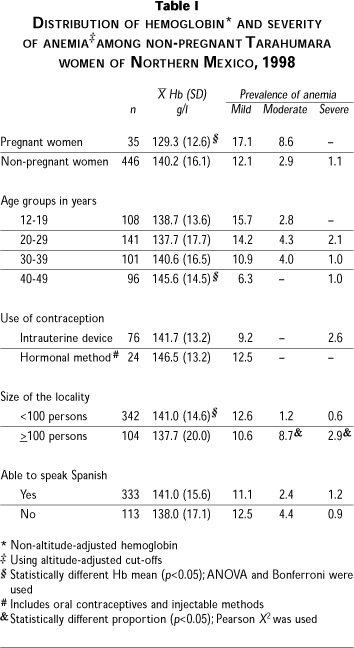
<body><![CDATA[<P>Data were captured and analyzed in the SPSS computer software. Box plot graphs, and means  (<I>s.d.</I>) for Hb were presented to describe the  Hb distribution. Analyses were stratified according to the women's reproductive status, age group, number of inhabitants in the locality, use  of contraception method, and ability to speak Spanish.     <P>     The mean (<I>SD</I>) and 95% confidence intervals for SF levels were calculated for pregnant and non-pregnant women, with and without  possible infection. To determine the prevalence of depleted iron stores, a  cut-off point of SF&lt;12 &#181;g/l was used, corresponding to the  5<SUP>th</SUP> percentile of the SF reference distribution for women, was  used.<SUP>41 </SUP>As SF was not normally distributed, a logarithmic transformation was done and the  correlation between Hb and logarithm SF (Log SF) was plotted.     <P>     The proportion of women who received iron supplementation, including the prescribed duration and schedule, was tabulated stratifying  by size of the locality.     <P> Pearson chi<SUP>2</SUP> tests were used to detect differences between categorical    variables. ANOVA and Bonferroni were used to identify mean differences. The    level at which differences were considered statistically significant was 0.05.      <P>&nbsp;     <P align="center">      <P align="center"><font size="4">Results </font>     <P>A total of 481 women from 387 households were surveyed (1.24 women per household). From the  households where two women were surveyed (n=71), neither  woman was anemic in 62%, one was anemic and the other was not in 29%, and both were anemic in 9% of the households.     <P> The mean altitude (range) in the 125 sampled localities was 2 237 meters above    sea level (1 840-2 500); for those with &lt;50, 50-99, and <font face="Symbol">&sup3;</font>    100 households, it was 2 180 m (1 840-2 420), 2300 m (2 100-2 500), and 2 298    m (2 020-2 460), respectively.      <P> <a href="#tabela1">Table I</a> presents the mean Hb&#177;<I>SD</I> and prevalence    of anemia by level of severity, stratifying by physiological status, age group,    use of contraception method, size of the locality, and ability to speak Spanish.    The overall prevalence of anemia (mean Hb&#177;<I>SD</I>) among non-pregnant    and pregnant women was 16.1% (140.2&#177;16.1 g/l) and 25.7% (129.3&#177;12.6    g/l), respectively. The prevalence of mild, moderate, and severe anemia was    12.1%, 2.9%, and 1.1% for non-pregnant women, and 17.1%, 8.6%, and 0% for pregnant    women, respectively. Anemia was worse in women aged 20-39 years. Those aged    40-49 years had a significantly higher mean Hb (145.6 g/l), and the lowest prevalence    of overall anemia. Though not statistically different, women using an intrauterine    device (IUD) had a lower mean Hb (141.7 g/l) than hormonal contraceptive users    (146.5 g/l). Women living in localities with <font face="Symbol">&sup3;</font>    100 persons showed a significantly lower mean Hb (137.7 g/l) than those with    &lt;100 persons (141 g/l), and the prevalence of moderate and severe anemia    were statistically higher in the bigger localities. Spanish-speaking women tended    to be associated with a higher Hb mean and a lower prevalence of mild and moderate    anemia (p&lt;0.10).      ]]></body>
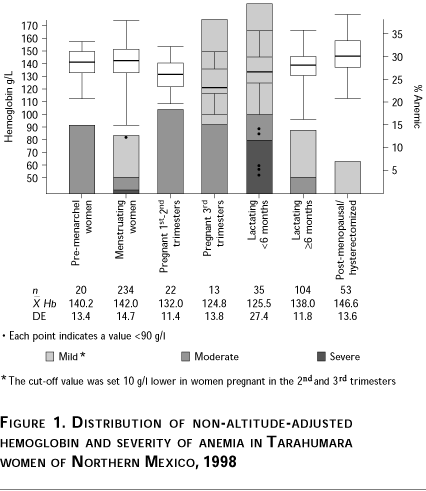
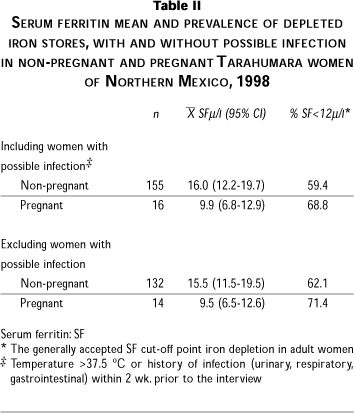
<body><![CDATA[<P align="center"><a name="tabela1"></a>     <P align="center">&nbsp;     <P align="center"><img src="/img/revistas/spm/v43n5/6717t1.gif">      <P align="center">&nbsp;     <P> <a href="#figura1">Figure 1</a> presents the Hb distribution, the mean Hb,    and the severity of anemia by chronology of physiological events during the    women's reproductive life. Low mean Hb, and high prevalence of anemia were important    among pregnant women in the 3<SUP>rd</SUP> trimester, and particularly among    those lactating their babies during the first six months after delivery, when    the prevalence of moderate and severe anemia reached 17.1%. The best status    was seen among pre-menarcheal and postmenopausal or hysterectomized women.      <P align="center"><a name="figura1"></a>     <P align="center">&nbsp;     <P align="center"><img src="/img/revistas/spm/v43n5/6717f1.gif">      <P align="center">&nbsp;     <P> The mean SF was 16.0 and 9.9 &#181;g/l for non-pregnant and pregnant women,    respectively, when possibly infected women were included in the analysis. When    women with possible infection were excluded (n=25), there was a decrease in    the mean SF of 0.5 &#181;g/l for non-pregnant and 0.4 &#181;g/l for pregnant    women. Conversely, the prevalence of iron depletion (SF&lt;12 &#181;g/l) increased    2.7% in non-pregnant and 2.6% in pregnant women (<a href="#tabela2">Table II</a>).      ]]></body>
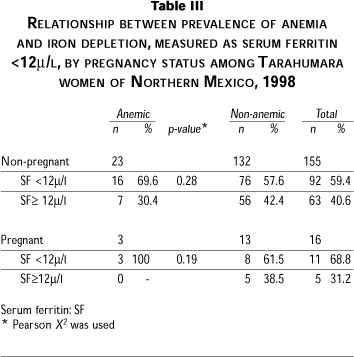
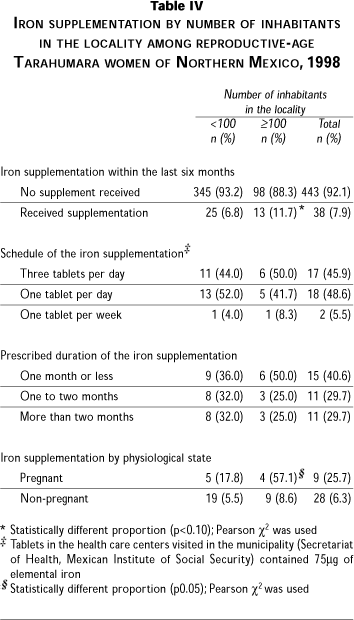
<body><![CDATA[<P align="center"><a name="tabela2"></a>     <P align="center">&nbsp;     <P align="center"><img src="/img/revistas/spm/v43n5/6717t2.gif">      <P align="center">&nbsp;     <P> <a href="#tabela3">Table III</a> presents the relationship between anemia    and depleted iron stores. Over half of the women had depleted iron stores, whether    anemic or not. The proportions of iron depletion in women with anemia tended    to be higher than in those without it, although this difference was not statistically    significant. Five of the 7 anemic women (Hb values between 121 and 127 g/l)    in whom no iron depletion was found had SF values close to the cut-off (12.3-16.2    &#181;g/l). The remaining two had SF values of 41.1 and 70.9 &#181;g/l, and    reported muscle/bone pain and respiratory tract infection respectively in the    morbidity recall, respectively.      <P align="center"><a name="tabela3"></a>     <P align="center">&nbsp;     <P align="center"><img src="/img/revistas/spm/v43n5/6717t3.gif">      <P align="center">&nbsp;     <P> <a href="#tabela4">Table IV</a> shows that the majority of women were not    given iron-containing supplements within six months before the survey, irrespective    of size of their community. The proportion that had received iron tended to    be higher in communities with <font face="Symbol">&sup3;</font>100 persons (<I>p</I>&lt;0.10),    and pregnant women were more likely to have received iron supplementation (<I>p</I>&lt;0.05).    The supplement contained 75&#181;g of elemental iron per tablet. Three tablets    per day was the prescribed dosage schedule for almost half of the supplemented    women, and the most common duration of supplementation prescribed was <font face="Symbol">&pound;</font>1    month.      ]]></body>
<body><![CDATA[<P align="center"><a name="tabela4"></a>     <P align="center">&nbsp;     <P align="center"><img src="/img/revistas/spm/v43n5/6717t4.gif">      <P>&nbsp;     <P>     <P align="center"><font size="4">Discussion</font>      <P>This is the first survey of anemia carried out at population level among reproductive-age women in the Tarahumara population. Indeed, in  the NNS, carried out by the Ministry of Health in 1988, there were no  indigenous women sampled in the northern region of  the country, where Chihuahua State is  located.<SUP>26</SUP> Although it was not possible to obtain a probabilistic sample due to the lack of a reliable sampling frame, we  consider that the sampling strategy used in this study gives a fair estimate of the prevalence of anemia in this group.     <P>     The results of this survey can be compared to those  obtained by the 1988 NNS. Nationwide, the prevalence  of anemia (non-altitude-adjusted mean  Hb&#177;<I>S.D.</I>) was 24.8% (130&#177;18 g/l) and 22.9% (123&#177;15 g/l)  for non-pregnant and pregnant indigenous women, respectively, compared  to 16.1% (140&#177;16 g/l) and 25.7% (129&#177;12 g/l) found among Tarahumara women. The higher proportion of anemia among non-pregnant women at  the national level cannot be easily explained, especially because dietary data are not available. That pregnant Tarahumara women presented a  slightly higher prevalence of anemia could be due to a lower intake of iron supplements during pregnancy.     <P>     No clear tendency for women within the same household to have similar iron status was found, as indicated by the fact that in  households where two women were sampled (18.3% of the total households), only in 9% of them both women were anemic.     <P>     Among non-pregnant women, those aged 20-39 years showed the highest prevalence of moderate and  severe anemia. This is expected, as these women are at  the peak of their reproductive lives. The lower prevalence of anemia among women aged 40-49 may be explained by the  fact that half of them were post-menopausal.     ]]></body>
<body><![CDATA[<P>     Although the difference did not reach statistical significance  (<I>p</I>=0.12), mean Hb was higher among women who used hormonal  contraception compared to IUD users, as it has been reported  elsewhere.<SUP>42,43</SUP> However, the lack of dietary and socioeconomic data limit the interpretation of  this result; for instance, women using hormonal contraceptives might have a better diet or a better socioeconomic status, then the differences  found could be related to their better diet or overall health. The same argument is valid for the lower proportions of anemia found among women  who spoke Spanish.      <P>     The proportion of women who used contraception was 38%, similar to that reported at the national level for the period 1987-92 for  women with no schooling (38.2%), but almost three times as many Tarahumara women used IUD as women at the national  level.<SUP>44</SUP>     <P>     Contrary to what might have been expected, the mean Hb among non-pregnant women was significantly  higher and the prevalence of moderate and severe anemia significantly lower, in women living in localities with &lt;100 persons, than in those living in localities with  <font face="Symbol">&sup3;</font>100 persons, these differences could not be explained by differences in the number of menstruating days, nor in the proportion of lactating women  in the first six months. There were in fact significantly more monolingual women and slightly fewer iron-supplemented women in the  smaller localities. No significant trends were found for women in the smaller localities to use IUD less often and hormonal contraceptives more often  than in the larger localities. All these factors could have only a marginal effect, if any, in explaining the differences. Hookworm and other  parasitic diseases, not evaluated in this survey, are known causes of anemia and could perhaps explain part of the differences found. One would  expect higher infection rates in smaller localities, as these are found in the more deprived and marginalized settings, but since all women in this sample  are living under rather deprived circumstances, parasitic diseases could be more prevalent in areas where the population density is higher and  transmission rates greater. Dietary intakes of <I>haem  </I>iron in these women were not measured. Meat is expensive and traditionally eaten only in  ceremonial occasions, but may be more widely eaten in the better-off and larger communities.     <P>     However, perhaps the factors that could best explain this difference are those that influence  non-<I>haeme </I>iron absorption. For example,  women in smaller villages might eat more wild plants and fruits with high contents of ascorbic acid, a powerful enhancer of  non-<I>haeme </I>iron absorption.<SUP>45</SUP> Alternatively, women in larger communities might drink more coffee, which contains tannins; these phenolic compounds inhibit  iron absorption.<SUP>46</SUP> Cultural explanations should also not  be ruled out. For instance, it might be possible that women living in small localities drink more  &quot;tesg&uuml;ino&quot; than those in the larger localities. This traditional Tarahumara beer is a thick, nutritious brew made from fermented corn prepared in iron  containers. There is evidence that extrinsic iron from the surface of  cooking vessels used to brew traditional alcoholic  beverages, as do some Southern African tribes, can add up to 100 mg to the daily iron  intake.<SUP>47</SUP> Further research to clarify this issue is needed.     <P>     Although the prevalence of anemia among non-pregnant women, particularly in those living in the smaller localities, does not appear to  be very high, pregnant women and women during the first six months of lactation have serious difficulties maintaining a  normal Hb level. Based on these cross-sectional data,  pregnancy appears to have a dramatic impact on the Hb and anemia levels of these women, lasting into  the first months of lactation, after which marked improvement occurs, presumably in part due to lactation  amenorrhoea. The extremely high prevalence of severe anemia among lactating women during the first  six months after delivery (11.4%) was not due to the  cut-off point used, as the cut-offs for moderate and severe anemia were similar among pregnant and non-pregnant women. It is possible that high blood losses at delivery  contributed to this, especially considering that 73% of the Tarahumara children are born at home without any health care  attention.<SUP>48</SUP> The high prevalence of anemia found among lactating women, suggests that it may be necessary to supplement mothers with daily iron several months after delivery,  in addition to other preventive measures.     <P>     The fact that the SF sub-sample was not randomly selected might certainly bias the estimates; however, there were no significant  differences in characteristics between the SF sampled and non-sampled women, including Hb levels and prevalence of anemia.     <P>     The study by Ahluwalia <I>et al</I>, measured venous  blood iron under laboratory conditions; they reported  a very high correlation between SF in filter paper and the conventional SF analytical technique  (<I>r</I>=0.99; <I>p</I>=0.0001), with a perfect sensitivity and specificity, even for samples stored up  to four weeks.<SUP>37</SUP> Moreover, this method was validated under field conditions with  capillary serum, using a very similar field technique to the  one utilized in this survey. A strong correlation was found between the capillary dried serum spot and the traditional SF method  (<I>r</I>=0.86; <I>p</I>=0.0001), and a sensitivity and specificity of 80% and 96.8%,  respectively.<SUP>49</SUP>      <P>     Some authors have found that determination of ferritin in capillary serum may lead to 5-7% overestimation, as compared to venous  serum values.<SUP>50</SUP> However, this would not have had a substantial impact on our conclusions. Also, the use of plasma (serum with anticoagulant) leads  to higher within- and between-sample  variation;<SUP>51 </SUP>to avoid these problems, serum without anticoagulant was utilized.     <P>     Some SF values may also be falsely high due  to recent infections, as serum apoferritin is an acute-phase reactant protein that increases  in response to infection.<SUP>35</SUP> This limits the interpretation of SF in  situations where the incidence of infection is  high.<SUP>3</SUP> To control for this situation,  it is common to assess C-reactive protein, another acute-phase reactant protein that increases in response to infection. However, as  a filter paper method adapted for field use to test for  C-reactive protein is not available, a 2-week morbidity recall and raised armpit temperature was used  to control for infection.     <P>     When possibly infected women were excluded from the analysis (n=25), a slight decrease was  observed in the mean SF of 0.5 &#181;g/l for non-pregnant and  0.4 &#181;g/l for pregnant women. Conversely, the prevalence of SF&lt;12 &#181;g/l increased 2.7% in non-pregnant and 2.6% in  pregnant women, respectively, but no statistically significant difference in mean SF or in the proportions of SF&lt;12 &#181;g/l was found when a possible  infection was considered. For these reasons, it was decided to include the whole sub-sample for the analysis of the relationship between anemia and  iron depletion.     ]]></body>
<body><![CDATA[<P>     In this sub-sample, a highly significant but modest positive correlation between Log SF and Hb was found  (<I>r</I>=0.31; <I>p</I>=0.000). Most women were iron-depleted, whether anemic or not. The majority of the anemia  was related to iron deficiency in both non-pregnant and  pregnant women. This is consistent with the common finding that for every case of IDA found in a population, there are at least two cases of  non-anemic iron deficiency.<SUP>3</SUP> However, not all anemic  women showed iron depletion. This may be related to  the cut-off points used or due to the existence of an inflammatory response; from the seven anemic women  in which no iron depletion was found, five had Hb and  SF values lying very close to the cut-off points for both anemia and iron depletion, and the other two had histories of inflammatory processes in the morbidity recall.     <P>     It was found that only 7.9% of the surveyed women had received iron supplementation within six months prior to the interview. Iron  supplements were taken slightly more often  (<I>p</I>=0.07) in the localities with <font face="Symbol">&sup3;</font>100 inhabitants (11.7%), compared to those with &lt;100 persons (6.8%).  The Mexican Technical Norm for Pre-natal Consultation, states that all women should receive iron supplementation during the last trimester of  pregnancy,<SUP>51</SUP> yet in this study, 57.1% of the pregnant women living in localities with <font face="Symbol">&sup3;</font>100 inhabitants received iron supplements, but only 17.8%  in localities with &lt;100 persons. The fact that nearly half the supplemented women received three high-dose tablets per day and each tablet  contains 25% more iron than recommended, suggests a delay in implementing more modern single-dose per-day supplementation  schedules.<SUP>52</SUP> This could cause more side effects, leading to compliance  problems, as well as being a waste of economic resources.  Furthermore, when anemic women were asked about the reason for iron prescription, it  was found that iron supplements were being used as a  treatment for weakness, dizziness, pallor, or other signs and symptoms related to anemia in non-pregnant women, but diagnoses were rarely confirmed. These findings point to the need  to improve not only the coverage, but also the quality of health care, especially for those women living in small localities. In particular,  lower-dose treatment schedule should be initiated for prophylaxis throughout pregnancy and for the first six months after delivery.     <P>     In Mexico, where most deliveries occur in hospitals, it has been calculated that, among hospital  deliveries, 25% of the maternal deaths are due to hemorrhage during the delivery  period.<SUP>53</SUP> Although the maternal mortality rate in this ethnic group has  never been determined, the relatively high prevalence  of anemia among pregnant women reported here, along with the poor prenatal care coverage, and the fact that 3 out  of 4 children are born at home with no health care  whatsoever,<SUP>48</SUP> pose significant risks for the mother and baby during the perinatal period.  Improving the mothers' Hb status prior to the delivery will thus diminish their risk of dying during delivery. Iron deficiency undoubtedly contributes to  the high morbidity and mortality among Tarahumara women of childbearing age, potentially impairing work performance and active learning  capacity as well.     <P> For many years, protein-energy malnutrition among infants belonging to this    ethnic group has been recognized as a public health problem, and has been a    major focus of attention by governmental and non-governmental organizations.    In response, several interventions, including feeding programs, have been carried    out. However, much less has been done to identify or treat other common forms    of malnutrition. We hope that these findings encourage governmental and non-governmental    organizations to focus on the problem of IDA among these women.      <P>&nbsp;     <P align="center">      <P align="center"><font size="4">Acknowledgments </font>     <P>     <P>The authors want to thank Nutritionist Andrea Gerger for her help in data collection    and Prof. Bo L&ouml;nnerdal (UC-Davis) for his laboratory assistance.      <P>&nbsp;     ]]></body>
<body><![CDATA[<P align="center">      <P align="center">      <P align="center">      <P align="center"><font size="4">References </font>     <P>     <!-- ref --><P>1. Bothwell T, Charlton R, Cook J, Finch C. Iron metabolism in man. Oxford: Blackwell Scientific Publications, 1979.    &nbsp;&nbsp;&nbsp;&nbsp;&nbsp;&nbsp;&nbsp;&nbsp;[&#160;<a href="javascript:void(0);" onclick="javascript: window.open('/scielo.php?script=sci_nlinks&ref=9143573&pid=S0036-3634200100050000200001&lng=','','width=640,height=500,resizable=yes,scrollbars=1,menubar=yes,');">Links</a>&#160;]<!-- end-ref --><!-- ref --><P>2. Scrimshaw N. Iron deficiency. Sci Am 1991(4);265:46-52.    &nbsp;&nbsp;&nbsp;&nbsp;&nbsp;&nbsp;&nbsp;&nbsp;[&#160;<a href="javascript:void(0);" onclick="javascript: window.open('/scielo.php?script=sci_nlinks&ref=9143574&pid=S0036-3634200100050000200002&lng=','','width=640,height=500,resizable=yes,scrollbars=1,menubar=yes,');">Links</a>&#160;]<!-- end-ref --><!-- ref --><P>3. International Nutritional Anemia Consultative Group. Iron deficiency in women. Washington, D.C.: INACG and WHO, 1989.    &nbsp;&nbsp;&nbsp;&nbsp;&nbsp;&nbsp;&nbsp;&nbsp;[&#160;<a href="javascript:void(0);" onclick="javascript: window.open('/scielo.php?script=sci_nlinks&ref=9143575&pid=S0036-3634200100050000200003&lng=','','width=640,height=500,resizable=yes,scrollbars=1,menubar=yes,');">Links</a>&#160;]<!-- end-ref --><!-- ref --><P>4. Hallberg L, Hult&eacute;n L. Iron requirements, iron balance and iron deficiency in menstruating and pregnant women. En: Hallberg L, Asp N, ed. Iron nutrition  in health and disease. Londres: John Libbey, 1996:165-181.    &nbsp;&nbsp;&nbsp;&nbsp;&nbsp;&nbsp;&nbsp;&nbsp;[&#160;<a href="javascript:void(0);" onclick="javascript: window.open('/scielo.php?script=sci_nlinks&ref=9143576&pid=S0036-3634200100050000200004&lng=','','width=640,height=500,resizable=yes,scrollbars=1,menubar=yes,');">Links</a>&#160;]<!-- end-ref --><!-- ref --><P>5. Stoltzfus R, Chwaya H, Tielsch J, Schulze L, Albonico M, Savioli L. Epidemiology of iron deficiency in Zanzibari schoolchildren: The importance of  hookworms. Am J Clin Nutr 1997;65(1):153-159.    &nbsp;&nbsp;&nbsp;&nbsp;&nbsp;&nbsp;&nbsp;&nbsp;[&#160;<a href="javascript:void(0);" onclick="javascript: window.open('/scielo.php?script=sci_nlinks&ref=9143577&pid=S0036-3634200100050000200005&lng=','','width=640,height=500,resizable=yes,scrollbars=1,menubar=yes,');">Links</a>&#160;]<!-- end-ref --><!-- ref --><P>6. Bothwell T. Iron balance and the capacity of regulatory systems to prevent the development of iron deficiency and overload. En: Hallberg L, Asp N,  ed. Iron nutrition in health and disease. Londres: John Libbey, 1996: 3-16.    &nbsp;&nbsp;&nbsp;&nbsp;&nbsp;&nbsp;&nbsp;&nbsp;[&#160;<a href="javascript:void(0);" onclick="javascript: window.open('/scielo.php?script=sci_nlinks&ref=9143578&pid=S0036-3634200100050000200006&lng=','','width=640,height=500,resizable=yes,scrollbars=1,menubar=yes,');">Links</a>&#160;]<!-- end-ref --><!-- ref --><P>7. Gillespie S. Major issues in the control of iron deficiency. Ottawa: Micronutrient Initiative, 1998.    &nbsp;&nbsp;&nbsp;&nbsp;&nbsp;&nbsp;&nbsp;&nbsp;[&#160;<a href="javascript:void(0);" onclick="javascript: window.open('/scielo.php?script=sci_nlinks&ref=9143579&pid=S0036-3634200100050000200007&lng=','','width=640,height=500,resizable=yes,scrollbars=1,menubar=yes,');">Links</a>&#160;]<!-- end-ref --><!-- ref --><P>8. Dallman P. Biochemical bases for the manifestation of iron deficiency. Ann Rev Nutr 1986;6:13-40.    &nbsp;&nbsp;&nbsp;&nbsp;&nbsp;&nbsp;&nbsp;&nbsp;[&#160;<a href="javascript:void(0);" onclick="javascript: window.open('/scielo.php?script=sci_nlinks&ref=9143580&pid=S0036-3634200100050000200008&lng=','','width=640,height=500,resizable=yes,scrollbars=1,menubar=yes,');">Links</a>&#160;]<!-- end-ref --><!-- ref --><P>9. Zhu Y, Hass J. Iron depletion without anemia and physical performance in young women. Am J Clin Nutr 1997;66(2):334-341.    &nbsp;&nbsp;&nbsp;&nbsp;&nbsp;&nbsp;&nbsp;&nbsp;[&#160;<a href="javascript:void(0);" onclick="javascript: window.open('/scielo.php?script=sci_nlinks&ref=9143581&pid=S0036-3634200100050000200009&lng=','','width=640,height=500,resizable=yes,scrollbars=1,menubar=yes,');">Links</a>&#160;]<!-- end-ref --><!-- ref --><P>10. WHO/UNICEF/UNU. Indicators for assessing iron deficiency and strategies for its prevention. Ginebra: WHO, 1996.    &nbsp;&nbsp;&nbsp;&nbsp;&nbsp;&nbsp;&nbsp;&nbsp;[&#160;<a href="javascript:void(0);" onclick="javascript: window.open('/scielo.php?script=sci_nlinks&ref=9143582&pid=S0036-3634200100050000200010&lng=','','width=640,height=500,resizable=yes,scrollbars=1,menubar=yes,');">Links</a>&#160;]<!-- end-ref --><!-- ref --><P>11. Walter T. Effect of iron deficiency anemia on cognitive skills in infancy and childhood. En: Hallberg L, Asp N, ed. Iron nutrition in health and  disease. Londres: John Libbey, 1996:219-229.    &nbsp;&nbsp;&nbsp;&nbsp;&nbsp;&nbsp;&nbsp;&nbsp;[&#160;<a href="javascript:void(0);" onclick="javascript: window.open('/scielo.php?script=sci_nlinks&ref=9143583&pid=S0036-3634200100050000200011&lng=','','width=640,height=500,resizable=yes,scrollbars=1,menubar=yes,');">Links</a>&#160;]<!-- end-ref --><!-- ref --><P>12. Schloz B, Gross R, Schultink W, Sastroamidjojo S. Anemia is associated with reduced productivity of women workers even in less  physically-strenuous tasks. Br J Nutr 1997;77(1):47-57.    &nbsp;&nbsp;&nbsp;&nbsp;&nbsp;&nbsp;&nbsp;&nbsp;[&#160;<a href="javascript:void(0);" onclick="javascript: window.open('/scielo.php?script=sci_nlinks&ref=9143584&pid=S0036-3634200100050000200012&lng=','','width=640,height=500,resizable=yes,scrollbars=1,menubar=yes,');">Links</a>&#160;]<!-- end-ref --><!-- ref --><P>13. Institute of Medicine. Iron nutrition during pregnancy. En: Food and Nutrition Board, ed. Nutrition during pregnancy. Washington, D.C.: National  Academy Press, 1990:272-298.    &nbsp;&nbsp;&nbsp;&nbsp;&nbsp;&nbsp;&nbsp;&nbsp;[&#160;<a href="javascript:void(0);" onclick="javascript: window.open('/scielo.php?script=sci_nlinks&ref=9143585&pid=S0036-3634200100050000200013&lng=','','width=640,height=500,resizable=yes,scrollbars=1,menubar=yes,');">Links</a>&#160;]<!-- end-ref --><!-- ref --><P>14. Royston R, Armstrong S. The status of women and maternal mortality. In: WHO, ed. Preventing maternal mortality. Ginebra: WHO, 1989:75-106.    &nbsp;&nbsp;&nbsp;&nbsp;&nbsp;&nbsp;&nbsp;&nbsp;[&#160;<a href="javascript:void(0);" onclick="javascript: window.open('/scielo.php?script=sci_nlinks&ref=9143586&pid=S0036-3634200100050000200014&lng=','','width=640,height=500,resizable=yes,scrollbars=1,menubar=yes,');">Links</a>&#160;]<!-- end-ref --><!-- ref --><P>15. Klebanoff M, Shiono P, Selby J, Trachtenberg A, Graubard B. Anemia and spontaneous preterm birth. Am J Obstet Gynecol 1991;164(1):59-63.    &nbsp;&nbsp;&nbsp;&nbsp;&nbsp;&nbsp;&nbsp;&nbsp;[&#160;<a href="javascript:void(0);" onclick="javascript: window.open('/scielo.php?script=sci_nlinks&ref=9143587&pid=S0036-3634200100050000200015&lng=','','width=640,height=500,resizable=yes,scrollbars=1,menubar=yes,');">Links</a>&#160;]<!-- end-ref --><!-- ref --><P>16. Hirve S, Ganatra B. Determinants of low birth weight: A community based prospective cohort study. Indian Pediatr 1994;31(10):1 221-1 225.    &nbsp;&nbsp;&nbsp;&nbsp;&nbsp;&nbsp;&nbsp;&nbsp;[&#160;<a href="javascript:void(0);" onclick="javascript: window.open('/scielo.php?script=sci_nlinks&ref=9143588&pid=S0036-3634200100050000200016&lng=','','width=640,height=500,resizable=yes,scrollbars=1,menubar=yes,');">Links</a>&#160;]<!-- end-ref --><!-- ref --><P>17. Deinard AS, Gilbert A, Dodds M, Egeland B. Iron deficiency anemia and behavioral deficits. Pediatrics 1981;68:828-833.    &nbsp;&nbsp;&nbsp;&nbsp;&nbsp;&nbsp;&nbsp;&nbsp;[&#160;<a href="javascript:void(0);" onclick="javascript: window.open('/scielo.php?script=sci_nlinks&ref=9143589&pid=S0036-3634200100050000200017&lng=','','width=640,height=500,resizable=yes,scrollbars=1,menubar=yes,');">Links</a>&#160;]<!-- end-ref --><!-- ref --><P>18. Oski FA, Honig AS, Helu B, Howanitz P. Effect of iron therapy on behavior performance in non-anemic iron deficient infants. Pediatrics 1983;71:877-880.    &nbsp;&nbsp;&nbsp;&nbsp;&nbsp;&nbsp;&nbsp;&nbsp;[&#160;<a href="javascript:void(0);" onclick="javascript: window.open('/scielo.php?script=sci_nlinks&ref=9143590&pid=S0036-3634200100050000200018&lng=','','width=640,height=500,resizable=yes,scrollbars=1,menubar=yes,');">Links</a>&#160;]<!-- end-ref --><!-- ref --><P>19. Deinard AS, List A, Lindgren B, Hunt JV, Chang PN. Cognitive deficits in iron deficient and iron deficient anemic children. J Pediatrics 1986;108: 681-689.    &nbsp;&nbsp;&nbsp;&nbsp;&nbsp;&nbsp;&nbsp;&nbsp;[&#160;<a href="javascript:void(0);" onclick="javascript: window.open('/scielo.php?script=sci_nlinks&ref=9143591&pid=S0036-3634200100050000200019&lng=','','width=640,height=500,resizable=yes,scrollbars=1,menubar=yes,');">Links</a>&#160;]<!-- end-ref --><!-- ref --><P>20. Instituto Nacional de Estad&iacute;stica, Geograf&iacute;a e Inform&aacute;tica. Resultados definitivos del conteo general de poblaci&oacute;n y vivienda, 1995: Chihuahua.  M&eacute;xico, D.F.: INEGI, 1997.    &nbsp;&nbsp;&nbsp;&nbsp;&nbsp;&nbsp;&nbsp;&nbsp;[&#160;<a href="javascript:void(0);" onclick="javascript: window.open('/scielo.php?script=sci_nlinks&ref=9143592&pid=S0036-3634200100050000200020&lng=','','width=640,height=500,resizable=yes,scrollbars=1,menubar=yes,');">Links</a>&#160;]<!-- end-ref --><!-- ref --><P>21. Fern&aacute;ndez P. La Mortalidad infantil ind&iacute;gena en 1990: una estimaci&oacute;n a trav&eacute;s de municipios predominantemente ind&iacute;genas. M&eacute;xico, D.F.: Secretar&iacute;a  de Salud, 1992.    &nbsp;&nbsp;&nbsp;&nbsp;&nbsp;&nbsp;&nbsp;&nbsp;[&#160;<a href="javascript:void(0);" onclick="javascript: window.open('/scielo.php?script=sci_nlinks&ref=9143593&pid=S0036-3634200100050000200021&lng=','','width=640,height=500,resizable=yes,scrollbars=1,menubar=yes,');">Links</a>&#160;]<!-- end-ref --><!-- ref --><P>22. G&oacute;mez de Le&oacute;n J, Partida V. Niveles de mortalidad infantil y fecundidad en M&eacute;xico por entidad federativa. M&eacute;xico, D.F.: Secretar&iacute;a de Salud, 1992.    &nbsp;&nbsp;&nbsp;&nbsp;&nbsp;&nbsp;&nbsp;&nbsp;[&#160;<a href="javascript:void(0);" onclick="javascript: window.open('/scielo.php?script=sci_nlinks&ref=9143594&pid=S0036-3634200100050000200022&lng=','','width=640,height=500,resizable=yes,scrollbars=1,menubar=yes,');">Links</a>&#160;]<!-- end-ref --><!-- ref --><P>23. Mon&aacute;rrez J, Mart&iacute;nez H. Prevalence of malnutrition in Tarahumara children under 5 years in the municipality of Guachochi, Chihuahua. Salud  Publica Mex 2000;42(1):8-16.    &nbsp;&nbsp;&nbsp;&nbsp;&nbsp;&nbsp;&nbsp;&nbsp;[&#160;<a href="javascript:void(0);" onclick="javascript: window.open('/scielo.php?script=sci_nlinks&ref=9143595&pid=S0036-3634200100050000200023&lng=','','width=640,height=500,resizable=yes,scrollbars=1,menubar=yes,');">Links</a>&#160;]<!-- end-ref --><!-- ref --><P>24. Gobierno del Estado de Chihuahua. Centro de informaci&oacute;n econ&oacute;mica    y social. Available from: <a href="http://www.chihuahua.gob.mx/Monografias_Mpios/Guachochi/InfGua"Symbol" size="2">http://www.chihuahua.gob.mx/Monografias<font face="Symbol" size="2">_</font>Mpios/Guachochi/InfGua</a>    (Internet site accessed on May 2000).    &nbsp;&nbsp;&nbsp;&nbsp;&nbsp;&nbsp;&nbsp;&nbsp;[&#160;<a href="javascript:void(0);" onclick="javascript: window.open('/scielo.php?script=sci_nlinks&ref=9143596&pid=S0036-3634200100050000200024&lng=','','width=640,height=500,resizable=yes,scrollbars=1,menubar=yes,');">Links</a>&#160;]<!-- end-ref --><!-- ref --><P>25. Mon&aacute;rrez-Espino J, Greiner T. Anthropometry in Tarahumara Indian women of reproductive age in Northern Mexico: Is overweight becoming a  problem? Ecol Food Nutr 2000;39:437-457.    &nbsp;&nbsp;&nbsp;&nbsp;&nbsp;&nbsp;&nbsp;&nbsp;[&#160;<a href="javascript:void(0);" onclick="javascript: window.open('/scielo.php?script=sci_nlinks&ref=9143597&pid=S0036-3634200100050000200025&lng=','','width=640,height=500,resizable=yes,scrollbars=1,menubar=yes,');">Links</a>&#160;]<!-- end-ref --><!-- ref --><P>26. Mart&iacute;nez H, Gonz&aacute;lez-Coss&iacute;o T, Flores M, Rivera J, Lezana M, Sep&uacute;lveda J. Anemia en mujeres de edad reproductiva. Salud Publica Mex 1995;37: 108-119.    &nbsp;&nbsp;&nbsp;&nbsp;&nbsp;&nbsp;&nbsp;&nbsp;[&#160;<a href="javascript:void(0);" onclick="javascript: window.open('/scielo.php?script=sci_nlinks&ref=9143598&pid=S0036-3634200100050000200026&lng=','','width=640,height=500,resizable=yes,scrollbars=1,menubar=yes,');">Links</a>&#160;]<!-- end-ref --><!-- ref --><P>27. Lemeshow S, Hosmer DW, Klar J, Lwanga S. Adequacy of sample size in health studies. West Sussex: John Wiley and Sons for WHO, 1990:43.    &nbsp;&nbsp;&nbsp;&nbsp;&nbsp;&nbsp;&nbsp;&nbsp;[&#160;<a href="javascript:void(0);" onclick="javascript: window.open('/scielo.php?script=sci_nlinks&ref=9143599&pid=S0036-3634200100050000200027&lng=','','width=640,height=500,resizable=yes,scrollbars=1,menubar=yes,');">Links</a>&#160;]<!-- end-ref --><!-- ref --><P>28. Schenck HV, Falkensson M, Lundberg B. Evaluation of &quot;Hemocue&quot;, a new device for determining hemoglobin. Clin Chem 1986;32:526-529.    &nbsp;&nbsp;&nbsp;&nbsp;&nbsp;&nbsp;&nbsp;&nbsp;[&#160;<a href="javascript:void(0);" onclick="javascript: window.open('/scielo.php?script=sci_nlinks&ref=9143600&pid=S0036-3634200100050000200028&lng=','','width=640,height=500,resizable=yes,scrollbars=1,menubar=yes,');">Links</a>&#160;]<!-- end-ref --><!-- ref --><P>29. Morris SS, Ruel MT, Cohen RJ, Dewery KG, De la Briere B, Hassan MN. Precision, accuracy, and reliability of hemoglobin assessment with use of  capillary blood. Am J Clin Nutr 1999;69(6):1 243-1 248.    &nbsp;&nbsp;&nbsp;&nbsp;&nbsp;&nbsp;&nbsp;&nbsp;[&#160;<a href="javascript:void(0);" onclick="javascript: window.open('/scielo.php?script=sci_nlinks&ref=9143601&pid=S0036-3634200100050000200029&lng=','','width=640,height=500,resizable=yes,scrollbars=1,menubar=yes,');">Links</a>&#160;]<!-- end-ref --><!-- ref --><P>30. Centers for Disease Control and Prevention. Criteria for anemia in children and childbearing age women. Atlanta: CDC, 1989; Report No. 38.    &nbsp;&nbsp;&nbsp;&nbsp;&nbsp;&nbsp;&nbsp;&nbsp;[&#160;<a href="javascript:void(0);" onclick="javascript: window.open('/scielo.php?script=sci_nlinks&ref=9143602&pid=S0036-3634200100050000200030&lng=','','width=640,height=500,resizable=yes,scrollbars=1,menubar=yes,');">Links</a>&#160;]<!-- end-ref --><!-- ref --><P>31. Cohen JH, Hass JD. Hemoglobin correction factors for estimating the prevalence of iron deficiency anemia in pregnant women residing at high  altitudes in Bolivia. Pan Am J Public Health 1999;6(6):392-399.    &nbsp;&nbsp;&nbsp;&nbsp;&nbsp;&nbsp;&nbsp;&nbsp;[&#160;<a href="javascript:void(0);" onclick="javascript: window.open('/scielo.php?script=sci_nlinks&ref=9143603&pid=S0036-3634200100050000200031&lng=','','width=640,height=500,resizable=yes,scrollbars=1,menubar=yes,');">Links</a>&#160;]<!-- end-ref --><!-- ref --><P>32. Hurtado A, Merino C, Delgado E. Influence of anoxemia on the hemopoietic activity. Arch Int Med 1945;75:284-323.    &nbsp;&nbsp;&nbsp;&nbsp;&nbsp;&nbsp;&nbsp;&nbsp;[&#160;<a href="javascript:void(0);" onclick="javascript: window.open('/scielo.php?script=sci_nlinks&ref=9143604&pid=S0036-3634200100050000200032&lng=','','width=640,height=500,resizable=yes,scrollbars=1,menubar=yes,');">Links</a>&#160;]<!-- end-ref --><!-- ref --><P>33. Dallman PR, Siimes MA, Steckel A. Iron deficiency in infancy and childhood. Am J Clin Nutr 1980;33(1):86-118.    &nbsp;&nbsp;&nbsp;&nbsp;&nbsp;&nbsp;&nbsp;&nbsp;[&#160;<a href="javascript:void(0);" onclick="javascript: window.open('/scielo.php?script=sci_nlinks&ref=9143605&pid=S0036-3634200100050000200033&lng=','','width=640,height=500,resizable=yes,scrollbars=1,menubar=yes,');">Links</a>&#160;]<!-- end-ref --><!-- ref --><P>34. Dirren H, Logman MH, Barclay DV, Freire WB. Altitude correction for hemoglobin. Eur J Clin Nutr 1994:48(9):625-632.    &nbsp;&nbsp;&nbsp;&nbsp;&nbsp;&nbsp;&nbsp;&nbsp;[&#160;<a href="javascript:void(0);" onclick="javascript: window.open('/scielo.php?script=sci_nlinks&ref=9143606&pid=S0036-3634200100050000200034&lng=','','width=640,height=500,resizable=yes,scrollbars=1,menubar=yes,');">Links</a>&#160;]<!-- end-ref --><!-- ref --><P>35. Worwood M. Ferritin. Blood Rev 1990;4(4):259-269.    &nbsp;&nbsp;&nbsp;&nbsp;&nbsp;&nbsp;&nbsp;&nbsp;[&#160;<a href="javascript:void(0);" onclick="javascript: window.open('/scielo.php?script=sci_nlinks&ref=9143607&pid=S0036-3634200100050000200035&lng=','','width=640,height=500,resizable=yes,scrollbars=1,menubar=yes,');">Links</a>&#160;]<!-- end-ref --><!-- ref --><P>36. Cook J, Baynes R, Skikne B. Iron deficiency and the measurement of iron status. Nutr Res Rev 1992;5:189-202.    &nbsp;&nbsp;&nbsp;&nbsp;&nbsp;&nbsp;&nbsp;&nbsp;[&#160;<a href="javascript:void(0);" onclick="javascript: window.open('/scielo.php?script=sci_nlinks&ref=9143608&pid=S0036-3634200100050000200036&lng=','','width=640,height=500,resizable=yes,scrollbars=1,menubar=yes,');">Links</a>&#160;]<!-- end-ref --><!-- ref --><P>37. Ahluwalia N, L&ouml;nnerdal B, Lorenz S, Allen L. Spot ferritin assay for serum samples dried on filter paper. Am J Clin Nutr 1998;67(1):88-92.    &nbsp;&nbsp;&nbsp;&nbsp;&nbsp;&nbsp;&nbsp;&nbsp;[&#160;<a href="javascript:void(0);" onclick="javascript: window.open('/scielo.php?script=sci_nlinks&ref=9143609&pid=S0036-3634200100050000200037&lng=','','width=640,height=500,resizable=yes,scrollbars=1,menubar=yes,');">Links</a>&#160;]<!-- end-ref --><!-- ref --><P>38. Mon&aacute;rrez J, L&ouml;nnerdal B, Greiner T. Assessment of iron deficiency anemia in Tarahumara women of Northern Mexico using filter paper to quantify  serum ferritin. Poster presentation. INACG Symposium, 11-12 March 1999, Durban, South Africa.    &nbsp;&nbsp;&nbsp;&nbsp;&nbsp;&nbsp;&nbsp;&nbsp;[&#160;<a href="javascript:void(0);" onclick="javascript: window.open('/scielo.php?script=sci_nlinks&ref=9143610&pid=S0036-3634200100050000200038&lng=','','width=640,height=500,resizable=yes,scrollbars=1,menubar=yes,');">Links</a>&#160;]<!-- end-ref --><!-- ref --><P>39. Worwood H. Serum ferritin. Crit Rev Clin Lab Sci 1979;10:171-204.    &nbsp;&nbsp;&nbsp;&nbsp;&nbsp;&nbsp;&nbsp;&nbsp;[&#160;<a href="javascript:void(0);" onclick="javascript: window.open('/scielo.php?script=sci_nlinks&ref=9143611&pid=S0036-3634200100050000200039&lng=','','width=640,height=500,resizable=yes,scrollbars=1,menubar=yes,');">Links</a>&#160;]<!-- end-ref --><!-- ref --><P>40. Birgeg&aring;rd G, Hallgren R, Killander A, Stromberg A, Benge P, Wilde L. Serum ferritin during infection. Scand J Haematol 1978;21:333-340.    &nbsp;&nbsp;&nbsp;&nbsp;&nbsp;&nbsp;&nbsp;&nbsp;[&#160;<a href="javascript:void(0);" onclick="javascript: window.open('/scielo.php?script=sci_nlinks&ref=9143612&pid=S0036-3634200100050000200040&lng=','','width=640,height=500,resizable=yes,scrollbars=1,menubar=yes,');">Links</a>&#160;]<!-- end-ref --><!-- ref --><P>41. Dallman P, Looker A, Johnson C, Carroll M. Influence of age on laboratory criteria for the diagnosis of iron deficiency anemia and iron deficiency  in infants and children. En: Hallberg L, Asp N, ed. Iron nutrition in health and disease. Londres: John Libbey, 1996:65-74.    &nbsp;&nbsp;&nbsp;&nbsp;&nbsp;&nbsp;&nbsp;&nbsp;[&#160;<a href="javascript:void(0);" onclick="javascript: window.open('/scielo.php?script=sci_nlinks&ref=9143613&pid=S0036-3634200100050000200041&lng=','','width=640,height=500,resizable=yes,scrollbars=1,menubar=yes,');">Links</a>&#160;]<!-- end-ref --><!-- ref --><P>42. Milman N, Clausen J, Byg K. Iron status in 268 Danish women aged 16-30 years: Influence of menstruation, contraceptive method, and iron  supplementation. Ann Hematol 1998;77(1-2):13-19.    &nbsp;&nbsp;&nbsp;&nbsp;&nbsp;&nbsp;&nbsp;&nbsp;[&#160;<a href="javascript:void(0);" onclick="javascript: window.open('/scielo.php?script=sci_nlinks&ref=9143614&pid=S0036-3634200100050000200042&lng=','','width=640,height=500,resizable=yes,scrollbars=1,menubar=yes,');">Links</a>&#160;]<!-- end-ref --><!-- ref --><P>43. Galan P, Yoon H, Preziosi P, Viteri F, Valeix P, Fieux B  <I>et al</I>. Determining factors in the iron status of adult women in the SU.VI.MAX study.  Supplementation en Vitamines et Mineraux Antioxydants. Eur J Clin Nutr 1998;52(6):383-388.    &nbsp;&nbsp;&nbsp;&nbsp;&nbsp;&nbsp;&nbsp;&nbsp;[&#160;<a href="javascript:void(0);" onclick="javascript: window.open('/scielo.php?script=sci_nlinks&ref=9143615&pid=S0036-3634200100050000200043&lng=','','width=640,height=500,resizable=yes,scrollbars=1,menubar=yes,');">Links</a>&#160;]<!-- end-ref --><!-- ref --><P>44. L&oacute;pez MP, Z&uacute;&ntilde;iga E. Salud reproductiva: situaci&oacute;n actual y perspectivas. M&eacute;xico, D.F.: Secretar&iacute;a de Salud, 1994:26-33.    &nbsp;&nbsp;&nbsp;&nbsp;&nbsp;&nbsp;&nbsp;&nbsp;[&#160;<a href="javascript:void(0);" onclick="javascript: window.open('/scielo.php?script=sci_nlinks&ref=9143616&pid=S0036-3634200100050000200044&lng=','','width=640,height=500,resizable=yes,scrollbars=1,menubar=yes,');">Links</a>&#160;]<!-- end-ref --><!-- ref --><P>45. Hallberg L, Brune M, Rossander L. Effect of ascorbic acid on iron absorption from different types of meals. Hum Nutr Appl Nutr 1986;40(2): 97-113.    &nbsp;&nbsp;&nbsp;&nbsp;&nbsp;&nbsp;&nbsp;&nbsp;[&#160;<a href="javascript:void(0);" onclick="javascript: window.open('/scielo.php?script=sci_nlinks&ref=9143617&pid=S0036-3634200100050000200045&lng=','','width=640,height=500,resizable=yes,scrollbars=1,menubar=yes,');">Links</a>&#160;]<!-- end-ref --><!-- ref --><P>46. Brune M, Rossander L, Hallberg L. Iron absorption and phenolic compounds: Importance of different phenolic structures. Eur J Clin Nutr  1989;43(8):547-558.    &nbsp;&nbsp;&nbsp;&nbsp;&nbsp;&nbsp;&nbsp;&nbsp;[&#160;<a href="javascript:void(0);" onclick="javascript: window.open('/scielo.php?script=sci_nlinks&ref=9143618&pid=S0036-3634200100050000200046&lng=','','width=640,height=500,resizable=yes,scrollbars=1,menubar=yes,');">Links</a>&#160;]<!-- end-ref --><!-- ref --><P>47. Charlton RW, Bothwell TH, Seftel HC. Dietary iron overload. Clin Haematol 1973;2:383-404.    &nbsp;&nbsp;&nbsp;&nbsp;&nbsp;&nbsp;&nbsp;&nbsp;[&#160;<a href="javascript:void(0);" onclick="javascript: window.open('/scielo.php?script=sci_nlinks&ref=9143619&pid=S0036-3634200100050000200047&lng=','','width=640,height=500,resizable=yes,scrollbars=1,menubar=yes,');">Links</a>&#160;]<!-- end-ref --><!-- ref --><P>48. Mon&aacute;rrez-Espino J. Caracterizaci&oacute;n de la desnutrici&oacute;n infantil Tarahumara y dise&ntilde;o de un programa de ayuda alimentaria con aceptabilidad  cultural. Cuernavaca, M&eacute;xico: Instituto Nacional de Salud P&uacute;blica, 1998.    &nbsp;&nbsp;&nbsp;&nbsp;&nbsp;&nbsp;&nbsp;&nbsp;[&#160;<a href="javascript:void(0);" onclick="javascript: window.open('/scielo.php?script=sci_nlinks&ref=9143620&pid=S0036-3634200100050000200048&lng=','','width=640,height=500,resizable=yes,scrollbars=1,menubar=yes,');">Links</a>&#160;]<!-- end-ref --><!-- ref --><P>49. Ahluwalia N, De Silva A, Weaver V, Atukorala S. Evaluation of filter paper based dried serum spots from capillary and venous blood for assessing  iron deficiency in children in Colombo, Sri Lanka. Poster presentation. INACG Symposium, 15-16 February 2001, Hanoi, Vietnam.    &nbsp;&nbsp;&nbsp;&nbsp;&nbsp;&nbsp;&nbsp;&nbsp;[&#160;<a href="javascript:void(0);" onclick="javascript: window.open('/scielo.php?script=sci_nlinks&ref=9143621&pid=S0036-3634200100050000200049&lng=','','width=640,height=500,resizable=yes,scrollbars=1,menubar=yes,');">Links</a>&#160;]<!-- end-ref --><!-- ref --><P>50. Pootrakul P, Skikne B, Cook J. The use of capillary blood for measurements of circulating ferritin. Am J Clin Nutr 1983;37(2):307-310.    &nbsp;&nbsp;&nbsp;&nbsp;&nbsp;&nbsp;&nbsp;&nbsp;[&#160;<a href="javascript:void(0);" onclick="javascript: window.open('/scielo.php?script=sci_nlinks&ref=9143622&pid=S0036-3634200100050000200050&lng=','','width=640,height=500,resizable=yes,scrollbars=1,menubar=yes,');">Links</a>&#160;]<!-- end-ref --><!-- ref --><P>51. Secretar&iacute;a de Salud. Comit&eacute; consultivo nacional de normalizaci&oacute;n de servicios de salud. Norma Oficial Mexicana NOM-007-SSA2-1993: Atenci&oacute;n de  la mujer durante el embarazo, parto y puerperio y del reci&eacute;n nacido. Criterios y procedimientos para la prestaci&oacute;n del servicio. Secci&oacute;n 5.16. M&eacute;xico,  D.F.: Diario Oficial de la Federaci&oacute;n, 1993. Norma en vigor a partir del 31 de octubre de 1994.    &nbsp;&nbsp;&nbsp;&nbsp;&nbsp;&nbsp;&nbsp;&nbsp;[&#160;<a href="javascript:void(0);" onclick="javascript: window.open('/scielo.php?script=sci_nlinks&ref=9143623&pid=S0036-3634200100050000200051&lng=','','width=640,height=500,resizable=yes,scrollbars=1,menubar=yes,');">Links</a>&#160;]<!-- end-ref --><!-- ref --><P>52. Stoltzfus R, Dreyfuss M. Guidelines for the use of iron supplements to prevent and treat iron deficiency anemia. Washington, D.C.: International  Life Sciences Institute, 1998:11-17.    &nbsp;&nbsp;&nbsp;&nbsp;&nbsp;&nbsp;&nbsp;&nbsp;[&#160;<a href="javascript:void(0);" onclick="javascript: window.open('/scielo.php?script=sci_nlinks&ref=9143624&pid=S0036-3634200100050000200052&lng=','','width=640,height=500,resizable=yes,scrollbars=1,menubar=yes,');">Links</a>&#160;]<!-- end-ref --><!-- ref --><P>53. Reyes S. Mortalidad materna en M&eacute;xico. M&eacute;xico, D.F.: Instituto Mexicano del Seguro Social, 1994:28-44.    &nbsp;&nbsp;&nbsp;&nbsp;&nbsp;&nbsp;&nbsp;&nbsp;[&#160;<a href="javascript:void(0);" onclick="javascript: window.open('/scielo.php?script=sci_nlinks&ref=9143625&pid=S0036-3634200100050000200053&lng=','','width=640,height=500,resizable=yes,scrollbars=1,menubar=yes,');">Links</a>&#160;]<!-- end-ref --><P>&nbsp;     <P>&nbsp;     ]]></body>
<body><![CDATA[<P><a name="back1"></a>This study was financially supported by the Swedish Mission    Council through the International Maternal and Child Health Section, Uppsala    University, and ITESM, Campus Chihuahua.      <P>(<a href="#top1">1</a>)<SUP> </SUP>Uppsala University. Department of Women's    and Children's Health, Section for International Maternal and Child Health (IMCH),    Uppsala, Sweden.      <P>(<a href="#top1">2</a>) Instituto Tecnol&oacute;gico y de Estudios Superiores    de Monterrey (ITESM), Campus Chihuahua, Coordinaci&oacute;n de Investigaci&oacute;n,    Chihuahua, Chih., M&eacute;xico.      <P>(<a href="#top1">3</a>) Instituto Mexicano del Seguro Social (IMSS). Centro    M&eacute;dico Nacional Siglo XXI, Divisi&oacute;n de Investigaci&oacute;n Epidemiol&oacute;gica,    M&eacute;xico, D.F., M&eacute;xico.      <P>&nbsp;     <P>     <P align="center"><B>Received on:</B> September 14, 2000 &#149; <B>Accepted on:</B>    April 9, 2000    <br>   Address reprint requests to: Dr. Joel Mon&aacute;rrez-Espino. Uppsala University.    Department of Women's and Children's Health, Section    <br>   for International Maternal and Child Health. University Hospital, Entrance 11.    S-751 85 Uppsala, Sweden.    <br>   E-mail: <a href="mailto:Joel.Monarrez@kbh.uu.se">Joel.Monarrez@kbh.uu.se</a>      ]]></body>
<body><![CDATA[ ]]></body><back>
<ref-list>
<ref id="B1">
<label>1</label><nlm-citation citation-type="book">
<person-group person-group-type="author">
<name>
<surname><![CDATA[Bothwell]]></surname>
<given-names><![CDATA[T]]></given-names>
</name>
<name>
<surname><![CDATA[Charlton]]></surname>
<given-names><![CDATA[R]]></given-names>
</name>
<name>
<surname><![CDATA[Cook]]></surname>
<given-names><![CDATA[J]]></given-names>
</name>
<name>
<surname><![CDATA[Finch]]></surname>
<given-names><![CDATA[C]]></given-names>
</name>
</person-group>
<source><![CDATA[Iron metabolism in man]]></source>
<year>1979</year>
<publisher-loc><![CDATA[Oxford ]]></publisher-loc>
<publisher-name><![CDATA[Blackwell Scientific Publications]]></publisher-name>
</nlm-citation>
</ref>
<ref id="B2">
<label>2</label><nlm-citation citation-type="journal">
<person-group person-group-type="author">
<name>
<surname><![CDATA[Scrimshaw]]></surname>
<given-names><![CDATA[N]]></given-names>
</name>
</person-group>
<article-title xml:lang="en"><![CDATA[Iron deficiency]]></article-title>
<source><![CDATA[Sci Am]]></source>
<year>1991</year>
<volume>4</volume>
<page-range>46-52</page-range></nlm-citation>
</ref>
<ref id="B3">
<label>3</label><nlm-citation citation-type="book">
<collab>International Nutritional Anemia Consultative Group</collab>
<source><![CDATA[Iron deficiency in women]]></source>
<year>1989</year>
<publisher-loc><![CDATA[Washington^eD.C. D.C.]]></publisher-loc>
<publisher-name><![CDATA[INACG and WHO]]></publisher-name>
</nlm-citation>
</ref>
<ref id="B4">
<label>4</label><nlm-citation citation-type="book">
<person-group person-group-type="author">
<name>
<surname><![CDATA[Hallberg]]></surname>
<given-names><![CDATA[L]]></given-names>
</name>
<name>
<surname><![CDATA[Hultén]]></surname>
<given-names><![CDATA[L]]></given-names>
</name>
</person-group>
<article-title xml:lang="en"><![CDATA[Iron requirements, iron balance and iron deficiency in menstruating and pregnant women]]></article-title>
<person-group person-group-type="editor">
<name>
<surname><![CDATA[Hallberg]]></surname>
<given-names><![CDATA[L]]></given-names>
</name>
<name>
<surname><![CDATA[Asp]]></surname>
<given-names><![CDATA[N]]></given-names>
</name>
</person-group>
<source><![CDATA[Iron nutrition in health and disease]]></source>
<year>1996</year>
<page-range>165-181</page-range><publisher-loc><![CDATA[Londres ]]></publisher-loc>
<publisher-name><![CDATA[John Libbey]]></publisher-name>
</nlm-citation>
</ref>
<ref id="B5">
<label>5</label><nlm-citation citation-type="journal">
<person-group person-group-type="author">
<name>
<surname><![CDATA[Stoltzfus]]></surname>
<given-names><![CDATA[R]]></given-names>
</name>
<name>
<surname><![CDATA[Chwaya]]></surname>
<given-names><![CDATA[H]]></given-names>
</name>
<name>
<surname><![CDATA[Tielsch]]></surname>
<given-names><![CDATA[J]]></given-names>
</name>
<name>
<surname><![CDATA[Schulze]]></surname>
<given-names><![CDATA[L]]></given-names>
</name>
<name>
<surname><![CDATA[Albonico]]></surname>
<given-names><![CDATA[M]]></given-names>
</name>
<name>
<surname><![CDATA[Savioli]]></surname>
<given-names><![CDATA[L]]></given-names>
</name>
</person-group>
<article-title xml:lang="en"><![CDATA[Epidemiology of iron deficiency in Zanzibari schoolchildren: The importance of hookworms]]></article-title>
<source><![CDATA[Am J Clin Nutr]]></source>
<year>1997</year>
<volume>65</volume>
<numero>1</numero>
<issue>1</issue>
<page-range>153-159</page-range></nlm-citation>
</ref>
<ref id="B6">
<label>6</label><nlm-citation citation-type="book">
<person-group person-group-type="author">
<name>
<surname><![CDATA[Bothwell]]></surname>
<given-names><![CDATA[T.]]></given-names>
</name>
</person-group>
<article-title xml:lang="en"><![CDATA[Iron balance and the capacity of regulatory systems to prevent the development of iron deficiency and overload]]></article-title>
<person-group person-group-type="editor">
<name>
<surname><![CDATA[Hallberg]]></surname>
<given-names><![CDATA[L]]></given-names>
</name>
<name>
<surname><![CDATA[Asp]]></surname>
<given-names><![CDATA[N]]></given-names>
</name>
</person-group>
<source><![CDATA[Iron nutrition in health and disease]]></source>
<year>1996</year>
<page-range>3-16</page-range><publisher-loc><![CDATA[Londres ]]></publisher-loc>
<publisher-name><![CDATA[John Libbey]]></publisher-name>
</nlm-citation>
</ref>
<ref id="B7">
<label>7</label><nlm-citation citation-type="book">
<person-group person-group-type="author">
<name>
<surname><![CDATA[Gillespie]]></surname>
<given-names><![CDATA[S]]></given-names>
</name>
</person-group>
<source><![CDATA[Major issues in the control of iron deficiency]]></source>
<year>1998</year>
<publisher-loc><![CDATA[Ottawa ]]></publisher-loc>
<publisher-name><![CDATA[Micronutrient Initiative]]></publisher-name>
</nlm-citation>
</ref>
<ref id="B8">
<label>8</label><nlm-citation citation-type="journal">
<person-group person-group-type="author">
<name>
<surname><![CDATA[Dallman]]></surname>
<given-names><![CDATA[P]]></given-names>
</name>
</person-group>
<article-title xml:lang="en"><![CDATA[Biochemical bases for the manifestation of iron deficiency]]></article-title>
<source><![CDATA[Ann Rev Nutr]]></source>
<year>1986</year>
<volume>6</volume>
<page-range>13-40</page-range></nlm-citation>
</ref>
<ref id="B9">
<label>9</label><nlm-citation citation-type="journal">
<person-group person-group-type="author">
<name>
<surname><![CDATA[Zhu]]></surname>
<given-names><![CDATA[Y]]></given-names>
</name>
<name>
<surname><![CDATA[Hass]]></surname>
<given-names><![CDATA[J]]></given-names>
</name>
</person-group>
<article-title xml:lang="en"><![CDATA[Iron depletion without anemia and physical performance in young women]]></article-title>
<source><![CDATA[Am J Clin Nutr]]></source>
<year>1997</year>
<volume>66</volume>
<numero>2</numero>
<issue>2</issue>
<page-range>334-341</page-range></nlm-citation>
</ref>
<ref id="B10">
<label>10</label><nlm-citation citation-type="book">
<collab>WHO</collab>
<collab>UNICEF</collab>
<collab>UNU</collab>
<source><![CDATA[Indicators for assessing iron deficiency and strategies for its prevention]]></source>
<year>1996</year>
<publisher-loc><![CDATA[Ginebra ]]></publisher-loc>
<publisher-name><![CDATA[WHO]]></publisher-name>
</nlm-citation>
</ref>
<ref id="B11">
<label>11</label><nlm-citation citation-type="book">
<person-group person-group-type="author">
<name>
<surname><![CDATA[Walter]]></surname>
<given-names><![CDATA[T]]></given-names>
</name>
</person-group>
<article-title xml:lang="en"><![CDATA[Effect of iron deficiency anemia on cognitive skills in infancy and childhood]]></article-title>
<person-group person-group-type="editor">
<name>
<surname><![CDATA[Hallberg]]></surname>
<given-names><![CDATA[L]]></given-names>
</name>
<name>
<surname><![CDATA[Asp]]></surname>
<given-names><![CDATA[N]]></given-names>
</name>
</person-group>
<source><![CDATA[Iron nutrition in health and disease]]></source>
<year>1996</year>
<page-range>219-229</page-range><publisher-loc><![CDATA[Londres ]]></publisher-loc>
<publisher-name><![CDATA[John Libbey]]></publisher-name>
</nlm-citation>
</ref>
<ref id="B12">
<label>12</label><nlm-citation citation-type="journal">
<person-group person-group-type="author">
<name>
<surname><![CDATA[Schloz]]></surname>
<given-names><![CDATA[B]]></given-names>
</name>
<name>
<surname><![CDATA[Gross]]></surname>
<given-names><![CDATA[R]]></given-names>
</name>
<name>
<surname><![CDATA[Schultink]]></surname>
<given-names><![CDATA[W]]></given-names>
</name>
<name>
<surname><![CDATA[Sastroamidjojo]]></surname>
<given-names><![CDATA[S]]></given-names>
</name>
</person-group>
<article-title xml:lang="en"><![CDATA[Anemia is associated with reduced productivity of women workers even in less physically-strenuous tasks]]></article-title>
<source><![CDATA[Br J Nutr]]></source>
<year>1997</year>
<volume>77</volume>
<numero>1</numero>
<issue>1</issue>
<page-range>47-57</page-range></nlm-citation>
</ref>
<ref id="B13">
<label>13</label><nlm-citation citation-type="book">
<collab>Institute of Medicine</collab>
<article-title xml:lang="en"><![CDATA[Iron nutrition during pregnancy]]></article-title>
<collab>Food and Nutrition Board</collab>
<source><![CDATA[Nutrition during pregnancy]]></source>
<year>1990</year>
<page-range>272-298</page-range><publisher-loc><![CDATA[Washington^eD.C. D.C.]]></publisher-loc>
<publisher-name><![CDATA[National Academy Press]]></publisher-name>
</nlm-citation>
</ref>
<ref id="B14">
<label>14</label><nlm-citation citation-type="book">
<person-group person-group-type="author">
<name>
<surname><![CDATA[Royston]]></surname>
<given-names><![CDATA[R]]></given-names>
</name>
<name>
<surname><![CDATA[Armstrong]]></surname>
<given-names><![CDATA[S]]></given-names>
</name>
</person-group>
<article-title xml:lang="en"><![CDATA[The status of women and maternal mortality]]></article-title>
<collab>WHO</collab>
<source><![CDATA[Preventing maternal mortality]]></source>
<year>1989</year>
<page-range>75-106</page-range><publisher-loc><![CDATA[Ginebra ]]></publisher-loc>
<publisher-name><![CDATA[WHO]]></publisher-name>
</nlm-citation>
</ref>
<ref id="B15">
<label>15</label><nlm-citation citation-type="journal">
<person-group person-group-type="author">
<name>
<surname><![CDATA[Klebanoff]]></surname>
<given-names><![CDATA[M]]></given-names>
</name>
<name>
<surname><![CDATA[Shiono]]></surname>
<given-names><![CDATA[P]]></given-names>
</name>
<name>
<surname><![CDATA[Selby]]></surname>
<given-names><![CDATA[J]]></given-names>
</name>
<name>
<surname><![CDATA[Trachtenberg]]></surname>
<given-names><![CDATA[A]]></given-names>
</name>
<name>
<surname><![CDATA[Graubard]]></surname>
<given-names><![CDATA[B]]></given-names>
</name>
</person-group>
<article-title xml:lang="en"><![CDATA[Anemia and spontaneous preterm birth]]></article-title>
<source><![CDATA[Am J Obstet Gynecol]]></source>
<year>1991</year>
<volume>164</volume>
<numero>1</numero>
<issue>1</issue>
<page-range>59-63</page-range></nlm-citation>
</ref>
<ref id="B16">
<label>16</label><nlm-citation citation-type="journal">
<person-group person-group-type="author">
<name>
<surname><![CDATA[Hirve]]></surname>
<given-names><![CDATA[S]]></given-names>
</name>
<name>
<surname><![CDATA[Ganatra]]></surname>
<given-names><![CDATA[B]]></given-names>
</name>
</person-group>
<article-title xml:lang="en"><![CDATA[Determinants of low birth weight: A community based prospective cohort study]]></article-title>
<source><![CDATA[Indian Pediatr]]></source>
<year>1994</year>
<volume>31</volume>
<numero>10</numero>
<issue>10</issue>
<page-range>1 221-1 225</page-range></nlm-citation>
</ref>
<ref id="B17">
<label>17</label><nlm-citation citation-type="journal">
<person-group person-group-type="author">
<name>
<surname><![CDATA[Deinard]]></surname>
<given-names><![CDATA[AS]]></given-names>
</name>
<name>
<surname><![CDATA[Gilbert]]></surname>
<given-names><![CDATA[A]]></given-names>
</name>
<name>
<surname><![CDATA[Dodds]]></surname>
<given-names><![CDATA[M]]></given-names>
</name>
<name>
<surname><![CDATA[Egeland]]></surname>
<given-names><![CDATA[B]]></given-names>
</name>
</person-group>
<article-title xml:lang="en"><![CDATA[Iron deficiency anemia and behavioral deficits]]></article-title>
<source><![CDATA[Pediatrics]]></source>
<year>1981</year>
<volume>68</volume>
<page-range>828-833</page-range></nlm-citation>
</ref>
<ref id="B18">
<label>18</label><nlm-citation citation-type="journal">
<person-group person-group-type="author">
<name>
<surname><![CDATA[Oski]]></surname>
<given-names><![CDATA[FA]]></given-names>
</name>
<name>
<surname><![CDATA[Honig]]></surname>
<given-names><![CDATA[AS]]></given-names>
</name>
<name>
<surname><![CDATA[Helu]]></surname>
<given-names><![CDATA[B]]></given-names>
</name>
<name>
<surname><![CDATA[Howanitz]]></surname>
<given-names><![CDATA[P]]></given-names>
</name>
</person-group>
<article-title xml:lang="en"><![CDATA[Effect of iron therapy on behavior performance in non-anemic iron deficient infants]]></article-title>
<source><![CDATA[Pediatrics]]></source>
<year>1983</year>
<volume>71</volume>
<page-range>877-880</page-range></nlm-citation>
</ref>
<ref id="B19">
<label>19</label><nlm-citation citation-type="journal">
<person-group person-group-type="author">
<name>
<surname><![CDATA[Deinard]]></surname>
<given-names><![CDATA[AS]]></given-names>
</name>
<name>
<surname><![CDATA[List]]></surname>
<given-names><![CDATA[A]]></given-names>
</name>
<name>
<surname><![CDATA[Lindgren]]></surname>
<given-names><![CDATA[B]]></given-names>
</name>
<name>
<surname><![CDATA[Hunt]]></surname>
<given-names><![CDATA[JV]]></given-names>
</name>
<name>
<surname><![CDATA[Chang]]></surname>
<given-names><![CDATA[PN]]></given-names>
</name>
</person-group>
<article-title xml:lang="en"><![CDATA[Cognitive deficits in iron deficient and iron deficient anemic children]]></article-title>
<source><![CDATA[J Pediatrics]]></source>
<year>1986</year>
<volume>108</volume>
<page-range>681-689</page-range></nlm-citation>
</ref>
<ref id="B20">
<label>20</label><nlm-citation citation-type="book">
<collab>Instituto Nacional de Estadística, Geografía e Informática</collab>
<source><![CDATA[Resultados definitivos del conteo general de población y vivienda, 1995: Chihuahua]]></source>
<year>1997</year>
<publisher-loc><![CDATA[México^eD.F. D.F.]]></publisher-loc>
<publisher-name><![CDATA[INEGI]]></publisher-name>
</nlm-citation>
</ref>
<ref id="B21">
<label>21</label><nlm-citation citation-type="book">
<person-group person-group-type="author">
<name>
<surname><![CDATA[Fernández]]></surname>
<given-names><![CDATA[P]]></given-names>
</name>
</person-group>
<source><![CDATA[La Mortalidad infantil indígena en 1990: una estimación a través de municipios predominantemente indígenas]]></source>
<year>1992</year>
<publisher-loc><![CDATA[México^eD.F. D.F.]]></publisher-loc>
<publisher-name><![CDATA[Secretaría de Salud]]></publisher-name>
</nlm-citation>
</ref>
<ref id="B22">
<label>22</label><nlm-citation citation-type="book">
<person-group person-group-type="author">
<name>
<surname><![CDATA[Gómez de León]]></surname>
<given-names><![CDATA[J]]></given-names>
</name>
<name>
<surname><![CDATA[Partida]]></surname>
<given-names><![CDATA[V]]></given-names>
</name>
</person-group>
<source><![CDATA[Niveles de mortalidad infantil y fecundidad en México por entidad federativa]]></source>
<year>1992</year>
<publisher-loc><![CDATA[México^eD.F. D.F.]]></publisher-loc>
<publisher-name><![CDATA[Secretaría de Salud]]></publisher-name>
</nlm-citation>
</ref>
<ref id="B23">
<label>23</label><nlm-citation citation-type="journal">
<person-group person-group-type="author">
<name>
<surname><![CDATA[Monárrez]]></surname>
<given-names><![CDATA[J]]></given-names>
</name>
<name>
<surname><![CDATA[Martínez]]></surname>
<given-names><![CDATA[H]]></given-names>
</name>
</person-group>
<article-title xml:lang="en"><![CDATA[Prevalence of malnutrition in Tarahumara children under 5 years in the municipality of Guachochi, Chihuahua]]></article-title>
<source><![CDATA[Salud Publica Mex]]></source>
<year>2000</year>
<volume>42</volume>
<numero>1</numero>
<issue>1</issue>
<page-range>8-16</page-range></nlm-citation>
</ref>
<ref id="B24">
<label>24</label><nlm-citation citation-type="">
<collab>Gobierno del Estado de Chihuahua^dCentro de información económica y social</collab>
<source><![CDATA[]]></source>
<year></year>
</nlm-citation>
</ref>
<ref id="B25">
<label>25</label><nlm-citation citation-type="journal">
<person-group person-group-type="author">
<name>
<surname><![CDATA[Monárrez-Espino]]></surname>
<given-names><![CDATA[J]]></given-names>
</name>
<name>
<surname><![CDATA[Greiner]]></surname>
<given-names><![CDATA[T]]></given-names>
</name>
</person-group>
<article-title xml:lang="en"><![CDATA[Anthropometry in Tarahumara Indian women of reproductive age in Northern Mexico: Is overweight becoming a problem?]]></article-title>
<source><![CDATA[Ecol Food Nutr]]></source>
<year>2000</year>
<volume>39</volume>
<page-range>437-457</page-range></nlm-citation>
</ref>
<ref id="B26">
<label>26</label><nlm-citation citation-type="journal">
<person-group person-group-type="author">
<name>
<surname><![CDATA[Martínez]]></surname>
<given-names><![CDATA[H]]></given-names>
</name>
<name>
<surname><![CDATA[González-Cossío]]></surname>
<given-names><![CDATA[T]]></given-names>
</name>
<name>
<surname><![CDATA[Flores]]></surname>
<given-names><![CDATA[M]]></given-names>
</name>
<name>
<surname><![CDATA[Rivera]]></surname>
<given-names><![CDATA[J]]></given-names>
</name>
<name>
<surname><![CDATA[Lezana]]></surname>
<given-names><![CDATA[M]]></given-names>
</name>
<name>
<surname><![CDATA[Sepúlveda]]></surname>
<given-names><![CDATA[J]]></given-names>
</name>
</person-group>
<article-title xml:lang="es"><![CDATA[Anemia en mujeres de edad reproductiva]]></article-title>
<source><![CDATA[Salud Publica Mex]]></source>
<year>1995</year>
<volume>37</volume>
<page-range>108-119</page-range></nlm-citation>
</ref>
<ref id="B27">
<label>27</label><nlm-citation citation-type="book">
<person-group person-group-type="author">
<name>
<surname><![CDATA[Lemeshow]]></surname>
<given-names><![CDATA[S]]></given-names>
</name>
<name>
<surname><![CDATA[Hosmer]]></surname>
<given-names><![CDATA[DW]]></given-names>
</name>
<name>
<surname><![CDATA[Klar]]></surname>
<given-names><![CDATA[J]]></given-names>
</name>
<name>
<surname><![CDATA[Lwanga]]></surname>
<given-names><![CDATA[S]]></given-names>
</name>
</person-group>
<source><![CDATA[Adequacy of sample size in health studies]]></source>
<year>1990</year>
<page-range>43</page-range><publisher-loc><![CDATA[West Sussex ]]></publisher-loc>
<publisher-name><![CDATA[John Wiley and Sons for WHO]]></publisher-name>
</nlm-citation>
</ref>
<ref id="B28">
<label>28</label><nlm-citation citation-type="journal">
<person-group person-group-type="author">
<name>
<surname><![CDATA[Schenck]]></surname>
<given-names><![CDATA[HV]]></given-names>
</name>
<name>
<surname><![CDATA[Falkensson]]></surname>
<given-names><![CDATA[M]]></given-names>
</name>
<name>
<surname><![CDATA[Lundberg]]></surname>
<given-names><![CDATA[B]]></given-names>
</name>
</person-group>
<article-title xml:lang="en"><![CDATA[Evaluation of "Hemocue", a new device for determining hemoglobin]]></article-title>
<source><![CDATA[Clin Chem]]></source>
<year>1986</year>
<volume>32</volume>
<page-range>526-529</page-range></nlm-citation>
</ref>
<ref id="B29">
<label>29</label><nlm-citation citation-type="journal">
<person-group person-group-type="author">
<name>
<surname><![CDATA[Morris]]></surname>
<given-names><![CDATA[SS]]></given-names>
</name>
<name>
<surname><![CDATA[Ruel]]></surname>
<given-names><![CDATA[MT]]></given-names>
</name>
<name>
<surname><![CDATA[Cohen]]></surname>
<given-names><![CDATA[RJ]]></given-names>
</name>
<name>
<surname><![CDATA[Dewery]]></surname>
<given-names><![CDATA[KG]]></given-names>
</name>
<name>
<surname><![CDATA[De la Briere]]></surname>
<given-names><![CDATA[B]]></given-names>
</name>
<name>
<surname><![CDATA[Hassan]]></surname>
<given-names><![CDATA[MN]]></given-names>
</name>
</person-group>
<article-title xml:lang="en"><![CDATA[Precision, accuracy, and reliability of hemoglobin assessment with use of capillary blood]]></article-title>
<source><![CDATA[Am J Clin Nutr]]></source>
<year>1999</year>
<volume>69</volume>
<numero>6</numero>
<issue>6</issue>
<page-range>1 243-1 248</page-range></nlm-citation>
</ref>
<ref id="B30">
<label>30</label><nlm-citation citation-type="book">
<collab>Centers for Disease Control and Prevention</collab>
<source><![CDATA[Criteria for anemia in children and childbearing age women]]></source>
<year>1989</year>
<publisher-loc><![CDATA[Atlanta ]]></publisher-loc>
<publisher-name><![CDATA[CDC]]></publisher-name>
</nlm-citation>
</ref>
<ref id="B31">
<label>31</label><nlm-citation citation-type="journal">
<person-group person-group-type="author">
<name>
<surname><![CDATA[Cohen]]></surname>
<given-names><![CDATA[JH]]></given-names>
</name>
<name>
<surname><![CDATA[Hass]]></surname>
<given-names><![CDATA[JD]]></given-names>
</name>
</person-group>
<article-title xml:lang="en"><![CDATA[Hemoglobin correction factors for estimating the prevalence of iron deficiency anemia in pregnant women residing at high altitudes in Bolivia]]></article-title>
<source><![CDATA[Pan Am J Public Health]]></source>
<year>1999</year>
<volume>6</volume>
<numero>6</numero>
<issue>6</issue>
<page-range>392-399</page-range></nlm-citation>
</ref>
<ref id="B32">
<label>32</label><nlm-citation citation-type="journal">
<person-group person-group-type="author">
<name>
<surname><![CDATA[Hurtado]]></surname>
<given-names><![CDATA[A]]></given-names>
</name>
<name>
<surname><![CDATA[Merino]]></surname>
<given-names><![CDATA[C]]></given-names>
</name>
<name>
<surname><![CDATA[Delgado]]></surname>
<given-names><![CDATA[E]]></given-names>
</name>
</person-group>
<article-title xml:lang="en"><![CDATA[Influence of anoxemia on the hemopoietic activity]]></article-title>
<source><![CDATA[Arch Int Med]]></source>
<year>1945</year>
<volume>75</volume>
<page-range>284-323</page-range></nlm-citation>
</ref>
<ref id="B33">
<label>33</label><nlm-citation citation-type="journal">
<person-group person-group-type="author">
<name>
<surname><![CDATA[Dallman]]></surname>
<given-names><![CDATA[PR]]></given-names>
</name>
<name>
<surname><![CDATA[Siimes]]></surname>
<given-names><![CDATA[MA]]></given-names>
</name>
<name>
<surname><![CDATA[Steckel]]></surname>
<given-names><![CDATA[A]]></given-names>
</name>
</person-group>
<article-title xml:lang="en"><![CDATA[Iron deficiency in infancy and childhood]]></article-title>
<source><![CDATA[Am J Clin Nutr]]></source>
<year>1980</year>
<volume>33</volume>
<numero>1</numero>
<issue>1</issue>
<page-range>86-118</page-range></nlm-citation>
</ref>
<ref id="B34">
<label>34</label><nlm-citation citation-type="journal">
<person-group person-group-type="author">
<name>
<surname><![CDATA[Dirren]]></surname>
<given-names><![CDATA[H]]></given-names>
</name>
<name>
<surname><![CDATA[Logman]]></surname>
<given-names><![CDATA[MH]]></given-names>
</name>
<name>
<surname><![CDATA[Barclay]]></surname>
<given-names><![CDATA[DV]]></given-names>
</name>
<name>
<surname><![CDATA[Freire]]></surname>
</name>
</person-group>
<article-title xml:lang="en"><![CDATA[Altitude correction for hemoglobin]]></article-title>
<source><![CDATA[Eur J Clin Nutr]]></source>
<year>1994</year>
<volume>48</volume>
<numero>9</numero>
<issue>9</issue>
<page-range>625-632</page-range></nlm-citation>
</ref>
<ref id="B35">
<label>35</label><nlm-citation citation-type="journal">
<person-group person-group-type="author">
<name>
<surname><![CDATA[Worwood]]></surname>
<given-names><![CDATA[M]]></given-names>
</name>
</person-group>
<article-title xml:lang="en"><![CDATA[Ferritin]]></article-title>
<source><![CDATA[Blood Rev]]></source>
<year>1990</year>
<volume>4</volume>
<numero>4</numero>
<issue>4</issue>
<page-range>259-269</page-range></nlm-citation>
</ref>
<ref id="B36">
<label>36</label><nlm-citation citation-type="journal">
<person-group person-group-type="author">
<name>
<surname><![CDATA[Cook]]></surname>
<given-names><![CDATA[J]]></given-names>
</name>
<name>
<surname><![CDATA[Baynes]]></surname>
<given-names><![CDATA[R]]></given-names>
</name>
<name>
<surname><![CDATA[Skikne]]></surname>
<given-names><![CDATA[B]]></given-names>
</name>
</person-group>
<article-title xml:lang="en"><![CDATA[Iron deficiency and the measurement of iron status]]></article-title>
<source><![CDATA[Nutr Res Rev]]></source>
<year>1992</year>
<volume>5</volume>
<page-range>189-202</page-range></nlm-citation>
</ref>
<ref id="B37">
<label>37</label><nlm-citation citation-type="journal">
<person-group person-group-type="author">
<name>
<surname><![CDATA[Ahluwalia]]></surname>
<given-names><![CDATA[N]]></given-names>
</name>
<name>
<surname><![CDATA[Lönnerdal]]></surname>
<given-names><![CDATA[B]]></given-names>
</name>
<name>
<surname><![CDATA[Lorenz]]></surname>
<given-names><![CDATA[S]]></given-names>
</name>
<name>
<surname><![CDATA[Allen]]></surname>
<given-names><![CDATA[L]]></given-names>
</name>
</person-group>
<article-title xml:lang="en"><![CDATA[Spot ferritin assay for serum samples dried on filter paper]]></article-title>
<source><![CDATA[Am J Clin Nutr]]></source>
<year>1998</year>
<volume>67</volume>
<numero>1</numero>
<issue>1</issue>
<page-range>88-92</page-range></nlm-citation>
</ref>
<ref id="B38">
<label>38</label><nlm-citation citation-type="confpro">
<person-group person-group-type="author">
<name>
<surname><![CDATA[Monárrez]]></surname>
<given-names><![CDATA[J]]></given-names>
</name>
<name>
<surname><![CDATA[Lönnerdal]]></surname>
<given-names><![CDATA[B]]></given-names>
</name>
<name>
<surname><![CDATA[Greiner]]></surname>
<given-names><![CDATA[T]]></given-names>
</name>
</person-group>
<article-title xml:lang="en"><![CDATA[Assessment of iron deficiency anemia in Tarahumara women of Northern Mexico using filter paper to quantify serum ferritin]]></article-title>
<source><![CDATA[]]></source>
<year></year>
<conf-name><![CDATA[ INACG Symposium]]></conf-name>
<conf-date>11-12 March 1999</conf-date>
<conf-loc>Durban </conf-loc>
</nlm-citation>
</ref>
<ref id="B39">
<label>39</label><nlm-citation citation-type="journal">
<person-group person-group-type="author">
<name>
<surname><![CDATA[Worwood]]></surname>
<given-names><![CDATA[H]]></given-names>
</name>
</person-group>
<article-title xml:lang="en"><![CDATA[Serum ferritin]]></article-title>
<source><![CDATA[Crit Rev Clin Lab Sci]]></source>
<year>1979</year>
<volume>10</volume>
<page-range>171-204</page-range></nlm-citation>
</ref>
<ref id="B40">
<label>40</label><nlm-citation citation-type="journal">
<person-group person-group-type="author">
<name>
<surname><![CDATA[Birgegård]]></surname>
<given-names><![CDATA[G]]></given-names>
</name>
<name>
<surname><![CDATA[Hallgren]]></surname>
<given-names><![CDATA[R]]></given-names>
</name>
<name>
<surname><![CDATA[Killander]]></surname>
<given-names><![CDATA[A]]></given-names>
</name>
<name>
<surname><![CDATA[Stromberg]]></surname>
<given-names><![CDATA[A]]></given-names>
</name>
<name>
<surname><![CDATA[Benge]]></surname>
<given-names><![CDATA[P]]></given-names>
</name>
<name>
<surname><![CDATA[Wilde]]></surname>
<given-names><![CDATA[L]]></given-names>
</name>
</person-group>
<article-title xml:lang="en"><![CDATA[Serum ferritin during infection]]></article-title>
<source><![CDATA[Scand J Haematol]]></source>
<year>1978</year>
<volume>21</volume>
<page-range>333-340</page-range></nlm-citation>
</ref>
<ref id="B41">
<label>41</label><nlm-citation citation-type="book">
<person-group person-group-type="author">
<name>
<surname><![CDATA[Dallman]]></surname>
<given-names><![CDATA[P]]></given-names>
</name>
<name>
<surname><![CDATA[Looker]]></surname>
<given-names><![CDATA[A]]></given-names>
</name>
<name>
<surname><![CDATA[Johnson]]></surname>
<given-names><![CDATA[C]]></given-names>
</name>
<name>
<surname><![CDATA[Carroll]]></surname>
<given-names><![CDATA[M]]></given-names>
</name>
</person-group>
<article-title xml:lang="en"><![CDATA[Influence of age on laboratory criteria for the diagnosis of iron deficiency anemia and iron deficiency in infants and children]]></article-title>
<person-group person-group-type="editor">
<name>
<surname><![CDATA[Hallberg]]></surname>
<given-names><![CDATA[L]]></given-names>
</name>
<name>
<surname><![CDATA[Asp]]></surname>
<given-names><![CDATA[N]]></given-names>
</name>
</person-group>
<source><![CDATA[Iron nutrition in health and disease]]></source>
<year>1996</year>
<page-range>65-74</page-range><publisher-loc><![CDATA[Londres ]]></publisher-loc>
<publisher-name><![CDATA[John Libbey]]></publisher-name>
</nlm-citation>
</ref>
<ref id="B42">
<label>42</label><nlm-citation citation-type="journal">
<person-group person-group-type="author">
<name>
<surname><![CDATA[Milman]]></surname>
<given-names><![CDATA[N]]></given-names>
</name>
<name>
<surname><![CDATA[Clausen]]></surname>
<given-names><![CDATA[J]]></given-names>
</name>
<name>
<surname><![CDATA[Byg]]></surname>
<given-names><![CDATA[K]]></given-names>
</name>
</person-group>
<article-title xml:lang="en"><![CDATA[Iron status in 268 Danish women aged 16-30 years: Influence of menstruation, contraceptive method, and iron supplementation]]></article-title>
<source><![CDATA[Ann Hematol]]></source>
<year>1998</year>
<volume>77</volume>
<numero>1-2</numero>
<issue>1-2</issue>
<page-range>13-19</page-range></nlm-citation>
</ref>
<ref id="B43">
<label>43</label><nlm-citation citation-type="journal">
<person-group person-group-type="author">
<name>
<surname><![CDATA[Galan]]></surname>
<given-names><![CDATA[P]]></given-names>
</name>
<name>
<surname><![CDATA[Yoon]]></surname>
<given-names><![CDATA[H]]></given-names>
</name>
<name>
<surname><![CDATA[Preziosi]]></surname>
<given-names><![CDATA[P]]></given-names>
</name>
<name>
<surname><![CDATA[Viteri]]></surname>
<given-names><![CDATA[F]]></given-names>
</name>
<name>
<surname><![CDATA[Valeix]]></surname>
<given-names><![CDATA[P]]></given-names>
</name>
<name>
<surname><![CDATA[Fieux]]></surname>
<given-names><![CDATA[B]]></given-names>
</name>
</person-group>
<article-title xml:lang="en"><![CDATA[Determining factors in the iron status of adult women in the SU.VI.MAX study: Supplementation en Vitamines et Mineraux Antioxydants]]></article-title>
<source><![CDATA[Eur J Clin Nutr]]></source>
<year>1998</year>
<volume>52</volume>
<numero>6</numero>
<issue>6</issue>
<page-range>383-388</page-range></nlm-citation>
</ref>
<ref id="B44">
<label>44</label><nlm-citation citation-type="book">
<person-group person-group-type="author">
<name>
<surname><![CDATA[López]]></surname>
<given-names><![CDATA[MP]]></given-names>
</name>
<name>
<surname><![CDATA[Zúñiga]]></surname>
<given-names><![CDATA[E]]></given-names>
</name>
</person-group>
<source><![CDATA[Salud reproductiva: situación actual y perspectivas]]></source>
<year>1994</year>
<page-range>26-33</page-range><publisher-loc><![CDATA[México^eD.F. D.F.]]></publisher-loc>
<publisher-name><![CDATA[Secretaría de Salud]]></publisher-name>
</nlm-citation>
</ref>
<ref id="B45">
<label>45</label><nlm-citation citation-type="journal">
<person-group person-group-type="author">
<name>
<surname><![CDATA[Hallberg]]></surname>
<given-names><![CDATA[L]]></given-names>
</name>
<name>
<surname><![CDATA[Brune]]></surname>
<given-names><![CDATA[M]]></given-names>
</name>
<name>
<surname><![CDATA[Rossander]]></surname>
<given-names><![CDATA[L]]></given-names>
</name>
</person-group>
<article-title xml:lang="en"><![CDATA[Effect of ascorbic acid on iron absorption from different types of meals]]></article-title>
<source><![CDATA[Hum Nutr Appl Nutr]]></source>
<year>1986</year>
<volume>40</volume>
<numero>2</numero>
<issue>2</issue>
<page-range>97-113</page-range></nlm-citation>
</ref>
<ref id="B46">
<label>46</label><nlm-citation citation-type="journal">
<person-group person-group-type="author">
<name>
<surname><![CDATA[Brune]]></surname>
<given-names><![CDATA[M]]></given-names>
</name>
<name>
<surname><![CDATA[Rossander]]></surname>
<given-names><![CDATA[L]]></given-names>
</name>
<name>
<surname><![CDATA[Hallberg]]></surname>
<given-names><![CDATA[L]]></given-names>
</name>
</person-group>
<article-title xml:lang="en"><![CDATA[Iron absorption and phenolic compounds: Importance of different phenolic structures]]></article-title>
<source><![CDATA[Eur J Clin Nutr]]></source>
<year>1989</year>
<volume>43</volume>
<numero>8</numero>
<issue>8</issue>
<page-range>547-558</page-range></nlm-citation>
</ref>
<ref id="B47">
<label>47</label><nlm-citation citation-type="journal">
<person-group person-group-type="author">
<name>
<surname><![CDATA[Charlton]]></surname>
<given-names><![CDATA[RW]]></given-names>
</name>
<name>
<surname><![CDATA[Bothwell]]></surname>
<given-names><![CDATA[TH]]></given-names>
</name>
<name>
<surname><![CDATA[Seftel]]></surname>
<given-names><![CDATA[HC]]></given-names>
</name>
</person-group>
<article-title xml:lang="en"><![CDATA[Dietary iron overload]]></article-title>
<source><![CDATA[Clin Haematol]]></source>
<year>1973</year>
<volume>2</volume>
<page-range>383-404</page-range></nlm-citation>
</ref>
<ref id="B48">
<label>48</label><nlm-citation citation-type="book">
<person-group person-group-type="author">
<name>
<surname><![CDATA[Monárrez-Espino]]></surname>
<given-names><![CDATA[J]]></given-names>
</name>
</person-group>
<source><![CDATA[Caracterización de la desnutrición infantil Tarahumara y diseño de un programa de ayuda alimentaria con aceptabilidad cultural]]></source>
<year>1998</year>
<publisher-loc><![CDATA[Cuernavaca^eMéxico México]]></publisher-loc>
<publisher-name><![CDATA[Instituto Nacional de Salud Pública]]></publisher-name>
</nlm-citation>
</ref>
<ref id="B49">
<label>49</label><nlm-citation citation-type="confpro">
<person-group person-group-type="author">
<name>
<surname><![CDATA[Ahluwalia]]></surname>
<given-names><![CDATA[N]]></given-names>
</name>
<name>
<surname><![CDATA[De Silva]]></surname>
<given-names><![CDATA[A]]></given-names>
</name>
<name>
<surname><![CDATA[Weaver]]></surname>
<given-names><![CDATA[V]]></given-names>
</name>
<name>
<surname><![CDATA[Atukorala]]></surname>
<given-names><![CDATA[S]]></given-names>
</name>
</person-group>
<article-title xml:lang="en"><![CDATA[Evaluation of filter paper based dried serum spots from capillary and venous blood for assessing iron deficiency in children in Colombo, Sri Lanka]]></article-title>
<source><![CDATA[]]></source>
<year></year>
<conf-name><![CDATA[ INACG Symposium]]></conf-name>
<conf-date>15-16 February 2001</conf-date>
<conf-loc>Hanoi </conf-loc>
</nlm-citation>
</ref>
<ref id="B50">
<label>50</label><nlm-citation citation-type="journal">
<person-group person-group-type="author">
<name>
<surname><![CDATA[Pootrakul]]></surname>
<given-names><![CDATA[P]]></given-names>
</name>
<name>
<surname><![CDATA[Skikne]]></surname>
<given-names><![CDATA[B]]></given-names>
</name>
<name>
<surname><![CDATA[Cook]]></surname>
<given-names><![CDATA[J]]></given-names>
</name>
</person-group>
<article-title xml:lang="en"><![CDATA[The use of capillary blood for measurements of circulating ferritin]]></article-title>
<source><![CDATA[Am J Clin Nutr]]></source>
<year>1983</year>
<volume>37</volume>
<numero>2</numero>
<issue>2</issue>
<page-range>307-310</page-range></nlm-citation>
</ref>
<ref id="B51">
<label>51</label><nlm-citation citation-type="journal">
<collab>Secretaría de Salud^dComité consultivo nacional de normalización de servicios de salud</collab>
<article-title xml:lang="es"><![CDATA[Norma Oficial Mexicana NOM-007-SSA2-1993: Atención de la mujer durante el embarazo, parto y puerperio y del recién nacido. Criterios y procedimientos para la prestación del servicio]]></article-title>
<source><![CDATA[Diario Oficial de la Federación]]></source>
<year>1993</year>
</nlm-citation>
</ref>
<ref id="B52">
<label>52</label><nlm-citation citation-type="book">
<person-group person-group-type="author">
<name>
<surname><![CDATA[Stoltzfus]]></surname>
<given-names><![CDATA[R]]></given-names>
</name>
<name>
<surname><![CDATA[Dreyfuss]]></surname>
<given-names><![CDATA[M]]></given-names>
</name>
</person-group>
<source><![CDATA[Guidelines for the use of iron supplements to prevent and treat iron deficiency anemia]]></source>
<year>1998</year>
<page-range>11-17</page-range><publisher-loc><![CDATA[Washington^eD.C. D.C.]]></publisher-loc>
<publisher-name><![CDATA[International Life Sciences Institute]]></publisher-name>
</nlm-citation>
</ref>
<ref id="B53">
<label>53</label><nlm-citation citation-type="book">
<person-group person-group-type="author">
<name>
<surname><![CDATA[Reyes]]></surname>
<given-names><![CDATA[S]]></given-names>
</name>
</person-group>
<source><![CDATA[Mortalidad materna en México]]></source>
<year>1994</year>
<page-range>28-44</page-range><publisher-loc><![CDATA[México^eD.F. D.F.]]></publisher-loc>
<publisher-name><![CDATA[Instituto Mexicano del Seguro Social]]></publisher-name>
</nlm-citation>
</ref>
</ref-list>
</back>
</article>