<?xml version="1.0" encoding="ISO-8859-1"?><article xmlns:mml="http://www.w3.org/1998/Math/MathML" xmlns:xlink="http://www.w3.org/1999/xlink" xmlns:xsi="http://www.w3.org/2001/XMLSchema-instance">
<front>
<journal-meta>
<journal-id>0034-8376</journal-id>
<journal-title><![CDATA[Revista de investigación clínica]]></journal-title>
<abbrev-journal-title><![CDATA[Rev. invest. clín.]]></abbrev-journal-title>
<issn>0034-8376</issn>
<publisher>
<publisher-name><![CDATA[Instituto Nacional de Ciencias Médicas y Nutrición Salvador Zubirán]]></publisher-name>
</publisher>
</journal-meta>
<article-meta>
<article-id>S0034-83762005000100006</article-id>
<title-group>
<article-title xml:lang="en"><![CDATA[Sentinel lymph node biopsy in colorectal cancer: A pilot study]]></article-title>
<article-title xml:lang="es"><![CDATA[Biopsia de ganglio centinela en cáncer colorrectal: Estudio piloto]]></article-title>
</title-group>
<contrib-group>
<contrib contrib-type="author">
<name>
<surname><![CDATA[Medina-Franco]]></surname>
<given-names><![CDATA[Heriberto]]></given-names>
</name>
<xref ref-type="aff" rid="A01"/>
</contrib>
<contrib contrib-type="author">
<name>
<surname><![CDATA[Takahashi]]></surname>
<given-names><![CDATA[Takeshi]]></given-names>
</name>
</contrib>
<contrib contrib-type="author">
<name>
<surname><![CDATA[González-Ruiz]]></surname>
<given-names><![CDATA[Gabriel F.]]></given-names>
</name>
</contrib>
<contrib contrib-type="author">
<name>
<surname><![CDATA[De-Anda]]></surname>
<given-names><![CDATA[Jazmin]]></given-names>
</name>
</contrib>
<contrib contrib-type="author">
<name>
<surname><![CDATA[Velazco]]></surname>
<given-names><![CDATA[Liliana]]></given-names>
</name>
</contrib>
</contrib-group>
<aff id="A01">
<institution><![CDATA[,Instituto Nacional de Ciencias Médicas y Nutrición Salvador Zubirán División de Cirugía ]]></institution>
<addr-line><![CDATA[Mexico ]]></addr-line>
</aff>
<pub-date pub-type="pub">
<day>00</day>
<month>02</month>
<year>2005</year>
</pub-date>
<pub-date pub-type="epub">
<day>00</day>
<month>02</month>
<year>2005</year>
</pub-date>
<volume>57</volume>
<numero>1</numero>
<fpage>49</fpage>
<lpage>54</lpage>
<copyright-statement/>
<copyright-year/>
<self-uri xlink:href="http://www.scielo.org.mx/scielo.php?script=sci_arttext&amp;pid=S0034-83762005000100006&amp;lng=en&amp;nrm=iso"></self-uri><self-uri xlink:href="http://www.scielo.org.mx/scielo.php?script=sci_abstract&amp;pid=S0034-83762005000100006&amp;lng=en&amp;nrm=iso"></self-uri><self-uri xlink:href="http://www.scielo.org.mx/scielo.php?script=sci_pdf&amp;pid=S0034-83762005000100006&amp;lng=en&amp;nrm=iso"></self-uri><abstract abstract-type="short" xml:lang="en"><p><![CDATA[Background. Although sentinel lymph node biopsy technique is the gold standard in the management of malignant melanoma and is gradually replacing conventional axillary dissection in breast cancer, its use in colorectal cancer is still controversial. The objective of this study is to demonstrate the feasibility and safety of sentinel node biopsy in the management of colorectal carcinoma. Methods. Consecutive patients with colorectal carcinoma without preoperative evidence of nodal or distant metastatic disease were included. Intraoperative subserosal injection of 1mL of isosulfan blue (Lymphazurin ®) was performed around the tumor in cases of colon cancer and ex-vivo infiltration was used for rectal cancer after resection was completed. Blue stained nodes were dissected and submitted for routine pathology exam. If nodes were deemed negative for neoplasm, immunohistochemistry for cytokeratin was performed. The specimen and non-stained nodes were resected and processed in the usual fashion. Sensitivity and negative predictive value were calculated and adverse effects to the blue dye were registered. Results. Ten patients were included with at least one sentinel lymph node identified in each. Mean number of sentinel and non-sentinel lymph nodes were 2.5 and 15.6 per patient, respectively. The sensitivity and negative predictive value of the sentinel node after immunohistochemistry were both 100%. There were no adverse effects caused by the dye. Conclusions. Sentinel lymph node biopsy technique in colorectal cancer is feasible, has a high diagnostic accuracy and is harmless.]]></p></abstract>
<abstract abstract-type="short" xml:lang="es"><p><![CDATA[Introducción. A pesar que la técnica de biopsia del ganglio centinela es el estándar de oro en el manejo del melanoma maligno y que gradualmente está reemplazando la disección axilar convencional en el cáncer mamario, existe controversia en el uso de esta técnica en cáncer colorrectal. El objetivo de este estudio es demostrar la factibilidad y seguridad de la técnica del ganglio centinela en el manejo del carcinoma colorrectal. Métodos. Pacientes consecutivos con diagnóstico de carcinoma colorrectal sin evidencia preoperatoria de metástasis ganglionares o distantes fueron incluidos en el estudio. Se realizó inyección subserosa intraoperatoria de 1 mL de azul de isosulfán (Lymphazurin ®) alrededor del tumor en los casos de cáncer colónico e infiltración ex vivo fue empleada en casos de cáncer rectal una vez finalizada la resección. Los ganglios teñidos de color azul fueron disecados y enviados para examen rutinario de patología. Si los ganglios eran negativos para neoplasia se estudiaban mediante inmunohistoquímica para citoqueratinas. Los ganglios no teñidos fueron resecados y procesados de manera rutinaria. Se calcularon la sensibilidad y el valor predictivo negativo y se registraron los efectos nocivos del colorante azul. Resultados. Se incluyeron diez pacientes, encontrándose por lo menos un ganglio centinela en cada uno de ellos. El promedio de ganglios centinela y no-centinela identificados por paciente fue de 2.5 y 15.6, respectivamente. Tanto la sensibilidad como el valor predictivo negativo del ganglio centinela después de la tinción con inmunohistoquímica fueron del 100%. No se registraron efectos adversos causados por el colorante. Conclusiones. El uso de la técnica de biopsia del ganglio centinela en cáncer colorrectal es factible, tiene alta exactitud diagnóstica y es inocua.]]></p></abstract>
<kwd-group>
<kwd lng="en"><![CDATA[Sentinel node]]></kwd>
<kwd lng="en"><![CDATA[Colon cancer]]></kwd>
<kwd lng="en"><![CDATA[Rectal cancer]]></kwd>
<kwd lng="es"><![CDATA[Ganglio centinela]]></kwd>
<kwd lng="es"><![CDATA[Cáncer de colon]]></kwd>
<kwd lng="es"><![CDATA[Cáncer de recto]]></kwd>
</kwd-group>
</article-meta>
</front><body><![CDATA[ <p align="justify"><font face="verdana" size="4">Art&iacute;culo original</font></p>     <p align="justify"><font face="verdana" size="2">&nbsp;</font></p>     <p align="center"><font face="verdana" size="4"><b>Sentinel lymph node biopsy in colorectal cancer: A pilot study</b></font></p>     <p align="justify"><font face="verdana" size="2">&nbsp;</font></p>     <p align="center"><font face="verdana" size="3"><b>Biopsia de ganglio centinela en c&aacute;ncer colorrectal: Estudio piloto</b></font></p>     <p align="justify"><font face="verdana" size="2">&nbsp;</font></p>     <p align="center"><font face="verdana" size="2"><b>Heriberto Medina&#150;Franco,* Takeshi Takahashi,** Gabriel F. Gonz&aacute;lez&#150;Ruiz,* Jazmin De&#150;Anda,*** Liliana Velazco**</b></font></p>     <p align="justify"><font face="verdana" size="2">&nbsp;</font></p>     <p align="justify"><font face="verdana" size="2"><i>* Division of Surgery, Section of Surgical Oncology,</i></font></p>     <p align="justify"><font face="verdana" size="2"><i>** Colorectal Surgery and</i></font></p>     ]]></body>
<body><![CDATA[<p align="justify"><font face="verdana" size="2"><i>*** Pathology. Instituto Nacional de Ciencias M&eacute;dicas y Nutrici&oacute;n Salvador Zubir&aacute;n.</i></font></p>     <p align="justify"><font face="verdana" size="2">&nbsp;</font></p>     <p align="justify"><font face="verdana" size="2"><b>Correspondence and reprint request:</b><i>    <br>   </i><i>Heriberto Medina&#150;Franco, M.D.    <br>   Division of Surgery    <br>   National Institute of Medical Sciences and Nutrition Salvador Zubir&aacute;n.    <br>   Vasco de Quiroga No. 15. Tlalpan.    <br>   14000, Mexico City.    <br>   Phone: 55739321. Fax: 55739321.</i>    <br> E&#150;mail: herimd@hotmail.com</font></p>     ]]></body>
<body><![CDATA[<p align="justify"><font face="verdana" size="2">&nbsp;</font></p>     <p align="justify"><font face="verdana" size="2">Recibido el 26 de febrero de 2004.     <br>   Aceptado el 23 de noviembre de 2004.</font></p>     <p align="justify"><font face="verdana" size="2">&nbsp;</font></p>     <p align="justify"><font face="verdana" size="2"><b>ABSTRACT</b></font></p>     <p align="justify"><font face="verdana" size="2"><i>Background. </i>Although sentinel lymph node biopsy technique is the gold standard in the management of malignant melanoma and is gradually replacing conventional axillary dissection in breast cancer, its use in colorectal cancer is still controversial. The objective of this study is to demonstrate the feasibility and safety of sentinel node biopsy in the management of colorectal carcinoma.</font></p>     <p align="justify"><font face="verdana" size="2"><i>Methods. </i>Consecutive patients with colorectal carcinoma without preoperative evidence of nodal or distant metastatic disease were included. Intraoperative subserosal injection of 1mL of isosulfan blue (Lymphazurin &reg;) was performed around the tumor in cases of colon cancer and ex&#150;vivo infiltration was used for rectal cancer after resection was completed. Blue stained nodes were dissected and submitted for routine pathology exam. If nodes were deemed negative for neoplasm, immunohistochemistry for cytokeratin was performed. The specimen and non&#150;stained nodes were resected and processed in the usual fashion. Sensitivity and negative predictive value were calculated and adverse effects to the blue dye were registered.</font></p>     <p align="justify"><font face="verdana" size="2"><i>Results. </i>Ten patients were included with at least one sentinel lymph node identified in each. Mean number of sentinel and non&#150;sentinel lymph nodes were 2.5 and 15.6 per patient, respectively. The sensitivity and negative predictive value of the sentinel node after immunohistochemistry were both 100%. There were no adverse effects caused by the dye. </font></p>     <p align="justify"><font face="verdana" size="2"><i>Conclusions. </i>Sentinel lymph node biopsy technique in colorectal cancer is feasible, has a high diagnostic accuracy and is harmless.</font></p>     <p align="justify"><font face="verdana" size="2"><b>Key words. </b>Sentinel node. Colon cancer. Rectal cancer.</font></p>     ]]></body>
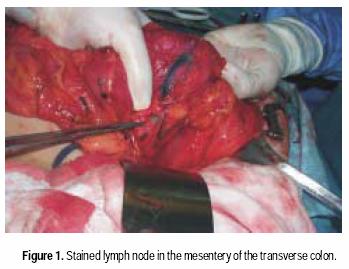
<body><![CDATA[<p align="justify"><font face="verdana" size="2">&nbsp;</font></p>     <p align="justify"><font face="verdana" size="2"><b><i>RESUMEN</i></b></font></p>     <p align="justify"><font face="verdana" size="2"><i>Introducci&oacute;n. </i><i>A pesar que la t&eacute;cnica de biopsia del ganglio centinela es el est&aacute;ndar de oro en el manejo del melanoma maligno y que gradualmente est&aacute; reemplazando la disecci&oacute;n axilar convencional en el c&aacute;ncer mamario, existe controversia en el uso de esta t&eacute;cnica en c&aacute;ncer colorrectal. El objetivo de este estudio es demostrar la factibilidad y seguridad de la t&eacute;cnica del ganglio centinela en el manejo del carcinoma colorrectal.</i></font></p>     <p align="justify"><font face="verdana" size="2"><i>M&eacute;todos. Pacientes consecutivos con diagn&oacute;stico de carcinoma colorrectal sin evidencia preoperatoria de met&aacute;stasis ganglionares o distantes fueron incluidos en el estudio. Se realiz&oacute; inyecci&oacute;n subserosa intraoperatoria de 1 mL de azul de isosulf&aacute;n (Lymphazurin &reg;) alrededor del tumor en los casos de c&aacute;ncer col&oacute;nico e infiltraci&oacute;n </i>ex vivo <i>fue empleada en casos de c&aacute;ncer rectal una vez finalizada la resecci&oacute;n. Los ganglios te&ntilde;idos de color azul fueron disecados y enviados para examen rutinario de patolog&iacute;a. Si los ganglios eran negativos para neoplasia se estudiaban mediante inmunohistoqu&iacute;mica para citoqueratinas. Los ganglios no te&ntilde;idos fueron resecados y procesados de manera rutinaria. Se calcularon la sensibilidad y el valor predictivo negativo y se registraron los efectos nocivos del colorante azul.</i></font></p>     <p align="justify"><font face="verdana" size="2"><i>Resultados. Se incluyeron diez pacientes, encontr&aacute;ndose por lo menos un ganglio centinela en cada uno de ellos. El promedio de ganglios centinela y no&#150;centinela identificados por paciente fue de 2.5 y 15.6, respectivamente. Tanto la sensibilidad como el valor predictivo negativo del ganglio centinela despu&eacute;s de la tinci&oacute;n con inmunohistoqu&iacute;mica fueron del 100%. No se registraron efectos adversos causados por el colorante.</i></font></p>     <p align="justify"><font face="verdana" size="2"><i>Conclusiones. El uso de la t&eacute;cnica de biopsia del ganglio centinela en c&aacute;ncer colorrectal es factible, tiene alta exactitud diagn&oacute;stica y es inocua.</i></font></p>     <p align="justify"><font face="verdana" size="2"><b><i>Palabras clave. </i></b><i>Ganglio centinela. C&aacute;ncer de colon. C&aacute;ncer de recto.</i></font></p>     <p align="justify"><font face="verdana" size="2">&nbsp;</font></p>     <p align="justify"><font face="verdana" size="2">The presence of lymph node metastasis is recognized as the single most important prognostic factor in colorectal cancer (CRC). Besides its importance in determining prognosis, the lymph node status is also used as the primary indicator of systemic disease spread and the rationale for postoperative adjuvant chemotherapy.<sup>1&#150;3</sup> Still, approximately 30% of patients diagnosed with early CRC (Stages I or II of the American Joint Committee on Cancer &#150;AJCC&#150;) develop systemic disease. This implies that the subgroup of patients with early CRC harbors minimal but significant amount of occult disease that is not detected by current techniques. Ultrastaging techniques such as multiple level sectioning, immunohistochemical staining, and polymerase chain reaction assays demonstrate the presence of lymph node micrometastases in a significant proportion of patients whose nodes are negative by routine hematoxylin and eosin staining.<sup>4&#150;</sup><sup>6</sup> Although the etiology of recurrence in these patients is likely to be multifactorial, several retrospective studies have established a poorer prognosis in those patients harboring nodal micrometastasis demonstrated by microstaging techniques.<sup>4,5</sup> Because ultrastaging techniques are labor intensive and expensive, it has been proposed to focus the efforts to the sentinel lymph node. The sentinel lymph node is the first node to receive the lymphatic drainage of a certain region, and its role in melanoma and breast cancer is well defined.<sup>7</sup></font></p>     <p align="justify"><font face="verdana" size="2">In addition, proximally situated locoregional lymph nodes metastases or involvement of the apical node are associated with poorer prognosis.<sup>8,9</sup> Similarly with melanoma<sup>10</sup> and breast cancer,<sup>11</sup> there has been no strong evidence that extended lymph node dissection in rectal cancer has any impact on survival or local recurrence,<sup>12,13</sup> therefore suggesting that lymph node metastasis are indicators of systemic disease rather than governors of survival.<sup>14</sup> However, it is important to be able to stage the disease accurately to define those who may benefit from adjuvant therapy.<sup>15</sup> Thus, in CRC, lymphatic mapping and the sentinel node technique are used to improve staging by means of focused pathologic ultrastaging examination of the sentinel nodes (the lymph nodes most likely to contain the earliest metastases) and to identify lymphatic routes outside the usual lymphatic drainage encompassed in routine lymphadenectomy.</font></p>     ]]></body>
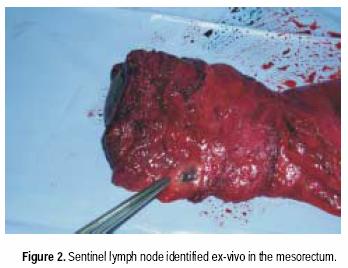
<body><![CDATA[<p align="justify"><font face="verdana" size="2">The objective of the present study was to establish the feasibility and safety of the sentinel lymph node biopsy technique in CRC and to determine its diagnostic accuracy.</font></p>     <p align="justify"><font face="verdana" size="2">&nbsp;</font></p>     <p align="justify"><font face="verdana" size="2"><b>METHODS</b></font></p>     <p align="justify"><font face="verdana" size="2">Between August 2001 and April 2002, consecutive patients undergoing resection for clinically localized CRC at the Instituto Nacional de Ciencias M&eacute;dicas y Nutrici&oacute;n Salvador Zubir&aacute;n in Mexico City, were enrolled in a prospective study of sentinel node mapping. Informed consent was obtained preoperatively from all patients. All patients were staged before surgery with chest X ray, routine lab measures and CT scan of the abdomen and pelvis. Patients with metastatic disease were not included in the study. All patients were approached via conventional open colon or rectal resection techniques. Laparotomy and routine operative exploration of the abdomen were performed. Patients with evidence of metastatic disease or enlarged lymph nodes suggestive of metastatic involvement were not included in the present study. After this evaluation and once resectability was determined, the involved segment of the colon was mobilized. One milliliter of isosulfan blue (Lymphazurin &reg;, US Surgical Corp, Ben Venue Laboratories, Inc., Bedford, Ohio) was carefully injected subserosally into four quadrants around the periphery of the tumor using a tubeculin syringe. The dye traveled from the injection site along the lymphatic vessels to the sentinel lymph node(s) typically within five minutes (<a href="#f1">Figure 1</a>). Each blue stained node was carefully dissected and sent to pathology lab as sentinel lymph node. After this maneuver, colectomy was performed in the standard fashion, including all nodes in the mesenteric resection specimen. The specimen was submitted for pathologic analysis.</font></p>     <p align="center"><font face="verdana" size="2"><a name="f1"></a></font></p>     <p align="center"><font face="verdana" size="2"><img src="/img/revistas/ric/v57n1/a6f1.jpg"></font></p>     <p align="justify"><font face="verdana" size="2">For rectal cancer cases, laparotomy and routine exploration was performed. Rectal resection with total mesorectal excision was routinely performed in all cancers 10 cm or less from the anal verge. After resection of surgical specimen, lymphatic mapping was performed with the specimen <i>ex vivo, </i>modifying the technique described by Wong <i>et al.</i><sup>16</sup> Within 30 minutes of resection, using a tuberculin syringe, four separate subserosal injections of 0.25 cc isosulfan blue (Lymphazurin &reg;), were performed in four quadrants around the tumor. The injection sites were gently massaged for approximately 2 to 5 minutes. The mesentery was then examined by gently incising the overlying endorectal fascia, the mesenteric fat was bluntly separated, and using a meticulous blunt dissection, blue lymphatic channels were identified and subsequently traced though adipose tissue of the mesentery to a blue&#150;stained lymph node (<a href="#f2">Figure 2</a>). These blue&#150;stained nodes were then individually harvested and submitted for histologic examination.</font></p>     <p align="center"><font face="verdana" size="2"><a name="f2"></a></font></p>     <p align="center"><font face="verdana" size="2"><img src="/img/revistas/ric/v57n1/a6f2.jpg"></font></p>     <p align="justify"><font face="verdana" size="2">Pathologic analysis entailed routine microscopic analysis of the tumor, margins, and all lymph nodes with hematoxylin and eosin staining. Lymph nodes were manually dissected from the mesenteric fat. All nodes identified were dissected, and a single section was examined with hematoxylin and eosin staining. If results were negative, each sentinel node was examined by a focused technique originally developed for the examination of sentinel lymph nodes draining primary breast carcinomas.<sup>17</sup> The pathologist sectioned each sentinel node in slices no thicker than 2 to 3 mm. One section for each level was stained with hematoxylin and eosin and another with cytokeratin immunohistochemistry. Immunohistochemical stains were interpreted according to strict criteria that required strong immunoreactivity combined with microanatomic and cytologic features compatible with CRC. A false negative sentinel node was defined as sentinel node that contained no tumor cells when one or more non&#150;sentinel nodes in the specimen were positive for tumor. Sensitivity, and negative predictive value of the sentinel node technique were calculated and adverse reaction to isosulfan blue were carefully recorded.</font></p>     ]]></body>
<body><![CDATA[<p align="justify"><font face="verdana" size="2">&nbsp;</font></p>     <p align="justify"><font face="verdana" size="2"><b>RESULTS</b></font></p>     <p align="justify"><font face="verdana" size="2">The study group consisted of 10 patients: 3 male and 7 female, whose average age was 69 years (range 42 to 90 years). Primary tumors were in the right colon (n =5), transverse colon (n = 1), left colon (n = 1), or rectum (n =3). According to Dukes' staging, one patient presented with stage A, 3 patients B1 and 6 patients B2 (one Tl, 3 T2 and 6 T3, according to the AJCC criteria). Two cases were classified as undifferentiated tumors and four cases each were moderately or well differentiated tumors. All colon cases were done with an <i>in vivo </i>technique and rectal cancers with <i>ex vivo </i>technique.</font></p>     <p align="justify"><font face="verdana" size="2">Lymphatic mapping successfully demonstrated at least one sentinel lymph node in all cases (100%). An average of 2.5 sentinel lymph nodes were identified in each case (range 1 to 7), and the average number of non&#150;sentinel nodes harvested from each CRC specimen was 15.6 (range 5 to 42). The total number of examined nodes was 181 and 25 (13.8%) were considered sentinel nodes. In all cases, the sentinel node was near the primary tumor or in the expected field of routine lymphadenectomy. We did not identify aberrant lymphatic drainage in any case.</font></p>     <p align="justify"><font face="verdana" size="2">Identified sentinel lymph nodes accurately reflected the status of the nodal basin after immunohisto&#150;chemical staining in 10 of 10 patients (100%). There was one rectal case, in whom the sentinel node was reported as H&amp;E negative and two non&#150;sentinel nodes were reported with metastatic disease. After IHC staining, micrometastasis in the sentinel node was identified. One additional right colon cancer, with all nodes negative for metastatic disease by H&amp;E including sentinel lymph node, after IHC staining, was found to have micrometastasis in the sentinel node. Overall, 3 out of 10 patients had metastatic disease by H&amp;E and one additional patient was found to have micrometastatic disease in the sentinel node. In summary, the sensitivity and negative predictive value of the sentinel node after IHC staining were both 100%. There were no adverse reactions reported due to isosulfan blue injection in any case. The only symptom reported in all <i>in vivo </i>cases were the presence of green urine 24 to 36 hours after the surgical procedure.</font></p>     <p align="justify"><font face="verdana" size="2">&nbsp;</font></p>     <p align="justify"><font face="verdana" size="2"><b>DISCUSSION</b></font></p>     <p align="justify"><font face="verdana" size="2">Standard pathologic methods of harvesting and studying lymph nodes from the resected colon specimens vary from one institution to another. Sampling error may lead to understaging and can occur when informative lymph nodes are not harvested from examination. Special harvesting methods may reveal small nodes that are often missed; these small occult nodes can frequently contain metastatic deposits.<sup>18</sup> Additionally, routine histologic lymph node examination techniques may also lead to understaging. Routinely, lymph nodes are bisected and only one or two sections are examined by hematoxylin and eosin staining, leaving more than 90% of the node unexamined. However, special pathologic examination of multiple section of the numerous lymph nodes revealed by these special techniques is expensive and time consuming. A method to select the ultrastaging examination of the lymph nodes most likely to harbor the earliest evidence of metastasis is desirable from both a logistical and economic standpoint. Application of lymphatic mapping and the sentinel lymph node technique facilitates such a focused pathologic examination. Unlike in melanoma and breast cancer, the application of sentinel lymph node technique in CRC is not intended to limit unnecessary lymphadenectomy. Actually, some authors have reported than in small number of patients, the presence of aberrant lymphatic drainage, lead them to perform more aggressive resection, encompassing in the lymphadenectomy field, areas not routinely included in the dissection.<sup>19</sup> In our study we did not find any case of aberrant lymphatic drainage.</font></p>     <p align="justify"><font face="verdana" size="2">Our study agree with others, regarding the high rate of lymph node identification in CRC,<sup>16,19,</sup><sup>20</sup> whereas the reported rates of sentinel node identification varies from 88 to 100%. Most authors concur that sentinel nodes are more difficult to identify in rectal cancers,<sup>19</sup> so <i>ex&#150;vivo </i>techniques used in the present study as previously described,<sup>16</sup> have proved to improve the rate of sentinel node identification in these cases. The accuracy of the sentinel node technique in CRC has varied from 100% in our present paper, 95% in a large study by Wood <i>et al., </i><sup>19</sup> and a false negative rate of 45% in a small study by Merrie <i>et al.</i><sup>20</sup><i>. </i>One recently published study using combination of probe and dye&#150;directed lymphatic mapping in early CRC reported an accuracy of 93.8% in 49 patients.<sup>21</sup></font></p>     <p align="justify"><font face="verdana" size="2">Preliminary studies have demonstrated the prognostic significance of the molecular detection of tumor DNA or RNA in the blood or bone marrow of patients with colon cancer.<sup>22,23</sup> Other investigators have hypothesized that molecular tumor genoty&#150;ping will someday provide important prognostic and clinically useful information.<sup>24</sup> Although these technologically advanced and specialized assays are likely to be extremely informative in the future, currently they are not generally available and reproducible in a clinical setting. At present, lymph node status remains the single most important and practical prognostic factor in CRC.</font></p>     ]]></body>
<body><![CDATA[<p align="justify"><font face="verdana" size="2">Although the prognostic importance of nodal status by routine hematoxylin and eosin staging has been proved, the prognostic significance of nodal micrometastatic disease remains unclear. Whereas a number of small retrospective studies have failed to demonstrate a difference in survival between those with micrometastatic disease and those with node&#150;negative disease<sup>25,26</sup> other similarly small studies have demonstrated a significant survival advantage in those patients without evidence of micrometastatic disease.<sup>45</sup> In our study we detected one patient with lymph node metastases detected only by immunohistochemical staining for cytokeratins. A prospective trial including a standardized focused examination of the sentinel lymph node seems to be the method most likely to separate accurately those with early metastatic disease from those who are truly node negative, and to determine the prognostic value of nodal micrometastasis in CRC.</font></p>     <p align="justify"><font face="verdana" size="2">Although a significant proportion of patients with early&#150;stage (AJCC stage I or II) CRC develop systemic disease, treatment of this group of patients with chemotherapy is currently controversial. To date, no prospective randomized trial has specifically addressed whether chemotherapy provides a survival advantage over surgery alone in stage I or stage II colon cancer. Two published meta&#150;analyses have attempted to provide insight into this question by pooling patients with Dukes' stage B colon cancer from available adjuvant therapy trials. In the United States, the National Surgical Adjuvant (NSABP) analyzed patients with Dukes' B colon cancer included in its C&#150;01, C&#150;02, C&#150;03, and C&#150;04.<sup>27</sup> The group concluded that patients with Dukes' B colon cancer who are treated with chemotherapy seemed to benefit and that chemotherapy should be routinely considered in these patients. Besides the inherent weakness of this study as a meta&#150;analysis, it has also been criticized because none of its four trial investigated the standard adjuvant regimen of 5&#150;fluoruracil/leucovorin <i>versus </i>surgery alone. A separate international multicenter group published the result of a meta&#150;analysis (IMPACT B&#150;2) that specifically pooled patients with Dukes' B2 colon cancer from five separate trials in which the standard treatment was used.<sup>28</sup> This study found no improvement in event&#150;free or overall survival with adjuvant therapy. Thus, the clinical benefit of adjuvant chemotherapy in early&#150;stage CRC remains unclear.</font></p>     <p align="justify"><font face="verdana" size="2">It is likely that certain subgroup of patients with early&#150;stage CRC might indeed benefit from adjuvant therapy. In the future, certain phenotypic and genotypic/molecular characteristics of the primary tumor and lymph nodes might provide a mean to stratify patient risk of recurrence after resection of early&#150;stage CRC. Currently, the sentinel node technique seems to be the best way to identify the group of patients with early metastatic disease.</font></p>     <p align="justify"><font face="verdana" size="2">In conclusion, sentinel lymph node mapping can be performed in carcinoma of the colon and rectum safely and with great degree of success. Although the sentinel node technique in CRC is not intended to minimize the extent or morbidity of lymphadenectomy as in melanoma or breast cancer, it facilitates a focused pathologic examination of the lymph nodes most likely to harbor early metastases, the sentinel nodes. There is a need to determine the prognostic significance of nodal micrometastases in colorectal carcinoma.</font></p>     <p align="justify"><font face="verdana" size="2">&nbsp;</font></p>     <p align="justify"><font face="verdana" size="2"><b>REFERENCES</b></font></p>     <!-- ref --><p align="justify"><font face="verdana" size="2">1. Fielding LP, Phillips RK, Fry JS, Hittinger R. Prediction of outcome  after  curative  resection for  large  bowel  cancer. <i>Lancet </i>1986;  2:  904&#150;7.</font>&nbsp;&nbsp;&nbsp;&nbsp;&nbsp;&nbsp;&nbsp;&nbsp;[&#160;<a href="javascript:void(0);" onclick="javascript: window.open('/scielo.php?script=sci_nlinks&ref=6752579&pid=S0034-8376200500010000600001&lng=','','width=640,height=500,resizable=yes,scrollbars=1,menubar=yes,');">Links</a>&#160;]<!-- end-ref --><!-- ref --><p align="justify"><font face="verdana" size="2">2. Cohen  AM,   Tremiterra  S,   Candela  F,   Thaler  HT,   Sigurdson ER.    Prognosis    of   node&#150;positive    colorectal   cancer. <i>Cancer </i>1991;  67:   1859&#150;61.</font>&nbsp;&nbsp;&nbsp;&nbsp;&nbsp;&nbsp;&nbsp;&nbsp;[&#160;<a href="javascript:void(0);" onclick="javascript: window.open('/scielo.php?script=sci_nlinks&ref=6752580&pid=S0034-8376200500010000600002&lng=','','width=640,height=500,resizable=yes,scrollbars=1,menubar=yes,');">Links</a>&#160;]<!-- end-ref --><!-- ref --><p align="justify"><font face="verdana" size="2">3. Malassagne B, Valleur P, Serra J, et al. Relationship of apycal node involvement to survival in resected colon carcinoma. <i>Dis Colon Rectum  </i>1993; 36: 645&#150;53.</font>&nbsp;&nbsp;&nbsp;&nbsp;&nbsp;&nbsp;&nbsp;&nbsp;[&#160;<a href="javascript:void(0);" onclick="javascript: window.open('/scielo.php?script=sci_nlinks&ref=6752581&pid=S0034-8376200500010000600003&lng=','','width=640,height=500,resizable=yes,scrollbars=1,menubar=yes,');">Links</a>&#160;]<!-- end-ref --><!-- ref --><p align="justify"><font face="verdana" size="2">4. Hayashi N, Ito I, Yanagisawa A, Kato Y, Nakamori S, Imaoka S, Watanabe H, Ogawa N, Nakamura Y. Genetic diagnosis of lymphnode metastasis in colorectal cancer. <i>Lancet </i>1995; 345:  1257&#150;9.</font>&nbsp;&nbsp;&nbsp;&nbsp;&nbsp;&nbsp;&nbsp;&nbsp;[&#160;<a href="javascript:void(0);" onclick="javascript: window.open('/scielo.php?script=sci_nlinks&ref=6752582&pid=S0034-8376200500010000600004&lng=','','width=640,height=500,resizable=yes,scrollbars=1,menubar=yes,');">Links</a>&#160;]<!-- end-ref --><!-- ref --><p align="justify"><font face="verdana" size="2">5. Liefers GJ, Cleton&#150;Jansen AM, Van de Velde CJ, Hermans J, Van Krieken JH, Cornelisse CJ, Tollenaar RA. Micrometastasses and survival in stage II colorectal cancer. <i>N Engl J Med </i>1998;    339:223&#150;8.</font>&nbsp;&nbsp;&nbsp;&nbsp;&nbsp;&nbsp;&nbsp;&nbsp;[&#160;<a href="javascript:void(0);" onclick="javascript: window.open('/scielo.php?script=sci_nlinks&ref=6752583&pid=S0034-8376200500010000600005&lng=','','width=640,height=500,resizable=yes,scrollbars=1,menubar=yes,');">Links</a>&#160;]<!-- end-ref --><!-- ref --><p align="justify"><font face="verdana" size="2">6. Calaluce R, Miedema BW, Yesus YW. Micrometastasis in colorectal carcinoma: a review. <i>J Surg Oncol </i>1998; 67:  194&#150;202.</font>&nbsp;&nbsp;&nbsp;&nbsp;&nbsp;&nbsp;&nbsp;&nbsp;[&#160;<a href="javascript:void(0);" onclick="javascript: window.open('/scielo.php?script=sci_nlinks&ref=6752584&pid=S0034-8376200500010000600006&lng=','','width=640,height=500,resizable=yes,scrollbars=1,menubar=yes,');">Links</a>&#160;]<!-- end-ref --><!-- ref --><p align="justify"><font face="verdana" size="2">7. Krag ND.  Minimal access surgery for staging regional lymph nodes:  the  sentinel node  concept. <i>Curr Prob Surg   </i>1998;  35: 953&#150;1017.</font>&nbsp;&nbsp;&nbsp;&nbsp;&nbsp;&nbsp;&nbsp;&nbsp;[&#160;<a href="javascript:void(0);" onclick="javascript: window.open('/scielo.php?script=sci_nlinks&ref=6752585&pid=S0034-8376200500010000600007&lng=','','width=640,height=500,resizable=yes,scrollbars=1,menubar=yes,');">Links</a>&#160;]<!-- end-ref --><!-- ref --><p align="justify"><font face="verdana" size="2">8. Shida H, Ban K, Matsumoto M, et al.  Prognostic significance of location of lymph node metastases in colorectal cancer. <i>Dis Colon Rectum  </i>1992; 35:   1046&#150;50.</font>&nbsp;&nbsp;&nbsp;&nbsp;&nbsp;&nbsp;&nbsp;&nbsp;[&#160;<a href="javascript:void(0);" onclick="javascript: window.open('/scielo.php?script=sci_nlinks&ref=6752586&pid=S0034-8376200500010000600008&lng=','','width=640,height=500,resizable=yes,scrollbars=1,menubar=yes,');">Links</a>&#160;]<!-- end-ref --><!-- ref --><p align="justify"><font face="verdana" size="2">9. Tang R,  Wang JY,  Chen JS, et al.  Survival impact of lymph node metastasis in TNM stage III carcinoma of the colon and rectum. <i>J Am Coll Surg </i>1995;  180: 705&#150;12.</font>&nbsp;&nbsp;&nbsp;&nbsp;&nbsp;&nbsp;&nbsp;&nbsp;[&#160;<a href="javascript:void(0);" onclick="javascript: window.open('/scielo.php?script=sci_nlinks&ref=6752587&pid=S0034-8376200500010000600009&lng=','','width=640,height=500,resizable=yes,scrollbars=1,menubar=yes,');">Links</a>&#160;]<!-- end-ref --><!-- ref --><p align="justify"><font face="verdana" size="2">10. Balch CM, Soong SJ, Bartolucci AA, et al. Efficacy of an elective lymph node dissection of 1 to 4 mm thick melanomas for patients  60  years  of age  and younger. <i>Ann Surg   </i>1996;  224: 255&#150;66.</font>&nbsp;&nbsp;&nbsp;&nbsp;&nbsp;&nbsp;&nbsp;&nbsp;[&#160;<a href="javascript:void(0);" onclick="javascript: window.open('/scielo.php?script=sci_nlinks&ref=6752588&pid=S0034-8376200500010000600010&lng=','','width=640,height=500,resizable=yes,scrollbars=1,menubar=yes,');">Links</a>&#160;]<!-- end-ref --><!-- ref --><p align="justify"><font face="verdana" size="2">11. Greco M, Agresti R, Raselli R, Giovanazzi R, Veronesi U. Axillary dissection can be  avoided  in selected breast cancer patients:  analysis of 401  cases. <i>Anticancer Res  </i>1996;   16:  3913&#150;17.</font>&nbsp;&nbsp;&nbsp;&nbsp;&nbsp;&nbsp;&nbsp;&nbsp;[&#160;<a href="javascript:void(0);" onclick="javascript: window.open('/scielo.php?script=sci_nlinks&ref=6752589&pid=S0034-8376200500010000600011&lng=','','width=640,height=500,resizable=yes,scrollbars=1,menubar=yes,');">Links</a>&#160;]<!-- end-ref --><!-- ref --><p align="justify"><font face="verdana" size="2">12. Pezin ME, Nicholls RJ.  Survival after high or low ligation of the inferior mesenteric artery during curative surgery for rectal cancer. <i>Ann Surg </i>1984; 200:  729&#150;33.</font>&nbsp;&nbsp;&nbsp;&nbsp;&nbsp;&nbsp;&nbsp;&nbsp;[&#160;<a href="javascript:void(0);" onclick="javascript: window.open('/scielo.php?script=sci_nlinks&ref=6752590&pid=S0034-8376200500010000600012&lng=','','width=640,height=500,resizable=yes,scrollbars=1,menubar=yes,');">Links</a>&#160;]<!-- end-ref --><!-- ref --><p align="justify"><font face="verdana" size="2">13. Surtees P, Ritchie JK, Phillips RK. High versus low ligation of the inferior mesenteric artery in rectal cancer. <i>Br J Surg </i>1990; 77:   618&#150;21.</font>&nbsp;&nbsp;&nbsp;&nbsp;&nbsp;&nbsp;&nbsp;&nbsp;[&#160;<a href="javascript:void(0);" onclick="javascript: window.open('/scielo.php?script=sci_nlinks&ref=6752591&pid=S0034-8376200500010000600013&lng=','','width=640,height=500,resizable=yes,scrollbars=1,menubar=yes,');">Links</a>&#160;]<!-- end-ref --><!-- ref --><p align="justify"><font face="verdana" size="2">14. Cady B. Lymph node metastases. Indicators, but not governors of survival. <i>Arch Surg </i>1984;  119:  1067&#150;72.</font>&nbsp;&nbsp;&nbsp;&nbsp;&nbsp;&nbsp;&nbsp;&nbsp;[&#160;<a href="javascript:void(0);" onclick="javascript: window.open('/scielo.php?script=sci_nlinks&ref=6752592&pid=S0034-8376200500010000600014&lng=','','width=640,height=500,resizable=yes,scrollbars=1,menubar=yes,');">Links</a>&#160;]<!-- end-ref --><!-- ref --><p align="justify"><font face="verdana" size="2">15. NIH Consensus Conference. Adjuvant therapy for patient with colon and rectal cancer. <i>JAMA  </i>1990; 264:  1444&#150;50.</font>&nbsp;&nbsp;&nbsp;&nbsp;&nbsp;&nbsp;&nbsp;&nbsp;[&#160;<a href="javascript:void(0);" onclick="javascript: window.open('/scielo.php?script=sci_nlinks&ref=6752593&pid=S0034-8376200500010000600015&lng=','','width=640,height=500,resizable=yes,scrollbars=1,menubar=yes,');">Links</a>&#160;]<!-- end-ref --><!-- ref --><p align="justify"><font face="verdana" size="2">16. Wong JA, Steinman S, Calderia C, Bowies J, Namiki T. <i>Ex vivo </i>sentinel node mapping in carcinoma of the colon and rectum. <i>Ann Surg </i>2001; 233:  515&#150;21.</font>&nbsp;&nbsp;&nbsp;&nbsp;&nbsp;&nbsp;&nbsp;&nbsp;[&#160;<a href="javascript:void(0);" onclick="javascript: window.open('/scielo.php?script=sci_nlinks&ref=6752594&pid=S0034-8376200500010000600016&lng=','','width=640,height=500,resizable=yes,scrollbars=1,menubar=yes,');">Links</a>&#160;]<!-- end-ref --><!-- ref --><p align="justify"><font face="verdana" size="2">17. Turner RR, Ollila DW, Stern S, Giuliano AE. Optimal histopathologic examination of the sentinel node for breast cancer staging. <i>Am J Surg Pathol </i>1999; 23: 263&#150;7.</font>&nbsp;&nbsp;&nbsp;&nbsp;&nbsp;&nbsp;&nbsp;&nbsp;[&#160;<a href="javascript:void(0);" onclick="javascript: window.open('/scielo.php?script=sci_nlinks&ref=6752595&pid=S0034-8376200500010000600017&lng=','','width=640,height=500,resizable=yes,scrollbars=1,menubar=yes,');">Links</a>&#160;]<!-- end-ref --><!-- ref --><p align="justify"><font face="verdana" size="2">18. Koren R, Siegal A, Klein B, Halpern M, Kyzer S, Veltman V, Gal R.  Lymph node&#150;reveling solution:  simple new method for detecting minute  lymph nodes in colon carcinoma. <i>Dis Colon Rectum  </i>1997;  40:  407&#150;10.</font>&nbsp;&nbsp;&nbsp;&nbsp;&nbsp;&nbsp;&nbsp;&nbsp;[&#160;<a href="javascript:void(0);" onclick="javascript: window.open('/scielo.php?script=sci_nlinks&ref=6752596&pid=S0034-8376200500010000600018&lng=','','width=640,height=500,resizable=yes,scrollbars=1,menubar=yes,');">Links</a>&#160;]<!-- end-ref --><!-- ref --><p align="justify"><font face="verdana" size="2">19. Wood TF, Nora DT, Morton DL, Turner RR, Rangel D, Hutchinson W, Bilchik AJ. One hundred consecutive cases of sentinel  lymph node mapping in  early  colorectal  carcinoma:  detection of missed micrometastasis. <i>J Gastrointest Surg </i>2002; 6: 322&#150;30.</font>&nbsp;&nbsp;&nbsp;&nbsp;&nbsp;&nbsp;&nbsp;&nbsp;[&#160;<a href="javascript:void(0);" onclick="javascript: window.open('/scielo.php?script=sci_nlinks&ref=6752597&pid=S0034-8376200500010000600019&lng=','','width=640,height=500,resizable=yes,scrollbars=1,menubar=yes,');">Links</a>&#160;]<!-- end-ref --><!-- ref --><p align="justify"><font face="verdana" size="2">20. Merrie AEH, Van Rij AM, Phillips LV, Rossaak JI, Yun K, Mc&#150;Call JL.  Diagnostic use of the sentinel node in colon cancer. <i>Dis Colon Rectum </i>2001; 44: 410&#150;7.</font>&nbsp;&nbsp;&nbsp;&nbsp;&nbsp;&nbsp;&nbsp;&nbsp;[&#160;<a href="javascript:void(0);" onclick="javascript: window.open('/scielo.php?script=sci_nlinks&ref=6752598&pid=S0034-8376200500010000600020&lng=','','width=640,height=500,resizable=yes,scrollbars=1,menubar=yes,');">Links</a>&#160;]<!-- end-ref --><!-- ref --><p align="justify"><font face="verdana" size="2">21. Trocha SD, Nora DT, Saha SS, Morton DL, Wiese D, Bilchik AJ.   Combination  probe   and  dye&#150;directed   lymphatic  mapping detects micrometastases in early colorectal cancer. <i>J Gastrointest Surg </i>2003; 7: 340&#150;6.</font>&nbsp;&nbsp;&nbsp;&nbsp;&nbsp;&nbsp;&nbsp;&nbsp;[&#160;<a href="javascript:void(0);" onclick="javascript: window.open('/scielo.php?script=sci_nlinks&ref=6752599&pid=S0034-8376200500010000600021&lng=','','width=640,height=500,resizable=yes,scrollbars=1,menubar=yes,');">Links</a>&#160;]<!-- end-ref --><!-- ref --><p align="justify"><font face="verdana" size="2">22. Mori M, Mimori K, Ueo H, Tsuji K, Shiraishi T, Barnard GF, Sugimachi  K,  Akiyoshi  T.   Clinical  significance  of molecular detection  of carcinoma  cells   in  lymph  nodes   and  peripheral blood   by   reverse   transcription&#150;polymerase   chain   reaction   in patients with gastrointestinal or breast carcinomas. <i>J Clin Oncol </i>1998;   16:   128&#150;32.</font>&nbsp;&nbsp;&nbsp;&nbsp;&nbsp;&nbsp;&nbsp;&nbsp;[&#160;<a href="javascript:void(0);" onclick="javascript: window.open('/scielo.php?script=sci_nlinks&ref=6752600&pid=S0034-8376200500010000600022&lng=','','width=640,height=500,resizable=yes,scrollbars=1,menubar=yes,');">Links</a>&#160;]<!-- end-ref --><!-- ref --><p align="justify"><font face="verdana" size="2">23. Yamaguchi K, Takagi Y, Aoki S, Futamura M, Saji S. Significant detection of circulating cancer cells  in blood by reverse transcriptase&#150;polymerase  chain reaction  during  colorectal  cancer resection. <i>Ann Surg </i>2000; 232: 58&#150;65.</font>&nbsp;&nbsp;&nbsp;&nbsp;&nbsp;&nbsp;&nbsp;&nbsp;[&#160;<a href="javascript:void(0);" onclick="javascript: window.open('/scielo.php?script=sci_nlinks&ref=6752601&pid=S0034-8376200500010000600023&lng=','','width=640,height=500,resizable=yes,scrollbars=1,menubar=yes,');">Links</a>&#160;]<!-- end-ref --><!-- ref --><p align="justify"><font face="verdana" size="2">24. Ellis LM. A perspective on sentinel lymph node biopsy in colorectal cancer: The race between surgical technology and molecular oncology. <i>Ann Surg Oncol </i>2000; 7: 475&#150;6.</font>&nbsp;&nbsp;&nbsp;&nbsp;&nbsp;&nbsp;&nbsp;&nbsp;[&#160;<a href="javascript:void(0);" onclick="javascript: window.open('/scielo.php?script=sci_nlinks&ref=6752602&pid=S0034-8376200500010000600024&lng=','','width=640,height=500,resizable=yes,scrollbars=1,menubar=yes,');">Links</a>&#160;]<!-- end-ref --><!-- ref --><p align="justify"><font face="verdana" size="2">25. Cutait R, lves VA, Lopes LC, Cutait DE, Borges JL, Singer J, Da Silva JH, Goffi FS. Restaging of colorectal cancer based on the  identification of lymph node micrometastases through immunoperoxidase staining of CEA and cytokeratins. <i>Dis Colon Rectum  </i>1991;  34:  917&#150;20.</font>&nbsp;&nbsp;&nbsp;&nbsp;&nbsp;&nbsp;&nbsp;&nbsp;[&#160;<a href="javascript:void(0);" onclick="javascript: window.open('/scielo.php?script=sci_nlinks&ref=6752603&pid=S0034-8376200500010000600025&lng=','','width=640,height=500,resizable=yes,scrollbars=1,menubar=yes,');">Links</a>&#160;]<!-- end-ref --><!-- ref --><p align="justify"><font face="verdana" size="2">26. Jeffers MD, O'Dowd GM, Mulcahy H, Stagg M, O'Donoghue DP,   Toner  M.   The   prognostic   significance   of  immunohisto&#150;chemically detected lymph node micrometastases in colorectal carcinoma. <i>J Pathol </i>1994;  172:  183&#150;7.</font>&nbsp;&nbsp;&nbsp;&nbsp;&nbsp;&nbsp;&nbsp;&nbsp;[&#160;<a href="javascript:void(0);" onclick="javascript: window.open('/scielo.php?script=sci_nlinks&ref=6752604&pid=S0034-8376200500010000600026&lng=','','width=640,height=500,resizable=yes,scrollbars=1,menubar=yes,');">Links</a>&#160;]<!-- end-ref --><!-- ref --><p align="justify"><font face="verdana" size="2">27. Mamounas  E,  Wieand  S,  Wolmark N,  Bear  HD,  Atkins  JN, Song K, Jones J, Rockette H. Comparative efficacy of adjuvant chemotherapy in patients with Duke's B versus Duke's C colon cancer:   Results  from  four National  Surgical  Adjuvant  Breast and Bowel Project adjuvant studies (C&#150;01, C&#150;02, C&#150;03, and C&#150;04). <i>J Clin Oncol </i>1999;  17:  1349&#150;55.</font>&nbsp;&nbsp;&nbsp;&nbsp;&nbsp;&nbsp;&nbsp;&nbsp;[&#160;<a href="javascript:void(0);" onclick="javascript: window.open('/scielo.php?script=sci_nlinks&ref=6752605&pid=S0034-8376200500010000600027&lng=','','width=640,height=500,resizable=yes,scrollbars=1,menubar=yes,');">Links</a>&#160;]<!-- end-ref --><!-- ref --><p align="justify"><font face="verdana" size="2">28. International Multicentre Pooled Analysis of B2 Colon Cancer Trials (IMPACT B2) Investigators. Efficacy of adjuvant fluoruracil and folinic acid in B2 colon cancer. <i>J Clin Oncol </i>1999; 17:    1356&#150;63.</font>&nbsp;&nbsp;&nbsp;&nbsp;&nbsp;&nbsp;&nbsp;&nbsp;[&#160;<a href="javascript:void(0);" onclick="javascript: window.open('/scielo.php?script=sci_nlinks&ref=6752606&pid=S0034-8376200500010000600028&lng=','','width=640,height=500,resizable=yes,scrollbars=1,menubar=yes,');">Links</a>&#160;]<!-- end-ref --> ]]></body><back>
<ref-list>
<ref id="B1">
<nlm-citation citation-type="journal">
<person-group person-group-type="author">
<name>
<surname><![CDATA[Fielding]]></surname>
<given-names><![CDATA[LP]]></given-names>
</name>
<name>
<surname><![CDATA[Phillips]]></surname>
<given-names><![CDATA[RK]]></given-names>
</name>
<name>
<surname><![CDATA[Fry]]></surname>
<given-names><![CDATA[JS]]></given-names>
</name>
<name>
<surname><![CDATA[Hittinger]]></surname>
<given-names><![CDATA[R]]></given-names>
</name>
</person-group>
<article-title xml:lang="en"><![CDATA[Prediction of outcome after curative resection for large bowel cancer]]></article-title>
<source><![CDATA[Lancet]]></source>
<year>1986</year>
<numero>2</numero>
<issue>2</issue>
<page-range>904-7</page-range></nlm-citation>
</ref>
<ref id="B2">
<nlm-citation citation-type="journal">
<person-group person-group-type="author">
<name>
<surname><![CDATA[Cohen]]></surname>
<given-names><![CDATA[AM]]></given-names>
</name>
<name>
<surname><![CDATA[Tremiterra]]></surname>
<given-names><![CDATA[S]]></given-names>
</name>
<name>
<surname><![CDATA[Candela]]></surname>
<given-names><![CDATA[F]]></given-names>
</name>
<name>
<surname><![CDATA[Thaler]]></surname>
<given-names><![CDATA[HT]]></given-names>
</name>
<name>
<surname><![CDATA[Sigurdson]]></surname>
<given-names><![CDATA[ER]]></given-names>
</name>
</person-group>
<article-title xml:lang="en"><![CDATA[Prognosis of node-positive colorectal cancer]]></article-title>
<source><![CDATA[Cancer]]></source>
<year>1991</year>
<numero>67</numero>
<issue>67</issue>
<page-range>1859-61</page-range></nlm-citation>
</ref>
<ref id="B3">
<nlm-citation citation-type="journal">
<person-group person-group-type="author">
<name>
<surname><![CDATA[Malassagne]]></surname>
<given-names><![CDATA[B]]></given-names>
</name>
<name>
<surname><![CDATA[Valleur]]></surname>
<given-names><![CDATA[P]]></given-names>
</name>
<name>
<surname><![CDATA[Serra]]></surname>
<given-names><![CDATA[J]]></given-names>
</name>
</person-group>
<article-title xml:lang="en"><![CDATA[Relationship of apycal node involvement to survival in resected colon carcinoma]]></article-title>
<source><![CDATA[Dis Colon Rectum]]></source>
<year>1993</year>
<numero>36</numero>
<issue>36</issue>
<page-range>645-53</page-range></nlm-citation>
</ref>
<ref id="B4">
<nlm-citation citation-type="journal">
<person-group person-group-type="author">
<name>
<surname><![CDATA[Hayashi]]></surname>
<given-names><![CDATA[N]]></given-names>
</name>
<name>
<surname><![CDATA[Ito]]></surname>
<given-names><![CDATA[I]]></given-names>
</name>
<name>
<surname><![CDATA[Yanagisawa]]></surname>
<given-names><![CDATA[A]]></given-names>
</name>
<name>
<surname><![CDATA[Kato]]></surname>
<given-names><![CDATA[Y]]></given-names>
</name>
<name>
<surname><![CDATA[Nakamori]]></surname>
<given-names><![CDATA[S]]></given-names>
</name>
<name>
<surname><![CDATA[Imaoka]]></surname>
<given-names><![CDATA[S]]></given-names>
</name>
<name>
<surname><![CDATA[Watanabe]]></surname>
<given-names><![CDATA[H]]></given-names>
</name>
<name>
<surname><![CDATA[Ogawa]]></surname>
<given-names><![CDATA[N]]></given-names>
</name>
<name>
<surname><![CDATA[Nakamura]]></surname>
<given-names><![CDATA[Y]]></given-names>
</name>
</person-group>
<article-title xml:lang="en"><![CDATA[Genetic diagnosis of lymphnode metastasis in colorectal cancer]]></article-title>
<source><![CDATA[Lancet]]></source>
<year>1995</year>
<numero>345</numero>
<issue>345</issue>
<page-range>1257-9</page-range></nlm-citation>
</ref>
<ref id="B5">
<nlm-citation citation-type="journal">
<person-group person-group-type="author">
<name>
<surname><![CDATA[Liefers]]></surname>
<given-names><![CDATA[GJ]]></given-names>
</name>
<name>
<surname><![CDATA[Cleton-Jansen]]></surname>
<given-names><![CDATA[AM]]></given-names>
</name>
<name>
<surname><![CDATA[Van de Velde]]></surname>
<given-names><![CDATA[CJ]]></given-names>
</name>
<name>
<surname><![CDATA[Hermans]]></surname>
<given-names><![CDATA[J]]></given-names>
</name>
<name>
<surname><![CDATA[Van Krieken]]></surname>
<given-names><![CDATA[JH]]></given-names>
</name>
<name>
<surname><![CDATA[Cornelisse]]></surname>
<given-names><![CDATA[CJ]]></given-names>
</name>
<name>
<surname><![CDATA[Tollenaar]]></surname>
<given-names><![CDATA[RA]]></given-names>
</name>
</person-group>
<article-title xml:lang="en"><![CDATA[Micrometastasses and survival in stage II colorectal cancer]]></article-title>
<source><![CDATA[N Engl J Med]]></source>
<year>1998</year>
<numero>339</numero>
<issue>339</issue>
<page-range>223-8</page-range></nlm-citation>
</ref>
<ref id="B6">
<nlm-citation citation-type="journal">
<person-group person-group-type="author">
<name>
<surname><![CDATA[Calaluce]]></surname>
<given-names><![CDATA[R]]></given-names>
</name>
<name>
<surname><![CDATA[Miedema]]></surname>
<given-names><![CDATA[BW]]></given-names>
</name>
<name>
<surname><![CDATA[Yesus]]></surname>
<given-names><![CDATA[YW]]></given-names>
</name>
</person-group>
<article-title xml:lang="en"><![CDATA[Micrometastasis in colorectal carcinoma: a review]]></article-title>
<source><![CDATA[J Surg Oncol]]></source>
<year>1998</year>
<numero>67</numero>
<issue>67</issue>
<page-range>194-202</page-range></nlm-citation>
</ref>
<ref id="B7">
<nlm-citation citation-type="journal">
<person-group person-group-type="author">
<name>
<surname><![CDATA[Krag]]></surname>
<given-names><![CDATA[ND]]></given-names>
</name>
</person-group>
<article-title xml:lang="en"><![CDATA[Minimal access surgery for staging regional lymph nodes: the sentinel node concept]]></article-title>
<source><![CDATA[Curr Prob Surg]]></source>
<year>1998</year>
<numero>35</numero>
<issue>35</issue>
<page-range>953-1017</page-range></nlm-citation>
</ref>
<ref id="B8">
<nlm-citation citation-type="journal">
<person-group person-group-type="author">
<name>
<surname><![CDATA[Shida]]></surname>
<given-names><![CDATA[H]]></given-names>
</name>
<name>
<surname><![CDATA[Ban]]></surname>
<given-names><![CDATA[K]]></given-names>
</name>
<name>
<surname><![CDATA[Matsumoto]]></surname>
<given-names><![CDATA[M]]></given-names>
</name>
</person-group>
<article-title xml:lang="en"><![CDATA[Prognostic significance of location of lymph node metastases in colorectal cancer]]></article-title>
<source><![CDATA[Dis Colon Rectum]]></source>
<year>1992</year>
<numero>35</numero>
<issue>35</issue>
<page-range>1046-50</page-range></nlm-citation>
</ref>
<ref id="B9">
<nlm-citation citation-type="journal">
<person-group person-group-type="author">
<name>
<surname><![CDATA[Tang]]></surname>
<given-names><![CDATA[R]]></given-names>
</name>
<name>
<surname><![CDATA[Wang]]></surname>
<given-names><![CDATA[JY]]></given-names>
</name>
<name>
<surname><![CDATA[Chen]]></surname>
<given-names><![CDATA[JS]]></given-names>
</name>
</person-group>
<article-title xml:lang="en"><![CDATA[Survival impact of lymph node metastasis in TNM stage III carcinoma of the colon and rectum]]></article-title>
<source><![CDATA[J Am Coll Surg]]></source>
<year>1995</year>
<numero>180</numero>
<issue>180</issue>
<page-range>705-12</page-range></nlm-citation>
</ref>
<ref id="B10">
<nlm-citation citation-type="journal">
<person-group person-group-type="author">
<name>
<surname><![CDATA[Balch]]></surname>
<given-names><![CDATA[CM]]></given-names>
</name>
<name>
<surname><![CDATA[Soong]]></surname>
<given-names><![CDATA[SJ]]></given-names>
</name>
<name>
<surname><![CDATA[Bartolucci]]></surname>
<given-names><![CDATA[AA]]></given-names>
</name>
</person-group>
<article-title xml:lang="en"><![CDATA[Efficacy of an elective lymph node dissection of 1 to 4 mm thick melanomas for patients 60 years of age and younger]]></article-title>
<source><![CDATA[Ann Surg]]></source>
<year>1996</year>
<numero>224</numero>
<issue>224</issue>
<page-range>255-66</page-range></nlm-citation>
</ref>
<ref id="B11">
<nlm-citation citation-type="journal">
<person-group person-group-type="author">
<name>
<surname><![CDATA[Greco]]></surname>
<given-names><![CDATA[M]]></given-names>
</name>
<name>
<surname><![CDATA[Agresti]]></surname>
<given-names><![CDATA[R]]></given-names>
</name>
<name>
<surname><![CDATA[Raselli]]></surname>
<given-names><![CDATA[R]]></given-names>
</name>
<name>
<surname><![CDATA[Giovanazzi]]></surname>
<given-names><![CDATA[R]]></given-names>
</name>
<name>
<surname><![CDATA[Veronesi]]></surname>
<given-names><![CDATA[U]]></given-names>
</name>
</person-group>
<article-title xml:lang="en"><![CDATA[Axillary dissection can be avoided in selected breast cancer patients: analysis of 401 cases]]></article-title>
<source><![CDATA[Anticancer Res]]></source>
<year>1996</year>
<numero>16</numero>
<issue>16</issue>
<page-range>3913-17</page-range></nlm-citation>
</ref>
<ref id="B12">
<nlm-citation citation-type="journal">
<person-group person-group-type="author">
<name>
<surname><![CDATA[Pezin]]></surname>
<given-names><![CDATA[ME]]></given-names>
</name>
<name>
<surname><![CDATA[Nicholls]]></surname>
<given-names><![CDATA[RJ]]></given-names>
</name>
</person-group>
<article-title xml:lang="en"><![CDATA[Survival after high or low ligation of the inferior mesenteric artery during curative surgery for rectal cancer]]></article-title>
<source><![CDATA[Ann Surg]]></source>
<year>1984</year>
<numero>200</numero>
<issue>200</issue>
<page-range>729-33</page-range></nlm-citation>
</ref>
<ref id="B13">
<nlm-citation citation-type="journal">
<person-group person-group-type="author">
<name>
<surname><![CDATA[Surtees]]></surname>
<given-names><![CDATA[P]]></given-names>
</name>
<name>
<surname><![CDATA[Ritchie]]></surname>
<given-names><![CDATA[JK]]></given-names>
</name>
<name>
<surname><![CDATA[Phillips]]></surname>
<given-names><![CDATA[RK]]></given-names>
</name>
</person-group>
<article-title xml:lang="en"><![CDATA[High versus low ligation of the inferior mesenteric artery in rectal cancer]]></article-title>
<source><![CDATA[Br J Surg]]></source>
<year>1990</year>
<numero>77</numero>
<issue>77</issue>
<page-range>618-21</page-range></nlm-citation>
</ref>
<ref id="B14">
<nlm-citation citation-type="journal">
<person-group person-group-type="author">
<name>
<surname><![CDATA[Cady]]></surname>
<given-names><![CDATA[B]]></given-names>
</name>
</person-group>
<article-title xml:lang="en"><![CDATA[Lymph node metastases: Indicators, but not governors of survival]]></article-title>
<source><![CDATA[Arch Surg]]></source>
<year>1984</year>
<numero>119</numero>
<issue>119</issue>
<page-range>1067-72</page-range></nlm-citation>
</ref>
<ref id="B15">
<nlm-citation citation-type="journal">
<article-title xml:lang="en"><![CDATA[Adjuvant therapy for patient with colon and rectal cancer]]></article-title>
<source><![CDATA[JAMA]]></source>
<year>1990</year>
<numero>264</numero>
<issue>264</issue>
<page-range>1444-50</page-range></nlm-citation>
</ref>
<ref id="B16">
<nlm-citation citation-type="journal">
<person-group person-group-type="author">
<name>
<surname><![CDATA[Wong]]></surname>
<given-names><![CDATA[JA]]></given-names>
</name>
<name>
<surname><![CDATA[Steinman]]></surname>
<given-names><![CDATA[S]]></given-names>
</name>
<name>
<surname><![CDATA[Calderia]]></surname>
<given-names><![CDATA[C]]></given-names>
</name>
<name>
<surname><![CDATA[Bowies]]></surname>
<given-names><![CDATA[J]]></given-names>
</name>
<name>
<surname><![CDATA[Namiki]]></surname>
<given-names><![CDATA[T]]></given-names>
</name>
</person-group>
<article-title xml:lang="en"><![CDATA[Ex vivo sentinel node mapping in carcinoma of the colon and rectum]]></article-title>
<source><![CDATA[Ann Surg]]></source>
<year>2001</year>
<numero>233</numero>
<issue>233</issue>
<page-range>515-21</page-range></nlm-citation>
</ref>
<ref id="B17">
<nlm-citation citation-type="journal">
<person-group person-group-type="author">
<name>
<surname><![CDATA[Turner]]></surname>
<given-names><![CDATA[RR]]></given-names>
</name>
<name>
<surname><![CDATA[Ollila]]></surname>
<given-names><![CDATA[DW]]></given-names>
</name>
<name>
<surname><![CDATA[Stern]]></surname>
<given-names><![CDATA[S]]></given-names>
</name>
<name>
<surname><![CDATA[Giuliano]]></surname>
<given-names><![CDATA[AE]]></given-names>
</name>
</person-group>
<article-title xml:lang="en"><![CDATA[Optimal histopathologic examination of the sentinel node for breast cancer staging]]></article-title>
<source><![CDATA[Am J Surg Pathol]]></source>
<year>1999</year>
<numero>23</numero>
<issue>23</issue>
<page-range>263-7</page-range></nlm-citation>
</ref>
<ref id="B18">
<nlm-citation citation-type="journal">
<person-group person-group-type="author">
<name>
<surname><![CDATA[Koren]]></surname>
<given-names><![CDATA[R]]></given-names>
</name>
<name>
<surname><![CDATA[Siegal]]></surname>
<given-names><![CDATA[A]]></given-names>
</name>
<name>
<surname><![CDATA[Klein]]></surname>
<given-names><![CDATA[B]]></given-names>
</name>
<name>
<surname><![CDATA[Halpern]]></surname>
<given-names><![CDATA[M]]></given-names>
</name>
<name>
<surname><![CDATA[Kyzer]]></surname>
<given-names><![CDATA[S]]></given-names>
</name>
<name>
<surname><![CDATA[Veltman]]></surname>
<given-names><![CDATA[V]]></given-names>
</name>
<name>
<surname><![CDATA[Gal]]></surname>
<given-names><![CDATA[R]]></given-names>
</name>
</person-group>
<article-title xml:lang="en"><![CDATA[Lymph node-reveling solution: simple new method for detecting minute lymph nodes in colon carcinoma]]></article-title>
<source><![CDATA[Dis Colon Rectum]]></source>
<year>1997</year>
<numero>40</numero>
<issue>40</issue>
<page-range>407-10</page-range></nlm-citation>
</ref>
<ref id="B19">
<nlm-citation citation-type="journal">
<person-group person-group-type="author">
<name>
<surname><![CDATA[Wood]]></surname>
<given-names><![CDATA[TF]]></given-names>
</name>
<name>
<surname><![CDATA[Nora]]></surname>
<given-names><![CDATA[DT]]></given-names>
</name>
<name>
<surname><![CDATA[Morton]]></surname>
<given-names><![CDATA[DL]]></given-names>
</name>
<name>
<surname><![CDATA[Turner]]></surname>
<given-names><![CDATA[RR]]></given-names>
</name>
<name>
<surname><![CDATA[Rangel]]></surname>
<given-names><![CDATA[D]]></given-names>
</name>
<name>
<surname><![CDATA[Hutchinson]]></surname>
<given-names><![CDATA[W]]></given-names>
</name>
<name>
<surname><![CDATA[Bilchik]]></surname>
<given-names><![CDATA[AJ]]></given-names>
</name>
</person-group>
<article-title xml:lang="en"><![CDATA[One hundred consecutive cases of sentinel lymph node mapping in early colorectal carcinoma: detection of missed micrometastasis]]></article-title>
<source><![CDATA[J Gastrointest Surg]]></source>
<year>2002</year>
<numero>6</numero>
<issue>6</issue>
<page-range>322-30</page-range></nlm-citation>
</ref>
<ref id="B20">
<nlm-citation citation-type="journal">
<person-group person-group-type="author">
<name>
<surname><![CDATA[Merrie]]></surname>
<given-names><![CDATA[AEH]]></given-names>
</name>
<name>
<surname><![CDATA[Van Rij]]></surname>
<given-names><![CDATA[AM]]></given-names>
</name>
<name>
<surname><![CDATA[Phillips]]></surname>
<given-names><![CDATA[LV]]></given-names>
</name>
<name>
<surname><![CDATA[Rossaak]]></surname>
<given-names><![CDATA[JI]]></given-names>
</name>
<name>
<surname><![CDATA[Yun]]></surname>
<given-names><![CDATA[K]]></given-names>
</name>
<name>
<surname><![CDATA[Mc-Call]]></surname>
<given-names><![CDATA[JL]]></given-names>
</name>
</person-group>
<article-title xml:lang="en"><![CDATA[Diagnostic use of the sentinel node in colon cancer]]></article-title>
<source><![CDATA[Dis Colon Rectum]]></source>
<year>2001</year>
<numero>44</numero>
<issue>44</issue>
<page-range>410-7</page-range></nlm-citation>
</ref>
<ref id="B21">
<nlm-citation citation-type="journal">
<person-group person-group-type="author">
<name>
<surname><![CDATA[Trocha]]></surname>
<given-names><![CDATA[SD]]></given-names>
</name>
<name>
<surname><![CDATA[Nora]]></surname>
<given-names><![CDATA[DT]]></given-names>
</name>
<name>
<surname><![CDATA[Saha]]></surname>
<given-names><![CDATA[SS]]></given-names>
</name>
<name>
<surname><![CDATA[Morton]]></surname>
<given-names><![CDATA[DL]]></given-names>
</name>
<name>
<surname><![CDATA[Wiese]]></surname>
<given-names><![CDATA[D]]></given-names>
</name>
<name>
<surname><![CDATA[Bilchik]]></surname>
<given-names><![CDATA[AJ]]></given-names>
</name>
</person-group>
<article-title xml:lang="en"><![CDATA[Combination probe and dye-directed lymphatic mapping detects micrometastases in early colorectal cancer]]></article-title>
<source><![CDATA[J Gastrointest Surg]]></source>
<year>2003</year>
<numero>7</numero>
<issue>7</issue>
<page-range>340-6</page-range></nlm-citation>
</ref>
<ref id="B22">
<nlm-citation citation-type="journal">
<person-group person-group-type="author">
<name>
<surname><![CDATA[Mori]]></surname>
<given-names><![CDATA[M]]></given-names>
</name>
<name>
<surname><![CDATA[Mimori]]></surname>
<given-names><![CDATA[K]]></given-names>
</name>
<name>
<surname><![CDATA[Ueo]]></surname>
<given-names><![CDATA[H]]></given-names>
</name>
<name>
<surname><![CDATA[Tsuji]]></surname>
<given-names><![CDATA[K]]></given-names>
</name>
<name>
<surname><![CDATA[Shiraishi]]></surname>
<given-names><![CDATA[T]]></given-names>
</name>
<name>
<surname><![CDATA[Barnard]]></surname>
<given-names><![CDATA[GF]]></given-names>
</name>
<name>
<surname><![CDATA[Sugimachi]]></surname>
<given-names><![CDATA[K]]></given-names>
</name>
<name>
<surname><![CDATA[Akiyoshi]]></surname>
<given-names><![CDATA[T]]></given-names>
</name>
</person-group>
<article-title xml:lang="en"><![CDATA[Clinical significance of molecular detection of carcinoma cells in lymph nodes and peripheral blood by reverse transcription-polymerase chain reaction in patients with gastrointestinal or breast carcinomas]]></article-title>
<source><![CDATA[J Clin Oncol]]></source>
<year>1998</year>
<numero>16</numero>
<issue>16</issue>
<page-range>128-32</page-range></nlm-citation>
</ref>
<ref id="B23">
<nlm-citation citation-type="journal">
<person-group person-group-type="author">
<name>
<surname><![CDATA[Yamaguchi]]></surname>
<given-names><![CDATA[K]]></given-names>
</name>
<name>
<surname><![CDATA[Takagi]]></surname>
<given-names><![CDATA[Y]]></given-names>
</name>
<name>
<surname><![CDATA[Aoki]]></surname>
<given-names><![CDATA[S]]></given-names>
</name>
<name>
<surname><![CDATA[Futamura]]></surname>
<given-names><![CDATA[M]]></given-names>
</name>
<name>
<surname><![CDATA[Saji]]></surname>
<given-names><![CDATA[S]]></given-names>
</name>
</person-group>
<article-title xml:lang="en"><![CDATA[Significant detection of circulating cancer cells in blood by reverse transcriptase-polymerase chain reaction during colorectal cancer resection]]></article-title>
<source><![CDATA[Ann Surg]]></source>
<year>2000</year>
<numero>232</numero>
<issue>232</issue>
<page-range>58-65</page-range></nlm-citation>
</ref>
<ref id="B24">
<nlm-citation citation-type="journal">
<person-group person-group-type="author">
<name>
<surname><![CDATA[Ellis]]></surname>
<given-names><![CDATA[LM]]></given-names>
</name>
</person-group>
<article-title xml:lang="en"><![CDATA[A perspective on sentinel lymph node biopsy in colorectal cancer: The race between surgical technology and molecular oncology]]></article-title>
<source><![CDATA[Ann Surg Oncol]]></source>
<year>2000</year>
<numero>7</numero>
<issue>7</issue>
<page-range>475-6</page-range></nlm-citation>
</ref>
<ref id="B25">
<nlm-citation citation-type="journal">
<person-group person-group-type="author">
<name>
<surname><![CDATA[Cutait]]></surname>
<given-names><![CDATA[R]]></given-names>
</name>
<name>
<surname><![CDATA[lves]]></surname>
<given-names><![CDATA[VA]]></given-names>
</name>
<name>
<surname><![CDATA[Lopes]]></surname>
<given-names><![CDATA[LC]]></given-names>
</name>
<name>
<surname><![CDATA[Cutait]]></surname>
<given-names><![CDATA[DE]]></given-names>
</name>
<name>
<surname><![CDATA[Borges]]></surname>
<given-names><![CDATA[JL]]></given-names>
</name>
<name>
<surname><![CDATA[Singer]]></surname>
<given-names><![CDATA[J]]></given-names>
</name>
<name>
<surname><![CDATA[Da Silva]]></surname>
<given-names><![CDATA[JH]]></given-names>
</name>
<name>
<surname><![CDATA[Goffi]]></surname>
<given-names><![CDATA[FS]]></given-names>
</name>
</person-group>
<article-title xml:lang="en"><![CDATA[Restaging of colorectal cancer based on the identification of lymph node micrometastases through immunoperoxidase staining of CEA and cytokeratins]]></article-title>
<source><![CDATA[Dis Colon Rectum]]></source>
<year>1991</year>
<numero>34</numero>
<issue>34</issue>
<page-range>917-20</page-range></nlm-citation>
</ref>
<ref id="B26">
<nlm-citation citation-type="journal">
<person-group person-group-type="author">
<name>
<surname><![CDATA[Jeffers]]></surname>
<given-names><![CDATA[MD]]></given-names>
</name>
<name>
<surname><![CDATA[O'Dowd]]></surname>
<given-names><![CDATA[GM]]></given-names>
</name>
<name>
<surname><![CDATA[Mulcahy]]></surname>
<given-names><![CDATA[H]]></given-names>
</name>
<name>
<surname><![CDATA[Stagg]]></surname>
<given-names><![CDATA[M]]></given-names>
</name>
<name>
<surname><![CDATA[O'Donoghue]]></surname>
<given-names><![CDATA[DP]]></given-names>
</name>
<name>
<surname><![CDATA[Toner]]></surname>
<given-names><![CDATA[M]]></given-names>
</name>
</person-group>
<article-title xml:lang="en"><![CDATA[The prognostic significance of immunohisto-chemically detected lymph node micrometastases in colorectal carcinoma]]></article-title>
<source><![CDATA[J Pathol]]></source>
<year>1994</year>
<numero>172</numero>
<issue>172</issue>
<page-range>183-7</page-range></nlm-citation>
</ref>
<ref id="B27">
<nlm-citation citation-type="journal">
<person-group person-group-type="author">
<name>
<surname><![CDATA[Mamounas]]></surname>
<given-names><![CDATA[E]]></given-names>
</name>
<name>
<surname><![CDATA[Wieand]]></surname>
<given-names><![CDATA[S]]></given-names>
</name>
<name>
<surname><![CDATA[Wolmark]]></surname>
<given-names><![CDATA[N]]></given-names>
</name>
<name>
<surname><![CDATA[Bear]]></surname>
<given-names><![CDATA[HD]]></given-names>
</name>
<name>
<surname><![CDATA[Atkins]]></surname>
<given-names><![CDATA[JN]]></given-names>
</name>
<name>
<surname><![CDATA[Song]]></surname>
<given-names><![CDATA[K]]></given-names>
</name>
<name>
<surname><![CDATA[Jones]]></surname>
<given-names><![CDATA[J]]></given-names>
</name>
<name>
<surname><![CDATA[Rockette]]></surname>
<given-names><![CDATA[H]]></given-names>
</name>
</person-group>
<article-title xml:lang="en"><![CDATA[Comparative efficacy of adjuvant chemotherapy in patients with Duke's B versus Duke's C colon cancer: Results from four National Surgical Adjuvant Breast and Bowel Project adjuvant studies (C-01, C-02, C-03, and C-04)]]></article-title>
<source><![CDATA[J Clin Oncol]]></source>
<year>1999</year>
<numero>17</numero>
<issue>17</issue>
<page-range>1349-55</page-range></nlm-citation>
</ref>
<ref id="B28">
<nlm-citation citation-type="journal">
<collab>International Multicentre Pooled Analysis of B2 Colon Cancer Trials (IMPACT B2) Investigators</collab>
<article-title xml:lang="en"><![CDATA[Efficacy of adjuvant fluoruracil and folinic acid in B2 colon cancer]]></article-title>
<source><![CDATA[J Clin Oncol]]></source>
<year>1999</year>
<numero>17</numero>
<issue>17</issue>
<page-range>1356-63</page-range></nlm-citation>
</ref>
</ref-list>
</back>
</article>