<?xml version="1.0" encoding="ISO-8859-1"?><article xmlns:mml="http://www.w3.org/1998/Math/MathML" xmlns:xlink="http://www.w3.org/1999/xlink" xmlns:xsi="http://www.w3.org/2001/XMLSchema-instance">
<front>
<journal-meta>
<journal-id>0016-7169</journal-id>
<journal-title><![CDATA[Geofísica internacional]]></journal-title>
<abbrev-journal-title><![CDATA[Geofís. Intl]]></abbrev-journal-title>
<issn>0016-7169</issn>
<publisher>
<publisher-name><![CDATA[Universidad Nacional Autónoma de México, Instituto de Geofísica]]></publisher-name>
</publisher>
</journal-meta>
<article-meta>
<article-id>S0016-71692014000400007</article-id>
<title-group>
<article-title xml:lang="en"><![CDATA[AVOA techniques for fracture characterization]]></article-title>
</title-group>
<contrib-group>
<contrib contrib-type="author">
<name>
<surname><![CDATA[Sabinin]]></surname>
<given-names><![CDATA[Vladimir]]></given-names>
</name>
<xref ref-type="aff" rid="A01"/>
</contrib>
</contrib-group>
<aff id="A01">
<institution><![CDATA[,Instituto Mexicano del Petróleo  ]]></institution>
<addr-line><![CDATA[México Distrito Federal]]></addr-line>
<country>México</country>
</aff>
<pub-date pub-type="pub">
<day>00</day>
<month>12</month>
<year>2014</year>
</pub-date>
<pub-date pub-type="epub">
<day>00</day>
<month>12</month>
<year>2014</year>
</pub-date>
<volume>53</volume>
<numero>4</numero>
<fpage>457</fpage>
<lpage>471</lpage>
<copyright-statement/>
<copyright-year/>
<self-uri xlink:href="http://www.scielo.org.mx/scielo.php?script=sci_arttext&amp;pid=S0016-71692014000400007&amp;lng=en&amp;nrm=iso"></self-uri><self-uri xlink:href="http://www.scielo.org.mx/scielo.php?script=sci_abstract&amp;pid=S0016-71692014000400007&amp;lng=en&amp;nrm=iso"></self-uri><self-uri xlink:href="http://www.scielo.org.mx/scielo.php?script=sci_pdf&amp;pid=S0016-71692014000400007&amp;lng=en&amp;nrm=iso"></self-uri><abstract abstract-type="short" xml:lang="es"><p><![CDATA[Se tomaron en consideración distintos aspectos de algunas técnicas computacionales para el análisis AVOA (Amplitud Versus Offset y Azimut), para la composición de fracturas, en particular: utilizando amplitudes en lugar de coeficientes de refección, suavizando los datos sísmicos y el método de la estimación numérica para calcular la dirección. Se estimó un nuevo método de cálculo y se indica un nuevo método suavizado. Se compararan distintos métodos de cálculo en los datos sintéticos de superficie de reflección, con y sin ruido. Se obtuvieron propiedades de los métodos numéricos, dependientes de conjuntos distintos de los azimut y los offset. Se muestra una superioridad del nuevo método.]]></p></abstract>
<abstract abstract-type="short" xml:lang="en"><p><![CDATA[Different aspects of computational techniques for AVOA analysis (Amplitude Versus Offset and Azimuth) for fracture characterization are considered, in particular: using amplitudes instead of reflection coefficients, smoothing seismic data, and numerical methods for estimation of fracture directions. A new computational method and a new filter for smoothing are suggested. The different computational methods are compared in synthetic reflection surface data with noise, and without noise. Properties of the numerical methods in dependence on different sets of azimuths and offsets are obtained. It is shown a superiority of the new method.]]></p></abstract>
<kwd-group>
<kwd lng="es"><![CDATA[AVOA]]></kwd>
<kwd lng="es"><![CDATA[medio HTI]]></kwd>
<kwd lng="es"><![CDATA[anisotropía sísmica]]></kwd>
<kwd lng="es"><![CDATA[caracterización de yacimientos fracturados]]></kwd>
<kwd lng="en"><![CDATA[AVOA]]></kwd>
<kwd lng="en"><![CDATA[HTI medium]]></kwd>
<kwd lng="en"><![CDATA[seismic anisotropy]]></kwd>
<kwd lng="en"><![CDATA[fracture-reservoir characterization]]></kwd>
</kwd-group>
</article-meta>
</front><body><![CDATA[ 
    <p align="justify"><font face="verdana" size="4">Original paper</font></p>
	    <p align="justify">&nbsp;</p>
    <p align="center"><font face="verdana" size="4"><b>AVOA techniques for fracture characterization</b></font></p>

    <p align="center">&nbsp;</p>
    <p align="center"><b><font face="verdana" size="2">Vladimir Sabinin</font></b></p>
    <p align="justify">&nbsp;</p>
    <p align="justify"><font face="verdana" size="2"><i>Instituto Mexicano del Petr&oacute;leo, Eje Central L&aacute;zaro C&aacute;rdenas 152 Col. San Bartolo Atepehuacan C.P. 07730 M&eacute;xico D.F., M&eacute;xico.</i> * Corresponding author: <a href="mailto:vsabinin@yahoo.com" target="_blank">vsabinin@yahoo.com</a></font></p>
    <p align="justify">&nbsp;</p>
    <p align="justify"><font face="verdana" size="2">Received: September 02, 2013.     ]]></body>
<body><![CDATA[<br>
Accepted: December 05, 2013.     <br>
Published on line: October 01, 2014.</font></p>

    <p align="justify">&nbsp;</p>
    <p align="justify"><font face="verdana" size="2"><b>Resumen</b></font></p>

    <p align="justify"><font face="verdana" size="2">Se tomaron en consideraci&oacute;n distintos aspectos de algunas t&eacute;cnicas computacionales para el an&aacute;lisis AVOA (Amplitud Versus Offset y Azimut), para la composici&oacute;n de fracturas, en particular: utilizando amplitudes en lugar de coeficientes de refecci&oacute;n, suavizando los datos s&iacute;smicos y el m&eacute;todo de la estimaci&oacute;n num&eacute;rica para calcular la direcci&oacute;n. Se estim&oacute; un nuevo m&eacute;todo de c&aacute;lculo y se indica un nuevo m&eacute;todo suavizado. Se compararan distintos m&eacute;todos de c&aacute;lculo en los datos sint&eacute;ticos de superficie de reflecci&oacute;n, con y sin ruido. Se obtuvieron propiedades de los m&eacute;todos num&eacute;ricos, dependientes de conjuntos distintos de los azimut y los offset. Se muestra una superioridad del nuevo m&eacute;todo.</font></p>

	    <p align="justify"><font face="verdana" size="2"><b>Palabras clave:</b> AVOA, medio HTI, anisotrop&iacute;a s&iacute;smica, caracterizaci&oacute;n de yacimientos fracturados.</font></p>

	    <p align="justify">&nbsp;</p>
	    <p align="justify"><font face="verdana" size="2"><b>Abstract</b></font></p>

	    <p align="justify"><font face="verdana" size="2">Different aspects of computational techniques for AVOA analysis (Amplitude Versus Offset and Azimuth) for fracture characterization are considered, in particular: using amplitudes instead of reflection coefficients, smoothing seismic data, and numerical methods for estimation of fracture directions. A new computational method and a new filter for smoothing are suggested. The different computational methods are compared in synthetic reflection surface data with noise, and without noise. Properties of the numerical methods in dependence on different sets of azimuths and offsets are obtained. It is shown a superiority of the new method.</font></p>

	    <p align="justify"><font face="verdana" size="2"><b>Key words:</b> AVOA, HTI medium, seismic anisotropy, fracture&#45;reservoir characterization.</font></p>

	    ]]></body>
<body><![CDATA[<p align="justify">&nbsp;</p>
    <p align="justify"><font face="verdana" size="2"><b>Introduction</b></font></p>

	    <p align="justify"><font face="verdana" size="2">The analysis of azimuthal variation in reflection coefficients, or AVOA analysis (Amplitude Versus Offset and Azimuth), is widely applied for detecting and mapping highly fractured zones with azimuthally&#45;oriented vertical cracks (Mallik <i>et al</i>., 1998; Jenner, 2002; Sabinin &amp; Chichinina, 2008). The AVOA techniques are based on the R&uuml;ger (1998) approximation for the reflection coefficients in HTI medium, and give principal symmetry directions of HTI medium.</font></p>

	    <p align="justify"><font face="verdana" size="2">Here, the computational aspects of AVOA techniques are considered, namely, applying amplitudes instead of reflection coefficients, smoothing the amplitudes, an incidence angle estimation, methods for obtaining the symmetry&#45;axis angle, synthetic data for testing techniques, and a numerical experiment for investigating properties of the techniques. A new computational method for obtaining the symmetry&#45;axis angle and a new filter for smoothing are suggested. All considered techniques are compared in synthetic anisotropic seismic data with noise, and without noise. The suggested new technique proved better than the others.</font></p>

	    <p align="justify">&nbsp;</p>
	    <p align="justify"><font face="verdana" size="2"><b>Background</b></font></p>

    <p align="justify"><font face="verdana" size="2">The methodology of AVOA analysis is based on the concept of azimuthal anisotropy caused for the most part by parallel vertical fractures. It leads to the azimuthal anisotropy of amplitudes, in particular, to azimuthal variation in reflection coefficients. Let a fractured reservoir be represented by a model of a transversely isotropic medium with horizontal symmetry axis (HTI medium). The PP&#45;wave reflection coefficient <i>R</i> at the interface (or at the reflecting boundary) between weakly anisotropic HTI media (or between an isotropic medium and an anisotropic HTI medium) is defined by the approximate formula (R&uuml;ger, 1998):</font></p>

	    <p align="center"><font face="verdana" size="2">R(<i>&#952;, &#966;</i>)= A + B (<i>&#966;</i>)sin<sup>2</sup> <i>&#952;</i> + C(<i>&#966;</i>)sin<sup>2</sup><i>&#952;</i> tan<sup>2</sup><i>&#952;</i>, (1)</font></p>

    <p align="justify"><font face="verdana" size="2">where <i>&#952;</i> is the incidence angle, and <i>&#966;</i> is the source&#45;receiver&#45;line azimuth with respect to the coordinate axis <i>x</i>. The term <i>A</i> is the normal&#45;incidence reflection coefficient</font></p>

	    <p align="center"><img src="/img/revistas/geoint/v53n4/a7e2a.jpg"></p>

    ]]></body>
<body><![CDATA[<p align="justify"><font face="verdana" size="2">where <img src="/img/revistas/geoint/v53n4/a7e2b.jpg"> is the vertical P&#45;wave impedance, <img src="/img/revistas/geoint/v53n4/a7e2c.jpg"> is the vertical velocity (or velocity in the isotropy plane) of the P&#45;wave, <i>&#961;</i> is density, <i>&#916;</i> denotes the difference between the values of a parameter below and above the reflecting boundary, and the bar <img src="/img/revistas/geoint/v53n4/a7e2e.jpg"> indicates average of these values. <img src="/img/revistas/geoint/v53n4/a7e2d.jpg"> in the isotropic media.</font></p>

    <p align="justify"><font face="verdana" size="2">The coefficient <i>B</i>(<i>&#966;</i>) is a so&#45;called AVO gradient, which can be written (R&uuml;ger, 1998) as</font></p>

	    <p align="center"><font face="verdana" size="2"><i>B</i>(<i>&#966;</i>) = <i>B<sub>iso</sub></i> + <i>B<sub>ani</sub></i> cos<sup>2</sup>(<i>&#966;</i>&#45;<i>&#966;</i><sub>0</sub>), (3)</font></p>

    <p align="justify"><font face="verdana" size="2">where <i>&#966;</i><sub>0</sub> is the angle of the symmetry axis with the <i>x</i>&#45;&#45;axis. The term <i>B<sub>iso</sub></i> is the AVO&#45;gradient isotropic part (equal to the AVO gradient for isotropic media), and <i>B<sub>ani</sub> </i>is the anisotropic part of the AVO gradient.</font></p>

    <p align="justify"><font face="verdana" size="2">The coefficient <i>C</i>(<i>&#966;</i>) can be written (R&uuml;ger, 1998) as,</font></p>

    <p align="center"><font face="verdana" size="2"><i>C</i>(<i>&#966;</i>) = <i>&#945;</i>+<i>&#946;</i> cos<sup>4</sup>(<i>&#966;</i>&#45;<i>&#966;</i><sub>0</sub>) + <i>&#947;</i> sin<sup>2</sup>(<i>&#966;</i>&#45;<i>&#966;</i><sub>0</sub>)cos<sup>2</sup>(<i>&#966;</i>&#45;<i>&#966;</i><sub>0</sub>), (4)</font></p>

    <p align="justify"><font face="verdana" size="2">where <img src="/img/revistas/geoint/v53n4/a7e1.jpg"> and <img src="/img/revistas/geoint/v53n4/a7e2.jpg"></font></p>

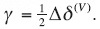
	    <p align="justify"><font face="verdana" size="2">Above, Thomsen&#45;style anisotropy parameters <i>&#949;</i><sup>(V)</sup>, and <i>&#948;</i><sup>(V)</sup> are negative for HTI media, and they are equal to zero for isotropic media.</font></p>

    <p align="justify"><font face="verdana" size="2">The main problem of AVOA analysis is to estimate the symmetry&#45;axis angle <i>&#966;</i><sub>0</sub> from surface seismic data of amplitudes using numerical techniques.</font></p>

    <p align="justify"><font face="verdana" size="2">The techniques of AVOA are based on equations (1) &#45; (4). Note that equation (1) is intended for calculation of reflection coefficients, while in real data, one operates with amplitudes of reflected waves, not with reflection coefficients. This brings some problems which are discussed in the next section.</font></p>

	    ]]></body>
<body><![CDATA[<p align="justify">&nbsp;</p>
	    <p align="justify"><font face="verdana" size="2"><b>Using amplitudes instead of reflection coefficients</b></font></p>

    <p align="justify"><font face="verdana" size="2">While the background of AVOA analysis is based on R&uuml;ger's equation for the reflection coefficient (1), in real data, AVOA analysis should use signal amplitudes. It is true that the amplitude is not equal to the reflection coefficient. Moreover, no picked instantaneous amplitude (sample) in the signal can be used instead of the reflection coefficient because the signal changes its form during propagation for many reasons. It seems that one should use an integral amplitude characteristic of the signal which adequately corresponds to the reflection coefficient. Let's call this characteristic simply by amplitude and denote it as <i>P</i>.</font></p>

	    <p align="justify"><font face="verdana" size="2">The estimated value of <i>&#966;</i><sub>0</sub> is very sensitive to the definition of <i>P</i>, especially for data with noise. I suggest the following procedure for definition of <i>P</i> which gives good and stable results. The procedure calculates an average value of a signal envelope in a time window. In calculating the envelope, the Fourier transform of this signal is used: <i>F</i> = <i>F</i><sub>+</sub>+ <i>F</i><sub>&#45;</sub>, where <i>F</i> is spectrum, <i>F</i><sub>+</sub> is the part of spectrum corresponding to positive frequencies (<i>&#969;</i>&ge;0), and <i>F</i><sub>&#45;</sub> is the part of negative frequencies. The envelope of the signal is given by the absolute value of inverse Fourier transform of the spectrum with double <i>F</i><sub>+</sub>, and <i>F</i><sub>&#45;</sub>&equiv;0 (Sheriff &amp; Geldart, 1983).</font></p>

    <p align="justify"><font face="verdana" size="2">The sign of envelope is positive; therefore this approach is applicable only to seismograms with the constant sign of reflection coefficient in dependence on offset.</font></p>

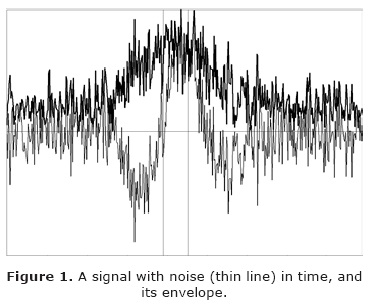
	    <p align="justify"><font face="verdana" size="2">For data with noise, the envelope is noisy, too (see <a href="#f1">Figure 1</a>). Therefore, smoothing is necessary.</font></p>
	    <p align="center"><a name="f1"></a></p>
	    <p align="center"><img src="/img/revistas/geoint/v53n4/a7f1.jpg"></p>

    <p align="justify"><font face="verdana" size="2">For smoothing, an algorithm of discrete transformations of wavelet by filters is applied. Four symmetric filters are constructed for it: the low&#45;pass (<i>h</i><sub>0</sub>) and high&#45;pass (<i>h</i><sub>1</sub>) analysis filters, and the low&#45;pass (<i>h</i><sub>2</sub>) and high&#45;pass (<i>h</i><sub>3</sub>) synthesis filters. The right&#45;hand part of <i>h</i><sub>0</sub> consists from the filter derived by Abdelnour &amp; Selesnick (2004). The left&#45;hand part of <i>h</i><sub>0</sub> is symmetric to it. That is</font></p>

	    <p align="center"><font face="verdana" size="2"><i>h</i><sub>0</sub>({&#45;<i>n</i>,...,<i>n</i>})={<i>b,b,</i>&#45;<i>a,a,b,b,a,</i>&#45;<i>a,c</i>,</font><font face="verdana" size="2">&#45;<i>a,a,b,b,a,</i>&#45;<i>a,b,b</i>}, (5)</font></p>
    ]]></body>
<body><![CDATA[<p align="justify"><font face="verdana" size="2">where <img src="/img/revistas/geoint/v53n4/a7e5a.jpg">, and <i>n</i> = 8. The central value is <i>c</i> = 1&#45;<i>M</i>.</font></p>

    <p align="justify"><font face="verdana" size="2">The high&#45;pass analysis filter is constructed by formula <i>h</i><sub>1</sub> (<i>i</i>) = (&#45;1)<sup><i>i</i></sup> <i>h</i><sub>0</sub> (<i>n</i>&#45;<i>i</i>+1) for <i>i </i>&ne; 0, and <i>h</i><sub>1</sub> (0) = 0. The synthesis filters are calculated by formula <i>h</i><sub>2</sub> (<i>i</i>) = (&#45;1)<sup><i>i</i></sup> <i>h</i><sub>1</sub> (<i>i</i>), <i>h</i><sub>3</sub> (<i>i</i>) = (&#45;1)<sup><i>i</i></sup> <i>h</i><sub>0</sub> (<i>i</i>), see (Abdelnour &amp; Selesnick, 2005). The central values are<i> h</i><sub>2</sub> (0) = <i>c</i> and <i>h</i><sub>3</sub> (0) = 0.</font></p>

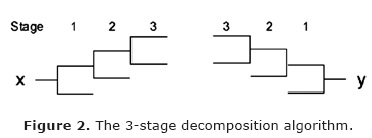
	    <p align="justify"><font face="verdana" size="2">The smoothed signal is obtained by the decomposition algorithm; see <a href="#f2">Figure 2</a> (WSBP, 2012).</font></p>
	    <p align="center"><a name="f2"></a></p>
	    <p align="center"><img src="/img/revistas/geoint/v53n4/a7f2.jpg"></p>

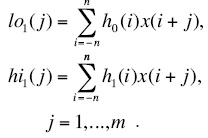
    <p align="justify"><font face="verdana" size="2">The input signal is <i>x</i>(<i>j</i>), <i>j</i>=1,...,<i>m</i>, <i>m</i>&gt;&gt;2<i>n</i>. It is decomposed into low and high components <i>lo</i><sub>1</sub>(<i>j</i>) and <i>hi</i><sub>1</sub>(<i>j</i>) in the first stage:</font></p>

	    <p align="center"><img src="/img/revistas/geoint/v53n4/a7e3.jpg"></p>
    <p align="justify"><font face="verdana" size="2">In the next stages (<i>s</i> = 2,..., <i>S</i>), the each low component <i>lo<sub>s</sub><sub>&#45;</sub></i><sub>1</sub>(<i>j)</i> is decomposed by the same analysis filters.</font></p>

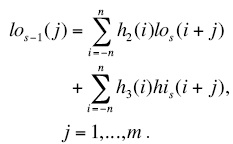
    <p align="justify"><font face="verdana" size="2">After all stages of decomposition finishing, the stages of applying the synthesis filters are fulfilled in reverse order (<i>s</i>=<i>S</i>, <i>S</i>&#45;1,...,1):</font></p>

	    <p align="center"><img src="/img/revistas/geoint/v53n4/a7e4.jpg"></p>
    ]]></body>
<body><![CDATA[<p align="justify"><font face="verdana" size="2">The output signal y (<i>j</i>) is obtained finally:</font></p>

	    <p align="center"><font face="verdana" size="2"><i>y</i>(<i>j</i>) = <i>lo</i><sub>0</sub>(<i>j)p</i>,</font></p>

    <p align="justify"><font face="verdana" size="2">where the fitting amplitude coefficient <i>p</i> can be approximately estimated by the formula <i>p</i> = 1+0.057S, where <i>S</i> is the number of stages.</font></p>

	    <p align="justify"><font face="verdana" size="2">The advantage of this variant of discrete transformation algorithm in comparison with (WSBP, 2012) is the absence of shift functions in it due to applying the fully symmetric filters (<i>i</i>=<i>&#45;n</i>,...,<i>n</i>).</font></p>

	    <p align="justify"><font face="verdana" size="2">It must be noted that the algorithm gives unsatisfactory results at the edges of the signal because of truncating the filters in 2<i>n</i> edge points. Therefore, it is necessary <i>m</i>&gt;&gt;2<i>n</i>.</font></p>

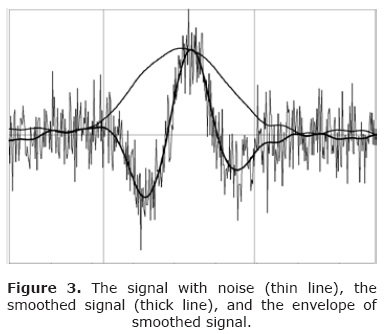
	    <p align="justify"><font face="verdana" size="2">The result of smoothing the signal of <a href="#f1">Figure 1</a> by the 3&#45;stage algorithm is presented in <a href="#f3">Figure 3</a>. The smoothness of resulting curve increases with increasing <i>S</i>. Also with increasing <i>S</i>, the algorithm slightly deforms the resulting impulse in comparison with the parent impulse without noise. Optimum in the smoothness and in the conservation of form is observed at the value <i>S</i> = 3.</font></p>
	    <p align="center"><a name="f3"></a></p>
	    <p align="center"><img src="/img/revistas/geoint/v53n4/a7f3.jpg"></p>

    <p align="justify"><font face="verdana" size="2">The limits of time window for calculating <i>P</i> with the help of envelope can be chosen by different ways. I use the following way. From the envelope of signal <i>e(t)</i>, the maximum <i>e<sub>m</sub></i> and nearest local minimums, left <i>e<sub>l</sub></i> and right <i>e<sub>r</sub></i>, are calculated. The left limit of the time window is set in the point where <i>e</i> = <i>e<sub>l</sub></i> + 0.15(<i>e<sub>m</sub></i>&#45;<i>e<sub>l</sub></i>), and the right limit &#150; where <i>e</i> = <i>e<sub>r</sub></i> + 0.15(<i>e<sub>m</sub></i>&#45;<i>e<sub>l</sub></i>), see vertical lines in <a href="#f1">Figures 1</a>, <a href="#f3">3</a>. Obviously, this algorithm correctly works only with smoothed signals.</font></p>

	    <p align="justify"><font face="verdana" size="2">Equation (1) should be rewritten for using the amplitudes. If the source and the receivers are at the earth surface, then the amplitude of reflected PP&#45;wave can be expressed as</font></p>

	    ]]></body>
<body><![CDATA[<p align="center"><img src="/img/revistas/geoint/v53n4/a7e4a.jpg"></p>

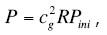
    <p align="justify"><font face="verdana" size="2">where <i>c<sub>g</sub></i> is the coefficient of geometrical spreading (divergence) from source to reflection point for this wave, <i>c<sub>g</sub></i>= <i>c<sub>g</sub></i> (<i>&#952;</i>, <i>&#966;</i>), <i>P<sub>ini</sub></i> is the amplitude of the source (the initial amplitude), and <i>R</i> is the reflection coefficient, <i>R</i> = <i>R</i> (<i>&#952;</i>, <i>&#966;</i>) in the equation (1).</font></p>

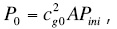
    <p align="justify"><font face="verdana" size="2">The amplitude for the normal&#45;incidence wave can be written as</font></p>

	    <p align="center"><img src="/img/revistas/geoint/v53n4/a7e5.jpg"></p>

    <p align="justify"><font face="verdana" size="2">where <i>c<sub>g</sub></i><sub>0</sub> is the normal&#45;incidence coefficient of geometrical spreading, which does not depend on (<i>&#952;</i>, <i>&#966;</i>), and <i>A</i> is the normal&#45;incidence reflection coefficient, <i>A</i> = <i>const</i>, see equations (1) &#45; (2). Then the reflection coefficient can be expressed as</font></p>

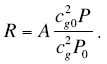
	    <p align="center"><img src="/img/revistas/geoint/v53n4/a7e6.jpg"></p>

    <p align="justify"><font face="verdana" size="2">Therefore the equation (1) for the reflection coefficient <i>R</i> transforms into the following equation for the amplitude <i>P</i>:</font></p>

	    <p align="center"><font face="verdana" size="2"><i>r<sub>g</sub>P</i>(<i>&#952;</i>, <i>&#966;</i>) = <i>P</i><sub>0</sub> + <i>mB</i>(<i>&#966;</i>)sin<sup>2</sup> <i>&#952;</i> + <i>mC</i>(<i>&#966;</i>)sin<sup>2</sup><i>&#952;</i> tan<sup>2</sup><i>&#952;</i>, (6)</font></p>

	    <p align="justify"><font face="verdana" size="2">where <i>m</i> = <i>P</i><sub>0</sub>/<i>A</i>, and <i>r<sub>g</sub></i> &equiv; (<i>c<sub>g0</sub></i> / <i>c<sub>g</sub></i>)<sup>2</sup>. This equation should be used in the AVOA techniques instead of (1).</font></p>

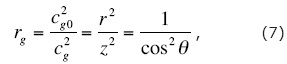
	    <p align="justify"><font face="verdana" size="2">Note that <i>c<sub>g</sub></i> can be expressed as <i>c<sub>g</sub></i> = <i>c</i>(<i>&#952;</i>, <i>&#966;</i>)/<i>r</i> in 3D space, where <i>r</i> is a half of travel path from source to receiver, and <i>c</i> depends on the direction of wave propagation (for isotropic media, <i>c</i> = <i>const</i>). In assuming a weak anisotropy, one may assume a weak dependence of geometrical spreading on incidence angle: <i>c</i> &asymp; <i>const</i> for a given source&#45;to&#45;receiver line with azimuth <i>&#966;</i>. Then, for a homogeneous medium above the reflecting boundary,</font></p>

    ]]></body>
<body><![CDATA[<p align="center"><img src="/img/revistas/geoint/v53n4/a7e7.jpg"></p>

    <p align="justify"><font face="verdana" size="2">where <i>z</i> is the normal&#45;incidence ray path, and <i>c<sub>g</sub></i><sub>0</sub> &equiv; <i>c</i> / <i>z</i>. It is the approximate formula for divergent correction.</font></p>

	    <p align="justify"><font face="verdana" size="2">Also for multilayered media, the expressions for divergence correction can be found from Newman (1973). A practical methodology for the P&#45;wave geometrical&#45;spreading correction in layered azimuthally anisotropic media can be found from Xu &amp; Tsvankin (2004).</font></p>

	    <p align="justify">&nbsp;</p>
	    <p align="justify"><font face="verdana" size="2"><b>The incidence angle estimation</b></font></p>

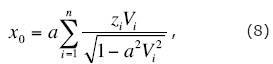
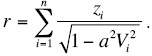
    <p align="justify"><font face="verdana" size="2">In the case of <i>n</i> isotropic layers above the reflecting boundary, one can obtain the incidence angle <i>&#952;</i> = <i>&#952;<sub>n</sub></i> from a solution of the following non&#45;linear equation for a:</font></p>

    <p align="center"><img src="/img/revistas/geoint/v53n4/a7e8.jpg"></p>

    <p align="justify"><font face="verdana" size="2">where <i>x</i><sub>0</sub> is the half of offset, <i>z<sub>i</sub></i> is the thickness of <i>i</i>&#45;th layer, <i>V<sub>i</sub></i> is the velocity in<i> i</i>&#45;th layer, and sin (<i>&#952;</i><sub><i>n</i></sub>) = <i>aV<sub>n</sub></i>. For calculating the geometrical spreading, the travel path <img src="/img/revistas/geoint/v53n4/a7e8a.jpg"></font></p>
	    <p align="justify"><font face="verdana" size="2">In the case of the reflecting boundary being the lower boundary of anisotropic layer, the problem is more complicated because the last layer is anisotropic, and the velocity <i>V<sub>n</sub></i> depends on <i>&#952;<sub>n</sub></i> in it and is not known beforehand.</font></p>

	    <p align="justify"><font face="verdana" size="2">The problem can be solved by Sabinin (2012). An advantage of his method is that the value <i>V<sub>n</sub></i> in the anisotropic layer is unnecessary for calculating angle <i>&#952;<sub>n</sub></i> and path <i>r</i>. However, it uses additionally the impulse from the upper boundary of anisotropic layer what complicates the technique. It gives results not sufficiently better than the method (8). Therefore, I use the simple method (8) here with setting an approximate value of <i>V<sub>n</sub></i>.</font></p>

    ]]></body>
<body><![CDATA[<p align="justify">&nbsp;</p>
    <p align="justify"><font face="verdana" size="2"><b>The methods for estimation of symmetry axis angle by AVOA</b></font></p>

    <p align="justify"><font face="verdana" size="2">Usually, 3D seismic data used in AVOA analysis are received from a system of receivers and sources spacing in nodes of a rectangle grid at the surface. The symmetry axis angle is calculated for a small square (for a bin) including a node of the grid, by using seismic traces which have the Common Middle Point (CMP) located in this bin. If such traces are few, then neighbor bins are combined into a superbin, and calculations are made for it. Therefore, a preliminary stage of the estimation is an extraction of seismic traces of the superbin from the seismic data for taking them into consideration.</font></p>

	    <p align="justify"><font face="verdana" size="2">For numerical methods of estimation of symmetry axis angle, one can use equation (6) as in R&uuml;ger's form:</font></p>

	    <p align="center"><font face="verdana" size="2"><i>T<sub>*</sub></i> = <i>a</i> + (<i>b</i><sub>*</sub> + <i>ct</i>)<i>s</i> + (<i>d</i><sub>*</sub> + <i>e</i><sub>*</sub><i>t</i> + <i>&#402;t</i><sup>2</sup>)<i>s</i><sup>2</sup>/(1&#45;<i>s</i>), (9a)</font></p>

    <p align="justify"><font face="verdana" size="2">as in the power form:</font></p>

	    <p align="center"><font face="verdana" size="2"><i>T</i> = <i>a</i> + <i>s</i>(<i>b</i> + <i>ct</i>)+<i>s</i><sup>2</sup> (<i>d</i> + <i>et</i> + <i>&#402;t</i><sup>2</sup>), (9b)</font></p>

    <p align="justify"><font face="verdana" size="2">where <i>T</i><sub>*</sub> = <i>r<sub>g</sub> P</i> (<i>&#952;</i>, <i>&#966;</i>), <i>T</i> = (1&#45;<i>s</i>)<i>T</i><sub>*</sub>, <i>s</i> = sin<sup>2</sup><i>&#952;</i>, <i>t</i> = cos<sup>2</sup> (<i>&#966;</i>&#45;<i>&#966;</i><sub>0</sub>), <i>a</i> = <i>P</i><sub>0</sub>, <i>b</i><sub>*</sub> = <i>mB<sub>iso</sub></i>, <i>b</i> = <i>b</i><sub>*</sub>&#45;<i>a</i>, <i>c</i> = <i>mB<sub>ani</sub></i>, <i>d</i><sub>*</sub> = <i>m&#945;</i>, <i>d</i> = <i>d</i><sub>*</sub>&#45;<i>b</i><sub>*</sub>, <i>e</i><sub>*</sub> = <i>m&#916;&#948;<sup>(V)</sup></i>/2, <i>e</i> = <i>e</i><sub>*</sub>&#45;<i>c</i>, <i>&#402;</i>=<i>m&#916;&#949;<sup> (V)</sup></i>/2&#45;<i>e</i><sub>*</sub> and <i>m</i> = <i>P</i><sub>0</sub>/<i>A</i>.</font></p>

    <p align="justify"><font face="verdana" size="2">The methods vary by simplifying ways applied, and can be separated into Sectored methods (S and SR), Linear methods (L and LR), and General method (G), where the letter 'R' denotes that the R&uuml;ger's form (9a) is used instead of (9b).</font></p>
    <p align="justify"><font face="verdana" size="2"><i>Sectored methods</i></font></p>
	    ]]></body>
<body><![CDATA[<p align="justify"><font face="verdana" size="2">The method SR was suggested by Mallik <i>et al</i>. (1998) for the case of three azimuths with using equations (1), and (3). It took its perfect form in the work by Sabinin &#38; Chichinina (2008) who used equations (6), (3), and (4). For this method, the traces of superbin are sorted by n azimuthal sectors. It is adopted that all traces of the sector have the same value of azimuth equal to the middle azimuth of the sector. Because of this, sectored methods introduce in <i>&#966;</i><sub>0</sub> an own error no more than a half of the sector size.</font></p>
    <p align="justify"><font face="verdana" size="2">Here, the method S applied to equation (9b) is presented. If in the sector of azimuth <i>&#966;</i><sub><i>j</i></sub> (<i>j</i> = 1, ..., <i>n</i>), there are k<sub>j</sub> traces with incidence angles <i>&#952;</i><sub>j</sub> (i = 1, ..., <i>k<sub>j</sub></i>) in the last layer above the target boundary, then one can write from (9b) for this sector<i> j</i>:</font></p>

    <p align="center"><img src="/img/revistas/geoint/v53n4/a7e10.jpg"></p>

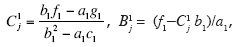
	    <p align="justify"><font face="verdana" size="2">where <i>T<sub>ij</sub></i> is the value <i>T</i> calculated from the trace <i>i</i> in the sector <i>j</i>. In each sector, <i>B<sup>1</sup><sub>j</sub>&#61;m<sub>j</sub>B<sub>j</sub> , C<sup>1</sup><sub>j</sub>&#61;m<sub>j</sub>C<sub>j</sub></i>,  where <i>m<sub>j</sub></i> = <i>P<sub>j</sub></i> /<i>A</i>, and <img src="/img/revistas/geoint/v53n4/a7e10c.jpg"> are the fitting constants.</font></p>

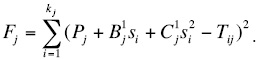
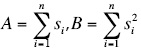
    <p align="justify"><font face="verdana" size="2">Having <i>T<sub>ij</sub></i> and <i>&#952;</i><sub><i>i</i></sub> for all <i>i</i> in the sector <i>j </i>(<i>k</i><sub>j</sub> &ge; 3), one can calculate <i>s<sub>i</sub></i> = sin<sup>2</sup> <i>&#952;i</i>, and then <i>P<sub>j</sub></i>, <i>B<sup>1</sup><sub>j</sub></i> and <i>C<sup>1</sup><sub>j</sub></i> from (10) by the least&#45;squares method. For this, it is minimized the functional of error for each sector <i>j</i>:</font></p>

    <p align="center"><img src="/img/revistas/geoint/v53n4/a7e10a.jpg"></p>

    <p align="justify"><font face="verdana" size="2">For minimizing <i>F<sub>j</sub>,</i> it is necessary to solve the system of three equations:</font></p>

	    <p align="center"><img src="/img/revistas/geoint/v53n4/a7e10f.jpg"></p>

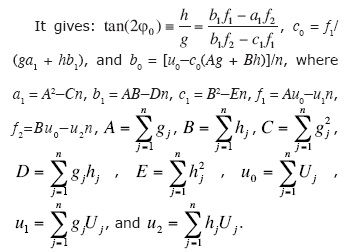
    <p align="justify"><font face="verdana" size="2">It gives: <img src="/img/revistas/geoint/v53n4/a7e10g.jpg">and <img src="/img/revistas/geoint/v53n4/a7e10h.jpg">where <i>a</i><sub>1</sub> = <i>A</i><sup>2</sup>&#45;<i>Bk<sub>j</sub></i>, <i>b</i><sub>1</sub> <i>AB</i>&#45;<i>Ck<sub>j</sub></i>, <i>c</i><sub><i>1</i></sub> = <i>B</i><sup>2</sup>&#45;<i>Dk<sub>j</sub></i>, <i>f</i><sub>1</sub> = <i>Au</i><sub>0</sub>&#45;<i>u</i><sub>1</sub><i>k<sub>j</sub></i>, <i>g</i><sub>1</sub> = <i>Bu</i><sub>0</sub> &#45; <i>u</i><sub>2</sub><i>k<sub>j</sub></i>, <img src="/img/revistas/geoint/v53n4/a7e10j.jpg">and <img src="/img/revistas/geoint/v53n4/a7e10k.jpg"></font></p>

    <p align="justify"><font face="verdana" size="2">These calculations should be made for all sectors.</font></p>

	    ]]></body>
<body><![CDATA[<p align="justify"><font face="verdana" size="2">Then, the unknown value <i>&#966;</i><sub>0</sub> can be obtained from the system of equations of type (3), see (9b):</font></p>

	    <p align="center"><img src="/img/revistas/geoint/v53n4/a7e11.jpg"></p>

    <p align="justify"><font face="verdana" size="2">where <i>j</i> = 1, ..., <i>n</i>, and <i>t<sub>j</sub></i> = cos2(<i>&#966;</i>&#45;<i>&#966;</i><sub>0</sub>). The unknown constants <i>b</i><sup>1</sup>, and <i>c</i><sup>1</sup> have a sense: <i>b</i><sup>1</sup><i>A</i> = <i>B<sub>iso</sub></i>&#45;<i>A</i>, and <i>c</i><sup>1</sup><i>A</i> =<i> B<sub>ani</sub></i>.</font></p>

    <p align="justify"><font face="verdana" size="2">Equation (11) is transformed into more convenient form:</font></p>

	    <p align="center"><font face="verdana" size="2"><i>U<sub>j</sub></i> = <i>b</i><sub>0</sub>+<i>c</i><sub>0</sub><i>gg<sub>j</sub></i>+<i>c</i><sub>0</sub><i>hh<sub>j</sub></i>, (12)</font></p>

	    <p align="justify"><font face="verdana" size="2">where <i>U<sub>j</sub></i> = <i>B</i><sup>1</sup><sub><i>j</i></sub> /<i>P<sub>j</sub></i>, <i>b</i><sub>0</sub> = <i>b</i><sup>1</sup> + 0.5<i>c</i><sup>1</sup>, <i>c</i><sub>0</sub> = 0.5<i>c</i><sup>1</sup>, <i>g</i> = cos(2<i>&#966;</i><sub>0</sub>), <i>h</i> = sin(2<i>&#966;</i><sub>0</sub>), <i>g<sub>j</sub></i> = cos(2<i>&#966;</i><sub><i>j</i></sub>) and <i>h<sub>j</sub></i> = sin(2<i>&#966;</i><sub><i>j</i></sub>).</font></p>

    <p align="justify"><font face="verdana" size="2">The system (12) has three unknowns (<i>b</i><sub>0</sub>, <i>c</i><sub>0</sub>, and <i>&#966;</i><sub>0</sub>), therefore it should be <i>n</i> &ge; 3 for obtaining solution. The system (12) has two solutions (two <i>&#966;</i><sub>0</sub> differing in <i>&#960;</i>/2, and two <i>c</i><sub>0</sub> of opposite signs, correspondently), and is solved by the least&#45;squares method, too. It is minimized the functional of error:</font></p>

    <p align="center"><img src="/img/revistas/geoint/v53n4/a7e13.jpg"></p>

    <p align="justify"><font face="verdana" size="2">The following system of three equations should be solved:</font></p>

	    <p align="center"><font face="verdana" size="2">&part;<i>F</i>/&part;<i>b</i><sub>0</sub> = 0, &part;<i>F</i>/&part;<i>c</i><sub>0</sub> = 0, &part;<i>F</i>/&part;<i>&#966;</i><sub>0</sub> = 0.</font></p>

    ]]></body>
<body><![CDATA[<p align="center"><font face="verdana" size="2"><img src="/img/revistas/geoint/v53n4/a7e13a.jpg"></font></p>

    <p align="justify"><font face="verdana" size="2">The condition for distinguishing symmetry&#45;axis from fracture&#45;strike directions is derived by Sabinin &amp; Chichinina (2008), and uses equation (4). Here it is presented in more general form.</font></p>

	    <p align="justify"><font face="verdana" size="2">In terms of equations (9b), (10), and (11), equation (4) can be written as</font></p>

	    <p align="center"><img src="/img/revistas/geoint/v53n4/a7e14.jpg"></p>

    <p align="justify"><font face="verdana" size="2">where<i> j</i> = 1, ..., <i>n</i>, <i>d</i><sup>1</sup> = (<i>&#945;</i>&#45;<i>B<sub>iso</sub></i>)/<i>A</i>, <i>e</i><sup>1</sup> = (<i>&#916;&#948;<sup>(V)</sup></i>/2&#45;<i>B<sub>ani</sub></i>)/<i>A</i>, and <i>&#402;</i><sup>1</sup> = (<i>&#916;&#949;<sup>(V)</sup></i>-<i>&#916;&#948;<sup>(V</sup></i><sup>)</sup>)/(2<i>A</i>).</font></p>

    <p align="justify"><font face="verdana" size="2">When substituting the value <img src="/img/revistas/geoint/v53n4/a7e14b.jpg"> instead of <i>&#966;</i><sub>0</sub> into equation (14), the sign of the second term <i>e</i><sup>1</sup><i>t<sub>j</sub> </i>switches to the opposite sign, because equation (14) takes the form</font></p>

    <p align="center"><img src="/img/revistas/geoint/v53n4/a7e14a.jpg"></p>

    <p align="justify"><font face="verdana" size="2">The last term of equation (11) <i>c</i><sup>1</sup><i>t<sub>j</sub> </i>switches its sign, too. One can combine <i>&#916;&#948;</i><sup>(V)</sup>=2A(<i>c</i>1+<i>e</i><sup>1</sup>) from definitions to equations (11), (14), and conclude that the sign of <i>&#916;&#948;</i><sup><i>(V)</i></sup> is switched, too. For calculating <i>&#916;&#948;</i><sup><i>(V)</i></sup>, it should be solved system (14) which is similar to (10) by the method of solution.</font></p>

	    <p align="justify"><font face="verdana" size="2">If the HTI layer is situated between isotropic layers then <i>&#916;&#948;</i><sup><i>(V)</i></sup> must be negative for upper reflecting boundary of the HTI layer, and positive for lower boundary. If the calculated value of <i>&#916;&#948;</i><sup><i>(V)</i></sup> has this sign then <i>&#966;</i><sub>0</sub> is the symmetry&#45;axis angle. In opposite case, it is the fracture&#45;strike direction.</font></p>

    <p align="justify"><font face="verdana" size="2">It must be noted that <i>&#916;&#949;</i><sup><i>(V)</i></sup> = 2<i>A</i>(<i>c</i><sup>1</sup>+<i>e</i><sup>1</sup>+<i>&#402;</i><sup>1</sup>), and also can be used for distinguishing solutions because <i>&#949;</i><sup><i>(V)</i></sup> and <i>&#948;</i><sup><i>(V)</i></sup> have the same sign.</font></p>

    ]]></body>
<body><![CDATA[<p align="justify"><font face="verdana" size="2">The formal condition that the second derivative of functional (13) must be positive in the minimum of functional can also be applied. Because of errors in data, it should be used as an additional condition to previous ones, and should have a form &part;<sup>2</sup><i>F</i>/&part;<i>&#966;</i><sup>2</sup><sub>0</sub> &gt; a small value.</font></p>
    <p align="justify"><font face="verdana" size="2"><i>Linear methods</i></font></p>
    <p align="justify"><font face="verdana" size="2">The method LR was suggested by Jenner (2002) for equation (1). It is not needed in sectoring data. All traces of superbin are taken into consideration together.</font></p>

	    <p align="justify"><font face="verdana" size="2">Here, it is applied to equation (9b), the method L. Equation (9b) is truncated after a line part respecting <i>s</i>. If the superbin has n traces(<i>i</i> = 1, ..., <i>n</i>), with incidence angles <i>&#952;</i><sub><i>i</i></sub> at the target boundary, and with azimuthal angles <i>&#966;<sub>i</sub></i>, then one can write the result of truncation in the form:</font></p>

    <p align="center"><font face="verdana" size="2"><i>T<sub>i</sub></i>= <i>a</i>+<i>s<sub>i</sub></i>(<i>b</i><sub>0</sub>+<i>c</i><sub>0</sub><i>gg<sub>i</sub></i>+<i>c</i><sub>0</sub><i>hhi</i>). (15)</font></p>

    <p align="justify"><font face="verdana" size="2">where <i>T<sub>i</sub> </i>is the value <i>T</i> calculated from the trace <i>i,</i> <i>s<sub>i</sub></i> = sin<sup>2</sup><i>&#952;</i><sub>i</sub>, <i>b</i><sub>0</sub> = b + 0.5<i>c</i>, <i>c</i><sub>0</sub> = 0.5<i>c, g </i>= cos(2<i>&#966;</i><sub>0</sub>), <i>h</i> = sin(2<i>&#966;</i><sub>0</sub>), <i>g<sub>i</sub></i>= cos(2<i>&#966;</i><sub><i>i</i></sub>), and <i>h<sub>i</sub></i> = sin(2<i>&#966;</i><sub><i>i</i></sub>).</font></p>

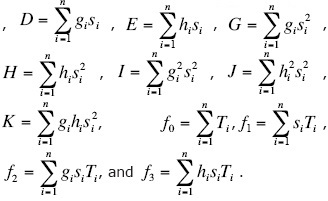
    <p align="justify"><font face="verdana" size="2">The values <i>s<sub>i</sub></i>, <i>g<sub>i</sub></i>, and <i>h<sub>i</sub></i> are known because they can be calculated from headers of seismograms and parameters of medium. Let us consider the functional of error:</font></p>

	    <p align="center"><img src="/img/revistas/geoint/v53n4/a7e16.jpg"></p>

    <p align="justify"><font face="verdana" size="2">Functional <i>F</i> must be minimized over parameters <i>a</i>,<i> b</i><sub>0</sub>, <i>c</i><sub>0</sub>, and <i>&#966;</i><sub>0</sub>. For this, it is necessary to solve the system of four equations:</font></p>

    <p align="center"><font face="verdana" size="2">&part;<i>F</i>/&part;<i>a</i> = 0, &part;<i>F</i>/&part;<i>b</i><sub>0</sub> = 0, &part;<i>F</i>/&part;<i>c</i><sub>0</sub> = 0, &part;<i>F</i>/&part;<i>&#966;</i><sub>0</sub> = 0. (17)</font></p>

    ]]></body>
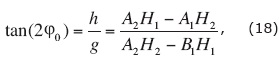
<body><![CDATA[<p align="justify"><font face="verdana" size="2">Solution of system (17) gives the equation for obtaining <i>&#966;</i><sub>0</sub>:</font></p>

    <p align="center"><img src="/img/revistas/geoint/v53n4/a7e18.jpg"></p>

    <p align="center"><font face="verdana" size="2">where <i>A</i><sub>1</sub>=<i>a</i><sub>1</sub><i>b</i><sub>1</sub>&#45;<i>a</i><sub>2</sub><sup>2</sup> , <i>B</i><sub>1</sub>=<i>a</i><sub>1</sub><i>c</i><sub>1</sub>&#45;<i>a</i><sup>2</sup><sub>3</sub> , <i>A</i><sub>2</sub>=<i>a</i><sub>1</sub><i>b</i><sub>2</sub>&#45;<i>a</i><sub>2</sub><i>a</i><sub>3</sub>, <i>H</i><sub>1</sub>=<i>F</i><sub>2</sub><i>a</i><sub>1</sub>&#45;<i>F</i><sub>1</sub><i>a</i><sub>2</sub>, and <i>H</i><sub>2</sub>=<i>F</i><sub>3</sub><i>a</i><sub>1</sub>&#45;<i>F</i><sub>1</sub><i>a</i><sub>3</sub> in which <i>a</i><sub>1</sub>=<i>nB</i>&#45;<i>A</i><sup>2</sup>, <i>b</i><sub>1</sub>=<i>nI</i>&#45;<i>D</i><sup>2</sup>, <i>c</i><sub>1</sub>=<i>nJ</i>&#45;<i>E</i><sup>2</sup>, <i>a</i><sub>2</sub>=<i>nG</i>&#45;<i>AD</i>, <i>b</i><sub>2</sub>=<i>nK</i>&#45;<i>ED</i>, <i>a</i><sub>3</sub>=<i>nH</i>&#45;<i>AE</i>, <i>F</i><sub>1</sub>=<i>nf</i><sub>1</sub>&#45;<i>Af</i><sub>0</sub>, <i>F</i><sub>2</sub>=<i>nf</i><sub>2</sub>&#45;<i>Df</i><sub>0</sub>, and <i>F</i><sub>3</sub>=<i>nf</i><sub>3</sub>&#45;<i>Ef</i><sub>0</sub>, and finally: <img src="/img/revistas/geoint/v53n4/a7e18a.jpg"></font></p>
    <p align="center"><font face="verdana" size="2"><img src="/img/revistas/geoint/v53n4/a7e18b.jpg"></font></p>

    <p align="justify"><font face="verdana" size="2">The other parameters are:</font></p>

	    <p align="justify"><font face="verdana" size="2"><img src="/img/revistas/geoint/v53n4/a7e18c.jpg">and <i>a</i> = (<i>&#402;</i><sub>0</sub>&#45;<i>b</i><sub>0</sub><i>A</i>&#45;<i>c</i><sub>0</sub><i>gD</i>&#45;<i>c</i><sub>0</sub><i>hE</i>)/<i>n</i>.</font></p>

    <p align="justify"><font face="verdana" size="2">From (18), one can see that the solution <i>&#966;</i><sub>0</sub> has a period of <img src="/img/revistas/geoint/v53n4/a7e18f.jpg">. This value of the period means that we must use an additional condition for understanding what value &#966;<sub>0</sub> is the symmetryaxis azimuth. This condition may be <i>B<sub>ani</sub> </i>&gt; 0 if <i>V<sub>S</sub></i> / <i>V<sub>P</sub></i> &gt; 0.56 (Chichinina <i>et al</i>., 2003). In general case, it can be the condition &part;<sup>2</sup><i>F</i>/&part;<i>&#966;</i><sup>2</sup><sub>0</sub> &gt; a small positive value, where F is the functional of error (16).</font></p>
    <p align="justify"><font face="verdana" size="2"><i>General method (G)</i></font></p>
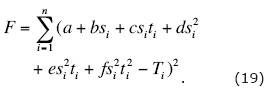
    <p align="justify"><font face="verdana" size="2">The method is constructed by analogy with the GM method by Sabinin (2013). It is not needed in sectoring, too. All traces of superbin are taken into consideration together. If the superbin has n traces (<i>i </i>= 1,..., <i>n</i>), with incidence angles qi at the target boundary, and with azimuthal angles fi, then equation (9b) can be written as:</font></p>

	    <p align="center"><font face="verdana" size="2"><i><img src="/img/revistas/geoint/v53n4/a7e18e.jpg"></i></font></p>

    ]]></body>
<body><![CDATA[<p align="justify"><font face="verdana" size="2">where <i>T<sub>i</sub></i> is the value <i>T</i> calculated from the trace <i>i</i>, <i>s<sub>i</sub></i> = sin<sup>2</sup><i>&#952;</i><sub><i>i</i></sub>, and <i>t<sub>i</sub></i> = cos<sup>2</sup>(<i>&#966;<sub>i</sub></i>&#45;<i>&#966;<sub>0</sub></i>).</font></p>

    <p align="justify"><font face="verdana" size="2">Let us consider the functional of error:</font></p>

	    <p align="center"><img src="/img/revistas/geoint/v53n4/a7e19.jpg"></p>
    <p align="justify"><font face="verdana" size="2">Functional <i>F</i> must be minimized over parameters <i>a, b, c, d, e, f</i>, and <i>&#966;</i><sub>0</sub>. For this, it is necessary to solve the system of seven equations:</font></p>

    <p align="center"><font face="verdana" size="2">&part;<i>F</i>/&part;<i>a</i> = 0, &part;<i>F</i>/&part;<i>b</i> = 0, &part;<i>F</i>/&part;<i>c</i> = 0, &part;<i>F</i>/&part;<i>d</i> = 0, &part;<i>F</i>/&part;<i>e</i> = 0, &part;<i>F</i>/&part;<i>f</i> = 0, &part;<i>F</i>/&part;<i>&#966;</i><sub>0</sub> = 0. (20)</font></p>
    <p align="justify"><font face="verdana" size="2">The six first equations of system (20) give a line system for deriving expressions for the parameters <i>a, b, c, d, e,</i> and <i>f</i> (for details, see <a href="/img/revistas/geoint/v53n4/html/a7appendix1.html" target="_blank">Appendix</a>).</font></p>

	    <p align="justify"><font face="verdana" size="2">The last equation of (20) can be transformed into a non&#45;linear equation for obtaining <i>&#966;</i><sub>0</sub> (for details, see <a href="/img/revistas/geoint/v53n4/html/a7appendix1.html" target="_blank">Appendix</a>).</font></p>

    <p align="justify"><font face="verdana" size="2">Thus, system (20) is non&#45;linear on <i>&#966;</i><sub>0</sub>, and is solved by the method of bisecting. It has more than one solution usually. From these local solutions, one chooses that one which gives a minimum for functional (19).</font></p>

    <p align="justify"><font face="verdana" size="2">As was observed from calculations, the solutions of system (20) near the symmetry axis angle, and near the fracture strike angle give close values of functional (19). It means that additional criterions are practically needed for separating these directions. For the case of HTI layer situated between isotropic layers, it can be the condition of negative values for calculated <i>&#949;<sup>(V)</sup></i> and <i>&#948;<sup>(V)</sup></i> in the anisotropic layer, as above. For this, from definitions to equations (9b) and (2), one can calculate from the solution of (20) at the interface:</font></p>

    <p align="center"><font face="verdana" size="2"><i>&#916;&#949;<sup>(V)</sup></i>= 2<i>A</i>(<i>c</i>+<i>e</i>+<i>&#402;</i>)/<i>a</i>, (21)</font></p>

    ]]></body>
<body><![CDATA[<p align="center"><font face="verdana" size="2"><i>&#916;&#948;<sup>(V)</sup></i>= 2<i>A</i>(<i>c</i>+<i>e</i>)/<i>a</i>. (22)</font></p>

    <p align="justify"><font face="verdana" size="2">In the case of interface between anisotropic layers, it is needed additionally to know the predefined signs of <i>&#916;&#949;<sup>(V)</sup></i>, and<i> &#916;&#948;<sup>(V)</sup></i> for comparison.</font></p>

    <p align="justify"><font face="verdana" size="2">The additional criterion can also be the maximum of second derivative of functional (19), &part;<i>F</i>/&part;<i>&#966;</i><sub>0</sub>.</font></p>

    <p align="justify">&nbsp;</p>
    <p align="justify"><font face="verdana" size="2"><b>Comparing the AVOA techniques</b></font></p>

    <p align="justify"><font face="verdana" size="2">The techniques using the methods above for estimation of symmetry axis angle were compared in ability to give the most precise value of <i>&#966;</i><sub>0</sub> for HTI medium. At present, reliable field methods of obtaining <i>&#966;</i><sub>0</sub> do not exist. Therefore, I generated synthetic seismograms for an artificial three&#45;layer medium with the anisotropic layer in the middle by applying the technique by Sabinin (2012) of 2D wave modeling. I set <i>&#966;</i><sub>0</sub> =60&ordm;, and derived models of the anisotropic layer for different values of <i>&#966;</i><sub><i>i</i></sub> by rotating the stiffness tensor for anisotropic HTI layer (MacBeth, 1999) around <i>z</i> axis relatively to <i>&#966;</i><sub>0</sub>. Anisotropic parameters <i>e<sub>n</sub></i> = 0.35, and <i>e<sub>t</sub></i> = 0.2 (see MacBeth, 1999) were used in the stiffness tensor.</font></p>

    <p align="justify"><font face="verdana" size="2">Host rock velocity <i>V<sub>P</sub></i> in three layers from above had the values 3200, 4000, and 4800 (the other variant was 3200), <i>m/s</i>, <i>V<sub>S</sub></i> was twice less, densities were equal, and thicknesses of two first layers were 1600, and 400 <i>m</i>. A source of explosion type generated one Ricker impulse of frequency 30 <i>Hz</i>. Receivers were spaced over every 100 <i>m</i> beginning from the source, and they measured z&#45;component of velocity. There were 50 offsets, and 50 traces in each seismogram.</font></p>

	    <p align="justify"><font face="verdana" size="2">There were three goals: to investigate how the techniques behave on different sets of incidence angles, how the techniques are influenced by non&#45;symmetry in <i>&#966;</i><sub>j</sub> relatively to <i>&#966;</i><sub>0</sub>, and how the techniques are influenced by noise.</font></p>

    <p align="justify"><font face="verdana" size="2">Therefore, for the first goal, I made calculations of <i>&#966;</i><sub>0</sub> for different intervals of offsets: from a minimum offset till a maximum offset, provided the minimum offset was fixed at the number one, and the number of maximum offset was changed from number 50 down to 3 in one set of the intervals; and the maximum offset was fixed at the 50&#45;th, and the minimum offset was changed from number 1 to 48 in the other set of the intervals. Naturally, the maximum incidence angle <i>&#952;</i><sub>max</sub> corresponding to the maximum offset, and the minimum incidence angle <i>&#952;</i><sub>min</sub> corresponding to the minimum offset was also correspondently changed in these sets of offsets.</font></p>

    <p align="justify"><font face="verdana" size="2">For the second goal, I obtained different sets of the synthetic seismograms corresponding to different azimuths, one seismogram for each azimuth. The sets of azimuths were uniform, and differed by symmetry. I did not aim to find the best or the worst set from them. I only supposed that a symmetric set can be better than an asymmetric one. I kept for testing the symmetric set of azimuths <i>&#966;</i><sub><i>j</i></sub> ={&#45;150&ordm;, &#45;120&ordm;, &#45;90&ordm;, &#45;60&ordm;, &#45;30&ordm;, 0&ordm;, 30&ordm;, 60&ordm;, 90&ordm;, 120&ordm;, 150&ordm;, 180&ordm;}, and the asymmetric set <i>&#966;</i><sub><i>j</i></sub> ={85&ordm;, 95&ordm;, 105&ordm;, 115&ordm;, 125&ordm;, 135&ordm;, 145&ordm;, 155&ordm;, 165&ordm;}.</font></p>

    ]]></body>
<body><![CDATA[<p align="justify"><font face="verdana" size="2">For the third goal, I took the best variant for the symmetric set of seismograms to eliminate the errors as due to the non&#45;symmetry, as due to a finite&#45;difference simulation when applying the artificial noise. The FD simulation by Sabinin (2012) uses PML boundary conditions which give non&#45;visible (see <a href="/img/revistas/geoint/v53n4/a7f4.jpg" target="_blank">Figure 4</a>) but non&#45;zero waves reflected from the boundaries of area. This slightly distorts the form of some synthetic impulses.</font></p>

	    <p align="justify"><font face="verdana" size="2">For the synthetic seismic data being quasi&#45;real, I added a random Gauss normal noise to the seismograms generated, different for each seismogram. Maximum amplitude of the noise was chosen as 10% of the maximum amplitude of the wave reflected from the top boundary of the anisotropic layer in the first trace of seismogram.</font></p>

	    <p align="justify"><font face="verdana" size="2">Finally, I added the noise to the seismograms of the asymmetric set.</font></p>

	    <p align="justify"><font face="verdana" size="2">All seismograms were smoothed by filters (5) in the techniques. High&#45;frequency components of the noise are eliminated well after smoothing, as shown in <a href="#f3">Figure 3</a>. It is principally impossible to eliminate low frequencies compared with the frequency of signal. Therefore, the signal after smoothing remains slightly deformed. I suppose that just these deformations affect the estimated value of <i>&#966;</i><sub>0</sub> in the case of noise.</font></p>

    <p align="justify"><font face="verdana" size="2">The same sets of the time windows were used for all the techniques, and for all intervals of offsets.</font></p>

	    <p align="justify"><font face="verdana" size="2">As illustration, in <a href="/img/revistas/geoint/v53n4/a7f4.jpg" target="_blank">Figure 4</a>, the seismogram without noise for azimuth 5&ordm; is presented for the variant of <i>V<sub>P</sub></i><sub>3</sub>= 4800 m/s; and in <a href="/img/revistas/geoint/v53n4/a7f5.jpg" target="_blank">Figure 5</a>, the seismogram with noise for azimuth 30&ordm; is presented for the variant of <i>V<sub>P</sub></i><sub>3</sub>= 3200 m/s.</font></p>

	    <p align="justify"><font face="verdana" size="2">As one can see from <a href="/img/revistas/geoint/v53n4/a7f5.jpg" target="_blank">Figure 5</a>, the amplitudes of noise reach really up to 50% of the maximum wave amplitudes in the middle traces, and up to 100% in the far traces.</font></p>

	    <p align="justify"><font face="verdana" size="2">The techniques were applied as to upper (1050 ms), as to down boundary (1250 ms) of the anisotropic layer.</font></p>

	    <p align="justify"><font face="verdana" size="2">In <a href="/img/revistas/geoint/v53n4/a7f6.jpg" target="_blank">Figures 6</a>, <a href="/img/revistas/geoint/v53n4/a7f7.jpg" target="_blank">7</a>, the error of estimated <i>&#966;</i><sub>0</sub> in degrees (difference with the correct value 60&ordm;) is presented for the symmetric set of azimuths and the upper boundary, variant <i>V<sub>P3</sub></i> = 3200. <a href="/img/revistas/geoint/v53n4/a7f6.jpg" target="_blank">Figure 6</a> is for fixed <i>&#952;</i><sub>min</sub> = 0&ordm;, and <a href="/img/revistas/geoint/v53n4/a7f7.jpg" target="_blank">Figure 7</a> is for fixed <i>&#952;</i><sub>max</sub> = 56.853&ordm;. The sectored methods show some instability for small values of <i>&#952;</i><sub>max</sub>&#45;<i>&#952;</i><sub>min</sub> in comparison with the others. All methods increase the error in the case of small <i>&#952;</i><sub>max</sub> (<a href="/img/revistas/geoint/v53n4/a7f6.jpg" target="_blank">Figure 6</a>).</font></p>

    <p align="justify"><font face="verdana" size="2">For the lower boundary and in the variant <i>V<sub>P3</sub> </i>= 4800, the general and linear methods also show increasing errors for small <i>&#952;</i><sub>max</sub>, and small <i>&#952;</i><sub>max</sub>&#45;<i>&#952;</i><sub>min</sub>, see <a href="/img/revistas/geoint/v53n4/a7f8.jpg" target="_blank">Figure 8</a>, and <a href="/img/revistas/geoint/v53n4/a7f9.jpg" target="_blank">Figure 9</a>. However, the errors of these methods are sufficiently less than of the sectored methods.</font></p>

    ]]></body>
<body><![CDATA[<p align="justify"><font face="verdana" size="2">In <a href="/img/revistas/geoint/v53n4/a7f10.jpg" target="_blank">Figures 10</a>, <a href="/img/revistas/geoint/v53n4/a7f11.jpg" target="_blank">11</a>, the variant of <a href="/img/revistas/geoint/v53n4/a7f6.jpg" target="_blank">Figs. 6</a>, <a href="/img/revistas/geoint/v53n4/a7f7.jpg" target="_blank">7</a> with the added noise is presented. The sectored methods demonstrate so great errors and instability that can not be recommended for applying. The other methods show large errors only for small <i>&#952;</i><sub>max</sub> (less than 30&ordm;).</font></p>

    <p align="justify"><font face="verdana" size="2">The asymmetric set of azimuths is presented by results in <a href="/img/revistas/geoint/v53n4/a7f12.jpg" target="_blank">Figures 12</a>&#45;<a href="/img/revistas/geoint/v53n4/a7f15.jpg" target="_blank">15</a>. The variant of upper boundary and <i>V<sub>P3</sub></i>= 3200 without noise is presented in <a href="/img/revistas/geoint/v53n4/a7f12.jpg" target="_blank">Figures 12</a>, <a href="/img/revistas/geoint/v53n4/a7f13.jpg" target="_blank">13</a>, and the same with the noise &#150; in <a href="/img/revistas/geoint/v53n4/a7f14.jpg" target="_blank">Figures 14</a>, <a href="/img/revistas/geoint/v53n4/a7f15.jpg" target="_blank">15</a>.</font></p>

    <p align="justify"><font face="verdana" size="2">Typical peculiarities of the asymmetric set are: great errors of the sectored methods with instability in noised data, and stable large errors of the linear methods (up to 7&ordm;). The general method remains of small errors. The noise causes instability of all methods in the interval of <i>&#952;</i><sub>max</sub>&lt;36&ordm;, provided even the general method (G) gives large errors in this interval.</font></p>

    <p align="justify">&nbsp;</p>
    <p align="justify"><font face="verdana" size="2"><b>Discussion and conclusion</b></font></p>

    <p align="justify"><font face="verdana" size="2">Some unexpected results were obtained. The first is that the sectored S and SR methods are failed. They can be used only in seismic data without noise, and for mainly symmetric distributions of azimuths <i>&#966;</i> in the 3D data (<a href="/img/revistas/geoint/v53n4/a7f6.jpg" target="_blank">Figures 6</a> &#45; <a href="/img/revistas/geoint/v53n4/a7f9.jpg" target="_blank">9</a>). This is too ideal conditions.</font></p>

	    <p align="justify"><font face="verdana" size="2">The second is that the linear L and LR methods have an additional nearly constant error in mainly asymmetric distributions of azimuths <i>&#966;</i> in the data (<a href="/img/revistas/geoint/v53n4/a7f12.jpg" target="_blank">Figures 12</a> &#45; <a href="/img/revistas/geoint/v53n4/a7f15.jpg" target="_blank">15</a>). This error is probably connected with the truncation of high terms in equation (1) of R&uuml;ger, because the general method G has not such error. Therefore, the linear methods should be applied to azimuthally symmetric data.</font></p>

	    <p align="justify"><font face="verdana" size="2">The third is that the smoothing data with noise by simple filters (5) gives relatively stable estimated values of <i>&#966;</i><sub>0</sub> in a wide interval of incidence angles <i>&#952;</i> for the methods L, LR, and G (<a href="/img/revistas/geoint/v53n4/a7f10.jpg" target="_blank">Figures 10</a>, <a href="/img/revistas/geoint/v53n4/a7f11.jpg" target="_blank">11</a>, <a href="/img/revistas/geoint/v53n4/a7f14.jpg" target="_blank">14</a>, <a href="/img/revistas/geoint/v53n4/a7f15.jpg" target="_blank">15</a>). The interval of instability is near the normal incidence, and has a width of <i>&#952;</i><sub>max</sub>&lt;40&ordm;, different in different variants (<a href="/img/revistas/geoint/v53n4/a7f10.jpg" target="_blank">Figures 10</a>, <a href="/img/revistas/geoint/v53n4/a7f14.jpg" target="_blank">14</a>). For data without noise, this interval is <i>&#952;</i><sub>max</sub>&lt;10&ordm; (<a href="/img/revistas/geoint/v53n4/a7f6.jpg" target="_blank">Figures 6</a>, <a href="/img/revistas/geoint/v53n4/a7f8.jpg" target="_blank">8</a>). Presence of the interval of instability is an intrinsic property of the formula (1) in connection with the least&#45;squares method. Errors in amplitudes become relatively more with decreasing <i>&#952;</i> in definition of <i>&#966;</i><sub>0</sub> by equation (1).</font></p>

    <p align="justify"><font face="verdana" size="2">The results show a superior of the general method (G). On the whole, its errors are less than of the others. Unfortunately, it has an intrinsic problem of choosing the right solution from the local solutions of non&#45;linear system (20). All criterions described above do not guarantee the correct choosing. It is especially difficult in the interval of instability. All the methods have such problem of distinguishing solutions. The best in this sense is the method L. Its criterions are failed very rarely. Therefore, I recommend applying the method G in a coupling with the method L: after estimation of <i>&#966;</i><sub>0</sub> by L, the value <i>&#966;</i><sub>0</sub> is defined more precisely by G with expertly taking into consideration the local solutions of (20). The other recommendation is to avoid the interval of instability.</font></p>

    <p align="justify"><font face="verdana" size="2">In applying to field data, the techniques can give worse results. The real data have much more interferences of waves than the synthetic data. It is practically impossible to clear each interfered wave of the other by filters. Distorted by this way impulses can lead to unpredictable results.</font></p>

	    ]]></body>
<body><![CDATA[<p align="justify">&nbsp;</p>
    <p align="justify"><font face="verdana" size="2"><b>References</b></font></p>

	    <!-- ref --><p align="justify"><font face="verdana" size="2">Abdelnour A.F., Selesnick I.W., 2004, Symmetric nearly orthogonal and orthogonal nearly symmetric wavelets. <i>Arabian J. for Science and Engineering</i>, 29, 2C, pp.3&#45;16.    &nbsp;&nbsp;&nbsp;&nbsp;&nbsp;&nbsp;&nbsp;&nbsp;[&#160;<a href="javascript:void(0);" onclick="javascript: window.open('/scielo.php?script=sci_nlinks&ref=3936002&pid=S0016-7169201400040000700001&lng=','','width=640,height=500,resizable=yes,scrollbars=1,menubar=yes,');">Links</a>&#160;]<!-- end-ref --></font></p>

	    <!-- ref --><p align="justify"><font face="verdana" size="2">Abdelnour A.F., Selesnick I.W., 2005, Symmetric nearly shift&#45;invariant tight frame wavelets. <i>IEEE Trans. Signal Process.</i>, 53, 1, pp.231&#45;239.    &nbsp;&nbsp;&nbsp;&nbsp;&nbsp;&nbsp;&nbsp;&nbsp;[&#160;<a href="javascript:void(0);" onclick="javascript: window.open('/scielo.php?script=sci_nlinks&ref=3936004&pid=S0016-7169201400040000700002&lng=','','width=640,height=500,resizable=yes,scrollbars=1,menubar=yes,');">Links</a>&#160;]<!-- end-ref --></font></p>

	    <!-- ref --><p align="justify"><font face="verdana" size="2">Chichinina T., Sabinin V., Ronquillo Jarrillo G., 2003, Numerical modeling of P&#45;wave AVOA in media containing vertical fractures / Expanded abstract. The Sixth International Conference on Mathematical and Numerical Aspects of Wave Propagation "Waves' 2003", Finland, Springer, p. 897&#45;902.    &nbsp;&nbsp;&nbsp;&nbsp;&nbsp;&nbsp;&nbsp;&nbsp;[&#160;<a href="javascript:void(0);" onclick="javascript: window.open('/scielo.php?script=sci_nlinks&ref=3936006&pid=S0016-7169201400040000700003&lng=','','width=640,height=500,resizable=yes,scrollbars=1,menubar=yes,');">Links</a>&#160;]<!-- end-ref --></font></p>

	    <!-- ref --><p align="justify"><font face="verdana" size="2">Dasgupta R., Clark R.A., 1998, Estimation of Q from surface seismic reflection data. <i>Geophysics, </i>63, 2120&#45;2128.    &nbsp;&nbsp;&nbsp;&nbsp;&nbsp;&nbsp;&nbsp;&nbsp;[&#160;<a href="javascript:void(0);" onclick="javascript: window.open('/scielo.php?script=sci_nlinks&ref=3936008&pid=S0016-7169201400040000700004&lng=','','width=640,height=500,resizable=yes,scrollbars=1,menubar=yes,');">Links</a>&#160;]<!-- end-ref --></font></p>

	    ]]></body>
<body><![CDATA[<!-- ref --><p align="justify"><font face="verdana" size="2">Jenner E., 2002, Azimuthal AVO: Methodology and data examples, <i>The Leading Edge</i>, 21, iss.8, pp.782&#45;786.    &nbsp;&nbsp;&nbsp;&nbsp;&nbsp;&nbsp;&nbsp;&nbsp;[&#160;<a href="javascript:void(0);" onclick="javascript: window.open('/scielo.php?script=sci_nlinks&ref=3936010&pid=S0016-7169201400040000700005&lng=','','width=640,height=500,resizable=yes,scrollbars=1,menubar=yes,');">Links</a>&#160;]<!-- end-ref --></font></p>

	    <!-- ref --><p align="justify"><font face="verdana" size="2">MacBeth C., 1999, Azimuthal variation in P&#45;wave signatures due to flow. <i>Geophysics,</i> 64, 1181&#45;1192.    &nbsp;&nbsp;&nbsp;&nbsp;&nbsp;&nbsp;&nbsp;&nbsp;[&#160;<a href="javascript:void(0);" onclick="javascript: window.open('/scielo.php?script=sci_nlinks&ref=3936012&pid=S0016-7169201400040000700006&lng=','','width=640,height=500,resizable=yes,scrollbars=1,menubar=yes,');">Links</a>&#160;]<!-- end-ref --></font></p>

	    <!-- ref --><p align="justify"><font face="verdana" size="2">Mallik, S., Craft, K.L, Meister L.J., Chambers R.E., 1998, Determination of the principal directions of azimuthal anisotropy from P&#45;wave seismic data. <i>Geophysics,</i> 63, 692&#45;706.    &nbsp;&nbsp;&nbsp;&nbsp;&nbsp;&nbsp;&nbsp;&nbsp;[&#160;<a href="javascript:void(0);" onclick="javascript: window.open('/scielo.php?script=sci_nlinks&ref=3936014&pid=S0016-7169201400040000700007&lng=','','width=640,height=500,resizable=yes,scrollbars=1,menubar=yes,');">Links</a>&#160;]<!-- end-ref --></font></p>

	    <!-- ref --><p align="justify"><font face="verdana" size="2">Newman P., 1973, Divergence effects in a layered earth. <i>Geophysics,</i> 38, 481&#45;488.    &nbsp;&nbsp;&nbsp;&nbsp;&nbsp;&nbsp;&nbsp;&nbsp;[&#160;<a href="javascript:void(0);" onclick="javascript: window.open('/scielo.php?script=sci_nlinks&ref=3936016&pid=S0016-7169201400040000700008&lng=','','width=640,height=500,resizable=yes,scrollbars=1,menubar=yes,');">Links</a>&#160;]<!-- end-ref --></font></p>

	    <!-- ref --><p align="justify"><font face="verdana" size="2">R&uuml;ger A., 1998, Variation of P&#45;wave reflectivity with offset and azimuth in anisotropic media. <i>Geophysics</i>, 63, 935&#45;947.    &nbsp;&nbsp;&nbsp;&nbsp;&nbsp;&nbsp;&nbsp;&nbsp;[&#160;<a href="javascript:void(0);" onclick="javascript: window.open('/scielo.php?script=sci_nlinks&ref=3936018&pid=S0016-7169201400040000700009&lng=','','width=640,height=500,resizable=yes,scrollbars=1,menubar=yes,');">Links</a>&#160;]<!-- end-ref --></font></p>

	    ]]></body>
<body><![CDATA[<!-- ref --><p align="justify"><font face="verdana" size="2">Sabinin V., 2012, Viscoelastic modeling and factor Q for reflection data. <i>Geofisica Internacional,</i> 51, 4, p.377&#45;391.    &nbsp;&nbsp;&nbsp;&nbsp;&nbsp;&nbsp;&nbsp;&nbsp;[&#160;<a href="javascript:void(0);" onclick="javascript: window.open('/scielo.php?script=sci_nlinks&ref=3936020&pid=S0016-7169201400040000700010&lng=','','width=640,height=500,resizable=yes,scrollbars=1,menubar=yes,');">Links</a>&#160;]<!-- end-ref --></font></p>

	    <!-- ref --><p align="justify"><font face="verdana" size="2">Sabinin V., 2013, QVOA techniques for fracture characterization. <i>Geofisica Internacional</i>, 52, 4, p. 311&#45;320.    &nbsp;&nbsp;&nbsp;&nbsp;&nbsp;&nbsp;&nbsp;&nbsp;[&#160;<a href="javascript:void(0);" onclick="javascript: window.open('/scielo.php?script=sci_nlinks&ref=3936022&pid=S0016-7169201400040000700011&lng=','','width=640,height=500,resizable=yes,scrollbars=1,menubar=yes,');">Links</a>&#160;]<!-- end-ref --></font></p>

	    <!-- ref --><p align="justify"><font face="verdana" size="2">Sabinin V., Chichinina T., 2008, AVOA technique for fracture characterization: resolving ambiguity, <i>Geofisica Internacional, </i>47, 1, p. 3&#45;11.    &nbsp;&nbsp;&nbsp;&nbsp;&nbsp;&nbsp;&nbsp;&nbsp;[&#160;<a href="javascript:void(0);" onclick="javascript: window.open('/scielo.php?script=sci_nlinks&ref=3936024&pid=S0016-7169201400040000700012&lng=','','width=640,height=500,resizable=yes,scrollbars=1,menubar=yes,');">Links</a>&#160;]<!-- end-ref --></font></p>

	    <!-- ref --><p align="justify"><font face="verdana" size="2">Sheriff R.E., Geldart L.P., 1983, Exploration Seismology, Volume 2, Data&#45;processing and interpretation. Cambridge University Press, Cambridge, 400 p.    &nbsp;&nbsp;&nbsp;&nbsp;&nbsp;&nbsp;&nbsp;&nbsp;[&#160;<a href="javascript:void(0);" onclick="javascript: window.open('/scielo.php?script=sci_nlinks&ref=3936026&pid=S0016-7169201400040000700013&lng=','','width=640,height=500,resizable=yes,scrollbars=1,menubar=yes,');">Links</a>&#160;]<!-- end-ref --></font></p>

    <!-- ref --><p align="justify"><font face="verdana" size="2">Xu X., Tsvankin, 2004, Geometrical&#45;spreading correction for P&#45;waves in layered azimuthally anisotropic media. 74th Ann. Internat. Mtg.: Soc. of Expl. Geophys., 111&#45;114.    &nbsp;&nbsp;&nbsp;&nbsp;&nbsp;&nbsp;&nbsp;&nbsp;[&#160;<a href="javascript:void(0);" onclick="javascript: window.open('/scielo.php?script=sci_nlinks&ref=3936028&pid=S0016-7169201400040000700014&lng=','','width=640,height=500,resizable=yes,scrollbars=1,menubar=yes,');">Links</a>&#160;]<!-- end-ref --></font></p>

    ]]></body>
<body><![CDATA[<!-- ref --><p align="justify"><font face="verdana" size="2">WSBP, 2012, (Wavelet Software at Brooklyn Poly), Matlab Implementation of Wavelet Transforms. <a href="http://eeweb.poly.edu/iselesni/WaveletSoftware" target="_blank">http://eeweb.poly.edu/iselesni/WaveletSoftware</a>.    &nbsp;&nbsp;&nbsp;&nbsp;&nbsp;&nbsp;&nbsp;&nbsp;[&#160;<a href="javascript:void(0);" onclick="javascript: window.open('/scielo.php?script=sci_nlinks&ref=3936030&pid=S0016-7169201400040000700015&lng=','','width=640,height=500,resizable=yes,scrollbars=1,menubar=yes,');">Links</a>&#160;]<!-- end-ref --></font></p>
     ]]></body><back>
<ref-list>
<ref id="B1">
<nlm-citation citation-type="journal">
<person-group person-group-type="author">
<name>
<surname><![CDATA[Abdelnour]]></surname>
<given-names><![CDATA[A.F.]]></given-names>
</name>
<name>
<surname><![CDATA[Selesnick]]></surname>
<given-names><![CDATA[I.W.]]></given-names>
</name>
</person-group>
<article-title xml:lang="en"><![CDATA[Symmetric nearly orthogonal and orthogonal nearly symmetric wavelets]]></article-title>
<source><![CDATA[Arabian J. for Science and Engineering]]></source>
<year>2004</year>
<volume>29</volume>
<numero>2</numero>
<issue>2</issue>
<page-range>3-16</page-range></nlm-citation>
</ref>
<ref id="B2">
<nlm-citation citation-type="journal">
<person-group person-group-type="author">
<name>
<surname><![CDATA[Abdelnour]]></surname>
<given-names><![CDATA[A.F.]]></given-names>
</name>
<name>
<surname><![CDATA[Selesnick]]></surname>
<given-names><![CDATA[I.W.]]></given-names>
</name>
</person-group>
<article-title xml:lang="en"><![CDATA[Symmetric nearly shift-invariant tight frame wavelets]]></article-title>
<source><![CDATA[IEEE Trans. Signal Process.]]></source>
<year>2005</year>
<volume>53</volume>
<numero>1</numero>
<issue>1</issue>
<page-range>231-239</page-range></nlm-citation>
</ref>
<ref id="B3">
<nlm-citation citation-type="book">
<person-group person-group-type="author">
<name>
<surname><![CDATA[Chichinina]]></surname>
<given-names><![CDATA[T.]]></given-names>
</name>
<name>
<surname><![CDATA[Sabinin]]></surname>
<given-names><![CDATA[V.]]></given-names>
</name>
<name>
<surname><![CDATA[Ronquillo Jarrillo]]></surname>
<given-names><![CDATA[G.]]></given-names>
</name>
</person-group>
<source><![CDATA[Numerical modeling of P-wave AVOA in media containing vertical fractures / Expanded abstract. The Sixth International Conference on Mathematical and Numerical Aspects of Wave Propagation "Waves' 2003"]]></source>
<year>2003</year>
<page-range>897-902</page-range><publisher-name><![CDATA[Springer]]></publisher-name>
</nlm-citation>
</ref>
<ref id="B4">
<nlm-citation citation-type="journal">
<person-group person-group-type="author">
<name>
<surname><![CDATA[Dasgupta]]></surname>
<given-names><![CDATA[R.]]></given-names>
</name>
<name>
<surname><![CDATA[Clark]]></surname>
<given-names><![CDATA[R.A.]]></given-names>
</name>
</person-group>
<article-title xml:lang="en"><![CDATA[Estimation of Q from surface seismic reflection data]]></article-title>
<source><![CDATA[Geophysics]]></source>
<year>1998</year>
<volume>63</volume>
<page-range>2120-2128</page-range></nlm-citation>
</ref>
<ref id="B5">
<nlm-citation citation-type="journal">
<person-group person-group-type="author">
<name>
<surname><![CDATA[Jenner]]></surname>
<given-names><![CDATA[E.]]></given-names>
</name>
</person-group>
<article-title xml:lang="en"><![CDATA[Azimuthal AVO: Methodology and data examples]]></article-title>
<source><![CDATA[The Leading Edge]]></source>
<year>2002</year>
<volume>21</volume>
<numero>8</numero>
<issue>8</issue>
<page-range>782-786</page-range></nlm-citation>
</ref>
<ref id="B6">
<nlm-citation citation-type="journal">
<person-group person-group-type="author">
<name>
<surname><![CDATA[MacBeth]]></surname>
<given-names><![CDATA[C.]]></given-names>
</name>
</person-group>
<article-title xml:lang="en"><![CDATA[Azimuthal variation in P-wave signatures due to flow]]></article-title>
<source><![CDATA[Geophysics]]></source>
<year>1999</year>
<volume>64</volume>
<page-range>1181-1192</page-range></nlm-citation>
</ref>
<ref id="B7">
<nlm-citation citation-type="journal">
<person-group person-group-type="author">
<name>
<surname><![CDATA[Mallik]]></surname>
<given-names><![CDATA[S.]]></given-names>
</name>
<name>
<surname><![CDATA[Craft]]></surname>
<given-names><![CDATA[K.L]]></given-names>
</name>
<name>
<surname><![CDATA[Meister]]></surname>
<given-names><![CDATA[L.J.]]></given-names>
</name>
<name>
<surname><![CDATA[Chambers]]></surname>
<given-names><![CDATA[R.E.]]></given-names>
</name>
</person-group>
<article-title xml:lang="en"><![CDATA[Determination of the principal directions of azimuthal anisotropy from P-wave seismic data]]></article-title>
<source><![CDATA[Geophysics]]></source>
<year>1998</year>
<volume>63</volume>
<page-range>692-706</page-range></nlm-citation>
</ref>
<ref id="B8">
<nlm-citation citation-type="journal">
<person-group person-group-type="author">
<name>
<surname><![CDATA[Newman]]></surname>
<given-names><![CDATA[P.]]></given-names>
</name>
</person-group>
<article-title xml:lang="en"><![CDATA[Divergence effects in a layered earth]]></article-title>
<source><![CDATA[Geophysics]]></source>
<year>1973</year>
<volume>38</volume>
<page-range>481-488</page-range></nlm-citation>
</ref>
<ref id="B9">
<nlm-citation citation-type="journal">
<person-group person-group-type="author">
<name>
<surname><![CDATA[Rüger]]></surname>
<given-names><![CDATA[A.]]></given-names>
</name>
</person-group>
<article-title xml:lang="en"><![CDATA[Variation of P-wave reflectivity with offset and azimuth in anisotropic media]]></article-title>
<source><![CDATA[Geophysics]]></source>
<year>1998</year>
<volume>63</volume>
<page-range>935-947</page-range></nlm-citation>
</ref>
<ref id="B10">
<nlm-citation citation-type="journal">
<person-group person-group-type="author">
<name>
<surname><![CDATA[Sabinin]]></surname>
<given-names><![CDATA[V.]]></given-names>
</name>
</person-group>
<article-title xml:lang="en"><![CDATA[Viscoelastic modeling and factor Q for reflection data]]></article-title>
<source><![CDATA[Geofisica Internacional]]></source>
<year>2012</year>
<volume>51</volume>
<numero>4</numero>
<issue>4</issue>
<page-range>377-391</page-range></nlm-citation>
</ref>
<ref id="B11">
<nlm-citation citation-type="journal">
<person-group person-group-type="author">
<name>
<surname><![CDATA[Sabinin]]></surname>
<given-names><![CDATA[V.]]></given-names>
</name>
</person-group>
<article-title xml:lang="en"><![CDATA[QVOA techniques for fracture characterization]]></article-title>
<source><![CDATA[Geofisica Internacional]]></source>
<year>2013</year>
<volume>52</volume>
<page-range>4</page-range><page-range>311-320</page-range></nlm-citation>
</ref>
<ref id="B12">
<nlm-citation citation-type="journal">
<person-group person-group-type="author">
<name>
<surname><![CDATA[Sabinin]]></surname>
<given-names><![CDATA[V.]]></given-names>
</name>
<name>
<surname><![CDATA[Chichinina]]></surname>
<given-names><![CDATA[T.]]></given-names>
</name>
</person-group>
<article-title xml:lang="en"><![CDATA[AVOA technique for fracture characterization: resolving ambiguity]]></article-title>
<source><![CDATA[Geofisica Internacional]]></source>
<year>2008</year>
<volume>47</volume>
<numero>1</numero>
<issue>1</issue>
<page-range>3-11</page-range></nlm-citation>
</ref>
<ref id="B13">
<nlm-citation citation-type="book">
<person-group person-group-type="author">
<name>
<surname><![CDATA[Sheriff]]></surname>
<given-names><![CDATA[R.E.]]></given-names>
</name>
<name>
<surname><![CDATA[Geldart]]></surname>
<given-names><![CDATA[L.P.]]></given-names>
</name>
</person-group>
<source><![CDATA[Exploration Seismology, Volume 2, Data-processing and interpretation]]></source>
<year>1983</year>
<page-range>400</page-range><publisher-loc><![CDATA[Cambridge ]]></publisher-loc>
<publisher-name><![CDATA[Cambridge University Press]]></publisher-name>
</nlm-citation>
</ref>
<ref id="B14">
<nlm-citation citation-type="book">
<person-group person-group-type="author">
<name>
<surname><![CDATA[Xu]]></surname>
<given-names><![CDATA[X.]]></given-names>
</name>
<name>
<surname><![CDATA[Tsvankin]]></surname>
</name>
</person-group>
<source><![CDATA[Geometrical-spreading correction for P-waves in layered azimuthally anisotropic media. 74th Ann. Internat. Mtg.]]></source>
<year>2004</year>
<page-range>111-114</page-range><publisher-name><![CDATA[Soc. of Expl. Geophys.]]></publisher-name>
</nlm-citation>
</ref>
<ref id="B15">
<nlm-citation citation-type="">
<collab>WSBP</collab>
<source><![CDATA[(Wavelet Software at Brooklyn Poly), Matlab Implementation of Wavelet Transforms]]></source>
<year>2012</year>
</nlm-citation>
</ref>
</ref-list>
</back>
</article>