<?xml version="1.0" encoding="ISO-8859-1"?><article xmlns:mml="http://www.w3.org/1998/Math/MathML" xmlns:xlink="http://www.w3.org/1999/xlink" xmlns:xsi="http://www.w3.org/2001/XMLSchema-instance">
<front>
<journal-meta>
<journal-id>0016-7169</journal-id>
<journal-title><![CDATA[Geofísica internacional]]></journal-title>
<abbrev-journal-title><![CDATA[Geofís. Intl]]></abbrev-journal-title>
<issn>0016-7169</issn>
<publisher>
<publisher-name><![CDATA[Universidad Nacional Autónoma de México, Instituto de Geofísica]]></publisher-name>
</publisher>
</journal-meta>
<article-meta>
<article-id>S0016-71692014000400002</article-id>
<title-group>
<article-title xml:lang="en"><![CDATA[Spectral Reflectance Analysis of the Caribbean Sea]]></article-title>
</title-group>
<contrib-group>
<contrib contrib-type="author">
<name>
<surname><![CDATA[Aguirre Gómez]]></surname>
<given-names><![CDATA[Raúl]]></given-names>
</name>
<xref ref-type="aff" rid="A01"/>
</contrib>
</contrib-group>
<aff id="A01">
<institution><![CDATA[,Universidad Nacional Autónoma de México Instituto de Geografía Laboratorio de Análisis Geoespacial]]></institution>
<addr-line><![CDATA[México Distrito Federal]]></addr-line>
<country>México</country>
</aff>
<pub-date pub-type="pub">
<day>00</day>
<month>12</month>
<year>2014</year>
</pub-date>
<pub-date pub-type="epub">
<day>00</day>
<month>12</month>
<year>2014</year>
</pub-date>
<volume>53</volume>
<numero>4</numero>
<fpage>385</fpage>
<lpage>398</lpage>
<copyright-statement/>
<copyright-year/>
<self-uri xlink:href="http://www.scielo.org.mx/scielo.php?script=sci_arttext&amp;pid=S0016-71692014000400002&amp;lng=en&amp;nrm=iso"></self-uri><self-uri xlink:href="http://www.scielo.org.mx/scielo.php?script=sci_abstract&amp;pid=S0016-71692014000400002&amp;lng=en&amp;nrm=iso"></self-uri><self-uri xlink:href="http://www.scielo.org.mx/scielo.php?script=sci_pdf&amp;pid=S0016-71692014000400002&amp;lng=en&amp;nrm=iso"></self-uri><abstract abstract-type="short" xml:lang="es"><p><![CDATA[En este trabajo se analizaron curvas de reflectancia espectral mediante el método de derivada. Los espectros de derivada de la reflectancia revelaron picos ocultos tanto en curvas de reflectancia y absorción del agua del Mar Caribe y de elementos contenidos en ella. Las curvas de reflectancia mostraron un predominio del color azul (400-500 nm), el cual es característico de aguas oligotróficas del Caribe, los picos de absorción están influenciados por las propiedades ópticas de la clorofila a y el agua de mar. Las curvas de reflectancia mostraron respuesta espectral similar. En este artículo se analizaron los espectros de reflectancia del agua marina en 31 estaciones en el Mar Caribe en el verano de 2001.]]></p></abstract>
<abstract abstract-type="short" xml:lang="en"><p><![CDATA[Reflectance spectral curves were analysed by a derivative method. Derivative reflectance spectra revealed concealed peaks of both reflectance and absorption curves of Caribbean seawater and elements contained within it. Reflectance curves showed a predominant blue colour (400-500 nm) characteristic of Caribbean oligotrophic waters, conspicuous peaks result from the optical properties of chlorophyll a and seawater. Reflectance curves had a similar spectral response. This paper analyses reflectance spectra of surface seawater at 31 stations in the Caribbean Sea during the summer of 2001.]]></p></abstract>
<kwd-group>
<kwd lng="es"><![CDATA[Propiedades ópticas]]></kwd>
<kwd lng="es"><![CDATA[Oceanografía óptica]]></kwd>
<kwd lng="es"><![CDATA[análisis de derivada de la reflectancia]]></kwd>
<kwd lng="es"><![CDATA[Mar Caribe]]></kwd>
<kwd lng="en"><![CDATA[Optical properties]]></kwd>
<kwd lng="en"><![CDATA[optical Oceanography]]></kwd>
<kwd lng="en"><![CDATA[derivative reflectance analysis]]></kwd>
<kwd lng="en"><![CDATA[Caribbean Sea]]></kwd>
</kwd-group>
</article-meta>
</front><body><![CDATA[ 
	    <p align="justify"><font face="verdana" size="4">Original Paper</font></p>
	    <p align="justify">&nbsp;</p>
    <p align="center"><b><font face="verdana" size="4">Spectral Reflectance Analysis of the Caribbean Sea</font></b></p>

	    <p align="center">&nbsp;</p>
	    <p align="center"><b><font face="verdana" size="2">Ra&uacute;l Aguirre G&oacute;mez</font></b></p>

	    <p align="justify">&nbsp;</p>
        <p align="justify"><font face="verdana" size="2"><i>Laboratorio de An&aacute;lisis Geoespacial, Instituto de Geograf&iacute;a, Universidad Nacional Aut&oacute;noma de M&eacute;xico Circuito Exterior, Ciudad Universitaria 04510, M&eacute;xico D.F., M&eacute;xico </i>Corresponding author: <a href="mailto:raguirre@igg.unam.mx" target="_blank">raguirre@igg.unam.mx</a></font></p>
    <p align="justify">&nbsp;</p>
        <p align="justify"><font face="verdana" size="2">Received: March 03, 2013.     ]]></body>
<body><![CDATA[<br>
    Accepted: January 21, 2013.     <br>
    Published on line: October 01, 2014.</font></p>
    <p align="justify">&nbsp;</p>
    <p align="justify"><font face="verdana" size="2"><b>Resumen</b></font></p>
    <p align="justify"><font face="verdana" size="2">En este trabajo se analizaron curvas de reflectancia espectral mediante el m&eacute;todo de derivada. Los espectros de derivada de la reflectancia revelaron picos ocultos tanto en curvas de reflectancia y absorci&oacute;n del agua del Mar Caribe y de elementos contenidos en ella. Las curvas de reflectancia mostraron un predominio del color azul (400&#45;500 nm), el cual es caracter&iacute;stico de aguas oligotr&oacute;ficas del Caribe, los picos de absorci&oacute;n est&aacute;n influenciados por las propiedades &oacute;pticas de la clorofila a y el agua de mar. Las curvas de reflectancia mostraron respuesta espectral similar. En este art&iacute;culo se analizaron los espectros de reflectancia del agua marina en 31 estaciones en el Mar Caribe en el verano de 2001.</font></p>
    <p align="justify"><font face="verdana" size="2"><b>Palabras clave:</b> Propiedades &oacute;pticas, Oceanograf&iacute;a &oacute;ptica, an&aacute;lisis de derivada de la reflectancia, Mar Caribe.</font></p>
    <p align="justify">&nbsp;</p>
    <p align="justify"><font face="verdana" size="2"><b>Abstract</b></font></p>
    <p align="justify"><font face="verdana" size="2">Reflectance spectral curves were analysed by a derivative method. Derivative reflectance spectra revealed concealed peaks of both reflectance and absorption curves of Caribbean seawater and elements contained within it. Reflectance curves showed a predominant blue colour (400&#45;500 nm) characteristic of Caribbean oligotrophic waters, conspicuous peaks result from the optical properties of chlorophyll a and seawater. Reflectance curves had a similar spectral response. This paper analyses reflectance spectra of surface seawater at 31 stations in the Caribbean Sea during the summer of 2001.</font></p>
    <p align="justify"><font face="verdana" size="2"><b>Keywords:</b> Optical properties, optical Oceanography, derivative reflectance analysis, Caribbean Sea.</font></p>
    ]]></body>
<body><![CDATA[<p align="justify">&nbsp;</p>
    <p align="justify"><font face="verdana" size="2"><b>Introduction</b></font></p>

	    <p align="justify"><font face="verdana" size="2">Sea surface reflectance R(&#955;) is operationally defined as the ratio between upwelling irradiance E<sub>u</sub>(&#955;,0) and the downwelling irradiance E<sub>d</sub>(&#955;,0) at wavelength &#955; at the surface (depth Z=0) and is expressed as:</font></p>

	    <p align="center"><img src="/img/revistas/geoint/v53n4/a2e1.jpg"></p>

    <p align="justify"><font face="verdana" size="2">The parameter <i>E<sub>u</sub></i>(&#955;,0) possesses information on the sea water and the dissolved and particulate matter contained within it, whilst <i>E<sub>d</sub></i>(&#955;, 0) stands for the total incoming irradiance. Changes of ocean colour are determined by the spectral variations of the reflectance R(&#955;, 0).</font></p>

	    <p align="justify"><font face="verdana" size="2">The operational expression of Equation (1) can be related to physical properties of water. Many models of radiative transfer are useful for establishing a relationship between R(&#955;) and the absorption (a) and backscattering (b<sub>b</sub>) coefficients (e.g. Morel and Prieur 1977, Gordon and Morel 1983). Both coefficients are influenced by the optical characteristics of pure sea water and those of the particulate and dissolved substances present in variable amounts in the sea. Thus, reflectance spectra are a consequence of absorption and backscattering processes due to water (w), phytoplankton (phyto), carbon dissolved organic matter or CDOM (y) and non&#45;phytoplankton particles (x). Hence, any interpretation of the reflectance must consider the optical properties of these substances.</font></p>

	    <p align="justify"><font face="verdana" size="2">Morel and Prieur (1977) proposed a simple relationship for the reflectance of oceanic waters:</font></p>

	    <p align="center"><img src="/img/revistas/geoint/v53n4/a2e2.jpg"></p>

    <p align="justify"><font face="verdana" size="2">Where <i>f</i> is a function of solar altitude and the scattering phase function (Gordon <i>et al.</i>, 1988). Thus, <i>f</i> can take different values depending on the angle of measurement. Historically, it had the value of 0.33 at the zenith angle of incident light (Morel and Prieur, 1977; Kirk 1984); however, other authors have estimated the <i>f </i>value for different angle intervals (e. g. Hirata and H&oslash;jerslev, 2008). Nonetheless, this equation is only valid for waters where b<sub>b</sub> &lt;&lt;a, and it is assumed that the coefficients a and b<sub>b</sub> follow the principle of superposition (Sathyendranath and Morel 1983).</font></p>

	    <p align="justify"><font face="verdana" size="2">Experimental data and theory indicate that, under most conditions, values of b<sub>b</sub>(&#955;) are relatively small compared to values of a(&#955;) and decrease monotonically with respect to wavelength (Gordon and Morel 1983).</font></p>

	    ]]></body>
<body><![CDATA[<p align="justify"><font face="verdana" size="2">In order to analyze reflectance spectra a number of techniques have been employed. Thus, ratios and differences have traditionally been used in ocean colour studies, although they are restricted to a small number of spectral bands.</font></p>

	    <p align="justify"><font face="verdana" size="2">Nowadays, the advent of high&#45;spectral&#45;resolution sensors requires the use of powerful analytical methods of study such as the derivative analysis. The derivative method undertakes many of the problems of quantitative analysis more effectively than ratios and differences by considering a larger amount of data, which stands for more information potentially available (Jia <i>et al.</i>, 2008). Derivative analysis has been applied to a different kind of spectra obtained by high spectral&#45;resolution sensors (e. g., Evangelista <i>et al.</i>, 2006). These sensors are characterised by having a bandwidth less than 5 nm and/or more than 100 spectral bands. Thus, high&#45;spectral&#45;resolution sensors can provide information about smaller spectral variations than coarse bands do. The derivative method has been used for minimizing low&#45;frequency background noise and for resolving overlapping spectra (Butler and Hopkins 1970). This method has successfully been applied in aquatic remote sensing for studying suspended solids in water (Chen <i>et al.</i>, 1992, Goodin <i>et al.</i>, 1993; Hunter <i>et al.</i>, 2008) and detecting photosynthetic algal pigments (Aguirre&#45;G&oacute;mez <i>et al.</i>, 2001; Han, 2005), among other topics.</font></p>

	    <p align="justify"><font face="verdana" size="2">In general, data provided by high&#45;spectral&#45;resolution sensors mounted on an aircraft, on a satellite, and on a field spectroradiometer, can be useful for testing new types of algorithms designed to analyse the reflectance of seawater. Particularly, data provided by field spectroradiometers are important in remote sensing studies because they may simulate those obtained through sensors mounted on aircraft or satellites. Additionally, these measurements are essential for determining the atmospheric effect between the airborne or spaceborne remote sensor and the ground, instead of using models for removing atmospheric influences (Philpot, 1991). Finally, under certain circumstances, it could be better to use ship&#45;based information because of higher confidence of <i>in situ</i> related data.</font></p>

	    <p align="justify"><font face="verdana" size="2">Consequently, the <i>in situ</i> optical properties, as calculated by equation (2), can be related to ocean colour observations through reflectance information on the marine surface as measured by equation (1).</font></p>

	    <p align="justify"><font face="verdana" size="2">The aim of this study is to assess the potential of derivative analysis applied to high&#45;spectral&#45;resolution ship&#45;based spectroradiometer data for retrieving information about photosynthetic pigments. Due to the lack of simultaneous <i>in situ</i> measurements of pigments, satellite&#45;derived chlorophyll&#45;a concentration was estimated to validate the spectral reflectance curves.</font></p>

	    <p align="justify">&nbsp;</p>
	    <p align="justify"><font face="verdana" size="2"><b>Derivative reflectance spectra</b></font></p>

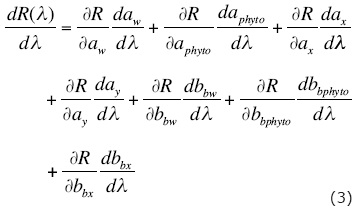
    <p align="justify"><font face="verdana" size="2">According to equation (2), the solar radiation reflected from the sea surface depends on absorption and backscattering processes. Both processes are dependent on the water itself, phytoplankton, particulate and dissolved matter (Kirk, 2011). Thus, considering all of these components, the derivative reflectance spectra can be expressed as the rate of change of reflectance with wavelength dR(&#955;)/d&#955;. Therefore, by estimating the complete differentiation of R = R(a<sub>w</sub>, a<sub>phyto</sub>, a<sub>x</sub>, a<sub>y</sub>, b<sub>bw</sub>, b<sub>bphyto</sub>, b<sub>bx</sub>, &#955;), we obtain</font></p>

	    <p align="center"><img src="/img/revistas/geoint/v53n4/a2e3.jpg"></p>
    <p align="justify"><font face="verdana" size="2">where the partial derivatives are an implicit function of &#955;.</font></p>

	    ]]></body>
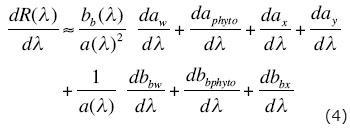
<body><![CDATA[<p align="justify"><font face="verdana" size="2">Assuming R(&#955;) &asymp; b<sub>b</sub>(&#955;)/a(&#955;) and by calculating the partial derivative for each component, and substituting in the equation (3), we get:</font></p>
	    <p align="center"><img src="/img/revistas/geoint/v53n4/a2e4.jpg"></p>
    <p align="justify"><font face="verdana" size="2">This equation relates the slope of a directly measured reflectance spectrum at any wavelength to each of the components. Consequently, it is possible to iteratively calculate high&#45;order derivatives. Thus, in principle, the presence of phytoplankton pigments, suspended and organic matter within the sea water can be estimated by considering reflectance spectrum components as mutually independent.</font></p>

	    <p align="justify">&nbsp;</p>
	    <p align="justify"><font face="verdana" size="2"><b>Study area</b></font></p>

	    <p align="justify"><font face="verdana" size="2">The Caribbean Sea is the largest sea adjacent to the Atlantic Ocean. It has an upper mixed layer of about 50 m, which quickly responds to atmospheric forcing. Circulation at this layer is controlled by the Caribbean Current, which substantially contributes to heat advection from the tropic to mid&#45;latitudes. The physical characteristics of the Caribbean Sea have been studied from various perspectives (e.g. Gordon, 1967; Etter <i>et al.</i>, 1987; Kinder <i>et al.</i>, 1985; M&uuml;ller&#45;Karger <i>et al.</i>, 1989). The Caribbean Sea is considered to be an oligotrophic area. This can be supported in terms of its efficiency of light utilisation. An areal efficiency eA (ratio of areal photosynthetic rate to the total Photosynthetically Active Radiation), in a range of 0.02%&#45;0.07%, was reported for the Caribbean Sea, which can be interpreted as a relatively low amount of phytoplankton within the euphotic zone (Morel, 1978). When the pycnocline is deeper than about 100 m, the deep chlorophyll maximum is extremely weak. However, the literature contains few studies of the bio&#45;optical characteristics of the area, measured with spectral radiometers and apparently no reports of its reflectance properties (e.g. Clark and Ewing, 1974; Farmer <i>et al.</i>, 1993).</font></p>

	    <p align="justify"><font face="verdana" size="2">The reflectance characteristics of oceanic waters have been studies by a number of authors (e.g. Wilson and Kiefer, 1979; Morel <i>et al.</i>, 1995). With the advent of high spectral resolution sensors the analysis of reflectance properties has been significantly improved.</font></p>

	    <p align="justify"><font face="verdana" size="2">The Bi&#45;directional Reflectance Factor (BDRF) method proposed by Milton (1987) has been widely used on lakes and lagoons (e.g. Dekker <i>et al.</i>, 1991; Aguirre&#45;G&oacute;mez, 2001) and on oceanic sites (e.g. Bidigare <i>et al.</i>, 1989; Aguirre <i>et al.</i>, 2001). One of the advantages of using high spectral resolution sensors is the potential for applying sophisticated algorithms, such as the derivative method, to nearly continuous curves. Particularly, it is a powerful tool for detecting information concealed in spectral reflectance curves. Thus, the main objective of this study is to analyze the spectral reflectance characteristics of the Caribbean Sea through the derivative method.</font></p>

	    <p align="justify">&nbsp;</p>
	    <p align="justify"><font face="verdana" size="2"><b>Material And Methods</b></font></p>

    ]]></body>
<body><![CDATA[<p align="justify"><font face="verdana" size="2">Hydrographical, meteorological and optical measurements were performed over the Caribbean Sea during the oceanographic/meteorological cruise ECAC&#45;3, onboard the R/V Justo Sierra (Universidad Nacional Aut&oacute;noma de M&eacute;xico, UNAM) from July 6 to 26, 2001.</font></p>

	    <p align="justify"><font face="verdana" size="2">The cruise track had three phases: outbound leg, main survey, and inbound leg (<a href="/img/revistas/geoint/v53n4/a2f1.jpg" target="_blank">Figure 1</a>). The outbound leg (from Tuxpan to Yucatan channel) was used for testing and training purposes. The cruise track for the main survey was determined by turning points that defined the nine cruise legs (<a href="/img/revistas/geoint/v53n4/a2t1.jpg" target="_blank">Table I</a>). The inbound leg (from Yucatan Channel to Tuxpan) was used for data processing and analysis, and database mergers.</font></p>

	    <p align="justify"><font face="verdana" size="2">Oceanic observations were focused on CTD casts made four or more times daily for temperature, salinity, density and dissolved oxygen (DO) depth profiles. Daytime fluorescence and reflectance measurements were carried out at 31 sampling stations located along of six cruise legs covering great extension of the Caribbean Sea (<a href="/img/revistas/geoint/v53n4/a2f2.jpg" target="_blank">Figure 2</a>). Chlorophyll a concentration at the 31 sampling stations was estimated by simultaneous derived SeaWiFs information.</font></p>

	    <p align="justify">&nbsp;</p>
	    <p align="justify"><font face="verdana" size="2"><b>Reflectance Measurements</b></font></p>

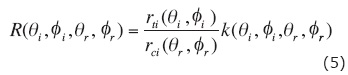
    <p align="justify"><font face="verdana" size="2">Reflectance was measured by the BDRF method (Swain and Davis, 1978). The BDRF can be defined as:</font></p>

	    <p align="center"><img src="/img/revistas/geoint/v53n4/a2e5.jpg"></p>

    <p align="justify"><font face="verdana" size="2">where <i>r<sub>ti</sub></i> is the flux reflected by a target under specified conditions of irradiation and viewing, <i>r<sub>ci</sub></i> is the flux reflected by a perfectly diffuse, completely reflecting Lambertian surface which is used as a reference and <i>k </i>is the panel correction factor which depends on the angular configuration and accounts for the non&#45;Lambertian spectral reflectance of the panel. To measure <i>r<sub>ti</sub></i> the Spectroradiometer GER&#45;1500 was placed over the sunny side of the ship to avoid the direct shadow of the ship, which may introduce an error of up to 30% (Gordon, 1985). Values of <i>r<sub>ci</sub> </i>were obtained by comparison with a Spectralon reference panel (Labsphere). The panel is resistant and hydrophobic, characteristics that render it suitable for field&#45;based research (Schutt <i>et al.</i>, 1981; Weidner and Hsia, 1981). The sensor was positioned to provide a nadir view of the water surface, reducing thus the unwanted irradiance of the specularly reflected light, which is independent of the optical properties of the water (Shifrin, 1988). This configuration guaranteed that light backscattered from the sea and the elements present within it would be the major contributor of the signal. Reflectance spectra were obtained by first scanning the water surface and then sequentially measuring over the reference panel. These observations were carried out while trying to keep the same viewing geometry by looking at nadir in both cases. However, since the calibration panel was onboard the target and reference observations were performed at different heights. Then, both scans were divided according to equation (5) and multiplied by a correction factor of k=0.99, following the manufacturer's instructions.</font></p>

	    <p align="justify"><font face="verdana" size="2">Spectroradiometric measurements were performed between 9:00 and 15:00 hrs for suitable solar conditions of illumination, that is, 45&deg; around nadir view, as suggested by Jerlov, (1968).</font></p>

	    <p align="justify"><font face="verdana" size="2">Remote Sensing reflectance spectra were estimated through ad hoc formulas taken a Fresnel reflectance &#961; = 0.028, which minimizes the effects of Sun glint and non&#45;uniform sky radiance, avoids instrument shading problems and is reliable for wind speeds less than 5 m s<sup>&#45;1</sup> (Mobley, 1999). Additionally, according to SeaWiFS protocol (Mueller and Austin, 1995) and in order to remove residual surface reflectance due to wave facets, the spectra were corrected for sun/sky glint error by subtracting the reflectance measured at 750 nm from each spectrum.</font></p>

	    ]]></body>
<body><![CDATA[<p align="justify">&nbsp;</p>
	    <p align="justify"><font face="verdana" size="2"><b>Derivative Spectral Analysis</b></font></p>

    <p align="justify"><font face="verdana" size="2">Atmospheric effects such as sky radiance, Rayleigh scattering, ozone absorption and Mie (or aerosol) scattering are unwanted signals in marine optics and in ocean colour studies (Sturm, 1981; Gordon, 1978). These effects must be considered in studies using remote sensing reflectance and have to be reduced if not eliminated. Atmospheric normalization algorithms can be used when analysing data for which there are no simultaneous atmospheric measurements. The derivative method is a kind of algorithm which makes insensitive to atmospheric effects some spectral features of the target. Generally, atmospheric normalization algorithms serve to parameterize the spectral shape (slope, curvature, etc) of the remote observations in an attempt to relate them to invariant spectra (Philpot, 1991). Grew (1981), developed a simple empirical algorithm for estimating oceanic chlorophyll from Multichannel Ocean Color Sensor (MOCS) data, the so&#45;called "inflection ratio algorithm". This algorithm is a linear difference operator acting as a high pass filter. Thus, linear variations in &#955; are completely removed and high order variations are reduced to a constant. Hence, the filtering quality of derivatives together with is linear properties account for its sensitivity to chlorophyll and its capabilities for eliminating unrelated effects such as the atmospheric ones. In this study a fourth derivative filter was applied to reflectance spectra for locating and identifying ubiquitous peaks concealed in the spectral curves. Since differentiation tends to magnify effects of high&#45;frequency noise in the spectra, a polynomial fit smoothing filter was applied over the data prior to calculation of the derivatives. Smoothed and derivative spectra were obtained with PeakFit program (AISN software, 1995). This program applies a convolution among the reflectance spectra and low and high &#45;pass filters (smoothing and fourth derivative filters, respectively).</font></p>

	    <p align="justify"><font face="verdana" size="2">Particularly, the fourth derivative detects the presence of both maxima and minima peaks that correspond to reflectance and absorption regions, respectively, due to optical properties of seawater and elements contained within it. Interpretation of peaks was based on the physical and biological spectral properties of these constituents.</font></p>

	    <p align="justify">&nbsp;</p>
	    <p align="justify"><font face="verdana" size="2"><b>Seawifs Data</b></font></p>

    <p align="justify"><font face="verdana" size="2">SeaWiFS data were utilised for associating reflectance and absorption peaks to chlorophyll a concentration. Daily images were not available due to cloud coverage in some of them, thus a set of existing of SeaWiFS imagery during the month was used for estimating the chlorophyll a concentration (&#91;Chl&#45;a&#93;) at each sampling station. A monthly&#45;averaged image, with a pixel of 1 km<sup>2</sup>, was obtained. From this, &#91;Chl&#45;a&#93; was estimated by using the empirical algorithm OC4 (O'Reilly <i>et al.</i>, 1998; O'Reilly <i>et al.</i>, 2000). In oligotrophic waters, the &#91;Chl&#45;a&#93; and its co&#45;varying derived products are considered to be the main contributors to the water reflectance. A simple relationship, with a sigmoid shape, links the log&#45;transformed reflectance ratios or remote sensing reflectance (R<sub>rs</sub>) to &#91;Chl&#45;a&#93;. The OC4 algorithm uses a single set of coefficients applied to the blue&#45;green ratio R<sub>BG</sub> which is determined by the maximum band ratio approach.</font></p>

	    <p align="justify"><font face="verdana" size="2">Thus, for R equal to log10(RBG):</font></p>
    <p align="center"><font face="verdana" size="2"><i>OC</i>4&#95;<i>Chl<sub>a</sub></i>&#40;0.366&#45;3.067<i>R</i> &#43; 1.93<i>R</i><sup>2</sup> &#45; 2.649 <i>R</i><sup>3</sup> &#45; 1.532<i>R</i><sup>4</sup>&#41; &#45; 0.0414</font></p>
    <p align="justify"><font face="verdana" size="2">SeaWiFS satellite data were processed with SeaDAS version 6.1. OC4 formulations and coefficients can be obtained from SeaDAS 6.1 documentation.</font></p>

    ]]></body>
<body><![CDATA[<p align="justify">&nbsp;</p>
    <p align="justify"><font face="verdana" size="2"><b>Results And Discussion</b></font></p>

    <p align="justify"><font face="verdana" size="2">Meteorological conditions, measured on board during the cruise, were rather stable except for two days of adverse weather at mid July (<a href="/img/revistas/geoint/v53n4/a2t2.jpg" target="_blank">Table II</a>). Mean values of the parameters indicate the stability of weather conditions. Thus, wind vectors had a mean magnitude of 6.24(3.01) m s<sup>&#45;1</sup> at 138.42(64.04) degrees. Variability of the other meteorological parameters was less: Mean Relative humidity 80.48% (4.13); mean barometric pressure 1010.7 (1.59) mb; and air temperature 29.16 (0.85) (&deg;C).</font></p>

	    <p align="justify"><font face="verdana" size="2">The spectral response of the Caribbean Sea is rather homogeneous. Most spectra profiles had a similar trend, with a relatively high reflectance between 0.04 and 0.06 at the blue end (400&#45;500 nm), except for three cases showing higher values; an abrupt downward slope starting at around 500 nm due to water absorption, and lower values at the red end of the spectra (<a href="/img/revistas/geoint/v53n4/a2f3.jpg" target="_blank">Figure 3</a>). All spectra are modulated by the optical properties of oceanic water and, at a lesser extent, by phytoplankton, which is characteristic of oligotrophic conditions. These characteristics account for the typical blue coloration of Caribbean waters.</font></p>

	    <p align="justify"><font face="verdana" size="2">The derivative analysis provides a more accurate location of absorption and reflectance peaks. They slightly differ from analysis performed with conventional methods. The derivative method precisely locates and the actual inflexion points and, consequently, identifies absorption or reflection peaks. Thus, a fourth derivative filter was then applied to all spectra in order to detect hidden reflectance and absorption peaks. Each reflectance spectra showed similar reflectance and absorption peaks as maxima and minima values, respectively. Hence, instead of having the theoretical blue absorption peak of chlorophyll around 440 nm, with the derivative analysis this peak is found around 447 nm. A statistical analysis of all the peaks found through this method was performed for the reflectance curves of every sampling site. Consequently, a mean value of them was considered in the following derivative analysis (<a href="/img/revistas/geoint/v53n4/a2t4.jpg" target="_blank">Table IV</a>). When all reflectance spectra were normalised at 447.95 (mean value of the fourth derivative maxima), which corresponds to the absorption peak of chlorophyll a in the blue region, the differences and similarities among the spectra could be assessed (<a href="/img/revistas/geoint/v53n4/a2f4.jpg" target="_blank">Figure 4</a>). Major differences are apparent between 400 and 450 nm (blue), whilst similarities occur mainly in the 450 &#45; 500 nm region (green). From 500 nm onwards all spectra have the same trend with slight variations between 650 and 700 nm.</font></p>

	    <p align="justify"><font face="verdana" size="2">However, it has been reported the presence also of cyanobacteria and green algae groups (Bidigare <i>et al.</i>, 1993). Mean absorption peaks at 597.12 and 659.02 nm are due to pure seawater. There is evidence that light absorption by pure water depends on its temperature, being apparent in absorption bands around 600 and 660 nm at 21&deg;C (Pegau and Zaneveld, 1993). It has been found that the absorption maximum shifts towards lower wavelengths at increasing temperature (Hakvoort, 1994). This may account for the slight difference found between the two sets of data, since the sea surface temperature of Caribbean waters was around 29&deg;C during the sampling.</font></p>

	    <p align="justify"><font face="verdana" size="2">A typical reflectance spectrum with its correspondent derivative peaks is shown in <a href="/img/revistas/geoint/v53n4/a2f5.jpg" target="_blank">Figure 5</a>. Peaks found through the derivative method can be associated with the optical properties of seawater. Mean reflectance peaks at 415.04 and 480.31 nm stands for the dominant colour of the water, which was mostly bluish over the entire zone. The peak at 685.82 nm is mainly due to the sum of irradiances produced through natural fluorescence emission by chlorophyll a and elastic scattering (Kirk, 2011). The mean reflectance peak at 546.92 nm has a physical explanation rather than a biological one because this peak marks the starting point of the strong water absorption, which reaches a maximum around 600 nm (Buiteveld <i>et al</i>, 1994).</font></p>

	    <p align="justify"><font face="verdana" size="2">On the other hand, absorption peaks found by the derivative process can be essentially related to optical properties of pigments and seawater (Pr&eacute;zelin and B&oacute;czar, 1986; Aguirre <i>et al</i>, 2001). Thus, the peak at 447.95 nm is due to chlorophyll a absorption in the blue region. A carotenoid absorption peak at 513.01 nm can presumably be attributed to fucoxanthin&#45;like pigments of brown algae, which are among the dominant groups in the zone (Taylor, 1959; M&uuml;ller&#45;Karger <i>et al</i>, 1989; Bidigare <i>et al</i>, 1993).</font></p>

	    <p align="justify"><font face="verdana" size="2">Satellite&#45;estimated &#91;Chl&#45;a&#93; at each sampling station is shown in <a href="/img/revistas/geoint/v53n4/a2t2.jpg" target="_blank">Table II</a> and had a mean value of 0.109 (0.023) mg m<sup>&#45;3</sup> (<a href="/img/revistas/geoint/v53n4/a2t3.jpg" target="_blank">Table III</a>). Values obtained are typical of oligotrophic waters, mainly at the northern sampling stations (3, 4, 5, 14 and 15), the remaining sites showed a slight increment of &#91;Chl&#45;a&#93; between 0.101 &#150; 0.158 mg m<sup>&#45;3</sup> but still in the oligotrophic interval, according to the CZCS&#45;NASA climatological monthly maps (Feldman <i>et al.</i>, 1989) as seen in <a href="/img/revistas/geoint/v53n4/a2t2.jpg" target="_blank">Table II</a> and <a href="/img/revistas/geoint/v53n4/a2f2.jpg" target="_blank">Figure 2</a>. Regions with the highest &#91;Chl&#45;a&#93; values were found close to Jamaica island (sites 25, 26, 27, 36) and near Honduras (sites 58, 79 and 91).</font></p>

	    <p align="justify"><font face="verdana" size="2">Moreover, applying OC4 algorithm to SeaDAS data tends to over&#45;estimates the chlorophyll concentrations in relatively chlorophyll&#45;poor waters, where the relative part of the suspended matter and the CDOM in the optical properties of water is high. For such waters, benefit in accuracy by using one algorithm or the other seems negligible compared with the biases and the noises. However, we have chosen the OC4 band ratio as it is recommended in the literature for a larger variety of waters, including chlorophyll rich waters.</font></p>

	    ]]></body>
<body><![CDATA[<p align="justify">&nbsp;</p>
	    <p align="justify"><font face="verdana" size="2"><b>Conclusions</b></font></p>

    <p align="justify"><font face="verdana" size="2">Reflectance characteristics of the Caribbean Sea were analysed with a high spectral resolution radiometer. Reflectance spectra show a typical coloration of tropical waters with maxima at the blue region of the electromagnetic spectrum. This response is mainly due to the oligotrophic characteristics of the zone, with a deep chlorophyll maximum at around 107 m. The presence of chlorophyll a can be established by two ways: a) via fluorescence, by observing the spectral behaviour which has an absorption peak at 447.9 nm (blue absorption) and a reflectance peak at 685.82 nm (fluorescence emission); b) via satellite derived information. Satellite information confirms both the homogenous distribution of &#91;Chl&#45;a&#93; and the oligotrophic condition of the Caribbean Sea. Reflectance profiles are markedly influenced by seawater spectral properties from 600 nm onwards. Hence, even though the Caribbean Sea is oligotrophic, the derivative analysis detects the presence of algae in an amount sufficient to generate a relatively strong signal within reflectance spectra and satellite imagery. Additionally, it can be concluded that most Caribbean Sea waters show similar optical characteristics in open ocean, being higher close to Jamaica and Honduras. This paper contributes to a better understanding of the optical characteristics of the Caribbean Sea.</font></p>

	    <p align="justify">&nbsp;</p>
	    <p align="justify"><font face="verdana" size="2"><b>Acknowledgements</b></font></p>

    <p align="justify"><font face="verdana" size="2">I thank the following: Dr. A. Gallegos for his kind invitation to participate in the ECAC&#45;3 cruise; Dr. V. Maga&ntilde;a, coordinator of the project and the IAI for funding these campaigns; to Dr. Olivia Salmer&oacute;n and Tania Fern&aacute;ndez for support during the cruise; the technicians of the Institute of Geography for drawings; and the crew of RV Justo Sierra.</font></p>

	    <p align="justify">&nbsp;</p>
	    <p align="justify"><font face="verdana" size="2"><b>References</b></font></p>

    <!-- ref --><p align="justify"><font face="verdana" size="2">Aguirre&#45;G&oacute;mez R., 2001, Caracterizaci&oacute;n &oacute;ptica de la laguna costera de Coyuca de Ben&iacute;tez. <i>Investigaciones Geogr&aacute;ficas</i>, 46, 78&#45;97.    &nbsp;&nbsp;&nbsp;&nbsp;&nbsp;&nbsp;&nbsp;&nbsp;[&#160;<a href="javascript:void(0);" onclick="javascript: window.open('/scielo.php?script=sci_nlinks&ref=3944332&pid=S0016-7169201400040000200001&lng=','','width=640,height=500,resizable=yes,scrollbars=1,menubar=yes,');">Links</a>&#160;]<!-- end-ref --></font></p>

	    ]]></body>
<body><![CDATA[<!-- ref --><p align="justify"><font face="verdana" size="2">Aguirre&#45;G&oacute;mez R., Weeks A.R., Boxall S.R., 2001, Detecting photosynthetic algal pigments in natural populations using a high&#45;spectral resolution spectroradiometer. <i>Int. J. Remote Sens</i>., 22, 15, 2867&#45;2884.    &nbsp;&nbsp;&nbsp;&nbsp;&nbsp;&nbsp;&nbsp;&nbsp;[&#160;<a href="javascript:void(0);" onclick="javascript: window.open('/scielo.php?script=sci_nlinks&ref=3944334&pid=S0016-7169201400040000200002&lng=','','width=640,height=500,resizable=yes,scrollbars=1,menubar=yes,');">Links</a>&#160;]<!-- end-ref --></font></p>

	    <!-- ref --><p align="justify"><font face="verdana" size="2">Bidigare R.R., Morrow J.H., Kiefer D.A., 1989, Derivative analysis of spectral absorption by photosynthetic pigments in the western Sargasso <i>Sea. J. Mar. Res</i>., 47, 323&#45;341.    &nbsp;&nbsp;&nbsp;&nbsp;&nbsp;&nbsp;&nbsp;&nbsp;[&#160;<a href="javascript:void(0);" onclick="javascript: window.open('/scielo.php?script=sci_nlinks&ref=3944336&pid=S0016-7169201400040000200003&lng=','','width=640,height=500,resizable=yes,scrollbars=1,menubar=yes,');">Links</a>&#160;]<!-- end-ref --></font></p>

	    <!-- ref --><p align="justify"><font face="verdana" size="2">Bidigare R.R., Ondrusek M.E., Brooks J.M., 1993, Influence of the Orinoco River outflow on distribution of algal pigments in the Caribbean <i>Sea. J. Geophys. Res</i>., 98, C2, 2259&#45;2269.    &nbsp;&nbsp;&nbsp;&nbsp;&nbsp;&nbsp;&nbsp;&nbsp;[&#160;<a href="javascript:void(0);" onclick="javascript: window.open('/scielo.php?script=sci_nlinks&ref=3944338&pid=S0016-7169201400040000200004&lng=','','width=640,height=500,resizable=yes,scrollbars=1,menubar=yes,');">Links</a>&#160;]<!-- end-ref --></font></p>

	    <!-- ref --><p align="justify"><font face="verdana" size="2">Buiteveld H., Hakvoort J.H.M., Donze M., 1994, The optical properties of pure water. SP1E, 2258 Ocean Optics XII: 174&#45;183.    &nbsp;&nbsp;&nbsp;&nbsp;&nbsp;&nbsp;&nbsp;&nbsp;[&#160;<a href="javascript:void(0);" onclick="javascript: window.open('/scielo.php?script=sci_nlinks&ref=3944340&pid=S0016-7169201400040000200005&lng=','','width=640,height=500,resizable=yes,scrollbars=1,menubar=yes,');">Links</a>&#160;]<!-- end-ref --></font></p>

	    <!-- ref --><p align="justify"><font face="verdana" size="2">Butler W.L., Hopkins D.W., 1970, Higher derivative analysis of complex absorption spectra. <i>Photochem. Photobiol.</i>, 12, 439&#45;450.    &nbsp;&nbsp;&nbsp;&nbsp;&nbsp;&nbsp;&nbsp;&nbsp;[&#160;<a href="javascript:void(0);" onclick="javascript: window.open('/scielo.php?script=sci_nlinks&ref=3944342&pid=S0016-7169201400040000200006&lng=','','width=640,height=500,resizable=yes,scrollbars=1,menubar=yes,');">Links</a>&#160;]<!-- end-ref --></font></p>

	    ]]></body>
<body><![CDATA[<!-- ref --><p align="justify"><font face="verdana" size="2">Chen Z., Curran P.J., Hansom J.D., 1992, Derivative reflectance spectroscopy to estimate suspended sediment concentration. <i>Remote Sens. Environ.</i>, 40, 67&#45;77.    &nbsp;&nbsp;&nbsp;&nbsp;&nbsp;&nbsp;&nbsp;&nbsp;[&#160;<a href="javascript:void(0);" onclick="javascript: window.open('/scielo.php?script=sci_nlinks&ref=3944344&pid=S0016-7169201400040000200007&lng=','','width=640,height=500,resizable=yes,scrollbars=1,menubar=yes,');">Links</a>&#160;]<!-- end-ref --></font></p>

	    <!-- ref --><p align="justify"><font face="verdana" size="2">Clark G.L., Ewing G.C., 1974, Remote spectroscopy of the sea for biological production studies. En N. G. Jerlov &amp; E. S. Nielsen (eds.), Optical Aspects of Oceanography, London: Academic Press, pp. 389&#45;413.    &nbsp;&nbsp;&nbsp;&nbsp;&nbsp;&nbsp;&nbsp;&nbsp;[&#160;<a href="javascript:void(0);" onclick="javascript: window.open('/scielo.php?script=sci_nlinks&ref=3944346&pid=S0016-7169201400040000200008&lng=','','width=640,height=500,resizable=yes,scrollbars=1,menubar=yes,');">Links</a>&#160;]<!-- end-ref --></font></p>

	    <!-- ref --><p align="justify"><font face="verdana" size="2">Dekker A.G., Malthus T.H., Seyhan E., 1991, Quantitative modeling of inland water quality for high&#45;resolution MSS systems. <i>IEEE Trans. Geosci and Remote Sensing.</i>, 29, 89&#45;95.    &nbsp;&nbsp;&nbsp;&nbsp;&nbsp;&nbsp;&nbsp;&nbsp;[&#160;<a href="javascript:void(0);" onclick="javascript: window.open('/scielo.php?script=sci_nlinks&ref=3944348&pid=S0016-7169201400040000200009&lng=','','width=640,height=500,resizable=yes,scrollbars=1,menubar=yes,');">Links</a>&#160;]<!-- end-ref --></font></p>

	    <!-- ref --><p align="justify"><font face="verdana" size="2">Etter P.C., Lamb P.J., Portis D.H., 1987, Heat and freshwater budgets of the Caribbean Sea with revised estimates for the Central American Seas,<i> J. Phys. Oceanogr</i>., 17, 1232&#45;1248.    &nbsp;&nbsp;&nbsp;&nbsp;&nbsp;&nbsp;&nbsp;&nbsp;[&#160;<a href="javascript:void(0);" onclick="javascript: window.open('/scielo.php?script=sci_nlinks&ref=3944350&pid=S0016-7169201400040000200010&lng=','','width=640,height=500,resizable=yes,scrollbars=1,menubar=yes,');">Links</a>&#160;]<!-- end-ref --></font></p>

	    <!-- ref --><p align="justify"><font face="verdana" size="2">Evangelista V., Frassanito A.M., Passarelli V., Barsanti L., Gualtieri P., 2006, Microspectroscopy of the Photosynthetic Compartment of Algae. <i>Photochem. Photobiol</i>., 82, 4, 1039&#45;1046.    &nbsp;&nbsp;&nbsp;&nbsp;&nbsp;&nbsp;&nbsp;&nbsp;[&#160;<a href="javascript:void(0);" onclick="javascript: window.open('/scielo.php?script=sci_nlinks&ref=3944352&pid=S0016-7169201400040000200011&lng=','','width=640,height=500,resizable=yes,scrollbars=1,menubar=yes,');">Links</a>&#160;]<!-- end-ref --></font></p>

	    ]]></body>
<body><![CDATA[<!-- ref --><p align="justify"><font face="verdana" size="2">Farmer C.T., Moore C.A., Zika R.G., Sikorski R.J., 1993, Effects of low and high Orinoco river flow on the underwater light field of the eastern Caribbean basin.<i> J. Geophys. Res</i>., 98, C2, 2279&#45;2288.    &nbsp;&nbsp;&nbsp;&nbsp;&nbsp;&nbsp;&nbsp;&nbsp;[&#160;<a href="javascript:void(0);" onclick="javascript: window.open('/scielo.php?script=sci_nlinks&ref=3944354&pid=S0016-7169201400040000200012&lng=','','width=640,height=500,resizable=yes,scrollbars=1,menubar=yes,');">Links</a>&#160;]<!-- end-ref --></font></p>

	    <!-- ref --><p align="justify"><font face="verdana" size="2">Feldman G.C., Kuring N., Ng C., Esaias W., McClain C.R., Elrod Maynard N., Endres D., Evans R., Brown J., Walsh S., Carle M., Podesta G., 1989. Ocean color: availability of the global data set. EOS Trans. <i>Am. Geophys. Union,</i> 70, 634&#45;641.    &nbsp;&nbsp;&nbsp;&nbsp;&nbsp;&nbsp;&nbsp;&nbsp;[&#160;<a href="javascript:void(0);" onclick="javascript: window.open('/scielo.php?script=sci_nlinks&ref=3944356&pid=S0016-7169201400040000200013&lng=','','width=640,height=500,resizable=yes,scrollbars=1,menubar=yes,');">Links</a>&#160;]<!-- end-ref --></font></p>

	    <!-- ref --><p align="justify"><font face="verdana" size="2">Gordon, A.L., 1967, Circulation of the Caribbean Sea, <i>J. Geophys. Res.,</i> 72, 24, 6207&#45;6223.    &nbsp;&nbsp;&nbsp;&nbsp;&nbsp;&nbsp;&nbsp;&nbsp;[&#160;<a href="javascript:void(0);" onclick="javascript: window.open('/scielo.php?script=sci_nlinks&ref=3944358&pid=S0016-7169201400040000200014&lng=','','width=640,height=500,resizable=yes,scrollbars=1,menubar=yes,');">Links</a>&#160;]<!-- end-ref --></font></p>

	    <!-- ref --><p align="justify"><font face="verdana" size="2">Gordon H.R., 1978, Removal of atmospheric effects from satellite imagery of the oceans. <i>Appl. Optics</i>, 17, 1631&#45;1636.    &nbsp;&nbsp;&nbsp;&nbsp;&nbsp;&nbsp;&nbsp;&nbsp;[&#160;<a href="javascript:void(0);" onclick="javascript: window.open('/scielo.php?script=sci_nlinks&ref=3944360&pid=S0016-7169201400040000200015&lng=','','width=640,height=500,resizable=yes,scrollbars=1,menubar=yes,');">Links</a>&#160;]<!-- end-ref --></font></p>

	    <!-- ref --><p align="justify"><font face="verdana" size="2">Gordon H.R., 1985, Ship perturbation of radiance measurements at sea. 1: Monte Carlo simulations. <i>Appl. Optics,</i> 24, 4172&#45;4182.    &nbsp;&nbsp;&nbsp;&nbsp;&nbsp;&nbsp;&nbsp;&nbsp;[&#160;<a href="javascript:void(0);" onclick="javascript: window.open('/scielo.php?script=sci_nlinks&ref=3944362&pid=S0016-7169201400040000200016&lng=','','width=640,height=500,resizable=yes,scrollbars=1,menubar=yes,');">Links</a>&#160;]<!-- end-ref --></font></p>

	    ]]></body>
<body><![CDATA[<!-- ref --><p align="justify"><font face="verdana" size="2">Goodin D.G., Han L., Fraser R.N., Rundquist D.C., Stebbins W.A., 1993, Analysis of suspended solids in water using remotely sensed high resolution derivative spectra. <i>Photogramm. Eng. Rem.</i> S., 59, 505&#45;510.    &nbsp;&nbsp;&nbsp;&nbsp;&nbsp;&nbsp;&nbsp;&nbsp;[&#160;<a href="javascript:void(0);" onclick="javascript: window.open('/scielo.php?script=sci_nlinks&ref=3944364&pid=S0016-7169201400040000200017&lng=','','width=640,height=500,resizable=yes,scrollbars=1,menubar=yes,');">Links</a>&#160;]<!-- end-ref --></font></p>

	    <!-- ref --><p align="justify"><font face="verdana" size="2">Gordon H.R, Morel A., 1983, Remote assessment of ocean color for interpretation of satellite visible imagery, a review.<i> Lectures. Notes on Coastal and Estuarine. Studies,</i> 4, Springer&#45;Verlag New York.    &nbsp;&nbsp;&nbsp;&nbsp;&nbsp;&nbsp;&nbsp;&nbsp;[&#160;<a href="javascript:void(0);" onclick="javascript: window.open('/scielo.php?script=sci_nlinks&ref=3944366&pid=S0016-7169201400040000200018&lng=','','width=640,height=500,resizable=yes,scrollbars=1,menubar=yes,');">Links</a>&#160;]<!-- end-ref --></font></p>

	    <!-- ref --><p align="justify"><font face="verdana" size="2">Gordon H.R., Brown O.B., Evans R.H., Brown J.W, Smith R.C, Smith K.S., Baker K.S, Clark D.K., 1988, A semianalytical radiance model of ocean color.<i> J. Geophysical Res.</i> Vol., 93, 10 909&#45;10924.    &nbsp;&nbsp;&nbsp;&nbsp;&nbsp;&nbsp;&nbsp;&nbsp;[&#160;<a href="javascript:void(0);" onclick="javascript: window.open('/scielo.php?script=sci_nlinks&ref=3944368&pid=S0016-7169201400040000200019&lng=','','width=640,height=500,resizable=yes,scrollbars=1,menubar=yes,');">Links</a>&#160;]<!-- end-ref --></font></p>

	    <!-- ref --><p align="justify"><font face="verdana" size="2">Grew G., 1981, Real&#45;time test of MOCS algorithm during Superflux 1980, NASA Washington DC, CP&#45;2188, 301&#45;322.    &nbsp;&nbsp;&nbsp;&nbsp;&nbsp;&nbsp;&nbsp;&nbsp;[&#160;<a href="javascript:void(0);" onclick="javascript: window.open('/scielo.php?script=sci_nlinks&ref=3944370&pid=S0016-7169201400040000200020&lng=','','width=640,height=500,resizable=yes,scrollbars=1,menubar=yes,');">Links</a>&#160;]<!-- end-ref --></font></p>

	    <!-- ref --><p align="justify"><font face="verdana" size="2">Hakvoort J.H.M., 1994, <i>Absorption of light by surface water.</i> (Delft: Delft University Press).    &nbsp;&nbsp;&nbsp;&nbsp;&nbsp;&nbsp;&nbsp;&nbsp;[&#160;<a href="javascript:void(0);" onclick="javascript: window.open('/scielo.php?script=sci_nlinks&ref=3944372&pid=S0016-7169201400040000200021&lng=','','width=640,height=500,resizable=yes,scrollbars=1,menubar=yes,');">Links</a>&#160;]<!-- end-ref --></font></p>

	    ]]></body>
<body><![CDATA[<!-- ref --><p align="justify"><font face="verdana" size="2">Han L., 2005, Estimating chlorophyll&#45;a concentration using first&#45;derivative spectra in coastal water. <i>Int. J. Remote Sens.</i> Vol., 26, 23, 5235&#45;5244.    &nbsp;&nbsp;&nbsp;&nbsp;&nbsp;&nbsp;&nbsp;&nbsp;[&#160;<a href="javascript:void(0);" onclick="javascript: window.open('/scielo.php?script=sci_nlinks&ref=3944374&pid=S0016-7169201400040000200022&lng=','','width=640,height=500,resizable=yes,scrollbars=1,menubar=yes,');">Links</a>&#160;]<!-- end-ref --></font></p>

	    <!-- ref --><p align="justify"><font face="verdana" size="2">Hirata T., H&oslash;jerslev N.K., 2008, Relationship between the irradiance reflectance and inherent optical properties of seawater. <i>J. Geophys. Res.</i>, 113, C03030.    &nbsp;&nbsp;&nbsp;&nbsp;&nbsp;&nbsp;&nbsp;&nbsp;[&#160;<a href="javascript:void(0);" onclick="javascript: window.open('/scielo.php?script=sci_nlinks&ref=3944376&pid=S0016-7169201400040000200023&lng=','','width=640,height=500,resizable=yes,scrollbars=1,menubar=yes,');">Links</a>&#160;]<!-- end-ref --></font></p>

	    <!-- ref --><p align="justify"><font face="verdana" size="2">Hunter P.D., Tyler A.N., Pr&eacute;sing M., Kov&aacute;cs A.W., Preston T., 2008, Spectral discrimination of phytoplankton colour groups: The effect of suspended particulate matter and sensor spectral resolution. Remote Sens. Environ., 112, 4, 1527&#45;1544.    &nbsp;&nbsp;&nbsp;&nbsp;&nbsp;&nbsp;&nbsp;&nbsp;[&#160;<a href="javascript:void(0);" onclick="javascript: window.open('/scielo.php?script=sci_nlinks&ref=3944378&pid=S0016-7169201400040000200024&lng=','','width=640,height=500,resizable=yes,scrollbars=1,menubar=yes,');">Links</a>&#160;]<!-- end-ref --></font></p>

	    <!-- ref --><p align="justify"><font face="verdana" size="2">Jerlov N.G., 1968, Optical oceanography: New York, American Elsevier Publishing Co., 194 pp.    &nbsp;&nbsp;&nbsp;&nbsp;&nbsp;&nbsp;&nbsp;&nbsp;[&#160;<a href="javascript:void(0);" onclick="javascript: window.open('/scielo.php?script=sci_nlinks&ref=3944380&pid=S0016-7169201400040000200025&lng=','','width=640,height=500,resizable=yes,scrollbars=1,menubar=yes,');">Links</a>&#160;]<!-- end-ref --></font></p>

	    <!-- ref --><p align="justify"><font face="verdana" size="2">Jia Y., Pengwu T., Hongyi Y., 2008, Peak Identification of Communication Signal Using Wavelet Packet Transform, <i>Wireless Communications, Networking and Mobile Computing, WiCOM '08. 4th International Conference on, </i>1&#45;4, doi: 10.1109/WiCom.2008.449.    &nbsp;&nbsp;&nbsp;&nbsp;&nbsp;&nbsp;&nbsp;&nbsp;[&#160;<a href="javascript:void(0);" onclick="javascript: window.open('/scielo.php?script=sci_nlinks&ref=3944382&pid=S0016-7169201400040000200026&lng=','','width=640,height=500,resizable=yes,scrollbars=1,menubar=yes,');">Links</a>&#160;]<!-- end-ref --></font></p>

	    ]]></body>
<body><![CDATA[<!-- ref --><p align="justify"><font face="verdana" size="2">Kinder T.H., Heburn G.W., Green A.W., 1985, Some aspects of the Caribbean circulation, <i>Mar. Geol.</i>, 68, 25&#45;52.    &nbsp;&nbsp;&nbsp;&nbsp;&nbsp;&nbsp;&nbsp;&nbsp;[&#160;<a href="javascript:void(0);" onclick="javascript: window.open('/scielo.php?script=sci_nlinks&ref=3944384&pid=S0016-7169201400040000200027&lng=','','width=640,height=500,resizable=yes,scrollbars=1,menubar=yes,');">Links</a>&#160;]<!-- end-ref --></font></p>

	    <!-- ref --><p align="justify"><font face="verdana" size="2">Kirk J.T.O., 2011, <i>Light and photosynthesis in aquatic Ecosystems </i>(Cambridge: Cambridge University Press), Third Edition.    &nbsp;&nbsp;&nbsp;&nbsp;&nbsp;&nbsp;&nbsp;&nbsp;[&#160;<a href="javascript:void(0);" onclick="javascript: window.open('/scielo.php?script=sci_nlinks&ref=3944386&pid=S0016-7169201400040000200028&lng=','','width=640,height=500,resizable=yes,scrollbars=1,menubar=yes,');">Links</a>&#160;]<!-- end-ref --></font></p>

	    <!-- ref --><p align="justify"><font face="verdana" size="2">Kirk J.T.O., 1984, Dependence of relationship between inherent and apparent optical properties of water on solar altitude. <i>Limnol. Oceanogr.,</i> 29, 350&#45;356.    &nbsp;&nbsp;&nbsp;&nbsp;&nbsp;&nbsp;&nbsp;&nbsp;[&#160;<a href="javascript:void(0);" onclick="javascript: window.open('/scielo.php?script=sci_nlinks&ref=3944388&pid=S0016-7169201400040000200029&lng=','','width=640,height=500,resizable=yes,scrollbars=1,menubar=yes,');">Links</a>&#160;]<!-- end-ref --></font></p>

	    <!-- ref --><p align="justify"><font face="verdana" size="2">Milton E.J., 1987, Principles of field spectroscopy. <i>Int. J. Remote Sens.</i>, 8, 1807&#45;1827.    &nbsp;&nbsp;&nbsp;&nbsp;&nbsp;&nbsp;&nbsp;&nbsp;[&#160;<a href="javascript:void(0);" onclick="javascript: window.open('/scielo.php?script=sci_nlinks&ref=3944390&pid=S0016-7169201400040000200030&lng=','','width=640,height=500,resizable=yes,scrollbars=1,menubar=yes,');">Links</a>&#160;]<!-- end-ref --></font></p>

	    <!-- ref --><p align="justify"><font face="verdana" size="2">Morel A., 1978, Available, usable and stored radiant energy in relation to marine photosynthesis. <i>Deep&#45;Sea Res.,</i> 25, 673&#45;688.    &nbsp;&nbsp;&nbsp;&nbsp;&nbsp;&nbsp;&nbsp;&nbsp;[&#160;<a href="javascript:void(0);" onclick="javascript: window.open('/scielo.php?script=sci_nlinks&ref=3944392&pid=S0016-7169201400040000200031&lng=','','width=640,height=500,resizable=yes,scrollbars=1,menubar=yes,');">Links</a>&#160;]<!-- end-ref --></font></p>

	    ]]></body>
<body><![CDATA[<!-- ref --><p align="justify"><font face="verdana" size="2">Morel A., Prieur L., 1977, Analysis of variations in ocean color.<i> Limnol. Oceanogr.</i>, 22, 709&#45;722.    &nbsp;&nbsp;&nbsp;&nbsp;&nbsp;&nbsp;&nbsp;&nbsp;[&#160;<a href="javascript:void(0);" onclick="javascript: window.open('/scielo.php?script=sci_nlinks&ref=3944394&pid=S0016-7169201400040000200032&lng=','','width=640,height=500,resizable=yes,scrollbars=1,menubar=yes,');">Links</a>&#160;]<!-- end-ref --></font></p>

	    <!-- ref --><p align="justify"><font face="verdana" size="2">Morel A., Voss K.J., Gentili B., 1995, Bidirectional reflectance of oceanic waters: A comparison of modeled and measured upward radiance fields. <i>J. Geophys. Res.</i>, 100, C7, 13143&#45;13150.    &nbsp;&nbsp;&nbsp;&nbsp;&nbsp;&nbsp;&nbsp;&nbsp;[&#160;<a href="javascript:void(0);" onclick="javascript: window.open('/scielo.php?script=sci_nlinks&ref=3944396&pid=S0016-7169201400040000200033&lng=','','width=640,height=500,resizable=yes,scrollbars=1,menubar=yes,');">Links</a>&#160;]<!-- end-ref --></font></p>

	    <!-- ref --><p align="justify"><font face="verdana" size="2">Mueller J.L., Austin R.W., 1995, Ocean optics protocols for SeaWiFS validation, revision 1, SeaWiFS Technical Report Series, Vol. 25, NASA Tech. Memo. 104566, S. B. Hooker, E. R. Firestone, and J. G. Acker, eds. ~National Technical Information Service, Springfield, Va.    &nbsp;&nbsp;&nbsp;&nbsp;&nbsp;&nbsp;&nbsp;&nbsp;[&#160;<a href="javascript:void(0);" onclick="javascript: window.open('/scielo.php?script=sci_nlinks&ref=3944398&pid=S0016-7169201400040000200034&lng=','','width=640,height=500,resizable=yes,scrollbars=1,menubar=yes,');">Links</a>&#160;]<!-- end-ref --></font></p>

	    <!-- ref --><p align="justify"><font face="verdana" size="2">M&uuml;ller&#45;Karger F.E., McClain C.R., Fisher T.R., Esaias W.E., Varela R., 1989, Pigment distribution in the Caribbean Sea: Observations from Space. <i>Prog. Oceanogr.</i>, 23, 23&#45;64.    &nbsp;&nbsp;&nbsp;&nbsp;&nbsp;&nbsp;&nbsp;&nbsp;[&#160;<a href="javascript:void(0);" onclick="javascript: window.open('/scielo.php?script=sci_nlinks&ref=3944400&pid=S0016-7169201400040000200035&lng=','','width=640,height=500,resizable=yes,scrollbars=1,menubar=yes,');">Links</a>&#160;]<!-- end-ref --></font></p>

	    <!-- ref --><p align="justify"><font face="verdana" size="2">O'Reilly J.E., Maritorena S., Mitchell B.G., Siegel D.A., Carder K.L., Garver S.A., Kahru S.A., McClain C., 1998, Ocean color chlorophyll algorithms for SeaWiFS. <i>Journal of Geophysical Research,</i> 103, 24 937&#45;24 953.    &nbsp;&nbsp;&nbsp;&nbsp;&nbsp;&nbsp;&nbsp;&nbsp;[&#160;<a href="javascript:void(0);" onclick="javascript: window.open('/scielo.php?script=sci_nlinks&ref=3944402&pid=S0016-7169201400040000200036&lng=','','width=640,height=500,resizable=yes,scrollbars=1,menubar=yes,');">Links</a>&#160;]<!-- end-ref --></font></p>

	    ]]></body>
<body><![CDATA[<!-- ref --><p align="justify"><font face="verdana" size="2">O'Reilly J.E., Maritorena S., Siegel D., O'Brien M., Toole D.T., Mitchell B.G., Kahru M., Chavez F.P., Strutton P., Cota G.F., Hooker S.B., McClain C.R., Carder K.L., Muller&#45;Karger F.E., Harding L., Magnuson A., Phinney D., Moore G.F., Aiken J., Arrigo K.R., Letelier R.M., Culver M.E., 2000, Ocean Color Chlorophyll a algorithms for SeaWiFS, OC2 and OC4: Version 4. SeaWiFS Postlaunch Calibration and Validation Analyses, Part 3. NASA/TM 206892, 11, 9&#45;23.    &nbsp;&nbsp;&nbsp;&nbsp;&nbsp;&nbsp;&nbsp;&nbsp;[&#160;<a href="javascript:void(0);" onclick="javascript: window.open('/scielo.php?script=sci_nlinks&ref=3944404&pid=S0016-7169201400040000200037&lng=','','width=640,height=500,resizable=yes,scrollbars=1,menubar=yes,');">Links</a>&#160;]<!-- end-ref --></font></p>

	    <!-- ref --><p align="justify"><font face="verdana" size="2">Pegau W.S., Zaneveld J.R.V., 1993, Temperature&#45;dependent absorption of water in the red and near infrared portion of the spectrum. <i>Limnol. Oceanogr,</i> 38, 188&#45;192.    &nbsp;&nbsp;&nbsp;&nbsp;&nbsp;&nbsp;&nbsp;&nbsp;[&#160;<a href="javascript:void(0);" onclick="javascript: window.open('/scielo.php?script=sci_nlinks&ref=3944406&pid=S0016-7169201400040000200038&lng=','','width=640,height=500,resizable=yes,scrollbars=1,menubar=yes,');">Links</a>&#160;]<!-- end-ref --></font></p>

	    <!-- ref --><p align="justify"><font face="verdana" size="2">Philpot W.D., 1991, The derivative ratio algorithm: avoiding atmospheric effects in remote sensing. IEEE Transactions on Geoscience and Remote Sensing, 29, 3.    &nbsp;&nbsp;&nbsp;&nbsp;&nbsp;&nbsp;&nbsp;&nbsp;[&#160;<a href="javascript:void(0);" onclick="javascript: window.open('/scielo.php?script=sci_nlinks&ref=3944408&pid=S0016-7169201400040000200039&lng=','','width=640,height=500,resizable=yes,scrollbars=1,menubar=yes,');">Links</a>&#160;]<!-- end-ref --></font></p>

	    <!-- ref --><p align="justify"><font face="verdana" size="2">Pr&eacute;zelin B.B., B&oacute;czar B.A., 1986, Molecular bases of cell absorption and fluorescence in phytoplankton: potential applications to studies in optical oceanography. In Round, F. E., and Chapman, D. J. (eds). Progress in<i> Phycological Research,</i> 4. Biopress Ltd., Bristol, pp: 349&#45;464.    &nbsp;&nbsp;&nbsp;&nbsp;&nbsp;&nbsp;&nbsp;&nbsp;[&#160;<a href="javascript:void(0);" onclick="javascript: window.open('/scielo.php?script=sci_nlinks&ref=3944410&pid=S0016-7169201400040000200040&lng=','','width=640,height=500,resizable=yes,scrollbars=1,menubar=yes,');">Links</a>&#160;]<!-- end-ref --></font></p>

	    <!-- ref --><p align="justify"><font face="verdana" size="2">Sathyendranath S., Morel A., 1983, Light emerging from the sea&#45;interpretation and uses in remote sensing. En A. P. Cracknell (Ed.) <i>Remote Sensing Applications in Marine Science and Technology, </i>Chapter 16, D. Reidel, Dordrecht).    &nbsp;&nbsp;&nbsp;&nbsp;&nbsp;&nbsp;&nbsp;&nbsp;[&#160;<a href="javascript:void(0);" onclick="javascript: window.open('/scielo.php?script=sci_nlinks&ref=3944412&pid=S0016-7169201400040000200041&lng=','','width=640,height=500,resizable=yes,scrollbars=1,menubar=yes,');">Links</a>&#160;]<!-- end-ref --></font></p>

	    ]]></body>
<body><![CDATA[<!-- ref --><p align="justify"><font face="verdana" size="2">Schutt J.B., Holben B.N., Shai L.M., Henninger J.H., 1981, Reflectivity of TFE &#150;a washable surface&#45; compared with that of BaSO<sub>4</sub>. <i>Appl. Optics</i>, 20, 2033&#45;2035.    &nbsp;&nbsp;&nbsp;&nbsp;&nbsp;&nbsp;&nbsp;&nbsp;[&#160;<a href="javascript:void(0);" onclick="javascript: window.open('/scielo.php?script=sci_nlinks&ref=3944414&pid=S0016-7169201400040000200042&lng=','','width=640,height=500,resizable=yes,scrollbars=1,menubar=yes,');">Links</a>&#160;]<!-- end-ref --></font></p>

	    <!-- ref --><p align="justify"><font face="verdana" size="2">Shiffrin K.S., 1988,<i> Physical Optics of Ocean Water</i> (New York: American Institute of Physics).    &nbsp;&nbsp;&nbsp;&nbsp;&nbsp;&nbsp;&nbsp;&nbsp;[&#160;<a href="javascript:void(0);" onclick="javascript: window.open('/scielo.php?script=sci_nlinks&ref=3944416&pid=S0016-7169201400040000200043&lng=','','width=640,height=500,resizable=yes,scrollbars=1,menubar=yes,');">Links</a>&#160;]<!-- end-ref --></font></p>

	    <!-- ref --><p align="justify"><font face="verdana" size="2">Sturm B., 1981, The atmospheric correction of remotely sensed data and the qualitative determination of suspended matter in marine water surface layer. In Cracknell, A. P. (ed). Remote Sensing in meteorology, oceanography and hydrology, Ellis Horwood Ltd., 163&#45;197.    &nbsp;&nbsp;&nbsp;&nbsp;&nbsp;&nbsp;&nbsp;&nbsp;[&#160;<a href="javascript:void(0);" onclick="javascript: window.open('/scielo.php?script=sci_nlinks&ref=3944418&pid=S0016-7169201400040000200044&lng=','','width=640,height=500,resizable=yes,scrollbars=1,menubar=yes,');">Links</a>&#160;]<!-- end-ref --></font></p>

	    <!-- ref --><p align="justify"><font face="verdana" size="2">Swain P.H., Davis, S.M., 1978, Remote Sensing: <i>The Quantitative Approach.</i> New York: McGraw&#45;Hill.    &nbsp;&nbsp;&nbsp;&nbsp;&nbsp;&nbsp;&nbsp;&nbsp;[&#160;<a href="javascript:void(0);" onclick="javascript: window.open('/scielo.php?script=sci_nlinks&ref=3944420&pid=S0016-7169201400040000200045&lng=','','width=640,height=500,resizable=yes,scrollbars=1,menubar=yes,');">Links</a>&#160;]<!-- end-ref --></font></p>

	    <!-- ref --><p align="justify"><font face="verdana" size="2">Taylor W.R., 1959, <i>Distribution in depth of Marine algae in the Caribbean and adjacent seas.</i> En Proceedings of the 9<sup>th</sup> International Botanical Congress. Canada: University of Toronto Press. Pp: 193&#45;197.    &nbsp;&nbsp;&nbsp;&nbsp;&nbsp;&nbsp;&nbsp;&nbsp;[&#160;<a href="javascript:void(0);" onclick="javascript: window.open('/scielo.php?script=sci_nlinks&ref=3944422&pid=S0016-7169201400040000200046&lng=','','width=640,height=500,resizable=yes,scrollbars=1,menubar=yes,');">Links</a>&#160;]<!-- end-ref --></font></p>

	    ]]></body>
<body><![CDATA[<!-- ref --><p align="justify"><font face="verdana" size="2">Weidner D.L., Hsia J.J., 1981, Reflection properties of pressed polytetrafluorethylene powder. <i>J. Opt. Soc. Am.</i>, 71, 856&#45;861.    &nbsp;&nbsp;&nbsp;&nbsp;&nbsp;&nbsp;&nbsp;&nbsp;[&#160;<a href="javascript:void(0);" onclick="javascript: window.open('/scielo.php?script=sci_nlinks&ref=3944424&pid=S0016-7169201400040000200047&lng=','','width=640,height=500,resizable=yes,scrollbars=1,menubar=yes,');">Links</a>&#160;]<!-- end-ref --></font></p>

	    <!-- ref --><p align="justify"><font face="verdana" size="2">Wilson W.H. Kiefer D.A, 1979, Reflectance spectroscopy of marine phytoplankton. Part 2. A simple model of ocean color. <i>Limnol. Oceanogr.</i>, 24, 4, 673&#45;682.    &nbsp;&nbsp;&nbsp;&nbsp;&nbsp;&nbsp;&nbsp;&nbsp;[&#160;<a href="javascript:void(0);" onclick="javascript: window.open('/scielo.php?script=sci_nlinks&ref=3944426&pid=S0016-7169201400040000200048&lng=','','width=640,height=500,resizable=yes,scrollbars=1,menubar=yes,');">Links</a>&#160;]<!-- end-ref --></font></p>
     ]]></body><back>
<ref-list>
<ref id="B1">
<nlm-citation citation-type="journal">
<person-group person-group-type="author">
<name>
<surname><![CDATA[Aguirre-Gómez]]></surname>
<given-names><![CDATA[R.]]></given-names>
</name>
</person-group>
<article-title xml:lang="es"><![CDATA[Caracterización óptica de la laguna costera de Coyuca de Benítez]]></article-title>
<source><![CDATA[Investigaciones Geográficas]]></source>
<year>2001</year>
<volume>46</volume>
<page-range>78-97</page-range></nlm-citation>
</ref>
<ref id="B2">
<nlm-citation citation-type="journal">
<person-group person-group-type="author">
<name>
<surname><![CDATA[Aguirre-Gómez]]></surname>
<given-names><![CDATA[R.]]></given-names>
</name>
<name>
<surname><![CDATA[Weeks]]></surname>
<given-names><![CDATA[A.R.]]></given-names>
</name>
<name>
<surname><![CDATA[Boxall]]></surname>
<given-names><![CDATA[S.R.]]></given-names>
</name>
</person-group>
<article-title xml:lang="en"><![CDATA[Detecting photosynthetic algal pigments in natural populations using a high-spectral resolution spectroradiometer]]></article-title>
<source><![CDATA[Int. J. Remote Sens.]]></source>
<year>2001</year>
<volume>22</volume>
<numero>15</numero>
<issue>15</issue>
<page-range>2867-2884</page-range></nlm-citation>
</ref>
<ref id="B3">
<nlm-citation citation-type="journal">
<person-group person-group-type="author">
<name>
<surname><![CDATA[Bidigare]]></surname>
<given-names><![CDATA[R.R.]]></given-names>
</name>
<name>
<surname><![CDATA[Morrow]]></surname>
<given-names><![CDATA[J.H.]]></given-names>
</name>
<name>
<surname><![CDATA[Kiefer]]></surname>
<given-names><![CDATA[D.A.]]></given-names>
</name>
</person-group>
<article-title xml:lang="en"><![CDATA[Derivative analysis of spectral absorption by photosynthetic pigments in the western Sargasso Sea]]></article-title>
<source><![CDATA[J. Mar. Res.]]></source>
<year>1989</year>
<volume>47</volume>
<page-range>323-341</page-range></nlm-citation>
</ref>
<ref id="B4">
<nlm-citation citation-type="journal">
<person-group person-group-type="author">
<name>
<surname><![CDATA[Bidigare]]></surname>
<given-names><![CDATA[R.R.]]></given-names>
</name>
<name>
<surname><![CDATA[Ondrusek]]></surname>
<given-names><![CDATA[M.E.]]></given-names>
</name>
<name>
<surname><![CDATA[Brooks]]></surname>
<given-names><![CDATA[J.M.]]></given-names>
</name>
</person-group>
<article-title xml:lang="en"><![CDATA[Influence of the Orinoco River outflow on distribution of algal pigments in the Caribbean Sea]]></article-title>
<source><![CDATA[J. Geophys. Res.]]></source>
<year>1993</year>
<volume>98</volume>
<numero>C2</numero>
<issue>C2</issue>
<page-range>2259-2269</page-range></nlm-citation>
</ref>
<ref id="B5">
<nlm-citation citation-type="journal">
<person-group person-group-type="author">
<name>
<surname><![CDATA[Buiteveld]]></surname>
<given-names><![CDATA[H.]]></given-names>
</name>
<name>
<surname><![CDATA[Hakvoort]]></surname>
<given-names><![CDATA[J.H.M.]]></given-names>
</name>
<name>
<surname><![CDATA[Donze]]></surname>
<given-names><![CDATA[M.]]></given-names>
</name>
</person-group>
<article-title xml:lang="en"><![CDATA[The optical properties of pure water]]></article-title>
<source><![CDATA[SP1E, 2258 Ocean Optics]]></source>
<year>1994</year>
<volume>XII</volume>
<page-range>174-183</page-range></nlm-citation>
</ref>
<ref id="B6">
<nlm-citation citation-type="journal">
<person-group person-group-type="author">
<name>
<surname><![CDATA[Butler]]></surname>
<given-names><![CDATA[W.L.]]></given-names>
</name>
<name>
<surname><![CDATA[Hopkins]]></surname>
<given-names><![CDATA[D.W.]]></given-names>
</name>
</person-group>
<article-title xml:lang="en"><![CDATA[Higher derivative analysis of complex absorption spectra]]></article-title>
<source><![CDATA[Photochem. Photobiol.]]></source>
<year>1970</year>
<volume>12</volume>
<page-range>439-450</page-range></nlm-citation>
</ref>
<ref id="B7">
<nlm-citation citation-type="journal">
<person-group person-group-type="author">
<name>
<surname><![CDATA[Chen]]></surname>
<given-names><![CDATA[Z.]]></given-names>
</name>
<name>
<surname><![CDATA[Curran]]></surname>
<given-names><![CDATA[P.J.]]></given-names>
</name>
<name>
<surname><![CDATA[Hansom]]></surname>
<given-names><![CDATA[J.D.]]></given-names>
</name>
</person-group>
<article-title xml:lang="en"><![CDATA[Derivative reflectance spectroscopy to estimate suspended sediment concentration]]></article-title>
<source><![CDATA[Remote Sens. Environ.]]></source>
<year>1992</year>
<volume>40</volume>
<page-range>67-77</page-range></nlm-citation>
</ref>
<ref id="B8">
<nlm-citation citation-type="book">
<person-group person-group-type="author">
<name>
<surname><![CDATA[Clark]]></surname>
<given-names><![CDATA[G.L.]]></given-names>
</name>
<name>
<surname><![CDATA[Ewing]]></surname>
<given-names><![CDATA[G.C.]]></given-names>
</name>
</person-group>
<article-title xml:lang="en"><![CDATA[Remote spectroscopy of the sea for biological production studies]]></article-title>
<person-group person-group-type="editor">
<name>
<surname><![CDATA[Jerlov]]></surname>
<given-names><![CDATA[N. G.]]></given-names>
</name>
<name>
<surname><![CDATA[Nielsen]]></surname>
<given-names><![CDATA[E. S.]]></given-names>
</name>
</person-group>
<source><![CDATA[Optical Aspects of Oceanography]]></source>
<year>1974</year>
<page-range>389-413</page-range><publisher-loc><![CDATA[London ]]></publisher-loc>
<publisher-name><![CDATA[Academic Press]]></publisher-name>
</nlm-citation>
</ref>
<ref id="B9">
<nlm-citation citation-type="journal">
<person-group person-group-type="author">
<name>
<surname><![CDATA[Dekker]]></surname>
<given-names><![CDATA[A.G.]]></given-names>
</name>
<name>
<surname><![CDATA[Malthus]]></surname>
<given-names><![CDATA[T.H.]]></given-names>
</name>
<name>
<surname><![CDATA[Seyhan]]></surname>
<given-names><![CDATA[E.]]></given-names>
</name>
</person-group>
<article-title xml:lang="en"><![CDATA[Quantitative modeling of inland water quality for high-resolution MSS systems]]></article-title>
<source><![CDATA[IEEE Trans. Geosci and Remote Sensing.]]></source>
<year>1991</year>
<volume>29</volume>
<page-range>89-95</page-range></nlm-citation>
</ref>
<ref id="B10">
<nlm-citation citation-type="journal">
<person-group person-group-type="author">
<name>
<surname><![CDATA[Etter]]></surname>
<given-names><![CDATA[P.C.]]></given-names>
</name>
<name>
<surname><![CDATA[Lamb]]></surname>
<given-names><![CDATA[P.J.]]></given-names>
</name>
<name>
<surname><![CDATA[Portis]]></surname>
<given-names><![CDATA[D.H.]]></given-names>
</name>
</person-group>
<article-title xml:lang="en"><![CDATA[Heat and freshwater budgets of the Caribbean Sea with revised estimates for the Central American Seas]]></article-title>
<source><![CDATA[J. Phys. Oceanogr.]]></source>
<year>1987</year>
<volume>17</volume>
<page-range>1232-1248</page-range></nlm-citation>
</ref>
<ref id="B11">
<nlm-citation citation-type="journal">
<person-group person-group-type="author">
<name>
<surname><![CDATA[Evangelista]]></surname>
<given-names><![CDATA[V.]]></given-names>
</name>
<name>
<surname><![CDATA[Frassanito]]></surname>
<given-names><![CDATA[A.M.]]></given-names>
</name>
<name>
<surname><![CDATA[Passarelli]]></surname>
<given-names><![CDATA[V.]]></given-names>
</name>
<name>
<surname><![CDATA[Barsanti]]></surname>
<given-names><![CDATA[L.]]></given-names>
</name>
<name>
<surname><![CDATA[Gualtieri]]></surname>
<given-names><![CDATA[P.]]></given-names>
</name>
</person-group>
<article-title xml:lang="en"><![CDATA[Microspectroscopy of the Photosynthetic Compartment of Algae]]></article-title>
<source><![CDATA[Photochem. Photobiol.]]></source>
<year>2006</year>
<volume>82</volume>
<numero>4</numero>
<issue>4</issue>
<page-range>1039-1046</page-range></nlm-citation>
</ref>
<ref id="B12">
<nlm-citation citation-type="journal">
<person-group person-group-type="author">
<name>
<surname><![CDATA[Farmer]]></surname>
<given-names><![CDATA[C.T.]]></given-names>
</name>
<name>
<surname><![CDATA[Moore]]></surname>
<given-names><![CDATA[C.A.]]></given-names>
</name>
<name>
<surname><![CDATA[Zika]]></surname>
<given-names><![CDATA[R.G.]]></given-names>
</name>
<name>
<surname><![CDATA[Sikorski]]></surname>
<given-names><![CDATA[R.J.]]></given-names>
</name>
</person-group>
<article-title xml:lang="en"><![CDATA[Effects of low and high Orinoco river flow on the underwater light field of the eastern Caribbean basin]]></article-title>
<source><![CDATA[J. Geophys. Res.]]></source>
<year>1993</year>
<volume>98</volume>
<numero>C2</numero>
<issue>C2</issue>
<page-range>2279-2288</page-range></nlm-citation>
</ref>
<ref id="B13">
<nlm-citation citation-type="journal">
<person-group person-group-type="author">
<name>
<surname><![CDATA[Feldman]]></surname>
<given-names><![CDATA[G.C.]]></given-names>
</name>
<name>
<surname><![CDATA[Kuring]]></surname>
<given-names><![CDATA[N.]]></given-names>
</name>
<name>
<surname><![CDATA[Ng]]></surname>
<given-names><![CDATA[C.]]></given-names>
</name>
<name>
<surname><![CDATA[Esaias]]></surname>
<given-names><![CDATA[W.]]></given-names>
</name>
<name>
<surname><![CDATA[McClain]]></surname>
<given-names><![CDATA[C.R.]]></given-names>
</name>
<name>
<surname><![CDATA[Elrod Maynard]]></surname>
<given-names><![CDATA[N.]]></given-names>
</name>
<name>
<surname><![CDATA[Endres]]></surname>
<given-names><![CDATA[D.]]></given-names>
</name>
<name>
<surname><![CDATA[Evans]]></surname>
<given-names><![CDATA[R.]]></given-names>
</name>
<name>
<surname><![CDATA[Brown]]></surname>
<given-names><![CDATA[J.]]></given-names>
</name>
<name>
<surname><![CDATA[Walsh]]></surname>
<given-names><![CDATA[S.]]></given-names>
</name>
<name>
<surname><![CDATA[Carle]]></surname>
<given-names><![CDATA[M.]]></given-names>
</name>
<name>
<surname><![CDATA[Podesta]]></surname>
<given-names><![CDATA[G.]]></given-names>
</name>
</person-group>
<article-title xml:lang="en"><![CDATA[Ocean color: availability of the global data set]]></article-title>
<source><![CDATA[EOS Trans. Am. Geophys. Union]]></source>
<year>1989</year>
<volume>70</volume>
<page-range>634-641</page-range></nlm-citation>
</ref>
<ref id="B14">
<nlm-citation citation-type="journal">
<person-group person-group-type="author">
<name>
<surname><![CDATA[Gordon]]></surname>
<given-names><![CDATA[A.L.]]></given-names>
</name>
</person-group>
<article-title xml:lang="en"><![CDATA[Circulation of the Caribbean Sea, J]]></article-title>
<source><![CDATA[Geophys. Res.]]></source>
<year>1967</year>
<volume>72</volume>
<numero>24</numero>
<issue>24</issue>
<page-range>6207-6223</page-range></nlm-citation>
</ref>
<ref id="B15">
<nlm-citation citation-type="journal">
<person-group person-group-type="author">
<name>
<surname><![CDATA[Gordon]]></surname>
<given-names><![CDATA[H.R.]]></given-names>
</name>
</person-group>
<article-title xml:lang="en"><![CDATA[Removal of atmospheric effects from satellite imagery of the oceans]]></article-title>
<source><![CDATA[Appl. Optics]]></source>
<year>1978</year>
<volume>17</volume>
<page-range>1631-1636</page-range></nlm-citation>
</ref>
<ref id="B16">
<nlm-citation citation-type="journal">
<person-group person-group-type="author">
<name>
<surname><![CDATA[Gordon]]></surname>
<given-names><![CDATA[H.R.]]></given-names>
</name>
</person-group>
<article-title xml:lang="en"><![CDATA[Ship perturbation of radiance measurements at sea. 1: Monte Carlo simulations]]></article-title>
<source><![CDATA[Appl. Optics]]></source>
<year>1985</year>
<volume>24</volume>
<page-range>4172-4182</page-range></nlm-citation>
</ref>
<ref id="B17">
<nlm-citation citation-type="journal">
<person-group person-group-type="author">
<name>
<surname><![CDATA[Goodin]]></surname>
<given-names><![CDATA[D.G.]]></given-names>
</name>
<name>
<surname><![CDATA[Han]]></surname>
<given-names><![CDATA[L.]]></given-names>
</name>
<name>
<surname><![CDATA[Fraser]]></surname>
<given-names><![CDATA[R.N.]]></given-names>
</name>
<name>
<surname><![CDATA[Rundquist]]></surname>
<given-names><![CDATA[D.C.]]></given-names>
</name>
<name>
<surname><![CDATA[Stebbins]]></surname>
<given-names><![CDATA[W.A.]]></given-names>
</name>
</person-group>
<article-title xml:lang="en"><![CDATA[Analysis of suspended solids in water using remotely sensed high resolution derivative spectra]]></article-title>
<source><![CDATA[Photogramm. Eng. Rem. S.]]></source>
<year>1993</year>
<volume>59</volume>
<page-range>505-510</page-range></nlm-citation>
</ref>
<ref id="B18">
<nlm-citation citation-type="book">
<person-group person-group-type="author">
<name>
<surname><![CDATA[Gordon]]></surname>
<given-names><![CDATA[H.R]]></given-names>
</name>
<name>
<surname><![CDATA[Morel]]></surname>
<given-names><![CDATA[A.]]></given-names>
</name>
</person-group>
<source><![CDATA[Remote assessment of ocean color for interpretation of satellite visible imagery, a review. Lectures]]></source>
<year>1983</year>
<publisher-loc><![CDATA[New York ]]></publisher-loc>
<publisher-name><![CDATA[Springer-Verlag]]></publisher-name>
</nlm-citation>
</ref>
<ref id="B19">
<nlm-citation citation-type="journal">
<person-group person-group-type="author">
<name>
<surname><![CDATA[Gordon]]></surname>
<given-names><![CDATA[H.R.]]></given-names>
</name>
<name>
<surname><![CDATA[Brown]]></surname>
<given-names><![CDATA[O.B.]]></given-names>
</name>
<name>
<surname><![CDATA[Evans]]></surname>
<given-names><![CDATA[R.H.]]></given-names>
</name>
<name>
<surname><![CDATA[Brown]]></surname>
<given-names><![CDATA[J.W]]></given-names>
</name>
<name>
<surname><![CDATA[Smith]]></surname>
<given-names><![CDATA[R.C]]></given-names>
</name>
<name>
<surname><![CDATA[Smith]]></surname>
<given-names><![CDATA[K.S.]]></given-names>
</name>
<name>
<surname><![CDATA[Baker]]></surname>
<given-names><![CDATA[K.S]]></given-names>
</name>
<name>
<surname><![CDATA[Clark]]></surname>
<given-names><![CDATA[D.K.]]></given-names>
</name>
</person-group>
<article-title xml:lang="en"><![CDATA[A semianalytical radiance model of ocean color]]></article-title>
<source><![CDATA[J. Geophysical Res.]]></source>
<year>1988</year>
<volume>93</volume>
<numero>10</numero>
<issue>10</issue>
<page-range>909-10924</page-range></nlm-citation>
</ref>
<ref id="B20">
<nlm-citation citation-type="book">
<person-group person-group-type="author">
<name>
<surname><![CDATA[Grew]]></surname>
<given-names><![CDATA[G.]]></given-names>
</name>
</person-group>
<source><![CDATA[Real-time test of MOCS algorithm during Superflux 1980]]></source>
<year>1981</year>
<page-range>301-322</page-range><publisher-loc><![CDATA[Washington^eDC DC]]></publisher-loc>
<publisher-name><![CDATA[NASA]]></publisher-name>
</nlm-citation>
</ref>
<ref id="B21">
<nlm-citation citation-type="book">
<person-group person-group-type="author">
<name>
<surname><![CDATA[Hakvoort]]></surname>
<given-names><![CDATA[J.H.M.]]></given-names>
</name>
</person-group>
<source><![CDATA[Absorption of light by surface water]]></source>
<year>1994</year>
<publisher-loc><![CDATA[Delft ]]></publisher-loc>
<publisher-name><![CDATA[Delft University Press]]></publisher-name>
</nlm-citation>
</ref>
<ref id="B22">
<nlm-citation citation-type="journal">
<person-group person-group-type="author">
<name>
<surname><![CDATA[Han]]></surname>
<given-names><![CDATA[L.]]></given-names>
</name>
</person-group>
<article-title xml:lang="en"><![CDATA[Estimating chlorophyll-a concentration using first-derivative spectra in coastal water]]></article-title>
<source><![CDATA[Int. J. Remote Sens.]]></source>
<year>2005</year>
<volume>26</volume>
<numero>23</numero>
<issue>23</issue>
<page-range>5235-5244</page-range></nlm-citation>
</ref>
<ref id="B23">
<nlm-citation citation-type="journal">
<person-group person-group-type="author">
<name>
<surname><![CDATA[Hirata]]></surname>
<given-names><![CDATA[T.]]></given-names>
</name>
<name>
<surname><![CDATA[Højerslev]]></surname>
<given-names><![CDATA[N.K.]]></given-names>
</name>
</person-group>
<article-title xml:lang="en"><![CDATA[Relationship between the irradiance reflectance and inherent optical properties of seawater]]></article-title>
<source><![CDATA[J. Geophys. Res.]]></source>
<year>2008</year>
<volume>113</volume>
<page-range>C03030</page-range></nlm-citation>
</ref>
<ref id="B24">
<nlm-citation citation-type="journal">
<person-group person-group-type="author">
<name>
<surname><![CDATA[Hunter]]></surname>
<given-names><![CDATA[P.D.]]></given-names>
</name>
<name>
<surname><![CDATA[Tyler]]></surname>
<given-names><![CDATA[A.N.]]></given-names>
</name>
<name>
<surname><![CDATA[Présing]]></surname>
<given-names><![CDATA[M.]]></given-names>
</name>
<name>
<surname><![CDATA[Kovács]]></surname>
<given-names><![CDATA[A.W.]]></given-names>
</name>
<name>
<surname><![CDATA[Preston]]></surname>
<given-names><![CDATA[T.]]></given-names>
</name>
</person-group>
<article-title xml:lang="en"><![CDATA[Spectral discrimination of phytoplankton colour groups: The effect of suspended particulate matter and sensor spectral resolution]]></article-title>
<source><![CDATA[Remote Sens. Environ.]]></source>
<year>2008</year>
<volume>112</volume>
<numero>4</numero>
<issue>4</issue>
<page-range>1527-1544</page-range></nlm-citation>
</ref>
<ref id="B25">
<nlm-citation citation-type="book">
<person-group person-group-type="author">
<name>
<surname><![CDATA[Jerlov]]></surname>
<given-names><![CDATA[N.G.]]></given-names>
</name>
</person-group>
<source><![CDATA[Optical oceanography]]></source>
<year>1968</year>
<page-range>194</page-range><publisher-loc><![CDATA[New York ]]></publisher-loc>
<publisher-name><![CDATA[American Elsevier Publishing Co.]]></publisher-name>
</nlm-citation>
</ref>
<ref id="B26">
<nlm-citation citation-type="">
<person-group person-group-type="author">
<name>
<surname><![CDATA[Jia]]></surname>
<given-names><![CDATA[Y.]]></given-names>
</name>
<name>
<surname><![CDATA[Pengwu]]></surname>
<given-names><![CDATA[T.]]></given-names>
</name>
<name>
<surname><![CDATA[Hongyi]]></surname>
<given-names><![CDATA[Y.]]></given-names>
</name>
</person-group>
<source><![CDATA[Peak Identification of Communication Signal Using Wavelet Packet Transform, Wireless Communications, Networking and Mobile Computing, WiCOM '08. 4th International Conference]]></source>
<year>2008</year>
<page-range>1-4</page-range></nlm-citation>
</ref>
<ref id="B27">
<nlm-citation citation-type="journal">
<person-group person-group-type="author">
<name>
<surname><![CDATA[Kinder]]></surname>
<given-names><![CDATA[T.H.]]></given-names>
</name>
<name>
<surname><![CDATA[Heburn]]></surname>
<given-names><![CDATA[G.W.]]></given-names>
</name>
<name>
<surname><![CDATA[Green]]></surname>
<given-names><![CDATA[A.W.]]></given-names>
</name>
</person-group>
<article-title xml:lang="en"><![CDATA[Some aspects of the Caribbean circulation]]></article-title>
<source><![CDATA[Mar. Geol.]]></source>
<year>1985</year>
<volume>68</volume>
<page-range>25-52</page-range></nlm-citation>
</ref>
<ref id="B28">
<nlm-citation citation-type="book">
<person-group person-group-type="author">
<name>
<surname><![CDATA[Kirk]]></surname>
<given-names><![CDATA[J.T.O.]]></given-names>
</name>
</person-group>
<source><![CDATA[Light and photosynthesis in aquatic Ecosystems]]></source>
<year>2011</year>
<edition>Third</edition>
<publisher-loc><![CDATA[Cambridge ]]></publisher-loc>
<publisher-name><![CDATA[Cambridge University Press]]></publisher-name>
</nlm-citation>
</ref>
<ref id="B29">
<nlm-citation citation-type="journal">
<person-group person-group-type="author">
<name>
<surname><![CDATA[Kirk]]></surname>
<given-names><![CDATA[J.T.O.]]></given-names>
</name>
</person-group>
<article-title xml:lang="en"><![CDATA[Dependence of relationship between inherent and apparent optical properties of water on solar altitude]]></article-title>
<source><![CDATA[Limnol. Oceanogr.]]></source>
<year>1984</year>
<volume>29</volume>
<page-range>350-356</page-range></nlm-citation>
</ref>
<ref id="B30">
<nlm-citation citation-type="journal">
<person-group person-group-type="author">
<name>
<surname><![CDATA[Milton]]></surname>
<given-names><![CDATA[E.J.]]></given-names>
</name>
</person-group>
<article-title xml:lang="en"><![CDATA[Principles of field spectroscopy]]></article-title>
<source><![CDATA[Int. J. Remote Sens.]]></source>
<year>1987</year>
<volume>8</volume>
<page-range>1807-1827</page-range></nlm-citation>
</ref>
<ref id="B31">
<nlm-citation citation-type="journal">
<person-group person-group-type="author">
<name>
<surname><![CDATA[Morel]]></surname>
<given-names><![CDATA[A.]]></given-names>
</name>
</person-group>
<article-title xml:lang="en"><![CDATA[Available, usable and stored radiant energy in relation to marine photosynthesis]]></article-title>
<source><![CDATA[Deep-Sea Res.]]></source>
<year>1978</year>
<volume>25</volume>
<page-range>673-688</page-range></nlm-citation>
</ref>
<ref id="B32">
<nlm-citation citation-type="journal">
<person-group person-group-type="author">
<name>
<surname><![CDATA[Morel]]></surname>
<given-names><![CDATA[A.]]></given-names>
</name>
<name>
<surname><![CDATA[Prieur]]></surname>
<given-names><![CDATA[L.]]></given-names>
</name>
</person-group>
<article-title xml:lang="en"><![CDATA[Analysis of variations in ocean color]]></article-title>
<source><![CDATA[Limnol. Oceanogr.]]></source>
<year>1977</year>
<volume>22</volume>
<page-range>709-722</page-range></nlm-citation>
</ref>
<ref id="B33">
<nlm-citation citation-type="journal">
<person-group person-group-type="author">
<name>
<surname><![CDATA[Morel]]></surname>
<given-names><![CDATA[A.]]></given-names>
</name>
<name>
<surname><![CDATA[Voss]]></surname>
<given-names><![CDATA[K.J.]]></given-names>
</name>
<name>
<surname><![CDATA[Gentili]]></surname>
<given-names><![CDATA[B.]]></given-names>
</name>
</person-group>
<article-title xml:lang="en"><![CDATA[Bidirectional reflectance of oceanic waters: A comparison of modeled and measured upward radiance fields]]></article-title>
<source><![CDATA[J. Geophys. Res.]]></source>
<year>1995</year>
<volume>100</volume>
<numero>C7</numero>
<issue>C7</issue>
<page-range>13143-13150</page-range></nlm-citation>
</ref>
<ref id="B34">
<nlm-citation citation-type="book">
<person-group person-group-type="author">
<name>
<surname><![CDATA[Mueller]]></surname>
<given-names><![CDATA[J.L.]]></given-names>
</name>
<name>
<surname><![CDATA[Austin]]></surname>
<given-names><![CDATA[R.W.]]></given-names>
</name>
<name>
<surname><![CDATA[Hooker]]></surname>
<given-names><![CDATA[S. B.]]></given-names>
</name>
<name>
<surname><![CDATA[Firestone]]></surname>
<given-names><![CDATA[E. R.]]></given-names>
</name>
<name>
<surname><![CDATA[Acker]]></surname>
<given-names><![CDATA[J. G.]]></given-names>
</name>
</person-group>
<source><![CDATA[Ocean optics protocols for SeaWiFS validation, revision 1, SeaWiFS Technical Report Series]]></source>
<year>1995</year>
<volume>25</volume>
<publisher-loc><![CDATA[Springfield^eVa. Va.]]></publisher-loc>
<publisher-name><![CDATA[NASANational Technical Information Service]]></publisher-name>
</nlm-citation>
</ref>
<ref id="B35">
<nlm-citation citation-type="journal">
<person-group person-group-type="author">
<name>
<surname><![CDATA[Müller-Karger]]></surname>
<given-names><![CDATA[F.E.]]></given-names>
</name>
<name>
<surname><![CDATA[McClain]]></surname>
<given-names><![CDATA[C.R.]]></given-names>
</name>
<name>
<surname><![CDATA[Fisher]]></surname>
<given-names><![CDATA[T.R.]]></given-names>
</name>
<name>
<surname><![CDATA[Esaias]]></surname>
<given-names><![CDATA[W.E.]]></given-names>
</name>
<name>
<surname><![CDATA[Varela]]></surname>
<given-names><![CDATA[R.]]></given-names>
</name>
</person-group>
<article-title xml:lang="en"><![CDATA[Pigment distribution in the Caribbean Sea: Observations from Space]]></article-title>
<source><![CDATA[Prog. Oceanogr.]]></source>
<year>1989</year>
<volume>23</volume>
<page-range>23-64</page-range></nlm-citation>
</ref>
<ref id="B36">
<nlm-citation citation-type="journal">
<person-group person-group-type="author">
<name>
<surname><![CDATA[O'Reilly]]></surname>
<given-names><![CDATA[J.E.]]></given-names>
</name>
<name>
<surname><![CDATA[Maritorena]]></surname>
<given-names><![CDATA[S.]]></given-names>
</name>
<name>
<surname><![CDATA[Mitchell]]></surname>
<given-names><![CDATA[B.G.]]></given-names>
</name>
<name>
<surname><![CDATA[Siegel]]></surname>
<given-names><![CDATA[D.A.]]></given-names>
</name>
<name>
<surname><![CDATA[Carder]]></surname>
<given-names><![CDATA[K.L.]]></given-names>
</name>
<name>
<surname><![CDATA[Garver]]></surname>
<given-names><![CDATA[S.A.]]></given-names>
</name>
<name>
<surname><![CDATA[Kahru]]></surname>
<given-names><![CDATA[S.A.]]></given-names>
</name>
<name>
<surname><![CDATA[McClain]]></surname>
<given-names><![CDATA[C.]]></given-names>
</name>
</person-group>
<article-title xml:lang="en"><![CDATA[Ocean color chlorophyll algorithms for SeaWiFS]]></article-title>
<source><![CDATA[Journal of Geophysical Research]]></source>
<year>1998</year>
<volume>103</volume>
<numero>24</numero>
<issue>24</issue>
<page-range>937-24 953</page-range></nlm-citation>
</ref>
<ref id="B37">
<nlm-citation citation-type="book">
<person-group person-group-type="author">
<name>
<surname><![CDATA[O'Reilly]]></surname>
<given-names><![CDATA[J.E.]]></given-names>
</name>
<name>
<surname><![CDATA[Maritorena]]></surname>
<given-names><![CDATA[S.]]></given-names>
</name>
<name>
<surname><![CDATA[Siegel]]></surname>
<given-names><![CDATA[D.]]></given-names>
</name>
<name>
<surname><![CDATA[O'Brien]]></surname>
<given-names><![CDATA[M.]]></given-names>
</name>
<name>
<surname><![CDATA[Toole]]></surname>
<given-names><![CDATA[D.T.]]></given-names>
</name>
<name>
<surname><![CDATA[Mitchell]]></surname>
<given-names><![CDATA[B.G.]]></given-names>
</name>
<name>
<surname><![CDATA[Kahru]]></surname>
<given-names><![CDATA[M.]]></given-names>
</name>
<name>
<surname><![CDATA[Chavez]]></surname>
<given-names><![CDATA[F.P.]]></given-names>
</name>
<name>
<surname><![CDATA[Strutton]]></surname>
<given-names><![CDATA[P.]]></given-names>
</name>
<name>
<surname><![CDATA[Cota]]></surname>
<given-names><![CDATA[G.F.]]></given-names>
</name>
<name>
<surname><![CDATA[Hooker]]></surname>
<given-names><![CDATA[S.B.]]></given-names>
</name>
<name>
<surname><![CDATA[McClain]]></surname>
<given-names><![CDATA[C.R.]]></given-names>
</name>
<name>
<surname><![CDATA[Carder]]></surname>
<given-names><![CDATA[K.L.]]></given-names>
</name>
<name>
<surname><![CDATA[Muller-Karger]]></surname>
<given-names><![CDATA[F.E.]]></given-names>
</name>
<name>
<surname><![CDATA[Harding]]></surname>
<given-names><![CDATA[L.]]></given-names>
</name>
<name>
<surname><![CDATA[Magnuson]]></surname>
<given-names><![CDATA[A.]]></given-names>
</name>
<name>
<surname><![CDATA[Phinney]]></surname>
<given-names><![CDATA[D.]]></given-names>
</name>
<name>
<surname><![CDATA[Moore]]></surname>
<given-names><![CDATA[G.F.]]></given-names>
</name>
<name>
<surname><![CDATA[Aiken]]></surname>
<given-names><![CDATA[J.]]></given-names>
</name>
<name>
<surname><![CDATA[Arrigo]]></surname>
<given-names><![CDATA[K.R.]]></given-names>
</name>
<name>
<surname><![CDATA[Letelier]]></surname>
<given-names><![CDATA[R.M.]]></given-names>
</name>
<name>
<surname><![CDATA[Culver]]></surname>
<given-names><![CDATA[M.E.]]></given-names>
</name>
</person-group>
<source><![CDATA[Ocean Color Chlorophyll a algorithms for SeaWiFS, OC2 and OC4: Version 4. SeaWiFS Postlaunch Calibration and Validation Analyses, Part 3]]></source>
<year>2000</year>
<volume>11</volume>
<page-range>9-23</page-range><publisher-name><![CDATA[NASA]]></publisher-name>
</nlm-citation>
</ref>
<ref id="B38">
<nlm-citation citation-type="journal">
<person-group person-group-type="author">
<name>
<surname><![CDATA[Pegau]]></surname>
<given-names><![CDATA[W.S.]]></given-names>
</name>
<name>
<surname><![CDATA[Zaneveld]]></surname>
<given-names><![CDATA[J.R.V.]]></given-names>
</name>
</person-group>
<article-title xml:lang="en"><![CDATA[Temperature-dependent absorption of water in the red and near infrared portion of the spectrum]]></article-title>
<source><![CDATA[Limnol. Oceanogr]]></source>
<year>1993</year>
<volume>38</volume>
<page-range>188-192</page-range></nlm-citation>
</ref>
<ref id="B39">
<nlm-citation citation-type="journal">
<person-group person-group-type="author">
<name>
<surname><![CDATA[Philpot]]></surname>
<given-names><![CDATA[W.D.]]></given-names>
</name>
</person-group>
<article-title xml:lang="en"><![CDATA[The derivative ratio algorithm: avoiding atmospheric effects in remote sensing]]></article-title>
<source><![CDATA[IEEE Transactions on Geoscience and Remote Sensing]]></source>
<year>1991</year>
<volume>29</volume>
<numero>3</numero>
<issue>3</issue>
</nlm-citation>
</ref>
<ref id="B40">
<nlm-citation citation-type="book">
<person-group person-group-type="author">
<name>
<surname><![CDATA[Prézelin]]></surname>
<given-names><![CDATA[B.B.]]></given-names>
</name>
<name>
<surname><![CDATA[Bóczar]]></surname>
<given-names><![CDATA[B.A.]]></given-names>
</name>
</person-group>
<article-title xml:lang="en"><![CDATA[Molecular bases of cell absorption and fluorescence in phytoplankton: potential applications to studies in optical oceanography]]></article-title>
<person-group person-group-type="editor">
<name>
<surname><![CDATA[Round]]></surname>
<given-names><![CDATA[F. E.]]></given-names>
</name>
<name>
<surname><![CDATA[Chapman]]></surname>
<given-names><![CDATA[D. J.]]></given-names>
</name>
</person-group>
<source><![CDATA[Progress in Phycological Research]]></source>
<year>1986</year>
<volume>4</volume>
<page-range>349-464</page-range><publisher-loc><![CDATA[Bristol ]]></publisher-loc>
<publisher-name><![CDATA[Biopress Ltd.]]></publisher-name>
</nlm-citation>
</ref>
<ref id="B41">
<nlm-citation citation-type="book">
<person-group person-group-type="author">
<name>
<surname><![CDATA[Sathyendranath]]></surname>
<given-names><![CDATA[S.]]></given-names>
</name>
<name>
<surname><![CDATA[Morel]]></surname>
<given-names><![CDATA[A.]]></given-names>
</name>
</person-group>
<article-title xml:lang="en"><![CDATA[Light emerging from the sea-interpretation and uses in remote sensing]]></article-title>
<person-group person-group-type="editor">
<name>
<surname><![CDATA[Cracknell]]></surname>
<given-names><![CDATA[A. P.]]></given-names>
</name>
</person-group>
<source><![CDATA[Remote Sensing Applications in Marine Science and Technology, Chapter 16]]></source>
<year>1983</year>
<publisher-loc><![CDATA[Dordrecht ]]></publisher-loc>
<publisher-name><![CDATA[D. Reidel]]></publisher-name>
</nlm-citation>
</ref>
<ref id="B42">
<nlm-citation citation-type="journal">
<person-group person-group-type="author">
<name>
<surname><![CDATA[Schutt]]></surname>
<given-names><![CDATA[J.B.]]></given-names>
</name>
<name>
<surname><![CDATA[Holben]]></surname>
<given-names><![CDATA[B.N.]]></given-names>
</name>
<name>
<surname><![CDATA[Shai]]></surname>
<given-names><![CDATA[L.M.]]></given-names>
</name>
<name>
<surname><![CDATA[Henninger]]></surname>
<given-names><![CDATA[J.H.]]></given-names>
</name>
</person-group>
<article-title xml:lang="en"><![CDATA[Reflectivity of TFE -a washable surface- compared with that of BaSO4]]></article-title>
<source><![CDATA[Appl. Optics]]></source>
<year>1981</year>
<volume>20</volume>
<page-range>2033-2035</page-range></nlm-citation>
</ref>
<ref id="B43">
<nlm-citation citation-type="book">
<person-group person-group-type="author">
<name>
<surname><![CDATA[Shiffrin]]></surname>
<given-names><![CDATA[K.S.]]></given-names>
</name>
</person-group>
<source><![CDATA[Physical Optics of Ocean Water]]></source>
<year>1988</year>
<publisher-loc><![CDATA[New York ]]></publisher-loc>
<publisher-name><![CDATA[American Institute of Physics]]></publisher-name>
</nlm-citation>
</ref>
<ref id="B44">
<nlm-citation citation-type="book">
<person-group person-group-type="author">
<name>
<surname><![CDATA[Sturm]]></surname>
<given-names><![CDATA[B.]]></given-names>
</name>
</person-group>
<article-title xml:lang="en"><![CDATA[The atmospheric correction of remotely sensed data and the qualitative determination of suspended matter in marine water surface layer]]></article-title>
<person-group person-group-type="editor">
<name>
<surname><![CDATA[Cracknell]]></surname>
<given-names><![CDATA[A. P.]]></given-names>
</name>
</person-group>
<source><![CDATA[Remote Sensing in meteorology, oceanography and hydrology]]></source>
<year>1981</year>
<page-range>163-197</page-range><publisher-name><![CDATA[Ellis Horwood Ltd.]]></publisher-name>
</nlm-citation>
</ref>
<ref id="B45">
<nlm-citation citation-type="book">
<person-group person-group-type="author">
<name>
<surname><![CDATA[Swain]]></surname>
<given-names><![CDATA[P.H.]]></given-names>
</name>
<name>
<surname><![CDATA[Davis]]></surname>
<given-names><![CDATA[S.M.]]></given-names>
</name>
</person-group>
<source><![CDATA[Remote Sensing: The Quantitative Approach]]></source>
<year>1978</year>
<publisher-loc><![CDATA[New York ]]></publisher-loc>
<publisher-name><![CDATA[McGraw-Hill]]></publisher-name>
</nlm-citation>
</ref>
<ref id="B46">
<nlm-citation citation-type="book">
<person-group person-group-type="author">
<name>
<surname><![CDATA[Taylor]]></surname>
<given-names><![CDATA[W.R.]]></given-names>
</name>
</person-group>
<article-title xml:lang="en"><![CDATA[Distribution in depth of Marine algae in the Caribbean and adjacent seas]]></article-title>
<source><![CDATA[Proceedings of the 9th International Botanical Congress]]></source>
<year>1959</year>
<page-range>193-197</page-range><publisher-name><![CDATA[University of Toronto Press]]></publisher-name>
</nlm-citation>
</ref>
<ref id="B47">
<nlm-citation citation-type="journal">
<person-group person-group-type="author">
<name>
<surname><![CDATA[Weidner]]></surname>
<given-names><![CDATA[D.L.]]></given-names>
</name>
<name>
<surname><![CDATA[Hsia]]></surname>
<given-names><![CDATA[J.J.]]></given-names>
</name>
</person-group>
<article-title xml:lang="en"><![CDATA[Reflection properties of pressed polytetrafluorethylene powder]]></article-title>
<source><![CDATA[J. Opt. Soc. Am.]]></source>
<year>1981</year>
<volume>71</volume>
<page-range>856-861</page-range></nlm-citation>
</ref>
<ref id="B48">
<nlm-citation citation-type="journal">
<person-group person-group-type="author">
<name>
<surname><![CDATA[Wilson]]></surname>
<given-names><![CDATA[W.H.]]></given-names>
</name>
<name>
<surname><![CDATA[Kiefer]]></surname>
<given-names><![CDATA[D.A]]></given-names>
</name>
</person-group>
<article-title xml:lang="en"><![CDATA[Reflectance spectroscopy of marine phytoplankton. Part 2. A simple model of ocean color]]></article-title>
<source><![CDATA[Limnol. Oceanogr.]]></source>
<year>1979</year>
<volume>24</volume>
<numero>4</numero>
<issue>4</issue>
<page-range>673-682</page-range></nlm-citation>
</ref>
</ref-list>
</back>
</article>