<?xml version="1.0" encoding="ISO-8859-1"?><article xmlns:mml="http://www.w3.org/1998/Math/MathML" xmlns:xlink="http://www.w3.org/1999/xlink" xmlns:xsi="http://www.w3.org/2001/XMLSchema-instance">
<front>
<journal-meta>
<journal-id>0016-7169</journal-id>
<journal-title><![CDATA[Geofísica internacional]]></journal-title>
<abbrev-journal-title><![CDATA[Geofís. Intl]]></abbrev-journal-title>
<issn>0016-7169</issn>
<publisher>
<publisher-name><![CDATA[Universidad Nacional Autónoma de México, Instituto de Geofísica]]></publisher-name>
</publisher>
</journal-meta>
<article-meta>
<article-id>S0016-71692014000400001</article-id>
<title-group>
<article-title xml:lang="en"><![CDATA[A high-resolution palaeoclimate record for the last 4800 years from lake la Brava, SE pampas plains, Argentina]]></article-title>
</title-group>
<contrib-group>
<contrib contrib-type="author">
<name>
<surname><![CDATA[Irurzun]]></surname>
<given-names><![CDATA[María A.]]></given-names>
</name>
<xref ref-type="aff" rid="A01"/>
</contrib>
<contrib contrib-type="author">
<name>
<surname><![CDATA[Gogorza]]></surname>
<given-names><![CDATA[Claudia S. G.]]></given-names>
</name>
<xref ref-type="aff" rid="A01"/>
</contrib>
<contrib contrib-type="author">
<name>
<surname><![CDATA[Sinito]]></surname>
<given-names><![CDATA[Ana M.]]></given-names>
</name>
<xref ref-type="aff" rid="A01"/>
</contrib>
<contrib contrib-type="author">
<name>
<surname><![CDATA[Chaparro]]></surname>
<given-names><![CDATA[Marcos A. E.]]></given-names>
</name>
<xref ref-type="aff" rid="A02"/>
</contrib>
<contrib contrib-type="author">
<name>
<surname><![CDATA[Prieto]]></surname>
<given-names><![CDATA[Aldo R.]]></given-names>
</name>
<xref ref-type="aff" rid="A04"/>
</contrib>
<contrib contrib-type="author">
<name>
<surname><![CDATA[Laprida]]></surname>
<given-names><![CDATA[Cecilia]]></given-names>
</name>
<xref ref-type="aff" rid="A06"/>
</contrib>
<contrib contrib-type="author">
<name>
<surname><![CDATA[Lirio]]></surname>
<given-names><![CDATA[Juan M.]]></given-names>
</name>
<xref ref-type="aff" rid="A05"/>
</contrib>
<contrib contrib-type="author">
<name>
<surname><![CDATA[Navas]]></surname>
<given-names><![CDATA[Ana M.]]></given-names>
</name>
<xref ref-type="aff" rid="A03"/>
</contrib>
<contrib contrib-type="author">
<name>
<surname><![CDATA[Nuñez]]></surname>
<given-names><![CDATA[Héctor]]></given-names>
</name>
<xref ref-type="aff" rid="A05"/>
</contrib>
</contrib-group>
<aff id="A01">
<institution><![CDATA[,Universidad Nacional del Centro de la Provincia de Buenos Aires Instituto de Física Arroyo Seco ]]></institution>
<addr-line><![CDATA[Tandil Buenos Aires]]></addr-line>
<country>Argentina</country>
</aff>
<aff id="A02">
<institution><![CDATA[,Consejo Nacional de Investigaciones Científicas y Técnicas  ]]></institution>
<addr-line><![CDATA[Buenos Aires ]]></addr-line>
<country>Argentina</country>
</aff>
<aff id="A03">
<institution><![CDATA[,Consejo Superior de Investigaciones Científicas  ]]></institution>
<addr-line><![CDATA[Zaragoza ]]></addr-line>
<country>España</country>
</aff>
<aff id="A04">
<institution><![CDATA[,Universidad Nacional de Mar del Plata  ]]></institution>
<addr-line><![CDATA[Mar del Plata Buenos Aires]]></addr-line>
<country>Argentina</country>
</aff>
<aff id="A05">
<institution><![CDATA[,Instituto Antártico Argentino  ]]></institution>
<addr-line><![CDATA[Buenos Aires ]]></addr-line>
<country>Argentina</country>
</aff>
<aff id="A06">
<institution><![CDATA[,Universidad de Buenos Aires Facultad de Ciencias Exactas y Naturales Departamento de Ciencias Geológicas]]></institution>
<addr-line><![CDATA[Buenos Aires ]]></addr-line>
<country>Argentina</country>
</aff>
<pub-date pub-type="pub">
<day>00</day>
<month>12</month>
<year>2014</year>
</pub-date>
<pub-date pub-type="epub">
<day>00</day>
<month>12</month>
<year>2014</year>
</pub-date>
<volume>53</volume>
<numero>4</numero>
<fpage>365</fpage>
<lpage>383</lpage>
<copyright-statement/>
<copyright-year/>
<self-uri xlink:href="http://www.scielo.org.mx/scielo.php?script=sci_arttext&amp;pid=S0016-71692014000400001&amp;lng=en&amp;nrm=iso"></self-uri><self-uri xlink:href="http://www.scielo.org.mx/scielo.php?script=sci_abstract&amp;pid=S0016-71692014000400001&amp;lng=en&amp;nrm=iso"></self-uri><self-uri xlink:href="http://www.scielo.org.mx/scielo.php?script=sci_pdf&amp;pid=S0016-71692014000400001&amp;lng=en&amp;nrm=iso"></self-uri><abstract abstract-type="short" xml:lang="es"><p><![CDATA[Los cambios climáticos son reflejados en las variaciones de diferentes parámetros. Las secuencias sedimentarias de lagos son buena fuente de esta información debido a que proveen grabaciones continuas y detalladas de cambios paleoclimáticos. Para determinar los cambios en el clima al SE de la llanura Pampeana, se presentan estudios de magnetismo de rocas realizados en un testigo colectado del fondo de la Laguna La Brava (Argentina). También se midieron contenidos totales de sulfuro, carbón orgánico e inorgánico (TS, TOC y TIC), elementos alcalinos, metales pesados y livianos, y cambios en las comunidades de vegetación. Se realizaron cinco determinaciones de edades radiocarbónicas y se calcularon las edades calibradas. La tasa promedio de acumulación de sedimento es 1.3 mm/año y la secuencia representa los últimos 4800 años en edades calibradas (cal. BP). El objetivo principal fue reconstruir el balance hidrológico de la laguna, cambios erosionales y de contribución de sedimento dentro del área de aporte, y explorar la medida en que pueden estar relacionados con cambios climáticos y/o actividades humanas. Los resultados de este trabajo y estudios previos sugieren cambios periódicos de condiciones frías a cálidas y húmedas. La relación entre plantas sumergidas y emergentes es consistente con el comportamiento de susceptibilidad magnética &#954;. Los cambios en TOC sugieren un ambiente húmedo durante períodos de mejoramiento magnético. Se identificaron eventos de desbordes y bajos niveles de la laguna. Para los últimos 50 cal. BP, cambios en la contribución de sedimento y procesos deposicionales fueron causados por impacto humano, en particular por el uso de recursos naturales.]]></p></abstract>
<abstract abstract-type="short" xml:lang="en"><p><![CDATA[Climatic changes are reflected in variations of different parameters. Sequences of lake sediments are good sources of this information because they provide continuous and detailed records of palaeoclimatic changes. In order to determine the changes in climate in SE Pampas plain,in this paper we present a series of rock magnetic studies performed on a bottom core collected from Lake La Brava (Argentina). In order to establish lake level variations, we also measure total sulphur, organic and inorganic carbon (TS, TOC and TIC) content,alkaline elements, light and heavy metals and changes in vegetation communities. Five radiocarbon age determinations were made from samples of organic-rich clay and calibrated ages were calculated. The averaged sediment accumulation rate is 1.3 mm/yr and the sequence represents a temporal extent of about 4800 calibrated years before the present (cal. BP). The main aim was to reconstruct the hydrological balance of the lake, the changes in erosional strength and sediment supply within the catchment area since the Middle Holocene, and to explore the extent to which these may be linked to changes in climate and/or human activities. The results of this work and previous studies suggest periodic changes from cooler to warmer and humid conditions. Relationships between submerged and emergent plants are consistent with the behaviour of magnetic susceptibility.TOC changes suggest wet environment during magnetic enhancement. Floods and lower lake level events were identified in detail. Changes in sediment contribution and depositional processes for the last 50 cal. BP are caused by human impact, particularly by the use of natural resources.]]></p></abstract>
<kwd-group>
<kwd lng="es"><![CDATA[cambios paleoclimáticos]]></kwd>
<kwd lng="es"><![CDATA[magnetismo de roca]]></kwd>
<kwd lng="es"><![CDATA[testigos sedimentarios]]></kwd>
<kwd lng="es"><![CDATA[América de Sur]]></kwd>
<kwd lng="es"><![CDATA[nivel de la laguna]]></kwd>
<kwd lng="es"><![CDATA[eventos secos]]></kwd>
<kwd lng="en"><![CDATA[palaeoclimatic changes]]></kwd>
<kwd lng="en"><![CDATA[rock magnetism]]></kwd>
<kwd lng="en"><![CDATA[sediment cores]]></kwd>
<kwd lng="en"><![CDATA[South America]]></kwd>
<kwd lng="en"><![CDATA[lake level]]></kwd>
<kwd lng="en"><![CDATA[dry events]]></kwd>
</kwd-group>
</article-meta>
</front><body><![CDATA[ 
    <p align="justify"><font face="verdana" size="4">Original Paper</font></p>
    <p align="justify">&nbsp;</p>
    <p align="center"><font face="verdana" size="4"><b>A high&#45;resolution palaeoclimate record for the last 4800 years from lake la Brava, SE pampas plains, Argentina</b></font></p>

    <p align="center">&nbsp;</p>
    <p align="center"><b><font face="verdana" size="2">Mar&iacute;a A. Irurzun*<sup>,</sup>**, Claudia S. G. Gogorza*<sup>,</sup>**, Ana M. Sinito*<sup>,</sup>**, Marcos A. E. Chaparro*<sup>,</sup>**, Aldo R. Prieto**<sup>,</sup>****, Cecilia Laprida**<sup>,</sup>******, Juan M. Lirio*****, Ana M. Navas*** and H&eacute;ctor Nu&ntilde;ez*****</font></b></p>

    <p align="justify">&nbsp;</p>
    <p align="justify"><font face="verdana" size="2"><i>* Instituto de F&iacute;sica Arroyo Seco, Universidad Nacional del Centro de la Provincia de Buenos Aires, Pinto 399, 7000 Tandil, Argentina </i>* Corresponding author: <a href="mailto:airurzun@exa.unicen.edu.ar" target="_blank">airurzun@exa.unicen.edu.ar</a></font></p>
    <p align="justify"><font face="verdana" size="2"><i>** Consejo Nacional de Investigaciones Cient&iacute;ficas y T&eacute;cnicas, Rivadavia 1917, C1033AAJ, Buenos Aires, Argentina.</i></font></p>
    <p align="justify"><i><font face="verdana" size="2">*** Estaci&oacute;n Experimental de Aula Dei CSIC. Av. Monta&ntilde;ana 1.005. 50059 Zaragoza, Espa&ntilde;a. </font></i></p>
    ]]></body>
<body><![CDATA[<p align="justify"><i><font face="verdana" size="2">**** Instituto de Investigaciones Marinas y Costeras Laboratorio de Paleoecolog&iacute;a y Palinolog&iacute;a Universidad Nacional de Mar del Plata Funes 3250, B7600GYI Mar del Plata, Argentina.</font></i></p>
    <p align="justify"><i><font face="verdana" size="2">*****</font> <font face="verdana" size="2">Instituto Ant&aacute;rtico Argentino (IAA) Cerrito 1248, Buenos Aires, Argentina.</font></i></p>
    <p align="justify"><i><font face="verdana" size="2">****** Departamento de Ciencias Geol&oacute;gicas Facultad de Ciencias Exactas y Naturales Universidad de Buenos Aires, CABA</font>.</i></p>
    <p align="justify">&nbsp;</p>
    <p align="justify"><font face="verdana" size="2">Received: June 25, 2012.     <br>
  Accepted: November 26, 2013.     <br>
  Published on line: October 01, 2014.</font></p>
    <p align="justify">&nbsp;</p>

    <p align="justify"><font face="verdana" size="2"><b>Resumen</b></font></p>
    <p align="justify"><font face="verdana" size="2">Los cambios clim&aacute;ticos son reflejados en las variaciones de diferentes par&aacute;metros. Las secuencias sedimentarias de lagos son buena fuente de esta informaci&oacute;n debido a que proveen grabaciones continuas y detalladas de cambios paleoclim&aacute;ticos.</font></p>
        ]]></body>
<body><![CDATA[<p align="justify"><font face="verdana" size="2">Para determinar los cambios en el clima al SE de la llanura Pampeana, se presentan estudios de magnetismo de rocas realizados en un testigo colectado del fondo de la Laguna La Brava (Argentina). Tambi&eacute;n se midieron contenidos totales de sulfuro, carb&oacute;n org&aacute;nico e inorg&aacute;nico (TS, TOC y TIC), elementos alcalinos, metales pesados y livianos, y cambios en las comunidades de vegetaci&oacute;n. Se realizaron cinco determinaciones de edades radiocarb&oacute;nicas y se calcularon las edades calibradas. La tasa promedio de acumulaci&oacute;n de sedimento es 1.3 mm/a&ntilde;o y la secuencia representa los &uacute;ltimos 4800 a&ntilde;os en edades calibradas (cal. BP).</font></p>
        <p align="justify"><font face="verdana" size="2">El objetivo principal fue reconstruir el balance hidrol&oacute;gico de la laguna, cambios erosionales y de contribuci&oacute;n de sedimento dentro del &aacute;rea de aporte, y explorar la medida en que pueden estar relacionados con cambios clim&aacute;ticos y/o actividades humanas. Los resultados de este trabajo y estudios previos sugieren cambios peri&oacute;dicos de condiciones fr&iacute;as a c&aacute;lidas y h&uacute;medas. La relaci&oacute;n entre plantas sumergidas y emergentes es consistente con el comportamiento de susceptibilidad magn&eacute;tica &#954;. Los cambios en TOC sugieren un ambiente h&uacute;medo durante per&iacute;odos de mejoramiento magn&eacute;tico. Se identificaron eventos de desbordes y bajos niveles de la laguna. Para los &uacute;ltimos 50 cal. BP, cambios en la contribuci&oacute;n de sedimento y procesos deposicionales fueron causados por impacto humano, en particular por el uso de recursos naturales.</font></p>
        <p align="justify"><font face="verdana" size="2"><b>Palabras clave:</b> cambios paleoclim&aacute;ticos, magnetismo de roca, testigos sedimentarios, Am&eacute;rica de Sur, nivel de la laguna, eventos secos.</font></p>
    <p align="justify">&nbsp;</p>
    <p align="justify"><font face="verdana" size="2"><b>Abstract</b></font></p>
    <p align="justify"><font face="verdana" size="2">Climatic changes are reflected in variations of different parameters. Sequences of lake sediments are good sources of this information because they provide continuous and detailed records of palaeoclimatic changes. In order to determine the changes in climate in SE Pampas plain,in this paper we present a series of rock magnetic studies performed on a bottom core collected from Lake La Brava (Argentina).</font></p>
    <p align="justify"><font face="verdana" size="2">In order to establish lake level variations, we also measure total sulphur, organic and inorganic carbon (TS, TOC and TIC) content,alkaline elements, light and heavy metals and changes in vegetation communities. Five radiocarbon age determinations were made from samples of organic&#45;rich clay and calibrated ages were calculated. The averaged sediment accumulation rate is 1.3 mm/yr and the sequence represents a temporal extent of about 4800 calibrated years before the present (cal. BP).</font></p>
    <p align="justify"><font face="verdana" size="2">The main aim was to reconstruct the hydrological balance of the lake, the changes in erosional strength and sediment supply within the catchment area since the Middle Holocene, and to explore the extent to which these may be linked to changes in climate and/or human activities. The results of this work and previous studies suggest periodic changes from cooler to warmer and humid conditions. Relationships between submerged and emergent plants are consistent with the behaviour of magnetic susceptibility.TOC changes suggest wet environment during magnetic enhancement. Floods and lower lake level events were identified in detail. Changes in sediment contribution and depositional processes for the last 50 cal. BP are caused by human impact, particularly by the use of natural resources.</font></p>
    <p align="justify"><font face="verdana" size="2"><b>Keywords:</b> palaeoclimatic changes, rock magnetism, sediment cores, South America, lake level, dry events.</font></p>
    <p align="justify">&nbsp;</p>
    ]]></body>
<body><![CDATA[<p align="justify"><font face="verdana" size="2"><b>Introduction</b></font></p>

	    <p align="justify"><font face="verdana" size="2">Lakes are very useful deposits of material that came from different sources, sometimes arriving from great distances <i>via</i> the atmosphere. More immediate and important sources are the catchment area and materials produced within the lake itself. Lake sediments are very sensitive archives of changes in rainfall, wind, trophic state, anthropogenic use of the catchment area, etc. Numerous studies have been published using magnetic parameters to investigate lake sediments (e.g.Sandgren and Risberg, 1990; Forester <i>et al.</i>, 1994; Dearing <i>et al.</i>, 2001; Abbott <i>et al.</i>, 2003; Chaparro <i>et al.</i>, 2008; Irurzun <i>et al.</i>, 2009, Gogorza <i>et al.</i>, 2004; 2006; 2012). Magnetic properties of sediments may act as sensitive recorders of palaeoclimatic changes, but they need to be interpreted in terms of climate by establishing models and correlations based on multi&#45;proxy analyses that include both magnetic and non&#45;magnetic techniques (Maher and Thompson, 1999; Geiss <i>et al.</i>, 2003).</font></p>

	    <p align="justify"><font face="verdana" size="2">The reconstruction of Holocene environmental variability across the subtropical Pampean plains of South America has been limited by the paucity of complete and well&#45;dated palaeoclimatic archives (Piovano <i>et al.</i>, 2009). Results suggest that climate archives show a complex pattern of timing and climate interactions throughout the Holocene. The precise chronology and magnitude of some of these climatic shifts is still a matter of debate. According to Tonni <i>et al.</i> (1999) the climate was mostly arid until 1500 cal. BP and wet until the present. On the other hand, according to Piovano <i>et al.</i> (2009) and Z&aacute;rate <i>et al.</i> (2000) the climate was dry; especially at around 4200 cal. BP. Mancini <i>et al.</i> (2005) suggest that from ~ 5000 cal. BP the climate became drier with episodic flooding events as a consequence of humid Atlantic air masses that spread into the continent (Sch&auml;bitz and Liebricht, 1998). Prieto <i>et al.</i> (2004) suggest a subhumid&#45;dry climate from mid to late Holocene in the NE Pampas and that the aeolian input increased (Prieto, 1996). The data are also consistent with trends of precipitation decrease quantitatively estimated for the late Holocene southwestern Pampa region (Tonello and Prieto, 2010) and drying suggested by episodes of aeolian reactivation across the Pampa region during the mid&#45; and late Holocene (Z&aacute;rate and Tripaldi, 2012).In the last two millennia climate has been rather unstable, with wetter phases interrupted by dry phases, such as the Little Ice Age (Cioccale, 1999; Piovano <i>et al.</i>, 2002; Laprida <i>et al.</i>, 2009a;Stutz <i>et al.</i>, 2012).</font></p>

	    <p align="justify"><font face="verdana" size="2">The Pampas Plain is one of the most important zones for agricultural production in Argentina and one of the most likely to be affected by climate changes (Laprida <i>et al.</i>, 2009a). To know the natural trends and the anthropogenic effect on the system is extremely necessary. The study of magnetic parameters in shallow lake sediments in the Pampean plain is extremely scarce. Most of the works have been carried out on soils and paleosols (Nabel <i>et al.</i>, 1999; Orgeira <i>et al.</i>, 2003; 2004; 2009; Bidegain <i>et al.</i>, 2009; Z&aacute;rate <i>et al.</i>, 2009) or short shallow lake sediment cores for the last 500 years (Lirio <i>et al.</i>, 2007; Laprida <i>et al.</i>, 2009a&#45;b; 2011; Stutz <i>et al.</i>, 2002; 2012).</font></p>

	    <p align="justify"><font face="verdana" size="2">It is evident the need to obtain longer sequen&#45;ces to better understand long&#45;term variations in environmental changes.In this work we are going to focus on palaeoenvironmental changes to achieve lake level variations for the last 4800 yrs using rock magnetic studies. Additionally, grain size, palynological, geochemical and preliminary micropalaeontological analyses were conducted.</font></p>

	    <p align="justify">&nbsp;</p>
	    <p align="justify"><font face="verdana" size="2"><b>Study site description</b></font></p>

	    <p align="justify"><font face="verdana" size="2">Lake La Brava (37&ordm;52'S 57&ordm;59'W) is one of the few permanent freshwater shallow lakes.The lake is located in the northern area of the Tandilia range, a low&#45;altitude mountain system of the Pampas plains (<a href="/img/revistas/geoint/v53n4/a1f1.jpg" target="_blank">Figure 1</a>). Lake La Brava is an elongated shallow lake (surface area: 4.5 km2, <i>ca.</i> 4.8 m maximum depth; 69 m a.s.l.).The modern regional vegetation is grasslands with a shrubby edaphic&#45;dominant community in the low&#45;altitude ranges. The present&#45;day local climate is humid&#45;temperate, with a mean annual precipitation of 800 mm; the area has a mean annual temperature of 13.3&ordm;C (INTA, 2008). S and SE winds predominate with an average speed of 20 km/h,reaching gusts of 40 &#150; 50 km/h (Balcarce Municipality; <a href="http://www.balcarce.gob.ar" target="_blank">www.balcarce.gob.ar</a>).</font></p>

	    <p align="justify"><font face="verdana" size="2">The origin of the lake, like most lakes of the region, is a wind deflation basin (Dangvas, 2005) formed during the times when the creek El Peligro was dry or had a temporary regime. The basin was formed as consequence of deposition of deflationed sediment at the northern edges which formed the paleodunes closing the original depression. The basin of the lake has the higher slope to the west, near La Brava Hill, and an elongated depocentre (<a href="/img/revistas/geoint/v53n4/a1f1.jpg" target="_blank">Figure 1</a>) with two sub&#45;basins with maximum depths of 4.8 and 3.5 m (Lirio <i>et al.</i>, 2007). The mean depth is 3.4 m and Secchi disk transparency of 1.4 m (Quir&oacute;s, 1988), these conditions are insufficient for a stable thermal profile, sufficiently deep to avoid light penetration to the bottom sediments and adequate to support photosynthesis of higher aquatic plants (Quir&oacute;s, 2004).</font></p>

	    <p align="justify"><font face="verdana" size="2">Lake La Brava is in an advanced state of eutrophication with nitrogen/phosphorus ratios of 0.42 (Quir&oacute;s <i>et al.</i>, 2002) and is classified as bicarbonate&#45;sodium oligohaline (INIDEP, 2001). This shallow lake has shown changes in the average water level during the last three decades, mainly through groundwater which is controlled by the variability of the precipitation (Kruse, 1987). For instance, between 2006 and 2008 the mean annual precipitation (MAP) oscillated between 685 and 785 mm/yr; during 2009 the MAP dropped to 606 mm/yr and in 2010 the MAP rose again up to 833 mm/yr (<a href="http://www.siia.gov.ar/" target="_blank">http://www.siia.gov.ar/</a>). The lake level, from a mark made in the dock (Sup. Data 1) dropped 50 cm from 2006 to 2009 and rose 40 cm from 2009 to 2010 (Sanzano, P. personal communication).</font></p>

	    ]]></body>
<body><![CDATA[<p align="justify"><font face="verdana" size="2">Sporadically it overflows into the Tajamar stream (Kruse, 1987), and has a tributary creek, El Peligro, which develops a delta where abundant vegetation grows (Lirio <i>et al.</i>, 2007). The lake plant community is characterised by aquatic plants (emergent, submerged and floating). In the deepest zones with medium to high lighting <i>Myriophyllum</i> elatinoides,Ludwigiarepens and Ceratophyllum demersum develop. At the lake margins and in sheltered habitats Azolla fliculoides,Potamogeton pectinatus, Ricciocarpus natans and Lemnasp. are present (Cordini, 1942; Romanelli, 2006). The dominant shore species is <i>Schoenoplectus</i> californicus (bulrush), accompanied by Typha latifolia (cattail) to the southward margin. The bulrush occupies an almost continuous belt along 63% of the lake shore. The belt width is variable between years and in different sectors, varying between 9 and 30 m in 2006 (Romanelli, 2006) and between 20 and 130 m in1942 (Cordini, 1942). This fringe is more extended at the end of the summer and occupies <i>ca.</i> 20% of the surface.</font></p>

	    <p align="justify">&nbsp;</p>
	    <p align="justify"><font face="verdana" size="2"><b>Materials and methods</b></font></p>
    <p align="justify"><font face="verdana" size="2"><i>Field work and sampling</i></font></p>
    <p align="justify"><font face="verdana" size="2">A long core (Br4, <a href="/img/revistas/geoint/v53n4/a1f1.jpg" target="_blank">Figure 1</a> and <a href="/img/revistas/geoint/v53n4/a1t1.jpg" target="_blank">Table I</a>) was collected with a push corer installed on a raft with a central hole in water depths of about 3.4 m. The core sections were 2 m long with a diameter of 6 cm, and were collected in PVC tubes. Once the core was brought to the surface, they were cut into 1 m segments and split into halves by means of a nylon thread. The core was described, and subsampled with cubic plastic boxes of 8 cm3 at intervals of 2.5 to 3 cm, and weighed in an electronic balance, Acculab GS&#45;200 (precision of 0.1 g). A total of 204 subsamples were collected.</font></p>
    <p align="justify"><font face="verdana" size="2"><i>Methods</i></font></p>
    <p align="justify"><font face="verdana" size="2">The following studies were carried out:</font></p>

	    <p align="justify"><font face="verdana" size="2">* For all the samples: volumetric magnetic susceptibility &#954; using a Bartington MS2 Susceptibility meter. Isothermal remanent magnetisation (IRM) in 24 increasing steps: 5, 10, 15, 20, 25, 30, 35, 40, 45, 50, 60, 70, 80, 90, 100, 150, 200, 300, 400, 500, 600, 800 mT, 1 and 1.2 T, reaching saturation (SIRM); back&#45;field, in growing steps until cancelling the magnetic remanence were measured. Associated parameters were calculated: S&#45;ratio (IRM<sub>&#45;300mT</sub>/SIRM) and coercivity of the remanence (B<sub>CR</sub>). Anhysteretic remanent magnetisation (ARM), with a direct field of 0.05 mT and a peak alternating field of 100 mT were determined. The inter&#45;parametric ratios: ARM/SIRM and SIRM/k were calculated. Remanent magnetisations were measured using a Minispin spinner fluxgate magnetometer Molspin Ltd.; a pulse magnetiser IM&#45;10&#45;30 AC Scientific was used for IRM experiments and an alternating field demagnetiser Molspin Ltd. with an ARM device was used for ARM acquisition.,TS, TOCand TIC were measured by using a Leco elemental analyser.Analysis of the clay, silt and sand fractions were performed using Beckman Coulter LS 13 320 laser diffraction particle size analyzer. Prior to the analysis the organic matter was eliminated with H<sub>2</sub>O<sub>2</sub> (10%) heated to 80 &ordm;C and samples were disaggregated with sodium hexametaphosphate (40%), stirred for 2 hours and dispersed with ultrasound for a few minutes.</font></p>

	    <p align="justify"><font face="verdana" size="2">* For a group of selected samples: A set of 62 samples was selected to perform thermal demagnetisation of SIRM to obtain Curie temperatures (T<sub>C</sub>) of the different magnetic minerals present in the sediments. The selected samples correspond to highs or lows in the curves of concentration, mineralogy or magnetic grain size parameters. The samples were dried out in pyrex holders and consolidated with sodium silicate before the heating process in a Thermal SpecimenDemagnetiser, model TD&#45;48 ASC Scientific. A good description of all magnetic measurements is shown in Chaparro, 2006 and Turner, 1997. The analysis of the total elemental composition was carried out after total acid digestion with HF (48%) in a microwave oven. A set of 42 samples was analysed for 17 elements: Li, K, Na (alkaline), Mg, Ca, Sr, Ba (light metals) and Cr, Cu, Mn, Fe, Al, Zn, Ni, Co, Cd and Pb (heavy metals). Analyses were performed by optic emission spectrometry using inductively coupled plasma (solid state detector). Concentrations were obtained after three measurements per element. Macroscopic sedimentological description was performed with a binocular magnifying glass.For pollen analyses, 66 subsamples were prepared with standard techniques (Faegri and Iversen, 1989). Pollen samples were mounted in jelly and counted using a Nikon H550S microscope at 1000x and 400x magnification. Pollen assemblages from lakeshore plants, aquatic macrophytes and introduced European taxa were selected from the total pollen. The two first were clustered on the assumption that distinctive zones of aquatic vegetation are associated with particular waterdepths. They were arranged from shore to inner of the lake as emergent (Cyperaceae, <i>Typha, Eryngium</i> and<i> Ranunculus</i>), submerged (<i>Myriophyllum</i> and <i>Ceratophyllum</i> leaf spines) and floating (<i>Azollafiliculoides,</i> Lemnaceae, Iridaceae and <i>Elodea</i>&#45;type). Introduced pollen included exotic trees (<i>Eucalyptus</i> and <i>Pinus</i>) and ruderal weeds (<i>Brassicaceae, Erodium, Carduus&#45;type</i> and<i> Rumex</i>). Pollen percentages were calculated on the sum of all pollen.</font></p>

	    <p align="justify">&nbsp;</p>
	    ]]></body>
<body><![CDATA[<p align="justify"><font face="verdana" size="2"><b>Results</b></font></p>
        <p align="justify"><font face="verdana" size="2"><i>Sedimentology</i></font></p>
    <p align="justify"><font face="verdana" size="2">The grain size results of core Br4 are shown in <a href="/img/revistas/geoint/v53n4/a1f2.jpg" target="_blank">figure 2</a>. The presence of a few tephra levels situated between 83 and 86 cm indicate volcanic ash falls from the Andean volcanoes situated 700 km westward to the Lake La Brava. Plant remains such as leaves and blades and charcoal lenses were also found (Lirio <i>et al.</i>, 2007).</font></p>

	    <p align="justify"><font face="verdana" size="2">The grain&#45;size composition is clearly dominated by silt, but subtle changes in clay and silt proportions allow the recognition of four intervals. The basal interval (548 &#150; 370.5 cm) is composed by clayed silt, with sporadic minor proportion of sand (&lt; 10%). From 370.5 and 186 cm, clayed silt, and sporadic sandy silt levels has been observed. The third interval (171 &#45;43 cm) is composed mainly by sandy silt with sporadic clayed silt, indicating an increase in the mean of grain size. The topmost 43 cm of the core is composed by clayed silt and subordinated silty clay. Geochemical parameters do not show drastic changes or discontinuities between intervals. Subtle changes in lithology cannot be interpreted only as changes in the source area or in the input, because the lake basin is rather small and its morphology is relatively simple, covered by Late Pleistocene loess deposits reworked during the Late Holocene by eolian activity (Muhs and Zarate, 2001). Additionally, lake level is nowadays highly dependent on in situ rainfall and hydrological balance, and thus subtle changes in lithology can be mainly interpreted as changes in the lake level. High lake level is indicated by low mean grain size, whereas higher content of sand indicates fluvial facies migration to the lake center during predominantly relative dry phases.</font></p>
        <p align="justify"><font face="verdana" size="2"><i>Chronology</i></font></p>
    <p align="justify"><font face="verdana" size="2">Five bulk sediment samples were dated by the<sup>14</sup>C&#45;AMS dating technique (see <a href="/img/revistas/geoint/v53n4/a1t1.jpg" target="_blank">Table I</a> for details) and calibrated with SHCal04 (MacCormac <i>et al.</i>, 2004). An age&#45;depth model (<a href="/img/revistas/geoint/v53n4/a1f2.jpg" target="_blank">Figure 2</a>) was calculated with the Oxcal 4.1 calibration software (Bronk Ramsey, 2001; 2008). From pollen analysis the introduced taxa (<a href="/img/revistas/geoint/v53n4/a1f3.jpg" target="_blank">Figure 3k</a>) appear on the top ten samples. It is historically documented (BalcarceMunicipality, <a href="http://www.balcarce.gob.ar" target="_blank">http://www.balcarce.gov.ar</a>) that the onset of this impact began at the end of the nineteenth century with the arrival of the first colonists. For this reason the age assigned to sample 10 is 50 cal. BP.</font></p>

	    <p align="justify"><font face="verdana" size="2">The basal age of this core is <i>ca.</i> 4800 cal. BP.An average sedimentation rate of 1.3 mm/yr for core Br4 was obtained, with variations between 0.4 to 3.6 mm/yr.</font></p>
        <p align="justify"><font face="verdana" size="2"><i>Rock magnetic analysis</i></font></p>
    <p align="justify"><font face="verdana" size="2">The magnetic concentration parameters, &#954; (<a href="/img/revistas/geoint/v53n4/a1f3.jpg" target="_blank">Figure 3a</a>), ARM (<a href="/img/revistas/geoint/v53n4/a1f3.jpg" target="_blank">Figure 3b</a>) and SIRM (<a href="/img/revistas/geoint/v53n4/a1f3.jpg" target="_blank">Figure 3c</a>) show similar features, suggesting they are mainly controlled by the concentration of the magnetic minerals (Irurzun <i>et al.</i>, 2009). Logs of &#954;, SIRM and ARM show an oscillatory behaviour around their mean values and have three maxima at 4100, 1000 cal. BP and in the first 50cal. BP. There is another local maximum between 2600 and 2100 cal. BP in the &#954; curve, less suggested in ARM and SIRM.</font></p>

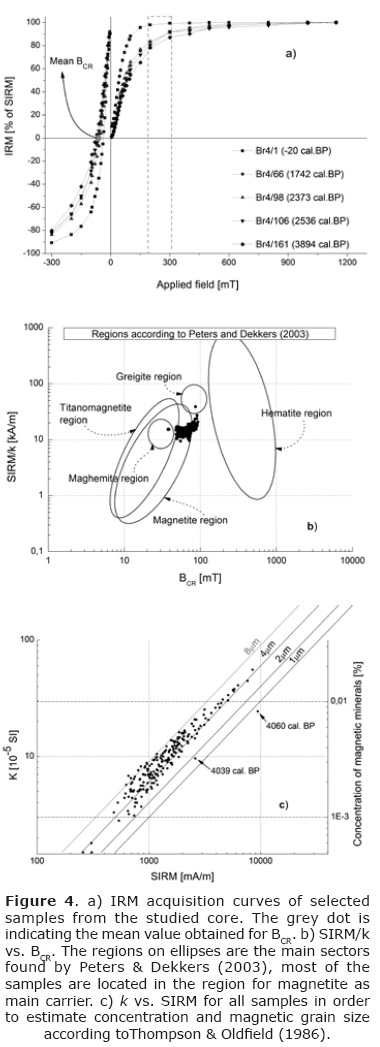
	    <p align="justify"><font face="verdana" size="2">To investigate the magnetic mineralogy, parameters derived from IRM curves were analysed to identify soft/hard magnetic minerals. Stepwise acquisition of the isothermal remanence (<a href="#f4">Figure 4a</a>) shows that 90% of the SIRM is acquired with applied fields of about 250mT. After progressive removal of SIRM by back&#45;field demagnetisation, B<sub>CR</sub> mean values of 66&plusmn;12mT were obtained. Values higher than 80mT (<a href="/img/revistas/geoint/v53n4/a1f3.jpg" target="_blank">Figure 3g</a>) suggest the presence of oxidised (titano) magnetite (Kruiver <i>et al.</i>, 2001; Roberts and Turner, 1993; Reynolds <i>et al.</i>, 1994) and/or antiferromagnetic minerals in low concentrations. A group of samples acquired 84% of the SIRM at 300 mT <a href="#f4">(Figure 4a)</a>, also indicating the presence of a small proportion of antiferromagnetic minerals.</font></p>
	    ]]></body>
<body><![CDATA[<p align="center"><a name="f4"></a></p>
	    <p align="center"><img src="/img/revistas/geoint/v53n4/a1f4.jpg"></p>

    <p align="justify"><font face="verdana" size="2">S&#45;ratio (<a href="/img/revistas/geoint/v53n4/a1f3.jpg" target="_blank">Figure 3f</a>) exhibits an oscillatory behaviour around 0.82 from the bottom of the core to 100 cal. BP, then abruptly changes to 0.9 and remains almost constant until the present. Soft minerals like magnetite have low B<sub>CR</sub> and high S&#45;ratio. Minima/maxima of B<sub>CR</sub> correspond to maxima/minima of S&#45;ratio, indicating that both parameters recorded the same trend in magnetic mineralogy. But the variations are more noticeable in B<sub>CR</sub>, suggesting that differences in mineralogy are better captured by coercivity. B<sub>CR</sub> shows its maxima at 4000, 2700 and 750 cal. BP. SIRM/k vs. B<sub>CR</sub> (Peters and Dekkers, 2003) is plotted to discriminate magnetic mineralogy. Most samples have values in a region with characteristic magnetite and (titano) magnetite as dominant magnetic carrier. Around 15% of the samples are out from that region which could be explained by the presence of a low content of hematite and/or greigite.</font></p>

	    <p align="justify"><font face="verdana" size="2">Assuming a magnetic mineralogy with predominance of soft minerals like magnetite is possible to use the figure (<a href="#f4">Figure 4c)</a> of Thompson and Oldfield(1986) to estimate percentages per unit volume of magnetite in the samples and to distinguish between grain sizes. The percentage of magnetite varies between0.003 and 0.02% and the magnetic grain size observed is between 2 and 8&#181;m.The results obtained suggest that magnetic grain sizes are in the range of pseudo single&#45;domain (PSD) magnetite (Thompson and Oldfield, 1986) which is probably due to a mixture of different magnetic grain sizes.Only two samples are finer than 2mm and correspond to the B<sub>CR</sub> extreme values (<a href="/img/revistas/geoint/v53n4/a1f3.jpg" target="_blank">Figure 3g</a>) and one of them is in the region of greigite (<a href="#f4">Figure 4b</a>).</font></p>

	    <p align="justify"><font face="verdana" size="2">Inter&#45;parametric ratios (SIRM/k andARM/SIRM, <a href="/img/revistas/geoint/v53n4/a1f3.jpg" target="_blank">Figure 3d</a> and <a href="/img/revistas/geoint/v53n4/a1f3.jpg" target="_blank">3e</a>) generally increase with decreasing grain size and a higher proportion of single domain (SD) grains are present (Hunt <i>et al.</i>, 1995; Turner, 1997). ARM is sensitive to fine ferromagnetic grains (0.02 &#150; 0.1 mm) and the ratioARM/SIRM is independent of paramagnetic and diamagnetic grains because only remanences are involved (Turner, 1997). On the other hand, k also involves paramagnetic and diamagnetic grains and the ratio SIRM/k is also used to point out the presence of greigite (Roberts <i>et al.</i>, 2011). The ratios show oscillating values around their mean values, 2 x 10<sup>&#45;2</sup> for ARM/SIRM and 15 for SIRM/k. The general behaviour belongs to a mixture of different sizes in the period 5000 &#45; 4300 cal. BP and finer grain sizes between 3200 &#45;2400 cal. BP and 300 &#150; 50 cal. BP.According to SIRM/k, the finest magnetic grain size is observed at 4700, 4060, 3200 and 2660 cal. BP. But at 4700 and 4060 cal. BP ARM/SIRM show low relative values suggesting an apparent increase in magnetic grain size. High B<sub>CR</sub> and S&#45;ratio values between 0.77 and 0.87 suggest the presence of hard coercivity magnetic minerals for those samples. These results are in agreement with the results of <a href="#f4">Figure 4b</a> for greigite. At 3200 and 2600 cal. BP ARM/SIRM shows also high values indicating fine magnetic grain sizes.</font></p>

	    <p align="justify"><font face="verdana" size="2"><a href="/img/revistas/geoint/v53n4/a1f5.jpg" target="_blank">Figure 5</a> shows the result of thermal demagnetisation curves of SIRM and the obtained T<sub>C</sub>. Sample 20 (<a href="/img/revistas/geoint/v53n4/a1f5.jpg" target="_blank">Figure 5a</a>) shows the behaviour of 85% of the samples. With two magnetic phases: a first magnetic phase with a characteristic temperature between 369 and 453 &ordm;C. These temperatures correspond to the presence of (titano) magnetite with a low proportion of Ti (Dankers, 1978; Gogorza <i>et al.</i>, 2004) or magnetite partially oxidised during the heating process (Dankers, 1978). The second phase is the principal magnetic phase, where more than 85% of remanence is lost at a mean value of T<a target="sub"><sub>C</sub></a>3 = 572 &ordm;C (<a href="/img/revistas/geoint/v53n4/a1f5.jpg" target="_blank">Figure 5d</a>), indicating that magnetite is the principal magnetic carrier (Dankers, 1978; Hunt <i>et al.</i>, 1995; Dunlop and &Ouml;zdemir, 1997; Irurzun <i>et al.</i>, 2009). Another two phases are found. According to a review made by Roberts <i>et al.</i> (2011), the Curie temperature of greigite is not exactly found but greater than 350&deg;C, but the shape of the heating curves shows an abrupt decrease between 290 and 320 &deg;C. T<sub>C</sub>1 between 266 and 342 &deg;C (<a href="/img/revistas/geoint/v53n4/a1f5.jpg" target="_blank">Figure 5c</a>) could correspond to greigite samples (Krs <i>et al.</i>, 1992; Dekkers <i>et al.</i>, 2000; Sagnotti <i>et al.</i>, 2005). T<sub>C</sub>4 is found between 596 and 664&ordm;C which correspond tosamples with the presence of antiferromagnetic minerals (Dankers, 1978). 10% of the samples have the same behaviour as the sample 186 (<a href="/img/revistas/geoint/v53n4/a1f5.jpg" target="_blank">Figure 5b</a>), were T<sub>C</sub>2 and T<sub>C</sub>4 are present. The samples from core Br4 hold a percentage of their magnetization after 580&deg;C indicating the presence of a mix of magnetite with haematite materials (T<sub>C</sub> =675&ordm;C). This percentage oscillates between 0.2% for samples like 20 (<a href="/img/revistas/geoint/v53n4/a1f5.jpg" target="_blank">Figure 5a</a>) and 6.8% for samples like 186 (<a href="/img/revistas/geoint/v53n4/a1f5.jpg" target="_blank">Figure 5b</a>). <a href="/img/revistas/geoint/v53n4/a1f5.jpg" target="_blank">Figure 5d</a> shows the Curie temperatures as a function of the ages. Several peaks were found in the intervals 4690 &#45; 4060 cal. BP and 2840 &#150; 2070 cal. BP. Greigite is suggested at 4700 and 4060 cal. BP, consistent with high SIRM/k, high TOC and high TS (<a href="/img/revistas/geoint/v53n4/a1f3.jpg" target="_blank">Figure 3</a>). The high values of percentages of hematite were found at 4380, 2820 and 1290 cal. BP.</font></p>
    <p align="justify"><font face="verdana" size="2"><i>Geochemical analysis</i></font></p>
    <p align="justify"><font face="verdana" size="2">The TOC record (<a href="/img/revistas/geoint/v53n4/a1f3.jpg" target="_blank">Figure 3h</a>) exhibits several fluctuations ranging between 1.2% and 23% and high values were determined between 4750 and 4450 cal. BP. TOC and TS (<a href="/img/revistas/geoint/v53n4/a1f3.jpg" target="_blank">Figure 3j</a>) show a significant positive correlation (R=0.84) and minima values between 4000 and 3500 cal. BP, 2600 and 2200 cal. BP and from 200 cal. BP, suggesting an organic origin for sulphur. TIC values (<a href="/img/revistas/geoint/v53n4/a1f3.jpg" target="_blank">Figure 3i</a>) range from 0 to 2.1%. Values lower than 1% are found between 4800 and 4200 cal. BP, 2500 and 2100 cal. BP and from 1500 cal. BP, whereas maxima values were found at 4100,3800 cal. BP, 3500 cal. BP, 3250 cal. BP and around 2700 cal. BP.</font></p>

	    <p align="justify"><font face="verdana" size="2">Soft magnetic minerals are significant when TS has the lowest values. Around 4680 and 4510 cal. BP the maxima values of TS are found, but not so significant changes are found in &#954;. At 4020 cal. BP, &#954; has minima values consistent with TOC and TIC maxima values whereas TS is almost constant, indicating a low presence of any magnetic mineral. TOC logs display a general inverse behaviour to &#954; and S&#45;ratio. TIC has an inverse relationship with &#954; in the period 400&#45;4200 cal. BP, but both parameters have an increasing trend from 4800 to 4200 cal. BP and for the last 450 cal. BP.</font></p>

	    <p align="justify"><font face="verdana" size="2">The more significant results from elemental analyses are shown in <a href="/img/revistas/geoint/v53n4/a1f3.jpg" target="_blank">Figure 3n</a> and <a href="/img/revistas/geoint/v53n4/a1f3.jpg" target="_blank">3o</a>. These elements show an oscillatory behaviour around their mean values,except Zn and Ca. Fe, Al and &#954; show similar behaviour between each other. There are increases in heavy metals and K at 4200, 3600, 2200 and around 200 cal. BP, which suggest a greater proportion of clay minerals at these ages (Abdul Aziz and Langereis, 2004), confirmed by grain size results. Ca, Mg and Sr show several coincident minima synchronized with high values of &#954;. There is a coincidence among the peaks of light metals, but Sr has less evident variations. The maxima in Ca coincide with maxima in TIC, suggesting that most of the inorganic carbon is in the form of calcium carbonate minerals. Low values of light metals coincide with high values of alkaline metals, pointing to the presence of eroded minerals from less&#45;weathered depths in the catchment (Higgitt <i>et al.</i>, 1991).</font></p>
        ]]></body>
<body><![CDATA[<p align="justify"><font face="verdana" size="2">Pollen analysis</font></p>
    <p align="justify"><font face="verdana" size="2">Local vegetation pollen record (<a href="/img/revistas/geoint/v53n4/a1f3.jpg" target="_blank">Figure 3k</a>, <a href="/img/revistas/geoint/v53n4/a1f3.jpg" target="_blank">3l</a> and <a href="/img/revistas/geoint/v53n4/a1f3.jpg" target="_blank">3m</a>) is dominated by emergent plants mostly characterized by Cyperaceae (<i>Schoenoplectus</i>), showing a general decreasing trend with a superimposed oscillating behaviour, with maxima at 347 cal. BP, and a decrease to the present. Between 4780 and 4160 cal. BP, emergent plants show fluctuating values from 20 to 60%. Floating plants (mainly <i>Azollafiliculoides</i>) are present along the record with values less than 3.7%, reaching two maxima, at 4780 cal. BP (36%) and 990 cal. BP (24%). Submerged plants (mainly <i>Myriophyllum</i>) have an increasing tendency between 4780 and 4370 cal. BP, reaching the highest value (30%) at 4400 cal. BP. Then, they decrease abruptly and present slight variations along the record. The last 50 cal. BP shows the impact of humans on the vegetation of the Lake La Brava region; an increase of introduced European weeds (<i>Rumex, Erodium</i> and <i>Carduus</i>&#45;type) represent the agriculture and grazing activities developed in the last decades of the 20th&#45;century which have modified the landscape surroundings of the shallow lake. <i>Eucalyptus</i> and<i> Pinus</i> pollen are related to the establishment of exotic arboreal vegetation near the farmer settlements.</font></p>

	    <p align="justify">&nbsp;</p>
	    <p align="justify"><font face="verdana" size="2"><b>Discussion</b></font></p>

    <p align="justify"><font face="verdana" size="2">Lakes are "containers" of material coming from the atmosphere and the catchment area. A complete and continuous sediment sequence is indicated by not disturbed levels and it is reinforce by both the age&#45;depth model as well as the smoothed total pollen concentration curve (Prieto, A.R. unpublished data) which indicate not significant change in the rate of sediment accumulation. Only a relatively higher rate of sedimentation occurs during anthropogenic settlement, probably due to larger external input of inorganic material into the lake owing to agricultural erosion.</font></p>

	    <p align="justify"><font face="verdana" size="2">The most frequently used parameter for lithostratigraphic correlation and preliminary palaeoclimatic assessment as rainfall indicator is &#954; (Maher and Thompson, 1999). When &#954; is high, higher concentration of magnetic minerals is expected. In this sense, lower TOC can be found because of a greater percentage of clastic influx during discharge into the lake owing to extreme flood events. Silt is almost constant in the sediments, so the opposite variation of clay and sand can be used as indicators of changes in the lake level as well. When the lake level is high, small particle size is expected in the centre of the lake (Nichols, 2009). If the lake level is low, then the shore is nearer of our coring site and coarser particles can be found. Inter&#45;parametric ratios are used to determine periods of entrance of coarser or finer magnetic particles. As in the case of clay and sand, if high inter&#45;parametric ratios (fine magnetic grain size) are found, then the shore is far from the coring site, indicating a high lake level or a wet period (V&aacute;zquez, 2012) and <i>vice versa</i>.</font></p>

	    <p align="justify"><font face="verdana" size="2">Another possible interpretation can be considered. Finer particles are easily transported by wind, whereas coarser particles need a more energetic transport way, like water, to reach the lake (Bagnold <i>et al.</i>, 1979). If a high energetic environment could transport coarse particles, then low inter&#45;parametric ratios should be found during rainfall periods. This is also argued by Lascu <i>et al.</i> (2012). For TOC interpretations, lower values of TOC can be found during periods of higher amount of minerogenic materials as a consequence of a dryer environment and a lower lake level than today.</font></p>

	    <p align="justify"><font face="verdana" size="2">The trends in pollen percentages of emergent macrophytes could reflect temporal movements of vegetation belts toward the shore and could be interpreted as a gradual relative rising of the level lake since 4800 cal. BP. The spread of macrophytes towards the centre of the lake may result from a lake&#45;level lowering, or the natural progressive infilling of the lake (Hannon and Gaillard, 1997).</font></p>

	    <p align="justify"><font face="verdana" size="2">The environmental interpretation of TIC is not so straightforward. TIC and Ca, Mg and Sr show positive correlation, and suggest that the TIC concentration reflects basically calcite occurrence. Assuming that TIC mainly represents calcite and given the relative low amount of calcareous fossils, most of the carbonates originate either from allochthonous sources or, more likely, are formed authigenically by precipitation (Shapley <i>et al.</i>, 2005). As allochthonous source, El Peligro Creek is located at the highest sector of the basin, where quartzitic strata and quartzitic debris mixed with fine clastic sediments occur (Romanelli <i>et al.</i>, 2010b). Since there is no carbonate outcrops in the basin, allochthonous sources of carbonates <i>via</i> surface influent El Peligro Creek can be dismissed. In fact, based on isotopic and geochemical data, El Peligro Creek can be considered as a "channeled" component of the groundwater (Romanelli <i>et al.</i>, 2010b). The high contribution of spring water(Romanelli <i>et al.</i>, 2011) indicates a direct and indirect wetland recharge <i>via</i> surface and subsurface runoff from the ranges, preferentially through the quartzite fracture system, and therefore they cannot be considered as a significant allochthonous source for carbonate or calcite ions to the lake water. Hence, in our model of authigenically carbonate origin, TIC minima imply a restriction of calcite precipitation, and TIC maxima imply favourable conditions of carbonate precipitation in the lake. In either case, the fluctuations in TIC indicate that Lake La Brava experienced significant environmental changes. Controls of authigenic carbonate burial include the rate of groundwater recharge, vegetation type, phytoproductivity and evaporation rate, which are in turn all linked to climate (Shapley <i>et al.</i>, 2009). Except for the last 50 cal. BP, no evident changes in regional vegetation have been detected; authigenic carbonate production may be supported by groundwater exchange (Shapley <i>et al.</i>, 2005) or by evaporation acting on water body.</font></p>

	    <p align="justify"><font face="verdana" size="2">In La Brava Lake, the relation between the lake and the aquifer is well known. In this way, the effluent&#45; influent behaviour of la Brava Lake has been defined (Kruse, 1987; Romanelli <i>et al.</i>, 2010b). Mixing water estimation to identify the proportions in which recharge sources contribute to the lake water shows that 50.77 % of it corresponds to groundwater (Romanelli <i>et al.</i>, 2011). In turn, groundwater recharge function of the lake is of significant importance since it provides water to the aquifer system and contributes to the maintenance of phreatic levels (Romanelli <i>et al.</i>, 2011). Isotopic and hydrochemical data indicate that the recharge to the aquifer is influenced by the natural rainfall input, wetland discharge and the concentration of surface run&#45;off from the range fringes to inter&#45;range depressions (Romanelli <i>et al.</i>, 2011). Recharge areas coincide with the hills, with a magnesium&#45; or calcium&#45;bicarbonate water type and relative low pH and electrical conductivity values, in coincidence with the area of groundwater calcite undersaturation (Quiroz Londo&ntilde;o <i>et al.</i>, 2008). Afterwards, as a consequence of evaporation and promoted by higher pH, water lake evolves to a sodium bicarbonate water type as a consequence of calcite precipitation which preferentially removes Ca<sup>+2</sup> and Mg<sup>+2</sup> in a softening process (magnesium and calcium exchange for sodium) (Romanelli <i>et al.</i>, 2010a). Due to the shallowness of Lake La Brava its hydrology is highly dependent on in situ rainfall (Quir&oacute;s <i>et al.</i>, 2002). As aquifer system recharge depends solely on rainwater infiltration, when precipitation decreases, groundwater recharge diminishes, lake level drops and higher pH and evaporative concentration promoted calcite precipitation in the lake. In conclusion, assuming that major proportion of carbonates has authigenic origin, increase amount of flux of TIC (percentage of TIC divided by sedimentation rate) in the central lake basin sediments could reflect periods of low lake level and <i>vice versa</i>.</font></p>

	    ]]></body>
<body><![CDATA[<p align="justify"><font face="verdana" size="2">Relatively insoluble metals like Ca, Sr, Mg, Ba, among others; tend to accumulate in the sediment. In periods with dilute conditions (wetter and high lake level) these same metals remain in solution and do not precipitate (Davison, 1992). Dry periods may occur during high evaporation rates. Increasing concentration of TS in the water and consequent precipitation of the solid phase mean the water level must be low, corresponding with low rainfall (Hillesheim <i>et al.</i>, 2005).</font></p>
        <p align="justify"><font face="verdana" size="2"><i>Lake level variations and palaeoclimatic implications</i></font></p>
    <p align="justify"><font face="verdana" size="2">Three intervals which integrate general behaviours can be considered. The first is estimated between 4800 and 4500 cal. BP (and an event at 4060 cal. BP), the second between 4500 and 260 cal. BP and the third between 260 cal. BP and the present.</font></p>

	    <p align="justify"><font face="verdana" size="2">Finer magnetic grain size particles according to inter&#45;parametric ratios are found from 4800 to 4500 cal. BP and at around 4060. Advances of marginal vegetation between <i>ca.</i> 4780 and 4160 cal. BP are indicated by high percentages of emergent plants. Values up to 90% of Cyperaceae characterized the modern pollen data set from communities that represent flooded depressions and shallow lakes shores of the Pampa grasslands (Tonello and Prieto, 2008). Between 4700 and 4200 cal. BP some low lake levels are indicated by the floating fern which floats at the water surface in sheltered habitats because it is vulnerable to the destructive effects of wave action. At 4780 cal. BP, low values of TOC, moderate high &#954; and an extremely high percentage of floating fern were found indicating a very low lake levels or a dry event (<a href="/img/revistas/geoint/v53n4/a1f6.jpg" target="_blank">Figure 6</a>) in accordance with previous studies of Mancini <i>et al.</i> (2005).</font></p>

	    <p align="justify"><font face="verdana" size="2">High percentages of clay and in consequence high lake levels are found at around 4650 cal. BP. SIRM, &#954; and ARM have shown similar features, indicating that the signal of the magnetic parameters is dominated by changes in the concentration of magnetic minerals. The concentration parameters show opposite to TOC variations of less amplitude. Considering the aforementioned results, TOC variations at 4650 cal. BP are variations related to a period of more rainfall and mild temperatures (<a href="/img/revistas/geoint/v53n4/a1f6.jpg" target="_blank">Figure 6</a>). Warm temperatures were found by Tonni <i>et al.</i> (1999).</font></p>

	    <p align="justify"><font face="verdana" size="2">In general terms, the similarities between &#954;, Fe, K and Al indicate very little or no diagenetic overprinting (Riedinger <i>et al.</i>, 2005). At 4060 cal. BP a change in mineralogy is suggested by differences between &#954; and Fe and Al (<a href="/img/revistas/geoint/v53n4/a1f3.jpg" target="_blank">Figure 3a</a> and <a href="/img/revistas/geoint/v53n4/a1f3.jpg" target="_blank">3o</a>) indicating autochthonous elements are responsible for the magnetic signal. As a consequence, the formation of authigenic phases like greigite could be considered. Temperature experiments suggest greigite (<a href="/img/revistas/geoint/v53n4/a1f5.jpg" target="_blank">Figure 5c</a> and <a href="/img/revistas/geoint/v53n4/a1f5.jpg" target="_blank">5d</a>) in samples with high SIRM/k values (<a href="/img/revistas/geoint/v53n4/a1f3.jpg" target="_blank">Figure 3d</a> and <a href="/img/revistas/geoint/v53n4/a1f3.jpg" target="_blank">e</a>). From 4800 to 4500 cal. BP another two samples with greigite were found around 4700 cal. BP. A high organic matter and a low oxygenated environment of the bottom lake sediments due to eutrophication during quiet sediment conditions could be the reason for an intense reductive dissolution of the original magnetic particles (Maher and Thompson, 1999, Geiss <i>et al.</i>, 2003). Greigite can grow when dissolved iron and sulphide are available during diagenesis (Roberts <i>et al.</i>, 2011) consistent with high TOC (<a href="/img/revistas/geoint/v53n4/a1f3.jpg" target="_blank">Figure 3h</a>) and high TS (<a href="/img/revistas/geoint/v53n4/a1f3.jpg" target="_blank">Figure 3j</a>). ARM/SIRM shows a relative decrease, suggesting coarser magnetic grain size in the greigite samples. So dissolution of the original magnetite to form greigite is possible (Geiss <i>et al.</i>, 2004). According to Ariztegui and Dobson (1996) greigite is a well&#45;defined palaeoenvironmental proxy as it is formed during a wet period in eutrophic lakes consistent with low flux of TIC. Pampean shallow lakes are not thermally stratified (Sosnovsky <i>et al.</i>, 2010). Because of their shallowness, these lakes are strongly influenced by wind and are therefore polymictic (Rennella and Quir&oacute;s, 2002, Miretzky <i>et al.</i>, 2004). As a consequence, they lack chemical or thermal stratification (Quir&oacute;s and Drago, 1999) and greigite cannot be formed unless there is a change in environmental conditions. In consequence, the greigite found may suggest particularly warm and wet times.</font></p>

	    <p align="justify"><font face="verdana" size="2">Greigite can preserve in sediments during a rapid sedimentation rate (Blanchet <i>et al.</i>, 2009). A relative high sedimentation rate is found at the beginning of the record, from 1.3mm/yr in average to 3 mm/yr at 4700 cal. BP, which might allow greigite preservation. In summary, the presence of greigite in the base indicates higher than present lake levels consistent with low TIC and submerged plants (<a href="/img/revistas/geoint/v53n4/a1f3.jpg" target="_blank">Figure 3i</a> and <a href="/img/revistas/geoint/v53n4/a1f3.jpg" target="_blank">3m</a>) during probably warm temperatures (high TOC). This short episode of a probably relative high lake level was not found by other authors.</font></p>

	    <p align="justify"><font face="verdana" size="2">From 4500 to 300 cal. BP, ARM/SIRM varies in less than an order of magnitude indicating a broadly stable environment. Coarser magnetic grain size particles were found around 4350 and between 1040 and 960 cal. BP. Low ARM/SIRM could suggest either low lake level because the shore is near, or high lake level because of increased rainfall. At around 4330 and 1000 cal. BP, emergent pollen taxa are high indicating the climate conditions were humid and the lake level high.A contribution dominated by high energy sources, like fluvial sediment sources which reach the lake carrying coarse terrigenous elements from La Brava Hill and El Peligro Creek or strong winds can be considered. All these periods are consistent with relative high &#954; and low TIC, so it is more likely that the sediments were transported by fluvial sources. An unstable environment from 2000 cal. BP to the present was found by Laprida et al (2009a).</font></p>

	    <p align="justify"><font face="verdana" size="2">The taxa of submerged plants are more abundant at the centre of the lake when the body of water is reduced, suggesting a shallower lake level at maxima values. The variations suggested through submerged and emergent plants are consistent with the behaviour of &#954;,indicating that this magnetic parameter is a good recorder of lake level changes.Between 4430 and 4250 cal. BP, low TOC values suggest a dry environment in the catchment area of Lake La Brava.A low lake level suggested by submerged plants is found in this interval (4410 &#150; 4370 cal. BP), coeval with the presence of haematite. Haematite is a significant proxy of arid climate, because it forms during dry episodes and lower rainfall in the catchment area (Torrent <i>et al.</i>, 2006). The presence of haematite in the samples was calculated as the remanent percentage of magnetization at 580&deg;C in the thermal curves. The higher presence of different amount of haematite always precedes the wet periods (T<sub>C</sub>4 from <a href="/img/revistas/geoint/v53n4/a1f5.jpg" target="_blank">Figure 5d</a> are between 5 to 6.8 %) and can reach the lake during times dominated by aeolian transport. The presence of haematite suggests an overall dry climate from 4420 to 260 cal. BP with episodic wet/rainy environment. Occasionally rain storm were also found by Stutz et al (2012) between 4840 and 1200 cal. BP in a lake located 90 km in the NE direction from Lake La Brava.</font></p>

	    <p align="justify"><font face="verdana" size="2">Meanwhile, from 3250 to 450 cal. BP, TOC values indicate broadly minor variations on rainfall and climate. During this period, TOC variations decrease when k increases, indicating high clastic input from the catchment. Ca, Sr and Mg indicate wetter periods at around 4000, 2500 &#150; 2000, 1500 and the last 260 cal. BP, suggesting more humid conditions than in previous periods.High percentages of clay and in consequence high lake levels are found at around 4330 and between 4000 &#150; 3530 and 2660 &#150; 2170 cal. BP. A mostly dry period was found between 3100 and 2600 cal. BP, consistent with TS maxima, low &#954; and relative high ARM/SIRM. At 990 cal. BP another dry event is suggested for the magnetic grain size, concentration dependent parameters and a peak in floating fern. A summary of all lake level and climatic changes and a comparison with previous results is shown in <a href="/img/revistas/geoint/v53n4/a1f6.jpg" target="_blank">Figure 6</a>.</font></p>

	    ]]></body>
<body><![CDATA[<p align="justify"><font face="verdana" size="2">Finer magnetic grain size particles according to inter&#45;parametric ratios are found from 260 cal. BP to the present, more noticeable in ARM/SIRM. &#954; is in an increasing trend region suggesting more erosion of unconsolidated material rich in magnetic minerals (Forester <i>et al.</i>, 1994; Dearing and Flower, 1982; Thorndycraft <i>et al.</i>, 1998) from the catchment area. Clay reaches the maximum indicating a low energy environment at the centre of the lake. The flux of TIC is very low suggesting a high lake level. In summary, the most likely environment is a quiet climate where the coast was far from the coring site indicating a high lake level. The highest lake level was found for the last 260 cal. BP, consistent with the insoluble metals mentioned before. In summary, a high lake level, possibly flood episodes, and increased erosion are suggested in this period.</font></p>

	    <p align="justify"><font face="verdana" size="2">The last 50 cal. BP show a decrease in organic matter content consistent with a decrease in emergent plants. The highest values of &#954; from 25 cal. BP to the present are in agreement with the increasing trend of annual rainfall during the last eight decades (Irigoyen <i>et al.</i>, 2008).The logs of S&#45;ratio and &#954; show an increase as well, but this magnetic enhancement is noticeable from 100 cal. BP to the present. This trend is similar to that reported for other lakes (Oldfield <i>et al.</i>, 1978; Turner and Thompson, 1981; Zolitschka, 1998; Stockhausen and Zolitschka, 1999; Dearing <i>et al.</i>, 2001; Rolph <i>et al.</i>, 2004), suggesting changes in sediment delivery and depositional processes caused by human impact (agricultural activities implying different soil erosion). This trend is observed also in vegetation analysis with the appearance of different species (Morell&oacute;n <i>et al.</i>, 2009). The proxy's record for the last decades suggests a mix of natural climate shift and anthropogenic activities. Considering that the values of &#954; are never that high, is more likely that the human disturbance is primarily responsible for these changes.</font></p>

	    <p align="justify">&nbsp;</p>
	    <p align="justify"><font face="verdana" size="2"><b>Conclusions</b></font></p>

    <p align="justify"><font face="verdana" size="2">This study allowed us to obtain high&#45;quality palaeoclimatic record for southeast Buenos Aires Province during the last 4800 cal. BP. The results from pollen analysis and sedimentology indicate that the lake never dried during this period. B<sub>CR</sub>, SIRM/k and the combination of both are in the range of (titano) magnetite for most of the samples.The values of T<sub>C</sub> and SIRM acquisition curves are consistent with sediments dominated by (titano) magnetite with different amount of Ti as the dominant magnetic carrier of remanence but not the only one present in the samples. S&#45;ratio has its mean value at 0.86, suggesting the presence of magnetite with different percentages of antiferromagnetic minerals. The main magnetic carrier is magnetite with grain size into the PSD range(Thompson and Oldfield, 1986). This grain size is probably a combination of MD with small size ferrimagnetic particles (Stockhausen and Zolitschka, 1999).The concentration of magnetite varies from 0.003 and 0.02%.</font></p>

	    <p align="justify"><font face="verdana" size="2">In combination with geochemical and palynological studies, &#954; and ARM/SIRM are the better magnetic proxies to infer precipitation; low values of both parameters are found during high lake level or more rainfall. The general trend for all parameters indicates an overall dry environment since 4800 cal. BP. Based on magnetic and geochemical studies, a model for palaeoclimatic implications show some flood or high lake level events at 4700, 4060 and 1500 cal. BP and a period of high lake level from 2500 to 2100 cal. BP were found.Two moments of extremely dry environment were found at 4780 and 990 cal. BP.</font></p>

	    <p align="justify"><font face="verdana" size="2">All the results suggest that climate was the major forcing process of regional fluvial system behaviour (erosion and lake level changes) across the catchment area of Lake La Brava from 4800 cal. BP until the beginning of stable human settlement. It was established that anthropogenic influence is the main factor of the changes observed during the twentieth century over imposed to a more humid environment.</font></p>

	    <p align="justify">&nbsp;</p>
	    <p align="justify"><font face="verdana" size="2"><b>Acknowledgements</b></font></p>

    <p align="justify"><font face="verdana" size="2">The authors wish to thank UNCPBA, IAA and CONICET. They are also grateful for funds provided by the CICYT project MEDEROCAR (CGL2008&#45;0831), PIP&#45;CONICET 1265/08 and the project PICT&#45;O n&ordm; 13&#45;11502. The authors wish to thanks Dr.C. Geiss for the comments and suggestions and to the anonymous reviewers for their comments which improve the paper.</font></p>

	    ]]></body>
<body><![CDATA[<p align="justify">&nbsp;</p>
	    <p align="justify"><font face="verdana" size="2"><b>References</b></font></p>

    <!-- ref --><p align="justify"><font face="verdana" size="2">Abbott M.B., Wolfe B.B., Wolfe AP, Seltzer G.O., Aravena R., Mark B.G., Polissar P.J., Rodbell D.T., Rowe H.D., Vuille M., 2003, Holocene paleohydrology and glacial history of the central Andes using multiproxy lake sediment studies. <i>Palaeogeography, Palaeoclimatology, Palaeoecology</i>., 194, 123&#45;138.    &nbsp;&nbsp;&nbsp;&nbsp;&nbsp;&nbsp;&nbsp;&nbsp;[&#160;<a href="javascript:void(0);" onclick="javascript: window.open('/scielo.php?script=sci_nlinks&ref=3934622&pid=S0016-7169201400040000100001&lng=','','width=640,height=500,resizable=yes,scrollbars=1,menubar=yes,');">Links</a>&#160;]<!-- end-ref --></font></p>

	    <!-- ref --><p align="justify"><font face="verdana" size="2">Abdul Aziz H., Langereis C.G., 2004, Astronomical tuning and duration of three new subchrons (C5r.2r&#45;1n, C5r.2r&#45;2n and C5r.3r&#45;1n) recorded in a Middle Miocene continental sequence from NE Spain. In <i>Geophysical Monograph Series,</i> 145, AGU, 328 pp.    &nbsp;&nbsp;&nbsp;&nbsp;&nbsp;&nbsp;&nbsp;&nbsp;[&#160;<a href="javascript:void(0);" onclick="javascript: window.open('/scielo.php?script=sci_nlinks&ref=3934624&pid=S0016-7169201400040000100002&lng=','','width=640,height=500,resizable=yes,scrollbars=1,menubar=yes,');">Links</a>&#160;]<!-- end-ref --></font></p>

	    <!-- ref --><p align="justify"><font face="verdana" size="2">Ariztegui D., Dobson J., 1996, Magnetic investigations of framboidalgregigite formation: a record of anthropogenic environmental changes in eutrophic Lake St Moritz, Switzerland. <i>The Holocene</i>, 6, 2, 235 &#150; 241.    &nbsp;&nbsp;&nbsp;&nbsp;&nbsp;&nbsp;&nbsp;&nbsp;[&#160;<a href="javascript:void(0);" onclick="javascript: window.open('/scielo.php?script=sci_nlinks&ref=3934626&pid=S0016-7169201400040000100003&lng=','','width=640,height=500,resizable=yes,scrollbars=1,menubar=yes,');">Links</a>&#160;]<!-- end-ref --></font></p>

	    <!-- ref --><p align="justify"><font face="verdana" size="2">Bagnold R.A., Rickwoods M.B., Edenbridge K.,1979, Sediment Transport by Wind and Water. <i>Nordic Hydrology,</i> 10, 309&#45;322.    &nbsp;&nbsp;&nbsp;&nbsp;&nbsp;&nbsp;&nbsp;&nbsp;[&#160;<a href="javascript:void(0);" onclick="javascript: window.open('/scielo.php?script=sci_nlinks&ref=3934628&pid=S0016-7169201400040000100004&lng=','','width=640,height=500,resizable=yes,scrollbars=1,menubar=yes,');">Links</a>&#160;]<!-- end-ref --></font></p>

	    ]]></body>
<body><![CDATA[<!-- ref --><p align="justify"><font face="verdana" size="2">Bidegain J.C., Rico Y., Bartel A., Chaparro M.A.E., Jurado S., 2009, Magnetic parameters reflecting pedogenesis in Pleistocene loess deposits of Argentina. <i>Quaternary International,</i> 209, 1&#45;2, 175&#45;186.    &nbsp;&nbsp;&nbsp;&nbsp;&nbsp;&nbsp;&nbsp;&nbsp;[&#160;<a href="javascript:void(0);" onclick="javascript: window.open('/scielo.php?script=sci_nlinks&ref=3934630&pid=S0016-7169201400040000100005&lng=','','width=640,height=500,resizable=yes,scrollbars=1,menubar=yes,');">Links</a>&#160;]<!-- end-ref --></font></p>

	    <!-- ref --><p align="justify"><font face="verdana" size="2">Blanchet, C. L., N. Thouveny and L. Vidal, 2009. Formation and preservation of greigite (Fe3S4) in sediments from the Santa Barbara Basin: Implications for paleoenvironmental changes during the past 35 ka. <i>Paleoceanography,</i> 24, PA2224, doi:10.1029/2008PA001719.    &nbsp;&nbsp;&nbsp;&nbsp;&nbsp;&nbsp;&nbsp;&nbsp;[&#160;<a href="javascript:void(0);" onclick="javascript: window.open('/scielo.php?script=sci_nlinks&ref=3934632&pid=S0016-7169201400040000100006&lng=','','width=640,height=500,resizable=yes,scrollbars=1,menubar=yes,');">Links</a>&#160;]<!-- end-ref --></font></p>

	    <!-- ref --><p align="justify"><font face="verdana" size="2">Bronk Ramsey C., 2001, Development of the radiocarbon calibration program OxCal. <i>Radiocarbon.</i>, 43, 2A, 355&#45;363.    &nbsp;&nbsp;&nbsp;&nbsp;&nbsp;&nbsp;&nbsp;&nbsp;[&#160;<a href="javascript:void(0);" onclick="javascript: window.open('/scielo.php?script=sci_nlinks&ref=3934634&pid=S0016-7169201400040000100007&lng=','','width=640,height=500,resizable=yes,scrollbars=1,menubar=yes,');">Links</a>&#160;]<!-- end-ref --></font></p>

	    <!-- ref --><p align="justify"><font face="verdana" size="2">Bronk Ramsey C., 2008, Deposition models for chronological records. <i>Quaternary Science Reviews, </i>27, 1&#45;2, 42&#45;60.    &nbsp;&nbsp;&nbsp;&nbsp;&nbsp;&nbsp;&nbsp;&nbsp;[&#160;<a href="javascript:void(0);" onclick="javascript: window.open('/scielo.php?script=sci_nlinks&ref=3934636&pid=S0016-7169201400040000100008&lng=','','width=640,height=500,resizable=yes,scrollbars=1,menubar=yes,');">Links</a>&#160;]<!-- end-ref --></font></p>

	    <!-- ref --><p align="justify"><font face="verdana" size="2">Chaparro M.A.E., 2006, Estudio de Par&aacute;metros Magn&eacute;ticos de Distintos Ambientes Relativamente Contaminados en Argentina y Ant&aacute;rtida.MONOGRAFIAS, Ed. Geof&iacute;sica UNAM, Monograf&iacute;a No. 7, 107 pp. ISBN: 970323567&#45;0. First edition, April 2006.    &nbsp;&nbsp;&nbsp;&nbsp;&nbsp;&nbsp;&nbsp;&nbsp;[&#160;<a href="javascript:void(0);" onclick="javascript: window.open('/scielo.php?script=sci_nlinks&ref=3934638&pid=S0016-7169201400040000100009&lng=','','width=640,height=500,resizable=yes,scrollbars=1,menubar=yes,');">Links</a>&#160;]<!-- end-ref --></font></p>

	    ]]></body>
<body><![CDATA[<!-- ref --><p align="justify"><font face="verdana" size="2">Chaparro M.A.E., B&ouml;hnel H.N., Byrne R., Nowaczyk N.R., Molina&#45;Garza R.S., Park J., Negendank J.F.W., 2008, Paleomagnetic secular variation and rock&#45;magneticstudies of Holocenesedimentsfrom a maarlake (Hoya de San Nicolas) in Central Mexico. <i>Geophysical Journal International,</i> 175, 462&#150;476.    &nbsp;&nbsp;&nbsp;&nbsp;&nbsp;&nbsp;&nbsp;&nbsp;[&#160;<a href="javascript:void(0);" onclick="javascript: window.open('/scielo.php?script=sci_nlinks&ref=3934640&pid=S0016-7169201400040000100010&lng=','','width=640,height=500,resizable=yes,scrollbars=1,menubar=yes,');">Links</a>&#160;]<!-- end-ref --></font></p>

	    <!-- ref --><p align="justify"><font face="verdana" size="2">Cioccale M.A., 1999, Climatic fluctuations in the Central Region of Argentina in the last 1000 years. <i>Quaternary International,</i> 62, 35&#45;47.    &nbsp;&nbsp;&nbsp;&nbsp;&nbsp;&nbsp;&nbsp;&nbsp;[&#160;<a href="javascript:void(0);" onclick="javascript: window.open('/scielo.php?script=sci_nlinks&ref=3934642&pid=S0016-7169201400040000100011&lng=','','width=640,height=500,resizable=yes,scrollbars=1,menubar=yes,');">Links</a>&#160;]<!-- end-ref --></font></p>

	    <!-- ref --><p align="justify"><font face="verdana" size="2">Cordini R., 1942, Laguna La Brava (Prov. de Buenos Aires). <i>Revista Argentina de Zoogeograf&iacute;a,</i> II, 1, 3&#45;53.    &nbsp;&nbsp;&nbsp;&nbsp;&nbsp;&nbsp;&nbsp;&nbsp;[&#160;<a href="javascript:void(0);" onclick="javascript: window.open('/scielo.php?script=sci_nlinks&ref=3934644&pid=S0016-7169201400040000100012&lng=','','width=640,height=500,resizable=yes,scrollbars=1,menubar=yes,');">Links</a>&#160;]<!-- end-ref --></font></p>

	    <!-- ref --><p align="justify"><font face="verdana" size="2">Dangavs N.V., 2005, Los ambientes acu&aacute;ticos de la Provincia de Buenos Aires. In: Recursos Minerales de la Provincia de Buenos Aires. Geolog&iacute;a y Relatorio XVL <i>Congreso Geol&oacute;gico Argentino,</i> pp 219&#45;236, ed. Barrio, R.E., Etcheverry, R.O., Caball&eacute; M.F., Llamb&iacute;as E., La Plata, Argentina.    &nbsp;&nbsp;&nbsp;&nbsp;&nbsp;&nbsp;&nbsp;&nbsp;[&#160;<a href="javascript:void(0);" onclick="javascript: window.open('/scielo.php?script=sci_nlinks&ref=3934646&pid=S0016-7169201400040000100013&lng=','','width=640,height=500,resizable=yes,scrollbars=1,menubar=yes,');">Links</a>&#160;]<!-- end-ref --></font></p>

	    <!-- ref --><p align="justify"><font face="verdana" size="2">Dankers P.H., 1978, Magnetic properties of dispersed natural iron oxides of known grain size (3rd Ed.), Ph.D. Thesis, Univ. Utrecht.Netherlands.    &nbsp;&nbsp;&nbsp;&nbsp;&nbsp;&nbsp;&nbsp;&nbsp;[&#160;<a href="javascript:void(0);" onclick="javascript: window.open('/scielo.php?script=sci_nlinks&ref=3934648&pid=S0016-7169201400040000100014&lng=','','width=640,height=500,resizable=yes,scrollbars=1,menubar=yes,');">Links</a>&#160;]<!-- end-ref --></font></p>

	    ]]></body>
<body><![CDATA[<!-- ref --><p align="justify"><font face="verdana" size="2">Davison W., 1992, Iron and manganese in lakes.<i> Earth Sciences Reviews, </i>34, 119&#45;163.    &nbsp;&nbsp;&nbsp;&nbsp;&nbsp;&nbsp;&nbsp;&nbsp;[&#160;<a href="javascript:void(0);" onclick="javascript: window.open('/scielo.php?script=sci_nlinks&ref=3934650&pid=S0016-7169201400040000100015&lng=','','width=640,height=500,resizable=yes,scrollbars=1,menubar=yes,');">Links</a>&#160;]<!-- end-ref --></font></p>

	    <!-- ref --><p align="justify"><font face="verdana" size="2">Dearing J.A., Flower R.J., 1982, The magnetic susceptibility of sedimenting material trapped in Lough Neagh, Northern Ireland, and its erosional significance.<i> Limnology and Oceanography,</i> 27, 969&#45;975.    &nbsp;&nbsp;&nbsp;&nbsp;&nbsp;&nbsp;&nbsp;&nbsp;[&#160;<a href="javascript:void(0);" onclick="javascript: window.open('/scielo.php?script=sci_nlinks&ref=3934652&pid=S0016-7169201400040000100016&lng=','','width=640,height=500,resizable=yes,scrollbars=1,menubar=yes,');">Links</a>&#160;]<!-- end-ref --></font></p>

	    <!-- ref --><p align="justify"><font face="verdana" size="2">Dearing J.A., Hu Y., Doody P., James P.A., Brauer A., 2001, Preliminary reconstruction of sediment&#45;source linkages for the past 6000 yrs at the Petit Lac d'Annecy, France, based on mineral magnetic data.<i> Journal of Paleolimnology,</i> 25, 245&#150;258.    &nbsp;&nbsp;&nbsp;&nbsp;&nbsp;&nbsp;&nbsp;&nbsp;[&#160;<a href="javascript:void(0);" onclick="javascript: window.open('/scielo.php?script=sci_nlinks&ref=3934654&pid=S0016-7169201400040000100017&lng=','','width=640,height=500,resizable=yes,scrollbars=1,menubar=yes,');">Links</a>&#160;]<!-- end-ref --></font></p>

	    <!-- ref --><p align="justify"><font face="verdana" size="2">Dekkers M.J., Passier H.F., Schoonen M.A.A., 2000, Magnetic properties of hydrothermally synthesized greigite (Fe3S4)&#151;II. High&#45; and low&#45;temperature characteristics. <i>Geophys. J. Int.</i>, 141, 809&#150;819.    &nbsp;&nbsp;&nbsp;&nbsp;&nbsp;&nbsp;&nbsp;&nbsp;[&#160;<a href="javascript:void(0);" onclick="javascript: window.open('/scielo.php?script=sci_nlinks&ref=3934656&pid=S0016-7169201400040000100018&lng=','','width=640,height=500,resizable=yes,scrollbars=1,menubar=yes,');">Links</a>&#160;]<!-- end-ref --></font></p>

	    <!-- ref --><p align="justify"><font face="verdana" size="2">Dunlop D.J., &Ouml;zdemir &Ouml;., 1997, Rock Magnetism. Fundamentals and Frontiers. 573 pp. Cambridge University Press, Cambridge.    &nbsp;&nbsp;&nbsp;&nbsp;&nbsp;&nbsp;&nbsp;&nbsp;[&#160;<a href="javascript:void(0);" onclick="javascript: window.open('/scielo.php?script=sci_nlinks&ref=3934658&pid=S0016-7169201400040000100019&lng=','','width=640,height=500,resizable=yes,scrollbars=1,menubar=yes,');">Links</a>&#160;]<!-- end-ref --></font></p>

	    ]]></body>
<body><![CDATA[<!-- ref --><p align="justify"><font face="verdana" size="2">Faegri K., Iversen J., 1989, Textbook of Pollen Analysis (Fourth Edition by K. Faegri, P.E. Kaland, and K. Krzywinski). John Wiley &amp; Sons New York. 328 pp.    &nbsp;&nbsp;&nbsp;&nbsp;&nbsp;&nbsp;&nbsp;&nbsp;[&#160;<a href="javascript:void(0);" onclick="javascript: window.open('/scielo.php?script=sci_nlinks&ref=3934660&pid=S0016-7169201400040000100020&lng=','','width=640,height=500,resizable=yes,scrollbars=1,menubar=yes,');">Links</a>&#160;]<!-- end-ref --></font></p>

	    <!-- ref --><p align="justify"><font face="verdana" size="2">Forester R.M., Colman S.M., Reynols R.L., Keigwin L.D., 1994, Lake Michigan's Late Quaternary limnological and climate history from ostracode, oxygen isotope, and magnetic susceptibility. <i>J. Great Lakes Res.,</i> 20, 99&#45;107.    &nbsp;&nbsp;&nbsp;&nbsp;&nbsp;&nbsp;&nbsp;&nbsp;[&#160;<a href="javascript:void(0);" onclick="javascript: window.open('/scielo.php?script=sci_nlinks&ref=3934662&pid=S0016-7169201400040000100021&lng=','','width=640,height=500,resizable=yes,scrollbars=1,menubar=yes,');">Links</a>&#160;]<!-- end-ref --></font></p>

	    <!-- ref --><p align="justify"><font face="verdana" size="2">Geiss C.E., Umbanhowar C.E., Camill P., Banerjee S.K., 2003, Sediment magnetic properties reveal Holocene climate change along the Minnesota prairie&#45;forest ecotone. <i>Journal of Paleolimnology.</i> 30: 151&#45;166.    &nbsp;&nbsp;&nbsp;&nbsp;&nbsp;&nbsp;&nbsp;&nbsp;[&#160;<a href="javascript:void(0);" onclick="javascript: window.open('/scielo.php?script=sci_nlinks&ref=3934664&pid=S0016-7169201400040000100022&lng=','','width=640,height=500,resizable=yes,scrollbars=1,menubar=yes,');">Links</a>&#160;]<!-- end-ref --></font></p>

	    <!-- ref --><p align="justify"><font face="verdana" size="2">Geiss C.E., Zanner C.W., Banerjee S.K., Joanna M., 2004, Signature of magnetic enhancement in a loessic soil in Nebraska, United States of America. <i>Earth and Planetary Science Letters,</i> 228, 355&#150; 367.    &nbsp;&nbsp;&nbsp;&nbsp;&nbsp;&nbsp;&nbsp;&nbsp;[&#160;<a href="javascript:void(0);" onclick="javascript: window.open('/scielo.php?script=sci_nlinks&ref=3934666&pid=S0016-7169201400040000100023&lng=','','width=640,height=500,resizable=yes,scrollbars=1,menubar=yes,');">Links</a>&#160;]<!-- end-ref --></font></p>

	    <!-- ref --><p align="justify"><font face="verdana" size="2">Gogorza C.S.G., Lirio J.M., Nu&ntilde;ez H., Chaparro M., Vilas J.F., Bertorello H.R., Sinito A.M., 2004, Paleointensity studies on Holocene&#45;Pleistocene sediments from lake Escondido, Argentina. <i>Physics of the Earth and Planetary Interiors,</i> 145, 219&#45;238.    &nbsp;&nbsp;&nbsp;&nbsp;&nbsp;&nbsp;&nbsp;&nbsp;[&#160;<a href="javascript:void(0);" onclick="javascript: window.open('/scielo.php?script=sci_nlinks&ref=3934668&pid=S0016-7169201400040000100024&lng=','','width=640,height=500,resizable=yes,scrollbars=1,menubar=yes,');">Links</a>&#160;]<!-- end-ref --></font></p>

	    ]]></body>
<body><![CDATA[<!-- ref --><p align="justify"><font face="verdana" size="2">Gogorza C.S.G., Irurzun M.A., Chaparro M.A.E., Lirio J.M., Nu&ntilde;ez H., Bercoff P.G., Sinito A.M., 2006, Relative paleointensity of the geomagnetic field over the last 21,000 years BP from sediment cores, Lake El Tr&eacute;bol (Patagonia, Argentina).<i> Earth Planets Space,</i> 58, 1323&#150;1332.    &nbsp;&nbsp;&nbsp;&nbsp;&nbsp;&nbsp;&nbsp;&nbsp;[&#160;<a href="javascript:void(0);" onclick="javascript: window.open('/scielo.php?script=sci_nlinks&ref=3934670&pid=S0016-7169201400040000100025&lng=','','width=640,height=500,resizable=yes,scrollbars=1,menubar=yes,');">Links</a>&#160;]<!-- end-ref --></font></p>

	    <!-- ref --><p align="justify"><font face="verdana" size="2">Gogorza C.S.G., Irurzun M.A., Sinito A.M., Lis&eacute;&#45;Pronovost A., St&#45;Onge G., 2012, High&#45;resolution paleomagnetic records from Laguna PotrokAike (Patagonia, Argentina) for the last 16,000 years. <i>Geochem. Geophys. Geosyst.,</i> 13, 12, Q12Z37, doi: 10.1029/2011GC003900.    &nbsp;&nbsp;&nbsp;&nbsp;&nbsp;&nbsp;&nbsp;&nbsp;[&#160;<a href="javascript:void(0);" onclick="javascript: window.open('/scielo.php?script=sci_nlinks&ref=3934672&pid=S0016-7169201400040000100026&lng=','','width=640,height=500,resizable=yes,scrollbars=1,menubar=yes,');">Links</a>&#160;]<!-- end-ref --></font></p>

	    <!-- ref --><p align="justify"><font face="verdana" size="2">Hannon G.E., Gaillard M.J., 1997,The plant&#45;macrofossil record of past lake&#45;level changes. <i>Journal of Palaeolimnology,</i> 18, 15&#45;28.    &nbsp;&nbsp;&nbsp;&nbsp;&nbsp;&nbsp;&nbsp;&nbsp;[&#160;<a href="javascript:void(0);" onclick="javascript: window.open('/scielo.php?script=sci_nlinks&ref=3934674&pid=S0016-7169201400040000100027&lng=','','width=640,height=500,resizable=yes,scrollbars=1,menubar=yes,');">Links</a>&#160;]<!-- end-ref --></font></p>

	    <!-- ref --><p align="justify"><font face="verdana" size="2">Higgitt S.R., Oldfield F., Appleby P.G., 1991, The record of land use change and soil erosion in the late Holocene sediments of the Petit Lac d'Annecy, eastern France.<i>The Holocene</i>, 1, 14&#45;28.    &nbsp;&nbsp;&nbsp;&nbsp;&nbsp;&nbsp;&nbsp;&nbsp;[&#160;<a href="javascript:void(0);" onclick="javascript: window.open('/scielo.php?script=sci_nlinks&ref=3934676&pid=S0016-7169201400040000100028&lng=','','width=640,height=500,resizable=yes,scrollbars=1,menubar=yes,');">Links</a>&#160;]<!-- end-ref --></font></p>

	    <!-- ref --><p align="justify"><font face="verdana" size="2">Hillesheim M.B., Hodell D.A., Leyden B.W., Brenner M., Curtis J.H., Anselmetti F.S., Ariztegui D., Buck D.G., Guilderson T.P., Rosenmeier M.F., Schnurrenberger D.W., 2005, Climate change in lowland Central America during the late deglacial and early Holocene. <i>Journal of Quaternary Science,</i> 20, 4, 363&#45;376.    &nbsp;&nbsp;&nbsp;&nbsp;&nbsp;&nbsp;&nbsp;&nbsp;[&#160;<a href="javascript:void(0);" onclick="javascript: window.open('/scielo.php?script=sci_nlinks&ref=3934678&pid=S0016-7169201400040000100029&lng=','','width=640,height=500,resizable=yes,scrollbars=1,menubar=yes,');">Links</a>&#160;]<!-- end-ref --></font></p>

	    ]]></body>
<body><![CDATA[<!-- ref --><p align="justify"><font face="verdana" size="2">Hunt C.P., Banerjee S.K., Han J., Solheid P.A., Oches E., Sun W., Liu T., 1995, Rock&#45;magnetic proxies of climate change in the loess&#45;paleosol sequences of the western Loess Plateau of China. <i>Geophys. J. Int.</i>, 123, 232&#150;244.    &nbsp;&nbsp;&nbsp;&nbsp;&nbsp;&nbsp;&nbsp;&nbsp;[&#160;<a href="javascript:void(0);" onclick="javascript: window.open('/scielo.php?script=sci_nlinks&ref=3934680&pid=S0016-7169201400040000100030&lng=','','width=640,height=500,resizable=yes,scrollbars=1,menubar=yes,');">Links</a>&#160;]<!-- end-ref --></font></p>

	    <!-- ref --><p align="justify"><font face="verdana" size="2">INIDEP, 2001. Inf. T&eacute;c. INIDEP N&deg;7. 06&#45;03&#45;01. 5 pp.    &nbsp;&nbsp;&nbsp;&nbsp;&nbsp;&nbsp;&nbsp;&nbsp;[&#160;<a href="javascript:void(0);" onclick="javascript: window.open('/scielo.php?script=sci_nlinks&ref=3934682&pid=S0016-7169201400040000100031&lng=','','width=640,height=500,resizable=yes,scrollbars=1,menubar=yes,');">Links</a>&#160;]<!-- end-ref --></font></p>

	    <!-- ref --><p align="justify"><font face="verdana" size="2">INTA. Instituto Nacional de Tecnolog&iacute;a Agropecuaria. Informe Agropecuario (2008) <a href="http://www.inta.gob.ar/balcarce/info/documentos/econo/analisis/zonas/ZAHIIIFBalcarce.pdf" target="_blank">http://www.inta.gob.ar/balcarce/info/documentos/econo/analisis/zonas/ZAHIIIFBalcarce.pdf</a>.    &nbsp;&nbsp;&nbsp;&nbsp;&nbsp;&nbsp;&nbsp;&nbsp;[&#160;<a href="javascript:void(0);" onclick="javascript: window.open('/scielo.php?script=sci_nlinks&ref=3934684&pid=S0016-7169201400040000100032&lng=','','width=640,height=500,resizable=yes,scrollbars=1,menubar=yes,');">Links</a>&#160;]<!-- end-ref --></font></p>

	    <!-- ref --><p align="justify"><font face="verdana" size="2">Irigoyen A.I., Suero E.E., Gardiol J.M., 2008, Tendencia Y Estacionalidad De La Precipitaci&oacute;n En Balcarce. Unidad Integrada: Facultad de Ciencias Agrarias UNMdP &#45;EEA INTA Balcarce. Argentina.    &nbsp;&nbsp;&nbsp;&nbsp;&nbsp;&nbsp;&nbsp;&nbsp;[&#160;<a href="javascript:void(0);" onclick="javascript: window.open('/scielo.php?script=sci_nlinks&ref=3934686&pid=S0016-7169201400040000100033&lng=','','width=640,height=500,resizable=yes,scrollbars=1,menubar=yes,');">Links</a>&#160;]<!-- end-ref --></font></p>

	    <!-- ref --><p align="justify"><font face="verdana" size="2">Irurzun M.A., Gogorza C.S.G., Torcida S., Lirio J.M., Nu&ntilde;ez H., Chaparro M.A.E., Sinito A.M., 2009, Rock magnetic properties and relative paleointensity stack between 13 and 24 kyr B.P. calibrated ages from sediment cores, Lake Moreno (Patagonia, Argentina). <i>Physics of the Earth and Planetary Interiors, </i>172, 157&#45;168.    &nbsp;&nbsp;&nbsp;&nbsp;&nbsp;&nbsp;&nbsp;&nbsp;[&#160;<a href="javascript:void(0);" onclick="javascript: window.open('/scielo.php?script=sci_nlinks&ref=3934688&pid=S0016-7169201400040000100034&lng=','','width=640,height=500,resizable=yes,scrollbars=1,menubar=yes,');">Links</a>&#160;]<!-- end-ref --></font></p>

	    ]]></body>
<body><![CDATA[<!-- ref --><p align="justify"><font face="verdana" size="2">Krs M., Krsov&aacute; M., Koul&iacute;kov&aacute; L., Pruner P., Val&iacute;n F., 1992, On the applicability of oil shale to paleomagnetic investigations,<i>Phys. Earth Planet. Inter.,</i> 70, 178&#150;186, doi:10.1016/0031&#45;9201(92)90180&#45;4.    &nbsp;&nbsp;&nbsp;&nbsp;&nbsp;&nbsp;&nbsp;&nbsp;[&#160;<a href="javascript:void(0);" onclick="javascript: window.open('/scielo.php?script=sci_nlinks&ref=3934690&pid=S0016-7169201400040000100035&lng=','','width=640,height=500,resizable=yes,scrollbars=1,menubar=yes,');">Links</a>&#160;]<!-- end-ref --></font></p>

	    <!-- ref --><p align="justify"><font face="verdana" size="2">Kruiver P.P., Dekkers M.J., Heslop D., 2001, Quantification of magnetic coercivity components by the analysis of acquisition curves of isothermal remanent magnetisation. <i>Earth and PlanetaryScience Letters, </i>189, 269&#45;276.    &nbsp;&nbsp;&nbsp;&nbsp;&nbsp;&nbsp;&nbsp;&nbsp;[&#160;<a href="javascript:void(0);" onclick="javascript: window.open('/scielo.php?script=sci_nlinks&ref=3934692&pid=S0016-7169201400040000100036&lng=','','width=640,height=500,resizable=yes,scrollbars=1,menubar=yes,');">Links</a>&#160;]<!-- end-ref --></font></p>

	    <!-- ref --><p align="justify"><font face="verdana" size="2">Kruse E., 1987, El agua subterr&aacute;nea en el r&eacute;gimen hidrol&oacute;gico de Laguna La Brava. Informe 40. Comisi&oacute;n de Investigaciones Cient&iacute;ficas de la Provincia de Buenos Aires. 18 pp.    &nbsp;&nbsp;&nbsp;&nbsp;&nbsp;&nbsp;&nbsp;&nbsp;[&#160;<a href="javascript:void(0);" onclick="javascript: window.open('/scielo.php?script=sci_nlinks&ref=3934694&pid=S0016-7169201400040000100037&lng=','','width=640,height=500,resizable=yes,scrollbars=1,menubar=yes,');">Links</a>&#160;]<!-- end-ref --></font></p>

	    <!-- ref --><p align="justify"><font face="verdana" size="2">Laprida C., Valero&#45;Garc&eacute;s B., 2009a, Cambios ambientales de &eacute;pocas hist&oacute;ricas en la pampa bonaerense en base a ostr&aacute;codos: historia hidrol&oacute;gica de la laguna de Chascom&uacute;s. <i>Ameghiniana</i>, 46, 95&#45;111.    &nbsp;&nbsp;&nbsp;&nbsp;&nbsp;&nbsp;&nbsp;&nbsp;[&#160;<a href="javascript:void(0);" onclick="javascript: window.open('/scielo.php?script=sci_nlinks&ref=3934696&pid=S0016-7169201400040000100038&lng=','','width=640,height=500,resizable=yes,scrollbars=1,menubar=yes,');">Links</a>&#160;]<!-- end-ref --></font></p>

	    <!-- ref --><p align="justify"><font face="verdana" size="2">Laprida C., Orgeira M.J., GarciaChapori N., 2009b, El registro de la Peque&ntilde;a Edad de Hielo en las lagunas pampeanas. Revista de la <i>Asociaci&oacute;n Geol&oacute;gica Argentina</i>, 65, 4, 603 &#150; 611.    &nbsp;&nbsp;&nbsp;&nbsp;&nbsp;&nbsp;&nbsp;&nbsp;[&#160;<a href="javascript:void(0);" onclick="javascript: window.open('/scielo.php?script=sci_nlinks&ref=3934698&pid=S0016-7169201400040000100039&lng=','','width=640,height=500,resizable=yes,scrollbars=1,menubar=yes,');">Links</a>&#160;]<!-- end-ref --></font></p>

	    ]]></body>
<body><![CDATA[<!-- ref --><p align="justify"><font face="verdana" size="2">Laprida C., Valero&#45;Garc&eacute;s B., Compagnucci R., Orgeira M.J., Navas A., Ito E., 2011, Cambios ambientales de la pampa bonaerense: memorias y olvidos de las lagunas pampeanas. En M. Caballero Miranda y B. Ortega Guerrero (eds.) Escenarios de Cambio Ambiental: Registros del Cuaternario en Am&eacute;rica Latina. Ed. Fondo de Cultura Econ&oacute;mico, 38 p. M&eacute;xico.    &nbsp;&nbsp;&nbsp;&nbsp;&nbsp;&nbsp;&nbsp;&nbsp;[&#160;<a href="javascript:void(0);" onclick="javascript: window.open('/scielo.php?script=sci_nlinks&ref=3934700&pid=S0016-7169201400040000100040&lng=','','width=640,height=500,resizable=yes,scrollbars=1,menubar=yes,');">Links</a>&#160;]<!-- end-ref --></font></p>

	    <!-- ref --><p align="justify"><font face="verdana" size="2">Lascu I., McLauchlan K., Myrbo A., Leavitt P.R. and Banerjee S.K., 2012, Sediment&#45;magnetic evidence for last millennium drought conditions at the prairie&#150;forest ecotone of northern United States, <i>Palaeogeography, Palaeoclimatology, Palaeoecology,</i> 337&#45;338, 99&#45;107.    &nbsp;&nbsp;&nbsp;&nbsp;&nbsp;&nbsp;&nbsp;&nbsp;[&#160;<a href="javascript:void(0);" onclick="javascript: window.open('/scielo.php?script=sci_nlinks&ref=3934702&pid=S0016-7169201400040000100041&lng=','','width=640,height=500,resizable=yes,scrollbars=1,menubar=yes,');">Links</a>&#160;]<!-- end-ref --></font></p>

	    <!-- ref --><p align="justify"><font face="verdana" size="2">Lirio J.M., N&uacute;&ntilde;ez H.J., Chaparro M.A., Sinito A.M., Irurzun A., Gogorza C.S., 2007, Laguna la brava, Provincia de Buenos Aires. Relaciones paleoclim&aacute;ticas con Patagonia y Antartida. Actas del VI Simposio Argentino y III Latinoamericano sobre investigaciones Ant&aacute;rticas.    &nbsp;&nbsp;&nbsp;&nbsp;&nbsp;&nbsp;&nbsp;&nbsp;[&#160;<a href="javascript:void(0);" onclick="javascript: window.open('/scielo.php?script=sci_nlinks&ref=3934704&pid=S0016-7169201400040000100042&lng=','','width=640,height=500,resizable=yes,scrollbars=1,menubar=yes,');">Links</a>&#160;]<!-- end-ref --></font></p>

	    <!-- ref --><p align="justify"><font face="verdana" size="2">Maher B.A., Thompson R., 1999, Quaternary Climates, Environments and Magnetism. Cambridge Univ. Press, Cambridge. 390 pp.    &nbsp;&nbsp;&nbsp;&nbsp;&nbsp;&nbsp;&nbsp;&nbsp;[&#160;<a href="javascript:void(0);" onclick="javascript: window.open('/scielo.php?script=sci_nlinks&ref=3934706&pid=S0016-7169201400040000100043&lng=','','width=640,height=500,resizable=yes,scrollbars=1,menubar=yes,');">Links</a>&#160;]<!-- end-ref --></font></p>

	    <!-- ref --><p align="justify"><font face="verdana" size="2">McCormac F.G., Hogg A.G., Blackwell P.G., Buck C.E., Higham T.F.G., Reimer P.J., 2004, SHCal04 Southern Hemisphere calibration, 0&#150;11.0 cal kyr BP. <i>Radiocarbon,</i> 46, 3, 1087&#150;1092.    &nbsp;&nbsp;&nbsp;&nbsp;&nbsp;&nbsp;&nbsp;&nbsp;[&#160;<a href="javascript:void(0);" onclick="javascript: window.open('/scielo.php?script=sci_nlinks&ref=3934708&pid=S0016-7169201400040000100044&lng=','','width=640,height=500,resizable=yes,scrollbars=1,menubar=yes,');">Links</a>&#160;]<!-- end-ref --></font></p>

	    ]]></body>
<body><![CDATA[<!-- ref --><p align="justify"><font face="verdana" size="2">Mancini M.V., Paez M.M., Prieto A.R., Stutz S., Tonello M., Vilanova I., 2005, Mid&#45;Holocene climatic variability reconstruction from pollen records (32&deg;&#150;52&deg;S, Argentina). <i>Quaternary International, </i>132, 47&#150;59.    &nbsp;&nbsp;&nbsp;&nbsp;&nbsp;&nbsp;&nbsp;&nbsp;[&#160;<a href="javascript:void(0);" onclick="javascript: window.open('/scielo.php?script=sci_nlinks&ref=3934710&pid=S0016-7169201400040000100045&lng=','','width=640,height=500,resizable=yes,scrollbars=1,menubar=yes,');">Links</a>&#160;]<!-- end-ref --></font></p>

	    <!-- ref --><p align="justify"><font face="verdana" size="2">Miretzky P., Fern&aacute;ndez Cirelli A., 2004, Silica dynamics in a pampean lake (Lake Chascom&uacute;s, Argentina) <i>Chemical Geology, </i>203, 1&#150;2, 109&#45;122.    &nbsp;&nbsp;&nbsp;&nbsp;&nbsp;&nbsp;&nbsp;&nbsp;[&#160;<a href="javascript:void(0);" onclick="javascript: window.open('/scielo.php?script=sci_nlinks&ref=3934712&pid=S0016-7169201400040000100046&lng=','','width=640,height=500,resizable=yes,scrollbars=1,menubar=yes,');">Links</a>&#160;]<!-- end-ref --></font></p>

	    <p align="justify"><font face="verdana" size="2">Morell&oacute;n M., Valero&#45;Garc&eacute;s B.L., Gonz&aacute;lez&#45;Samp&eacute;riz P., Vegas&#45;Vilarr&uacute;bia T., Rubio E., Rieradevall M., Delgado&#45;Huertas A., Mata P., Romero O., Engstrom D.R., L&oacute;pez&#45;Vicente M., Navas A., Soto J., 2009, Climate changes and human activities recorded in the sediments of Lake Estanya (NE Spain) during the Medieval Warm Period and Little Ice Age.<i> Journal of Paleolimnology, </i>1&#45;30.</font></p>

	    <!-- ref --><p align="justify"><font face="verdana" size="2">Muhs D.R., Z&aacute;rate M., 2001, Late Quaternary eolian records of the Americas and their paleoclimatic significance. <i>Interhemispheric climate linkages,</i> 12, 183&#45;216.    &nbsp;&nbsp;&nbsp;&nbsp;&nbsp;&nbsp;&nbsp;&nbsp;[&#160;<a href="javascript:void(0);" onclick="javascript: window.open('/scielo.php?script=sci_nlinks&ref=3934715&pid=S0016-7169201400040000100047&lng=','','width=640,height=500,resizable=yes,scrollbars=1,menubar=yes,');">Links</a>&#160;]<!-- end-ref --></font></p>

	    <!-- ref --><p align="justify"><font face="verdana" size="2">Nabel P.E., Morr&aacute;s H.J.M., Petersen N., Zech W., 1999, Correlation of magnetic and lithologic features of soils and Quaternary sediments from the Undulating Pampa, Argentina. J<i>ournal of South American Earth Sciences,</i> 12, 3, 311&#45;323.    &nbsp;&nbsp;&nbsp;&nbsp;&nbsp;&nbsp;&nbsp;&nbsp;[&#160;<a href="javascript:void(0);" onclick="javascript: window.open('/scielo.php?script=sci_nlinks&ref=3934717&pid=S0016-7169201400040000100048&lng=','','width=640,height=500,resizable=yes,scrollbars=1,menubar=yes,');">Links</a>&#160;]<!-- end-ref --></font></p>

	    <!-- ref --><p align="justify"><font face="verdana" size="2">Nichols G., 2009, Sedimentology and Stratigraphy. 2da ed., Ed. Wiley&#45;Blackwell, United Kingdom, 419 pp.    &nbsp;&nbsp;&nbsp;&nbsp;&nbsp;&nbsp;&nbsp;&nbsp;[&#160;<a href="javascript:void(0);" onclick="javascript: window.open('/scielo.php?script=sci_nlinks&ref=3934719&pid=S0016-7169201400040000100049&lng=','','width=640,height=500,resizable=yes,scrollbars=1,menubar=yes,');">Links</a>&#160;]<!-- end-ref --></font></p>

	    <!-- ref --><p align="justify"><font face="verdana" size="2">Oldfield F., Dearing J.A., Thompson R., Garret&#45;Jones S., 1978, Some magnetic properties of lake sediments and their possible links with erosion rates. <i>Pol. Arch. Hydrobiol.</i>, 25, 321&#45;331.    &nbsp;&nbsp;&nbsp;&nbsp;&nbsp;&nbsp;&nbsp;&nbsp;[&#160;<a href="javascript:void(0);" onclick="javascript: window.open('/scielo.php?script=sci_nlinks&ref=3934721&pid=S0016-7169201400040000100050&lng=','','width=640,height=500,resizable=yes,scrollbars=1,menubar=yes,');">Links</a>&#160;]<!-- end-ref --></font></p>

	    <!-- ref --><p align="justify"><font face="verdana" size="2">Orgeira M.J., Walther A.M., T&oacute;falo R.O., Vasquez C., Berqu&oacute; T., FavierDobois C., Bohnel H., 2003, Environmental magnetism in fluvial and loessic Holocene sediments and paleosols from the Chacopampean plain (Argentina). <i>Journal of South American EarthSciences,</i> 16, 259&#150;274.    &nbsp;&nbsp;&nbsp;&nbsp;&nbsp;&nbsp;&nbsp;&nbsp;[&#160;<a href="javascript:void(0);" onclick="javascript: window.open('/scielo.php?script=sci_nlinks&ref=3934723&pid=S0016-7169201400040000100051&lng=','','width=640,height=500,resizable=yes,scrollbars=1,menubar=yes,');">Links</a>&#160;]<!-- end-ref --></font></p>

	    <!-- ref --><p align="justify"><font face="verdana" size="2">Orgeira M.J., Pereyra F.X., V&aacute;squez C., Casta&ntilde;eda E., Compagnucci R., 2004, Se&ntilde;al magn&eacute;tica en suelos actuales de la Provincia de Buenos Aires, Argentina: su relaci&oacute;n con el clima. <i>GEO&#45;TEMAS. Zaragoza: Sociedad Geol&oacute;gica de Espa&ntilde;a</i>, 6, 311&#45;314.    &nbsp;&nbsp;&nbsp;&nbsp;&nbsp;&nbsp;&nbsp;&nbsp;[&#160;<a href="javascript:void(0);" onclick="javascript: window.open('/scielo.php?script=sci_nlinks&ref=3934725&pid=S0016-7169201400040000100052&lng=','','width=640,height=500,resizable=yes,scrollbars=1,menubar=yes,');">Links</a>&#160;]<!-- end-ref --></font></p>

	    <!-- ref --><p align="justify"><font face="verdana" size="2">Orgeira M.J., V&aacute;squez C.A., Compagnucci R.H., Raposo I., Pereyra F.X., 2009, Magnetismo de rocas en suelos actuales de la Pampa Ondulada, provincia de Buenos Aires, Argentina. Vinculaci&oacute;n del clima con el comportamiento magn&eacute;tico. <i>Revista Mexicana de Ciencias Geol&oacute;gicas, </i>26, 1, 65&#45;78.    &nbsp;&nbsp;&nbsp;&nbsp;&nbsp;&nbsp;&nbsp;&nbsp;[&#160;<a href="javascript:void(0);" onclick="javascript: window.open('/scielo.php?script=sci_nlinks&ref=3934727&pid=S0016-7169201400040000100053&lng=','','width=640,height=500,resizable=yes,scrollbars=1,menubar=yes,');">Links</a>&#160;]<!-- end-ref --></font></p>

	    <!-- ref --><p align="justify"><font face="verdana" size="2">Peters C., Dekkers M.J., 2003, Selected room temperature magnetic parameters as a function of mineralogy, concentration and grain size. <i>Phys. Chem. Earth,</i> 28, 659&#150;667.    &nbsp;&nbsp;&nbsp;&nbsp;&nbsp;&nbsp;&nbsp;&nbsp;[&#160;<a href="javascript:void(0);" onclick="javascript: window.open('/scielo.php?script=sci_nlinks&ref=3934729&pid=S0016-7169201400040000100054&lng=','','width=640,height=500,resizable=yes,scrollbars=1,menubar=yes,');">Links</a>&#160;]<!-- end-ref --></font></p>

	    <!-- ref --><p align="justify"><font face="verdana" size="2">Piovano E.L., Ariztegui D., Damatto Moreira S., 2002, Recent environmental changes in Laguna Mar Chiquita (central Argentina): a sedimentary model for a highly variable saline lake. <i>Sedimentology,</i> 49, 1371&#150;1384.    &nbsp;&nbsp;&nbsp;&nbsp;&nbsp;&nbsp;&nbsp;&nbsp;[&#160;<a href="javascript:void(0);" onclick="javascript: window.open('/scielo.php?script=sci_nlinks&ref=3934731&pid=S0016-7169201400040000100055&lng=','','width=640,height=500,resizable=yes,scrollbars=1,menubar=yes,');">Links</a>&#160;]<!-- end-ref --></font></p>

	    <!-- ref --><p align="justify"><font face="verdana" size="2">Piovano E.L., Aristegui D., Cordoba F., Cioccale M., Sylvestre F., 2009, Hydrological Variability in South America below the Tropic of Capricorn (Pampas and Patagonia, Argentina) during the Last 13.0 Ka. In: F. Vimeux M. Khodri and F. Sylvestre (Eds). Past Climate Variability in South America and Surrounding Regions. From the Last Glacial Maximum to the Holocene. Springer, 14, 323&#45;352.    &nbsp;&nbsp;&nbsp;&nbsp;&nbsp;&nbsp;&nbsp;&nbsp;[&#160;<a href="javascript:void(0);" onclick="javascript: window.open('/scielo.php?script=sci_nlinks&ref=3934733&pid=S0016-7169201400040000100056&lng=','','width=640,height=500,resizable=yes,scrollbars=1,menubar=yes,');">Links</a>&#160;]<!-- end-ref --></font></p>

	    <!-- ref --><p align="justify"><font face="verdana" size="2">Prieto A.R., 1996, Late Quaternary Vegetational and Climatic Changes in the Pampa Grassland of Argentina. <i>Quaternary Research</i>, 45, 73&#150;88.    &nbsp;&nbsp;&nbsp;&nbsp;&nbsp;&nbsp;&nbsp;&nbsp;[&#160;<a href="javascript:void(0);" onclick="javascript: window.open('/scielo.php?script=sci_nlinks&ref=3934735&pid=S0016-7169201400040000100057&lng=','','width=640,height=500,resizable=yes,scrollbars=1,menubar=yes,');">Links</a>&#160;]<!-- end-ref --></font></p>

	    <!-- ref --><p align="justify"><font face="verdana" size="2">Prieto A.R., Blasi A.M., De Francesco C.G., Fernandez C., 2004, Environmental history since 11,000 14C yr B.P. of the northeastern Pampas, Argentina, from alluvial sequences of the Luj&aacute;n River. <i>Quaternary Research,</i> 62, 146&#150;161.    &nbsp;&nbsp;&nbsp;&nbsp;&nbsp;&nbsp;&nbsp;&nbsp;[&#160;<a href="javascript:void(0);" onclick="javascript: window.open('/scielo.php?script=sci_nlinks&ref=3934737&pid=S0016-7169201400040000100058&lng=','','width=640,height=500,resizable=yes,scrollbars=1,menubar=yes,');">Links</a>&#160;]<!-- end-ref --></font></p>

	    <!-- ref --><p align="justify"><font face="verdana" size="2">Quir&oacute;s R., 1988, Relationships between air temperature, depth, nutrients and chlorophyll in 103 Argentinian lakes. <i>Verh. Internat. Verein. Limnol.</i>, 23, 647&#45;658.    &nbsp;&nbsp;&nbsp;&nbsp;&nbsp;&nbsp;&nbsp;&nbsp;[&#160;<a href="javascript:void(0);" onclick="javascript: window.open('/scielo.php?script=sci_nlinks&ref=3934739&pid=S0016-7169201400040000100059&lng=','','width=640,height=500,resizable=yes,scrollbars=1,menubar=yes,');">Links</a>&#160;]<!-- end-ref --></font></p>

	    <!-- ref --><p align="justify"><font face="verdana" size="2">Quir&oacute;s S.R., Drago E., 1999, The environmental state of Argentinean lakes: an overview. Lakes &amp; Reservoirs: Research and Management, 4, 55&#45;64.    &nbsp;&nbsp;&nbsp;&nbsp;&nbsp;&nbsp;&nbsp;&nbsp;[&#160;<a href="javascript:void(0);" onclick="javascript: window.open('/scielo.php?script=sci_nlinks&ref=3934741&pid=S0016-7169201400040000100060&lng=','','width=640,height=500,resizable=yes,scrollbars=1,menubar=yes,');">Links</a>&#160;]<!-- end-ref --></font></p>

	    <!-- ref --><p align="justify"><font face="verdana" size="2">Quir&oacute;s R., Rosso J.J., Rennella A., Sosnovsky A., Boveri M., 2002, Estudio sobre el estado tr&oacute;fico de las lagunas pampeanas. <i>Interciencia,</i> 27, 584&#45;591.    &nbsp;&nbsp;&nbsp;&nbsp;&nbsp;&nbsp;&nbsp;&nbsp;[&#160;<a href="javascript:void(0);" onclick="javascript: window.open('/scielo.php?script=sci_nlinks&ref=3934743&pid=S0016-7169201400040000100061&lng=','','width=640,height=500,resizable=yes,scrollbars=1,menubar=yes,');">Links</a>&#160;]<!-- end-ref --></font></p>

	    <!-- ref --><p align="justify"><font face="verdana" size="2">Quir&oacute;s R., 2004, Sobre la morfolog&iacute;a de las lagunas pampeanas. Documento de Trabajo del Area de Sistemas de Producci&oacute;n Acu&aacute;tica N&ordm; 3. Area de Sistemas de Producci&oacute;n Acu&aacute;tica, Departamento de Producci&oacute;n Animal, Facultad de Agronom&iacute;a, Universidad de Buenos Aires.    &nbsp;&nbsp;&nbsp;&nbsp;&nbsp;&nbsp;&nbsp;&nbsp;[&#160;<a href="javascript:void(0);" onclick="javascript: window.open('/scielo.php?script=sci_nlinks&ref=3934745&pid=S0016-7169201400040000100062&lng=','','width=640,height=500,resizable=yes,scrollbars=1,menubar=yes,');">Links</a>&#160;]<!-- end-ref --></font></p>

	    <!-- ref --><p align="justify"><font face="verdana" size="2">Quiroz Londo&ntilde;o O.M., Martinez D.E., Dapena C., Massone H., 2008, Hydrogeochemistry and isotope analyses used to determine groundwater recharge and flow in low&#45;gradient catchments of the province of Buenos Aires, Argentina. <i>Hydrogeology Journal,</i> 16, 1113&#45;1127.    &nbsp;&nbsp;&nbsp;&nbsp;&nbsp;&nbsp;&nbsp;&nbsp;[&#160;<a href="javascript:void(0);" onclick="javascript: window.open('/scielo.php?script=sci_nlinks&ref=3934747&pid=S0016-7169201400040000100063&lng=','','width=640,height=500,resizable=yes,scrollbars=1,menubar=yes,');">Links</a>&#160;]<!-- end-ref --></font></p>

	    <!-- ref --><p align="justify"><font face="verdana" size="2">Rennella A. M. and Quir&oacute;s R., 2002, Relations between planktivorous fish and zooplankton in two very shallow lakes of the Pampa Plain. <i>Verh. Internat. Verein. Limnol.</i>, 28, 1&#150;5 Stuttgart, Germany.    &nbsp;&nbsp;&nbsp;&nbsp;&nbsp;&nbsp;&nbsp;&nbsp;[&#160;<a href="javascript:void(0);" onclick="javascript: window.open('/scielo.php?script=sci_nlinks&ref=3934749&pid=S0016-7169201400040000100064&lng=','','width=640,height=500,resizable=yes,scrollbars=1,menubar=yes,');">Links</a>&#160;]<!-- end-ref --></font></p>

	    <!-- ref --><p align="justify"><font face="verdana" size="2">Reynolds R.L., Tuttle M.L., Rice C.A., Fishman N.S., Karachewski J.A., Sherman D.M., 1994, Magnetization and geochemistry of greigite&#45;bearing Cretaceous strata, North Slope Basin, Alaska. <i>Am. J. Sci.</i>, 294, 485&#150;528.    &nbsp;&nbsp;&nbsp;&nbsp;&nbsp;&nbsp;&nbsp;&nbsp;[&#160;<a href="javascript:void(0);" onclick="javascript: window.open('/scielo.php?script=sci_nlinks&ref=3934751&pid=S0016-7169201400040000100065&lng=','','width=640,height=500,resizable=yes,scrollbars=1,menubar=yes,');">Links</a>&#160;]<!-- end-ref --></font></p>

	    <!-- ref --><p align="justify"><font face="verdana" size="2">Riedinger N., Pfeifer K., Kasten S., Garming J.F.L., Vogt C., Hensen C., 2005, Diagenetic Alteration of Magnetic Signals by Anaerobic Oxidation of Methane Related to a Change in Sedimentation Rate. <i>Geochimicaet Cosmochimica Acta</i>, 69, 16, 4117&#150;4126.    &nbsp;&nbsp;&nbsp;&nbsp;&nbsp;&nbsp;&nbsp;&nbsp;[&#160;<a href="javascript:void(0);" onclick="javascript: window.open('/scielo.php?script=sci_nlinks&ref=3934753&pid=S0016-7169201400040000100066&lng=','','width=640,height=500,resizable=yes,scrollbars=1,menubar=yes,');">Links</a>&#160;]<!-- end-ref --></font></p>

	    <!-- ref --><p align="justify"><font face="verdana" size="2">Roberts A.O., Turner G.M., 1993. Diagenetic formation of ferrimagnetic iron sulphide minerals in rapidly deposited marine sediments, South Island, New Zealand. Earth Planet. Sci. Lett., 115, 257&#150;273.    &nbsp;&nbsp;&nbsp;&nbsp;&nbsp;&nbsp;&nbsp;&nbsp;[&#160;<a href="javascript:void(0);" onclick="javascript: window.open('/scielo.php?script=sci_nlinks&ref=3934755&pid=S0016-7169201400040000100067&lng=','','width=640,height=500,resizable=yes,scrollbars=1,menubar=yes,');">Links</a>&#160;]<!-- end-ref --></font></p>

	    <!-- ref --><p align="justify"><font face="verdana" size="2">Roberts A.P., Chang L., Rowan C.J., Horng C. &#45;S., Florindo F., 2011, Magnetic properties of sedimentary greigite (Fe<sub>3</sub>S<sub>4</sub>): <i>An update, Rev. Geophys.,</i> 49, RG1002, doi:10.1029/2010RG000336.    &nbsp;&nbsp;&nbsp;&nbsp;&nbsp;&nbsp;&nbsp;&nbsp;[&#160;<a href="javascript:void(0);" onclick="javascript: window.open('/scielo.php?script=sci_nlinks&ref=3934757&pid=S0016-7169201400040000100068&lng=','','width=640,height=500,resizable=yes,scrollbars=1,menubar=yes,');">Links</a>&#160;]<!-- end-ref --></font></p>

	    <!-- ref --><p align="justify"><font face="verdana" size="2">Rolph T.C., Vigliotti L., Oldfield F., 2004, Mineral magnetism and geomagnetic secular variation of marine and lacustrine sediments from central Italy: timing and nature of local and regional Holocene environmental change. <i>Quaternary Science Reviews,</i> 23, 1699&#150;1722.    &nbsp;&nbsp;&nbsp;&nbsp;&nbsp;&nbsp;&nbsp;&nbsp;[&#160;<a href="javascript:void(0);" onclick="javascript: window.open('/scielo.php?script=sci_nlinks&ref=3934759&pid=S0016-7169201400040000100069&lng=','','width=640,height=500,resizable=yes,scrollbars=1,menubar=yes,');">Links</a>&#160;]<!-- end-ref --></font></p>

	    <!-- ref --><p align="justify"><font face="verdana" size="2">Romanelli A., 2006, Estudio integral del &aacute;rea de laguna La Brava. Diagn&oacute;stico y perspectivas de gesti&oacute;n sustentable. Tesis de Grado. Facultad de Ciencias Exactas y Naturales, Universidad Nacional de Mar del Plata. 77 pp. (unpublished).    &nbsp;&nbsp;&nbsp;&nbsp;&nbsp;&nbsp;&nbsp;&nbsp;[&#160;<a href="javascript:void(0);" onclick="javascript: window.open('/scielo.php?script=sci_nlinks&ref=3934761&pid=S0016-7169201400040000100070&lng=','','width=640,height=500,resizable=yes,scrollbars=1,menubar=yes,');">Links</a>&#160;]<!-- end-ref --></font></p>

	    <!-- ref --><p align="justify"><font face="verdana" size="2">Romanelli A., Quiroz Londo&ntilde;o O.M., Massone H.E., Martinez D.E., Bocanegra E., 2010a, El agua subterr&aacute;nea en el funcionamiento hidrol&oacute;gico de los humedales del Sudeste Bonaerense, Provincia de Buenos Aires, Argentina. <i>Bolet&iacute;n Geol&oacute;gico y Minero</i>, 121, 4, 373&#45;386.    &nbsp;&nbsp;&nbsp;&nbsp;&nbsp;&nbsp;&nbsp;&nbsp;[&#160;<a href="javascript:void(0);" onclick="javascript: window.open('/scielo.php?script=sci_nlinks&ref=3934763&pid=S0016-7169201400040000100071&lng=','','width=640,height=500,resizable=yes,scrollbars=1,menubar=yes,');">Links</a>&#160;]<!-- end-ref --></font></p>

	    <!-- ref --><p align="justify"><font face="verdana" size="2">Romanelli A., Quiroz Londo&ntilde;o O.M., Massone H.E., Escalante A. H., 2010b, Validaci&oacute;n y ajuste del modelo hidrogeol&oacute;gico conceptual de un humedal de la Llanura Pampeana, Provincia de Buenos Aires, Argentina. <i>RevistaLimnetica</i>. Asociaci&oacute;n Ib&eacute;rica de Limnolog&iacute;a, Madrid, Espa&ntilde;a, 29, 2, 407&#45;418.    &nbsp;&nbsp;&nbsp;&nbsp;&nbsp;&nbsp;&nbsp;&nbsp;[&#160;<a href="javascript:void(0);" onclick="javascript: window.open('/scielo.php?script=sci_nlinks&ref=3934765&pid=S0016-7169201400040000100072&lng=','','width=640,height=500,resizable=yes,scrollbars=1,menubar=yes,');">Links</a>&#160;]<!-- end-ref --></font></p>

	    <!-- ref --><p align="justify"><font face="verdana" size="2">Romanelli A., Massone H.E., Quiroz Londo&ntilde;o O. M., 2011, Integrated hydrogeological study of surface water and groundwater resources in the Southeastern of Buenos Aires Province, Argentina. <i>International Journal of Environmental Research,</i> 5, 4, 1053&#45;1064.    &nbsp;&nbsp;&nbsp;&nbsp;&nbsp;&nbsp;&nbsp;&nbsp;[&#160;<a href="javascript:void(0);" onclick="javascript: window.open('/scielo.php?script=sci_nlinks&ref=3934767&pid=S0016-7169201400040000100073&lng=','','width=640,height=500,resizable=yes,scrollbars=1,menubar=yes,');">Links</a>&#160;]<!-- end-ref --></font></p>

	    <!-- ref --><p align="justify"><font face="verdana" size="2">Sagnotti L., Roberts A.P., Weaver R., Verosub K.L., Florindo F., Pike C.R., Clayton T., Wilson G.S., 2005, Apparent magneticpolarity reversals due to remagnetization resulting from latediagenetic growth of greigite from siderite, <i>Geophys. J. Int</i>., 160, 89&#150;100</font>&nbsp;&nbsp;&nbsp;&nbsp;&nbsp;&nbsp;&nbsp;&nbsp;[&#160;<a href="javascript:void(0);" onclick="javascript: window.open('/scielo.php?script=sci_nlinks&ref=3934769&pid=S0016-7169201400040000100074&lng=','','width=640,height=500,resizable=yes,scrollbars=1,menubar=yes,');">Links</a>&#160;]<!-- end-ref --><!-- ref --><p align="justify"><font face="verdana" size="2">Sandgren P., Risberg J., 1990, Magnetic mineralogy of the sediments in Lake Adran, E Sweden, and an interpretation of early Holocene water level changes.<i> Boreas, </i>19, 57&#45;68.    &nbsp;&nbsp;&nbsp;&nbsp;&nbsp;&nbsp;&nbsp;&nbsp;[&#160;<a href="javascript:void(0);" onclick="javascript: window.open('/scielo.php?script=sci_nlinks&ref=3934770&pid=S0016-7169201400040000100075&lng=','','width=640,height=500,resizable=yes,scrollbars=1,menubar=yes,');">Links</a>&#160;]<!-- end-ref --></font></p>

	    <!-- ref --><p align="justify"><font face="verdana" size="2">Sch&auml;bitz F., Liebricht H., 1998, Landscape and climate development in the south&#45;eastern part of the ''Arid Diagonal'' during the last 13,000 years. <i>Bamberger Geographische Schriften,</i> 15, S, 371&#150;388.    &nbsp;&nbsp;&nbsp;&nbsp;&nbsp;&nbsp;&nbsp;&nbsp;[&#160;<a href="javascript:void(0);" onclick="javascript: window.open('/scielo.php?script=sci_nlinks&ref=3934772&pid=S0016-7169201400040000100076&lng=','','width=640,height=500,resizable=yes,scrollbars=1,menubar=yes,');">Links</a>&#160;]<!-- end-ref --></font></p>

	    <!-- ref --><p align="justify"><font face="verdana" size="2">Shapley M.D., Ito E., Donovan J.J., 2005, Authienic calcium carbonate flux in groundwater&#45;controled lakes: implications for lacustrine paleoclimate records. <i>Geochimica et Cosmochimica Acta,</i> 69, 10, 2517&#45;2533.    &nbsp;&nbsp;&nbsp;&nbsp;&nbsp;&nbsp;&nbsp;&nbsp;[&#160;<a href="javascript:void(0);" onclick="javascript: window.open('/scielo.php?script=sci_nlinks&ref=3934774&pid=S0016-7169201400040000100077&lng=','','width=640,height=500,resizable=yes,scrollbars=1,menubar=yes,');">Links</a>&#160;]<!-- end-ref --></font></p>

	    <!-- ref --><p align="justify"><font face="verdana" size="2">Shapley M.D., Ito E., Donovan J.J., 2009, Lateglacial and Holocene hydroclimate inferred from a groundwater flow&#45;through lake, Northern Rocky Mountains, USA. <i>The Holocene</i>, 19, 4, 523&#150;535.    &nbsp;&nbsp;&nbsp;&nbsp;&nbsp;&nbsp;&nbsp;&nbsp;[&#160;<a href="javascript:void(0);" onclick="javascript: window.open('/scielo.php?script=sci_nlinks&ref=3934776&pid=S0016-7169201400040000100078&lng=','','width=640,height=500,resizable=yes,scrollbars=1,menubar=yes,');">Links</a>&#160;]<!-- end-ref --></font></p>

	    <!-- ref --><p align="justify"><font face="verdana" size="2">Sosnovsky A., Rosso J., Quir&oacute;s R., 2010, Trophic interactions in shallow lakes of the Pampa plain (Argentina) and their effects on water transparency during two cold seasons of contrasting fish abundance. Limnetica, 29 (2): 233&#45;246, Madrid. Spain. ISSN: 0213&#45;8409</font>&nbsp;&nbsp;&nbsp;&nbsp;&nbsp;&nbsp;&nbsp;&nbsp;[&#160;<a href="javascript:void(0);" onclick="javascript: window.open('/scielo.php?script=sci_nlinks&ref=3934778&pid=S0016-7169201400040000100079&lng=','','width=640,height=500,resizable=yes,scrollbars=1,menubar=yes,');">Links</a>&#160;]<!-- end-ref --><!-- ref --><p align="justify"><font face="verdana" size="2">Stockhausen H., Zolitschka B., 1999, Environmental changes since 13,000 cal. BP reflected in magnetic and sedimentological properties of sediments from Lake Holzmaar (Germany). <i>Quaternary Science Reviews</i>, 18, 913&#45;925.    &nbsp;&nbsp;&nbsp;&nbsp;&nbsp;&nbsp;&nbsp;&nbsp;[&#160;<a href="javascript:void(0);" onclick="javascript: window.open('/scielo.php?script=sci_nlinks&ref=3934779&pid=S0016-7169201400040000100080&lng=','','width=640,height=500,resizable=yes,scrollbars=1,menubar=yes,');">Links</a>&#160;]<!-- end-ref --></font></p>

	    <!-- ref --><p align="justify"><font face="verdana" size="2">Stutz S., Prieto A.R., Isla F.I., 2002, Historia de la vegetaci&oacute;n del Holoceno de la laguna Hinojales, sudeste de la provincia de Buenos Aires, Argentina. <i>Ameghinina,</i> 39, 1, 85&#150;94.    &nbsp;&nbsp;&nbsp;&nbsp;&nbsp;&nbsp;&nbsp;&nbsp;[&#160;<a href="javascript:void(0);" onclick="javascript: window.open('/scielo.php?script=sci_nlinks&ref=3934781&pid=S0016-7169201400040000100081&lng=','','width=640,height=500,resizable=yes,scrollbars=1,menubar=yes,');">Links</a>&#160;]<!-- end-ref --></font></p>

	    <!-- ref --><p align="justify"><font face="verdana" size="2">Stutz, S., Borel, C.M., Fontana, S.L., Tonello, S.M., 2012. Holocene changes in trophic states of shallow lakes from the Pampa plain of Argentina. <i>The Holocene,</i> 22, 11, 1263&#45;1270.    &nbsp;&nbsp;&nbsp;&nbsp;&nbsp;&nbsp;&nbsp;&nbsp;[&#160;<a href="javascript:void(0);" onclick="javascript: window.open('/scielo.php?script=sci_nlinks&ref=3934783&pid=S0016-7169201400040000100082&lng=','','width=640,height=500,resizable=yes,scrollbars=1,menubar=yes,');">Links</a>&#160;]<!-- end-ref --></font></p>

	    <!-- ref --><p align="justify"><font face="verdana" size="2">Thompson R., Oldfield F., 1986, Environmental Magnetism. Allen &amp; Unwin Ltd., London, U.K. 225 pp.    &nbsp;&nbsp;&nbsp;&nbsp;&nbsp;&nbsp;&nbsp;&nbsp;[&#160;<a href="javascript:void(0);" onclick="javascript: window.open('/scielo.php?script=sci_nlinks&ref=3934785&pid=S0016-7169201400040000100083&lng=','','width=640,height=500,resizable=yes,scrollbars=1,menubar=yes,');">Links</a>&#160;]<!-- end-ref --></font></p>

	    <!-- ref --><p align="justify"><font face="verdana" size="2">Thorndycraft V., Hu Y., Oldfield F., Crooks P.R.J., Appleby P.G., 1998, A high resolution flood event stratigraphy un the sediments of the Petit Lac d'Annecy. <i>Holocene</i>, 8, 741&#45;746.    &nbsp;&nbsp;&nbsp;&nbsp;&nbsp;&nbsp;&nbsp;&nbsp;[&#160;<a href="javascript:void(0);" onclick="javascript: window.open('/scielo.php?script=sci_nlinks&ref=3934787&pid=S0016-7169201400040000100084&lng=','','width=640,height=500,resizable=yes,scrollbars=1,menubar=yes,');">Links</a>&#160;]<!-- end-ref --></font></p>

	    <!-- ref --><p align="justify"><font face="verdana" size="2">Tonello M.S.,Prieto A.R., 2008, Modern vegetation&#45;pollen&#45;climate relationships for the Pampa grasslands of Argentina.<i> Journal of Biogeography,</i> 35, 5, 926&#150;938.    &nbsp;&nbsp;&nbsp;&nbsp;&nbsp;&nbsp;&nbsp;&nbsp;[&#160;<a href="javascript:void(0);" onclick="javascript: window.open('/scielo.php?script=sci_nlinks&ref=3934789&pid=S0016-7169201400040000100085&lng=','','width=640,height=500,resizable=yes,scrollbars=1,menubar=yes,');">Links</a>&#160;]<!-- end-ref --></font></p>

	    <!-- ref --><p align="justify"><font face="verdana" size="2">Tonello M.S., Prieto A.R., 2010, Tendencias clim&aacute;ticas para los pastizales pampeanos durante el Pleistoceno tard&iacute;o&#45;Holoceno: estimaciones cuantitativas basadas en secuencias pol&iacute;nicas f&oacute;siles. <i>Ameghiniana,</i> 47, 501&#45;514.    &nbsp;&nbsp;&nbsp;&nbsp;&nbsp;&nbsp;&nbsp;&nbsp;[&#160;<a href="javascript:void(0);" onclick="javascript: window.open('/scielo.php?script=sci_nlinks&ref=3934791&pid=S0016-7169201400040000100086&lng=','','width=640,height=500,resizable=yes,scrollbars=1,menubar=yes,');">Links</a>&#160;]<!-- end-ref --></font></p>

	    <!-- ref --><p align="justify"><font face="verdana" size="2">Tonni E.P., Cione A.L., Figini A.J., 1999, Predominance of arid climates indicated by mammals in the pampas of Argentina during the Late Pleistocene and Holocene. <i>Palaeogeography, Palaeoclimatology, Palaeoecology, </i>147, 257&#150;281.    &nbsp;&nbsp;&nbsp;&nbsp;&nbsp;&nbsp;&nbsp;&nbsp;[&#160;<a href="javascript:void(0);" onclick="javascript: window.open('/scielo.php?script=sci_nlinks&ref=3934793&pid=S0016-7169201400040000100087&lng=','','width=640,height=500,resizable=yes,scrollbars=1,menubar=yes,');">Links</a>&#160;]<!-- end-ref --></font></p>

	    <!-- ref --><p align="justify"><font face="verdana" size="2">Torrent J., Barr&oacute;n V., Liu Q., 2006, Magnetic enhancement is linked to and precedes hematite formation in aerobic soil. <i>Geophysical Research Letters,</i> 33, L02401, doi: 10.1029/2005GL024818.    &nbsp;&nbsp;&nbsp;&nbsp;&nbsp;&nbsp;&nbsp;&nbsp;[&#160;<a href="javascript:void(0);" onclick="javascript: window.open('/scielo.php?script=sci_nlinks&ref=3934795&pid=S0016-7169201400040000100088&lng=','','width=640,height=500,resizable=yes,scrollbars=1,menubar=yes,');">Links</a>&#160;]<!-- end-ref --></font></p>

	    <!-- ref --><p align="justify"><font face="verdana" size="2">Turner G.M., 1997, Environmental magnetism and magnetic correlation of high resolution lake sediment records from Nortern Hawke's Bay, New Zealand. <i>New Zealand Journal of Geology and Geophysics,</i> 40, 287&#45;298.    &nbsp;&nbsp;&nbsp;&nbsp;&nbsp;&nbsp;&nbsp;&nbsp;[&#160;<a href="javascript:void(0);" onclick="javascript: window.open('/scielo.php?script=sci_nlinks&ref=3934797&pid=S0016-7169201400040000100089&lng=','','width=640,height=500,resizable=yes,scrollbars=1,menubar=yes,');">Links</a>&#160;]<!-- end-ref --></font></p>

	    <!-- ref --><p align="justify"><font face="verdana" size="2">Turner G.M., Thompson R., 1981, Lake sediment record of geomagnetic secular variation in Britain during Holocene times. <i>Geophys J. R. Soc,</i> 65, 703&#45;725.    &nbsp;&nbsp;&nbsp;&nbsp;&nbsp;&nbsp;&nbsp;&nbsp;[&#160;<a href="javascript:void(0);" onclick="javascript: window.open('/scielo.php?script=sci_nlinks&ref=3934799&pid=S0016-7169201400040000100090&lng=','','width=640,height=500,resizable=yes,scrollbars=1,menubar=yes,');">Links</a>&#160;]<!-- end-ref --></font></p>

	    <!-- ref --><p align="justify"><font face="verdana" size="2">V&aacute;zquez G., 2012, Magnetismo Ambiental de los &Uacute;ltimos 17,000 a&ntilde;os en el Lago Zirahu&eacute;n, Michoac&aacute;n, M&eacute;xico. PhD. Thesis Universidad Nacional Aut&oacute;noma de M&eacute;xico, M&eacute;xico. 222pp.    &nbsp;&nbsp;&nbsp;&nbsp;&nbsp;&nbsp;&nbsp;&nbsp;[&#160;<a href="javascript:void(0);" onclick="javascript: window.open('/scielo.php?script=sci_nlinks&ref=3934801&pid=S0016-7169201400040000100091&lng=','','width=640,height=500,resizable=yes,scrollbars=1,menubar=yes,');">Links</a>&#160;]<!-- end-ref --></font></p>

	    <!-- ref --><p align="justify"><font face="verdana" size="2">Z&aacute;rate M., Kemp R.A., Espinosa M., Ferrero L., 2000, Pedosedimentary and palaeoenvironmental significance of a Holocene alluvial sequence in the southern Pampas Argentina. <i>The Holocene,</i> 10, 4), 481&#45;488.    &nbsp;&nbsp;&nbsp;&nbsp;&nbsp;&nbsp;&nbsp;&nbsp;[&#160;<a href="javascript:void(0);" onclick="javascript: window.open('/scielo.php?script=sci_nlinks&ref=3934803&pid=S0016-7169201400040000100092&lng=','','width=640,height=500,resizable=yes,scrollbars=1,menubar=yes,');">Links</a>&#160;]<!-- end-ref --></font></p>

	    <!-- ref --><p align="justify"><font face="verdana" size="2">Z&aacute;rate M., Kemp R., Toms P., 2009, Late Quaternary landscape reconstruction and geochronology in the northern Pampas of Buenos Aires province, Argentina. <i>Journal of South American Earth Science,</i> 27, 1, 88&#45;99.    &nbsp;&nbsp;&nbsp;&nbsp;&nbsp;&nbsp;&nbsp;&nbsp;[&#160;<a href="javascript:void(0);" onclick="javascript: window.open('/scielo.php?script=sci_nlinks&ref=3934805&pid=S0016-7169201400040000100093&lng=','','width=640,height=500,resizable=yes,scrollbars=1,menubar=yes,');">Links</a>&#160;]<!-- end-ref --></font></p>

	    <!-- ref --><p align="justify"><font face="verdana" size="2">Z&aacute;rate M.A., Tripaldi, A., 2012, The aeolian system of central Argentina. <i>Aeolian Research, </i>3, 401&#45;417.    &nbsp;&nbsp;&nbsp;&nbsp;&nbsp;&nbsp;&nbsp;&nbsp;[&#160;<a href="javascript:void(0);" onclick="javascript: window.open('/scielo.php?script=sci_nlinks&ref=3934807&pid=S0016-7169201400040000100094&lng=','','width=640,height=500,resizable=yes,scrollbars=1,menubar=yes,');">Links</a>&#160;]<!-- end-ref --></font></p>

	    <!-- ref --><p align="justify"><font face="verdana" size="2">Zolitschka B., 1998, A 14000 year sediment yield record from western Germany based on annually laminated sediments. <i>Geomorphology,</i> 22, 1&#45;17.    &nbsp;&nbsp;&nbsp;&nbsp;&nbsp;&nbsp;&nbsp;&nbsp;[&#160;<a href="javascript:void(0);" onclick="javascript: window.open('/scielo.php?script=sci_nlinks&ref=3934809&pid=S0016-7169201400040000100095&lng=','','width=640,height=500,resizable=yes,scrollbars=1,menubar=yes,');">Links</a>&#160;]<!-- end-ref --></font></p>
     ]]></body><back>
<ref-list>
<ref id="B1">
<nlm-citation citation-type="journal">
<person-group person-group-type="author">
<name>
<surname><![CDATA[Abbott]]></surname>
<given-names><![CDATA[M.B.]]></given-names>
</name>
<name>
<surname><![CDATA[Wolfe]]></surname>
<given-names><![CDATA[B.B.]]></given-names>
</name>
<name>
<surname><![CDATA[Wolfe]]></surname>
<given-names><![CDATA[AP]]></given-names>
</name>
<name>
<surname><![CDATA[Seltzer]]></surname>
<given-names><![CDATA[G.O.]]></given-names>
</name>
<name>
<surname><![CDATA[Aravena]]></surname>
<given-names><![CDATA[R.]]></given-names>
</name>
<name>
<surname><![CDATA[Mark]]></surname>
<given-names><![CDATA[B.G.]]></given-names>
</name>
<name>
<surname><![CDATA[Polissar]]></surname>
<given-names><![CDATA[P.J.]]></given-names>
</name>
<name>
<surname><![CDATA[Rodbell]]></surname>
<given-names><![CDATA[D.T.]]></given-names>
</name>
<name>
<surname><![CDATA[Rowe]]></surname>
<given-names><![CDATA[H.D.]]></given-names>
</name>
<name>
<surname><![CDATA[Vuille]]></surname>
<given-names><![CDATA[M.]]></given-names>
</name>
</person-group>
<article-title xml:lang="en"><![CDATA[Holocene paleohydrology and glacial history of the central Andes using multiproxy lake sediment studies]]></article-title>
<source><![CDATA[Palaeogeography, Palaeoclimatology, Palaeoecology]]></source>
<year>2003</year>
<volume>194</volume>
<page-range>123-138</page-range></nlm-citation>
</ref>
<ref id="B2">
<nlm-citation citation-type="journal">
<person-group person-group-type="author">
<name>
<surname><![CDATA[Abdul Aziz]]></surname>
<given-names><![CDATA[H.]]></given-names>
</name>
<name>
<surname><![CDATA[Langereis]]></surname>
<given-names><![CDATA[C.G.]]></given-names>
</name>
</person-group>
<article-title xml:lang="en"><![CDATA[Astronomical tuning and duration of three new subchrons (C5r.2r-1n, C5r.2r-2n and C5r.3r-1n) recorded in a Middle Miocene continental sequence from NE Spain]]></article-title>
<source><![CDATA[Geophysical Monograph Series]]></source>
<year>2004</year>
<volume>145</volume>
<page-range>328</page-range><publisher-name><![CDATA[AGU]]></publisher-name>
</nlm-citation>
</ref>
<ref id="B3">
<nlm-citation citation-type="journal">
<person-group person-group-type="author">
<name>
<surname><![CDATA[Ariztegui]]></surname>
<given-names><![CDATA[D.]]></given-names>
</name>
<name>
<surname><![CDATA[Dobson]]></surname>
<given-names><![CDATA[J.]]></given-names>
</name>
</person-group>
<article-title xml:lang="en"><![CDATA[Magnetic investigations of framboidalgregigite formation: a record of anthropogenic environmental changes in eutrophic Lake St Moritz, Switzerland]]></article-title>
<source><![CDATA[The Holocene]]></source>
<year>1996</year>
<volume>6</volume>
<numero>2</numero>
<issue>2</issue>
<page-range>235 - 241</page-range></nlm-citation>
</ref>
<ref id="B4">
<nlm-citation citation-type="journal">
<person-group person-group-type="author">
<name>
<surname><![CDATA[Bagnold]]></surname>
<given-names><![CDATA[R.A.]]></given-names>
</name>
<name>
<surname><![CDATA[Rickwoods]]></surname>
<given-names><![CDATA[M.B.]]></given-names>
</name>
<name>
<surname><![CDATA[Edenbridge]]></surname>
<given-names><![CDATA[K.]]></given-names>
</name>
</person-group>
<article-title xml:lang="en"><![CDATA[Sediment Transport by Wind and Water]]></article-title>
<source><![CDATA[Nordic Hydrology]]></source>
<year>1979</year>
<volume>10</volume>
<page-range>309-322</page-range></nlm-citation>
</ref>
<ref id="B5">
<nlm-citation citation-type="journal">
<person-group person-group-type="author">
<name>
<surname><![CDATA[Bidegain]]></surname>
<given-names><![CDATA[J.C.]]></given-names>
</name>
<name>
<surname><![CDATA[Rico]]></surname>
<given-names><![CDATA[Y.]]></given-names>
</name>
<name>
<surname><![CDATA[Bartel]]></surname>
<given-names><![CDATA[A.]]></given-names>
</name>
<name>
<surname><![CDATA[Chaparro]]></surname>
<given-names><![CDATA[M.A.E.]]></given-names>
</name>
<name>
<surname><![CDATA[Jurado]]></surname>
<given-names><![CDATA[S.]]></given-names>
</name>
</person-group>
<article-title xml:lang="en"><![CDATA[Magnetic parameters reflecting pedogenesis in Pleistocene loess deposits of Argentina]]></article-title>
<source><![CDATA[Quaternary International]]></source>
<year>2009</year>
<volume>209</volume>
<numero>1</numero><numero>2</numero>
<issue>1</issue><issue>2</issue>
<page-range>175-186</page-range></nlm-citation>
</ref>
<ref id="B6">
<nlm-citation citation-type="journal">
<person-group person-group-type="author">
<name>
<surname><![CDATA[Blanchet]]></surname>
<given-names><![CDATA[C. L.]]></given-names>
</name>
<name>
<surname><![CDATA[Thouveny]]></surname>
<given-names><![CDATA[N.]]></given-names>
</name>
<name>
<surname><![CDATA[Vidal]]></surname>
<given-names><![CDATA[L.]]></given-names>
</name>
</person-group>
<article-title xml:lang="en"><![CDATA[Formation and preservation of greigite (Fe3S4) in sediments from the Santa Barbara Basin: Implications for paleoenvironmental changes during the past 35 ka]]></article-title>
<source><![CDATA[Paleoceanography]]></source>
<year>2009</year>
<volume>24</volume>
<page-range>PA2224</page-range></nlm-citation>
</ref>
<ref id="B7">
<nlm-citation citation-type="journal">
<person-group person-group-type="author">
<name>
<surname><![CDATA[Bronk Ramsey]]></surname>
<given-names><![CDATA[C.]]></given-names>
</name>
</person-group>
<article-title xml:lang="en"><![CDATA[Development of the radiocarbon calibration program OxCal]]></article-title>
<source><![CDATA[Radiocarbon]]></source>
<year>2001</year>
<volume>43</volume>
<numero>2A</numero>
<issue>2A</issue>
<page-range>355-363</page-range></nlm-citation>
</ref>
<ref id="B8">
<nlm-citation citation-type="journal">
<person-group person-group-type="author">
<name>
<surname><![CDATA[Bronk Ramsey]]></surname>
<given-names><![CDATA[C.]]></given-names>
</name>
</person-group>
<article-title xml:lang="en"><![CDATA[Deposition models for chronological records]]></article-title>
<source><![CDATA[Quaternary Science Reviews]]></source>
<year>2008</year>
<volume>27</volume>
<numero>1</numero><numero>2</numero>
<issue>1</issue><issue>2</issue>
<page-range>42-60</page-range></nlm-citation>
</ref>
<ref id="B9">
<nlm-citation citation-type="book">
<person-group person-group-type="author">
<name>
<surname><![CDATA[Chaparro]]></surname>
<given-names><![CDATA[M.A.E.]]></given-names>
</name>
</person-group>
<source><![CDATA[Estudio de Parámetros Magnéticos de Distintos Ambientes Relativamente Contaminados en Argentina y Antártida.MONOGRAFIAS]]></source>
<year>2006</year>
<edition>First</edition>
<page-range>107</page-range><publisher-name><![CDATA[Geofísica UNAM]]></publisher-name>
</nlm-citation>
</ref>
<ref id="B10">
<nlm-citation citation-type="journal">
<person-group person-group-type="author">
<name>
<surname><![CDATA[Chaparro]]></surname>
<given-names><![CDATA[M.A.E.]]></given-names>
</name>
<name>
<surname><![CDATA[Böhnel]]></surname>
<given-names><![CDATA[H.N.]]></given-names>
</name>
<name>
<surname><![CDATA[Byrne]]></surname>
<given-names><![CDATA[R.]]></given-names>
</name>
<name>
<surname><![CDATA[Nowaczyk]]></surname>
<given-names><![CDATA[N.R.]]></given-names>
</name>
<name>
<surname><![CDATA[Molina-Garza]]></surname>
<given-names><![CDATA[R.S.]]></given-names>
</name>
<name>
<surname><![CDATA[Park]]></surname>
<given-names><![CDATA[J.]]></given-names>
</name>
<name>
<surname><![CDATA[Negendank]]></surname>
<given-names><![CDATA[J.F.W.]]></given-names>
</name>
</person-group>
<article-title xml:lang="en"><![CDATA[Paleomagnetic secular variation and rock-magneticstudies of Holocenesedimentsfrom a maarlake (Hoya de San Nicolas) in Central Mexico]]></article-title>
<source><![CDATA[Geophysical Journal International]]></source>
<year>2008</year>
<volume>175</volume>
<page-range>462-476</page-range></nlm-citation>
</ref>
<ref id="B11">
<nlm-citation citation-type="journal">
<person-group person-group-type="author">
<name>
<surname><![CDATA[Cioccale]]></surname>
<given-names><![CDATA[M.A.]]></given-names>
</name>
</person-group>
<article-title xml:lang="en"><![CDATA[Climatic fluctuations in the Central Region of Argentina in the last 1000 years]]></article-title>
<source><![CDATA[Quaternary International]]></source>
<year>1999</year>
<volume>62</volume>
<page-range>35-47</page-range></nlm-citation>
</ref>
<ref id="B12">
<nlm-citation citation-type="journal">
<person-group person-group-type="author">
<name>
<surname><![CDATA[Cordini]]></surname>
<given-names><![CDATA[R.]]></given-names>
</name>
</person-group>
<article-title xml:lang="es"><![CDATA[Laguna La Brava (Prov. de Buenos Aires)]]></article-title>
<source><![CDATA[Revista Argentina de Zoogeografía]]></source>
<year>1942</year>
<volume>II</volume>
<numero>1</numero>
<issue>1</issue>
<page-range>3-53</page-range></nlm-citation>
</ref>
<ref id="B13">
<nlm-citation citation-type="">
<person-group person-group-type="author">
<name>
<surname><![CDATA[Dangavs]]></surname>
<given-names><![CDATA[N.V.]]></given-names>
</name>
</person-group>
<article-title xml:lang="es"><![CDATA[Los ambientes acuáticos de la Provincia de Buenos Aires]]></article-title>
<person-group person-group-type="editor">
<name>
<surname><![CDATA[Barrio]]></surname>
<given-names><![CDATA[R.E.]]></given-names>
</name>
<name>
<surname><![CDATA[Etcheverry]]></surname>
<given-names><![CDATA[R.O.]]></given-names>
</name>
<name>
<surname><![CDATA[Caballé]]></surname>
<given-names><![CDATA[M.F.]]></given-names>
</name>
<name>
<surname><![CDATA[Llambías]]></surname>
<given-names><![CDATA[E.]]></given-names>
</name>
</person-group>
<source><![CDATA[Recursos Minerales de la Provincia de Buenos Aires. Geología y Relatorio XVL Congreso Geológico Argentino]]></source>
<year>2005</year>
<page-range>219-236</page-range><publisher-loc><![CDATA[La Plata ]]></publisher-loc>
</nlm-citation>
</ref>
<ref id="B14">
<nlm-citation citation-type="">
<person-group person-group-type="author">
<name>
<surname><![CDATA[Dankers]]></surname>
<given-names><![CDATA[P.H.]]></given-names>
</name>
</person-group>
<source><![CDATA[Magnetic properties of dispersed natural iron oxides of known grain size]]></source>
<year>1978</year>
<edition>3</edition>
</nlm-citation>
</ref>
<ref id="B15">
<nlm-citation citation-type="journal">
<person-group person-group-type="author">
<name>
<surname><![CDATA[Davison]]></surname>
<given-names><![CDATA[W.]]></given-names>
</name>
</person-group>
<article-title xml:lang="en"><![CDATA[Iron and manganese in lakes]]></article-title>
<source><![CDATA[Earth Sciences Reviews]]></source>
<year>1992</year>
<volume>34</volume>
<page-range>119-163</page-range></nlm-citation>
</ref>
<ref id="B16">
<nlm-citation citation-type="journal">
<person-group person-group-type="author">
<name>
<surname><![CDATA[Dearing]]></surname>
<given-names><![CDATA[J.A.]]></given-names>
</name>
<name>
<surname><![CDATA[Flower]]></surname>
<given-names><![CDATA[R.J.]]></given-names>
</name>
</person-group>
<article-title xml:lang="en"><![CDATA[The magnetic susceptibility of sedimenting material trapped in Lough Neagh, Northern Ireland, and its erosional significance]]></article-title>
<source><![CDATA[Limnology and Oceanography]]></source>
<year>1982</year>
<volume>27</volume>
<page-range>969-975</page-range></nlm-citation>
</ref>
<ref id="B17">
<nlm-citation citation-type="journal">
<person-group person-group-type="author">
<name>
<surname><![CDATA[Dearing]]></surname>
<given-names><![CDATA[J.A.]]></given-names>
</name>
<name>
<surname><![CDATA[Hu]]></surname>
<given-names><![CDATA[Y.]]></given-names>
</name>
<name>
<surname><![CDATA[Doody]]></surname>
<given-names><![CDATA[P.]]></given-names>
</name>
<name>
<surname><![CDATA[James]]></surname>
<given-names><![CDATA[P.A.]]></given-names>
</name>
<name>
<surname><![CDATA[Brauer]]></surname>
<given-names><![CDATA[A.]]></given-names>
</name>
</person-group>
<article-title xml:lang="en"><![CDATA[Preliminary reconstruction of sediment-source linkages for the past 6000 yrs at the Petit Lac d'Annecy, France, based on mineral magnetic data]]></article-title>
<source><![CDATA[Journal of Paleolimnology]]></source>
<year>2001</year>
<volume>25</volume>
<page-range>245-258</page-range></nlm-citation>
</ref>
<ref id="B18">
<nlm-citation citation-type="journal">
<person-group person-group-type="author">
<name>
<surname><![CDATA[Dekkers]]></surname>
<given-names><![CDATA[M.J.]]></given-names>
</name>
<name>
<surname><![CDATA[Passier]]></surname>
<given-names><![CDATA[H.F.]]></given-names>
</name>
<name>
<surname><![CDATA[Schoonen]]></surname>
<given-names><![CDATA[M.A.A.]]></given-names>
</name>
</person-group>
<article-title xml:lang="en"><![CDATA[Magnetic properties of hydrothermally synthesized greigite (Fe3S4)-II. High- and low-temperature characteristics]]></article-title>
<source><![CDATA[Geophys. J. Int.]]></source>
<year>2000</year>
<volume>141</volume>
<page-range>809-819</page-range></nlm-citation>
</ref>
<ref id="B19">
<nlm-citation citation-type="book">
<person-group person-group-type="author">
<name>
<surname><![CDATA[Dunlop]]></surname>
<given-names><![CDATA[D.J.]]></given-names>
</name>
<name>
<surname><![CDATA[Özdemir]]></surname>
<given-names><![CDATA[Ö.]]></given-names>
</name>
</person-group>
<source><![CDATA[Rock Magnetism. Fundamentals and Frontiers]]></source>
<year>1997</year>
<page-range>573</page-range><publisher-loc><![CDATA[Cambridge ]]></publisher-loc>
<publisher-name><![CDATA[Cambridge University Press]]></publisher-name>
</nlm-citation>
</ref>
<ref id="B20">
<nlm-citation citation-type="book">
<person-group person-group-type="author">
<name>
<surname><![CDATA[Faegri]]></surname>
<given-names><![CDATA[K.]]></given-names>
</name>
<name>
<surname><![CDATA[Iversen]]></surname>
<given-names><![CDATA[J.]]></given-names>
</name>
<name>
<surname><![CDATA[Faegri]]></surname>
<given-names><![CDATA[K.]]></given-names>
</name>
<name>
<surname><![CDATA[Kaland]]></surname>
<given-names><![CDATA[P.E.]]></given-names>
</name>
<name>
<surname><![CDATA[Krzywinski]]></surname>
<given-names><![CDATA[K.]]></given-names>
</name>
</person-group>
<source><![CDATA[Textbook of Pollen Analysis]]></source>
<year>1989</year>
<edition>Fourth</edition>
<page-range>328</page-range><publisher-loc><![CDATA[New York ]]></publisher-loc>
<publisher-name><![CDATA[John Wiley & Sons]]></publisher-name>
</nlm-citation>
</ref>
<ref id="B21">
<nlm-citation citation-type="journal">
<person-group person-group-type="author">
<name>
<surname><![CDATA[Forester]]></surname>
<given-names><![CDATA[R.M.]]></given-names>
</name>
<name>
<surname><![CDATA[Colman]]></surname>
<given-names><![CDATA[S.M.]]></given-names>
</name>
<name>
<surname><![CDATA[Reynols]]></surname>
<given-names><![CDATA[R.L.]]></given-names>
</name>
<name>
<surname><![CDATA[Keigwin]]></surname>
<given-names><![CDATA[L.D.]]></given-names>
</name>
</person-group>
<article-title xml:lang="en"><![CDATA[Lake Michigan's Late Quaternary limnological and climate history from ostracode, oxygen isotope, and magnetic susceptibility]]></article-title>
<source><![CDATA[J. Great Lakes Res.]]></source>
<year>1994</year>
<volume>20</volume>
<page-range>99-107</page-range></nlm-citation>
</ref>
<ref id="B22">
<nlm-citation citation-type="journal">
<person-group person-group-type="author">
<name>
<surname><![CDATA[Geiss]]></surname>
<given-names><![CDATA[C.E.]]></given-names>
</name>
<name>
<surname><![CDATA[Umbanhowar]]></surname>
<given-names><![CDATA[C.E.]]></given-names>
</name>
<name>
<surname><![CDATA[Camill]]></surname>
<given-names><![CDATA[P.]]></given-names>
</name>
<name>
<surname><![CDATA[Banerjee]]></surname>
<given-names><![CDATA[S.K.]]></given-names>
</name>
</person-group>
<article-title xml:lang="en"><![CDATA[Sediment magnetic properties reveal Holocene climate change along the Minnesota prairie-forest ecotone]]></article-title>
<source><![CDATA[Journal of Paleolimnology]]></source>
<year>2003</year>
<volume>30</volume>
<page-range>151-166</page-range></nlm-citation>
</ref>
<ref id="B23">
<nlm-citation citation-type="journal">
<person-group person-group-type="author">
<name>
<surname><![CDATA[Geiss]]></surname>
<given-names><![CDATA[C.E.]]></given-names>
</name>
<name>
<surname><![CDATA[Zanner]]></surname>
<given-names><![CDATA[C.W.]]></given-names>
</name>
<name>
<surname><![CDATA[Banerjee]]></surname>
<given-names><![CDATA[S.K.]]></given-names>
</name>
<name>
<surname><![CDATA[Joanna]]></surname>
<given-names><![CDATA[M.]]></given-names>
</name>
</person-group>
<article-title xml:lang="en"><![CDATA[Signature of magnetic enhancement in a loessic soil in Nebraska, United States of America]]></article-title>
<source><![CDATA[Earth and Planetary Science Letters]]></source>
<year>2004</year>
<volume>228</volume>
<page-range>355- 367</page-range></nlm-citation>
</ref>
<ref id="B24">
<nlm-citation citation-type="journal">
<person-group person-group-type="author">
<name>
<surname><![CDATA[Gogorza]]></surname>
<given-names><![CDATA[C.S.G.]]></given-names>
</name>
<name>
<surname><![CDATA[Lirio]]></surname>
<given-names><![CDATA[J.M.]]></given-names>
</name>
<name>
<surname><![CDATA[Nuñez]]></surname>
<given-names><![CDATA[H.]]></given-names>
</name>
<name>
<surname><![CDATA[Chaparro]]></surname>
<given-names><![CDATA[M.]]></given-names>
</name>
<name>
<surname><![CDATA[Vilas]]></surname>
<given-names><![CDATA[J.F.]]></given-names>
</name>
<name>
<surname><![CDATA[Bertorello]]></surname>
<given-names><![CDATA[H.R.]]></given-names>
</name>
<name>
<surname><![CDATA[Sinito]]></surname>
<given-names><![CDATA[A.M.]]></given-names>
</name>
</person-group>
<article-title xml:lang="en"><![CDATA[Paleointensity studies on Holocene-Pleistocene sediments from lake Escondido, Argentina]]></article-title>
<source><![CDATA[Physics of the Earth and Planetary Interiors]]></source>
<year>2004</year>
<volume>145</volume>
<page-range>219-238</page-range></nlm-citation>
</ref>
<ref id="B25">
<nlm-citation citation-type="journal">
<person-group person-group-type="author">
<name>
<surname><![CDATA[Gogorza]]></surname>
<given-names><![CDATA[C.S.G.]]></given-names>
</name>
<name>
<surname><![CDATA[Irurzun]]></surname>
<given-names><![CDATA[M.A.]]></given-names>
</name>
<name>
<surname><![CDATA[Chaparro]]></surname>
<given-names><![CDATA[M.A.E.]]></given-names>
</name>
<name>
<surname><![CDATA[Lirio]]></surname>
<given-names><![CDATA[J.M.]]></given-names>
</name>
<name>
<surname><![CDATA[Nuñez]]></surname>
<given-names><![CDATA[H.]]></given-names>
</name>
<name>
<surname><![CDATA[Bercoff]]></surname>
<given-names><![CDATA[P.G.]]></given-names>
</name>
<name>
<surname><![CDATA[Sinito]]></surname>
<given-names><![CDATA[A.M.]]></given-names>
</name>
</person-group>
<article-title xml:lang="en"><![CDATA[Relative paleointensity of the geomagnetic field over the last 21,000 years BP from sediment cores, Lake El Trébol (Patagonia, Argentina)]]></article-title>
<source><![CDATA[Earth Planets Space]]></source>
<year>2006</year>
<volume>58</volume>
<page-range>1323-1332</page-range></nlm-citation>
</ref>
<ref id="B26">
<nlm-citation citation-type="journal">
<person-group person-group-type="author">
<name>
<surname><![CDATA[Gogorza]]></surname>
<given-names><![CDATA[C.S.G.]]></given-names>
</name>
<name>
<surname><![CDATA[Irurzun]]></surname>
<given-names><![CDATA[M.A.]]></given-names>
</name>
<name>
<surname><![CDATA[Sinito]]></surname>
<given-names><![CDATA[A.M.]]></given-names>
</name>
<name>
<surname><![CDATA[Lisé-Pronovost]]></surname>
<given-names><![CDATA[A.]]></given-names>
</name>
<name>
<surname><![CDATA[St-Onge]]></surname>
<given-names><![CDATA[G.]]></given-names>
</name>
</person-group>
<article-title xml:lang="en"><![CDATA[High-resolution paleomagnetic records from Laguna PotrokAike (Patagonia, Argentina) for the last 16,000 years]]></article-title>
<source><![CDATA[Geochem. Geophys. Geosyst.]]></source>
<year>2012</year>
<volume>13</volume>
<numero>12</numero>
<issue>12</issue>
<page-range>Q12Z37</page-range></nlm-citation>
</ref>
<ref id="B27">
<nlm-citation citation-type="journal">
<person-group person-group-type="author">
<name>
<surname><![CDATA[Hannon]]></surname>
<given-names><![CDATA[G.E.]]></given-names>
</name>
<name>
<surname><![CDATA[Gaillard]]></surname>
<given-names><![CDATA[M.J.]]></given-names>
</name>
</person-group>
<article-title xml:lang="en"><![CDATA[The plant-macrofossil record of past lake-level changes]]></article-title>
<source><![CDATA[Journal of Palaeolimnology]]></source>
<year>1997</year>
<volume>18</volume>
<page-range>15-28</page-range></nlm-citation>
</ref>
<ref id="B28">
<nlm-citation citation-type="journal">
<person-group person-group-type="author">
<name>
<surname><![CDATA[Higgitt]]></surname>
<given-names><![CDATA[S.R.]]></given-names>
</name>
<name>
<surname><![CDATA[Oldfield]]></surname>
<given-names><![CDATA[F.]]></given-names>
</name>
<name>
<surname><![CDATA[Appleby]]></surname>
<given-names><![CDATA[P.G.]]></given-names>
</name>
</person-group>
<article-title xml:lang="en"><![CDATA[The record of land use change and soil erosion in the late Holocene sediments of the Petit Lac d'Annecy, eastern France]]></article-title>
<source><![CDATA[The Holocene]]></source>
<year>1991</year>
<volume>1</volume>
<page-range>14-28</page-range></nlm-citation>
</ref>
<ref id="B29">
<nlm-citation citation-type="journal">
<person-group person-group-type="author">
<name>
<surname><![CDATA[Hillesheim]]></surname>
<given-names><![CDATA[M.B.]]></given-names>
</name>
<name>
<surname><![CDATA[Hodell]]></surname>
<given-names><![CDATA[D.A.]]></given-names>
</name>
<name>
<surname><![CDATA[Leyden]]></surname>
<given-names><![CDATA[B.W.]]></given-names>
</name>
<name>
<surname><![CDATA[Brenner]]></surname>
<given-names><![CDATA[M.]]></given-names>
</name>
<name>
<surname><![CDATA[Curtis]]></surname>
<given-names><![CDATA[J.H.]]></given-names>
</name>
<name>
<surname><![CDATA[Anselmetti]]></surname>
<given-names><![CDATA[F.S.]]></given-names>
</name>
<name>
<surname><![CDATA[Ariztegui]]></surname>
<given-names><![CDATA[D.]]></given-names>
</name>
<name>
<surname><![CDATA[Buck]]></surname>
<given-names><![CDATA[D.G.]]></given-names>
</name>
<name>
<surname><![CDATA[Guilderson]]></surname>
<given-names><![CDATA[T.P.]]></given-names>
</name>
<name>
<surname><![CDATA[Rosenmeier]]></surname>
<given-names><![CDATA[M.F.]]></given-names>
</name>
<name>
<surname><![CDATA[Schnurrenberger]]></surname>
<given-names><![CDATA[D.W.]]></given-names>
</name>
</person-group>
<article-title xml:lang="en"><![CDATA[Climate change in lowland Central America during the late deglacial and early Holocene]]></article-title>
<source><![CDATA[Journal of Quaternary Science]]></source>
<year>2005</year>
<volume>20</volume>
<numero>4</numero>
<issue>4</issue>
<page-range>363-376</page-range></nlm-citation>
</ref>
<ref id="B30">
<nlm-citation citation-type="journal">
<person-group person-group-type="author">
<name>
<surname><![CDATA[Hunt]]></surname>
<given-names><![CDATA[C.P.]]></given-names>
</name>
<name>
<surname><![CDATA[Banerjee]]></surname>
<given-names><![CDATA[S.K.]]></given-names>
</name>
<name>
<surname><![CDATA[Han]]></surname>
<given-names><![CDATA[J.]]></given-names>
</name>
<name>
<surname><![CDATA[Solheid]]></surname>
<given-names><![CDATA[P.A.]]></given-names>
</name>
<name>
<surname><![CDATA[Oches]]></surname>
<given-names><![CDATA[E.]]></given-names>
</name>
<name>
<surname><![CDATA[Sun]]></surname>
<given-names><![CDATA[W.]]></given-names>
</name>
<name>
<surname><![CDATA[Liu]]></surname>
<given-names><![CDATA[T.]]></given-names>
</name>
</person-group>
<article-title xml:lang="en"><![CDATA[Rock-magnetic proxies of climate change in the loess-paleosol sequences of the western Loess Plateau of China]]></article-title>
<source><![CDATA[Geophys. J. Int.]]></source>
<year>1995</year>
<volume>123</volume>
<page-range>232-244</page-range></nlm-citation>
</ref>
<ref id="B31">
<nlm-citation citation-type="">
<collab>INIDEP</collab>
<source><![CDATA[Inf. Téc. INIDEP N°7]]></source>
<year>2001</year>
<page-range>5</page-range></nlm-citation>
</ref>
<ref id="B32">
<nlm-citation citation-type="">
<collab>Instituto Nacional de Tecnología Agropecuaria</collab>
<source><![CDATA[Informe Agropecuario (2008)]]></source>
<year></year>
</nlm-citation>
</ref>
<ref id="B33">
<nlm-citation citation-type="book">
<person-group person-group-type="author">
<name>
<surname><![CDATA[Irigoyen]]></surname>
<given-names><![CDATA[A.I.]]></given-names>
</name>
<name>
<surname><![CDATA[Suero]]></surname>
<given-names><![CDATA[E.E.]]></given-names>
</name>
<name>
<surname><![CDATA[Gardiol]]></surname>
<given-names><![CDATA[J.M.]]></given-names>
</name>
</person-group>
<source><![CDATA[Tendencia Y Estacionalidad De La Precipitación En Balcarce. Unidad Integrada]]></source>
<year>2008</year>
<publisher-name><![CDATA[Facultad de Ciencias Agrarias UNMdPEEA INTA Balcarce]]></publisher-name>
</nlm-citation>
</ref>
<ref id="B34">
<nlm-citation citation-type="journal">
<person-group person-group-type="author">
<name>
<surname><![CDATA[Irurzun]]></surname>
<given-names><![CDATA[M.A.]]></given-names>
</name>
<name>
<surname><![CDATA[Gogorza]]></surname>
<given-names><![CDATA[C.S.G.]]></given-names>
</name>
<name>
<surname><![CDATA[Torcida]]></surname>
<given-names><![CDATA[S.]]></given-names>
</name>
<name>
<surname><![CDATA[Lirio]]></surname>
<given-names><![CDATA[J.M.]]></given-names>
</name>
<name>
<surname><![CDATA[Nuñez]]></surname>
<given-names><![CDATA[H.]]></given-names>
</name>
<name>
<surname><![CDATA[Chaparro]]></surname>
<given-names><![CDATA[M.A.E.]]></given-names>
</name>
<name>
<surname><![CDATA[Sinito]]></surname>
<given-names><![CDATA[A.M.]]></given-names>
</name>
</person-group>
<article-title xml:lang="en"><![CDATA[Rock magnetic properties and relative paleointensity stack between 13 and 24 kyr B.P. calibrated ages from sediment cores, Lake Moreno (Patagonia, Argentina)]]></article-title>
<source><![CDATA[Physics of the Earth and Planetary Interiors]]></source>
<year>2009</year>
<volume>172</volume>
<page-range>157-168</page-range></nlm-citation>
</ref>
<ref id="B35">
<nlm-citation citation-type="journal">
<person-group person-group-type="author">
<name>
<surname><![CDATA[Krs]]></surname>
<given-names><![CDATA[M.]]></given-names>
</name>
<name>
<surname><![CDATA[Krsová]]></surname>
<given-names><![CDATA[M.]]></given-names>
</name>
<name>
<surname><![CDATA[Koulíková]]></surname>
<given-names><![CDATA[L.]]></given-names>
</name>
<name>
<surname><![CDATA[Pruner]]></surname>
<given-names><![CDATA[P.]]></given-names>
</name>
<name>
<surname><![CDATA[Valín]]></surname>
<given-names><![CDATA[F.]]></given-names>
</name>
</person-group>
<article-title xml:lang="en"><![CDATA[On the applicability of oil shale to paleomagnetic investigations,Phys]]></article-title>
<source><![CDATA[Earth Planet. Inter.]]></source>
<year>1992</year>
<volume>70</volume>
<page-range>178-186</page-range></nlm-citation>
</ref>
<ref id="B36">
<nlm-citation citation-type="journal">
<person-group person-group-type="author">
<name>
<surname><![CDATA[Kruiver]]></surname>
<given-names><![CDATA[P.P.]]></given-names>
</name>
<name>
<surname><![CDATA[Dekkers]]></surname>
<given-names><![CDATA[M.J.]]></given-names>
</name>
<name>
<surname><![CDATA[Heslop]]></surname>
<given-names><![CDATA[D.]]></given-names>
</name>
</person-group>
<article-title xml:lang="en"><![CDATA[Quantification of magnetic coercivity components by the analysis of acquisition curves of isothermal remanent magnetisation]]></article-title>
<source><![CDATA[Earth and PlanetaryScience Letters]]></source>
<year>2001</year>
<volume>189</volume>
<page-range>269-276</page-range></nlm-citation>
</ref>
<ref id="B37">
<nlm-citation citation-type="book">
<person-group person-group-type="author">
<name>
<surname><![CDATA[Kruse]]></surname>
<given-names><![CDATA[E.]]></given-names>
</name>
</person-group>
<source><![CDATA[El agua subterránea en el régimen hidrológico de Laguna La Brava]]></source>
<year>1987</year>
<page-range>18</page-range><publisher-name><![CDATA[Comisión de Investigaciones Científicas de la Provincia de Buenos Aires]]></publisher-name>
</nlm-citation>
</ref>
<ref id="B38">
<nlm-citation citation-type="journal">
<person-group person-group-type="author">
<name>
<surname><![CDATA[Laprida]]></surname>
<given-names><![CDATA[C.]]></given-names>
</name>
<name>
<surname><![CDATA[Valero-Garcés]]></surname>
<given-names><![CDATA[B.]]></given-names>
</name>
</person-group>
<article-title xml:lang="es"><![CDATA[Cambios ambientales de épocas históricas en la pampa bonaerense en base a ostrácodos: historia hidrológica de la laguna de Chascomús]]></article-title>
<source><![CDATA[Ameghiniana]]></source>
<year>2009</year>
<volume>46</volume>
<page-range>95-111</page-range></nlm-citation>
</ref>
<ref id="B39">
<nlm-citation citation-type="journal">
<person-group person-group-type="author">
<name>
<surname><![CDATA[Laprida]]></surname>
<given-names><![CDATA[C.]]></given-names>
</name>
<name>
<surname><![CDATA[Orgeira]]></surname>
<given-names><![CDATA[M.J.]]></given-names>
</name>
<name>
<surname><![CDATA[GarciaChapori]]></surname>
<given-names><![CDATA[N.]]></given-names>
</name>
</person-group>
<article-title xml:lang="es"><![CDATA[El registro de la Pequeña Edad de Hielo en las lagunas pampeanas]]></article-title>
<source><![CDATA[Revista de la Asociación Geológica Argentina]]></source>
<year>2009</year>
<volume>65</volume>
<numero>4</numero>
<issue>4</issue>
<page-range>603 - 611</page-range></nlm-citation>
</ref>
<ref id="B40">
<nlm-citation citation-type="book">
<person-group person-group-type="author">
<name>
<surname><![CDATA[Laprida]]></surname>
<given-names><![CDATA[C.]]></given-names>
</name>
<name>
<surname><![CDATA[Valero-Garcés]]></surname>
<given-names><![CDATA[B.]]></given-names>
</name>
<name>
<surname><![CDATA[Compagnucci]]></surname>
<given-names><![CDATA[R.]]></given-names>
</name>
<name>
<surname><![CDATA[Orgeira]]></surname>
<given-names><![CDATA[M.J.]]></given-names>
</name>
<name>
<surname><![CDATA[Navas]]></surname>
<given-names><![CDATA[A.]]></given-names>
</name>
<name>
<surname><![CDATA[Ito]]></surname>
<given-names><![CDATA[E.]]></given-names>
</name>
</person-group>
<article-title xml:lang="es"><![CDATA[Cambios ambientales de la pampa bonaerense: memorias y olvidos de las lagunas pampeanas]]></article-title>
<person-group person-group-type="editor">
<name>
<surname><![CDATA[Caballero Miranda]]></surname>
<given-names><![CDATA[M.]]></given-names>
</name>
<name>
<surname><![CDATA[Ortega Guerrero]]></surname>
<given-names><![CDATA[B.]]></given-names>
</name>
</person-group>
<source><![CDATA[Escenarios de Cambio Ambiental: Registros del Cuaternario en América Latina]]></source>
<year>2011</year>
<page-range>38</page-range><publisher-loc><![CDATA[México ]]></publisher-loc>
<publisher-name><![CDATA[Fondo de Cultura Económico]]></publisher-name>
</nlm-citation>
</ref>
<ref id="B41">
<nlm-citation citation-type="journal">
<person-group person-group-type="author">
<name>
<surname><![CDATA[Lascu]]></surname>
<given-names><![CDATA[I.]]></given-names>
</name>
<name>
<surname><![CDATA[McLauchlan]]></surname>
<given-names><![CDATA[K.]]></given-names>
</name>
<name>
<surname><![CDATA[Myrbo]]></surname>
<given-names><![CDATA[A.]]></given-names>
</name>
<name>
<surname><![CDATA[Leavitt]]></surname>
<given-names><![CDATA[P.R.]]></given-names>
</name>
<name>
<surname><![CDATA[Banerjee]]></surname>
<given-names><![CDATA[S.K.]]></given-names>
</name>
</person-group>
<article-title xml:lang="en"><![CDATA[Sediment-magnetic evidence for last millennium drought conditions at the prairie-forest ecotone of northern United States]]></article-title>
<source><![CDATA[Palaeogeography, Palaeoclimatology, Palaeoecology]]></source>
<year>2012</year>
<volume>337</volume><volume>338</volume>
<page-range>99-107</page-range></nlm-citation>
</ref>
<ref id="B42">
<nlm-citation citation-type="">
<person-group person-group-type="author">
<name>
<surname><![CDATA[Lirio]]></surname>
<given-names><![CDATA[J.M.]]></given-names>
</name>
<name>
<surname><![CDATA[Núñez]]></surname>
<given-names><![CDATA[H.J.]]></given-names>
</name>
<name>
<surname><![CDATA[Chaparro]]></surname>
<given-names><![CDATA[M.A.]]></given-names>
</name>
<name>
<surname><![CDATA[Sinito]]></surname>
<given-names><![CDATA[A.M.]]></given-names>
</name>
<name>
<surname><![CDATA[Irurzun]]></surname>
<given-names><![CDATA[A.]]></given-names>
</name>
<name>
<surname><![CDATA[Gogorza]]></surname>
<given-names><![CDATA[C.S.]]></given-names>
</name>
</person-group>
<article-title xml:lang="es"><![CDATA[Laguna la brava, Provincia de Buenos Aires. Relaciones paleoclimáticas con Patagonia y Antartida]]></article-title>
<source><![CDATA[Actas del VI Simposio Argentino y III Latinoamericano sobre investigaciones Antárticas]]></source>
<year>2007</year>
</nlm-citation>
</ref>
<ref id="B43">
<nlm-citation citation-type="book">
<person-group person-group-type="author">
<name>
<surname><![CDATA[Maher]]></surname>
<given-names><![CDATA[B.A.]]></given-names>
</name>
<name>
<surname><![CDATA[Thompson]]></surname>
<given-names><![CDATA[R.]]></given-names>
</name>
</person-group>
<source><![CDATA[Quaternary Climates, Environments and Magnetism]]></source>
<year>1999</year>
<page-range>390</page-range><publisher-loc><![CDATA[Cambridge ]]></publisher-loc>
<publisher-name><![CDATA[Cambridge Univ. Press]]></publisher-name>
</nlm-citation>
</ref>
<ref id="B44">
<nlm-citation citation-type="journal">
<person-group person-group-type="author">
<name>
<surname><![CDATA[McCormac]]></surname>
<given-names><![CDATA[F.G.]]></given-names>
</name>
<name>
<surname><![CDATA[Hogg]]></surname>
<given-names><![CDATA[A.G.]]></given-names>
</name>
<name>
<surname><![CDATA[Blackwell]]></surname>
<given-names><![CDATA[P.G.]]></given-names>
</name>
<name>
<surname><![CDATA[Buck]]></surname>
<given-names><![CDATA[C.E.]]></given-names>
</name>
<name>
<surname><![CDATA[Higham]]></surname>
<given-names><![CDATA[T.F.G.]]></given-names>
</name>
<name>
<surname><![CDATA[Reimer]]></surname>
<given-names><![CDATA[P.J.]]></given-names>
</name>
</person-group>
<article-title xml:lang="en"><![CDATA[SHCal04 Southern Hemisphere calibration, 0-11.0 cal kyr BP]]></article-title>
<source><![CDATA[Radiocarbon]]></source>
<year>2004</year>
<volume>46</volume>
<numero>3</numero>
<issue>3</issue>
<page-range>1087-1092</page-range></nlm-citation>
</ref>
<ref id="B45">
<nlm-citation citation-type="journal">
<person-group person-group-type="author">
<name>
<surname><![CDATA[Mancini]]></surname>
<given-names><![CDATA[M.V.]]></given-names>
</name>
<name>
<surname><![CDATA[Paez]]></surname>
<given-names><![CDATA[M.M.]]></given-names>
</name>
<name>
<surname><![CDATA[Prieto]]></surname>
<given-names><![CDATA[A.R.]]></given-names>
</name>
<name>
<surname><![CDATA[Stutz]]></surname>
<given-names><![CDATA[S.]]></given-names>
</name>
<name>
<surname><![CDATA[Tonello]]></surname>
<given-names><![CDATA[M.]]></given-names>
</name>
<name>
<surname><![CDATA[Vilanova]]></surname>
<given-names><![CDATA[I.]]></given-names>
</name>
</person-group>
<article-title xml:lang="en"><![CDATA[Mid-Holocene climatic variability reconstruction from pollen records (32°-52°S, Argentina)]]></article-title>
<source><![CDATA[Quaternary International]]></source>
<year>2005</year>
<volume>132</volume>
<page-range>47-59</page-range></nlm-citation>
</ref>
<ref id="B46">
<nlm-citation citation-type="journal">
<person-group person-group-type="author">
<name>
<surname><![CDATA[Miretzky]]></surname>
<given-names><![CDATA[P.]]></given-names>
</name>
<name>
<surname><![CDATA[Fernández Cirelli]]></surname>
<given-names><![CDATA[A.]]></given-names>
</name>
</person-group>
<article-title xml:lang="en"><![CDATA[Silica dynamics in a pampean lake (Lake Chascomús, Argentina)]]></article-title>
<source><![CDATA[Chemical Geology]]></source>
<year>2004</year>
<volume>203</volume>
<numero>1</numero><numero>2</numero>
<issue>1</issue><issue>2</issue>
<page-range>109-122</page-range></nlm-citation>
</ref>
<ref id="B47">
<nlm-citation citation-type="journal">
<person-group person-group-type="author">
<name>
<surname><![CDATA[Muhs]]></surname>
<given-names><![CDATA[D.R.]]></given-names>
</name>
<name>
<surname><![CDATA[Zárate]]></surname>
<given-names><![CDATA[M.]]></given-names>
</name>
</person-group>
<article-title xml:lang="en"><![CDATA[Late Quaternary eolian records of the Americas and their paleoclimatic significance]]></article-title>
<source><![CDATA[Interhemispheric climate linkages]]></source>
<year>2001</year>
<volume>12</volume>
<page-range>183-216</page-range></nlm-citation>
</ref>
<ref id="B48">
<nlm-citation citation-type="journal">
<person-group person-group-type="author">
<name>
<surname><![CDATA[Nabel]]></surname>
<given-names><![CDATA[P.E.]]></given-names>
</name>
<name>
<surname><![CDATA[Morrás]]></surname>
<given-names><![CDATA[H.J.M.]]></given-names>
</name>
<name>
<surname><![CDATA[Petersen]]></surname>
<given-names><![CDATA[N.]]></given-names>
</name>
<name>
<surname><![CDATA[Zech]]></surname>
<given-names><![CDATA[W.]]></given-names>
</name>
</person-group>
<article-title xml:lang="en"><![CDATA[Correlation of magnetic and lithologic features of soils and Quaternary sediments from the Undulating Pampa, Argentina]]></article-title>
<source><![CDATA[Journal of South American Earth Sciences]]></source>
<year>1999</year>
<volume>12</volume>
<numero>3</numero>
<issue>3</issue>
<page-range>311-323</page-range></nlm-citation>
</ref>
<ref id="B49">
<nlm-citation citation-type="book">
<person-group person-group-type="author">
<name>
<surname><![CDATA[Nichols]]></surname>
<given-names><![CDATA[G.]]></given-names>
</name>
</person-group>
<source><![CDATA[Sedimentology and Stratigraphy]]></source>
<year>2009</year>
<edition>2</edition>
<page-range>419</page-range><publisher-name><![CDATA[Wiley-Blackwell]]></publisher-name>
</nlm-citation>
</ref>
<ref id="B50">
<nlm-citation citation-type="journal">
<person-group person-group-type="author">
<name>
<surname><![CDATA[Oldfield]]></surname>
<given-names><![CDATA[F.]]></given-names>
</name>
<name>
<surname><![CDATA[Dearing]]></surname>
<given-names><![CDATA[J.A.]]></given-names>
</name>
<name>
<surname><![CDATA[Thompson]]></surname>
<given-names><![CDATA[R.]]></given-names>
</name>
<name>
<surname><![CDATA[Garret-Jones]]></surname>
<given-names><![CDATA[S.]]></given-names>
</name>
</person-group>
<article-title xml:lang="en"><![CDATA[Some magnetic properties of lake sediments and their possible links with erosion rates]]></article-title>
<source><![CDATA[Pol. Arch. Hydrobiol.]]></source>
<year>1978</year>
<volume>25</volume>
<page-range>321-331</page-range></nlm-citation>
</ref>
<ref id="B51">
<nlm-citation citation-type="journal">
<person-group person-group-type="author">
<name>
<surname><![CDATA[Orgeira]]></surname>
<given-names><![CDATA[M.J.]]></given-names>
</name>
<name>
<surname><![CDATA[Walther]]></surname>
<given-names><![CDATA[A.M.]]></given-names>
</name>
<name>
<surname><![CDATA[Tófalo]]></surname>
<given-names><![CDATA[R.O.]]></given-names>
</name>
<name>
<surname><![CDATA[Vasquez]]></surname>
<given-names><![CDATA[C.]]></given-names>
</name>
<name>
<surname><![CDATA[Berquó]]></surname>
<given-names><![CDATA[T.]]></given-names>
</name>
<name>
<surname><![CDATA[FavierDobois]]></surname>
<given-names><![CDATA[C.]]></given-names>
</name>
<name>
<surname><![CDATA[Bohnel]]></surname>
<given-names><![CDATA[H.]]></given-names>
</name>
</person-group>
<article-title xml:lang="en"><![CDATA[Environmental magnetism in fluvial and loessic Holocene sediments and paleosols from the Chacopampean plain (Argentina)]]></article-title>
<source><![CDATA[Journal of South American EarthSciences]]></source>
<year>2003</year>
<volume>16</volume>
<page-range>259-274</page-range></nlm-citation>
</ref>
<ref id="B52">
<nlm-citation citation-type="journal">
<person-group person-group-type="author">
<name>
<surname><![CDATA[Orgeira]]></surname>
<given-names><![CDATA[M.J.]]></given-names>
</name>
<name>
<surname><![CDATA[Pereyra]]></surname>
<given-names><![CDATA[F.X.]]></given-names>
</name>
<name>
<surname><![CDATA[Vásquez]]></surname>
<given-names><![CDATA[C.]]></given-names>
</name>
<name>
<surname><![CDATA[Castañeda]]></surname>
<given-names><![CDATA[E.]]></given-names>
</name>
<name>
<surname><![CDATA[Compagnucci]]></surname>
<given-names><![CDATA[R.]]></given-names>
</name>
</person-group>
<article-title xml:lang="es"><![CDATA[Señal magnética en suelos actuales de la Provincia de Buenos Aires, Argentina: su relación con el clima]]></article-title>
<source><![CDATA[GEO-TEMAS]]></source>
<year>2004</year>
<volume>6</volume>
<page-range>311-314</page-range><publisher-loc><![CDATA[Zaragoza ]]></publisher-loc>
<publisher-name><![CDATA[Sociedad Geológica de España]]></publisher-name>
</nlm-citation>
</ref>
<ref id="B53">
<nlm-citation citation-type="journal">
<person-group person-group-type="author">
<name>
<surname><![CDATA[Orgeira]]></surname>
<given-names><![CDATA[M.J.]]></given-names>
</name>
<name>
<surname><![CDATA[Vásquez]]></surname>
<given-names><![CDATA[C.A.]]></given-names>
</name>
<name>
<surname><![CDATA[Compagnucci]]></surname>
<given-names><![CDATA[R.H.]]></given-names>
</name>
<name>
<surname><![CDATA[Raposo]]></surname>
<given-names><![CDATA[I.]]></given-names>
</name>
<name>
<surname><![CDATA[Pereyra]]></surname>
<given-names><![CDATA[F.X.]]></given-names>
</name>
</person-group>
<article-title xml:lang="es"><![CDATA[Magnetismo de rocas en suelos actuales de la Pampa Ondulada, provincia de Buenos Aires, Argentina. Vinculación del clima con el comportamiento magnético]]></article-title>
<source><![CDATA[Revista Mexicana de Ciencias Geológicas]]></source>
<year>2009</year>
<volume>26</volume>
<numero>1</numero>
<issue>1</issue>
<page-range>65-78</page-range></nlm-citation>
</ref>
<ref id="B54">
<nlm-citation citation-type="journal">
<person-group person-group-type="author">
<name>
<surname><![CDATA[Peters]]></surname>
<given-names><![CDATA[C.]]></given-names>
</name>
<name>
<surname><![CDATA[Dekkers]]></surname>
<given-names><![CDATA[M.J.]]></given-names>
</name>
</person-group>
<article-title xml:lang="en"><![CDATA[Selected room temperature magnetic parameters as a function of mineralogy, concentration and grain size]]></article-title>
<source><![CDATA[Phys. Chem. Earth]]></source>
<year>2003</year>
<volume>28</volume>
<page-range>659-667</page-range></nlm-citation>
</ref>
<ref id="B55">
<nlm-citation citation-type="journal">
<person-group person-group-type="author">
<name>
<surname><![CDATA[Piovano]]></surname>
<given-names><![CDATA[E.L.]]></given-names>
</name>
<name>
<surname><![CDATA[Ariztegui]]></surname>
<given-names><![CDATA[D.]]></given-names>
</name>
<name>
<surname><![CDATA[Damatto Moreira]]></surname>
<given-names><![CDATA[S.]]></given-names>
</name>
</person-group>
<article-title xml:lang="en"><![CDATA[Recent environmental changes in Laguna Mar Chiquita (central Argentina): a sedimentary model for a highly variable saline lake]]></article-title>
<source><![CDATA[Sedimentology]]></source>
<year>2002</year>
<volume>49</volume>
<page-range>1371-1384</page-range></nlm-citation>
</ref>
<ref id="B56">
<nlm-citation citation-type="book">
<person-group person-group-type="author">
<name>
<surname><![CDATA[Piovano]]></surname>
<given-names><![CDATA[E.L.]]></given-names>
</name>
<name>
<surname><![CDATA[Aristegui]]></surname>
<given-names><![CDATA[D.]]></given-names>
</name>
<name>
<surname><![CDATA[Cordoba]]></surname>
<given-names><![CDATA[F.]]></given-names>
</name>
<name>
<surname><![CDATA[Cioccale]]></surname>
<given-names><![CDATA[M.]]></given-names>
</name>
<name>
<surname><![CDATA[Sylvestre]]></surname>
<given-names><![CDATA[F.]]></given-names>
</name>
</person-group>
<article-title xml:lang="en"><![CDATA[Hydrological Variability in South America below the Tropic of Capricorn (Pampas and Patagonia, Argentina) during the Last 13.0 Ka]]></article-title>
<person-group person-group-type="editor">
<name>
<surname><![CDATA[Vimeux]]></surname>
<given-names><![CDATA[F.]]></given-names>
</name>
<name>
<surname><![CDATA[Khodri]]></surname>
<given-names><![CDATA[M.]]></given-names>
</name>
<name>
<surname><![CDATA[Sylvestre]]></surname>
<given-names><![CDATA[F.]]></given-names>
</name>
</person-group>
<source><![CDATA[Past Climate Variability in South America and Surrounding Regions. From the Last Glacial Maximum to the Holocene]]></source>
<year>2009</year>
<volume>14</volume>
<page-range>323-352</page-range><publisher-name><![CDATA[Springer]]></publisher-name>
</nlm-citation>
</ref>
<ref id="B57">
<nlm-citation citation-type="journal">
<person-group person-group-type="author">
<name>
<surname><![CDATA[Prieto]]></surname>
<given-names><![CDATA[A.R.]]></given-names>
</name>
</person-group>
<article-title xml:lang="en"><![CDATA[Late Quaternary Vegetational and Climatic Changes in the Pampa Grassland of Argentina]]></article-title>
<source><![CDATA[Quaternary Research]]></source>
<year>1996</year>
<volume>45</volume>
<page-range>73-88</page-range></nlm-citation>
</ref>
<ref id="B58">
<nlm-citation citation-type="journal">
<person-group person-group-type="author">
<name>
<surname><![CDATA[Prieto]]></surname>
<given-names><![CDATA[A.R.]]></given-names>
</name>
<name>
<surname><![CDATA[Blasi]]></surname>
<given-names><![CDATA[A.M.]]></given-names>
</name>
<name>
<surname><![CDATA[De Francesco]]></surname>
<given-names><![CDATA[C.G.]]></given-names>
</name>
<name>
<surname><![CDATA[Fernandez]]></surname>
<given-names><![CDATA[C.]]></given-names>
</name>
</person-group>
<article-title xml:lang="en"><![CDATA[Environmental history since 11,000 14C yr B.P. of the northeastern Pampas, Argentina, from alluvial sequences of the Luján River]]></article-title>
<source><![CDATA[Quaternary Research]]></source>
<year>2004</year>
<volume>62</volume>
<page-range>146-161</page-range></nlm-citation>
</ref>
<ref id="B59">
<nlm-citation citation-type="journal">
<person-group person-group-type="author">
<name>
<surname><![CDATA[Quirós]]></surname>
<given-names><![CDATA[R.]]></given-names>
</name>
</person-group>
<article-title xml:lang="en"><![CDATA[Relationships between air temperature, depth, nutrients and chlorophyll in 103 Argentinian lakes]]></article-title>
<source><![CDATA[Verh. Internat. Verein. Limnol.]]></source>
<year>1988</year>
<volume>23</volume>
<page-range>647-658</page-range></nlm-citation>
</ref>
<ref id="B60">
<nlm-citation citation-type="journal">
<person-group person-group-type="author">
<name>
<surname><![CDATA[Quirós]]></surname>
<given-names><![CDATA[S.R.]]></given-names>
</name>
<name>
<surname><![CDATA[Drago]]></surname>
<given-names><![CDATA[E.]]></given-names>
</name>
</person-group>
<article-title xml:lang="en"><![CDATA[The environmental state of Argentinean lakes: an overview]]></article-title>
<source><![CDATA[Lakes & Reservoirs: Research and Management]]></source>
<year>1999</year>
<volume>4</volume>
<page-range>55-64</page-range></nlm-citation>
</ref>
<ref id="B61">
<nlm-citation citation-type="journal">
<person-group person-group-type="author">
<name>
<surname><![CDATA[Quirós]]></surname>
<given-names><![CDATA[R.]]></given-names>
</name>
<name>
<surname><![CDATA[Rosso]]></surname>
<given-names><![CDATA[J.J.]]></given-names>
</name>
<name>
<surname><![CDATA[Rennella]]></surname>
<given-names><![CDATA[A.]]></given-names>
</name>
<name>
<surname><![CDATA[Sosnovsky]]></surname>
<given-names><![CDATA[A.]]></given-names>
</name>
<name>
<surname><![CDATA[Boveri]]></surname>
<given-names><![CDATA[M.]]></given-names>
</name>
</person-group>
<article-title xml:lang="es"><![CDATA[Estudio sobre el estado trófico de las lagunas pampeanas]]></article-title>
<source><![CDATA[Interciencia]]></source>
<year>2002</year>
<volume>27</volume>
<page-range>584-591</page-range></nlm-citation>
</ref>
<ref id="B62">
<nlm-citation citation-type="book">
<person-group person-group-type="author">
<name>
<surname><![CDATA[Quirós]]></surname>
<given-names><![CDATA[R.]]></given-names>
</name>
</person-group>
<source><![CDATA[Sobre la morfología de las lagunas pampeanas]]></source>
<year>2004</year>
<publisher-name><![CDATA[Area de Sistemas de Producción Acuática, Departamento de Producción Animal, Facultad de Agronomía, Universidad de Buenos Aires]]></publisher-name>
</nlm-citation>
</ref>
<ref id="B63">
<nlm-citation citation-type="journal">
<person-group person-group-type="author">
<name>
<surname><![CDATA[Quiroz Londoño]]></surname>
<given-names><![CDATA[O.M.]]></given-names>
</name>
<name>
<surname><![CDATA[Martinez]]></surname>
<given-names><![CDATA[D.E.]]></given-names>
</name>
<name>
<surname><![CDATA[Dapena]]></surname>
<given-names><![CDATA[C.]]></given-names>
</name>
<name>
<surname><![CDATA[Massone]]></surname>
<given-names><![CDATA[H.]]></given-names>
</name>
</person-group>
<article-title xml:lang="en"><![CDATA[Hydrogeochemistry and isotope analyses used to determine groundwater recharge and flow in low-gradient catchments of the province of Buenos Aires, Argentina]]></article-title>
<source><![CDATA[Hydrogeology Journal]]></source>
<year>2008</year>
<volume>16</volume>
<page-range>1113-1127</page-range></nlm-citation>
</ref>
<ref id="B64">
<nlm-citation citation-type="journal">
<person-group person-group-type="author">
<name>
<surname><![CDATA[Rennella]]></surname>
<given-names><![CDATA[A. M.]]></given-names>
</name>
<name>
<surname><![CDATA[Quirós]]></surname>
<given-names><![CDATA[R.]]></given-names>
</name>
</person-group>
<article-title xml:lang="en"><![CDATA[Relations between planktivorous fish and zooplankton in two very shallow lakes of the Pampa Plain]]></article-title>
<source><![CDATA[Verh. Internat. Verein. Limnol.]]></source>
<year>2002</year>
<volume>28</volume>
<page-range>1-5</page-range><publisher-loc><![CDATA[Stuttgart ]]></publisher-loc>
</nlm-citation>
</ref>
<ref id="B65">
<nlm-citation citation-type="journal">
<person-group person-group-type="author">
<name>
<surname><![CDATA[Reynolds]]></surname>
<given-names><![CDATA[R.L.]]></given-names>
</name>
<name>
<surname><![CDATA[Tuttle]]></surname>
<given-names><![CDATA[M.L.]]></given-names>
</name>
<name>
<surname><![CDATA[Rice]]></surname>
<given-names><![CDATA[C.A.]]></given-names>
</name>
<name>
<surname><![CDATA[Fishman]]></surname>
<given-names><![CDATA[N.S.]]></given-names>
</name>
<name>
<surname><![CDATA[Karachewski]]></surname>
<given-names><![CDATA[J.A.]]></given-names>
</name>
<name>
<surname><![CDATA[Sherman]]></surname>
<given-names><![CDATA[D.M.]]></given-names>
</name>
</person-group>
<article-title xml:lang="en"><![CDATA[Magnetization and geochemistry of greigite-bearing Cretaceous strata, North Slope Basin, Alaska]]></article-title>
<source><![CDATA[Am. J. Sci.]]></source>
<year>1994</year>
<volume>294</volume>
<page-range>485-528</page-range></nlm-citation>
</ref>
<ref id="B66">
<nlm-citation citation-type="journal">
<person-group person-group-type="author">
<name>
<surname><![CDATA[Riedinger]]></surname>
<given-names><![CDATA[N.]]></given-names>
</name>
<name>
<surname><![CDATA[Pfeifer]]></surname>
<given-names><![CDATA[K.]]></given-names>
</name>
<name>
<surname><![CDATA[Kasten]]></surname>
<given-names><![CDATA[S.]]></given-names>
</name>
<name>
<surname><![CDATA[Garming]]></surname>
<given-names><![CDATA[J.F.L.]]></given-names>
</name>
<name>
<surname><![CDATA[Vogt]]></surname>
<given-names><![CDATA[C.]]></given-names>
</name>
<name>
<surname><![CDATA[Hensen]]></surname>
<given-names><![CDATA[C.]]></given-names>
</name>
</person-group>
<article-title xml:lang="en"><![CDATA[Diagenetic Alteration of Magnetic Signals by Anaerobic Oxidation of Methane Related to a Change in Sedimentation Rate]]></article-title>
<source><![CDATA[Geochimicaet Cosmochimica Acta]]></source>
<year>2005</year>
<volume>69</volume>
<numero>16</numero>
<issue>16</issue>
<page-range>4117-4126</page-range></nlm-citation>
</ref>
<ref id="B67">
<nlm-citation citation-type="journal">
<person-group person-group-type="author">
<name>
<surname><![CDATA[Roberts]]></surname>
<given-names><![CDATA[A.O.]]></given-names>
</name>
<name>
<surname><![CDATA[Turner]]></surname>
<given-names><![CDATA[G.M.]]></given-names>
</name>
</person-group>
<article-title xml:lang="en"><![CDATA[Diagenetic formation of ferrimagnetic iron sulphide minerals in rapidly deposited marine sediments, South Island, New Zealand]]></article-title>
<source><![CDATA[Earth Planet. Sci. Lett.]]></source>
<year>1993</year>
<volume>115</volume>
<page-range>257-273</page-range></nlm-citation>
</ref>
<ref id="B68">
<nlm-citation citation-type="journal">
<person-group person-group-type="author">
<name>
<surname><![CDATA[Roberts]]></surname>
<given-names><![CDATA[A.P.]]></given-names>
</name>
<name>
<surname><![CDATA[Chang]]></surname>
<given-names><![CDATA[L.]]></given-names>
</name>
<name>
<surname><![CDATA[Rowan]]></surname>
<given-names><![CDATA[C.J.]]></given-names>
</name>
<name>
<surname><![CDATA[Horng]]></surname>
<given-names><![CDATA[C. -S.]]></given-names>
</name>
<name>
<surname><![CDATA[Florindo]]></surname>
<given-names><![CDATA[F.]]></given-names>
</name>
</person-group>
<article-title xml:lang="en"><![CDATA[Magnetic properties of sedimentary greigite (Fe3S4): An update]]></article-title>
<source><![CDATA[Rev. Geophys.]]></source>
<year>2011</year>
<volume>49</volume>
<page-range>RG1002</page-range></nlm-citation>
</ref>
<ref id="B69">
<nlm-citation citation-type="journal">
<person-group person-group-type="author">
<name>
<surname><![CDATA[Rolph]]></surname>
<given-names><![CDATA[T.C.]]></given-names>
</name>
<name>
<surname><![CDATA[Vigliotti]]></surname>
<given-names><![CDATA[L.]]></given-names>
</name>
<name>
<surname><![CDATA[Oldfield]]></surname>
<given-names><![CDATA[F.]]></given-names>
</name>
</person-group>
<article-title xml:lang="en"><![CDATA[Mineral magnetism and geomagnetic secular variation of marine and lacustrine sediments from central Italy: timing and nature of local and regional Holocene environmental change]]></article-title>
<source><![CDATA[Quaternary Science Reviews]]></source>
<year>2004</year>
<volume>23</volume>
<page-range>1699-1722</page-range></nlm-citation>
</ref>
<ref id="B70">
<nlm-citation citation-type="">
<person-group person-group-type="author">
<name>
<surname><![CDATA[Romanelli]]></surname>
<given-names><![CDATA[A.]]></given-names>
</name>
</person-group>
<source><![CDATA[Estudio integral del área de laguna La Brava. Diagnóstico y perspectivas de gestión sustentable]]></source>
<year>2006</year>
<page-range>77</page-range></nlm-citation>
</ref>
<ref id="B71">
<nlm-citation citation-type="journal">
<person-group person-group-type="author">
<name>
<surname><![CDATA[Romanelli]]></surname>
<given-names><![CDATA[A.]]></given-names>
</name>
<name>
<surname><![CDATA[Quiroz Londoño]]></surname>
<given-names><![CDATA[O.M.]]></given-names>
</name>
<name>
<surname><![CDATA[Massone]]></surname>
<given-names><![CDATA[H.E.]]></given-names>
</name>
<name>
<surname><![CDATA[Martinez]]></surname>
<given-names><![CDATA[D.E.]]></given-names>
</name>
<name>
<surname><![CDATA[Bocanegra]]></surname>
<given-names><![CDATA[E.]]></given-names>
</name>
</person-group>
<article-title xml:lang="es"><![CDATA[El agua subterránea en el funcionamiento hidrológico de los humedales del Sudeste Bonaerense, Provincia de Buenos Aires, Argentina]]></article-title>
<source><![CDATA[Boletín Geológico y Minero]]></source>
<year>2010</year>
<volume>121</volume>
<numero>4</numero>
<issue>4</issue>
<page-range>373-386</page-range></nlm-citation>
</ref>
<ref id="B72">
<nlm-citation citation-type="journal">
<person-group person-group-type="author">
<name>
<surname><![CDATA[Romanelli]]></surname>
<given-names><![CDATA[A.]]></given-names>
</name>
<name>
<surname><![CDATA[Quiroz Londoño]]></surname>
<given-names><![CDATA[O.M.]]></given-names>
</name>
<name>
<surname><![CDATA[Massone]]></surname>
<given-names><![CDATA[H.E.]]></given-names>
</name>
<name>
<surname><![CDATA[Escalante]]></surname>
<given-names><![CDATA[A. H.]]></given-names>
</name>
</person-group>
<article-title xml:lang="es"><![CDATA[Validación y ajuste del modelo hidrogeológico conceptual de un humedal de la Llanura Pampeana, Provincia de Buenos Aires, Argentina]]></article-title>
<source><![CDATA[RevistaLimnetica]]></source>
<year>2010</year>
<volume>29</volume>
<numero>2</numero>
<issue>2</issue>
<page-range>407-418</page-range><publisher-loc><![CDATA[Madrid ]]></publisher-loc>
<publisher-name><![CDATA[Asociación Ibérica de Limnología]]></publisher-name>
</nlm-citation>
</ref>
<ref id="B73">
<nlm-citation citation-type="journal">
<person-group person-group-type="author">
<name>
<surname><![CDATA[Romanelli]]></surname>
<given-names><![CDATA[A.]]></given-names>
</name>
<name>
<surname><![CDATA[Massone]]></surname>
<given-names><![CDATA[H.E.]]></given-names>
</name>
<name>
<surname><![CDATA[Quiroz Londoño]]></surname>
<given-names><![CDATA[O. M.]]></given-names>
</name>
</person-group>
<article-title xml:lang="en"><![CDATA[Integrated hydrogeological study of surface water and groundwater resources in the Southeastern of Buenos Aires Province, Argentina]]></article-title>
<source><![CDATA[International Journal of Environmental Research]]></source>
<year>2011</year>
<volume>5</volume>
<numero>4</numero>
<issue>4</issue>
<page-range>1053-1064</page-range></nlm-citation>
</ref>
<ref id="B74">
<nlm-citation citation-type="journal">
<person-group person-group-type="author">
<name>
<surname><![CDATA[Sagnotti]]></surname>
<given-names><![CDATA[L.]]></given-names>
</name>
<name>
<surname><![CDATA[Roberts]]></surname>
<given-names><![CDATA[A.P.]]></given-names>
</name>
<name>
<surname><![CDATA[Weaver]]></surname>
<given-names><![CDATA[R.]]></given-names>
</name>
<name>
<surname><![CDATA[Verosub]]></surname>
<given-names><![CDATA[K.L.]]></given-names>
</name>
<name>
<surname><![CDATA[Florindo]]></surname>
<given-names><![CDATA[F.]]></given-names>
</name>
<name>
<surname><![CDATA[Pike]]></surname>
<given-names><![CDATA[C.R.]]></given-names>
</name>
<name>
<surname><![CDATA[Clayton]]></surname>
<given-names><![CDATA[T.]]></given-names>
</name>
<name>
<surname><![CDATA[Wilson]]></surname>
<given-names><![CDATA[G.S.]]></given-names>
</name>
</person-group>
<article-title xml:lang="en"><![CDATA[Apparent magneticpolarity reversals due to remagnetization resulting from latediagenetic growth of greigite from siderite]]></article-title>
<source><![CDATA[Geophys. J. Int.]]></source>
<year>2005</year>
<volume>160</volume>
<page-range>89-100</page-range></nlm-citation>
</ref>
<ref id="B75">
<nlm-citation citation-type="journal">
<person-group person-group-type="author">
<name>
<surname><![CDATA[Sandgren]]></surname>
<given-names><![CDATA[P.]]></given-names>
</name>
<name>
<surname><![CDATA[Risberg]]></surname>
<given-names><![CDATA[J.]]></given-names>
</name>
</person-group>
<article-title xml:lang="en"><![CDATA[Magnetic mineralogy of the sediments in Lake Adran, E Sweden, and an interpretation of early Holocene water level changes]]></article-title>
<source><![CDATA[Boreas]]></source>
<year>1990</year>
<volume>19</volume>
<page-range>57-68</page-range></nlm-citation>
</ref>
<ref id="B76">
<nlm-citation citation-type="journal">
<person-group person-group-type="author">
<name>
<surname><![CDATA[Schäbitz]]></surname>
<given-names><![CDATA[F.]]></given-names>
</name>
<name>
<surname><![CDATA[Liebricht]]></surname>
<given-names><![CDATA[H.]]></given-names>
</name>
</person-group>
<article-title xml:lang="en"><![CDATA[Landscape and climate development in the south-eastern part of the ''Arid Diagonal'' during the last 13,000 years]]></article-title>
<source><![CDATA[Bamberger Geographische Schriften]]></source>
<year>1998</year>
<volume>15</volume>
<numero>S</numero>
<issue>S</issue>
<page-range>371-388</page-range></nlm-citation>
</ref>
<ref id="B77">
<nlm-citation citation-type="journal">
<person-group person-group-type="author">
<name>
<surname><![CDATA[Shapley]]></surname>
<given-names><![CDATA[M.D.]]></given-names>
</name>
<name>
<surname><![CDATA[Ito]]></surname>
<given-names><![CDATA[E.]]></given-names>
</name>
<name>
<surname><![CDATA[Donovan]]></surname>
<given-names><![CDATA[J.J.]]></given-names>
</name>
</person-group>
<article-title xml:lang="en"><![CDATA[Authienic calcium carbonate flux in groundwater-controled lakes: implications for lacustrine paleoclimate records]]></article-title>
<source><![CDATA[Geochimica et Cosmochimica Acta]]></source>
<year>2005</year>
<volume>69</volume>
<numero>10</numero>
<issue>10</issue>
<page-range>2517-2533</page-range></nlm-citation>
</ref>
<ref id="B78">
<nlm-citation citation-type="journal">
<person-group person-group-type="author">
<name>
<surname><![CDATA[Shapley]]></surname>
<given-names><![CDATA[M.D.]]></given-names>
</name>
<name>
<surname><![CDATA[Ito]]></surname>
<given-names><![CDATA[E.]]></given-names>
</name>
<name>
<surname><![CDATA[Donovan]]></surname>
<given-names><![CDATA[J.J.]]></given-names>
</name>
</person-group>
<article-title xml:lang="en"><![CDATA[Lateglacial and Holocene hydroclimate inferred from a groundwater flow-through lake, Northern Rocky Mountains, USA]]></article-title>
<source><![CDATA[The Holocene]]></source>
<year>2009</year>
<volume>19</volume>
<numero>4</numero>
<issue>4</issue>
<page-range>523-535</page-range></nlm-citation>
</ref>
<ref id="B79">
<nlm-citation citation-type="journal">
<person-group person-group-type="author">
<name>
<surname><![CDATA[Sosnovsky]]></surname>
<given-names><![CDATA[A.]]></given-names>
</name>
<name>
<surname><![CDATA[Rosso]]></surname>
<given-names><![CDATA[J.]]></given-names>
</name>
<name>
<surname><![CDATA[Quirós]]></surname>
<given-names><![CDATA[R.]]></given-names>
</name>
</person-group>
<article-title xml:lang="en"><![CDATA[Trophic interactions in shallow lakes of the Pampa plain (Argentina) and their effects on water transparency during two cold seasons of contrasting fish abundance]]></article-title>
<source><![CDATA[Limnetica]]></source>
<year>2010</year>
<volume>29</volume>
<numero>2</numero>
<issue>2</issue>
<page-range>233-246</page-range><publisher-loc><![CDATA[Madrid ]]></publisher-loc>
</nlm-citation>
</ref>
<ref id="B80">
<nlm-citation citation-type="journal">
<person-group person-group-type="author">
<name>
<surname><![CDATA[Stockhausen]]></surname>
<given-names><![CDATA[H.]]></given-names>
</name>
<name>
<surname><![CDATA[Zolitschka]]></surname>
<given-names><![CDATA[B.]]></given-names>
</name>
</person-group>
<article-title xml:lang="en"><![CDATA[Environmental changes since 13,000 cal. BP reflected in magnetic and sedimentological properties of sediments from Lake Holzmaar (Germany)]]></article-title>
<source><![CDATA[Quaternary Science Reviews]]></source>
<year>1999</year>
<volume>18</volume>
<page-range>913-925</page-range></nlm-citation>
</ref>
<ref id="B81">
<nlm-citation citation-type="journal">
<person-group person-group-type="author">
<name>
<surname><![CDATA[Stutz]]></surname>
<given-names><![CDATA[S.]]></given-names>
</name>
<name>
<surname><![CDATA[Prieto]]></surname>
<given-names><![CDATA[A.R.]]></given-names>
</name>
<name>
<surname><![CDATA[Isla]]></surname>
<given-names><![CDATA[F.I.]]></given-names>
</name>
</person-group>
<article-title xml:lang="es"><![CDATA[Historia de la vegetación del Holoceno de la laguna Hinojales, sudeste de la provincia de Buenos Aires, Argentina]]></article-title>
<source><![CDATA[Ameghinina]]></source>
<year>2002</year>
<volume>39</volume>
<numero>1</numero>
<issue>1</issue>
<page-range>85-94</page-range></nlm-citation>
</ref>
<ref id="B82">
<nlm-citation citation-type="journal">
<person-group person-group-type="author">
<name>
<surname><![CDATA[Stutz]]></surname>
<given-names><![CDATA[S.]]></given-names>
</name>
<name>
<surname><![CDATA[Borel]]></surname>
<given-names><![CDATA[C.M.]]></given-names>
</name>
<name>
<surname><![CDATA[Fontana]]></surname>
<given-names><![CDATA[S.L.]]></given-names>
</name>
<name>
<surname><![CDATA[Tonello]]></surname>
<given-names><![CDATA[S.M.]]></given-names>
</name>
</person-group>
<article-title xml:lang="en"><![CDATA[Holocene changes in trophic states of shallow lakes from the Pampa plain of Argentina]]></article-title>
<source><![CDATA[The Holocene]]></source>
<year>2012</year>
<volume>22</volume>
<numero>11</numero>
<issue>11</issue>
<page-range>1263-1270</page-range></nlm-citation>
</ref>
<ref id="B83">
<nlm-citation citation-type="book">
<person-group person-group-type="author">
<name>
<surname><![CDATA[Thompson]]></surname>
<given-names><![CDATA[R.]]></given-names>
</name>
<name>
<surname><![CDATA[Oldfield]]></surname>
<given-names><![CDATA[F.]]></given-names>
</name>
</person-group>
<source><![CDATA[Environmental Magnetism]]></source>
<year>1986</year>
<page-range>225</page-range><publisher-loc><![CDATA[London ]]></publisher-loc>
<publisher-name><![CDATA[Allen & Unwin Ltd.]]></publisher-name>
</nlm-citation>
</ref>
<ref id="B84">
<nlm-citation citation-type="journal">
<person-group person-group-type="author">
<name>
<surname><![CDATA[Thorndycraft]]></surname>
<given-names><![CDATA[V.]]></given-names>
</name>
<name>
<surname><![CDATA[Hu]]></surname>
<given-names><![CDATA[Y.]]></given-names>
</name>
<name>
<surname><![CDATA[Oldfield]]></surname>
<given-names><![CDATA[F.]]></given-names>
</name>
<name>
<surname><![CDATA[Crooks]]></surname>
<given-names><![CDATA[P.R.J.]]></given-names>
</name>
<name>
<surname><![CDATA[Appleby]]></surname>
<given-names><![CDATA[P.G.]]></given-names>
</name>
</person-group>
<article-title xml:lang="en"><![CDATA[A high resolution flood event stratigraphy un the sediments of the Petit Lac d'Annecy]]></article-title>
<source><![CDATA[Holocene]]></source>
<year>1998</year>
<volume>8</volume>
<page-range>741-746</page-range></nlm-citation>
</ref>
<ref id="B85">
<nlm-citation citation-type="journal">
<person-group person-group-type="author">
<name>
<surname><![CDATA[Tonello]]></surname>
<given-names><![CDATA[M.S.]]></given-names>
</name>
<name>
<surname><![CDATA[Prieto]]></surname>
<given-names><![CDATA[A.R.]]></given-names>
</name>
</person-group>
<article-title xml:lang="en"><![CDATA[Modern vegetation-pollen-climate relationships for the Pampa grasslands of Argentina]]></article-title>
<source><![CDATA[Journal of Biogeography]]></source>
<year>2008</year>
<volume>35</volume>
<numero>5</numero>
<issue>5</issue>
<page-range>926-938</page-range></nlm-citation>
</ref>
<ref id="B86">
<nlm-citation citation-type="journal">
<person-group person-group-type="author">
<name>
<surname><![CDATA[Tonello]]></surname>
<given-names><![CDATA[M.S.]]></given-names>
</name>
<name>
<surname><![CDATA[Prieto]]></surname>
<given-names><![CDATA[A.R.]]></given-names>
</name>
</person-group>
<article-title xml:lang="es"><![CDATA[Tendencias climáticas para los pastizales pampeanos durante el Pleistoceno tardío-Holoceno: estimaciones cuantitativas basadas en secuencias polínicas fósiles]]></article-title>
<source><![CDATA[Ameghiniana]]></source>
<year>2010</year>
<volume>47</volume>
<page-range>501-514</page-range></nlm-citation>
</ref>
<ref id="B87">
<nlm-citation citation-type="journal">
<person-group person-group-type="author">
<name>
<surname><![CDATA[Tonni]]></surname>
<given-names><![CDATA[E.P.]]></given-names>
</name>
<name>
<surname><![CDATA[Cione]]></surname>
<given-names><![CDATA[A.L.]]></given-names>
</name>
<name>
<surname><![CDATA[Figini]]></surname>
<given-names><![CDATA[A.J.]]></given-names>
</name>
</person-group>
<article-title xml:lang="en"><![CDATA[Predominance of arid climates indicated by mammals in the pampas of Argentina during the Late Pleistocene and Holocene]]></article-title>
<source><![CDATA[Palaeogeography, Palaeoclimatology, Palaeoecology]]></source>
<year>1999</year>
<volume>147</volume>
<page-range>257-281</page-range></nlm-citation>
</ref>
<ref id="B88">
<nlm-citation citation-type="journal">
<person-group person-group-type="author">
<name>
<surname><![CDATA[Torrent]]></surname>
<given-names><![CDATA[J.]]></given-names>
</name>
<name>
<surname><![CDATA[Barrón]]></surname>
<given-names><![CDATA[V.]]></given-names>
</name>
<name>
<surname><![CDATA[Liu]]></surname>
<given-names><![CDATA[Q.]]></given-names>
</name>
</person-group>
<article-title xml:lang="en"><![CDATA[Magnetic enhancement is linked to and precedes hematite formation in aerobic soil]]></article-title>
<source><![CDATA[Geophysical Research Letters]]></source>
<year>2006</year>
<volume>33</volume>
<page-range>L02401</page-range></nlm-citation>
</ref>
<ref id="B89">
<nlm-citation citation-type="journal">
<person-group person-group-type="author">
<name>
<surname><![CDATA[Turner]]></surname>
<given-names><![CDATA[G.M.]]></given-names>
</name>
</person-group>
<article-title xml:lang="en"><![CDATA[Environmental magnetism and magnetic correlation of high resolution lake sediment records from Nortern Hawke's Bay, New Zealand]]></article-title>
<source><![CDATA[New Zealand Journal of Geology and Geophysics]]></source>
<year>1997</year>
<volume>40</volume>
<page-range>287-298</page-range></nlm-citation>
</ref>
<ref id="B90">
<nlm-citation citation-type="journal">
<person-group person-group-type="author">
<name>
<surname><![CDATA[Turner]]></surname>
<given-names><![CDATA[G.M.]]></given-names>
</name>
<name>
<surname><![CDATA[Thompson]]></surname>
<given-names><![CDATA[R.]]></given-names>
</name>
</person-group>
<article-title xml:lang="en"><![CDATA[Lake sediment record of geomagnetic secular variation in Britain during Holocene times]]></article-title>
<source><![CDATA[Geophys J. R. Soc]]></source>
<year>1981</year>
<volume>65</volume>
<page-range>703-725</page-range></nlm-citation>
</ref>
<ref id="B91">
<nlm-citation citation-type="">
<person-group person-group-type="author">
<name>
<surname><![CDATA[Vázquez]]></surname>
<given-names><![CDATA[G.]]></given-names>
</name>
</person-group>
<source><![CDATA[Magnetismo Ambiental de los Últimos 17,000 años en el Lago Zirahuén, Michoacán, México]]></source>
<year>2012</year>
<page-range>222</page-range></nlm-citation>
</ref>
<ref id="B92">
<nlm-citation citation-type="journal">
<person-group person-group-type="author">
<name>
<surname><![CDATA[Zárate]]></surname>
<given-names><![CDATA[M.]]></given-names>
</name>
<name>
<surname><![CDATA[Kemp]]></surname>
<given-names><![CDATA[R.A.]]></given-names>
</name>
<name>
<surname><![CDATA[Espinosa]]></surname>
<given-names><![CDATA[M.]]></given-names>
</name>
<name>
<surname><![CDATA[Ferrero]]></surname>
<given-names><![CDATA[L.]]></given-names>
</name>
</person-group>
<article-title xml:lang="en"><![CDATA[Pedosedimentary and palaeoenvironmental significance of a Holocene alluvial sequence in the southern Pampas Argentina]]></article-title>
<source><![CDATA[The Holocene]]></source>
<year>2000</year>
<volume>10</volume>
<numero>4</numero>
<issue>4</issue>
<page-range>481-488</page-range></nlm-citation>
</ref>
<ref id="B93">
<nlm-citation citation-type="journal">
<person-group person-group-type="author">
<name>
<surname><![CDATA[Zárate]]></surname>
<given-names><![CDATA[M.]]></given-names>
</name>
<name>
<surname><![CDATA[Kemp]]></surname>
<given-names><![CDATA[R.]]></given-names>
</name>
<name>
<surname><![CDATA[Toms]]></surname>
<given-names><![CDATA[P.]]></given-names>
</name>
</person-group>
<article-title xml:lang="en"><![CDATA[Late Quaternary landscape reconstruction and geochronology in the northern Pampas of Buenos Aires province, Argentina]]></article-title>
<source><![CDATA[Journal of South American Earth Science]]></source>
<year>2009</year>
<volume>27</volume>
<numero>1</numero>
<issue>1</issue>
<page-range>88-99</page-range></nlm-citation>
</ref>
<ref id="B94">
<nlm-citation citation-type="journal">
<person-group person-group-type="author">
<name>
<surname><![CDATA[Zárate]]></surname>
<given-names><![CDATA[M.A.]]></given-names>
</name>
<name>
<surname><![CDATA[Tripaldi]]></surname>
<given-names><![CDATA[A.]]></given-names>
</name>
</person-group>
<article-title xml:lang="en"><![CDATA[The aeolian system of central Argentina]]></article-title>
<source><![CDATA[Aeolian Research]]></source>
<year>2012</year>
<volume>3</volume>
<page-range>401-417</page-range></nlm-citation>
</ref>
<ref id="B95">
<nlm-citation citation-type="journal">
<person-group person-group-type="author">
<name>
<surname><![CDATA[Zolitschka]]></surname>
<given-names><![CDATA[B.]]></given-names>
</name>
</person-group>
<article-title xml:lang="en"><![CDATA[A 14000 year sediment yield record from western Germany based on annually laminated sediments]]></article-title>
<source><![CDATA[Geomorphology]]></source>
<year>1998</year>
<volume>22</volume>
<page-range>1-17</page-range></nlm-citation>
</ref>
</ref-list>
</back>
</article>
