<?xml version="1.0" encoding="ISO-8859-1"?><article xmlns:mml="http://www.w3.org/1998/Math/MathML" xmlns:xlink="http://www.w3.org/1999/xlink" xmlns:xsi="http://www.w3.org/2001/XMLSchema-instance">
<front>
<journal-meta>
<journal-id>0016-7169</journal-id>
<journal-title><![CDATA[Geofísica internacional]]></journal-title>
<abbrev-journal-title><![CDATA[Geofís. Intl]]></abbrev-journal-title>
<issn>0016-7169</issn>
<publisher>
<publisher-name><![CDATA[Universidad Nacional Autónoma de México, Instituto de Geofísica]]></publisher-name>
</publisher>
</journal-meta>
<article-meta>
<article-id>S0016-71692014000200003</article-id>
<title-group>
<article-title xml:lang="en"><![CDATA[Hydrogeologic characterization of the abandoned mining site of Castelejo, Portugal by VLF-EM & RMT-R geophysical surveying]]></article-title>
</title-group>
<contrib-group>
<contrib contrib-type="author">
<name>
<surname><![CDATA[Gomes de Oliveira]]></surname>
<given-names><![CDATA[Vitor Manuel]]></given-names>
</name>
<xref ref-type="aff" rid="A01"/>
</contrib>
<contrib contrib-type="author">
<name>
<surname><![CDATA[Tavares Ribeiro]]></surname>
<given-names><![CDATA[Luís Filipe]]></given-names>
</name>
<xref ref-type="aff" rid="A01"/>
</contrib>
<contrib contrib-type="author">
<name>
<surname><![CDATA[Rosalino da Silva]]></surname>
<given-names><![CDATA[María Catarina]]></given-names>
</name>
<xref ref-type="aff" rid="A02"/>
</contrib>
</contrib-group>
<aff id="A01">
<institution><![CDATA[,Universidade de Lisboa CVRM Instituto Superior Técnico ]]></institution>
<addr-line><![CDATA[Lisboa ]]></addr-line>
<country>Portugal</country>
</aff>
<aff id="A02">
<institution><![CDATA[,Universidade de Lisboa Faculdade de Ciências Centro de Geología]]></institution>
<addr-line><![CDATA[Lisboa ]]></addr-line>
<country>Portugal</country>
</aff>
<pub-date pub-type="pub">
<day>00</day>
<month>06</month>
<year>2014</year>
</pub-date>
<pub-date pub-type="epub">
<day>00</day>
<month>06</month>
<year>2014</year>
</pub-date>
<volume>53</volume>
<numero>2</numero>
<fpage>135</fpage>
<lpage>151</lpage>
<copyright-statement/>
<copyright-year/>
<self-uri xlink:href="http://www.scielo.org.mx/scielo.php?script=sci_arttext&amp;pid=S0016-71692014000200003&amp;lng=en&amp;nrm=iso"></self-uri><self-uri xlink:href="http://www.scielo.org.mx/scielo.php?script=sci_abstract&amp;pid=S0016-71692014000200003&amp;lng=en&amp;nrm=iso"></self-uri><self-uri xlink:href="http://www.scielo.org.mx/scielo.php?script=sci_pdf&amp;pid=S0016-71692014000200003&amp;lng=en&amp;nrm=iso"></self-uri><abstract abstract-type="short" xml:lang="es"><p><![CDATA[Hay alrededor de 175 minas abandonadas en Portugal, de las cuales unos 60 son antiguas explotaciones de uranio. La mina de uranio Castelejo está ubicada a unos 2 km al W de Vila Cortês da Serra, en el distrito de Guarda, en la cuenca del río Mondego. En términos geológicos, la mina se localiza en un granito de grano medio e dos micas con tendencia porfiroidal. La explotación comenzó con dos minas a cielo abierto entre 1979 y 1990, que produjeron alrededor de 132 toneladas de U3O8. Desde 1992, la producción comenzó a llevarse a cabo a través de la lixiviación in situ con H2SO4 de materiales de bajo contenido en uranio. La circulación de las aguas superficial y subterránea está estructuralmente condicionada por la fracturación intensa en la zona. Dos campañas geofísicas de exploración se llevaron a cabo a fin de caracterizar el sistema de fracturas. La primera fue una investigación con el método VLF que nos permitió identificar los principales sistemas de fallas que pueden proporcionar rutas para el flujo de las aguas subterráneas. A partir de la segunda campaña, que fue un estudio llevado a cabo con el método RMT en una caja de falla que reproduz o gradiente natural de la mina, se obtuvieron las resistividades y espesores del material de granito intemperizado. Los perfiles obtenidos muestran que la resistividad disminuye con el aumento de profundidad. Este aspecto puede deberse a causas naturales - el material que llena la caja de falla es más intemperizado en profundidad que en la superficie - o puede indicar contaminación en profundidad, debido al drenaje ácido de las minas.]]></p></abstract>
<abstract abstract-type="short" xml:lang="en"><p><![CDATA[There are about 175 abandoned mining sites in Portugal, of which about 60 are old uranium workings. The Castelejo mine is an old uranium located about 2 km W of Vila Cortês da Serra, in Guarda district, on the River Mondego basin. In geologic terms, the mine is located in medium-grained two-mica monzonitic granite, with porphyroidal tendency. Exploitation started with two open cast mines between 1979 and 1990 which produced about 132 tonnes U3O8. From 1992, production started to be carried out through the in situ H2SO4 leaching of the mine's low-grade materials. The superficial and groundwater circulation are structurally conditioned by the intense fracturing in the area. Two exploratory geophysical field campaigns were conducted in order to characterize the fracturing. The first was a VLF survey that allowed us to identify major fault systems that may provide paths for groundwater flow. From the second campaign, which was an RMT survey conducted at a fault gauge which records the mine natural gradient flow, we obtained the resistivities and thicknesses of the weathered granite material. The profiles obtained show that resistivity declines with increasing depth. This fact may arise from natural causes - the material which fills the fault gauge is more weathered at depth than on the surface - or it may indicate contamination at depth, due to acid mine drainage.]]></p></abstract>
<kwd-group>
<kwd lng="es"><![CDATA[prospección geofísica]]></kwd>
<kwd lng="es"><![CDATA[acuífero fisurado]]></kwd>
<kwd lng="es"><![CDATA[agua de mina]]></kwd>
<kwd lng="es"><![CDATA[VLF]]></kwd>
<kwd lng="es"><![CDATA[RMT-R]]></kwd>
<kwd lng="en"><![CDATA[geophysical surveying]]></kwd>
<kwd lng="en"><![CDATA[fissured aquifer]]></kwd>
<kwd lng="en"><![CDATA[mine water]]></kwd>
<kwd lng="en"><![CDATA[VLF]]></kwd>
<kwd lng="en"><![CDATA[RMT-R]]></kwd>
</kwd-group>
</article-meta>
</front><body><![CDATA[  	    <p align="justify"><font face="verdana" size="4">Original paper</font></p>  	    <p>&nbsp;</p>  	    <p align="center"><font face="verdana" size="4"><b>Hydrogeologic characterization of the abandoned mining site of Castelejo, Portugal by VLF&#45;EM &amp; RMT&#45;R geophysical surveying</b></font></p>  	    <p>&nbsp;</p>  	    <p align="center"><font face="verdana" size="2"><b>Vitor Manuel Gomes de Oliveira*, Lu&iacute;s Filipe Tavares Ribeiro*, Mar&iacute;a Catarina Rosalino da Silva**</b></font></p>  	    <p>&nbsp;</p>  	    <p align="justify"><font face="verdana" size="2">* <i>CVRM</i> <i>Instituto Superior T&eacute;cnico, Universidade de Lisboa, Av. Rovisco Pais, Lisboa Portugal</i> *Corresponding author: <a href="mailto:vgomesoliveira@ist.utl.pt">vgomesoliveira@ist.utl.pt</a></font></p>  	    <p align="justify"><font face="verdana" size="2">** <i>Centro de Geolog&iacute;a,</i> <i>FCUL, Edif&iacute;cio C6, Campo Grande Lisboa, Portugal</i></font>.</p>  	    <p>&nbsp;</p>  	    ]]></body>
<body><![CDATA[<p align="justify"><font face="verdana" size="2">Received: November 27, 2012.    <br> 	Accepted: August 28, 2013.    <br> 	Published on line: April 01, 2014</font>.</p>  	    <p>&nbsp;</p>  	    <p align="justify"><font face="verdana" size="2"><b>Resumen</b></font></p>  	    <p align="justify"><font face="verdana" size="2">Hay alrededor de 175 minas abandonadas en Portugal, de las cuales unos 60 son antiguas explotaciones de uranio. La mina de uranio Castelejo est&aacute; ubicada a unos 2 km al W de Vila Cort&ecirc;s da Serra, en el distrito de Guarda, en la cuenca del r&iacute;o Mondego. En t&eacute;rminos geol&oacute;gicos, la mina se localiza en un granito de grano medio e dos micas con tendencia porfiroidal. La explotaci&oacute;n comenz&oacute; con dos minas a cielo abierto entre 1979 y 1990, que produjeron alrededor de 132 toneladas de U<sub>3</sub>O<sub>8</sub>. Desde 1992, la producci&oacute;n comenz&oacute; a llevarse a cabo a trav&eacute;s de la lixiviaci&oacute;n <i>in situ</i> con H<sub>2</sub>SO<sub>4</sub> de materiales de bajo contenido en uranio. La circulaci&oacute;n de las aguas superficial y subterr&aacute;nea est&aacute; estructuralmente condicionada por la fracturaci&oacute;n intensa en la zona. Dos campa&ntilde;as geof&iacute;sicas de exploraci&oacute;n se llevaron a cabo a fin de caracterizar el sistema de fracturas. La primera fue una investigaci&oacute;n con el m&eacute;todo VLF que nos permiti&oacute; identificar los principales sistemas de fallas que pueden proporcionar rutas para el flujo de las aguas subterr&aacute;neas. A partir de la segunda campa&ntilde;a, que fue un estudio llevado a cabo con el m&eacute;todo RMT en una caja de falla que reproduz o gradiente natural de la mina, se obtuvieron las resistividades y espesores del material de granito intemperizado. Los perfiles obtenidos muestran que la resistividad disminuye con el aumento de profundidad.</font></p>  	    <p align="justify"><font face="verdana" size="2">Este aspecto puede deberse a causas naturales &#45; el material que llena la caja de falla es m&aacute;s intemperizado en profundidad que en la superficie &#45; o puede indicar contaminaci&oacute;n en profundidad, debido al drenaje &aacute;cido de las minas.</font></p>  	    <p align="justify"><font face="verdana" size="2"><b>Palabras clave:</b> prospecci&oacute;n geof&iacute;sica, acu&iacute;fero fisurado, agua de mina, VLF, RMT&#45;R.</font></p>  	    <p>&nbsp;</p>  	    <p align="justify"><font face="verdana" size="2"><b>Abstract</b></font></p>  	    ]]></body>
<body><![CDATA[<p align="justify"><font face="verdana" size="2">There are about 175 abandoned mining sites in Portugal, of which about 60 are old uranium workings. The Castelejo mine is an old uranium located about 2 km W of Vila Cort&ecirc;s da Serra, in Guarda district, on the River Mondego basin. In geologic terms, the mine is located in medium&#45;grained two&#45;mica monzonitic granite, with porphyroidal tendency. Exploitation started with two open cast mines between 1979 and 1990 which produced about 132 tonnes U<sub>3</sub>O<sub>8</sub>. From 1992, production started to be carried out through the <i>in situ</i> H<sub>2</sub>SO<sub>4</sub> leaching of the mine's low&#45;grade materials. The superficial and groundwater circulation are structurally conditioned by the intense fracturing in the area. Two exploratory geophysical field campaigns were conducted in order to characterize the fracturing. The first was a VLF survey that allowed us to identify major fault systems that may provide paths for groundwater flow. From the second campaign, which was an RMT survey conducted at a fault gauge which records the mine natural gradient flow, we obtained the resistivities and thicknesses of the weathered granite material. The profiles obtained show that resistivity declines with increasing depth.</font></p>  	    <p align="justify"><font face="verdana" size="2">This fact may arise from natural causes &#150; the material which fills the fault gauge is more weathered at depth than on the surface &#150; or it may indicate contamination at depth, due to acid mine drainage.</font></p>  	    <p align="justify"><font face="verdana" size="2"><b>Key words:</b> geophysical surveying, fissured aquifer, mine water, VLF, RMT&#45;R.</font></p>  	    <p>&nbsp;</p>  	    <p align="justify"><font face="verdana" size="2"><b>Introduction</b></font></p>  	    <p align="justify"><font face="verdana" size="2">The activities developed by mining are, from the very start of operations, capable of degrading the surrounding environment and causing major environmental modifications, unless they are properly monitored and then controlled in accordance with the data gathered from the monitoring.</font></p>  	    <p align="justify"><font face="verdana" size="2">Main modifications to the environmental balance generally result from digging a part of the land surface, as well as from the production of deposits of varying kinds of waste and / or sterile minerals (tailings) and from the chemical products used in ore separation / purification (Younger <i>et al</i>., eds, 2002). All these modifications cause hydrological and hydrogeological impacts (on superficial and ground water), geochemical impacts (on sediment, ground and alluvium) and biochemical impacts (on living beings) (Lottermoser, 2003).</font></p>  	    <p align="justify"><font face="verdana" size="2">The characteristics and consequences of these impacts diverge according to when they are produced, and they can cause sporadic and /or diffuse pollution.</font></p>  	    <p align="justify"><font face="verdana" size="2">Sporadic pollution occurs when the mine is being worked; if there is a control system in operation (monitoring) the pollution can be prevented from spreading.</font></p>  	    <p align="justify"><font face="verdana" size="2">Diffuse pollution tends to occur once a mine has been abandoned. As a rule (Rapantova <i>et al</i>., eds, 2008) when a reasonably long time is spent on closing down a mine there is no longer any concern with monitoring, which is only undertaken when it is active.</font></p>  	    ]]></body>
<body><![CDATA[<p align="justify"><font face="verdana" size="2">This attitude disregards possible subsequent risks to the closed down mine without taking any type of prevention to forestall them, and therefore it contributes to the propagation of the contamination.</font></p>  	    <p align="justify"><font face="verdana" size="2">The environmental liabilities of mining are expressed, as a rule, by the incidence of abnormal (very high) concentrations of heavy metals in the sediments, ground and alluvia, as well as in the water within the area of influence of this activity (Rapantova <i>et al</i>., eds, 2008). The presence of these elements is essentially due to the leaching of the materials inside the mine and to erosion and leaching processes acting on the tailing materials extracted from the mine (Younger <i>et al</i>., eds, 2002). In fact, in open cast mining these elements are vulnerable to the action of the wind and the rain, which are their main vehicles of dissemination.</font></p>  	    <p align="justify"><font face="verdana" size="2">In many cases of mine exploration, the action of the water over the tailings and other mine wastes causes a phenomenon known as acid mine drainage (AMD). This phenomenon particularly occurs in metal ore workings in which sulphide is exposed to oxidating environments, or when acid leaching from poor ore with a view to its concentration and subsequent recuperation occurs (Lottermoser, 2003). When the mine is definitely abandoned and if the evolution of the characteristics and the processes of environmental alteration are not controlled the ominous consequences will get worse as years go by. One of the best&#45;known is the contamination of the surface water and groundwater, which occurs both during the phase of functioning and after the mine's closure.</font></p>  	    <p align="justify"><font face="verdana" size="2">The hydrogeological impact is a serious problem in almost all underground mines and in open cast mines, too. A series of measures can help to avoid or reduce this contamination. Thus, when the mine is abandoned it is essential to have the most accurate knowledge possible of the hydrogeology, the geology, the mineralogical composition of the materials, and the method of extracting and processing the ore to enable the prevention, correction and mitigation of environmental degradation caused by the operation.</font></p>  	    <p align="justify"><font face="verdana" size="2">The method used to decommission a mine directly influences the local hydrogeological conditions. In conjunction with the operation there are often problems of mining subsidence, which occurs because methods of dismantling are used that do not consider the full extent of the galleries.</font></p>  	    <p align="justify"><font face="verdana" size="2">When in operation we can see, in brief, the following effects:</font></p>  	    <blockquote> 		    <p align="justify"><font face="verdana" size="2">&#45; Differential settlements    <br> 		&#45; Fractures on the ground    <br> 		&#45; Lowering of groundwater levels    ]]></body>
<body><![CDATA[<br> 		&#45; Reduced flow of aquifers or even their exhaustion    <br> 		&#45; Contamination of water.</font></p> 	</blockquote>  	    <p align="justify"><font face="verdana" size="2">It can be said that during the course of its history Portugal several times gained importance for major mining, and it is even one of those countries in which mining carried out by Romans is well documented (Ferreira, 1971; Carvalho <i>et al</i>., 1971).</font></p>  	    <p align="justify"><font face="verdana" size="2">From north to south Portugal 55 Roman mining operations were recorded, and we think there were others that have not been surveyed. They were mostly for gold and several remained in operation until very recent times (Nunes, 1983).</font></p>  	    <p align="justify"><font face="verdana" size="2"><i>Identification of fracturing</i></font></p>  	    <p align="justify"><font face="verdana" size="2">Geophysical surveying has long been used to characterize fracturing in various geological formations. Particularly in mining areas, where fractures are often related to mineralized veins, the joint use of geophysical and other methods enables one to characterize the ore potential of an area of interest (Kearey <i>et al</i>., 2002).</font></p>  	    <p align="justify"><font face="verdana" size="2">Geophysical surveying today has a very broad range of applications: from mining to civil engineering, through archaeological, environmental, geological and hydrological investigations to aquifer characterization.</font></p>  	    <p align="justify"><font face="verdana" size="2">In addition to obtaining different kinds of information of geological interest and detecting geological structures that may contain water (e.g. faults and fractures), geophysical surveying is also used to map and monitor the presence and behavior of contaminants in groundwater, ranging from saltwater intrusion in coastal aquifers to the presence of contaminants from mining, industrial or agricultural operations (Kearey <i>et al</i>., 2002; Oliveira, V., 2010).</font></p>  	    <p align="justify"><font face="verdana" size="2">Several geophysical methods can be applied to characterize soil and groundwater contamination, particularly those using ground&#45;penetrating radar (GPR) devices, magnetometers or conductivimeters (Daniels <i>et al</i>., 1995; Milson, 2003).</font></p>  	    <p align="justify"><font face="verdana" size="2">Using more than one surveying method improves the accuracy of interpretations, so as in the work described here, it is possible to geologically characterize the suspected area of contamination using one method and to adopt another to detail its intensity and spread. In this study we use two electromagnetic methods, adapted and refined at the University of Neuch&acirc;tel, where they are starting to be used in the characterization of karst discontinuities (Thierrin <i>et al</i>., 1988; Turberg <i>et al</i>., 1992).</font></p>  	    ]]></body>
<body><![CDATA[<p align="justify"><font face="verdana" size="2"><i>Risks associated with abandoned U mining sites</i></font></p>  	    <p align="justify"><font face="verdana" size="2">Some of the risks associated with abandoned uranium mining sites are usually identified through an ecological and human risk&#45;assessment process. In general terms, once the ore has been milled it becomes yellowcake, a U<sub>3</sub>O<sub>8</sub> concentrate, through a series of processes that include crushing, leaching, drying and filtering the initial material.</font></p>  	    <p align="justify"><font face="verdana" size="2">The composition of the tailings produced over all these processes is represented in <a href="/img/revistas/geoint/v53n2/a3t1.jpg" target="_blank">Table 1</a>.</font></p>  	    <p align="justify"><font face="verdana" size="2">Tailings pose several risks and threats, some of which are (see <a href="/img/revistas/geoint/v53n2/html/a3f4.html" target="_blank">Figure 4</a>):</font></p>  	    <p align="justify"><font face="verdana" size="2">a) Radon exhalation</font></p>  	    <p align="justify"><font face="verdana" size="2">Radon (<sup>222</sup>Rn) is a dangerous radioactive gas which migrates to the surface of a tailings pile through a process of diffusion and is then released into the atmosphere.</font></p>  	    <p align="justify"><font face="verdana" size="2">One of the most feared characteristics of Rn is the danger that it poses to the lungs if inhaled. According to USEPA (2007), Rn can affect the health of people living many kilometers from a tailings pile.</font></p>  	    <p align="justify"><font face="verdana" size="2">b) Gamma radiation</font></p>  	    <p align="justify"><font face="verdana" size="2">The radioactivity present in the tailings, mainly due to the uranium decay products of radium (<sup>226</sup>Ra) and thorium (<sup>230</sup>Th) can be harmful to those directly exposed to the emitted radiation.</font></p>  	    <p align="justify"><font face="verdana" size="2">c) Dust blowing</font></p>  	    ]]></body>
<body><![CDATA[<p align="justify"><font face="verdana" size="2">The action of the wind over the tailings causes dust blowing. Dust blowing can spread many kinds of contaminants in the air. This risk worsens after the closure of the mine, as the tailings materials dry out.</font></p>  	    <p align="justify"><font face="verdana" size="2">d) Dam failure</font></p>  	    <p align="justify"><font face="verdana" size="2">Dam failure, although rare, might be caused by anthropogenic or natural factors. Among the former, bad conception or design of the dam can be blamed while natural disasters &#150; earthquakes, rainfall, snowfall or flooding are examples of natural causes.</font></p>  	    <p align="justify"><font face="verdana" size="2">e) Seepage</font></p>  	    <p align="justify"><font face="verdana" size="2">Groundwater contamination may be a major problem when considering the risks associated with uranium mill tailings.</font></p>  	    <p align="justify"><font face="verdana" size="2">In fact, there is a strong relationship between the geological environment of the mine and its surroundings and the migration of contaminants to the aquifer, as we can also see in this study.</font></p>  	    <p align="justify"><font face="verdana" size="2">The hydrology of the site is also crucial, along with the chemistry and type of the tailings (sand, slime or liquid and their composition, see <a href="/img/revistas/geoint/v53n2/a3t1.jpg" target="_blank">Table 1</a> for details). The soil composition and the characteristics of the mining processes (e.g. underground or surface mining, use of acid leaching) are likewise important. The acid leaching poses an additional problem related to the increased solubility caused in some products, thereby facilitating their migration to groundwater.</font></p>  	    <p align="justify"><font face="verdana" size="2">f) Other risks</font></p>  	    <p align="justify"><font face="verdana" size="2">Among the risks not illustrated in <a href="/img/revistas/geoint/v53n2/html/a3f4.html" target="_blank">Figure 4</a>, the improper use of tailings must be mentioned.</font></p>  	    <p align="justify"><font face="verdana" size="2">Actually the use of sandy tailings as building materials raises the danger of radiation exposure for the inhabitants of such buildings.</font></p>  	    ]]></body>
<body><![CDATA[<p>&nbsp;</p>  	    <p align="justify"><font face="verdana" size="2"><b>Study Area</b></font></p>  	    <p align="justify"><font face="verdana" size="2"><i>Current situation in Portugal</i></font></p>  	    <p align="justify"><font face="verdana" size="2">In Portugal there are about 175 abandoned mine workings, dozens of which are currently undergoing environmental restoration. About 60 are former uranium mines, which are for the most part located in very intense fractured zones.</font></p>  	    <p align="justify"><font face="verdana" size="2">1907 is the year of the discovery of the Urgeiri&ccedil;a uranium&#45;radium deposit. Only radium was exploited until 1944, when the exploitation and production of uranium began, which had place in Urgeiri&ccedil;a until the operation was closed in 2001 with the ending of processing of ore.</font></p>  	    <p align="justify"><font face="verdana" size="2">The uranium workings were abandoned with the decline of its economic and strategic interest, and the last mines of this radioactive metal were closed in the early 1990s.</font></p>  	    <p align="justify"><font face="verdana" size="2">The present work concerns an old mine site at Castelejo, an ancient uranium exploitation, located about 2 km W of Vila Cort&ecirc;s da Serra in Gouveia municipality, Guarda district, and connected to the Mondego River basin through the Pa&ccedil;o Stream (<a href="/img/revistas/geoint/v53n2/a3f8.jpg" target="_blank">Figure 8&#45;B</a>).</font></p>  	    <p align="justify"><font face="verdana" size="2">At present, the area is being environmentally rehabilitated by the Portuguese state&#45;owned enterprise charged with the environmental rehabilitation of old abandoned mining areas. Exploitation started with two open cast pits (now both flooded) between 1979 and 1990 which produced about 132 tonnes of U<sub>3</sub>O<sub>8</sub>. From 1992 up to 1997 production started to be done through <i>in situ</i> H<sub>2</sub>SO<sub>4</sub> leaching of the poor material taken from the mine itself, as well as that from other workings located nearby. This latter process was responsible for the production of (more or less) a further 22.5 tonnes U<sub>3</sub>O<sub>8</sub>.</font></p>  	    <p align="justify"><font face="verdana" size="2">The coordinates of the central point of the mine, located between both open skies, referring to the Unified European Reference System (ED50) are: latitude 40&ordm; 33' 20''N and longitude 7&ordm; 33' 5''W (<a href="/img/revistas/geoint/v53n2/a3f8.jpg" target="_blank">Figure 8&#45;B</a>).</font></p>  	    <p align="justify"><font face="verdana" size="2"><i>Geology</i></font></p>  	    ]]></body>
<body><![CDATA[<p align="justify"><font face="verdana" size="2">Mainland Portugal is formed by an ancient and hardened core, usually called the <i>Hercynian Massif</i>, part of the so&#45;called Hesperian Massif, and by land coverage (<a href="/img/revistas/geoint/v53n2/a3f1.jpg" target="_blank">Figure 1&#45;A</a> and <a href="/img/revistas/geoint/v53n2/a3f1.jpg" target="_blank">B</a>).</font></p>  	    <p align="justify"><font face="verdana" size="2">The <i>Hercynian Massif</i> comprises ante&#45;Mesozoic lands, and consists of sedimentary, eruptive and metamorphic rocks (Ribeiro <i>et al</i>., 1979).</font></p>  	    <p align="justify"><font face="verdana" size="2">The land coverage includes sedimentary and some Meso&#45;Cenozoic eruptive rocks which form the western and southern edges of the country, as well as modern deposits, consisting of alluvial flood plains and different beach levels, which result from various basins of sedimentary filling (Teixeira, 1966; Ribeiro <i>et al</i>., 1979; <a href="/img/revistas/geoint/v53n2/a3f1.jpg" target="_blank">Figures 1&#45;A</a> and <a href="/img/revistas/geoint/v53n2/a3f1.jpg" target="_blank">B</a>).</font></p>  	    <p align="justify"><font face="verdana" size="2">The Hesperian Massif is crossed by the Central Cordillera, a ENE&#45;WSW lying mountain range, which divides it into two: the north Meseta (Meseta signifies Little Table, so the expression has an essential geomorphological meaning) with an average altitude of 800 meters, and the south Meseta, with an average altitude of about 400 m.</font></p>  	    <p align="justify"><font face="verdana" size="2">The formations that form the Hesperian Massif, mainly schists, granites and graywackes, suffered the action of Caledonian, Hercynian and Alpine orogenies, although the Hercynian orogeny is the one whose effects are better documented here.</font></p>  	    <p align="justify"><font face="verdana" size="2">In the Iberian Peninsula, the Hercynian orogeny began in the Middle Devonian and continued until the Late Carboniferous period (Ribeiro <i>et al</i>., 1979).</font></p>  	    <p align="justify"><font face="verdana" size="2">Although it has developed over several stages, two main phases can be distinguished (dated by the presence of unconformities in the outer zones or by radiometric dating of certain granites (Ara&uacute;jo, M.A. (2002); Abranches, M.C.B. <i>et al</i>. (1982)):</font></p>  	    <p align="justify"><font face="verdana" size="2">&#45; First one, which ran from Middle Devonian to Visean</font></p>  	    <p align="justify"><font face="verdana" size="2">&#45; Second, a phase dating from Westphalian.</font></p>  	    <p align="justify"><font face="verdana" size="2">The orogenic actions caused folding in a general NW&#45;SE orientation, as well as synorogenic magmatism and regional metamorphism.</font></p>  	    ]]></body>
<body><![CDATA[<p align="justify"><font face="verdana" size="2">Between the Late Westphalian and Late Permian periods the Hercynian chain suffered uplifts, the results of erosion and post&#45;tectonics intrusive actions, mainly consisting of alkaline and calc&#45;alkaline granitoid rocks, which gave rise to considerable filonian mineralization.</font></p>  	    <p align="justify"><font face="verdana" size="2">The last stages of Hercynian orogeny induced intense fracturation in the Massif, causing various movements of uplifting and sinking.</font></p>  	    <p align="justify"><font face="verdana" size="2">During the Cenozoic era the Hesperian Massif suffered fracturation again, now predominantly in the NE&#45;SW direction, as a result of the Alpine orogeny actions that occurred (Ribeiro <i>et al</i>., 1979).</font></p>  	    <p align="justify"><font face="verdana" size="2">In geological terms (see <a href="/img/revistas/geoint/v53n2/a3f2.jpg" target="_blank">Figures 2</a> and <a href="/img/revistas/geoint/v53n2/a3f3.jpg" target="_blank">3</a>) the Castelejo mine is located in medium&#45;grained two&#45;mica monzonitic granite, with porphyritic tendency.</font></p>  	    <p align="justify"><font face="verdana" size="2">Various granitic intrusions occurred in the late Hercynian age (the mineralizations that occurred are related to quartz veins and usually consist of uranium phosphates &#45; torbernite, autunite and sabugalite &#45; secondary minerals derived from uraninite and other uranium weathering product compounds).</font></p>  	    <p align="justify"><font face="verdana" size="2"><i>The distribution of U in Portugal</i></font></p>  	    <p align="justify"><font face="verdana" size="2">Most known uraniferous deposits lie in central Portugal, in the region covered by the four districts (a district corresponds to an administrative territorial division) of Viseu, Guarda, Coimbra and Porto, although the largest number of mining operations are concentrated in the first two districts (which are, in general terms, presented in <a href="/img/revistas/geoint/v53n2/a3f2.jpg" target="_blank">Figure 2</a>).</font></p>  	    <p align="justify"><font face="verdana" size="2">The uranium deposits are related to post&#45;tectonic Hercynian magmatism, usually in the form of monzonitic granite intrusions, medium to coarse&#45;grained, two&#45;mica and having a porphyritic tendency.</font></p>  	    <p align="justify"><font face="verdana" size="2">They usually lie in a NE&#45;SW direction. Most deposits are related to quartz veins installed in fractures in granites.</font></p>  	    <p align="justify"><font face="verdana" size="2">There are various opinions about the genesis of uranium deposits. In brief, most authors (Cerveira, A., 1951; Neiva, J.M.C., 1995) albeit with slight variations, considered primary deposits as coming from hydrothermal deposits, while the secondary deposits &#45; impregnation deposits &#45; are considered as coming from the leaching of the first and subsequent precipitation in favourable structures.</font></p>  	    ]]></body>
<body><![CDATA[<p align="justify"><font face="verdana" size="2"><i>Scope of the study</i></font></p>  	    <p align="justify"><font face="verdana" size="2">The superficial and groundwater circulation is structurally conditioned by the intense fracturing in the area (Teixeira, C. <i>et al</i>., 1967). To characterize the fracturing, two superficial geophysical exploration field campaigns were conducted. The first consisted of a very low frequency (VLF) survey that enabled the identification of major fault systems that may constitute prime pathways for groundwater flow. The second campaign was a radio magnetotelluric (RMT) survey conducted at a fault gauge fulfilled with weathered granite material. This fault gauge collects the mine's natural gradient flow, and from the survey we have obtained the resistivities and thicknesses of the weathered material.</font></p>  	    <p align="justify"><font face="verdana" size="2">EDM, the Portuguese state&#45;owned enterprise, in charge of the environmental rehabilitation of the old abandoned mining areas, has been monitoring several water points (wells and piezometers) located in the vicinity of the old Castelejo mine on a more or less regular basis since 1991. However, the collected data are difficult to process since neither the piezometer geometrical characteristics nor its depths of abstraction are known. Besides, data collected over time vary both quantitatively as qualitatively, which makes data analysis difficult.</font></p>  	    <p align="justify"><font face="verdana" size="2">Furthermore, the collected data relate to two different realities &#150; dug wells and drilled wells &#45; and it is reasonable to apply them a conceptual model based on the supposition that they concern two equally different aquifers: a porous aquifer located near the surface, in the superficial zone of granite weathering, taken as an unconfined aquifer and shown up by countless flooded zones and superficial abstractions detected in the field, and a fissured aquifer, located under the first one in a deeper fractured rock zone, taken as a confined aquifer (Afonso, M.J.C. 2003; Carvalho, J.M., 2006).</font></p>  	    <p align="justify"><font face="verdana" size="2">Therefore, in view of the hydrogeological characterization of the former mining area and the identification of main drainage pathways, supplementary data was needed to enable us to confirm (or not) the layout of the several unpublished reports. For this, two geophysical surveys were undertaken, using two different geophysical methods. This was intended to supplement the information obtained in each campaign.</font></p>  	    <blockquote> 		    <p align="justify"><font face="verdana" size="2">Main fractures identified in the initial study performed, which was based on photogeological analysis of the studied area.</font></p> 	</blockquote>  	    <p>&nbsp;</p>  	    <p align="justify"><font face="verdana" size="2"><b>Materials and Methods</b></font></p>  	    <p align="justify"><font face="verdana" size="2"><i>Bases and methods</i></font></p>  	    ]]></body>
<body><![CDATA[<p align="justify"><font face="verdana" size="2">It is common to be faced with problems of several orders when approaching the hydrogeological study of fractured rocks with a view to their hydraulic characterization.</font></p>  	    <p align="justify"><font face="verdana" size="2">In the case of granitic rocks, in particular, which, when fresh, are practically impermeable to water, it is well known that its secondary porosity, namely due to several physical processes, can very often play a determinant role in water circulation.</font></p>  	    <p align="justify"><font face="verdana" size="2">The circulation of the water in this type of rock prompts a fundamental question, which is linked to the identification of the fractures from where the drainage can proceed: these fractures are not always easy to identify, bearing in mind the thickness of the covering layer that sometimes overlies the rock (Afonso, M.J.C. 2003).</font></p>  	    <p align="justify"><font face="verdana" size="2">So, we need to resort to indirect survey methods that enable us to identify any abnormalities of hydrogeological interest.</font></p>  	    <p align="justify"><font face="verdana" size="2">The methods used in the current work are very low frequency &#150; electromagnetics (VLF&#45;EM) and radio magnetotelluric &#150; resistivity (RMT&#45;R). Both methods are based on radio waves from low frequency to very low frequency &#150; from 12 kHz to 300 kHz in both methods &#150; which are emitted by antennas located all over the world (Thierrin, J. <i>et al</i>., 1988; Turberg, P. <i>et al</i>., 1992; Turberg, P., 1993).</font></p>  	    <p align="justify"><font face="verdana" size="2">These waves also propagate in the basement, with the depth of penetration of their generated primary field being given by :</font></p>  	    <p align="center"><font face="verdana" size="2"><img src="/img/revistas/geoint/v53n2/a3fo1.jpg"></font></p>  	    <p align="justify"><font face="verdana" size="2">where :</font></p>  	    <p align="justify"><font face="verdana" size="2"><i>P</i> &#45; depth of penetration of the primary field generated by the radio waves (m)    <br> 	<i>&#961;<sub>a</sub></i> &#45; apparent resistivity (ohm.m)    ]]></body>
<body><![CDATA[<br> 	<i>F</i> &#45; wave frequency (Hz).</font></p>  	    <p align="justify"><font face="verdana" size="2">But these waves also give rise to a secondary electromagnetic field, which depends on the nature of the material crossed and can be detected at the surface (Thierrin, J. <i>et al</i>., 1988; Turberg, P. <i>et al</i>., 1992). Consequently the resultant electromagnetic field consists of the sum of the primary and secondary fields, which are distinguished by intensity, phase and direction.</font></p>  	    <p align="justify"><font face="verdana" size="2"><i>VLF&#45;EM Method</i></font></p>  	    <p align="justify"><font face="verdana" size="2">With the VLF&#45;EM method, special, well&#45;adjusted devices make use of one horizontal axis coil to measure the intensity of the primary electromagnetic field (Hp), while the intensity of the secondary field (Hs) is measured through one vertical axis coil.</font></p>  	    <p align="justify"><font face="verdana" size="2">The equipment used was specifically developed for hydrogeological purposes by Prof. Imre M&uuml;ller, of the Centre of Hydrogeology of the University of Neuch&acirc;tel (M&uuml;ller, I., 1983).</font></p>  	    <p align="justify"><font face="verdana" size="2">It differs from commercial appliances since it continuously registers the variation of the signal. The joint use of a data logger and a GPS secures the right location of registered anomalies (M&uuml;ller, I., 1983; Thierrin, J. <i>et al</i>., 1988; Turberg, P. <i>et al</i>., 1992).</font></p>  	    <p align="justify"><font face="verdana" size="2">The vertical components are either in phase or out of phase relative to the primary field.</font></p>  	    <p align="justify"><font face="verdana" size="2">The expression of the results is given by the relation Hs/Hp %, as illustrated in <a href="/img/revistas/geoint/v53n2/a3f5.jpg" target="_blank">Figure 5</a>.</font></p>  	    <p align="justify"><font face="verdana" size="2">The method permits detection of the presence of electricity&#45;conducting bodies such as faults filled with clay materials exhibiting equally great sensitivity to other important hydrogeologic characteristics, such as lateral facies variations (Dill, A. <i>et al</i>., 1998).</font></p>  	    <p align="justify"><font face="verdana" size="2">The method has the additional advantage of not requiring contact with the ground &#150;once the antenna is automatically oriented, it can be used manually or installed in vehicles.</font></p>  	    ]]></body>
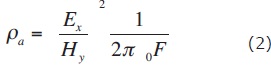
<body><![CDATA[<p align="justify"><font face="verdana" size="2"><i>RMT&#45;R Method</i></font></p>  	    <p align="justify"><font face="verdana" size="2">The RMT&#45;R method measures the electric field, <i>E<sub>x</sub></i> , in the direction of propagating radio waves (e.g. in the emitter antenna direction). The electric field is measured between two electrodes inserted in the ground at a certain distance from each other (in our work this distance is 5 meters).</font></p>  	    <p align="justify"><font face="verdana" size="2">The RMT&#45;R method also measures the magnetic field, H<sub>y</sub> , which is measured through a coil whose horizontal axis is normal to the emitter antenna direction.</font></p>  	    <p align="justify"><font face="verdana" size="2">The apparent resistivity, <i>&#961;<sub>a</sub></i>, results from the application of equation (2):</font></p>  	    <p align="center"><font face="verdana" size="2"><img src="/img/revistas/geoint/v53n2/a3fo2.jpg"></font></p>  	    <p align="justify"><font face="verdana" size="2">where:</font></p>  	    <p align="justify"><font face="verdana" size="2"><i>E<sub>x</sub></i> &#45; electric component of the resultant field (Volt/m)    <br> 	<i>H<sub>y</sub></i> &#45; magnetic component of the resultant field (Ampere/m)    <br> 	<i>&#956;<sub>0</sub></i> &#45; permeability of free space (Henry/m).    <br> 	<i>F</i> &#45; wave frequency (Hz).</font></p>  	    ]]></body>
<body><![CDATA[<p align="justify"><font face="verdana" size="2">This method also measures the phase&#45;shift, <i>&#934;</i>, between the electric and magnetic components. The phase&#45;shift enables inference of the stratigraphic characteristics of the place under study: there will be a conductive layer over a resistive one if <i>&#934;</i>&lt; 45&ordm; , there will be a resistive layer over a conductive one if <i>&#934;</i>&gt; 45&ordm;, and the medium is considered homogeneous if <i>&#934;</i> = 45&ordm; .</font></p>  	    <p align="justify"><font face="verdana" size="2">Given the fact that emitter antennas being located far apart from the receiver device, we could consider all directions of propagation as essentially parallel, which in practice reduces to only one direction. Once the device allows the simultaneous measurement of 4 frequencies, we can interpret it as supplying information from 4 depths (see <a href="/img/revistas/geoint/v53n2/a3f6.jpg">Figure 6</a>). An inversion program (FITVLF2) for the personal computer was used to obtain the real resistivities and the thicknesses of the layers traversed. Although its description is beyond the scope of this article, detailed information about the method of inversion and its implementation can be found at Fischer, G. <i>et al</i>. (1981), Fischer, G. (1985) and Thierrin, J. (1992).</font></p>  	    <p align="center"><font face="verdana" size="2"><a href="/img/revistas/geoint/v53n2/a3f7.jpg" target="_blank">Figure 7</a></font></p>  	    <p align="justify"><font face="verdana" size="2">Since it is a quick method that enables measurements (soundings) to be taken at 5 m intervals it allows the detection of heterogeneities, and it is possible to infer the permeability of the formations from their resistivity values, although this has not been done in the present study.</font></p>  	    <p align="justify"><font face="verdana" size="2">Multidirectional soundings can also be carried out to get information about the anisotropy of the studied medium.</font></p>  	    <p>&nbsp;</p>  	    <p align="justify"><font face="verdana" size="2"><b>Results and Discussion</b></font></p>  	    <p align="justify"><font face="verdana" size="2"><i>VLF&#45;EM</i></font></p>  	    <p align="justify"><font face="verdana" size="2">In <a href="/img/revistas/geoint/v53n2/a3f8.jpg" target="_blank">Figure 8</a> we present a photographic map of the places surveyed by VLF&#45;EM method.</font></p>  	    <p align="justify"><font face="verdana" size="2">The marked points show the paths walked along and color gradation indicates that the relation Hs/Hp % is (the deeper the color, the stronger the relationship Hs/Hp %):</font></p>  	    ]]></body>
<body><![CDATA[<p align="justify"><font face="verdana" size="2">&#45; red color &#150; positive Hs/Hp % relationship;    <br> 	&#45; blue color &#150; negative Hs/Hp % relationship;    <br> 	&#45; white color &#45; near zero Hs/Hp % relationship.</font></p>  	    <p align="justify"><font face="verdana" size="2">All profiles were carried out at 16 kHz frequency and some important conclusions can be drawn from their interpretation (see <a href="/img/revistas/geoint/v53n2/a3f8.jpg" target="_blank">Figure 8</a>).</font></p>  	    <p align="justify"><font face="verdana" size="2">Very negative or very positive values (Hs/Hp &lt;&#45;40 % or Hs/Hp&gt; 40 %) correspond to measurements taken under the influence of high tension power lines and so they must not be considered. Negative Hs/Hp % values are usually related to major resistivity layers, whereas positive Hs/Hp % values indicate major electricity conductivity layers (for instance, the presence of clay materials).</font></p>  	    <p align="justify"><font face="verdana" size="2">Successive inflections of Hs/Hp % indicate fracture zones, the more important the greater the registered amplitude.</font></p>  	    <p align="justify"><font face="verdana" size="2">In <a href="/img/revistas/geoint/v53n2/a3f9.jpg" target="_blank">Figure 9</a> we present a summarized interpretation of the obtained results, in order to illustrate the stated above. The joint interpretation of the VLF&#45;EM results with information gathered on EDM internal reports and field reconnaissance data made it possible to draw a map summarizing the fractures in the studied area, from which main drainage trends can be established (see <a href="/img/revistas/geoint/v53n2/a3f10.jpg" target="_blank">Figure 10</a>, wherein places where the presence of water was noted are marked in blue).</font></p>  	    <p align="justify"><font face="verdana" size="2"><i>RMT&#45;R</i></font></p>  	    <p align="justify"><font face="verdana" size="2">Apparent resistivity and phase difference between the electric and magnetic fields were measured in RMT&#45;R survey profiles. These profiles were defined in the sectors marked with circles, and they were quite enlightening (see <a href="/img/revistas/geoint/v53n2/a3f10.jpg" target="_blank">Figures 10</a> and <a href="/img/revistas/geoint/v53n2/a3f11.jpg" target="_blank">11</a>).</font></p>  	    <p align="justify"><font face="verdana" size="2">In particular, the profiles located NW of the mining site, in the Castelejo Valley (see <a href="/img/revistas/geoint/v53n2/a3f12.jpg" target="_blank">Figure 12</a>), have revealed very interesting features.</font></p>  	    ]]></body>
<body><![CDATA[<p align="justify"><font face="verdana" size="2">After processing the obtained results using an inversion program (Fischer, G., 1985), the real resistivities and thicknesses of the different layers were computed (<a href="/img/revistas/geoint/v53n2/a3f13.jpg" target="_blank">Figure 13</a>). Mid sector values were calculated next.</font></p>  	    <p align="justify"><font face="verdana" size="2">We noted that all the profiles defined along the Castelejo Valley exhibit a decrease in resistivity with depth. Once we are away from the mineralized vein, this may suggest either more alteration of granites with depth, or a situation of deep&#45;contamination.</font></p>  	    <p align="justify"><font face="verdana" size="2">The profile P1 reproduced in <a href="/img/revistas/geoint/v53n2/a3f13.jpg" target="_blank">Figure 13</a> (referring to deep pink points in <a href="/img/revistas/geoint/v53n2/a3f10.jpg" target="_blank">Figures 10</a> and <a href="/img/revistas/geoint/v53n2/a3f11.jpg" target="_blank">11</a>) is located near the old mining site: resistivity values correspond to those obtained for almost unweathered granite blocks (with resistivity values &gt; 1000 <i>&#937;</i>.m) immersed in a weathered matrix (with resistivity values &asymp; 700 <i>&#937;</i>.m).</font></p>  	    <p align="justify"><font face="verdana" size="2">On the other side, the profile P6, also reproduced separately in <a href="/img/revistas/geoint/v53n2/a3f13.jpg" target="_blank">Figure 13</a> (here referring to light green points in <a href="/img/revistas/geoint/v53n2/a3f10.jpg" target="_blank">Figures 10</a> and <a href="/img/revistas/geoint/v53n2/a3f11.jpg" target="_blank">11</a>) is located along the main fault valley near the confluence with the mine stream: resistivity values corresponding to a situation of very weathered rock material, decreasing with depth.</font></p>  	    <p align="justify"><font face="verdana" size="2">The profiles carried out along the valley that spreads out WNW from washing pools, indicate that this is a fault valley, filled in with erosion material. As before mentioned, all profiles show a decrease of resistivity not only with depth but also as we go away from the mine towards the main fault valley (e.g. from P1 to P6, see <a href="/img/revistas/geoint/v53n2/a3f12.jpg" target="_blank">figure 12</a>).</font></p>  	    <p>&nbsp;</p>  	    <p align="justify"><font face="verdana" size="2"><b>Conclusions</b></font></p>  	    <p align="justify"><font face="verdana" size="2">At the beginning of the study it was known the situation in terms of regional tectonics, which was known complex for being associated with a number of episodes of tardi&#45;Hercynian fracturing, as well with the Alpine tectonics.</font></p>  	    <p align="justify"><font face="verdana" size="2">In order to better characterize the underlying geology of the old Castelejo mine, two geophysical surveying campaigns were conducted at the site. Both the results of the first campaign (VLF&#45;EM results) and the references consulted, particularly in EDM internal reports, pointed to the presence of faults and fractures which might constitute the main pathways of superficial and underground drainage.</font></p>  	    <p align="justify"><font face="verdana" size="2">In the second campaign, measurements of RMT&#45;R were performed to the WNW and ESE of the centre of exploration. Apparent resistivity and phase difference between the electric and magnetic fields were the measured values. The obtained values were projected graphically and processed, after which real resistivities and thicknesses were determined through the use of an inversion program.</font></p>  	    ]]></body>
<body><![CDATA[<p align="justify"><font face="verdana" size="2">After matching the literature data with the data obtained during field work, it was concluded that the direction of maximum compressive stress, s<sub>1</sub>, located NNW&#45;SSE to NW&#45;SE, where extension fractures are developed, should be the one wherein groundwater flows more easily, since the larger openings of the fractures provide a better flow.</font></p>  	    <p align="justify"><font face="verdana" size="2">However, it was not possible to establish a direct correspondence between real resistivity values and permeability values, which, although outside the scope of this article, may be relevant for v.g. hydrogeological purposes.</font></p>  	    <p align="justify"><font face="verdana" size="2">All profiles also reveal a singular situation &#150; their resistivity values decrease with depth.</font></p>  	    <p align="justify"><font face="verdana" size="2">This can be due to natural causes (more weathered layers) or it can indicate a situation of deep contamination with acid drainage (increased mineralization).</font></p>  	    <p align="justify"><font face="verdana" size="2">In fact, we are in the presence of a former uranium exploration, in which ore acid leaching took place in a flooded open sky, with a number of negative implications in the surroundings, particularly over groundwater. Treatment operations of the mine water still occur. However, any risks to populations seem weak, given the isolation of the area in terms of population.</font></p>  	    <p align="justify"><font face="verdana" size="2">Also the use of water seems to be aimed to agricultural purposes rather than for human consumption.</font></p>  	    <p align="justify"><font face="verdana" size="2">This point will be addressed in the future through the implementation of a hydrochemical monitoring plan.</font></p>  	    <p>&nbsp;</p>  	    <p align="justify"><font face="verdana" size="2"><b>Acnowledgements</b></font></p>  	    <p align="justify"><font face="verdana" size="2">The assistance of Am&eacute;lia Dill was deeply appreciated</font>.</p>  	    ]]></body>
<body><![CDATA[<p>&nbsp;</p>  	    <p align="justify"><font face="verdana" size="2"><b>References</b></font></p>  	    <!-- ref --><p align="justify"><font face="verdana" size="2">Abranches M.C.B., Canilho M.H., 1982. Determina&ccedil;&atilde;o de idade pelo m&eacute;todo do Rb&#45;Sr de granitos antigos portugueses. In Mem&oacute;rias da Academia das Ci&ecirc;ncias de Lisboa. &#45; Tomo XXIV (1981/82), p. 17&#45;32</font>.    &nbsp;&nbsp;&nbsp;&nbsp;&nbsp;&nbsp;&nbsp;&nbsp;[&#160;<a href="javascript:void(0);" onclick="javascript: window.open('/scielo.php?script=sci_nlinks&ref=3931670&pid=S0016-7169201400020000300001&lng=','','width=640,height=500,resizable=yes,scrollbars=1,menubar=yes,');">Links</a>&#160;]<!-- end-ref --></p>  	    <!-- ref --><p align="justify"><font face="verdana" size="2">Afonso M.J.C., 2003, Hidrogeologia de rochas gran&iacute;ticas da regi&atilde;o do Porto (NW de Portugal). Cadernos <i>Lab. Xeol&oacute;xico de</i> Laxe. A Coru&ntilde;a. 28, pp. 173&#45;192.    &nbsp;&nbsp;&nbsp;&nbsp;&nbsp;&nbsp;&nbsp;&nbsp;[&#160;<a href="javascript:void(0);" onclick="javascript: window.open('/scielo.php?script=sci_nlinks&ref=3931672&pid=S0016-7169201400020000300002&lng=','','width=640,height=500,resizable=yes,scrollbars=1,menubar=yes,');">Links</a>&#160;]<!-- end-ref --></font></p>  	    <!-- ref --><p align="justify"><font face="verdana" size="2">Ara&uacute;jo M.A., 2002, T&oacute;picos da Mat&eacute;ria da disciplina de Geografia F&iacute;sica de Portugal. <a href="http://web.letras.up.pt/asaraujo/geofis/geofis.html" target="_blank">http://web.letras.up.pt/asaraujo/geofis/geofis.html</a>.    &nbsp;&nbsp;&nbsp;&nbsp;&nbsp;&nbsp;&nbsp;&nbsp;[&#160;<a href="javascript:void(0);" onclick="javascript: window.open('/scielo.php?script=sci_nlinks&ref=3931674&pid=S0016-7169201400020000300003&lng=','','width=640,height=500,resizable=yes,scrollbars=1,menubar=yes,');">Links</a>&#160;]<!-- end-ref --></font></p>  	    <!-- ref --><p align="justify"><font face="verdana" size="2">Carvalho D., Goinhas J., Schermerhorn L., 1971, Principais jazigos minerais do Sul de Portugal. I Congresso Hispano&#45;Luso&#45;Americano de Geologia Econ&oacute;mica, Livro&#45;Guia da Excurs&atilde;o n&ordm; 4, Direc&ccedil;&atilde;o&#45;Geral de Minas e Servi&ccedil;os Geol&oacute;gicos, Lisboa, 94 pp.    &nbsp;&nbsp;&nbsp;&nbsp;&nbsp;&nbsp;&nbsp;&nbsp;[&#160;<a href="javascript:void(0);" onclick="javascript: window.open('/scielo.php?script=sci_nlinks&ref=3931676&pid=S0016-7169201400020000300004&lng=','','width=640,height=500,resizable=yes,scrollbars=1,menubar=yes,');">Links</a>&#160;]<!-- end-ref --></font></p>  	    ]]></body>
<body><![CDATA[<!-- ref --><p align="justify"><font face="verdana" size="2">Carvalho J.M., 2006, Prospec&ccedil;&atilde;o e pesquisa de recursos h&iacute;dricos subterr&acirc;neos no Maci&ccedil;o Antigo Portugu&ecirc;s : linhas metodol&oacute;gicas. Tese de Doutoramento, Universidade de Aveiro, 312 pp.    &nbsp;&nbsp;&nbsp;&nbsp;&nbsp;&nbsp;&nbsp;&nbsp;[&#160;<a href="javascript:void(0);" onclick="javascript: window.open('/scielo.php?script=sci_nlinks&ref=3931678&pid=S0016-7169201400020000300005&lng=','','width=640,height=500,resizable=yes,scrollbars=1,menubar=yes,');">Links</a>&#160;]<!-- end-ref --></font></p>  	    <!-- ref --><p align="justify"><font face="verdana" size="2">Cerveira A., 1951, Sobre a metalogenia do ur&acirc;nio em Portugal. <i>Boletim da Sociedade Geol&oacute;gica Portuguesa</i>, 8, 3, pp.141&#45;182</font>.    &nbsp;&nbsp;&nbsp;&nbsp;&nbsp;&nbsp;&nbsp;&nbsp;[&#160;<a href="javascript:void(0);" onclick="javascript: window.open('/scielo.php?script=sci_nlinks&ref=3931680&pid=S0016-7169201400020000300006&lng=','','width=640,height=500,resizable=yes,scrollbars=1,menubar=yes,');">Links</a>&#160;]<!-- end-ref --></p>  	    <!-- ref --><p align="justify"><font face="verdana" size="2">Daniels J., Roberts R., Vendl M., 1995, Ground penetrating radar for the detection of liquid contaminants. <i>Journal of Applied Geophysics</i>, 33, Elsevier, 13 pp.    &nbsp;&nbsp;&nbsp;&nbsp;&nbsp;&nbsp;&nbsp;&nbsp;[&#160;<a href="javascript:void(0);" onclick="javascript: window.open('/scielo.php?script=sci_nlinks&ref=3931682&pid=S0016-7169201400020000300007&lng=','','width=640,height=500,resizable=yes,scrollbars=1,menubar=yes,');">Links</a>&#160;]<!-- end-ref --></font></p>  	    <!-- ref --><p align="justify"><font face="verdana" size="2">Dill A., M&uuml;ller I., Costa A.M., Monteiro J.P., 1998, Import&acirc;ncia do uso de m&eacute;todos geof&iacute;sicos electromagn&eacute;ticos Very Low Frequency Electromagnetics (VLF&#45;EM) e Radio Magnetotelluric&#45;Resistivity (RMT&#45;R) no estudo de aqu&iacute;feros c&aacute;rsicos do Alentejo e do Algarve. 4&ordm; Congresso da &Aacute;gua, A.P.R.H., Lisboa, 10 pp.    &nbsp;&nbsp;&nbsp;&nbsp;&nbsp;&nbsp;&nbsp;&nbsp;[&#160;<a href="javascript:void(0);" onclick="javascript: window.open('/scielo.php?script=sci_nlinks&ref=3931684&pid=S0016-7169201400020000300008&lng=','','width=640,height=500,resizable=yes,scrollbars=1,menubar=yes,');">Links</a>&#160;]<!-- end-ref --></font></p>  	    <!-- ref --><p align="justify"><font face="verdana" size="2">Ferreira M.P., 1971, Jazigos uran&iacute;feros portugueses, jazigos de Au&#45;Ag&#45;sulfuretos do Norte de Portugal. I Congresso Hispano&#45;Luso&#45;Americano de Geologia Econ&oacute;mica, Livro&#45;Guia da Excurs&atilde;o n&ordm; 5, Direc&ccedil;&atilde;o&#45;Geral de Minas e Servi&ccedil;os Geol&oacute;gicos, Lisboa, 81 pp.    &nbsp;&nbsp;&nbsp;&nbsp;&nbsp;&nbsp;&nbsp;&nbsp;[&#160;<a href="javascript:void(0);" onclick="javascript: window.open('/scielo.php?script=sci_nlinks&ref=3931686&pid=S0016-7169201400020000300009&lng=','','width=640,height=500,resizable=yes,scrollbars=1,menubar=yes,');">Links</a>&#160;]<!-- end-ref --></font></p>  	    ]]></body>
<body><![CDATA[<!-- ref --><p align="justify"><font face="verdana" size="2">Fischer G., Schnegg P.&#45;A., Peguiron M., Le Quang B., 1981, An analytic one&#45;dimensional magnetotelluric inversion scheme. <i>Geophysical Journal of the Royal Astronomical Society</i>, 67 2, John Wiley &amp; Sons Ltd, pp. 257&#45;278.    &nbsp;&nbsp;&nbsp;&nbsp;&nbsp;&nbsp;&nbsp;&nbsp;[&#160;<a href="javascript:void(0);" onclick="javascript: window.open('/scielo.php?script=sci_nlinks&ref=3931688&pid=S0016-7169201400020000300010&lng=','','width=640,height=500,resizable=yes,scrollbars=1,menubar=yes,');">Links</a>&#160;]<!-- end-ref --></font></p>  	    <!-- ref --><p align="justify"><font face="verdana" size="2">Fischer G., 1985, Some Remarks on the Behaviour of the Magnetotelluric Phase. <i>Geophysical Prospecting</i>, 33 (5), John Wiley &amp; Sons Ltd , pp. 716&#45;722.    &nbsp;&nbsp;&nbsp;&nbsp;&nbsp;&nbsp;&nbsp;&nbsp;[&#160;<a href="javascript:void(0);" onclick="javascript: window.open('/scielo.php?script=sci_nlinks&ref=3931690&pid=S0016-7169201400020000300011&lng=','','width=640,height=500,resizable=yes,scrollbars=1,menubar=yes,');">Links</a>&#160;]<!-- end-ref --></font></p>  	    <!-- ref --><p align="justify"><font face="verdana" size="2">Kearey P., Brooks M., Hill I., 2002, An Introduction to Geophysical Exploration. Blackwell Science Ltd., 281 pp.    &nbsp;&nbsp;&nbsp;&nbsp;&nbsp;&nbsp;&nbsp;&nbsp;[&#160;<a href="javascript:void(0);" onclick="javascript: window.open('/scielo.php?script=sci_nlinks&ref=3931692&pid=S0016-7169201400020000300012&lng=','','width=640,height=500,resizable=yes,scrollbars=1,menubar=yes,');">Links</a>&#160;]<!-- end-ref --></font></p>  	    <!-- ref --><p align="justify"><font face="verdana" size="2">Lottermoser B., 2003, Mine wastes, characterization, treatment and environmental impacts. Springer&#45;Verlag Berlin Heidelberg, 277 pp.    &nbsp;&nbsp;&nbsp;&nbsp;&nbsp;&nbsp;&nbsp;&nbsp;[&#160;<a href="javascript:void(0);" onclick="javascript: window.open('/scielo.php?script=sci_nlinks&ref=3931694&pid=S0016-7169201400020000300013&lng=','','width=640,height=500,resizable=yes,scrollbars=1,menubar=yes,');">Links</a>&#160;]<!-- end-ref --></font></p>  	    <!-- ref --><p align="justify"><font face="verdana" size="2">Milsom J., 2003, Field geophysics. John Wiley &amp; Sons Ltd, West Sussex, England, 249 pp.    &nbsp;&nbsp;&nbsp;&nbsp;&nbsp;&nbsp;&nbsp;&nbsp;[&#160;<a href="javascript:void(0);" onclick="javascript: window.open('/scielo.php?script=sci_nlinks&ref=3931696&pid=S0016-7169201400020000300014&lng=','','width=640,height=500,resizable=yes,scrollbars=1,menubar=yes,');">Links</a>&#160;]<!-- end-ref --></font></p>  	    ]]></body>
<body><![CDATA[<!-- ref --><p align="justify"><font face="verdana" size="2">M&uuml;ller I., 1983, Anisotropic properties of rocks detected with electro&#45;magnetic VLLF (Very Low Frequency). International Symposium on Field measurements in Geomechanics. Zurich, Switzerland, special publ., pp. 273&#45;282.    &nbsp;&nbsp;&nbsp;&nbsp;&nbsp;&nbsp;&nbsp;&nbsp;[&#160;<a href="javascript:void(0);" onclick="javascript: window.open('/scielo.php?script=sci_nlinks&ref=3931698&pid=S0016-7169201400020000300015&lng=','','width=640,height=500,resizable=yes,scrollbars=1,menubar=yes,');">Links</a>&#160;]<!-- end-ref --></font></p>  	    <!-- ref --><p align="justify"><font face="verdana" size="2">Neiva J.M.C., 1995, Jazigos portugueses de min&eacute;rios de ur&acirc;nio. <i>Mem&oacute;rias</i> 4, IV Congresso Nacional de Geologia, Museu e Laborat&oacute;rio Mineral&oacute;gico e Geol&oacute;gico, Faculdade de Ci&ecirc;ncias, Universidade do Porto, pp. 575&#45;579</font>.    &nbsp;&nbsp;&nbsp;&nbsp;&nbsp;&nbsp;&nbsp;&nbsp;[&#160;<a href="javascript:void(0);" onclick="javascript: window.open('/scielo.php?script=sci_nlinks&ref=3931700&pid=S0016-7169201400020000300016&lng=','','width=640,height=500,resizable=yes,scrollbars=1,menubar=yes,');">Links</a>&#160;]<!-- end-ref --></p>  	    <!-- ref --><p align="justify"><font face="verdana" size="2">Nunes A., 1983, A geologia econ&oacute;mica e a ind&uacute;stria mineira atrav&eacute;s dos tempos. Geonovas 5, pp. 67&#45;114.    &nbsp;&nbsp;&nbsp;&nbsp;&nbsp;&nbsp;&nbsp;&nbsp;[&#160;<a href="javascript:void(0);" onclick="javascript: window.open('/scielo.php?script=sci_nlinks&ref=3931702&pid=S0016-7169201400020000300017&lng=','','width=640,height=500,resizable=yes,scrollbars=1,menubar=yes,');">Links</a>&#160;]<!-- end-ref --></font></p>  	    <!-- ref --><p align="justify"><font face="verdana" size="2">Oliveira V., 2010, Modela&ccedil;&atilde;o hidrogeol&oacute;gica da &aacute;rea mineira abandonada de Castelejo (Guarda). Tese de Doutoramento. Faculdade de Ci&ecirc;ncias Universidade de Lisboa, 211 pp.    &nbsp;&nbsp;&nbsp;&nbsp;&nbsp;&nbsp;&nbsp;&nbsp;[&#160;<a href="javascript:void(0);" onclick="javascript: window.open('/scielo.php?script=sci_nlinks&ref=3931704&pid=S0016-7169201400020000300018&lng=','','width=640,height=500,resizable=yes,scrollbars=1,menubar=yes,');">Links</a>&#160;]<!-- end-ref --></font></p>  	    <!-- ref --><p align="justify"><font face="verdana" size="2">Rapantova N., Hrkal Z., (editors), 2008, Mine water and the environment. Proceedings of 10<sup>th</sup> Internacional Mine Water Association Congress. VSB&#45;Technical University of Ostrava, Faculty of Mining and Geology. Olomouc, Czech Republic, 628 pp.    &nbsp;&nbsp;&nbsp;&nbsp;&nbsp;&nbsp;&nbsp;&nbsp;[&#160;<a href="javascript:void(0);" onclick="javascript: window.open('/scielo.php?script=sci_nlinks&ref=3931706&pid=S0016-7169201400020000300019&lng=','','width=640,height=500,resizable=yes,scrollbars=1,menubar=yes,');">Links</a>&#160;]<!-- end-ref --></font></p>  	    ]]></body>
<body><![CDATA[<!-- ref --><p align="justify"><font face="verdana" size="2">Ribeiro A., Antunes M.T., Ferreira M.P., Rocha R.B., Soares A.F., Zbyszewski G., Moitinho de Almeida F., Carvalho D. e Monteiro, J.H., 1979, Introduction &agrave; la g&eacute;ologie g&eacute;n&eacute;rale du Portugal. Servi&ccedil;os Geol&oacute;gicos de Portugal, Lisboa, 114 pp.    &nbsp;&nbsp;&nbsp;&nbsp;&nbsp;&nbsp;&nbsp;&nbsp;[&#160;<a href="javascript:void(0);" onclick="javascript: window.open('/scielo.php?script=sci_nlinks&ref=3931708&pid=S0016-7169201400020000300020&lng=','','width=640,height=500,resizable=yes,scrollbars=1,menubar=yes,');">Links</a>&#160;]<!-- end-ref --></font></p>  	    <!-- ref --><p align="justify"><font face="verdana" size="2">Teixeira C., 1966, A evolu&ccedil;&atilde;o do territ&oacute;rio portugu&ecirc;s no decurso dos tempos geol&oacute;gicos. Palestra <i>Rev. Ped. Cult.</i>, 28, Lisboa, pp. 111&#45;157.    &nbsp;&nbsp;&nbsp;&nbsp;&nbsp;&nbsp;&nbsp;&nbsp;[&#160;<a href="javascript:void(0);" onclick="javascript: window.open('/scielo.php?script=sci_nlinks&ref=3931710&pid=S0016-7169201400020000300021&lng=','','width=640,height=500,resizable=yes,scrollbars=1,menubar=yes,');">Links</a>&#160;]<!-- end-ref --></font></p>  	    <!-- ref --><p align="justify"><font face="verdana" size="2">Teixeira C., Carvalho B., Santos P., Peres M., Barros R., 1967, Carta geol&oacute;gica de Portugal &agrave; escala 1:50.000, Folha 17&#45;D (Gouveia) e not&iacute;cia explicativa. Servi&ccedil;os Geol&oacute;gicos de Portugal, Lisboa, 28 pp.    &nbsp;&nbsp;&nbsp;&nbsp;&nbsp;&nbsp;&nbsp;&nbsp;[&#160;<a href="javascript:void(0);" onclick="javascript: window.open('/scielo.php?script=sci_nlinks&ref=3931712&pid=S0016-7169201400020000300022&lng=','','width=640,height=500,resizable=yes,scrollbars=1,menubar=yes,');">Links</a>&#160;]<!-- end-ref --></font></p>  	    <!-- ref --><p align="justify"><font face="verdana" size="2">Thierrin J., M&uuml;ller I., 1988, La m&eacute;thode VLF&#45;R&eacute;sistivit&eacute; multifr&eacute;quence, un example d'exploration hydrog&eacute;ologique dans un synclinal cr&eacute;tac&eacute; &agrave; la Br&eacute;vine (Jura neuch&acirc;telois). <i>Annales Scientifiques de l'Universit&eacute; de Besan&ccedil;on</i>, M&eacute;moire Hors de S&eacute;rie, n&ordm; 6, Quatri&egrave;me Colloque d&acute;Hydrog&eacute;ologie en Pays Calcaire, Besan&ccedil;on, France, 17&#45;25.    &nbsp;&nbsp;&nbsp;&nbsp;&nbsp;&nbsp;&nbsp;&nbsp;[&#160;<a href="javascript:void(0);" onclick="javascript: window.open('/scielo.php?script=sci_nlinks&ref=3931714&pid=S0016-7169201400020000300023&lng=','','width=640,height=500,resizable=yes,scrollbars=1,menubar=yes,');">Links</a>&#160;]<!-- end-ref --></font></p>  	    <!-- ref --><p align="justify"><font face="verdana" size="2">Turberg P., 1993, Apport de la cartographie radiomagnetotellurique a l'hydrogeologie des milieux fractur&eacute;s. Th&egrave;se de Doctorat. Facult&eacute; des Sciences de l'Universit&eacute; de Neuch&acirc;tel, Suisse, 233 pp.    &nbsp;&nbsp;&nbsp;&nbsp;&nbsp;&nbsp;&nbsp;&nbsp;[&#160;<a href="javascript:void(0);" onclick="javascript: window.open('/scielo.php?script=sci_nlinks&ref=3931716&pid=S0016-7169201400020000300024&lng=','','width=640,height=500,resizable=yes,scrollbars=1,menubar=yes,');">Links</a>&#160;]<!-- end-ref --></font></p>  	    ]]></body>
<body><![CDATA[<!-- ref --><p align="justify"><font face="verdana" size="2">Turberg P., M&uuml;ller I., 1992, La m&eacute;thode inductive VLF&#45;EM pour la prospection hydrog&eacute;ologique en continu du milieu fissure. <i>Annales Scientifiques de l'Universit&eacute; de Besan&ccedil;on</i>, M&eacute;moire Hors de S&eacute;rie, n&ordm; 11, Cinqui&egrave;me Colloque d&acute;Hydrog&eacute;ologie en Pays Calcaire et en Milieu Fissur&eacute;, Neuch&acirc;tel, Suisse, 207&#45;214.    &nbsp;&nbsp;&nbsp;&nbsp;&nbsp;&nbsp;&nbsp;&nbsp;[&#160;<a href="javascript:void(0);" onclick="javascript: window.open('/scielo.php?script=sci_nlinks&ref=3931718&pid=S0016-7169201400020000300025&lng=','','width=640,height=500,resizable=yes,scrollbars=1,menubar=yes,');">Links</a>&#160;]<!-- end-ref --></font></p>  	    <!-- ref --><p align="justify"><font face="verdana" size="2">United States Environmental Protection Agency, 2007, Technical report on technologically enhanced naturally occurring radioactive materials from uranium mining &#150; Volume 2: investigation of potential health, geographic and environmental issues of abandoned uranium mines. U.S. Environmental Protection Agency, Office of Radiation and Indoor Air, Radiation Protection Division, Washington, DC, USA.    &nbsp;&nbsp;&nbsp;&nbsp;&nbsp;&nbsp;&nbsp;&nbsp;[&#160;<a href="javascript:void(0);" onclick="javascript: window.open('/scielo.php?script=sci_nlinks&ref=3931720&pid=S0016-7169201400020000300026&lng=','','width=640,height=500,resizable=yes,scrollbars=1,menubar=yes,');">Links</a>&#160;]<!-- end-ref --></font></p>  	    <!-- ref --><p align="justify"><font face="verdana" size="2">Younger P., Robins N., (editors), 2002, Mine water hydrogeology and geochemistry. <i>Geological Society Special Publication</i>, 198, London, 396 pp.    &nbsp;&nbsp;&nbsp;&nbsp;&nbsp;&nbsp;&nbsp;&nbsp;[&#160;<a href="javascript:void(0);" onclick="javascript: window.open('/scielo.php?script=sci_nlinks&ref=3931722&pid=S0016-7169201400020000300027&lng=','','width=640,height=500,resizable=yes,scrollbars=1,menubar=yes,');">Links</a>&#160;]<!-- end-ref --></font></p>      ]]></body><back>
<ref-list>
<ref id="B1">
<nlm-citation citation-type="">
<person-group person-group-type="author">
<name>
<surname><![CDATA[Abranches]]></surname>
<given-names><![CDATA[M.C.B.]]></given-names>
</name>
<name>
<surname><![CDATA[Canilho]]></surname>
<given-names><![CDATA[M.H.]]></given-names>
</name>
</person-group>
<source><![CDATA[Determinação de idade pelo método do Rb-Sr de granitos antigos portugueses. In Memórias da Academia das Ciências de Lisboa]]></source>
<year>1982</year>
<volume>XXIV</volume>
<page-range>17-32</page-range></nlm-citation>
</ref>
<ref id="B2">
<nlm-citation citation-type="journal">
<person-group person-group-type="author">
<name>
<surname><![CDATA[Afonso]]></surname>
<given-names><![CDATA[M.J.C.]]></given-names>
</name>
</person-group>
<article-title xml:lang="pt"><![CDATA[Hidrogeologia de rochas graníticas da região do Porto (NW de Portugal)]]></article-title>
<source><![CDATA[Cadernos Lab. Xeolóxico de Laxe. A Coruña]]></source>
<year>2003</year>
<volume>28</volume>
<page-range>173-192</page-range></nlm-citation>
</ref>
<ref id="B3">
<nlm-citation citation-type="">
<person-group person-group-type="author">
<name>
<surname><![CDATA[Araújo]]></surname>
<given-names><![CDATA[M.A.]]></given-names>
</name>
</person-group>
<source><![CDATA[Tópicos da Matéria da disciplina de Geografia Física de Portugal]]></source>
<year>2002</year>
</nlm-citation>
</ref>
<ref id="B4">
<nlm-citation citation-type="book">
<person-group person-group-type="author">
<name>
<surname><![CDATA[Carvalho]]></surname>
<given-names><![CDATA[D.]]></given-names>
</name>
<name>
<surname><![CDATA[Goinhas]]></surname>
<given-names><![CDATA[J.]]></given-names>
</name>
<name>
<surname><![CDATA[Schermerhorn]]></surname>
<given-names><![CDATA[L.]]></given-names>
</name>
</person-group>
<source><![CDATA[Principais jazigos minerais do Sul de Portugal. I Congresso Hispano-Luso-Americano de Geologia Económica, Livro-Guia da Excursão nº 4]]></source>
<year>1971</year>
<page-range>94</page-range><publisher-loc><![CDATA[Lisboa ]]></publisher-loc>
<publisher-name><![CDATA[Direcção-Geral de Minas e Serviços Geológicos]]></publisher-name>
</nlm-citation>
</ref>
<ref id="B5">
<nlm-citation citation-type="">
<person-group person-group-type="author">
<name>
<surname><![CDATA[Carvalho]]></surname>
<given-names><![CDATA[J.M.]]></given-names>
</name>
</person-group>
<source><![CDATA[Prospecção e pesquisa de recursos hídricos subterrâneos no Maciço Antigo Português : linhas metodológicas]]></source>
<year>2006</year>
<page-range>312</page-range></nlm-citation>
</ref>
<ref id="B6">
<nlm-citation citation-type="journal">
<person-group person-group-type="author">
<name>
<surname><![CDATA[Cerveira]]></surname>
<given-names><![CDATA[A.]]></given-names>
</name>
</person-group>
<article-title xml:lang="pt"><![CDATA[Sobre a metalogenia do urânio em Portugal]]></article-title>
<source><![CDATA[Boletim da Sociedade Geológica Portuguesa]]></source>
<year>1951</year>
<volume>8</volume>
<numero>3</numero>
<issue>3</issue>
<page-range>141-182</page-range></nlm-citation>
</ref>
<ref id="B7">
<nlm-citation citation-type="journal">
<person-group person-group-type="author">
<name>
<surname><![CDATA[Daniels]]></surname>
<given-names><![CDATA[J.]]></given-names>
</name>
<name>
<surname><![CDATA[Roberts]]></surname>
<given-names><![CDATA[R.]]></given-names>
</name>
<name>
<surname><![CDATA[Vendl]]></surname>
<given-names><![CDATA[M.]]></given-names>
</name>
</person-group>
<article-title xml:lang="en"><![CDATA[Ground penetrating radar for the detection of liquid contaminants]]></article-title>
<source><![CDATA[Journal of Applied Geophysics]]></source>
<year>1995</year>
<volume>33</volume>
<page-range>13</page-range><publisher-name><![CDATA[Elsevier]]></publisher-name>
</nlm-citation>
</ref>
<ref id="B8">
<nlm-citation citation-type="">
<person-group person-group-type="author">
<name>
<surname><![CDATA[Dill]]></surname>
<given-names><![CDATA[A.]]></given-names>
</name>
<name>
<surname><![CDATA[Müller]]></surname>
<given-names><![CDATA[I.]]></given-names>
</name>
<name>
<surname><![CDATA[Costa]]></surname>
<given-names><![CDATA[A.M.]]></given-names>
</name>
<name>
<surname><![CDATA[Monteiro]]></surname>
<given-names><![CDATA[J.P.]]></given-names>
</name>
</person-group>
<source><![CDATA[Importância do uso de métodos geofísicos electromagnéticos Very Low Frequency Electromagnetics (VLF-EM) e Radio Magnetotelluric-Resistivity (RMT-R) no estudo de aquíferos cársicos do Alentejo e do Algarve. 4º Congresso da Água, A.P.R.H.]]></source>
<year>1998</year>
<page-range>10</page-range><publisher-loc><![CDATA[Lisboa ]]></publisher-loc>
</nlm-citation>
</ref>
<ref id="B9">
<nlm-citation citation-type="book">
<person-group person-group-type="author">
<name>
<surname><![CDATA[Ferreira]]></surname>
<given-names><![CDATA[M.P.]]></given-names>
</name>
</person-group>
<source><![CDATA[Jazigos uraníferos portugueses, jazigos de Au-Ag-sulfuretos do Norte de Portugal. I Congresso Hispano-Luso-Americano de Geologia Económica, Livro-Guia da Excursão nº 5]]></source>
<year>1971</year>
<page-range>81</page-range><publisher-loc><![CDATA[Lisboa ]]></publisher-loc>
<publisher-name><![CDATA[Direcção-Geral de Minas e Serviços Geológicos]]></publisher-name>
</nlm-citation>
</ref>
<ref id="B10">
<nlm-citation citation-type="journal">
<person-group person-group-type="author">
<name>
<surname><![CDATA[Fischer]]></surname>
<given-names><![CDATA[G.]]></given-names>
</name>
<name>
<surname><![CDATA[Schnegg P.]]></surname>
<given-names><![CDATA[A.]]></given-names>
</name>
<name>
<surname><![CDATA[Peguiron]]></surname>
<given-names><![CDATA[M.]]></given-names>
</name>
<name>
<surname><![CDATA[Le Quang]]></surname>
<given-names><![CDATA[B.]]></given-names>
</name>
</person-group>
<article-title xml:lang="en"><![CDATA[An analytic one-dimensional magnetotelluric inversion scheme]]></article-title>
<source><![CDATA[Geophysical Journal of the Royal Astronomical Society]]></source>
<year>1981</year>
<volume>67</volume>
<numero>2</numero>
<issue>2</issue>
<page-range>257-278</page-range><publisher-name><![CDATA[John Wiley & Sons Ltd]]></publisher-name>
</nlm-citation>
</ref>
<ref id="B11">
<nlm-citation citation-type="journal">
<person-group person-group-type="author">
<name>
<surname><![CDATA[Fischer]]></surname>
<given-names><![CDATA[G.]]></given-names>
</name>
</person-group>
<article-title xml:lang="en"><![CDATA[Some Remarks on the Behaviour of the Magnetotelluric Phase]]></article-title>
<source><![CDATA[Geophysical Prospecting]]></source>
<year>1985</year>
<volume>33</volume>
<numero>5</numero>
<issue>5</issue>
<page-range>716-722</page-range><publisher-name><![CDATA[John Wiley & Sons Ltd]]></publisher-name>
</nlm-citation>
</ref>
<ref id="B12">
<nlm-citation citation-type="book">
<person-group person-group-type="author">
<name>
<surname><![CDATA[Kearey]]></surname>
<given-names><![CDATA[P.]]></given-names>
</name>
<name>
<surname><![CDATA[Brooks]]></surname>
<given-names><![CDATA[M.]]></given-names>
</name>
<name>
<surname><![CDATA[Hill]]></surname>
<given-names><![CDATA[I.]]></given-names>
</name>
</person-group>
<source><![CDATA[An Introduction to Geophysical Exploration]]></source>
<year>2002</year>
<page-range>281</page-range><publisher-name><![CDATA[Blackwell Science Ltd.]]></publisher-name>
</nlm-citation>
</ref>
<ref id="B13">
<nlm-citation citation-type="book">
<person-group person-group-type="author">
<name>
<surname><![CDATA[Lottermoser]]></surname>
<given-names><![CDATA[B.]]></given-names>
</name>
</person-group>
<source><![CDATA[Mine wastes, characterization, treatment and environmental impacts]]></source>
<year>2003</year>
<page-range>277</page-range><publisher-loc><![CDATA[BerlinHeidelberg ]]></publisher-loc>
<publisher-name><![CDATA[Springer-Verlag]]></publisher-name>
</nlm-citation>
</ref>
<ref id="B14">
<nlm-citation citation-type="book">
<person-group person-group-type="author">
<name>
<surname><![CDATA[Milsom]]></surname>
<given-names><![CDATA[J.]]></given-names>
</name>
</person-group>
<source><![CDATA[Field geophysics]]></source>
<year>2003</year>
<page-range>249</page-range><publisher-loc><![CDATA[West Sussex ]]></publisher-loc>
<publisher-name><![CDATA[John Wiley & Sons Ltd]]></publisher-name>
</nlm-citation>
</ref>
<ref id="B15">
<nlm-citation citation-type="">
<person-group person-group-type="author">
<name>
<surname><![CDATA[Müller]]></surname>
<given-names><![CDATA[I]]></given-names>
</name>
</person-group>
<source><![CDATA[Anisotropic properties of rocks detected with electro-magnetic VLLF (Very Low Frequency). International Symposium on Field measurements in Geomechanics]]></source>
<year>1983</year>
<page-range>273-282</page-range><publisher-loc><![CDATA[Zurich ]]></publisher-loc>
</nlm-citation>
</ref>
<ref id="B16">
<nlm-citation citation-type="book">
<person-group person-group-type="author">
<name>
<surname><![CDATA[Neiva]]></surname>
<given-names><![CDATA[J.M.C.]]></given-names>
</name>
</person-group>
<source><![CDATA[Jazigos portugueses de minérios de urânio. Memórias 4, IV Congresso Nacional de Geologia, Museu e Laboratório Mineralógico e Geológico]]></source>
<year>1995</year>
<page-range>575-579</page-range><publisher-name><![CDATA[Faculdade de Ciências, Universidade do Porto]]></publisher-name>
</nlm-citation>
</ref>
<ref id="B17">
<nlm-citation citation-type="journal">
<person-group person-group-type="author">
<name>
<surname><![CDATA[Nunes]]></surname>
<given-names><![CDATA[A.]]></given-names>
</name>
</person-group>
<article-title xml:lang="en"><![CDATA[A geologia económica e a indústria mineira através dos tempos]]></article-title>
<source><![CDATA[Geonovas]]></source>
<year>1983</year>
<volume>5</volume>
<page-range>67-114</page-range></nlm-citation>
</ref>
<ref id="B18">
<nlm-citation citation-type="">
<person-group person-group-type="author">
<name>
<surname><![CDATA[Oliveira]]></surname>
<given-names><![CDATA[V.]]></given-names>
</name>
</person-group>
<source><![CDATA[Modelação hidrogeológica da área mineira abandonada de Castelejo (Guarda)]]></source>
<year>2010</year>
<page-range>211</page-range></nlm-citation>
</ref>
<ref id="B19">
<nlm-citation citation-type="book">
<person-group person-group-type="author">
<name>
<surname><![CDATA[Rapantova]]></surname>
<given-names><![CDATA[N.]]></given-names>
</name>
<name>
<surname><![CDATA[Hrkal]]></surname>
<given-names><![CDATA[Z.]]></given-names>
</name>
</person-group>
<source><![CDATA[Mine water and the environment. Proceedings of 10th Internacional Mine Water Association Congress. VSB-Technical University of Ostrava]]></source>
<year>2008</year>
<page-range>628</page-range><publisher-loc><![CDATA[Olomouc ]]></publisher-loc>
<publisher-name><![CDATA[Faculty of Mining and Geology]]></publisher-name>
</nlm-citation>
</ref>
<ref id="B20">
<nlm-citation citation-type="book">
<person-group person-group-type="author">
<name>
<surname><![CDATA[Ribeiro]]></surname>
<given-names><![CDATA[A.]]></given-names>
</name>
<name>
<surname><![CDATA[Antunes]]></surname>
<given-names><![CDATA[M.T.]]></given-names>
</name>
<name>
<surname><![CDATA[Ferreira]]></surname>
<given-names><![CDATA[M.P.]]></given-names>
</name>
<name>
<surname><![CDATA[Rocha]]></surname>
<given-names><![CDATA[R.B.]]></given-names>
</name>
<name>
<surname><![CDATA[Soares]]></surname>
<given-names><![CDATA[A.F.]]></given-names>
</name>
<name>
<surname><![CDATA[Zbyszewski]]></surname>
<given-names><![CDATA[G.]]></given-names>
</name>
<name>
<surname><![CDATA[Moitinho de Almeida]]></surname>
<given-names><![CDATA[F.]]></given-names>
</name>
<name>
<surname><![CDATA[Carvalho]]></surname>
<given-names><![CDATA[D.]]></given-names>
</name>
<name>
<surname><![CDATA[Monteiro]]></surname>
<given-names><![CDATA[J.H.]]></given-names>
</name>
</person-group>
<source><![CDATA[Introduction à la géologie générale du Portugal]]></source>
<year>1979</year>
<page-range>114</page-range><publisher-loc><![CDATA[Lisboa ]]></publisher-loc>
<publisher-name><![CDATA[Serviços Geológicos de Portugal]]></publisher-name>
</nlm-citation>
</ref>
<ref id="B21">
<nlm-citation citation-type="journal">
<person-group person-group-type="author">
<name>
<surname><![CDATA[Teixeira]]></surname>
<given-names><![CDATA[C.]]></given-names>
</name>
</person-group>
<article-title xml:lang="pt"><![CDATA[A evolução do território português no decurso dos tempos geológicos]]></article-title>
<source><![CDATA[Palestra Rev. Ped. Cult.]]></source>
<year>1966</year>
<volume>28</volume>
<page-range>111-157</page-range><publisher-loc><![CDATA[Lisboa ]]></publisher-loc>
</nlm-citation>
</ref>
<ref id="B22">
<nlm-citation citation-type="book">
<person-group person-group-type="author">
<name>
<surname><![CDATA[Teixeira]]></surname>
<given-names><![CDATA[C.]]></given-names>
</name>
<name>
<surname><![CDATA[Carvalho]]></surname>
<given-names><![CDATA[B.]]></given-names>
</name>
<name>
<surname><![CDATA[Santos]]></surname>
<given-names><![CDATA[P.]]></given-names>
</name>
<name>
<surname><![CDATA[Peres]]></surname>
<given-names><![CDATA[M.]]></given-names>
</name>
<name>
<surname><![CDATA[Barros]]></surname>
<given-names><![CDATA[R.]]></given-names>
</name>
</person-group>
<source><![CDATA[Carta geológica de Portugal à escala 1:50.000, Folha 17-D (Gouveia) e notícia explicativa]]></source>
<year>1967</year>
<page-range>28</page-range><publisher-loc><![CDATA[Lisboa ]]></publisher-loc>
<publisher-name><![CDATA[Serviços Geológicos de Portugal]]></publisher-name>
</nlm-citation>
</ref>
<ref id="B23">
<nlm-citation citation-type="">
<person-group person-group-type="author">
<name>
<surname><![CDATA[Thierrin]]></surname>
<given-names><![CDATA[J.]]></given-names>
</name>
<name>
<surname><![CDATA[Müller]]></surname>
<given-names><![CDATA[I.]]></given-names>
</name>
</person-group>
<source><![CDATA[La méthode VLF-Résistivité multifréquence, un example d'exploration hydrogéologique dans un synclinal crétacé à la Brévine (Jura neuchâtelois). Annales Scientifiques de l'Université de Besançon, Mémoire Hors de Série, nº 6, Quatrième Colloque d´Hydrogéologie en Pays Calcaire]]></source>
<year>1988</year>
<page-range>17-25</page-range><publisher-loc><![CDATA[Besançon ]]></publisher-loc>
</nlm-citation>
</ref>
<ref id="B24">
<nlm-citation citation-type="">
<person-group person-group-type="author">
<name>
<surname><![CDATA[Turberg]]></surname>
<given-names><![CDATA[P.]]></given-names>
</name>
</person-group>
<source><![CDATA[Apport de la cartographie radiomagnetotellurique a l'hydrogeologie des milieux fracturés]]></source>
<year>1993</year>
</nlm-citation>
</ref>
<ref id="B25">
<nlm-citation citation-type="">
<person-group person-group-type="author">
<name>
<surname><![CDATA[Turberg]]></surname>
<given-names><![CDATA[P.]]></given-names>
</name>
<name>
<surname><![CDATA[Müller]]></surname>
<given-names><![CDATA[I.]]></given-names>
</name>
</person-group>
<source><![CDATA[La méthode inductive VLF-EM pour la prospection hydrogéologique en continu du milieu fissure. Annales Scientifiques de l'Université de Besançon, Mémoire Hors de Série, nº 11, Cinquième Colloque d´Hydrogéologie en Pays Calcaire et en Milieu Fissuré]]></source>
<year>1992</year>
<page-range>207-214</page-range><publisher-loc><![CDATA[Neuchâtel ]]></publisher-loc>
</nlm-citation>
</ref>
<ref id="B26">
<nlm-citation citation-type="book">
<collab>United States Environmental Protection Agency</collab>
<source><![CDATA[Technical report on technologically enhanced naturally occurring radioactive materials from uranium mining - Volume 2: investigation of potential health, geographic and environmental issues of abandoned uranium mines]]></source>
<year>2007</year>
<publisher-loc><![CDATA[Washington^eDC DC]]></publisher-loc>
<publisher-name><![CDATA[U.S. Environmental Protection Agency, Office of Radiation and Indoor Air, Radiation Protection Division]]></publisher-name>
</nlm-citation>
</ref>
<ref id="B27">
<nlm-citation citation-type="journal">
<person-group person-group-type="author">
<name>
<surname><![CDATA[Younger]]></surname>
<given-names><![CDATA[P.]]></given-names>
</name>
<name>
<surname><![CDATA[Robins]]></surname>
<given-names><![CDATA[N.]]></given-names>
</name>
</person-group>
<article-title xml:lang="en"><![CDATA[Mine water hydrogeology and geochemistry]]></article-title>
<source><![CDATA[Geological Society Special Publication]]></source>
<year>2002</year>
<volume>198</volume>
<page-range>396</page-range><publisher-loc><![CDATA[London ]]></publisher-loc>
</nlm-citation>
</ref>
</ref-list>
</back>
</article>