<?xml version="1.0" encoding="ISO-8859-1"?><article xmlns:mml="http://www.w3.org/1998/Math/MathML" xmlns:xlink="http://www.w3.org/1999/xlink" xmlns:xsi="http://www.w3.org/2001/XMLSchema-instance">
<front>
<journal-meta>
<journal-id>0016-7169</journal-id>
<journal-title><![CDATA[Geofísica internacional]]></journal-title>
<abbrev-journal-title><![CDATA[Geofís. Intl]]></abbrev-journal-title>
<issn>0016-7169</issn>
<publisher>
<publisher-name><![CDATA[Universidad Nacional Autónoma de México, Instituto de Geofísica]]></publisher-name>
</publisher>
</journal-meta>
<article-meta>
<article-id>S0016-71692012000400006</article-id>
<title-group>
<article-title xml:lang="en"><![CDATA[Viscoelastic modeling and factor Q for reflection data]]></article-title>
</title-group>
<contrib-group>
<contrib contrib-type="author">
<name>
<surname><![CDATA[Sabinin]]></surname>
<given-names><![CDATA[Vladimir]]></given-names>
</name>
<xref ref-type="aff" rid="A01"/>
</contrib>
</contrib-group>
<aff id="A01">
<institution><![CDATA[,Instituto Mexicano del Petróleo.  ]]></institution>
<addr-line><![CDATA[México D.F.]]></addr-line>
<country>México</country>
</aff>
<pub-date pub-type="pub">
<day>00</day>
<month>12</month>
<year>2012</year>
</pub-date>
<pub-date pub-type="epub">
<day>00</day>
<month>12</month>
<year>2012</year>
</pub-date>
<volume>51</volume>
<numero>4</numero>
<fpage>377</fpage>
<lpage>391</lpage>
<copyright-statement/>
<copyright-year/>
<self-uri xlink:href="http://www.scielo.org.mx/scielo.php?script=sci_arttext&amp;pid=S0016-71692012000400006&amp;lng=en&amp;nrm=iso"></self-uri><self-uri xlink:href="http://www.scielo.org.mx/scielo.php?script=sci_abstract&amp;pid=S0016-71692012000400006&amp;lng=en&amp;nrm=iso"></self-uri><self-uri xlink:href="http://www.scielo.org.mx/scielo.php?script=sci_pdf&amp;pid=S0016-71692012000400006&amp;lng=en&amp;nrm=iso"></self-uri><abstract abstract-type="short" xml:lang="es"><p><![CDATA[Los modelos numéricos viscoelásticos, basados en el concepto de mecanismos de dispersión, toman en cuenta las variables de memoria y algunos parámetros de dispersión, a saber los tiempos de relajación de tensión. En la práctica de la geofísica, el factor de calidad Q se usa normalmente para describir una propiedad de atenuación de medios viscoelásticos. Para el modelado numérico, es útil saber qué dependencia existe entre el factor Q y los tiempos de relajación. En lugar de derivar la dependencia teóricamente, en el reciente trabajo, esta se evalúa de los resultados de un experimento numérico para la estimación del factor Q de datos sintéticos de reflexión. Para obtener los sismogramas sintéticos, un nuevo modelo 3D numérico de propagación de las ondas en medios viscoelásticos se desarrolló, difiriendo de los anteriores en que utiliza los valores medios de parámetros de relajación en los casos de mecanismos de dispersión múltiples y aplicando una nueva modificación del límite absorbente PML. Para la estimación del factor Q, se usaron métodos numéricos con la opción manual de ventanas espectrales. Estos métodos se adaptaron para los datos de reflexión. La fórmula desarrollada de la dependencia de Q en los tiempos de relajación es cualitativamente buena en la gama amplia de los tiempos de relajación.]]></p></abstract>
<abstract abstract-type="short" xml:lang="en"><p><![CDATA[Viscoelastic numerical models, based on a concept of dissipation mechanisms, take into account memory variables, and some dissipation parameters, namely stress and strain relaxation times. In geophysical practice, the quality factor Q is widely used for describing an attenuation property of viscoelastic media. For numerical modeling, it is useful to know what dependence exists between the factor Q, and the relaxation times. Instead of deriving this dependence theoretically, in recent work, it is evaluated from results of numerical experiment for estimating the factor Q in synthetic reflection data. For obtaining the synthetic seismograms, a new 3D numerical model of wave propagation in viscoelastic media is developed, differing from previous ones by utilizing average values of relaxation parameters in cases of multiple dissipation mechanisms, and by applying a new modification of PML absorbing boundary. For the estimation of factor Q, numerical methods are used with manual choice of spectral windows. These methods are adapted for surface reflection data. The developed formula of the dependence Q on relaxation times is qualitatively good in a wide range of relaxation times.]]></p></abstract>
<kwd-group>
<kwd lng="es"><![CDATA[medios viscoelásticos]]></kwd>
<kwd lng="es"><![CDATA[mecanismo de dispersión]]></kwd>
<kwd lng="es"><![CDATA[tiempos de relajación]]></kwd>
<kwd lng="es"><![CDATA[modelo numérico]]></kwd>
<kwd lng="es"><![CDATA[PML]]></kwd>
<kwd lng="es"><![CDATA[factor de calidad Q]]></kwd>
<kwd lng="en"><![CDATA[viscoelastic media]]></kwd>
<kwd lng="en"><![CDATA[dissipation mechanism]]></kwd>
<kwd lng="en"><![CDATA[relaxation times]]></kwd>
<kwd lng="en"><![CDATA[numerical model]]></kwd>
<kwd lng="en"><![CDATA[PML]]></kwd>
<kwd lng="en"><![CDATA[quality factor Q]]></kwd>
</kwd-group>
</article-meta>
</front><body><![CDATA[ <p align="justify"><font face="verdana" size="4">Original paper</font></p>     <p align="justify"><font face="verdana" size="2">&nbsp;</font></p>      <p align="center"><font face="verdana" size="4"><b>Viscoelastic modeling and factor</b> <b><i>Q</i> for reflection data</b></font></p>     <p align="center"><font face="verdana" size="2">&nbsp;</font></p>      <p align="center"><font face="verdana" size="2"><b>Vladimir Sabinin*</b></font></p>     <p align="center"><font face="verdana" size="2">&nbsp;</font></p>     <p align="justify"><font face="verdana" size="2"><i>Instituto Mexicano del Petr&oacute;leo Eje Central L&aacute;zaro C&aacute;rdenas 152 Col. San Bartolo Atepehuacan C.P. 07730 M&eacute;xico D.F., M&eacute;xico. *Corresponding author:</i> <a href="mailto:vsabinin@yahoo.com">vsabinin@yahoo.com</a>.</font></p>     <p align="justify"><font face="verdana" size="2">&nbsp;</font></p>     <p align="justify"><font face="verdana" size="2">Received: October 27, 2011;     <br> accepted: June 10, 2012;    ]]></body>
<body><![CDATA[<br>  published on line: September 28, 2012.</font></p>     <p align="justify"><font face="verdana" size="2">&nbsp;</font></p>     <p align="justify"><font face="verdana" size="2"><b>Resumen</b></font></p>  	    <p align="justify"><font face="verdana" size="2">Los modelos num&eacute;ricos viscoel&aacute;sticos, basados en el concepto de mecanismos de dispersi&oacute;n, toman en cuenta las variables de memoria y algunos par&aacute;metros de dispersi&oacute;n, a saber los tiempos de relajaci&oacute;n de tensi&oacute;n. En la pr&aacute;ctica de la geof&iacute;sica, el factor de calidad <i>Q</i> se usa normalmente para describir una propiedad de atenuaci&oacute;n de medios viscoel&aacute;sticos. Para el modelado num&eacute;rico, es &uacute;til saber qu&eacute; dependencia existe entre el factor <i>Q</i> y los tiempos de relajaci&oacute;n.</font></p>  	    <p align="justify"><font face="verdana" size="2">En lugar de derivar la dependencia te&oacute;ricamente, en el reciente trabajo, esta se eval&uacute;a de los resultados de un experimento num&eacute;rico para la estimaci&oacute;n del factor <i>Q</i> de datos sint&eacute;ticos de reflexi&oacute;n. Para obtener los sismogramas sint&eacute;ticos, un nuevo modelo 3D num&eacute;rico de propagaci&oacute;n de las ondas en medios viscoel&aacute;sticos se desarroll&oacute;, difiriendo de los anteriores en que utiliza los valores medios de par&aacute;metros de relajaci&oacute;n en los casos de mecanismos de dispersi&oacute;n m&uacute;ltiples y aplicando una nueva modificaci&oacute;n del l&iacute;mite absorbente PML. Para la estimaci&oacute;n del factor <i>Q,</i> se usaron m&eacute;todos num&eacute;ricos con la opci&oacute;n manual de ventanas espectrales. Estos m&eacute;todos se adaptaron para los datos de reflexi&oacute;n. La f&oacute;rmula desarrollada de la dependencia de <i>Q</i> en los tiempos de relajaci&oacute;n es cualitativamente buena en la gama amplia de los tiempos de relajaci&oacute;n.</font></p>  	    <p align="justify"><font face="verdana" size="2"><b>Palabras clave:</b> medios viscoel&aacute;sticos, mecanismo de dispersi&oacute;n, tiempos de relajaci&oacute;n, modelo num&eacute;rico, PML, factor de calidad <i>Q.</i></font></p>     <p align="justify"><font face="verdana" size="2">&nbsp;</font></p>      <p align="justify"><font face="verdana" size="2"><b>Abstract</b></font></p>  	    <p align="justify"><font face="verdana" size="2">Viscoelastic numerical models, based on a concept of dissipation mechanisms, take into account memory variables, and some dissipation parameters, namely stress and strain relaxation times. In geophysical practice, the quality factor <i>Q</i> is widely used for describing an attenuation property of viscoelastic media. For numerical modeling, it is useful to know what dependence exists between the factor <i>Q,</i> and the relaxation times.</font></p>  	    <p align="justify"><font face="verdana" size="2">Instead of deriving this dependence theoretically, in recent work, it is evaluated from results of numerical experiment for estimating the factor <i>Q</i> in synthetic reflection data. For obtaining the synthetic seismograms, a new 3D numerical model of wave propagation in viscoelastic media is developed, differing from previous ones by utilizing average values of relaxation parameters in cases of multiple dissipation mechanisms, and by applying a new modification of PML absorbing boundary. For the estimation of factor Q, numerical methods are used with manual choice of spectral windows. These methods are adapted for surface reflection data. The developed formula of the dependence <i>Q</i> on relaxation times is qualitatively good in a wide range of relaxation times.</font></p>  	    ]]></body>
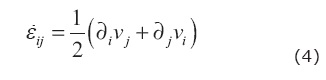
<body><![CDATA[<p align="justify"><font face="verdana" size="2"><b>Key words:</b> viscoelastic media, dissipation mechanism, relaxation times, numerical model, PML, quality factor <i>Q.</i></font></p>  	    <p align="justify"><font face="verdana" size="2">&nbsp;</font></p>     <p align="justify"><font face="verdana" size="2"><b>Introduction</b></font></p>  	    <p align="justify"><font face="verdana" size="2">Viscoelastic properties of oil&#45;gas reservoirs cause high attenuation of seismic waves. Mathematical models of wave propagation in viscoelastic media can be useful for investigation of seismic attenuation in oil&#45;gas reservoirs. The attenuation can be introduced into an elastic model in different ways. One of the most theoretically interesting is the method of dissipation mechanisms (Carcione <i>et al.,</i> 1988; Robertsson <i>et al.,</i> 1994; Xu and McMechan, 1998; Mikhailenko <i>et al,</i> 2003; Sabinin <i>et al,</i> 2003). It supposes that the viscoelastic property can be described by action of some dissipation mechanisms which are characterized by stress and strain relaxation times, and by type of interaction.</font></p>  	    <p align="justify"><font face="verdana" size="2">In the practice, it is more convenient to have lesser number of parameters for describing attenuation, for instance, one &#45; the quality factor <i>Q</i>. Definition of the dependence between the relaxation times and the factor <i>Q</i> will facilitate an application of the models. It is known that the <i>Q</i> factor is nearly independent on frequency (Knopoff, 1964) in seismic spectrum, and it can be composed by some (&gt;1) dissipation mechanisms with suitably fitted values of relaxation times (Emmerich, 1992; Blanch <i>et al,</i> 1995; Xu and McMechan, 1995, 1998). But nobody did comparison the composed input values of factor <i>Q</i> with the output values obtained from viscoelastic modeling. This issue may be also connected namely with a problem of correct definition of the factor <i>Q</i>.</font></p>      <p align="justify"><font face="verdana" size="2">Below, an attempt is made to derive the formula for dependence of the factor <i>Q</i> on relaxation times by estimating directly the factor <i>Q</i> output from synthetic seismograms computed by the viscoelastic numerical model. For the correct modeling, I revised the numerical model Virieux (1986), and Robertsson <i>et al.</i> (1994), and added to it my modification of the absorbing boundary layer by Collino and Tsogka (2001). Additionally, I developed a methodology of correct estimation of factor <i>Q</i> in surface reflection data for using this typical problem of seismology in numerical experiment.</font></p>     <p align="justify"><font face="verdana" size="2">&nbsp;</font></p>      <p align="justify"><font face="verdana" size="2"><b>Viscoelastic Model</b></font></p>  	    <p align="justify"><font face="verdana" size="2">In the linear theory of viscoelasticity, for the standard linear solid model of relaxation, stress <i>&#963;<sub>ij</sub></i> depends on strain <i>&#949;<sub>ij</sub></i> by the following modified Hooke's law:</font></p>  	    <p align="center"><font face="verdana" size="2"><img src="/img/revistas/geoint/v51n4/a6e1.jpg"></font></p>      ]]></body>
<body><![CDATA[<p align="justify"><font face="verdana" size="2">where G<sub>ijkl</sub>&#45; the stiffness tensor, <i>&#964;<sub>&#949;</sub></i> and <i>&#964;</i><sub>&#963;</sub> the strain and stress relaxation times.</font></p>     <p align="justify"><font face="verdana" size="2">Following Liu <i>et al.</i> (1976), one can derive the Boltzmann's after&#45;effect equation directly from (1):</font></p>     <p align="center"><font face="verdana" size="2"><img src="/img/revistas/geoint/v51n4/a6e2.jpg"></font></p>      <p align="justify"><font face="verdana" size="2">where * denotes the convolution in time, and <img src="/img/revistas/geoint/v51n4/a5s6.jpg">(<i>t</i>) is the specific creep function. For one dissipation mechanism,</font></p>      <p align="center"><font face="verdana" size="2"><img src="/img/revistas/geoint/v51n4/a6e3.jpg"></font></p>     <p align="justify"><font face="verdana" size="2">where <i>&#952;</i> &#45; the Heaviside function, and <i>&#964;= 1&#45;&#964;<sub>&#963;</sub> /&#964;<sub>&#949;</sub></i>, provided &#964;<sub>&#949;</sub>&gt;&#964;<sub>&#963;</sub>. For small <i>t&lt;&lt;&#964;<sub>&#949;</sub>,</i> it corresponds to the hyperbolic creep function used by Lomnitz (1957).</font></p>      <p align="justify"><font face="verdana" size="2">By taking the time derivative of (2), and substituting the dependence of strain on the particle velocity</font></p>  	    <p align="center"><font face="verdana" size="2"><img src="/img/revistas/geoint/v51n4/a6e4.jpg"></font></p>      <p align="justify"><font face="verdana" size="2">one can get:</font></p>     <p align="center"><font face="verdana" size="2"><img src="/img/revistas/geoint/v51n4/a6e5.jpg"></font></p>      ]]></body>
<body><![CDATA[<p align="justify"><font face="verdana" size="2">where following Carcione (1993), and Xu and McMechan (1995) :</font></p>  	    <p align="center"><font face="verdana" size="2"><img src="/img/revistas/geoint/v51n4/a6e6.jpg"></font></p>     <p align="justify"><font face="verdana" size="2">where &#955; and<i> &#956;</i>&#45; Lame elastic constants, {i=x,z; j=x,z} for two&#45;dimensional viscoelastic media, and {i=x,y,z; j=x,y,z} for three&#45;dimensional viscoelastic media.</font></p>  	    <p align="justify"><font face="verdana" size="2">By expanding in the convolution the time derivative of <img src="/img/revistas/geoint/v51n4/a5s6.jpg"> (see Robertsson <i>et al.,</i> 1994), one can get from (5):</font></p>     <p align="center"><font face="verdana" size="2"><img src="/img/revistas/geoint/v51n4/a6e7.jpg"></font></p>      <p align="justify"><font face="verdana" size="2">where <i>r<sub>ij</sub></i> &#45; the so&#45;called memory variable:</font></p>  	    <p align="center"><font face="verdana" size="2"><img src="/img/revistas/geoint/v51n4/a6e8.jpg"></font></p>      <p align="justify"><font face="verdana" size="2">By taking the time derivative of (7), one can get the equation for the memory variable:</font></p>  	    <p align="center"><font face="verdana" size="2"><img src="/img/revistas/geoint/v51n4/a6e9.jpg"></font></p>      <p align="justify"><font face="verdana" size="2">Combining (6) and (8), one can obtain a more convenient form of (6):</font></p>  	    ]]></body>
<body><![CDATA[<p align="center"><font face="verdana" size="2"><img src="/img/revistas/geoint/v51n4/a6e10.jpg"></font></p>     <p align="justify"><font face="verdana" size="2">Adding Newton's second law</font></p>  	    <p align="center"><font face="verdana" size="2"><img src="/img/revistas/geoint/v51n4/a6e11.jpg"></font></p>     <p align="justify"><font face="verdana" size="2">yields the system of equations (8)&#45;(10) for the seismic wave propagation in the viscoelastic media, which governs the stress <i>&#963;<sub>ij</sub></i>, the particle velocity <i>v<sub>i</sub></i> , and the memory variable <i>r<sub>ij</sub></i><sub></sub> in the area of modeling for the case of one dissipation mechanism.</font></p>      <p align="justify"><font face="verdana" size="2">In the case of <i>&#964;<sub>&#963;</sub>=&#964;<sub>&#949;</sub></i> , the system (8)&#45;(10) becomes the system for elastic media.</font></p>  	    <p align="justify"><font face="verdana" size="2">By substituting <i>E<sub>ij</sub>= &#963;<sub>ij</sub>&#45;(&#964;<sub>&#949;</sub>&#45;&#964;<sub>&#963;</sub>)r<sub>ij</sub></i> one can transform (9) into the equation for elastic media <img src="/img/revistas/geoint/v51n4/a6s7.jpg"><i><sub>ij</sub>&#45; = L<sub>ij</sub></i>, and obtain from (8):</font></p>     <p align="center"><font face="verdana" size="2"><img src="/img/revistas/geoint/v51n4/a6e12.jpg"></font></p>     <p align="justify"><font face="verdana" size="2">The equation (11) is similar to equation (1), and can be derived directly from it by defining <i>E<sub>ij</sub> = G<sub>ijkl </sub>&#949;<sub>kl</sub></i>. Therefore, the value E has a sense of the elastic part of the stress <i>&#963;</i>. Thus, the equation (11) governs an effect of viscosity, and it is an equation on only time.</font></p>     <p align="justify"><font face="verdana" size="2">Possibly, we ought to consider two sets of relaxation times: for shear and compressional waves, and modify the equations (8) and (9) by a way following Carcione (1995), for example. But Xu and McMechan (1995) simplified the problem by supposing equal relaxation times for shear and compressional waves. Another way of simplification is to consider cases of multiple dissipation mechanisms which can be transformed to the case of one dissipation mechanism, as below.</font></p>     <p align="justify">&nbsp;</p> 	    ]]></body>
<body><![CDATA[<p align="justify"><font face="verdana" size="2"><b>Extention of the model to N dissipation mechanisms</b></font></p>     <p align="justify"><font face="verdana" size="2">For the general case of N dissipation mechanisms which differ only by values of <i>&#964;<sub>&#949;</sub></i>, and <i>&#964;<sub>&#963;</sub></i>, we should write equations (1) and (2) for each n&#150;th dissipation mechanism as follows:</font></p>     <p align="center"><font face="verdana" size="2"><img src="/img/revistas/geoint/v51n4/a6e13.jpg"></font></p>     <p align="justify"><font face="verdana" size="2">Values of total <i>&#963;<sub>ij</sub></i> and <i>&#949;<sub>ij</sub></i> over <i>N</i> dissipation mechanisms depend on scheme of interactions (interconnections) of the mechanisms: which mechanisms interact as parallel or as sequential, and which groups of mechanisms interact with other groups as parallel or sequential.</font></p>     <p align="justify"><font face="verdana" size="2">Really, the scheme of interactions of mechanisms is not known beforehand, and the problem of modeling does not need such fine developing.</font></p>  	    <p align="justify"><font face="verdana" size="2">For three simple cases below, it is possible to reduce the system of equations for <i>N</i> mechanisms to the case of one mechanism. They are: 1) <i>N</i> mechanisms interacting sequentialy, 2)&nbsp;<i>N</i> mechanisms interacting in parallel, and 3)&nbsp;two independent groups: one including <i>N<sub>1</sub></i> mechanisms interacting sequentialy, and the second including <i>N<sub>2</sub></i> mechanisms interacting in parallel, <i>N<sub>1</sub>+ N<sub>2</sub>=N.</i> These are general enough cases.</font></p>     <p align="justify"><font face="verdana" size="2">For the case 1), the creep function can be represented as follows (for details see <a href="/img/revistas/geoint/v51n4/html/a6apendice.htm#a1" target="_blank">Appendix A</a>):</font></p>      <p align="center"><font face="verdana" size="2"><img src="/img/revistas/geoint/v51n4/a6e14.jpg"></font></p>     <p align="justify"><font face="verdana" size="2">If introduce the average values of relaxation times:</font></p>  	    <p align="center"><font face="verdana" size="2"><img src="/img/revistas/geoint/v51n4/a6e15.jpg"></font></p>      ]]></body>
<body><![CDATA[<p align="justify"><font face="verdana" size="2">then, from (5) with (14), one can derive (for details see <a href="/img/revistas/geoint/v51n4/html/a6apendice.htm#a2" target="_blank">Appendix B</a>) similar equation to (6):</font></p>      <p align="center"><font face="verdana" size="2"><img src="/img/revistas/geoint/v51n4/a6e16.jpg"></font></p>     <p align="justify"><font face="verdana" size="2">where <i>R<sub>ij</sub></i> is the average memory variable, which can be found from the following similar equation</font></p>  	    <p align="center"><font face="verdana" size="2"><img src="/img/revistas/geoint/v51n4/a6e17.jpg"></font></p>     <p align="justify"><font face="verdana" size="2">For the case 2), the equation (5) becomes as follows:</font></p>     <p align="center"><font face="verdana" size="2"><img src="/img/revistas/geoint/v51n4/a6e18.jpg"></font></p>     <p align="justify"><font face="verdana" size="2">in which the creep function is (see <a href="/img/revistas/geoint/v51n4/html/a6apendice.htm#a1" target="_blank">Appendix A</a>, and Carcione, 1995)</font></p>      <p align="center"><font face="verdana" size="2"><img src="/img/revistas/geoint/v51n4/a6e19.jpg"></font></p>      <p align="justify"><font face="verdana" size="2">where <img src="/img/revistas/geoint/v51n4/a6e20.jpg"></font></p>      <p align="justify"><font face="verdana" size="2">For the case 3), the equation (5) is valid for the first group, and the equation (17) is valid for the second group.</font></p>     ]]></body>
<body><![CDATA[<p align="justify"><font face="verdana" size="2">In the case 2), from (17) with (18), and in the case 3), from (5) with (14), and from (17) with (18), one can derive the same equations (15) and (16) for the stress, and for the average memory variable (see <a href="/img/revistas/geoint/v51n4/html/a6apendice.htm#a2" target="_blank">Appendix B</a>).</font></p>      <p align="justify"><font face="verdana" size="2">Consequently, (if use is done the average memory variable and the average values of relaxation times), one may clearly see that the equations for the considered cases of <i>N</i> mechanisms (15)&#45;(16) are equivalent to equations (6) and (8) for the case of one dissipation mechanism.</font></p>  	    <p align="justify"><font face="verdana" size="2">From this equivalence, it follows that, for a fixed geometry of the problem, the value of <i>Q</i> depends only on values of<i> <img src="/img/revistas/geoint/v51n4/a6s2.jpg"></i>, and<i> <img src="/img/revistas/geoint/v51n4/a6s6.jpg"></i>, and on the source of seismic wave.</font></p>      <p align="justify"><font face="verdana" size="2">Anyway, the solution of equation (11), which is similar to (1), is basic for the case of <i>N</i> mechanisms. Therefore, we will consider the equations for one dissipation mechanism (8) and (9) as the basic equations, and for this case, will calculate the dependence of factor <i>Q</i> on the average relaxation times of the media.</font></p>     <p align="justify"><font face="verdana" size="2">&nbsp;</font></p>      <p align="justify"><font face="verdana" size="2"><b>Solution method for the model</b></font></p>     <p align="justify"><font face="verdana" size="2">The system of equations (8)&#150;(10) is solved by the finite&#150;difference method with using the PML for boundary conditions. The finite&#150;difference scheme has the following form:</font></p>     <p align="center"><font face="verdana" size="2"><img src="/img/revistas/geoint/v51n4/a6e21.jpg"></font></p>     <p align="justify"><font face="verdana" size="2">where </font></p>     <p align="center"><font face="verdana" size="2"><img src="/img/revistas/geoint/v51n4/a6e22.jpg"></font></p>     ]]></body>
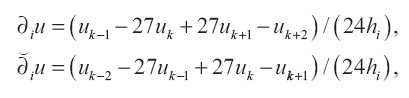
<body><![CDATA[<p align="justify"><font face="verdana" size="2">Here<i> i,j=1,2,3</i> &#150; are the indexes of direction, <i>n=0,1,2</i>... &#150; the mesh index in time, <i>&#916;</i>t &#150; the time increment. Space derivatives are defined as follows:</font></p>     <p align="center"><font face="verdana" size="2"><img src="/img/revistas/geoint/v51n4/a6e23.jpg"></font></p>     <p align="justify"><font face="verdana" size="2">where <i>h<sub>i</sub></i> &#45; the space step in the i&#150;direction, and<i> k</i>&#45; the space mesh index in the <i>i</i>&#45;direction. If an inner boundary of the area coincides with a middle line between the nodes, the average coefficients <i><img src="/img/revistas/geoint/v51n4/a6s3.jpg">&iexcl;,</i> <img src="/img/revistas/geoint/v51n4/a6s4.jpg"><sub>i</sub>, and <i><img src="/img/revistas/geoint/v51n4/a6s3.jpg"><sub>i</sub></i> for the inner boundary are calculated as follows:</font></p>      <p align="center"><font face="verdana" size="2"><img src="/img/revistas/geoint/v51n4/a6e24.jpg"></font></p>      <p align="justify"><font face="verdana" size="2">The scheme (19) is written for a fixed grid (<i>k<sub>i</sub>= 0.....I; k<sub>j</sub> = 0.....J; k<sub>k</sub>=0</i>.....<i>K</i>; <i>n</i> <i>= 0,</i> <i>1, 2,</i> ...), and has the order of approximation <i>O</i> (<i>&#916;t<sup>2</sup>,</i><i>h<sup>4</sup></i>). It is practically equivalent to the "staggered" scheme used by Virieux (1986), and by Robertsson <i>et al.</i> (1994), but it operates only with integer values of indexes, as classical schemes, what is achieved by appropriate shift of "staggered" indexes.</font></p>     <p align="justify"><font face="verdana" size="2">The equation (19a) can be solved by implicit scheme. It gives:</font></p>  	    <p align="center"><font face="verdana" size="2"><img src="/img/revistas/geoint/v51n4/a6e25.jpg"></font></p>     <p align="justify"><font face="verdana" size="2">The necessary stability condition for the scheme (19)&#45;(20) in the 3D case is:</font></p>     <p align="center"><font face="verdana" size="2"><img src="/img/revistas/geoint/v51n4/a6e26.jpg"></font></p>     <p align="justify"><font face="verdana" size="2">Where <img src="/img/revistas/geoint/v51n4/a6e27.jpg"></font></p>  	    ]]></body>
<body><![CDATA[<p align="justify"><font face="verdana" size="2">If applying the Ricker wavelet for a seismic source, the following condition is used additionally:</font></p> 	    <p align="center"><font face="verdana" size="2"><img src="/img/revistas/geoint/v51n4/a6e28.jpg"></font></p>     <p align="justify"><font face="verdana" size="2">where &#402; &#45; the Ricker wavelet frequency. This condition provides the undamaged form of PP, PS, and SS waves in seismograms. The coefficient 16 is empirical and can be explained by 4&#45;point approximation of space derivatives and 4&#45;slope form of the Ricker wavelet. It should not be less than 4 points at each slope. Other authors suggest different values of the coefficient for schemes of different accuracy: 10 &#45; Virieux (1986), 12 &#45; Moczo <i>et al.</i> (1997), 15&#45;20 &#45; Xu and McMechan (1998).</font></p>  	    <p align="justify"><font face="verdana" size="2">Above, <i>V<sub>p</sub></i> and <i>V<sub>s</sub></i> are velocities of the compressional and shear waves used in definition of the Lame constants.</font></p>      <p align="justify"><font face="verdana" size="2">In the nodes of the PML absorbing layer, the equations (19b)&#45;(19c) are modified by Collino and Tsogka (2001). Indeed, I apply another formula for absorbing sink (<i>S<sub>a</sub></i>) in the left hand side of the modified equations (19b,c). It forms the implicit (not centered) scheme with the finite&#45;difference time derivative (Sabinin <i>et al., </i>2003):</font></p>     <p align="center"><font face="verdana" size="2"><img src="/img/revistas/geoint/v51n4/a6e29.jpg"></font></p>     <p align="justify"><font face="verdana" size="2">where <i>u</i> &#45; the same variable that is in the finite&#45;difference time derivative of the corresponding equation of the system (19).</font></p>      <p align="justify"><font face="verdana" size="2">The parameter <i>d</i> in (22) is calculated by a new formula (<i>k</i> = <i>x, y, z</i> &#45; index of direction):</font></p>      <p align="center"><font face="verdana" size="2"><img src="/img/revistas/geoint/v51n4/a6e30.jpg"></font></p>     <p align="justify"><font face="verdana" size="2">&nbsp;</font></p>  	    ]]></body>
<body><![CDATA[<p align="justify"><font face="verdana" size="2">where <i>m<sub>k</sub>&#45;</i> the thickness of PML in mesh steps in k&#45;th direction, <i>n<sub>k</sub></i>&#45;number of the node across the PML, 1 <u>&lt;</u> <i>n<sub>k</sub>  </i><u>&lt;</u><i> m<sub>k</sub></i><i>, a, b &#45;</i> matching coefficients (approximately, <i>a=1, b=10</i>). The formula (23) is not sensitive to values of the parameters <i>&#945;, b.</i> The PML thickness <i>m<sub>k</sub></i> is recommended to be 20, or more.</font></p>     <p align="justify"><font face="verdana" size="2">Advantage of the finite&#45;difference scheme (19)&#45;(23) is its convenience for parallel computations what are easily done with instructions of Open MP.</font></p>     <p align="justify"><font face="verdana" size="2">&nbsp;</font></p>      <p align="justify"><font face="verdana" size="2"><b>Estimation of factor</b> <i><b>Q</b></i></font></p>  	    <p align="justify"><font face="verdana" size="2">For obtaining dependence of the quality factor <i>Q</i> on relaxation times, let us consider a formula by Liu <i>et al.</i> (1976), which is valid under the assumption that &#964;<sub>&#949;</sub> and &#964;<sub>&#963;</sub> do not depend on frequency &#969;=2&#960;<i>&#402;</i> at the specified bandwidth:</font></p>      <p align="center"><font face="verdana" size="2"><img src="/img/revistas/geoint/v51n4/a6e31.jpg"></font></p>     <p align="justify"><font face="verdana" size="2">Taking an integral from this expression over some interval of frequency, one can get the formula</font></p>  	    <p align="center"><font face="verdana" size="2"><img src="/img/revistas/geoint/v51n4/a6e32.jpg"></font></p>     <p align="justify"><font face="verdana" size="2">where the constant coefficients <i>a</i>, and <i>b</i> are to be evaluated from a numerical experiment. The formula (24) is derived without the assumption <i>&#964;</i>&lt;&lt;1 used by Blanch <i>et al.</i> (1995).</font></p>      <p align="justify"><font face="verdana" size="2">From different methods of estimation for factor <i>Q</i> (see, for example, Tonn, 1991), two methods seem as more reliable.</font></p>  	    ]]></body>
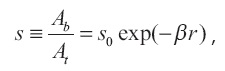
<body><![CDATA[<p align="justify"><font face="verdana" size="2">The Spectral Ratio method (SR) will be applied in the following form. From the theory, the ratio of spectral amplitudes of waves reflected from the bottom and from the top of target layer can be expressed as follows:</font></p>  	    <p align="center"><font face="verdana" size="2"><img src="/img/revistas/geoint/v51n4/a6e33.jpg"></font></p>      <p align="justify"><font face="verdana" size="2">where <i><b>A<sub>t</sub>, A<sub>b</sub></b></i> &#45; amplitudes of spectra of reflection waves from top and bottom of the target layer in the same ray path, <i>r</i> is a travel distance, and &#946; is an absorption coefficient.</font></p>      <p align="justify"><font face="verdana" size="2">Futterman (1962) defined the quality factor <i>Q</i> as</font></p>     <p align="center"><font face="verdana" size="2"><img src="/img/revistas/geoint/v51n4/a6e34.jpg"></font></p>     <p align="justify"><font face="verdana" size="2">where</font></p>  	    <p align="center"><font face="verdana" size="2"><img src="/img/revistas/geoint/v51n4/a6e35.jpg"></font></p>     <p align="justify"><font face="verdana" size="2">&#402; is frequency, and &#964;<sub>0</sub> is a travel time. It means that <i>Q&gt;2&#960;</i>.</font></p>      <p align="justify"><font face="verdana" size="2">From the other hand, one can approximate a logarithm of the same spectral ratio by a line function over a proper interval of<i> &#402;</i> by the least squares method:</font></p> 	    <p align="center"><font face="verdana" size="2"><img src="/img/revistas/geoint/v51n4/a6e36.jpg"></font></p>      ]]></body>
<body><![CDATA[<p align="justify"><font face="verdana" size="2">It means, that estimated <i>d</i> in the interval is:</font></p>  	    <p align="center"><font face="verdana" size="2"><img src="/img/revistas/geoint/v51n4/a6e37.jpg"></font></p>     <p align="justify"><font face="verdana" size="2">The art of application of this method consists in proper choice of a window for impulse in the time domain, and a window (interval) for the least squares method in the spectral domain.</font></p>  	    <p align="justify"><font face="verdana" size="2">For the Ricker wavelet which will be used further, the time window must include all three phases of the impulse up to visible noise at the edges. It is a visible width of impulse at the seismogram.</font></p>  	    <p align="justify"><font face="verdana" size="2">The spectrum of the Ricker impulse has a shape of a bell, and a logarithm of the spectral ratio has a near line part (see <a href="/img/revistas/geoint/v51n4/a6f1.jpg" target="_blank">Fig. 1</a>). The spectral window should be chosen inside this line part. It can be made manually. For automatic choice, by observing synthetic seismograms, it was found that a good choice is the window between 0.8 of the peak frequency for the bottom spectrum and the peak frequency for the top spectrum.</font></p>     <p align="justify"><font face="verdana" size="2">The second method used is the Centroid Frequency Shift (FS) method (Quan and Harris, 1993). Here the coefficient r for the formula (26) is calculated by the following formulas:</font></p>  	    <p align="center"><font face="verdana" size="2"><img src="/img/revistas/geoint/v51n4/a6e38.jpg"></font></p>     <p align="justify"><font face="verdana" size="2">where <i>s</i> depends on the shape of spectra, for Gaussian spectra <i>s=1</i> (Quan and Harris, 1993).</font></p>  	    <p align="justify"><font face="verdana" size="2">The FS method operates with integral values, therefore it is less sensitive to the noise than the SR method, but it is more sensitive to the shape of spectra.</font></p>     <p align="justify"><font face="verdana" size="2">Because of influence of errors on the shape of spectra, it is used the same spectral window for the FS method as for the SR method.</font></p>     ]]></body>
<body><![CDATA[<p align="justify"><font face="verdana" size="2">For estimating <i>Q</i> from equations (25)&#150;(26), the value of travel time &#964;<sub>0</sub> must be calculated, too.</font></p>     <p align="justify"><font face="verdana" size="2">To calculate &#964;<sub>0</sub> in a multilayered reservoir, a system of non&#45;linear equations can be derived by the ray&#45;tracing method (see <a href="/img/revistas/geoint/v51n4/html/a6apendice.htm#a3" target="_blank">Appendix C</a>).</font></p>     <p align="justify"><font face="verdana" size="2">If the target layer is the second from the surface, then the calculations become simpler. Ray paths for this case are presented in <a href="/img/revistas/geoint/v51n4/a6f2.jpg" target="_blank">Figure 2</a>. One can see that</font></p>  	    <p align="center"><font face="verdana" size="2"><img src="/img/revistas/geoint/v51n4/a6e39.jpg"></font></p>     <p align="justify"><font face="verdana" size="2">where indexes 1, and 2 denote the number of layer from above, <i>V</i> is <i>V<sub>p</sub>, r<sub>0</sub></i> is the path from a source to the top of target layer for the impulse reflected from the top, <i>r<sub>1</sub></i> is the same for the impulse reflected from the bottom, <i>r<sub>2</sub></i> is the path inside the second layer from the top to the bottom of target layer, and <i>&#916;t</i> is time between the reflected impulses at the trace.</font></p>      <p align="justify"><font face="verdana" size="2">For reflection data, the receivers are at the surface, therefore <i>&#964;<sub>0</sub></i> is twice more than travel time between points <i>x</i> , and <i>x<sub>0</sub></i>.</font></p>      <p align="justify"><font face="verdana" size="2">Using Snell's law, one excludes the velocity <i>V<sub>2</sub></i> of the target layer from (28):</font></p>     <p align="justify"><font face="verdana" size="2">&nbsp;</font></p> 	    <p align="center"><font face="verdana" size="2"><i><img src="/img/revistas/geoint/v51n4/a6e40.jpg"></i> </font></p>     <p align="justify"><font face="verdana" size="2">where <i>p = 0.5&#916;tV</i><sub>1</sub> <i>+<img src="/img/revistas/geoint/v51n4/a6e41.jpg"></i>, <i>x<sub>0</sub></i><sub> </sub>is the half of the offset, z<sub>1</sub>, z<sub>2</sub> are thicknesses of the layers, and &#952;<sub>1</sub>, &#952;<sub>2</sub> are travel (incidence) angles.</font></p>      ]]></body>
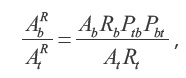
<body><![CDATA[<p align="justify"><font face="verdana" size="2">Denoting the offset value of refraction point for the bottom ray as <i>x</i> (see <a href="/img/revistas/geoint/v51n4/a6f2.jpg" target="_blank">Fig. 2</a>), one obtains:</font></p>  	    <p align="center"><font face="verdana" size="2"><img src="/img/revistas/geoint/v51n4/a6e42.jpg"></font></p>     <p align="justify"><font face="verdana" size="2">The non&#45;linear equation (30) is solved numerically. The obtained value <i>x</i> is used to calculate the travel time &#964;<sub>0</sub><i>=2r<sub>2</sub></i>/<i>V<sub>2</sub></i> of the ray inside the target layer. From (28),</font></p>      <p align="center"><font face="verdana" size="2"><img src="/img/revistas/geoint/v51n4/a6e43.jpg"></font></p>      <p align="justify"><font face="verdana" size="2">where <i>V</i><sub>1</sub> is <i>V</i><sub>p</sub> of the upper layer. The value &#916;t can be calculated by the correlation function between the impulses at the trace.</font></p>      <p align="justify"><font face="verdana" size="2">Difference between &#916;<i>t</i> and &#964;<sub>0</sub> is illustrated in <a href="/img/revistas/geoint/v51n4/a6f3.jpg" target="_blank">Figure 3</a>. The difference increases with offset significantly.</font></p>      <p align="justify"><font face="verdana" size="2">An advantage of the method (30)&#45;(31) is the exclusion of the unknown velocity <i>V</i><sub>2</sub> from consideration.</font></p>      <p align="justify"><font face="verdana" size="2">As can be also seen from <a href="/img/revistas/geoint/v51n4/a6f2.jpg" target="_blank">Fig. 2</a>, for more exact estimating the factor <i>Q,</i> one should use the wave reflected from the point <i>x</i> at the top of target layer to calculate spectral amplitude <i>A<sub>t</sub></i>, but not from the point <i>x<sub>0</sub></i> which is commonly used for this purpose. Knowing value <i>x</i> from (30), one may obtain this wave (or its spectrum) by interpolation from waves (or spectra) of adjacent traces, with taking into account different values of geometrical spreading.</font></p>      <p align="justify"><font face="verdana" size="2">Another possible problem in estimating <i>Q</i> of the target layer is how to exclude from the consideration the coefficients of reflection and refraction at the boundaries of the viscoelastic target layer. It will be the best result in the estimation of <i>Q</i> if the spectral amplitudes will differ only because of viscoelastic attenuation inside the layer. Really, the reflection and refraction at the boundaries of the layer may also act:</font></p>     <p align="center"><font face="verdana" size="2"><img src="/img/revistas/geoint/v51n4/a6e44.jpg"></font></p>     ]]></body>
<body><![CDATA[<p align="justify"><font face="verdana" size="2">where <i>A<sup>R</sup></i>&#45; real amplitude, <i>R</i> &#45; coefficient of reflection, <i>P</i> &#45; coefficient of refraction.</font></p>      <p align="justify"><font face="verdana" size="2">If R and P would depend on <i>f</i> then they influenced on value of <i>Q</i>. However, practice shows that influence of reflection/refraction coefficients on the estimated values of <i>Q</i> is less than difference in estimated values <i>Q</i> caused by different smart choices of the time and spectral windows.</font></p>      <p align="justify"><font face="verdana" size="2">Both methods SR and FS give close values <i>Q</i> but FS insufficiently less.</font></p>     <p align="justify"><font face="verdana" size="2">&nbsp;</font></p>      <p align="justify"><font face="verdana" size="2"><b>Numerical simulation</b></font></p>  	    <p align="justify"><font face="verdana" size="2">I use the developed numerical model for obtaining the synthetic seismograms of waves reflected from the top and bottom boundaries of a horizontal viscoelastic layer. Then I estimate the factor <i>Q</i> from the seismograms with different &#964;, and &#964;<sub>&#963;</sub>, and put these values into the left&#45;hand side of the formula (24) to estimate the values of the coefficients <i>a, b</i> of the formula (24) by least squares method.</font></p>      <p align="justify"><font face="verdana" size="2">The computation of synthetic seismograms by the viscoelastic model was performed at a workstation which gave possibility to parallelize calculations into 24 threats. But it was too slow for a 3D model. For economy, a 2D problem was chosen for the numerical experiment, as follows.</font></p>  	    <p align="justify"><font face="verdana" size="2">At the earth surface, there was one wave source, and a set of equally spaced (every 100 meters) receivers (the common source point observation system). The area of width 5000 m and depth 2250 m consisted of three homogeneous layers, the target viscoelastic layer was the second, beginning at the depth 1500 m, and had the thickness 400 m. The other layers were considered as elastic, with &#964; = 0.</font></p>  	    <p align="justify"><font face="verdana" size="2">The density, and the elastic velocities of compressional and shear waves were as in <a href="#t1">Table 1</a>.</font></p> 	    <p align="center"><font face="verdana" size="2"><a name="t1"></a></font></p> 	    ]]></body>
<body><![CDATA[<p align="center"><font face="verdana" size="2"><img src="/img/revistas/geoint/v51n4/a6t1.jpg"></font></p>     <p align="justify"><font face="verdana" size="2">Seismic wave source of explosion type was the Ricker wavelet in time, its frequency <i>&#402;<sub>r</sub></i> was set to 15, 30, 45, and 60 Hz, duration of the impulse &#45;160, 80, 53.3, and 40 ms correspondingly.</font></p>      <p align="justify"><font face="verdana" size="2">The mesh sizes of the finite&#45;difference grid were <i>h<sub>x</sub>=5m, h<sub>z</sub>=2.5m,</i> and the time step was 0.2 ms. The PML thickness was equal to 40 nodes. The PML was not mounted at the earth surface where the source was set.</font></p>  	    <p align="justify"><font face="verdana" size="2">The typical seismogram of <i>v<sub>z</sub></i> obtained for this 2D problem is shown in <a href="/img/revistas/geoint/v51n4/a6f4.jpg" target="_blank">Figure 4</a>. First two fronts of PP&#45;waves were used for estimating the factor Q. PP waves reflected from the bottom of area (1400&#45;1500 ms), and direct waves reflected from the vertical sides of area are not visible. It means a good effectiveness of applied modification of PML absorbing boundaries.</font></p>      <p align="justify"><font face="verdana" size="2">For comparison, the 3D problem was computed in the variant of &#402;<sub>r</sub> = 30 Hz, &#964;= 0.7, and &#964;<sub>&#963;</sub><i>=</i> 0.625ms. The 3D area had and additionally y&#45;direction with thickness 2000 m. The receivers were spaced in the middle line. For saving time of computation, a rough grid was used: <i>h<sub>x</sub>=h</i><sub>y</sub>=20m, and the time step 0.4ms.</font></p>  	    <p align="justify"><font face="verdana" size="2">The seismogram of <i>v<sub>z</sub></i> obtained for the 3D problem is shown in the <a href="/img/revistas/geoint/v51n4/a6f5.jpg" target="_blank">Figure 5</a>. Visible distortions are caused by the roughness of grid The <a href="/img/revistas/geoint/v51n4/a6f5.jpg" target="_blank">Figure 5</a> corresponds to the variant of <a href="/img/revistas/geoint/v51n4/a6f4.jpg" target="_blank">Figure 4</a>. Values of factor <i>Q</i> calculated for seismograms of <a href="/img/revistas/geoint/v51n4/a6f4.jpg" target="_blank">Figures 4</a>, and 5 are practically the same, and are equal to 14.8.</font></p>     <p align="justify"><font face="verdana" size="2">The comparison is good enough to decide to apply more economical 2D model in the numerical experiment.</font></p>     <p align="justify"><font face="verdana" size="2">&nbsp;</font></p>      <p align="justify"><font face="verdana" size="2"><b>Numerical results</b></font></p>  	    <p align="justify"><font face="verdana" size="2">Factor <i>Q</i> was calculated with the SR method for all offsets and did not show any stable or significant dependence on the offset. Existing errors were caused by small distortions of waves by interference with waves reflected from the sides of area, and by errors in setting the time windows.</font></p>  	    ]]></body>
<body><![CDATA[<p align="justify"><font face="verdana" size="2">Difference in Q on offsets was up to 6% of magnitude for small values <i>&#964;<sub>&#963;</sub></i>(&lt;0.0002), and up to 12% for large values <i>&#964;<sub>&#963;</sub></i>(&gt;0.01), with 0.5%&#45;3% for a middle values, what can be adopted as an error for the estimation of <i>Q.</i></font></p>      <p align="justify"><font face="verdana" size="2">Difficulty in calculation of the factor Q is that the linear part of logarithm of spectral ratio which one can see in <a href="/img/revistas/geoint/v51n4/a6f1.jpg" target="_blank">Figure 1</a> is not clearly present for extreme values of relaxation times. For example, it is a curve for large values &#964;<sub>&#963;</sub>. Therefore, this gave unreliable values of <i>Q</i> sometimes.</font></p>     <p align="justify"><font face="verdana" size="2">The results of calculation of factor <i>Q</i> in a wide range near normal incidence are presented in <a href="/img/revistas/geoint/v51n4/a6t2.jpg" target="_blank">Tables 2</a>&#45;<a href="/img/revistas/geoint/v51n4/a6t5.jpg" target="_blank">5</a> (<a href="/img/revistas/geoint/v51n4/a6t3.jpg" target="_blank">3</a>-<a href="/img/revistas/geoint/v51n4/a6t4.jpg" target="_blank">4</a>) for the source frequencies of<i> &#402;<sub>r</sub></i> =15, 30, 45, 60 Hz respectively.</font></p>      <p align="justify"><font face="verdana" size="2">As equations (8), (9) depend on &#964; and &#964;<sub>&#963;</sub>, so the values <i>Q</i> in the  <a href="/img/revistas/geoint/v51n4/a6t2.jpg" target="_blank">Tables 2</a>&#45;<a href="/img/revistas/geoint/v51n4/a6t5.jpg" target="_blank">5</a> (<a href="/img/revistas/geoint/v51n4/a6t3.jpg" target="_blank">3</a>-<a href="/img/revistas/geoint/v51n4/a6t4.jpg" target="_blank">4</a>) are presented depending on these parameters. Also, the results depend on the frequency of the source significantly.</font></p>      <p align="justify"><font face="verdana" size="2">It was found that equation (24) does not match satisfactory to <a href="/img/revistas/geoint/v51n4/a6t2.jpg" target="_blank">Tables 2</a>&#45;<a href="/img/revistas/geoint/v51n4/a6t5.jpg" target="_blank">5</a> (<a href="/img/revistas/geoint/v51n4/a6t3.jpg" target="_blank">3</a>-<a href="/img/revistas/geoint/v51n4/a6t4.jpg" target="_blank">4</a>). Instead, the following similar equation was derived for this:</font></p>      <p align="center"><font face="verdana" size="2"><img src="/img/revistas/geoint/v51n4/a6e45.jpg"></font></p>      <p align="justify"><font face="verdana" size="2">where <i>d</i> depends on <i>Q</i> by formula (25), <i>x</i>=&#964;<sup>&#945;</sup> , y=&#91;3/(<i>&#402;<sub>r</sub></i>&#964;<sub>&#963;</sub>)&#93;<sup>&#946;</sup>. Values &#945;=0.7, and &#946;=1.2 represent a near optimal choice.</font></p>      <p align="justify"><font face="verdana" size="2">The obtained coefficients A, B, and C of (32) are presented in <a href="#t6">Table 6</a> with values of relative estimation error by (32).</font></p> 	    <p align="center"><font face="verdana" size="2"><a name="t6"></a></font></p> 	    <p align="center"><font face="verdana" size="2"><img src="/img/revistas/geoint/v51n4/a6t6.jpg"></font></p> 	    ]]></body>
<body><![CDATA[<p align="justify"><font face="verdana" size="2">One can compare values <i>Q</i> calculated by (32) for <i>&#402;<sub>r</sub></i> =45 in <a href="/img/revistas/geoint/v51n4/a6t7.jpg" target="_blank">Table 7</a> with values from <a href="/img/revistas/geoint/v51n4/a6t4.jpg" target="_blank">Table 4</a>.</font></p>      <p align="justify"><font face="verdana" size="2">For practical use, one can apply <a href="/img/revistas/geoint/v51n4/a6t2.jpg" target="_blank">Tables 2</a>&#45;<a href="/img/revistas/geoint/v51n4/a6t5.jpg" target="_blank">5</a> (<a href="/img/revistas/geoint/v51n4/a6t3.jpg" target="_blank">3</a>-<a href="/img/revistas/geoint/v51n4/a6t4.jpg" target="_blank">4</a>), or equation (32), or derive an own approximation formula.</font></p>     <p align="justify"><font face="verdana" size="2">&nbsp;</font></p>     <p align="justify"><font face="verdana" size="2"><b>Discussion</b></font></p>  	    <p align="justify"><font face="verdana" size="2">Some authors (Blanch <i>et al.,</i> 1995; Xu and McMechan, 1998) guess that the constant value <i>Q</i> over some interval of spectral frequency, which one can usually see, is equal to a near constant value <i>Q</i> on an average graphic consisting of the separate theoretical graphics Q (as by Liu <i>et </i>al., 1976) for N&gt;1 dissipation mechanisms with different relaxation times. As one can see from (25), this method of obtaining constant <i>Q</i> fails in the case of one dissipation mechanism. Contrary, the experimental formula (32) does not depend on the number of dissipation mechanisms.</font></p>     <p align="justify"><font face="verdana" size="2">Although the formulas (25) &#45; (27) of methods for estimating factor <i>Q</i> are simple, they have several sources for errors. At first, it is a nonlinear form of the "line" part of the logarithm of spectral ratio which can be clearly seen in field data. It is necessary smoothing seismograms with noise, and developing new methods of Q&#45;estimation for synthetic seismograms obtained at large &#964;<sub>&#963;</sub>.</font></p>  	    <p align="justify"><font face="verdana" size="2">Second, insignificantly different sizes and positions of time windows can give significantly different spectra what is caused by increased role of noise at the edges of impulses. Suitable automatic algorithms for generating the time windows are needed.</font></p>  	    <p align="justify"><font face="verdana" size="2">Third, a correct estimation of the travel time is needed as one can see from <a href="/img/revistas/geoint/v51n4/a6f3.jpg" target="_blank">Figure 3</a>.</font></p>  	    <p align="justify"><font face="verdana" size="2">Finally, a good estimation for the usually unknown impulses reflected from the top of target layer in the point <i>x</i> of <a href="/img/revistas/geoint/v51n4/a6f2.jpg" target="_blank">Fig.2</a> is necessary.</font></p>      <p align="justify"><font face="verdana" size="2">Errors from these four sources can give significantly incorrect values <i>Q</i>, up to 50% and more.</font></p>      ]]></body>
<body><![CDATA[<p align="justify"><font face="verdana" size="2">I have solved these problems for synthetic seismograms in case of fine spacing the receivers and not large values <i>&#964;<sub>&#963;</sub>.</i> As the result, <i>Q</i> values calculated here do not depend on offset what must be theoretically for isotropic media, because factor <i>Q</i> is a property of medium only. This is a good criterion for correctness of methods for estimating <i>Q.</i> If one sees a factor <i>Q</i> depending on offset (see for example Dasgupta and Clark, 1998), it means that the medium is anisotropic or there are the errors in algorithm of estimating <i>Q.</i></font></p>     <p align="justify"><font face="verdana" size="2">As known, PML absorbing boundary does not exclude completely reflections from the boundaries of area for finite&#45;difference problems. The modification of PML presented here decreases the reflections in comparison with classical PML by Collino and Tsogka (2001) due to lucky choice of exponent functions for approximation (23).</font></p>  	    <p align="justify"><font face="verdana" size="2">Errors of the approximated formula (32) for dependence <i>Q</i> on relaxation times are in agreement with errors of estimating <i>Q.</i> For example, if it is excluded the first and ultimate columns from <a href="/img/revistas/geoint/v51n4/a6t2.jpg" target="_blank">Table 2</a>, then the error of estimation by (32) becomes twice less.</font></p>     <p align="justify"><font face="verdana" size="2">&nbsp;</font></p>      <p align="justify"><font face="verdana" size="2"><b>Conclusion</b></font></p>  	    <p align="justify"><font face="verdana" size="2">A numerical 3D model for seismic wave propagation in viscoelastic media is developed, which differs from the previous (Robertsson <i>et</i> al. 1994) by modification of the finite&#45;difference scheme, and by including the improved variant of PML absorbing boundary.</font></p>  	    <p align="justify"><font face="verdana" size="2">It is shown that the numerical model for one dissipation mechanism can be directly applied to three simple schemes of interaction of <i>N</i> dissipation mechanisms by using average relaxation times.</font></p>  	    <p align="justify"><font face="verdana" size="2">The synthetic seismograms are obtained for 3D, and 2D variants of a reservoir which show close values of factor <i>Q</i> in the viscoelastic layer.</font></p>  	    <p align="justify"><font face="verdana" size="2">The methodology of estimation of factor <i>Q</i> for surface reflection data is developed which differs from previous by more exact calculation of travel times for reflected waves, and by manual choice of spectral windows. </font><font face="verdana" size="2">The viscoelastic model and the method of <i>Q</i>&#45;estimation are applied to obtaining experimental dependences of factor <i>Q</i> on relaxation times. The approximate formula is suggested for such dependence.</font></p>     <p align="justify"><font face="verdana" size="2">&nbsp;</font></p>     ]]></body>
<body><![CDATA[<p align="justify"><font face="verdana" size="2"><b>Bibliography</b></font></p>  	    <!-- ref --><p align="justify"><font face="verdana" size="2">Blanch J.O, Robertsson J.O.A., Symes W.W.,1995, Modeling of constant Q: Methodology and algorithm for an efficient and optimally inexpensive viscoelastic technique, <i>Geophysics,</i> 60, 1, p.176&#45;184.    &nbsp;&nbsp;&nbsp;&nbsp;&nbsp;&nbsp;&nbsp;&nbsp;[&#160;<a href="javascript:void(0);" onclick="javascript: window.open('/scielo.php?script=sci_nlinks&ref=3923652&pid=S0016-7169201200040000600001&lng=','','width=640,height=500,resizable=yes,scrollbars=1,menubar=yes,');">Links</a>&#160;]<!-- end-ref --></font></p>  	    <!-- ref --><p align="justify"><font face="verdana" size="2">Carcione J.M., 1993, Seismic modeling in viscoelastic media, <i>Geophysics,</i> 58, 1, p.110&#45;120.    &nbsp;&nbsp;&nbsp;&nbsp;&nbsp;&nbsp;&nbsp;&nbsp;[&#160;<a href="javascript:void(0);" onclick="javascript: window.open('/scielo.php?script=sci_nlinks&ref=3923654&pid=S0016-7169201200040000600002&lng=','','width=640,height=500,resizable=yes,scrollbars=1,menubar=yes,');">Links</a>&#160;]<!-- end-ref --></font></p>     <!-- ref --><p align="justify"><font face="verdana" size="2">Carcione J.M., 1995, Constitutive model and wave equations for linear, viscoelastic, anisotropic media, <i>Geophysics,</i> 60, 2, p.537&#45;548.    &nbsp;&nbsp;&nbsp;&nbsp;&nbsp;&nbsp;&nbsp;&nbsp;[&#160;<a href="javascript:void(0);" onclick="javascript: window.open('/scielo.php?script=sci_nlinks&ref=3923656&pid=S0016-7169201200040000600003&lng=','','width=640,height=500,resizable=yes,scrollbars=1,menubar=yes,');">Links</a>&#160;]<!-- end-ref --></font></p>  	    <!-- ref --><p align="justify"><font face="verdana" size="2">Carcione J.M., Kosloff D., Kosloff R., 1988, Wave propagation in a linear viscoelastic medium, <i>Geophysical Journal,</i> 95, p.597&#45;611.    &nbsp;&nbsp;&nbsp;&nbsp;&nbsp;&nbsp;&nbsp;&nbsp;[&#160;<a href="javascript:void(0);" onclick="javascript: window.open('/scielo.php?script=sci_nlinks&ref=3923658&pid=S0016-7169201200040000600004&lng=','','width=640,height=500,resizable=yes,scrollbars=1,menubar=yes,');">Links</a>&#160;]<!-- end-ref --></font></p>  	    <!-- ref --><p align="justify"><font face="verdana" size="2">Collino F., Tsogka C., 2001, Application of the PML Absorbing Layer Model to the Linear Elastodynamic Problem in Anisotropic Heterogeneous Media, <i>Geophysics,</i> 66, 1, 294&#45;307.    &nbsp;&nbsp;&nbsp;&nbsp;&nbsp;&nbsp;&nbsp;&nbsp;[&#160;<a href="javascript:void(0);" onclick="javascript: window.open('/scielo.php?script=sci_nlinks&ref=3923660&pid=S0016-7169201200040000600005&lng=','','width=640,height=500,resizable=yes,scrollbars=1,menubar=yes,');">Links</a>&#160;]<!-- end-ref --></font></p>     <!-- ref --><p align="justify"><font face="verdana" size="2">Dasgupta R., Clark R.A., 1998, Estimation of Q from surface seismic reflection data. <i>Geophysics,</i> 63, 2120&#45;2128.    &nbsp;&nbsp;&nbsp;&nbsp;&nbsp;&nbsp;&nbsp;&nbsp;[&#160;<a href="javascript:void(0);" onclick="javascript: window.open('/scielo.php?script=sci_nlinks&ref=3923662&pid=S0016-7169201200040000600006&lng=','','width=640,height=500,resizable=yes,scrollbars=1,menubar=yes,');">Links</a>&#160;]<!-- end-ref --></font></p>  	    <!-- ref --><p align="justify"><font face="verdana" size="2">Emmerich H., 1992, PSV&#45;wave propagation in a medium with local heterogeneities: a hybrid formulation and its application, <i>Geophys. J.</i> Int., 109, 54 &#45; 64.    &nbsp;&nbsp;&nbsp;&nbsp;&nbsp;&nbsp;&nbsp;&nbsp;[&#160;<a href="javascript:void(0);" onclick="javascript: window.open('/scielo.php?script=sci_nlinks&ref=3923664&pid=S0016-7169201200040000600007&lng=','','width=640,height=500,resizable=yes,scrollbars=1,menubar=yes,');">Links</a>&#160;]<!-- end-ref --></font></p>  	    <!-- ref --><p align="justify"><font face="verdana" size="2">Futterman W.I., 1962, Dispersive body waves. <i>J. Geophys. Res,</i> 67, 5279&#45;5291.    &nbsp;&nbsp;&nbsp;&nbsp;&nbsp;&nbsp;&nbsp;&nbsp;[&#160;<a href="javascript:void(0);" onclick="javascript: window.open('/scielo.php?script=sci_nlinks&ref=3923666&pid=S0016-7169201200040000600008&lng=','','width=640,height=500,resizable=yes,scrollbars=1,menubar=yes,');">Links</a>&#160;]<!-- end-ref --></font></p>  	    <!-- ref --><p align="justify"><font face="verdana" size="2">Knopoff L., 1964, Q. <i>Revs. Geophys,</i> 2, 625&#45;660.    &nbsp;&nbsp;&nbsp;&nbsp;&nbsp;&nbsp;&nbsp;&nbsp;[&#160;<a href="javascript:void(0);" onclick="javascript: window.open('/scielo.php?script=sci_nlinks&ref=3923668&pid=S0016-7169201200040000600009&lng=','','width=640,height=500,resizable=yes,scrollbars=1,menubar=yes,');">Links</a>&#160;]<!-- end-ref --></font></p>  	    <!-- ref --><p align="justify"><font face="verdana" size="2">Komatitsch D., Tromp J., 2002, Spectral&#45;element simulations of global seismic wave propagation&#45;&nbsp;I. Validation. <i>Geophys. J. Int.,</i> 149, p.390&#45;&nbsp;412.    &nbsp;&nbsp;&nbsp;&nbsp;&nbsp;&nbsp;&nbsp;&nbsp;[&#160;<a href="javascript:void(0);" onclick="javascript: window.open('/scielo.php?script=sci_nlinks&ref=3923670&pid=S0016-7169201200040000600010&lng=','','width=640,height=500,resizable=yes,scrollbars=1,menubar=yes,');">Links</a>&#160;]<!-- end-ref --></font></p>     <!-- ref --><p align="justify"><font face="verdana" size="2">Liu H.&#45;P., Anderson D.L., Kanamori H., 1976, Velocity dispersion due to anelasticity; implications for seismology and mantle composition, <i>Geophys. J. R. Astr. Soc.,</i> 47, 41&#45;58.    &nbsp;&nbsp;&nbsp;&nbsp;&nbsp;&nbsp;&nbsp;&nbsp;[&#160;<a href="javascript:void(0);" onclick="javascript: window.open('/scielo.php?script=sci_nlinks&ref=3923672&pid=S0016-7169201200040000600011&lng=','','width=640,height=500,resizable=yes,scrollbars=1,menubar=yes,');">Links</a>&#160;]<!-- end-ref --></font></p>     <!-- ref --><p align="justify"><font face="verdana" size="2">Lomnitz C., 1957, Linear dissipation in solids. <i>J. Appl. Phys.,</i> 28, 201&#45;205.    &nbsp;&nbsp;&nbsp;&nbsp;&nbsp;&nbsp;&nbsp;&nbsp;[&#160;<a href="javascript:void(0);" onclick="javascript: window.open('/scielo.php?script=sci_nlinks&ref=3923674&pid=S0016-7169201200040000600012&lng=','','width=640,height=500,resizable=yes,scrollbars=1,menubar=yes,');">Links</a>&#160;]<!-- end-ref --></font></p>  	    <!-- ref --><p align="justify"><font face="verdana" size="2">Mikhailenko B., Mikhailov A., Reshetova G., 2003, Spectral Laguerre method for viscoelastic seismic modeling. Mathematical and Numerical Aspects of Wave Propagation WAVES 2003, Springer&#45;Verlag, p.891&#45;896.    &nbsp;&nbsp;&nbsp;&nbsp;&nbsp;&nbsp;&nbsp;&nbsp;[&#160;<a href="javascript:void(0);" onclick="javascript: window.open('/scielo.php?script=sci_nlinks&ref=3923676&pid=S0016-7169201200040000600013&lng=','','width=640,height=500,resizable=yes,scrollbars=1,menubar=yes,');">Links</a>&#160;]<!-- end-ref --></font></p>  	    <!-- ref --><p align="justify"><font face="verdana" size="2">Moczo P., Bystricky E., Kristek J., Carcione J.M., Bouchon M., 1997, Hybrid modeling of P&#45;SV seismic motion at inhomogeneous viscoelastic topographic structures, Bulletin of the Seismological Society of America, 87,5, p.1305&#45;1323.    &nbsp;&nbsp;&nbsp;&nbsp;&nbsp;&nbsp;&nbsp;&nbsp;[&#160;<a href="javascript:void(0);" onclick="javascript: window.open('/scielo.php?script=sci_nlinks&ref=3923678&pid=S0016-7169201200040000600014&lng=','','width=640,height=500,resizable=yes,scrollbars=1,menubar=yes,');">Links</a>&#160;]<!-- end-ref --></font></p>     <!-- ref --><p align="justify"><font face="verdana" size="2">Quan Y., Harris J.M., 1993, Seismic attenuation tomography based on centroid frequency shift, Exp. Abs., 63&#45;rd Ann. Internat. SEG Mtg., Washington, Paper BG2.3.    &nbsp;&nbsp;&nbsp;&nbsp;&nbsp;&nbsp;&nbsp;&nbsp;[&#160;<a href="javascript:void(0);" onclick="javascript: window.open('/scielo.php?script=sci_nlinks&ref=3923680&pid=S0016-7169201200040000600015&lng=','','width=640,height=500,resizable=yes,scrollbars=1,menubar=yes,');">Links</a>&#160;]<!-- end-ref --></font></p>  	    <!-- ref --><p align="justify"><font face="verdana" size="2">Robertsson J.O.A., Blanch J.O., Symes W.W., 1994, Viscoelastic finite&#45;difference modeling. <i>Geophysics,</i> 59, 9, p.1444 &#45; 1456.    &nbsp;&nbsp;&nbsp;&nbsp;&nbsp;&nbsp;&nbsp;&nbsp;[&#160;<a href="javascript:void(0);" onclick="javascript: window.open('/scielo.php?script=sci_nlinks&ref=3923682&pid=S0016-7169201200040000600016&lng=','','width=640,height=500,resizable=yes,scrollbars=1,menubar=yes,');">Links</a>&#160;]<!-- end-ref --></font></p>  	    <!-- ref --><p align="justify"><font face="verdana" size="2">Sabinin V., Chichinina T., Ronquillo Jarillo G., 2003, Numerical model of seismic wave propagation in viscoelastic media. Mathematical and Numerical Aspects of Wave Propagation WAVES 2003, Springer&#45;Verlag, p.922&#45;927.    &nbsp;&nbsp;&nbsp;&nbsp;&nbsp;&nbsp;&nbsp;&nbsp;[&#160;<a href="javascript:void(0);" onclick="javascript: window.open('/scielo.php?script=sci_nlinks&ref=3923684&pid=S0016-7169201200040000600017&lng=','','width=640,height=500,resizable=yes,scrollbars=1,menubar=yes,');">Links</a>&#160;]<!-- end-ref --></font></p>  	    <!-- ref --><p align="justify"><font face="verdana" size="2">Tonn R., 1991, The determination of the seismic quality factor Q from VSP data: a comparison of different computational methods, Geophysical Prospecting, 39, 1&#45;37.    &nbsp;&nbsp;&nbsp;&nbsp;&nbsp;&nbsp;&nbsp;&nbsp;[&#160;<a href="javascript:void(0);" onclick="javascript: window.open('/scielo.php?script=sci_nlinks&ref=3923686&pid=S0016-7169201200040000600018&lng=','','width=640,height=500,resizable=yes,scrollbars=1,menubar=yes,');">Links</a>&#160;]<!-- end-ref --></font></p>  	    <!-- ref --><p align="justify"><font face="verdana" size="2">Virieux J., 1986, P&#45;SV wave propagation in heterogeneous media: Velocity&#45;stress finite&#45;difference method. <i>Geophysics,</i> 51, 4, p.889&#45; 901.    &nbsp;&nbsp;&nbsp;&nbsp;&nbsp;&nbsp;&nbsp;&nbsp;[&#160;<a href="javascript:void(0);" onclick="javascript: window.open('/scielo.php?script=sci_nlinks&ref=3923688&pid=S0016-7169201200040000600019&lng=','','width=640,height=500,resizable=yes,scrollbars=1,menubar=yes,');">Links</a>&#160;]<!-- end-ref --></font></p>     <!-- ref --><p align="justify"><font face="verdana" size="2">Xu T., McMechan G.A., 1995, Composite memory variables for viscoelastic synthetic seismograms. <i>Geophys. J. Int,</i> 121, p.634 &#45;639.    &nbsp;&nbsp;&nbsp;&nbsp;&nbsp;&nbsp;&nbsp;&nbsp;[&#160;<a href="javascript:void(0);" onclick="javascript: window.open('/scielo.php?script=sci_nlinks&ref=3923690&pid=S0016-7169201200040000600020&lng=','','width=640,height=500,resizable=yes,scrollbars=1,menubar=yes,');">Links</a>&#160;]<!-- end-ref --></font></p>     <!-- ref --><p align="justify"><font face="verdana" size="2">Xu T., McMechan G.A., 1998, Efficient 3&#45;D viscoelastic modeling with application to near&#45;surface data. <i>Geophysics,</i> 63, 2, p.601 &#45; 612.    &nbsp;&nbsp;&nbsp;&nbsp;&nbsp;&nbsp;&nbsp;&nbsp;[&#160;<a href="javascript:void(0);" onclick="javascript: window.open('/scielo.php?script=sci_nlinks&ref=3923692&pid=S0016-7169201200040000600021&lng=','','width=640,height=500,resizable=yes,scrollbars=1,menubar=yes,');">Links</a>&#160;]<!-- end-ref --></font></p>      ]]></body><back>
<ref-list>
<ref id="B1">
<nlm-citation citation-type="journal">
<person-group person-group-type="author">
<name>
<surname><![CDATA[Blanch]]></surname>
<given-names><![CDATA[J.O]]></given-names>
</name>
<name>
<surname><![CDATA[Robertsson]]></surname>
<given-names><![CDATA[J.O.A.]]></given-names>
</name>
<name>
<surname><![CDATA[Symes]]></surname>
<given-names><![CDATA[W.W.]]></given-names>
</name>
</person-group>
<article-title xml:lang="en"><![CDATA[Modeling of constant Q: Methodology and algorithm for an efficient and optimally inexpensive viscoelastic technique]]></article-title>
<source><![CDATA[Geophysics]]></source>
<year>1995</year>
<volume>60</volume><volume>1</volume>
<page-range>176-184</page-range></nlm-citation>
</ref>
<ref id="B2">
<nlm-citation citation-type="journal">
<person-group person-group-type="author">
<name>
<surname><![CDATA[Carcione]]></surname>
<given-names><![CDATA[J.M.]]></given-names>
</name>
</person-group>
<article-title xml:lang="en"><![CDATA[Seismic modeling in viscoelastic media]]></article-title>
<source><![CDATA[Geophysics]]></source>
<year>1993</year>
<volume>58</volume>
<numero>1</numero>
<issue>1</issue>
<page-range>110-120</page-range></nlm-citation>
</ref>
<ref id="B3">
<nlm-citation citation-type="journal">
<person-group person-group-type="author">
<name>
<surname><![CDATA[Carcione]]></surname>
<given-names><![CDATA[J.M.]]></given-names>
</name>
</person-group>
<article-title xml:lang="en"><![CDATA[Constitutive model and wave equations for linear, viscoelastic, anisotropic media]]></article-title>
<source><![CDATA[Geophysics]]></source>
<year>1995</year>
<volume>60</volume>
<numero>2</numero>
<issue>2</issue>
<page-range>537-548</page-range></nlm-citation>
</ref>
<ref id="B4">
<nlm-citation citation-type="journal">
<person-group person-group-type="author">
<name>
<surname><![CDATA[Carcione]]></surname>
<given-names><![CDATA[J.M.]]></given-names>
</name>
<name>
<surname><![CDATA[Kosloff]]></surname>
<given-names><![CDATA[D.]]></given-names>
</name>
<name>
<surname><![CDATA[Kosloff]]></surname>
<given-names><![CDATA[R.]]></given-names>
</name>
</person-group>
<article-title xml:lang="en"><![CDATA[Wave propagation in a linear viscoelastic medium]]></article-title>
<source><![CDATA[Geophysical Journal]]></source>
<year>1988</year>
<volume>95</volume>
<page-range>597-611</page-range></nlm-citation>
</ref>
<ref id="B5">
<nlm-citation citation-type="journal">
<person-group person-group-type="author">
<name>
<surname><![CDATA[Collino]]></surname>
<given-names><![CDATA[F.]]></given-names>
</name>
<name>
<surname><![CDATA[Tsogka]]></surname>
<given-names><![CDATA[C.]]></given-names>
</name>
</person-group>
<article-title xml:lang="en"><![CDATA[Application of the PML Absorbing Layer Model to the Linear Elastodynamic Problem in Anisotropic Heterogeneous Media]]></article-title>
<source><![CDATA[Geophysics]]></source>
<year>2001</year>
<volume>66</volume>
<numero>1</numero>
<issue>1</issue>
<page-range>294-307</page-range></nlm-citation>
</ref>
<ref id="B6">
<nlm-citation citation-type="journal">
<person-group person-group-type="author">
<name>
<surname><![CDATA[Dasgupta]]></surname>
<given-names><![CDATA[R.]]></given-names>
</name>
<name>
<surname><![CDATA[Clark]]></surname>
<given-names><![CDATA[R.A.]]></given-names>
</name>
</person-group>
<article-title xml:lang="en"><![CDATA[Estimation of Q from surface seismic reflection data]]></article-title>
<source><![CDATA[Geophysics]]></source>
<year>1998</year>
<volume>63</volume>
<page-range>2120-2128</page-range></nlm-citation>
</ref>
<ref id="B7">
<nlm-citation citation-type="journal">
<person-group person-group-type="author">
<name>
<surname><![CDATA[Emmerich]]></surname>
<given-names><![CDATA[H.]]></given-names>
</name>
</person-group>
<article-title xml:lang="en"><![CDATA[PSV-wave propagation in a medium with local heterogeneities: a hybrid formulation and its application]]></article-title>
<source><![CDATA[Geophys. J. Int.]]></source>
<year>1992</year>
<volume>109</volume>
<page-range>54 - 64</page-range></nlm-citation>
</ref>
<ref id="B8">
<nlm-citation citation-type="journal">
<person-group person-group-type="author">
<name>
<surname><![CDATA[Futterman]]></surname>
<given-names><![CDATA[W.I.]]></given-names>
</name>
</person-group>
<article-title xml:lang="en"><![CDATA[Dispersive body waves]]></article-title>
<source><![CDATA[J. Geophys. Res]]></source>
<year>1962</year>
<volume>67</volume>
<page-range>5279-5291</page-range></nlm-citation>
</ref>
<ref id="B9">
<nlm-citation citation-type="journal">
<person-group person-group-type="author">
<name>
<surname><![CDATA[Knopoff]]></surname>
<given-names><![CDATA[L.]]></given-names>
</name>
</person-group>
<source><![CDATA[Revs. Geophys]]></source>
<year>1964</year>
<volume>2</volume>
<page-range>625-660</page-range></nlm-citation>
</ref>
<ref id="B10">
<nlm-citation citation-type="journal">
<person-group person-group-type="author">
<name>
<surname><![CDATA[Komatitsch]]></surname>
<given-names><![CDATA[D.]]></given-names>
</name>
<name>
<surname><![CDATA[Tromp]]></surname>
<given-names><![CDATA[J.]]></given-names>
</name>
</person-group>
<article-title xml:lang="en"><![CDATA[Spectral-element simulations of global seismic wave propagation- I. Validation]]></article-title>
<source><![CDATA[Geophys. J. Int.]]></source>
<year>2002</year>
<volume>149</volume>
<page-range>390- 412</page-range></nlm-citation>
</ref>
<ref id="B11">
<nlm-citation citation-type="journal">
<person-group person-group-type="author">
<name>
<surname><![CDATA[Liu]]></surname>
<given-names><![CDATA[H.-P.]]></given-names>
</name>
<name>
<surname><![CDATA[Anderson]]></surname>
<given-names><![CDATA[D.L.]]></given-names>
</name>
<name>
<surname><![CDATA[Kanamori]]></surname>
<given-names><![CDATA[H.]]></given-names>
</name>
</person-group>
<article-title xml:lang="en"><![CDATA[Velocity dispersion due to anelasticity; implications for seismology and mantle composition]]></article-title>
<source><![CDATA[Geophys. J. R. Astr. Soc.]]></source>
<year>1976</year>
<volume>47</volume>
<page-range>41-58</page-range></nlm-citation>
</ref>
<ref id="B12">
<nlm-citation citation-type="journal">
<person-group person-group-type="author">
<name>
<surname><![CDATA[Lomnitz]]></surname>
<given-names><![CDATA[C.]]></given-names>
</name>
</person-group>
<article-title xml:lang="en"><![CDATA[Linear dissipation in solids]]></article-title>
<source><![CDATA[J. Appl. Phys.]]></source>
<year>1957</year>
<volume>28</volume>
<page-range>201-205</page-range></nlm-citation>
</ref>
<ref id="B13">
<nlm-citation citation-type="book">
<person-group person-group-type="author">
<name>
<surname><![CDATA[Mikhailenko]]></surname>
<given-names><![CDATA[B.]]></given-names>
</name>
<name>
<surname><![CDATA[Mikhailov]]></surname>
<given-names><![CDATA[A.]]></given-names>
</name>
<name>
<surname><![CDATA[Reshetova]]></surname>
<given-names><![CDATA[G.]]></given-names>
</name>
</person-group>
<source><![CDATA[Spectral Laguerre method for viscoelastic seismic modeling. Mathematical and Numerical Aspects of Wave Propagation WAVES 2003]]></source>
<year>2003</year>
<page-range>891-896</page-range><publisher-name><![CDATA[Springer-Verlag]]></publisher-name>
</nlm-citation>
</ref>
<ref id="B14">
<nlm-citation citation-type="journal">
<person-group person-group-type="author">
<name>
<surname><![CDATA[Moczo]]></surname>
<given-names><![CDATA[P.]]></given-names>
</name>
<name>
<surname><![CDATA[Bystricky]]></surname>
<given-names><![CDATA[E.]]></given-names>
</name>
<name>
<surname><![CDATA[Kristek]]></surname>
<given-names><![CDATA[J.]]></given-names>
</name>
<name>
<surname><![CDATA[Carcione]]></surname>
<given-names><![CDATA[J.M.]]></given-names>
</name>
<name>
<surname><![CDATA[Bouchon]]></surname>
<given-names><![CDATA[M.]]></given-names>
</name>
</person-group>
<article-title xml:lang="en"><![CDATA[Hybrid modeling of P-SV seismic motion at inhomogeneous viscoelastic topographic structures]]></article-title>
<source><![CDATA[Bulletin of the Seismological Society of America]]></source>
<year>1997</year>
<volume>87</volume>
<numero>5</numero>
<issue>5</issue>
<page-range>1305-1323</page-range></nlm-citation>
</ref>
<ref id="B15">
<nlm-citation citation-type="">
<person-group person-group-type="author">
<name>
<surname><![CDATA[Quan]]></surname>
<given-names><![CDATA[Y.]]></given-names>
</name>
<name>
<surname><![CDATA[Harris]]></surname>
<given-names><![CDATA[J.M.]]></given-names>
</name>
</person-group>
<source><![CDATA[Seismic attenuation tomography based on centroid frequency shift, Exp. Abs., 63-rd Ann. Internat. SEG Mtg.]]></source>
<year>1993</year>
<publisher-loc><![CDATA[Washington ]]></publisher-loc>
</nlm-citation>
</ref>
<ref id="B16">
<nlm-citation citation-type="journal">
<person-group person-group-type="author">
<name>
<surname><![CDATA[Robertsson]]></surname>
<given-names><![CDATA[J.O.A.]]></given-names>
</name>
<name>
<surname><![CDATA[Blanch]]></surname>
<given-names><![CDATA[J.O.]]></given-names>
</name>
<name>
<surname><![CDATA[Symes]]></surname>
<given-names><![CDATA[W.W.]]></given-names>
</name>
</person-group>
<article-title xml:lang="en"><![CDATA[Viscoelastic finite-difference modeling]]></article-title>
<source><![CDATA[Geophysics]]></source>
<year>1994</year>
<volume>59</volume>
<numero>9</numero>
<issue>9</issue>
<page-range>1444 - 1456</page-range></nlm-citation>
</ref>
<ref id="B17">
<nlm-citation citation-type="book">
<person-group person-group-type="author">
<name>
<surname><![CDATA[Sabinin]]></surname>
<given-names><![CDATA[V.]]></given-names>
</name>
<name>
<surname><![CDATA[Chichinina]]></surname>
<given-names><![CDATA[T.]]></given-names>
</name>
<name>
<surname><![CDATA[Ronquillo Jarillo]]></surname>
<given-names><![CDATA[G.]]></given-names>
</name>
</person-group>
<source><![CDATA[Numerical model of seismic wave propagation in viscoelastic media. Mathematical and Numerical Aspects of Wave Propagation WAVES 2003]]></source>
<year>2003</year>
<page-range>922-927</page-range><publisher-name><![CDATA[Springer-Verlag]]></publisher-name>
</nlm-citation>
</ref>
<ref id="B18">
<nlm-citation citation-type="journal">
<person-group person-group-type="author">
<name>
<surname><![CDATA[Tonn]]></surname>
<given-names><![CDATA[R.]]></given-names>
</name>
</person-group>
<article-title xml:lang="en"><![CDATA[The determination of the seismic quality factor Q from VSP data: a comparison of different computational methods]]></article-title>
<source><![CDATA[Geophysical Prospecting]]></source>
<year>1991</year>
<volume>39</volume>
<page-range>1-37</page-range></nlm-citation>
</ref>
<ref id="B19">
<nlm-citation citation-type="journal">
<person-group person-group-type="author">
<name>
<surname><![CDATA[Virieux]]></surname>
<given-names><![CDATA[J.]]></given-names>
</name>
</person-group>
<article-title xml:lang="en"><![CDATA[P-SV wave propagation in heterogeneous media: Velocity-stress finite-difference method]]></article-title>
<source><![CDATA[Geophysics]]></source>
<year>1986</year>
<volume>51</volume>
<numero>4</numero>
<issue>4</issue>
<page-range>889- 901</page-range></nlm-citation>
</ref>
<ref id="B20">
<nlm-citation citation-type="journal">
<person-group person-group-type="author">
<name>
<surname><![CDATA[Xu]]></surname>
<given-names><![CDATA[T.]]></given-names>
</name>
<name>
<surname><![CDATA[McMechan]]></surname>
<given-names><![CDATA[G.A.]]></given-names>
</name>
</person-group>
<article-title xml:lang="en"><![CDATA[Composite memory variables for viscoelastic synthetic seismograms]]></article-title>
<source><![CDATA[Geophys. J. Int]]></source>
<year>1995</year>
<volume>121</volume>
<page-range>634 -639</page-range></nlm-citation>
</ref>
<ref id="B21">
<nlm-citation citation-type="journal">
<person-group person-group-type="author">
<name>
<surname><![CDATA[Xu]]></surname>
<given-names><![CDATA[T.]]></given-names>
</name>
<name>
<surname><![CDATA[McMechan]]></surname>
<given-names><![CDATA[G.A.]]></given-names>
</name>
</person-group>
<article-title xml:lang="en"><![CDATA[Efficient 3-D viscoelastic modeling with application to near-surface data]]></article-title>
<source><![CDATA[Geophysics]]></source>
<year>1998</year>
<volume>63</volume>
<numero>2</numero>
<issue>2</issue>
<page-range>601 - 612</page-range></nlm-citation>
</ref>
</ref-list>
</back>
</article>