<?xml version="1.0" encoding="ISO-8859-1"?><article xmlns:mml="http://www.w3.org/1998/Math/MathML" xmlns:xlink="http://www.w3.org/1999/xlink" xmlns:xsi="http://www.w3.org/2001/XMLSchema-instance">
<front>
<journal-meta>
<journal-id>0016-7169</journal-id>
<journal-title><![CDATA[Geofísica internacional]]></journal-title>
<abbrev-journal-title><![CDATA[Geofís. Intl]]></abbrev-journal-title>
<issn>0016-7169</issn>
<publisher>
<publisher-name><![CDATA[Universidad Nacional Autónoma de México, Instituto de Geofísica]]></publisher-name>
</publisher>
</journal-meta>
<article-meta>
<article-id>S0016-71692011000300007</article-id>
<title-group>
<article-title xml:lang="en"><![CDATA[A review of iron oxide transformations, rock magnetism and interpretation of magnetic anomalies: El Morro Mine (Brazil), a case study]]></article-title>
</title-group>
<contrib-group>
<contrib contrib-type="author">
<name>
<surname><![CDATA[Alva-Valdivia]]></surname>
<given-names><![CDATA[Luis M.]]></given-names>
</name>
<xref ref-type="aff" rid="A01"/>
</contrib>
<contrib contrib-type="author">
<name>
<surname><![CDATA[López-Loera]]></surname>
<given-names><![CDATA[Hector]]></given-names>
</name>
<xref ref-type="aff" rid="A02"/>
</contrib>
</contrib-group>
<aff id="A01">
<institution><![CDATA[,Universidad Nacional Autónoma de México Instituto de Geofísica Laboratorio de Paleomagnetismo]]></institution>
<addr-line><![CDATA[México D.F.]]></addr-line>
<country>México</country>
</aff>
<aff id="A02">
<institution><![CDATA[,Instituto Potosino de Investigación, Científica y Tecnológica División de Geociencias Aplicadas ]]></institution>
<addr-line><![CDATA[San Luis Potosí S.L.P.]]></addr-line>
<country>México</country>
</aff>
<pub-date pub-type="pub">
<day>00</day>
<month>09</month>
<year>2011</year>
</pub-date>
<pub-date pub-type="epub">
<day>00</day>
<month>09</month>
<year>2011</year>
</pub-date>
<volume>50</volume>
<numero>3</numero>
<fpage>341</fpage>
<lpage>362</lpage>
<copyright-statement/>
<copyright-year/>
<self-uri xlink:href="http://www.scielo.org.mx/scielo.php?script=sci_arttext&amp;pid=S0016-71692011000300007&amp;lng=en&amp;nrm=iso"></self-uri><self-uri xlink:href="http://www.scielo.org.mx/scielo.php?script=sci_abstract&amp;pid=S0016-71692011000300007&amp;lng=en&amp;nrm=iso"></self-uri><self-uri xlink:href="http://www.scielo.org.mx/scielo.php?script=sci_pdf&amp;pid=S0016-71692011000300007&amp;lng=en&amp;nrm=iso"></self-uri><abstract abstract-type="short" xml:lang="es"><p><![CDATA[Se presenta una revisión de la mineralogía de los óxidos de hierro y su relación con las propiedades magnéticas. Se discuten los procesos magnéticos y modelos de una gran área alrededor de la mina El Morro, Brasil en el depósito alcalino-carbonatítico Jacupiranga. Propiedades magnéticas de las rocas y observaciones de minerales opacos sugieren que la titanomagnetita es la principal fase mineral. La anomalía magnética sugiere cuerpos mineralizados con una tendencia general este-oeste. El cuerpo mas grande esta en la parte norte del área y mide al menos 5 por 2 km. Todos los cuerpos están ubicados en un dominio aeromagnético de forma semi-elipsoidal y rumbo general noreste-suroeste. Se propone que la zona anómala continua hacia el norte y que el área de interés económico total puede extenderse aproximadamente 8 x 4 km en dirección norte-sur. Se modelaron dos perfiles con direcciones N-S y E-O y el mejor ajuste corresponde a varios grandes cuerpos irregulares. Los cuerpos mineralizados mas importantes están ubicados debajo del alto magnético hacia el norte; esta inferencia es apoyada por datos gravimétricos. Otros cuerpos están ubicados debajo del bajo magnético y se extienden hacia el sur. El mejor ajuste de la anomalía calculada a la observada se obtuvo usando principalmente la magnetización inducida.]]></p></abstract>
<abstract abstract-type="short" xml:lang="en"><p><![CDATA[A review of iron oxide mineralogy and its relationship with rock magnetic properties is presented. Magnetic processes and models of a large area around the El Morro, Brazil mine in the Jacupiranga alkaline-carbonatitic deposit is discussed. Rock magnetic properties and opaque mineral observations suggest that titanomagnetite is the main magnetic phase. The magnetic anomaly suggests ore bodies of an east-west general strike. The largest body is in the northern part of the area. It measures at least 5 by 2 km. All bodies are located in an aeromagnetic domain of semi-ellipsoidal shape and northeast-southwest general strike. It is proposed that the anomalous zone is continuous to the north and that the whole area of economic interest may extend roughly 8x4 km in the north-south direction. We modeled two N-S and E-W profiles and the best fit corresponds to several large irregular bodies. The most important mineralized bodies are located beneath the northward continuation of the magnetic high; this inference is supported by a gravimetric data. Other bodies are located under the magnetic low and extend to the south. The best fit of calculated to observed anomaly is obtained by using mostly induced magnetization.]]></p></abstract>
<kwd-group>
<kwd lng="es"><![CDATA[Óxidos de hierro]]></kwd>
<kwd lng="es"><![CDATA[magnetismo de rocas]]></kwd>
<kwd lng="es"><![CDATA[modelado de anomalías magnéticas]]></kwd>
<kwd lng="es"><![CDATA[complejo Jacupiranga]]></kwd>
<kwd lng="es"><![CDATA[Brasil]]></kwd>
<kwd lng="en"><![CDATA[iron oxides]]></kwd>
<kwd lng="en"><![CDATA[rock magnetism]]></kwd>
<kwd lng="en"><![CDATA[magnetic anomaly modeling]]></kwd>
<kwd lng="en"><![CDATA[Jacupiranga complex]]></kwd>
<kwd lng="en"><![CDATA[Brazil]]></kwd>
</kwd-group>
</article-meta>
</front><body><![CDATA[  	    <p align="justify"><font face="verdana" size="4">Art&iacute;culo de revisi&oacute;n</font></p>  	    <p align="justify"><font face="verdana" size="2">&nbsp;</font></p>  	    <p align="center"><font face="verdana" size="4"><b>A review of iron oxide transformations, rock magnetism and interpretation of magnetic anomalies: El Morro Mine (Brazil), a case study</b></font></p>  	    <p align="justify"><font face="verdana" size="2">&nbsp;</font></p>  	    <p align="center"><font face="verdana" size="2"><b>Luis M. Alva&#45;Valdivia<sup>1</sup> and Hector L&oacute;pez&#45;Loera<sup>2</sup></b></font></p>  	    <p align="justify"><font face="verdana" size="2">&nbsp;</font></p>  	    <p align="justify"><font face="verdana" size="2"><sup><i>1</i></sup> <i>Laboratorio de Paleomagnetismo, Instituto de Geof&iacute;sica, Universidad Nacional Aut&oacute;noma de M&eacute;xico, Ciudad Universitaria, Delegaci&oacute;n Coyoac&aacute;n, 04510, M&eacute;xico D.F., M&eacute;xico <sup>*</sup>Corresponding author: </i><a href="mailto:lalva@geofsica.unam.mx">lalva@geofisica.unam.mx</a><i> y Laboratorio Interinstitucional de Magnetismo Natural Instituto de Geof&iacute;sica Universidad Nacional Aut&oacute;noma de M&eacute;xico Campus Morelia, Michoac&aacute;n, M&eacute;xico</i></font></p>  	    <p align="justify"><font face="verdana" size="2"><sup><i>2</i></sup> <i>Instituto Potosino de Investigaci&oacute;n, Cient&iacute;fica y Tecnol&oacute;gica A.C. Divisi&oacute;n de Geociencias Aplicadas, Camino a la Presa San Jos&eacute; 2055,, Lomas 4&ordf; Secci&oacute;n, 78216, San Luis Potos&iacute;, S.L.P., M&eacute;xico</i></font></p>  	    <p align="justify"><font face="verdana" size="2">&nbsp;</font></p>  	    ]]></body>
<body><![CDATA[<p align="justify"><font face="verdana" size="2">Received: April 13, 2011    <br> 	accepted: April 29    <br> 	published on line: June 30, 2011</font></p>  	    <p align="justify"><font face="verdana" size="2">&nbsp;</font></p>  	    <p align="justify"><font face="verdana" size="2"><b>Resumen</b></font></p>  	    <p align="justify"><font face="verdana" size="2">Se presenta una revisi&oacute;n de la mineralog&iacute;a de los &oacute;xidos de hierro y su relaci&oacute;n con las propiedades magn&eacute;ticas. Se discuten los procesos magn&eacute;ticos y modelos de una gran &aacute;rea alrededor de la mina El Morro, Brasil en el dep&oacute;sito alcalino&#45;carbonat&iacute;tico Jacupiranga. Propiedades magn&eacute;ticas de las rocas y observaciones de minerales opacos sugieren que la titanomagnetita es la principal fase mineral. La anomal&iacute;a magn&eacute;tica sugiere cuerpos mineralizados con una tendencia general este&#45;oeste. El cuerpo mas grande esta en la parte norte del &aacute;rea y mide al menos 5 por 2 km. Todos los cuerpos est&aacute;n ubicados en un dominio aeromagn&eacute;tico de forma semi&#45;elipsoidal y rumbo general noreste&#45;suroeste. Se propone que la zona an&oacute;mala continua hacia el norte y que el &aacute;rea de inter&eacute;s econ&oacute;mico total puede extenderse aproximadamente 8 x 4 km en direcci&oacute;n norte&#45;sur. Se modelaron dos perfiles con direcciones N&#45;S y E&#45;O y el mejor ajuste corresponde a varios grandes cuerpos irregulares. Los cuerpos mineralizados mas importantes est&aacute;n ubicados debajo del alto magn&eacute;tico hacia el norte; esta inferencia es apoyada por datos gravim&eacute;tricos. Otros cuerpos est&aacute;n ubicados debajo del bajo magn&eacute;tico y se extienden hacia el sur. El mejor ajuste de la anomal&iacute;a calculada a la observada se obtuvo usando principalmente la magnetizaci&oacute;n inducida.</font></p>  	    <p align="justify"><font face="verdana" size="2"><b>Palabras clave</b>: &Oacute;xidos de hierro, magnetismo de rocas, modelado de anomal&iacute;as magn&eacute;ticas, complejo Jacupiranga, Brasil.</font></p>  	    <p align="justify"><font face="verdana" size="2">&nbsp;</font></p>  	    <p align="justify"><font face="verdana" size="2"><b>Abstract</b></font></p>  	    <p align="justify"><font face="verdana" size="2">A review of iron oxide mineralogy and its relationship with rock magnetic properties is presented. Magnetic processes and models of a large area around the El Morro, Brazil mine in the Jacupiranga alkaline&#45;carbonatitic deposit is discussed. Rock magnetic properties and opaque mineral observations suggest that titanomagnetite is the main magnetic phase. The magnetic anomaly suggests ore bodies of an east&#45;west general strike. The largest body is in the northern part of the area. It measures at least 5 by 2 km. All bodies are located in an aeromagnetic domain of semi&#45;ellipsoidal shape and northeast&#45;southwest general strike. It is proposed that the anomalous zone is continuous to the north and that the whole area of economic interest may extend roughly 8x4 km in the north&#45;south direction. We modeled two N&#45;S and E&#45;W profiles and the best fit corresponds to several large irregular bodies. The most important mineralized bodies are located beneath the northward continuation of the magnetic high; this inference is supported by a gravimetric data. Other bodies are located under the magnetic low and extend to the south. The best fit of calculated to observed anomaly is obtained by using mostly induced magnetization.</font></p>  	    ]]></body>
<body><![CDATA[<p align="justify"><font face="verdana" size="2"><b>Key words</b>: iron oxides, rock magnetism, magnetic anomaly modeling, Jacupiranga complex, Brazil.</font></p>  	    <p align="justify"><font face="verdana" size="2">&nbsp;</font></p>  	    <p align="justify"><font face="verdana" size="2"><b>Introduction</b></font></p>  	    <p align="justify"><font face="verdana" size="2">A very significant issue in paleomagnetic studies relates to the inference on the magnetic remanence carrier, and how the rocks became magnetized. We review present knowledge on the importance of natural magnetic phases, how to identify them, how they were formed, and what their magnetic behavior is. A brief description of some geologically important magnetic phases is described. Useful magnetic characteristics of important minerals may be found in Table 6.1 of Tauxe (2009).</font></p>  	    <p align="justify"><font face="verdana" size="2">Iron is by far the most abundant transition element in the solar system. A large amount of paleomagnetic studies depend on the magnetic iron&#45;bearing minerals: the iron&#45;nickels (particularly important for extraterrestrial magnetic studies); the iron&#45;oxides such as magnetite, maghemite, and hematite; the iron&#45;oxyhydroxides such as goethite and ferrihydrite; and the iron&#45;sulfdes such as greigite and pyrrhotite.</font></p>  	    <p align="justify"><font face="verdana" size="2">Rock magnetic studies of host rocks and ore minerals yield information on the composition, concentration, and microstructure of the magnetic mineral fraction. This is important because of quantitative interpretation of observed magnetometric anomalies. This information is also needed for the investigation of problems related to the magnetic history of rocks and anomalies in the geomagnetic field, and to problems in geochemistry and geophysics. Information of rock magnetic properties can restrict the range of possible models, particularly when magnetic properties are systematically obtained as part of complementary data from geological boreholes and other geophysical information. Thus, rock magnetic parameters are essential for a better understanding of the relationships of geology and rock magnetism and magnetic anomalies. This relation is complex because of the dependence of magnetic signature with respect to a rock unit, lithology, structure and geologic history.</font></p>  	    <p align="justify"><font face="verdana" size="2">Great advances in data acquisition, processing, satellite navigation, and image processing of high&#45;resolution aeromagnetic surveys, resulted in a critical need for a better appreciation of these relationships. Aeromagnetic surveys supply information on sources at all depths within the crust: they have been widely used for decades in mineral and petroleum exploration. Software now allows for advanced modeling. Magnetic interpretation has the potential for modeling rock bodies; however, a major restrictive factor has been the non&#45;uniqueness of solutions of models. The two most important constraints on magnetic models are reliability of magnetic properties and of petrophysical data, and the known geological structure. Without a solid constraint, the non&#45;uniqueness in potential field data limits the amount of information and knowledge we can retrieve from magnetic surveys. Given the amount of money spent on acquisition of magnetic data, and the use of magnetic surveys in exploration, detailed studies of rock&#45;magnetic properties will strongly be needed to support modeling of magnetic anomalies.</font></p>  	    <p align="justify"><font face="verdana" size="2">At present, it is recognized that rock magnetic information assists in optimizing magnetic anomaly interpretations, especially for magnetite&#45;bearing ores and related rocks. The intensity of remanent magnetism varies greatly in rocks and Fe&#45;ores, and it may exceed the intensity of induced magnetization implying high Q&#45;ratio values (Alva&#45;Valdivia <i>et al</i>., 1991, 1995, 1998, 2000, 2001, 2003a, b; Direen <i>et al</i>., 2008; Henkel, 1994; Schmidt, <i>et al</i>., 2007 and references therein; Skilbrei <i>et al</i>., 1991). Sometimes, scattered paleomagnetic directions from exposed outcrops suggest the effect of lightning strikes and imply extremely high values of magnetization. Several authors have focused on different aspects, e.g., relationships between petrology, observed aeromagnetic anomalies and physical properties to define geological and structural units and the mapping of these units to establish a correspondence between magnetic petrology and rock&#45;magnetic properties.</font></p>  	    <p align="justify"><font face="verdana" size="2">The El Morro Mine in Brazil contains iron oxide&#45;phoscoritic ores, which do not appear to have been formed by the same mechanism in all localities. Some of them, nevertheless led to units with similar appearances. These deposits present different field relationships, textural characteristics, and trace element compositions, according to their formation mechanism. It is important to examine in detail these features of Fe&#45;ores in order to discriminate between the various mechanisms proposed for their origin. This may also provide an important exploration tool for locating associated mineral deposits other than iron, and it could contribute to a better understanding of the systems in which these deposits were formed. By high&#45;resolution transmission electron microscopy (TEM) we were able to determine the presence of magnetic nanoparticles and their physical&#45;chemical characterization (Alva&#45;Valdivia <i>et al</i>., submitted).</font></p>  	    <p align="justify"><font face="verdana" size="2">The aim of this paper is (1) to review oxide minerals and their relationship to rock magnetic properties and magnetic anomaly modeling, as a source of information for constraining models of mineralized body sources from observed magnetic anomalies; and (2) to explain this information may be used in exploration&#45;exploitation program planning when supported by results of microscopy and rock&#45;magnetism in the Jacupiranga (Cajati) complex. This can provide more reliable models to evaluate factors like ore&#45;type, ore&#45;grade, grain&#45;size, mineralogy, size, depth, shape and attitude of the ore bodies.</font></p>  	    ]]></body>
<body><![CDATA[<p align="justify"><font face="verdana" size="2">&nbsp;</font></p>  	    <p align="justify"><font face="verdana" size="2"><b>Fundamentals of iron oxides</b></font></p>  	    <p align="justify"><font face="verdana" size="2"><i>Magnetic mineralogy of igneous rocks: historical chronological perspective</i></font></p>  	    <p align="justify"><font face="verdana" size="2">This topic has been studied in detail during the last 40 years. Haggerty (1976a,b) provided an excellent review of this topic. We will leave out the discussion of sedimentary rocks case, but it is relevant to mention that the complexities discussed for igneous rock should be also valid for sedimentary rocks. In general, the complexity of composition of iron&#45;titanium oxides is reflected in their magnetic signatures. This complexity arises from their variation of chemical composition and complexity of grain&#45;size spectra and domain states. The variation in composition is related to an almost infinite range of possibilities in mineral chemistry which includes minerals of the spinel and ilmenite in combinations as pure and/or oxidized ulv&ouml;spinel&#45;magnetite solid solutions, as well as with Mg, Cl, Al or Mn substitutions in iron minerals present in rocks.</font></p>  	    <p align="justify"><font face="verdana" size="2">It is well known that titanomagnetites (TM's) occurring in nature deviate in structure and behavior from the ideal TM's or even from their synthetic representatives. Real TM's contain iron and titanium, and also non&#45;stoichiometric cation species. It seems that real minerals were derived from ideal ones by substitution and/or by oxidation or reduction (Al<sup>3+</sup>, Mg<sup>2+</sup>, Mn<sup>2+</sup> and other cations normally replacing Fe<sup>3+</sup> or Fe<sup>2</sup>). Similarly, oxidation of ideal TMs result in cation/anion ratios becoming less that &#190; (stoichiometric). O'Reilly (1984) has described parameters which specify a deviation from stoichiometry and degree of oxidation. These considerations have been extended to titanomaghemite and members of the titanohematite series (O'Reilly, 1984).</font></p>  	    <p align="justify"><font face="verdana" size="2">Deutsch <i>et al</i>. (1981) and Radhakrishnamurty <i>et al</i>. (1981) showed that TM's tend to form stable single&#45;domain and superparamagnetic states normally observed in basalts. The crystallization mode in igneous rocks affects strongly the nature of magnetic minerals. High or low temperature geologic events are reflected in corresponding types of oxidation leading to high or low non&#45;stoichiometry. The cooling regime, the presence or absence of water, and the diffusion rates of the new minerals being generated, affect strongly the nature of these minerals. Suitable oxidation indices have been devised for describing the effects of deuteric oxidation in igneous rocks (Wilson and Watkins, 1967; Ade&#45;Hall <i>et al</i>. , 1968; and Wilson <i>et al</i>., 1968).</font></p>  	    <p align="justify"><font face="verdana" size="2">The end products of hydrothermal regional alteration or weathering are different from those of high temperature (Ade&#45;Hall <i>et al</i>., 1971; Vincenz <i>et al</i>., 1975). For example, iron oxides or oxyhydroxides generated by serpentinization or iddingsitization are quite different from minerals produced by deuteric oxidation. The phenomenon of oxidation of oceanic basalts is basic for understanding the magnetism of the oceanic crust. Preliminary results are puzzling, that low temperatures seem to produce phases in marine basalts similar to those normally generated by deuteric oxidation in surface rocks (Vincenz, 1987).</font></p>  	    <p align="justify"><font face="verdana" size="2">Cooling of magma introduces stresses within the rock and lead to variable strains, which result in fracturing, crushing, introduction of cracks, which affect the micro&#45; to nanostructure and composition of magnetic materials. Crushing from secondary geological events leads to a reduction of natural remanent magnetization and produces changes in its direction (Bruckshaw and Vincenz, 1954). There are few observations of such effects. Petersen <i>et al</i>. (1979), observed the formation of 'shrink cracks' in larger grains of TMs. These were generated by low temperature oxidation, which leds to a decrease of the lattice constant, a reduction in iron content and a change in the magnetic properties of the grains. According to O'Reilly (1984), magnetic behavior depends on several factors, but always on composition. Sometimes it only depends on composition but more often also on microstructure or concentration, or both. Haggerty (1976b) found that substitution of Cr, Mg, Mn or Al in TM's solid solutions in igneous rocks enhances the microstructural complexities. Magnesium, aluminum and chromium TM's include magnesioferrite (MgFe<sub>2</sub>O<sub>4</sub>), magnesium titanate (Mg<sub>2</sub>TiO<sub>4</sub>), hercynite (FeAl<sub>2</sub>O<sub>4</sub>), and chromite (FeCr<sub>2</sub>O<sub>4</sub>). Magnesium and manganese also occur in ilmenite, but manganese is rarely present in significant proportions in TM's in igneous rocks, while jacobsite (iron manganite, MnFe<sub>2</sub>O<sub>4</sub>) plays an important role in marine sediments.</font></p>  	    <p align="justify"><font face="verdana" size="2">Introduction of aluminum, magnesium or manganese in the maghemite lattice convert maghemite to hematite by a crystallographic transition effect of temperature decreasing the Curie temperature. However, it does not affect spontaneous magnetization, at least not in the case of aluminum. This makes the transition to hematite more difficult, i.e., maghemite is given greater stability (Stacey and Banerjee, 1974). The expected difference in Curie temperatures of magnetite and magnesium ferrite with a random cation distribution is about 6% (O'Reilly, 1984). However, with few exceptions (Petersen <i>et al</i>., 1979; Deutsch <i>et al</i>., 1981), the effects of substitution of iron by Al, Mg, Cr or Mn in TMs are not well known and require studies in both synthetic and natural phases. O'Reilly (1984) suggests that non&#45;stoichiometry may have a more important influence on the variations of Curie temperatures than variation in cation distribution.</font></p>  	    <p align="justify"><font face="verdana" size="2"><i>Ferrous&#45;ferric iron oxide (IO) transformations</i></font></p>  	    ]]></body>
<body><![CDATA[<p align="justify"><font face="verdana" size="2">Most geophysical applications related to iron and its oxides are based on the magnetic properties of iron&#45;containing rocks and minerals. Ferrous iron oxide is paramagnetic and ferric iron oxide is antiferromagnetic, but only ferric oxide can be part of ferri&#45; and ferromagnetic minerals, excluding magnetite. This means that IO transformations can give origin to a magnetic anomaly, which could be measured by geophysical prospecting methods.</font></p>  	    <p align="justify"><font face="verdana" size="2">It is believed that electric currents in the molten outer core cause Earth's magnetic field by induction (e.g., Merrill and McFadden, 1995). This process generates the main magnetic field of the Earth (Geocentric Axial Dipole, GAD); however, an anomalous magnetic field is being generated by the magnetic properties of rocks and minerals composing the Earth's crust and upper mantle.</font></p>  	    <p align="justify"><font face="verdana" size="2">The stability of ferric iron decreases with depth within the crust and upper mantle. Depending on the geothermal regime and oxidation conditions, there is a depth at which IO changes will take place. Below that depth, ferric&#45;iron&#45;containing minerals will no longer have strong magnetic properties. On the other hand, every ferromagnetic mineral has a Curie point (T<sub>C</sub>), above which it is no longer ferromagnetic. Thus there are two possibilities for losing magnetic properties by rocks and minerals: reaching the Curie point, and IO changes.</font></p>  	    <p align="justify"><font face="verdana" size="2"><i>Iron in rocks and minerals</i></font></p>  	    <p align="justify"><font face="verdana" size="2">Iron and its oxides have peculiar properties. They produce different magnetic properties in all kinds of magnetic materials (antiferromagnetic, paramagnetic, ferrimagnetic, and ferromagnetic). The most abundant ferrimagnetic and ferromagnetic minerals contain ferric iron oxide (Fe<sub>2</sub>O<sub>3</sub>), and most rocks contain these minerals. The main role in paleomagnetism is related to the magnetic properties of minerals that can preserve natural remanent magnetization (NRM). Magnetic properties of rocks and stability of their NRM are strongly dependent on the composition, grain&#45;size, and amount of magnetic minerals. Rocks carrying magnetism usually contain a solid solution of magnetic minerals, which are sensitive to the type of magnetic mineral, oxidation processes, cation ordering, subsolidus exsolution, etc.</font></p>  	    <p align="justify"><font face="verdana" size="2">Tauxe (2009) describes the main solid solution series and oxidation processes between them. Two solid&#45;solution series are particularly important in paleomagnetism: the ulv&ouml;spinel&#45;magnetite series and the ilmenite&#45;hematite series. Both TM's and hemoilmenites crystallize at about 1,300 &ordm;C. Above 600 &ordm;C, there is a complete solid solution between magnetite and ulv&ouml;spinel and above about 800 &ordm;C between hematite and ilmenite. A change in temperature and/or pressure could alter the stability of rocks and minerals and lead to alteration of their NRM. Numerous studies (e.g., Muxworthy and Dunlop, 2002) show that the magnetic properties of minerals are strongly dependent on grain&#45;size. Usually, magnetic grains are divided into single&#45;domain (SD), pseudo&#45;single&#45;domain (PSD), and multidomain (MD); and a separate theory was developed for each grain size (Dunlop, 1995; Dunlop and &Ouml;zdemir, 1997). Exsolution is important in paleomagnetism for two reasons. First, the different compositions have very different magnetic properties. Second, the lamellae effectively reduce the magnetic crystal size, which we know has a profound influence on the magnetic stability of the mineral.</font></p>  	    <p align="justify"><font face="verdana" size="2">Composition in minerals is normally plotted on ternary diagrams such as shown in <a href="/img/revistas/geoint/v50n3/a7f1.jpg" target="_blank">Figure 1</a>. The oxides for these species are FeO (w&uuml;stite), Fe<sub>2</sub>O<sub>3</sub> (hematite or maghemite, depending on structure), and TiO (rutile). Every point on the triangle represents a cation mixture or a solution that adds up to one cation.</font></p>  	    <p align="justify"><font face="verdana" size="2">Each solid arrow in <a href="/img/revistas/geoint/v50n3/a7f1.jpg" target="_blank">Figure 1</a> (titanomagnetite and hemoilmenite) denotes increasing substitution of titanium into the crystal lattices of magnetite and hematite, respectively. The amount of Ti substitution in TM's is denoted by "<i>x</i>," whereas substitution in the hemoilmenites is denoted by "y." Values for <i>x</i> and <i>y</i> range from 0 (magnetite or hematite) to 1 (ulv&ouml;spinel or ilmenite).</font></p>  	    <p align="justify"><font face="verdana" size="2"><i>Titanomagnetites (TMs;</i> Fe<sub>3<i>&#45;x</i></sub>Ti<sub>x</sub>O<sub>4</sub><i>)</i></font></p>  	    <p align="justify"><font face="verdana" size="2">Titanomagnetites are usually the dominant carriers of magnetism in most basaltic rocks (e.g., Haggerty, 1976a, 1976b). Magnetite and TM's are generally complex solid solutions of different spinel compounds, among which magnetite (Fe<sub>3</sub>O<sub>4</sub>) and ulvospinel (Fe<sub>2</sub>TiO<sub>4</sub>) are dominant. At higher temperatures, ulvospinel containing ferrous iron oxide is more stable; and at lower temperatures, the magnetite component of the solid solution becomes more stable because of IO transformations (Pilchin and Eppelbaum, 1997, 2004, 2006), which makes the ferrous&#45;iron&#45;containing ulvospinel less stable.</font></p>  	    ]]></body>
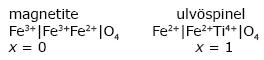
<body><![CDATA[<p align="justify"><font face="verdana" size="2">TM's can occur as primary minerals in igneous rocks. Magnetite, as well as various members of the hemoilmenite series, can also form as a result of high temperature oxidation. In sediments, magnetite often occurs as a detrital component, or a bacteria product, or is authigenically formed during diagenesis. Substitution of Ti<sup>4+</sup>, which has no unpaired spins, has a profound effect on the magnetic properties of the resulting titanomagnetite. Ti<sup>4+</sup> substitutes for a trivalent iron ion. In order to maintain charge balance, another trivalent iron ion turns into a divalent iron ion. The end members of the solid solution series are</font></p>  	    <p align="center"><font face="verdana" size="2"><img src="/img/revistas/geoint/v50n3/a7e1.jpg"></font></p>  	    <p align="justify"><font face="verdana" size="2">Ulv&ouml;spinel is antiferromagnetic because the A and B lattice sites have the same net moment. When <i>x</i> is between 0 and 1, the mineral is called a titanomagnetite. If <i>x</i> is 0.6, for example, the mineral is called TM60 (green dot in <a href="/img/revistas/geoint/v50n3/a7f1.jpg" target="_blank">Figure 1</a>).</font></p>  	    <p align="justify"><font face="verdana" size="2">The profound effect of titanium substitution on the intrinsic properties of titanomagnetite is illustrated in <a href="/img/revistas/geoint/v50n3/a7f2.jpg" target="_blank">Figure 2</a>. Because Ti<sup>4+</sup> has no unpaired spins, the saturation magnetization decreases with increasing <i>x</i> (<a href="/img/revistas/geoint/v50n3/a7f2.jpg" target="_blank">Figure 2a</a>). The cell dimensions increase with increasing <i>x</i> (<a href="/img/revistas/geoint/v50n3/a7f2.jpg" target="_blank">Figure 2b</a>). As a result of the increased cell dimension, there is a decrease in Curie temperature (<a href="/img/revistas/geoint/v50n3/a7f2.jpg" target="_blank">Figure 2c</a>). There is also a slight increase in coercivity (not shown).</font></p>  	    <p align="justify"><font face="verdana" size="2"><i>Titanohematites (Fe<sub>2y</sub>Ti<sub>y</sub>O<sub>3</sub>)</i></font></p>      <p align="justify"><font face="verdana" size="2">Hematite occurs widely in oxidized sediments and dominates the magnetic properties of red beds. It occurs as a high&#45;temperature oxidation product in certain igneous rocks. Depending on grain size, among other things, it is either black (specularite) or red (pigmentary). The substitution of Ti into the lattice structure of <i>&#945;</i>Fe<sub>2</sub>O<sub>3</sub> has an even more profound influence on magnetic properties than with magnetite. For <i>y =</i> 0 the magnetization is spin canted antiferromagnetic, but when <i>y =</i> 0<i>.</i>45, the magnetization becomes ferrimagnetic (<a href="/img/revistas/geoint/v50n3/a7f3.jpg" target="_blank">Figure 3a</a>). For small amounts of substitution, the Ti and Fe cations are distributed equally among the cation layers. For <i>y &gt;</i> 0<i>.</i>45, however, the Ti cations preferentially occupy alternate cation layers. Remembering that the Ti<sup>4+</sup> ions have no net moment, we can imagine that antiparallel coupling between the two sub&#45;lattices results in ferrimagnetic behavior, as opposed to the equal&#45;and&#45;opposite style of antiferromagnetism.</font></p>  	    <p align="justify"><font face="verdana" size="2">Titanohematite particles with intermediate values of <i>y</i> have interesting properties from a paleomagnetic point of view. There is a solid solution at high temperatures, but as the temperatures drop, the crystals exsolve into titanium&#45;rich and titanium&#45;poor lamellae. <a href="/img/revistas/geoint/v50n3/a7f3.jpg" target="_blank">Figure 3</a> shows the variation in saturation magnetization and N&eacute;el temperature with Ti substitution. For certain initial liquid compositions, the exolution lamellae could have Ti&#45;rich bands alternating with Ti&#45;poor bands. If the Ti&#45;rich bands have higher magnetizations, yet lower Curie temperatures, than the Ti&#45;poor bands, then the Ti&#45;poor bands will become magnetized first. When the Curie temperature of the Ti&#45;rich bands is reached, they will become magnetized in the presence of the demagnetizing field of the Ti&#45;poor bands; hence, they will acquire a remanence that is antiparallel to the applied field. Because these bands have higher magnetizations, the net NRM will also be antiparallel to the applied field, and the rock will be <i>self reversed</i>. This is fortunately very rare in nature.</font></p>  	    <p align="justify"><font face="verdana" size="2"><i>Oxidation of (titano)magnetites to (titano) maghemites</i></font></p>  	    <p align="justify"><font face="verdana" size="2">Many minerals form under one set of equilibrium conditions (say, within a cooling lava flow) and are later subjected to a different set of conditions (seafloor alteration or surface weathering). They will tend to alter so as to come into equilibrium with the new set of conditions. The new conditions are often more oxidizing than the original ones, and compositions tend to move along the dashed lines in <a href="/img/revistas/geoint/v50n3/a7f1.jpg" target="_blank">Figure 1</a>. The degree of oxidation is represented by the parameter <i>z</i>.</font></p>  	    <p align="justify"><font face="verdana" size="2">Although a solid solution of magnetite and ulv&ouml;spinel exists in principle, intergrowth of these two minerals is actually quite rare in nature because the TM's interact with oxygen in the melt to form intergrowths of low Ti magnetite with ilmenite. This form of oxidation is known as <i>deuteric</i> oxidation.</font></p>  	    ]]></body>
<body><![CDATA[<p align="justify"><font face="verdana" size="2">Low&#45;temperature oxidation will tend to transform a single&#45;phase spinel (titanomagnetite) into a new single&#45;phase spinel (titanomaghemite) by diffusion of Fe<sup>2+</sup> from the lattice structure of the (titano)magnetite to the surface, where it is converted to Fe<sup>3+</sup>; titanomaghemite is a "cation&#45;deficient" inverse spinel. The inset in <a href="/img/revistas/geoint/v50n3/a7f4.jpg" target="_blank">Figure 4c</a> shows a magnetite crystal in the process of becoming maghemite. The conversion of the Fe<sup>2+</sup> ion means a loss in volume, which results in a characteristic cracking of the surface. There is also a loss in magnetization, a shrinkage of cell size, and, along with the tightening unit cell, an increase in Curie temperature. These trends are shown for TM60 in <a href="/img/revistas/geoint/v50n3/a7f4.jpg" target="_blank">Figure 4</a>. Maghemitization results in a much&#45;reduced Verwey transition (<a href="/img/revistas/geoint/v50n3/a7f5.jpg" target="_blank">Figure 5</a>).</font></p>  	    <p align="justify"><font face="verdana" size="2">The (titano)maghemite structure is metastable and can invert to form the isochemical, but more stable, structure of (titano)hematite, or it can be reduced to form magnetite. The two forms of Fe<sub>2</sub>O<sub>3</sub> are distinguished by the symbols <i>&#947;</i> for maghemite and <i>&#945;</i> for hematite. Inversion of natural maghemite is usually complete by about 350 &deg;C, but it can survive until much higher temperatures (for more details, see Dunlop and &Ouml;zdemir, 1997). Also, it is common that the outer rim of the magnetite will be oxidized to maghemite, whereas the inner core will remain magnetite.</font></p>  	    <p align="justify"><font face="verdana" size="2">Chemical equilibrium between solid solutions of TM's and titanohematites is consistent with results of several studies of consecutive lava flows in Mexico, showing that the main magnetic mineral in these lavas are Ti&#45;poor TM's associated with exsolved ilmenite (e.g., Alva&#45;Valdivia, 2005). Analysis of the Leg 30 samples from a single thick sill shows abundant coarse TM's with fully developed ilmenite exsolution lamellae (Dunlop <i>et al</i>., 1982). Gaspar and Wyllie (1983) and Alva&#45;Valdivia <i>et al</i>. (2009) point to the coexistence of magnetite and ilmenite (with low MgO and MnO content) with equilibrium temperatures between 570 and 615 &deg;C in carbonatite of the Jacupiranga Complex, Brazil.</font></p>  	    <p align="justify"><font face="verdana" size="2">At high temperature in a magma chamber in the upper mantle, ferric iron oxide should be unstable, and the main component of solid solutions of TM's should be ulvospinel. Dyar <i>et al</i>. (2004) report that different techniques of microscopy and magnetic data suggests that ultra&#45;fine hematite lamellae are magnetically ordered, and their resultant remanent magnetic anomalies may contribute significantly to magnetism on terrestrial planets, even those without present&#45;day magnetic fields. Magnetite would be formed primarily during the cooling process at the time of magma uplift, its solidification, and final cooling. The oxidation of Fe<sub>2</sub>TiO<sub>4</sub> into magnetite during cooling creates solid solutions enriched in magnetite with a decrease of the cooling rate, because it would then be under favorable conditions for IO changes for a longer period of time, obviously with low oxygen fugacity within the rising magma. Since both TM's and titanohematite are solid solutions involving either ferrous or ferric iron oxides, respectively, IO changes could possibly play an important role in their stability and transformations. IO changes involving ulvospinel would increase the content of ferric iron oxide in the solid solution. This process would also increase the T<sub>C</sub> of TMs or generate a new component with a higher T<sub>C</sub>. This means that at a slow cooling rate of basalts, there is more chances that a magnetite&#45;rich component will be formed.</font></p>  	    <p align="justify"><font face="verdana" size="2"><i>IO changes and effect in rock magnetism</i></font></p>  	    <p align="justify"><font face="verdana" size="2">As magnetic and paleomagnetic studies illustrate during heating and cooling cycles significant changes occur in magnetic properties. These changes may involve the formation of new magnetic substances, change of Curie point, increase or decrease of magnetization, etc. A large number of studies show changes in rock magnetization during heating at temperatures in the range of 200&deg; to 500&deg;C (e.g. Acton <i>et al</i>., 2000; Hill, 2000; Otofuji <i>et al</i>., 2000; Kechra <i>et al</i>., 2003; Matzka <i>et al</i>., 2003; Shau <i>et al</i>. 2004; Zhu, 2004, etc.). We also observed changes in the size and number of magnetic nanoparticles related to heating at distinct temperature ranges (Rivas&#45;Sanchez <i>et al</i>., in prep.).</font></p>  	    <p align="justify"><font face="verdana" size="2">In many cases, the samples exhibit bimodal blocking&#45;temperature spectra. Such bimodal blocking&#45;temperature spectra with blocking temperatures in the range of 200&#150;580 &deg;C were reported in rocks from different regions (e.g., Orlick&yacute; and Funaki, 2002, and Shau <i>et al</i>., 2004). Some results demonstrate changes in both the value of T<sub>C</sub> and the quantity of magnetic minerals within the rock during experiments of heating&#45;cooling cycles at temperatures in the range of 350&#150;580 &deg;C (e.g., Vlag <i>et al</i>., 2000). Some authors find a temperature range rather than at an exact value of blocking temperatures (e.g., Dunlop and &Ouml;zdemir, 2001). Many researchers believe that a special role in rock magnetism belongs to maghemite (&#947;&#45;Fe<sub>2</sub>O<sub>3</sub>) and/ or titanomaghemite (e.g., Matzka <i>et al</i>., 2003). However, even though maghemite has very strong magnetic properties, it is metastable and would be easily converted to antiferromagnetic hematite. The temperature range of the stability of maghemite is usually within 200&#150;350 &deg;C (e.g., Alva&#45;Valdivia <i>et al</i>., 2001; Gendler <i>et al</i>., 2005).</font></p>  	    <p align="justify"><font face="verdana" size="2">Large differences in T<sub>C</sub> and blocking temperature could be related to IO transformations and re&#45;magnetization processes. Processes of heating, cooling, reheating, and further cooling could take place in different regions and during different processes (repeated intrusions or extrusions, repeated metamorphic processes, hydrothermal events, etc.). Such processes can change both the magnetic phase and content in the rocks of a region. Even though magnetite has a T<sub>C</sub> between 575&deg; and 580 &deg;C, this does not mean that all rocks containing magnetite formed above the T<sub>C</sub> and acquired magnetization at this T<sub>C</sub> during cooling. Magnetite could be formed by IO changes at any temperature within the range of IO changes (between 570&deg; and 200 &deg;C), yet the newly formed magnetite would still have the same properties and T<sub>C</sub> as would a magnetite formed under different temperature conditions. Clearly, magnetic minerals cannot acquire a remanent magnetization prior to formation of the magnetic phase. Also, a magnetic phase formed above its T<sub>C</sub> cannot gain magnetization until the temperature is reduced to its blocking temperature. TMs, formed at high temperature, cannot acquire magnetization until cooling to the blocking temperature. Rapid cooling can prevent rocks from significant IO changes. Thus the amount of magnetite would depend on the cooling rate, unlike for rocks formed under different conditions.</font></p>  	    <p align="justify"><font face="verdana" size="2">IO transformations could take place during either cooling or heating processes. They would start when the temperature within the cooling rock decreases below the upper boundary of the temperature range of IO changes, and they would continue until the temperature drops below that of the lower boundary of the temperature range of IO changes. IO changes would also take place during the heating of a rock as soon as its temperature rises above the lower boundary of the temperature range of IO transformations. IO changes would start just above 200 &deg;C and change the magnetic properties of the rock. This is consistent with the well&#45;known presence of broad temperature tails above and below the blocking temperature within which changes in the composition of a magnetic phase and its magnetic characteristics take place (Dunlop and &Ouml;zdemir, 2001). This may mean that the magnetic phase of a rock was either formed close to the blocking temperature, or that the blocking temperature does not control IO changes.</font></p>  	    <p align="justify"><font face="verdana" size="2">&nbsp;</font></p>  	    ]]></body>
<body><![CDATA[<p align="justify"><font face="verdana" size="2"><b>Magnetic anomalies</b></font></p>  	    <p align="justify"><font face="verdana" size="2"><i>Magnetic anomalies and geological mapping</i></font></p>  	    <p align="justify"><font face="verdana" size="2">Geologic reconnaissance of a region is the scientific basis for resource exploration (petroleum, solid minerals, groundwater) all over the world. Among the diversity of rock types found in the Earth's crust, many exhibit magnetic properties, whether the magnetization is induced by the present&#45;day geomagnetic field, or a remanent magnetization was acquired at some time in the geological past, or both. Mapping the patterns of magnetic anomalies ascribed to rock magnetism has proved to be a very effective way to explore large areas of geology at a low cost per unit area. The fact that most sedimentary rocks and surface&#45;cover formations (including water) are effectively nonmagnetic means that the anomalies are attributable to the underlying igneous and metamorphic rocks (the so&#45;called "magnetic basement"), even where they are not accessible to observation at the surface. Thus aeromagnetic surveys can indicate the distribution of bedrock lithology and structures virtually everywhere. Interpretation of magnetic anomaly patterns can map hidden geology and give direction to the exploration process. In igneous and metamorphic ("hard rock") terranes, outlines of promising areas for the occurrence of ore bodies can be delineated for closer follow&#45;up studies.</font></p>  	    <p align="justify"><font face="verdana" size="2"><i>Mineral exploration</i></font></p>  	    <p align="justify"><font face="verdana" size="2">The amplitude, shape, and internal configuration of magnetic anomalies may be used to indicate the chance of finding certain ore types. Initially, aeromagnetic measurements were used for direct prospecting of magnetic iron ores and in indirect detection of certain classes of magmatic&#45;hosted Ni&#45;deposits, kimberlitic pipes for diamonds, and so forth. Hydrothermally altered areas in magnetic environments are often detectable as low magnetic zones and may be prospected for Au and Pb. The largest concentrated source of magnetic anomalies in terms of magnetic moment is the Kursk low&#45;grade magnetic iron&#45;quartzite ore formation in Ukraine that can be measured even at satellite altitudes.</font></p>  	    <p align="justify"><font face="verdana" size="2">Most major satellite anomalies are, however, attributable to provinces of relatively magnetic rocks, such as Northern Fennoscandia, of which the Kiruna magmatic iron ore is only a small part. Most ore deposits within the crystalline basement are, either in themselves or through their host rocks, accompanied by magnetic anomalies. These anomalies are often used further in the closer evaluation of the extent and geometry of a deposit and in assessing the mineral potential of other comparable geological formations. At the reconnaissance stage of mineral assessment, area selection and prospecting geological mapping can be driven in large part by interpretation of detailed aeromagnetic anomaly maps. These provide a reliable picture of the underlying subsurface, including the location and extent of geological units and their lithology, structure and deformation.</font></p>  	    <p align="justify"><font face="verdana" size="2"><i>Magnetic mineralogy</i></font></p>  	    <p align="justify"><font face="verdana" size="2">The physical link between geological formations and their magnetic anomalies is constituted by the magnetic properties of rocks (Clark and Emerson, 1991). These are often measured, for example, in connection with Ocean Drilling Program (ODP) analyses, paleomagnetic studies, geological mapping, and mineral prospecting.</font></p>  	    <p align="justify"><font face="verdana" size="2">International paleomagnetic databases comprise the remanent magnetic properties acquired in the geological past. Magneto&#45;mineralogical studies reveal that by far the most common magnetic source mineral of Precambrian shield areas is magnetite. Most of the digital petrophysical data for the continents were collected, in the Fennoscandian Shield, by the Nordic countries (Korhonen <i>et al</i>., 2002a,b).</font></p>  	    <p align="justify"><font face="verdana" size="2">Similar data sets for other provinces are required to understand how adequate this information represents more globally crustal rocks. The results from Fennoscandia show that, when plotted on a diagram of induced magnetization against density (<a href="/img/revistas/geoint/v50n3/a7f6.jpg" target="_blank">Figure 6</a>) the samples form two populations, A and B. Population A represents the paramagnetic range of susceptibilities defined by Curie's law. Compositional variation of Fe&#45; and Mn&#45;oxides correlates with density, the denser, more basic (mafic) rock lithology being more magnetic than acid (silicic) ones by up to an order of magnitude. However, this population is only capable of causing anomalies less than about 25 nT.</font></p>  	    ]]></body>
<body><![CDATA[<p align="justify"><font face="verdana" size="2">A mostly acid second population (B) represents the ferrimagnetic range of susceptibilities, mainly with a large range of variation in the abundance and grain size of magnetite. This population is two orders of magnitude more magnetic than the average of the first population (A). Rocks of population B represent mostly sources of local, induced magnetic anomalies. Average susceptibilities vary typically from 0.04 to 0.02 SI units, but much larger variation can be found from one formation to another.</font></p>  	    <p align="justify"><font face="verdana" size="2">Another important parameter is the relative proportion of ferromagnetic (population B) rocks to the effectively "nonmagnetic" paramagnetic (population A) rocks in any given area. For example, it is only a few percent in the magnetic "low" of central Fennoscandia but almost 100% in the northern Fennoscandian "high". Overall in Fennoscandia the average value is about 25%. In oceanic areas, by contrast, it approaches 100%.</font></p>  	    <p align="justify"><font face="verdana" size="2">Spatial contrasts in magnetic rock properties that give rise to the local magnetic anomalies encountered in mineral exploration are attributable to factors such as: (a) the aforementioned bimodal nature of magnetic mineralogy (populations A and B); (b) the effects of magnetic mineralogy and grain size; (c) the history of magnetization and demagnetization; and (d) the variation between induced and remanent magnetization. These are related in turn to geological causes such as initial rock lithology, chemical composition, oxygen fugacity, and metamorphic history.</font></p>  	    <p align="justify"><font face="verdana" size="2">The ratio of remanent to induced magnetization varies typically from 0.1 to 20, corresponding to rocks containing coarse&#45;grained fresh magnetite (most susceptible to induced magnetization) via altered and fine&#45;grained magnetites to pyrrhotite (with a very stable remanent magnetization). <a href="/img/revistas/geoint/v50n3/a7f6.jpg" target="_blank">Figure 6b</a> shows the results for induced and remanent magnetization from the Fennoscandian Shield. For the relatively few rock samples (population D) that depart from a low level of magnetization (population C), the Q&#45;ratio is mostly less than 1.0, indicating the predominance of induced magnetization over remanent as a source of magnetic anomalies. A few exceptions are, however, highly magnetic (above 1.0 A m&#150;1). For increasingly large source bodies, variations in the direction of all local remanent magnetizations cause the net remanent magnetization to sum up more slowly than the consistently oriented induced magnetization. Hence the effects of remanent magnetization are relatively more important in magnetic anomalies measured close to source bodies (such as on the ground) than farther away (from an aircraft or satellite). This effect is even more noticeable at magnetizations above 1 Am<sup>&#45;1</sup>, where Q&#45;values tend to approach or even exceed 1.0.</font></p>  	    <p align="justify"><font face="verdana" size="2">&nbsp;</font></p>  	    <p align="justify"><font face="verdana" size="2"><b>El Morro Mine, Cajat&iacute;, Brazil: A case study</b></font></p>  	    <p align="justify"><font face="verdana" size="2"><i>Geology and Mineralization</i></font></p>  	    <p align="justify"><font face="verdana" size="2">The Jacupiranga alkaline&#45;carbonatitic complex is located in southeastern Brazil (48&deg; 09' W and 24&deg; 41' S; <a href="/img/revistas/geoint/v50n3/a7f7.jpg" target="_blank">Figure 7</a>). It belongs to the Jacupiranga Ultramafic Alkaline Complex, first described by Melcher (1954) as an ellipsoid intrusive body with axis NNW oriented (10.5 x 6.7 km), covering approximately 65 km<sup>2</sup>, of Early Cretaceous age (131 My, Ruberti <i>et al</i>., 2000). Similar to the Juqui&aacute; Complex, Jacupiranga is emplaced in Precambrian basement, and consists of silicate and carbonatitic rocks. One silicate rock is widely known as "jacupirangite". Among carbonatitic phases, there are different compositions (calciocarbonatites to magnesiumcarbonatites) forming independent plugs, dykes and dyke swarms.</font></p>  	    <p align="justify"><font face="verdana" size="2">The orebody is basically composed of carbonatite. It represents at least fve magmatic events. Main mineralized geological settings can be recognized as carbonatitic portions (both of calcic and dolomitic composition) separated by peculiar features as well as other lithological ore types, with remarkable minor portions of phoscoritic composition. An important 20&#45;30 m wide faulting zone crosses the orebody with SE&#45;NW direction and splits the carbonatite. The contact between carbonatite and jacupirangite shows a remarkable reaction zone between jacupirangite host rock and intrusive carbonatitic liquid (Bon&aacute;s, 2001).</font></p>  	    <p align="justify"><font face="verdana" size="2"><i>Magnetic Measurements</i></font></p>  	    ]]></body>
<body><![CDATA[<p align="justify"><font face="verdana" size="2">A rock&#45;magnetic study was conducted to identify the magnetic carriers responsible for the magnetization and obtain information about their magnetic stability (Alva&#45;Valdivia <i>et al</i>., 2009).</font></p>  	    <p align="justify"><font face="verdana" size="2">Natural remanent magnetization intensity, NRM (M<sub>o</sub>), density, susceptibility (<i>k)</i> at room temperature and the K&ouml;nigsberger ratio Q (calculated for the present geomagnetic field) were reported by Alva&#45;Valdivia <i>et al</i>. (2009) (<a href="/img/revistas/geoint/v50n3/a7t1.jpg" target="_blank">Table 1</a>). K&ouml;nigsberger ratios indicate the relative importance of remanent and induced magnetization. Main differences in M<sub>o</sub> and <i>k</i> are due to two factors, distinct initial volume content of magnetite, and development of weakly magnetic or non&#45;magnetic phases created during alteration of the rocks. Induced magnetization vs. density and remanent vs. induced magnetization results are showed in <a href="/img/revistas/geoint/v50n3/a7f6.jpg" target="_blank">Figure 6a</a> and <a href="/img/revistas/geoint/v50n3/a7f6.jpg" target="_blank">6b</a>, respectively, by red stars.</font></p>  	    <p align="justify"><font face="verdana" size="2">Carbonatite&#45;phoscoritic ore (MM1, MM2, MM3) present low to medium NRM's and bulk susceptibility values (0.004 &#150; 6 A/m; 1.3 &#150; 47.3&times;10<sup>&#45;3</sup> SI, respectively), which reflect the magnetite content (Alva&#45;Valdivia <i>et al</i>., 2009). This is clearly exposed in the Q ratios (0.01 &#150; 6.81). Also, the magnetic carriers in the carbonatite&#45;pyroxenite (MM2, MM3) and intrusive rocks (ijolite, MM8) are associated with low Q values. This could suggest a predominance of multidomain (MD) carriers. Sites MM2 and MM8 have the lowest susceptibilities (1.28 and 1.06 &times;10<sup>&#45;3</sup> SI, respectively) associated with low NRM intensities, resulting in low Q ratios. For all of these sites, the NRMs have low to intermediate coercivity and low to medium directional stability under AF demagnetization.</font></p>  	    <p align="justify"><font face="verdana" size="2">Relatively high Q ratios (&#126; 6&#150;11) for Jacupirangite&#45;pyroxenite (MM4, MM5, MM6) may indirectly support a thermo remanent origin for the magnetization. As noted in the last section, the dominant carriers are Ti&#45;poor TMs, with some deuteric oxy&#45;exsolution products. The pyroxenite samples have the highest NRM intensity values (up to 27 A/m, site MM5) and the highest susceptibilities (up to 161&times;10<sup>&#45;3</sup> SI, site MM6), with high Q ratios, suggesting a wide range of magnetite grain sizes carrying NRM.</font></p>  	    <p align="justify"><font face="verdana" size="2"><i>Magnetic Anomaly Interpretation</i></font></p>  	    <p align="justify"><font face="verdana" size="2">An aeromagnetic survey was completed in El Morro area in 1978. It was constituted by 10 north&#45;south fight lines 10 km long, separated by 1 km and a 150 meters fight altitude, and one control line 10 km long, east&#45;west direction.</font></p>  	    <p align="justify"><font face="verdana" size="2">A residual magnetic field map (<a href="/img/revistas/geoint/v50n3/a7f8.jpg" target="_blank">Figure 8</a>) was provided by the Geological Staff of the Mine. The final cell size of the anomaly grid is 200 x 200 m. We reduced to the pole the total field magnetic anomalies, to remove the skewness of the anomalies (Baranov, 1957; Baranov and Naudy, 1964). The transformation makes the anomalies overlie vertically the sources and makes it possible to correlate the magnetic anomalies with other types of geophysical anomalies (e.g., gravity) and geological information to aid in their interpretation.</font></p>  	    <p align="justify"><font face="verdana" size="2"><i>Qualitative interpretation.</i> The magnetic anomaly reduced to the pole and 300 m upward continued (<a href="/img/revistas/geoint/v50n3/a7f9.jpg" target="_blank">Figure 9</a>) suggests that there are at least three deep tabular bodies of general east&#45;west strike, at the northern, southern and central parts. Several other data processes were applied to infer the possible shape, geometry and position of the bodies that produce the magnetic anomaly, which could be helpful during the modeling process.</font></p>  	    <p align="justify"><font face="verdana" size="2">The reduced to the pole magnetic map (<a href="/img/revistas/geoint/v50n3/a7f9.jpg" target="_blank">Figure 9</a>) shows a circular magnetic anomaly, formed along of its borders by elongated positive anomalies, ranging in magnitude from 228 nT at the SSW up to 2,034 nT at the northern area. Moreover, the central part of the anomalous area is formed by several magnetic low elongated anomalies ranging from &#45;479 nT at the southern part up to &#45;3,058 nT at the central&#45;eastern area. This map shows also two distinct anomaly types: some are normally dipolar for the southern hemisphere (i.e. magnetic high/low to the north/ south, respectively); and others are monopolar&#45;type anomalies at the southern area.</font></p>  	    <p align="justify"><font face="verdana" size="2">The most important anomaly is located at the northern portion showing a typical dipole with a magnetic intensity 3,663 nT and a dipolar distance of 2,070 m (between maximum and minimum). Its size is approximately of 5,000 m in NE&#45;SW strike and 2,500 m in NW&#45;SE strike. This composed magnetic anomaly comprises four magnetic maximum, particular magnetic intensity values of 954 nT to the west, passing by 1,572 nT at the center, and up to 1,187 nT to the east. They show an average distance of 5 km along WNW&#45;ESE strike and 1,550 m along the N&#45;S direction.</font></p>  	    ]]></body>
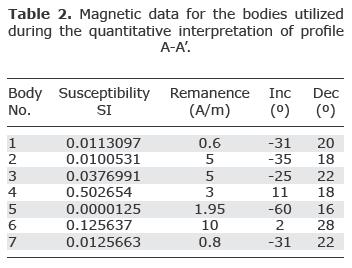
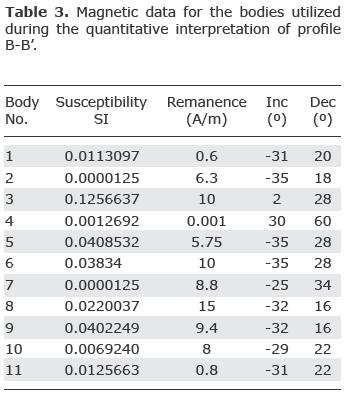
<body><![CDATA[<p align="justify"><font face="verdana" size="2">The border of the central&#45;eastern area is represented by an anomaly, showing two magnetic highs of 891 nT and 1,394 nT from north to south. It covers an area of 2,800 m and 1,210 m longitude in the NNE&#45;SSW and E&#45;W strikes. The western sector shows two positive anomalies of 626 nT and 913 nT to the south and north, respectively.</font></p>  	    <p align="justify"><font face="verdana" size="2">In general, the configuration of the reduced to the pole map shows a large anomalous area produced clearly by the ferromagnetic minerals contained in the rock present. The dimension of this area is of 8.5 km in the N&#45;S direction and approximately 9 km in E&#45;W direction.</font></p>  	    <p align="justify"><font face="verdana" size="2">The radial averaged power spectra (RAPS), indicates that the tops of the sources lie between 200 and 300 m approximately (<a href="/img/revistas/geoint/v50n3/a7f10.jpg" target="_blank">Figure 10</a>). A low&#45;pass filter and upward continuation of magnetic data (300 meters) (<a href="/img/revistas/geoint/v50n3/a7f11.jpg" target="_blank">Figure 11</a>) were used to deduce the geometry of bodies with depth and allow us to infer that the main body (to the north) has a strike almost east&#45;west, and that other two bodies tend to disappear with depth.</font></p>  	    <p align="justify"><font face="verdana" size="2"><i>Quantitative interpretation</i>. The reduced to the pole anomaly was modeled through a N&#45;S (A&#45;A', L&#45;2140 white line) and an E&#45;W profile (B&#45;B', T&#45;9110 white line) (<a href="/img/revistas/geoint/v50n3/a7f9.jpg" target="_blank">Figure 9</a>). The biggest body, located at the northern part of the studied area, has a minimum size of 5 &times; 2 km. All the bodies (dipolar magnetic anomalies) are located in the same semi&#45;ellipsoidal aeromagnetic domain of northeast southwest general strike. Also, the low&#45;pass filter (LPF) (<a href="/img/revistas/geoint/v50n3/a7f11.jpg" target="_blank">Figure 11</a>) shows that the anomalous zone is extended to the north and that the area of interest for ore is associated with one body 8.3 km aligned north&#45;south direction and 4.0 km east&#45;west direction.</font></p>  	    <p align="justify"><font face="verdana" size="2">The model corresponding to the north&#45;south profile (A&#45;A') suggests distinct mineralized ore bodies of non&#45;uniform shape and with depths up to &#126; 800 m (<a href="/img/revistas/geoint/v50n3/a7f12.jpg" target="_blank">Figure 12</a>).</font></p>  	    <p align="justify"><font face="verdana" size="2">The magnetic anomaly corresponds in general to a large normally polarized dipole oriented almost north south and situated over two major mineralized bodies. This dipolar anomaly is characterized by a low/high sequence and a peak&#45;to&#45;peak amplitude of about 4,200 nT. The geometry and magnetic properties of the sources associated with the anomalies were modeled using the GM&#45;SYS&trade; software; the respective routine utilizes a Marquardt inversion algorithm (Marquardt, 1963) to linearize and perform the calculations. GM&#45;SYS&trade; implemented an algorithm for magnetic data processing developed by the USGS in the computer program SAKI (Webring, 1985). Polygonal bodies of different magnetizations can be adjusted to the observed anomalies.</font></p>  	    <p align="justify"><font face="verdana" size="2">Magnetic properties of rocks and ores (Alva&#45;Valdivia <i>et al</i>., 2009) sampled were used to constrain the interpretation. We analyzed several polygonal models with various combinations of magnetic properties, and the best fit corresponds to several large irregular bodies. The contribution most important for the model A&#45;A', comes from body 4 and 6 (<a href="/img/revistas/geoint/v50n3/a7f12.jpg" target="_blank">Figure 12</a>, <a href="#t2">Table 2</a>). Body 4 probably corresponds to the actual position or surroundings of the El Morro Mine, and body 6, located beneath the magnetic high, continues deep and northward. On the other hand, bodies 3 and 5 are located under the magnetic lows, and extend to the south. Bodies 1, 2, 3 and 7, smaller and with less magnetic contribution, were assumed to fit the details of the profile (<a href="/img/revistas/geoint/v50n3/a7f12.jpg" target="_blank">Figure 12</a>). Model B&#45;B', almost orthogonal to the A&#45;A' profile (<a href="/img/revistas/geoint/v50n3/a7f13.jpg" target="_blank">Figure 13</a>, <a href="#t3">Table 3</a>), shows one maximum positive value to the east and three continuous magnetic lows (negative) to the west. For this anomaly, the most important contribution comes from body 3, including the highest susceptibility and one of the highest remanent magnetization (<a href="/img/revistas/geoint/v50n3/a7f13.jpg" target="_blank">Figure 13</a>). Other important bodies contributing to the anomaly are 5, 6, 8 and 9. Finally, the rest of the bodies were used to fit the best possible the observed anomaly. The rock&#45;magnetic parameters for all the proposed bodies are within the range of those measured in our samples, which seem reasonably for fresh rock at depth.</font></p>  	    <p align="center"><font face="verdana" size="2"><a name="t2"></a></font></p>  	    <p align="center"><font face="verdana" size="2"><img src="/img/revistas/geoint/v50n3/a7t2.jpg"></font></p>  	    <p align="center"><font face="verdana" size="2"><a name="t3"></a></font></p>  	    ]]></body>
<body><![CDATA[<p align="center"><font face="verdana" size="2"><img src="/img/revistas/geoint/v50n3/a7t3.jpg"></font></p>  	    <p align="justify"><font face="verdana" size="2">The modeling processes have been partly constrained resulting in a model that approach to the geological reality in size, depth and geometry. The models (that produced an acceptable fit) incorporate the susceptibility, remanent intensity and direction of remanence values of <a href="#t2">Tables 2</a> and <a href="#t3">3</a>. The values of remanence proposed are in the range of those measured and quite similar to the reported properties of the mineralized bodies. The magnetic susceptibility values proposed in our model are also into the range of those measured. This means that almost all the remarkable proposed bodies can be mineralized. The calculated curves show almost no deviation from the observed ones. The small differences may be explained since there are many small outcrops of Fe&#45;ore. Therefore, we believe our models are expressive of the main source bodies that produce the magnetic anomaly.</font></p>  	    <p align="justify"><font face="verdana" size="2">&nbsp;</font></p>  	    <p align="justify"><font face="verdana" size="2"><b>Discussion and Conclusions</b></font></p>  	    <p align="justify"><font face="verdana" size="2">Relatively high Q ratios (&#8805;5) for Jacupirangite&#45;pyroxenite (Alva&#45;Valdivia <i>et al.,</i> 2009) may indicate a TRM origin of the magnetization. The principal carriers are Ti&#45;poor TMs, with some deuteric oxy&#45;exsolution products. These rocks have the highest NRM intensity and susceptibility values, resulting in high Q ratios, suggesting a wide range of magnetite grain sizes carrying the NRM.</font></p>  	    <p align="justify"><font face="verdana" size="2">The magnetic anomaly analyses included several processes and modeling attempts. Accordingly, we inferred: bodies of a general east&#45;west strike (<a href="/img/revistas/geoint/v50n3/a7f8.jpg" target="_blank">Figure 8</a>) and a largest body at the northern part of the area studied of at least 5 &times; 2 km in size. This large ore deposit has been found and confirmed recently by J. C. Gaspar of the Vale Mining Company (pers. comm.). All of these bodies are located in the same northeast&#45;southwest semi&#45;ellipsoidal aeromagnetic domain. It is also proposed that the mineralized anomalous zone extends to the north and that the whole interest area for ore probably covers an area roughly 8 &times; 4 km in the north&#45;south direction.</font></p>  	    <p align="justify"><font face="verdana" size="2">Processing of the magnetic data helped to infer the shape, geometry and position of the bodies that produce the magnetic anomaly. These characteristics are considered critical during the modeling process (<a href="/img/revistas/geoint/v50n3/a7f9.jpg" target="_blank">Figures 9</a> and <a href="/img/revistas/geoint/v50n3/a7f10.jpg" target="_blank">10</a>). We selected two almost orthogonal profiles (<a href="/img/revistas/geoint/v50n3/a7f9.jpg" target="_blank">Figure 9</a>, white lines), proposing distinct mineralized ore bodies of non&#45;uniform shape that reach depth up to 800 meters (<a href="/img/revistas/geoint/v50n3/a7f12.jpg" target="_blank">Figure 12</a> and <a href="/img/revistas/geoint/v50n3/a7f13.jpg" target="_blank">13</a>). We analyzed several polygonal models with various combinations of magnetic properties, and the best fit corresponds to several large irregular bodies. The most important mineralized bodies are located beneath the magnetic high that extends northwards, a result also supported by a gravimetric model (Shukowsky <i>et al</i>., 2003), other bodies are located under the magnetic low that extends to the south (El Morro mine). To constrain the interpretation, we used the magnetic properties of the rock&#45;units and ores sampled. The model that produced the best fit require susceptibility and remanent magnetization intensity values within the range of measurements than those measured and more similar to the mineralized ores. This is acceptable as we are trying to adjust the anomaly looking for the mineralized bodies. If so, almost all the bodies may be mineralized. The ambiguity of the modeling processes has been constrained, to be closer to the geological reality of size, depth and geometry of the proposed bodies. The computed curve shows almost no deviation from the observed one. Hence, we suggest that the models represent a reasonable image of the main source mineralized bodies that produce the magnetic anomaly.</font></p>  	    <p align="justify"><font face="verdana" size="2">&nbsp;</font></p>  	    <p align="justify"><font face="verdana" size="2"><b>Acknowledgements</b></font></p>  	    <p align="justify"><font face="verdana" size="2">We are grateful for the kind cooperation of the engineering staff of Planejamento de Lavra/ Geologia, BUNGE Fertilizantes S/A Unidade Cajati. This research was funded by CONACyT project 105194. A. Gonz&aacute;lez Rangel performed all the measurements at the Paleomagnetic laboratory of the Geophysics Institute, UNAM. We appreciate the very constructive reviewing process of Professor O. Campos&#45;Enriquez that has improved greatly this manuscript.</font></p>  	    ]]></body>
<body><![CDATA[<p align="justify"><font face="verdana" size="2">&nbsp;</font></p>  	    <p align="justify"><font face="verdana" size="2"><b>Bibliography</b></font></p>  	    <!-- ref --><p align="justify"><font face="verdana" size="2">Acton G.D., Tessema A., Jackson M., Bilham R., 2000, The tectonic and geomagnetic significance of paleomagnetic observations from volcanic rocks from central Afar, Africa, <i>Earth Planet. Sci. Lett</i>., 180, 225&#45;241.    &nbsp;&nbsp;&nbsp;&nbsp;&nbsp;&nbsp;&nbsp;&nbsp;[&#160;<a href="javascript:void(0);" onclick="javascript: window.open('/scielo.php?script=sci_nlinks&ref=3916276&pid=S0016-7169201100030000700001&lng=','','width=640,height=500,resizable=yes,scrollbars=1,menubar=yes,');">Links</a>&#160;]<!-- end-ref --></font></p>  	    <!-- ref --><p align="justify"><font face="verdana" size="2">Ade&#45;Hall J.M., Kahn J.M., Dagley P., Wilson R.L., 1968, A detailed opaque petrological and magnetic ionvestigation of a signle Tertiary lava flow from Skye, Scotland, I. Iron and titanium oxide petrology. <i>Geophys. J. R. Astr. Soc.,</i> 16, 375&#45;388.    &nbsp;&nbsp;&nbsp;&nbsp;&nbsp;&nbsp;&nbsp;&nbsp;[&#160;<a href="javascript:void(0);" onclick="javascript: window.open('/scielo.php?script=sci_nlinks&ref=3916278&pid=S0016-7169201100030000700002&lng=','','width=640,height=500,resizable=yes,scrollbars=1,menubar=yes,');">Links</a>&#160;]<!-- end-ref --></font></p>  	    <!-- ref --><p align="justify"><font face="verdana" size="2">Ade&#45;Hall J.M., Palmer H.C., Hubbard T.P., 1971, The magnetic and opaque petrological response of basalts to regional hydrothermal alteration. <i>Geophys. J. R. Astr. Soc.,</i> 24, 137&#45;174.    &nbsp;&nbsp;&nbsp;&nbsp;&nbsp;&nbsp;&nbsp;&nbsp;[&#160;<a href="javascript:void(0);" onclick="javascript: window.open('/scielo.php?script=sci_nlinks&ref=3916280&pid=S0016-7169201100030000700003&lng=','','width=640,height=500,resizable=yes,scrollbars=1,menubar=yes,');">Links</a>&#160;]<!-- end-ref --></font></p>  	    <!-- ref --><p align="justify"><font face="verdana" size="2">Alva&#45;Valdivia L.M., 2005, Comprehensive paleomagnetic study on a succession of Holocene olivine&#45;basalt flow: Xitle volcano (Mexico) revisited. <i>Earth Planets Space,</i> 57, 839&#45;853.    &nbsp;&nbsp;&nbsp;&nbsp;&nbsp;&nbsp;&nbsp;&nbsp;[&#160;<a href="javascript:void(0);" onclick="javascript: window.open('/scielo.php?script=sci_nlinks&ref=3916282&pid=S0016-7169201100030000700004&lng=','','width=640,height=500,resizable=yes,scrollbars=1,menubar=yes,');">Links</a>&#160;]<!-- end-ref --></font></p>  	    ]]></body>
<body><![CDATA[<!-- ref --><p align="justify"><font face="verdana" size="2">Alva&#45;Valdivia L.M., Perrin M., Rivas&#45;S&aacute;nchez M., Goguitchaichvili A., L&oacute;pez&#45;Loera H., Ferreira Lopes O., Bon&aacute;s T.B., 2009, Rock Magnetism and Microscopy of the Jacupiranga Alkaline&#45;Carbonatitic Complex, South Brazil. <i>Earth Planets and Space,</i> 61, 161&#45;171.    &nbsp;&nbsp;&nbsp;&nbsp;&nbsp;&nbsp;&nbsp;&nbsp;[&#160;<a href="javascript:void(0);" onclick="javascript: window.open('/scielo.php?script=sci_nlinks&ref=3916284&pid=S0016-7169201100030000700005&lng=','','width=640,height=500,resizable=yes,scrollbars=1,menubar=yes,');">Links</a>&#160;]<!-- end-ref --></font></p>  	    <!-- ref --><p align="justify"><font face="verdana" size="2">Alva&#45;Valdivia L.M., Rivas M.L., Goguitchaichvili, A., Urrutia&#45;Fucugauchi J., Gonzalez J. A., Morales J., G&oacute;mez S., Henr&iacute;quez F., Nystr&ouml;m J.O., Naslund R.H., 2003b, Rock Magnetic and Oxide Microscopy Studies of the El Laco, Iron&#45;Ore Deposits, Chilean High Andes and Implications for Magnetic Anomaly Modeling. <i>Int. Geol. Rev.,</i> 45, 533&#45;547.    &nbsp;&nbsp;&nbsp;&nbsp;&nbsp;&nbsp;&nbsp;&nbsp;[&#160;<a href="javascript:void(0);" onclick="javascript: window.open('/scielo.php?script=sci_nlinks&ref=3916286&pid=S0016-7169201100030000700006&lng=','','width=640,height=500,resizable=yes,scrollbars=1,menubar=yes,');">Links</a>&#160;]<!-- end-ref --></font></p>  	    <!-- ref --><p align="justify"><font face="verdana" size="2">Alva&#45;Valdivia L.M., Rivas&#45;S&aacute;nchez M., Arenas&#45;Alatorre J., Goguitchaishvili A., Ferreira Lopes O., Ti&#45;Magnesioferrite nanoparticles from Jacupiranga Alkaline Complex, Brazil: magnetic properties, mineralogy and grain size effect. Submitted to <i>Geophys. J. Int.    &nbsp;&nbsp;&nbsp;&nbsp;&nbsp;&nbsp;&nbsp;&nbsp;[&#160;<a href="javascript:void(0);" onclick="javascript: window.open('/scielo.php?script=sci_nlinks&ref=3916288&pid=S0016-7169201100030000700007&lng=','','width=640,height=500,resizable=yes,scrollbars=1,menubar=yes,');">Links</a>&#160;]<!-- end-ref --></i></font></p>  	    <!-- ref --><p align="justify"><font face="verdana" size="2">Alva&#45;Valdivia L.M., Rivas&#45;S&aacute;nchez M.L., Gonzalez A., Goguitchaichvili A., Urrutia&#45;Fucugauchi J., Morales J., Vivallo W., 2003a, Integratted magnetic studies of the El Romeral Iron&#45;ore Deposit, Chile: implications for the ore genesis and modeling magnetic anomalies. <i>J. Applied Geophys</i>, 53, 137&#45;151.    &nbsp;&nbsp;&nbsp;&nbsp;&nbsp;&nbsp;&nbsp;&nbsp;[&#160;<a href="javascript:void(0);" onclick="javascript: window.open('/scielo.php?script=sci_nlinks&ref=3916290&pid=S0016-7169201100030000700008&lng=','','width=640,height=500,resizable=yes,scrollbars=1,menubar=yes,');">Links</a>&#160;]<!-- end-ref --></font></p>  	    <!-- ref --><p align="justify"><font face="verdana" size="2">Alva&#45;Valdivia L., Urrutia&#45;Fucugauchi J., 1995, Rock magnetic surveys in the iron ore deposit of El Encino, Mexico. <i>J. South Am. Earth Sci</i>., 8, 209&#45;220.    &nbsp;&nbsp;&nbsp;&nbsp;&nbsp;&nbsp;&nbsp;&nbsp;[&#160;<a href="javascript:void(0);" onclick="javascript: window.open('/scielo.php?script=sci_nlinks&ref=3916292&pid=S0016-7169201100030000700009&lng=','','width=640,height=500,resizable=yes,scrollbars=1,menubar=yes,');">Links</a>&#160;]<!-- end-ref --></font></p>  	    ]]></body>
<body><![CDATA[<!-- ref --><p align="justify"><font face="verdana" size="2">Alva&#45;Valdivia L.M., Urrutia&#45;Fucugauchi J., B&ouml;hnel H., Moran&#45;Zenteno D., 1991, Aeromagnetic anomalies and paleomagnetism in Jalisco and Michoacan, southern Mexico continental margin, and their implications for iron&#45;ore deposits exploration. <i>Tectonophys</i>, 192, 169&#45;190.    &nbsp;&nbsp;&nbsp;&nbsp;&nbsp;&nbsp;&nbsp;&nbsp;[&#160;<a href="javascript:void(0);" onclick="javascript: window.open('/scielo.php?script=sci_nlinks&ref=3916294&pid=S0016-7169201100030000700010&lng=','','width=640,height=500,resizable=yes,scrollbars=1,menubar=yes,');">Links</a>&#160;]<!-- end-ref --></font></p>  	    <!-- ref --><p align="justify"><font face="verdana" size="2">Alva&#45;Valdivia L.M., Urrutia&#45;Fucugauchi J., 1998, Rock magnetic properties and ore microscopy of the iron ore deposit of Las Truchas, Michoacan, Mexico. <i>J. Applied Geophys,</i> 38, 277&#45;299.    &nbsp;&nbsp;&nbsp;&nbsp;&nbsp;&nbsp;&nbsp;&nbsp;[&#160;<a href="javascript:void(0);" onclick="javascript: window.open('/scielo.php?script=sci_nlinks&ref=3916296&pid=S0016-7169201100030000700011&lng=','','width=640,height=500,resizable=yes,scrollbars=1,menubar=yes,');">Links</a>&#160;]<!-- end-ref --></font></p>  	    <!-- ref --><p align="justify"><font face="verdana" size="2">Alva Valdivia L.M., Urrutia&#45;Fucugauchi J., Goguichaichvili A., Dunlop D., 2000, Magnetic mineralogy and properties of the Pe&ntilde;a Colorada iron ore deposit, Guerrero Terrane: implications for magnetometric modeling. <i>J. South Am. Earth Sci.,</i> 13, 5, 415&#45;428.    &nbsp;&nbsp;&nbsp;&nbsp;&nbsp;&nbsp;&nbsp;&nbsp;[&#160;<a href="javascript:void(0);" onclick="javascript: window.open('/scielo.php?script=sci_nlinks&ref=3916298&pid=S0016-7169201100030000700012&lng=','','width=640,height=500,resizable=yes,scrollbars=1,menubar=yes,');">Links</a>&#160;]<!-- end-ref --></font></p>  	    <!-- ref --><p align="justify"><font face="verdana" size="2">Alva&#45;Valdivia L.M., Urrutia&#45;Fucugauchi J., Goguitchaichvili A., Vivallo W., 2001, Rock&#150;magnetism and ore microscopy of magnetite&#45;apatite ore deposit from Cerro de Mercado, Mexico. <i>Earth, Planets and Space</i> 53(3), 181&#45;192.    &nbsp;&nbsp;&nbsp;&nbsp;&nbsp;&nbsp;&nbsp;&nbsp;[&#160;<a href="javascript:void(0);" onclick="javascript: window.open('/scielo.php?script=sci_nlinks&ref=3916300&pid=S0016-7169201100030000700013&lng=','','width=640,height=500,resizable=yes,scrollbars=1,menubar=yes,');">Links</a>&#160;]<!-- end-ref --></font></p>  	    <!-- ref --><p align="justify"><font face="verdana" size="2">Baranov V., 1957, A new method for interpretation of aeromagnetic maps: pseudo&#45;gravimetric anomalies. <i>Geophys</i>. 22: 359&#150;383.    &nbsp;&nbsp;&nbsp;&nbsp;&nbsp;&nbsp;&nbsp;&nbsp;[&#160;<a href="javascript:void(0);" onclick="javascript: window.open('/scielo.php?script=sci_nlinks&ref=3916302&pid=S0016-7169201100030000700014&lng=','','width=640,height=500,resizable=yes,scrollbars=1,menubar=yes,');">Links</a>&#160;]<!-- end-ref --></font></p>  	    ]]></body>
<body><![CDATA[<!-- ref --><p align="justify"><font face="verdana" size="2">Baranov, V., and Naudy, H., 1964. Numerical calculation of the formula of reduction to the magnetic pole. Geophys. 29: 67&#150;79.    &nbsp;&nbsp;&nbsp;&nbsp;&nbsp;&nbsp;&nbsp;&nbsp;[&#160;<a href="javascript:void(0);" onclick="javascript: window.open('/scielo.php?script=sci_nlinks&ref=3916304&pid=S0016-7169201100030000700015&lng=','','width=640,height=500,resizable=yes,scrollbars=1,menubar=yes,');">Links</a>&#160;]<!-- end-ref --></font></p>  	    <!-- ref --><p align="justify"><font face="verdana" size="2">Bon&aacute;s, T.B. (2001). Consolida&ccedil;&atilde;o de crit&eacute;rios de descri&ccedil;&atilde;o litol&oacute;gica para o min&eacute;rio apat&iacute;tico do complexo alcalino de Jacupiranga. Monografa de trabalho de formatura, IG &#150; USP, 48p.    &nbsp;&nbsp;&nbsp;&nbsp;&nbsp;&nbsp;&nbsp;&nbsp;[&#160;<a href="javascript:void(0);" onclick="javascript: window.open('/scielo.php?script=sci_nlinks&ref=3916306&pid=S0016-7169201100030000700016&lng=','','width=640,height=500,resizable=yes,scrollbars=1,menubar=yes,');">Links</a>&#160;]<!-- end-ref --></font></p>  	    <!-- ref --><p align="justify"><font face="verdana" size="2">Bruckshaw, J.M., Vincenz S.A., 1954, The permanent magnetism of the Mull lavas. Mon. Nat. R. Astron. Soc., <i>Geophys. Suppl,</i> 6, 579&#45;589.    &nbsp;&nbsp;&nbsp;&nbsp;&nbsp;&nbsp;&nbsp;&nbsp;[&#160;<a href="javascript:void(0);" onclick="javascript: window.open('/scielo.php?script=sci_nlinks&ref=3916308&pid=S0016-7169201100030000700017&lng=','','width=640,height=500,resizable=yes,scrollbars=1,menubar=yes,');">Links</a>&#160;]<!-- end-ref --></font></p>  	    <!-- ref --><p align="justify"><font face="verdana" size="2">Butler R.F., 1992, <i>Paleomagnetism: Magnetic Domains to Geologic Terranes</i>. Boston: Blackwell Scientific Publications.    &nbsp;&nbsp;&nbsp;&nbsp;&nbsp;&nbsp;&nbsp;&nbsp;[&#160;<a href="javascript:void(0);" onclick="javascript: window.open('/scielo.php?script=sci_nlinks&ref=3916310&pid=S0016-7169201100030000700018&lng=','','width=640,height=500,resizable=yes,scrollbars=1,menubar=yes,');">Links</a>&#160;]<!-- end-ref --></font></p>     <!-- ref --><p align="justify"><font face="verdana" size="2">Clark D.A., Emerson D.W., 1991, Notes on rock magnetization characteristics in applied geophysical studies. <i>Explor. Geophys.,</i> 22: 547&#150;555.    &nbsp;&nbsp;&nbsp;&nbsp;&nbsp;&nbsp;&nbsp;&nbsp;[&#160;<a href="javascript:void(0);" onclick="javascript: window.open('/scielo.php?script=sci_nlinks&ref=3916312&pid=S0016-7169201100030000700019&lng=','','width=640,height=500,resizable=yes,scrollbars=1,menubar=yes,');">Links</a>&#160;]<!-- end-ref --></font></p>  	    ]]></body>
<body><![CDATA[<!-- ref --><p align="justify"><font face="verdana" size="2">Deutsch E.R., P&auml;tzold R R., Radhakrishnamurty C., 1981, <i>Phys. Earth Planet. Int</i>., 26, 27&#45;36.    &nbsp;&nbsp;&nbsp;&nbsp;&nbsp;&nbsp;&nbsp;&nbsp;[&#160;<a href="javascript:void(0);" onclick="javascript: window.open('/scielo.php?script=sci_nlinks&ref=3916314&pid=S0016-7169201100030000700020&lng=','','width=640,height=500,resizable=yes,scrollbars=1,menubar=yes,');">Links</a>&#160;]<!-- end-ref --></font></p>  	    <!-- ref --><p align="justify"><font face="verdana" size="2">Direen N.G., Pfeiffer K.M., Schmidt P.W., Sexton M., Strong remanent magnetization in Pyrrothite: a structurally&#45;controlled example from the Paleoproterozoic Tnami Orogenic gold province, northern Australia, <i>Precam. Res.</i>, 165, 96&#150;106, 2008.    &nbsp;&nbsp;&nbsp;&nbsp;&nbsp;&nbsp;&nbsp;&nbsp;[&#160;<a href="javascript:void(0);" onclick="javascript: window.open('/scielo.php?script=sci_nlinks&ref=3916316&pid=S0016-7169201100030000700021&lng=','','width=640,height=500,resizable=yes,scrollbars=1,menubar=yes,');">Links</a>&#160;]<!-- end-ref --></font></p>  	    <!-- ref --><p align="justify"><font face="verdana" size="2">Dunlop D.J., 1982, Characteristic magnetic properties of titanomagnetites in continental igneous rocks, <i>Phys. Earth Planet. Int</i>., 30, 4, 273.    &nbsp;&nbsp;&nbsp;&nbsp;&nbsp;&nbsp;&nbsp;&nbsp;[&#160;<a href="javascript:void(0);" onclick="javascript: window.open('/scielo.php?script=sci_nlinks&ref=3916318&pid=S0016-7169201100030000700022&lng=','','width=640,height=500,resizable=yes,scrollbars=1,menubar=yes,');">Links</a>&#160;]<!-- end-ref --></font></p>  	    <!-- ref --><p align="justify"><font face="verdana" size="2">Dunlop D.J., 1995, Magnetism in rocks, <i>J. Geophys. Res.,</i> 100, B2, 2,161&#45;2,174.    &nbsp;&nbsp;&nbsp;&nbsp;&nbsp;&nbsp;&nbsp;&nbsp;[&#160;<a href="javascript:void(0);" onclick="javascript: window.open('/scielo.php?script=sci_nlinks&ref=3916320&pid=S0016-7169201100030000700023&lng=','','width=640,height=500,resizable=yes,scrollbars=1,menubar=yes,');">Links</a>&#160;]<!-- end-ref --></font></p>  	    <!-- ref --><p align="justify"><font face="verdana" size="2">Dunlop D.J., &Ouml;zdemir &Ouml;., 2001, Beyond N&eacute;el's theories: thermal demagnetization of narrowband partial thermoremanent magnetizations, <i>Phys. Earth Planet. Int</i>., 126, 43&#150;57.    &nbsp;&nbsp;&nbsp;&nbsp;&nbsp;&nbsp;&nbsp;&nbsp;[&#160;<a href="javascript:void(0);" onclick="javascript: window.open('/scielo.php?script=sci_nlinks&ref=3916322&pid=S0016-7169201100030000700024&lng=','','width=640,height=500,resizable=yes,scrollbars=1,menubar=yes,');">Links</a>&#160;]<!-- end-ref --></font></p>  	    ]]></body>
<body><![CDATA[<!-- ref --><p align="justify"><font face="verdana" size="2">Dunlop D.J., &Ouml;zdemir &Ouml;., 1997, Rock Magnetism: Fundamentals and Frontiers, Cambridge Univ. Press.    &nbsp;&nbsp;&nbsp;&nbsp;&nbsp;&nbsp;&nbsp;&nbsp;[&#160;<a href="javascript:void(0);" onclick="javascript: window.open('/scielo.php?script=sci_nlinks&ref=3916324&pid=S0016-7169201100030000700025&lng=','','width=640,height=500,resizable=yes,scrollbars=1,menubar=yes,');">Links</a>&#160;]<!-- end-ref --></font></p>  	    <!-- ref --><p align="justify"><font face="verdana" size="2">Dyar, M.D., McEnroe S.A., Murad E., Brown L.L., Schiellerup H., 2004, The relationship between exsolution and magnetic properties in hemo&#45;ilmenite: insights from M&ouml;ssbauer spectroscopy with implications for planetary magnetic anomalies. <i>Geophys. Res. Lett</i>., 31, L04608, doi:10.1029/2003GL019076.    &nbsp;&nbsp;&nbsp;&nbsp;&nbsp;&nbsp;&nbsp;&nbsp;[&#160;<a href="javascript:void(0);" onclick="javascript: window.open('/scielo.php?script=sci_nlinks&ref=3916326&pid=S0016-7169201100030000700026&lng=','','width=640,height=500,resizable=yes,scrollbars=1,menubar=yes,');">Links</a>&#160;]<!-- end-ref --></font></p>  	    <!-- ref --><p align="justify"><font face="verdana" size="2">Gaspar J.C., Wyllie P.J. 1983b, Magnetite in the carbonatites from the Jacupiranga Complex, Brazil, <i>Amer. Miner</i>., 68, 195&#45;213.    &nbsp;&nbsp;&nbsp;&nbsp;&nbsp;&nbsp;&nbsp;&nbsp;[&#160;<a href="javascript:void(0);" onclick="javascript: window.open('/scielo.php?script=sci_nlinks&ref=3916328&pid=S0016-7169201100030000700027&lng=','','width=640,height=500,resizable=yes,scrollbars=1,menubar=yes,');">Links</a>&#160;]<!-- end-ref --></font></p>  	    <!-- ref --><p align="justify"><font face="verdana" size="2">Gapeyev A., Tsel'movich V., 1988, Stages of oxidation of titanomagnetite grains in igneous rocks (in Russian). <i>Viniti N. Moscow</i>, 1,331&#45;B89, 3&#150;8.    &nbsp;&nbsp;&nbsp;&nbsp;&nbsp;&nbsp;&nbsp;&nbsp;[&#160;<a href="javascript:void(0);" onclick="javascript: window.open('/scielo.php?script=sci_nlinks&ref=3916330&pid=S0016-7169201100030000700028&lng=','','width=640,height=500,resizable=yes,scrollbars=1,menubar=yes,');">Links</a>&#160;]<!-- end-ref --></font></p>  	    <!-- ref --><p align="justify"><font face="verdana" size="2">Gendler T.S., Shcherbakov V.P., Dekkers M.J., Gapeev A.K., Gribov S.K., McClelland E., 2005, The lepidocrocite&#45;maghemite&#45;haematite reaction chain &#45; I. Acquisition of chemical remanent magnetization by maghemite, its magnetic properties and thermal stability, <i>Geophys. J. Int.</i> 160, 3, 815&#45;835.    &nbsp;&nbsp;&nbsp;&nbsp;&nbsp;&nbsp;&nbsp;&nbsp;[&#160;<a href="javascript:void(0);" onclick="javascript: window.open('/scielo.php?script=sci_nlinks&ref=3916332&pid=S0016-7169201100030000700029&lng=','','width=640,height=500,resizable=yes,scrollbars=1,menubar=yes,');">Links</a>&#160;]<!-- end-ref --></font></p>  	    ]]></body>
<body><![CDATA[<!-- ref --><p align="justify"><font face="verdana" size="2">Haggerty S.E., 1976a, Oxidation of opaque mineral oxides in basalts. In: Douglas Rumble (Ed.), III, Oxide Minerals. Miner. Soc. Am. (Short Course Notes), 3, chapter 4, Hg&#45;1 to Hg&#45;100.    &nbsp;&nbsp;&nbsp;&nbsp;&nbsp;&nbsp;&nbsp;&nbsp;[&#160;<a href="javascript:void(0);" onclick="javascript: window.open('/scielo.php?script=sci_nlinks&ref=3916334&pid=S0016-7169201100030000700030&lng=','','width=640,height=500,resizable=yes,scrollbars=1,menubar=yes,');">Links</a>&#160;]<!-- end-ref --></font></p>  	    <!-- ref --><p align="justify"><font face="verdana" size="2">Haggerty S.E., 1976b, Opaque mineral oxides in terrestrial igneous rocks. In: Douglas Rumble (Ed.), III, Oxide Minerals. Miner. Soc. Am. (Short Course Notes), 3, chapter 8, Hg&#45;101 to Hg&#45;300.    &nbsp;&nbsp;&nbsp;&nbsp;&nbsp;&nbsp;&nbsp;&nbsp;[&#160;<a href="javascript:void(0);" onclick="javascript: window.open('/scielo.php?script=sci_nlinks&ref=3916336&pid=S0016-7169201100030000700031&lng=','','width=640,height=500,resizable=yes,scrollbars=1,menubar=yes,');">Links</a>&#160;]<!-- end-ref --></font></p>  	    <!-- ref --><p align="justify"><font face="verdana" size="2">Henkel H., 1994, Standard diagrams of magnetic properties and density &#150;a tool for understanding magnetic petrology. <i>J. Applied Geophys.,</i> 32, 43&#45;53.    &nbsp;&nbsp;&nbsp;&nbsp;&nbsp;&nbsp;&nbsp;&nbsp;[&#160;<a href="javascript:void(0);" onclick="javascript: window.open('/scielo.php?script=sci_nlinks&ref=3916338&pid=S0016-7169201100030000700032&lng=','','width=640,height=500,resizable=yes,scrollbars=1,menubar=yes,');">Links</a>&#160;]<!-- end-ref --></font></p>  	    <!-- ref --><p align="justify"><font face="verdana" size="2">Kechra F., Vandamme D., Rochette P., 2003, Tertiary remagnetization of normal polarity in Mesozoic marly limestones from SE France, <i>Tectonophys</i>, 362, 1&#45;4, 219&#45;238.    &nbsp;&nbsp;&nbsp;&nbsp;&nbsp;&nbsp;&nbsp;&nbsp;[&#160;<a href="javascript:void(0);" onclick="javascript: window.open('/scielo.php?script=sci_nlinks&ref=3916340&pid=S0016-7169201100030000700033&lng=','','width=640,height=500,resizable=yes,scrollbars=1,menubar=yes,');">Links</a>&#160;]<!-- end-ref --></font></p>  	    <!-- ref --><p align="justify"><font face="verdana" size="2">Korhonen J. V., Aaro S., All T., Elo S., Haller L. &Aring;., K&auml;&auml;ri&auml;inen J., Kulinich A., Skilbrei J.R., Solheim D., S&auml;&auml;vuori H., Vaher R., Zhdanova L., Koistinen T., 2002a, Bouguer Anomaly Map of the Fennoscandian Shield 1:2000000. Geological Surveys of Finland, Norway and Sweden and Ministry of Natural Resources of Russian Federation. ISBN 951&#45;960&#45;818&#45;7.    &nbsp;&nbsp;&nbsp;&nbsp;&nbsp;&nbsp;&nbsp;&nbsp;[&#160;<a href="javascript:void(0);" onclick="javascript: window.open('/scielo.php?script=sci_nlinks&ref=3916342&pid=S0016-7169201100030000700034&lng=','','width=640,height=500,resizable=yes,scrollbars=1,menubar=yes,');">Links</a>&#160;]<!-- end-ref --></font></p>  	    ]]></body>
<body><![CDATA[<!-- ref --><p align="justify"><font face="verdana" size="2">Korhonen J.V., Aaro S., All T., Nevanlinna H., Skilbrei J.R., S&auml;&auml;vuori H., Vaher R., Zhdanova L., Koistinen T., 2002b, Magnetic Anomaly Map of the Fennoscandian Shield 1:2000000. Geological Surveys of Finland, Norway and Sweden and Ministry of Natural Resources of Russian Federation. ISBN 951&#45;690&#45;817&#45;9.    &nbsp;&nbsp;&nbsp;&nbsp;&nbsp;&nbsp;&nbsp;&nbsp;[&#160;<a href="javascript:void(0);" onclick="javascript: window.open('/scielo.php?script=sci_nlinks&ref=3916344&pid=S0016-7169201100030000700035&lng=','','width=640,height=500,resizable=yes,scrollbars=1,menubar=yes,');">Links</a>&#160;]<!-- end-ref --></font></p>  	    <!-- ref --><p align="justify"><font face="verdana" size="2">Marquardt D.W., 1963, An algorithm for least&#45;squares estimation of non&#45;linear parameters. <i>J. SIAM</i> 11, 431&#150;441.    &nbsp;&nbsp;&nbsp;&nbsp;&nbsp;&nbsp;&nbsp;&nbsp;[&#160;<a href="javascript:void(0);" onclick="javascript: window.open('/scielo.php?script=sci_nlinks&ref=3916346&pid=S0016-7169201100030000700036&lng=','','width=640,height=500,resizable=yes,scrollbars=1,menubar=yes,');">Links</a>&#160;]<!-- end-ref --></font></p>  	    <!-- ref --><p align="justify"><font face="verdana" size="2">Matzka, J., Kr&aacute;sa, D., Kunzmann, Th., Schult, A. and Petersen, N., 2003. Magnetic state of 10&#150; 40 Ma old ocean basalts and its implications for natural remanent magnetization, <i>Earth Planet. Sci. Lett</i>., 206, 3&#45;4, 541&#45;553.    &nbsp;&nbsp;&nbsp;&nbsp;&nbsp;&nbsp;&nbsp;&nbsp;[&#160;<a href="javascript:void(0);" onclick="javascript: window.open('/scielo.php?script=sci_nlinks&ref=3916348&pid=S0016-7169201100030000700037&lng=','','width=640,height=500,resizable=yes,scrollbars=1,menubar=yes,');">Links</a>&#160;]<!-- end-ref --></font></p>  	    <!-- ref --><p align="justify"><font face="verdana" size="2">Melcher G.C., 1954, Nota sobre os distrito Alcalino de Jacpiranga, S&atilde;o Paulo Div. Geol. Min., 84.    &nbsp;&nbsp;&nbsp;&nbsp;&nbsp;&nbsp;&nbsp;&nbsp;[&#160;<a href="javascript:void(0);" onclick="javascript: window.open('/scielo.php?script=sci_nlinks&ref=3916350&pid=S0016-7169201100030000700038&lng=','','width=640,height=500,resizable=yes,scrollbars=1,menubar=yes,');">Links</a>&#160;]<!-- end-ref --></font></p>  	    <!-- ref --><p align="justify"><font face="verdana" size="2">Merrill R.T., McFadden P.L., 1995, Dynamo theory and paleomagnetism, <i>J. Geophys. Res</i>., 100, 317&#45;326.    &nbsp;&nbsp;&nbsp;&nbsp;&nbsp;&nbsp;&nbsp;&nbsp;[&#160;<a href="javascript:void(0);" onclick="javascript: window.open('/scielo.php?script=sci_nlinks&ref=3916352&pid=S0016-7169201100030000700039&lng=','','width=640,height=500,resizable=yes,scrollbars=1,menubar=yes,');">Links</a>&#160;]<!-- end-ref --></font></p>  	    ]]></body>
<body><![CDATA[<!-- ref --><p align="justify"><font face="verdana" size="2">Muxworthy A.R., Dunlop D.J., 2002, First&#45;order reversal curve (FORC) diagrams for pseudo&#45;single&#45;domain magnetites at high temperature, <i>Earth Planet. Sci. Lett.,</i> 203, 369&#45;382.    &nbsp;&nbsp;&nbsp;&nbsp;&nbsp;&nbsp;&nbsp;&nbsp;[&#160;<a href="javascript:void(0);" onclick="javascript: window.open('/scielo.php?script=sci_nlinks&ref=3916354&pid=S0016-7169201100030000700040&lng=','','width=640,height=500,resizable=yes,scrollbars=1,menubar=yes,');">Links</a>&#160;]<!-- end-ref --></font></p>  	    <!-- ref --><p align="justify"><font face="verdana" size="2">Nagata T., 1961, <i>Rock Magnetism</i>. Tokyo: Maruzen.    &nbsp;&nbsp;&nbsp;&nbsp;&nbsp;&nbsp;&nbsp;&nbsp;[&#160;<a href="javascript:void(0);" onclick="javascript: window.open('/scielo.php?script=sci_nlinks&ref=3916356&pid=S0016-7169201100030000700041&lng=','','width=640,height=500,resizable=yes,scrollbars=1,menubar=yes,');">Links</a>&#160;]<!-- end-ref --></font></p>  	    <!-- ref --><p align="justify"><font face="verdana" size="2">O'Reilly W., 1984, Rock and Mineral Magnetism, Chapman and Hall, N. Y.    &nbsp;&nbsp;&nbsp;&nbsp;&nbsp;&nbsp;&nbsp;&nbsp;[&#160;<a href="javascript:void(0);" onclick="javascript: window.open('/scielo.php?script=sci_nlinks&ref=3916358&pid=S0016-7169201100030000700042&lng=','','width=640,height=500,resizable=yes,scrollbars=1,menubar=yes,');">Links</a>&#160;]<!-- end-ref --></font></p>  	    <!-- ref --><p align="justify"><font face="verdana" size="2">Orlick&yacute; O., Funaki M., 2002, Study of Laboratory Induced Self&#45;Reversed Thermoremanent Magnetization and the Fe&#45;Ti Oxides of the Dacite Ash from the 1991 Pinatubo Eruption (Philippines), St. <i>Geophys. Geod.</i>, 46, 3, 527&#45;544.    &nbsp;&nbsp;&nbsp;&nbsp;&nbsp;&nbsp;&nbsp;&nbsp;[&#160;<a href="javascript:void(0);" onclick="javascript: window.open('/scielo.php?script=sci_nlinks&ref=3916360&pid=S0016-7169201100030000700043&lng=','','width=640,height=500,resizable=yes,scrollbars=1,menubar=yes,');">Links</a>&#160;]<!-- end-ref --></font></p>  	    <!-- ref --><p align="justify"><font face="verdana" size="2">&Ouml;zdemir O., Dunlop D.J., Moskowitz B.M., 1993, The effect of oxidation on the Verwey transition in magnetite. <i>Geophys. Res. Lett.</i>, 20, 1671&#150;1674.    &nbsp;&nbsp;&nbsp;&nbsp;&nbsp;&nbsp;&nbsp;&nbsp;[&#160;<a href="javascript:void(0);" onclick="javascript: window.open('/scielo.php?script=sci_nlinks&ref=3916362&pid=S0016-7169201100030000700044&lng=','','width=640,height=500,resizable=yes,scrollbars=1,menubar=yes,');">Links</a>&#160;]<!-- end-ref --></font></p>  	    ]]></body>
<body><![CDATA[<!-- ref --><p align="justify"><font face="verdana" size="2">Petersen N., Eisench P., Bleil U., 1979, Low temperature alteration of the magnetic minerals in ocean floor basalts, In: M. Talwani and W. C. Pitman, III (eds), Maurice Ewing Series, 1, <i>Am. Geophys. Un.</i>, 169&#45;209.    &nbsp;&nbsp;&nbsp;&nbsp;&nbsp;&nbsp;&nbsp;&nbsp;[&#160;<a href="javascript:void(0);" onclick="javascript: window.open('/scielo.php?script=sci_nlinks&ref=3916364&pid=S0016-7169201100030000700045&lng=','','width=640,height=500,resizable=yes,scrollbars=1,menubar=yes,');">Links</a>&#160;]<!-- end-ref --></font></p>  	    <!-- ref --><p align="justify"><font face="verdana" size="2">Pilchin A.N., Eppelbaum L.V., 1997, Determination of the lower edges of magnetized bodies by using geothermal data, <i>Geophys. J. Int.,</i> 1 2 8 , 1 6 7 &#45; 1 7 4 .    &nbsp;&nbsp;&nbsp;&nbsp;&nbsp;&nbsp;&nbsp;&nbsp;[&#160;<a href="javascript:void(0);" onclick="javascript: window.open('/scielo.php?script=sci_nlinks&ref=3916366&pid=S0016-7169201100030000700046&lng=','','width=640,height=500,resizable=yes,scrollbars=1,menubar=yes,');">Links</a>&#160;]<!-- end-ref --></font></p>  	    <!-- ref --><p align="justify"><font face="verdana" size="2">Pilchin A.N., Eppelbaum L.V., 2004, On the stability of ferrous and ferric iron oxides and its role in rocks and rock&#45;forming minerals stability, Scientific Israel, 6, 3&#45;4, 119&#45;135.    &nbsp;&nbsp;&nbsp;&nbsp;&nbsp;&nbsp;&nbsp;&nbsp;[&#160;<a href="javascript:void(0);" onclick="javascript: window.open('/scielo.php?script=sci_nlinks&ref=3916368&pid=S0016-7169201100030000700047&lng=','','width=640,height=500,resizable=yes,scrollbars=1,menubar=yes,');">Links</a>&#160;]<!-- end-ref --></font></p>  	    <!-- ref --><p align="justify"><font face="verdana" size="2">Pilchin A.N., Eppelbaum L.V., 2006, Iron and its unique role in Earth evolution. Monograf&iacute;as del Instituto de Geof&iacute;sica No. 9. Ed. Instituto de Geof&iacute;sica, Universidad Nacional Aut&oacute;noma de M&eacute;xico.    &nbsp;&nbsp;&nbsp;&nbsp;&nbsp;&nbsp;&nbsp;&nbsp;[&#160;<a href="javascript:void(0);" onclick="javascript: window.open('/scielo.php?script=sci_nlinks&ref=3916370&pid=S0016-7169201100030000700048&lng=','','width=640,height=500,resizable=yes,scrollbars=1,menubar=yes,');">Links</a>&#160;]<!-- end-ref --></font></p>  	    <!-- ref --><p align="justify"><font face="verdana" size="2">Radhakrishnamurty C., Liknite S.D., Deutsch E.R., Murthy G.S., 1981, A comparison of magnetic properties of syhthetic titanomagnetites and basalts. <i>Phys. Earth Planet. Int</i>., 26, 37&#45;46.    &nbsp;&nbsp;&nbsp;&nbsp;&nbsp;&nbsp;&nbsp;&nbsp;[&#160;<a href="javascript:void(0);" onclick="javascript: window.open('/scielo.php?script=sci_nlinks&ref=3916372&pid=S0016-7169201100030000700049&lng=','','width=640,height=500,resizable=yes,scrollbars=1,menubar=yes,');">Links</a>&#160;]<!-- end-ref --></font></p>  	    ]]></body>
<body><![CDATA[<!-- ref --><p align="justify"><font face="verdana" size="2">Ruberti E., Gomes C.B., Melchor G.C., 2000, The Jacupiranga Carbonatite Complex: geological and petrological aspects of the Jacupiranga alkaline&#45;carbonatite association, southern Brazil. Post&#45;Congress Field Trip Aft 08 Guidebook, International Geological Congress, Rio de Janeiro, Brazil, Part I: 1&#45;21.    &nbsp;&nbsp;&nbsp;&nbsp;&nbsp;&nbsp;&nbsp;&nbsp;[&#160;<a href="javascript:void(0);" onclick="javascript: window.open('/scielo.php?script=sci_nlinks&ref=3916374&pid=S0016-7169201100030000700050&lng=','','width=640,height=500,resizable=yes,scrollbars=1,menubar=yes,');">Links</a>&#160;]<!-- end-ref --></font></p>  	    <!-- ref --><p align="justify"><font face="verdana" size="2">Schmidt P.W., McEnroe S.A., Clark D.A., Robinson P. 2007, Magneic properties and potential field modeling of the Peculiar Knob metamorphosed iron formation, South Australia: An analog for the source of the intense Martian magnetic anomalies?, <i>J. Geophys. Res.,</i> 112, B03102, doi:10.1029/2006JB004495.    &nbsp;&nbsp;&nbsp;&nbsp;&nbsp;&nbsp;&nbsp;&nbsp;[&#160;<a href="javascript:void(0);" onclick="javascript: window.open('/scielo.php?script=sci_nlinks&ref=3916376&pid=S0016-7169201100030000700051&lng=','','width=640,height=500,resizable=yes,scrollbars=1,menubar=yes,');">Links</a>&#160;]<!-- end-ref --></font></p>  	    <!-- ref --><p align="justify"><font face="verdana" size="2">Shau Y.H., Torii M., Horng C.S., Liang W.T., 2004, Magnetic properties of mid&#45;ocean&#45;ridge basalts from Ocean Drilling Program Leg 187, In: Pedersen, R.B., D.M. Christie, and Miller, D.J. (Eds.), Proc. ODP, Sci. Results, 187, 25 p.    &nbsp;&nbsp;&nbsp;&nbsp;&nbsp;&nbsp;&nbsp;&nbsp;[&#160;<a href="javascript:void(0);" onclick="javascript: window.open('/scielo.php?script=sci_nlinks&ref=3916378&pid=S0016-7169201100030000700052&lng=','','width=640,height=500,resizable=yes,scrollbars=1,menubar=yes,');">Links</a>&#160;]<!-- end-ref --></font></p>  	    <!-- ref --><p align="justify"><font face="verdana" size="2">Shukowsky W., Mantovani M.S.M., Bon&aacute;s T., Gravity prospecting for carbonatite at the Jacupiranga alkaline complex, Brazil, 8<sup>th</sup> International Congress of the Brazilian Geophysical Society, 14&#45;18 september 2003. Extended abstract, 1&#45;4.    &nbsp;&nbsp;&nbsp;&nbsp;&nbsp;&nbsp;&nbsp;&nbsp;[&#160;<a href="javascript:void(0);" onclick="javascript: window.open('/scielo.php?script=sci_nlinks&ref=3916380&pid=S0016-7169201100030000700053&lng=','','width=640,height=500,resizable=yes,scrollbars=1,menubar=yes,');">Links</a>&#160;]<!-- end-ref --></font></p>  	    <!-- ref --><p align="justify"><font face="verdana" size="2">Skilbrei J.R., Skyseth T., Olesen O., 1991, Petrophysical data and opaque mineralogy of high&#45;grade and retrogressed lithologies: implications for the interpretation of aeromag&#45;netic anomalies in Northern Vestranden, Central Norway. <i>Tectonophys</i>., 192, 21&#45;31.    &nbsp;&nbsp;&nbsp;&nbsp;&nbsp;&nbsp;&nbsp;&nbsp;[&#160;<a href="javascript:void(0);" onclick="javascript: window.open('/scielo.php?script=sci_nlinks&ref=3916382&pid=S0016-7169201100030000700054&lng=','','width=640,height=500,resizable=yes,scrollbars=1,menubar=yes,');">Links</a>&#160;]<!-- end-ref --></font></p>  	    ]]></body>
<body><![CDATA[<!-- ref --><p align="justify"><font face="verdana" size="2">Stacey F.D., Banerjee S.K., 1974, The physical principles of rock magnetism. Developments in Solid earth Geophysics. Elsevier, New York, 195 pp.    &nbsp;&nbsp;&nbsp;&nbsp;&nbsp;&nbsp;&nbsp;&nbsp;[&#160;<a href="javascript:void(0);" onclick="javascript: window.open('/scielo.php?script=sci_nlinks&ref=3916384&pid=S0016-7169201100030000700055&lng=','','width=640,height=500,resizable=yes,scrollbars=1,menubar=yes,');">Links</a>&#160;]<!-- end-ref --></font></p>  	    <!-- ref --><p align="justify"><font face="verdana" size="2">Tauxe L., 2009, Essentials of Paleomagnetism: Web Edition 1.0 (<a href="http://magician.ucsd.edu/Essentials/index.html" target="_blank">http://magician.ucsd.edu/Essentials/index.html</a>) with contributions from: Subir K. Banerjee, Robert F. Butler and Rob van der Voo.    &nbsp;&nbsp;&nbsp;&nbsp;&nbsp;&nbsp;&nbsp;&nbsp;[&#160;<a href="javascript:void(0);" onclick="javascript: window.open('/scielo.php?script=sci_nlinks&ref=3916386&pid=S0016-7169201100030000700056&lng=','','width=640,height=500,resizable=yes,scrollbars=1,menubar=yes,');">Links</a>&#160;]<!-- end-ref --></font></p>  	    <!-- ref --><p align="justify"><font face="verdana" size="2">Vincenz S.A., 1975, Unsually high Curie temperatures of some natural hematite's. In: R. M. Fisher, M. Fuller, V. A., Schmidt and P. J. Wasiilewski (eds.). Proc. Takesi Nagata Conference, 1974, Univ. Pittsburgh, Goddard Space Flight Center, Greenbelt, MD, 106&#45;111.    &nbsp;&nbsp;&nbsp;&nbsp;&nbsp;&nbsp;&nbsp;&nbsp;[&#160;<a href="javascript:void(0);" onclick="javascript: window.open('/scielo.php?script=sci_nlinks&ref=3916388&pid=S0016-7169201100030000700057&lng=','','width=640,height=500,resizable=yes,scrollbars=1,menubar=yes,');">Links</a>&#160;]<!-- end-ref --></font></p>  	    <!-- ref --><p align="justify"><font face="verdana" size="2">Vincenz S.A., 1987, Discrepancies between experimental observations in natural and synthetic samples. <i>Phys. Earth. Planet. Int.</i> 46, 164&#45;172.    &nbsp;&nbsp;&nbsp;&nbsp;&nbsp;&nbsp;&nbsp;&nbsp;[&#160;<a href="javascript:void(0);" onclick="javascript: window.open('/scielo.php?script=sci_nlinks&ref=3916390&pid=S0016-7169201100030000700058&lng=','','width=640,height=500,resizable=yes,scrollbars=1,menubar=yes,');">Links</a>&#160;]<!-- end-ref --></font></p>  	    <!-- ref --><p align="justify"><font face="verdana" size="2">Vlag P., Alva&#45;Valdivia L.M., de Boer C., Gonzalez&#45;Huesca S., Urrutia&#45;Fucugauchi J., 2000, A rock&#45; and paleomagnetic study of a Holocene lava flow in Central Mexico. <i>Phys. Earth Planet. Int.,</i> 118, 259&#45;272.    &nbsp;&nbsp;&nbsp;&nbsp;&nbsp;&nbsp;&nbsp;&nbsp;[&#160;<a href="javascript:void(0);" onclick="javascript: window.open('/scielo.php?script=sci_nlinks&ref=3916392&pid=S0016-7169201100030000700059&lng=','','width=640,height=500,resizable=yes,scrollbars=1,menubar=yes,');">Links</a>&#160;]<!-- end-ref --></font></p>  	    ]]></body>
<body><![CDATA[<!-- ref --><p align="justify"><font face="verdana" size="2">Webring M., 1985, SAKI: a FORTRAN program for generalized inversion of gravity and magnetic profiles. USGS Open File Report, pp. 85&#150;122. 29 p.    &nbsp;&nbsp;&nbsp;&nbsp;&nbsp;&nbsp;&nbsp;&nbsp;[&#160;<a href="javascript:void(0);" onclick="javascript: window.open('/scielo.php?script=sci_nlinks&ref=3916394&pid=S0016-7169201100030000700060&lng=','','width=640,height=500,resizable=yes,scrollbars=1,menubar=yes,');">Links</a>&#160;]<!-- end-ref --></font></p>  	    <!-- ref --><p align="justify"><font face="verdana" size="2">Wilson R.L., Watkins N.D., 1967, Correlation of petrology and natural magnetic polarity of Columbia Plateau basalts. <i>Geophys. J. R. Astr. Soc.,</i> 12, 405&#45;424.    &nbsp;&nbsp;&nbsp;&nbsp;&nbsp;&nbsp;&nbsp;&nbsp;[&#160;<a href="javascript:void(0);" onclick="javascript: window.open('/scielo.php?script=sci_nlinks&ref=3916396&pid=S0016-7169201100030000700061&lng=','','width=640,height=500,resizable=yes,scrollbars=1,menubar=yes,');">Links</a>&#160;]<!-- end-ref --></font></p>  	    <!-- ref --><p align="justify"><font face="verdana" size="2">Wilson R.L., Haggerty S.E., Watkins N.D., 1968, Variation of paleomagnetic stability and other parameters in a vertical traverse in a single Icelandic lava. <i>Geophys. J. R. Astr. Soc.,</i> 16, 79&#45;96.    &nbsp;&nbsp;&nbsp;&nbsp;&nbsp;&nbsp;&nbsp;&nbsp;[&#160;<a href="javascript:void(0);" onclick="javascript: window.open('/scielo.php?script=sci_nlinks&ref=3916398&pid=S0016-7169201100030000700062&lng=','','width=640,height=500,resizable=yes,scrollbars=1,menubar=yes,');">Links</a>&#160;]<!-- end-ref --></font></p>  	    <!-- ref --><p align="justify"><font face="verdana" size="2">Zhu R., Liu Q., Jackson M.J., 2004, Paleoenvironmental significance of the magnetic fabrics in Chinese loess&#45;paleosols since the last interglacial (6130 ka), <i>Earth Planet. Sci. Lett.,</i> 221, 55&#45;69.    &nbsp;&nbsp;&nbsp;&nbsp;&nbsp;&nbsp;&nbsp;&nbsp;[&#160;<a href="javascript:void(0);" onclick="javascript: window.open('/scielo.php?script=sci_nlinks&ref=3916400&pid=S0016-7169201100030000700063&lng=','','width=640,height=500,resizable=yes,scrollbars=1,menubar=yes,');">Links</a>&#160;]<!-- end-ref --></font></p>      ]]></body><back>
<ref-list>
<ref id="B1">
<nlm-citation citation-type="journal">
<person-group person-group-type="author">
<name>
<surname><![CDATA[Acton]]></surname>
<given-names><![CDATA[G.D.]]></given-names>
</name>
<name>
<surname><![CDATA[Tessema]]></surname>
<given-names><![CDATA[A.]]></given-names>
</name>
<name>
<surname><![CDATA[Jackson]]></surname>
<given-names><![CDATA[M.]]></given-names>
</name>
<name>
<surname><![CDATA[Bilham]]></surname>
<given-names><![CDATA[R.]]></given-names>
</name>
</person-group>
<article-title xml:lang="en"><![CDATA[The tectonic and geomagnetic significance of paleomagnetic observations from volcanic rocks from central Afar, Africa]]></article-title>
<source><![CDATA[Earth Planet. Sci. Lett.]]></source>
<year>2000</year>
<volume>180</volume>
<page-range>225-241</page-range></nlm-citation>
</ref>
<ref id="B2">
<nlm-citation citation-type="journal">
<person-group person-group-type="author">
<name>
<surname><![CDATA[Ade-Hall]]></surname>
<given-names><![CDATA[J.M.]]></given-names>
</name>
<name>
<surname><![CDATA[Kahn]]></surname>
<given-names><![CDATA[J.M.]]></given-names>
</name>
<name>
<surname><![CDATA[Dagley]]></surname>
<given-names><![CDATA[P.]]></given-names>
</name>
<name>
<surname><![CDATA[Wilson]]></surname>
<given-names><![CDATA[R.L.]]></given-names>
</name>
</person-group>
<article-title xml:lang="en"><![CDATA[A detailed opaque petrological and magnetic ionvestigation of a signle Tertiary lava flow from Skye, Scotland, I. Iron and titanium oxide petrology]]></article-title>
<source><![CDATA[Geophys. J. R. Astr. Soc.]]></source>
<year>1968</year>
<volume>16</volume>
<page-range>375-388</page-range></nlm-citation>
</ref>
<ref id="B3">
<nlm-citation citation-type="journal">
<person-group person-group-type="author">
<name>
<surname><![CDATA[Ade-Hall]]></surname>
<given-names><![CDATA[J.M.]]></given-names>
</name>
<name>
<surname><![CDATA[Palmer]]></surname>
<given-names><![CDATA[H.C.]]></given-names>
</name>
<name>
<surname><![CDATA[Hubbard]]></surname>
<given-names><![CDATA[T.P.]]></given-names>
</name>
</person-group>
<article-title xml:lang="en"><![CDATA[The magnetic and opaque petrological response of basalts to regional hydrothermal alteration]]></article-title>
<source><![CDATA[Geophys. J. R. Astr. Soc.]]></source>
<year>1971</year>
<volume>24</volume>
<page-range>137-174</page-range></nlm-citation>
</ref>
<ref id="B4">
<nlm-citation citation-type="journal">
<person-group person-group-type="author">
<name>
<surname><![CDATA[Alva-Valdivia]]></surname>
<given-names><![CDATA[L.M.]]></given-names>
</name>
</person-group>
<article-title xml:lang="en"><![CDATA[Comprehensive paleomagnetic study on a succession of Holocene olivine-basalt flow: Xitle volcano (Mexico) revisited]]></article-title>
<source><![CDATA[Earth Planets Space]]></source>
<year>2005</year>
<volume>57</volume>
<page-range>839-853</page-range></nlm-citation>
</ref>
<ref id="B5">
<nlm-citation citation-type="journal">
<person-group person-group-type="author">
<name>
<surname><![CDATA[Alva-Valdivia]]></surname>
<given-names><![CDATA[L.M.]]></given-names>
</name>
<name>
<surname><![CDATA[Perrin]]></surname>
<given-names><![CDATA[M.]]></given-names>
</name>
<name>
<surname><![CDATA[Rivas-Sánchez]]></surname>
<given-names><![CDATA[M.]]></given-names>
</name>
<name>
<surname><![CDATA[Goguitchaichvili]]></surname>
<given-names><![CDATA[A.]]></given-names>
</name>
<name>
<surname><![CDATA[López-Loera]]></surname>
<given-names><![CDATA[H.]]></given-names>
</name>
<name>
<surname><![CDATA[Ferreira Lopes]]></surname>
<given-names><![CDATA[O.]]></given-names>
</name>
<name>
<surname><![CDATA[Bonás]]></surname>
<given-names><![CDATA[T.B.]]></given-names>
</name>
</person-group>
<article-title xml:lang="en"><![CDATA[Rock Magnetism and Microscopy of the Jacupiranga Alkaline-Carbonatitic Complex, South Brazil]]></article-title>
<source><![CDATA[Earth Planets and Space]]></source>
<year>2009</year>
<volume>61</volume>
<page-range>161-171</page-range></nlm-citation>
</ref>
<ref id="B6">
<nlm-citation citation-type="journal">
<person-group person-group-type="author">
<name>
<surname><![CDATA[Alva-Valdivia]]></surname>
<given-names><![CDATA[L.M.]]></given-names>
</name>
<name>
<surname><![CDATA[Rivas]]></surname>
<given-names><![CDATA[M.L.]]></given-names>
</name>
<name>
<surname><![CDATA[Goguitchaichvili]]></surname>
<given-names><![CDATA[A.]]></given-names>
</name>
<name>
<surname><![CDATA[Urrutia-Fucugauchi]]></surname>
<given-names><![CDATA[J.]]></given-names>
</name>
<name>
<surname><![CDATA[Gonzalez]]></surname>
<given-names><![CDATA[J. A.]]></given-names>
</name>
<name>
<surname><![CDATA[Morales]]></surname>
<given-names><![CDATA[J.]]></given-names>
</name>
<name>
<surname><![CDATA[Gómez]]></surname>
<given-names><![CDATA[S.]]></given-names>
</name>
<name>
<surname><![CDATA[Henríquez]]></surname>
<given-names><![CDATA[F.]]></given-names>
</name>
<name>
<surname><![CDATA[Nyström]]></surname>
<given-names><![CDATA[J.O.]]></given-names>
</name>
<name>
<surname><![CDATA[Naslund]]></surname>
<given-names><![CDATA[R.H.]]></given-names>
</name>
</person-group>
<article-title xml:lang="en"><![CDATA[Rock Magnetic and Oxide Microscopy Studies of the El Laco, Iron-Ore Deposits, Chilean High Andes and Implications for Magnetic Anomaly Modeling]]></article-title>
<source><![CDATA[Int. Geol. Rev.]]></source>
<year>2003</year>
<month>b</month>
<volume>45</volume>
<page-range>533-547</page-range></nlm-citation>
</ref>
<ref id="B7">
<nlm-citation citation-type="journal">
<person-group person-group-type="author">
<name>
<surname><![CDATA[Alva-Valdivia]]></surname>
<given-names><![CDATA[L.M.]]></given-names>
</name>
<name>
<surname><![CDATA[Rivas-Sánchez]]></surname>
<given-names><![CDATA[M.]]></given-names>
</name>
<name>
<surname><![CDATA[Arenas-Alatorre]]></surname>
<given-names><![CDATA[J.]]></given-names>
</name>
<name>
<surname><![CDATA[Goguitchaishvili]]></surname>
<given-names><![CDATA[A.]]></given-names>
</name>
<name>
<surname><![CDATA[Ferreira Lopes]]></surname>
<given-names><![CDATA[O.]]></given-names>
</name>
</person-group>
<article-title xml:lang="en"><![CDATA[Ti-Magnesioferrite nanoparticles from Jacupiranga Alkaline Complex, Brazil: magnetic properties, mineralogy and grain size effect]]></article-title>
<source><![CDATA[Geophys. J. Int]]></source>
<year></year>
</nlm-citation>
</ref>
<ref id="B8">
<nlm-citation citation-type="journal">
<person-group person-group-type="author">
<name>
<surname><![CDATA[Alva-Valdivia]]></surname>
<given-names><![CDATA[L.M.]]></given-names>
</name>
<name>
<surname><![CDATA[Rivas-Sánchez]]></surname>
<given-names><![CDATA[M.L.]]></given-names>
</name>
<name>
<surname><![CDATA[Gonzalez]]></surname>
<given-names><![CDATA[A.]]></given-names>
</name>
<name>
<surname><![CDATA[Goguitchaichvili]]></surname>
<given-names><![CDATA[A.]]></given-names>
</name>
<name>
<surname><![CDATA[Urrutia-Fucugauchi]]></surname>
<given-names><![CDATA[J.]]></given-names>
</name>
<name>
<surname><![CDATA[Morales]]></surname>
<given-names><![CDATA[J.]]></given-names>
</name>
<name>
<surname><![CDATA[Vivallo]]></surname>
<given-names><![CDATA[W.]]></given-names>
</name>
</person-group>
<article-title xml:lang="en"><![CDATA[Integratted magnetic studies of the El Romeral Iron-ore Deposit, Chile: implications for the ore genesis and modeling magnetic anomalies]]></article-title>
<source><![CDATA[J. Applied Geophys]]></source>
<year>2003</year>
<month>a</month>
<volume>53</volume>
<page-range>137-151</page-range></nlm-citation>
</ref>
<ref id="B9">
<nlm-citation citation-type="journal">
<person-group person-group-type="author">
<name>
<surname><![CDATA[Alva-Valdivia]]></surname>
<given-names><![CDATA[L.]]></given-names>
</name>
<name>
<surname><![CDATA[Urrutia-Fucugauchi]]></surname>
<given-names><![CDATA[J.]]></given-names>
</name>
</person-group>
<article-title xml:lang="en"><![CDATA[Rock magnetic surveys in the iron ore deposit of El Encino, Mexico]]></article-title>
<source><![CDATA[J. South Am. Earth Sci.]]></source>
<year>1995</year>
<volume>8</volume>
<page-range>209-220</page-range></nlm-citation>
</ref>
<ref id="B10">
<nlm-citation citation-type="journal">
<person-group person-group-type="author">
<name>
<surname><![CDATA[Alva-Valdivia]]></surname>
<given-names><![CDATA[L.M.]]></given-names>
</name>
<name>
<surname><![CDATA[Urrutia-Fucugauchi]]></surname>
<given-names><![CDATA[J.]]></given-names>
</name>
<name>
<surname><![CDATA[Böhnel]]></surname>
<given-names><![CDATA[H.]]></given-names>
</name>
<name>
<surname><![CDATA[Moran-Zenteno]]></surname>
<given-names><![CDATA[D.]]></given-names>
</name>
</person-group>
<article-title xml:lang="en"><![CDATA[Aeromagnetic anomalies and paleomagnetism in Jalisco and Michoacan, southern Mexico continental margin, and their implications for iron-ore deposits exploration]]></article-title>
<source><![CDATA[Tectonophys]]></source>
<year>1991</year>
<volume>192</volume>
<page-range>169-190</page-range></nlm-citation>
</ref>
<ref id="B11">
<nlm-citation citation-type="journal">
<person-group person-group-type="author">
<name>
<surname><![CDATA[Alva-Valdivia]]></surname>
<given-names><![CDATA[L.M.]]></given-names>
</name>
<name>
<surname><![CDATA[Urrutia-Fucugauchi]]></surname>
<given-names><![CDATA[J.]]></given-names>
</name>
</person-group>
<article-title xml:lang="en"><![CDATA[Rock magnetic properties and ore microscopy of the iron ore deposit of Las Truchas, Michoacan, Mexico]]></article-title>
<source><![CDATA[J. Applied Geophys]]></source>
<year>1998</year>
<volume>38</volume>
<page-range>277-299</page-range></nlm-citation>
</ref>
<ref id="B12">
<nlm-citation citation-type="journal">
<person-group person-group-type="author">
<name>
<surname><![CDATA[Alva Valdivia]]></surname>
<given-names><![CDATA[L.M.]]></given-names>
</name>
<name>
<surname><![CDATA[Urrutia-Fucugauchi]]></surname>
<given-names><![CDATA[J.]]></given-names>
</name>
<name>
<surname><![CDATA[Goguichaichvili]]></surname>
<given-names><![CDATA[A.]]></given-names>
</name>
<name>
<surname><![CDATA[Dunlop]]></surname>
<given-names><![CDATA[D.]]></given-names>
</name>
</person-group>
<article-title xml:lang="en"><![CDATA[Magnetic mineralogy and properties of the Peña Colorada iron ore deposit, Guerrero Terrane: implications for magnetometric modeling]]></article-title>
<source><![CDATA[J. South Am. Earth Sci.]]></source>
<year>2000</year>
<volume>13</volume>
<numero>5</numero>
<issue>5</issue>
<page-range>415-428</page-range></nlm-citation>
</ref>
<ref id="B13">
<nlm-citation citation-type="journal">
<person-group person-group-type="author">
<name>
<surname><![CDATA[Alva-Valdivia]]></surname>
<given-names><![CDATA[L.M.]]></given-names>
</name>
<name>
<surname><![CDATA[Urrutia-Fucugauchi]]></surname>
<given-names><![CDATA[J.]]></given-names>
</name>
<name>
<surname><![CDATA[Goguitchaichvili]]></surname>
<given-names><![CDATA[A.]]></given-names>
</name>
<name>
<surname><![CDATA[Vivallo]]></surname>
<given-names><![CDATA[W.]]></given-names>
</name>
</person-group>
<article-title xml:lang="en"><![CDATA[Rock-magnetism and ore microscopy of magnetite-apatite ore deposit from Cerro de Mercado, Mexico]]></article-title>
<source><![CDATA[Earth, Planets and Space]]></source>
<year>2001</year>
<volume>53</volume>
<numero>3</numero>
<issue>3</issue>
<page-range>181-192</page-range></nlm-citation>
</ref>
<ref id="B14">
<nlm-citation citation-type="journal">
<person-group person-group-type="author">
<name>
<surname><![CDATA[Baranov]]></surname>
<given-names><![CDATA[V.]]></given-names>
</name>
</person-group>
<article-title xml:lang="en"><![CDATA[A new method for interpretation of aeromagnetic maps: pseudo-gravimetric anomalies]]></article-title>
<source><![CDATA[Geophys]]></source>
<year>1957</year>
<volume>22</volume>
<page-range>359-383</page-range></nlm-citation>
</ref>
<ref id="B15">
<nlm-citation citation-type="journal">
<person-group person-group-type="author">
<name>
<surname><![CDATA[Baranov]]></surname>
<given-names><![CDATA[V.]]></given-names>
</name>
<name>
<surname><![CDATA[Naudy]]></surname>
<given-names><![CDATA[H.]]></given-names>
</name>
</person-group>
<article-title xml:lang="en"><![CDATA[Numerical calculation of the formula of reduction to the magnetic pole]]></article-title>
<source><![CDATA[Geophys]]></source>
<year>1964</year>
<volume>29</volume>
<page-range>67-79</page-range></nlm-citation>
</ref>
<ref id="B16">
<nlm-citation citation-type="book">
<person-group person-group-type="author">
<name>
<surname><![CDATA[Bonás]]></surname>
<given-names><![CDATA[T.B.]]></given-names>
</name>
</person-group>
<source><![CDATA[Consolidação de critérios de descrição litológica para o minério apatítico do complexo alcalino de Jacupiranga. Monografa de trabalho de formatura]]></source>
<year>2001</year>
<page-range>48</page-range><publisher-name><![CDATA[IG - USP]]></publisher-name>
</nlm-citation>
</ref>
<ref id="B17">
<nlm-citation citation-type="journal">
<person-group person-group-type="author">
<name>
<surname><![CDATA[Bruckshaw]]></surname>
<given-names><![CDATA[J.M.]]></given-names>
</name>
<name>
<surname><![CDATA[Vincenz]]></surname>
<given-names><![CDATA[S.A.]]></given-names>
</name>
</person-group>
<article-title xml:lang="en"><![CDATA[The permanent magnetism of the Mull lavas]]></article-title>
<source><![CDATA[Mon. Nat. R. Astron. Soc., Geophys. Suppl]]></source>
<year>1954</year>
<volume>6</volume>
<page-range>579-589</page-range></nlm-citation>
</ref>
<ref id="B18">
<nlm-citation citation-type="book">
<person-group person-group-type="author">
<name>
<surname><![CDATA[Butler]]></surname>
<given-names><![CDATA[R.F.]]></given-names>
</name>
</person-group>
<source><![CDATA[Paleomagnetism: Magnetic Domains to Geologic Terranes]]></source>
<year>1992</year>
<publisher-loc><![CDATA[Boston ]]></publisher-loc>
<publisher-name><![CDATA[Blackwell Scientific Publications]]></publisher-name>
</nlm-citation>
</ref>
<ref id="B19">
<nlm-citation citation-type="journal">
<person-group person-group-type="author">
<name>
<surname><![CDATA[Clark]]></surname>
<given-names><![CDATA[D.A.]]></given-names>
</name>
<name>
<surname><![CDATA[Emerson]]></surname>
<given-names><![CDATA[D.W.]]></given-names>
</name>
</person-group>
<article-title xml:lang="en"><![CDATA[Notes on rock magnetization characteristics in applied geophysical studies]]></article-title>
<source><![CDATA[Explor. Geophys.]]></source>
<year>1991</year>
<volume>22</volume>
<page-range>547-555</page-range></nlm-citation>
</ref>
<ref id="B20">
<nlm-citation citation-type="journal">
<person-group person-group-type="author">
<name>
<surname><![CDATA[Deutsch]]></surname>
<given-names><![CDATA[E.R.]]></given-names>
</name>
<name>
<surname><![CDATA[Pätzold]]></surname>
<given-names><![CDATA[R R.]]></given-names>
</name>
<name>
<surname><![CDATA[Radhakrishnamurty]]></surname>
<given-names><![CDATA[C.]]></given-names>
</name>
</person-group>
<source><![CDATA[Phys. Earth Planet. Int.]]></source>
<year>1981</year>
<volume>26</volume>
<page-range>27-36</page-range></nlm-citation>
</ref>
<ref id="B21">
<nlm-citation citation-type="journal">
<person-group person-group-type="author">
<name>
<surname><![CDATA[Direen]]></surname>
<given-names><![CDATA[N.G.]]></given-names>
</name>
<name>
<surname><![CDATA[Pfeiffer]]></surname>
<given-names><![CDATA[K.M.]]></given-names>
</name>
<name>
<surname><![CDATA[Schmidt]]></surname>
<given-names><![CDATA[P.W.]]></given-names>
</name>
<name>
<surname><![CDATA[Sexton]]></surname>
<given-names><![CDATA[M.]]></given-names>
</name>
</person-group>
<article-title xml:lang="en"><![CDATA[Strong remanent magnetization in Pyrrothite: a structurally-controlled example from the Paleoproterozoic Tnami Orogenic gold province, northern Australia]]></article-title>
<source><![CDATA[Precam. Res.]]></source>
<year></year>
<volume>165</volume>
<page-range>96-106</page-range></nlm-citation>
</ref>
<ref id="B22">
<nlm-citation citation-type="journal">
<person-group person-group-type="author">
<name>
<surname><![CDATA[Dunlop]]></surname>
<given-names><![CDATA[D.J.]]></given-names>
</name>
</person-group>
<article-title xml:lang="en"><![CDATA[Characteristic magnetic properties of titanomagnetites in continental igneous rocks]]></article-title>
<source><![CDATA[Phys. Earth Planet. Int.]]></source>
<year>1982</year>
<volume>30</volume>
<numero>4</numero>
<issue>4</issue>
<page-range>273</page-range></nlm-citation>
</ref>
<ref id="B23">
<nlm-citation citation-type="journal">
<person-group person-group-type="author">
<name>
<surname><![CDATA[Dunlop]]></surname>
<given-names><![CDATA[D.J.]]></given-names>
</name>
</person-group>
<article-title xml:lang="en"><![CDATA[Magnetism in rocks]]></article-title>
<source><![CDATA[J. Geophys. Res.]]></source>
<year>1995</year>
<volume>100</volume>
</nlm-citation>
</ref>
<ref id="B24">
<nlm-citation citation-type="journal">
<person-group person-group-type="author">
<name>
<surname><![CDATA[Dunlop]]></surname>
<given-names><![CDATA[D.J.]]></given-names>
</name>
<name>
<surname><![CDATA[Özdemir]]></surname>
<given-names><![CDATA[Ö.]]></given-names>
</name>
</person-group>
<article-title xml:lang="de"><![CDATA[Beyond Néel's theories: thermal demagnetization of narrowband partial thermoremanent magnetizations]]></article-title>
<source><![CDATA[Phys. Earth Planet. Int.]]></source>
<year>2001</year>
<volume>126</volume>
<page-range>43-57</page-range></nlm-citation>
</ref>
<ref id="B25">
<nlm-citation citation-type="book">
<person-group person-group-type="author">
<name>
<surname><![CDATA[Dunlop]]></surname>
<given-names><![CDATA[D.J.]]></given-names>
</name>
<name>
<surname><![CDATA[Özdemir]]></surname>
<given-names><![CDATA[Ö.]]></given-names>
</name>
</person-group>
<source><![CDATA[Rock Magnetism: Fundamentals and Frontiers]]></source>
<year>1997</year>
<publisher-name><![CDATA[Cambridge Univ. Press]]></publisher-name>
</nlm-citation>
</ref>
<ref id="B26">
<nlm-citation citation-type="journal">
<person-group person-group-type="author">
<name>
<surname><![CDATA[Dyar]]></surname>
<given-names><![CDATA[M.D.]]></given-names>
</name>
<name>
<surname><![CDATA[McEnroe]]></surname>
<given-names><![CDATA[S.A.]]></given-names>
</name>
<name>
<surname><![CDATA[Murad]]></surname>
<given-names><![CDATA[E.]]></given-names>
</name>
<name>
<surname><![CDATA[Brown]]></surname>
<given-names><![CDATA[L.L.]]></given-names>
</name>
<name>
<surname><![CDATA[Schiellerup]]></surname>
<given-names><![CDATA[H.]]></given-names>
</name>
</person-group>
<article-title xml:lang="en"><![CDATA[The relationship between exsolution and magnetic properties in hemo-ilmenite: insights from Mössbauer spectroscopy with implications for planetary magnetic anomalies]]></article-title>
<source><![CDATA[Geophys. Res. Lett.]]></source>
<year>2004</year>
<volume>31</volume>
</nlm-citation>
</ref>
<ref id="B27">
<nlm-citation citation-type="journal">
<person-group person-group-type="author">
<name>
<surname><![CDATA[Gaspar]]></surname>
<given-names><![CDATA[J.C.]]></given-names>
</name>
<name>
<surname><![CDATA[Wyllie]]></surname>
<given-names><![CDATA[P.J.]]></given-names>
</name>
</person-group>
<article-title xml:lang="en"><![CDATA[Magnetite in the carbonatites from the Jacupiranga Complex, Brazil]]></article-title>
<source><![CDATA[Amer. Miner.]]></source>
<year>1983</year>
<month>b</month>
<volume>68</volume>
<page-range>195-213</page-range></nlm-citation>
</ref>
<ref id="B28">
<nlm-citation citation-type="journal">
<person-group person-group-type="author">
<name>
<surname><![CDATA[Gapeyev]]></surname>
<given-names><![CDATA[A.]]></given-names>
</name>
<name>
<surname><![CDATA[Tsel'movich]]></surname>
<given-names><![CDATA[V.]]></given-names>
</name>
</person-group>
<article-title xml:lang="en"><![CDATA[Stages of oxidation of titanomagnetite grains in igneous rocks (in Russian)]]></article-title>
<source><![CDATA[Viniti N. Moscow]]></source>
<year>1988</year>
<volume>1</volume>
<page-range>3-8</page-range></nlm-citation>
</ref>
<ref id="B29">
<nlm-citation citation-type="journal">
<person-group person-group-type="author">
<name>
<surname><![CDATA[Gendler]]></surname>
<given-names><![CDATA[T.S.]]></given-names>
</name>
<name>
<surname><![CDATA[Shcherbakov]]></surname>
<given-names><![CDATA[V.P.]]></given-names>
</name>
<name>
<surname><![CDATA[Dekkers]]></surname>
<given-names><![CDATA[M.J.]]></given-names>
</name>
<name>
<surname><![CDATA[Gapeev]]></surname>
<given-names><![CDATA[A.K.]]></given-names>
</name>
<name>
<surname><![CDATA[Gribov]]></surname>
<given-names><![CDATA[S.K.]]></given-names>
</name>
<name>
<surname><![CDATA[McClelland]]></surname>
<given-names><![CDATA[E.]]></given-names>
</name>
</person-group>
<article-title xml:lang="en"><![CDATA[The lepidocrocite-maghemite-haematite reaction chain - I. Acquisition of chemical remanent magnetization by maghemite, its magnetic properties and thermal stabilit]]></article-title>
<source><![CDATA[Geophys. J. Int.]]></source>
<year>2005</year>
<volume>160</volume>
<numero>3</numero>
<issue>3</issue>
<page-range>815-835</page-range></nlm-citation>
</ref>
<ref id="B30">
<nlm-citation citation-type="">
<person-group person-group-type="author">
<name>
<surname><![CDATA[Haggerty]]></surname>
<given-names><![CDATA[S.E.]]></given-names>
</name>
</person-group>
<article-title xml:lang="en"><![CDATA[Oxidation of opaque mineral oxides in basalts]]></article-title>
<person-group person-group-type="editor">
<name>
<surname><![CDATA[Rumble]]></surname>
<given-names><![CDATA[Douglas]]></given-names>
</name>
</person-group>
<source><![CDATA[III, Oxide Minerals]]></source>
<year>1976</year>
<month>a</month>
</nlm-citation>
</ref>
<ref id="B31">
<nlm-citation citation-type="">
<person-group person-group-type="author">
<name>
<surname><![CDATA[Haggerty]]></surname>
<given-names><![CDATA[S.E.]]></given-names>
</name>
</person-group>
<article-title xml:lang="en"><![CDATA[Opaque mineral oxides in terrestrial igneous rocks]]></article-title>
<person-group person-group-type="editor">
<name>
<surname><![CDATA[Rumble]]></surname>
<given-names><![CDATA[Douglas]]></given-names>
</name>
</person-group>
<source><![CDATA[III, Oxide Minerals]]></source>
<year>1976</year>
<month>b</month>
</nlm-citation>
</ref>
<ref id="B32">
<nlm-citation citation-type="journal">
<person-group person-group-type="author">
<name>
<surname><![CDATA[Henkel]]></surname>
<given-names><![CDATA[H.]]></given-names>
</name>
</person-group>
<article-title xml:lang="en"><![CDATA[Standard diagrams of magnetic properties and density -a tool for understanding magnetic petrology]]></article-title>
<source><![CDATA[J. Applied Geophys.]]></source>
<year>1994</year>
<volume>32</volume>
<page-range>43-53</page-range></nlm-citation>
</ref>
<ref id="B33">
<nlm-citation citation-type="journal">
<person-group person-group-type="author">
<name>
<surname><![CDATA[Kechra]]></surname>
<given-names><![CDATA[F.]]></given-names>
</name>
<name>
<surname><![CDATA[Vandamme]]></surname>
<given-names><![CDATA[D.]]></given-names>
</name>
<name>
<surname><![CDATA[Rochette]]></surname>
<given-names><![CDATA[P.]]></given-names>
</name>
</person-group>
<article-title xml:lang="en"><![CDATA[Tertiary remagnetization of normal polarity in Mesozoic marly limestones from SE France]]></article-title>
<source><![CDATA[Tectonophys]]></source>
<year>2003</year>
<volume>362</volume>
<numero>1-4</numero>
<issue>1-4</issue>
<page-range>219-238</page-range></nlm-citation>
</ref>
<ref id="B34">
<nlm-citation citation-type="book">
<person-group person-group-type="author">
<name>
<surname><![CDATA[Korhonen]]></surname>
<given-names><![CDATA[J. V.]]></given-names>
</name>
<name>
<surname><![CDATA[Aaro]]></surname>
<given-names><![CDATA[S.]]></given-names>
</name>
<name>
<surname><![CDATA[All]]></surname>
<given-names><![CDATA[T.]]></given-names>
</name>
<name>
<surname><![CDATA[Elo]]></surname>
<given-names><![CDATA[S.]]></given-names>
</name>
<name>
<surname><![CDATA[Haller]]></surname>
<given-names><![CDATA[L. Å.]]></given-names>
</name>
<name>
<surname><![CDATA[Kääriäinen]]></surname>
<given-names><![CDATA[J.]]></given-names>
</name>
<name>
<surname><![CDATA[Kulinich]]></surname>
<given-names><![CDATA[A.]]></given-names>
</name>
<name>
<surname><![CDATA[Skilbrei]]></surname>
<given-names><![CDATA[J.R.]]></given-names>
</name>
<name>
<surname><![CDATA[Solheim]]></surname>
<given-names><![CDATA[D.]]></given-names>
</name>
<name>
<surname><![CDATA[Säävuori]]></surname>
<given-names><![CDATA[H.]]></given-names>
</name>
<name>
<surname><![CDATA[Vaher]]></surname>
<given-names><![CDATA[R.]]></given-names>
</name>
<name>
<surname><![CDATA[Zhdanova]]></surname>
<given-names><![CDATA[L.]]></given-names>
</name>
<name>
<surname><![CDATA[Koistinen]]></surname>
<given-names><![CDATA[T.]]></given-names>
</name>
</person-group>
<source><![CDATA[Bouguer Anomaly Map of the Fennoscandian Shield 1:2000000]]></source>
<year>2002</year>
<month>a</month>
<publisher-name><![CDATA[Geological Surveys of Finland, Norway and Sweden and Ministry of Natural Resources of Russian Federation]]></publisher-name>
</nlm-citation>
</ref>
<ref id="B35">
<nlm-citation citation-type="book">
<person-group person-group-type="author">
<name>
<surname><![CDATA[Korhonen]]></surname>
<given-names><![CDATA[J.V.]]></given-names>
</name>
<name>
<surname><![CDATA[Aaro]]></surname>
<given-names><![CDATA[S.]]></given-names>
</name>
<name>
<surname><![CDATA[All]]></surname>
<given-names><![CDATA[T.]]></given-names>
</name>
<name>
<surname><![CDATA[Nevanlinna]]></surname>
<given-names><![CDATA[H.]]></given-names>
</name>
<name>
<surname><![CDATA[Skilbrei]]></surname>
<given-names><![CDATA[J.R.]]></given-names>
</name>
<name>
<surname><![CDATA[Säävuori]]></surname>
<given-names><![CDATA[H.]]></given-names>
</name>
<name>
<surname><![CDATA[Vaher]]></surname>
<given-names><![CDATA[R.]]></given-names>
</name>
<name>
<surname><![CDATA[Zhdanova]]></surname>
<given-names><![CDATA[L.]]></given-names>
</name>
<name>
<surname><![CDATA[Koistinen]]></surname>
<given-names><![CDATA[T.]]></given-names>
</name>
</person-group>
<source><![CDATA[Magnetic Anomaly Map of the Fennoscandian Shield 1:2000000]]></source>
<year>2002</year>
<month>b</month>
<publisher-name><![CDATA[Geological Surveys of Finland, Norway and Sweden and Ministry of Natural Resources of Russian Federation]]></publisher-name>
</nlm-citation>
</ref>
<ref id="B36">
<nlm-citation citation-type="journal">
<person-group person-group-type="author">
<name>
<surname><![CDATA[Marquardt]]></surname>
<given-names><![CDATA[D.W.]]></given-names>
</name>
</person-group>
<article-title xml:lang="en"><![CDATA[An algorithm for least-squares estimation of non-linear parameters]]></article-title>
<source><![CDATA[J. SIAM]]></source>
<year>1963</year>
<volume>11</volume>
<page-range>431-441</page-range></nlm-citation>
</ref>
<ref id="B37">
<nlm-citation citation-type="journal">
<person-group person-group-type="author">
<name>
<surname><![CDATA[Matzka]]></surname>
<given-names><![CDATA[J.]]></given-names>
</name>
<name>
<surname><![CDATA[Krása]]></surname>
<given-names><![CDATA[D.]]></given-names>
</name>
<name>
<surname><![CDATA[Kunzmann]]></surname>
<given-names><![CDATA[Th.]]></given-names>
</name>
<name>
<surname><![CDATA[Schult]]></surname>
<given-names><![CDATA[A.]]></given-names>
</name>
<name>
<surname><![CDATA[Petersen]]></surname>
<given-names><![CDATA[N.]]></given-names>
</name>
</person-group>
<article-title xml:lang="en"><![CDATA[Magnetic state of 10- 40 Ma old ocean basalts and its implications for natural remanent magnetization]]></article-title>
<source><![CDATA[Earth Planet. Sci. Lett.]]></source>
<year>2003</year>
<volume>206</volume>
<numero>3-4</numero>
<issue>3-4</issue>
<page-range>541-553</page-range></nlm-citation>
</ref>
<ref id="B38">
<nlm-citation citation-type="journal">
<person-group person-group-type="author">
<name>
<surname><![CDATA[Melcher]]></surname>
<given-names><![CDATA[G.C.]]></given-names>
</name>
</person-group>
<article-title xml:lang="pt"><![CDATA[Nota sobre os distrito Alcalino de Jacpiranga]]></article-title>
<source><![CDATA[São Paulo Div. Geol. Min.]]></source>
<year>1954</year>
<volume>84</volume>
</nlm-citation>
</ref>
<ref id="B39">
<nlm-citation citation-type="journal">
<person-group person-group-type="author">
<name>
<surname><![CDATA[Merrill]]></surname>
<given-names><![CDATA[R.T.]]></given-names>
</name>
<name>
<surname><![CDATA[McFadden]]></surname>
<given-names><![CDATA[P.L.]]></given-names>
</name>
</person-group>
<article-title xml:lang="en"><![CDATA[Dynamo theory and paleomagnetism]]></article-title>
<source><![CDATA[J. Geophys. Res.]]></source>
<year>1995</year>
<volume>100</volume>
<page-range>317-326</page-range></nlm-citation>
</ref>
<ref id="B40">
<nlm-citation citation-type="journal">
<person-group person-group-type="author">
<name>
<surname><![CDATA[Muxworthy]]></surname>
<given-names><![CDATA[A.R.]]></given-names>
</name>
<name>
<surname><![CDATA[Dunlop]]></surname>
<given-names><![CDATA[D.J.]]></given-names>
</name>
</person-group>
<article-title xml:lang="en"><![CDATA[First-order reversal curve (FORC) diagrams for pseudo-single-domain magnetites at high temperature]]></article-title>
<source><![CDATA[Earth Planet. Sci. Lett.]]></source>
<year>2002</year>
<volume>203</volume>
<page-range>369-382</page-range></nlm-citation>
</ref>
<ref id="B41">
<nlm-citation citation-type="book">
<person-group person-group-type="author">
<name>
<surname><![CDATA[Nagata]]></surname>
<given-names><![CDATA[T.]]></given-names>
</name>
</person-group>
<source><![CDATA[Rock Magnetism]]></source>
<year>1961</year>
<publisher-loc><![CDATA[Tokyo ]]></publisher-loc>
<publisher-name><![CDATA[Maruzen]]></publisher-name>
</nlm-citation>
</ref>
<ref id="B42">
<nlm-citation citation-type="book">
<person-group person-group-type="author">
<name>
<surname><![CDATA[O'Reilly]]></surname>
<given-names><![CDATA[W.]]></given-names>
</name>
</person-group>
<source><![CDATA[Rock and Mineral Magnetism]]></source>
<year>1984</year>
<publisher-loc><![CDATA[N. Y ]]></publisher-loc>
<publisher-name><![CDATA[Chapman and Hall]]></publisher-name>
</nlm-citation>
</ref>
<ref id="B43">
<nlm-citation citation-type="journal">
<person-group person-group-type="author">
<name>
<surname><![CDATA[Orlický]]></surname>
<given-names><![CDATA[O.]]></given-names>
</name>
<name>
<surname><![CDATA[Funaki]]></surname>
<given-names><![CDATA[M.]]></given-names>
</name>
</person-group>
<article-title xml:lang="en"><![CDATA[Study of Laboratory Induced Self-Reversed Thermoremanent Magnetization and the Fe-Ti Oxides of the Dacite Ash from the 1991 Pinatubo Eruption (Philippines), St.]]></article-title>
<source><![CDATA[Geophys. Geod.]]></source>
<year>2002</year>
<volume>46</volume>
<numero>3</numero>
<issue>3</issue>
<page-range>527-544</page-range></nlm-citation>
</ref>
<ref id="B44">
<nlm-citation citation-type="journal">
<person-group person-group-type="author">
<name>
<surname><![CDATA[Özdemir]]></surname>
<given-names><![CDATA[O.]]></given-names>
</name>
<name>
<surname><![CDATA[Dunlop]]></surname>
<given-names><![CDATA[D.J.]]></given-names>
</name>
<name>
<surname><![CDATA[Moskowitz]]></surname>
<given-names><![CDATA[B.M.]]></given-names>
</name>
</person-group>
<article-title xml:lang="en"><![CDATA[The effect of oxidation on the Verwey transition in magnetite]]></article-title>
<source><![CDATA[Geophys. Res. Lett.]]></source>
<year>1993</year>
<volume>20</volume>
<page-range>1671-1674</page-range></nlm-citation>
</ref>
<ref id="B45">
<nlm-citation citation-type="book">
<person-group person-group-type="author">
<name>
<surname><![CDATA[Petersen]]></surname>
<given-names><![CDATA[N.]]></given-names>
</name>
<name>
<surname><![CDATA[Eisench]]></surname>
<given-names><![CDATA[P.]]></given-names>
</name>
<name>
<surname><![CDATA[Bleil]]></surname>
<given-names><![CDATA[U.]]></given-names>
</name>
</person-group>
<article-title xml:lang="en"><![CDATA[Low temperature alteration of the magnetic minerals in ocean floor basalts]]></article-title>
<person-group person-group-type="editor">
<name>
<surname><![CDATA[Talwani]]></surname>
<given-names><![CDATA[M.]]></given-names>
</name>
<name>
<surname><![CDATA[Pitman]]></surname>
<given-names><![CDATA[W. C.]]></given-names>
</name>
</person-group>
<source><![CDATA[Maurice Ewing Series, 1]]></source>
<year>1979</year>
<page-range>169-209</page-range><publisher-name><![CDATA[Am. Geophys. Un.]]></publisher-name>
</nlm-citation>
</ref>
<ref id="B46">
<nlm-citation citation-type="journal">
<person-group person-group-type="author">
<name>
<surname><![CDATA[Pilchin]]></surname>
<given-names><![CDATA[A.N.]]></given-names>
</name>
<name>
<surname><![CDATA[Eppelbaum]]></surname>
<given-names><![CDATA[L.V.]]></given-names>
</name>
</person-group>
<article-title xml:lang="en"><![CDATA[Determination of the lower edges of magnetized bodies by using geothermal data]]></article-title>
<source><![CDATA[Geophys. J. Int.]]></source>
<year>1997</year>
<volume>1 2 8</volume>
<page-range>1 6 7 - 1 7 4</page-range></nlm-citation>
</ref>
<ref id="B47">
<nlm-citation citation-type="journal">
<person-group person-group-type="author">
<name>
<surname><![CDATA[Pilchin]]></surname>
<given-names><![CDATA[A.N.]]></given-names>
</name>
<name>
<surname><![CDATA[Eppelbaum]]></surname>
<given-names><![CDATA[L.V.]]></given-names>
</name>
</person-group>
<article-title xml:lang="en"><![CDATA[On the stability of ferrous and ferric iron oxides and its role in rocks and rock-forming minerals stability]]></article-title>
<source><![CDATA[Scientific Israel]]></source>
<year>2004</year>
<volume>6</volume>
<numero>3-4</numero>
<issue>3-4</issue>
<page-range>119-135</page-range></nlm-citation>
</ref>
<ref id="B48">
<nlm-citation citation-type="book">
<person-group person-group-type="author">
<name>
<surname><![CDATA[Pilchin]]></surname>
<given-names><![CDATA[A.N.]]></given-names>
</name>
<name>
<surname><![CDATA[Eppelbaum]]></surname>
<given-names><![CDATA[L.V.]]></given-names>
</name>
</person-group>
<source><![CDATA[Iron and its unique role in Earth evolution]]></source>
<year>2006</year>
<publisher-name><![CDATA[Instituto de Geofísica, Universidad Nacional Autónoma de México]]></publisher-name>
</nlm-citation>
</ref>
<ref id="B49">
<nlm-citation citation-type="journal">
<person-group person-group-type="author">
<name>
<surname><![CDATA[Radhakrishnamurty]]></surname>
<given-names><![CDATA[C.]]></given-names>
</name>
<name>
<surname><![CDATA[Liknite]]></surname>
<given-names><![CDATA[S.D.]]></given-names>
</name>
<name>
<surname><![CDATA[Deutsch]]></surname>
<given-names><![CDATA[E.R.]]></given-names>
</name>
<name>
<surname><![CDATA[Murthy]]></surname>
<given-names><![CDATA[G.S.]]></given-names>
</name>
</person-group>
<article-title xml:lang="en"><![CDATA[A comparison of magnetic properties of syhthetic titanomagnetites and basalts]]></article-title>
<source><![CDATA[Phys. Earth Planet. Int.]]></source>
<year>1981</year>
<volume>26</volume>
<page-range>37-46</page-range></nlm-citation>
</ref>
<ref id="B50">
<nlm-citation citation-type="book">
<person-group person-group-type="author">
<name>
<surname><![CDATA[Ruberti]]></surname>
<given-names><![CDATA[E.]]></given-names>
</name>
<name>
<surname><![CDATA[Gomes]]></surname>
<given-names><![CDATA[C.B.]]></given-names>
</name>
<name>
<surname><![CDATA[Melchor]]></surname>
<given-names><![CDATA[G.C.]]></given-names>
</name>
</person-group>
<article-title xml:lang="en"><![CDATA[The Jacupiranga Carbonatite Complex: geological and petrological aspects of the Jacupiranga alkaline-carbonatite association, southern Brazil]]></article-title>
<source><![CDATA[Post-Congress Field Trip Aft 08 Guidebook]]></source>
<year>2000</year>
<page-range>1-21</page-range><publisher-loc><![CDATA[Rio de Janeiro ]]></publisher-loc>
<publisher-name><![CDATA[International Geological Congress]]></publisher-name>
</nlm-citation>
</ref>
<ref id="B51">
<nlm-citation citation-type="journal">
<person-group person-group-type="author">
<name>
<surname><![CDATA[Schmidt]]></surname>
<given-names><![CDATA[P.W.]]></given-names>
</name>
<name>
<surname><![CDATA[McEnroe]]></surname>
<given-names><![CDATA[S.A.]]></given-names>
</name>
<name>
<surname><![CDATA[Clark]]></surname>
<given-names><![CDATA[D.A.]]></given-names>
</name>
<name>
<surname><![CDATA[Robinson]]></surname>
<given-names><![CDATA[P.]]></given-names>
</name>
</person-group>
<article-title xml:lang="en"><![CDATA[Magneic properties and potential field modeling of the Peculiar Knob metamorphosed iron formation, South Australia: An analog for the source of the intense Martian magnetic anomalies?]]></article-title>
<source><![CDATA[J. Geophys. Res.]]></source>
<year>2007</year>
<volume>112</volume>
</nlm-citation>
</ref>
<ref id="B52">
<nlm-citation citation-type="">
<person-group person-group-type="author">
<name>
<surname><![CDATA[Shau]]></surname>
<given-names><![CDATA[Y.H.]]></given-names>
</name>
<name>
<surname><![CDATA[Torii]]></surname>
<given-names><![CDATA[M.]]></given-names>
</name>
<name>
<surname><![CDATA[Horng]]></surname>
<given-names><![CDATA[C.S.]]></given-names>
</name>
<name>
<surname><![CDATA[Liang]]></surname>
<given-names><![CDATA[W.T.]]></given-names>
</name>
</person-group>
<article-title xml:lang="en"><![CDATA[Magnetic properties of mid-ocean-ridge basalts from Ocean Drilling Program Leg 187]]></article-title>
<person-group person-group-type="editor">
<name>
<surname><![CDATA[Pedersen]]></surname>
<given-names><![CDATA[R.B.]]></given-names>
</name>
<name>
<surname><![CDATA[Christie]]></surname>
<given-names><![CDATA[D.M.]]></given-names>
</name>
<name>
<surname><![CDATA[Miller]]></surname>
<given-names><![CDATA[D.J.]]></given-names>
</name>
</person-group>
<source><![CDATA[Proc. ODP, Sci. Results, 187]]></source>
<year>2004</year>
<page-range>25</page-range></nlm-citation>
</ref>
<ref id="B53">
<nlm-citation citation-type="confpro">
<person-group person-group-type="author">
<name>
<surname><![CDATA[Shukowsky]]></surname>
<given-names><![CDATA[W.]]></given-names>
</name>
<name>
<surname><![CDATA[Mantovani]]></surname>
<given-names><![CDATA[M.S.M.]]></given-names>
</name>
<name>
<surname><![CDATA[Bonás]]></surname>
<given-names><![CDATA[T.]]></given-names>
</name>
</person-group>
<article-title xml:lang="en"><![CDATA[Gravity prospecting for carbonatite at the Jacupiranga alkaline complex, Brazil]]></article-title>
<source><![CDATA[]]></source>
<year></year>
<conf-name><![CDATA[ 8th International Congress of the Brazilian Geophysical Society]]></conf-name>
<conf-date>14-18 september 2003</conf-date>
<conf-loc> </conf-loc>
</nlm-citation>
</ref>
<ref id="B54">
<nlm-citation citation-type="journal">
<person-group person-group-type="author">
<name>
<surname><![CDATA[Skilbrei]]></surname>
<given-names><![CDATA[J.R.]]></given-names>
</name>
<name>
<surname><![CDATA[Skyseth]]></surname>
<given-names><![CDATA[T.]]></given-names>
</name>
<name>
<surname><![CDATA[Olesen]]></surname>
<given-names><![CDATA[O.]]></given-names>
</name>
</person-group>
<article-title xml:lang="en"><![CDATA[Petrophysical data and opaque mineralogy of high-grade and retrogressed lithologies: implications for the interpretation of aeromag-netic anomalies in Northern Vestranden, Central Norway]]></article-title>
<source><![CDATA[Tectonophys]]></source>
<year>1991</year>
<volume>192</volume>
<page-range>21-31</page-range></nlm-citation>
</ref>
<ref id="B55">
<nlm-citation citation-type="book">
<person-group person-group-type="author">
<name>
<surname><![CDATA[Stacey]]></surname>
<given-names><![CDATA[F.D.]]></given-names>
</name>
<name>
<surname><![CDATA[Banerjee]]></surname>
<given-names><![CDATA[S.K.]]></given-names>
</name>
</person-group>
<source><![CDATA[The physical principles of rock magnetism. Developments in Solid earth Geophysics]]></source>
<year>1974</year>
<page-range>195</page-range><publisher-loc><![CDATA[New York ]]></publisher-loc>
<publisher-name><![CDATA[Elsevier]]></publisher-name>
</nlm-citation>
</ref>
<ref id="B56">
<nlm-citation citation-type="">
<person-group person-group-type="author">
<name>
<surname><![CDATA[Tauxe]]></surname>
<given-names><![CDATA[L.]]></given-names>
</name>
</person-group>
<source><![CDATA[Essentials of Paleomagnetism: Web Edition 1.0]]></source>
<year>2009</year>
</nlm-citation>
</ref>
<ref id="B57">
<nlm-citation citation-type="book">
<person-group person-group-type="author">
<name>
<surname><![CDATA[Vincenz]]></surname>
<given-names><![CDATA[S.A.]]></given-names>
</name>
</person-group>
<article-title xml:lang="en"><![CDATA[Unsually high Curie temperatures of some natural hematite's]]></article-title>
<person-group person-group-type="editor">
<name>
<surname><![CDATA[Fisher]]></surname>
<given-names><![CDATA[R. M.]]></given-names>
</name>
<name>
<surname><![CDATA[Fuller]]></surname>
<given-names><![CDATA[M.]]></given-names>
</name>
<name>
<surname><![CDATA[Schmidt]]></surname>
<given-names><![CDATA[V. A.]]></given-names>
</name>
<name>
<surname><![CDATA[Wasiilewski]]></surname>
<given-names><![CDATA[P. J.]]></given-names>
</name>
</person-group>
<source><![CDATA[Proc. Takesi Nagata Conference]]></source>
<year>1975</year>
<month>19</month>
<day>74</day>
<page-range>106-111</page-range><publisher-name><![CDATA[Univ. Pittsburgh, Goddard Space Flight Center, Greenbelt, MD]]></publisher-name>
</nlm-citation>
</ref>
<ref id="B58">
<nlm-citation citation-type="journal">
<person-group person-group-type="author">
<name>
<surname><![CDATA[Vincenz]]></surname>
<given-names><![CDATA[S.A.]]></given-names>
</name>
</person-group>
<article-title xml:lang="en"><![CDATA[Discrepancies between experimental observations in natural and synthetic samples]]></article-title>
<source><![CDATA[Phys. Earth. Planet. Int.]]></source>
<year>1987</year>
<volume>46</volume>
<page-range>164-172</page-range></nlm-citation>
</ref>
<ref id="B59">
<nlm-citation citation-type="journal">
<person-group person-group-type="author">
<name>
<surname><![CDATA[Vlag]]></surname>
<given-names><![CDATA[P.]]></given-names>
</name>
<name>
<surname><![CDATA[Alva-Valdivia]]></surname>
<given-names><![CDATA[L.M.]]></given-names>
</name>
<name>
<surname><![CDATA[de Boer]]></surname>
<given-names><![CDATA[C.]]></given-names>
</name>
<name>
<surname><![CDATA[Gonzalez-Huesca]]></surname>
<given-names><![CDATA[S.]]></given-names>
</name>
<name>
<surname><![CDATA[Urrutia-Fucugauchi]]></surname>
<given-names><![CDATA[J.]]></given-names>
</name>
</person-group>
<article-title xml:lang="en"><![CDATA[A rock- and paleomagnetic study of a Holocene lava flow in Central Mexico]]></article-title>
<source><![CDATA[Phys. Earth Planet. Int.]]></source>
<year>2000</year>
<volume>118</volume>
<page-range>259-272</page-range></nlm-citation>
</ref>
<ref id="B60">
<nlm-citation citation-type="book">
<person-group person-group-type="author">
<name>
<surname><![CDATA[Webring]]></surname>
<given-names><![CDATA[M.]]></given-names>
</name>
</person-group>
<source><![CDATA[SAKI: a FORTRAN program for generalized inversion of gravity and magnetic profiles]]></source>
<year>1985</year>
<page-range>85-122</page-range><publisher-name><![CDATA[USGS Open File Report]]></publisher-name>
</nlm-citation>
</ref>
<ref id="B61">
<nlm-citation citation-type="journal">
<person-group person-group-type="author">
<name>
<surname><![CDATA[Wilson]]></surname>
<given-names><![CDATA[R.L.]]></given-names>
</name>
<name>
<surname><![CDATA[Watkins]]></surname>
<given-names><![CDATA[N.D.]]></given-names>
</name>
</person-group>
<article-title xml:lang="en"><![CDATA[Correlation of petrology and natural magnetic polarity of Columbia Plateau basalts]]></article-title>
<source><![CDATA[Geophys. J. R. Astr. Soc.]]></source>
<year>1967</year>
<volume>12</volume>
<page-range>405-424</page-range></nlm-citation>
</ref>
<ref id="B62">
<nlm-citation citation-type="journal">
<person-group person-group-type="author">
<name>
<surname><![CDATA[Wilson]]></surname>
<given-names><![CDATA[R.L.]]></given-names>
</name>
<name>
<surname><![CDATA[Haggerty]]></surname>
<given-names><![CDATA[S.E.]]></given-names>
</name>
<name>
<surname><![CDATA[Watkins]]></surname>
<given-names><![CDATA[N.D.]]></given-names>
</name>
</person-group>
<article-title xml:lang="en"><![CDATA[Variation of paleomagnetic stability and other parameters in a vertical traverse in a single Icelandic lava]]></article-title>
<source><![CDATA[Geophys. J. R. Astr. Soc.]]></source>
<year>1968</year>
<volume>16</volume>
<page-range>79-96</page-range></nlm-citation>
</ref>
<ref id="B63">
<nlm-citation citation-type="journal">
<person-group person-group-type="author">
<name>
<surname><![CDATA[Zhu]]></surname>
<given-names><![CDATA[R.]]></given-names>
</name>
<name>
<surname><![CDATA[Liu]]></surname>
<given-names><![CDATA[Q.]]></given-names>
</name>
<name>
<surname><![CDATA[Jackson]]></surname>
<given-names><![CDATA[M.J.]]></given-names>
</name>
</person-group>
<article-title xml:lang="en"><![CDATA[Paleoenvironmental significance of the magnetic fabrics in Chinese loess-paleosols since the last interglacial (6130 ka)]]></article-title>
<source><![CDATA[Earth Planet. Sci. Lett.]]></source>
<year>2004</year>
<volume>221</volume>
<page-range>55-69</page-range></nlm-citation>
</ref>
</ref-list>
</back>
</article>