<?xml version="1.0" encoding="ISO-8859-1"?><article xmlns:mml="http://www.w3.org/1998/Math/MathML" xmlns:xlink="http://www.w3.org/1999/xlink" xmlns:xsi="http://www.w3.org/2001/XMLSchema-instance">
<front>
<journal-meta>
<journal-id>0016-7169</journal-id>
<journal-title><![CDATA[Geofísica internacional]]></journal-title>
<abbrev-journal-title><![CDATA[Geofís. Intl]]></abbrev-journal-title>
<issn>0016-7169</issn>
<publisher>
<publisher-name><![CDATA[Universidad Nacional Autónoma de México, Instituto de Geofísica]]></publisher-name>
</publisher>
</journal-meta>
<article-meta>
<article-id>S0016-71692010000300004</article-id>
<title-group>
<article-title xml:lang="en"><![CDATA[Some new theoretical considerations about the ellipticity of Rayleigh waves in the light of site-effect studies in Israel and Mexico]]></article-title>
</title-group>
<contrib-group>
<contrib contrib-type="author">
<name>
<surname><![CDATA[Malischewsky]]></surname>
<given-names><![CDATA[P. G.]]></given-names>
</name>
<xref ref-type="aff" rid="A01"/>
</contrib>
<contrib contrib-type="author">
<name>
<surname><![CDATA[Zaslavsky]]></surname>
<given-names><![CDATA[Y.]]></given-names>
</name>
<xref ref-type="aff" rid="A02"/>
</contrib>
<contrib contrib-type="author">
<name>
<surname><![CDATA[Gorstein]]></surname>
<given-names><![CDATA[M.]]></given-names>
</name>
<xref ref-type="aff" rid="A02"/>
</contrib>
<contrib contrib-type="author">
<name>
<surname><![CDATA[Pinsky]]></surname>
<given-names><![CDATA[V.]]></given-names>
</name>
<xref ref-type="aff" rid="A02"/>
</contrib>
<contrib contrib-type="author">
<name>
<surname><![CDATA[Tran]]></surname>
<given-names><![CDATA[T. T.]]></given-names>
</name>
<xref ref-type="aff" rid="A03"/>
</contrib>
<contrib contrib-type="author">
<name>
<surname><![CDATA[Scherbaum]]></surname>
<given-names><![CDATA[F.]]></given-names>
</name>
<xref ref-type="aff" rid="A04"/>
</contrib>
<contrib contrib-type="author">
<name>
<surname><![CDATA[Flores Estrella]]></surname>
<given-names><![CDATA[H.]]></given-names>
</name>
<xref ref-type="aff" rid="A05"/>
</contrib>
</contrib-group>
<aff id="A01">
<institution><![CDATA[,Friedrich-Schiller-Universität Jena  ]]></institution>
<addr-line><![CDATA[Jena ]]></addr-line>
<country>Germany</country>
</aff>
<aff id="A02">
<institution><![CDATA[,Geophysical Institute of Israel Seismology Division ]]></institution>
<addr-line><![CDATA[ ]]></addr-line>
<country>Israel</country>
</aff>
<aff id="A03">
<institution><![CDATA[,University of Science Faculty of Mathematics ]]></institution>
<addr-line><![CDATA[Hanoi ]]></addr-line>
<country>Vietnam</country>
</aff>
<aff id="A04">
<institution><![CDATA[,Universität Potsdam  ]]></institution>
<addr-line><![CDATA[Potsdam ]]></addr-line>
<country>Germany</country>
</aff>
<aff id="A05">
<institution><![CDATA[,Universidad Nacional Autónoma de México Ciudad Universitaria Instituto de Geofísica]]></institution>
<addr-line><![CDATA[Mexico ]]></addr-line>
<country>Mexico</country>
</aff>
<pub-date pub-type="pub">
<day>00</day>
<month>09</month>
<year>2010</year>
</pub-date>
<pub-date pub-type="epub">
<day>00</day>
<month>09</month>
<year>2010</year>
</pub-date>
<volume>49</volume>
<numero>3</numero>
<fpage>141</fpage>
<lpage>152</lpage>
<copyright-statement/>
<copyright-year/>
<self-uri xlink:href="http://www.scielo.org.mx/scielo.php?script=sci_arttext&amp;pid=S0016-71692010000300004&amp;lng=en&amp;nrm=iso"></self-uri><self-uri xlink:href="http://www.scielo.org.mx/scielo.php?script=sci_abstract&amp;pid=S0016-71692010000300004&amp;lng=en&amp;nrm=iso"></self-uri><self-uri xlink:href="http://www.scielo.org.mx/scielo.php?script=sci_pdf&amp;pid=S0016-71692010000300004&amp;lng=en&amp;nrm=iso"></self-uri><abstract abstract-type="short" xml:lang="es"><p><![CDATA[La amplificación del movimiento del terreno, como resultado de la presencia de suelos blandos, es un fenómeno común en áreas urbanas y bien identificado como un factor que incrementa el daño y el número de pérdidas humanas. Por otro lado, para el análisis de la amenaza sísmica, el estudio de la elipticidad de las ondas de Rayleigh se ha hecho más popular en el contexto del uso de registros de vibraciones ambientales, además, los resultados pueden ser usados en la inversión de la estructura de velocidades. Los efectos de sitio normalmente pueden ser modelados a partir de un perfil de velocidades simple, dado el alto contraste de impedancias en la estructura somera del subsuelo. Por lo tanto, el análisis y el entendimiento de las implicaciones de un modelo tan simple como una capa sobre un semiespacio (LOH, por sus siglas en inglés) son de suma importancia, no sólo teórica sino también práctica. Adicionalmente, para registros de vibraciones ambientales todavía no se cuenta con un modelo teórico que explique de manera satisfactoria los resultados de los cocientes espectrales H/V; un punto de inicio sobre la elipticidad de las ondas Rayleigh es la fórmula exacta propuesta por Malischewsky y Scherbaum (2004). Es posible mostrar que un modelo tan simple como LOH puede producir una gran variedad de curvas H/V-versus-frecuencia y mostramos como ejemplo las curvas H/V con más de un máximo para los casos de Israel y de México. Este fenómeno se atribuye a la contribución de capas adicionales, esto es, que el primer máximo se asocia con la frecuencia de resonancia de la primera capa y los máximos secundarios se asocian con las frecuencias de resonancia de capas más profundas. Demostramos que con un modelo LOH obtenemos dos máximos, para ciertos valores del módulo de Poisson. Sin embargo, este modelo simple no puede explicar las curvas experimentales consideradas, para las que posiblemente se requieran perfiles de velocidades más complejos y modos de propagación superiores. Estas consideraciones pueden implicar restricciones para los valores del módulo de Poisson, que normalmente no se toman en consideración. En conclusión, estas investigaciones analíticas y semi-analíticas son indispensables para un mejor entendimiento del comportamiento de la elipticidad de las ondas de Rayleigh en su uso para estudios de efectos de sitio.]]></p></abstract>
<abstract abstract-type="short" xml:lang="en"><p><![CDATA[It is well-known that ground motion amplification due to soft soils, common in urban areas, is a major contributor to increasing damage and number of causalities. Indirectly, the study of Rayleigh-wave ellipticities has recently gained considerable popularity in the context of studying ambient seismic vibrations for seismic hazard analysis. The output can be integrated into the inversion process for the velocity structure. Due to the strong impedance contrast in the shallow subsurface structure, local site effects are often fairly well predicted by simple models. Therefore, a thorough theoretical understanding of even a single layer over half-space (LOH) is not only of theoretical but also of considerable practical interest. Adding to this argument is the fact that an accepted theoretical model for the interpretation of H/V-measurements from ambient vibrations, still has to be developed. A useful starting point for the theoretical investigation of the ellipticity of Rayleigh waves is the exact formula derived by Malischewsky and Scherbaum (2004). It can be shown, that already the simple LOH model is able to produce a great variety of H/V-versus-frequency curves with different character. We cite observations from Israel and Mexico as an example of H/V-curves with more than one maximum. This phenomenon is usually contributed to additional layers, where the first maximum is connected with the shear-resonance frequency of the first layer and the secondary maximum with a resonance frequency of a deeper layer. We demonstrate that already the simple LOH model yields two peaks in a certain range of Poisson ratios. However this simple model cannot explain the experimental curves under consideration, where more complex models and higher modes are necessary. These considerations can yield constraints for Poisson ratios which are otherwise less controlled. In conclusion, such theoretical investigations of analytical or half-analytical character are necessary for a better understanding of the behaviour of the ellipticity of Rayleigh waves and its use for site effect studies.]]></p></abstract>
<kwd-group>
<kwd lng="es"><![CDATA[Elipticidad de ondas Rayleigh (H/V)]]></kwd>
<kwd lng="es"><![CDATA[estudios de efectos de sitio en Israel y en México]]></kwd>
<kwd lng="en"><![CDATA[Ellipticity of Rayleigh waves (H/V)]]></kwd>
<kwd lng="en"><![CDATA[site effect studies in Israel and Mexico]]></kwd>
</kwd-group>
</article-meta>
</front><body><![CDATA[ <p align="justify"><font face="verdana" size="4">Articles</font></p>     <p align="justify"><font face="verdana" size="2">&nbsp;</font></p>     <p align="center"><font face="verdana" size="4"><b>Some new theoretical considerations about the ellipticity of Rayleigh waves in the light of site&#150;effect studies in Israel and Mexico</b></font></p>     <p align="center"><font face="verdana" size="2">&nbsp;</font></p>     <p align="center"><font face="verdana" size="2"><b>P. G. Malischewsky<sup>1</sup>*, Y. Zaslavsky<sup>2</sup>, M. Gorstein<sup>2</sup>, V. Pinsky<sup>2</sup>, T. T. Tran<sup>3</sup>, F. Scherbaum<sup>4</sup> and H. Flores Estrella<sup>5</sup></b></font></p>     <p align="center"><font face="verdana" size="2">&nbsp;</font></p>     <p align="justify"><font face="verdana" size="2"><i><sup>1</sup> Friedrich&#150;Schiller&#150;Universit&auml;t Jena, Institut f&uuml;r Geowissenschaften, 07749 Jena, Germany. *Corresponding author: </i><a href="mailto:p.mali@uni&#150;jena.de">p.mali@uni&#150;jena.de</a></font></p>     <p align="justify"><font face="verdana" size="2"><i><sup>2</sup> Seismology Division, Geophysical Institute of Israel, Lod 71100, Israel.</i></font></p>     <p align="justify"><font face="verdana" size="2"><i><sup>3</sup> Faculty of Mathematics, Mechanics and Informatics, Hanoi University of Science, Hanoi, Vietnam. </i></font></p>     <p align="justify"><font face="verdana" size="2"><i><sup>4</sup> Universit&auml;t Potsdam, Institut f&uuml;r Geowissenschaften, 14476 Potsdam, Germany.</i></font></p>     ]]></body>
<body><![CDATA[<p align="justify"><font face="verdana" size="2"><i><sup>5</sup> Instituto de Geof&iacute;sica, Universidad Nacional Aut&oacute;noma de M&eacute;xico, Ciudad Universitaria, Del. Coyoac&aacute;n, 04510, Mexico City, Mexico.</i></font></p>     <p align="justify"><font face="verdana" size="2">&nbsp;</font></p>     <p align="justify"><font face="verdana" size="2">Received: April 12, 2009    <br> Accepted: June 4, 2010 </font></p>     <p align="justify"><font face="verdana" size="2">&nbsp;</font></p>     <p align="justify"><font face="verdana" size="2"><b>Resumen</b></font></p>     <p align="justify"><font face="verdana" size="2">La amplificaci&oacute;n del movimiento del terreno, como resultado de la presencia de suelos blandos, es un fen&oacute;meno com&uacute;n en &aacute;reas urbanas y bien identificado como un factor que incrementa el da&ntilde;o y el n&uacute;mero de p&eacute;rdidas humanas. Por otro lado, para el an&aacute;lisis de la amenaza s&iacute;smica, el estudio de la elipticidad de las ondas de Rayleigh se ha hecho m&aacute;s popular en el contexto del uso de registros de vibraciones ambientales, adem&aacute;s, los resultados pueden ser usados en la inversi&oacute;n de la estructura de velocidades. Los efectos de sitio normalmente pueden ser modelados a partir de un perfil de velocidades simple, dado el alto contraste de impedancias en la estructura somera del subsuelo. Por lo tanto, el an&aacute;lisis y el entendimiento de las implicaciones de un modelo tan simple como una capa sobre un semiespacio (LOH, por sus siglas en ingl&eacute;s) son de suma importancia, no s&oacute;lo te&oacute;rica sino tambi&eacute;n pr&aacute;ctica. Adicionalmente, para registros de vibraciones ambientales todav&iacute;a no se cuenta con un modelo te&oacute;rico que explique de manera satisfactoria los resultados de los cocientes espectrales <i>H/V; </i>un punto de inicio sobre la elipticidad de las ondas Rayleigh es la f&oacute;rmula exacta propuesta por Malischewsky y Scherbaum (2004). Es posible mostrar que un modelo tan simple como LOH puede producir una gran variedad de curvas H/V&#150;versus&#150;frecuencia y mostramos como ejemplo las curvas <i>H/V </i>con m&aacute;s de un m&aacute;ximo para los casos de Israel y de M&eacute;xico. Este fen&oacute;meno se atribuye a la contribuci&oacute;n de capas adicionales, esto es, que el primer m&aacute;ximo se asocia con la frecuencia de resonancia de la primera capa y los m&aacute;ximos secundarios se asocian con las frecuencias de resonancia de capas m&aacute;s profundas. Demostramos que con un modelo LOH obtenemos dos m&aacute;ximos, para ciertos valores del m&oacute;dulo de Poisson. Sin embargo, este modelo simple no puede explicar las curvas experimentales consideradas, para las que posiblemente se requieran perfiles de velocidades m&aacute;s complejos y modos de propagaci&oacute;n superiores. Estas consideraciones pueden implicar restricciones para los valores del m&oacute;dulo de Poisson, que normalmente no se toman en consideraci&oacute;n. En conclusi&oacute;n, estas investigaciones anal&iacute;ticas y semi&#150;anal&iacute;ticas son indispensables para un mejor entendimiento del comportamiento de la elipticidad de las ondas de Rayleigh en su uso para estudios de efectos de sitio.</font></p>     <p align="justify"><font face="verdana" size="2"><b>Palabras clave: </b>Elipticidad de ondas Rayleigh <i>(H/V), </i>estudios de efectos de sitio en Israel y en M&eacute;xico. </font></p>     <p align="justify"><font face="verdana" size="2">&nbsp;</font></p>     <p align="justify"><font face="verdana" size="2"><b>Abstract</b></font></p>     ]]></body>
<body><![CDATA[<p align="justify"><font face="verdana" size="2">It is well&#150;known that ground motion amplification due to soft soils, common in urban areas, is a major contributor to increasing damage and number of causalities. Indirectly, the study of Rayleigh&#150;wave ellipticities has recently gained considerable popularity in the context of studying ambient seismic vibrations for seismic hazard analysis. The output can be integrated into the inversion process for the velocity structure. Due to the strong impedance contrast in the shallow subsurface structure, local site effects are often fairly well predicted by simple models. Therefore, a thorough theoretical understanding of even a single layer over half&#150;space (LOH) is not only of theoretical but also of considerable practical interest. Adding to this argument is the fact that an accepted theoretical model for the interpretation of <i>H/V</i>&#150;measurements from ambient vibrations, still has to be developed. A useful starting point for the theoretical investigation of the ellipticity of Rayleigh waves is the exact formula derived by Malischewsky and Scherbaum (2004). It can be shown, that already the simple LOH model is able to produce a great variety of H/V&#150;versus&#150;frequency curves with different character. We cite observations from Israel and Mexico as an example of <i>H/V</i>&#150;curves with more than one maximum. This phenomenon is usually contributed to additional layers, where the first maximum is connected with the shear&#150;resonance frequency of the first layer and the secondary maximum with a resonance frequency of a deeper layer. We demonstrate that already the simple LOH model yields two peaks in a certain range of Poisson ratios. However this simple model cannot explain the experimental curves under consideration, where more complex models and higher modes are necessary. These considerations can yield constraints for Poisson ratios which are otherwise less controlled. In conclusion, such theoretical investigations of analytical or half&#150;analytical character are necessary for a better understanding of the behaviour of the ellipticity of Rayleigh waves and its use for site effect studies.</font></p>     <p align="justify"><font face="verdana" size="2"><b>Key words: </b>Ellipticity of Rayleigh waves <i>(H/V), </i>site effect studies in Israel and Mexico.</font></p>     <p align="justify"><font face="verdana" size="2">&nbsp;</font></p>     <blockquote>       <p align="right"><font face="verdana" size="2"><i>El mayor placer en el mundo para el ser humano es descubrir nuevas verdades; el siguiente es librarse de viejos prejuicios.    <br>   </i>Friedrich II, Rey Prusiano (1712&#150;1786)</font></p>       <p align="right"><font face="verdana" size="2"><i>The most vigorous pleasure for a human being in the world is to discover new truths; the next to this is to get rid of old prejudices.    <br>   </i>Friedrich II, Prussian King (1712&#150;1786)</font></p>       <p align="right"><font face="verdana" size="2">&nbsp;</font></p> </blockquote>     <p align="justify"><font face="verdana" size="2"><b>Introduction</b></font></p>     ]]></body>
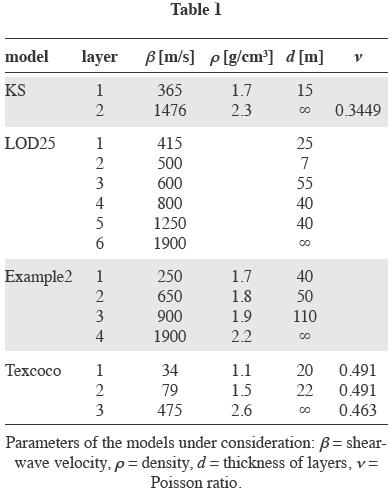
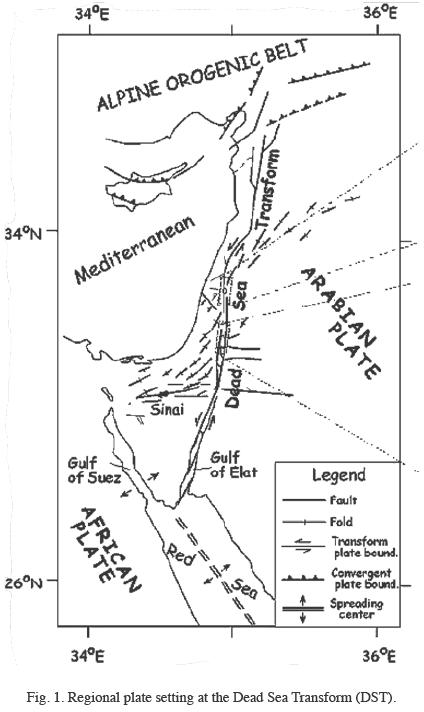
<body><![CDATA[<p align="justify"><font face="verdana" size="2">It is well&#150;known that the ellipticity of Rayleigh waves is important in applying the popular <i>H/V </i>method for the estimation of local site effects and the characterization of shallow site structure. <i>H/V </i>spectral ratios of ambient vibrations are increasingly used in investigations of local site amplifications during strong earthquakes, as ambient noise is often dominated by Rayleigh waves (Scherbaum <i>et al., </i>2003; Bard, 1998). It can be even said that the <i>H/V </i>spectral ratio technique, originally introduced by Nogoshi and Igarashi (1971), also known as Nakamura's method (Nakamura, 1989; 2009), has become the primary tool of choice in many of the ambient noise related studies (see e. g., Muciarelli <i>et al., </i>2009).</font></p>     <p align="justify"><font face="verdana" size="2">However, the fundamentals of the <i>H/V </i>technique are controversial &#91;the history and different opinions are discussed e. g., by Bonnefoy&#150;Claudet <i>et al. </i>(2006) and Petrosino (2006)&#93;. These different opinions even refer to the term <i>H/V </i>technique itself. The spectral ratio <i>H/V </i>is usually taken from ambient noise but sometimes also from earthquakes &#91;see e. g., Zschau and Parolai (2004) or Flores Estrella (2009)&#93; or artificial explosions. Following Ch&aacute;vez&#150;Garc&iacute;a (2009), microtremors can be explored in two directions: estimation of a local transfer function and estimation of the subsoil structure and from there obtain site effects by modelling. He points out that the use of <i>H/V </i>spectral ratio of microtremors to estimate a local transfer function has a weaker physical basis than spectral ratios relative to the reference site. Nevertheless, it has been successful to estimate site effects. This success has been explained by the assumption that microtremors consist of body waves &#91;see e. g., Nakamura (1989)&#93; contrary to the observation in the papers by Bard (1998) and Scherbaum <i>et al. </i>(2003) cited above. On the other hand, it is interesting to note that an explanation based on the opposite assumption that microtremors mainly consist of surface waves is also successful &#91;see e. g., F&auml;h <i>et al. </i>(2001)&#93;. This is especially true for great shear&#150;wave contrasts between layer and half&#150;space which was theoretically confirmed by Malischewsky and Scherbaum (2004). By interpreting Rayleigh waves as P and S waves with complex angles of incidence their interrelation in interpreting <i>H/V </i>spectra becomes obvious. It is not the aim of this paper to investigate these complicated ramifications of seismic wave theory, which we let to be done in a future paper. Rather, we focus on a special feature, namely on the existence of more than one peak in the <i>H/V </i>curve and demonstrate theoretically under which conditions it can be attributed to the ellipticity of Rayleigh waves alone. These considerations were carried out in the framework of an German&#150;Israelian project "Interdisciplinary study of the internal structure and current crustal deformation in the Dead Sea Transform (DST) with applications to seismic hazard in the region." The DST (see <a href="#figura1">Fig. 1</a>) is the most impressive seismically active feature in the Middle East. Return periods for large destructive earthquakes are of hundreds of years or more, but also medium&#150;large events (e. g., the 1927 Jericho earthquake with M ~ 6.2) may cause substantial damage and loss of life (see seismicity map in <a href="/img/revistas/geoint/v49n3/a4f2.jpg" target="_blank">Fig. 2</a>).</font></p>     <p align="center"><font face="verdana" size="2"><a name="figura1"></a></font></p>     <p align="center"><font face="verdana" size="2"><img src="/img/revistas/geoint/v49n3/a4f1.jpg"></font></p>     <p align="justify"><font face="verdana" size="2">Concerning <i>H/V </i>measurements in Israel, Zaslavsky <i>et </i>al. (2008) come to the conclusion: "Our results point to the fact that <i>H/V </i>spectral ratio from ambient noise adds very useful information and when integrated with other different data sources allows us to obtain a systematic picture of site effects in the investigated region. The application of this methodology is very important in Israel and probably other regions where big earthquakes present a long return period, but might exhibit a high seismic risk."</font></p>     <p align="justify"><font face="verdana" size="2">A lot of <i>H/V </i>measurements were carried out in the Lod&#150;Ramla urban area of Israel (see <a href="/img/revistas/geoint/v49n3/a4f3.jpg" target="_blank">Fig. 3</a>). They exhibit in several cases curves with more than one peak and these additional peaks are usually attributed to resonances in deeper layers. These measurements do not directly refer to the DST. However, theoretical implications derived from them have methodological character and are applicable not only for the DST zone but everywhere in the world in zones with high seismic risk including the valley of Mexico City.</font></p>     <p align="justify"><font face="verdana" size="2">After theoretical considerations in next chapter we will present and discuss measurements from the urban Lod&#150;Ramla area mentioned above, from the northern part of the DST, the Mehola test site (see <a href="/img/revistas/geoint/v49n3/a4f3.jpg" target="_blank">Fig. 3</a>) and from the valley of Mexico, D. F. (see <a href="#figura12">Fig.12</a>). The parameters of the considered models, so far available, are summarized in <a href="#tabla1">Table 1</a>. They come partly from borehole measurements and were now and then changed and simplified for our theoretical requirements.</font></p>     <p align="center"><font face="verdana" size="2"><a name="tabla1"></a></font></p>     <p align="center"><font face="verdana" size="2"><img src="/img/revistas/geoint/v49n3/a4t1.jpg"></font></p>     <p align="center"><font face="verdana" size="2">&nbsp;</font></p>     ]]></body>
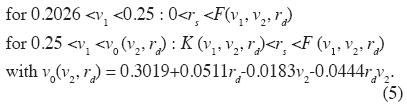
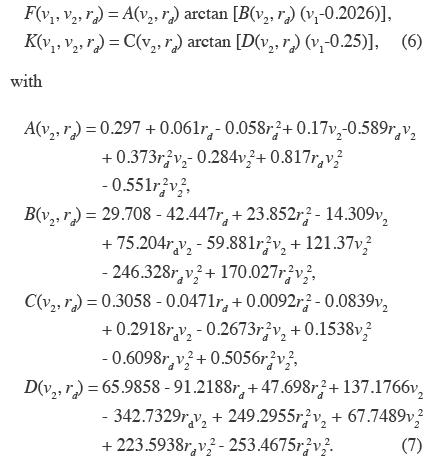
<body><![CDATA[<p align="justify"><font face="verdana" size="2"><b>Two peaks of the Rayleigh&#150;wave ellipticity <i>(H/V) </i>in a model "Layer over Half&#150;Space (LOH)"</b></font></p>     <p align="justify"><font face="verdana" size="2">An useful starting point for the following considerations is the exact formula for the ellipticity <i>&chi; </i>= H/V of the Rayleigh fundamental mode according to Malischewsky and Scherbaum (2004) which yields <i>&chi; </i>as a function of the layer and half&#150;space parameters, and the non&#150;dimensional frequency <img src="/img/revistas/geoint/v49n3/a4e1.jpg">:</font></p>     <p align="center"><font face="verdana" size="2"><img src="/img/revistas/geoint/v49n3/a4e2.jpg"></font></p>     <p align="justify"><font face="verdana" size="2">In particular <i>r<sub>s</sub> </i>= <i>&beta;<sub>1</sub>/&beta;<sub>2</sub> </i>is the ratio of shear&#150;wave velocities between layer (<i>&beta;<sub>1</sub></i>) and half&#150;space (<i>&beta;<sub>2</sub></i>), r<sub>d</sub>=&rho;<sub>1</sub>/ &rho;<sub>2</sub> is the density contrast and <i>v</i><sub>1</sub> and <i>v</i><sub>2</sub> are the Poisson ratios of the layer and Half&#150;space, respectively. The non&#150;dimensional frequency is defined by <i> <img src="/img/revistas/geoint/v49n3/a4e1.jpg"></i>= d/&lambda;<sub>&beta;1</sub>, with the layer thickness <i>d </i>and the shear&#150;wave length in the layer <i>&lambda;<sub>&beta;1</sub> . </i>The complicated formula (1) can be found at Malischewsky and Scherbaum (2004) or Malischewsky <i>et al. </i>(2006). Usually it is assumed for the model "1 layer over half&#150;space (LOH)" that &chi; as a function of frequency has one peak or one maximum depending on the material parameters whereas a model with 2 layers over a half&#150;space may have two peaks &#91;see e. g., Wathelet <i>et al. </i>(2004)&#93;. However, a more careful theoretical analysis exhibits also two peaks for a 1&#150;layer model within a certain parameter range. <a href="/img/revistas/geoint/v49n3/a4f4.jpg" target="_blank">Fig. 4</a> presents two 3D&#150;pictures of &chi; for a simplified 1&#150;layer model of the Israelian test site Kyriat Shmona (see <a href="/img/revistas/geoint/v49n3/a4f3.jpg" target="_blank">Fig. 3</a>) in dependence on <i>v</i><sub>1</sub> and <i>f </i>with different ViewPoints. <a href="/img/revistas/geoint/v49n3/a4f4.jpg" target="_blank">Fig. 4a</a> better demonstrates the transition from one maximum of &chi; to two peaks, and <a href="/img/revistas/geoint/v49n3/a4f4.jpg" target="_blank">Fig. 4b</a> clearer shows the special <i>v</i><sub>1</sub> range with two peaks.</font></p>     <p align="justify"><font face="verdana" size="2">Additionally, we present, in <a href="/img/revistas/geoint/v49n3/a4f5.jpg" target="_blank">Fig. 5</a>, a 2D picture with the dependence of  <img src="/img/revistas/geoint/v49n3/a4e1.jpg"> for the primary and secondary peak or the maximum, against <i>v</i><sub>1</sub>.</font></p>     <p align="justify"><font face="verdana" size="2">By varying the shear contrast <i>r </i>of the model we are able to demonstrate the (<i>v</i><sub>1</sub>, <i>r<sub>s</sub></i>) domain for two peaks in the LOH&#150;model (see <a href="/img/revistas/geoint/v49n3/a4f6.jpg" target="_blank">Fig. 6</a>). The <i>v</i><sub>1</sub> range is maximum for <i>r<sub>s</sub> </i>= 0; i. e., for a layer with fixed bottom (LFB), and ceases to exist for <i>r<sub>s</sub> </i>&gt;0.36.</font></p>     <p align="justify"><font face="verdana" size="2">Tran, (2009) has found a necessary and sufficient condition for the existence of two peaks for the LFB&#150;model (compare with <a href="/img/revistas/geoint/v49n3/a4f6.jpg" target="_blank">Fig. 6</a>), which is</font></p>     <p align="center"><font face="verdana" size="2"><img src="/img/revistas/geoint/v49n3/a4e3.jpg"></font></p>     <p align="justify"><font face="verdana" size="2">The number 0.2026 is a solution of the equation</font></p>     <p align="center"><font face="verdana" size="2"><img src="/img/revistas/geoint/v49n3/a4e4.jpg"></font></p>     ]]></body>
<body><![CDATA[<p align="justify"><font face="verdana" size="2">with</font></p>     <p align="center"><font face="verdana" size="2"><img src="/img/revistas/geoint/v49n3/a4e5.jpg"></font></p>     <p align="justify"><font face="verdana" size="2">For this model, the frequency of the first peak is always <img src="/img/revistas/geoint/v49n3/a4e1.jpg"><sub>1</sub> = 0.25 (resonance frequency!) and of the second peak</font></p>     <p align="center"><font face="verdana" size="2"><img src="/img/revistas/geoint/v49n3/a4e6.jpg"></font></p>     <p align="justify"><font face="verdana" size="2">The situation is more complicated for the model LOH. Following Tran (2009), the necessary and sufficient conditions for the existence of two peaks in this case are:</font></p>     <p align="center"><font face="verdana" size="2"><img src="/img/revistas/geoint/v49n3/a4e7.jpg"></font></p>     <p align="justify"><font face="verdana" size="2">These conditions were obtained numerically and the functions <i>F </i>and <i>K </i>are given by</font></p>     <p align="center"><font face="verdana" size="2"><img src="/img/revistas/geoint/v49n3/a4e8.jpg"></font></p>     <p align="justify"><font face="verdana" size="2">While function <i>F </i>is comparatively precise (its error is less than 1&#150;2 %), the error of <i>K </i>can be up to 5 &chi; in some cases. The critical Poisson ratio varies according to (5) within the bounds:</font></p>     <p align="center"><font face="verdana" size="2"><img src="/img/revistas/geoint/v49n3/a4e9.jpg"></font></p>     ]]></body>
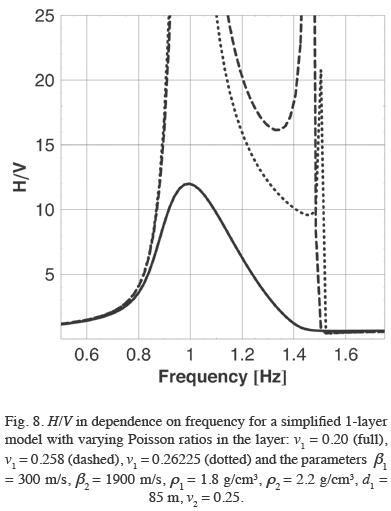
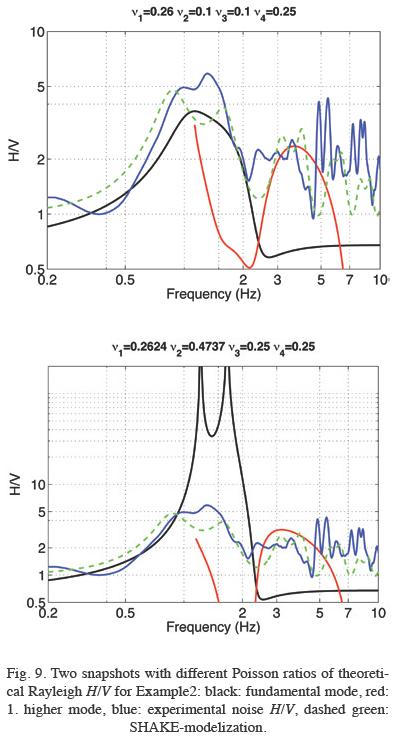
<body><![CDATA[<p align="justify"><font face="verdana" size="2">This estimation was obtained by assuming 0.3 &lt; <i>r<sub>d</sub> </i>&lt; 0.9 and 0 &lt; <i>v</i><sub>2</sub> &lt; 0.5 and it indicates that the influence of <i>v</i><sub>2 </sub>and <i>r<sub>d</sub> </i>is not negligible.</font></p>     <p align="justify"><font face="verdana" size="2">&nbsp;</font></p>     <p align="justify"><font face="verdana" size="2"><b>Some Measurements and numerical simulations</b></font></p>     <p align="justify"><font face="verdana" size="2">The area of Lod&#150;Ramla (see <a href="/img/revistas/geoint/v49n3/a4f3.jpg" target="_blank">Fig. 3</a>) was shaken by the last destructive earthquake on July 11, 1927 nearby Jericho with Richter magnitude about 6.3 or a seismic intensity of VIII on the MSK scale and caused the destruction of a great part of these towns. It can be assumed that such a high intensity from a relatively distant earthquake was probably the result of local site effects, which is very similar to the disastrous earthquake in Mexico City on 19 September; 1985. Site response studies by using ambient vibrations in that area were carried out by Zaslavsky <i>et al. </i>(2005). Quite a few of these <i>H/V </i>spectral ratios exhibit more than one peak or maximum. <a href="/img/revistas/geoint/v49n3/a4f7.jpg" target="_blank">Fig. 7</a> shows two examples.</font></p>     <p align="justify"><font face="verdana" size="2">We realize in <a href="/img/revistas/geoint/v49n3/a4f7.jpg" target="_blank">Fig. 7a</a> a splitted maximum at 0.9 Hz and 1.2 Hz, respectively, and another maximum is not very well visible between 3 and 4 Hz. The typical shape with two close peaks between 0.9 and 1.4 Hz can be seen in the noise <i>H/V, </i>in the transfer function and in the <i>H/V </i>spectral ratio of a Red Sea earthquake as well. The second peak at 1.4 Hz is most likely caused by an intermediate hard layer in the subsurface, at the very least is this one possibility of explanation. <a href="/img/revistas/geoint/v49n3/a4f7.jpg" target="_blank">Fig. 7b</a> shows clearly two maxima at 1.2 and 3.5 Hz. The modelization with SH waves with the SHAKE program &#91;see Schnabel <i>et al. </i>(1972)&#93; is moderate for Example2 and excellent for Lod25. If we use a simplified 1&#150;layer model with high shear&#150;wave contrast and varying Poisson ratios in the layer, we observe a behaviour as in <a href="#figura8">Fig. 8</a> in agreement with our theory. The main peak is stable at 0.9 Hz because of the big shear&#150;wave contrast, but for certain Poisson ratios in the layer a secondary peak appears at 1.5 Hz.</font></p>     <p align="center"><font face="verdana" size="2"><a name="figura8"></a></font></p>     <p align="center"><font face="verdana" size="2"><img src="/img/revistas/geoint/v49n3/a4f8.jpg"></font></p>     <p align="justify"><font face="verdana" size="2">Now we try a modelization on the basis of multilayer models and Rayleigh<i>&#150;H/V </i>by varying the Poisson ratios in the layers and present some snapshots for Example2 in <a href="#figura9">Fig. 9</a> and for Lod25 in <a href="/img/revistas/geoint/v49n3/a4f10.jpg" target="_blank">Fig. 10</a>.</font></p>     <p align="center"><font face="verdana" size="2"><a name="figura9"></a></font></p>     <p align="center"><font face="verdana" size="2"><img src="/img/revistas/geoint/v49n3/a4f9.jpg"></font></p>     ]]></body>
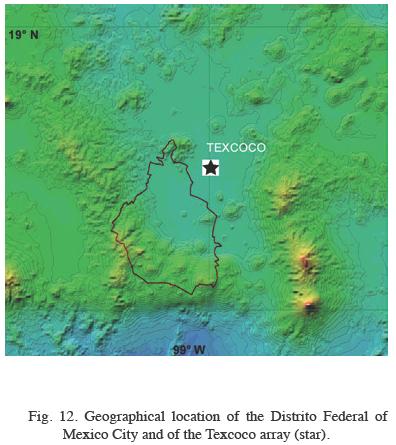
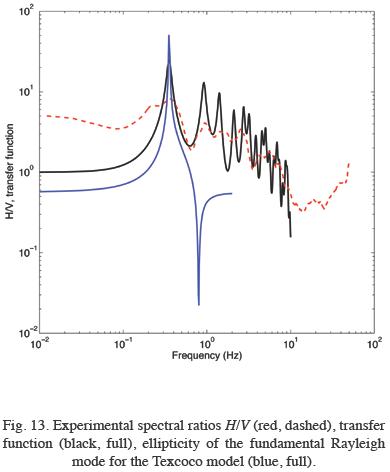
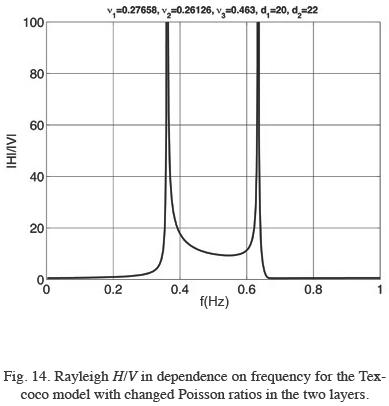
<body><![CDATA[<p align="justify"><font face="verdana" size="2">We see from <a href="#figura9">Fig. 9a</a> that the first maximum can be explained by Rayleigh's fundamental mode as well and the second maximum by the first higher mode. Further we realize that a certain splitting of the first maximum is observed for the snapshot parameters in <a href="#figura8">Fig. 8b</a>, but on an other amplitude level. However, the difficulties with the amplitude of <i>H/V </i>are well known.</font></p>     <p align="justify"><font face="verdana" size="2">Similar tendencies can be observed in the three snapshots for the location Lod25 in <a href="/img/revistas/geoint/v49n3/a4f10.jpg" target="_blank">Fig. 10</a>. The snapshot top left shows a very good coincidence between the experimental values and the Rayleigh modelization for the first maximum and the fundamental mode and for the position of the second maximum concerning the frequency with the 1<sup>st</sup> higher mode.</font></p>     <p align="justify"><font face="verdana" size="2">The so&#150;called Mehola experiment with artificial explosions, was carried out in 2004. The investigated area (see <a href="/img/revistas/geoint/v49n3/a4f3.jpg" target="_blank">Fig. 3</a>) is situated in the structural saddle between the Kinneret&#150;Bet Shean graben and Damia graben corresponding to the intersection of the DST and SE extension of the Yagur fault system. It is characterized by loose sediments &#91;exposed alluvium (gravels and soil) and Lisan Formation&#93; in the upper layer of 0 to 50 m thickness overlying hard carbonates of Late Cretaceous&#150;Eocene age. We have analyzed the data collected at stations 1, 2, and 3 in this region by using the software package SESARRAY of the European commission Site Effects assessment using Ambient Excitations (SESAME) SESAME (2005). The explosions and the noise in the time series were processed separately and example curves are presented separately for station 3 in <a href="/img/revistas/geoint/v49n3/a4f11.jpg" target="_blank">Fig. 11</a>.</font></p>     <p align="justify"><font face="verdana" size="2">The comparatively good agreement between the explosion and noise curves is noteworthy. Further we realize that between 2.5 and 4.3 Hz two maxima appear in outlines.</font></p>     <p align="justify"><font face="verdana" size="2">A lot of <i>H/V </i>measurements were carried out in the valley of Mexico City. As is known, this region has a very high seismic hazard and on the other hand it is an unique region worldwide with an extremely high Poisson ratio (nearby 0.5) in the uppermost layer. We present here only one recent example from the interpretation of measurements in the Texcoco array (see <a href="#figura12">Fig. 12</a>) by Flores&#150;Estrella (2009). Eight events from the time interval 1998&#150;2004 with magnitudes 5.9&#150;7.6 and epicentral distances 266&#150;561 km were analyzed. The time window extended 80 s from the arrival of S waves including some surface waves as well. <a href="#figura13">Fig. 13</a> shows the experimental <i>H/V </i>results together with the theoretical transfer function and our surface&#150;wave <i>H/V </i>modelization with the assumed model parameters from <a href="#tabla1">Table 1</a>.</font></p>     <p align="center"><font face="verdana" size="2"><a name="figura12"></a></font></p>     <p align="center"><font face="verdana" size="2"><img src="/img/revistas/geoint/v49n3/a4f12.jpg"></font></p>     <p align="center"><font face="verdana" size="2"><a name="figura13"></a></font></p>     <p align="center"><font face="verdana" size="2"><img src="/img/revistas/geoint/v49n3/a4f13.jpg"></font></p>     <p align="justify"><font face="verdana" size="2">We see a very good agreement for the main maximum between the experimental curve, the transfer function, and the Rayleigh&#150;wave ellipticity of the fundamental mode. The stable agreement between the transfer function and the Rayleigh&#150;wave ellipticity is well known for high impedance contrasts between sediment and bedrock. Concerning the other maxima it is clear that <i>H/V </i>of the fundamental Rayleigh mode does not contain them because of the extremely high Poisson ratio of the uppermost layers in the Texcoco region. If we would diminish Poisson's ratio artificially, we can obtain two maxima in agreement with our theory (see <a href="#figura14">Fig. 14</a>).</font></p>     ]]></body>
<body><![CDATA[<p align="center"><font face="verdana" size="2"><a name="figura14"></a></font></p>     <p align="center"><font face="verdana" size="2"><img src="/img/revistas/geoint/v49n3/a4f14.jpg"></font></p>     <p align="justify"><font face="verdana" size="2">The position of the first peak is more or less stable, but the second maximum does not fall into a region where we would wait for another maximum. We have not analyzed the contribution of higher Rayleigh modes for the other maxima of the Texcoco model, which may be important.</font></p>     <p align="justify"><font face="verdana" size="2">&nbsp;</font></p>     <p align="justify"><font face="verdana" size="2"><b>Discussion and conclusions</b></font></p>     <p align="justify"><font face="verdana" size="2">The application of the <i>H/V </i>method is without doubt important for such regions with medium or high seismic risk as Israel and surrounding regions, and Mexico. We have realized that there is a very definite parameter interval in which the theoretical spectral ratio <i>H/V </i>of the fundamental Rayleigh mode has two peaks for the model LOH. On the other hand, many observations, from which we specify only a few, exhibit several peaks. Obviously, the simple LOH model is not complex enough to explain the latter ones for the examples under discussion. Here, more complex models and higher modes as in <a href="#figura9">Fig. 9</a> are necessary. Our intention is to sensitize the seismological community for the phenomenon of more than one peak or maximum of the ellipticity of Rayleigh waves as a function of frequency, which was only marginally considered so far. Naturally, such a consideration has to start with very simple structural models and then swich over to more complex ones. The very simple model of an impedance surface can produce under certain circumstances a weak maximum of <i>H/V </i>only &#91;see Malischewsky <i>et al. </i>(2008)&#93;. The simplest model being able to generate two peaks for certain model parameters is LOH, which was analyzed here. The existence and position of these secondary peaks is very sensitive to changes of Poisson's ratio. So this conception of two or more peaks for Rayleigh <i>H/V </i>in comparison with measurements can yield constraints especially for Poisson ratios, which are otherwise less controlled. The same is true when considering the changing range of prograde Rayleigh motion, which was already carried out for the Mexico basin and the Israelian test site Kyriat Shmona as well &#91;see Malischewsky <i>et al. </i>(2006, 2008)&#93;.</font></p>     <p align="justify"><font face="verdana" size="2">&nbsp;</font></p>     <p align="justify"><font face="verdana" size="2"><b>Acknowledgements</b></font></p>     <p align="justify"><font face="verdana" size="2">The support in providing the data material of the Mehola test site of Michael Kalmanowich and Yefim Gitterman is kindly acknowledged.</font></p>     <p align="justify"><font face="verdana" size="2">PGM and VP gratefully acknowledge the support of Bundesministerium f&uuml;r Bildung und Forschung (BMBF) in the framework of the joint project "WTZ Germany&#150;Israel: System Earth" under Grant No. 03F0448A. Tran Thanh Tuan acknowledges the support of VNU in the framework of the QT project.</font></p>     ]]></body>
<body><![CDATA[<p align="justify"><font face="verdana" size="2">&nbsp;</font></p>     <p align="justify"><font face="verdana" size="2"><b>Bibliography</b></font></p>     <!-- ref --><p align="justify"><font face="verdana" size="2">Bard, P.&#150; Y., 1998. Microtremor measurements: A tool for site effect estimation. Proc. Of the second International Symposium on the Effect of Surface Geology on Seismic Motion, Yokohama, Japan, 1&#150;3 Dec, 1998, pp. 25&#150;33.    &nbsp;&nbsp;&nbsp;&nbsp;&nbsp;&nbsp;&nbsp;&nbsp;[&#160;<a href="javascript:void(0);" onclick="javascript: window.open('/scielo.php?script=sci_nlinks&ref=3909742&pid=S0016-7169201000030000400001&lng=','','width=640,height=500,resizable=yes,scrollbars=1,menubar=yes,');">Links</a>&#160;]<!-- end-ref --></font></p>     <!-- ref --><p align="justify"><font face="verdana" size="2">Bonnefoy&#150;Claudet, S. F., Cotton and P.&#150;Y. Bard, 2006. The nature of noise wavefield and its applications for site effect studies. A literature review. <i>Earth Science Reviews, 79, </i>205&#150;227.    &nbsp;&nbsp;&nbsp;&nbsp;&nbsp;&nbsp;&nbsp;&nbsp;[&#160;<a href="javascript:void(0);" onclick="javascript: window.open('/scielo.php?script=sci_nlinks&ref=3909744&pid=S0016-7169201000030000400002&lng=','','width=640,height=500,resizable=yes,scrollbars=1,menubar=yes,');">Links</a>&#160;]<!-- end-ref --></font></p>     <!-- ref --><p align="justify"><font face="verdana" size="2">Ch&aacute;vez&#150;Garc&iacute;a, F. J., 2009. Ambient noise and site response: from estimation of site effects to determination of the subsoil structure, In: Mucciarelli, M., M. Herak and J. Cassidi (Ed.): Increasing Seismic Safety by Combining Engineering Technologies and Seismological Data, Springer, Dordrecht, 53&#150;71.    &nbsp;&nbsp;&nbsp;&nbsp;&nbsp;&nbsp;&nbsp;&nbsp;[&#160;<a href="javascript:void(0);" onclick="javascript: window.open('/scielo.php?script=sci_nlinks&ref=3909746&pid=S0016-7169201000030000400003&lng=','','width=640,height=500,resizable=yes,scrollbars=1,menubar=yes,');">Links</a>&#160;]<!-- end-ref --></font></p>     <!-- ref --><p align="justify"><font face="verdana" size="2">F&auml;h, D., F. Kind and D. Giardini, 2001. A theoretical investigation of average H/V ratios. <i>Geophys. J. Int., 145, </i>535&#150;549.    &nbsp;&nbsp;&nbsp;&nbsp;&nbsp;&nbsp;&nbsp;&nbsp;[&#160;<a href="javascript:void(0);" onclick="javascript: window.open('/scielo.php?script=sci_nlinks&ref=3909748&pid=S0016-7169201000030000400004&lng=','','width=640,height=500,resizable=yes,scrollbars=1,menubar=yes,');">Links</a>&#160;]<!-- end-ref --></font></p>     ]]></body>
<body><![CDATA[<!-- ref --><p align="justify"><font face="verdana" size="2">Flores Estrella, H. C., 2009. The wave field in the Lake&#150;Texcoco zone: implications for the study of seismic risc in the lake zone of the Mexico basin (in Spanish), PhD thesis, UNAM.    &nbsp;&nbsp;&nbsp;&nbsp;&nbsp;&nbsp;&nbsp;&nbsp;[&#160;<a href="javascript:void(0);" onclick="javascript: window.open('/scielo.php?script=sci_nlinks&ref=3909750&pid=S0016-7169201000030000400005&lng=','','width=640,height=500,resizable=yes,scrollbars=1,menubar=yes,');">Links</a>&#160;]<!-- end-ref --></font></p>     <!-- ref --><p align="justify"><font face="verdana" size="2">Malischewsky, P. G. and F. Scherbaum, 2004. Love's formula and H/V&#150;ratio (ellipticity) of Rayleigh waves. <i>Wave Motion, 40, </i>57&#150;67.    &nbsp;&nbsp;&nbsp;&nbsp;&nbsp;&nbsp;&nbsp;&nbsp;[&#160;<a href="javascript:void(0);" onclick="javascript: window.open('/scielo.php?script=sci_nlinks&ref=3909752&pid=S0016-7169201000030000400006&lng=','','width=640,height=500,resizable=yes,scrollbars=1,menubar=yes,');">Links</a>&#160;]<!-- end-ref --></font></p>     <!-- ref --><p align="justify"><font face="verdana" size="2">Malischewsky, P. G., C. Lomnitz, F. Wuttke and R. Saragoni, 2006. Prograde Rayleigh&#150;wave motion in the valley of Mexico. <i>Geof&iacute;sica Internacional, 45, </i>149&#150;162.    &nbsp;&nbsp;&nbsp;&nbsp;&nbsp;&nbsp;&nbsp;&nbsp;[&#160;<a href="javascript:void(0);" onclick="javascript: window.open('/scielo.php?script=sci_nlinks&ref=3909754&pid=S0016-7169201000030000400007&lng=','','width=640,height=500,resizable=yes,scrollbars=1,menubar=yes,');">Links</a>&#160;]<!-- end-ref --></font></p>     <!-- ref --><p align="justify"><font face="verdana" size="2">Malischewsky, P. G., F. Scherbaum, C. Lomnitz, Tran Thanh Tuan, F. Wuttke and G. Shamir, 2008. The domain of existence of prograde Rayleigh&#150;wave particle motion for simple models. <i>Wave Motion, 45, </i>556&#150;564.    &nbsp;&nbsp;&nbsp;&nbsp;&nbsp;&nbsp;&nbsp;&nbsp;[&#160;<a href="javascript:void(0);" onclick="javascript: window.open('/scielo.php?script=sci_nlinks&ref=3909756&pid=S0016-7169201000030000400008&lng=','','width=640,height=500,resizable=yes,scrollbars=1,menubar=yes,');">Links</a>&#160;]<!-- end-ref --></font></p>     <!-- ref --><p align="justify"><font face="verdana" size="2">Muciarelli, M., M. Herak and J. Cassidi (Ed.), 2009. Increasing Seismic Safety by Combining Engineering Technologies and Seismological Data, Springer, Dordrecht.    &nbsp;&nbsp;&nbsp;&nbsp;&nbsp;&nbsp;&nbsp;&nbsp;[&#160;<a href="javascript:void(0);" onclick="javascript: window.open('/scielo.php?script=sci_nlinks&ref=3909758&pid=S0016-7169201000030000400009&lng=','','width=640,height=500,resizable=yes,scrollbars=1,menubar=yes,');">Links</a>&#160;]<!-- end-ref --></font></p>     ]]></body>
<body><![CDATA[<!-- ref --><p align="justify"><font face="verdana" size="2">Nakamura, Y., 1989. A method for dynamic characteristics estimation of subsurface using microtremor on the ground surface, <i>Quarterly Report of RTRI, 30, </i>25&#150;33.    &nbsp;&nbsp;&nbsp;&nbsp;&nbsp;&nbsp;&nbsp;&nbsp;[&#160;<a href="javascript:void(0);" onclick="javascript: window.open('/scielo.php?script=sci_nlinks&ref=3909760&pid=S0016-7169201000030000400010&lng=','','width=640,height=500,resizable=yes,scrollbars=1,menubar=yes,');">Links</a>&#160;]<!-- end-ref --></font></p>     <!-- ref --><p align="justify"><font face="verdana" size="2">Nakamura, Y., 2009. Basic structure of QTS (HVSR) and examples of applications, In: : Mucciarelli, M., M. Herak and J. Cassidi (Ed.): Increasing Seismic Safety by Combining Engineering Technologies and Seismological Data, Springer, Dordrecht, 33&#150;51.    &nbsp;&nbsp;&nbsp;&nbsp;&nbsp;&nbsp;&nbsp;&nbsp;[&#160;<a href="javascript:void(0);" onclick="javascript: window.open('/scielo.php?script=sci_nlinks&ref=3909762&pid=S0016-7169201000030000400011&lng=','','width=640,height=500,resizable=yes,scrollbars=1,menubar=yes,');">Links</a>&#160;]<!-- end-ref --></font></p>     <!-- ref --><p align="justify"><font face="verdana" size="2">Nogoshi, M. and T. Igarashi, 1971. On the amplitude characteristics of microtremor (part 2) (in Japanese with English abstract). <i>J. of Seismol. Soc. of Japan, 24, </i>26&#150;40.    &nbsp;&nbsp;&nbsp;&nbsp;&nbsp;&nbsp;&nbsp;&nbsp;[&#160;<a href="javascript:void(0);" onclick="javascript: window.open('/scielo.php?script=sci_nlinks&ref=3909764&pid=S0016-7169201000030000400012&lng=','','width=640,height=500,resizable=yes,scrollbars=1,menubar=yes,');">Links</a>&#160;]<!-- end-ref --></font></p>     <!-- ref --><p align="justify"><font face="verdana" size="2">Petrosino, S., 2006. Attenuation and velocity structure in the area of Pozzuoli&#150;Solfatara (Campi Flegrei, Italy) for the estimate of local site response, PhD thesis, Universit&agrave; degli Studi di Napoli "Federico II".    &nbsp;&nbsp;&nbsp;&nbsp;&nbsp;&nbsp;&nbsp;&nbsp;[&#160;<a href="javascript:void(0);" onclick="javascript: window.open('/scielo.php?script=sci_nlinks&ref=3909766&pid=S0016-7169201000030000400013&lng=','','width=640,height=500,resizable=yes,scrollbars=1,menubar=yes,');">Links</a>&#160;]<!-- end-ref --></font></p>     <!-- ref --><p align="justify"><font face="verdana" size="2">Scherbaum, F., K.&#150;G. Hinzen and M. Ohrnberger, 2003. Determination of shallow shear wave velocity profiles in the Cologne/Germany area using ambient vibrations, <i>Geophys. J. Int., 152, </i>597&#150;612.    &nbsp;&nbsp;&nbsp;&nbsp;&nbsp;&nbsp;&nbsp;&nbsp;[&#160;<a href="javascript:void(0);" onclick="javascript: window.open('/scielo.php?script=sci_nlinks&ref=3909768&pid=S0016-7169201000030000400014&lng=','','width=640,height=500,resizable=yes,scrollbars=1,menubar=yes,');">Links</a>&#160;]<!-- end-ref --></font></p>     ]]></body>
<body><![CDATA[<!-- ref --><p align="justify"><font face="verdana" size="2">Schnabel P. B., J. Lysmer, H. B. Seed, 1972. SHAKE: a computer program for earthquake response analysis of horizontally layered sites. Report No. EERC72&#150;12, University of California, Berkeley.    &nbsp;&nbsp;&nbsp;&nbsp;&nbsp;&nbsp;&nbsp;&nbsp;[&#160;<a href="javascript:void(0);" onclick="javascript: window.open('/scielo.php?script=sci_nlinks&ref=3909770&pid=S0016-7169201000030000400015&lng=','','width=640,height=500,resizable=yes,scrollbars=1,menubar=yes,');">Links</a>&#160;]<!-- end-ref --></font></p>     <!-- ref --><p align="justify"><font face="verdana" size="2">SESAME, 2005. Guidelines for the implementation of the <i>H/V </i>spectral ratio technique on ambient vibration measurements and interpretation. Deliverable D23.12, University of Potsdam, <a href="http://sesame-fp5.obs.ujf-grenoble.fr/SES_Reports.htm" target="_blank">http://sesame&#150;fp5.obs.ujf&#150;grenoble.fr/SES_Reports.htm</a> .    &nbsp;&nbsp;&nbsp;&nbsp;&nbsp;&nbsp;&nbsp;&nbsp;[&#160;<a href="javascript:void(0);" onclick="javascript: window.open('/scielo.php?script=sci_nlinks&ref=3909772&pid=S0016-7169201000030000400016&lng=','','width=640,height=500,resizable=yes,scrollbars=1,menubar=yes,');">Links</a>&#160;]<!-- end-ref --></font></p>     <!-- ref --><p align="justify"><font face="verdana" size="2">Tran, T. T., 2009. The ellipticity (H/V&#150;ratio) of Rayleigh surface waves, PhD thesis, Friedrich&#150;Schiller&#150;Universitât Jena.    &nbsp;&nbsp;&nbsp;&nbsp;&nbsp;&nbsp;&nbsp;&nbsp;[&#160;<a href="javascript:void(0);" onclick="javascript: window.open('/scielo.php?script=sci_nlinks&ref=3909774&pid=S0016-7169201000030000400017&lng=','','width=640,height=500,resizable=yes,scrollbars=1,menubar=yes,');">Links</a>&#160;]<!-- end-ref --></font></p>     <!-- ref --><p align="justify"><font face="verdana" size="2">Wathelet, M., D. Jongmans and M. Ohrnberger, 2004. Surface&#150;wave inversion using a direct search algorithm and its application to ambient vibration measurements, <i>Near Surface Geophysics, 2, </i>211&#150;221.    &nbsp;&nbsp;&nbsp;&nbsp;&nbsp;&nbsp;&nbsp;&nbsp;[&#160;<a href="javascript:void(0);" onclick="javascript: window.open('/scielo.php?script=sci_nlinks&ref=3909776&pid=S0016-7169201000030000400018&lng=','','width=640,height=500,resizable=yes,scrollbars=1,menubar=yes,');">Links</a>&#160;]<!-- end-ref --></font></p>     <!-- ref --><p align="justify"><font face="verdana" size="2">Zaslavsky, Y., A. Shapira, M. Gorstein, M. Kalmanovich, V. Giller, N. Perelman, I. Livshits, D. Giller and I. Dan, 2005, <i>Bulletin of Earthquake Engineering, 3, </i>355&#150;381.    &nbsp;&nbsp;&nbsp;&nbsp;&nbsp;&nbsp;&nbsp;&nbsp;[&#160;<a href="javascript:void(0);" onclick="javascript: window.open('/scielo.php?script=sci_nlinks&ref=3909778&pid=S0016-7169201000030000400019&lng=','','width=640,height=500,resizable=yes,scrollbars=1,menubar=yes,');">Links</a>&#160;]<!-- end-ref --></font></p>     ]]></body>
<body><![CDATA[<!-- ref --><p align="justify"><font face="verdana" size="2">Zaslavsky, Y., G. Ataev, M. Gorstein, M. Kalmanovich, N. Perelman and A. Shapira, 2008. Assessment of site specific earthquake hazards in urban areas. A case study: the town Afula, Israel, and neighbouring settlements. <i>Bollettino di Geofsica Teorica ed Applicata, 49, </i>93&#150;108.    &nbsp;&nbsp;&nbsp;&nbsp;&nbsp;&nbsp;&nbsp;&nbsp;[&#160;<a href="javascript:void(0);" onclick="javascript: window.open('/scielo.php?script=sci_nlinks&ref=3909780&pid=S0016-7169201000030000400020&lng=','','width=640,height=500,resizable=yes,scrollbars=1,menubar=yes,');">Links</a>&#160;]<!-- end-ref --></font></p>     <!-- ref --><p align="justify"><font face="verdana" size="2">Zschau, J. and S. Parolai, 2004. Studying earthquake site effects in urban areas: the example of Cologne (Germany). Taller Humboldt para la Cooperaci&oacute;n M&eacute;xico&#150;Alemania (Humboldt&#150;Workshop), Juriquilla, Qto., Mexico 2004.    &nbsp;&nbsp;&nbsp;&nbsp;&nbsp;&nbsp;&nbsp;&nbsp;[&#160;<a href="javascript:void(0);" onclick="javascript: window.open('/scielo.php?script=sci_nlinks&ref=3909782&pid=S0016-7169201000030000400021&lng=','','width=640,height=500,resizable=yes,scrollbars=1,menubar=yes,');">Links</a>&#160;]<!-- end-ref --></font></p>      ]]></body><back>
<ref-list>
<ref id="B1">
<nlm-citation citation-type="confpro">
<person-group person-group-type="author">
<name>
<surname><![CDATA[Bard]]></surname>
<given-names><![CDATA[P.- Y.]]></given-names>
</name>
</person-group>
<source><![CDATA[Microtremor measurements: A tool for site effect estimation]]></source>
<year>1998</year>
<conf-name><![CDATA[ Proc. Of the second International Symposium on the Effect of Surface Geology on Seismic Motion]]></conf-name>
<conf-date>1-3 Dec, 1998</conf-date>
<conf-loc>Yokohama </conf-loc>
<page-range>25-33</page-range></nlm-citation>
</ref>
<ref id="B2">
<nlm-citation citation-type="journal">
<person-group person-group-type="author">
<name>
<surname><![CDATA[Bonnefoy-Claudet]]></surname>
<given-names><![CDATA[S. F.]]></given-names>
</name>
<name>
<surname><![CDATA[Cotton]]></surname>
</name>
<name>
<surname><![CDATA[Bard]]></surname>
<given-names><![CDATA[P.-Y.]]></given-names>
</name>
</person-group>
<article-title xml:lang="en"><![CDATA[The nature of noise wavefield and its applications for site effect studies: A literature review]]></article-title>
<source><![CDATA[Earth Science Reviews]]></source>
<year>2006</year>
<volume>79</volume>
<page-range>205-227</page-range></nlm-citation>
</ref>
<ref id="B3">
<nlm-citation citation-type="">
<person-group person-group-type="author">
<name>
<surname><![CDATA[Chávez-García]]></surname>
<given-names><![CDATA[F. J.]]></given-names>
</name>
</person-group>
<article-title xml:lang="en"><![CDATA[Ambient noise and site response: from estimation of site effects to determination of the subsoil structure]]></article-title>
<person-group person-group-type="editor">
<name>
<surname><![CDATA[Mucciarelli]]></surname>
<given-names><![CDATA[M.]]></given-names>
</name>
<name>
<surname><![CDATA[Herak]]></surname>
<given-names><![CDATA[M.]]></given-names>
</name>
<name>
<surname><![CDATA[Cassidi]]></surname>
<given-names><![CDATA[J.]]></given-names>
</name>
</person-group>
<source><![CDATA[Increasing Seismic Safety by Combining Engineering Technologies and Seismological Data]]></source>
<year>2009</year>
<page-range>53-71</page-range><publisher-loc><![CDATA[Dordrecht ]]></publisher-loc>
</nlm-citation>
</ref>
<ref id="B4">
<nlm-citation citation-type="journal">
<person-group person-group-type="author">
<name>
<surname><![CDATA[Fäh]]></surname>
<given-names><![CDATA[D.]]></given-names>
</name>
<name>
<surname><![CDATA[Kind]]></surname>
<given-names><![CDATA[F.]]></given-names>
</name>
<name>
<surname><![CDATA[Giardini]]></surname>
<given-names><![CDATA[D.]]></given-names>
</name>
</person-group>
<article-title xml:lang="en"><![CDATA[A theoretical investigation of average H/V ratios]]></article-title>
<source><![CDATA[Geophys. J. Int]]></source>
<year>2001</year>
<volume>145</volume>
<page-range>535-549</page-range></nlm-citation>
</ref>
<ref id="B5">
<nlm-citation citation-type="">
<person-group person-group-type="author">
<name>
<surname><![CDATA[Flores Estrella]]></surname>
<given-names><![CDATA[H. C.]]></given-names>
</name>
</person-group>
<source><![CDATA[The wave field in the Lake-Texcoco zone: implications for the study of seismic risc in the lake zone of the Mexico basin]]></source>
<year>2009</year>
</nlm-citation>
</ref>
<ref id="B6">
<nlm-citation citation-type="journal">
<person-group person-group-type="author">
<name>
<surname><![CDATA[Malischewsky]]></surname>
<given-names><![CDATA[P. G.]]></given-names>
</name>
<name>
<surname><![CDATA[Scherbaum]]></surname>
<given-names><![CDATA[F.]]></given-names>
</name>
</person-group>
<article-title xml:lang="en"><![CDATA[Love's formula and H/V-ratio (ellipticity) of Rayleigh waves]]></article-title>
<source><![CDATA[Wave Motion]]></source>
<year>2004</year>
<volume>40</volume>
<page-range>57-67</page-range></nlm-citation>
</ref>
<ref id="B7">
<nlm-citation citation-type="journal">
<person-group person-group-type="author">
<name>
<surname><![CDATA[Malischewsky]]></surname>
<given-names><![CDATA[P. G.]]></given-names>
</name>
<name>
<surname><![CDATA[Lomnitz]]></surname>
<given-names><![CDATA[C.]]></given-names>
</name>
<name>
<surname><![CDATA[Wuttke]]></surname>
<given-names><![CDATA[F.]]></given-names>
</name>
<name>
<surname><![CDATA[Saragoni]]></surname>
<given-names><![CDATA[R.]]></given-names>
</name>
</person-group>
<article-title xml:lang="en"><![CDATA[Prograde Rayleigh-wave motion in the valley of Mexico]]></article-title>
<source><![CDATA[Geofísica Internacional]]></source>
<year>2006</year>
<volume>45</volume>
<page-range>149-162</page-range></nlm-citation>
</ref>
<ref id="B8">
<nlm-citation citation-type="journal">
<person-group person-group-type="author">
<name>
<surname><![CDATA[Malischewsky]]></surname>
<given-names><![CDATA[P. G.]]></given-names>
</name>
<name>
<surname><![CDATA[Scherbaum]]></surname>
<given-names><![CDATA[F.]]></given-names>
</name>
<name>
<surname><![CDATA[Lomnitz]]></surname>
<given-names><![CDATA[C.]]></given-names>
</name>
<name>
<surname><![CDATA[Thanh Tuan]]></surname>
<given-names><![CDATA[Tran]]></given-names>
</name>
<name>
<surname><![CDATA[Wuttke]]></surname>
<given-names><![CDATA[F.]]></given-names>
</name>
<name>
<surname><![CDATA[Shamir]]></surname>
<given-names><![CDATA[G.]]></given-names>
</name>
</person-group>
<article-title xml:lang="en"><![CDATA[The domain of existence of prograde Rayleigh-wave particle motion for simple models]]></article-title>
<source><![CDATA[Wave Motion]]></source>
<year>2008</year>
<volume>45</volume>
<page-range>556-564</page-range></nlm-citation>
</ref>
<ref id="B9">
<nlm-citation citation-type="">
<person-group person-group-type="author">
<name>
<surname><![CDATA[Muciarelli]]></surname>
<given-names><![CDATA[M.]]></given-names>
</name>
<name>
<surname><![CDATA[Herak]]></surname>
<given-names><![CDATA[M.]]></given-names>
</name>
<name>
<surname><![CDATA[Cassidi]]></surname>
<given-names><![CDATA[J.]]></given-names>
</name>
</person-group>
<source><![CDATA[Increasing Seismic Safety by Combining Engineering Technologies and Seismological Data]]></source>
<year>2009</year>
<publisher-loc><![CDATA[Dordrecht ]]></publisher-loc>
</nlm-citation>
</ref>
<ref id="B10">
<nlm-citation citation-type="journal">
<person-group person-group-type="author">
<name>
<surname><![CDATA[Nakamura]]></surname>
<given-names><![CDATA[Y.]]></given-names>
</name>
</person-group>
<article-title xml:lang="en"><![CDATA[A method for dynamic characteristics estimation of subsurface using microtremor on the ground surface]]></article-title>
<source><![CDATA[Quarterly Report of RTRI]]></source>
<year>1989</year>
<volume>30</volume>
<page-range>25-33</page-range></nlm-citation>
</ref>
<ref id="B11">
<nlm-citation citation-type="">
<person-group person-group-type="author">
<name>
<surname><![CDATA[Nakamura]]></surname>
<given-names><![CDATA[Y.]]></given-names>
</name>
</person-group>
<article-title xml:lang="en"><![CDATA[Basic structure of QTS (HVSR) and examples of applications]]></article-title>
<person-group person-group-type="editor">
<name>
<surname><![CDATA[Mucciarelli]]></surname>
<given-names><![CDATA[M.]]></given-names>
</name>
<name>
<surname><![CDATA[Herak]]></surname>
<given-names><![CDATA[M.]]></given-names>
</name>
<name>
<surname><![CDATA[Cassidi]]></surname>
<given-names><![CDATA[J.]]></given-names>
</name>
</person-group>
<source><![CDATA[Increasing Seismic Safety by Combining Engineering Technologies and Seismological Data]]></source>
<year>2009</year>
<page-range>33-51</page-range><publisher-loc><![CDATA[Dordrecht ]]></publisher-loc>
</nlm-citation>
</ref>
<ref id="B12">
<nlm-citation citation-type="journal">
<person-group person-group-type="author">
<name>
<surname><![CDATA[Nogoshi]]></surname>
<given-names><![CDATA[M.]]></given-names>
</name>
<name>
<surname><![CDATA[Igarashi]]></surname>
<given-names><![CDATA[T.]]></given-names>
</name>
</person-group>
<article-title xml:lang="en"><![CDATA[On the amplitude characteristics of microtremor]]></article-title>
<source><![CDATA[J. of Seismol. Soc. of Japan]]></source>
<year>1971</year>
<volume>24</volume>
<page-range>26-40</page-range></nlm-citation>
</ref>
<ref id="B13">
<nlm-citation citation-type="">
<person-group person-group-type="author">
<name>
<surname><![CDATA[Petrosino]]></surname>
<given-names><![CDATA[S.]]></given-names>
</name>
</person-group>
<source><![CDATA[Attenuation and velocity structure in the area of Pozzuoli-Solfatara (Campi Flegrei, Italy) for the estimate of local site response]]></source>
<year>2006</year>
</nlm-citation>
</ref>
<ref id="B14">
<nlm-citation citation-type="journal">
<person-group person-group-type="author">
<name>
<surname><![CDATA[Scherbaum]]></surname>
<given-names><![CDATA[F.]]></given-names>
</name>
<name>
<surname><![CDATA[Hinzen]]></surname>
<given-names><![CDATA[K.-G.]]></given-names>
</name>
<name>
<surname><![CDATA[Ohrnberger]]></surname>
<given-names><![CDATA[M.]]></given-names>
</name>
</person-group>
<article-title xml:lang="en"><![CDATA[Determination of shallow shear wave velocity profiles in the Cologne/Germany area using ambient vibrations]]></article-title>
<source><![CDATA[Geophys. J. Int.]]></source>
<year>2003</year>
<volume>152</volume>
<page-range>597-612</page-range></nlm-citation>
</ref>
<ref id="B15">
<nlm-citation citation-type="book">
<person-group person-group-type="author">
<name>
<surname><![CDATA[Schnabel]]></surname>
<given-names><![CDATA[P. B.]]></given-names>
</name>
<name>
<surname><![CDATA[Lysmer]]></surname>
<given-names><![CDATA[J.]]></given-names>
</name>
<name>
<surname><![CDATA[Seed]]></surname>
<given-names><![CDATA[H. B.]]></given-names>
</name>
</person-group>
<source><![CDATA[SHAKE: a computer program for earthquake response analysis of horizontally layered sites]]></source>
<year>1972</year>
<publisher-loc><![CDATA[Berkeley ]]></publisher-loc>
<publisher-name><![CDATA[University of California]]></publisher-name>
</nlm-citation>
</ref>
<ref id="B16">
<nlm-citation citation-type="book">
<collab>SESAME</collab>
<source><![CDATA[Guidelines for the implementation of the H/V spectral ratio technique on ambient vibration measurements and interpretation]]></source>
<year>2005</year>
<publisher-name><![CDATA[University of Potsdam]]></publisher-name>
</nlm-citation>
</ref>
<ref id="B17">
<nlm-citation citation-type="">
<person-group person-group-type="author">
<name>
<surname><![CDATA[Tran]]></surname>
<given-names><![CDATA[T. T.]]></given-names>
</name>
</person-group>
<source><![CDATA[The ellipticity (H/V-ratio) of Rayleigh surface waves]]></source>
<year>2009</year>
</nlm-citation>
</ref>
<ref id="B18">
<nlm-citation citation-type="journal">
<person-group person-group-type="author">
<name>
<surname><![CDATA[Wathelet]]></surname>
<given-names><![CDATA[M.]]></given-names>
</name>
<name>
<surname><![CDATA[Jongmans]]></surname>
<given-names><![CDATA[D.]]></given-names>
</name>
<name>
<surname><![CDATA[Ohrnberger]]></surname>
<given-names><![CDATA[M.]]></given-names>
</name>
</person-group>
<article-title xml:lang="en"><![CDATA[Surface-wave inversion using a direct search algorithm and its application to ambient vibration measurements]]></article-title>
<source><![CDATA[Near Surface Geophysics]]></source>
<year>2004</year>
<volume>2</volume>
<page-range>211-221</page-range></nlm-citation>
</ref>
<ref id="B19">
<nlm-citation citation-type="journal">
<person-group person-group-type="author">
<name>
<surname><![CDATA[Zaslavsky]]></surname>
<given-names><![CDATA[Y.]]></given-names>
</name>
<name>
<surname><![CDATA[Shapira]]></surname>
<given-names><![CDATA[A.]]></given-names>
</name>
<name>
<surname><![CDATA[Gorstein]]></surname>
<given-names><![CDATA[M.]]></given-names>
</name>
<name>
<surname><![CDATA[Kalmanovich]]></surname>
<given-names><![CDATA[M.]]></given-names>
</name>
<name>
<surname><![CDATA[Giller]]></surname>
<given-names><![CDATA[V.]]></given-names>
</name>
<name>
<surname><![CDATA[Perelman]]></surname>
<given-names><![CDATA[N.]]></given-names>
</name>
<name>
<surname><![CDATA[Livshits]]></surname>
<given-names><![CDATA[I.]]></given-names>
</name>
<name>
<surname><![CDATA[Giller]]></surname>
<given-names><![CDATA[D.]]></given-names>
</name>
<name>
<surname><![CDATA[Dan]]></surname>
<given-names><![CDATA[I.]]></given-names>
</name>
</person-group>
<source><![CDATA[Bulletin of Earthquake Engineering]]></source>
<year>2005</year>
<volume>3</volume>
<page-range>355-381</page-range></nlm-citation>
</ref>
<ref id="B20">
<nlm-citation citation-type="journal">
<person-group person-group-type="author">
<name>
<surname><![CDATA[Zaslavsky]]></surname>
<given-names><![CDATA[Y.]]></given-names>
</name>
<name>
<surname><![CDATA[Ataev]]></surname>
<given-names><![CDATA[G.]]></given-names>
</name>
<name>
<surname><![CDATA[Gorstein]]></surname>
<given-names><![CDATA[M.]]></given-names>
</name>
<name>
<surname><![CDATA[Kalmanovich]]></surname>
<given-names><![CDATA[M.]]></given-names>
</name>
<name>
<surname><![CDATA[Perelman]]></surname>
<given-names><![CDATA[N.]]></given-names>
</name>
<name>
<surname><![CDATA[Shapira]]></surname>
<given-names><![CDATA[A.]]></given-names>
</name>
</person-group>
<article-title xml:lang="en"><![CDATA[Assessment of site specific earthquake hazards in urban areas. A case study: the town Afula, Israel, and neighbouring settlements]]></article-title>
<source><![CDATA[Bollettino di Geofsica Teorica ed Applicata]]></source>
<year>2008</year>
<volume>49</volume>
<page-range>93-108</page-range></nlm-citation>
</ref>
<ref id="B21">
<nlm-citation citation-type="">
<person-group person-group-type="author">
<name>
<surname><![CDATA[Zschau]]></surname>
<given-names><![CDATA[J.]]></given-names>
</name>
<name>
<surname><![CDATA[Parolai]]></surname>
<given-names><![CDATA[S.]]></given-names>
</name>
</person-group>
<source><![CDATA[Studying earthquake site effects in urban areas: the example of Cologne]]></source>
<year>2004</year>
<publisher-loc><![CDATA[Juriquilla^eQto Qto]]></publisher-loc>
</nlm-citation>
</ref>
</ref-list>
</back>
</article>