<?xml version="1.0" encoding="ISO-8859-1"?><article xmlns:mml="http://www.w3.org/1998/Math/MathML" xmlns:xlink="http://www.w3.org/1999/xlink" xmlns:xsi="http://www.w3.org/2001/XMLSchema-instance">
<front>
<journal-meta>
<journal-id>0016-7169</journal-id>
<journal-title><![CDATA[Geofísica internacional]]></journal-title>
<abbrev-journal-title><![CDATA[Geofís. Intl]]></abbrev-journal-title>
<issn>0016-7169</issn>
<publisher>
<publisher-name><![CDATA[Universidad Nacional Autónoma de México, Instituto de Geofísica]]></publisher-name>
</publisher>
</journal-meta>
<article-meta>
<article-id>S0016-71692010000200003</article-id>
<title-group>
<article-title xml:lang="en"><![CDATA[A generalized equation of state with an application to the Earth's mantle]]></article-title>
</title-group>
<contrib-group>
<contrib contrib-type="author">
<name>
<surname><![CDATA[Robles-Gutiérrez]]></surname>
<given-names><![CDATA[J. A.]]></given-names>
</name>
<xref ref-type="aff" rid="A01"/>
</contrib>
<contrib contrib-type="author">
<name>
<surname><![CDATA[Robles-Domínguez]]></surname>
<given-names><![CDATA[J. M. A.]]></given-names>
</name>
<xref ref-type="aff" rid="A01"/>
</contrib>
<contrib contrib-type="author">
<name>
<surname><![CDATA[Lomnitz]]></surname>
<given-names><![CDATA[C.]]></given-names>
</name>
<xref ref-type="aff" rid="A02"/>
</contrib>
</contrib-group>
<aff id="A01">
<institution><![CDATA[,Universidad Autónoma Metropolitana Unidad Iztapalapa ]]></institution>
<addr-line><![CDATA[Mexico City ]]></addr-line>
<country>Mexico</country>
</aff>
<aff id="A02">
<institution><![CDATA[,Universidad Nacional Autónoma de México Instituto de Geofísica ]]></institution>
<addr-line><![CDATA[Mexico City ]]></addr-line>
<country>Mexico</country>
</aff>
<pub-date pub-type="pub">
<day>00</day>
<month>06</month>
<year>2010</year>
</pub-date>
<pub-date pub-type="epub">
<day>00</day>
<month>06</month>
<year>2010</year>
</pub-date>
<volume>49</volume>
<numero>2</numero>
<fpage>77</fpage>
<lpage>82</lpage>
<copyright-statement/>
<copyright-year/>
<self-uri xlink:href="http://www.scielo.org.mx/scielo.php?script=sci_arttext&amp;pid=S0016-71692010000200003&amp;lng=en&amp;nrm=iso"></self-uri><self-uri xlink:href="http://www.scielo.org.mx/scielo.php?script=sci_abstract&amp;pid=S0016-71692010000200003&amp;lng=en&amp;nrm=iso"></self-uri><self-uri xlink:href="http://www.scielo.org.mx/scielo.php?script=sci_pdf&amp;pid=S0016-71692010000200003&amp;lng=en&amp;nrm=iso"></self-uri><abstract abstract-type="short" xml:lang="es"><p><![CDATA[En este trabajo se muestra la pertinencia de incluir en la ecuación de estado de Kamerlingh-Onnes, interacciones múltiples no aditivas de fuerzas entre partículas. Estas fuerzas son de carácter electrodinámico. A partir de la ecuación de estado así generalizada se obtienen las isotermas en la vecindad del punto crítico y del punto triple para sistemas polares o no polares. Se desarrolla el ejemplo del agua. Se generaliza la ecuación de estado para el manto desarrollada por Birch, y en particular se obtiene la compresibilidad isotérmica para el manto terrestre. Se presentan las formas que toman, bajo esta generalización, algunas leyes de la mecánica y electrodinámica.]]></p></abstract>
<abstract abstract-type="short" xml:lang="en"><p><![CDATA[This study analizes the pertinency of including in the state equation of Kamerlingh-Onnes, non additive, potentials of multiple-interactiions of particles. These forces are indeed real and of a electrodinamic character. From the state equation no gerenalized, we obtained the isotherms in the vecinity of the critical point, and of the triple point for polar (or no polar) systems. We developed the example of water. We generalized the state equation for the mantle developed by Birch, and in particular, we obtained the isothermal compressibiliy for the earth mantle. We present, the forms that, under this generalization assume several laws of classical mechanism and electrodinamics.]]></p></abstract>
<kwd-group>
<kwd lng="es"><![CDATA[Ecuación de estado]]></kwd>
<kwd lng="es"><![CDATA[fases]]></kwd>
<kwd lng="es"><![CDATA[energías no aditivas]]></kwd>
<kwd lng="es"><![CDATA[energías binarias]]></kwd>
<kwd lng="es"><![CDATA[isotermas]]></kwd>
<kwd lng="es"><![CDATA[compresibilidad isotérmica]]></kwd>
<kwd lng="en"><![CDATA[Equation of state]]></kwd>
<kwd lng="en"><![CDATA[phases]]></kwd>
<kwd lng="en"><![CDATA[non-additive energies]]></kwd>
<kwd lng="en"><![CDATA[additive binary energies]]></kwd>
<kwd lng="en"><![CDATA[isotherms]]></kwd>
<kwd lng="en"><![CDATA[isothermic compressibility]]></kwd>
</kwd-group>
</article-meta>
</front><body><![CDATA[ <p align="justify"><font face="verdana" size="4">Articles</font></p>     <p align="justify"><font face="verdana" size="2">&nbsp;</font></p>     <p align="center"><font face="verdana" size="4"><b>A generalized equation of state with an application to the Earth's mantle</b></font></p>     <p align="center"><font face="verdana" size="2">&nbsp;</font></p>     <p align="center"><font face="verdana" size="2"><b>J. A. Robles&#150;Guti&eacute;rrez<sup>1</sup><sup>*</sup>, J. M. A. Robles&#150;Dom&iacute;nguez<sup>1</sup> and C. Lomnitz<sup>2</sup></b></font></p>     <p align="center"><font face="verdana" size="2">&nbsp;</font></p>     <p align="justify"><font face="verdana" size="2"><i><sup>1 </sup>Universidad Aut&oacute;noma Metropolitana, Iztapalapa, 09340, Mexico City, Mexico.</i></font></p>     <p align="justify"><font face="verdana" size="2"><sup>2 </sup><i>Instituto de Geof&iacute;sica, Universidad Nacional Aut&oacute;noma de M&eacute;xico, Ciudad Universitaria, Del. Coyoac&aacute;n, 04510, Mexico City, Mexico. </i>* Corresponding author: <a href="mailto:nautilo68@yahoo.fr">nautilo68@yahoo.fr</a></font></p>     <p align="justify"><font face="verdana" size="2">&nbsp;</font></p>     <p align="justify"><font face="verdana" size="2">Received: June 29, 2009    ]]></body>
<body><![CDATA[<br>Accepted: February 4, 2010</font></p>     <p align="justify"><font face="verdana" size="2">&nbsp;</font></p>     <p align="justify"><font face="verdana" size="2"><b>Resumen</b></font></p>     <p align="justify"><font face="verdana" size="2">En este trabajo se muestra la pertinencia de incluir en la ecuaci&oacute;n de estado de Kamerlingh&#150;Onnes, interacciones m&uacute;ltiples no aditivas de fuerzas entre part&iacute;culas. Estas fuerzas son de car&aacute;cter electrodin&aacute;mico. A partir de la ecuaci&oacute;n de estado as&iacute; generalizada se obtienen las isotermas en la vecindad del punto cr&iacute;tico y del punto triple para sistemas polares o no polares. Se desarrolla el ejemplo del agua. Se generaliza la ecuaci&oacute;n de estado para el manto desarrollada por Birch, y en particular se obtiene la compresibilidad isot&eacute;rmica para el manto terrestre. Se presentan las formas que toman, bajo esta generalizaci&oacute;n, algunas leyes de la mec&aacute;nica y electrodin&aacute;mica.</font></p>     <p align="justify"><font face="verdana" size="2"><b>Palabras clave: </b>Ecuaci&oacute;n de estado, fases, energ&iacute;as no aditivas, energ&iacute;as binarias, isotermas, compresibilidad isot&eacute;rmica.</font></p>     <p align="justify"><font face="verdana" size="2">&nbsp;</font></p>     <p align="justify"><font face="verdana" size="2"><b>Abstract</b></font></p>     <p align="justify"><font face="verdana" size="2">This study analizes the pertinency of including in the state equation of Kamerlingh&#150;Onnes, non additive, potentials of multiple&#150;interactiions of particles. These forces are indeed real and of a electrodinamic character. From the state equation no gerenalized, we obtained the isotherms in the vecinity of the critical point, and of the triple point for polar (or no polar) systems. We developed the example of water. We generalized the state equation for the mantle developed by Birch, and in particular, we obtained the isothermal compressibiliy for the earth mantle. We present, the forms that, under this generalization assume several laws of classical mechanism and electrodinamics.</font></p>     <p align="justify"><font face="verdana" size="2"><b>Key words: </b>Equation of state, phases, non&#150;additive energies, additive binary energies, isotherms, isothermic compressibility.</font></p>     <p align="justify"><font face="verdana" size="2">&nbsp;</font></p>     ]]></body>
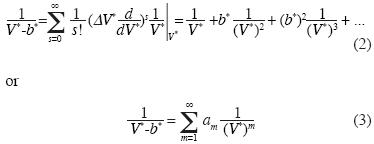
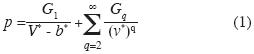
<body><![CDATA[<p align="justify"><font face="verdana" size="2"><b>Introduction</b></font></p>     <p align="justify"><font face="verdana" size="2">In an earlier paper (Robles&#150;Dominguez <i>et al</i>., 2007) we derived the equation of state for a one&#150;component fuid and in general, for a fuid of 1, 2, 3 . . . phases. This result was based on introducing inter&#150;molecular potential energies such as additive binary, non&#150;additive tertiary, non&#150;additive quaternary interactions and so on:</font></p>     <p align="center"><font face="verdana" size="2"><img src="/img/revistas/geoint/v49n2/a3e1.jpg"></font></p>     <p align="justify"><font face="verdana" size="2">where <i>p </i>is pressure on a container of volume <i>V</i>, <i>V</i>* is the molar volume, <i>b</i>* is the molar volume of all molecules, <i>G</i><sub>1</sub> , <i>G</i><sub>2</sub> , ... are functions of absolute temperature <i>T</i>. Here <i>G</i><sub>1</sub> is the mean feld of all rigid shells of a molecule, <i>G</i><sub>2</sub> is the mean feld of all additive binary interactions between pairs of molecules, <i>G</i><sub>3</sub> is the mean feld of all non&#150;additive ternary interactions and so on. The term "non&#150;additive" means that the interaction among, say, 4 particles is different from the other interactions so that they cannot be included in a sum of binary interactions or in a sum of interactions of three particles, and so on. We also consider the mean feld approximation for all these energies.</font></p>     <p align="justify"><font face="verdana" size="2">In Section II, we derive our equation (1) in a new basis of functions, which is (<i><i>&rho;*</i></i>)<sup>r</sup>, <i>r </i>= 1, 2, 3, ... , where <i>&rho;*</i> is the molar density. In Section III, we obtain the isotherms in the vicinity of the critical point and of the triple point of any system, polar or not, and applied it to water as an example.</font></p>     <p align="justify"><font face="verdana" size="2">Section IV, provides exist, and it is shown that, the new forces develop a generalization of electrodynamics, classical mechanics, etc. In Section V, we derive the isothermal compressibility for the Earth's Mantle after Birch (1947). Section VI, contains the conclusions.</font></p>     <p align="justify"><font face="verdana" size="2">&nbsp;</font></p>     <p align="justify"><font face="verdana" size="2"><b>The equation of state in base (<i><i>&rho;*</i></i>)<sup>l</sup>, l = 1, 2, 3</b></font></p>     <p align="justify"><font face="verdana" size="2">If the <img src="/img/revistas/geoint/v49n2/a3e2.jpg"> term in Equation (1) is expanded in a Taylor series in terms of <i>V</i><sup>*&#150;<i>m</i></sup>, where <i>V</i><sup>*</sup> &gt;&gt; b<sup>*</sup> and <i>&Delta;V</i><sup>*</sup> = &#150;<i>b</i><sup>*</sup> , we fnd:</font></p>     <p align="center"><font face="verdana" size="2"><img src="/img/revistas/geoint/v49n2/a3e3.jpg"></font></p>     ]]></body>
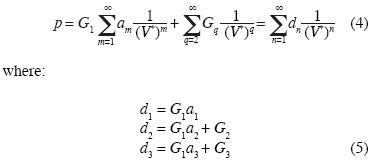
<body><![CDATA[<p align="justify"><font face="verdana" size="2">The coeffcients <i>a<sub><i>m</i></sub>  </i>are the same found by Ursell and Mayer (c.e., Uhlenbeck and Ford, 1963).</font></p>     <p align="justify"><font face="verdana" size="2">We replace (3) into (1) and we obtain:</font></p>     <p align="center"><font face="verdana" size="2"><img src="/img/revistas/geoint/v49n2/a3e4.jpg"></font></p>     <p align="justify"><font face="verdana" size="2">etc.</font></p>     <p align="justify"><font face="verdana" size="2">Note that the equation of state (4) contains linear independent vectors <img src="/img/revistas/geoint/v49n2/a3e5.jpg">, <i>n</i>=1,2,3,... thus the Kamerlingh&#150;Onnes equation is derived from statistical mechanics. The parameters <i>a<sub>m</sub> </i>and <i>G</i><sub>2</sub> were calculated from additive binary potentials that contain all additive binary interactions (c.e., Uhlenbeck and Ford<i>, </i>1963). The parameters <i>G</i><sub>q</sub>, <i>q</i>&#8805;3, were obtained from non&#150;additive potentials. Thus, <i>d</i><sub>3</sub> &#8800; <i>a</i><sub>3</sub>, <i>d</i><sub>4</sub> &#8800; <i>a</i><sub>4</sub>, and so on. Since <i>d</i><sub>3</sub> = <i>G</i><sub>1</sub><i>a</i><sub>3</sub> + <i>G</i><sub>3</sub>, the quantity <i>G</i><sub>1</sub><i>a</i><sub>3</sub> is identical to the coeffcient of van der Waals, or Ursell &amp; Mayer. Not so <i>G</i><sub>3</sub>, our coeffcient for non additive tertiary potentials. Also, <i>G</i><sub>4</sub> is our coeffcient for non additive quaternary potentials, and so on.</font></p>     <p align="justify"><font face="verdana" size="2">If <i>d<sub>n</sub> </i>= 0, <i>n </i>&#8805; 2 equation (4) should become the equation for an ideal gas, namely:</font></p>     <p align="center"><font face="verdana" size="2"><img src="/img/revistas/geoint/v49n2/a3e6.jpg"></font></p>     <p align="justify"><font face="verdana" size="2">where <i>R </i>is the universal gas constant. This is because:</font></p>     <p align="center"><font face="verdana" size="2"><img src="/img/revistas/geoint/v49n2/a3e7.jpg"></font></p>     <p align="justify"><font face="verdana" size="2">If we set</font></p>     ]]></body>
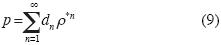
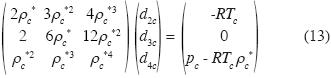
<body><![CDATA[<p align="center"><font face="verdana" size="2"><img src="/img/revistas/geoint/v49n2/a3e8.jpg"></font></p>     <p align="justify"><font face="verdana" size="2">where <i>&rho;*</i> is the molar density, we may write (4) as:</font></p>     <p align="center"><font face="verdana" size="2"><img src="/img/revistas/geoint/v49n2/a3e9.jpg"></font></p>     <p align="center"><font face="verdana" size="2">&nbsp;</font></p>     <p align="justify"><font face="verdana" size="2"><b>The isotherms in the neighborhood of the critical and triple points of water</b></font></p>     <p align="justify"><font face="verdana" size="2">Equation (9) is an appropriate equation of state which yields the isotherms of polar or non polar fuids. Let us derive the critical isotherm by means of the well known conditions:</font></p>     <p align="center"><font face="verdana" size="2"><img src="/img/revistas/geoint/v49n2/a3e10.jpg"></font></p>     <p align="justify"><font face="verdana" size="2">where <i>&rho;<sub>c</sub>*</i> is the critical molar density and <i>T<sub>c</sub> </i>is the critical temperature. In equation (12), if we substitute <i>p </i>= <i>p<sub>c</sub> </i>and <i>&rho;*</i> = <i>&rho;<sub>c</sub>*</i>, we may use (10), (11) and (12) in order to obtain <i>d</i><sub>2<i>c</i></sub>, <i>d</i><sub>3<i>c</i></sub>, <i>d</i><sub>4<i>c</i></sub>assuming <i>d<sub>nc</sub> </i>= 0, for <i>n </i>&gt; 4. Thus we obtain the critical isotherm in the neighborhood of the critical point:</font></p>     <p align="center"><font face="verdana" size="2"><img src="/img/revistas/geoint/v49n2/a3e11.jpg"></font></p>     <p align="justify"><font face="verdana" size="2">Now we calculate the solutions of these equations for water, using data of Black and Hartley<i>. </i>(1993):</font></p>     ]]></body>
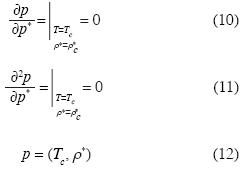
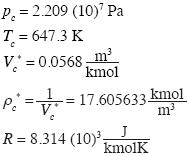
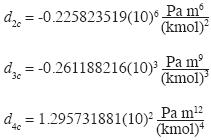
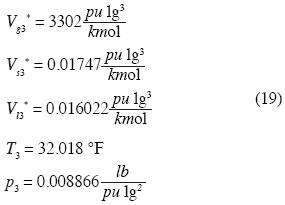
<body><![CDATA[<p align="center"><font face="verdana" size="2"><img src="/img/revistas/geoint/v49n2/a3e12.jpg"></font></p>     <p align="justify"><font face="verdana" size="2">The solution of (13) is</font></p>     <p align="center"><font face="verdana" size="2"><img src="/img/revistas/geoint/v49n2/a3e13.jpg"></font></p>     <p align="justify"><font face="verdana" size="2">For these values the non additives interactions between three and four molecules are necessary to explain the Critical Point, and the isotherm in the neighborhood of the critical point is:</font></p>     <p align="center"><font face="verdana" size="2"><img src="/img/revistas/geoint/v49n2/a3e14.jpg"></font></p>     <p align="justify"><font face="verdana" size="2">Van der Waals could not obtain this isotherm because he did not consider potentials of 3, 4. molecules respectively.</font></p>     <p align="justify"><font face="verdana" size="2">When a wider interval of molar densities is desired, more experimental data will be required; in this case the critical isotherm will be of degree n &gt; 4 which will enable us to compute the values of <i>d<sub>nc</sub> </i>to a higher precision.</font></p>     <p align="justify"><font face="verdana" size="2">We consider now the isotherm in the neighborhood of the triple point in a system, polar or otherwise. As an example we consider water. The minimum curve near the triple point to provide stability in (<i>p</i><sub>3</sub>, <i>&rho;*<sub>g</sub></i><sub>3</sub>, <i>T</i><sub>3</sub>), (<i>p</i><sub>3</sub>, <i>&rho;*<sub>s</sub></i><sub>3</sub>, <i>T</i><sub>3</sub>) y (<i>p</i><sub>3</sub>, <i>&rho;*<sub>l</sub></i><sub>3</sub>, <i>T</i><sub>3</sub>), must be of ffth degree. Let the right sub index 3 denote "triple point", and let <i>g</i>, <i>s</i>, and 1 be the three phases. The equation (8) is reduced to:</font></p>     <p align="center"><font face="verdana" size="2"><img src="/img/revistas/geoint/v49n2/a3e15.jpg"></font></p>     <p align="justify"><font face="verdana" size="2">where</font></p>     ]]></body>
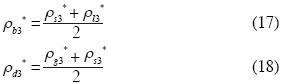
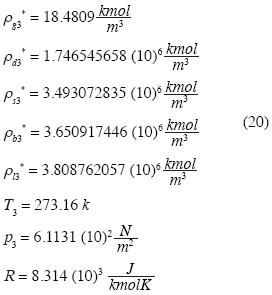
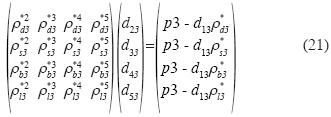
<body><![CDATA[<p align="center"><font face="verdana" size="2"><img src="/img/revistas/geoint/v49n2/a3e16.jpg"></font></p>     <p align="justify"><font face="verdana" size="2"><i>R </i>is the Universal Gas Constant and <i>T</i><sub>3</sub> the absolute temperature of the triple point in the system. The remaining four unknown constants in (15) may be determined as follows. Let the molar densities be <i>&rho;*<sub>g</sub></i><sub>3</sub> &lt; <i>&rho;*<sub>d</sub></i><sub>3</sub> &lt; <i>&rho;*<sub>s</sub></i><sub>3</sub> &lt; <i>&rho;*<sub>b</sub></i><sub>3</sub> &lt; <i>&rho;*<sub>l</sub></i><sub>3 </sub>where <i>&rho;*<sub>s</sub></i><sub>3</sub> y <i>&rho;*<sub>l</sub></i><sub>3</sub> are obtained by experiment from the solid and liquid phases of water at the triple point. The other molar densities are restrained by Maxwell's constructions for triple point:</font></p>     <p align="center"><font face="verdana" size="2"><img src="/img/revistas/geoint/v49n2/a3e17.jpg"></font></p>     <p align="justify"><font face="verdana" size="2">According to Keenan and Keyes (1978) we have, for</font></p>     <p align="center"><font face="verdana" size="2"><img src="/img/revistas/geoint/v49n2/a3e18.jpg"></font></p>     <p align="justify"><font face="verdana" size="2">and recalling <img src="/img/revistas/geoint/v49n2/a3e19.jpg"> we fnd:</font></p>     <p align="center"><font face="verdana" size="2"><img src="/img/revistas/geoint/v49n2/a3e20.jpg"></font></p>     <p align="justify"><font face="verdana" size="2">The system of equations is as follows:</font></p>     <p align="center"><font face="verdana" size="2"><img src="/img/revistas/geoint/v49n2/a3e21.jpg"> </font></p>     <p align="justify"><font face="verdana" size="2">and the solution is:</font></p>     ]]></body>
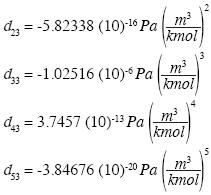
<body><![CDATA[<p align="center"><font face="verdana" size="2"><img src="/img/revistas/geoint/v49n2/a3e22.jpg"> </font></p>     <p align="justify"><font face="verdana" size="2">which yields the isotherm of water in the neighborhood of the triple point:</font></p>     <p align="center"><font face="verdana" size="2"><img src="/img/revistas/geoint/v49n2/a3e23.jpg"> </font></p>     <p align="justify"><font face="verdana" size="2">For these values the non&#150;additive interactions between three, four and fve molecules are absolutely indispensable, for all fuids, to obtain the isotherm for the triple state; the explicit isotherm for the triple state for the water is equation (23), where the term of non&#150;additive interactions between three molecules is the dominant term; this equation is derived, using statistical mechanics, for the frst time.</font></p>     <p align="justify"><font face="verdana" size="2">&nbsp;</font></p>     <p align="justify"><font face="verdana" size="2"><b>Existence of an infnity of new electromagnetic forces, and generalizations of electrodynamics, classical mechanics.</b></font></p>     <p align="justify"><font face="verdana" size="2">Robles&#150;Dom&iacute;nguez <i>et al</i>. (2007) derived expression (1), the frst two terms of which reduce to the van der Waals equation. While van der Waals had considered all binary interactions in the fuid, his expression does not fit adequately the experimental data. We therefore considered additional interactions such as non&#150;additive tertiary, non&#150;additive quaternary and so on, which are the Fourier coeffcients of the development based on Functional Analysis (see Courant and Hilbert, 1953; and Kolmogorov and Fomin, 1957) which reproduce exactly the experimental isotherm. The new forces are real.</font></p>     <p align="justify"><font face="verdana" size="2">But in a fuid the interactions are electromagnetic. Therefore these new interactions are electromagnetic interactions. In equation (1), <i>G<sub>3</sub> </i>represents the mean feld of the non&#150;additive interaction between molecular triplets. Coulomb could not obtain these results. Thus equation (1) contains an infnity of additional new electromagnetic forces. If these forces are not considered, e.g. by making <i>G<sub>3</sub>, G<sub>4</sub>,</i>... to vanish, functional analysis suggests that we may not succeed in reproducing the experimental results.</font></p>     <p align="justify"><font face="verdana" size="2">When those new felds are considered, in the Electromagnetic case, the Maxwell's Laws are generalized. Thus the fourth Law of Maxwell takes the form:</font></p>     <p align="center"><font face="verdana" size="2"><img src="/img/revistas/geoint/v49n2/a3e24.jpg"></font></p>     ]]></body>
<body><![CDATA[<p align="justify"><font face="verdana" size="2">Where <i>H </i>is the Magnetic Field, <i>D </i>is the Electric Displacement Field, <i>J </i>is the Electric Current and subscript 2 is employed for binary additive felds, sub&#150;script 3 is employed for ternary non&#150;additive, etc.</font></p>     <p align="justify"><font face="verdana" size="2">In Classical Mechanics, Newton's Second Law is generalized to the form:</font></p>     <p align="center"><font face="verdana" size="2"><img src="/img/revistas/geoint/v49n2/a3e25.jpg"></font></p>     <p align="justify"><font face="verdana" size="2">where F<sub>2</sub> is the resultant of the additive binary forces upon <i>m</i>, F<sub>3</sub> is the resultant of the non&#150;additive tertiary forces upon <i>m</i>, and so on. Here m is mass and <i>a </i>is acceleration.</font></p>     <p align="justify"><font face="verdana" size="2"><i>Generalized conservation of energy</i></font></p>     <p align="center"><font face="verdana" size="2"><i><img src="/img/revistas/geoint/v49n2/a3e26.jpg"></i></font></p>     <p align="justify"><font face="verdana" size="2">here <i>K </i>is kinetic energy, <i>a </i>and <i>b </i>are two points of the path of the particle, <i>&phi;<sub>2</sub> , &phi;<sub>3</sub> , </i>... are the energies of all additive binary, non&#150;additive ternary, non&#150;additive quaternary conservative forces, and so on, and the integral is the total work done by all binary additive non&#150;conservative forces, tertiary non&#150;additive non&#150;conservative forces, etc.</font></p>     <p align="justify"><font face="verdana" size="2">In Quantum Field Theory are obtained:</font></p>     <p align="justify"><font face="verdana" size="2"><i>Generalized Klein&#150;Gordon equation with electromagnetic feld</i></font></p>     <p align="center"><font face="verdana" size="2"><img src="/img/revistas/geoint/v49n2/a3e27.jpg"></font></p>     ]]></body>
<body><![CDATA[<blockquote>       <p align="justify"><font face="verdana" size="2">&bull;<i> &phi;<sub>2</sub> </i>is the additive scalar potential energy operator</font></p>       <p align="justify"><font face="verdana" size="2">&bull;<i> <i>&phi;</i><sub>3</sub> </i>is the non&#150;additive tertiary scalar potential energy operator.</font></p>       <p align="justify"><font face="verdana" size="2">&bull; etc.</font></p>       <p align="justify"><font face="verdana" size="2">&bull; <i>A2 </i>is the additive binary vector potential operator.</font></p>       <p align="justify"><font face="verdana" size="2">&bull; <i>A<sub>3</sub> </i>is the non&#150;additive ternary vector potential operator.</font></p>       <p align="justify"><font face="verdana" size="2">&bull; etc.</font></p> </blockquote>     <p align="justify"><font face="verdana" size="2">All these operate on the Wave Function. (for the case with additive binary interaction only see Bj&ouml;rken and Drell, 1964).</font></p>     <p align="justify"><font face="verdana" size="2"><i>Generalized Dirac equation for the electromagnetic feld</i></font></p>     <p align="center"><font face="verdana" size="2"><img src="/img/revistas/geoint/v49n2/a3e28.jpg"></font></p>     ]]></body>
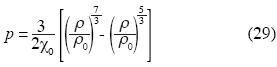
<body><![CDATA[<p align="justify"><font face="verdana" size="2">where &gamma;<sub>s</sub> = <i>1, 2, 3 </i>are Dirac matrices (for the case with additive binary interaction only see: Bj&ouml;rken <i>et al, </i>1964).</font></p>     <p align="justify"><font face="verdana" size="2">&nbsp;</font></p>     <p align="justify"><font face="verdana" size="2"><b>Isothermal compressibility in the Earth's Mantle</b></font></p>     <p align="justify"><font face="verdana" size="2">The geophysicist F. Birch obtained a state equation for the Earth's Mantle (Birch,1947) which is:</font></p>     <p align="center"><font face="verdana" size="2"><img src="/img/revistas/geoint/v49n2/a3e29.jpg"></font></p>     <p align="justify"><font face="verdana" size="2">where <i>p </i>is pressure, &#967; is isothermal compressibility and <i>&rho; </i>is the density of the Earth's Mantle; the sub&#150;script zero is used for quantities evaluated to atmospheric pressure.</font></p>     <p align="justify"><font face="verdana" size="2">The density is:</font></p>     <p align="center"><font face="verdana" size="2"><img src="/img/revistas/geoint/v49n2/a3e30.jpg"></font></p>     <p align="justify"><font face="verdana" size="2">where <i>m </i>is the mass and <i>V </i>the volume.</font></p>     <p align="justify"><font face="verdana" size="2">The mass can be expressed in terms of the moles number <i>n</i>:</font></p>     ]]></body>
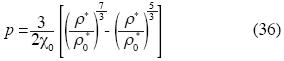
<body><![CDATA[<p align="center"><font face="verdana" size="2"><img src="/img/revistas/geoint/v49n2/a3e31.jpg"></font></p>     <p align="justify"><font face="verdana" size="2">where M is the molecular mass, and <i>&#961; </i>can be expressed in terms of n as follow:</font></p>     <p align="center"><font face="verdana" size="2"><img src="/img/revistas/geoint/v49n2/a3e32.jpg"></font></p>     <p align="justify"><font face="verdana" size="2">and the Molar Density <i>&rho;</i><sup>*</sup> is:</font></p>     <p align="center"><font face="verdana" size="2"><img src="/img/revistas/geoint/v49n2/a3e33.jpg"></font></p>     <p align="justify"><font face="verdana" size="2">then:</font></p>     <p align="center"><font face="verdana" size="2"><img src="/img/revistas/geoint/v49n2/a3e34.jpg"></font></p>     <p align="justify"><font face="verdana" size="2">and:</font></p>     <p align="center"><font face="verdana" size="2"><img src="/img/revistas/geoint/v49n2/a3e35.jpg"></font></p>     <p align="justify"><font face="verdana" size="2">Birch's equation can be rewritten as follows:</font></p>     ]]></body>
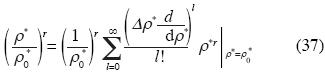
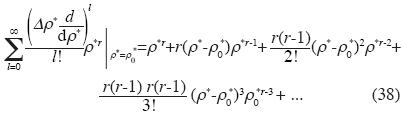
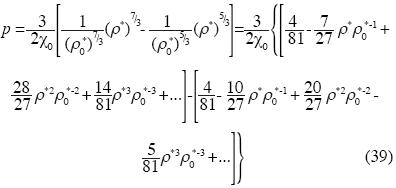
<body><![CDATA[<p align="center"><font face="verdana" size="2"><img src="/img/revistas/geoint/v49n2/a3e36.jpg"></font></p>     <p align="justify"><font face="verdana" size="2">Our State Equation (1) is valid for gases, liquids and solids; of course Birch's Equation is a particular case of (1).</font></p>     <p align="justify"><font face="verdana" size="2">We can express that equation in the base {<i>&rho;<sup>l</sup></i>, <i>l </i>= 0, 1, 2, 3, 4, 5, ...}developing it in Taylor series near <i>&rho;<sub>0</sub></i> :</font></p>     <p align="center"><font face="verdana" size="2"><img src="/img/revistas/geoint/v49n2/a3e37.jpg"></font></p>     <p align="justify"><font face="verdana" size="2">where <i>r </i>can take the values <img src="/img/revistas/geoint/v49n2/a3e38.jpg"> , and <i>&Delta;&rho;</i><sup>*</sup>=<i>&rho;</i><sup>*</sup>&#150; <i>&rho;<sub>0</sub></i></font></p>     <p align="center"><font face="verdana" size="2"><i><img src="/img/revistas/geoint/v49n2/a3e39.jpg"></i></font></p>     <p align="justify"><font face="verdana" size="2">and Birch's equation is: </font></p>     <p align="center"><font face="verdana" size="2"><img src="/img/revistas/geoint/v49n2/a3e40.jpg"></font></p>     <p align="justify"><font face="verdana" size="2">and Birch's state equation is:</font></p>     <p align="center"><font face="verdana" size="2"><img src="/img/revistas/geoint/v49n2/a3e41.jpg"> </font></p>     ]]></body>
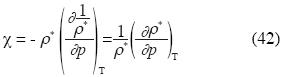
<body><![CDATA[<p align="justify"><font face="verdana" size="2">This state equation shows, at this approximation, that the non &#150;additive interactions of three bodies are relevant.</font></p>     <p align="justify"><font face="verdana" size="2">The isothermal compressibility is:</font></p>     <p align="center"><font face="verdana" size="2"><img src="/img/revistas/geoint/v49n2/a3e42.jpg"> </font></p>     <p align="justify"><font face="verdana" size="2">Or in terms of <i><i>&rho;*</i></i>:</font></p>     <p align="center"><font face="verdana" size="2"><img src="/img/revistas/geoint/v49n2/a3e43.jpg"></font></p>     <p align="justify"><font face="verdana" size="2">Implicit derivation applied to the last equation of p gives:</font></p>     <p align="center"><font face="verdana" size="2"><img src="/img/revistas/geoint/v49n2/a3e44.jpg"></font></p>     <p align="justify"><font face="verdana" size="2">and   the   isothermal   compressibility   is  expressed   as follow:</font></p>     <p align="center"><font face="verdana" size="2"><img src="/img/revistas/geoint/v49n2/a3e45.jpg"></font></p>     <p align="justify"><font face="verdana" size="2"></font></p>     ]]></body>
<body><![CDATA[<p align="justify"><font face="verdana" size="2">According to this equation, if the molar density increases the isothermal compressibility decreases.</font></p>     <p align="justify"><font face="verdana" size="2">We can use other equations for the Earth's Mantle, but Birch's equation is more simple and we want to show only the existence of the term of tertiary non&#150;additive interactions in the Earth's Mantle.</font></p>     <p align="justify"><font face="verdana" size="2">&nbsp;</font></p>     <p align="justify"><font face="verdana" size="2"><b>Conclusions</b></font></p>     <p align="justify"><font face="verdana" size="2">In this paper we show that there is an infnite number of new molecular forces in a fuid; these forces are of electromagnetic nature. Here we present the corresponding generalization of the equations of electrodynamics and classical mechanics and quantum feld theory in which comprising these new forces. We propose that any feld in nature must be associated with a corresponding infnite set of new non&#150;additive forces. Also, the Earth's Mantle equations must contain these new forces.</font></p>     <p align="justify"><font face="verdana" size="2">&nbsp;</font></p>     <p align="justify"><font face="verdana" size="2"><b>Acknowledgments</b></font></p>     <p align="justify"><font face="verdana" size="2">Critical review from two anonimous reviewer is acknowledged.</font></p>     <p align="justify"><font face="verdana" size="2">&nbsp;</font></p>     <p align="justify"><font face="verdana" size="2"><b>Bibliography</b></font></p>     ]]></body>
<body><![CDATA[<!-- ref --><p align="justify"><font face="verdana" size="2">Birch, F., 1947. Finite Elastic Strain of Cubic Crystals, <i>Phys. Rev</i>., <i>71, 11</i>, 809&#150;824.</font>&nbsp;&nbsp;&nbsp;&nbsp;&nbsp;&nbsp;&nbsp;&nbsp;[&#160;<a href="javascript:void(0);" onclick="javascript: window.open('/scielo.php?script=sci_nlinks&ref=3912203&pid=S0016-7169201000020000300001&lng=','','width=640,height=500,resizable=yes,scrollbars=1,menubar=yes,');">Links</a>&#160;]<!-- end-ref --><!-- ref --><p align="justify"><font face="verdana" size="2">Bj&ouml;rken, J. D. and S. D. Drell, 1964. Relativistic Quantum Mechanics. McGraw&#150;Hill Book Company, 300 p.</font>&nbsp;&nbsp;&nbsp;&nbsp;&nbsp;&nbsp;&nbsp;&nbsp;[&#160;<a href="javascript:void(0);" onclick="javascript: window.open('/scielo.php?script=sci_nlinks&ref=3912204&pid=S0016-7169201000020000300002&lng=','','width=640,height=500,resizable=yes,scrollbars=1,menubar=yes,');">Links</a>&#160;]<!-- end-ref --><!-- ref --><p align="justify"><font face="verdana" size="2">Black, W. Z. and S. A. Hartley, 1993. Termodin&aacute;mica, Editorial CECSA, M&eacute;xico, 883 p.</font>&nbsp;&nbsp;&nbsp;&nbsp;&nbsp;&nbsp;&nbsp;&nbsp;[&#160;<a href="javascript:void(0);" onclick="javascript: window.open('/scielo.php?script=sci_nlinks&ref=3912205&pid=S0016-7169201000020000300003&lng=','','width=640,height=500,resizable=yes,scrollbars=1,menubar=yes,');">Links</a>&#160;]<!-- end-ref --><!-- ref --><p align="justify"><font face="verdana" size="2">Courant, R. and D. Hilbert, 1953. Methods of mathematical physics. 1<sup>st</sup> English ed., translated and rev. from the German original. New York, Interscience Publishers, p. 62.</font>&nbsp;&nbsp;&nbsp;&nbsp;&nbsp;&nbsp;&nbsp;&nbsp;[&#160;<a href="javascript:void(0);" onclick="javascript: window.open('/scielo.php?script=sci_nlinks&ref=3912206&pid=S0016-7169201000020000300004&lng=','','width=640,height=500,resizable=yes,scrollbars=1,menubar=yes,');">Links</a>&#160;]<!-- end-ref --><!-- ref --><p align="justify"><font face="verdana" size="2">Keenan, J. H. and F. G. Keyes, 1978. Thermodynamics properties of water including vapor, liquid and solid phases. Ed. J. Wiley. New York, 156 p.</font>&nbsp;&nbsp;&nbsp;&nbsp;&nbsp;&nbsp;&nbsp;&nbsp;[&#160;<a href="javascript:void(0);" onclick="javascript: window.open('/scielo.php?script=sci_nlinks&ref=3912207&pid=S0016-7169201000020000300005&lng=','','width=640,height=500,resizable=yes,scrollbars=1,menubar=yes,');">Links</a>&#160;]<!-- end-ref --><!-- ref --><p align="justify"><font face="verdana" size="2">Kolmogorov, A. N. and S. V. Fomin, 1957. Elements of the theory of functions and functional analysis. Translated from the 1<sup>st</sup> Russian ed. by Leo F. Boron. Rochester, N. Y. , Graylock Press, 128 p.</font>&nbsp;&nbsp;&nbsp;&nbsp;&nbsp;&nbsp;&nbsp;&nbsp;[&#160;<a href="javascript:void(0);" onclick="javascript: window.open('/scielo.php?script=sci_nlinks&ref=3912208&pid=S0016-7169201000020000300006&lng=','','width=640,height=500,resizable=yes,scrollbars=1,menubar=yes,');">Links</a>&#160;]<!-- end-ref --><!-- ref --><p align="justify"><font face="verdana" size="2">Robles&#150;Dom&iacute;nguez, J. A. M., J. A. Robles&#150;Guti&eacute;rrez and C. Lomnitz, 2007. An Equation of State for more than two phases, with an application to the Earth's mantle, <i>Geof&iacute;sica Internacional 40, 3</i>, 155&#150;161.</font>&nbsp;&nbsp;&nbsp;&nbsp;&nbsp;&nbsp;&nbsp;&nbsp;[&#160;<a href="javascript:void(0);" onclick="javascript: window.open('/scielo.php?script=sci_nlinks&ref=3912209&pid=S0016-7169201000020000300007&lng=','','width=640,height=500,resizable=yes,scrollbars=1,menubar=yes,');">Links</a>&#160;]<!-- end-ref --><!-- ref --><p align="justify"><font face="verdana" size="2">Uhlenbeck, G. E. and G. W. Ford, 1963. Lectures in Statistical Mechanics in American Mathematical Society, Providence, R. I., 30 p.</font>&nbsp;&nbsp;&nbsp;&nbsp;&nbsp;&nbsp;&nbsp;&nbsp;[&#160;<a href="javascript:void(0);" onclick="javascript: window.open('/scielo.php?script=sci_nlinks&ref=3912210&pid=S0016-7169201000020000300008&lng=','','width=640,height=500,resizable=yes,scrollbars=1,menubar=yes,');">Links</a>&#160;]<!-- end-ref --> ]]></body><back>
<ref-list>
<ref id="B1">
<nlm-citation citation-type="journal">
<person-group person-group-type="author">
<name>
<surname><![CDATA[Birch]]></surname>
<given-names><![CDATA[F.]]></given-names>
</name>
</person-group>
<article-title xml:lang="en"><![CDATA[Finite Elastic Strain of Cubic Crystals]]></article-title>
<source><![CDATA[Phys. Rev.]]></source>
<year>1947</year>
<volume>71</volume>
<numero>11</numero>
<issue>11</issue>
<page-range>809-824</page-range></nlm-citation>
</ref>
<ref id="B2">
<nlm-citation citation-type="book">
<person-group person-group-type="author">
<name>
<surname><![CDATA[Björken]]></surname>
<given-names><![CDATA[J. D.]]></given-names>
</name>
<name>
<surname><![CDATA[Drell]]></surname>
<given-names><![CDATA[S. D.]]></given-names>
</name>
</person-group>
<source><![CDATA[Relativistic Quantum Mechanics]]></source>
<year>1964</year>
<page-range>300</page-range><publisher-name><![CDATA[McGraw-Hill Book Company]]></publisher-name>
</nlm-citation>
</ref>
<ref id="B3">
<nlm-citation citation-type="book">
<person-group person-group-type="author">
<name>
<surname><![CDATA[Black]]></surname>
<given-names><![CDATA[W. Z.]]></given-names>
</name>
<name>
<surname><![CDATA[Hartley]]></surname>
<given-names><![CDATA[S. A.]]></given-names>
</name>
</person-group>
<source><![CDATA[Termodinámica]]></source>
<year>1993</year>
<page-range>883</page-range><publisher-name><![CDATA[Editorial CECSA]]></publisher-name>
</nlm-citation>
</ref>
<ref id="B4">
<nlm-citation citation-type="book">
<person-group person-group-type="author">
<name>
<surname><![CDATA[Courant]]></surname>
<given-names><![CDATA[R.]]></given-names>
</name>
<name>
<surname><![CDATA[Hilbert]]></surname>
<given-names><![CDATA[D.]]></given-names>
</name>
</person-group>
<source><![CDATA[Methods of mathematical physics]]></source>
<year>1953</year>
<edition>1st</edition>
<page-range>62</page-range><publisher-loc><![CDATA[New York ]]></publisher-loc>
<publisher-name><![CDATA[Interscience Publishers]]></publisher-name>
</nlm-citation>
</ref>
<ref id="B5">
<nlm-citation citation-type="book">
<person-group person-group-type="author">
<name>
<surname><![CDATA[Keenan]]></surname>
<given-names><![CDATA[J. H.]]></given-names>
</name>
<name>
<surname><![CDATA[Keyes]]></surname>
<given-names><![CDATA[F. G.]]></given-names>
</name>
</person-group>
<source><![CDATA[Thermodynamics properties of water including vapor, liquid and solid phases]]></source>
<year>1978</year>
<page-range>156</page-range><publisher-loc><![CDATA[New York ]]></publisher-loc>
<publisher-name><![CDATA[J. Wiley]]></publisher-name>
</nlm-citation>
</ref>
<ref id="B6">
<nlm-citation citation-type="book">
<person-group person-group-type="author">
<name>
<surname><![CDATA[Kolmogorov]]></surname>
<given-names><![CDATA[A. N.]]></given-names>
</name>
<name>
<surname><![CDATA[Fomin]]></surname>
<given-names><![CDATA[S. V.]]></given-names>
</name>
</person-group>
<source><![CDATA[Elements of the theory of functions and functional analysis]]></source>
<year>1957</year>
<page-range>128</page-range><publisher-loc><![CDATA[Rochester^eN. Y. N. Y.]]></publisher-loc>
<publisher-name><![CDATA[Graylock Press]]></publisher-name>
</nlm-citation>
</ref>
<ref id="B7">
<nlm-citation citation-type="journal">
<person-group person-group-type="author">
<name>
<surname><![CDATA[Robles-Domínguez]]></surname>
<given-names><![CDATA[J. A. M.]]></given-names>
</name>
<name>
<surname><![CDATA[Robles-Gutiérrez]]></surname>
<given-names><![CDATA[J. A.]]></given-names>
</name>
<name>
<surname><![CDATA[Lomnitz]]></surname>
<given-names><![CDATA[C.]]></given-names>
</name>
</person-group>
<article-title xml:lang="en"><![CDATA[An Equation of State for more than two phases, with an application to the Earth's mantle]]></article-title>
<source><![CDATA[Geofísica Internacional]]></source>
<year>2007</year>
<volume>40</volume>
<numero>3</numero>
<issue>3</issue>
<page-range>155-161</page-range></nlm-citation>
</ref>
<ref id="B8">
<nlm-citation citation-type="">
<person-group person-group-type="author">
<name>
<surname><![CDATA[Uhlenbeck]]></surname>
<given-names><![CDATA[G. E.]]></given-names>
</name>
<name>
<surname><![CDATA[Ford]]></surname>
<given-names><![CDATA[G. W.]]></given-names>
</name>
</person-group>
<source><![CDATA[Lectures in Statistical Mechanics in American Mathematical Society]]></source>
<year>1963</year>
<page-range>30</page-range><publisher-loc><![CDATA[Providence^eR. I. R. I.]]></publisher-loc>
</nlm-citation>
</ref>
</ref-list>
</back>
</article>