<?xml version="1.0" encoding="ISO-8859-1"?><article xmlns:mml="http://www.w3.org/1998/Math/MathML" xmlns:xlink="http://www.w3.org/1999/xlink" xmlns:xsi="http://www.w3.org/2001/XMLSchema-instance">
<front>
<journal-meta>
<journal-id>0016-7169</journal-id>
<journal-title><![CDATA[Geofísica internacional]]></journal-title>
<abbrev-journal-title><![CDATA[Geofís. Intl]]></abbrev-journal-title>
<issn>0016-7169</issn>
<publisher>
<publisher-name><![CDATA[Universidad Nacional Autónoma de México, Instituto de Geofísica]]></publisher-name>
</publisher>
</journal-meta>
<article-meta>
<article-id>S0016-71692010000200002</article-id>
<title-group>
<article-title xml:lang="en"><![CDATA[Onset and end of the rainy season and corn yields in São Paulo State, Brazil]]></article-title>
</title-group>
<contrib-group>
<contrib contrib-type="author">
<name>
<surname><![CDATA[Franchito]]></surname>
<given-names><![CDATA[S. H.]]></given-names>
</name>
<xref ref-type="aff" rid="A01"/>
</contrib>
<contrib contrib-type="author">
<name>
<surname><![CDATA[Brahmananda Rao]]></surname>
<given-names><![CDATA[V.]]></given-names>
</name>
<xref ref-type="aff" rid="A01"/>
</contrib>
<contrib contrib-type="author">
<name>
<surname><![CDATA[Gan]]></surname>
<given-names><![CDATA[M. A.]]></given-names>
</name>
<xref ref-type="aff" rid="A01"/>
</contrib>
<contrib contrib-type="author">
<name>
<surname><![CDATA[Santo]]></surname>
<given-names><![CDATA[C. M. E.]]></given-names>
</name>
<xref ref-type="aff" rid="A01"/>
</contrib>
</contrib-group>
<aff id="A01">
<institution><![CDATA[,Instituto Nacional de Pesquisas Espaciais Centro de Previsão de Tempo e Estudos Climáticos ]]></institution>
<addr-line><![CDATA[São Jose dos Campos SP]]></addr-line>
<country>Brazil</country>
</aff>
<pub-date pub-type="pub">
<day>00</day>
<month>06</month>
<year>2010</year>
</pub-date>
<pub-date pub-type="epub">
<day>00</day>
<month>06</month>
<year>2010</year>
</pub-date>
<volume>49</volume>
<numero>2</numero>
<fpage>69</fpage>
<lpage>76</lpage>
<copyright-statement/>
<copyright-year/>
<self-uri xlink:href="http://www.scielo.org.mx/scielo.php?script=sci_arttext&amp;pid=S0016-71692010000200002&amp;lng=en&amp;nrm=iso"></self-uri><self-uri xlink:href="http://www.scielo.org.mx/scielo.php?script=sci_abstract&amp;pid=S0016-71692010000200002&amp;lng=en&amp;nrm=iso"></self-uri><self-uri xlink:href="http://www.scielo.org.mx/scielo.php?script=sci_pdf&amp;pid=S0016-71692010000200002&amp;lng=en&amp;nrm=iso"></self-uri><abstract abstract-type="short" xml:lang="es"><p><![CDATA[En este estudio se investigaron las relaciones entre la temporada de lluvias y las cosechas de maíz en el estado de São Paulo, Brasil. Los resultados mostraron que las cosechas de maíz y las precipitaciones se correlacionan fuertemente en una gran parte de la región, particularmente en la parte noreste, este, noroeste y oeste del estado (valores positivos superiores a 0.5 y signifcativos a un nivel de confanza de 95%). El análisis de las tendencias en la duración de la temporada de lluvias y la precipitación acumulada asociada, mostraba una tendencia a mayor volumen de precipitación y una más corta temporada de lluvias. Esto puede ser debido al calentamiento global. Aunque se correlacionan positivamente las cosechas de maíz y la lluvia, un aumento en el futuro de eventos de intensas lluvias puede conducir a deslizamientos de tierras, inundaciones y, en consecuencia, provocar daños a los cultivos. Durante el período 1970-2003 hubo un aumento de duración en la temporada de lluvias y en el volumen de precipitación en fuertes episodios de El Niño, mientras que en el caso de los eventos de La Niña la temporada de lluvias fue más corta y hubo una disminución de las precipitaciones. Los resultados de los estudios de caso, teniendo en cuenta El Niño 1997-98 y La Niña 1998-99 sugirieron que el aumento (disminución) de la duración de la temporada de lluvias durante el evento de El Niño (La Niña) está asociado con el aumento (disminución) de las cosechas de maíz en el estado de São Paulo. Se necesitan estudios adicionales con un récord de datos de los rendimientos de maíz mayor de 14 años y teniendo en cuenta otros episodios de El Niño/LaNiña para hacer una conexión convincente entre las cosechas de maíz y eventos ENOS en el estado de São Paulo.]]></p></abstract>
<abstract abstract-type="short" xml:lang="en"><p><![CDATA[The relationships between the rainy season and corn yields in São Paulo State were investigated. The results showed that rainfall and corn yields are strongly positively correlated in most of the region, particularly in the northeastern, eastern, northwestern and western parts of the state (i.e. values are higher than 0.5 signifcant at 95% confdence level). The analysis of the trends in the duration of the rainy season and the associated accumulated precipitation showed a tendency of higher precipitation and shorter rainy seasons. It has been suggested to be due to global warming. Although rainfall and crop yields were positively correlated, an increase in heavy rainfall events in future may lead to landslides, fash foods and consequently crop damage. During the period 1970-2003 there was an increase of the rainy season and rainfall in strong El Niño episodes while in the case of La Niña events the rainy season was shorter and the rainfall decreased. Results of case studies considering the 1997-98 El Niño and the 1998-99 La Niña suggested that the increase (decrease) of the duration of the rainy season during the El Niño (La Niña) event is associated with the increase (decrease) of corn yields in São Paulo State. Further studies with a record of corn yields longer than 14 years and considering other El Niño/La Niña episodes are needed to obtain a frm connection between corn yields and ENSO events in São Paulo State.]]></p></abstract>
<kwd-group>
<kwd lng="es"><![CDATA[Temporada de lluvias en el estado de San Pablo]]></kwd>
<kwd lng="es"><![CDATA[cosecha de maíz]]></kwd>
<kwd lng="es"><![CDATA[El Niño/La Niña]]></kwd>
<kwd lng="en"><![CDATA[Rainy season in São Paulo State]]></kwd>
<kwd lng="en"><![CDATA[corn yields]]></kwd>
<kwd lng="en"><![CDATA[El Niño/La Niña]]></kwd>
</kwd-group>
</article-meta>
</front><body><![CDATA[ <p align="justify"><font face="verdana" size="4">Articles</font></p>     <p align="justify"><font face="verdana" size="2">&nbsp;</font></p>     <p align="center"><font face="verdana" size="4"><b>Onset and end of the rainy season and corn yields in S&atilde;o Paulo State, Brazil</b></font></p>     <p align="center"><font face="verdana" size="2">&nbsp;</font></p>     <p align="center"><font face="verdana" size="2"><b>S. H. Franchito<sup>*</sup>, V. Brahmananda Rao, M. A. Gan and C. M. E. Santo</b></font></p>     <p align="center"><font face="verdana" size="2">&nbsp;</font></p>     <p align="justify"><font face="verdana" size="2"><i>Centro de Previs&atilde;o de Tempo e Estudos Clim&aacute;ticos, Instituto Nacional de Pesquisas Espaciais, CP 515, 12215&#150;970, S&atilde;o Jose dos Campos, SP, Brazil. </i>* Corresponding author: <a href="mailto:sergio.franchito@cptec.inpe.br">sergio.franchito@cptec.inpe.br</a></font></p>     <p align="justify"><font face="verdana" size="2">&nbsp;</font></p>     <p align="justify"><font face="verdana" size="2">Received: April 23, 2009    <br>   Accepted: February 2, 2010</font></p>     ]]></body>
<body><![CDATA[<p align="justify"><font face="verdana" size="2">&nbsp;</font></p>     <p align="justify"><font face="verdana" size="2"><b>Resumen</b></font></p>     <p align="justify"><font face="verdana" size="2">En este estudio se investigaron las relaciones entre la temporada de lluvias y las cosechas de ma&iacute;z en el estado de S&atilde;o Paulo, Brasil. Los resultados mostraron que las cosechas de ma&iacute;z y las precipitaciones se correlacionan fuertemente en una gran parte de la regi&oacute;n, particularmente en la parte noreste, este, noroeste y oeste del estado (valores positivos superiores a 0.5 y signifcativos a un nivel de confanza de 95%).</font></p>     <p align="justify"><font face="verdana" size="2">El an&aacute;lisis de las tendencias en la duraci&oacute;n de la temporada de lluvias y la precipitaci&oacute;n acumulada asociada, mostraba una tendencia a mayor volumen de precipitaci&oacute;n y una m&aacute;s corta temporada de lluvias. Esto puede ser debido al calentamiento global. Aunque se correlacionan positivamente las cosechas de ma&iacute;z y la lluvia, un aumento en el futuro de eventos de intensas lluvias puede conducir a deslizamientos de tierras, inundaciones y, en consecuencia, provocar da&ntilde;os a los cultivos. Durante el per&iacute;odo 1970&#150;2003 hubo un aumento de duraci&oacute;n en la temporada de lluvias y en el volumen de precipitaci&oacute;n en fuertes episodios de El Ni&ntilde;o, mientras que en el caso de los eventos de La Ni&ntilde;a la temporada de lluvias fue m&aacute;s corta y hubo una disminuci&oacute;n de las precipitaciones.</font></p>     <p align="justify"><font face="verdana" size="2">Los resultados de los estudios de caso, teniendo en cuenta El Ni&ntilde;o 1997&#150;98 y La Ni&ntilde;a 1998&#150;99 sugirieron que el aumento (disminuci&oacute;n) de la duraci&oacute;n de la temporada de lluvias durante el evento de El Ni&ntilde;o (La Ni&ntilde;a) est&aacute; asociado con el aumento (disminuci&oacute;n) de las cosechas de ma&iacute;z en el estado de S&atilde;o Paulo. Se necesitan estudios adicionales con un r&eacute;cord de datos de los rendimientos de ma&iacute;z mayor de 14 a&ntilde;os y teniendo en cuenta otros episodios de El Ni&ntilde;o/LaNi&ntilde;a para hacer una conexi&oacute;n convincente entre las cosechas de ma&iacute;z y eventos ENOS en el estado de S&atilde;o Paulo.</font></p>     <p align="justify"><font face="verdana" size="2"><b>Palabras clave: </b>Temporada de lluvias en el estado de San Pablo, cosecha de ma&iacute;z, El Ni&ntilde;o/La Ni&ntilde;a.</font></p>     <p align="justify"><font face="verdana" size="2">&nbsp;</font></p>     <p align="justify"><font face="verdana" size="2"><b>Abstract</b></font></p>     <p align="justify"><font face="verdana" size="2">The relationships between the rainy season and corn yields in S&atilde;o Paulo State were investigated. The results showed that rainfall and corn yields are strongly positively correlated in most of the region, particularly in the northeastern, eastern, northwestern and western parts of the state (i.e. values are higher than 0.5 signifcant at 95% confdence level). The analysis of the trends in the duration of the rainy season and the associated accumulated precipitation showed a tendency of higher precipitation and shorter rainy seasons. It has been suggested to be due to global warming. Although rainfall and crop yields were positively correlated, an increase in heavy rainfall events in future may lead to landslides, fash foods and consequently crop damage.</font></p>     <p align="justify"><font face="verdana" size="2">During the period 1970&#150;2003 there was an increase of the rainy season and rainfall in strong El Ni&ntilde;o episodes while in the case of La Ni&ntilde;a events the rainy season was shorter and the rainfall decreased. Results of case studies considering the 1997&#150;98 El Ni&ntilde;o and the 1998&#150;99 La Ni&ntilde;a suggested that the increase (decrease) of the duration of the rainy season during the El Ni&ntilde;o (La Ni&ntilde;a) event is associated with the increase (decrease) of corn yields in S&atilde;o Paulo State. Further studies with a record of corn yields longer than 14 years and considering other El Ni&ntilde;o/La Ni&ntilde;a episodes are needed to obtain a frm connection between corn yields and ENSO events in S&atilde;o Paulo State.</font></p>     ]]></body>
<body><![CDATA[<p align="justify"><font face="verdana" size="2"><b>Key words: </b>Rainy season in S&atilde;o Paulo State, corn yields, El Ni&ntilde;o/La Ni&ntilde;a.</font></p>     <p align="justify"><font face="verdana" size="2">&nbsp;</font></p>     <p align="justify"><font face="verdana" size="2"><b>Introduction</b></font></p>     <p align="justify"><font face="verdana" size="2">Climate variability has a great impact on agricultural productivity. A better knowledge of climate and its variability is essential to improve climate prediction, as well as to give important information to minimize the impact of adverse climate conditions. Climate variability in the tropics as revealed by rainfall variability affects crop yields. Studies of Handler (1984), Nicholls (1984), Gasques (1988) and Cane <i>et al</i>. (1994) indicate a possible connection between El Ni&ntilde;o&#150;Southern Oscillation (ENSO) and food production. In the particular case of Brazil, the ENSO phenomenon has specifc regional infuence on the precipitation patterns (Grimm <i>et al</i>., 1998, 2000; Fontana and Berlato, 1997; Berlato and Fontana, 1997; Kousky <i>et al., </i>1984) and consequently, on Brazil's agricultural productivity. Rao <i>et al. </i>(1997) verifed that rainfall correlates signifcantly well with corn yields in several states of Northeast Brazil (NEB). Since rainfall is affected by ENSO events, they found good success in predicting annual corn yields in NEB from prior observations of the Southern Oscillation (SO) index in some states of that region. However, the relationship between rainfall and crop yields remained largely unexplored for the other parts of Brazil.</font></p>     <p align="justify"><font face="verdana" size="2">S&atilde;o Paulo city is located in southeastern Brazil. It is the most populous and plays an important role in the economy of the country because of its high industrial activity, hydroelectric power generation and high agricultural productivity. The regime of precipitation in this region shows characteristics of a monsoon system, where the rainy season takes place in the austral summer and the dry season takes place in the austral winter. The three wettest and driest months correspond to DJF and JJA, respectively (Rao and Hada, 1990). Studies on the onset and end of the rainy season in the southeastern Brazil have been made using different methods, which show different results. Marengo <i>et al. </i>(2001), using Outgoing Longwave Radiation data (OLR), suggested that the rainy season in the region begins between the end of September and beginning of October. Cavalcanti <i>et al. </i>(2001), using daily data of precipitation from the Instituto Nacional de Meteorolog&iacute;a (INMET) for the period 1979&#150;1997, showed that there is a large variability in the beginning of the rainy season in southeastern Brazil. However, on the average it begins between the end of October and beginning of November. In a recent study, Franchito <i>et al. </i>(2008) showed that when OLR data are used, the beginning and the end dates of the rainy season are wrongly anticipated and delayed, respectively. This is because OLR sensors contribute to an overestimation of convective rainfall due to the presence of high cirrus clouds (Fu and Liu, 2003; Franchito <i>et al, </i>2008).</font></p>     <p align="justify"><font face="verdana" size="2">Our purpose is to investigate the relationships between the onset and end of the rainy season and corn yields in S&atilde;o Paulo State. An attempt has been made to examine the infuence of ENSO events on the duration of the rainy season and associated accumulated precipitation on corn yields. The present study aims to provide useful information for the management of agricultural resources in the region.</font></p>     <p align="justify"><font face="verdana" size="2">&nbsp;</font></p>     <p align="justify"><font face="verdana" size="2"><b>Data and Methodology</b></font></p>     <p align="justify"><font face="verdana" size="2">Rainfall daily data for 249 rain gauge stations for a period of 34 years (1970&#150;2003) for S&atilde;o Paulo State are obtained from Departamento de Aguas e Energia El&eacute;trica de S&atilde;o Paulo (DAEE). Corn yields for the period 1990&#150;2003 are obtained from Instituto Brasileiro de Geografa e Estat&iacute;stica (IBGE).</font></p>     <p align="justify"><font face="verdana" size="2">The method to determine the onset and end of the rainy season is the same used by Franchito <i>et al. </i>(2008). For each rainy gauge station (i) for each pentad (j) for each year (k), the value of the accumulated precipitation at each 5 days &#91;p(i,j,k)&#93; is compared to &#91;P<sub>5</sub>(i)&#93;, which represents the 5 days accumulated precipitation assuming the annual rainfall was uniformly distributed during the whole year. Starting from January 1<sup>st</sup>, the ratio r (i,j,k) = p (i,j,k) / P<sub>5</sub> (i) is calculated, where P<sub>5</sub> (i) = P (i) / 73, and P (i) is the mean annual rainfall. As criterion for the beginning (end) of the rainy season it is assumed that at least 50% of the values of r (i,j,k) are higher (lower) than 1 (threshold value) for at least three consecutive pentads or for two pentads followed by three pentads among four consecutive pentads. As mentioned by Franchito <i>et al. </i>(2008) this criterion is suffciently sensitive and very useful to the necessities of many sectors of society, such as agriculture and human activities.</font></p>     ]]></body>
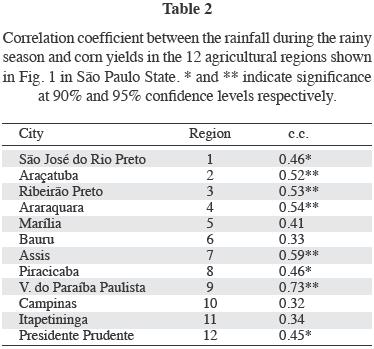
<body><![CDATA[<p align="justify"><font face="verdana" size="2">The 249 rain gauge stations are grouped in 27 regions with 1&deg; x 1&deg; (latitude x longitude) (<a href="/img/revistas/geoint/v49n2/a2f1.jpg" target="_blank">Fig. 1</a>). The daily precipitation in each region is obtained by averaging the daily precipitation values of stations. This method allows the flling of the data gaps so that a continuous daily precipitation data series is obtained. The method of Franchito <i>et al. </i>(2008) is applied to the rainfall data series for each of the 27 regions and thus the onset and end dates of the rainy season are obtained. The duration of the rainy season and the rainfall amounts are compared with corn yields data in several agricultural regions according to IBGE classifcation, which are also shown in <a href="/img/revistas/geoint/v49n2/a2f1.jpg" target="_blank">Fig. 1</a>.</font></p>     <p align="justify"><font face="verdana" size="2">&nbsp;</font></p>     <p align="justify"><font face="verdana" size="2"><b>Results</b></font></p>     <p align="justify"><font face="verdana" size="2"><i>a) Relationships between corn yields and rainfall</i></font></p>     <p align="justify"><font face="verdana" size="2"><a href="/img/revistas/geoint/v49n2/a2f2.jpg" target="_blank">Figs. 2a&#150;b</a> show the dates of the beginning of the rainy and dry seasons, respectively, for the 27 regions of S&atilde;o Paulo State of <a href="/img/revistas/geoint/v49n2/a2f1.jpg" target="_blank">Fig. 1</a>. The later and early beginning of the rainy and dry seasons are shown in <a href="/img/revistas/geoint/v49n2/a2f2.jpg" target="_blank">Figs. 2c&#150;d</a>, respectively. Also dates obtained by adding (substracting) one standard deviation (SD) indicate the range of the onset of the rainy and dry seasons. As can be seen, for 85% of the regions, the rainy season begins between the end of October and the frst week of November. In eastern S&atilde;o Paulo State the beginning of the rainy season occurs in the last week of October and in southeastern S&atilde;o Paulo it occurs between the frst and second week of November (<a href="/img/revistas/geoint/v49n2/a2f2.jpg" target="_blank">Fig. 2a</a>). The earliest onset of the rainy season occurs in general between the frst and second week of September (59% of the regions). However, in northern S&atilde;o Paulo the onset occurs in the last two weeks of September. The maximum delay of the onset of the rainy season occurs in the last two weeks of December for 63% of the regions. The maximum delay of the rainy season, which occurs in the end of December, takes places on the southern and southeast parts of the state (<a href="/img/revistas/geoint/v49n2/a2f2.jpg" target="_blank">Fig. 2c</a>).</font></p>     <p align="justify"><font face="verdana" size="2">In general, for 77% of the regions, the beginning of the dry season occurs between the frst and second week of April. The earliest onset of the dry season is between the frst and second week of March in the north (20% of the regions) and at the end of February in the west of the state (20% of the regions). For 33% of the regions, the earliest beginning of the dry season occurs during the frst two weeks of February. The maximum delay of the dry season occurs during the frst two weeks of June (59% of the regions). At the northern and northwestern zones of the state the maximum delay of the dry season occurs between the frst week of May and frst week of June (<a href="/img/revistas/geoint/v49n2/a2f2.jpg" target="_blank">Fig. 2d</a>).</font></p>     <p align="justify"><font face="verdana" size="2">The trend (in days) of the onset or demise of the rainy season in the period 1970&#150;2003, for the 27 blocks of 1&deg; x 1&deg; (latitude x longitude) of <a href="/img/revistas/geoint/v49n2/a2f1.jpg" target="_blank">Fig. 1</a>, is shown in <a href="/img/revistas/geoint/v49n2/a2t1.jpg" target="_blank">Table 1</a>. To compute the signifcance of the trend, the two&#150;sided Student t&#150;test (Fisher and Yates, 1974) is used. It can be seen that in 12 (4) blocks there is a tendency of more than 20 days to delay the onset (demise) dates. In other regions, such as blocks 1, 4, 17 and 21 there is a tendency to anticipate the demise date. In 7 (12) of the 27 blocks, no trend in the onset (demise) dates is noted. Since there are more regions where the rainy season onset is delaying compared to the demise delay, there is a tendency of a shorter rainy season to occur. This can be seen in 14 of the 27 blocks. Although there is a tendency of a shorter rainy season, in general the accumulated precipitation shows a tendency to increase. As can be seen in <a href="/img/revistas/geoint/v49n2/a2t1.jpg" target="_blank">Table 1</a>, at least in 13 blocks, the accumulated precipitation shows an increasing trend.</font></p>     <p align="justify"><font face="verdana" size="2">In order to investigate the relationships between the rainy season and corn yields in S&atilde;o Paulo State correlation coeffcients (c.cs) between the rainfall and corn yields for the period 1990&#150;2003 are calculated for the 12 agricultural regions showed in <a href="/img/revistas/geoint/v49n2/a2f1.jpg" target="_blank">Fig. 1</a>. As can be seen in <a href="#tabla2">Table 2</a>, there is a strong positive correlation between the rainfall and corn yields in most of the regions. The c.cs are higher than 0.45 (signifcant at a 90% confidence level by the two sided Student t&#150;test) in 8 of the 12 regions considered. In 5 of these regions the c.cs are higher than 0.5 (signifcant at a 95% confdence level). From <a href="/img/revistas/geoint/v49n2/a2f1.jpg" target="_blank">Fig. 1</a> and <a href="#tabla2">Table 2</a>, these 5 regions with higher c.cs are located at the northeastern (2), eastern (1), northwestern (1) and in the western zone (1) of the state. The c.cs are less signifcant in the central, central&#150;eastern and southern regions of the state.</font></p>     <p align="center"><font face="verdana" size="2"><a name="tabla2"></a></font></p>     <p align="center"><font face="verdana" size="2"><img src="/img/revistas/geoint/v49n2/a2t2.jpg"></font></p>     ]]></body>
<body><![CDATA[<p align="justify"><font face="verdana" size="2"><a href="#tabla3">Table 3</a> shows that there is an increasing trend in corn yields for the 12 agricultural regions of S&atilde;o Paulo State (<a href="/img/revistas/geoint/v49n2/a2f1.jpg" target="_blank">Fig. 1</a>) in the period 1990&#150;2003. This can be due to various factors, such as climate variations and improvement of agricultural techniques among others. In the present study the impact of climate conditions on corn yields is investigated, particularly the infuence of precipitation. It is showed that the duration of the rainy season is to reduce, while the tendency of the accumulated precipitation during the rainy season is to increase. Thus, it is suggested that the amount of precipitation rather than the duration of the rainy season has higher impact on corn yields in S&atilde;o Paulo State.</font></p>     <p align="center"><font face="verdana" size="2"><a name="tabla3"></a></font></p>     <p align="center"><font face="verdana" size="2"><img src="/img/revistas/geoint/v49n2/a2t3.jpg"></font></p>     <p align="justify"><font face="verdana" size="2">Another climate variable that has large infuence on agricultural productivity is air temperature. <a href="#tabla4">Table 4</a> shows the trend in air temperature (in oC) for the period 1971&#150;2002 for the 12 agricultural regions in S&atilde;o Paulo State (<a href="/img/revistas/geoint/v49n2/a2f1.jpg" target="_blank">Fig. 1</a>). As can be noted, there is an increasing temperature trend. Model and observation studies have shown that the temperature is increasing globally. Recently, the IPCC AR4 (International Panel for Climate Change Fourth Assessment) evaluations showed that the global warming is mainly due to anthropogenic cause (IPCC, 2007a). Among the anthropogenic gases, CO<sub>2</sub> has more infuence in the increase of mean temperature (<a href="http://www.rrz.uni_hambirg.de/Klima2000/eng/eng_helf.html" target="_blank">http://rrz.uni_hambirg.de/Klima2000/eng/eng_helf.html</a>). The IPCC AR4 studies also indicate that the frequency of extreme events is increasing. These events are associated with heavy rainfall. Thus, the results presented here (shorter rainy season, positive trend of rainfall amounts and positive trend in temperature) may be a consequence of climatic change due to global warming (IPCC, 2007b).</font></p>     <p align="center"><font face="verdana" size="2"><a name="tabla4"></a></font></p>     <p align="center"><font face="verdana" size="2"><img src="/img/revistas/geoint/v49n2/a2t4.jpg"></font></p>     <p align="justify"><font face="verdana" size="2">In the analysis above the factors such as fertility, sowing time and improvements in agricultural techniques are not taken into account. Despite these limitations, the c.c values between rainfall and corn yields strongly indicate the infuence of rainfall on corn yields in the S&atilde;o Paulo region. However, a further increase of accumulated precipitation during shorter rainy season in future can be harmful to agriculture. These events of heavy rainfall in shorter periods may result in landslides, fash foods and consequently crop damage (IPCC 2007b, Goswami <i>et al, </i>2006).</font></p>     <p align="justify"><font face="verdana" size="2"><i>b) El Ni&ntilde;o and La Ni&ntilde;a cases</i></font></p>     <p align="justify"><font face="verdana" size="2">In this section the effect of the El Ni&ntilde;o and La Ni&ntilde;a events on the duration of the rainy season, and the associated accumulated rainfall on corn yields in S&atilde;o Paulo State is investigated. During the period  1970&#150;2003 there were 7 El Ni&ntilde;o events and 4 La Ni&ntilde;a events. Analysis of the rainy season duration and the accumulated precipitation in the 12 agricultural regions of S&atilde;o Paulo State  shows  that in  general  during  strong  El  Ni&ntilde;o episodes there is an increase of both the rainy season and the rainfall. On other hand, the rainy season is shorter and the rainfall decreases during La Ni&ntilde;a episodes. To investigate the infuence of ENSO events on crop yields, two cases are considered: the 1997&#150;98 El Ni&ntilde;o, which was the strongest of the last century (Coughlan, 1999), and the 1998&#150;99 La Ni&ntilde;a, which was a moderate episode. <a href="/img/revistas/geoint/v49n2/a2t5.jpg" target="_blank">Table 5</a> shows the variation of the duration of the rainy season and corn yields for 7 agricultural regions of <a href="/img/revistas/geoint/v49n2/a2f1.jpg" target="_blank">Fig. 1</a> during the El Ni&ntilde;o and La Ni&ntilde;a cases. As can be seen, in the 1997&#150;98 El Ni&ntilde;o, there was an increase of the rainy season (17 to 72 days) for all the 7 regions considered, except in Piracibaca (which is located in the center of the state). The beginning of the rainy season occurred earlier by 20 to 30 days, while the end of the rainy season was around the climatological mean, except in Assis (west of the state), where it was delayed by 35 days.</font></p>     <p align="justify"><font face="verdana" size="2">In the case of the 1998&#150;98 La Ni&ntilde;a event, the rainy season was delayed by 10 to 40 days in the agricultural regions considered, while the end of the rainy season was anticipated by 10 to 35 days in the most of the regions. However, in Aracatuba (northwestern S&atilde;o Paulo) and Assis (western S&atilde;o Paulo) there was a delay of the end of the rainy season by 22 and 15 days, respectively. In the 7 agricultural regions considered, the rainy season was reduced by 18 to 75 days during the La Ni&ntilde;a event.</font></p>     ]]></body>
<body><![CDATA[<p align="justify"><font face="verdana" size="2">As shown in results, section (a), the calculation of the trend using the entire data series indicates that the increase of precipitation in short rainy season seems to have higher impact on corn yields in S&atilde;o Paulo State. However, from <a href="/img/revistas/geoint/v49n2/a2t5.jpg" target="_blank">Table 5</a>, it can be seen that there was an increase of the rainy season in the El Ni&ntilde;o case, while in the La Ni&ntilde;a event a decrease occurred. Also, there is an increase (decrease) of corn yields during the El Ni&ntilde;o (La Ni&ntilde;a) event. Thus, it is suggested that during ENSO episodes the duration of the rainy season seems to have a great impact on corn yields in S&atilde;o Paulo State. Further studies with a record of corn yields longer than 14 years and considering other El Ni&ntilde;o/La Ni&ntilde;a episodes are needed to make convincing connection between corn yields and ENSO events in S&atilde;o Paulo State.</font></p>     <p align="justify"><font face="verdana" size="2">&nbsp;</font></p>     <p align="justify"><font face="verdana" size="2"><b>Conclusions</b></font></p>     <p align="justify"><font face="verdana" size="2">In this study the relationships between the rainy season and corn yields in S&atilde;o Paulo state were investigated. First, the dates of the onset and end of the rainy and dry seasons were determined. Pentad data for 249 rain gauge stations for a period of 34 years (1970&#150;2003) were grouped in 27 regions of 1&deg; x 1&deg; latitude x longitude. The results showed that in general the beginning of the rainy season occurs between the end of October and the frst week of November and the beginning of the dry season occurs between the frst and second week of April. In most of S&atilde;o Paulo State the earlier onset of the rainy season is between the frst and second week of September, while in the northern region it occurs in the last week of September. The later onset of the rainy season takes places in general between the frst and second week of December, although in the southern region it occurs in the end of December. The earlier onset of the dry season occurs on different dates in the several regions of S&atilde;o Paulo. It occurs between the frst and second week of March in the northern zone, at the end of February in the western area, and in the beginning of February in most part of the central and southeastern regions. The later delay of the dry season occurs between the frst and second week of July in most of S&atilde;o Paulo, while in the northern and northwestern regions it occurs between the last week of April and frst two weeks of May.</font></p>     <p align="justify"><font face="verdana" size="2">Trends in the duration of the rainy season and the associated accumulated precipitation were calculated for the 27 blocks 1&deg; x 1&deg; in S&atilde;o Paulo State. The results showed that in general the trend in the duration of the rainy season is negative while the trend in the accumulated rainfall during the rainy season is positive. Although there is a trend of a shorter rainy season, the tendency of the accumulated rainfall is to increase. Trend in crop yields was calculated for the 12 agricultural regions of S&atilde;o Paulo State, showing an increase in the agricultural productivity. Since the trend in the duration of the duration of the rainy season is negative, while the trend in the accumulated precipitation is positive, it is suggested that the increase of precipitation in a shorter rainy season seems to have higher impact on corn yields in S&atilde;o Paulo State. Trend in air temperature was also calculated, indicating that the air temperature is increasing. Higher rainfall and shorter rainy season indicate that the frequency of extreme events with heavy precipitation is increasing. According to IPCC AR4 evaluations the frequency of extreme events is increasing. So, the present results may be associated with global warming. Although rainfall and crop yields were positively correlated, an increase in heavy rainfall events in future may lead to landslides, fash foods and consequently crop damage.</font></p>     <p align="justify"><font face="verdana" size="2">Correlation coeffcients between the rainfall and corn yields were computed for 12 agricultural regions of S&atilde;o Paulo. For 8 of the 12 regions the c.c values were higher than 0.45 (signifcant at a 90% confdence level), while in 5 regions (2 at the northeastern, and 1 in the eastern, northwestern and western zones of the state) the c.cs values are higher than 0.5 (signifcant at 95% confdence level). The central, central&#150;eastern and southern regions showed c.cs with less signifcance.</font></p>     <p align="justify"><font face="verdana" size="2">During the period 1970&#150;2003 there was an increase of the rainy season and rainfall in strong El Ni&ntilde;o episodes while in the case of La Ni&ntilde;a events the rainy season was shorter and the rainfall decreased. Results of case studies considering the 1997&#150;98 El Ni&ntilde;o and the 1998&#150;99 La Ni&ntilde;a indicated that the rainy season duration in the agricultural regions during the El Ni&ntilde;o event increased between 17 and 72 days, while in the La Ni&ntilde;a event there is a decrease of the duration of rainy season between 18 and 75 days. In most of the agricultural regions there was an increase (decrease) of corn yields in the El Ni&ntilde;o (La Ni&ntilde;a) case. This suggests that the increase (decrease) of the duration of the rainy season during the El Ni&ntilde;o (La Ni&ntilde;a) event is associated with the increase (decrease) of corn yields in S&atilde;o Paulo State. Further studies with a record of corn yields longer than 14 years and considering other El Ni&ntilde;o/La Ni&ntilde;a episodes are needed to make convincing connection between corn yields and ENSO events in S&atilde;o Paulo State.</font></p>     <p align="justify"><font face="verdana" size="2">&nbsp;</font></p>     <p align="justify"><font face="verdana" size="2"><b>Acknowledgments</b></font></p>     <p align="justify"><font face="verdana" size="2">This study was supported by Elektro &#150; Eletricidade e Servi&ccedil;os S. A. (Project: Elektro&#150;Climatico, No. ANEEL 0385&#150;008/2007).</font></p>     ]]></body>
<body><![CDATA[<p align="justify"><font face="verdana" size="2">&nbsp;</font></p>     <p align="justify"><font face="verdana" size="2"><b>Bibliography</b></font></p>     <!-- ref --><p align="justify"><font face="verdana" size="2">Berlato, M. A., and D. C. Fontana, 1997. El Ni&ntilde;o Oscila&ccedil;&atilde;o Sul e a agricultura da Regi&atilde;o Sul do Brasil. In: Berri, G.J. (Comp). <i>Efectos de El Ni&ntilde;o sobre la variabilidad clim&aacute;tica, agricultura y recursos h&iacute;dricos en el sudeste de Sudam&eacute;rica. </i>&#91;Buenos Aires&#93;: Ministerio de Cultura y Educaci&oacute;n &#150; Secretar&iacute;a de Ciencia y Tecnolog&iacute;a, p. 27&#150;30. (Taller y Conferencia sobre El Ni&ntilde;o 1997/ 98, Montevideo, Uruguay, 1997).</font>&nbsp;&nbsp;&nbsp;&nbsp;&nbsp;&nbsp;&nbsp;&nbsp;[&#160;<a href="javascript:void(0);" onclick="javascript: window.open('/scielo.php?script=sci_nlinks&ref=3908607&pid=S0016-7169201000020000200001&lng=','','width=640,height=500,resizable=yes,scrollbars=1,menubar=yes,');">Links</a>&#160;]<!-- end-ref --><!-- ref --><p align="justify"><font face="verdana" size="2">Cane, M. A., G. Eschel and R. W. Buckland, 1994. Forecasting Zimbabwean maize yield using eastern equatorial Pacifc sea surface temperature. <i>Nature, </i>370, 204&#150;205.</font>&nbsp;&nbsp;&nbsp;&nbsp;&nbsp;&nbsp;&nbsp;&nbsp;[&#160;<a href="javascript:void(0);" onclick="javascript: window.open('/scielo.php?script=sci_nlinks&ref=3908608&pid=S0016-7169201000020000200002&lng=','','width=640,height=500,resizable=yes,scrollbars=1,menubar=yes,');">Links</a>&#160;]<!-- end-ref --><!-- ref --><p align="justify"><font face="verdana" size="2">Cavalcanti, I. F. A., C. A. Souza, V. E. Kousky and E. B. M. Barbosa, cited 2001. Precipitation anomalies in the southeast region of Brazil (in Portuguese). &#91;Available online at <a href="http://www.cptec.inpe.br/energia/saiba/portalpop2.shtml" target="_blank">http://www.cptec.inpe.br/energi/saiba/portalpop2.shtml</a> </font>&nbsp;&nbsp;&nbsp;&nbsp;&nbsp;&nbsp;&nbsp;&nbsp;[&#160;<a href="javascript:void(0);" onclick="javascript: window.open('/scielo.php?script=sci_nlinks&ref=3908609&pid=S0016-7169201000020000200003&lng=','','width=640,height=500,resizable=yes,scrollbars=1,menubar=yes,');">Links</a>&#160;]<!-- end-ref --><!-- ref --><p align="justify"><font face="verdana" size="2">Coughlan, M. J., 1999. Retrospective on the 1997/1998 El Ni&ntilde;o event. <i>CLIVAR Exchanges, </i>4, 7&#150;8.</font>&nbsp;&nbsp;&nbsp;&nbsp;&nbsp;&nbsp;&nbsp;&nbsp;[&#160;<a href="javascript:void(0);" onclick="javascript: window.open('/scielo.php?script=sci_nlinks&ref=3908610&pid=S0016-7169201000020000200004&lng=','','width=640,height=500,resizable=yes,scrollbars=1,menubar=yes,');">Links</a>&#160;]<!-- end-ref --><!-- ref --><p align="justify"><font face="verdana" size="2">Fisher, R. A. and F. Yates, 1974. Statistical Tables for Biological, Agricultural and Medical Research, published by Longman Group Ltd., London.</font>&nbsp;&nbsp;&nbsp;&nbsp;&nbsp;&nbsp;&nbsp;&nbsp;[&#160;<a href="javascript:void(0);" onclick="javascript: window.open('/scielo.php?script=sci_nlinks&ref=3908611&pid=S0016-7169201000020000200005&lng=','','width=640,height=500,resizable=yes,scrollbars=1,menubar=yes,');">Links</a>&#160;]<!-- end-ref --><!-- ref --><p align="justify"><font face="verdana" size="2">Fontana, D. C. and M. A. Berlato, 1997. Infuence of ENSO on the rainfall over Rio Grande do Sul State (in Portuguese). <i>Revista Brasileira de Agrometeorologia, </i>5, 127&#150; 132.</font>&nbsp;&nbsp;&nbsp;&nbsp;&nbsp;&nbsp;&nbsp;&nbsp;[&#160;<a href="javascript:void(0);" onclick="javascript: window.open('/scielo.php?script=sci_nlinks&ref=3908612&pid=S0016-7169201000020000200006&lng=','','width=640,height=500,resizable=yes,scrollbars=1,menubar=yes,');">Links</a>&#160;]<!-- end-ref --><!-- ref --><p align="justify"><font face="verdana" size="2">Franchito, S. H., V. B. Rao, P. R. B. Barbieri and C. M. E. Santo, 2008. Rainy season duration estimated from OLR versus rain gauge data and the 2001 drought. <i>Journal of Applied Meteorology and Climatology, 47, </i>1493&#150;1499.</font>&nbsp;&nbsp;&nbsp;&nbsp;&nbsp;&nbsp;&nbsp;&nbsp;[&#160;<a href="javascript:void(0);" onclick="javascript: window.open('/scielo.php?script=sci_nlinks&ref=3908613&pid=S0016-7169201000020000200007&lng=','','width=640,height=500,resizable=yes,scrollbars=1,menubar=yes,');">Links</a>&#160;]<!-- end-ref --><!-- ref --><p align="justify"><font face="verdana" size="2">Fu, Y., and G. Liu, 2003. Precipitation characteristics in mid&#150;latitude East Asia as observed by TRMM PR and TMI. J. Meteor. Soc. Japan, 81, 1351&#150;1367.</font>&nbsp;&nbsp;&nbsp;&nbsp;&nbsp;&nbsp;&nbsp;&nbsp;[&#160;<a href="javascript:void(0);" onclick="javascript: window.open('/scielo.php?script=sci_nlinks&ref=3908614&pid=S0016-7169201000020000200008&lng=','','width=640,height=500,resizable=yes,scrollbars=1,menubar=yes,');">Links</a>&#160;]<!-- end-ref --><!-- ref --><p align="justify"><font face="verdana" size="2">Gasques, J. G., 1988. The effects of climatic variations on agriculture in northeast Brazil. <i>The impact of climatic variations on agriculture. </i>Vol. 2. Assessments in semi&#150;arid regions (Parry, M. I., T. R. Carter, N. T. Konijn, Editors). Kluwer Academic Publishers.</font>&nbsp;&nbsp;&nbsp;&nbsp;&nbsp;&nbsp;&nbsp;&nbsp;[&#160;<a href="javascript:void(0);" onclick="javascript: window.open('/scielo.php?script=sci_nlinks&ref=3908615&pid=S0016-7169201000020000200009&lng=','','width=640,height=500,resizable=yes,scrollbars=1,menubar=yes,');">Links</a>&#160;]<!-- end-ref --><!-- ref --><p align="justify"><font face="verdana" size="2">Goswami, B. N., V. Venugopal, D. Sengupta, M. S. Madhusoodanan and P. K. Xavier, 2006. Increasing trend of extreme rain events over India in a warming environment. <i>Science, </i>314, 1442 &#150; 1445.</font>&nbsp;&nbsp;&nbsp;&nbsp;&nbsp;&nbsp;&nbsp;&nbsp;[&#160;<a href="javascript:void(0);" onclick="javascript: window.open('/scielo.php?script=sci_nlinks&ref=3908616&pid=S0016-7169201000020000200010&lng=','','width=640,height=500,resizable=yes,scrollbars=1,menubar=yes,');">Links</a>&#160;]<!-- end-ref --><!-- ref --><p align="justify"><font face="verdana" size="2">Grimm, A. M., S. E. T Ferraz and J. Gomes, 1998. Precipitation anomalies in southern Brazil associated with El Ni&ntilde;o and La Ni&ntilde;a events. <i>J. Climate, </i>11, 2863&#150;2880.</font>&nbsp;&nbsp;&nbsp;&nbsp;&nbsp;&nbsp;&nbsp;&nbsp;[&#160;<a href="javascript:void(0);" onclick="javascript: window.open('/scielo.php?script=sci_nlinks&ref=3908617&pid=S0016-7169201000020000200011&lng=','','width=640,height=500,resizable=yes,scrollbars=1,menubar=yes,');">Links</a>&#160;]<!-- end-ref --><!-- ref --><p align="justify"><font face="verdana" size="2">Grimm, A. M., V. R. Barros and M. E. Doyle, 2000. Climate variability in Southern South America associated with El Ni&ntilde;o and La Ni&ntilde;a events. <i>J. Climate, </i>13, 35&#150;58.</font>&nbsp;&nbsp;&nbsp;&nbsp;&nbsp;&nbsp;&nbsp;&nbsp;[&#160;<a href="javascript:void(0);" onclick="javascript: window.open('/scielo.php?script=sci_nlinks&ref=3908618&pid=S0016-7169201000020000200012&lng=','','width=640,height=500,resizable=yes,scrollbars=1,menubar=yes,');">Links</a>&#160;]<!-- end-ref --><!-- ref --><p align="justify"><font face="verdana" size="2">Handler, P., 1984. Corn yields in United States and sea surface anomalies in the equatorial Pacifc ocean. <i>Agricultural and Forest Meteorology, </i>31, 25&#150;32.</font>&nbsp;&nbsp;&nbsp;&nbsp;&nbsp;&nbsp;&nbsp;&nbsp;[&#160;<a href="javascript:void(0);" onclick="javascript: window.open('/scielo.php?script=sci_nlinks&ref=3908619&pid=S0016-7169201000020000200013&lng=','','width=640,height=500,resizable=yes,scrollbars=1,menubar=yes,');">Links</a>&#160;]<!-- end-ref --><!-- ref --><p align="justify"><font face="verdana" size="2">IPCC, 2007a: <i>Climate Change 2007. The Physical Science Basis. Contribution of Working Group I to the Fourth Assessment Report of the Intergovernmental Panel on Climate Change </i>&#91;Solomon, S., D. Qin, M. Manning, Z. Chen, M. Marquis, K.B. Averyt, M. Tignor and H.L. Miller (eds.)&#93;. Cambridge University Press, Cambridge, United Kingdom and New York, NY, USA.</font>&nbsp;&nbsp;&nbsp;&nbsp;&nbsp;&nbsp;&nbsp;&nbsp;[&#160;<a href="javascript:void(0);" onclick="javascript: window.open('/scielo.php?script=sci_nlinks&ref=3908620&pid=S0016-7169201000020000200014&lng=','','width=640,height=500,resizable=yes,scrollbars=1,menubar=yes,');">Links</a>&#160;]<!-- end-ref --><!-- ref --><p align="justify"><font face="verdana" size="2">IPCC, 2007b: <i>Climate Change 2007. Impacts, Adaptation, and Vulnerability. Contribution of Working Group II to the Fourth Assessment Report of the Intergovernmental Panel on Climate Change </i>&#91;Parry, Martin L., Canziani, Osvaldo F, Palutikof, Jean P., van der Linden, Paul J., and Hanson, Clair E. (eds.)&#93;. Cambridge University Press, Cambridge, United Kingdom, 1000 pp.</font>&nbsp;&nbsp;&nbsp;&nbsp;&nbsp;&nbsp;&nbsp;&nbsp;[&#160;<a href="javascript:void(0);" onclick="javascript: window.open('/scielo.php?script=sci_nlinks&ref=3908621&pid=S0016-7169201000020000200015&lng=','','width=640,height=500,resizable=yes,scrollbars=1,menubar=yes,');">Links</a>&#160;]<!-- end-ref --><!-- ref --><p align="justify"><font face="verdana" size="2">Kousky, V. E., M. T. Kayano and I. F. A. Cavalcanti, 1984. A review of the southern oscillation oceanic atmospheric circulation changes and related rainfall anomalies. <i>Tellus, </i>36, 490&#150;504.</font>&nbsp;&nbsp;&nbsp;&nbsp;&nbsp;&nbsp;&nbsp;&nbsp;[&#160;<a href="javascript:void(0);" onclick="javascript: window.open('/scielo.php?script=sci_nlinks&ref=3908622&pid=S0016-7169201000020000200016&lng=','','width=640,height=500,resizable=yes,scrollbars=1,menubar=yes,');">Links</a>&#160;]<!-- end-ref --><!-- ref --><p align="justify"><font face="verdana" size="2">Marengo, J. A., L. M. Alves, C. A. C. Castro, and D. Mendes, cited 2001. Information on the beginning of the rainy season in the southeast, west&#150;central and south of northeast regions, which are affected by the energy crisis (in Portuguese). &#91;Available online at <a href="http://www.cptec.inpe.br/energia/saiba/iniciochuvas.shtml" target="_blank">http://www.cptec.inpe.br/energia/saiba/iniciochuvas.shtml</a>.&#93;</font>&nbsp;&nbsp;&nbsp;&nbsp;&nbsp;&nbsp;&nbsp;&nbsp;[&#160;<a href="javascript:void(0);" onclick="javascript: window.open('/scielo.php?script=sci_nlinks&ref=3908623&pid=S0016-7169201000020000200017&lng=','','width=640,height=500,resizable=yes,scrollbars=1,menubar=yes,');">Links</a>&#160;]<!-- end-ref --><!-- ref --><p align="justify"><font face="verdana" size="2">Nicholls, N, 1984: The Stability of Empirical Long&#150;Range Forecast Techniques: A Case Study. <i>Journal of Climate and Applied Meteorology, 23, </i>143&#150;147.</font>&nbsp;&nbsp;&nbsp;&nbsp;&nbsp;&nbsp;&nbsp;&nbsp;[&#160;<a href="javascript:void(0);" onclick="javascript: window.open('/scielo.php?script=sci_nlinks&ref=3908624&pid=S0016-7169201000020000200018&lng=','','width=640,height=500,resizable=yes,scrollbars=1,menubar=yes,');">Links</a>&#160;]<!-- end-ref --><!-- ref --><p align="justify"><font face="verdana" size="2">Rao, V. B., and K. Hada, 1990. Characteristics of rainfall over Brazil: Annual variations and connections with Southern Oscillation. <i>Theor. App. Clim., 42, </i>81&#150;91.</font>&nbsp;&nbsp;&nbsp;&nbsp;&nbsp;&nbsp;&nbsp;&nbsp;[&#160;<a href="javascript:void(0);" onclick="javascript: window.open('/scielo.php?script=sci_nlinks&ref=3908625&pid=S0016-7169201000020000200019&lng=','','width=640,height=500,resizable=yes,scrollbars=1,menubar=yes,');">Links</a>&#160;]<!-- end-ref --><!-- ref --><p align="justify"><font face="verdana" size="2">Rao, V. B., L. D. A. S&aacute;, S. H. Franchito, and K. Hada, 1997. Interanual variations of rainfall and corn yields in northeast Brazil. <i>Agricultural and Forest Meteorology, 85, </i>63&#150;74.</font>&nbsp;&nbsp;&nbsp;&nbsp;&nbsp;&nbsp;&nbsp;&nbsp;[&#160;<a href="javascript:void(0);" onclick="javascript: window.open('/scielo.php?script=sci_nlinks&ref=3908626&pid=S0016-7169201000020000200020&lng=','','width=640,height=500,resizable=yes,scrollbars=1,menubar=yes,');">Links</a>&#160;]<!-- end-ref --> ]]></body><back>
<ref-list>
<ref id="B1">
<nlm-citation citation-type="confpro">
<person-group person-group-type="author">
<name>
<surname><![CDATA[Berlato]]></surname>
<given-names><![CDATA[M. A.]]></given-names>
</name>
<name>
<surname><![CDATA[Fontana]]></surname>
<given-names><![CDATA[D. C.]]></given-names>
</name>
</person-group>
<article-title xml:lang="pt"><![CDATA[El Niño Oscilação Sul e a agricultura da Região Sul do Brasil]]></article-title>
<person-group person-group-type="editor">
<name>
<surname><![CDATA[Berri]]></surname>
<given-names><![CDATA[G.J.]]></given-names>
</name>
</person-group>
<source><![CDATA[Efectos de El Niño sobre la variabilidad climática, agricultura y recursos hídricos en el sudeste de Sudamérica]]></source>
<year>1997</year>
<conf-name><![CDATA[ Taller y Conferencia sobre El Niño 1997/ 98]]></conf-name>
<conf-date>1997</conf-date>
<conf-loc>Montevideo </conf-loc>
<page-range>27-30</page-range><publisher-loc><![CDATA[Buenos Aires ]]></publisher-loc>
<publisher-name><![CDATA[Ministerio de Cultura y EducaciónSecretaría de Ciencia y Tecnología]]></publisher-name>
</nlm-citation>
</ref>
<ref id="B2">
<nlm-citation citation-type="journal">
<person-group person-group-type="author">
<name>
<surname><![CDATA[Cane]]></surname>
<given-names><![CDATA[M. A.]]></given-names>
</name>
<name>
<surname><![CDATA[Eschel]]></surname>
<given-names><![CDATA[G.]]></given-names>
</name>
<name>
<surname><![CDATA[Buckland]]></surname>
<given-names><![CDATA[R. W.]]></given-names>
</name>
</person-group>
<article-title xml:lang="en"><![CDATA[Forecasting Zimbabwean maize yield using eastern equatorial Pacifc sea surface temperature]]></article-title>
<source><![CDATA[Nature]]></source>
<year>1994</year>
<volume>370</volume>
<page-range>204-205</page-range></nlm-citation>
</ref>
<ref id="B3">
<nlm-citation citation-type="">
<person-group person-group-type="author">
<name>
<surname><![CDATA[Cavalcanti]]></surname>
<given-names><![CDATA[I. F. A.]]></given-names>
</name>
<name>
<surname><![CDATA[Souza]]></surname>
<given-names><![CDATA[C. A.]]></given-names>
</name>
<name>
<surname><![CDATA[Kousky]]></surname>
<given-names><![CDATA[V. E.]]></given-names>
</name>
<name>
<surname><![CDATA[Barbosa]]></surname>
<given-names><![CDATA[E. B. M.]]></given-names>
</name>
</person-group>
<source><![CDATA[Precipitation anomalies in the southeast region of Brazil]]></source>
<year></year>
</nlm-citation>
</ref>
<ref id="B4">
<nlm-citation citation-type="journal">
<person-group person-group-type="author">
<name>
<surname><![CDATA[Coughlan]]></surname>
<given-names><![CDATA[M. J.]]></given-names>
</name>
</person-group>
<article-title xml:lang="en"><![CDATA[Retrospective on the 1997/1998 El Niño event]]></article-title>
<source><![CDATA[CLIVAR Exchanges]]></source>
<year>1999</year>
<volume>4</volume>
<page-range>7-8</page-range></nlm-citation>
</ref>
<ref id="B5">
<nlm-citation citation-type="book">
<person-group person-group-type="author">
<name>
<surname><![CDATA[Fisher]]></surname>
<given-names><![CDATA[R. A.]]></given-names>
</name>
<name>
<surname><![CDATA[Yates]]></surname>
<given-names><![CDATA[F.]]></given-names>
</name>
</person-group>
<source><![CDATA[Statistical Tables for Biological, Agricultural and Medical Research]]></source>
<year>1974</year>
<publisher-loc><![CDATA[London ]]></publisher-loc>
<publisher-name><![CDATA[Longman Group Ltd.]]></publisher-name>
</nlm-citation>
</ref>
<ref id="B6">
<nlm-citation citation-type="journal">
<person-group person-group-type="author">
<name>
<surname><![CDATA[Fontana]]></surname>
<given-names><![CDATA[D. C.]]></given-names>
</name>
<name>
<surname><![CDATA[Berlato]]></surname>
<given-names><![CDATA[M. A.]]></given-names>
</name>
</person-group>
<article-title xml:lang="pt"><![CDATA[Infuence of ENSO on the rainfall over Rio Grande do Sul State]]></article-title>
<source><![CDATA[Revista Brasileira de Agrometeorologia]]></source>
<year>1997</year>
<volume>5</volume>
<page-range>127- 132</page-range></nlm-citation>
</ref>
<ref id="B7">
<nlm-citation citation-type="journal">
<person-group person-group-type="author">
<name>
<surname><![CDATA[Franchito]]></surname>
<given-names><![CDATA[S. H.]]></given-names>
</name>
<name>
<surname><![CDATA[Rao]]></surname>
<given-names><![CDATA[V. B.]]></given-names>
</name>
<name>
<surname><![CDATA[Barbieri]]></surname>
<given-names><![CDATA[P. R. B.]]></given-names>
</name>
<name>
<surname><![CDATA[Santo]]></surname>
<given-names><![CDATA[C. M. E.]]></given-names>
</name>
</person-group>
<article-title xml:lang="en"><![CDATA[Rainy season duration estimated from OLR versus rain gauge data and the 2001 drought]]></article-title>
<source><![CDATA[Journal of Applied Meteorology and Climatology]]></source>
<year>2008</year>
<volume>47</volume>
<page-range>1493-1499</page-range></nlm-citation>
</ref>
<ref id="B8">
<nlm-citation citation-type="journal">
<person-group person-group-type="author">
<name>
<surname><![CDATA[Fu]]></surname>
<given-names><![CDATA[Y.]]></given-names>
</name>
<name>
<surname><![CDATA[Liu]]></surname>
<given-names><![CDATA[G.]]></given-names>
</name>
</person-group>
<article-title xml:lang="en"><![CDATA[Precipitation characteristics in mid-latitude East Asia as observed by TRMM PR and TMI]]></article-title>
<source><![CDATA[J. Meteor. Soc. Japan]]></source>
<year>2003</year>
<volume>81</volume>
<page-range>1351-1367</page-range></nlm-citation>
</ref>
<ref id="B9">
<nlm-citation citation-type="book">
<person-group person-group-type="author">
<name>
<surname><![CDATA[Gasques]]></surname>
<given-names><![CDATA[J. G.]]></given-names>
</name>
</person-group>
<article-title xml:lang="en"><![CDATA[The effects of climatic variations on agriculture in northeast Brazil]]></article-title>
<person-group person-group-type="editor">
<name>
<surname><![CDATA[Parry]]></surname>
<given-names><![CDATA[M. I.]]></given-names>
</name>
<name>
<surname><![CDATA[Carter]]></surname>
<given-names><![CDATA[T. R.]]></given-names>
</name>
<name>
<surname><![CDATA[Konijn]]></surname>
<given-names><![CDATA[N. T.]]></given-names>
</name>
</person-group>
<source><![CDATA[The impact of climatic variations on agriculture: Vol. 2. Assessments in semi-arid regions]]></source>
<year>1988</year>
<publisher-name><![CDATA[Kluwer Academic Publishers]]></publisher-name>
</nlm-citation>
</ref>
<ref id="B10">
<nlm-citation citation-type="journal">
<person-group person-group-type="author">
<name>
<surname><![CDATA[Goswami]]></surname>
<given-names><![CDATA[B. N.]]></given-names>
</name>
<name>
<surname><![CDATA[Venugopal]]></surname>
<given-names><![CDATA[V.]]></given-names>
</name>
<name>
<surname><![CDATA[Sengupta]]></surname>
<given-names><![CDATA[D.]]></given-names>
</name>
<name>
<surname><![CDATA[Madhusoodanan]]></surname>
<given-names><![CDATA[M. S.]]></given-names>
</name>
<name>
<surname><![CDATA[Xavier]]></surname>
<given-names><![CDATA[P. K.]]></given-names>
</name>
</person-group>
<article-title xml:lang="en"><![CDATA[Increasing trend of extreme rain events over India in a warming environment]]></article-title>
<source><![CDATA[Science]]></source>
<year>2006</year>
<volume>314</volume>
<page-range>1442 - 1445</page-range></nlm-citation>
</ref>
<ref id="B11">
<nlm-citation citation-type="journal">
<person-group person-group-type="author">
<name>
<surname><![CDATA[Grimm]]></surname>
<given-names><![CDATA[A. M.]]></given-names>
</name>
<name>
<surname><![CDATA[Ferraz]]></surname>
<given-names><![CDATA[S. E. T]]></given-names>
</name>
<name>
<surname><![CDATA[Gomes]]></surname>
<given-names><![CDATA[J.]]></given-names>
</name>
</person-group>
<article-title xml:lang="en"><![CDATA[Precipitation anomalies in southern Brazil associated with El Niño and La Niña events]]></article-title>
<source><![CDATA[J. Climate]]></source>
<year>1998</year>
<volume>11</volume>
<page-range>2863-2880</page-range></nlm-citation>
</ref>
<ref id="B12">
<nlm-citation citation-type="journal">
<person-group person-group-type="author">
<name>
<surname><![CDATA[Grimm]]></surname>
<given-names><![CDATA[A. M.]]></given-names>
</name>
<name>
<surname><![CDATA[Barros]]></surname>
<given-names><![CDATA[V. R.]]></given-names>
</name>
<name>
<surname><![CDATA[Doyle]]></surname>
<given-names><![CDATA[M. E.]]></given-names>
</name>
</person-group>
<article-title xml:lang="en"><![CDATA[Climate variability in Southern South America associated with El Niño and La Niña events]]></article-title>
<source><![CDATA[J. Climate]]></source>
<year>2000</year>
<volume>13</volume>
<page-range>35-58</page-range></nlm-citation>
</ref>
<ref id="B13">
<nlm-citation citation-type="journal">
<person-group person-group-type="author">
<name>
<surname><![CDATA[Handler]]></surname>
<given-names><![CDATA[P.]]></given-names>
</name>
</person-group>
<article-title xml:lang="en"><![CDATA[Corn yields in United States and sea surface anomalies in the equatorial Pacifc ocean]]></article-title>
<source><![CDATA[Agricultural and Forest Meteorology]]></source>
<year>1984</year>
<volume>31</volume>
<page-range>25-32</page-range></nlm-citation>
</ref>
<ref id="B14">
<nlm-citation citation-type="book">
<person-group person-group-type="author">
<name>
<surname><![CDATA[Solomon]]></surname>
<given-names><![CDATA[S.]]></given-names>
</name>
<name>
<surname><![CDATA[Qin]]></surname>
<given-names><![CDATA[D.]]></given-names>
</name>
<name>
<surname><![CDATA[Manning]]></surname>
<given-names><![CDATA[M.]]></given-names>
</name>
<name>
<surname><![CDATA[Chen]]></surname>
<given-names><![CDATA[Z.]]></given-names>
</name>
<name>
<surname><![CDATA[Marquis]]></surname>
<given-names><![CDATA[M.]]></given-names>
</name>
<name>
<surname><![CDATA[Averyt]]></surname>
<given-names><![CDATA[K.B.]]></given-names>
</name>
<name>
<surname><![CDATA[Tignor]]></surname>
<given-names><![CDATA[M.]]></given-names>
</name>
<name>
<surname><![CDATA[Miller]]></surname>
<given-names><![CDATA[H.L.]]></given-names>
</name>
</person-group>
<collab>IPCC</collab>
<source><![CDATA[Climate Change 2007: The Physical Science Basis. Contribution of Working Group I to the Fourth Assessment Report of the Intergovernmental Panel on Climate Change]]></source>
<year>2007</year>
<publisher-loc><![CDATA[Cambridge^eNYNew York NY]]></publisher-loc>
<publisher-name><![CDATA[Cambridge University Press]]></publisher-name>
</nlm-citation>
</ref>
<ref id="B15">
<nlm-citation citation-type="book">
<person-group person-group-type="author">
<name>
<surname><![CDATA[Parry]]></surname>
<given-names><![CDATA[Martin L.]]></given-names>
</name>
<name>
<surname><![CDATA[Canziani]]></surname>
<given-names><![CDATA[Osvaldo F]]></given-names>
</name>
<name>
<surname><![CDATA[Palutikof]]></surname>
<given-names><![CDATA[Jean P.]]></given-names>
</name>
<name>
<surname><![CDATA[van der Linden]]></surname>
<given-names><![CDATA[Paul J.]]></given-names>
</name>
<name>
<surname><![CDATA[Hanson]]></surname>
<given-names><![CDATA[Clair E.]]></given-names>
</name>
</person-group>
<collab>IPCC</collab>
<source><![CDATA[Climate Change 2007: Impacts, Adaptation, and Vulnerability. Contribution of Working Group II to the Fourth Assessment Report of the Intergovernmental Panel on Climate Change]]></source>
<year>2007</year>
<page-range>1000</page-range><publisher-loc><![CDATA[Cambridge ]]></publisher-loc>
<publisher-name><![CDATA[Cambridge University Press]]></publisher-name>
</nlm-citation>
</ref>
<ref id="B16">
<nlm-citation citation-type="journal">
<person-group person-group-type="author">
<name>
<surname><![CDATA[Kousky]]></surname>
<given-names><![CDATA[V. E.]]></given-names>
</name>
<name>
<surname><![CDATA[Kayano]]></surname>
<given-names><![CDATA[M. T.]]></given-names>
</name>
<name>
<surname><![CDATA[Cavalcanti]]></surname>
<given-names><![CDATA[I. F. A.]]></given-names>
</name>
</person-group>
<article-title xml:lang="en"><![CDATA[A review of the southern oscillation oceanic atmospheric circulation changes and related rainfall anomalies]]></article-title>
<source><![CDATA[Tellus]]></source>
<year>1984</year>
<volume>36</volume>
<page-range>490-504</page-range></nlm-citation>
</ref>
<ref id="B17">
<nlm-citation citation-type="">
<person-group person-group-type="author">
<name>
<surname><![CDATA[Marengo]]></surname>
<given-names><![CDATA[J. A.]]></given-names>
</name>
<name>
<surname><![CDATA[Alves]]></surname>
<given-names><![CDATA[L. M.]]></given-names>
</name>
<name>
<surname><![CDATA[Castro]]></surname>
<given-names><![CDATA[C. A. C.]]></given-names>
</name>
<name>
<surname><![CDATA[Mendes]]></surname>
<given-names><![CDATA[D.]]></given-names>
</name>
</person-group>
<source><![CDATA[Information on the beginning of the rainy season in the southeast, west-central and south of northeast regions, which are affected by the energy crisis]]></source>
<year></year>
</nlm-citation>
</ref>
<ref id="B18">
<nlm-citation citation-type="journal">
<person-group person-group-type="author">
<name>
<surname><![CDATA[Nicholls]]></surname>
<given-names><![CDATA[N]]></given-names>
</name>
</person-group>
<article-title xml:lang="en"><![CDATA[The Stability of Empirical Long-Range Forecast Techniques: A Case Study]]></article-title>
<source><![CDATA[Journal of Climate and Applied Meteorology]]></source>
<year>1984</year>
<volume>23</volume>
<page-range>143-147</page-range></nlm-citation>
</ref>
<ref id="B19">
<nlm-citation citation-type="journal">
<person-group person-group-type="author">
<name>
<surname><![CDATA[Rao]]></surname>
<given-names><![CDATA[V. B.]]></given-names>
</name>
<name>
<surname><![CDATA[Hada]]></surname>
<given-names><![CDATA[K.]]></given-names>
</name>
</person-group>
<article-title xml:lang="en"><![CDATA[Characteristics of rainfall over Brazil: Annual variations and connections with Southern Oscillation]]></article-title>
<source><![CDATA[Theor. App. Clim.]]></source>
<year>1990</year>
<volume>42</volume>
<page-range>81-91</page-range></nlm-citation>
</ref>
<ref id="B20">
<nlm-citation citation-type="journal">
<person-group person-group-type="author">
<name>
<surname><![CDATA[Rao]]></surname>
<given-names><![CDATA[V. B.]]></given-names>
</name>
<name>
<surname><![CDATA[Sá]]></surname>
<given-names><![CDATA[L. D. A.]]></given-names>
</name>
<name>
<surname><![CDATA[Franchito]]></surname>
<given-names><![CDATA[S. H.]]></given-names>
</name>
<name>
<surname><![CDATA[Hada]]></surname>
<given-names><![CDATA[K.]]></given-names>
</name>
</person-group>
<article-title xml:lang="en"><![CDATA[Interanual variations of rainfall and corn yields in northeast Brazil]]></article-title>
<source><![CDATA[Agricultural and Forest Meteorology]]></source>
<year>1997</year>
<volume>85</volume>
<page-range>63-74</page-range></nlm-citation>
</ref>
</ref-list>
</back>
</article>
