<?xml version="1.0" encoding="ISO-8859-1"?><article xmlns:mml="http://www.w3.org/1998/Math/MathML" xmlns:xlink="http://www.w3.org/1999/xlink" xmlns:xsi="http://www.w3.org/2001/XMLSchema-instance">
<front>
<journal-meta>
<journal-id>0016-7169</journal-id>
<journal-title><![CDATA[Geofísica internacional]]></journal-title>
<abbrev-journal-title><![CDATA[Geofís. Intl]]></abbrev-journal-title>
<issn>0016-7169</issn>
<publisher>
<publisher-name><![CDATA[Universidad Nacional Autónoma de México, Instituto de Geofísica]]></publisher-name>
</publisher>
</journal-meta>
<article-meta>
<article-id>S0016-71692010000200001</article-id>
<title-group>
<article-title xml:lang="en"><![CDATA[Multi-scale analysis of well-logging data in petrophysical and stratigraphic correlation]]></article-title>
</title-group>
<contrib-group>
<contrib contrib-type="author">
<name>
<surname><![CDATA[Coconi-Morales]]></surname>
<given-names><![CDATA[E.]]></given-names>
</name>
<xref ref-type="aff" rid="A01"/>
</contrib>
<contrib contrib-type="author">
<name>
<surname><![CDATA[Ronquillo-Jarillo]]></surname>
<given-names><![CDATA[G.]]></given-names>
</name>
<xref ref-type="aff" rid="A01"/>
</contrib>
<contrib contrib-type="author">
<name>
<surname><![CDATA[Campos-Enríquez]]></surname>
<given-names><![CDATA[J. O.]]></given-names>
</name>
<xref ref-type="aff" rid="A02"/>
</contrib>
</contrib-group>
<aff id="A01">
<institution><![CDATA[,Instituto Mexicano del Petróleo  ]]></institution>
<addr-line><![CDATA[Mexico City ]]></addr-line>
<country>Mexico</country>
</aff>
<aff id="A02">
<institution><![CDATA[,Universidad Nacional Autónoma de México Instituto de Geofísica ]]></institution>
<addr-line><![CDATA[Mexico City ]]></addr-line>
<country>Mexico</country>
</aff>
<pub-date pub-type="pub">
<day>00</day>
<month>06</month>
<year>2010</year>
</pub-date>
<pub-date pub-type="epub">
<day>00</day>
<month>06</month>
<year>2010</year>
</pub-date>
<volume>49</volume>
<numero>2</numero>
<fpage>55</fpage>
<lpage>67</lpage>
<copyright-statement/>
<copyright-year/>
<self-uri xlink:href="http://www.scielo.org.mx/scielo.php?script=sci_arttext&amp;pid=S0016-71692010000200001&amp;lng=en&amp;nrm=iso"></self-uri><self-uri xlink:href="http://www.scielo.org.mx/scielo.php?script=sci_abstract&amp;pid=S0016-71692010000200001&amp;lng=en&amp;nrm=iso"></self-uri><self-uri xlink:href="http://www.scielo.org.mx/scielo.php?script=sci_pdf&amp;pid=S0016-71692010000200001&amp;lng=en&amp;nrm=iso"></self-uri><abstract abstract-type="short" xml:lang="es"><p><![CDATA[Determinación de los límites locales de una columna estratigráfca (por ejemplo relacionados con ambientes de depósito) representan en particular una gran contribución al análisis y caracterización de yacimientos petroleros. En este marco general, las Transformadas de Ondícula, continua y discreta, son aplicadas a datos de registros geofísicos de pozos de un área productora de aceite en el Golfo de México, con el propósito de encontrar periodicidades o ciclos y correlacionarlos con las características litológicas y estratigráfcas de los ambientes asociados. Un análisis multiescala de registros geofísicos de pozos (rayos gama, resistividad y potencial espontáneo) fue realizado basado en la transformada de ondicular. En particular los coefcientes ondiculares fueron determinados. El análisis de los escalogramas-espectrogramas permitió obtener pseudolongitudes de onda características para cada escala (frecuencias). Las pseudolongitudes de onda fueron asociadas con posibles periodicidades o periodos deposicionales (ciclos climáticos de Milankovitch) del área de estudio. El caso presentado muestra que el análisis ondicular es una técnica complementaria de gran ayuda para la caracterización de yacimientos, particularmente en la localización de secuencias estratigráfcas y de las facies asociadas.]]></p></abstract>
<abstract abstract-type="short" xml:lang="en"><p><![CDATA[Establishment of sequence limits in a stratigraphic column (i.e., related to depositional environments) represents in particular a great contribution to the analysis and characterization of oil reservoirs. In this context, we applied the continuous as well as the discrete wavelet transforms, to data from geophysical well logs from an oil producing area in the Gulf of Mexico, in order to bring about periodicities or cycles and correlate them with lithologic and stratigraphic characteristics of the associated environments. A multiscale analysis of geophysical well loggings (gamma ray, resistivity, and spontaneous potential) was done based in the wavelet transform. In particular the wavelet coeffcients were determined. Analysis of the obtained spectrograms-scalograms enabled to establish characteristic pseudowavelengths for each scale (frequencies). Pseudo wavelengths were associated with possible periodicities in deposition (Milankovitch's climatic cycles) of the study area. This case history shows that the wavelet analysis is a helpful complementary technique for reservoir characterization, specifcally in the location of stratigraphic sequences and associated facies.]]></p></abstract>
<kwd-group>
<kwd lng="es"><![CDATA[Transformada de ondícula]]></kwd>
<kwd lng="es"><![CDATA[registros geofísicos de pozos]]></kwd>
<kwd lng="es"><![CDATA[patrones de repetición]]></kwd>
<kwd lng="es"><![CDATA[análisis multiescala]]></kwd>
<kwd lng="es"><![CDATA[ciclicidad]]></kwd>
<kwd lng="en"><![CDATA[Wavelet transform]]></kwd>
<kwd lng="en"><![CDATA[geophysical well logging]]></kwd>
<kwd lng="en"><![CDATA[repetition patterns]]></kwd>
<kwd lng="en"><![CDATA[multiscale analysis]]></kwd>
<kwd lng="en"><![CDATA[cyclicity]]></kwd>
</kwd-group>
</article-meta>
</front><body><![CDATA[ <p align="justify"><font face="verdana" size="4">Articles</font></p>     <p align="justify"><font face="verdana" size="2">&nbsp;</font></p>     <p align="center"><font face="verdana" size="4"><b>Multi&#150;scale analysis of well&#150;logging data in petrophysical and stratigraphic correlation</b></font></p>     <p align="center"><font face="verdana" size="2">&nbsp;</font></p>     <p align="center"><font face="verdana" size="2"><b>E. Coconi&#150;Morales<sup>1*</sup>, G. Ronquillo&#150;Jarillo<sup>1</sup> and J. O. Campos&#150;Enr&iacute;quez<sup>2</sup></b></font></p>     <p align="justify"><font face="verdana" size="2">&nbsp;</font></p>     <p align="justify"><font face="verdana" size="2"><i><sup>1</sup> Instituto Mexicano del Petr&oacute;leo, Eje Central Norte L&aacute;zaro C&aacute;rdenas 152, 07730, Mexico City, Mexico</i></i></font></p>     <p align="justify"><font face="verdana" size="2"><i><sup>2</sup> Instituto de Geof&iacute;sica, Universidad Nacional Aut&oacute;noma de M&eacute;xico, Ciudad Universitaria, Del. Coyoac&aacute;n, 04510, Mexico City, Mexico. </i>*Corresponding author: <a href="mailto:ecoconi@imp.mx">ecoconi@imp.mx</a></i></font></p>     <p align="justify"><font face="verdana" size="2">&nbsp;</font></p>     <p align="justify"><font face="verdana" size="2">Received: January 28, 2009    ]]></body>
<body><![CDATA[<br> Accepted: December, 2009</font></p>     <p align="justify"><font face="verdana" size="2">&nbsp;</font></p>     <p align="justify"><font face="verdana" size="2"><b>Resumen</b></font></p>     <p align="justify"><font face="verdana" size="2">Determinaci&oacute;n de los l&iacute;mites locales de una columna estratigr&aacute;fca (por ejemplo relacionados con ambientes de dep&oacute;sito) representan en particular una gran contribuci&oacute;n al an&aacute;lisis y caracterizaci&oacute;n de yacimientos petroleros. En este marco general, las Transformadas de Ond&iacute;cula, continua y discreta, son aplicadas a datos de registros geof&iacute;sicos de pozos de un &aacute;rea productora de aceite en el Golfo de M&eacute;xico, con el prop&oacute;sito de encontrar periodicidades o ciclos y correlacionarlos con las caracter&iacute;sticas litol&oacute;gicas y estratigr&aacute;fcas de los ambientes asociados.</font></p>     <p align="justify"><font face="verdana" size="2">Un an&aacute;lisis multiescala de registros geof&iacute;sicos de pozos (rayos gama, resistividad y potencial espont&aacute;neo) fue realizado basado en la transformada de ondicular. En particular los coefcientes ondiculares fueron determinados. El an&aacute;lisis de los escalogramas&#150;espectrogramas permiti&oacute; obtener pseudolongitudes de onda caracter&iacute;sticas para cada escala (frecuencias). Las pseudolongitudes de onda fueron asociadas con posibles periodicidades o periodos deposicionales (ciclos clim&aacute;ticos de Milankovitch) del &aacute;rea de estudio.</font></p>     <p align="justify"><font face="verdana" size="2">El caso presentado muestra que el an&aacute;lisis ondicular es una t&eacute;cnica complementaria de gran ayuda para la caracterizaci&oacute;n de yacimientos, particularmente en la localizaci&oacute;n de secuencias estratigr&aacute;fcas y de las facies asociadas.</font></p>     <p align="justify"><font face="verdana" size="2"><b>Palabras clave: </b>Transformada de ond&iacute;cula, registros geof&iacute;sicos de pozos, patrones de repetici&oacute;n, an&aacute;lisis multiescala, ciclicidad.</font></p>     <p align="justify"><font face="verdana" size="2">&nbsp;</font></p>     <p align="justify"><font face="verdana" size="2"><b>Abstract</b></font></p>     <p align="justify"><font face="verdana" size="2">Establishment of sequence limits in a stratigraphic column (i.e., related to depositional environments) represents in particular a great contribution to the analysis and characterization of oil reservoirs. In this context, we applied the continuous as well as the discrete wavelet transforms, to data from geophysical well logs from an oil producing area in the Gulf of Mexico, in order to bring about periodicities or cycles and correlate them with lithologic and stratigraphic characteristics of the associated environments.</font></p>     ]]></body>
<body><![CDATA[<p align="justify"><font face="verdana" size="2">A multiscale analysis of geophysical well loggings (gamma ray, resistivity, and spontaneous potential) was done based in the wavelet transform. In particular the wavelet coeffcients were determined. Analysis of the obtained spectrograms&#150;scalograms enabled to establish characteristic pseudowavelengths for each scale (frequencies). Pseudo wavelengths were associated with possible periodicities in deposition (Milankovitch's climatic cycles) of the study area.</font></p>     <p align="justify"><font face="verdana" size="2">This case history shows that the wavelet analysis is a helpful complementary technique for reservoir characterization, specifcally in the location of stratigraphic sequences and associated facies.</font></p>     <p align="justify"><font face="verdana" size="2"><b>Key words: </b>Wavelet transform, geophysical well logging, repetition patterns, multiscale analysis, cyclicity.</font></p>     <p align="justify"><font face="verdana" size="2">&nbsp;</font></p>     <p align="justify"><font face="verdana" size="2"><b>Introduction</b></font></p>     <p align="justify"><font face="verdana" size="2">The aim of static reservoir characterization is to produce models in particular of the spatial distribution of certain physical properties of rocks and of the contained fuids, constituting a given reservoir. The representative model is a product of multidisciplinary studies which are related to different types of geological and geophysical data (geological and structural aspects, geophysical well logs, core analysis, seismic data, hydrocarbon saturation, and pressure and production test information). A key factor in this context is the ciclicity of sedimentary formations.</font></p>     <p align="justify"><font face="verdana" size="2">The cycle stratigraphy (sequence stratigraphy) analyzes the cycles or periodicities to reconstruct and to defne characteristic stratigraphic issues (Schwarzacher, 1998). Cycles are common in sedimentary environments, and they are represented by repetitive stratigraphic and depositional sequences. Two of the main causes of sedimentary cycles associated with changes in water level are tectonic movements and climatic changes.</font></p>     <p align="justify"><font face="verdana" size="2">It has been established the existence of sea level changes with fve different types cycles with characteristic magnitude orders, with duration of about one hundred million to ten thousand years (<a href="/img/revistas/geoint/v49n2/a1t1.jpg" target="_blank">Table 1</a>) (Kerans and Tinker, 1997). Of these fve cycle types, the fourth and ffth order cycles have durations of less than one million years and are considered as a regular cyclic control (Plint <i>et al.</i>, 1993).</font></p>     <p align="justify"><font face="verdana" size="2">Changes in sea level, consequences of climatic effects, are identifed as Milankovitch cycles. These are produced by three main aspects of the Earth's motion: rotation axis precession (21 x 10<sup>3</sup> years), obliquity variations of the rotating axis regarding the ecliptic (41 x 10<sup>3</sup> years) and eccentricity variations of the earth orbit (100 and 400 x 10<sup>3</sup> years).</font></p>     <p align="justify"><font face="verdana" size="2">Analysis of core and three&#150;dimensional (3&#150;D) seismic data analysis, as well as seismic interpretation play a defnite role in the identifcation and correlation of stratigraphic units. Unfortunately, just a small percentage of the existing wells are cored.</font></p>     ]]></body>
<body><![CDATA[<p align="justify"><font face="verdana" size="2">In the same sense, it is known that seismic resolution associated with 3&#150;D seismic data is not high enough to interpret stratigraphic sequences or facies location, because the vertical and horizontal seismic resolution depends both on the frequency and wavelength of the seismic information.</font></p>     <p align="justify"><font face="verdana" size="2">Therefore, other tools have been developed to help in the identifcation and correlation of stratigraphic units. Contrasting to the low number of wells being cored, geophysical well logs (GWL) are systematically obtained from most wells. Particularly, GWL categorically contribute to the geological evaluation and correlation (Coconi&#150;Morales <i>et al.</i>, 2005, 2006). GWL can register cyclicity, trends, sudden changes, etc. in sedimentation and stratigraphy.</font></p>     <p align="justify"><font face="verdana" size="2">The dip log (dipmeter) is one of the tools used to obtain  predominant  patterns,  and  assist  stratigraphic correlation, identifcation of formation boundaries, and location of discordances, cyclicities or periodicities in the environments (Ram&iacute;rez and Bueno, 1987; Doveton, 1994; Ram&iacute;rez <i>et al.</i>, 2000). Standard analysis tools applied in the determination of cyclicities or periodicities include: 1) semivariograms (SV) (Jennings <i>et al.</i>, 2000; Jensen <i>et al.</i>, 2000), 2) Fourier analysis (Gelhar, 1993), 3) and the biostratigraphic and chronostratigraphic methods and sequence stratigraphy (Prokoph and Agterberg, 2000).</font></p>     <p align="justify"><font face="verdana" size="2">Prokoph and Agterberg (2000) applied Morlet&#150;wavelet based wavelet analysis to gamma&#150;ray (GR) logs to localize discontinuities and to establish sedimentary cycles with high&#150;resolution. They found a correlation between the predominant cycles within the GR logs with the relationships existing between the different Milankovitch cycles, suggesting that climatic cycles are an important factor in deposition.</font></p>     <p align="justify"><font face="verdana" size="2">The application of the GWL in sedimentary and stratigraphic studies has been intensifed in recent decades (Serra and Abbot, 1982; Saggaf and Lebrija, 2000; Lee <i>et al.</i>, 2002).</font></p>     <p align="justify"><font face="verdana" size="2">In particular, the wavelet based multiscale analysis of GWL has been developed (Prokoph and Agterberg, 2000; Bernasconi <i>et al.</i>, 1999 ), and represents opportunities for research and technologic development, which, combined with structural and stratigraphic seismic interpretation, will contribute to the different stages of reservoir characterization.</font></p>     <p align="justify"><font face="verdana" size="2">In this study we apply Wavelet Transform (WT) to determine periodicities through pseudowavelengths. However, the proposed methodology differs from previous ones. Here frst an analysis of the used wavelet is made (wavelet type) and then the length of the signal, sampling interval, and the scale range (minimum and maximum to be disturbed by means of the continuous wavelet transform &#150;CWT, and by the discrete wavelet transform, DWT) are taken into account for a suitable correlation and determination of optimal scales. The pseudoperiodicities are estimated by the following sequence: i), determination of the number of scales to use in the CWT and in the DWT; ii) the scalogram and its coeffcients are obtained; iii) the pseudo wavelength is obtained within the scalogram based on the scales and central frequency of the wavelet employed; and fnally iv) a multiscale analysis is performed in the DWT domain for the detection of the layer limits.</font></p>     <p align="justify"><font face="verdana" size="2">&nbsp;</font></p>     <p align="justify"><font face="verdana" size="2"><b>Theoretical background of wavelet transform</b></font></p>     <p align="justify"><font face="verdana" size="2">Geophysical well logs (GWL) document different events and stratigraphic characteristics, e.g., cyclicity, trends, sudden changes, etc., which, as already mentioned have been traditionally studied by means of Fourier spectral synthesis and analysis. However Fourier analysis has a big limitation associated with time&#150;space location. In the 1980's this limitation was partially overcome by the introduction of the WT. It represents a signal or image in different resolutions (multiscale) (Goswami and Chan, 1999).</font></p>     ]]></body>
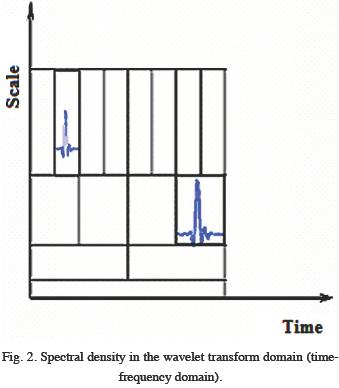
<body><![CDATA[<p align="justify"><font face="verdana" size="2">The WT meaningfully contributes to the analysis and processing of geophysical data, and particularly with several potential applications to GWL.</font></p>     <p align="justify"><font face="verdana" size="2">In investigations related to geophysical signal analysis, the wavelet transform (Mallat, 1998) is, in general, an adequate technique for the preadjustment, analysis, and interpretation of signals and images on diverse representation scales (multiscale analysis) (Cohen and Chen, 1993; Li and Ulrych, 1995; Grubb and Walden, 1997; Lozada&#150;Zumaeta and Ronquillo&#150;Jarillo, 1997; Lozada&#150;Zumaeta and Ronquillo&#150;Jarillo, 2001; Matos <i>et al.</i>, 2003; Gersztenkorn, 2005; Rivera&#150;Recillas <i>et al.</i>, 2005). The WT has been applied particularly in seismic data processing and pre&#150;processing phase (Chakraborty and Okaya, 1995), in 1&#150;D seismic inverse tomography problems (Xin&#150;Gong and Ulrych, 1995), and in correlating and re&#150;scaling petrophysical properties and seismic sections (Panda <i>et al.</i>, 2000). In geosciences, in general is being applied to the analysis of transitory signals and image processing (Foufoula&#150;Georgiou and Kumar, 1994), particularly in the detection of pseudo&#150; periodicities in climatology (Lau and Weng, 1995).</font></p>     <p align="justify"><font face="verdana" size="2">Applications, in the oil industry, comprise the preadjustment, fltering, and anomaly identifcation of pressure tests (Jansen and Kelkar, 1997; Athichanagorn <i>et al.</i>, 1999; Gonzalez <i>et al.</i>, 1999; Soliman <i>et al.</i>, 2001), compression&#150;transmission of drilling data (logging while drilling) (Bernasconi <i>et al.</i>, 1999).</font></p>     <p align="justify"><font face="verdana" size="2">A wavelet (mother wavelet) is defned by a located and oscillating function of time (Deighan and Watts, 1997; Burke, 1998). Examples of different types of wavelets are shown in <a href="#figura1">Fig. 1</a> (Daubechies, 1990). The wavelet analysis synthesizes a nonstationary signal in terms of base functions (of time and frequency). From the mother wavelet <i>&#968;</i><sub>(<i>a</i>,</sub> <i><sub>b</sub></i><sub>)</sub>, the respective family wavelets are derived by means of scaling and translation procedures by manipulating the coeffcients <b><i>a </i></b>(scale factor) and <b><i>b </i></b>(displacement or translation)<i>, </i>respectively (<a href="#tabla2">Table 2</a>).</font></p>      <p align="center"><font face="verdana" size="2"><a name="figura1"></a></font></p>      <p align="center"><font face="verdana" size="2"><img src="/img/revistas/geoint/v49n2/a1f1.jpg"></font></p>      <p align="center"><font face="verdana" size="2"><a name="tabla2"></a></font></p>      <p align="center"><font face="verdana" size="2"><img src="/img/revistas/geoint/v49n2/a1t2.jpg"></font></p>      <p align="justify"><font face="verdana" size="2">The coeffcients distribution of a WT is presented in the time&#150;frequency domain (<a href="#figura2">Fig. 2</a>). A summary of main wavelets types and their properties is given in <a href="/img/revistas/geoint/v49n2/a1t3.jpg" target="_blank">Table 3</a>. In this study Coifet and Symlet wavelets were used.</font></p>     <p align="center"><font face="verdana" size="2"><a name="figura2"></a></font></p>     ]]></body>
<body><![CDATA[<p align="center"><font face="verdana" size="2"><img src="/img/revistas/geoint/v49n2/a1f2.jpg"></font></p>     <p align="justify"><font face="verdana" size="2">There  are   two   types   of  wavelet  transform,  i.e., continuous and discrete.</font></p>     <p align="justify"><font face="verdana" size="2"><i>(i) Continuous Wavelet Transform</i></font></p>     <p align="justify"><font face="verdana" size="2">The CWT (Grossman and Morlet, 1984) of a signal <i>x(t) </i>is defned as (Strang, 1989):</font></p>     <p align="center"><font face="verdana" size="2"><img src="/img/revistas/geoint/v49n2/a1e1.jpg"></font></p>     <p align="justify"><font face="verdana" size="2">where W is a function that is generated from the mother wavelet by translation and scaling; or in terms of spectral representation</font></p>     <p align="center"><font face="verdana" size="2"><img src="/img/revistas/geoint/v49n2/a1e2.jpg"></font></p>     <p align="justify"><font face="verdana" size="2">where * is the complex conjugate, <i>&omega; </i>frequency and <i>i </i>= <img src="/img/revistas/geoint/v49n2/a1e3.jpg">. The signal <i>x(t</i>) must be of a fnite energy. In this case, the signal <i>x(t) </i>can be reconstructed or synthesized by means of the inverse continuous wavelet transform (ICWT) (Strang, 1989), defined as:</font></p>     <p align="center"><font face="verdana" size="2"><img src="/img/revistas/geoint/v49n2/a1e4.jpg"></font></p>     <p align="justify"><font face="verdana" size="2"><i>C<sub>g</sub> </i>is a constant depending on the wavelet to be used (admissibility constant).</font></p>     ]]></body>
<body><![CDATA[<p align="justify"><font face="verdana" size="2"><i>(ii) Discrete Wavelet Transform</i></font></p>     <p align="justify"><font face="verdana" size="2">In the discrete version of the WT, the parameters {(<i>a<sub>j</sub></i>; <i>b<sub>k</sub></i>)} are respectively discretized, so that <i>&psi;<sub>aj</sub></i><sub>,</sub> <i><sub>bk</sub>, </i>the wavelet family is defned as (Strang, 1989; Burke, 1998):</font></p>     <p align="center"><font face="verdana" size="2"><img src="/img/revistas/geoint/v49n2/a1e5.jpg"></font></p>     <p align="justify"><font face="verdana" size="2">In general, these classes of wavelets are associated to a dyadic set (octave), <i>a</i><b><i>. </i></b><i>= </i>2<sup>&#150;j</sup>; <i>b<sub>k</sub> = 2</i><sup>&#150;j</sup><i>k j<b>,</b>k <img src="/img/revistas/geoint/v49n2/a1e6.jpg">Z</i>, which transforms the expression (4) to the following one:</font></p>     <p align="center"><font face="verdana" size="2"><img src="/img/revistas/geoint/v49n2/a1e7.jpg"></font></p>     <p align="justify"><font face="verdana" size="2">and the DWT can occur as:</font></p>     <p align="center"><font face="verdana" size="2"><img src="/img/revistas/geoint/v49n2/a1e8.jpg"></font></p>     <p align="justify"><font face="verdana" size="2">where <i>&psi;<sub>j,k</sub> (t) </i>is the mother wavelet and <i>s(t) </i>is a fnite energy signal. On the other hand, the inverse transform (synthesis) is defned as:</font></p>     <p align="center"><font face="verdana" size="2"><img src="/img/revistas/geoint/v49n2/a1e9.jpg"></font></p>     <p align="justify"><font face="verdana" size="2"><i>c<sub>j,</sub> <sub>k</sub> </i>are the appropriate wavelet coeffcients.</font></p>     ]]></body>
<body><![CDATA[<p align="justify"><font face="verdana" size="2"><i>Spectrogram and Scalogram</i></font></p>     <p align="justify"><font face="verdana" size="2">Spectrogram and scalogram are time&#150;frequency graphical representations of the coeffcients distribution associated with the WT, respectively, that may be related with energy and power spectra (Strang, 1989; Meyer and Ryan, 1993; Burke, 1998) of the <i>&#968;</i>(<i>a</i>, <i>b</i>),</font></p>     <p align="center"><font face="verdana" size="2"><img src="/img/revistas/geoint/v49n2/a1e10.jpg"></font></p>     <p align="justify"><font face="verdana" size="2">The energy distribution is associated to <img src="/img/revistas/geoint/v49n2/a1e11.jpg">.</font></p>     <p align="justify"><font face="verdana" size="2">The  combination  of  the  different  coeffcients  at different   scales   (wavelengths)   forms   a   scalogram. Depths versus coeffcients indicate the position where the particular wavelength (&#955;) is placed. For the Coifet wavelet, the scale to wavelength conversion is given by:</font></p>     <p align="center"><font face="verdana" size="2"><img src="/img/revistas/geoint/v49n2/a1e12.jpg"></font></p>     <p align="justify"><font face="verdana" size="2">Where <i>a </i>is the scale and <i>Fs </i>is the sampling frequency. The wavelet analysis allows us to reveal aspects to small scales (high frequencies) and big scales (low frequencies).</font></p>     <p align="justify"><font face="verdana" size="2">&nbsp;</font></p>     <p align="justify"><font face="verdana" size="2"><b>Wavelet transform vs. semivariogram and Fourier transform</b></font></p>     <p align="justify"><font face="verdana" size="2">The semivariogram (SV) establishes the rate of similarity between a set of samples as a function of the separation, but the location of the cyclic events in the space is not possible neither as with the Fourier transform (FT). To illustrate this point we generated a series of synthetic signals, including a theoretical well log. We applied the conventional analysis techniques (SV and FT), as well as the WT, and conducted a comparative analysis.</font></p>     ]]></body>
<body><![CDATA[<p align="justify"><font face="verdana" size="2">In the frst case, the FFT, S V, and WT (using a Morlet wavelet) were applied to a 1024 samples signal (sampling interval of 0.004 seconds, sampling frequency of 250 Hz, and a 125 Hz Nyquist frequency). The signal (<a href="/img/revistas/geoint/v49n2/a1f3.jpg" target="_blank">Fig. 3a</a>) comprises three components: a) a cosine function of 20 Hz frequency; b) an impulse located at 2 seconds; c) and a sweep from 2 to 15 Hz. <a href="/img/revistas/geoint/v49n2/a1f3.jpg" target="_blank">Fig. 3b</a> shows the FT of the resulting signal; the frequency components of the signals can be observed, but it is not possible to determine their time location.</font></p>      <p align="justify"><font face="verdana" size="2"><a href="/img/revistas/geoint/v49n2/a1f4.jpg" target="_blank">Fig. 4</a> displays the WT scalogram or coeffcients distribution generated with the WT to the signal of <a href="/img/revistas/geoint/v49n2/a1f3.jpg" target="_blank">Fig. 3a</a>. The location (or domain) where the three component signals are active are very well represented. The characteristic frequency of the cosine signal, 20 Hz, can be read very well in the time axis. The instantaneous pulse, located at 2000 milliseconds, is parallel to the frequency axis. The sweep is transversely presented through the high and low scale domain.</font></p>     <p align="justify"><font face="verdana" size="2"><a href="/img/revistas/geoint/v49n2/a1f5.jpg" target="_blank">Figs. 5</a> and <a href="/img/revistas/geoint/v49n2/a1f6.jpg" target="_blank">6</a> show the comparison of the WT with FT and SV for signals more representative of stratigraphic cycles. The corresponding signals contain multiple frequencies with different time distributions. These signals can fairly well be representative of a high energy sedimentary sequence. <a href="/img/revistas/geoint/v49n2/a1f5.jpg" target="_blank">Fig. 5</a> shows the analysis of this signal with the three different methods (WT, FT and SV) applied to a two component signal. The frst component, from 1000 to 1100 m, has an average wavelength of 33 m, while the second one, from 1100 to 1170 m, has an average wavelength of 13 m. The SV indicates fairly well the two components. The Fourier analysis shows more clearly than the semivariogram the presence of these two components; nevertheless these methodologies can display neither the location of the two components nor the frequency changes. In comparison, the scalogram (WT), identifes both frequencies accurately as well as the location of the corresponding transition.</font></p>     <p align="justify"><font face="verdana" size="2">The example of <a href="/img/revistas/geoint/v49n2/a1f6.jpg" target="_blank">Fig. 6</a> again comprises two superimposed signals (with average wavelengths of 13 and 33 m respectively). Both, the SV and the Fourier analysis identify the presence of the two components, but are unable to locate them at depth. The scalogram besides identifying both signals helps to quantify the existing wavelengths. In particular it helps to identify the two overlapping existing cycles.</font></p>     <p align="justify"><font face="verdana" size="2">In both the above mentioned cases, SV and the Fourier analysis show similar results (two different wavelengths). However, the comparative analysis suggests that the analysis with the WT can provide better results, in relation with the Fourier analysis and the SV, in stratigraphic cycles studies. These results are in accordance with those reported by Lau and Weng (1995).</font></p>     <p align="justify"><font face="verdana" size="2">Finally, a pulsed neutrons (capture cross section or Sigma) synthetic log covering a depth interval of 0 to 4200 m, was generated (<a href="/img/revistas/geoint/v49n2/a1f7.jpg" target="_blank">Fig. 7a</a>). It is the theoretical response of a geological model comprising 24 thick and thin layers. For the generation of the synthetic sigma GWL, equation 10 was used (Dewan, 1983; Schlumberger, 1991; Coconi&#150;Morales, 2000),</font></p>     <p align="center"><font face="verdana" size="2"><img src="/img/revistas/geoint/v49n2/a1e13.jpg"></font></p>     <p align="justify"><font face="verdana" size="2">Where &#931;<sub>log</sub> is the capture cross section or sigma measured (in capture units, c.u.) for each depth; <i>&phi; </i>is porosity; S<i><sub>w</sub> </i>is water saturation (%); &#931;<i><sub>w</sub> </i>and &#931;<i><sub>h</sub> </i>are the sigma for water and oil (c.u.), respectively; <i>v<sub>sh</sub> </i>is clay volume (%); &#931;<i><sub>sh</sub> </i>is the sigma for clay (c.u.), and &#931;<i><sub>ma</sub> </i>is the sigma of the associated matrix (c.u.).</font></p>      <p align="justify"><font face="verdana" size="2">Sigma is the probability that gamma rays impact a nucleus thus rendering it possible to obtain water saturation, lithology and porosity of the formation under study.</font></p>     <p align="justify"><font face="verdana" size="2">The respective multiscale analysis is shown in <a href="/img/revistas/geoint/v49n2/a1f7.jpg" target="_blank">Fig. 7b</a>. It can be observed that for low scales (high frequencies) it is possible to distinguish thin layers, while at intermediate scales it is possible to analyze thicker layers. At even higher scales (low frequencies) the global characteristics are displayed. Thin layers would be represented as a single unit. For comparison purposes, the amplitude spectrum of the synthetic Sigma log is presented in <a href="/img/revistas/geoint/v49n2/a1f7.jpg" target="_blank">Fig. 7c</a>.</font></p>     ]]></body>
<body><![CDATA[<p align="justify"><font face="verdana" size="2">It is observed that the high frequencie spectrogram portion and corresponding to low scales (1, 2, 3 and 4), correlate with thin layers at depth intervals of 1200 &#150; 1400, 2600 &#150; 2800, and 4000 &#150; 4200 m respectively (<a href="/img/revistas/geoint/v49n2/a1f7.jpg" target="_blank">Fig. 7b</a>).</font></p>     <p align="justify"><font face="verdana" size="2"><a href="#figura8">Figs. 8</a> and <a href="#figura9">9</a> displays the representation of the theoretical log (<a href="/img/revistas/geoint/v49n2/a1f7.jpg" target="_blank">Fig. 7a</a>) at two different scales of the depth domain. From a set of different scale components, selectively chosen, it is possible to reconstruct, or synthesize, the theoretical log in such a way as to enhance predominant components at different frequencies. For example, scale 6 correlates with thin layers (<a href="#figura8">Fig. 8</a>). In <a href="#figura9">Fig. 9</a> we can note how scale 9 enhances thick layers.</font></p>     <p align="center"><font face="verdana" size="2"><a name="figura8"></a></font></p>     <p align="center"><font face="verdana" size="2"><img src="/img/revistas/geoint/v49n2/a1f8.jpg"></font></p>     <p align="center"><font face="verdana" size="2"><a name="figura9"></a></font></p>     <p align="center"><font face="verdana" size="2"><img src="/img/revistas/geoint/v49n2/a1f9.jpg"></font></p>     <p align="justify"><font face="verdana" size="2">This comparative analysis also illustrates the methodology followed to determine cyclicity from the GWL, and which can be contrasted against the existing methods (i.e., that of Sadler, 1981). The methodology is schematized in <a href="/img/revistas/geoint/v49n2/a1f10.jpg" target="_blank">Fig. 10</a>.</font></p>      <p align="justify"><font face="verdana" size="2">The GWL lithoestratigraphic depth windows of interest (spontaneous potential &#150;SP, GR, and true resistivity &#150;Rt) are subjected to conventional analysis. Later the CWT is applied, involving two interrelated processes: the generation of the scalogram (selecting and using a specifc wavelet), and the determination of cycles or discontinuities.</font></p>      <p align="justify"><font face="verdana" size="2">&nbsp;</font></p>      <p align="justify"><font face="verdana" size="2"><b>Application of the methodology</b></font></p>     ]]></body>
<body><![CDATA[<p align="justify"><font face="verdana" size="2">Multiscale analysis was applied to a set of GWL from a well of an area in the Gulf of Mexico. The representatives facies comprise sands, shales, and evaporites (<a href="/img/revistas/geoint/v49n2/a1f11.jpg" target="_blank">Fig. 11c</a>). The Coifet wavelet (order 4, see <a href="/img/revistas/geoint/v49n2/a1t3.jpg" target="_blank">Table 3</a>) was selected to consequently obtain the CWT. Finally the characteristic pseudowavelengths linked to each of the representation scales were obtained from the corresponding scalogram.</font></p>     <p align="justify"><font face="verdana" size="2"><a href="/img/revistas/geoint/v49n2/a1f11.jpg" target="_blank">Figs. 11a, b, e and g</a>, represent respectively the permeability, natural GR, deep laterolog (LLD), neutron porosity (PHIN) and bulk density (RHOB) logs, in addition to the scalograms of the GR and Rt logs (<a href="/img/revistas/geoint/v49n2/a1f11.jpg" target="_blank">Figs. 11d and 11f</a> respectively). Stratigraphically, for its analysis, the well was divided in three main zones: zone 1 (1215 &#150; 1250 m), zone 2 (1250 &#150; 1275 2 m) and zone 3 (1275 &#150; 1306 m).</font></p>     <p align="justify"><font face="verdana" size="2">Zone 1 comprises two evaporitic sequences (of low and high permeability) and an intermediate layer with no evaporites. The GR log only determines dirty zones (presence of shales) or clean zones (no shales) but not lithology type. The evaporite sequences are distinguished by means of the Rt log (LLD) (as resistivity increases), the neutron log (as low porosity values), and density log (as high values).</font></p>     <p align="justify"><font face="verdana" size="2">Accordingly, zone 1 shows cyclicities with periodicities ranging between 1.5 and 2 m, corresponding to the thickness of channelized or evaporatic deposits.</font></p>     <p align="justify"><font face="verdana" size="2">Additionally, the gamma ray scalogram shows short cycles for zone 1 with periods varying from 1.5 to 6 m. The LLD log shows strong cycles with periodicities varying respectively from 1.5 to 2.5 m, and 5 to 6 m.</font></p>     <p align="justify"><font face="verdana" size="2">Zone  2  comprises  two  zones,  of  high  and  low permeability sands respectively. Zone 3 is constituted by high permeability sands intercalated with low permeability clays.</font></p>     <p align="justify"><font face="verdana" size="2">Despite the mentioned limitations of the GR log, the respective scalogram displays or shows the limits of the thin anhydrite layers whose exact locations could be independently checked by means of core and petrophysical interpretation (<a href="/img/revistas/geoint/v49n2/a1f11.jpg" target="_blank">Figs. 11a and c</a>). Anomalies at different scales (frequencies) are observed in this scalogram. Low and intermediate scales correspond to the limits of thin and intermediate layers and sedimentary cycles, respectively.</font></p>     <p align="justify"><font face="verdana" size="2">For zones 2 and 3 a similar behavior is inferred due to the presence of clean sand layers. From the respective scalograms of the GR and LLD logs wavelengths were calculated ranging from 1 to 7.5 m. According to the GR log, zone 3 show cyclicities with periodicities ranging between 1.5 and 2 m.</font></p>     <p align="justify"><font face="verdana" size="2">Summarizing:</font></p>     <p align="justify"><font face="verdana" size="2">Zone 1: Displays a cyclicity of 1.5 to 2 m (cemented evaporites) at depth intervals of 1234 to 1236, 1239 to 1240, and 1248 to 1250 m. The GR log shows 1.5 and 6 m cyclicities, and the LLD log shows cycles ranging from 1.5 to 2.5, as well as from 5 to 6.5 m. Both scalograms solve layers thickness according to the depth information.</font></p>     ]]></body>
<body><![CDATA[<p align="justify"><font face="verdana" size="2">Zone 2: The GR log show a beach zone (sands), and together with the resistivity log (LLD), they enable to establish cycles with wavelengths between 1.5 to 2.5 m.</font></p>     <p align="justify"><font face="verdana" size="2">Zone 3: Cyclicities are comprised in the range of 1.5 to 2 m. The GR log registers cycles between 1 and 1.5 m (at the base) and of about 6 m (at the top). The GR log scalogram shows higher anomalies within the depth interval from 1290 to 1295 m, corresponding to zones containing clays. The GR log shows a progressive increase in radioactivity.</font></p>     <p align="justify"><font face="verdana" size="2">In zone 1, wavelengths are in the range from 1.5 to 2, and 3 to 7 m respectively, with a relationship from 1: 2: 4.6. For zone 2, the most characteristic &#150;conspicuous wavelengths have values of 1 to 2, and 2.5 m as well as from 7 to 7.5 m with respective relationships of 1: 1.9: 4.8. Finally for zone 3, the three conspicuous wavelengths are of 1 to 2, 3, and 6.5 m, with corresponding relationship of 1: 2: 4.3.</font></p>     <p align="justify"><font face="verdana" size="2">Changes in sea level, consequences of climatic effects, are identifed as Milankovitch's cycles. These are produced by three main aspects of the motion of the Earth rotation axis: precession (21&middot;10<sup>3</sup> years), obliquity variations of the rotating axis regarding the ecliptic (41&middot;10<sup>3</sup> years) and eccentricity variations of the earth orbit (100 and 400&middot;10<sup>3</sup> years).</font></p>     <p align="justify"><font face="verdana" size="2">As already mentioned Milankovitch's cycles related to precession, obliquity of the rotation axis regarding the ecliptic, and eccentricity variations of the Earth orbit have respective periods of 21, 41 and 100 k years, with a respective relationship of 1: 2: 4.8.</font></p>     <p align="justify"><font face="verdana" size="2">A fair good correlation is observed between these relationship and those obtained for zone 2. This similarity in the relationships suggests that the Milankovitch's cycles played a key factor controlling the sand sedimentation in our study area.</font></p>     <p align="justify"><font face="verdana" size="2">To support this interpretation, one can calculate the sedimentation rate from the wavelet analysis, and compare it with information from previous studies. In particular, for a zone similar to our study area, during the Lower Triassic the sedimentation took place for 5 My. For the study area, the typical thickness of the corresponding formation is of 243 m; implying a sedimentation rate of 4.86 cm/kyear.</font></p>     <p align="justify"><font face="verdana" size="2">This result is within the range from 1.5 to 6 cm/kyear observed in sediments from this type and reported by Anstey and O'Doherty (2002). Based in the wavelet analysis, for zone 2, we observe that the dominant wavelength is 2.5 m (using the scale vs. energy graphs), (which corresponds to the Milankovitch's cycle related to obliquity of the rotation axis, with a period of 41 ky), and a sedimentation rate of 6.09 cm/kyear.</font></p>     <p align="justify"><font face="verdana" size="2">For zone 3, the dominate wavelength is of 1.1 m, that can be correlated with Milankovitch's cycle associated to precession of the rotation axis regarding the ecliptic, and with a period of 21 ky; we obtained a sedimentation rate of 5.24 cm/ky.</font></p>     <p align="justify"><font face="verdana" size="2">&nbsp;</font></p>     ]]></body>
<body><![CDATA[<p align="justify"><font face="verdana" size="2"><b>Conclusions</b></font></p>     <p align="justify"><font face="verdana" size="2">Wavelet analysis provides complementary information useful for the interpretation and evaluation of GWL. In particular, the wavelet based analysis when applied to information related to stratigraphic data can be a suitable technique in the study of stratigraphic cycles.</font></p>     <p align="justify"><font face="verdana" size="2">This study indicates: 1) that the SV and FT methods, the most commonly used methods so far, present limitations in the evaluation of overlapped cyclicities; and 2) that the wavelet transform and associated multiscale analysis are more suitable for establishment of cyclicities present in a sedimentary sequence.</font></p>     <p align="justify"><font face="verdana" size="2">A study case was presented that illustrates the potential of the wavelet analysis. It was possible, for a well from an area of Gulf of Mexico, to establish the cyclicity orders present in the intervals studied; which could be linked to the Milankovitch's cycles. The associated sedimentation rates correlate fairly well with independent information.</font></p>     <p align="justify"><font face="verdana" size="2">&nbsp;</font></p>     <p align="justify"><font face="verdana" size="2"><b>Acknowledgments</b></font></p>     <p align="justify"><font face="verdana" size="2">The authors greatly appreciate the support of the Instituto Mexicano del Petr&oacute;leo for the development of the present study. Comments and suggestions of three anonymous reviewers helped to improve the quality of the paper.</font></p>     <p align="justify"><font face="verdana" size="2">&nbsp;</font></p>     <p align="justify"><font face="verdana" size="2"><b>Bibliography</b></font></p>     <!-- ref --><p align="justify"><font face="verdana" size="2">Anstey, N. and R. O'Doherty, 2002. Cycles, layer and refections: Part I: <i>The Leading Edge</i>, January, 21, 1, 44&#150;51.</font>&nbsp;&nbsp;&nbsp;&nbsp;&nbsp;&nbsp;&nbsp;&nbsp;[&#160;<a href="javascript:void(0);" onclick="javascript: window.open('/scielo.php?script=sci_nlinks&ref=3908445&pid=S0016-7169201000020000100001&lng=','','width=640,height=500,resizable=yes,scrollbars=1,menubar=yes,');">Links</a>&#160;]<!-- end-ref --><!-- ref --><p align="justify"><font face="verdana" size="2">Athichanagorn, S., R. Horne and J. Kikani, 1999. Processing and interpretation of long&#150;term data from permanent down hole pressure gauges, paper SPE 56419, in SPE Annual Technical Conference and Exhibition, Houston, October, 3&#150;6.</font>&nbsp;&nbsp;&nbsp;&nbsp;&nbsp;&nbsp;&nbsp;&nbsp;[&#160;<a href="javascript:void(0);" onclick="javascript: window.open('/scielo.php?script=sci_nlinks&ref=3908446&pid=S0016-7169201000020000100002&lng=','','width=640,height=500,resizable=yes,scrollbars=1,menubar=yes,');">Links</a>&#160;]<!-- end-ref --><!-- ref --><p align="justify"><font face="verdana" size="2">Bernasconi, G., V. Rampa, F. Abramo and L. Bertelli, 1999. Compression of down hole data, paper SPE/IADC in SPE (IADC Drilling Conference), Amsterdam, 9&#150;11 March.</font>&nbsp;&nbsp;&nbsp;&nbsp;&nbsp;&nbsp;&nbsp;&nbsp;[&#160;<a href="javascript:void(0);" onclick="javascript: window.open('/scielo.php?script=sci_nlinks&ref=3908447&pid=S0016-7169201000020000100003&lng=','','width=640,height=500,resizable=yes,scrollbars=1,menubar=yes,');">Links</a>&#160;]<!-- end-ref --><!-- ref --><p align="justify"><font face="verdana" size="2">Burke, H. B., 1998. The World according to wavelets. A. K. Peters (editor), second edition, 250 p.</font>&nbsp;&nbsp;&nbsp;&nbsp;&nbsp;&nbsp;&nbsp;&nbsp;[&#160;<a href="javascript:void(0);" onclick="javascript: window.open('/scielo.php?script=sci_nlinks&ref=3908448&pid=S0016-7169201000020000100004&lng=','','width=640,height=500,resizable=yes,scrollbars=1,menubar=yes,');">Links</a>&#160;]<!-- end-ref --><!-- ref --><p align="justify"><font face="verdana" size="2">Chakraborty, A. and D. Okaya, 1995. Frequency&#150;time decomposition of seismic data using wavelet&#150;based methods. <i>Geophysics, 60</i>, 1906&#150;1916.</font>&nbsp;&nbsp;&nbsp;&nbsp;&nbsp;&nbsp;&nbsp;&nbsp;[&#160;<a href="javascript:void(0);" onclick="javascript: window.open('/scielo.php?script=sci_nlinks&ref=3908449&pid=S0016-7169201000020000100005&lng=','','width=640,height=500,resizable=yes,scrollbars=1,menubar=yes,');">Links</a>&#160;]<!-- end-ref --><!-- ref --><p align="justify"><font face="verdana" size="2">Coconi&#150;Morales, E., 2000. Metodolog&iacute;a usando el registro de neutrones pulsados (PNC) para el monitoreo de los contactos gas &#150; aceite y aceite &#150; agua y saturaci&oacute;n de agua en el complejo Cantarell. Master's degree thesis, Divisi&oacute;n de Estudios de Posgrado, Facultad de Ingenier&iacute;a, Universidad Nacional Aut&oacute;noma de M&eacute;xico, 100 p.</font>&nbsp;&nbsp;&nbsp;&nbsp;&nbsp;&nbsp;&nbsp;&nbsp;[&#160;<a href="javascript:void(0);" onclick="javascript: window.open('/scielo.php?script=sci_nlinks&ref=3908450&pid=S0016-7169201000020000100006&lng=','','width=640,height=500,resizable=yes,scrollbars=1,menubar=yes,');">Links</a>&#160;]<!-- end-ref --><!-- ref --><p align="justify"><font face="verdana" size="2">Coconi&#150;Morales E., M, Lozada&#150;Zumaeta, D. Rivera&#150;Recillas and G. Ronquillo&#150;Jarillo, 2005. Estimaci&oacute;n litol&oacute;&#150;gica a partir de registros geof&iacute;sicos de pozo utilizando trasformada de ond&iacute;cula discreta unidimensional (DWT 1&#150;D). First Geosciences Internacional Congress, September 4&#150;7, M&eacute;rida, Yucat&aacute;n, M&eacute;xico, p. 130 &#150; 135.</font>&nbsp;&nbsp;&nbsp;&nbsp;&nbsp;&nbsp;&nbsp;&nbsp;[&#160;<a href="javascript:void(0);" onclick="javascript: window.open('/scielo.php?script=sci_nlinks&ref=3908451&pid=S0016-7169201000020000100007&lng=','','width=640,height=500,resizable=yes,scrollbars=1,menubar=yes,');">Links</a>&#160;]<!-- end-ref --><!-- ref --><p align="justify"><font face="verdana" size="2">Coconi&#150;Morales, E., M. Lozada&#150;Zumaeta, D. Rivera&#150;Recillas, G. Ronquillo&#150;Jarillo and J. O. Campos&#150;Enriquez, 2006. Identifying reservoir fuids in sandy clay and carbonate reservoir using the wavelet transform with well logs. SPWLA 47<sup>th</sup> Annual Logging Symposium, June 4&#150;7, Veracruz, Mexico, p. 130&#150;135.</font>&nbsp;&nbsp;&nbsp;&nbsp;&nbsp;&nbsp;&nbsp;&nbsp;[&#160;<a href="javascript:void(0);" onclick="javascript: window.open('/scielo.php?script=sci_nlinks&ref=3908452&pid=S0016-7169201000020000100008&lng=','','width=640,height=500,resizable=yes,scrollbars=1,menubar=yes,');">Links</a>&#160;]<!-- end-ref --><!-- ref --><p align="justify"><font face="verdana" size="2">Cohen, J. and T. Chen, 1993. Fundamental of the wavelet transform for seismic data processing. Tech Rep. CWP&#150;130. Center for wave phenomena. CSM, 250 p.</font>&nbsp;&nbsp;&nbsp;&nbsp;&nbsp;&nbsp;&nbsp;&nbsp;[&#160;<a href="javascript:void(0);" onclick="javascript: window.open('/scielo.php?script=sci_nlinks&ref=3908453&pid=S0016-7169201000020000100009&lng=','','width=640,height=500,resizable=yes,scrollbars=1,menubar=yes,');">Links</a>&#160;]<!-- end-ref --><!-- ref --><p align="justify"><font face="verdana" size="2">Daubechies, I., 1990. The wavelet transform, time&#150;frequency location and signal analysis, IEEE Transactions on Information Theory, 36, 5.</font>&nbsp;&nbsp;&nbsp;&nbsp;&nbsp;&nbsp;&nbsp;&nbsp;[&#160;<a href="javascript:void(0);" onclick="javascript: window.open('/scielo.php?script=sci_nlinks&ref=3908454&pid=S0016-7169201000020000100010&lng=','','width=640,height=500,resizable=yes,scrollbars=1,menubar=yes,');">Links</a>&#160;]<!-- end-ref --><!-- ref --><p align="justify"><font face="verdana" size="2">Daubechies I., 1994. Ten lectures on wavelets, CBMS, SIAM, 258&#150;261.</font>&nbsp;&nbsp;&nbsp;&nbsp;&nbsp;&nbsp;&nbsp;&nbsp;[&#160;<a href="javascript:void(0);" onclick="javascript: window.open('/scielo.php?script=sci_nlinks&ref=3908455&pid=S0016-7169201000020000100011&lng=','','width=640,height=500,resizable=yes,scrollbars=1,menubar=yes,');">Links</a>&#160;]<!-- end-ref --><!-- ref --><p align="justify"><font face="verdana" size="2">Deighan, A. and D. Watts, 1997. Ground roll suppression using the wavelet transform. <i>Geophysics, 62</i>, 1896&#150;1903.</font>&nbsp;&nbsp;&nbsp;&nbsp;&nbsp;&nbsp;&nbsp;&nbsp;[&#160;<a href="javascript:void(0);" onclick="javascript: window.open('/scielo.php?script=sci_nlinks&ref=3908456&pid=S0016-7169201000020000100012&lng=','','width=640,height=500,resizable=yes,scrollbars=1,menubar=yes,');">Links</a>&#160;]<!-- end-ref --><!-- ref --><p align="justify"><font face="verdana" size="2">Dewan, J., 1983. Modern open&#150;hole log interpretation. Pennwell Books. 361p.</font>&nbsp;&nbsp;&nbsp;&nbsp;&nbsp;&nbsp;&nbsp;&nbsp;[&#160;<a href="javascript:void(0);" onclick="javascript: window.open('/scielo.php?script=sci_nlinks&ref=3908457&pid=S0016-7169201000020000100013&lng=','','width=640,height=500,resizable=yes,scrollbars=1,menubar=yes,');">Links</a>&#160;]<!-- end-ref --><!-- ref --><p align="justify"><font face="verdana" size="2">Doveton, J., 1994. Geologic log analysis using computer methods, AAPG Computer Applications in Geology, 2, Tulsa. 162 p.</font>&nbsp;&nbsp;&nbsp;&nbsp;&nbsp;&nbsp;&nbsp;&nbsp;[&#160;<a href="javascript:void(0);" onclick="javascript: window.open('/scielo.php?script=sci_nlinks&ref=3908458&pid=S0016-7169201000020000100014&lng=','','width=640,height=500,resizable=yes,scrollbars=1,menubar=yes,');">Links</a>&#160;]<!-- end-ref --><!-- ref --><p align="justify"><font face="verdana" size="2">Foufoula&#150;Georgiou, E. and F. Kumar, 1994. Wavelet in Geophysics Academic Press, New York, p. 1&#150;43.</font>&nbsp;&nbsp;&nbsp;&nbsp;&nbsp;&nbsp;&nbsp;&nbsp;[&#160;<a href="javascript:void(0);" onclick="javascript: window.open('/scielo.php?script=sci_nlinks&ref=3908459&pid=S0016-7169201000020000100015&lng=','','width=640,height=500,resizable=yes,scrollbars=1,menubar=yes,');">Links</a>&#160;]<!-- end-ref --><!-- ref --><p align="justify"><font face="verdana" size="2">Gelhar, L., 1993. Stochastic subsurface hydrology, Prentice&#150;Hall, Englewood Cliffs, N.J., 250 p.</font>&nbsp;&nbsp;&nbsp;&nbsp;&nbsp;&nbsp;&nbsp;&nbsp;[&#160;<a href="javascript:void(0);" onclick="javascript: window.open('/scielo.php?script=sci_nlinks&ref=3908460&pid=S0016-7169201000020000100016&lng=','','width=640,height=500,resizable=yes,scrollbars=1,menubar=yes,');">Links</a>&#160;]<!-- end-ref --><!-- ref --><p align="justify"><font face="verdana" size="2">Gersztenkorn, A., 2005. Stratigraphic detail from wavelet based spectral imaging. CSEG Record. April, p. 40&#150;43.</font>&nbsp;&nbsp;&nbsp;&nbsp;&nbsp;&nbsp;&nbsp;&nbsp;[&#160;<a href="javascript:void(0);" onclick="javascript: window.open('/scielo.php?script=sci_nlinks&ref=3908461&pid=S0016-7169201000020000100017&lng=','','width=640,height=500,resizable=yes,scrollbars=1,menubar=yes,');">Links</a>&#160;]<!-- end-ref --><!-- ref --><p align="justify"><font face="verdana" size="2">Gonzalez, F., R. Camacho and B. Escalante, 1999. Truncation de&#150;noising in transient pressure test, paper SPE 56422, in SPE Annual Technical Conference and Exhibition, Houston, October 3&#150;6, 234&#150;239.</font>&nbsp;&nbsp;&nbsp;&nbsp;&nbsp;&nbsp;&nbsp;&nbsp;[&#160;<a href="javascript:void(0);" onclick="javascript: window.open('/scielo.php?script=sci_nlinks&ref=3908462&pid=S0016-7169201000020000100018&lng=','','width=640,height=500,resizable=yes,scrollbars=1,menubar=yes,');">Links</a>&#160;]<!-- end-ref --><!-- ref --><p align="justify"><font face="verdana" size="2">Goswami, J. and A. Chan, 1999. Fundamentals of wavelet, John Wiley, New York, 324 p.</font>&nbsp;&nbsp;&nbsp;&nbsp;&nbsp;&nbsp;&nbsp;&nbsp;[&#160;<a href="javascript:void(0);" onclick="javascript: window.open('/scielo.php?script=sci_nlinks&ref=3908463&pid=S0016-7169201000020000100019&lng=','','width=640,height=500,resizable=yes,scrollbars=1,menubar=yes,');">Links</a>&#160;]<!-- end-ref --><!-- ref --><p align="justify"><font face="verdana" size="2">Grossman, A. and J. Morlet, 1984. Descomposition of hardy functions into square integrable wavelets of constante shape. <i>SIAM J. Math. Annal., 15, 4</i>, 723 p.</font>&nbsp;&nbsp;&nbsp;&nbsp;&nbsp;&nbsp;&nbsp;&nbsp;[&#160;<a href="javascript:void(0);" onclick="javascript: window.open('/scielo.php?script=sci_nlinks&ref=3908464&pid=S0016-7169201000020000100020&lng=','','width=640,height=500,resizable=yes,scrollbars=1,menubar=yes,');">Links</a>&#160;]<!-- end-ref --><!-- ref --><p align="justify"><font face="verdana" size="2">Grubb, H. and A. Walden, 1997. Characterizing seismic time series using the discrete wavelet transform. <i>Geophysical Prospecting, 45</i>, 183&#150;205.</font>&nbsp;&nbsp;&nbsp;&nbsp;&nbsp;&nbsp;&nbsp;&nbsp;[&#160;<a href="javascript:void(0);" onclick="javascript: window.open('/scielo.php?script=sci_nlinks&ref=3908465&pid=S0016-7169201000020000100021&lng=','','width=640,height=500,resizable=yes,scrollbars=1,menubar=yes,');">Links</a>&#160;]<!-- end-ref --><!-- ref --><p align="justify"><font face="verdana" size="2">Jansen, F. and M. Kelkar, 1997. Application of wavelet to production data in describing inter&#150;well relationships, paper SPE 38876, in Annual technical conference and exhibition: Society of Petroleum Engineers, 323&#150;330.</font>&nbsp;&nbsp;&nbsp;&nbsp;&nbsp;&nbsp;&nbsp;&nbsp;[&#160;<a href="javascript:void(0);" onclick="javascript: window.open('/scielo.php?script=sci_nlinks&ref=3908466&pid=S0016-7169201000020000100022&lng=','','width=640,height=500,resizable=yes,scrollbars=1,menubar=yes,');">Links</a>&#160;]<!-- end-ref --><!-- ref --><p align="justify"><font face="verdana" size="2">Jennings, J. W., S. C. Ruppel and W. B. Ward, 2000. Geostatical analysis of permeability data and modeling of fuid&#150;fow effects in carbonate outcrops: SPEREE, 3, 292&#150;303.</font>&nbsp;&nbsp;&nbsp;&nbsp;&nbsp;&nbsp;&nbsp;&nbsp;[&#160;<a href="javascript:void(0);" onclick="javascript: window.open('/scielo.php?script=sci_nlinks&ref=3908467&pid=S0016-7169201000020000100023&lng=','','width=640,height=500,resizable=yes,scrollbars=1,menubar=yes,');">Links</a>&#160;]<!-- end-ref --><!-- ref --><p align="justify"><font face="verdana" size="2">Jensen, J. L., L. Lake, P. Corbett and D. Goggin, 2000. Statistics for petroleum engineers and geoscientist. Elsevier, Amsterdam, 364 p.</font>&nbsp;&nbsp;&nbsp;&nbsp;&nbsp;&nbsp;&nbsp;&nbsp;[&#160;<a href="javascript:void(0);" onclick="javascript: window.open('/scielo.php?script=sci_nlinks&ref=3908468&pid=S0016-7169201000020000100024&lng=','','width=640,height=500,resizable=yes,scrollbars=1,menubar=yes,');">Links</a>&#160;]<!-- end-ref --><!-- ref --><p align="justify"><font face="verdana" size="2">Kerans, Ch. and Tinker S., 1997. Sequence stratigraphy and characterization of carbonate reservoirs. SEPM. Short course notes 40, 1&#150;38.</font>&nbsp;&nbsp;&nbsp;&nbsp;&nbsp;&nbsp;&nbsp;&nbsp;[&#160;<a href="javascript:void(0);" onclick="javascript: window.open('/scielo.php?script=sci_nlinks&ref=3908469&pid=S0016-7169201000020000100025&lng=','','width=640,height=500,resizable=yes,scrollbars=1,menubar=yes,');">Links</a>&#160;]<!-- end-ref --><!-- ref --><p align="justify"><font face="verdana" size="2">Lau, K. and H. Weng, 1995. Climate signal detection using wavelet transform: How to make a time series, <i>Bull. of the Am. Meteorological Society. 76, </i>12, p. 2391&#150;2402.</font>&nbsp;&nbsp;&nbsp;&nbsp;&nbsp;&nbsp;&nbsp;&nbsp;[&#160;<a href="javascript:void(0);" onclick="javascript: window.open('/scielo.php?script=sci_nlinks&ref=3908470&pid=S0016-7169201000020000100026&lng=','','width=640,height=500,resizable=yes,scrollbars=1,menubar=yes,');">Links</a>&#160;]<!-- end-ref --><!-- ref --><p align="justify"><font face="verdana" size="2">Lee, S. H., A. Khargonia and A. Datta&#150;Gupta, 2002. Electrofacies characterization and permeability predictions in complex reservoirs. <i>SPE Reservoir Evaluation &amp; Engineering, 5</i>, 3, 237&#150;248.</font>&nbsp;&nbsp;&nbsp;&nbsp;&nbsp;&nbsp;&nbsp;&nbsp;[&#160;<a href="javascript:void(0);" onclick="javascript: window.open('/scielo.php?script=sci_nlinks&ref=3908471&pid=S0016-7169201000020000100027&lng=','','width=640,height=500,resizable=yes,scrollbars=1,menubar=yes,');">Links</a>&#160;]<!-- end-ref --><!-- ref --><p align="justify"><font face="verdana" size="2">Li, X. and T. Ulrych, 1995. Tomography via wavelet transform constraints. 65th Annual International Meeting, Society Exploration Geophysicists, Expanded Abstracts, 1070&#150;1073.</font>&nbsp;&nbsp;&nbsp;&nbsp;&nbsp;&nbsp;&nbsp;&nbsp;[&#160;<a href="javascript:void(0);" onclick="javascript: window.open('/scielo.php?script=sci_nlinks&ref=3908472&pid=S0016-7169201000020000100028&lng=','','width=640,height=500,resizable=yes,scrollbars=1,menubar=yes,');">Links</a>&#160;]<!-- end-ref --><!-- ref --><p align="justify"><font face="verdana" size="2">Lozada&#150;Zumaeta, M. and G. Ronquillo&#150;Jarillo, 1997. Multiresolution Analysis and Seismic Attributes. Moscow International Geoscience Conference, Exhibition. Soc. E.G.S, EAGE and SEG. Expanded Abstracts, 245&#150;250.</font>&nbsp;&nbsp;&nbsp;&nbsp;&nbsp;&nbsp;&nbsp;&nbsp;[&#160;<a href="javascript:void(0);" onclick="javascript: window.open('/scielo.php?script=sci_nlinks&ref=3908473&pid=S0016-7169201000020000100029&lng=','','width=640,height=500,resizable=yes,scrollbars=1,menubar=yes,');">Links</a>&#160;]<!-- end-ref --><!-- ref --><p align="justify"><font face="verdana" size="2">Lozada&#150;Zumaeta, M. and G. Ronquillo&#150;Jarillo, 2001. Transformada de ond&iacute;cula aplicada al an&aacute;lisis s&iacute;smico de refexi&oacute;n. S&eacute;ptimo Congreso Internacional SGGF. 493&#150;496. Salvador, Brasil.</font>&nbsp;&nbsp;&nbsp;&nbsp;&nbsp;&nbsp;&nbsp;&nbsp;[&#160;<a href="javascript:void(0);" onclick="javascript: window.open('/scielo.php?script=sci_nlinks&ref=3908474&pid=S0016-7169201000020000100030&lng=','','width=640,height=500,resizable=yes,scrollbars=1,menubar=yes,');">Links</a>&#160;]<!-- end-ref --><!-- ref --><p align="justify"><font face="verdana" size="2">Mallat, S., 1998. A wavelet tour of signal processing. Academic Press, New York, 140 p.</font>&nbsp;&nbsp;&nbsp;&nbsp;&nbsp;&nbsp;&nbsp;&nbsp;[&#160;<a href="javascript:void(0);" onclick="javascript: window.open('/scielo.php?script=sci_nlinks&ref=3908475&pid=S0016-7169201000020000100031&lng=','','width=640,height=500,resizable=yes,scrollbars=1,menubar=yes,');">Links</a>&#160;]<!-- end-ref --><!-- ref --><p align="justify"><font face="verdana" size="2">Matos, C., P. Osorio and P. Johann, 2003. Using wavelet transform and self organizing maps for seismic reservoir characterization of a deep water feld, Campos Basin, Brazil. SEG Expanded Abstracts, P. 120&#150;124.</font>&nbsp;&nbsp;&nbsp;&nbsp;&nbsp;&nbsp;&nbsp;&nbsp;[&#160;<a href="javascript:void(0);" onclick="javascript: window.open('/scielo.php?script=sci_nlinks&ref=3908476&pid=S0016-7169201000020000100032&lng=','','width=640,height=500,resizable=yes,scrollbars=1,menubar=yes,');">Links</a>&#160;]<!-- end-ref --><!-- ref --><p align="justify"><font face="verdana" size="2">Meyer, Y. and R. Ryan, 1993. Wavelet Theory &amp; Applications, Cambridge University Press, 528 p.</font>&nbsp;&nbsp;&nbsp;&nbsp;&nbsp;&nbsp;&nbsp;&nbsp;[&#160;<a href="javascript:void(0);" onclick="javascript: window.open('/scielo.php?script=sci_nlinks&ref=3908477&pid=S0016-7169201000020000100033&lng=','','width=640,height=500,resizable=yes,scrollbars=1,menubar=yes,');">Links</a>&#160;]<!-- end-ref --><!-- ref --><p align="justify"><font face="verdana" size="2">Misiti, M., Y. Misisit, G. Oppenheim and J. Poggi, 1996. Wavelet Toolbox. The Math Works, Inc. New York. 320 p.</font>&nbsp;&nbsp;&nbsp;&nbsp;&nbsp;&nbsp;&nbsp;&nbsp;[&#160;<a href="javascript:void(0);" onclick="javascript: window.open('/scielo.php?script=sci_nlinks&ref=3908478&pid=S0016-7169201000020000100034&lng=','','width=640,height=500,resizable=yes,scrollbars=1,menubar=yes,');">Links</a>&#160;]<!-- end-ref --><!-- ref --><p align="justify"><font face="verdana" size="2">Panda, M. N., C. C. Mosher and A. K. Chopra, 2000. Application of wavelet transform to reservoir&#150;data analysis and scaling. SPE, 5, 92&#150;101.</font>&nbsp;&nbsp;&nbsp;&nbsp;&nbsp;&nbsp;&nbsp;&nbsp;[&#160;<a href="javascript:void(0);" onclick="javascript: window.open('/scielo.php?script=sci_nlinks&ref=3908479&pid=S0016-7169201000020000100035&lng=','','width=640,height=500,resizable=yes,scrollbars=1,menubar=yes,');">Links</a>&#160;]<!-- end-ref --><!-- ref --><p align="justify"><font face="verdana" size="2">Plint, A. G, N. Eyles and R. G. Walker, 1993. Control of sea leavel change. Geological Association of Canada, Toronto, 15&#150;25.</font>&nbsp;&nbsp;&nbsp;&nbsp;&nbsp;&nbsp;&nbsp;&nbsp;[&#160;<a href="javascript:void(0);" onclick="javascript: window.open('/scielo.php?script=sci_nlinks&ref=3908480&pid=S0016-7169201000020000100036&lng=','','width=640,height=500,resizable=yes,scrollbars=1,menubar=yes,');">Links</a>&#160;]<!-- end-ref --><!-- ref --><p align="justify"><font face="verdana" size="2">Prokoph, A. and F. G. Agterberg, 2000. Wavelet analysis of well&#150;logging data from oil source rock, Egret member, offshore eastern Canada. <i>AAPG Bull. 84, 10</i>, 1617&#150;1632.</font>&nbsp;&nbsp;&nbsp;&nbsp;&nbsp;&nbsp;&nbsp;&nbsp;[&#160;<a href="javascript:void(0);" onclick="javascript: window.open('/scielo.php?script=sci_nlinks&ref=3908481&pid=S0016-7169201000020000100037&lng=','','width=640,height=500,resizable=yes,scrollbars=1,menubar=yes,');">Links</a>&#160;]<!-- end-ref --><!-- ref --><p align="justify"><font face="verdana" size="2">Ram&iacute;rez, J. H. and O. Bueno, 1987. Correlaci&oacute;n de Registros Utilizando T&eacute;cnicas de Inteligencia Artifcial, Rev. AIPM, Vol. XXVII., 45&#150;50.</font>&nbsp;&nbsp;&nbsp;&nbsp;&nbsp;&nbsp;&nbsp;&nbsp;[&#160;<a href="javascript:void(0);" onclick="javascript: window.open('/scielo.php?script=sci_nlinks&ref=3908482&pid=S0016-7169201000020000100038&lng=','','width=640,height=500,resizable=yes,scrollbars=1,menubar=yes,');">Links</a>&#160;]<!-- end-ref --><!-- ref --><p align="justify"><font face="verdana" size="2">Ram&iacute;rez, J., Morf&iacute;n&#150;Faure M. and E. Coconi&#150;Morales, 2000. Manual de capacitaci&oacute;n en registros geof&iacute;sicos de pozo, Instituto Mexicano del Petr&oacute;leo, 80 p.</font>&nbsp;&nbsp;&nbsp;&nbsp;&nbsp;&nbsp;&nbsp;&nbsp;[&#160;<a href="javascript:void(0);" onclick="javascript: window.open('/scielo.php?script=sci_nlinks&ref=3908483&pid=S0016-7169201000020000100039&lng=','','width=640,height=500,resizable=yes,scrollbars=1,menubar=yes,');">Links</a>&#160;]<!-- end-ref --><!-- ref --><p align="justify"><font face="verdana" size="2">Rivera&#150;Recillas, D., M. Lozada&#150;Zumaeta, Ronquillo&#150;Jarrillo and J. O. Campos&#150;Enr&iacute;quez, 2005. Multiresolution analysis applied to interpretation of seismic refection data. <i>Geof&iacute;sica Internacional. 44, </i>355 &#150; 368.</font>&nbsp;&nbsp;&nbsp;&nbsp;&nbsp;&nbsp;&nbsp;&nbsp;[&#160;<a href="javascript:void(0);" onclick="javascript: window.open('/scielo.php?script=sci_nlinks&ref=3908484&pid=S0016-7169201000020000100040&lng=','','width=640,height=500,resizable=yes,scrollbars=1,menubar=yes,');">Links</a>&#160;]<!-- end-ref --><!-- ref --><p align="justify"><font face="verdana" size="2">Sadler, P., 1981. Sediment accumulation rates and the completeness of stratigraphic sections. <i>Journal of Geology. 89, </i>569&#150;584.</font>&nbsp;&nbsp;&nbsp;&nbsp;&nbsp;&nbsp;&nbsp;&nbsp;[&#160;<a href="javascript:void(0);" onclick="javascript: window.open('/scielo.php?script=sci_nlinks&ref=3908485&pid=S0016-7169201000020000100041&lng=','','width=640,height=500,resizable=yes,scrollbars=1,menubar=yes,');">Links</a>&#160;]<!-- end-ref --><!-- ref --><p align="justify"><font face="verdana" size="2">Saggaf, M. M., and E. L. Lebrija, 2000. Estimation of lithologies and depositional facies from wire&#150;lines longs. <i>AAPG Bull. 84, </i>1633&#150;1646.</font>&nbsp;&nbsp;&nbsp;&nbsp;&nbsp;&nbsp;&nbsp;&nbsp;[&#160;<a href="javascript:void(0);" onclick="javascript: window.open('/scielo.php?script=sci_nlinks&ref=3908486&pid=S0016-7169201000020000100042&lng=','','width=640,height=500,resizable=yes,scrollbars=1,menubar=yes,');">Links</a>&#160;]<!-- end-ref --><!-- ref --><p align="justify"><font face="verdana" size="2">Schlumberger, 1991. Dual&#150;burst TDT logging. Texas, 33 p.</font>&nbsp;&nbsp;&nbsp;&nbsp;&nbsp;&nbsp;&nbsp;&nbsp;[&#160;<a href="javascript:void(0);" onclick="javascript: window.open('/scielo.php?script=sci_nlinks&ref=3908487&pid=S0016-7169201000020000100043&lng=','','width=640,height=500,resizable=yes,scrollbars=1,menubar=yes,');">Links</a>&#160;]<!-- end-ref --><!-- ref --><p align="justify"><font face="verdana" size="2">Schwarzacher, W., 1998. Stratigraphic resolution, cycles and sequences. Sequence stratigraphy. Concepts and applications. Elsevier, Amsterdam, 243 p.</font>&nbsp;&nbsp;&nbsp;&nbsp;&nbsp;&nbsp;&nbsp;&nbsp;[&#160;<a href="javascript:void(0);" onclick="javascript: window.open('/scielo.php?script=sci_nlinks&ref=3908488&pid=S0016-7169201000020000100044&lng=','','width=640,height=500,resizable=yes,scrollbars=1,menubar=yes,');">Links</a>&#160;]<!-- end-ref --><!-- ref --><p align="justify"><font face="verdana" size="2">Serra, O. and H. T. Abbot, 1982. The contribution of logging data to sedimentology and stratigraphy. <i>Society Petroleum Engineers Journal. 22, </i>117&#150;135.</font>&nbsp;&nbsp;&nbsp;&nbsp;&nbsp;&nbsp;&nbsp;&nbsp;[&#160;<a href="javascript:void(0);" onclick="javascript: window.open('/scielo.php?script=sci_nlinks&ref=3908489&pid=S0016-7169201000020000100045&lng=','','width=640,height=500,resizable=yes,scrollbars=1,menubar=yes,');">Links</a>&#160;]<!-- end-ref --><!-- ref --><p align="justify"><font face="verdana" size="2">Soliman, M. Y., J. Ansah, S. Stephenson and B. Manda, 2001. Application of wavelet transform to analysis of pressure transient data. Paper SPE 71571, in: SPE Annual Technical Conference and Exhibition. New Orleans, 30 Sept&#150;3 Oct., 1234&#150;1238.</font>&nbsp;&nbsp;&nbsp;&nbsp;&nbsp;&nbsp;&nbsp;&nbsp;[&#160;<a href="javascript:void(0);" onclick="javascript: window.open('/scielo.php?script=sci_nlinks&ref=3908490&pid=S0016-7169201000020000100046&lng=','','width=640,height=500,resizable=yes,scrollbars=1,menubar=yes,');">Links</a>&#160;]<!-- end-ref --><!-- ref --><p align="justify"><font face="verdana" size="2">Strang, G., 1989. Wavelets and dilation equations: A brief introduction, SIAM review, 31, 614&#150;627.</font>&nbsp;&nbsp;&nbsp;&nbsp;&nbsp;&nbsp;&nbsp;&nbsp;[&#160;<a href="javascript:void(0);" onclick="javascript: window.open('/scielo.php?script=sci_nlinks&ref=3908491&pid=S0016-7169201000020000100047&lng=','','width=640,height=500,resizable=yes,scrollbars=1,menubar=yes,');">Links</a>&#160;]<!-- end-ref --><!-- ref --><p align="justify"><font face="verdana" size="2">Xin&#150;Gong, L. and T. J. Ulrych, 1995. Tomography via wavelet transform constrain, University of British Columbia. 65th ann. International Meeting. Society of Exploration Geophysicists. Expanded abstracts, 1070&#150;1073.</font>&nbsp;&nbsp;&nbsp;&nbsp;&nbsp;&nbsp;&nbsp;&nbsp;[&#160;<a href="javascript:void(0);" onclick="javascript: window.open('/scielo.php?script=sci_nlinks&ref=3908492&pid=S0016-7169201000020000100048&lng=','','width=640,height=500,resizable=yes,scrollbars=1,menubar=yes,');">Links</a>&#160;]<!-- end-ref --> ]]></body><back>
<ref-list>
<ref id="B1">
<nlm-citation citation-type="journal">
<person-group person-group-type="author">
<name>
<surname><![CDATA[Anstey]]></surname>
<given-names><![CDATA[N.]]></given-names>
</name>
<name>
<surname><![CDATA[O'Doherty]]></surname>
<given-names><![CDATA[R.]]></given-names>
</name>
</person-group>
<article-title xml:lang="en"><![CDATA[Cycles, layer and refections: Part I]]></article-title>
<source><![CDATA[The Leading Edge]]></source>
<year>2002</year>
<volume>21</volume>
<numero>1</numero>
<issue>1</issue>
<page-range>44-51</page-range></nlm-citation>
</ref>
<ref id="B2">
<nlm-citation citation-type="confpro">
<person-group person-group-type="author">
<name>
<surname><![CDATA[Athichanagorn]]></surname>
<given-names><![CDATA[S.]]></given-names>
</name>
<name>
<surname><![CDATA[Horne]]></surname>
<given-names><![CDATA[R.]]></given-names>
</name>
<name>
<surname><![CDATA[Kikani]]></surname>
<given-names><![CDATA[J.]]></given-names>
</name>
</person-group>
<source><![CDATA[Processing and interpretation of long-term data from permanent down hole pressure gauges]]></source>
<year>1999</year>
<volume>56419</volume>
<conf-name><![CDATA[ Annual Technical Conference and Exhibition]]></conf-name>
<conf-loc>Houston </conf-loc>
</nlm-citation>
</ref>
<ref id="B3">
<nlm-citation citation-type="confpro">
<person-group person-group-type="author">
<name>
<surname><![CDATA[Bernasconi]]></surname>
<given-names><![CDATA[G.]]></given-names>
</name>
<name>
<surname><![CDATA[Rampa]]></surname>
<given-names><![CDATA[V.]]></given-names>
</name>
<name>
<surname><![CDATA[Abramo]]></surname>
<given-names><![CDATA[F.]]></given-names>
</name>
<name>
<surname><![CDATA[Bertelli]]></surname>
<given-names><![CDATA[L.]]></given-names>
</name>
</person-group>
<source><![CDATA[Compression of down hole data, paper SPE/IADC]]></source>
<year>1999</year>
<conf-name><![CDATA[ IADC Drilling Conference]]></conf-name>
<conf-loc>Amsterdam </conf-loc>
</nlm-citation>
</ref>
<ref id="B4">
<nlm-citation citation-type="">
<person-group person-group-type="author">
<name>
<surname><![CDATA[Burke]]></surname>
<given-names><![CDATA[H. B.]]></given-names>
</name>
<name>
<surname><![CDATA[Peters]]></surname>
<given-names><![CDATA[A. K.]]></given-names>
</name>
</person-group>
<source><![CDATA[The World according to wavelets]]></source>
<year>1998</year>
<edition>second</edition>
<page-range>250</page-range></nlm-citation>
</ref>
<ref id="B5">
<nlm-citation citation-type="journal">
<person-group person-group-type="author">
<name>
<surname><![CDATA[Chakraborty]]></surname>
<given-names><![CDATA[A.]]></given-names>
</name>
<name>
<surname><![CDATA[Okaya]]></surname>
<given-names><![CDATA[D.]]></given-names>
</name>
</person-group>
<article-title xml:lang="en"><![CDATA[Frequency-time decomposition of seismic data using wavelet-based methods]]></article-title>
<source><![CDATA[Geophysics]]></source>
<year>1995</year>
<volume>60</volume>
<page-range>1906-1916</page-range></nlm-citation>
</ref>
<ref id="B6">
<nlm-citation citation-type="">
<person-group person-group-type="author">
<name>
<surname><![CDATA[Coconi-Morales]]></surname>
<given-names><![CDATA[E.]]></given-names>
</name>
</person-group>
<source><![CDATA[Metodología usando el registro de neutrones pulsados (PNC) para el monitoreo de los contactos gas - aceite y aceite - agua y saturación de agua en el complejo Cantarell]]></source>
<year>2000</year>
<page-range>100</page-range></nlm-citation>
</ref>
<ref id="B7">
<nlm-citation citation-type="confpro">
<person-group person-group-type="author">
<name>
<surname><![CDATA[Coconi-Morales]]></surname>
<given-names><![CDATA[E.]]></given-names>
</name>
<name>
<surname><![CDATA[Lozada-Zumaeta]]></surname>
<given-names><![CDATA[M]]></given-names>
</name>
<name>
<surname><![CDATA[Rivera-Recillas]]></surname>
<given-names><![CDATA[D.]]></given-names>
</name>
<name>
<surname><![CDATA[Ronquillo-Jarillo]]></surname>
<given-names><![CDATA[G.]]></given-names>
</name>
</person-group>
<source><![CDATA[Estimación litoló-gica a partir de registros geofísicos de pozo utilizando trasformada de ondícula discreta unidimensional (DWT 1-D)]]></source>
<year>2005</year>
<conf-name><![CDATA[First Geosciences Internacional Congress]]></conf-name>
<conf-loc>Mérida Yucatán</conf-loc>
<page-range>130 - 135</page-range></nlm-citation>
</ref>
<ref id="B8">
<nlm-citation citation-type="confpro">
<person-group person-group-type="author">
<name>
<surname><![CDATA[Coconi-Morales]]></surname>
<given-names><![CDATA[E.]]></given-names>
</name>
<name>
<surname><![CDATA[Lozada-Zumaeta]]></surname>
<given-names><![CDATA[M.]]></given-names>
</name>
<name>
<surname><![CDATA[Rivera-Recillas]]></surname>
<given-names><![CDATA[D.]]></given-names>
</name>
<name>
<surname><![CDATA[Ronquillo-Jarillo]]></surname>
<given-names><![CDATA[G.]]></given-names>
</name>
<name>
<surname><![CDATA[Campos-Enriquez]]></surname>
<given-names><![CDATA[J. O.]]></given-names>
</name>
</person-group>
<source><![CDATA[Identifying reservoir fuids in sandy clay and carbonate reservoir using the wavelet transform with well logs]]></source>
<year>2006</year>
<conf-name><![CDATA[47th Annual Logging Symposium]]></conf-name>
<conf-loc>Veracruz Veracruz</conf-loc>
<page-range>130-135</page-range></nlm-citation>
</ref>
<ref id="B9">
<nlm-citation citation-type="book">
<person-group person-group-type="author">
<name>
<surname><![CDATA[Cohen]]></surname>
<given-names><![CDATA[J.]]></given-names>
</name>
<name>
<surname><![CDATA[Chen]]></surname>
<given-names><![CDATA[T.]]></given-names>
</name>
</person-group>
<source><![CDATA[Fundamental of the wavelet transform for seismic data processing]]></source>
<year>1993</year>
<volume>CWP-130</volume>
<page-range>250</page-range><publisher-name><![CDATA[Center for wave phenomenaCSM]]></publisher-name>
</nlm-citation>
</ref>
<ref id="B10">
<nlm-citation citation-type="">
<person-group person-group-type="author">
<name>
<surname><![CDATA[Daubechies]]></surname>
<given-names><![CDATA[I.]]></given-names>
</name>
</person-group>
<source><![CDATA[The wavelet transform, time-frequency location and signal analysis]]></source>
<year>1990</year>
<volume>36</volume>
<page-range>5</page-range></nlm-citation>
</ref>
<ref id="B11">
<nlm-citation citation-type="book">
<person-group person-group-type="author">
<name>
<surname><![CDATA[Daubechies]]></surname>
<given-names><![CDATA[I.]]></given-names>
</name>
</person-group>
<source><![CDATA[Ten lectures on wavelets]]></source>
<year>1994</year>
<page-range>258-261</page-range><publisher-name><![CDATA[CBMSSIAM]]></publisher-name>
</nlm-citation>
</ref>
<ref id="B12">
<nlm-citation citation-type="journal">
<person-group person-group-type="author">
<name>
<surname><![CDATA[Deighan]]></surname>
<given-names><![CDATA[A.]]></given-names>
</name>
<name>
<surname><![CDATA[Watts]]></surname>
<given-names><![CDATA[D.]]></given-names>
</name>
</person-group>
<article-title xml:lang="en"><![CDATA[Ground roll suppression using the wavelet transform]]></article-title>
<source><![CDATA[Geophysics]]></source>
<year>1997</year>
<volume>62</volume>
<page-range>1896-1903</page-range></nlm-citation>
</ref>
<ref id="B13">
<nlm-citation citation-type="book">
<person-group person-group-type="author">
<name>
<surname><![CDATA[Dewan]]></surname>
<given-names><![CDATA[J.]]></given-names>
</name>
</person-group>
<source><![CDATA[Modern open-hole log interpretation]]></source>
<year>1983</year>
<page-range>361</page-range><publisher-name><![CDATA[Pennwell Books]]></publisher-name>
</nlm-citation>
</ref>
<ref id="B14">
<nlm-citation citation-type="">
<person-group person-group-type="author">
<name>
<surname><![CDATA[Doveton]]></surname>
<given-names><![CDATA[J.]]></given-names>
</name>
</person-group>
<source><![CDATA[Geologic log analysis using computer methods]]></source>
<year>1994</year>
<volume>2</volume>
<page-range>162</page-range><publisher-loc><![CDATA[Tulsa ]]></publisher-loc>
</nlm-citation>
</ref>
<ref id="B15">
<nlm-citation citation-type="book">
<person-group person-group-type="author">
<name>
<surname><![CDATA[Foufoula-Georgiou]]></surname>
<given-names><![CDATA[E.]]></given-names>
</name>
<name>
<surname><![CDATA[Kumar]]></surname>
<given-names><![CDATA[F.]]></given-names>
</name>
</person-group>
<source><![CDATA[]]></source>
<year>1994</year>
<page-range>1-43</page-range><publisher-loc><![CDATA[New York ]]></publisher-loc>
<publisher-name><![CDATA[Wavelet in Geophysics Academic Press]]></publisher-name>
</nlm-citation>
</ref>
<ref id="B16">
<nlm-citation citation-type="book">
<person-group person-group-type="author">
<name>
<surname><![CDATA[Gelhar]]></surname>
<given-names><![CDATA[L.]]></given-names>
</name>
</person-group>
<source><![CDATA[Stochastic subsurface hydrology]]></source>
<year>1993</year>
<page-range>250</page-range><publisher-loc><![CDATA[Englewood Cliffs^eN.J. N.J.]]></publisher-loc>
<publisher-name><![CDATA[Prentice-Hall]]></publisher-name>
</nlm-citation>
</ref>
<ref id="B17">
<nlm-citation citation-type="book">
<person-group person-group-type="author">
<name>
<surname><![CDATA[Gersztenkorn]]></surname>
<given-names><![CDATA[A.]]></given-names>
</name>
</person-group>
<source><![CDATA[Stratigraphic detail from wavelet based spectral imaging]]></source>
<year>2005</year>
<page-range>40-43</page-range><publisher-name><![CDATA[CSEG Record]]></publisher-name>
</nlm-citation>
</ref>
<ref id="B18">
<nlm-citation citation-type="confpro">
<person-group person-group-type="author">
<name>
<surname><![CDATA[Gonzalez]]></surname>
<given-names><![CDATA[F.]]></given-names>
</name>
<name>
<surname><![CDATA[Camacho]]></surname>
<given-names><![CDATA[R.]]></given-names>
</name>
<name>
<surname><![CDATA[Escalante]]></surname>
<given-names><![CDATA[B.]]></given-names>
</name>
</person-group>
<source><![CDATA[Truncation de-noising in transient pressure test]]></source>
<year>1999</year>
<volume>56422</volume>
<conf-name><![CDATA[ Annual Technical Conference and Exhibition]]></conf-name>
<conf-loc>Houston </conf-loc>
<page-range>234-239</page-range></nlm-citation>
</ref>
<ref id="B19">
<nlm-citation citation-type="book">
<person-group person-group-type="author">
<name>
<surname><![CDATA[Goswami]]></surname>
<given-names><![CDATA[J.]]></given-names>
</name>
<name>
<surname><![CDATA[Chan]]></surname>
<given-names><![CDATA[A.]]></given-names>
</name>
</person-group>
<source><![CDATA[Fundamentals of wavelet]]></source>
<year>1999</year>
<page-range>324</page-range><publisher-loc><![CDATA[New York ]]></publisher-loc>
<publisher-name><![CDATA[John Wiley]]></publisher-name>
</nlm-citation>
</ref>
<ref id="B20">
<nlm-citation citation-type="journal">
<person-group person-group-type="author">
<name>
<surname><![CDATA[Grossman]]></surname>
<given-names><![CDATA[A.]]></given-names>
</name>
<name>
<surname><![CDATA[Morlet]]></surname>
<given-names><![CDATA[J.]]></given-names>
</name>
</person-group>
<article-title xml:lang="en"><![CDATA[Descomposition of hardy functions into square integrable wavelets of constante shape]]></article-title>
<source><![CDATA[SIAM J. Math. Annal.]]></source>
<year>1984</year>
<volume>15</volume>
<numero>4</numero>
<issue>4</issue>
<page-range>723</page-range></nlm-citation>
</ref>
<ref id="B21">
<nlm-citation citation-type="journal">
<person-group person-group-type="author">
<name>
<surname><![CDATA[Grubb]]></surname>
<given-names><![CDATA[H.]]></given-names>
</name>
<name>
<surname><![CDATA[Walden]]></surname>
<given-names><![CDATA[A.]]></given-names>
</name>
</person-group>
<article-title xml:lang="en"><![CDATA[Characterizing seismic time series using the discrete wavelet transform]]></article-title>
<source><![CDATA[Geophysical Prospecting]]></source>
<year>1997</year>
<volume>45</volume>
<page-range>183-205</page-range></nlm-citation>
</ref>
<ref id="B22">
<nlm-citation citation-type="confpro">
<person-group person-group-type="author">
<name>
<surname><![CDATA[Jansen]]></surname>
<given-names><![CDATA[F.]]></given-names>
</name>
<name>
<surname><![CDATA[Kelkar]]></surname>
<given-names><![CDATA[M.]]></given-names>
</name>
</person-group>
<source><![CDATA[Application of wavelet to production data in describing inter-well relationships]]></source>
<year>1997</year>
<volume>38876</volume>
<conf-name><![CDATA[ Annual technical conference and exhibition]]></conf-name>
<conf-loc> </conf-loc>
<page-range>323-330</page-range></nlm-citation>
</ref>
<ref id="B23">
<nlm-citation citation-type="">
<person-group person-group-type="author">
<name>
<surname><![CDATA[Jennings]]></surname>
<given-names><![CDATA[J. W.]]></given-names>
</name>
<name>
<surname><![CDATA[Ruppel]]></surname>
<given-names><![CDATA[S. C.]]></given-names>
</name>
<name>
<surname><![CDATA[Ward]]></surname>
<given-names><![CDATA[W. B.]]></given-names>
</name>
</person-group>
<source><![CDATA[Geostatical analysis of permeability data and modeling of fuid-fow effects in carbonate outcrops]]></source>
<year>2000</year>
<volume>3</volume>
<page-range>292-303</page-range></nlm-citation>
</ref>
<ref id="B24">
<nlm-citation citation-type="book">
<person-group person-group-type="author">
<name>
<surname><![CDATA[Jensen]]></surname>
<given-names><![CDATA[J. L.]]></given-names>
</name>
<name>
<surname><![CDATA[Lake]]></surname>
<given-names><![CDATA[L.]]></given-names>
</name>
<name>
<surname><![CDATA[Corbett]]></surname>
<given-names><![CDATA[P.]]></given-names>
</name>
<name>
<surname><![CDATA[Goggin]]></surname>
<given-names><![CDATA[D.]]></given-names>
</name>
</person-group>
<source><![CDATA[Statistics for petroleum engineers and geoscientist]]></source>
<year>2000</year>
<page-range>364</page-range><publisher-loc><![CDATA[Amsterdam ]]></publisher-loc>
<publisher-name><![CDATA[Elsevier]]></publisher-name>
</nlm-citation>
</ref>
<ref id="B25">
<nlm-citation citation-type="book">
<person-group person-group-type="author">
<name>
<surname><![CDATA[Kerans]]></surname>
<given-names><![CDATA[Ch.]]></given-names>
</name>
<name>
<surname><![CDATA[Tinker]]></surname>
<given-names><![CDATA[S.]]></given-names>
</name>
</person-group>
<source><![CDATA[Sequence stratigraphy and characterization of carbonate reservoirs]]></source>
<year>1997</year>
<volume>40</volume>
<page-range>1-38</page-range><publisher-name><![CDATA[SEPM]]></publisher-name>
</nlm-citation>
</ref>
<ref id="B26">
<nlm-citation citation-type="journal">
<person-group person-group-type="author">
<name>
<surname><![CDATA[Lau]]></surname>
<given-names><![CDATA[K.]]></given-names>
</name>
<name>
<surname><![CDATA[Weng]]></surname>
<given-names><![CDATA[H.]]></given-names>
</name>
</person-group>
<article-title xml:lang="en"><![CDATA[Climate signal detection using wavelet transform: How to make a time series]]></article-title>
<source><![CDATA[Bull. of the Am. Meteorological Society]]></source>
<year>1995</year>
<volume>76</volume>
<numero>12</numero>
<issue>12</issue>
<page-range>2391-2402</page-range></nlm-citation>
</ref>
<ref id="B27">
<nlm-citation citation-type="journal">
<person-group person-group-type="author">
<name>
<surname><![CDATA[Lee]]></surname>
<given-names><![CDATA[S. H.]]></given-names>
</name>
<name>
<surname><![CDATA[Khargonia]]></surname>
<given-names><![CDATA[A.]]></given-names>
</name>
<name>
<surname><![CDATA[Datta-Gupta]]></surname>
<given-names><![CDATA[A.]]></given-names>
</name>
</person-group>
<article-title xml:lang="en"><![CDATA[Electrofacies characterization and permeability predictions in complex reservoirs]]></article-title>
<source><![CDATA[SPE Reservoir Evaluation & Engineering]]></source>
<year>2002</year>
<volume>5</volume>
<numero>3</numero>
<issue>3</issue>
<page-range>237-248</page-range></nlm-citation>
</ref>
<ref id="B28">
<nlm-citation citation-type="confpro">
<person-group person-group-type="author">
<name>
<surname><![CDATA[Li]]></surname>
<given-names><![CDATA[X.]]></given-names>
</name>
<name>
<surname><![CDATA[Ulrych]]></surname>
<given-names><![CDATA[T.]]></given-names>
</name>
</person-group>
<source><![CDATA[Tomography via wavelet transform constraints]]></source>
<year>1995</year>
<conf-name><![CDATA[65th Annual International Meeting]]></conf-name>
<conf-loc> </conf-loc>
<page-range>1070-1073</page-range></nlm-citation>
</ref>
<ref id="B29">
<nlm-citation citation-type="confpro">
<person-group person-group-type="author">
<name>
<surname><![CDATA[Lozada-Zumaeta]]></surname>
<given-names><![CDATA[M.]]></given-names>
</name>
<name>
<surname><![CDATA[Ronquillo-Jarillo]]></surname>
<given-names><![CDATA[G.]]></given-names>
</name>
</person-group>
<source><![CDATA[Multiresolution Analysis and Seismic Attributes]]></source>
<year>1997</year>
<conf-name><![CDATA[ Moscow International Geoscience Conference, Exhibition]]></conf-name>
<conf-loc> </conf-loc>
<page-range>245-250</page-range></nlm-citation>
</ref>
<ref id="B30">
<nlm-citation citation-type="confpro">
<person-group person-group-type="author">
<name>
<surname><![CDATA[Lozada-Zumaeta]]></surname>
<given-names><![CDATA[M.]]></given-names>
</name>
<name>
<surname><![CDATA[Ronquillo-Jarillo]]></surname>
<given-names><![CDATA[G.]]></given-names>
</name>
</person-group>
<source><![CDATA[Transformada de ondícula aplicada al análisis sísmico de refexión]]></source>
<year>2001</year>
<conf-name><![CDATA[Séptimo Congreso Internacional]]></conf-name>
<conf-loc> </conf-loc>
</nlm-citation>
</ref>
<ref id="B31">
<nlm-citation citation-type="book">
<person-group person-group-type="author">
<name>
<surname><![CDATA[Mallat]]></surname>
<given-names><![CDATA[S.]]></given-names>
</name>
</person-group>
<source><![CDATA[A wavelet tour of signal processing]]></source>
<year>1998</year>
<page-range>140</page-range><publisher-loc><![CDATA[New York ]]></publisher-loc>
<publisher-name><![CDATA[Academic Press]]></publisher-name>
</nlm-citation>
</ref>
<ref id="B32">
<nlm-citation citation-type="book">
<person-group person-group-type="author">
<name>
<surname><![CDATA[Matos]]></surname>
<given-names><![CDATA[C.]]></given-names>
</name>
<name>
<surname><![CDATA[Osorio]]></surname>
<given-names><![CDATA[P.]]></given-names>
</name>
<name>
<surname><![CDATA[Johann]]></surname>
<given-names><![CDATA[P.]]></given-names>
</name>
</person-group>
<source><![CDATA[Using wavelet transform and self organizing maps for seismic reservoir characterization of a deep water feld]]></source>
<year>2003</year>
<page-range>120-124</page-range><publisher-loc><![CDATA[Campos Basin ]]></publisher-loc>
<publisher-name><![CDATA[SEG Expanded Abstracts]]></publisher-name>
</nlm-citation>
</ref>
<ref id="B33">
<nlm-citation citation-type="book">
<person-group person-group-type="author">
<name>
<surname><![CDATA[Meyer]]></surname>
<given-names><![CDATA[Y.]]></given-names>
</name>
<name>
<surname><![CDATA[Ryan]]></surname>
<given-names><![CDATA[R.]]></given-names>
</name>
</person-group>
<source><![CDATA[Wavelet Theory & Applications]]></source>
<year>1993</year>
<page-range>528</page-range><publisher-name><![CDATA[Cambridge University Press]]></publisher-name>
</nlm-citation>
</ref>
<ref id="B34">
<nlm-citation citation-type="book">
<person-group person-group-type="author">
<name>
<surname><![CDATA[Misiti]]></surname>
<given-names><![CDATA[M.]]></given-names>
</name>
<name>
<surname><![CDATA[Misisit]]></surname>
<given-names><![CDATA[Y.]]></given-names>
</name>
<name>
<surname><![CDATA[Oppenheim]]></surname>
<given-names><![CDATA[G.]]></given-names>
</name>
<name>
<surname><![CDATA[Poggi]]></surname>
<given-names><![CDATA[J.]]></given-names>
</name>
</person-group>
<source><![CDATA[Wavelet Toolbox]]></source>
<year>1996</year>
<page-range>320</page-range><publisher-loc><![CDATA[New York ]]></publisher-loc>
<publisher-name><![CDATA[The Math Works, Inc.]]></publisher-name>
</nlm-citation>
</ref>
<ref id="B35">
<nlm-citation citation-type="book">
<person-group person-group-type="author">
<name>
<surname><![CDATA[Panda]]></surname>
<given-names><![CDATA[M. N.]]></given-names>
</name>
<name>
<surname><![CDATA[Mosher]]></surname>
<given-names><![CDATA[C. C.]]></given-names>
</name>
<name>
<surname><![CDATA[Chopra]]></surname>
<given-names><![CDATA[A. K.]]></given-names>
</name>
</person-group>
<source><![CDATA[Application of wavelet transform to reservoir-data analysis and scaling]]></source>
<year>2000</year>
<volume>5</volume>
<page-range>92-101</page-range><publisher-name><![CDATA[SPE]]></publisher-name>
</nlm-citation>
</ref>
<ref id="B36">
<nlm-citation citation-type="book">
<person-group person-group-type="author">
<name>
<surname><![CDATA[Plint]]></surname>
<given-names><![CDATA[A. G]]></given-names>
</name>
<name>
<surname><![CDATA[Eyles]]></surname>
<given-names><![CDATA[N.]]></given-names>
</name>
<name>
<surname><![CDATA[Walker]]></surname>
<given-names><![CDATA[R. G.]]></given-names>
</name>
</person-group>
<source><![CDATA[Control of sea leavel change]]></source>
<year>1993</year>
<page-range>15-25</page-range><publisher-loc><![CDATA[Toronto ]]></publisher-loc>
<publisher-name><![CDATA[Geological Association of Canada]]></publisher-name>
</nlm-citation>
</ref>
<ref id="B37">
<nlm-citation citation-type="journal">
<person-group person-group-type="author">
<name>
<surname><![CDATA[Prokoph]]></surname>
<given-names><![CDATA[A.]]></given-names>
</name>
<name>
<surname><![CDATA[Agterberg]]></surname>
<given-names><![CDATA[F. G.]]></given-names>
</name>
</person-group>
<article-title xml:lang="en"><![CDATA[Wavelet analysis of well-logging data from oil source rock, Egret member, offshore eastern Canada]]></article-title>
<source><![CDATA[AAPG Bull.]]></source>
<year>2000</year>
<volume>84</volume>
<numero>10</numero>
<issue>10</issue>
<page-range>1617-1632</page-range></nlm-citation>
</ref>
<ref id="B38">
<nlm-citation citation-type="book">
<person-group person-group-type="author">
<name>
<surname><![CDATA[Ramírez]]></surname>
<given-names><![CDATA[J. H.]]></given-names>
</name>
<name>
<surname><![CDATA[Bueno]]></surname>
<given-names><![CDATA[O.]]></given-names>
</name>
</person-group>
<source><![CDATA[Correlación de Registros Utilizando Técnicas de Inteligencia Artifcial]]></source>
<year>1987</year>
<volume>XXVII</volume>
<page-range>45-50</page-range><publisher-name><![CDATA[Rev. AIPM]]></publisher-name>
</nlm-citation>
</ref>
<ref id="B39">
<nlm-citation citation-type="book">
<person-group person-group-type="author">
<name>
<surname><![CDATA[Ramírez]]></surname>
<given-names><![CDATA[J.]]></given-names>
</name>
<name>
<surname><![CDATA[Morfín-Faure]]></surname>
<given-names><![CDATA[M.]]></given-names>
</name>
<name>
<surname><![CDATA[Coconi-Morales]]></surname>
<given-names><![CDATA[E.]]></given-names>
</name>
</person-group>
<source><![CDATA[Manual de capacitación en registros geofísicos de pozo]]></source>
<year>2000</year>
<page-range>80</page-range><publisher-name><![CDATA[Instituto Mexicano del Petróleo]]></publisher-name>
</nlm-citation>
</ref>
<ref id="B40">
<nlm-citation citation-type="journal">
<person-group person-group-type="author">
<name>
<surname><![CDATA[Rivera-Recillas]]></surname>
<given-names><![CDATA[D.]]></given-names>
</name>
<name>
<surname><![CDATA[Lozada-Zumaeta]]></surname>
<given-names><![CDATA[M.]]></given-names>
</name>
<name>
<surname><![CDATA[Ronquillo-Jarrillo]]></surname>
</name>
<name>
<surname><![CDATA[Campos-Enríquez]]></surname>
<given-names><![CDATA[J. O.]]></given-names>
</name>
</person-group>
<article-title xml:lang="en"><![CDATA[Multiresolution analysis applied to interpretation of seismic refection data]]></article-title>
<source><![CDATA[Geofísica Internacional]]></source>
<year>2005</year>
<volume>44</volume>
<page-range>355 - 368</page-range></nlm-citation>
</ref>
<ref id="B41">
<nlm-citation citation-type="journal">
<person-group person-group-type="author">
<name>
<surname><![CDATA[Sadler]]></surname>
<given-names><![CDATA[P.]]></given-names>
</name>
</person-group>
<article-title xml:lang="en"><![CDATA[Sediment accumulation rates and the completeness of stratigraphic sections]]></article-title>
<source><![CDATA[Journal of Geology]]></source>
<year>1981</year>
<volume>89</volume>
<page-range>569-584</page-range></nlm-citation>
</ref>
<ref id="B42">
<nlm-citation citation-type="journal">
<person-group person-group-type="author">
<name>
<surname><![CDATA[Saggaf]]></surname>
<given-names><![CDATA[M. M.]]></given-names>
</name>
<name>
<surname><![CDATA[Lebrija]]></surname>
<given-names><![CDATA[E. L.]]></given-names>
</name>
</person-group>
<article-title xml:lang="en"><![CDATA[Estimation of lithologies and depositional facies from wire-lines longs]]></article-title>
<source><![CDATA[AAPG Bull.]]></source>
<year>2000</year>
<volume>84</volume>
<page-range>1633-1646</page-range></nlm-citation>
</ref>
<ref id="B43">
<nlm-citation citation-type="">
<person-group person-group-type="author">
<name>
<surname><![CDATA[Schlumberger]]></surname>
</name>
</person-group>
<source><![CDATA[Dual-burst TDT logging]]></source>
<year>1991</year>
<page-range>33</page-range><publisher-loc><![CDATA[^eTexas Texas]]></publisher-loc>
</nlm-citation>
</ref>
<ref id="B44">
<nlm-citation citation-type="book">
<person-group person-group-type="author">
<name>
<surname><![CDATA[Schwarzacher]]></surname>
<given-names><![CDATA[W.]]></given-names>
</name>
</person-group>
<source><![CDATA[Stratigraphic resolution, cycles and sequences: Sequence stratigraphy. Concepts and applications]]></source>
<year>1998</year>
<page-range>243</page-range><publisher-loc><![CDATA[Amsterdam ]]></publisher-loc>
<publisher-name><![CDATA[Elsevier]]></publisher-name>
</nlm-citation>
</ref>
<ref id="B45">
<nlm-citation citation-type="journal">
<person-group person-group-type="author">
<name>
<surname><![CDATA[Serra]]></surname>
<given-names><![CDATA[O.]]></given-names>
</name>
<name>
<surname><![CDATA[Abbot]]></surname>
<given-names><![CDATA[H. T.]]></given-names>
</name>
</person-group>
<article-title xml:lang="en"><![CDATA[The contribution of logging data to sedimentology and stratigraphy]]></article-title>
<source><![CDATA[Society Petroleum Engineers Journal]]></source>
<year>1982</year>
<volume>22</volume>
<page-range>117-135</page-range></nlm-citation>
</ref>
<ref id="B46">
<nlm-citation citation-type="confpro">
<person-group person-group-type="author">
<name>
<surname><![CDATA[Soliman]]></surname>
<given-names><![CDATA[M. Y.]]></given-names>
</name>
<name>
<surname><![CDATA[Ansah]]></surname>
<given-names><![CDATA[J.]]></given-names>
</name>
<name>
<surname><![CDATA[Stephenson]]></surname>
<given-names><![CDATA[S.]]></given-names>
</name>
<name>
<surname><![CDATA[Manda]]></surname>
<given-names><![CDATA[B.]]></given-names>
</name>
</person-group>
<source><![CDATA[Application of wavelet transform to analysis of pressure transient data]]></source>
<year>2001</year>
<volume>71571</volume>
<conf-name><![CDATA[ Annual Technical Conference and Exhibition]]></conf-name>
<conf-loc>New Orleans New Orleans</conf-loc>
<page-range>1234-1238</page-range></nlm-citation>
</ref>
<ref id="B47">
<nlm-citation citation-type="">
<person-group person-group-type="author">
<name>
<surname><![CDATA[Strang]]></surname>
<given-names><![CDATA[G.]]></given-names>
</name>
</person-group>
<source><![CDATA[Wavelets and dilation equations: A brief introduction]]></source>
<year>1989</year>
<volume>31</volume>
<page-range>614-627</page-range></nlm-citation>
</ref>
<ref id="B48">
<nlm-citation citation-type="confpro">
<person-group person-group-type="author">
<name>
<surname><![CDATA[Xin-Gong]]></surname>
<given-names><![CDATA[L.]]></given-names>
</name>
<name>
<surname><![CDATA[Ulrych]]></surname>
<given-names><![CDATA[T. J.]]></given-names>
</name>
</person-group>
<source><![CDATA[Tomography via wavelet transform constrain]]></source>
<year>1995</year>
<conf-name><![CDATA[65th International Meeting]]></conf-name>
<conf-loc> </conf-loc>
<page-range>1070-1073</page-range><publisher-name><![CDATA[University of British Columbia]]></publisher-name>
</nlm-citation>
</ref>
</ref-list>
</back>
</article>