<?xml version="1.0" encoding="ISO-8859-1"?><article xmlns:mml="http://www.w3.org/1998/Math/MathML" xmlns:xlink="http://www.w3.org/1999/xlink" xmlns:xsi="http://www.w3.org/2001/XMLSchema-instance">
<front>
<journal-meta>
<journal-id>0016-7169</journal-id>
<journal-title><![CDATA[Geofísica internacional]]></journal-title>
<abbrev-journal-title><![CDATA[Geofís. Intl]]></abbrev-journal-title>
<issn>0016-7169</issn>
<publisher>
<publisher-name><![CDATA[Universidad Nacional Autónoma de México, Instituto de Geofísica]]></publisher-name>
</publisher>
</journal-meta>
<article-meta>
<article-id>S0016-71692008000400006</article-id>
<title-group>
<article-title xml:lang="en"><![CDATA[A new method of damage determination in geothermal wells from geothermal inflow with application to Los Humeros, Mexico]]></article-title>
</title-group>
<contrib-group>
<contrib contrib-type="author">
<name>
<surname><![CDATA[Aragón]]></surname>
<given-names><![CDATA[A]]></given-names>
</name>
<xref ref-type="aff" rid="A01"/>
</contrib>
<contrib contrib-type="author">
<name>
<surname><![CDATA[Moya]]></surname>
<given-names><![CDATA[S. L]]></given-names>
</name>
<xref ref-type="aff" rid="A02"/>
</contrib>
<contrib contrib-type="author">
<name>
<surname><![CDATA[García-Gutiérrez]]></surname>
<given-names><![CDATA[A]]></given-names>
</name>
<xref ref-type="aff" rid="A01"/>
</contrib>
<contrib contrib-type="author">
<name>
<surname><![CDATA[Arellano]]></surname>
<given-names><![CDATA[V]]></given-names>
</name>
<xref ref-type="aff" rid="A01"/>
</contrib>
</contrib-group>
<aff id="A01">
<institution><![CDATA[,Instituto de Investigaciones Eléctricas  ]]></institution>
<addr-line><![CDATA[Cuernavaca Morelos]]></addr-line>
<country>México</country>
</aff>
<aff id="A02">
<institution><![CDATA[,Centro Nacional de Investigación y Desarrollo Tecnológico  ]]></institution>
<addr-line><![CDATA[Cuernavaca Morelos]]></addr-line>
<country>México</country>
</aff>
<pub-date pub-type="pub">
<day>00</day>
<month>12</month>
<year>2008</year>
</pub-date>
<pub-date pub-type="epub">
<day>00</day>
<month>12</month>
<year>2008</year>
</pub-date>
<volume>47</volume>
<numero>4</numero>
<fpage>371</fpage>
<lpage>382</lpage>
<copyright-statement/>
<copyright-year/>
<self-uri xlink:href="http://www.scielo.org.mx/scielo.php?script=sci_arttext&amp;pid=S0016-71692008000400006&amp;lng=en&amp;nrm=iso"></self-uri><self-uri xlink:href="http://www.scielo.org.mx/scielo.php?script=sci_abstract&amp;pid=S0016-71692008000400006&amp;lng=en&amp;nrm=iso"></self-uri><self-uri xlink:href="http://www.scielo.org.mx/scielo.php?script=sci_pdf&amp;pid=S0016-71692008000400006&amp;lng=en&amp;nrm=iso"></self-uri><abstract abstract-type="short" xml:lang="es"><p><![CDATA[Se presenta la obtención de curvas-tipo de influjo geotérmico para diferentes valores de daño, y se demuestra su aplicación en los análisis de producción de pozos geotérmicos determinando el daño en trece pozos del campo geotérmico de Los Humeros, Puebla, México. También se hicieron determinaciones de la permeabilidad en las zonas de producción de estos pozos y de sus respectivos índices de productividad. Se compararon los resultados del valor de daño obtenido con la metodología propuesta, con los valores de daño obtenidos a partir de pruebas de presión, encontrando que las diferencias máximas entre ambas técnicas es del orden de 0.7 unidades de daño. La presente metodología permite la caracterización del yacimiento a lo largo de su vida productiva a partir de las mediciones de las pruebas de producción efectuadas en los pozos. La metodología propuesta es innovadora porque anteriormente el daño solamente se podía determinar a partir de los análisis de las mediciones de la pruebas de presión.]]></p></abstract>
<abstract abstract-type="short" xml:lang="en"><p><![CDATA[Geothermal inflow type curves were obtained for different values of well damage (i.e., inflow performance relationships). The method was evaluated by diagnosing the damage of thirteen producing wells in the Los Humeros, Puebla, México geothermal field. Permeability determinations were carried out for these wells and their productivity indices were estimated. Comparison of the diagnoses made via damage effects against the results of field pressure tests showed that the maximum difference between both approaches is on the order of 0.7 damage units. The methodology allows reservoir characterization along its productive life, since several production tests are carried out while the reservoir is producing. The data obtained from production tests are used to determine the damage effect and permeability of the rock formation. Previously the damage (skin factor) could only be determined from the analyses of transient pressure tests.]]></p></abstract>
<kwd-group>
<kwd lng="es"><![CDATA[Relaciones del comportamiento de influjo]]></kwd>
<kwd lng="es"><![CDATA[pruebas de producción en pozos]]></kwd>
<kwd lng="es"><![CDATA[factor de daño]]></kwd>
<kwd lng="es"><![CDATA[yacimientos geotérmicos]]></kwd>
<kwd lng="es"><![CDATA[curvas tipo]]></kwd>
<kwd lng="es"><![CDATA[campo geotérmico Los Humeros]]></kwd>
<kwd lng="en"><![CDATA[Inflow performance relationships]]></kwd>
<kwd lng="en"><![CDATA[well test production]]></kwd>
<kwd lng="en"><![CDATA[skin damage effect]]></kwd>
<kwd lng="en"><![CDATA[geothermal reservoir]]></kwd>
<kwd lng="en"><![CDATA[type curves]]></kwd>
<kwd lng="en"><![CDATA[Los Humeros geothermal field]]></kwd>
</kwd-group>
</article-meta>
</front><body><![CDATA[ <p align="justify"><font face="verdana" size="4">Article</font></p>     <p align="center"><font face="verdana" size="2">&nbsp;</font></p>     <p align="center"><font face="verdana" size="4"><b>A new method of damage determination in geothermal wells from geothermal inflow with application to Los Humeros, Mexico</b></font></p>     <p align="justify"><font face="verdana" size="2">&nbsp;</font></p>     <p align="center"><font face="verdana" size="2"><b>A. Arag&oacute;n<sup>1,</sup>*, S. L Moya<sup>2</sup>, A. Garc&iacute;a&#150;Guti&eacute;rrez<sup>1,2</sup>, V. Arellano<sup>1</sup></b></font></p>     <p align="justify"><font face="verdana" size="2">&nbsp;</font></p>     <p align="justify"><font face="verdana" size="2"><sup>1</sup> <i>Instituto de Investigaciones El&eacute;ctricas, Av. Reforma 113, Col. Palmira, C. P. 62490 Cuernavaca, Morelos, M&eacute;xico.     <br> *Corresponding author: <a href="mailto:aaragon@iie.org.mx">aaragon@iie.org.mx</a></i></font></p>     <p align="justify"><font face="verdana" size="2"><sup>2</sup> <i>Centro Nacional de Investigaci&oacute;n y Desarrollo Tecnol&oacute;gico, Av. Palmira, Esq. con calle Apatzingan, Col. Palmira, C.P. 62490 Cuernavaca, Morelos, M&eacute;xico</i></font></p>     <p align="justify"><font face="verdana" size="2">&nbsp;</font></p>     ]]></body>
<body><![CDATA[<p align="justify"><font face="verdana" size="2">Received: July 10, 2007    <br>   Accepted: October 2, 2008</font></p>     <p align="justify"><font face="verdana" size="2">&nbsp;</font></p>     <p align="justify"><font face="verdana" size="2"><b>Resumen</b></font></p>     <p align="justify"><font face="verdana" size="2">Se presenta la obtenci&oacute;n de curvas&#150;tipo de influjo geot&eacute;rmico para diferentes valores de da&ntilde;o, y se demuestra su aplicaci&oacute;n en los an&aacute;lisis de producci&oacute;n de pozos geot&eacute;rmicos determinando el da&ntilde;o en trece pozos del campo geot&eacute;rmico de Los Humeros, Puebla, M&eacute;xico. Tambi&eacute;n se hicieron determinaciones de la permeabilidad en las zonas de producci&oacute;n de estos pozos y de sus respectivos &iacute;ndices de productividad. Se compararon los resultados del valor de da&ntilde;o obtenido con la metodolog&iacute;a propuesta, con los valores de da&ntilde;o obtenidos a partir de pruebas de presi&oacute;n, encontrando que las diferencias m&aacute;ximas entre ambas t&eacute;cnicas es del orden de 0.7 unidades de da&ntilde;o. La presente metodolog&iacute;a permite la caracterizaci&oacute;n del yacimiento a lo largo de su vida productiva a partir de las mediciones de las pruebas de producci&oacute;n efectuadas en los pozos. La metodolog&iacute;a propuesta es innovadora porque anteriormente el da&ntilde;o solamente se pod&iacute;a determinar a partir de los an&aacute;lisis de las mediciones de la pruebas de presi&oacute;n.</font></p>     <p align="justify"><font face="verdana" size="2"><b>Palabras clave: </b>Relaciones del comportamiento de influjo, pruebas de producci&oacute;n en pozos, factor de da&ntilde;o, yacimientos geot&eacute;rmicos, curvas tipo, campo geot&eacute;rmico Los Humeros.</font></p>     <p align="justify"><font face="verdana" size="2">&nbsp;</font></p>     <p align="justify"><font face="verdana" size="2"><b>Abstract</b></font></p>     <p align="justify"><font face="verdana" size="2">Geothermal inflow type curves were obtained for different values of well damage (i.e., inflow performance relationships). The method was evaluated by diagnosing the damage of thirteen producing wells in the Los Humeros, Puebla, M&eacute;xico geothermal field. Permeability determinations were carried out for these wells and their productivity indices were estimated. Comparison of the diagnoses made via damage effects against the results of field pressure tests showed that the maximum difference between both approaches is on the order of 0.7 damage units. The methodology allows reservoir characterization along its productive life, since several production tests are carried out while the reservoir is producing. The data obtained from production tests are used to determine the damage effect and permeability of the rock formation. Previously the damage (skin factor) could only be determined from the analyses of transient pressure tests.</font></p>     <p align="justify"><font face="verdana" size="2"><b>Key words:</b> Inflow performance relationships, well test production, skin damage effect, geothermal reservoir, type curves, Los Humeros geothermal field.</font></p>     ]]></body>
<body><![CDATA[<p align="justify"><font face="verdana" size="2">&nbsp;</font></p>     <p align="justify"><font face="verdana" size="2"><b>Introduction</b></font></p>     <p align="justify"><font face="verdana" size="2">Characteristic curves of production at bottom&#150;hole conditions are built from the values of both pressure and flow measured during the production tests of a well, or directly from their characteristic curves of production using a well flow numerical simulator.</font></p>     <p align="justify"><font face="verdana" size="2">The inflow curves (and the characteristic curves) are specific to each well and vary according to the stage of their productive life. They reflect of the thermo&#150; physical characteristics of the formation and of the properties of the fluid in the reservoir. They are used for reservoir characterization.</font></p>     <p align="justify"><font face="verdana" size="2">The goals of this paper are 1) To show the geothermal inflow type&#150;curve with damage effect; 2) To present the methodology determining the damage effect from the production tests data, using geothermal inflow type&#150;curves with damage effect and; 3) To apply the proposed methodology with data production tests carried out in wells of Los Humeros, M&eacute;xico geothermal field, obtaining their respective damage values.</font></p>     <p align="justify"><font face="verdana" size="2">The application of the inflow curves was used in hydrocarbon exploitation, in order to establish useful approaches in the exploitation designs (Evinger and Muskat, 1942; Muskat, 1945; Gilbert, 1954). The methods proposed (Fetkovich, 1973; Jones <i>et al.</i>, 1976; Chu, 1988; Helmy and Wattenbarger, 1998) were applied to practical field case studies.</font></p>     <p align="justify"><font face="verdana" size="2">The techniques applied for this type of analysis were adapted from the results of the pressure transient analysis (Muskat, 1945; Gilbert, 1954; Van Everdingen and Hurst, 1949; Horner, 1951; Ramey, 1970; Chu <i>et al.</i>, 1980).</font></p>     <p align="justify"><font face="verdana" size="2">Weller (1966) established a method to calculate the behavior of the reservoir decline by means of the pressure behavior in the well bottom as a function of production. The above&#150;mentioned technique comprises the determination of well productivity and the implementation of the methodology proposed by Muskat (1945) and Gilbert (1954).</font></p>     <p align="justify"><font face="verdana" size="2">The development, analysis and application of the first relationships of theoretical curves of the inflow behavior, known as "Inflow Performance Relationships" (IPR), were made by Vogel (1968). Later on, Standing (1970), Fetkovich (1973), Klins and Majcher (1992), Klins and Clark (1993) and Wiggins (1994) made improvements to these first inflow curves.</font></p>     <p align="justify"><font face="verdana" size="2">Inflow performance relationships have been used in the petroleum industry for a number of years to determine the productivity of oil wells (Codeon, 2004) from a single dimensionless IPR curve (reference curve), which relates the dimensionless bottom&#150;hole flowing pressure with the respective dimensionless volumetric flow rate. In this sense, the first inflow performance relationship was proposed by Vogel (1968) as follows:</font></p>     ]]></body>
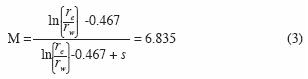
<body><![CDATA[<p align="justify"><font face="verdana" size="2"><img src="/img/revistas/geoint/v47n4/a6s1.jpg"></font></p>     <p align="justify"><font face="verdana" size="2">where <i>p<sub>wf</sub></i> is the bottom&#150;hole flowing pressure, <i>q<sub>o</sub></i> is the volumetric flow rate, and the scale parameters are the reservoir pressure (<i>p<sub>e</sub></i>) and the maximum volumetric flow rate (<i>q<sub>o</sub></i>)<sub>max</sub></font></p>     <p align="justify"><font face="verdana" size="2">Klins and Majcher (1992) modified the above relation by incorporating the decay factor (n) and the skin damage effect (s) after analyzing information of more of 1340 petroleum wells. The final expression is:</font></p>     <p align="justify"><font face="verdana" size="2"><img src="/img/revistas/geoint/v47n4/a6s2.jpg"></font></p>     <p align="justify"><font face="verdana" size="2">where <i>M </i>is a parameter which incorporates the skin damage effect (s):</font></p>     <p align="justify"><font face="verdana" size="2"><img src="/img/revistas/geoint/v47n4/a6s3.jpg"></font></p>     <p align="justify"><font face="verdana" size="2">where <i>r<sub>e</sub></i> is the reservoir drainage radius and rw is the wellbore radius.</font></p>     <p align="justify"><font face="verdana" size="2">Klins and Majcher (1992) established the mean characteristics of the wellbore radius and the drainage of the reservoir in order to determine the value of <i>M</i>. According with the last thing, they used a value of 247 ft as a drainage radius (<i>r<sub>e</sub></i>) and 2 inches as wellbore radius (<i>r<sub>w</sub></i>). They applied these values in original expression of M and the result is the value of the constants appearing in Eq. (3).</font></p>     <p align="justify"><font face="verdana" size="2">The exponent <i>n</i> of Eq. (2) is a function of the reservoir pressure pe and the bubble point pressure (<i>p<sub>b</sub></i>), and is given by:</font></p>     <p align="justify"><font face="verdana" size="2"><img src="/img/revistas/geoint/v47n4/a6s4.jpg"></font></p>     ]]></body>
<body><![CDATA[<p align="justify"><font face="verdana" size="2">In the geothermal engineering Iglesias and Moya (1990) formulated the first dimensionless inflow curve for geothermal reservoirs, considering the geothermal fluid as only pure water. The expression is:</font></p>     <p align="justify"><font face="verdana" size="2"><img src="/img/revistas/geoint/v47n4/a6s5.jpg"></font></p>     <p align="justify"><font face="verdana" size="2">where <i>W</i> is the produced mass flow, <i>W<sub>max</sub></i> is the maximum mass flow (theoretically for <i>p<sub>wf</sub></i> = 0). The flowing bottom pressure is <i>p<sub>wf</sub></i> and the reservoir pressure is <i>p</i><i><sub>e</sub></i>.</font></p>     <p align="justify"><font face="verdana" size="2">The same authors presented the corresponding inflow curve for thermal productivity (they also call it as thermal power):</font></p> 				    <p align="justify"><font face="verdana" size="2"><img src="/img/revistas/geoint/v47n4/a6s6.jpg"></font></p> 				    <p align="justify"><font face="verdana" size="2">where <i>Pot</i> is the thermal power = (<i>W</i>) (<i>h</i>), and h is flowing enthalpy.</font></p> 				    <p align="justify"><font face="verdana" size="2">Subsequently, Moya (1994) obtained the respective dimensionless inflow curves for a binary system <i>H<sub>2</sub>O&#150;CO<sub>2</sub></i>, being the expression of the mass productivity as follows:</font></p> 				    <p align="justify"><font face="verdana" size="2"><img src="/img/revistas/geoint/v47n4/a6s7.jpg"></font></p> 				    <p align="justify"><font face="verdana" size="2">Applications of the binary model to field case studies of Mexican geothermal reservoirs were made (Moya <i>et al.</i>, 1995; 1997; 1998), obtaining outflow curves and comparing them to field data. Iglesias and Moya (1998) validated the inflow curves, comparing their results with bottom&#150;hole data. Moya <i>et al.</i> (2001, 2003) extended the application of this methodology to estimate the permeability of rock formations by means of a computation system (Moya and Uribe, 2000) that applies the methodology in automated form.</font></p> 				    <p align="justify"><font face="verdana" size="2">To introduce the effect of salts, Montoya (2003) proposed an inflow curve that considers the geothermal fluid to be a ternary mixture <i>H<sub>2</sub>O&#150;CO<sub>2</sub>&#150;NaCl</i>. This expression is a result of use the TOUGH program (Pruess, <i>et al.</i>, 1999) applied to geothermal reservoirs for different flow values, using diverse salt (NaCl) concentrations, up to 5 % of mass fraction in the liquid phase and its form is:</font></p> 				    ]]></body>
<body><![CDATA[<p align="justify"><font face="verdana" size="2"><img src="/img/revistas/geoint/v47n4/a6s8.jpg"></font></p> 				    <p align="justify"><font face="verdana" size="2">where <i>W</i> is the well mass flow rate and <i>W<sub>max</sub></i> is the well maximum possible mass flow rate.</font></p> 				    <p align="justify"><font face="verdana" size="2">In order to incorporate the damage effect to the reference curve of Eq. (8), it is appropriate to mention the proposed by Klins and Majcher (1992). So, in order to determine the values of the constants applicable to geothermal systems, was done a research about the characteristics of the pipes production and mean dimensions of the different geothermal reservoir of the world. The obtained results helped to establish the value of <i>r<sub>w </sub></i>of 2 inches and <i>r<sub>e</sub></i> of 750 ft. According with the last thing, the equation to determine the value of <i>M</i> is given by the next expression:</font></p> 				    <p align="justify"><font face="verdana" size="2"><img src="/img/revistas/geoint/v47n4/a6s9.jpg"></font></p> 				    <p align="justify"><font face="verdana" size="2">This factor affects the reference curve given by Eq. (8), which is function of <i>p<sub>wf</sub></i> and <i>p<sub>e</sub></i> relation, skin damage and of gas and salt concentration.</font></p> 				    <p align="justify"><font face="verdana" size="2"><img src="/img/revistas/geoint/v47n4/a6s10.jpg"></font></p> 				    <p align="justify"><font face="verdana" size="2">Eq. (10) is the proposed reference curve for geothermal reservoirs with damage effects.</font></p> 				    <p align="justify"><font face="verdana" size="2">Using variables in dimensionless form:</font></p> 				    <p align="justify"><font face="verdana" size="2"><img src="/img/revistas/geoint/v47n4/a6s11.jpg"></font></p> 				    <p align="justify"><font face="verdana" size="2"><img src="/img/revistas/geoint/v47n4/a6s12.jpg"></font></p> 				    ]]></body>
<body><![CDATA[<p align="justify"><font face="verdana" size="2">Thus, the dimensionless form of Eq. (10) is as follows:</font></p> 				    <p align="justify"><font face="verdana" size="2"><img src="/img/revistas/geoint/v47n4/a6s13.jpg"></font></p> 				    <p align="justify"><font face="verdana" size="2">A plot of Eq. (13) is shown graphically in <a href="#f1">Fig. 1</a> for skin damage values between &#150;4 and +6.</font></p> 				    <p align="center"><font face="verdana" size="2"><a name="f1"></a></font></p> 				    <p align="center"><font face="verdana" size="2"><img src="/img/revistas/geoint/v47n4/a6f1.jpg"></font></p> 				    <p align="justify"><font face="verdana" size="2">The presence of skin damage (s) in the rock formation is manifested by an additional drop in reservoir pressure caused by obstructions or plugging of the rock flow channels, yielding a reduced formation permeability and positive values of the skin damage effect. When the rock formation is artificially treated with a cleaning, stimulation or fracturing job to increase well/formation productivity, then negative values of the damage effect are obtained, which is a beneficial event.</font></p> 				    <p align="justify"><font face="verdana" size="2">It is common to find beneficial situations in wells (negative values of damage effect) during production tests performed at the end of the well drilling and completion. This occurs because the well discharge induces dragging of the drilling fluid residues that would have lodged in the walls of the well, thus causing a cleaning operation of the well.</font></p> 				    <p align="justify">&nbsp;</p> 				    <p align="justify"><font face="verdana" size="2"><b>Methodology</b></font></p> 				    <p align="justify"><font face="verdana" size="2">The proposed general methodology to determine skin damage in a well through the use of the geothermal type&#150;curves with damage effects given by Eqs. (10) and (13) is shown schematically in <a href="#f2">Fig. 2</a>:</font></p> 				    ]]></body>
<body><![CDATA[<p align="center"><font face="verdana" size="2"><a name="f2"></a></font></p> 				    <p align="center"><font face="verdana" size="2"><img src="/img/revistas/geoint/v47n4/a6f2.jpg"></font></p> 				    <p align="justify"><font face="verdana" size="2">The proposed methodology establishes the use of the SISTCURV (Moya and Uribe, 2000; Moya <i>et al.</i>, 2003), which is a computer program that uses measures data (pressure, flow) of a production test in a geothermal well. This computer program uses the well flow simulator VSTEAM (INTERCOMP, 1981) to determine the bottomhole conditions. So, it reproduces all output curves of the well, and determines the maximum possible flow of the well. The correlations for pressure drops that this program uses, are: Hagedorn&#150;Brown, Orkiszewski, Azis&#150;Govier, Beggs&#150;Brill and Mukherjee&#150;Brill. In this work the correlation of Hagedorn&#150;Brown is used, because the good results for reproduce well conditions.</font></p> 				    <p align="justify"><font face="verdana" size="2">According to <a href="#f2">Fig. 2</a>, the methodology employed in this study can be briefly described as follows:</font></p> 				    <p align="justify"><font face="verdana" size="2">1. The input data correspond to the data of a production test and include the mass flow rate (<i>W</i>), the flowing pressure and enthalpy (<i>p, h</i>), and the static reservoir pressure (<i>p</i><i><sub>e</sub></i>).</font></p>     <p align="justify"><font face="verdana" size="2">2. If the available data are at wellhead conditions (<i>p, h</i>), then a well flow simulator is used to obtain the bottomhole flowing conditions.</font></p> 				    <p align="justify"><font face="verdana" size="2">3. The dimensionless inflow curve of the well is determined from the reference curve (Eq. 5) employing the computational system SISTCURV (Moya and Uribe, 2000; Moya <i>et al.</i>, 2003).</font></p> 				    <p align="justify"><font face="verdana" size="2">4. The dimensionless inflow curve of the well is overlapped on the geothermal type&#150;curve with damage effects shown in <a href="#f1">Fig. 1</a>. The skin damage effect (s) corresponding to the best overlap of both curves, gives the required skin damage effect value.</font></p> 				    <p align="justify"><font face="verdana" size="2">5. The method proposed by Jones <i>et al.</i> (1976) is used to corroborate the skin damage effect determined using the proposed methodology.</font></p> 				    <p align="justify"><font face="verdana" size="2">This method is used to determine the skin damage existence in petroleum rock formations at the completion stage of a well using the data of a production test (Chu, 1988). It is a qualitative method and requires a minimum of three pairs of mass flow and pressure data.</font></p> 				    ]]></body>
<body><![CDATA[<p align="justify"><font face="verdana" size="2">The Jones <i>et al.</i> (1976) method is used to diagnose the mean conditions of the formation, as at stage of well completion as during any stage of the well operative life. The method was designed mainly to be applied in petroleum wells, but at the date, its application still is not common in geothermal wells. The method is useful to identify the pressure losses, originated by turbulent flow, related with the restrictions in the feed zone, which can indicate presence of damage.</font></p> 				    <p align="justify"><font face="verdana" size="2">In the present work the method is used as a tool to verify the proposed methodology, under the following procedure:</font></p> 				    <p align="justify"><font face="verdana" size="2">a) Determine the value &#91;(<i>p</i><i><sub>e</sub></i>&#150;<i>p<sub>wf</sub></i>)/<i>q</i>&#93; for each volumetric flow q. This is equivalent to obtaining the inverse value of the productivity index <i>J.</i></font></p> 				    <p align="justify"><font face="verdana" size="2">b) Plot &#91;(<i>p</i><i><sub>e</sub></i>&#150;<i>p<sub>wf</sub></i>)/<i>q</i>&#93; vs. <i>q</i></font></p> 				    <p align="justify"><font face="verdana" size="2">c) Fit a straight line to the data points and determine the values of its ordinate b and slope m such that:</font></p> 				    <p align="justify"><font face="verdana" size="2"><img src="/img/revistas/geoint/v47n4/a6s14.jpg"></font></p> 				    <p align="justify"><font face="verdana" size="2">The criterion of the Jones method used for the diagnosis establishes that if the ordinate value b is less than 0.05, then the rock formation does not have damage, but for values of <i>b</i> greater than 0.05, there is skin damage in the formation.</font></p> 				    <p align="justify"><font face="verdana" size="2">In the diagnosis of the well conditions, the method proposes to determine <i>b</i>' from the next expression:</font></p> 				    <p align="justify"><font face="verdana" size="2"><img src="/img/revistas/geoint/v47n4/a6s14b.jpg"></font></p> 				    <p align="justify"><font face="verdana" size="2">where <i>Q<sub>max</sub></i> is obtained from the inflow relationship (Eqs. 10 and 11).</font></p> 				    ]]></body>
<body><![CDATA[<p align="justify"><font face="verdana" size="2">If the ratio of <i>b'/b</i>, is less than 2.0 then, in the interface wellbore&#150;formation, the turbulence is small or there is not.</font></p> 				    <p align="justify"><font face="verdana" size="2">For values of b less than 0.05 and <i>b'/b </i>greater than 2, the poor productivity could be originated because the area for the flow is not enough. In the last situation, the resulting solution is to improve the exploitation zone by making deeper the well.</font></p> 				    <p align="justify">&nbsp;</p> 				    <p align="justify"><font face="verdana" size="2"><b>Study cases</b></font></p> 				    <p align="justify"><font face="verdana" size="2">The methodology described above was applied to data of thirteen wells from the Los Humeros, Puebla, M&eacute;xico geothermal field which is located approximately 200 km east of M&eacute;xico City. <a href="#f3">Fig. 3</a> shows the location of the wells in the field. The wells considered in the present study appear in <a href="#f3">Fig. 3</a> with a different symbol and are listed in <a href="#t1">Table 1</a>. Wellhead production test data for these wells were taken from Arellano <i>et al.</i>, (1998).</font></p> 				    <p align="center"><font face="verdana" size="2"><a name="f3"></a></font></p> 				    <p align="center"><font face="verdana" size="2"><img src="/img/revistas/geoint/v47n4/a6f3.jpg"></font></p> 				    <p align="center"><font face="verdana" size="2"><a name="t1"></a></font></p> 				    <p align="center"><font face="verdana" size="2"><img src="/img/revistas/geoint/v47n4/a6t1.jpg"></font></p> 				    <p align="justify"><font face="verdana" size="2">The static pressure data were obtained from transient pressure tests or measurements carried out at the completion stage of the well (Torres&#150;Rodr&iacute;guez, 1995) for sufficiently long stabilization times (greater than 100 hours). The static temperatures of the wells were determined using the Horner (1951) method (Arellano <i>et al.</i>, 1998). The output or discharge measurements correspond to the initial exploitation stage of the wells. </font></p> 				    ]]></body>
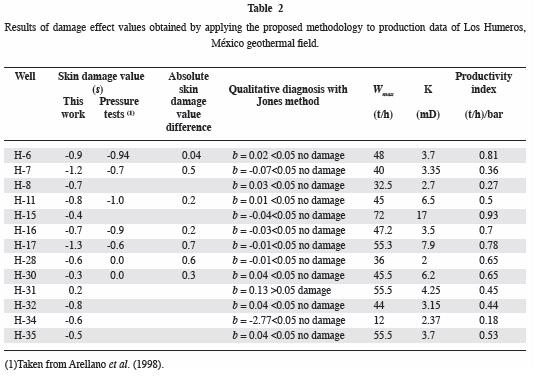
<body><![CDATA[<p align="justify"><font face="verdana" size="2"><i>Example of skin damage determination using data of well H&#150;11</i></font></p> 				    <p align="justify"><font face="verdana" size="2">In order to show the application of the proposed methodology, the data of well H&#150;11 were considered which is located in the most exploited zone of the field. <a href="/img/revistas/geoint/v47n4/a6f4.jpg" target="_blank">Fig. 4</a> shows the complete output curve obtained with SISTCURV and its comparison with the well production test field data.</font></p> 				    <p align="justify"><font face="verdana" size="2"><a href="#f5">Fig. 5</a> shows the overlap of the corresponding dimensionless inflow curve of the well with the geothermal type&#150;curves with damage effect (<a href="#f1">Fig. 1</a>). From this overlap it is obtained a skin damage value (s) of &#150;0.8.</font></p> 				    <p align="center"><font face="verdana" size="2"><a name="f5"></a></font></p> 				    <p align="center"><font face="verdana" size="2"><img src="/img/revistas/geoint/v47n4/a6f5.jpg"></font></p> 				    <p align="justify"><font face="verdana" size="2">In order to verify this determination the qualitative method of Jones <i>et al.</i> (1976) is used to confirm the presence or absence of the damage determined with the proposed methodology. <a href="#f6">Fig. 6</a> shows the plot of q versus <i>&Delta;p/q</i> in the form suggested by the Jones method. It can be seen that the ordinate value is less than 0.05 (<i>b</i> = 0.0068); therefore it is verified that there is not damage in the well. Furthermore, the value of the skin damage effect also is verified with that obtained from transient pressure tests of <i>s</i> = &#150;1 (<a href="#t2">Table 2</a>).</font></p> 				    <p align="center"><font face="verdana" size="2"><a name="f6"></a></font></p> 				    <p align="center"><font face="verdana" size="2"><img src="/img/revistas/geoint/v47n4/a6f6.jpg"></font></p> 				    <p align="center"><font face="verdana" size="2"><a name="t2"></a></font></p> 				    <p align="center"><font face="verdana" size="2"><img src="/img/revistas/geoint/v47n4/a6t2.jpg"></font></p> 				    ]]></body>
<body><![CDATA[<p align="justify"><font face="verdana" size="2"><b>Results and discussion</b></font></p> 				    <p align="justify"><font face="verdana" size="2"><a href="#t2">Table 2</a> shows a summary of the well skin damage determinations performed for thirteen wells from the Los Humeros geothermal field considered herein and their comparison with the skin damage effect results, obtained by Arellano <i>et al.</i> (1998) from transient pressure tests. Corroboration of results using the Jones method is also included according to the present methodology. <a href="#t2">Table 2</a> also includes the mass flow rate of each well and the respective permeabilities obtained with SISTCURV through the application of the methodology proposed by Moya <i>et al.</i> (2001) which are in the interval of mean values for this field. Finally, the corresponding productivity indices which were determined with the values of maximum mass flow are included. These values originate from the application of the SISTCURV procedure, as described before.</font></p> 				    <p align="justify"><font face="verdana" size="2">It can be seen from <a href="#t2">Table 2</a> that all the damage values determined using the present methodology are negative with exception of well H&#150;31, which has a positive skin value of 0.2, and that the interval of damage values varies from &#150;1.3 to 0.2. The presence of negative damage values is related with the fact that the production data correspond to early exploitation stage of the wells. In the initial exploitation stage, the flow from reservoir removes any possible obstruction caused by residues of well drilling, so this results in a cleaning operation of the rock formation yielding favorable beneficial conditions. It is also necessary to emphasize that the conditions close to the natural undisturbed state of the reservoir occur at the initial exploitation stage, so under this situation it is common to find beneficial flow conditions, i.e., negative values of damage effect.</font></p> 				    <p align="justify"><font face="verdana" size="2">When comparing the damage values from the present diagnosis with those obtained using transient pressure tests (Matthews and Russell, 1967), variations between 0.2 and 0.7 damage units were found. These differences are less than unity and therefore the results are considered reasonably reliable.</font></p> 				    <p align="justify">&nbsp;</p> 				    <p align="justify"><font face="verdana" size="2"><b>Conclusions</b></font></p> 				    <p align="justify"><font face="verdana" size="2">From the technical literature reviewed was found that the inflow performance relationships (IPR) are a good tool to characterize a production well, but the skin damage factor still is not included in these relationships.</font></p> 				    <p align="justify"><font face="verdana" size="2">In this work we presented inflow performance relationships including the skin damage effect (<i>s</i>).</font></p> 				    <p align="justify"><font face="verdana" size="2">We obtained geothermal inflow type&#150;curves affected with skin damage effect and in this work are presented.</font></p> 				    <p align="justify"><font face="verdana" size="2">A new methodology to evaluate skin damage effects in geothermal wells using production tests data has been developed and described herein.</font></p> 				    ]]></body>
<body><![CDATA[<p align="justify"><font face="verdana" size="2">This methodology was successfully applied to the analysis and skin damage determinations of thirteen wells from the Los Humeros, M&eacute;xico, geothermal field using production tests data.</font></p> 				    <p align="justify"><font face="verdana" size="2">The results obtained using the methodology proposed in this work were corroborated with the qualitative Jones method and supports the values of the skin damage effect obtained for the wells considered in the analysis, and also confirms the validity of the proposed methodology.</font></p> 				    <p align="justify"><font face="verdana" size="2">Comparison results of the skin damage obtained using the analysis method of transient pressure and using the proposed methodology, shows good agreement and the maximum difference was of 0.7 damage units.</font></p> 				    <p align="center"><font face="verdana" size="2"><img src="/img/revistas/geoint/v47n4/a6n1.jpg"></font></p> 				    <p align="justify">&nbsp;</p> 				    <p align="justify"><font face="verdana" size="2"><b>Acknowledgements</b></font></p> 				    <p align="justify"><font face="verdana" size="2">The authors express their gratitude to the authorities of IIE (Instituto de Investigaciones Electricas) and of Gerencia de Proyectos Geotermoel&eacute;ctricos of CFE for their support and encouragement to publish this work. CENIDET (Centro Nacional de Investigaci&oacute;n y Desarrollo Tecnol&oacute;gico) played an important role for publication of this work.</font></p> 				    <p align="justify"><font face="verdana" size="2">&nbsp;</font></p> 				    <p align="justify"><font face="verdana" size="2"><b>Bibliography</b></font></p> 				    <!-- ref --><p align="justify"><font face="verdana" size="2">Arellano, G. V., Garc&iacute;a, G. A., Barrag&aacute;n, R. M., Izquierdo, M, G., Arag&oacute;n, A. A., Nieva, G. D., Portugal, M. E., Torres, A. I., 1998. Desarrollo de un modelo b&aacute;sico actualizado del yacimiento geot&eacute;rmico de los Humeros, Puebla, Informe IIE/11/11459/01/F, proyecto contratado por la Gerencia de Proyectos Geotermoel&eacute;ctricos de la CFE, pp. 53&#150;92.</font>&nbsp;&nbsp;&nbsp;&nbsp;&nbsp;&nbsp;&nbsp;&nbsp;[&#160;<a href="javascript:void(0);" onclick="javascript: window.open('/scielo.php?script=sci_nlinks&ref=3902798&pid=S0016-7169200800040000600001&lng=','','width=640,height=500,resizable=yes,scrollbars=1,menubar=yes,');">Links</a>&#160;]<!-- end-ref --> 				    <!-- ref --><p align="justify"><font face="verdana" size="2">Chu, M. H., 1988. Inflow performance relationships for geopressured geothermal wells, Geothermal Resources Council Transactions, Vol. 12, pp. 437&#150;440.</font>&nbsp;&nbsp;&nbsp;&nbsp;&nbsp;&nbsp;&nbsp;&nbsp;[&#160;<a href="javascript:void(0);" onclick="javascript: window.open('/scielo.php?script=sci_nlinks&ref=3902800&pid=S0016-7169200800040000600002&lng=','','width=640,height=500,resizable=yes,scrollbars=1,menubar=yes,');">Links</a>&#160;]<!-- end-ref --> 				    <!-- ref --><p align="justify"><font face="verdana" size="2">Chu, W. C., Garc&iacute;a&#150;Rivera, J., Raghavan, R., 1980. Analysis of interference test data influenced by wellbore storage and skin effect at the flowing well, Journal Pet. Tech., Vol. 32, No. 1, p. 171</font>.&nbsp;&nbsp;&nbsp;&nbsp;&nbsp;&nbsp;&nbsp;&nbsp;[&#160;<a href="javascript:void(0);" onclick="javascript: window.open('/scielo.php?script=sci_nlinks&ref=3902802&pid=S0016-7169200800040000600003&lng=','','width=640,height=500,resizable=yes,scrollbars=1,menubar=yes,');">Links</a>&#160;]<!-- end-ref --> 				    <!-- ref --><p align="justify"><font face="verdana" size="2">Codeon Gmbh, 2004. Codeon Multiflo Simulator: A transient and steady state well simulator, <a href="http://www.multiflo-simulator.com/" target="_blank">www.multiflo&#150;simulator.com</a>, Feb. 2004.</font>&nbsp;&nbsp;&nbsp;&nbsp;&nbsp;&nbsp;&nbsp;&nbsp;[&#160;<a href="javascript:void(0);" onclick="javascript: window.open('/scielo.php?script=sci_nlinks&ref=3902804&pid=S0016-7169200800040000600004&lng=','','width=640,height=500,resizable=yes,scrollbars=1,menubar=yes,');">Links</a>&#160;]<!-- end-ref --> 				    <!-- ref --><p align="justify"><font face="verdana" size="2">Evinger, H. H., Muskat, M., 1942. Calculation of theoretical productivity factor, Trans., AIME, No. 146, pp. 126&#150;139</font>.&nbsp;&nbsp;&nbsp;&nbsp;&nbsp;&nbsp;&nbsp;&nbsp;[&#160;<a href="javascript:void(0);" onclick="javascript: window.open('/scielo.php?script=sci_nlinks&ref=3902806&pid=S0016-7169200800040000600005&lng=','','width=640,height=500,resizable=yes,scrollbars=1,menubar=yes,');">Links</a>&#160;]<!-- end-ref --> 				    <!-- ref --><p align="justify"><font face="verdana" size="2">Fetkovich, J. J., 1973. The isochronal testing of oil wells, SPE 4529, presented at the SPE 48th Annual Fall Meeting, Las Vegas Nevada, U.S.A., pp. 78&#150;84.</font>&nbsp;&nbsp;&nbsp;&nbsp;&nbsp;&nbsp;&nbsp;&nbsp;[&#160;<a href="javascript:void(0);" onclick="javascript: window.open('/scielo.php?script=sci_nlinks&ref=3902808&pid=S0016-7169200800040000600006&lng=','','width=640,height=500,resizable=yes,scrollbars=1,menubar=yes,');">Links</a>&#160;]<!-- end-ref --> 				    <!-- ref --><p align="justify"><font face="verdana" size="2">Gilbert, W. E., 1954. Flowing and gas&#150;lift well performance, Drilling and Production Pract., API, 126 p.</font>&nbsp;&nbsp;&nbsp;&nbsp;&nbsp;&nbsp;&nbsp;&nbsp;[&#160;<a href="javascript:void(0);" onclick="javascript: window.open('/scielo.php?script=sci_nlinks&ref=3902810&pid=S0016-7169200800040000600007&lng=','','width=640,height=500,resizable=yes,scrollbars=1,menubar=yes,');">Links</a>&#160;]<!-- end-ref --> 				    <!-- ref --><p align="justify"><font face="verdana" size="2">Helmy, M. W., Wattenbarger, R. A., 1998. New shape factor for well produced at constant pressure, SPE Gas Technology Symposium, SPE 39370, Calgary Canada, pp. 532&#150;538.</font>&nbsp;&nbsp;&nbsp;&nbsp;&nbsp;&nbsp;&nbsp;&nbsp;[&#160;<a href="javascript:void(0);" onclick="javascript: window.open('/scielo.php?script=sci_nlinks&ref=3902812&pid=S0016-7169200800040000600008&lng=','','width=640,height=500,resizable=yes,scrollbars=1,menubar=yes,');">Links</a>&#160;]<!-- end-ref --> 				    <!-- ref --><p align="justify"><font face="verdana" size="2">Horner, D. R., 1951. Pressure buildup in wells, Proceedings of the third World Petroleum Congress, Section II, E. J. Brill, Leiden, pp. 101&#150;107.</font>&nbsp;&nbsp;&nbsp;&nbsp;&nbsp;&nbsp;&nbsp;&nbsp;[&#160;<a href="javascript:void(0);" onclick="javascript: window.open('/scielo.php?script=sci_nlinks&ref=3902814&pid=S0016-7169200800040000600009&lng=','','width=640,height=500,resizable=yes,scrollbars=1,menubar=yes,');">Links</a>&#160;]<!-- end-ref --> 				    <!-- ref --><p align="justify"><font face="verdana" size="2">Iglesias, R. E., Moya, S. L., 1990. Geothermal inflow performance relationships, Geothermal Resources Council Transactions, Vol. 14, Part II, pp. 1201&#150;1205.</font>&nbsp;&nbsp;&nbsp;&nbsp;&nbsp;&nbsp;&nbsp;&nbsp;[&#160;<a href="javascript:void(0);" onclick="javascript: window.open('/scielo.php?script=sci_nlinks&ref=3902816&pid=S0016-7169200800040000600010&lng=','','width=640,height=500,resizable=yes,scrollbars=1,menubar=yes,');">Links</a>&#160;]<!-- end-ref --> 				    <!-- ref --><p align="justify"><font face="verdana" size="2">Iglesias, R. E., Moya, S. L., 1998. Applicability of geothermal inflow performance reference curves to CO2&#150;bearing reservoirs, Geothermics, Vol. 27, No. 3, pp. 305&#150;315.</font>&nbsp;&nbsp;&nbsp;&nbsp;&nbsp;&nbsp;&nbsp;&nbsp;[&#160;<a href="javascript:void(0);" onclick="javascript: window.open('/scielo.php?script=sci_nlinks&ref=3902818&pid=S0016-7169200800040000600011&lng=','','width=640,height=500,resizable=yes,scrollbars=1,menubar=yes,');">Links</a>&#160;]<!-- end-ref --> 				    <!-- ref --><p align="justify"><font face="verdana" size="2">INTERCOMP, 1981."Vertical steam&#150;water flow in wells with heat transfer &#150; VSTEAM, User's manual", INTERCOMP Resource Development and Engineering, Inc., Houston, Texas, U.S.A., 45 p.</font>&nbsp;&nbsp;&nbsp;&nbsp;&nbsp;&nbsp;&nbsp;&nbsp;[&#160;<a href="javascript:void(0);" onclick="javascript: window.open('/scielo.php?script=sci_nlinks&ref=3902820&pid=S0016-7169200800040000600012&lng=','','width=640,height=500,resizable=yes,scrollbars=1,menubar=yes,');">Links</a>&#160;]<!-- end-ref --> 				    <!-- ref --><p align="justify"><font face="verdana" size="2">Jones, L. G., Blount, E. M., Glaze, O. H., 1976. Use of short term multiple rate flow tests to predict performance of wells having turbulence, SPE 51st Annual Fall Meeting, (SPE 6133), New Orleans, LA., U.S.A., pp. 378&#150;383.</font>&nbsp;&nbsp;&nbsp;&nbsp;&nbsp;&nbsp;&nbsp;&nbsp;[&#160;<a href="javascript:void(0);" onclick="javascript: window.open('/scielo.php?script=sci_nlinks&ref=3902822&pid=S0016-7169200800040000600013&lng=','','width=640,height=500,resizable=yes,scrollbars=1,menubar=yes,');">Links</a>&#160;]<!-- end-ref --> 				    <!-- ref --><p align="justify"><font face="verdana" size="2">Klins, M. A., Majcher, M. W., 1992. Inflow performance relationships for damaged or improved wells producing under solution&#150;gas drive, J. Pet. Tech., SPE&#150;AIME, pp. 1357&#150;1363.</font>&nbsp;&nbsp;&nbsp;&nbsp;&nbsp;&nbsp;&nbsp;&nbsp;[&#160;<a href="javascript:void(0);" onclick="javascript: window.open('/scielo.php?script=sci_nlinks&ref=3902824&pid=S0016-7169200800040000600014&lng=','','width=640,height=500,resizable=yes,scrollbars=1,menubar=yes,');">Links</a>&#160;]<!-- end-ref --> 				    <!-- ref --><p align="justify"><font face="verdana" size="2">Klins, M. A., Clark, L. 1993. An improved method to predict future IPR curves, SPE Reservoir Engineering, pp. 243&#150;248.</font>&nbsp;&nbsp;&nbsp;&nbsp;&nbsp;&nbsp;&nbsp;&nbsp;[&#160;<a href="javascript:void(0);" onclick="javascript: window.open('/scielo.php?script=sci_nlinks&ref=3902826&pid=S0016-7169200800040000600015&lng=','','width=640,height=500,resizable=yes,scrollbars=1,menubar=yes,');">Links</a>&#160;]<!-- end-ref --> 				    <!-- ref --><p align="justify"><font face="verdana" size="2">Matthews, C. S., Russell, D. G., 1967. Pressure buildup and flow test in wells, Society of Petroleum Engineers of AIME, Monograph Vol. I, Henry L. Doherty Series, Dallas, Texas, U.S.A. pp. 4&#150;17.</font>&nbsp;&nbsp;&nbsp;&nbsp;&nbsp;&nbsp;&nbsp;&nbsp;[&#160;<a href="javascript:void(0);" onclick="javascript: window.open('/scielo.php?script=sci_nlinks&ref=3902828&pid=S0016-7169200800040000600016&lng=','','width=640,height=500,resizable=yes,scrollbars=1,menubar=yes,');">Links</a>&#160;]<!-- end-ref --> 				    <!-- ref --><p align="justify"><font face="verdana" size="2">Montoya, D., 2003. Estimaci&oacute;n de permeabilidades de yacimientos geot&eacute;rmicos mediante la aplicaci&oacute;n de curvas tipo de influjo geot&eacute;rmico, Tesis de maestr&iacute;a, CENIDET (Centro Nacional de Investigaci&oacute;n y Desarrollo Tecnol&oacute;gico), Cuernavaca, Morelos, M&eacute;xico, 112 p.</font>&nbsp;&nbsp;&nbsp;&nbsp;&nbsp;&nbsp;&nbsp;&nbsp;[&#160;<a href="javascript:void(0);" onclick="javascript: window.open('/scielo.php?script=sci_nlinks&ref=3902830&pid=S0016-7169200800040000600017&lng=','','width=640,height=500,resizable=yes,scrollbars=1,menubar=yes,');">Links</a>&#160;]<!-- end-ref --> 				    <!-- ref --><p align="justify"><font face="verdana" size="2">Moya, S. L., 1994. Efectos del bi&oacute;xido de carbono sobre el transporte de masa y energ&iacute;a en yacimientos geot&eacute;rmicos, Ph. D. Tesis, Divisi&oacute;n de Estudios de Posgrado, Facultad de Ingenier&iacute;a, Universidad Nacional Aut&oacute;noma de M&eacute;xico, M&eacute;xico, 204 p.</font>&nbsp;&nbsp;&nbsp;&nbsp;&nbsp;&nbsp;&nbsp;&nbsp;[&#160;<a href="javascript:void(0);" onclick="javascript: window.open('/scielo.php?script=sci_nlinks&ref=3902832&pid=S0016-7169200800040000600018&lng=','','width=640,height=500,resizable=yes,scrollbars=1,menubar=yes,');">Links</a>&#160;]<!-- end-ref --> 				    <!-- ref --><p align="justify"><font face="verdana" size="2">Moya, S. L., Iglesias, E. R., Arag&oacute;n, A. A., 1995. Curvas de referencia adimensionales para estimar productividades de masa y energ&iacute;a en yacimientos geot&eacute;rmicos con/sin bi&oacute;xido de carbono, Geotermia, Revista Mexicana de Geoenerg&iacute;a, Vol. 11, No. 3, pp. 167&#150;179.</font>&nbsp;&nbsp;&nbsp;&nbsp;&nbsp;&nbsp;&nbsp;&nbsp;[&#160;<a href="javascript:void(0);" onclick="javascript: window.open('/scielo.php?script=sci_nlinks&ref=3902834&pid=S0016-7169200800040000600019&lng=','','width=640,height=500,resizable=yes,scrollbars=1,menubar=yes,');">Links</a>&#160;]<!-- end-ref --> 				    <!-- ref --><p align="justify"><font face="verdana" size="2">Moya, S. L., Arag&oacute;n, A. A., Gonz&aacute;lez, L., 1997. Estimaci&oacute;n de curvas de producci&oacute;n de pozos geot&eacute;rmicos empleando dos curvas de referencia adimensionales del comportamiento de influjo, Ingenier&iacute;a Hidr&aacute;ulica en M&eacute;xico, Vol. 12, No. 3, pp. 35&#150;40.</font>&nbsp;&nbsp;&nbsp;&nbsp;&nbsp;&nbsp;&nbsp;&nbsp;[&#160;<a href="javascript:void(0);" onclick="javascript: window.open('/scielo.php?script=sci_nlinks&ref=3902836&pid=S0016-7169200800040000600020&lng=','','width=640,height=500,resizable=yes,scrollbars=1,menubar=yes,');">Links</a>&#160;]<!-- end-ref --> 				    <!-- ref --><p align="justify"><font face="verdana" size="2">Moya, S. L., Arag&oacute;n, A. A., Iglesias, E. R., Santoyo, G. E., 1998. Prediction of mass deliverability from a single wellhead measurement and geothermal inflow performance reference curves, Geothermics, Vol. 27, No. 3, pp. 317&#150;329.</font>&nbsp;&nbsp;&nbsp;&nbsp;&nbsp;&nbsp;&nbsp;&nbsp;[&#160;<a href="javascript:void(0);" onclick="javascript: window.open('/scielo.php?script=sci_nlinks&ref=3902838&pid=S0016-7169200800040000600021&lng=','','width=640,height=500,resizable=yes,scrollbars=1,menubar=yes,');">Links</a>&#160;]<!-- end-ref --> 				    <!-- ref --><p align="justify"><font face="verdana" size="2">Moya, S. L., Uribe, D., 2000. Computational system to estimate formation permeabilities by superposition of the well inflow curve with geothermal inflow type curve, Proceedings World Geothermal Congress 2000, pp. 2731&#150;2737.</font>&nbsp;&nbsp;&nbsp;&nbsp;&nbsp;&nbsp;&nbsp;&nbsp;[&#160;<a href="javascript:void(0);" onclick="javascript: window.open('/scielo.php?script=sci_nlinks&ref=3902840&pid=S0016-7169200800040000600022&lng=','','width=640,height=500,resizable=yes,scrollbars=1,menubar=yes,');">Links</a>&#160;]<!-- end-ref --> 				    <!-- ref --><p align="justify"><font face="verdana" size="2">Moya, S. L., Uribe, D., Arag&oacute;n, A., Garc&iacute;a, A., 2001. Formation permeability at the feedzone of geothermal wells employing inflow type&#150;curves, Geof&iacute;sica Internacional, Vol. 40, No. 3, pp. 163&#150;180.</font>&nbsp;&nbsp;&nbsp;&nbsp;&nbsp;&nbsp;&nbsp;&nbsp;[&#160;<a href="javascript:void(0);" onclick="javascript: window.open('/scielo.php?script=sci_nlinks&ref=3902842&pid=S0016-7169200800040000600023&lng=','','width=640,height=500,resizable=yes,scrollbars=1,menubar=yes,');">Links</a>&#160;]<!-- end-ref --> 				    <!-- ref --><p align="justify"><font face="verdana" size="2">Moya S.L., Uribe, D., Montoya, D., 2003. Computational system to estimate formation permeabilities and output curves of geothermal wells, Computers &amp; Goesciences, Vol. 29, pp. 1071&#150;1083.</font>&nbsp;&nbsp;&nbsp;&nbsp;&nbsp;&nbsp;&nbsp;&nbsp;[&#160;<a href="javascript:void(0);" onclick="javascript: window.open('/scielo.php?script=sci_nlinks&ref=3902844&pid=S0016-7169200800040000600024&lng=','','width=640,height=500,resizable=yes,scrollbars=1,menubar=yes,');">Links</a>&#160;]<!-- end-ref --> 				    <!-- ref --><p align="justify"><font face="verdana" size="2">Muskat, M., 1945. The production histories of oil producing gas&#150;drive reservoirs, Journal Applied Physics, 16, pp. 147&#150;153.</font>&nbsp;&nbsp;&nbsp;&nbsp;&nbsp;&nbsp;&nbsp;&nbsp;[&#160;<a href="javascript:void(0);" onclick="javascript: window.open('/scielo.php?script=sci_nlinks&ref=3902846&pid=S0016-7169200800040000600025&lng=','','width=640,height=500,resizable=yes,scrollbars=1,menubar=yes,');">Links</a>&#160;]<!-- end-ref --> 				    <!-- ref --><p align="justify"><font face="verdana" size="2">Pruess, K., Oldenburg, C., Moridis, G., 1999. TOUGH2 User's guide, Version 2.0. Report LBNL&#150;43134, Lawrence Berkeley Laboratory, Berkeley, CA, USA, 47 p.</font>&nbsp;&nbsp;&nbsp;&nbsp;&nbsp;&nbsp;&nbsp;&nbsp;[&#160;<a href="javascript:void(0);" onclick="javascript: window.open('/scielo.php?script=sci_nlinks&ref=3902848&pid=S0016-7169200800040000600026&lng=','','width=640,height=500,resizable=yes,scrollbars=1,menubar=yes,');">Links</a>&#160;]<!-- end-ref --> 				    <!-- ref --><p align="justify"><font face="verdana" size="2">Ramey, H. J. Jr., 1970. Short&#150;time well test data interpretation in the presence of skin effect and wellbore storage, Journal Pet. Tech., pp. 97&#150;104.</font>&nbsp;&nbsp;&nbsp;&nbsp;&nbsp;&nbsp;&nbsp;&nbsp;[&#160;<a href="javascript:void(0);" onclick="javascript: window.open('/scielo.php?script=sci_nlinks&ref=3902850&pid=S0016-7169200800040000600027&lng=','','width=640,height=500,resizable=yes,scrollbars=1,menubar=yes,');">Links</a>&#160;]<!-- end-ref --> 				    <!-- ref --><p align="justify"><font face="verdana" size="2">Rodr&iacute;guez, O. R., 1997. Revisi&oacute;n y actualizaci&oacute;n de los intervalos permeables del campo geot&eacute;rmico Los Humeros, Puebla, Internal report, /RE/03/97 Comisi&oacute;n Federal de Electricidad, Campo Geot&eacute;rmico Los Humeros, Pue., Residencia de Estudios, Maztaloya, Pue., 83 p.</font>&nbsp;&nbsp;&nbsp;&nbsp;&nbsp;&nbsp;&nbsp;&nbsp;[&#160;<a href="javascript:void(0);" onclick="javascript: window.open('/scielo.php?script=sci_nlinks&ref=3902852&pid=S0016-7169200800040000600028&lng=','','width=640,height=500,resizable=yes,scrollbars=1,menubar=yes,');">Links</a>&#160;]<!-- end-ref --> 				    <!-- ref --><p align="justify"><font face="verdana" size="2">Standing, M. B., 1970. Inflow performance relationships for damaged wells producing by solution&#150;gas drive, Journal Pet. Tech., pp. 1399&#150;1400.</font>&nbsp;&nbsp;&nbsp;&nbsp;&nbsp;&nbsp;&nbsp;&nbsp;[&#160;<a href="javascript:void(0);" onclick="javascript: window.open('/scielo.php?script=sci_nlinks&ref=3902854&pid=S0016-7169200800040000600029&lng=','','width=640,height=500,resizable=yes,scrollbars=1,menubar=yes,');">Links</a>&#160;]<!-- end-ref --> 				    <!-- ref --><p align="justify"><font face="verdana" size="2">Torres&#150;Rodr&iacute;guez, M. A., 1995. Characterization of the reservoir of the Los Humeros, M&eacute;xico geothermal field, Proceedings of the World Geothermal Congress, 1995, Vol. 3, Florence, Italy, pp. 1561&#150;1567.</font>&nbsp;&nbsp;&nbsp;&nbsp;&nbsp;&nbsp;&nbsp;&nbsp;[&#160;<a href="javascript:void(0);" onclick="javascript: window.open('/scielo.php?script=sci_nlinks&ref=3902856&pid=S0016-7169200800040000600030&lng=','','width=640,height=500,resizable=yes,scrollbars=1,menubar=yes,');">Links</a>&#160;]<!-- end-ref --> 				    <!-- ref --><p align="justify"><font face="verdana" size="2">Van Everdingen, A. F., Hurst, W., 1949. The application of the LaPlace transformation to flow problems in reservoirs, Petroleum Transactions AIME, 196, pp. 156&#150;164.</font>&nbsp;&nbsp;&nbsp;&nbsp;&nbsp;&nbsp;&nbsp;&nbsp;[&#160;<a href="javascript:void(0);" onclick="javascript: window.open('/scielo.php?script=sci_nlinks&ref=3902858&pid=S0016-7169200800040000600031&lng=','','width=640,height=500,resizable=yes,scrollbars=1,menubar=yes,');">Links</a>&#160;]<!-- end-ref --> 				    <!-- ref --><p align="justify"><font face="verdana" size="2">Vogel, J. V., 1968. Inflow performance relationships for solution&#150;gas drive wells, J. Pet. Tech., Trans. AIME, No. 243, pp. 83&#150;92.</font>&nbsp;&nbsp;&nbsp;&nbsp;&nbsp;&nbsp;&nbsp;&nbsp;[&#160;<a href="javascript:void(0);" onclick="javascript: window.open('/scielo.php?script=sci_nlinks&ref=3902860&pid=S0016-7169200800040000600032&lng=','','width=640,height=500,resizable=yes,scrollbars=1,menubar=yes,');">Links</a>&#160;]<!-- end-ref --> 				    <!-- ref --><p align="justify"><font face="verdana" size="2">Weller, W. T., 1966. Reservoir performance during two&#150;phase flow, Journal Pet. Tech., pp. 240&#150;246.</font>&nbsp;&nbsp;&nbsp;&nbsp;&nbsp;&nbsp;&nbsp;&nbsp;[&#160;<a href="javascript:void(0);" onclick="javascript: window.open('/scielo.php?script=sci_nlinks&ref=3902862&pid=S0016-7169200800040000600033&lng=','','width=640,height=500,resizable=yes,scrollbars=1,menubar=yes,');">Links</a>&#160;]<!-- end-ref --> 				    <!-- ref --><p align="justify"><font face="verdana" size="2">Wiggins, M. L., 1994. Generalized inflow performance relationships for three&#150;phase flow, SPE Production Operations Symposium SPE 25458, Oklahoma City, U.S.A., pp. 275&#150;286.</font>&nbsp;&nbsp;&nbsp;&nbsp;&nbsp;&nbsp;&nbsp;&nbsp;[&#160;<a href="javascript:void(0);" onclick="javascript: window.open('/scielo.php?script=sci_nlinks&ref=3902864&pid=S0016-7169200800040000600034&lng=','','width=640,height=500,resizable=yes,scrollbars=1,menubar=yes,');">Links</a>&#160;]<!-- end-ref --> ]]></body><back>
<ref-list>
<ref id="B1">
<nlm-citation citation-type="book">
<person-group person-group-type="author">
<name>
<surname><![CDATA[Arellano]]></surname>
<given-names><![CDATA[G. V.]]></given-names>
</name>
<name>
<surname><![CDATA[García]]></surname>
<given-names><![CDATA[G. A.]]></given-names>
</name>
<name>
<surname><![CDATA[Barragán]]></surname>
<given-names><![CDATA[R. M.]]></given-names>
</name>
<name>
<surname><![CDATA[Izquierdo]]></surname>
<given-names><![CDATA[M, G]]></given-names>
</name>
<name>
<surname><![CDATA[Aragón]]></surname>
<given-names><![CDATA[A. A.]]></given-names>
</name>
<name>
<surname><![CDATA[Nieva]]></surname>
<given-names><![CDATA[G. D.]]></given-names>
</name>
<name>
<surname><![CDATA[Portugal]]></surname>
<given-names><![CDATA[M. E.]]></given-names>
</name>
<name>
<surname><![CDATA[Torres]]></surname>
<given-names><![CDATA[A. I.]]></given-names>
</name>
</person-group>
<source><![CDATA[Desarrollo de un modelo básico actualizado del yacimiento geotérmico de los Humeros]]></source>
<year>1998</year>
<page-range>53-92</page-range><publisher-loc><![CDATA[^ePuebla Puebla]]></publisher-loc>
<publisher-name><![CDATA[proyecto contratado por la Gerencia de Proyectos Geotermoeléctricos de la CFE]]></publisher-name>
</nlm-citation>
</ref>
<ref id="B2">
<nlm-citation citation-type="journal">
<person-group person-group-type="author">
<name>
<surname><![CDATA[Chu]]></surname>
<given-names><![CDATA[M. H.]]></given-names>
</name>
</person-group>
<article-title xml:lang="en"><![CDATA[Inflow performance relationships for geopressured geothermal wells]]></article-title>
<source><![CDATA[Geothermal Resources Council Transactions]]></source>
<year>1988</year>
<volume>12</volume>
<page-range>437-440</page-range></nlm-citation>
</ref>
<ref id="B3">
<nlm-citation citation-type="journal">
<person-group person-group-type="author">
<name>
<surname><![CDATA[Chu]]></surname>
<given-names><![CDATA[W. C.]]></given-names>
</name>
<name>
<surname><![CDATA[García-Rivera]]></surname>
<given-names><![CDATA[J]]></given-names>
</name>
<name>
<surname><![CDATA[Raghavan]]></surname>
<given-names><![CDATA[R]]></given-names>
</name>
</person-group>
<article-title xml:lang="en"><![CDATA[Analysis of interference test data influenced by wellbore storage and skin effect at the flowing well]]></article-title>
<source><![CDATA[Journal Pet. Tech.]]></source>
<year>1980</year>
<volume>32</volume>
<numero>1</numero>
<issue>1</issue>
<page-range>171</page-range></nlm-citation>
</ref>
<ref id="B4">
<nlm-citation citation-type="">
<person-group person-group-type="author">
<name>
<surname><![CDATA[Codeon]]></surname>
<given-names><![CDATA[Gmbh]]></given-names>
</name>
</person-group>
<source><![CDATA[Codeon Multiflo Simulator: A transient and steady state well simulator]]></source>
<year>2004</year>
</nlm-citation>
</ref>
<ref id="B5">
<nlm-citation citation-type="book">
<person-group person-group-type="author">
<name>
<surname><![CDATA[Evinger]]></surname>
<given-names><![CDATA[H. H.]]></given-names>
</name>
<name>
<surname><![CDATA[Muskat]]></surname>
<given-names><![CDATA[M]]></given-names>
</name>
</person-group>
<source><![CDATA[Calculation of theoretical productivity factor]]></source>
<year>1942</year>
<volume>146</volume>
<page-range>126-139</page-range><publisher-name><![CDATA[AIME]]></publisher-name>
</nlm-citation>
</ref>
<ref id="B6">
<nlm-citation citation-type="confpro">
<person-group person-group-type="author">
<name>
<surname><![CDATA[Fetkovich]]></surname>
<given-names><![CDATA[J. J.]]></given-names>
</name>
</person-group>
<source><![CDATA[The isochronal testing of oil wells]]></source>
<year>1973</year>
<conf-name><![CDATA[ presented at the SPE 48th Annual Fall Meeting]]></conf-name>
<conf-loc>Las Vegas Nevada </conf-loc>
<page-range>78-84</page-range></nlm-citation>
</ref>
<ref id="B7">
<nlm-citation citation-type="book">
<person-group person-group-type="author">
<name>
<surname><![CDATA[Gilbert]]></surname>
<given-names><![CDATA[W. E.]]></given-names>
</name>
</person-group>
<source><![CDATA[Flowing and gas-lift well performance, Drilling and Production Pract.]]></source>
<year>1954</year>
<page-range>126</page-range><publisher-name><![CDATA[API]]></publisher-name>
</nlm-citation>
</ref>
<ref id="B8">
<nlm-citation citation-type="confpro">
<person-group person-group-type="author">
<name>
<surname><![CDATA[Helmy]]></surname>
<given-names><![CDATA[M. W.]]></given-names>
</name>
<name>
<surname><![CDATA[Wattenbarger]]></surname>
<given-names><![CDATA[R. A.]]></given-names>
</name>
</person-group>
<source><![CDATA[New shape factor for well produced at constant pressure]]></source>
<year>1998</year>
<conf-name><![CDATA[ SPE Gas Technology Symposium]]></conf-name>
<conf-loc>Calgary </conf-loc>
<page-range>532-538</page-range></nlm-citation>
</ref>
<ref id="B9">
<nlm-citation citation-type="confpro">
<person-group person-group-type="author">
<name>
<surname><![CDATA[Horner]]></surname>
<given-names><![CDATA[D. R.]]></given-names>
</name>
</person-group>
<source><![CDATA[Pressure buildup in wells]]></source>
<year>1951</year>
<conf-name><![CDATA[ Proceedings of the third World Petroleum Congress]]></conf-name>
<conf-loc> </conf-loc>
<page-range>101-107</page-range><publisher-loc><![CDATA[Leiden ]]></publisher-loc>
<publisher-name><![CDATA[E. J. Brill]]></publisher-name>
</nlm-citation>
</ref>
<ref id="B10">
<nlm-citation citation-type="book">
<person-group person-group-type="author">
<name>
<surname><![CDATA[Iglesias]]></surname>
<given-names><![CDATA[R. E.]]></given-names>
</name>
<name>
<surname><![CDATA[Moya]]></surname>
<given-names><![CDATA[S. L.]]></given-names>
</name>
</person-group>
<source><![CDATA[Geothermal inflow performance relationships]]></source>
<year>1990</year>
<volume>14</volume>
<page-range>1201-1205</page-range><publisher-name><![CDATA[Geothermal Resources Council Transactions]]></publisher-name>
</nlm-citation>
</ref>
<ref id="B11">
<nlm-citation citation-type="journal">
<person-group person-group-type="author">
<name>
<surname><![CDATA[Iglesias]]></surname>
<given-names><![CDATA[R. E.]]></given-names>
</name>
<name>
<surname><![CDATA[Moya]]></surname>
<given-names><![CDATA[S. L.]]></given-names>
</name>
</person-group>
<article-title xml:lang="en"><![CDATA[Applicability of geothermal inflow performance reference curves to CO2-bearing reservoirs]]></article-title>
<source><![CDATA[Geothermics]]></source>
<year>1998</year>
<volume>27</volume>
<numero>3</numero>
<issue>3</issue>
<page-range>305-315</page-range></nlm-citation>
</ref>
<ref id="B12">
<nlm-citation citation-type="book">
<collab>INTERCOMP</collab>
<source><![CDATA[Vertical steam-water flow in wells with heat transfer - VSTEAM, User's manual]]></source>
<year>1981</year>
<page-range>45</page-range><publisher-loc><![CDATA[Houston^eTexas Texas]]></publisher-loc>
<publisher-name><![CDATA[INTERCOMP Resource Development and Engineering, Inc.]]></publisher-name>
</nlm-citation>
</ref>
<ref id="B13">
<nlm-citation citation-type="confpro">
<person-group person-group-type="author">
<name>
<surname><![CDATA[Jones]]></surname>
<given-names><![CDATA[L. G.]]></given-names>
</name>
<name>
<surname><![CDATA[Blount]]></surname>
<given-names><![CDATA[E. M.]]></given-names>
</name>
<name>
<surname><![CDATA[Glaze]]></surname>
<given-names><![CDATA[O. H.]]></given-names>
</name>
</person-group>
<source><![CDATA[Use of short term multiple rate flow tests to predict performance of wells having turbulence]]></source>
<year>1976</year>
<conf-name><![CDATA[ SPE 51st Annual Fall Meeting]]></conf-name>
<conf-loc>New Orleans LA</conf-loc>
<page-range>378-383</page-range></nlm-citation>
</ref>
<ref id="B14">
<nlm-citation citation-type="journal">
<person-group person-group-type="author">
<name>
<surname><![CDATA[Klins]]></surname>
<given-names><![CDATA[M. A.]]></given-names>
</name>
<name>
<surname><![CDATA[Majcher]]></surname>
<given-names><![CDATA[M. W.]]></given-names>
</name>
</person-group>
<article-title xml:lang="en"><![CDATA[Inflow performance relationships for damaged or improved wells producing under solution-gas drive]]></article-title>
<source><![CDATA[J. Pet. Tech.]]></source>
<year>1992</year>
<page-range>1357-1363</page-range><publisher-name><![CDATA[SPE-AIME]]></publisher-name>
</nlm-citation>
</ref>
<ref id="B15">
<nlm-citation citation-type="book">
<person-group person-group-type="author">
<name>
<surname><![CDATA[Klins]]></surname>
<given-names><![CDATA[M. A.]]></given-names>
</name>
<name>
<surname><![CDATA[Clark]]></surname>
<given-names><![CDATA[L]]></given-names>
</name>
</person-group>
<source><![CDATA[An improved method to predict future IPR curves]]></source>
<year>1993</year>
<page-range>243-248</page-range><publisher-name><![CDATA[SPE Reservoir Engineering]]></publisher-name>
</nlm-citation>
</ref>
<ref id="B16">
<nlm-citation citation-type="book">
<person-group person-group-type="author">
<name>
<surname><![CDATA[Matthews]]></surname>
<given-names><![CDATA[C. S.]]></given-names>
</name>
<name>
<surname><![CDATA[Russell]]></surname>
<given-names><![CDATA[D. G.]]></given-names>
</name>
</person-group>
<source><![CDATA[Pressure buildup and flow test in wells]]></source>
<year>1967</year>
<volume>I</volume>
<page-range>4-17</page-range><publisher-loc><![CDATA[Dallas^eTexas Texas]]></publisher-loc>
<publisher-name><![CDATA[Society of Petroleum Engineers of AIME]]></publisher-name>
</nlm-citation>
</ref>
<ref id="B17">
<nlm-citation citation-type="">
<person-group person-group-type="author">
<name>
<surname><![CDATA[Montoya]]></surname>
<given-names><![CDATA[D]]></given-names>
</name>
</person-group>
<source><![CDATA[Estimación de permeabilidades de yacimientos geotérmicos mediante la aplicación de curvas tipo de influjo geotérmico]]></source>
<year>2003</year>
<page-range>112</page-range></nlm-citation>
</ref>
<ref id="B18">
<nlm-citation citation-type="">
<person-group person-group-type="author">
<name>
<surname><![CDATA[Moya]]></surname>
<given-names><![CDATA[S. L.]]></given-names>
</name>
</person-group>
<source><![CDATA[Efectos del bióxido de carbono sobre el transporte de masa y energía en yacimientos geotérmicos]]></source>
<year>1994</year>
<page-range>204</page-range></nlm-citation>
</ref>
<ref id="B19">
<nlm-citation citation-type="journal">
<person-group person-group-type="author">
<name>
<surname><![CDATA[Moya]]></surname>
<given-names><![CDATA[S. L.]]></given-names>
</name>
<name>
<surname><![CDATA[Iglesias]]></surname>
<given-names><![CDATA[E. R.]]></given-names>
</name>
<name>
<surname><![CDATA[Aragón]]></surname>
<given-names><![CDATA[A. A.]]></given-names>
</name>
</person-group>
<article-title xml:lang="es"><![CDATA[Curvas de referencia adimensionales para estimar productividades de masa y energía en yacimientos geotérmicos con/sin bióxido de carbono]]></article-title>
<source><![CDATA[Geotermia]]></source>
<year>1995</year>
<volume>11</volume>
<numero>3</numero>
<issue>3</issue>
<page-range>167-179</page-range></nlm-citation>
</ref>
<ref id="B20">
<nlm-citation citation-type="journal">
<person-group person-group-type="author">
<name>
<surname><![CDATA[Moya]]></surname>
<given-names><![CDATA[S. L.]]></given-names>
</name>
<name>
<surname><![CDATA[Aragón]]></surname>
<given-names><![CDATA[A. A.]]></given-names>
</name>
<name>
<surname><![CDATA[González]]></surname>
<given-names><![CDATA[L]]></given-names>
</name>
</person-group>
<article-title xml:lang="es"><![CDATA[Estimación de curvas de producción de pozos geotérmicos empleando dos curvas de referencia adimensionales del comportamiento de influjo]]></article-title>
<source><![CDATA[Ingeniería Hidráulica en México]]></source>
<year>1997</year>
<volume>12</volume>
<numero>3</numero>
<issue>3</issue>
<page-range>35-40</page-range></nlm-citation>
</ref>
<ref id="B21">
<nlm-citation citation-type="journal">
<person-group person-group-type="author">
<name>
<surname><![CDATA[Moya]]></surname>
<given-names><![CDATA[S. L.]]></given-names>
</name>
<name>
<surname><![CDATA[Aragón]]></surname>
<given-names><![CDATA[A. A.]]></given-names>
</name>
<name>
<surname><![CDATA[Iglesias]]></surname>
<given-names><![CDATA[E. R.]]></given-names>
</name>
<name>
<surname><![CDATA[Santoyo]]></surname>
<given-names><![CDATA[G. E.]]></given-names>
</name>
</person-group>
<article-title xml:lang="en"><![CDATA[Prediction of mass deliverability from a single wellhead measurement and geothermal inflow performance reference curves]]></article-title>
<source><![CDATA[Geothermics]]></source>
<year>1998</year>
<volume>27</volume>
<numero>3</numero>
<issue>3</issue>
<page-range>317-329</page-range></nlm-citation>
</ref>
<ref id="B22">
<nlm-citation citation-type="confpro">
<person-group person-group-type="author">
<name>
<surname><![CDATA[Moya]]></surname>
<given-names><![CDATA[S. L.]]></given-names>
</name>
<name>
<surname><![CDATA[Uribe]]></surname>
<given-names><![CDATA[D]]></given-names>
</name>
</person-group>
<source><![CDATA[Computational system to estimate formation permeabilities by superposition of the well inflow curve with geothermal inflow type curve]]></source>
<year>2000</year>
<conf-name><![CDATA[ Proceedings World Geothermal Congress 2000]]></conf-name>
<conf-loc> </conf-loc>
<page-range>2731-2737</page-range></nlm-citation>
</ref>
<ref id="B23">
<nlm-citation citation-type="journal">
<person-group person-group-type="author">
<name>
<surname><![CDATA[Moya]]></surname>
<given-names><![CDATA[S. L.]]></given-names>
</name>
<name>
<surname><![CDATA[Uribe]]></surname>
<given-names><![CDATA[D]]></given-names>
</name>
<name>
<surname><![CDATA[Aragón]]></surname>
<given-names><![CDATA[A]]></given-names>
</name>
<name>
<surname><![CDATA[García]]></surname>
<given-names><![CDATA[A]]></given-names>
</name>
</person-group>
<article-title xml:lang="en"><![CDATA[Formation permeability at the feedzone of geothermal wells employing inflow type-curves]]></article-title>
<source><![CDATA[Geofísica Internacional]]></source>
<year>2001</year>
<volume>40</volume>
<numero>3</numero>
<issue>3</issue>
<page-range>163-180</page-range></nlm-citation>
</ref>
<ref id="B24">
<nlm-citation citation-type="journal">
<person-group person-group-type="author">
<name>
<surname><![CDATA[Moya]]></surname>
<given-names><![CDATA[S.L.]]></given-names>
</name>
<name>
<surname><![CDATA[Uribe]]></surname>
<given-names><![CDATA[D]]></given-names>
</name>
<name>
<surname><![CDATA[Montoya]]></surname>
<given-names><![CDATA[D]]></given-names>
</name>
</person-group>
<article-title xml:lang="en"><![CDATA[Computational system to estimate formation permeabilities and output curves of geothermal wells]]></article-title>
<source><![CDATA[Computers & Goesciences]]></source>
<year>2003</year>
<volume>29</volume>
<page-range>1071-1083</page-range></nlm-citation>
</ref>
<ref id="B25">
<nlm-citation citation-type="journal">
<person-group person-group-type="author">
<name>
<surname><![CDATA[Muskat]]></surname>
<given-names><![CDATA[M]]></given-names>
</name>
</person-group>
<article-title xml:lang="en"><![CDATA[The production histories of oil producing gas-drive reservoirs]]></article-title>
<source><![CDATA[Journal Applied Physics]]></source>
<year>1945</year>
<numero>16</numero>
<issue>16</issue>
<page-range>147-153</page-range></nlm-citation>
</ref>
<ref id="B26">
<nlm-citation citation-type="book">
<person-group person-group-type="author">
<name>
<surname><![CDATA[Pruess]]></surname>
<given-names><![CDATA[K]]></given-names>
</name>
<name>
<surname><![CDATA[Oldenburg]]></surname>
<given-names><![CDATA[C]]></given-names>
</name>
<name>
<surname><![CDATA[Moridis]]></surname>
<given-names><![CDATA[G]]></given-names>
</name>
</person-group>
<source><![CDATA[TOUGH2 User's guide, Version 2.0.]]></source>
<year>1999</year>
<page-range>47</page-range><publisher-loc><![CDATA[Berkeley^eCA CA]]></publisher-loc>
<publisher-name><![CDATA[Lawrence Berkeley Laboratory]]></publisher-name>
</nlm-citation>
</ref>
<ref id="B27">
<nlm-citation citation-type="journal">
<person-group person-group-type="author">
<name>
<surname><![CDATA[Ramey]]></surname>
<given-names><![CDATA[H. J.]]></given-names>
</name>
</person-group>
<article-title xml:lang="en"><![CDATA[Short-time well test data interpretation in the presence of skin effect and wellbore storage]]></article-title>
<source><![CDATA[Journal Pet. Tech.]]></source>
<year>1970</year>
<page-range>97-104</page-range></nlm-citation>
</ref>
<ref id="B28">
<nlm-citation citation-type="book">
<person-group person-group-type="author">
<name>
<surname><![CDATA[Rodríguez]]></surname>
<given-names><![CDATA[O. R.]]></given-names>
</name>
</person-group>
<source><![CDATA[Revisión y actualización de los intervalos permeables del campo geotérmico Los Humeros, Puebla]]></source>
<year></year>
<page-range>83</page-range><publisher-loc><![CDATA[Maztaloya^ePue. Pue.]]></publisher-loc>
<publisher-name><![CDATA[Comisión Federal de Electricidad, Campo Geotérmico Los Humeros, Pue., Residencia de Estudios,]]></publisher-name>
</nlm-citation>
</ref>
<ref id="B29">
<nlm-citation citation-type="journal">
<person-group person-group-type="author">
<name>
<surname><![CDATA[Standing]]></surname>
<given-names><![CDATA[M. B.]]></given-names>
</name>
</person-group>
<article-title xml:lang="en"><![CDATA[Inflow performance relationships for damaged wells producing by solution-gas drive]]></article-title>
<source><![CDATA[Journal Pet. Tech.]]></source>
<year>1970</year>
<page-range>1399-1400</page-range></nlm-citation>
</ref>
<ref id="B30">
<nlm-citation citation-type="confpro">
<person-group person-group-type="author">
<name>
<surname><![CDATA[Torres-Rodríguez]]></surname>
<given-names><![CDATA[M. A.]]></given-names>
</name>
</person-group>
<source><![CDATA[Characterization of the reservoir of the Los Humeros, México geothermal field]]></source>
<year></year>
<volume>3</volume>
<conf-name><![CDATA[ Proceedings of the World Geothermal Congress]]></conf-name>
<conf-date>1995</conf-date>
<conf-loc> </conf-loc>
<page-range>1561-1567</page-range></nlm-citation>
</ref>
<ref id="B31">
<nlm-citation citation-type="book">
<person-group person-group-type="author">
<name>
<surname><![CDATA[Van Everdingen]]></surname>
<given-names><![CDATA[A. F.]]></given-names>
</name>
<name>
<surname><![CDATA[Hurst]]></surname>
<given-names><![CDATA[W]]></given-names>
</name>
</person-group>
<source><![CDATA[The application of the LaPlace transformation to flow problems in reservoirs]]></source>
<year>1949</year>
<volume>196</volume>
<page-range>156-164</page-range><publisher-name><![CDATA[Petroleum Transactions AIME]]></publisher-name>
</nlm-citation>
</ref>
<ref id="B32">
<nlm-citation citation-type="journal">
<person-group person-group-type="author">
<name>
<surname><![CDATA[Vogel]]></surname>
<given-names><![CDATA[J. V.]]></given-names>
</name>
</person-group>
<article-title xml:lang="en"><![CDATA[Inflow performance relationships for solution-gas drive wells]]></article-title>
<source><![CDATA[J. Pet. Tech., Trans. AIME]]></source>
<year>1968</year>
<numero>243</numero>
<issue>243</issue>
<page-range>83-92</page-range></nlm-citation>
</ref>
<ref id="B33">
<nlm-citation citation-type="journal">
<person-group person-group-type="author">
<name>
<surname><![CDATA[Weller]]></surname>
<given-names><![CDATA[W. T.]]></given-names>
</name>
</person-group>
<article-title xml:lang="en"><![CDATA[Reservoir performance during two-phase flow]]></article-title>
<source><![CDATA[Journal Pet. Tech.]]></source>
<year>1966</year>
<page-range>240-246</page-range></nlm-citation>
</ref>
<ref id="B34">
<nlm-citation citation-type="confpro">
<person-group person-group-type="author">
<name>
<surname><![CDATA[Wiggins]]></surname>
<given-names><![CDATA[M. L.]]></given-names>
</name>
</person-group>
<source><![CDATA[Generalized inflow performance relationships for three-phase flow]]></source>
<year>1994</year>
<conf-name><![CDATA[ SPE Production Operations Symposium SPE 25458]]></conf-name>
<conf-loc>Oklahoma City </conf-loc>
<page-range>275-286</page-range></nlm-citation>
</ref>
</ref-list>
</back>
</article>