<?xml version="1.0" encoding="ISO-8859-1"?><article xmlns:mml="http://www.w3.org/1998/Math/MathML" xmlns:xlink="http://www.w3.org/1999/xlink" xmlns:xsi="http://www.w3.org/2001/XMLSchema-instance">
<front>
<journal-meta>
<journal-id>0016-7169</journal-id>
<journal-title><![CDATA[Geofísica internacional]]></journal-title>
<abbrev-journal-title><![CDATA[Geofís. Intl]]></abbrev-journal-title>
<issn>0016-7169</issn>
<publisher>
<publisher-name><![CDATA[Universidad Nacional Autónoma de México, Instituto de Geofísica]]></publisher-name>
</publisher>
</journal-meta>
<article-meta>
<article-id>S0016-71692008000400003</article-id>
<title-group>
<article-title xml:lang="en"><![CDATA[Magnetic characteristics and archeointensity determination on Mesoamerican Pre-Columbian Pottery from Quiahuiztlan, Veracruz, Mexico]]></article-title>
</title-group>
<contrib-group>
<contrib contrib-type="author">
<name>
<surname><![CDATA[López-Téllez]]></surname>
<given-names><![CDATA[J. M.]]></given-names>
</name>
<xref ref-type="aff" rid="A01"/>
</contrib>
<contrib contrib-type="author">
<name>
<surname><![CDATA[Aguilar-Reyes]]></surname>
<given-names><![CDATA[B]]></given-names>
</name>
<xref ref-type="aff" rid="A01"/>
</contrib>
<contrib contrib-type="author">
<name>
<surname><![CDATA[Morales]]></surname>
<given-names><![CDATA[J]]></given-names>
</name>
<xref ref-type="aff" rid="A01"/>
</contrib>
<contrib contrib-type="author">
<name>
<surname><![CDATA[Goguitchaichvili]]></surname>
<given-names><![CDATA[A]]></given-names>
</name>
<xref ref-type="aff" rid="A01"/>
</contrib>
<contrib contrib-type="author">
<name>
<surname><![CDATA[Calvo-Rathert]]></surname>
<given-names><![CDATA[M]]></given-names>
</name>
<xref ref-type="aff" rid="A02"/>
</contrib>
<contrib contrib-type="author">
<name>
<surname><![CDATA[Urrutia-Fucugauchi]]></surname>
<given-names><![CDATA[J]]></given-names>
</name>
<xref ref-type="aff" rid="A03"/>
</contrib>
</contrib-group>
<aff id="A01">
<institution><![CDATA[,Universidad Nacional Autónoma de México Instituto de Geofísica Laboratorio Interinstitucional de Magnetismo Natural]]></institution>
<addr-line><![CDATA[Morelia ]]></addr-line>
<country>Mexico</country>
</aff>
<aff id="A02">
<institution><![CDATA[,Universidad de Burgos Escuela Politécnica Superior Departamento de Física]]></institution>
<addr-line><![CDATA[Burgos ]]></addr-line>
<country>Spain</country>
</aff>
<aff id="A03">
<institution><![CDATA[,Universidad Nacional Autónoma de México Instituto de Geofisica Laboratorio de Paleomagnetismo y Paleoambientes]]></institution>
<addr-line><![CDATA[México D.F.]]></addr-line>
<country>Mexico</country>
</aff>
<pub-date pub-type="pub">
<day>00</day>
<month>12</month>
<year>2008</year>
</pub-date>
<pub-date pub-type="epub">
<day>00</day>
<month>12</month>
<year>2008</year>
</pub-date>
<volume>47</volume>
<numero>4</numero>
<fpage>329</fpage>
<lpage>340</lpage>
<copyright-statement/>
<copyright-year/>
<self-uri xlink:href="http://www.scielo.org.mx/scielo.php?script=sci_arttext&amp;pid=S0016-71692008000400003&amp;lng=en&amp;nrm=iso"></self-uri><self-uri xlink:href="http://www.scielo.org.mx/scielo.php?script=sci_abstract&amp;pid=S0016-71692008000400003&amp;lng=en&amp;nrm=iso"></self-uri><self-uri xlink:href="http://www.scielo.org.mx/scielo.php?script=sci_pdf&amp;pid=S0016-71692008000400003&amp;lng=en&amp;nrm=iso"></self-uri><abstract abstract-type="short" xml:lang="es"><p><![CDATA[Reportamos una investigación arqueomagnética detallada de algunas cerámicas pre-Colombinas de Quiahuiztlan (Veracruz, Golfo de México). Las muestras estudiadas pertenecen al intervalo de ~900 D.C. a 1521 D.C. Las muestras, analizadas por técnicas magnéticas modernas, parecen portar esencialmente una magnetización termoremanente estable y univectorial, observada a partir del tratamiento por campos magnéticos alternos. Las curvas continuas de susceptibilidad magnética inicial de bajo campo contra temperatura obtenidas en aire señalan como responsables de la magnetización a las titanomagnetitas pobres en Ti. Algunas muestras, sin embargo, presentan dos fases ferrimagnéticas con temperaturas de Curie compatibles con aquellas de las titanomagnetitas pobres y ricas en Ti. Los parámetros de histéresis magnética caen esencialmente en la región de los pseudos dominios sencillos- lo cual podría corresponder alternativamente a una mezcla de granos multi-dominio con una cantidad significativa de granos de domino sencillo. Las determinaciones de la intensidad geomagnéticas antigua obtenidas por medio del método de Thellier modificado por Coe fueron obtenidas de 90 muestras seleccionadas. Los valores de arqueointensidad corregidos por ritmo de enfriamiento varían entre 34.0 ± 1.2 y 62.2 ± 0.2 µT. Los momentos dipolares axiales virtuales correspondientes (VADM) varían entre 5.7 y 10.7 x10(22) Am². Las curvas de intensidad absoluta para Mesoamérica poseen una resolución espacial/temporal limitada. Para propósitos de fechamiento tentativo, utilizamos curvas globales de arqueointensidad reducidas a México central y del este, dando algunos fechamientos preliminares para la cerámica de Quiahuiztlan. La comparación de nuestros datos contra aquellos reportados en la base de datos ArcheoInt nos permitió identificar dos periodos (900- 1000 y 1400-1600 DC) como los rangos mas probables de fabricación de las cerámicas estudiadas.]]></p></abstract>
<abstract abstract-type="short" xml:lang="en"><p><![CDATA[We report a detailed archeomagnetic investigation on pre-Columbian potteries from Quiahuiztlan, Veracruz, from ~900 AD to 1521 AD. Archeological samples analyzed by modern magnetic techniques carry a stable univectorial thermoremanent magnetization under alternating field treatment. Continuous low-field susceptibility vs. temperature curves performed in air indicates Ti-poor titanomagnetites as magnetization carriers. Few samples, however, show two ferrimagnetic phases with Curie temperatures compatible with both Ti-poor and Ti-rich titanomagnetites. Hysteresis parameter ratios fall essentially in the pseudo-single-domain region, which may indicate a mixture of multi-domain and a significant amount of single domain grains. Early geomagnetic field intensity determinations using the Coe variant of Thellier method were performed on 90 selected samples. Cooling rate corrected intensity values range from 34.0 ± 1.2 to 62.2 ± 0.2 µT. Corresponding virtual axial dipole moments (VADM) range from 5.7 to 10.7 x10(22) Am². Absolute intensity curves for Mesoamerica present limited spatial/temporal resolution. For tentative dating purposes, we used global archeointensity curves reduced to central and eastern Mexico that permit preliminary dating of Quiahuiztlan potteries. Comparison of our data against those reported in ArcheoInt database allow to identify two periods 900- 1000 and 1400-1600 AD as the most probable manufacturing ranges for the potteries studied.]]></p></abstract>
<kwd-group>
<kwd lng="es"><![CDATA[Arqueointensidad]]></kwd>
<kwd lng="es"><![CDATA[propiedades magnéticas]]></kwd>
<kwd lng="es"><![CDATA[cerámicas]]></kwd>
<kwd lng="es"><![CDATA[Mesoamérica]]></kwd>
<kwd lng="es"><![CDATA[Quiahuiztlan]]></kwd>
<kwd lng="es"><![CDATA[Golfo de México]]></kwd>
<kwd lng="en"><![CDATA[Archeointensity]]></kwd>
<kwd lng="en"><![CDATA[Magnetic Properties]]></kwd>
<kwd lng="en"><![CDATA[Pottery]]></kwd>
<kwd lng="en"><![CDATA[Mesoamerica]]></kwd>
<kwd lng="en"><![CDATA[Quiahuiztlan]]></kwd>
<kwd lng="en"><![CDATA[Gulf of Mexico]]></kwd>
</kwd-group>
</article-meta>
</front><body><![CDATA[ <p align="justify"><font face="verdana" size="4">Article</font></p>     <p align="center"><font face="verdana" size="2">&nbsp;</font></p>     <p align="center"><font face="verdana" size="4"><b>Magnetic characteristics and archeointensity determination on Mesoamerican Pre&#150;Columbian Pottery from Quiahuiztlan, Veracruz, Mexico</b></font></p>     <p align="justify"><font face="verdana" size="2">&nbsp;</font></p>     <p align="center"><font face="verdana" size="2"><b>J. M. L&oacute;pez&#150;T&eacute;llez<sup>1</sup>, B. Aguilar&#150;Reyes<sup>1</sup>, J. Morales<sup>1</sup>*, A. Goguitchaichvili<sup>1</sup>, M. Calvo&#150;Rathert<sup>2</sup> and J. Urrutia&#150;Fucugauchi<sup>3</sup></b></font></p>     <p align="justify"><font face="verdana" size="2">&nbsp;</font></p>     <p align="justify"><font face="verdana" size="2"><sup>1</sup><i> Laboratorio Interinstitucional de Magnetismo Natural, Instituto de Geof&iacute;sica, Sede Michoac&aacute;n, Universidad Nacional Aut&oacute;noma de M&eacute;xico, Morelia, Mexico. * Corresponding author: <a href="mailto:jmorales@geofisica.unam.mx">jmorales@geofisica.unam.mx</a></i></font></p>     <p align="justify"><font face="verdana" size="2"><sup>2 </sup><i>Departamento de F&iacute;sica, Escuela Polit&eacute;cnica Superior, Universidad de Burgos, C/Francisco de Vitoria, Burgos, Spain.</i></font></p>     <p align="justify"><font face="verdana" size="2"><sup>3 </sup><i>Laboratorio de Paleomagnetismo y Paleoambientes, Instituto de Geofisica, Universidad Nacional Aut&oacute;noma de M&eacute;xico, M&eacute;xico D.F., C.P. 04510, Ciudad Universitaria, Mexico.</i></font></p>     <p align="justify"><font face="verdana" size="2">&nbsp;</font></p>     ]]></body>
<body><![CDATA[<p align="justify"><font face="verdana" size="2">Received: March 13, 2008    <br> Accepted: July 3, 2008</font></p>     <p align="justify"><font face="verdana" size="2">&nbsp;</font></p>     <p align="justify"><font face="verdana" size="2"><b>Resumen</b></font></p>     <p align="justify"><font face="verdana" size="2">Reportamos una investigaci&oacute;n arqueomagn&eacute;tica detallada de algunas cer&aacute;micas pre&#150;Colombinas de Quiahuiztlan (Veracruz, Golfo de M&eacute;xico). Las muestras estudiadas pertenecen al intervalo de ~900 D.C. a 1521 D.C. Las muestras, analizadas por t&eacute;cnicas magn&eacute;ticas modernas, parecen portar esencialmente una magnetizaci&oacute;n termoremanente estable y univectorial, observada a partir del tratamiento por campos magn&eacute;ticos alternos. Las curvas continuas de susceptibilidad magn&eacute;tica inicial de bajo campo contra temperatura obtenidas en aire se&ntilde;alan como responsables de la magnetizaci&oacute;n a las titanomagnetitas pobres en Ti. Algunas muestras, sin embargo, presentan dos fases ferrimagn&eacute;ticas con temperaturas de Curie compatibles con aquellas de las titanomagnetitas pobres y ricas en Ti. Los par&aacute;metros de hist&eacute;resis magn&eacute;tica caen esencialmente en la regi&oacute;n de los pseudos dominios sencillos&#150; lo cual podr&iacute;a corresponder alternativamente a una mezcla de granos multi&#150;dominio con una cantidad significativa de granos de domino sencillo. Las determinaciones de la intensidad geomagn&eacute;ticas antigua obtenidas por medio del m&eacute;todo de Thellier modificado por Coe fueron obtenidas de 90 muestras seleccionadas. Los valores de arqueointensidad corregidos por ritmo de enfriamiento var&iacute;an entre 34.0 &plusmn; 1.2 y 62.2 &plusmn; 0.2 <i>&micro;</i>T. Los momentos dipolares axiales virtuales correspondientes (VADM) var&iacute;an entre 5.7 y 10.7 x10<sup>22</sup> Am<sup>2</sup>. Las curvas de intensidad absoluta para Mesoam&eacute;rica poseen una resoluci&oacute;n espacial/temporal limitada. Para prop&oacute;sitos de fechamiento tentativo, utilizamos curvas globales de arqueointensidad reducidas a M&eacute;xico central y del este, dando algunos fechamientos preliminares para la cer&aacute;mica de Quiahuiztlan. La comparaci&oacute;n de nuestros datos contra aquellos reportados en la base de datos ArcheoInt nos permiti&oacute; identificar dos periodos (900&#150; 1000 y 1400&#150;1600 DC) como los rangos mas probables de fabricaci&oacute;n de las cer&aacute;micas estudiadas.</font></p>     <p align="justify"><font face="verdana" size="2"><b>Palabras clave: </b>Arqueointensidad, propiedades magn&eacute;ticas, cer&aacute;micas, Mesoam&eacute;rica, Quiahuiztlan, Golfo de M&eacute;xico.</font></p>     <p align="justify"><font face="verdana" size="2">&nbsp;</font></p>     <p align="justify"><font face="verdana" size="2"><b>Abstract</b></font></p>     <p align="justify"><font face="verdana" size="2">We report a detailed archeomagnetic investigation on pre&#150;Columbian potteries from Quiahuiztlan, Veracruz, from ~900 AD to 1521 AD. Archeological samples analyzed by modern magnetic techniques carry a stable univectorial thermoremanent magnetization under alternating field treatment. Continuous low&#150;field susceptibility vs. temperature curves performed in air indicates Ti&#150;poor titanomagnetites as magnetization carriers. Few samples, however, show two ferrimagnetic phases with Curie temperatures compatible with both Ti&#150;poor and Ti&#150;rich titanomagnetites. Hysteresis parameter ratios fall essentially in the pseudo&#150;single&#150;domain region, which may indicate a mixture of multi&#150;domain and a significant amount of single domain grains. Early geomagnetic field intensity determinations using the Coe variant of Thellier method were performed on 90 selected samples. Cooling rate corrected intensity values range from 34.0 &plusmn; 1.2 to 62.2 &plusmn; 0.2 <i>&micro;</i>T. Corresponding virtual axial dipole moments (VADM) range from 5.7 to 10.7 x10<sup>22</sup> Am<sup>2</sup>. Absolute intensity curves for Mesoamerica present limited spatial/temporal resolution. For tentative dating purposes, we used global archeointensity curves reduced to central and eastern Mexico that permit preliminary dating of Quiahuiztlan potteries. Comparison of our data against those reported in ArcheoInt database allow to identify two periods 900&#150; 1000 and 1400&#150;1600 AD as the most probable manufacturing ranges for the potteries studied.</font></p>     <p align="justify"><font face="verdana" size="2"><b>Key words:</b> Archeointensity, Magnetic Properties, Pottery, Mesoamerica, Quiahuiztlan, Gulf of Mexico.</font></p>     ]]></body>
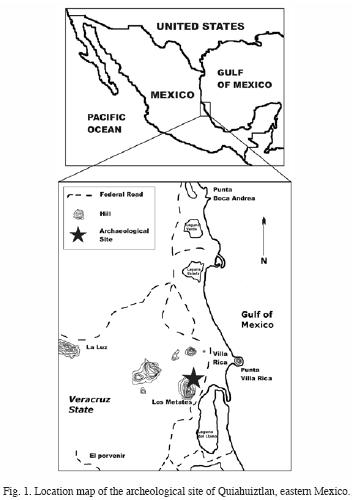
<body><![CDATA[<p align="justify"><font face="verdana" size="2">&nbsp;</font></p>     <p align="justify"><font face="verdana" size="2"><b>Introduction</b></font></p>     <p align="justify"><font face="verdana" size="2">Archeological remains are abundant in Mexico, but archeomagnetic studies are still scarce and of uneven quality (Morales <i>et al.</i>, 2008). In the early seventies, Wolfman (1973) reported archeomagnetic directions from some sites in Central and Eastern Mexico. Unfortunately most of the archeological material that can be used in archeomagnetism is not oriented. Thus, relatively few reliable paleodirections of the geomagnetic field may be obtained. Absolute geomagnetic intensity studies (archeointensity) have the advantage that no oriented material is required. Nonetheless, few studies have been carried out in the region (e.g., Nagata <i>et al.</i>, 1965; Bucha <i>et al.</i>, 1970; Urrutia&#150;Fucugauchi, 1975). High quality studies have been carried out for other places in America (southwestern U.S. and northwestern South America; e.g., Kono <i>et al.</i>, 1986; Sternberg, 1989; Bowles <i>et al.</i>, 2002 and references therein). Bowles <i>et al.</i> (2002) presented archeointensity records for southwestern U.S. and northwestern South America reporting rather different curves in terms of field variation, probably related to non&#150;dipole field effects across distant regions.</font></p>     <p align="justify"><font face="verdana" size="2">Since an archeointensity master curve for Mesoamerica is yet of preliminary nature (e.g., Gonzalez <i>et al.</i>, 1997; Urrutia&#150;Fucugauchi, 1996), we used global data curves (McElhinny and Senanayake, 1982; Yang <i>et al.</i>, 2000; Bowles <i>et al.</i>, 2002; Genevey and Gallet, 2003) reduced to eastern Mexico (19&deg; 40' 11.4" N, 96&deg; 24' 54.9" O) as an alternative way of dating. We carried out in this study several magnetic experiments (susceptibility vs. temperature curves, alternating field and thermal demagnetization, hysteresis cycles and archeointensity) on fragments of Pre&#150;Columbian pottery from the Quiahuiztlan archeological site (Veracruz State, Mexico).</font></p>     <p align="justify">&nbsp;</p>     <p align="justify"><font face="verdana" size="2"><b>Location and samples</b></font></p>     <p align="justify"><font face="verdana" size="2">The archeological site of Quiahuiztlan (<a href="#f1">Fig. 1</a>) is located in the central zone of Gulf of Mexico, Veracruz State, Mexico. This site presents cultural vestiges that match to the central Totonacapan culture (Arellanos, 1997). Quiahuiztlan &#150; a city&#150;cemetery&#150;fortress, was apparently shared between several groups of the central coastal Totonacapan and seems to correspond to the Post&#150;classic period (900 &#150; 1521 AD). In addition, it is one of the first important human settlements known by Spaniards at their arrival to American territory (Arellanos, 1997).</font></p>     <p align="center"><font face="verdana" size="2"><a name="f1"></a></font></p>     <p align="center"><font face="verdana" size="2"><img src="/img/revistas/geoint/v47n4/a3f1.jpg"></font></p>     <p align="justify"><font face="verdana" size="2">Fragments under study correspond to pottery artifacts. During their manufacturing process these materials were baked inside a kiln and later cooled in the presence of the ambient magnetic field. Most samples correspond to basic utensils used by the old settlers in their routine life and the manufacture style is considered coarse. It's unlikely that these pieces have been imported from other places. There is archeological evidence that the site was occupied from about 900 to 1521 AD. This is supported by an authenticity test using thermoluminescence, confirming a pre&#150;Columbian origin with an average absolute age of 600 years.</font></p>     ]]></body>
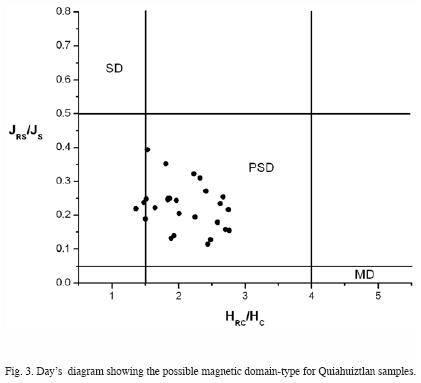
<body><![CDATA[<p align="justify"><font face="verdana" size="2">Twenty&#150;six fragments from three different sites within the archeological zone were analyzed. The fragments were previously washed with distilled water and separated into three groups. These fragments were further divided into at least five pieces and embedded into salt pellets in order to treat them as standard paleomagnetic cores (for more details on sample preparation, please see in Morales <i>et al.</i>, 2008).</font></p>     <p align="justify">&nbsp;</p>     <p align="justify"><font face="verdana" size="2"><b>Magnetic characteristic</b></font></p>     <p align="justify"><font face="verdana" size="2">Magnetic hysteresis measurements at room temperature were performed on all studied samples using an AGFM "Micromag" apparatus in fields up to 1 T. The saturation remanent magnetization (Jrs), the saturation magnetization (Js), and the coercive force (Hc) were calculated after correction for the paramagnetic or diamagnetic contribution. Coercivity of remanence (Hcr) was determined by applying a progressively increasing backfield after saturation. Some typical hysteresis plots are reported in the left part of <a href="/img/revistas/geoint/v47n4/a3f2.jpg" target="_blank">Fig. 2</a>. The curves are symmetrical in all cases. IRM (isothermal remanent magnetization) acquisition curves (right part of <a href="/img/revistas/geoint/v47n4/a3f2.jpg" target="_blank">Fig. 2</a>) show saturation at moderate fields from 150 to 250 mT, which point to the presence of ferrimagnetic minerals as remanence carriers, more likely Ti&#150;poor titanomagnetites (Gogichaishvili <i>et al.</i>, 2004). The hysteresis parameters reported in a Jrs/Js versus Hcr/Hc plot (<a href="#f3">Fig. 3</a>) are essentially in the pseudo&#150;single&#150;domain (PSD) range (Day <i>et al.</i>, 1977). This also could indicate a mixture of multi&#150;domain (MD) and a significant amount of single domain (SD) grains (Parry, 1982; Dunlop and &Ouml;zdemir, 1997; Dunlop, 2002). However, we note that the room temperature hysteresis parameters have limited resolution in estimating domain state of most natural rocks (Gogichaishvili <i>et al.</i>, 2001).</font></p>     <p align="center"><font face="verdana" size="2"><a name="f3"></a></font></p>     <p align="center"><font face="verdana" size="2"><img src="/img/revistas/geoint/v47n4/a3f3.jpg"></font></p>     <p align="justify"><font face="verdana" size="2">Selected samples carry essentially a stable, univectorial remanent magnetization observed upon alternating field treatment (<a href="/img/revistas/geoint/v47n4/a3f4.jpg" target="_blank">Fig. 4a</a>). Median destructive fields range mostly in the 20 &#150; 40 mT interval, confirming the existence of pseudo&#150;single&#150;domain grains as remanence carriers (Dunlop and &Ouml;zdemir, 1997).</font></p>     <p align="justify"><font face="verdana" size="2">Continuous low&#150;field susceptibility vs. high&#150;temperature curves performed in air show the presence of Ti&#150;poor titanomagnetite as dominant magnetic mineral (<a href="/img/revistas/geoint/v47n4/a3f5.jpg" target="_blank">Fig. 5</a>). Only exception is sample Q1L which shows two ferrimagnetic phases with Curie temperatures compatible to both Ti&#150;poor and Ti&#150;rich titanomagnetites. Some samples show low initial susceptibility signal, which indicates poor magnetic mineral presence (sample Q1A, <a href="/img/revistas/geoint/v47n4/a3f5.jpg" target="_blank">Fig. 5</a>). For archeointensity determination we selected samples that show almost reversible k&#150;T curves.</font></p>     <p align="justify">&nbsp;</p>     <p align="justify"><font face="verdana" size="2"><b>Archeointensity determination</b></font></p>     ]]></body>
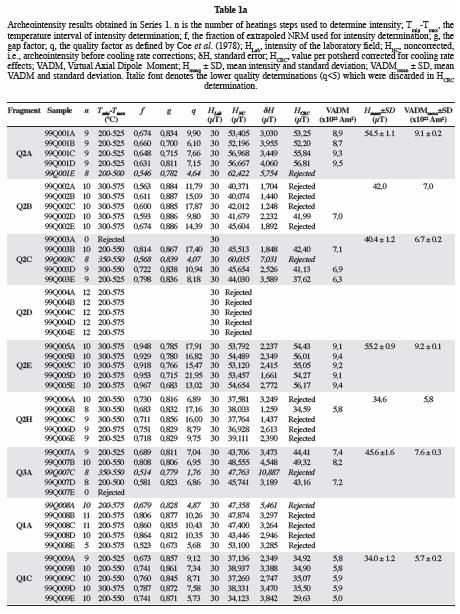
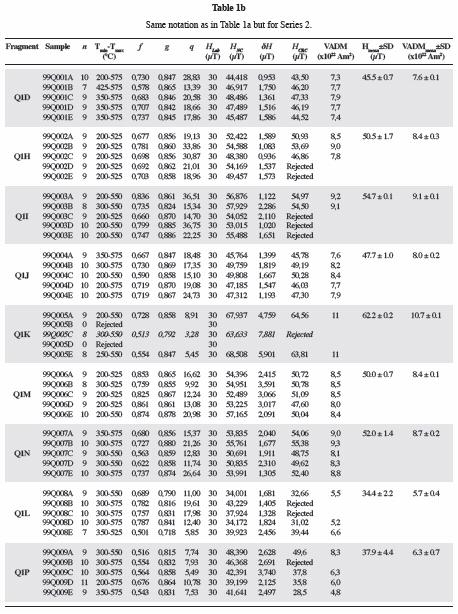
<body><![CDATA[<p align="justify"><font face="verdana" size="2">Archeointensity experiments were performed using the Thellier method (Thellier and Thellier, 1959) in its modified form (Coe, 1967). Heating and cooling were made in air and the laboratory field was set to 30 <i>&micro;</i>T. Due to the design of the thermal demagnetizer chamber (ASC TD&#150;48) and for practical reasons, samples were divided in two groups: Series 1 and Series 2 (<a href="#t1a">Table 1a</a> and <a href="#t1b">b</a>). Series 1 included specimens: Q2A, Q2B, Q2C, Q2D Q2E, Q2H, Q3A, Q1A and Q1C while Series 2 consisted of: Q1D, Q1H, Q1I, Q1J, Q1K, Q1M, Q1N, Q1L and Q1P. Eleven to twelve temperature steps were distributed between 200 and 575&deg;C. Several control heatings (i.e. reinvestigations of results from previous heating steps, commonly referred to as partial TRM (pTRM) checks) were performed throughout the experiments (<a href="/img/revistas/geoint/v47n4/a3f6.jpg" target="_blank">Fig. 6</a>).</font></p>     <p align="center"><font face="verdana" size="2"><a name="t1a"></a></font></p>     <p align="center"><font face="verdana" size="2"><img src="/img/revistas/geoint/v47n4/a3t1a.jpg"></font></p>     <p align="center"><font face="verdana" size="2"><a name="t1b"></a></font></p>     <p align="center"><font face="verdana" size="2"><img src="/img/revistas/geoint/v47n4/a3t1b.jpg"></font></p>     <p align="justify"><font face="verdana" size="2">Strength of thermoremanent magnetization of the samples is also related to cooling rate (e.g. Fox and Aitken, 1980; McClelland&#150;Brown, 1984). Cooling rate dependence of TRM was investigated here following a modified procedure to that described by Chauvin <i>et al.</i> (2000) (see Morales <i>et al.</i>, 2008). Contrary to European archeological artifacts manufacture process, which utilized closed brick kilns, Native Americans employed open kilns with cooling times on the order of 1 to 12 h. (Bowles <i>et al.</i>, 2002). We have thus decided to use a slow cooling time of 6 &frac12; hours, from 575&deg;C to 20&deg;C. Cooling rate procedure provided correction factors &lt; 1 for most samples, which corresponds to an overall decrease of the raw intensity values. Cooling rate correction was applied only when corresponding change in TRM acquisition capacity was below 15%. This correction diminished the dispersion of the archeointensity results up to 31.7 %. Results obtained indicate that field intensities have a range from (34.0 &plusmn; 1.2 to 62.2 &plusmn; 0.2) <i>&micro;</i>T. Corresponding virtual axial dipole moments (VADM) range from 5.7 to 10.0 x10<sup>22</sup> Am<sup>2</sup>.</font></p>     <p align="justify"><font face="verdana" size="2">TRM anisotropy corrections can be implemented in different ways (e.g., McCabe <i>et al.</i>, 1985; Selkin <i>et al.</i>, 2000; Chauvin <i>et al.</i>, 2000, etc.). It basically requires the creation of a TRM along 6 mutually perpendicular directions (+X, +Y, +Z, &#150;X, &#150;Y, &#150;Z) by cooling them from 600 &deg;C to room temperature in a known magnetic field. This involves six additional heatings which may alter significantly the magnetic mineralogy of the samples. To circumvent this time&#150;consuming procedure, individual specimens (belonging to the same fragment) were embedded in the six above described positions into the salt pellets. In this way, possible bias due to TRM anisotropy effects would be canceled, as attested by our various previous test experiments (see Morales <i>et al.</i>, 2008).</font></p>     <p align="justify">&nbsp;</p>     <p align="justify"><font face="verdana" size="2"><b>Discussion and main results</b></font></p>     <p align="justify"><font face="verdana" size="2">Proposal of a master archeomagnetic curve as an alternative way of dating archeological artifacts has been the aim of researchers for long time. In theory, this would be possible by comparison of the ancient field recorded in archeological artifacts against a previously established geomagnetic intensity variation curve. In this study, we tried several global and local (reduced) geomagnetic intensity variation models to make an estimation of the manufacturing dates of our studied pottery. Global models used for dating proposes were those proposed by McElhinny and Senanayake (1982) and Yang <i>et al.</i> (2000), while local models for United States and South America are those of Bowles <i>et al.</i> (2002), and that from Mesopotamia elaborated by Genevey and Gallet (2003).</font></p>     ]]></body>
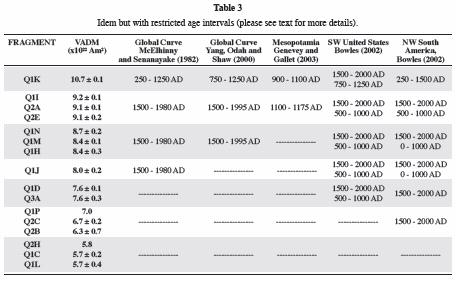
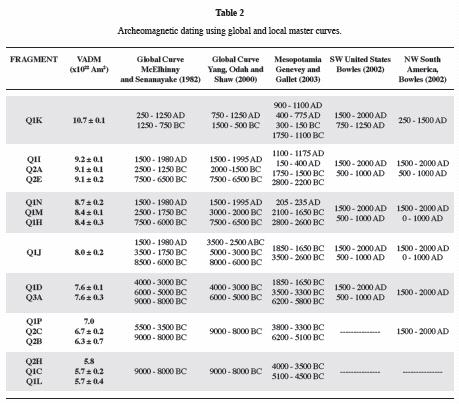
<body><![CDATA[<p align="justify"><font face="verdana" size="2">'Possible dates' according to the different models are presented in the <a href="#t2">Table 2</a>. It is obvious that dating archeological artifact by means of either global or local variation curves is not a straightforward task. As one may appreciate from the <a href="#t2">Table 2</a>, there are various VADM's that could be associated to different periods throughout the time scale and complementary information such as archeological background and/or alternative dating methods (e.g., radiocarbon or thermoluminescence (TL) dates, etc.) is more than welcome. In this context, we performed an authenticity test on some selected pottery fragments by the TL technique. This test was applied to three fragments; Q1L, Q2C and Q2E. The absolute ages obtained are: 535&plusmn;70, 770&plusmn;150 and 500&plusmn;230 years, respectively. These results confirm the pre&#150;Columbian origin for the studied pottery. These new data allows restricting the time range considered as acceptable or 'true' age of our samples. Indeed, based on archeological considerations and TL measurements the most likely time interval is from 900 to 1521 AD. Moreover, we note that pre&#150;Columbian pottery at eastern Mexico cannot have an antiquity beyond 2500 years BC (Guillermo Acosta, personal communication). This allows us to reject older dates. All these considerations permitted us to propose a more accurate relationship between calculated VDAM's and archeomagnetic datings (<a href="#t3">Table 3</a>). Nonetheless, there are still some samples that cannot be accommodated in the time intervals proposed here. In spite of high scatter, best results were obtained with the use of local curves of the geomagnetic intensity variation from North and South America. These curves provide, however, a very coarse dating.</font></p>     <p align="center"><font face="verdana" size="2"><a name="t2"></a></font></p>     <p align="center"><font face="verdana" size="2"><img src="/img/revistas/geoint/v47n4/a3t2.jpg"></font></p>     <p align="center"><font face="verdana" size="2"><a name="t3"></a></font></p>     <p align="center"><font face="verdana" size="2"><img src="/img/revistas/geoint/v47n4/a3t3.jpg"></font></p>     <p align="justify"><font face="verdana" size="2">It is worth noting that in spite of the concordance between VADM's from different places, archeomagnetic dating on displaced materials by means of VADM's could be little precise. Taking this into account, we made an alternative comparison using only intensity data against geomagnetic field model CALS7K (Korte and Constable, 2005) and the latest archeointensity compilation data ArcheoInt (Genevey <i>et al.</i>, 2008), considering the following premises:</font></p>     <p align="justify"><font face="verdana" size="2">1. Based on archeological considerations the most likely time interval for samples analyzed ranges from 900 to 1521 AD</font></p>     <p align="justify"><font face="verdana" size="2">2. An average absolute (TL) age of 600 years.</font></p>     <p align="justify"><font face="verdana" size="2">3. Archeological artifacts are seldom of enough different ages at one location (Schnepp <i>et al.</i>, 2003).</font></p>     <p align="justify"><font face="verdana" size="2">4. Smooth secular variation is expected for averaged intensity, as suggested for geomagnetic filed models.</font></p>     ]]></body>
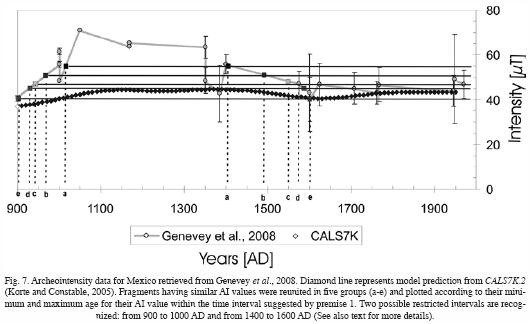
<body><![CDATA[<p align="justify"><font face="verdana" size="2">Above premises allowed the construction of <a href="#f7">Fig. 7</a>, where fragments having similar AI values were reunited in five groups (a&#150;e) and plotted according their minimum and maximum age for their AI value within the time interval suggested by premise 1. Two possible restricted intervals are recognized: from 900 to 1000 AD and from 1400 to 1600 AD, approximately. Both intervals lie on almost linear paths connecting ArcheoInt data points. Groups plot almost symmetrically on both sides from 1200 AD, presenting, however, different variation rates. Right hand interval (1400 to 1600 AD) seems to be better supported by premise 2.</font></p>     <p align="center"><font face="verdana" size="2"><a name="f7"></a></font></p>     <p align="center"><font face="verdana" size="2"><img src="/img/revistas/geoint/v47n4/a3f7.jpg"></font></p>     <p align="justify"><font face="verdana" size="2">An attempt of dating using model prediction CALS7K failed because of the notorious downward shift of the curve (Morales <i>et al.</i>, 2008). One most take into account, however, that data used to model geomagnetic field variation for the last 7 millennia is based mainly on old data, obtained with no strict acceptance criteria without any corrections applied (cooling rate and/or anisotropy correction).</font></p>     <p align="justify"><font face="verdana" size="2">This work confirms usefulness of Mesoamerican pottery for archeointensity studies and opens perspectives to construct a reliable local curve of geomagnetic intensity variation that may be used as an alternative and confident dating method. The use of global archeointensity curves seems to be inappropriate for dating purposes, at least for Mesoamerica.</font></p>     <p align="justify"><font face="verdana" size="2">&nbsp;</font></p>     <p align="justify"><font face="verdana" size="2"><b>Acknowledgements</b></font></p>     <p align="justify"><font face="verdana" size="2">We appreciate the comments and suggestions made by two anonymous reviewers that greatly improve the manuscript. We thank Angel Ramirez&#150;Luna for assistance with the TL experiments. Financial support was provided by CONACYT project # 54957 and 'Proyecto Interno de Investigaci&oacute;n G122'.</font></p>     <p align="justify"><font face="verdana" size="2">&nbsp;</font></p>     <p align="justify"><font face="verdana" size="2"><b>Bibliography</b></font></p>     ]]></body>
<body><![CDATA[<!-- ref --><p align="justify"><font face="verdana" size="2">Arellanos, M. R., 1997. La arquitectura monumental postcl&aacute;sica de Quiahuiztlan, Estudio monogr&aacute;fico, Universidad Veracruzana, 15&#150;49.</font>&nbsp;&nbsp;&nbsp;&nbsp;&nbsp;&nbsp;&nbsp;&nbsp;[&#160;<a href="javascript:void(0);" onclick="javascript: window.open('/scielo.php?script=sci_nlinks&ref=3902245&pid=S0016-7169200800040000300001&lng=','','width=640,height=500,resizable=yes,scrollbars=1,menubar=yes,');">Links</a>&#160;]<!-- end-ref --><!-- ref --><p align="justify"><font face="verdana" size="2">Bowles, J., J. Gee, J., Hildebrand and L. Tauxe, 2002. Archeomagnetic intensity results from California and Ecuador: evaluation of regional data, <i>Earth Planet. Sci. Lett., 203</i>, 967&#150;981.</font>&nbsp;&nbsp;&nbsp;&nbsp;&nbsp;&nbsp;&nbsp;&nbsp;[&#160;<a href="javascript:void(0);" onclick="javascript: window.open('/scielo.php?script=sci_nlinks&ref=3902246&pid=S0016-7169200800040000300002&lng=','','width=640,height=500,resizable=yes,scrollbars=1,menubar=yes,');">Links</a>&#160;]<!-- end-ref --><!-- ref --><p align="justify"><font face="verdana" size="2">Bucha, V., R. E. Tylor, R. Berger and E. W. Haury, Geomagnetic intensity: Changes during the past 3000 years in the western hemisphere, <i>Science, 168</i>, 111&#150;114, 1970.</font>&nbsp;&nbsp;&nbsp;&nbsp;&nbsp;&nbsp;&nbsp;&nbsp;[&#160;<a href="javascript:void(0);" onclick="javascript: window.open('/scielo.php?script=sci_nlinks&ref=3902247&pid=S0016-7169200800040000300003&lng=','','width=640,height=500,resizable=yes,scrollbars=1,menubar=yes,');">Links</a>&#160;]<!-- end-ref --><!-- ref --><p align="justify"><font face="verdana" size="2">Chauvin, A., A. Garcia, Ph. Lanos and F. Laubenheimer, 2000. Paleointensity of the geomagnetic field recovered on archaeomagnetic sites from France, <i>Phys. Earth Planet. Int., 120</i>, 111&#150;136.</font>&nbsp;&nbsp;&nbsp;&nbsp;&nbsp;&nbsp;&nbsp;&nbsp;[&#160;<a href="javascript:void(0);" onclick="javascript: window.open('/scielo.php?script=sci_nlinks&ref=3902248&pid=S0016-7169200800040000300004&lng=','','width=640,height=500,resizable=yes,scrollbars=1,menubar=yes,');">Links</a>&#160;]<!-- end-ref --><!-- ref --><p align="justify"><font face="verdana" size="2">Coe, R. S., 1967. Paleo&#150;Intensities of the Earth's Magn&eacute;tic Field Determined from Tertiary and Quaternary Rocks, <i>J. Geophys. Res., 72</i>, No. 12, 3247&#150;3262.</font>&nbsp;&nbsp;&nbsp;&nbsp;&nbsp;&nbsp;&nbsp;&nbsp;[&#160;<a href="javascript:void(0);" onclick="javascript: window.open('/scielo.php?script=sci_nlinks&ref=3902249&pid=S0016-7169200800040000300005&lng=','','width=640,height=500,resizable=yes,scrollbars=1,menubar=yes,');">Links</a>&#160;]<!-- end-ref --><!-- ref --><p align="justify"><font face="verdana" size="2">Coe, R. S., S. Gromm&eacute; and E. A. Mankinen, 1978. Geomagnetic paleointensities from radiocarbon&#150;dated lava flows on Hawaii and the question of the pacific nondipole low, <i>J. Geophys. Res., 83, B4</i>, 1740&#150;1756.</font>&nbsp;&nbsp;&nbsp;&nbsp;&nbsp;&nbsp;&nbsp;&nbsp;[&#160;<a href="javascript:void(0);" onclick="javascript: window.open('/scielo.php?script=sci_nlinks&ref=3902250&pid=S0016-7169200800040000300006&lng=','','width=640,height=500,resizable=yes,scrollbars=1,menubar=yes,');">Links</a>&#160;]<!-- end-ref --><!-- ref --><p align="justify"><font face="verdana" size="2">Day, R., M. Fuller and V. A. Schmidt, 1977. Hysteresis Properties of Titanomagnetites: Grain&#150;Size and Compositional Dependence, <i>Phys. Earth Planet. Inter., 13</i>, 206&#150;267.</font>&nbsp;&nbsp;&nbsp;&nbsp;&nbsp;&nbsp;&nbsp;&nbsp;[&#160;<a href="javascript:void(0);" onclick="javascript: window.open('/scielo.php?script=sci_nlinks&ref=3902251&pid=S0016-7169200800040000300007&lng=','','width=640,height=500,resizable=yes,scrollbars=1,menubar=yes,');">Links</a>&#160;]<!-- end-ref --><!-- ref --><p align="justify"><font face="verdana" size="2">Dunlop, D. J. and &Ouml;. &Ouml;zdemir, 1997. Rock magnetism: Fundamentals and frontiers, Cambridge University Press, Cambridge, 573.</font>&nbsp;&nbsp;&nbsp;&nbsp;&nbsp;&nbsp;&nbsp;&nbsp;[&#160;<a href="javascript:void(0);" onclick="javascript: window.open('/scielo.php?script=sci_nlinks&ref=3902252&pid=S0016-7169200800040000300008&lng=','','width=640,height=500,resizable=yes,scrollbars=1,menubar=yes,');">Links</a>&#160;]<!-- end-ref --><!-- ref --><p align="justify"><font face="verdana" size="2">Dunlop, D. J., 2002. Theory and Applications of the Day Plot (Mra/Mr versus Hcr/Hc). Theorical Curves and Test Using Titanomagnetite Data, <i>J. Geophys Res., 107, b3</i>, 1029&#150;2001.</font>&nbsp;&nbsp;&nbsp;&nbsp;&nbsp;&nbsp;&nbsp;&nbsp;[&#160;<a href="javascript:void(0);" onclick="javascript: window.open('/scielo.php?script=sci_nlinks&ref=3902253&pid=S0016-7169200800040000300009&lng=','','width=640,height=500,resizable=yes,scrollbars=1,menubar=yes,');">Links</a>&#160;]<!-- end-ref --><!-- ref --><p align="justify"><font face="verdana" size="2">Fox, J. M. W. and M. J. Aitken, 1980. Cooling rate dependence of the thermoremanent magnetization. <i>Nature, 283</i>, 462&#150;463.</font>&nbsp;&nbsp;&nbsp;&nbsp;&nbsp;&nbsp;&nbsp;&nbsp;[&#160;<a href="javascript:void(0);" onclick="javascript: window.open('/scielo.php?script=sci_nlinks&ref=3902254&pid=S0016-7169200800040000300010&lng=','','width=640,height=500,resizable=yes,scrollbars=1,menubar=yes,');">Links</a>&#160;]<!-- end-ref --><!-- ref --><p align="justify"><font face="verdana" size="2">Genevey, A. and Y. Gallet, 2003. Eight thousand years of geomagnetic field intensity variations in the eastern Mediterranean, <i>J. Geophys. Res., 108, B5</i>, 2228, 1&#150;18.</font>&nbsp;&nbsp;&nbsp;&nbsp;&nbsp;&nbsp;&nbsp;&nbsp;[&#160;<a href="javascript:void(0);" onclick="javascript: window.open('/scielo.php?script=sci_nlinks&ref=3902255&pid=S0016-7169200800040000300011&lng=','','width=640,height=500,resizable=yes,scrollbars=1,menubar=yes,');">Links</a>&#160;]<!-- end-ref --><!-- ref --><p align="justify"><font face="verdana" size="2">Genevey, A., Y. Gallet, C. G. Constable, M. Korte and G. Hulot, 2008. ArcheoInt: An upgraded compilation of geomagnetic field intensity data for the past ten millennia and its application to the recovery of the past dipole moment, Geochem. <i>Geophys. Geosyst., 9, </i>Q04038, doi:10.1029/2007GC001881.</font>&nbsp;&nbsp;&nbsp;&nbsp;&nbsp;&nbsp;&nbsp;&nbsp;[&#160;<a href="javascript:void(0);" onclick="javascript: window.open('/scielo.php?script=sci_nlinks&ref=3902256&pid=S0016-7169200800040000300012&lng=','','width=640,height=500,resizable=yes,scrollbars=1,menubar=yes,');">Links</a>&#160;]<!-- end-ref --><!-- ref --><p align="justify"><font face="verdana" size="2">Gogichaishvili, A., J. Morales and J. Urrrutia&#150; Fucugauchi, 2001. On the use of thermomagnetic curves in paleomagnetism, C. R. Acad. <i>Sci. Ser., IIa, 333</i>, 699&#150;704.</font>&nbsp;&nbsp;&nbsp;&nbsp;&nbsp;&nbsp;&nbsp;&nbsp;[&#160;<a href="javascript:void(0);" onclick="javascript: window.open('/scielo.php?script=sci_nlinks&ref=3902257&pid=S0016-7169200800040000300013&lng=','','width=640,height=500,resizable=yes,scrollbars=1,menubar=yes,');">Links</a>&#160;]<!-- end-ref --><!-- ref --><p align="justify"><font face="verdana" size="2">Gogichaishvili, A., L. M. Alva&#150;Valdivia, J. Rosas&#150;Elgera, J. Urrutia&#150;Fucugauchi and J. Sol&eacute;, 2004. Absolute geomagnetic paleointensity after the cretaceus normal superchron and just prior to the cretaceus&#150;tertiary transition. <i>J. Geophys. Res., 109</i>, B01105.</font>&nbsp;&nbsp;&nbsp;&nbsp;&nbsp;&nbsp;&nbsp;&nbsp;[&#160;<a href="javascript:void(0);" onclick="javascript: window.open('/scielo.php?script=sci_nlinks&ref=3902258&pid=S0016-7169200800040000300014&lng=','','width=640,height=500,resizable=yes,scrollbars=1,menubar=yes,');">Links</a>&#160;]<!-- end-ref --><!-- ref --><p align="justify"><font face="verdana" size="2">Gonzalez, S., G. Sherwood, H. Bohnel and E. Schnepp, 1997. Paleosecular variation in central Mexico over the last 30 000 years: The record from lavas. <i>Geophysical Journal International, 130</i>, p. 201&#150;219.</font>&nbsp;&nbsp;&nbsp;&nbsp;&nbsp;&nbsp;&nbsp;&nbsp;[&#160;<a href="javascript:void(0);" onclick="javascript: window.open('/scielo.php?script=sci_nlinks&ref=3902259&pid=S0016-7169200800040000300015&lng=','','width=640,height=500,resizable=yes,scrollbars=1,menubar=yes,');">Links</a>&#160;]<!-- end-ref --><!-- ref --><p align="justify"><font face="verdana" size="2">Kono, M., N. Ueno and Y. Onuki, 1986. Paleointensities of the geomagnetic field obtained from Pre&#150;Inca potsherds near Cajamarca, Northern Peru, <i>J. Geomagn. Geoelectr. 38</i>, 1339&#150;1348.</font>&nbsp;&nbsp;&nbsp;&nbsp;&nbsp;&nbsp;&nbsp;&nbsp;[&#160;<a href="javascript:void(0);" onclick="javascript: window.open('/scielo.php?script=sci_nlinks&ref=3902260&pid=S0016-7169200800040000300016&lng=','','width=640,height=500,resizable=yes,scrollbars=1,menubar=yes,');">Links</a>&#160;]<!-- end-ref --><!-- ref --><p align="justify"><font face="verdana" size="2">Korte, M. and C. G. Constable, 2005. Continuous geomagnetic field models for the past 7 millenia: 2. CALS7K, <i>Geoch. Geophys. Geosyst., 6</i>, Q02H16, doi:10.1029/2004GC000801.</font>&nbsp;&nbsp;&nbsp;&nbsp;&nbsp;&nbsp;&nbsp;&nbsp;[&#160;<a href="javascript:void(0);" onclick="javascript: window.open('/scielo.php?script=sci_nlinks&ref=3902261&pid=S0016-7169200800040000300017&lng=','','width=640,height=500,resizable=yes,scrollbars=1,menubar=yes,');">Links</a>&#160;]<!-- end-ref --><!-- ref --><p align="justify"><font face="verdana" size="2">McCabe, C., M. Jackson and B. Ellwood, 1985. Magnetic anisotropy in the Trenton limestone: results of a new technique, anisotropy of anhysteric susceptibility, <i>Geophys. Res. Lett. 12</i>, 333&#150;336.</font>&nbsp;&nbsp;&nbsp;&nbsp;&nbsp;&nbsp;&nbsp;&nbsp;[&#160;<a href="javascript:void(0);" onclick="javascript: window.open('/scielo.php?script=sci_nlinks&ref=3902262&pid=S0016-7169200800040000300018&lng=','','width=640,height=500,resizable=yes,scrollbars=1,menubar=yes,');">Links</a>&#160;]<!-- end-ref --><!-- ref --><p align="justify"><font face="verdana" size="2">McClelland&#150;Brown, E., 1984. Experiments on TRM intensity dependence on cooling rate. <i>Geophys. Res. Lett., 11, 3</i>, 205&#150;208.</font>&nbsp;&nbsp;&nbsp;&nbsp;&nbsp;&nbsp;&nbsp;&nbsp;[&#160;<a href="javascript:void(0);" onclick="javascript: window.open('/scielo.php?script=sci_nlinks&ref=3902263&pid=S0016-7169200800040000300019&lng=','','width=640,height=500,resizable=yes,scrollbars=1,menubar=yes,');">Links</a>&#160;]<!-- end-ref --><!-- ref --><p align="justify"><font face="verdana" size="2">McElhinny, M. W. and W. E. Senanayake, 1982. Variations in the geomagnetic dipole 1: the past 50,000 years, <i>J. Geomag. Geoelectr., 34</i>, 39&#150;51.</font>&nbsp;&nbsp;&nbsp;&nbsp;&nbsp;&nbsp;&nbsp;&nbsp;[&#160;<a href="javascript:void(0);" onclick="javascript: window.open('/scielo.php?script=sci_nlinks&ref=3902264&pid=S0016-7169200800040000300020&lng=','','width=640,height=500,resizable=yes,scrollbars=1,menubar=yes,');">Links</a>&#160;]<!-- end-ref --><!-- ref --><p align="justify"><font face="verdana" size="2">Morales, J., A. Goguitchaichvili, G. Acosta, T. Gonz&aacute;lez, L. Alva&#150;Valdivia, J. Robles&#150;Camacho and S. Hern&aacute;ndez&#150;Bernal, Magnetic Properties and Archeointensity determination on Pre&#150;Columbian Pottery from Chiapas, Mesoamerica, EPS Special Issue, in press.</font>&nbsp;&nbsp;&nbsp;&nbsp;&nbsp;&nbsp;&nbsp;&nbsp;[&#160;<a href="javascript:void(0);" onclick="javascript: window.open('/scielo.php?script=sci_nlinks&ref=3902265&pid=S0016-7169200800040000300021&lng=','','width=640,height=500,resizable=yes,scrollbars=1,menubar=yes,');">Links</a>&#160;]<!-- end-ref --><!-- ref --><p align="justify"><font face="verdana" size="2">Nagata, T., K. Kobayashi and E. J. Schwarz, 1965. Archeomagnetic intensity studies of South and Central America, <i>J. Geomagn. Geoelectr., 17</i>, 399&#150;405.</font>&nbsp;&nbsp;&nbsp;&nbsp;&nbsp;&nbsp;&nbsp;&nbsp;[&#160;<a href="javascript:void(0);" onclick="javascript: window.open('/scielo.php?script=sci_nlinks&ref=3902266&pid=S0016-7169200800040000300022&lng=','','width=640,height=500,resizable=yes,scrollbars=1,menubar=yes,');">Links</a>&#160;]<!-- end-ref --><!-- ref --><p align="justify"><font face="verdana" size="2">Parry, L. G., 1982. Magnetizations of immobilized particle dispersion whit tow distinct particle size, Phys. <i>Earth Planet. Inter., 28</i>, 230&#150;241.</font>&nbsp;&nbsp;&nbsp;&nbsp;&nbsp;&nbsp;&nbsp;&nbsp;[&#160;<a href="javascript:void(0);" onclick="javascript: window.open('/scielo.php?script=sci_nlinks&ref=3902267&pid=S0016-7169200800040000300023&lng=','','width=640,height=500,resizable=yes,scrollbars=1,menubar=yes,');">Links</a>&#160;]<!-- end-ref --><!-- ref --><p align="justify"><font face="verdana" size="2">Schnepp, E., R. Pucher, C. Geodike, A. Manzano, U. M&uuml;ller and P. Lanos, 2003. Paleomagnetic directions and thermoluminescence dating from a bread oven&#150;floor sequence in L&uuml;beck (Germany): A record of 450 years of geomagnetic secular variation, <i>J. Geophys. Res., 1008, B2</i>, 2078, doi:10.1029/2002JB001975.</font>&nbsp;&nbsp;&nbsp;&nbsp;&nbsp;&nbsp;&nbsp;&nbsp;[&#160;<a href="javascript:void(0);" onclick="javascript: window.open('/scielo.php?script=sci_nlinks&ref=3902268&pid=S0016-7169200800040000300024&lng=','','width=640,height=500,resizable=yes,scrollbars=1,menubar=yes,');">Links</a>&#160;]<!-- end-ref --><!-- ref --><p align="justify"><font face="verdana" size="2">Selkin, P. A., J. S. Gee, L. Tauxe, W. P. Meurer and A. J. Newell, 2000. The effect of remanence anisotropy on paleointensity estimates: a case study from the Archean Stillwater Complex, Earth Planet. <i>Sci. Letters, 183</i>, 403&#150;416.</font>&nbsp;&nbsp;&nbsp;&nbsp;&nbsp;&nbsp;&nbsp;&nbsp;[&#160;<a href="javascript:void(0);" onclick="javascript: window.open('/scielo.php?script=sci_nlinks&ref=3902269&pid=S0016-7169200800040000300025&lng=','','width=640,height=500,resizable=yes,scrollbars=1,menubar=yes,');">Links</a>&#160;]<!-- end-ref --><!-- ref --><p align="justify"><font face="verdana" size="2">Sternberg, R. S., 1989. Archeomagnetic paleointensity in the American Southwest during the past 2000 years, Phys. <i>Earth Planet. Inter., 56</i>, 1&#150;17.</font>&nbsp;&nbsp;&nbsp;&nbsp;&nbsp;&nbsp;&nbsp;&nbsp;[&#160;<a href="javascript:void(0);" onclick="javascript: window.open('/scielo.php?script=sci_nlinks&ref=3902270&pid=S0016-7169200800040000300026&lng=','','width=640,height=500,resizable=yes,scrollbars=1,menubar=yes,');">Links</a>&#160;]<!-- end-ref --><!-- ref --><p align="justify"><font face="verdana" size="2">Thellier, E. and O. Thellier, 1959. Sur l'intensit&eacute; du champ magn&eacute;tique terrestre dans le pass&eacute; historique et g&eacute;ologique. <i>Ann. G&eacute;ophysique. 15</i>, 285&#150;376.</font>&nbsp;&nbsp;&nbsp;&nbsp;&nbsp;&nbsp;&nbsp;&nbsp;[&#160;<a href="javascript:void(0);" onclick="javascript: window.open('/scielo.php?script=sci_nlinks&ref=3902271&pid=S0016-7169200800040000300027&lng=','','width=640,height=500,resizable=yes,scrollbars=1,menubar=yes,');">Links</a>&#160;]<!-- end-ref --><!-- ref --><p align="justify"><font face="verdana" size="2">Urrutia Fucugauchi, J., 1975. Investigaciones paleomagneticas y arqueomagneticas en Mexico. <i>Anales Inst. Geofisica, 21</i>, 27&#150;34.</font>&nbsp;&nbsp;&nbsp;&nbsp;&nbsp;&nbsp;&nbsp;&nbsp;[&#160;<a href="javascript:void(0);" onclick="javascript: window.open('/scielo.php?script=sci_nlinks&ref=3902272&pid=S0016-7169200800040000300028&lng=','','width=640,height=500,resizable=yes,scrollbars=1,menubar=yes,');">Links</a>&#160;]<!-- end-ref --><!-- ref --><p align="justify"><font face="verdana" size="2">Urrutia Fucugauchi, J., 1996. Palaeomagnetic study of the Xitle&#150;Pedregal de San Angel lava flow, Southern Basin of Mexico. <i>Physics Earth Planetary Interiors, 97</i>, 197&#150;196.</font>&nbsp;&nbsp;&nbsp;&nbsp;&nbsp;&nbsp;&nbsp;&nbsp;[&#160;<a href="javascript:void(0);" onclick="javascript: window.open('/scielo.php?script=sci_nlinks&ref=3902273&pid=S0016-7169200800040000300029&lng=','','width=640,height=500,resizable=yes,scrollbars=1,menubar=yes,');">Links</a>&#160;]<!-- end-ref --><!-- ref --><p align="justify"><font face="verdana" size="2">Wolfman, D., 1973. A re&#150;evaluation of Mesoamerican chronology: AD 1&#150;1200. PhD thesis, University of Colorado.</font>&nbsp;&nbsp;&nbsp;&nbsp;&nbsp;&nbsp;&nbsp;&nbsp;[&#160;<a href="javascript:void(0);" onclick="javascript: window.open('/scielo.php?script=sci_nlinks&ref=3902274&pid=S0016-7169200800040000300030&lng=','','width=640,height=500,resizable=yes,scrollbars=1,menubar=yes,');">Links</a>&#160;]<!-- end-ref --><!-- ref --><p align="justify"><font face="verdana" size="2">Yang, S., H. Odah, and J. Shaw, 2000. Variations in the geomagnetic dipole moment over the last 12 000 years, Geophys. <i>J. Int., 140</i>, 158&#150;162.</font>&nbsp;&nbsp;&nbsp;&nbsp;&nbsp;&nbsp;&nbsp;&nbsp;[&#160;<a href="javascript:void(0);" onclick="javascript: window.open('/scielo.php?script=sci_nlinks&ref=3902275&pid=S0016-7169200800040000300031&lng=','','width=640,height=500,resizable=yes,scrollbars=1,menubar=yes,');">Links</a>&#160;]<!-- end-ref --> ]]></body><back>
<ref-list>
<ref id="B1">
<nlm-citation citation-type="book">
<person-group person-group-type="author">
<name>
<surname><![CDATA[Arellanos]]></surname>
<given-names><![CDATA[M. R.]]></given-names>
</name>
</person-group>
<source><![CDATA[La arquitectura monumental postclásica de Quiahuiztlan]]></source>
<year>1997</year>
<page-range>15-49</page-range><publisher-name><![CDATA[Universidad Veracruzana]]></publisher-name>
</nlm-citation>
</ref>
<ref id="B2">
<nlm-citation citation-type="journal">
<person-group person-group-type="author">
<name>
<surname><![CDATA[Bowles]]></surname>
<given-names><![CDATA[J]]></given-names>
</name>
<name>
<surname><![CDATA[Gee]]></surname>
<given-names><![CDATA[J]]></given-names>
</name>
<name>
<surname><![CDATA[Hildebrand]]></surname>
<given-names><![CDATA[J]]></given-names>
</name>
<name>
<surname><![CDATA[Tauxe]]></surname>
<given-names><![CDATA[L]]></given-names>
</name>
</person-group>
<article-title xml:lang="en"><![CDATA[Archeomagnetic intensity results from California and Ecuador: evaluation of regional data]]></article-title>
<source><![CDATA[Earth Planet. Sci. Lett.]]></source>
<year>2002</year>
<numero>203</numero>
<issue>203</issue>
<page-range>967-981</page-range></nlm-citation>
</ref>
<ref id="B3">
<nlm-citation citation-type="journal">
<person-group person-group-type="author">
<name>
<surname><![CDATA[Bucha]]></surname>
<given-names><![CDATA[V]]></given-names>
</name>
<name>
<surname><![CDATA[Tylor]]></surname>
<given-names><![CDATA[R. E.]]></given-names>
</name>
<name>
<surname><![CDATA[Berger]]></surname>
<given-names><![CDATA[R]]></given-names>
</name>
<name>
<surname><![CDATA[Haury]]></surname>
<given-names><![CDATA[E. W.]]></given-names>
</name>
</person-group>
<article-title xml:lang="en"><![CDATA[Geomagnetic intensity: Changes during the past 3000 years in the western hemisphere]]></article-title>
<source><![CDATA[Science]]></source>
<year>1970</year>
<numero>168</numero>
<issue>168</issue>
<page-range>111-114</page-range></nlm-citation>
</ref>
<ref id="B4">
<nlm-citation citation-type="journal">
<person-group person-group-type="author">
<name>
<surname><![CDATA[Chauvin]]></surname>
<given-names><![CDATA[A]]></given-names>
</name>
<name>
<surname><![CDATA[Garcia]]></surname>
<given-names><![CDATA[A]]></given-names>
</name>
<name>
<surname><![CDATA[Lanos]]></surname>
<given-names><![CDATA[Ph]]></given-names>
</name>
<name>
<surname><![CDATA[Laubenheimer]]></surname>
<given-names><![CDATA[F]]></given-names>
</name>
</person-group>
<article-title xml:lang="en"><![CDATA[Paleointensity of the geomagnetic field recovered on archaeomagnetic sites from France]]></article-title>
<source><![CDATA[Phys. Earth Planet. Int.]]></source>
<year>2000</year>
<numero>120</numero>
<issue>120</issue>
<page-range>111-136</page-range></nlm-citation>
</ref>
<ref id="B5">
<nlm-citation citation-type="journal">
<person-group person-group-type="author">
<name>
<surname><![CDATA[Coe]]></surname>
<given-names><![CDATA[R. S.]]></given-names>
</name>
</person-group>
<article-title xml:lang="en"><![CDATA[Paleo-Intensities of the Earth's Magnétic Field Determined from Tertiary and Quaternary Rocks]]></article-title>
<source><![CDATA[J. Geophys. Res.]]></source>
<year>1967</year>
<volume>72</volume>
<numero>12</numero>
<issue>12</issue>
<page-range>3247-3262</page-range></nlm-citation>
</ref>
<ref id="B6">
<nlm-citation citation-type="journal">
<person-group person-group-type="author">
<name>
<surname><![CDATA[Coe]]></surname>
<given-names><![CDATA[R. S.]]></given-names>
</name>
<name>
<surname><![CDATA[Grommé]]></surname>
<given-names><![CDATA[S]]></given-names>
</name>
<name>
<surname><![CDATA[Mankinen]]></surname>
<given-names><![CDATA[E. A.]]></given-names>
</name>
</person-group>
<article-title xml:lang="en"><![CDATA[Geomagnetic paleointensities from radiocarbon-dated lava flows on Hawaii and the question of the pacific nondipole low]]></article-title>
<source><![CDATA[J. Geophys. Res.]]></source>
<year>1978</year>
<volume>83</volume>
<numero>B4</numero>
<issue>B4</issue>
<page-range>1740-1756</page-range></nlm-citation>
</ref>
<ref id="B7">
<nlm-citation citation-type="journal">
<person-group person-group-type="author">
<name>
<surname><![CDATA[Day]]></surname>
<given-names><![CDATA[R]]></given-names>
</name>
<name>
<surname><![CDATA[Fuller]]></surname>
<given-names><![CDATA[M]]></given-names>
</name>
<name>
<surname><![CDATA[Schmidt]]></surname>
<given-names><![CDATA[V. A.]]></given-names>
</name>
</person-group>
<article-title xml:lang="en"><![CDATA[Hysteresis Properties of Titanomagnetites: Grain-Size and Compositional Dependence]]></article-title>
<source><![CDATA[Phys. Earth Planet. Inter.]]></source>
<year>1977</year>
<numero>13</numero>
<issue>13</issue>
<page-range>206-267</page-range></nlm-citation>
</ref>
<ref id="B8">
<nlm-citation citation-type="book">
<person-group person-group-type="author">
<name>
<surname><![CDATA[Dunlop]]></surname>
<given-names><![CDATA[D. J.]]></given-names>
</name>
<name>
<surname><![CDATA[Özdemir]]></surname>
<given-names><![CDATA[Ö]]></given-names>
</name>
</person-group>
<source><![CDATA[Rock magnetism: Fundamentals and frontiers]]></source>
<year>1997</year>
<page-range>573</page-range><publisher-loc><![CDATA[Cambridge ]]></publisher-loc>
<publisher-name><![CDATA[Cambridge University Press]]></publisher-name>
</nlm-citation>
</ref>
<ref id="B9">
<nlm-citation citation-type="journal">
<person-group person-group-type="author">
<name>
<surname><![CDATA[Dunlop]]></surname>
<given-names><![CDATA[D. J.]]></given-names>
</name>
</person-group>
<article-title xml:lang="en"><![CDATA[Theory and Applications of the Day Plot (Mra/Mr versus Hcr/Hc): Theorical Curves and Test Using Titanomagnetite Data]]></article-title>
<source><![CDATA[J. Geophys Res.]]></source>
<year>2002</year>
<volume>107</volume>
<numero>b3</numero>
<issue>b3</issue>
<page-range>1029-2001</page-range></nlm-citation>
</ref>
<ref id="B10">
<nlm-citation citation-type="journal">
<person-group person-group-type="author">
<name>
<surname><![CDATA[Fox]]></surname>
<given-names><![CDATA[J. M. W.]]></given-names>
</name>
<name>
<surname><![CDATA[Aitken]]></surname>
<given-names><![CDATA[M. J.]]></given-names>
</name>
</person-group>
<article-title xml:lang="en"><![CDATA[Cooling rate dependence of the thermoremanent magnetization]]></article-title>
<source><![CDATA[Nature]]></source>
<year>1980</year>
<numero>283</numero>
<issue>283</issue>
<page-range>462-463</page-range></nlm-citation>
</ref>
<ref id="B11">
<nlm-citation citation-type="journal">
<person-group person-group-type="author">
<name>
<surname><![CDATA[Genevey]]></surname>
<given-names><![CDATA[A]]></given-names>
</name>
<name>
<surname><![CDATA[Gallet]]></surname>
<given-names><![CDATA[Y]]></given-names>
</name>
</person-group>
<article-title xml:lang="en"><![CDATA[Eight thousand years of geomagnetic field intensity variations in the eastern Mediterranean]]></article-title>
<source><![CDATA[J. Geophys. Res.]]></source>
<year>2003</year>
<volume>108</volume>
<numero>B5</numero>
<issue>B5</issue>
<page-range>1-18</page-range></nlm-citation>
</ref>
<ref id="B12">
<nlm-citation citation-type="journal">
<person-group person-group-type="author">
<name>
<surname><![CDATA[Genevey]]></surname>
<given-names><![CDATA[A]]></given-names>
</name>
<name>
<surname><![CDATA[Gallet]]></surname>
<given-names><![CDATA[Y]]></given-names>
</name>
<name>
<surname><![CDATA[Constable]]></surname>
<given-names><![CDATA[C. G.]]></given-names>
</name>
<name>
<surname><![CDATA[Korte]]></surname>
<given-names><![CDATA[M]]></given-names>
</name>
<name>
<surname><![CDATA[Hulot]]></surname>
<given-names><![CDATA[G]]></given-names>
</name>
</person-group>
<article-title xml:lang="en"><![CDATA[ArcheoInt: n upgraded compilation of geomagnetic field intensity data for the past ten millennia and its application to the recovery of the past dipole moment]]></article-title>
<source><![CDATA[Geochem. Geophys. Geosyst.]]></source>
<year>2008</year>
<numero>9</numero>
<issue>9</issue>
</nlm-citation>
</ref>
<ref id="B13">
<nlm-citation citation-type="journal">
<person-group person-group-type="author">
<name>
<surname><![CDATA[Gogichaishvili]]></surname>
<given-names><![CDATA[A]]></given-names>
</name>
<name>
<surname><![CDATA[Morales]]></surname>
<given-names><![CDATA[J]]></given-names>
</name>
<name>
<surname><![CDATA[Urrrutia- Fucugauchi]]></surname>
<given-names><![CDATA[J]]></given-names>
</name>
</person-group>
<article-title xml:lang="en"><![CDATA[On the use of thermomagnetic curves in paleomagnetism]]></article-title>
<source><![CDATA[C. R. Acad. Sci. Ser.]]></source>
<year>2001</year>
<volume>IIa</volume>
<numero>333</numero>
<issue>333</issue>
<page-range>699-704</page-range></nlm-citation>
</ref>
<ref id="B14">
<nlm-citation citation-type="journal">
<person-group person-group-type="author">
<name>
<surname><![CDATA[Gogichaishvili]]></surname>
<given-names><![CDATA[A]]></given-names>
</name>
<name>
<surname><![CDATA[Alva-Valdivia]]></surname>
<given-names><![CDATA[L. M.]]></given-names>
</name>
<name>
<surname><![CDATA[Rosas-Elgera]]></surname>
<given-names><![CDATA[J]]></given-names>
</name>
<name>
<surname><![CDATA[Urrutia-Fucugauchi]]></surname>
<given-names><![CDATA[J]]></given-names>
</name>
<name>
<surname><![CDATA[Solé]]></surname>
<given-names><![CDATA[J]]></given-names>
</name>
</person-group>
<article-title xml:lang="en"><![CDATA[Absolute geomagnetic paleointensity after the cretaceus normal superchron and just prior to the cretaceus-tertiary transition]]></article-title>
<source><![CDATA[J. Geophys. Res.]]></source>
<year>2004</year>
<numero>109</numero>
<issue>109</issue>
</nlm-citation>
</ref>
<ref id="B15">
<nlm-citation citation-type="journal">
<person-group person-group-type="author">
<name>
<surname><![CDATA[Gonzalez]]></surname>
<given-names><![CDATA[S]]></given-names>
</name>
<name>
<surname><![CDATA[Sherwood]]></surname>
<given-names><![CDATA[G]]></given-names>
</name>
<name>
<surname><![CDATA[Bohnel]]></surname>
<given-names><![CDATA[H]]></given-names>
</name>
<name>
<surname><![CDATA[Schnepp]]></surname>
<given-names><![CDATA[E]]></given-names>
</name>
</person-group>
<article-title xml:lang="en"><![CDATA[Paleosecular variation in central Mexico over the last 30 000 years: The record from lavas]]></article-title>
<source><![CDATA[Geophysical Journal International]]></source>
<year>1997</year>
<numero>130</numero>
<issue>130</issue>
<page-range>201-219</page-range></nlm-citation>
</ref>
<ref id="B16">
<nlm-citation citation-type="journal">
<person-group person-group-type="author">
<name>
<surname><![CDATA[Kono]]></surname>
<given-names><![CDATA[M]]></given-names>
</name>
<name>
<surname><![CDATA[Ueno]]></surname>
<given-names><![CDATA[N]]></given-names>
</name>
<name>
<surname><![CDATA[Onuki]]></surname>
<given-names><![CDATA[Y]]></given-names>
</name>
</person-group>
<article-title xml:lang="en"><![CDATA[Paleointensities of the geomagnetic field obtained from Pre-Inca potsherds near Cajamarca, Northern Peru]]></article-title>
<source><![CDATA[J. Geomagn. Geoelectr.]]></source>
<year>1986</year>
<numero>38</numero>
<issue>38</issue>
<page-range>1339-1348</page-range></nlm-citation>
</ref>
<ref id="B17">
<nlm-citation citation-type="journal">
<person-group person-group-type="author">
<name>
<surname><![CDATA[Korte]]></surname>
<given-names><![CDATA[M]]></given-names>
</name>
<name>
<surname><![CDATA[Constable]]></surname>
<given-names><![CDATA[C. G.]]></given-names>
</name>
</person-group>
<article-title xml:lang="en"><![CDATA[Continuous geomagnetic field models for the past 7 millenia: 2. CALS7K]]></article-title>
<source><![CDATA[Geoch. Geophys. Geosyst.]]></source>
<year>2005</year>
<numero>6</numero>
<issue>6</issue>
</nlm-citation>
</ref>
<ref id="B18">
<nlm-citation citation-type="journal">
<person-group person-group-type="author">
<name>
<surname><![CDATA[McCabe]]></surname>
<given-names><![CDATA[C]]></given-names>
</name>
<name>
<surname><![CDATA[Jackson]]></surname>
<given-names><![CDATA[M]]></given-names>
</name>
<name>
<surname><![CDATA[Ellwood]]></surname>
<given-names><![CDATA[B]]></given-names>
</name>
</person-group>
<article-title xml:lang="en"><![CDATA[Magnetic anisotropy in the Trenton limestone: results of a new technique, anisotropy of anhysteric susceptibility]]></article-title>
<source><![CDATA[Geophys. Res. Lett.]]></source>
<year>1985</year>
<numero>12</numero>
<issue>12</issue>
<page-range>333-336</page-range></nlm-citation>
</ref>
<ref id="B19">
<nlm-citation citation-type="journal">
<person-group person-group-type="author">
<name>
<surname><![CDATA[McClelland-Brown]]></surname>
<given-names><![CDATA[E]]></given-names>
</name>
</person-group>
<article-title xml:lang="en"><![CDATA[Experiments on TRM intensity dependence on cooling rate]]></article-title>
<source><![CDATA[Geophys. Res. Lett.]]></source>
<year>1984</year>
<volume>11</volume>
<numero>3</numero>
<issue>3</issue>
<page-range>205-208</page-range></nlm-citation>
</ref>
<ref id="B20">
<nlm-citation citation-type="journal">
<person-group person-group-type="author">
<name>
<surname><![CDATA[McElhinny]]></surname>
<given-names><![CDATA[M. W.]]></given-names>
</name>
<name>
<surname><![CDATA[Senanayake]]></surname>
<given-names><![CDATA[W. E.]]></given-names>
</name>
</person-group>
<article-title xml:lang="en"><![CDATA[Variations in the geomagnetic dipole 1: the past 50,000 years]]></article-title>
<source><![CDATA[J. Geomag. Geoelectr.]]></source>
<year>1982</year>
<numero>34</numero>
<issue>34</issue>
<page-range>39-51</page-range></nlm-citation>
</ref>
<ref id="B21">
<nlm-citation citation-type="book">
<person-group person-group-type="author">
<name>
<surname><![CDATA[Morales]]></surname>
<given-names><![CDATA[J]]></given-names>
</name>
<name>
<surname><![CDATA[Goguitchaichvili]]></surname>
<given-names><![CDATA[A]]></given-names>
</name>
<name>
<surname><![CDATA[Acosta]]></surname>
<given-names><![CDATA[G]]></given-names>
</name>
<name>
<surname><![CDATA[González]]></surname>
<given-names><![CDATA[T]]></given-names>
</name>
<name>
<surname><![CDATA[Alva-Valdivia]]></surname>
<given-names><![CDATA[L]]></given-names>
</name>
<name>
<surname><![CDATA[Robles-Camacho]]></surname>
<given-names><![CDATA[J]]></given-names>
</name>
<name>
<surname><![CDATA[Hernández-Bernal]]></surname>
<given-names><![CDATA[S]]></given-names>
</name>
</person-group>
<source><![CDATA[Magnetic Properties and Archeointensity determination on Pre-Columbian Pottery from Chiapas]]></source>
<year></year>
<publisher-name><![CDATA[Mesoamerica]]></publisher-name>
</nlm-citation>
</ref>
<ref id="B22">
<nlm-citation citation-type="journal">
<person-group person-group-type="author">
<name>
<surname><![CDATA[Nagata]]></surname>
<given-names><![CDATA[T]]></given-names>
</name>
<name>
<surname><![CDATA[Kobayashi]]></surname>
<given-names><![CDATA[K]]></given-names>
</name>
<name>
<surname><![CDATA[Schwarz]]></surname>
<given-names><![CDATA[E. J.]]></given-names>
</name>
</person-group>
<article-title xml:lang="en"><![CDATA[Archeomagnetic intensity studies of South and Central America]]></article-title>
<source><![CDATA[J. Geomagn. Geoelectr.]]></source>
<year>1965</year>
<numero>17</numero>
<issue>17</issue>
<page-range>399-405</page-range></nlm-citation>
</ref>
<ref id="B23">
<nlm-citation citation-type="journal">
<person-group person-group-type="author">
<name>
<surname><![CDATA[Parry]]></surname>
<given-names><![CDATA[L. G.]]></given-names>
</name>
</person-group>
<article-title xml:lang="en"><![CDATA[Magnetizations of immobilized particle dispersion whit tow distinct particle size]]></article-title>
<source><![CDATA[Phys. Earth Planet. Inter.]]></source>
<year>1982</year>
<numero>28</numero>
<issue>28</issue>
<page-range>230-241</page-range></nlm-citation>
</ref>
<ref id="B24">
<nlm-citation citation-type="journal">
<person-group person-group-type="author">
<name>
<surname><![CDATA[Schnepp]]></surname>
<given-names><![CDATA[E]]></given-names>
</name>
<name>
<surname><![CDATA[Pucher]]></surname>
<given-names><![CDATA[R]]></given-names>
</name>
<name>
<surname><![CDATA[Geodike]]></surname>
<given-names><![CDATA[C]]></given-names>
</name>
<name>
<surname><![CDATA[Manzano]]></surname>
<given-names><![CDATA[A]]></given-names>
</name>
<name>
<surname><![CDATA[Müller]]></surname>
<given-names><![CDATA[U]]></given-names>
</name>
<name>
<surname><![CDATA[Lanos]]></surname>
<given-names><![CDATA[P]]></given-names>
</name>
</person-group>
<article-title xml:lang="en"><![CDATA[Paleomagnetic directions and thermoluminescence dating from a bread oven-floor sequence in Lübeck (Germany): A record of 450 years of geomagnetic secular variation]]></article-title>
<source><![CDATA[J. Geophys. Res.]]></source>
<year>2003</year>
<volume>1008</volume>
<numero>B2</numero>
<issue>B2</issue>
<page-range>2078</page-range></nlm-citation>
</ref>
<ref id="B25">
<nlm-citation citation-type="journal">
<person-group person-group-type="author">
<name>
<surname><![CDATA[Selkin]]></surname>
<given-names><![CDATA[P. A.]]></given-names>
</name>
<name>
<surname><![CDATA[Gee]]></surname>
<given-names><![CDATA[J. S.]]></given-names>
</name>
<name>
<surname><![CDATA[Tauxe]]></surname>
<given-names><![CDATA[L]]></given-names>
</name>
<name>
<surname><![CDATA[Meurer]]></surname>
<given-names><![CDATA[W. P.]]></given-names>
</name>
<name>
<surname><![CDATA[Newell]]></surname>
<given-names><![CDATA[A. J.]]></given-names>
</name>
</person-group>
<article-title xml:lang="en"><![CDATA[The effect of remanence anisotropy on paleointensity estimates: a case study from the Archean Stillwater Complex]]></article-title>
<source><![CDATA[Earth Planet. Sci. Letters]]></source>
<year>2000</year>
<numero>183</numero>
<issue>183</issue>
<page-range>403-416</page-range></nlm-citation>
</ref>
<ref id="B26">
<nlm-citation citation-type="journal">
<person-group person-group-type="author">
<name>
<surname><![CDATA[Sternberg]]></surname>
<given-names><![CDATA[R. S.]]></given-names>
</name>
</person-group>
<article-title xml:lang="en"><![CDATA[Archeomagnetic paleointensity in the American Southwest during the past 2000 years]]></article-title>
<source><![CDATA[Phys. Earth Planet. Inter.]]></source>
<year>1989</year>
<numero>56</numero>
<issue>56</issue>
<page-range>1-17</page-range></nlm-citation>
</ref>
<ref id="B27">
<nlm-citation citation-type="journal">
<person-group person-group-type="author">
<name>
<surname><![CDATA[Thellier]]></surname>
<given-names><![CDATA[E]]></given-names>
</name>
<name>
<surname><![CDATA[Thellier]]></surname>
<given-names><![CDATA[O]]></given-names>
</name>
</person-group>
<article-title xml:lang="fr"><![CDATA[Sur l'intensité du champ magnétique terrestre dans le passé historique et géologique]]></article-title>
<source><![CDATA[Ann. Géophysique]]></source>
<year>1959</year>
<numero>15</numero>
<issue>15</issue>
<page-range>285-376</page-range></nlm-citation>
</ref>
<ref id="B28">
<nlm-citation citation-type="journal">
<person-group person-group-type="author">
<name>
<surname><![CDATA[Urrutia Fucugauchi]]></surname>
<given-names><![CDATA[J]]></given-names>
</name>
</person-group>
<article-title xml:lang="es"><![CDATA[Investigaciones paleomagneticas y arqueomagneticas en Mexico]]></article-title>
<source><![CDATA[Anales Inst. Geofisica]]></source>
<year>1975</year>
<numero>21</numero>
<issue>21</issue>
<page-range>27-34</page-range></nlm-citation>
</ref>
<ref id="B29">
<nlm-citation citation-type="journal">
<person-group person-group-type="author">
<name>
<surname><![CDATA[Urrutia Fucugauchi]]></surname>
<given-names><![CDATA[J]]></given-names>
</name>
</person-group>
<article-title xml:lang="en"><![CDATA[Palaeomagnetic study of the Xitle-Pedregal de San Angel lava flow, Southern Basin of Mexico]]></article-title>
<source><![CDATA[Physics Earth Planetary Interiors]]></source>
<year>1996</year>
<numero>97</numero>
<issue>97</issue>
<page-range>197-196</page-range></nlm-citation>
</ref>
<ref id="B30">
<nlm-citation citation-type="">
<person-group person-group-type="author">
<name>
<surname><![CDATA[Wolfman]]></surname>
<given-names><![CDATA[D]]></given-names>
</name>
</person-group>
<source><![CDATA[A re-evaluation of Mesoamerican chronology: AD 1-1200]]></source>
<year>1973</year>
</nlm-citation>
</ref>
<ref id="B31">
<nlm-citation citation-type="journal">
<person-group person-group-type="author">
<name>
<surname><![CDATA[Yang]]></surname>
<given-names><![CDATA[S]]></given-names>
</name>
<name>
<surname><![CDATA[Odah]]></surname>
<given-names><![CDATA[H]]></given-names>
</name>
<name>
<surname><![CDATA[Shaw]]></surname>
<given-names><![CDATA[J]]></given-names>
</name>
</person-group>
<article-title xml:lang="en"><![CDATA[Variations in the geomagnetic dipole moment over the last 12 000 years]]></article-title>
<source><![CDATA[Geophys. J. Int.]]></source>
<year>2000</year>
<numero>140</numero>
<issue>140</issue>
<page-range>158-162</page-range></nlm-citation>
</ref>
</ref-list>
</back>
</article>