<?xml version="1.0" encoding="ISO-8859-1"?><article xmlns:mml="http://www.w3.org/1998/Math/MathML" xmlns:xlink="http://www.w3.org/1999/xlink" xmlns:xsi="http://www.w3.org/2001/XMLSchema-instance">
<front>
<journal-meta>
<journal-id>0016-7169</journal-id>
<journal-title><![CDATA[Geofísica internacional]]></journal-title>
<abbrev-journal-title><![CDATA[Geofís. Intl]]></abbrev-journal-title>
<issn>0016-7169</issn>
<publisher>
<publisher-name><![CDATA[Universidad Nacional Autónoma de México, Instituto de Geofísica]]></publisher-name>
</publisher>
</journal-meta>
<article-meta>
<article-id>S0016-71692008000300016</article-id>
<title-group>
<article-title xml:lang="en"><![CDATA[Streamlets within meteoroid streams on NEA orbits]]></article-title>
</title-group>
<contrib-group>
<contrib contrib-type="author">
<name>
<surname><![CDATA[García-Martínez]]></surname>
<given-names><![CDATA[J. L.]]></given-names>
</name>
<xref ref-type="aff" rid="A01"/>
</contrib>
<contrib contrib-type="author">
<name>
<surname><![CDATA[Ortega-Gutiérrez]]></surname>
<given-names><![CDATA[F]]></given-names>
</name>
<xref ref-type="aff" rid="A01"/>
</contrib>
</contrib-group>
<aff id="A01">
<institution><![CDATA[,Universidad Nacional Autónoma de México Instituto de Geología ]]></institution>
<addr-line><![CDATA[Mexico City ]]></addr-line>
<country>Mexico</country>
</aff>
<pub-date pub-type="pub">
<day>00</day>
<month>09</month>
<year>2008</year>
</pub-date>
<pub-date pub-type="epub">
<day>00</day>
<month>09</month>
<year>2008</year>
</pub-date>
<volume>47</volume>
<numero>3</numero>
<fpage>251</fpage>
<lpage>255</lpage>
<copyright-statement/>
<copyright-year/>
<self-uri xlink:href="http://www.scielo.org.mx/scielo.php?script=sci_arttext&amp;pid=S0016-71692008000300016&amp;lng=en&amp;nrm=iso"></self-uri><self-uri xlink:href="http://www.scielo.org.mx/scielo.php?script=sci_abstract&amp;pid=S0016-71692008000300016&amp;lng=en&amp;nrm=iso"></self-uri><self-uri xlink:href="http://www.scielo.org.mx/scielo.php?script=sci_pdf&amp;pid=S0016-71692008000300016&amp;lng=en&amp;nrm=iso"></self-uri><abstract abstract-type="short" xml:lang="es"><p><![CDATA[Cinco corrientes de meteoroides de aparente naturaleza asteroidal se han identificado en la Base de Datos de Meteoros Fotográficos del IAU_MDC. Tres corrientes de meteoroides contienen subcorrientes, compuestas de dos o más meteoroides compartiendo prácticamente la misma órbita. La razón de impactos aleatorios en la población de NEAs por objetos de 1 m de longitud o mayores se estima que es de 4900 año-1.]]></p></abstract>
<abstract abstract-type="short" xml:lang="en"><p><![CDATA[Five meteoroid streams of apparent asteroidal nature have been identified in the IAU_MDC Database of Photographic Meteors. Three streams contain streamlets, composed of two or more meteoroids sharing nearly the same orbit. The random impact rate on the NEA population by objects 1 m or larger is estimated to be 4900 yr-1.]]></p></abstract>
<kwd-group>
<kwd lng="es"><![CDATA[NEAs]]></kwd>
<kwd lng="es"><![CDATA[meteoroides]]></kwd>
<kwd lng="es"><![CDATA[corrientes]]></kwd>
<kwd lng="es"><![CDATA[subcorrientes]]></kwd>
<kwd lng="en"><![CDATA[NEAs]]></kwd>
<kwd lng="en"><![CDATA[meteoroids]]></kwd>
<kwd lng="en"><![CDATA[streams]]></kwd>
<kwd lng="en"><![CDATA[streamlets]]></kwd>
</kwd-group>
</article-meta>
</front><body><![CDATA[ <p align="justify"><font face="verdana" size="4">Article</font></p>     <p align="justify"><font face="verdana" size="2">&nbsp;</font></p>     <p align="center"><font face="verdana" size="4"><b>Streamlets within meteoroid streams on NEA orbits</b></font></p>     <p align="justify"><font face="verdana" size="2">&nbsp;</font></p>     <p align="center"><font face="verdana" size="2"><b>J. L. Garc&iacute;a&#150;Mart&iacute;nez* and F. Ortega&#150;Guti&eacute;rrez</b></font></p>     <p align="justify"><font face="verdana" size="2">&nbsp;</font></p>     <p align="justify"><font face="verdana" size="2"><i>Instituto de Geolog&iacute;a, Universidad Nacional Aut&oacute;noma de M&eacute;xico, Ciudad Universitaria Del. Coyoac&aacute;n 04510 Mexico City, Mexico. </i> E&#150;mail: <a href="mailto:fortega@servidor.unam.mx">fortega@servidor.unam.mx</a> * Corresponding author: <a href="mailto:pepeluis@correo.unam.mx">pepeluis@correo.unam.mx</a></font></p>     <p align="justify"><font face="verdana" size="2">&nbsp;</font></p>     <p align="justify"><font face="verdana" size="2">Received: September 29, 2007    <br> Accepted: April 25, 2008</font></p>     ]]></body>
<body><![CDATA[<p align="justify"><font face="verdana" size="2">&nbsp;</font></p>     <p align="justify"><font face="verdana" size="2"><b>Resumen</b></font></p>     <p align="justify"><font face="verdana" size="2">Cinco corrientes de meteoroides de aparente naturaleza asteroidal se han identificado en la Base de Datos de Meteoros Fotogr&aacute;ficos del IAU_MDC. Tres corrientes de meteoroides contienen subcorrientes, compuestas de dos o m&aacute;s meteoroides compartiendo pr&aacute;cticamente la misma &oacute;rbita. La raz&oacute;n de impactos aleatorios en la poblaci&oacute;n de NEAs por objetos de 1 m de longitud o mayores se estima que es de 4900 a&ntilde;o<sup>-1</sup>.</font></p>     <p align="justify"><font face="verdana" size="2"><b>Palabras clave: </b>NEAs, meteoroides, corrientes, subcorrientes.</font></p>     <p align="justify"><font face="verdana" size="2">&nbsp;</font></p>     <p align="justify"><font face="verdana" size="2"><b>Abstract</b></font></p>     <p align="justify"><font face="verdana" size="2">Five meteoroid streams of apparent asteroidal nature have been identified in the IAU_MDC Database of Photographic Meteors. Three streams contain streamlets, composed of two or more meteoroids sharing nearly the same orbit. The random impact rate on the NEA population by objects 1 m or larger is estimated to be 4900 yr<sup>-1</sup>.</font></p>     <p align="justify"><font face="verdana" size="2"><b>Key words: </b>NEAs, meteoroids, streams, streamlets.</font></p>     <p align="justify"><font face="verdana" size="2">&nbsp;</font></p>     <p align="justify"><font face="verdana" size="2"><b>Introduction</b></font></p>     ]]></body>
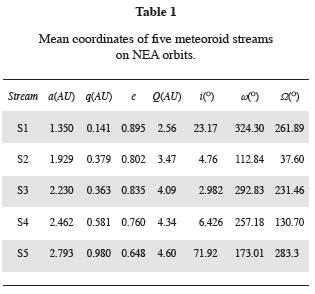
<body><![CDATA[<p align="justify"><font face="verdana" size="2">Meteoroid streams are commonly associated with cometary paths. Though evidence of meteoroid streams on Near Earth Asteroid (NEA) orbits has been persistent since 1937 (Kostolansky, 1998). Impacts on the NEA population are naturally expected: the same mechanisms that scatter NEAs from the Main Belt (MB) to the near&#150;Earth space, which are the mean motion and secular resonances, simultaneously scatter many times more smaller fragments together with the NEAs. Some of these smaller fragments eventually hit the asteroids of the NEA population, creating in the process new fragment swarms that will travel along the impacted NEA's orbit as a stream. Moreover, since most NEAs have aphelia that lie within the MB, every time they move through it, they do it at the lowest possible speed of their orbits and crossing at the same time multiple quasi&#150;circular orbits of Main Belt fragments of systematically higher speeds. This makes NEAs to become easy targets of these MB fragment population. Finally, the near&#150;Earth space is crossed by about 135 Short Period Comet (SPC) orbits plus some Long Period Comet (LPC) ones, populated with fragments of diverse sizes. As many of these cometary orbits overlap the NEA space, eventually some NEAs will cross one or more of these fragment paths, increasing greatly the probability of being hit by one or more of them every time they return to the crossing point. Whatever the point of the orbit a Near Earth Asteroid is hit by an impactor, the resulting fragment swarm will travel along with the asteroid on about the same orbit. This will be detected at the Earth as an Asteroidal Meteoroid Stream.</font></p>     <p align="justify">&nbsp;</p>     <p align="justify"><font size="2" face="verdana"><b>Observations</b></font></p>     <p align="justify"><font face="verdana" size="2">We have performed a visual search for possible simultaneous clustering of the orbital parameter values of meteoroid groups in the IAU_MDC Database of Photographic Meteors (Lindblad <i>et al.</i>, 2003). The search was positive, giving as a result five probable asteroidal meteoroid streams (<a href="#t1">Table 1</a> and <a href="/img/revistas/geoint/v47n3/a16f1.jpg" target="_blank">Fig. 1</a>) with three of them, S1, S2, and S3 containing streamlets as part of their structure. Streams S2 and S3 contain, respectively, four and three streamlets but stream S1, coming from the innermost Asteroid Belt, contains nine such streamlets (<a href="/img/revistas/geoint/v47n3/a16t2.jpg" target="_blank">Table 2</a> and <a href="/img/revistas/geoint/v47n3/a16f2.jpg" target="_blank">Fig. 2</a>), including the most populous one with six orbits. Streams are distinguished from each other due to a clear difference in their mean orbital parameters values (<a href="#t1">Table 1</a>). This is not the case for streamlets within streams, since all of them have very similar orbital parameters values. It is only a slight but systematic difference in the aphelion values what distinguishes a streamlet from the rest; by times a slight difference in semi&#150;major axis also helps isolate streamlets (<a href="/img/revistas/geoint/v47n3/a16t2.jpg" target="_blank">Table 2</a>). In the case of streamlet SS1d, besides a slight difference in q, the homogeneity of <i>q</i> and <i>&Omega;</i> values is what distinguishes it from SS1a.</font></p>     <p align="center"><font face="verdana" size="2"><a name="t1"></a></font></p>     <p align="center"><font face="verdana" size="2"><img src="/img/revistas/geoint/v47n3/a16t1.jpg"></font></p>     <p align="justify">&nbsp;</p>     <p align="justify"><font face="verdana" size="2"><b>Analysis</b></font></p>     <p align="justify"><font face="verdana" size="2">In agreement with Neukum <i>et al.</i> (2001), for the last Gy during which the impact rate on the Moon has been approximately constant, the cumulative crater size distribution is given by</font></p>     <p align="justify"><font face="verdana" size="2"><img src="/img/revistas/geoint/v47n3/a16s1.jpg"></font></p>     ]]></body>
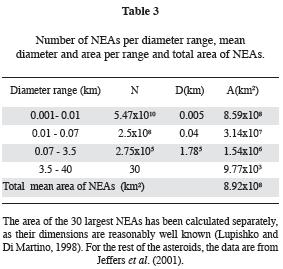
<body><![CDATA[<p align="justify"><font face="verdana" size="2">where <i>D</i> is the crater size in km, N is the number of craters per km<sup>2</sup> with diameter &gt; <i>D</i>, a<sub>0</sub> = &#150;3.0876, a<sub>1</sub> = &#150;3.557528, a<sub>2</sub> = 0.781027, a<sub>3</sub> = 1.021521, a<sub>4</sub> = &#150;0.156012, a<sub>5</sub> = &#150;0.444058, a<sub>6</sub> = 0.019977, a<sub>7</sub> = 0.08685, a<sub>8</sub> = &#150;0.005874, a<sub>9</sub> = &#150;0.006809, a<sub>10</sub> = 0.000825, and a<sub>11</sub> = 0.0000554. If D = 0.01 km, equation 1) implies that a lunar area 1 Gy old has a crater density of N(D <u>&gt;</u> 0.01km) = 3700/km2. For the case of the Moon (See Melosh, 1989), the relationship between a crater of diameter D made by an impactor of diameter d is given by</font></p>     <p align="justify"><font face="verdana" size="2"><img src="/img/revistas/geoint/v47n3/a16s2.jpg"></font></p>     <p align="justify"><font face="verdana" size="2">where <i>&rho;<sub>i</sub></i> = 2200 kg/m<sup>3</sup> and vi = 104 m/s are the mean density and mean impact velocity of NEAs on the Moon and <i>&rho;<sub>m</sub></i> = 2400 kg/m<sup>3</sup>, the mean density of the Moon (Jeffers <i>et al.</i>, 2001). By replacing these values in 2) we find that a crater of approximately 500 m in diameter is made by a typical 50 m impactor, what justifies the commonly used rule of thumb <i>d</i> <img src="/img/revistas/geoint/v47n3/a16s6.jpg"> 0.1D. Thus the latter result implies that about the Earth's orbit the impactor flux with diameter <u>&gt;</u> d is given by n<sub>e</sub> = N(D <u>&gt;</u> 0.01km)/1 Gy, or</font></p>     <p align="justify"><font face="verdana" size="2"><img src="/img/revistas/geoint/v47n3/a16s3.jpg"></font></p>     <p align="justify"><font face="verdana" size="2">On the other hand, since most NEAs move periodically into the impactor&#150;populated Main Belt, the approximate impactor flux they are subject to while in the Belt is expected to be</font></p>     <p align="justify"><font face="verdana" size="2"><img src="/img/revistas/geoint/v47n3/a16s4.jpg"></font></p>     <p align="justify"><font face="verdana" size="2">as estimated for Gaspra by S. V. Jeffers and D. J. Asher (2003), given the orbital similarity of this asteroid with typical Apollo and Amor NEAs.</font></p>     <p align="justify"><font face="verdana" size="2">So, on the average, the Apollo and Amor population is expected to be subject to a mean impact flux</font></p>     <p align="justify"><font face="verdana" size="2"><img src="/img/revistas/geoint/v47n3/a16s5.jpg"></font></p>     <p align="justify"><font face="verdana" size="2">Now, since in agreement with <a href="#t3">Table 3</a> the total estimated area for the NEA population is 8.92x10<sup>8</sup> km<sup>2</sup>, the expected impact rate on the whole population by objects 1m or larger in diameter would be 4900 yr<sup>&#150;1</sup>. This high impact rate on the NEA population explains the bservation of fragment streams about mean orbits in the NEA space.</font></p>     ]]></body>
<body><![CDATA[<p align="center"><font face="verdana" size="2"><a name="t3"></a></font></p>     <p align="center"><font face="verdana" size="2"><img src="/img/revistas/geoint/v47n3/a16t3.jpg"></font></p>     <p align="justify"><font face="verdana" size="2">Regarding the presence of several streamlets within streams, such as in <a href="/img/revistas/geoint/v47n3/a16f2.jpg" target="_blank">Fig. 2</a> and <a href="/img/revistas/geoint/v47n3/a16t2.jpg" target="_blank">Table 2</a>, this fact implies that the parent NEA has been subject to an impact rate much higher than estimated by equation 6. A plausible interpretation for this observation is the parent NEAs have happened to cross periodically through densely populated debris paths, probably cometary, in such a way that for each impact received by a sizable cometary fragment, the creation of a streamlet is ensued.</font></p>     <p align="justify">&nbsp;</p>     <p align="justify"><font size="2" face="verdana"><b>Summary</b></font></p>     <p align="justify"><font face="verdana" size="2">Five streams of apparent asteroidal nature have been identified. Three streams contain streamlets as part of their structure. The probable sources of streams and streamlets are Near Earth Asteroids, as they follow typical NEA orbits. It is probable streamlets are asteroidal fragments resulting from recent collisions of a NEAs with cometary fragments, probably due to periodic encounters of the latter with a densely populated cometary debris path. Concerning the random impact rate on the NEA population by objects 1m or larger in diameter, it is estimated to be 4900 yr<sup>&#150;1</sup>.</font></p>     <p align="justify">&nbsp;</p>     <p align="justify"><font size="2" face="verdana"><b>Acknowledgments</b></font></p>     <p align="justify"><font face="verdana" size="2">We thank the Organizing Committee of the VIII COLAGE for all the facilities provided to participate in the Conference.</font></p>     <p align="justify">&nbsp;</p>     ]]></body>
<body><![CDATA[<p align="justify"><font face="verdana" size="2"><b>Bibliography</b></font></p>     <!-- ref --><p align="justify"><font face="verdana" size="2">Jeffers, S. V. and D. J. Asher, 2003. Theoretical calculation of the cratering on Ida, Mathilde, Eros and Gaspra, <i>Mon. Not. R. Astron. Soc., 343</i>, 56&#150;66.</font>&nbsp;&nbsp;&nbsp;&nbsp;&nbsp;&nbsp;&nbsp;&nbsp;[&#160;<a href="javascript:void(0);" onclick="javascript: window.open('/scielo.php?script=sci_nlinks&ref=3900250&pid=S0016-7169200800030001600001&lng=','','width=640,height=500,resizable=yes,scrollbars=1,menubar=yes,');">Links</a>&#160;]<!-- end-ref --><!-- ref --><p align="justify"><font face="verdana" size="2">Jeffers, S. V., S. P. Manley, M. E. Bailey and D. J. Asher, 2001. Near&#150;Earth object velocity distributions and consequences for the Chicxulub impactor, <i>Mon. Not. R. Astron. Soc., 327</i>, 126&#150;132.</font>&nbsp;&nbsp;&nbsp;&nbsp;&nbsp;&nbsp;&nbsp;&nbsp;[&#160;<a href="javascript:void(0);" onclick="javascript: window.open('/scielo.php?script=sci_nlinks&ref=3900251&pid=S0016-7169200800030001600002&lng=','','width=640,height=500,resizable=yes,scrollbars=1,menubar=yes,');">Links</a>&#160;]<!-- end-ref --><!-- ref --><p align="justify"><font face="verdana" size="2">Kostolansky, E., 1998. On asteroidal meteoroid stream detection <i>Contrib. Astron. Obs. Skalant&eacute; Pleso, 28</i>, 22&#150;30.</font>&nbsp;&nbsp;&nbsp;&nbsp;&nbsp;&nbsp;&nbsp;&nbsp;[&#160;<a href="javascript:void(0);" onclick="javascript: window.open('/scielo.php?script=sci_nlinks&ref=3900252&pid=S0016-7169200800030001600003&lng=','','width=640,height=500,resizable=yes,scrollbars=1,menubar=yes,');">Links</a>&#160;]<!-- end-ref --><!-- ref --><p align="justify"><font face="verdana" size="2">Lindblad, B. A., L. Neslusan, V. Porubcan and J. Svoren, 2003. IAU Meteor Database of Photographic Orbits &#150; Version 2003, <i>Earth, Moon &amp; Planets, 93</i>, 249&#150;260.</font>&nbsp;&nbsp;&nbsp;&nbsp;&nbsp;&nbsp;&nbsp;&nbsp;[&#160;<a href="javascript:void(0);" onclick="javascript: window.open('/scielo.php?script=sci_nlinks&ref=3900253&pid=S0016-7169200800030001600004&lng=','','width=640,height=500,resizable=yes,scrollbars=1,menubar=yes,');">Links</a>&#160;]<!-- end-ref --><!-- ref --><p align="justify"><font face="verdana" size="2">Lupishko, D. F. and M. Di Martino, 1998. Physical properties of near&#150;Earth asteroids, <i>Planet. Space Sci., 46</i>, 47&#150;74.</font>&nbsp;&nbsp;&nbsp;&nbsp;&nbsp;&nbsp;&nbsp;&nbsp;[&#160;<a href="javascript:void(0);" onclick="javascript: window.open('/scielo.php?script=sci_nlinks&ref=3900254&pid=S0016-7169200800030001600005&lng=','','width=640,height=500,resizable=yes,scrollbars=1,menubar=yes,');">Links</a>&#160;]<!-- end-ref --><!-- ref --><p align="justify"><font face="verdana" size="2">Melosh, H. J., 1989. Impact cratering: A geologic process: New York, Oxford University Press.</font>&nbsp;&nbsp;&nbsp;&nbsp;&nbsp;&nbsp;&nbsp;&nbsp;[&#160;<a href="javascript:void(0);" onclick="javascript: window.open('/scielo.php?script=sci_nlinks&ref=3900255&pid=S0016-7169200800030001600006&lng=','','width=640,height=500,resizable=yes,scrollbars=1,menubar=yes,');">Links</a>&#160;]<!-- end-ref --><!-- ref --><p align="justify"><font face="verdana" size="2">Neukum, G., B. A. Ivanov and W. K. Hartmann, 2001.Cratering records in the Inner Solar System in Relation to the Lunar Reference System, <i>Chronology and Evolution of Mars, 96</i>, 55&#150;86.</font>&nbsp;&nbsp;&nbsp;&nbsp;&nbsp;&nbsp;&nbsp;&nbsp;[&#160;<a href="javascript:void(0);" onclick="javascript: window.open('/scielo.php?script=sci_nlinks&ref=3900256&pid=S0016-7169200800030001600007&lng=','','width=640,height=500,resizable=yes,scrollbars=1,menubar=yes,');">Links</a>&#160;]<!-- end-ref --> ]]></body><back>
<ref-list>
<ref id="B1">
<nlm-citation citation-type="journal">
<person-group person-group-type="author">
<name>
<surname><![CDATA[Jeffers]]></surname>
<given-names><![CDATA[S. V.]]></given-names>
</name>
<name>
<surname><![CDATA[Asher]]></surname>
<given-names><![CDATA[D. J.]]></given-names>
</name>
</person-group>
<article-title xml:lang="en"><![CDATA[Theoretical calculation of the cratering on Ida, Mathilde, Eros and Gaspra]]></article-title>
<source><![CDATA[Mon. Not. R. Astron. Soc.]]></source>
<year>2003</year>
<numero>343</numero>
<issue>343</issue>
<page-range>56-66</page-range></nlm-citation>
</ref>
<ref id="B2">
<nlm-citation citation-type="journal">
<person-group person-group-type="author">
<name>
<surname><![CDATA[Jeffers]]></surname>
<given-names><![CDATA[S. V.]]></given-names>
</name>
<name>
<surname><![CDATA[Manley]]></surname>
<given-names><![CDATA[S. P.]]></given-names>
</name>
<name>
<surname><![CDATA[Bailey]]></surname>
<given-names><![CDATA[M. E.]]></given-names>
</name>
<name>
<surname><![CDATA[Asher]]></surname>
<given-names><![CDATA[D. J.]]></given-names>
</name>
</person-group>
<article-title xml:lang="en"><![CDATA[Near-Earth object velocity distributions and consequences for the Chicxulub impactor]]></article-title>
<source><![CDATA[Mon. Not. R. Astron. Soc.]]></source>
<year>2001</year>
<numero>327</numero>
<issue>327</issue>
<page-range>126-132</page-range></nlm-citation>
</ref>
<ref id="B3">
<nlm-citation citation-type="journal">
<person-group person-group-type="author">
<name>
<surname><![CDATA[Kostolansky]]></surname>
<given-names><![CDATA[E]]></given-names>
</name>
</person-group>
<article-title xml:lang="en"><![CDATA[On asteroidal meteoroid stream detection]]></article-title>
<source><![CDATA[Contrib. Astron. Obs. Skalanté Pleso]]></source>
<year>1998</year>
<numero>28</numero>
<issue>28</issue>
<page-range>22-30</page-range></nlm-citation>
</ref>
<ref id="B4">
<nlm-citation citation-type="journal">
<person-group person-group-type="author">
<name>
<surname><![CDATA[Lindblad]]></surname>
<given-names><![CDATA[B. A.]]></given-names>
</name>
<name>
<surname><![CDATA[Neslusan]]></surname>
<given-names><![CDATA[L]]></given-names>
</name>
<name>
<surname><![CDATA[Porubcan]]></surname>
<given-names><![CDATA[V]]></given-names>
</name>
<name>
<surname><![CDATA[Svoren]]></surname>
<given-names><![CDATA[J]]></given-names>
</name>
</person-group>
<article-title xml:lang="en"><![CDATA[IAU Meteor Database of Photographic Orbits - Version 2003]]></article-title>
<source><![CDATA[Earth, Moon & Planets]]></source>
<year>2003</year>
<numero>93</numero>
<issue>93</issue>
<page-range>249-260</page-range></nlm-citation>
</ref>
<ref id="B5">
<nlm-citation citation-type="journal">
<person-group person-group-type="author">
<name>
<surname><![CDATA[Lupishko]]></surname>
<given-names><![CDATA[D. F.]]></given-names>
</name>
<name>
<surname><![CDATA[Di Martino]]></surname>
<given-names><![CDATA[M]]></given-names>
</name>
</person-group>
<article-title xml:lang="en"><![CDATA[Physical properties of near-Earth asteroids]]></article-title>
<source><![CDATA[Planet. Space Sci.]]></source>
<year>1998</year>
<numero>46</numero>
<issue>46</issue>
<page-range>47-74</page-range></nlm-citation>
</ref>
<ref id="B6">
<nlm-citation citation-type="book">
<person-group person-group-type="author">
<name>
<surname><![CDATA[Melosh]]></surname>
<given-names><![CDATA[H. J.]]></given-names>
</name>
</person-group>
<source><![CDATA[Impact cratering: A geologic process]]></source>
<year>1989</year>
<publisher-loc><![CDATA[New York ]]></publisher-loc>
<publisher-name><![CDATA[Oxford University Press]]></publisher-name>
</nlm-citation>
</ref>
<ref id="B7">
<nlm-citation citation-type="">
<person-group person-group-type="author">
<name>
<surname><![CDATA[Neukum]]></surname>
<given-names><![CDATA[G]]></given-names>
</name>
<name>
<surname><![CDATA[Ivanov]]></surname>
<given-names><![CDATA[B. A.]]></given-names>
</name>
<name>
<surname><![CDATA[Hartmann]]></surname>
<given-names><![CDATA[W. K.]]></given-names>
</name>
</person-group>
<source><![CDATA[Cratering records in the Inner Solar System in Relation to the Lunar Reference System: Chronology and Evolution of Mars]]></source>
<year>2001</year>
<volume>96</volume>
<page-range>55-86</page-range></nlm-citation>
</ref>
</ref-list>
</back>
</article>