<?xml version="1.0" encoding="ISO-8859-1"?><article xmlns:mml="http://www.w3.org/1998/Math/MathML" xmlns:xlink="http://www.w3.org/1999/xlink" xmlns:xsi="http://www.w3.org/2001/XMLSchema-instance">
<front>
<journal-meta>
<journal-id>0016-7169</journal-id>
<journal-title><![CDATA[Geofísica internacional]]></journal-title>
<abbrev-journal-title><![CDATA[Geofís. Intl]]></abbrev-journal-title>
<issn>0016-7169</issn>
<publisher>
<publisher-name><![CDATA[Universidad Nacional Autónoma de México, Instituto de Geofísica]]></publisher-name>
</publisher>
</journal-meta>
<article-meta>
<article-id>S0016-71692008000300013</article-id>
<title-group>
<article-title xml:lang="en"><![CDATA[Study of charge behavior during solar particle acceleration]]></article-title>
</title-group>
<contrib-group>
<contrib contrib-type="author">
<name>
<surname><![CDATA[Pérez-Peraza]]></surname>
<given-names><![CDATA[J]]></given-names>
</name>
<xref ref-type="aff" rid="A01"/>
</contrib>
<contrib contrib-type="author">
<name>
<surname><![CDATA[Balderas-Aviles]]></surname>
<given-names><![CDATA[G]]></given-names>
</name>
<xref ref-type="aff" rid="A01"/>
</contrib>
<contrib contrib-type="author">
<name>
<surname><![CDATA[Rodríguez-Frías]]></surname>
<given-names><![CDATA[D]]></given-names>
</name>
<xref ref-type="aff" rid="A02"/>
</contrib>
<contrib contrib-type="author">
<name>
<surname><![CDATA[del Peral]]></surname>
<given-names><![CDATA[L]]></given-names>
</name>
<xref ref-type="aff" rid="A02"/>
</contrib>
<contrib contrib-type="author">
<name>
<surname><![CDATA[Hebrero]]></surname>
<given-names><![CDATA[G]]></given-names>
</name>
<xref ref-type="aff" rid="A02"/>
</contrib>
<contrib contrib-type="author">
<name>
<surname><![CDATA[Gallegos-Cruz]]></surname>
<given-names><![CDATA[A]]></given-names>
</name>
<xref ref-type="aff" rid="A03"/>
</contrib>
</contrib-group>
<aff id="A01">
<institution><![CDATA[,Universidad Nacional Autónoma de México Instituto de Geofísica ]]></institution>
<addr-line><![CDATA[México City ]]></addr-line>
<country>México</country>
</aff>
<aff id="A02">
<institution><![CDATA[,Universidad de Alcalá Grupo de Física de Plasmas y Astropartículas ]]></institution>
<addr-line><![CDATA[Madrid ]]></addr-line>
<country>Spain</country>
</aff>
<aff id="A03">
<institution><![CDATA[,Instituto Politécnico Nacional Unidad Profesional Interdisciplinaria de Ingeniería y Ciencias Sociales y Administrativas Depto. de Ciencias Básicas]]></institution>
<addr-line><![CDATA[México City ]]></addr-line>
<country>México</country>
</aff>
<pub-date pub-type="pub">
<day>00</day>
<month>09</month>
<year>2008</year>
</pub-date>
<pub-date pub-type="epub">
<day>00</day>
<month>09</month>
<year>2008</year>
</pub-date>
<volume>47</volume>
<numero>3</numero>
<fpage>215</fpage>
<lpage>230</lpage>
<copyright-statement/>
<copyright-year/>
<self-uri xlink:href="http://www.scielo.org.mx/scielo.php?script=sci_arttext&amp;pid=S0016-71692008000300013&amp;lng=en&amp;nrm=iso"></self-uri><self-uri xlink:href="http://www.scielo.org.mx/scielo.php?script=sci_abstract&amp;pid=S0016-71692008000300013&amp;lng=en&amp;nrm=iso"></self-uri><self-uri xlink:href="http://www.scielo.org.mx/scielo.php?script=sci_pdf&amp;pid=S0016-71692008000300013&amp;lng=en&amp;nrm=iso"></self-uri><abstract abstract-type="short" xml:lang="es"><p><![CDATA[Con objeto de reproducir la evolución con energía de los estados de carga observacionales de los iones energéticos solares, hemos desarrollado un modelo en el que los estados de carga se definen en la fuente durante el proceso de aceleración de los iones solares. El intercambio de carga entre iones y la materia local se estudia en base a secciones eficaces de alta energía para pérdida y captura electrónica. El modelo se desarrolla bajo dos enfoques diferentes. Aplicamos el modelo a datos observacionales de estados de carga para la mayor parte los eventos publicados en la literatura. Analizamos y discutimos nuestros resultados e implicaciones dentro del contexto de otros modelos: concluimos que nuestro modelo analítico da mayor información de la física involucrada que las simulaciones numéricas desarrollada por otros autores.]]></p></abstract>
<abstract abstract-type="short" xml:lang="en"><p><![CDATA[In order to explain the evolution with energy of the charge state of solar particles we have developed a model where charge states are defined at the source during the particle acceleration process. Charge-interchange processes between the accelerated ions and local matter are considered on basis of electron loss and capture cross-sections at high energies. The model is worked out under two different approaches. We apply the model to observational data of charge states of most of particle events published in the literature. We discuss our results and implications within the frame of other existing models: we conclude that our analytical model gives more information of the underlying physics than the numerical simulations developed by other authors.]]></p></abstract>
<kwd-group>
<kwd lng="es"><![CDATA[PES]]></kwd>
<kwd lng="es"><![CDATA[evolución de estados de carga]]></kwd>
<kwd lng="es"><![CDATA[aceleración]]></kwd>
<kwd lng="en"><![CDATA[SEP]]></kwd>
<kwd lng="en"><![CDATA[charge states evolution]]></kwd>
<kwd lng="en"><![CDATA[acceleration]]></kwd>
</kwd-group>
</article-meta>
</front><body><![CDATA[ <p align="justify"><font face="verdana" size="4">Article</font></p>     <p align="justify"><font face="verdana" size="2">&nbsp;</font></p>     <p align="center"><font face="verdana" size="4"><b>Study of charge behavior during solar particle acceleration</b></font></p>     <p align="justify"><font face="verdana" size="2">&nbsp;</font></p>     <p align="center"><font face="verdana" size="2"><b>J. P&eacute;rez&#150;Peraza<sup>1,</sup>*, G. Balderas&#150;Aviles<sup>1</sup>, D. Rodr&iacute;guez&#150;Fr&iacute;as<sup>2</sup>, L. del Peral<sup>2</sup>, G. Hebrero<sup>2</sup>, and A. Gallegos&#150;Cruz<sup>3</sup></b></font></p>     <p align="center"><font face="verdana" size="2">&nbsp;</font></p>     <p align="justify"><font face="verdana" size="2"><sup>1</sup> <i>Instituto de Geof&iacute;sica, Universidad Nacional Aut&oacute;noma de M&eacute;xico, Del. Coyoac&aacute;n, 04510 M&eacute;xico City, M&eacute;xico. </i>* Corresponding author: <a href="mailto:perperaz@geofisica.unam.mx">perperaz@geofisica.unam.mx</a></font></p>     <p align="justify"><font face="verdana" size="2"><sup>2</sup> <i>Grupo de F&iacute;sica de Plasmas y Astropart&iacute;culas, Universidad de Alcal&aacute;, 28871, Madrid, Spain</i></font></p>     <p align="justify"><font face="verdana" size="2"> <sup>3</sup> <i>Depto. de Ciencias B&aacute;sicas, Unidad Profesional Interdisciplinaria de Ingenier&iacute;a y Ciencias Sociales y Administrativas, Instituto Polit&eacute;cnico Nacional, T&eacute; 950, Iztacalco, 08400, M&eacute;xico City, M&eacute;xico</i></font></p>     <p align="justify"><font face="verdana" size="2">&nbsp;</font></p>     ]]></body>
<body><![CDATA[<p align="justify"><font face="verdana" size="2">Received: December 14, 2007    <br> Accepted: January 22, 2008</font></p>     <p align="justify"><font face="verdana" size="2">&nbsp;</font></p>     <p align="justify"><font face="verdana" size="2"><b>Resumen</b></font></p>     <p align="justify"><font face="verdana" size="2">Con objeto de reproducir la evoluci&oacute;n con energ&iacute;a de los estados de carga observacionales de los iones energ&eacute;ticos solares, hemos desarrollado un modelo en el que los estados de carga se definen en la fuente durante el proceso de aceleraci&oacute;n de los iones solares. El intercambio de carga entre iones y la materia local se estudia en base a secciones eficaces de alta energ&iacute;a para p&eacute;rdida y captura electr&oacute;nica. El modelo se desarrolla bajo dos enfoques diferentes. Aplicamos el modelo a datos observacionales de estados de carga para la mayor parte los eventos publicados en la literatura. Analizamos y discutimos nuestros resultados e implicaciones dentro del contexto de otros modelos: concluimos que nuestro modelo anal&iacute;tico da mayor informaci&oacute;n de la f&iacute;sica involucrada que las simulaciones num&eacute;ricas desarrollada por otros autores.</font></p>     <p align="justify"><font face="verdana" size="2"><b>Palabras clave: </b>PES, evoluci&oacute;n de estados de carga, aceleraci&oacute;n.</font></p>     <p align="justify"><font face="verdana" size="2">&nbsp;</font></p>     <p align="justify"><font face="verdana" size="2"><b>Abstract</b></font></p>     <p align="justify"><font face="verdana" size="2">In order to explain the evolution with energy of the charge state of solar particles we have developed a model where charge states are defined at the source during the particle acceleration process. Charge&#150;interchange processes between the accelerated ions and local matter are considered on basis of electron loss and capture cross&#150;sections at high energies. The model is worked out under two different approaches. We apply the model to observational data of charge states of most of particle events published in the literature. We discuss our results and implications within the frame of other existing models: we conclude that our analytical model gives more information of the underlying physics than the numerical simulations developed by other authors.</font></p>     <p align="justify"><font face="verdana" size="2"><b>Key words:</b> SEP, charge states evolution, acceleration.</font></p>     ]]></body>
<body><![CDATA[<p align="justify"><font face="verdana" size="2">&nbsp;</font></p>     <p align="justify"><font face="verdana" size="2"><b>Introduction</b></font></p>     <p align="justify"><font face="verdana" size="2">It is well known in several branches of physics that the knowledge of charge states of energetic ions, and their evolution with energy during the passage of ions through matter is a very important factor for the study of particle interaction with matter and E.M. fields. The scope of applications was described in P&eacute;rez&#150;Peraza and Alvarez (1990). As stated recently by Kaganovich <i>et al.</i> (2006) charge interchange collisions play an important role in many applications such as heavy ion inertial fusion, collisional and radiative processes in the Earth's upper atmosphere, ion&#150;beam lifetimes in accelerators, atomic spectroscopy, ion stopping matter and a wide range of problems in atomic physics. The behavior of charge states in connection with the energy and charge spectra is of particular interest: chemical and isotopic abundances of the accelerated ions are highly dependent on the charge states during their acceleration, escape from the source and propagation at the Sun and in interplanetary space, and so is the emitted radiation when the accelerated ions capture electrons of the medium (P&eacute;rez&#150;Peraza <i>et al.</i>, 1989; P&eacute;rez&#150;Peraza and Gallegos&#150;Cruz.,1998). The present knowledge of Effective Charge, qeff (or mean equilibrium charge state) is associated with experimental results of Stopping Power of ions in atomic matter, which can be adequately described by several semi&#150;empirical smooth functions of ion velocity and nuclear charge (Z). These kinds of relations refer to experiments of ion deceleration toward stopping in atomic matter. All those expres&#150;sions do not consider the temperature of the medium (T). Therefore, for astrophysical applications, these kinds of ex&#150;pressions are usually extrapolated by introducing T, commonly by means of a thermal velocity. All those semi&#150;empirical relations, though useful for some purposes, do not give enough information about the underlying physics. Strictly, these kinds of expressions are not valid when ions instead of being stopped are undergoing an acceleration process while interacting with the local matter, as is the case in Cosmic Ray sources. In fact, because the energy gain rate is of a different nature (electromagnetic) from the Stopping Power rate (atomic), the evolution of particle charge as a function of energy must be derived taking into account the kind of energy change process involved. Since there are no data of particle charge evolution of ions moving through plasmas, either during stopping or acceleration, a big amount of theoretical work has been done in relation with the charge state evolution of solar flare particles. We analyze here one of the models developed at this regard, namely hereafter the High Energy Cross&#150;Sections model (HECSM), and discuss it within the frame of other models.</font></p>     <p align="justify">&nbsp;</p>     <p align="justify"><font size="2" face="verdana"><b>The Model of Charge Evolution</b></font></p>     <p align="justify"><font face="verdana" size="2">It is widely believed that the simplest description of a physical phenomenon is usually the best approach to understand the underlying physics involved in the phenomenon. With this aim, we have developed an analytical expression for the effective charge qeff of the accelerated particles which gives us information about the acceleration mechanism and its efficiency, the acceleration time, the source parameters, and indirectly the nature of the charge interchange cross&#150;sections.</font></p>     <p align="justify"><font face="verdana" size="2">In the model presented here, it is assumed that resonant ions with MHD turbulence are accelerated from the thermal background, and while being accelerated they interact with local matter, such that under specific conditions, they undergo charge interchange with the electrons, ions and atoms of the source. Once particles escape from the acceleration volume, no important charge transfer is established out of the source. The model is analyzed from two different approaches:</font></p>     <p align="justify"><font face="verdana" size="2"><i>The simplified approach</i></font></p>     <p align="justify"><font face="verdana" size="2">Derivation of this simplified approach was given in P&eacute;rez&#150;Peraza and Alvarez&#150;Madrigal (1990a, 1990b). It is assumed an ion (A, Z) of velocity v(E) which is being accelerated while interacting with a flux of targets <i>nv</i><sub>R</sub> which are moving with a relative velocity <i>&nu;</i><sub>R</sub> among them. For T &gt; 2.7 x 10<sup>4</sup>K we use electrons as targets. By simple physical arguments it was obtained the following expression for the effective charge:</font></p>     <p align="justify"><font face="verdana" size="2"><img src="/img/revistas/geoint/v47n3/a13s1.jpg"></font></p>     ]]></body>
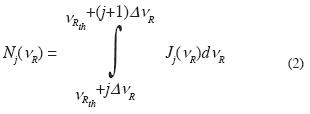
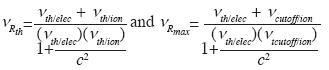
<body><![CDATA[<p align="justify"><font face="verdana" size="2">With <i><b>q</b></i><sub>0</sub> as the local thermal charge of the ion in consideration, determined by the local temperature of the medium of density (n) at the source; <i>t<sub>&alpha;</sub></i> is the acceleration time of mechanism of efficiency <i>&alpha;</i> (s<sup>&#150;1</sup>) (here we use Fermi&#150;type acceleration); <i>&sigma;<sub>l</sub></i> and <i>&sigma;<sub>c</sub></i> are the electron loss and electron capture (Coulomb plus radiative) cross&#150;sections respectively (which depend majorly on the ion projectile parameters).</font></p>     <p align="justify">&nbsp;</p>     <p align="justify"><font size="2" face="verdana"><b>The general approach</b></font></p>     <p align="justify"><font face="verdana" size="2">This is in principle the global approach to the problem, which assumes that two populations are interacting: on one hand, a population which is not in thermodynamic equilibrium (TE), namely the accelerated projectile ions, with a typical solar particle spectrum (either an inverse potential law, or an exponential one), and on the other hand a population in TE, namely the thermal targets, with a Maxwell type velocity. The evolution with energy of the ions charge during acceleration under this approach is expressed in the frame of the plasma. In order to take into account all the projectiles, one takes the integral of the solar energetic particles spectrum which gives the number of particles in a relative velocity interval &#91;j, j+1&#93;, that is:</font></p>     <p align="justify"><font face="verdana" size="2"><img src="/img/revistas/geoint/v47n3/a13s2.jpg"></font></p>     <p align="justify"><font face="verdana" size="2"><i>&Delta;&nu;<sub>R</sub></i>  is a velocity increase that is defined as follows:</font></p>     <p align="justify"><font face="verdana" size="2"><img src="/img/revistas/geoint/v47n3/a13s3.jpg"></font></p>     <p align="justify"><font face="verdana" size="2"><i>i </i>is the desired number of velocity intervals,<i>&nu;<sub>Rth</sub></i> is the ion's thermal relative velocity and <i>&nu;<sub>Rmax</sub></i> is the maximum relative velocity that corresponds to the high energy cutoff of the accelerated ions (Heristchi <i>et al.</i>, 1976), that we are arbitrarily taking as 100 MeV/n.</font></p>     <p align="justify"><font face="verdana" size="2">The relative velocity is the one defined by Einstein's special relativity, therefore:</font></p>     <p align="justify"><font face="verdana" size="2"><img src="/img/revistas/geoint/v47n3/a13s4.jpg"></font></p>     ]]></body>
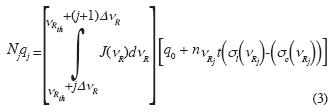
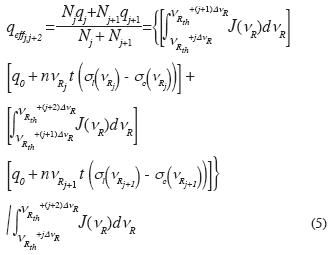
<body><![CDATA[<p align="justify"><font face="verdana" size="2">Where <i>&nu;<sub>th/elec</sub></i> is the electron's thermal velocity, nth/ion is the ion's thermal velocity and <i>&nu;<sub>cutoff/ion </sub></i>ion is the ion's velocity that corresponds in this work to 100 MeV/n.</font></p>     <p align="justify"><font face="verdana" size="2">Next, we proceed to calculate (using the simplified approach) the total charge state for the particles within the interval &#91;j, j+1&#93;</font></p>     <p align="justify"><font face="verdana" size="2"><img src="/img/revistas/geoint/v47n3/a13s5.jpg"></font></p>     <p align="justify"><font face="verdana" size="2">Where  <img src="/img/revistas/geoint/v47n3/a13s6.jpg"> is the ion's average relative velocity at the &#91;j, j+1&#93; interval. We now have the total charge state of that velocity interval. In order to have an average charge, one requires at least 2 values, so we will take the total charge state of the next velocity band &#91;j+1, j+2&#93;, this is</font></p>     <p align="justify"><font face="verdana" size="2"><img src="/img/revistas/geoint/v47n3/a13s7.jpg"></font></p>     <p align="justify"><font face="verdana" size="2">We have now the average charge state of the ions in the interval of velocities &#91;j, j+2&#93;. Our final charge state equation in the velocity interval &#91;j, j+2&#93; is expressed as follows:</font></p>     <p align="justify"><font face="verdana" size="2"><img src="/img/revistas/geoint/v47n3/a13s8.jpg"></font></p>     <p align="justify"><font face="verdana" size="2">This expression only estimates the average charge value in one interval of velocities. To obtain the average charge state per velocity interval we make the succession:</font></p>     <p align="justify"><font face="verdana" size="2"><img src="/img/revistas/geoint/v47n3/a13s9.jpg"></font></p>     <p align="justify"><font face="verdana" size="2"><img src="/img/revistas/geoint/v47n3/a13s10.jpg"></font></p>     ]]></body>
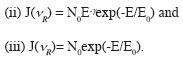
<body><![CDATA[<p align="justify"><font face="verdana" size="2">Where j = 0, 1, 2,..., i&#150;2. It can be seen from (5) that for j = 0, our starting velocity is <i>&nu;<sub>Rth</sub></i> whereas for j = (i &#150; 2), our final velocity is <i>&nu;<sub>Rmax</sub></i>. Each one of these values, allows us to construct the graphic that expresses the evolution of the aver&#150;age charge state as the energy increases. Also, it is well known that as the number of intervals increases, so does the precision of our results. The charge state value &lt;<i>qeff</i><sub>0,2</sub>&gt; is retro&#150;fed when calculating &lt;<i>qeff</i><sub>2,4</sub>&gt; and so on in order to preserve the evolving nature of the equation 1.</font></p>     <p align="justify"><font face="verdana" size="2">It should be noted that we avoid in equation 4 the Maxwellian distribution, since it is well known that this distribution does not correspond to the nature of the high energy ions that are being accelerated. Besides, it is well known (e.g. Sav&eacute;liev, 1982) that 70.7% of particles have a velocity in the range 0.5&#150;1.5 times the most probable velocity, <i>&nu;</i><sub>mp</sub>; those with v &gt; 3 vmp, and v &gt; 5 <i>&nu;</i><sub>mp</sub> represent only the 0.04% and 8 x 10&#150;9% respectively, and since our integrals are limited to the range (<i>&nu;<sub>th/ion</sub></i><img src="/img/revistas/geoint/v47n3/a13s12.jpg"><i>&nu;<sub>cutoff/ion</sub></i>) the number of particles with <i>&nu;</i><sub>targets</sub> <img src="/img/revistas/geoint/v47n3/a13s13.jpg"> <i>&nu;</i><sub>mp</sub> is still much higher.</font></p>     <p align="justify"><font face="verdana" size="2">J(<i>&nu;</i><sub>R</sub>) is the energy spectrum of the accelerated ions: we examine here 3 possibilities: (i) J(<i>&nu;</i><sub>R</sub>) = N<sub>0</sub>E<sup>&#150;&gamma;</sup>,</font></p>     <p align="justify"><font face="verdana" size="2"><img src="/img/revistas/geoint/v47n3/a13s11.jpg"></font></p>     <p align="justify"><font face="verdana" size="2">It can be appreciated that (1) is a completely analytic expression. In particular, this approach has the advantage that given a temperature (T) and a density (n), the only free parameter is the acceleration efficiency (&alpha;) which appears in the acceleration time (<i>t<sub>a</sub></i>), whereas equation 5 has an extra free parameter, either the index &gamma; or the characteristic value E<sub>0</sub> of the spectrum. It can be appreciated that the evolution of ion charge depends basically from the balance between the cross&#150;sections <i>&sigma;<sub>l</sub></i> and <i>&sigma;<sub>c</sub></i> Results derived from equation 1 were published in P&eacute;rez&#150;Peraza and Alvarez&#150;Madrigal (1990); P&eacute;rez&#150;Peraza <i>et al.</i> (1999); Rodr&iacute;guez&#150;Fr&iacute;as <i>et al</i>. (2000, 2001a, 2001b, 2002) y Peral <i>et al.</i> (2002).</font></p>     <p align="justify"><font face="verdana" size="2"><i>Charge interchange cross&#150;sections</i></font></p>     <p align="justify"><font face="verdana" size="2">Intensive studies of electron capture and loss cross&#150;sections of high energy ions in atomic matter date from the 1940's: the status is periodically reviewed, among which, some of the more interesting are Betz (1972) and Kaganovich (2006).</font></p>     <p align="justify"><font face="verdana" size="2">On the basis of such cross&#150;sections (P&eacute;rez&#150;Peraza <i>et al.</i>,1983, 1985) the criteria for the establishment of charge changing process of heavy ions with the local matter was developed, when ions are undergoing acceleration and coulomb energy losses at the source. That was done for several acceleration mechanisms, and it was found that depending on the mechanism, and its acceleration efficiency, as well as the temperature and density of the medium, either both processes electron capture and loss occur, or one of them may be inhibited: electron capture at high energies, or electron loss at low energies, or even there can be situations where ions do not undergo any charge interchange in the source, as for instance when acceleration is very fast in a relatively diluted medium with an open field lines topology in the acceleration volume.</font></p>     <p align="justify"><font face="verdana" size="2">Given the condition <i>&alpha; &gt; &alpha;<sub>c</sub></i> (where &alpha; is the acceleration efficiency and &alpha;c is related to the Coulomb barrier), such establishment depends on the relation between their mean flight times for acceleration and for charge&#150;changing processes, i.e. the mean free path for acceleration <i>&lambda;</i> compared with that of the atomic process <i>&lambda;<sub>c</sub></i>,  <i>&lambda;<sub>p</sub></i>: it may occur that <i>&lambda;</i> &gt; <i>&lambda;</i><sub>c</sub> while <i>&lambda; </i>&lt;&lt; <i>&lambda;</i><sub>p</sub> or vice versa, in such a way that in the case that only electron capture is established, ions in a cold plasma may eventually become neutral and get lost from the accelerated flux. Since <i>t<sub>a</sub></i> ~ 1/&alpha;, then if &alpha; is small ta is long enough for charge changing processes to be established, but if the efficiency is very high,  <i>t<sub>a</sub></i> is quite short for such establishment, and then one or two of the atomic processes could be inhibited. &#150;Therefore, the establishment of charge changing processes is very sensitive to the corresponding cross&#150;sections.</font></p>     <p align="justify"><font face="verdana" size="2">Unfortunately, there is not, to the best of our knowledge, experimental cross&#150;sections of high energy ions in plasmas, as in atomic matter. Due to the lack of experimental data one is obliged to make some assumptions: because the high energy ions interact with the coronal thermal plasma, people usually recur to the cross&#150;sections of equilibrium ionization fractions in the coronal plasma (e.g. Jordan, 1969; Jain and Narain, 1978; Arnaud and Raymond, 1992). However, such cross&#150;sections are developed for plasma components that are in thermodynamic equilibrium (TE) with a well defined Maxwellian type spectrum, whereas the energetic ions projectiles interacting with the thermal targets are out of TE, with a non&#150;thermal spectrum. Then, it is not clear why such thermal cross&#150;sections may be extrapolated to a high energy population (Luhn and Hovestadt, 1987; Kocharov <i>et al.</i>, 2000, 2001). Besides, it is well known that the measured distribution of charge states of solar ions is not representative of the equilibrium charge distribution of thermal plasma, defined by the temperature, but rather of the amount of traversed matter in the source and its environment.</font></p>     ]]></body>
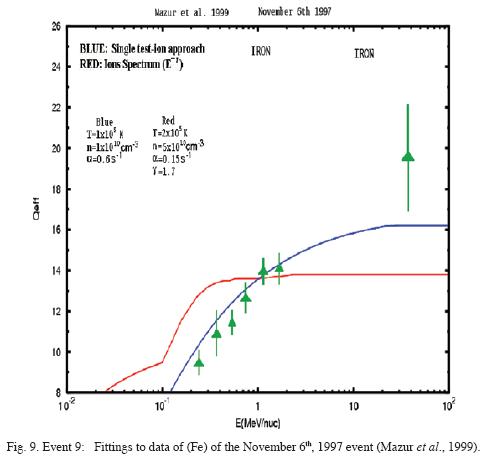
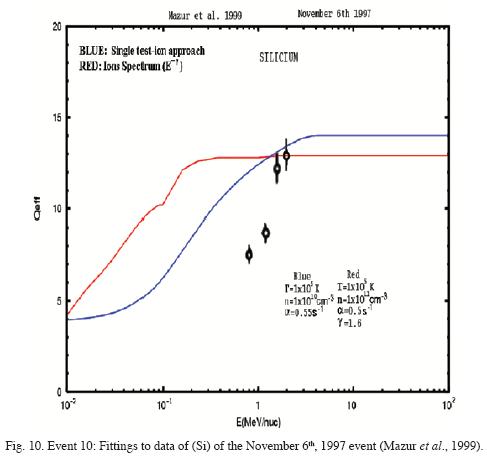
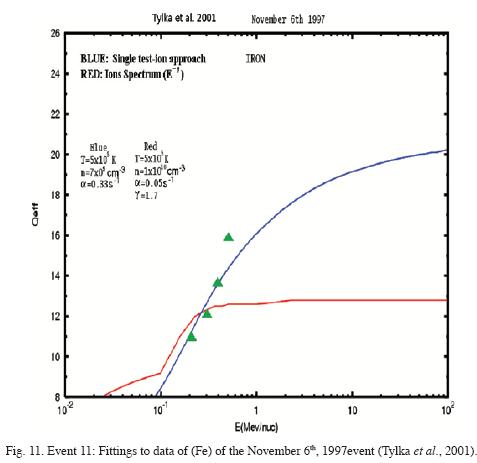
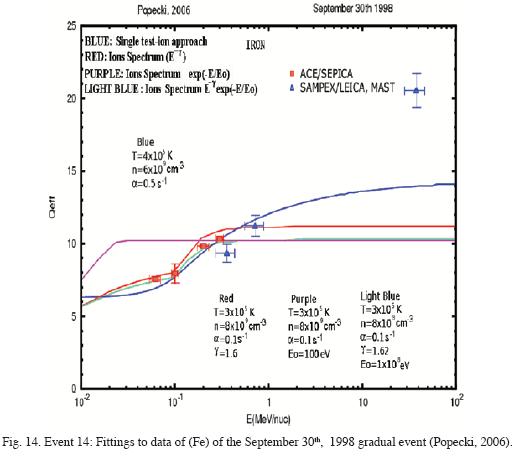
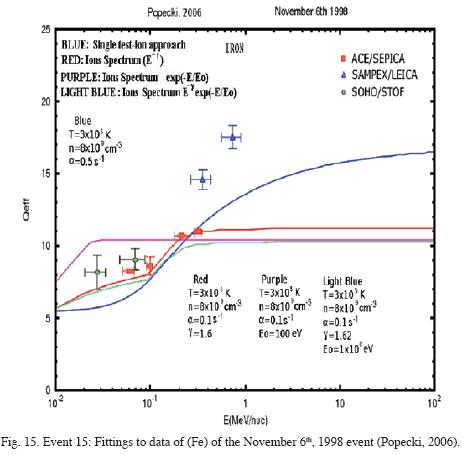
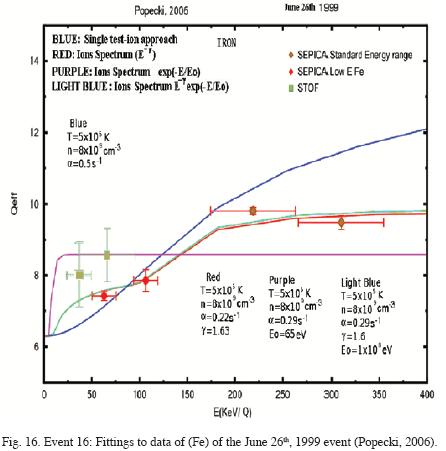
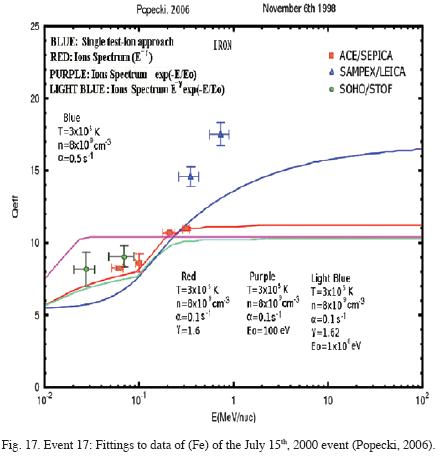
<body><![CDATA[<p align="justify"><font face="verdana" size="2">Another option was developed in P&eacute;rez&#150;Peraza <i>et al.</i> (1983, 1985) by applying the cross&#150;sections of high energy particles in atomic matter to plasmas, even at energies lower than the thermal energy of electrons, provided the ions are undergoing an electromagnetic acceleration process. Therefore, finite&#150;temperature cross&#150;sections were derived in those works by introducing, a relative velocity <i>&nu;<sub>R</sub></i> between the projectile and the thermal targets (electrons, protons and atoms of Hydrogen) (see Figs. in P&eacute;rez&#150;Peraza <i>et al.</i>, 1985 where <i>&sigma;</i><sub>l</sub><i>, &sigma;</i><sub>cc</sub> and <i>&sigma;</i><sub>cr</sub> are the electron loss, coulomb capture and radiative capture cross&#150;sections, corresponding respectively to ionization, recombination and radiative recombination in thermal jargon).</font></p>     <p align="justify">&nbsp;</p>     <p align="justify"><font size="2" face="verdana"><b>Analysis and results</b></font></p>     <p align="justify"><font face="verdana" size="2">Values of the local thermal charge states <b>q</b><sub>0</sub>(T) for each ion species at the beginning of the acceleration were taken from Arnaud and Raymond (1992). Ecuations 1&#150;6 are coupled to the criteria of charge interchange: at each energy value it is tested if both processes capture and loss are occurring, or only one of them, or even none of them. In the later case <b>q*</b><i><sub>eff</sub></i> = <b>q</b><sub>0</sub>.</font></p> 				    <p align="justify"><font face="verdana" size="2">For testing our model predictions, we proceeded here to fit the three approaches of the model equations 1&#150;6 to data of mean charge state of ions (mostly iron) that has been published since 1995.</font></p> 				    <p align="justify"><font face="verdana" size="2">Regarding data on mean ionic charge states, according to Klecker <i>et al.</i> (2006), up to the decade of the 80's it was conventional accepted that mean ionic charge of heavy ions was compatible with coronal temperatures in the range 1&#150;2x10<sup>6</sup> K. Later the large ionic charge of heavy ions in impulsive SEP events was interpreted as being due to high temperatures of <img src="/img/revistas/geoint/v47n3/a13s14.jpg">10<sup>7</sup> K at the flare site, whereas the ionic charge states in gradual SEP events were assumed to be similar to those of the solar wind. However, new results with advanced instrumentation from several missions (e.g. Wind, SAMPEX, SOHO, SEPICA onboard ACE) have shown that this picture was oversimplified. One of the key accomplishments with the new generation of instruments was the extension of ionic charge measurements over a wide energy range and the much improved sensitivity of the instrumentation (Klecker <i>et al.</i>, 2006).</font></p>     <p align="justify"><font face="verdana" size="2">It is worth noting here, that such oversimplification was pointed out long ago as a natural implication of the criteria for the establishment of charge interchange developed in P&eacute;rez&#150;Peraza <i>et al.</i>(1983, 1985): as mentioned before it was found that depending on several factors during ion acceleration, charge equilibrium could be established, while in other circunstances electron capture can be inhibited, so that ions acquire faster a high mean charge than it is expected from charge equilibrium, or a lower mean charge at a given energy when the conditions during acceleration are such that electron loss is inhibited; additionally, under some conditions charge interchange does not occur at all, and ions keep their local charge <b>q</b><sub>0</sub>(T) from the corona <img src="/img/revistas/geoint/v47n3/a13s14.jpg">10<sup>6</sup>K), or from the flare region (<img src="/img/revistas/geoint/v47n3/a13s14.jpg">10<sup>7</sup> K) as it is sometimes seen in some SEP. Concretely, in those previous papers we had advanced the thesis that the ionic charges are most frequently not defined uniquely by ionization equilibrium of a collisionally dominated plasma at the source matter temperature, as used to be claimed in the literature. This is supported by the fact than in many SEP events an energy dependence of the ionic charge states is observed with a large event&#150;to&#150;event variability (Oetliker <i>et al.</i>, 1997; Mazur <i>et al.</i>, 1999).</font></p> 				    <p align="justify"><font face="verdana" size="2">Furthermore, if one rejects our primitive hypothesis that charge states are defined by the amount of traversed matter in the source and its close environment, and it were assumed that it is only determined by ionization equilibrium at the source temperature, hence since flares occur in a wide range of heliolongitudes an heliolatitudes from event to event, it is natural to assume also a high variability in coronal and chromospheric depths. So, there is no reason to assume that charge states are systematically a kind of samples of the coronal matter at an altitude where T<img src="/img/revistas/geoint/v47n3/a13s14.jpg">1&#150;2x10<sup>6</sup> K or the flare site (T<img src="/img/revistas/geoint/v47n3/a13s14.jpg"> 10<sup>7</sup> K), or even to recur to multi&#150;sources at different altitudes in a single event to explain high charge state values and the energy dependence of charge states. It should be mentioned, however, that acceleration of particle flare remnants by CME driven coronal and interplanetary shocks could lead to observe high energy ions with charge states which correspond to lower energy ions. A very interesting model was given by Mullan and Waldron (1986), where photoionization in the solar corona due to a flux of X&#150;rays from the parent solar flares determines the charge states of the energetic ions. When the parent flare reaches <img src="/img/revistas/geoint/v47n3/a13s14.jpg"> 107 K, the ionization equilibrium turns a collisionally dominated plasma into a radiatively dominated plasma, in which case a single coronal temperature allows them to describe charge states from C up to S of some events reported by Luhn <i>et al.</i> (1984). Such data is given at a fixed energy range, so that this model does not lead to evaluate the charge evolution with velocity q(v). The model predicts then, that charge state is defined before the acceleration step, which takes place out of the flare volume. Once the acceleration occurs, ions represent a sample of the temporally radiation dominated coronal plasma. Another interesting approach is given by Sollit <i>et al.</i> (2008), who give an expression to describe charge states as a function of a decay time, the SEP's power law, the ion's atomic number and a reference element. Though, they derive a nice analytical expression for the ion's charge, there is no explicit dependence on charge interchange cross&#150;sections, so, that it can be seen as a semi&#150;empirical analytical expression.</font></p>     <p align="justify"><font face="verdana" size="2">We thus remain within the frame of our primordial hypothesis, and only in those events where the source conditions and the acceleration process do not allow charge interchange to occur, the observed ionic charge states are real samples of those of the local source matter, where ionization equilibrium is collisional and/ or radiative dominated.</font></p> 				    <p align="justify"><font face="verdana" size="2">For our analysis we have chosen data of 17 events among the many published in the literature, some of which correspond to the same series of solar events. Event 1, 2, 3 (Fe), from series of 1998 to May 2000 (M&ouml;bius <i>et al.</i>, 2003), events 4, 5, 6 (Fe), from series of 1997&#150;2000 events (Klecker <i>et al.</i>, 2000), event 7 (Fe), from the May 1, 1998 (Klecker <i>et al.</i>, 2005), events 8 (Si) from October&#150;November 1992 (Mazur <i>et al.</i>, 1999), events 9,10, (Fe, Si respectively) event 11 November 6<sup>th</sup> 1997 (Tylka <i>et al.</i>, 2001, event 12 (Fe) from November 1<sup>st </sup>, 1992 event (Leske <i>et al.</i>, 1995; Mason <i>et al.</i>, 1995, Oetliker <i>et al.</i>, 1997), events 13&#150;17 (Fe) from November 6<sup>th</sup>, 1997, September 30th 1998, November 6<sup>th</sup>, 1998, June 26<sup>th</sup>, 1999, July 15<sup>th</sup> 2000 respectively (Popecki, 2006).</font></p> 				    ]]></body>
<body><![CDATA[<p align="justify"><font face="verdana" size="2">Results of fittings are shown through <a href="/img/revistas/geoint/v47n3/a13f1.jpg" target="_blank">Figs. 1</a>&#150;<a href="#f17">17</a> (Fig. <a href="/img/revistas/geoint/v47n3/a13f1.jpg" target="_blank">1</a>, <a href="/img/revistas/geoint/v47n3/a13f2.jpg" target="_blank">2</a>, <a href="/img/revistas/geoint/v47n3/a13f3.jpg" target="_blank">3</a>, <a href="/img/revistas/geoint/v47n3/a13f4.jpg" target="_blank">4</a>, <a href="/img/revistas/geoint/v47n3/a13f5.jpg" target="_blank">5</a>, <a href="/img/revistas/geoint/v47n3/a13f6.jpg" target="_blank">6</a>, <a href="/img/revistas/geoint/v47n3/a13f7.jpg" target="_blank">7</a>, <a href="#f8">8</a>, <a href="#f9">9</a>, <a href="#f10">10</a>, <a href="#f11">11</a>, <a href="/img/revistas/geoint/v47n3/a13f12.jpg" target="_blank">12</a>, <a href="#f13">13</a>, <a href="#f14">14</a>, <a href="#f15">15</a>, <a href="#f16">16</a> and <a href="#f17">17</a>) where the curves in blue correspond to approach (a) and other colors to approach (b) respectively. It can be appreciated that fits are in general quite correct for typical values of n, T and Î± in chromospheric and coronal associated flare conditions, though results deviate from the lowest energy point in events 14 and 15. Also it should be noted in events 13, 14, 15 that, if data of ACE/SEPICA and SOHO/STOF are fitted, then data of SAMPEX/LEICA, MAST cannot be fitted with the same set of parameters.</font></p> 				    <p align="center"><font face="verdana" size="2"><a name="f8"></a></font></p> 				    <p align="center"><font face="verdana" size="2"><img src="/img/revistas/geoint/v47n3/a13f8.jpg"></font></p> 				    <p align="center"><font face="verdana" size="2"><a name="f9"></a></font></p> 				    <p align="center"><font face="verdana" size="2"><img src="/img/revistas/geoint/v47n3/a13f9.jpg"></font></p> 				    <p align="center"><font face="verdana" size="2"><a name="f10"></a></font></p> 				    <p align="center"><font face="verdana" size="2"><img src="/img/revistas/geoint/v47n3/a13f10.jpg"></font></p> 				    <p align="center"><font face="verdana" size="2"><a name="f11"></a></font></p> 				    <p align="center"><font face="verdana" size="2"><img src="/img/revistas/geoint/v47n3/a13f11.jpg"></font></p> 				    <p align="center"><font face="verdana" size="2"><a name="f13"></a></font></p> 				    ]]></body>
<body><![CDATA[<p align="center"><font face="verdana" size="2"><img src="/img/revistas/geoint/v47n3/a13f13.jpg"></font></p> 				    <p align="center"><font face="verdana" size="2"><a name="f14"></a></font></p> 				    <p align="center"><font face="verdana" size="2"><img src="/img/revistas/geoint/v47n3/a13f14.jpg"></font></p> 				    <p align="center"><font face="verdana" size="2"><a name="f15"></a></font></p> 				    <p align="center"><font face="verdana" size="2"><img src="/img/revistas/geoint/v47n3/a13f15.jpg"></font></p> 				    <p align="center"><font face="verdana" size="2"><a name="f16"></a></font></p> 				    <p align="center"><font face="verdana" size="2"><img src="/img/revistas/geoint/v47n3/a13f16.jpg"></font></p> 				    <p align="center"><font face="verdana" size="2"><a name="f17"></a></font></p> 				    <p align="center"><font face="verdana" size="2"><img src="/img/revistas/geoint/v47n3/a13f17.jpg"></font></p> 				    <p align="justify"><font face="verdana" size="2">The best fits are obtained with both, the one&#150;free parameter (&alpha;) approach (a), and approach (b) in the option (ii), as is illustrated in events 1, 2, 4, 13, 14, 15, 16. 17. Relatively good fittings are obtained with approach (b) in option (i), though results deviate from data in events 9 and 11 at low and high energies respectively. The worst fit is systematically obtained with approach (b) in the option (iii) as can be seen in events 1, 2, 4, 13, 14, 15, 16. 17. We have failed, however, to fit events 10 and 12, where even under extreme values of the parameters, low energy and high energy data can&#150;not be fitted simultaneously, so, we have arbitrarily chosen to fit the high energy data; if low energy data in these two events would correspond to still lower energies, by a factor of ~ 10<sup>3</sup> times, we could fit data quite correctly, as was shown in <a href="/img/revistas/geoint/v47n3/a13f2.jpg" target="_blank">Fig. 2</a> of Rodr&iacute;guez&#150;Frias <i>et al.</i> (2000). Besides, we cannot attribute our fail with these events to the gradual behavior of them, because most of the events that have been correctly fitted in this work, have been also classed as of gradual nature, as is the case of events 8, 9 and 11, 13&#150;17. Nevertheless, it should be emphasized, as pointed out by Popecki (2006), that the distinction of SEP into two classes as distinguished by charge state values is not a strict categorization as comes out from observations (Oetliker <i>et al.</i>, 1997). Perhaps the involved acceleration process in these cases is not of the stochastic Fermi&#150;type nature, or, the involved energy spectra were not of the kind used in this work. A more refined analysis is needed in these cases.</font></p>     ]]></body>
<body><![CDATA[<p align="justify"><font face="verdana" size="2">It is worth to mention that our previous results with the approach (a), in Rodr&iacute;guez&#150;Fr&iacute;as, <i>et al.</i> (2000, 2001), were criticized by Kovaltsov <i>et al.</i> (2002) and Kocharov <i>et al.</i> (2002), because our predictions increase with energy steeper than their numerical code (based on thermal cross&#150;sections). This was an unfortunate criticism because data also grow steeper than their model predictions, as was emphasized by Klecker <i>et al.</i> (2005), who have shown that data of 3 of the 4 events studied with SEPICA onboard ACE are systematically above the equilibrium charge states obtained with the numerical model by Kocharov et al. (2000), and conclude that a more complete model including non&#150;equilibrium conditions may perhaps be consistent with their data. At this regard, such data is quite well reproduced here, as it is illustrated for events 1 and 4 from the work of Klecker <i>et al.</i> (2005), with our the analytical approaches (curves blue of our events 7 and 3), and even event 3 is well reproduced by the approach (a) in the option (i) (the red curve). Obviously, Kovaltsov <i>et al.</i> and Kocharov et al. did not understand at all our model, which is based on high energy cross&#150;sections of charge interchange (because we are dealing with high energy ions) and not on thermal cross&#150;sections as they do. Neither have they under&#150;stood that, according to our criteria there are situations where electron capture does not occur but only electron loss, in which case ions strip off faster than in equilibrium, or that ions can gain charge at the beginning of the acceleration, in the very low energy range when electron capture does not occur yet. They seem to ignore that, in general, an analytical approach is not only more economic to manage, but gives much more physical information than highly complex numerical codes.</font></p>     <p align="justify">&nbsp;</p>     <p align="justify"><font size="2" face="verdana"><b>Conclusions</b></font></p>     <p align="justify"><font face="verdana" size="2">In order to predict the charge evolution of solar energetic ions, three main kinds of models have been developed, our analytical model, the radiation dominated from X&#150;rays model (Mullan and Waldron, 1986) and numerical codes (e.g. Kocharov <i>et al.</i>, 2000, 2001). The many advantages of our analytical model presented in this work were extensively discussed in P&eacute;rez&#150;Peraza <i>et al.</i>, 2007, and will not be repeated here. Instead we want to emphasize that this is our first attempt to fit data, since previous works were limited to present predictions of the charge evolution behavior. We have shown that our analytical model reproduces quite well data, at least better than previous efforts with numerical simulations.</font></p>     <p align="justify"><font face="verdana" size="2">Since the model is based on pre&#150;established criteria for particle charge interchange during acceleration (P&eacute;rez&#150;Peraza <i>et al.</i>, 1983, 1985, 1989), we are able to obtain a relatively steep increase of charge when both electron capture and loss are established, as is seen in some SEP events, or even a steeper increase when electron capture has been inhibited, and on the other hand, a flat increase of charge when electron loss is inhibited at low energies. In such a situation, it may even occur that charge decreases at low energies up to an energy where electron loss is established and then the charge begins to grow. The level of steepness is of course determined by the acceleration efficiency in its competition with the mean free path for electron loss and capture. These features are not contemplated in any other model. Therefore, we have presented here the best fittings that have been published up to now. Nevertheless, the model is in continuous optimization, and one of the next steps will be the evaluation in our equations (1) and (5) of the effect of the cross&#150;section of photoionization from X&#150;rays, not for thermal matter, but for high energy particles during the stage of ion acceleration.</font></p>     <p align="justify">&nbsp;</p>     <p align="justify"><font size="2" face="verdana"><b>Acknowledges</b></font></p>     <p align="justify"><font face="verdana" size="2">We thank Prof. Mark Popecki from the University of New Hampshire for the valuable data on charge states given to us in the AGU Fall Meeting of San Francisco, California, last December 2007.</font></p>     <p align="justify">&nbsp;</p>     <p align="justify"><font face="verdana" size="2"><b>Bibliography</b></font></p>     ]]></body>
<body><![CDATA[<!-- ref --><p align="justify"><font face="verdana" size="2">Arnaud, M. and J. Raymond, 1992. <i>Ap. J. 398</i>, 394&#150;406.</font>&nbsp;&nbsp;&nbsp;&nbsp;&nbsp;&nbsp;&nbsp;&nbsp;[&#160;<a href="javascript:void(0);" onclick="javascript: window.open('/scielo.php?script=sci_nlinks&ref=3899837&pid=S0016-7169200800030001300001&lng=','','width=640,height=500,resizable=yes,scrollbars=1,menubar=yes,');">Links</a>&#160;]<!-- end-ref --><!-- ref --><p align="justify"><font face="verdana" size="2">Betz, H. D., 1972. Charge states and charge&#150;charging cross sections of fast heavy ions penetrating through gaseous and solid media, <i>Rev. Mod. Phys. 44</i>, 465&#150;539.</font>&nbsp;&nbsp;&nbsp;&nbsp;&nbsp;&nbsp;&nbsp;&nbsp;[&#160;<a href="javascript:void(0);" onclick="javascript: window.open('/scielo.php?script=sci_nlinks&ref=3899838&pid=S0016-7169200800030001300002&lng=','','width=640,height=500,resizable=yes,scrollbars=1,menubar=yes,');">Links</a>&#160;]<!-- end-ref --><!-- ref --><p align="justify"><font face="verdana" size="2">Del Peral, L., M. D. Rodriguez&#150;Fr&iacute;as, R. G&oacute;mez&#150;Herrero, J. Rodr&iacute;guez&#150;Pacheco and J. Guti&eacute;rrez, 2002. Charge state behaviour of projectiles under an acceleration mechanism in a hot plasma, <i>Astroparticle Phys. 17</i>, 415&#150;420.</font>&nbsp;&nbsp;&nbsp;&nbsp;&nbsp;&nbsp;&nbsp;&nbsp;[&#160;<a href="javascript:void(0);" onclick="javascript: window.open('/scielo.php?script=sci_nlinks&ref=3899839&pid=S0016-7169200800030001300003&lng=','','width=640,height=500,resizable=yes,scrollbars=1,menubar=yes,');">Links</a>&#160;]<!-- end-ref --><!-- ref --><p align="justify"><font face="verdana" size="2">Heristchi, D. J., G. Trottetan J. P&eacute;rez&#150;Peraza, 1976. Upper cutoff of high energy solar protons, <i>J., Solar Physics 49</i>, 151&#150;175.</font>&nbsp;&nbsp;&nbsp;&nbsp;&nbsp;&nbsp;&nbsp;&nbsp;[&#160;<a href="javascript:void(0);" onclick="javascript: window.open('/scielo.php?script=sci_nlinks&ref=3899840&pid=S0016-7169200800030001300004&lng=','','width=640,height=500,resizable=yes,scrollbars=1,menubar=yes,');">Links</a>&#160;]<!-- end-ref --><!-- ref --><p align="justify"><font face="verdana" size="2">Jain, N. K. and V. Narain, 1978. <i>Astron. Astrophy. Suppl. 31</i>, 1.</font>&nbsp;&nbsp;&nbsp;&nbsp;&nbsp;&nbsp;&nbsp;&nbsp;[&#160;<a href="javascript:void(0);" onclick="javascript: window.open('/scielo.php?script=sci_nlinks&ref=3899841&pid=S0016-7169200800030001300005&lng=','','width=640,height=500,resizable=yes,scrollbars=1,menubar=yes,');">Links</a>&#160;]<!-- end-ref --><!-- ref --><p align="justify"><font face="verdana" size="2">Jordan, C., 1969. <i>M. N. R. A. S. 142</i>, 501.</font>&nbsp;&nbsp;&nbsp;&nbsp;&nbsp;&nbsp;&nbsp;&nbsp;[&#160;<a href="javascript:void(0);" onclick="javascript: window.open('/scielo.php?script=sci_nlinks&ref=3899842&pid=S0016-7169200800030001300006&lng=','','width=640,height=500,resizable=yes,scrollbars=1,menubar=yes,');">Links</a>&#160;]<!-- end-ref --><!-- ref --><p align="justify"><font face="verdana" size="2">Kaganovich, I. D., E. Startsev and R. C. Davidson, 2006. <i>New Journal of Physics 8</i>, 278.</font>&nbsp;&nbsp;&nbsp;&nbsp;&nbsp;&nbsp;&nbsp;&nbsp;[&#160;<a href="javascript:void(0);" onclick="javascript: window.open('/scielo.php?script=sci_nlinks&ref=3899843&pid=S0016-7169200800030001300007&lng=','','width=640,height=500,resizable=yes,scrollbars=1,menubar=yes,');">Links</a>&#160;]<!-- end-ref --><!-- ref --><p align="justify"><font face="verdana" size="2">Klecker, B., A. T. Bogdanov, M. Popecki, R. F. Wimmer&#150;Schweingruber, E. M&ouml;bius, R. Schaerer, et al., in Mewaldt, R. A., et al. (eds.), 2000. Acceleration and Transport of Energetic Particles Observed in the Heliosphere: ACE 2000 Symposium, p. 135.</font>&nbsp;&nbsp;&nbsp;&nbsp;&nbsp;&nbsp;&nbsp;&nbsp;[&#160;<a href="javascript:void(0);" onclick="javascript: window.open('/scielo.php?script=sci_nlinks&ref=3899844&pid=S0016-7169200800030001300008&lng=','','width=640,height=500,resizable=yes,scrollbars=1,menubar=yes,');">Links</a>&#160;]<!-- end-ref --><!-- ref --><p align="justify"><font face="verdana" size="2">Klecker, B., E. M&ouml;bius, M. A. Popecki, L. M. Kistler, H. Kucharek, M. Hilchenbach, 2005. <i>Adv. Space Res. 38</i>, 493&#150;497.</font>&nbsp;&nbsp;&nbsp;&nbsp;&nbsp;&nbsp;&nbsp;&nbsp;[&#160;<a href="javascript:void(0);" onclick="javascript: window.open('/scielo.php?script=sci_nlinks&ref=3899845&pid=S0016-7169200800030001300009&lng=','','width=640,height=500,resizable=yes,scrollbars=1,menubar=yes,');">Links</a>&#160;]<!-- end-ref --><!-- ref --><p align="justify"><font face="verdana" size="2">Klecker, B., E. M&ouml;bius, M. A. Popecki, 2006. <i>Space Science Rev. 124</i>, 289&#150;301.</font>&nbsp;&nbsp;&nbsp;&nbsp;&nbsp;&nbsp;&nbsp;&nbsp;[&#160;<a href="javascript:void(0);" onclick="javascript: window.open('/scielo.php?script=sci_nlinks&ref=3899846&pid=S0016-7169200800030001300010&lng=','','width=640,height=500,resizable=yes,scrollbars=1,menubar=yes,');">Links</a>&#160;]<!-- end-ref --><!-- ref --><p align="justify"><font face="verdana" size="2">Kocharov, L., G. A. Kovaltzov, J. Torsti, V. M. Ostryakov, 2000. <i>Astron. Astrophys. 357</i>, 716&#150;724.</font>&nbsp;&nbsp;&nbsp;&nbsp;&nbsp;&nbsp;&nbsp;&nbsp;[&#160;<a href="javascript:void(0);" onclick="javascript: window.open('/scielo.php?script=sci_nlinks&ref=3899847&pid=S0016-7169200800030001300011&lng=','','width=640,height=500,resizable=yes,scrollbars=1,menubar=yes,');">Links</a>&#160;]<!-- end-ref --><!-- ref --><p align="justify"><font face="verdana" size="2">Kocharov, L., G. A. Kovaltskov and J. Torsti, 2001. Dynamical cycles in charge and energy for iron ions accelerated in a hot plasma, <i>Ap. J.</i>, 919&#150;927.</font>&nbsp;&nbsp;&nbsp;&nbsp;&nbsp;&nbsp;&nbsp;&nbsp;[&#160;<a href="javascript:void(0);" onclick="javascript: window.open('/scielo.php?script=sci_nlinks&ref=3899848&pid=S0016-7169200800030001300012&lng=','','width=640,height=500,resizable=yes,scrollbars=1,menubar=yes,');">Links</a>&#160;]<!-- end-ref --><!-- ref --><p align="justify"><font face="verdana" size="2">Kocharov, L., G. A. Kovaltsov, J. Torsti, 2002.<i> J. Phys. G: Nucl. and Part. Phys. 28 (6)</i>, 1511&#150;1514.</font>&nbsp;&nbsp;&nbsp;&nbsp;&nbsp;&nbsp;&nbsp;&nbsp;[&#160;<a href="javascript:void(0);" onclick="javascript: window.open('/scielo.php?script=sci_nlinks&ref=3899849&pid=S0016-7169200800030001300013&lng=','','width=640,height=500,resizable=yes,scrollbars=1,menubar=yes,');">Links</a>&#160;]<!-- end-ref --><!-- ref --><p align="justify"><font face="verdana" size="2">Kovaltsov, G. A., Y. Y. Kartavykh, L. Kocharov, V. M. Ostryakov and J. Torsti, 2002. Model of ionic charge states of impulsive solar energetic particles in slar flares by M. D. Rodr&iacute;guez&#150;Fr&iacute;as, L. Del Peral and J. P&eacute;rez&#150; Peraza <i>J. G. R. 107,</i> A(10), doi; 10.1029/2001JA009173.</font>&nbsp;&nbsp;&nbsp;&nbsp;&nbsp;&nbsp;&nbsp;&nbsp;[&#160;<a href="javascript:void(0);" onclick="javascript: window.open('/scielo.php?script=sci_nlinks&ref=3899850&pid=S0016-7169200800030001300014&lng=','','width=640,height=500,resizable=yes,scrollbars=1,menubar=yes,');">Links</a>&#160;]<!-- end-ref --><!-- ref --><p align="justify"><font face="verdana" size="2">Leske, R. A., J. R. Cummings, R. A. Mewaldt, E. C. Stone and T. T. von Rosenvinge, 1995. <i>Ap. J. 452</i>, L149.</font>&nbsp;&nbsp;&nbsp;&nbsp;&nbsp;&nbsp;&nbsp;&nbsp;[&#160;<a href="javascript:void(0);" onclick="javascript: window.open('/scielo.php?script=sci_nlinks&ref=3899851&pid=S0016-7169200800030001300015&lng=','','width=640,height=500,resizable=yes,scrollbars=1,menubar=yes,');">Links</a>&#160;]<!-- end-ref --><!-- ref --><p align="justify"><font face="verdana" size="2">Luhn, A., B. Klecker, D. Hovestadt, G. Gloecker, F. M. Ipavich, M. Scholer, C. Y. Fan and L. A. Fisk, 1984. <i>Adv. Space Res. 4(2&#150;3)</i>, 161.</font>&nbsp;&nbsp;&nbsp;&nbsp;&nbsp;&nbsp;&nbsp;&nbsp;[&#160;<a href="javascript:void(0);" onclick="javascript: window.open('/scielo.php?script=sci_nlinks&ref=3899852&pid=S0016-7169200800030001300016&lng=','','width=640,height=500,resizable=yes,scrollbars=1,menubar=yes,');">Links</a>&#160;]<!-- end-ref --><!-- ref --><p align="justify"><font face="verdana" size="2">Luhn, A. and D. Hovestadt, 1987. <i>Ap. J. 317</i>, 852&#150;857.</font>&nbsp;&nbsp;&nbsp;&nbsp;&nbsp;&nbsp;&nbsp;&nbsp;[&#160;<a href="javascript:void(0);" onclick="javascript: window.open('/scielo.php?script=sci_nlinks&ref=3899853&pid=S0016-7169200800030001300017&lng=','','width=640,height=500,resizable=yes,scrollbars=1,menubar=yes,');">Links</a>&#160;]<!-- end-ref --><!-- ref --><p align="justify"><font face="verdana" size="2">Mason, G. M., J. E. Mazur, M. D. Looper and R. A. Mewaldt, 1995. <i>Ap. J. 452</i>, 901, 1995.</font>&nbsp;&nbsp;&nbsp;&nbsp;&nbsp;&nbsp;&nbsp;&nbsp;[&#160;<a href="javascript:void(0);" onclick="javascript: window.open('/scielo.php?script=sci_nlinks&ref=3899854&pid=S0016-7169200800030001300018&lng=','','width=640,height=500,resizable=yes,scrollbars=1,menubar=yes,');">Links</a>&#160;]<!-- end-ref --><!-- ref --><p align="justify"><font face="verdana" size="2">Mazur, J. E., G. M. Mason, M. D. Looper, R. A. Leske and R. A. Mewaldt, 1999. <i>Geophys. Res. Lett. 26</i>, 173.</font>&nbsp;&nbsp;&nbsp;&nbsp;&nbsp;&nbsp;&nbsp;&nbsp;[&#160;<a href="javascript:void(0);" onclick="javascript: window.open('/scielo.php?script=sci_nlinks&ref=3899855&pid=S0016-7169200800030001300019&lng=','','width=640,height=500,resizable=yes,scrollbars=1,menubar=yes,');">Links</a>&#160;]<!-- end-ref --><!-- ref --><p align="justify"><font face="verdana" size="2">M&ouml;bius, E., Y. Cao, M. Popecki, L. Kistler, H. Kucharek, B. Klecker, 2003. <i>Proc. 28th ICRC, Tsukuba, Japan, 6</i>, 3273&#150;32376.</font>&nbsp;&nbsp;&nbsp;&nbsp;&nbsp;&nbsp;&nbsp;&nbsp;[&#160;<a href="javascript:void(0);" onclick="javascript: window.open('/scielo.php?script=sci_nlinks&ref=3899856&pid=S0016-7169200800030001300020&lng=','','width=640,height=500,resizable=yes,scrollbars=1,menubar=yes,');">Links</a>&#160;]<!-- end-ref --><!-- ref --><p align="justify"><font face="verdana" size="2">Mullan, D. J. and W. L. Waldron, 1986. <i>Ap. J. 308</i>, L21&#150;L25.</font>&nbsp;&nbsp;&nbsp;&nbsp;&nbsp;&nbsp;&nbsp;&nbsp;[&#160;<a href="javascript:void(0);" onclick="javascript: window.open('/scielo.php?script=sci_nlinks&ref=3899857&pid=S0016-7169200800030001300021&lng=','','width=640,height=500,resizable=yes,scrollbars=1,menubar=yes,');">Links</a>&#160;]<!-- end-ref --><!-- ref --><p align="justify"><font face="verdana" size="2">Oetliker, M., B. Klecker, D. Hovestadt, G. M. Mason, J. E. Mazur, R. A. Mewaldt, et al., 1997. <i>Astrophys. J. 477</i>, 495.</font>&nbsp;&nbsp;&nbsp;&nbsp;&nbsp;&nbsp;&nbsp;&nbsp;[&#160;<a href="javascript:void(0);" onclick="javascript: window.open('/scielo.php?script=sci_nlinks&ref=3899858&pid=S0016-7169200800030001300022&lng=','','width=640,height=500,resizable=yes,scrollbars=1,menubar=yes,');">Links</a>&#160;]<!-- end-ref --><!-- ref --><p align="justify"><font face="verdana" size="2">P&eacute;rez&#150;Peraza, J., J. Martinell and A. Villareal, 1983. <i>Adv. Space Res. 2</i>, 197&#150;101.</font>&nbsp;&nbsp;&nbsp;&nbsp;&nbsp;&nbsp;&nbsp;&nbsp;[&#160;<a href="javascript:void(0);" onclick="javascript: window.open('/scielo.php?script=sci_nlinks&ref=3899859&pid=S0016-7169200800030001300023&lng=','','width=640,height=500,resizable=yes,scrollbars=1,menubar=yes,');">Links</a>&#160;]<!-- end-ref --><!-- ref --><p align="justify"><font face="verdana" size="2">P&eacute;rez&#150;Peraza, J., M. &Aacute;lvarez, A. Laville and A. Gallegos, 1985. <i>Proc. 19<sup>th</sup> ICRC 4</i>, 18&#150;19.</font>&nbsp;&nbsp;&nbsp;&nbsp;&nbsp;&nbsp;&nbsp;&nbsp;[&#160;<a href="javascript:void(0);" onclick="javascript: window.open('/scielo.php?script=sci_nlinks&ref=3899860&pid=S0016-7169200800030001300024&lng=','','width=640,height=500,resizable=yes,scrollbars=1,menubar=yes,');">Links</a>&#160;]<!-- end-ref --><!-- ref --><p align="justify"><font face="verdana" size="2">P&eacute;rez&#150;Peraza, J., M. &Aacute;lvarez&#150;Madrigal and Gallego&#150;Cruz, 1989. <i>Advances in Space Res. 9(12)</i>, 97&#150;101.</font>&nbsp;&nbsp;&nbsp;&nbsp;&nbsp;&nbsp;&nbsp;&nbsp;[&#160;<a href="javascript:void(0);" onclick="javascript: window.open('/scielo.php?script=sci_nlinks&ref=3899861&pid=S0016-7169200800030001300025&lng=','','width=640,height=500,resizable=yes,scrollbars=1,menubar=yes,');">Links</a>&#160;]<!-- end-ref --><!-- ref --><p align="justify"><font face="verdana" size="2">P&eacute;rez&#150;Peraza, J. and M. Alvarez&#150;Madrigal, 1990. <i>Proc. 21<sup>th</sup> ICRC, 5</i>, 382&#150;385.</font>&nbsp;&nbsp;&nbsp;&nbsp;&nbsp;&nbsp;&nbsp;&nbsp;[&#160;<a href="javascript:void(0);" onclick="javascript: window.open('/scielo.php?script=sci_nlinks&ref=3899862&pid=S0016-7169200800030001300026&lng=','','width=640,height=500,resizable=yes,scrollbars=1,menubar=yes,');">Links</a>&#160;]<!-- end-ref --><!-- ref --><p align="justify"><font face="verdana" size="2">P&eacute;rez&#150;Peraza, J. and A. Gallegos&#150;Cruz, 1998. <i>Advances in Space Research 21&#150;4</i>, 629&#150;632.</font>&nbsp;&nbsp;&nbsp;&nbsp;&nbsp;&nbsp;&nbsp;&nbsp;[&#160;<a href="javascript:void(0);" onclick="javascript: window.open('/scielo.php?script=sci_nlinks&ref=3899863&pid=S0016-7169200800030001300027&lng=','','width=640,height=500,resizable=yes,scrollbars=1,menubar=yes,');">Links</a>&#160;]<!-- end-ref --><!-- ref --><p align="justify"><font face="verdana" size="2">P&eacute;rez&#150;Peraza, J., A. Gallegos&#150;Cruz, A. &Aacute;lvarez&#150; Madrigal and A. S&aacute;nchez&#150;Hertz, 1999. Proc. of the Int. Cosmic Ray Conf. XXVI&#150;6, 95&#150;98.</font>&nbsp;&nbsp;&nbsp;&nbsp;&nbsp;&nbsp;&nbsp;&nbsp;[&#160;<a href="javascript:void(0);" onclick="javascript: window.open('/scielo.php?script=sci_nlinks&ref=3899864&pid=S0016-7169200800030001300028&lng=','','width=640,height=500,resizable=yes,scrollbars=1,menubar=yes,');">Links</a>&#160;]<!-- end-ref --><!-- ref --><p align="justify"><font face="verdana" size="2">P&eacute;rez&#150;Peraza, J., G. Balderas, L. Del Peral, M. D. Rodr&iacute;guez&#150;Fr&iacute;as, G. Hebrero and A. Gallegos&#150;Cruz, 2007. Proc. 30<sup>th</sup> ICRC, Merida, Yuc., (In Press).</font>&nbsp;&nbsp;&nbsp;&nbsp;&nbsp;&nbsp;&nbsp;&nbsp;[&#160;<a href="javascript:void(0);" onclick="javascript: window.open('/scielo.php?script=sci_nlinks&ref=3899865&pid=S0016-7169200800030001300029&lng=','','width=640,height=500,resizable=yes,scrollbars=1,menubar=yes,');">Links</a>&#160;]<!-- end-ref --><!-- ref --><p align="justify"><font face="verdana" size="2">Popecki, M. A., 2006. Geophysical Monographs Series of AGU No. 165, Solar Eruptions and Energetic Particles, 127&#150;135.</font>&nbsp;&nbsp;&nbsp;&nbsp;&nbsp;&nbsp;&nbsp;&nbsp;[&#160;<a href="javascript:void(0);" onclick="javascript: window.open('/scielo.php?script=sci_nlinks&ref=3899866&pid=S0016-7169200800030001300030&lng=','','width=640,height=500,resizable=yes,scrollbars=1,menubar=yes,');">Links</a>&#160;]<!-- end-ref --><!-- ref --><p align="justify"><font face="verdana" size="2">Popecki, M. A., J. E. Mazur, E. M&ouml;bius, B. Klecker, A. Bogdanov, G. M. Mason anad L. M. Kistler, 2003. Proc. 28<sup>th</sup> ICRC 6, 3283&#150;3286.</font>&nbsp;&nbsp;&nbsp;&nbsp;&nbsp;&nbsp;&nbsp;&nbsp;[&#160;<a href="javascript:void(0);" onclick="javascript: window.open('/scielo.php?script=sci_nlinks&ref=3899867&pid=S0016-7169200800030001300031&lng=','','width=640,height=500,resizable=yes,scrollbars=1,menubar=yes,');">Links</a>&#160;]<!-- end-ref --><!-- ref --><p align="justify"><font face="verdana" size="2">Rodr&iacute;guez&#150;Fr&iacute;as, M. D., L. Del Peral and J. P&eacute;rez&#150;Peraza, 2000. Particle charge evolution during acceleration processes in solar flares, <i>J. Phys G. Nuc. Part. Phys. 26</i>, 259&#150;265.</font>&nbsp;&nbsp;&nbsp;&nbsp;&nbsp;&nbsp;&nbsp;&nbsp;[&#160;<a href="javascript:void(0);" onclick="javascript: window.open('/scielo.php?script=sci_nlinks&ref=3899868&pid=S0016-7169200800030001300032&lng=','','width=640,height=500,resizable=yes,scrollbars=1,menubar=yes,');">Links</a>&#160;]<!-- end-ref --><!-- ref --><p align="justify"><font face="verdana" size="2">Rodr&iacute;guez&#150;Fr&iacute;as, M. D., L. Del Peral and J. P&eacute;rez&#150;Peraza, 2001a. <i>J. G. R. 106</i>, A8, 15, 657&#150;15, 664.</font>&nbsp;&nbsp;&nbsp;&nbsp;&nbsp;&nbsp;&nbsp;&nbsp;[&#160;<a href="javascript:void(0);" onclick="javascript: window.open('/scielo.php?script=sci_nlinks&ref=3899869&pid=S0016-7169200800030001300033&lng=','','width=640,height=500,resizable=yes,scrollbars=1,menubar=yes,');">Links</a>&#160;]<!-- end-ref --><!-- ref --><p align="justify"><font face="verdana" size="2">Rodr&iacute;guez&#150;Fr&iacute;as, M. D., L. del Peral, J. P&eacute;rez&#150;Peraza and J. Guti&eacute;rrez, 2001b. Proc. 27<sup>th</sup> of the Int. Cosmic Ray Conf. XXVII&#150;8, 3161&#150;3164.</font>&nbsp;&nbsp;&nbsp;&nbsp;&nbsp;&nbsp;&nbsp;&nbsp;[&#160;<a href="javascript:void(0);" onclick="javascript: window.open('/scielo.php?script=sci_nlinks&ref=3899870&pid=S0016-7169200800030001300034&lng=','','width=640,height=500,resizable=yes,scrollbars=1,menubar=yes,');">Links</a>&#160;]<!-- end-ref --><!-- ref --><p align="justify"><font face="verdana" size="2">Rodr&iacute;guez&#150;Fr&iacute;as, M. D., L. Del Peral, R. G&oacute;mez&#150;Guerrero, J. Guti&eacute;rrez and J. P&eacute;rez&#150;Peraza, 2002. The 6<sup>th</sup> World Multiconference on Systemics, Cybernetics and Informatics, CD &#150;ROM.</font>&nbsp;&nbsp;&nbsp;&nbsp;&nbsp;&nbsp;&nbsp;&nbsp;[&#160;<a href="javascript:void(0);" onclick="javascript: window.open('/scielo.php?script=sci_nlinks&ref=3899871&pid=S0016-7169200800030001300035&lng=','','width=640,height=500,resizable=yes,scrollbars=1,menubar=yes,');">Links</a>&#160;]<!-- end-ref --><!-- ref --><p align="justify"><font face="verdana" size="2">Sav&eacute;liev, I. V., 1982. Course on General Physics, Vol. I. Mechanics and Molecular Physics, Ed. by MIR, Moscow.</font>&nbsp;&nbsp;&nbsp;&nbsp;&nbsp;&nbsp;&nbsp;&nbsp;[&#160;<a href="javascript:void(0);" onclick="javascript: window.open('/scielo.php?script=sci_nlinks&ref=3899872&pid=S0016-7169200800030001300036&lng=','','width=640,height=500,resizable=yes,scrollbars=1,menubar=yes,');">Links</a>&#160;]<!-- end-ref --><!-- ref --><p align="justify"><font face="verdana" size="2">Sollit, L. S., E. C. Stone, R. A. Mewaldt, C. M. S. Cohen, A. C. Cummings, R. A. Leske, M. E. Wiedenbeck and T. T. von Rosenvinge, 2008. <i>Ap. J. 679</i>, 910&#150;912.</font>&nbsp;&nbsp;&nbsp;&nbsp;&nbsp;&nbsp;&nbsp;&nbsp;[&#160;<a href="javascript:void(0);" onclick="javascript: window.open('/scielo.php?script=sci_nlinks&ref=3899873&pid=S0016-7169200800030001300037&lng=','','width=640,height=500,resizable=yes,scrollbars=1,menubar=yes,');">Links</a>&#160;]<!-- end-ref --><!-- ref --><p align="justify"><font face="verdana" size="2">Tylka, A. J., C. M. S. Cohen, W. F. Dietrich, C. G. Maclennan, R. E. McGuire, C. K. Ng, and D. V. Reames., 2001. <i>Ap. J 558</i>, L59&#150;L63.</font>&nbsp;&nbsp;&nbsp;&nbsp;&nbsp;&nbsp;&nbsp;&nbsp;[&#160;<a href="javascript:void(0);" onclick="javascript: window.open('/scielo.php?script=sci_nlinks&ref=3899874&pid=S0016-7169200800030001300038&lng=','','width=640,height=500,resizable=yes,scrollbars=1,menubar=yes,');">Links</a>&#160;]<!-- end-ref --> ]]></body><back>
<ref-list>
<ref id="B1">
<nlm-citation citation-type="journal">
<person-group person-group-type="author">
<name>
<surname><![CDATA[Arnaud]]></surname>
<given-names><![CDATA[M]]></given-names>
</name>
<name>
<surname><![CDATA[Raymond]]></surname>
<given-names><![CDATA[J]]></given-names>
</name>
</person-group>
<source><![CDATA[Ap. J.]]></source>
<year>1992</year>
<numero>398</numero>
<issue>398</issue>
<page-range>394-406</page-range></nlm-citation>
</ref>
<ref id="B2">
<nlm-citation citation-type="journal">
<person-group person-group-type="author">
<name>
<surname><![CDATA[Betz]]></surname>
<given-names><![CDATA[H. D.]]></given-names>
</name>
</person-group>
<article-title xml:lang="en"><![CDATA[Charge states and charge-charging cross sections of fast heavy ions penetrating through gaseous and solid media]]></article-title>
<source><![CDATA[Rev. Mod. Phys.]]></source>
<year>1972</year>
<numero>44</numero>
<issue>44</issue>
<page-range>465-539</page-range></nlm-citation>
</ref>
<ref id="B3">
<nlm-citation citation-type="journal">
<person-group person-group-type="author">
<name>
<surname><![CDATA[Del Peral]]></surname>
<given-names><![CDATA[L]]></given-names>
</name>
<name>
<surname><![CDATA[Rodriguez-Frías]]></surname>
<given-names><![CDATA[M. D.]]></given-names>
</name>
<name>
<surname><![CDATA[Gómez-Herrero]]></surname>
<given-names><![CDATA[R]]></given-names>
</name>
<name>
<surname><![CDATA[Rodríguez-Pacheco]]></surname>
<given-names><![CDATA[J]]></given-names>
</name>
<name>
<surname><![CDATA[Gutiérrez]]></surname>
<given-names><![CDATA[J]]></given-names>
</name>
</person-group>
<article-title xml:lang="en"><![CDATA[Charge state behaviour of projectiles under an acceleration mechanism in a hot plasma]]></article-title>
<source><![CDATA[Astroparticle Phys.]]></source>
<year>2002</year>
<numero>17</numero>
<issue>17</issue>
<page-range>415-420</page-range></nlm-citation>
</ref>
<ref id="B4">
<nlm-citation citation-type="journal">
<person-group person-group-type="author">
<name>
<surname><![CDATA[Heristchi]]></surname>
<given-names><![CDATA[D. J.]]></given-names>
</name>
<name>
<surname><![CDATA[Trottetan]]></surname>
<given-names><![CDATA[G]]></given-names>
</name>
<name>
<surname><![CDATA[Pérez-Peraza]]></surname>
<given-names><![CDATA[J]]></given-names>
</name>
</person-group>
<article-title xml:lang="en"><![CDATA[Upper cutoff of high energy solar protons]]></article-title>
<source><![CDATA[J., Solar Physics]]></source>
<year>1976</year>
<numero>49</numero>
<issue>49</issue>
<page-range>151-175</page-range></nlm-citation>
</ref>
<ref id="B5">
<nlm-citation citation-type="journal">
<person-group person-group-type="author">
<name>
<surname><![CDATA[Jain]]></surname>
<given-names><![CDATA[N. K.]]></given-names>
</name>
<name>
<surname><![CDATA[Narain]]></surname>
<given-names><![CDATA[V]]></given-names>
</name>
</person-group>
<source><![CDATA[Astron. Astrophy.]]></source>
<year>1978</year>
<numero>^s31</numero>
<issue>^s31</issue>
<supplement>31</supplement>
<page-range>1</page-range></nlm-citation>
</ref>
<ref id="B6">
<nlm-citation citation-type="journal">
<person-group person-group-type="author">
<name>
<surname><![CDATA[Jordan]]></surname>
<given-names><![CDATA[C]]></given-names>
</name>
</person-group>
<source><![CDATA[M. N. R. A. S.]]></source>
<year>1969</year>
<numero>142</numero>
<issue>142</issue>
<page-range>501</page-range></nlm-citation>
</ref>
<ref id="B7">
<nlm-citation citation-type="journal">
<person-group person-group-type="author">
<name>
<surname><![CDATA[Kaganovich]]></surname>
<given-names><![CDATA[I. D.]]></given-names>
</name>
<name>
<surname><![CDATA[Startsev]]></surname>
<given-names><![CDATA[E]]></given-names>
</name>
<name>
<surname><![CDATA[Davidson]]></surname>
<given-names><![CDATA[R. C.]]></given-names>
</name>
</person-group>
<source><![CDATA[New Journal of Physics]]></source>
<year>2006</year>
<numero>8</numero>
<issue>8</issue>
<page-range>278</page-range></nlm-citation>
</ref>
<ref id="B8">
<nlm-citation citation-type="confpro">
<person-group person-group-type="author">
<name>
<surname><![CDATA[Klecker]]></surname>
<given-names><![CDATA[B]]></given-names>
</name>
<name>
<surname><![CDATA[Bogdanov]]></surname>
<given-names><![CDATA[A. T.]]></given-names>
</name>
<name>
<surname><![CDATA[Popecki]]></surname>
<given-names><![CDATA[M]]></given-names>
</name>
<name>
<surname><![CDATA[Wimmer-Schweingruber]]></surname>
<given-names><![CDATA[R. F.]]></given-names>
</name>
<name>
<surname><![CDATA[Möbius]]></surname>
<given-names><![CDATA[E]]></given-names>
</name>
<name>
<surname><![CDATA[Schaerer]]></surname>
<given-names><![CDATA[R]]></given-names>
</name>
</person-group>
<person-group person-group-type="editor">
<name>
<surname><![CDATA[Mewaldt]]></surname>
<given-names><![CDATA[R. A.]]></given-names>
</name>
</person-group>
<source><![CDATA[Acceleration and Transport of Energetic Particles Observed in the Heliosphere]]></source>
<year>2000</year>
<conf-name><![CDATA[ ACE 2000 Symposium]]></conf-name>
<conf-loc> </conf-loc>
<page-range>135</page-range></nlm-citation>
</ref>
<ref id="B9">
<nlm-citation citation-type="journal">
<person-group person-group-type="author">
<name>
<surname><![CDATA[Klecker]]></surname>
<given-names><![CDATA[B]]></given-names>
</name>
<name>
<surname><![CDATA[Möbius]]></surname>
<given-names><![CDATA[E]]></given-names>
</name>
<name>
<surname><![CDATA[Popecki]]></surname>
<given-names><![CDATA[M. A.]]></given-names>
</name>
<name>
<surname><![CDATA[Kistler]]></surname>
<given-names><![CDATA[L. M.]]></given-names>
</name>
<name>
<surname><![CDATA[Kucharek]]></surname>
<given-names><![CDATA[H]]></given-names>
</name>
<name>
<surname><![CDATA[Hilchenbach]]></surname>
<given-names><![CDATA[M]]></given-names>
</name>
</person-group>
<source><![CDATA[Adv. Space Res.]]></source>
<year>2005</year>
<numero>38</numero>
<issue>38</issue>
<page-range>493-497</page-range></nlm-citation>
</ref>
<ref id="B10">
<nlm-citation citation-type="journal">
<person-group person-group-type="author">
<name>
<surname><![CDATA[Klecker]]></surname>
<given-names><![CDATA[B]]></given-names>
</name>
<name>
<surname><![CDATA[Möbius]]></surname>
<given-names><![CDATA[E]]></given-names>
</name>
<name>
<surname><![CDATA[Popecki]]></surname>
<given-names><![CDATA[M. A.]]></given-names>
</name>
</person-group>
<source><![CDATA[Space Science Rev.]]></source>
<year>2006</year>
<numero>124</numero>
<issue>124</issue>
<page-range>289-301</page-range></nlm-citation>
</ref>
<ref id="B11">
<nlm-citation citation-type="journal">
<person-group person-group-type="author">
<name>
<surname><![CDATA[Kocharov]]></surname>
<given-names><![CDATA[L]]></given-names>
</name>
<name>
<surname><![CDATA[Kovaltzov]]></surname>
<given-names><![CDATA[G. A.]]></given-names>
</name>
<name>
<surname><![CDATA[Torsti]]></surname>
<given-names><![CDATA[J]]></given-names>
</name>
<name>
<surname><![CDATA[Ostryakov]]></surname>
<given-names><![CDATA[V. M.]]></given-names>
</name>
</person-group>
<source><![CDATA[Astron. Astrophys.]]></source>
<year>2000</year>
<numero>357</numero>
<issue>357</issue>
<page-range>716-724</page-range></nlm-citation>
</ref>
<ref id="B12">
<nlm-citation citation-type="journal">
<person-group person-group-type="author">
<name>
<surname><![CDATA[Kocharov]]></surname>
<given-names><![CDATA[L]]></given-names>
</name>
<name>
<surname><![CDATA[Kovaltskov]]></surname>
<given-names><![CDATA[G. A.]]></given-names>
</name>
<name>
<surname><![CDATA[Torsti]]></surname>
<given-names><![CDATA[J]]></given-names>
</name>
</person-group>
<article-title xml:lang="en"><![CDATA[Dynamical cycles in charge and energy for iron ions accelerated in a hot plasma]]></article-title>
<source><![CDATA[Ap. J.]]></source>
<year>2001</year>
<page-range>919-927</page-range></nlm-citation>
</ref>
<ref id="B13">
<nlm-citation citation-type="journal">
<person-group person-group-type="author">
<name>
<surname><![CDATA[Kocharov]]></surname>
<given-names><![CDATA[L]]></given-names>
</name>
<name>
<surname><![CDATA[Kovaltsov]]></surname>
<given-names><![CDATA[G. A.]]></given-names>
</name>
<name>
<surname><![CDATA[Torsti]]></surname>
<given-names><![CDATA[J]]></given-names>
</name>
</person-group>
<source><![CDATA[J. Phys. G]]></source>
<year>2002</year>
<volume>28</volume>
<numero>6</numero>
<issue>6</issue>
<page-range>1511-1514</page-range></nlm-citation>
</ref>
<ref id="B14">
<nlm-citation citation-type="journal">
<person-group person-group-type="author">
<name>
<surname><![CDATA[Kovaltsov]]></surname>
<given-names><![CDATA[G. A.]]></given-names>
</name>
<name>
<surname><![CDATA[Kartavykh]]></surname>
<given-names><![CDATA[Y. Y.]]></given-names>
</name>
<name>
<surname><![CDATA[Kocharov]]></surname>
<given-names><![CDATA[L]]></given-names>
</name>
<name>
<surname><![CDATA[Ostryakov]]></surname>
<given-names><![CDATA[V. M.]]></given-names>
</name>
<name>
<surname><![CDATA[Torsti]]></surname>
<given-names><![CDATA[J]]></given-names>
</name>
</person-group>
<article-title xml:lang="en"><![CDATA[Model of ionic charge states of impulsive solar energetic particles in slar flares by M. D. Rodríguez-Frías, L. Del Peral and J. Pérez- Peraza]]></article-title>
<source><![CDATA[J. G. R.]]></source>
<year>2002</year>
<volume>107</volume>
<numero>10</numero>
<issue>10</issue>
</nlm-citation>
</ref>
<ref id="B15">
<nlm-citation citation-type="journal">
<person-group person-group-type="author">
<name>
<surname><![CDATA[Leske]]></surname>
<given-names><![CDATA[R. A.]]></given-names>
</name>
<name>
<surname><![CDATA[Cummings]]></surname>
<given-names><![CDATA[J. R.]]></given-names>
</name>
<name>
<surname><![CDATA[Mewaldt]]></surname>
<given-names><![CDATA[R. A.]]></given-names>
</name>
<name>
<surname><![CDATA[Stone]]></surname>
<given-names><![CDATA[E. C.]]></given-names>
</name>
<name>
<surname><![CDATA[von Rosenvinge]]></surname>
<given-names><![CDATA[T. T.]]></given-names>
</name>
</person-group>
<source><![CDATA[Ap. J.]]></source>
<year>1995</year>
<numero>452</numero>
<issue>452</issue>
<page-range>L149</page-range></nlm-citation>
</ref>
<ref id="B16">
<nlm-citation citation-type="journal">
<person-group person-group-type="author">
<name>
<surname><![CDATA[Luhn]]></surname>
<given-names><![CDATA[A]]></given-names>
</name>
<name>
<surname><![CDATA[Klecker]]></surname>
<given-names><![CDATA[B]]></given-names>
</name>
<name>
<surname><![CDATA[Hovestadt]]></surname>
<given-names><![CDATA[D]]></given-names>
</name>
<name>
<surname><![CDATA[Gloecker]]></surname>
<given-names><![CDATA[G]]></given-names>
</name>
<name>
<surname><![CDATA[Ipavich]]></surname>
<given-names><![CDATA[F. M.]]></given-names>
</name>
<name>
<surname><![CDATA[Scholer]]></surname>
<given-names><![CDATA[M]]></given-names>
</name>
<name>
<surname><![CDATA[Fan]]></surname>
<given-names><![CDATA[C. Y.]]></given-names>
</name>
<name>
<surname><![CDATA[Fisk]]></surname>
<given-names><![CDATA[L. A.]]></given-names>
</name>
</person-group>
<source><![CDATA[Adv. Space Res.]]></source>
<year>1984</year>
<volume>4</volume>
<numero>2-3</numero>
<issue>2-3</issue>
<page-range>161</page-range></nlm-citation>
</ref>
<ref id="B17">
<nlm-citation citation-type="journal">
<person-group person-group-type="author">
<name>
<surname><![CDATA[Luhn]]></surname>
<given-names><![CDATA[A]]></given-names>
</name>
<name>
<surname><![CDATA[Hovestadt]]></surname>
<given-names><![CDATA[D]]></given-names>
</name>
</person-group>
<source><![CDATA[Ap. J.]]></source>
<year>1987</year>
<numero>317</numero>
<issue>317</issue>
<page-range>852-857</page-range></nlm-citation>
</ref>
<ref id="B18">
<nlm-citation citation-type="journal">
<person-group person-group-type="author">
<name>
<surname><![CDATA[Mason]]></surname>
<given-names><![CDATA[G. M.]]></given-names>
</name>
<name>
<surname><![CDATA[Mazur]]></surname>
<given-names><![CDATA[J. E.]]></given-names>
</name>
<name>
<surname><![CDATA[Looper]]></surname>
<given-names><![CDATA[M. D.]]></given-names>
</name>
<name>
<surname><![CDATA[Mewaldt]]></surname>
<given-names><![CDATA[R. A.]]></given-names>
</name>
</person-group>
<source><![CDATA[Ap. J.]]></source>
<year>1995</year>
<month>19</month>
<day>95</day>
<volume>452</volume>
<numero>901</numero>
<issue>901</issue>
</nlm-citation>
</ref>
<ref id="B19">
<nlm-citation citation-type="journal">
<person-group person-group-type="author">
<name>
<surname><![CDATA[Mazur]]></surname>
<given-names><![CDATA[J. E.]]></given-names>
</name>
<name>
<surname><![CDATA[Mason]]></surname>
<given-names><![CDATA[G. M.]]></given-names>
</name>
<name>
<surname><![CDATA[Looper]]></surname>
<given-names><![CDATA[M. D.]]></given-names>
</name>
<name>
<surname><![CDATA[Leske]]></surname>
<given-names><![CDATA[R. A.]]></given-names>
</name>
<name>
<surname><![CDATA[Mewaldt]]></surname>
<given-names><![CDATA[R. A.]]></given-names>
</name>
</person-group>
<source><![CDATA[Geophys. Res. Lett.]]></source>
<year>1999</year>
<numero>26</numero>
<issue>26</issue>
<page-range>173</page-range></nlm-citation>
</ref>
<ref id="B20">
<nlm-citation citation-type="confpro">
<person-group person-group-type="author">
<name>
<surname><![CDATA[Möbius]]></surname>
<given-names><![CDATA[E]]></given-names>
</name>
<name>
<surname><![CDATA[Cao]]></surname>
<given-names><![CDATA[Y]]></given-names>
</name>
<name>
<surname><![CDATA[Popecki]]></surname>
<given-names><![CDATA[M]]></given-names>
</name>
<name>
<surname><![CDATA[Kistler]]></surname>
<given-names><![CDATA[L]]></given-names>
</name>
<name>
<surname><![CDATA[Kucharek]]></surname>
<given-names><![CDATA[H]]></given-names>
</name>
<name>
<surname><![CDATA[Klecker]]></surname>
<given-names><![CDATA[B]]></given-names>
</name>
</person-group>
<source><![CDATA[]]></source>
<year>2003</year>
<volume>6</volume>
<conf-name><![CDATA[ Proc. 28th ICRC]]></conf-name>
<conf-loc> </conf-loc>
<page-range>3273-32376</page-range><publisher-loc><![CDATA[Tsukuba ]]></publisher-loc>
</nlm-citation>
</ref>
<ref id="B21">
<nlm-citation citation-type="journal">
<person-group person-group-type="author">
<name>
<surname><![CDATA[Mullan]]></surname>
<given-names><![CDATA[D. J.]]></given-names>
</name>
<name>
<surname><![CDATA[Waldron]]></surname>
<given-names><![CDATA[W. L.]]></given-names>
</name>
</person-group>
<source><![CDATA[Ap. J.]]></source>
<year>1986</year>
<volume>308</volume>
<page-range>L21-L25</page-range></nlm-citation>
</ref>
<ref id="B22">
<nlm-citation citation-type="journal">
<person-group person-group-type="author">
<name>
<surname><![CDATA[Oetliker]]></surname>
<given-names><![CDATA[M]]></given-names>
</name>
<name>
<surname><![CDATA[Klecker]]></surname>
<given-names><![CDATA[B]]></given-names>
</name>
<name>
<surname><![CDATA[Hovestadt]]></surname>
<given-names><![CDATA[D]]></given-names>
</name>
<name>
<surname><![CDATA[Mason]]></surname>
<given-names><![CDATA[G. M.]]></given-names>
</name>
<name>
<surname><![CDATA[Mazur]]></surname>
<given-names><![CDATA[J. E.]]></given-names>
</name>
<name>
<surname><![CDATA[Mewaldt]]></surname>
<given-names><![CDATA[R. A.]]></given-names>
</name>
</person-group>
<source><![CDATA[Astrophys. J.]]></source>
<year>1997</year>
<numero>477</numero>
<issue>477</issue>
<page-range>495</page-range></nlm-citation>
</ref>
<ref id="B23">
<nlm-citation citation-type="journal">
<person-group person-group-type="author">
<name>
<surname><![CDATA[Pérez-Peraza]]></surname>
<given-names><![CDATA[J]]></given-names>
</name>
<name>
<surname><![CDATA[Martinell]]></surname>
<given-names><![CDATA[J]]></given-names>
</name>
<name>
<surname><![CDATA[Villareal]]></surname>
<given-names><![CDATA[A]]></given-names>
</name>
</person-group>
<source><![CDATA[Adv. Space Res.]]></source>
<year>1983</year>
<numero>2</numero>
<issue>2</issue>
<page-range>197-101</page-range></nlm-citation>
</ref>
<ref id="B24">
<nlm-citation citation-type="confpro">
<person-group person-group-type="author">
<name>
<surname><![CDATA[Pérez-Peraza]]></surname>
<given-names><![CDATA[J]]></given-names>
</name>
<name>
<surname><![CDATA[Álvarez]]></surname>
<given-names><![CDATA[M]]></given-names>
</name>
<name>
<surname><![CDATA[Laville]]></surname>
<given-names><![CDATA[A]]></given-names>
</name>
<name>
<surname><![CDATA[Gallegos]]></surname>
<given-names><![CDATA[A]]></given-names>
</name>
</person-group>
<source><![CDATA[]]></source>
<year>1985</year>
<conf-name><![CDATA[ Proc. 19th ICRC 4]]></conf-name>
<conf-loc> </conf-loc>
<page-range>18-19</page-range></nlm-citation>
</ref>
<ref id="B25">
<nlm-citation citation-type="journal">
<person-group person-group-type="author">
<name>
<surname><![CDATA[Pérez-Peraza]]></surname>
<given-names><![CDATA[J]]></given-names>
</name>
<name>
<surname><![CDATA[Álvarez-Madrigal]]></surname>
<given-names><![CDATA[M]]></given-names>
</name>
<name>
<surname><![CDATA[Gallego-Cruz]]></surname>
</name>
</person-group>
<source><![CDATA[Advances in Space Res.]]></source>
<year>1989</year>
<volume>9</volume>
<numero>12</numero>
<issue>12</issue>
<page-range>97-101</page-range></nlm-citation>
</ref>
<ref id="B26">
<nlm-citation citation-type="confpro">
<person-group person-group-type="author">
<name>
<surname><![CDATA[Pérez-Peraza]]></surname>
<given-names><![CDATA[J]]></given-names>
</name>
<name>
<surname><![CDATA[Alvarez-Madrigal]]></surname>
<given-names><![CDATA[M]]></given-names>
</name>
</person-group>
<source><![CDATA[]]></source>
<year>1990</year>
<volume>5</volume>
<conf-name><![CDATA[ Proc. 21th ICRC]]></conf-name>
<conf-loc> </conf-loc>
<page-range>382-385</page-range></nlm-citation>
</ref>
<ref id="B27">
<nlm-citation citation-type="journal">
<person-group person-group-type="author">
<name>
<surname><![CDATA[Pérez-Peraza]]></surname>
<given-names><![CDATA[J]]></given-names>
</name>
<name>
<surname><![CDATA[Gallegos-Cruz]]></surname>
<given-names><![CDATA[A]]></given-names>
</name>
</person-group>
<source><![CDATA[Advances in Space Research]]></source>
<year>1998</year>
<numero>21-4</numero>
<issue>21-4</issue>
<page-range>629-632</page-range></nlm-citation>
</ref>
<ref id="B28">
<nlm-citation citation-type="confpro">
<person-group person-group-type="author">
<name>
<surname><![CDATA[Pérez-Peraza]]></surname>
<given-names><![CDATA[J]]></given-names>
</name>
<name>
<surname><![CDATA[Gallegos-Cruz]]></surname>
<given-names><![CDATA[A]]></given-names>
</name>
<name>
<surname><![CDATA[Álvarez- Madrigal]]></surname>
<given-names><![CDATA[A]]></given-names>
</name>
<name>
<surname><![CDATA[Sánchez-Hertz]]></surname>
<given-names><![CDATA[A]]></given-names>
</name>
</person-group>
<source><![CDATA[]]></source>
<year>1999</year>
<conf-name><![CDATA[ Proc. of the Int. Cosmic Ray Conf. XXVI-6]]></conf-name>
<conf-loc> </conf-loc>
<page-range>95-98</page-range></nlm-citation>
</ref>
<ref id="B29">
<nlm-citation citation-type="confpro">
<person-group person-group-type="author">
<name>
<surname><![CDATA[Pérez-Peraza]]></surname>
<given-names><![CDATA[J]]></given-names>
</name>
<name>
<surname><![CDATA[Balderas]]></surname>
<given-names><![CDATA[G]]></given-names>
</name>
<name>
<surname><![CDATA[Del Peral]]></surname>
<given-names><![CDATA[L]]></given-names>
</name>
<name>
<surname><![CDATA[Rodríguez-Frías]]></surname>
<given-names><![CDATA[M. D.]]></given-names>
</name>
<name>
<surname><![CDATA[Hebrero]]></surname>
<given-names><![CDATA[G]]></given-names>
</name>
<name>
<surname><![CDATA[Gallegos-Cruz]]></surname>
<given-names><![CDATA[A]]></given-names>
</name>
</person-group>
<source><![CDATA[]]></source>
<year>2007</year>
<conf-name><![CDATA[ Proc. 30th ICRC]]></conf-name>
<conf-loc>Merida Yuc.</conf-loc>
</nlm-citation>
</ref>
<ref id="B30">
<nlm-citation citation-type="">
<person-group person-group-type="author">
<name>
<surname><![CDATA[Popecki]]></surname>
<given-names><![CDATA[M. A.]]></given-names>
</name>
</person-group>
<source><![CDATA[Solar Eruptions and Energetic Particles]]></source>
<year>2006</year>
<page-range>127-135</page-range></nlm-citation>
</ref>
<ref id="B31">
<nlm-citation citation-type="confpro">
<person-group person-group-type="author">
<name>
<surname><![CDATA[Popecki]]></surname>
<given-names><![CDATA[M. A.]]></given-names>
</name>
<name>
<surname><![CDATA[Mazur]]></surname>
<given-names><![CDATA[J. E.]]></given-names>
</name>
<name>
<surname><![CDATA[Möbius]]></surname>
<given-names><![CDATA[E]]></given-names>
</name>
<name>
<surname><![CDATA[Klecker]]></surname>
<given-names><![CDATA[B]]></given-names>
</name>
<name>
<surname><![CDATA[Bogdanov]]></surname>
<given-names><![CDATA[A]]></given-names>
</name>
<name>
<surname><![CDATA[Mason]]></surname>
<given-names><![CDATA[G. M.]]></given-names>
</name>
<name>
<surname><![CDATA[Kistler]]></surname>
<given-names><![CDATA[L. M.]]></given-names>
</name>
</person-group>
<source><![CDATA[]]></source>
<year>2003</year>
<conf-name><![CDATA[ Proc. 28th ICRC 6]]></conf-name>
<conf-loc> </conf-loc>
<page-range>3283-3286</page-range></nlm-citation>
</ref>
<ref id="B32">
<nlm-citation citation-type="journal">
<person-group person-group-type="author">
<name>
<surname><![CDATA[Rodríguez-Frías]]></surname>
<given-names><![CDATA[M. D.]]></given-names>
</name>
<name>
<surname><![CDATA[Del Peral]]></surname>
<given-names><![CDATA[L]]></given-names>
</name>
<name>
<surname><![CDATA[Pérez-Peraza]]></surname>
<given-names><![CDATA[J]]></given-names>
</name>
</person-group>
<source><![CDATA[J. Phys G. Nuc. Part. Phys.]]></source>
<year>2000</year>
<numero>26</numero>
<issue>26</issue>
<page-range>259-265</page-range></nlm-citation>
</ref>
<ref id="B33">
<nlm-citation citation-type="journal">
<person-group person-group-type="author">
<name>
<surname><![CDATA[Rodríguez-Frías]]></surname>
<given-names><![CDATA[M. D.]]></given-names>
</name>
<name>
<surname><![CDATA[Del Peral]]></surname>
<given-names><![CDATA[L]]></given-names>
</name>
<name>
<surname><![CDATA[Pérez-Peraza]]></surname>
<given-names><![CDATA[J]]></given-names>
</name>
</person-group>
<source><![CDATA[J. G. R.]]></source>
<year>2001</year>
<month>a</month>
<volume>106</volume>
<numero>A8</numero>
<issue>A8</issue>
<page-range>664</page-range></nlm-citation>
</ref>
<ref id="B34">
<nlm-citation citation-type="confpro">
<person-group person-group-type="author">
<name>
<surname><![CDATA[Rodríguez-Frías]]></surname>
<given-names><![CDATA[M. D.]]></given-names>
</name>
<name>
<surname><![CDATA[del Peral]]></surname>
<given-names><![CDATA[L]]></given-names>
</name>
<name>
<surname><![CDATA[Pérez-Peraza]]></surname>
<given-names><![CDATA[J]]></given-names>
</name>
<name>
<surname><![CDATA[Gutiérrez]]></surname>
<given-names><![CDATA[J]]></given-names>
</name>
</person-group>
<source><![CDATA[]]></source>
<year>2001</year>
<month>b</month>
<conf-name><![CDATA[ Proc. 27th of the Int. Cosmic Ray Conf. XXVII-8]]></conf-name>
<conf-loc> </conf-loc>
<page-range>3161-3164</page-range></nlm-citation>
</ref>
<ref id="B35">
<nlm-citation citation-type="confpro">
<person-group person-group-type="author">
<name>
<surname><![CDATA[Rodríguez-Frías]]></surname>
<given-names><![CDATA[M. D.]]></given-names>
</name>
<name>
<surname><![CDATA[Del Peral]]></surname>
<given-names><![CDATA[L]]></given-names>
</name>
<name>
<surname><![CDATA[Gómez-Guerrero]]></surname>
<given-names><![CDATA[R]]></given-names>
</name>
<name>
<surname><![CDATA[Gutiérrez]]></surname>
<given-names><![CDATA[J]]></given-names>
</name>
<name>
<surname><![CDATA[Pérez-Peraza]]></surname>
<given-names><![CDATA[J]]></given-names>
</name>
</person-group>
<source><![CDATA[]]></source>
<year>2002</year>
<conf-name><![CDATA[ The 6th World Multiconference on Systemics, Cybernetics and Informatics]]></conf-name>
<conf-loc> </conf-loc>
</nlm-citation>
</ref>
<ref id="B36">
<nlm-citation citation-type="book">
<person-group person-group-type="author">
<name>
<surname><![CDATA[Savéliev]]></surname>
<given-names><![CDATA[I. V.]]></given-names>
</name>
</person-group>
<source><![CDATA[Course on General Physics: Vol. I. Mechanics and Molecular Physics]]></source>
<year>1982</year>
<publisher-loc><![CDATA[Moscow ]]></publisher-loc>
<publisher-name><![CDATA[MIR]]></publisher-name>
</nlm-citation>
</ref>
<ref id="B37">
<nlm-citation citation-type="journal">
<person-group person-group-type="author">
<name>
<surname><![CDATA[Sollit]]></surname>
<given-names><![CDATA[L. S.]]></given-names>
</name>
<name>
<surname><![CDATA[Stone]]></surname>
<given-names><![CDATA[E. C.]]></given-names>
</name>
<name>
<surname><![CDATA[Mewaldt]]></surname>
<given-names><![CDATA[R. A.]]></given-names>
</name>
<name>
<surname><![CDATA[Cohen]]></surname>
<given-names><![CDATA[C. M. S.]]></given-names>
</name>
<name>
<surname><![CDATA[Cummings]]></surname>
<given-names><![CDATA[A. C.]]></given-names>
</name>
<name>
<surname><![CDATA[Leske]]></surname>
<given-names><![CDATA[R. A.]]></given-names>
</name>
<name>
<surname><![CDATA[Wiedenbeck]]></surname>
<given-names><![CDATA[M. E.]]></given-names>
</name>
<name>
<surname><![CDATA[von Rosenvinge]]></surname>
<given-names><![CDATA[T. T.]]></given-names>
</name>
</person-group>
<source><![CDATA[Ap. J.]]></source>
<year>2008</year>
<numero>679</numero>
<issue>679</issue>
<page-range>910-912</page-range></nlm-citation>
</ref>
<ref id="B38">
<nlm-citation citation-type="journal">
<person-group person-group-type="author">
<name>
<surname><![CDATA[Tylka]]></surname>
<given-names><![CDATA[A. J.]]></given-names>
</name>
<name>
<surname><![CDATA[Cohen]]></surname>
<given-names><![CDATA[C. M. S.]]></given-names>
</name>
<name>
<surname><![CDATA[Dietrich]]></surname>
<given-names><![CDATA[W. F.]]></given-names>
</name>
<name>
<surname><![CDATA[Maclennan]]></surname>
<given-names><![CDATA[C. G.]]></given-names>
</name>
<name>
<surname><![CDATA[McGuire]]></surname>
<given-names><![CDATA[R. E.]]></given-names>
</name>
<name>
<surname><![CDATA[Ng]]></surname>
<given-names><![CDATA[C. K.]]></given-names>
</name>
<name>
<surname><![CDATA[Reames]]></surname>
<given-names><![CDATA[D. V.]]></given-names>
</name>
</person-group>
<source><![CDATA[Ap. J]]></source>
<year>2001</year>
<numero>558</numero>
<issue>558</issue>
<page-range>L59-L63</page-range></nlm-citation>
</ref>
</ref-list>
</back>
</article>